EP0764180B9 - Curable compositions - Google Patents
Curable compositions Download PDFInfo
- Publication number
- EP0764180B9 EP0764180B9 EP95921054A EP95921054A EP0764180B9 EP 0764180 B9 EP0764180 B9 EP 0764180B9 EP 95921054 A EP95921054 A EP 95921054A EP 95921054 A EP95921054 A EP 95921054A EP 0764180 B9 EP0764180 B9 EP 0764180B9
- Authority
- EP
- European Patent Office
- Prior art keywords
- epoxy resin
- rubber
- curable composition
- composition according
- epoxy
- Prior art date
- Legal status (The legal status is an assumption and is not a legal conclusion. Google has not performed a legal analysis and makes no representation as to the accuracy of the status listed.)
- Expired - Lifetime
Links
- 239000000203 mixture Substances 0.000 title claims abstract description 120
- 229920001971 elastomer Polymers 0.000 claims abstract description 107
- 239000005060 rubber Substances 0.000 claims abstract description 107
- 239000003822 epoxy resin Substances 0.000 claims abstract description 98
- 229920000647 polyepoxide Polymers 0.000 claims abstract description 98
- 238000006243 chemical reaction Methods 0.000 claims abstract description 40
- 239000007787 solid Substances 0.000 claims abstract description 25
- 239000004593 Epoxy Substances 0.000 claims abstract description 18
- 239000003054 catalyst Substances 0.000 claims abstract description 15
- 239000011541 reaction mixture Substances 0.000 claims abstract description 13
- 229920005989 resin Polymers 0.000 claims description 43
- 239000011347 resin Substances 0.000 claims description 43
- 229910052757 nitrogen Inorganic materials 0.000 claims description 34
- 239000003795 chemical substances by application Substances 0.000 claims description 28
- 229920000459 Nitrile rubber Polymers 0.000 claims description 24
- IISBACLAFKSPIT-UHFFFAOYSA-N bisphenol A Chemical compound C=1C=C(O)C=CC=1C(C)(C)C1=CC=C(O)C=C1 IISBACLAFKSPIT-UHFFFAOYSA-N 0.000 claims description 23
- 239000007795 chemical reaction product Substances 0.000 claims description 22
- 238000000034 method Methods 0.000 claims description 17
- QGBSISYHAICWAH-UHFFFAOYSA-N dicyandiamide Chemical compound NC(N)=NC#N QGBSISYHAICWAH-UHFFFAOYSA-N 0.000 claims description 15
- MQJKPEGWNLWLTK-UHFFFAOYSA-N Dapsone Chemical compound C1=CC(N)=CC=C1S(=O)(=O)C1=CC=C(N)C=C1 MQJKPEGWNLWLTK-UHFFFAOYSA-N 0.000 claims description 14
- 239000002245 particle Substances 0.000 claims description 13
- NLHHRLWOUZZQLW-UHFFFAOYSA-N Acrylonitrile Chemical group C=CC#N NLHHRLWOUZZQLW-UHFFFAOYSA-N 0.000 claims description 10
- -1 alkyl triphenyl phosphonium iodide Chemical compound 0.000 claims description 10
- 238000010992 reflux Methods 0.000 claims description 10
- 230000000694 effects Effects 0.000 claims description 9
- 239000000178 monomer Substances 0.000 claims description 9
- 239000000463 material Substances 0.000 claims description 8
- 239000002904 solvent Substances 0.000 claims description 8
- CERQOIWHTDAKMF-UHFFFAOYSA-N Methacrylic acid Chemical compound CC(=C)C(O)=O CERQOIWHTDAKMF-UHFFFAOYSA-N 0.000 claims description 7
- 150000001412 amines Chemical class 0.000 claims description 7
- GYZLOYUZLJXAJU-UHFFFAOYSA-N diglycidyl ether Chemical class C1OC1COCC1CO1 GYZLOYUZLJXAJU-UHFFFAOYSA-N 0.000 claims description 7
- 239000000835 fiber Substances 0.000 claims description 7
- 238000011065 in-situ storage Methods 0.000 claims description 7
- 238000010438 heat treatment Methods 0.000 claims description 6
- 125000003118 aryl group Chemical group 0.000 claims description 5
- 150000001875 compounds Chemical class 0.000 claims description 5
- 229920001577 copolymer Polymers 0.000 claims description 5
- 125000003700 epoxy group Chemical group 0.000 claims description 5
- 150000002170 ethers Chemical class 0.000 claims description 5
- LNEPOXFFQSENCJ-UHFFFAOYSA-N haloperidol Chemical compound C1CC(O)(C=2C=CC(Cl)=CC=2)CCN1CCCC(=O)C1=CC=C(F)C=C1 LNEPOXFFQSENCJ-UHFFFAOYSA-N 0.000 claims description 5
- PLIKAWJENQZMHA-UHFFFAOYSA-N 4-aminophenol Chemical compound NC1=CC=C(O)C=C1 PLIKAWJENQZMHA-UHFFFAOYSA-N 0.000 claims description 4
- 150000004984 aromatic diamines Chemical class 0.000 claims description 4
- 229920003986 novolac Polymers 0.000 claims description 4
- 230000001737 promoting effect Effects 0.000 claims description 4
- 230000002787 reinforcement Effects 0.000 claims description 4
- CDAWCLOXVUBKRW-UHFFFAOYSA-N 2-aminophenol Chemical class NC1=CC=CC=C1O CDAWCLOXVUBKRW-UHFFFAOYSA-N 0.000 claims description 3
- XMTQQYYKAHVGBJ-UHFFFAOYSA-N 3-(3,4-DICHLOROPHENYL)-1,1-DIMETHYLUREA Chemical compound CN(C)C(=O)NC1=CC=C(Cl)C(Cl)=C1 XMTQQYYKAHVGBJ-UHFFFAOYSA-N 0.000 claims description 3
- CPELXLSAUQHCOX-UHFFFAOYSA-M Bromide Chemical compound [Br-] CPELXLSAUQHCOX-UHFFFAOYSA-M 0.000 claims description 3
- VEXZGXHMUGYJMC-UHFFFAOYSA-M Chloride anion Chemical compound [Cl-] VEXZGXHMUGYJMC-UHFFFAOYSA-M 0.000 claims description 3
- ISWSIDIOOBJBQZ-UHFFFAOYSA-N Phenol Chemical compound OC1=CC=CC=C1 ISWSIDIOOBJBQZ-UHFFFAOYSA-N 0.000 claims description 3
- 239000005062 Polybutadiene Substances 0.000 claims description 3
- 125000000217 alkyl group Chemical group 0.000 claims description 3
- RPBPCPJJHKASGQ-UHFFFAOYSA-K chromium(3+);octanoate Chemical compound [Cr+3].CCCCCCCC([O-])=O.CCCCCCCC([O-])=O.CCCCCCCC([O-])=O RPBPCPJJHKASGQ-UHFFFAOYSA-K 0.000 claims description 3
- 238000001816 cooling Methods 0.000 claims description 3
- 229920003244 diene elastomer Polymers 0.000 claims description 3
- 125000001495 ethyl group Chemical group [H]C([H])([H])C([H])([H])* 0.000 claims description 3
- 125000003055 glycidyl group Chemical group C(C1CO1)* 0.000 claims description 3
- 125000000959 isobutyl group Chemical group [H]C([H])([H])C([H])(C([H])([H])[H])C([H])([H])* 0.000 claims description 3
- 125000002496 methyl group Chemical group [H]C([H])([H])* 0.000 claims description 3
- BMLIZLVNXIYGCK-UHFFFAOYSA-N monuron Chemical compound CN(C)C(=O)NC1=CC=C(Cl)C=C1 BMLIZLVNXIYGCK-UHFFFAOYSA-N 0.000 claims description 3
- 125000004108 n-butyl group Chemical group [H]C([H])([H])C([H])([H])C([H])([H])C([H])([H])* 0.000 claims description 3
- 125000000740 n-pentyl group Chemical group [H]C([H])([H])C([H])([H])C([H])([H])C([H])([H])C([H])([H])* 0.000 claims description 3
- 229920002857 polybutadiene Polymers 0.000 claims description 3
- 125000001436 propyl group Chemical group [H]C([*])([H])C([H])([H])C([H])([H])[H] 0.000 claims description 3
- KSBAEPSJVUENNK-UHFFFAOYSA-L tin(ii) 2-ethylhexanoate Chemical compound [Sn+2].CCCCC(CC)C([O-])=O.CCCCC(CC)C([O-])=O KSBAEPSJVUENNK-UHFFFAOYSA-L 0.000 claims description 3
- YBRVSVVVWCFQMG-UHFFFAOYSA-N 4,4'-diaminodiphenylmethane Chemical compound C1=CC(N)=CC=C1CC1=CC=C(N)C=C1 YBRVSVVVWCFQMG-UHFFFAOYSA-N 0.000 claims description 2
- AQCLQMIIOAXRBP-UHFFFAOYSA-N 4-[2-(4-amino-3,5-dimethylphenyl)-3,6-di(propan-2-yl)phenyl]-2,6-dimethylaniline Chemical compound C=1C(C)=C(N)C(C)=CC=1C=1C(C(C)C)=CC=C(C(C)C)C=1C1=CC(C)=C(N)C(C)=C1 AQCLQMIIOAXRBP-UHFFFAOYSA-N 0.000 claims description 2
- RZVWLPZIPNEVCN-UHFFFAOYSA-N 4-[2-(4-aminophenyl)-3,6-di(propan-2-yl)phenyl]aniline Chemical compound C=1C=C(N)C=CC=1C=1C(C(C)C)=CC=C(C(C)C)C=1C1=CC=C(N)C=C1 RZVWLPZIPNEVCN-UHFFFAOYSA-N 0.000 claims description 2
- 239000002253 acid Substances 0.000 claims description 2
- 150000007513 acids Chemical class 0.000 claims description 2
- 150000001336 alkenes Chemical group 0.000 claims description 2
- 125000003277 amino group Chemical group 0.000 claims description 2
- 150000001993 dienes Chemical class 0.000 claims description 2
- SLAFUPJSGFVWPP-UHFFFAOYSA-M ethyl(triphenyl)phosphanium;iodide Chemical group [I-].C=1C=CC=CC=1[P+](C=1C=CC=CC=1)(CC)C1=CC=CC=C1 SLAFUPJSGFVWPP-UHFFFAOYSA-M 0.000 claims description 2
- 125000002887 hydroxy group Chemical group [H]O* 0.000 claims description 2
- JRZJOMJEPLMPRA-UHFFFAOYSA-N olefin Natural products CCCCCCCC=C JRZJOMJEPLMPRA-UHFFFAOYSA-N 0.000 claims description 2
- 150000002989 phenols Chemical class 0.000 claims description 2
- 239000002798 polar solvent Substances 0.000 claims description 2
- 239000011369 resultant mixture Substances 0.000 claims description 2
- 150000005846 sugar alcohols Polymers 0.000 claims description 2
- 229920001897 terpolymer Polymers 0.000 claims description 2
- 239000011159 matrix material Substances 0.000 claims 1
- 239000002131 composite material Substances 0.000 abstract description 20
- CSCPPACGZOOCGX-UHFFFAOYSA-N Acetone Chemical compound CC(C)=O CSCPPACGZOOCGX-UHFFFAOYSA-N 0.000 description 32
- 238000012360 testing method Methods 0.000 description 26
- KAKZBPTYRLMSJV-UHFFFAOYSA-N Butadiene Chemical compound C=CC=C KAKZBPTYRLMSJV-UHFFFAOYSA-N 0.000 description 16
- ZWEHNKRNPOVVGH-UHFFFAOYSA-N 2-Butanone Chemical compound CCC(C)=O ZWEHNKRNPOVVGH-UHFFFAOYSA-N 0.000 description 12
- 239000004744 fabric Substances 0.000 description 12
- KUBDPQJOLOUJRM-UHFFFAOYSA-N 2-(chloromethyl)oxirane;4-[2-(4-hydroxyphenyl)propan-2-yl]phenol Chemical compound ClCC1CO1.C=1C=C(O)C=CC=1C(C)(C)C1=CC=C(O)C=C1 KUBDPQJOLOUJRM-UHFFFAOYSA-N 0.000 description 11
- 238000009472 formulation Methods 0.000 description 11
- IJGRMHOSHXDMSA-UHFFFAOYSA-N Atomic nitrogen Chemical compound N#N IJGRMHOSHXDMSA-UHFFFAOYSA-N 0.000 description 8
- 238000005470 impregnation Methods 0.000 description 7
- 239000000126 substance Substances 0.000 description 7
- OKTJSMMVPCPJKN-UHFFFAOYSA-N Carbon Chemical compound [C] OKTJSMMVPCPJKN-UHFFFAOYSA-N 0.000 description 6
- 238000007792 addition Methods 0.000 description 5
- 229920000058 polyacrylate Polymers 0.000 description 5
- 239000011148 porous material Substances 0.000 description 5
- 229920001169 thermoplastic Polymers 0.000 description 5
- 239000004416 thermosoftening plastic Substances 0.000 description 5
- 239000012745 toughening agent Substances 0.000 description 5
- 229920013646 Hycar Polymers 0.000 description 4
- VYPSYNLAJGMNEJ-UHFFFAOYSA-N Silicium dioxide Chemical compound O=[Si]=O VYPSYNLAJGMNEJ-UHFFFAOYSA-N 0.000 description 4
- 238000004128 high performance liquid chromatography Methods 0.000 description 4
- 230000001788 irregular Effects 0.000 description 4
- 238000004519 manufacturing process Methods 0.000 description 4
- 238000000465 moulding Methods 0.000 description 4
- 239000004848 polyfunctional curative Substances 0.000 description 4
- 230000003014 reinforcing effect Effects 0.000 description 4
- KWYUFKZDYYNOTN-UHFFFAOYSA-M Potassium hydroxide Chemical compound [OH-].[K+] KWYUFKZDYYNOTN-UHFFFAOYSA-M 0.000 description 3
- 229910052799 carbon Inorganic materials 0.000 description 3
- 150000004985 diamines Chemical class 0.000 description 3
- 150000002118 epoxides Chemical class 0.000 description 3
- 239000000945 filler Substances 0.000 description 3
- 239000010439 graphite Substances 0.000 description 3
- 229910002804 graphite Inorganic materials 0.000 description 3
- RAXXELZNTBOGNW-UHFFFAOYSA-N imidazole Natural products C1=CNC=N1 RAXXELZNTBOGNW-UHFFFAOYSA-N 0.000 description 3
- 239000007788 liquid Substances 0.000 description 3
- 229920000642 polymer Polymers 0.000 description 3
- 239000011208 reinforced composite material Substances 0.000 description 3
- 239000007858 starting material Substances 0.000 description 3
- 238000003756 stirring Methods 0.000 description 3
- 239000011800 void material Substances 0.000 description 3
- 239000002759 woven fabric Substances 0.000 description 3
- SMZOUWXMTYCWNB-UHFFFAOYSA-N 2-(2-methoxy-5-methylphenyl)ethanamine Chemical compound COC1=CC=C(C)C=C1CCN SMZOUWXMTYCWNB-UHFFFAOYSA-N 0.000 description 2
- NIXOWILDQLNWCW-UHFFFAOYSA-N 2-Propenoic acid Natural products OC(=O)C=C NIXOWILDQLNWCW-UHFFFAOYSA-N 0.000 description 2
- 229910002012 Aerosil® Inorganic materials 0.000 description 2
- XEEYBQQBJWHFJM-UHFFFAOYSA-N Iron Chemical compound [Fe] XEEYBQQBJWHFJM-UHFFFAOYSA-N 0.000 description 2
- FQYUMYWMJTYZTK-UHFFFAOYSA-N Phenyl glycidyl ether Chemical compound C1OC1COC1=CC=CC=C1 FQYUMYWMJTYZTK-UHFFFAOYSA-N 0.000 description 2
- NBIIXXVUZAFLBC-UHFFFAOYSA-N Phosphoric acid Chemical compound OP(O)(O)=O NBIIXXVUZAFLBC-UHFFFAOYSA-N 0.000 description 2
- NQRYJNQNLNOLGT-UHFFFAOYSA-N Piperidine Chemical compound C1CCNCC1 NQRYJNQNLNOLGT-UHFFFAOYSA-N 0.000 description 2
- WYURNTSHIVDZCO-UHFFFAOYSA-N Tetrahydrofuran Chemical compound C1CCOC1 WYURNTSHIVDZCO-UHFFFAOYSA-N 0.000 description 2
- 229920006397 acrylic thermoplastic Polymers 0.000 description 2
- WTEOIRVLGSZEPR-UHFFFAOYSA-N boron trifluoride Chemical compound FB(F)F WTEOIRVLGSZEPR-UHFFFAOYSA-N 0.000 description 2
- 125000003178 carboxy group Chemical group [H]OC(*)=O 0.000 description 2
- 229910003460 diamond Inorganic materials 0.000 description 2
- 239000010432 diamond Substances 0.000 description 2
- LIWAQLJGPBVORC-UHFFFAOYSA-N ethylmethylamine Chemical compound CCNC LIWAQLJGPBVORC-UHFFFAOYSA-N 0.000 description 2
- 229910021485 fumed silica Inorganic materials 0.000 description 2
- 239000011521 glass Substances 0.000 description 2
- 239000004615 ingredient Substances 0.000 description 2
- 238000005259 measurement Methods 0.000 description 2
- 230000007246 mechanism Effects 0.000 description 2
- 229910052751 metal Inorganic materials 0.000 description 2
- 239000002184 metal Substances 0.000 description 2
- 238000005191 phase separation Methods 0.000 description 2
- 229920003229 poly(methyl methacrylate) Polymers 0.000 description 2
- 239000000454 talc Substances 0.000 description 2
- 229910052623 talc Inorganic materials 0.000 description 2
- ISXSCDLOGDJUNJ-UHFFFAOYSA-N tert-butyl prop-2-enoate Chemical compound CC(C)(C)OC(=O)C=C ISXSCDLOGDJUNJ-UHFFFAOYSA-N 0.000 description 2
- XLYOFNOQVPJJNP-UHFFFAOYSA-N water Chemical compound O XLYOFNOQVPJJNP-UHFFFAOYSA-N 0.000 description 2
- 229910015900 BF3 Inorganic materials 0.000 description 1
- 229910052582 BN Inorganic materials 0.000 description 1
- PZNSFCLAULLKQX-UHFFFAOYSA-N Boron nitride Chemical compound N#B PZNSFCLAULLKQX-UHFFFAOYSA-N 0.000 description 1
- 239000005510 Diuron Substances 0.000 description 1
- 238000005033 Fourier transform infrared spectroscopy Methods 0.000 description 1
- KFZMGEQAYNKOFK-UHFFFAOYSA-N Isopropanol Chemical compound CC(C)O KFZMGEQAYNKOFK-UHFFFAOYSA-N 0.000 description 1
- 239000002841 Lewis acid Substances 0.000 description 1
- 229920000784 Nomex Polymers 0.000 description 1
- 239000004793 Polystyrene Substances 0.000 description 1
- QAOWNCQODCNURD-UHFFFAOYSA-N Sulfuric acid Chemical compound OS(O)(=O)=O QAOWNCQODCNURD-UHFFFAOYSA-N 0.000 description 1
- 229920000800 acrylic rubber Polymers 0.000 description 1
- 239000000853 adhesive Substances 0.000 description 1
- 230000001070 adhesive effect Effects 0.000 description 1
- 239000012790 adhesive layer Substances 0.000 description 1
- 239000012615 aggregate Substances 0.000 description 1
- 229910000147 aluminium phosphate Inorganic materials 0.000 description 1
- 238000004458 analytical method Methods 0.000 description 1
- 238000013459 approach Methods 0.000 description 1
- 150000004982 aromatic amines Chemical class 0.000 description 1
- 230000000712 assembly Effects 0.000 description 1
- 238000000429 assembly Methods 0.000 description 1
- 239000011324 bead Substances 0.000 description 1
- 230000000903 blocking effect Effects 0.000 description 1
- 238000011088 calibration curve Methods 0.000 description 1
- 238000009734 composite fabrication Methods 0.000 description 1
- 238000000748 compression moulding Methods 0.000 description 1
- 238000004132 cross linking Methods 0.000 description 1
- XLJMAIOERFSOGZ-UHFFFAOYSA-M cyanate Chemical compound [O-]C#N XLJMAIOERFSOGZ-UHFFFAOYSA-M 0.000 description 1
- 230000001419 dependent effect Effects 0.000 description 1
- 239000012153 distilled water Substances 0.000 description 1
- 238000001914 filtration Methods 0.000 description 1
- 239000010419 fine particle Substances 0.000 description 1
- 230000010006 flight Effects 0.000 description 1
- 238000005227 gel permeation chromatography Methods 0.000 description 1
- ZEKANFGSDXODPD-UHFFFAOYSA-N glyphosate-isopropylammonium Chemical compound CC(C)N.OC(=O)CNCP(O)(O)=O ZEKANFGSDXODPD-UHFFFAOYSA-N 0.000 description 1
- PCHJSUWPFVWCPO-UHFFFAOYSA-N gold Chemical compound [Au] PCHJSUWPFVWCPO-UHFFFAOYSA-N 0.000 description 1
- 239000010931 gold Substances 0.000 description 1
- 229910052737 gold Inorganic materials 0.000 description 1
- 230000005484 gravity Effects 0.000 description 1
- 150000002357 guanidines Chemical class 0.000 description 1
- 238000011835 investigation Methods 0.000 description 1
- 229910052742 iron Inorganic materials 0.000 description 1
- 238000010409 ironing Methods 0.000 description 1
- 150000007517 lewis acids Chemical class 0.000 description 1
- 238000011068 loading method Methods 0.000 description 1
- 239000010445 mica Substances 0.000 description 1
- 229910052618 mica group Inorganic materials 0.000 description 1
- 230000000877 morphologic effect Effects 0.000 description 1
- QGRDUUPRPZFVCC-UHFFFAOYSA-N n'-(oxiran-2-ylmethyl)-n,n'-diphenylmethanediamine Chemical compound C1OC1CN(C=1C=CC=CC=1)CNC1=CC=CC=C1 QGRDUUPRPZFVCC-UHFFFAOYSA-N 0.000 description 1
- 239000004763 nomex Substances 0.000 description 1
- 239000002667 nucleating agent Substances 0.000 description 1
- 229920000620 organic polymer Polymers 0.000 description 1
- 230000010355 oscillation Effects 0.000 description 1
- 238000005498 polishing Methods 0.000 description 1
- 229920002223 polystyrene Polymers 0.000 description 1
- 229920001343 polytetrafluoroethylene Polymers 0.000 description 1
- 239000004810 polytetrafluoroethylene Substances 0.000 description 1
- 239000012286 potassium permanganate Substances 0.000 description 1
- 238000004626 scanning electron microscopy Methods 0.000 description 1
- 239000003381 stabilizer Substances 0.000 description 1
- 238000003860 storage Methods 0.000 description 1
- 239000001117 sulphuric acid Substances 0.000 description 1
- 235000011149 sulphuric acid Nutrition 0.000 description 1
- 239000003930 superacid Substances 0.000 description 1
- 238000009864 tensile test Methods 0.000 description 1
- YLQBMQCUIZJEEH-UHFFFAOYSA-N tetrahydrofuran Natural products C=1C=COC=1 YLQBMQCUIZJEEH-UHFFFAOYSA-N 0.000 description 1
- 238000004448 titration Methods 0.000 description 1
- 239000010455 vermiculite Substances 0.000 description 1
- 229910052902 vermiculite Inorganic materials 0.000 description 1
- 235000019354 vermiculite Nutrition 0.000 description 1
Images
Classifications
-
- C—CHEMISTRY; METALLURGY
- C08—ORGANIC MACROMOLECULAR COMPOUNDS; THEIR PREPARATION OR CHEMICAL WORKING-UP; COMPOSITIONS BASED THEREON
- C08J—WORKING-UP; GENERAL PROCESSES OF COMPOUNDING; AFTER-TREATMENT NOT COVERED BY SUBCLASSES C08B, C08C, C08F, C08G or C08H
- C08J3/00—Processes of treating or compounding macromolecular substances
- C08J3/24—Crosslinking, e.g. vulcanising, of macromolecules
- C08J3/243—Two or more independent types of crosslinking for one or more polymers
-
- C—CHEMISTRY; METALLURGY
- C08—ORGANIC MACROMOLECULAR COMPOUNDS; THEIR PREPARATION OR CHEMICAL WORKING-UP; COMPOSITIONS BASED THEREON
- C08G—MACROMOLECULAR COMPOUNDS OBTAINED OTHERWISE THAN BY REACTIONS ONLY INVOLVING UNSATURATED CARBON-TO-CARBON BONDS
- C08G59/00—Polycondensates containing more than one epoxy group per molecule; Macromolecules obtained by polymerising compounds containing more than one epoxy group per molecule using curing agents or catalysts which react with the epoxy groups
- C08G59/18—Macromolecules obtained by polymerising compounds containing more than one epoxy group per molecule using curing agents or catalysts which react with the epoxy groups ; e.g. general methods of curing
- C08G59/20—Macromolecules obtained by polymerising compounds containing more than one epoxy group per molecule using curing agents or catalysts which react with the epoxy groups ; e.g. general methods of curing characterised by the epoxy compounds used
- C08G59/32—Epoxy compounds containing three or more epoxy groups
- C08G59/38—Epoxy compounds containing three or more epoxy groups together with di-epoxy compounds
-
- C—CHEMISTRY; METALLURGY
- C08—ORGANIC MACROMOLECULAR COMPOUNDS; THEIR PREPARATION OR CHEMICAL WORKING-UP; COMPOSITIONS BASED THEREON
- C08L—COMPOSITIONS OF MACROMOLECULAR COMPOUNDS
- C08L63/00—Compositions of epoxy resins; Compositions of derivatives of epoxy resins
-
- C—CHEMISTRY; METALLURGY
- C08—ORGANIC MACROMOLECULAR COMPOUNDS; THEIR PREPARATION OR CHEMICAL WORKING-UP; COMPOSITIONS BASED THEREON
- C08J—WORKING-UP; GENERAL PROCESSES OF COMPOUNDING; AFTER-TREATMENT NOT COVERED BY SUBCLASSES C08B, C08C, C08F, C08G or C08H
- C08J2363/00—Characterised by the use of epoxy resins; Derivatives of epoxy resins
-
- Y—GENERAL TAGGING OF NEW TECHNOLOGICAL DEVELOPMENTS; GENERAL TAGGING OF CROSS-SECTIONAL TECHNOLOGIES SPANNING OVER SEVERAL SECTIONS OF THE IPC; TECHNICAL SUBJECTS COVERED BY FORMER USPC CROSS-REFERENCE ART COLLECTIONS [XRACs] AND DIGESTS
- Y10—TECHNICAL SUBJECTS COVERED BY FORMER USPC
- Y10T—TECHNICAL SUBJECTS COVERED BY FORMER US CLASSIFICATION
- Y10T428/00—Stock material or miscellaneous articles
- Y10T428/249921—Web or sheet containing structurally defined element or component
- Y10T428/249924—Noninterengaged fiber-containing paper-free web or sheet which is not of specified porosity
- Y10T428/24994—Fiber embedded in or on the surface of a polymeric matrix
- Y10T428/24995—Two or more layers
-
- Y—GENERAL TAGGING OF NEW TECHNOLOGICAL DEVELOPMENTS; GENERAL TAGGING OF CROSS-SECTIONAL TECHNOLOGIES SPANNING OVER SEVERAL SECTIONS OF THE IPC; TECHNICAL SUBJECTS COVERED BY FORMER USPC CROSS-REFERENCE ART COLLECTIONS [XRACs] AND DIGESTS
- Y10—TECHNICAL SUBJECTS COVERED BY FORMER USPC
- Y10T—TECHNICAL SUBJECTS COVERED BY FORMER US CLASSIFICATION
- Y10T428/00—Stock material or miscellaneous articles
- Y10T428/31504—Composite [nonstructural laminate]
- Y10T428/31511—Of epoxy ether
- Y10T428/31525—Next to glass or quartz
-
- Y—GENERAL TAGGING OF NEW TECHNOLOGICAL DEVELOPMENTS; GENERAL TAGGING OF CROSS-SECTIONAL TECHNOLOGIES SPANNING OVER SEVERAL SECTIONS OF THE IPC; TECHNICAL SUBJECTS COVERED BY FORMER USPC CROSS-REFERENCE ART COLLECTIONS [XRACs] AND DIGESTS
- Y10—TECHNICAL SUBJECTS COVERED BY FORMER USPC
- Y10T—TECHNICAL SUBJECTS COVERED BY FORMER US CLASSIFICATION
- Y10T442/00—Fabric [woven, knitted, or nonwoven textile or cloth, etc.]
- Y10T442/60—Nonwoven fabric [i.e., nonwoven strand or fiber material]
- Y10T442/697—Containing at least two chemically different strand or fiber materials
Definitions
- This invention relates to curable compositions.
- curable compositions such as epoxy, cyanate, phenolic and like resins, both reinforced and unreinforced, has been known for a long time in a wide variety of commercial and military applications.
- curable compositions such as epoxy, cyanate, phenolic and like resins, both reinforced and unreinforced, has been known for a long time in a wide variety of commercial and military applications.
- resins reinforced with continuous fibres, both unidirectional and woven for structural applications such as aerospace vehicle parts such as aircraft tail assemblies and wing structures.
- Many such applications involve the use of multifunctional epoxy resins such as tetraglycidyl compounds cured using diamine hardeners.
- US-A-4482660 and US-A-4500660 both disclose epoxy resin systems which are derived from epoxy resins, a reaction product of an epoxy resin and a butadiene/acrylonitrile copolymer having carboxylic groups and a curing agent such as dicyandiamide or 4,4'-diaminodiphenylsulphone. Whilst there are no specific details disclosed, both documents suggest that using a reaction product of an epoxy resin and a solid rubber does not give rise to useful properties either in the curable composition or in the cured articles made therefrom. It is suggested that the viscosity of the curable composition can be adjusted by the addition of solid rubber particles, eg nitrile rubbers having carboxylic groups, thereto.
- US-A-4680076 discloses a tough cured resin system having a phase-inverted morphology derived from a polyepoxy resin, an aromatic oligomer (ie thermoplastic), an aromatic diamine hardener and a reactive liquid rubber.
- US-A-4783506 and US-A-4863787 disclose a curable composition based on a polyepoxy resin, an aromatic oligomer, a diamine hardener for the epoxy resin and a reactive (eg carboxyl functionality) solid rubber, the latter being present as infusible particles having a median size between 10 ⁇ and 75 ⁇ .
- the conversion of the rubber into infusible particles is preferably achieved in situ by removing solvent from the epoxy/ oligomer/rubber mixture whilst heating it.
- a large proportion of the particles are filtered by the fibres and remain on the prepreg surface to act as interlaminar toughening agents.
- the particles, presumably preformed may be applied directly to the surface of the prepregs.
- US-A-4977215 and US-A-4977218 disclose similar resin systems to US-A-4783506 and US-A-4863787 but in which the infusible rubber particles are preformed, have a Tg above 15°C, a size in the range 1 ⁇ to 75 ⁇ and comprise cross-linked carboxylated diene rubbers or carboxylated acrylic rubbers. Again, in using the composition to form fibre-reinforced composite materials, a large proportion, if not all, of the particles remain on the prepreg surface to act as interlaminar toughening agents.
- EP-A-71197 is primarily concerned with novel diamine hardeners for curable compositions but again discloses the use of what is termed flexibilizing agents or elastomeric compounds such as rubbers and thermoplastics.
- EP-A-559437 is concerned with a particular problem arising when fabricating honeycomb reinforcing structures which are covered with resin-impregnated fabrics; that is porosity in the fabrics which it solves by crushing the impregnated fabric to achieve a certain cover factor K p as defined therein.
- the liquid rubber systems whether present as added or as a reaction product or alone or together with a solid rubber, or solid rubber systems do not adequately overcome the problem of porosity.
- EP-A-559437 discloses crushing fabrics impregnated with a composition of epoxy resin, pre-curing agent and solid rubber either without reactive groups or with reactive groups. The preferred composition adds the solid rubber in a lightly cross-linked state.
- the toughening effect is achieved by the generation of relatively large, infusible rubber particles which phase separated from the epoxy resin during curing.
- curable compositions which have pre-formed rubber particles eg US-A-4977215 and US-A-4977218
- the fibres have a filtering effect on the particles which effectively limits the toughening effect of the rubber to the interlaminar regions of the composite materials. Consequently, the intralaminar properties of such composite materials are enhanced, as a result of the presence of the rubber toughening agent, to a considerably lesser extent.
- honeycomb and like load-bearing structures present particular difficulties.
- One such proposed application of honeycomb structures involves aerospace vehicle components, eg aircraft tail units, in which prepregs will be used to form a continuous skin over a honeycomb reinforcing member.
- Such structural components are required inter alia to have high low temperature tensile strength.
- EP-A-559437 proposes to overcome the problem of porosity by crushing the fabric.
- the rheological properties of the curable compositions considered for such use are critical since too high a viscosity will prevent resin flow into air pockets under the applied pressure, and thus will entrap volatile vapour which will nucleate to form voids, and too low a viscosity will cause the resin to flow out of the fibres even under the modest pressure applied.
- thermoplastic tougheners results in a significant increase in the viscosity, and hence the elasticity, of the composition.
- liquid rubbers alone does not significantly affect the viscosity, and hence the elasticity, of the compositions including them.
- infusible particles alone has no significant effect on the viscosity of the composition and thus the elasticity is too low.
- solid rubbers which are capable of cross-linking, ie when the infusible particles are formed in situ, results again in relatively high viscosity as the composition is heated sufficiently for the rubber to react.
- the objects of the invention are achieved by the provision of a curable composition in which a solid rubber has been pre-reacted in situ with at least a proportion of an epoxy resin present in the composition.
- a curable composition comprises:
- the resultant curable composition is substantially homogeneous to look at, i.e. the rubber is not visibly detectable.
- the morphology is generally homogenous but, if the rubber is detectable, i.e. particulate morphology, it is as very fine particles, i.e. substantially less than 5 ⁇ and, more especially, not more than 1 ⁇ .
- the viscoelastic properties of the curable composition are controllable to enable impregnation and subsequent fabrication of structures such as fabric-reinforced honeycomb structures to occur.
- the reaction producing the reaction product occurs primarily between the rubber and oligomeric epoxy species present in the epoxy resin.
- the reaction product comprises either rubber reacted with at least a proportion of a mixture of both of said epoxy resin components: or, alternatively, and in a particularly preferred form of the invention, the reaction product comprises rubber reacted only with at least a proportion of said first epoxy resin component.
- the amount of such oligomeric species present in the epoxy resin is at least 0.05% by weight, preferably at least 0.5%.
- epoxy resin systems contain significant quantities of oligomeric species which are created during the manufacture of said resins.
- the minimum quantities of such oligomeric species quoted above are derived from consideration of stoichiometric requirements based on potential reaction mechanisms.
- the types of oligomeric species present in the epoxy resin may differ from resin to resin depending upon the manufacturing route and, consequently, higher quantities of oligomeric species (to ensure the presence of sufficient quantities of appropriate reactive species) may be required.
- the epoxy resin has at least 5% by weight, preferably at least 7.5% by weight and especially at least 15% by weight of oligomeric species.
- the rubber to epoxy resin ratios are between 1:1 and 1:20, preferably between 1:2.5 and 1:17 and especially between 1:2.5 and 1:16.5.
- the second epoxy resin component comprises glycidyl derivative of one or more of:
- Particularly preferred for said first epoxy component is N, N, N', N'-tetraglycidyl diaminodiphenylmethane with an epoxide equivalent weight of 112 to 125.5.
- Particularly preferred for said second epoxy component are diglycidyl ethers of bisphenol A based materials having the formula given in the preceding paragraph and having an epoxide equivalent weight of 188 to 500.
- At least two curing agents are used, the first of the curing agents being capable of reacting with epoxy groups and of promoting reaction between hydroxyl groups and epoxy groups.
- the curing agents are preferably an amino compound having a molecular weight up to 500 per amino group, for example an aromatic amine or a guanidine derivative.
- Particular examples suitable for use as the second curing agent are:-
- Particular examples suitable for use as the first curing agent are:-
- the total amine content of the curing agent is in the range 70-110% of the stoichiometric requirement of the epoxy resin component.
- a catalyst for the epoxy resin component/curing agent reaction may also be used. If such a catalyst is used, it is typically a Lewis acid, for example boron trifluoride, conveniently as a derivative with an amine such as piperidine or methylethylamine. Alternatively it can be basic, for example an imidazole or amine.
- the rubber used to prepare the reaction product is selected from olefin, diene and nitrile rubbers and copolymers and terpolymers thereof which have pendant reactive groups, especially carboxylic groups. Particularly preferred are diene-nitrile copolymers having carboxylic groups. A particular preferred rubber is acrylonitrile/butadiene rubber having carboxylic groups. Preferably, the carboxylic groups are provided by a termonomer such as methacrylic acid.
- the rubber contains at least 2.25wt% of carboxylic groups; preferably 2.5 wt% of carboxylic groups and preferably upto 5 wt% carboxylic groups.
- Particularly preferred rubbers are the acrylonitrile/butadiene/methacrylic acid rubbers available from Nippon Zeon under the trade name Hycar, especially Hycar 1472 (now available under the trade name NIPOL 1472) which has 3.75 wt% of carboxylic groups (ie 1 per 1200 M w ).
- the rubber has an M w of at least 30000, preferably at least 100000 and especially at least 150000.
- the rubber is soluble or at least highly swellable in the epoxy resin.
- the curable composition comprises 1 to 20 wt %, preferably 1 to 10 wt %, and more especially 3 to 6 wt %, of rubber based on the total weight of epoxy resin, curing agent and reaction product in said composition.
- the curable composition comprises 4.0 to 8.0 wt %, more especially 4.5 to 7.0 wt %, of rubber based on the total weight rubber and said first epoxy resin component.
- said reaction product may contain all of said first epoxy resin; alternatively, said reaction product may contain only a proportion of said first epoxy resin.
- the prereaction of the rubber with at least a proportion of said epoxy resin in situ enables a significant degree of control over the viscoelastic properties of the resultant curable composition to be exercised.
- the viscoelastic properties can be varied by varying the ratio of rubber to epoxy resin.
- the rubber to epoxy resin ratios of between 1:1 and 1:20, preferably between 1:2.5 and 1:17 and especially between 1:2.5 and 1:16.5 are to be used.
- small variations in the rubber to epoxy resin ratio have a significant effect on the viscoelastic properties of the resultant curable composition.
- a measure of the viscoelastic properties of the curable composition is possible by determining the rheological properties of the composition especially the storage or elastic modulus, G'. This is determined as described below in the Examples.
- the G' minimum of the curable composition is controlled within the range 20 Pa to 200 Pa, preferably within the range 40 Pa to 160 Pa and, more especially, within the range 80 Pa to 110 Pa.
- the curable composition according to the invention may also contain other toughening agents such as thermoplastics optionally having reactive groups; other fillers such as fumed silica; aggregates, eg glass beads; polytetrafluoroethylene; graphite; boron nitride; mica; talc; vermiculite; nucleating agents; and stabilisers.
- additional components will have an effect on the viscoelastic properties of the composition which has to be taken into account when formulating the reaction product.
- the invention includes composite material comprising the curable composition according to the invention and fibre reinforcement.
- the fibres may be any suitable fibres such as glass, carbon or organic polymers, preferably, the fibres are carbon fibres, especially graphite fibres.
- Graphite fibres which have been found to be especially useful in the invention are those supplied by Amoco under the trade designations T650-35, T650-42 and T300; those supplied by Toray under the trade designation T800-HB; and those supplied by Hercules under the trade designations AS4, AU4, IM 8 and IM 7.
- the fibres may be short or chopped fibres, typically of mean fibre length not more than 20 mm, for example about 6mm.
- the fibres are continuous and may, for example, be unidirectionally-disposed fibres or a woven fabric, ie the composite material comprises a prepreg. Combinations of both short and/or chopped fibres and continuous fibres may be utilised.
- the fibres may be sized or unsized.
- the total of the aforementioned other toughening agents, fillers, aggregates etc in the curable composition and the fibre reinforcement of any composite material comprising said curable composition should be such that the curable composition or composite material contains at least 20% by volume of such materials and/or reinforcing fibres.
- the percentages of fibres and such other materials are calculated on the total composition after curing.
- the invention also includes composite materials comprising prepregs according to the invention laminated together by heat and pressure, for example by autoclave, compression moulding or by heated rollers, at a temperature above the curing temperature of the curable composition.
- the resulting multi-ply laminated composite material may be anisotropic in which the fibres are oriented essentially parallel to one another or quasi-isotropic in each ply of which the fibres are oriented at an angle, conveniently 45° as in most quasi-isotropic laminates but possibly for example 30° or 60° or 90° or intermediately, to those in the plies above and below. Orientations which are between anisotropic and quasi-isotropic, and combination laminates, may be used.
- Suitable laminated composite materials contain at least four, preferably at least eight, plies.
- the number of plies is dependent on the application for the laminated composite material, for example the strength required, and laminated composite materials containing thirty-two or even more, for example several hundred, plies may be desirable. There may be aggregates, as mentioned above, in interlaminar regions.
- structures may be quasi-isotropic or between anisotropic and quasi-isotropic.
- the invention also includes a composite material comprising prepreg according to the invention laid up on at least one side, and preferably with both opposed sides, of a honeycomb reinforcing component such as Nomex honeycomb available from Hexel, optionally with an adhesive layer interposed between the prepreg and the honeycomb component.
- a honeycomb reinforcing component such as Nomex honeycomb available from Hexel
- a process for making a curable composition as hereinbefore defined comprises forming a reaction mixture of said rubber, at least a proportion of said epoxy resin, a catalyst capable of promoting a reaction between epoxy groups and the reactive groups of said rubber and a polar solvent, said rubber, said epoxy resin and said catalyst comprising between 25 and 75 wt%, preferably between 35 and 65 wt%, more especially between 40 and 50 wt%, of the reaction mixture, heating the mixture to effect said reaction, cooling the resultant mixture to substantially ambient temperatures and adding the remaining proportion, if any, of said epoxy resin and said first and second curing agents to the mixture and substantially removing the solvent therefrom.
- the mixture is heated to a temperature in the range 40°C to 80°C, preferably under reflux.
- the catalyst is preferably selected from the group consisting of alkyl triphenyl phosphonium iodide, bromide or chloride, wherein alkyl is methyl, ethyl, propyl, n-butyl, iso-butyl, n-pentyl or n-decyl, stannous octoate, chromium octoate, especially ethyl triphenyl phosphonium iodide.
- Composite materials according to the invention which comprise continuous fibres are made by preimpregnating the continuous fibres with the curable composition prior to removal of the solvent to form prepregs and removing the solvent from the prepreg, said prepreg optionally being consolidated between nip rollers.
- the curable composition was made by preparing the reaction product in situ from a reaction mixture containing:-
- the curable composition was made by prereacting the rubber with all or part of the first epoxy resin component using the method described in Example 1 (both DDS and DICY were added at step d)).
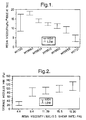
- oligomer content of the epoxy resin was investigated as follows:- The viscosity of various MY epoxy resin grades available from Ciba-Geigy were determined using a CARIMED viscometer at 50°C using a shear rate of 0.5 and the results are given in Figure 1.
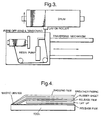
- Resin samples for rheological examination were taken and placed in a vacuum oven at 60°C for 30 min to remove acetone. The samples were then rheologically tested to determine the G'minimum.
- HPLC HPLC was used to examine some of the resins both before and after the reaction with the rubber. The results are given in Table 4.
- the figures in the rows are the areas of the peaks obtained using HPLC for the various components of the resins and they are proportional to the quantities of the resin components present.
- the large figures, eg 68.4 etc. represent the amount of monomer present: the figures in the rows above the monomer row are derived from remnant starting materials from which the monomer is made: and the figures in the rows below the monomer row are derived from oligomeric species that are present.
- Example 3 The procedure described in Example 3 was used to determine G' minimum for samples made using varying weights of NIPOL 1472 of differing molecular weights (determined using Gel Permeation Chromatography using tetrahydrofuran as the solvent phase and at 40°C and a polystyrene calibration curve). The results are listed in Table 5 below.
- NIPOL 1472 rubber (128.2og, 0.000706 mols, this weight includes 6.4wt% talc) and 950mls methylethylketone (MEK).
- MEK methylethylketone
- the reaction solution on cooling to room temperature, was poured into a large crystallising dish to allow the bulk of the MEK to evaporate off.
- the resultant blocked rubber was then leached with propan-2-ol to remove the excess phenylglycidylether. Finally, the blocked rubber was dried for 20 hours at 60°C in a vacuum oven. The degree of reaction (100% in this case) was assessed by titration as described above and by FTIR.
- the 20%, 40% and 55% blocked rubbers were obtained by a similar procedure.
- the temperature of the reaction flask raised by means of an oil bath to reflux the acetone. This temperature was then maintained for 2 hours following which the heat was switched off and the temperature was allowed to drop to 40°C.
- An Epon1001F/Epon 828 (50:50) epoxy mixture (48.00g) was then added. The temperature of the reaction flask was then allowed to cool to room temperature at which time DDS (68.00g) and DICY (10.00g) were added.
- the reaction mixture (DICY is insoluble in acetone) was allowed to stir for a further 10 to 15 minutes or until all the DDS was in solution. Finally a further amount of acetone was then added so that the resin solids content measured between 54%w/w and 60%w/w depending on the resin density.
- the temperature of the reaction mixture was raised to 50°C to aid solubility of the MY 9663 and Epon epoxy mixture in the acetone. Once solution was complete the heat was removed. Then DDS (68.00g) and DICY (10.00g) were added. The reaction mixture was allowed to stir at room temperature for 1/2 hour or until all the DDS was in solution. Acetone was then added to give the required resin solids content for prepregging (55%w/w - 60%w/w).
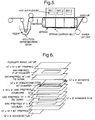
- the formulated resin solution (1 litre) was poured into a resin pump (see Figure 3) of a drumwinder.
- the drum on the drumwinder was set to a temperature of 55°C to ensure complete volatilisation of the solvent.
- Each run on the drumwinder produced 1m 2 of prepreg.
- Two runs were carried out for each of the formulated Samples 1/6 to 13/6.
- the following process conditions were utilised so that a resin content on the prepreg of between 35%w/w and 42%w/w (determined gravimetrically) was achieved:- Fibre Amoco T300 (12K).
- the appropriate number of plies were cut to size from the prepreg and laid up. The number of plies and their dimensions were dependant on the type of mechanical test to be performed.
- Transflexural Strength (TFS), Modulus, Tg determination, Short Beam Shear (SBS) and morphology required a test panel of 16 plies ( [0] 16 ) and dimensions of 6 inches by 4 inches (152.4mm by 101.6mm).
- Toughness (G 1c ) measurement required a test panel of 20 plies [0] 20 ) with dimensions of 14 inches by 6 inches (355.6mm by 152.4mm).
- the plies were laid up by sequentially ironing them together with an iron set at 50°C.
- Transflexural Strength was determined using test specimens obtained from a [0] 16 panel with a nominal thickness of 2mm. The specimen size used was 10mm x 70mm and these were cut using a diamond saw. The test was carried out on a Instron 6022 machine using a standard 3 point bend arrangement with a support span of 50mm and tested at a speed of 1mm/min. The stress to cause failure was recorded. An average of 8 samples was taken to give a final TFS value for each of the composite systems studied. Fracture surfaces were examined both visually, to check for fibre mis-orietation and by SEM to discover the nature of failure.
- Flexural Modulus was determined using test specimens were cut from a [0] 16 panel that had a nominal thickness of 2mm. The dimensions of the specimens were 140mm x 10mm. Testing was carried out on an Instron 6022 machine set up in 3 point bend mode with a support span of 100mm , thus giving a span to depth ratio of 50:1. The test was performed at a rate of 1mm/min. The test was manually stopped when the central deflection was equal to the specimen thickness(approx 2mm). An average of 4 specimens was taken as the final result.
- Short Beam Shear was determined using test specimens which were machined from a [0] 24 panel with a nominal thickness of 3mm.
- the specimen size used was 25mm x 10mm (0° in 25mm direction) and these were cut using a diamond saw.
- the test was carried out on a Instron 6022 testing machine with a three point bend set up using a support span of 15mm giving a span to depth ratio of 5:1.
- the test speed used was 1mm/min and an average of 8 samples was taken to give the final result. The mode of failure was also recorded.
- G 1c Testing was determined using panels used for this test were [0] 20 6inch x 14inch (152.4mm by 101.6mm) that had a crack starter (FEP - 0.02mm thick) 3inch x 6inch (76.2mm x 152.4mm) placed in between plies 10 and 11. Prior to testing the panels were C-scanned then samples were cut to a size of 1" ⁇ 14" for double cantilever beam testing. Specimens were precracked by loading them at a crosshead rate of 0.05inch/min until the crack reached a length of 1 inch beyond the FEP crack starter. Specimens were then tested at a rate of 0.05inch/min in tension. Results quoted are G 1c of propagation.
- Morphology was determined using [0] 16 unidirectional panels. Small samples of the composites were cut and mounted in cold-curing epoxy resin. These samples were then polished to a fine finish using a Buehler Metserv automatic polishing machine. To reveal the morphological structure samples were etched in a 1% w/v solution of KMnO 4 in "super acid" (which is a mixture of 5:5:2 by volume of conc. sulphuric acid: phosphoric acid : distilled water respectively). Samples were etched in this solution for 10 minutes then washed under flowing water for 30 mins. The samples were then cut from the mounting epoxy resin and attached to stubbs for SEM analysis. SEM samples were gold coated prior to analysis.
- Example 6 Certain of the formulations used in Example 6 were repeated using the methods described below and for convenience the same sample numbering is utilised.
- the rubber to be used was solvated in acetone.
- the rubber solution, MY9663 and ETPI were mixed for 10 minutes until homogeneous. This mixture was then heated to reflux (approx 57°C) and held for 2 hours. The solution had approximately 45% resin solids during the reflux. After the two hour reflux, the heating apparatus was removed and the Epon 828 and Epon 1001 F were added immediately to the solution. This was allowed to mix until the solid 1001 F had completely dissolved into the solution. With the solution mixed well and cooled to approaching room temperature, the DDS and DICY were added to the mixture. 0.01% by weight Aerosil 974 (fumed silica available from De Gussa) was also added at this point and allowed to mix until homogeneous. All additions to the solution are washed with acetone. The final solution had approx. 55% resin solids content. This was adjusted (as needed) during impregnation.
- Samples 2/6 and 8/6 were prepared using the process just described except that there was no reflux of the rubber solution and MY 9663 epoxy. The components were all simply added to the vessel and mixed at room temperature.
- Sample 4/6 was prepared similarly to Samples 2/6 and 8/6 except that there was no rubber added to the mix. The percent amounts of each component was altered somewhat to compensate for the 5% lost from the rubber as follows: MY9663 - 66.32; Epon 828 - 6.32; Epon 1001F - 6.32; DDS - 17.89; DICY - 2.63; ETPI - 0.53; Aerosil 974 - 0.05.
- the impregnated fabric was then transferred to the tape line and compacted under the following set of conditions: Line speed 35 inches per min (14.8mm/sec). 1 st Nip Temperature Room Temperature 1 st Nip Pressure 5psi (0.034MPa) Hot Plate Temperature 88°C 2 nd Nip Temperature 88°C 2 nd Nip Pressure 20psi (0.14MPa)
- compositions according to the invention perform surprisingly well in this test which is considered especially important in the aerospace industry since aerospace vehicles are frequently subjected to very low temperatures during flights.
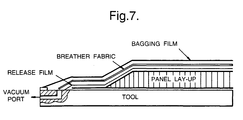
- a porosity panel was also prepared in which fabric was bonded to a honeycomb structure using the layup illustrated in Figure 6.
- the panel was consolidated by being placed into a bag, as illustrated in Figure 7, and autoclaved.
- the panels are sectioned into two equal halves from which a 1 inch (25.4mm) wide strip is then cut and mounted in epoxy resin.
- the specimen is then polished to a high surface finish and the number of pores along the length of the panel are counted using a light microscope. If any significant pores are observed, the panel is failed.
- Table 9 The results are given in Table 9.
Landscapes
- Chemical & Material Sciences (AREA)
- Health & Medical Sciences (AREA)
- Chemical Kinetics & Catalysis (AREA)
- Medicinal Chemistry (AREA)
- Polymers & Plastics (AREA)
- Organic Chemistry (AREA)
- Epoxy Resins (AREA)
- Reinforced Plastic Materials (AREA)
- Compositions Of Macromolecular Compounds (AREA)
- Macromonomer-Based Addition Polymer (AREA)
- Addition Polymer Or Copolymer, Post-Treatments, Or Chemical Modifications (AREA)
- Laminated Bodies (AREA)
- Sealing Material Composition (AREA)
Priority Applications (1)
| Application Number | Priority Date | Filing Date | Title |
|---|---|---|---|
| DK95921054T DK0764180T3 (da) | 1995-06-06 | 1995-06-06 | Hærdbare sammensætninger |
Applications Claiming Priority (3)
| Application Number | Priority Date | Filing Date | Title |
|---|---|---|---|
| GB9411367 | 1994-06-07 | ||
| GB9411367A GB9411367D0 (en) | 1994-06-07 | 1994-06-07 | Curable Composites |
| PCT/GB1995/001303 WO1995033785A1 (en) | 1994-06-07 | 1995-06-06 | Curable compositions |
Publications (3)
| Publication Number | Publication Date |
|---|---|
| EP0764180A1 EP0764180A1 (en) | 1997-03-26 |
| EP0764180B1 EP0764180B1 (en) | 2004-08-11 |
| EP0764180B9 true EP0764180B9 (en) | 2005-03-02 |
Family
ID=10756315
Family Applications (1)
| Application Number | Title | Priority Date | Filing Date |
|---|---|---|---|
| EP95921054A Expired - Lifetime EP0764180B9 (en) | 1994-06-07 | 1995-06-06 | Curable compositions |
Country Status (12)
| Country | Link |
|---|---|
| US (2) | US6013730A (enExample) |
| EP (1) | EP0764180B9 (enExample) |
| JP (1) | JP4397970B2 (enExample) |
| KR (1) | KR100341666B1 (enExample) |
| AT (1) | ATE273337T1 (enExample) |
| AU (1) | AU689902B2 (enExample) |
| CA (1) | CA2192368C (enExample) |
| DE (1) | DE69533358T2 (enExample) |
| ES (1) | ES2227549T3 (enExample) |
| GB (1) | GB9411367D0 (enExample) |
| MX (1) | MX9606181A (enExample) |
| WO (1) | WO1995033785A1 (enExample) |
Families Citing this family (98)
| Publication number | Priority date | Publication date | Assignee | Title |
|---|---|---|---|---|
| WO2001032779A1 (en) * | 1999-11-04 | 2001-05-10 | Cytec Technology Corp | Variable temperature curable composition |
| EP1355782A4 (en) * | 2000-12-22 | 2004-04-21 | Avery Dennison Corp | ADAPTABLE FILMS AND ARTICLES MADE THEREFROM |
| US7473715B2 (en) | 2001-05-02 | 2009-01-06 | Zephyros, Inc. | Two component (epoxy/amine) structural foam-in-place material |
| US6887914B2 (en) | 2001-09-07 | 2005-05-03 | L&L Products, Inc. | Structural hot melt material and methods |
| US6774171B2 (en) | 2002-01-25 | 2004-08-10 | L&L Products, Inc. | Magnetic composition |
| US6713535B2 (en) * | 2002-02-28 | 2004-03-30 | Turbine Controls, Inc. | Low-friction chromate-free coating of epoxy resins and sulfonyldianiline |
| US6846559B2 (en) | 2002-04-01 | 2005-01-25 | L&L Products, Inc. | Activatable material |
| EP1359005B1 (de) * | 2002-05-02 | 2006-01-25 | Bayer MaterialScience AG | Sandwichelemente und ihre Verwendung |
| US20040039106A1 (en) * | 2002-06-27 | 2004-02-26 | Man Aren Joost De | Conformable calendered films and articles made therefrom |
| US20040204551A1 (en) * | 2003-03-04 | 2004-10-14 | L&L Products, Inc. | Epoxy/elastomer adduct, method of forming same and materials and articles formed therewith |
| US7208228B2 (en) * | 2003-04-23 | 2007-04-24 | Toray Composites (America), Inc. | Epoxy resin for fiber reinforced composite materials |
| US7125461B2 (en) | 2003-05-07 | 2006-10-24 | L & L Products, Inc. | Activatable material for sealing, baffling or reinforcing and method of forming same |
| US7199165B2 (en) | 2003-06-26 | 2007-04-03 | L & L Products, Inc. | Expandable material |
| US8070994B2 (en) | 2004-06-18 | 2011-12-06 | Zephyros, Inc. | Panel structure |
| US7521093B2 (en) | 2004-07-21 | 2009-04-21 | Zephyros, Inc. | Method of sealing an interface |
| CN103012820B (zh) | 2005-05-09 | 2016-06-08 | Cytec技术有限公司 | 用于复合材料的树脂可溶的热塑性遮盖物 |
| DE102006007108B4 (de) * | 2006-02-16 | 2020-09-17 | Lohmann Gmbh & Co. Kg | Reaktive Harzmischung und Verfahren zu deren Herstellung |
| US7438782B2 (en) | 2006-06-07 | 2008-10-21 | Zephyros, Inc. | Activatable material for sealing, baffling or reinforcing and method of forming same |
| KR20100017712A (ko) * | 2007-05-09 | 2010-02-16 | 다우 글로벌 테크놀로지스 인크. | 과잉 에폭시 수지를 포함하는 에폭시 열경화성 조성물 및 이의 제조 방법 |
| CO6030030A1 (es) * | 2007-05-23 | 2009-04-30 | Mi Llc | Uso de emulsiones epoxicas inversas para estabilizacion de orificio de pozo |
| AR063176A1 (es) * | 2007-05-23 | 2008-12-30 | Mi Llc | Uso de emulsiones epoxicas directas para la estabilizacion de perforaciones de pozos |
| EP2152773A1 (en) * | 2007-05-29 | 2010-02-17 | Dow Global Technologies Inc. | Isocyanate-epoxy formulations for improved cure control |
| JP5336485B2 (ja) * | 2007-08-02 | 2013-11-06 | ダウ グローバル テクノロジーズ エルエルシー | 熱硬化性ポリマーの性能を向上させるための両親媒性ブロックコポリマーおよび無機ナノフィラー |
| TW200922959A (en) * | 2007-10-26 | 2009-06-01 | Dow Global Technologies Inc | Epoxy resin composition containing isocyanurates for use in electrical laminates |
| CN101878101A (zh) * | 2007-11-29 | 2010-11-03 | 陶氏环球技术公司 | 可微波加热的单乙烯基芳族聚合物 |
| ATE509053T1 (de) * | 2007-11-29 | 2011-05-15 | Dow Global Technologies Llc | Dimethylformamidfreie formulierungen mit dicyanadiamid als härtemittel für wärmehärtende epoxidharze |
| EP2229416B1 (en) * | 2008-01-08 | 2018-04-04 | Dow Global Technologies LLC | High tg epoxy systems for composite application |
| GB0806434D0 (en) | 2008-04-09 | 2008-05-14 | Zephyros Inc | Improvements in or relating to structural adhesives |
| CN101998970B (zh) | 2008-04-14 | 2013-12-18 | 陶氏环球技术公司 | 用于粉末涂料应用的环氧-咪唑催化剂 |
| JP2012501335A (ja) * | 2008-08-28 | 2012-01-19 | ダウ グローバル テクノロジーズ エルエルシー | リン含有化合物およびそれを含むポリマー組成物 |
| SG172201A1 (en) | 2008-12-16 | 2011-07-28 | Dow Global Technologies Llc | Homogeneous bismaleimide - triazine - epoxy compositions useful for the manufacture of electrical laminates |
| US20110224329A1 (en) * | 2009-01-06 | 2011-09-15 | Dow Global Technologies Llc | Metal stabilizers for epoxy resins and dispersion process |
| CN102325821A (zh) | 2009-02-24 | 2012-01-18 | 陶氏环球技术有限责任公司 | 可固化环氧树脂组合物及其固化产物 |
| KR20120036887A (ko) | 2009-05-27 | 2012-04-18 | 다우 글로벌 테크놀로지스 엘엘씨 | 중합체성 글리시딜 에테르 반응성 희석제 |
| US8846818B2 (en) | 2009-05-29 | 2014-09-30 | Cytec Technology Corp. | Engineered cross-linked thermoplastic particles for interlaminar toughening |
| KR20120040153A (ko) | 2009-06-22 | 2012-04-26 | 다우 글로벌 테크놀로지스 엘엘씨 | 에폭시 수지용 경화제 조성물 |
| GB0916205D0 (en) | 2009-09-15 | 2009-10-28 | Zephyros Inc | Improvements in or relating to cavity filling |
| EP2480586B1 (en) | 2009-09-22 | 2014-11-12 | Dow Global Technologies LLC | Process for preparing episulfide resins |
| WO2011037895A1 (en) | 2009-09-25 | 2011-03-31 | Dow Global Technologies Llc | Curable epoxy resin compositions and composites made therefrom |
| BR112012006361A2 (pt) | 2009-09-30 | 2019-09-24 | Dow Global Technologies Inc | composição de resina epóxl, processo para reduzir uma composição de resina epóxl de baixa coloração e composição de resina epóxi de baixa coloração curável |
| BR112012010870A2 (pt) | 2009-11-12 | 2019-09-24 | Dow Global Technologies Inc | composição de resina de oxazolidona com funcionalidade epóxi,composição de resina epóxi curável ,processo para reparar uma composição de resina de oxazolodona com funcionalidadde epóxi,processo para preparar uma composição de resina epóxi curável e produto termofixo curado |
| EP2507283B1 (en) | 2009-12-02 | 2013-10-23 | Dow Global Technologies LLC | Epoxy resin compositions |
| SG181485A1 (en) | 2009-12-02 | 2012-07-30 | Dow Global Technologies Llc | Composite compositions |
| SG181486A1 (en) | 2009-12-02 | 2012-07-30 | Dow Global Technologies Llc | Coating compositions |
| EP2507284A1 (en) | 2009-12-03 | 2012-10-10 | Dow Global Technologies LLC | Adducts based on divinylarene oxides |
| WO2011071650A1 (en) | 2009-12-08 | 2011-06-16 | Dow Global Technologies Llc | Hydroxyl-functional polyester resins |
| BR112012013527A2 (pt) | 2009-12-09 | 2016-08-02 | Dow Global Technologies Llc | composição de resina epóxi, composição de resina epóxi curável e processo para preparar uma composição de resina epóxi |
| KR20120104590A (ko) | 2009-12-09 | 2012-09-21 | 다우 글로벌 테크놀로지스 엘엘씨 | 다이비닐아렌 다이옥사이드 수지 |
| WO2011097009A2 (en) | 2010-02-02 | 2011-08-11 | Dow Global Technologies Llc | Curable epoxy resin compositions |
| JP2013521163A (ja) | 2010-03-04 | 2013-06-10 | ゼフィロス インコーポレイテッド | 構造複合積層品 |
| EP2550310B1 (en) | 2010-03-24 | 2018-05-02 | Blue Cube IP LLC | Epoxy resin compositions comprising poly(propylene oxide) polyol as toughening agent |
| TWI506010B (zh) | 2010-05-21 | 2015-11-01 | Dow Global Technologies Llc | 用於可熱固樹脂組成物之硬化劑 |
| EP2585520A2 (en) | 2010-06-25 | 2013-05-01 | Dow Global Technologies LLC | Polymer concrete composition |
| EP2585512A2 (en) | 2010-06-25 | 2013-05-01 | Dow Global Technologies LLC | Curable epoxy resin compositions and composites made therefrom |
| US8633293B2 (en) * | 2010-11-30 | 2014-01-21 | GM Global Technology Operations LLC | Self-repairing polymer |
| KR20140007815A (ko) * | 2010-12-22 | 2014-01-20 | 사이텍 테크놀러지 코포레이션 | 프리프레그 및 구조 부재 이용분야에 사용되는 불용성 및 부분 용해성 또는 팽창성 강인화 입자를 함유하는 에폭시 수지계 |
| GB201101302D0 (en) | 2011-01-25 | 2011-03-09 | Cytec Tech Corp | Benzoxazine resins |
| RU2013152319A (ru) | 2011-04-26 | 2015-06-10 | ДАУ ГЛОБАЛ ТЕКНОЛОДЖИЗ ЭлЭлСи | Отверждаемые композиции |
| GB201113196D0 (en) | 2011-08-01 | 2011-09-14 | Cytec Tech Corp | Thermoset resin compositions with increased toughness |
| WO2013025304A2 (en) | 2011-08-18 | 2013-02-21 | Dow Global Technologies Llc | Curable resin compositions |
| CN103732659B (zh) | 2011-08-18 | 2017-03-08 | 蓝立方知识产权公司 | 可固化树脂组合物 |
| IN2014CN03362A (enExample) | 2011-11-08 | 2015-07-03 | Dow Global Technologies Llc | |
| US8895148B2 (en) | 2011-11-09 | 2014-11-25 | Cytec Technology Corp. | Structural adhesive and bonding application thereof |
| EP2785762A2 (en) | 2011-12-01 | 2014-10-08 | Dow Global Technologies LLC | Liquid accelerator composition for hardeners |
| GB201122296D0 (en) | 2011-12-23 | 2012-02-01 | Cytec Tech Corp | Composite materials |
| CA2861797A1 (en) | 2011-12-30 | 2013-07-04 | Dow Global Technologies Llc | Low temperature curable epoxy system |
| US20130196155A1 (en) | 2012-02-01 | 2013-08-01 | Ut-Battelle, Llc | Apparatus and process for the surface treatment of carbon fibers |
| US9365685B2 (en) | 2012-02-28 | 2016-06-14 | Ut-Battelle, Llc | Method of improving adhesion of carbon fibers with a polymeric matrix |
| WO2013155061A1 (en) | 2012-04-09 | 2013-10-17 | M-I L.L.C. | Triggered heating of wellbore fluids by carbon nanomaterials |
| KR101477353B1 (ko) * | 2012-11-09 | 2014-12-29 | 주식회사 두산 | 수지 조성물 및 이를 포함하는 인쇄 회로 기판용 적층체 |
| WO2014078095A2 (en) | 2012-11-15 | 2014-05-22 | Cytec Industries Inc. | Thermoset resin composite materials comprising inter-laminar toughening particles |
| RU2015128263A (ru) | 2012-12-14 | 2017-01-23 | БЛЮ КЬЮБ АйПи ЭлЭлСи | Отверждаемые композиции |
| CN105143301A (zh) | 2012-12-14 | 2015-12-09 | 蓝立方知识产权有限责任公司 | 改性环氧树脂 |
| WO2014197829A1 (en) | 2013-06-06 | 2014-12-11 | Halliburton Energy Services, Inc. | Deformable plug and seal well system |
| JP6426163B2 (ja) * | 2013-07-03 | 2018-11-21 | ローディア オペレーションズ | 硬化性組成物およびエポキシ熱硬化性樹脂の製造方法 |
| EP2829570A1 (en) | 2013-07-22 | 2015-01-28 | Rhodia Operations | Curable composition and process for the manufacture of an epoxy thermoset |
| CN105722933A (zh) | 2013-07-26 | 2016-06-29 | 泽费罗斯股份有限公司 | 热固性粘合膜的改进或涉及它的改进 |
| US9617398B2 (en) | 2013-12-16 | 2017-04-11 | Ut-Battelle, Llc | Multifunctional curing agents and their use in improving strength of composites containing carbon fibers embedded in a polymeric matrix |
| WO2015130375A2 (en) | 2013-12-23 | 2015-09-03 | Cytec Industries Inc. | Toughened composite materials and methods of manufacturing thereof |
| CN106164125B (zh) * | 2014-02-24 | 2020-08-07 | Sika技术股份公司 | 在低voc应用中用作环氧树脂的固化剂的基于呋喃的胺 |
| WO2016053641A1 (en) | 2014-09-29 | 2016-04-07 | Blue Cube Ip Llc | Adduct composition |
| US11104791B2 (en) | 2014-10-10 | 2021-08-31 | Dow Global Technologies Llc | Surfactant composition |
| GB201417985D0 (en) | 2014-10-10 | 2014-11-26 | Zephyros Inc | Improvements in or relating to structural adhesives |
| WO2016176568A1 (en) | 2015-04-30 | 2016-11-03 | Blue Cube Ip Llc | Hardener composition |
| GB201509292D0 (en) | 2015-05-29 | 2015-07-15 | Cytec Ind Inc | Process for preparing moulded articles from fibre-reinforced composite materials - II |
| GB201509294D0 (en) | 2015-05-29 | 2015-07-15 | Cytec Ind Inc | Process for preparing moulded articles from fibre-reinforced composite materials - I |
| US20190001593A1 (en) | 2016-01-04 | 2019-01-03 | Dow Global Technologies Llc | Fiber composites with reduced surface roughness and methods for making them |
| EP3585607B1 (en) | 2017-02-26 | 2021-12-15 | Dow Global Technologies, LLC | Fiber composite with reduced surface roughness and method for its manufacture |
| US20200190390A1 (en) | 2017-08-15 | 2020-06-18 | Covestro Llc | Additive to flexibilize epoxy-based resins for use in oil field applications |
| US11827757B2 (en) | 2018-02-20 | 2023-11-28 | Ut-Battelle, Llc | Carbon fiber-nanoparticle composites with electromechanical properties |
| US12091510B2 (en) | 2018-04-10 | 2024-09-17 | Lg Chem, Ltd. | Thermosetting resin composite and metal clad laminate using the same |
| US20190390063A1 (en) | 2018-06-22 | 2019-12-26 | Covestro Llc | Solventborne compositions containing organic ion-exchangers to improve corrosion resistance |
| US20190390066A1 (en) | 2018-06-22 | 2019-12-26 | Covestro Llc | Waterborne compositions containing inorganic ion-exchangers to improve corrosion resistance |
| US12540254B2 (en) | 2018-06-22 | 2026-02-03 | Ennis-Flint, Inc. | Epoxy compositions and methods of use |
| US20190390064A1 (en) | 2018-06-22 | 2019-12-26 | Covestro Llc | Solventborne compositions containing inorganic ion-exchangers to improve corrosion resistance |
| US20190390065A1 (en) | 2018-06-22 | 2019-12-26 | Covestro Llc | Waterborne compositions containing organic ion-exchangers to improve corrosion resistance |
| WO2020005393A1 (en) | 2018-06-26 | 2020-01-02 | Dow Global Technologies Llc | Fibre-reinforced composite and process of making this composite |
| EP4551635A2 (en) | 2022-07-08 | 2025-05-14 | Zephyros, Inc. | Storage-stable solid rubber epoxy adduct |
Family Cites Families (17)
| Publication number | Priority date | Publication date | Assignee | Title |
|---|---|---|---|---|
| JPS6039286B2 (ja) | 1980-07-11 | 1985-09-05 | 東邦レーヨン株式会社 | プリプレグ |
| JPS5883032A (ja) | 1981-11-13 | 1983-05-18 | Toho Rayon Co Ltd | エポキシ樹脂含浸プリプレグ |
| JPS5883022A (ja) | 1981-11-13 | 1983-05-18 | Toho Rayon Co Ltd | エポキシ樹脂組成物 |
| JPS58120639A (ja) * | 1982-01-14 | 1983-07-18 | Toho Rayon Co Ltd | 高伸度かつ耐熱性コンポジツト用プリプレグ |
| JPS58183723A (ja) * | 1982-04-21 | 1983-10-27 | Toho Rayon Co Ltd | エポキシ樹脂組成物 |
| JPS58206624A (ja) | 1982-05-26 | 1983-12-01 | Sumitomo Bakelite Co Ltd | エポキシ樹脂組成物 |
| JPS59207918A (ja) | 1983-05-12 | 1984-11-26 | Toho Rayon Co Ltd | エポキシ樹脂組成物 |
| US4550129A (en) * | 1983-05-12 | 1985-10-29 | The United States Of America As Represented By The Administrator Of The National Aeronautics And Space Administration | Toughening reinforced epoxy composites with brominated polymeric additives |
| JPS59207919A (ja) | 1983-05-12 | 1984-11-26 | Toho Rayon Co Ltd | 高伸度エポキシ樹脂組成物 |
| US4539253A (en) | 1984-03-30 | 1985-09-03 | American Cyanamid Co. | High impact strength fiber resin matrix composites |
| US5025068A (en) | 1986-04-14 | 1991-06-18 | Hughes Aircraft Company | Reacting novolac and bisphenol F epoxy resins with carboxy-terminated butadiene-acrylonitrile |
| JPS62246923A (ja) | 1986-04-18 | 1987-10-28 | Mitsubishi Chem Ind Ltd | 炭素繊維複合材料用樹脂組成物 |
| JPS6466282A (ja) | 1987-09-08 | 1989-03-13 | 新興化学工業株式会社 | 電子部品接合用接着剤組成物 |
| DE3829662A1 (de) * | 1988-09-01 | 1990-03-15 | Basf Ag | Epoxidharzmischungen fuer faserverbundwerkstoffe |
| JPH03205420A (ja) | 1990-01-08 | 1991-09-06 | Mitsubishi Kasei Corp | 繊維強化プラスチック用エポキシ樹脂組成物 |
| DE4122450A1 (de) | 1991-06-12 | 1992-12-17 | Beiersdorf Ag | Reaktiver warmschmelzklebstoff |
| DE4217509A1 (de) * | 1992-05-27 | 1993-12-02 | Basf Ag | Epoxidharzmischungen |
-
1994
- 1994-06-07 GB GB9411367A patent/GB9411367D0/en not_active Ceased
-
1995
- 1995-06-06 AT AT95921054T patent/ATE273337T1/de active
- 1995-06-06 JP JP50056196A patent/JP4397970B2/ja not_active Expired - Lifetime
- 1995-06-06 AU AU26256/95A patent/AU689902B2/en not_active Expired
- 1995-06-06 CA CA002192368A patent/CA2192368C/en not_active Expired - Lifetime
- 1995-06-06 EP EP95921054A patent/EP0764180B9/en not_active Expired - Lifetime
- 1995-06-06 DE DE69533358T patent/DE69533358T2/de not_active Expired - Lifetime
- 1995-06-06 WO PCT/GB1995/001303 patent/WO1995033785A1/en not_active Ceased
- 1995-06-06 KR KR1019960706977A patent/KR100341666B1/ko not_active Expired - Lifetime
- 1995-06-06 US US08/750,394 patent/US6013730A/en not_active Expired - Lifetime
- 1995-06-06 ES ES95921054T patent/ES2227549T3/es not_active Expired - Lifetime
-
1996
- 1996-12-06 MX MX9606181A patent/MX9606181A/es not_active IP Right Cessation
-
1999
- 1999-07-20 US US09/357,801 patent/US6242083B1/en not_active Expired - Lifetime
Also Published As
| Publication number | Publication date |
|---|---|
| DE69533358D1 (de) | 2004-09-16 |
| ES2227549T3 (es) | 2005-04-01 |
| AU2625695A (en) | 1996-01-04 |
| US6013730A (en) | 2000-01-11 |
| CA2192368C (en) | 2007-11-20 |
| JPH10501020A (ja) | 1998-01-27 |
| EP0764180A1 (en) | 1997-03-26 |
| EP0764180B1 (en) | 2004-08-11 |
| KR100341666B1 (ko) | 2003-01-14 |
| ATE273337T1 (de) | 2004-08-15 |
| AU689902B2 (en) | 1998-04-09 |
| US6242083B1 (en) | 2001-06-05 |
| JP4397970B2 (ja) | 2010-01-13 |
| KR970703378A (ko) | 1997-07-03 |
| CA2192368A1 (en) | 1995-12-14 |
| MX9606181A (es) | 1998-06-30 |
| WO1995033785A1 (en) | 1995-12-14 |
| DE69533358T2 (de) | 2004-12-30 |
| GB9411367D0 (en) | 1994-07-27 |
Similar Documents
| Publication | Publication Date | Title |
|---|---|---|
| EP0764180B1 (en) | Curable compositions | |
| EP1297048B1 (en) | Low moisture absorption epoxy resin systems | |
| EP1275674B1 (en) | Epoxy resin composition and prepreg made with the epoxy resin composition | |
| US4962162A (en) | Resin composition of thermosetting resin and thermoplastic resin | |
| CN102099402B (zh) | 具有改善的韧性的结构复合材料 | |
| EP2794735B1 (en) | Improvements in or relating to fibre reinforced composites | |
| AU2001266730A1 (en) | Low moisture absorption epoxy resin systems | |
| JPWO2001081445A1 (ja) | エポキシ樹脂組成物及び該エポキシ樹脂組成物を使用したプリプレグ | |
| EP3409706B1 (en) | Epoxy resin composition, prepreg and fiber reinforced composite material | |
| NO335443B1 (no) | Harpiksbindemiddelsammensetning for produksjon av en fiberpreform, fremgangsmåte for preformproduksjon og fremgangsmåte for utvelgelse eller blanding av harpikssammensetningen | |
| JPWO2019167579A1 (ja) | 熱硬化性樹脂組成物、プリプレグおよび繊維強化複合材料 | |
| JP4821163B2 (ja) | 繊維強化複合材料用エポキシ樹脂組成物 | |
| JPH02113031A (ja) | 繊維複合材料用エポキシ樹脂混合物 | |
| JP4857587B2 (ja) | 繊維強化複合材料用エポキシ樹脂組成物 | |
| WO2020217894A1 (ja) | エポキシ樹脂組成物、中間基材および繊維強化複合材料 | |
| USH1542H (en) | Fiber-reinforced composites | |
| JP5017794B2 (ja) | 繊維強化複合材料用エポキシ樹脂組成物 | |
| WO2021074684A1 (en) | Flame retardant epoxy resin composition | |
| JP2006291094A (ja) | 繊維強化複合材料用エポキシ樹脂組成物 | |
| JP2003055534A (ja) | 複合材料用樹脂組成物、複合材料用中間材および複合材料 | |
| JP2006335791A (ja) | エポキシ樹脂組成物、およびそれを含むプリプレグ | |
| JPS6360056B2 (enExample) | ||
| JPH03281635A (ja) | プリプレグ用樹脂組成物 | |
| EP0636472A1 (en) | Fibre-reinforced composites | |
| Biermann et al. | Development of a heterogeneous laminating resin system |
Legal Events
| Date | Code | Title | Description |
|---|---|---|---|
| PUAI | Public reference made under article 153(3) epc to a published international application that has entered the european phase |
Free format text: ORIGINAL CODE: 0009012 |
|
| 17P | Request for examination filed |
Effective date: 19961218 |
|
| AK | Designated contracting states |
Kind code of ref document: A1 Designated state(s): AT BE CH DE DK ES FR GB GR IE IT LI LU MC NL PT SE |
|
| RAP1 | Party data changed (applicant data changed or rights of an application transferred) |
Owner name: CYTEC TECHNOLOGY CORP. |
|
| 17Q | First examination report despatched |
Effective date: 20000831 |
|
| GRAP | Despatch of communication of intention to grant a patent |
Free format text: ORIGINAL CODE: EPIDOSNIGR1 |
|
| GRAS | Grant fee paid |
Free format text: ORIGINAL CODE: EPIDOSNIGR3 |
|
| GRAA | (expected) grant |
Free format text: ORIGINAL CODE: 0009210 |
|
| AK | Designated contracting states |
Kind code of ref document: B1 Designated state(s): AT BE CH DE DK ES FR GB GR IE IT LI LU MC NL PT SE |
|
| REG | Reference to a national code |
Ref country code: GB Ref legal event code: FG4D |
|
| REG | Reference to a national code |
Ref country code: CH Ref legal event code: EP |
|
| REG | Reference to a national code |
Ref country code: IE Ref legal event code: FG4D |
|
| REG | Reference to a national code |
Ref country code: CH Ref legal event code: NV Representative=s name: A. BRAUN, BRAUN, HERITIER, ESCHMANN AG PATENTANWAE |
|
| REF | Corresponds to: |
Ref document number: 69533358 Country of ref document: DE Date of ref document: 20040916 Kind code of ref document: P |
|
| REG | Reference to a national code |
Ref country code: SE Ref legal event code: TRGR |
|
| REG | Reference to a national code |
Ref country code: DK Ref legal event code: T3 |
|
| PG25 | Lapsed in a contracting state [announced via postgrant information from national office to epo] |
Ref country code: GR Free format text: LAPSE BECAUSE OF FAILURE TO SUBMIT A TRANSLATION OF THE DESCRIPTION OR TO PAY THE FEE WITHIN THE PRESCRIBED TIME-LIMIT Effective date: 20041111 |
|
| ET | Fr: translation filed | ||
| REG | Reference to a national code |
Ref country code: ES Ref legal event code: FG2A Ref document number: 2227549 Country of ref document: ES Kind code of ref document: T3 |
|
| PG25 | Lapsed in a contracting state [announced via postgrant information from national office to epo] |
Ref country code: LU Free format text: LAPSE BECAUSE OF NON-PAYMENT OF DUE FEES Effective date: 20050606 |
|
| PLBE | No opposition filed within time limit |
Free format text: ORIGINAL CODE: 0009261 |
|
| STAA | Information on the status of an ep patent application or granted ep patent |
Free format text: STATUS: NO OPPOSITION FILED WITHIN TIME LIMIT |
|
| PG25 | Lapsed in a contracting state [announced via postgrant information from national office to epo] |
Ref country code: MC Free format text: LAPSE BECAUSE OF NON-PAYMENT OF DUE FEES Effective date: 20050630 |
|
| 26N | No opposition filed |
Effective date: 20050512 |
|
| PGFP | Annual fee paid to national office [announced via postgrant information from national office to epo] |
Ref country code: DK Payment date: 20060510 Year of fee payment: 12 |
|
| PGFP | Annual fee paid to national office [announced via postgrant information from national office to epo] |
Ref country code: BE Payment date: 20060629 Year of fee payment: 12 |
|
| BERE | Be: lapsed |
Owner name: *CYTEC TECHNOLOGY CORP. Effective date: 20070630 |
|
| PG25 | Lapsed in a contracting state [announced via postgrant information from national office to epo] |
Ref country code: PT Free format text: LAPSE BECAUSE OF NON-PAYMENT OF DUE FEES Effective date: 20050111 |
|
| REG | Reference to a national code |
Ref country code: DK Ref legal event code: EBP |
|
| PG25 | Lapsed in a contracting state [announced via postgrant information from national office to epo] |
Ref country code: BE Free format text: LAPSE BECAUSE OF NON-PAYMENT OF DUE FEES Effective date: 20070630 |
|
| REG | Reference to a national code |
Ref country code: CH Ref legal event code: PFA Owner name: CYTEC TECHNOLOGY CORP. Free format text: CYTEC TECHNOLOGY CORP.#1105 NORTH MARKET STREET#WILMINGTON, DELAWARE 19801 (US) -TRANSFER TO- CYTEC TECHNOLOGY CORP.#1105 NORTH MARKET STREET#WILMINGTON, DELAWARE 19801 (US) |
|
| PG25 | Lapsed in a contracting state [announced via postgrant information from national office to epo] |
Ref country code: DK Free format text: LAPSE BECAUSE OF NON-PAYMENT OF DUE FEES Effective date: 20070702 |
|
| REG | Reference to a national code |
Ref country code: CH Ref legal event code: PCAR Free format text: NEW ADDRESS: HOLBEINSTRASSE 36-38, 4051 BASEL (CH) |
|
| PGFP | Annual fee paid to national office [announced via postgrant information from national office to epo] |
Ref country code: GB Payment date: 20140604 Year of fee payment: 20 Ref country code: IE Payment date: 20140610 Year of fee payment: 20 |
|
| PGFP | Annual fee paid to national office [announced via postgrant information from national office to epo] |
Ref country code: CH Payment date: 20140612 Year of fee payment: 20 Ref country code: ES Payment date: 20140513 Year of fee payment: 20 Ref country code: SE Payment date: 20140611 Year of fee payment: 20 Ref country code: DE Payment date: 20140603 Year of fee payment: 20 Ref country code: AT Payment date: 20140528 Year of fee payment: 20 Ref country code: IT Payment date: 20140606 Year of fee payment: 20 |
|
| PGFP | Annual fee paid to national office [announced via postgrant information from national office to epo] |
Ref country code: NL Payment date: 20140610 Year of fee payment: 20 |
|
| PGFP | Annual fee paid to national office [announced via postgrant information from national office to epo] |
Ref country code: FR Payment date: 20140609 Year of fee payment: 20 |
|
| REG | Reference to a national code |
Ref country code: DE Ref legal event code: R071 Ref document number: 69533358 Country of ref document: DE |
|
| REG | Reference to a national code |
Ref country code: CH Ref legal event code: PL |
|
| REG | Reference to a national code |
Ref country code: NL Ref legal event code: V4 Effective date: 20150606 |
|
| REG | Reference to a national code |
Ref country code: GB Ref legal event code: PE20 Expiry date: 20150605 |
|
| REG | Reference to a national code |
Ref country code: AT Ref legal event code: MK07 Ref document number: 273337 Country of ref document: AT Kind code of ref document: T Effective date: 20150606 |
|
| REG | Reference to a national code |
Ref country code: IE Ref legal event code: MK9A |
|
| PG25 | Lapsed in a contracting state [announced via postgrant information from national office to epo] |
Ref country code: GB Free format text: LAPSE BECAUSE OF EXPIRATION OF PROTECTION Effective date: 20150605 |
|
| REG | Reference to a national code |
Ref country code: SE Ref legal event code: EUG |
|
| REG | Reference to a national code |
Ref country code: ES Ref legal event code: FD2A Effective date: 20150925 |
|
| PG25 | Lapsed in a contracting state [announced via postgrant information from national office to epo] |
Ref country code: ES Free format text: LAPSE BECAUSE OF EXPIRATION OF PROTECTION Effective date: 20150607 Ref country code: IE Free format text: LAPSE BECAUSE OF EXPIRATION OF PROTECTION Effective date: 20150606 |