EP0759552B1 - Stickstoffoxidsensor - Google Patents
Stickstoffoxidsensor Download PDFInfo
- Publication number
- EP0759552B1 EP0759552B1 EP96905004A EP96905004A EP0759552B1 EP 0759552 B1 EP0759552 B1 EP 0759552B1 EP 96905004 A EP96905004 A EP 96905004A EP 96905004 A EP96905004 A EP 96905004A EP 0759552 B1 EP0759552 B1 EP 0759552B1
- Authority
- EP
- European Patent Office
- Prior art keywords
- electrode
- electromotive force
- nox
- mno
- sensor
- Prior art date
- Legal status (The legal status is an assumption and is not a legal conclusion. Google has not performed a legal analysis and makes no representation as to the accuracy of the status listed.)
- Expired - Lifetime
Links
- MWUXSHHQAYIFBG-UHFFFAOYSA-N Nitric oxide Chemical compound O=[N] MWUXSHHQAYIFBG-UHFFFAOYSA-N 0.000 title 3
- QVGXLLKOCUKJST-UHFFFAOYSA-N atomic oxygen Chemical compound [O] QVGXLLKOCUKJST-UHFFFAOYSA-N 0.000 claims description 22
- 239000001301 oxygen Substances 0.000 claims description 22
- 229910052760 oxygen Inorganic materials 0.000 claims description 22
- 239000007784 solid electrolyte Substances 0.000 claims description 20
- 239000007789 gas Substances 0.000 claims description 18
- 239000000463 material Substances 0.000 claims description 5
- 229910010382 TiMn2 Inorganic materials 0.000 claims description 4
- 229910017925 MgMn2O4 Inorganic materials 0.000 claims description 3
- 229910001308 Zinc ferrite Inorganic materials 0.000 claims description 3
- NNGHIEIYUJKFQS-UHFFFAOYSA-L hydroxy(oxo)iron;zinc Chemical compound [Zn].O[Fe]=O.O[Fe]=O NNGHIEIYUJKFQS-UHFFFAOYSA-L 0.000 claims description 3
- 238000006243 chemical reaction Methods 0.000 description 10
- 239000000126 substance Substances 0.000 description 10
- MCMNRKCIXSYSNV-UHFFFAOYSA-N Zirconium dioxide Chemical compound O=[Zr]=O MCMNRKCIXSYSNV-UHFFFAOYSA-N 0.000 description 8
- 230000007423 decrease Effects 0.000 description 8
- 239000007772 electrode material Substances 0.000 description 8
- 238000012360 testing method Methods 0.000 description 8
- 229910002651 NO3 Inorganic materials 0.000 description 5
- NHNBFGGVMKEFGY-UHFFFAOYSA-N Nitrate Chemical compound [O-][N+]([O-])=O NHNBFGGVMKEFGY-UHFFFAOYSA-N 0.000 description 5
- 230000035945 sensitivity Effects 0.000 description 5
- 230000003197 catalytic effect Effects 0.000 description 4
- 238000002485 combustion reaction Methods 0.000 description 4
- 230000000052 comparative effect Effects 0.000 description 4
- 150000002500 ions Chemical class 0.000 description 4
- 238000000034 method Methods 0.000 description 4
- 239000000203 mixture Substances 0.000 description 4
- VWDWKYIASSYTQR-UHFFFAOYSA-N sodium nitrate Chemical compound [Na+].[O-][N+]([O-])=O VWDWKYIASSYTQR-UHFFFAOYSA-N 0.000 description 4
- 229910052727 yttrium Inorganic materials 0.000 description 4
- 238000003487 electrochemical reaction Methods 0.000 description 3
- 229910052742 iron Inorganic materials 0.000 description 3
- 229910052748 manganese Inorganic materials 0.000 description 3
- 238000005259 measurement Methods 0.000 description 3
- 230000008018 melting Effects 0.000 description 3
- 238000002844 melting Methods 0.000 description 3
- 150000002823 nitrates Chemical class 0.000 description 3
- 150000002826 nitrites Chemical class 0.000 description 3
- 239000004065 semiconductor Substances 0.000 description 3
- 238000000926 separation method Methods 0.000 description 3
- 239000007787 solid Substances 0.000 description 3
- 229910002254 LaCoO3 Inorganic materials 0.000 description 2
- 229910002321 LaFeO3 Inorganic materials 0.000 description 2
- 229910002340 LaNiO3 Inorganic materials 0.000 description 2
- CPLXHLVBOLITMK-UHFFFAOYSA-N Magnesium oxide Chemical compound [Mg]=O CPLXHLVBOLITMK-UHFFFAOYSA-N 0.000 description 2
- 238000010521 absorption reaction Methods 0.000 description 2
- 239000000956 alloy Substances 0.000 description 2
- 229910045601 alloy Inorganic materials 0.000 description 2
- PNEYBMLMFCGWSK-UHFFFAOYSA-N aluminium oxide Inorganic materials [O-2].[O-2].[O-2].[Al+3].[Al+3] PNEYBMLMFCGWSK-UHFFFAOYSA-N 0.000 description 2
- 229910052804 chromium Inorganic materials 0.000 description 2
- 239000004020 conductor Substances 0.000 description 2
- 229910052737 gold Inorganic materials 0.000 description 2
- 229910052741 iridium Inorganic materials 0.000 description 2
- 229910052751 metal Inorganic materials 0.000 description 2
- 239000002184 metal Substances 0.000 description 2
- 150000002739 metals Chemical class 0.000 description 2
- 238000012544 monitoring process Methods 0.000 description 2
- 229910052763 palladium Inorganic materials 0.000 description 2
- 229910052697 platinum Inorganic materials 0.000 description 2
- 238000006722 reduction reaction Methods 0.000 description 2
- 229910052703 rhodium Inorganic materials 0.000 description 2
- 229910052707 ruthenium Inorganic materials 0.000 description 2
- 229910052709 silver Inorganic materials 0.000 description 2
- 238000005245 sintering Methods 0.000 description 2
- 229910001415 sodium ion Inorganic materials 0.000 description 2
- 238000004544 sputter deposition Methods 0.000 description 2
- 238000001947 vapour-phase growth Methods 0.000 description 2
- RUDFQVOCFDJEEF-UHFFFAOYSA-N yttrium(III) oxide Inorganic materials [O-2].[O-2].[O-2].[Y+3].[Y+3] RUDFQVOCFDJEEF-UHFFFAOYSA-N 0.000 description 2
- 229910002927 BaMnO3 Inorganic materials 0.000 description 1
- 229910002969 CaMnO3 Inorganic materials 0.000 description 1
- ODINCKMPIJJUCX-UHFFFAOYSA-N Calcium oxide Chemical compound [Ca]=O ODINCKMPIJJUCX-UHFFFAOYSA-N 0.000 description 1
- 229910052688 Gadolinium Inorganic materials 0.000 description 1
- 206010021143 Hypoxia Diseases 0.000 description 1
- 229910002561 K2NiF4 Inorganic materials 0.000 description 1
- 229910002282 La2CuO4 Inorganic materials 0.000 description 1
- 229910002328 LaMnO3 Inorganic materials 0.000 description 1
- 229910017893 MgMnO3 Inorganic materials 0.000 description 1
- 229910016493 Mn2 O4 Inorganic materials 0.000 description 1
- 239000002228 NASICON Substances 0.000 description 1
- 229910003249 Na3Zr2Si2PO12 Inorganic materials 0.000 description 1
- 229910052779 Neodymium Inorganic materials 0.000 description 1
- 229910005798 NiMnO3 Inorganic materials 0.000 description 1
- 229910002781 RbAg4I5 Inorganic materials 0.000 description 1
- 229910052772 Samarium Inorganic materials 0.000 description 1
- BQCADISMDOOEFD-UHFFFAOYSA-N Silver Chemical compound [Ag] BQCADISMDOOEFD-UHFFFAOYSA-N 0.000 description 1
- 229910003387 SrMnO3 Inorganic materials 0.000 description 1
- 229910004115 SrNiO3 Inorganic materials 0.000 description 1
- 238000002441 X-ray diffraction Methods 0.000 description 1
- 229910009567 YMnO3 Inorganic materials 0.000 description 1
- 229910052769 Ytterbium Inorganic materials 0.000 description 1
- 238000002679 ablation Methods 0.000 description 1
- 229910052788 barium Inorganic materials 0.000 description 1
- 229910001422 barium ion Inorganic materials 0.000 description 1
- IWOUKMZUPDVPGQ-UHFFFAOYSA-N barium nitrate Inorganic materials [Ba+2].[O-][N+]([O-])=O.[O-][N+]([O-])=O IWOUKMZUPDVPGQ-UHFFFAOYSA-N 0.000 description 1
- 229910000416 bismuth oxide Inorganic materials 0.000 description 1
- 229910052793 cadmium Inorganic materials 0.000 description 1
- 229910052791 calcium Inorganic materials 0.000 description 1
- 239000000292 calcium oxide Substances 0.000 description 1
- 235000012255 calcium oxide Nutrition 0.000 description 1
- 239000000919 ceramic Substances 0.000 description 1
- CETPSERCERDGAM-UHFFFAOYSA-N ceric oxide Chemical compound O=[Ce]=O CETPSERCERDGAM-UHFFFAOYSA-N 0.000 description 1
- 229910000422 cerium(IV) oxide Inorganic materials 0.000 description 1
- 238000005234 chemical deposition Methods 0.000 description 1
- 239000011248 coating agent Substances 0.000 description 1
- 238000000576 coating method Methods 0.000 description 1
- 229910052802 copper Inorganic materials 0.000 description 1
- 238000000354 decomposition reaction Methods 0.000 description 1
- 238000006477 desulfuration reaction Methods 0.000 description 1
- 230000023556 desulfurization Effects 0.000 description 1
- 238000001514 detection method Methods 0.000 description 1
- TYIXMATWDRGMPF-UHFFFAOYSA-N dibismuth;oxygen(2-) Chemical compound [O-2].[O-2].[O-2].[Bi+3].[Bi+3] TYIXMATWDRGMPF-UHFFFAOYSA-N 0.000 description 1
- 230000000694 effects Effects 0.000 description 1
- 238000003411 electrode reaction Methods 0.000 description 1
- 239000003792 electrolyte Substances 0.000 description 1
- 238000010438 heat treatment Methods 0.000 description 1
- 238000011835 investigation Methods 0.000 description 1
- 238000007737 ion beam deposition Methods 0.000 description 1
- 238000007733 ion plating Methods 0.000 description 1
- JEIPFZHSYJVQDO-UHFFFAOYSA-N iron(III) oxide Inorganic materials O=[Fe]O[Fe]=O JEIPFZHSYJVQDO-UHFFFAOYSA-N 0.000 description 1
- 229910052746 lanthanum Inorganic materials 0.000 description 1
- 239000000395 magnesium oxide Substances 0.000 description 1
- NUJOXMJBOLGQSY-UHFFFAOYSA-N manganese dioxide Inorganic materials O=[Mn]=O NUJOXMJBOLGQSY-UHFFFAOYSA-N 0.000 description 1
- GEYXPJBPASPPLI-UHFFFAOYSA-N manganese(III) oxide Inorganic materials O=[Mn]O[Mn]=O GEYXPJBPASPPLI-UHFFFAOYSA-N 0.000 description 1
- 229910000473 manganese(VI) oxide Inorganic materials 0.000 description 1
- 229910052759 nickel Inorganic materials 0.000 description 1
- 229910052758 niobium Inorganic materials 0.000 description 1
- 238000007254 oxidation reaction Methods 0.000 description 1
- 238000005289 physical deposition Methods 0.000 description 1
- 238000002360 preparation method Methods 0.000 description 1
- 238000006479 redox reaction Methods 0.000 description 1
- 229910052706 scandium Inorganic materials 0.000 description 1
- 238000007650 screen-printing Methods 0.000 description 1
- 229910052712 strontium Inorganic materials 0.000 description 1
- 229910052721 tungsten Inorganic materials 0.000 description 1
- 238000001771 vacuum deposition Methods 0.000 description 1
- XLYOFNOQVPJJNP-UHFFFAOYSA-N water Chemical compound O XLYOFNOQVPJJNP-UHFFFAOYSA-N 0.000 description 1
Images


Classifications
-
- G—PHYSICS
- G01—MEASURING; TESTING
- G01N—INVESTIGATING OR ANALYSING MATERIALS BY DETERMINING THEIR CHEMICAL OR PHYSICAL PROPERTIES
- G01N27/00—Investigating or analysing materials by the use of electric, electrochemical, or magnetic means
- G01N27/26—Investigating or analysing materials by the use of electric, electrochemical, or magnetic means by investigating electrochemical variables; by using electrolysis or electrophoresis
- G01N27/403—Cells and electrode assemblies
- G01N27/406—Cells and probes with solid electrolytes
- G01N27/407—Cells and probes with solid electrolytes for investigating or analysing gases
- G01N27/4075—Composition or fabrication of the electrodes and coatings thereon, e.g. catalysts
Definitions
- the present invention relates to a sensor to detect NOx concentration in an exhaust gas generated from combustion furnace, automobile engine, etc.
- a semiconductor type sensor utilizing a phenomena that the electric resistance of a gas sensor composed of oxide semiconductor changes in proportion to the concentration of NOx or a solid electrolyte sensor measuring the electromotive force caused by the difference in the partial pressure of a gas at each electrodes which are formed on an ion conductive solid electrode are the representative sensors being proposed up to now.
- a solid electrolyte sensor using AgI or RbAg 4 I 5 as a solid electrolyte and an electrode coated by silber nitrate is disclosed (The Japanese Laid-open Patent Publication Sho61-184450).
- This sensor is a concentration cell type, wherein Ag ion in the nitrate migrates in the solid electrolyte by the difference of NOx concentration between the electrodes and causes the electromotive force which complies with Nernst formula and detects NOx concentration by the measurement of said electromotive force.
- a concentration cell type sensor based on the same principle using NASICON (Na 3 Zr 2 Si 2 PO 12 ) as a solid electrolyte and NaNO 3 as electrodes is disclosed.
- nitrates or nitrites are used as an electrode material and then the durable temperature of the sensor is limited by the melting point of nitrates or nitrites. Even when Ba(NO 3 ) 2 , having the highest melting point is used as an electrode, the durable temperature is below 592°C . Furthermore, due to the diliquescence property of nitrates and nitrites, performance and stability of the sensor were not enough when used in the test gas containing water vapor.
- a NOx sensor using an oxide of 6a Group element and oxides of perovskite or pseudo perovskite as an electrode material is proposed. These sensors have a good thermal durability due to the high melting point and decomposition temperature of the oxides.
- the response of the NOx sensor of this type is different from that of the sensor using nitrate as an electrode which complies with Nernst formula and depends on the change of electromotive force caused by the catalytic activity of the electrode for the test gas and oxidation reduction reactions on the electrode and hence the performance of the sensor depends largely on the oxides.
- electrodes using oxides of perovskite or pseudo perovskite structure containing Sn or Cu respond not only to NOx but also CO 2 and there are issues that the exact detection of NOx concentration is not possible, since it is affected very much by the CO 2 concentration.
- a sensor using oxides of 6a Group element and perovskite structure containing Ti as an electrode works well around 500 °C , but its sensitivity to NOx rapidly decreases above 600°C and there are issues in the reduction of resolution and accuracy of NOx concentration.
- US-A-4 927 517 (Mizutani et al.) 22 May 1990 - discloses a NOx sensor consisting essentially of first and second electrodes in contact with an oxygen conductive solid electrolyte, wherein the first electrode is made of oxides of Mn, Fe, Co or Ni.
- the present invention provides a NOx sensor which does not respond to CO 2 and has a good sensitivity to NOx at a temperature above 600°C.
- the present invention proposes a NOx sensor consisting essentially of first and second electrodes in contact with an oxygen conductive solid electrolyte, wherein said sensor is capable of detecting a concentration of NOx in a gas by converting an amount of NOx concentration into an electromotive force level between the first and second electrodes, characterized in that the first electrode is made of a material selected from the group consisting of MgMn 2 O 4 , TiMn 2 O 4 , CrMn 2 O 4 , CoMn 2 O 4 , CdMn 2 O 4 , (CdAl)Mn 2 O 4 , (CdAl) MnCr 2 O 4 , CdFe 2 O 4 , ZnFe 2 O 4 , CrFe 2 O 4 , Ca 2 MnO 4 , Mg 2 MnO 4 , Fe 2 MnO 4 , Ni 2 MnO 4 , Zn 2 MnO 4 , Al 2 MnO 4 , Sb 2 MnO 4 , La 2 M
- zirconia ZrO 2 -M 2 O 3 or ZrO 2 -MO, where M is Yb, Cd, Nd, Ca, Y, Mg, Hf
- bismuth oxide Ba 2 O 3 -M 2 O 3 or MO or M 2 O 3 , where M is Y, Gd, Nb, W, Sr, Ba
- ceria oxide CeO 2 -M 2 O 3 or MO 2 , where M is Y, Sm
- a solid electrolyte can be either a separation wall structure which separates the test gas to be detected of NOx concentration from the constant atmospheric gas such as air, a plate or rod shape.
- the first and second electrode are placed on each surface of the wall and in the case that a solid electrolyte is not a separation wall structure, the first and second electrodes are placed at any place on the solid electrolyte.
- the first electrode to be formed on an electrolyte is made of a material selected from the group consisting of MgMn 2 O 4 , TiMn 2 O 4 , CrMn 2 O 4 , CoMn 2 O 4 , CdMn 2 O 4 , (CdAl)Mn 2 O 4 , (CdAl) MnCr 2 O 4 , CdFe 2 O 4 , ZnFe 2 O 4 , CrFe 2 O 4 , Ca 2 MnO 4 , Mg 2 MnO 4 , Fe 2 MnO 4 , Ni 2 MnO 4 , Zn 2 MnO 4 , Al 2 MnO 4 , Sb 2 MnO 4 , La 2 MnO 4 , Cr 2 CoO 4 , CdGaMnO 4 or YFeMnO 4 .
- the oxygen content expressed by the chemical formula can be a stoichiometric value including a non-integral number caused by the oxygen deficiency.
- an electric collector composed of rare metals such as Pt, Au, Pd, Ir, Rh, Ru or its alloy as an electro-conductive material can be formed to keep electrical connection.
- the first electrode of a hybrid oxide is formed on a solid electrolyte by coating using screen printing, etc., and sintering and also it can be formed by physical deposition method such as vacuum deposition, lasor ablation, ion beam deposition and ionplating method and chemical deposition method such as chemical vapour phase deposition and plasma chemical vapour phase deposition.
- the second electrode is composed of a substance comprising rare metals, such as Pt, Ag, Au, Pd, Ir, Rh and Ru, its alloy, electro-conductive ceramics, for example, oxides of perovskite structure expressed by ABO 3 , such as LaCoO 3 , LaNiO 3 , LaFeO 3 , wherein a part of A or B site can be replaced by an element such as Sr, an oxide having a structure of K 2 NiF 4 and a substance which can be an oxygen electrode such as La 2 CuO 4 or a substance which can give a definite chemical potential to oxygen.
- rare metals such as Pt, Ag, Au, Pd, Ir, Rh and Ru
- electro-conductive ceramics for example, oxides of perovskite structure expressed by ABO 3 , such as LaCoO 3 , LaNiO 3 , LaFeO 3 , wherein a part of A or B site can be replaced by an element such as Sr, an oxide having a structure of K 2 NiF 4
- the change of the electrical potential caused at the first electrode should not be cancelled by the change of the electrical potential caused by the second electrode and it is preferred that it is composed of a material which does not cause a change of electrical potential for NO and NO 2 or a material which cause a change of electrical potential in an opposite direction to that caused at the first electrode.
- the first electrode which works as a detecting electrode, reacts with the test gas existing on the surface of the electrode and as a result, the difference in the electrical potential is caused by the change of the chemical potential of the ion conductive carrier of a solid electrolyte to the chemical potential of the other electrode, which complys with the Nernst formula.
- the change of the electromotive force in the present invention does not comply with the Nernst formula, because the number of the electrons obtained from the slope of the dependency of the electromotive force on the concentration and temperature are not integral numbers.
- the change of the electromotive force is different for NO 2 and NO.
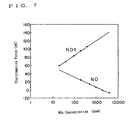
- the electromotive force increases depending on the increase of the concentration of NO 2 and decreases depending on the increase of NO concentration. Judging from the change of the electromotive force corresponding to the change of the concentration of the test gas, it is thought that the reduction reaction of the test gas occurs on the electrode when the electromotive force increases and oxydation reaction occurs on the electrode when the electromotive force decreases.
- the dependency of the electromotive force on the concentration of NOx is different in the presence and absence of oxygen, wherein the slope of the dependency of the electromotive force on NOx concentration in the presence of oxygen is larger than that in the absence of oxygen; that is oxygen is involved in the electrode reaction.
- the response of the sensor according to the present invention is obtained by the following reactions.
- an electrochemical reaction between oxygen and NOx is concomitantly occurs and the change of the electromotive force is caused by the hybrid electropotential of the local battery formed on the first electrode.
- a hybrid electric potential is caused for NO 2 by the following reactions on the first electrode NO 2 + 2e ⁇ NO + O 2- O 2- ⁇ 1 ⁇ 2 O 2 + 2e and a hybrid electric potential is caused for NO by the following reactions on the first electrode 1 ⁇ 2 O 2 + 2e ⁇ O 2- NO + O 2- ⁇ NO 2 + 2e
- the first electrode of the NOx sensor according to the present invention can act as an oxygen electrode and has enough activity for the reactions of (2) and (4). Furthermore, it also has a high catalytic activity for NOx and is active for the reactions of (1) and (2). Namely, since it is active both for oxygen and NOx, the change of the electromotive force is obtained by the hybrid electric potential caused by the electrochemical reaction between oxygen and NOx which occurs concomitantly on the first electrode and occurs also at 600°C , and hence a good performance is obtained.
- Fig. 1 is a cross section of an example of a NOx sensor according to the present invention.
- Fig. 2 is a figure showing the dependency of the change of the electromotive force on NOx concentration in an example of a NOx sensor according to comparative example 1.
- Fig. 3 is a figure showing the dependency of the change of the electromotive force on the NOx concentration in an example of a NOx sensor according to example 1.
- Fig. 4 is a figure showing the dependency of the change of the electromotive force on the CO 2 concentration, according to example 1.
- Fig. 5 is a figure showing the dependency of the change of the electromotive force on the NOx sensor according to comparative example 2.
- Fig. 6 is a figure showing the dependency of the change of the electromotive force on NOx concentration in an example of a NOx sensor according to the present invention.
- Fig. 7 is a figure showing the dependency of the change of the electromotive force on NOx concentration in an example of a NOx sensor according to the present invention.
- Fig. 1 shows a cross section of a NOx sensor in an example according to the present invention.
- a solid electrolyte 1 can be any oxgen ion conductive material, however, in view of thermal stability and resistance, zirconia, wholly or partially stabilized by yttria, calcia or magnesia, etc. is preferred. In this example, zirconia stabilized by 8 mol% of yttria was used.
- the first electrode 2 and second electrode 3 are placed on one surface of a plate solid electrolyte.
- the first electrode 2 is composed of oxides of 7a or 8a Group element.
- the first electrode was prepared by sputtering using oxide as a target.
- the second electrode 3 is composed of an electrode which does not respond to NOx and Pt is used in this case.
- the first electrode 2 and the second electrode 3 is a so called gas electrode and formed as a porous electrode.
- An electric collector 4 of Pt is placed on the first electrode 2 and the cable 5 and 6 of the second electrode 3 is connected with the measurement circuit.
- the change of the electromotive force at the introduction of 100ppm of NO 2 and 500ppm of NO taking the value of the electromotive force under the atmospheric circumstance of 4% oxygen at 600°C as a standard is shown in Table 1.
- the NOx sensor whichever oxides are used, responds to NO 2 resulting in the increase of the electromotive force and to NO in the decrease of the electromotive force.
- the sensor using Co as the first electrode showed the heighest sensitivity.
- Figs. 2 and 3 show the dependency of the electromotive force of a NOx sensor using oxides of Co as the first electrode on NOx concentration.
- Fig. 4 shows the dependency of the electromotive force of a NOx sensor using oxides of Co as the first electrode on CO 2 concentration at 600°C .
- the sensor does not respond to CO 2 and the electromotive force does not change even when CO 2 concentration changes.
- the dependency of the electromotive force on NOx concentration and the response characteristic to CO 2 were the same for the sensor using other oxides shown in this example.
- the Change of the Electromotive Force corresponding to 100ppm NO 2 and 500ppm No Electrode Material The Change of the Electromotive Force (mV) 100ppm NO 2 500ppm NO Mn 2 O 3 16.9 -10.5 Fe 2 O 3 28.7 -11.5 CO 3 O 4 64.3 -38.1 NiO 43.8 -10.1
- a NOx sensor was prepared using hybrid oxides expressed by the same method as explained in Example 1.
- Hybrid oxides expressed by ABO 3 used as the first electrode were prepared by sintering a mixture of a single oxide of each element composing of hybrid oxides. It was confirmed by the X-ray diffraction that these hybrid oxides are composed of a single phase or a mixed phase of oxides of either A or B.
- the change of electromotive force at the introducing of 100ppm of NO 2 and 500ppm of NO taking the value of the electromotive force under the atmospheric circumstance of 4% oxygen at 600 °C as a standard is shown in Table 2.
- a NOx sensor using hybrid oxides expressed by ABO 3 as the first electrode responds to NO 2 resulting in the increase of the electromotive force and to NO in the decrease of the electromotive force and the change of the electromotive force to the concentration of NO 2 and NO was proportional to the logarithm of the concentration. Furthermore, any of the sensors did not respond to CO 2 .
- Fig. 5 shows the dependency of the electromotive force of a NOx sensor at 600 °C on NOx concentration.
- the Change of the Electromotive Force corresponding to 100ppm NO 2 and 500ppm NO Electrode Material The Change of the Electromotive Force (mV) 100ppm NO 2 500ppm NO MgMnO 3 37.4 -18.2 SrMnO 3 66.1 -11.4 CaMnO 3 30.5 -14.5 BaMnO 3 43.6 -12.8 YMnO 3 25.3 -11.8 CrMnO 3 32.2 -10.0 CoMnO 3 36.8 -17.4 NiMnO 3 52.4 -25.7 AgMnO 3 32.1 -13.5 ZnMnO 3 57.5 -35.6 LaMnO 3 44.8 -25.7 NdMnO 3 35.4 -18.7 SmMnO 3 39.0 -10.7 (YSr)MnO 3 22.6 -10.5 GaFeO 3 21.8 - 9.2 LaFeO 3 49.3 -19.8 LaCoO 3 45.2 -20.1 LaNiO 3 22.4 -11.2 SrNiO 3 28.6 -1
- a NOx sensor was prepared using the hybrid oxides expressed by AB 2 O 4 and indicated in Table 3 as the first electrode by the same method as shown in Example 2.
- the change of the electromotive force at the introduction of 100ppm of NO 2 and 500ppm of NO taking the value of the electromotive force under the atmospheric circumstance of 4% oxygen at 600 °C as a standard is shown in Table 3.
- the sensor responds to NO 2 resulting in the increase of the electromotive force and to NO in the decrease of the electromotive force and the change of the electromotive force to the concentration of NO 2 and NO was proportional to the logarithm of the concentration. Any sensor did not responds to CO 2 at the first electrode.
- a NOx sensor was prepared using the hybrid oxides expressed by A 2 BO 4 and indicated in Table 4 as the first electrode by the same method as explained in Example 2 and the change of the electromotive force at the introduction of 100ppm of NO 2 and 500ppm of NO taking the value of the electromotive force under the atmospheric circumstance of 4% oxygen at 600 °C as a standard is shown in Table 4.
- the sensor responds to NO 2 resulting in the increase of the electromotive force and to NO in the decrease of the electromotive force and the change of the electromotive force to the concentration of NO 2 and NO was proportional to the logarithm of the concentration.
- a NOx sensor was prepared using the hybrid oxides expressed by ABCO 4 and indicated in Table 5 as the first electrode by the same method as explained in Example 1 and the change of the electromotive force at the introduction of 100ppm of NO 2 and 500ppm of NO taking the value of the electromotive force under the atmospheric circumstance of 4% oxygen at 600 °C as a standard is shown in Table 5.
- hybrid oxides which have no catalytic activity for CO 2 are used as the electrode material, it is possible to detect NOx concentration correctly without being affected by the fluctuation of CO 2 concentration. Furthermore, those hybrid oxides are active both for oxygen and NOx and hence the sensor looks at a temperature above 600 °C and detects NOx concentration with high accuracy.
Landscapes
- Chemical & Material Sciences (AREA)
- Life Sciences & Earth Sciences (AREA)
- Health & Medical Sciences (AREA)
- Physics & Mathematics (AREA)
- Chemical Kinetics & Catalysis (AREA)
- Electrochemistry (AREA)
- Molecular Biology (AREA)
- Analytical Chemistry (AREA)
- Biochemistry (AREA)
- General Health & Medical Sciences (AREA)
- General Physics & Mathematics (AREA)
- Immunology (AREA)
- Pathology (AREA)
- Measuring Oxygen Concentration In Cells (AREA)
Claims (2)
- NOx-Sensor, der im wesentlichen aus ersten und zweiten Elektroden besteht, die in Kontakt mit einem sauerstoffleitfähigen Festkörperelektrolyt stehen, wobei der Sensor in der Lage ist, eine Konzentration an NOx in einem Gas zu erfassen, durch Umwandeln eines Betrags einer NOx-Konzentration in ein Niveau der elektromotorischen Kraft zwischen den ersten und zweiten Elektroden,
dadurch gekennzeichnet, daß die erste Elektrode aus einem Material hergestellt ist, das aus der Gruppe ausgewählt ist, bestehend aus MgMn2O4, TiMn2O4, CrMn2O4, CoMn2O4, CdMn2O4, (CdAl)Mn2O4, (CdAl) MnCr2O4, CdFe2O4, ZnFe2O4, CrFe2O4, Ca2MnO4, Mg2MnO4, Fe2MnO4, Ni2MnO4, Zn2MnO4, Al2MnO4, Sb2MnO4, La2MnO4, Cr2CoO4, CdGaMnO4 oder YFeMnO4. - NOx-Sensor nach Anspruch 1, dadurch gekennzeichnet, daß die ersten und zweiten Elektroden an einer Seite des sauerstoffleitfähigen Festkörperelektrolyts ausgebildet sind.
Applications Claiming Priority (4)
| Application Number | Priority Date | Filing Date | Title |
|---|---|---|---|
| JP78427/95 | 1995-03-10 | ||
| JP7842795 | 1995-03-10 | ||
| JP07842795A JP3524980B2 (ja) | 1995-03-10 | 1995-03-10 | 窒素酸化物センサ |
| PCT/JP1996/000537 WO1996028722A1 (en) | 1995-03-10 | 1996-03-06 | Nitrogen oxide sensor |
Publications (3)
| Publication Number | Publication Date |
|---|---|
| EP0759552A1 EP0759552A1 (de) | 1997-02-26 |
| EP0759552A4 EP0759552A4 (de) | 1997-05-28 |
| EP0759552B1 true EP0759552B1 (de) | 2004-05-19 |
Family
ID=13661752
Family Applications (1)
| Application Number | Title | Priority Date | Filing Date |
|---|---|---|---|
| EP96905004A Expired - Lifetime EP0759552B1 (de) | 1995-03-10 | 1996-03-06 | Stickstoffoxidsensor |
Country Status (7)
| Country | Link |
|---|---|
| US (1) | US6019881A (de) |
| EP (1) | EP0759552B1 (de) |
| JP (1) | JP3524980B2 (de) |
| CN (1) | CN1151372C (de) |
| CA (1) | CA2189360C (de) |
| DE (1) | DE69632510T2 (de) |
| WO (1) | WO1996028722A1 (de) |
Families Citing this family (40)
| Publication number | Priority date | Publication date | Assignee | Title |
|---|---|---|---|---|
| US6303011B1 (en) * | 1997-06-23 | 2001-10-16 | Kabushiki Kaisha Riken | Gas sensor |
| DE19734860C2 (de) * | 1997-08-12 | 1999-12-16 | Bosch Gmbh Robert | Verfahren zur Bestimmung oxidierbarer Bestandteile in einem Gasgemisch |
| DE19734861C2 (de) * | 1997-08-12 | 1999-10-28 | Bosch Gmbh Robert | Sensorelement zur Bestimmung der Konzentration oxidierbarer Bestandteile in einem Gasgemisch |
| JP3526000B2 (ja) * | 1998-02-25 | 2004-05-10 | 株式会社豊田中央研究所 | 窒素酸化物センサ |
| JP3587290B2 (ja) * | 1998-09-17 | 2004-11-10 | 日本特殊陶業株式会社 | NOxガスセンサ |
| GB9823428D0 (en) * | 1998-10-26 | 1998-12-23 | Capteur Sensors & Analysers | Materials for solid-state gas sensors |
| DE19861198B4 (de) * | 1998-11-11 | 2004-04-15 | Robert Bosch Gmbh | Sensor für die Untersuchung von Abgasen und Untersuchungsverfahren |
| US6277256B1 (en) * | 1999-05-17 | 2001-08-21 | The Regents Of The University Of California | Enhanced electrodes for solid state gas sensors |
| DE19932048A1 (de) * | 1999-07-09 | 2001-01-11 | Bosch Gmbh Robert | Meßfühler zur Bestimmung einer Konzentration von Gaskomponenten in Gasgemischen |
| DE19960338A1 (de) * | 1999-12-15 | 2001-07-05 | Bosch Gmbh Robert | Gassensor zur Bestimmung der Konzentration von Gaskomponenten in Gasgemischen und dessen Verwendung |
| JP2002174618A (ja) * | 2000-12-07 | 2002-06-21 | Matsushita Electric Ind Co Ltd | 固体電解質型ガスセンサ |
| US6565737B2 (en) | 2000-12-14 | 2003-05-20 | Battelle Memorial Institute | Method and apparatus for selectively removing oxygen using a non-catalytic electrode in an electrochemical cell |
| WO2002059559A2 (en) * | 2001-01-25 | 2002-08-01 | The Regents Of The University Of California | Hydrocarbon sensor |
| US6656336B2 (en) * | 2001-01-25 | 2003-12-02 | The Regents Of The University Of California | Method for forming a potential hydrocarbon sensor with low sensitivity to methane and CO |
| US20040084308A1 (en) * | 2002-11-01 | 2004-05-06 | Cole Barrett E. | Gas sensor |
| US20080017510A1 (en) * | 2004-05-26 | 2008-01-24 | Nair Balakrishnan G | NOx Gas Sensor Method and Device |
| EP1754050B1 (de) * | 2004-05-26 | 2017-08-30 | EmiSense Technologies, LLC | Nox-gassensorverfahren und -vorrichtung |
| US7678329B2 (en) * | 2004-09-24 | 2010-03-16 | Babcock & Wilcox Technical Services Y-12, Llc | NOx sensing devices having conductive oxide electrodes |
| US20060231422A1 (en) * | 2005-04-14 | 2006-10-19 | Honeywell International Inc. | Switched gas sensor |
| US7611612B2 (en) * | 2005-07-14 | 2009-11-03 | Ceramatec, Inc. | Multilayer ceramic NOx gas sensor device |
| US7820028B2 (en) * | 2005-09-02 | 2010-10-26 | Honeywell International Inc. | Oxides of nitrogen gas sensors and methods |
| JP2010519514A (ja) * | 2007-02-16 | 2010-06-03 | セラマテック・インク | 選択性および検出感度の改善されたNOxセンサー |
| DE102007059652A1 (de) * | 2007-12-10 | 2009-06-18 | Eads Deutschland Gmbh | Gassensor mit einer verbesserten Selektivität |
| US20110168556A1 (en) * | 2008-09-30 | 2011-07-14 | Iljin Copper Foil Co., Ltd. | Nitrogen-oxide gas sensor |
| JP2012504235A (ja) * | 2008-09-30 | 2012-02-16 | イルジン カッパー ホイル カンパニー リミテッド | 長期信号安定性を有する窒素酸化物ガスセンサー |
| US20110168557A1 (en) * | 2008-09-30 | 2011-07-14 | Iljin Copper Foil Co., Ltd. | Nitrogen-oxide gas sensor |
| US20100122916A1 (en) * | 2008-11-19 | 2010-05-20 | Nair Balakrishnan G | Sensor with electrodes of a same material |
| CN101706470B (zh) * | 2009-11-13 | 2012-06-27 | 宁波工程学院 | 一种全固化混合电势型NOx传感器及其制备方法 |
| DE102010038153B3 (de) * | 2010-10-13 | 2012-03-08 | Ford Global Technologies, Llc. | Partikelsensor, Abgassystem und Verfahren zum Schutz von Komponenten eines turbogeladenen Motors mit Abgasrückführung |
| ES2393586B1 (es) * | 2011-06-10 | 2013-07-26 | Centro De Estudios E Investigaciones Tecnicas (Ceit) | Sensor electroquímico para la medición de concentración de gases y procedimiento para su fabricación |
| US9164080B2 (en) | 2012-06-11 | 2015-10-20 | Ohio State Innovation Foundation | System and method for sensing NO |
| CN102735731B (zh) * | 2012-06-29 | 2016-01-20 | 中国第一汽车股份有限公司 | 用于NOx检测的钇稳定氧化锆和多孔贵金属复合电极 |
| CN103728359A (zh) * | 2014-01-20 | 2014-04-16 | 中国科学院上海硅酸盐研究所 | 一种NOx传感器及其制备方法 |
| CN103728358A (zh) * | 2014-01-20 | 2014-04-16 | 中国科学院上海硅酸盐研究所 | 一种氧化锆基NOx传感器及其制备方法 |
| JP6155247B2 (ja) * | 2014-11-17 | 2017-06-28 | 一般財団法人ファインセラミックスセンター | 窒素酸化物応答性素子及びその製造方法 |
| US9823216B2 (en) * | 2014-12-10 | 2017-11-21 | Delphi Technologies, Inc. | Sensor material and gas sensor element and gas sensor derived therefrom |
| JP6571383B2 (ja) * | 2015-05-13 | 2019-09-04 | 日本特殊陶業株式会社 | ガスセンサ |
| EP3343212B1 (de) * | 2015-08-28 | 2019-11-06 | Panasonic Intellectual Property Management Co., Ltd. | Gassensor und brennstoffzellenfahrzeug |
| US10267761B2 (en) * | 2016-06-14 | 2019-04-23 | Delphi Technologies Ip Limited | Material for sensing electrode of NOX gas sensor |
| US20180252670A1 (en) * | 2017-03-03 | 2018-09-06 | Ngk Spark Plug Co., Ltd. | Mixed-potential-type sensor |
Family Cites Families (12)
| Publication number | Priority date | Publication date | Assignee | Title |
|---|---|---|---|---|
| DE3017947A1 (de) * | 1980-05-10 | 1981-11-12 | Bosch Gmbh Robert | Elektrochemischer messfuehler fuer die bestimmung des sauerstoffgehaltes in gasen und verfahren zum herstellen von sensorelementen fuer derartige messfuehler |
| JPS5991358A (ja) * | 1982-11-16 | 1984-05-26 | Fuji Electric Corp Res & Dev Ltd | 笑気センサ |
| JPS59100854A (ja) * | 1982-12-01 | 1984-06-11 | Mazda Motor Corp | 広域空燃比センサ− |
| US4587105A (en) * | 1984-05-17 | 1986-05-06 | Honeywell Inc. | Integratable oxygen sensor |
| JPS61184450A (ja) * | 1985-02-13 | 1986-08-18 | Nok Corp | 窒素酸化物センサ− |
| JPS61264250A (ja) * | 1985-05-17 | 1986-11-22 | Nippon Denso Co Ltd | 窒素酸化物検出器 |
| US5037525A (en) * | 1985-10-29 | 1991-08-06 | Commonwealth Scientific And Industrial Research Organisation | Composite electrodes for use in solid electrolyte devices |
| JP2636883B2 (ja) * | 1988-04-30 | 1997-07-30 | 日本碍子株式会社 | NOx濃度測定装置 |
| DE4225775C2 (de) * | 1992-08-04 | 2002-09-19 | Heraeus Electro Nite Int | Anordnung zum kontinuierlichen Überwachen der Konzentration von NO in Gasgemischen |
| US5397442A (en) | 1994-03-09 | 1995-03-14 | Gas Research Institute | Sensor and method for accurately measuring concentrations of oxide compounds in gas mixtures |
| JP3296092B2 (ja) * | 1994-06-20 | 2002-06-24 | 株式会社豊田中央研究所 | 窒素酸化物センサ |
| JPH0862174A (ja) * | 1994-08-19 | 1996-03-08 | Riken Corp | NOxセンサ |
-
1995
- 1995-03-10 JP JP07842795A patent/JP3524980B2/ja not_active Expired - Fee Related
-
1996
- 1996-03-06 DE DE69632510T patent/DE69632510T2/de not_active Expired - Fee Related
- 1996-03-06 CN CNB961904372A patent/CN1151372C/zh not_active Expired - Fee Related
- 1996-03-06 CA CA002189360A patent/CA2189360C/en not_active Expired - Fee Related
- 1996-03-06 EP EP96905004A patent/EP0759552B1/de not_active Expired - Lifetime
- 1996-03-06 WO PCT/JP1996/000537 patent/WO1996028722A1/ja not_active Ceased
-
1998
- 1998-09-25 US US09/160,344 patent/US6019881A/en not_active Expired - Fee Related
Also Published As
| Publication number | Publication date |
|---|---|
| EP0759552A4 (de) | 1997-05-28 |
| WO1996028722A1 (en) | 1996-09-19 |
| EP0759552A1 (de) | 1997-02-26 |
| JP3524980B2 (ja) | 2004-05-10 |
| JPH08247992A (ja) | 1996-09-27 |
| DE69632510D1 (de) | 2004-06-24 |
| US6019881A (en) | 2000-02-01 |
| CA2189360A1 (en) | 1996-09-19 |
| CA2189360C (en) | 2001-02-20 |
| CN1152352A (zh) | 1997-06-18 |
| CN1151372C (zh) | 2004-05-26 |
| DE69632510T2 (de) | 2005-05-12 |
Similar Documents
| Publication | Publication Date | Title |
|---|---|---|
| EP0759552B1 (de) | Stickstoffoxidsensor | |
| US7074319B2 (en) | Ammonia gas sensors | |
| US6143165A (en) | Nox sensor | |
| US8974657B2 (en) | Amperometric electrochemical cells and sensors | |
| US5124021A (en) | Solid electrolyte gas sensor and method of measuring concentration of gas to be detected in gas mixture | |
| US20090218220A1 (en) | Amperometric Electrochemical Cells and Sensors | |
| US6413397B2 (en) | Nitrogen oxide gas sensor | |
| KR19990007223A (ko) | 가스 센서 | |
| US6709558B2 (en) | Gas sensor | |
| US20050016848A1 (en) | Oxygen sensor with a solid-state reference and manufacturing thereof | |
| KR101052617B1 (ko) | 질소산화물 가스센서 | |
| US6379514B1 (en) | Composition structure for NOx sensors | |
| US8257575B2 (en) | Ammonia gas sensors with vanadium-based sensing electrode | |
| JPH0980014A (ja) | 窒素酸化物センサ | |
| US20110210013A1 (en) | Selective gas sensor device and associated method | |
| JPH11142369A (ja) | 窒素酸化物センサ | |
| US20060213772A1 (en) | Sensing element and method of making | |
| US6565737B2 (en) | Method and apparatus for selectively removing oxygen using a non-catalytic electrode in an electrochemical cell | |
| JP2002005883A (ja) | 窒素酸化物ガスセンサ | |
| JP3450898B2 (ja) | 排ガス用不完全燃焼検知素子の製造方法 | |
| US8257576B2 (en) | Ammonia gas sensors with lanthanide vanadate sensing electrode | |
| WO1997041428A1 (en) | Solid-state gas sensor | |
| JPH07306178A (ja) | 窒素酸化物センサ | |
| CN1224499A (zh) | 固态的气敏元件 | |
| JPH0843346A (ja) | 窒素酸化物センサ |
Legal Events
| Date | Code | Title | Description |
|---|---|---|---|
| PUAI | Public reference made under article 153(3) epc to a published international application that has entered the european phase |
Free format text: ORIGINAL CODE: 0009012 |
|
| 17P | Request for examination filed |
Effective date: 19961031 |
|
| AK | Designated contracting states |
Kind code of ref document: A1 Designated state(s): CH DE FR GB IT LI NL |
|
| A4 | Supplementary search report drawn up and despatched |
Effective date: 19970411 |
|
| AK | Designated contracting states |
Kind code of ref document: A4 Designated state(s): CH DE FR GB IT LI NL |
|
| 17Q | First examination report despatched |
Effective date: 20010702 |
|
| GRAP | Despatch of communication of intention to grant a patent |
Free format text: ORIGINAL CODE: EPIDOSNIGR1 |
|
| GRAS | Grant fee paid |
Free format text: ORIGINAL CODE: EPIDOSNIGR3 |
|
| GRAA | (expected) grant |
Free format text: ORIGINAL CODE: 0009210 |
|
| AK | Designated contracting states |
Kind code of ref document: B1 Designated state(s): CH DE FR GB IT LI NL |
|
| PG25 | Lapsed in a contracting state [announced via postgrant information from national office to epo] |
Ref country code: NL Free format text: LAPSE BECAUSE OF FAILURE TO SUBMIT A TRANSLATION OF THE DESCRIPTION OR TO PAY THE FEE WITHIN THE PRESCRIBED TIME-LIMIT Effective date: 20040519 Ref country code: LI Free format text: LAPSE BECAUSE OF FAILURE TO SUBMIT A TRANSLATION OF THE DESCRIPTION OR TO PAY THE FEE WITHIN THE PRESCRIBED TIME-LIMIT Effective date: 20040519 Ref country code: IT Free format text: LAPSE BECAUSE OF FAILURE TO SUBMIT A TRANSLATION OF THE DESCRIPTION OR TO PAY THE FEE WITHIN THE PRESCRIBED TIME-LIMIT;WARNING: LAPSES OF ITALIAN PATENTS WITH EFFECTIVE DATE BEFORE 2007 MAY HAVE OCCURRED AT ANY TIME BEFORE 2007. THE CORRECT EFFECTIVE DATE MAY BE DIFFERENT FROM THE ONE RECORDED. Effective date: 20040519 Ref country code: CH Free format text: LAPSE BECAUSE OF FAILURE TO SUBMIT A TRANSLATION OF THE DESCRIPTION OR TO PAY THE FEE WITHIN THE PRESCRIBED TIME-LIMIT Effective date: 20040519 |
|
| REG | Reference to a national code |
Ref country code: GB Ref legal event code: FG4D |
|
| REG | Reference to a national code |
Ref country code: CH Ref legal event code: EP |
|
| REF | Corresponds to: |
Ref document number: 69632510 Country of ref document: DE Date of ref document: 20040624 Kind code of ref document: P |
|
| NLV1 | Nl: lapsed or annulled due to failure to fulfill the requirements of art. 29p and 29m of the patents act | ||
| REG | Reference to a national code |
Ref country code: CH Ref legal event code: PL |
|
| ET | Fr: translation filed | ||
| PG25 | Lapsed in a contracting state [announced via postgrant information from national office to epo] |
Ref country code: GB Free format text: LAPSE BECAUSE OF NON-PAYMENT OF DUE FEES Effective date: 20050306 |
|
| PLBE | No opposition filed within time limit |
Free format text: ORIGINAL CODE: 0009261 |
|
| STAA | Information on the status of an ep patent application or granted ep patent |
Free format text: STATUS: NO OPPOSITION FILED WITHIN TIME LIMIT |
|
| 26N | No opposition filed |
Effective date: 20050222 |
|
| GBPC | Gb: european patent ceased through non-payment of renewal fee |
Effective date: 20050306 |
|
| PGFP | Annual fee paid to national office [announced via postgrant information from national office to epo] |
Ref country code: FR Payment date: 20070321 Year of fee payment: 12 |
|
| PGFP | Annual fee paid to national office [announced via postgrant information from national office to epo] |
Ref country code: DE Payment date: 20080530 Year of fee payment: 13 |
|
| REG | Reference to a national code |
Ref country code: FR Ref legal event code: ST Effective date: 20081125 |
|
| PG25 | Lapsed in a contracting state [announced via postgrant information from national office to epo] |
Ref country code: FR Free format text: LAPSE BECAUSE OF NON-PAYMENT OF DUE FEES Effective date: 20080331 |
|
| PG25 | Lapsed in a contracting state [announced via postgrant information from national office to epo] |
Ref country code: DE Free format text: LAPSE BECAUSE OF NON-PAYMENT OF DUE FEES Effective date: 20091001 |