EP0748908B1 - Schliesszylinder - Google Patents
Schliesszylinder Download PDFInfo
- Publication number
- EP0748908B1 EP0748908B1 EP96107539A EP96107539A EP0748908B1 EP 0748908 B1 EP0748908 B1 EP 0748908B1 EP 96107539 A EP96107539 A EP 96107539A EP 96107539 A EP96107539 A EP 96107539A EP 0748908 B1 EP0748908 B1 EP 0748908B1
- Authority
- EP
- European Patent Office
- Prior art keywords
- cylinder
- locking
- bolt
- housing
- core
- Prior art date
- Legal status (The legal status is an assumption and is not a legal conclusion. Google has not performed a legal analysis and makes no representation as to the accuracy of the status listed.)
- Expired - Lifetime
Links
- 239000007787 solid Substances 0.000 claims abstract 2
- 229910000831 Steel Inorganic materials 0.000 claims 1
- 239000010959 steel Substances 0.000 claims 1
- 238000010276 construction Methods 0.000 description 5
- 238000004519 manufacturing process Methods 0.000 description 4
- 230000008878 coupling Effects 0.000 description 2
- 238000010168 coupling process Methods 0.000 description 2
- 238000005859 coupling reaction Methods 0.000 description 2
- 238000009434 installation Methods 0.000 description 2
- 230000006835 compression Effects 0.000 description 1
- 238000007906 compression Methods 0.000 description 1
Images


Classifications
-
- E—FIXED CONSTRUCTIONS
- E05—LOCKS; KEYS; WINDOW OR DOOR FITTINGS; SAFES
- E05B—LOCKS; ACCESSORIES THEREFOR; HANDCUFFS
- E05B9/00—Lock casings or latch-mechanism casings ; Fastening locks or fasteners or parts thereof to the wing
- E05B9/04—Casings of cylinder locks
- E05B9/045—Modular casings for adjusting the length of cylinder locks
Definitions
- the invention relates to a lock cylinder, in particular Double lock cylinder, the cylinder being a turnable Core and one receiving the cylinder core Cylinder housing comprises, the cylinder housing from a Circular cylinder part and one of which projects radially Bridge part exists.
- This lock cylinder has known in Way on the bridge part a connecting bridge made of harder material on to the lock cylinder with the second lock cylinder for the production of a double lock cylinder, or connects with a mounting part for a half cylinder.
- the bridge has the faceplate screw hole.
- Lock cylinders of the type mentioned are state of the art and it is for example on the CH-PS 679.169 and the EP 0 438 654 A2. With those that can be assembled from individual parts Double lock cylinders, it is possible Lengths of the cylinders and the position of the faceplate screw hole adapt to the respective door dimensions.
- the object of the present invention is to lock cylinders in the manner of a modular system with the desired dimensions to assemble and assemble at the installation site. As few different parts as possible should be used Find.
- the design is intended for both tumbler locks be suitable, in which the housing pins in Bridge part lie, as well as for locks where the Control and tumbler elements are in the circular cylinder part. Furthermore, there is the task of a simple installation to establish sufficient fixed bridge connection.
- the tasks are determined by the characteristics according to the Claims resolved.
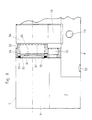
- FIG. 1 shows a longitudinal section through a housing Double cylinder lock with the connecting bridge removed.
- Fig.2 is a view of the inner face of the Cylinder housing according to arrow II in Fig.1.
- 3 and 4 are associated cracks of an extension piece for the cylinder housing and
- Figs. 5 to 7 are each other associated cracks of an extension piece for the cylinder core.
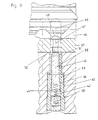
- Fig. 8 shows a partial section analogous to Fig.1 another embodiment and Fig.9 shows in sections the longitudinal section through a cylinder lock in the area of Key tip.
- FIG. 1 shows a longitudinal section of an inventive Lock cylinder, the two half cylinders with the cylinder housings 1 and 2 includes.
- the core hole 3 sits Cylinder core, which is not shown in Fig.1.
- ring grooves 4 and ring webs 5 which together with scanning and locking elements of the cylinder core the rotation of the Enable or prevent cylinder core.
- the connecting bridge 8 For the firm connection of the two cylinder housings 1 and 2 serves the connecting bridge 8. It comprises a cylinder bolt 9 located between the cylinder end faces 10 extends. Extends from these cylinder end faces 10 one axial retaining pin 11. The cylinder pin 9 points the faceplate screw bore perpendicular to the longitudinal axis 12 13, by means of which the finished double cylinder lock can be fixed in the door lock. The recess 14 serves the free rotation of the not shown here Lock bit between the two half cylinders 1 and 2 which is twisted by one of the two cylinder cores can be.
- FIG. 2 shows the top view of the inner end face 15 of the Cylinder housing 1.
- the web part 7 ends at the bottom in one Rounding 16 is centered within this rounding 16 a receiving bore 17 is arranged, in which the holding pin 11 of the connecting bridge 8 can be used.
- the web part 7 also has a latching recess 18 on, which is formed with the same radius as the Radius of the cylinder pin 9. This recess extends at least over a third of the length of the half cylinder from the inside face 15 outwards in the direction to the outside face 19 of the cylinder housing.
- the stop surface 20 of the recess 18 serves as a stop for the cylinder end face 10 of the connecting bridge.
- the attachment of the connecting bridge 8 with the cylinder housing takes place in such a way that the holding pin 11 in the receiving bore 17 is inserted until the cylinder end surface 10 the stop surface 20 strikes.
- the support surface 21 comes to lie on the cylinder surface of the cylinder pin 9.
- the Cylinder bolt 9 extends through a radial bore 22, which with a threaded bore 23 of the cylinder housing is aligned.
- the connecting bridge 8 In its smallest dimension, the connecting bridge is like this long that between the two inner end faces 15 of Cylinder housing 1.2 the locking ring with little play is freely rotatable.
- the housing extension parts 24 When extending the connecting bridge 8 is gradually extended in practice, depending on Position of the fixing screw hole on the cylinder housing 1 and / or 2 one or more of the housing extension parts 24 are arranged as shown in Figures 3 and 4 are shown.
- the outer dimension of the housing extension 24 corresponds to the outer dimension of the Cylinder housing and thus also has a circular cylinder part and a bridge part.
- the bottom ends Web part in the support surface 21, which is analogous to the support surface of the cylinder housing is formed.
- the core bore 27 has a diameter which is approximately that Corresponds to the diameter of the cylinder core.
- the diameter is chosen so that the Housing extension slid over the circlip can be with which of the cylinder core in the usual way is axially secured. See Fig. 8.
- FIG. 5 to 7 show the cracks associated with one another Core extension part 29, which is inserted into the core bore 27 will and the connection between the cylinder core and Lockbar ring produces, as is known per se.
- the pins 30 engage in a corresponding diametrical Recess of the cylinder core, so that a rotary connection is made.
- the engaging slot 31 has the same Effect like the analog diametrical slot of the cylinder core and serves the optional coupling or uncoupling a coupling element that lies in the lock ring.
- the fastening screw 33 (Fig.8) must then of course the added lengths of the stepped bores 25 be adjusted.
- FIG. 8 shows the left half cylinder 1 in view, cut during the housing extension part 24 is.
- the lock ring 34 is also shown in view.
- the core extension part 29 is the better one For the sake of illustration only shown in dashed lines.
- the Seegerring has the reference number 35 and sits in one Ring groove 36 of the cylinder core 37. Drawn in with a broken line can be seen how the pin 30 of the core extension part 29 in the cylinder core 37 respectively. engage its slot.
- the Slidable housing pin 38 is within a hollow Fixing pin 39 out.
- the fixing pin 39 is in one Stepped bore 40 screwed in by means of the thread 41.
- the Compression spring 42 is supported on a plug 43. The axial movement of the housing pin 38 in the direction of Key channel 44 is through the collar 45 and the stop 46 limited.
- the core pin 47 is in the core bore 48 of the cylinder core displaceable and is through the control recess 49th of the key 50 in the corresponding closed position held.
- the core pin bore is on the rotation and division plane 51 52 dipped so that the core pin 47 at during assembly, do not fall out of the core pin hole can.
- This construction makes it easier to insert the housing pin when installing the lock.
Landscapes
- Mechanical Engineering (AREA)
- Engineering & Computer Science (AREA)
- Lock And Its Accessories (AREA)
- Fluid-Damping Devices (AREA)
- Chairs Characterized By Structure (AREA)
- Dowels (AREA)
- Pens And Brushes (AREA)
- Clamps And Clips (AREA)
- Lubrication Of Internal Combustion Engines (AREA)
- Connection Of Plates (AREA)
- Underground Structures, Protecting, Testing And Restoring Foundations (AREA)
- Actuator (AREA)
- Hydrogenated Pyridines (AREA)
- Catching Or Destruction (AREA)
Description
Claims (6)
- Schließzylinder, der entweder zwei Halbzylinder (Doppelschließzylinder) oder einen Halbzylinder und einen Montageteil umfaßt, wobei die Halbzylinder aus einem Kreiszylinderteil und einem davon radial abstehenden Stegteil mit halbkreisförmiger Abrundung bestehen und die zwei Halbzylinder, oder ein Halbzylinder mit dem Befestigungsteil, über eine massive Verbindungsbrücke verbunden sind, dadurch gekennzeichnet, daß die Verbindungsbrücke (8) aus einem Zylinderbolzen gebildet ist, dessen Radius etwa gleich dem Radius der Abrundung (16) des Stegteiles (17) ist, und der Zylinderbolzen (9) an der dem/den Halbzylindern zugewandten Zylinderendflächen (10) einen axialen Haltezapfen (11) aufweist, daß die Verbindungsbrücke (8) in einer Rastausnehmung (18) des Stegteiles (7) angeordnet ist, wobei die Rastausnehmung mit einem Radius gebildet ist, der dem Radius des Zylinderbolzens (9) entspricht, daß sich die Rastausnehmung (18) zumindest über ein Drittel der Länge des Halbzylinders von der Innenstirnfläche (15) nach außen hin erstreckt und daß sich von der Rastausnehmung eine Aufnahmebohrung (17) für den Haltezapfen (11) erstreckt.
- Schließzylinder nach Anspruch 1, dadurch gekennzeichnet, daß zur Fixierung der Verbindungsbrücke (8)am Zylindergehäuse (1,2) der Zylinderbolzen (9) eine radiale Bohrung (22) aufweist, die mit einer Gewindebohrung (23) im Stegteil des Zylindergehäuses fluchtet und eine Schraube (53) aufnimmt.
- Schließzylinder nach Anspruch 1 oder 2, dadurch gekennzeichnet, daß die Verbindungsbrücke (8) mit den Haltezapfen (11) und dem Zylinderbolzen (9) ein Drehteil, bevorzugt aus Stahl, ist, wobei gegebenenfalls im Bereich der Stulpschraubenbohrung (13) eine Ausnehmung (14) für die freie Verdrehbarkeit des Schließbartes (54) vorgesehen ist.
- Schließzylinder nach einem der vorhergehenden Ansprüche, dadurch gekennzeichnet, daß zur Verlängerung des Zylindergehäuses ein oder mehrere Gehäuseverlängerungsteile (24) vorgesehen sind, die aus einem Ringteil mit der Kernbohrung (27) und dem Stegteil mit einer Stützfläche (21) zur Abstützung am Zylinderbolzen (9) bestehen, wobei die Kernbohrung (27) einen erweiterten Abschnitt (28) und der Ringteil außen eine abgesetzte Stufe (32) aufweisen.
- Schließzylinder nach Anspruch 4, dadurch gekennzeichnet, daß der/die Gehäuseverlängerungsteile (24) mittels einer Schraube (33) an der Innenstirnfläche (15) des/der Zylindergehäuse(s) (1,2) befestigt sind.
- Schließzylinder nach einem der Ansprüche 4 oder 5, dadurch gekennzeichnet, daß in der Kernbohrung (27) ein oder mehrere Kernverlängerungsteile (29) angeordnet sind, die mit dem Zylinderkern (37) oder miteinander auf Drehung gekuppelt sind.
Priority Applications (1)
| Application Number | Priority Date | Filing Date | Title |
|---|---|---|---|
| SI9630358T SI0748908T1 (en) | 1995-06-13 | 1996-05-11 | Locking cylinder |
Applications Claiming Priority (3)
| Application Number | Priority Date | Filing Date | Title |
|---|---|---|---|
| AT1008/95 | 1995-06-13 | ||
| AT0100895A AT405960B (de) | 1995-06-13 | 1995-06-13 | Schliesszylinder |
| AT100895 | 1995-06-13 |
Publications (3)
| Publication Number | Publication Date |
|---|---|
| EP0748908A2 EP0748908A2 (de) | 1996-12-18 |
| EP0748908A3 EP0748908A3 (de) | 1997-11-19 |
| EP0748908B1 true EP0748908B1 (de) | 2002-01-16 |
Family
ID=3504813
Family Applications (1)
| Application Number | Title | Priority Date | Filing Date |
|---|---|---|---|
| EP96107539A Expired - Lifetime EP0748908B1 (de) | 1995-06-13 | 1996-05-11 | Schliesszylinder |
Country Status (9)
| Country | Link |
|---|---|
| EP (1) | EP0748908B1 (de) |
| AT (2) | AT405960B (de) |
| CZ (1) | CZ282240B6 (de) |
| DE (2) | DE29512441U1 (de) |
| DK (1) | DK0748908T3 (de) |
| ES (1) | ES2168406T3 (de) |
| FR (1) | FR2735513B3 (de) |
| NL (1) | NL1000826C2 (de) |
| SI (1) | SI0748908T1 (de) |
Families Citing this family (11)
| Publication number | Priority date | Publication date | Assignee | Title |
|---|---|---|---|---|
| DE29608645U1 (de) * | 1996-03-01 | 1996-08-01 | Keller, Ernst, Richterswil | Einbau-Doppelschliesszylinder für ein Sicherheitsschloss |
| DE29801490U1 (de) * | 1998-01-30 | 1999-06-02 | Bks Gmbh, 42549 Velbert | Verbinder für einen Profilzylinder |
| DE19831846A1 (de) * | 1998-07-16 | 2000-01-20 | Winkhaus Fa August | Schließzylinder |
| DE10041650B4 (de) * | 2000-08-24 | 2004-03-25 | Dom-Sicherheitstechnik Gmbh & Co. Kg | Zylinderschloss |
| DE102006001267B3 (de) * | 2006-01-10 | 2007-05-10 | Seccor High Security Gmbh | Verlängerbarer Zylinderkörper für elektronische Schließzylinder |
| AT504009B1 (de) | 2006-07-07 | 2008-06-15 | Michael Ing Makivic | Zylinderschloss |
| DE102007035265B4 (de) | 2007-07-27 | 2020-11-26 | ABUS Seccor GmbH | Verlängerbarer Zylinderkörper mit Führungselementen in der Zylinderkernbohrung |
| DE102010047429B4 (de) | 2010-10-04 | 2014-10-30 | ABUS Seccor GmbH | Verlängerbarer Zylinderkörper mit axialen Befestigungsbolzen |
| ES2426340B1 (es) | 2013-07-19 | 2014-08-12 | La Industria Cerrajera, S.A. | Cilindro de cierre provisto de puente de conexión |
| DE102014205960A1 (de) * | 2014-03-31 | 2015-10-01 | Bks Gmbh | Schließzylinder und Montagevorrichtung |
| ES2592954B1 (es) * | 2015-06-01 | 2017-08-03 | Talleres De Escoriaza, S.A. (Tesa) | Cilindro de cerradura modular |
Family Cites Families (8)
| Publication number | Priority date | Publication date | Assignee | Title |
|---|---|---|---|---|
| GB1581095A (en) * | 1978-02-16 | 1980-12-10 | Lowe & Fletcher Ltd | Lock with two key-receiving members |
| EP0022233A1 (de) * | 1979-07-05 | 1981-01-14 | C.I.S.A. Costruzioni Italiane Serrature Affini S.p.A. | Schloss mit koaxialem Doppelzylinder |
| CH679169A5 (en) * | 1988-05-05 | 1991-12-31 | Ernst Keller | Morticed double cylinder for door lock - has flexible longitudinal component joining housing sections together |
| FR2655367B1 (fr) * | 1989-12-05 | 1992-04-03 | Vachette Sa | Serrure a barillet double a condamnation mecanique et electrique. |
| DE9000746U1 (de) * | 1990-01-24 | 1991-05-23 | BKS GmbH, 5620 Velbert | Profil-Doppelschließzylinder |
| DE4106709A1 (de) * | 1991-03-02 | 1992-09-03 | Dom Sicherheitstechnik | Aus mehreren einheiten zusammensetzbarer schliesszylinder |
| DE4213382A1 (de) * | 1992-01-17 | 1993-07-22 | Giesser Irmgard | Doppelsperrzylinder |
| US5501087A (en) * | 1993-05-27 | 1996-03-26 | Keller; Ernst | Rotary locking cylinder for a safety lock |
-
1995
- 1995-06-13 AT AT0100895A patent/AT405960B/de not_active IP Right Cessation
- 1995-07-17 NL NL1000826A patent/NL1000826C2/xx not_active IP Right Cessation
- 1995-07-21 FR FR9508896A patent/FR2735513B3/fr not_active Expired - Lifetime
- 1995-08-02 DE DE29512441U patent/DE29512441U1/de not_active Expired - Lifetime
-
1996
- 1996-05-11 SI SI9630358T patent/SI0748908T1/xx unknown
- 1996-05-11 EP EP96107539A patent/EP0748908B1/de not_active Expired - Lifetime
- 1996-05-11 ES ES96107539T patent/ES2168406T3/es not_active Expired - Lifetime
- 1996-05-11 DK DK96107539T patent/DK0748908T3/da active
- 1996-05-11 DE DE59608579T patent/DE59608579D1/de not_active Expired - Fee Related
- 1996-05-11 AT AT96107539T patent/ATE212098T1/de not_active IP Right Cessation
- 1996-06-04 CZ CZ961613A patent/CZ282240B6/cs not_active IP Right Cessation
Also Published As
| Publication number | Publication date |
|---|---|
| SI0748908T1 (en) | 2002-06-30 |
| EP0748908A3 (de) | 1997-11-19 |
| ATE212098T1 (de) | 2002-02-15 |
| EP0748908A2 (de) | 1996-12-18 |
| DK0748908T3 (da) | 2002-03-18 |
| CZ282240B6 (cs) | 1997-06-11 |
| FR2735513A3 (fr) | 1996-12-20 |
| ATA100895A (de) | 1999-05-15 |
| CZ161396A3 (en) | 1997-01-15 |
| NL1000826C2 (nl) | 1996-12-13 |
| DE59608579D1 (de) | 2002-02-21 |
| ES2168406T3 (es) | 2002-06-16 |
| FR2735513B3 (fr) | 1997-05-30 |
| DE29512441U1 (de) | 1995-11-09 |
| AT405960B (de) | 2000-01-25 |
Similar Documents
| Publication | Publication Date | Title |
|---|---|---|
| DE102011102159B4 (de) | Modularer Schließzylinder | |
| EP2198103B1 (de) | Scharnier für eine gepäckbox od. dgl. | |
| EP0748908B1 (de) | Schliesszylinder | |
| DE3715972C2 (de) | Kupplungseinrichtung an Doppel-Schließzylindern | |
| EP0438654B1 (de) | Profil-Doppelschliesszylinder | |
| DE3828354C2 (de) | ||
| DE102012003168A1 (de) | Schliesszylinder | |
| EP1068419B1 (de) | Mit einem türscharnier baulich vereinigter türfeststeller | |
| DE2905941A1 (de) | Steuereinrichtung, insbesondere schloss | |
| DE102009008922A1 (de) | Kupplungseinrichtung für einen zwei Zylinderkerne beinhaltenden Doppelschließzylinder mit Not- und Gefahrenfunktion | |
| DE3134471C2 (de) | ||
| DE3733518C2 (de) | Doppelschließzylinder | |
| DE3643188C2 (de) | ||
| DE2923598A1 (de) | Schliesszylinder und schliessanlage | |
| DE69201668T2 (de) | Zylinderschloss. | |
| DE9400744U1 (de) | Schließzylinder | |
| DE10107398C2 (de) | Bausatz für Möbelschlösser oder Möbeloliven mit einem Adaptergehäuse zur Aufnahme für unterschiedliche Schließsysteme | |
| DE3127449A1 (de) | Profil-schliesszylinder | |
| DE3308319A1 (de) | Auf einem tuerfluegel oder dergleichen zu befestigendes schloss | |
| CH706693A2 (de) | Schliesszylinder. | |
| DE20202526U1 (de) | Bausatz für Möbelschlösser oder Möbeloliven mit einem Adaptergehäuse zur Aufnahme für unterschiedliche Schließsysteme | |
| CH690279A5 (de) | Zylinderschloss. | |
| EP0712978B1 (de) | Kupplungseinrichtung in Doppel-Schliessyzlindern | |
| CH690306A5 (de) | Einsteckschloss. | |
| EP0591661A2 (de) | Codierbares Zylinderschloss |
Legal Events
| Date | Code | Title | Description |
|---|---|---|---|
| PUAI | Public reference made under article 153(3) epc to a published international application that has entered the european phase |
Free format text: ORIGINAL CODE: 0009012 |
|
| AK | Designated contracting states |
Kind code of ref document: A2 Designated state(s): AT BE CH DE DK ES FR GB IT LI NL SE |
|
| AX | Request for extension of the european patent |
Free format text: SI PAYMENT 960511 |
|
| PUAL | Search report despatched |
Free format text: ORIGINAL CODE: 0009013 |
|
| AK | Designated contracting states |
Kind code of ref document: A3 Designated state(s): AT BE CH DE DK ES FR GB IT LI NL SE |
|
| AX | Request for extension of the european patent |
Free format text: SI PAYMENT 960511 |
|
| 17P | Request for examination filed |
Effective date: 19980121 |
|
| GRAG | Despatch of communication of intention to grant |
Free format text: ORIGINAL CODE: EPIDOS AGRA |
|
| 17Q | First examination report despatched |
Effective date: 20010312 |
|
| GRAG | Despatch of communication of intention to grant |
Free format text: ORIGINAL CODE: EPIDOS AGRA |
|
| GRAH | Despatch of communication of intention to grant a patent |
Free format text: ORIGINAL CODE: EPIDOS IGRA |
|
| GRAH | Despatch of communication of intention to grant a patent |
Free format text: ORIGINAL CODE: EPIDOS IGRA |
|
| GRAA | (expected) grant |
Free format text: ORIGINAL CODE: 0009210 |
|
| REG | Reference to a national code |
Ref country code: GB Ref legal event code: IF02 |
|
| AK | Designated contracting states |
Kind code of ref document: B1 Designated state(s): AT BE CH DE DK ES FR GB IT LI NL SE |
|
| AX | Request for extension of the european patent |
Free format text: SI PAYMENT 19960511 |
|
| REF | Corresponds to: |
Ref document number: 212098 Country of ref document: AT Date of ref document: 20020215 Kind code of ref document: T |
|
| REG | Reference to a national code |
Ref country code: CH Ref legal event code: EP |
|
| REG | Reference to a national code |
Ref country code: CH Ref legal event code: NV Representative=s name: A. BRAUN, BRAUN, HERITIER, ESCHMANN AG PATENTANWAE |
|
| REF | Corresponds to: |
Ref document number: 59608579 Country of ref document: DE Date of ref document: 20020221 |
|
| REG | Reference to a national code |
Ref country code: DK Ref legal event code: T3 |
|
| GBT | Gb: translation of ep patent filed (gb section 77(6)(a)/1977) |
Effective date: 20020406 |
|
| ET | Fr: translation filed | ||
| REG | Reference to a national code |
Ref country code: ES Ref legal event code: FG2A Ref document number: 2168406 Country of ref document: ES Kind code of ref document: T3 |
|
| PLBE | No opposition filed within time limit |
Free format text: ORIGINAL CODE: 0009261 |
|
| STAA | Information on the status of an ep patent application or granted ep patent |
Free format text: STATUS: NO OPPOSITION FILED WITHIN TIME LIMIT |
|
| 26N | No opposition filed | ||
| REG | Reference to a national code |
Ref country code: SI Ref legal event code: IF |
|
| REG | Reference to a national code |
Ref country code: CH Ref legal event code: PFA Owner name: EVVA - WERK SPEZIALERZEUGUNG VON ZYLINDER-UND SIC Free format text: EVVA - WERK SPEZIALERZEUGUNG VON ZYLINDER-UND SICHERHEITSSCHLOESSERN GESELLSCHAFT M.B.H. & CO. KOMMANDITGESELLSCHAFT#WIENERBERGSTRASSE 59-65#A-1120 WIEN (AT) -TRANSFER TO- EVVA - WERK SPEZIALERZEUGUNG VON ZYLINDER-UND SICHERHEITSSCHLOESSERN GESELLSCHAFT M.B.H. & CO. KOMMANDITGESELLSCHAFT#WIENERBERGSTRASSE 59-65#A-1120 WIEN (AT) |
|
| PGFP | Annual fee paid to national office [announced via postgrant information from national office to epo] |
Ref country code: NL Payment date: 20090529 Year of fee payment: 14 Ref country code: ES Payment date: 20090408 Year of fee payment: 14 Ref country code: DK Payment date: 20090514 Year of fee payment: 14 |
|
| PGFP | Annual fee paid to national office [announced via postgrant information from national office to epo] |
Ref country code: SE Payment date: 20090525 Year of fee payment: 14 Ref country code: IT Payment date: 20090529 Year of fee payment: 14 Ref country code: DE Payment date: 20090519 Year of fee payment: 14 Ref country code: AT Payment date: 20090427 Year of fee payment: 14 |
|
| PGFP | Annual fee paid to national office [announced via postgrant information from national office to epo] |
Ref country code: BE Payment date: 20090506 Year of fee payment: 14 |
|
| PGFP | Annual fee paid to national office [announced via postgrant information from national office to epo] |
Ref country code: CH Payment date: 20090526 Year of fee payment: 14 |
|
| PGFP | Annual fee paid to national office [announced via postgrant information from national office to epo] |
Ref country code: GB Payment date: 20090409 Year of fee payment: 14 |
|
| PGFP | Annual fee paid to national office [announced via postgrant information from national office to epo] |
Ref country code: FR Payment date: 20091106 Year of fee payment: 14 |
|
| BERE | Be: lapsed |
Owner name: *EVVA - WERK SPEZIALERZEUGUNG VON ZYLINDER-UND SIC Effective date: 20100531 |
|
| REG | Reference to a national code |
Ref country code: NL Ref legal event code: V1 Effective date: 20101201 |
|
| REG | Reference to a national code |
Ref country code: CH Ref legal event code: PL |
|
| REG | Reference to a national code |
Ref country code: DK Ref legal event code: EBP |
|
| GBPC | Gb: european patent ceased through non-payment of renewal fee |
Effective date: 20100511 |
|
| PG25 | Lapsed in a contracting state [announced via postgrant information from national office to epo] |
Ref country code: AT Free format text: LAPSE BECAUSE OF NON-PAYMENT OF DUE FEES Effective date: 20100511 |
|
| EUG | Se: european patent has lapsed | ||
| REG | Reference to a national code |
Ref country code: FR Ref legal event code: ST Effective date: 20110131 |
|
| PG25 | Lapsed in a contracting state [announced via postgrant information from national office to epo] |
Ref country code: LI Free format text: LAPSE BECAUSE OF NON-PAYMENT OF DUE FEES Effective date: 20100531 Ref country code: CH Free format text: LAPSE BECAUSE OF NON-PAYMENT OF DUE FEES Effective date: 20100531 |
|
| REG | Reference to a national code |
Ref country code: SI Ref legal event code: KO00 Effective date: 20110107 |
|
| PG25 | Lapsed in a contracting state [announced via postgrant information from national office to epo] |
Ref country code: IT Free format text: LAPSE BECAUSE OF NON-PAYMENT OF DUE FEES Effective date: 20100511 Ref country code: SE Free format text: LAPSE BECAUSE OF NON-PAYMENT OF DUE FEES Effective date: 20100512 Ref country code: BE Free format text: LAPSE BECAUSE OF NON-PAYMENT OF DUE FEES Effective date: 20100531 Ref country code: NL Free format text: LAPSE BECAUSE OF NON-PAYMENT OF DUE FEES Effective date: 20101201 |
|
| PG25 | Lapsed in a contracting state [announced via postgrant information from national office to epo] |
Ref country code: DK Free format text: LAPSE BECAUSE OF NON-PAYMENT OF DUE FEES Effective date: 20100531 Ref country code: DE Free format text: LAPSE BECAUSE OF NON-PAYMENT OF DUE FEES Effective date: 20101201 |
|
| PG25 | Lapsed in a contracting state [announced via postgrant information from national office to epo] |
Ref country code: FR Free format text: LAPSE BECAUSE OF NON-PAYMENT OF DUE FEES Effective date: 20100531 |
|
| REG | Reference to a national code |
Ref country code: ES Ref legal event code: FD2A Effective date: 20110715 |
|
| PG25 | Lapsed in a contracting state [announced via postgrant information from national office to epo] |
Ref country code: GB Free format text: LAPSE BECAUSE OF NON-PAYMENT OF DUE FEES Effective date: 20100511 Ref country code: ES Free format text: LAPSE BECAUSE OF NON-PAYMENT OF DUE FEES Effective date: 20110705 |
|
| PG25 | Lapsed in a contracting state [announced via postgrant information from national office to epo] |
Ref country code: ES Free format text: LAPSE BECAUSE OF NON-PAYMENT OF DUE FEES Effective date: 20100512 |