EP0747370B1 - Polyglycidylphenylether von Alkylen- oder Alkylenoxyketten und ihre Verwendung in mikroelektronischen Klebstoffen - Google Patents
Polyglycidylphenylether von Alkylen- oder Alkylenoxyketten und ihre Verwendung in mikroelektronischen Klebstoffen Download PDFInfo
- Publication number
- EP0747370B1 EP0747370B1 EP96109064A EP96109064A EP0747370B1 EP 0747370 B1 EP0747370 B1 EP 0747370B1 EP 96109064 A EP96109064 A EP 96109064A EP 96109064 A EP96109064 A EP 96109064A EP 0747370 B1 EP0747370 B1 EP 0747370B1
- Authority
- EP
- European Patent Office
- Prior art keywords
- epoxy
- flexible
- epoxies
- adduct
- reaction
- Prior art date
- Legal status (The legal status is an assumption and is not a legal conclusion. Google has not performed a legal analysis and makes no representation as to the accuracy of the status listed.)
- Expired - Lifetime
Links
- QEYTZVYXSXZUEP-UHFFFAOYSA-N C=CCc(cccc1CCP)c1OCC(COCCCCOCC(COc1c(CC=C)cc(C2)c2c1CC=C)O)O Chemical compound C=CCc(cccc1CCP)c1OCC(COCCCCOCC(COc1c(CC=C)cc(C2)c2c1CC=C)O)O QEYTZVYXSXZUEP-UHFFFAOYSA-N 0.000 description 1
- PWCKSOLBQNLCRR-UHFFFAOYSA-N CC(C)(C)C(COc1ccccc1)O Chemical compound CC(C)(C)C(COc1ccccc1)O PWCKSOLBQNLCRR-UHFFFAOYSA-N 0.000 description 1
- TYRUSIJKQXMLLQ-UHFFFAOYSA-N CCOCC(COc1ccccc1)O Chemical compound CCOCC(COc1ccccc1)O TYRUSIJKQXMLLQ-UHFFFAOYSA-N 0.000 description 1
- URIABTAWNXHOTJ-UHFFFAOYSA-N OC(CCCCCCCCCCC(COc1c(CC2OC2)cccc1)O)COc1c(CC2OC2)cccc1 Chemical compound OC(CCCCCCCCCCC(COc1c(CC2OC2)cccc1)O)COc1c(CC2OC2)cccc1 URIABTAWNXHOTJ-UHFFFAOYSA-N 0.000 description 1
- GLRSEQVGIZEQRQ-UHFFFAOYSA-O OC(COCCCCOCC(COc1c(CC2OC2)cccc1CC1=[O]C1)O)COc1c(CC2[OH+]C2)cccc1CC1OC1 Chemical compound OC(COCCCCOCC(COc1c(CC2OC2)cccc1CC1=[O]C1)O)COc1c(CC2[OH+]C2)cccc1CC1OC1 GLRSEQVGIZEQRQ-UHFFFAOYSA-O 0.000 description 1
- HNBDWLWMXVCVDM-UHFFFAOYSA-N OC(COCCCCOCC(COc1c(CC2OC2)cccc1CC1OC1)O)COc1c(CC2OC2)cccc1CC1OC1 Chemical compound OC(COCCCCOCC(COc1c(CC2OC2)cccc1CC1OC1)O)COc1c(CC2OC2)cccc1CC1OC1 HNBDWLWMXVCVDM-UHFFFAOYSA-N 0.000 description 1
Classifications
-
- C—CHEMISTRY; METALLURGY
- C07—ORGANIC CHEMISTRY
- C07D—HETEROCYCLIC COMPOUNDS
- C07D303/00—Compounds containing three-membered rings having one oxygen atom as the only ring hetero atom
- C07D303/02—Compounds containing oxirane rings
- C07D303/12—Compounds containing oxirane rings with hydrocarbon radicals, substituted by singly or doubly bound oxygen atoms
- C07D303/18—Compounds containing oxirane rings with hydrocarbon radicals, substituted by singly or doubly bound oxygen atoms by etherified hydroxyl radicals
- C07D303/20—Ethers with hydroxy compounds containing no oxirane rings
- C07D303/22—Ethers with hydroxy compounds containing no oxirane rings with monohydroxy compounds
-
- C—CHEMISTRY; METALLURGY
- C07—ORGANIC CHEMISTRY
- C07D—HETEROCYCLIC COMPOUNDS
- C07D303/00—Compounds containing three-membered rings having one oxygen atom as the only ring hetero atom
- C07D303/02—Compounds containing oxirane rings
- C07D303/12—Compounds containing oxirane rings with hydrocarbon radicals, substituted by singly or doubly bound oxygen atoms
- C07D303/18—Compounds containing oxirane rings with hydrocarbon radicals, substituted by singly or doubly bound oxygen atoms by etherified hydroxyl radicals
- C07D303/28—Ethers with hydroxy compounds containing oxirane rings
-
- C—CHEMISTRY; METALLURGY
- C07—ORGANIC CHEMISTRY
- C07D—HETEROCYCLIC COMPOUNDS
- C07D303/00—Compounds containing three-membered rings having one oxygen atom as the only ring hetero atom
- C07D303/02—Compounds containing oxirane rings
- C07D303/12—Compounds containing oxirane rings with hydrocarbon radicals, substituted by singly or doubly bound oxygen atoms
- C07D303/18—Compounds containing oxirane rings with hydrocarbon radicals, substituted by singly or doubly bound oxygen atoms by etherified hydroxyl radicals
- C07D303/20—Ethers with hydroxy compounds containing no oxirane rings
- C07D303/24—Ethers with hydroxy compounds containing no oxirane rings with polyhydroxy compounds
-
- C—CHEMISTRY; METALLURGY
- C08—ORGANIC MACROMOLECULAR COMPOUNDS; THEIR PREPARATION OR CHEMICAL WORKING-UP; COMPOSITIONS BASED THEREON
- C08G—MACROMOLECULAR COMPOUNDS OBTAINED OTHERWISE THAN BY REACTIONS ONLY INVOLVING UNSATURATED CARBON-TO-CARBON BONDS
- C08G59/00—Polycondensates containing more than one epoxy group per molecule; Macromolecules obtained by polymerising compounds containing more than one epoxy group per molecule using curing agents or catalysts which react with the epoxy groups
- C08G59/18—Macromolecules obtained by polymerising compounds containing more than one epoxy group per molecule using curing agents or catalysts which react with the epoxy groups ; e.g. general methods of curing
- C08G59/20—Macromolecules obtained by polymerising compounds containing more than one epoxy group per molecule using curing agents or catalysts which react with the epoxy groups ; e.g. general methods of curing characterised by the epoxy compounds used
- C08G59/22—Di-epoxy compounds
- C08G59/24—Di-epoxy compounds carbocyclic
- C08G59/245—Di-epoxy compounds carbocyclic aromatic
-
- C—CHEMISTRY; METALLURGY
- C08—ORGANIC MACROMOLECULAR COMPOUNDS; THEIR PREPARATION OR CHEMICAL WORKING-UP; COMPOSITIONS BASED THEREON
- C08G—MACROMOLECULAR COMPOUNDS OBTAINED OTHERWISE THAN BY REACTIONS ONLY INVOLVING UNSATURATED CARBON-TO-CARBON BONDS
- C08G59/00—Polycondensates containing more than one epoxy group per molecule; Macromolecules obtained by polymerising compounds containing more than one epoxy group per molecule using curing agents or catalysts which react with the epoxy groups
- C08G59/18—Macromolecules obtained by polymerising compounds containing more than one epoxy group per molecule using curing agents or catalysts which react with the epoxy groups ; e.g. general methods of curing
- C08G59/20—Macromolecules obtained by polymerising compounds containing more than one epoxy group per molecule using curing agents or catalysts which react with the epoxy groups ; e.g. general methods of curing characterised by the epoxy compounds used
- C08G59/22—Di-epoxy compounds
- C08G59/28—Di-epoxy compounds containing acyclic nitrogen atoms
-
- C—CHEMISTRY; METALLURGY
- C08—ORGANIC MACROMOLECULAR COMPOUNDS; THEIR PREPARATION OR CHEMICAL WORKING-UP; COMPOSITIONS BASED THEREON
- C08G—MACROMOLECULAR COMPOUNDS OBTAINED OTHERWISE THAN BY REACTIONS ONLY INVOLVING UNSATURATED CARBON-TO-CARBON BONDS
- C08G59/00—Polycondensates containing more than one epoxy group per molecule; Macromolecules obtained by polymerising compounds containing more than one epoxy group per molecule using curing agents or catalysts which react with the epoxy groups
- C08G59/18—Macromolecules obtained by polymerising compounds containing more than one epoxy group per molecule using curing agents or catalysts which react with the epoxy groups ; e.g. general methods of curing
- C08G59/20—Macromolecules obtained by polymerising compounds containing more than one epoxy group per molecule using curing agents or catalysts which react with the epoxy groups ; e.g. general methods of curing characterised by the epoxy compounds used
- C08G59/32—Epoxy compounds containing three or more epoxy groups
-
- C—CHEMISTRY; METALLURGY
- C08—ORGANIC MACROMOLECULAR COMPOUNDS; THEIR PREPARATION OR CHEMICAL WORKING-UP; COMPOSITIONS BASED THEREON
- C08G—MACROMOLECULAR COMPOUNDS OBTAINED OTHERWISE THAN BY REACTIONS ONLY INVOLVING UNSATURATED CARBON-TO-CARBON BONDS
- C08G59/00—Polycondensates containing more than one epoxy group per molecule; Macromolecules obtained by polymerising compounds containing more than one epoxy group per molecule using curing agents or catalysts which react with the epoxy groups
- C08G59/18—Macromolecules obtained by polymerising compounds containing more than one epoxy group per molecule using curing agents or catalysts which react with the epoxy groups ; e.g. general methods of curing
- C08G59/20—Macromolecules obtained by polymerising compounds containing more than one epoxy group per molecule using curing agents or catalysts which react with the epoxy groups ; e.g. general methods of curing characterised by the epoxy compounds used
- C08G59/32—Epoxy compounds containing three or more epoxy groups
- C08G59/3218—Carbocyclic compounds
-
- C—CHEMISTRY; METALLURGY
- C08—ORGANIC MACROMOLECULAR COMPOUNDS; THEIR PREPARATION OR CHEMICAL WORKING-UP; COMPOSITIONS BASED THEREON
- C08L—COMPOSITIONS OF MACROMOLECULAR COMPOUNDS
- C08L63/00—Compositions of epoxy resins; Compositions of derivatives of epoxy resins
-
- C—CHEMISTRY; METALLURGY
- C09—DYES; PAINTS; POLISHES; NATURAL RESINS; ADHESIVES; COMPOSITIONS NOT OTHERWISE PROVIDED FOR; APPLICATIONS OF MATERIALS NOT OTHERWISE PROVIDED FOR
- C09J—ADHESIVES; NON-MECHANICAL ASPECTS OF ADHESIVE PROCESSES IN GENERAL; ADHESIVE PROCESSES NOT PROVIDED FOR ELSEWHERE; USE OF MATERIALS AS ADHESIVES
- C09J163/00—Adhesives based on epoxy resins; Adhesives based on derivatives of epoxy resins
-
- H—ELECTRICITY
- H10—SEMICONDUCTOR DEVICES; ELECTRIC SOLID-STATE DEVICES NOT OTHERWISE PROVIDED FOR
- H10W—GENERIC PACKAGES, INTERCONNECTIONS, CONNECTORS OR OTHER CONSTRUCTIONAL DETAILS OF DEVICES COVERED BY CLASS H10
- H10W70/00—Package substrates; Interposers; Redistribution layers [RDL]
- H10W70/40—Leadframes
- H10W70/411—Chip-supporting parts, e.g. die pads
- H10W70/417—Bonding materials between chips and die pads
-
- H—ELECTRICITY
- H10—SEMICONDUCTOR DEVICES; ELECTRIC SOLID-STATE DEVICES NOT OTHERWISE PROVIDED FOR
- H10W—GENERIC PACKAGES, INTERCONNECTIONS, CONNECTORS OR OTHER CONSTRUCTIONAL DETAILS OF DEVICES COVERED BY CLASS H10
- H10W72/00—Interconnections or connectors in packages
- H10W72/30—Die-attach connectors
-
- H—ELECTRICITY
- H10—SEMICONDUCTOR DEVICES; ELECTRIC SOLID-STATE DEVICES NOT OTHERWISE PROVIDED FOR
- H10W—GENERIC PACKAGES, INTERCONNECTIONS, CONNECTORS OR OTHER CONSTRUCTIONAL DETAILS OF DEVICES COVERED BY CLASS H10
- H10W74/00—Encapsulations, e.g. protective coatings
- H10W74/40—Encapsulations, e.g. protective coatings characterised by their materials
- H10W74/47—Encapsulations, e.g. protective coatings characterised by their materials comprising organic materials, e.g. plastics or resins
-
- H—ELECTRICITY
- H10—SEMICONDUCTOR DEVICES; ELECTRIC SOLID-STATE DEVICES NOT OTHERWISE PROVIDED FOR
- H10W—GENERIC PACKAGES, INTERCONNECTIONS, CONNECTORS OR OTHER CONSTRUCTIONAL DETAILS OF DEVICES COVERED BY CLASS H10
- H10W72/00—Interconnections or connectors in packages
- H10W72/071—Connecting or disconnecting
- H10W72/073—Connecting or disconnecting of die-attach connectors
-
- H—ELECTRICITY
- H10—SEMICONDUCTOR DEVICES; ELECTRIC SOLID-STATE DEVICES NOT OTHERWISE PROVIDED FOR
- H10W—GENERIC PACKAGES, INTERCONNECTIONS, CONNECTORS OR OTHER CONSTRUCTIONAL DETAILS OF DEVICES COVERED BY CLASS H10
- H10W72/00—Interconnections or connectors in packages
- H10W72/071—Connecting or disconnecting
- H10W72/073—Connecting or disconnecting of die-attach connectors
- H10W72/07331—Connecting techniques
- H10W72/07337—Connecting techniques using a polymer adhesive, e.g. an adhesive based on silicone or epoxy
- H10W72/07338—Connecting techniques using a polymer adhesive, e.g. an adhesive based on silicone or epoxy hardening the adhesive by curing, e.g. thermosetting
-
- H—ELECTRICITY
- H10—SEMICONDUCTOR DEVICES; ELECTRIC SOLID-STATE DEVICES NOT OTHERWISE PROVIDED FOR
- H10W—GENERIC PACKAGES, INTERCONNECTIONS, CONNECTORS OR OTHER CONSTRUCTIONAL DETAILS OF DEVICES COVERED BY CLASS H10
- H10W72/00—Interconnections or connectors in packages
- H10W72/30—Die-attach connectors
- H10W72/321—Structures or relative sizes of die-attach connectors
- H10W72/325—Die-attach connectors having a filler embedded in a matrix
-
- H—ELECTRICITY
- H10—SEMICONDUCTOR DEVICES; ELECTRIC SOLID-STATE DEVICES NOT OTHERWISE PROVIDED FOR
- H10W—GENERIC PACKAGES, INTERCONNECTIONS, CONNECTORS OR OTHER CONSTRUCTIONAL DETAILS OF DEVICES COVERED BY CLASS H10
- H10W72/00—Interconnections or connectors in packages
- H10W72/30—Die-attach connectors
- H10W72/351—Materials of die-attach connectors
- H10W72/352—Materials of die-attach connectors comprising metals or metalloids, e.g. solders
-
- H—ELECTRICITY
- H10—SEMICONDUCTOR DEVICES; ELECTRIC SOLID-STATE DEVICES NOT OTHERWISE PROVIDED FOR
- H10W—GENERIC PACKAGES, INTERCONNECTIONS, CONNECTORS OR OTHER CONSTRUCTIONAL DETAILS OF DEVICES COVERED BY CLASS H10
- H10W72/00—Interconnections or connectors in packages
- H10W72/30—Die-attach connectors
- H10W72/351—Materials of die-attach connectors
- H10W72/353—Materials of die-attach connectors not comprising solid metals or solid metalloids, e.g. ceramics
-
- H—ELECTRICITY
- H10—SEMICONDUCTOR DEVICES; ELECTRIC SOLID-STATE DEVICES NOT OTHERWISE PROVIDED FOR
- H10W—GENERIC PACKAGES, INTERCONNECTIONS, CONNECTORS OR OTHER CONSTRUCTIONAL DETAILS OF DEVICES COVERED BY CLASS H10
- H10W72/00—Interconnections or connectors in packages
- H10W72/30—Die-attach connectors
- H10W72/351—Materials of die-attach connectors
- H10W72/353—Materials of die-attach connectors not comprising solid metals or solid metalloids, e.g. ceramics
- H10W72/354—Materials of die-attach connectors not comprising solid metals or solid metalloids, e.g. ceramics comprising polymers
-
- Y—GENERAL TAGGING OF NEW TECHNOLOGICAL DEVELOPMENTS; GENERAL TAGGING OF CROSS-SECTIONAL TECHNOLOGIES SPANNING OVER SEVERAL SECTIONS OF THE IPC; TECHNICAL SUBJECTS COVERED BY FORMER USPC CROSS-REFERENCE ART COLLECTIONS [XRACs] AND DIGESTS
- Y10—TECHNICAL SUBJECTS COVERED BY FORMER USPC
- Y10T—TECHNICAL SUBJECTS COVERED BY FORMER US CLASSIFICATION
- Y10T428/00—Stock material or miscellaneous articles
- Y10T428/12—All metal or with adjacent metals
- Y10T428/12493—Composite; i.e., plural, adjacent, spatially distinct metal components [e.g., layers, joint, etc.]
- Y10T428/12528—Semiconductor component
Definitions
- This invention is directed to flexible epoxy compounds for use in microelectronics adhesives that can be rapidly cured and that have low or no ionic contamination, and to processes for their syntheses.
- One step in the manufacture of semiconductor integrated circuits is the bonding of a silicon chip or die with an adhesive to a copper frame from which extend metal conductor leads.
- the bonded die and lead frame assembly is encapsulated within a polymeric sealant and connected to external circuitry by way of the metal conductor leads that extend through the encapsulation.
- Epoxy compounds are preferred as the die attach or encapsulating adhesive due to their superior adhesive strength.
- the epoxies conventionally used are the aromatic epoxies, due to their strength, but these are inherently rigid and brittle.
- the adhesives and substrates are subjected to repeated thermal cycling. If the adhesives and substrates have widely disparate coefficients of thermal expansion, the stress of thermal cycling can lead to adhesive failure, substrate warpage, or fracture of the die.
- a crucial requirement for an adhesive destined for microelectronics use is that it be strong and flexible to absorb the stress of thermal cycling.
- a second crucial criterion is that the adhesives be capable of rapidly curing to meet the speeds of assembly line processing.
- the fast cure times required typically 30-60 seconds at about 200°C, are known as snap-cure. This combination of criteria, adhesive strength, flexibility, and ability to be snap-cured, is difficult to attain in one adhesive.
- epoxy formulations be free of ionic contamination, particularly sodium and chloride ions, and free of bonded chlorine. These contaminants can cause corrosion of the metal leads in semiconductor devices and the ultimate failure of the devices.
- epoxies can be co-reacted with an aliphatic flexibilizer; this, however, reduces adhesive strength because the level of aromatic moieties is lowered.
- the addition of a flexibilizer also reduces the ability of the adhesive to be snap-cured because the flexibilizer has a high molecular weight per epoxy.
- the aliphatic and aromatic epoxies when cured, they may not co-react due to a difference in reactivity rates; low molecular weight compounds may volatilize out before cure, and high molecular weight compounds may not completely cure. This combination of factors, sometimes even a problem for slow cure formulations, is fatal for achieving snap-cure.
- This invention relates to flexible epoxy resins that can be used to formulate snap-curable die attach adhesives, encapsulants, and coatings.
- the epoxies are prepared by a synthetic route that avoids the use of epichlorohydrin resulting in low levels of ionic contaminated sources (including sodium ion, chloride ion, and organic bound chlorine), less than about 0.1% by weight, compared to prior art compositions, which contain impurities at higher levels, especially when the compositions are not subjected to stringent purification methods that significantly reduce yields.
- the synthetic routes permit the preparation of discreet chemical structures, rather than mixes of various resins.
- the epoxy resins are liquids at room temperature, have Tg values when cured of less than or equal to 150°C, and have neat resin viscosities of 25,000 cps or less at 25°C. Thus, no solvent is required for formulating these epoxies into highly filled adhesives (for example, with thermal or conductive fillers).
- the modulus of elasticity, percent strain and glass transition temperature (T g ) values for these epoxies indicate high flexibility.
- the modulus typically is less than or equal to 2.0MPa.
- the percent strain typically is greater than or equal to 5%.
- the cured T g values for these epoxies will be 150°C or less, and for some compounds will be 100°C or less.
- this invention pertains to adhesives made with these epoxies, for use in microelectronics applications.
- the flexibility of these compounds is retained when the epoxies are formulated with conductive material, such as silver flakes, and used to bond silicon chips to a metal lead frame substrate.
- the cured epoxies demonstrate a high radius of curvature, greater than or equal to 350 mm. (The higher the radius of curvature, the less chip warpage, which in turn implies a flexible adhesive.)
- the cured epoxies also demonstrate good adhesive strength, measured as die shear strength. Die shear is a measure of the force required to remove a bonded chip from the metal substrate, which for these compounds is greater than or equal to 13 MPa.
- the adhesives exhibit no loss of flexibility or strength.
- the formulation will comprise 20-80 parts by weight of the flexible epoxy and 80-20 parts of an aromatic O-glycidyl ether (to a total of 100 parts), a curing agent, a conductive filler, and optionally 20-50 parts of a phenolic hardener per hundred parts of epoxy resin (pphr).
- the structural composition of the epoxy resins comprises an oligomeric backbone of alkylene or alkyleneoxy repeat units, of moderate length to provide flexibility, but still maintain sufficient crosslink density to yield useful adhesive properties.
- the flexible backbone is terminated on one or both ends with an aromatic moiety bearing one or more epoxy functionalities.
- the compounds have no more than two aromatic moieties, which exist only at the termini. Restricting the number and the location of aromatic moieties in the polymer backbone maintains the strength imparted to the cured material by the aromatic moieties and maximizes the flexibility imparted to the cured material by the aliphatic moieties.
- the compounds have no more than two hydroxyl groups per molecule; restricting the number of hydroxyl groups to two or less promotes low viscosity.
- the epoxies have one of the following general structural formulas: in which R' is H, C 1-18 alkyl, C 1-5 alkoxy or aryl or alkylaryl, C 1-5 perfluoroalkyl, or C 1-5 acyl; n is an integer 1-3; the flexible chain is as described for each structure; and p, q, and r are integers as described for each structure.
- alkyl refers to a hydrocarbon group derived from an alkane and have the generic formula C n H 2n+1 ; alkoxy refers to an alkyl group also containing oxygen; aryl refers to a group having the ring structure characteristic of benzene; alkylaryl refers to a group containing both alkyl and aryl structures; perfluoroalkyl refers to an alkyl group in which one or more of the hydrogens are substituted with fluorine; and acyl refers to an organic acid group in which the OH of the carboxyl group is replaced by some other substituent, in this case, the phenyl ring to which it is attached.
- the flexibilized epoxy resins may be prepared by any suitable synthetic method that leaves the product free of ionic contamination.
- the preferred synthetic routes are those that avoid the use of epichlorohydrin, and comprise the steps of (a) preparing an olefinic precursor by attaching an alkylene or alkyleneoxy chain to a phenoxy compound bearing olefinic groups, and (b) oxidizing the olefinic groups to the corresponding epoxides.
- the flexible alkylene or alkyleneoxy chain is end terminated with a functional group that is activated toward nucleophilic substitution.
- the functional group is an epoxy, chloro, sulfonate, or toluenesulfonate.
- the flexible chain is derivatized by nucleophilic addition of a phenolate compound displacing the chloride, sulfonate, or alkoxide (from epoxy ring opening) functional group.
- the phenolate is prepared from the reaction of sodium hydroxide or other alkali metal hydroxide with a phenol compound having only one hydroxyl group, which assures that the nucleophilic substitution can occur only once and discrete chemical structures result (that is, not mixtures of products).
- the phenol compound is also substituted with an olefin moiety, preferably an allyl group, which is inert to nucleophilic substitution, and serves as the site for the final epoxide product.
- an olefin moiety preferably an allyl group, which is inert to nucleophilic substitution, and serves as the site for the final epoxide product.
- the olefin on the phenol group is converted to the oxirane (epoxide).
- the olefinic precursors to the epoxy compound preferably may be prepared by one of the following generally described methods. More specific detail for each method is provided in the examples.
- the olefin in oxidized by any method effective to provide the corresponding epoxy.
- Various methods are described in the literature for effectively carrying out the oxidation process, and include the use as an oxidant of organic peracids, such as peracetic acid or trifluroperacetic acid; peroxyimidic acids; dioxirane compounds like dimethyldioxirane; inorganic peracids, such as peroxytungstate systems; metal-catalyzed systems, such as methyltrioxorhenium and hydrogen peroxide, titanium catalyzed t-butyl-hydroperoxide, and manganese-salen catalyzed oxidations.
- organic peracids such as peracetic acid or trifluroperacetic acid
- peroxyimidic acids such as dioxirane compounds like dimethyldioxirane
- inorganic peracids such as peroxytungstate systems
- metal-catalyzed systems such as methyltrioxorhenium and hydrogen peroxide,
- the preferred epoxidation methods use inorganic peracids, peracetic acid, and peroxyimidic acids as the primary oxidant. More specific detail for each method is provided in the examples.
- the preferred inorganic peracids are based on tungstic acid, phosphotungstic acid, and similar compounds, using hydrogen peroxide as the secondary oxidant.
- the oxidation process is enhanced by employing a two phase system and a quaternary ammonium or phosphonium salt as the phase transfer catalyst.
- Peracetic acid in acetic acid may also be used successfully as the oxidant. Although many solvents are suitable for this oxidation, the rate is faster in chlorinated solvents, such as, dichloroethane. In this process, as the reaction is pushed to complete conversion, the accumulating acetic acid begins to attack the oxirane. The result is a product with a lower oxirane content (higher WPE), and higher viscosity than if the oxidizing agent is an inorganic peracid in the presence of a quaternary onium salt.
- peroxyimidic acid as the oxidant provides the advantage that the byproduct is acetamide, which is innocuous to the oxirane.
- a preferred peroxyimidic acid is derived from acetonitrile and hydrogen peroxide.
- the optimum conditions for the peroxyimidic acid oxidation include the use of KHCO 3 , reaction temperature near 40°C, and optionally, the use of an aqueous sponge, such as, 2,2-dimethoxypropane.
- the flexible epoxy compositions of this invention are useful as oven cured adhesives; however, their utility can be expanded if the snap-cure property is available.
- the epoxies can be formulated into adhesives that exhibit good adhesive strength, flexibility, and ability to be snap-cured.
- the preferred formulations will contain 20-80 parts by weight of the flexible epoxy and 80-20 parts by weight of an aromatic O-glycidyl ether resin (to total 100 parts), a curing catalyst, and optionally one or more fillers.
- the curing catalyst is an imidazole catalyst, present in an amount of about 5-10 parts per hundred parts resin
- the filler is thermally or electrically conductive, such as silver flakes, although other electrically or thermally conductive fillers or silica may be used.
- the filler is preferably present in an amount of about 25% by volume of the adhesive formulaton.
- the aromatic O-glycidyl ether (aromatic epoxy) will be substituted with one or more aromatic rings, and optionally with one or more C 1 -C 3 groups.
- the aromatic epoxies will have an epoxy equivalent weight (WPE, weight per epoxy) of 200 or less, and will be derived form the corresponding phenolic hardeners.
- Exemplary aromatic epoxies are bisphenol-F diglycidyl ether, bisphenol-A diglycidyl ether, resorcinol diglycidyl ether, and the epoxy phenol novolaks.
- the adhesive formulation may further contain 20-50 parts per hundred parts of resin of a phenolic hardener having one or more hydroxyl groups per aromatic ring (from which are derived the aromatic epoxies described above).
- a phenolic hardener having one or more hydroxyl groups per aromatic ring (from which are derived the aromatic epoxies described above).
- Exemplary phenolic hardeners are the commercially available phenol novolak resins, bisphenol-F, bisphenol-A and resorcinol.
- the addition of the phenolic resin serves to improve the adhesion strength of the formulation after exposure to moisture and thermal shock at 250°C, and to prevent bleeding of the flexible epoxy out of the formulation.
- any effective curing catalyst in an effective catalytic amount can be used.
- the preferred curing catalyst is an imidazole catalyst, and typically is present in an amount of about 5 parts per hundred parts resin.
- Preferable imidazole catalysts are imidazole, 2-ethylimidazole, 2-ethyl-4-methylimidazole, 2-phenylimididazole, 2-phenyl-4-methylimidazole, and 2-undecylimidazole.
- the filler may be any of the thermally or electrically conductive materials known to be suitable for microelectronics applications, used in any effective amount.
- the preferred filler is silver flakes, although other electrically or thermally conductive fillers or silica may be used, and is preferably present in an amount of about 25% by volume of the adhesive formulation.
- the examples also disclose snap-curable die attach adhesive formulations that contain the flexible epoxies and the O-glycidyl ether aromatic epoxies, and formulations containing the phenolic resin hardeners.
- the epoxy equivalent weight (WPE, weight per epoxy) for each of the epoxy products was determined by dissolving the compound in glacial acetic acid followed by titration with standardized HBr/acetic acid ( ⁇ 0.1N) to the violet/green transition of crystal violet indicator.
- the viscosity of each of the samples was determined using a Brookfield cone-n-plate viscometer at multiple spindle speeds at 25°C and is reported as an average of three readings.
- the amount of hydrolyzable chlorine was determined by the following method: Weigh accurately 1-5 g (to the nearest 0.1 mg) of resin into a clean, 125 ml Erlenmeyer flask with a Teflon® coated magnetic stir bar. Add 40 ml of 0.1N KOH dissolved in methanol. Place flask fitted with reflux condensor into a water bath heated by magnetic stirrer / hot plate unit. Reflux the stirred solution for exactly 15 minutes, then remove the flask, and allow it to cool to room temperature. Transfer the liquid into a clean 250 ml beaker. Rinse the sample flask three times with 50 ml portions of methanol, transferring the liquid into the beaker.
- Chloride (ppm) (ml titrant) (N AgNO 3 ) (3.55 x 10 4 ) weight sample g
- the amount of total chlorine was determined by the following method: Accurately weigh 1-5 g (to the nearest 0.1 mg) of resin into a clean Erlenmeyer flask with a magnetic stir bar. Add 30 ml of dioxane and 15 ml of 3N KOH solution in ethanol. Place flask fitted with a reflux condensor into a 100 o C water bath heated on a stirrer / hot plate unit. Allow sample solution to reflux for 30 minutes. Remove flask and allow it to cool to room temperature. Transfer the liquid into a clean 400 ml beaker. Rinse the sample flask three times with 50 ml portions of methanol, transferring the liquid into the beaker. Add 100 ml of glacial acetic acid. Titrate potentiometrically with 0.005N AgNO 3 solution to the end point using a silver electrode with a KNO 3 salt bridge. Calculate the chloride content in ppm as described above.
- the reaction apparatus was a 500ml round bottom flask equipped with a mechanical stirrer, thermometer, and condenser.
- the reagents 2-allyl phenol (159 gms, 1.19 moles), 1,4-butanediol diglycidyl ether (120 gms, 0.59 moles), and 1% tetramethylammonium chloride catalyst (2.5 gms), were added to the reaction apparatus and stirred at 50°C for approximately an hour.
- the temperature was raised to 70°C and the reagents stirred at that temperature for an additional hour; then the temperature was raised to 120°C and the reagents held at that temperature while progress of the reaction was monitored by gas chromotograpy (GC). Completion was determined to occur after four hours, at which time the reaction was cooled and the work-up initiated.
- GC gas chromotograpy
- reaction mixture was transferred to a single neck flask and placed on a kugelrohr apparatus (120°C/0.1mmHg) to strip off any residual starting materials (particularly, 2-allyl phenol).
- the adduct was transferred to a 1000 ml separatory funnel and dissolved in 300 ml of toluene. This organic phase was washed with 5% sodium carbonate (3 X 200 mL), 10% sodium sulfate (3 X 200 mL), and then passed through a neutral alumina pad ( ⁇ 200 mL) rinsed with toluene.
- the toluene was stripped off by rotory evaporator at 60°C/25mm Hg vacuum, and then placed on a kugelrohr at 70°C/0.1 mm Hg to remove any residual solvent.
- the adduct was obtained in 90% yield, and was characterized by IR and 1 H NMR spectroscopy. It had a viscosity ranging from 650 to 870 cps at 25°C.
- Adduct B was prepared in a manner similar to that used for Adduct A, except that 2,6-diallyl phenol (310 gms, 1.78 moles) was reacted with 1,4-butanediol diglycidyl ether (180 gms, 0.89 moles) in the presence of 4.5 gm tetramethylammonium chloride. The temperature of the reaction mixture was gradually raised to 180°C and held there for one hour until reaction was complete as indicated by GC. The product was isolated as described for Adduct A in 81% yield and was characterized by IR and 1 HNMR spectroscopy. It had a viscosity of 983 cps at 25°C.
- Adduct C was prepared in a manner similar to that used for Adduct A, except that 2-allylphenol (8.44 gm, 0.063 moles) was reacted with 1,2,13,14-diepoxy tetradecane (6.48 gm, 0.0286 moles; prepared by the oxidation of 1,13-tetradecadiene) in the presence of 0.1 gm tetramethylammonium chloride.
- the reaction mixture was heated to 185°C and held at that temperature for 3.3 hour until reaction was complete as indicated by GC.
- the product was isolated as described for Adduct A in 81% yield and was characterized by IR and 1 HNMR spectroscopy.
- the reaction apparatus was a one liter multi-neck flask equipped with mechanical stirrer, thermometer, Dean-Stark trap, and condenser.
- Solid sodium hydroxide pellets (19.95 gm, 0.5 moles) and 83 mL xylene under a gentle nitrogen purge were added to the apparatus and heated with a heating mantle to 70°C.
- 2-allyl phenol (66.9 gm, 0.5 moles) dissolved in 200 mL xylene was introduced through a slow-addition funnel, while the system was brought to reflux.
- the water formed as a by-product was driven off via azeotropic distillation to the Dean-Stark trap, followed by distillation of additional xylene (225 mL) through the Dean-Stark trap to remove any trapped water.
- the by-product salts sodium chloride
- the solvent was removed first on a rotory evaporator, then on a Kugelrohr apparatus (130°C/0.2 mm Hg). The product was collected in 95% yield and was analyzed by IR and 1 HNMR spectroscopy.
- the reaction apparatus was a five liter multi-neck flask equipped with mechanical stirrer, thermometer, Dean-Stark trap, and condenser.
- Solid sodium hydroxide pellets (79.2 gm, 1.98 moles) and one liter xylene were added to the reaction apparatus under a gentle nitrogen purge, and heated with a heating mantle to 135°C (reflux).
- 2-allyl phenol (267 gm, 1.98 moles) was introduced through a slow-addition funnel, while the system was maintained at reflux.
- the water formed as a by-product was driven off via azeotropic distillation to the Dean-Stark trap, followed by distillation of 100mL additional xylene through the Dean-Stark trap to remove any trapped water.
- the internal temperature was lowered to 90°C, and 100 mL dimethylformamide and tetraethylene glycol ditosylate (400 gm, 0.795 moles; prepared by the action of p-toluenesulfonyl chloride on tetraethylene glycol in the presence of pyridine) dissolved in 300 mL xylene were introduced into the flask through a slow-addition funnel.
- the reaction temperature was raised to 120°C and held there for two hours.
- the reaction was cooled and the by-product salts (sodium tosylate) were removed by filtration.
- Adduct A was oxidized to give Epoxy A by two methods: with peracetic acid and with peroxyimidic acid.
- the reaction apparatus was a 500 ml flask equipped with mechanical stirrer, thermometer and slow-add funnel.
- Adduct A 75 gms, 0.16 moles, 0.32 moles of olefinic functionality
- 1,2-dichloroethane 150 mL
- sodium acetate 4.7gms
- peracetic acid 94.7 gms
- the internal temperature rose to 38°C. After 10 minutes the temperature dropped to 35°C and was held steady at 35°C for 5 hours.
- the reaction was monitored for completion by IR spectroscopy for the disappearance or minimization of the 1635 cm -1 absorption.
- a completion 300 mL of distilled water was added to the reaction mixture. The phases were separated, and the organic phase washed with 300mL 5% sodium bicarbonate solution, then with 200 mL of 5% sodium sulfite solution. Toluene (300 mL) was added to break the emulsion. The organic layer was then washed with 200 mL of 10% sodium sulfate, and 200 mL of distilled water.
- the reaction apparatus was a 250 ml round bottom flask equipped with mechanical stirrer, thermometer, and slow-add funnel.
- Adduct A (30.0 gm, 0.0638 moles, 0.128 moles olefin functionality), methanol (74 mL), acetonitrile (11.54 gm, 0.2815 moles), and KHCO 3 (7.12 gm, 0.7111 mole) were added to the apparatus and heated to 40°C. At that temperature 30% H 2 O 2 (10.0 gm, 0.0882 mole) was added dropwise. The reaction mixture was maintained at 40°C for seven hours, at which point, additional 30% H 2 O 2 (13.8 gm, 0.1218 mole) was added dropwise. The reaction was maintained at 40°C for a further 20 hours.
- Emulsification was alleviated by the addition of 10% Na 2 SO 4 .
- the organic layer was separated and the solvent removed first on a rotory evaporator (80°C/25 mmHg), then on a Kugelrohr apparatus (80°C/0.1 mmHg).
- Adduct B was oxidized to give Epoxy B by two methods: with peracetic acid and with peroxyimidic acid.
- Adduct B was oxidized using 35% peracetic acid as described for the synthesis of Epoxy A.
- Adduct B (110 gm, 0.2 mole) was treated with peracetic acid (210 mL of 35% solution, 1.09 moles) in 220mL 1,2-dichloroethane at 35°C.
- Adduct B was oxidized using acetonitrile and hydrogen peroxide as described for the synthesis of Epoxy A. The acetonitrile and hydrogen peroxide generated in situ the peroxyimidic acid.
- Adduct B (150 gm, 0.27 mole) was treated with acetonitrile (97 gm), potassium bicarbonate (60.5 gm), 30% hydrogen peroxide (200 gm), 2,2-dimethoxypropane (812.5 gm), and methanol (375 mL). The reaction was carried out at 40°C until the IR absorption at 163cm -1 no longer changed significantly.
- Adduct C was oxidized to give Epoxy C using peroxytungstate catalysis.
- Oxidation with Peroxytungstate Adduct C (17 gm, 0.035 mole) was dissolved in 60 mL dichloroethane to which was added 3.8 gm tetrabutylammonium hydrogen sulfate, and this was stirred vigorously at room temperature. To this rapidly stirred solution was added an aqueous mixture comprising sodium tungstate dihydrate (6.3 gm) in 10mL distilled water with a sufficient amount of 85% phosphoric acid to adjust the pH to 6.5. Then 30% hydrogen peroxide (15.7 gm, 0.138 mole) was added at room temperature and the combined contents were stirred for 96 hours. At that point, the 1637 cm -1 absorption in the IR spectrum was minimized.
- the product was isolated by separating the phases and washing the organic layer with 5% sodium sulfite (2 X 100mL) until the peroxide was completely quenched.
- the solvent was removed on a rotory evaporator at a temperature less than or equal to 40°C and the residue dissolved in 100mL toluene.
- the toluene layer was washed with 150mL 5% sodium carbonate, with water (2 X 150mL), then with 10% sodium sulfate (2 X 150mL).
- the toluene was removed from the organic layer first on a rotory evaporator, then on a Kugelrohr apparatus under high vacuum (80°C/0.1mm Hg).
- Adduct D was oxidized to Epoxy D by two methods: with peracetic acid and with peroxytungstate catalysis.
- Adduct E was oxidized to Epoxy E by two methods: with peracetic acid and with peroxytungstate catalysis.
- Epoxy F was prepared according to the methods described in US patent 3,522,210, issued to Sellers, examples 1A and 15.
- reaction temperature was held at reflux for 36.75 hours at which point the pH still did not reach 7-8 but GC analysis indicated the reaction had stalled with respect to consumption of bisphenol A.
- Toluene 150 mL was added and azeotropic distillation was initiated to drive off 60 mL H 2 O and another 40 mL of toluene was driven off additional to ensure dryness.
- the solution was placed in a singleneck round bottom flask and stripped on a rotary evaporator to 60 o C / 11 mmHg, collecting 300 mL distillate.
- the residue was dissolved in 600 mL methyl isobutyl ketone and 800 mL water, transferred to a separatory funnel and the phases separated.
- the organic layer was washed with 200 mL water, which resulted in an emulsion that was alleviated by the addition of 100 mL saturated sodium sulfate.
- the pH of the aqueous wash was ⁇ 7 (neutral).
- the organic solution was placed on the rotary evaporator to remove solvent to 95 o C/11 mmHg.
- the material was further stripped on a Kugelrohr apparatus to 133 o C/1.5 mmHg.
- the epoxies were tested for modulus, percent strain, radius of curvature as a measure of their flexibility and die shear as a measure of their adhesive strength.
- the modulus is a coefficient of elasticity representing the ratio of stress to strain as a material is deformed under dynamic load. These epoxies demonstrated a low modulus, preferably less than or equal to 2.0MPa.
- the percent strain is a measure of the resistance to deformation, and these compounds have a percent strain of elongation, greater than or equal to 5%, and notably in certain cases the test specimen yielded.
- the cured epoxies When formulated with silver flakes and used to bond silicon chips to a metal lead frame substrate, the cured epoxies demonstrated a high radius of curvature, greater than or equal to 350 mm, and good die shear strength, greater than or equal to 13 MPa at room temperature.
- the cured T g values for these epoxies will be 150°C or less, and for some compounds will be 100°C or less.
- the wire/tube form was then laid on the coated side of the glass plate, interior to the spacers.
- the second glass plate, coated side to the wire/tube and spacers, was laid over the first glass plate so that the wire/tubing form and spacers were sandwiched between the two plates.
- the two plates of glass were clamped together using the binder clips.
- a sample of 90.25 g of epoxy resin was poured into a 250 mL single neck flask.
- the sample was degassed on a Kugelrohr at 70-75°C and 0.2mm Hg for ⁇ 20 minutes, and cooled to 50°C. Based on 100 parts by weight of the epoxy, (4.75 gm) 5 parts by weight of 2-ethyl-4-methylimidazole was added with mixing to the sample.
- the sample was degassed on a Kugelrohr at 50°C and 2mmHg for ⁇ 20 minutes.
- the epoxy sample was poured into the cavity formed by the "U" shaped wire/tube and glass plate mold with care taken to avoid forming air pockets.
- the poured epoxy sample was cured in a programmable oven in an upright position according to the following program: 50°C for 30 minutes; 50°C to 125°C @ 1°C/min; hold at 125°C for 1 hour; 125°C to 175°C @ 10°C/min; hold at 175°C for 1 hour; cool to 60°C over 90 min.
- the resulting epoxy plaques after release from the mold, were cut into 3" x 0.5" pieces with a water-cooled diamond blade saw. The 0.5 cut was cut with a slight excess so that the plaques could then be milled to exactly 0.5".
- Silicon chips (80 x 80 mil 2 ) were coated on one side with the adhesive formulation and placed on a copper lead frame (D/L) and cured in a 175°C oven for one hour. The samples were tested after cure for die shear strength at room temperature (RT). Die shear strength was measured using a Hybrid Machine Products Corp. die shear tester (Model 1750)/ Chatillon DFl 50 digital force gauge. The force required to remove the bonded die was read in kg units, and converted to a die shear strength in MPa averaged over ten samples.
- RT room temperature
- Preferred die shear values are those of 13 MPa or greater.
- control Epoxies were the following:
- Bisphenol F diglycidyl ether sold under the tradename EPICLON 830S, a product of Dai Nippon, having the structure:
- Bisphenol A diglycidyl ether sold under the tradename EPON 828, a product of Shell Corporation, having the structure:
- a dimer acid diglycidyl ester sold under the tradename EPON 871, a product of Shell Corporation, having the structure:
- a polyglycol diepoxide sold under the tradename DER 732, a product of Dow Corporation, having the structure:
- Epoxies A-E were tested according to the test methods described above and compared to the control aromatic epoxy resins and epoxy resins containing flexibilizers. The results of the flexibility and strength performance tests, and comparisons to the control epoxies, are presented in the following table.
- the inventive flexible epoxies demonstrated a low modulus and high percent strain compared to the controls. Notably, a few of the flexible epoxies yielded during the strain testing, in contrast to the controls, all of which snapped.
- EXAMPLE IV Snap-cured Adhesive Formulations. Inventive epoxies C, D, and E, and a proprietary flexible epoxy, designated EPOXY X, were formulated into die attach adhesives comprising by weight 80 parts of flexible epoxy and 20 parts aromatic O-glycidyl ether, and 20 or 40 parts per hundred parts of epoxy resin (pphr) of a phenolic hardener. The curing agent was 5 pphr of 2-ethyl-4-methyl imidazole.
- EPOXY X is a proprietary flexible diepoxy synthesized from dimer acid and having a 36 carbon chain between two epoxy end groups.
- a bisphenol-F epoxy resin sold under the tradename EPON 862, a product of Shell Chemical Company, having the structure:
- EPOXY Y A proprietary epoxy resin, designated EPOXY Y, having the structure:
- the phenolic hardener was a phenolic novolak resin sold under the tradename HRJ-1166 from Schenectady Chemical having the structure:
- Preparation of the formulations was as follows: the phenolic hardener resin was dissolved at 130°C in the flexible epoxy; the imidazole catalyst was dissolved in the aromatic epoxy; these two mixtures were blended and the blend mixed with 25% by volume silver flakes.
- the adhesive formulations were tested for die shear strength and radius of curvature as described in Example III.
- the die shear tests were run on the 80 X 80 mil 2 die after cure (i) at room temperature (RT), (ii) at 250°C after heating at 250°C for one minute (250°C/1 min) (to simulate the wire bonding operation during manufacture), and (iii) after boiling in water for two hours, and then at 250°C after heating at 250°C for one minute (100°C H 2 O; 250°C/1 min) (intended to test resistance to moisture and the phenomenon known as "pop-corn," a mechanical failure of fully encapsulated packages after moisture exposure during solder reflow process, 220°-260°C).
- Results are presented in the following table and show that the snap-cured formulations containing the inventive flexible epoxies maintain their flexibility and good die shear strength at room temperature and after being thermally shocked.
- the die shear strength after exposure to moisture and thermal shock are within a range acceptable for use as die attach adhesives.
Landscapes
- Chemical & Material Sciences (AREA)
- Organic Chemistry (AREA)
- Health & Medical Sciences (AREA)
- Chemical Kinetics & Catalysis (AREA)
- Medicinal Chemistry (AREA)
- Polymers & Plastics (AREA)
- Epoxy Compounds (AREA)
- Epoxy Resins (AREA)
Claims (11)
- Flexible, durch einen Gesamtchlorgehalt von weniger als 0,1 Gew.-% charakterisierte Epoxyverbindung mit der allgemeinen Struktur:in der:
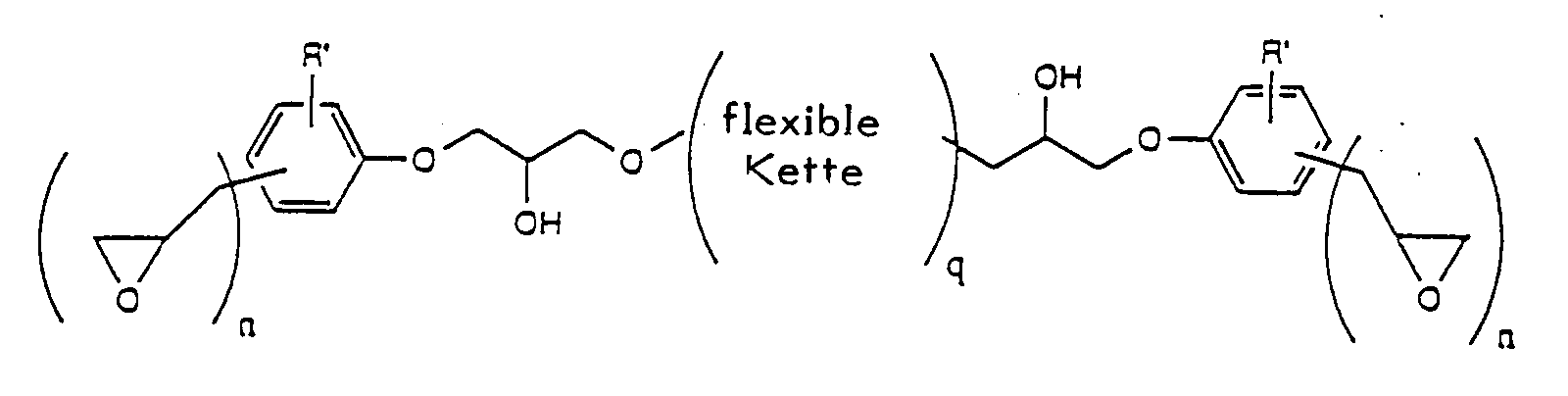 R' H, C1-18-Alkyl, C1-5-Alkoxy oder Aryl oder Alkylaryl, C1-5-Perfluoralkyl oder C1-5-Acyl ist; undn eine ganze Zahl 1 bis 3 ist; unddie flexible Kette CH2CH2CH2CH2O ist, wenn q eine ganze Zahl 1 bis 6 ist; oderdie flexible Kette CH2CH2O ist, wenn q eine ganze Zahl 3 bis 10 ist.
 - Flexible, durch einen Gesamtchlorgehalt von weniger als 0,1 Gew.-% charakterisierte Epoxyverbindung mit der Strukturformel:in der:
 R' H, C1-18-Alkyl, C1-5-Alkoxy oder Aryl oder Alkylaryl, C1-5-Perfluoralkyl oder C1-5-Acyl ist; undn eine ganze Zahl 1 bis 3 ist; undp eine ganze Zahl 6 bis 16 ist.
 - Flexible, durch einen Gesamtchlorgehalt von weniger als 0,1 Gew.-% charakterisierte Epoxyverbindung mit der Strukturformel:in der:
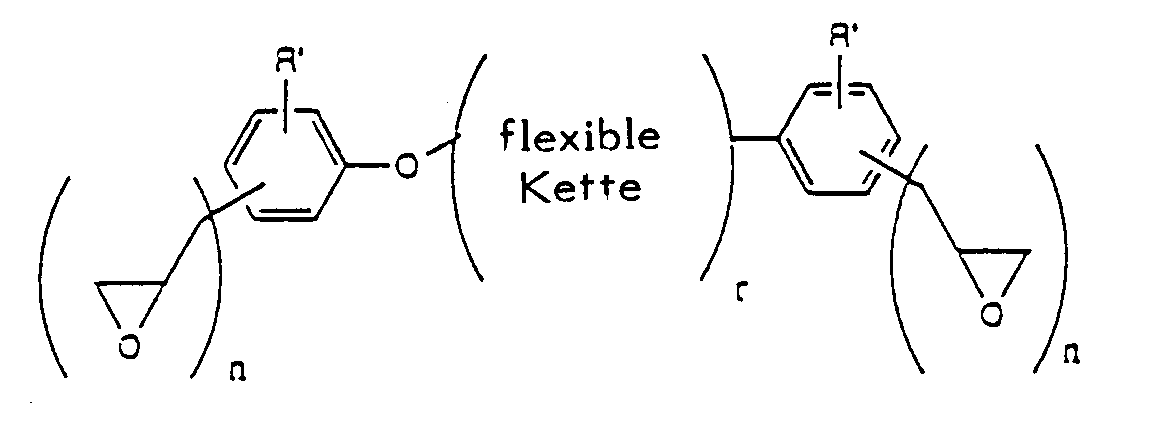 R' H, C1-18-Alkyl, C1-5-Alkoxy oder Aryl oder Alkylaryl, C1-5-Perfluoralkyl oder C1-5-Acyl ist; undn eine ganze Zahl 1 bis 3 ist; unddie flexible Kette CH2CH2CH2CH2O ist, wenn r eine ganze Zahl 1 bis 10 ist; oderdie flexible Kette CH2CH2O ist, wenn r eine ganze Zahl 3 bis 10 ist; oderdie flexible Kette CH2 ist, wenn r eine ganze Zahl 10 bis 20 ist.
 - Flexible Epoxyverbindung gemäß Anspruch 1 mit der Struktur:

- Flexible Epoxyverbindung gemäß Anspruch 1 mit der Struktur:

- Flexible Fpoxyverbindung gemäß Anspruch 2 mit der Struktur:
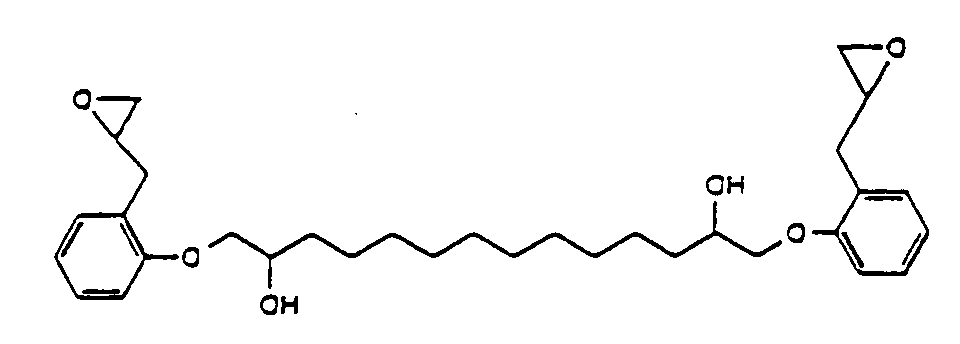
- Flexible Epoxyverbindung gemäß Anspruch 3 mit der Struktur:

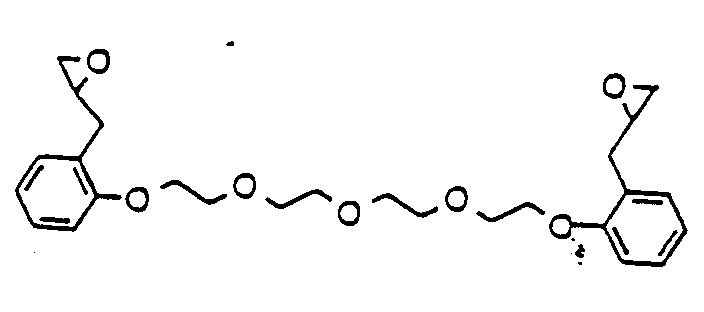
- Flexible Epoxyverbindung gemäß Anspruch 3 mit der Struktur:
- Klebstoff zur Verwendung in Mikroelektronik-Anwendungen, der ein flexibles Epoxid gemäß Anspruch 1 enthält.
- Klebstoff zur Verwendung in Mikroelektronik-Anwendungen, der ein flexibles Epoxid gemaß Anspruch 2 enthält.
- Klebstoff zur Verwendung in Mikroelektronik-Anwendungen, der ein flexibles Epoxid gemäß Anspruch 3 enthält.
Priority Applications (1)
| Application Number | Priority Date | Filing Date | Title |
|---|---|---|---|
| SG1996010005A SG75097A1 (en) | 1995-06-07 | 1996-06-07 | Polyglydicylphenyl ethers of alkylene or alkyleoxy chains for use in microelectronics adhesives |
Applications Claiming Priority (4)
| Application Number | Priority Date | Filing Date | Title |
|---|---|---|---|
| US48254195A | 1995-06-07 | 1995-06-07 | |
| US482541 | 1995-06-07 | ||
| US656597 | 1996-05-31 | ||
| US08/656,597 US5646315A (en) | 1995-06-07 | 1996-05-31 | Polyglydicylphenyl ethers of alkyloxy chains for use in microelectronics adhesives |
Publications (2)
| Publication Number | Publication Date |
|---|---|
| EP0747370A1 EP0747370A1 (de) | 1996-12-11 |
| EP0747370B1 true EP0747370B1 (de) | 1999-12-22 |
Family
ID=27047326
Family Applications (1)
| Application Number | Title | Priority Date | Filing Date |
|---|---|---|---|
| EP96109064A Expired - Lifetime EP0747370B1 (de) | 1995-06-07 | 1996-06-05 | Polyglycidylphenylether von Alkylen- oder Alkylenoxyketten und ihre Verwendung in mikroelektronischen Klebstoffen |
Country Status (4)
| Country | Link |
|---|---|
| US (3) | US5646315A (de) |
| EP (1) | EP0747370B1 (de) |
| KR (1) | KR100195543B1 (de) |
| DE (1) | DE69605716D1 (de) |
Families Citing this family (15)
| Publication number | Priority date | Publication date | Assignee | Title |
|---|---|---|---|---|
| US5646315A (en) * | 1995-06-07 | 1997-07-08 | National Starch And Chemical Investment Holding Corporation | Polyglydicylphenyl ethers of alkyloxy chains for use in microelectronics adhesives |
| US5717054A (en) * | 1995-06-07 | 1998-02-10 | National Starch & Chemical Investment Holding Corp. | Epoxy resins consisting of flexible chains terminated with glycidyloxyphenyl groups for use in microelectronics adhesives |
| US5770706A (en) * | 1995-06-07 | 1998-06-23 | National Starch And Chemical Investment Holding Corporation | Snap-cure epoxy adhesives |
| AT404514B (de) * | 1996-11-06 | 1998-12-28 | Robert Dr Kellner | Vorrichtung und verfahren zur messung der konzentration von stoffen in flüssigkeiten |
| US20010014399A1 (en) * | 1997-02-26 | 2001-08-16 | Stanley J. Jasne | Conductive uv-curable epoxy formulations |
| US7115976B1 (en) | 1997-08-06 | 2006-10-03 | Micron Technology, Inc. | Method and apparatus for epoxy LOC die attachment |
| US6858469B1 (en) * | 1997-08-06 | 2005-02-22 | Micron Technology, Inc. | Method and apparatus for epoxy loc die attachment |
| JP3365367B2 (ja) * | 1999-09-14 | 2003-01-08 | ソニーケミカル株式会社 | Cog実装品および接続材料 |
| US6750301B1 (en) * | 2000-07-07 | 2004-06-15 | National Starch And Chemical Investment Holding Corporation | Die attach adhesives with epoxy compound or resin having allyl or vinyl groups |
| DE10208743A1 (de) * | 2002-02-28 | 2003-12-11 | Siemens Ag | Korrosionsarme Epoxidharze und Herstellungsverfahren dazu |
| DE60323758D1 (de) * | 2002-08-05 | 2008-11-06 | Nxp Bv | Verfahren zur herstellung einer verpackten halbleitervorrichtung, mit solch einem verfahren erhaltene verpackte halbleitervorrichtung und zur verwendung in solch einem verfahren geeigneter metallträger |
| US20070236542A1 (en) * | 2006-03-29 | 2007-10-11 | Graham David C | Adhesive Compositions, Micro-Fluid Ejection Devices, and Methods for Attaching Micro-Fluid Ejection Heads |
| JP2011509339A (ja) * | 2008-01-08 | 2011-03-24 | ダウ グローバル テクノロジーズ エルエルシー | 複合材料用の高Tgエポキシ系 |
| US20110014354A1 (en) * | 2009-07-20 | 2011-01-20 | David Christopher Graham | Adhesive compositions and methods for use in failure analysis |
| JP6825723B2 (ja) * | 2017-12-18 | 2021-02-03 | Dic株式会社 | ヒドロキシ化合物、組成物、硬化物及び積層体 |
Family Cites Families (13)
| Publication number | Priority date | Publication date | Assignee | Title |
|---|---|---|---|---|
| DE1222076C2 (de) * | 1962-02-03 | 1976-01-15 | Bayer Ag, 5090 Leverkusen | Verfahren zur herstellung von diepoxiden |
| US3522210A (en) * | 1965-03-01 | 1970-07-28 | Union Carbide Corp | Curable polyglycidyl ethers of a dihydric phenol,containing flexible linkages |
| US4110354A (en) * | 1970-08-26 | 1978-08-29 | The Dow Chemical Company | Water-soluble epoxy resins and process for their preparation |
| JPS6011910B2 (ja) * | 1979-10-26 | 1985-03-28 | 岡村製油株式会社 | ポリカルボン酸グリシジルエステル |
| DE3671449D1 (de) * | 1985-06-06 | 1990-06-28 | Ciba Geigy Ag | 2,6-disubstituierte 4-epoxypropylphenylglycidylether und deren verwendung. |
| CH672666A5 (de) * | 1986-11-27 | 1989-12-15 | Bbc Brown Boveri & Cie | |
| US4789711A (en) * | 1986-12-02 | 1988-12-06 | Ciba-Geigy Corporation | Multifunctional epoxide resins |
| JPH02282375A (ja) * | 1989-04-21 | 1990-11-19 | Asahi Denka Kogyo Kk | 新規ジグリシジルエーテル |
| CA2043422A1 (en) * | 1990-05-30 | 1991-12-01 | Kailash C. B. Dangayach | Epoxy resin composition |
| JPH0753671A (ja) * | 1993-08-11 | 1995-02-28 | Toshiba Chem Corp | エポキシ樹脂組成物および半導体封止装置 |
| US5536855A (en) * | 1994-03-04 | 1996-07-16 | National Starch And Chemical Investment Holding Corporation | Process for preparing glycidyl esters for use in electronics adhesives |
| US5717054A (en) * | 1995-06-07 | 1998-02-10 | National Starch & Chemical Investment Holding Corp. | Epoxy resins consisting of flexible chains terminated with glycidyloxyphenyl groups for use in microelectronics adhesives |
| US5646315A (en) * | 1995-06-07 | 1997-07-08 | National Starch And Chemical Investment Holding Corporation | Polyglydicylphenyl ethers of alkyloxy chains for use in microelectronics adhesives |
-
1996
- 1996-05-31 US US08/656,597 patent/US5646315A/en not_active Expired - Lifetime
- 1996-06-05 EP EP96109064A patent/EP0747370B1/de not_active Expired - Lifetime
- 1996-06-05 DE DE69605716T patent/DE69605716D1/de not_active Expired - Lifetime
- 1996-06-07 KR KR1019960020241A patent/KR100195543B1/ko not_active Expired - Fee Related
- 1996-11-27 US US08/757,187 patent/US5703195A/en not_active Expired - Lifetime
- 1996-11-27 US US08/758,603 patent/US5783713A/en not_active Expired - Lifetime
Also Published As
| Publication number | Publication date |
|---|---|
| KR100195543B1 (ko) | 1999-06-15 |
| US5783713A (en) | 1998-07-21 |
| KR970001406A (ko) | 1997-01-24 |
| EP0747370A1 (de) | 1996-12-11 |
| US5703195A (en) | 1997-12-30 |
| DE69605716D1 (de) | 2000-01-27 |
| US5646315A (en) | 1997-07-08 |
Similar Documents
| Publication | Publication Date | Title |
|---|---|---|
| US5854315A (en) | Snap-cure epoxy adhesives | |
| EP0747370B1 (de) | Polyglycidylphenylether von Alkylen- oder Alkylenoxyketten und ihre Verwendung in mikroelektronischen Klebstoffen | |
| GB2316407A (en) | Epoxy resins and compositions containing them | |
| JP2902356B2 (ja) | マイクロエレクトロニクス接着剤における使用のためのアルキレン若しくはアルキレンオキシ鎖のポリグリシジルフェニルエーテル | |
| JP5319289B2 (ja) | エポキシ樹脂及びその製造方法、並びにそれを用いたエポキシ樹脂組成物及びその硬化物 | |
| JP5669532B2 (ja) | 半導体封止用硬化性組成物 | |
| JP6407580B2 (ja) | エポキシ樹脂及びその組成物、並びに化合物 | |
| JP3573530B2 (ja) | エポキシ樹脂混合物、エポキシ樹脂組成物およびその硬化物 | |
| JP6688805B2 (ja) | 置換アリルエーテル樹脂、メタリルエーテル樹脂、エポキシ樹脂、エポキシ樹脂組成物及びその硬化物 | |
| JP3451104B2 (ja) | エポキシ樹脂組成物 | |
| JP3907140B2 (ja) | 変性エポキシ樹脂、エポキシ樹脂組成物及びその硬化物 | |
| JP3636409B2 (ja) | フェノール類樹脂、エポキシ樹脂、エポキシ樹脂組成物及びその硬化物 | |
| JPH08333428A (ja) | 低軟化点フェニルフェノールアラルキル樹脂およびその樹脂を用いたエポキシ樹脂組成物 | |
| JP2003277468A (ja) | エポキシ樹脂、エポキシ樹脂組成物及びその硬化物 | |
| JPH06145309A (ja) | ヒドロキシナフタレン共重合体、そのエポキシ化物、それらの製造方法および用途 | |
| JPH0920819A (ja) | 変性フェノールノボラック樹脂、エポキシ樹脂、エポキシ樹脂組成物及びその硬化物 | |
| JP4463453B2 (ja) | エポキシ樹脂組成物及びその硬化物 | |
| JP4404821B2 (ja) | 変性エポキシ樹脂、エポキシ樹脂組成物及びその硬化物 | |
| WO2005078001A1 (ja) | エポキシ樹脂の製造方法、エポキシ樹脂組成物及び硬化物 | |
| JP4082668B2 (ja) | フェノール樹脂、エポキシ樹脂組成物及びその硬化物 | |
| JPH08325361A (ja) | フェノール樹脂、エポキシ樹脂、エポキシ樹脂組成物及びその硬化物 | |
| JP2003026760A (ja) | 結晶性エポキシ樹脂、エポキシ樹脂組成物及びその硬化物 | |
| JP2004224818A (ja) | エポキシ樹脂組成物 | |
| JP2002105169A (ja) | エポキシ樹脂組成物及びその硬化物 | |
| JP2003026761A (ja) | エポキシ樹脂、エポキシ樹脂組成物及びその硬化物 |
Legal Events
| Date | Code | Title | Description |
|---|---|---|---|
| PUAI | Public reference made under article 153(3) epc to a published international application that has entered the european phase |
Free format text: ORIGINAL CODE: 0009012 |
|
| AK | Designated contracting states |
Kind code of ref document: A1 Designated state(s): CH DE FR GB IT LI NL |
|
| 17P | Request for examination filed |
Effective date: 19961106 |
|
| GRAG | Despatch of communication of intention to grant |
Free format text: ORIGINAL CODE: EPIDOS AGRA |
|
| 17Q | First examination report despatched |
Effective date: 19990211 |
|
| GRAG | Despatch of communication of intention to grant |
Free format text: ORIGINAL CODE: EPIDOS AGRA |
|
| GRAH | Despatch of communication of intention to grant a patent |
Free format text: ORIGINAL CODE: EPIDOS IGRA |
|
| GRAH | Despatch of communication of intention to grant a patent |
Free format text: ORIGINAL CODE: EPIDOS IGRA |
|
| GRAA | (expected) grant |
Free format text: ORIGINAL CODE: 0009210 |
|
| AK | Designated contracting states |
Kind code of ref document: B1 Designated state(s): CH DE FR GB IT LI NL |
|
| PG25 | Lapsed in a contracting state [announced via postgrant information from national office to epo] |
Ref country code: NL Free format text: LAPSE BECAUSE OF FAILURE TO SUBMIT A TRANSLATION OF THE DESCRIPTION OR TO PAY THE FEE WITHIN THE PRESCRIBED TIME-LIMIT Effective date: 19991222 Ref country code: LI Free format text: LAPSE BECAUSE OF FAILURE TO SUBMIT A TRANSLATION OF THE DESCRIPTION OR TO PAY THE FEE WITHIN THE PRESCRIBED TIME-LIMIT Effective date: 19991222 Ref country code: IT Free format text: LAPSE BECAUSE OF FAILURE TO SUBMIT A TRANSLATION OF THE DESCRIPTION OR TO PAY THE FEE WITHIN THE PRESCRIBED TIME-LIMIT;WARNING: LAPSES OF ITALIAN PATENTS WITH EFFECTIVE DATE BEFORE 2007 MAY HAVE OCCURRED AT ANY TIME BEFORE 2007. THE CORRECT EFFECTIVE DATE MAY BE DIFFERENT FROM THE ONE RECORDED. Effective date: 19991222 Ref country code: FR Free format text: LAPSE BECAUSE OF FAILURE TO SUBMIT A TRANSLATION OF THE DESCRIPTION OR TO PAY THE FEE WITHIN THE PRESCRIBED TIME-LIMIT Effective date: 19991222 Ref country code: CH Free format text: LAPSE BECAUSE OF FAILURE TO SUBMIT A TRANSLATION OF THE DESCRIPTION OR TO PAY THE FEE WITHIN THE PRESCRIBED TIME-LIMIT Effective date: 19991222 |
|
| REG | Reference to a national code |
Ref country code: CH Ref legal event code: EP |
|
| REF | Corresponds to: |
Ref document number: 69605716 Country of ref document: DE Date of ref document: 20000127 |
|
| PG25 | Lapsed in a contracting state [announced via postgrant information from national office to epo] |
Ref country code: DE Free format text: LAPSE BECAUSE OF FAILURE TO SUBMIT A TRANSLATION OF THE DESCRIPTION OR TO PAY THE FEE WITHIN THE PRESCRIBED TIME-LIMIT Effective date: 20000323 |
|
| EN | Fr: translation not filed | ||
| NLV1 | Nl: lapsed or annulled due to failure to fulfill the requirements of art. 29p and 29m of the patents act | ||
| REG | Reference to a national code |
Ref country code: CH Ref legal event code: PL |
|
| PLBE | No opposition filed within time limit |
Free format text: ORIGINAL CODE: 0009261 |
|
| STAA | Information on the status of an ep patent application or granted ep patent |
Free format text: STATUS: NO OPPOSITION FILED WITHIN TIME LIMIT |
|
| 26N | No opposition filed | ||
| PGFP | Annual fee paid to national office [announced via postgrant information from national office to epo] |
Ref country code: GB Payment date: 20010502 Year of fee payment: 6 |
|
| REG | Reference to a national code |
Ref country code: GB Ref legal event code: IF02 |
|
| PG25 | Lapsed in a contracting state [announced via postgrant information from national office to epo] |
Ref country code: GB Free format text: LAPSE BECAUSE OF NON-PAYMENT OF DUE FEES Effective date: 20020605 |
|
| GBPC | Gb: european patent ceased through non-payment of renewal fee |
Effective date: 20020605 |