EP0697027B1 - Tetraaroxyperylen-3,4,9,10-tetracarbonsäurepolyimide - Google Patents
Tetraaroxyperylen-3,4,9,10-tetracarbonsäurepolyimide Download PDFInfo
- Publication number
- EP0697027B1 EP0697027B1 EP94915140A EP94915140A EP0697027B1 EP 0697027 B1 EP0697027 B1 EP 0697027B1 EP 94915140 A EP94915140 A EP 94915140A EP 94915140 A EP94915140 A EP 94915140A EP 0697027 B1 EP0697027 B1 EP 0697027B1
- Authority
- EP
- European Patent Office
- Prior art keywords
- tetraaroxyperylene
- radicals
- tetracarboxylic
- polyimides
- general formula
- Prior art date
- Legal status (The legal status is an assumption and is not a legal conclusion. Google has not performed a legal analysis and makes no representation as to the accuracy of the status listed.)
- Expired - Lifetime
Links
- 0 *c(cc1)ccc1O Chemical compound *c(cc1)ccc1O 0.000 description 6
- ANGLQXXKITTZAY-UHFFFAOYSA-N CCC(C)(C)N(CO)C(C1C=C(C)CC1C)=O Chemical compound CCC(C)(C)N(CO)C(C1C=C(C)CC1C)=O ANGLQXXKITTZAY-UHFFFAOYSA-N 0.000 description 1
Classifications
-
- C—CHEMISTRY; METALLURGY
- C07—ORGANIC CHEMISTRY
- C07D—HETEROCYCLIC COMPOUNDS
- C07D493/00—Heterocyclic compounds containing oxygen atoms as the only ring hetero atoms in the condensed system
- C07D493/02—Heterocyclic compounds containing oxygen atoms as the only ring hetero atoms in the condensed system in which the condensed system contains two hetero rings
- C07D493/06—Peri-condensed systems
-
- C—CHEMISTRY; METALLURGY
- C08—ORGANIC MACROMOLECULAR COMPOUNDS; THEIR PREPARATION OR CHEMICAL WORKING-UP; COMPOSITIONS BASED THEREON
- C08G—MACROMOLECULAR COMPOUNDS OBTAINED OTHERWISE THAN BY REACTIONS ONLY INVOLVING UNSATURATED CARBON-TO-CARBON BONDS
- C08G73/00—Macromolecular compounds obtained by reactions forming a linkage containing nitrogen with or without oxygen or carbon in the main chain of the macromolecule, not provided for in groups C08G12/00 - C08G71/00
- C08G73/06—Polycondensates having nitrogen-containing heterocyclic rings in the main chain of the macromolecule
- C08G73/10—Polyimides; Polyester-imides; Polyamide-imides; Polyamide acids or similar polyimide precursors
- C08G73/1067—Wholly aromatic polyimides, i.e. having both tetracarboxylic and diamino moieties aromatically bound
-
- C—CHEMISTRY; METALLURGY
- C08—ORGANIC MACROMOLECULAR COMPOUNDS; THEIR PREPARATION OR CHEMICAL WORKING-UP; COMPOSITIONS BASED THEREON
- C08G—MACROMOLECULAR COMPOUNDS OBTAINED OTHERWISE THAN BY REACTIONS ONLY INVOLVING UNSATURATED CARBON-TO-CARBON BONDS
- C08G73/00—Macromolecular compounds obtained by reactions forming a linkage containing nitrogen with or without oxygen or carbon in the main chain of the macromolecule, not provided for in groups C08G12/00 - C08G71/00
- C08G73/06—Polycondensates having nitrogen-containing heterocyclic rings in the main chain of the macromolecule
- C08G73/10—Polyimides; Polyester-imides; Polyamide-imides; Polyamide acids or similar polyimide precursors
- C08G73/1075—Partially aromatic polyimides
- C08G73/1082—Partially aromatic polyimides wholly aromatic in the tetracarboxylic moiety
-
- C—CHEMISTRY; METALLURGY
- C09—DYES; PAINTS; POLISHES; NATURAL RESINS; ADHESIVES; COMPOSITIONS NOT OTHERWISE PROVIDED FOR; APPLICATIONS OF MATERIALS NOT OTHERWISE PROVIDED FOR
- C09B—ORGANIC DYES OR CLOSELY-RELATED COMPOUNDS FOR PRODUCING DYES, e.g. PIGMENTS; MORDANTS; LAKES
- C09B69/00—Dyes not provided for by a single group of this subclass
- C09B69/10—Polymeric dyes; Reaction products of dyes with monomers or with macromolecular compounds
- C09B69/101—Polymeric dyes; Reaction products of dyes with monomers or with macromolecular compounds containing an anthracene dye
- C09B69/102—Polymeric dyes; Reaction products of dyes with monomers or with macromolecular compounds containing an anthracene dye containing a perylene dye
Definitions
- the invention further relates to new tetraaroxyperylene-3,4,9,10-tetracarboxylic acid dianhydrides of the general formula III and the corresponding tetraaroxyperylene-3,4,9,10-tetracarboxylic acids (IIIa) as intermediates for the preparation of the polyimides I.
- fluorescent dyes are used, for example, for the areal concentration of light in light collection systems, for the production of dye lasers and daylight colors as well as for the general coloring of printing inks, paints and polymers.
- the dyes must have a number of properties that are particularly high for light collection systems. They must have high fluorescence, a wide absorption range, good separation of absorption and emission bands in the application medium, high lightfastness and good solubility and at the same time a low tendency to migrate in the application medium.
- the object of the invention was to provide fluorescent dyes which come particularly close to the required property profile.
- polyimides I were found for the production of dye lasers and light collection systems and for the pigmentation of printing inks, paints and plastics.
- Suitable R 1 radicals are aryl radicals, such as naphthyl, anthryl and especially phenyl.
- the aryl radicals can be substituted by cyano, nitro, halogen, in particular chlorine, C 1 -C 18 alkoxy, C 5 -C 7 cycloalkyl, especially cyclohexyl, and / or C 1 -C 18 alkyl and each contain in the Usually up to 24 carbon atoms.
- the R 1 radicals can be the same or different, but are preferably the same.
- Examples of preferred substituted aryl radicals are 4-tert-butylphenyl, 2-cyclohexyl-4-methylphenyl, 2- and 4-cyclohexylphenyl, 4-hexyloxyphenyl, 2-phenylphenyl, 4-cyanophenyl-O-nitrophenyl, benzylphenyl and 2-benzyl- 4-chlorophenyl.
- the groups R 2 are preferably aliphatic, cycloaliphatic or aromatic groups.
- Suitable alkylene groups generally contain 2 to 30, preferably 3 to 10, carbon atoms. Examples include: ethylene, 1,2- and 1,3-propylene, 1,2-, 1,3-, 1,4- and 2,3-butylene, 1,2-, 1,3-, 1, 4-, 1,5-, 2,3- and 2,4-pentylene, hexamethylene, heptamethylene, octamethylene, nonamethylene and decamethylene and other branched residues of this type.
- the carbon chain of these groups can be interrupted by 1 to 10 oxygen atoms in ether function or phenylene or cyclohexylene.
- Suitable cyclic groups R 2 are in particular cyclohexylene and phenylene, but also naphthylene.
- variable n means an average for the number of perylene diimide units contained in the polyimide I and is generally 2 to 100, preferably 10 to 50 and particularly preferably 20 to 40.
- the polyimides I according to the invention are distinguished overall by excellent properties: they have high light fastness, high thermal stability, high fluorescence and a broad absorption range. Despite their molecular size, they are very soluble and at the same time show only a low tendency to migrate in the respective application medium. In addition, they are easily film-forming and are drawn onto glass or plastic as a homogeneous film.
- the process according to the invention for the preparation of the polyimides I is carried out in two stages via the new tetraaroxyperylene-3,4,9,10-tetracarboxylic acid dianhydrides III or the corresponding acids (IIIa) as intermediates.
- Suitable radicals R 3 on the imide nitrogen atom are C 1 -C 30 alkyl radicals, preferably C 1 -C 18 alkyl radicals, as mentioned for R 1 , C 5 -C 7 cycloalkyl radicals, especially cyclohexyl radicals, and phenyl radicals.
- the carbon chain of the alkyl radicals can be interrupted by 1 to 10 ether oxygen atoms.
- Examples include: 2-methoxy, 2-ethoxy, 2-propoxy, 2-isopropoxy and 2-butoxyethyl, 2- and 3-methoxypropyl, 2- and 3-ethoxypropyl, 2- and 4-ethoxybutyl, 2 - and 4-isopropoxybutyl, 5-ethoxypentyl, 6-methoxyhexyl, 4-oxa-6-ethyldecyl, 3,6-dioxaheptyl, 3,6-dioxaoctyl, 3,6-dioxadecyl, 3,6,9-trioxadecyl and 3, 6,8-trioxaundecyl.
- cycloalkyl and phenyl radicals can be substituted by up to 2 C 1 -C 4 alkyl groups, as also mentioned above.
- the perylimides II are known from EP-A-227 980 and, as described there, can be prepared by reacting the tetrachloroperylimides with the corresponding arylates.
- step a) of the process according to the invention a perylimide II is reacted with a base in the presence of a polar, protic solvent in the corresponding anhydride III transferred.
- the acid (IIIa) itself is not stable and converts to the anhydride practically immediately.
- inorganic bases such as sodium hydroxide and potassium hydroxide are suitable as bases.
- the base is in excess, i.e. generally used in amounts of 1 to 10 mol per 10 mmol.
- Suitable polar, protic solvents are, in particular, C 1 -C 10 -alkanols such as propanol, isopropanol, n-butanol, n-hexanol, n-decanol, preferably tert-butanol.
- a small amount of water, generally 0.1 to 0.4 mol per mmol of II, is expediently added to facilitate the removal of the product.
- the amount of solvent is also not critical per se. Usual amounts are 0.5 to 1.2 mol per mmol II.
- step a) of the process according to the invention the mixture of perylene diimide II, base and solvent is refluxed for several hours, generally 10 to 48 hours, i.e. heated to about 80 to 140 ° C. After cooling to room temperature, the organic phase can then be separated off.
- the anhydride III can be isolated in the customary manner by precipitation with an acid, filtering off, washing and drying.
- step b) of the process according to the invention the anhydride III obtained in a) and a diamine IV are polymerized.
- This polycondensation is preferably carried out in the presence of a polar solvent first under acidic and then under basic catalysis.
- the solvents used in the production of polyimides are suitable as polar solvents.
- Preferred examples include cresol, dimethylformamide, dimethylacetamide, N-methylpyridone, 1,3-dimethyl-3,4,5,6-tetrahydropyrimidin-2-one.
- the solvent is usually used in amounts of 0.8 to 2 mol, preferably around 1 mol, per 10 mmol of diamine IV.
- Benzoic acid for example, is preferred as the acid catalyst.
- 2 to 4 mol, in particular 2 mol, of catalyst are used per mol of III.
- Particularly suitable basic catalysts are, for example, quinoline and isoquinoline, which are usually also in amounts of about 2 to 4 mol, preferably 2 mol, per mol of III.
- the reaction temperature is usually 170 to 200 ° C.
- the polycondensation is carried out in such a way that a mixture of diamine IV, solvent, anhydride III and acid catalyst is first heated to the reaction temperature for about 8 to 12 h and, after the addition of the basic catalyst, usually for a further 15 to 24 h. After cooling to room temperature, the polyimide I can be separated from the reaction mixture by dissolving in chloroform and precipitated again by adding methanol.
- the process according to the invention is distinguished by good yields and high purity of the polyimides I obtained.
- the polyimides I are advantageously suitable for the usual uses for fluorescent dyes, such as the production of light collection systems and dye lasers, which is described in EP-A-227 980 or DE-A-34 13 418 and the literature cited in each case. Furthermore, they can be used for pigmenting printing inks, paints, in particular also fluorescent inks, and plastics.
Landscapes
- Chemical & Material Sciences (AREA)
- Organic Chemistry (AREA)
- Health & Medical Sciences (AREA)
- Chemical Kinetics & Catalysis (AREA)
- Medicinal Chemistry (AREA)
- Polymers & Plastics (AREA)
- Macromolecular Compounds Obtained By Forming Nitrogen-Containing Linkages In General (AREA)
- Luminescent Compositions (AREA)
- Compositions Of Macromolecular Compounds (AREA)
Abstract
Description
- Die vorliegende Erfindung betrifft neue Tetraaroxyperylen-3,4,9,10-tetracarbonsäurepolyimide der allgemeinen Formel I

- R1
- gleiche oder verschiedene Arylreste, die durch Cyano, Nitro, Halogen, C1-C18-Alkoxy, C5-C7-Cycloalkyl und/oder C1-C18-Alkyl substituiert sein können und jeweils bis zu 24 C-Atome enthalten können;
- R2
- C2-C30-Alkylengruppen, deren Kohlenstoffkette durch 1 bis 10 Sauerstoffatome in Etherfunktion oder eine Phenylen- oder Cyclohexylengruppe unterbrochen sein kann, oder gegebenenfalls durch C1-C10-Alkylen oder Sauerstoff verbrückte C6-C30-Arylen- oder Cyclohexylenreste;
- n
- 2 bis 100,
- Weiterhin betrifft die Erfindung neue Tetraaroxyperylen-3,4,9,10-tetracarbonsäuredianhydride der allgemeinen Formel III

- Für Fluoreszenzfarbstoffe gibt es bekanntermaßen vielfältige Anwendungsmöglichkeiten; sie werden beispielsweise zur flächenmäßigen Konzentrierung von Licht in Lichtsammelsystemen, zur Herstellung von Farbstofflasern und Tagesleuchtfarben sowie auch allgemein zur Einfärbung von Druckfarben, Anstrichmitteln und Polymeren eingesetzt.
- Hierfür müssen die Farbstoffe eine Reihe von Eigenschaften aufweisen, die insbesondere für Lichtsammelsysteme hoch sind. Sie müssen hohe Fluoreszenz, einen breiten Absorptionsbereich, gute Trennung von Absorptions- und Emissionsbanden im Anwendungsmedium, hohe Lichtechtheit und gute Löslichkeit und gleichzeitig geringe Neigung zur Migration im Anwendungsmedium aufweisen.
- Diese Anforderungen sind gleichzeitig nur schwer zu erfüllen. Das gilt auch für die in der EP-A-227 980 und der JP-A-53 894/1992 beschriebenen Fluoreszenzfarbstoffe auf der Basis von monomeren, vierfach substituierten Perylen-3,4,9,10-tetracarbonsäurediimiden, die hinsichtlich ihrer Migrationsbeständigkeit teilweise nicht zufriedenstellend sind.
- Aus der JP-A-110 219/1988 und der EP-A-445 577 sind unsubstituierte Perylen-3,4,9,10-tetracarbonsäurepolyimide bekannt, die jedoch nicht als Fluoreszenzfarbstoffe verwendet werden.
- Der Erfindung lag die Aufgabe zugrunde, Fluoreszenzfarbstoffe bereitzustellen, die dem geforderten Eigenschaftsprofil besonders nahe kommen.
- Demgemäß wurden die eingangs definierten Tetraaroxyperylen-3,4,9,10-tetracarbonsäurepolyimide I gefunden.
- Weiterhin wurde ein Verfahren zur Herstellung der Polyimide I gefunden, welches dadurch gekennzeichnet ist, daß man
- a) ein Tetraaroxyperylen-3,4,9,10-tetracarbonsäurediimid der allgemeinen Formel II

mit einer Base in einem polaren, protischen Lösungsmittel behandelt und - b) das in Schritt a) erhaltene Tetraaroxyperylen-3,4,9,10-tetracarbonsäuredianhydrid der allgemeinen Formel III

H2N-R2-NH2 IV
in Gegenwart eines polaren Lösungsmittels zunächst unter saurer und dann unter basischer Katalyse bei 170 bis 200°C polykondensiert. - Außerdem wurde die Verwendung der Polyimide I zur Herstellung von Farbstofflasern und Lichtsammelsystemen und zur Pigmentierung von Druckfarben, Anstrichmitteln und Kunststoffen gefunden.
- Nicht zuletzt wurden die Tetraaroxyperylen-3,4,9,10-tetracarbonsäuredianhydride III und die entsprechenden Tetraaroxyperylen-3,4,9,10-tetracarbonsäuren (IIIa) als Zwischenprodukte für die Herstellung der Polyimide I gefunden.
- Geeignete Reste R1 sind dabei Arylreste, wie Naphthyl, Anthryl und besonders Phenyl. Die Arylreste können durch Cyano, Nitro, Halogen, insbesondere Chlor, C1-C18-Alkoxy, C5-C7-Cycloalkyl, vor allem Cyclohexyl, und/oder C1-C18-Alkyl substituiert sein und enthalten jeweils in der Regel bis zu 24 C-Atome. Die Reste R1 können gleich oder verschieden sein, sind jedoch bevorzugt gleich.
- Beispiele für die als Substituenten geeigneten C1-C18-Alkoxy- und Alkylgruppen sind:
- Methoxy, Ethoxy, Propoxy, Isopropoxy, Butoxy, Isobutoxy, sec.-Butoxy, tert.-Butoxy, Pentyloxy, Isopentyloxy, Neopentyloxy, Hexyloxy, Heptyloxy, Octyloxy, 2-Ethylhexyloxy, Nonyloxy, Decyloxy, Undecyloxy, Dodecyloxy, Tridecyloxy, Tetradecyloxy, Pentadecyloxy, Hexadecyloxy, Heptadecyloxy und Octadecyloxy sowie weitere verzweigte Reste dieser Art;
- Methyl, Ethyl, Propyl, Isopropyl, Butyl, Isobutyl, sec.-Butyl, tert.-Butyl, Pentyl, Isopentyl, Neopentyl, tert.-Pentyl, Hexyl, 2-Methylpentyl, Heptyl, Octyl, 2-Ethylhexyl, Nonyl, Decyl, Undecyl, Dodecyl, Tridecyl, Tetradecyl, Pentadecyl, Hexadecyl, Heptadecyl und Octadecyl sowie weitere verzweigte Reste dieser Art.
- Beispiele für bevorzugte substituierte Arylreste sind 4-tert.-Butylphenyl, 2-Cyclohexyl-4-methylphenyl, 2- und 4-Cyclohexylphenyl, 4-Hexyloxyphenyl, 2-Phenylphenyl, 4-Cyanophenyl-O-nitrophenyl, Benzylphenyl und 2-Benzyl-4-chlorphenyl.
- Bei den Gruppen R2 handelt es sich vorzugsweise um aliphatische, cycloaliphatische oder aromatische Gruppen.
- Geeignete Alkylengruppen enthalten in der Regel 2 bis 30, bevorzugt 3 bis 10 C-Atome. Beispielsweise seien genannt: Ethylen, 1,2- und 1,3-Propylen, 1,2-, 1,3-, 1,4- und 2,3-Butylen, 1,2-, 1,3-, 1,4-, 1,5-, 2,3- und 2,4-Pentylen, Hexamethylen, Heptamethylen, Octamethylen, Nonamethylen und Decamethylen sowie weitere verzweigte Reste dieser Art.
- Zusätzlich kann die Kohlenstoffkette dieser Gruppen noch durch 1 bis 10 Sauerstoffatome in Etherfunktion oder Phenylen oder Cyclohexylen unterbrochen sein. Als Beispiele seien genannt (dabei bedeuten Ph= Phenylen, C6H4= Cyclohexylen):
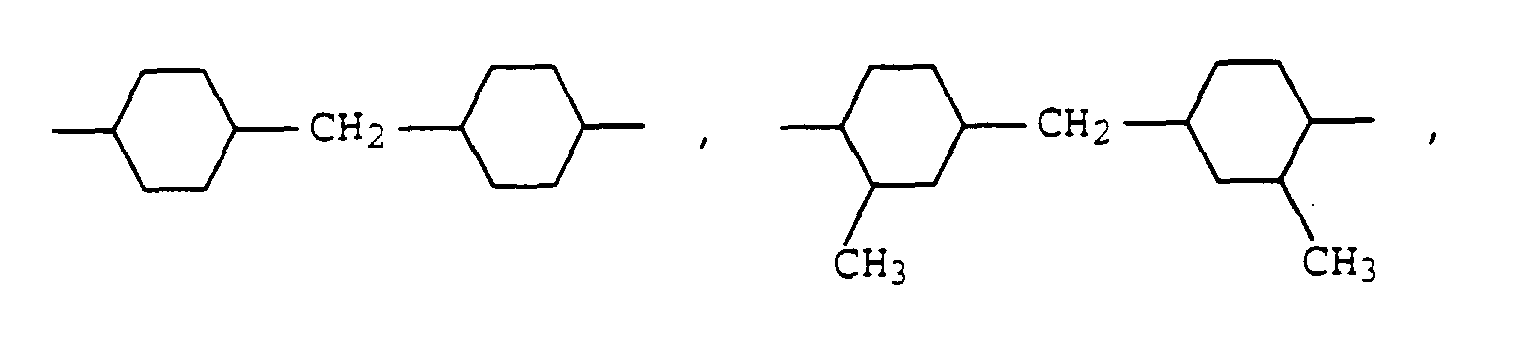
-(CH2)2-O-(CH2)2-, -[(CH2)2-O]2-(CH2)2-, -[(CH2)2-O]3-(CH2)2-, -(CH2)3-O-(CH2)4-O-(CH2)3-, -(CH2)3-O-[(CH2)2-O]2-(CH2)3-, -CH2-Ph-CH2- und -CH2-C6H4-CH2-. - Geeignete cyclische Gruppen R2 sind insbesondere Cyclohexylen und Phenylen, aber auch Naphthylen. Insbesondere können auch zwei Arylen- oder Cyclohexylenreste über Sauerstoff oder C1-C10-Alkylen verbrückt sein. Beispiele für diese Gruppierungen sind (dabei bedeutet m= 1 bis 10):


- Die Variable n bedeutet schließlich einen Mittelwert für die Anzahl der im Polyimid I enthaltenen Perylendiimideinheiten und beträgt in der Regel 2 bis 100, bevorzugt 10 bis 50 und besonders bevorzugt 20 bis 40.
- Die erfindungsgemäßen Polyimide I zeichnen sich insgesamt durch hervorragende Eigenschaften aus: Sie weisen hohe Lichtechtheit, hohe thermische Stabilität, hohe Fluoreszenz und einen breiten Absorptionsbereich auf. Sie sind trotz ihrer Molekülgröße sehr gut löslich und zeigen gleichzeitig nur geringe Migrationstendenz im jeweiligen Anwendungsmedium. Zudem sind sie leicht filmbildend und ziehen als homogener Film auf Glas oder Kunststoff auf.
- Das erfindungsgemäße Verfahren zur Herstellung der Polyimide I läuft zweistufig über die neuen Tetraaroxyperylen-3,4,9,10-tetracarbonsäuredianhydride III bzw. die entsprechenden Säuren (IIIa) als Zwischenprodukte ab.
- Als Edukte bei der in Schritt a) erfolgenden Synthese der Anhydride III werden die oben definierten Tetraaroxyperylen-3,4,9,10-tetracarbonsäurediimide II eingesetzt.
- Geeignete Reste R3 am Imidstickstoffatom- sind dabei C1-C30-Alkylreste, vorzugsweise C1-C18-Alkylreste, wie sie bei R1 genannt sind, C5-C7-Cycloalkylreste, vor allem Cyclohexylreste, und Phenylreste.
- Die Kohlenstoffkette der Alkylreste kann durch 1 bis 10 Sauerstoffatome in Etherfunktion unterbrochen sein. Beispiele hierfür sind: 2-Methoxy-, 2-Ethoxy-, 2-Propoxy-, 2-Isopropoxy- und 2-Butoxyethyl, 2- und 3-Methoxypropyl, 2- und 3-Ethoxypropyl, 2- und 4-Ethoxybutyl, 2- und 4-Isopropoxybutyl, 5-Ethoxypentyl, 6-Methoxyhexyl, 4-Oxa-6-ethyldecyl, 3,6-Dioxaheptyl, 3,6-Dioxaoctyl, 3,6-Dioxadecyl, 3,6,9-Trioxadecyl und 3,6,8-Trioxaundecyl.
- Die Cycloalkyl- und Phenylreste können durch bis zu 2 C1-C4-Alkylgruppen, wie sie ebenfalls oben genannt sind, substituiert sein.
- Die Perylimide II sind aus der EP-A-227 980 bekannt und können, wie dort beschrieben, durch Umsetzung der Tetrachlorperylimide mit den entsprechenden Arylaten hergestellt werden.
- In Schritt a) des erfindungsgemäßen Verfahrens wird ein Perylimid II durch Einwirkung einer Base in Gegenwart eines polaren, protischen Lösungsmittels in das entsprechende Anhydrid III überführt. Die Säure (IIIa) selbst ist nicht beständig und wandelt sich praktisch sofort in das Anhydrid um.
- Als Basen sind dabei vor allem anorganische Basen wie Natriumhydroxid und Kaliumhydroxid geeignet.
- Wie für derartige Reaktionen üblich, wird die Base im Überschuß, d.h. in der Regel in Mengen von 1 bis 10 mol pro 10 mmol, eingesetzt.
- Als polare, protische Lösungsmittel kommen insbesondere C1-C10-Alkanole wie Propanol, Isopropanol, n-Butanol, n-Hexanol, n-Decanol, vorzugsweise tert.-Butanol in Frage. Zweckmäßigerweise wird noch eine geringe Menge Wasser, im allgemeinen 0,1 bis 0,4 mol pro mmol II zugefügt, um die Abtrennung des Produkts zu erleichtern.
- Auch die Menge Lösungsmittel ist an sich unkritisch. Übliche Mengen sind 0,5 bis 1,2 mol pro mmol II.
- Zweckmäßigerweise geht man in Schritt a) des erfindungsgemäßen Verfahrens so vor, daß man die Mischung aus Perylendiimid II, Base und Lösungsmittel mehrere h, in der Regel 10 bis 48 h, unter Rückfluß, d.h. etwa auf 80 bis 140°C, erhitzt. Nach Abkühlen auf Raumtemperatur kann dann die organische Phase abgetrennt werden. Die Isolation des Anhydrids III kann in üblicher Weise durch Ausfällen mit einer Säure, Abfiltrieren, Waschen und Trocknen erfolgen.
- In Schritt b) des erfindungsgemäßen Verfahrens werden das in a) erhaltene Anhydrid III und ein Diamin IV polymerisiert.
- Diese Polykondensation wird bevorzugt in Gegenwart eines polaren Lösungsmittels zunächst unter saurer und anschließend unter basischer Katalyse durchgeführt.
- Als polare Lösungsmittel eignen sich die bei der Herstellung von Polyimiden eingesetzten Lösungsmittel. Als bevorzugte Beispiele seien Kresol, Dimethylformamid, Dimethylacetamid, N-Methylpyridon, 1,3-Dimethyl-3,4,5,6-tetrahydropyrimidin-2-on genannt. Das Lösungsmittel wird üblicherweise in Mengen von 0,8 bis 2 mol, vorzugsweise um 1 mol, pro 10 mmol Diamin IV eingesetzt.
- Als saurer Katalysator ist z.B. Benzoesäure bevorzugt. Im allgemeinen verwendet man 2 bis 4 mol, insbesondere 2 mol Katalysator pro mol III. Besonders geeignete basische Katalysatoren sind beispielsweise Chinolin und Isochinolin, die üblicherweise ebenfalls in Mengen von etwa 2 bis 4 mol, vorzugsweise 2 mol, pro mol III eingesetzt werden.
- Die Reaktionstemperatur beträgt in der Regel 170 bis 200°C.
- Zweckmäßigerweise geht man bei der Polykondensation so vor, daß man eine Mischung aus Diamin IV, Lösungsmittel, Anhydrid III und saurem Katalysator zunächst etwa 8 bis 12 h und nach Zugabe des basischen Katalysators üblicherweise weitere 15 bis 24 h auf die Reaktionstemperatur erhitzt. Nach Abkühlen auf Raumtemperatur kann das Polyimid I durch Lösen in Chloroform vom Reaktionsgemisch abgetrennt und durch Zugabe von Methanol wieder ausgefällt werden.
- Das erfindungsgemäße Verfahren zeichnet sich durch gute Ausbeuten und hohe Reinheit der erhaltenen Polyimide I aus.
- Die Polyimide I eignen sich vorteilhaft für die für Fluoreszenzfarbstoffe üblichen Anwendungszwecke wie die Herstellung von Lichtsammelsystemen und Farbstofflasern, die in der EP-A-227 980 bzw. der DE-A-34 13 418 und der jeweils angegebenen Literatur beschrieben ist. Weiterhin können sie zur Pigmentierung von Druckfarben, Anstrichmitteln, insbesondere auch Tagesleuchtfarben, und Kunststoffen eingesetzt werden.
- Herstellung von polymeren Tetraaroxyperylen-3,4,9,10-tetracarbonsäurediimiden I'
- a) Herstellung der Tetraaroxyperylen-3,4,9,10-tetracarbonsäuredianhydride III'


- Nach 8 h wurde der Niederschlag abfiltriert, mit Wasser neutral gewaschen und im Vakuum bei 100°C getrocknet. Zur weiteren Reinigung wurde das Produkt erneut in 5 gew.-%iger ethanolischer Natriumhydroxidlösung gelöst und durch Zugabe von 2 N Salzsäure wieder ausgefällt.
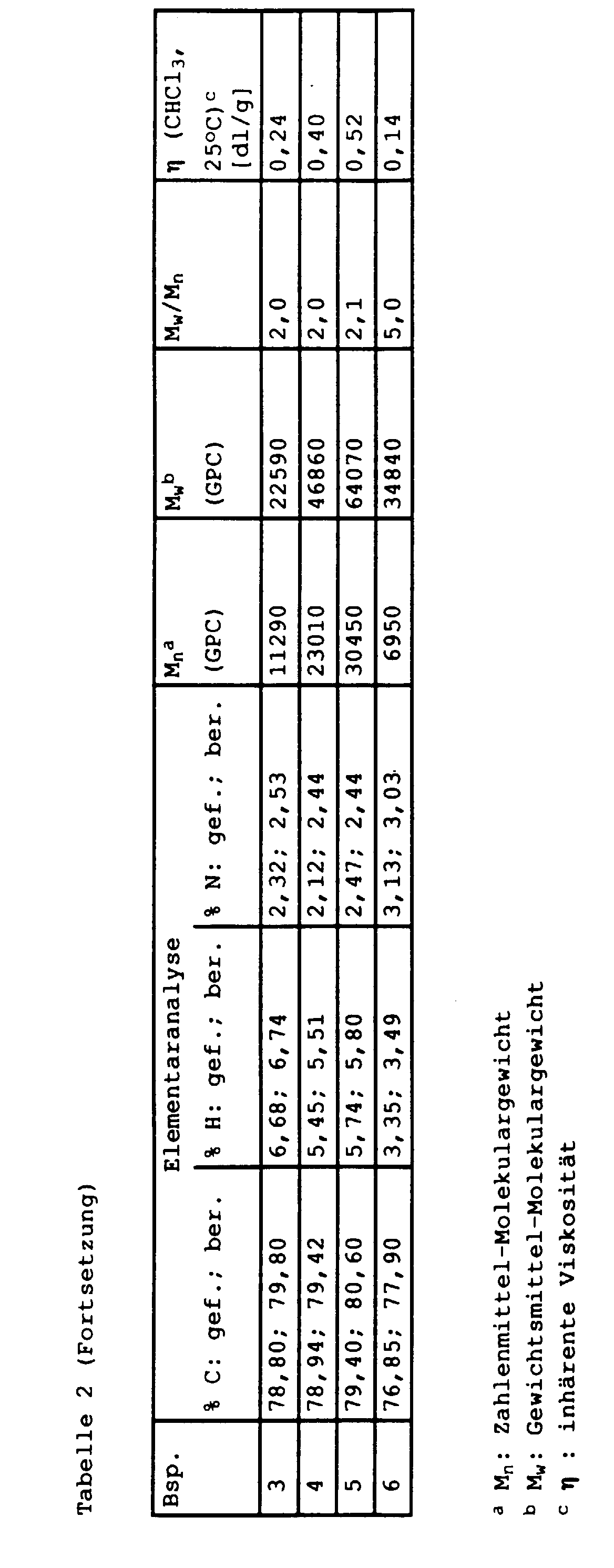
- Weitere Einzelheiten zu diesen Versuchen und deren Ergebnisse sind in Tabelle 1 aufgeführt.

- b) Herstellung der polymeren Tetraaroxyperylen-3,4,9,10-tetracarbonsäurediimide I'

- Eine Mischung aus 0,3 mmol eines Diamins IV'
H2N-R-NH2 IV'
gelöst in 3 ml m-Kresol, 0,3 mmol eines Anhydrids III' und 0,6 mmol Benzoesäure wurde unter Rühren und Einleiten von Argon auf 190°C erhitzt und 9 h bei dieser Temperatur gehalten. Nach Zusatz von 0,6 mmol Isochinolin, gelöst in 0,3 ml m-Kresol, wurde die Polykondensation weitere 19 h bei 190°C fortgesetzt. - Dann wurde die viskose Reaktionsmasse auf Raumtemperatur abgekühlt, und Chloroform wurde zugegeben. Die erhaltene Polymerlösung wurde filtriert, eingeengt, und das Polyimid I' wurde durch Zugabe von Methanol ausgefällt, rekristallisiert und bei Normaldruck über einen G4-Glasfilter filtriert.
- Alle erhaltenen Polyimide I' zeigten die charakteristischen Schwingungen für aromatische Imide in Sechsringen bei 1700 cm-1 und für an zwei aromatische Ringe gebundene Carbonylgruppen bei 1660 cm-1 und waren an Luft und unter Stickstoff bis 350°C thermisch stabil.
- Weitere Einzelheiten zu diesen Versuchen und ihre Ergebnisse sind in Tabelle 2 und 3 zusammengestellt.


Claims (4)
- Tetraaroxyperylen-3,4,9,10-tetracarbonsäurepolyimide der allgemeinen Formel I
 R1 gleiche oder verschiedene Arylreste, die durch Cyano, Nitro, Halogen, C1-C18-Alkoxy, C5-C7-Cycloalkyl und/oder C1-C18-Alkyl substituiert sein können und jeweils bis zu 24 C-Atome enthalten können;R2 C2-C30-Alkylengruppen, deren Kohlenstoffkette durch 1 bis 10 Sauerstoffatome in Etherfunktion oder eine Phenylen- oder Cyclohexylengruppe unterbrochen sein kann, oder gegebenenfalls durch C1-C10-Alkylen oder Sauerstoff verbrückte C6-C30-Arylen- oder Cyclohexylenreste;n 2 bis 100.
 - Verfahren zur Herstellung von Tetraaroxyperylen-3,4,9,10- tetracarbonsäurepolyimiden der Formel I gemäß Anspruch 1, dadurch gekennzeichnet, daß mana) ein Tetraaroxyperylen-3,4,9,10-tetracarbonsäurediimid der allgemeinen Formel II

mit einer Base in einem polaren, protischen Lösungsmittel behandelt undb) das in Schritt a) erhaltene Tetraaroxyperylen-3,4,9,10-tetracarbonsäuredianhydrid der allgemeinen Formel III
H2N-R2-NH2 IV
in Gegenwart eines polaren Lösungsmittels zunächst unter saurer und dann unter basischer Katalyse bei 170 bis 200°C polykondensiert. - Verwendung von Tetraaroxyperylen-3,4,9,10-tetracarbonsäurepolyimiden der Formel I gemäß Anspruch 1 zur Herstellung von Farbstofflasern und Lichtsammelsystemen und zur Pigmentierung von Druckfarben, Anstrichmitteln und Kunststoffen.
- Tetraaroxyperylen-3,4,9,10-tetracarbonsäuredianhydride der allgemeinen Formel III

und die entsprechenden Tetraaroxyperylen-3,4,9,10-tetracarbonsäuren (IIIa).
Applications Claiming Priority (3)
| Application Number | Priority Date | Filing Date | Title |
|---|---|---|---|
| DE4314622 | 1993-05-04 | ||
| DE4314622 | 1993-05-04 | ||
| PCT/EP1994/001345 WO1994025504A1 (de) | 1993-05-04 | 1994-04-28 | Tetraaroxyperylen-3,4,9,10-tetracarbonsäurepolyimide |
Publications (2)
| Publication Number | Publication Date |
|---|---|
| EP0697027A1 EP0697027A1 (de) | 1996-02-21 |
| EP0697027B1 true EP0697027B1 (de) | 1997-07-02 |
Family
ID=6487079
Family Applications (1)
| Application Number | Title | Priority Date | Filing Date |
|---|---|---|---|
| EP94915140A Expired - Lifetime EP0697027B1 (de) | 1993-05-04 | 1994-04-28 | Tetraaroxyperylen-3,4,9,10-tetracarbonsäurepolyimide |
Country Status (5)
| Country | Link |
|---|---|
| US (1) | US5677417A (de) |
| EP (1) | EP0697027B1 (de) |
| JP (1) | JP3498132B2 (de) |
| DE (1) | DE59403259D1 (de) |
| WO (1) | WO1994025504A1 (de) |
Families Citing this family (56)
| Publication number | Priority date | Publication date | Assignee | Title |
|---|---|---|---|---|
| DE19547210A1 (de) | 1995-12-18 | 1997-06-19 | Basf Ag | 1,7-Disubstituierte Perylen-3,4,9-10-tetracarbonsäuren, deren Dianhydride und Diimide |
| DE19547209A1 (de) * | 1995-12-18 | 1997-06-19 | Basf Ag | 1,7-Diaroxy-oder -arylthiosubstituierte Perylen-3,4,9,10-tetracarbonsäuren, deren Dianhydride und Diimide |
| US6600175B1 (en) | 1996-03-26 | 2003-07-29 | Advanced Technology Materials, Inc. | Solid state white light emitter and display using same |
| US6601634B2 (en) * | 1999-12-17 | 2003-08-05 | Barbara E. Weidenbach | Illuminating window cover |
| DE10039232A1 (de) | 2000-08-11 | 2002-02-21 | Basf Ag | Flüssigkristalline Perylen-3,4:9,10-tetracarbonsäurediimide |
| KR100467033B1 (ko) * | 2002-04-18 | 2005-01-24 | 주식회사 알지비케미컬 | 페릴렌 단위 형광체를 포함하는 고분자형광체를 포함하는 화학 발광조성물 |
| WO2005076815A2 (en) | 2004-01-26 | 2005-08-25 | Northwestern University | PERYLENE n-TYPE SEMICONDUCTORS AND RELATED DEVICES |
| DE102005037115A1 (de) * | 2005-08-03 | 2007-02-08 | Basf Ag | Mehrfachchromophore |
| WO2007146250A2 (en) * | 2006-06-12 | 2007-12-21 | Northwestern University | Naphthalene-based semiconductor materials and methods of preparing and use thereof |
| US20080074583A1 (en) * | 2006-07-06 | 2008-03-27 | Intematix Corporation | Photo-luminescence color liquid crystal display |
| US8947619B2 (en) | 2006-07-06 | 2015-02-03 | Intematix Corporation | Photoluminescence color display comprising quantum dots material and a wavelength selective filter that allows passage of excitation radiation and prevents passage of light generated by photoluminescence materials |
| US20080029720A1 (en) | 2006-08-03 | 2008-02-07 | Intematix Corporation | LED lighting arrangement including light emitting phosphor |
| US7947837B2 (en) * | 2006-10-25 | 2011-05-24 | Polyera Corporation | Organic semiconductor materials and methods of preparing and use thereof |
| EP2086974B1 (de) * | 2006-11-17 | 2013-07-24 | Polyera Corporation | Halbleitermaterialien auf diimidbasis und verfahren zu deren herstellung und anwendung |
| WO2008067445A2 (en) * | 2006-11-29 | 2008-06-05 | Sun Chemical Corporation | Poly(oxyalkylene)ated colorants and their use as fluorescent security taggants |
| EP2104676A2 (de) * | 2007-01-08 | 2009-09-30 | Polyera Corporation | Verfahren zur herstellung aren-bi-(dicarboximid)-basierter halbleitermaterialien und entsprechende zwischenprodukte zu ihrer herstellung |
| WO2008091670A2 (en) * | 2007-01-24 | 2008-07-31 | Polyera Corporation | Organic semiconductor materials and precursors thereof |
| US20080192458A1 (en) * | 2007-02-12 | 2008-08-14 | Intematix Corporation | Light emitting diode lighting system |
| US7972030B2 (en) * | 2007-03-05 | 2011-07-05 | Intematix Corporation | Light emitting diode (LED) based lighting systems |
| US8203260B2 (en) | 2007-04-13 | 2012-06-19 | Intematix Corporation | Color temperature tunable white light source |
| US7703943B2 (en) * | 2007-05-07 | 2010-04-27 | Intematix Corporation | Color tunable light source |
| US8783887B2 (en) | 2007-10-01 | 2014-07-22 | Intematix Corporation | Color tunable light emitting device |
| US7915627B2 (en) | 2007-10-17 | 2011-03-29 | Intematix Corporation | Light emitting device with phosphor wavelength conversion |
| US8567973B2 (en) | 2008-03-07 | 2013-10-29 | Intematix Corporation | Multiple-chip excitation systems for white light emitting diodes (LEDs) |
| US8740400B2 (en) | 2008-03-07 | 2014-06-03 | Intematix Corporation | White light illumination system with narrow band green phosphor and multiple-wavelength excitation |
| US20100027293A1 (en) * | 2008-07-30 | 2010-02-04 | Intematix Corporation | Light Emitting Panel |
| EP2166040A1 (de) * | 2008-09-22 | 2010-03-24 | Radiant Color N.V. | Neue lipophile fluoreszierende Farbstoffe und ein Prozess für ihre Produktion |
| US8822954B2 (en) * | 2008-10-23 | 2014-09-02 | Intematix Corporation | Phosphor based authentication system |
| KR101012542B1 (ko) * | 2008-12-12 | 2011-02-07 | 재단법인대구경북과학기술원 | 고분자 화합물 및 그를 포함하는 태양전지 |
| US8390193B2 (en) * | 2008-12-31 | 2013-03-05 | Intematix Corporation | Light emitting device with phosphor wavelength conversion |
| US8651692B2 (en) | 2009-06-18 | 2014-02-18 | Intematix Corporation | LED based lamp and light emitting signage |
| US8779685B2 (en) * | 2009-11-19 | 2014-07-15 | Intematix Corporation | High CRI white light emitting devices and drive circuitry |
| US20110149548A1 (en) * | 2009-12-22 | 2011-06-23 | Intematix Corporation | Light emitting diode based linear lamps |
| GEP20156283B (en) * | 2010-05-25 | 2015-05-11 | Sicpa Holding Sa | Polymer-bonded perylene dyes and compositions containing same |
| US8807799B2 (en) | 2010-06-11 | 2014-08-19 | Intematix Corporation | LED-based lamps |
| US8888318B2 (en) | 2010-06-11 | 2014-11-18 | Intematix Corporation | LED spotlight |
| US8946998B2 (en) | 2010-08-09 | 2015-02-03 | Intematix Corporation | LED-based light emitting systems and devices with color compensation |
| WO2012047937A1 (en) | 2010-10-05 | 2012-04-12 | Intematix Corporation | Solid-state light emitting devices and signage with photoluminescence wavelength conversion |
| US8604678B2 (en) | 2010-10-05 | 2013-12-10 | Intematix Corporation | Wavelength conversion component with a diffusing layer |
| US9546765B2 (en) | 2010-10-05 | 2017-01-17 | Intematix Corporation | Diffuser component having scattering particles |
| US8957585B2 (en) | 2010-10-05 | 2015-02-17 | Intermatix Corporation | Solid-state light emitting devices with photoluminescence wavelength conversion |
| US8614539B2 (en) | 2010-10-05 | 2013-12-24 | Intematix Corporation | Wavelength conversion component with scattering particles |
| US8610341B2 (en) | 2010-10-05 | 2013-12-17 | Intematix Corporation | Wavelength conversion component |
| US9004705B2 (en) | 2011-04-13 | 2015-04-14 | Intematix Corporation | LED-based light sources for light emitting devices and lighting arrangements with photoluminescence wavelength conversion |
| US8992051B2 (en) | 2011-10-06 | 2015-03-31 | Intematix Corporation | Solid-state lamps with improved radial emission and thermal performance |
| US20130088848A1 (en) | 2011-10-06 | 2013-04-11 | Intematix Corporation | Solid-state lamps with improved radial emission and thermal performance |
| US9365766B2 (en) | 2011-10-13 | 2016-06-14 | Intematix Corporation | Wavelength conversion component having photo-luminescence material embedded into a hermetic material for remote wavelength conversion |
| US9115868B2 (en) | 2011-10-13 | 2015-08-25 | Intematix Corporation | Wavelength conversion component with improved protective characteristics for remote wavelength conversion |
| US9252338B2 (en) | 2012-04-26 | 2016-02-02 | Intematix Corporation | Methods and apparatus for implementing color consistency in remote wavelength conversion |
| US8994056B2 (en) | 2012-07-13 | 2015-03-31 | Intematix Corporation | LED-based large area display |
| US20140185269A1 (en) | 2012-12-28 | 2014-07-03 | Intermatix Corporation | Solid-state lamps utilizing photoluminescence wavelength conversion components |
| US9217543B2 (en) | 2013-01-28 | 2015-12-22 | Intematix Corporation | Solid-state lamps with omnidirectional emission patterns |
| CN105121951A (zh) | 2013-03-15 | 2015-12-02 | 英特曼帝克司公司 | 光致发光波长转换组件 |
| US9318670B2 (en) | 2014-05-21 | 2016-04-19 | Intematix Corporation | Materials for photoluminescence wavelength converted solid-state light emitting devices and arrangements |
| WO2016154214A1 (en) | 2015-03-23 | 2016-09-29 | Intematix Corporation | Photoluminescence color display |
| JP7334725B2 (ja) * | 2019-02-28 | 2023-08-29 | 東レ株式会社 | 樹脂組成物、黒色樹脂膜、積層体および表示装置 |
Family Cites Families (6)
| Publication number | Priority date | Publication date | Assignee | Title |
|---|---|---|---|---|
| DE3413418A1 (de) * | 1984-04-10 | 1985-10-17 | Basf Ag, 6700 Ludwigshafen | Farbstofflaser |
| US4845223A (en) * | 1985-12-19 | 1989-07-04 | Basf Aktiengesellschaft | Fluorescent aryloxy-substituted perylene-3,4,9,10-tetracarboxylic acid diimides |
| DE3545004A1 (de) * | 1985-12-19 | 1987-06-25 | Basf Ag | Fluoreszierende aroxysubstituierte perylen-3,4,9,10-tetracarbonsaeurediimide und ihre verwendung zur flaechenmaessigen konzentriertung von licht |
| JPS63110219A (ja) * | 1986-10-28 | 1988-05-14 | Tosoh Corp | ポリイミド樹脂の製造方法 |
| DE4006646A1 (de) * | 1990-03-03 | 1991-09-05 | Basf Ag | Polyperylen |
| JPH0453894A (ja) * | 1990-06-20 | 1992-02-21 | Nippon Kagaku Hakko Kk | 赤色化学発光体 |
-
1994
- 1994-04-28 JP JP52388994A patent/JP3498132B2/ja not_active Expired - Fee Related
- 1994-04-28 WO PCT/EP1994/001345 patent/WO1994025504A1/de not_active Ceased
- 1994-04-28 EP EP94915140A patent/EP0697027B1/de not_active Expired - Lifetime
- 1994-04-28 US US08/513,769 patent/US5677417A/en not_active Expired - Fee Related
- 1994-04-28 DE DE59403259T patent/DE59403259D1/de not_active Expired - Fee Related
Also Published As
| Publication number | Publication date |
|---|---|
| EP0697027A1 (de) | 1996-02-21 |
| JP3498132B2 (ja) | 2004-02-16 |
| WO1994025504A1 (de) | 1994-11-10 |
| JPH08509517A (ja) | 1996-10-08 |
| DE59403259D1 (en) | 1997-08-07 |
| US5677417A (en) | 1997-10-14 |
Similar Documents
| Publication | Publication Date | Title |
|---|---|---|
| WO1994025504A1 (de) | Tetraaroxyperylen-3,4,9,10-tetracarbonsäurepolyimide | |
| US4667036A (en) | Concentration of light over a particular area, and novel perylene-3,4,9,10-tetracarboxylic acid diimides | |
| EP0193721A2 (de) | Polyimide und Verfahren zu ihrer Herstellung | |
| DE4312182A1 (de) | Sternförmige Nylonmoleküle, Verfahren zu ihrer Herstellung, tetrasubstituierte Carbonsäuren und Verfahren zu deren Herstellung | |
| CH638514A5 (de) | Arylthiophendioxidverbindungen. | |
| EP0098808B1 (de) | Herstellung von 1,4-Diketopyrrolo-(3,4-c)-pyrrolen | |
| DE2521305A1 (de) | Aromatische polyimide mit endstaendigen phthalsaeurenitrilgruppen und verfahren zur herstellung derselben | |
| CH353110A (de) | Verfahren zur Herstellung von Anthrachinonküpenfarbstoffen | |
| CH622278A5 (de) | ||
| DE2626271A1 (de) | Chinolinderivate, verfahren zu ihrer herstellung und verwendung derselben | |
| DE2638528A1 (de) | Chinolinderivate, verfahren zu ihrer herstellung und verwendung derselben | |
| DE2461350C2 (de) | Verfahren zur Herstellung von Polyimiden | |
| DE2232463C3 (de) | Polybenz-13-oxazindione-(2,4), Verfahren zu ihrer Herstellung und ihre Verwendung- | |
| DE2258505A1 (de) | Oxindoldiamine und verfahren zu ihrer herstellung | |
| DE2025429A1 (en) | Bis-azomethine pigment dyes - giving yellow to red shades of good - fastness esp to light and solvents | |
| DE4339699A1 (de) | Verfahren zur Herstellung von polycylischen Farbstoffen | |
| DE1644401C (de) | Monoazofarbstoffe und Verfahren zur Herstellung und Verwendung von Monoazofarbstoffen | |
| DE4215043A1 (de) | Fluorierte n,n-bisimide, deren herstellung und ihre verwendung bei der herstellung von hochleistungspolymeren | |
| DE1644159C3 (de) | Sulfonsäuregruppenfreie Azofarbstoffe | |
| DE1668374A1 (de) | Verbindungen mit hohem Molekulargewicht | |
| DE1569841B1 (de) | Pigmentfarbstoffe und Verfahren zu deren Herstellung | |
| DE3235572A1 (de) | Kuepenfarbstoffgemische | |
| DE2447228A1 (de) | Perinon-verbindungen, verfahren zu deren herstellung und ihre verwendung als farbmittel | |
| EP0657507A2 (de) | Verfahren zur Herstellung von unsymmetrischen Bisisoindolinpigmenten | |
| DE1720884C3 (de) | Verfahren zur Herstellung stickstoffhaltiger Polykondensate |
Legal Events
| Date | Code | Title | Description |
|---|---|---|---|
| PUAI | Public reference made under article 153(3) epc to a published international application that has entered the european phase |
Free format text: ORIGINAL CODE: 0009012 |
|
| 17P | Request for examination filed |
Effective date: 19950826 |
|
| AK | Designated contracting states |
Kind code of ref document: A1 Designated state(s): CH DE FR GB IT LI |
|
| GRAG | Despatch of communication of intention to grant |
Free format text: ORIGINAL CODE: EPIDOS AGRA |
|
| 17Q | First examination report despatched |
Effective date: 19960812 |
|
| GRAH | Despatch of communication of intention to grant a patent |
Free format text: ORIGINAL CODE: EPIDOS IGRA |
|
| GRAH | Despatch of communication of intention to grant a patent |
Free format text: ORIGINAL CODE: EPIDOS IGRA |
|
| GRAA | (expected) grant |
Free format text: ORIGINAL CODE: 0009210 |
|
| AK | Designated contracting states |
Kind code of ref document: B1 Designated state(s): CH DE FR GB IT LI |
|
| REG | Reference to a national code |
Ref country code: CH Ref legal event code: EP |
|
| GBT | Gb: translation of ep patent filed (gb section 77(6)(a)/1977) |
Effective date: 19970707 |
|
| REF | Corresponds to: |
Ref document number: 59403259 Country of ref document: DE Date of ref document: 19970807 |
|
| ITF | It: translation for a ep patent filed | ||
| ET | Fr: translation filed | ||
| PLBE | No opposition filed within time limit |
Free format text: ORIGINAL CODE: 0009261 |
|
| STAA | Information on the status of an ep patent application or granted ep patent |
Free format text: STATUS: NO OPPOSITION FILED WITHIN TIME LIMIT |
|
| 26N | No opposition filed | ||
| REG | Reference to a national code |
Ref country code: GB Ref legal event code: IF02 |
|
| PGFP | Annual fee paid to national office [announced via postgrant information from national office to epo] |
Ref country code: FR Payment date: 20060410 Year of fee payment: 13 |
|
| PGFP | Annual fee paid to national office [announced via postgrant information from national office to epo] |
Ref country code: DE Payment date: 20060420 Year of fee payment: 13 |
|
| PGFP | Annual fee paid to national office [announced via postgrant information from national office to epo] |
Ref country code: GB Payment date: 20060426 Year of fee payment: 13 |
|
| PGFP | Annual fee paid to national office [announced via postgrant information from national office to epo] |
Ref country code: CH Payment date: 20060427 Year of fee payment: 13 |
|
| PGFP | Annual fee paid to national office [announced via postgrant information from national office to epo] |
Ref country code: IT Payment date: 20060430 Year of fee payment: 13 |
|
| REG | Reference to a national code |
Ref country code: CH Ref legal event code: PL |
|
| GBPC | Gb: european patent ceased through non-payment of renewal fee |
Effective date: 20070428 |
|
| PG25 | Lapsed in a contracting state [announced via postgrant information from national office to epo] |
Ref country code: DE Free format text: LAPSE BECAUSE OF NON-PAYMENT OF DUE FEES Effective date: 20071101 |
|
| PG25 | Lapsed in a contracting state [announced via postgrant information from national office to epo] |
Ref country code: CH Free format text: LAPSE BECAUSE OF NON-PAYMENT OF DUE FEES Effective date: 20070430 Ref country code: LI Free format text: LAPSE BECAUSE OF NON-PAYMENT OF DUE FEES Effective date: 20070430 |
|
| PG25 | Lapsed in a contracting state [announced via postgrant information from national office to epo] |
Ref country code: GB Free format text: LAPSE BECAUSE OF NON-PAYMENT OF DUE FEES Effective date: 20070428 |
|
| PG25 | Lapsed in a contracting state [announced via postgrant information from national office to epo] |
Ref country code: FR Free format text: LAPSE BECAUSE OF NON-PAYMENT OF DUE FEES Effective date: 20070430 |
|
| PG25 | Lapsed in a contracting state [announced via postgrant information from national office to epo] |
Ref country code: IT Free format text: LAPSE BECAUSE OF NON-PAYMENT OF DUE FEES Effective date: 20070428 |