EP0685582B1 - Cushioning structure - Google Patents
Cushioning structure Download PDFInfo
- Publication number
- EP0685582B1 EP0685582B1 EP95301504A EP95301504A EP0685582B1 EP 0685582 B1 EP0685582 B1 EP 0685582B1 EP 95301504 A EP95301504 A EP 95301504A EP 95301504 A EP95301504 A EP 95301504A EP 0685582 B1 EP0685582 B1 EP 0685582B1
- Authority
- EP
- European Patent Office
- Prior art keywords
- layer portion
- cushioning
- cushioning structure
- surface layer
- protuberances
- Prior art date
- Legal status (The legal status is an assumption and is not a legal conclusion. Google has not performed a legal analysis and makes no representation as to the accuracy of the status listed.)
- Expired - Lifetime
Links
- 239000010410 layer Substances 0.000 claims description 94
- 239000002344 surface layer Substances 0.000 claims description 39
- 239000002759 woven fabric Substances 0.000 claims description 33
- 239000004744 fabric Substances 0.000 claims description 32
- 239000000463 material Substances 0.000 claims description 31
- 230000035699 permeability Effects 0.000 claims description 22
- 230000006835 compression Effects 0.000 claims description 10
- 238000007906 compression Methods 0.000 claims description 10
- 239000000835 fiber Substances 0.000 description 28
- -1 polypropylene Polymers 0.000 description 14
- 229920000139 polyethylene terephthalate Polymers 0.000 description 12
- 239000005020 polyethylene terephthalate Substances 0.000 description 12
- 229920001778 nylon Polymers 0.000 description 9
- 208000004210 Pressure Ulcer Diseases 0.000 description 8
- 239000004677 Nylon Substances 0.000 description 7
- 238000010030 laminating Methods 0.000 description 7
- 230000036544 posture Effects 0.000 description 6
- 229920003002 synthetic resin Polymers 0.000 description 5
- 239000000057 synthetic resin Substances 0.000 description 5
- 229920000742 Cotton Polymers 0.000 description 4
- JOYRKODLDBILNP-UHFFFAOYSA-N Ethyl urethane Chemical compound CCOC(N)=O JOYRKODLDBILNP-UHFFFAOYSA-N 0.000 description 4
- 230000000694 effects Effects 0.000 description 4
- 239000006260 foam Substances 0.000 description 4
- 229920005989 resin Polymers 0.000 description 4
- 239000011347 resin Substances 0.000 description 4
- 230000007547 defect Effects 0.000 description 3
- 230000007774 longterm Effects 0.000 description 3
- 230000002265 prevention Effects 0.000 description 3
- 238000009958 sewing Methods 0.000 description 3
- 206010016322 Feeling abnormal Diseases 0.000 description 2
- 230000003247 decreasing effect Effects 0.000 description 2
- 230000000994 depressogenic effect Effects 0.000 description 2
- QQVIHTHCMHWDBS-UHFFFAOYSA-N isophthalic acid Chemical compound OC(=O)C1=CC=CC(C(O)=O)=C1 QQVIHTHCMHWDBS-UHFFFAOYSA-N 0.000 description 2
- 238000009940 knitting Methods 0.000 description 2
- 238000005259 measurement Methods 0.000 description 2
- 238000012856 packing Methods 0.000 description 2
- 229920000728 polyester Polymers 0.000 description 2
- 238000011160 research Methods 0.000 description 2
- 239000000523 sample Substances 0.000 description 2
- 239000002356 single layer Substances 0.000 description 2
- 238000012360 testing method Methods 0.000 description 2
- WZFUQSJFWNHZHM-UHFFFAOYSA-N 2-[4-[2-(2,3-dihydro-1H-inden-2-ylamino)pyrimidin-5-yl]piperazin-1-yl]-1-(2,4,6,7-tetrahydrotriazolo[4,5-c]pyridin-5-yl)ethanone Chemical compound C1C(CC2=CC=CC=C12)NC1=NC=C(C=N1)N1CCN(CC1)CC(=O)N1CC2=C(CC1)NN=N2 WZFUQSJFWNHZHM-UHFFFAOYSA-N 0.000 description 1
- 239000004952 Polyamide Substances 0.000 description 1
- 239000004698 Polyethylene Substances 0.000 description 1
- 239000004743 Polypropylene Substances 0.000 description 1
- 239000004372 Polyvinyl alcohol Substances 0.000 description 1
- 239000002253 acid Substances 0.000 description 1
- 239000004760 aramid Substances 0.000 description 1
- 229920003235 aromatic polyamide Polymers 0.000 description 1
- 230000001413 cellular effect Effects 0.000 description 1
- 239000002131 composite material Substances 0.000 description 1
- 230000007423 decrease Effects 0.000 description 1
- 230000009189 diving Effects 0.000 description 1
- 230000003203 everyday effect Effects 0.000 description 1
- 230000001747 exhibiting effect Effects 0.000 description 1
- 239000003365 glass fiber Substances 0.000 description 1
- 238000009413 insulation Methods 0.000 description 1
- 238000004519 manufacturing process Methods 0.000 description 1
- 229920002647 polyamide Polymers 0.000 description 1
- 229920000573 polyethylene Polymers 0.000 description 1
- 229920001155 polypropylene Polymers 0.000 description 1
- 229920002451 polyvinyl alcohol Polymers 0.000 description 1
- 238000012545 processing Methods 0.000 description 1
- 238000011084 recovery Methods 0.000 description 1
- 238000010008 shearing Methods 0.000 description 1
- 210000004243 sweat Anatomy 0.000 description 1
- 229920002994 synthetic fiber Polymers 0.000 description 1
- 239000012209 synthetic fiber Substances 0.000 description 1
- KKEYFWRCBNTPAC-UHFFFAOYSA-L terephthalate(2-) Chemical compound [O-]C(=O)C1=CC=C(C([O-])=O)C=C1 KKEYFWRCBNTPAC-UHFFFAOYSA-L 0.000 description 1
- 239000011800 void material Substances 0.000 description 1
- XLYOFNOQVPJJNP-UHFFFAOYSA-N water Substances O XLYOFNOQVPJJNP-UHFFFAOYSA-N 0.000 description 1
Images
Classifications
-
- D—TEXTILES; PAPER
- D03—WEAVING
- D03D—WOVEN FABRICS; METHODS OF WEAVING; LOOMS
- D03D11/00—Double or multi-ply fabrics not otherwise provided for
- D03D11/02—Fabrics formed with pockets, tubes, loops, folds, tucks or flaps
-
- A—HUMAN NECESSITIES
- A47—FURNITURE; DOMESTIC ARTICLES OR APPLIANCES; COFFEE MILLS; SPICE MILLS; SUCTION CLEANERS IN GENERAL
- A47C—CHAIRS; SOFAS; BEDS
- A47C27/00—Spring, stuffed or fluid mattresses or cushions specially adapted for chairs, beds or sofas
- A47C27/12—Spring, stuffed or fluid mattresses or cushions specially adapted for chairs, beds or sofas with fibrous inlays, e.g. made of wool, of cotton
-
- A—HUMAN NECESSITIES
- A47—FURNITURE; DOMESTIC ARTICLES OR APPLIANCES; COFFEE MILLS; SPICE MILLS; SUCTION CLEANERS IN GENERAL
- A47C—CHAIRS; SOFAS; BEDS
- A47C27/00—Spring, stuffed or fluid mattresses or cushions specially adapted for chairs, beds or sofas
- A47C27/14—Spring, stuffed or fluid mattresses or cushions specially adapted for chairs, beds or sofas with foamed material inlays
- A47C27/16—Spring, stuffed or fluid mattresses or cushions specially adapted for chairs, beds or sofas with foamed material inlays reinforced with sheet-like or rigid elements, e.g. profiled
-
- D—TEXTILES; PAPER
- D03—WEAVING
- D03D—WOVEN FABRICS; METHODS OF WEAVING; LOOMS
- D03D15/00—Woven fabrics characterised by the material, structure or properties of the fibres, filaments, yarns, threads or other warp or weft elements used
- D03D15/50—Woven fabrics characterised by the material, structure or properties of the fibres, filaments, yarns, threads or other warp or weft elements used characterised by the properties of the yarns or threads
- D03D15/567—Shapes or effects upon shrinkage
-
- Y—GENERAL TAGGING OF NEW TECHNOLOGICAL DEVELOPMENTS; GENERAL TAGGING OF CROSS-SECTIONAL TECHNOLOGIES SPANNING OVER SEVERAL SECTIONS OF THE IPC; TECHNICAL SUBJECTS COVERED BY FORMER USPC CROSS-REFERENCE ART COLLECTIONS [XRACs] AND DIGESTS
- Y10—TECHNICAL SUBJECTS COVERED BY FORMER USPC
- Y10T—TECHNICAL SUBJECTS COVERED BY FORMER US CLASSIFICATION
- Y10T428/00—Stock material or miscellaneous articles
- Y10T428/23—Sheet including cover or casing
- Y10T428/233—Foamed or expanded material encased
-
- Y—GENERAL TAGGING OF NEW TECHNOLOGICAL DEVELOPMENTS; GENERAL TAGGING OF CROSS-SECTIONAL TECHNOLOGIES SPANNING OVER SEVERAL SECTIONS OF THE IPC; TECHNICAL SUBJECTS COVERED BY FORMER USPC CROSS-REFERENCE ART COLLECTIONS [XRACs] AND DIGESTS
- Y10—TECHNICAL SUBJECTS COVERED BY FORMER USPC
- Y10T—TECHNICAL SUBJECTS COVERED BY FORMER US CLASSIFICATION
- Y10T428/00—Stock material or miscellaneous articles
- Y10T428/23—Sheet including cover or casing
- Y10T428/237—Noninterengaged fibered material encased [e.g., mat, batt, etc.]
-
- Y—GENERAL TAGGING OF NEW TECHNOLOGICAL DEVELOPMENTS; GENERAL TAGGING OF CROSS-SECTIONAL TECHNOLOGIES SPANNING OVER SEVERAL SECTIONS OF THE IPC; TECHNICAL SUBJECTS COVERED BY FORMER USPC CROSS-REFERENCE ART COLLECTIONS [XRACs] AND DIGESTS
- Y10—TECHNICAL SUBJECTS COVERED BY FORMER USPC
- Y10T—TECHNICAL SUBJECTS COVERED BY FORMER US CLASSIFICATION
- Y10T428/00—Stock material or miscellaneous articles
- Y10T428/23—Sheet including cover or casing
- Y10T428/239—Complete cover or casing
-
- Y—GENERAL TAGGING OF NEW TECHNOLOGICAL DEVELOPMENTS; GENERAL TAGGING OF CROSS-SECTIONAL TECHNOLOGIES SPANNING OVER SEVERAL SECTIONS OF THE IPC; TECHNICAL SUBJECTS COVERED BY FORMER USPC CROSS-REFERENCE ART COLLECTIONS [XRACs] AND DIGESTS
- Y10—TECHNICAL SUBJECTS COVERED BY FORMER USPC
- Y10T—TECHNICAL SUBJECTS COVERED BY FORMER US CLASSIFICATION
- Y10T428/00—Stock material or miscellaneous articles
- Y10T428/24—Structurally defined web or sheet [e.g., overall dimension, etc.]
- Y10T428/24025—Superposed movable attached layers or components
-
- Y—GENERAL TAGGING OF NEW TECHNOLOGICAL DEVELOPMENTS; GENERAL TAGGING OF CROSS-SECTIONAL TECHNOLOGIES SPANNING OVER SEVERAL SECTIONS OF THE IPC; TECHNICAL SUBJECTS COVERED BY FORMER USPC CROSS-REFERENCE ART COLLECTIONS [XRACs] AND DIGESTS
- Y10—TECHNICAL SUBJECTS COVERED BY FORMER USPC
- Y10T—TECHNICAL SUBJECTS COVERED BY FORMER US CLASSIFICATION
- Y10T428/00—Stock material or miscellaneous articles
- Y10T428/24—Structurally defined web or sheet [e.g., overall dimension, etc.]
- Y10T428/24149—Honeycomb-like
-
- Y—GENERAL TAGGING OF NEW TECHNOLOGICAL DEVELOPMENTS; GENERAL TAGGING OF CROSS-SECTIONAL TECHNOLOGIES SPANNING OVER SEVERAL SECTIONS OF THE IPC; TECHNICAL SUBJECTS COVERED BY FORMER USPC CROSS-REFERENCE ART COLLECTIONS [XRACs] AND DIGESTS
- Y10—TECHNICAL SUBJECTS COVERED BY FORMER USPC
- Y10T—TECHNICAL SUBJECTS COVERED BY FORMER US CLASSIFICATION
- Y10T428/00—Stock material or miscellaneous articles
- Y10T428/24—Structurally defined web or sheet [e.g., overall dimension, etc.]
- Y10T428/24479—Structurally defined web or sheet [e.g., overall dimension, etc.] including variation in thickness
- Y10T428/24496—Foamed or cellular component
- Y10T428/24504—Component comprises a polymer [e.g., rubber, etc.]
- Y10T428/24512—Polyurethane
-
- Y—GENERAL TAGGING OF NEW TECHNOLOGICAL DEVELOPMENTS; GENERAL TAGGING OF CROSS-SECTIONAL TECHNOLOGIES SPANNING OVER SEVERAL SECTIONS OF THE IPC; TECHNICAL SUBJECTS COVERED BY FORMER USPC CROSS-REFERENCE ART COLLECTIONS [XRACs] AND DIGESTS
- Y10—TECHNICAL SUBJECTS COVERED BY FORMER USPC
- Y10T—TECHNICAL SUBJECTS COVERED BY FORMER US CLASSIFICATION
- Y10T428/00—Stock material or miscellaneous articles
- Y10T428/24—Structurally defined web or sheet [e.g., overall dimension, etc.]
- Y10T428/24479—Structurally defined web or sheet [e.g., overall dimension, etc.] including variation in thickness
- Y10T428/24521—Structurally defined web or sheet [e.g., overall dimension, etc.] including variation in thickness with component conforming to contour of nonplanar surface
- Y10T428/24529—Structurally defined web or sheet [e.g., overall dimension, etc.] including variation in thickness with component conforming to contour of nonplanar surface and conforming component on an opposite nonplanar surface
-
- Y—GENERAL TAGGING OF NEW TECHNOLOGICAL DEVELOPMENTS; GENERAL TAGGING OF CROSS-SECTIONAL TECHNOLOGIES SPANNING OVER SEVERAL SECTIONS OF THE IPC; TECHNICAL SUBJECTS COVERED BY FORMER USPC CROSS-REFERENCE ART COLLECTIONS [XRACs] AND DIGESTS
- Y10—TECHNICAL SUBJECTS COVERED BY FORMER USPC
- Y10T—TECHNICAL SUBJECTS COVERED BY FORMER US CLASSIFICATION
- Y10T428/00—Stock material or miscellaneous articles
- Y10T428/24—Structurally defined web or sheet [e.g., overall dimension, etc.]
- Y10T428/24479—Structurally defined web or sheet [e.g., overall dimension, etc.] including variation in thickness
- Y10T428/24562—Interlaminar spaces
Definitions
- This invention relates to a cushioning structure constituted by a three-dimensional multiple woven texture. More specifically, this invention relates to a cushioning structure constituted by a three-dimensional multiple woven texture, which structure can be used in the fields requiring an air permeability, cushioning properties, washability and the like, such as bed, a sheet for vehicles, a sheet for chair, a sheet for Japanese cushion, a sheet for drawing-room suite, a sports material and the like.
- Three-dimensional cushioning structures have been hitherto used in various fields which are roughly classified into a resin form mat typified by an urethane mat, a cushioning fiber structure utilizing a space of a monofilament assembly and a structure of a three-dimensional woven texture utilizing a space of a multiple woven texture.
- these ordinary three-dimensional cushioning structures have defects in practical use.
- a resin foam mat such as an urethane mat, which has a roughened surface and possesses a controlled compression pressure. Nevertheless, since the internal space is formed of a foam resin, air is not passed therethrough. Thus, the resin foam mat is lacking in air permeability.
- the urethane mat has a decreased compression (resistance) pressure when it is used for a long period of time, and then it becomes unusable as a cushioning structure.
- the cushioning fiber structure utilizing the space of the monofilament assembly is relatively good in air permeability, but is low in durability. That is, as the cushioning fiber structure is repetitively used, collapse occurs, so that an inner space (void) ratio decreases and cushioning properties are almost lost. Further, in case of the structure of the three-dimensional woven texture utilizing the space of the multiple woven texture, a durability is relatively excellent, but a fiber fillability is high, with the result that an air permeability is poor and cushioning properties are low. Besides, there is a defect that since a big uneven shape is not present on the surface, a pressure distribution hardly becomes uniform.
- This document describes a cushioning woven fabric characterized in that a woven material obtained by using at least two kinds of synthetic resin fibers having a sufficient potential heat shrinkage difference as a warp, or as a weft, or as a warp and a weft is heat-relaxed under suitable temperature conditions to form a wavy resilient surface portion that is formed by flexing of the synthetic resin fiber having a lower heat shrinkage, the flexing being realized by heat shrinkage of the synthetic resin fiber having a higher heat shrinkage to the higher extent.
- This cushioning woven fabric is either a single-woven cushioning material having a wavy surface or a double-woven, sheet-like cushioning material in which pipy space portions formed by flexing are arranged in parallel and whose both surfaces are flat.
- the structure of this cushioning material is at most a structure of a monolayered wavy woven fabric, and has poor cushioning properties and insufficient pressure distribution and lacks a durability.
- This document describes a shoes mat whose surface material is formed of a cushioning woven fabric in which at least two kinds of synthetic resin fibers having a sufficient potential heat shrinkage difference are used, and a wavy resilient portion is formed by flexing of the synthetic resin fiber having a lower heat shrinkage, the flexing being realized by heat shrinking of the synthetic fiber having a higher heat shrinkage to the higher extent.
- This cushioning woven fabric is obtained by simply heat-treating a plain fabric or a gauze fabric, and has a thickness of at most about 5 mm. Accordingly, cushioning properties of the fabric are very poor, and said fabric is quite unsuitable as a cushioning material for bed pad or vehicle sheet.
- This document describes a cloth of a three-dimensional structure in which fabric textures of front and back surfaces are connected with connecting yarns and which is knitted with a double raschel knitting machine or a moquette knitting machine, the connecting yarns being two or more kinds of yarns each having heat shrinkage different from the other by at least 5 %, the space ratio of the cloth being 0.4 to 0.98, and the thickness of the cloth being 1 to 15 mm, as well as a cloth of a three-dimensional structure which is obtained by heat-treating the above cloth to develop an uneven appearance.
- this cloth is a relatively thin structure formed of the front and back fabrics.
- a cloth having a thickness of 6.5 mm is actually shown in the document. This document indicates that the above cloth is used as a surface material for a mattress, a sheet, a bed pad and clothing. Accordingly, the cloth is thin and has low cushioning properties.
- a narrow woven tubular fabric having a flattened oval cross-section said fabric comprising an upper layer and a lower layer, both of said layers containing monofilament filling yarns, said monofilament filling yarns having a denier between 100 to 2080, said layers being connected together along their longitudinal edges and said layers being resiliently separated by a plurality of monofilament warp yarns alternately intermittently woven with each of said layers, said monofilament warp yarns having a denier of between 100 to 2080, the sum of the denier of a monofilament filling yarn plus a monofilament warp yarn being in the range of from 430 denier to 4200 denier and the ratio of denier of monofilament filling yarn to monofilament warp yarn being from 20:1 to 1:20.”
- the above invention relates to a narrow woven tubular fabric with two layers resiliently separated from one another to provide a cushion or sponge effect.
- This fabric is used in shoulder straps of brassieres, straps on knapsacks or back-packing equipment or straps on scuba diving equipment. Accordingly, the above fabric is a narrow structure such as a strap, and has low cushioning properties. Thus, the fabric cannot be used as a cushioning material for a bed pad or vehicle sheet.
- FR-A-2063535 which represents the most relevant state of the art, describes a multi-layer expandable fabric for use in a composite structure such as rigid cellular panels, panels of reinforced foam or inflatable structures.
- the multi-layer expandable fabric is characterized by excellent compressive and shearing strength and is of one-piece including at least two upper and lower woven outer layers interconnected by non-woven thread plies transverse to the outer layers.
- the threads of the transverse plies are continuous and have a laid-out length equal to the width of the flat fabric and occupy an oblique position relative to the mid-plane of the fabric in the expanded state.
- the ordinary cushioning structures when used in beds, sheets for vehicles, sheets for chairs, sheets for Japanese cushions, sports material and the like, were not said to satisfy such conditions required of the cushioning structure that heat or sweat generated from a human body is absorbed, durability is provided and pressure distribution is uniform.
- a second object of this invention is to provide a cushioning structure excellent in cushioning properties, uniformity of a pressure distribution without causing a bottom-hit feel, air permeability, washability and durability.
- a third object of this invention is to provide a cushioning structure which is relatively light in weight and can be used for widely differing applications such as beds, sheets for vehicles, sheets for chairs, sheets for Japanese cushions, drawing-room suites, sports material and the like.
- a cushioning structure which is a three-dimensional multiple woven texture constituted by a spatial surface layer portion and a spatial intermediate layer portion, said surface layer portion having a structure that is integrally formed on one side or both sides of the spatial intermediate layer portion, wherein protuberances are formed on said one side or both sides of the surface layer portion at least unidirectionally, characterised in that said protuberances have an average height of 2 to 15 mm, an average width of one side of the protuberance being 2 to 30 mm; in that said intermediate layer portion is formed of one or more layers, each layer having a plurality of communicating hollow portions which are arranged in parallel unidirectionally, and a cross section, perpendicular to the longitudinal direction, of the communicating hollow portion in the intermediate layer portion having the shape of a trapezoid; and in that the surface layer portion is integrally woven into the surface of the intermediate layer portion.
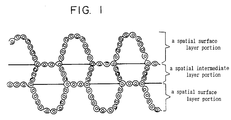
- Fig. 1 is a schematic view of a cross section of a cushioning structure obtained in Example 1.
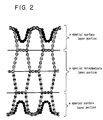
- Fig. 2 is a schematic view of a cross section of a cushioning structure obtained in Example 2.
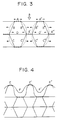
- Fig. 3 is a schematic view of a cross section of a portion in which two layers having communicating hollow portions are formed in an intermediate layer portion of the cushioning structure of this invention.
- Fig. 4 is a schematic view of a state where a woven fabric using stretchable bulky yarns is integrally fabricated between the tops of the protuberances in the surface layer portion by the woven texture on the surface layer portion of the cushioning structure of this invention.
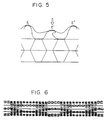
- Fig. 5 is a schematic view of a cross section in a state where a pressure is partially exerted in the state shown in Figure 4.
- Fig. 6 is a schematic view of a cross section of a woven fabric (not shrunk) obtained in Example 2.
- the cushioning structure of this invention is a three-dimensional structure obtained by texturing a woven fabric of filament fibers and formed of a spatial surface layer portion and a spatial intermediate layer portion, said surface layer portion having a structure that it is integrally formed on one side or both sides of the intermediate layer portion.
- Said cushioning structure is characterized in that protuberances having a fixed size and a fixed shape are formed on the surface layer portion, and the intermediate layer portion is formed of one or more layers each having a plurality of communicating hollow portions which are arranged in parallel unidirectionally.
- the three-dimensional multiple woven texture of this invention is substantially formed of a filament fiber.
- a filament fiber may be an ordinary fiber.
- the fiber include a polyester fiber, a polyamide fiber (nylon fiber), an aromatic polyamide fiber, a polyvinyl alcohol fiber, a polypropylene fiber, a polyethylene fiber and a glass fiber. These fibers can be used in combination of two or more. Especially, it is preferred to use a combination of the nylon fiber and the polyester fiber.
- the filament of the filament fiber is a monofilament or a multifilament.
- a warp filament constituting the monofilament is a nylon filament excellent in deformation recovery.
- the cushioning structure which is the three-dimensional multiple woven texture of this invention has the surface layer portion in which protuberances are formed on one side or both sides thereof.
- the protuberances may be unidirectional protuberances, i.e., wavy protuberances or trapezoidal protuberances. It is desirous that the cross section of the protuberance takes a shape of a gentle curve. It is advisable that the shape of the protuberance on the surface is regularly formed such that a depression formed between the two adjacent protuberances on the surface has an inverse protuberance shape.
- the protuberances on the surface layer portion may be, as shown in Figure 1, formed on both sides or on one side only.
- the protuberance can take a wavy shape, as shown in Figure 1, which is formed unidirectionally.
- a height of the protuberance corresponds to a straight distance from the surface of the intermediate layer portion in contact with the protuberance to the top of the protuberance. It is on the average 2 to 15 mm, preferably 3 to 13 mm.
- the width of one side of the protuberance (on the average a straight distance between the tops of the two adjacent protuberances) is on the average 2 to 30 mm, preferably 3 to 25 mm.
- the ratio of height of the protuberance/width of one side of the protuberance is 1/5 to 2/1, preferably 1/4 to 3/2.
- the height of the protuberance is 1/3 or less, preferably 1/4 or less of the thickness of the cushioning structure.
- the pressure is hardly distributed uniformly.
- the cushioning structure tends to bend and collapse due to the pressure. This is, therefore, undesirable.
- the width of one side of the protuberance is less than 2 mm, the surface layer portion becomes too flat, and the pressure is hardly distributed uniformly.
- the width of one side of the protuberance exceeds 30 mm, the pressure is likewise hardly distributed uniformly.
- the woven fabric forming the surface layer portion is, as shown in Figs. 1 and 2, integrally woven texturally into the surface of the intermediate layer portion on the bottom of the protuberance.
- the cushioning structure formed of the three-dimensional multiple woven texture of this invention has the intermediate layer portion as shown in Figures 1 and 2.
- the intermediate layer portion may be formed of single layer as shown in Figure 1, two layers as shown in Figure 2 or three layers. In case of two or more layers, the layers are integrally laminated. From the aspects of ease of the production and practical use, it is suitable that the intermediate layer portion is formed of two or three layers.
- the one layer forming the intermediate layer portion has a plurality of communicating hollow portions which are arranged in parallel unidirectionally in the cross section.
- the shape of the cross section intersecting perpendicularly to the longitudinal direction, of the communicating hollow portion is approximately trapezoidal, which is advantageous for cushioning properties and durability. It is advisable that the trapezoid in the cross section is so designed that the two trapezoids next to each other form together a parallelogram and the parallelogram is repeated as one unit in one layer.
- Figure 3 is a schematic view of a cross section of a portion formed by laminating two layers having communicating hollow portions in the intermediate layer portion.
- a trapezoid (X) surrounded by four sides A, B, B' and D is formed.
- the same trapezoid (Y) is formed by four sides A'', B'', B''' and D'.
- a trapezoid of the same shape as that of these trapezoids is formed inversely between the trapezoids (X) and (Y).
- the respective trapezoids are symmetrically formed via sides D and D' (laminating surfaces).
- the plurality of the hollow portions that communicate in the intermediate layer portion are present in parallel unidirectionally.
- one hollow portion does not necessarily communicate completely from one end to another in the cushioning structure. That is, the hollow portion may be closed in one part by stitching, sewing with a machine or the like so far as a performance as a structure is maintained, and it is sufficient that the communicating hollow portions may usually communicate with one another with a length of 5 cm or more, preferably 10 cm or more.
- the number of the layers having the plurality of the communicating hollow portions in the intermediate layer portion is 1 to 5, preferably 1 to 3, and the surface layer portions having the protuberances are formed on one side or both sides, preferably both sides, of the intermediate layer portion.
- the practical thickness of the structure is 10 to 50 mm, preferably 15 to 40 mm. For special usages, the structure may be thicker.
- the intermediate layer portion is preferably formed of two or three layers.
- the cushioning structure of this invention is formed substantially of filament fibers and three-dimensionally textured. Accordingly, the space ratio is as high as 90 % or more, preferably 93 % or more. Therefore, the cushioning structure is very light in weight as a whole and easy to carry.
- a compression pressure required to compress said cushioning structure in the thickness direction by 10 mm is 20 to 300 g/cm 2 , preferably 30 to 250 g/cm 2 , and an air permeability is at least 20 cc/cm 2 ⁇ sec, preferably 30 to 500 g/cm 2 ⁇ sec, especially preferably 40 to 350 g/cm 2 ⁇ sec.
- the cushioning structure of this invention has both the suitable compression pressure and the excellent air permeability. Therefore, when the cushioning structure of this invention is used, for example, as bed, a wet feeling is reduced and a pressure is suitably distributed uniformly, to thereby give a comfortable feeling in bed. Particularly, when the cushioning structure is used as bed for patients requiring a long-term medical care, it is hygienically good and effective for prevention against bedsore.
- the cushioning structure in which the woven fabric using stretchable bulky yarns as a warp or a warp and a weft are integrally fabricated in the protuberances on the surface of the surface layer portion having the protuberances formed thereon by the woven texture feels soft in touching the surface, gives a soft feeling in contact with a body, and is therefore much superior as a cushioning material.
- an apparent length for forming the two adjacent protuberances of the surface layer portion is longer by 10 to 100 %, preferably 15 to 90 % than an apparent length for forming the two adjacent protuberances of the woven fabric fabricated in the surface layer portion. That is, it is preferable that the woven fabric is integrally fabricated between the tops of the two adjacent protuberances in the surface layer portion in such a state that the woven fabric is bridged therebetween in a depressed state which is gentler than the depressed state formed by said two protuberances.
- the stretchable bulky yarns of the woven fabric fabricated in the surface layer portion are woven in a crimped state (i.e., in a state where the crimp is developed) between the two adjacent protuberances.
- Figures 4 and 5 are schematic views of a cross section in a state where a surface layer portion having protuberances is formed on one side of an intermediate layer portion obtained by laminating two layers having communicating hollow portions and a woven fabric formed of stretchable bulky yarns is integrally fabricated between the tops of the protuberances on the surface layer portion by the woven texture.
- E, E' and E'' are the tops of the protuberances on the surface layer portion wherein the woven fabric is integrated.
- F and F' are depressions of the woven fabric formed between the two adjacent protuberances.
- Figure 4 shows a state where a pressure is not applied
- Figure 5 shows a state where a pressure is applied to the top E' of the protuberance.
- the cushioning structure of this invention is a three-dimensional woven structure which makes use of spaces of the multiple woven texture.
- This structure is quite low in fiber fillability and has a raised/depressed structure of a specific shape on the surface. Therefore, the cushioning structure is excellent in air permeability, cushioning properties, uniformity of pressure distribution and washability. Accordingly, the cushioning structure of this invention is suited for bed pad, pillow, chair, vehicle sheet and the like.
- the cushioning structure of this invention is a flat material having a thickness of about 10 to 50 mm, it can be used as a cushioning material of a bed pad.
- a cushioning structure of a predetermined size can be used as a cushioning material for bed pad by accommodating it into a cover of an ordinary cloth.
- the cushioning structure is accommodated within a cover having an air permeability of 5 cc/cm 2 ⁇ sec or less.
- a cushioning structure having a thickness of 20 to 40 mm, especially 25 to 35 mm is suitable for bed pad.
- the cushioning structure may be directly laid on a bed pad or on a bed pad stuffed with short fibers or cotton. Or the cushioning structure may be laid on a carpet. In this case, too, it feels also quite comfortable.
- the cushioning structure of this invention is, as mentioned above, quite excellent in air permeability and excellent in uniformity of pressure distribution. Consequently, when said cushioning structure is used as a cushioning material for bed pad, it provides a comfortable feeling in bed but not a wet feeling in bed.
- the cushioning material for bed pad using the cushioning structure of this invention is quite effective for prevention against a bedsore of a patient who has to undergo long-term medical care in bed.
- a change of his posture is usually required every 2 or 3 hours with the conventional bed pad.
- the bed pad using the cushioning structure of this invention is employed, no substantial bedsore is observed even if the posture is changed every 4 or 5 hours. This shows that the cushioning structure of this invention is quite excellent in air permeability and excellent in uniformity of pressure distribution.
- the cushioning structure of this invention is quite excellent in durability. For example, when the cushioning structure of this invention is used every day as a cushioning material for bed pad, no substantial change is observed, after three or more years, with respect to the compression pressure and the uniformity of pressure distribution.
- Air permeability was measured with JISL-1079 (Frazier-type air permeability tester). Air was drawn in such that a pressure difference became 1/2 inch, and an amount of flowing air per unit area and unit time on that occasion was taken as the air permeability.
- a stress distribution of a sacrum portion was measured with a TEX ⁇ SCAN tactile sensor system manufactured by Nitta K.K.
- the pressure sensor has a size of 43 cm x 48 cm, and has an ability to measure a pressure at each of spots by 10 mm apart.
- a sample material was compressed at a rate of 50 mm/min using a compression disc described in JISK-6401-5.4.2, and the pressure was measured when the sample was compressed by 10 mm.
- Loading and unloading of a 200 kg weight in an area having a diameter of 20 cm was repeated 50,000 times, and a change in thickness before and after the test was measured. A degree of collapse was shown by a ratio (%) of the decreased thickness to the thickness before measured.
- a copolyethylene terephthalate fiber containing 13 mol%, based on the total acid components, of an isophthalic acid component was used as a highly shrinkable yarn.
- a denier of a monofilament in this yarn was 4, a total denier was 1,000, an intrinsic viscosity [ ⁇ ] was 0.8, a strength was 5.5 g/de, a thermal shrinkage stress value was 0.52 g/de, and a boiling-off water shrinkage factor was 47 % (using SOCRATEX, a trade name for a yarn manufactured by Teijin Limited).
- the woven fabric was set at a dry heat of 170°C and the highly shrinkable yarns as the warp were shrunk to obtain a highly air-permeable cushioning structure having a thickness of 25 mm, a cross sectional shape of said structure being shown in Figure 1.
- a white circle (0) shows a polyethylene terephthalate monofilament (weft) having a denier of 400, and a warp woven in the white circle shows a nylon monofilament having a denier of 440.
- Two solid lines which were drawn in parallel laterally, as shown in Figure 1, show originally highly shrinkable yarns which have been shrunk, and the intermediate layer portion (single layer) was formed by the two highly shrinked yarns.
- polyethylene terephthalate woollie yarns SD (144 filaments having a denier of 475) were used as a weft outer layer, and the polyethylene terephthalate monofilaments having a denier of 300 were woven in the four layers of the intermediate layer portion to obtain a woven fabric of a structure shown in Figure 6.
- the obtained woven fabric was set at 170°C for about 2 minutes, and the highly shrinkable yarns were shrunk by 40 % in the longitudinal direction of the woven fabric to obtain a highly air-permeable cushioning structure having a thickness of 30 mm, a cross sectional shape of said structure being shown in Figure 2.
- a black circle ( ⁇ ) of the weft shows a polyethylene terephthalate woollie yarn.
- a dotted line woven in the black circle is a warp of a polyethylene terephthalate woollie yarn.
- a white circle and a circle with cross show warps of polyethylene terephthalate monofilaments.
- Solid lines woven in the white circle and the circle with cross show wefts of nylon monofilaments.
- the highly shrinkable yarns (three thick solid lines drawn in parallel laterally) are formed by three layers which form an intermediate layer portion (two layers).
- the polyethylene terephthalate woollie yarns, the nylon monofilaments and the highly shrinkable yarns are integrated texturally with one another in some portions, as shown Fig. 2.
- Example 2 1 Compression pressure (g/cm 2 ) 65 40 2 Air permeability (cc/cm 2 ⁇ sec) 800 78 3 Texture fillability (%) [Space ratio %] 4 [96] 4.5 [95.5] 4 Degree of collapse (%) 5.8 4.5 5 Stress distribution All 100 g/cm 2 or less All 70 g/cm 2 or less 6 Height of a protuberance on a surface layer portion (mm) 7 4 Width of one side of the protuberance on the surface layer portion (mm) 16 16 7 Total thickness (mm) 25 30
- Portions which were 10 cm spaced apart from both ends in the longitudinal (warp) direction of the cushioning structure obtained in Example 2 were sewed with a machine.
- the longitudinal and lateral ends were subjected to a piping-Adler processing with a piping tape having a width of 70 mm (a tape obtained by laminating a urethane film having a back surface of 100 ⁇ in thickness on a back surface of a pile tricot and slitting the laminate with a width of 70 mm) with a special machine in which Adler-205 type sewing machine (a trade name for a machine manufactured by Durkoepp Adler GmbH) was fitted with a head and a V-shaped element. There was obtained a bed mattress formed of the good cushioning structure.
- polyethylene terephthalate woollie yarns SD (144 filaments having a denier of 475) were used as a weft outer layer (32.35 filaments/inch), and the polyethylene terephthalate monofilaments having a denier of 300 (60.65 monofilaments/inch) were woven in the four layers of the intermediate layer portion to obtain a woven fabric of a structure shown in Figure 6.
- the obtained woven fabric was set at 130°C for about 2 minutes, and the highly shrinkable yarns were shrunk by 38 % in the longitudinal direction of the woven fabric to obtain a highly air-permeable cushioning structure having a thickness of 30.5 mm, a cross sectional shape of said structure being shown in Figure 2.
- the properties of the obtained cushioning structure are shown in Table 2.
- Properties Example 4 1 Compression pressure (g/cm 2 ) 60 2 Air permeability (cc/cm 2 ⁇ sec) 170 3 Texture fillability (%) [Space ratio %] 3.2 [96.8] 4 Degree of collapse (%) 2.4 5 Stress distribution All 107 g/cm 2 or less 6 Height of a protuberance on a surface layer portion (mm) 4.5 Width of one side of the protuberance on the surface layer portion (mm) 16.5 7 Total thickness (mm) 30.5
- a cushioning material for bed pad having a width of 92 cm, a length of 195 cm and a thickness of 3.05 cm was prepared by using the cushioning structure obtained in Example 4. This cushioning structure was used by accommodating it into an ordinary cotton plain fabric (the density of 77 ends/inch and 140 pick/inch using cotton yarn of 40 s/1).
- the pressure distribution of the cushioning material for bed pad was measured in each of the following modes by laying said cushioning material on a carpet or on a standard bed pad which was placed on the carpet.
- a grown-up man (height 175, weight 70 kg) lied on his back on the bed pad in each mode, and a pressure sensor was placed between his hip and the bed pad. In this posture, the distribution of the pressure exerted on the hip was measured.
- a tactile sensor system GSCAN (BIG-MAT) manufactured by Nitta K.K. was used as a measuring instrument. This measuring instrument can measure the pressure exerted on the hip with a unit of 1 cm 2 .
- the cushioning structure of this invention is excellent in air permeability and uniformity of pressure distribution.
- a cushioning structure excellent in air permeability, cushioning properties, uniformity of pressure distribution, durability, washability and soft feeling to touch. It is useful as a cushioning material for use in a bed, a sheet for vehicles, a sheet for chair, a sheet for Japanese cushion, a sheet for drawing-room suite, a sports material and the like.
Landscapes
- Engineering & Computer Science (AREA)
- Textile Engineering (AREA)
- Laminated Bodies (AREA)
- Woven Fabrics (AREA)
- Mattresses And Other Support Structures For Chairs And Beds (AREA)
Applications Claiming Priority (3)
| Application Number | Priority Date | Filing Date | Title |
|---|---|---|---|
| JP9188894 | 1994-04-28 | ||
| JP9188894 | 1994-04-28 | ||
| JP91888/94 | 1994-04-28 |
Publications (2)
| Publication Number | Publication Date |
|---|---|
| EP0685582A1 EP0685582A1 (en) | 1995-12-06 |
| EP0685582B1 true EP0685582B1 (en) | 2000-07-12 |
Family
ID=14039104
Family Applications (1)
| Application Number | Title | Priority Date | Filing Date |
|---|---|---|---|
| EP95301504A Expired - Lifetime EP0685582B1 (en) | 1994-04-28 | 1995-03-08 | Cushioning structure |
Country Status (6)
| Country | Link |
|---|---|
| US (1) | US5501891A (Direct) |
| EP (1) | EP0685582B1 (Direct) |
| KR (1) | KR100217976B1 (Direct) |
| CA (1) | CA2145152C (Direct) |
| DE (1) | DE69517873T2 (Direct) |
| TW (1) | TW299367B (Direct) |
Families Citing this family (36)
| Publication number | Priority date | Publication date | Assignee | Title |
|---|---|---|---|---|
| US6085369A (en) * | 1994-08-30 | 2000-07-11 | Feher; Steve | Selectively cooled or heated cushion and apparatus therefor |
| JP2961355B2 (ja) * | 1995-03-23 | 1999-10-12 | ユニチカグラスファイバー株式会社 | 立体織物構造材及びその製造方法 |
| US6010652A (en) * | 1995-03-23 | 2000-01-04 | Unitika Glass Fiber Co., Ltd. | Three-dimensional woven fabric structural material and method of producing same |
| US5741568A (en) * | 1995-08-18 | 1998-04-21 | Robert C. Bogert | Shock absorbing cushion |
| US5804277A (en) * | 1995-11-30 | 1998-09-08 | The United States Of America As Represented By The Secretary Of The Air Force | Three-dimensional fiber weave with cubic symmetry and no zero valued shear moduli |
| US5787525A (en) * | 1996-07-09 | 1998-08-04 | Life Energy Industry Inc. | Layered fabric mattress |
| US6263530B1 (en) * | 1996-09-24 | 2001-07-24 | Steve Feher | Selectively cooled or heated cushion and apparatus therefor |
| US6272707B1 (en) | 1998-11-12 | 2001-08-14 | Colbond Inc. | Support pad |
| JP2000248455A (ja) * | 1999-02-25 | 2000-09-12 | Nhk Spring Co Ltd | クッション体とその製造方法および製造装置 |
| JP4328405B2 (ja) * | 1999-03-16 | 2009-09-09 | 株式会社デルタツーリング | 3次元ネットを有するクッション部材 |
| JP2001009269A (ja) * | 1999-04-27 | 2001-01-16 | Tadayoshi Nagaoka | 物質移動等を行う装置内の充填体等の立体網状構造物およびその製造方法 |
| US6102482A (en) * | 1999-05-07 | 2000-08-15 | Collins & Aikman Products Co. | Lightweight suspension panel for vehicle seats and door panels |
| JP3730874B2 (ja) * | 2001-02-13 | 2006-01-05 | 日本フイルコン株式会社 | 車両の走行補助織物 |
| JP4832663B2 (ja) * | 2001-05-16 | 2011-12-07 | 株式会社デルタツーリング | クッション構造 |
| US7235504B2 (en) * | 2001-09-28 | 2007-06-26 | Seiren Co., Ltd. | Three dimensional knitted fabric having unevenness |
| NL1020206C2 (nl) * | 2002-03-19 | 2003-09-23 | Francis Norbert Marie Lampe | Composietmateriaal. |
| US7086423B2 (en) * | 2003-05-15 | 2006-08-08 | Milliken & Company | Pile fabric |
| KR20030068098A (ko) * | 2003-07-24 | 2003-08-19 | 문환업 | 에어 매트 |
| US7406733B2 (en) * | 2005-05-13 | 2008-08-05 | Illinois Tool Works Inc. | Elastomeric fabric load bearing surface |
| US7117899B1 (en) * | 2005-05-18 | 2006-10-10 | Boon Do Kim | Pile mesh fabric |
| JP4094636B2 (ja) * | 2005-08-09 | 2008-06-04 | 株式会社 第一織物 | 織物 |
| US7380421B1 (en) * | 2007-02-09 | 2008-06-03 | Ruey Tay Fibre Industry Co., Ltd. | Fabric |
| US8151376B2 (en) * | 2008-06-13 | 2012-04-10 | ConfiHips, LLC | Compliant impact protection pad |
| US8732869B2 (en) | 2008-06-13 | 2014-05-27 | Comfihips, Llc | Compliant impact protection pad |
| DE102008029405A1 (de) * | 2008-06-23 | 2009-12-24 | Gkd - Gebr. Kufferath Ag | Gewebepaket, Verwendung dieses Gewebepakets und Regenerator |
| EP2379039B1 (en) * | 2008-12-17 | 2016-02-17 | Stryker Corporation | Patient support |
| WO2013010086A2 (en) | 2011-07-13 | 2013-01-17 | Stryker Corporation | Patient/invalid handling support |
| DE102012010479A1 (de) | 2012-05-26 | 2012-11-22 | Daimler Ag | Polster und Strukturmaterial für Polster |
| DE102013001912A1 (de) * | 2013-02-05 | 2014-08-07 | Burkhard Schmitz | Verfahren zur Herstellung einer Bespannung für ein Möbel und Möbel, insbesondere ein Sitzmöbel |
| KR101421222B1 (ko) * | 2013-07-10 | 2014-07-22 | 주식회사 송이실업 | 통기성과 탄력성을 가지는 다층구조 입체직물 |
| KR101504693B1 (ko) | 2013-09-30 | 2015-03-20 | 정태복 | 난연 및 전자파 차폐성능을 가지는 항균성 헬스케어 직물 |
| DE102014213373B4 (de) | 2014-04-16 | 2021-06-24 | Johnson Controls Gmbh & Co. Kg | Polsterelement |
| TWM495137U (zh) * | 2014-09-05 | 2015-02-11 | Yao I Fabric Co Ltd | 多重彈性之透氣墊體 |
| US10231549B2 (en) * | 2016-11-10 | 2019-03-19 | B/E Aerospace, Inc. | Multi-function seat cushion |
| WO2019054968A2 (en) * | 2017-09-14 | 2019-03-21 | Kipas Mensucat Isletmeleri Anonim Sirketi | CONFIGURATION OF THREE DIMENSIONAL MEDICAL WOVEN FABRIC |
| KR102053309B1 (ko) * | 2019-06-27 | 2019-12-06 | 주식회사 아르셀라 | 3d 에어매쉬 이불 충전재의 제조방법 |
Family Cites Families (12)
| Publication number | Priority date | Publication date | Assignee | Title |
|---|---|---|---|---|
| BE648780A (Direct) * | ||||
| FR806436A (fr) * | 1936-01-15 | 1936-12-16 | étoffes complexes | |
| US3359610A (en) * | 1963-12-17 | 1967-12-26 | Deering Milliken Res Corp | Woven fabrics |
| US3598159A (en) * | 1969-09-08 | 1971-08-10 | U S Plush Mills Inc | Multilayer fabric |
| BE757707A (fr) * | 1969-10-21 | 1971-04-01 | Maistre Michel A J | Tissu expansible multicouche |
| US3965942A (en) * | 1972-09-20 | 1976-06-29 | Hitco | Multi-ply woven article having stiffening elements between double plies |
| US4015641A (en) * | 1975-07-16 | 1977-04-05 | Johnson & Johnson | Cushioned narrow woven tubular fabric |
| FR2337774A1 (fr) * | 1976-01-08 | 1977-08-05 | Sportiss Ets Jean Laurent | Tissu matelasse extensible |
| EP0286004B1 (en) * | 1987-03-31 | 1992-07-22 | Asahi Kasei Kogyo Kabushiki Kaisha | Woven fabric having multi-layer structure and composite material comprising the woven fabric |
| JPH01321948A (ja) * | 1988-03-15 | 1989-12-27 | Motomikurosu Kogyo Kk | クッション性織物 |
| JP2927891B2 (ja) * | 1989-06-19 | 1999-07-28 | 日本電気株式会社 | 音声ダイヤル装置 |
| JPH04222260A (ja) * | 1990-12-25 | 1992-08-12 | Unitika Ltd | 三次元構造布帛 |
-
1995
- 1995-02-16 TW TW084101401A patent/TW299367B/zh active
- 1995-02-17 US US08/390,585 patent/US5501891A/en not_active Expired - Lifetime
- 1995-03-08 DE DE69517873T patent/DE69517873T2/de not_active Expired - Lifetime
- 1995-03-08 EP EP95301504A patent/EP0685582B1/en not_active Expired - Lifetime
- 1995-03-21 CA CA002145152A patent/CA2145152C/en not_active Expired - Fee Related
- 1995-04-07 KR KR1019950008161A patent/KR100217976B1/ko not_active Expired - Fee Related
Also Published As
| Publication number | Publication date |
|---|---|
| TW299367B (Direct) | 1997-03-01 |
| KR100217976B1 (ko) | 1999-09-01 |
| DE69517873T2 (de) | 2001-03-15 |
| KR950030932A (ko) | 1995-12-18 |
| CA2145152A1 (en) | 1995-10-29 |
| US5501891A (en) | 1996-03-26 |
| DE69517873D1 (de) | 2000-08-17 |
| EP0685582A1 (en) | 1995-12-06 |
| CA2145152C (en) | 1997-03-18 |
Similar Documents
| Publication | Publication Date | Title |
|---|---|---|
| EP0685582B1 (en) | Cushioning structure | |
| JP3928178B2 (ja) | 弾性布帛と弾性面材 | |
| CN101410039B (zh) | 用于粘弹性泡沫床垫的罩 | |
| JP2011529360A (ja) | カバーおよび関連製品、ならびにそれらの製造 | |
| KR101421222B1 (ko) | 통기성과 탄력성을 가지는 다층구조 입체직물 | |
| JP2883288B2 (ja) | クッション構造体および寝具用クッション材 | |
| JP2002138352A (ja) | 三次元立体編物 | |
| JP2720985B2 (ja) | 充填材 | |
| JPH0951994A (ja) | クッション複合体 | |
| GB2029695A (en) | Bed cover | |
| JP4584403B2 (ja) | マット | |
| JP2003339480A (ja) | クッション材 | |
| JP2002010881A (ja) | クッション材及びこれを使用した床ずれ防止マット | |
| JPH053894A (ja) | マツトレス | |
| JP5260595B2 (ja) | モケットと肢体支持装置 | |
| JP2000005015A (ja) | ふとん | |
| ES3040263T3 (en) | Seat including upholstery material | |
| JP3123157U (ja) | 動物用クッション構造体及びそれからなる動物用クッション材 | |
| CN212972543U (zh) | 一种五层面料冰爽蚕丝席 | |
| WO2007055152A1 (ja) | 枕 | |
| JP2003245316A (ja) | 移動用シート | |
| JP4736087B2 (ja) | 弾性布帛 | |
| JP3786619B2 (ja) | 中綿詰物体 | |
| JPH0731014U (ja) | 腰用サポーター | |
| JPH11309047A (ja) | 椅子用マット |
Legal Events
| Date | Code | Title | Description |
|---|---|---|---|
| PUAI | Public reference made under article 153(3) epc to a published international application that has entered the european phase |
Free format text: ORIGINAL CODE: 0009012 |
|
| AK | Designated contracting states |
Kind code of ref document: A1 Designated state(s): CH DE FR GB IT LI SE |
|
| 17P | Request for examination filed |
Effective date: 19960326 |
|
| 17Q | First examination report despatched |
Effective date: 19960510 |
|
| GRAG | Despatch of communication of intention to grant |
Free format text: ORIGINAL CODE: EPIDOS AGRA |
|
| GRAG | Despatch of communication of intention to grant |
Free format text: ORIGINAL CODE: EPIDOS AGRA |
|
| GRAH | Despatch of communication of intention to grant a patent |
Free format text: ORIGINAL CODE: EPIDOS IGRA |
|
| GRAH | Despatch of communication of intention to grant a patent |
Free format text: ORIGINAL CODE: EPIDOS IGRA |
|
| GRAA | (expected) grant |
Free format text: ORIGINAL CODE: 0009210 |
|
| AK | Designated contracting states |
Kind code of ref document: B1 Designated state(s): CH DE FR GB IT LI SE |
|
| PG25 | Lapsed in a contracting state [announced via postgrant information from national office to epo] |
Ref country code: LI Free format text: LAPSE BECAUSE OF FAILURE TO SUBMIT A TRANSLATION OF THE DESCRIPTION OR TO PAY THE FEE WITHIN THE PRESCRIBED TIME-LIMIT Effective date: 20000712 Ref country code: IT Free format text: LAPSE BECAUSE OF FAILURE TO SUBMIT A TRANSLATION OF THE DESCRIPTION OR TO PAY THE FEE WITHIN THE PRE;WARNING: LAPSES OF ITALIAN PATENTS WITH EFFECTIVE DATE BEFORE 2007 MAY HAVE OCCURRED AT ANY TIME BEFORE 2007. THE CORRECT EFFECTIVE DATE MAY BE DIFFERENT FROM THE ONE RECORDED.SCRIBED TIME-LIMIT Effective date: 20000712 Ref country code: CH Free format text: LAPSE BECAUSE OF FAILURE TO SUBMIT A TRANSLATION OF THE DESCRIPTION OR TO PAY THE FEE WITHIN THE PRESCRIBED TIME-LIMIT Effective date: 20000712 |
|
| REG | Reference to a national code |
Ref country code: CH Ref legal event code: EP |
|
| REF | Corresponds to: |
Ref document number: 69517873 Country of ref document: DE Date of ref document: 20000817 |
|
| ET | Fr: translation filed | ||
| PG25 | Lapsed in a contracting state [announced via postgrant information from national office to epo] |
Ref country code: SE Free format text: LAPSE BECAUSE OF FAILURE TO SUBMIT A TRANSLATION OF THE DESCRIPTION OR TO PAY THE FEE WITHIN THE PRESCRIBED TIME-LIMIT Effective date: 20001012 |
|
| REG | Reference to a national code |
Ref country code: CH Ref legal event code: PL |
|
| PLBE | No opposition filed within time limit |
Free format text: ORIGINAL CODE: 0009261 |
|
| STAA | Information on the status of an ep patent application or granted ep patent |
Free format text: STATUS: NO OPPOSITION FILED WITHIN TIME LIMIT |
|
| 26N | No opposition filed | ||
| REG | Reference to a national code |
Ref country code: GB Ref legal event code: IF02 |
|
| PGFP | Annual fee paid to national office [announced via postgrant information from national office to epo] |
Ref country code: GB Payment date: 20130321 Year of fee payment: 19 |
|
| PGFP | Annual fee paid to national office [announced via postgrant information from national office to epo] |
Ref country code: DE Payment date: 20130416 Year of fee payment: 19 |
|
| PGFP | Annual fee paid to national office [announced via postgrant information from national office to epo] |
Ref country code: FR Payment date: 20130412 Year of fee payment: 19 |
|
| REG | Reference to a national code |
Ref country code: DE Ref legal event code: R119 Ref document number: 69517873 Country of ref document: DE |
|
| GBPC | Gb: european patent ceased through non-payment of renewal fee |
Effective date: 20140308 |
|
| REG | Reference to a national code |
Ref country code: FR Ref legal event code: ST Effective date: 20141128 |
|
| REG | Reference to a national code |
Ref country code: DE Ref legal event code: R119 Ref document number: 69517873 Country of ref document: DE Effective date: 20141001 |
|
| PG25 | Lapsed in a contracting state [announced via postgrant information from national office to epo] |
Ref country code: GB Free format text: LAPSE BECAUSE OF NON-PAYMENT OF DUE FEES Effective date: 20140308 Ref country code: FR Free format text: LAPSE BECAUSE OF NON-PAYMENT OF DUE FEES Effective date: 20140331 Ref country code: DE Free format text: LAPSE BECAUSE OF NON-PAYMENT OF DUE FEES Effective date: 20141001 |