EP0649920B1 - Kontinuierliches Verfahren und Vorrichtung zum Schmelzspinnen von monofilen Fäden - Google Patents
Kontinuierliches Verfahren und Vorrichtung zum Schmelzspinnen von monofilen Fäden Download PDFInfo
- Publication number
- EP0649920B1 EP0649920B1 EP94115963A EP94115963A EP0649920B1 EP 0649920 B1 EP0649920 B1 EP 0649920B1 EP 94115963 A EP94115963 A EP 94115963A EP 94115963 A EP94115963 A EP 94115963A EP 0649920 B1 EP0649920 B1 EP 0649920B1
- Authority
- EP
- European Patent Office
- Prior art keywords
- filaments
- cooling
- process according
- liquid
- temperature
- Prior art date
- Legal status (The legal status is an assumption and is not a legal conclusion. Google has not performed a legal analysis and makes no representation as to the accuracy of the status listed.)
- Expired - Lifetime
Links
- 238000002074 melt spinning Methods 0.000 title claims abstract description 13
- 238000010924 continuous production Methods 0.000 title claims abstract description 6
- 239000007788 liquid Substances 0.000 claims abstract description 40
- 238000001816 cooling Methods 0.000 claims abstract description 22
- 229920000642 polymer Polymers 0.000 claims abstract description 22
- XLYOFNOQVPJJNP-UHFFFAOYSA-N water Substances O XLYOFNOQVPJJNP-UHFFFAOYSA-N 0.000 claims abstract description 18
- 238000004519 manufacturing process Methods 0.000 claims abstract description 11
- 239000002826 coolant Substances 0.000 claims abstract description 7
- 238000010791 quenching Methods 0.000 claims abstract 2
- 230000000171 quenching effect Effects 0.000 claims abstract 2
- 238000000034 method Methods 0.000 claims description 27
- 238000004804 winding Methods 0.000 claims description 17
- 238000002360 preparation method Methods 0.000 claims description 15
- 238000009987 spinning Methods 0.000 claims description 11
- 239000012530 fluid Substances 0.000 claims description 6
- 239000004952 Polyamide Substances 0.000 claims description 4
- 239000000110 cooling liquid Substances 0.000 claims description 4
- 229920002647 polyamide Polymers 0.000 claims description 4
- 210000001520 comb Anatomy 0.000 claims description 3
- 238000011144 upstream manufacturing Methods 0.000 claims 1
- 229920002292 Nylon 6 Polymers 0.000 description 9
- -1 polyethylene Polymers 0.000 description 6
- 238000007664 blowing Methods 0.000 description 5
- 235000014113 dietary fatty acids Nutrition 0.000 description 4
- 239000000194 fatty acid Substances 0.000 description 4
- 229930195729 fatty acid Natural products 0.000 description 4
- 150000004665 fatty acids Chemical class 0.000 description 4
- 239000004698 Polyethylene Substances 0.000 description 3
- 239000004743 Polypropylene Substances 0.000 description 3
- 239000000853 adhesive Substances 0.000 description 3
- 230000001070 adhesive effect Effects 0.000 description 3
- 229920000573 polyethylene Polymers 0.000 description 3
- 229920001155 polypropylene Polymers 0.000 description 3
- 229920002545 silicone oil Polymers 0.000 description 3
- 229920000299 Nylon 12 Polymers 0.000 description 2
- 229920002302 Nylon 6,6 Polymers 0.000 description 2
- 125000002947 alkylene group Chemical group 0.000 description 2
- 150000001412 amines Chemical class 0.000 description 2
- 239000003945 anionic surfactant Substances 0.000 description 2
- 239000003795 chemical substances by application Substances 0.000 description 2
- 239000006185 dispersion Substances 0.000 description 2
- 239000010696 ester oil Substances 0.000 description 2
- 150000002148 esters Chemical class 0.000 description 2
- 239000003925 fat Substances 0.000 description 2
- 150000002191 fatty alcohols Chemical class 0.000 description 2
- 239000000314 lubricant Substances 0.000 description 2
- RLSSMJSEOOYNOY-UHFFFAOYSA-N m-cresol Chemical compound CC1=CC=CC(O)=C1 RLSSMJSEOOYNOY-UHFFFAOYSA-N 0.000 description 2
- 239000002480 mineral oil Substances 0.000 description 2
- 239000002736 nonionic surfactant Substances 0.000 description 2
- 239000012188 paraffin wax Substances 0.000 description 2
- 235000019809 paraffin wax Nutrition 0.000 description 2
- 235000019271 petrolatum Nutrition 0.000 description 2
- 229920001281 polyalkylene Polymers 0.000 description 2
- 229920000768 polyamine Polymers 0.000 description 2
- 239000001993 wax Substances 0.000 description 2
- 229920000571 Nylon 11 Polymers 0.000 description 1
- 239000004734 Polyphenylene sulfide Substances 0.000 description 1
- 239000002253 acid Substances 0.000 description 1
- 230000015572 biosynthetic process Effects 0.000 description 1
- 239000000919 ceramic Substances 0.000 description 1
- 150000008280 chlorinated hydrocarbons Chemical class 0.000 description 1
- 230000000052 comparative effect Effects 0.000 description 1
- 238000010036 direct spinning Methods 0.000 description 1
- 230000000694 effects Effects 0.000 description 1
- 238000005516 engineering process Methods 0.000 description 1
- 238000001125 extrusion Methods 0.000 description 1
- 230000017525 heat dissipation Effects 0.000 description 1
- 229930195733 hydrocarbon Natural products 0.000 description 1
- 150000002430 hydrocarbons Chemical class 0.000 description 1
- 238000009434 installation Methods 0.000 description 1
- 239000000155 melt Substances 0.000 description 1
- 239000000203 mixture Substances 0.000 description 1
- 239000003921 oil Substances 0.000 description 1
- 239000004033 plastic Substances 0.000 description 1
- 229920003023 plastic Polymers 0.000 description 1
- 229920002239 polyacrylonitrile Polymers 0.000 description 1
- 229920000728 polyester Polymers 0.000 description 1
- 229920000069 polyphenylene sulfide Polymers 0.000 description 1
- 239000007921 spray Substances 0.000 description 1
- 229910001220 stainless steel Inorganic materials 0.000 description 1
- 239000010935 stainless steel Substances 0.000 description 1
- 229920001169 thermoplastic Polymers 0.000 description 1
- 239000004416 thermosoftening plastic Substances 0.000 description 1
Images


Classifications
-
- D—TEXTILES; PAPER
- D01—NATURAL OR MAN-MADE THREADS OR FIBRES; SPINNING
- D01F—CHEMICAL FEATURES IN THE MANUFACTURE OF ARTIFICIAL FILAMENTS, THREADS, FIBRES, BRISTLES OR RIBBONS; APPARATUS SPECIALLY ADAPTED FOR THE MANUFACTURE OF CARBON FILAMENTS
- D01F6/00—Monocomponent artificial filaments or the like of synthetic polymers; Manufacture thereof
- D01F6/58—Monocomponent artificial filaments or the like of synthetic polymers; Manufacture thereof from homopolycondensation products
- D01F6/60—Monocomponent artificial filaments or the like of synthetic polymers; Manufacture thereof from homopolycondensation products from polyamides
-
- D—TEXTILES; PAPER
- D01—NATURAL OR MAN-MADE THREADS OR FIBRES; SPINNING
- D01D—MECHANICAL METHODS OR APPARATUS IN THE MANUFACTURE OF ARTIFICIAL FILAMENTS, THREADS, FIBRES, BRISTLES OR RIBBONS
- D01D5/00—Formation of filaments, threads, or the like
- D01D5/08—Melt spinning methods
- D01D5/088—Cooling filaments, threads or the like, leaving the spinnerettes
- D01D5/0885—Cooling filaments, threads or the like, leaving the spinnerettes by means of a liquid
-
- D—TEXTILES; PAPER
- D01—NATURAL OR MAN-MADE THREADS OR FIBRES; SPINNING
- D01D—MECHANICAL METHODS OR APPARATUS IN THE MANUFACTURE OF ARTIFICIAL FILAMENTS, THREADS, FIBRES, BRISTLES OR RIBBONS
- D01D5/00—Formation of filaments, threads, or the like
- D01D5/12—Stretch-spinning methods
- D01D5/16—Stretch-spinning methods using rollers, or like mechanical devices, e.g. snubbing pins
Definitions
- the invention relates to a high-speed production method and an apparatus for Production of monofilament threads with a diameter of 60 ⁇ m to 500 ⁇ m in a continuous procedure from thread-forming polymers Melt spinning of the polymer, optionally blowing on the formed Polymer threads below the melt spinning head with a cooling medium, Cool the threads in a liquid bath at a temperature from -10 ° C to 150 ° C, removal of the drag water and post-treatment of the threads by preparation, Stretching and fixing with a thread run-out speed after the fixing step of greater than 600 to 4000 m / min.
- thermoplastic Monofilaments (with a diameter larger than 60 ⁇ m) by spinning, e.g. in Water, produced with a maximum discharge speed of 600 m / min become.
- Monofilaments with a much smaller cross-section and multifilament threads are included a significantly higher outlet speed directly into other processes Air spun.
- the German laid-open specification DE 41 29 521 A1 describes this a device for the rapid spinning of multifilament threads at winding speeds of at least 2000 m / min., in particular of at least 5,000 m / min.
- multifilament threads are in Air spun and wound up directly.
- the peculiarity of this patent is the Cooling device. It consists of a porous tube open in the spinning direction, which is arranged concentrically to the spinning line. At the high Winding speeds are based on an active supply of a cooling medium waived.
- the process described there also relates to filament yarns Individual filament titre from 0.1 to 6 dtex and is not on monofilaments with a Diameters greater than 50 ⁇ m (approx. 20 dtex) can be used.
- EP-A 0 540 062 is a continuous Process for the production of monofilament threads from thread-forming polymers by melt spinning the polymer and cooling the threads in one Liquid bath, deflection of the threads in the liquid bath on a deflection roller, Adjust the liquid adhering to the monofilament to a content of at least 10% based on the dry weight of the monofilaments, if necessary Blowing with air to adjust the water content, stretching in one or several stages in steam, fixing and winding the threads known, the Winding speed can be up to 1122 m / min.
- the one from this Processes available monofilaments should have a rectangular cross section. According to the method, only a single filament is made and aftertreated.
- EP-A 0 540 062 deals only with the manufacture of a single When dealing with monofilaments, the person skilled in the art receives no information from this, such as spinning Mastered by a large number of monofilaments at high production speeds or how to avoid contact between the filaments.
- the object of the present invention is to provide a continuous process for Melt spinning of monofilament threads with a diameter of 60 to 500 ⁇ m from thread-forming polymers, in particular polyamide, in which in a cooling bath is spun, despite the high outlet speed of 600 to 4000 m / min, especially when driving through the cooling bath, still manageable is, as well as one of the previously known production processes (at 200 to 400 m / min Outlet speed; see manual of Kustscherxtrusionstechnik II, Hanser-Verlag (1989) Patents, Knapp, Hensen Chap. 10) at least comparable Thread quality delivers.
- the object is achieved in that the thread-forming polymer melt-spun in air, the spun threads in a liquid bath cooled and redirected at a temperature of -10 to 150 ° C, wherein the fluid flow caused by the drag flow of the threads, if applicable is calmed; the threads by stripping and / or throwing off Freed drag water and then by optionally preparing, Stretching and fixing are post-treated. Then the threads wound up, the thread outlet speed at least 600 to Is 4000 m / min.
- the invention relates to a continuous process for simultaneous Production of a large number of monofilament threads with a diameter of 60 ⁇ m up to 500 ⁇ m, preferably from 100 - 300 ⁇ m, by melt spinning the polymer, Cooling the threads in a liquid bath, deflecting the threads in the Liquid bath on a thread guide, stripping and throwing off the entrained liquid at the outlet of the liquid bath, suctioning off the remaining dragging liquid, stretching in one or more stages in hot air, Hot water or steam or a combination of these media, fixing the stretched threads in hot air and / or steam and finally winding up the Threads, the speed at which the threads run out after the fixing step of 600 is up to 4000 m / min, preferably 1000 to 3500 m / min, that is characterized in that the polymer threads formed below the Melt spinning head are blown with a cooling medium for cooling that Cooling in the cooling bath with a temperature of the cooling liquid from -10 ° C to 150 ° C is made and
- the invention further relates to a device for carrying out the inventive method consisting of a melt spinning head with Spinneret, a liquid bath with a thread guide and flow breaker, Scraper, at least one deflection roller or rear sight roller for Throwing away the carried coolant, an adhesive liquid suction before and possibly after a subsequent spin preparation site, one or several stretching devices for hot stretching, a fixing zone and Winding points, characterized in that the thread guide a Comb thread guidance with separate guidance of the individual threads is that between the Spinneret and the liquid bath a blowing nozzle for cooling the threads is attached, and that at each winding point a post-preparation is arranged, the winding speed of the winding stations of 600 m / min to 4000 m / min.
- the thread guide preferably consists of Semi-circular arranged, rod-shaped guide elements with combs that the Guide the threads individually on the guide elements.
- the polymer melt is spun in air from a spinning head known in principle.
- all thread-forming polymers which can be processed in the melt are particularly suitable, in particular polyamide, polyester, polyethylene, polyphenylene sulfide, polypropylene and polyacrylonitrile.
- Polyamides such as polyamide 6, polyamide 66, polyamide 12, polyamide 6 / T and copolyamides such as polyamide 66/6, polyamide 12/6, polyamide 11/6 and polyamide 6/10 are particularly suitable , and mixtures of these.
- the polymer threads formed are preferably laterally below the spinning head over a distance of 1 to 10 cm with tempered air from 0 to 50 ° C, preferably 10 to 25 ° C, blown from blow nozzles to ensure the smooth running of the threads stabilize.
- the polymer threads are then carried along in a liquid bath a liquid temperature from -10 ° C to 150 ° C, preferably from 10 to 40 ° C, cooled down.
- the threads are still in the liquid bath on a thread guide the vertical deflected in the direction of the pool edge of the liquid bath.
- the formation of liquid flows in the liquid bath is preferred by the installation of baffles avoided.
- Suitable cooling liquids for the liquid bath are all compared to the polymer the threads of inert liquids, e.g. Water, oils (e.g. silicone oil), hydrocarbons, Chlorinated hydrocarbons etc.
- Preferred coolant for the Liquid bath is water.
- Towing fluid is preferably stripped from the threads with stripping and on Output of the liquid bath spun off on pull rollers. Remaining drag fluid is sucked off by the threads on a suction unit and then the threads the further post-treatment steps.
- the following at first possible preparation of the threads is carried out in a manner known per se by application an optionally aqueous preparation agent at the preparation site. Suitable preparations for this are all lubricant dispersions on the Basis of e.g.
- the preparation step can, if necessary, also after stretching or Fixing done.
- the optionally prepared threads are then in one or more Stages, preferably in one to four stages, in hot air at a temperature of 150 to 350 ° C, hot water with a temperature of 85 to 98 ° C or steam with a temperature of 100 to 150 ° C or any combination of these Media stretched by 200 to 700%, the maximum degree of stretching depends on the stretchability typical of the respective polymer.
- the drawn threads are then in hot air at a temperature of 150 to 350 ° C and / or steam at a temperature of 100 to 150 ° C fixed and then at a speed of 600 to 4000 m / min, preferably 1000 up to 3500 m / min, wound up. It is also preferred at each winding unit applied a special preparation (finish).
- finish are suitable as finishing agents all lubricant dispersions based on e.g.
- Fats and ester oils mineral oils, silicone oils, paraffin waxes, polyethylene or polypropylene waxes, condensates from fatty acids with polyalkylene polyamines and their derivatives, addition products of alkylene oxides with fatty alcohols, Fatty amines or fatty acids and the like, organophosphoric esters, nonionic and anionic surfactants etc.
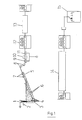
- the polymer melt promoted by conventional pumps begins the ring spinneret 1 and is made from blowing nozzles 2 with 0 to 50 ° C warm air blown through between the spinneret 1 and the cooling liquid (e.g. water) flows.
- the threads 17 dip into the liquid bath 3 and are on the Thread guide 4 deflected in the direction of the pool edge 5.
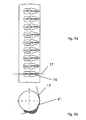
- the thread guide 4 consists of rod-shaped guide elements 4 'arranged in a semicircle stainless steel or ceramic.
- the threads are made by so-called combs 16 guided so that they do not hit and stick together. It is important that the Friction between threads 17 and thread guide 4, as well as the number of Points of contact are minimal.
- the special thread guide (Fig. 3) is another object of the invention.
- the guide elements 4 'of the thread guide 4 are designed so that the threads 17 at the high take-off speed due to the drag water carried along - Similar to the slide bearing effect - slide over the guide elements 4 'and thus as it were without contact.
- a liquid bath 3 with baffles 6, 6 ' is preferably used.
- the flow breakers 6, 6 ' (see e.g. Fig. 4) the through Drag flow of the threads 17 caused liquid flow calmed.
- the Flow breakers 6 are transverse to the direction of the thread below and partly above the thread group arranged (see Fig. 4).
- the upper flow breakers 6 'can can be folded up to put on the threads.
- the threads 17 After emerging from the liquid bath 3, the threads 17 by means of a Scraper 7 freed of the trailing fluid (e.g. water). Further drag fluid will be thrown off by deflecting the threads on deflection rollers 8. To be favoured Rear casters are used for better removal (spinning) of the towing water. Further drag water that remains on the threads is removed with the Adhesive water suction 9 removed. Then the spin finish on the Preparation site 10 with a preparation roll or in a spray chamber Nozzles applied to the threads and evened out with a scraper.
- the trailing fluid e.g. water
- Further drag fluid will be thrown off by deflecting the threads on deflection rollers 8.
- Rear casters are used for better removal (spinning) of the towing water. Further drag water that remains on the threads is removed with the Adhesive water suction 9 removed. Then the spin finish on the Preparation site 10 with a preparation roll or in a spray
- the threads are then passed through the drawing zone, for example via a roller septet 12 13 fed.
- the threads are, for example, in two stages Hot air at a temperature of 240 to 260 ° C and a total of 420% stretched.
- the fixing in the fixing zone 14 is preferably carried out in hot air with e.g. 250 to 260 ° C.
- the threads are then wound at a winding speed of up to 4000 m / min wound on the winding stations 15.
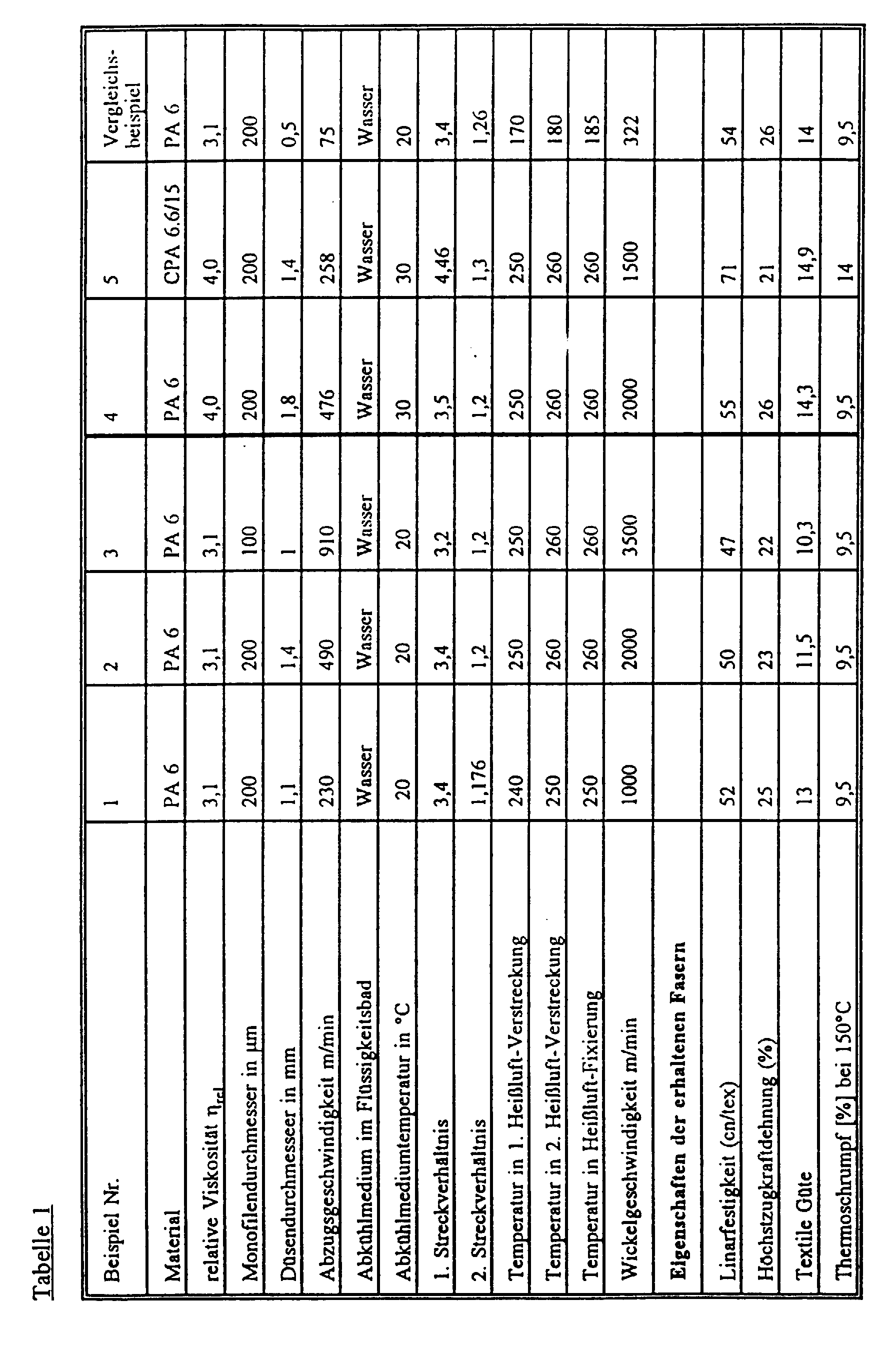
- monofilaments were made from pure Polyamide-6 and copolyamide (85% PA 6 with 15% PA 6.6) are produced. Before the The monofilaments emerging from the spinning head became cool in the liquid bath Blown vertically with air (25 ° C) directly below the spinneret.
- the comparative example represents the usual production of polyamide 6 monofilaments today.
Landscapes
- Engineering & Computer Science (AREA)
- Textile Engineering (AREA)
- Mechanical Engineering (AREA)
- Chemical & Material Sciences (AREA)
- Chemical Kinetics & Catalysis (AREA)
- General Chemical & Material Sciences (AREA)
- Spinning Methods And Devices For Manufacturing Artificial Fibers (AREA)
- Yarns And Mechanical Finishing Of Yarns Or Ropes (AREA)
- Artificial Filaments (AREA)
Description
- Fig. 1
- eine schematische Abbildung des Gesamtverfahrens,
- Fig. 2
- das erfindungsgemäße Flüssigkeitsbad mit Fadenführung und Strömungsbrechern,
- Fig. 3
- die erfindungsgemäße Fadenführung,
- Fig. 4
- bevorzugte erfindungsgemäße Strömungsbrecher.
Claims (13)
- Kontinuierliches Verfahren zur gleichzeitigen Herstellung einer Vielzahl von monofilen Fäden mit einem Durchmesser von 60 um bis 500 µm aus fadenbildenden Polymeren durch Schmelzspinnen des Polymeren, Abkühlen der Fäden (17) in einem Flüssigkeitsbad (3), Umlenken der Fäden im Flüssigkeitsbad (3) an einer Fadenführung (4), Abstreifen und Abschleudern der mitgeschleppten Flüssigkeit am Ausgang des Flüssigkeitsbades, Absaugen der restlichen Schleppflüssigkeit, Verstrecken in einer oder mehreren Stufen in Heißluft, Heißwasser oder Dampf oder einer Kombination dieser Medien, Fixieren der verstreckten Fäden in Heißluft und/oder Dampf und abschließendes Aufwickeln der Fäden, wobei die Auslaufgeschwindigkeit der Fäden nach dem Fixierschritt von 600 bis 4000 m/min beträgt, dadurch gekennzeichnet, daß die gebildeten Polymerfäden unterhalb des Schmelzspinnkopfes mit einem Kühlmedium zur Kühlung angeblasen werden, daß die Kühlung im Kühlbad mit einer Temperatur der Kühlflüssigkeit von -10-150 °C vorgenommen wird und daß die einzelnen Fäden separat im Kühlbad auf einer Kammfadenführung (16) geführt werden.
- Verfahren gemäß Anspruch 1, dadurch gekennzeichnet, daß die Auslaufgeschwindigkeit der Fäden von 1000 bis 3500 m/min beträgt.
- Verfahren gemäß den Ansprüchen 1 und 2, dadurch gekennzeichnet, daß die Fäden einen Enddurchmesser von 100 bis 300 µm aufweisen.
- Verfahren gemäß den Ansprüchen 1 bis 3, dadurch gekennzeichnet, daß die Fäden einen Enddurchmesser von 180 bis 250 µm aufweisen.
- Verfahren gemäß den Ansprüchen 1 bis 4, dadurch gekennzeichnet, daß als fadenbildende Polymere Polyamide verwendet werden.
- Verfahren gemäß den Ansprüchen 1 bis 5, dadurch gekennzeichnet, daß die gebildeten Fäden unterhalb des Spinnkopfes (1) auf einer Strecke von 1 bis 10 cm mit Luft einer Temperatur von 0 bis 50 °C seitlich angeblasen werden.
- Verfahren gemäß den Ansprüchen 1 bis 6, dadurch gekennzeichnet, daß die Temperatur des Kühlbades (3) bis 10 bis 40 °C beträgt.
- Verfahren gemäß den Ansprüchen 1 bis 6, dadurch gekennzeichnet, daß zur Beruhigung der Fluidströmung im Kühlbad (3) Strömungsbrecher (6, 6') eingesetzt werden, von denen die oberhalb der Fadenschar gelegenen Strömungsbrecher (6') bei laufendem Verfahren nach oben weggeklappt werden können.
- Verfahren gemäß den Ansprüchen 1 bis 8, dadurch gekennzeichnet, daß die Fäden in Heißluft mit einer Temperatur von 150 bis 350 °C, Heißwasser mit einer Temperatur von 85 °C bis 98 °C oder Dampf mit einer Temperatur von 100 bis 150 °C oder einer beliebigen, hintereinandergeschalteten Kombination dieser Medien um 200 bis 700 % verstreckt werden und anschließend in Heißluft einer Temperatur von 150 bis 350 °C und/oder Dampf mit einer Temperatur von 100 bis 150 °C fixiert werden.
- Verfahren gemäß den Ansprüchen 1 bis 9, dadurch gekennzeichnet, daß die durch die Schleppströmung der Fäden verursachte Fluidströmung mittels kammartiger Strömungsbrecher (6, 6') beruhigt wird.
- Verfahren gemäß den Ansprüchen 1 bis 10, dadurch gekennzeichnet, daß vor dem Verstrecken auf die Fäden eine Präparation aufgebracht wird.
- Vorrichtung zur Durchführung des Verfahrens gemäß den Ansprüchen 1 bis 11 bestehend aus einem Schmelzspinnkopf mit Spinndüse (1), einem Flüssigkeitsbad (3) mit einer Fadenführung (4) und Strömungsbrechern (6, 6'), Abstreifern (7), mindestens einer Umlenkrolle (8) oder Kimmenrollenwalze zum Abschleudern von mitgeschleppter Kühlflüssigkeit, einer Haftflüssigkeitsabsaugung (9, 11) vor und evt. nach einer anschließenden Spinnpräparationsstelle (10), einer oder mehreren Verstreckvorrichtungen (12) zur Heißverstreckung, einer Fixierzone (13) und Aufwickelstellen (15), dadurch gekennzeichnet, daß die Fadenführung (4) eine Kammfadenführung mit separater Führung (16) der Einzelfäden (17) ist, daß zwischen der Spinndüse (1) und dem Flüssigkeitsbad (3) eine Anblasdüse (2) zur Kühlung der Fäden angebracht ist, und daß an jeder Aufwickelstelle (15) eine Nachpräparationsstelle angeordnet ist, wobei die Wickelgeschwindigkeit der Aufwickelstellen (15) von 600 m/min bis 4000 m/min beträgt.
- Vorrichtung gemäß Anspruch 12, dadurch gekennzeichnet, daß die Fadenführung (4) aus im Halbkreis angeordneten, stabförmigen Führungselementen (4') mit Kämmen (16) besteht, die die Fäden (17) auf den Führungselementen einzeln führen.
Applications Claiming Priority (2)
| Application Number | Priority Date | Filing Date | Title |
|---|---|---|---|
| DE4336097A DE4336097A1 (de) | 1993-10-22 | 1993-10-22 | Kontinuierliches Verfahren zum Schmelzspinnen von monofilen Fäden |
| DE4336097 | 1993-10-22 |
Publications (2)
| Publication Number | Publication Date |
|---|---|
| EP0649920A1 EP0649920A1 (de) | 1995-04-26 |
| EP0649920B1 true EP0649920B1 (de) | 1999-01-07 |
Family
ID=6500787
Family Applications (1)
| Application Number | Title | Priority Date | Filing Date |
|---|---|---|---|
| EP94115963A Expired - Lifetime EP0649920B1 (de) | 1993-10-22 | 1994-10-10 | Kontinuierliches Verfahren und Vorrichtung zum Schmelzspinnen von monofilen Fäden |
Country Status (7)
| Country | Link |
|---|---|
| US (2) | US5518670A (de) |
| EP (1) | EP0649920B1 (de) |
| JP (1) | JP3575842B2 (de) |
| AT (1) | ATE175454T1 (de) |
| CA (1) | CA2118478C (de) |
| DE (2) | DE4336097A1 (de) |
| ES (1) | ES2127328T3 (de) |
Families Citing this family (37)
| Publication number | Priority date | Publication date | Assignee | Title |
|---|---|---|---|---|
| DE19600090A1 (de) * | 1996-01-03 | 1997-07-10 | Bayer Faser Gmbh | Verfahren und Vorrichtung zur Herstellung von schmelzgesponnenen Monofilen |
| DE19645786A1 (de) * | 1996-11-07 | 1998-05-14 | Bayer Faser Gmbh | Monofile und ihre Verwendung zur Herstellung von technischen textilen Waren |
| JPH10219512A (ja) * | 1997-01-31 | 1998-08-18 | Musashino Kikai:Kk | 溶融押出し紡糸方法及び装置 |
| US6582634B2 (en) | 1998-05-07 | 2003-06-24 | Peri-Dent Limited | Process of making a yarn |
| GB9817011D0 (en) * | 1998-08-06 | 1998-09-30 | Peri Dent Ltd | Improvements in or relating to plastic yarn |
| CA2421635A1 (en) | 2000-09-15 | 2002-03-21 | First Quality Fibers, Llc | Apparatus for manufacturing optical fiber made of semi-crystalline polymer |
| EP1221499A1 (de) * | 2001-01-05 | 2002-07-10 | Acordis Industrial Fibers bv | Verfahren zum Spinnstrecken von schmelzgesponnenen Garnen |
| ES2267369B2 (es) * | 2001-12-27 | 2007-11-16 | Toyo Boseki Kabushiki Kaisha | Aparato y procedimiento para la fabricacion de fibras elasticas. |
| DE10200406A1 (de) * | 2002-01-08 | 2003-07-24 | Zimmer Ag | Spinnvorrichtung und -verfahren mit turbulenter Kühlbeblasung |
| DE10204381A1 (de) * | 2002-01-28 | 2003-08-07 | Zimmer Ag | Ergonomische Spinnanlage |
| DE10213007A1 (de) * | 2002-03-22 | 2003-10-09 | Zimmer Ag | Verfahren und Vorrichtung zur Regelung des Raumklimas bei einem Spinnprozess |
| DE10223268B4 (de) * | 2002-05-24 | 2006-06-01 | Zimmer Ag | Benetzungseinrichtung und Spinnanlage mit Benetzungseinrichtung |
| DE10314878A1 (de) * | 2003-04-01 | 2004-10-28 | Zimmer Ag | Verfahren und Vorrichtung zur Herstellung nachverstreckter Cellulose-Spinnfäden |
| DE102004024029A1 (de) * | 2004-05-13 | 2005-12-08 | Zimmer Ag | Lyocell-Verfahren und -Vorrichtung mit Steuerung des Metallionen-Gehalts |
| DE102004024028B4 (de) * | 2004-05-13 | 2010-04-08 | Lenzing Ag | Lyocell-Verfahren und -Vorrichtung mit Presswasserrückführung |
| DE102004024030A1 (de) * | 2004-05-13 | 2005-12-08 | Zimmer Ag | Lyocell-Verfahren mit polymerisationsgradabhängiger Einstellung der Verarbeitungsdauer |
| US20060033231A1 (en) * | 2004-08-10 | 2006-02-16 | Reuter Rene F | Monofilament reinforced rubber component and method of producing |
| BRPI0608521A2 (pt) * | 2005-03-18 | 2017-07-25 | Diolen Ind Fibers Bv | Processo para produzir um fio de multifilamento de sulfeto de polifenileno, fio de multifilamento de sulfeto de polifenileno, e, uso do mesmo |
| JP5140609B2 (ja) * | 2009-01-19 | 2013-02-06 | クレハ合繊株式会社 | 熱可塑性樹脂モノフィラメントおよびその製造方法 |
| DE102010007497A1 (de) | 2010-02-09 | 2011-08-11 | Thüringisches Institut für Textil- und Kunststoff-Forschung e.V., 07407 | Wärmespeichernde Formkörper |
| WO2012171835A1 (de) * | 2011-06-15 | 2012-12-20 | Trützschler Nonwovens Gmbh | Spinnbadwanne |
| WO2015061877A1 (pt) * | 2013-10-29 | 2015-05-07 | Braskem S.A. | Sistema e método de dosagem de uma mistura de polímero com um primeiro solvente, dispositivo, sistema e método de extração de solvente de pelo menos um fio polimérico, sistema e método de pré-recuperação mecânica de pelo menos um líquido em pelo menos um fio polimérico, e sistema e método contínuos para a produção de pelo menos um fio polimérico |
| EP3034659A1 (de) * | 2014-12-17 | 2016-06-22 | Redco NV | Verbesserte Polypropylenfasern, Verfahren zur Herstellung davon und Verwendung davon zur Herstellung von Faserzementprodukten |
| RU2709920C1 (ru) * | 2016-08-03 | 2019-12-23 | Кордса Текник Текстил Аноним Ширкети | Система и способ для производства моноволоконной нити |
| CN106367824B (zh) * | 2016-10-31 | 2018-09-21 | 哈尔滨天顺化工科技开发有限公司 | 一种用于纺丝的大包角握持牵伸辊组 |
| CN106521783A (zh) * | 2017-01-20 | 2017-03-22 | 南通杰克拜尼服帽有限公司 | 一种针织帽的制作工艺 |
| CN106835475A (zh) * | 2017-01-20 | 2017-06-13 | 南通杰克拜尼服帽有限公司 | 一种针织汗带的制作工艺 |
| CN108754641B (zh) * | 2018-08-21 | 2024-02-27 | 江西东华机械有限责任公司 | 一种便于生头的凝固浴水槽 |
| CN110747519A (zh) * | 2019-10-22 | 2020-02-04 | 齐齐哈尔大学 | 一种高强聚丙烯纤维的制备方法 |
| WO2021124259A1 (en) * | 2019-12-18 | 2021-06-24 | Garware Technical Fibres Limited | Method of manufacturing yarn for polymer net and system for the same |
| CN112030247A (zh) * | 2020-09-14 | 2020-12-04 | 东纶科技实业有限公司 | 湿法纺丝凝固浴的水洗系统 |
| JP7021328B2 (ja) * | 2020-11-10 | 2022-02-16 | コルドサ・テクニク・テクスティル・アノニム・シルケティ | モノフィラメント糸製造のための方法 |
| DE102021104890A1 (de) * | 2021-03-01 | 2022-09-01 | Dietze & Schell Maschinenfabrik Gmbh & Co. Kg | Verfahren zur Herstellung zumindest eines Filaments, Bedampfungsvorrichtung zur Durchführung eines derartigen Verfahrens und Filamentproduktionsanlage mit einer derartigen Bedampfungsvorrichtung |
| CN113622048B (zh) * | 2021-08-06 | 2023-11-07 | 浙江巴斯特网丝有限公司 | 造纸网用聚酯单丝的制备方法 |
| CN116837473A (zh) * | 2023-07-04 | 2023-10-03 | 浙江金汇特材料有限公司 | 一种尼龙工业长丝制备方法 |
| CN116983836A (zh) * | 2023-08-01 | 2023-11-03 | 贵州理工学院 | 具有非对称结构的中空纤维膜及其制备方法、应用 |
| CN117071092B (zh) * | 2023-10-18 | 2024-01-05 | 德州市纤维检验所 | 一种纺丝装置 |
Family Cites Families (32)
| Publication number | Priority date | Publication date | Assignee | Title |
|---|---|---|---|---|
| US2746839A (en) * | 1953-06-26 | 1956-05-22 | Pittsburgh Plate Glass Co | Method of spinning shaped filaments of plastic materials |
| GB787563A (en) * | 1954-04-12 | 1957-12-11 | British Celanese | Improvements in or relating to the production and treatment of artificial and other filamentary materials |
| US2875019A (en) * | 1956-01-17 | 1959-02-24 | Firestone Tire & Rubber Co | Method for producing crimped filaments |
| US3002804A (en) * | 1958-11-28 | 1961-10-03 | Du Pont | Process of melt spinning and stretching filaments by passing them through liquid drag bath |
| US3041663A (en) * | 1958-12-23 | 1962-07-03 | Pittsburgh Plate Glass Co | Method and apparatus for forming fibers |
| GB911800A (en) * | 1959-06-18 | 1962-11-28 | Du Pont | Nylon monofilaments |
| US3029124A (en) * | 1959-08-24 | 1962-04-10 | Koppers Co Inc | Process for producing polyethylene monofilaments |
| US3091805A (en) * | 1960-11-02 | 1963-06-04 | Du Pont | Apparatus and process for drawing yarn |
| NL281284A (de) * | 1961-07-24 | |||
| BE631629A (de) * | 1962-04-27 | |||
| BE644325A (de) * | 1963-02-28 | 1964-08-25 | ||
| US3221088A (en) * | 1964-11-02 | 1965-11-30 | Eastman Kodak Co | Process and apparatus for orienting yarn |
| GB1111649A (en) * | 1965-07-08 | 1968-05-01 | Fuji Boseki Kabushiki Kaisha | Method and apparatus for melt spinning of synthetic filaments |
| US3518722A (en) * | 1967-10-31 | 1970-07-07 | Fmc Corp | Guide for incompletely solidified polymeric article |
| DE1710620B2 (de) * | 1968-03-14 | 1974-10-31 | Farbwerke Hoechst Ag Vormals Meister Lucius & Bruening, 6000 Frankfurt | Verfahren und Vorrichtung zur Herstellung von runden Drähten aus synthetischen linearen Hochpolymeren |
| US3621088A (en) * | 1968-08-09 | 1971-11-16 | Phillips Petroleum Co | High production of water-quenched filaments |
| US3790655A (en) * | 1971-03-02 | 1974-02-05 | E B & A C Whiting Co | Method for commingling and orienting colored sets of thermoplastic filaments |
| JPS516241B2 (de) * | 1972-05-30 | 1976-02-26 | ||
| US3993805A (en) * | 1972-07-31 | 1976-11-23 | Concorde Fibers Inc. | Method of applying liquid finish composition to filaments |
| US4037288A (en) * | 1973-09-07 | 1977-07-26 | Phillips Petroleum Company | Filament liquid quenching apparatus |
| US3905381A (en) * | 1973-09-07 | 1975-09-16 | Phillips Petroleum Co | Filament liquid quenching apparatus |
| US4265849A (en) * | 1979-05-29 | 1981-05-05 | Phillips Petroleum Company | Method for producing multifilament thermoplastic yarn having latent crimp |
| EP0030648B1 (de) * | 1979-11-30 | 1984-03-07 | Sekisui Jushi Kabushiki Kaisha | Verfahren zur Herstellung von Verpackungsmaterial aus Polyäthylenterephthalat |
| DE3409450A1 (de) * | 1984-03-15 | 1985-09-26 | Bayer Ag, 5090 Leverkusen | Verfahren und vorrichtung zur umlenkung von monofilen in einem kuehlbad |
| EP0172924B1 (de) * | 1984-08-14 | 1989-03-15 | Mitsubishi Jukogyo Kabushiki Kaisha | Vorrichtung zur Herstellung von Folien |
| JPH086203B2 (ja) * | 1986-07-03 | 1996-01-24 | 東レ株式会社 | 熱可塑性合成繊維の製造方法 |
| US5082611A (en) * | 1988-07-15 | 1992-01-21 | E. I. Du Pont De Nemours And Company | Process for spinning and drawing monofilaments with high tenacity and high tensile uniformity |
| WO1991011547A1 (de) * | 1990-02-05 | 1991-08-08 | Rhone-Poulenc Viscosuisse Sa | Verfahren und vorrichtung zum schnellspinnen von monofilamenten und damit hergestellte monofilamente |
| BR9102420A (pt) * | 1990-06-14 | 1992-01-14 | Du Pont | Monofilamentos de poliester para reforcar pneus |
| US5171504A (en) * | 1991-03-28 | 1992-12-15 | North Carolina State University | Process for producing high strength, high modulus thermoplastic fibers |
| DE4129521A1 (de) * | 1991-09-06 | 1993-03-11 | Akzo Nv | Vorrichtung zum schnellspinnen von multifilen faeden und deren verwendung |
| US5362430A (en) * | 1993-07-16 | 1994-11-08 | E. I. Du Pont De Nemours And Company | Aqueous-quench spinning of polyamides |
-
1993
- 1993-10-22 DE DE4336097A patent/DE4336097A1/de not_active Withdrawn
-
1994
- 1994-10-10 ES ES94115963T patent/ES2127328T3/es not_active Expired - Lifetime
- 1994-10-10 EP EP94115963A patent/EP0649920B1/de not_active Expired - Lifetime
- 1994-10-10 AT AT94115963T patent/ATE175454T1/de active
- 1994-10-10 DE DE59407594T patent/DE59407594D1/de not_active Expired - Lifetime
- 1994-10-13 US US08/322,233 patent/US5518670A/en not_active Expired - Lifetime
- 1994-10-17 JP JP27552594A patent/JP3575842B2/ja not_active Expired - Fee Related
- 1994-10-19 CA CA002118478A patent/CA2118478C/en not_active Expired - Fee Related
-
1996
- 1996-02-06 US US08/597,315 patent/US5785997A/en not_active Expired - Lifetime
Also Published As
| Publication number | Publication date |
|---|---|
| US5785997A (en) | 1998-07-28 |
| US5518670A (en) | 1996-05-21 |
| ES2127328T3 (es) | 1999-04-16 |
| CA2118478C (en) | 2004-04-27 |
| JP3575842B2 (ja) | 2004-10-13 |
| DE59407594D1 (de) | 1999-02-18 |
| JPH07166411A (ja) | 1995-06-27 |
| ATE175454T1 (de) | 1999-01-15 |
| CA2118478A1 (en) | 1995-04-23 |
| EP0649920A1 (de) | 1995-04-26 |
| DE4336097A1 (de) | 1995-04-27 |
Similar Documents
| Publication | Publication Date | Title |
|---|---|---|
| EP0649920A1 (de) | Kontinuierliches Verfahren zum Schmelzspinnen von monofilen Fäden | |
| DE3781313T3 (de) | Verfahren und Vorrichtung. | |
| EP2283173B1 (de) | Verfahren zum abziehen und verstrecken eines multifilen fadens beim schmelzspinnen sowie eine vorrichtung zur durchführung des verfahrens | |
| EP0937791B1 (de) | Verfahren und Vorrichtung zum Spinnen eines multifilen Fadens | |
| EP0871805A1 (de) | Verfahren und vorrichtung zur herstellung von schmelzgesponnenen monofilen | |
| EP2456913A1 (de) | Verfahren zum schmelzspinnen, verstrecken und aufwickeln eines multifilen fadens sowie eine vorrichtung zur durchführung des verfahrens | |
| DE102007031755A1 (de) | Verfahren und Vorrichtung zum Schmelzspinnen eines synthetischen multifilen Fadens | |
| EP0682720B1 (de) | Schmelzspinnverfahren für filamente | |
| DE2925006C2 (de) | Verfahren zur Herstellung schmelzgesponnener und molekularorientierend verstreckter, kristalliner Filamente | |
| EP2567008B1 (de) | Verfahren und vorrichtung zum schmelzspinnen, verstrecken und aufwickeln mehrerer synthetischer fäden | |
| EP1228268B1 (de) | Verfahren zum schmelzspinnen | |
| EP1520065A1 (de) | Verfahren und vorrichtung zum schmelzspinnen und zerschneiden eines spinnkabels | |
| WO2016058873A1 (de) | Verfahren und vorrichtung zur herstellung eines multifilen fadens aus einer polyamidschmelze | |
| EP1486592B1 (de) | Vorrichtung zum Spinnen und Behandeln synthetischer Fäden | |
| EP1352114A1 (de) | Verfahren zum spinnstrecken von schmelzgesponnenen garnen | |
| DE3036683C2 (de) | Verfahren zum Schmelzspinnen von synthetischen Polymeren | |
| DE2741193A1 (de) | Verfahren und vorrichtung zur herstellung von thermoplastischen faeden | |
| DE1902213A1 (de) | Verfahren zur Herstellung von Polyamid-Kraeuselfaeden | |
| WO1992001093A1 (de) | Verfahren und vorrichtung zum herstellen von kunststoffäden oder -fasern aus polymeren, insbesondere polyamid, polyester oder polypropylen | |
| DE19909073A1 (de) | Vorrichtung und Verfahren zum Verstrecken eines synthetischen Fadens | |
| DE10338821B4 (de) | Verfahren zur Herstellung von feinen Fasern | |
| WO2019034488A1 (de) | Verfahren und vorrichtung zur herstellung eines multifilen vollverstreckten fadens aus einer polyamidschmelze | |
| EP0423278B1 (de) | Verfahren zur herstellung von feinen monofilamenten und monofilament hergestellt nach diesem verfahren | |
| CH626922A5 (de) | ||
| DE102008039378A1 (de) | Verfahren zum Abziehen und Verstrecken eines multifilen Fadens beim Schmelzspinnen sowie eine Vorrichtung zur Durchführung des Verfahrens |
Legal Events
| Date | Code | Title | Description |
|---|---|---|---|
| PUAI | Public reference made under article 153(3) epc to a published international application that has entered the european phase |
Free format text: ORIGINAL CODE: 0009012 |
|
| AK | Designated contracting states |
Kind code of ref document: A1 Designated state(s): AT BE CH DE ES FR GB IT LI NL PT |
|
| 17P | Request for examination filed |
Effective date: 19951024 |
|
| 17Q | First examination report despatched |
Effective date: 19961202 |
|
| GRAG | Despatch of communication of intention to grant |
Free format text: ORIGINAL CODE: EPIDOS AGRA |
|
| GRAG | Despatch of communication of intention to grant |
Free format text: ORIGINAL CODE: EPIDOS AGRA |
|
| GRAH | Despatch of communication of intention to grant a patent |
Free format text: ORIGINAL CODE: EPIDOS IGRA |
|
| GRAH | Despatch of communication of intention to grant a patent |
Free format text: ORIGINAL CODE: EPIDOS IGRA |
|
| GRAA | (expected) grant |
Free format text: ORIGINAL CODE: 0009210 |
|
| AK | Designated contracting states |
Kind code of ref document: B1 Designated state(s): AT BE CH DE ES FR GB IT LI NL PT |
|
| REF | Corresponds to: |
Ref document number: 175454 Country of ref document: AT Date of ref document: 19990115 Kind code of ref document: T |
|
| REG | Reference to a national code |
Ref country code: CH Ref legal event code: NV Representative=s name: E. BLUM & CO. PATENTANWAELTE Ref country code: CH Ref legal event code: EP |
|
| GBT | Gb: translation of ep patent filed (gb section 77(6)(a)/1977) |
Effective date: 19990108 |
|
| REF | Corresponds to: |
Ref document number: 59407594 Country of ref document: DE Date of ref document: 19990218 |
|
| ITF | It: translation for a ep patent filed | ||
| REG | Reference to a national code |
Ref country code: ES Ref legal event code: FG2A Ref document number: 2127328 Country of ref document: ES Kind code of ref document: T3 |
|
| ET | Fr: translation filed | ||
| REG | Reference to a national code |
Ref country code: PT Ref legal event code: SC4A Free format text: AVAILABILITY OF NATIONAL TRANSLATION Effective date: 19990406 |
|
| PLBE | No opposition filed within time limit |
Free format text: ORIGINAL CODE: 0009261 |
|
| STAA | Information on the status of an ep patent application or granted ep patent |
Free format text: STATUS: NO OPPOSITION FILED WITHIN TIME LIMIT |
|
| 26N | No opposition filed | ||
| REG | Reference to a national code |
Ref country code: GB Ref legal event code: IF02 |
|
| REG | Reference to a national code |
Ref country code: CH Ref legal event code: PFA Owner name: BAYER AG Free format text: BAYER AG# #51368 LEVERKUSEN (DE) -TRANSFER TO- BAYER AG# #51368 LEVERKUSEN (DE) |
|
| PGFP | Annual fee paid to national office [announced via postgrant information from national office to epo] |
Ref country code: NL Payment date: 20101009 Year of fee payment: 17 Ref country code: FR Payment date: 20101020 Year of fee payment: 17 Ref country code: AT Payment date: 20101014 Year of fee payment: 17 |
|
| PGFP | Annual fee paid to national office [announced via postgrant information from national office to epo] |
Ref country code: PT Payment date: 20101011 Year of fee payment: 17 Ref country code: DE Payment date: 20101006 Year of fee payment: 17 Ref country code: CH Payment date: 20101012 Year of fee payment: 17 |
|
| PGFP | Annual fee paid to national office [announced via postgrant information from national office to epo] |
Ref country code: GB Payment date: 20101006 Year of fee payment: 17 Ref country code: BE Payment date: 20101020 Year of fee payment: 17 Ref country code: IT Payment date: 20101016 Year of fee payment: 17 |
|
| PGFP | Annual fee paid to national office [announced via postgrant information from national office to epo] |
Ref country code: ES Payment date: 20101122 Year of fee payment: 17 |
|
| REG | Reference to a national code |
Ref country code: PT Ref legal event code: MM4A Free format text: LAPSE DUE TO NON-PAYMENT OF FEES Effective date: 20120410 |
|
| BERE | Be: lapsed |
Owner name: *BAYER A.G. Effective date: 20111031 |
|
| REG | Reference to a national code |
Ref country code: NL Ref legal event code: V1 Effective date: 20120501 |
|
| REG | Reference to a national code |
Ref country code: CH Ref legal event code: PL |
|
| GBPC | Gb: european patent ceased through non-payment of renewal fee |
Effective date: 20111010 |
|
| REG | Reference to a national code |
Ref country code: FR Ref legal event code: ST Effective date: 20120629 |
|
| PG25 | Lapsed in a contracting state [announced via postgrant information from national office to epo] |
Ref country code: NL Free format text: LAPSE BECAUSE OF NON-PAYMENT OF DUE FEES Effective date: 20120501 Ref country code: DE Free format text: LAPSE BECAUSE OF NON-PAYMENT OF DUE FEES Effective date: 20120501 Ref country code: CH Free format text: LAPSE BECAUSE OF NON-PAYMENT OF DUE FEES Effective date: 20111031 Ref country code: LI Free format text: LAPSE BECAUSE OF NON-PAYMENT OF DUE FEES Effective date: 20111031 Ref country code: BE Free format text: LAPSE BECAUSE OF NON-PAYMENT OF DUE FEES Effective date: 20111031 |
|
| REG | Reference to a national code |
Ref country code: DE Ref legal event code: R119 Ref document number: 59407594 Country of ref document: DE Effective date: 20120501 |
|
| PG25 | Lapsed in a contracting state [announced via postgrant information from national office to epo] |
Ref country code: PT Free format text: LAPSE BECAUSE OF NON-PAYMENT OF DUE FEES Effective date: 20120410 Ref country code: FR Free format text: LAPSE BECAUSE OF NON-PAYMENT OF DUE FEES Effective date: 20111102 Ref country code: GB Free format text: LAPSE BECAUSE OF NON-PAYMENT OF DUE FEES Effective date: 20111010 Ref country code: IT Free format text: LAPSE BECAUSE OF NON-PAYMENT OF DUE FEES Effective date: 20111010 |
|
| REG | Reference to a national code |
Ref country code: AT Ref legal event code: MM01 Ref document number: 175454 Country of ref document: AT Kind code of ref document: T Effective date: 20111010 |
|
| PG25 | Lapsed in a contracting state [announced via postgrant information from national office to epo] |
Ref country code: AT Free format text: LAPSE BECAUSE OF NON-PAYMENT OF DUE FEES Effective date: 20111010 |
|
| REG | Reference to a national code |
Ref country code: ES Ref legal event code: FD2A Effective date: 20130604 |
|
| PG25 | Lapsed in a contracting state [announced via postgrant information from national office to epo] |
Ref country code: ES Free format text: LAPSE BECAUSE OF NON-PAYMENT OF DUE FEES Effective date: 20111011 |