EP0634441B1 - High melt strength, propylene polymer, process for making it, and use thereof - Google Patents
High melt strength, propylene polymer, process for making it, and use thereof Download PDFInfo
- Publication number
- EP0634441B1 EP0634441B1 EP94111029A EP94111029A EP0634441B1 EP 0634441 B1 EP0634441 B1 EP 0634441B1 EP 94111029 A EP94111029 A EP 94111029A EP 94111029 A EP94111029 A EP 94111029A EP 0634441 B1 EP0634441 B1 EP 0634441B1
- Authority
- EP
- European Patent Office
- Prior art keywords
- propylene
- ethylene
- olefin
- alpha
- copolymer
- Prior art date
- Legal status (The legal status is an assumption and is not a legal conclusion. Google has not performed a legal analysis and makes no representation as to the accuracy of the status listed.)
- Expired - Lifetime
Links
- 229920001155 polypropylene Polymers 0.000 title claims abstract description 134
- 238000000034 method Methods 0.000 title claims abstract description 42
- 230000008569 process Effects 0.000 title claims abstract description 33
- 239000002861 polymer material Substances 0.000 claims abstract description 106
- 239000000463 material Substances 0.000 claims abstract description 43
- 239000007787 solid Substances 0.000 claims abstract description 38
- 229920000642 polymer Polymers 0.000 claims abstract description 30
- QVGXLLKOCUKJST-UHFFFAOYSA-N atomic oxygen Chemical compound [O] QVGXLLKOCUKJST-UHFFFAOYSA-N 0.000 claims abstract description 24
- 239000001301 oxygen Substances 0.000 claims abstract description 24
- 229910052760 oxygen Inorganic materials 0.000 claims abstract description 24
- 238000005482 strain hardening Methods 0.000 claims abstract description 18
- 238000007765 extrusion coating Methods 0.000 claims abstract description 3
- VGGSQFUCUMXWEO-UHFFFAOYSA-N Ethene Chemical compound C=C VGGSQFUCUMXWEO-UHFFFAOYSA-N 0.000 claims description 90
- 239000005977 Ethylene Substances 0.000 claims description 90
- 239000004711 α-olefin Substances 0.000 claims description 79
- 229920001577 copolymer Polymers 0.000 claims description 60
- QQONPFPTGQHPMA-UHFFFAOYSA-N propylene Natural products CC=C QQONPFPTGQHPMA-UHFFFAOYSA-N 0.000 claims description 46
- 125000004805 propylene group Chemical group [H]C([H])([H])C([H])([*:1])C([H])([H])[*:2] 0.000 claims description 41
- 239000000203 mixture Substances 0.000 claims description 32
- -1 propylene, ethylene Chemical group 0.000 claims description 30
- CTQNGGLPUBDAKN-UHFFFAOYSA-N O-Xylene Chemical compound CC1=CC=CC=C1C CTQNGGLPUBDAKN-UHFFFAOYSA-N 0.000 claims description 25
- 239000008096 xylene Substances 0.000 claims description 25
- 230000005865 ionizing radiation Effects 0.000 claims description 15
- 150000001993 dienes Chemical class 0.000 claims description 12
- 239000004743 Polypropylene Substances 0.000 claims description 10
- 229920001384 propylene homopolymer Polymers 0.000 claims description 9
- 238000000113 differential scanning calorimetry Methods 0.000 claims description 7
- 229920001519 homopolymer Polymers 0.000 claims description 7
- 150000001336 alkenes Chemical class 0.000 claims description 6
- 238000010894 electron beam technology Methods 0.000 claims description 6
- 125000000217 alkyl group Chemical group 0.000 claims description 5
- 229910052799 carbon Inorganic materials 0.000 claims description 5
- 229920005684 linear copolymer Polymers 0.000 claims description 5
- JRZJOMJEPLMPRA-UHFFFAOYSA-N olefin Natural products CCCCCCCC=C JRZJOMJEPLMPRA-UHFFFAOYSA-N 0.000 claims description 5
- 238000012668 chain scission Methods 0.000 claims description 4
- 230000001678 irradiating effect Effects 0.000 claims description 4
- 229920000098 polyolefin Polymers 0.000 claims description 4
- 238000002844 melting Methods 0.000 claims description 2
- 230000008018 melting Effects 0.000 claims description 2
- 229920005606 polypropylene copolymer Polymers 0.000 claims 2
- 231100000987 absorbed dose Toxicity 0.000 claims 1
- 239000008199 coating composition Substances 0.000 claims 1
- 229920005629 polypropylene homopolymer Polymers 0.000 claims 1
- 230000005855 radiation Effects 0.000 abstract description 17
- 238000004519 manufacturing process Methods 0.000 abstract description 4
- 238000003856 thermoforming Methods 0.000 abstract description 3
- 238000005187 foaming Methods 0.000 abstract 1
- IJGRMHOSHXDMSA-UHFFFAOYSA-N Atomic nitrogen Chemical compound N#N IJGRMHOSHXDMSA-UHFFFAOYSA-N 0.000 description 17
- 239000003381 stabilizer Substances 0.000 description 17
- 229920001971 elastomer Polymers 0.000 description 14
- 239000000654 additive Substances 0.000 description 13
- 150000003254 radicals Chemical class 0.000 description 13
- 238000012546 transfer Methods 0.000 description 11
- 239000006260 foam Substances 0.000 description 9
- 239000007789 gas Substances 0.000 description 9
- 239000000155 melt Substances 0.000 description 9
- 239000002245 particle Substances 0.000 description 9
- 239000005060 rubber Substances 0.000 description 9
- 229910052757 nitrogen Inorganic materials 0.000 description 8
- 239000008188 pellet Substances 0.000 description 8
- 238000001125 extrusion Methods 0.000 description 7
- 239000012530 fluid Substances 0.000 description 7
- 230000000996 additive effect Effects 0.000 description 6
- 239000007795 chemical reaction product Substances 0.000 description 6
- 238000004132 cross linking Methods 0.000 description 6
- 239000000047 product Substances 0.000 description 6
- 229920005989 resin Polymers 0.000 description 6
- 239000011347 resin Substances 0.000 description 6
- 239000012298 atmosphere Substances 0.000 description 5
- 239000000806 elastomer Substances 0.000 description 5
- 238000001879 gelation Methods 0.000 description 5
- 239000012299 nitrogen atmosphere Substances 0.000 description 5
- 239000000126 substance Substances 0.000 description 5
- 238000010521 absorption reaction Methods 0.000 description 4
- 238000010276 construction Methods 0.000 description 4
- 239000011261 inert gas Substances 0.000 description 4
- 238000010128 melt processing Methods 0.000 description 4
- 230000005012 migration Effects 0.000 description 4
- 238000013508 migration Methods 0.000 description 4
- 238000011084 recovery Methods 0.000 description 4
- 239000000243 solution Substances 0.000 description 4
- BGYHLZZASRKEJE-UHFFFAOYSA-N [3-[3-(3,5-ditert-butyl-4-hydroxyphenyl)propanoyloxy]-2,2-bis[3-(3,5-ditert-butyl-4-hydroxyphenyl)propanoyloxymethyl]propyl] 3-(3,5-ditert-butyl-4-hydroxyphenyl)propanoate Chemical compound CC(C)(C)C1=C(O)C(C(C)(C)C)=CC(CCC(=O)OCC(COC(=O)CCC=2C=C(C(O)=C(C=2)C(C)(C)C)C(C)(C)C)(COC(=O)CCC=2C=C(C(O)=C(C=2)C(C)(C)C)C(C)(C)C)COC(=O)CCC=2C=C(C(O)=C(C=2)C(C)(C)C)C(C)(C)C)=C1 BGYHLZZASRKEJE-UHFFFAOYSA-N 0.000 description 3
- BEIOEBMXPVYLRY-UHFFFAOYSA-N [4-[4-bis(2,4-ditert-butylphenoxy)phosphanylphenyl]phenyl]-bis(2,4-ditert-butylphenoxy)phosphane Chemical compound CC(C)(C)C1=CC(C(C)(C)C)=CC=C1OP(C=1C=CC(=CC=1)C=1C=CC(=CC=1)P(OC=1C(=CC(=CC=1)C(C)(C)C)C(C)(C)C)OC=1C(=CC(=CC=1)C(C)(C)C)C(C)(C)C)OC1=CC=C(C(C)(C)C)C=C1C(C)(C)C BEIOEBMXPVYLRY-UHFFFAOYSA-N 0.000 description 3
- 238000013019 agitation Methods 0.000 description 3
- 238000010924 continuous production Methods 0.000 description 3
- 238000013461 design Methods 0.000 description 3
- PWWSSIYVTQUJQQ-UHFFFAOYSA-N distearyl thiodipropionate Chemical compound CCCCCCCCCCCCCCCCCCOC(=O)CCSCCC(=O)OCCCCCCCCCCCCCCCCCC PWWSSIYVTQUJQQ-UHFFFAOYSA-N 0.000 description 3
- 239000012634 fragment Substances 0.000 description 3
- 238000001746 injection moulding Methods 0.000 description 3
- 125000002496 methyl group Chemical group [H]C([H])([H])* 0.000 description 3
- 238000010791 quenching Methods 0.000 description 3
- 230000000171 quenching effect Effects 0.000 description 3
- 230000000717 retained effect Effects 0.000 description 3
- 238000000926 separation method Methods 0.000 description 3
- 238000012360 testing method Methods 0.000 description 3
- XLYOFNOQVPJJNP-UHFFFAOYSA-N water Substances O XLYOFNOQVPJJNP-UHFFFAOYSA-N 0.000 description 3
- 239000004604 Blowing Agent Substances 0.000 description 2
- 101000618467 Hypocrea jecorina (strain ATCC 56765 / BCRC 32924 / NRRL 11460 / Rut C-30) Endo-1,4-beta-xylanase 2 Proteins 0.000 description 2
- LSDPWZHWYPCBBB-UHFFFAOYSA-N Methanethiol Chemical compound SC LSDPWZHWYPCBBB-UHFFFAOYSA-N 0.000 description 2
- 230000002411 adverse Effects 0.000 description 2
- 239000011324 bead Substances 0.000 description 2
- 238000012993 chemical processing Methods 0.000 description 2
- 239000011248 coating agent Substances 0.000 description 2
- 238000000576 coating method Methods 0.000 description 2
- 239000012141 concentrate Substances 0.000 description 2
- NNBZCPXTIHJBJL-UHFFFAOYSA-N decalin Chemical compound C1CCCC2CCCCC21 NNBZCPXTIHJBJL-UHFFFAOYSA-N 0.000 description 2
- 239000004744 fabric Substances 0.000 description 2
- 238000006116 polymerization reaction Methods 0.000 description 2
- 238000002360 preparation method Methods 0.000 description 2
- 238000012545 processing Methods 0.000 description 2
- 229920005653 propylene-ethylene copolymer Polymers 0.000 description 2
- 229920005604 random copolymer Polymers 0.000 description 2
- 238000003860 storage Methods 0.000 description 2
- 239000000758 substrate Substances 0.000 description 2
- 229920003002 synthetic resin Polymers 0.000 description 2
- 239000000057 synthetic resin Substances 0.000 description 2
- DDMOUSALMHHKOS-UHFFFAOYSA-N 1,2-dichloro-1,1,2,2-tetrafluoroethane Chemical compound FC(F)(Cl)C(F)(F)Cl DDMOUSALMHHKOS-UHFFFAOYSA-N 0.000 description 1
- MYMOFIZGZYHOMD-UHFFFAOYSA-N Dioxygen Chemical compound O=O MYMOFIZGZYHOMD-UHFFFAOYSA-N 0.000 description 1
- 229920002943 EPDM rubber Polymers 0.000 description 1
- 238000005481 NMR spectroscopy Methods 0.000 description 1
- 101100168115 Neurospora crassa (strain ATCC 24698 / 74-OR23-1A / CBS 708.71 / DSM 1257 / FGSC 987) con-6 gene Proteins 0.000 description 1
- 101100168117 Neurospora crassa (strain ATCC 24698 / 74-OR23-1A / CBS 708.71 / DSM 1257 / FGSC 987) con-8 gene Proteins 0.000 description 1
- JKIJEFPNVSHHEI-UHFFFAOYSA-N Phenol, 2,4-bis(1,1-dimethylethyl)-, phosphite (3:1) Chemical compound CC(C)(C)C1=CC(C(C)(C)C)=CC=C1OP(OC=1C(=CC(=CC=1)C(C)(C)C)C(C)(C)C)OC1=CC=C(C(C)(C)C)C=C1C(C)(C)C JKIJEFPNVSHHEI-UHFFFAOYSA-N 0.000 description 1
- 230000001133 acceleration Effects 0.000 description 1
- 238000013459 approach Methods 0.000 description 1
- 238000007664 blowing Methods 0.000 description 1
- 238000010504 bond cleavage reaction Methods 0.000 description 1
- CJZGTCYPCWQAJB-UHFFFAOYSA-L calcium stearate Chemical compound [Ca+2].CCCCCCCCCCCCCCCCCC([O-])=O.CCCCCCCCCCCCCCCCCC([O-])=O CJZGTCYPCWQAJB-UHFFFAOYSA-L 0.000 description 1
- 239000008116 calcium stearate Substances 0.000 description 1
- 235000013539 calcium stearate Nutrition 0.000 description 1
- 230000008859 change Effects 0.000 description 1
- 238000003889 chemical engineering Methods 0.000 description 1
- 239000003795 chemical substances by application Substances 0.000 description 1
- KYKAJFCTULSVSH-UHFFFAOYSA-N chloro(fluoro)methane Chemical compound F[C]Cl KYKAJFCTULSVSH-UHFFFAOYSA-N 0.000 description 1
- 230000000052 comparative effect Effects 0.000 description 1
- 238000013329 compounding Methods 0.000 description 1
- 238000001816 cooling Methods 0.000 description 1
- 230000009849 deactivation Effects 0.000 description 1
- 230000001419 dependent effect Effects 0.000 description 1
- 229910001873 dinitrogen Inorganic materials 0.000 description 1
- 229910001882 dioxygen Inorganic materials 0.000 description 1
- 230000009977 dual effect Effects 0.000 description 1
- 230000000694 effects Effects 0.000 description 1
- 238000005516 engineering process Methods 0.000 description 1
- 239000000835 fiber Substances 0.000 description 1
- 239000000945 filler Substances 0.000 description 1
- 239000010408 film Substances 0.000 description 1
- 239000012467 final product Substances 0.000 description 1
- 239000004088 foaming agent Substances 0.000 description 1
- 238000002523 gelfiltration Methods 0.000 description 1
- 230000009477 glass transition Effects 0.000 description 1
- 239000008187 granular material Substances 0.000 description 1
- 238000009863 impact test Methods 0.000 description 1
- 238000005304 joining Methods 0.000 description 1
- 238000002074 melt spinning Methods 0.000 description 1
- 229910052751 metal Inorganic materials 0.000 description 1
- 239000002184 metal Substances 0.000 description 1
- 239000002480 mineral oil Substances 0.000 description 1
- 235000010446 mineral oil Nutrition 0.000 description 1
- 238000012986 modification Methods 0.000 description 1
- 230000004048 modification Effects 0.000 description 1
- 239000012768 molten material Substances 0.000 description 1
- 239000002667 nucleating agent Substances 0.000 description 1
- 230000006911 nucleation Effects 0.000 description 1
- 238000010899 nucleation Methods 0.000 description 1
- 238000004806 packaging method and process Methods 0.000 description 1
- 238000005453 pelletization Methods 0.000 description 1
- 230000035515 penetration Effects 0.000 description 1
- 239000002530 phenolic antioxidant Substances 0.000 description 1
- 230000000704 physical effect Effects 0.000 description 1
- 239000000049 pigment Substances 0.000 description 1
- 239000004033 plastic Substances 0.000 description 1
- 238000005215 recombination Methods 0.000 description 1
- 230000006798 recombination Effects 0.000 description 1
- 230000009467 reduction Effects 0.000 description 1
- 238000000518 rheometry Methods 0.000 description 1
- 230000007017 scission Effects 0.000 description 1
- 229910001220 stainless steel Inorganic materials 0.000 description 1
- 239000010935 stainless steel Substances 0.000 description 1
- 239000007858 starting material Substances 0.000 description 1
- 238000005728 strengthening Methods 0.000 description 1
- 239000000454 talc Substances 0.000 description 1
- 229910052623 talc Inorganic materials 0.000 description 1
- 238000009864 tensile test Methods 0.000 description 1
- 229920001897 terpolymer Polymers 0.000 description 1
- 229920001169 thermoplastic Polymers 0.000 description 1
- 239000012815 thermoplastic material Substances 0.000 description 1
- 239000004416 thermosoftening plastic Substances 0.000 description 1
- 230000007704 transition Effects 0.000 description 1
- 238000010626 work up procedure Methods 0.000 description 1
Images
Classifications
-
- C—CHEMISTRY; METALLURGY
- C08—ORGANIC MACROMOLECULAR COMPOUNDS; THEIR PREPARATION OR CHEMICAL WORKING-UP; COMPOSITIONS BASED THEREON
- C08L—COMPOSITIONS OF MACROMOLECULAR COMPOUNDS
- C08L23/00—Compositions of homopolymers or copolymers of unsaturated aliphatic hydrocarbons having only one carbon-to-carbon double bond; Compositions of derivatives of such polymers
- C08L23/02—Compositions of homopolymers or copolymers of unsaturated aliphatic hydrocarbons having only one carbon-to-carbon double bond; Compositions of derivatives of such polymers not modified by chemical after-treatment
- C08L23/16—Ethene-propene or ethene-propene-diene copolymers
-
- C—CHEMISTRY; METALLURGY
- C08—ORGANIC MACROMOLECULAR COMPOUNDS; THEIR PREPARATION OR CHEMICAL WORKING-UP; COMPOSITIONS BASED THEREON
- C08L—COMPOSITIONS OF MACROMOLECULAR COMPOUNDS
- C08L23/00—Compositions of homopolymers or copolymers of unsaturated aliphatic hydrocarbons having only one carbon-to-carbon double bond; Compositions of derivatives of such polymers
- C08L23/02—Compositions of homopolymers or copolymers of unsaturated aliphatic hydrocarbons having only one carbon-to-carbon double bond; Compositions of derivatives of such polymers not modified by chemical after-treatment
- C08L23/10—Homopolymers or copolymers of propene
-
- C—CHEMISTRY; METALLURGY
- C08—ORGANIC MACROMOLECULAR COMPOUNDS; THEIR PREPARATION OR CHEMICAL WORKING-UP; COMPOSITIONS BASED THEREON
- C08F—MACROMOLECULAR COMPOUNDS OBTAINED BY REACTIONS ONLY INVOLVING CARBON-TO-CARBON UNSATURATED BONDS
- C08F8/00—Chemical modification by after-treatment
- C08F8/48—Isomerisation; Cyclisation
-
- C—CHEMISTRY; METALLURGY
- C08—ORGANIC MACROMOLECULAR COMPOUNDS; THEIR PREPARATION OR CHEMICAL WORKING-UP; COMPOSITIONS BASED THEREON
- C08J—WORKING-UP; GENERAL PROCESSES OF COMPOUNDING; AFTER-TREATMENT NOT COVERED BY SUBCLASSES C08B, C08C, C08F, C08G or C08H
- C08J3/00—Processes of treating or compounding macromolecular substances
- C08J3/28—Treatment by wave energy or particle radiation
-
- C—CHEMISTRY; METALLURGY
- C08—ORGANIC MACROMOLECULAR COMPOUNDS; THEIR PREPARATION OR CHEMICAL WORKING-UP; COMPOSITIONS BASED THEREON
- C08J—WORKING-UP; GENERAL PROCESSES OF COMPOUNDING; AFTER-TREATMENT NOT COVERED BY SUBCLASSES C08B, C08C, C08F, C08G or C08H
- C08J9/00—Working-up of macromolecular substances to porous or cellular articles or materials; After-treatment thereof
- C08J9/0061—Working-up of macromolecular substances to porous or cellular articles or materials; After-treatment thereof characterized by the use of several polymeric components
-
- C—CHEMISTRY; METALLURGY
- C08—ORGANIC MACROMOLECULAR COMPOUNDS; THEIR PREPARATION OR CHEMICAL WORKING-UP; COMPOSITIONS BASED THEREON
- C08J—WORKING-UP; GENERAL PROCESSES OF COMPOUNDING; AFTER-TREATMENT NOT COVERED BY SUBCLASSES C08B, C08C, C08F, C08G or C08H
- C08J9/00—Working-up of macromolecular substances to porous or cellular articles or materials; After-treatment thereof
- C08J9/04—Working-up of macromolecular substances to porous or cellular articles or materials; After-treatment thereof using blowing gases generated by a previously added blowing agent
- C08J9/12—Working-up of macromolecular substances to porous or cellular articles or materials; After-treatment thereof using blowing gases generated by a previously added blowing agent by a physical blowing agent
- C08J9/14—Working-up of macromolecular substances to porous or cellular articles or materials; After-treatment thereof using blowing gases generated by a previously added blowing agent by a physical blowing agent organic
- C08J9/143—Halogen containing compounds
- C08J9/144—Halogen containing compounds containing carbon, halogen and hydrogen only
-
- C—CHEMISTRY; METALLURGY
- C08—ORGANIC MACROMOLECULAR COMPOUNDS; THEIR PREPARATION OR CHEMICAL WORKING-UP; COMPOSITIONS BASED THEREON
- C08L—COMPOSITIONS OF MACROMOLECULAR COMPOUNDS
- C08L23/00—Compositions of homopolymers or copolymers of unsaturated aliphatic hydrocarbons having only one carbon-to-carbon double bond; Compositions of derivatives of such polymers
- C08L23/02—Compositions of homopolymers or copolymers of unsaturated aliphatic hydrocarbons having only one carbon-to-carbon double bond; Compositions of derivatives of such polymers not modified by chemical after-treatment
- C08L23/10—Homopolymers or copolymers of propene
- C08L23/12—Polypropene
-
- C—CHEMISTRY; METALLURGY
- C08—ORGANIC MACROMOLECULAR COMPOUNDS; THEIR PREPARATION OR CHEMICAL WORKING-UP; COMPOSITIONS BASED THEREON
- C08J—WORKING-UP; GENERAL PROCESSES OF COMPOUNDING; AFTER-TREATMENT NOT COVERED BY SUBCLASSES C08B, C08C, C08F, C08G or C08H
- C08J2201/00—Foams characterised by the foaming process
- C08J2201/02—Foams characterised by the foaming process characterised by mechanical pre- or post-treatments
- C08J2201/03—Extrusion of the foamable blend
-
- C—CHEMISTRY; METALLURGY
- C08—ORGANIC MACROMOLECULAR COMPOUNDS; THEIR PREPARATION OR CHEMICAL WORKING-UP; COMPOSITIONS BASED THEREON
- C08J—WORKING-UP; GENERAL PROCESSES OF COMPOUNDING; AFTER-TREATMENT NOT COVERED BY SUBCLASSES C08B, C08C, C08F, C08G or C08H
- C08J2323/00—Characterised by the use of homopolymers or copolymers of unsaturated aliphatic hydrocarbons having only one carbon-to-carbon double bond; Derivatives of such polymers
- C08J2323/02—Characterised by the use of homopolymers or copolymers of unsaturated aliphatic hydrocarbons having only one carbon-to-carbon double bond; Derivatives of such polymers not modified by chemical after treatment
- C08J2323/10—Homopolymers or copolymers of propene
-
- C—CHEMISTRY; METALLURGY
- C08—ORGANIC MACROMOLECULAR COMPOUNDS; THEIR PREPARATION OR CHEMICAL WORKING-UP; COMPOSITIONS BASED THEREON
- C08J—WORKING-UP; GENERAL PROCESSES OF COMPOUNDING; AFTER-TREATMENT NOT COVERED BY SUBCLASSES C08B, C08C, C08F, C08G or C08H
- C08J2323/00—Characterised by the use of homopolymers or copolymers of unsaturated aliphatic hydrocarbons having only one carbon-to-carbon double bond; Derivatives of such polymers
- C08J2323/02—Characterised by the use of homopolymers or copolymers of unsaturated aliphatic hydrocarbons having only one carbon-to-carbon double bond; Derivatives of such polymers not modified by chemical after treatment
- C08J2323/10—Homopolymers or copolymers of propene
- C08J2323/12—Polypropene
-
- C—CHEMISTRY; METALLURGY
- C08—ORGANIC MACROMOLECULAR COMPOUNDS; THEIR PREPARATION OR CHEMICAL WORKING-UP; COMPOSITIONS BASED THEREON
- C08J—WORKING-UP; GENERAL PROCESSES OF COMPOUNDING; AFTER-TREATMENT NOT COVERED BY SUBCLASSES C08B, C08C, C08F, C08G or C08H
- C08J2323/00—Characterised by the use of homopolymers or copolymers of unsaturated aliphatic hydrocarbons having only one carbon-to-carbon double bond; Derivatives of such polymers
- C08J2323/02—Characterised by the use of homopolymers or copolymers of unsaturated aliphatic hydrocarbons having only one carbon-to-carbon double bond; Derivatives of such polymers not modified by chemical after treatment
- C08J2323/10—Homopolymers or copolymers of propene
- C08J2323/14—Copolymers of propene
-
- C—CHEMISTRY; METALLURGY
- C08—ORGANIC MACROMOLECULAR COMPOUNDS; THEIR PREPARATION OR CHEMICAL WORKING-UP; COMPOSITIONS BASED THEREON
- C08J—WORKING-UP; GENERAL PROCESSES OF COMPOUNDING; AFTER-TREATMENT NOT COVERED BY SUBCLASSES C08B, C08C, C08F, C08G or C08H
- C08J2323/00—Characterised by the use of homopolymers or copolymers of unsaturated aliphatic hydrocarbons having only one carbon-to-carbon double bond; Derivatives of such polymers
- C08J2323/02—Characterised by the use of homopolymers or copolymers of unsaturated aliphatic hydrocarbons having only one carbon-to-carbon double bond; Derivatives of such polymers not modified by chemical after treatment
- C08J2323/16—Ethene-propene or ethene-propene-diene copolymers
-
- C—CHEMISTRY; METALLURGY
- C08—ORGANIC MACROMOLECULAR COMPOUNDS; THEIR PREPARATION OR CHEMICAL WORKING-UP; COMPOSITIONS BASED THEREON
- C08J—WORKING-UP; GENERAL PROCESSES OF COMPOUNDING; AFTER-TREATMENT NOT COVERED BY SUBCLASSES C08B, C08C, C08F, C08G or C08H
- C08J2423/00—Characterised by the use of homopolymers or copolymers of unsaturated aliphatic hydrocarbons having only one carbon-to-carbon double bond; Derivatives of such polymers
-
- C—CHEMISTRY; METALLURGY
- C08—ORGANIC MACROMOLECULAR COMPOUNDS; THEIR PREPARATION OR CHEMICAL WORKING-UP; COMPOSITIONS BASED THEREON
- C08L—COMPOSITIONS OF MACROMOLECULAR COMPOUNDS
- C08L23/00—Compositions of homopolymers or copolymers of unsaturated aliphatic hydrocarbons having only one carbon-to-carbon double bond; Compositions of derivatives of such polymers
- C08L23/26—Compositions of homopolymers or copolymers of unsaturated aliphatic hydrocarbons having only one carbon-to-carbon double bond; Compositions of derivatives of such polymers modified by chemical after-treatment
- C08L2023/40—Compositions of homopolymers or copolymers of unsaturated aliphatic hydrocarbons having only one carbon-to-carbon double bond; Compositions of derivatives of such polymers modified by chemical after-treatment by reaction with compounds changing molecular weight
- C08L2023/42—Depolymerisation, vis-breaking or degradation
-
- C—CHEMISTRY; METALLURGY
- C08—ORGANIC MACROMOLECULAR COMPOUNDS; THEIR PREPARATION OR CHEMICAL WORKING-UP; COMPOSITIONS BASED THEREON
- C08L—COMPOSITIONS OF MACROMOLECULAR COMPOUNDS
- C08L2205/00—Polymer mixtures characterised by other features
- C08L2205/02—Polymer mixtures characterised by other features containing two or more polymers of the same C08L -group
-
- C—CHEMISTRY; METALLURGY
- C08—ORGANIC MACROMOLECULAR COMPOUNDS; THEIR PREPARATION OR CHEMICAL WORKING-UP; COMPOSITIONS BASED THEREON
- C08L—COMPOSITIONS OF MACROMOLECULAR COMPOUNDS
- C08L2205/00—Polymer mixtures characterised by other features
- C08L2205/03—Polymer mixtures characterised by other features containing three or more polymers in a blend
-
- C—CHEMISTRY; METALLURGY
- C08—ORGANIC MACROMOLECULAR COMPOUNDS; THEIR PREPARATION OR CHEMICAL WORKING-UP; COMPOSITIONS BASED THEREON
- C08L—COMPOSITIONS OF MACROMOLECULAR COMPOUNDS
- C08L2205/00—Polymer mixtures characterised by other features
- C08L2205/03—Polymer mixtures characterised by other features containing three or more polymers in a blend
- C08L2205/035—Polymer mixtures characterised by other features containing three or more polymers in a blend containing four or more polymers in a blend
-
- C—CHEMISTRY; METALLURGY
- C08—ORGANIC MACROMOLECULAR COMPOUNDS; THEIR PREPARATION OR CHEMICAL WORKING-UP; COMPOSITIONS BASED THEREON
- C08L—COMPOSITIONS OF MACROMOLECULAR COMPOUNDS
- C08L2207/00—Properties characterising the ingredient of the composition
- C08L2207/02—Heterophasic composition
-
- C—CHEMISTRY; METALLURGY
- C08—ORGANIC MACROMOLECULAR COMPOUNDS; THEIR PREPARATION OR CHEMICAL WORKING-UP; COMPOSITIONS BASED THEREON
- C08L—COMPOSITIONS OF MACROMOLECULAR COMPOUNDS
- C08L23/00—Compositions of homopolymers or copolymers of unsaturated aliphatic hydrocarbons having only one carbon-to-carbon double bond; Compositions of derivatives of such polymers
- C08L23/02—Compositions of homopolymers or copolymers of unsaturated aliphatic hydrocarbons having only one carbon-to-carbon double bond; Compositions of derivatives of such polymers not modified by chemical after-treatment
- C08L23/04—Homopolymers or copolymers of ethene
- C08L23/08—Copolymers of ethene
- C08L23/0807—Copolymers of ethene with unsaturated hydrocarbons only containing four or more carbon atoms
- C08L23/0815—Copolymers of ethene with unsaturated hydrocarbons only containing four or more carbon atoms with aliphatic 1-olefins containing one carbon-to-carbon double bond
-
- C—CHEMISTRY; METALLURGY
- C08—ORGANIC MACROMOLECULAR COMPOUNDS; THEIR PREPARATION OR CHEMICAL WORKING-UP; COMPOSITIONS BASED THEREON
- C08L—COMPOSITIONS OF MACROMOLECULAR COMPOUNDS
- C08L23/00—Compositions of homopolymers or copolymers of unsaturated aliphatic hydrocarbons having only one carbon-to-carbon double bond; Compositions of derivatives of such polymers
- C08L23/02—Compositions of homopolymers or copolymers of unsaturated aliphatic hydrocarbons having only one carbon-to-carbon double bond; Compositions of derivatives of such polymers not modified by chemical after-treatment
- C08L23/10—Homopolymers or copolymers of propene
- C08L23/14—Copolymers of propene
- C08L23/142—Copolymers of propene at least partially crystalline copolymers of propene with other olefins
-
- C—CHEMISTRY; METALLURGY
- C08—ORGANIC MACROMOLECULAR COMPOUNDS; THEIR PREPARATION OR CHEMICAL WORKING-UP; COMPOSITIONS BASED THEREON
- C08L—COMPOSITIONS OF MACROMOLECULAR COMPOUNDS
- C08L91/00—Compositions of oils, fats or waxes; Compositions of derivatives thereof
-
- Y—GENERAL TAGGING OF NEW TECHNOLOGICAL DEVELOPMENTS; GENERAL TAGGING OF CROSS-SECTIONAL TECHNOLOGIES SPANNING OVER SEVERAL SECTIONS OF THE IPC; TECHNICAL SUBJECTS COVERED BY FORMER USPC CROSS-REFERENCE ART COLLECTIONS [XRACs] AND DIGESTS
- Y10—TECHNICAL SUBJECTS COVERED BY FORMER USPC
- Y10S—TECHNICAL SUBJECTS COVERED BY FORMER USPC CROSS-REFERENCE ART COLLECTIONS [XRACs] AND DIGESTS
- Y10S522/00—Synthetic resins or natural rubbers -- part of the class 520 series
- Y10S522/911—Specified treatment involving megarad or less
Definitions
- This invention resides in the chemical arts. More particularly, it relates to the chemical art having to do with synthetic resins derived from alpha or 1-olefins. Specifically, it relates to impact modified synthetic resins, also known as heterophasic resin, formed by the sequential polymerization of propylene and other olefins.
- heterophasic resins by conventional radiation methods has resulted in an heterophasic resin having melt strength, but severe gelation and high degree of crosslinking, which are undesirable in foam applications.
- This invention in one aspect comprises an irradiated normally solid, high molecular weight, non-linear, substantially gel-free, propylene polymer material being obtainable by a process comprising
- This invention in another aspect provides a practical process for converting normally solid, high molecular weight, linear, propylene polymer material without strain hardening elongational viscosity into irradiated normally solid, high molecular weight, non-linear, substantially gel-free, propylene polymer material, that has significant strain hardening elongational viscosity and enhanced melt strength comprising:
- the propylene polymer material treated according to the process of this invention is a normally solid, high molecular weight, linear, propylene polymer material selected from the group consisting essentially of:
- the high molecular weight, linear, propylene polymer material treated according to the process of this invention under the broadest concepts of the process can be in any physical form, for example, spherical, granules, pellets, film and sheet.
- the linear, propylene polymer material is in a finely divided condition with satisfactory results being obtained at an average spherical or pellet particle size of 0.5 to 7mm.
- high molecular weight means weight average molecular weight of at least 100,000.
- Intrinsic viscosity also known as the limiting viscosity number, in its most general sense is a measure of the capacity of a polymer molecule to enhance the viscosity of a solution. This depends on both the size and the shape of the dissolved polymer molecule. Hence, in comparing a nonlinear polymer with a linear polymer of substantially the same weight average molecular weight, it is an indication of configuration of the nonlinear polymer molecule. Indeed, the above ratio of intrinsic viscosities is a measure of the degree of branching of the nonlinear polymer.
- a method for determining intrinsic viscosity of propylene polymer material is described by Elliott et al., J. App. Poly. Sci.,14, pp 2947-2963 (1970). In this specification the intrinsic viscosity in each instance is determined with the polymer dissolved in decahydronaphthalene at 135°C.
- Melt tension provides an indicator of the melt strength of the material.
- Melt tension is determined with a Gottfert Rheotens melt tension apparatus from Gottfert Inc. by measuring the tension of a strand of molten polymer material in centi-newtons as follows: the polymer to be examined is extruded at an extrusion rate of 0.13 cc/sec. at an apparent shear rate of approximately 15 reciprocal seconds and temperature of from 140°C to 200°C through a capillary 20 mm long and 2 mm in diameter; the strand is then subjected to stretching using a drawing system with a constant acceleration rate based on the particular material. The tension resulting from the above drawing is measured (in centi-newtons), The higher the melt tension means the greater the melt strength values which, in turn, are indicative of the particular material's strain hardening ability.
- Elongational viscosity is the resistance of a fluid or semifluid substance to elongation. It is a melt property of a thermoplastic material, that can be determined by an instrument that measures the stress and strain of a specimen in the melt state when subjected to tensile strain at a constant rate.
- an instrument that measures the stress and strain of a specimen in the melt state when subjected to tensile strain at a constant rate.
- One such instrument is described in, and shown in Fig. 1 of, Munstedt, J. Rheology, 23, (4), 421-425, (1979).
- a commercial instrument of similar design is the Rheometrics RER-9000 extensional rheometer.
- Molten, high molecular weight, linear, propylene polymer material exhibits elongational viscosity which, as it is elongated or drawn at a constant rate from a relatively fixed point, tends to increase for a distance dependent on the rate of elongation, and then to decrease rapidly until it thins to nothing - so-called ductile or necking failure.
- the molten propylene polymer material of this invention that is of substantially the same weight average molecular weight and at substantially the same test temperature as the corresponding, molten, high molecular weight, linear, propylene polymer material, exhibits elongational viscosity which, as it is elongated or drawn from a relatively fixed point at substantially the same rate of elongation tends to increase over a longer distance, and it breaks or fails by fracture - so-called brittle or elastic failure.
- These characteristics are indicative of strain hardening. Indeed, the more long chain branching the propylene polymer material of this invention has the greater the tendency of the elongational viscosity to increase as the elongated material approaches failure. This latter tendency is most evident when the branching index is less than 0.8.
- the stretch recovery or tension set of the material of this invention is a measure of the materials elasticity. Stretch recovery is determined by measuring the permanent deformation in a molded sample elongated to high deformation on a tensile testing instrument and then allowed to relax for a preset period of time. For the purpose of this invention, stretch recovery is defined as the permanent deformation, measured after 30 minutes, in a specimen elongated to break at a cross head speed of 50,8 cm/min (20 in./min at room temperature. It can be expressed as a percent permanent deformation relative to the original gauge length of the undeformed specimen or as a percent of break elongation of the material.
- the desired substantially branched, high molecular weight, non-linear, propylene polymer material there can be a net reduction in weight average molecular weight between the starting material and the end product, the desired substantially branched, high molecular weight, non-linear, propylene polymer material.
- the intrinsic viscosity of the starting, linear, propylene polymer material which is indicative of its molecular weight, should be in general 1-25, and preferably 2-6, to result in an end product with an intrinsic viscosity of 0.8-25, and preferably 1-3.
- linear, propylene polymer material with intrinsic viscosities higher and lower than these general values are within the broader scope of this invention.
- active oxygen means oxygen in a form that will react with the irradiated material and more particularly the free radicals in the material. It includes molecular oxygen (which is the form of oxygen normally found in air).
- the active oxygen content requirement of the process of this invention can be achieved by use of vacuum or by replacing part or all of air in the environment by an inert gas such as, for example, nitrogen.
- Linear, propylene polymer material immediately after it is made is normally substantially free of active oxygen. Therefore, it is within the concepts of this invention to follow the polymerization and polymer work-up steps (when the propylene polymer material is not exposed to air) with the process of this invention.
- the linear, propylene polymer material will have an active oxygen content because of having been stored in air, or for some other reason. Consequently, in the preferred practice of the process of this invention the linear, propylene polymer material is first treated to reduce its active oxygen content.
- a preferred way of doing this is to introduce the material into a bed of the same blown with nitrogen, the active oxygen content of which is equal to or less than 0.004% by volume.
- the residence time of the material in the bed generally should be at least 5 minutes for effective removal of active oxygen from the interstices of the particles of the material, and preferably long enough for the material to be in equilibrium with the environment.
- the prepared, linear, propylene polymer material should be maintained in an environment in which the active oxygen concentration is less than 15%, preferably less than 5% in a gas conveyance system, and more preferably 0.004%, by volume of the environment.
- temperature of the linear, propylene polymer material should be kept above the glass transition temperature of the amorphous fraction of the material, generally at less than 40°C and preferably at 25°C, because of the increase in temperature of the material that occurs in the irradiation step.
- the active oxygen concentration of the environment preferably is less than 5% by volume, and more preferably less than 1% by volume.
- the most preferred concentration of active oxygen is 0.004% by volume.
- the ionizing radiation should have sufficient energy to penetrate to the extent desired the mass of linear, propylene polymer material being radiated.
- the energy must be sufficient to ionize the molecular structure and to excite atomic structure, but not sufficient to affect atomic nuclei.
- the ionizing radiation can be of any kind, but the most practical kinds comprise electrons and gamma rays. Preferred are electrons beamed from an electron generator having an accelerating potential of 500-4,000 kilovolts.
- rad is usually defined as that quantity of ionizing radiation that results in the absorption of 100 ergs of energy per gram of irradiated material, regardless of the source of radiation.
- the amount of energy absorbed by the propylene polymer material when it is irradiated usually is not determined.
- energy absorption from ionizing radiation is measured by the well known conventional dosimeter, a measuring device in which a strip of fabric containing a radiation sensitive dye is the energy absorption sensing means.
- rad means that quantity of ionizing radiation resulting in the absorption of the equivalent of 100 ergs of energy per gram of the fabric of a dosimeter placed at the surface of the propylene polymer material being irradiated, whether in the form of a bed or layer of particles, or a film, or a sheet.
- the second step of the process of this invention should be performed in a period of time generally in the range from one minute to one hour, and preferably 2-30 minutes.
- a minimum time is needed for sufficient migration of propylene polymer chain fragments to free radical sites and for combination thereat to reform complete chains, or to form long branches on chains.
- a radical migration time less than one minute, for example, a half minute, is within the broader concepts of this invention, but is not preferred because the amount of resulting free-end long chain branching is quite low.
- the final step of the process can be performed by the application of heat or by the addition of an additive that functions as a free radical trap, such as, for example, methyl mercaptan.
- the application of heat comprises extruding the irradiated propylene polymer material at about 200°C. At this temperature the irradiated propylene polymer material is melted. As a result, quenching of the free radicals is substantially complete.
- the irradiated propylene polymer material prior to the extrusion or melt compounding, can be blended with other polymers, for example, linear, propylene polymer material, if desired, and additives such as, for example, stabilizers, pigments and fillers. Alternatively, such additives can be incorporated as a side stream addition to the extruder.
- the application of heat is achieved by introducing the irradiated propylene polymer material into a fluidized bed or a staged fluid bed system in which the fluidizing medium is, for example, nitrogen or other inert gas.
- the bed or beds is or are established and maintained in a temperature range of at least 60°C up to 130°C and preferably 80-120°C, with the average residence time of the irradiated propylene polymer material in the fluid bed or beds being from 5 minutes to 120 minutes, with 20-30 minutes being optimum.
- the product thus obtained is a normally solid, high molecular weight, non-linear, substantially gel-free, propylene polymer material characterized by strain hardening and enhanced melt strength.
- substantially gel-free as used herein, it is meant that the gel content of the material is from 0 to less than 3%.
- the process of the invention can be carried out on a batch basis, preferably it is performed on a continuous basis.
- the finely divided, linear, propylene polymer material either with or without the preparation step, depending on the active oxygen content of the material, is layered on a traveling belt in the required environment.
- the thickness of the layer depends on the desired extent of penetration of the ionizing radiation into the layer and the proportion of linear, propylene polymer material desired in the final end product.
- the speed of travel of the traveling belt is selected so that the layer of finely divided, propylene polymer material passes through the beam or beams of ionizing radiation at a rate to receive the desired dose of ionizing radiation.
- the irradiated layer can be left on the traveling belt in said environment for the period of time for free-radical migration and combination to occur, and then removed from the belt, and introduced into an extruder operated at a melt temperature of the irradiated material, or, in another specific embodiment introduced into a heated bed, or a staged system of heated beds, of particles of irradiated material fluidized with nitrogen or other inert gas.
- the irradiated material after at least substantially all of the free radicals therein are deactivated is discharged into the atmosphere and quickly cooled to room temperature.
- the irradiated, propylene polymer material is discharged from the belt and conveyed in the required environment to a holding vessel, the interior of which has the required environment, and held in the vessel to complete the requisite free radical migration time.
- the irradiated material then is introduced into an extruder operated at a melt temperature of the irradiated material or is introduced into a heated, inert gas fluidized bed, or a staged system of fluidized beds, of irradiated particles of propylene polymer material and, after quenching of the free radicals, the irradiated propylene polymer material is discharged into the atmosphere.
- This invention in still another aspect comprises the extensional flow use of the strain hardening, propylene polymer material of this invention.
- Extensional flow occurs when the propylene polymer material in the molten condition is pulled in one or more directions at a rate faster than it would normally flow in those directions. It happens in extrusion coating operations in which a melted coating material is extruded on to a substrate such as a moving web of paper or metal sheet, and the extruder or substrate is moving at a higher rate than the extrusion rate. It takes place in film production when the molten film is extruded and then stretched to the desired thinness. It is present in thermoforming operations in which a molten sheet is clamped over a plug mold, vacuum is applied and the sheet is pushed into the mold.
- strain hardening propylene polymer material of this invention is particularly useful as part of (for example from as little as 0.5% by weight to as much as 95% or more by weight) or as substantially all of the molten plastic material used in these and other melt processing methods (for example, profile extrusion, as in the melt spinning of fibers) for making useful articles.
- the strain hardened propylene polymer material of this invention it is particularly useful when blended with a normally solid, predominantly isotactic, semi-crystalline, linear, propylene polymer material for use in melt processing and other operations for making useful articles.
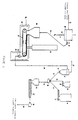
- Fig. 1 is a schematic flow sheet of a preferred embodiment of a continuous process for converting, for example, normally solid, linear propylene polymer material into a normally solid, non-linear, substantially gel-free, propylene polymer material with strain hardening and enhanced melt strength.
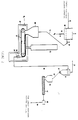
- Fig. 2 is a schematic flow sheet of a preferred embodiment of a continuous process for converting, for example, normally solid, linear propylene polymer material into a normally solid, non-linear, substantially gel-free, propylene polymer material with strain hardening and enhanced melt strength, without the additive hopper 37, screw feeder 38, bulk feed hopper 41 and screw feeder 42.
- Fig. 1 depicts a fluid bed unit 10 of conventional construction and operation into which finely divided, high molecular weight, propylene polymer material is introduced by way of conduit 11, nitrogen gas is introduced by way of conduit 13, and from which substantially active oxygen free, high molecular weight, propylene polymer material is removed by way of a solids discharge conduit 15 which also has a solids flow rate controller 16.
- the solids discharge conduit 15 leads to a conveyer belt feed hopper 20.
- the conveyer belt feed hopper 20 is a capped structure of conventional design. It is operated so that its interior contains a nitrogen atmosphere. It has a bottom solids discharge outlet through which the propylene polymer material particles move and form a layer on the top horizontal run of an endless conveyer belt 21.
- the conveyer belt 21 is generally horizontally disposed, and continuously moves under normal operative conditions. It is contained in radiation chamber 22. This chamber completely encloses the conveyer belt, and is constructed and operated to establish and maintain a nitrogen atmosphere in its interior.
- an electron beam generator 25 In combination with the radiation chamber 22 is an electron beam generator 25 of conventional design and operation. Under normal operative conditions it generates a beam of high energy electrons directed to the layer of propylene polymer material particles on the conveyer belt 21.
- a solids collector 28 Below the discharge end of the conveyer belt is a solids collector 28 arranged to receive the irradiated propylene polymer material particles falling off the conveyer belt 21 as it turns into its path of opposite travel. Irradiated propylene polymer material particles in the solids collector 28 are removed therefrom by a rotary valve or star wheel 29 and delivered thereby to a solids transfer line 30.
- the transfer line 30 leads to a gas-solids separator 31.
- This unit is of conventional construction and usually is a cyclone type separator. Gas separated therein is removed as by gas discharge conduit 33 while separated solids are discharged therefrom as by a rotary valve or star wheel 32 into a solids discharge line 34.
- the solids discharge line 34 can lead directly to an extruder hopper 35. However, in the embodiment shown, it leads to a plow blender 36.
- the additive hopper 37 preferably is conventional, and preferably is constructed and operated to maintain the contents in a nitrogen atmosphere.
- the discharge end of the additives hopper 37 empties into a screw feeder 38 which feeds material into an additives transfer line 39 that goes to the plow blender 36.
- a bulk feed hopper 41 in which, for example, finely divided or pelletized linear polypropylene is contained.
- This hopper is conventional, and it too preferably is constructed and operated to maintain the contents in a nitrogen atmosphere.
- the bulk feed hopper 41 empties into a screw feeder 42 which feeds a solids transfer line 43 that goes to the plow blender 36.
- the solids fed into it are blended and then discharged into a blended feed line 45 that empties into the extruder hopper 35.
- the extruder hopper 35 which feeds an extruder 47, is conventional in construction and operation. It too is an enclosed structure adapted for establishing and maintaining a nitrogen atmosphere in its interior.
- the extruder 47 is of conventional construction, and is operated in normal fashion.
- the solids in the extruder hopper 35 move therefrom into the extruder which is operated at a rate of extrusion to result in the period of time between irradiation of the propylene polymer material and its entry into the extruder being sufficient for a significant amount of free-end long chain branches to form. Accordingly, the volume of the extruder hopper 35 is selected to provide, if necessary, the desired amount of hopper storage time to meet this condition.
- the extruder 47 is designed (length of extruder barrel and screw) and operated at a melt temperature and at a pressure sufficient to maintain the free radical containing propylene polymer material therein for the amount of time needed to deactivate substantially all of the free radicals present.
- the thus treated, propylene polymer material is characterized by being non-linear, substantially gel-free, and substantially branched with free-end long chains of propylene polymer units. It can be used as is, or introduced, for example, directly into a pelletizing and cooling unit 49 and conveyed away therefrom as by solids transport line 50 as solid pellets which can be stored and then used, or used without storage.
- test samples and physical properties of the following working examples and comparative examples were prepared and measured according to the following methods: Melt Flow Rate (MFR) ASTM D-1238, Condition L Tensile Strength ASTM-D 638 Weldline Strength (W.L.) ASTM-D 638, Dual Gated Tensile bar Retained Weldline Strength ASTM-D 638 Elongation @ Break ASTM-D 638 Elongation @ Yield ASTM-D 638 Elongation @ Break at W.L.
- ASTM-D 638 Flexural Modulus ASTM-D 790 Flexural Strength ASTM-D 618, Procedure A Haze % ASTM-D 1003 Notched Izod (J/m (ft lb/in)) ASTM-D 256-87
- the percent gel is determined by a hot-gel filtration test, whereby the polymer is dissolved in a 1% xylene solution at 135°C and is filtered through a 325 mesh stainless steel screen.
- the percent xylene solubles at room temperature, (XSRT), is determined by dissolving 2.5 g of the polymer in 250 ml of xylene in a vessel equipped with a stirrer which is heated at 135°C with agitation for 20 minutes. The solution is cooled to 25°C while continuing the agitation , and then left to stand without agitation for 30 minutes so that the solids can settle. The solids are filtered with filter paper, the remaining solution is evaporated by treating it with a nitrogen stream, and the solid residue is vacuum dried at 80°C until constant weight is reached.
- a propylene polymer material in spherical form, containing 35% of a propylene-ethylene copolymer, (3.3 wt.% polymerized ethylene units), and 65% of an ethylene-propylene copolymer, (71 wt.% polymerized ethylene units), having a MFR of 0.98 dg/min., XSRT of 61.7%, and % gel of 0.1, is tumble blended with 0.12% of B225 stabilizer is extruded on a Haake twin screw extruder at 150 rpm and 232°C (450°F), pelletized, and introduced into the fluid bed unit 10 and fluidized with nitrogen for 60 minutes.
- the thus treated propylene polymer material is then dropped into the conveyer belt feed hopper 20 which lays it on the moving conveyer belt 21 to form a bed of propylene polymer material 1.5 cm high and 6.25 cm wide.
- the bed is passed by the conveyer belt 21 through an electron beam generated by a 2 MeV Van de Graff generator operating at a 80 ⁇ amp beam current.
- the conveyor belt speed was adjusted to result in an absorbed surface dose of 2 Mrad.
- the active oxygen content of the environment or atmosphere within the enclosed radiation chamber 22 and in the remaining part of the system comprising the irradiated propylene polymer transfer line 30, the solids-gas separator 31, the separator discharge line 34, and the extruder hopper 35 is established and maintained at less than 40 ppm.
- the propylene polymer material falls off the end of the conveyer belt 21 into the belt discharge collector 28 and through the rotary valve 29 into the transfer line 30. After separation of gas from the irradiated polymer, the polymer is fed through the separator discharge line 34 into the extruder hopper 35.
- the extruder 47 is a 1.87 cm barrel diameter single screw Brabender extruder operated at a 195°C and 180 rpm.
- the extruded strands of product from the die are cooled in water and then cold sliced to form pellets.
- the pellets were then stabilized with 0.07% PEPQ stabilizer, 0.07% Irganox 1010 2,2-bis[[3-[3,5-bis(1,1-dimethylethyl)-4-hydroxyphenyl]-1-oxopropoxy]methyl]-1,3-propanediyl-3,5-bis-(1,1-dimethylethyl)-4-hydroxybenzenepropanoate stabilizer, and 0.25% DSTDP stabilizer.
- the mixture was then molded on a 42,5 g (1.5 oz.) Battenfeld injection molding machine at 246°C (475°F) and mold temperature of 57°C (135°F).
- a propylene polymer material, in spherical form, containing 35% of a propylene-ethylene copolymer, (3.3 wt.% polymerized ethylene units), and 65% of an ethylene-propylene copolymer, (71 wt.% polymerized ethylene units), having a MFR of 0.98 dg/min., XSRT of 61.7%, and % gel of 0.1, is tumble blended with 0.12% of Irganox B 225 2,2-Bis[[3-[3,5-Bis(1,1-dimethylethyl)-4-hydroxyphenyl]-1-oxopropoxy]methyl]-1,3-propanediyl-3,5-Bis(1,1-dimethyl-ethyl)-4-hydroxybenzenepropanoate stabilizer and tris(2,4-di-tert-butylphenyl) phosphite stabilizer in a 50:50 blend is extruded on a Ha
- the pelletized propylene polymer material was then tumble blended with 0.07% PEPQ stabilizer, 0.07% Irganox 1010 2,2-bis[[3-[3,5-bis(1,1-dimethylethyl)-4-hydroxyphenyl]-1-oxopropoxy]-methyl]-1,3-propanediyl-3,5-bis-(1,1-dimethylethyl)-4-hydroxybenzenepropanoate stabilizer, and 0.25% DSTDP stabilizer.
- the mixture was then molded on a 42,5 g (1.5 oz.) Battenfeld injection molding machine at 246°C (475°F) and mold temperature of 57°C (135°F).
- Propylene polymer material of the present invention was prepared according to the process set forth in Example 1, except that the bed is passed by the conveyer belt 21 through an electron beam generated by a 2 MeV Van de Graff generator operating at a 230 ⁇ amp beam current, instead of 80 ⁇ amp; the conveyor belt speed was adjusted to result in an absorbed surface dose of 6 Mrad, instead of 2 Mrad; and the single screw Brabender extruder operated at a 210°C and 180 rpm, instead of 195°C as in example 1.
- Propylene polymer material of the present invention was prepared according to the process set forth in Example 2, except that the propylene polymer material was not pelletized prior to irradiation, but remained in spherical form; the bed is 1.6 cm high, instead of 1.5 cm high, and the single screw Brabender extruder operated at a 200°C and 180 rpm, instead of 210°C as in Example 2.
- a propylene polymer material in spherical form, containing 40% propylene homopolymer, 40% ethylene-propylene copolymer rubber and 20% semi-crystalline, ethylene- propylene copolymer fraction which is insoluble in xylene at room temperature and an ethylene content of 96%, having a MFR of 0.75 dg/min., XSRT of 40.0%, and % gel of 0.1, is tumble blended with 0.12% of B225 stabilizer, is extruded in a Haake twin screw extruder at 150 rpm and 232°C (450°F), pelletized, and introduced into the fluid bed unit 10 and fluidized with nitrogen for 60 minutes.
- the thus treated propylene polymer material is then dropped onto the conveyer belt feed hopper 20 which lays it on the moving conveyer belt 21 to form a bed of propylene polymer material 1.5 cm high and 6.25 cm wide.
- the bed is passed by the conveyer belt 21 through an electron beam generated by a 2 MeV Van de Graff generator operating at a 230 ⁇ amp beam current.
- the conveyor belt speed was adjusted to result in an absorbed surface dose of 6 Mrad.
- the active oxygen content of the environment or atmosphere within the enclosed radiation chamber 22 and in the remaining part of the system comprising the irradiated propylene polymer transfer line 30, the solids-gas separator 31, the separator discharge line 34, and the extruder hopper 35 is established and maintained at less than 40 ppm.
- the propylene polymer material falls off the end of the conveyer belt 21 into the belt discharge collector 28 and through the rotary valve 29 into the transfer line 30. After separation of gas from the irradiated polymer, the polymer is fed through the separator discharge line 34 into the extruder hopper 35.
- the extruder 47 is a 1.87 cm barrel diameter single screw Brabender extruder operated at 232°C and 180 rpm.
- the extruded strands of product from the die are cooled in water and then cold sliced to form pellets.
- the pellets were then stabilized with 0.07% PEPQ stabilizer, 0.07% Irganox 1010 2,2-bis[[3-[3,5-bis(1,1-dimethylethyl)-4-hydroxyphenyl]-1-oxopropoxy]methyl]-1,3-propanediyl-3,5-bis-(1,1-dimethylethyl)-4-hydroxybenzenepropanoate stabilizer, and 0.25% DSTDP stabilizer.
- the mixture was then molded on a 42,5 g (1.5 oz.) Battenfeld injection molding machine at 246°C (475°F) and mold temperature of 57°C (135°F).
- Examples 1-4 of the present invention have improved weldline strength, retained strength, and melt tension, with little or no change in tensile strength @ yield, as compared to Controls 1-3, which were not irradiated.
- a propylene polymer composition in spherical form, containing (a) 40% propylene homopolymer, (b) 40% ethylene-propylene copolymer rubber and (c) 20% semi-crystalline, ethylene-propylene copolymer fraction which is insoluble in xylene at room temperature and having an ethylene content of 96%, a MFR of 0.75 dg/min., XSRT of 40.0%, and % gel of 0.1, is tumble blended with 0.12% of B225 stabilizer is extruded on a Haake twin screw extruder at 150 rpm 232°C (450°F), pelletized and introduced into the fluid bed unit 10 and fluidized with nitrogen for 60 minutes.
- the thus treated propylene polymer material is then dropped onto the conveyer belt feed hopper 20 which lays it on the moving conveyer belt 21 to form a bed of propylene polymer material 1.5 cm high and 15 cm wide.
- the bed is passed by the conveyer belt 21 through an electron beam generated by a 2 MeV Van de Graff generator operating at a 230 ⁇ amp beam current.
- the conveyor belt speed was adjusted to result in an absorbed surface dose of 1 Mrad.
- the active oxygen content of the environment or atmosphere within the enclosed radiation chamber 22 and in the remaining part of the system comprising the irradiated propylene polymer transfer line 30, the solids-gas separator 31, the separator discharge line 34, the blender 36, the blender discharge line 45 and the extruder hopper 35 is established and maintained at less than 40 ppm.
- the propylene polymer material falls off the end of the conveyer belt 21 into the belt discharge collector 28 and through the rotary valve 29 into the transfer line 30.
- the polymer is fed through the separator discharge line 34 into the blender 36.
- a finely divided additive concentrate consisting essentially of a linear polypropylene (100 parts by weight), conventional phenolic antioxidant (10.1 parts by weight), and calcium stearate (7.0 parts by weight) from the additive hopper 37 is added by way of the additives transfer line 39 to the blender 36 at a rate of 3 parts by weight per 100 parts of the irradiated polymer.
- the resulting blend is then fed by way of the blender discharge line 45 from the blender 36 into the extruder feed hopper 35.
- the extruder 47 is a 6.4 cm barrel diameter single screw Sterling extruder operated at a 240°C and 180 rpm.
- the extruded strands of product from the die are cooled in water and then cold sliced to form pellets.
- Examples 5-12 have better tensile strength @ break and higher elastic recovery than Controls 4 and 5.
- This example illustrates the use of a propylene polymer material of the present invention in a foam application.
- the composition of this example contained the product of Example 2 of the present invention.
- Tumble blended were 30% of the product of Example 2, 70% of an irradiated propylene homopolymer having a MFR of 3-5, melt strength of 16-18 Cn, XSRT of 4-4.5%, 0.20 pph mineral oil and 0.75 pph of Vertal 350 talc (nucleating agent) before processing.
- Downstream of the hopper CFC 114 chlorofluorocarbon blowing agent (B.A.) was pumped into the molten mixture at two different levels, (60 and 80% pump stroke that corresponds to 6 and 8% wt. of the blowing agent).
- the blend shows good processability and foam performance, with good foam density and cell structure.
- the propylene polymer material of this invention has utility in melt processing operations to form useful articles, such as foam sheet, for use in any applications where foam sheet materials are employed, such as foam cushioning or packaging and foam beads.
- the propylene polymer material also can be used for other applications, such as thermoforming, melt extrusion, sheet extrusion and coextrusion.
- the strain hardening propylene polymer material of this invention is useful in all melt processing operations in which a high molecular weight, propylene polymer material of enhanced melt strength is desired.
Landscapes
- Chemical & Material Sciences (AREA)
- Chemical Kinetics & Catalysis (AREA)
- Medicinal Chemistry (AREA)
- Polymers & Plastics (AREA)
- Organic Chemistry (AREA)
- Health & Medical Sciences (AREA)
- Materials Engineering (AREA)
- Engineering & Computer Science (AREA)
- General Chemical & Material Sciences (AREA)
- Compositions Of Macromolecular Compounds (AREA)
- Processes Of Treating Macromolecular Substances (AREA)
- Manufacture Of Macromolecular Shaped Articles (AREA)
- Manufacture Of Porous Articles, And Recovery And Treatment Of Waste Products (AREA)
- Treatments Of Macromolecular Shaped Articles (AREA)
- Addition Polymer Or Copolymer, Post-Treatments, Or Chemical Modifications (AREA)
Applications Claiming Priority (2)
| Application Number | Priority Date | Filing Date | Title |
|---|---|---|---|
| US92344 | 1993-07-15 | ||
| US08/092,344 US5414027A (en) | 1993-07-15 | 1993-07-15 | High melt strength, propylene polymer, process for making it, and use thereof |
Publications (2)
| Publication Number | Publication Date |
|---|---|
| EP0634441A1 EP0634441A1 (en) | 1995-01-18 |
| EP0634441B1 true EP0634441B1 (en) | 1998-05-20 |
Family
ID=22232774
Family Applications (1)
| Application Number | Title | Priority Date | Filing Date |
|---|---|---|---|
| EP94111029A Expired - Lifetime EP0634441B1 (en) | 1993-07-15 | 1994-07-15 | High melt strength, propylene polymer, process for making it, and use thereof |
Country Status (10)
| Country | Link |
|---|---|
| US (3) | US5414027A (cg-RX-API-DMAC10.html) |
| EP (1) | EP0634441B1 (cg-RX-API-DMAC10.html) |
| JP (1) | JP3392947B2 (cg-RX-API-DMAC10.html) |
| KR (1) | KR100311290B1 (cg-RX-API-DMAC10.html) |
| CN (1) | CN1087019C (cg-RX-API-DMAC10.html) |
| AT (1) | ATE166368T1 (cg-RX-API-DMAC10.html) |
| CA (1) | CA2128064C (cg-RX-API-DMAC10.html) |
| DE (1) | DE69410357T2 (cg-RX-API-DMAC10.html) |
| MX (1) | MX9405377A (cg-RX-API-DMAC10.html) |
| TW (1) | TW304969B (cg-RX-API-DMAC10.html) |
Cited By (1)
| Publication number | Priority date | Publication date | Assignee | Title |
|---|---|---|---|---|
| US12227605B2 (en) | 2021-05-12 | 2025-02-18 | Borealis Ag | High melt strength polypropylene |
Families Citing this family (183)
| Publication number | Priority date | Publication date | Assignee | Title |
|---|---|---|---|---|
| US5508319A (en) * | 1991-06-21 | 1996-04-16 | Montell North America Inc. | High melt strength, ethylene polymer, process for making it, and use thereof |
| IT1260495B (it) * | 1992-05-29 | 1996-04-09 | Himont Inc | Concentrati adatti alla preparazione di poliolefine funzionalizzate e processo di funzionalizzazione mediante detti concentrati |
| US5414027A (en) * | 1993-07-15 | 1995-05-09 | Himont Incorporated | High melt strength, propylene polymer, process for making it, and use thereof |
| JP2793482B2 (ja) * | 1993-10-13 | 1998-09-03 | 昭和電工株式会社 | ポリオレフィン系樹脂組成物およびその成形体 |
| US5773515A (en) * | 1994-08-25 | 1998-06-30 | Solvay Engineered Polymers | Engineered polyolefin materials |
| US5763534A (en) * | 1994-08-25 | 1998-06-09 | Solvay Engineered Polymers | Thermoplastic polypropylene blends with mixtures of ethylene/butene and ethylene/octene copolymer elastomers |
| CN1160412A (zh) * | 1994-10-12 | 1997-09-24 | 金伯利-克拉克环球有限公司 | 可熔融挤出的热塑性聚丙烯组合物及由此所制备的非织造织物 |
| IT1274503B (it) * | 1995-05-15 | 1997-07-17 | Montell North America Inc | Fibre poliolefiniche ad elevata tenacita' |
| US5738745A (en) * | 1995-11-27 | 1998-04-14 | Kimberly-Clark Worldwide, Inc. | Method of improving the photostability of polypropylene compositions |
| DE19544828A1 (de) * | 1995-12-01 | 1997-06-05 | Hoechst Ag | Hochmolekulare Copolymere |
| US6211295B1 (en) * | 1995-12-01 | 2001-04-03 | Montell Technology Company By Hoofddorp | Polyolefin compositions and blown films obtained therefrom |
| US5820981A (en) * | 1996-04-02 | 1998-10-13 | Montell North America Inc. | Radiation visbroken polypropylene and fibers made therefrom |
| CA2208337C (en) * | 1996-06-22 | 2002-05-14 | Clifford P. Ronden | Process for the production of lightweight cellular composites of wood waste and thermoplastic polymers |
| IT1287179B1 (it) * | 1996-11-15 | 1998-08-04 | Montell North America Inc | Miscela polimerica per slush moulding |
| TW442528B (en) * | 1996-12-02 | 2001-06-23 | Chisso Corp | Polypropylene composition |
| US5947944A (en) * | 1996-12-30 | 1999-09-07 | Kimberly-Clark Worldwide, Inc. | Stretched-thinned films comprising low crystallinity polymers and laminates thereof |
| DE69836415T3 (de) | 1997-02-07 | 2014-03-27 | Exxonmobil Chemical Patents Inc. | Herstellung von vinyl enthaltenden polymeren |
| CA2277111A1 (en) | 1997-02-07 | 1998-08-13 | Exxon Chemical Patents, Inc. | Thermoplastic elastomer compositions from branched olefin copolymers |
| EP0872516A1 (en) * | 1997-04-15 | 1998-10-21 | Dsm N.V. | Foamable polymeric composition |
| US6218023B1 (en) | 1997-04-21 | 2001-04-17 | Montell North America, Inc. | Co-extruded laminate comprising at least one propylene graft copolymer layer |
| US5916929A (en) * | 1997-06-23 | 1999-06-29 | E-Beam Services, Inc. | Method for irradiating organic polymers |
| US5986009A (en) * | 1997-12-03 | 1999-11-16 | The Dow Chemical Company | Blends of polypropylenes |
| US6197910B1 (en) | 1997-12-10 | 2001-03-06 | Exxon Chemical Patents, Inc. | Propylene polymers incorporating macromers |
| US6184327B1 (en) | 1997-12-10 | 2001-02-06 | Exxon Chemical Patents, Inc. | Elastomeric propylene polymers |
| US6060533A (en) * | 1998-01-09 | 2000-05-09 | Montell North America Inc. | Process for making foam articles having good low temperature toughness from high melt strength propyline polymer materials |
| US6486246B1 (en) * | 1998-02-03 | 2002-11-26 | Montell Technology Company Bv | Polyolefin based hot melt adhesive composition |
| DE19815045B4 (de) * | 1998-04-03 | 2004-04-08 | Borealis Gmbh | Verbunde mit textilem Charakter und Verfahren zu deren Herstellung sowie deren Verwendung |
| DE19815046A1 (de) * | 1998-04-03 | 1999-10-14 | Borealis Ag | Polyolefinfolien und Polyolefinbeschichtungen von Substraten |
| US6306960B1 (en) | 1998-05-13 | 2001-10-23 | Exxonmobil Chemical Patents Inc. | Articles formed from foamable polypropylene polymer |
| US6692679B1 (en) * | 1998-06-10 | 2004-02-17 | Depuy Orthopaedics, Inc. | Cross-linked molded plastic bearings |
| EP1522553B1 (en) | 1998-07-01 | 2007-04-11 | ExxonMobil Chemical Patents Inc. | Elastic blends comprising crystalline polymer and crystallizable polymers of propylene |
| JP5407099B2 (ja) | 1998-08-26 | 2014-02-05 | エクソンモービル・ケミカル・パテンツ・インク | 分枝ポリプロピレン組成物 |
| US6720362B1 (en) | 1998-09-17 | 2004-04-13 | The Dow Chemical Company | Perforated foams |
| AU2476600A (en) | 1998-12-08 | 2000-06-26 | Dow Chemical Company, The | Mel-bondable polypropylene/ethylene polymer fiber and composition for making thesame |
| MXPA01006372A (es) | 1998-12-21 | 2002-06-04 | Exxonmobil Chem Patents Inc | Composiciones de etileno-propileno semi-cristalinas, ramificadas. |
| JP4310832B2 (ja) * | 1999-01-13 | 2009-08-12 | チッソ株式会社 | プロピレン系樹脂シートおよびそれを用いた成形体 |
| US6630231B2 (en) * | 1999-02-05 | 2003-10-07 | 3M Innovative Properties Company | Composite articles reinforced with highly oriented microfibers |
| US6110588A (en) | 1999-02-05 | 2000-08-29 | 3M Innovative Properties Company | Microfibers and method of making |
| EP1038893A1 (en) * | 1999-03-19 | 2000-09-27 | Fina Research S.A. | Production of polypropylene having improved properties |
| US6265037B1 (en) | 1999-04-16 | 2001-07-24 | Andersen Corporation | Polyolefin wood fiber composite |
| US6174930B1 (en) | 1999-04-16 | 2001-01-16 | Exxon Chemical Patents, Inc. | Foamable polypropylene polymer |
| US6225411B1 (en) | 1999-04-19 | 2001-05-01 | Montell Technology Company Bv | Soft propylene polymer blend with high melt strength |
| US6143825A (en) * | 1999-05-14 | 2000-11-07 | Montell Technology Company Bv | Adhesive propylene polymer compositions suitable for coating substrates |
| US6306518B1 (en) * | 1999-05-19 | 2001-10-23 | Montell Technology Company Bv | High surface gloss, co-extruded sheets from propylene polymer materials |
| US6489019B1 (en) * | 1999-05-19 | 2002-12-03 | Basell Poliolefine Italia S.P.A. | High surface gloss, co-extruded sheets from olefin polymer materials |
| CA2377008C (en) | 1999-06-24 | 2008-11-25 | The Dow Chemical Company | Polyolefin composition with improved impact properties |
| US6541105B1 (en) | 1999-09-16 | 2003-04-01 | Dow Global Technologies Inc. | Acoustical open-cell polylefins and process for making |
| US6809168B2 (en) * | 1999-12-10 | 2004-10-26 | Exxonmobil Chemical Patents Inc. | Articles formed from propylene diene copolymers |
| US6977287B2 (en) * | 1999-12-10 | 2005-12-20 | Exxonmobil Chemical Patents Inc. | Propylene diene copolymers |
| CA2393414A1 (en) * | 1999-12-10 | 2001-06-14 | Main Chang | Propylene diene copolymerized polymers |
| WO2001088001A1 (en) * | 1999-12-30 | 2001-11-22 | Opp Petroquímica S.A. | Process for preparing high melt strength polypropylene and crosslinked polypropylene prepared therewith |
| US6593005B2 (en) | 2000-01-24 | 2003-07-15 | Dow Global Technologies Inc. | Composition and films thereof |
| ES2257397T3 (es) | 2000-03-17 | 2006-08-01 | Dow Global Technologies Inc. | Espuma poliolefinica macrocelular que tiene una alta temperatura de servicio para aplicaciones acusticas. |
| MXPA02008939A (es) * | 2000-03-17 | 2004-10-15 | Dow Global Technologies Inc | Espuma de polimero de absorcion acustica que tiene funcionamiento mejorado de aislamiento termico. |
| DE60117536T2 (de) | 2000-05-04 | 2006-11-09 | Dow Global Technologies, Inc., Midland | Molekularschmelze und verfahren zu ihrer herstellung und anwendung |
| DE10023441B4 (de) * | 2000-05-12 | 2006-02-09 | Clariant Gmbh | Verwendung von Wachsmischungen für Lacke |
| WO2001092403A2 (en) * | 2000-05-26 | 2001-12-06 | Dow Global Technologies Inc. | Polyethylene rich/polypropylene blends and their uses |
| US6468451B1 (en) | 2000-06-23 | 2002-10-22 | 3M Innovative Properties Company | Method of making a fibrillated article |
| EP1170322A1 (en) * | 2000-07-04 | 2002-01-09 | ATOFINA Research | Heat sealing polyolefins |
| EP1170307A1 (en) * | 2000-07-05 | 2002-01-09 | ATOFINA Research | Moulding of polyolefins having improved properties |
| EP1170309A1 (en) * | 2000-07-05 | 2002-01-09 | ATOFINA Research | Production of propylene copolymers having improved properties |
| EP1170306A1 (en) * | 2000-07-05 | 2002-01-09 | ATOFINA Research | Production of polypropylene having improved properties |
| EP1170305A1 (en) * | 2000-07-05 | 2002-01-09 | ATOFINA Research | Production of polyolefins having improved properties |
| CA2323307A1 (en) | 2000-10-16 | 2002-04-16 | Peter Jackson | Crosslinked, heat shrinkable polypropylene compositions |
| US6417242B1 (en) | 2000-10-23 | 2002-07-09 | Dow Global Technologies Inc. | Propylene polymer foams |
| US6420024B1 (en) * | 2000-12-21 | 2002-07-16 | 3M Innovative Properties Company | Charged microfibers, microfibrillated articles and use thereof |
| WO2002051890A1 (en) | 2000-12-22 | 2002-07-04 | Dow Global Technologies Inc. | Propylene copolymer foams |
| US6590034B2 (en) | 2001-01-02 | 2003-07-08 | Dow Global Technologies Inc. | Peelable seal and method of making and using same |
| US7537829B2 (en) * | 2001-02-22 | 2009-05-26 | Exxonmobil Oil Corporation | Multi-layer films having improved sealing properties |
| JP4796235B2 (ja) * | 2001-03-27 | 2011-10-19 | 上野製薬株式会社 | ビナフトール誘導体金属塩およびその製法 |
| US6680114B2 (en) | 2001-05-15 | 2004-01-20 | 3M Innovative Properties Company | Fibrous films and articles from microlayer substrates |
| US20030211310A1 (en) * | 2001-06-21 | 2003-11-13 | Haas Christopher K. | Foam and method of making |
| US6620695B2 (en) * | 2001-07-30 | 2003-09-16 | The United States Of America As Represented By The Secretary Of The Navy | Method for increasing fracture toughness and reducing brittleness of semi-crystalline polymer |
| CN1276019C (zh) * | 2001-10-01 | 2006-09-20 | 陶氏环球技术公司 | 可吹塑的丙烯聚合物组合物 |
| US20050070673A1 (en) * | 2001-10-01 | 2005-03-31 | Novak Leo R. | Thermoformable propylene polymer compositions |
| PL368462A1 (en) * | 2001-11-27 | 2005-03-21 | Basell Poliolefine Italia S.P.A. | Clear and flexible propylene polymer compositions |
| US6913056B2 (en) | 2002-01-31 | 2005-07-05 | Baxter International Inc. | Apparatus and method for connecting and disconnecting flexible tubing |
| US7226955B2 (en) * | 2002-02-22 | 2007-06-05 | Dow Global Technologies Inc. | Macrocellular acoustic foam containing particulate additive |
| US6869538B2 (en) | 2002-05-24 | 2005-03-22 | Baxter International, Inc. | Method and apparatus for controlling a medical fluid heater |
| US6764761B2 (en) * | 2002-05-24 | 2004-07-20 | Baxter International Inc. | Membrane material for automated dialysis system |
| AU2003234608A1 (en) | 2002-05-24 | 2003-12-12 | Baxter Healthcare S.A. | Automated dialysis system |
| JP4468801B2 (ja) | 2002-05-24 | 2010-05-26 | バクスター・インターナショナル・インコーポレイテッド | 自動化された透析装置のためのハードウエアシステム、方法及び装置 |
| EP2314333B1 (en) | 2002-05-24 | 2012-07-11 | Baxter International Inc. | Dialysis system comprising a display device |
| US20030232210A1 (en) * | 2002-06-18 | 2003-12-18 | 3M Innovative Properties Company | Ink-receptive foam article |
| EP1380613A1 (en) * | 2002-07-09 | 2004-01-14 | ATOFINA Research | Long chain branching polypropylene |
| US6734253B2 (en) * | 2002-07-19 | 2004-05-11 | Dow Global Technologies, Inc. | Scratch and mar resistant propylene polymer composition |
| US7238164B2 (en) * | 2002-07-19 | 2007-07-03 | Baxter International Inc. | Systems, methods and apparatuses for pumping cassette-based therapies |
| WO2005108442A1 (en) | 2002-10-15 | 2005-11-17 | Exxonmobil Chemical Patents Inc. | Polyolefin adhesive compositions and articles made therefrom |
| US7550528B2 (en) | 2002-10-15 | 2009-06-23 | Exxonmobil Chemical Patents Inc. | Functionalized olefin polymers |
| US7700707B2 (en) | 2002-10-15 | 2010-04-20 | Exxonmobil Chemical Patents Inc. | Polyolefin adhesive compositions and articles made therefrom |
| US6844038B2 (en) * | 2003-01-24 | 2005-01-18 | Baxter International Inc. | Peelable overpouch films |
| US7820282B2 (en) * | 2003-04-10 | 2010-10-26 | 3M Innovative Properties Company | Foam security substrate |
| US7655296B2 (en) | 2003-04-10 | 2010-02-02 | 3M Innovative Properties Company | Ink-receptive foam article |
| US7883769B2 (en) * | 2003-06-18 | 2011-02-08 | 3M Innovative Properties Company | Integrally foamed microstructured article |
| JP2007502338A (ja) * | 2003-08-12 | 2007-02-08 | バーセル ポリオレフィン イタリア ソシエタ ア レスポンサビリタ リミタータ | 照射されたブテン−1ポリマー組成物 |
| DE602004031638D1 (de) * | 2003-09-12 | 2011-04-14 | Kaneka Corp | Harzzusammensetzung auf basis von polypropylen, diese enthaltende expandierte formkörper und herstellungsverfahren dafür |
| CA2539494C (en) | 2003-09-22 | 2011-12-06 | Baxter International Inc. | High-pressure sterilization to terminally sterilize pharmaceutical preparations and medical products |
| US20050085785A1 (en) * | 2003-10-17 | 2005-04-21 | Sherwin Shang | High impact strength film and non-pvc containing container and pouch and overpouch |
| US20050186377A1 (en) * | 2004-02-19 | 2005-08-25 | Hurst William S. | Solventless plastic bonding of medical devices and container components through infrared heating |
| US8076386B2 (en) * | 2004-02-23 | 2011-12-13 | Molecular Imprints, Inc. | Materials for imprint lithography |
| US7226977B2 (en) * | 2004-04-19 | 2007-06-05 | Sunoco, Inc. ( R&M) | High melt flow rate thermoplastic polyolefins produced in-reactor |
| US7378476B2 (en) * | 2004-06-25 | 2008-05-27 | Ineos Usa Llc | Olefin polymerization process in the presence of a radical generating system |
| US7511105B2 (en) * | 2004-07-01 | 2009-03-31 | The Penn State Research Foundation | One-pot process and reagents for preparing long chain branched polymers |
| US20090198031A1 (en) * | 2004-07-01 | 2009-08-06 | The Penn State Research Foundation | One-pot process and reagents for preparing long chain branched polymers |
| CA2577290C (en) * | 2004-08-13 | 2011-03-08 | Srivatsan Srinivas Iyer | Polymeric compositions including their uses and methods of production |
| DE102004040991B4 (de) * | 2004-08-17 | 2006-10-19 | Leibniz-Institut Für Polymerforschung Dresden E.V. | Verfahren zur Erzeugung von langkettenverzweigtem Polypropylen |
| US7456231B2 (en) * | 2005-02-02 | 2008-11-25 | Shawcor Ltd. | Radiation-crosslinked polyolefin compositions |
| WO2006082144A1 (en) | 2005-02-03 | 2006-08-10 | Basell Poliolefine Italia S.R.L. | Propylene polymer composition for injection molding |
| US8076416B2 (en) * | 2005-02-04 | 2011-12-13 | Exxonmobil Chemical Patents Inc. | Thermoplastic vulcanizates and their use |
| US20060255501A1 (en) * | 2005-05-11 | 2006-11-16 | Shawcor Ltd. | Crosslinked chlorinated polyolefin compositions |
| KR20080022101A (ko) | 2005-05-12 | 2008-03-10 | 바셀 폴리올레핀 이탈리아 에스.알.엘 | 프로필렌-에틸렌 공중합체 및 그 제조 방법 |
| EP1899415B1 (en) * | 2005-07-01 | 2011-08-10 | Basell Poliolefine Italia S.r.l. | Propylene polymers having broad molecular weight distribution |
| US20070004861A1 (en) * | 2005-07-01 | 2007-01-04 | Kevin Cai | High melt strength polypropylene resins and method for making same |
| JP5127711B2 (ja) * | 2005-08-08 | 2013-01-23 | サンアロマー株式会社 | ポリプロピレン樹脂の核化方法 |
| ATE394448T1 (de) * | 2005-08-19 | 2008-05-15 | Borealis Tech Oy | Polyolefin-schaum |
| US7465776B2 (en) * | 2006-06-01 | 2008-12-16 | Sunoco, Inc. (R&M) | High crystallinity, high melt flow rate polypropylene |
| US8012550B2 (en) * | 2006-10-04 | 2011-09-06 | 3M Innovative Properties Company | Ink receptive article |
| US8003176B2 (en) * | 2006-10-04 | 2011-08-23 | 3M Innovative Properties Company | Ink receptive article |
| CN100467521C (zh) * | 2006-10-24 | 2009-03-11 | 秦怀德 | 一种聚丙烯组合物 |
| CA2668397A1 (en) * | 2006-11-01 | 2008-05-15 | Dow Global Technologies Inc. | Articles comprising nonpolar polyolefin and polyurethane, and methods for their preparation and use |
| JP4637157B2 (ja) * | 2006-11-17 | 2011-02-23 | 日本ポリプロ株式会社 | プロピレン系重合体及びその製造方法 |
| EP2527374B1 (en) | 2006-12-21 | 2020-07-01 | Dow Global Technologies LLC | Functionalized olefin polymers, compositions and articles prepared therefrom, and methods for making the same |
| KR101038802B1 (ko) * | 2007-03-02 | 2011-06-03 | 고쿠리츠다이가쿠호진 히로시마다이가쿠 | 고분자 결정체 |
| JP2010523762A (ja) * | 2007-03-30 | 2010-07-15 | ダウ グローバル テクノロジーズ インコーポレイティド | ポリプロピレン組成物、その製造方法、及びそれより製造された物品 |
| EP2167570A1 (en) * | 2007-06-29 | 2010-03-31 | Basell Poliolefine Italia S.R.L. | An irradiated polyolefin composition comprising a non - phenolic stabilizer |
| EP2177544B1 (en) * | 2007-08-06 | 2012-05-02 | Japan Polypropylene Corporation | Propylene polymer, process for producing the same, composition containing the same, and use thereof |
| US7662901B2 (en) * | 2007-11-30 | 2010-02-16 | Sunoco Chemicals, Inc. | High crystallinity, high melt flow rate polypropylene |
| US7867358B2 (en) * | 2008-04-30 | 2011-01-11 | Xyleco, Inc. | Paper products and methods and systems for manufacturing such products |
| AU2013202841B2 (en) * | 2008-04-30 | 2015-05-07 | Xyleco, Inc. | Paper products and methods and systems for manufacturing such products |
| US8212087B2 (en) * | 2008-04-30 | 2012-07-03 | Xyleco, Inc. | Processing biomass |
| SG10201805188YA (en) * | 2008-06-18 | 2018-07-30 | Dow Global Technologies Inc | Processes to control fouling and improve compositions |
| EP2294102B1 (en) * | 2008-06-30 | 2013-08-21 | Dow Global Technologies LLC | Polyolefin compositions and articles prepared therefrom and methods of making the same |
| US7935740B2 (en) * | 2008-12-30 | 2011-05-03 | Basell Poliolefine Italia S.R.L. | Process for producing high melt strength polypropylene |
| US20100227966A1 (en) * | 2009-03-06 | 2010-09-09 | Shawcor Ltd. | Moisture-crosslinked polyolefin compositions |
| US20110111456A1 (en) | 2009-04-03 | 2011-05-12 | Xyleco, Inc. | Processing biomass |
| US8220226B2 (en) | 2009-08-04 | 2012-07-17 | E-Beam Services, Inc. | Electron beam irradiation of bulk material solids |
| WO2011086581A1 (en) | 2010-01-15 | 2011-07-21 | Reliance Industries Limited | Concurrent solid & melt state grafting of coagents for making long chain branched polypropylene via direct reactive extrusion process |
| JP5992907B2 (ja) * | 2010-06-30 | 2016-09-14 | バーゼル・ポリオレフィン・イタリア・ソチエタ・ア・レスポンサビリタ・リミタータ | 架橋済みポリオレフィン組成物 |
| EP2426061A1 (en) * | 2010-09-02 | 2012-03-07 | baumhueter extrusion GmbH | Geogrid, non-woven or woven fabric and strapping band |
| KR101559638B1 (ko) | 2010-10-14 | 2015-10-12 | 릴라이언스 인더스트리즈 리미티드 | 고용융장력 프로필렌 폴리머의 제조 과정 |
| US8575252B2 (en) | 2011-02-09 | 2013-11-05 | Equistar Chemicals, Lp | Controlled rheology formulations containing high melt strength polypropylene for extrusion coating |
| US8389632B2 (en) | 2011-02-09 | 2013-03-05 | Equistar Chemicals, Lp | Co-continuous heterophase polymer compositions containing high melt strength polypropylene for extrusion coating |
| US8546504B2 (en) | 2011-02-09 | 2013-10-01 | Equistar Chemicals, Lp | Extrusion processes using high melt strength polypropylene |
| US9067705B2 (en) | 2011-06-17 | 2015-06-30 | Berry Plastics Corporation | Process for forming an insulated container having artwork |
| WO2012174422A2 (en) | 2011-06-17 | 2012-12-20 | Berry Plastics Corporation | Insulated container with molded brim |
| CN103717113B (zh) | 2011-06-17 | 2015-11-25 | 比瑞塑料公司 | 用于杯子的绝热套筒 |
| MX347519B (es) | 2011-06-17 | 2017-04-28 | Berry Plastics Corp | Depósito aislado. |
| BR112014004460A2 (pt) | 2011-08-31 | 2017-03-21 | Berry Plastics Corp | material polimérico para um recipiente isolado |
| WO2014025877A1 (en) | 2012-08-07 | 2014-02-13 | Berry Plastics Corporation | Cup-forming process and machine |
| BR112015009329A2 (pt) | 2012-10-26 | 2017-07-04 | Berry Plastics Corp | material polimérico para um recipiente isolado |
| AR093944A1 (es) | 2012-12-14 | 2015-07-01 | Berry Plastics Corp | Troquelado para envase |
| US9840049B2 (en) | 2012-12-14 | 2017-12-12 | Berry Plastics Corporation | Cellular polymeric material |
| AR093943A1 (es) | 2012-12-14 | 2015-07-01 | Berry Plastics Corp | Reborde de un envase termico |
| US9957365B2 (en) | 2013-03-13 | 2018-05-01 | Berry Plastics Corporation | Cellular polymeric material |
| JP2016518289A (ja) | 2013-03-14 | 2016-06-23 | ベリー プラスチックス コーポレイション | 容器 |
| WO2015024018A1 (en) | 2013-08-16 | 2015-02-19 | Berry Plastics Corporation | Polymeric material for an insulated container |
| CA2917818A1 (en) | 2013-08-26 | 2015-03-05 | Berry Plastics Corporation | Polymeric material for container |
| CN104877236B (zh) * | 2014-02-27 | 2020-11-10 | 浙江交联辐照材料股份有限公司 | 辐射交联聚丙烯泡沫塑料及其连续生产方法 |
| US9982099B2 (en) | 2014-04-16 | 2018-05-29 | Costas Tzoganakis | Method for modifying polyolefin to increase long chain branching |
| EP3144365B1 (en) * | 2014-05-16 | 2019-09-11 | Eidai Co., Ltd. | Heat reservoir comprising porous substrate impregnated with latent heat storage material, and method for producing the same |
| US9758655B2 (en) | 2014-09-18 | 2017-09-12 | Berry Plastics Corporation | Cellular polymeric material |
| BR112017005773A2 (pt) | 2014-09-23 | 2017-12-12 | Dart Container | recipiente expandido de espuma, lâmina com múltiplas camadas, método para produção de um recipiente expandido de espuma, e, processo para formação de uma lâmina com múltiplas camadas. |
| US10513589B2 (en) | 2015-01-23 | 2019-12-24 | Berry Plastics Corporation | Polymeric material for an insulated container |
| WO2016141179A1 (en) | 2015-03-04 | 2016-09-09 | Berry Plastics Corporation | Polymeric material for container |
| WO2016173967A1 (en) * | 2015-04-30 | 2016-11-03 | Sabic Global Technologies B.V. | High density polyethylene |
| KR102502942B1 (ko) | 2016-06-10 | 2023-02-22 | 이-빔 서비시스, 인크. | 프로필렌 폴리머 또는 이것의 코폴리머의 용융 강도를 증가시키는 방법 |
| PL3497152T3 (pl) | 2016-08-11 | 2023-10-16 | Sabic Global Technologies B.V. | Kompozycja polipropylenowa |
| KR101859286B1 (ko) | 2016-09-26 | 2018-06-29 | 롯데케미칼 주식회사 | 고용융장력 폴리프로필렌 수지 제조방법 |
| US20180094111A1 (en) * | 2016-09-30 | 2018-04-05 | LCY Chemical Corp. | Linear polypropylene specimen and foam and process of preparing the same |
| CA3013576A1 (en) | 2017-08-08 | 2019-02-08 | Berry Global, Inc. | Insulated multi-layer sheet and method of making the same |
| JP2021501237A (ja) * | 2017-10-27 | 2021-01-14 | ダブリュー・アール・グレース・アンド・カンパニー−コーンW R Grace & Co−Conn | 溶融強度が増加したポリオレフィンポリマー |
| EP3708594A4 (en) | 2017-11-09 | 2021-10-13 | Lotte Chemical Corporation | PROCESS FOR PREPARING A HIGH MELT RESISTANCE POLYPROPYLENE RESIN |
| WO2019199486A1 (en) | 2018-04-10 | 2019-10-17 | Exxonmobil Chemical Patents Inc. | Thermoplastic vulcanizale compositions |
| WO2020109870A2 (en) | 2018-06-28 | 2020-06-04 | Exxonmobil Chemical Patents Inc. | Polyethylene compositions, wires and cables, and methods for making the same |
| EP3850255A1 (en) | 2018-09-14 | 2021-07-21 | ExxonMobil Chemical Patents Inc. | Thermoplastic vulcanizate compositions their preparation and use in flexible tubular pipes |
| KR102671695B1 (ko) | 2018-11-29 | 2024-06-05 | 롯데케미칼 주식회사 | 우수한 용융 특성을 지닌 폴리프로필렌 수지 및 그 제조 방법 |
| CN113853403B (zh) | 2019-06-13 | 2024-04-16 | 国际人造丝公司 | 用热塑性硫化橡胶组合物形成的汽车挡风雨密封件 |
| JP2022536829A (ja) | 2019-06-21 | 2022-08-19 | エクソンモービル・ケミカル・パテンツ・インク | 熱可塑性加硫物組成物 |
| US12486390B2 (en) | 2019-06-26 | 2025-12-02 | Dow Global Technologies Llc | EPDM blends with long chain branching |
| CN112759826B (zh) | 2019-10-21 | 2021-10-22 | 国家能源投资集团有限责任公司 | 可发泡聚丙烯组合物和发泡聚丙烯及其制备方法 |
| CN112759768B (zh) | 2019-10-21 | 2022-01-28 | 国家能源投资集团有限责任公司 | 聚丙烯改性剂及其制备方法和聚丙烯组合物和聚丙烯材料及其制备方法 |
| KR20240059091A (ko) * | 2022-10-27 | 2024-05-07 | 에스케이이노베이션 주식회사 | 고용융강도 프로필렌계 중합체 및 이의 제조방법 |
| KR102831045B1 (ko) | 2022-11-30 | 2025-07-04 | 롯데케미칼 주식회사 | 용융강도가 우수한 폴리프로필렌 수지 조성물 및 그 제조방법 |
Family Cites Families (21)
| Publication number | Priority date | Publication date | Assignee | Title |
|---|---|---|---|---|
| US3717559A (en) * | 1967-02-18 | 1973-02-20 | Toray Industries | Process for the preparation of polypropylene resin foams |
| DE2331933C3 (de) * | 1973-06-26 | 1979-11-08 | Sumitomo Chemical Co., Ltd., Osaka (Japan) | Verschäumbare Formmasse und Verfahren zur Herstellung einer Propylenpolymerisatschaumstofflage |
| US4170664A (en) * | 1978-07-13 | 1979-10-09 | Exxon Research & Engineering Co. | Resilient radiation-curable automotive body components |
| JPS5540739A (en) * | 1978-09-18 | 1980-03-22 | Kanegafuchi Chem Ind Co Ltd | Foamed polypropylene resin article and its manufacturing |
| DE2911719C2 (de) * | 1979-03-24 | 1982-07-01 | Fa. Carl Freudenberg, 6940 Weinheim | Verfahren zur Herstellung von leichtgewichtigen Schaumstoffen aus thermoplastischen kristallinen Kunststoffen |
| US4424293A (en) * | 1980-02-25 | 1984-01-03 | The Furukawa Electric Co., Ltd. | Crosslinkable polypropylene composition |
| US4525257A (en) * | 1982-12-27 | 1985-06-25 | Union Carbide Corporation | Low level irradiated linear low density ethylene/alpha-olefin copolymers and film extruded therefrom |
| IN166935B (cg-RX-API-DMAC10.html) * | 1985-01-31 | 1990-08-11 | Himont Inc | |
| EP0190889B2 (en) * | 1985-01-31 | 2000-07-05 | Montell North America Inc. | Polypropylene with free-end long chain branching, process for making it, and use thereof |
| US4626467A (en) * | 1985-12-16 | 1986-12-02 | Hercules Incorporated | Branched polyolefin as a quench control agent for spin melt compositions |
| US5047446A (en) * | 1988-07-22 | 1991-09-10 | Himont Incorporated | Thermal treatment of irradiated propylene polymer material |
| US4940736A (en) * | 1988-09-12 | 1990-07-10 | Amoco Corporation | Production of low density polypropylene foam |
| US5047485A (en) * | 1989-02-21 | 1991-09-10 | Himont Incorporated | Process for making a propylene polymer with free-end long chain branching and use thereof |
| IT1230133B (it) * | 1989-04-28 | 1991-10-14 | Himont Inc | Composizioni polipropileniche plasto-elastiche |
| IT1240417B (it) * | 1990-02-28 | 1993-12-15 | Himont Inc | Procedimento per la produzione di film e corpi laminari polipropilenici e prodotti cosi' ottenuti |
| IT1242305B (it) * | 1990-03-09 | 1994-03-04 | Ausimont Srl | Composizioni di polipropilene reticolato atte alla preparazione di materiali espansi |
| US5116881A (en) * | 1990-03-14 | 1992-05-26 | James River Corporation Of Virginia | Polypropylene foam sheets |
| IT1243188B (it) * | 1990-08-01 | 1994-05-24 | Himont Inc | Composizioni poliolefiniche elastoplastiche |
| US5212246A (en) * | 1990-09-28 | 1993-05-18 | Himont Incorporated | Olefin polymer films |
| TW275636B (cg-RX-API-DMAC10.html) * | 1991-06-21 | 1996-05-11 | Himont Inc | |
| US5414027A (en) * | 1993-07-15 | 1995-05-09 | Himont Incorporated | High melt strength, propylene polymer, process for making it, and use thereof |
-
1993
- 1993-07-15 US US08/092,344 patent/US5414027A/en not_active Expired - Lifetime
-
1994
- 1994-07-14 MX MX9405377A patent/MX9405377A/es not_active IP Right Cessation
- 1994-07-14 CA CA002128064A patent/CA2128064C/en not_active Expired - Fee Related
- 1994-07-15 AT AT94111029T patent/ATE166368T1/de not_active IP Right Cessation
- 1994-07-15 EP EP94111029A patent/EP0634441B1/en not_active Expired - Lifetime
- 1994-07-15 KR KR1019940017250A patent/KR100311290B1/ko not_active Expired - Fee Related
- 1994-07-15 CN CN94116148A patent/CN1087019C/zh not_active Expired - Fee Related
- 1994-07-15 JP JP16431494A patent/JP3392947B2/ja not_active Expired - Fee Related
- 1994-07-15 DE DE69410357T patent/DE69410357T2/de not_active Expired - Fee Related
- 1994-08-10 TW TW083107305A patent/TW304969B/zh active
-
1995
- 1995-01-17 US US08/373,925 patent/US5541236A/en not_active Expired - Lifetime
-
1996
- 1996-03-28 US US08/625,450 patent/US5605936A/en not_active Expired - Lifetime
Cited By (1)
| Publication number | Priority date | Publication date | Assignee | Title |
|---|---|---|---|---|
| US12227605B2 (en) | 2021-05-12 | 2025-02-18 | Borealis Ag | High melt strength polypropylene |
Also Published As
| Publication number | Publication date |
|---|---|
| US5605936A (en) | 1997-02-25 |
| DE69410357D1 (de) | 1998-06-25 |
| CN1087019C (zh) | 2002-07-03 |
| CA2128064C (en) | 2002-12-31 |
| DE69410357T2 (de) | 1998-10-08 |
| US5541236A (en) | 1996-07-30 |
| JPH07138430A (ja) | 1995-05-30 |
| KR950003325A (ko) | 1995-02-16 |
| TW304969B (cg-RX-API-DMAC10.html) | 1997-05-11 |
| KR100311290B1 (ko) | 2002-08-13 |
| ATE166368T1 (de) | 1998-06-15 |
| CA2128064A1 (en) | 1995-01-16 |
| US5414027A (en) | 1995-05-09 |
| MX9405377A (es) | 1995-01-31 |
| JP3392947B2 (ja) | 2003-03-31 |
| EP0634441A1 (en) | 1995-01-18 |
| CN1105033A (zh) | 1995-07-12 |
Similar Documents
| Publication | Publication Date | Title |
|---|---|---|
| EP0634441B1 (en) | High melt strength, propylene polymer, process for making it, and use thereof | |
| US5508318A (en) | Compositions of irradiated and non-irradiated olefin polymer materials with reduced gloss | |
| US5552104A (en) | High melt strength, ethylene polymer, process for making it, and use thereof | |
| EP0190889B1 (en) | Polypropylene with free-end long chain branching, process for making it, and use thereof | |
| US8076416B2 (en) | Thermoplastic vulcanizates and their use | |
| CN101479334B (zh) | 聚烯烃热塑性硫化产品弹性体 | |
| US4906694A (en) | Thermoplastic elastomer composition and process for preparation thereof | |
| JPH0745551B2 (ja) | 自由端長鎖枝分れを有するポリプロピレンおよびその製造法 | |
| WO2007044104A1 (en) | Peroxide-cured thermoplastic vulcanizates and process for making the same | |
| EP1534772B1 (en) | Thermoplastic elastomers having enhanced foaming and physical properties | |
| EP1661935B2 (en) | Transparent easy tearable film | |
| CA2071779C (en) | High melt strength, ethylene polymer, process for making it, and use thereof | |
| EP0519386B1 (en) | High melt strength irradiated ethylene polymer | |
| US4489195A (en) | Process for producing thermoplastic olefinic elastomer | |
| EP1672024B1 (en) | Soft thermoplastic elastomers | |
| EP0721972B1 (en) | Thermoplastic-elastomeric composition | |
| KR20190064336A (ko) | 저온 열접착성 및 수축율이 우수한 수축필름용 폴리프로필렌 수지 조성물 |
Legal Events
| Date | Code | Title | Description |
|---|---|---|---|
| PUAI | Public reference made under article 153(3) epc to a published international application that has entered the european phase |
Free format text: ORIGINAL CODE: 0009012 |
|
| AK | Designated contracting states |
Kind code of ref document: A1 Designated state(s): AT BE DE FR GB IT NL SE |
|
| 17P | Request for examination filed |
Effective date: 19950311 |
|
| RAP1 | Party data changed (applicant data changed or rights of an application transferred) |
Owner name: MONTELL NORTH AMERICA INC. |
|
| 17Q | First examination report despatched |
Effective date: 19960702 |
|
| GRAG | Despatch of communication of intention to grant |
Free format text: ORIGINAL CODE: EPIDOS AGRA |
|
| GRAG | Despatch of communication of intention to grant |
Free format text: ORIGINAL CODE: EPIDOS AGRA |
|
| GRAH | Despatch of communication of intention to grant a patent |
Free format text: ORIGINAL CODE: EPIDOS IGRA |
|
| GRAH | Despatch of communication of intention to grant a patent |
Free format text: ORIGINAL CODE: EPIDOS IGRA |
|
| GRAH | Despatch of communication of intention to grant a patent |
Free format text: ORIGINAL CODE: EPIDOS IGRA |
|
| GRAA | (expected) grant |
Free format text: ORIGINAL CODE: 0009210 |
|
| AK | Designated contracting states |
Kind code of ref document: B1 Designated state(s): AT BE DE FR GB IT NL SE |
|
| REF | Corresponds to: |
Ref document number: 166368 Country of ref document: AT Date of ref document: 19980615 Kind code of ref document: T |
|
| REF | Corresponds to: |
Ref document number: 69410357 Country of ref document: DE Date of ref document: 19980625 |
|
| ITF | It: translation for a ep patent filed | ||
| ET | Fr: translation filed | ||
| PLBQ | Unpublished change to opponent data |
Free format text: ORIGINAL CODE: EPIDOS OPPO |
|
| PLBI | Opposition filed |
Free format text: ORIGINAL CODE: 0009260 |
|
| PLBF | Reply of patent proprietor to notice(s) of opposition |
Free format text: ORIGINAL CODE: EPIDOS OBSO |
|
| PLBF | Reply of patent proprietor to notice(s) of opposition |
Free format text: ORIGINAL CODE: EPIDOS OBSO |
|
| 26 | Opposition filed |
Opponent name: BOREALIS AG Effective date: 19990217 |
|
| NLR1 | Nl: opposition has been filed with the epo |
Opponent name: BOREALIS AG |
|
| PLBF | Reply of patent proprietor to notice(s) of opposition |
Free format text: ORIGINAL CODE: EPIDOS OBSO |
|
| PLBL | Opposition procedure terminated |
Free format text: ORIGINAL CODE: EPIDOS OPPC |
|
| PLBM | Termination of opposition procedure: date of legal effect published |
Free format text: ORIGINAL CODE: 0009276 |
|
| STAA | Information on the status of an ep patent application or granted ep patent |
Free format text: STATUS: OPPOSITION PROCEDURE CLOSED |
|
| 27C | Opposition proceedings terminated |
Effective date: 20010107 |
|
| NLR2 | Nl: decision of opposition | ||
| REG | Reference to a national code |
Ref country code: GB Ref legal event code: IF02 |
|
| REG | Reference to a national code |
Ref country code: FR Ref legal event code: CA |
|
| PGFP | Annual fee paid to national office [announced via postgrant information from national office to epo] |
Ref country code: DE Payment date: 20080806 Year of fee payment: 15 |
|
| PGFP | Annual fee paid to national office [announced via postgrant information from national office to epo] |
Ref country code: NL Payment date: 20080724 Year of fee payment: 15 Ref country code: IT Payment date: 20080729 Year of fee payment: 15 Ref country code: FR Payment date: 20080729 Year of fee payment: 15 Ref country code: AT Payment date: 20080619 Year of fee payment: 15 |
|
| PGFP | Annual fee paid to national office [announced via postgrant information from national office to epo] |
Ref country code: GB Payment date: 20080729 Year of fee payment: 15 |
|
| PGFP | Annual fee paid to national office [announced via postgrant information from national office to epo] |
Ref country code: SE Payment date: 20080729 Year of fee payment: 15 Ref country code: BE Payment date: 20080818 Year of fee payment: 15 |
|
| BERE | Be: lapsed |
Owner name: *MONTELL NORTH AMERICA INC. Effective date: 20090731 |
|
| EUG | Se: european patent has lapsed | ||
| GBPC | Gb: european patent ceased through non-payment of renewal fee |
Effective date: 20090715 |
|
| NLV4 | Nl: lapsed or anulled due to non-payment of the annual fee |
Effective date: 20100201 |
|
| REG | Reference to a national code |
Ref country code: FR Ref legal event code: ST Effective date: 20100331 |
|
| PG25 | Lapsed in a contracting state [announced via postgrant information from national office to epo] |
Ref country code: FR Free format text: LAPSE BECAUSE OF NON-PAYMENT OF DUE FEES Effective date: 20090731 |
|
| PG25 | Lapsed in a contracting state [announced via postgrant information from national office to epo] |
Ref country code: GB Free format text: LAPSE BECAUSE OF NON-PAYMENT OF DUE FEES Effective date: 20090715 |
|
| PG25 | Lapsed in a contracting state [announced via postgrant information from national office to epo] |
Ref country code: DE Free format text: LAPSE BECAUSE OF NON-PAYMENT OF DUE FEES Effective date: 20100202 Ref country code: BE Free format text: LAPSE BECAUSE OF NON-PAYMENT OF DUE FEES Effective date: 20090731 Ref country code: AT Free format text: LAPSE BECAUSE OF NON-PAYMENT OF DUE FEES Effective date: 20090715 |
|
| PG25 | Lapsed in a contracting state [announced via postgrant information from national office to epo] |
Ref country code: IT Free format text: LAPSE BECAUSE OF NON-PAYMENT OF DUE FEES Effective date: 20090715 |
|
| PG25 | Lapsed in a contracting state [announced via postgrant information from national office to epo] |
Ref country code: SE Free format text: LAPSE BECAUSE OF NON-PAYMENT OF DUE FEES Effective date: 20090716 |
|
| PG25 | Lapsed in a contracting state [announced via postgrant information from national office to epo] |
Ref country code: NL Free format text: LAPSE BECAUSE OF NON-PAYMENT OF DUE FEES Effective date: 20100201 |