EP0621293B1 - Kammpolymere - Google Patents
Kammpolymere Download PDFInfo
- Publication number
- EP0621293B1 EP0621293B1 EP94105648A EP94105648A EP0621293B1 EP 0621293 B1 EP0621293 B1 EP 0621293B1 EP 94105648 A EP94105648 A EP 94105648A EP 94105648 A EP94105648 A EP 94105648A EP 0621293 B1 EP0621293 B1 EP 0621293B1
- Authority
- EP
- European Patent Office
- Prior art keywords
- denotes
- formula
- methyl
- hydrogen
- carbon atoms
- Prior art date
- Legal status (The legal status is an assumption and is not a legal conclusion. Google has not performed a legal analysis and makes no representation as to the accuracy of the status listed.)
- Expired - Lifetime
Links
- 229920000642 polymer Polymers 0.000 title claims abstract description 30
- KAKZBPTYRLMSJV-UHFFFAOYSA-N Butadiene Chemical compound C=CC=C KAKZBPTYRLMSJV-UHFFFAOYSA-N 0.000 claims abstract description 28
- 239000001257 hydrogen Substances 0.000 claims abstract description 21
- 229910052739 hydrogen Inorganic materials 0.000 claims abstract description 21
- 125000002496 methyl group Chemical group [H]C([H])([H])* 0.000 claims abstract description 17
- 239000000178 monomer Substances 0.000 claims abstract description 15
- 125000004432 carbon atom Chemical group C* 0.000 claims abstract description 14
- 229920000089 Cyclic olefin copolymer Polymers 0.000 claims abstract description 8
- 125000000391 vinyl group Chemical group [H]C([*])=C([H])[H] 0.000 claims abstract description 4
- 229920002554 vinyl polymer Polymers 0.000 claims abstract description 3
- UFHFLCQGNIYNRP-UHFFFAOYSA-N Hydrogen Chemical compound [H][H] UFHFLCQGNIYNRP-UHFFFAOYSA-N 0.000 claims description 22
- IJGRMHOSHXDMSA-UHFFFAOYSA-N Atomic nitrogen Chemical compound N#N IJGRMHOSHXDMSA-UHFFFAOYSA-N 0.000 claims description 14
- -1 acrylic ester Chemical class 0.000 claims description 14
- 125000000217 alkyl group Chemical group 0.000 claims description 8
- 229910052757 nitrogen Inorganic materials 0.000 claims description 7
- 239000000654 additive Substances 0.000 claims description 5
- 239000001301 oxygen Substances 0.000 claims description 5
- 229910052760 oxygen Inorganic materials 0.000 claims description 5
- 125000000623 heterocyclic group Chemical group 0.000 claims description 4
- QVGXLLKOCUKJST-UHFFFAOYSA-N atomic oxygen Chemical compound [O] QVGXLLKOCUKJST-UHFFFAOYSA-N 0.000 claims description 3
- 125000000524 functional group Chemical group 0.000 claims description 3
- 125000005842 heteroatom Chemical group 0.000 claims description 3
- 239000004215 Carbon black (E152) Substances 0.000 claims description 2
- 230000000996 additive effect Effects 0.000 claims description 2
- 229930195733 hydrocarbon Natural products 0.000 claims description 2
- 125000004169 (C1-C6) alkyl group Chemical group 0.000 claims 2
- 125000003118 aryl group Chemical group 0.000 claims 1
- 125000000962 organic group Chemical group 0.000 claims 1
- 150000002900 organolithium compounds Chemical class 0.000 abstract description 4
- NIXOWILDQLNWCW-UHFFFAOYSA-M Acrylate Chemical compound [O-]C(=O)C=C NIXOWILDQLNWCW-UHFFFAOYSA-M 0.000 abstract description 2
- 125000004435 hydrogen atom Chemical group [H]* 0.000 abstract 2
- YXFVVABEGXRONW-UHFFFAOYSA-N Toluene Chemical compound CC1=CC=CC=C1 YXFVVABEGXRONW-UHFFFAOYSA-N 0.000 description 33
- WYURNTSHIVDZCO-UHFFFAOYSA-N Tetrahydrofuran Chemical compound C1CCOC1 WYURNTSHIVDZCO-UHFFFAOYSA-N 0.000 description 30
- 150000001875 compounds Chemical class 0.000 description 18
- YLQBMQCUIZJEEH-UHFFFAOYSA-N tetrahydrofuran Natural products C=1C=COC=1 YLQBMQCUIZJEEH-UHFFFAOYSA-N 0.000 description 15
- MZRVEZGGRBJDDB-UHFFFAOYSA-N N-Butyllithium Chemical compound [Li]CCCC MZRVEZGGRBJDDB-UHFFFAOYSA-N 0.000 description 14
- OKKJLVBELUTLKV-UHFFFAOYSA-N Methanol Chemical compound OC OKKJLVBELUTLKV-UHFFFAOYSA-N 0.000 description 12
- 239000003999 initiator Substances 0.000 description 12
- 238000006243 chemical reaction Methods 0.000 description 11
- RTZKZFJDLAIYFH-UHFFFAOYSA-N Diethyl ether Chemical compound CCOCC RTZKZFJDLAIYFH-UHFFFAOYSA-N 0.000 description 10
- 229920001577 copolymer Polymers 0.000 description 10
- 238000006116 polymerization reaction Methods 0.000 description 10
- VVQNEPGJFQJSBK-UHFFFAOYSA-N Methyl methacrylate Chemical compound COC(=O)C(C)=C VVQNEPGJFQJSBK-UHFFFAOYSA-N 0.000 description 9
- ZMANZCXQSJIPKH-UHFFFAOYSA-N Triethylamine Chemical compound CCN(CC)CC ZMANZCXQSJIPKH-UHFFFAOYSA-N 0.000 description 9
- 238000010626 work up procedure Methods 0.000 description 9
- SOGAXMICEFXMKE-UHFFFAOYSA-N Butylmethacrylate Chemical compound CCCCOC(=O)C(C)=C SOGAXMICEFXMKE-UHFFFAOYSA-N 0.000 description 8
- 239000000203 mixture Substances 0.000 description 8
- 239000003921 oil Substances 0.000 description 8
- OZAIFHULBGXAKX-UHFFFAOYSA-N 2-(2-cyanopropan-2-yldiazenyl)-2-methylpropanenitrile Chemical compound N#CC(C)(C)N=NC(C)(C)C#N OZAIFHULBGXAKX-UHFFFAOYSA-N 0.000 description 6
- KDLHZDBZIXYQEI-UHFFFAOYSA-N Palladium Chemical compound [Pd] KDLHZDBZIXYQEI-UHFFFAOYSA-N 0.000 description 6
- 238000010539 anionic addition polymerization reaction Methods 0.000 description 6
- 230000000694 effects Effects 0.000 description 6
- 150000003254 radicals Chemical class 0.000 description 6
- 239000002904 solvent Substances 0.000 description 6
- LFQSCWFLJHTTHZ-UHFFFAOYSA-N Ethanol Chemical compound CCO LFQSCWFLJHTTHZ-UHFFFAOYSA-N 0.000 description 5
- IAYPIBMASNFSPL-UHFFFAOYSA-N Ethylene oxide Chemical compound C1CO1 IAYPIBMASNFSPL-UHFFFAOYSA-N 0.000 description 5
- 150000001252 acrylic acid derivatives Chemical class 0.000 description 5
- 239000003054 catalyst Substances 0.000 description 5
- VLKZOEOYAKHREP-UHFFFAOYSA-N n-Hexane Chemical compound CCCCCC VLKZOEOYAKHREP-UHFFFAOYSA-N 0.000 description 5
- 238000002360 preparation method Methods 0.000 description 5
- 230000008719 thickening Effects 0.000 description 5
- XLYOFNOQVPJJNP-UHFFFAOYSA-N water Substances O XLYOFNOQVPJJNP-UHFFFAOYSA-N 0.000 description 5
- XKRFYHLGVUSROY-UHFFFAOYSA-N Argon Chemical compound [Ar] XKRFYHLGVUSROY-UHFFFAOYSA-N 0.000 description 4
- VEXZGXHMUGYJMC-UHFFFAOYSA-N Hydrochloric acid Chemical compound Cl VEXZGXHMUGYJMC-UHFFFAOYSA-N 0.000 description 4
- CSNNHWWHGAXBCP-UHFFFAOYSA-L Magnesium sulfate Chemical compound [Mg+2].[O-][S+2]([O-])([O-])[O-] CSNNHWWHGAXBCP-UHFFFAOYSA-L 0.000 description 4
- CERQOIWHTDAKMF-UHFFFAOYSA-N Methacrylic acid Chemical class CC(=C)C(O)=O CERQOIWHTDAKMF-UHFFFAOYSA-N 0.000 description 4
- FAPWRFPIFSIZLT-UHFFFAOYSA-M Sodium chloride Chemical compound [Na+].[Cl-] FAPWRFPIFSIZLT-UHFFFAOYSA-M 0.000 description 4
- NIXOWILDQLNWCW-UHFFFAOYSA-N acrylic acid group Chemical group C(C=C)(=O)O NIXOWILDQLNWCW-UHFFFAOYSA-N 0.000 description 4
- CQEYYJKEWSMYFG-UHFFFAOYSA-N butyl acrylate Chemical compound CCCCOC(=O)C=C CQEYYJKEWSMYFG-UHFFFAOYSA-N 0.000 description 4
- 238000010438 heat treatment Methods 0.000 description 4
- 239000012442 inert solvent Substances 0.000 description 4
- 238000004519 manufacturing process Methods 0.000 description 4
- 238000000034 method Methods 0.000 description 4
- 238000001542 size-exclusion chromatography Methods 0.000 description 4
- 238000003756 stirring Methods 0.000 description 4
- GOXQRTZXKQZDDN-UHFFFAOYSA-N 2-Ethylhexyl acrylate Chemical compound CCCCC(CC)COC(=O)C=C GOXQRTZXKQZDDN-UHFFFAOYSA-N 0.000 description 3
- AHLWZBVXSWOPPL-RGYGYFBISA-N 20-deoxy-20-oxophorbol 12-myristate 13-acetate Chemical compound C([C@]1(O)C(=O)C(C)=C[C@H]1[C@@]1(O)[C@H](C)[C@H]2OC(=O)CCCCCCCCCCCCC)C(C=O)=C[C@H]1[C@H]1[C@]2(OC(C)=O)C1(C)C AHLWZBVXSWOPPL-RGYGYFBISA-N 0.000 description 3
- 241001602688 Pama Species 0.000 description 3
- 239000002253 acid Substances 0.000 description 3
- 238000013459 approach Methods 0.000 description 3
- 238000001816 cooling Methods 0.000 description 3
- 238000007334 copolymerization reaction Methods 0.000 description 3
- 238000009826 distribution Methods 0.000 description 3
- 239000007789 gas Substances 0.000 description 3
- 238000005984 hydrogenation reaction Methods 0.000 description 3
- 125000005395 methacrylic acid group Chemical group 0.000 description 3
- VHRYZQNGTZXDNX-UHFFFAOYSA-N methacryloyl chloride Chemical compound CC(=C)C(Cl)=O VHRYZQNGTZXDNX-UHFFFAOYSA-N 0.000 description 3
- 230000007935 neutral effect Effects 0.000 description 3
- 229920003229 poly(methyl methacrylate) Polymers 0.000 description 3
- 239000000047 product Substances 0.000 description 3
- 238000010992 reflux Methods 0.000 description 3
- 238000001291 vacuum drying Methods 0.000 description 3
- MLMGJTAJUDSUKA-UHFFFAOYSA-N 2-ethenyl-1h-imidazole Chemical class C=CC1=NC=CN1 MLMGJTAJUDSUKA-UHFFFAOYSA-N 0.000 description 2
- VTYYLEPIZMXCLO-UHFFFAOYSA-L Calcium carbonate Chemical compound [Ca+2].[O-]C([O-])=O VTYYLEPIZMXCLO-UHFFFAOYSA-L 0.000 description 2
- UXVMQQNJUSDDNG-UHFFFAOYSA-L Calcium chloride Chemical compound [Cl-].[Cl-].[Ca+2] UXVMQQNJUSDDNG-UHFFFAOYSA-L 0.000 description 2
- CURLTUGMZLYLDI-UHFFFAOYSA-N Carbon dioxide Chemical compound O=C=O CURLTUGMZLYLDI-UHFFFAOYSA-N 0.000 description 2
- RRHGJUQNOFWUDK-UHFFFAOYSA-N Isoprene Chemical compound CC(=C)C=C RRHGJUQNOFWUDK-UHFFFAOYSA-N 0.000 description 2
- IMNFDUFMRHMDMM-UHFFFAOYSA-N N-Heptane Chemical compound CCCCCCC IMNFDUFMRHMDMM-UHFFFAOYSA-N 0.000 description 2
- 101150092791 PAO4 gene Proteins 0.000 description 2
- 239000005062 Polybutadiene Substances 0.000 description 2
- JUJWROOIHBZHMG-UHFFFAOYSA-N Pyridine Chemical compound C1=CC=NC=C1 JUJWROOIHBZHMG-UHFFFAOYSA-N 0.000 description 2
- PPBRXRYQALVLMV-UHFFFAOYSA-N Styrene Chemical compound C=CC1=CC=CC=C1 PPBRXRYQALVLMV-UHFFFAOYSA-N 0.000 description 2
- 230000010933 acylation Effects 0.000 description 2
- 238000005917 acylation reaction Methods 0.000 description 2
- 150000001298 alcohols Chemical class 0.000 description 2
- 229910052786 argon Inorganic materials 0.000 description 2
- 239000002199 base oil Substances 0.000 description 2
- 239000001110 calcium chloride Substances 0.000 description 2
- 229910001628 calcium chloride Inorganic materials 0.000 description 2
- 235000011089 carbon dioxide Nutrition 0.000 description 2
- 239000013065 commercial product Substances 0.000 description 2
- 230000001419 dependent effect Effects 0.000 description 2
- 150000001993 dienes Chemical class 0.000 description 2
- 238000001035 drying Methods 0.000 description 2
- 239000000839 emulsion Substances 0.000 description 2
- 239000003112 inhibitor Substances 0.000 description 2
- 229910052943 magnesium sulfate Inorganic materials 0.000 description 2
- 235000019341 magnesium sulphate Nutrition 0.000 description 2
- 238000003760 magnetic stirring Methods 0.000 description 2
- NWVVVBRKAWDGAB-UHFFFAOYSA-N p-methoxyphenol Chemical compound COC1=CC=C(O)C=C1 NWVVVBRKAWDGAB-UHFFFAOYSA-N 0.000 description 2
- 229910052763 palladium Inorganic materials 0.000 description 2
- 229920002857 polybutadiene Polymers 0.000 description 2
- 239000004926 polymethyl methacrylate Substances 0.000 description 2
- 239000011780 sodium chloride Substances 0.000 description 2
- 238000005809 transesterification reaction Methods 0.000 description 2
- ILWRPSCZWQJDMK-UHFFFAOYSA-N triethylazanium;chloride Chemical compound Cl.CCN(CC)CC ILWRPSCZWQJDMK-UHFFFAOYSA-N 0.000 description 2
- 125000000008 (C1-C10) alkyl group Chemical group 0.000 description 1
- WPWHSFAFEBZWBB-UHFFFAOYSA-N 1-butyl radical Chemical compound [CH2]CCC WPWHSFAFEBZWBB-UHFFFAOYSA-N 0.000 description 1
- APQXWKHOGQFGTB-UHFFFAOYSA-N 1-ethenyl-9h-carbazole Chemical class C12=CC=CC=C2NC2=C1C=CC=C2C=C APQXWKHOGQFGTB-UHFFFAOYSA-N 0.000 description 1
- KGIGUEBEKRSTEW-UHFFFAOYSA-N 2-vinylpyridine Chemical class C=CC1=CC=CC=N1 KGIGUEBEKRSTEW-UHFFFAOYSA-N 0.000 description 1
- 241000640882 Condea Species 0.000 description 1
- XDTMQSROBMDMFD-UHFFFAOYSA-N Cyclohexane Chemical compound C1CCCCC1 XDTMQSROBMDMFD-UHFFFAOYSA-N 0.000 description 1
- 229920002121 Hydroxyl-terminated polybutadiene Polymers 0.000 description 1
- CTQNGGLPUBDAKN-UHFFFAOYSA-N O-Xylene Chemical compound CC1=CC=CC=C1C CTQNGGLPUBDAKN-UHFFFAOYSA-N 0.000 description 1
- NINIDFKCEFEMDL-UHFFFAOYSA-N Sulfur Chemical compound [S] NINIDFKCEFEMDL-UHFFFAOYSA-N 0.000 description 1
- CIUQDSCDWFSTQR-UHFFFAOYSA-N [C]1=CC=CC=C1 Chemical compound [C]1=CC=CC=C1 CIUQDSCDWFSTQR-UHFFFAOYSA-N 0.000 description 1
- 238000004458 analytical method Methods 0.000 description 1
- 239000003849 aromatic solvent Substances 0.000 description 1
- 150000005840 aryl radicals Chemical class 0.000 description 1
- 230000015572 biosynthetic process Effects 0.000 description 1
- 229910000019 calcium carbonate Inorganic materials 0.000 description 1
- 150000001716 carbazoles Chemical class 0.000 description 1
- 238000009903 catalytic hydrogenation reaction Methods 0.000 description 1
- 238000012512 characterization method Methods 0.000 description 1
- 239000003795 chemical substances by application Substances 0.000 description 1
- 230000000052 comparative effect Effects 0.000 description 1
- 238000009833 condensation Methods 0.000 description 1
- 230000005494 condensation Effects 0.000 description 1
- 230000008602 contraction Effects 0.000 description 1
- 230000007423 decrease Effects 0.000 description 1
- GTBGXKPAKVYEKJ-UHFFFAOYSA-N decyl 2-methylprop-2-enoate Chemical compound CCCCCCCCCCOC(=O)C(C)=C GTBGXKPAKVYEKJ-UHFFFAOYSA-N 0.000 description 1
- 239000003599 detergent Substances 0.000 description 1
- AASUFOVSZUIILF-UHFFFAOYSA-N diphenylmethanone;sodium Chemical compound [Na].C=1C=CC=CC=1C(=O)C1=CC=CC=C1 AASUFOVSZUIILF-UHFFFAOYSA-N 0.000 description 1
- 239000006185 dispersion Substances 0.000 description 1
- 230000008451 emotion Effects 0.000 description 1
- 238000001704 evaporation Methods 0.000 description 1
- 230000008020 evaporation Effects 0.000 description 1
- 230000007717 exclusion Effects 0.000 description 1
- 230000002349 favourable effect Effects 0.000 description 1
- 238000001914 filtration Methods 0.000 description 1
- 239000011521 glass Substances 0.000 description 1
- 238000009904 heterogeneous catalytic hydrogenation reaction Methods 0.000 description 1
- 238000004128 high performance liquid chromatography Methods 0.000 description 1
- 229920001519 homopolymer Polymers 0.000 description 1
- 150000002431 hydrogen Chemical class 0.000 description 1
- 125000000687 hydroquinonyl group Chemical class C1(O)=C(C=C(O)C=C1)* 0.000 description 1
- 239000005457 ice water Substances 0.000 description 1
- 150000002460 imidazoles Chemical class 0.000 description 1
- 239000011261 inert gas Substances 0.000 description 1
- 238000002955 isolation Methods 0.000 description 1
- 150000003951 lactams Chemical class 0.000 description 1
- 239000007788 liquid Substances 0.000 description 1
- WGOPGODQLGJZGL-UHFFFAOYSA-N lithium;butane Chemical compound [Li+].CC[CH-]C WGOPGODQLGJZGL-UHFFFAOYSA-N 0.000 description 1
- 239000000314 lubricant Substances 0.000 description 1
- KJJBSBKRXUVBMX-UHFFFAOYSA-N magnesium;butane Chemical compound [Mg+2].CCC[CH2-].CCC[CH2-] KJJBSBKRXUVBMX-UHFFFAOYSA-N 0.000 description 1
- 150000002734 metacrylic acid derivatives Chemical class 0.000 description 1
- 229910052751 metal Inorganic materials 0.000 description 1
- 239000002184 metal Substances 0.000 description 1
- 239000002480 mineral oil Substances 0.000 description 1
- 239000010705 motor oil Substances 0.000 description 1
- 125000004108 n-butyl group Chemical group [H]C([H])([H])C([H])([H])C([H])([H])C([H])([H])* 0.000 description 1
- 210000000056 organ Anatomy 0.000 description 1
- 125000001979 organolithium group Chemical group 0.000 description 1
- 150000002989 phenols Chemical class 0.000 description 1
- 239000000843 powder Substances 0.000 description 1
- 230000001376 precipitating effect Effects 0.000 description 1
- 238000001556 precipitation Methods 0.000 description 1
- UMJSCPRVCHMLSP-UHFFFAOYSA-N pyridine Natural products COC1=CC=CN=C1 UMJSCPRVCHMLSP-UHFFFAOYSA-N 0.000 description 1
- 230000000717 retained effect Effects 0.000 description 1
- 150000003839 salts Chemical class 0.000 description 1
- 238000005507 spraying Methods 0.000 description 1
- 230000006641 stabilisation Effects 0.000 description 1
- 238000011105 stabilization Methods 0.000 description 1
- 150000003440 styrenes Chemical class 0.000 description 1
- 229910052717 sulfur Inorganic materials 0.000 description 1
- 239000011593 sulfur Substances 0.000 description 1
- 238000010792 warming Methods 0.000 description 1
- 238000005406 washing Methods 0.000 description 1
- 239000008096 xylene Substances 0.000 description 1
Classifications
-
- C—CHEMISTRY; METALLURGY
- C10—PETROLEUM, GAS OR COKE INDUSTRIES; TECHNICAL GASES CONTAINING CARBON MONOXIDE; FUELS; LUBRICANTS; PEAT
- C10M—LUBRICATING COMPOSITIONS; USE OF CHEMICAL SUBSTANCES EITHER ALONE OR AS LUBRICATING INGREDIENTS IN A LUBRICATING COMPOSITION
- C10M149/00—Lubricating compositions characterised by the additive being a macromolecular compound containing nitrogen
- C10M149/02—Macromolecular compounds obtained by reactions only involving carbon-to-carbon unsaturated bonds
- C10M149/10—Macromolecular compounds obtained by reactions only involving carbon-to-carbon unsaturated bonds containing monomers having an unsaturated radical bound to a nitrogen-containing hetero ring
-
- C—CHEMISTRY; METALLURGY
- C08—ORGANIC MACROMOLECULAR COMPOUNDS; THEIR PREPARATION OR CHEMICAL WORKING-UP; COMPOSITIONS BASED THEREON
- C08F—MACROMOLECULAR COMPOUNDS OBTAINED BY REACTIONS ONLY INVOLVING CARBON-TO-CARBON UNSATURATED BONDS
- C08F290/00—Macromolecular compounds obtained by polymerising monomers on to polymers modified by introduction of aliphatic unsaturated end or side groups
- C08F290/02—Macromolecular compounds obtained by polymerising monomers on to polymers modified by introduction of aliphatic unsaturated end or side groups on to polymers modified by introduction of unsaturated end groups
- C08F290/04—Polymers provided for in subclasses C08C or C08F
-
- C—CHEMISTRY; METALLURGY
- C10—PETROLEUM, GAS OR COKE INDUSTRIES; TECHNICAL GASES CONTAINING CARBON MONOXIDE; FUELS; LUBRICANTS; PEAT
- C10M—LUBRICATING COMPOSITIONS; USE OF CHEMICAL SUBSTANCES EITHER ALONE OR AS LUBRICATING INGREDIENTS IN A LUBRICATING COMPOSITION
- C10M145/00—Lubricating compositions characterised by the additive being a macromolecular compound containing oxygen
- C10M145/02—Macromolecular compounds obtained by reactions only involving carbon-to-carbon unsaturated bonds
- C10M145/10—Macromolecular compounds obtained by reactions only involving carbon-to-carbon unsaturated bonds containing monomers having an unsaturated radical bound to a carboxyl radical, e.g. acrylate
- C10M145/12—Macromolecular compounds obtained by reactions only involving carbon-to-carbon unsaturated bonds containing monomers having an unsaturated radical bound to a carboxyl radical, e.g. acrylate monocarboxylic
- C10M145/14—Acrylate; Methacrylate
-
- C—CHEMISTRY; METALLURGY
- C10—PETROLEUM, GAS OR COKE INDUSTRIES; TECHNICAL GASES CONTAINING CARBON MONOXIDE; FUELS; LUBRICANTS; PEAT
- C10M—LUBRICATING COMPOSITIONS; USE OF CHEMICAL SUBSTANCES EITHER ALONE OR AS LUBRICATING INGREDIENTS IN A LUBRICATING COMPOSITION
- C10M149/00—Lubricating compositions characterised by the additive being a macromolecular compound containing nitrogen
- C10M149/02—Macromolecular compounds obtained by reactions only involving carbon-to-carbon unsaturated bonds
- C10M149/06—Macromolecular compounds obtained by reactions only involving carbon-to-carbon unsaturated bonds containing monomers having an unsaturated radical bound to an amido or imido group
-
- C—CHEMISTRY; METALLURGY
- C10—PETROLEUM, GAS OR COKE INDUSTRIES; TECHNICAL GASES CONTAINING CARBON MONOXIDE; FUELS; LUBRICANTS; PEAT
- C10M—LUBRICATING COMPOSITIONS; USE OF CHEMICAL SUBSTANCES EITHER ALONE OR AS LUBRICATING INGREDIENTS IN A LUBRICATING COMPOSITION
- C10M2209/00—Organic macromolecular compounds containing oxygen as ingredients in lubricant compositions
- C10M2209/02—Macromolecular compounds obtained by reactions only involving carbon-to-carbon unsaturated bonds
- C10M2209/08—Macromolecular compounds obtained by reactions only involving carbon-to-carbon unsaturated bonds containing monomers having an unsaturated radical bound to a carboxyl radical, e.g. acrylate type
- C10M2209/084—Acrylate; Methacrylate
-
- C—CHEMISTRY; METALLURGY
- C10—PETROLEUM, GAS OR COKE INDUSTRIES; TECHNICAL GASES CONTAINING CARBON MONOXIDE; FUELS; LUBRICANTS; PEAT
- C10M—LUBRICATING COMPOSITIONS; USE OF CHEMICAL SUBSTANCES EITHER ALONE OR AS LUBRICATING INGREDIENTS IN A LUBRICATING COMPOSITION
- C10M2217/00—Organic macromolecular compounds containing nitrogen as ingredients in lubricant compositions
- C10M2217/02—Macromolecular compounds obtained from nitrogen containing monomers by reactions only involving carbon-to-carbon unsaturated bonds
- C10M2217/024—Macromolecular compounds obtained from nitrogen containing monomers by reactions only involving carbon-to-carbon unsaturated bonds containing monomers having an unsaturated radical bound to an amido or imido group
-
- C—CHEMISTRY; METALLURGY
- C10—PETROLEUM, GAS OR COKE INDUSTRIES; TECHNICAL GASES CONTAINING CARBON MONOXIDE; FUELS; LUBRICANTS; PEAT
- C10M—LUBRICATING COMPOSITIONS; USE OF CHEMICAL SUBSTANCES EITHER ALONE OR AS LUBRICATING INGREDIENTS IN A LUBRICATING COMPOSITION
- C10M2217/00—Organic macromolecular compounds containing nitrogen as ingredients in lubricant compositions
- C10M2217/02—Macromolecular compounds obtained from nitrogen containing monomers by reactions only involving carbon-to-carbon unsaturated bonds
- C10M2217/028—Macromolecular compounds obtained from nitrogen containing monomers by reactions only involving carbon-to-carbon unsaturated bonds containing monomers having an unsaturated radical bound to a nitrogen-containing hetero ring
-
- C—CHEMISTRY; METALLURGY
- C10—PETROLEUM, GAS OR COKE INDUSTRIES; TECHNICAL GASES CONTAINING CARBON MONOXIDE; FUELS; LUBRICANTS; PEAT
- C10M—LUBRICATING COMPOSITIONS; USE OF CHEMICAL SUBSTANCES EITHER ALONE OR AS LUBRICATING INGREDIENTS IN A LUBRICATING COMPOSITION
- C10M2217/00—Organic macromolecular compounds containing nitrogen as ingredients in lubricant compositions
- C10M2217/06—Macromolecular compounds obtained by functionalisation op polymers with a nitrogen containing compound
-
- C—CHEMISTRY; METALLURGY
- C10—PETROLEUM, GAS OR COKE INDUSTRIES; TECHNICAL GASES CONTAINING CARBON MONOXIDE; FUELS; LUBRICANTS; PEAT
- C10M—LUBRICATING COMPOSITIONS; USE OF CHEMICAL SUBSTANCES EITHER ALONE OR AS LUBRICATING INGREDIENTS IN A LUBRICATING COMPOSITION
- C10M2221/00—Organic macromolecular compounds containing sulfur, selenium or tellurium as ingredients in lubricant compositions
- C10M2221/02—Macromolecular compounds obtained by reactions of monomers involving only carbon-to-carbon unsaturated bonds
Definitions
- the invention relates to comb polymers based on olefin copolymer macromonomers.
- Polyalkyl (meth) acrylates so-called PAMA, cause as Oil additives in some dependence on molecular weight and the monomer composition is an increase in the Viscosity index paired with in comparison with others Viscosity index improvers outstanding Low temperature properties.
- Basic requirement for the Applicability as oil additives is in any case the Oil solubility of the polymers.
- Polalkyl methacrylates have often been used to to copolymerize short-chain (meth) acrylic esters, for example, methyl methacrylate or butyl methacrylate. Due to the short-chain component but the solubility at low temperatures, so that e.g. of the Proportion of methyl methacrylate limited to about 20 wt .-% remains.
- the viscosity indices are - depending on Shear stability and base oil - between 150 and 250, where a molecular weight range with this one corresponding shear stability index (SSI) of a maximum of 20 is taken as a basis.
- SSI shear stability index
- shear-stable viscosity index improvers such as those required for gearbox, hydraulic and other motor oil applications, based on conventional polymer types, such as PAMA-based, can be achieved only with very high additional amounts.
- viscosity index improvers would be very low viscosity contribution at low temperatures and normal thickening at 40 to 100 degrees C with at the same time good oil solubility in the Low temperature range of special technical Interest. Such viscosity index improvers would et al the use of higher-viscosity base oils with accordingly lower evaporation loss at high temperatures enable.
- segments [A] and [A '] are derived from styrene and styrene derivatives, for example alkylstyrenes, especially methyl-substituted styrenes also from Interest.
- comonomers of the formula II are in particular Methyl methacrylate, butyl acrylate, 2-ethylhexyl acrylate Mixture of n-C6 - C10-alkyl methacrylate (from Commercial product LINCOL® from Condea) C12-C15-alkyl methacrylate (from commercial product DOBANOL® 25 L der Shell, Hamburg).
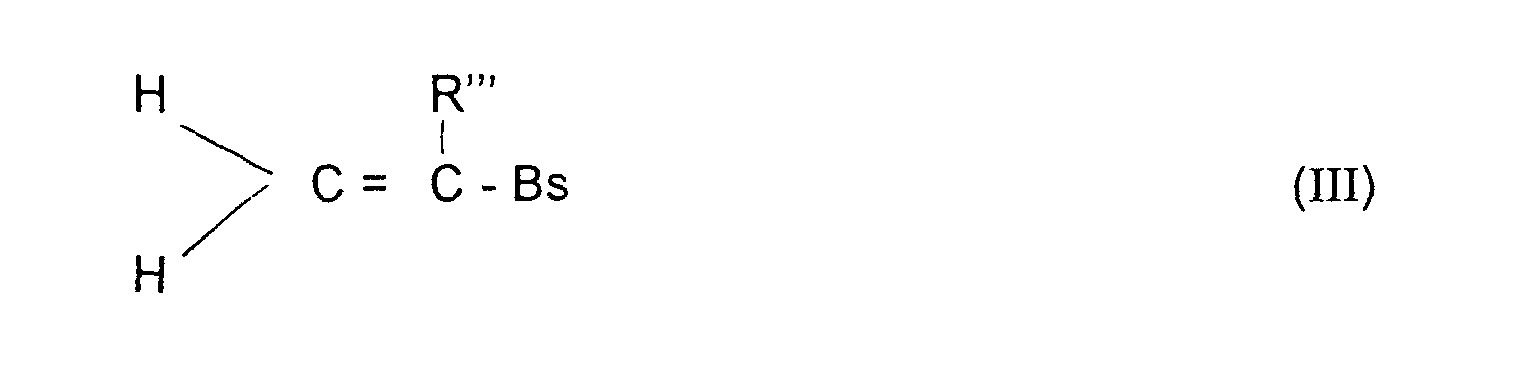
- comonomers which can be used are, in addition to those of the formula II, free-radically polymerizable monomers having functional groups in the molecule, in particular those whose dispersion / detergent activity in oil additives is known per se, eg compounds of the formula III wherein R "'is hydrogen or methyl and Bs an (inert) heterocyclic 5- or 6-membered ring or a radical wherein Z is oxygen or a radical -NR4 and Q is an optionally alkylated hydrocarbon bridge having a total of 2 to 50 carbon atoms, which may be interrupted by oxygen bridges, preferably 2 to 6 C-bridge members, and R 5 is -OR 6 or -NR 7 R 8, wherein R preferably 6 hydrogen or an alkyl radical having 1 to 24, preferably 8 to 22 carbon atoms or alkyl-substituted aryl radicals, especially phenyl radicals with C1-C18-alkyl substituents having C6-C16 alkyl substituents, and wherein R 7
- heteroatoms in addition to nitrogen, oxygen and / or sulfur are understood. Mention may be made as heterocyclic radicals in particular imidazoles, lactams, carbazoles and vinylpyridines and their substituted derivatives, in particular C 1 -C 4 -alkyl derivatives.
- compounds of the formula III include vinylimidazoles, vinyllactams, vinylcarbazoles and vinylimidazoles.
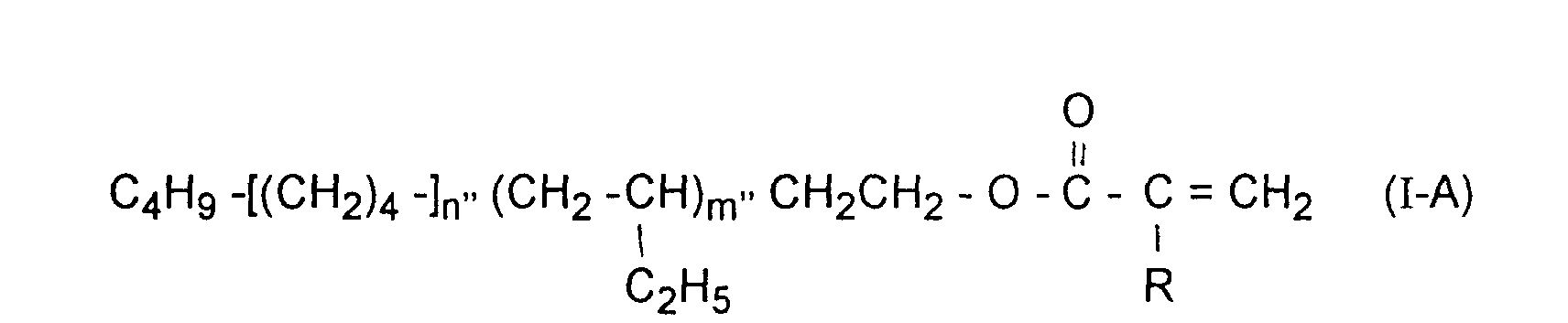
- comb polymers having a content of 5 to 80% by weight of OCP macromonomers of the formula I and / or of the formula IA, preferably 10 to 50% by weight and 90 to 50% by weight of alkyl (meth) acrylates are preferred.
- the proportion of free-radically polymerizable monomers having functional groups in the molecule is generally in the range 0 to 25 wt .-%, preferably 0.5 to 25, in particular 2 to 20 wt .-%, based on the totality of the monomers ,
- the preferred values for n and m are 10 to 1000, with the proviso that the preferred value for (n + m) is in the range 10 to 2000.
- the preferred n 'and m' values are in the range 10 to 2,000, with the proviso that the preferred value for (n '+ m') should be in the range 10 to 2000.
- the molecular weights M w of the comb polymers according to the invention are preferably in the range from 10,000 to 500,000, in particular from 20,000 to 300,000 (determination by SEC (size exclusion chromatography) with PMMA calibration).
- the preparation of the macromonomers of the formula I can be carried out using known production methods, as illustrated by the example of butadiene.
- the compound of the formula IV is prepared in an anionic polymerization step, preferably with butyllithium in a suitable inert solvent LM such as, for example, toluene, hexane, cyclohexane, THF and mixtures thereof, with termination of the polymerization with ethylene oxide:
- R 3 is hydrogen or an alkyl radical having 1 to 6 carbon atoms and n, m and R 1 have the meanings given above.
- the compound of formula IV is hydrogenated in a conventional manner, for example by catalytic hydrogenation with hydrogen, preferably with palladium catalysts under pressure (30-150 atmospheres) to give the saturated alcohol of formula V.
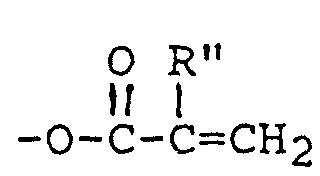
- the alcohol of the formula V can also be prepared in a known manner, for example by reaction with an activated (meth) acrylic acid derivative of the formula VI where X is Cl or a radical and wherein R "is hydrogen or methyl, or by transesterification with a (meth) acrylic acid ester, preferably in the presence of at least one polymerization inhibitor, for example from the class of sterically hindered phenols, usually in amounts of 0.1 to 1 wt .-%, based on the compounds of the formula V (compare H. Rauch-Puntigam, acrylic and methacrylic compounds, Springer Verlag 1968, Ullmann's Encyclopedia of Industrial Chemistry 5 th Ed. Vol. A20, pg 461-475, VCH 1992, R. Gaechter, HM Müller , Handbuch der Kunststoffadditive, Hanser Verlag, 1979).
- the reaction is preferably carried out by reacting the compound of formula V in a (not with water miscible) inert solvents such as e.g. Methyl tert-butyl or an aromatic solvent such as toluene and the alcohol of formula V, preferably in the presence an acid acceptor such as pyridine, triethylamine Stirring drops and over a period of time, For example, react at 25 degrees C for 12-24 hours leaves.
- a (not with water miscible) inert solvents such as e.g. Methyl tert-butyl or an aromatic solvent such as toluene
- an acid acceptor such as pyridine, triethylamine Stirring drops and over a period of time, For example, react at 25 degrees C for 12-24 hours leaves.
- the workup is done by precipitating the solution in Ethanol (ratio of solvent / precipitant about 1:10).
- the preparation of the macromonomers of the formula I can also based on US Pat. No. 5,254,632 by transesterification respectively.
- molecular weights, distributions and microstructure of the macromonomers of the formula I can be set in a defined manner.
- a good end-group functionality f OH, MMA > 90% is achieved.
- copolymerization of the monomers of the formulas I and II or III e.g. as radical-induced Solvent polymerization in a conventional manner (see H. Rauch-Puntigam, Th. Acrylic and methacrylic compounds loc.cit.).
- initiators come to themselves known initiators, for example azo initiators, such as Azo-bis-isobutyronitrile (AIBN) also compounds in the usual amounts, for example 0.1 to 1 wt .-%, based on the monomers in question. It is still useful Initiator at intervals, for example after 4 and re-fed after 6 hours.
- the Total polymerization time is usually in the range someday.
- the formed comb polymer KP with a precipitant such as e.g. Methanol are precipitated.
- the solution of butyllithium such as n-butyllithium or sec.
- Butyllithium as a stop is called an approximately 12% solution, added, as well as required to control the microstructure for the desired range amount of Regulator such as tetrahydrofuran.
- the diene (see formula scheme a ) is usually condensed under cooling, for example in the range from -20 to 0 ° C. After removal of the cooling and reaching the room temperature, the reaction is usually exothermic. In the case of butadiene, for example, temperature peaks of up to 80 degrees C are reached.
- reaction it is advisable in many cases, to complete the reaction to heat up to about one hour, as an indication 60 degrees C called. It is then cooled appropriately, for example to -5 degrees C and metered ethylene oxide, for example in tetrahydrofuran. Reaction with ethylene oxide gives chain termination in a known manner:
- THF tetrahydrofuran
- the heterogeneous hydrogenation of the compound of formula IV for saturated alcohol of the formula V can also be analogous to Prior art methods are preferably in high-pressure autoclave (with stirring and heating) in one suitable liquid medium such as THF and in the presence of a metal.
- Hydrogenation catalyst such as e.g. Palladium, preferably on a calcium carbonate carrier.
- 5 to 10% are used Polymer solutions in THF and - as a stop - one Hydrogen pressure of 50 bar. It has proven to be appropriate proven, after observed pressure drop and reaching the Temperature stability still heat up, for example 120 degrees C and over a period of time, for example, to hydrogenate for 18 hours.
- the Work-up is done in the usual way.
- the acylation of the alcohol of the formula V to give the (meth) acrylic acid ester can in principle be carried out using the customary activated (meth) acrylic acid derivatives, for example the compounds of the formula VI.
- the reaction is usually carried out in a suitable vessel such as a three-neck round bottomed flask with reflux condenser (calcium chloride tube) magnetic stirrer and internal thermometer. Usually, it is allowed to react in the presence of an acid acceptor such as triethylamine.
- the polymers dissolved in a suitable, inert solvent, such as diethyl ether, are expediently present (about 10% strength) and admixed with the acid acceptor, usually in a molar ratio of 1: 1.1, based on the compound of the formula VI. Then, with stirring, the compound of the formula VI, preferably methacrylic acid chloride in an equimolar ratio to the compound V to. It is advisable to add a polymerization inhibitor (compare H. Rauch-Puntigam, Th.
- hydroquinone derivatives such as the hydroquinone monomethyl ether in ppm amounts; as an indication 50 ppm are mentioned. It is allowed to react for a longer period of time, for example 18 hours at room temperature.
- the workup is carried out by filtering off the precipitated salt, for example of triethylammonium hydrochloride, followed by washing the organ. Phase with water to neutralize them, precipitation of the compound I with eg methanol or concentration on a rotary evaporator and drying.
- a suitable choice of comonomers or the Process parameters can comb polymers KP with a largely homogeneous distribution of side branches produce.
- OCP macromonomers can be copolymerized in concentrated solution with alkyl (meth) acrylates, for example of the formula II, up to a molecular weight M n of about 150 000 g / mol.
- the Shear Stability Index SSI becomes ASTM 2603 certainly.
- the viscosity index VIB can according to DIN 51564 / ISO 2909.
- Apparatus for 100 g batches one uses a 250 ml Four-neck swan piston, a KPG saber agitator, Thermometer, reflux condenser, gas inlet pipe for Nitrogen, oil bath heating.
- toluene Under inert conditions, about 1,200 ml of toluene are distilled over benzophenone sodium directly into the reaction vessel.
- the initiator is added by means of gas-tight spraying, for example a 12% strength solution of n-butyllithium in n-hexane and discrete quantities of absolute tetrahydrofuran as regulator.
- butadiene dried over dibutylmagnesium is condensed at -20 ° C. and then at 0 ° C. After completion of the butadiene condensation, the cooling bath is removed. After warming to room temperature, the mixtures are usually exothermic. Temperatures of up to 80 degrees C are reached.
- the majority of the mixtures are heated to 60 degrees C. for about 30 to 60 minutes.
- For OH termination was cooled with ice water to ⁇ 5 degrees C and a solution of ethylene oxide in tetrahydrofuran added. It is allowed to react for about 20 hours at room temperature. From the addition of the ethylene oxide is suitably taken a sample for determining the molecular weight of the non-functionalized portion.
- the mixtures are pressed under argon gas, with conc. Hydrochloric acid acidified, washed neutral with water (ether or sodium chloride is added in the formation of emulsions) dried over magnesium sulfate, filtered, concentrated in a rotary evaporator and the residues dried in a vacuum oven at room temperature.
- the desired microstructure is set in the anionic polymerization of butadiene with n-butyllithium or sec-butyllithium as an initiator in toluene as a solvent by addition of defined amounts of tetrahydrofuran as a regulator. The required amount of tetrahydrofuran therefore corresponds to the molecular weight.
- the desired structure ratio is obtained at a molar ratio of tetrahydrofuran: initiator of 1: 1 to 3: 1.
- the macromonomers of the formula I characterized in the following table are prepared: Characterization of macromonomers description M W, th M W , SEC U f, OH, HPLC MMA macromonomer I-1 1 000 2 490 0, 07 0, 98 1.0 I-2 5,000 9 100 0, 07 0, 94 0, 95 I-3 10 000 29,000 0, 04 0, 88 0, 90 I-4 40,000 148,000 0.19 0, 95 ---
- the hydrogenation can be carried out, for example, in a 21-high pressure autoclave with stirring device and heating. conditions pressure 50 bar H 2 temperature 120 degrees C duration 18 hours emotion 1 200 rev / min. catalyst Palladium on calcium carbonate carrier (Pd)
- the reaction of the compounds of formula V can be carried out in a three-necked round-bottomed flask with reflux condenser with attached calcium chloride tube, magnetic stirring and internal thermometer.
- the polymers are in absolute.
- methacrylic acid chloride is added in a molar ratio of 1: 1.1, whereby the solutions cloud.
- the observed heat of reaction is between 1 and 3 degrees C. It is expedient to add hydroquinone monomethyl ether (50 ppm) to the batch for stabilization and leave to react for a total of about 18 hours at room temperature.
Landscapes
- Chemical & Material Sciences (AREA)
- Chemical Kinetics & Catalysis (AREA)
- Organic Chemistry (AREA)
- General Chemical & Material Sciences (AREA)
- Oil, Petroleum & Natural Gas (AREA)
- Medicinal Chemistry (AREA)
- Health & Medical Sciences (AREA)
- Polymers & Plastics (AREA)
- Macromonomer-Based Addition Polymer (AREA)
- Addition Polymer Or Copolymer, Post-Treatments, Or Chemical Modifications (AREA)
- Lubricants (AREA)
- Polymers With Sulfur, Phosphorus Or Metals In The Main Chain (AREA)
- Polyoxymethylene Polymers And Polymers With Carbon-To-Carbon Bonds (AREA)
Description
Parallel dazu nimmt die Scherstabilität, d.h. der Kettenbruch unter hohem Schergefälle ab. Infolge dieser gegenläufigen Effekte sind z.B. scherstabile Viskositätsindexverbesserer, wie sie für Getriebe-, Hydraulik- und andere Motorenöl-Anwendungen gefragt sind, auf Basis konventioneller Polymertypen, wie z.B. auf PAMA-Basis, nur mit sehr hohen Zusatzmengen realisierbar.

- R'
- für Wasserstoff oder Methyl
- R1
- für den organischen Rest einer lithium-organischen Verbindung
- [A]
- für ein Segment gebildet durch 1,4-Addition von gegebenenfalls mit einem C1 - C6-Alkylrest substituierten Butadien
- [A']
- für ein Segment gebildet durch Vinyladdition von gegebenenfalls mit einem C1 - C6-Alkylrest substituierten Butadien
- und n + m
- für eine ganze Zahl von 7 bis 3000 steht

- R'
- für Wasserstoff oder Methyl und
- R2
- für einen Alkylrest mit 1 bis 26 Kohlenstoffatomen steht
- R1
- stammt, wie im weiteren gezeigt wird, aus dem bei der anionischen Polymerisation verwendeten lithiumorganischen Katalysator und bedeutet vorzugsweise einen Alkylrest mit 1 bis 6 Kohlenstoffatomen, oder einen Arylrest, mit bis zu 10 Kohlenstoffatomen insbesondere einen Butylrest, speziell einen n-Butylrest oder einen Phenylrest.

- R
- für Wasserstoff oder Methyl,
- n'
- für eine ganze Zahl von größer als 0 bis 3000
und - m'
- für eine ganze Zahl von größer als 0 bis 3000 steht, mit der Maßgabe, daß n' + m' mindestens 10 und m' ≥ n' ist;

- R
- für Wasserstoff oder Methyl,
- n"
- für eine ganze Zahl von größer als 0 bis 1500 und
- m"
- für eine ganze Zahl mit m" ≥ n"



Zur weiteren Aufarbeitung der so hergestellten Verbindungen der Formel IV kann beispielsweise über Magnesiumsulfat getrocknet, anschließend filtriert und im Rotationsverdampfer eingeengt werden. Die abschließende Trocknung der Rückstände kann z.B. im Vakuumtrockenschrank bei Raumtemperatur erfolgen.
Man läßt über einen größeren Zeitraum, beispielsweise 18 Stunden bei Raumtemperatur reagieren. Die Aufarbeitung erfolgt durch Abfiltrieren des ausgefallenen Salzes, beispielsweise des Triethylammoniumhydrochlorids, anschließendes Waschen der organ. Phase mit Wasser um sie zu neutralisieren, Fällung der Verbindung I mit z.B. Methanol oder Einengen am Rotationsverdampfer und Trocknen.
Die Bestimmung der Lösungseigenschaften wird im Kapillarviskosimeter nach ASTM-D 445 vorgenommen. (In PAO4 zwischen 100 Grad und -20 Grad C.) Als Maß der Verdickungswirkung wird der Quotient η Lösung/ η Lösungsmittel = rel (= relative Viskosität angegeben, wobei, sofern nicht extra vermerkt, KV (100) auf 12,1 + O,1 mm2/s in PAO4 / KV (100) = 3,88 mm2/s) eingestellt wurde.
| 50 Gew.-Tle. | Makromonomer der Formel I = 25 g |
| 50 Gew.-Tle. | Monomer der Formel II = 25 g |
| 0,3 Gew.-% | 2,2'Azobis-(isobutyronitril), einprozentig in Toluol = 15 g |
Bestimmung der Lösungseigenschaften wie oben angegeben nach ASTM-D 445 kapillarviskosimetrisch.
Mw = 247000 g/mol; U = 1,66; VIB = 260 (6,7 Gew.-% in PAO 4).
Mw = 235000 g/mol; U = 1,76; VIB = 287 (7,0 Gew.-% in PAO 4).
Mw = 222000 g/mol; U = 1,45; VIB = 318 (8,0 Gew.-% in PAO 4)
Mw = 119000 g/mol; U = 8.
Mw = 171000, U = 9.
Mw = 325000 g/mol; U = 4; VIB = 284 (5,9 Gew.-% in PAO 4).
Mw = 269000 g/mol; U = 5,9; VIB = 196 (3,5 Gew.-% in PAO 4).
Mw = 266000 g/mol; U = 2,22; VIB = 260 (7,0 Gew.-% in PAO 4).
Mw = 274000 g/mol; U = 1,59; VIB = 227 (7,7 Gew.-% in PAO 4).
| Relative Viskositäten der Kammpolymeren und vergleichbarer linearer PMMAs, bestimmt in PAO 4 in einem Temperaturbereich von -20 Grad C bis 100 Grad C, mit einer kinematischen Lösungs-Viskosität von 12,1 mm2/s bei 100 Grad C. | |||||||
| Beisp. | Konz. (Gew.-%) | η rel in mm2 /s bei | |||||
| 100°C | 40°C | 0°C | -10°C | -20°C | SSI (ASTM 2603) | ||
| KP-1 | 8, 2 | 3, 09 | 2,44 | 1,95 | 1,85 | 1,55 | 21,0 |
| KP-2 | 8,7 | 3,11 | 2,19 | 1,82 | 1,62 | 1,57 | 22,7 |
| KP-3 | 6,7 | 3,11 | 2,81 | 2,35 | 2, 22 | 2, 05 | 23,2 |
| KP-4 | 7, 0 | 3, 05 | 2,51 | 2, 27 | 2,16 | 2, 00 | 19,8 |
| KP-5 | 8, 0 | 3, 05 | 2, 27 | 2, 03 | 1,92 | 1,82 | 18,9 |
| KP-6 | 5,0 | 1,60 | 1,59 | 1,91 | 1,79 | 1,73 | n. b. |
| KP-7 | 10,9 | 2,18 | 2, 02 | 2,44 | 2,33 | 2,42 | n. b. |
| KP-8 | 5,9 | 3,10 | 2, 60 | 2, 40 | 2,35 | 2, 25 | 21,2 |
| KP-9 | 3,5 | 3, 06 | 3,56 | 4,41 | 4,43 | 4,56 | 20,5 |
| V-1 | 7, 0 | 3,10 | 2,80 | 2,59 | 2, 62 | 2,40 | 32,3 DIN 51382 |
| V-2 | 7,7 | 3,14 | 3, 24 | 3,39 | 3, 29 | 3,15 | 29,3 DIN 51382 |
| V-3 | 9,5 | 3,10 | 2,80 | 2,70 | 2, 60 | 2,70 | 7, 0 |
Zwecks OH-Terminierung wurde mit Eiswasser auf < 5 Grad C abgekühlt und eine Lösung von Ethylenoxid in Tetrahydrofuran zudosiert. Man läßt noch etwa 20 Stunden bei Raumtemperatur nachreagieren. Von der Zugabe des Ethylenoxids entnimmt man zweckmäßig eine Probe zur Bestimmung des Molekulargewichts des nicht funktionalisierten Anteils.
Die gewünschte Mikrostruktur wird bei der anionischen Polymerisation von Butadien mit n-Butyllithium oder sec.-Butyllithium als Initiator in Toluol als Lösemittel durch Zudosierung definierter Mengen Tetrahydrofuran als Regler eingestellt. Die benötigte Menge Tetrahydrofuran korrespondiert daher mit dem Molekulargewicht. Das gewünschte Strukturverhältnis wird bei einem molaren Verhältnis Tetrahydrofuran: Initiator von 1 : 1 bis 3 : 1 erhalten.
Gemäß der allgemeinen Herstellungsvorschrift werden beispielsweise die in der folgenden Tabelle charakterisierten Makromonomeren der Formel I hergestellt:
| Charakterisierung der Makromonomeren | ||||||
| Bezeichnung | MW,th | MW , SEC | U | f, OH, HPLC | MMA | |
| Makromonomer | I-1 | 1 000 | 2 490 | 0, 07 | 0, 98 | 1,0 |
| I-2 | 5 000 | 9 100 | 0, 07 | 0, 94 | 0, 95 | |
| I-3 | 10 000 | 29 000 | 0, 04 | 0, 88 | 0, 90 | |
| I-4 | 40 000 | 148 000 | 0,19 | 0, 95 | --- |
| Bedingungen | |
| Druck | 50 bar H2 |
| Temperatur | 120 Grad C |
| Dauer | 18 Stunden |
| Rührung | 1 200 U/Min. |
| Katalysator | Palladium auf Calciumcarbonatträger (Pd) |
Die Polymeren werden in absol. Diethylether gelöst (10 Gew.-%) im Reaktionskolben vorgelegt und mit Triethylamin versetzt. Anschließend wird bei Raumtemperatur Methacrylsäurechlorid im molaren Verhältnis 1 : 1,1 zugesetzt, wobei die Lösungen eintrüben. Die beobachtete Wärmetönung liegt zwischen 1 und 3 Grad C. Man fügt zweckmäßig dem Ansatz zur Stabilisierung Hydrochinonmonomethylether (50 ppm) zu und läßt insgesamt ca. 18 Stunden bei Raumtemperatur reagieren. Zur Aufarbeitung wird vom ausgefallenen Triethylaminhydrochlorid abfiltriert, mit Wasser neutral gewaschen und das Makromonomer mit Methanol gefällt bzw. am Rotationsverdampfer eingeengt und die Rückstände im Vakuumtrockenschrank bei Raumtemperatur getrocknet.
Claims (5)
- Kammpolymere auf Basis von Olefin-Copolymer-Makromonomeren,
dadurch gekennzeichnet, daß man hydrierte Olefin-Copolymer-Makromonomere der Formel Iworin
- R'
- für Wasserstoff oder Methyl
- R1
- für den organischen Rest einer lithium-organischen
Verbindung
[A] für ein Segment gebildet durch 1,4-Addition von gegebenenfalls mit einem C1 - C6 Alkylrest substituierten Butadien
[A'] für ein Segment gebildet durch Vinyladdition von gegebenenfalls mit einem C1 - C6 Alkylrest substituierten Butadien
und n + m für eine ganze Zahl von 7 bis 3000 steht, mit (Meth)acrylester-Monomeren der Formel II
- R'
- für Wasserstoff oder Methyl und
- R2
- für einen Alkylrest mit 1 bis 26 Kohlenstoffatomen steht in radikalischer Polymerisation copolymerisiert.
- Kammpolymere gemäß Anspruch 1, dadurch gekennzeichnet, daß außer den (Meth)acrylester-monomeren der Formel II noch Monomere mit funktionellen Gruppen im Molekül der Formel IIIworin R"' Wasserstoff oder Methyl und Bs einen (inerten) heterocyclischen 5- oder 6-gliedrigen Ring oder einen Rest
 bedeutet, wobei Z für Sauerstoff oder einen Rest - NR4 und Q für eine gegebenenfalls alkylierte Kohlenwasserstoffbrücke mit insgesamt 2 bis 50 Kohlenstoffatomen, die durch Sauerstoffbrücken unterbrochen sein kann, vorzugsweise 2 bis 6 C-Brückengliedern, und R5 für OR6 oder -NR7R8 steht, worin R6 für Wasserstoff oder einen Alkylrest mit 1 bis 24 Kohlenstoffatomen oder alkylsubstituierte Arylreste mit C1 bis C18-Alkylsubstutenten und worin R7 und R8 jeweils für einen Alkylrest mit 1 bis 6 Kohlenstoffatomen stehen oder zusammen unter Einbeziehung des Stickstoffs und gegebenenfalls andere Heteroatome einen heterocyclischen 5- oder 6-gliedrigen Ring bilden können und worin R4 für Wasserstoff oder einen Alkylrest mit 1 bis 6 Kohlenstoffatomen steht, in Mengen von 0,5 bis 25 Gew.-% bezogen auf die Gesamtheit der Monomeren copolymerisiert werden.
- Kammpolymere gemäß den Ansprüchen 1 und 2, dadurch gekennzeichnet, daß als Olefin-Copolymer-Makromonomer ein solches der Formel I-Aworin

- R
- für Wasserstoff oder Methyl,
- n'
- für eine ganze Zahl von größer als 0 bis 3000 und
- m'
- für eine ganze Zahl von größer als 0 bis 3000 steht,
eingesetzt wird. - Makromonomere der Formel I-Aworin
- R
- für Wasserstoff oder Methyl,
- n"
- für eine ganze Zahl von größen als bis 1500 und
- m"
- für eine ganze Zahl mit m" ≥ n"
- Verwendung des Kammpolymere gemäß den Ansprüchen 1 bis 3 als Öladditive.
Applications Claiming Priority (2)
| Application Number | Priority Date | Filing Date | Title |
|---|---|---|---|
| DE4312715A DE4312715A1 (de) | 1993-04-20 | 1993-04-20 | Kammpolymere |
| DE4312715 | 1993-04-20 |
Publications (2)
| Publication Number | Publication Date |
|---|---|
| EP0621293A1 EP0621293A1 (de) | 1994-10-26 |
| EP0621293B1 true EP0621293B1 (de) | 2004-06-09 |
Family
ID=6485802
Family Applications (1)
| Application Number | Title | Priority Date | Filing Date |
|---|---|---|---|
| EP94105648A Expired - Lifetime EP0621293B1 (de) | 1993-04-20 | 1994-04-13 | Kammpolymere |
Country Status (5)
| Country | Link |
|---|---|
| US (1) | US5565130A (de) |
| EP (1) | EP0621293B1 (de) |
| JP (1) | JP3474918B2 (de) |
| AT (1) | ATE268787T1 (de) |
| DE (2) | DE4312715A1 (de) |
Cited By (4)
| Publication number | Priority date | Publication date | Assignee | Title |
|---|---|---|---|---|
| RU2773826C2 (ru) * | 2017-12-13 | 2022-06-10 | Эвоник Оперейшенс ГмбХ | Присадка, улучшающая индекс вязкости, с улучшенными показателями сопротивления сдвигу и растворимости после сдвига |
| US11365273B2 (en) | 2019-12-16 | 2022-06-21 | Infineum International Limited | High viscosity index comb polymer viscosity modifiers and methods of modifying lubricant viscosity using same |
| US11384311B2 (en) | 2019-12-16 | 2022-07-12 | Infineum International Limited | High viscosity index comb polymer viscosity modifiers and methods of modifying lubricant viscosity using same |
| US11685874B2 (en) | 2019-12-16 | 2023-06-27 | Infineum International Limited | High viscosity index comb polymer viscosity modifiers and methods of modifying lubricant viscosity using same |
Families Citing this family (55)
| Publication number | Priority date | Publication date | Assignee | Title |
|---|---|---|---|---|
| DE4431302A1 (de) * | 1994-09-02 | 1996-03-07 | Roehm Gmbh | Kammpolymere |
| DE19518786A1 (de) * | 1995-05-22 | 1996-11-28 | Roehm Gmbh | Schmierstoffadditive |
| US6084030A (en) * | 1995-08-04 | 2000-07-04 | Dsm Copolymer, Inc. | Branched polymers with polyolefin arms |
| DE19622272A1 (de) * | 1996-06-03 | 1997-12-04 | Basf Ag | Copolymere von Alk-1-enen und a,beta-Dienen mit erhöhtem Viskositätsindex |
| DE19631170A1 (de) * | 1996-08-01 | 1998-02-05 | Basf Ag | Schlagzähe thermoplastische Formmassen |
| EP0856542A1 (de) * | 1997-01-31 | 1998-08-05 | Dsm N.V. | Polyolefin-Polymer mit guten mechanischen Eigenschaften |
| EP0856544A1 (de) * | 1997-01-31 | 1998-08-05 | Dsm N.V. | Verzweigte Polymere, ihre Herstellung und Verwendung |
| EP0856545A1 (de) * | 1997-01-31 | 1998-08-05 | Dsm N.V. | Polyolefin-Polymer mit hohem Molekulargewicht |
| EP0856541A1 (de) * | 1997-01-31 | 1998-08-05 | Dsm N.V. | Aus Olefinpolymer hergestelltes Produkt |
| EP0856546A1 (de) * | 1997-01-31 | 1998-08-05 | Dsm N.V. | Verzweigte Polyolefine |
| EP0856543A1 (de) * | 1997-01-31 | 1998-08-05 | Dsm N.V. | Verwendung eines Olefinpolymer als Beschichtungsmittel und beschichtetes Produkt mit einer Polyolefinbeschichtung |
| DE102005031244A1 (de) * | 2005-07-01 | 2007-02-15 | Rohmax Additives Gmbh | Öllösliche Kammpolymere |
| JP2007045850A (ja) * | 2005-08-05 | 2007-02-22 | Tonengeneral Sekiyu Kk | 潤滑油組成物 |
| WO2007127615A2 (en) * | 2006-04-24 | 2007-11-08 | The Lubrizol Corporation | Star polymer lubricating composition |
| JP5607923B2 (ja) | 2006-05-08 | 2014-10-15 | ザ ルブリゾル コーポレイション | 新規ポリマーおよび粘度を制御する方法 |
| BRPI0813492B1 (pt) * | 2007-07-09 | 2017-06-06 | Evonik Oil Additives Gmbh | uso de polímeros em forma de pente para reduzir consumo de combustível |
| DE102007032120A1 (de) * | 2007-07-09 | 2009-01-15 | Evonik Rohmax Additives Gmbh | Verwendung von Kammpolymeren zur Verringerung des Kraftstoffverbrauchs |
| DE102007046223A1 (de) | 2007-09-26 | 2009-04-02 | Evonik Rohmax Additives Gmbh | Verwendung von Kammpolymeren zur Verringerung des Kraftstoffverbrauchs |
| DE102009001447A1 (de) * | 2009-03-10 | 2010-09-16 | Evonik Rohmax Additives Gmbh | Verwendung von Kammpolymeren zur Verbesserung des Lasttragevermögens |
| DE102009001446A1 (de) | 2009-03-10 | 2010-09-23 | Evonik Rohmax Additives Gmbh | Verwendung von Kammpolymeren als Antifatigue-Additive |
| FR2964115B1 (fr) | 2010-08-27 | 2013-09-27 | Total Raffinage Marketing | Lubrifiant moteur |
| JP2013147608A (ja) * | 2012-01-23 | 2013-08-01 | Sanyo Chem Ind Ltd | 粘度指数向上剤及び潤滑油組成物 |
| JP5878199B2 (ja) * | 2013-04-23 | 2016-03-08 | 三洋化成工業株式会社 | 粘度指数向上剤及び潤滑油組成物 |
| JP5902230B2 (ja) * | 2013-05-27 | 2016-04-13 | 三洋化成工業株式会社 | 粘度指数向上剤及び潤滑油組成物 |
| US20150051129A1 (en) * | 2013-08-15 | 2015-02-19 | Infineum International Limited | Transmission Fluid Compositions for Improved Energy Efficiency |
| EP3093334A4 (de) | 2014-02-25 | 2017-12-13 | Sanyo Chemical Industries, Ltd. | Viskositätsindexverbesserer für schmierölzusammensetzung |
| KR102689185B1 (ko) * | 2015-03-20 | 2024-07-26 | 이데미쓰 고산 가부시키가이샤 | 점도 지수 향상제, 윤활유 조성물, 및 윤활유 조성물의 제조 방법 |
| JP6748593B2 (ja) * | 2016-03-18 | 2020-09-02 | 三洋化成工業株式会社 | 粘度指数向上剤及び潤滑油組成物 |
| CN108779229B (zh) * | 2016-03-31 | 2021-08-20 | 横滨橡胶株式会社 | 光固性树脂、混合物、以及光固性树脂组合物 |
| JP6747662B2 (ja) * | 2016-04-25 | 2020-08-26 | 出光興産株式会社 | 緩衝器用潤滑油組成物及びその製造方法、並びに減衰方法及び緩衝器 |
| CN109071736B (zh) | 2016-05-13 | 2021-08-10 | 赢创运营有限公司 | 基于聚烯烃主链和甲基丙烯酸酯侧链的接枝共聚物 |
| SG11201901623TA (en) | 2016-08-31 | 2019-03-28 | Evonik Oil Additives Gmbh | Comb polymers for improving noack evaporation loss of engine oil formulations |
| US10544241B2 (en) | 2016-09-15 | 2020-01-28 | Fina Technology, Inc. | Farnesene-based macromonomers and methods of making and using the same |
| JP7014552B2 (ja) * | 2016-09-21 | 2022-02-01 | 株式会社日本触媒 | 粘度指数向上剤および潤滑油組成物 |
| US10982167B2 (en) | 2016-09-21 | 2021-04-20 | Nippon Shokubai Co., Ltd. | Viscosity index improver and lubricating oil composition |
| RU2747727C2 (ru) * | 2016-11-02 | 2021-05-13 | Эвоник Оперейшнс Гмбх | Смазывающая композиция, обладающая улучшенными характеристиками вязкости при низкой рабочей температуре |
| EP3555245B1 (de) | 2016-12-19 | 2020-10-28 | Evonik Operations GmbH | Schmierölzusammensetzung mit dispersanten kammpolymeren |
| CN110462009B (zh) * | 2017-03-23 | 2021-12-07 | 三洋化成工业株式会社 | 粘度指数改进剂和润滑油组合物 |
| WO2019012031A1 (en) | 2017-07-14 | 2019-01-17 | Evonik Oil Additives Gmbh | COMB POLYMERS WITH IMIDE FUNCTIONALITY |
| ES2847382T3 (es) * | 2017-09-04 | 2021-08-03 | Evonik Operations Gmbh | Nuevos mejoradores del índice de viscosidad con distribuciones de peso molecular definidas |
| EP3498808B1 (de) * | 2017-12-13 | 2020-05-13 | Evonik Operations GmbH | Viskositätsindexverbesserer mit verbesserter scherfestigkeit und löslichkeit nach der scherung |
| JP6456468B1 (ja) * | 2017-12-13 | 2019-01-23 | エボニック オイル アディティヴス ゲゼルシャフト ミット ベシュレンクテル ハフツングEvonik Oil Additives GmbH | 改善された低温粘度および剪断抵抗を有する粘度指数向上剤 |
| MX2021011416A (es) | 2019-03-20 | 2021-10-13 | Evonik Operations Gmbh | Nuevos (met)acrilatos de polialquilo para mejorar la economia de combustible, la dispersion y el rendimiento de los depositos. |
| WO2020262088A1 (ja) | 2019-06-26 | 2020-12-30 | 三洋化成工業株式会社 | 粘度指数向上剤組成物及び潤滑油組成物 |
| WO2021060422A1 (ja) * | 2019-09-24 | 2021-04-01 | 出光興産株式会社 | 粘度指数向上剤組成物及び潤滑油組成物 |
| CN116209738B (zh) | 2020-09-01 | 2026-03-13 | 国际壳牌研究有限公司 | 发动机油组合物 |
| CN116848163B (zh) | 2020-09-14 | 2025-03-04 | 三洋化成工业株式会社 | 粘度指数改进剂和润滑油组合物 |
| WO2022210709A1 (ja) * | 2021-03-29 | 2022-10-06 | 出光興産株式会社 | 潤滑油組成物 |
| JP2023046286A (ja) * | 2021-09-22 | 2023-04-03 | 三菱ケミカル株式会社 | 潤滑油用摩擦低減剤、および潤滑油組成物 |
| EP4534632A4 (de) | 2022-06-10 | 2026-04-08 | Sanyo Chemical Ind Ltd | Viskositätsindexverbessererzusammensetzung und schmierölzusammensetzung |
| KR20250047785A (ko) | 2022-08-08 | 2025-04-04 | 에보니크 오퍼레이션즈 게엠베하 | 개선된 저온 특성을 갖는 폴리알킬 (메트)아크릴레이트-기반 중합체 |
| JP2024061337A (ja) * | 2022-10-21 | 2024-05-07 | 三菱ケミカル株式会社 | 潤滑油用添加剤、潤滑油用摩擦低減剤、及び潤滑油組成物 |
| US20250109349A1 (en) | 2023-07-20 | 2025-04-03 | Infineum International Limited | Flat Oil Viscosity Lubricant Compositions |
| EP4658738A1 (de) | 2024-02-19 | 2025-12-10 | Evonik Operations GmbH | Wenig flüchtige kammpolymerzusammensetzung für motoröle |
| EP4658739A1 (de) | 2024-02-19 | 2025-12-10 | Evonik Operations GmbH | Wenig flüchtige kammpolymerzusammensetzung für motoröle |
Family Cites Families (11)
| Publication number | Priority date | Publication date | Assignee | Title |
|---|---|---|---|---|
| GB1053529A (de) * | ||||
| US4085168A (en) * | 1971-02-22 | 1978-04-18 | Cpc International Inc. | Chemically joined, phase separated self-cured hydrophilic thermoplastic graft copolymers and their preparation |
| FR2198490A5 (de) * | 1972-08-04 | 1974-03-29 | Aquitaine Total Organico | |
| DE3607444A1 (de) * | 1986-03-07 | 1987-09-10 | Roehm Gmbh | Additive fuer mineraloele mit stockpunktverbessernder wirkung |
| DE3613992C2 (de) * | 1986-04-25 | 2000-05-04 | Roehm Gmbh | Additive für paraffinische Schmieröle |
| US5015406A (en) * | 1988-10-31 | 1991-05-14 | Conoco | Mineral oil or synthetic oil compositions containing terpolymers of alkyl acrylates or methacrylates etc. |
| US5349019A (en) * | 1988-12-24 | 1994-09-20 | Hoechst | New copolymers, mixtures thereof with poly(meth)acrylate esters and the use thereof for improving the cold fluidity of crude oils |
| DE3924554A1 (de) * | 1989-07-25 | 1991-01-31 | Roehm Gmbh | Anisotrope fluessigkristalline polymer-filme |
| US5002676A (en) * | 1989-12-06 | 1991-03-26 | Shell Oil Company | Block copolymers |
| DE4121811A1 (de) * | 1991-07-02 | 1993-01-07 | Roehm Gmbh | Verfahren zur herstellung von polyalkylmethacrylat-makromonomeren und ihre verwendung zur herstellung von kammpolymeren |
| US5272211A (en) * | 1992-12-21 | 1993-12-21 | Shell Oil Company | Block copolymers of dienes, vinylarenes, and alkylmethacrylates as modified viscosity index improvers |
-
1993
- 1993-04-20 DE DE4312715A patent/DE4312715A1/de not_active Ceased
-
1994
- 1994-04-13 DE DE59410375T patent/DE59410375D1/de not_active Expired - Lifetime
- 1994-04-13 EP EP94105648A patent/EP0621293B1/de not_active Expired - Lifetime
- 1994-04-13 AT AT94105648T patent/ATE268787T1/de not_active IP Right Cessation
- 1994-04-18 JP JP07869294A patent/JP3474918B2/ja not_active Expired - Lifetime
-
1995
- 1995-06-07 US US08/478,048 patent/US5565130A/en not_active Expired - Lifetime
Cited By (4)
| Publication number | Priority date | Publication date | Assignee | Title |
|---|---|---|---|---|
| RU2773826C2 (ru) * | 2017-12-13 | 2022-06-10 | Эвоник Оперейшенс ГмбХ | Присадка, улучшающая индекс вязкости, с улучшенными показателями сопротивления сдвигу и растворимости после сдвига |
| US11365273B2 (en) | 2019-12-16 | 2022-06-21 | Infineum International Limited | High viscosity index comb polymer viscosity modifiers and methods of modifying lubricant viscosity using same |
| US11384311B2 (en) | 2019-12-16 | 2022-07-12 | Infineum International Limited | High viscosity index comb polymer viscosity modifiers and methods of modifying lubricant viscosity using same |
| US11685874B2 (en) | 2019-12-16 | 2023-06-27 | Infineum International Limited | High viscosity index comb polymer viscosity modifiers and methods of modifying lubricant viscosity using same |
Also Published As
| Publication number | Publication date |
|---|---|
| JPH06306130A (ja) | 1994-11-01 |
| ATE268787T1 (de) | 2004-06-15 |
| US5565130A (en) | 1996-10-15 |
| JP3474918B2 (ja) | 2003-12-08 |
| EP0621293A1 (de) | 1994-10-26 |
| DE4312715A1 (de) | 1994-10-27 |
| DE59410375D1 (de) | 2004-07-15 |
Similar Documents
| Publication | Publication Date | Title |
|---|---|---|
| DE4312715A1 (de) | Kammpolymere | |
| EP0418610B1 (de) | Dispergierwirksame Viskositäts-Index-Verbesserer | |
| EP0236844B1 (de) | Verwendung von additiven für Mineralöle mit stockpunktverbessernder Wirkung | |
| EP0008327B1 (de) | Schmieröladditive und deren Herstellung | |
| EP0699694B1 (de) | Kammpolymere | |
| DE69020508T2 (de) | Blockcopolymere. | |
| EP0140274B2 (de) | Additive für Schmieröle | |
| DE69607688T2 (de) | Konzentrat und schmiermittelzusammensetzung enthaltend sternförmig verzweigte acrylat- und methacrylat-polymere | |
| EP0744457A2 (de) | Schmierstoffadditive | |
| HUT69298A (en) | Method of making a copolymer useful as viscosity index improving additive for hydraulic fluids | |
| EP1899393A1 (de) | Öllösliche kammpolymere | |
| DE10015552A1 (de) | Gradientencopolymere sowie Verfahren zur Herstellung und Verwendung | |
| DE2603034C3 (de) | Mineralschmierölgemische | |
| DE3046802A1 (de) | Ethylen-alkin-copolymerisate, deren herstellung und verwendung als zusatz zu erdoeldestillaten | |
| WO2001040339A1 (de) | Blockcopolymere sowie verfahren zur herstellung und verwendung | |
| EP0728780B1 (de) | Pfropfpolymere mit Emulgatoreigenschaften | |
| DE4025493A1 (de) | Verfahren zur herstellung von homooligomeren und cooligomeren | |
| WO2013104486A1 (de) | Photoinduzierte vernetzung von doppelbindungen-enthaltenden polymeren mittels pericyclischer reaktion | |
| DE2414872B2 (de) | Verfahren zur Herstellung von Additiven für die Verbesserung des Viskositäts-Index und der Scherfestigkeit von Schmierölen | |
| DE3112456A1 (de) | "verfahren zur verbesserung der fliessfaehigkeit von mineraloelen" | |
| DE3513356A1 (de) | Neue ester ungesaettigter polymerisierbarer carbonsaeuren, daraus gewonnene oelloesliche homo- und copolymere, verfahren zu ihrer herstellung und ihre verwendung als stockpunktserniedriger | |
| DE2645128A1 (de) | N-substituierte acrylamidine, daraus gebildete copolymere und deren verwendung | |
| EP0773260B1 (de) | Polymeremulsionen mit bimodaler Molekulargewichtsverteilung | |
| EP1054913B1 (de) | Verfahren zur herstellung von polymeren aus n-vinylverbindungen | |
| EP0343476A2 (de) | Ethylenisch ungesättigte Harnstoffderivate und Verfahren zu ihrer Herstellung |
Legal Events
| Date | Code | Title | Description |
|---|---|---|---|
| PUAI | Public reference made under article 153(3) epc to a published international application that has entered the european phase |
Free format text: ORIGINAL CODE: 0009012 |
|
| AK | Designated contracting states |
Kind code of ref document: A1 Designated state(s): AT BE CH DE DK ES FR GB IT LI NL SE |
|
| 17P | Request for examination filed |
Effective date: 19950317 |
|
| 17Q | First examination report despatched |
Effective date: 19990226 |
|
| RAP1 | Party data changed (applicant data changed or rights of an application transferred) |
Owner name: ROEHM GMBH & CO. KG |
|
| GRAP | Despatch of communication of intention to grant a patent |
Free format text: ORIGINAL CODE: EPIDOSNIGR1 |
|
| GRAS | Grant fee paid |
Free format text: ORIGINAL CODE: EPIDOSNIGR3 |
|
| GRAA | (expected) grant |
Free format text: ORIGINAL CODE: 0009210 |
|
| AK | Designated contracting states |
Kind code of ref document: B1 Designated state(s): AT BE CH DE DK ES FR GB IT LI NL SE |
|
| REG | Reference to a national code |
Ref country code: GB Ref legal event code: FG4D Free format text: NOT ENGLISH |
|
| REG | Reference to a national code |
Ref country code: CH Ref legal event code: EP |
|
| REF | Corresponds to: |
Ref document number: 59410375 Country of ref document: DE Date of ref document: 20040715 Kind code of ref document: P |
|
| PG25 | Lapsed in a contracting state [announced via postgrant information from national office to epo] |
Ref country code: SE Free format text: LAPSE BECAUSE OF FAILURE TO SUBMIT A TRANSLATION OF THE DESCRIPTION OR TO PAY THE FEE WITHIN THE PRESCRIBED TIME-LIMIT Effective date: 20040909 Ref country code: DK Free format text: LAPSE BECAUSE OF FAILURE TO SUBMIT A TRANSLATION OF THE DESCRIPTION OR TO PAY THE FEE WITHIN THE PRESCRIBED TIME-LIMIT Effective date: 20040909 |
|
| PG25 | Lapsed in a contracting state [announced via postgrant information from national office to epo] |
Ref country code: ES Free format text: LAPSE BECAUSE OF FAILURE TO SUBMIT A TRANSLATION OF THE DESCRIPTION OR TO PAY THE FEE WITHIN THE PRESCRIBED TIME-LIMIT Effective date: 20040920 |
|
| GBT | Gb: translation of ep patent filed (gb section 77(6)(a)/1977) |
Effective date: 20040922 |
|
| ET | Fr: translation filed | ||
| PG25 | Lapsed in a contracting state [announced via postgrant information from national office to epo] |
Ref country code: AT Free format text: LAPSE BECAUSE OF NON-PAYMENT OF DUE FEES Effective date: 20050413 |
|
| PLBE | No opposition filed within time limit |
Free format text: ORIGINAL CODE: 0009261 |
|
| STAA | Information on the status of an ep patent application or granted ep patent |
Free format text: STATUS: NO OPPOSITION FILED WITHIN TIME LIMIT |
|
| PG25 | Lapsed in a contracting state [announced via postgrant information from national office to epo] |
Ref country code: LI Free format text: LAPSE BECAUSE OF NON-PAYMENT OF DUE FEES Effective date: 20050430 Ref country code: CH Free format text: LAPSE BECAUSE OF NON-PAYMENT OF DUE FEES Effective date: 20050430 Ref country code: BE Free format text: LAPSE BECAUSE OF NON-PAYMENT OF DUE FEES Effective date: 20050430 |
|
| 26N | No opposition filed |
Effective date: 20050310 |
|
| BERE | Be: lapsed |
Owner name: *ROHM G.M.B.H. & CO. K.G. Effective date: 20050430 |
|
| REG | Reference to a national code |
Ref country code: CH Ref legal event code: PL |
|
| BERE | Be: lapsed |
Owner name: *ROHM G.M.B.H. & CO. K.G. Effective date: 20050430 |
|
| REG | Reference to a national code |
Ref country code: FR Ref legal event code: CJ Ref country code: FR Ref legal event code: CD |
|
| REG | Reference to a national code |
Ref country code: NL Ref legal event code: TD Effective date: 20100223 Ref country code: NL Ref legal event code: SD Effective date: 20100223 |
|
| PGFP | Annual fee paid to national office [announced via postgrant information from national office to epo] |
Ref country code: GB Payment date: 20130418 Year of fee payment: 20 Ref country code: DE Payment date: 20130419 Year of fee payment: 20 |
|
| PGFP | Annual fee paid to national office [announced via postgrant information from national office to epo] |
Ref country code: NL Payment date: 20130418 Year of fee payment: 20 Ref country code: FR Payment date: 20130515 Year of fee payment: 20 Ref country code: IT Payment date: 20130424 Year of fee payment: 20 |
|
| REG | Reference to a national code |
Ref country code: DE Ref legal event code: R071 Ref document number: 59410375 Country of ref document: DE |
|
| REG | Reference to a national code |
Ref country code: NL Ref legal event code: V4 Effective date: 20140413 |
|
| REG | Reference to a national code |
Ref country code: GB Ref legal event code: PE20 Expiry date: 20140412 |
|
| PG25 | Lapsed in a contracting state [announced via postgrant information from national office to epo] |
Ref country code: GB Free format text: LAPSE BECAUSE OF EXPIRATION OF PROTECTION Effective date: 20140412 |
|
| PG25 | Lapsed in a contracting state [announced via postgrant information from national office to epo] |
Ref country code: DE Free format text: LAPSE BECAUSE OF EXPIRATION OF PROTECTION Effective date: 20140415 |