EP0579557A1 - Portable facsimile apparatus - Google Patents
Portable facsimile apparatus Download PDFInfo
- Publication number
- EP0579557A1 EP0579557A1 EP93401842A EP93401842A EP0579557A1 EP 0579557 A1 EP0579557 A1 EP 0579557A1 EP 93401842 A EP93401842 A EP 93401842A EP 93401842 A EP93401842 A EP 93401842A EP 0579557 A1 EP0579557 A1 EP 0579557A1
- Authority
- EP
- European Patent Office
- Prior art keywords
- ncu
- facsimile apparatus
- signal
- mode
- ncubox
- Prior art date
- Legal status (The legal status is an assumption and is not a legal conclusion. Google has not performed a legal analysis and makes no representation as to the accuracy of the status listed.)
- Ceased
Links
- 238000001514 detection method Methods 0.000 claims description 5
- 230000000994 depressogenic effect Effects 0.000 description 22
- 238000000034 method Methods 0.000 description 13
- 230000005540 biological transmission Effects 0.000 description 10
- 230000001413 cellular effect Effects 0.000 description 6
- 238000010586 diagram Methods 0.000 description 6
- 238000004891 communication Methods 0.000 description 5
- 238000004519 manufacturing process Methods 0.000 description 1
- 238000010295 mobile communication Methods 0.000 description 1
- 238000000926 separation method Methods 0.000 description 1
Images




Classifications
-
- H—ELECTRICITY
- H04—ELECTRIC COMMUNICATION TECHNIQUE
- H04N—PICTORIAL COMMUNICATION, e.g. TELEVISION
- H04N1/00—Scanning, transmission or reproduction of documents or the like, e.g. facsimile transmission; Details thereof
- H04N1/00127—Connection or combination of a still picture apparatus with another apparatus, e.g. for storage, processing or transmission of still picture signals or of information associated with a still picture
- H04N1/00281—Connection or combination of a still picture apparatus with another apparatus, e.g. for storage, processing or transmission of still picture signals or of information associated with a still picture with a telecommunication apparatus, e.g. a switched network of teleprinters for the distribution of text-based information, a selective call terminal
- H04N1/00302—Connection or combination of a still picture apparatus with another apparatus, e.g. for storage, processing or transmission of still picture signals or of information associated with a still picture with a telecommunication apparatus, e.g. a switched network of teleprinters for the distribution of text-based information, a selective call terminal with a telephonic apparatus, e.g. telephone answering machine or videotex terminal
-
- H—ELECTRICITY
- H04—ELECTRIC COMMUNICATION TECHNIQUE
- H04M—TELEPHONIC COMMUNICATION
- H04M19/00—Current supply arrangements for telephone systems
- H04M19/08—Current supply arrangements for telephone systems with current supply sources at the substations
-
- H—ELECTRICITY
- H04—ELECTRIC COMMUNICATION TECHNIQUE
- H04N—PICTORIAL COMMUNICATION, e.g. TELEVISION
- H04N1/00—Scanning, transmission or reproduction of documents or the like, e.g. facsimile transmission; Details thereof
- H04N1/00127—Connection or combination of a still picture apparatus with another apparatus, e.g. for storage, processing or transmission of still picture signals or of information associated with a still picture
-
- H—ELECTRICITY
- H04—ELECTRIC COMMUNICATION TECHNIQUE
- H04N—PICTORIAL COMMUNICATION, e.g. TELEVISION
- H04N1/00—Scanning, transmission or reproduction of documents or the like, e.g. facsimile transmission; Details thereof
- H04N1/00885—Power supply means, e.g. arrangements for the control of power supply to the apparatus or components thereof
- H04N1/00901—Using different supplies or connection to an external supply
-
- H—ELECTRICITY
- H04—ELECTRIC COMMUNICATION TECHNIQUE
- H04N—PICTORIAL COMMUNICATION, e.g. TELEVISION
- H04N1/00—Scanning, transmission or reproduction of documents or the like, e.g. facsimile transmission; Details thereof
- H04N1/32—Circuits or arrangements for control or supervision between transmitter and receiver or between image input and image output device, e.g. between a still-image camera and its memory or between a still-image camera and a printer device
- H04N1/327—Initiating, continuing or ending a single-mode communication; Handshaking therefor
- H04N1/32704—Establishing a communication with one of a facsimile and another telecommunication apparatus sharing a single line
- H04N1/32706—Type of the other apparatus
- H04N1/32708—Telephone
-
- H—ELECTRICITY
- H04—ELECTRIC COMMUNICATION TECHNIQUE
- H04N—PICTORIAL COMMUNICATION, e.g. TELEVISION
- H04N1/00—Scanning, transmission or reproduction of documents or the like, e.g. facsimile transmission; Details thereof
- H04N1/32—Circuits or arrangements for control or supervision between transmitter and receiver or between image input and image output device, e.g. between a still-image camera and its memory or between a still-image camera and a printer device
- H04N1/327—Initiating, continuing or ending a single-mode communication; Handshaking therefor
- H04N1/32704—Establishing a communication with one of a facsimile and another telecommunication apparatus sharing a single line
- H04N1/32706—Type of the other apparatus
- H04N1/3271—Telephone answering machine
-
- H—ELECTRICITY
- H04—ELECTRIC COMMUNICATION TECHNIQUE
- H04N—PICTORIAL COMMUNICATION, e.g. TELEVISION
- H04N1/00—Scanning, transmission or reproduction of documents or the like, e.g. facsimile transmission; Details thereof
- H04N1/32—Circuits or arrangements for control or supervision between transmitter and receiver or between image input and image output device, e.g. between a still-image camera and its memory or between a still-image camera and a printer device
- H04N1/327—Initiating, continuing or ending a single-mode communication; Handshaking therefor
- H04N1/32704—Establishing a communication with one of a facsimile and another telecommunication apparatus sharing a single line
- H04N1/32715—Detecting
- H04N1/32719—Detecting a facsimile calling signal, e.g. CNG
-
- H—ELECTRICITY
- H04—ELECTRIC COMMUNICATION TECHNIQUE
- H04N—PICTORIAL COMMUNICATION, e.g. TELEVISION
- H04N1/00—Scanning, transmission or reproduction of documents or the like, e.g. facsimile transmission; Details thereof
- H04N1/32—Circuits or arrangements for control or supervision between transmitter and receiver or between image input and image output device, e.g. between a still-image camera and its memory or between a still-image camera and a printer device
- H04N1/327—Initiating, continuing or ending a single-mode communication; Handshaking therefor
- H04N1/32704—Establishing a communication with one of a facsimile and another telecommunication apparatus sharing a single line
- H04N1/32715—Detecting
- H04N1/32728—Detecting an off-hook condition
-
- H—ELECTRICITY
- H04—ELECTRIC COMMUNICATION TECHNIQUE
- H04N—PICTORIAL COMMUNICATION, e.g. TELEVISION
- H04N1/00—Scanning, transmission or reproduction of documents or the like, e.g. facsimile transmission; Details thereof
- H04N1/32—Circuits or arrangements for control or supervision between transmitter and receiver or between image input and image output device, e.g. between a still-image camera and its memory or between a still-image camera and a printer device
- H04N1/327—Initiating, continuing or ending a single-mode communication; Handshaking therefor
- H04N1/32704—Establishing a communication with one of a facsimile and another telecommunication apparatus sharing a single line
- H04N1/32763—Supplying power to the apparatus
-
- H—ELECTRICITY
- H04—ELECTRIC COMMUNICATION TECHNIQUE
- H04N—PICTORIAL COMMUNICATION, e.g. TELEVISION
- H04N1/00—Scanning, transmission or reproduction of documents or the like, e.g. facsimile transmission; Details thereof
- H04N1/32—Circuits or arrangements for control or supervision between transmitter and receiver or between image input and image output device, e.g. between a still-image camera and its memory or between a still-image camera and a printer device
- H04N1/327—Initiating, continuing or ending a single-mode communication; Handshaking therefor
- H04N1/32797—Systems adapted to communicate over more than one channel, e.g. via ISDN
-
- H—ELECTRICITY
- H04—ELECTRIC COMMUNICATION TECHNIQUE
- H04N—PICTORIAL COMMUNICATION, e.g. TELEVISION
- H04N1/00—Scanning, transmission or reproduction of documents or the like, e.g. facsimile transmission; Details thereof
- H04N1/00127—Connection or combination of a still picture apparatus with another apparatus, e.g. for storage, processing or transmission of still picture signals or of information associated with a still picture
- H04N1/00281—Connection or combination of a still picture apparatus with another apparatus, e.g. for storage, processing or transmission of still picture signals or of information associated with a still picture with a telecommunication apparatus, e.g. a switched network of teleprinters for the distribution of text-based information, a selective call terminal
- H04N1/00307—Connection or combination of a still picture apparatus with another apparatus, e.g. for storage, processing or transmission of still picture signals or of information associated with a still picture with a telecommunication apparatus, e.g. a switched network of teleprinters for the distribution of text-based information, a selective call terminal with a mobile telephone apparatus
-
- H—ELECTRICITY
- H04—ELECTRIC COMMUNICATION TECHNIQUE
- H04N—PICTORIAL COMMUNICATION, e.g. TELEVISION
- H04N1/00—Scanning, transmission or reproduction of documents or the like, e.g. facsimile transmission; Details thereof
- H04N1/00885—Power supply means, e.g. arrangements for the control of power supply to the apparatus or components thereof
-
- H—ELECTRICITY
- H04—ELECTRIC COMMUNICATION TECHNIQUE
- H04N—PICTORIAL COMMUNICATION, e.g. TELEVISION
- H04N2201/00—Indexing scheme relating to scanning, transmission or reproduction of documents or the like, and to details thereof
- H04N2201/0096—Portable devices
Definitions
- the present invention relates to a portable facsimile apparatus having a separable NCU.
- a prior art portable facsimile apparatus has an NCU in the facsimile apparatus.
- Figs. 1, 2, 3, 4, 5A, 5B, 6, 7A, 7B and 7C best show features of the present invention.
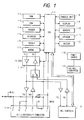
- Fig. 1 shows a block diagram of a main unit of the present invention.
- CPU 1-1 controls the entire facsimile apparatus, that is, a RAM 1-3, a reader 1-4, a recorder 1-5, a driver 1-6, a modem 1-7, a console unit 1-8, a display 1-9, sensors 1-10, a speaker 1-11, a buzzer 1-12, a filter 1-13, a cellular/coupler connector 1-14 and an NCU contact 1-15.
- the RAM 1-3 stores binary image data read by the reader 1-4 or binary data to be recorded by the recorder 1-5, stores a signal modulated by the modem 1-7, and stores binary data outputted from a subscriber line 2-1 at the NCUBOX of Fig. 2 through the NCU contact 1-15.
- the RAM 1-3 is further used to demodulate an analog waveform inputted from the subscriber line 2-1 through the NCUBOX of Fig. 2 and the modem 1-7 and stores the resulting binary data.
- the reader 1-4 comprises a DMA controller, a CCD or a close contact type image sensor (CS), a TTL IC and a binary circuit. It binarizes the data read by using the CCD or the CS under the control of the CPU 1-1 and sends the binary data to the RAM 1-3 sequentially.
- the recorder 1-5 comprises a DMA controller, a B4/A4 size thermal head and a TTL IC. It reads the record data stored in the RAM 1-3 under the control of the CPU 1-1 and prints it out as a hard copy.
- the driver 1-6 comprises a stepping motor for driving feed and eject rollers of the reader 1-4 and the recorder 1-5, a gear for transmitting a driving force of the motor, and a driver circuit for controlling the motor.
- the modem 1-7 comprises G3, G2, G1 and old FM modems and a clock generators connected to the modems. It modulates transmission data stored in the RAM 1-3 under the control of the CPU 1-1 and conducts communication by an analog signal from the subscriber line 2-1 or the cellular/coupler connector 1-14 through the NCUBOX of Fig. 2 and the NCU contact 1-15.
- the modem 1-7 further receives the analog signal from the subscriber line 2-1 or from the cellular/coupler connector 1-14 through the NCUBOX of Fig. 2 and the NCU contact, and demodulates and binarizes it and stores the binary data in the RAM 1-3.
- the console unit 1-8 comprises a start key for transmission and reception, a mode key for designating an operation mode such as fine mode and standard mode in the transmitted image, a copy key for a copy operation, an economy key for designating an energy saving mode in recording and printing when a battery power supply is used, and a stop key for stopping the operation.
- the CPU 1-1 detects the depression of those keys and controls the respective units in accordance with the depression status.
- the display 1-9 displays an operation status such as a communication status, a power supply status and the fine and standard modes. It comprises an LCD or LED's.
- the sensors 1-10 comprises a record sheet width sensor, a record sheet Presence/absence sensor, a document sheet width sensor and a document sheet presence/absence sensor. It detects the status of the document sheet and the record sheet under the control of the CPU 1-1.
- the speaker 1-11 comprises a speaker and a speaker driver. It monitors a voice signal and a communication signal under the control of the CPU.
- the buzzer 1-12 comprises a buzzer and a buzzer driver. It generates an alarm sound and a key touch sound under the control of the CPU.
- the filter 1-13 is a low-pass filter which comprises an operational amplifier.
- the cellular/coupler connected 1-14 comprises a connector with a switch and it is an analog signal interface for connecting a mobile communication terminal and an acoustic coupler. Whether a plug is inserted in a jack terminal or not is monitored by the CPU by a JACK signal and a transmission level is changed under the control of the CPU and the reception signal is selectively received from the NCU connector or the cellular/coupler connector. By applying a CMODE signal of the cellular/coupler connector to the CPU, the mobile terminal and the acoustic coupler are discriminated and the transmission level or the reception level can be switched accordingly.
- the NCU connector 1-15 is an interface for inputting and outputting signals and supplying powers as the contacts of the main unit and it has the following input/output signal lines. Input of a power supply Vcc; GND; TX which outputs a transmission signal TX from a modem in the main body; RX which inputs a reception signal RX from the NCUBOX of Fig. 2; CML which outputs a control signal of a relay 1 of Fig. 2 from the CPU of the main unit; H which outputs a control signal of the relay 2 of Fig. 2 from the CPU of the main unit; CNG which inputs a CNG control signal from a CNG detector 2-6 of the NCUBOX of Fig.
- CI which inputs a CI control signal from the CI detector 2-5 of the NCUBOX of Fig. 2; FC which inputs an FC control signal from an FC detector 2-7 of the NCUBOX of Fig. 2; OFF-HOOK which inputs an OFF-HOOK control signal from an off-hook detector 2-9 of the NCUBOX of Fig. 2; KEY which is applied to the CPU of the main unit from the console unit 2-13; and DRIVE which controls the LED's of the display 2-14 by from the CPU of the main unit;
- the power supply 1-16 supplies powers to the respective units. It uses one of the three configurations shown in Fig. 7 and outputs a DC power of +12 volts.
- the power supply 7-1 comprises a battery 7-2 of DC +12 volts and it supplies powers of DC +12 volts to the respective units.
- the power supply 7-3 comprises an AC adaptor 7-4 which converts an AC power input to DC +12 volts and it supplies powers of DC +12 volts to the respective units.
- the power supply 7-5 comprises a car battery adapter 7-6 which receives a DC power from a car-mounted battery and converts it to stabilized DC +12 volts and it supplies powers of DC +12 volts to the respective units.
- the voltage converter 1-17 comprises a series regulator or a switching regulator and a DC/DC converter and it converts DC +12 volts supplied from the power supply 1-14 to DC +5 volts.
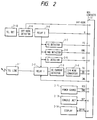
- Fig. 2 shows a block diagram of a configuration of the NCUBOX of the present invention. It is connected to the NCU connector 1-15 of the main unit.
- the telephone line 2-1 is a subscriber line connected to the NCUBOX.
- Relays 1 and 2-2 selectively connect the telephone line 2-1 to the modem 1-7 in the main unit or a sub-telephone connector 2-10 under the control of the CPU 1-1.
- a DC capture unit 2-3 captures a DC on the telephone line.
- a 2-4 wire converter 2-4 comprises a hybrid transformer and converts between two wires and four wires.
- a CI detector 2-5 separates a call control signal (CI signal) applied from the telephone line 2-1 between a primary and a secondary by using a photo-coupler and passes only an AC signal component.
- CI signal call control signal
- a CNG detector 2-6 separates a CNG control signal defined by T-30 of a protocol signal in a facsimile communication between the primary and the secondary when the telephone line is connected to the sub-telephone by the relay 1 and passes only an AC signal component.
- An FC detector 2-7 detects a non-ringing call signal (a call signal sent from an F-network which is a service network of NTT Corp., at 1300 Hz) by a frequency counter and detects an FC signal which is the detection signal by a PLL circuit, for example.
- a non-ringing call signal a call signal sent from an F-network which is a service network of NTT Corp., at 1300 Hz
- FC signal which is the detection signal by a PLL circuit, for example.
- An off-hook detector 2-9 detects the off-hook of a telephone set connected to the sub-telephone connector 2-10.
- the relay 1 connects the subscriber line and the modem, it forms a quasi-DC loop in the telephone set connected to the sub-telephone connector 2-10 to detect a current.
- relays 2 and 2-8 are provided to control it by an H control of the CPU.
- a sub-telephone connector 2-10 is a sub-telephone connector terminal connected to the NCUBOX.
- a power supply 2-11 supplies powers to the main unit of Fig. 1 through the NCU contact.
- the NCU contact 2-12 is an interface which inputs and outputs signals through the contact of the NCUBOX and supplies powers. It has the following input/output signal lines. Input of a power supply Vcc; GND; TX which outputs a transmission signal TX from a modem in the main body; RX which inputs a reception signal RX from the NCUBOX of Fig. 2; CML which outputs a control signal of a relay 1 of Fig. 2 from the CPU of the main unit; H which outputs a control signal of the relay 2 of Fig. 2 from the CPU of the main unit; CNG which inputs a CNG control signal from a CNG detector 2-6 of the NCUBOX of Fig.
- CI which inputs a CI control signal from the CI detector 2-5 of the NCUBOX of Fig. 2; FC which inputs an FC control signal from an FC detector 2-7 of the NCUBOX of Fig. 2; OFF-HOOK which inputs an OFF-HOOK control signal from an off-hook detector 2-9 of the NCUBOX of Fig. 2; KEY which is applied to the CPU of the main unit from the console unit 2-13; and DRIVE which controls the LED's of the display 2-14 by from the CPU of the main unit.
- a console unit 2-13 comprises a mode key for designating a reception mode.
- the CPU 1-1 detects the depression of the key and controls the respective units in accordance with the depression status.
- a display 2-14 comprises LED's for displaying the reception mode and displays the status by the signal from the CPU 1-1.
- Fig. 3 shows an outer view of the present invention.
- Numeral 3-1 denotes a facsimile main unit in a transport mode and has a configuration shown in Fig. 1.
- Numeral 3-2 denotes the NCUBOX used when it is connected to the subscriber line and has a configuration shown in the block diagram of Fig. 2.
- Numeral 3-3 denotes a display for displaying the reception mode.
- Numeral 3-4 denotes a console unit for switching a communication mode.
- Numeral 3-5 denotes a terminal for the sub-telephone connector.
- Numeral 3-6 denotes a terminal for connecting the subscriber line.
- Numeral 3-7 denotes a terminal for connecting the mobile terminal and the acoustic coupler.
- Numeral 3-8 denotes a terminal for connecting the NCUBOX 3-2.
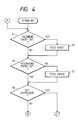
- a stand-by mode is initiated.
- the loading of a document sheet is determined by checking the presence or absence of the document sheet. If the document sheet has been loaded, the document sheet is fed in a step and the process proceeds to a step S6.
- step S6 whether a record sheet has been loaded or not is determined by checking the presence or absence of the record sheet. If the record sheet has been loaded, the record sheet is fed in a step S7 and the process proceeds to a step S8.
- step S8 whether any key of the console unit 1-8 has been depressed or not is determined. If the key has been depressed, a key operation of a flow C is initiated.
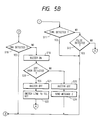
- a flow B is initiated and in a step S3, the FC signal of 1300 Hz is detected by the CPU of the main unit by the FC signal of the FC detector of the NCUBOX through the contact. If it is detected, a reception mode of a step S27 is initiated. If the FC signal is not detected, whether the mode switch is in a manual mode or not is determined in a step S5, and if it is in the manual mode, a tone signal or a pulse signal which is sent to switch from the telephone set to the facsimile apparatus is detected in steps S11 and S12. The tone signal is detected by the modem in the main unit through RX of the contact and the pulse signal is detected by the CPU of the main unit through OFF-HOOK of the contact.
- the process returns to a stand-by state, and if any of the signals is detected, the CML relay of the NCUBOX is switched from an externally connected telephone set to the facsimile apparatus through the contact by the CML signal from the CPU of the main unit to initiate the reception mode of the step S27.
- step S5 if the mode switch is not in the manual mode, whether the mode switch is in a FAX/TEL automatic switching mode or not is determined in a step S9, and if it is in the FAX/TEL automatic switching mode, the CI signal is detected in a step S13 by the CPU of the main unit by the signal from the CI detector of the NCUBOX. If the CI signal is not detected, the process returns to the stand-by state, and if it is detected, a voice message 1 "Now calling. Please wait for a while.” is sent out in a step S14 from the modem 1-7 of the main unit through TX of the NCUBOX, and in a step S-15, a busy tone BT signal is detected by the modem of the main unit.
- the line is released in a step S16 and the process returns to the stand-by state. If it is not detected, the CNG signal of 1100 Hz is detected by the modem of the main unit or the FC signal is detected in steps S17 and S18. If any of the signals is detected. The reception mode of the step S27 is detected, and if none of the signals is detected, a buzzer sound is generated in a step S19 to inform that a destination is a telephone set.
- the OFF-HOOK signal is detected to determine if a handset has been hooked off or not in a step S20. If it is detected, the buzzer sound is stopped in a step S21 and the line is switched to the sub-telephone in a step S22. Then, the process returns to the stand-by mode.
- step S9 if the mode switch is not in the FAX/TEL automatic switching mode, whether the mode switch is in an automatic answering and recording telephone connection mode or not is determined in a step S10. If it is not, the process returns to the stand-by status. If it is in the automatic answering and recording telephone connection mode, the CNG signal is detected in a step S25, and if it is detected, the reception mode is started in a step S27.
- step S26 If the CNG signal is not detected, whether the destination is soundless or not is determined in a step S26. If it is soundless, the reception mode is started in the step S27, and if not, the process returns to the stand-by status.
- step S40 whether a copy key has been depressed or not is determined, and if it has been depressed, the copy mode is started in a step S46.
- step S47 If the start key has been depressed, the presence or absence of a document sheet is determined in a step S47. If the document sheet is present, the same operation as that of the prior art facsimile manual transmission is conducted in a step S49.
- the reception mode is started in a step S48.
- step S41 if the start key has not been depressed, whether a transmission mode key has been depressed or not is determined in a step S42. If it has been depressed, the transmission mode is set to either fine or standard in a step S50.
- step S43 If the transmission key has not been depressed, whether an economy key has been depressed or not is determined in a step S43. If it has been depressed, an economy mode in which thin (or intermittent) printing is made is set in a step S51.
- a reception mode key has been depressed or not is determined by a KEY signal of the contact to the NCUBOX in a step S44. If it has been depressed, the reception mode is set to one of manual, FAX/TEL switching and automatic responding and recording telephone connection in a step S52 and display the selected mode by an LED on the display of the NCUBOX by a DRIVE signal.
- reception mode key has not been depressed, whether a stop key has been depressed or not is determined in a step S45. If it has been depressed, the operation is immediately stopped in a step S53 and the process returns to the stand-by status.
- the NCU since the NCU is separable from the main unit, the dimension and the weight of the main unit are reduced. Further, in Europe, the main unit has many versions from country to country but the main unit may be uniform by the separation of the NCU.
Landscapes
- Engineering & Computer Science (AREA)
- Signal Processing (AREA)
- Multimedia (AREA)
- Human Computer Interaction (AREA)
- Computer Networks & Wireless Communication (AREA)
- Facsimiles In General (AREA)
- Telephonic Communication Services (AREA)
Applications Claiming Priority (2)
| Application Number | Priority Date | Filing Date | Title |
|---|---|---|---|
| JP4190948A JPH0637951A (ja) | 1992-07-17 | 1992-07-17 | ポータブルファクシミリ装置 |
| JP190948/92 | 1992-07-17 |
Publications (1)
| Publication Number | Publication Date |
|---|---|
| EP0579557A1 true EP0579557A1 (en) | 1994-01-19 |
Family
ID=16266344
Family Applications (1)
| Application Number | Title | Priority Date | Filing Date |
|---|---|---|---|
| EP93401842A Ceased EP0579557A1 (en) | 1992-07-17 | 1993-07-16 | Portable facsimile apparatus |
Country Status (3)
| Country | Link |
|---|---|
| US (1) | US5673117A (enExample) |
| EP (1) | EP0579557A1 (enExample) |
| JP (1) | JPH0637951A (enExample) |
Cited By (3)
| Publication number | Priority date | Publication date | Assignee | Title |
|---|---|---|---|---|
| EP0683594A1 (en) * | 1994-04-20 | 1995-11-22 | Canon Kabushiki Kaisha | Data processing apparatus |
| EP0825760A3 (en) * | 1996-08-22 | 2000-02-02 | Hewlett-Packard Company | Facsimile device with user-friendly automatic receive mode |
| US20050285759A1 (en) * | 2004-06-11 | 2005-12-29 | Canon Kabushiki Kaisha | Communication device and method for controlling the same |
Families Citing this family (9)
| Publication number | Priority date | Publication date | Assignee | Title |
|---|---|---|---|---|
| US6674550B1 (en) | 1992-07-17 | 2004-01-06 | Canon Kabushiki Kaisha | Facsimile apparatus |
| US6285467B1 (en) * | 1992-11-12 | 2001-09-04 | Canon Kabushiki Kaisha | Communication apparatus |
| GB9407760D0 (en) * | 1994-04-19 | 1994-06-15 | Optionexist Ltd | Portable communication apparatus |
| US5909488A (en) * | 1995-08-22 | 1999-06-01 | Canon Kabushiki Kaisha | Communication apparatus having a non-ringing call receiving mode and an energy-saving stand-by mode |
| JP3325800B2 (ja) * | 1997-05-19 | 2002-09-17 | 松下電送システム株式会社 | 画像処理装置 |
| JPH11146151A (ja) * | 1997-11-06 | 1999-05-28 | Matsushita Denso System Kk | 着脱型読取装置 |
| JP2003114769A (ja) * | 2001-10-03 | 2003-04-18 | Canon Inc | 複合装置及びその制御方法、ファクシミリ装置、及びネットワーク接続装置 |
| USD483039S1 (en) | 2002-10-31 | 2003-12-02 | Hewlett-Packard Development Company, L.P. | Facsimile device |
| JP4333485B2 (ja) * | 2004-06-02 | 2009-09-16 | 船井電機株式会社 | 光ディスク装置内蔵型テレビジョン装置 |
Citations (1)
| Publication number | Priority date | Publication date | Assignee | Title |
|---|---|---|---|---|
| WO1992006531A1 (en) * | 1990-09-28 | 1992-04-16 | Graeme William Younger | Transportable ac power supply apparatus |
Family Cites Families (6)
| Publication number | Priority date | Publication date | Assignee | Title |
|---|---|---|---|---|
| JPH0687572B2 (ja) * | 1989-02-08 | 1994-11-02 | 村田機械株式会社 | 留守番電話・ファクシミリ受信切替方式 |
| US5200991A (en) * | 1989-06-23 | 1993-04-06 | Kabushiki Kaisha Toshiba | Image communication system including a mobile telephone set and a facsimile device |
| JP2781227B2 (ja) * | 1989-06-30 | 1998-07-30 | 株式会社リコー | グループ4ファクシミリ通信アダプタ装置 |
| GB2240904B (en) * | 1990-01-31 | 1994-06-01 | Oki Electric Ind Co Ltd | Mobile facsimile telecommunications system capable of automatically off-hooking a facsimile device |
| JPH0411440A (ja) * | 1990-04-28 | 1992-01-16 | Sharp Corp | ファクシミリ装置 |
| JP3342131B2 (ja) * | 1993-04-28 | 2002-11-05 | キヤノン株式会社 | 画像通信装置 |
-
1992
- 1992-07-17 JP JP4190948A patent/JPH0637951A/ja active Pending
-
1993
- 1993-07-16 EP EP93401842A patent/EP0579557A1/en not_active Ceased
-
1996
- 1996-04-22 US US08/635,785 patent/US5673117A/en not_active Expired - Fee Related
Patent Citations (1)
| Publication number | Priority date | Publication date | Assignee | Title |
|---|---|---|---|---|
| WO1992006531A1 (en) * | 1990-09-28 | 1992-04-16 | Graeme William Younger | Transportable ac power supply apparatus |
Non-Patent Citations (5)
| Title |
|---|
| PATENT ABSTRACTS OF JAPAN vol. 13, no. 058 (E-714)9 February 1989 & JP-A-63 246 964 ( SEIKO EPSON ) * |
| PATENT ABSTRACTS OF JAPAN vol. 13, no. 88 (E-721)28 February 1989 & JP-A-63 266 956 ( NEC ) * |
| PATENT ABSTRACTS OF JAPAN vol. 15, no. 106 (E-1044)13 March 1991 & JP-A-02 311 072 ( NIPPON TELEGR & TELEPH CORP ) * |
| PATENT ABSTRACTS OF JAPAN vol. 16, no. 364 (E-1244)6 August 1992 & JP-A-04 115 762 ( TOSHIBA ) * |
| PATENT ABSTRACTS OF JAPAN vol. 9, no. 115 (E-315)18 May 1985 & JP-A-60 003 296 ( MATSUSHITA DENKI SANGYO ) * |
Cited By (4)
| Publication number | Priority date | Publication date | Assignee | Title |
|---|---|---|---|---|
| EP0683594A1 (en) * | 1994-04-20 | 1995-11-22 | Canon Kabushiki Kaisha | Data processing apparatus |
| US6801328B2 (en) | 1994-04-20 | 2004-10-05 | Canon Kabushiki Kaisha | Data processing apparatus operable in accordance with a connected IC card |
| EP0825760A3 (en) * | 1996-08-22 | 2000-02-02 | Hewlett-Packard Company | Facsimile device with user-friendly automatic receive mode |
| US20050285759A1 (en) * | 2004-06-11 | 2005-12-29 | Canon Kabushiki Kaisha | Communication device and method for controlling the same |
Also Published As
| Publication number | Publication date |
|---|---|
| US5673117A (en) | 1997-09-30 |
| JPH0637951A (ja) | 1994-02-10 |
Similar Documents
| Publication | Publication Date | Title |
|---|---|---|
| US6476939B1 (en) | Program for externally controlling a communication apparatus | |
| US5086455A (en) | Facsimile arrangement having automatic answering telephone set and facsimile set and switching process therefor | |
| US5673117A (en) | Data communication apparatus with detachable network control unit | |
| US5187736A (en) | Telephone data communication switching system | |
| JP2862191B2 (ja) | 記録装置 | |
| US5815288A (en) | Facsimile apparatus with changeable transmission energy level and transmission speed | |
| US6674550B1 (en) | Facsimile apparatus | |
| JP3219802B2 (ja) | データ通信装置 | |
| JP3181652B2 (ja) | ファクシミリシステム | |
| EP0866599B1 (en) | Communication apparatus and communication control method | |
| JP2605564B2 (ja) | ファクシミリ装置 | |
| JP3173270B2 (ja) | ファクシミリ装置 | |
| EP0848538A2 (en) | Communication terminal device | |
| JP2875262B2 (ja) | データ通信装置 | |
| US6285467B1 (en) | Communication apparatus | |
| JP2868669B2 (ja) | ファクシミリ装置 | |
| JP3642133B2 (ja) | 通信端末装置 | |
| JPH0595438A (ja) | 画像通信装置 | |
| JP2798519B2 (ja) | ファクシミリ装置 | |
| JPH10294802A (ja) | ファクシミリ装置 | |
| JPH04249466A (ja) | 画像受信装置 | |
| JPH08307562A (ja) | 通信装置 | |
| JPH03162063A (ja) | ファクシミリ装置 | |
| JPH02272866A (ja) | ファクシミリ装置およびファクシミリ通信方式 | |
| WO2010087168A1 (en) | Facsimile apparatus |
Legal Events
| Date | Code | Title | Description |
|---|---|---|---|
| PUAI | Public reference made under article 153(3) epc to a published international application that has entered the european phase |
Free format text: ORIGINAL CODE: 0009012 |
|
| AK | Designated contracting states |
Kind code of ref document: A1 Designated state(s): DE ES FR GB IT |
|
| 17P | Request for examination filed |
Effective date: 19940615 |
|
| 17Q | First examination report despatched |
Effective date: 19970410 |
|
| GRAG | Despatch of communication of intention to grant |
Free format text: ORIGINAL CODE: EPIDOS AGRA |
|
| STAA | Information on the status of an ep patent application or granted ep patent |
Free format text: STATUS: THE APPLICATION HAS BEEN REFUSED |
|
| 18R | Application refused |
Effective date: 20011001 |