EP0566221A2 - Thermoplastisches Abdruckmaterial - Google Patents
Thermoplastisches Abdruckmaterial Download PDFInfo
- Publication number
- EP0566221A2 EP0566221A2 EP93202060A EP93202060A EP0566221A2 EP 0566221 A2 EP0566221 A2 EP 0566221A2 EP 93202060 A EP93202060 A EP 93202060A EP 93202060 A EP93202060 A EP 93202060A EP 0566221 A2 EP0566221 A2 EP 0566221A2
- Authority
- EP
- European Patent Office
- Prior art keywords
- impression material
- thermoplastic
- tray
- impression
- shell
- Prior art date
- Legal status (The legal status is an assumption and is not a legal conclusion. Google has not performed a legal analysis and makes no representation as to the accuracy of the status listed.)
- Withdrawn
Links
Images
Classifications
-
- A—HUMAN NECESSITIES
- A61—MEDICAL OR VETERINARY SCIENCE; HYGIENE
- A61C—DENTISTRY; APPARATUS OR METHODS FOR ORAL OR DENTAL HYGIENE
- A61C9/00—Impression cups, i.e. impression trays; Impression methods
-
- A—HUMAN NECESSITIES
- A61—MEDICAL OR VETERINARY SCIENCE; HYGIENE
- A61C—DENTISTRY; APPARATUS OR METHODS FOR ORAL OR DENTAL HYGIENE
- A61C9/00—Impression cups, i.e. impression trays; Impression methods
- A61C9/0006—Impression trays
-
- A—HUMAN NECESSITIES
- A61—MEDICAL OR VETERINARY SCIENCE; HYGIENE
- A61C—DENTISTRY; APPARATUS OR METHODS FOR ORAL OR DENTAL HYGIENE
- A61C13/00—Dental prostheses; Making same
- A61C13/08—Artificial teeth; Making same
- A61C13/087—Artificial resin teeth
-
- A—HUMAN NECESSITIES
- A61—MEDICAL OR VETERINARY SCIENCE; HYGIENE
- A61K—PREPARATIONS FOR MEDICAL, DENTAL OR TOILETRY PURPOSES
- A61K6/00—Preparations for dentistry
- A61K6/80—Preparations for artificial teeth, for filling teeth or for capping teeth
- A61K6/884—Preparations for artificial teeth, for filling teeth or for capping teeth comprising natural or synthetic resins
- A61K6/887—Compounds obtained by reactions only involving carbon-to-carbon unsaturated bonds
-
- A—HUMAN NECESSITIES
- A61—MEDICAL OR VETERINARY SCIENCE; HYGIENE
- A61K—PREPARATIONS FOR MEDICAL, DENTAL OR TOILETRY PURPOSES
- A61K6/00—Preparations for dentistry
- A61K6/80—Preparations for artificial teeth, for filling teeth or for capping teeth
- A61K6/884—Preparations for artificial teeth, for filling teeth or for capping teeth comprising natural or synthetic resins
- A61K6/891—Compounds obtained otherwise than by reactions only involving carbon-to-carbon unsaturated bonds
-
- A—HUMAN NECESSITIES
- A61—MEDICAL OR VETERINARY SCIENCE; HYGIENE
- A61K—PREPARATIONS FOR MEDICAL, DENTAL OR TOILETRY PURPOSES
- A61K6/00—Preparations for dentistry
- A61K6/80—Preparations for artificial teeth, for filling teeth or for capping teeth
- A61K6/884—Preparations for artificial teeth, for filling teeth or for capping teeth comprising natural or synthetic resins
- A61K6/891—Compounds obtained otherwise than by reactions only involving carbon-to-carbon unsaturated bonds
- A61K6/893—Polyurethanes
-
- A—HUMAN NECESSITIES
- A61—MEDICAL OR VETERINARY SCIENCE; HYGIENE
- A61K—PREPARATIONS FOR MEDICAL, DENTAL OR TOILETRY PURPOSES
- A61K6/00—Preparations for dentistry
- A61K6/90—Compositions for taking dental impressions
-
- C—CHEMISTRY; METALLURGY
- C08—ORGANIC MACROMOLECULAR COMPOUNDS; THEIR PREPARATION OR CHEMICAL WORKING-UP; COMPOSITIONS BASED THEREON
- C08L—COMPOSITIONS OF MACROMOLECULAR COMPOUNDS
- C08L67/00—Compositions of polyesters obtained by reactions forming a carboxylic ester link in the main chain; Compositions of derivatives of such polymers
- C08L67/02—Polyesters derived from dicarboxylic acids and dihydroxy compounds
- C08L67/025—Polyesters derived from dicarboxylic acids and dihydroxy compounds containing polyether sequences
-
- C—CHEMISTRY; METALLURGY
- C08—ORGANIC MACROMOLECULAR COMPOUNDS; THEIR PREPARATION OR CHEMICAL WORKING-UP; COMPOSITIONS BASED THEREON
- C08L—COMPOSITIONS OF MACROMOLECULAR COMPOUNDS
- C08L67/00—Compositions of polyesters obtained by reactions forming a carboxylic ester link in the main chain; Compositions of derivatives of such polymers
- C08L67/04—Polyesters derived from hydroxycarboxylic acids, e.g. lactones
-
- A—HUMAN NECESSITIES
- A61—MEDICAL OR VETERINARY SCIENCE; HYGIENE
- A61C—DENTISTRY; APPARATUS OR METHODS FOR ORAL OR DENTAL HYGIENE
- A61C2201/00—Material properties
- A61C2201/007—Material properties using shape memory effect
-
- Y—GENERAL TAGGING OF NEW TECHNOLOGICAL DEVELOPMENTS; GENERAL TAGGING OF CROSS-SECTIONAL TECHNOLOGIES SPANNING OVER SEVERAL SECTIONS OF THE IPC; TECHNICAL SUBJECTS COVERED BY FORMER USPC CROSS-REFERENCE ART COLLECTIONS [XRACs] AND DIGESTS
- Y10—TECHNICAL SUBJECTS COVERED BY FORMER USPC
- Y10S—TECHNICAL SUBJECTS COVERED BY FORMER USPC CROSS-REFERENCE ART COLLECTIONS [XRACs] AND DIGESTS
- Y10S522/00—Synthetic resins or natural rubbers -- part of the class 520 series
- Y10S522/908—Dental utility
-
- Y—GENERAL TAGGING OF NEW TECHNOLOGICAL DEVELOPMENTS; GENERAL TAGGING OF CROSS-SECTIONAL TECHNOLOGIES SPANNING OVER SEVERAL SECTIONS OF THE IPC; TECHNICAL SUBJECTS COVERED BY FORMER USPC CROSS-REFERENCE ART COLLECTIONS [XRACs] AND DIGESTS
- Y10—TECHNICAL SUBJECTS COVERED BY FORMER USPC
- Y10S—TECHNICAL SUBJECTS COVERED BY FORMER USPC CROSS-REFERENCE ART COLLECTIONS [XRACs] AND DIGESTS
- Y10S528/00—Synthetic resins or natural rubbers -- part of the class 520 series
- Y10S528/92—Polymers useful for replacing hard animal tissues, e.g. dentures, bones
Definitions
- This invention relates to thermoplastic dental impression material.
- thermoplastic compositions include U.S. Pat. Nos. 2,020,311, 4,227,877, 4,361,528, 4,401,616, 4 413,979, 4,569,342, 4,619,610 4,657,509, 4,659,786 (& EP-A-0174 713), 4,768,951, 4,776,792, and 4,835,203.
- Other references include Kokai (Japanese Published Pat. Appl.) Nos.
- thermoplastic materials of these references are used without a surrounding shell, or their manner of use is not specifically described. In some instances the thermoplastic materials are themselves shaped to form a custom tray which is in turn used as a shell surrounding a conventional non-thermoplastic elastomeric impression material such as a polysiloxane.
- thermoplastic materials of the '610 and '792 patents are exceptions; both employ a thin thermoplastic sheet surrounded by a rigid tray.
- the thin thermoplastic sheet is used to make a bite registration of only the occlusal tooth surfaces.
- Kokai Hei 2[1990]-45049 describes an impression technique that employs a thermoplastic propionic cellulose acetate impression material that is heated in a rod shape, bent to conform to an arch-shaped tray, "piled" on the tray, and inserted into a patient's mouth while still warm.
- the tray is not a preloaded dental impression tray, in that the impression material resides in the tray for only a short time before it is inserted in a patient's mouth, and is not intended to be sold in preloaded form.
- Hei 2[1990]-60642 and Hei 2 [990]-60672 were not published until 1 March 1990. They refer respectively to a custom impression tray and a mouthguard, both being made of heat-softenable thermoplastic resin.
- European Pat. Application No. 0 359 135 was not published until 21 March 1990. It describes a mouthpiece (a mouthguard) for use in contact sports.
- the mouthpiece is made of inner and outer layers of thermoplastic EVA resins.
- the outer layer is required to be impact resistant so that it will survive strong impacts.
- the outer layer is also said to have a melting point preferably above 60°C, more preferably from 63 to 68°C. If made of EVA, the outer layer is required to have a melt flow rate ("MFR") less than 65 g/10 min.
- MFR melt flow rate
- the mouthpiece is formed by heating it to a temperature that will melt the inner layer but not the outer layer. This reference does not disclose or suggest dental impressioning to make a dental model.
- thermoplastic polyolefin elastomers for custom-fitted denture bases.
- an impression material comprising a homogeneous blend of a thermoplastic material, a free-radically polymerizable resin, and a free-radical initiator, the blend being a solid at 38°C and having:
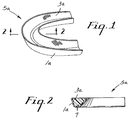
- FIGS. 1 and 2 show an arch-shaped tray 5a having a shell 1a of thermoplastic material that will soften if heated in a 60°C water bath (not shown).
- the warmed tray can be custom-shaped in the mouth to account for variations in patient dentition. Accordingly, the dentist need keep on hand only a few tray sizes rather than a large assortment of trays. Also, by imparting a custom shape to the tray, an accurate impression having a desirably thin layer of solidified impression material will be obtained.
- Shell 1a is lined with an optional woven scrim 3a, which assists in formation of a firm bond between shell 1a and thermoplastic impression material 7 after the impression material resolidifies.
- Thermoplastic impression material 7 has certain important properties described in more detail below.
- Tray 5a can be sold to an end-user with thermoplastic impression material 7 preloaded in the tray prior to shipment.
- the preloaded tray can be packaged and subjected to routine warehouse handling and shipment without damage.
- Preferably the tray is stored at less that 60°C (e.g., at room temperature) before use.
- the tray can also have a shell (not shown) of rigid metal or plastic.
- the rigid shell does not melt below 75°C, and thus is not custom-shaped in the mouth. Accordingly, a larger inventory of tray shapes and sizes will typically be required.
- trays with rigid shells will be preferred by many practitioners, especially for applications such as "double bite" trays and partial arch (e. g., quadrant) trays.
- the impression material of the invention provides a simplified dental impression system.
- Traditional impressioning systems employ one or more low viscosity, flowable elastomeric materials such as an alginate, hydrocolloid, polyvinylsiloxane, polyether, or polysulfide contained in a fairly rigid adhesive-coated plastic or metal arch-shaped shell.
- the elastomeric material often is applied both to the dental tissue to be modeled and to the shell.
- the elastomeric material and surrounding shell are subsequently pressed against the dental tissue, and left in place until the elastomeric material has hardened. This traditional process involves several materials and steps, material waste and fairly lengthy set times.
- the invention permits impressioning using a bilayer thermoplastic molding composition.
- a flat sheet or a preformed arch-shaped shell is made from two coextruded thermoplastic layers.
- the physical properties of each layer emulate in part the properties of a conventional rigid shell and the elastomeric impression material respectively.
- the shell layer becomes a conformable, non-sticky melt (thereby permitting the warm shell layer to be hand-shaped into a custom shell configuration) and the elastomer layer exhibits good flow and low viscosity (thereby permitting the warm elastomer layer to flow around tooth structure and provide an accurate model).
- the warm bilayer construction provides easy placement, accurate impressioning, and efficient use of materials.
- Cooling can take place rapidly, and in less time than is required to harden a conventional impression. Once cooled, the shell layer exhibits sufficient rigidity to discourage distortion of the impression during removal from the mouth or during subsequent handling.
- the elastomer layer provides stable, accurate modeling of hard and soft dental tissue. If either the shell or the elastomer layer is crosslinked after the desired custom shape has been attained, then the shape memory properties of the crosslinked layer discourage creep and distortion. In addition, if the elastomer layer is crosslinked, then the shape memory properties of the elastomer layer will aid in making accurate casts using heated gypsum stone substitutes such as hot-melt thermoplastics. The completed impression can be shipped through the mail and exposed to elevated temperatures with reduced risk that the impression will melt or otherwise become permanently distorted.
- the thermoplastic impression material is a heat-softenable substance that is a solid at 38°C. Preferably it is free of objectionable taste or odor, and safe for use in the mouth. Selection of the thermoplastic impression material should be based in part on the desired tray configuration and the desired properties of the impression material in the molten or softened ("warm impression") and solid ("cool impression") states.
- the warm impression state is characterized by appreciable mass flow of the thermoplastic impression material under moderate (hand) pressure at some temperature between body temperature (about 38°C) and the maximum temperature that comfortably can be withstood by oral tissues. This maximum temperature is generally thought to be about 75°C, although a maximum of about 65°C is preferred.
- thermoplastic impression material should have sufficient warm impression fluidity to conform accurately to adult dentition and the gingival margin.
- the thermoplastic impression material preferably has a modified consistency disk test value that is greater than about 21. More preferably, the modified consistency disk test value is between about 21 and about 40. Most preferably, it is about 23 to about 30.
- the cool impression state is characterized by sufficient strength and flexibility after the thermoplastic impression material is resolidified in the mouth to permit removal of the tray from the teeth without tearing or undesirable distortion. This latter requirement is reasonably stringent, and rules out many thermoplastic materials heretofore used in dentistry (e.g., for custom tray manufacture).
- the preferred thermoplastic impression materials include ethylene vinyl acetate (“EVA”) elastomers and thermoplastic segmented polyester elastomers. Suitable EVA elastomers are described in European Published Pat. Appl. No. 0 359 135 and Kokai No. Sho 63[1988]-96536. Preferred commercially available EVA elastomers include the "ELVAX” resins shown below: Melt Flow ELVAX Resin rate %Vinyl acetate 40-W 48-66 40 150 38-48 33 220 134-168 28 250 22-28 28 260 5.3-6.7 28 These are all commercially available from E. I. dupont de Nemours & Co. "ULTRATHENE” EVA resins from Quantum Chemical Corp. and “ESCORENE” EVA resins from Exxon Chemical Co. are also useful.
- EVA ethylene vinyl acetate
- ESCORENE EVA resins from Exxon Chemical Co.
- Suitable segmented polyesters are described in U.S. Pat. Nos. 4,059,715 and 4,552,906.
- the elastomer optionally can contain property-modifying or crosslinkable functional groups (for example hydroxyl, acrylate, methacrylate, epoxy, isocyanato or vinyl groups. Blends of elastomers can be used if desired.
- property-modifying or crosslinkable functional groups for example hydroxyl, acrylate, methacrylate, epoxy, isocyanato or vinyl groups.
- Blends of elastomers can be used if desired.
- Elastomers plasticized with natural plasticizers e.g., oils
- synthetic plasticizers e.g., phthalate esters
- Castor oil, cottonseed oil, mineral oil, orange oil and peanut oil are useful natural plasticizing oils, with triglyceride containing vegetable oils such as castor oil, cottonseed oil and peanut oil being most preferred.
- Preferred commercially available synthetic plasticizers include dioctyl adipate; dioctyl sebacate (e.g., "UNIFLEX DOS", Union Camp); “PANALANE” polyisobutylene (Amoco); “PLASTOLEIN” mixed esters such as grades 9048, 9058 and 9071 (Henkel Corp.); and “SANTICIZER” phthalates such as grades 160 and 261 (Monsanto, Inc.). Blends of plasticizers can be used if desired.
- the thermoplastic impression material can include a free-radically polymerizable resin containing at least one ethylenically unsaturated monomer, oligomer, or polymer capable of undergoing addition polymerization and containing two or more polymerizable groups. This permits the resin to be crosslinked after an impression has been taken, thereby increasing the impression material's heat resistance and discouraging creep and heat-induced distortion. This will facilitate shipping the completed impression to a remote location (e.g., a dental laboratory) where the model can be poured.
- a remote location e.g., a dental laboratory
- Suitable monomers include di-or polyfunctional acrylates and methacrylates such as glycerol diacrylate, glycerol triacrylate, ethyleneglycol diacrylate, diethyleneglycol diacrylate, triethyleneglycol dimethacrylate, 1,3-propanediol diacrylate, 1,3-propanediol dimethacrylate, trimethylolpropane triacrylate, 1,2,3-butanetriol trimethacrylate, 1,6-hexanediol diacrylate, 1,4-cyclohexanediol diacrylate, pentaerythritol triacrylate, pentaerythritol tetraacrylate, pentaerythritol tetramethacrylate, sorbitol hexacrylate, bis[l-(2-acryloxy)]-p-ethoxyphenyldimethyl-methane, bis[l-(3-acryloxy-2-hydroxy)]-
- Suitable monomers include unsaturated amides such as methylene bis-acrylamide, methylene bis-methacrylamide, 1,6-hexamethylene bis-acrylamide and diethylenetriamine tris-acrylamide.
- Suitable oligomeric or polymeric resins include 200 to 500 molecular weight polyalkylene glycols, acrylated or methacrylated oligomers such as those of U.S. Pat. No.
- acrylated urethanes such as "SARTOMER” SR-349, 9503, 9504 and 9505 (Sartomer Corp.), "INTEREZ” CMD 8803, 8804 and 8805 (Radcure Specialties, Inc.), and “PHOTOMER” 4127, 4072, 6060, 6110 and 6160 (Henkel Corp.), as well as acrylated polyester oligomers such as “EBERCRYL” 830 (Radcure Specialties, Inc.). Mixtures of free-radically polymerizable monomers, oligomers or polymers can be used if desired.
- the free-radically polymerizable resin can if desired be cured using a conventional chemical initiator system, such as a combination of a peroxide and an amine.
- chemical cure initiator systems typically require at least partial ingredient separation before use.
- the resin is preferably cured using a photoinitiator, optionally combined with a suitable photosensitizer or accelerator.
- the photoinitiator should be capable of generating free radicals for addition polymerization at some wavelength between 200 and 800 nm.
- Suitable photoinitiators include alpha-diketones, monoketals of alpha-diketones or ketoaldehydes, acyloins and their corresponding ethers, chromophore-substituted halomethyl-s-triazines, chromophore-substituted halomethyl-oxadiazoles, aryliodonium salts, and other commercially available ultraviolet (“UV”) and visible light photoinitiators.
- Preferred photoinitiator systems include a mono or diketone photoinitiator together with a suitable donor compound or accelerator, such as the systems described in U.S. Pat. Nos.
- thermoplastic materials can be used to make customizable shells for trays for the impression material of the invention.
- the shell preferably is free of objectionable taste or odor, and safe for use in the mouth.
- Selection of a thermoplastic shell material should be based in part on the desired tray configuration and the desired properties of the shell in the molten or softened ("warm shell") and solid (“cool shell”) states.
- the warm shell state is characterized by appreciable mass flow of the thermoplastic shell material under moderate (hand) pressure at some temperature between body temperature (about 38°C) and the maximum temperature that comfortably can be withstood by oral tissues.
- the shell melts or softens at a temperature less than 60°C.
- the cool shell state is characterized by sufficient shell strength and stiffness to permit an acceptably accurate dental impression to be made in the tray, and by minimal apparent mass flow of the thermoplastic shell material under moderate pressure at temperatures below 38°C.
- the warm shell and cool shell properties permit the tray to be heated to a moderate temperature, manually shaped in the mouth while warm to conform to the shape of hard and soft oral tissue, and cooled within the mouth to form a substantially rigid custom impression tray.
- thermoplastic shell materials include polyesters and polyurethanes such as those described in U.S. Pat. Nos. 3,382,202, 4,059,715, 4,182,829, 4,327,013, 4,361,538, 4,552,906 and 4,569,342; copolymers such as those described in U.S. Pat. Nos. 4,659,786, 4,740,245 and 4,768,951; and ethylene vinyl acetate copolymers such as those described above.
- the thermoplastic shell material preferably is a homopolymer or copolymer of epsilon-caprolactone.
- the polycaprolactone optionally can contain property-modifying or crosslinkable functional groups (for example hydroxyl, acrylate, methacrylate, epoxy, isocyanato or vinyl groups) if desired. Blends of polycaprolactones can also be employed.
- Preferred commercially available polycaprolactone polymers include "TONE P-700” and “TONE P-767” (40,000 molecular weight) and “TONE P-300” (10,000 molecular weight) polycaprolactone from Union Carbide Corp., and the "CAPA" polycaprolactones "630" (30,000 molecular weight), "640” (40,000 molecular weight), "650” (50,000 molecular weight), and “656” (56,000 molecular weight) from Interox.
- the thermoplastic shell material preferably contains at least one ethylenically unsaturated monomer, oligomer, or polymer capable of undergoing addition polymerization, together with a suitable initiator (e.g., a photoinitiator), such as the ethylenically unsaturated materials and initiators described above. They permit the shell to be crosslinked, thereby imparting shape memory to the thermoplastic shell material and increasing its heat resistance.
- a suitable initiator e.g., a photoinitiator
- thermoplastic shell material and the thermoplastic impression material can contain a wide variety of adjuvants depending upon the desired tray properties. Suitable adjuvants include solvents, diluents, plasticizers, pigments, dyes, inorganic or organic reinforcing or extending fillers, thixotropic agents, indicators, inhibitors, stabilizers, UV absorbers, medicaments (e.g., leachable fluorides), biocides and the like.
- the thermoplastic shell material preferably contains one or more fillers that increase the material's warm state modulus. Preferred fillers have a fibrous, platy or finely-divided particulate form.
- the filler preferably has an aspect ratio greater than about 3:1, more preferably greater than about 5:1, and most preferably greater than 10:1.
- the particles preferably have an average particle diameter less than about 100 micrometers, more preferably less than about 10 micrometers, and most preferably less than about 1 micrometer.
- Particularly preferred fillers include glass fibers, clay, mica, alumina, submicron silica (for example, fumed, precipitated or colloidal silica) and finely-divided calcium carbonate.
- the fillers can be untreated or treated with a suitable coupling agent (for example, a silane).
- thermoplastic impression material and the thermoplastic shell material usually will be empirically selected. Both thermoplastic materials preferably should remain substantially homogeneous (that is, they should not undergo macroscopic phase separation or filler sedimentation). Subject to the effects of any shape memory imprinted in the shell, the tray preferably should retain its desired physical properties even if repeatedly cycled between the warm and cool states. Thus the selection of ingredients can be guided in part by the desire to preserve homogeneity and thermal reversibility.
- thermoplastic elastomer and plasticizer in the thermoplastic impression material are as follows: Ingredient Preferred Weight% Most Preferred Weight% Thermoplastic elastomer 30 to 90 40 to 60 Plasticizer 10 to 70 20 to 40 Polymerizable resin 0 to 60 20 to 40 Initiator 0 to 5
- the preferred amounts of thermoplastic, polymerizable resin, initiator and filler in the thermoplastic shell material are as follows: Ingredient Preferred Weight% Most Preferred Weight% Thermoplastic up to 90 80 to 40 Polymerizable resin 0 to 50 0 to 35 Initiator 0 to 10 0 to 5 Filler 0 to 70 20 to 60
- the ingredients can be blended by hand or by mechanical mixing.
- the ingredients preferably are warmed efficiently to melt the thermoplastic portion, but if desired can be mixed at lower temperatures.
- Any suitable mixing device can be used, including kettles equipped with mechanical stirrer, extruders, rubber mills, and the like.
- the tray can also have a rigid shell.
- rigid shell materials can be used.
- the chosen material is free of objectionable taste or odor, and safe for use in the mouth.
- Suitable materials include metals (e.g., stainless steel) and rigid plastics (e.g., polystyrene, polypropylene, or polyamide). Injection-moldable plastics are preferred. If desired, fillers or stiffening ribs can be used to increase the shell's rigidity.
- Particularly preferred trays with rigid shells can be prepared from currently-available stock trays available from dental suppliers. These can be preloaded by partially filling the shell with the above-described thermoplastic impression materials, and then packaging the tray for shipment.
- Suitable shells include disposable trays such as the "TRIPLE TRAY” double bite tray (Espe-Premier), the "OCCLUSAL HARMONY” closed bite impression tray, the "COE” spacer tray (Coe, Inc.), the "MASTER TRAY” full arch tray (Teledyne Getz), and the "FUZZY TRAY” full arch tray (Laclede Inc.).
- the tray preferably includes an adhesion-promoting scrim between the tray and the thermoplastic impression material.
- woven, nonwoven or perforated sheetlike materials can be used to form the scrim.
- Suitable woven materials include cloth or gauze formed of natural or synthetic fibers such as cotton, polyester (e.g., "DACRON” fibers, and “SONTARA” fabrics such as polyester grades 8000, 8027 and 8100, E. I. dupont de Nemours & Co.), polyethylene, polypropylene, polyurethane, polyamide (e.g., "NYLON” fiber), polyaramide (e.g., "KEVLAR” fiber) and glass (e.g., "FIBERGLAS” fiber).
- the scrim can be a conventional weave or a nonconventional weave such as either of the "hook” or “loop” fabrics used in hook and loop fasteners.
- Suitable nonwoven materials include felt and randomly-laid polyester (e.g., "BONAR” fabrics such as “ULTRALOFT” powder-bonded polyester grades 60B-9125, 60B-9628 and 60B-9928, Bonar Fabrics Corporation).
- Suitable perforated sheetlike materials include fine pitch polypropylene net.
- the scrim preferably should bond well to both the shell and to the thermoplastic impression material, be free of objectionable taste or odor, and be safe for use in the mouth.
- the scrim also preferably has a melting temperature above the melting or softening temperature of the thermoplastic impression material.
- Woven or perforated sheetlike scrim materials preferably have a mesh size and surface topography sufficient to provide the desired degree of adhesion between the shell and the impression material.
- the scrim can be treated with an appropriate primer or coupling agent to aid adhesion to the shell or to the thermoplastic impression material. If visible through the preloaded thermoplastic impression material, the scrim can be printed with instructions for the user or imprinted with a suitable trademark.
- one or more spacers are fastened either atop or beneath the scrim. These aid in controlling the amount of impression material that will be loaded into the tray, and in preventing unduly thin impressions which may perforate or tear upon removal from the mouth.
- at least one of the spacers is thermoplastic. By heating a thermoplastic spacer or the scrim prior to assembly, a firm bond between spacer and scrim will readily be achieved.
- thermoplastic impression material For trays having either a thermoplastic or a rigid shell, sufficient thermoplastic impression material should be preloaded into the shell to provide accurate envelopment of typical adult dentition and the gingival margin when the impression is made.
- about 15 to 30 ml of thermoplastic impression material will be needed for a full arch tray.
- larger quantities e.g., 30 to 50 ml
- Lesser quantities can of course be used for small trays (e.g., partial arch trays). Larger quantities may of course be needed for double bite trays than for single bite trays.
- empirical in vivo trials will be used to establish the preferred thermoplastic impression material quantity for a given tray configuration or shape.
- thermoplastic impression material is conveniently preloaded in the shell by heating the impression material until it becomes a free-flowing liquid, pouring it into the shell, and then cooling the resulting tray for shipment or storage.
- a level fill is preferred for reasons of manufacturing convenience, although non-level filling (e.g., by tipping the shell from side to side during preloading to coat the inside of the shell, or by using a rounded coating head whose shape conforms generally to the inside of the shell) can be employed if desired.
- the tray can be packaged using any convenient packaging materials, including paper or plastic bags, pouches or boxes. If desired, a peel-off cover can be adhered to the top of the tray to prevent loss or spillage of the thermoplastic impression material if the tray is inadvertently heated during shipment or storage.
- the tray When ready for use, the tray is heated using any convenient means until the preloaded thermoplastic impression material melts or softens.
- the tray can be immersed in a heated bath containing a suitable inert liquid (for example, water or a fluorochemical fluid) that will not dissolve or swell the tray in either its cool or warm states.
- a suitable inert liquid for example, water or a fluorochemical fluid
- the tray can also be softened using heat sources such as a hot air gun, hot plate, conventional oven, infrared heater or microwave oven.
- the tray can be encased in a plastic pouch or other container which is in turn heated (e.g., electrically), or subjected to one or more of the above-mentioned heating methods.
- the increase in transparency that typically occurs at the melting point will provide a convenient indicator of sufficient heating.
- the warmed tray should be promptly inserted in the patient's mouth, (and, if made using a heat-softenable thermoplastic shell, shaped to conform
- Transforming the tray from a warm impression state to a cool impression state requires loss of thermal energy and can be carried out using a variety of cooling techniques. Cooling can take place under ambient conditions in the presence of air only. Cooling can be expedited using forced air, cold water, ice, or heat sinks such as chilled "cold packs" or flexible pouches containing low boiling inert liquids. Of particular interest for dental applications are chilled cold packs in flexible pouches that have been preshaped to match the contours of the tray. For example, flexible pouches containing a chilled coolant can be fabricated in the shape of a full arch or quadrant and placed intraorally in contact with the warm tray.
- Shape memory can be imparted to trays of the invention whose shells contain thermoplastic impression material, free-radically polymerizable resin and initiator.
- the resin is allowed or caused to harden (for example, by exposing shells containing a photoinitiator to a suitable light source).
- Polymerization can take place before or after the warmed, softened shell is allowed to cool, although carrying out polymerization after cooling will tend to lengthen polymerization times.
- the shell preferably retains sufficient elasticity to permit ready removal of the model.
- the polymerized, cooled shell will exhibit shape memory. Accordingly, it will be more resistant to heat and handling stresses than shells made solely from a thermoplastic.
- the shell can be returned to its custom shape by reheating it to its warm shell state while in a relaxed condition.
- the tray can be immersed in a hot water bath and removed for cooling after the custom shape has reappeared. While still in the warm shell state, it will remain pliable, and accordingly will exhibit semi-thermoplasticity. This permits the custom shape to be adjusted if desired.
- thermoplastic custom shell composition was prepared by combining 22.5 parts "TONE P-767” 40,000 molecular weight polycaprolactone (Union Carbide Corp.), 7.5 parts “SR-9505" urethane diacrylate oligomer (Sartomer Corp.), 1.2 parts “EBERCRYL 830” polyester hexacrylate (Radcure Specialties, Inc.), 45 parts "VICRON” calcium carbonate (Pfizer Corp.), 10 parts "SIPERNAT D-11” treated precipitated silica (North American Silica Co.), 5 parts “ULTRASIL VN 3 SP” untreated precipitated silica (North American Silica Co.), 4 parts “1156” chopped glass fibers (PPG), and 0.75 parts each camphorquinone (“CPQ”) and p-ethyldimethylaminobenzoate (“EDMAB”).
- CPQ camphorquinone
- EDMAB p-ethyldimethylaminobenzoate
- the ingredients were stirred in a warm vessel at about 100°C until homogeneous.
- the resulting mixture was cast atop polyester film into a 2.5 mm thick layer into which was pressed a web of "SONTARA 8000" nonwoven material (E.I. DuPont de Nemours & Co.).
- the warm assembly was cut into generally U-shaped pieces using a "cookie cutter” style cutting implement. Each piece was squeezed while still warm between two halves of a silicone mold to form an arch-shaped, nonwoven scrim-lined customizable shell.
- thermoplastic impression material was prepared by melt blending 20 parts each "ELVAX 150" and “ELVAX 40" EVA resins (E. I. dupont de Nemours & Co.), 25 parts cottonseed oil, and 0.01 parts "ULTRAMARINE BLUE A 9829" (Kohnstamm Co.). The oil was heated first to about 120°C in a mechanical stirring device. The resin was added in small portions with stirring, followed by the dye. The molten mixture was poured into the customizable shell and allowed to cool. The cooled thermoplastic impression material had a rubbery consistency.
- the resulting tray could be easily softened by immersing the tray in a 60°C water bath for about three minutes.
- a tray with shape memory is obtained.
- the tray can also be photocured by setting it under a conventional dental operatory light (for example, a "RITTER STAR LIGHT", Sybron Corp.) for about two minutes per side.
- Very satisfactory dental models are obtained by pouring a conventional gypsum stone slurry into the completed impression and allowing the gypsum to harden. Removal of the model is easy, and is accomplished without breakage of the hardened gypsum.
- thermoplastic tray material was prepared by combining 39.7 parts “TONE P-767” polycaprolactone, 11.8 parts “SR-9505" urethane diacrylate oligomer, 2 parts “EBERCRYL 830” polyester hexacrylate, 20 parts “3075” chopped glass fibers (PPG), 11.7 parts “QUSO WR55” hydrophobic silica (North American Silica Co.), 16.6 parts "ULTRASIL VN 3 SP” untreated precipitated silica, 0.9 parts EDMAB, and 0.23 parts CPQ.
- the ingredients were blended and molded into a shell using the method of EXAMPLE 1. The interior of the completed shell was softened by heating it under an infrared lamp.
- a sheet of "SONTARA 8027” polyester fabric (E. I. dupont de Nemours & Co.) was pressed into the heated shell surface, and the shell was allowed to cool.
- One quadrant of the shell was preloaded with the molten thermoplastic impression material of EXAMPLE 1. After cooling, the resulting tray was rewarmed in a 60°C water bath, removed and shaken to remove excess water. "IMPRINT" vinyl polysiloxane single phase impression material was syringed into the other quadrant of the shell. The resulting tray was then placed in Dr. Oxman's mouth, shaped to conform to his upper arch, and allowed to cool until both impression materials had hardened. A gypsum stone model was poured in the completed impression. Both quadrants of the model exhibited good detail reproduction, with no apparent difference in quality between the two quadrants.
- the "OCCLUSAL HARMONY" closed bite tray includes a bite wafer believed to be made of polycaprolactone. If warmed before insertion in the mouth, the bite wafer can be used to record occlusal registration.
- the bite wafer is only about 3 mm thick, and in solid form it is relatively inflexible. Thus it could not be used to make full-depth impressions of adult teeth. Instead, the user typically must fill the tray with a conventional two-part impression material such as an addition-cure silicone or a polyether.
- the "OCCLUSAL HARMONY" tray was filled to the top of its sidewalls with the molten thermoplastic impression material of EXAMPLE 1. After cooling, the resulting preloaded stock tray was used to make a closed bite partial arch impression. The tray was heated in a 70°C water bath for about 3 minutes, until both the thermoplastic impression material and the bite wafer had softened. The tray was placed into the mouth of a human subject and cooled to form an impression as in EXAMPLE 1. The occlusal detail appeared to be more faithfully reproduced than the detail obtained from a corresponding impression made by filling the tray with a conventional polysiloxane impression material.
- EXAMPLE 3 The procedure of EXAMPLE 3 was repeated using a "TRIPLE TRAY" double bite impression tray (Espe-Premier). The resulting preloaded stock tray yielded impressions with excellent detail reproduction.
- EXAMPLE 3 The procedure of EXAMPLE 3 was repeated using a "MASTER TRAY" full arch plastic tray (Teledyne Getz, Inc.). The resulting preloaded stock tray yielded impressions with excellent detail reproduction.
- thermoplastic polyester was prepared by measuring out the ingredients set out below in TABLE I: TABLE I Ingredient % (Parts Poly(tetramethylene ether) diol1 49.43 (49.53) Adipic acid 29.15 (29.21) 1,6-hexanediol 21.22 (21.26) Antioxidant2 0.10 (0.10) Antimony oxide 0.10 (0.10) 1 "POLYMEG 200" (Quaker Oats Chemical).
- the antioxidant and antimony oxide were then added to the flask.
- the flask was purged with nitrogen for 5 minutes. Following the purge, the flask was attached to a vacuum line and the pressure reduced while maintaining a reaction temperature of 150°C. After 30 to 60 minutes a vacuum of ⁇ O.lmm Hg was attained and the reaction temperature increased to 230°C. The reaction was continued until the acid number had decreased to less than lmg KOH/gm sample.
- the resulting semi-crystalline thermoplastic composition contained about 53% amorphous segment content and exhibited rubbery, elastomeric properties in the solid state.
- a blend of this segmented polyester and a free-radically polymerizable acrylate resin (“CMD-8803", Interez) was prepared by transferring the ingredients set out below in TABLE II to a glass vessel heated to 80°C: TABLE II Ingredient % (Parts) Segmented Polyester 79.40 (80.0) Urethane acrylate 19.85 (20.0) CPQ 0.25 (0.25) EDMAB 0.50 (0.05) The ingredients were heated until molten and mixed thoroughly with a spatula until homogeneous. The resultant blend was cast into a sheet and cooled, yielding a thermoplastic elastomer.
- CMD-8803 free-radically polymerizable acrylate resin
- the neat segmented polyester and the segmented polyester/acrylate blend were evaluated by measuring warm impression state viscosity at 65°C using a rheometric dynamic analyzer (Rheometrics, Inc.) operated at 20% maximum strain and 1 radian/second strain rate.
- rheometric dynamic analyzer (Rheometrics, Inc.) operated at 20% maximum strain and 1 radian/second strain rate.
- Cool impression state storage modulus was measured at 30°C on the rheometric dynamic analyzer, operated at 1.4% maximum strain and a 10 radian/second strain rate, on examples that were 1) not irradiated (“NIR”) or 2) irradiated under "hot” conditions (“IR HOT”) while the sample was at about 50-55°C, using a "VISILUX 2" dental curing lamp (3M).
- Dimensional stability was evaluated using a modified version of ADA Test Specification No. 19. Each composition was heated to 80°C until molten and poured onto the ruled die prescribed in the Test Specification. A transparent rigid plate was placed atop the molten composition, and secured to the ruled die with a clamp. The molten composition was allowed to cool for 5 minutes at room temperature. The clamp and solidified molding composition were removed from the die. The resulting solid sample was stored at 23 ⁇ 1°C and 50 ⁇ 5% relative humidity for 24 hours. Dimensional stability was determined by comparing the distances between the ruled lines on the sample and on the ruled die using an optical comparator.
- Compression set was evaluated using a modified version of ADA Test Specification No. 19. Each composition was heated to 80°C until molten and transferred to the standard compression set cylindrical mold prescribed in the Test Specification. The mold endplates were clamped into place and the mold and its contents cooled in a 22°C water bath for 5 minutes. The resulting solid sample was removed from the mold. Each sample was axially compressed 1.0 mm for 30 seconds using a metered screw clamp. The clamp was released and a measurement of permanent deformation recorded one minute later. The percentage change in cylinder height was calculated to determine compression set.
- Strain-in-compression was evaluated using a modified version of ADA Test Specification No. 19. Cylindrical samples were prepared according to the compression set test described above. The cylinder height was measured, a 1.125 kg mass was placed atop the cylinder, and a second height measurement was recorded thirty seconds later. The percentage change in cylinder height was calculated to determine strain-in-compression.
- thermoplastic impression materials were prepared from a variety of plasticized elastomers.
- the elastomers were blended as described in EXAMPLE 1.
- Consistency was evaluated using a modified version of ADA Test Specification No. 19. Each composition was heated in an oven at 80°C until molten, then transferred to the standard polyethylene-covered plate described in the Test specification. Thirty seconds after removal of the composition from the oven, the sample was covered with a second polyethylene sheet, a 75 g glass plate and a 500 g weight. Seven minutes later the major and minor diameters of the resulting thin disk were measured and averaged. Because the values obtained were very reproducible from sample to sample, only one or two samples of each composition were evaluated rather than the three samples specified in the original Test Specification.
Landscapes
- Health & Medical Sciences (AREA)
- Oral & Maxillofacial Surgery (AREA)
- Epidemiology (AREA)
- Life Sciences & Earth Sciences (AREA)
- Animal Behavior & Ethology (AREA)
- General Health & Medical Sciences (AREA)
- Public Health (AREA)
- Veterinary Medicine (AREA)
- Chemical & Material Sciences (AREA)
- Plastic & Reconstructive Surgery (AREA)
- Dentistry (AREA)
- Polymers & Plastics (AREA)
- Medicinal Chemistry (AREA)
- Organic Chemistry (AREA)
- Chemical Kinetics & Catalysis (AREA)
- Dental Preparations (AREA)
- Dental Prosthetics (AREA)
- Macromonomer-Based Addition Polymer (AREA)
- Polymerisation Methods In General (AREA)
- Compositions Of Macromolecular Compounds (AREA)
- Laminated Bodies (AREA)
- Transforming Light Signals Into Electric Signals (AREA)
- Color Television Image Signal Generators (AREA)
- Solid State Image Pick-Up Elements (AREA)
Priority Applications (1)
| Application Number | Priority Date | Filing Date | Title |
|---|---|---|---|
| EP19930202060 EP0566221A3 (de) | 1990-02-23 | 1991-02-25 | Thermoplastisches Abdruckmaterial |
Applications Claiming Priority (3)
| Application Number | Priority Date | Filing Date | Title |
|---|---|---|---|
| US48469590A | 1990-02-23 | 1990-02-23 | |
| US484695 | 1990-02-23 | ||
| EP19930202060 EP0566221A3 (de) | 1990-02-23 | 1991-02-25 | Thermoplastisches Abdruckmaterial |
Related Parent Applications (2)
| Application Number | Title | Priority Date | Filing Date |
|---|---|---|---|
| EP91905092A Division EP0516711B1 (de) | 1990-02-23 | 1991-02-25 | Vorgefüllter thermoplastischer dentalabdrucklöffel |
| EP91905092.2 Division | 1991-02-25 |
Publications (2)
| Publication Number | Publication Date |
|---|---|
| EP0566221A2 true EP0566221A2 (de) | 1993-10-20 |
| EP0566221A3 EP0566221A3 (de) | 1993-11-03 |
Family
ID=23925206
Family Applications (4)
| Application Number | Title | Priority Date | Filing Date |
|---|---|---|---|
| EP90314283A Expired - Lifetime EP0443269B1 (de) | 1990-02-23 | 1990-12-24 | Semi-thermoplastische Formmasse mit thermostabilem Formerinnerungsvermögen |
| EP19930202060 Withdrawn EP0566221A3 (de) | 1990-02-23 | 1991-02-25 | Thermoplastisches Abdruckmaterial |
| EP91905092A Revoked EP0516711B1 (de) | 1990-02-23 | 1991-02-25 | Vorgefüllter thermoplastischer dentalabdrucklöffel |
| EP91905973A Expired - Lifetime EP0516751B1 (de) | 1990-02-23 | 1991-02-25 | Mit einer verstärkungseinlage versehener dentalabdrucklöffel |
Family Applications Before (1)
| Application Number | Title | Priority Date | Filing Date |
|---|---|---|---|
| EP90314283A Expired - Lifetime EP0443269B1 (de) | 1990-02-23 | 1990-12-24 | Semi-thermoplastische Formmasse mit thermostabilem Formerinnerungsvermögen |
Family Applications After (2)
| Application Number | Title | Priority Date | Filing Date |
|---|---|---|---|
| EP91905092A Revoked EP0516711B1 (de) | 1990-02-23 | 1991-02-25 | Vorgefüllter thermoplastischer dentalabdrucklöffel |
| EP91905973A Expired - Lifetime EP0516751B1 (de) | 1990-02-23 | 1991-02-25 | Mit einer verstärkungseinlage versehener dentalabdrucklöffel |
Country Status (13)
| Country | Link |
|---|---|
| US (4) | US5415544A (de) |
| EP (4) | EP0443269B1 (de) |
| JP (3) | JPH04211602A (de) |
| KR (1) | KR0175148B1 (de) |
| AU (1) | AU635809B2 (de) |
| BR (1) | BR9100262A (de) |
| CA (1) | CA2034182A1 (de) |
| DE (3) | DE69004245T2 (de) |
| DK (1) | DK0443269T3 (de) |
| ES (2) | ES2060075T3 (de) |
| FI (1) | FI910393L (de) |
| NO (1) | NO910693L (de) |
| WO (2) | WO1991012775A1 (de) |
Cited By (5)
| Publication number | Priority date | Publication date | Assignee | Title |
|---|---|---|---|---|
| DE19711514A1 (de) * | 1997-03-19 | 1998-09-24 | Thera Ges Fuer Patente | Triglyceride enthaltende Abformmassen |
| WO2000009032A1 (en) * | 1998-08-14 | 2000-02-24 | Dentsply International Inc. | Custom fitting variable dimension dental impression tray, product and method |
| FR2868941A1 (fr) * | 2004-04-20 | 2005-10-21 | Patrick Lesage | Porte-empreinte dentaire |
| EP1844729A3 (de) * | 1998-08-14 | 2007-10-24 | Dentsply International, Inc. | Kundenspezifischer, größenverstellbarer Zahnabdrucklöffel, Produkt und Verfahren |
| US8747114B2 (en) | 2005-04-11 | 2014-06-10 | Kettenbach Gmbh & Co. Kg | Set for producing a temporary tooth crown or bridge |
Families Citing this family (164)
| Publication number | Priority date | Publication date | Assignee | Title |
|---|---|---|---|---|
| US5709548A (en) * | 1990-02-23 | 1998-01-20 | Minnesota Mining And Manufacturing Company | Dental crown liner composition and methods of preparing provisional applications |
| DE69004245T2 (de) * | 1990-02-23 | 1994-05-11 | Minnesota Mining & Mfg | Semi-thermoplastische Formmasse mit thermostabilem Formerinnerungsvermögen. |
| US6214876B1 (en) * | 1994-07-21 | 2001-04-10 | Eli Lilly And Company | Indene-1-acetamide sPLA2 inhibitors |
| US5924863A (en) * | 1995-04-18 | 1999-07-20 | Jacobs; Allison J. | Delivery system |
| US5616027A (en) * | 1995-04-18 | 1997-04-01 | Jacobs; Allison J. | Custom dental tray |
| US5562449A (en) * | 1995-04-18 | 1996-10-08 | Jacobs; Allison J. | Custom dental tray |
| US5571011A (en) * | 1995-06-07 | 1996-11-05 | Adell; Loren S. | Dental arch bite registration device |
| WO1997010924A1 (en) * | 1995-09-18 | 1997-03-27 | Minnesota Mining And Manufacturing Company | Thermoplastic lens blocking material |
| US5885700A (en) * | 1995-09-18 | 1999-03-23 | Minnesota Mining And Manufacturing Company | Thermoplastic lens blocking material |
| US6126528A (en) * | 1995-09-18 | 2000-10-03 | 3M Innovative Properties Company | Preformed ophthalmic lens base block with textured surface |
| US5763075A (en) * | 1996-09-13 | 1998-06-09 | Minnesota Mining And Manufacturing Company | Polycaprolactone lens blocking material |
| JP3773285B2 (ja) * | 1995-09-20 | 2006-05-10 | 株式会社松風 | 重合体中にウレタン(メタ)アクリレートを含む組成物 |
| US5682904A (en) * | 1996-02-05 | 1997-11-04 | Stinnett; Thomas M. | Mouthpiece having a cavity portion |
| US5807100A (en) * | 1996-05-24 | 1998-09-15 | Thornton; W. Keith | Dental device having an improved deformable material and method for forming same |
| DE19626356A1 (de) | 1996-06-18 | 1998-01-02 | Ivoclar Ag | Dentalmaterialien auf der Basis von polymerisierbaren Wachsen |
| US5772432A (en) * | 1996-10-18 | 1998-06-30 | Minnesota Mining & Manufacturing Co. | Dental impression tray with improved adhesion to impression material |
| JP4086338B2 (ja) * | 1996-12-06 | 2008-05-14 | 株式会社松風 | 歯科用弾性修復材料並びにそれを用いた歯科補綴材料の作製方法 |
| US5961325A (en) * | 1997-04-17 | 1999-10-05 | Van Handel; William J. | Method and apparatus for fabricating and fitting dentures |
| US6506816B1 (en) * | 1997-07-17 | 2003-01-14 | 3M Innovative Properties Company | Dental resin cements having improved handling properties |
| US5837752A (en) * | 1997-07-17 | 1998-11-17 | Massachusetts Institute Of Technology | Semi-interpenetrating polymer networks |
| AU1617999A (en) * | 1997-12-03 | 1999-06-16 | Colgate-Palmolive Company, The | Color indicator for dental impression material |
| IL137878A0 (en) | 1998-02-23 | 2001-10-31 | Mnemoscience Gmbh | Shape memory polymers |
| BR9907968B1 (pt) * | 1998-02-23 | 2009-12-01 | composição de polìmeros com memória de formato biodegradáveis e artigos compreendendo a mesma. | |
| FR2783039B1 (fr) * | 1998-09-07 | 2001-04-06 | Atx Sa | Luminaire a fermeture de securite, notamment pour atmospheres explosibles |
| US6274122B1 (en) * | 1999-01-07 | 2001-08-14 | Mclaughlin Gerald | Device and method using dry mixtures for whitening teeth |
| US6082363A (en) * | 1999-10-28 | 2000-07-04 | E-Z Gard Industries, Inc. | Triple layer mouthguard having integral shock absorbing framework |
| US6799969B2 (en) * | 1999-11-10 | 2004-10-05 | Dentsply Research & Development Corp. | Wax-like polymerizable dental material, method and shaped product |
| US7114951B2 (en) * | 1999-11-10 | 2006-10-03 | Dentsply International Inc. | Method and shaped product-formed from low tack and fluorescing polymerizable dental material |
| US6592369B2 (en) | 2000-09-26 | 2003-07-15 | Dentsply Research & Development Corp. | Wax-like polymerizable dental material, method and shaped product |
| US7175433B2 (en) * | 1999-11-10 | 2007-02-13 | Dentsply International Inc. | Dental material and method |
| US7476347B1 (en) | 1999-11-10 | 2009-01-13 | Dentsply International, Inc. | Process for making denture having integral teeth and denture base |
| US7566412B2 (en) * | 1999-11-10 | 2009-07-28 | Dentsply International Inc. | Dental method and device |
| US6464924B1 (en) | 2000-04-05 | 2002-10-15 | W. Keith Thornton | Method of forming a custom mask using an impression mask |
| US6571798B1 (en) | 2000-04-05 | 2003-06-03 | W. Keith Thornton | Device for improving breathing and method of constructing same |
| US6405729B1 (en) | 2000-04-05 | 2002-06-18 | W. Keith Thornton | Oral appliance for improving breathing and method of constructing same |
| ES2230318T3 (es) * | 2000-05-31 | 2005-05-01 | Mnemoscience Gmbh | Materias termoplasticas con memoria de forma yredes polimeras para ingenieria de tejidos. |
| DE10101523B4 (de) * | 2001-01-15 | 2012-07-19 | Ivoclar Vivadent Ag | Dentalmaterialien auf der Basis polyfunktioneller Amide |
| US6953832B2 (en) | 2001-01-15 | 2005-10-11 | Ivoclar Vivadent Ag | Dental materials based on polyfunctional amides |
| US6491036B2 (en) * | 2001-04-06 | 2002-12-10 | William A. Cook | Low-density polyethylene dental appliance and mouthguard with nucleating agent |
| US6584978B1 (en) * | 2001-05-25 | 2003-07-01 | Sportsguard Laboratories, Inc. | Mouthguard and method of making |
| US7156637B1 (en) | 2001-06-19 | 2007-01-02 | Kutsch V Kim | Apparatus for producing dental prostheses |
| JP2003017645A (ja) * | 2001-07-03 | 2003-01-17 | Shinko Electric Ind Co Ltd | リードフレーム及びその製造方法 |
| JP5329734B2 (ja) * | 2001-08-15 | 2013-10-30 | スリーエム イノベイティブ プロパティズ カンパニー | 硬化性自己支持形構造および方法 |
| US7024770B2 (en) * | 2001-09-04 | 2006-04-11 | Dentsply Research & Development Corp. | Method of making a dental product |
| US7211136B2 (en) * | 2001-10-24 | 2007-05-01 | Pentron Clinical Technologies, Llc | Dental filling material |
| US7204874B2 (en) * | 2001-10-24 | 2007-04-17 | Pentron Clinical Technologies, Llc | Root canal filling material |
| US7303817B2 (en) * | 2001-10-24 | 2007-12-04 | Weitao Jia | Dental filling material |
| US7204875B2 (en) * | 2001-10-24 | 2007-04-17 | Pentron Clinical Technologies, Llc | Dental filling material |
| US7750063B2 (en) | 2001-10-24 | 2010-07-06 | Pentron Clinical Technologies, Llc | Dental filling material |
| JP4132811B2 (ja) * | 2001-12-25 | 2008-08-13 | 株式会社ジーシー | 歯科用アルギン酸塩印象材組成物 |
| DE10208211A1 (de) * | 2002-02-26 | 2003-09-11 | Mnemoscience Gmbh | Polymere Netzwerke |
| DE10208396B4 (de) * | 2002-02-27 | 2006-05-18 | Ivoclar Vivadent Ag | Dentalmaterialien auf der Basis von substituierten Iminooxadiazindion-Derivaten |
| US6875016B2 (en) * | 2002-03-25 | 2005-04-05 | 3M Espe, Ag | Dental impression tray with impression material retainer |
| EP1501458B1 (de) * | 2002-05-01 | 2007-08-08 | Keith W. Thornton | Vorrichtung zur verbesserung der atmung einer person |
| US7101179B2 (en) * | 2002-05-28 | 2006-09-05 | All Dental Prodx, Llc | Kit and method for taking a dental impression |
| DE10224002B4 (de) * | 2002-05-29 | 2008-04-10 | Deltamed Medizinprodukte Gmbh | Verwendung eines aus einer pastösen lichthärtbaren Kunststoffmasse gebildeten Formteils zur Herstellung einer Dental-Aufbissschiene |
| US6945778B2 (en) * | 2002-08-20 | 2005-09-20 | Ultradent Products, Inc. | Customized dental trays comprising ultra low density polyethylene and methods for making and using such trays |
| US6848905B2 (en) | 2002-08-20 | 2005-02-01 | Archtek, Inc. | Method of making a dental tray using a patient's teeth as a template |
| US6969255B2 (en) * | 2002-08-20 | 2005-11-29 | Archtek, Inc. | Preformed tray comprising ultra low density polyethylene |
| US6857428B2 (en) * | 2002-10-24 | 2005-02-22 | W. Keith Thornton | Custom fitted mask and method of forming same |
| JP4154576B2 (ja) * | 2002-12-02 | 2008-09-24 | 株式会社ジーシー | 親水性ポリオルガノシロキサン組成物並びに歯科印象材及びその製造方法 |
| US20040154626A1 (en) * | 2003-02-12 | 2004-08-12 | E-Z Gard Industries, Inc. | Mouthguard |
| DE10305666A1 (de) * | 2003-02-12 | 2004-09-09 | Basf Coatings Ag | Mit aktinischer Strahlung härtbare Masse, Verfahren zu ihrer Herstellung und ihre Verwendung |
| US20040214140A1 (en) * | 2003-04-25 | 2004-10-28 | Ultradent Products, Inc. | Anatomical preformed tray incorporating a severable handle |
| DE60331893D1 (de) * | 2003-05-09 | 2010-05-12 | 3M Espe Ag | Aushärtbare Silikon-Abformmassen mit hoher Reissfestigkeit und geringer Konsistenz |
| US20050042576A1 (en) * | 2003-08-19 | 2005-02-24 | Oxman Joel D. | Dental article forms and methods |
| US20050042577A1 (en) * | 2003-08-19 | 2005-02-24 | Kvitrud James R. | Dental crown forms and methods |
| US20050040551A1 (en) * | 2003-08-19 | 2005-02-24 | Biegler Robert M. | Hardenable dental article and method of manufacturing the same |
| CA2539186A1 (en) | 2003-09-17 | 2005-03-31 | Segan Industries, Inc. | Plural element composite materials, methods for making and using the same |
| DE10349047B3 (de) * | 2003-10-17 | 2005-02-24 | Kettenbach Gmbh & Co. Kg | Verfahren und Abdrucklöffel zur Herstellung einer Dentalschiene |
| FR2863479B1 (fr) * | 2003-12-10 | 2006-01-27 | Pierre Luc Reynaud | Tenon de restauration dentaire |
| US20050147944A1 (en) * | 2003-12-31 | 2005-07-07 | Naimul Karim | Curable dental mill blanks and related methods |
| US7059858B2 (en) * | 2004-02-19 | 2006-06-13 | Ultradent Products, Inc. | Universal tray design having anatomical features to enhance fit |
| US7420020B2 (en) * | 2004-05-14 | 2008-09-02 | Fuji Xerox Co., Ltd. | Resin particles and producing method thereof, toner for developing electrostatic latent image and producing method thereof, electrostatic latent image developer as well as image forming method |
| US7243650B2 (en) * | 2004-07-12 | 2007-07-17 | Thornton W Keith | Custom fitted mask configured for coupling to an external gas supply system and method of forming same |
| US7137814B2 (en) * | 2004-10-12 | 2006-11-21 | Ultradent Products, Inc. | Dental treatment tray comprising a plasticized resin for improved moldability and conformability |
| US20060099550A1 (en) * | 2004-11-10 | 2006-05-11 | Ranir/Dcp Corporation | Device and method for delivering an oral care agent |
| US9353294B2 (en) * | 2004-12-14 | 2016-05-31 | 3M Innovative Properties Company | Microstructured release liners |
| MX2007013408A (es) * | 2005-04-29 | 2008-01-18 | 3M Innovative Properties Co | Coronas dentales simetricas maleables. |
| US20070016253A1 (en) * | 2005-07-15 | 2007-01-18 | Amanda Doherty | Primary dental teether |
| US20070016252A1 (en) * | 2005-07-15 | 2007-01-18 | Doherty Amanda L | Primary dental eruption teether |
| US7568579B2 (en) * | 2005-11-22 | 2009-08-04 | Ultradent Products, Inc. | High stability package for dental treatment devices |
| US7776940B2 (en) * | 2005-12-20 | 2010-08-17 | 3M Innovative Properties Company | Methods for reducing bond strengths, dental compositions, and the use thereof |
| US20070142498A1 (en) * | 2005-12-20 | 2007-06-21 | Brennan Joan V | Dental compositions including thermally responsive additives, and the use thereof |
| US8026296B2 (en) | 2005-12-20 | 2011-09-27 | 3M Innovative Properties Company | Dental compositions including a thermally labile component, and the use thereof |
| US7896650B2 (en) * | 2005-12-20 | 2011-03-01 | 3M Innovative Properties Company | Dental compositions including radiation-to-heat converters, and the use thereof |
| US8316858B2 (en) | 2006-04-06 | 2012-11-27 | Airway Technologies, Llc | System for coupling an oral appliance to a medical mask |
| US7748386B2 (en) * | 2006-04-06 | 2010-07-06 | Thornton W Keith | Oral appliance for treating a breathing condition |
| US8316857B2 (en) | 2006-04-06 | 2012-11-27 | Airway Technologies, Llc | Oral appliance for treating a breathing condition |
| DE102006017651A1 (de) * | 2006-04-12 | 2007-10-18 | Heraeus Kulzer Gmbh | Verfahren und Vorrichtung(en) zur Herstellung von Zahnprothesen |
| US20100209875A1 (en) * | 2006-04-12 | 2010-08-19 | Heraeus | Method and device(s) for production of dental prostheses |
| US20070264615A1 (en) * | 2006-05-09 | 2007-11-15 | Heraeus Kulzer Gmbh | Dental restoration aids |
| USD539429S1 (en) * | 2006-05-19 | 2007-03-27 | Creative Sourcing & Development Ltd. | Mouthpiece for whitening teeth |
| US8236216B2 (en) | 2006-07-06 | 2012-08-07 | Airway Technologies, Llc | System and method for forming a custom medical mask using an orientation device |
| US8874251B2 (en) * | 2006-07-06 | 2014-10-28 | Airway Technologies, Llc | System and method for forming a custom medical mask from a three-dimensional electronic model |
| US7677889B2 (en) * | 2006-08-07 | 2010-03-16 | Thornton W Keith | Device and method for forming a custom oral appliance |
| US20080041400A1 (en) * | 2006-08-17 | 2008-02-21 | Darnell Daniel H | System and Process for Custom Molding Dental Trays |
| US8007277B2 (en) | 2006-08-25 | 2011-08-30 | Ultradent Products, Inc. | Non-custom dental treatment trays and mouth guards having improved anatomical features |
| CN101547661A (zh) * | 2006-09-13 | 2009-09-30 | 3M创新有限公司 | 预成形的延展性多层牙科制品 |
| EP2068746A2 (de) * | 2006-09-13 | 2009-06-17 | 3M Innovative Properties Company | Vorgeformte und verformbare feststoffkrone |
| US20080085493A1 (en) * | 2006-09-29 | 2008-04-10 | Sun Benjamin J | Methods for making provisional and long-term dental crowns and bridges |
| DE102006056983A1 (de) * | 2006-11-30 | 2008-06-05 | Kettenbach Gmbh & Co. Kg | Thermoplastisches Material und Verfahren zur Herstellung eines Dentalproduktes |
| US8020276B2 (en) | 2006-11-30 | 2011-09-20 | Airway Technologies, Llc | System and method for custom-orienting a medical mask to an oral appliance |
| KR20090111847A (ko) * | 2007-01-19 | 2009-10-27 | 아디아 바이오사이언스즈 인크. | Mek 억제제 |
| ITPI20070016A1 (it) * | 2007-02-23 | 2008-08-24 | Antonio Monicelli | Metodo per realizzare un portaimpronta per uso odontoiatrico |
| US7658193B2 (en) | 2007-06-04 | 2010-02-09 | Hayloft Enterprises, Inc. | Interocclusal appliance and method |
| US20090035350A1 (en) * | 2007-08-03 | 2009-02-05 | John Stankus | Polymers for implantable devices exhibiting shape-memory effects |
| US20100028829A1 (en) | 2008-07-31 | 2010-02-04 | Ultradent Products, Inc. | Chemically activated dental bleaching trays |
| US8926327B2 (en) * | 2007-11-07 | 2015-01-06 | Global Dental Impression Trays, Inc. | Dental device and method of use thereof |
| CN101878005A (zh) * | 2007-11-28 | 2010-11-03 | 3M创新有限公司 | 化合物smc牙研磨坯料 |
| US20100268363A1 (en) * | 2007-11-28 | 2010-10-21 | Naimul Karim | Digitally-machined smc dental articles |
| CN101878004A (zh) * | 2007-11-28 | 2010-11-03 | 3M创新有限公司 | Smc冠壳 |
| US9259515B2 (en) * | 2008-04-10 | 2016-02-16 | Abbott Cardiovascular Systems Inc. | Implantable medical devices fabricated from polyurethanes with grafted radiopaque groups |
| DE202009002364U1 (de) * | 2008-05-27 | 2009-10-01 | Kettenbach Gmbh & Co. Kg | Dentalprodukt und Kit zu seiner Herstellung |
| ES2642221T3 (es) * | 2008-11-17 | 2017-11-15 | 3M Innovative Properties Company | Artículos dentales maleables formados previamente y métodos |
| US20100155998A1 (en) * | 2008-12-19 | 2010-06-24 | 3M Innovative Properties Company | Shape memory polymer |
| EP2387372A1 (de) * | 2009-01-15 | 2011-11-23 | Medentic S.A. | Abdrucklöffel sowie verfahren zur erfassung von strukturen, anordnungen oder formen, insbesondere im mund oder menschlichen körper |
| EP2395937A1 (de) | 2009-02-12 | 2011-12-21 | 3M Innovative Properties Company | Verfahren zur herstellung und verwendung von dentalartikeln für zahnimplantate und vorgeformte dentalartikel |
| US8607796B2 (en) | 2009-02-27 | 2013-12-17 | Airway Technologies, Llc | Apparatus and method for coupling an oral appliance to a gas delivery device |
| FR2948562B1 (fr) * | 2009-07-30 | 2011-09-23 | Prod Dentaires Pierre Rolland | Composition pour barriere dentaire comprenant au moins un monomere, au moins un systeme initiateur de polymerisation, et au moins un indicateur permettant le suivi de la reaction de polymerisation |
| US8765031B2 (en) * | 2009-08-13 | 2014-07-01 | Align Technology, Inc. | Method of forming a dental appliance |
| US20110067710A1 (en) * | 2009-09-23 | 2011-03-24 | Dentek Oral Care Inc. | Night time dental protector |
| US8573224B2 (en) * | 2009-10-16 | 2013-11-05 | Airway Technologies, Llc | Custom-molded oral appliance and method of forming |
| WO2011056452A2 (en) | 2009-10-28 | 2011-05-12 | 3M Innovative Properties Company | Dental implant mill blank articles and methods |
| US20120202170A1 (en) | 2009-10-28 | 2012-08-09 | Johnson Ryan E | Dental implant articles and methods |
| US8987352B1 (en) * | 2009-12-23 | 2015-03-24 | Nei Corporation | Phase separated self-healing polymer coatings |
| US9622837B2 (en) | 2010-04-08 | 2017-04-18 | Dentek Oral Care, Inc. | Dental guard with temporary forming tray |
| US8689796B2 (en) | 2010-05-17 | 2014-04-08 | Shock Doctor, Inc. | Mouthguard with linear storage configuration |
| USD663486S1 (en) | 2010-06-02 | 2012-07-10 | Shock Doctor, Inc. | Custom mouthguard |
| CA2742037C (en) | 2010-06-02 | 2013-09-10 | Shock Doctor, Inc. | Custom mouthguard |
| USD663485S1 (en) | 2010-06-02 | 2012-07-10 | Shock Doctor, Inc. | Custom mouthguard |
| JP5824061B2 (ja) | 2010-10-27 | 2015-11-25 | スリーエム イノベイティブ プロパティズ カンパニー | 半結晶性樹脂とナノクラスター充填剤とを含む歯科用組成物 |
| WO2012138459A1 (en) | 2011-04-05 | 2012-10-11 | Airway Technologies, Llc | Oral appliance for treating particular disorders associated with sleep |
| US8671946B2 (en) | 2011-04-05 | 2014-03-18 | Airway Technologies, Llc | Custom dental appliance and method of creating a custom dental appliance |
| US8783261B2 (en) | 2011-04-05 | 2014-07-22 | Airway Technologies, Llc | Apparatus for prevention of snoring and improved breathing |
| US8662084B2 (en) | 2011-04-05 | 2014-03-04 | Airway Technologies, Llc | Universal oral appliance with a universal coupler |
| USD688832S1 (en) | 2011-05-17 | 2013-08-27 | Shock Doctor, Inc. | Mouthguard |
| WO2013049696A2 (en) | 2011-09-30 | 2013-04-04 | Ribi Hans O | Advanced multi-element consumable - disposable products |
| EP2614810B1 (de) * | 2012-01-16 | 2017-12-06 | Kerr Corporation | Auf Thermoplast basierte Polymerhaftzusammensetzungen und Vorrichtungen für ihre Verwendung in Zahnanwendungen |
| GB201217520D0 (en) * | 2012-10-01 | 2012-11-14 | Bedi Raman | Paediatric dental impression tray |
| US9241881B2 (en) * | 2013-03-15 | 2016-01-26 | Stewart J. Lustgarten | Dental material and method |
| EP2969582B1 (de) | 2013-03-15 | 2021-06-02 | Segan Industries, Inc. | Verbindungen zur reduzierung der hintergrundfarbe in farbwechselzusammensetzungen |
| US20140290668A1 (en) * | 2013-03-28 | 2014-10-02 | W. Keith Thornton | Adjustable Breathing Device |
| WO2015011546A1 (en) * | 2013-07-20 | 2015-01-29 | PX3 SPORTS SCIENCE, a trade name of P3 ATHLETICS INC. | Performance enhancing bite regulator and self-impression system and method of custom fitting same |
| KR101445524B1 (ko) * | 2014-03-20 | 2014-10-02 | 백현영 | 임시 레진계 치관 |
| JP2015189867A (ja) * | 2014-03-28 | 2015-11-02 | Dic株式会社 | 活性エネルギー線硬化型樹脂組成物、硬化物、接着剤及び積層フィルム |
| WO2016010942A1 (en) | 2014-07-15 | 2016-01-21 | 3M Innovative Properties Company | Methods of using hardenable dental articles |
| US11426304B2 (en) | 2014-08-25 | 2022-08-30 | Airway Technologies, Llc | Oral appliance |
| US10376408B2 (en) | 2014-08-25 | 2019-08-13 | Airway Technologies, Llc | Oral appliance |
| WO2016154095A1 (en) | 2015-03-26 | 2016-09-29 | 3M Innovative Properties Company | Methods of using hardenable dental articles |
| US9310355B1 (en) | 2015-06-16 | 2016-04-12 | President And Fellows Of Harvard College | Methodology of dental caries detection |
| US9662276B2 (en) | 2015-06-16 | 2017-05-30 | President And Fellows Of Harvard College | Methodology of dental caries detection |
| WO2018048777A1 (en) * | 2016-09-06 | 2018-03-15 | 3M Innovative Properties Company | Methods of improving dental restoration margins and articles |
| DE102017111592A1 (de) | 2017-05-29 | 2018-11-29 | Sebastian Linzen | Individuell anpassbarer zahnmedizinischer Abformlöffel für die zahnmedizinische Feinabformung |
| EP3826576B1 (de) * | 2018-07-24 | 2026-04-22 | The Snore Reliever Company, LLC | Vorrichtung zur verminderung von schnarchen |
| USD874654S1 (en) | 2018-07-26 | 2020-02-04 | Dentek Oral Care, Inc. | Dental guard and tray |
| WO2020108707A2 (de) | 2018-11-29 | 2020-06-04 | Sebastian Linzen | Individuell anpassbarer zahnmedizinischer abformlöffel sowie verfahren zur vorbereitung einer abformung und verfahren zur herstellung eines derartigen abformlöffels |
| CN109851934A (zh) * | 2018-12-20 | 2019-06-07 | 四川华柚医疗器械有限公司 | 一种可反复塑性的口腔印模托盘及其制造、使用方法 |
| KR102427794B1 (ko) * | 2019-02-14 | 2022-08-01 | 주식회사 제이시스메디칼 | 사용자의 구강 구조에 맞추어 채득된 인상체에 절연층을 포함하는 피부용 마우스 피스 및 피부용 전류 제공 장치 |
| EP3718500B1 (de) * | 2019-04-03 | 2021-06-09 | Straumann Holding AG | Personalisierbare zahnärztliche vorrichtung |
| CN119837668A (zh) * | 2020-05-08 | 2025-04-18 | 无锡时代天使医疗器械科技有限公司 | 具有防龋功能的壳状牙科器械及其制作方法 |
| USD990057S1 (en) * | 2021-02-19 | 2023-06-20 | Derek J Sine | Mouthguard film liner |
| US20230055910A1 (en) * | 2021-08-18 | 2023-02-23 | Jeffrey M. Rosenberg | Method and apparatus for determining depth and health of periodontal sulcus |
| KR102830653B1 (ko) * | 2025-04-08 | 2025-07-04 | 주식회사 오디에스 | 나노 실리카 강화 형상복원 광경화성 고분자 조성물 및 이를 이용하여 제조한 고내구성 치아 교정장치 |
Family Cites Families (59)
| Publication number | Priority date | Publication date | Assignee | Title |
|---|---|---|---|---|
| US3124129A (en) * | 1964-03-10 | Teeth protector | ||
| US1763553A (en) * | 1929-03-21 | 1930-06-10 | Charles B Dennis | Method and apparatus for use in taking impressions of edentulous mouths |
| US2404683A (en) * | 1944-06-14 | 1946-07-23 | Barishman Harry | Dental device |
| US2705492A (en) * | 1953-04-06 | 1955-04-05 | Milton H Chandler | Teeth protector |
| US2985961A (en) * | 1956-11-19 | 1961-05-30 | Jacob D Schwartz | Trial denture base plates |
| US3333582A (en) * | 1964-03-23 | 1967-08-01 | Shur Fit Corp | Custom fittable mouth protector |
| NL136868C (de) * | 1964-08-27 | |||
| GB1090142A (en) * | 1965-02-26 | 1967-11-08 | Agfa Gevaert Nv | Photochemical insolubilisation of polymers |
| US3759807A (en) * | 1969-01-28 | 1973-09-18 | Union Carbide Corp | Photopolymerization process using combination of organic carbonyls and amines |
| CA935398A (en) * | 1969-01-28 | 1973-10-16 | L. Osborn Claiborn | Crosslinking process |
| US3621575A (en) * | 1970-02-16 | 1971-11-23 | Sidney Schneider | In-situ denture and method of formation |
| US3647498A (en) * | 1970-03-27 | 1972-03-07 | Dentsply Int Inc | Process for production of dental crowns |
| NL7018015A (de) * | 1970-12-10 | 1972-06-13 | ||
| GB1408265A (en) * | 1971-10-18 | 1975-10-01 | Ici Ltd | Photopolymerisable composition |
| BE794482A (fr) * | 1972-01-25 | 1973-07-24 | Du Pont | Compositions photopolymerisables contenant des composes cis- alpha -dicarbonyliques cycliques et des sensibilisateurs choisis |
| US3923729A (en) * | 1972-07-28 | 1975-12-02 | Union Carbide Corp | Biodegradable transplanter containers |
| US4059715A (en) * | 1975-06-30 | 1977-11-22 | Minnesota Mining And Manufacturing Company | Adhesive composition and sheet-like product formed therewith |
| US4445854A (en) * | 1976-11-29 | 1984-05-01 | Ivan Bekey | Apparatus for constructing registered teeth castings |
| US4227877A (en) * | 1977-10-20 | 1980-10-14 | Black Knight Investments, Limited | Anatomical intra-orally moldable dental impression tray and method |
| DE2724260C2 (de) * | 1977-05-28 | 1985-06-05 | Bayer Ag, 5090 Leverkusen | Abformmaterialien für die Zahnheilkunde |
| US4240415A (en) * | 1978-12-18 | 1980-12-23 | WFR/Aquaplast Corp. | Orthopedic cast |
| US4413979A (en) * | 1979-04-19 | 1983-11-08 | Black Knight Investments Limited | Preform for molding custom dental impression trays |
| US4327013A (en) * | 1979-05-01 | 1982-04-27 | Union Carbide Corporation | Poly(acrylate) containing compositions and process for producing molded articles |
| US4361528A (en) * | 1979-08-30 | 1982-11-30 | Black Knight Investments Limited | Method of making thermoplastic dental impression tray |
| DE3065741D1 (en) * | 1980-02-08 | 1984-01-05 | Dentaire Ivoclar Ets | Catalyst for preparing artificial dental compositions or dental replacement parts, its utilisation, and artificial dental compositions |
| US4491453A (en) * | 1980-08-29 | 1985-01-01 | Dentsply Research & Development Corp. | Process for restoring teeth with visible light curable compositions |
| US4433958A (en) * | 1981-09-25 | 1984-02-28 | Rohm And Haas Company | Permanent dental restorative material |
| FR2519992B1 (fr) * | 1982-01-20 | 1986-04-04 | Lhd Lab Hygiene Dietetique | Procede de preparation d'une nouvelle composition thermoplastique a memoire a partir de polycaprolactone et de polyurethane, produit obtenu selon ce procede et son utilisation notamment en orthopedie |
| LU83972A1 (fr) * | 1982-02-24 | 1983-09-02 | Jean Marie Liegeois | Composition de matieres pour elements de contention et plaques a base de cette composition |
| US4483333A (en) * | 1982-06-01 | 1984-11-20 | Wrf/Aquaplast Corporation | Orthopedic cast |
| SE458171B (sv) * | 1982-06-01 | 1989-03-06 | Andersson A E Bror | Avtryckssked av plast foer dentala aendamaal |
| DE3238816A1 (de) * | 1982-10-20 | 1984-04-26 | geb. Schlüter Frauke Freifrau von Nostitz 8000 München Hofacker | Dentalfunktionsabdruckloeffel, verfahren und verwendung desselben zur herstellung eines funktionsmodells vom ober- bzw. unterkiefer sowie einer bissschablone |
| DE3316851A1 (de) * | 1983-05-07 | 1984-11-08 | Bayer Ag, 5090 Leverkusen | Polymerisierbare dentalmassen und hieraus hergestellte dentalformkoerper |
| US4759798A (en) * | 1983-10-19 | 1988-07-26 | Nostitz F Von | Process for the preparation of dental-technical, dental-medical and medical molding and lining materials |
| JPS60149603A (ja) * | 1984-01-17 | 1985-08-07 | Kuraray Co Ltd | 光重合性の組成物 |
| CA1312402C (en) * | 1984-07-31 | 1993-01-05 | Dentsply International Inc. | Chain extended urethane diacrylate and dental impression formation |
| US4813875A (en) * | 1984-07-31 | 1989-03-21 | Dentsply Research & Development Corp. | Chain extended urethane diacrylate and dental impression formation |
| JPS6166722A (ja) * | 1984-09-11 | 1986-04-05 | Univ Tohoku | 熱可塑性ポリエステル−ポリシロキサンブロック共重合体 |
| US4642126A (en) * | 1985-02-11 | 1987-02-10 | Norton Company | Coated abrasives with rapidly curable adhesives and controllable curvature |
| DE3506020A1 (de) * | 1985-02-21 | 1986-08-21 | Etablissement Dentaire Ivoclar, Schaan | Verfahren zur herstellung von kuenstlichen zaehnen oder zahnteilen und dafuer geeigneter lagerfaehiger dentalwerkstoff |
| CA1268645A (en) * | 1985-02-22 | 1990-05-08 | Peter Morris | Disposable impression tray and method of using |
| JPS6261909A (ja) * | 1985-09-12 | 1987-03-18 | G C Dental Ind Corp | 熱可塑性歯科充填用組成物 |
| DE3703120A1 (de) * | 1986-07-25 | 1988-01-28 | Bayer Ag | Urethangruppen enthaltende (meth)-acrylsaeurederivate von tricyclo (5.2.1.0(pfeil hoch)2(pfeil hoch)(pfeil hoch).(pfeil hoch)(pfeil hoch)6(pfeil hoch))decanen |
| US4678435A (en) * | 1986-07-28 | 1987-07-07 | Long Harry A | Temporary dental crown and method of forming the same |
| US4761136A (en) * | 1986-07-28 | 1988-08-02 | Kerr Manufacturing Company | Visible light cured impression material |
| JPH0714401B2 (ja) * | 1986-08-13 | 1995-02-22 | 而至歯科工業株式会社 | 歯科用トレ− |
| JPS63270759A (ja) * | 1986-12-17 | 1988-11-08 | Tokuyama Soda Co Ltd | 熱可塑性樹脂組成物 |
| FR2608614B1 (fr) * | 1986-12-19 | 1989-03-10 | Poudres & Explosifs Ste Nale | Composition solide thermoplastique radioreticulable et produits durcissables obtenus avec cette composition |
| JPS63171554A (ja) * | 1987-01-09 | 1988-07-15 | ダイセル化学工業株式会社 | 歯科印象採得方法 |
| US4776792A (en) * | 1987-02-18 | 1988-10-11 | Oral Dynamics, Inc. | Dental arch occlusal surface print recording pallet and process of using the same |
| US4867680A (en) * | 1987-03-31 | 1989-09-19 | Dentsply Research & Development Corp. | Pre-loaded dental impression package and method of making |
| US4828583A (en) * | 1987-04-02 | 1989-05-09 | Minnesota Mining And Manufacturing Company | Coated abrasive binder containing ternary photoinitiator system |
| US4835203A (en) * | 1987-06-15 | 1989-05-30 | Sieverding David L | Polycaprolactone modeling and molding compositions |
| JPH01268613A (ja) * | 1988-04-18 | 1989-10-26 | Shinsei Dentaru Lab:Kk | 歯科用印象材 |
| US5011407A (en) * | 1989-05-22 | 1991-04-30 | Joseph Pelerin | Custom dental impression tray |
| US5028667A (en) * | 1989-09-29 | 1991-07-02 | E.I. Du Pont De Nemours And Company | Yttrium and rare earth compounds catalyzed lactone polymerization |
| US5066231A (en) * | 1990-02-23 | 1991-11-19 | Minnesota Mining And Manufacturing Company | Dental impression process using polycaprolactone molding composition |
| DE69004245T2 (de) * | 1990-02-23 | 1994-05-11 | Minnesota Mining & Mfg | Semi-thermoplastische Formmasse mit thermostabilem Formerinnerungsvermögen. |
| US5304063A (en) * | 1992-09-29 | 1994-04-19 | Ginsburg Stephen J | Method of producing and fitting complete dentures |
-
1990
- 1990-12-24 DE DE90314283T patent/DE69004245T2/de not_active Expired - Lifetime
- 1990-12-24 ES ES90314283T patent/ES2060075T3/es not_active Expired - Lifetime
- 1990-12-24 DK DK90314283.4T patent/DK0443269T3/da active
- 1990-12-24 EP EP90314283A patent/EP0443269B1/de not_active Expired - Lifetime
-
1991
- 1991-01-15 CA CA002034182A patent/CA2034182A1/en not_active Abandoned
- 1991-01-21 AU AU69862/91A patent/AU635809B2/en not_active Expired
- 1991-01-22 BR BR919100262A patent/BR9100262A/pt not_active Application Discontinuation
- 1991-01-25 FI FI910393A patent/FI910393L/fi unknown
- 1991-02-21 NO NO91910693A patent/NO910693L/no unknown
- 1991-02-22 JP JP3028607A patent/JPH04211602A/ja active Pending
- 1991-02-22 KR KR1019910002940A patent/KR0175148B1/ko not_active Expired - Fee Related
- 1991-02-25 EP EP19930202060 patent/EP0566221A3/de not_active Withdrawn
- 1991-02-25 WO PCT/US1991/001244 patent/WO1991012775A1/en not_active Ceased
- 1991-02-25 WO PCT/US1991/001245 patent/WO1991012776A1/en not_active Ceased
- 1991-02-25 DE DE69111055T patent/DE69111055T2/de not_active Expired - Fee Related
- 1991-02-25 US US07/916,862 patent/US5415544A/en not_active Expired - Fee Related
- 1991-02-25 EP EP91905092A patent/EP0516711B1/de not_active Revoked
- 1991-02-25 ES ES91905092T patent/ES2052374T3/es not_active Expired - Lifetime
- 1991-02-25 EP EP91905973A patent/EP0516751B1/de not_active Expired - Lifetime
- 1991-02-25 DE DE69101702T patent/DE69101702T2/de not_active Revoked
- 1991-02-25 JP JP3506030A patent/JPH05503459A/ja active Pending
- 1991-02-25 JP JP3505251A patent/JPH05504499A/ja active Pending
-
1993
- 1993-10-15 US US08/137,584 patent/US5403188A/en not_active Expired - Lifetime
-
1995
- 1995-02-13 US US08/388,156 patent/US5635545A/en not_active Expired - Lifetime
- 1995-05-19 US US08/444,406 patent/US5591786A/en not_active Expired - Lifetime
Cited By (13)
| Publication number | Priority date | Publication date | Assignee | Title |
|---|---|---|---|---|
| DE19711514A1 (de) * | 1997-03-19 | 1998-09-24 | Thera Ges Fuer Patente | Triglyceride enthaltende Abformmassen |
| DE19711514B4 (de) * | 1997-03-19 | 2006-09-14 | 3M Espe Ag | Triglyceride enthaltende Abformmassen |
| US6127449A (en) * | 1997-03-19 | 2000-10-03 | Thera Patent Gmbh & Co. Kg Gesellschaft Fur Industrielle Schutzrechte | Impression compositions comprising triglycerides |
| US6395801B1 (en) | 1997-03-19 | 2002-05-28 | Thera Patent Gmbh & Co Kg Gesellschaft Fur Industrielle Schutzrechte | Impression compositions comprising triglycerides |
| EP0865784A3 (de) * | 1997-03-19 | 2001-10-24 | ESPE Dental AG | Triglyceride enthaltende Abformmassen |
| AU740062B2 (en) * | 1997-03-19 | 2001-10-25 | 3M Espe Ag | Impression compositions comprising triglycerides |
| AU741237B2 (en) * | 1998-08-14 | 2001-11-29 | Dentsply International Inc. | Custom fitting variable dimension dental impression tray, product and method |
| US6196840B1 (en) | 1998-08-14 | 2001-03-06 | Dentsply Research & Development Corp. | Custom fitting variable dimension dental impression tray, product and method |
| WO2000009032A1 (en) * | 1998-08-14 | 2000-02-24 | Dentsply International Inc. | Custom fitting variable dimension dental impression tray, product and method |
| EP1844729A3 (de) * | 1998-08-14 | 2007-10-24 | Dentsply International, Inc. | Kundenspezifischer, größenverstellbarer Zahnabdrucklöffel, Produkt und Verfahren |
| FR2868941A1 (fr) * | 2004-04-20 | 2005-10-21 | Patrick Lesage | Porte-empreinte dentaire |
| WO2005107633A1 (fr) * | 2004-04-20 | 2005-11-17 | Patrick Lesage | Porte empreinte dentaire |
| US8747114B2 (en) | 2005-04-11 | 2014-06-10 | Kettenbach Gmbh & Co. Kg | Set for producing a temporary tooth crown or bridge |
Also Published As
Similar Documents
| Publication | Publication Date | Title |
|---|---|---|
| US5415544A (en) | Preloaded thermoplastic dental impression tray | |
| US5709548A (en) | Dental crown liner composition and methods of preparing provisional applications | |
| US5753781A (en) | Blended polycaprolactone thermoplastic molding composition | |
| US5502087A (en) | Dental composition, prosthesis, and method for making dental prosthesis | |
| EP0516716B1 (de) | Thermoplastischer abdrucklöffel für die zahnbehandlung mit hohem elastizitätsmodul in erwärmten zustand | |
| US5698611A (en) | Denture base relining resins | |
| CA2124426C (en) | Dental composition, prostheses, and method for making dental prostheses | |
| CA1177209A (en) | System for making direct oral impression tray | |
| WO1995035071A1 (en) | Dental crown liner compostion and methods of preparing provisional restorations | |
| JPH01301609A (ja) | 加熱硬化性歯科用シリコーン系義歯裏装材組成物 | |
| US4661065A (en) | Soft denture liner | |
| KR100266981B1 (ko) | 치과용조성물,보철물및치과용보철물제작방법 | |
| JPH0818946B2 (ja) | ソフトなライナーによる複合義歯 |
Legal Events
| Date | Code | Title | Description |
|---|---|---|---|
| PUAI | Public reference made under article 153(3) epc to a published international application that has entered the european phase |
Free format text: ORIGINAL CODE: 0009012 |
|
| PUAL | Search report despatched |
Free format text: ORIGINAL CODE: 0009013 |
|
| AC | Divisional application: reference to earlier application |
Ref document number: 516711 Country of ref document: EP |
|
| AK | Designated contracting states |
Kind code of ref document: A2 Designated state(s): CH DE DK ES FR GB IT LI NL SE |
|
| AK | Designated contracting states |
Kind code of ref document: A3 Designated state(s): CH DE DK ES FR GB IT LI NL SE |
|
| 17P | Request for examination filed |
Effective date: 19940502 |
|
| 17Q | First examination report despatched |
Effective date: 19950706 |
|
| GRAG | Despatch of communication of intention to grant |
Free format text: ORIGINAL CODE: EPIDOS AGRA |
|
| GRAH | Despatch of communication of intention to grant a patent |
Free format text: ORIGINAL CODE: EPIDOS IGRA |
|
| 18D | Application deemed to be withdrawn |
Effective date: 19970701 |