EP0494792B1 - Tetrahydropyranyloxystyrol Homopolymer und Verfahren zu seiner Herstellung - Google Patents
Tetrahydropyranyloxystyrol Homopolymer und Verfahren zu seiner Herstellung Download PDFInfo
- Publication number
- EP0494792B1 EP0494792B1 EP19920300222 EP92300222A EP0494792B1 EP 0494792 B1 EP0494792 B1 EP 0494792B1 EP 19920300222 EP19920300222 EP 19920300222 EP 92300222 A EP92300222 A EP 92300222A EP 0494792 B1 EP0494792 B1 EP 0494792B1
- Authority
- EP
- European Patent Office
- Prior art keywords
- tetrahydropyranyloxystyrene
- homopolymer
- molecular weight
- polymerization
- reaction
- Prior art date
- Legal status (The legal status is an assumption and is not a legal conclusion. Google has not performed a legal analysis and makes no representation as to the accuracy of the status listed.)
- Expired - Lifetime
Links
- 0 C*Cc(cc1)ccc1OC1OCCCC1 Chemical compound C*Cc(cc1)ccc1OC1OCCCC1 0.000 description 1
- OHJXIJVQYNXYLT-UHFFFAOYSA-N CC(C)Cc(cc1)ccc1OC1OCCCC1 Chemical compound CC(C)Cc(cc1)ccc1OC1OCCCC1 OHJXIJVQYNXYLT-UHFFFAOYSA-N 0.000 description 1
Images


Classifications
-
- C—CHEMISTRY; METALLURGY
- C08—ORGANIC MACROMOLECULAR COMPOUNDS; THEIR PREPARATION OR CHEMICAL WORKING-UP; COMPOSITIONS BASED THEREON
- C08F—MACROMOLECULAR COMPOUNDS OBTAINED BY REACTIONS ONLY INVOLVING CARBON-TO-CARBON UNSATURATED BONDS
- C08F112/00—Homopolymers of compounds having one or more unsaturated aliphatic radicals, each having only one carbon-to-carbon double bond, and at least one being terminated by an aromatic carbocyclic ring
- C08F112/02—Monomers containing only one unsaturated aliphatic radical
- C08F112/32—Monomers containing only one unsaturated aliphatic radical containing two or more rings
-
- G—PHYSICS
- G03—PHOTOGRAPHY; CINEMATOGRAPHY; ANALOGOUS TECHNIQUES USING WAVES OTHER THAN OPTICAL WAVES; ELECTROGRAPHY; HOLOGRAPHY
- G03F—PHOTOMECHANICAL PRODUCTION OF TEXTURED OR PATTERNED SURFACES, e.g. FOR PRINTING, FOR PROCESSING OF SEMICONDUCTOR DEVICES; MATERIALS THEREFOR; ORIGINALS THEREFOR; APPARATUS SPECIALLY ADAPTED THEREFOR
- G03F7/00—Photomechanical, e.g. photolithographic, production of textured or patterned surfaces, e.g. printing surfaces; Materials therefor, e.g. comprising photoresists; Apparatus specially adapted therefor
- G03F7/004—Photosensitive materials
- G03F7/039—Macromolecular compounds which are photodegradable, e.g. positive electron resists
Definitions
- This invention concerns a polystyrene derivative and its method of manufacture, and in particular, a tetrahydropyranyloxystyrene homopolymer useful as a functional polymer and its method of manufacture.
- resists are being studied with a view to replacing conventional resists.
- These resists are characterized in particular by their workability, due to the fact that they possess functional groups which can easily be eliminated by acids and to the fact that their solubility is different before and after the elimination.
- Such polymers which were the main component of resists known in the art were obtained by ordinary radical polymerization or condensation polymerization, but no attempt was made to control their molecular weights or molecular weight distribution.
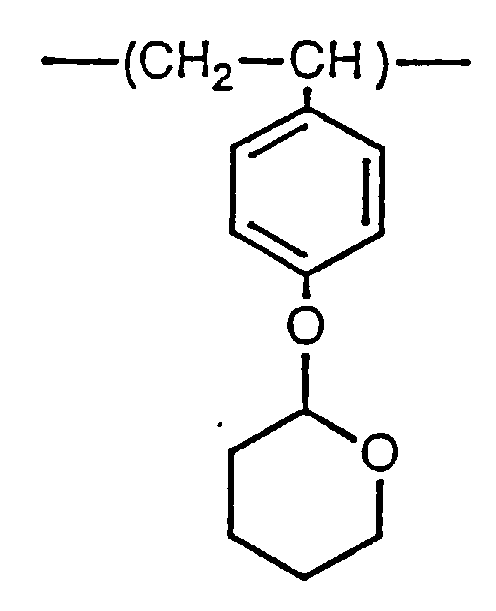
- tetrahydropyranyloxystyrene homopolymer consisting of the repeating units represented by the following structural formula (1) , which has a narrow dispersion, as hereinbelow defined, of molecular weight, and a method of manufacturing said homopolymer:
- the molecular weight distribution of the tetrahydropyranyloxystyrene homopolymer obtained is narrow, and as the molecular weight can be controlled to any desired value, the polymer can be expected to provide higher resolution than conventional polymers when used as a photosensitive material for resists.
- the molecular weight distribution of the tetrahydropyranyloxystyrene homopolymer of this invention, having repeating units represented by the structural formula (1), is a narrow dispersion wherein the ratio of weight average molecular weight Mw to number average molecular weight Mn, Mw/Mn, is within the range of (1.03 - 1.50).
- the weight average molecular weight Mw can easily be calculated from the weight of monomer used and the molarity (the number of molecules) of an initiator used.
- Mn number average molecular weight
- IR infrared absorption
- 1 H-NMR 1 H-NMR
- the tetrahydropyranyloxystyrene homopolymer of this invention can be manufactured by anionic polymerization of a tetrahydropyranyloxystyrene represented by the following structural formula (2):
- the tetrahydropyranyloxystyrene When the tetrahydropyranyloxystyrene is polymerized, it can be given a narrow dispersion of molecular weight by using any of the living anionic initiators known in the art, organometal compounds being particularly preferred.
- the tetrahydropyranyloxystyrene homopolymer having a narrow dispersion of molecular weight according to this invention is then normally obtained as a living polymer.
- the aforesaid organometal compound may be an organoalkali metal such as n-butyl lithium, sec-butyl lithium, naphthyl sodium, naphthyl potassium, anthryl sodium, disodium ⁇ -methylstyrene tetramer, cumyl potassium and cumyl cesium.
- organoalkali metal such as n-butyl lithium, sec-butyl lithium, naphthyl sodium, naphthyl potassium, anthryl sodium, disodium ⁇ -methylstyrene tetramer, cumyl potassium and cumyl cesium.
- Organic solvents that can be used herein include aromatic hydrocarbons, cyclic ethers and aliphatic hydrocarbons (with specific examples including benzene, toluene, tetrahydrofuran, dioxane, tetrahydropyran, dimethoxyethane, n-hexane and cyclohexane) and mixtures of these solvents, but tetrahydrofuran is particularly preferable.
- the concentration of monomer used in the polymerization is 1 - 30 wt%, and the reaction is carried out with stirring under high vacuum or in an atmosphere of an inert gas Such as argon or nitrogen.
- the reaction temperature can be set to any temperature from -78°C to the boiling point of the solvent used. However when tetrahydrofuran is used as solvent the temperature preferably lies in the range - 78°C - 0°C, while when benzene is used it is preferably room temperature.
- the polymerization reaction is carried out during a period of approx. 10 minutes - 5 hours.
- a polymerization terminator such as methanol, water or methyl bromide is added to the reaction system to stop the reaction. In this way, a tetrahydropyranyloxystyrene homopolymer having a desired molecular weight can be obtained.
- the reaction mixture can then be precipitated with, for example, methanol, and the product washed and dried to purify and separate it.
- the polymer thus manufactured is a polymer with residual polymerizing terminal sites which can easily be verified by the 1H-NMR spectrum.
- the tetrahydropyranyloxystyrene obtained had a boiling point of 120°C at 0.1 mm Hg.
- This tetrahydropyranyloxystyrene monomer was then treated with CaH 2 , distilled, and purified by sodium benzophenonate to remove water and other impurities, and used for polymerization.
Landscapes
- Physics & Mathematics (AREA)
- Chemical & Material Sciences (AREA)
- Spectroscopy & Molecular Physics (AREA)
- General Physics & Mathematics (AREA)
- Health & Medical Sciences (AREA)
- Chemical Kinetics & Catalysis (AREA)
- Medicinal Chemistry (AREA)
- Polymers & Plastics (AREA)
- Organic Chemistry (AREA)
- Addition Polymer Or Copolymer, Post-Treatments, Or Chemical Modifications (AREA)
Claims (15)
- Tetrahydropyranyloxystyrenhomopolymer mit einem Gewichtsverhältnis des Durchschnittsmolekulargewichts Mw zum Zahlenmittelmolekulargewicht Mn, Mw/Mn im Bereich zwischen 1,03 und 1,50 und bestehend aus sich wiederholenden Einheiten, wie sie durch die nachfolgende Strukturformel (1) wiedergegeben sind:
- Tetrahydropyranyloxystyrenhomopolymer nach Anspruch 1, welches eine lebendes Polymer ist.
- Verfahren zur Herstellung eines Tetrahydropyranyloxystyrenhomopolymers, welches eine anjonische Living-Polymerisation eines Tetrahydropyranyloxystyrens einschließt, wie es durch die folgende Strukturformel (2) wiedergegeben ist:

- Verfahren nach Anspruch 3, welches einen lebenden anjonischen Initiator für die genannte anjonische Living-Polymerisation verwendet.
- Verfahren nach Anspruch 4, bei welchem der genannte lebende anjonische Initiator eine Organometallverbindung ist.
- Verfahren nach Anspruch 5, bei dem die genannte Organometallverbindung ein Organoalkalimetall ist.
- Verfahren nach Anspruch 6, bei welchem das genannte Organoalkalimetall wenigstens eines ist, das ausgewählt ist aus n-Butyllithium, sec-Butyllithium, Naphtylnatrium, Naphtylkalium, Anthrylnatrium, Disodium α-Methylstyrentetramer, Cumylkalium oder Cumylcesium.
- Verfahren nach Anspruch 3, bei welchem die genannte anjonische Living-Polymerisation in einem organischen Lösungsmittel ausgeführt wird.
- Verfahren nach Anspruch 8, bei welchem das organische Lösungsmittel wenigstens ein Lösungsmittel ist, das ausgewählt wurde unter aromatischen Kohlenwasserstoffen, zyklischen Ethern oder aliphatischen Kohlenwasserstoffen.
- Verfahren nach Anspruch 9, bei welchem das Lösungsmittel ausgewählt wurde unter Benzol, Toluol, Tetrahydrofuran, Dioxan, Tetrahydropyran, Dimethoxaethan, n-Hexan und Cyclohexan.
- Verfahren nach Anspruch 10, bei welchem das Lösungsmittel Tetrahydrofuran ist.
- Verfahren nach Anspruch 11, bei welchem die Reaktionstemperatur im Bereich von -78°C bis 0°C liegt.
- Verfahren nach Anspruch 10, bei welchem das ausgewählte Lösungsmittel Benzol ist und die anjonische Living-Polymerisation bei Raumtemperatur durchgeführt wird.
- Verfahren nach einem der Ansprüche 3 bis 13, bei welchem die Reaktions unter Hochvakuumbedingungen oder in einerAtmosphäre eines inerten Gases ausgeführt wird.
- Verfahren nach einem der Ansprüche 3 bis 14, welches darüber hinaus den Schritt des Stoppens der Polymerisationsreaktion durch Zufügen eines Polymerisationsbeendigers zum Reaktionssystem zu dem Zeitpunkt umfaßt, wenn das gebildete Polymer das gewünschte Molekulargewicht erreicht.
Applications Claiming Priority (2)
| Application Number | Priority Date | Filing Date | Title |
|---|---|---|---|
| JP1389891A JPH04306204A (ja) | 1991-01-11 | 1991-01-11 | ポリ(テトラヒドロピラニルオキシスチレン)及びその製造方法 |
| JP13898/91 | 1991-01-11 |
Publications (2)
| Publication Number | Publication Date |
|---|---|
| EP0494792A1 EP0494792A1 (de) | 1992-07-15 |
| EP0494792B1 true EP0494792B1 (de) | 1996-12-04 |
Family
ID=11845990
Family Applications (1)
| Application Number | Title | Priority Date | Filing Date |
|---|---|---|---|
| EP19920300222 Expired - Lifetime EP0494792B1 (de) | 1991-01-11 | 1992-01-10 | Tetrahydropyranyloxystyrol Homopolymer und Verfahren zu seiner Herstellung |
Country Status (3)
| Country | Link |
|---|---|
| EP (1) | EP0494792B1 (de) |
| JP (1) | JPH04306204A (de) |
| DE (1) | DE69215546T2 (de) |
Families Citing this family (3)
| Publication number | Priority date | Publication date | Assignee | Title |
|---|---|---|---|---|
| EP0723201A1 (de) * | 1995-01-20 | 1996-07-24 | Ocg Microelectronic Materials, Inc. | Phenolharze mit säurelabilen Schutzgruppen |
| KR100220951B1 (ko) * | 1996-12-20 | 1999-09-15 | 김영환 | 비닐 4-테트라히드로피라닐옥시벤잘-비닐 4-히드록시벤잘-비닐 테트라히드로피라닐에테르-비닐 아세테이트 공중합체, 비닐 4-테트라히드로피라닐옥시벤잘-비닐 테트라히드로피라닐에테르-비닐 아세테이트 공중합체 및 그들의 제조방법 |
| US9587136B2 (en) | 2013-10-08 | 2017-03-07 | Wisconsin Alumni Research Foundation | Block copolymers with high Flory-Huggins interaction parameters for block copolymer lithography |
Family Cites Families (2)
| Publication number | Priority date | Publication date | Assignee | Title |
|---|---|---|---|---|
| DE3817012A1 (de) * | 1988-05-19 | 1989-11-30 | Basf Ag | Positiv und negativ arbeitende strahlungsempfindliche gemische sowie verfahren zur herstellung von reliefmustern |
| DE4005212A1 (de) * | 1990-02-20 | 1991-08-22 | Basf Ag | Strahlungsempfindliches gemisch |
-
1991
- 1991-01-11 JP JP1389891A patent/JPH04306204A/ja active Pending
-
1992
- 1992-01-10 EP EP19920300222 patent/EP0494792B1/de not_active Expired - Lifetime
- 1992-01-10 DE DE1992615546 patent/DE69215546T2/de not_active Expired - Fee Related
Also Published As
| Publication number | Publication date |
|---|---|
| DE69215546D1 (de) | 1997-01-16 |
| EP0494792A1 (de) | 1992-07-15 |
| JPH04306204A (ja) | 1992-10-29 |
| DE69215546T2 (de) | 1997-06-19 |
Similar Documents
| Publication | Publication Date | Title |
|---|---|---|
| JPH0665333A (ja) | 単分散性共重合体及びその製造方法 | |
| EP0517428B1 (de) | Poly(para-t-butyloxycarbonyl-oxystyrol) und Verfahren zu seiner Herstellung | |
| EP0494791B1 (de) | P-Vinylphenoxydimethylphenyl-Carbyldimethylsilan Homopolymer und Verfahren zu seiner Herstellung | |
| EP0494792A1 (de) | Tetrahydropyranyloxystyrol Homopolymer und Verfahren zu seiner Herstellung | |
| JPH0672173B2 (ja) | グラフト重合体およびその製造方法 | |
| US4731424A (en) | Process for producing polymer compound containing alkenylsilyl group | |
| US5412050A (en) | Polymer having a narrow dispersion of molecular weight and a manufacturing process thereof | |
| JPH03277608A (ja) | P―アルケニルフェノール系重合体の製造方法 | |
| JPH0641221A (ja) | ポリ(3−メチル−4−ヒドロキシスチレン)及びその製造方法 | |
| US4758640A (en) | Vinylsilyl group-containing monodisperse polymeric compound and a method for the preparation thereof | |
| JP3342111B2 (ja) | 官能化された樹脂を製造する方法 | |
| JP2575958B2 (ja) | ポリヒドロキシスチレンの製造方法 | |
| JPH0641222A (ja) | ポリ(m−ヒドロキシスチレン)及びその製造方法 | |
| JPH0632818A (ja) | ポリ(p−ヒドロキシスチレン)の製造方法 | |
| JPH0632837A (ja) | ポリ(m−t−ブトキシスチレン)及びその製造方法 | |
| JPH0632819A (ja) | ポリ(p−ヒドロキシ−α−メチルスチレン)の製造方法 | |
| JPH0665324A (ja) | 単分散性共重合体及びその製造方法 | |
| JPH075649B2 (ja) | アニオン重合方法 | |
| JPH05271332A (ja) | アミノ基を有するスチレン系ポリマーの製造法 | |
| JPH0665325A (ja) | 単分散性共重合体の製造方法 | |
| JPH05148324A (ja) | 共重合体及びその製造方法 | |
| JPH0641244A (ja) | 単分散性共重合体及びその製造方法 | |
| JPH051115A (ja) | ポリヒドロキシスチレンの製造方法 | |
| JPH0641243A (ja) | 単分散性共重合体及びその製造方法 | |
| JPH0641245A (ja) | 単分散性共重合体及びその製造方法 |
Legal Events
| Date | Code | Title | Description |
|---|---|---|---|
| PUAI | Public reference made under article 153(3) epc to a published international application that has entered the european phase |
Free format text: ORIGINAL CODE: 0009012 |
|
| AK | Designated contracting states |
Kind code of ref document: A1 Designated state(s): DE FR GB |
|
| 17P | Request for examination filed |
Effective date: 19921102 |
|
| 17Q | First examination report despatched |
Effective date: 19941216 |
|
| GRAG | Despatch of communication of intention to grant |
Free format text: ORIGINAL CODE: EPIDOS AGRA |
|
| GRAH | Despatch of communication of intention to grant a patent |
Free format text: ORIGINAL CODE: EPIDOS IGRA |
|
| GRAH | Despatch of communication of intention to grant a patent |
Free format text: ORIGINAL CODE: EPIDOS IGRA |
|
| GRAA | (expected) grant |
Free format text: ORIGINAL CODE: 0009210 |
|
| AK | Designated contracting states |
Kind code of ref document: B1 Designated state(s): DE FR GB |
|
| ET | Fr: translation filed | ||
| PGFP | Annual fee paid to national office [announced via postgrant information from national office to epo] |
Ref country code: GB Payment date: 19970102 Year of fee payment: 6 |
|
| REF | Corresponds to: |
Ref document number: 69215546 Country of ref document: DE Date of ref document: 19970116 |
|
| PGFP | Annual fee paid to national office [announced via postgrant information from national office to epo] |
Ref country code: FR Payment date: 19970130 Year of fee payment: 6 |
|
| PGFP | Annual fee paid to national office [announced via postgrant information from national office to epo] |
Ref country code: DE Payment date: 19970227 Year of fee payment: 6 |
|
| PLBE | No opposition filed within time limit |
Free format text: ORIGINAL CODE: 0009261 |
|
| 26N | No opposition filed | ||
| PG25 | Lapsed in a contracting state [announced via postgrant information from national office to epo] |
Ref country code: GB Free format text: LAPSE BECAUSE OF NON-PAYMENT OF DUE FEES Effective date: 19980110 |
|
| PG25 | Lapsed in a contracting state [announced via postgrant information from national office to epo] |
Ref country code: FR Free format text: THE PATENT HAS BEEN ANNULLED BY A DECISION OF A NATIONAL AUTHORITY Effective date: 19980131 |
|
| GBPC | Gb: european patent ceased through non-payment of renewal fee |
Effective date: 19980110 |
|
| PG25 | Lapsed in a contracting state [announced via postgrant information from national office to epo] |
Ref country code: DE Free format text: LAPSE BECAUSE OF NON-PAYMENT OF DUE FEES Effective date: 19981001 |
|
| REG | Reference to a national code |
Ref country code: FR Ref legal event code: ST |