EP0380712B1 - Verfahren zur Herstellung von 2,6-Dichlordiphenylaminessigsäurederivaten - Google Patents
Verfahren zur Herstellung von 2,6-Dichlordiphenylaminessigsäurederivaten Download PDFInfo
- Publication number
- EP0380712B1 EP0380712B1 EP89101437A EP89101437A EP0380712B1 EP 0380712 B1 EP0380712 B1 EP 0380712B1 EP 89101437 A EP89101437 A EP 89101437A EP 89101437 A EP89101437 A EP 89101437A EP 0380712 B1 EP0380712 B1 EP 0380712B1
- Authority
- EP
- European Patent Office
- Prior art keywords
- formula
- compound
- reaction
- preparation
- process according
- Prior art date
- Legal status (The legal status is an assumption and is not a legal conclusion. Google has not performed a legal analysis and makes no representation as to the accuracy of the status listed.)
- Expired - Lifetime
Links
- 238000000034 method Methods 0.000 title claims abstract description 31
- 238000002360 preparation method Methods 0.000 title claims abstract description 10
- 239000002253 acid Substances 0.000 title 1
- 150000001875 compounds Chemical class 0.000 claims description 46
- 238000006243 chemical reaction Methods 0.000 claims description 12
- ZMXDDKWLCZADIW-UHFFFAOYSA-N N,N-Dimethylformamide Chemical compound CN(C)C=O ZMXDDKWLCZADIW-UHFFFAOYSA-N 0.000 claims description 10
- LFQSCWFLJHTTHZ-UHFFFAOYSA-N Ethanol Chemical compound CCO LFQSCWFLJHTTHZ-UHFFFAOYSA-N 0.000 claims description 9
- PAYRUJLWNCNPSJ-UHFFFAOYSA-N Aniline Chemical compound NC1=CC=CC=C1 PAYRUJLWNCNPSJ-UHFFFAOYSA-N 0.000 claims description 8
- 125000004435 hydrogen atom Chemical group [H]* 0.000 claims description 7
- RFFLAFLAYFXFSW-UHFFFAOYSA-N 1,2-dichlorobenzene Chemical compound ClC1=CC=CC=C1Cl RFFLAFLAYFXFSW-UHFFFAOYSA-N 0.000 claims description 6
- 230000003197 catalytic effect Effects 0.000 claims description 6
- VGCXGMAHQTYDJK-UHFFFAOYSA-N Chloroacetyl chloride Chemical compound ClCC(Cl)=O VGCXGMAHQTYDJK-UHFFFAOYSA-N 0.000 claims description 5
- 239000003513 alkali Substances 0.000 claims description 5
- AULKDLUOQCUNOK-UHFFFAOYSA-N 3,5-dichloro-4-hydroxybenzoic acid Chemical compound OC(=O)C1=CC(Cl)=C(O)C(Cl)=C1 AULKDLUOQCUNOK-UHFFFAOYSA-N 0.000 claims description 4
- 238000005580 one pot reaction Methods 0.000 claims description 4
- 239000002904 solvent Substances 0.000 claims description 4
- 125000004169 (C1-C6) alkyl group Chemical group 0.000 claims description 3
- KHZWIIFEFQBNKL-UHFFFAOYSA-N 2-(2,6-dichlorophenoxy)acetic acid Chemical class OC(=O)COC1=C(Cl)C=CC=C1Cl KHZWIIFEFQBNKL-UHFFFAOYSA-N 0.000 claims description 3
- 238000005904 alkaline hydrolysis reaction Methods 0.000 claims description 3
- 238000007098 aminolysis reaction Methods 0.000 claims description 3
- HOPRXXXSABQWAV-UHFFFAOYSA-N anhydrous collidine Natural products CC1=CC=NC(C)=C1C HOPRXXXSABQWAV-UHFFFAOYSA-N 0.000 claims description 3
- UTBIMNXEDGNJFE-UHFFFAOYSA-N collidine Natural products CC1=CC=C(C)C(C)=N1 UTBIMNXEDGNJFE-UHFFFAOYSA-N 0.000 claims description 3
- 238000006114 decarboxylation reaction Methods 0.000 claims description 3
- 238000011065 in-situ storage Methods 0.000 claims description 3
- GFYHSKONPJXCDE-UHFFFAOYSA-N sym-collidine Natural products CC1=CN=C(C)C(C)=C1 GFYHSKONPJXCDE-UHFFFAOYSA-N 0.000 claims description 3
- FXHOOIRPVKKKFG-UHFFFAOYSA-N N,N-Dimethylacetamide Chemical compound CN(C)C(C)=O FXHOOIRPVKKKFG-UHFFFAOYSA-N 0.000 claims description 2
- 125000004429 atom Chemical group 0.000 claims description 2
- FOCAUTSVDIKZOP-UHFFFAOYSA-N chloroacetic acid Chemical class OC(=O)CCl FOCAUTSVDIKZOP-UHFFFAOYSA-N 0.000 claims description 2
- HDUUZPLYVVQTKN-UHFFFAOYSA-N 2,6-dichloro-n-phenylaniline Chemical class ClC1=CC=CC(Cl)=C1NC1=CC=CC=C1 HDUUZPLYVVQTKN-UHFFFAOYSA-N 0.000 abstract description 4
- 239000013543 active substance Substances 0.000 abstract 1
- LRHPLDYGYMQRHN-UHFFFAOYSA-N N-Butanol Chemical compound CCCCO LRHPLDYGYMQRHN-UHFFFAOYSA-N 0.000 description 10
- 0 Cc1cccc(C*)c1O* Chemical compound Cc1cccc(C*)c1O* 0.000 description 7
- 239000000203 mixture Substances 0.000 description 7
- KFZMGEQAYNKOFK-UHFFFAOYSA-N Isopropanol Chemical compound CC(C)O KFZMGEQAYNKOFK-UHFFFAOYSA-N 0.000 description 6
- OKKJLVBELUTLKV-UHFFFAOYSA-N Methanol Chemical compound OC OKKJLVBELUTLKV-UHFFFAOYSA-N 0.000 description 6
- HEMHJVSKTPXQMS-UHFFFAOYSA-M Sodium hydroxide Chemical compound [OH-].[Na+] HEMHJVSKTPXQMS-UHFFFAOYSA-M 0.000 description 6
- XLYOFNOQVPJJNP-UHFFFAOYSA-N water Substances O XLYOFNOQVPJJNP-UHFFFAOYSA-N 0.000 description 6
- 239000000047 product Substances 0.000 description 5
- WQDUMFSSJAZKTM-UHFFFAOYSA-N Sodium methoxide Chemical compound [Na+].[O-]C WQDUMFSSJAZKTM-UHFFFAOYSA-N 0.000 description 4
- VSCWAEJMTAWNJL-UHFFFAOYSA-K aluminium trichloride Chemical compound Cl[Al](Cl)Cl VSCWAEJMTAWNJL-UHFFFAOYSA-K 0.000 description 4
- 239000000126 substance Substances 0.000 description 4
- JCICIFOYVSPMHG-UHFFFAOYSA-N 1-(2,6-dichlorophenyl)-3h-indol-2-one Chemical compound ClC1=CC=CC(Cl)=C1N1C2=CC=CC=C2CC1=O JCICIFOYVSPMHG-UHFFFAOYSA-N 0.000 description 3
- -1 2,6-dichlorophenyl Chemical group 0.000 description 3
- XEKOWRVHYACXOJ-UHFFFAOYSA-N Ethyl acetate Chemical compound CCOC(C)=O XEKOWRVHYACXOJ-UHFFFAOYSA-N 0.000 description 3
- YXFVVABEGXRONW-UHFFFAOYSA-N Toluene Chemical compound CC1=CC=CC=C1 YXFVVABEGXRONW-UHFFFAOYSA-N 0.000 description 3
- 229960001193 diclofenac sodium Drugs 0.000 description 3
- 238000010438 heat treatment Methods 0.000 description 3
- 238000002955 isolation Methods 0.000 description 3
- BWHMMNNQKKPAPP-UHFFFAOYSA-L potassium carbonate Chemical compound [K+].[K+].[O-]C([O-])=O BWHMMNNQKKPAPP-UHFFFAOYSA-L 0.000 description 3
- BDERNNFJNOPAEC-UHFFFAOYSA-N propan-1-ol Chemical compound CCCO BDERNNFJNOPAEC-UHFFFAOYSA-N 0.000 description 3
- JGMJQSFLQWGYMQ-UHFFFAOYSA-M sodium;2,6-dichloro-n-phenylaniline;acetate Chemical compound [Na+].CC([O-])=O.ClC1=CC=CC(Cl)=C1NC1=CC=CC=C1 JGMJQSFLQWGYMQ-UHFFFAOYSA-M 0.000 description 3
- JDMFXJULNGEPOI-UHFFFAOYSA-N 2,6-dichloroaniline Chemical compound NC1=C(Cl)C=CC=C1Cl JDMFXJULNGEPOI-UHFFFAOYSA-N 0.000 description 2
- VONWPEXRCLHKRJ-UHFFFAOYSA-N 2-chloro-n-phenylacetamide Chemical compound ClCC(=O)NC1=CC=CC=C1 VONWPEXRCLHKRJ-UHFFFAOYSA-N 0.000 description 2
- VHYFNPMBLIVWCW-UHFFFAOYSA-N 4-Dimethylaminopyridine Chemical compound CN(C)C1=CC=NC=C1 VHYFNPMBLIVWCW-UHFFFAOYSA-N 0.000 description 2
- QARVLSVVCXYDNA-UHFFFAOYSA-N bromobenzene Chemical compound BrC1=CC=CC=C1 QARVLSVVCXYDNA-UHFFFAOYSA-N 0.000 description 2
- MVPPADPHJFYWMZ-UHFFFAOYSA-N chlorobenzene Chemical compound ClC1=CC=CC=C1 MVPPADPHJFYWMZ-UHFFFAOYSA-N 0.000 description 2
- 150000002148 esters Chemical class 0.000 description 2
- JYGFTBXVXVMTGB-UHFFFAOYSA-N indolin-2-one Chemical compound C1=CC=C2NC(=O)CC2=C1 JYGFTBXVXVMTGB-UHFFFAOYSA-N 0.000 description 2
- 239000012442 inert solvent Substances 0.000 description 2
- ZXEKIIBDNHEJCQ-UHFFFAOYSA-N isobutanol Chemical compound CC(C)CO ZXEKIIBDNHEJCQ-UHFFFAOYSA-N 0.000 description 2
- 238000004519 manufacturing process Methods 0.000 description 2
- 238000005191 phase separation Methods 0.000 description 2
- 239000012429 reaction media Substances 0.000 description 2
- 239000011541 reaction mixture Substances 0.000 description 2
- 230000035484 reaction time Effects 0.000 description 2
- 230000008707 rearrangement Effects 0.000 description 2
- 239000007787 solid Substances 0.000 description 2
- HOLHYSJJBXSLMV-UHFFFAOYSA-N 2,6-dichlorophenol Chemical compound OC1=C(Cl)C=CC=C1Cl HOLHYSJJBXSLMV-UHFFFAOYSA-N 0.000 description 1
- DWXSYDKEWORWBT-UHFFFAOYSA-N 2-(2-bromophenyl)acetic acid Chemical compound OC(=O)CC1=CC=CC=C1Br DWXSYDKEWORWBT-UHFFFAOYSA-N 0.000 description 1
- IUJAAIZKRJJZGQ-UHFFFAOYSA-N 2-(2-chlorophenyl)acetic acid Chemical compound OC(=O)CC1=CC=CC=C1Cl IUJAAIZKRJJZGQ-UHFFFAOYSA-N 0.000 description 1
- CNJGWCQEGROXEE-UHFFFAOYSA-N 3,5-Dichlorosalicylicacid Chemical compound OC(=O)C1=CC(Cl)=CC(Cl)=C1O CNJGWCQEGROXEE-UHFFFAOYSA-N 0.000 description 1
- WKSKHBFEWVRZEZ-UHFFFAOYSA-N CC(N(c1ccccc1)c(c(Cl)ccc1)c1Cl)=O Chemical compound CC(N(c1ccccc1)c(c(Cl)ccc1)c1Cl)=O WKSKHBFEWVRZEZ-UHFFFAOYSA-N 0.000 description 1
- XBJADZKTEUBHBI-UHFFFAOYSA-N Cc(cccc1)c1Nc1c(C)cccc1C Chemical compound Cc(cccc1)c1Nc1c(C)cccc1C XBJADZKTEUBHBI-UHFFFAOYSA-N 0.000 description 1
- UMVOQQDNEYOJOK-UHFFFAOYSA-N Cc1cc(C(O)=O)cc(C)c1 Chemical compound Cc1cc(C(O)=O)cc(C)c1 UMVOQQDNEYOJOK-UHFFFAOYSA-N 0.000 description 1
- 238000006816 Chapman rearrangement reaction Methods 0.000 description 1
- VEXZGXHMUGYJMC-UHFFFAOYSA-N Hydrochloric acid Chemical compound Cl VEXZGXHMUGYJMC-UHFFFAOYSA-N 0.000 description 1
- UFHFLCQGNIYNRP-UHFFFAOYSA-N Hydrogen Chemical compound [H][H] UFHFLCQGNIYNRP-UHFFFAOYSA-N 0.000 description 1
- 206010022998 Irritability Diseases 0.000 description 1
- CTQNGGLPUBDAKN-UHFFFAOYSA-N O-Xylene Chemical compound CC1=CC=CC=C1C CTQNGGLPUBDAKN-UHFFFAOYSA-N 0.000 description 1
- KWYUFKZDYYNOTN-UHFFFAOYSA-M Potassium hydroxide Chemical compound [OH-].[K+] KWYUFKZDYYNOTN-UHFFFAOYSA-M 0.000 description 1
- 208000025747 Rheumatic disease Diseases 0.000 description 1
- FFPBZKBPQXTOSC-UHFFFAOYSA-N acetic acid;n-phenylaniline Chemical class CC(O)=O.C=1C=CC=CC=1NC1=CC=CC=C1 FFPBZKBPQXTOSC-UHFFFAOYSA-N 0.000 description 1
- 239000004480 active ingredient Substances 0.000 description 1
- 229910052783 alkali metal Inorganic materials 0.000 description 1
- 150000001340 alkali metals Chemical class 0.000 description 1
- 125000000217 alkyl group Chemical group 0.000 description 1
- YCOXTKKNXUZSKD-UHFFFAOYSA-N as-o-xylenol Natural products CC1=CC=C(O)C=C1C YCOXTKKNXUZSKD-UHFFFAOYSA-N 0.000 description 1
- 239000002585 base Substances 0.000 description 1
- 238000006555 catalytic reaction Methods 0.000 description 1
- 238000002425 crystallisation Methods 0.000 description 1
- 230000008025 crystallization Effects 0.000 description 1
- DMBHHRLKUKUOEG-UHFFFAOYSA-N diphenylamine Chemical class C=1C=CC=CC=1NC1=CC=CC=C1 DMBHHRLKUKUOEG-UHFFFAOYSA-N 0.000 description 1
- 238000004821 distillation Methods 0.000 description 1
- 230000000694 effects Effects 0.000 description 1
- NLFBCYMMUAKCPC-KQQUZDAGSA-N ethyl (e)-3-[3-amino-2-cyano-1-[(e)-3-ethoxy-3-oxoprop-1-enyl]sulfanyl-3-oxoprop-1-enyl]sulfanylprop-2-enoate Chemical compound CCOC(=O)\C=C\SC(=C(C#N)C(N)=O)S\C=C\C(=O)OCC NLFBCYMMUAKCPC-KQQUZDAGSA-N 0.000 description 1
- OKNYKYRPQGNADZ-UHFFFAOYSA-N ethyl 2-(2,6-dichlorophenoxy)acetate Chemical compound CCOC(=O)COC1=C(Cl)C=CC=C1Cl OKNYKYRPQGNADZ-UHFFFAOYSA-N 0.000 description 1
- VEUUMBGHMNQHGO-UHFFFAOYSA-N ethyl chloroacetate Chemical compound CCOC(=O)CCl VEUUMBGHMNQHGO-UHFFFAOYSA-N 0.000 description 1
- 238000000605 extraction Methods 0.000 description 1
- 239000007789 gas Substances 0.000 description 1
- GNOIPBMMFNIUFM-UHFFFAOYSA-N hexamethylphosphoric triamide Chemical compound CN(C)P(=O)(N(C)C)N(C)C GNOIPBMMFNIUFM-UHFFFAOYSA-N 0.000 description 1
- 239000001257 hydrogen Substances 0.000 description 1
- 229910052739 hydrogen Inorganic materials 0.000 description 1
- IXCSERBJSXMMFS-UHFFFAOYSA-N hydrogen chloride Substances Cl.Cl IXCSERBJSXMMFS-UHFFFAOYSA-N 0.000 description 1
- 229910000041 hydrogen chloride Inorganic materials 0.000 description 1
- 239000005457 ice water Substances 0.000 description 1
- 239000013067 intermediate product Substances 0.000 description 1
- 238000003402 intramolecular cyclocondensation reaction Methods 0.000 description 1
- 150000002497 iodine compounds Chemical class 0.000 description 1
- SNHMUERNLJLMHN-UHFFFAOYSA-N iodobenzene Chemical compound IC1=CC=CC=C1 SNHMUERNLJLMHN-UHFFFAOYSA-N 0.000 description 1
- 239000012452 mother liquor Substances 0.000 description 1
- DWVWVSLAIJHBBG-UHFFFAOYSA-N n-(2,6-dichlorophenyl)acetamide Chemical compound CC(=O)NC1=C(Cl)C=CC=C1Cl DWVWVSLAIJHBBG-UHFFFAOYSA-N 0.000 description 1
- 239000012074 organic phase Substances 0.000 description 1
- 239000012071 phase Substances 0.000 description 1
- 229940072033 potash Drugs 0.000 description 1
- 235000015320 potassium carbonate Nutrition 0.000 description 1
- 229910000027 potassium carbonate Inorganic materials 0.000 description 1
- 235000011181 potassium carbonates Nutrition 0.000 description 1
- 238000004886 process control Methods 0.000 description 1
- 239000002994 raw material Substances 0.000 description 1
- 238000010992 reflux Methods 0.000 description 1
- 150000003839 salts Chemical class 0.000 description 1
- 229910052708 sodium Inorganic materials 0.000 description 1
- 125000004436 sodium atom Chemical group 0.000 description 1
- 159000000000 sodium salts Chemical class 0.000 description 1
- 239000007858 starting material Substances 0.000 description 1
- LMBFAGIMSUYTBN-MPZNNTNKSA-N teixobactin Chemical compound C([C@H](C(=O)N[C@@H]([C@@H](C)CC)C(=O)N[C@@H](CO)C(=O)N[C@H](CCC(N)=O)C(=O)N[C@H]([C@@H](C)CC)C(=O)N[C@@H]([C@@H](C)CC)C(=O)N[C@@H](CO)C(=O)N[C@H]1C(N[C@@H](C)C(=O)N[C@@H](C[C@@H]2NC(=N)NC2)C(=O)N[C@H](C(=O)O[C@H]1C)[C@@H](C)CC)=O)NC)C1=CC=CC=C1 LMBFAGIMSUYTBN-MPZNNTNKSA-N 0.000 description 1
- 238000002560 therapeutic procedure Methods 0.000 description 1
- 231100000331 toxic Toxicity 0.000 description 1
- 230000002588 toxic effect Effects 0.000 description 1
- 239000008096 xylene Substances 0.000 description 1
Classifications
-
- C—CHEMISTRY; METALLURGY
- C07—ORGANIC CHEMISTRY
- C07C—ACYCLIC OR CARBOCYCLIC COMPOUNDS
- C07C227/00—Preparation of compounds containing amino and carboxyl groups bound to the same carbon skeleton
- C07C227/22—Preparation of compounds containing amino and carboxyl groups bound to the same carbon skeleton from lactams, cyclic ketones or cyclic oximes, e.g. by reactions involving Beckmann rearrangement
-
- C—CHEMISTRY; METALLURGY
- C07—ORGANIC CHEMISTRY
- C07C—ACYCLIC OR CARBOCYCLIC COMPOUNDS
- C07C227/00—Preparation of compounds containing amino and carboxyl groups bound to the same carbon skeleton
- C07C227/14—Preparation of compounds containing amino and carboxyl groups bound to the same carbon skeleton from compounds containing already amino and carboxyl groups or derivatives thereof
- C07C227/18—Preparation of compounds containing amino and carboxyl groups bound to the same carbon skeleton from compounds containing already amino and carboxyl groups or derivatives thereof by reactions involving amino or carboxyl groups, e.g. hydrolysis of esters or amides, by formation of halides, salts or esters
-
- C—CHEMISTRY; METALLURGY
- C07—ORGANIC CHEMISTRY
- C07C—ACYCLIC OR CARBOCYCLIC COMPOUNDS
- C07C229/00—Compounds containing amino and carboxyl groups bound to the same carbon skeleton
- C07C229/40—Compounds containing amino and carboxyl groups bound to the same carbon skeleton having amino groups bound to carbon atoms of at least one six-membered aromatic ring and carboxyl groups bound to acyclic carbon atoms of the same carbon skeleton
- C07C229/42—Compounds containing amino and carboxyl groups bound to the same carbon skeleton having amino groups bound to carbon atoms of at least one six-membered aromatic ring and carboxyl groups bound to acyclic carbon atoms of the same carbon skeleton with carboxyl groups linked to the six-membered aromatic ring, or to the condensed ring system containing that ring, by saturated carbon chains
Definitions
- diphenylamine derivative of the formula V for example, a process is already known which starts from 2,6-dichloroacetanilide and bromobenzene and requires long reaction times, for example 96 h (cf. DC Atkins et al., J.Med.Chem. 26 , 1361 (1983); CH-PS-473 770 and US-PS-3 536 758). Another method is based on iodobenzene. However, there are no indications of the yield of this process (cf. JP-OS 57 167 947 and CA 98 , 53 379 K (1983)).
- JP-OS-58 144 350 describes the Chapman rearrangement of the N-phenyl-o- (2,6-dichlorophenyl) benzimido ester at 275 ° C. as an alternative to the preparation of compound V.
- the object of the invention is to provide a process for the preparation of the compound of the formula I which, in a technically simple and feasible manner, provides the desired substance in very good purity and good yield from readily accessible raw materials, without the extreme reaction conditions of the known Procedures must be used to produce the sterically demanding molecule of formula V.
- the invention therefore relates to a process for the preparation of 2,6-dichlorodiphenylamine derivative of the general formula I. wherein R represents a hydrogen atom, a C1 to C4 alkyl group or an alkali atom, which is characterized in that a 2,6-dichlorophenoxyacetic acid derivative of the formula II wherein R1 represents a hydrogen atom or a C1 - to C6-alkyl group and R2, R3 each represent a hydrogen atom or a C1- to C4-alkyl group, with aniline in a one-pot reaction first to the compound of formula III wherein R2 and R3 have the meanings given above, then reacted in situ to the compound of formula IV wherein R2 and R3 have the meanings given above, rearranged, the compound of formula IV obtained in the presence of catalytic to equimolar amounts of an alkali metal alcoholate to the compound of formula V.
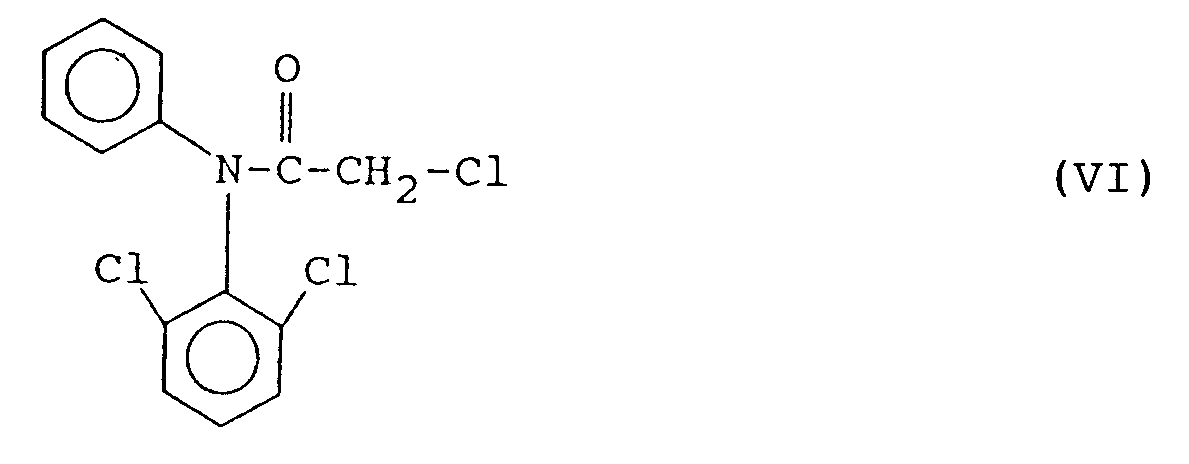
- the compound of formula V after isolation by reaction with chloroacetyl chloride in the compound of formula VI transferred the compound of formula VI to the compound of formula VII cyclized and the resulting compound of formula VII converted into the compound of formula I by alkaline hydrolysis.
- an alkali alcoholate such as sodium methoxide in an alcohol
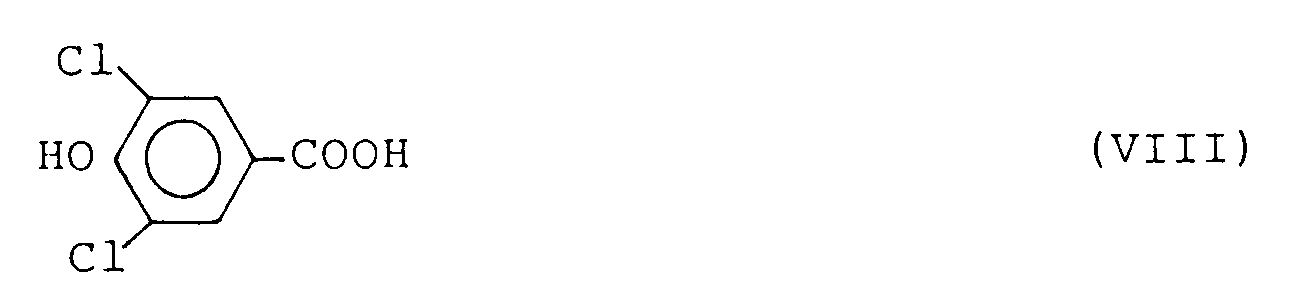
- the starting compound of formula II from 3,5-dichlorohydroxybenzoic acid of formula VIII manufactured.
- the compound of formula VIII is first subjected to a decarboxylation reaction in dimethylformamide or dimethylacetamide in the presence of catalytic amounts (for example 1/10 mol%) of collidine and at temperatures below 160 ° C., for example 156 ° C., and then immediately with a Chloroacetic acid derivative of the formula IX implemented.
- Potassium carbonate can preferably be used as the base without the ester being saponified.
- the intermediate compound of formula III can also be prepared directly from 2,6-dichlorophenol and chloroacetanilide by base-catalyzed reaction; However, because of the toxic side effect of chloroacetanilide, this process is not suitable for producing large amounts of compound III.
- the intermediate compound of the formula III obtained according to the invention is converted into the compound of the formula IV directly in situ, without isolation, at reaction temperatures of 90 ° C. to 100 ° C., for example 95 ° C. to 100 ° C. relocated.
- the rearrangement is effected by the alkali alcoholate present in the reaction medium.
- the reaction medium consists of an alcohol, for example methanol, ethanol, n-propanol, i-propanol, n-butanol or i-butanol.
- Alkaline alcoholate is effected.
- the reaction temperatures are as in the third stage of the process according to the invention.
- the 2,6-dichlorophenylamine of the formula V obtained is isolated by conventional measures and, if necessary, purified.
- the compound mentioned is obtained as a solid.
- the compound of the formula V is converted into the derivative of the formula VI by reaction with chloroacetyl chloride transferred.
- chloroacetylation is preferably carried out as aminolysis in an inert solvent, preferably xylene or chlorobenzene, and at temperatures from 90 ° C. to 120 ° C., preferably 110 ° C. to 120 ° C.
- this step is carried out in the presence of catalytic amounts, for example 1/20 mol% to 1/10 mol%, 4-dimethylaminopyridine.
- the yields of the desired compound of formula VI are almost quantitative.
- an intramolecular cyclization of the compound of the formula VI to the indolinone of the formula VII takes place
- This stage of the process according to the invention is carried out in an inert solvent, preferably o-dichlorobenzene, and at elevated temperatures, preferably 140 ° C. to 160 ° C. Yields of over 90% are achieved.
- the compound of the formula VII is converted into the sodium salt of the desired compound of the formula I by alkaline hydrolysis, preferably using sodium hydroxide solution in an alcohol as described above, in particular n-butanol.
- the reaction temperature in this stage is 90 ° C to 110 ° C, preferably 100 ° C to 110 ° C.
- the compound of formula I thus obtained can be isolated from the reaction mixture by customary measures, for example by extraction, and purified by customary procedures, for example crystallization.
- An essential feature of the present invention is that the first, second and third stages of the process are carried out as a one-pot process without isolating the intermediate compounds III and IV. In this way, on the one hand simple process control and on the other hand relatively high overall yields, for example 80% to 90% of theory. Th., Received.
- the bottom temperature is slowly increased to 155 ° C and held until no more CO2 escapes.
- a mixture of 996 g of 2,6-dichlorophenoxyacetate, 500 ml of aniline and 400 ml of n-butanol is preheated to 100 ° C. in a distillation apparatus.
Landscapes
- Chemical & Material Sciences (AREA)
- Organic Chemistry (AREA)
- Chemical Kinetics & Catalysis (AREA)
- Organic Low-Molecular-Weight Compounds And Preparation Thereof (AREA)
- Indole Compounds (AREA)
- Low-Molecular Organic Synthesis Reactions Using Catalysts (AREA)
Description
- 2,6-Dichlorsubstituierte Diphenylaminessigsäurederivate spielen eine herausragende Rolle bei der Therapie rheumatischer Erkrankungen, bei der sich vor allem Diclofenac Natrium der Formel I
(R = Natriumatom)
bewährt hat. Diese Verbindung und ihre arzneiliche Verwendung ist bereits aus der DE-A-15 43 639 bekannt. Im allgemeinen verläuft die Herstellung dieser Verbindung über ein Zwischenprodukt der Formel V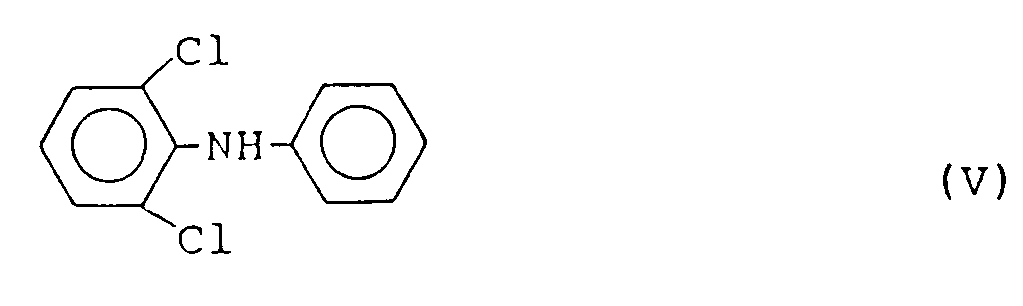
Zur Herstellung dieses Zwischenprodukts, das den zentralen Baustein des oben genannten Wirkstoffs darstellt, sind bereits verschiedene Herstellungsverfahren bekannt, deren Nachteile einerseits in der notwendigen Anwendung von langen Reaktionszeiten und von hohen Temperaturen und andererseits in der Tatsache, daß nur mäßige bis schlechte Ausbeuten erzielt werden, zu sehen sind. - So ist für das Diphenylaminderivat der Formel V bereits ein Verfahren bekannt, das von 2,6-Dichloracetanilid und Brombenzol ausgeht und lange Reaktionszeiten, z.B. 96 h, erfordert (vgl. D.C. Atkins et al., J.Med.Chem. 26, 1361 (1983) ; CH-PS-473 770 und US-PS-3 536 758). Bei einem weiteren Verfahren geht man von Jodbenzol aus. Ausbeuteangaben dieses Verfahrens fehlen allerdings (vgl. JP-OS-57 167 947 und C.A. 98, 53 379 K (1983)).
- Auch bei einem neueren Verfahren (vgl. J. S. Kaltenbronn, R.A. Scherer, Arzneim. Forsch. 33, 62 (1983)) wird die angestrebte Substanz nur mit schlechter Ausbeute erhalten. Bei dem Verfahren der DE-OS-15 43 639 beträgt die Ausbeute, wie dort angegeben, nur 43% der Theorie. Nach den Angaben der oben genannten Schriften soll das Zwischenprodukt der Formel V als gelbes Öl anfallen. Tatsächlich handelt es sich aber bei dieser Substanz um einen farblosen Feststoff (Fp. 47,5 - 48°C).
- In der JP-OS-58 144 350 wird die Chapman-Umlagerung des N-Phenyl-o-(2,6-dichlorphenyl)benzimidoesters bei 275°C als Alternative zur Darstellung der Verbindung V beschrieben.
- Zur Herstellung von Diclofenac-Natrium sind auch schon direkte Verfahren beschrieben worden, die sich jedoch nicht reproduzieren lassen. Bei einem bekannten Verfahren dieser Art wird 2-Chlorphenylessigsäure mit 2,6-Dichloranilin umgesetzt (JP-OS-81 158 744, C.A. 97, 23 467 z (1980)). Das angestrebte Produkt wird nach 12 h in DMF bei 150°C allerdings nur mit einer Ausbeute von 37% erhalten. Auch Verfahren, bei denen 2-Bromphenylessigsäure und 2,6-Dichlorphenylnatriumamid als Ausgangsprodukte verwendet werden, liefern die angestrebte Substanz nur in geringen Ausbeuten (22% in HMPT; vgl. JP-OS-77 00 240, C.A. 87 39 078 c (1977)).
- Andere Verfahren arbeiten mit molaren Mengen an Jodverbindungen (vgl. JP-OS-66 550, C.A. 93, 167 946 v (1980) und DE-OS-26 32 198).
- Ein Verfahren, bei dem die angestrebte Verbindung der Formel I direkt aus der Verbindung der Formel V erhalten wird, ist in der CH-PS-473 770 und der DE-OS-15 43 639 bekannt. Dieses Verfahren baut sich auf der bekannten Stollé-Reaktion (Ber. dtsch. Chem. Ges. 47, 2120 (1914)) auf und wird in einer Aluminiumchloridschmelze durchgeführt.
- Aufgabe der Erfindung ist es, ein Verfahren zur Herstellung der Verbindung der Formel I zur Verfügung zu stellen, das in technisch einfacher und realisierbarer Weise die gewünschte Substanz in sehr guter Reinheit und guter Ausbeute aus gut zugänglichen Rohstoffen liefert, ohne daß die extremen Reaktionsbedingungen der bekannten Verfahren angewendet werden müssen, um das sterisch anspruchsvolle Molekül der Formel V herzustellen.
- Diese Aufgabe wird durch die Erfindung gelöst. Gegenstand der Erfindung ist daher ein Verfahren zur Herstellung von 2,6-Dichlordiphenylaminderivat der allgemeinen Formel I

worin R ein Wasserstoffatom, eine C₁- bis C₄-Alkylgruppe oder ein Alkaliatom bedeutet, das dadurch gekennzeichnet ist, daß man ein 2,6-Dichlorphenoxyessigsäurederivat der Formel II
worin R₁ ein Wasserstoffatom oder eine C₁ - bis C₆-Alkylgruppe bedeutet und R₂, R₃ jeweils für ein Wasserstoffatom oder eine C₁- bis C₄-Alkylgruppe stehen, mit Anilin in einer Eintopfreaktion zuerst zu der Verbindung der Formel III
worin R₂ und R₃ die oben angegebenen Bedeutungen haben, umsetzt, dann in situ zu der Verbindung der Formel IV
worin R₂ und R₃ die oben angegebenen Bedeutungen haben, umlagert, die erhaltene Verbindung der Formel IV in Gegenwart katalytischer bis äquimolarer Mengen eines Alkalialkoholats zu der Verbindung der Formel V
aminolysiert, die Verbindung der Formel V nach Isolierung durch Umsetzung mit chloracetylchlorid in die Verbindung der Formel VI
überführt, die Verbindung der Formel VI zu der Verbindung der Formel VII
cyclisiert und die erhaltene Verbindung der Formel VII durch alkalische Hydrolyse in die Verbindung der Formel I überführt. - In der ersten Stufe des erfindungsgemäßen Verfahrens wird ein 2,6-Dichlorphenoxyester der Formel II

worin R₁ ein Wasserstoffatom oder eine C₁- bis C₆-Alkylgruppe bedeutet und R₂ und R₃ jeweils Wasserstoff oder eine C₁- bis C₄-Alkylgruppe bedeuten, mit Anilin in Gegenwart katalytischer Mengen eines Alkalialkoholats wie Natriummethanolat in einem Alkohol, beispielsweise Methanol, Ethanol, n-Propanol, i-Propanol, n-Butanol oder i-Butanol, bei Temperaturen unter 120°C, beispielsweise bei 90°C vorzugsweise 100°C umgesetzt. - Nach einer bevorzugten Ausführungsfrom der Erfindung wird die Ausgangsverbindung der Formel II aus 3,5-Dichlorhydroxybenzoesäure der Formel VIII
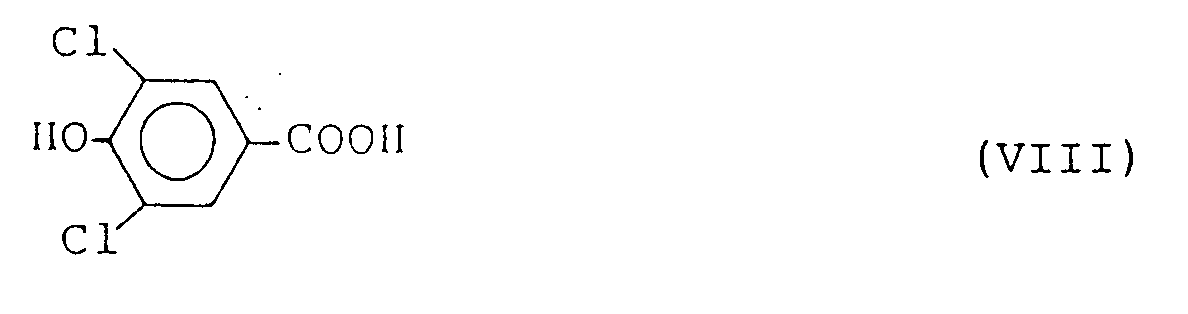
hergestellt. Hierzu wird die Verbindung der Formel VIII in einer Eintopfreaktion zunächst einer Decarboxylierungsreaktion in Dimethylformamid oder Dimethylacetamid in Gegenwart von katalytischen Mengen (z.B. 1/10mol %) von Collidin und bei Temperaturen unter 160°C, beispielsweise 156°C, unterworfen und anschließend sofort mit einem Chloressigsäurederivat der Formel IX
umgesetzt. Dabei kann vorzugweise Kaliumcarbonat als Base verwendet werden, ohne daß eine Verseifung des Esters erfolgt. - Die Zwischenverbindung der Formel III läßt sich auch direkt aus 2,6-Dichlorphenol und Chloracetanilid durch basenkatalysierte Reaktion herstellen; dieses Verfahren eignet sich jedoch wegen der toxischen Nebenwirkung des Chloracetanilids nicht zur Herstellung größer Mengen der Verbindung III.
- In der zweiten Stufe des erfindungsgemäßen Verfahrens wird die erfindungsgemäß erhaltene Zwischneverbindung der Formel III ohne Isolierung direkt in situ, bei Reaktionstemperaturen von 90°C bis 100°C, beispielsweise 95°C bis 100°C zu der Verbindung der Formel IV

umgelagert. Die Umlagerung wird durch das im Reaktionsmedium vorhandene Alkalialkoholat bewirkt. Wie oben bereits ausgeführt wurde, besteht das Reaktionsmedium aus einem Alkohol, z.B. Methanol, Ethanol, n-Propanol, i-Propanol, n-Butanol oder i-Butanol. - In der dritten Stufe des erfindungsgemäßen Verfahrens wird - ebenfalls ohne Isolierung - die durch Umlagerung erhaltene Verbindung der Formel IV zu der Verbindung der Formel V

aminolysiert, wobei die Aminolyse durch das im Reaktionsgemisch enthaltene. Alkalialkoholat bewirkt wird. Die Reaktionstemperaturen sind wie in der dritten Stufe des erfindungsgemäßen Verfahrens. Das erhaltene 2,6-Dichlorphenylamin der Formel V wird durch übliche Maßnahmen isoliert und ggf. gereinigt. Die genannte Verbindung fällt als Feststoff an. - In der vierten Stufe des erfindungsgemäßen Verfahrens wird die Verbindung der Formel V durch Umsetzung mit Chloracetylchlorid in das Derivat der Formel VI

überführt. Erfindungsgemäß erfolgt die Chloracetylierung vorzugsweise als Aminolyse in einem inerten Lösungsmittel, vorzugsweise Xylol oder Chlorbenzol, und bei Temperaturen von 90°C bis 120°C, vorzugsweise 110°C bis 120°C. Nach einer bevorzugten Ausführungsform der Erfindung wird diese Stufe in Anwesenheit katalytischer Mengen, z.B. 1/20 mol % bis 1/10 mol %, 4-Dimethylaminopyridin durchgeführt. Die Ausbeuten an der angestrebten Verbindung der Formel VI sind fast quantitativ. - In der fünften Stufe des erfindungsgemäßen Verfahrens erfolgt eine intramolekulare Cyclisierung der Verbindung der Formel VI zum Indolinon der Formel VII

Diese Stufe des erfindungsgemäßen Verfahrens erfolgt in einem inerten Lösungsmittel, vorzugsweise o-Dichlorbenzol, und erhöhten Temperaturen, vorzugsweise 140°C bis 160°C. Dabei werden Ausbeuten von über 90% erreicht. - In der letzten Stufe des erfindungsgemäßen Verfahrens wird die Verbindung der Formel VII durch alkalische Hydrolyse vorzugsweise mit Natronlauge in einem Alkohol wie oben beschrieben, insbesondere n-Butanol, in das Natriumsalz der angestrebten Verbindung der Formel I umgewandelt. Die Reaktionstemperatur in dieser Stufe ist 90°C bis 110°C, vorzugsweise 100°C bis 110°C.
- Die so erhaltene Verbindung der Formel I kann durch übliche Maßnahmen, bespielsweise durch Extraktion, aus dem Reaktionsgemisch isoliert werden und durch übliche Verfahrensweisen, beispielsweise Kristallisation, gereinigt werden.
- Als wesentliches Merkmal der vorliegenden Erfindung ist anzusehen, daß die erste, die zweite und die dritte Stufe des Verfahrens als Eintopfverfahren durchgeführt wird, ohne daß dei Zwischneverbindungen III und IV isoliert werden. Auf diese Weise werden einerseits eine einfache Verfahrensführung und andererseits relativ hohe Gesamtausbeuten, z.B. 80% bis 90% d. Th., erhalten.
- Die Erfindung wird an den folgenden Beispielen erläutert.
- In 0,5 l DMF trägt man bei ca. 90°C 675 g 3,5-Dichlor-4-hydroxybenzoesäure ein, gibt 75 ml Collidin zu und heizt bis 120°C, wobei die Decarboxylierung einsetzt.
- Die Sumpftemperatur wird langsam auf 155°C gesteigert und gehalten bis kein CO₂ mehr entweicht.
- Der Sumpf wird bei 50°C mit 240 g Pottasche, 0,6 l Essigester und 0,35 l Chlroessigsäureethylester versetzt. Man wartet bei 70°C ide Umsetzung ab, die unter Freisetzung von CO₂ verläuft, und kocht noch 2 h unter Rückfluß. Nach Zusatz von 1,7 l Wasser führt man bei 20°C eine Phasentrennung durch und fraktioniert die organische Phase.
- Kp.
- 0,1 = 100 bis 130°C
- Ausbeute:
- 617 g = 83% d. Th.
- Ein Gemisch aus 996 g 2,6-Dichlorphenoxyessigethylester, 500 ml Anilin und 400 ml n-Butanol wird in einer Destillationsapparatur auf 100°C vorgeheizt.
- In 30 min läßt man 400 ml 5,5 n Natriummethylat zufließen, wobei ein Destillatfluß durch die Exothermie der Umsetzung aufrechterhalten wird. Nach der Zugabe wird noch 15 min bei 100°C unter weiterer Destillatabnahme gerührt.
- Dann gibt man 1 l Wasser zu und destilliert Lösungsmittel bis zur Sumpftemperatur von 90°C ab. Bei 60°C erfolgt Phasentrennung. Das Lösungsmittel wird imn Vakuum abgezogen und das Produkt aus 1 l 90% i-Propanol kristallisiert. Man saugt bei 0°C ab und wäscht mit dil. i-Propanol nach.
- Ausbeute:
- 727 g = 76,5% d. Th.
bei Ausbeutung der Mutterlauge 82% d. Th. - DSCmax =
- 54°C bei 2°C/min Heizrate
- In 900 ml o-Dichlorbenzol werden 476 g 2,6-Dichlordiphenylamin vorgelegt und bei 150°C mit 271 g Chloracetylchlorid in 1,5 h versetzt. Das Gemisch wird noch 2 h bie 150°C gerührt, bis keine Gase mehr entweichen.
- Bei 60°C werden 533 g Aluminiumchlorid zugegeben und das Gemisch langsam bis 160°C geheizt, wobei ab 100°C Chlorwasserstoff entweicht. Nach 1 h bei 110°C kühlt man auf 60°C und hydrolysiert bei maximal 80°C mit 1,5 l Eiswasser.
- Nach Phasentrennung wäscht man nochmals mit Wasser und zieht das Lösungsmittel im Vakuum ab. Das Produkt wird aus 1 l i-Propanol kristallisiert.
- Ausbeute:
- 512 g = 92% d. Th.
- DSCmax =
- 121°C bei 2°C/min Heizrate
- 1 Teil des Indolinons aus Beispiel 3 wird in 2 Teilen n-Butanol und der äquivalenten Menge Natronlauge unter azeotroper Wasserentfernung gekocht, wobei 0,2 Teile Toluol zugesetzt werden.
- Wenn kein Wasser mehr abgeschieden wird und das Salz gefallen ist, gibt man 2 TL i-Propanol zu und saugt bei 10°C ab.
- Dieses Produkt wird aus Wasser umkristallisiert und bei 100°C getrocknet.
- Ausbeute:
- 88,6% d. Th.
- DSCmax =
- 106°C (bei Hydrat)
- DSCmin =
- 268 bis 270°C bei 2°C/min Heizrate
Claims (4)
- Verfahren zur Herstellung von 2,6-Dichlordiphenylaminderivaten der allgemeinen Formel I


mit Anilin in einer Eintopfreaktion zuerst zu der Verbindung der Formel III



- Verfahren nach Anspruch 1, dadurch gekennzeichnet, daß man die Verbindung der Formel II aus 3,5-Dichlor-4-hydroxybenzoesäure dem Formel VIII

- Verfahren nach Anspruch 1, dadurch gekennzeichnet, daß man die Herstellung der Verbindung der Formel V in einem Alkohol bei Temperaturen unter 120°C vornimmt.
- Verfahren nach Anspruch 1, dadurch gekennzeichnet, daß man die Umsetzung der Verbindung der Formel V mit Chloracetylchlorid in Form einer Aminolyse durchführt und die erhaltene Verbindung der Formel VI in o-Dichlorbenzol zu der Verbindung der Formel VII cyclisiert und diese mit Alkalilauge in einem protischen Lösungsmittel in die Verbindung der Formel I überführt.
Priority Applications (16)
| Application Number | Priority Date | Filing Date | Title |
|---|---|---|---|
| AT89101437T ATE116636T1 (de) | 1989-01-27 | 1989-01-27 | Verfahren zur herstellung von 2,6- dichlordiphenylaminessigsäurederivaten. |
| ES89101437T ES2065928T3 (es) | 1989-01-27 | 1989-01-27 | Procedimiento para la fabricacion de derivados de acido 2,6-diclorodifenilaminacetico. |
| DE58908857T DE58908857D1 (de) | 1989-01-27 | 1989-01-27 | Verfahren zur Herstellung von 2,6-Dichlordiphenylaminessigsäurederivaten. |
| EP89101437A EP0380712B1 (de) | 1989-01-27 | 1989-01-27 | Verfahren zur Herstellung von 2,6-Dichlordiphenylaminessigsäurederivaten |
| DK198903004A DK175838B1 (da) | 1989-01-27 | 1989-06-16 | Fremgangsmåde til fremstilling af 2,6-dichlordiphenylamineddikesyrederivater |
| ZA894667A ZA894667B (en) | 1989-01-27 | 1989-06-20 | Process for the preparation of 2,6-dichlorodiphenyl-amino-acetic derivatives |
| IE199689A IE65880B1 (en) | 1989-01-27 | 1989-06-20 | Process for the preparation of 2,6-dichlorodiphenylamino-acetic acid derivatives |
| NZ229636A NZ229636A (en) | 1989-01-27 | 1989-06-20 | A process for the preparation of 2,6-dichlorodiphenylamino-acetic acid derivatives |
| IL90674A IL90674A0 (en) | 1989-01-27 | 1989-06-20 | Process for the preparation of 2,6-dichlorodiphenylamino-acetic acid derivatives |
| HU893149A HU202826B (en) | 1989-01-27 | 1989-06-20 | Process for producing (2,6-dichloro-phenyl)-amino-phenyl-acetic acid derivatives |
| US07/369,618 US4978773A (en) | 1989-01-27 | 1989-06-21 | Process for the preparation of 2,6-dichlorodiphenylaminoacetic acid derivatives |
| AU36749/89A AU611813B2 (en) | 1989-01-27 | 1989-06-23 | Process for the preparation of 2,6-dichlorodiphenylaminoacetic acid derivatives |
| CA000603909A CA1310017C (en) | 1989-01-27 | 1989-06-26 | Process for the preparation of 2, 6-dichlorodiphenylamino-acetic acid derivatives |
| KR1019890009376A KR960008664B1 (ko) | 1989-01-27 | 1989-07-01 | 2,6-디클로로디페닐아미노아세트산 유도체류의 제조공정 |
| PT91093A PT91093B (pt) | 1989-01-27 | 1989-07-07 | Processo para a preparacao de derivados de acido 2,6-diclorodifenilamino- -acetico |
| JP1205559A JP2682705B2 (ja) | 1989-01-27 | 1989-08-07 | 2,6−ジクロロフェニルアミノベンゼン酢酸誘導体及びジフェニルアミン誘導体の製造方法。 |
Applications Claiming Priority (1)
| Application Number | Priority Date | Filing Date | Title |
|---|---|---|---|
| EP89101437A EP0380712B1 (de) | 1989-01-27 | 1989-01-27 | Verfahren zur Herstellung von 2,6-Dichlordiphenylaminessigsäurederivaten |
Publications (2)
| Publication Number | Publication Date |
|---|---|
| EP0380712A1 EP0380712A1 (de) | 1990-08-08 |
| EP0380712B1 true EP0380712B1 (de) | 1995-01-04 |
Family
ID=8200913
Family Applications (1)
| Application Number | Title | Priority Date | Filing Date |
|---|---|---|---|
| EP89101437A Expired - Lifetime EP0380712B1 (de) | 1989-01-27 | 1989-01-27 | Verfahren zur Herstellung von 2,6-Dichlordiphenylaminessigsäurederivaten |
Country Status (16)
| Country | Link |
|---|---|
| US (1) | US4978773A (de) |
| EP (1) | EP0380712B1 (de) |
| JP (1) | JP2682705B2 (de) |
| KR (1) | KR960008664B1 (de) |
| AT (1) | ATE116636T1 (de) |
| AU (1) | AU611813B2 (de) |
| CA (1) | CA1310017C (de) |
| DE (1) | DE58908857D1 (de) |
| DK (1) | DK175838B1 (de) |
| ES (1) | ES2065928T3 (de) |
| HU (1) | HU202826B (de) |
| IE (1) | IE65880B1 (de) |
| IL (1) | IL90674A0 (de) |
| NZ (1) | NZ229636A (de) |
| PT (1) | PT91093B (de) |
| ZA (1) | ZA894667B (de) |
Families Citing this family (10)
| Publication number | Priority date | Publication date | Assignee | Title |
|---|---|---|---|---|
| EP0498011B1 (de) * | 1991-02-07 | 1995-04-26 | HEUMANN PHARMA GMBH & CO | Neue Salze der 2-(2,6-Dichloranilino)-phenylessigsäure, Verfahren zu ihrer Herstellung und ihre Verwendung für topisch anwendbare pharmazeutische Zubereitungen |
| ES2046141B1 (es) * | 1992-07-15 | 1994-06-16 | Prodesfarma Sa | "procedimiento para la obtencion del acido 2-((2,6-diclorofenil)amino) fenilacetoxiacetico" |
| US5475139A (en) * | 1993-10-22 | 1995-12-12 | Yung Shin Pharm. Ind. Co., Ltd. | Method for the preparation of substituted derivatives of diphenyl amine |
| GB9922830D0 (en) * | 1999-09-27 | 1999-11-24 | Novartis Ag | Processes |
| CN103113236A (zh) * | 2013-03-15 | 2013-05-22 | 河南东泰制药有限公司 | 一种2,6-二氯二苯胺的制备方法 |
| CN106957237B (zh) * | 2017-03-24 | 2019-04-09 | 苏州汇和药业有限公司 | 一种合成溴芬酸钠的方法 |
| CN108947861A (zh) * | 2018-08-17 | 2018-12-07 | 复旦大学 | 双氯芬酸钠的合成方法 |
| CN111116391A (zh) * | 2019-12-17 | 2020-05-08 | 浙江工业大学 | 一种2-[(2,6-二氯苯基)氨基]苯乙酸钠的制备方法 |
| CN114539086B (zh) | 2022-02-25 | 2023-10-03 | 复旦大学 | 一种双氯芬酸钠的合成方法 |
| CN114516813B (zh) * | 2022-02-25 | 2024-05-28 | 复旦大学 | 一种双氯芬酸钠的连续流制备方法 |
Family Cites Families (7)
| Publication number | Priority date | Publication date | Assignee | Title |
|---|---|---|---|---|
| US3558690A (en) * | 1965-04-08 | 1971-01-26 | Gelgy Chemical Corp | Substituted derivatives of 2-anilinophenylacetic acids and a process of preparation |
| NL137301C (de) * | 1966-03-30 | |||
| JPS51113842A (en) * | 1975-03-31 | 1976-10-07 | Ikeda Mohandou:Kk | Process for preparing o-(2,6-dichloroanilino)phenyl acetic acid |
| IT1097265B (it) * | 1978-06-23 | 1985-08-31 | Acraf | Nouva sintesi di un acido fenilacetico |
| JPS5545615A (en) * | 1978-09-27 | 1980-03-31 | Nissan Chem Ind Ltd | Derivative of (n-allyl-o-(2,6-dichloroanilino) phenyl) acetic acid |
| JPS5770848A (en) * | 1980-10-20 | 1982-05-01 | Zenyaku Kogyo Kk | Preparation of o-substituted phenylacetic acid |
| JPS5920256A (ja) * | 1982-07-27 | 1984-02-01 | Hokuriku Seiyaku Co Ltd | 2−(2,6−ジフルオロアニリノ)フエニル酢酸誘導体 |
-
1989
- 1989-01-27 EP EP89101437A patent/EP0380712B1/de not_active Expired - Lifetime
- 1989-01-27 AT AT89101437T patent/ATE116636T1/de not_active IP Right Cessation
- 1989-01-27 DE DE58908857T patent/DE58908857D1/de not_active Expired - Lifetime
- 1989-01-27 ES ES89101437T patent/ES2065928T3/es not_active Expired - Lifetime
- 1989-06-16 DK DK198903004A patent/DK175838B1/da not_active IP Right Cessation
- 1989-06-20 NZ NZ229636A patent/NZ229636A/en unknown
- 1989-06-20 HU HU893149A patent/HU202826B/hu unknown
- 1989-06-20 IE IE199689A patent/IE65880B1/en not_active IP Right Cessation
- 1989-06-20 ZA ZA894667A patent/ZA894667B/xx unknown
- 1989-06-20 IL IL90674A patent/IL90674A0/xx unknown
- 1989-06-21 US US07/369,618 patent/US4978773A/en not_active Expired - Lifetime
- 1989-06-23 AU AU36749/89A patent/AU611813B2/en not_active Expired
- 1989-06-26 CA CA000603909A patent/CA1310017C/en not_active Expired - Lifetime
- 1989-07-01 KR KR1019890009376A patent/KR960008664B1/ko not_active Expired - Lifetime
- 1989-07-07 PT PT91093A patent/PT91093B/pt not_active IP Right Cessation
- 1989-08-07 JP JP1205559A patent/JP2682705B2/ja not_active Expired - Lifetime
Also Published As
| Publication number | Publication date |
|---|---|
| IE891996L (en) | 1990-07-27 |
| KR900011710A (ko) | 1990-08-02 |
| DK300489A (da) | 1990-07-28 |
| IL90674A0 (en) | 1990-01-18 |
| PT91093B (pt) | 1995-03-31 |
| ES2065928T3 (es) | 1995-03-01 |
| US4978773A (en) | 1990-12-18 |
| DK175838B1 (da) | 2005-03-21 |
| AU611813B2 (en) | 1991-06-20 |
| ATE116636T1 (de) | 1995-01-15 |
| JPH02215750A (ja) | 1990-08-28 |
| JP2682705B2 (ja) | 1997-11-26 |
| DE58908857D1 (de) | 1995-02-16 |
| ZA894667B (en) | 1990-02-28 |
| HU202826B (en) | 1991-04-29 |
| KR960008664B1 (ko) | 1996-06-28 |
| AU3674989A (en) | 1990-08-02 |
| EP0380712A1 (de) | 1990-08-08 |
| DK300489D0 (da) | 1989-06-16 |
| NZ229636A (en) | 1991-03-26 |
| IE65880B1 (en) | 1995-11-29 |
| HUT53064A (en) | 1990-09-28 |
| PT91093A (pt) | 1990-07-31 |
| CA1310017C (en) | 1992-11-10 |
Similar Documents
| Publication | Publication Date | Title |
|---|---|---|
| DE2461601C2 (de) | 3-Pyrrolidino-4-phenoxy-5-sulfamoylbenzoesäureester und Verfahren zu ihrer Herstellung | |
| AT262274B (de) | Verfahren zur Herstellung neuer Indolderivate | |
| EP0380712B1 (de) | Verfahren zur Herstellung von 2,6-Dichlordiphenylaminessigsäurederivaten | |
| EP0174910B1 (de) | Verfahren zur Herstellung von 4-Phenyl-pyrrol-derivaten | |
| DE3688004T2 (de) | Verfahren zur herstellung herbizider 2-(4,4-disubstituierter-5-oxo-2-imidazolin-2yl)benzoesaeuren, -nicotinsaeuren und chinolin-3-carbonsaeuren, ester und salze. | |
| DD283603A5 (de) | Verfahren zur herstellung von substituierten hydroxylaminen | |
| EP0336250B1 (de) | Verfahren zur Herstellung von 5-gliedrigen, stickstoffhaltigen Heteroaromaten | |
| DE69013726T2 (de) | Verbessertes Verfahren für die Herstellung von o-Carboxypyridyl- und o-Carboxychinolylimidazolinonen. | |
| CH653996A5 (de) | Tryptaminderivate und verfahren zu deren herstellung. | |
| CH668424A5 (de) | 4-benzyloxy-3-pyrrolin-2-on-l-yl-acetamid, dessen herstellung und verwendung. | |
| EP0216324A2 (de) | 4-Alkoxy-3-pyrrolin-2-on-1-yl-essigsäurealkyl- bzw. -benzylester sowie deren Herstellung | |
| DE2725019A1 (de) | Verfahren zur herstellung substituierter aminochinazolinderivate und zwischenprodukte dafuer | |
| EP0345464B1 (de) | Verfahren zur Herstellung von substituierten 3-Amino-2(benzoyl)-acrylsäureestern sowie ein Verfahren zur Herstellung von Zwischenprodukten für antibakterielle Wirkstoffe aus diesen Verbindungen | |
| DE2354931C2 (de) | trans-2-Phenylbicyclooctan-Verbindungen, Verfahren zu ihrer Herstellung und sie enthaltende pharmazeutische Zubereitungen | |
| EP0090769B1 (de) | Verfahren zur Herstellung von 1,2,5,6-Tetrahydro-4H-pyrrolo(3,2,1-ij)-chinolin-4-on und neue 5-Halogen-1,2,3-(1,2-dihydropyrrolo)-4-chinolone als Zwischenprodukte zur Durchführung des Verfahrens | |
| DE2613838A1 (de) | Verfahren zum erzeugen der eckige klammer auf o-(2,6-dichloranilino)- phenyl eckige klammer zu -essigsaeure und von salzen derselben | |
| AT250338B (de) | Verfahren zur Herstellung neuer, basischer Derivate von substituierten Benzofuran-2-carbonsäuren und deren Salzen | |
| AT376417B (de) | Verfahren zur herstellung von phenylaethanolaminen und ihren salzen | |
| EP0221494A1 (de) | Verfahren zur Herstellung von Glykolsäureamiden | |
| DE1166782B (de) | Verfahren zur Herstellung von substituierten aromatischen Dicarbonsaeureimiden und deren Salzen | |
| DD147241A1 (de) | Verfahren zur herstellung von furanderivaten | |
| DE2942195C2 (de) | ||
| AT270635B (de) | Verfahren zur Herstellung von neuen (3-Indolyl)-essigsäureverbindungen | |
| CH655930A5 (de) | Verfahren zur herstellung von 3-hydroxybenzdiazepinonen. | |
| EP0285109A1 (de) | Verfahren zur Herstellung von 2-Amino-4-acylaminophenylethern |
Legal Events
| Date | Code | Title | Description |
|---|---|---|---|
| PUAI | Public reference made under article 153(3) epc to a published international application that has entered the european phase |
Free format text: ORIGINAL CODE: 0009012 |
|
| AK | Designated contracting states |
Kind code of ref document: A1 Designated state(s): AT BE CH DE ES FR GB GR IT LI LU NL SE |
|
| 17P | Request for examination filed |
Effective date: 19910129 |
|
| 17Q | First examination report despatched |
Effective date: 19920910 |
|
| GRAA | (expected) grant |
Free format text: ORIGINAL CODE: 0009210 |
|
| AK | Designated contracting states |
Kind code of ref document: B1 Designated state(s): AT BE CH DE ES FR GB GR IT LI LU NL SE |
|
| REF | Corresponds to: |
Ref document number: 116636 Country of ref document: AT Date of ref document: 19950115 Kind code of ref document: T |
|
| ITF | It: translation for a ep patent filed | ||
| REF | Corresponds to: |
Ref document number: 58908857 Country of ref document: DE Date of ref document: 19950216 |
|
| GBT | Gb: translation of ep patent filed (gb section 77(6)(a)/1977) |
Effective date: 19950120 |
|
| REG | Reference to a national code |
Ref country code: ES Ref legal event code: FG2A Ref document number: 2065928 Country of ref document: ES Kind code of ref document: T3 |
|
| ET | Fr: translation filed | ||
| REG | Reference to a national code |
Ref country code: GR Ref legal event code: FG4A Free format text: 3014630 |
|
| PLBE | No opposition filed within time limit |
Free format text: ORIGINAL CODE: 0009261 |
|
| STAA | Information on the status of an ep patent application or granted ep patent |
Free format text: STATUS: NO OPPOSITION FILED WITHIN TIME LIMIT |
|
| 26N | No opposition filed | ||
| REG | Reference to a national code |
Ref country code: GB Ref legal event code: IF02 |
|
| PGFP | Annual fee paid to national office [announced via postgrant information from national office to epo] |
Ref country code: CH Payment date: 20080116 Year of fee payment: 20 Ref country code: ES Payment date: 20080218 Year of fee payment: 20 |
|
| PGFP | Annual fee paid to national office [announced via postgrant information from national office to epo] |
Ref country code: LU Payment date: 20080129 Year of fee payment: 20 Ref country code: IT Payment date: 20080128 Year of fee payment: 20 Ref country code: DE Payment date: 20080124 Year of fee payment: 20 Ref country code: GB Payment date: 20080123 Year of fee payment: 20 Ref country code: SE Payment date: 20080128 Year of fee payment: 20 Ref country code: NL Payment date: 20080123 Year of fee payment: 20 |
|
| PGFP | Annual fee paid to national office [announced via postgrant information from national office to epo] |
Ref country code: AT Payment date: 20080114 Year of fee payment: 20 |
|
| PGFP | Annual fee paid to national office [announced via postgrant information from national office to epo] |
Ref country code: FR Payment date: 20080108 Year of fee payment: 20 |
|
| PGFP | Annual fee paid to national office [announced via postgrant information from national office to epo] |
Ref country code: BE Payment date: 20080403 Year of fee payment: 20 |
|
| REG | Reference to a national code |
Ref country code: CH Ref legal event code: PL |
|
| REG | Reference to a national code |
Ref country code: GB Ref legal event code: PE20 Expiry date: 20090126 |
|
| PGFP | Annual fee paid to national office [announced via postgrant information from national office to epo] |
Ref country code: GR Payment date: 20080116 Year of fee payment: 20 |
|
| EUG | Se: european patent has lapsed | ||
| NLV7 | Nl: ceased due to reaching the maximum lifetime of a patent |
Effective date: 20090127 |
|
| REG | Reference to a national code |
Ref country code: ES Ref legal event code: FD2A Effective date: 20090128 |
|
| PG25 | Lapsed in a contracting state [announced via postgrant information from national office to epo] |
Ref country code: NL Free format text: LAPSE BECAUSE OF EXPIRATION OF PROTECTION Effective date: 20090127 |
|
| PG25 | Lapsed in a contracting state [announced via postgrant information from national office to epo] |
Ref country code: GB Free format text: LAPSE BECAUSE OF EXPIRATION OF PROTECTION Effective date: 20090126 |
|
| PG25 | Lapsed in a contracting state [announced via postgrant information from national office to epo] |
Ref country code: ES Free format text: LAPSE BECAUSE OF EXPIRATION OF PROTECTION Effective date: 20090128 |