EP0351237B1 - Matériau de disque de frein pour véhicule ferroviaire - Google Patents
Matériau de disque de frein pour véhicule ferroviaire Download PDFInfo
- Publication number
- EP0351237B1 EP0351237B1 EP89307172A EP89307172A EP0351237B1 EP 0351237 B1 EP0351237 B1 EP 0351237B1 EP 89307172 A EP89307172 A EP 89307172A EP 89307172 A EP89307172 A EP 89307172A EP 0351237 B1 EP0351237 B1 EP 0351237B1
- Authority
- EP
- European Patent Office
- Prior art keywords
- friction
- brake disk
- lining
- speed
- disk
- Prior art date
- Legal status (The legal status is an assumption and is not a legal conclusion. Google has not performed a legal analysis and makes no representation as to the accuracy of the status listed.)
- Expired - Lifetime
Links
Images


Classifications
-
- F—MECHANICAL ENGINEERING; LIGHTING; HEATING; WEAPONS; BLASTING
- F16—ENGINEERING ELEMENTS AND UNITS; GENERAL MEASURES FOR PRODUCING AND MAINTAINING EFFECTIVE FUNCTIONING OF MACHINES OR INSTALLATIONS; THERMAL INSULATION IN GENERAL
- F16D—COUPLINGS FOR TRANSMITTING ROTATION; CLUTCHES; BRAKES
- F16D65/00—Parts or details
- F16D65/02—Braking members; Mounting thereof
- F16D65/12—Discs; Drums for disc brakes
- F16D65/125—Discs; Drums for disc brakes characterised by the material used for the disc body
-
- Y—GENERAL TAGGING OF NEW TECHNOLOGICAL DEVELOPMENTS; GENERAL TAGGING OF CROSS-SECTIONAL TECHNOLOGIES SPANNING OVER SEVERAL SECTIONS OF THE IPC; TECHNICAL SUBJECTS COVERED BY FORMER USPC CROSS-REFERENCE ART COLLECTIONS [XRACs] AND DIGESTS
- Y10—TECHNICAL SUBJECTS COVERED BY FORMER USPC
- Y10T—TECHNICAL SUBJECTS COVERED BY FORMER US CLASSIFICATION
- Y10T428/00—Stock material or miscellaneous articles
- Y10T428/12—All metal or with adjacent metals
- Y10T428/12486—Laterally noncoextensive components [e.g., embedded, etc.]
Definitions
- This invention relates to a brake disk material for railroad vehicles which is used as a material for brake disks for use in high-speed railroad vehicles.
- JRS Japanese National Railway Standard
- NCM cast iron low-alloyed pearlitic-matrix flaky graphite cast iron (Ni: 1.0 to 2.0% by weight, Cr: 0.3 to 0.6% by weight, Mo: 0.3 to 0.5% by weight, hereinafter referred to as "NCM cast iron") which, according to JRS 12209-2, has a tensile strength of at least 245 MPa and a hardness of 210 to 280 HB.
- the brake disk material constituted of the NCM cast iron is characterized by an appropriate average coefficient of friction, a stable instantaneous coefficient of friction and a low rate of wear, which ensure a braking force fulfiling the specifications both at the time of service braking for stop (initial speed braking: 35 km/h) and at the time of emergency braking for stop (initial speed braking: 220 km/h).
- the brake disk material of the NCM cast iron is thus superior to general-purpose pearlitic-matrix flaky graphite cast irons in resistance to heat cracking at the sliding surfaces of brake disks, even under high-frequency (service braking) or high-load (emergency braking) frictional conditions.
- the NCM cast iron is obtained through increases in the size and number of graphite particles formed in the structure of the metal to serve for absorption and relaxation of thermal stress, with the attendant reduction in strength being compensated for by reinforcement of the matrix structure through alloying with Ni, Cr and Mo. Comparable to JIS FC25 grade cast irons in strength, the NCM cast iron has good thermal conductivity and excellent resistance to mechanical damages caused by heat loads.
- a forged steel brake disk material has recently been developed and put to practical use.
- the original reason for the use of cast iron in place of steel as a brake disk material is the stable friction-wear characteristics of the cast iron during braking, due to the presence of free carbon (graphite) in the cast iron. Therefore, the forged steel brake disk material has the problems of instability in coefficient of friction during braking and a greater permanent set of the material in use, as compared to the cast iron brake disk material.
- the brake disk materials for use in such railroad vehicles are required to have a good balance of friction-wear characteristics, material strength and thermal damage resistance. Furthermore, in order to meet the requirement for smaller non-suspended weight on a design basis, development of a nonferrous brake disk material of high performance has been requested.
- a typical example of lightweight nonferrous metals is aluminum alloy.
- the material does not show satisfactory friction-wear characteristics or the like in such application, and leads to large disk wear as well as seizure or the like, by which the pad material as a mating material is also consumed.
- JP-A-59173234 discloses a brake disk for a road vehicle, with an Al-hypo eutectic Si alloy matrix, containing alumina and/or silicon carbide.
- JP-A-62124244 discloses a brake disk of aluminium alloy containing fibrous material such as alumina, silicon carbide and silicon nitride. The brake disks are designed for use in road vehicles at relatively low speeds.
- the object of the present invention is to provide a brake disk material for rail vehicles, and has high strength, good thermal conductivity and high wear resistance.
- a brake disk material for railroad vehicles which comprises hard ceramic particles dispersed in an aluminium alloy matrix to reinforce wear resistance, characterised in that 1 to 25% by weight of hard ceramic particles having a particle diameter of 5 to 100 ⁇ m are dispersed in the Al alloy matrix which is an A1-Mg base alloy matrix.
- the Al-Mg alloy matrix shows little reduction in strength due to frictional heat in operation.
- the reinforcement particles dispersed in the aluminum metal matrix may be particles of, for example, Al2O3 or SiC, provided that the particles are hard fine particles.
- the diameter of the reinforcement particles is 5 to 100 ⁇ m. If the particle diameter is less than 5 ⁇ m, satisfactory wear resistance for use as a brake disk material is not obtainable. A particle diameter of more than 100 ⁇ m, on the other hand, leads to lower machinability and toughness.
- the amount of the reinforcement particles dispersed is less than 1% by weight, satisfactory wear resistance for use as a brake disk material is, again, not obtainable. If the amount of the particles exceeds 25% by weight, the machinability and toughness are lowered.
- the reinforcement particles are dispersed uniformly in the aluminum alloy matrix, but, if desired, the particles may be present locally at specified portions.
- the superiority or inferiority of friction-wear characteristics of a brake disk material for high-speed vehicles is evaluated based on the propriety of average coefficient of friction in braking, the stability of instantaneous coefficient of friction and the wear resistance of the brake disk and the mating material.
- aluminum alloys are generally deemed low in resistance to wear, it is possible to provide an aluminum alloy with an extremely high wear resistance by adding and dispersing hard reinforcement particles uniformly in the aluminum matrix.
- a brake disk material is required to have sufficient strength for security under the centrifugal force generated by the high-speed rotation of the brake disk and the thermal stress generated by the heat load at the time of braking, and the reinforcement particle dispersion type aluminum alloy is superior to the NCM cast iron in strength and thermal conductivity.
- the reinforcement particle dispersion type aluminum alloy as a brake disk material is superior also in resistance to heat cracking at the sliding surface of the brake disk under high-frequency (service braking) or high-load (emergency braking) frictional conditions.
- the specific gravity of the aluminum alloy, 2.7 is as low as about one-third of the specific gravity of cast iron, 7.2-7.3; thus, by use of the aluminum alloy it is possible to markedly improve the lightness in weight, which is essential to the high-speed vehicles, on a material basis.
- the limit of the braking force of a railroad vehicle depends on the frictional force (adhesion force) between the wheel and the rail.
- adhesion force the frictional force between the wheel and the rail.
- the wheel slips on the rail without rotating; therefore, the wheel tread is ground by the rail, and the resultant flaw increases the vibration of the wheel set, rendering the ride comfort extremely poor.
- the upper limit of the braking force is restricted by the adhesion force.
- the adhesion force is determined by the friction between the metal of the wheel and the metal of the rail and, therefore, is by far lower than that in the case of an automobile using rubber tires.
- the brake for railroad vehicles should be lower in the pressure with which the lining is pressed against the brake disk, be longer in the period of time necessary for stopping, have a relatively lower coefficient of friction of 0.25 to 0.3, and be superior in stability of the coefficient of friction from a higher to a lower speed, as compared with the brake for automobiles.
- the seizure if brought about, would cause scattering of particles of the disk material adhered to the lining or would cause an increase in the coefficient of friction, thereby lowering the performance of the brake material.
- Dispersing the ceramic particles in the aluminum metal matrix enhances the seizure resistance and, therefore, reduces the possibility of the above-mentioned phenomena, the effect of the dispersion being higher as the amount of the ceramic particles dispersed is greater.
- the ceramic particles dispersed When the vehicle speed is high (220 km/h or above), where the lining used is strong in the property of attacking the disk, or where the inertial mass of the vehicle is large, on the other hand, it is preferable to increase further the amount of the ceramic particles dispersed, because there is a high possibility of seizure due to a rise in the disk temperature.
- the upper limit of the amount of the particles dispersed is restricted by the secondary workability or toughness, as mentioned above. It is possible to ensure favorable secondary workability by appropriate selection of the working conditions or cutting tools, and to ensure good toughness by an improvement in construction, such as enbracing the disk by the wheel. An addition of more than 25% by weight of ceramic particles, however, makes it difficult to obtain the desired result by modifying the working conditions or the construction, and makes it impossible to adopt the resultant material as a brake disk material.
- the amount of the ceramic particles dispersed which is desirable for the case of high vehicle speeds (220 to 250 km/h), without considerable lowering in secondary workability or toughness, is from 7 to 15% by weight.
- reinforcement particles 5 to 100 ⁇ m in diameter are dispersed in an aluminum metal matrix in an amount of 1 to 25% by weight. It has been confirmed that the particle dispersion type aluminum alloy thus obtained is lighter in weight and has higher strength, superior thermal conductivity and extremely higher wear resistance as well as substantially comparable friction-wear characteristics, as compared with the conventional NCM cast iron. Accordingly, the brake disk material according to the invention has effective properties for use as a brake disk material for high-speed vehicles.
- Reinforcement particles of Al2O3 or SiC were dispersely mixed into a matrix of the 5083 aluminum alloy (JIS H4000) by a composite casting process, to obtain aluminum composite materials.
- the diameter of the Al2O3 particles was about 20 ⁇ m and the diameter of the SiC particles was about 10 to 30 ⁇ m.
- Some of the composite materials contained 3% or 5% by weight of either Al2O3 or SiC particles dispersed therein, and the other contained 2.5% by weight each of both the Al2O3 particles and the SiC particles dispersed therein.
- the composite materials were served to constant-speed friction tests to verify the friction-wear characteristics of the materials as a brake disk material for high-speed vehicles.
- the composite materials as materials to be tested, were formed into disk-shaped test pieces 206 mm in diameter and 25 mm in thickness (hereinafter referred to as "disks").
- disks disk-shaped test pieces 206 mm in diameter and 25 mm in thickness
- mating materials for friction two kinds of copper-base sintered alloy linings respectively for the NCM cast iron (the lining will be hereinafter referred to as "Cu1”) and for forged steel (the lining will be hereinafter referred to as "Cu2”) and one kind of lining for ordinary cast iron (the lining will be hereinafter referred to as "FC1”) were prepared.
- the lining materials were provided with a friction surface area of 30 ⁇ 30 mm.
- the test conditions were as follows. The friction speed was set at three levels: 7, 14 and 21 m/s. The pressing force for the lining was 0.5 MPa, and the continuous friction time for one run was 60 seconds. The test at each friction speed was repeated 25 times.
- the items of measurement were average coefficient of friction, instantaneous coefficient of friction, rates of wear of the disk and the lining, and temperatures rises in the disk and the lining.
- disks of the NCM cast iron were also served to the constant-speed friction tests under the same conditions as for the disks according to the embodiment.
- the materials according to the embodiment and the NCM cast iron were cmparable to each other in instantaneous coefficient of friction.
- the disks according to the embodiment were superior to (namely, showed smaller temperature rises than) the disks of the prior art material.
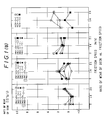
- FIGURES 1(A) to 1(C) show the results of measurement of average coefficient of friction, rate of wear of disk and rate of wear of lining, respectively, upon the constant-speed friction tests, with friction speeds of up to 21 m/s on the disks according to the embodiment and the disks of the prior art material.
- the disks according to the embodiment showed an average coefficient of friction substantially comparable to that of the NCM cast iron when the mating material was the copper-base sintered alloy lining (Cu1 or Cu2).
- the mating material was the lining for ordinary cast iron (FC1)
- the disks according to the embodiment with addition of 3% by weight of the reinforcement particles showed a greater decrease in coefficient of friction with an increase in friction speed, as compared to the disks of the NCM cast iron.
- the disks according to the embodiment with the addition of 5% by weight of SiC showed the best friction-wear characteristics.
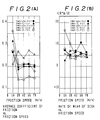
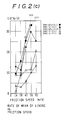
- FIGURES 2(A) to 2(C) show the results of the tests, with friction speeds of up to 70 m/s, on the material according to the embodiment (with addition of 5% by weight of SiC) which gave relatively good results upon the tests with friction speeds of up to 21 m/s.
- the material according to the embodiment but with addition of 5% of Al2O3 instead of SiC was also subjected to the constant-speed friction tests.
- the test results for the combination of the NCM cast iron as the prior art material with the lining Cu2 were compared with the test results for the combination of the material according to the embodiment with the addition of 5% by weight of SiC with the lining Cu2.
- the comparison revealed that the two combinations are comparable as to average coefficient of friction.
- the rate of wear of disk shown by the material according to the embodiment was lower than that shown by the prior art material.
- the rate of wear of lining the material according to the embodiment gave a value smaller, even by half, than the value given by the prior art material at a friction speed of 70 m/s.
- Reinforcement particles of SiC were dispersely mixed into a matrix of the 5083 aluminum alloy (JIS H4000) by a composite casting process, to obtain aluminum composite materials.
- the diameter of the SiC particles was about 10 to 30 ⁇ m, and the composite materials produced were of four kinds which contained the SiC particles in respective amounts of 3%, 10%, 15% and 20% by weight.
- the composite materials thus obtained were served to a constant speed type wear test to verify the friction-wear characteristics of the composite materials as brake disk materials for vehicles.
- the composite materials as materials to be tested, were formed into disks 565 mm in diameter and 30 mm in thickness.
- a copper-base sintered alloy lining was used as a mating material for friction.
- the lining had a friction surface area of 30 x 30 mm.
- the test conditions were as follows.
- the friction speed was 70 m/s.
- the pressing force for the lining was 0.5 MPa, the continuous friction time for one run was prolonged to 360 seconds, and the run was repeated 25 times, with the result of a temperature rise.
- the longer friction time with a heavier load on the disk caused seizure, in the cases of the disk materials with relatively small amounts of the ceramic particles dispersed therein, leading to a higher average coefficient of friction, heavier wear of the disk and the lining, and scattering of the adhered particles of the disk material.
- the coefficient of friction was low and stable, and the wear of the disk and the lining was slight.
Landscapes
- Engineering & Computer Science (AREA)
- General Engineering & Computer Science (AREA)
- Mechanical Engineering (AREA)
- Braking Arrangements (AREA)
Claims (5)
- Un matériau de disque de frein pour véhicules ferroviaires comprenant des particules de céramique dure dispersées dans une matrice en alliage d'aluminium pour renforcer la résistance à l'usure, caractérisé en ce que 1 à 25% en poids des particules de céramique dure, d'un diamètre de particule de 5 à 100 µm, sont dispersées dans la matrice en alliage d'aluminium, qui est une matrice d'alliage à base d'Al-Mg.
- Le matériau de disque de frein selon la revendication 1, dans lequel la quantité des dites particules dispersées représente 1 à 7% en poids.
- Le matériau de disque de frein selon la revendication 1, dans lequel la quantité des dites particules dispersées représente de 7 à 15% en poids.
- Le matériau de disque de frein selon l'une quelconque des revendications 1 à 3, dans lequel lesdites particules sont constituées au moins d'un des matériaux d'oxyde d'aluminium et de carbure de silicium.
- Le matériau de disque de frein selon l'une quelconque des revendications 1 à 3, dans lequel lesdites particules sont des particules comprenant de l'oxyde d'aluminium et du carbure de silicium.
Applications Claiming Priority (2)
| Application Number | Priority Date | Filing Date | Title |
|---|---|---|---|
| JP176697/88 | 1988-07-15 | ||
| JP63176697A JP2987704B2 (ja) | 1988-07-15 | 1988-07-15 | 高速鉄道車両用ブレーキディスク材 |
Publications (2)
| Publication Number | Publication Date |
|---|---|
| EP0351237A1 EP0351237A1 (fr) | 1990-01-17 |
| EP0351237B1 true EP0351237B1 (fr) | 1993-10-27 |
Family
ID=16018158
Family Applications (1)
| Application Number | Title | Priority Date | Filing Date |
|---|---|---|---|
| EP89307172A Expired - Lifetime EP0351237B1 (fr) | 1988-07-15 | 1989-07-14 | Matériau de disque de frein pour véhicule ferroviaire |
Country Status (4)
| Country | Link |
|---|---|
| US (1) | US5028494A (fr) |
| EP (1) | EP0351237B1 (fr) |
| JP (1) | JP2987704B2 (fr) |
| DE (1) | DE68910209T2 (fr) |
Cited By (2)
| Publication number | Priority date | Publication date | Assignee | Title |
|---|---|---|---|---|
| DE4400896C1 (de) * | 1994-01-14 | 1995-03-30 | Bergische Stahlindustrie | Bremsscheibe für Scheibenbremsen von Schienenfahrzeugen |
| DE4400898C1 (de) * | 1994-01-14 | 1995-03-30 | Bergische Stahlindustrie | Wellenbremsscheibe für Schienenfahrzeuge |
Families Citing this family (27)
| Publication number | Priority date | Publication date | Assignee | Title |
|---|---|---|---|---|
| JPH03267355A (ja) * | 1990-03-15 | 1991-11-28 | Sumitomo Electric Ind Ltd | アルミニウム―クロミウム系合金およびその製法 |
| US5521015A (en) * | 1990-09-14 | 1996-05-28 | Murphy; Martin J. M. | Metal matrix composite component |
| ATE295490T1 (de) * | 1991-06-20 | 2005-05-15 | Claude Rancourt | Bremsvorrichtung |
| WO1993001012A1 (fr) * | 1991-07-01 | 1993-01-21 | Kabushiki Kaisha Komatsu Seisakusho | Systeme d'amortissement de matrice dans une presse |
| US5261511A (en) * | 1991-12-17 | 1993-11-16 | Allied-Signal Inc. | Lightweight and high thermal conductivity brake rotor |
| DE69207781T2 (de) * | 1991-12-17 | 1996-05-30 | Allied Signal Inc | Bremsrotor mit leichtem gewicht und hoher wärmeleitungsfähigkeit |
| US5620791A (en) * | 1992-04-03 | 1997-04-15 | Lanxide Technology Company, Lp | Brake rotors and methods for making the same |
| US5372222A (en) * | 1992-06-08 | 1994-12-13 | Alliedsignal Inc. | Lightweight and high thermal conductivity brake rotor |
| US5620042A (en) * | 1993-06-30 | 1997-04-15 | Kelsey-Hayes Company | Method of casting a composite disc brake rotor |
| DE69407291T2 (de) * | 1993-06-30 | 1998-04-23 | Kelsey Hayes Co | Aus verbundwerkstoff hergestellte bremsscheibe sowie verfahren zu deren herstellung |
| CA2149301A1 (fr) * | 1993-09-15 | 1995-03-23 | Ratnesh Kumar Dwivedi | Disques de frein et methodes de fabrication |
| FR2717874B1 (fr) * | 1994-03-25 | 1996-04-26 | Gec Alsthom Transport Sa | Disque multimatériaux pour freinage à haute énergie. |
| US5526914A (en) * | 1994-04-12 | 1996-06-18 | Lanxide Technology Company, Lp | Brake rotors, clutch plates and like parts and methods for making the same |
| US5712029A (en) * | 1994-04-28 | 1998-01-27 | Nisshinbo Industries, Inc. | Friction material |
| US5544726A (en) * | 1994-09-06 | 1996-08-13 | Ford Motor Company | Brake rotor with flow through ventilation |
| DE19505724A1 (de) * | 1995-02-20 | 1996-08-29 | Daimler Benz Ag | Aluminium-Bremsscheibe |
| US5957251A (en) * | 1996-05-02 | 1999-09-28 | The Dow Chemical Company | Brake or clutch components having a ceramic-metal composite friction material |
| US5878849A (en) * | 1996-05-02 | 1999-03-09 | The Dow Chemical Company | Ceramic metal composite brake components and manufacture thereof |
| CA2275277C (fr) * | 1996-12-17 | 2007-10-30 | Tomoe Electric Manufacturing Co., Ltd. | Roue pour corps mobile se deplacant sur des rails, corps mobile pourvu de ces roues, rail et equipement mobile utilisant un rail |
| US6364072B1 (en) * | 1997-04-28 | 2002-04-02 | Alliedsignal Bremsbelag Gmbh | Sintered material for a magnetic track brake |
| US6086688A (en) * | 1997-07-28 | 2000-07-11 | Alcan International Ltd. | Cast metal-matrix composite material and its use |
| US6458466B1 (en) | 1998-04-24 | 2002-10-01 | Dow Global Technologies Inc. | Brake or clutch components having a ceramic-metal composite friction material |
| DE10011018C2 (de) * | 2000-03-07 | 2003-06-18 | Deere & Co | Reibeingriffsvorrichtung |
| JP2002178130A (ja) * | 2000-09-12 | 2002-06-25 | Jason Sin Hin Lo | ハイブリッド金属マトリクス組成物及びその製造方法 |
| US6623867B2 (en) | 2001-07-13 | 2003-09-23 | Visteon Global Technologies, Inc. | Reinforced aluminum metal composite carrier |
| DE102005032544B4 (de) * | 2004-07-14 | 2011-01-20 | Hitachi Powdered Metals Co., Ltd., Matsudo | Abriebsresistente gesinterte Aluminiumlegierung mit hoher Festigkeit und Herstellugsverfahren hierfür |
| WO2010130529A1 (fr) * | 2009-05-13 | 2010-11-18 | Ford Global Technologies, Llc | Disque en alliage léger revêtu |
Family Cites Families (22)
| Publication number | Priority date | Publication date | Assignee | Title |
|---|---|---|---|---|
| CH633868A5 (de) * | 1977-09-07 | 1982-12-31 | Alusuisse | Verschleissfeste beschichtung der arbeitsoberflaeche von scheibenfoermigen maschinenteilen aus aluminium oder aluminiumlegierungen. |
| JPS597775B2 (ja) * | 1979-11-22 | 1984-02-21 | 日立化成工業株式会社 | 制動子鋳造用Al合金 |
| JPS56116851A (en) * | 1980-02-21 | 1981-09-12 | Nissan Motor Co Ltd | Cylinder liner material for internal combustion engine |
| JPS5782441A (en) * | 1980-11-12 | 1982-05-22 | Manabu Kiuchi | Manufacture of grain reinforced composite material |
| JPS5782440A (en) * | 1980-11-12 | 1982-05-22 | Manabu Kiuchi | Manufacture of grain reinforced composite material |
| JPS5881948A (ja) * | 1981-11-11 | 1983-05-17 | Nissan Motor Co Ltd | 耐摩耗性ならびに振動減衰能に優れたアルミニウム複合材料 |
| JPS58110652A (ja) * | 1981-12-25 | 1983-07-01 | Nissan Motor Co Ltd | 耐摩耗性アルミニウム複合材料およびその製造方法 |
| JPS58117849A (ja) * | 1982-01-06 | 1983-07-13 | Ryobi Ltd | アルミニウム基複合材 |
| JPS59173234A (ja) * | 1983-03-22 | 1984-10-01 | Nissan Motor Co Ltd | ブレ−キロ−タ用アルミニウム合金 |
| US4759995A (en) * | 1983-06-06 | 1988-07-26 | Dural Aluminum Composites Corp. | Process for production of metal matrix composites by casting and composite therefrom |
| JPS6050138A (ja) * | 1983-08-30 | 1985-03-19 | Riken Corp | 硬質粒子分散型耐熱耐摩耗性高力アルミニウム合金部材とその製造方法 |
| JPS6148556A (ja) * | 1984-08-13 | 1986-03-10 | Atsugi Motor Parts Co Ltd | ベ−ン |
| JPS61159545A (ja) * | 1984-12-29 | 1986-07-19 | Canon Inc | 精密加工用アルミニウム合金、これを用いた管材及び光導電部材 |
| FR2576913B1 (fr) * | 1985-02-01 | 1987-02-27 | Cegedur | Procede d'obtention par la metallurgie des poudres d'un materiau a base d'alliage d'aluminium et d'au moins une ceramique destine a la confection de pieces soumises a frottement |
| GB8507674D0 (en) * | 1985-03-25 | 1985-05-01 | Atomic Energy Authority Uk | Metal matrix composite |
| JPS61257450A (ja) * | 1985-05-08 | 1986-11-14 | Nissan Motor Co Ltd | 耐熱アルミニウム合金 |
| JPS6270538A (ja) * | 1985-09-24 | 1987-04-01 | Agency Of Ind Science & Technol | セラミツクス粒子分散複合合金の製造方法 |
| JPS62124244A (ja) * | 1985-11-21 | 1987-06-05 | Nippon Light Metal Co Ltd | 繊維強化アルミニウム合金製ブレ−キロ−タおよびその製造法 |
| JPS62227057A (ja) * | 1986-03-28 | 1987-10-06 | Showa Alum Corp | 耐摩耗性に優れたアルミニウム基複合材およびその製造方法 |
| US4713111A (en) * | 1986-08-08 | 1987-12-15 | Amax Inc. | Production of aluminum-SiC composite using sodium tetrasborate as an addition agent |
| US4753690A (en) * | 1986-08-13 | 1988-06-28 | Amax Inc. | Method for producing composite material having an aluminum alloy matrix with a silicon carbide reinforcement |
| JP2546660B2 (ja) * | 1986-12-30 | 1996-10-23 | 昭和電工株式会社 | セラミックス分散強化型アルミニウム合金の製造方法 |
-
1988
- 1988-07-15 JP JP63176697A patent/JP2987704B2/ja not_active Expired - Fee Related
-
1989
- 1989-07-12 US US07/378,620 patent/US5028494A/en not_active Expired - Fee Related
- 1989-07-14 DE DE89307172T patent/DE68910209T2/de not_active Expired - Fee Related
- 1989-07-14 EP EP89307172A patent/EP0351237B1/fr not_active Expired - Lifetime
Non-Patent Citations (2)
| Title |
|---|
| PATENT ABSTRACTS OF JAPAN, vol. 11, no. 353 (C-457)(2800), 18 November 1987# * |
| PATENT ABSTRACTS OF JAPAN, vol. 9, no. 28 (C-264)(1751), 06 February 1985# * |
Cited By (2)
| Publication number | Priority date | Publication date | Assignee | Title |
|---|---|---|---|---|
| DE4400896C1 (de) * | 1994-01-14 | 1995-03-30 | Bergische Stahlindustrie | Bremsscheibe für Scheibenbremsen von Schienenfahrzeugen |
| DE4400898C1 (de) * | 1994-01-14 | 1995-03-30 | Bergische Stahlindustrie | Wellenbremsscheibe für Schienenfahrzeuge |
Also Published As
| Publication number | Publication date |
|---|---|
| US5028494A (en) | 1991-07-02 |
| JPH0225538A (ja) | 1990-01-29 |
| DE68910209D1 (de) | 1993-12-02 |
| JP2987704B2 (ja) | 1999-12-06 |
| EP0351237A1 (fr) | 1990-01-17 |
| DE68910209T2 (de) | 1994-04-21 |
Similar Documents
| Publication | Publication Date | Title |
|---|---|---|
| US5028494A (en) | Brake disk material for railroad vehicle | |
| AU678009B2 (en) | Porous copper powder modified friction material | |
| JP4430468B2 (ja) | 銅系焼結摩擦材 | |
| US5325941A (en) | Composite brake rotors and clutches | |
| EP0778901B1 (fr) | Fonte grise perlitique pour composants de freins | |
| Long et al. | Wear resistance of Al–Si alloys and aluminium matrix composites | |
| JP3357949B2 (ja) | 高速鉄道車両用ブレーキディスク材料 | |
| Cristescu et al. | Studies and research on the tribological behavior of the braking systems of vehicles. Review | |
| JP4058769B2 (ja) | 鉄道車両ブレーキディスク用複合材料 | |
| CA2209244A1 (fr) | Pieces de reduction de bruit | |
| JP3266792B2 (ja) | 耐摩耗性、耐熱性および耐食性を備えた軽量なAl基複合部材 | |
| JP3114641B2 (ja) | 高速鉄道車両用ブレーキディスク材 | |
| JP3316831B2 (ja) | 鉄道車両用ブレーキディスク | |
| JP3413031B2 (ja) | 鉄道車両ブレーキディスク用複合材料 | |
| JPH10137920A (ja) | 鉄道車両用複合材料ブレーキディスクの製造方法 | |
| JP3386322B2 (ja) | 鉄道車両用ブレーキディスクの製造方法 | |
| JP2000355685A (ja) | 摩擦材料 | |
| JP4050970B2 (ja) | 金属製の車輪、ブレーキ、自動車のcvt | |
| JP2722349B2 (ja) | 自動車用ブレーキディスク材、ブレーキライニング材およびディスクブレーキ装置 | |
| JPH10140274A (ja) | 鉄道車両ブレーキディスク用複合材料 | |
| JPH04362326A (ja) | ブレーキディスク | |
| CA1175687A (fr) | Alliages d'aluminium forts a haute resistance a l'usure | |
| JPH1157982A (ja) | 複合耐摩耗部材 | |
| JPH09329165A (ja) | 複合ディスクブレーキロータ | |
| JP2004091846A (ja) | ブレーキディスク用アルミニウム基複合材料 |
Legal Events
| Date | Code | Title | Description |
|---|---|---|---|
| PUAI | Public reference made under article 153(3) epc to a published international application that has entered the european phase |
Free format text: ORIGINAL CODE: 0009012 |
|
| AK | Designated contracting states |
Kind code of ref document: A1 Designated state(s): DE FR GB IT |
|
| 17P | Request for examination filed |
Effective date: 19900717 |
|
| 17Q | First examination report despatched |
Effective date: 19910912 |
|
| GRAA | (expected) grant |
Free format text: ORIGINAL CODE: 0009210 |
|
| AK | Designated contracting states |
Kind code of ref document: B1 Designated state(s): DE FR GB IT |
|
| PG25 | Lapsed in a contracting state [announced via postgrant information from national office to epo] |
Ref country code: IT Free format text: LAPSE BECAUSE OF FAILURE TO SUBMIT A TRANSLATION OF THE DESCRIPTION OR TO PAY THE FEE WITHIN THE PRESCRIBED TIME-LIMIT;WARNING: LAPSES OF ITALIAN PATENTS WITH EFFECTIVE DATE BEFORE 2007 MAY HAVE OCCURRED AT ANY TIME BEFORE 2007. THE CORRECT EFFECTIVE DATE MAY BE DIFFERENT FROM THE ONE RECORDED. Effective date: 19931027 |
|
| REF | Corresponds to: |
Ref document number: 68910209 Country of ref document: DE Date of ref document: 19931202 |
|
| ET | Fr: translation filed | ||
| PG25 | Lapsed in a contracting state [announced via postgrant information from national office to epo] |
Ref country code: GB Effective date: 19940714 |
|
| PLBE | No opposition filed within time limit |
Free format text: ORIGINAL CODE: 0009261 |
|
| STAA | Information on the status of an ep patent application or granted ep patent |
Free format text: STATUS: NO OPPOSITION FILED WITHIN TIME LIMIT |
|
| 26N | No opposition filed | ||
| GBPC | Gb: european patent ceased through non-payment of renewal fee |
Effective date: 19940714 |
|
| PGFP | Annual fee paid to national office [announced via postgrant information from national office to epo] |
Ref country code: DE Payment date: 20000724 Year of fee payment: 12 |
|
| PGFP | Annual fee paid to national office [announced via postgrant information from national office to epo] |
Ref country code: FR Payment date: 20000725 Year of fee payment: 12 |
|
| PG25 | Lapsed in a contracting state [announced via postgrant information from national office to epo] |
Ref country code: FR Free format text: LAPSE BECAUSE OF NON-PAYMENT OF DUE FEES Effective date: 20020329 |
|
| PG25 | Lapsed in a contracting state [announced via postgrant information from national office to epo] |
Ref country code: DE Free format text: LAPSE BECAUSE OF NON-PAYMENT OF DUE FEES Effective date: 20020501 |
|
| REG | Reference to a national code |
Ref country code: FR Ref legal event code: ST |