EP0343538B1 - Vielfalt-Empfänger - Google Patents
Vielfalt-Empfänger Download PDFInfo
- Publication number
- EP0343538B1 EP0343538B1 EP89109094A EP89109094A EP0343538B1 EP 0343538 B1 EP0343538 B1 EP 0343538B1 EP 89109094 A EP89109094 A EP 89109094A EP 89109094 A EP89109094 A EP 89109094A EP 0343538 B1 EP0343538 B1 EP 0343538B1
- Authority
- EP
- European Patent Office
- Prior art keywords
- signal
- circuit
- noise
- field strength
- detection circuit
- Prior art date
- Legal status (The legal status is an assumption and is not a legal conclusion. Google has not performed a legal analysis and makes no representation as to the accuracy of the status listed.)
- Expired - Lifetime
Links
- 238000001514 detection method Methods 0.000 claims description 86
- 230000035945 sensitivity Effects 0.000 claims description 20
- 230000005540 biological transmission Effects 0.000 claims description 9
- 230000000903 blocking effect Effects 0.000 claims description 9
- 238000010586 diagram Methods 0.000 description 11
- 230000004048 modification Effects 0.000 description 11
- 238000012986 modification Methods 0.000 description 11
- 230000004075 alteration Effects 0.000 description 1
- 239000003990 capacitor Substances 0.000 description 1
- 230000001419 dependent effect Effects 0.000 description 1
- 230000005684 electric field Effects 0.000 description 1
- 238000001914 filtration Methods 0.000 description 1
- 238000000926 separation method Methods 0.000 description 1
- 230000008054 signal transmission Effects 0.000 description 1
- 230000001960 triggered effect Effects 0.000 description 1
Images



Classifications
-
- H—ELECTRICITY
- H04—ELECTRIC COMMUNICATION TECHNIQUE
- H04B—TRANSMISSION
- H04B7/00—Radio transmission systems, i.e. using radiation field
- H04B7/02—Diversity systems; Multi-antenna system, i.e. transmission or reception using multiple antennas
-
- H—ELECTRICITY
- H04—ELECTRIC COMMUNICATION TECHNIQUE
- H04B—TRANSMISSION
- H04B7/00—Radio transmission systems, i.e. using radiation field
- H04B7/02—Diversity systems; Multi-antenna system, i.e. transmission or reception using multiple antennas
- H04B7/04—Diversity systems; Multi-antenna system, i.e. transmission or reception using multiple antennas using two or more spaced independent antennas
- H04B7/08—Diversity systems; Multi-antenna system, i.e. transmission or reception using multiple antennas using two or more spaced independent antennas at the receiving station
- H04B7/0802—Diversity systems; Multi-antenna system, i.e. transmission or reception using multiple antennas using two or more spaced independent antennas at the receiving station using antenna selection
- H04B7/0805—Diversity systems; Multi-antenna system, i.e. transmission or reception using multiple antennas using two or more spaced independent antennas at the receiving station using antenna selection with single receiver and antenna switching
Definitions
- the present invention relates to a diversity receiver of a type which is provided with two antennae positioned with a certain space in between or two antennae having different characteristics, and which selects one antenna by a switching operation for connecting the selected antenna with the receiver, and more particularly, to a diversity receiver which is suitable for use in an FM radio receiver equipped in a motor vehicle.
- a prior art diversity receiver is disclosed, for example, in Japanese Patent Laid-Open Publication No. 62-294340, in which one of the two antennae is selected in accordance with the noise level in the signal, and the selected antenna is connected to the receiver.
- the prior art diversity receiver includes first and second antennae 1 and 2 and antenna switching circuit 3 for selecting one of the first and second antennae 1 and 2.
- Front end 4, IF amplifier 5, and FM detector 6 are provided for converting the FM radio signal received at the antenna to an IF (intermediate frequency) signal, amplifying, and FM detecting the IF signal, respectively.
- Stereo multiplexer 7 is provided for separating right and left channel stereo signals from the output signal of FM detector 6.
- a combination of high-pass filter 8 and noise wave detector 9 define a noise detection circuit 10 which detects the high frequency noise signal in the output signal of FM detector 6.
- a trigger circuit 11 is provided for producing a trigger pulse when the output signal from noise detection circuit 10 is greater than a predetermined level, and T-FF (trigger flip-flop) 12 is provided for producing a switching signal according to the trigger pulse.
- a diversity receiver of this type switches the antenna when high frequency noise signal as detected by the FM detector 6 becomes greater than the predetermined level, and thereby maintaining good FM signal reception.
- a diversity receiver of the type shown in Fig. 1 further includes a counter 13 which counts the trigger pulses generated by trigger circuit 11, and a monostable multivibrator 14 which controls the operation of counter 13. By a control signal generated from counter 13 in accordance with the generation frequency of the trigger pulse, the stereo separation of the stereo multiplexer 7 is controlled to reduce the noise level.
- a diversity receiver which has a first and second antennas for receiving an RF-signal and an antenna switching circuit for selecting one of the first and second antennas.
- the switching of the antenna is first carried out through the output of a first comparator only and then on the basis of the outputs of two comparators. Therefore, the intensity of the electric field of the detected signal is evaluated by two comparators, thereby providing hysteresis between the first switching and the second switching.
- the present invention has been developed with a view to substantially solving the above described disadvantages and has for its essential object to provide an improved diversity receiver which can provide an accurate noise detection both under strong and weak field strength.
- a diversity receiver comprises first and second noise detection circuits for detecting the noise signal included in the received signal, a field strength detection circuit for detecting the field strength of the received signal, and a selection circuit for selecting and outputting the output signal of the first or second noise detection circuit according to the output signal of the field strength detection circuit.
- the detection sensitivity of the first noise detection circuit is set high and the detection sensitivity of the second noise detection circuit is set low.
- the first output signal will be generated by the field strength detection circuit, whereby detection of the noise signal using the high sensitivity first noise detection circuit is possible, and the problem of insufficient sensitivity does not occur.
- the second output signal will be outputted from the field strength detection circuit, whereby the detection of the noise signal using the low sensitivity second noise detection circuit is possible, and improper operation does not occur.
- reference number 15 is a first noise detection circuit with a high sensitivity
- 16 is a second noise detection circuit with a low sensitivity
- 17 is a field strength detection circuit which compares a signal expressing the field strength of the received signal obtained from IF amplifier 5 with a predetermined reference voltage Vr and produces a first or second output signal when the signal expressing the field strength is higher or lower, respectively, than the predetermined reference voltage Vr.
- Reference number 18 is a selector for selecting the output signal of either first or second noise detection circuit 15 or 16 according to the output signal of the field strength detection circuit 17, and thus controls antenna switching circuit 3.
- antenna switching circuit 3 and selector 18 are connected in a manner as shown in Fig. 2, so that the required signal processing is performed by IF amplifier 5, FM detector 6, and stereo multiplexer 7, and thus, left-right stereo signals are obtained at the first and second output terminals 19 and 20.
- the high frequency noise signal contained in the output signal of FM detector 6 is applied to first and second noise detection circuits 15 and 16.
- Each of the first and second noise detection circuits 15 and 16 produces an output signal according to the high frequency noise signal, such as a multipass noise signal.
- the signal indicative of the field strength of the received signal as produced from IF amplifier 5 is applied to field strength detection circuit 17, which in turn produces either a first (e.g., low) level or a second (e.g., high) level output signal which is applied to selector 18.
- selector 18 provides no noise detection signal to antenna switching circuit 3, so that antenna switching circuit 3 is maintained in the state shown in Fig. 2, thereby continuing the normal reception using the first antenna 1.
- the level of high frequency noise signal contained in the output signal of FM detector 6 becomes high.
- This high noise level is detected by the first noise detection circuit 15 which then produces a corresponding noise detection signal.
- the noise detection signal is transmitted from first noise detection circuit 15 through selector 18 to antenna switching circuit 3.
- antenna switching circuit 3 switches the connection of the antenna from antenna 1 to antenna 2, so that the front end 4 starts to receive the RF signal from antenna 2.
- the first noise detection circuit 15 detects a high noise signal level in the signal produced from FM detector 6, so that first noise detection circuit 15 again produces a noise detection signal which is applied through selector 18 to antenna switching circuit 3.
- antenna switching circuit 3 switches the connection of the antenna from antenna 2 back to antenna 1.
- selector 18 switches to the position which is the opposite of that shown in Fig. 2, so that the output of the second noise detection circuit 16 is selected.
- the detection sensitivity of the second noise detection circuit 16 is set lower than that of the first noise detection circuit 15.
- second noise detection circuit 16 does not respond to white noise and other aberrations caused by a weak field strength, and is therefore able to detect accurately only noise signal which is not dependent upon field strength, e.g., multipass noise signal. Therefore, noise signal contained in the output of FM detector 6 is detected by second noise detection circuit 16, and when a noise detection signal is produced from second noise detection circuit 16, it is applied to antenna switching circuit 3 through selector 18 so that the antenna switching circuit 3 switches the antenna between the position shown in Fig. 2 and the position opposite that shown in Fig. 2. Thus, RF signal reception by the antenna is switched from that using the first antenna 1 to that using the second antenna 2, or vice versa. If noise signal is again detected in this state, antenna switching will once again occur.
- noise signals caused by multipasses can be accurately detected irrespective of the field strength of the received signal, and antenna switching can effectively occur.
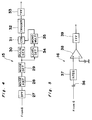
- FIG. 3 a circuit diagram of a modification of the first and second noise detection circuits 15 and 16 is shown, in which a counter is used as the first and second noise detection circuits 15 and 16.
- the high frequency noise signal contained in the output of FM detector 6 is applied to a high pass filter 24 and in turn to a wave forming circuit 22.
- Wave forming circuit 22 produces a rectangular pulse corresponding to the noise signal exceeding a specified level.
- the rectangular pulse is then applied to the counter 23 for counting the number of rectangular pulses generated.
- counter 23 counts, for example, three rectangular pulses
- counter 23 produces a high level signal from its first output terminal 25
- counter 23 counts, for example, ten pulses
- counter 23 produces a high level signal from its second output terminal 26.
- the noise detection circuit shown in Fig. 3 operates as a first noise detection circuit of high sensitivity when selector 18 is in a state as shown in Fig. 3, and operates as a second noise detection circuit of low sensitivity when the selector 18 is in a state opposite that shown in Fig. 3.
- circuitry can be simplified because a single counter can be shared, and the sensitivity setting can be changed by simply changing the count value.
- FIG. 4 a circuit diagram of a modification of the first noise detection circuit 15 is shown, in which 27 is a bandpass filter for filtering and detecting the high frequency noise signal in the output signal from FM detector 6, 28 is a noise signal amplifier for amplifying the high frequency noise signal, 29 is a noise signal detector for detecting the output signal (representing the noise) from noise amplifier 28, 30 is a pulse generator for generating a pulse when the noise detected output signal from noise signal detector 29 exceeds a predetermined threshold level, 31 is a counter, 32 is a trigger circuit which generates a trigger signal according to the output signal of counter 31, 33 is a T-FF (trigger flip-flop) which is triggered by the output signal of the trigger circuit 32, and 34 and 35 are a level detector and monostable multivibrator, respectively, which control the operation of the counter 31 such that counter 31 counts only during the high level signal produced from the multivibrator 35.
- 27 is a bandpass filter for filtering and detecting the high frequency noise signal in the output signal from FM detector 6
- the circuit shown in Fig. 4 has a noise amplifier 28 between the bandpass filter 27 and noise signal detector 29 so that the high frequency noise signal passing the bandpass filter 27 can be amplified to a sufficient level and thus the noise detection of high sensitivity can be realized.
- a circuit diagram of a modification of the second noise detection circuit 16 which includes a capacitor 36 for cutting DC component and passing high frequency noise signal, an integrator 37, a comparator 38, and a T-FF 39.
- the AC component which is the noise signal, contained in the detected signal obtained from FM detector 6 is integrated with a long time constant and compared with a reference voltage.
- white noise caused by a weak field strength will not be detected due to the low sensitivity. Thus, the noise signals caused by a multipass can be accurately detected.
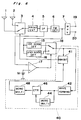
- Signal blocking circuit 40 includes a transmission inhibit circuit 41, a wave forming circuit 42 for waveforming the noise detection signal obtained from selector 18, a monostable multivibrator 44 for producing a pulse having a predetermined period of duration (such as 1 second) in response to the noise detection signal (a very narrow pulse signal), a counter 46 for counting the number of noise detection signals during a period in which monostable multivibrator 44 is producing a pulse and for producing a trigger pulse when counter has counted more than a predetermined number of noise detection signals, such as three noise detection signals, during the pulse duration, and a monostable multivibrator 48 for producing a pulse having a predetermined pulse duration in response to the trigger pulse from counter 46.
- transmission inhibit circuit 41 stops transmitting the output of selector 18 to antenna switching circuit 3.
- signal blocking circuit 40 blocks the transmission so as to prevent the high frequency noise detection signals from being transmitted to antenna switching circuit 3. Accordingly, when the noise signal is captured by both antennae 1 and 2, frequent antenna switching by antenna switching circuit 3 can be prevented, and sounds irritating to the listener can be prevented.
- a modification of the signal blocking circuit 40 which includes transmission inhibit circuit 41 and a field strength detector 43 which is defined by a comparator having its inverting input connected to the IF circuit 5 and non-inverting input connected to a predetermined reference voltage Ve which is smaller than the predetermined reference voltage Vr.
- the output of comparator 43 is connected to transmission inhibit circuit 41.
- comparator 43 produces a high level signal which is applied to transmission inhibit circuit 41.
- the signal transmission from selector 18 to antenna switching circuit 3 is blocked to prevent the antenna switching operation between antennae 1 and 2.
- antenna switching when the field strength of the received signal is extremely low will not occur, and unnecessary antenna switching can be prevented before such may occur.
- a diversity receiver uses two noise detection circuits with varying high and low sensitivity levels according to the field strength of the received signal, and therefore, correct antenna switching will be carried out.
Landscapes
- Engineering & Computer Science (AREA)
- Computer Networks & Wireless Communication (AREA)
- Signal Processing (AREA)
- Radio Transmission System (AREA)
Claims (9)
- Diversity-Empfänger mit
erster (1) und zweiter (2) Antenne zum Empfangen eines RF-Signals; und
einem Antennenschaltkreis (3) zum Wählen der ersten (1) oder zweiten (2) Antenne;
gekennzeichnet durch;
eine erste Detektorschaltung (15) mit hoher Empfindlichkeit zum Detektieren eines Rauschsignals, daa im empfangenen RF-Signal enthalten ist;
eine zweite Detektorschaltung (16) mit niedriger Empfindlichkeit zum Detektieren eines Rauschsignals, das in dem empfangenen RF-Signal enthalten ist;
eine Feldstärke-Detektorschaltung (17) zum Detektieren der Feldstärke eines empfangenen RF-Signals; und
eine Wählschaltung (18) zum Wählen der ersten oder zweiten Detektorschaltungen (15,16) gemäß dem Ausgangsignal der Feldstärkedetektorschaltung (17), und zum Bilden eines Schaltsignals für den Antennenschaltkreis (3) zum Schalten der Antennenwahl;
wobei wenn die Feldstärke relativ stark ist, die erste Detektorschaltung (15) mit hoher Empfindlichkeit für die Rauschdetektion verwendet wird und wenn die Feldstärke relativ schwach ist, die zweite Detektorschaltung (16) mit niedriger Empfindlichkeit zur Rauschdetektion verwendet wird. - Diversity-Empfänger nach Anspruch 1, wobei die Wählschaltung einen Ausgang der ersten Detektorschaltung (15) wählt, wenn die Feldstärke des empfangenen Signals größer als ein vorbestimmter Pegel (Vr) ist.
- Diversity-Empfänger nach Anspruch 1, wobei die erste Detektorschaltung (15) einen ersten Zähler (29) aufweist, um die Impulse entsprechend den Rauschsignalen zu zählen und ein erstes Ausgangssignal (25) zu erzeugen, wenn der Wert des ersten Zählers einen ersten vorbestimmten Wert übersteigt, und wobei die zweite Detektorschaltung einen zweiten Zähler aufweist, um die Impulse entsprechend den Rauschsignalen zu zählen und ein zweites Ausgangssignal (26) zu erzeugen, wenn der Wert des zweiten Zählers einen zweiten vorbestimmten Wert übersteigt, der größer als der erste vorbestimmte Wert ist.
- Diversity-Empfänger nach Anspruch 3, wobei die ersten und zweiten Zähler (15,16) derartig Bestandteil eines gemeinsamen Zählers (23) sind, daß ein erstes Ausgangssignal (25) ausgegeben wird, wenn der Wert des gemeinsamen Zählers einen ersten vorbestimmten Wert erreicht, und ein zweites Ausgangssignal (26) ausgegeben wird, wenn der Wert des gemeinsamen Zählers einen zweiten vorbestimmten Wert erreicht, der größer als der erste vorbestimmte Wert ist.
- Diversity-Empfänger nach Anspruch 1, wobei die erste Detektorschaltung einen dritten Zähler (31) aufweist, um eine Anzahl von Rauschimpulsen zu zählen und ein Rauschsignal bei Zählen einer vorbestimmten Anzahl von Rauschimpulsen zu erzeugen.
- Diversity-Empfänger nach Anspruch 1, wobei die zweite Detektorschaltung einen Integrator (37) aufweist, um ein Rauschsignal zu integrieren, und einen Komparator (38), um das integrierte Signal mit einem vorbestimmten Pegel zu vergleichen.
- Diversity-Empfänger nach Anspruch 1, weiterhin mit einer Signal-Verriegelungsschaltung (40), die zwischen die Wählschaltung (18) und den Antennenschaltkreis (3) eingesetzt ist, um die Übertragung des Schaltsignals auf den Antennenschaltkreis zu sperren.
- Diversity-Empfänger nach Anspruch 7, wobei die Signal-Verriegelungsschaltung (40) eine Sperrschaltung (41), die zwischen die Wählschaltung (18) und den Antennenschaltkreis (3) einesetzt ist, einen vierten Zähler (46) zum Zählen der Anzahl der Rauschsignale, die in einer vorbestimmten Zeitspanne erzeugt worden sind, und einen Impulsgenerator (48) aufweist, um an der Sperrschaltung (41) einen Sperrimpuls mit einer vorbestimmten Impulsbreite zu erzeugen, wenn der Wert des vierten Zählers einen zweiten vorbestimmten Wert übersteigt; wobei die Sperrschaltung die Übertragung des Schaltsignals auf den Antennenschaltkreis bei Anwesenheit des Sperrimpulses stoppt.
- Diversity-Empfänger nach Anspruch 7, wobei die Signal-Verriegelungsschaltung eine Sperrschaltung (41), die zwischen die Wählschaltung (18) und den Antennenschaltkreis (3) eingesetzt ist, und eine zweite Felddetektorschaltung (43) aufweist, um eine Feldstärke des empfangenen RS-Signals zu detektieren und ein Sperrsignal zu erzeugen, während die Feldstärke niedriger als eine vorbestimmte Feldstärke ist, wodurch die Sperrschaltung (41) die Übertragung des Schaltsignals auf den Antenntenschaltkreis (3) bei Anwesenheit des Sperrsignals stoppt.
Applications Claiming Priority (2)
| Application Number | Priority Date | Filing Date | Title |
|---|---|---|---|
| JP122317/88 | 1988-05-19 | ||
| JP63122317A JP2708777B2 (ja) | 1988-05-19 | 1988-05-19 | ダイバーシティ受信装置 |
Publications (3)
| Publication Number | Publication Date |
|---|---|
| EP0343538A2 EP0343538A2 (de) | 1989-11-29 |
| EP0343538A3 EP0343538A3 (de) | 1991-05-02 |
| EP0343538B1 true EP0343538B1 (de) | 1995-10-18 |
Family
ID=14832964
Family Applications (1)
| Application Number | Title | Priority Date | Filing Date |
|---|---|---|---|
| EP89109094A Expired - Lifetime EP0343538B1 (de) | 1988-05-19 | 1989-05-19 | Vielfalt-Empfänger |
Country Status (5)
| Country | Link |
|---|---|
| US (1) | US4977615A (de) |
| EP (1) | EP0343538B1 (de) |
| JP (1) | JP2708777B2 (de) |
| KR (1) | KR960000526B1 (de) |
| DE (1) | DE68924554T2 (de) |
Families Citing this family (37)
| Publication number | Priority date | Publication date | Assignee | Title |
|---|---|---|---|---|
| CA1320535C (en) * | 1988-02-29 | 1993-07-20 | Kazuzi Watanabe | Interference cancellation circuit |
| CA2012120C (en) * | 1989-03-15 | 1994-10-18 | Seiji Kondou | Interference detection apparatus for use in digital mobile communications system |
| US5390342A (en) * | 1990-03-14 | 1995-02-14 | Pioneer Electronic Corporation | Receiver using selective diversity receiving system |
| GB9019489D0 (en) * | 1990-09-06 | 1990-10-24 | Ncr Co | Antenna control for a wireless local area network station |
| GB9019487D0 (en) * | 1990-09-06 | 1990-10-24 | Ncr Co | Carrier detection for a wireless local area network |
| US5369801A (en) * | 1992-09-25 | 1994-11-29 | Northern Telecom Limited | Antenna diversity reception in wireless personal communications |
| CA2125220C (en) * | 1993-06-08 | 2000-08-15 | Joji Kane | Noise suppressing apparatus capable of preventing deterioration in high frequency signal characteristic after noise suppression and in balanced signal transmitting system |
| AU7925194A (en) * | 1993-09-30 | 1995-04-18 | Pacific Communication Sciences, Inc. | Multiple antenna home base for digital cordless telephones |
| DE4403612B4 (de) * | 1994-02-05 | 2008-10-02 | Lindenmeier, Heinz, Prof. Dr. Ing. | Schaltungsanordnung für ein Mehrantennen-Scanning-Diversitysystem für Kraftfahrzeuge |
| DE69530476T2 (de) * | 1994-10-17 | 2003-12-24 | Koninklijke Philips Electronics N.V., Eindhoven | Digitales funkkommunikationssystem, funkgerät und digitaler lautsprecher |
| US5603107A (en) * | 1995-06-09 | 1997-02-11 | Ford Motor Company | Switching system for diversity antenna FM receiver |
| US5818543A (en) * | 1995-09-06 | 1998-10-06 | Premier Wireless, Inc. | Diversity receiver for television |
| JP3297580B2 (ja) * | 1996-02-26 | 2002-07-02 | キヤノン株式会社 | スペクトラム拡散通信装置 |
| CA2188845A1 (en) * | 1996-10-25 | 1998-04-25 | Stephen Ross Todd | Selection of an antenna operating in diversity |
| US6108526A (en) * | 1997-05-07 | 2000-08-22 | Lucent Technologies, Inc. | Antenna system and method thereof |
| US5933111A (en) * | 1997-06-17 | 1999-08-03 | A T & T Corp. | Apparatus and method for detection of antenna mispointing in satellite earth stations |
| SE9702370L (sv) * | 1997-06-19 | 1998-12-20 | Ericsson Telefon Ab L M | Balanserad diversitet |
| KR100298345B1 (ko) * | 1997-12-31 | 2001-08-07 | 윤종용 | 씨티-2적용송수신선택다중경로시스템 |
| EP1020828B1 (de) * | 1998-07-30 | 2005-09-21 | Mitsubishi Denki Kabushiki Kaisha | Notmeldevorrichtung mit selbstprüfender funktion |
| JP2001184149A (ja) * | 1999-12-27 | 2001-07-06 | Toshiba Corp | 情報処理装置および動作状態制御方法 |
| DE60029303T2 (de) * | 2000-04-28 | 2007-07-05 | Siemens Ag | Empfänger mit Antennendiversity |
| JP4417593B2 (ja) * | 2001-08-10 | 2010-02-17 | パイオニア株式会社 | アンテナ切替装置 |
| JP4460226B2 (ja) * | 2002-02-21 | 2010-05-12 | パナソニック株式会社 | 無線基地局装置、無線端末装置及び無線通信方法 |
| JP3880485B2 (ja) * | 2002-08-22 | 2007-02-14 | 株式会社豊田自動織機 | ステレオ復調回路 |
| JP2004128930A (ja) * | 2002-10-03 | 2004-04-22 | Toyota Industries Corp | Fm受信機、fm受信機のノイズ除去装置及びノイズ除去方法 |
| DE10311836B4 (de) * | 2003-03-18 | 2006-10-05 | Integrated Electronic Systems !Sys Consulting Gmbh | Ferngesteuertes Industriegerät |
| KR20050013333A (ko) * | 2003-07-28 | 2005-02-04 | 현대자동차주식회사 | 차량용 라디오 수신기 및 그 제어방법 |
| JP2005252933A (ja) * | 2004-03-08 | 2005-09-15 | Matsushita Electric Ind Co Ltd | Amラジオ受信機 |
| TWI289385B (en) * | 2005-01-07 | 2007-11-01 | Neuro Solution Corp | FM radio receiver |
| JP2006287845A (ja) * | 2005-04-05 | 2006-10-19 | Fujitsu Ten Ltd | ダイバーシティ受信機及び信号処理回路 |
| JP2009081839A (ja) * | 2007-09-04 | 2009-04-16 | Sanyo Electric Co Ltd | Fmチューナ |
| JP4941338B2 (ja) * | 2008-02-01 | 2012-05-30 | 富士通株式会社 | 通信装置、ノイズ除去方法及びコンピュータプログラム |
| JP2009278525A (ja) * | 2008-05-16 | 2009-11-26 | Nec Electronics Corp | アンテナダイバーシティ受信装置とそのアンテナ切替制御方法 |
| EP2207273B1 (de) * | 2009-01-09 | 2016-01-06 | AKG Acoustics GmbH | Verfahren und Gerät zum Empfangen digitaler Audiodaten |
| BR112013032800B1 (pt) * | 2011-06-22 | 2021-02-23 | Vam Drilling France | elemento para uma coluna de perfuração, dispositivo tubular com comunicação de radiofrequência para cabeça de poço e método para a comunicação |
| US8600331B2 (en) * | 2012-04-11 | 2013-12-03 | Black Berry Limited | Radio receiver with reconfigurable baseband channel filter |
| JP7078018B2 (ja) * | 2019-06-26 | 2022-05-31 | 株式会社Jvcケンウッド | 受信装置及び受信処理プログラム |
Family Cites Families (7)
| Publication number | Priority date | Publication date | Assignee | Title |
|---|---|---|---|---|
| JPS57135532A (en) * | 1981-02-13 | 1982-08-21 | Matsushita Electric Ind Co Ltd | Diversity receiver |
| JPS57135533A (en) * | 1981-02-13 | 1982-08-21 | Matsushita Electric Ind Co Ltd | Diversity receiver |
| JPS58191538A (ja) * | 1982-04-30 | 1983-11-08 | Clarion Co Ltd | 車載用ダイバ−シテイ受信装置 |
| US4499606A (en) * | 1982-12-27 | 1985-02-12 | Sri International | Reception enhancement in mobile FM broadcast receivers and the like |
| JPS59181732A (ja) * | 1983-03-31 | 1984-10-16 | Toshiba Corp | 携帯用無線機におけるダイバ−シチ−受信方式 |
| JPH0314850Y2 (de) * | 1984-10-15 | 1991-04-02 | ||
| JPH0771034B2 (ja) * | 1986-05-19 | 1995-07-31 | 三洋電機株式会社 | ダイバ−シテイ受信装置 |
-
1988
- 1988-05-19 JP JP63122317A patent/JP2708777B2/ja not_active Expired - Lifetime
-
1989
- 1989-05-16 US US07/352,775 patent/US4977615A/en not_active Expired - Lifetime
- 1989-05-18 KR KR1019890006604A patent/KR960000526B1/ko not_active Expired - Fee Related
- 1989-05-19 EP EP89109094A patent/EP0343538B1/de not_active Expired - Lifetime
- 1989-05-19 DE DE68924554T patent/DE68924554T2/de not_active Expired - Lifetime
Also Published As
| Publication number | Publication date |
|---|---|
| DE68924554T2 (de) | 1996-06-05 |
| EP0343538A2 (de) | 1989-11-29 |
| JPH01292915A (ja) | 1989-11-27 |
| KR960000526B1 (ko) | 1996-01-08 |
| US4977615A (en) | 1990-12-11 |
| JP2708777B2 (ja) | 1998-02-04 |
| KR890017902A (ko) | 1989-12-18 |
| EP0343538A3 (de) | 1991-05-02 |
| DE68924554D1 (de) | 1995-11-23 |
Similar Documents
| Publication | Publication Date | Title |
|---|---|---|
| US4977615A (en) | Diversity receiver | |
| US4499606A (en) | Reception enhancement in mobile FM broadcast receivers and the like | |
| EP0792017B1 (de) | Hochfrequenz-Radioempfangsvorrichtung für digitale Kommunikation | |
| US4370522A (en) | FM Receiver for use with motorcars | |
| EP0286366B1 (de) | Raumdiversity-Empfangssystem | |
| EP0208530B1 (de) | Schaltung zum Detektieren einer Rauschunterdrückung mit Mitteln zur Bestimmung des Anfangs der Rauschunterdrückung | |
| EP0217475A1 (de) | Empfänger mit Detektor für Mehrwegübertragung | |
| JPS6139731A (ja) | 雑音検出器 | |
| US5444862A (en) | Circuit for stopping data transmission responding to low level and rapid fall of received electric field | |
| EP0565255B1 (de) | Mehrwegeempfangsdetektor mit Phasenvergleich des Stereopilotsignales | |
| US4189679A (en) | Noise detecting circuit having noise-immune AGC | |
| US20050036568A1 (en) | Fast settling data slicer comprising a low-pass filter with switchable cut-off frequency and a notch-filter | |
| US4742570A (en) | Multipath noise detecting circuit | |
| EP0293873B1 (de) | Signalerkennungsschaltung | |
| US4099124A (en) | Combined keyed AGC and pulse amplitude comparator circuit | |
| JP2620633B2 (ja) | ダイバーシティ受信装置 | |
| JPH0730472A (ja) | ダイバシティアンテナ切換制御回路 | |
| EP1100208B1 (de) | Empfänger mit auf Mehrwegstörungen abhängigen Mono-Stereo-Detektor | |
| JPS6033632Y2 (ja) | マルチパス検出器 | |
| JPS60248082A (ja) | 映像信号受信の有無検出回路 | |
| JPS6219002Y2 (de) | ||
| EP0477463A1 (de) | Mehrweg-Empfangsdetektor für eine FM Abstimmschaltung | |
| JPS62189820A (ja) | 雑音判別回路 | |
| JPH0733471Y2 (ja) | ダイバーシチ受信機 | |
| GB2217150A (en) | Voice/speech operated switch |
Legal Events
| Date | Code | Title | Description |
|---|---|---|---|
| PUAI | Public reference made under article 153(3) epc to a published international application that has entered the european phase |
Free format text: ORIGINAL CODE: 0009012 |
|
| AK | Designated contracting states |
Kind code of ref document: A2 Designated state(s): DE FR GB IT |
|
| 17P | Request for examination filed |
Effective date: 19901210 |
|
| PUAL | Search report despatched |
Free format text: ORIGINAL CODE: 0009013 |
|
| AK | Designated contracting states |
Kind code of ref document: A3 Designated state(s): DE FR GB IT |
|
| 17Q | First examination report despatched |
Effective date: 19930326 |
|
| GRAA | (expected) grant |
Free format text: ORIGINAL CODE: 0009210 |
|
| AK | Designated contracting states |
Kind code of ref document: B1 Designated state(s): DE FR GB IT |
|
| ITF | It: translation for a ep patent filed | ||
| REF | Corresponds to: |
Ref document number: 68924554 Country of ref document: DE Date of ref document: 19951123 |
|
| ET | Fr: translation filed | ||
| PLBE | No opposition filed within time limit |
Free format text: ORIGINAL CODE: 0009261 |
|
| STAA | Information on the status of an ep patent application or granted ep patent |
Free format text: STATUS: NO OPPOSITION FILED WITHIN TIME LIMIT |
|
| 26N | No opposition filed | ||
| REG | Reference to a national code |
Ref country code: GB Ref legal event code: IF02 |
|
| PGFP | Annual fee paid to national office [announced via postgrant information from national office to epo] |
Ref country code: DE Payment date: 20080522 Year of fee payment: 20 |
|
| PGFP | Annual fee paid to national office [announced via postgrant information from national office to epo] |
Ref country code: IT Payment date: 20080527 Year of fee payment: 20 |
|
| PGFP | Annual fee paid to national office [announced via postgrant information from national office to epo] |
Ref country code: GB Payment date: 20080521 Year of fee payment: 20 |
|
| REG | Reference to a national code |
Ref country code: GB Ref legal event code: PE20 Expiry date: 20090518 |
|
| PG25 | Lapsed in a contracting state [announced via postgrant information from national office to epo] |
Ref country code: GB Free format text: LAPSE BECAUSE OF EXPIRATION OF PROTECTION Effective date: 20090518 |
|
| PGFP | Annual fee paid to national office [announced via postgrant information from national office to epo] |
Ref country code: FR Payment date: 20080514 Year of fee payment: 20 |