EP0337474B1 - Anwuchsverhindernde Überzugszusammensetzung - Google Patents
Anwuchsverhindernde Überzugszusammensetzung Download PDFInfo
- Publication number
- EP0337474B1 EP0337474B1 EP89106669A EP89106669A EP0337474B1 EP 0337474 B1 EP0337474 B1 EP 0337474B1 EP 89106669 A EP89106669 A EP 89106669A EP 89106669 A EP89106669 A EP 89106669A EP 0337474 B1 EP0337474 B1 EP 0337474B1
- Authority
- EP
- European Patent Office
- Prior art keywords
- carbon atoms
- group
- hydrogen atom
- fluorine
- alkyl
- Prior art date
- Legal status (The legal status is an assumption and is not a legal conclusion. Google has not performed a legal analysis and makes no representation as to the accuracy of the status listed.)
- Expired - Lifetime
Links
- 0 CC1CC(CCC*C=C)CC1 Chemical compound CC1CC(CCC*C=C)CC1 0.000 description 5
Classifications
-
- C—CHEMISTRY; METALLURGY
- C09—DYES; PAINTS; POLISHES; NATURAL RESINS; ADHESIVES; COMPOSITIONS NOT OTHERWISE PROVIDED FOR; APPLICATIONS OF MATERIALS NOT OTHERWISE PROVIDED FOR
- C09D—COATING COMPOSITIONS, e.g. PAINTS, VARNISHES OR LACQUERS; FILLING PASTES; CHEMICAL PAINT OR INK REMOVERS; INKS; CORRECTING FLUIDS; WOODSTAINS; PASTES OR SOLIDS FOR COLOURING OR PRINTING; USE OF MATERIALS THEREFOR
- C09D5/00—Coating compositions, e.g. paints, varnishes or lacquers, characterised by their physical nature or the effects produced; Filling pastes
- C09D5/16—Antifouling paints; Underwater paints
- C09D5/1606—Antifouling paints; Underwater paints characterised by the anti-fouling agent
- C09D5/1637—Macromolecular compounds
-
- C—CHEMISTRY; METALLURGY
- C09—DYES; PAINTS; POLISHES; NATURAL RESINS; ADHESIVES; COMPOSITIONS NOT OTHERWISE PROVIDED FOR; APPLICATIONS OF MATERIALS NOT OTHERWISE PROVIDED FOR
- C09D—COATING COMPOSITIONS, e.g. PAINTS, VARNISHES OR LACQUERS; FILLING PASTES; CHEMICAL PAINT OR INK REMOVERS; INKS; CORRECTING FLUIDS; WOODSTAINS; PASTES OR SOLIDS FOR COLOURING OR PRINTING; USE OF MATERIALS THEREFOR
- C09D4/00—Coating compositions, e.g. paints, varnishes or lacquers, based on organic non-macromolecular compounds having at least one polymerisable carbon-to-carbon unsaturated bond ; Coating compositions, based on monomers of macromolecular compounds of groups C09D183/00 - C09D183/16
Definitions
- This invention relates to an antifouling composition capable of forming a coating layer excellent in weatherability and antifouling properties and articles partly or wholy coated with the composition.
- Known coating compositions having good weatherability include those containing a copolymer of fluoro-olefin with vinyl ethers such as cyclohexylvinyl ether, alkylvinyl ether, hydroxyalkylvinyl ether and the like (e.g. Japanese Unexamined Patent Publication No.34107/1982).
- these coating compositions have the drawbacks of having little antifouling properties and, when applied to the exterior wall boads or walls of houses, for example, the coated surfaces are prone to be stained with rain drops or trickles, metal rust, contaminants from exhaust fumes from automobiles, soils, etc., resulting in impaired appearance thereof. Further, when these compositions are applied to household electric appliances such as refrigerator, television set, microwave range, surfaces are easily stained with oil or grease, dirt from the havds, cigarrette fume, marking pen, crayon, etc. which are difficult to remove.
- (meth)acrylate copolymers having long-chain fluoroalkyl group as side chain show excellent water- and oil-repellent and antifouling properties. Nevertheless, these copolymers have the drawbacks of being poor in weatherability and chemical resistance and easily degraded in oil repellency and antifouling property because the copolymers have a relatively low molecular weight of less than 10,000 and are not cross-linked.
- An object of the invention is to use a coating composition capable of forming a coat excellent both in weatherability and antifouling properties as antifouling agent.
- the present invention can use among the following antifouling coating compositions.
- the present invention further provides articles on the surface of which a cured coating film derived from the composition A or B is formed.
- an antifouling composition comprising a specific (meth)acrylate or a polymer containing the (meth)acrylate unit gives a coating layer of highly improved weatherability and antifouling property and exhibits excellent processability enabling bending of the article which is formed of the coating film of the composition without causing cracking or peeling of the film, and the film formed has a high hardness.
- the present invention has been accomplished based on this novel finding.
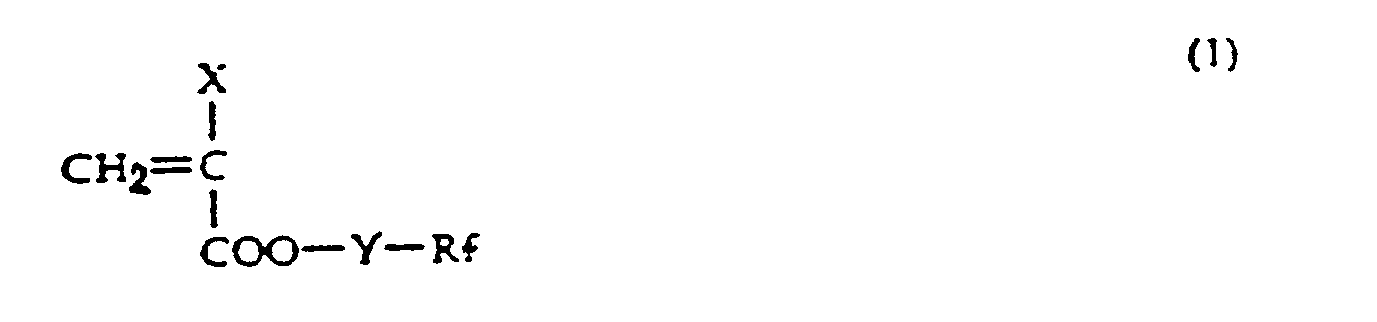
- composition A of the invention comprises a (meth)acrylate of the formula (1) as the component capable of forming antifouling coating films of highly improved properties (hereinafter referred to as "antifouling coating component").
- examples of fluoroalkyl groups represented by Rf and having 6 to 12 carbon atoms or those represented by Rf and having 5 to 21 carbon atoms and containing 1 to 5 oxygen atoms in the carbon ring are groups reprsented by the formula -(CF2CF2) k CF(R3)CF3 wherein k is an integer of 1 to 6, and R3 is a fluorine atom or trifluoromethyl, groups represented by the formula -[(CF2) l O] p CF(R3)CF3 wherein R3 is as defined above, l is an integer of 1 to 3, and p is an integer of 1 to 5, groups represented by the formula wherein R3 is as defined above, and q is an integer of 0 to 4, and groups represented by the formula -Ph-O-Rf′ wherein Ph is phenylene, and Rf′ is perfluoroalkylene having 5 to 15 carbon atoms.
- fluorine-containing (meth)acrylates (1) those wherein X is fluorine are more preferable.
- composition A may contain hydrocarbon (meth)acrylates, (meth)acrylates having a functional group, etc. as antifouling coating components other than the fluorine-containing (meth)acrylates (1).
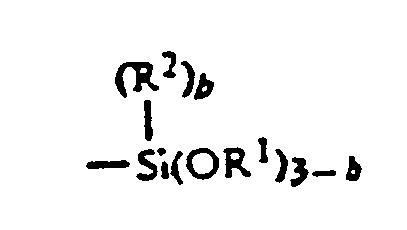
- Examples of useful (meth)acrylates having functional group are compounds represented by the formula (3) wherein X is as defined above, A is a group -(CH2)a-(wherein a is 0 or an integer of 1 to 4), and B is a hydrogen atom, hydroxyl, epoxy, a group -NHCH2OH, alkyl having 1 to 4 carbon atoms and having as substituent at least one of hydroxyl and halogen atoms or a group (wherein R1 and R2 are the same or different and represent a hydrogen atom or a alkyl having 1 to 4 carbon atoms, and b is 0 or an integer of 1 to 3.)
- those wherein B is a group (wherein R1, R2 and b are as defined above) are particularly preferred because those (meth)acrylates impart to the coating film particularly improved antifouling properties, weatherability, curing rate, transparency, smoothness, etc.
- Examples of useful hydrocarbon (meth)acrylates are compounds represented by the formula (4) wherein X is as defined above, and Z is alkyl having 1 to 10 carbon atoms, or alicyclic or aromatic group having 6 to 10 carbon atoms.
- the composition A may contain ethylenically unsaturated monomers other than indicated above for reducing the cost of the composition.
- ethylenically unsaturated monomers are ethylene, vinyl chloride, vinyl versate, stylene and the like.
- fluorine-containing (meth)acrylate (1), (meth)acrylate having a fucntional group (3) and hydrocarbon (meth)acrylate (4) are used in combination as antifouling coating components, the proportions of these compounds are not limited specifically but can be determined suitably.
- ethylenically unsaturated monomers as defined above may be used in such an amount that the properties of the coating film are not impaired, usually up to 35 wt.% of the combined amount of all monomers.
- the composition A contains, in addition to the antifouling coating component or components, a photopolymerization initiator or thermal polymerization initiator.
- a photopolymerization initiator or thermal polymerization initiator examples include those already known, such as benzoyl alkyl ethers, ⁇ -hydroxyisobutylphenone, 1-hydroxycyclohexyl phenyl ketone and the like.
- useful thermal polymerization initiators are also those already known, such as t-butyl peroxide, benzoyl peroxide and like peroxides, azobis(isobutyronitrile) and like azo compounds, etc.
- the amount of photopolymerization initiator or thermal polymerization initiator although not limited specifically, is usually about 0.1 to about 10 parts by weight, preferably about 1 to about 5 parts by weight, per 100 parts by weight of the antifouling coating component.
- An antifouling coating film can be formed on the desired article using the composition A in the same manner as usual coating compositions containing a photopolymerization initiator or thermal polymerization initiator, for example, by applying the composition A to the article and thereafter irradiating the coating with ultraviolet radiation or heating the coating to polymerize the (meth)acrylate compound present in the composition.
- the composition can be applied by any known method, for example, by brush coating, dipping, roll coating, spin coating, spray coating, flow coating, bar coating, screen printing, etc.
- Photopolymerization is effected using ultraviolet radiation sources such as a high pressure mercury lamp, metal halide lamp and the like.
- Thermal polymerization are carried out at room temperature or at elevated temperatures.
- the temperature is selected depending on the kind of initiator used and usually between about 50 to about 150°C.
- the antifouling coating film to be formed is about 0.1 to about 150 ⁇ m in thickness.
- crosslinking agents are Lewis acid compounds, amino compounds, amide compounds, imino compounds, epoxy compounds, isocyanate compounds, carboxylic acid anhydride, etc.
- crosslinking accelerators are hydrochloric acid, acetic acid, p-toluenesulfonic acid, dibutyltin dilaurate, etc.
- composition A of the invention may further contain one or more of conventional additives such as pigment, dispersion stabilizer, viscosity regulating agent, leveling agent, anti-static agent, antigelling agent, UV absorber, antioxidant, flatting agent, filler, etc.
- additives such as pigment, dispersion stabilizer, viscosity regulating agent, leveling agent, anti-static agent, antigelling agent, UV absorber, antioxidant, flatting agent, filler, etc.
- the antifouling component of the composition B is a fluorine-containing polymer containing structural units represented by the formula (2). More specifically, examples of useful fluorine-containing polymers are homopolymers or copolymers of fluorine-containing (meth)acrylates (1), copolymers of acrylates (1) and monomers copolymerizable therewith. Examples of useful monomers copolymerizable with acrylates (1) are (meth)acrylates having a functional group (3), hydrocarbon (meth)acrylates (4) and ethylenically unsaturated monomer other than monomers (1), (3) and (4) which are exemplified above.
- the (meth)acrylate (3) as a monomer component enables the fluorine-containing copolymer obtained to exhibit improved hardness and adhesion to substrate. Further the (meth)acrylate (4), when used as a polymer component, permits the coating film formed to exhibit enhanced hardness.
- the fluorine-containing polymer can be prepared by known radical polymerization processes, for example, by solution polymerization, bulk or mass polymerization, emulsion polymerization or suspension polymerization.
- Examples or solvents usable for solution polymerization are m-xylenehexafluoride, trichlorotrifluoroethane and like fluorine-containing solvents, 1,1,1-trichloroethane and like chlorine-containing solvents, ethyl acetate and like ester solvents, methyl isobutyl ketone, acetone and like ketone solvents, toluene, xylene and like hydrocarbon solvents, etc.
- Useful polymerization initiators are those already known, such as azobisisobutyronitrile (AIBN) and like azo compounds, benzoyl peroxide and like peroxide compounds, etc. Further laurylmercaptan, thiophenol and the like may be used as chain transfer agents.
- the polymerization temperature although not limited specifically, is usually about 30 to about 100°C.
- the solution resulting from solution polymerization and containing the desired fluorine-containing polymer may be used as it is as the composition B.
- the fluorine-containing polymer may be separated from the solution and dried before use.
- Bulk or mass polymerization when to be resorted to, can be conducted using the same polymerization initiator, chain transfer agent and polymerization conditions as employed for solution polymerization.
- the fluorine-containing polymer obtained by bulk or mass polymerization is separated from the resulting block and dried before use.
- emulsifying agents are useful in the emulsion polymerization.
- emulsifying agents are fluorine-containing type such as ammonium salts of perfluorocarboxylic acids and the like, polyethyleneglycols, hydrocarbon type such as alkylphenylethers and the like.
- Known polymerization initiators can be used which include redox initiators consisting of oxidizing agents such as ammonium persulfate, potassium persulfate and the like, reducing agents such as sodium sulfate and the like and ferrous sulfate and like salts of transition metals; azo compounds such as azoisobutyroamidine hydrochloride etc.; peroxide compounds suchd as succinic acid peroxide, etc.
- Emulsion polymerization is conducted under the similar conditions as in solution polymerization.
- Suspension polyerization can be conducted in the presence of suspension stabilizer such as sodium polyacrylate or the like using the same polymerization initiator and polymerization conditions as employed for emulsion polymerization.
- suspension stabilizer such as sodium polyacrylate or the like
- the fluorine-containing (meth)acrylate (1), (meth)acrylate having a functional group (3), hydrocarbon (meth)acrylate (4) and ethylenically unsaturated monomer other than monomer (1), (3) and (4) can be used in proportions which are not limited sepcifically.
- the fluorine-containing acrylate (1) about 1 to about 50 wt.%, preferably about 5 to 40 wt.%, of the (meth)acrylate (3), and up to 35 wt.%, preferably about 0.1 to about 20 wt.%, of the hydrocarbon (meth)acrylate (4).
- the ethylenically unsaturated monomers as defined above may be used in such an amount that the properties of the coating film are not impaired, usually up to 35 wt.% of the combined amount of all monomer components.
- fluorine-containing polymers thus obtained, it is desirable to use those having a number average molecular weight of about 5,000 to about 4,000,000 (as determined by gel permeation chromatography) or those having an intrinsic viscosity [ ⁇ ] of about 0.15 to about 3.0 (solvent: m-xylenehexafluoride, methyl ethyl ketone, chloroform or 1,1,1-trichloroethane or the like, temperature: 35°C). If the molecular weight is too small, the antifouling coating film is liable to separate from the article treated and is likely to have low strength, whereas if it is excessively great, the composition is not always applicable to articles easily.
- the composition B can be prepared by dissolving the antifouling coating component, i.e. the fluorine-containing polymer, in a suitable solvent.
- suitable solvents are m-xylenehexafluoride, trichlorotrifluoroethane and like fluorine-containing solvents, tetrachloroethylene, trichloroethylene, trichloroethane and like chlorine-containing solvents, acetone and like ketone solvents, ethyl acetate and like ester solvents, toluene and like aromatic solvents, n-hexane and like saturated aliphatic solvents, etc.
- the diluted composition can be applied by the same method as already described. After application, the composition is dried at room temperature or with heating at about 50 to about 150°C for 30 minutes to 7 days, whereby an antifouling coating film is formed.
- the monomer wherein the functional group is (wherein R1, R2 and b are as defined above) is uded as a film forming component
- the concentration of the antifouling component although not limited specifically, is suitably determined usually from the range of about 0.05 to about 40 wt.%, in view of work efficiency, etc.
- the antifouling coating film formed from the composition B may have the same thickness as is the case with the composition A.
- a crosslinking agent and/or crosslinking accelerator and additives mentioned above may be added to the composition B to further crosslink the fluorine-containing polymer and to thereby assure the coating of promoted curing.
- a primer coating may be formed on the surface of substrate or article to be protected in order to improve the adhesion of antifouling coating film to the surface.
- Any primer composition can be used which include those comprising silane coupling agent, acryl-silicone polymer, acrylate polymer, epoxy polymer, urethane polymer, etc.
- the articles of the invention are partially or wholy coated with the composition A or B.
- the articles to be coated are not specifically limited and include those formed from a wide range of materials.
- the materials for articles are metals such as iron, aluminum, copper and alloys thereof; glass and enameled ware; resins such as ABS resin, AXS resin, polycarbonate resin, polyacrylate resin, polymethacrylate resin, amino resin, phenol resin, alkyd resin, polyvinyl chloride resin, polyester resin, polyurethane resin, polyamide resin, polyacetal resin, polyethylene resin, polypropylene resin, epoxy resin, furan resin, diallyl phthalate resin, polyvinyl acetate resin, polystylene resin, cellulosic plastics, etc.; natural and synthetic rubbers; wood, etc.
- Articles formed from these materials may be pre-treated by plating, chemical conversion, oxidation and the like. Further, Articles may be formed of coating of resin as mentioned above.
- Articles to be coated with the antifouling composition of the invention are not limited and include building, bridge, plant, sound-proof wall, tunnel, antennas and like outdoor constructions; refrigerator, television set, microwave oven, washer, dryer, electric ion, rice cooker, electric fan, air circulating fan, illuminating apparatus, air conditioner, stereo audio player and like household electric appliances; sink, cooking table, wagon and like kitchen ware; bathtub, bath burner, washbowl, toilet bowl and like sanitary ware; furniture, desk, interior wall board and the like; personal computer, word processor, copying machine, shredder, communication device, cabinet and like business machines; car, railroad car, ship, aircraft and like vehicles; inner surface of injection nozzle of ink-jet type printer, etc.
- the antifouling coating compositions of the invention can produce coating films excellent in weatherability and antifouling property and having good processability.
- the article formed of the coating film of the composition of the invention can be bent without entailing cracks in the film or peeling of the film. Further, the coating film formed has a remarkable hardness.
- the composition was applied with a doctor blade to a degreased aluminum sheet (BT712) to a thickness of 10 ⁇ m.
- the aluminum sheet was then irradiated with ultraviolet radiation to cure the coated composition.
- the antifouling coating film thus prepared was 9 ⁇ m in thickness.
- the antifouling coating film was found to be resistant to m-xylene hexafluoride (mXHF), showing the film was fully crosslinked.
- mXHF m-xylene hexafluoride
- a 4-necked flask was charged with a mixture of 66 g of ⁇ F17F, 30 g of methylmethacrylate (MMA), 4 g of hydroxypropylacrylate (HPA), 0.5 g of azobisisobutyronitrile (AIBN) and 233 g of mXHF. After replacing the air in the flask with nitrogen, the mixture was reacted at 50°C for 24 hours to obtain a 30 wt.% solution of fluorine-containing copolymer.
- MMA methylmethacrylate
- HPA hydroxypropylacrylate
- AIBN azobisisobutyronitrile
- the copolymer solution was diluted with 1,1,1-trichloroethane to a concentration of 20 wt.% to obtain a composition of the invention.
- composition thus produced was applied with a brush to a degreased aluminum sheet (BT712) and the aluminum sheet was heated at 140°C for 60 minutes to cure the coated composition and to form a antifouling coating film 15 ⁇ m in thickness.
- a mixture of 50 g of an acrylic paint composition (trademark “Hitaloyd”, product of Hitachi Kasei Kabushiki Kaisha) and 5.3 g of a crosslinking agent (trademark “Colonate EH”, product of Nippon Polyurethane Kabushiki Kaisha) was diluted with a mixture of ethyl acetate/toluene (1/1) to a paint concentration of 30 wt.%.
- the diluted paint composition was applied to a degreased aluminum sheet and cured at room temperature for 7 days to form an antifouling coating film 30 ⁇ m in thickness.
- a mixture of 100 g of fluorine-containing weather resistant paint composition (trademark “Lumiflon", a product of Asahi Glass Co., Ltd.), 9.3 g of crosslinking agent (trademark “Colonate EH"), 3.5 mg of dibutyltin dilaurate and 100 g of xylene/methylisobutylketone (1/3) was applied to an aluminum sheet and cured at room temperature for 7 days to produce an antifouling coating film 30 ⁇ m in thickness.
- the aluminum sheet formed of antifouling coating film was bonded to the outer wall of a building of a plant at Settsu-shi, Osaka of Daikin Industries Ltd. After the lapse of one month, the aluminum sheet was washed with water and checked for gloss retaining rate according to the following criteria.
- Bending test according to JIS K 5400 was carried out using a rod (2 mm in diameter) and a support plate (4 mm in thickness) to evaluate the quality of the antifouling coating film.
- the criteria for evaluation are as follows.
- Table 2 and 3 reveal that the compositions of the invention can produce coating films excellent in antifouling property, weatherability and processability.
- Dibutyltin dilaurate (curing accelerator) was added to the solution in an amount of 0.1 part per 100 parts of solid to prepare an antifouling coating composition.
- the coating composition was applied with a brush to the surface of body (ABS resin) of an electric cleaner.
- the coated composition was dried at room temperature for 30 minutes and then heated at 80°C for 12 hours to obtain a cured coating film 5 ⁇ m in thickness.
- the electric cleaner body formed of the coating film was subjected to the tests listed in Table 4.
- Table 4 shows the results of an electric cleaner to which the coating composition was not applied.
- Table 4 Marking Pen 1) Hand dirts Cross Cut 2) Pencil Hardness Coated cleaner Not stained Not stained 100/100 H Non-coated cleaner Stained Stained - HB 1) : Red oil marker (product of Sakura Color Products Co., Ltd.) 2) : JIS K 5400
- the antifouling coating composition was applied to the aluminum fin element of air conditioner and cured.
- the air conditioner was continuously operated for 10 days and frost formation on the fin element was checked.
Landscapes
- Chemical & Material Sciences (AREA)
- Life Sciences & Earth Sciences (AREA)
- Engineering & Computer Science (AREA)
- Materials Engineering (AREA)
- Wood Science & Technology (AREA)
- Organic Chemistry (AREA)
- Paints Or Removers (AREA)
Claims (4)
- Verwendung einer Zusammensetzung als Antifouling-Beschichtungsmittel, die im wesentlichen besteht aus: 50 - 99 Gew.-% eines fluorhaltigen Acrylats, welches wiedergegeben wird durch die Formel (1)


50 - 1 Gew.-% eines (Meth)acrylats, welches durch die Formel (3)

- Verwendung einer Zusammensetzung als Antifouling-Beschichtungsmittel, bestehend im wesentlichen aus: 50 - 99 Gew.-% eines fluorhaltigen Acrtylats, welches wiedergegeben wird durch die Formal (1)

50 - 1 Gew.-% eines Acrylats, welches durch die Formel (3-a) dargestellt wird
- Die Verwendung einer Zusammensetzung als Antifouling-Beschichtungsmittel, bestehend im wesentlichen aus einem Polymer, welches umfaßt:
50 - 99 Gew.-% einer Einheit, die durch die Formel (2)

50 - 1 Gew.-% einer Einheit, die durch die Formel (3') repräsentiert wird,

- Verwendung einer Zusammensetzung als Antifouling-Beschichtungsmittel, bestehend im wesentlichen aus Polymer, welches enthält:
60 - 95 Gew.-% einer Einheit, die durch die Formel (2) wiedergegeben wird,

5 - 40 Gew.-% einer Einheit, die durch die Formel (3) wiedergegeben wird,


Applications Claiming Priority (4)
| Application Number | Priority Date | Filing Date | Title |
|---|---|---|---|
| JP93860/88 | 1988-04-15 | ||
| JP9386088 | 1988-04-15 | ||
| JP212741/88 | 1988-08-26 | ||
| JP63212741A JP2595678B2 (ja) | 1988-04-15 | 1988-08-26 | 防汚塗料組成物及び被覆品 |
Publications (3)
| Publication Number | Publication Date |
|---|---|
| EP0337474A2 EP0337474A2 (de) | 1989-10-18 |
| EP0337474A3 EP0337474A3 (de) | 1991-04-10 |
| EP0337474B1 true EP0337474B1 (de) | 1994-07-27 |
Family
ID=26435140
Family Applications (1)
| Application Number | Title | Priority Date | Filing Date |
|---|---|---|---|
| EP89106669A Expired - Lifetime EP0337474B1 (de) | 1988-04-15 | 1989-04-14 | Anwuchsverhindernde Überzugszusammensetzung |
Country Status (4)
| Country | Link |
|---|---|
| US (1) | US5081165A (de) |
| EP (1) | EP0337474B1 (de) |
| JP (1) | JP2595678B2 (de) |
| DE (1) | DE68916996T2 (de) |
Families Citing this family (39)
| Publication number | Priority date | Publication date | Assignee | Title |
|---|---|---|---|---|
| DE3912151A1 (de) * | 1989-04-13 | 1990-10-18 | Hoechst Ag | Transparente thermoplastische formmasse aus 2,3-difluoracrylsaeureestern |
| US5449553A (en) * | 1992-03-06 | 1995-09-12 | The United States Of America As Represented By The Secretary Of The Navy | Nontoxic antifouling systems |
| JP3320491B2 (ja) * | 1993-03-24 | 2002-09-03 | 旭硝子株式会社 | 防汚加工剤 |
| KR100385924B1 (ko) * | 1995-12-30 | 2003-08-21 | 고려화학 주식회사 | 방오 도료용 바인더의 제조방법 및 이를 함유한 방오도료조성물 |
| DE19606011B4 (de) * | 1996-02-17 | 2006-11-23 | Degussa Ag | Verwendung einer Zubereitung zur Herstellung einer Antifouling-Beschichtung |
| JPH11279527A (ja) * | 1997-06-30 | 1999-10-12 | Asahi Glass Co Ltd | 防汚加工剤組成物、その製造方法およびそれを用いた被処理物 |
| US7087661B1 (en) * | 1998-09-23 | 2006-08-08 | Cernofina, Llc | Safe and effective biofilm inhibitory compounds and health-related uses thereof |
| US6245854B1 (en) | 1998-12-11 | 2001-06-12 | Visteon Global Technologies, Inc. | Fluorocarbon-containing hydrophilic polymer coating composition for heat exchangers |
| US6750296B2 (en) | 2001-01-05 | 2004-06-15 | Cornell Research Foundation, Inc. | Polymer material with stable non-wetting surface |
| DE60127527T2 (de) | 2001-01-19 | 2007-12-13 | 3M Innovative Properties Co., St. Paul | Wasserlösliche oder in Wasser dispergierbare fluorochemische Silane, um Substrate öl- und wasserabstossend zu machen |
| EP1225187B1 (de) | 2001-01-19 | 2009-05-27 | 3M Innovative Properties Company | Fluorovinyloligomerkomponente mit Silangruppen, Flüssigzusammensetzungen daraus und Beschichtungsverfahren |
| WO2003055679A1 (en) * | 2001-12-26 | 2003-07-10 | Tdk Corporation | Article having composite hard coat layer and method for forming composite hard coat layer |
| GB0208138D0 (en) * | 2002-04-09 | 2002-05-22 | Stewart Signs Ltd | Graffiti resistant film and method for application of an anti-graffiti coating onto a substrate |
| US6806026B2 (en) * | 2002-05-31 | 2004-10-19 | International Business Machines Corporation | Photoresist composition |
| DE60216424T2 (de) | 2002-06-03 | 2007-09-20 | 3M Innovative Properties Co., St. Paul | Fluor-Silan-Oligomerzusammensetzung |
| WO2003102500A1 (en) * | 2002-06-04 | 2003-12-11 | Olympus Corporation | Method of obtaining 3-d coordinates |
| AU2003244153A1 (en) * | 2002-06-27 | 2004-01-19 | Tdk Corporation | Object with composite hard coating layer and method of forming composite hard coating layer |
| ITTO20020583A1 (it) * | 2002-07-04 | 2004-01-05 | Univ Degli Studi Genova | Nuovi copolimeri acrilici parzialmente fluorurati e loro utilizzo come vernici o rivestimenti superficiali protettivi e, in particolare, ant |
| FR2858420B1 (fr) * | 2003-07-29 | 2005-11-25 | Essilor Int | Article d'optique comprenant un empilement anti-reflets multicouches et procede de preparation |
| US7887790B2 (en) | 2004-02-20 | 2011-02-15 | Cornell Research Foundation, Inc. | Polymers and polymer coatings |
| DE602004018898D1 (de) * | 2004-03-01 | 2009-02-26 | Lorenzo Toffano | Zusammensetzungen zur Herstellung von hydrophoben Beschichtungen |
| JP4466649B2 (ja) * | 2004-03-26 | 2010-05-26 | ダイキン工業株式会社 | 表面処理剤と、含フッ素単量体および含フッ素重合体 |
| KR100840819B1 (ko) | 2004-03-26 | 2008-06-23 | 다이킨 고교 가부시키가이샤 | 불소 함유 단량체, 불소 함유 중합체 및 표면 처리제 |
| WO2005097851A1 (ja) * | 2004-04-05 | 2005-10-20 | Daikin Industries, Ltd. | 含フッ素重合体を含む汚れ脱離剤 |
| US20070048249A1 (en) | 2005-08-24 | 2007-03-01 | Purdue Research Foundation | Hydrophilized bactericidal polymers |
| CN101437909B (zh) * | 2006-03-06 | 2013-07-03 | 乔滕股份公司 | 除垢组合物 |
| KR101134273B1 (ko) * | 2007-04-06 | 2012-04-12 | 주식회사 엘지화학 | 내오염성이 우수한 하드 코팅액 조성물 |
| WO2010078413A1 (en) | 2008-12-31 | 2010-07-08 | Apinee, Inc. | Preservation of wood, compositions and methods thereof |
| IT1402906B1 (it) * | 2010-11-30 | 2013-09-27 | Milano Politecnico | Rivestimento superficiale con composti perfluorurati come antifouling. |
| BE1019713A3 (fr) * | 2010-12-24 | 2012-10-02 | Axichem Ab | Peinture repulsive a base de derives de capsaicine. |
| US9878464B1 (en) | 2011-06-30 | 2018-01-30 | Apinee, Inc. | Preservation of cellulosic materials, compositions and methods thereof |
| JP5692272B2 (ja) * | 2012-04-02 | 2015-04-01 | ダイキン工業株式会社 | 耐久型防水・防湿性コーティング組成物 |
| US10947396B2 (en) | 2012-11-13 | 2021-03-16 | 3M Innovative Properties Company | Curable antifouling composition, method of use, and articles |
| FR3008100B1 (fr) * | 2013-07-08 | 2015-06-26 | Saint Gobain | Copolymere pour revetement hydrophobe a durabilite amelioree |
| JP2015108733A (ja) * | 2013-12-05 | 2015-06-11 | チェイル インダストリーズ インコーポレイテッド | 樹脂膜及び樹脂膜の製造方法 |
| WO2015084097A1 (ko) * | 2013-12-05 | 2015-06-11 | 삼성에스디아이 주식회사 | 수지막 및 수지막의 제조 방법 |
| EP3541619B1 (de) * | 2016-11-18 | 2022-03-16 | The Penn State Research Foundation | Flüssige und viskoelastische materialabweisende und anti-biofouling-beschichtungen |
| WO2018222622A1 (en) | 2017-05-27 | 2018-12-06 | Poly Group LLC | Dispersible antimicrobial complex and coatings therefrom |
| WO2018232417A1 (en) | 2017-06-16 | 2018-12-20 | Poly Group LLC | Polymeric antimicrobial surfactant |
Family Cites Families (10)
| Publication number | Priority date | Publication date | Assignee | Title |
|---|---|---|---|---|
| US3457247A (en) * | 1965-02-12 | 1969-07-22 | Daikin Ind Ltd | Fluorocarbon compounds and polymers thereof |
| GB1411101A (en) * | 1972-09-08 | 1975-10-22 | Asahi Glass Co Ltd | Oil-and-water repellent composition |
| US4478876A (en) * | 1980-12-18 | 1984-10-23 | General Electric Company | Process of coating a substrate with an abrasion resistant ultraviolet curable composition |
| JPS6090855A (ja) * | 1983-10-21 | 1985-05-22 | Nitto Electric Ind Co Ltd | 光学ガラスフアイバ用被覆材料 |
| JPS61228078A (ja) * | 1985-04-01 | 1986-10-11 | Shin Etsu Chem Co Ltd | 粘着剤用離型性組成物 |
| JPH0699655B2 (ja) * | 1985-10-09 | 1994-12-07 | 大日本インキ化学工業株式会社 | 常温硬化性樹脂組成物 |
| JPH0811777B2 (ja) * | 1986-02-27 | 1996-02-07 | 大日本インキ化学工業株式会社 | 低屈折率樹脂組成物 |
| US4786658A (en) * | 1986-02-27 | 1988-11-22 | Dainippon Ink And Chemicals, Inc. | Fluorine-containing resin composition having low refractive index |
| JPS6361032A (ja) * | 1986-09-02 | 1988-03-17 | Honny Chem Ind Co Ltd | 可塑化ポリ塩化ビニル基材用被覆組成物 |
| JPH01259072A (ja) * | 1988-04-08 | 1989-10-16 | Daikin Ind Ltd | 防湿コーティング剤 |
-
1988
- 1988-08-26 JP JP63212741A patent/JP2595678B2/ja not_active Expired - Fee Related
-
1989
- 1989-04-14 EP EP89106669A patent/EP0337474B1/de not_active Expired - Lifetime
- 1989-04-14 DE DE68916996T patent/DE68916996T2/de not_active Expired - Fee Related
- 1989-04-14 US US07/338,709 patent/US5081165A/en not_active Expired - Lifetime
Also Published As
| Publication number | Publication date |
|---|---|
| JPH0228270A (ja) | 1990-01-30 |
| DE68916996T2 (de) | 1995-03-16 |
| JP2595678B2 (ja) | 1997-04-02 |
| EP0337474A2 (de) | 1989-10-18 |
| EP0337474A3 (de) | 1991-04-10 |
| US5081165A (en) | 1992-01-14 |
| DE68916996D1 (de) | 1994-09-01 |
Similar Documents
| Publication | Publication Date | Title |
|---|---|---|
| EP0337474B1 (de) | Anwuchsverhindernde Überzugszusammensetzung | |
| US4581412A (en) | Coating composition of vinylidene fluoride copolymer and acrylic polymer | |
| JP5212561B1 (ja) | 含フッ素共重合体 | |
| AU775474B2 (en) | Highly weathering-resistant powder coating composition | |
| EP0311052A1 (de) | Beschichtungszusammensetzung | |
| JP3365366B2 (ja) | 架橋性含フッ素樹脂水性分散液組成物 | |
| JPH07122046B2 (ja) | 塗料用組成物 | |
| US5284893A (en) | Coating composition | |
| JPH0910672A (ja) | 粉体塗料により形成された塗膜を有する物品 | |
| JPH044246A (ja) | 含フッ素共重合体およびそれを用いた硬化用組成物 | |
| JP2961874B2 (ja) | 被覆用フッ化ビニリデン重合体組成物 | |
| JP2805826B2 (ja) | 床 材 | |
| JP2002105388A (ja) | 塗料用樹脂組成物 | |
| JPH01198653A (ja) | 塗料用組成物 | |
| JP2830047B2 (ja) | 異型押出し品 | |
| EP0422684B1 (de) | Beschichtungszusammensetzung | |
| JPH02300388A (ja) | 壁紙 | |
| JP2830046B2 (ja) | 軟質塩ビシート | |
| JPS61218610A (ja) | 防汚送風扇 | |
| JP4830298B2 (ja) | 積雪地用硬化型含フッ素塗料用組成物 | |
| JP2830045B2 (ja) | 硬質塩ビシート | |
| JPH02112936A (ja) | 農業用プラスチックシート | |
| JPH0649358B2 (ja) | 一般外装材 | |
| JP3160002B2 (ja) | 硬化性組成物 | |
| JPH0673330A (ja) | 被覆された熱可塑性シートおよび被覆用組成物 |
Legal Events
| Date | Code | Title | Description |
|---|---|---|---|
| PUAI | Public reference made under article 153(3) epc to a published international application that has entered the european phase |
Free format text: ORIGINAL CODE: 0009012 |
|
| AK | Designated contracting states |
Kind code of ref document: A2 Designated state(s): DE FR GB |
|
| PUAL | Search report despatched |
Free format text: ORIGINAL CODE: 0009013 |
|
| 17P | Request for examination filed |
Effective date: 19901221 |
|
| AK | Designated contracting states |
Kind code of ref document: A3 Designated state(s): DE FR GB |
|
| 17Q | First examination report despatched |
Effective date: 19920212 |
|
| GRAA | (expected) grant |
Free format text: ORIGINAL CODE: 0009210 |
|
| AK | Designated contracting states |
Kind code of ref document: B1 Designated state(s): DE FR GB |
|
| REF | Corresponds to: |
Ref document number: 68916996 Country of ref document: DE Date of ref document: 19940901 |
|
| ET | Fr: translation filed | ||
| PLBE | No opposition filed within time limit |
Free format text: ORIGINAL CODE: 0009261 |
|
| STAA | Information on the status of an ep patent application or granted ep patent |
Free format text: STATUS: NO OPPOSITION FILED WITHIN TIME LIMIT |
|
| 26N | No opposition filed | ||
| REG | Reference to a national code |
Ref country code: GB Ref legal event code: IF02 |
|
| PGFP | Annual fee paid to national office [announced via postgrant information from national office to epo] |
Ref country code: DE Payment date: 20070412 Year of fee payment: 19 |
|
| PGFP | Annual fee paid to national office [announced via postgrant information from national office to epo] |
Ref country code: GB Payment date: 20070411 Year of fee payment: 19 |
|
| PGFP | Annual fee paid to national office [announced via postgrant information from national office to epo] |
Ref country code: FR Payment date: 20080312 Year of fee payment: 20 |
|
| GBPC | Gb: european patent ceased through non-payment of renewal fee |
Effective date: 20080414 |
|
| PG25 | Lapsed in a contracting state [announced via postgrant information from national office to epo] |
Ref country code: DE Free format text: LAPSE BECAUSE OF NON-PAYMENT OF DUE FEES Effective date: 20081101 |
|
| PG25 | Lapsed in a contracting state [announced via postgrant information from national office to epo] |
Ref country code: GB Free format text: LAPSE BECAUSE OF NON-PAYMENT OF DUE FEES Effective date: 20080414 |