EP0214650A2 - Mauerstein - Google Patents
Mauerstein Download PDFInfo
- Publication number
- EP0214650A2 EP0214650A2 EP86112496A EP86112496A EP0214650A2 EP 0214650 A2 EP0214650 A2 EP 0214650A2 EP 86112496 A EP86112496 A EP 86112496A EP 86112496 A EP86112496 A EP 86112496A EP 0214650 A2 EP0214650 A2 EP 0214650A2
- Authority
- EP
- European Patent Office
- Prior art keywords
- base body
- webs
- stone
- shell
- brick according
- Prior art date
- Legal status (The legal status is an assumption and is not a legal conclusion. Google has not performed a legal analysis and makes no representation as to the accuracy of the status listed.)
- Granted
Links
- 239000004575 stone Substances 0.000 claims description 68
- 238000009413 insulation Methods 0.000 claims description 24
- 239000011449 brick Substances 0.000 claims description 22
- 239000012774 insulation material Substances 0.000 claims description 6
- 239000011505 plaster Substances 0.000 claims description 6
- 230000015572 biosynthetic process Effects 0.000 claims description 5
- 238000005755 formation reaction Methods 0.000 claims description 5
- 239000007787 solid Substances 0.000 claims description 5
- 238000007789 sealing Methods 0.000 claims description 3
- 238000000926 separation method Methods 0.000 claims description 3
- 230000013011 mating Effects 0.000 claims 1
- 239000011810 insulating material Substances 0.000 abstract description 2
- 239000004570 mortar (masonry) Substances 0.000 description 11
- 239000000463 material Substances 0.000 description 6
- 238000012986 modification Methods 0.000 description 4
- 230000004048 modification Effects 0.000 description 4
- 239000004927 clay Substances 0.000 description 3
- 239000004567 concrete Substances 0.000 description 2
- 239000007799 cork Substances 0.000 description 2
- 239000011490 mineral wool Substances 0.000 description 2
- 239000011148 porous material Substances 0.000 description 2
- 230000002787 reinforcement Effects 0.000 description 2
- 239000011455 calcium-silicate brick Substances 0.000 description 1
- 239000011083 cement mortar Substances 0.000 description 1
- 238000004140 cleaning Methods 0.000 description 1
- 239000000571 coke Substances 0.000 description 1
- 239000002131 composite material Substances 0.000 description 1
- 239000000835 fiber Substances 0.000 description 1
- 239000006260 foam Substances 0.000 description 1
- 239000011491 glass wool Substances 0.000 description 1
- 238000007373 indentation Methods 0.000 description 1
- 238000002347 injection Methods 0.000 description 1
- 239000007924 injection Substances 0.000 description 1
- 239000011147 inorganic material Substances 0.000 description 1
- 229910010272 inorganic material Inorganic materials 0.000 description 1
- 230000009191 jumping Effects 0.000 description 1
- 239000000203 mixture Substances 0.000 description 1
- 239000011368 organic material Substances 0.000 description 1
- 230000029058 respiratory gaseous exchange Effects 0.000 description 1
- 239000000243 solution Substances 0.000 description 1
- 239000012209 synthetic fiber Substances 0.000 description 1
- 229920002994 synthetic fiber Polymers 0.000 description 1
- 239000002023 wood Substances 0.000 description 1
- 210000002268 wool Anatomy 0.000 description 1
Images



Classifications
-
- E—FIXED CONSTRUCTIONS
- E04—BUILDING
- E04C—STRUCTURAL ELEMENTS; BUILDING MATERIALS
- E04C1/00—Building elements of block or other shape for the construction of parts of buildings
- E04C1/40—Building elements of block or other shape for the construction of parts of buildings built-up from parts of different materials, e.g. composed of layers of different materials or stones with filling material or with insulating inserts
- E04C1/41—Building elements of block or other shape for the construction of parts of buildings built-up from parts of different materials, e.g. composed of layers of different materials or stones with filling material or with insulating inserts composed of insulating material and load-bearing concrete, stone or stone-like material
-
- E—FIXED CONSTRUCTIONS
- E04—BUILDING
- E04B—GENERAL BUILDING CONSTRUCTIONS; WALLS, e.g. PARTITIONS; ROOFS; FLOORS; CEILINGS; INSULATION OR OTHER PROTECTION OF BUILDINGS
- E04B2/00—Walls, e.g. partitions, for buildings; Wall construction with regard to insulation; Connections specially adapted to walls
- E04B2/02—Walls, e.g. partitions, for buildings; Wall construction with regard to insulation; Connections specially adapted to walls built-up from layers of building elements
- E04B2002/0202—Details of connections
- E04B2002/0204—Non-undercut connections, e.g. tongue and groove connections
- E04B2002/0206—Non-undercut connections, e.g. tongue and groove connections of rectangular shape
Definitions
- the invention relates to a brick with a base body provided with air chambers.
- Such bricks are known. There are also known bricks that are provided with a separate insulation made of suitable insulation material, for example rock wool, to increase their thermal insulation value.
- the invention has for its object to propose a brick that is characterized by a particularly high thermal insulation value.
- first webs are formed on at least one side of the base body and extend only over part of the height of the base body, to which a first shell is molded parallel to the base body, that on the first shell and / or second webs are formed on the other side of the base body, to which a second shell, also parallel to the base body, is formed, which also extend only over part of the height of the base body, to be precise offset from the first webs, and that the space between the shells and / or between the base body and the shell is filled with insulation material.
- others can Shells and bars are available.
- the webs connecting the two shells or the inner shell with the base body are offset from one another in such a way that no or only slight thermal bridges can form over these webs.
- the offset is preferably at the height of the webs. But it can also be done in the length of the webs and / or in their height.
- the base body and preferably also both webs are provided with corresponding air chambers, as is known per se.
- Fired pore clay or clay without pores, which extends to clay as a visible stone, will be used as the material for the brick.
- the principle can also be used for expanded concrete, lightweight concrete, sand-lime brick and all other suitable materials, especially those with good workability and high insulation value and strength.
- the surface of the brick can be provided with grooves as a plaster base or smooth as a visible stone work.
- grooves it is preferred if the outer and internal surfaces of the stone are provided through plaster grooves that are perpendicular and equally spaced from one another. These act like a tape measure. For example, they are 2.5 cm apart. They are then designed as separating notches.
- the mortar chambers can also be omitted if the base body is provided with mutually fitting projections or formations in the manner of a tongue and groove connection.
- insulation material can also be used for the insulation material, ranging from foam to organic material, e.g. Cork, cork shot, coke fiber, wood wool to inorganic materials, e.g. Glass wool, rock wool. Synthetic fibers are also possible, injection molded, cast or inserted, as well as mixtures of all suitable materials.
- organic material e.g. Cork, cork shot, coke fiber, wood wool to inorganic materials, e.g. Glass wool, rock wool.
- Synthetic fibers are also possible, injection molded, cast or inserted, as well as mixtures of all suitable materials.
- a normal stone will be used, if necessary a corner stone, window stones, wall cobblestones, parapet stones, masonry stones and optionally special shaped stones as desired.
- high-quality masonry can therefore be created with a few types of stone, in particular with regard to strength, sound insulation, heat insulation, breathing, fire and durability.
- the stones essentially correspond to conventional stones and can therefore be walled up without special training. They are optimal detail solutions and connections for windows, doors, shutters, parapets and ceiling connections available. There are advantages of a composite masonry with a so-called curtain wall. The outer shell takes on this function.
- the stone according to the invention can also be combined with commercially available stones.
- the foundation body which is usually on the inside, produces a load-bearing, sound and duct wall. It serves as a storage wall with its air chambers. It can be created in visible and plaster versions.
- the insulation layers mentioned are present in the outer wall part. As they exist, they can be fully pulled through on parapets or masonry, and also at a window or door stop.
- the outer shell serves as a curtain wall with air chambers. It forms a rear-ventilated, solid weather seal.
- All shaped stones can also be used in mirror image. Therefore, only a few types are required. They can be made directly on site.
- the dimensions are common. They can be combined with commercially available stones, preferably with the same materials. It is a one-handed stone, the weight of which is 12 kg. It can be bricked up quickly like conventional masonry with a trowel or mortar sled and router. There are two mortar tapes, possibly a mortar pocket, and the usual reinforcements can also be provided. Because the air chambers are preferably honeycomb-shaped, a large number of air chambers can be used per volume or cross-sectional area.
- the joints are tightly and elastically closed.
- the mortar tapes are separated and the inner and outer layers of molded stone are also separated. This results in a very good insulation value of around 0.3 watts per square meter and degree Kelvin.
- the insulation is jumping over the stone.
- the connecting bridges only extend over about two thirds of the stone height. They are staggered in height, possibly also in length, which in particular contributes to low heat transfer.
- the insulation layers can therefore be used in one piece. Versatile insulation is possible, the stone can be divided into solid partial stones, preferably every 5 cm, due to the continuous openings in a row. Every intermediate dimension can be cut to length. This results in the necessary freedom of planning and also takes into account all deviations in dimensions. A residual stone can also be recycled.
- any reveal depth can be created for window and door hinges with full insulation connection. It is essential that at least two continuous insulation layers are arranged between the webs and are arranged in an elastically sealing manner without butt joints under contact pressure.
- the insulation layers protrude from the base body or brick, and when these stones are placed on top of or on top of each other, the insulation layers are pressed on. So there are no cold bridges.
- the air chambers are arranged in a honeycomb arrangement offset from one another. This allows the stone to be divided so that it can be cut to length, that, for example, solid partial stones are created every 5 cm.
- the basic variant of a brick according to the invention shown here consists of a base body 1, on one longitudinal side (outside) of which first webs 2 are formed.
- first shell 3 parallel to the longitudinal extent of the base body 1, molded. This is the inner shell.
- second webs 4 are formed parallel to the first webs 2 and on the outside, in turn, a second shell, also parallel to the first shell and to the base body.
- FIG. 8 shows that the first webs and the second webs each extend over approximately two thirds of the height of the base body, namely offset in height from one another. This means that the first webs terminate at the bottom and reach a certain height, while the second webs conversely terminate at the top and reach a certain height.
- Mats made of suitable insulation material are used, in the exemplary embodiment shown over the first webs 2 from above and over the second webs 4 from below, because there the top and bottom sides are free, namely because the webs do not extend so far there.
- Figure 1 also shows that the base body is provided with a series of honeycomb-shaped air chambers 6. The same applies to the two shells 3, 5.
- openings 7 of approximately rectangular cross section with a much smaller area than the air chamber 6 are provided, which pass through the layers 1, 3, 5 and which are each in a row.
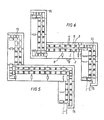
- the stone can easily be divided into partial stones along the rows thus formed. Examples of application of this are shown in FIGS. 5 and 6.
- both outer surfaces of the brick are provided with plaster grooves 8 which are perpendicular and are equally spaced from one another. Their distance is, for example, 2.5 cm.
- the normal stone has indentations 9 on the end faces of its base body 1. These are used to form a mortar chamber for connecting the stones to one another.
- the parapet stone according to FIG. 2 basically corresponds to the normal stone according to FIG. 1. Only the base body is flatter.
- the facing brick according to FIG. 3 in turn arises from the parapet according to FIG. 1, leaving out the middle layer 3.
- Figure 4 shows an example of a special corner stone.
- FIG. 8 also shows mortar strips 10 located between the stone layers, as well as a ceiling 11 and a balcony slab 12 with continuous reinforcements. Between the ceiling and the balcony slab, a masonry brick according to Figure 3 has been used. A parapet according to Figure 2 above.
- Figures 5 to 7 show examples of use. This also shows, for example, the use of partial stones and corner stones.
- Figure 9 shows a parapet according to Figure 2, in which the first shell has 3 differently shaped and larger air chambers. According to the definition, position 3 in FIG. 9 can also be regarded as a base body, on which shells 1.5 are formed on both sides via webs 2.4.
- the normal stone shown in FIG. 10 has formations 13 on its left end, both on the base body 1 and on the webs 2, 4.
- the height of the formations on the webs 2, 4 is therefore preferably the same as that of these webs.
- the formations 13 correspond to receptacles 14 on the other face of the stone.
- FIG. 11 shows a matching parapet stone and FIG. 12 shows a corner facing stone of this type.
- a very good thermal insulation is achieved in that the insulating layer 18 arranged between the webs 2, 4, i.e. these insulation plates protrude beyond the outline of the base body 1, so that when these stones are placed against one another, these plates are pressed together, are elastic and represent a very good thermal insulation there sealing.
- the air chambers 6 are arranged offset from one another or are honeycomb-shaped, openings 6 being present which form separation points when the stones are broken apart at these points.
- These separation points are openings 7 are arranged so that the base body is divisible, for example, every 5 cm a solid stone arise.
- Additional cleaning grooves 8 are simultaneously formed as notches 17, so that even more precise divisibility is now possible by breaking out, for example every 5 cm or every 2.5 cm.
- FIG. 6 shows window stop stones 15 because there are separating points 16 in order to reach any reveal depth. Again, the principle of easy divisibility by notches and / or openings is present.
Landscapes
- Engineering & Computer Science (AREA)
- Architecture (AREA)
- Civil Engineering (AREA)
- Structural Engineering (AREA)
- Building Environments (AREA)
- Table Devices Or Equipment (AREA)
- Buildings Adapted To Withstand Abnormal External Influences (AREA)
- Finishing Walls (AREA)
Abstract
Description
- Die Erfindung betrifft einen Mauerstein mit einem mit Luftkammern versehenen Grundkörper.
- Derartige Mauersteine sind bekannt. Es sind auch schon Mauersteine bekannt, die mit einer gesonderten Isolation aus geeignetem Isolationsmaterial, beispielsweise Steinwolle, zur Erhöhung ihres Wärmedämmwertes versehen sind.
- Der Erfindung liegt die Aufgabe zugrunde, einen Mauerstein vorzuschlagen, der sich durch einen besonders hohen Wärmedämmwert auszeichnet.
- Ferner ist Aufgabe der Erfindung, den Mauerstein so auszubilden, daß er eine hohe Tragkraft aufweist, geringes Gewicht besitzt, sowie einfach und schnell verarbeitbar ist.
- Zur Lösung dieser Aufgabe ist die Erfindung dadurch gekennzeichnet, daß an wenigstens eine Seite des Grundkörpers erste Stege angeformt sind, die sich nur über einen Teil der Höhe des Grundkörpers erstrecken, an die eine erste Schale parallel zum Grundkörper angeformt ist, daß an die erste Schale und/oder an die andere Seite des Grundkörpers zweite Stege angeformt sind, an die eine zweite Schale, ebenfalls parallel zum Grundkörper, angeformt ist, die sich ebenfalls nur über einen Teil der Höhe des Grundkörpers erstrecken, und zwar versetzt zu den ersten Stegen, und daß der Raum zwischen den Schalen und/oder zwischen dem Grundkörper und der Schale mit Isolationsmaterial gefüllt ist. Im übrigen können auch weitere Schalen und Stege vorhanden sein.
- Durch diese Maßnahmen können zwei oder mehr Lagen von Isolationsmaterial verwendet werden. Für den erreichten hohen Wärmedämmwert fällt es insbesondere ins Gewicht, daß die die beiden Schalen bzw. die innere Schale mit dem Grundkörper verbindenden Stege so zueinander versetzt sind, daß sich keine oder nur geringfügige Wärmebrücken über diese Stege ausbilden können. Der Versatz erfolgt hierbei vorzugsweise in der Höhe der Stege. Er kann aber auch in der Länge der Stege und/oder in ihrer Höhe erfolgen. Der Grundkörper und vorzugsweise auch beide Stege sind mit entsprechenden Luftkammern versehen, wie an sich bekannt. Weil die Stege zur Erzielung des erwähnten Versatzes sich nur über einen Teil der Höhe des Grundkörpers erstrecken, nämlich etwa über zwei Drittel dieser Höhe, können durchgehende Platten aus dem Isoliermaterial verwendet werden, die dann gegebenenfalls von der Oberkante oder Unterkante einreichende Einschnitte haben, in die sich dann die Stege legen. Je nach dem Material kann man evtl. auch ohne diese Einschnitte auskommen.
- Als Material für den Mauerstein wird man gebrannten Porenton oder auch Ton ohne Poren, reichend bis zum Material Ton als Sichtstein, verwenden. Das Prinzip ist auch anwendbar für Blähtonbeton, Leichtbeton, Kalksandstein und alle sonstigen geeigneten Materialien, insbesondere solche mit guter Bearbeitbarkeit und hohem Dämmwert und Festigkeit.
- Die Oberfläche des Mauersteins kann mit Rillen als Putzträger versehen sein oder auch glatt als Sichtsteinwerk. Wenn man Rillen als Putzträger verwendet, so wird es bevorzugt, wenn an den Außen- und Innenflächen des Steins lotrecht durchgehende und voneinander gleichweit beabstandete Putzrillen vorgesehen sind. Diese wirken nach Art eines Maßbandes. Sie haben beispielsweise Abstände von 2,5 cm voneinander. Sie sind dann als Trennkerben ausgeführt.
- Für die Fugen kann man herkömmlichen Isolationsmörtel oder auch verlängerten Mörtel, Zementmörtel, Spezialmörtel usw. verwenden. Gegebenenfalls können auch die Mörtelkammern entfallen, wenn man nämlich die Grundkörper mit ineinander passenden Vorsprüngen bzw. Ausformungen nach Art einer Nut-Feder-Verbindung versieht.
- Für das Isolationsmaterial kann man ebenfalls alle geeigneten Materialien verwenden, reichend vom Schaumstoff bis zu organischem Material, z.B. Kork, Korkschrot, Koksfaser, Holzwolle bis zu anorganischen Materialien, z.B. Glaswolle, Steinwolle. Auch sind Kunstfasern möglich, gespritzt, gegossen oder eingeschoben sowie auch Mischungen aller geeigneter Materialien.
- Als Typen für den erfindungsgemässen Mauerstein wird man einen Normalstein verwenden, gegebenenfalls einen Eckstein, Fenstersteine, Mauerkopfsteine, Brüstungssteine , Vormauerungssteine und gegebenenfalls Spezialformsteine nach Wunsch.
- Durch die Erfindung können also mit wenigen Steintypen hochwertige Mauerwerke erstellt werden, insbesondere hochwertig bezüglich der Festigkeit, Schallisolation, Wärmeisolation, Atmung, Feuer und Dauerhaftigkeit. Die Steine entsprechen im wesentlichen herkömmlichen Steinen und können daher ohne spezielle Schulung vermauert werden. Es sind optimale Detaillösungen und Anschlüsse bei Fenster, Türen-, Rolläden-, Brüstungs-, und Deckenanschlüssen vorhanden. Es ergeben sich Vorteile eines Verbundmauerwerks mit sogenannter vorgehängter Fassade. Diese Funktion übernimmt nämlich die äußere Schale. Der erfindungsgemässe Stein ist auch mit handelsüblichen Steinen kombinierbar.
- Der üblicherweise innen liegende Gründkörper ergibt gemauert eine Trag-, Schall- und Leitungswand. Er dient als Speicherwand mit seinen Luftkammern. Er ist in Sicht- und Putzausführung erstellbar. Zusätzlich sind die erwähnten Isolationsschichten im äußeren Wandteil vorhanden. Sie können so, wie sie bestehen, voll bei Brüstungen oder Vormauerungen und auch bei einem Fenster- oder Türanschlag durchgezogen werden. Die äußere Schale dient, wie erwähnt, als vorgehängte Fassade mit Luftkammern. Sie bildet einen hinterlüfteten, festen Witterungsabschluß.
- Alle Formsteine sind auch spiegelbildlich verwendbar. Daher sind nur wenig Typen erforderlich. Sie können direkt auf dem Bau hergestellt werden.
- Die Maße sind gängig. Sie sind mit handelsüblichen Steinen beliebig kombinierbar, vorzugsweise mit den gleichen Materialien. Es handelt sich um einen Einhandstein, dessen Gewicht bei 12 kg liegt. Er ist schnell zu vermauern wie herkömmliches Mauerwerk mit Kelle oder Mörtelschlitten und Fräse. Es sind zwei Mörtelbänder, evtl. eine Mörteltasche möglich und auch die üblichen Armierungen können vorgesehen werden. Weil die Luftkammern vorzugsweise wabenförmig sind, können viel Luftkammern pro Volumen bzw. Querschnittsfläche eingesetzt werden.
- Das beschriebene Prinzip kann auch dahingehend ergänzt werden, daß ggf. eine oder mehrere weitere Schalen angeformt werden.
- Die Stöße sind dicht und elastisch geschlossen. Die Mörtelbänder sind getrennt und auch die inneren und äußeren Formsteinschichten sind getrennt. Es ergibt sich daher ein sehr guter Isolationswert von etwa 0,3 Watt pro qm und Grad Kelvin. Die Isolation ist über den Stein springend. Die Verbindungsstege erstrecken sich nur über etwa zwei Drittel der Steinhöhe. Die sind in der Höhe, ggf. auch in der Länge, zueinander versetzt, was insbesondere zur geringen Wärmeübertragung beiträgt. Die Isolationsschichten können daher in einem Stück eingesetzt werden. Es sind vielseitige Isolationen möglich, der Stein ist, bedingt durch die in einer Reihe liegenden und durchgehenden Öffnungen, in feste Teilsteine teilbar, vorzugsweise alle 5 cm. Jedes Zwischenmaß ist auf cm-Länge ablängbar. Dies ergibt die notwendige Planungsfreiheit und nimmt auch alle Baumaßabweichungen auf. Ein Reststein kann auch verwertet werden.
- Für Fenster- und Türanschlag ist jede Laibungstiefe erstellbar bei vollem Isolationsanschluß. Wesentlich ist, daß mindestens zwei durchgehende Isolationsschichten zwischen den Stegen angeordnet , ohne Stoßfugen unter Anpreßdruck dichtend elastisch angeordnet sind.
- Bei dieser Ausführung überragen die Isolationsschichten den Grundkörper bzw. Mauerstein, und wenn diese Steine aneinandergesetzt oder übereinandergesetzt werden, erfolgt ein Anpreßdruck dieser Isolationsschichten. Es sind also keine Kältebrücken vorhanden.
- Für die Teilbarkeit des Steines ist es noch wesentlich, daß die Luftkammern zueinander versetzt wabenförmig angeordnet sind. Dadurch lässt sich der Stein so teilen, daß er genau abgelängt werden kann, daß z.B. alle 5 cm feste Teilsteine entstehen.
- Wesentlich ist noch, daß ein Eck-Fenster-Anschlagstein vorhanden ist, der Trennstellen z.B. alle 2,5 cm aufweist, die ausbrechbar sind. Durch diese Maßnahme wird erreicht, daß diese Isolation immer an Türen und/oder Fenstern anschließt. Man kann also jede beliebige Laibungstiefe mit vollem Isolationsanschluß herstellen.
- Die Erfindung wird im folgenden anhand von Ausführungsbeispielen näher erläutert, aus denen sich weitere wichtige Merkmale ergeben. Es zeigt:
- Figur 1 eine Draufsicht auf eine erste Ausführungsform eines erfindungsgemässen Mauersteins in der Ausführung als Normalstein;
- Figur 2 eine Draufsicht auf eine Abänderung dieses Normalsteins als Brüstungsstein;
- Figur 3 eine Draufsicht auf eine weitere Abänderung dieses Normalsteins als Vormauerungsstein;
- Figur 4 eine weitere Abänderung als Spezialstein (Eckstein-Fenter-Anschlagstein);
- Figur 5 ein erstes Ausführungsbeispiel einer mit diesen Steinen gemauerten Steinschicht;
- Figur 6 ein zweites Ausführungsbeispiel einer ähnlichen Steinschicht nach Figur 5;
- Figur 7 eine Äquariante, ebenfalls hergestellt mit diesen Steintypen;
- Figur 8 einen Vertikalschnitt durch mehrere der Steinschichten;
- Figur 9 einen Brüstungsstein in einer Abänderung gegenüber Figur 2;
- Figur 10 einen weiteren Normalstein, der mit Hilfe einer Nut-Feder-Verbindung, dh. ohne die sonst übliche Mörtelkammer, vermauert wird;
- Figur 11 den Stein nach Figur 10 als Brüstungsstein;
- Figur 12 den Stein nach Figur 10 als Eck-Vormauerungsstein.
- Zunächst sei das Prinzip anhand der Figur 1 und 8 näher erläutert. Die hier gezeigte Grundvariante eines erfindungsgemässen Mauersteins besteht aus einem Grundkörper 1, an dessen eine Längsseite (Außenseite) erste Stege 2 angeformt sind. An diese wiederum ist eine erste Schale 3, parallel zur Längserstreckung des Grundkörpers 1, angeformt. Dies ist die Innenschale. An die andere Seite der ersten Schale 3 sind wiederum zweite Stege 4 parallel zu den ersten Stegen 2 angeformt und an deren Außenseite wiederum eine zweite Schale, ebenfalls parallel zur ersten Schale und zum Grundkörper.
- Insbesondere Figur 8 lässt erkennen, daß die ersten Stege und die zweiten Stege sich jeweils über etwa zwei Drittel der Höhe des Grundkörpers erstrecken, und zwar in der Höhe zueinander versetzt. Das heisst, daß die ersten Stege unten abschließen und bis zu einer gewissen Höhe reichen, während die zweiten Stege umgekehrt oben abschließen und bis zu einer gewissen Höhe reichen.
- In den Raum zwischen den Grundkörper 1 und die erste Schale 3 bzw. zwischen die erste Schale 3 und die zweite Schale 5 werden z.B. Matten aus geeignetem Isolationsmaterial eingesetzt, und zwar beim gezeigten Ausführungsbeispiel über die ersten Stege 2 von oben und über die zweiten Stege 4 von unten, weil dort die Oberseiten bzw. Unterseiten jeweils frei sind, weil nämlich die Stege dort nicht so weit reichen.
- Figur 1 zeigt außerdem, daß der Grundkörper mit einer Reihe von wabenförmigen Luftkammern 6 versehen ist. Dasselbe gilt für die beiden Schalen 3,5.
- Außerdem sind durchgehende Öffnungen 7 von etwa rechteckigem Querschnitt mit einer viel kleineren Fläche als die Luftkammer 6 vorgesehen, die durch die Schichten 1,3,5 durchgehen und die jeweils in einer Reihe liegen. Längs der dadurch gebildeten Reihen kann der Stein leicht in Teilsteine unterteilt werden. Anwendungsbeispiele hierfür zeigen die Figuren 5 und 6.
- Schließlich ist aus Figur 1 noch ersichtlich, daß beide Außenflächen des Mauersteins mit lotrecht durchgehenden und voneinander gleichweit beabstandeten Putzrillen 8 versehen sind. Ihr Abstand beträgt beispielsweise 2,5 cm.
- Nach Figur 1 hat der Normalstein an den Stirnseiten seines Grundkörpers 1 Einformungen 9. Diese dienen zur Ausbildung einer Mörtelkammer zur Verbindung der Steine miteinander.
- Der Brüstungsstein nach Figur 2 entspricht grundsätzlich dem Normalstein nach Figur 1. Nur ist der Grundkörper flacher ausgebildet.
- Der Vormauerungsstein nach Figur 3 entsteht gedanklich wiederum aus dem Brüstungsstein nach Figur 1 unter Fortlassung der mittleren Schicht 3.
- Figur 4 zeigt als Beispiel einen Spezial-Eckstein.
- Figur 8 lässt außerdem zwischen den Steinschichten befindliche Mörtelbänder 10 erkennen sowie eine Decke 11 und eine Balkonplatte 12 mit durchgehenden Armierungen. Zwischen der Decke und der Balkonplatte ist ein Vormauerungsstein nach Figur 3 verwendet worden. Darüber ein Brüstungsstein nach Figur 2.
- Die Figuren 5 bis 7 zeigen Einsatzbeispiele. Daraus geht beispielsweise auch die Verwendung von Teilsteinen und Ecksteinen hervor.
- Figur 9 zeigt einen Brüstungsstein entsprechend Figur 2, bei dem die erste Schale 3 anders geformte und größere Luftkammern hat. Definitionsgemäss kann man aber auch Position 3 in Figur 9 als Grundkörper auffassen, an den dann beidseits Schalen 1,5 über Stege 2,4 angeformt sind.
- Der in Figur 10 gezeigte Normalstein hat an seiner linken Stirnseite Ausformungen 13, und zwar sowohl am Grundkörper 1 wie auch an den Stegen 2,4. Die Höhe der Ausformungen an den Stegen 2,4 ist daher vorzugsweise so wie die dieser Stege. Die Ausformungen 13 entsprechen Aufnahmen 14 an der anderen Stirnseite des Steins. Diese Steine können daher nach Art einer Nut-Feder-Verbindung und ohne die sonst üblichen Mötelkammern aneinander gesetzt und miteinander verbunden werden.
- Figur 11 zeigt einen hierzu passenden Brüstungsstein und Figur 12 einen Eck-Vormauerungsstein dieses Typs.
- Eine sehr gute Wärmeisolation wird dadurch erreicht, daß die zwischen den Stegen 2,4 angeordnete Isolationsschicht 18, d.h. diese Isolationsplatten den Umriß des Grundkörpers 1 überragt, so daß bei Aneinandersetzen dieser Steine diese Platten zusammengepresst werden, elastisch sind und dort dichtend eine sehr gute Wärmeisolierung darstellen.
- Besonders aus Figur 1 ist erkennbar, daß die Luftkammern 6 zueinander versetzt angeordnet sind, bzw. wabenförmig sind, wobei Öffnungen 6 vorhanden sind, die Trennstellen bilden, wenn man die Steine an diesen Stellen auseinanderbricht. Diese Trennstellen sind also Öffnungen 7 sind so angeordnet, daß der Grundkörper teilungsfähig ist, z.B. alle 5 cm kann ein fester Teilstein entstehen. Zusätzliche Putzrillen 8 sind gleichzeitig als Kerben 17 ausgebildet, so daß jetzt durch Ausbrechen eine noch genauere Teilbarkeit möglich ist, z.B. alle 5 cm oder alle 2,5 cm.
- In der Figur 6 sind Fenster-Anschlagsteine 15 dargestellt, weil Trennstellen 16 vorhanden sind, um jede Laibungstiefe zu erreichen. Auch hier ist wieder das Prinzip der leichten Teilbarkeit durch Kerben und/oder Öffnungen vorhanden.
Claims (11)
Priority Applications (1)
| Application Number | Priority Date | Filing Date | Title |
|---|---|---|---|
| AT86112496T ATE48300T1 (de) | 1985-09-12 | 1986-09-10 | Mauerstein. |
Applications Claiming Priority (2)
| Application Number | Priority Date | Filing Date | Title |
|---|---|---|---|
| DE3532590 | 1985-09-12 | ||
| DE19853532590 DE3532590A1 (de) | 1985-09-12 | 1985-09-12 | Mauerstein |
Publications (3)
| Publication Number | Publication Date |
|---|---|
| EP0214650A2 true EP0214650A2 (de) | 1987-03-18 |
| EP0214650A3 EP0214650A3 (en) | 1987-10-21 |
| EP0214650B1 EP0214650B1 (de) | 1989-11-29 |
Family
ID=6280804
Family Applications (1)
| Application Number | Title | Priority Date | Filing Date |
|---|---|---|---|
| EP86112496A Expired EP0214650B1 (de) | 1985-09-12 | 1986-09-10 | Mauerstein |
Country Status (3)
| Country | Link |
|---|---|
| EP (1) | EP0214650B1 (de) |
| AT (1) | ATE48300T1 (de) |
| DE (2) | DE3532590A1 (de) |
Cited By (6)
| Publication number | Priority date | Publication date | Assignee | Title |
|---|---|---|---|---|
| DE19944672C2 (de) * | 1998-09-21 | 2003-05-15 | Paul Kramer | Wärmedämm-Mauerstein |
| EP1752592A3 (de) * | 2005-07-21 | 2011-01-05 | Deutsche Rockwool Mineralwoll GmbH & Co. OHG | Verfahren zur Herstellung von Mauersteinen sowie mit dem Verfahren hergestellter Mauerstein |
| DE102010016877A1 (de) * | 2010-05-11 | 2011-11-17 | Michael Kellerer | Mauerziegel mit Dämmfüllung |
| EP2762651A1 (de) * | 2013-02-05 | 2014-08-06 | Latvijas Universitate | Mauerwerk mit variabler physikalisch-baulicher Wärmedämmung und Wärme und Feuchtigkeitsansammlungseigenschaften |
| WO2017204667A1 (en) * | 2016-05-24 | 2017-11-30 | Doliński Szymon | Wall element with a heat-insulating core |
| EP3919701A1 (de) * | 2020-06-05 | 2021-12-08 | Ziegelwerk Otto Staudacher GmbH & Co. KG | Mauerziegel |
Families Citing this family (1)
| Publication number | Priority date | Publication date | Assignee | Title |
|---|---|---|---|---|
| DE9305328U1 (de) * | 1993-04-07 | 1993-07-01 | Schmidt, Harald M., 8873 Ichenhausen | Ziegelstein |
Family Cites Families (12)
| Publication number | Priority date | Publication date | Assignee | Title |
|---|---|---|---|---|
| DE808379C (de) * | 1949-07-08 | 1951-07-12 | Boeger & Co Stahlbau K G | Grossformat-Hohlblockstein |
| SE352914B (de) * | 1971-05-28 | 1973-01-15 | S Fernaeus | |
| AT309038B (de) * | 1971-06-16 | 1973-07-25 | Peter Maria Schmid | Hohlblockstein |
| DE7537653U (de) * | 1974-11-29 | 1976-04-15 | Moritz, Jean-Pierre, Molsheim, Soultz-Les-Bains (Frankreich) | Vorgefertigter, blockartiger mauerstein |
| DE2608612A1 (de) * | 1976-03-02 | 1977-09-08 | Erlus Baustoffwerke | Formstein |
| AT348213B (de) * | 1977-01-26 | 1979-02-12 | Wienerberger Baustoffind Ag | Hohlformstein |
| DE2737012A1 (de) * | 1977-08-17 | 1979-03-01 | Schwagmeier Wilfried | Hochlochziegel fuer aussenwaende |
| DE2739409C3 (de) * | 1977-09-01 | 1984-10-25 | Fa. Heinrich Oltmanns, 2905 Edewecht | Hohlblockstein |
| US4324080A (en) * | 1979-12-17 | 1982-04-13 | Mullins Wayne L | Thermally insulative cementitious block modules and method of making same |
| US4380887A (en) * | 1980-10-06 | 1983-04-26 | Lee Kenneth S | Insulated structural block |
| AT370814B (de) * | 1981-02-10 | 1983-05-10 | Wutte Friedrich | Mauerwerk |
| DE3215860A1 (de) * | 1982-04-29 | 1983-11-03 | Siegfried 7971 Aichstetten Gebhart | Eckbaustein und trennbaustein |
-
1985
- 1985-09-12 DE DE19853532590 patent/DE3532590A1/de not_active Ceased
-
1986
- 1986-09-10 AT AT86112496T patent/ATE48300T1/de not_active IP Right Cessation
- 1986-09-10 DE DE8686112496T patent/DE3667191D1/de not_active Expired - Lifetime
- 1986-09-10 EP EP86112496A patent/EP0214650B1/de not_active Expired
Cited By (6)
| Publication number | Priority date | Publication date | Assignee | Title |
|---|---|---|---|---|
| DE19944672C2 (de) * | 1998-09-21 | 2003-05-15 | Paul Kramer | Wärmedämm-Mauerstein |
| EP1752592A3 (de) * | 2005-07-21 | 2011-01-05 | Deutsche Rockwool Mineralwoll GmbH & Co. OHG | Verfahren zur Herstellung von Mauersteinen sowie mit dem Verfahren hergestellter Mauerstein |
| DE102010016877A1 (de) * | 2010-05-11 | 2011-11-17 | Michael Kellerer | Mauerziegel mit Dämmfüllung |
| EP2762651A1 (de) * | 2013-02-05 | 2014-08-06 | Latvijas Universitate | Mauerwerk mit variabler physikalisch-baulicher Wärmedämmung und Wärme und Feuchtigkeitsansammlungseigenschaften |
| WO2017204667A1 (en) * | 2016-05-24 | 2017-11-30 | Doliński Szymon | Wall element with a heat-insulating core |
| EP3919701A1 (de) * | 2020-06-05 | 2021-12-08 | Ziegelwerk Otto Staudacher GmbH & Co. KG | Mauerziegel |
Also Published As
| Publication number | Publication date |
|---|---|
| DE3667191D1 (de) | 1990-01-04 |
| EP0214650B1 (de) | 1989-11-29 |
| EP0214650A3 (en) | 1987-10-21 |
| ATE48300T1 (de) | 1989-12-15 |
| DE3532590A1 (de) | 1987-03-19 |
Similar Documents
| Publication | Publication Date | Title |
|---|---|---|
| DE1949726A1 (de) | Isolierter Blockbaustein und Verfahren zu seiner Herstellung | |
| DE3005402C2 (de) | Isolierendes Verbandsmauerwerk | |
| EP0214650B1 (de) | Mauerstein | |
| EP0378217A2 (de) | Hochlochziegel und Verfahren zur Erstellung einer Schallschutzwand | |
| DE3201832A1 (de) | Hohlbaustein und darauf aufgebautes baukastensystem | |
| DE3101471A1 (de) | Wand mit vorsatzplatten | |
| EP0010238A1 (de) | Montageblock für den Hochbau mit Aussparungen zum Einfügen von Isoliermaterial, sowie Verfahren zum Herstellen und Verwendung eines derartigen Montageblockes | |
| DE2320750A1 (de) | Isolierbaustein und aus den steinen hergestellter verband | |
| DE816891C (de) | Wandbaustein | |
| EP0033485B1 (de) | Baustein zur Herstellung eines zweischaligen Kachelofens | |
| DE19623659C2 (de) | Ziegelwand aus mindestens zwei vorgefertigten Ziegelwandelementen | |
| DE866382C (de) | Baustein und Bausteinanordnung | |
| DE4005024C2 (de) | Außen- oder Innenmauerwerk eines Gebäudes | |
| DE9315423U1 (de) | Mauerwerk | |
| DE3432442A1 (de) | Hohlblockstein und verfahren seiner herstellung | |
| DE924050C (de) | Wand aus Profil- oder Formsteinen | |
| DE7830206U1 (de) | Montageblock mit integrierter waermedaemmung | |
| DE2032257A1 (de) | Hohlblockstein | |
| DE1276316B (de) | Fertigbalken zum UEberdecken von OEffnungen im Mauerwerk | |
| DE822599C (de) | Hohlbaustein | |
| DE8600250U1 (de) | Mauerstein | |
| DE2052479C3 (de) | Verfahren zum Herstellen eines künstlichen Steines zum Errichten von geschoBhohen Wänden | |
| AT392665B (de) | Ueberlage | |
| AT267145B (de) | Verfahren zur Errichtung eines thermisch isolierten Mauerwerks | |
| DE2037000A1 (de) | Formsteinsatz zum Herstellen von Bauten oder dergleichen |
Legal Events
| Date | Code | Title | Description |
|---|---|---|---|
| PUAI | Public reference made under article 153(3) epc to a published international application that has entered the european phase |
Free format text: ORIGINAL CODE: 0009012 |
|
| AK | Designated contracting states |
Kind code of ref document: A2 Designated state(s): AT BE CH DE FR GB IT LI LU NL SE |
|
| PUAL | Search report despatched |
Free format text: ORIGINAL CODE: 0009013 |
|
| AK | Designated contracting states |
Kind code of ref document: A3 Designated state(s): AT BE CH DE FR GB IT LI LU NL SE |
|
| 17P | Request for examination filed |
Effective date: 19870915 |
|
| 17Q | First examination report despatched |
Effective date: 19890406 |
|
| GRAA | (expected) grant |
Free format text: ORIGINAL CODE: 0009210 |
|
| AK | Designated contracting states |
Kind code of ref document: B1 Designated state(s): AT BE CH DE FR GB IT LI LU NL SE |
|
| PG25 | Lapsed in a contracting state [announced via postgrant information from national office to epo] |
Ref country code: IT Free format text: LAPSE BECAUSE OF FAILURE TO SUBMIT A TRANSLATION OF THE DESCRIPTION OR TO PAY THE FEE WITHIN THE PRE;WARNING: LAPSES OF ITALIAN PATENTS WITH EFFECTIVE DATE BEFORE 2007 MAY HAVE OCCURRED AT ANY TIME BEFORE 2007. THE CORRECT EFFECTIVE DATE MAY BE DIFFERENT FROM THE ONE RECORDED.SCRIBED TIME-LIMIT Effective date: 19891129 Ref country code: GB Effective date: 19891129 Ref country code: NL Effective date: 19891129 Ref country code: BE Effective date: 19891129 Ref country code: SE Effective date: 19891129 |
|
| REF | Corresponds to: |
Ref document number: 48300 Country of ref document: AT Date of ref document: 19891215 Kind code of ref document: T |
|
| REF | Corresponds to: |
Ref document number: 3667191 Country of ref document: DE Date of ref document: 19900104 |
|
| ET | Fr: translation filed | ||
| NLV1 | Nl: lapsed or annulled due to failure to fulfill the requirements of art. 29p and 29m of the patents act | ||
| GBV | Gb: ep patent (uk) treated as always having been void in accordance with gb section 77(7)/1977 [no translation filed] | ||
| PLBE | No opposition filed within time limit |
Free format text: ORIGINAL CODE: 0009261 |
|
| PLBE | No opposition filed within time limit |
Free format text: ORIGINAL CODE: 0009261 |
|
| STAA | Information on the status of an ep patent application or granted ep patent |
Free format text: STATUS: NO OPPOSITION FILED WITHIN TIME LIMIT |
|
| PG25 | Lapsed in a contracting state [announced via postgrant information from national office to epo] |
Ref country code: LU Free format text: LAPSE BECAUSE OF NON-PAYMENT OF DUE FEES Effective date: 19900930 |
|
| 26N | No opposition filed | ||
| 26N | No opposition filed | ||
| PGFP | Annual fee paid to national office [announced via postgrant information from national office to epo] |
Ref country code: AT Payment date: 19940930 Year of fee payment: 9 |
|
| PGFP | Annual fee paid to national office [announced via postgrant information from national office to epo] |
Ref country code: CH Payment date: 19941206 Year of fee payment: 9 |
|
| PG25 | Lapsed in a contracting state [announced via postgrant information from national office to epo] |
Ref country code: AT Effective date: 19950910 |
|
| PG25 | Lapsed in a contracting state [announced via postgrant information from national office to epo] |
Ref country code: LI Effective date: 19950930 Ref country code: CH Effective date: 19950930 |
|
| REG | Reference to a national code |
Ref country code: CH Ref legal event code: PL |
|
| PGFP | Annual fee paid to national office [announced via postgrant information from national office to epo] |
Ref country code: DE Payment date: 19971011 Year of fee payment: 12 |
|
| PGFP | Annual fee paid to national office [announced via postgrant information from national office to epo] |
Ref country code: FR Payment date: 19971029 Year of fee payment: 12 |
|
| PG25 | Lapsed in a contracting state [announced via postgrant information from national office to epo] |
Ref country code: FR Free format text: LAPSE BECAUSE OF NON-PAYMENT OF DUE FEES Effective date: 19990531 |
|
| PG25 | Lapsed in a contracting state [announced via postgrant information from national office to epo] |
Ref country code: DE Free format text: LAPSE BECAUSE OF NON-PAYMENT OF DUE FEES Effective date: 19990701 |
|
| REG | Reference to a national code |
Ref country code: FR Ref legal event code: ST |