EP0189004A2 - Verfahren zur Herstellung bestimmter in 3-Stellung substituierter Indole und Zwischenprodukte dafür - Google Patents
Verfahren zur Herstellung bestimmter in 3-Stellung substituierter Indole und Zwischenprodukte dafür Download PDFInfo
- Publication number
- EP0189004A2 EP0189004A2 EP85810609A EP85810609A EP0189004A2 EP 0189004 A2 EP0189004 A2 EP 0189004A2 EP 85810609 A EP85810609 A EP 85810609A EP 85810609 A EP85810609 A EP 85810609A EP 0189004 A2 EP0189004 A2 EP 0189004A2
- Authority
- EP
- European Patent Office
- Prior art keywords
- formula
- alkylene
- phenylene
- hydrogen
- hydroxy
- Prior art date
- Legal status (The legal status is an assumption and is not a legal conclusion. Google has not performed a legal analysis and makes no representation as to the accuracy of the status listed.)
- Withdrawn
Links
Classifications
-
- C—CHEMISTRY; METALLURGY
- C07—ORGANIC CHEMISTRY
- C07D—HETEROCYCLIC COMPOUNDS
- C07D401/00—Heterocyclic compounds containing two or more hetero rings, having nitrogen atoms as the only ring hetero atoms, at least one ring being a six-membered ring with only one nitrogen atom
- C07D401/02—Heterocyclic compounds containing two or more hetero rings, having nitrogen atoms as the only ring hetero atoms, at least one ring being a six-membered ring with only one nitrogen atom containing two hetero rings
- C07D401/04—Heterocyclic compounds containing two or more hetero rings, having nitrogen atoms as the only ring hetero atoms, at least one ring being a six-membered ring with only one nitrogen atom containing two hetero rings directly linked by a ring-member-to-ring-member bond
-
- A—HUMAN NECESSITIES
- A61—MEDICAL OR VETERINARY SCIENCE; HYGIENE
- A61P—SPECIFIC THERAPEUTIC ACTIVITY OF CHEMICAL COMPOUNDS OR MEDICINAL PREPARATIONS
- A61P7/00—Drugs for disorders of the blood or the extracellular fluid
- A61P7/02—Antithrombotic agents; Anticoagulants; Platelet aggregation inhibitors
-
- A—HUMAN NECESSITIES
- A61—MEDICAL OR VETERINARY SCIENCE; HYGIENE
- A61P—SPECIFIC THERAPEUTIC ACTIVITY OF CHEMICAL COMPOUNDS OR MEDICINAL PREPARATIONS
- A61P9/00—Drugs for disorders of the cardiovascular system
- A61P9/08—Vasodilators for multiple indications
-
- A—HUMAN NECESSITIES
- A61—MEDICAL OR VETERINARY SCIENCE; HYGIENE
- A61P—SPECIFIC THERAPEUTIC ACTIVITY OF CHEMICAL COMPOUNDS OR MEDICINAL PREPARATIONS
- A61P9/00—Drugs for disorders of the cardiovascular system
- A61P9/10—Drugs for disorders of the cardiovascular system for treating ischaemic or atherosclerotic diseases, e.g. antianginal drugs, coronary vasodilators, drugs for myocardial infarction, retinopathy, cerebrovascula insufficiency, renal arteriosclerosis
-
- A—HUMAN NECESSITIES
- A61—MEDICAL OR VETERINARY SCIENCE; HYGIENE
- A61P—SPECIFIC THERAPEUTIC ACTIVITY OF CHEMICAL COMPOUNDS OR MEDICINAL PREPARATIONS
- A61P9/00—Drugs for disorders of the cardiovascular system
- A61P9/12—Antihypertensives
Definitions
- the invention relates to a new, advantageous process for the preparation of certain N-pyridylindoles which are substituted in the 3-position and which are known as valuable active pharmaceutical ingredients.
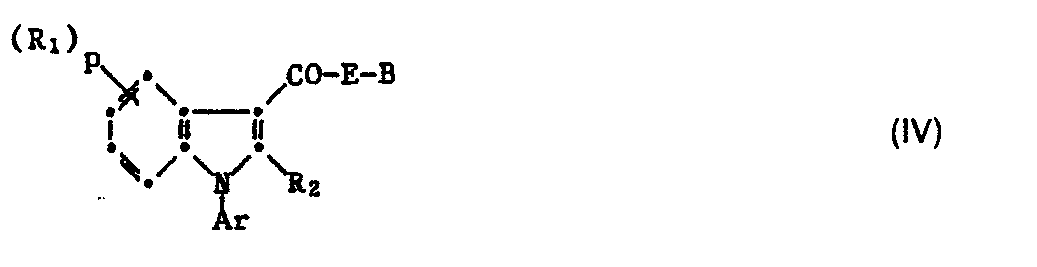
- the invention further relates to new ketones which are useful as intermediates for the preparation of the pharmacologically active compounds mentioned above and which also have valuable pharmacological properties, a process for the preparation of these ketones and their use.
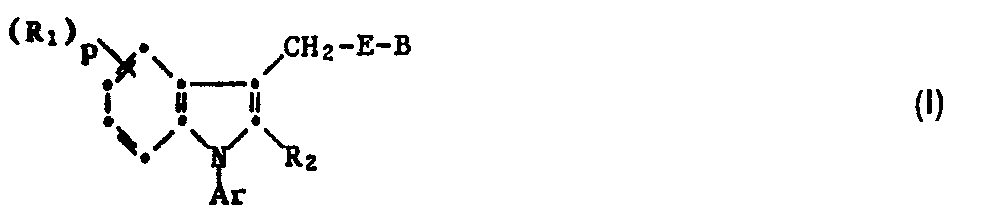
- the invention relates in particular to a process for the preparation of the N-pyridylindoles of the formula I which are substituted in the 3-position where Ar is unsubstituted or substituted by lower alkyl 3- or 4-pyridyl, the radicals R 1 independently of one another are hydrogen, halogen, trifluoromethyl, lower alkyl, hydroxy, acylated or etherified hydroxy or lower alkylthio, or two radicals R i alkylenedi located on adjacent carbon atoms represent oxy, p is 1 or 2, R 2 is hydrogen or lower alkyl, E is C 1 -C 11 -alkylene, phenylene, C 1 -C 6 -alkylene-phenylene, C 1 -C 6 -alkylene- (thio or oxy) lower alkylene, C 1 -C 6 -alkylene- (thio or oxy) -phenylene, C 1 -C 6 -alkylene-phenylene-lower alkylene
- the compounds of formula I - including the preferred compounds of formula II and III below - are useful as thromboxane synthetase inhibitors in mammals and as such are disclosed in European Patent Application No. 126,401. They are therefore useful for treating diseases in mammals that respond to inhibition of thromboxane synthetase. Such diseases are primarily cardiovascular disorders such as thrombosis, arteriosclerosis, coronary spasms, celebrale ischemic attacks, migraines and other vascular headaches, myocardial infarction, angina pectoris and hypertension.
- cardiovascular disorders such as thrombosis, arteriosclerosis, coronary spasms, celebrale ischemic attacks, migraines and other vascular headaches, myocardial infarction, angina pectoris and hypertension.
- the new process requires only two (instead of three) reaction steps, avoids the problems associated with the use of organometallic reagents and makes extremely expensive cooling devices unnecessary.
- phenylene means 1,2-, 1,3- and preferably 1,4-phenylene.
- lower in the above or below organic groups, radicals or compounds includes in particular those with at most 7, preferably 4 and especially 1, 2 or 3 carbon atoms.
- Ci-C6-alkylene-phenylene, C 1 -C 6 -alkylene-phenylene-lower alkylene and Ci-C 6 -alkylene- (thio or oxy) -phenylene preferably contain 1 to 4 and in particular 1 or 2 carbon atoms in each alkylene radical.
- the alkylene radicals can be straight-chain or branched.
- Ci-C 6 alkylene (thio or oxy) lower alkylene can be straight-chain or branched and have a total of 2 to 11, preferably 2 to 8, carbon atoms.
- Lower alkyl preferably contains 1 to 4 carbon atoms and is e.g. ethyl, propyl or butyl and especially methyl.
- Lower alkylene preferably contains 1 to 4 carbon atoms and is e.g. for methylene, ethylene, 1,3-propylene or 1,3- or 1,4-butylene.
- Lower alkylenedioxy preferably means ethylenedioxy or methylenedioxy.
- Lower alkoxy preferably contains 1 to 4 carbon atoms and is e.g. Aethoxy, propoxy or especially methoxy.
- Lower alkylthio is preferably methylthio.
- Lower alkoxycarbonyl preferably contains 1 to 4 carbon atoms in the alkoxy part and means e.g. Methoxycarbonyl, propoxycarbonyl or isopropoxycarbonyl and especially ethoxycarbonyl.
- Halogen is preferably fluorine or chlorine, but can also be bromine or iodine.
- Aryl e.g. in an aryl-lower alkoxy group, preferably means phenyl, phenyl or pyridyl mono- or disubstituted by lower alkyl, halogen or lower alkoxy.
- Aryl-lower alkoxy is preferably benzyloxy.
- Acylated hydroxy preferably means lower alkanoyloxy, e.g. Acetyloxy, unsubstituted or in the phenyl ring by lower alkyl, e.g. Methyl, halogen, e.g. Chlorine, or lower alkoxy, e.g. Methoxy, substituted benzoyioxy or nicotinoyloxy.
- lower alkanoyloxy e.g. Acetyloxy, unsubstituted or in the phenyl ring by lower alkyl, e.g. Methyl, halogen, e.g. Chlorine, or lower alkoxy, e.g. Methoxy, substituted benzoyioxy or nicotinoyloxy.
- Etherified hydroxy preferably means lower alkoxy, e.g. Methoxy, unsubstituted or in the phenyl ring by lower alkyl, e.g. Methyl, halogen, e.g. Chlorine, or lower alkoxy, e.g. Methoxy, substituted benzyloxy or pyridylmethoxy.
- Esterified carboxy is preferably understood to mean those esters which are pharmaceutically usable, for example lower alkoxycarbonyl, (amino, mono- or di-lower alkylamino) -substituted lower alkoxycarbonyl, carboxy-substituted lower alkoxycarbonyl, for example a-carboxy-substituted lower alkoxycarbonyl, lower alkoxycarbonyl-substituted lower alkoxycarbonyl , for example a-lower alkoxycarbonyl-substituted lower alkoxycarbonyl, aryl-substituted lower alkoxycarbonyl, for example optionally substituted benzyloxycarbonyl or pyridylmethoxycarbonyl, (hydroxy-, lower alkanoyloxy- or lower alkoxy) -substituted lower alkoxycarbonyl, for example pivaloyloxymethoxycarbonyl, (hydroxy- or lower alkoxycarbony
- Salts which can be used pharmaceutically are, in particular, metal or ammonium salts of the compounds of the formula I mentioned which have a free carboxy group, especially alkali metal or alkaline earth metal salts, for example sodium, potassium, magnesium or calcium salts; primarily lightly crystallizing ammonium salts derived from ammonia or organic amines, e.g.
- Such acids are, for example, strong mineral acids, such as hydrohalic acids, for example hydrochloric or hydrobromic acid, sulfuric, phosphoric, nitric or perchloric acid; or organic acids, especially aliphatic or aromatic carboxylic or sulfonic acids, e.g.
- R 1 ' is hydrogen, lower alkyl, halogen, trifluoromethyl, hydroxy, lower alkylthio or lower alkoxy
- Rz' is hydrogen or lower alkyl
- m is an integer from 1 to 10
- R 4 is hydroxy, lower alkoxy or amino, or their pharmaceutically usable Salt.
- R 1 ' is hydrogen, methyl, chlorine, fluorine, trifluoromethyl, hydroxyl, methylthio or methoxy
- R 2 ' is hydrogen
- m is an integer from 3 to 8
- R 4 is hydroxy, ethoxy, methoxy or amino; or their pharmaceutically acceptable salts.
- R 1 'and R 2 ' are hydrogen, m is 3, 4 or 5 and R 4 is hydroxy, methoxy or ethoxy; or their pharmaceutically acceptable salts.
- R 1 ' is hydrogen, lower alkyl, halogen, trifluoromethyl, hydroxy, lower alkylthio or lower alkoxy
- R 2 ' is hydrogen or lower alkyl
- R 4 is hydroxy, lower alkoxy or amino
- n is an integer from 2 to 4, but also 1 when W is 1,4-phenylene
- W is (thio or oxy) alkylene of 1 to 4 carbon atoms, (thio or oxy) -1,4-phenylene or 1,4-phenylene; or their pharmaceutically acceptable salts.
- a compound of the formula IV (including V and VI) is treated under reductive conditions which are selective for the reduction of the carbonyl group mentioned to methylene, where advantageously little or no reduction in other functional groups, such as carboxy, esterified carboxy or carbamoyl, occurs.
- a preferred reagent to carry out such a reduction is borane in the form of an amine complex, e.g. with an aliphatic, aromatic or cyclic amine, such as tert-butylamine, pyridine, N, N-diethylaniline, diisopropylamine, 4-dimethylaminopyridine, dimethylamine, 4-methylmorpholine or the like, preferably under acidic conditions.
- an aliphatic, aromatic or cyclic amine such as tert-butylamine, pyridine, N, N-diethylaniline, diisopropylamine, 4-dimethylaminopyridine, dimethylamine, 4-methylmorpholine or the like, preferably under acidic conditions.
- the reduction with the borane-amine complex is preferably carried out in an acidic polar solvent, advantageously in a lower alkanoic acid, e.g. Acetic acid, with or without additional inert solvent, or in an inert solvent, e.g. Toluene, tetrahydrofuran or diglyme, in the presence of a Lewis acid, e.g. Aluminum chloride or tin (IV) chloride, at a temperature of about 0 ° C to 100 ° C, advantageously at or near room temperature.
- an acidic polar solvent advantageously in a lower alkanoic acid, e.g. Acetic acid, with or without additional inert solvent, or in an inert solvent, e.g. Toluene, tetrahydrofuran or diglyme
- a Lewis acid e.g. Aluminum chloride or tin (IV) chloride
- the reduction of the carbonyl group according to the invention can also be carried out by using other known methods for reducing carbonyl groups, for example those as described in Comprehensive Organic Chemistry Vol. 1, published by IF Stoddart, pages 1079-1081.
- the following methods can be used, for example: catalytic hydrogenation; Clemmensen reduction, for example with zinc amalgam or tin under acidic conditions; Reduction of a hydrazone derivative of the carbonyl group, for example a tosylhydrazone derivative with sodium cyanoborohydride; reductive desulfurization of a thioketal derivative of the carbonyl group, for example an ethylenedithio derivative with Raney nickel or tributyltin hydride in the presence of azobis (isobutyronitrile).
- Another method for reducing the carbonyl group is reduction with diborane.
- the new intermediates of the formula IV are prepared by, under acid catalysis, preferably in the presence of a Lewis acid, a compound of the formula VII (or VIIa) wherein Ar, R 1 , R 2 and p have the meaning given above under formula I (and Ri 'and R 2 ' have the meaning given above under formula II or III), with a compound of formula VIII (or with a compound of formula VIIIa or VIIIb) wherein E and B (m, n, R 4 and W) have the meaning given above, or preferably a reactive functional derivative thereof, acylated.
- a reactive functional derivative of a carboxylic acid of the formula VIII, VIIIa or VIIIb is, for example, an acyl halide, for example the acid chloride, a simple anhydride in the event that B or COR 4 is carboxy, a mixed anhydride, for example one that is derived from a carbonic acid lower alkyl ester halide , such as ethyl chloroformate, and similar known derivatives.
- an acyl halide for example the acid chloride
- a mixed anhydride for example one that is derived from a carbonic acid lower alkyl ester halide , such as ethyl chloroformate, and similar known derivatives.
- condensation of an indole of formula VII or VIIa with a free carboxylic acid of formula VIII, VIIIa or VIIIb is e.g. carried out in the presence of polyphosphoric acid or polyphosphate ester, in an inert solvent, e.g. Chloroform or ethylene dichloride, preferably at an elevated temperature.
- condensation of an indole of formula VII or VIIa with a reactive functional derivative of a carboxylic acid of formula VIII, VIIIa or VIIIb, e.g. an acid chloride thereof, is carried out in the presence of a Lewis acid, e.g. Tin (IV) chloride, titanium (IV) chloride, or boron trifluoride etherate, in a polar solvent, e.g. Methylene chloride, at room temperature or elevated temperature, advantageously at room temperature.
- a Lewis acid e.g. Tin (IV) chloride, titanium (IV) chloride, or boron trifluoride etherate
- a polar solvent e.g. Methylene chloride
- the starting materials of the formulas VII and VIIa are either known (e.g. J.Chem. Soc. C 1970, 85) or are prepared analogously from the corresponding optionally substituted indoles.
- the starting materials of the formula VIII, VIIIa or VIIIb and functional derivatives thereof are likewise either known or are prepared in a manner known per se.
- the two-stage process for the preparation of the compounds of the formula I which comprises the preparation of a compound of the formula IV and its reduction as described above, forms a further subject of the present invention.
- the compounds of the formula I (including II and III) and the intermediates of the formula IV (including V and VI) form acid addition salts, and also metal or ammonium salts when B (or COR 4 ) is carboxy.
- Acceptable salts are preferably the pharmaceutically acceptable salts described above.
- the invention also relates to modifications of the present process, according to which an intermediate product obtained at any stage of the process is used as the starting material and the remaining process steps are carried out, or the process is terminated at any stage, or according to which a starting material is formed under the reaction conditions, or wherein one or more of the starting materials is used in the form of a salt.
- functional groups are e.g. Carboxy and / or hydroxy, optionally protected by protective groups, which are common in preparative organic chemistry.
- protective groups which are common in preparative organic chemistry.
- Protected carboxy and hydroxyl groups are characterized by the fact that they can be converted into free carboxy and hydroxyl groups under mild conditions without the molecular structure being destroyed or other undesirable side reactions taking place.
- mixtures of isomers of the abovementioned compounds or intermediates are obtained, they can be separated into the individual isomers in a manner known per se, e.g. by fractional distillation, crystallization or chromatography.
- Racemic end products and intermediates can be separated into the optical antipodes by e.g. diastereomeric salts are separated therefrom, e.g. by fractional crystallization of d- or l- (tartrate, dibenzoyl tartrate, mandelate or camphorsulfonate) salts.
- Racemic end products or acidic racemic intermediates can also be broken down by e.g. which separates d- and 1- (a-methylbenzylamine, cinchonidine, cinchonine, quinine, quinidine, ephedrine, dehydroabietylamine, brucine or strychnine) salts from those compounds which have an acidic salt-binding group.
- d- and 1- a-methylbenzylamine, cinchonidine, cinchonine, quinine, quinidine, ephedrine, dehydroabietylamine, brucine or strychnine
- the compounds are obtained either in free form or in the form of corresponding salts.
- free compounds and salts are to be understood as meaningful and appropriate, if appropriate, also the corresponding salts or free compounds.
- a free compound obtained can be converted into a corresponding acid addition salt, preferably with a pharmaceutically acceptable acid or with an anion exchanger.
- Acid addition salts obtained can be converted into the corresponding free compounds, for example by treatment with a molar equivalent of a base, for example a metal or ammonium hydroxide or a basic salt, such as an alkali metal hydroxide or carbonate, or with a cation exchanger.
- Free carboxylic acids can by Treatment with bases can be converted into the corresponding metal or ammonium salts. These or other salts can also be used to purify the compounds obtained. The salts are separated in pure form and the free compounds are released therefrom.
- the compounds and their salts can also be obtained in the form of their hydrates or include other solvents used for the crystallization.
- the compounds of the formula I which are prepared by the process according to the invention correspond to the compounds described in EP-A-126 401.
- the identity is determined, for example, by comparing the melting point, the R f value in the thin-layer chromatogram or the migration in HPLC chromatography or by spectral methods, such as, for example, IR and NMR spectroscopy.
- Example 2 A mixture of 15.0 g of 3- (1-oxo-4-ethoxycarbonylbutyl) -N- (3-pyridyl) indole and 100 ml of 0.5 N sodium hydroxide solution is boiled under reflux for 16 h. The solution is brought to pH about 6 with hydrochloric acid and extracted with methylene chloride. The methylene chloride extract is dried over sodium sulfate and evaporated to dryness, giving 3- (1-oxo-4-carboxybutyl) -N- (3-pyridyl) indole, mp. 177-178 °.
- 3- (1-0xo-4-carboxybutyl) -N- (3-pyridyl) indole can also be prepared by reacting N- (3-pyridyl) indole with glutaric anhydride in the presence of tin (IV) chloride.
- Example 4 0.6 g of borane-tert-butylamine complex is added to a solution of 0.5 g of 3- (1-oxo-4-ethoxycarbonylbutyl) -N- (3-pyridyl) indole in 25 ml of tetrahydrofuran and added 0.6 ml of glacial acetic acid.
- the reaction mixture is heated to 90 ° and the progress of the reaction is monitored by HPLC chromatography. After the reaction is complete, the reaction mixture is evaporated under reduced pressure; Water and methylene chloride are added. The pH is adjusted to 7-8 by adding sodium carbonate solution. The organic phase is separated, washed with water, dried and evaporated to dryness to give 3- (4-ethoxycarbonylbutyl) -N- (3-pyridyl) indole.
- Example 5 3.1 g of Mossy zinc are treated with a mixture of 0.31 g of mercury (II) chloride, 0.15 ml of concentrated hydrochloric acid and 4 ml of water for 5 minutes. The solution is then decanted, 7.5 ml of water and 17.5 ml of concentrated hydrochloric acid and 10 ml of toluene are added, and finally 1 g of 3- (1-0xo-4-ethoxycarbonylbutyl) -N- (3- pyridyl) indole. The reaction mixture is boiled under reflux for 24 h. Then it is adjusted to a pH of 6 with 1 N sodium hydroxide solution and extracted with methylene chloride. The methylene chloride solution is washed with water, dried over sodium sulfate and evaporated to dryness to give 3- (4-carboxybutyl) -N- (3-pyridyl) indole.
- II mercury
- Example 6 0.5 g of borane-tert-butylamine complex are added to a solution of 0.5 g of 3- (1-oxo-4-carboxybutyl) -N- (3-pyridyl) indole in 7.5 ml of glacial acetic acid given. The reaction mixture is stirred at room temperature overnight. It is concentrated, the residue is dissolved in 10 ml of 1N sodium hydroxide solution, water is added to the residue and the pH is adjusted to 5.0 with hydrochloric acid. The precipitate is filtered off and dried to give 3- (4-carboxybutyl) -N- (3-pyridyl) indole.
- Example 7 First, 0.40 g of aluminum chloride and then 0.175 g of dimethylamine are added to a solution of 0.5 g of 3- (1-oxo-4-ethoxycarbonylbutyl) -N- (3-pyridyl) indole in 15 ml of methylene chloride -Boran complex given. The reaction mixture is stirred at room temperature for 24 h. It is cooled to 0 ° C. and 10 ml of water are added dropwise. After 10 min, 35 ml of 1 N sodium hydroxide solution are added in order to adjust the pH to 8. The methylene chloride phase is separated off and the aqueous phase is extracted again with methylene chloride.
- Example 8 The following compounds of the formula II in which R 4 is hydroxy or ethoxy are prepared by reduction methods which are analogous to those from the preceding examples: Claims for the contracting states: BE, CH, DE, FR, GB, IT,
Landscapes
- Health & Medical Sciences (AREA)
- Chemical & Material Sciences (AREA)
- Organic Chemistry (AREA)
- Engineering & Computer Science (AREA)
- Bioinformatics & Cheminformatics (AREA)
- Veterinary Medicine (AREA)
- Life Sciences & Earth Sciences (AREA)
- Public Health (AREA)
- Chemical Kinetics & Catalysis (AREA)
- General Chemical & Material Sciences (AREA)
- Medicinal Chemistry (AREA)
- Nuclear Medicine, Radiotherapy & Molecular Imaging (AREA)
- General Health & Medical Sciences (AREA)
- Pharmacology & Pharmacy (AREA)
- Animal Behavior & Ethology (AREA)
- Heart & Thoracic Surgery (AREA)
- Cardiology (AREA)
- Vascular Medicine (AREA)
- Urology & Nephrology (AREA)
- Diabetes (AREA)
- Hematology (AREA)
- Pharmaceuticals Containing Other Organic And Inorganic Compounds (AREA)
- Indole Compounds (AREA)
- Plural Heterocyclic Compounds (AREA)
Abstract
Description
- Die Erfindung betrifft ein neues, vorteilhaftes Verfahren zur Herstellung bestimmter in 3-Stellung substituierter N-Pyridylindole, die als wertvolle Arzneimittelwirkstoffe bekannt sind. Die Erfindung betrifft ferner neue Ketone, die als Zwischenprodukte zur Herstellung der oben erwähnten pharmakologisch wirksamen Verbindungen nützlich sind und die ebenfalls wertvolle pharmakologische Eigenschaften besitzen, ein Verfahren zur Herstellung dieser Ketone und ihre Verwendung.
- Die Erfindung betrifft insbesondere ein Verfahren zur Herstellung der in 3-Stellung substituierten N-Pyridylindole der Formel I


- Die Verbindungen der Formel I - einschliesslich der unten angegebenen bevorzugten Verbindungen der Formel II und III - sind als Thromboxan-Synthetase-Hemmer bei Säugern nützlich und sind als solche in der Europäischen Patentanmeldung Nr. 126 401 offenbart. Sie sind daher nützlich zur Behandlung von Krankheiten bei Säugern, die auf eine Hemmung der Thromboxan-Synthetase ansprechen. Solche Krankheiten sind in erster Linie kardiovaskuläre Störungen wie Thrombose, Arteriosklerose, Koronarkrämpfe, celebrale ischämische Anfälle, Migräne und andere vaskuläre Kopfschmerzen, Myocardinfarkt, Angina pectoris und Hypertension.
- Alle in EP-A-126 401 angegebenen Verfahren zur Herstellung der Verbindungen der Formel I haben verschiedene Nachteile, z.B. verläuft die Synthese ausgehend von kommerziell erhältlichen Chemikalien über viele Stufen und/oder die Ausbeuten sind niedrig und/oder die benötigten Reagenzien sind teuer. Das dort angegebene Verfahren, das noch relativ am besten zur Herstellung von Verbindungen der Formel I geeignet ist, ist die Kondensation nach Art einer Wittig-Reaktion, z.B. gemäss folgendem Schema:

- Dieses Verfahren ist gut geeignet zur Durchführung im kleinen Massstab im Labor, seine Anwendung im industriellen Massstab stösst jedoch auf eine Vielzahl von Schwierigkeiten: Die Wittig-artige Reaktion ist im industriellen Bereich sehr schwierig durchzuführen, weil u.a. (a) metallorganische Reagenzien an der Reaktion beteiligt sind, die sehr feuchtigkeitsempfindlich sind und (b) eine Kühlung auf Temperaturen von weit unter 0°C erforderlich ist. Kühlung bei industriellen Verfahren ist bekanntlich extrem teuer, insbesondere dann, wenn wie hier Eiskühlung nicht ausreichend ist.
- Das erfindungsgemässe Verfahren erlaubt überraschenderweise die Herstellung der Verbindungen der Formel I im industriellen Massstab, liefert hohe Ausbeuten, erfordert nur wenige Reaktionsstufen ausgehend von kommerziell erhältlichen Chemikalien und ist daher kosteneffektiv. Die gesamte Synthesesequenz verläuft z.B. wie folgt:

- Ausgehend vom gleichen Ausgangsmaterial wie die Wittig-Reaktionssequenz benötigt das neue Verfahren nur zwei (anstelle von drei) Reaktionsstufen, vermeidet die mit dem Einsatz von metallorganischen Reagenzien verbundenen Probleme und macht extrem teure Kühlvorrichtungen unnötig.
- Um das erfindungsgemässe Verfahren zu entwickeln, war es nötig, die neuen Ketozwischenprodukte der Formel IV zu konzipieren und eine vorteilhafte Synthese für sie zu entwickeln. Das erfindungsgemässe Verfahren löst überraschenderweise das Problem, eine Ketogruppe in Gegenwart von Carboxy, verestertem Carboxy oder Carbamoyl in hohen Ausbeuten selektiv zu reduzieren.
- Die vor-, sowie nachstehend verwendeten Allgemeinbegriffe haben im Rahmen der vorliegenden Erfindung die folgenden Bedeutungen:
- Cl-Cll-Alkylen bedeutet Alkylen mit 1 bis 11 Kohlenstoffatomen, das geradkettig oder verzweigt sein kann, und vorzugsweise für Aethylen, Propylen, Butylen, Pentylen, Hexylen oder Heptylen steht, wobei die genannten Reste unsubstituiert oder durch eine oder mehrere Niederalkylgruppen substituiert sind, mit der Massgabe, dass die Summe der Kohlenstoffatome nicht grösser als 11 ist.
- Der Ausdruck Phenylen bedeutet 1,2-, 1,3- und vorzugsweise 1,4-Phenylen.
- Der Ausdruck "nieder" umfasst in den vor- oder nachstehend genannten organischen Gruppen, Resten oder Verbindungen insbesondere solche mit höchstens 7, vorzugsweise 4 und vor allem 1, 2 oder 3 Kohlenstoffatomen.
- Ci-C6-Alkylen-phenylen, Cl-C6-Alkylen-phenylen-niederalkylen und Ci-C6-Alkylen-(thio oder oxy)-phenylen enthalten in jedem Alkylenrest vorzugsweise 1 bis 4 und insbesondere 1 oder 2 Kohlenstoffatome. Die Alkylenreste können geradkettig oder verzweigt sein.
- Ci-C6-Alkylen-(thio oder oxy)-niederalkylen kann geradkettig oder verzweigt sein und insgesamt 2 bis 11, vorzugsweise 2 bis 8, Kohlenstoffatome haben.
- Niederalkyl enthält vorzugsweise 1 bis 4 Kohlenstoffatome und steht z.B für Aethyl, Propyl oder Butyl und insbesondere für Methyl.
- Niederalkylen enthält vorzugsweise 1 bis 4 Kohlenstoffatome und steht z.B. für Methylen, Aethylen, 1,3-Propylen oder 1,3- oder 1,4-Butylen.
- Niederalkylendioxy bedeutet vorzugsweise Aethylendioxy oder Methylendioxy.
- Niederalkoxy enthält vorzugsweise 1 bis 4 Kohlenstoffatome und ist z.B. Aethoxy, Propoxy oder insbesondere Methoxy. Niederalkylthio ist vorzugsweise Methylthio.
- Niederalkoxycarbonyl enthält vorzugsweise 1 bis 4 Kohlenstoffatome im Alkoxyteil und bedeutet z.B. Methoxycarbonyl, Propoxycarbonyl oder Isopropoxycarbonyl und insbesondere Aethoxycarbonyl.
- Halogen ist vorzugsweise Fluor oder Chlor, kann aber auch Brom oder Jod sein.
- Aryl, z.B. in einer Arylniederalkoxy-Gruppe, bedeutet vorzugsweise Phenyl, durch Niederalkyl, Halogen oder Niederalkoxy mono- oder disubstituiertes Phenyl oder Pyridyl.
- Arylniederalkoxy ist vorzugsweise Benzyloxy.
- Acyliertes Hydroxy bedeutet vorzugsweise Niederalkanoyloxy, z.B. Acetyloxy, unsubstituiertes oder im Phenylring durch Niederalkyl, z.B. Methyl, Halogen, z.B. Chlor, oder Niederalkoxy, z.B. Methoxy, substituiertes Benzoyioxy oder Nikotinoyloxy.
- Veräthertes Hydroxy bedeutet vorzugsweise Niederalkoxy, z.B. Methoxy, unsubstituiertes oder im Phenylring durch Niederalkyl, z.B. Methyl, Halogen, z.B. Chlor, oder Niederalkoxy, z.B. Methoxy, substituiertes Benzyloxy oder Pyridylmethoxy.
- Unter verestertem Carboxy sind vorzugsweise solche Ester zu verstehen, die pharmazeutisch verwendbar sind, z.B. Niederalkoxycarbonyl, (Amino-, Mono- oder Di-niederalkylamino)-substituiertes Niederalkoxycarbonyl, Carboxy-substituiertes Niederalkoxycarbonyl, z.B. a-Carboxy-substituiertes Niederalkoxycarbonyl, Niederalkoxycarbonyl-substituiertes Niederalkoxycarbonyl, z.B. a-Niederalkoxycarbonyl-substituiertes Niederalkoxycarbonyl, Aryl-substituiertes Niederalkoxycarbonyl, z.B. gegebenenfalls substituiertes Benzyloxycarbonyl oder Pyridylmethoxycarbonyl, (Hydroxy-, Niederalkanoyloxy-oder Niederalkoxy)-substituiertes Niederalkoxycarbonyl, z.B. Pivaloyloxymethoxycarbonyl, (Hydroxy-, Niederalkanoyloxy- oder Niederalkoxy)-substituiertes Niederalkoxymethoxycarbonyl, Bicycloalkoxycarbonyl-substituiertes Niederalkoxycarbonyl, z.B. Bicyclo-[2,2,1]-heptyloxycarbonyl-substituiertea Niederalkoxycarbonyl, insbesondere Bicyclo[2,2,1]-heptyloxycarbonyl-substituiertes Methoxy, z.B. Bornyloxycarbonylmethoxycarbonyl, 3-Phthalidoxycarbonyl, (Niederalkyl-, Niederalkoxy-, Halogen)-substituiertes 3-Phthalidoxycarbonyl, Niederalkoxycarbonyloxy-niederalkoxycarbonyl, z.B. l-(Methoxy- oder Aethoxycarbonyloxy)-äthoxycarbonyl, Aryloxycarbonyl, z.B. Phenoxycarbonyl oder Phenoxycarbonyl, das vorteilhaft in der ortho-Position durch Carboxy oder Niederalkoxycarbonyl substituiert ist.
- Pharmazeutisch verwendbare Salze sind insbesondere Metall- oder Ammoniumsalze der genannten Verbindungen der Formel I, welche eine freie Carboxygruppe besitzen, vor allem Alkalimetall- oder Erdalkalimetallsalze, z.B. Natrium-, Kalium-, Magnesium- oder Calciumsalze; in erster Linie leicht kristallisierende Ammoniumsalze, die abgeleitet sind von Ammoniak oder organischen Aminen, z.B. Mono-, Di- oder Tri-nieder-(alkyl, cycloalkyl oder hydroxyalkyl)-aminen, Niederalkylendiaminen oder (Hydroxy-niederalkyl- oder Aryl-niederalkyl)-niederalkylammonium-Hydroxiden, z.B. Methylamin, Diäthylamin, Triäthylamin, Dicyclohexylamin, Triäthanolamin, Aethylendiamin, Tris-(hydroxymethyl)-aminomethan oder Benzyl-trimethylammoniumhydroxid. Die genannten Verbindungen der Formel I bilden Säureadditionssalze. Diese werden vorzugsweise mit solchen anorganischen oder organischen Säuren, die pharmazeutisch verwendbare Säureadditionssalze ergeben, hergestellt. Solche Säuren sind z.B. starke Mineralsäuren, wie Halogenwasserstoffsäuren, z.B. Chlorwasserstoff- oder Bromwasserstoffsäure, Schwefel-, Phosphor-, Salpeter- oder Perchlorsäure; oder organische Säuren, insbesondere aliphatische oder aromatische Carbon- oder Sulfonsäuren, z.B. Essig-, Propion-, Bernstein-, Glykol-, Milch-, Aepfel-, Wein-, Glucon-, Zitronen-, Malein-, Fumar-, Brenztrauben-, Phenylessig-, Benzoe-, 4-Aminobenzoe-, Anthranil-, 4-Hydroxybenzoe-, Salicyl-, 4-Aminosalicyl-, Pamoe-, Nikotin-, Methansulfon-, Aethansulfon-, Hydroxyäthansulfon-, Benzolsulfon-, p-Toluolsulfon-, Naphthalinsulfon-, Sulfanil- oder Cyclohexylsulfaminsäure; oder andere saure organische Substanzen, wie z.B. die Ascorbinsäure.
- Bevorzugt ist das Verfahren zur Herstellung von Verbindungen der Formel I, worin Ar für 3-Pyridyl steht, R1 Wasserstoff, Halogen, Trifluormethyl, Niederalkyl, Niederalkoxy, Niederalkylthio, Hydroxy oder Niederalkanoyloxy bedeutet, p für 1 steht, Rz Wasserstoff oder Niederalkyl ist, E die oben angegebene Bedeutung hat und B Carboxy, Niederalkoxycarbonyl, oder Carbamoyl bedeutet; oder ihren pharmazeutisch verwendbaren Salzen.
- Besonders hervorzuheben ist das Verfahren zur Herstellung von Verbindungen der Formel I, worin E für C2-C9-Alkylen, Phenylen, Cl-C3-Alkylenphenylen, C1-C3-Alkylen-thio-phenylen oder Cl-C3-Alkylen-oxy-phenylen steht und B Carboxy oder Niederalkoxycarbonyl bedeutet, Ri Wasserstoff, Niederalkyl, Halogen, Trifluormethyl, Hydroxy, Niederalkylthio oder Niederalkoxy ist, p für 1 steht, Ar 3-Pyridyl bedeutet und R2 Wasserstoff oder Niederalkyl ist; oder ihren pharmazeutisch verwendbaren Salzen.
- In erster Linie ist das Verfahren zur Herstellung von Verbindungen der Formel I bevorzugt, worin E für Alkylen mit 2 bis 7 Kohlenstoffatomen steht.
- Von besonderem Interesse ist das Verfahren zur Herstellung von Verbindungen der Formel II

- Weiterhin ist das Verfahren zur Herstellung von solchen Verbindungen der Formel II bevorzugt, worin R1' Wasserstoff, Methyl, Chlor, Fluor, Trifluormethyl, Hydroxy, Methylthio oder Methoxy bedeutet, R2' Wasserstoff ist, m für eine ganze Zahl von 3 bis 8 steht und R4 Hydroxy, Aethoxy, Methoxy oder Amino bedeutet; oder ihren pharmazeutisch verwendbaren Salzen.
- In allererster Linie ist das Verfahren zur Herstellung von Verbindungen der Formel II bevorzugt, worin R1' und R2' Wasserstoff sind, m für 3, 4 oder 5 steht und R4 Hydroxy, Methoxy oder Aethoxy bedeutet; oder ihren pharmazeutisch verwendbaren Salzen.
- Bevorzugt ist ferner das Verfahren zur Herstellung von Verbindungen der Formel III

- Vor allen Dingen bevorzugt ist das Verfahren zur Herstellung der in den Beispielen beschriebenen Verbindungen der Formel I (einschliesslich II und III) oder ihren pharmazeutisch verwendbaren Salzen.
- Zur Herstellung der bevorzugten Verbindungen der Formel II und III werden die bevorzugten Zwischenprodukte der Formel V bzw. VI verwendet

- Gemäss dem erfinderischen Reduktionsverfahren, in dem eine mit dem Indolring direkt verbundene Carbonylgruppe zu Methylen reduziert wird, wird eine Verbindung der Formel IV (einschliesslich V und VI) unter reduktiven Bedingungen, die selektiv für die Reduktion der genannten Carbonylgruppe zu Methylen sind, behandelt, wobei vorteilhaft nur eine geringe oder keine Reduktion anderer funktioneller Gruppen, wie Carboxy, verestertes Carboxy oder Carbamoyl, auftritt.
- Ein bevorzugtes Reagenz, um eine solche Reduktion durchzuführen, ist Boran in Form eines Aminkomplexes, z.B. mit einem aliphatischen, aromatischen oder cyclischen Amin, wie tert-Butylamin, Pyridin, N,N-Diäthylanilin, Diisopropylamin, 4-Dimethylaminopyridin, Dimethylamin, 4-Methylmorpholin oder ähnlichen, vorzugsweise unter sauren Bedingungen.
- Die Reduktion mit dem Boran-Amin-Komplex wird vorzugsweise in einem sauren polaren Lösungsmittel durchgeführt, vorteilhaft in einer Niederalkansäure, z.B. Essigsäure, mit oder ohne zusätzliches inertes Lösungsmittel, oder in einem inerten Lösungsmittel, z.B. Toluol, Tetrahydrofuran oder Diglyme, in Gegenwart einer Lewissäure, z.B. Aluminiumchlorid oder Zinn(IV)chlorid, bei einer Temperatur von etwa 0°C bis 100°C, vorteilhaft bei oder nahe Raumtemperatur.
- Die erfindungsgemässe Reduktion der Carbonylgruppe kann auch durchgeführt werden, indem andere bekannte Verfahren zur Reduktion von Carbonylgruppen angewendet werden, z.B. solche wie sie in Comprehensive Organic Chemistry Vol. 1, herausgegeben von I.F. Stoddart, Seiten 1079-1081, beschrieben sind. Anwendbar sind z.B. folgende Methoden: Katalytische Hydrierung; Clemmensen-Reduktion, z.B. mit Zinkamalgam oder Zinn unter sauren Bedingungen; Reduktion eines Hydrazonderivates der Carbonylgruppe, z.B. eines Tosylhydrazon-Derivats mit Natriumcyanoborhydrid; reduktive Entschwefelung eines Thioketal-Derivats der Carbonylgruppe, z.B. eines Aethylendithio-Derivates mit Raney-Nickel oder Tributylzinnhydrid in Gegenwart von Azobis-(isobutyronitril).
- Eine weitere Methode zur Reduktion der Carbonylgruppe ist die Reduktion mit Diboran.
- Die neuen Zwischenprodukte der Formel IV (einschliesslich V und VI) werden hergestellt, indem man unter saurer Katalyse, vorzugsweise in Gegenwart einer Lewis-Säure, eine Verbindung der Formel VII (bzw. VIIa)


- Ein reaktives funktionelles Derivat einer Carbonsäure der Formel VIII, VIIIa oder VIIIb ist z.B. ein Acylhalogenid, z.B. das Säurechlorid, ein einfaches Anhydrid im dem Fall, dass B oder COR4 Carboxy bedeuten, ein gemischtes Anhydrid, z.B. eines, dass von einem Kohlensäureniederalkylester-halogenid, wie Chlorameisensäure- äthylester, abgeleitet ist, und ähnliche bekannte Derivate.
- Die Kondensation eines Indols der Formel VII oder VIIa mit einer freien Carbonsäure der Formel VIII, VIIIa oder VIIIb wird z.B. in Gegenwart von Polyphosphorsäure oder Polyphosphatester durchgeführt, in einem inerten Lösungsmittel, z.B. Chloroform oder Aethylendichlorid, vorzugsweise bei erhöhter Temperatur.
- Die Kondensation eines Indols der Formel VII oder VIIa mit einem reaktiven funktionellen Derivat einer Carbonsäure der Formel VIII, VIIIa oder VIIIb, z.B. einem Säurechlorid davon, wird in Gegenwart einer Lewissäure durchgeführt, z.B. Zinn(IV)chlorid, Titan(IV)chlorid, oder Bortrifluorid-Aetherat, in einem polaren Lösungsmittel, z.B. Methylenchlorid, bei Raumtemperatur oder erhöhter Temperatur, vorteilhaft bei Raumtemperatur.
- Die Ausgangsmaterialien der Formel VII und VIIa sind entweder bekannt (z.B. J.Chem. Soc. C 1970, 85) oder werden analog aus den entsprechenden gegebenenfalls substituierten Indolen hergestellt.
- Die Ausgangsmaterialien der Formel VIII, VIIIa oder VIIIb und funktionelle Derivate davon sind ebenfalls entweder bekannt oder werden in an sich bekannter Weise hergestellt.
- Das oben beschriebene Verfahren liefert überraschenderweise einen vorteilhaften Zugang zu den neuen Zwischenprodukten der Formel IV in hohen Ausbeuten. Die selektive Acylierung von Indolen in 3-Stellung unter Friedel-Crafts-Bedingungen ist bisher nur in wenigen speziellen Fällen durchgeführt worden, in denen das Indol bestimmmte Substituenten enthielt (z.B. 2-Amino in Tetrahedron Lett. 1971, 3049). Weiterhin sind N-Aryl- oder N-Alkyl- substituierte Indole bisher niemals so acyliert worden. Vielmehr mussten N-Aryl-3-acyl- indole bisher immer auf anderen Wegen hergestellt werden, hauptsächlich durch Reaktion von p-Benzochinon mit geeigneten Aminen oder Iminen oder durch N-Arylierung von 3-Acylindolen. Daher konnte nicht erwartet werden, dass das oben beschriebene Verfahren einen vorteilhaften Zugang zu den Zwischenprodukten der Formel IV liefern würde.
- Durch die Bereitstellung der neuen Zwischenprodukte der Formel IV wird ein Syntheseweg eröffnet, auf dem die wertvollen Verbindungen der Formel I in wirtschaftlich und technologisch vorteilhafter Weise hergestellt werden können. Ferner sind die Zwischenprodukte der Formel IV ebenfalls nützlich als Thromboxan-Synthetase-Hemmer.
- Das Zweistufenverfahren zur Herstellung der Verbindungen der Formel I, welches die Herstellung einer Verbindung der Formel IV und ihre Reduktion wie oben beschrieben umfasst, bildet einen weiteren Gegenstand der vorliegenden Erfindung.
- Die Verbindungen der Formel I (einschliesslich II und III) und die Zwischenprodukte der Formel IV (einschliesslich V und VI) bilden Säureadditionssalze, ferner auch Metall- oder Ammoniumsalze, wenn B (oder COR4) Carboxy bedeutet. Akzeptable Salze sind vorzugsweise die oben beschriebenen pharmazeutisch anwendbaren Salze.
- Die oben genannten Reaktionen werden nach an sich bekannten Methoden, in Gegenwart oder Abwesenheit von Verdünnungsmitteln, vorzugsweise in solchen, die gegenüber den Reagenzien inert sind und diese lösen, Katalysatoren, Kondensations- oder anderen obengenannten Mitteln, und/oder einer inerten Atmosphäre, unter Kühlung, bei Raumtemperatur oder bei erhöhter Temperatur, vorzugsweise beim Siedepunkt des verwendeten Lösungsmittels, bei normalem oder erhöhtem Druck, durchgeführt.
- Die Erfindung betrifft ebenfalls Abänderungen des vorliegenden Verfahrens, wonach ein auf irgendeiner Stufe des Verfahrens erhaltenes Zwischenprodukt als Ausgangsmaterial verwendet wird und die verbleibenden Verfahrensschritte durchgeführt werden, oder das Verfahren auf irgendeiner Stufe abgebrochen wird, oder wonach ein Ausgangsmaterial unter den Reaktionsbedingungen gebildet, oder worin einer oder mehrere der Ausgangsstoffe in Form eines Salzes verwendet wird.
- Immer wenn es wünschenswert ist, werden bei der Durchführung der oben beschriebenen Verfahren in einem ersten Schritt möglicherweise störende reaktive funktionelle Gruppen im Molekül in an sich bekannter Weise geschützt.
- Daher sind in Ausgangsverbindungen und Zwischenprodukten, die wie oben beschrieben zu den Zielverbindungen umgesetzt werden, funktionelle Gruppen z.B. Carboxy und/oder Hydroxy, gegebenenfalls durch Schutzgruppen geschützt, die in der präparativen organischen Chemie üblich sind. Geschützte Carboxy- und Hydroxygruppen zeichnen sich dadurch aus, dass sie unter milden Bedingungen in freie Carboxy- und Hydroxygruppen umgewandelt werden können, ohne dass das Molekülgerüst zerstört wird oder andere unerwünschte Nebenreaktionen stattfinden.
- Schutzgruppen, die diese Bedingungen erfüllen, ihre Einführung und Abspaltung werden z.B. in J.F.W. McOmie, "Protective Groups in Organic Chemistry", Plenum Press, London, New York 1973; T.W. Greene, "Protective Groups in Organic Synthesis", Wiley, New York 1984; und ebenso in Houben-Weyl, "Methoden der Organischen Chemie", Vol. 15/1, Georg Thieme Verlag, Stuttgart 1974, beschrieben.
- Im Verfahren der vorliegenden Erfindung werden bevorzugt solche Ausgangsstoffe verwendet, die zu den im vorstehenden als besonders wertvoll beschriebenen Verbindungen führen.
- Falls Isomerengemische der oben genannten Verbindungen oder Zwischenprodukte erhalten werden, können diese in die einzelnen Isomeren in an sich bekannter Weise aufgetrennt werden, z.B. durch fraktionierte Destillation, Kristallisation oder Chromatographie.
- Racemische Endprodukte und Zwischenprodukte können in die optischen Antipoden aufgetrennt werden, indem z.B. diastereomere Salze davon getrennt werden, z.B. durch fraktionierte Kristallisation von d-oder l-(Tartrat, Dibenzoyltartrat, Mandelat oder Camphersulfonat)-Salzen.
- Racemische Endstoffe oder saure racemische Zwischenprodukte können auch dadurch aufgespalten werden, dass man z.B. die d- und 1-(a-Methylbenzylamin, Cinchonidin, Cinchonin, Chinin, Chinidin, Ephedrin, Dehydroabietylamin, Brucin oder Strychnin)-Salze von solchen Verbindungen, die eine saure salzbindende Gruppe aufweisen, auftrennt.
- Die Verbindungen werden entweder in freier Form erhalten oder in Form entsprechender Salze. In Folge der engen Beziehung zwischen den Verbindungen in freier Form und in Form ihrer Salze sind im vorausgegangenen und nachfolgend unter freien Verbindungen und Salzen sinn- und zweckgemäss gegebenenfalls auch die entsprechenden Salze bzw. freien Verbindungen zu verstehen.
- Eine erhaltene freie Verbindung kann in ein entsprechendes Säureadditionssalz vorzugsweise mit einer pharmazeutisch akzeptablen Säure oder mit einem Anionenaustauscher überführt werden. Erhaltene Säureadditionssalze können in die entsprechenden freien Verbindungen z.B. durch Behandlung mit einem molaren Aequivalent einer Base, z.B. einem Metall- oder Ammoniumhydroxid oder einem basischen Salz, wie einem Alkalimetallhydroxid oder -carbonat, oder mit einem Kationenaustauscher umgewandelt werden. Freie Carbonsäuren können durch Behandlung mit Basen in die entsprechenden Metall- oder Ammoniumsalze überführt werden. Diese oder andere Salze können auch zur Reinigung der erhaltenen Verbindungen verwendet werden. Dabei werden die Salze in reiner Form abgetrennt und daraus die freien Verbindungen freigesetzt.
- Die Verbindungen und ihre Salze können auch in Form ihrer Hydrate erhalten werden oder andere, für die Kristallisation verwendete Lösungsmittel einschliessen.
- Die Verbindungen der Formel I, die durch das erfindungsgemässe Verfahren hergestellt werden, entsprechen den in EP-A-126 401 beschriebenen Verbindungen. Die Identität wird z.B. durch Vergleich des Schmelzpunktes, des Rf-Wertes im Dunnschichtchromatogramm oder der Wanderung bei der HPLC-Chromatographie oder durch spektrale Methoden, wie z.B. die IR- und NMR-Spektroskopie, festgestellt.
- Die folgenden Beispiele dienen zur Illustration der Erfindung und sind nicht als Einschränkung ihres Umfanges aufzufassen. Temperaturen werden in Celsiusgraden angegeben. Wenn nicht anders angegeben, wird das Eindampfen unter vermindertem Druck, vorzugsweise zwischen ungefähr 20 und 130 mbar, durchgeführt.
- a) Zu einer Mischung aus 10,0 g N-(3-Pyridyl)-indol (J. Chem. Soc. C 1970, 85) and 13,8 g Glutarsäuremonoäthylesterchlorid in 90 ml Methylenchlorid wird innerhalb von 3 h tropfenweise eine Lösung von 20,1 g Zinn(IV)chlorid in 60 ml Methylenchlorid gegeben. Das Reaktionsgemisch wird bei Raumtemperatur über Nacht gerührt. Dann wird es auf 10-150 abgekühlt und mit 150 ml 14 % wässriger Ammoniaklösung versetzt. Die organische Phase wird abgetrennt, mit Wasser gewaschen und über Natriumsulfat getrocknet, wobei man 3-(1-0xo-4-äthoxycarbonylbutyl)-N-(3-pyridyl)-indol vom Smp. 95-97° erhält.
-
- b) 3-(1-0xo-2-äthoxycarbonyläthyl)-N-(3-pyridyl)-indol;
- c) 3-(1-Oxo-3-äthoxycarbonylpropyl)-N-(3-pyridyl)-indol;
- d) 5-Brom-3-(1-oxo-4-äthoxycarbonylbutyl)-N-(3-pyridyl)-indol;
- e) 3-(1-Oxo-4-äthoxycarbonylbutyl)-2-methyl-N-(3-pyridyl)-indol;
- f) 3-(1-Oxo-4-methoxycarbonylbutyl)-7-methyl-N-(3-pyridyl)-indol;
- g) 3-(1-Oxo-4-äthoxycarbonylbutyl)-5-methoxy-N-(3-pyridyl)-indol;
- h) 3-(1-Oxo-4-äthoxycarbonylbutyl)-5-chlor-N-(3-pyridyl)-indol;
- i) 3-(1-Oxo-4-methoxycarbonylbutyl)-5-methyl-N-(3-pyridyl)-indol;
- j) 3-(1-Oxo-5-methoxycarbonylpentyl)-N-(3-pyridyl)-indol;
- k) 3-(1-Oxo-4-äthoxycarbonylbutyl)-6-chlor-N-(3-pyridyl)-indol.
- Die zur Herstellung der oben genannten Verbindungen nötigen Ausgangsmaterialien, die entsprechend substituierten N-(3-pyridyl)-indole, werden aus den entsprechenden N-unsubstituierten Indolen gemäss J. Chem. Soc. C 1970, 85 hergestellt.
- Beispiel 2: Eine Mischung aus 15,0 g 3-(1-oxo-4-äthoxycarbonyl- butyl)-N-(3-pyridyl)-indol und 100 ml 0,5 N Natronlauge wird 16 h unter Rückfluss gekocht. Die Lösung wird mit Salzsäure auf einen pH-Wert von ungefähr 6 gebracht und mit Methylenchlorid extrahiert. Der Methylenchlorid-Extrakt wird über Natriumsulfat getrocknet und zur Trockene eingedampft, wobei man 3-(1-Oxo-4-carboxybutyl)-N-(3-pyridyl)-indol vom Smp. 177-178° erhält.
- 3-(1-0xo-4-carboxybutyl)-N-(3-pyridyl)-indol kann ferner dadurch hergestellt werden, dass man N-(3-Pyridyl)-indol mit Glutarsäureanhydrid in Gegenwart von Zinn(IV)chlorid umsetzt.
- Analog werden die Oxo-carbonsäuren der Formel V (worin R4 Hydroxy bedeutet), die den Estern der Beispiele lb bis lk) entsprechen, hergestellt.
-
- a) Zu einer Lösung von 5 g 3-(1-0xo-4-äthoxycarbonylbutyl)-N-(3-pyridyl)-indol in 75 ml Eisessig werden 5 g Boran-tert-Butylamin-Komplex gegeben. Das Reaktionsgemisch wird über Nacht bei Raumtemperatur gerührt. Dann wird es eingeengt, man gibt Wasser zum Rückstand und extrahiert das Produkt mit Methylenchlorid. Die organische Phase wird abgetrennt, zunächst mit konzentrierter Natriumcarbonatlösung, dann mit konzentrierter Kochsalzlösung gewaschen, über Natriumsulfat getrocknet und zur Trockene eingedampft, wobei man 3-(4-Aethoxycarbonylbutyl)-N-(3-pyridyl)-indol vom Smp. 56-58° erhält.
- b) Eine Suspension von 0,46 g 3-(4-Aethoxycarbonylbutyl)-N-(3-pyridyl)-indol in 85 ml 1 N Natronlauge wird 8 h auf 95° erhitzt. Die Lösung wird mit Salzsäure neutralisiert und auf einen pH-Wert von etwa 5,5 gebracht. Der entstandene Niederschlag wird abfiltriert und mit Acetonitril verrieben, wobei man 3-(4-Carboxybutyl)-N-(3-pyridyl)-indol (EP-A-126 401) vom Smp. 122-124° erhält.
- Beispiel 4: Zu einer Lösung von 0,5 g 3-(1-Oxo-4-äthoxycarbonyl- butyl)-N-(3-pyridyl)-indol in 25 ml Tetrahydrofuran werden 0,6 g Boran-tert-Butylamin-Komplex und 0,6 ml Eisessig gegeben. Das Reaktionsgemisch wird auf 90° erhitzt und der Fortgang der Reaktion durch HPLC-Chromatographie verfolgt. Nach vollständiger Reaktion wird das Reaktionsgemisch unter vermindertem Druck eingedampft; Wasser und Methylenchlorid werden hinzugegeben. Der pH-Wert wird durch Zugabe von Natriumcarbonat-Lösung auf 7-8 eingestellt. Die organische Phase wird abgetrennt, mit Wasser gewaschen, getrocknet und zur Trockene eingedampft, wobei man 3-(4-Aethoxycarbonylbutyl)-N-(3-pyridyl)-indol erhält.
- Beispiel 5: 3,1 g Mossy-Zink werden mit einem Gemisch aus 0,31 g Quecksilber(II)chlorid, 0,15 ml konzentrierter Salzsäure und 4 ml Wasser 5 min lang behandelt. Dann wird die Lösung dekantiert, 7,5 ml Wasser und 17,5 ml konzentrierte Salzsäure und 10 ml Toluol zugegeben und schliesslich 1 g 3-(1-0xo-4-äthoxycarbonylbutyl)-N-(3-pyridyl)-indol. Das Reaktionsgemisch wird 24 h unter Rückfluss gekocht. Dann wird es mit 1 N Natronlauge auf einen .pH-Wert von 6 eingestellt und mit Methylenchlorid extrahiert. Die Methylenchloridlösung wird mit Wasser gewaschen, über Natriumsulfat getrocknet und zur Trockene eingedampft, wobei man 3-(4-Carboxybutyl)-N-(3-pyridyl)-indol erhält.
- Beispiel 6: Zu einer Lösung von 0,5 g 3-(1-Oxo-4-carboxybutyl)-N-(3-pyridyl)-indol in 7,5 ml Eisessig werden 0,5 g Boran-tert-Butylamin-Komplex gegeben. Das Reaktionsgemisch wird bei Raumtemperatur über Nacht gerührt. Es wird eingeengt, der Rückstand in 10 ml 1 N Natronlauge gelöst, Wasser zum Rückstand gegeben und der pH-Wert mit Salzsäure auf 5,0 eingestellt. Der Niederschlag wird abfiltriert und getrocknet, wobei man 3-(4-Carboxybutyl)-N-(3-pyridyl)-indol erhält.
- Beispiel 7: Zu einer Lösung von 0,5 g 3-(1-Oxo-4-äthoxycarbonyl- butyl)-N-(3-pyridyl)-indol in 15 ml Methylenchlorid werden zunächst 0,40 g Aluminiumchlorid und dann 0,175 g Dimethylamin-Boran-Komplex gegeben. Das Reaktionsgemisch wird 24 h bei Raumtemperatur gerührt. Es wird auf 0°C abgekühlt und tropfenweise mit 10 ml Wasser versetzt. Nach 10 min werden 35 ml 1 N Natronlauge hinzugegeben, um den pH-Wert auf 8 einzustellen. Die Methylenchlorid-Phase wird abgetrennt und die wässrige Phase nochmals mit Methylenchlorid extrahiert. Die vereinigten Methylenchloridextrakte werden mit Wasser gewaschen, getrocknet und zur Trockene eingedampft, wobei man 3-(4-Aethoxycarbonylbutyl)-N-(3-pyridyl)-indol erhält. Die Hydrolyse davon mit verdünnter Natronlauge ergibt wie oben beschrieben 3-(4-Carboxybutyl)-N-(3-pyridyl)-indol.
- Beispiel 8: Durch Reduktionsmethoden, die analog zu denen aus den vorhergehenden Beispielen sind, werden die folgenden Verbindungen der Formel II worin R4 Hydroxy oder Aethoxy bedeutet, hergestellt:

-
- 1. Verfahren zur Herstellung der in 3-Stellung substituierten N-Pyridylindole der Formel I


- 2. Verfahren gemäss Anspruch 1, dadurch gekennzeichnet, dass Verbindungen der Formel I, worin Ar für 3-Pyridyl steht, Ri Wasserstoff, Halogen, Trifluormethyl, Niederalkyl, Niederalkoxy, Niederalkylthio, Hydroxy oder Niederalkanoyloxy bedeutet, p für 1 steht, Rz Wasserstoff oder Niederalkyl ist, E die in Anspruch 1 angegebene Bedeutung hat und B Carboxy, Niederalkoxycarbonyl, oder Carbamoyl bedeutet; oder ihre pharmazeutisch verwendbaren Salze hergestellt werden.
- 3. Verfahren gemäss Anspruch 1, dadurch gekennzeichnet, dass Verbindungen der Formel I, worin E für C2-C9-Alkylen, Phenylen, C1-C3-Alkylenphenylen, Cl-C3-Alkylen-thio-phenylen oder Cl-C3-Alkylen-oxy-phenylen steht und B Carboxy oder Niederalkoxycarbonyl bedeutet, Ri Wasserstoff, Niederalkyl, Halogen, Trifluormethyl, Hydroxy, Niederalkylthio oder Niederalkoxy ist, p für 1 steht, Ar 3-Pyridyl bedeutet und R2 Wasserstoff oder Niederalkyl ist; oder ihre pharmazeutisch verwendbaren Salze hergestellt werden.
- 4. Verfahren gemäss Anspruch 3, dadurch gekennzeichnet, dass Verbindungen der Formel I hergestellt werden, worin E für Alkylen mit 2 bis 7 Kohlenstoffatomen steht.
- 5. Verfahren gemäss Anspruch 1, dadurch gekennzeichnet, dass die selektive Reduktion mit Boran in Form eines Aminkomplexes unter sauren Bedingungen durchgeführt wird.
- 6. Verfahren gemäss Anspruch 1, dadurch gekennzeichnet, dass die selektive Reduktion durch reduktive Entschwefelung eines Thioketal-Derivats von einem Keton der Formel IV durchgeführt wird.
- 7. Verfahren gemäss Anspruch 1, dadurch gekennzeichnet, dass die selektive Reduktion mit Diboran durchgeführt wird.
- 8. Verfahren gemäss Anspruch 1 zur Herstellung von Verbindungen der Formel II
- 9. Verfahren gemäss Anspruch 8, dadurch gekennzeichnet, dass Verbindungen der Formel II, worin R1' Wasserstoff, Methyl, Chlor, Fluor, Trifluormethyl, Hydroxy, Methylthio oder Methoxy bedeutet, R2' Wasserstoff ist, m für eine ganze Zahl von 3 bis 8 steht und R4 Hydroxy, Aethoxy, Methoxy oder Amino bedeutet; oder ihre pharmazeutisch verwendbaren Salze hergestellt werden.
- 10. Verfahren gemäss Anspruch 8, dadurch gekennzeichnet, dass Verbindungen der Formel II, worin R1' und R2' Wasserstoff sind, m für 3, 4 oder 5 steht und R4 Hydroxy, Methoxy oder Aethoxy bedeutet; oder ihre pharmazeutisch verwendbaren Salze hergestellt werden.
- 11. Verfahren gemäss Anspruch 8 zur Herstellung einer Verbindung der Formel II, worin R1' und Rz' Wasserstoff bedeuten, m für 3, 4 oder 5 steht und R4 Hydroxy bedeutet, dadurch gekennzeichnet, dass die Ketogruppe in einer Verbindung der Formel V, worin Ri' und R2' Wasserstoff bedeuten, m für 3, 4 oder 5 steht und R4 Niederalkoxy bedeutet, wie in Anspruch 8 beschrieben selektiv reduziert wird und die erhaltene Verbindung der Formel II, worin R4 Niederalkoxy bedeutet, hydrolysiert wird.
- 12. Verfahren gemäss Anspruch l, dadurch gekennzeichnet, dass 3-(4-Aethoxycarbonylbutyl)-N-(3-pyridyl)-indol hergestellt wird.
- 13. Verfahren gemäss Anspruch 1, dadurch gekennzeichnet, dass 3-(4-Carboxybutyl)-N-(3-pyridyl)-indol hergestellt wird.
- 14. Verfahren gemäss Anspruch 11, dadurch gekennzeichnet, dass 3-(4-Carboxybutyl)-N-(3-pyridyl)-indol hergestellt wird.
- 15. Verfahren gemäss Anspruch 1 zur Herstellung von Verbindungen der Formel III
- 16. Verbindungen der Formel IV

- 17. Verbindungen der Formel IV gemäss Anspruch 16, worin E für C2-C9-Alkylen, Phenylen, C1-C3-Alkylenphenylen, Cl-C3-Alkylen-thio- phenylen oder Cl-C3-Alkylen-oxy-phenylen steht und B Carboxy oder Niederalkoxycarbonyl bedeutet, R1 Wasserstoff, Niederalkyl, Halogen, Trifluormethyl, Hydroxy, Niederalkylthio oder Niederalkoxy ist, p für 1 steht, Ar 3-Pyridyl bedeutet und R2 Wasserstoff oder Niederalkyl ist, und pharmazeutisch verwendbare Salze davon.
- 18. Verbindungen der Formel V gemäss Anspruch 16

- 19. Verbindungen der Formel V gemäss Anspruch 18, worin R1' und R2' Wasserstoff bedeuten, m für 3, 4 oder 5 steht und R4 Hydroxy, Methoxy oder Aethoxy bedeutet, und pharmazeutisch verwendbare Salze davon.
- 20. Verbindungen der Formel VI gemäss Anspruch 16

- 21. 3-(1-Oxo-4-äthoxycarbonylbutyl)-N-(3-pyridyl)-indol gemäss Anspruch 16 und pharmazeutisch verwendbare Salze davon.
- 22. 3-(1-Oxo-4-carboxybutyl)-N-(3-pyridyl)-indol gemäss Anspruch 16 und pharmazeutisch verwendbare Salze davon.
- 23. Verfahren zur Herstellung von Verbindungen der Formel IV gemäss Anspruch 16, dadurch gekennzeichnet, dass man unter saurer Katalyse eine Verbindung der Formel VII


Claims (23)
- Patentansprüche (für den Vertragsstaat: AT)
- 1. Verfahren zur Herstellung der in 3-Stellung substituierten N-Pyridylindole der Formel I


- 2. Verfahren gemäss Anspruch 1, dadurch gekennzeichnet, dass Verbindungen der Formel I, worin Ar für 3-Pyridyl steht, Ri Wasserstoff, Halogen, Trifluormethyl, Niederalkyl, Niederalkoxy, Niederalkylthio, Hydroxy oder Niederalkanoyloxy bedeutet, p für 1 steht, R2 Wasserstoff oder Niederalkyl ist, E die in Anspruch 1 angegebene Bedeutung hat und B Carboxy, Niederalkoxycarbonyl, oder Carbamoyl bedeutet; oder ihre pharmazeutisch verwendbaren Salze hergestellt werden.
- 3. Verfahren gemäss Anspruch 1, dadurch gekennzeichnet, dass Verbindungen der Formel I, worin E für C2-C9-Alkylen, Phenylen, CI-C3-Alkylenphenylen, Cl-C3-Alkylen-thio-phenylen oder Cl-C3-Alkylen-oxy-phenylen steht und B Carboxy oder Niederalkoxycarbonyl bedeutet, R1 Wasserstoff, Niederalkyl, Halogen, Trifluormethyl, Hydroxy, Niederalkylthio oder Niederalkoxy ist, p für 1 steht, Ar 3-Pyridyl bedeutet und R2 Wasserstoff oder Niederalkyl ist; oder ihre pharmazeutisch verwendbaren Salze hergestellt werden.
- 4. Verfahren gemäss Anspruch 3, dadurch gekennzeichnet, dass Verbindungen der Formel I hergestellt werden, worin E für Alkylen mit 2 bis 7 Kohlenstoffatomen steht.
- 5. Verfahren gemäss Anspruch 1, dadurch gekennzeichnet, dass die selektive Reduktion mit Boran in Form eines Aminkomplexes unter sauren Bedingungen durchgeführt wird.
- 6. Verfahren gemäss Anspruch 1, dadurch gekennzeichnet, dass die selektive Reduktion durch reduktive Entschwefelung eines Thioketal-Derivats von einem Keton der Formel IV durchgeführt wird.
- 7. Verfahren gemäss Anspruch 1, dadurch gekennzeichnet, dass die selektive Reduktion mit Diboran durchgeführt wird.
- 8. Verfahren gemäss Anspruch 1 zur Herstellung von Verbindungen der Formel II


- 9. Verfahren gemäss Anspruch 8, dadurch gekennzeichnet, dass Verbindungen der Formel II, worin Ri' Wasserstoff, Methyl, Chlor, Fluor, Trifluormethyl, Hydroxy, Methylthio oder Methoxy bedeutet, Rz' Wasserstoff ist, m für eine ganze Zahl von 3 bis 8 steht und R4 Hydroxy, Aethoxy, Methoxy oder Amino bedeutet; oder ihre pharmazeutisch verwendbaren Salze hergestellt werden.
- 10. Verfahren gemäss Anspruch 8, dadurch gekennzeichnet, dass Verbindungen der Formel II, worin R1' und Rz' Wasserstoff sind, m für 3, 4 oder 5 steht und R4 Hydroxy, Methoxy oder Aethoxy bedeutet; oder ihre pharmazeutisch verwendbaren Salze hergestellt werden.
- 11. Verfahren gemäss Anspruch 8 zur Herstellung einer Verbindung der Formel II, worin Ri' und R2' Wasserstoff bedeuten, m für 3, 4 oder 5 steht und R4 Hydroxy bedeutet, dadurch gekennzeichnet, dass die Ketogruppe in einer Verbindung der Formel V, worin Ri' und R2' Wasserstoff bedeuten, m für 3, 4 oder 5 steht und R4 Niederalkoxy bedeutet, wie in Anspruch 8 beschrieben selektiv reduziert wird und die erhaltene Verbindung der Formel II, worin R4 Niederalkoxy bedeutet, hydrolysiert wird.
- 12. Verfahren gemäss Anspruch 1, dadurch gekennzeichnet, dass 3-(4-Aethoxycarbonylbutyl)-N-(3-pyridyl)-indol hergestellt wird.
- 13. Verfahren gemäss Anspruch 1, dadurch gekennzeichnet, dass 3-(4-Carboxybutyl)-N-(3-pyridyl)-indol hergestellt wird.
- 14. Verfahren gemäss Anspruch 11, dadurch gekennzeichnet, dass 3-(4-Carboxybutyl)-N-(3-pyridyl)-indol hergestellt wird.
- 15. Verfahren gemäss Anspruch 1 zur Herstellung von Verbindungen der Formel III


- 16. Verfahren zur Herstellung von Verbindungen der Formel IV


- 17. Verfahren gemäss Anspruch 16 zur Herstellung von Verbindungen der Formel IV, worin E für CZ-C9-Alkylen, Phenylen, Ci-C3-Alkylen- phenylen, Cl-C3-Alkylen-thio-phenylen oder C1-C3-Alkylen-oxy- phenylen steht und B Carboxy oder Niederalkoxycarbonyl bedeutet, Ri Wasserstoff, Niederalkyl, Halogen, Trifluormethyl, Hydroxy, Niederalkylthio oder Niederalkoxy ist, p für 1 steht, Ar 3-Pyridyl bedeutet und R2 Wasserstoff oder Niederalkyl ist, oder pharmazeutisch verwendbaren Salzen davon.
- 18. Verfahren gemäss Anspruch 16 zur Herstellung von Verbindungen der Formel V

- 19. Verfahren gemäss Anspruch 18 zur Herstellung von Verbindungen der Formel V, worin R1' und R2' Wasserstoff bedeuten, m für 3, 4 oder 5 steht und R4 Hydroxy, Methoxy oder Aethoxy bedeutet, oder pharmazeutisch verwendbaren Salzen davon.
- 20. Verfahren gemäss Anspruch 16 zur Herstellung von Verbindungen der Formel VI

- 21. Verfahren gemäss Anspruch 16 zur Herstellung von 3-(1-Oxo-4- äthoxycarbonylbutyl)-N-(3-pyridyl)-indol oder einem pharmazeutisch verwendbaren Salz davon.
- 22. Verfahren gemäss Anspruch 16 zur Herstellung von 3-(1-Oxo-4-carboxybutyl)-N-(3-pyridyl)-indol oder einem pharmazeutisch verwendbaren Salz davon. FO 7.4 BL/bg*
Applications Claiming Priority (2)
| Application Number | Priority Date | Filing Date | Title |
|---|---|---|---|
| US06/686,777 US4609733A (en) | 1984-12-27 | 1984-12-27 | 3-keto-substituted-N-pyridylindoles |
| US686777 | 1984-12-27 |
Publications (2)
| Publication Number | Publication Date |
|---|---|
| EP0189004A2 true EP0189004A2 (de) | 1986-07-30 |
| EP0189004A3 EP0189004A3 (de) | 1987-09-02 |
Family
ID=24757714
Family Applications (1)
| Application Number | Title | Priority Date | Filing Date |
|---|---|---|---|
| EP85810609A Withdrawn EP0189004A3 (de) | 1984-12-27 | 1985-12-23 | Verfahren zur Herstellung bestimmter in 3-Stellung substituierter Indole und Zwischenprodukte dafür |
Country Status (9)
| Country | Link |
|---|---|
| US (1) | US4609733A (de) |
| EP (1) | EP0189004A3 (de) |
| JP (1) | JPS61161278A (de) |
| DK (1) | DK602785A (de) |
| ES (1) | ES557251A1 (de) |
| FI (1) | FI855139A7 (de) |
| GR (1) | GR853094B (de) |
| HU (1) | HUT40102A (de) |
| PT (1) | PT81738B (de) |
Cited By (1)
| Publication number | Priority date | Publication date | Assignee | Title |
|---|---|---|---|---|
| WO2001066541A1 (en) * | 2000-03-08 | 2001-09-13 | Takeda Chemical Industries, Ltd. | Process for the preparation of hydrazine derivatives |
Families Citing this family (3)
| Publication number | Priority date | Publication date | Assignee | Title |
|---|---|---|---|---|
| US4992448A (en) * | 1989-10-24 | 1991-02-12 | Hoechst-Roussel Pharmaceuticals Inc. | Benzocycloalkylaminopyridinamines and related compounds as topical antiinflammatory agents for the treatment of skin disorders |
| US5599774A (en) * | 1992-01-22 | 1997-02-04 | Imperial Chemical Industries Plc | N-arylindoles and their use as herbicides |
| US5395817A (en) * | 1992-01-22 | 1995-03-07 | Imperial Chemical Industries Plc | N-arylindoles and their use as herbicides |
Family Cites Families (16)
| Publication number | Priority date | Publication date | Assignee | Title |
|---|---|---|---|---|
| US3449348A (en) * | 1968-01-08 | 1969-06-10 | Merck & Co Inc | Alpha-halomethyl-1-pyridine or quinoline carbonyl-3-indolylacetic acids |
| AT299938B (de) * | 1971-02-03 | 1972-07-10 | Italiana Sint Spa | Verfahren zur Herstellung des neuen Natriumsalzes der (1-Nicotinoyl-2-methyl-5-methoxy-3-indolyl)-essigsäure, gegebenenfalls im Gemisch mit der freien Säure |
| FR2171936B1 (de) * | 1972-02-16 | 1975-04-25 | Clin Midy | |
| FR2171937A1 (en) * | 1972-02-16 | 1973-09-28 | Clin Midy | Aminoketo indoles - analgesics and antidepressants |
| AT323154B (de) * | 1973-02-02 | 1975-06-25 | Hurka Wilhelm | Verfahren zur herstellung von neuen 5-methoxy-2-methylindol-3-essigsäurederivaten sowie von deren salzen |
| DE2862340D1 (en) * | 1978-02-01 | 1983-11-24 | Wellcome Found | Imidazole derivatives and salts thereof, their synthesis, and pharmaceutical formulations thereof |
| US4322533A (en) * | 1980-03-17 | 1982-03-30 | Lesher George Y | 1H-Indole-2,3-dione derivatives |
| US4363912A (en) * | 1980-12-15 | 1982-12-14 | Pfizer Inc. | Indole thromboxane synthetase inhibitors |
| CS229934B2 (en) * | 1981-07-07 | 1984-07-16 | Pfizer | Production method subst.indolylacryte acid derivative |
| GB2102795A (en) * | 1981-07-31 | 1983-02-09 | Pfizer Ltd | Indole derivatives |
| ZA825413B (en) * | 1981-08-26 | 1983-06-29 | Pfizer | Thromboxane synthetase inhibitors, processes for their production, and pharmaceutical compositions comprising them |
| GB2111050B (en) * | 1981-11-19 | 1985-09-11 | Ciba Geigy Ag | N-substituted-2-pyridylindoles |
| US4478842A (en) * | 1981-11-19 | 1984-10-23 | Ciba-Geigy Corporation | N-Substituted-2-pyridylindoles |
| US4460777A (en) * | 1981-11-19 | 1984-07-17 | Ciba-Geigy Corporation | N-Substituted-2-pyridylindoles |
| US4511573A (en) * | 1983-05-17 | 1985-04-16 | Ciba-Geigy Corporation | 3-Substituted-2-(heteroaryl) indoles |
| US4536505A (en) * | 1983-05-17 | 1985-08-20 | Ciba-Geigy Corporation | Certain N-(pyridyl) indoles |
-
1984
- 1984-12-27 US US06/686,777 patent/US4609733A/en not_active Expired - Fee Related
-
1985
- 1985-12-20 GR GR853094A patent/GR853094B/el unknown
- 1985-12-20 HU HU854932A patent/HUT40102A/hu unknown
- 1985-12-20 PT PT81738A patent/PT81738B/pt unknown
- 1985-12-23 EP EP85810609A patent/EP0189004A3/de not_active Withdrawn
- 1985-12-23 FI FI855139A patent/FI855139A7/fi not_active Application Discontinuation
- 1985-12-23 DK DK602785A patent/DK602785A/da not_active Application Discontinuation
- 1985-12-26 JP JP60292364A patent/JPS61161278A/ja active Pending
-
1986
- 1986-12-16 ES ES557251A patent/ES557251A1/es not_active Expired
Cited By (1)
| Publication number | Priority date | Publication date | Assignee | Title |
|---|---|---|---|---|
| WO2001066541A1 (en) * | 2000-03-08 | 2001-09-13 | Takeda Chemical Industries, Ltd. | Process for the preparation of hydrazine derivatives |
Also Published As
| Publication number | Publication date |
|---|---|
| HUT40102A (en) | 1986-11-28 |
| ES557251A1 (es) | 1987-10-01 |
| DK602785A (da) | 1986-06-28 |
| FI855139A0 (fi) | 1985-12-23 |
| PT81738A (en) | 1986-01-01 |
| PT81738B (en) | 1987-10-19 |
| US4609733A (en) | 1986-09-02 |
| EP0189004A3 (de) | 1987-09-02 |
| JPS61161278A (ja) | 1986-07-21 |
| GR853094B (de) | 1986-04-18 |
| DK602785D0 (da) | 1985-12-23 |
| FI855139A7 (fi) | 1986-06-28 |
Similar Documents
| Publication | Publication Date | Title |
|---|---|---|
| EP0026848B1 (de) | Tetralinderivate, ihre Herstellung und Heilmittel, welche diese Verbindungen enthalten | |
| DE68908374T2 (de) | Propenonoximether, Verfahren zu dessen Herstellung sowie diese enthaltende Arzneinmittel. | |
| DE69202120T2 (de) | Harnstoffderivate, ihre Herstellung und ihre Verwendung bei der Therapie. | |
| DE4102103A1 (de) | Substituierte benzoxazepine und benzthiazepine, verfahren zu ihrer herstellung und ihre verwendung in arzneimitteln | |
| DE2257310A1 (de) | 3-substituierte alkenylenamine | |
| EP0080154B1 (de) | N-Substituierte 2-Pyridylindole, Verfahren zu ihrer Herstellung, pharmazeutische Präparate enthaltend diese Verbindungen, sowie ihre therapeutische Verwendung | |
| EP0087655B1 (de) | Verfahren zur Herstellung von Acemetacin | |
| EP0297380A2 (de) | Indolylpropanole, Verfahren zu ihrer Herstellung und ihre Verwendung sowie die Verbindungen enthaltende Zubereitungen | |
| DE2754561A1 (de) | Propionsaeurederivate, verfahren zu deren herstellung und arzneimittel, welche diese enthalten | |
| DE2514673C2 (de) | Benzo[b]bicyclo[3.3.1]nona-3,6a(10a)diene, Verfahren zu ihrer Herstellung und diese enthaltende anorektische Mittel | |
| DE1934809A1 (de) | Neue Hydrazon-N-dithiocarbonsaeureester und Verfahren zur Herstellung derselben | |
| CH622777A5 (de) | ||
| US4609733A (en) | 3-keto-substituted-N-pyridylindoles | |
| EP0062919A1 (de) | Neue Indol-Derivate, Verfahren zu ihrer Herstellung und pharmazeutische Präparate, die diese Verbindungen enthalten | |
| GB2212153A (en) | Phenyl hydroxamic acids | |
| DE2618721C2 (de) | Benzo(b)-bicyclo[3,3,1]nonene, Verfahren zu deren Herstellung und pharmazeutische Mittel, die diese Verbindungen enthalten | |
| DE68907032T2 (de) | Verfahren zur Herstellung von 1,4-Überbrückten-Cyclohexancarbonsäure-Derivaten und ihre Verwendung. | |
| EP0102929B1 (de) | Propylamin-Derivate, Verfahren zu ihrer Herstellung, pharmazeutische Präparate enthaltend diese Verbindungen, sowie ihre therapeutische Verwendung | |
| DE1695722C3 (de) | i-Acyl-3-lndolylcarbonsäurederivate und Verfahren zu ihrer Herstellung | |
| US3637737A (en) | 3-aminomethylpyrazolinones | |
| DE1643462A1 (de) | Verfahren zum Herstellen von 3-Indolyl-essigsaeuren | |
| AT216495B (de) | Verfahren zur Herstellung von neuen Phenylalaninderivaten und deren Salzen | |
| DE1445858C3 (de) | 7-Cyan-5-phenyl-1,2-dihydro-3H-l,4benzodiazepin-2-on-Derivate | |
| AT337682B (de) | Verfahren zur herstellung von neuen benzocycloalkencarbonsauren sowie ihren estern und salzen | |
| AT208862B (de) | Verfahren zur Herstellung von neuen Hydrazin-Derivaten |
Legal Events
| Date | Code | Title | Description |
|---|---|---|---|
| PUAI | Public reference made under article 153(3) epc to a published international application that has entered the european phase |
Free format text: ORIGINAL CODE: 0009012 |
|
| 17P | Request for examination filed |
Effective date: 19851223 |
|
| AK | Designated contracting states |
Kind code of ref document: A2 Designated state(s): AT BE CH DE FR GB IT LI LU NL SE |
|
| PUAL | Search report despatched |
Free format text: ORIGINAL CODE: 0009013 |
|
| AK | Designated contracting states |
Kind code of ref document: A3 Designated state(s): AT BE CH DE FR GB IT LI LU NL SE |
|
| STAA | Information on the status of an ep patent application or granted ep patent |
Free format text: STATUS: THE APPLICATION IS DEEMED TO BE WITHDRAWN |
|
| 18D | Application deemed to be withdrawn |
Effective date: 19880303 |
|
| RIN1 | Information on inventor provided before grant (corrected) |
Inventor name: BACH, JOSEPH Inventor name: GELOTTE, KARL OLAF Inventor name: BOYER, STEPHEN KANE |