EP0103178A2 - Isolierung mikrobieller Polysaccharide aus ihren Fettamin-Addukten - Google Patents
Isolierung mikrobieller Polysaccharide aus ihren Fettamin-Addukten Download PDFInfo
- Publication number
- EP0103178A2 EP0103178A2 EP83107960A EP83107960A EP0103178A2 EP 0103178 A2 EP0103178 A2 EP 0103178A2 EP 83107960 A EP83107960 A EP 83107960A EP 83107960 A EP83107960 A EP 83107960A EP 0103178 A2 EP0103178 A2 EP 0103178A2
- Authority
- EP
- European Patent Office
- Prior art keywords
- amine
- adducts
- alcohol
- microbial polysaccharides
- fatty
- Prior art date
- Legal status (The legal status is an assumption and is not a legal conclusion. Google has not performed a legal analysis and makes no representation as to the accuracy of the status listed.)
- Granted
Links
Classifications
-
- C—CHEMISTRY; METALLURGY
- C08—ORGANIC MACROMOLECULAR COMPOUNDS; THEIR PREPARATION OR CHEMICAL WORKING-UP; COMPOSITIONS BASED THEREON
- C08B—POLYSACCHARIDES; DERIVATIVES THEREOF
- C08B37/00—Preparation of polysaccharides not provided for in groups C08B1/00 - C08B35/00; Derivatives thereof
-
- C—CHEMISTRY; METALLURGY
- C12—BIOCHEMISTRY; BEER; SPIRITS; WINE; VINEGAR; MICROBIOLOGY; ENZYMOLOGY; MUTATION OR GENETIC ENGINEERING
- C12P—FERMENTATION OR ENZYME-USING PROCESSES TO SYNTHESISE A DESIRED CHEMICAL COMPOUND OR COMPOSITION OR TO SEPARATE OPTICAL ISOMERS FROM A RACEMIC MIXTURE
- C12P19/00—Preparation of compounds containing saccharide radicals
- C12P19/04—Polysaccharides, i.e. compounds containing more than five saccharide radicals attached to each other by glycosidic bonds
- C12P19/06—Xanthan, i.e. Xanthomonas-type heteropolysaccharides
-
- C—CHEMISTRY; METALLURGY
- C08—ORGANIC MACROMOLECULAR COMPOUNDS; THEIR PREPARATION OR CHEMICAL WORKING-UP; COMPOSITIONS BASED THEREON
- C08B—POLYSACCHARIDES; DERIVATIVES THEREOF
- C08B37/00—Preparation of polysaccharides not provided for in groups C08B1/00 - C08B35/00; Derivatives thereof
- C08B37/0003—General processes for their isolation or fractionation, e.g. purification or extraction from biomass
-
- C—CHEMISTRY; METALLURGY
- C12—BIOCHEMISTRY; BEER; SPIRITS; WINE; VINEGAR; MICROBIOLOGY; ENZYMOLOGY; MUTATION OR GENETIC ENGINEERING
- C12P—FERMENTATION OR ENZYME-USING PROCESSES TO SYNTHESISE A DESIRED CHEMICAL COMPOUND OR COMPOSITION OR TO SEPARATE OPTICAL ISOMERS FROM A RACEMIC MIXTURE
- C12P19/00—Preparation of compounds containing saccharide radicals
- C12P19/04—Polysaccharides, i.e. compounds containing more than five saccharide radicals attached to each other by glycosidic bonds
Definitions
- the invention relates to a method for isolating microbial polysaccharides from their adducts with fatty amines.
- extraceliular microbial polysaccharides produced by fermentation have found industrial use as thickeners, gelling or suspending agents, protective colloids or water-binding agents. Due to the manufacturing process, these products are quite expensive, with the previously known complex insulation processes contributing significantly to their high price.
- the invention relates to a method for isolating microbial polysaccharides from their fatty amine adducts, which is characterized in that these adducts are treated in the presence of an alcohol with a salt of ammonia or a readily volatile amine which is soluble or thermally easily dissociates in this alcohol.
- Suitable alcohols are in principle all those which have a sufficient dissolving power for the salts mentioned or in which these salts can easily dissociate thermally.
- Alcohols with a boiling point at atmospheric pressure up to about 100 ° C. in particular lower alkanols, especially methanol, ethanol, n- and iso-propanol, are preferred.
- the commercial technical qualities are advantageously used as alcohols, with the fact that the small amounts of water which these products contain do not impair the process according to the invention.
- larger amounts of water are not advantageous since the free microbial polysaccharides, in particular xanthan, are soluble in water, but insoluble in alcohols. A higher water content in the medium could make it difficult to work up.
- Volatile amines are primarily understood to mean those with a boiling point below 150 ° C. at normal pressure. Salts of amines with a higher boiling point are less useful. Salts of primary alkylamines with an alkyl radical of up to 6 carbon atoms, secondary amines with identical or different alkyl radicals with up to 4 carbon atoms and tertiary amines with identical or different alkyl radicals with up to 3 carbon atoms are therefore preferred. The salts of trimethylamine, triethylamine, dimethylethylamine and diethylmethylamine are particularly preferred.
- the salts which are easily thermally disassociating products such as ammonium carbonate, ammonium formate, ammonium acetate, Triethylammonium acetate, trimethylammonium formate and triethylammonium formate are preferred.
- thermally more stable salts it is important that they have sufficient solubility in the alcohol at the chosen process temperature, which can easily be determined by simple preliminary tests.
- Ammonium chloride, bromide or nitrate, for example, and the analogous mono-, di- and triethylammonium salts can also be used.
- the lightly dissociating salt used is derived from ammonia or a primary or secondary amine
- the reaction is conveniently carried out at the reflux temperature of the reaction mixture.
- pressure can be used.
- At least the equimolar amount, based on the amine content of the adduct, of salt is used to cleave the adducts, advantageously a more or less large excess, for example two to ten times the molar amount. Since the released microbial polysaccharides are not soluble in the alcoholic salt solution, an excess of salt does not interfere as long as it remains dissolved then the solution can be returned to the process. This procedure can also be considered for a continuous design.
- the microbial polysaccharides occur in an easily separable form and are largely in the free acid form after drying.
- the products are characterized by very favorable viscosity properties.
- the liquid phase containing the alcohol and the cleaved amine can be worked up by distillation.
- the amine split off from the adduct can immediately be used again to separate microbial polysaccharides from their fermentation solutions.
- the alcohol can be returned to the process.
- a moist press cake consisting of the adduct of hexadecyldimethylamine with xanthan, which contains 32% xanthan, were comminuted in a mixer equipped with a cutting propeller together with 4000 parts of methanol and, after adding 100 parts of ammonium bromide, heated under reflux for 6 hours.
- the xanthan which was released in fibrous form was filtered off and washed with methanol until practically free of bromide.
- the filter cake was dried and crushed.
- the yield of xanthan was practically quantitative (31.9 parts by weight).
- the product was completely soluble in deionized water.
- Example 3-7 The procedure was as in Example 1, but a moist presscake of an adduct of hexadecylamine and xanthan and 3200 parts of methanol and 100 parts of ammonium acetate were used. The virtually quantitatively obtained xanthan dissolved completely in deionized water. Examples 3-7 were carried out analogously to Example 1 with the modifications specified. 100 parts of adduct were used in each case. The product was always soluble in deionized water.
Landscapes
- Chemical & Material Sciences (AREA)
- Life Sciences & Earth Sciences (AREA)
- Organic Chemistry (AREA)
- Health & Medical Sciences (AREA)
- Engineering & Computer Science (AREA)
- Zoology (AREA)
- General Health & Medical Sciences (AREA)
- Wood Science & Technology (AREA)
- Biochemistry (AREA)
- Chemical Kinetics & Catalysis (AREA)
- General Chemical & Material Sciences (AREA)
- General Engineering & Computer Science (AREA)
- Medicinal Chemistry (AREA)
- Biotechnology (AREA)
- Materials Engineering (AREA)
- Microbiology (AREA)
- Molecular Biology (AREA)
- Genetics & Genomics (AREA)
- Bioinformatics & Cheminformatics (AREA)
- Polymers & Plastics (AREA)
- Sustainable Development (AREA)
- Preparation Of Compounds By Using Micro-Organisms (AREA)
- Polysaccharides And Polysaccharide Derivatives (AREA)
- Macromolecular Compounds Obtained By Forming Nitrogen-Containing Linkages In General (AREA)
- Biological Depolymerization Polymers (AREA)
- Hall/Mr Elements (AREA)
- Inks, Pencil-Leads, Or Crayons (AREA)
- Organic Low-Molecular-Weight Compounds And Preparation Thereof (AREA)
Abstract
Description
- Die Erfindung betrifft ein Verfahren zur Isolierung von mikrobiellen Polysacchariden aus ihren Addukten mit Fettaminen.
- Durch Fermentation hergestellte extrazeliuläre mikrobielle Polysaccharide haben aufgrund ihrer hervorragenden Eigenschaften industrielle Anwendung als Verdicker, Gelier-oder Suspendiermittel, Schutzkolloide oder wasserbindende Mittel gefunden. Bedingt durch das Herstellungsverfahren sind diese Produkte recht teuer, wobei die bisher bekannten aufwendigen Isolierverfahren erheblich zu deren hohem Preis beitragen.
- Aus der US-PS 3.928.316 ist es bekannt, das anionische Heteropolysaccharid, das durch Fermentation mit Hilfe des Bakteriums Xanthomonas campestris NRRL B-1459 erhalten wurde, als wasserunlösliches Salz eines primären langkettigen Amins aus den angesäuerten verdünnten Fermentationslösungen zu isolieren. Sofern eine Spaltung dieses Salzes beabsichtigt ist, erfolgt sie mit alkoholischer Kalilauge, wobei das Kaliumsalz erhalten wird, das aber noch aminhaltig ist.
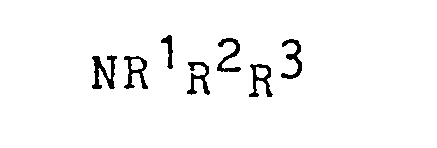
- Die Patentanmeldung ....... vom gleichen Anmeldetag (Deutsche Patentanmeldung P 32 30 303.3) betrifft ein Verfahren zur Abtrennung von mikrobiellen Polysacchariden aus ihren wäßrigen Lösungen durch Fällung im sauren Medium als Addukt mit einem langkettigen Alkylamin, das dadurch gekennzeichnet ist, daß ein Amin der Formel
- Die bekannten Methoden zur Aufspaltung der Amin-Addukte verlaufen zum Teil recht unvollständig und führen zur salzhaltigen Polymeren. Somit werden weitere Reinigungsoperationen erforderlich, die nicht zuletzt wegen der Aufarbeitung der Abwässer aufwendig sind. Die Behandlung der Addukte mit starken Alkalien kann auch zu Schädigungen des Polymers führen.
- 'Die Patentanmeldung ....... vom gleichen Anmeldetag (Deutsche Patentanmeldung P 32 30 302.5) betrifft ein Verfahren zur Isolierung von mikrobiellen Polysacchariden aus ihren Amin-Addukten durch Behandeln mit alkalischen Mitteln in Gegenwart einwertiger Alkanole mit 1 bis 3 Kohlenstoffatomen, das dadurch gekennzeichnet ist, daß als alkalisches Mittel Ammoniak oder ein leichtflüchtiges Amin eingesetzt wird.
- Die Erfindung betrifft demgegenüber ein Verfahren zur Isolierung von mikrobiellen Polysacchariden aus ihren Fettamin-Addukten, das dadurch gekennzeichnet ist, daß diese Addukte in Gegenwart eines Alkohols mit einem in diesem Alkohol löslichen oder thermisch leicht dissoziierenden Salz von Ammoniak oder einem leicht flüchtigen Amin behandelt werden.
- Im folgend.en werden bevorzugte Ausgestaltungen der Erfindung näher erläutert:
- Als Ausgangsmaterialien sind solche Addukte bevorzugt, die sich von Xanthan als mikrobiellem Polysaccharid und einem primären oder tertiären Fettalkylamin (mit zwei kurzkettigen Alkylresten) ableiten. Vorteilhaft werden diese Addukte im feuchten Zustand, beispielsweise als Preßkuchen, eingesetzt, wie sie bei der Isolierung der mikrobiellen Polysaccharide aus den Fermentationslösungen anfallen.
- Es entfällt so das Trocknen der Addukte, das nicht nur beachtliche Energiemengen erfordert, sondern auch das Löslichkeits- und Quellvermögen der Addukte beeinträchtigen kann. Die geringen Wassermengen, die durch den Einsatz der feuchten Addukte eingebracht werden, stören beim erfindungsgemäßen Verfahren nicht.
- Als Alkohole eignen sich grundsätzlich alle, die ein hinreichendes Lösevermögen für die genannten Salze haben oder in denen diese Salze thermisch leicht dissoziieren können. Bevorzugt sind Alkohole mit einem Siedepunkt bei Normaldruck bis etwa 100°C, insbesondere niedere Alkanole, vor allem Methanol, Ethanol, n- und iso-Propanol. Als Alkohole werden vorteilhaft die handelsüblichen technischen Qualitäten eingesetzt, wobei auch hierfür gilt, daß die geringen Wassermengen, die diese Produkte enthalten, das erfindungsgemäße Verfahren nicht beeinträchtigen. Größere Wassermengen sind jedoch nicht vorteilhaft, da die freien mikrobiellen Polysaccharide, insbesondere das Xanthan, in Wasser löslich, in Alkoholen jedoch unlöslich sind. Ein höherer Wassergehalt im Medium könnte'somit die Aufarbeitung erschweren.
- Unter leichtflüchtigen Aminen, deren Salze eingesetzt werden, werden in erster Linie solche mit einem Siedepunkt unter 150°C bei Normaldruck verstanden. Salze von Aminen mit höherem Siedepunkt sind weniger zweckmäßig. Bevorzugt sind deshalb Salze primärer Alkylamine mit einem Alkylrest bis zu 6 Kohlenstoffatomen, sekundärer Amine mit gleichen oder verschiedenen Alkylresten mit bis zu 4 Kohlenstoffatomen und tertiärer Amine mit gleichen oder verschiedenen Alkylresten mit bis zu 3 Kohlenstoffatomen. Besonders bevorzugt sind die Salze von Trimethylamin, Triethylamin, Dimethylethylamin und Diethylmethylamin.
- Als Salze sind thermisch leicht diisoziierende Produkte wie Ammoniumcarbonat, Ammoniumformiat, Ammoniumacetat, Triethylammoniumacetat, Trimethylammoniumformiat und Triethylammoniumformiat bevorzugt. Für thermisch stabilere Salze kommt es darauf an, daß sie in dem Alkohol bei der gewählten Verfahrenstemperatur eine hinreichende Löslichkeit besitzen, was durch einfache Vorversuche leicht feststellbar ist. Brauchbar sind beispielsweise Ammoniumchlorid, -bromid oder -nitrat, ferner die analogen Mono-, Di- und Triethylammoniumsalze.
- Wenn das Addukt eines primären oder sekundären Fettamins gespalten wird bzw. wenn sich das eingesetzte leichtdissoziierende Salz von Ammoniak oder einem primären oder sekundären Amin ableitet,, ist darauf zu achten, daß die freigesetzten Amine mit reaktiven Gruppen, insbesondere Estergruppen, der mikrobiellen Polysaccharide reagieren können. In solchen Fällen arbeitet man deshalb zweckmäßig bei niederen bis mäßig erhöhten Temperaturen.
- Bei Verwendung von Salzen tertiärer Amine, auch leichtdissoziierenden, und beim Einsatz von Addukten tertiärer Amine kann hingegen bei erhöhter Temperatur gearbeitet werden, ohne daß es zu einer Produktschädiguhg kommt. Höhere Temperaturen sind bevorzugt, da sie die Verfahrensdauer erheblich verkürzen.
- Die Reaktion wird zweckmäßig bei der Rückflußtemperatur des Reaktionsgemischs durchgeführt. Insbesondere beim Einsatz niederer Alkohole kann unter Anwendung von Druck gearbeitet werden.
- Zur Spaltung der Addukte wird mindestens die äquimolare Menge, bezogen auf den Amingehalt im Addukt, an Salz eingesetzt, vorteilhaft ein mehr oder weniger großer Überschuß, beispielsweise die zwei- bis zehnfache molare Menge. Da die freigesetzten mikrobiellen Polysaccharide in der alkoholischen Salzlösung nicht löslich sind, stört ein Salzüberschuß nicht, solange er gelöst bleibt, da dann die Lösung wieder in das Verfahren zurückgeführt werden kann. Diese Verfahrensweise kommt auch für eine kontinuierliche Ausgestaltung in Betracht.
- Die mikrobiellen Polysaccharide fallen in einer leicht abtrennbaren Form an und liegen nach dem Trocknen weitgehend in der freien Säureform vor. Die Produkte zeichnen sich durch sehr günstige Viskositätseigenschaften aus.
- Die den Alkohol und das abgespaltene Amin enthaltende flüssige Phase läßt sich destillativ aufarbeiten. Das aus dem Addukt abgespaltene Amin kann unmittelbar wieder zur Abtrennung mikrobieller Polysaccharide aus ihren Fermentationslösungen eingesetzt werden. Der Alkohol kann wieder in den Prozeß zurückgeführt werden.
- In den folgenden Beispielen beziehen sich Teile und Prozentangaben auf das Gewicht, sofern nichts anderes angegeben ist. Volumenteile stehen .zu Gewichtsteilen im Verhältnis von 1 zu kg.
- Zunächst wird die nicht-literaturbekannte Herstellung eines Addukts aus Xanthan und einem tertiären Fettalkylamin beschrieben (Deutsche Patentanmeldung P 32 30 303.3):
- Als Produktionsstamm diente Xanthomonas campestris NRRL B-1459. Zur Vorkultur wurde eine Agarkultur in ein Glucose-Pepton-Medium überimpft und darin im Schüttelkolben bei 30°C bebrütet. Diese Kultur diente als Inoculum (3 %) für einen 10 Liter-Fermenter, dessen Nährmedium 3 - 5 % Glucose oder Saccharose, 0,15 - 0,25 % Cornsteep (Maisquellwasser), 0,1 bis 0,2 % Natriumnitrat, 0,1 % Dikaliumphosphat und 0,05 % Magnesiumsulfat-Hydrat enthielt. Der beimpfte Fermenter wurde auf 28 OC gehalten und unter Rühren (400 U/min) mit 10 1 Luft/min belüftet. Nach etwa 36 Stunden enthielt das Fermentationsmedium 18 - 20 g Xanthan pro Liter.
- In 100 g einer Xanthanlösung mit einem Polysaccharidgehalt von 1,8 % wurden 0,85 g Talgfettalkyl-dimethylamin (C-Kettenverteilung im Talgfettalkylrest: etwa 5 % C14; 30 % C16; 65 % C18) eingerührt. Nach Zugabe von 2,5 g 2 N Essigsäure gerann die erhaltene Dispersion und das Addukt schied sich in Form von zunächst stark gequollenen Fladen ab, die aber beim Nachrühren rasch desolvatisierten. Das Addukt wurde abfiltriert, mit entionisiertem Wasser nachgewaschen und durch Abpressen entwässert. Es wurden 6,2 g eines feuchten Preßkuchens erhalten, der 1,8 g Xanthan und 0,43 g-Amin enthielt.
- 100 Teile eines feuchten Preßkuchens, bestehend aus dem Addukt von Hexadecyldimethylamin an Xanthan, das 32 % Xanthan enthält, wurden in einem mit einem Schneidepropeller ausgerüsteten Mixer zusammen mit 4000 Teilen Methanol zerkleinert und nach Zugabe von 100 Teilen Ammoniumbromid 6 Stunden unter Rückfluß erhitzt. Das dabei in faseriger Form freigesetzte Xanthan wurde abfiltriert und mit Methanol bis zur praktischen Bromidfreiheit gewaschen. Der Filterkuchen wurde getrocknet und zerkleinert. Die Ausbeute an Xanthan war praktisch quantitativ (31,9 Gewichtsteile). Das Produkt war in entionisiertem Wasser vollkommen löslich.
- Es wurde wie in Beispiel 1 gearbeitet, jedoch ein feuchter Preßkuchen eines Adduktes von Hexadecylamin und Xanthan und 3200 Teile Methanol sowie 100 Teile Ammoniumacetat eingesetzt. Das praktisch quantitativ erhaltene Xanthan löste sich vollständig in entionisiertem Wasser. Die Beispiele 3-7 wurden analog Beispiel 1 mit den angegebenen Abänderungen ausgeführt. Es wurden jeweils 100 Teile Addukt eingesetzt. Das Produkt war immer in entionisiertem Wasser löslich.

Claims (8)
Priority Applications (1)
| Application Number | Priority Date | Filing Date | Title |
|---|---|---|---|
| AT83107960T ATE32902T1 (de) | 1982-08-14 | 1983-08-11 | Isolierung mikrobieller polysaccharide aus ihren fettamin-addukten. |
Applications Claiming Priority (2)
| Application Number | Priority Date | Filing Date | Title |
|---|---|---|---|
| DE3230301 | 1982-08-14 | ||
| DE19823230301 DE3230301A1 (de) | 1982-08-14 | 1982-08-14 | Isolierung mikrobieller polysaccharide aus ihren fettamin-addukten |
Publications (3)
| Publication Number | Publication Date |
|---|---|
| EP0103178A2 true EP0103178A2 (de) | 1984-03-21 |
| EP0103178A3 EP0103178A3 (en) | 1985-05-22 |
| EP0103178B1 EP0103178B1 (de) | 1988-03-09 |
Family
ID=6170890
Family Applications (1)
| Application Number | Title | Priority Date | Filing Date |
|---|---|---|---|
| EP83107960A Expired EP0103178B1 (de) | 1982-08-14 | 1983-08-11 | Isolierung mikrobieller Polysaccharide aus ihren Fettamin-Addukten |
Country Status (18)
| Country | Link |
|---|---|
| US (1) | US4703117A (de) |
| EP (1) | EP0103178B1 (de) |
| JP (1) | JPS5953503A (de) |
| KR (1) | KR840005820A (de) |
| AT (1) | ATE32902T1 (de) |
| AU (1) | AU1795683A (de) |
| BR (1) | BR8304346A (de) |
| CA (1) | CA1204400A (de) |
| DD (1) | DD210309A5 (de) |
| DE (2) | DE3230301A1 (de) |
| DK (1) | DK368883A (de) |
| ES (1) | ES524905A0 (de) |
| FI (1) | FI832901L (de) |
| GR (1) | GR78695B (de) |
| IL (1) | IL69477A (de) |
| NO (1) | NO832908L (de) |
| PT (1) | PT77189B (de) |
| ZA (1) | ZA835946B (de) |
Families Citing this family (7)
| Publication number | Priority date | Publication date | Assignee | Title |
|---|---|---|---|---|
| JPS5635692A (en) * | 1979-08-30 | 1981-04-08 | Mitsubishi Electric Corp | Control device for transistor motor |
| GB8426529D0 (en) * | 1984-10-19 | 1984-11-28 | Allied Colloids Ltd | Dry polymers |
| GB8520101D0 (en) * | 1985-08-09 | 1985-09-18 | Unilever Plc | Phase separation |
| IL76981A (en) * | 1985-11-07 | 1989-02-28 | Univ Ramot | Bacterially produced hetero polysaccharide dispersants for inorganic minerals in aqueous medium and their preparation |
| CA1334290C (en) * | 1987-02-26 | 1995-02-07 | Adrienne Elizabeth Clarke | Plant gum material and use thereof in food products |
| JP3741734B2 (ja) | 1994-06-30 | 2006-02-01 | 信越化学工業株式会社 | キサンタンガムの回収精製方法 |
| US6271001B1 (en) | 1995-03-23 | 2001-08-07 | Bio Polymers Pty. Ltd. | Cultured plant cell gums for food, pharmaceutical, cosmetic and industrial applications |
Family Cites Families (8)
| Publication number | Priority date | Publication date | Assignee | Title |
|---|---|---|---|---|
| GB1167747A (en) * | 1965-11-16 | 1969-10-22 | Ashland Oil Inc | Precipitation of Polymeric Hydroxyl Compounds |
| US3422085A (en) * | 1966-07-29 | 1969-01-14 | Hercules Inc | Recovery and purification of microbial polysaccharides |
| US3598730A (en) * | 1968-04-15 | 1971-08-10 | Gen Mills Inc | Process of flocculating silica with a cationic xanthomonas gum ether |
| US3729460A (en) * | 1970-03-02 | 1973-04-24 | J Patton | Modified heteropolysaccharides |
| US3928316A (en) * | 1974-04-22 | 1975-12-23 | Gen Mills Chem Inc | Xanthomonas gum amine salts |
| US4135979A (en) * | 1976-08-24 | 1979-01-23 | Merck & Co., Inc. | Treatment of xanthan gum to improve clarity |
| US4254257A (en) * | 1979-02-21 | 1981-03-03 | The Lubrizol Corporation | Amine salts of acidic microbial polysaccharides and their use in recovery of such polysaccharides |
| DE3230302A1 (de) * | 1982-08-14 | 1984-02-16 | Hoechst Ag, 6230 Frankfurt | Isolierung mikrobieller polysaccharide aus ihren amin-addukten |
-
1982
- 1982-08-14 DE DE19823230301 patent/DE3230301A1/de not_active Withdrawn
-
1983
- 1983-08-11 EP EP83107960A patent/EP0103178B1/de not_active Expired
- 1983-08-11 DE DE8383107960T patent/DE3375919D1/de not_active Expired
- 1983-08-11 FI FI832901A patent/FI832901L/fi not_active Application Discontinuation
- 1983-08-11 PT PT77189A patent/PT77189B/de unknown
- 1983-08-11 AT AT83107960T patent/ATE32902T1/de not_active IP Right Cessation
- 1983-08-12 ES ES524905A patent/ES524905A0/es active Granted
- 1983-08-12 JP JP58146756A patent/JPS5953503A/ja active Pending
- 1983-08-12 CA CA000434448A patent/CA1204400A/en not_active Expired
- 1983-08-12 ZA ZA835946A patent/ZA835946B/xx unknown
- 1983-08-12 AU AU17956/83A patent/AU1795683A/en not_active Abandoned
- 1983-08-12 BR BR8304346A patent/BR8304346A/pt unknown
- 1983-08-12 DD DD83253926A patent/DD210309A5/de unknown
- 1983-08-12 KR KR1019830003772A patent/KR840005820A/ko not_active Withdrawn
- 1983-08-12 IL IL69477A patent/IL69477A/xx unknown
- 1983-08-12 NO NO832908A patent/NO832908L/no unknown
- 1983-08-12 GR GR72214A patent/GR78695B/el unknown
- 1983-08-12 DK DK368883A patent/DK368883A/da not_active Application Discontinuation
-
1985
- 1985-10-07 US US06/783,814 patent/US4703117A/en not_active Expired - Fee Related
Also Published As
| Publication number | Publication date |
|---|---|
| DE3375919D1 (en) | 1988-04-14 |
| DE3230301A1 (de) | 1984-02-16 |
| EP0103178B1 (de) | 1988-03-09 |
| PT77189A (de) | 1983-09-01 |
| ZA835946B (en) | 1984-04-25 |
| EP0103178A3 (en) | 1985-05-22 |
| ES8404380A1 (es) | 1984-05-01 |
| FI832901A0 (fi) | 1983-08-11 |
| DK368883A (da) | 1984-02-15 |
| ATE32902T1 (de) | 1988-03-15 |
| FI832901A7 (fi) | 1984-02-15 |
| BR8304346A (pt) | 1984-03-20 |
| ES524905A0 (es) | 1984-05-01 |
| DK368883D0 (da) | 1983-08-12 |
| GR78695B (de) | 1984-09-27 |
| IL69477A (en) | 1986-08-31 |
| PT77189B (de) | 1986-03-27 |
| KR840005820A (ko) | 1984-11-19 |
| FI832901L (fi) | 1984-02-15 |
| DD210309A5 (de) | 1984-06-06 |
| AU1795683A (en) | 1984-02-16 |
| CA1204400A (en) | 1986-05-13 |
| JPS5953503A (ja) | 1984-03-28 |
| NO832908L (no) | 1984-02-15 |
| US4703117A (en) | 1987-10-27 |
| IL69477A0 (en) | 1983-11-30 |
Similar Documents
| Publication | Publication Date | Title |
|---|---|---|
| EP0243619A2 (de) | Verfahren zur Herstellung einer hochkonzentrierten, fliess- und pumpfähigen Betainlösung | |
| DE69718339T2 (de) | Zusammensetzung auf basis von derivatisiertem guargummi, welche nichtionische und kationische gruppen enthält, und die daraus hergestellten lösungen sehr klar und in reinigungsmitteln verwendbar sind | |
| EP0103178B1 (de) | Isolierung mikrobieller Polysaccharide aus ihren Fettamin-Addukten | |
| DE3639752A1 (de) | Verfahren zur herstellung von amphoteren oberflaechenaktiven agentien | |
| DE2834118C2 (de) | ||
| DE2415155C2 (de) | Verfahren zur Herstellung von 2,3-Dihydroxypropylcellulose | |
| DE1493778A1 (de) | Organische Polyalkylenoxyborate sowie Verfahren zu ihrer Herstellung | |
| DE3781322T2 (de) | Verfahren zur herstellung einer mischung eines aldehyds mit dem entsprechenden alkohol. | |
| DE3105556A1 (de) | "verbessertes verfahren zur herstellung von xanthomonas-biopolymeren" | |
| EP0103176A2 (de) | Isolierung mikrobieller Polysaccharide aus ihren Amin-Addukten | |
| EP0130946B1 (de) | Verfahren zur Herstellung eines galaktomannanreichen Verdickungsmittels | |
| EP0134978B1 (de) | Isolierung mikrobieller Polysaccharide aus ihren Amin-Addukten | |
| EP0103177B1 (de) | Abtrennung mikrobieller Polysaccharide als Amin-Addukte und deren Verwendung | |
| DE2918225A1 (de) | Phosphatiertes johannisbrotgummi | |
| CH635615A5 (en) | Process for decreasing the lipid and nucleic acid content in microbial cell masses | |
| EP0719793B1 (de) | Verfahren zur Herstellung von wasserlöslichen Aminoalkylderivaten von Polysacchariden | |
| DE1920350A1 (de) | Schwefelsaeurehalbester von Tragant und Verfahren zu ihrer Herstellung | |
| DE1300670B (de) | Verfahren zur Herstellung von wasserloeslicher und wasserunloeslicher Hydroxyalkylamylose | |
| DE2810279A1 (de) | Verfahren zur herstellung hochviskoser saurer polysaccharide und diese enthaltende mittel | |
| DE19909907A1 (de) | Verfahren zur Herstellung von N-Alkylpolyhydroxyalkylaminen aus Monoalkylamin und reduzierendem Zucker | |
| DE562180C (de) | Verfahren zur Herstellung von Cellulose- und Staerkeverbindungen | |
| DE727404C (de) | Verfahren zur Herstellung von betainartig konstituierten Kondensationsprodukten | |
| DE936889C (de) | Verfahren zur Gewinnung von reinem Erythromycin | |
| AT301030B (de) | Verfahren zur herstellung von neuen spiramycinderivaten | |
| DE966852C (de) | Verfahren zum Reinigen und Fraktionieren von Dextranen |
Legal Events
| Date | Code | Title | Description |
|---|---|---|---|
| PUAI | Public reference made under article 153(3) epc to a published international application that has entered the european phase |
Free format text: ORIGINAL CODE: 0009012 |
|
| AK | Designated contracting states |
Designated state(s): AT BE CH DE FR GB IT LI LU NL SE |
|
| PUAL | Search report despatched |
Free format text: ORIGINAL CODE: 0009013 |
|
| AK | Designated contracting states |
Designated state(s): AT BE CH DE FR GB IT LI LU NL SE |
|
| 17P | Request for examination filed |
Effective date: 19850805 |
|
| 17Q | First examination report despatched |
Effective date: 19860613 |
|
| GRAA | (expected) grant |
Free format text: ORIGINAL CODE: 0009210 |
|
| AK | Designated contracting states |
Kind code of ref document: B1 Designated state(s): AT BE CH DE FR GB IT LI LU NL SE |
|
| REF | Corresponds to: |
Ref document number: 32902 Country of ref document: AT Date of ref document: 19880315 Kind code of ref document: T |
|
| ITF | It: translation for a ep patent filed | ||
| REF | Corresponds to: |
Ref document number: 3375919 Country of ref document: DE Date of ref document: 19880414 |
|
| ET | Fr: translation filed | ||
| GBT | Gb: translation of ep patent filed (gb section 77(6)(a)/1977) | ||
| PG25 | Lapsed in a contracting state [announced via postgrant information from national office to epo] |
Ref country code: LU Free format text: LAPSE BECAUSE OF NON-PAYMENT OF DUE FEES Effective date: 19880831 |
|
| PLBE | No opposition filed within time limit |
Free format text: ORIGINAL CODE: 0009261 |
|
| STAA | Information on the status of an ep patent application or granted ep patent |
Free format text: STATUS: NO OPPOSITION FILED WITHIN TIME LIMIT |
|
| 26N | No opposition filed | ||
| PG25 | Lapsed in a contracting state [announced via postgrant information from national office to epo] |
Ref country code: GB Effective date: 19890811 Ref country code: AT Effective date: 19890811 |
|
| PG25 | Lapsed in a contracting state [announced via postgrant information from national office to epo] |
Ref country code: SE Effective date: 19890812 |
|
| PG25 | Lapsed in a contracting state [announced via postgrant information from national office to epo] |
Ref country code: LI Effective date: 19890831 Ref country code: CH Effective date: 19890831 Ref country code: BE Effective date: 19890831 |
|
| BERE | Be: lapsed |
Owner name: HOECHST A.G. Effective date: 19890831 |
|
| PG25 | Lapsed in a contracting state [announced via postgrant information from national office to epo] |
Ref country code: NL Effective date: 19900301 |
|
| GBPC | Gb: european patent ceased through non-payment of renewal fee | ||
| NLV4 | Nl: lapsed or anulled due to non-payment of the annual fee | ||
| PG25 | Lapsed in a contracting state [announced via postgrant information from national office to epo] |
Ref country code: FR Effective date: 19900427 |
|
| REG | Reference to a national code |
Ref country code: CH Ref legal event code: PL |
|
| PG25 | Lapsed in a contracting state [announced via postgrant information from national office to epo] |
Ref country code: DE Effective date: 19900501 |
|
| REG | Reference to a national code |
Ref country code: FR Ref legal event code: ST |
|
| EUG | Se: european patent has lapsed |
Ref document number: 83107960.3 Effective date: 19900418 |