EP0100581B1 - Lichtempfindliches Material für die Elektrophotographie - Google Patents
Lichtempfindliches Material für die Elektrophotographie Download PDFInfo
- Publication number
- EP0100581B1 EP0100581B1 EP83201154A EP83201154A EP0100581B1 EP 0100581 B1 EP0100581 B1 EP 0100581B1 EP 83201154 A EP83201154 A EP 83201154A EP 83201154 A EP83201154 A EP 83201154A EP 0100581 B1 EP0100581 B1 EP 0100581B1
- Authority
- EP
- European Patent Office
- Prior art keywords
- parts
- benzoquinone
- weight
- pigment
- charge
- Prior art date
- Legal status (The legal status is an assumption and is not a legal conclusion. Google has not performed a legal analysis and makes no representation as to the accuracy of the status listed.)
- Expired
Links
Images
Classifications
-
- G—PHYSICS
- G03—PHOTOGRAPHY; CINEMATOGRAPHY; ANALOGOUS TECHNIQUES USING WAVES OTHER THAN OPTICAL WAVES; ELECTROGRAPHY; HOLOGRAPHY
- G03G—ELECTROGRAPHY; ELECTROPHOTOGRAPHY; MAGNETOGRAPHY
- G03G5/00—Recording-members for original recording by exposure, e.g. to light, to heat or to electrons; Manufacture thereof; Selection of materials therefor
- G03G5/02—Charge-receiving layers
- G03G5/04—Photoconductive layers; Charge-generation layers or charge-transporting layers; Additives therefor; Binders therefor
- G03G5/06—Photoconductive layers; Charge-generation layers or charge-transporting layers; Additives therefor; Binders therefor characterised by the photoconductive material being organic
- G03G5/0622—Heterocyclic compounds
- G03G5/0644—Heterocyclic compounds containing two or more hetero rings
- G03G5/0646—Heterocyclic compounds containing two or more hetero rings in the same ring system
- G03G5/0657—Heterocyclic compounds containing two or more hetero rings in the same ring system containing seven relevant rings
-
- Y—GENERAL TAGGING OF NEW TECHNOLOGICAL DEVELOPMENTS; GENERAL TAGGING OF CROSS-SECTIONAL TECHNOLOGIES SPANNING OVER SEVERAL SECTIONS OF THE IPC; TECHNICAL SUBJECTS COVERED BY FORMER USPC CROSS-REFERENCE ART COLLECTIONS [XRACs] AND DIGESTS
- Y10—TECHNICAL SUBJECTS COVERED BY FORMER USPC
- Y10S—TECHNICAL SUBJECTS COVERED BY FORMER USPC CROSS-REFERENCE ART COLLECTIONS [XRACs] AND DIGESTS
- Y10S430/00—Radiation imagery chemistry: process, composition, or product thereof
- Y10S430/001—Electric or magnetic imagery, e.g., xerography, electrography, magnetography, etc. Process, composition, or product
- Y10S430/10—Donor-acceptor complex photoconductor
Definitions
- the present invention relates to a photosensitive material for the electrophotography. More particularly, the present invention relates to an improvement of a single-layer type photosensitive material comprising a dispersion of a charge-generating perylene type pigment in a charge-transporting medium composed mainly of a polyvinyl carbazole resin (often referred to as "PVK” hereinafter).
- PVK polyvinyl carbazole resin
- Such a photosensitive material is known from US-A 4,264,695, US-A 3,904,407, DE-A 2,237,539, DE-A 2,353,639 and EP-A 0 040 402.
- a dispersion of a perylene type pigment in PVK has no substantial sensitivity and it can hardly be put into practical use.
- sensitizing agents may be incorporated so as to sensitize photosensitive layers of the charge-transporting medium/charge-generating pigment dispersion type.
- sensitizing agents when most of these sensitizing agents are incorporated in a PVK-perylene type pigment composition, no satisfactory results are obtained in the sensitivity, the charge potential or the repetition characteristics.
- a photosensitive material for the electrophotography which comprises a dispersion of a charge-generating pigment in a charge-transporting medium composed mainly of a polyvinyl carbazole resin, wherein a perylene pigment represented by the following general formula: wherein R, and R 2 stand for a hydrogen atom or a substituted or unsubstituted alkyl or aryl group, is dispersed and incorporated as the charge-generating pigment in an amount of 1 to 40 parts by weight per 100 parts by weight of the polyvinyl carbazole resin, and which is characterized in that a halogeno-p-benzoquinone selected from 2,5- and 2,6-dichloro-p-benzoquinone is further incorporated in an amount of 1 to 60 parts by weight per 100 parts per weight of the polyvinyl carbazole resin.
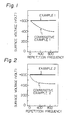
- Figs. 1 and 2 are graphs showing the repetition characteristics of a photosensitive material according to the present invention and a comparative photosensitive material, respectively.
- Halogeno-p-benzoquinones are per se known to be active as an electron-receiving substance, and if at least one halogeno-p-benzoquinone selected from 2,5- and 2,6-dichloro-p-benzoquinone is dispersed and incorporated in combination with the perylene pigment of the above-mentioned structural formula (1) into a charge-transporting medium composed mainly of a polyvinyl carbazole resin, as pointed out hereinbefore, the fatigue at the repeated exposure is prevented and a predetermined charge quantity can always be obtained stably. This is one of prominent characteristic features of the present invention.
- the sensitivity of a photosensitive layer for the electrophotography is expressed by the light exposure quantity (lux. sec) for half-decay of the voltage.
- the sensitivity of a photosensitive layer of the PVK-perylene pigment dispersion type is about 40 to about 60 iux-sec if the halogeno-p-benzoquinone is not incorporated, but if the halogeno-p-benzoquinone is incorporated in this photosensitive material, the sensitivity can be improved to a level of 10 to 20 lux-sec.
- a known electron-receiving substance may be used in combination with the halogeno-p-benzoquinone in an amount of 1 to 10 parts by weight per part by weight of the halogeno-p-benzoquinone.
- the electron-receiving substance there can be mentioned, for example, carboxylic anhydrides, compounds having an electron-receiving nucleus structure such as an o- or p-quinoid structure, and alicyclic, aromatic and heterocyclic compounds having electron-receiving substituents such as nitro, nitroso and cyano groups.
- maleic anhydride phthalic anhydride, tetrachlorophthalic anhydride, tetrabromophthalic anhydride, naphthalic anhydride, pyromellitic anhydride, 5,8-dichloronaphthoquinone, o-chloranil, o-bromanil, p-chloranil, p-bromanil, p-iodanil, tetracyanoquinodimethane, 5,6-quinoline-dione, coumarin-2,2-dione, hydroxyindirubin, hydroxy- indigo, 1,2-dinitroethane, 2,2-dinitropropane, 2-nitro-2-nitrosopropane, iminodiacetonitrile, succinonitrile, tetracyanoethylene, 1,1,3,3-tetracyanopropenide, o-, m- and p-dinitrobenzenes, 1,2,3-trinitro
- a known perylene pigment represented by the following general formula: wherein R, and R 2 stand for a hydrogen atom or a substituted or unsubstituted alkyl or aryl group, is used in combination with the halogeno-p-benzoquinone. If this perylene pigment is used in combination with the above-mentioned halogeno-p-benzoquinone, a photosensitive material excellent in the sensitivity and the memory resistance can be obtained.
- the substituent there can be mentioned a hydroxyl group, an alkoxy group, an amino group, a nitro group and a halogen atom.
- the perylene pigment there can be mentioned N,N'-dimethylperylene-3,4,9,10-tetracarboxylic acid diimide, N,N'-di(3,5-dimethylphenyl)perylene-3,4,9,10-tetracarboxylic acid diimide, N,N'-di(4-ethoxyphenyl)perylene-3,4,9,10-tetracarboxylic acid diimide and N,N'-di(4-toluyl)perylene-3,4,9,10-tetracarboxylic acid diimide.
- the perylene pigments that can be used are not limited to those exemplified above.
- the ratio of the perylene pigment and halogeno-p-benzoquinone to be dispersed in combination into PVK is important in the present invention. More specifically, in the present invention, the perylene pigment of the structural formula (1) is incorporated in an amount of 1 to 40 parts by weight, especially 4 to 20 parts by weight, per 100 parts by weight of PVK, and the halogeno-p-benzoquinone is incorporated in an amount of 1 to 60 parts by weight, especially 4 to 30 parts by weight, per 100 parts by weight of PVK. When the amount incorporated of the perylene pigment is too small and below the above range, even if the halogeno-p-benzoquinone is incorporated in combination, no effective sensitivity can be obtained.
- the amount of the perylene pigment exceeds the above range, formation of a photosensitive layer by the film-forming technique becomes difficult and even if a photosensitive layer can be formed, the mechanical strength is very low and the abrasion resistance of the photosensitive layer is extremely poor. If the amount of the halogeno-p-benzoquinone is too small and below the above range, the sensitivity is reduced and the intended control of the fatigue at the repeated exposure cannot be attained. If the amount of the halogeno-p-benzoquinone exceeds the above range, a crystal of the halogeno-p-benzoquinone is precipitated on the photosensitive layer and a uniform photosensitive layer cannot be formed, and retention of charges on the photosensitive layer becomes difficult.
- the polyvinyl carbazole resin used as the charge-transporting medium-in the present invention is a polymer having the following recurring units: and this polymer has a film-forming property and an electron-donating characteristic.
- a nucleus substitution product of this polymer for example, a halogen- or nitro-substituted polymer, can also be used.
- the sensitive wavelength region of the photosensitive layer can be rendered more panchromatic.
- the perylene pigment used in the present invention has a sensitivity to rays having a wavelength of 400 to 600 nm, and if a phthalocyanine pigment or disazo pigment is incorporated, the sensitivity to rays having a longer wavelength can be increased.
- binders having no photoconductivity such as a polyester resin, an epoxy resin, a polycarbonate resin, a polyurethane resin, a xylene resin, an acrylic resin and a styrene-butadiene copolymer, can be used.
- the binder may be used in an amount of 0.1 to 50 parts by weight, especially 10 to 30 parts by weight, per 100 parts by weight of the polyvinyl carbazole resin.
- a levelling agent such as polydimethylsiloxane may be used in an amount of 0.005 to 5 parts by weight per 100 parts by weight of the polyvinyl carbazole resin.
- the above-mentioned photosensitive composition of the present invention is coated in a certain thickness on an electroconductive substrate and is used as a photosensitive material for the electrophotography.
- the electroconductive substrate there may be used foils or plates of metals such as aluminum, copper, tin and tinplate in the form of sheets or drums.
- a film substrate such as a biaxially drawn polyester film or a glass sheet, to which a metal such as mentioned above is applied by vacuum deposition, sputtering or nonelectrode plating, or Nesa glass can be used as the electroconductive substrate.
- the coating composition is prepared by dispersing the perylene pigment, optionally in combination with the phthalcyanine pigment or disazo pigment, into a good solvent for the polyvinyl carbazole resin, such as tetrahydrofuran, dichloroethane or toluene, cyclohexanone, by ultrasonic vibration or high shearing stirring, and dissolving the polyvinyl carbazole resin and the halogeno-p-benzoquinone in the resulting dispersion. From the viewpoint of the adaptability to the coating operation, it is preferred that the solid concentration of the formed coating composition be 5 to 12% by weight.
- the thickness of the photosensitive composition layer after drying be 3 to 30 11m, especially 8 to 15 11m.
- the photosensitive composition was coated by a doctor blade to an anodized aluminum foil having a thickness of 80 pm, and the coated foil was dried for 1 hour in an oven maintained at 80°C to obtain a photosensitive plate having a photosensitive layer thickness of 15 ⁇ m after drying.
- the photosensitive plate was allowed to stand still in the dark place overnight, and the electrophotographic characteristics were determined according to the following procedures.
- the test was carried out by using an electrostatic paper analyzer supplied by Kawaguchi Denki under the following conditions:
- the photosensitive plate was attached to a PPC copying machine (Model DC-232 supplied by Mita Industrial Company), and the copying operation was repeated 1000 times under conditions of an applied voltage of +7.2 KV, a destaticization AC voltage of 5.0 KV and a transfer voltage of +6.0 KV by using an original having a reflection density of 1.8.
- the surface voltage was measured by a surface potentiometer supplied by Monroe Co. while the copying operation was repeated. The obtained results are shown in Fig. 1.
- the surface voltage (598 V) at the 1000th cycle was not substantially different from the surface voltage (600 V) at the first cycle, and it was confirmed that the characteristics were very stable.
- a photosensitive plate was prepared in the same manner as described in Example 1 except that 2,3-dichloro-1,4-naphthoquinone was used instead of 2,5-dichloro-p-benzoquinone used in Example 1, and the photosensitive plate was tested in the same manner as described in Example 1.
- the obtained results are as follows.
- a photosensitive plate was prepared in the same manner as described in Example 1 except that 2,6-dichloro-p-benzoquinone was used instead of 2,5-dichloro-p-benzoquinone used in Example 1, and the photosensitive plate was tested in the same manner as described in Example 1. The obtained results are as follows.
- a photosensitive plate was prepared in the same manner as described in Example 1 except that 2,4,7- trinitro-9-fluorenone was used instead of 2,5-dichloro-p-benzoquinone used in Example 1.
- the photosensitive plate was tested in the same manner as described in Example 1. The obtained results are as follows.
- the surface voltage at the first cycle was +600 volt, but it was reduced to +430 V at the 1000th cycle, and it was confirmed that the charge quantity was drastically reduced and the characteristics were very unstable (see Fig. 2).
Landscapes
- Physics & Mathematics (AREA)
- General Physics & Mathematics (AREA)
- Photoreceptors In Electrophotography (AREA)
Claims (3)

Applications Claiming Priority (2)
| Application Number | Priority Date | Filing Date | Title |
|---|---|---|---|
| JP57135478A JPS5924852A (ja) | 1982-08-03 | 1982-08-03 | 電子写真用感光体 |
| JP135478/82 | 1982-08-03 |
Publications (3)
| Publication Number | Publication Date |
|---|---|
| EP0100581A2 EP0100581A2 (de) | 1984-02-15 |
| EP0100581A3 EP0100581A3 (en) | 1984-04-25 |
| EP0100581B1 true EP0100581B1 (de) | 1987-08-26 |
Family
ID=15152648
Family Applications (1)
| Application Number | Title | Priority Date | Filing Date |
|---|---|---|---|
| EP83201154A Expired EP0100581B1 (de) | 1982-08-03 | 1983-08-03 | Lichtempfindliches Material für die Elektrophotographie |
Country Status (4)
| Country | Link |
|---|---|
| US (1) | US4469769A (de) |
| EP (1) | EP0100581B1 (de) |
| JP (1) | JPS5924852A (de) |
| DE (1) | DE3373222D1 (de) |
Families Citing this family (15)
| Publication number | Priority date | Publication date | Assignee | Title |
|---|---|---|---|---|
| US4514482A (en) * | 1984-03-08 | 1985-04-30 | Xerox Corporation | Photoconductive devices containing perylene dye compositions |
| JPS6187158A (ja) * | 1984-10-05 | 1986-05-02 | Dainichi Seika Kogyo Kk | 電子写真感光体 |
| JPS63155047A (ja) * | 1986-12-18 | 1988-06-28 | Konica Corp | 電子写真感光体 |
| US5069993A (en) * | 1989-12-29 | 1991-12-03 | Xerox Corporation | Photoreceptor layers containing polydimethylsiloxane copolymers |
| US5139909A (en) * | 1990-07-31 | 1992-08-18 | Xerox Corporation | Perinone photoconductive imaging members |
| US5213928A (en) * | 1991-11-04 | 1993-05-25 | Xerox Corporation | Imaging member containing polysiloxane homopolymers |
| US5876887A (en) * | 1997-02-26 | 1999-03-02 | Xerox Corporation | Charge generation layers comprising pigment mixtures |
| US6022656A (en) * | 1998-04-30 | 2000-02-08 | Eastman Kodak Company | Bipolar electrophotographic elements |
| US6162571A (en) | 1998-10-02 | 2000-12-19 | Xerox Corporation | Unsymmetrical perylene dimers |
| US6051351A (en) * | 1999-05-21 | 2000-04-18 | Xerox Corporation | Perylenes |
| US6165661A (en) * | 1999-05-21 | 2000-12-26 | Xerox Corporation | Perylene compositions |
| US6287738B1 (en) | 2000-05-25 | 2001-09-11 | Xerox Corporation | Photoconductive imaging members |
| US6464902B1 (en) | 2000-05-25 | 2002-10-15 | Xerox Corporation | Perylene mixtures |
| US7588873B2 (en) * | 2007-10-23 | 2009-09-15 | Static Control Components, Inc. | Methods and apparatus for providing a liquid coating for an organic photoconductive drum |
| JP5194057B2 (ja) * | 2010-06-04 | 2013-05-08 | 京セラドキュメントソリューションズ株式会社 | 正帯電単層型電子写真感光体、及び画像形成装置 |
Family Cites Families (8)
| Publication number | Priority date | Publication date | Assignee | Title |
|---|---|---|---|---|
| NL231103A (de) * | 1957-09-07 | |||
| US3904407A (en) * | 1970-12-01 | 1975-09-09 | Xerox Corp | Xerographic plate containing photoinjecting perylene pigments |
| US3901697A (en) * | 1971-10-04 | 1975-08-26 | Xerox Corp | Manifold imaging process using electrically photosensitive material subject to light fatigue |
| DE2237539C3 (de) * | 1972-07-31 | 1981-05-21 | Hoechst Ag, 6000 Frankfurt | Elektrophotographisches Aufzeichnungsmaterial |
| DE2353639C2 (de) * | 1973-10-26 | 1983-08-04 | Hoechst Ag, 6230 Frankfurt | Elektrophotographisches Aufzeichnungsmaterial |
| DE2737516C3 (de) * | 1976-08-23 | 1981-09-17 | Ricoh Co., Ltd., Tokyo | Elektrophotographisches Aufzeichnungsmaterial |
| JPS55134860A (en) * | 1979-04-09 | 1980-10-21 | Fuji Xerox Co Ltd | Electrophotographic receptor |
| DE3019326C2 (de) * | 1980-05-21 | 1983-03-03 | Hoechst Ag, 6000 Frankfurt | Elektrophotographisches Aufzeichnungsmaterial |
-
1982
- 1982-08-03 JP JP57135478A patent/JPS5924852A/ja active Pending
-
1983
- 1983-08-02 US US06/519,233 patent/US4469769A/en not_active Expired - Fee Related
- 1983-08-03 DE DE8383201154T patent/DE3373222D1/de not_active Expired
- 1983-08-03 EP EP83201154A patent/EP0100581B1/de not_active Expired
Also Published As
| Publication number | Publication date |
|---|---|
| EP0100581A2 (de) | 1984-02-15 |
| JPS5924852A (ja) | 1984-02-08 |
| US4469769A (en) | 1984-09-04 |
| EP0100581A3 (en) | 1984-04-25 |
| DE3373222D1 (en) | 1987-10-01 |
Similar Documents
| Publication | Publication Date | Title |
|---|---|---|
| EP0100581B1 (de) | Lichtempfindliches Material für die Elektrophotographie | |
| EP0760492B1 (de) | Lichtempfindliches elektrophotographisches Element | |
| JPH0252257B2 (de) | ||
| JPS5928903B2 (ja) | 多活性、光導電性絶縁要素 | |
| US4106934A (en) | Photoconductive compositions and elements with charge transfer complexes | |
| JPH0746227B2 (ja) | 電子写真用感光体 | |
| US5681678A (en) | Charge generation layer containing hydroxyalkyl acrylate reaction product | |
| US4891288A (en) | Photoreceptor for positive electrostatic charge | |
| EP0088607B1 (de) | Organisches lichtempfindliches Material für die Elektrophotographie | |
| EP0114482B1 (de) | Lichtempfindliche Zusammensetzung für die Elektrophotographie | |
| US6022656A (en) | Bipolar electrophotographic elements | |
| JPS6373256A (ja) | ヒンダ−ドアミン化合物を含有する電子写真感光体 | |
| JPH0527469A (ja) | 電子写真感光体 | |
| JPH0527457A (ja) | 電子写真感光体 | |
| JP2000221713A (ja) | 電子写真感光体、該電子写真感光体を有するプロセスカートリッジ及び電子写真装置 | |
| JP2001209195A (ja) | 電子写真感光体 | |
| US5389479A (en) | Electrophotographic photoconductors containing a bis-enamine compound | |
| JP2920315B2 (ja) | 電子写真感光体 | |
| US4438187A (en) | Photosensitive composition for electrophotography with chloronaphthoquinones | |
| JPH0264553A (ja) | 電子写真感光体 | |
| JPH0675205B2 (ja) | 感光体 | |
| JPH1020527A (ja) | 電子写真感光体 | |
| JPH07160013A (ja) | 画像形成方法 | |
| JPH0566587A (ja) | 電子写真感光体 | |
| JPH0466350B2 (de) |
Legal Events
| Date | Code | Title | Description |
|---|---|---|---|
| PUAI | Public reference made under article 153(3) epc to a published international application that has entered the european phase |
Free format text: ORIGINAL CODE: 0009012 |
|
| AK | Designated contracting states |
Designated state(s): CH DE FR GB LI NL |
|
| PUAL | Search report despatched |
Free format text: ORIGINAL CODE: 0009013 |
|
| AK | Designated contracting states |
Designated state(s): CH DE FR GB LI NL |
|
| 17P | Request for examination filed |
Effective date: 19840925 |
|
| 17Q | First examination report despatched |
Effective date: 19860124 |
|
| GRAA | (expected) grant |
Free format text: ORIGINAL CODE: 0009210 |
|
| AK | Designated contracting states |
Kind code of ref document: B1 Designated state(s): CH DE FR GB LI NL |
|
| REF | Corresponds to: |
Ref document number: 3373222 Country of ref document: DE Date of ref document: 19871001 |
|
| ET | Fr: translation filed | ||
| PLBE | No opposition filed within time limit |
Free format text: ORIGINAL CODE: 0009261 |
|
| STAA | Information on the status of an ep patent application or granted ep patent |
Free format text: STATUS: NO OPPOSITION FILED WITHIN TIME LIMIT |
|
| 26N | No opposition filed | ||
| PG25 | Lapsed in a contracting state [announced via postgrant information from national office to epo] |
Ref country code: GB Effective date: 19890803 |
|
| PG25 | Lapsed in a contracting state [announced via postgrant information from national office to epo] |
Ref country code: LI Effective date: 19890831 Ref country code: CH Effective date: 19890831 |
|
| PG25 | Lapsed in a contracting state [announced via postgrant information from national office to epo] |
Ref country code: NL Effective date: 19900301 |
|
| GBPC | Gb: european patent ceased through non-payment of renewal fee | ||
| NLV4 | Nl: lapsed or anulled due to non-payment of the annual fee | ||
| PG25 | Lapsed in a contracting state [announced via postgrant information from national office to epo] |
Ref country code: FR Effective date: 19900427 |
|
| REG | Reference to a national code |
Ref country code: CH Ref legal event code: PL |
|
| PG25 | Lapsed in a contracting state [announced via postgrant information from national office to epo] |
Ref country code: DE Effective date: 19900501 |
|
| REG | Reference to a national code |
Ref country code: FR Ref legal event code: ST |