EP0054873B1 - 3,4-Disubstituierte 1,2,5-Oxadiazol-2-oxide, Verfahren zu ihrer Herstellung und sie enthaltende pharmazeutische Zubereitungen - Google Patents
3,4-Disubstituierte 1,2,5-Oxadiazol-2-oxide, Verfahren zu ihrer Herstellung und sie enthaltende pharmazeutische Zubereitungen Download PDFInfo
- Publication number
- EP0054873B1 EP0054873B1 EP81110400A EP81110400A EP0054873B1 EP 0054873 B1 EP0054873 B1 EP 0054873B1 EP 81110400 A EP81110400 A EP 81110400A EP 81110400 A EP81110400 A EP 81110400A EP 0054873 B1 EP0054873 B1 EP 0054873B1
- Authority
- EP
- European Patent Office
- Prior art keywords
- denotes
- methyl
- formula
- oxadiazole
- see diagramm
- Prior art date
- Legal status (The legal status is an assumption and is not a legal conclusion. Google has not performed a legal analysis and makes no representation as to the accuracy of the status listed.)
- Expired
Links
- 0 C**([C@@]1C)O*=C1C#C Chemical compound C**([C@@]1C)O*=C1C#C 0.000 description 7
Classifications
-
- A—HUMAN NECESSITIES
- A61—MEDICAL OR VETERINARY SCIENCE; HYGIENE
- A61K—PREPARATIONS FOR MEDICAL, DENTAL OR TOILETRY PURPOSES
- A61K31/00—Medicinal preparations containing organic active ingredients
- A61K31/70—Carbohydrates; Sugars; Derivatives thereof
- A61K31/7028—Compounds having saccharide radicals attached to non-saccharide compounds by glycosidic linkages
- A61K31/7034—Compounds having saccharide radicals attached to non-saccharide compounds by glycosidic linkages attached to a carbocyclic compound, e.g. phloridzin
- A61K31/704—Compounds having saccharide radicals attached to non-saccharide compounds by glycosidic linkages attached to a carbocyclic compound, e.g. phloridzin attached to a condensed carbocyclic ring system, e.g. sennosides, thiocolchicosides, escin, daunorubicin
-
- A—HUMAN NECESSITIES
- A61—MEDICAL OR VETERINARY SCIENCE; HYGIENE
- A61K—PREPARATIONS FOR MEDICAL, DENTAL OR TOILETRY PURPOSES
- A61K31/00—Medicinal preparations containing organic active ingredients
- A61K31/33—Heterocyclic compounds
- A61K31/395—Heterocyclic compounds having nitrogen as a ring hetero atom, e.g. guanethidine or rifamycins
- A61K31/41—Heterocyclic compounds having nitrogen as a ring hetero atom, e.g. guanethidine or rifamycins having five-membered rings with two or more ring hetero atoms, at least one of which being nitrogen, e.g. tetrazole
- A61K31/42—Oxazoles
-
- A—HUMAN NECESSITIES
- A61—MEDICAL OR VETERINARY SCIENCE; HYGIENE
- A61K—PREPARATIONS FOR MEDICAL, DENTAL OR TOILETRY PURPOSES
- A61K31/00—Medicinal preparations containing organic active ingredients
- A61K31/33—Heterocyclic compounds
- A61K31/395—Heterocyclic compounds having nitrogen as a ring hetero atom, e.g. guanethidine or rifamycins
- A61K31/435—Heterocyclic compounds having nitrogen as a ring hetero atom, e.g. guanethidine or rifamycins having six-membered rings with one nitrogen as the only ring hetero atom
- A61K31/47—Quinolines; Isoquinolines
- A61K31/475—Quinolines; Isoquinolines having an indole ring, e.g. yohimbine, reserpine, strychnine, vinblastine
-
- A—HUMAN NECESSITIES
- A61—MEDICAL OR VETERINARY SCIENCE; HYGIENE
- A61K—PREPARATIONS FOR MEDICAL, DENTAL OR TOILETRY PURPOSES
- A61K31/00—Medicinal preparations containing organic active ingredients
- A61K31/33—Heterocyclic compounds
- A61K31/395—Heterocyclic compounds having nitrogen as a ring hetero atom, e.g. guanethidine or rifamycins
- A61K31/495—Heterocyclic compounds having nitrogen as a ring hetero atom, e.g. guanethidine or rifamycins having six-membered rings with two or more nitrogen atoms as the only ring heteroatoms, e.g. piperazine or tetrazines
- A61K31/50—Pyridazines; Hydrogenated pyridazines
-
- A—HUMAN NECESSITIES
- A61—MEDICAL OR VETERINARY SCIENCE; HYGIENE
- A61K—PREPARATIONS FOR MEDICAL, DENTAL OR TOILETRY PURPOSES
- A61K31/00—Medicinal preparations containing organic active ingredients
- A61K31/33—Heterocyclic compounds
- A61K31/395—Heterocyclic compounds having nitrogen as a ring hetero atom, e.g. guanethidine or rifamycins
- A61K31/495—Heterocyclic compounds having nitrogen as a ring hetero atom, e.g. guanethidine or rifamycins having six-membered rings with two or more nitrogen atoms as the only ring heteroatoms, e.g. piperazine or tetrazines
- A61K31/505—Pyrimidines; Hydrogenated pyrimidines, e.g. trimethoprim
-
- A—HUMAN NECESSITIES
- A61—MEDICAL OR VETERINARY SCIENCE; HYGIENE
- A61K—PREPARATIONS FOR MEDICAL, DENTAL OR TOILETRY PURPOSES
- A61K31/00—Medicinal preparations containing organic active ingredients
- A61K31/33—Heterocyclic compounds
- A61K31/395—Heterocyclic compounds having nitrogen as a ring hetero atom, e.g. guanethidine or rifamycins
- A61K31/54—Heterocyclic compounds having nitrogen as a ring hetero atom, e.g. guanethidine or rifamycins having six-membered rings with at least one nitrogen and one sulfur as the ring hetero atoms, e.g. sulthiame
-
- A—HUMAN NECESSITIES
- A61—MEDICAL OR VETERINARY SCIENCE; HYGIENE
- A61K—PREPARATIONS FOR MEDICAL, DENTAL OR TOILETRY PURPOSES
- A61K31/00—Medicinal preparations containing organic active ingredients
- A61K31/33—Heterocyclic compounds
- A61K31/395—Heterocyclic compounds having nitrogen as a ring hetero atom, e.g. guanethidine or rifamycins
- A61K31/55—Heterocyclic compounds having nitrogen as a ring hetero atom, e.g. guanethidine or rifamycins having seven-membered rings, e.g. azelastine, pentylenetetrazole
-
- A—HUMAN NECESSITIES
- A61—MEDICAL OR VETERINARY SCIENCE; HYGIENE
- A61P—SPECIFIC THERAPEUTIC ACTIVITY OF CHEMICAL COMPOUNDS OR MEDICINAL PREPARATIONS
- A61P9/00—Drugs for disorders of the cardiovascular system
-
- A—HUMAN NECESSITIES
- A61—MEDICAL OR VETERINARY SCIENCE; HYGIENE
- A61P—SPECIFIC THERAPEUTIC ACTIVITY OF CHEMICAL COMPOUNDS OR MEDICINAL PREPARATIONS
- A61P9/00—Drugs for disorders of the cardiovascular system
- A61P9/08—Vasodilators for multiple indications
-
- A—HUMAN NECESSITIES
- A61—MEDICAL OR VETERINARY SCIENCE; HYGIENE
- A61P—SPECIFIC THERAPEUTIC ACTIVITY OF CHEMICAL COMPOUNDS OR MEDICINAL PREPARATIONS
- A61P9/00—Drugs for disorders of the cardiovascular system
- A61P9/10—Drugs for disorders of the cardiovascular system for treating ischaemic or atherosclerotic diseases, e.g. antianginal drugs, coronary vasodilators, drugs for myocardial infarction, retinopathy, cerebrovascula insufficiency, renal arteriosclerosis
-
- A—HUMAN NECESSITIES
- A61—MEDICAL OR VETERINARY SCIENCE; HYGIENE
- A61P—SPECIFIC THERAPEUTIC ACTIVITY OF CHEMICAL COMPOUNDS OR MEDICINAL PREPARATIONS
- A61P9/00—Drugs for disorders of the cardiovascular system
- A61P9/12—Antihypertensives
-
- C—CHEMISTRY; METALLURGY
- C07—ORGANIC CHEMISTRY
- C07D—HETEROCYCLIC COMPOUNDS
- C07D271/00—Heterocyclic compounds containing five-membered rings having two nitrogen atoms and one oxygen atom as the only ring hetero atoms
- C07D271/02—Heterocyclic compounds containing five-membered rings having two nitrogen atoms and one oxygen atom as the only ring hetero atoms not condensed with other rings
- C07D271/08—1,2,5-Oxadiazoles; Hydrogenated 1,2,5-oxadiazoles
Definitions
- the invention relates to 3,4-disubstituted 1,2,5-oxadiazole-2-oxides of the formula and their pharmacologically acceptable acid addition compounds, processes for their preparation, these compounds for use as pharmacologically active substances and pharmaceutical preparations containing them.
- R 3 is preferably -CH 2 CH 2 - or -CH 2 CH 2 CH 2 -.
- R 2 -CH 3
- R 1 has an —NH group.
- R 9 here denotes an alkyl radical with 1 to 6 carbon atoms, in particular with 1 to 4 carbon atoms, preferably methyl or ethyl.
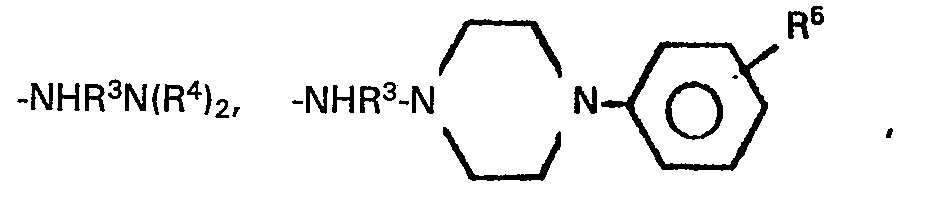
- the amine HZ is selected so that the radical Z together with the carbonyl group of the ester II in the compound la forms the radical R 1 .
- Z therefore has the following meanings:
- the reaction of the compound II with the amine HZ is expediently carried out in a suitable solvent or dispersant.
- solvents or dispersants can be, for example, alcohols, such as methanol, ethanol, i-propanol; furthermore ethers, such as diethyl ether, dioxane, tetrahydrofuran; Ketones such as acetone; Hydrocarbons, such as toluene, xylenes, petroleum ether; halogenated hydrocarbons such as chloroform, chlorobenzene; polar aprotic solvents such as e.g. Acetonitrile, dimethylformamide or aqueous solutions of the HZ amine can be used.
- the reaction can be carried out at temperatures in the range from 0 ° C. to the reflux temperature of the solvent or dispersant, as a rule the reaction takes place at 15-25 ° C.
- the thermal rearrangement is expediently carried out without solvent or dispersant by heating the substance to temperatures of 150 to 220 ° C., preferably 180 to 200 ° C.
- the thermal rearrangement is usually complete after 15 to 120 minutes, in most cases after 30 to 60 minutes.
- the course of the rearrangement can be followed by thin layer chromatography.
- the compounds I according to the invention which have a basic side chain, form salts with inorganic or organic acids.
- Such acids are, for example, hydrogen chloride, hydrogen bromide, phosphoric, sulfuric, oxalic, lactic, wine, vinegar, salicylic, benzoic, citric, ascorbic, adipic and naphthalenedisulfonic acid.
- the acid addition compounds are obtained in a known manner by combining the components in a suitable solvent or dispersant.
- the compounds of the formula and their pharmacologically acceptable acid addition compounds have valuable pharmacological properties. Its effect on the cardiovascular system is particularly pronounced. They lower blood pressure in low doses, reduce peripheral resistance and lead to a reduction in cardiac work by lowering pulmonary artery pressure with little affected heart rate.
- the compounds of formula 1 and their pharmacologically acceptable acid addition salts can therefore be administered to humans as a remedy on their own, in mixtures with one another or in the form of pharmaceutical preparations which allow enteral or parenteral use and which as an active ingredient are an effective dose of at least one compound of the formula I or an acid addition salt thereof, in addition to conventional pharmaceutically acceptable carriers and additives.
- the remedies can be administered orally, e.g. in the form of pills, tablets, coated tablets, coated tablets, hard and soft gelatin capsules, solutions, syrups, emulsions or suspensions or aerosol mixtures.
- the administration can also be rectal, e.g. B. in the form of suppositories, or parenterally, e.g. in the form of solutions for injection, or percutaneously, e.g. in the form of ointments or tinctures.
- Pharmaceutical inert inorganic or organic carriers are used to manufacture the pharmaceutical preparations.
- Pharmaceutical inert inorganic or organic carriers are used to manufacture the pharmaceutical preparations.
- pills, tablets, dragees and hard gelatin capsules e.g. Lactose, corn starch or derivatives thereof, talc, stearic acid or its salts, etc.
- Carriers for soft gelatin capsules and suppositories are e.g. Fats, waxes, semi-solid and liquid polyols, natural or hardened oils, etc.
- Suitable carriers for the production of solutions and syrups are e.g. Water, sucrose, invert sugar, glucose, polyols etc.
- suitable carriers for the production of injection solutions are Water, alcohols, glycerin, polyols, vegetable oils etc.
- the pharmaceutical preparations can also contain additives such as Fillers, extenders, explosives, binders, lubricants, wetting agents, stabilizers, emulsifiers, preservatives, sweeteners, colors, flavors or aromatizers, thickeners, diluents, buffer substances, furthermore solvents or Solubilizers or agents for achieving a depot effect, as well as salts for changing the osmotic pressure, coating agents or antioxidants. They can also contain two or more compounds of formula 1 or their pharmacologically acceptable acid addition salts and still other therapeutically active substances.
- Such other therapeutically active substances are, for example: ⁇ -receptor blockers, e.g. Propranolol, pindolol, metoprolol; Vasodilators, e.g. Carbochromes; Sedatives, e.g. Barbituric acid derivatives, 1,4-benzodiazepines and meprobamate; Diuretics, such as Chlorothiazide; heart tonifying agents such as Digitalis preparations; antihypertensive agents such as Hydralazine, dihydralazine, prazosin, clonidine, Rauwolfia alkaloids; Agents that lower the level of fatty acids in the blood, e.g. Bezafibrate, fenofibrate; Agents for thromboprophylaxis, e.g. Phenprocoumon.
- ⁇ -receptor blockers e.g. Propranolol, pindolol, metoprolol
- the compounds of the formula I, their pharmacologically acceptable acid addition salts and pharmaceutical preparations which contain the compounds of the formula 1 or their pharmacologically acceptable acid addition salts as active compounds can be used in humans in combating or preventing diseases of the cardiovascular system, for example as antihypertensive remedies in the various forms of high blood pressure, in combating or preventing angina pectoris, etc.
- the dosage can vary within wide limits and must be adapted to the individual circumstances in each individual case.
- a daily dose of 0.2 to 150 mg, preferably 1 to 30 mg is appropriate for oral administration per human individual. With other forms of administration, too, the daily dose is, due to the good absorption of the active ingredients, in similar quantity ranges, i.e. generally also at 0.2 to 150 mg / person.
- the daily dose is usually divided into several, e.g. 2 to 4 sub-administrations divided.
- the pharmaceutical preparations contain the active compounds of the formula I or their pharma ecologically acceptable acid addition salts 0.1 to 50 mg, preferably 0.5 to 10 mg / dose.
- Systolic and diastolic blood pressure was measured peripherally in the femoral artery using a Statham pressure transducer.
- a Millar-Tip catheter inserted into the left ventricle via the carotid artery delivered the signal for the LVEDP (left ventricular end-diastolic pressure) and the heart rate.
- the mean blood pressure in the pulmonary artery was recorded with a second tip catheter inserted over the jugular vein. The results obtained are shown in the following table. In the table mean:
- a process for the preparation of furoxane derivatives is known from CH-A-601 276, but these are substituted differently in the 3,4-position than the furoxane derivatives according to the invention.
- a use for the known furoxane derivatives is not specified.
- the present invention is not suggested by this prior art, nor by CH-A-498 856, which relates to a process for the preparation of 3-amino-4-phenyl-furazane derivatives which are mono-, di- or trisubstituted in the phenyl nucleus and are used to calm weak arousal and to relieve muscle stiffness.
- the abbreviation «Zers.» means decomposition.
- the indication “NDS salt” in connection with the melting point for some of the aforementioned compounds means that it is the melting point of the addition compound with the naphthalene-1,5-disulfonic acid.
- the structures of the synthesized compounds can be confirmed by elemental analysis and by IR and NMR spectra.
Landscapes
- Health & Medical Sciences (AREA)
- Chemical & Material Sciences (AREA)
- Life Sciences & Earth Sciences (AREA)
- General Health & Medical Sciences (AREA)
- Veterinary Medicine (AREA)
- Public Health (AREA)
- Animal Behavior & Ethology (AREA)
- Pharmacology & Pharmacy (AREA)
- Medicinal Chemistry (AREA)
- Organic Chemistry (AREA)
- Epidemiology (AREA)
- Bioinformatics & Cheminformatics (AREA)
- Engineering & Computer Science (AREA)
- Nuclear Medicine, Radiotherapy & Molecular Imaging (AREA)
- General Chemical & Material Sciences (AREA)
- Chemical Kinetics & Catalysis (AREA)
- Heart & Thoracic Surgery (AREA)
- Cardiology (AREA)
- Urology & Nephrology (AREA)
- Molecular Biology (AREA)
- Vascular Medicine (AREA)
- Heterocyclic Carbon Compounds Containing A Hetero Ring Having Nitrogen And Oxygen As The Only Ring Hetero Atoms (AREA)
- Pharmaceuticals Containing Other Organic And Inorganic Compounds (AREA)
- Plural Heterocyclic Compounds (AREA)
- Organic Low-Molecular-Weight Compounds And Preparation Thereof (AREA)
- Cephalosporin Compounds (AREA)
- Chemical Treatment Of Metals (AREA)
- Preventing Corrosion Or Incrustation Of Metals (AREA)
Description
- Die Erfindung betrifft 3,4-disubstituierte 1,2,5--Oxadiazol-2-oxide der Formel

- In der Formel I steht einer der Reste R1, R2 für -CH3 und der andere für


- R3 einen Alkylenrest -CnH2n- mit n = 2, 3, oder 4 bedeutet,
- R4, R8 = -CH3, -C2H5,
- R5 = -OCH3, -CI,
- R6 = -H, -CH3,
- R7 = Alkyl mit 1 bis 4 C-Atomen, Cycloalkyl mit 5 bis 7 C-Atomen, Allyl, Pyridyl-methyl, und CH3
- X = -(CH2)2-O-(CH2)2-, -(CH2)2-N-CH2)2-, -CH2CH2CH2CH2- oder -CH2CH2CH2CH2CH2-
- Die für R7 (und die für das nachstehend erwähnte R9) stehenden Alkylreste und die für R3 stehenden Alkylenreste können geradkettig oder verzweigt sein. R3 bedeutet vorzugsweise -CH2CH2- oder -CH2CH2CH2-. Von den Verbindungen der Formel I sind diejenigen bevorzugt, bei denen R2 = -CH3 ist, ferner diejenigen, die im Rest R1 eine -NH-Gruppierung besitzen.
- Die Verbindungen der Formel mit R2 = -CH3 können erfindungsgemäss durch Umsetzung von 3-Methyl-1,2,5-oxadiazol-2-oxid-4-carbonsäureestern der Formel II mit einem Amin HZ



- Die Umsetzung der Verbindung II mit dem Amin HZ wird zweckmässigerweise in einem geeigneten Lösungs- oder Dispergiermittel durchgeführt. Als derartige Lösungs- oder Dispergiermittel können beispielsweise Alkohole, wie Methanol, Ethanol, i-Propanol; ferner Ether, wie Diethylether, Dioxan, Tetrahydrofuran; Ketone wie Aceton; Kohlenwasserstoffe, wie Toluol, Xylole, Petrolether; halogenierte Kohlenwasserstoffe, wie Chloroform, Chlorbenzol; polare aprotische Lösungsmittel, wie z.B. Acetonitril, Dimethylformamid oder wässrige Lösungen des Amins HZ verwendet werden. Die Reaktion kann bei Temperaturen im Bereich von 0°C bis zur Rückflusstemperatur des Lösungs- oder Dispergiermittels durchgeführt werden, in der Regel erfolgt die Reaktion bei 15 - 25°C.
- Die Verbindung der Formel II mit R9 = Ethyl ist in Berichte der deutschen chemischen Gesellschaft 28, 2681 (1895) beschrieben als Ester der Peroxydiisonitrosobuttersäure. Verbindungen der Formel II mit anderen R9-Resten lassen sich bei Wahl geeigneter Ausgangsprodukte analog herstellen.
- Erfindungsgemässe Verbindungen mit Rl = CH3, denen die Formel Ib zukommt

- Die erfindungsgemässen Verbindungen I, die eine basische Seitenkette aufweisen, bilden mit anorganischen oder organischen Säuren Salze. Solche Säuren sind beispielsweise Chlorwasserstoff-, Bromwasserstoff-, Phosphor-, Schwefel-, Oxal-, Milch-, Wein-, Essig-, Salicyl-, Benzoe-, Zitronen-, Ascorbin-, Adipin- und Naphthalindisulfonsäure. Die Säureadditionsverbindungen werden in bekannter Weise durch Vereinigen der Komponenten in einem geeigneten Lösungs- oder Dispergiermittel erhalten.
- Die Verbindungen der Formel und ihre pharmakologisch annehmbaren Säureadditionsverbindungen besitzen wertvolle pharmakologische Eigenschaften. Besonders ausgeprägt ist ihre Wirkung auf das Herz-Kreislauf-System. Sie senken in niedriger Dosierung den Blutdruck, vermindern den peripheren Widerstand und führen über eine Senkung des Pulmonalarteriendrucks bei wenig beeinflusster Herzfrequenz zu einer Verminderung der Herzarbeit.
- Die Verbindungen der Formel 1 und ihre pharmakologisch annehmbaren Säureadditionssalze können daher am Menschen als Heilmittel für sich allein, in Mischungen untereinander oder in Form von pharmazeutischen Zubereitungen verabreicht werden, die eine enterale oder parenterale Anwendung gestatten und die als aktiven Bestandteil eine wirksame Dosis mindestens einer Verbindung der Formel I oder eines Säureadditionssalzes davon, neben üblichen pharmazeutisch zulässigen Träger- und Zusatzstoffen enthalten.
- Die Heilmittel können oral, z.B. in Form von Pillen, Tabletten, Lacktabletten, Dragees, Hart-und Weichgelatinekapseln, Lösungen, Sirupen, Emulsionen oder Suspensionen oder Aerosolmischungen verabreicht werden. Die Verabreichung kann aber auch rektal, z. B. in Form von Suppositorien, oder parenteral, z.B. in Form von Injektionslösungen, oder perkutan, z.B. in Form von Salben oder Tinkturen, erfolgen.
- Zur Herstellung der pharmazeutischen Präparate werden pharmazeutisch inerte anorganische oder organische Trägerstoffe verwendet. Für die Herstellung von Pillen, Tabletten, Dragees und Hartgelatinekapseln verwendet man z.B. Lactose, Maisstärke oder Derivate davon, Talk, Stearinsäure oder deren Salze usw. Trägerstoffe für Weichgelatinekapseln und Suppositorien sind z.B. Fette, Wachse, halbfeste und flüssige Polyole, natürliche oder gehärtete Öle usw. Als Trägerstoffe für die Herstellung von Lösungen und Sirupen eignen sich z.B. Wasser, Saccharose, Invertzucker, Glukose, Polyole usw. Als Trägerstoffe für die Herstellung von Injektionslösungen eignen sich z.B. Wasser, Alkohole, Glyzerin, Polyole, pflanzliche Öle usw.
- Die pharmazeutischen Präprate können neben den Wirk- und Trägerstoffen noch Zusatzstoffe, wie z.B. Füllstoffe, Streck-, Spreng-, Binde-, Gleit-, Netz-, Stabilisierungs-, Emulgier-, Konservierungs-, Süss-, Färbe-, Geschmacks- oder Aromatisierungs-, Dikkungs-, Verdünnungs-Mittel, Puffersubstanzen, ferner Lösungsmittel oder Lösungsvermittler oder Mittel zur Erzielung eines Depoteffekts, sowie Salze zur Veränderung des osmotischen Drucks, Überzugsmittel oder Antioxidantien enthalten. Sie können auch zwei oder mehrere Verbindungen der Formel 1 oder ihrer pharmakologisch annehmbaren Säureadditionssalze und noch andere therapeutisch wirksame Stoffe enthalten.
- Derartige andere therapeutisch wirksame Substanzen sind beispielsweise: β-Rezeptorenblocker, wiez.B. Propranolol, Pindolol, Metoprolol; Vasodilatatoren, wie z.B. Carbochromen; Beruhigungsmittel, wie z.B. Barbitursäurederivate, 1,4-Benzodiazepine und Meprobamat; Diuretica, wie z.B. Chlorothiazid; das Herz tonisierende Mittel, wie z.B. Digitalispräparate; blutdrucksenkende Mittel, wie z.B. Hydraläzin, Dihydralazin, Prazosin, Clonidin, Rauwolfia-Alkaloide; Mittel, die den Fettsäurespiegel im Blut senken, wie z.B. Bezafibrat, Fenofibrat; Mittel für die Thromboseprophylaxe, wie z.B. Phenprocoumon.
- Die Verbindungen der Formel I, ihre pharmakologisch annehmbaren Säureadditionssalze und pharmazeutische Präparate, welche die Verbindungen der Formel 1 oder ihre pharmakologisch annehmbaren Säureadditionssalze als Wirkstoffe enthalten, können am Menschen bei der Bekämpfung bzw. Vorbeugung von Erkrankungen des kardiovaskulären Systems verwendet werden, beispielsweise als antihypertensive Heilmittel bei den verschiedenen Formen des Bluthochdrucks, bei der Bekämpfung bzw. Vorbeugung von Angina pectoris usw. Die Dosierung kann innerhalb weiter Grenzen variieren und ist in jedem einzelnen Fall den individuellen Gegebenheiten anzupassen. Im allgemeinen ist bei oraler Verabreichung pro menschlichem Individuum eine Tagesdosis von 0,2 bis 150 mg, vorzugsweise 1 bis 30 mg, angemessen. Auch bei anderen Applikationsformen liegt die Tagesdosis, wegen der guten Resorption der Wirkstoffe, in ähnlichen Mengenbereichen, d.h. im allgemeinen ebenfalls bei 0,2 bis 150 mg/Mensch. Die Tagesdosis wird normalerweise in mehrere, z.B. 2 bis 4 Teilverabreichungen aufgeteilt.
- Die pharmazeutischen Zubereitungen enthalten von den Wirkstoffen der Formel I oder ihrer pharmakologisch annehmbaren Säureadditionssalze 0,1 bis 50 mg, vorzugsweise 0,5 bis 10 mg/Dosis.
- Die Untersuchungen über die antianginöse und antihypertensive Wirkung der Verbindungen der Formel 1 wurden an Bastardhunden beiderlei Geschlechts in Pentobarbital-Narkose (30 bis 40 mg/kg i.v.) oder in Urethan-Chloralose-Narkose (3 ml /kg Urethan-Chloralose-Gemisch i.v. = 20 mg/kg Chloralose und 250 mg/kg Urethan) durchgeführt. Die Beatmung der Tiere erfolgte mit einem Bird-Mark-7-Respirator. Der endexpiratorische Kohlensäuregehalt (gemessen mit dem Uras) betrug zwischen 4,5 und 5 Vol.-%. Während des gesamten Versuchs erhielten die Tiere mit Pentobarbital-Narkose eine Dauerinfusion von Pentobarbital i.v. = 4 mg/kg/6 ml/h, um eine konstante Narkosetiefe zu gewährleisten; die Tiere mit Urethan-Chloralose-Narkose erhielten keine Dauerinfusion. Die Infusion wurde durch die Vena cephalica gegeben. Nach der Präparation des Versuchstieres wurde ca. 1 Stunde gewartet, bis sich alle haemodynamischen Parameter eingestellt hatten (steady state). Danach wurde mit dem eigentlichen Versuch begonnen.
- Der systolische und diastolische Blutdruck wurde peripher in der Arteria femoralis über einen Statham-Druckaufnehmer gemessen. Ein über die Arteria carotis in den linken Ventrikel geschobener Millar-Tip-Kathether lieferte das Signal für den LVEDP (linksventrikulärer enddiastolischer Druck) und die Herzfrequenz. Mit einem zweiten, über die Vena jugularis eingeschobenen Tip-Katheter wurde der mittlere Blutdruck in der Arteria pulmonalis erfasst. Die erhaltenen Ergebnisse sind in der folgenden Tabelle angegeben.


- Aus der CH-A-601 276 ist ein Verfahren zur Herstellung von Furoxanderivaten bekannt, die jedoch in 3,4-Stellung anders substituiert sind, als die erfindungsgemässen Furoxanderivate. Eine Verwendung für die bekannten Furoxanderivate ist nicht angegeben. Die vorliegende Erfindung wird durch diesen Stand der Technik nicht nahegelegt, ebensowenig durch die CH-A-498 856, die ein Verfahren zur Herstellung von 3-Amino-4-phenyl-furazanderivaten betrifft, die im Phenylkern ein-, zwei- oder dreifach substituiert sind und die zur Beruhigung von schwachen Erregungszuständen und zur Behebung der Muskelsteife verwendet werden.
- Die folgenden Beispiele dienen der weiteren Erläuterung der Erfindung.
- 19,2 g 1,2,5-Oxadiazol-2-oxid-3-methyl-4-car- bonsäureethylester werden in 50 ml Ethanol gelöst. Bei 20°C wird eine Lösung von 6,1 g Ethanolamin in 40 ml Ethanol zugetropft. Die Mischung wird 4 Stunden bei 20°C gerührt, auf 0°C abgekühlt. Der Feststoff wird abgesaugt, mit wenig kaltem Ethanol gewaschen und aus Isopropanol umkristallisiert: Farblose Kristalle vom Fp 107 bis 108°C.
- Analog diesem Verfahren können die folgenden Verbindungen in den angegebenen Lösungsmitteln und bei den angegebenen Reaktionstemperaturen hergestellt werden (NDS = Naphthalin-1,5-disulfonsäure):
- 1,2,5-Oxadiazol-2-oxid-3-methyl-4-carbonsäure- allylamid (Öl) in Methanol bei 15°C.
- 1,2,5-Oxadiazol-2-oxid-3-methyl-4-carbonsäure- methylamid (Fp 89 bis 91 °C) in Wasser bei 0°C.
- 1,2,5-Oxadiazol-2-oxid-3-methyl-4-carbonsäure- ethylamid (Fp 80 bis 82°C) in i-Propanol bei 20°C.
- 1,2,5-Oxadiazol-2-oxid-3-methyl-4-carbonsäure- isopropylamid (Fp 94 bis 95°C) in Toluol bei 50°C.
- 1,2,5-Oxadiazol-2-oxid-3-methyl-4-carbonsäure--(2-diethylaminoethylamid (Fp 216°C, NDS-Salz) in Diethylether bei Rückflusstemperatur.
- 1,2,5-Oxadiazol-2-oxid-3-methyl-4-carbonsäure--(3-diethylaminopropylamid) (Öl) in Diethylether bei Rückflusstemperatur.
- 1,2,5-Oxadiazol-2-oxid-3-methyl-4-carbonsäure--[3-(4-o-methoxiphenylpiperazin-1-yl)-propylamid] (Fp 232°C, NDS-Salz) in Toluol bei 110°C.
- 1,2,5-Oxadiazol-2-oxid-3-methyl-4-carbonsäure--(4-o-methoxiphenylpiperazinid) (Fp 152 bis 153°C) in Chlorbenzol bei 100°C.
- 1,2,5-Oxadiazol-2-oxid-3-methyl-4-carbonsäure--[3-(4-o-chlorphenylpiperazin-1-yl)-propylamid] (Fp 205 bis 206°C Zers. NDS-Salz) in Toluol bei 110°C.
- 1,2,5-Oxadiazol-2-oxid-3-methyl-4-carbonsäure--(3-(4-o-methoxiphenylpiperazin-1-yl)-2-methyl--propylamid] (Fp 114 bis 115°C) in Toluol bei 110°C.
- 1,2,5-Oxadiazol-2-oxid-3-methyl-4-carbonsäure- cyclopentylamid (Fp 104 bis 106°C) in Ethanol bei 40°C.
- 1,2,5-Oxadiazol-2-oxid-3-methyl-4-carbonsäure- cyclohexylamid (Fp 95 bis 96,5°C) in Ethanol bei 60°C.
- 1,2,5-Oxadiazol-2-oxid-3-methyl-4-carbonsäure--(2-methoxiethylamid) (Fp 69 bis 70°C) in Ethanol bei 20°C.
- 1,2-Bis-[1,2,5-oxadiazol-2-oxid-3-methyl-4-carbo- nylamino]-ethan (Fp 195 bis 200°C Zers.) in Ethanol bei 25°C.
- 1,3-Bis-[1,2,5-oxadiazol-2-oxid-3-methyl-4-carbo- nylamino]-propan (Fp 183 bis 186°C) in Ethanol bei 25°C.
- 1,2,5-Oxadiazol-2-oxid-3-methyl-4-carbonsäure- morpholid (Fp 75 bis 78°C) in Acetonitril bei 40°C.
- 1,2,5-Oxadiazol-2-oxid-3-methyl-4-carbonsäure- benzylamid (Fp 91 bis 93°C) in Petrolether bei 20°C.
- 1,2,5-Oxadiazol-2-oxid-3-methyl-4-carbonsäure- pyrrolidid (Fp 65 bis 67°C) in Ethanol bei 15°C.
- 1,2,5-Oxadiazol-2-oxid-3-methyl-4-carbonsäure--(4-methylpiperazid)-hydrochlorid (Fp 278 bis 280°C Zers.) in Methylenchlorid bei 25°C.
- 1,2,5-Oxadiazol-2-oxid-3-methyl-4-carbonsäure--dimethylamid (Fp bis 72°C) in Dimethylformamid/ Wasser bei 30°C.
- 1,2,5-Oxadiazol-2-oxid-3-methyl-4-carbonsäure--(pyrid-3-yl-methylamid) (Fp 127 bis 129°C) in Ethanol bei 25°C.
- 5 g 1,2,5-Oxadiazol-2-oxid-4-methyl-3-carbonsäure-methylamid werden ohne Lösungsmittel 30 Minuten auf 190°C erwärmt. Nach Abkühlen der Schmelze wird das Produktgemisch säulenchromatographisch (Laufmittel: Methylenchlorid, Säulenfüllung: Kieselgel) aufgetrennt. Die schneller laufende Fraktion wird eingeengt und mit Ligroin verrührt. Der weisse Feststoff wird abgesaugt und ist nach Trocknung im Vakuum analysenrein: Fp 57 bis 59°C.
- Analog diesem Verfahren können die folgenden Verbindungen bei den nach den Verbindungen angegebenen Reaktionstemperaturen hergestellt werden:
- 1,2,5-Oxadiazol-2-oxid-4-methyl-3-carbonsäure--ethylamid (Öl) 150°C,
- 1,2,5-Oxadiazol-2-oxid-4-methyl-3-carbonsäure--(2-methoxiethylamid) (Öl) bei 220°C,
- 1,2,5-Oxadiazol-2-oxid-4-methyl-3-carbonsäure--isopropylamid (Fp 65 bis 68°C) bei 200°C,
- 1,2,5-Oxadiazol-2-oxid-4-methyl-3-carbonsäure--(2-diethylaminoethylamid) (Fp 200 bis 202°C NDS-Salz) bei 190°C,
- 1,2,5-Oxadiazol-2-oxid-4-methyl-3-carbonsäure--(4-o-methoxiphenylpiperazinid) (Fp 129 bis 131 °C) bei 200°C,
- 1,2,5-Oxadiazol-2-oxid-4-methyl-3-carbonsäure--cyclopentylamid (Fp 91 bis 94°C) bei 190°C,
- 1,2,5-Oxad iazol-2-oxid-4-methyl-3-carbonsäure- morpholid (Fp 45 bis 46°C) bei 185°C,
- 1,2,5-Oxadiazol-2-oxid-4-methyl-3-carbonsäure--pyrrolidid (Öl) bei 180°C,
- 1,2,5-Oxadiazol-2-oxid-4-methyl-3-carbonsäure--(4-methylpiperazid) (Fp des Hydrochlorids 250 bis 252°C Zers.) bei 195°C.
- Die Abkürzung «Zers.» bedeutet Zersetzung. Die Angabe «NDS-Salz» im Zusammenhang mit dem Schmelzpunkt bei einigen der vorgenannten Verbindungen bedeutet, dass es sich um den Schmelzpunkt der Additionsverbindung mit der Naphthalin-1,5-disulfonsäure handelt.
- Die Strukturen der synthetisierten Verbindungen können durch die Elementaranalyse und durch die IR-und NMR-Spektren bestätigt werden.
bedeuten.
Claims (8)

einer der Reste R1, R2 für -CH3 und der andere für
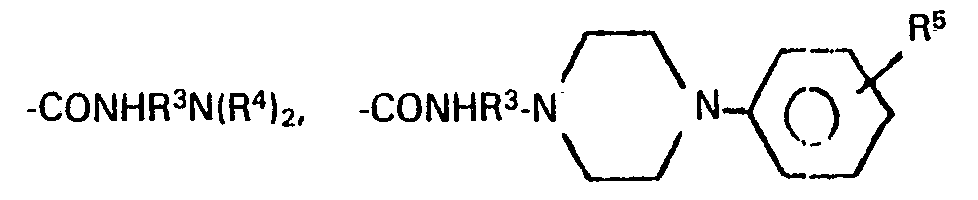

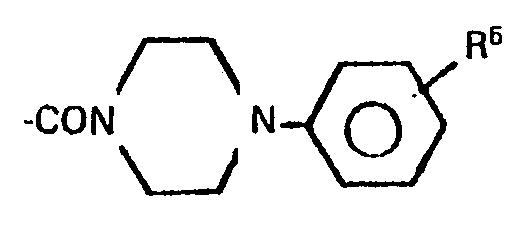


bedeuten, sowie ihre pharmakologisch annehmbaren Säureadditionsverbindungen.


Priority Applications (1)
| Application Number | Priority Date | Filing Date | Title |
|---|---|---|---|
| AT81110400T ATE9692T1 (de) | 1980-12-18 | 1981-12-12 | 3,4-disubstituierte 1,2,5-oxadiazol-2-oxide, verfahren zu ihrer herstellung und sie enthaltende pharmazeutische zubereitungen. |
Applications Claiming Priority (2)
| Application Number | Priority Date | Filing Date | Title |
|---|---|---|---|
| DE19803047749 DE3047749A1 (de) | 1980-12-18 | 1980-12-18 | 3,4-disubstituierte 1,2,5-oxdiazol-2-oxide, verfahren zu ihrer herstellung, ihre verwendung und sie enthaltende pharmazeutische zubereitungen |
| DE3047749 | 1980-12-18 |
Publications (2)
| Publication Number | Publication Date |
|---|---|
| EP0054873A1 EP0054873A1 (de) | 1982-06-30 |
| EP0054873B1 true EP0054873B1 (de) | 1984-10-03 |
Family
ID=6119512
Family Applications (1)
| Application Number | Title | Priority Date | Filing Date |
|---|---|---|---|
| EP81110400A Expired EP0054873B1 (de) | 1980-12-18 | 1981-12-12 | 3,4-Disubstituierte 1,2,5-Oxadiazol-2-oxide, Verfahren zu ihrer Herstellung und sie enthaltende pharmazeutische Zubereitungen |
Country Status (14)
| Country | Link |
|---|---|
| EP (1) | EP0054873B1 (de) |
| JP (1) | JPS57123174A (de) |
| AT (1) | ATE9692T1 (de) |
| AU (1) | AU7855781A (de) |
| CA (1) | CA1173034A (de) |
| DD (1) | DD202019A5 (de) |
| DE (2) | DE3047749A1 (de) |
| DK (1) | DK533781A (de) |
| ES (1) | ES8300102A1 (de) |
| HU (1) | HU183750B (de) |
| NO (1) | NO814097L (de) |
| PL (1) | PL234258A1 (de) |
| SU (1) | SU1152519A3 (de) |
| ZA (1) | ZA818725B (de) |
Families Citing this family (8)
| Publication number | Priority date | Publication date | Assignee | Title |
|---|---|---|---|---|
| US4507485A (en) * | 1984-01-23 | 1985-03-26 | Bristol-Myers Company | 3,4-Disubstituted-1,2,5-oxadiazoles having histamine H2 -receptor antagonist activity |
| DE4217794A1 (de) * | 1992-05-29 | 1993-12-02 | Cassella Ag | Phenylfuroxane |
| DE4218582A1 (de) * | 1992-06-05 | 1993-12-09 | Cassella Ag | Pyridyl-1,2,5-oxadiazol-carbonamid-2-oxide |
| DE4218979A1 (de) * | 1992-06-10 | 1993-12-16 | Cassella Ag | Pyrimidofuroxane |
| DE4220264A1 (de) * | 1992-06-20 | 1993-12-23 | Cassella Ag | Phenyl-1,2,5-oxadiazol-carbonamid-2-oxide |
| DE4223800A1 (de) * | 1992-07-20 | 1994-01-27 | Cassella Farbwerke Mainkur Ag | Verwendung von 1.2.5-Oxadiazol-2-oxiden zur Behandlung erektiler Dysfunktionen |
| DE4401150A1 (de) * | 1994-01-17 | 1995-07-20 | Cassella Ag | Furazancarbonsäurederivate |
| US6957741B2 (en) | 2001-08-07 | 2005-10-25 | Manfred Franz Axel Freissle | Screening arrangement |
Family Cites Families (2)
| Publication number | Priority date | Publication date | Assignee | Title |
|---|---|---|---|---|
| CH498854A (de) * | 1968-02-06 | 1970-11-15 | Geigy Ag J R | Verfahren zur Herstellung von neuen Furazanderivaten |
| GB1474692A (en) * | 1973-05-21 | 1977-05-25 | Ici Ltd | Furoxan production |
-
1980
- 1980-12-18 DE DE19803047749 patent/DE3047749A1/de not_active Withdrawn
-
1981
- 1981-12-01 DK DK533781A patent/DK533781A/da not_active Application Discontinuation
- 1981-12-01 NO NO814097A patent/NO814097L/no unknown
- 1981-12-12 DE DE8181110400T patent/DE3166527D1/de not_active Expired
- 1981-12-12 AT AT81110400T patent/ATE9692T1/de not_active IP Right Cessation
- 1981-12-12 EP EP81110400A patent/EP0054873B1/de not_active Expired
- 1981-12-14 DD DD81235739A patent/DD202019A5/de unknown
- 1981-12-15 PL PL23425881A patent/PL234258A1/xx unknown
- 1981-12-16 AU AU78557/81A patent/AU7855781A/en not_active Abandoned
- 1981-12-16 SU SU813367546A patent/SU1152519A3/ru active
- 1981-12-17 ZA ZA818725A patent/ZA818725B/xx unknown
- 1981-12-17 ES ES508087A patent/ES8300102A1/es not_active Expired
- 1981-12-17 CA CA000392542A patent/CA1173034A/en not_active Expired
- 1981-12-17 JP JP56202599A patent/JPS57123174A/ja active Pending
- 1981-12-18 HU HU813860A patent/HU183750B/hu unknown
Also Published As
| Publication number | Publication date |
|---|---|
| JPS57123174A (en) | 1982-07-31 |
| DD202019A5 (de) | 1983-08-24 |
| DE3047749A1 (de) | 1982-07-22 |
| ATE9692T1 (de) | 1984-10-15 |
| AU7855781A (en) | 1982-06-24 |
| DE3166527D1 (en) | 1984-11-08 |
| DK533781A (da) | 1982-06-19 |
| ES508087A0 (es) | 1982-10-01 |
| NO814097L (no) | 1982-06-21 |
| ES8300102A1 (es) | 1982-10-01 |
| CA1173034A (en) | 1984-08-21 |
| HU183750B (en) | 1984-05-28 |
| PL234258A1 (de) | 1982-08-02 |
| SU1152519A3 (en) | 1985-04-23 |
| ZA818725B (en) | 1982-11-24 |
| EP0054873A1 (de) | 1982-06-30 |
Similar Documents
| Publication | Publication Date | Title |
|---|---|---|
| AT363096B (de) | Verfahren zur herstellung von neuen phthalazinderivaten und deren salzen | |
| DE2430237C2 (de) | Äthanolaminoderivate und sie enthaltende pharmazeutische Zusammensetzungen | |
| DE2558501C2 (de) | ||
| DE3931954A1 (de) | Substituierte n-(2-piperidylmethyl)benzamide und diese enthaltende antiarrhythmische mittel | |
| EP0059356B1 (de) | Substituierte 3-Amino-sydnonimine, Verfahren zu ihrer Herstellung und ihre Verwendung | |
| DE2160148C2 (de) | Arzneimittel und bestimmte Sulfoxide als solche | |
| DE3717080C2 (de) | 1-(Hydroxystyryl)-5H-2,3-benzodiazepinderivate, Verfahren zu ihrer Herstellung und diese enthaltende Arzneimittel | |
| EP0038438A2 (de) | Substituierte 1,2,5-Oxadiazol-2-oxide zur Anwendung als Arzneimittel und sie enthaltende Arzneimittel | |
| EP0054872B1 (de) | 3,4-Bis-substituierte 1,2,5-Oxadiazol-2-oxide, Verfahren zu ihrer Herstellung, und sie enthaltende pharmazeutische Zubereitungen | |
| DE2528147A1 (de) | Aromatische ketone, verfahren zu ihrer herstellung und diese ketone enthaltende arzneimittel | |
| EP0054873A1 (de) | 3,4-Disubstituierte 1,2,5-Oxadiazol-2-oxide, Verfahren zu ihrer Herstellung und sie enthaltende pharmazeutische Zubereitungen | |
| DE2221758A1 (de) | Yohimbinderivate,Verfahren zu ihrer Herstellung und ihre Verwendung | |
| DE69007422T2 (de) | 1-(4-Aminophenyl)-2-piperidinopropanon-Derivate, Verfahren zu deren Herstellung und therapeutische Verwendung. | |
| DE1470074C3 (de) | 1,2,3,4,6,7-Hexahydro-l lbH-benzo eckige Klammer auf a eckige Klammer zu chinolizine sowie deren Acetate und/oder phsiologisch verträgliche Säureadditionssalze sowie Verfahren zu ihrer Herstellung | |
| EP0045911B1 (de) | Neue Aminopropanol-Derivate, Verfahren zu ihrer Herstellung und diese Verbindungen enthaltende Arzneimittel | |
| DE3120913C2 (de) | ||
| DE4220264A1 (de) | Phenyl-1,2,5-oxadiazol-carbonamid-2-oxide | |
| EP0030343A1 (de) | Substituierte 2-Amino-3,4-dihydropyridinderivate, Verfahren zu ihrer Herstellung und ihre Verwendung als Arzneimittel | |
| EP0027928A2 (de) | Piperidinderivate von 4,5-Dialkyl-3-hydroxy-pyrrol-2-carbonsäureestern, ihre Herstellung und diese enthaltende pharmazeutische Zubereitungen | |
| EP0003298B1 (de) | 4-Hydroxy-2-benzimidazolin-thion-Derivate, Verfahren zu deren Herstellung sowie diese Verbindungen enthaltende Arzneimittel | |
| DE2235406B2 (de) | 2-Amino-4H-pyrane, Verfahren zu ihrer Herstellung sowie diese Verbindungen enthaltende Arzneimittel | |
| DE2062055A1 (de) | Propanolamin Derivate | |
| DE3324727C2 (de) | ||
| DE10131217A1 (de) | 3-Phenyl-3,7-diazabicyclo 3,3,1 nonan-Verbindungen sowie Verfahren zu ihrer Herstellung und diese Verbindungen enthaltende Arzneimittel | |
| AT337709B (de) | Verfahren zur herstellung von neuen 1-phthalazonderivaten |
Legal Events
| Date | Code | Title | Description |
|---|---|---|---|
| PUAI | Public reference made under article 153(3) epc to a published international application that has entered the european phase |
Free format text: ORIGINAL CODE: 0009012 |
|
| 17P | Request for examination filed |
Effective date: 19820407 |
|
| AK | Designated contracting states |
Designated state(s): AT BE CH DE FR GB IT NL SE |
|
| ITF | It: translation for a ep patent filed | ||
| GRAA | (expected) grant |
Free format text: ORIGINAL CODE: 0009210 |
|
| AK | Designated contracting states |
Designated state(s): AT BE CH DE FR GB IT LI NL SE |
|
| REF | Corresponds to: |
Ref document number: 9692 Country of ref document: AT Date of ref document: 19841015 Kind code of ref document: T |
|
| PGFP | Annual fee paid to national office [announced via postgrant information from national office to epo] |
Ref country code: CH Payment date: 19841018 Year of fee payment: 4 |
|
| PGFP | Annual fee paid to national office [announced via postgrant information from national office to epo] |
Ref country code: FR Payment date: 19841019 Year of fee payment: 4 |
|
| PGFP | Annual fee paid to national office [announced via postgrant information from national office to epo] |
Ref country code: NL Payment date: 19841022 Year of fee payment: 4 Ref country code: AT Payment date: 19841022 Year of fee payment: 4 |
|
| REF | Corresponds to: |
Ref document number: 3166527 Country of ref document: DE Date of ref document: 19841108 |
|
| PGFP | Annual fee paid to national office [announced via postgrant information from national office to epo] |
Ref country code: SE Payment date: 19841231 Year of fee payment: 4 Ref country code: BE Payment date: 19841231 Year of fee payment: 4 |
|
| ET | Fr: translation filed | ||
| PGFP | Annual fee paid to national office [announced via postgrant information from national office to epo] |
Ref country code: DE Payment date: 19850225 Year of fee payment: 4 |
|
| PLBE | No opposition filed within time limit |
Free format text: ORIGINAL CODE: 0009261 |
|
| STAA | Information on the status of an ep patent application or granted ep patent |
Free format text: STATUS: NO OPPOSITION FILED WITHIN TIME LIMIT |
|
| 26N | No opposition filed | ||
| PG25 | Lapsed in a contracting state [announced via postgrant information from national office to epo] |
Ref country code: AT Effective date: 19851212 |
|
| PG25 | Lapsed in a contracting state [announced via postgrant information from national office to epo] |
Ref country code: SE Effective date: 19851213 |
|
| PG25 | Lapsed in a contracting state [announced via postgrant information from national office to epo] |
Ref country code: LI Effective date: 19851231 Ref country code: CH Effective date: 19851231 Ref country code: BE Effective date: 19851231 |
|
| BERE | Be: lapsed |
Owner name: CASSELLA A.G. Effective date: 19851231 |
|
| PG25 | Lapsed in a contracting state [announced via postgrant information from national office to epo] |
Ref country code: NL Effective date: 19860701 |
|
| GBPC | Gb: european patent ceased through non-payment of renewal fee | ||
| NLV4 | Nl: lapsed or anulled due to non-payment of the annual fee | ||
| PG25 | Lapsed in a contracting state [announced via postgrant information from national office to epo] |
Ref country code: FR Free format text: LAPSE BECAUSE OF NON-PAYMENT OF DUE FEES Effective date: 19860829 |
|
| REG | Reference to a national code |
Ref country code: CH Ref legal event code: PL |
|
| PG25 | Lapsed in a contracting state [announced via postgrant information from national office to epo] |
Ref country code: DE Effective date: 19860902 |
|
| REG | Reference to a national code |
Ref country code: FR Ref legal event code: ST |
|
| PG25 | Lapsed in a contracting state [announced via postgrant information from national office to epo] |
Ref country code: GB Effective date: 19881121 |
|
| EUG | Se: european patent has lapsed |
Ref document number: 81110400.9 Effective date: 19860902 |