EP0054677B1 - Neue Cephalosporine, Verfahren zu ihrer Herstellung und diese Verbindungen enthaltende Arzneimittel - Google Patents
Neue Cephalosporine, Verfahren zu ihrer Herstellung und diese Verbindungen enthaltende Arzneimittel Download PDFInfo
- Publication number
- EP0054677B1 EP0054677B1 EP81108768A EP81108768A EP0054677B1 EP 0054677 B1 EP0054677 B1 EP 0054677B1 EP 81108768 A EP81108768 A EP 81108768A EP 81108768 A EP81108768 A EP 81108768A EP 0054677 B1 EP0054677 B1 EP 0054677B1
- Authority
- EP
- European Patent Office
- Prior art keywords
- general formula
- group
- acid
- compound
- hydroxy
- Prior art date
- Legal status (The legal status is an assumption and is not a legal conclusion. Google has not performed a legal analysis and makes no representation as to the accuracy of the status listed.)
- Expired
Links
- 0 *C(CSC1[C@@]2N)=C(*)N1C2=O Chemical compound *C(CSC1[C@@]2N)=C(*)N1C2=O 0.000 description 5
- HWHNFJYQDMSYAF-UHFFFAOYSA-N Cc1nnn[n]1C Chemical compound Cc1nnn[n]1C HWHNFJYQDMSYAF-UHFFFAOYSA-N 0.000 description 1
Classifications
-
- C—CHEMISTRY; METALLURGY
- C07—ORGANIC CHEMISTRY
- C07D—HETEROCYCLIC COMPOUNDS
- C07D501/00—Heterocyclic compounds containing 5-thia-1-azabicyclo [4.2.0] octane ring systems, i.e. compounds containing a ring system of the formula:, e.g. cephalosporins; Such ring systems being further condensed, e.g. 2,3-condensed with an oxygen-, nitrogen- or sulfur-containing hetero ring
- C07D501/14—Compounds having a nitrogen atom directly attached in position 7
- C07D501/16—Compounds having a nitrogen atom directly attached in position 7 with a double bond between positions 2 and 3
- C07D501/20—7-Acylaminocephalosporanic or substituted 7-acylaminocephalosporanic acids in which the acyl radicals are derived from carboxylic acids
- C07D501/24—7-Acylaminocephalosporanic or substituted 7-acylaminocephalosporanic acids in which the acyl radicals are derived from carboxylic acids with hydrocarbon radicals, substituted by hetero atoms or hetero rings, attached in position 3
- C07D501/36—Methylene radicals, substituted by sulfur atoms
-
- A—HUMAN NECESSITIES
- A61—MEDICAL OR VETERINARY SCIENCE; HYGIENE
- A61P—SPECIFIC THERAPEUTIC ACTIVITY OF CHEMICAL COMPOUNDS OR MEDICINAL PREPARATIONS
- A61P31/00—Antiinfectives, i.e. antibiotics, antiseptics, chemotherapeutics
- A61P31/04—Antibacterial agents
-
- Y—GENERAL TAGGING OF NEW TECHNOLOGICAL DEVELOPMENTS; GENERAL TAGGING OF CROSS-SECTIONAL TECHNOLOGIES SPANNING OVER SEVERAL SECTIONS OF THE IPC; TECHNICAL SUBJECTS COVERED BY FORMER USPC CROSS-REFERENCE ART COLLECTIONS [XRACs] AND DIGESTS
- Y02—TECHNOLOGIES OR APPLICATIONS FOR MITIGATION OR ADAPTATION AGAINST CLIMATE CHANGE
- Y02P—CLIMATE CHANGE MITIGATION TECHNOLOGIES IN THE PRODUCTION OR PROCESSING OF GOODS
- Y02P20/00—Technologies relating to chemical industry
- Y02P20/50—Improvements relating to the production of bulk chemicals
- Y02P20/55—Design of synthesis routes, e.g. reducing the use of auxiliary or protecting groups
Definitions
- the invention relates to new cephalosporins of the general formula I. or their possible tautomers, their physiologically tolerable salts with inorganic or organic bases, processes for the preparation of these compounds and medicaments containing these compounds.
- protective groups which can easily be split in vitro are e.g. B. the benzyl, diphenylmethyl, trityl, t-butyl, the 2,2,2-trichloroethyl or the trimethylsilyl group.
- Examples of easily cleavable protective groups in vivo are e.g. B. alkanoyloxyalkyl groups, such as. B. the acetoxymethyl, propionyloxymethyl, 2-acetoxy-ethyl or pivaloyloxymethyl group or the phthalidyl group.
- E is a hydrogen atom
- the claim also includes pharmacologically acceptable salts with inorganic or organic bases, such as. B.
- the alkali or alkaline earth metal salts for. B. the sodium, potassium, magnesium 's or calcium salts, the ammonium salts or organic amine salts, for. B. those with triethylamine or dicyclohexylamine.
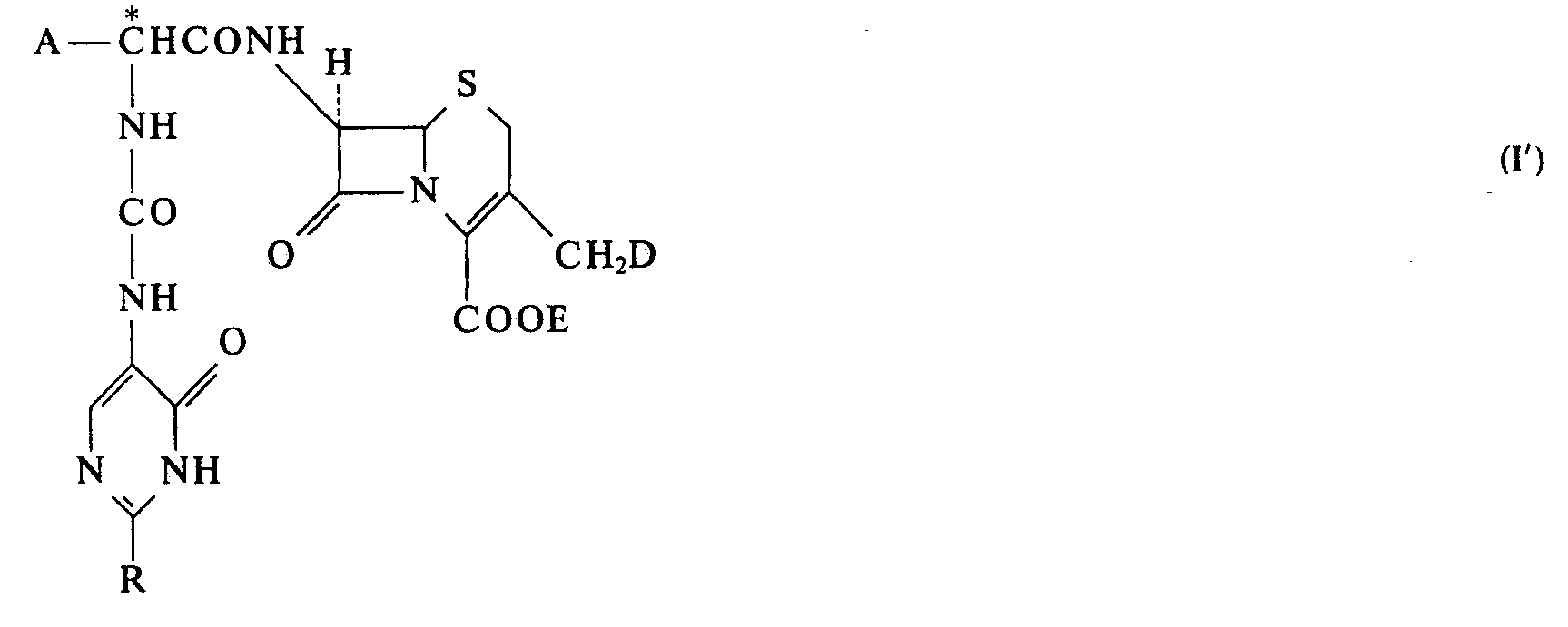
- cephalosporin compounds of the general formula and the intermediates described below can exist in 2 tautomeric forms with respect to the pyrimidine ring. It depends in particular on the particular solvent and on the nature of the substituent R, which of the following forms I or I 'predominates:
- the compounds of the general formula can exist in the two possible R and S configurations with respect to the chiral center C + marked with an asterisk, but also as a mixture of these configurations.
- E represents a radical other than a hydrogen atom
- a compound of the general formula 1 in which E represents a diphenylmethyl group is treated in a known manner with anisole and trifluoroacetic acid to split off the ester protecting group, or a silyl protecting group can also be removed in a known manner by aqueous hydrolysis.
- the compounds of the general formula in which E represents a sodium or potassium cation are prepared by reacting the corresponding free acid of the compounds of the general formula in which E represents a hydrogen atom with the corresponding salt-forming ion.
- the Um customary in the chemistry of penicillins and cephalosporins is suitable setting with sodium ethyl hexanoate, or the reaction with sodium hydrogen carbonate and subsequent freeze-drying.
- the cephalosporin antibiotics of the general formula in which E represents a hydrogen atom can in a known manner in the acyloxyalkyl esters in which E z. B. a pivaloyloxymethyl rest is converted by using an alkali salt of cephalosporin carboxylic acid, for example a sodium or potassium salt, with a pivaloyloxymethyl halide of the formula where Hal represents chlorine, bromine or iodine.
- Other suitable acyloxyalkyl halides are e.g. B. chloromethyl acetate, bromomethyl propionate or 1-bromoethyl acetate.
- the corresponding starting compounds are used, it is possible to prepare the compounds of the general formula in the form of the racemates or in the form of the individual isomers. If the end product is obtained in the D, L form, the pure D and L diastereoisomers can be prepared by preparative liquid chromatography (HPLC). The invention relates to the racemates and the isomers.
- ureidocarboxylic acids of the general formula IV, the pyrimidines of the general formula VI and the cephalosporins of the general formula VII are known from the literature. They are described in German Offenlegungsschrift 29 24 296.
- the active compounds according to the invention can therefore be used for the prophylaxis and chemotherapy of local and systemic infections in human and veterinary medicine.
- Diseases which can be prevented or cured by the compounds according to the invention are, for example, those of the respiratory tract, throat and urinary tract; the compounds are particularly effective against pharyngitis, pneumonia, peritonitis, pyelonephritis, otitis, cystitis, endocarditis, bronchitis, arthritis and general systemic infections.
- these compounds can be used as substances for the preservation of inorganic or organic materials, in particular of organic materials such as polymers, lubricants, paints, fibers, leather, paper and wood and of food.
- the compounds of the general formula 1 act very strongly both in vitro and in vivo against harmful microorganisms, in particular against gram-positive and gram-negative bacteria and bacterial-like microorganisms, and they are particularly notable for a broad spectrum of action.
- the germ suspension was adjusted on a photometer (according to Eppendorf) (test tube diameter 14 mm, filter 546 nm) on the basis of the turbidity of a barium sulfate reference suspension which was produced by a barium sulfate suspension, which was obtained by adding 3.0 ml of 1% barium chloride solution in 97 ml of 1% sulfuric acid. After the adjustment, Streptococcus Aronson in a ratio of 1:15 and the remaining test germs in a ratio of 1: 1500 were further diluted with a saline solution.
- the wells of the microtiter plates were charged with 0.2 ml of nutrient medium, 0.01 ml of the corresponding substance dilution and with a drop of germ suspension (0.01 ml) and incubated at 37 ° C. for 18 to 20 hours. A solvent control was always carried out.
- Cefuroxime was used as the reference substance.
- the acute toxicity was determined by oral and subcutaneous application of the compounds of Table 2 to the rat in increasing doses.
- the LD 50 is the dose after which 50% of the animals die within 8 days. All compounds showed case of oral administration a LD 50 of more than 4 g / kg, subcutaneous administration at a LD 50 of about 2 g / kg, ie they are so non-toxic for the practice.
- E. coli ATCC 11 775 was used as pathogenic bacteria.
- An intraperitoneal infection with 0.2 ml of a bacterial suspension (with 5% mucin) was set. This corresponds to approximately 1.4 x 10 6 E. coli / mouse germs.
- Female NMRI mice were divided into groups of 10 animals each, two groups remained untreated, the remaining groups were treated subcutaneously with different doses of the respective cephalosporins according to the invention to determine the ED 50 (dose in which 50% of the animals survive). Treatment was given one hour after the injection was given.
- the active ingredient in human or veterinary medicine or a mixture of the various active ingredients of the general formula I is administered in a dosage between 5 and 500, preferably 10-200 mg / kg body weight per 24 hours, optionally in the form of several individual doses.
- a single dose contains the active ingredient (s) according to the invention, preferably in amounts of about 1 to about 250, in particular 10 to 60 mg / kg of body weight.
- the new compounds When used as a feed additive, the new compounds can be given in the usual concentrations and preparations together with the feed or with feed preparations or with the drinking water. This can prevent, ameliorate and / or cure an infection by gram-negative or gram-positive bacteria and also promote growth and improve the utilization of the feed.
- the product thus obtained is suspended in a little methylene chloride and stirred with 2 ml of anisole and 10 ml of trifluoroacetic acid for 30 minutes while cooling with ice, during which time solution occurs. Then 50 ml of toluene are added twice and concentrated to dryness in vacuo. One mixes with ether and sucks off.
- cephalosporins sodium salts of the general formula given in the following table
- the preparation was carried out analogously to Example 1, starting from the ureidocarboxylic acid used there and an equimolecular amount of 7-amino-3 - [(1- (2'-t-butoxycarbonylamino-ethyl) -tetrazol-5-yl) -thiomethyl] -ceph- 3-em-4-carboxylic acid diphenylmethyl ester.
- the activated anhydride is prepared from 495 mg (0.001 mol) of the ureidocarboxylic acid used in Example 1 in analogy to Example 7 using N-methylmorpholine and ethyl chloroformate.
- This solution is cooled to -15 ° C. and added dropwise to the upper solution at this temperature.
- the mixture is then stirred at -10 ° C for 1 hour and at + 10 ° C for 1 hour. After this time, 2 ml of methanol are added and insoluble material is filtered off. The solvent is then removed in vacuo. The residue is taken up in 40 ml of water and adjusted to pH 7.0. At this pH, the mixture is shaken twice with ethyl acetate. The aqueous phase is adjusted to pH 2.9 with ice-cooling with dilute hydrochloric acid, the precipitated product is filtered off with suction, washed with a little water and dried in vacuo.
- the single dose in adults is generally between 50 and 1000 mg, preferably 100 to 500 mg, the daily dose between 100 and 4000 mg, preferably 250 to 2000 mg.
- a mixture consisting of 2 kg of active substance, 5 kg of lactose, 1.8 kg of potato starch, 0.1 kg of magnesium stearate and 0.1 kg of talc is pressed into tablets in a conventional manner such that each tablet contains 200 mg of active ingredient.
- tablets are pressed, which are then coated in a conventional manner with a coating consisting of sugar, potato starch, talc and tragacanth.
- each capsule contains 500 mg of the active substance.
- Physiological saline solution for injection was filled in ampoules in an amount of 2.0 ml each, and the ampoules were sealed. In this way, ampoules (No. B) were obtained.
- the physiological saline in the ampoules (No. B) was poured into the jars (No. A), whereby an injectable preparation for intravenous administration was obtained.
- Distilled water for injection was poured into the vials (No. A) in an amount of 20 ml, and the solution was dissolved in a 5% solution of glucose for injections (250 ml). In this way, continuous infusion solutions were made.
- tablets, dragees, capsules and ampoules are available which contain one or more of the other active compounds of the formula or the physiologically acceptable salts of these compounds.
Landscapes
- Chemical & Material Sciences (AREA)
- Organic Chemistry (AREA)
- Health & Medical Sciences (AREA)
- Chemical Kinetics & Catalysis (AREA)
- Life Sciences & Earth Sciences (AREA)
- General Chemical & Material Sciences (AREA)
- Medicinal Chemistry (AREA)
- Nuclear Medicine, Radiotherapy & Molecular Imaging (AREA)
- Communicable Diseases (AREA)
- Pharmacology & Pharmacy (AREA)
- Oncology (AREA)
- Animal Behavior & Ethology (AREA)
- General Health & Medical Sciences (AREA)
- Public Health (AREA)
- Veterinary Medicine (AREA)
- Cephalosporin Compounds (AREA)
- Pharmaceuticals Containing Other Organic And Inorganic Compounds (AREA)
Description
- Die Erfindung betrifft neue Cephalosporine der allgemeinen Formel I

- In der allgemeinen Formel bedeuten:
- A die Phenyl-, 4-Hydroxyphenyl-, 3,4-Dihydroxyphenyl-, oder die 2- oder 3-Thienylgruppe,
- D die Gruppe SHet, wobei Het die 4H-5,6-Dioxo-1,2,4-triazin-3-yl- oder 4-Methyl-5,6-dioxo-1,2,4-triazin-3-ylgruppe, die 1-Vinyl-tetrazol-5-yl- oder 1-Allyltetrazol-5-ylgruppe oder eine Gruppe der allgemeinen Formel II,

in der n die Zahlen 1 bis 3 bedeutet und R1 für die Hydroxygruppe, die Amino-, Dimethylamino-, Acetylamino-, Aminocarbonyl-, Aminocarbonylamino-, Aminosulfonyl-, Aminosulfonylamino-, Methylcarbonyl-, Methylsulfonylamino-, Cyano-, Hydroxysulfonylamino-, Methylsulfonyl-, Methylsulfinyl-, sowie für eine Carbonsäure oder Sulfonsäuregruppe steht, oder in der (CH2)nR, eine Alkylgruppe mit 2 bis 4 Kohlenstoffatomen oder einen 2,3-Dihydroxypropylrest bedeutet, - R eine Gruppe der allgemeinen Formel NHR2, in der R2 eine substituierte oder unsubstituierte 3-Pyridyl-, 5-Pyrimidinyl-, 2-Thienyl-, 2-Furylmethyl-, 2-Thienylmethyl-, 2-lmidazolylmethyl-, 2-Thiazolylmethyl-, 3-Pyridylmethyl- oder eine 5-Pyrimidinylmethylgruppe bedeutet, wobei diese Gruppen durch ein Chloratom, eine Methyl-, Aacetylamino-, Hydroxy-, Methylsulfinyl-, Methylsulfonyl-, Aminocarbonyl- oder Aminosulfonylgruppe substituiert sein können,
- E ein Wasserstoffatom oder eine in vitro oder in vivo leicht spaltbare Carboxylschutzgruppe. Als Carboxylschutzgruppen kommen im Sinne der Erfindung solche in Frage, welche auch bisher schon auf dem Gebiet der Penicilline und Cephalosporine eingesetzt wurden, insbesondere esterbildende Gruppen, die durch Hydrogenolyse oder Hydrolyse oder andere Behandlungen unter milden Bedingungen entfernt werden können oder esterbildende Gruppen, welche leicht im lebenden Organismus abgespalten werden können.
- Beispiele für in vitro leicht spaltbare Schutzgruppen sind z. B. die Benzyl-, Diphenylmethyl-, Trityl-, t-Butyl-, die 2,2,2-Trichloräthyl- oder die Trimethylsilylgruppe. Beispiele für in vivo leicht spaltbare Schutzgruppen sind z. B. Alkanoyloxyalkylgruppen, wie z. B. die Acetoxymethyl-, Propionyloxymethyl-, 2-Acetoxy-äthyl- oder Pivaloyloxymethylgruppe oder die Phthalidylgruppe. Bedeutet E ein Wasserstoffatom, so fallen unter den Anspruch auch pharmakologisch verträgliche Salze mit anorganischen oder organischen Basen, wie z. B. die Alkali- oder Erdalkalisalze, z. B. die Natrium-, Kalium-, Magne- 'sium- oder Calciumsalze, die Ammoniumsalze oder organische Aminsalze, z. B. solche mit Triäthylamin oder Dicyclohexylamin.
- Das Sternchen an dem Kohlenstoffatom in den Verbindungen der allgemeinen Formel 1 bedeutet ein
- Die Cephalosporinverbindungen der allgemeinen Formel und die nachstrehend beschriebenen Zwischenprodukte können in 2 tautomeren Formen bezüglich des Pyrimidinrings vorliegen. Es hängt besonders vom jeweiligen Lösungsmittel und von der Art des Substituenten R ab, welche der nachstehenden Formen I oder I' überwiegt:


- Es versteht sich von selbst, daß die eingangs angegebenen Verbindungen der allgemeinen Formel immer beide Tautomeren umfassen.
- Die Verbindungen der allgemeinen Formel können bezüglich des mit einem Sternchen gekennzeichneten Chiralitätszentrums C+ in den beiden möglichen R- und S-Konfigurationen, jedoch auch als ein Gemisch dieser Konfigurationen vorliegen.
- Die Verbindungen der allgemeinen Formel können wie folgt hergestellt werden:
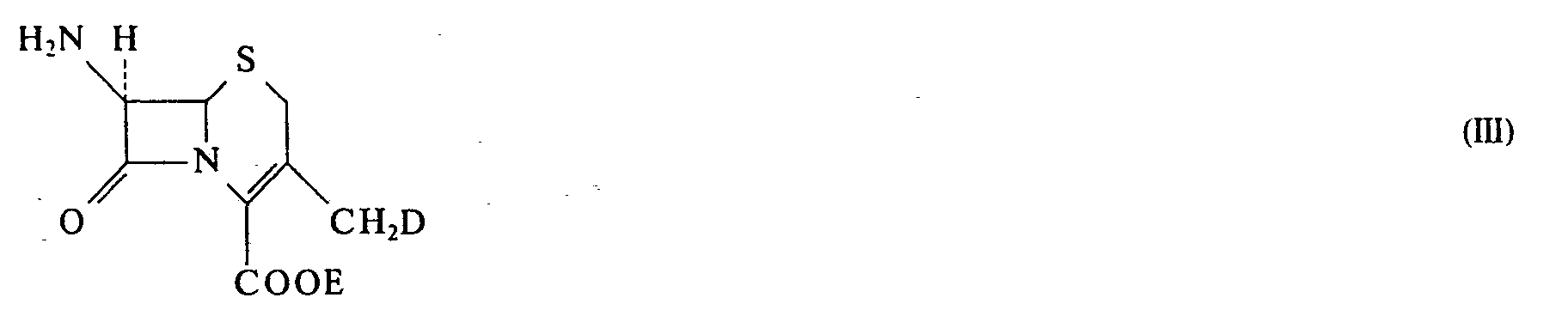
- 1. Durch Umsetzung eines 7-Aminocephalosporansäurederivates der allgemeinen Formel III,


- Die Ureidocarbonsäure, ihre Salze oder ihre reaktiven Derivate werden mit den 7-Aminocephalosporansäurederivaten in einem Lösungsmittel bei Temperaturen zwischen -40°C und +40°C gegebenenfalls in Gegenwart einer Base, umgesetzt. Wird z. B. ein Anhydrid der Ureidocarbonsäure, beispielsweise das Anhydrid mit dem Äthylchloroformiat, eingesetzt, so wird die Reaktion unter Kühlung, beispielsweise bei -10°C bis + 1 20°C in einem Lösungsmittel wie Aceton, Tetrahydrofuran, Dimethylformamid, Chloroform, Dichlormethan, Hexametapol oder in einem Gemisch dieser Lösungsmsittel, durchgeführt. Setzt man beispielsweise einen N-Hydroxysuccinimidester der Ureidocarbonsäure mit Derivaten der allgemeinen Formel 111 um, so wird die Reaktion vorzugsweise bei 0 bis 20°C in Anwesenheit einer Base, wie z. B. Triäthylamin, in einem Lösungsmittel wie Dimethylformamid, Dichlormethan, Dioxan oder in einem Gemisch solcher Lösungsmittel durchgeführt.
- Die Umsetzung einer Ureidocarbonsäure der allgemeinen Formel IV selbst oder ihrer Salze mit Verbindungen der allgemeinen Formel III erfolgt vorteilhafterweise in Gegenwart eines Kondensationsmittels, z. B. in Gegenwart von N,N'-Dicyclohexylcarbodiimid.
- 2. Durch Umsetzung von Cephalosporansäurederivaten der allgemeinen Formel V oder ihrer Salze


- Es können auch Gemisch von solchen Pyrimidinderivaten der allgemeinen Formel VI verwendet werden, in der B teils die eine und teils die andere der vorstehend genannten Bedeutungen besitzt, z. B. die Gruppen

- Die Reaktion wird bevorzugt in beliebigen Mischungen von Wasser mit solchen organischen Lösungsmitteln, die mit Wasser mischbar sind, wie Ketonen, z. B. Aceton, cyclische Äther, z. B. Tetrahydrofuran oder Dioxan, Nitrilen, z. B. Acetonitril, Formamiden, z. B. Dimethylformamid, Dimethylsilfoxid oder Alkoholen, z. B. Isopropanol oder in Hexametapol durchgeführt. Besonders bevorzugt ist ein Gemisch aus Tetrahydrofuran und Wasser. Dabei hält man den pH der Reaktionsmischung durch Zusatz von Basen oder Verwendung von Pufferlösungen in einem pH-Bereich von etwa 2,0 bis 9,0, vorzugsweise zwischen pH 6,5 und 8,0.
- Es können auch Gemisch von solchen Pyrimidinderivaten der allgemeinen Formel VI verwendet werden, in der B teils die eine und teils die andere der vorstehend genannten Bedeutungen besitzt, z. B. die Gruppen
- 3. Zur Herstellung von Verbindungen der allgemeinen Formel I bzw. I', in der D für-SHet steht, durch Umsetzung einer Verbindung der allgemeinen Formel VII,


- Die nach den vorstehenden Verfahren hergestellten Verbindungen der allgemeinen Formel 1, in der E einen anderen Rest als ein Wasserstoffatom bedeutet, können in an sich bekannter Weise zur Abspaltung der Schutzgruppe behandelt werden. Es werden dadurch die Verbindungen erhalten, in denen E Wasserstoff bedeutet und die im Sinne der Erfindung als ganz besonders bevorzugte Endverbindungen gelten. Beispielsweise wird eine Verbindung der allgemeinen Formel 1, in der E für eine Diphenylmethylgruppe steht, in bekannter Weise mit Anisol und Trifluoressigsäure zur Abspaltung der Esterschutzgruppe behandelt oder es kann in ebenfalls bekannter Weise eine Silylschutzgruppe durch wäßrige Hydrolyse entfernt werden.
- Die Verbindungen der allgemeinen Formel in der E ein Natrium- oder Kaliumkation darstellt, werden durch Umsetzung der entsprechenden freien Säure der Verbindungen der allgemeinen Formel in der E ein Wasserstoffatom darstellt, mit dem entsprechenden salzbildenden Ion hergestellt.
- Hierzu eignet sich zum Beispiel die in der Chemie der Penicilline und Cephalosporine übliche Umsetzung mit Natriumäthylhexanoat, oder die Umsetzung mit Natriumhydrogencarbonat und anschließende Gefriertrocknung. Die Cephalosporinantibiotika der allgemeinen Formel in der E ein Wasserstoffatom bedeutet, können auf bekannte Weise in die Acyloxyalkylester, worin E z. B. eine Pivaloyloxymethyl rest


- Bei Verwendung der entsprechenden Ausgangsverbindungen ist es möglich, die Verbindungen der allgemeinen Formel in Form der Racemate oder in Form der einzelnen Isomeren herzustellen. Wenn das Endprodukt in der D,L-Form anfällt, gelingt es, die reinen D- und L-Diastereoisomeren durch präparative Flüssigkeitschromatographie (HPLC) herzustellen. Die Erfindung betrifft die Racemate und die lsomeren.
- Die Ureidocarbonsäuren der allgemeinen Formel IV, die Pyrimidine der allgemeinen Formel VI, sowie die Cephalosporine der allgemeinen Formel VII sind literaturbekannt. Sie werden in der deutschen Offenlegungsschrift 29 24 296 beschrieben.
- Es wurde gefunden, daß die Verbindungen der allgemeinen Formel 1 wertvolle pharmakologische Eigenschaften bei guter Verträglichkeit besitzen.
- Die erfindungsgemäßen Wirkstoffe können daher zur Prophylaxe und Chemotherapie von lokalen und systemischen Infektionen in der Human- und Tiermedizin verwendet werden. Als Krankheiten, die durch die erfindungsgemäßen Verbindungen verhindert bzw. geheilt werden können, seien beispielsweise solche der Atmungswege, des Rachenraumes und der Harnwege genannt; die Verbindungen wirken insbesondere gegen Pharyngitis, Pneumonie, Peritonitis, Pyelonephritis, Otitis, Cystitis, Endocarditis, Bronchitis, Arthritis und allgemeine systemische Infektionen. Weiter können diese Verbindungen als Stoffe zur Konservierung von anorganischen oder organischen Materialien verwendet werden, besonders von organischen Materialien, wie Polymeren, Schmiermittel, Farben, Fasern, Leder, Papier und Holz sowie von Lebensmitteln.
- Dieses wird dadurch ermöglicht, daß die Verbindungen der allgemeinen Formel 1 sowohl in vitro als auch in vivo gegen schädliche Mikroorganismen, insbesondere gegen grampositive und gramnegative Bakterien und bakterienähnliche Mikroorganismen sehr stark wirken, wobei sie sich besonders durch ein breites Wirkungsspektrum auszeichnen.
- Mit diesen Cephalosporinderivaten können beispielsweise lokale und/oder systemische Erkrankungen behandelt und/oder verhindert werden, die durch die folgenden Erreger oder durch Mischungen der folgenden Erreger verursacht werden:
- Micrococcaceae, wie Staphylokokken;
- Lactobacteriaceae, wie Streptokokken;
- Neisseriaceae, wie Neisserien;
- Corynebacteriaceae, wie Corynebakterien;
- Enterobacteriaceae, wie Escherichia-Bakterien der Coli-Gruppe;
- Klebsiella-Bakterien, z. B. K. pneumoniae;
- Proteae-Bakterien der Proteus-Gruppe, z. B. Proteus vulgaris;
- Salmonella-Bakterien, z. B. S. thyphimurium;
- Shigella-Bakterien, z. B. Shigella dysenteriae;
- Pseudomonas-Bakterien, z. B. Pseudomonas aeruginosa;
- Aeromonas-Bakterien, z. B. Aeromonas lique faciens;
- Spirillaceae, wie Vibrio-Bakterien, z. B. Vibrio cholerae;
- Parvobacteriaceae oder Brucellaceae, wie Pasteurella-Bakterien;
- Brucella-Bakterien, z. B. Brucella abortus;
- Haemophilus-Bakterien, z. B. Haemophilus influenzae;
- Bordetella-Bakterien, z. B. Bordetella pertussis;
- Moraxella-Bakterien, z. B. Moraxella lacunata;
- Bacteroidaceae, wie Bacteroides-Bakterien;
- Fusiforme-Bakterien, z. B. Fusobacterium fusiforme;
- Spaerophorus-Bakterien, z. B. Spaerophorus necrophorus;
- Bacillaceae, wie aerobe Sporenbildner, z. B. Bacillus anthracis;
- anaerobe Sporenbildner-Chlostridien, z. B. Chlostridium perfringens;
- Spirochaetaceae, wie Borrelia-Bakterien;
- Treponema-Bakterien, z. B. Treponema pallidum;
- Leptospira-Bakterien, wie Leptospira interrogans.
- Die obige Aufzählung von Erregern ist lediglich beispielhaft und keineswegs beschränkend aufzufassen.
- Im folgenden werden einige typische, besonders gut wirksame Verbindungen gemäß der vorliegenden Erfindung aufgezählt:
- Natrium-7ß-{D-α[3-(4-hydroxy-2-(3'-pyridylmethylamino)-5-pyrimidinyl)-ureido]-p-hydroxy- phenylacetamido)-3-[(1-(2'-hydroxyäthyl)-tetrazol-5-yl)-thiomethyl]-ceph-3-em-4-carboxylat Natrium-7ß-(D-α-[3-(2-(5'-aminosulfonyl-2'-thienylmethylamino)-4-hydroxy-5-pyrimidinyl)-ureido]-p-hydroxyphenylacetamido}-3-[(1-(2'-hydroxyäthyl)-tetrazol-5-yl)-thiomethyl]-ceph-3-em-4-carboxylat
- Natrium-7ß-ID-a-[3-(2-(5'-aminosulfonyl-2'-thienylmethylamino)-4-hydroxy-5-pyrimidinyl)-ureido]-p-hydroxyphenylacetamido}-3-[(-vinyl-tetrazol-5-yl)-thiomethyl]-ceph-3-em-4-carboxylat
- Natrium-7,ß-{D,L-α-[3-(2-(5'-aminosulfonyl-2'-thienyl-methyl-amino)-4-hydroxy-5-pyrimidinyl)-ureido]-2-thienylacetylamido)-3-[(2'-hydroxyäthyl)-tetrazol-5-yl)-thiomethyl]-ceph-3-em-4-carboxylat
- Natrium-7ß-{D-α-[3-(4-hydroxy-2-(4'-methyl-2'-imidazolyl-methylamino)-5-pyrimidinyl)-ureido]-p-hydroxyphenyl-acetamido}-3-([1-(2'-hydroxyäthyl)-tetrazol-5-yl)-thiomethyl]-ceph-3-em-4-carboxylat
- Natrium-7ß-{(D-α-[3-(2-(5'-aminosulfonyl-2'-thienylmethyl-amino)-4-hydroxy-5-pyrimidinyl)-ureido]-p-hydroxyphenyl-acetamido}-3-{(1-(2'-aminocarbonyläthyl)-tetrazol-5-yl)-thio-methyl]-ceph-3-em-4-carboxylat
- Natrium-7ß{-D-α-[3-(2-(2'-furyfmethylamino)-4-hydroxy-5-pyrimidinyl)-ureido]-p-hydroxy- phenylacetamido)-3-[( 1-(2'-methyl-sulfonyläthyl)-tetrazol-5-yl)-thiomethyl]-ceph-3-em-4-carboxylat 1
- Die Wirksamkeit der erfindungsgemäßen β-Lactam-Antibiotika läßt sich durch folgende Untersuchungen beispielhaft demonstrieren:
- Für die Untersuchungen wurde die Methode des Reihenverdünnungstests im Mikrotitersystem angewandt. Die Prüfung der Substanzen auf Bakteriostase erfolgte in flüssigem Medium. Es wurden die Bakteriostasewirkung bei folgenden Konzentrationen untersucht:
- 128, 64, 32, 16, 8, 4, 2, 1, 0,5, 0,25, 0,12, 0,06 µg/ml. Es wurde ein Nährboden folgender Zusammensetzung benutzt: 10 g Pepton, 8 g Fleischextrakt-Oxoid, 3 g Natriumchlorid, 2 g sek. Natriumphosphat werden mit dest. Wasser auf 100 ml aufgefüllt (pH 7,2-7,4). Das Alter der Primärkulturen betrug etwa 20 Stunden.
- Die Einstellung der Keimsuspension erfolgte am Photometer (nach Eppendorf) (Reagenzglas-Durchmesser 14 mm, Filter 546 nm) anhand der Trübung einer Bariumsulfat-Vergleichssuspension, die durch eine Bariumsulfat-Aufschwemmung erzeugt wurde, welche durch die Zugabe von 3,0 ml 1 %ige Barium-chloridlösung in 97 ml 1 %iger Schwefelsäure entstand. Nach der Einstellung wurden Streptococcus Aronson im Verhältnis 1 : 15 und die übrigen Testkeime im Verhältnis 1 : 1500 mit einer Kochsalzlösung weiter verdünnt.
- 16 mg der jeweiligen Substanz wurden in 10 ml-Meßkolben eingewogen und mit dem Lösungsmittel bis zur Marke aufgefüllt. Die weitere Verdünnungsreihe wurde mit destilliertem Wasser oder dem jeweiligen Lösungsmittel hergestellt.
- Die Vertiefungen der Mikrotiterplatten wurden mit 0,2 ml Nährmedium, 0,01 ml der entsprechenden Substanzverdünnung und mit einem Tropfen Keimsuspension (0,01 ml) beschickt und 18 bis 20 Stunden bei 37°C bebrütet. Eine Lösungsmittelkontrolle wurde stets mitgeführt.
- Die Ablesung wurde makroskopisch vorgenommen, wobei die jeweilige Grenzkonzentration (= niedrigste noch bakteriostatisch wirksame Konzentration) ermittelt wurde.
- Als Testorganismen wurden benützt:
- Staphyllococcus aureus SG 511, Escherichia coli ATCC 11 775, Pseudomonas aeruginosa Hamburgensis und Pseudomonas aeruginosa BC 19, Serratia marcescens ATCC 13 880, Klebsiella pneumoniae ATCC 10 031 und BC 6, Proteus mirabilis BC 17, Proteus rettgeri, Enterobacter cloacae ATCC 13 047, E. coli R + TEM (ß-Lactamase-Träger).
- In der folgenden Tabelle 1 sind die ermittelten minimalen Hemmkonzentrationen (MIC) für typische Vertreter der erfindungsgemäßen Verbindungen aufgeführt:
- Natrium-7ß-{D-α[3-(4-hydroxy-2-(3'-pyridylmethylamino)- = Verbindung A 5-pyrimidinyl)-ureido]-p-hydroxyphenyfacetamido}-3-[(1-(2'-hydroxyäthyl)-tetrazol-5-yl)-thiomethyl]-ceph-3-em-4-carboxylat
- Natrium-7ß-{D-α-[3-(2-(5'-aminosulfonyl-2'-thienylmethylamino)- = Verbindung B 4-hydroxy-5-pyrimidinyl)-ureido]-p-hydroxyphenylacetamido)-3-[( 1-(2'-hydroxyäthyl)-tetrazol-5-yl)-thiomethyl]-ceph-3-em-4-carboxylat
- Natrium-7ß-{D-α-[3-(2-(5'-aminosulfonyl-2'-thienylmethyl-amino)- = Verbindung C 4-hydroxy-5-pyrimidinyl)-ureido]-p-hydroxyphenyl-acetamido}-3-[(1-(Z'-aminocarbonyläthyl)-tetrazol-5-yl)-thiomethyl]-ceph-3-em-4-carboxylat
- Natrium-7ß-{D-α-[3-(2-(2'-furylmethylamino)-4-hydroxy- = Verbindung D 5-pyrimidinyl)-ureido]-p-hydroxyphenylacetamido}-3-[(1-(2'-methyl- sulfonyläthyl)-tetrazol-5-yl)-thiomethyl]-ceph-3-em-4-carboxylat
- Als Vergleichssubstanz diente Cefuroxim.

- Die akute Toxizität wurde durch perorale und subcutane Applikation der Verbindungen der Tabelle 2 an der Ratte in steigenden Dosen bestimmt.
- Die LD50 ist die Dosis, nach deren Applikation 50% der Tiere innerhalb von 8 Tagen sterben. Sämtliche Substanzen zeigten bei oraler Gabe eine LD50 von über 4 g/kg, bei subcutaner Gabe eine LD50 von über 2 g/kg, d. h. sie sind damit für die Praxis untoxisch.
- Eine Reihe von erfindungsgemäßen Verbindungen wurde in vivo bei experimentellen Infektionen an Mäusen untersucht. Man verwendete als pathogene Bakterien E. coli ATCC 11 775. Es wurde eine intraperitoneale Infektion mit 0,2 ml einer Bakteriensuspension (mit 5% Mucin) gesetzt. Dies entspricht etwa 1,4 x 10⁶ Keime E. coli/Maus. Weibliche Mäuse vom Stamm NMRI wurden in Gruppen von jeweils 10 Tieren aufgeteilt, zwei Gruppen blieben unbehandelt, die restlichen Gruppen wurden mit verschiedenen Dosen der jeweiligen erfindungsgemäßen Cephalosporine subcutan zur Bestimmung der ED50 (Dosis bei der 50% der Tiere überleben) behandelt. Es wurde einmal eine Stunde nach Setzen der Injektion therapiert.
- Der Beobachtungszeitraum betrug in beiden Fällen 7 Tage. Die Ergebnisse dieser Teste mit den Vertretern der Tabelle 1 sind in der Tabelle 2 dargestellt.

- Es ist eine weitere Aufgabe der vorliegenden Erfindung, pharmazeutische Mittel zu schaffen, die bei der Behandlung infektiöser Krankheiten sowohl beim Menschen als auch beim Tier wertvoll sind.
- Als bevorzugte pharmazeutische Zubereitungen seien Tabletten, Dragees, Kapseln, Granulate, Suppositorien, Lösungen, Suspensionen, Emulsionen, Salben, Gele, Cremes, Puder und Sprays genannt. Vorteilhafterweise wird der Wirkstoff in der Human- oder Tiermedizin oder ein Gemisch der verschiedenen Wirkstoffe der allgemeinen Formel I in einer Dosierung zwischen 5 und 500 vorzugsweise 10-200 mg/kg Körpergewicht je 24 Stunden verabreicht, gegebenenfalls in Form mehrerer Einzelgaben. Eine Einzelgabe enthält den oder die erfindungsgemäßen Wirkstoffe, vorzugsweise in Mengen von etwa 1 bis etwa 250, insbesondere 10 bis 60 mg/kg Körpergewicht. Es kann jedoch erforderlich sein, von den genannten Dosierungen abzuweichen, und zwar in Abhängigkeitvon derArt und dem Körpergewicht des zu behandelnden Objektes, der Art und der Schwere der Erkrankung, der Art der Zubereitung und der Applikation des Arzneimittels sowie dem Zeitpunkt bzw. Intervall, innerhalb welchem die Verabreichung erfolgt. So kann es in einigen Fällen ausreichend sein, mit weniger als der oben genannten Menge Wirkstoff auszukommen, während in anderen Fällen die oben angeführte Wirkstoffmenge überschritten werden muß. Die Festlegung der jeweils erforderlichen optimalen Dosierung und Applikationsart der Wirkstoffe kann durch jeden Fachmann aufgrund seines Fachwissens leicht erfolgen.
- Im Falle der Anwendung als Futterzusatzmittel können die neuen Verbindungen in den üblichen Konzentrationen und Zubereitungen zusammen mit dem Futter bzw. mit Futterzubereitungen oder mit dem Trinkwasser gegeben werden. Dadurch kann eine Infektion durch gramnegative odergrampositive Bakterien verhindert, gebessert und/oder geheilt werden und ebenso eine Förderung des Wachstums und eine Verbesserung der Verwertung des Futters erreicht werden.
- Die nachfolgenden Beispiele sollen die Erfindung näher beschreiben:
- 2,72 g (0,005 Mol) D-a-[3-(2-(5'-Aminosulfonyl-2'-thienyl-methylamino-4-hydroxy-5-pyrimidinyl)-ureido]-p-hydroxy-phenylessigsäure werden in 30 ml trockenem Dimethylformamid gelöst. Man fügt eine Lösung von 2,62 g (0,005 Mol) 7-Amino-3-[(1-(2'-hydroxyäthyl)-tetrazol-5-yl)-thiomethyl]-ceph-3-em-4-carbonsäure-diphenylmethylester in 30 ml trockenem Methylenchlorid hinzu. Zu dieser Lösung werden unter Eiskühlung 1,13 g Dicyclohexylcarbodiimid gegeben und es wird 2 Stunden bei 10°C, und 6 Stunden bei Raumtemperatur gerührt. Ein Dünnschichtchromatogramm zeigt, daß die Ausgangsprodukte nahezu vollständig verschwunden sind. Man filtriert und engt dann das Filtrat im Vakuum zur Trockne ein, rührt zweimal mit jeweils 50 ml Methanol und einmal mit 100 ml Methylenchlorid gut aus. Das zurückbleibende Festprodukt wird abgesaugt und mit Äther gut gewaschen. Zur Entfernung geringfügiger Verunreinigungen, die im Dünnschichtchromatogramm (Methylenchlorid : Methanol 4 : 1) am Startfleck sitzen bleiben, wird über eine Kieselgelsäule chromatographiert. Ausbeute an Ester: 3,46 g (65,5%).
- Das so erhaltene Produkt wird in wenig Methylenchlorid suspendiert und unter Eiskühlung 30 Minuten mit 2 ml Anisol und 10 ml Trifluoressigsäure gerührt, wobei Lösung eintritt. Anschließend werden zweimal 50 ml Toluol hinzugefügt und im Vakuum jeweils zur Trockne eingeengt. Man versetzt mit Äther und saugt ab.
- Zur Herstellung des Natriumsalzes löst man in wenig Dimethylformamid, gibt die berechnete Menge Natrium-äthylhexanoat in Methanol zu und versetzt mit Äther. Das ausgefällte Produkt wird abgesaugt, sorgfältig mit Äther gewaschen, und im Vakuum getrocknet.
- Ausbeute an Natriumsalz (bezogen auf das eingesetzte Cephalosporinderivat): 2,71 g (61 %).
- IR-Spektrum: 1760, 1655, 1615, 1550 cm-1;
- NMR-Spektrum (DMSO + CD30D) Signale bei ppm:
- 3,55 (m, 2 H), 3,75 (m, 2 H), 4,2-4,6 (m, 2 + 2 + 2 H), 4,90 d, 1 H), 5,45 (s, 1 H), 5,65 (d, 1 H), 6,75 (d, 2 H), 7,0 (d, 1 H), 7,25 (d, 2 H), 7,40 (d, 1 H), 8,15 (s, 1 H).
- Nach der in Beispiel 1 angegebenen Methode wurden die Cephalosporine (Natriumsalze der allgemeinen Formel die in der folgenden Tabelle angegeben sind, synthetisiert:

- Die Herstellung erfolgte analog Beispiel 1, ausgehend von der dort eingesetzten Ureidocarbonsäure sowie einer äquimolekularen Menge 7-Amino-3-[(1-(2'-t-butoxycarbonylamino-äthyl)-tetrazol-5-yl)-thiomethyl]-ceph-3-em-4-carbonsäure-diphenylmethylester.
- Ausbeute nach Abspaltung der Schutzgruppen und Herstellung des Natriumsalzes: 43,5%;
- IR-Spektrum: 1760, 1675, 1600 cm-1;
- NMR-Spektrum (DMSO + CD30D) Signale bei ppm:
- 3,15 (m, 2 H), 3,55 (m, 2 H), 4,35 (m, 6 H), 4,95 (d, 1 H), 5,55 (s, 1 H), 5,70 (d, 1 H), 6,75 (d, 2 H), 7,05 (d, 1 H), 7,25 (d, 2 H), 7,4 (d, 1 H), 8,15 (s, 1 H).
- Zu einer Lösung von 830 mg (0,002 Mol) der D-a-[3-(4-Hydroxy-2-(4'-methyl-2'-imidazolylmethyl- amino)-5-pyrimidinyl)-ureido]-p-hydroxyphenylessigsäure, in 20 ml trockenem Dimethylformamid gibt man 0,2 g N-Methylmorpholin. Die Lösung wird auf-15°C abgekühlt und es wird bei dieser Temperatur eine Lösung von 0,22 g Chlorameisensäureäthylester in 5 ml Methylenchlorid zugetropft. Die erhaltene Mischung wird 45 Minuten bei dieser Temperatur gehalten.
- Anschließend tropft man bei -15°C eine Lösung von 1,12 g (0,002 Mol) 7-Amino-3-[(1-(2'-acetyl- aminoäthyl-tetrazol-5-yl)-thiomethyl]-ceph-3-em-4-carbonsäure-diphenylmethylester in 20 ml trockenem Methylenchlorid zu. Man rührt 1 Stunde bei-10°C und läßt dann langsam auf Raumtemperatur kommen. Die Lösung wird im Vakuum zur Trockne eingeengt und, wie in Beispiel 1 beschrieben, weiter behandelt. Die Abspaltung der Esterschutzgruppe erfolgt ebenfalls analog Beispiel 1.
- Ausbeute an Natriumsalz: 900 mg (54%);
- IR-Spektrum: 1760, 1650, 1610, 1550 cm-1;
- NMR-Spektrum (DMSO + CD30D) Signale bei ppm:
- 1,85 (s, 3 H), 2,1 (s, 3 H), 3,6 (m, 2 + 2 H), 4,2-4,5 (m, 2 + 2 + 2 H), 5,05 (d, 1 H), 5,45 (s, 1 H), 5,65 (d, 1 H), 6,75 (m, 2 + 1 H), 7,25 (d, 2 H), 8,10 (s, 1 H).
- Aus 495 mg (0,001 Mol) der Ureidocarbonsäure, die in Beispiel 1 eingesetzt wurde, wird analog Beispiel 7 mit N-Methylmorpholin und Chlorameisensäureäthylester das aktivierte Anhydrid hergestellt. Andererseits gibt man zu einer Suspension von 410 mg (0;001 Mol) 7-Amino-3-[(1-hydroxysulfonyl- methyltetrazol-5-yl)-thiomethyl]-ceph-3-em-4-carbonsäure in 20 ml wasserfreiem Acetonitril 600 mg N,O-Bistrimethylsilylacetamid, wobei eine Lösung erhalten wird. Diese Lösung wird auf -15°C abgekühlt und zu der oberen Lösung bei dieser Temperatur zugetropft. Danach wird die Mischung bei -10°C 1 Stunde und bei +10°C ebenfalls 1 Stunde lang gerührt. Nach dieser Zeit fügt man 2 ml Methanol zu und filtriert von unlöslichen Material ab. Danach wird das Lösungsmittel im Vakuum entfernt. Der Rückstand wird in 40 ml Wasser aufgenommen und auf pH 7,0 gestellt. Bei diesem pH-Wert wird zweimal mit Essigester ausgeschüttelt. Die wäßrige Phase wird unter Eiskühlung mit verdünnter Salzsäure auf pH 2,9 gestellt, das ausgefallene Produkt wird abgesaugt, mit wenig Wasser gewaschen und im Vakuum getrocknet.
- Ausbeute: 445 mg (57 %);
- IR-Spektrum: 1760, 1660, 1600 cm-1;
- NMR-Spektrum (DMSO + CD30D) Signale bei ppm:
- 3,60 (m, 2 H), 4,25-4,45 (m, 4 H), 5,0 (m, 3 H), 5,55 (s, 1 H), 5,70 (d, 1 H), 6,75 (d, 2 H), 7,0 (d, 1 H), 7,25 (d, 2 H), 7,45 (d, 1 H), 8,15 (s, 1 H).


- 3,60 (m, 2 H), 4,25-4,45 (m, 4 H), 5,0 (m, 3 H), 5,55 (s, 1 H), 5,70 (d, 1 H), 6,75 (d, 2 H), 7,0 (d, 1 H), 7,25 (d, 2 H), 7,45 (d, 1 H), 8,15 (s, 1 H).
- Ausgehend von 2,72 g D-a-[3-(2-(5'-aminosulfonyl-2'-thienylmethylamino)-4-hydroxy-5-pyrimidinyl)-ureido]-p-hydroxyphenylessigsäure (0,0Ö5 Mol) und 1,36 g 7-Aminocephalosporansäure werden analog der Herstellvorschrift des Beispiels 8 2,08 g (57 %) 7-{D-α-[3-(5'-Aminosulfonyl-2'-thienylme- thylamino)-4-hydroxy-5-pyrimidinyl)-ureido]-p-hydroxy-phenylacetamido}-3-acetoxymethyl-ceph-3-em-4-carbonsäure erhalten.
- 500 mg dieses Cephalosporins werden in 20 ml einer Phosphorsäurepufferlösung von pH 6,3 zusammen mit 200 mg 1-(2'-Dimethylaminoäthyl)-5-mercapto-tetrazol 6 Stunden unter Stickstoff auf 70°C erwärmt, wobei der pH-Wert zwischen 6 und 6,5 gehalten wird. Nach dieser Zeit wird die Reaktionsflüssigkeit abgekühlt, von etwas Unlöslichem abfiltriert und zweimal mit Essigsäureäthylester ausgeschüttelt. Anschließend wird unter Kühlen Salzsäure bis zu einem pH-Wert von 2,8 zugesetzt. Das ausgefallene Produkt wird abgesaugt, mit wenig Wasser gewaschen und getrocknet. Der Rückstand wird auf die übliche Weise in das Natriumsalz überführt.
- Ausbeute: 64%;
- IR-Spektrum: 1760, 1660, 1600 cm-1;
- NMR-Spektrum (DMSO + CD30D) Signale bei ppm:
- 2,35 (s, 6 H), 2,80 (m, 2 H), 3,60 (m, 2 H), 4,30 (m, 6 H), 4,95 (d, 1 H), 5,45 (s, 1 H), 5,65 (d, 1 H), 6,75 (d, 2 H), 7,05 (d, 1 H), 7,30 (d, 2 H), 7,45 (d, 1 H), 8,15 (s, 1 H).
- Die Synthese erfolgte analog Beispiel 15, ausgehend von dem Cephalosporinderivat, das dort eingesetzt wurde sowie 4-Methyl-2-mercapto-5,6-dioxo-1,3,4-triazin.
- Ausbeute: 66,5 % (der Theorie);
- IR-Spektrum: 1760, 1670, 1600 cm-1;
- NMR-Spektrum (DMSO + CD30D) Signale bei ppm:
- 3,55 (m, 2 H + s, 3 H), 4,35 (m, 4 H), 4,90 (d, 1 H), 5,50 (s, 1 H), 5,65 (d, 1 H), 6,75 (d, 2 H), 7,05 (d, 1 H), 7,25 (d, 2 H), 7,40 (d, 1 H), 8,15 (s, 1 H).
- Analog zu Beispiel 15 wurden die Verbindungen der allgemeinen Formel I der folgenden Tabelle hergestellt:

- Die Verbindungen der allgemeinen Formel und I' lassen sich in die üblichen pharmazeutischen Anwendungsformen, wie Tabletten, Dragees, Kapseln oder Ampullen einarbeiten. Die Einzeldosis beträgt bei Erwachsenen im allgemeinen zwischen 50 und 1000 mg, vorzugsweise 100 bis 500 mg, die Tagesdosis zwischen 100 und 4000 mg, vorzugsweise 250 bis 2000 mg.
- Ein Gemisch bestehend aus 2 kg Wirksubstanz, 5 kg Lactose, 1,8 kg Kartoffelstärke, 0,1 kg Magnesiumstearat und 0,1 kg Talk wird in üblicher Weise zu Tabletten gepreßt, derart, daß jede Tablette 200 mg Wirkstoff enthält.
- Analog Beispiel werden Tabletten gepreßt, die anschließend in üblicher Weise mit einem Überzug, bestehend aus Zucker, Kartoffelstärke, Talk und Tragant überzogen werden.
- 5 kg Wirksubstanz werden in üblicher Weise in Hartgelatinekapseln gefüllt, derart, daß jede Kapsel 500 mg des Wirkstoffes enthält.
- In einem aseptischen Bereich wurde 251 g Wirkstoff in 200 ml destilliertem Wasser zur Injektion aufgelöst. Die Lösung wurde durch ein Millipore-Filter (Porengröße 0,22µm, Produkt der Millipore Corporation, Bedford, USA) filtriert. Die Lösung wurde jeweils in einer Menge von 2,0 ml in 1000 Gläschen (Kapazität 10 ml) eingegossen und es wurde lyophilisiert. Die Gläschen wurden sodann mit einem Kautschukstöpsel und einer Aluminiumkappe verschlossen. Somit wurden Gläschen (Nr. A) jeweils mit 250 mg Wirkstoff erhalten.
- Eine physiologische Kochsalzlösung zur Injektion wurde in einer Menge von jeweils 2,0 ml in Ampullen abgefüllt und die Ampullen wurden verschlossen. Auf diese Weise wurden Ampullen (Nr. B) erhalten. Die physiologische Kochsalzlösung in den Ampullen (Nr. B) wurde in die Gläschen (Nr. A) gegossen, wodurch eine injizierbare Zubereitung für die intravenöse Verabreichung erhalten wurde. Destilliertes Wasser zur Injektion wurde in einer Menge von 20 ml in die Gläschen (Nr. A) gegossen und die Lösung wurde in einer 5 %igen Lösung von Glucose für Injektionen (250 ml) aufgelöst. Auf diese Weise wurden Lösungen für die kontinuierliche Infusion hergestellt.
- Analog sind Tabletten, Dragees, Kapseln und Ampullen erhältlich, die einen oder mehrere der übrigen Wirkstoffe der Formel oder die physiologisch unbedenklichen Salze dieser Verbindungen enthalten.
Claims (8)


in der n die Zahlen 1 bis 3 bedeutet und R1 für die Hydroxygruppe, die Amino-, Dimethylamino-, Acetylamino-, Aminocarbonyl-, Aminocarbonylamino-, Aminosulfonyl-, Aminosulfonylamino-, Methylcarbonyl-, Methylsulfonylamino-, Cyano-, Hydroxysulfonylamino-, Methylsulfonyl-, Methylsulfinyl-, sowie für eine Carbonsäure oder Sulfonsäuregruppe steht, oder in der (CH2)nR1 eine Alkylgruppe mit 2 bis 4 Kohlenstoffatomen oder einen 2,3-Dihydroxypropylrest bedeuten,


umgesetzt wird, oder daß eine Verbindung der allgemeinen Formel V, in der das Wasserstoffatom der Carboxylgruppe durch eine Silylgruppe oder eine andere leicht abspaltbare Schutzgruppe ersetzt ist, mit einer Verbindung der allgemeinen Formel VI in einem wasser- und hydroxylgruppenfreien bzw. aprotischen Lösungsmittel, gegebenenfalls in Gegenwart einer Base, umgesetzt wird.
Priority Applications (1)
| Application Number | Priority Date | Filing Date | Title |
|---|---|---|---|
| AT81108768T ATE13536T1 (de) | 1980-12-13 | 1981-10-23 | Neue cephalosporine, verfahren zu ihrer herstellung und diese verbindungen enthaltende arzneimittel. |
Applications Claiming Priority (2)
| Application Number | Priority Date | Filing Date | Title |
|---|---|---|---|
| DE3047082 | 1980-12-13 | ||
| DE19803047082 DE3047082A1 (de) | 1980-12-13 | 1980-12-13 | Neue cephalosporine, verfahren zu ihrer herstellung und diese verbindungen enthaltende arzneimittel |
Publications (3)
| Publication Number | Publication Date |
|---|---|
| EP0054677A2 EP0054677A2 (de) | 1982-06-30 |
| EP0054677A3 EP0054677A3 (en) | 1983-07-06 |
| EP0054677B1 true EP0054677B1 (de) | 1985-05-29 |
Family
ID=6119125
Family Applications (1)
| Application Number | Title | Priority Date | Filing Date |
|---|---|---|---|
| EP81108768A Expired EP0054677B1 (de) | 1980-12-13 | 1981-10-23 | Neue Cephalosporine, Verfahren zu ihrer Herstellung und diese Verbindungen enthaltende Arzneimittel |
Country Status (23)
| Country | Link |
|---|---|
| US (1) | US4401667A (de) |
| EP (1) | EP0054677B1 (de) |
| JP (1) | JPS57123192A (de) |
| AR (1) | AR229804A1 (de) |
| AT (1) | ATE13536T1 (de) |
| AU (1) | AU7814881A (de) |
| CA (1) | CA1170652A (de) |
| CS (1) | CS224637B2 (de) |
| DD (1) | DD201905A5 (de) |
| DE (2) | DE3047082A1 (de) |
| DK (1) | DK542081A (de) |
| ES (3) | ES507829A0 (de) |
| FI (1) | FI813992L (de) |
| GB (1) | GB2089346B (de) |
| GR (1) | GR76948B (de) |
| HU (1) | HU186448B (de) |
| IL (1) | IL64427A (de) |
| NO (1) | NO814240L (de) |
| NZ (1) | NZ199129A (de) |
| PL (1) | PL129917B1 (de) |
| PT (1) | PT74117B (de) |
| SU (1) | SU1075977A3 (de) |
| ZA (1) | ZA818317B (de) |
Families Citing this family (2)
| Publication number | Priority date | Publication date | Assignee | Title |
|---|---|---|---|---|
| JPS59104389A (ja) * | 1982-12-06 | 1984-06-16 | Shionogi & Co Ltd | オキサセファム誘導体 |
| FR2816309B1 (fr) * | 2000-11-09 | 2002-12-27 | Bioprojet Soc Civ | Procede de synthese de derives n-(mercaptoacyl)-amino-acides a partir d'acides acryliques alpha-substitues |
Family Cites Families (6)
| Publication number | Priority date | Publication date | Assignee | Title |
|---|---|---|---|---|
| JPS5344585A (en) * | 1976-10-02 | 1978-04-21 | Meiji Seika Kaisha Ltd | Cephalosporin derivatives and their preparation |
| US4311699A (en) * | 1979-03-12 | 1982-01-19 | Haskell Theodore H | Aminoacid derivatives of cephalosporin compounds |
| DE2924948A1 (de) * | 1979-06-21 | 1981-01-22 | Thomae Gmbh Dr K | Neue cephalosporine, verfahren zu ihrer herstellung und diese verbindungen enthaltende arzneimittel |
| DE2928344A1 (de) * | 1979-07-13 | 1981-02-05 | Thomae Gmbh Dr K | Neue lactame, verfahren zu ihrer herstellung und diese verbindungen enthaltende arzneimittel |
| DE3007685A1 (de) * | 1980-02-29 | 1981-10-01 | Dr. Karl Thomae Gmbh, 7950 Biberach | Neue cephylosporine, verfahren zu ihrer herstellung und diese verbindungen enthaltende arzneimittel |
| EP0053276A3 (de) * | 1980-12-02 | 1983-08-03 | Dr. Karl Thomae GmbH | Neue Cephalosporine, Verfahren zu ihrer Herstellung und diese Verbindungen enthaltende Arzneimittel |
-
1980
- 1980-12-13 DE DE19803047082 patent/DE3047082A1/de not_active Withdrawn
-
1981
- 1981-10-23 DE DE8181108768T patent/DE3170755D1/de not_active Expired
- 1981-10-23 AT AT81108768T patent/ATE13536T1/de not_active IP Right Cessation
- 1981-10-23 EP EP81108768A patent/EP0054677B1/de not_active Expired
- 1981-11-20 US US06/323,432 patent/US4401667A/en not_active Expired - Fee Related
- 1981-12-01 NZ NZ199129A patent/NZ199129A/en unknown
- 1981-12-01 CA CA000391309A patent/CA1170652A/en not_active Expired
- 1981-12-01 ZA ZA818317A patent/ZA818317B/xx unknown
- 1981-12-01 GB GB8136205A patent/GB2089346B/en not_active Expired
- 1981-12-01 IL IL64427A patent/IL64427A/xx unknown
- 1981-12-01 AU AU78148/81A patent/AU7814881A/en not_active Abandoned
- 1981-12-07 SU SU813361699A patent/SU1075977A3/ru active
- 1981-12-08 DK DK542081A patent/DK542081A/da not_active Application Discontinuation
- 1981-12-09 DD DD81235589A patent/DD201905A5/de unknown
- 1981-12-10 GR GR66767A patent/GR76948B/el unknown
- 1981-12-10 ES ES507829A patent/ES507829A0/es active Granted
- 1981-12-10 CS CS819179A patent/CS224637B2/cs unknown
- 1981-12-11 NO NO814240A patent/NO814240L/no unknown
- 1981-12-11 FI FI813992A patent/FI813992L/fi not_active Application Discontinuation
- 1981-12-11 JP JP56199949A patent/JPS57123192A/ja active Pending
- 1981-12-11 AR AR287775A patent/AR229804A1/es active
- 1981-12-11 HU HU813746A patent/HU186448B/hu unknown
- 1981-12-11 PT PT74117A patent/PT74117B/de unknown
- 1981-12-11 PL PL1981234192A patent/PL129917B1/pl unknown
-
1982
- 1982-06-11 ES ES513020A patent/ES8304996A1/es not_active Expired
- 1982-06-11 ES ES513019A patent/ES8304995A1/es not_active Expired
Also Published As
| Publication number | Publication date |
|---|---|
| GB2089346A (en) | 1982-06-23 |
| ES513019A0 (es) | 1983-03-16 |
| AR229804A1 (es) | 1983-11-30 |
| ES8304995A1 (es) | 1983-03-16 |
| AU7814881A (en) | 1982-06-24 |
| PL234192A1 (en) | 1983-03-14 |
| GB2089346B (en) | 1984-08-15 |
| PT74117B (de) | 1983-12-19 |
| DE3170755D1 (en) | 1985-07-04 |
| EP0054677A3 (en) | 1983-07-06 |
| HU186448B (en) | 1985-07-29 |
| IL64427A (en) | 1984-10-31 |
| DD201905A5 (de) | 1983-08-17 |
| DE3047082A1 (de) | 1982-07-29 |
| JPS57123192A (en) | 1982-07-31 |
| CS224637B2 (en) | 1984-01-16 |
| GR76948B (de) | 1984-09-04 |
| PL129917B1 (en) | 1984-06-30 |
| ES513020A0 (es) | 1983-03-16 |
| FI813992A7 (fi) | 1982-06-14 |
| SU1075977A3 (ru) | 1984-02-23 |
| CA1170652A (en) | 1984-07-10 |
| EP0054677A2 (de) | 1982-06-30 |
| ES8304996A1 (es) | 1983-03-16 |
| IL64427A0 (en) | 1982-03-31 |
| NO814240L (no) | 1982-06-14 |
| ES8302006A1 (es) | 1983-01-01 |
| PT74117A (de) | 1982-01-01 |
| US4401667A (en) | 1983-08-30 |
| FI813992L (fi) | 1982-06-14 |
| ATE13536T1 (de) | 1985-06-15 |
| DK542081A (da) | 1982-06-14 |
| NZ199129A (en) | 1985-02-28 |
| ES507829A0 (es) | 1983-01-01 |
| ZA818317B (en) | 1983-08-31 |
Similar Documents
| Publication | Publication Date | Title |
|---|---|---|
| CH633558A5 (de) | Verfahren zur herstellung neuer cephalosporinderivate. | |
| DE2439880A1 (de) | Antibiotika und verfahren zu ihrer herstellung | |
| EP0022494B1 (de) | Neue Lactame, Verfahren zu ihrer Herstellung und diese Verbindungen enthaltende Arzneimittel | |
| DE3789720T2 (de) | Cephalosporinverbindungen. | |
| DE2225694A1 (de) | Cephalosporinverbindungen und Ver fahren zu deren Herstellung | |
| EP0000392B1 (de) | Cephalosporin und Penicillin-derivate, Verfahren zu deren Herstellung, und deren pharmazeutische Präparate | |
| CH648561A5 (de) | ||
| EP0021176B1 (de) | Cephalosporine, Verfahren zu ihrer Herstellung und diese Verbindungen enthaltende Arzneimittel | |
| EP0035161B1 (de) | Cephalosporine, Verfahren zu ihrer Herstellung und diese Verbindungen enthaltende Arzneimittel | |
| EP0054677B1 (de) | Neue Cephalosporine, Verfahren zu ihrer Herstellung und diese Verbindungen enthaltende Arzneimittel | |
| EP0075169A1 (de) | Beta-Lactam Antibiotica, Verfahren zu ihrer Herstellung sowie ihre Verwendung als Arzneimittel | |
| EP0049814B1 (de) | Neue Cephalosporine, Verfahren zu ihrer Herstellung und diese Verbindungen enthaltende Arzneimittel | |
| EP0053276A2 (de) | Neue Cephalosporine, Verfahren zu ihrer Herstellung und diese Verbindungen enthaltende Arzneimittel | |
| EP0073454B1 (de) | Neue 6alpha-Methoxy-penicilline, ihre Salze, Verfahren zu ihrer Herstellung und diese Verbindungen enthaltende Arzneimittel | |
| DE2818985C2 (de) | Halogenarylmalonamidooxacephalosporine und deren Verwendung bei der Bekämpfung bakterieller Infektionen | |
| DE3224866A1 (de) | Ss-lactamantibiotika, verfahren zu deren herstellung sowie sie enthaltende mittel | |
| DE3027530A1 (de) | Neue lactame, verfahren zu ihrer herstellung und diese verbindungen enthaltende arzneimittel | |
| DE2546503A1 (de) | Verfahren zur herstellung von 3-methyl-4-(5-tetrazolyl)-delta hoch 3 cephem-verbindungen | |
| DE2112058A1 (de) | Chemische Verbindungen und Verfahren zu ihrer Herstellung | |
| DE2645144A1 (de) | Cephalosporinverbindungen, verfahren zu deren herstellung und diese enthaltende pharmazeutische mittel | |
| EP0044992A1 (de) | Neue Lactame, Verfahren zu ihrer Herstellung und diese Verbindungen enthaltende Arzneimittel | |
| DE2727586A1 (de) | Methoxy-beta-lactam-antibiotica, verfahren zu ihrer herstellung sowie ihre verwendung | |
| AT345459B (de) | Verfahren zur herstellung neuer acylierter 6-amino-2,2-dimethyl-3- (5-tetrazolyl)penamderivate | |
| DE3045331A1 (de) | Neue cephalosporine, verfahren zu ihrer herstellung und diese verbindungen enthaltende arzneimittel | |
| EP0053693A1 (de) | Neue Penicilline, ihre Salze, Verfahren zu ihrer Herstellung und diese Verbindungen enthaltende Arzneimittel |
Legal Events
| Date | Code | Title | Description |
|---|---|---|---|
| PUAI | Public reference made under article 153(3) epc to a published international application that has entered the european phase |
Free format text: ORIGINAL CODE: 0009012 |
|
| 17P | Request for examination filed |
Effective date: 19811023 |
|
| AK | Designated contracting states |
Designated state(s): AT BE CH DE FR IT LU NL SE |
|
| PUAL | Search report despatched |
Free format text: ORIGINAL CODE: 0009013 |
|
| AK | Designated contracting states |
Designated state(s): AT BE CH DE FR IT LI LU NL SE |
|
| ITF | It: translation for a ep patent filed | ||
| GRAA | (expected) grant |
Free format text: ORIGINAL CODE: 0009210 |
|
| AK | Designated contracting states |
Designated state(s): AT BE CH DE FR IT LI LU NL SE |
|
| PG25 | Lapsed in a contracting state [announced via postgrant information from national office to epo] |
Ref country code: NL Effective date: 19850529 Ref country code: FR Free format text: THE PATENT HAS BEEN ANNULLED BY A DECISION OF A NATIONAL AUTHORITY Effective date: 19850529 Ref country code: BE Effective date: 19850529 |
|
| REF | Corresponds to: |
Ref document number: 13536 Country of ref document: AT Date of ref document: 19850615 Kind code of ref document: T |
|
| PG25 | Lapsed in a contracting state [announced via postgrant information from national office to epo] |
Ref country code: SE Effective date: 19850530 |
|
| PG25 | Lapsed in a contracting state [announced via postgrant information from national office to epo] |
Ref country code: DE Effective date: 19850701 |
|
| REF | Corresponds to: |
Ref document number: 3170755 Country of ref document: DE Date of ref document: 19850704 |
|
| PG25 | Lapsed in a contracting state [announced via postgrant information from national office to epo] |
Ref country code: AT Effective date: 19851023 |
|
| PG25 | Lapsed in a contracting state [announced via postgrant information from national office to epo] |
Ref country code: LU Free format text: LAPSE BECAUSE OF NON-PAYMENT OF DUE FEES Effective date: 19851031 Ref country code: LI Effective date: 19851031 Ref country code: CH Effective date: 19851031 |
|
| NLV1 | Nl: lapsed or annulled due to failure to fulfill the requirements of art. 29p and 29m of the patents act | ||
| EN | Fr: translation not filed | ||
| PLBE | No opposition filed within time limit |
Free format text: ORIGINAL CODE: 0009261 |
|
| STAA | Information on the status of an ep patent application or granted ep patent |
Free format text: STATUS: NO OPPOSITION FILED WITHIN TIME LIMIT |
|
| 26N | No opposition filed | ||
| REG | Reference to a national code |
Ref country code: CH Ref legal event code: PL |