EP0033935A1 - Feste Elektrode in einer Brennstoffzelle, einer Hochleistungsbatterie, einer elektrochromen Zeichendarstellungseinheit oder einem elektrochemischen Speicherelement - Google Patents
Feste Elektrode in einer Brennstoffzelle, einer Hochleistungsbatterie, einer elektrochromen Zeichendarstellungseinheit oder einem elektrochemischen Speicherelement Download PDFInfo
- Publication number
- EP0033935A1 EP0033935A1 EP81100739A EP81100739A EP0033935A1 EP 0033935 A1 EP0033935 A1 EP 0033935A1 EP 81100739 A EP81100739 A EP 81100739A EP 81100739 A EP81100739 A EP 81100739A EP 0033935 A1 EP0033935 A1 EP 0033935A1
- Authority
- EP
- European Patent Office
- Prior art keywords
- electrode according
- mobile ions
- ions
- state
- electrode
- Prior art date
- Legal status (The legal status is an assumption and is not a legal conclusion. Google has not performed a legal analysis and makes no representation as to the accuracy of the status listed.)
- Granted
Links
Images
Classifications
-
- H—ELECTRICITY
- H01—ELECTRIC ELEMENTS
- H01M—PROCESSES OR MEANS, e.g. BATTERIES, FOR THE DIRECT CONVERSION OF CHEMICAL ENERGY INTO ELECTRICAL ENERGY
- H01M4/00—Electrodes
- H01M4/86—Inert electrodes with catalytic activity, e.g. for fuel cells
-
- G—PHYSICS
- G02—OPTICS
- G02F—OPTICAL DEVICES OR ARRANGEMENTS FOR THE CONTROL OF LIGHT BY MODIFICATION OF THE OPTICAL PROPERTIES OF THE MEDIA OF THE ELEMENTS INVOLVED THEREIN; NON-LINEAR OPTICS; FREQUENCY-CHANGING OF LIGHT; OPTICAL LOGIC ELEMENTS; OPTICAL ANALOGUE/DIGITAL CONVERTERS
- G02F1/00—Devices or arrangements for the control of the intensity, colour, phase, polarisation or direction of light arriving from an independent light source, e.g. switching, gating or modulating; Non-linear optics
- G02F1/01—Devices or arrangements for the control of the intensity, colour, phase, polarisation or direction of light arriving from an independent light source, e.g. switching, gating or modulating; Non-linear optics for the control of the intensity, phase, polarisation or colour
- G02F1/15—Devices or arrangements for the control of the intensity, colour, phase, polarisation or direction of light arriving from an independent light source, e.g. switching, gating or modulating; Non-linear optics for the control of the intensity, phase, polarisation or colour based on an electrochromic effect
- G02F1/153—Constructional details
- G02F1/155—Electrodes
-
- H—ELECTRICITY
- H01—ELECTRIC ELEMENTS
- H01M—PROCESSES OR MEANS, e.g. BATTERIES, FOR THE DIRECT CONVERSION OF CHEMICAL ENERGY INTO ELECTRICAL ENERGY
- H01M4/00—Electrodes
- H01M4/02—Electrodes composed of, or comprising, active material
- H01M4/36—Selection of substances as active materials, active masses, active liquids
- H01M4/38—Selection of substances as active materials, active masses, active liquids of elements or alloys
- H01M4/40—Alloys based on alkali metals
-
- H—ELECTRICITY
- H01—ELECTRIC ELEMENTS
- H01M—PROCESSES OR MEANS, e.g. BATTERIES, FOR THE DIRECT CONVERSION OF CHEMICAL ENERGY INTO ELECTRICAL ENERGY
- H01M4/00—Electrodes
- H01M4/02—Electrodes composed of, or comprising, active material
- H01M4/36—Selection of substances as active materials, active masses, active liquids
- H01M4/58—Selection of substances as active materials, active masses, active liquids of inorganic compounds other than oxides or hydroxides, e.g. sulfides, selenides, tellurides, halogenides or LiCoFy; of polyanionic structures, e.g. phosphates, silicates or borates
- H01M4/581—Chalcogenides or intercalation compounds thereof
-
- Y—GENERAL TAGGING OF NEW TECHNOLOGICAL DEVELOPMENTS; GENERAL TAGGING OF CROSS-SECTIONAL TECHNOLOGIES SPANNING OVER SEVERAL SECTIONS OF THE IPC; TECHNICAL SUBJECTS COVERED BY FORMER USPC CROSS-REFERENCE ART COLLECTIONS [XRACs] AND DIGESTS
- Y02—TECHNOLOGIES OR APPLICATIONS FOR MITIGATION OR ADAPTATION AGAINST CLIMATE CHANGE
- Y02E—REDUCTION OF GREENHOUSE GAS [GHG] EMISSIONS, RELATED TO ENERGY GENERATION, TRANSMISSION OR DISTRIBUTION
- Y02E60/00—Enabling technologies; Technologies with a potential or indirect contribution to GHG emissions mitigation
- Y02E60/10—Energy storage using batteries
-
- Y—GENERAL TAGGING OF NEW TECHNOLOGICAL DEVELOPMENTS; GENERAL TAGGING OF CROSS-SECTIONAL TECHNOLOGIES SPANNING OVER SEVERAL SECTIONS OF THE IPC; TECHNICAL SUBJECTS COVERED BY FORMER USPC CROSS-REFERENCE ART COLLECTIONS [XRACs] AND DIGESTS
- Y02—TECHNOLOGIES OR APPLICATIONS FOR MITIGATION OR ADAPTATION AGAINST CLIMATE CHANGE
- Y02E—REDUCTION OF GREENHOUSE GAS [GHG] EMISSIONS, RELATED TO ENERGY GENERATION, TRANSMISSION OR DISTRIBUTION
- Y02E60/00—Enabling technologies; Technologies with a potential or indirect contribution to GHG emissions mitigation
- Y02E60/30—Hydrogen technology
- Y02E60/50—Fuel cells
Definitions
- the invention relates to a fixed electrode in an electrolytic cell for rapid installation and removal of ions migrating to and from it by an electrolyte, in particular for a fuel cell, a high-performance battery, an electrochromic character display unit or an electrochemical storage element.
- the object of the invention is to be able to increase the current density (current / electrode surface) during charging and discharging and to reduce voltage losses during discharging and voltage increases during charging reduce.
- the electrode is characterized in that it has a higher electrical conductivity for electrons or holes than for the ions, and that the concentration of the electrons or holes movable in it is lower than that of the movable ions contained therein.
- an electrode according to the invention provides a better solution to the problem than an electrode which has a high (metallic) electron or hole conductivity.
- the chemical equilibrium with the ions is established very quickly during the loading and unloading, so that there is also a low polarization and thus low losses (e.g. due to heat).
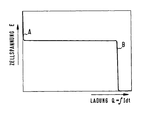
- the electrode is preferably characterized in that its coulometric titration curve (stationary discharge curve: equilibrium cell voltage E as a function of the amount of charge Q) - in the almost discharged state (B) and preferably also in the almost fully charged state (A) drops steeply.
- the coulometric titration curve only needs to have the slope in the almost fully charged state (A) with a secondary cell (a rechargeable galvanic cell). In the case of a primary element (which is only intended for a single discharge), only the slope in state (B) is required.
- the concentration of defect sites that receive the mobile ions is preferably a substantial fraction - preferably more than 1 or 10 percent - of the maximum concentration of the mobile ions contained in it.
- the factor 10 2 or 1 0 3 contained in the given formula is essentially the thermodynamic gain factor W.
- a material that has undergone a phase transition between the almost discharged state (B) and the almost completely charged state (A) has proven to be particularly suitable.
- the material in the almost charged state (A) had at least approximately the composition Li in Sb or Bi and in the almost completely discharged state (B) at least approximately the composition Li 3 Sb or Li 3 Bi.
- the amplification factors of Li 3 Sb and Li 3 Bi are 70,000 and 370, respectively. Such amplification factors cannot be achieved with known electrode materials, in particular not with intercalation compounds, such as e.g. B. Li x TiS 2 .
- a material of the composition ⁇ -Ag 2 S has proven itself as another suitable material.
- the gain factor of this material is around 1 0000 , which corresponds to a diffusion coefficient of 0.47 cm 2 sec at 200 ° C, ie a diffusion coefficient that is much higher than in most liquids.
- the curve is also called a CT curve (coulometric titration curve).
- CT curve coulometric titration curve
Landscapes
- Chemical & Material Sciences (AREA)
- Physics & Mathematics (AREA)
- Chemical Kinetics & Catalysis (AREA)
- Electrochemistry (AREA)
- General Chemical & Material Sciences (AREA)
- Nonlinear Science (AREA)
- Inorganic Chemistry (AREA)
- General Physics & Mathematics (AREA)
- Optics & Photonics (AREA)
- Electrodes For Compound Or Non-Metal Manufacture (AREA)
- Inert Electrodes (AREA)
- Battery Electrode And Active Subsutance (AREA)
- Secondary Cells (AREA)
- Primary Cells (AREA)
Abstract
Description
- Die Erfindung betrifft eine feste Elektrode in einer elektrolytischen Zelle zum schnellen und mit geringer Spannungseinbuße verbundenen Ein- und Ausbau von durch einen Elektrolyten zu ihr und von ihr wandernden Ionen, insbesondere für eine Brennstoffzelle, eine Hochleistungsbatterie, eine elektrochrome Zeichendarstellungseinheit oder ein elektrochemisches Speicherelement.
- Es ist bekannt, feste Elektroden mit möglichst hoher elektronischer (i. a. metallischer) Leitfähigkeit zu verwenden. Diese Elektroden gestatten jedoch nur eine geringe Stromdichte bei der Be- und Entladung. Es zeigen sich Spannungseinbußen (Polarisation) beim Entladen und überhöhte Spannungen beim Laden; hierdurch wird die nutzbare Energie gemindert. Um hohe Ströme zu erzielen, mußten (wenn flüssige Elektrolyte verwendet werden konnten) die Elektrodenmaterialien porös gemacht werden, um eine große Oberfläche (Grenzfläche zwischen Elektrode und Elektrolyt) zu erzeugen.
- Aufgabe der Erfindung ist es demgegenüber, die Stromdichte (Strom/Elektrodenoberfläche) bei der Be- und Entladung erhöhen zu können und Spannungseinbußen bei der Entladung und Spannungsüberhöhungen bei der Ladung zu mindern.
- Zur Lösung dieser Aufgabe ist die Elektrode dadurch gekennzeichnet, daß sie eine höhere elektrische Leitfähigkeit für Elektronen oder Löcher als für die Ionen aufweist, und daß die Konzentration der in ihr beweglichen Elektronen oder Löcher geringer ist als die der in ihr enthaltenen beweglichen Ionen.
- Vorzugsweise handelt es sich hierbei um ein halbleitendes Material. überraschenderweise ergibt sich mit einer erfindungsgemäßen Elektrode eine bessere Lösung der Aufgabe als mit einer Elektrode, die eine hohe (metallische) Elektronen- oder Löcherleitfähigkeit hat. In einer erfindungsgemäßen Elektrode stellt sich das chemische Gleichgewicht mit den Ionen bei der Be- und Entladung sehr rasch ein, so daß sich auch eine geringe Polarisation und damit geringe Verluste (z. B. durch Wärme) ergeben.
- Um die Ionenbeweglichkeit besonders groß zu machen, ist die Elektrode bevorzugt dadurch gekennzeichnet, daß ihre coulometrische Titrationskurve (stationäre Entladekurve : Gleichgewichts-Zellspannung E in Abhängigkeit von der Menge der geflossenen Ladung Q)-im nahezu entladenen Zustand (B) und vorzugsweise auch im nahezu vollständig geladenen Zustand (A) steil abfällt. Die coulometrische Titrationskurve braucht die Steilheit im nahezu vollständig geladenen Zustand (A) nur bei einer Sekundärzelle (einer wiederaufladbaren galvanischen Zelle) zu haben. Bei einem Primärelement (das nur für eine einmalige Entladung vorgesehen ist), ist nur die Steilheit im Zustand (B) erforderlich. Die Forderung der Steilheit sowohl im Zustand (A) als auch im Zustand (B) ist nicht nur bei wiederaufladbaren Batterien, sondern auch bei elektrochromen Zeichendarstellungseinheiten und elektrochemischen Speicherelementen vorteilhaft, da in diesen Fällen die Ionen in beiden Stromrichtungen schnell hin und her transportiert werden sollen. Aus dem gleichen Grund ist in ihr bevorzugt die Konzentration von die beweglichen Ionen aufnehmenden Defektstellen ein wesentlicher Bruchteil - vorzugsweise mehr als 1 oder 1o Prozent - der maximalen Konzentration der in ihr enthaltenen beweglichen Ionen.
- Es ist schwierig, die Bedingungen für die Forderung nach ausreichender Fehlordnung für einen schnellen Ionentransport allgemein anzugeben. Es genügt jedoch, daß vorzugsweise 1 bis 10 % der regulären Gitterpositionen "falsch" besetzt sind.
- Eine bevorzugte Ausbildung ist dadurch gekennzeichnet, daß die Mindeststeilheit

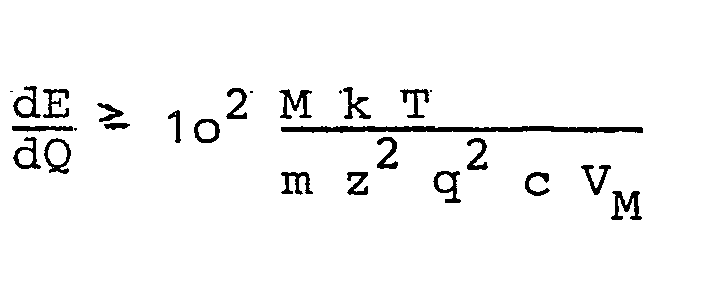

- wobei M = Molekulargewicht der bei B bzw. A stöchiom = Masse metrisch variierten Phase V = Molvolumen in der Elektrode
- c = Konzentration der beweglichen Ionen
- z - Ladungszahl der beweglichen Ionen
- q = Elementarladung
- k = Boltzmann's Konstante
- T = absolute Temperatur
- Der in der angegebenen Formel enthaltene Faktor 102 bzw. 10 3 ist im wesentlichen der thermodynamische Verstärkungsfaktor W.
- In einer bevorzugten Ausbildung ist die Elektrode dadurch gekennzeichnet, daß ihr thermodynamischer Verstärkungsfaktor W, ermittelt durch

- wobei

- σE = Leitfähigkeit der beweglichen Ionen
- Als besonders geeignet hat sich für die Elektrode ein Material erwiesen, das zwischen dem nahezu entladenen Zustand (B) und dem nahezu vollständig geladenen Zustand (A) eine Phasenumwandlung erfährt.
- In einem erfolgreich erprobten Fall hatte das Material im nahezu geladenen Zustand (A) wenigstens annähernd die Zusammensetzung Li in Sb oder Bi und im nahezu vollständig entladenen Zustand (B) wenigstens annähernd die Zusammensetzung Li3Sb oder Li3Bi. Die Verstärkungsfaktoren von Li3Sb und Li3Bi betragen 70000 bzw. 370. Derartige Verstärkungsfaktoren sind mit bekannten Elektrodenmaterialien nicht zu erzielen, insbesondere nicht mit Intercalationsverbindungen, wie z. B. LixTiS2.
- Als ein anderes geeignetes Material hat sich ausgezeichnet ein Material der Zusammensetzung α-Ag2S bewährt. Der Verstärkungsfaktor dieses Materials liegt um etwa 10000, was einem Diffusionskoeffizienten von o,47 cm2 sec bei 200°C entspricht, also einem Diffusionskoeffizienten, der viel höher ist als in den meisten Flüssigkeiten.
- In der beigefügten Zeichnung ist ein Beispiel einer stationären Entladekurve dargestellt. Es ist die Gleichgewichts-Zellspannung E in Abhängigkeit von der Menge der geflossenen Ladung Q = Idt (Zeitintegral über den geflossenen Strom) dargestellt.
- Die Kurve nennt man auch CT-Kurve (coulometrische Titrationskurve). Bei der Entladung steigt die Kurve unterhalb des Punkts A, der der Ladungsmenge QA entspricht, steil an, oberhalb des Punkts B, der der Ladung QB entspricht, fällt die Kurve steil ab.
-
- 1. W. Weppner and R.A. Huggins, Determination of the Kinetic Parameters of Mixed-Conducting Electrodes and Application to the System Li3Sb, J. Electrochem. Soc. 124: 1569 (1977)
- 2. C. Wagner, Investigations on Silver Sulfides, J. Chem. Phys. 21: 1819 (1953)
- 3. W. Weppner and R.A. Huggins, Electrochemical Methods for Determining Kinetic Properties of Solids, Ann. Rev. Mater. Sci. 8: 269 (1978)
- 4. W. Weppner and R.A. Huggins, Electrochemical Investigation of the Chemical Diffusion, Partial Ionic Conductivities, and Other Kinetic Parameters in Li3Sb and Li3Bi, J. Solid State Chem. 22: 297 (1977)
- 5. W. Weppner and R.A. Huggins, Thermodynamic Properties of the Intermetallic Systems Lithium Antimony and Lithium-Bismuth , J. Electrochem. Soc. 125: 7 (1978)
- 6. W.F. Chu, H. Rickert and W. Weppner, Electrochemical Investigations of the Chemical Diffusion in Wüstite and Silver-Sulphide, W. van Gool, ed., North Holland Publ. Comp., Amsterdam (1973), p. 181
δ = stöchiometrische Zahl der beweglichen Ionen, größer als 102, vorzugsweise größer als 103 ist.
Claims (8)


δ = stöchiometrische Zahl der beweglichen Ionen, größer als 10 2, vorzugsweise größer als 10 3 ist.
Applications Claiming Priority (2)
| Application Number | Priority Date | Filing Date | Title |
|---|---|---|---|
| DE19803004571 DE3004571A1 (de) | 1980-02-07 | 1980-02-07 | Feste elektrode in einer elektrolytischen zelle |
| DE3004571 | 1980-02-07 |
Publications (2)
| Publication Number | Publication Date |
|---|---|
| EP0033935A1 true EP0033935A1 (de) | 1981-08-19 |
| EP0033935B1 EP0033935B1 (de) | 1985-08-07 |
Family
ID=6094019
Family Applications (1)
| Application Number | Title | Priority Date | Filing Date |
|---|---|---|---|
| EP81100739A Expired EP0033935B1 (de) | 1980-02-07 | 1981-02-02 | Feste Elektrode in einer Brennstoffzelle, einer Hochleistungsbatterie, einer elektrochromen Zeichendarstellungseinheit oder einem elektrochemischen Speicherelement |
Country Status (4)
| Country | Link |
|---|---|
| US (1) | US5023153A (de) |
| EP (1) | EP0033935B1 (de) |
| JP (1) | JPH0622132B2 (de) |
| DE (2) | DE3004571A1 (de) |
Cited By (3)
| Publication number | Priority date | Publication date | Assignee | Title |
|---|---|---|---|---|
| RU2380794C1 (ru) * | 2008-10-10 | 2010-01-27 | Эрика Александровна Алисова | Электрохимический элемент с твердым электролитом |
| RU2554110C2 (ru) * | 2011-12-29 | 2015-06-27 | Федеральное государственное военное образовательное учреждение высшего профессионального образования "Военный учебно-научный центр Сухопутных войск Общевойсковая академия Вооруженных Сил Российской Федерации" | Способ преобразования энергии ионизованной среды в электрическую энергию |
| US9793525B2 (en) | 2012-10-09 | 2017-10-17 | Johnson Battery Technologies, Inc. | Solid-state battery electrodes |
Families Citing this family (9)
| Publication number | Priority date | Publication date | Assignee | Title |
|---|---|---|---|---|
| GB9121912D0 (en) * | 1991-10-16 | 1991-11-27 | Atomic Energy Authority Uk | Titanium dioxide-based material |
| US5695624A (en) * | 1995-01-30 | 1997-12-09 | The Regents Of The Univeristy Of California | Solid state oxygen sensor |
| US5543025A (en) * | 1995-01-30 | 1996-08-06 | The Regents Of The University Of California, Office Of Technology Transfer | Solid state oxygen sensor |
| DE19623434A1 (de) * | 1996-06-12 | 1997-12-18 | Bosch Gmbh Robert | Sensor zur Bestimmung der Konzentration oxidierbarer Bestandteile in einem Gasgemisch |
| DE60044484D1 (de) * | 1999-04-08 | 2010-07-15 | Koninkl Philips Electronics Nv | Verfahren und vorrichtung zur ermittlung des ladungszustands einer batterie |
| EP1331671B1 (de) * | 2000-11-01 | 2007-01-24 | Japan Science and Technology Agency | Punktkontaktmatrix und elektronische Schaltung damit |
| US10333123B2 (en) | 2012-03-01 | 2019-06-25 | Johnson Ip Holding, Llc | High capacity solid state composite cathode, solid state composite separator, solid-state rechargeable lithium battery and methods of making same |
| JP6763965B2 (ja) | 2015-12-21 | 2020-09-30 | ジョンソン・アイピー・ホールディング・エルエルシー | 固体電池、セパレータ、電極および製造方法 |
| US10218044B2 (en) | 2016-01-22 | 2019-02-26 | Johnson Ip Holding, Llc | Johnson lithium oxygen electrochemical engine |
Citations (3)
| Publication number | Priority date | Publication date | Assignee | Title |
|---|---|---|---|---|
| DE2517882A1 (de) * | 1974-04-25 | 1975-11-13 | Mallory & Co Inc P R | Positive elektrode fuer ein elektrochemisches festkoerperelement |
| DE2433044A1 (de) * | 1974-06-12 | 1976-01-02 | Bbc Brown Boveri & Cie | Steuerbare elektrochromische anzeigevorrichtung mit ionenleitender zwischenschicht und nichtpolarisierbarer elektrode |
| DE2655918A1 (de) * | 1975-12-09 | 1977-06-16 | Us Energy | Verfahren zur herstellung einer lithiumlegierung enthaltenden negativen elektrode |
Family Cites Families (4)
| Publication number | Priority date | Publication date | Assignee | Title |
|---|---|---|---|---|
| SU489367A3 (ru) * | 1972-11-09 | 1975-10-25 | Рейниш-Вестфалишес Электрицитетсверк Аг (Фирма) | Первичный элемент |
| JPS5244408B2 (de) * | 1973-06-08 | 1977-11-08 | ||
| DE2516704C3 (de) * | 1975-04-16 | 1981-07-02 | Varta Batterie Ag, 3000 Hannover | Galvanisches Element mit einer negativen Elektrode aus Leichtmetall, einem nichtwäßrigen Elektrolyten und einer positiven Elektrode |
| DE3026141A1 (de) * | 1980-07-10 | 1982-02-18 | Varta Batterie Ag, 3000 Hannover | Galvanische festelektrolytzelle |
-
1980
- 1980-02-07 DE DE19803004571 patent/DE3004571A1/de not_active Withdrawn
-
1981
- 1981-02-02 EP EP81100739A patent/EP0033935B1/de not_active Expired
- 1981-02-02 DE DE8181100739T patent/DE3171640D1/de not_active Expired
- 1981-02-05 JP JP56015094A patent/JPH0622132B2/ja not_active Expired - Lifetime
-
1989
- 1989-04-05 US US07/333,777 patent/US5023153A/en not_active Expired - Fee Related
Patent Citations (3)
| Publication number | Priority date | Publication date | Assignee | Title |
|---|---|---|---|---|
| DE2517882A1 (de) * | 1974-04-25 | 1975-11-13 | Mallory & Co Inc P R | Positive elektrode fuer ein elektrochemisches festkoerperelement |
| DE2433044A1 (de) * | 1974-06-12 | 1976-01-02 | Bbc Brown Boveri & Cie | Steuerbare elektrochromische anzeigevorrichtung mit ionenleitender zwischenschicht und nichtpolarisierbarer elektrode |
| DE2655918A1 (de) * | 1975-12-09 | 1977-06-16 | Us Energy | Verfahren zur herstellung einer lithiumlegierung enthaltenden negativen elektrode |
Cited By (4)
| Publication number | Priority date | Publication date | Assignee | Title |
|---|---|---|---|---|
| RU2380794C1 (ru) * | 2008-10-10 | 2010-01-27 | Эрика Александровна Алисова | Электрохимический элемент с твердым электролитом |
| RU2554110C2 (ru) * | 2011-12-29 | 2015-06-27 | Федеральное государственное военное образовательное учреждение высшего профессионального образования "Военный учебно-научный центр Сухопутных войск Общевойсковая академия Вооруженных Сил Российской Федерации" | Способ преобразования энергии ионизованной среды в электрическую энергию |
| US9793525B2 (en) | 2012-10-09 | 2017-10-17 | Johnson Battery Technologies, Inc. | Solid-state battery electrodes |
| US10084168B2 (en) | 2012-10-09 | 2018-09-25 | Johnson Battery Technologies, Inc. | Solid-state battery separators and methods of fabrication |
Also Published As
| Publication number | Publication date |
|---|---|
| DE3171640D1 (en) | 1985-09-12 |
| JPH0622132B2 (ja) | 1994-03-23 |
| JPS56126265A (en) | 1981-10-03 |
| EP0033935B1 (de) | 1985-08-07 |
| DE3004571A1 (de) | 1981-08-13 |
| US5023153A (en) | 1991-06-11 |
Similar Documents
| Publication | Publication Date | Title |
|---|---|---|
| DE2516704C3 (de) | Galvanisches Element mit einer negativen Elektrode aus Leichtmetall, einem nichtwäßrigen Elektrolyten und einer positiven Elektrode | |
| DE2841895C2 (de) | ||
| DE2940556C2 (de) | ||
| DE2336666A1 (de) | Nichtwaessrige batterie | |
| DE2501881A1 (de) | Sekundaere elektronische zelle sowie kathode dafuer | |
| DE1771922A1 (de) | Elektrische Brennstoffzelle | |
| DE3036807C2 (de) | Elektrochemisches Element mit hoher Energiedichte | |
| EP0033935A1 (de) | Feste Elektrode in einer Brennstoffzelle, einer Hochleistungsbatterie, einer elektrochromen Zeichendarstellungseinheit oder einem elektrochemischen Speicherelement | |
| DE3323333A1 (de) | Glasfaserseparatoren fuer zellen mit fluessigen positiven elektroden | |
| DE3032556A1 (de) | Gegen fehlanwendung widerstandsfaehige elemente mit einer negativen aktivmetallelektrode und fluessigem positivem elektrodendepolarisator | |
| DE69012310T2 (de) | Getter-Elektrode enthaltende elektrochemische Zelle. | |
| EP0357952B1 (de) | Nichtwässriges, wiederaufladbares galvanisches Lithiumelement mit anorganischer Elektrolytlösung | |
| DE2539736C3 (de) | Galvanisches Element mit einer negativen Elektrode aus einem stark elektropositiven Metall und einem nichtwäßrigen Elektrolyten | |
| DE2546972C3 (de) | Verwendung eines Bleiakkumulators bei erhöhter Betriebstemperatur sowie Konstruktion dieses Bleiakkumulators | |
| DE2555654A1 (de) | Wiederaufladbare galvanische zelle | |
| DE2819584C2 (de) | Schaltung zur Sicherung von Speicherzellen | |
| DE3917795A1 (de) | Ladegeraet zum wiederaufladen einer sekundaerzelle mit einer li-cucl(pfeil abwaerts)2(pfeil abwaerts)-verknuepfung | |
| DE2925383A1 (de) | Elektrochemische energiequelle | |
| EP0114272A2 (de) | Elektrochemische Speicherzelle | |
| DE2521769A1 (de) | Galvanisches element mit einer negativen elektrode aus leichtmetall, einem nichtwaessrigen elektrolyten und einer positiven elektrode | |
| DE2154092B2 (de) | Galvanisches element mit einer negativen elektrode auf lithiumbasis | |
| DE102020101890B4 (de) | Bismut-Ionen-Akkumulator und Verfahren zu dessen Herstellung | |
| DE2504284C3 (de) | Aufladbares, galvanisches Element | |
| DE2241369C3 (de) | Elektrode für Bleiakkumulatoren | |
| DE2316666A1 (de) | Wiederaufladebare elektrolytische trockenbaueinheit mit duenner anode |
Legal Events
| Date | Code | Title | Description |
|---|---|---|---|
| PUAI | Public reference made under article 153(3) epc to a published international application that has entered the european phase |
Free format text: ORIGINAL CODE: 0009012 |
|
| AK | Designated contracting states |
Designated state(s): BE CH DE FR GB LI NL |
|
| 17P | Request for examination filed |
Effective date: 19811207 |
|
| GRAA | (expected) grant |
Free format text: ORIGINAL CODE: 0009210 |
|
| AK | Designated contracting states |
Designated state(s): BE CH DE FR GB LI NL |
|
| REF | Corresponds to: |
Ref document number: 3171640 Country of ref document: DE Date of ref document: 19850912 |
|
| ET | Fr: translation filed | ||
| PGFP | Annual fee paid to national office [announced via postgrant information from national office to epo] |
Ref country code: NL Payment date: 19860228 Year of fee payment: 6 |
|
| PLBE | No opposition filed within time limit |
Free format text: ORIGINAL CODE: 0009261 |
|
| STAA | Information on the status of an ep patent application or granted ep patent |
Free format text: STATUS: NO OPPOSITION FILED WITHIN TIME LIMIT |
|
| 26N | No opposition filed | ||
| BERE | Be: lapsed |
Owner name: MAX-PLANCK-G ZUR FORDERUNG DER WISSENSCHAFTEN E.V Effective date: 19870228 |
|
| PG25 | Lapsed in a contracting state [announced via postgrant information from national office to epo] |
Ref country code: NL Effective date: 19870901 |
|
| NLV4 | Nl: lapsed or anulled due to non-payment of the annual fee | ||
| PG25 | Lapsed in a contracting state [announced via postgrant information from national office to epo] |
Ref country code: BE Effective date: 19890228 |
|
| PGFP | Annual fee paid to national office [announced via postgrant information from national office to epo] |
Ref country code: GB Payment date: 19910131 Year of fee payment: 11 |
|
| PGFP | Annual fee paid to national office [announced via postgrant information from national office to epo] |
Ref country code: CH Payment date: 19910208 Year of fee payment: 11 |
|
| PGFP | Annual fee paid to national office [announced via postgrant information from national office to epo] |
Ref country code: FR Payment date: 19910218 Year of fee payment: 11 |
|
| PG25 | Lapsed in a contracting state [announced via postgrant information from national office to epo] |
Ref country code: GB Effective date: 19920202 |
|
| PG25 | Lapsed in a contracting state [announced via postgrant information from national office to epo] |
Ref country code: LI Effective date: 19920229 Ref country code: CH Effective date: 19920229 |
|
| GBPC | Gb: european patent ceased through non-payment of renewal fee | ||
| PG25 | Lapsed in a contracting state [announced via postgrant information from national office to epo] |
Ref country code: FR Effective date: 19921030 |
|
| REG | Reference to a national code |
Ref country code: CH Ref legal event code: PL |
|
| REG | Reference to a national code |
Ref country code: FR Ref legal event code: ST |
|
| PGFP | Annual fee paid to national office [announced via postgrant information from national office to epo] |
Ref country code: DE Payment date: 19930311 Year of fee payment: 13 |
|
| PG25 | Lapsed in a contracting state [announced via postgrant information from national office to epo] |
Ref country code: DE Effective date: 19941101 |