EP0013402B1 - Siloxanmodifizierte Novolake, deren Herstellung und Verwendung zur Herstellung von Reibbelägen - Google Patents
Siloxanmodifizierte Novolake, deren Herstellung und Verwendung zur Herstellung von Reibbelägen Download PDFInfo
- Publication number
- EP0013402B1 EP0013402B1 EP79105301A EP79105301A EP0013402B1 EP 0013402 B1 EP0013402 B1 EP 0013402B1 EP 79105301 A EP79105301 A EP 79105301A EP 79105301 A EP79105301 A EP 79105301A EP 0013402 B1 EP0013402 B1 EP 0013402B1
- Authority
- EP
- European Patent Office
- Prior art keywords
- novolak
- polysiloxane
- alkyl
- weight
- aryl
- Prior art date
- Legal status (The legal status is an assumption and is not a legal conclusion. Google has not performed a legal analysis and makes no representation as to the accuracy of the status listed.)
- Expired
Links
Classifications
-
- C—CHEMISTRY; METALLURGY
- C08—ORGANIC MACROMOLECULAR COMPOUNDS; THEIR PREPARATION OR CHEMICAL WORKING-UP; COMPOSITIONS BASED THEREON
- C08G—MACROMOLECULAR COMPOUNDS OBTAINED OTHERWISE THAN BY REACTIONS ONLY INVOLVING UNSATURATED CARBON-TO-CARBON BONDS
- C08G77/00—Macromolecular compounds obtained by reactions forming a linkage containing silicon with or without sulfur, nitrogen, oxygen or carbon in the main chain of the macromolecule
- C08G77/04—Polysiloxanes
- C08G77/38—Polysiloxanes modified by chemical after-treatment
-
- C—CHEMISTRY; METALLURGY
- C08—ORGANIC MACROMOLECULAR COMPOUNDS; THEIR PREPARATION OR CHEMICAL WORKING-UP; COMPOSITIONS BASED THEREON
- C08G—MACROMOLECULAR COMPOUNDS OBTAINED OTHERWISE THAN BY REACTIONS ONLY INVOLVING UNSATURATED CARBON-TO-CARBON BONDS
- C08G77/00—Macromolecular compounds obtained by reactions forming a linkage containing silicon with or without sulfur, nitrogen, oxygen or carbon in the main chain of the macromolecule
- C08G77/42—Block-or graft-polymers containing polysiloxane sequences
-
- C—CHEMISTRY; METALLURGY
- C08—ORGANIC MACROMOLECULAR COMPOUNDS; THEIR PREPARATION OR CHEMICAL WORKING-UP; COMPOSITIONS BASED THEREON
- C08G—MACROMOLECULAR COMPOUNDS OBTAINED OTHERWISE THAN BY REACTIONS ONLY INVOLVING UNSATURATED CARBON-TO-CARBON BONDS
- C08G8/00—Condensation polymers of aldehydes or ketones with phenols only
- C08G8/28—Chemically modified polycondensates
-
- F—MECHANICAL ENGINEERING; LIGHTING; HEATING; WEAPONS; BLASTING
- F16—ENGINEERING ELEMENTS AND UNITS; GENERAL MEASURES FOR PRODUCING AND MAINTAINING EFFECTIVE FUNCTIONING OF MACHINES OR INSTALLATIONS; THERMAL INSULATION IN GENERAL
- F16D—COUPLINGS FOR TRANSMITTING ROTATION; CLUTCHES; BRAKES
- F16D69/00—Friction linings; Attachment thereof; Selection of coacting friction substances or surfaces
- F16D69/02—Composition of linings ; Methods of manufacturing
- F16D69/025—Compositions based on an organic binder
Definitions
- the invention relates to siloxane-modified novolaks, their production and use for the production of friction linings.
- novolaks for the production of friction linings is known (cf. rubber, asbestos, plastics 9, (1978) year 31, pp. 666-670). Such resins serve to glue the numerous fillers and additives and enable the molding compounds to subsequently harden by heating.
- Moldings which are resistant to high temperatures should have the highest possible decomposition temperature and a low evaporation rate of thermal decomposition products.
- the high temperature range is generally understood to be the range of 250-800 ° C.
- the effectiveness of friction linings and their service life is drastically reduced by a high proportion of volatile cracking products such as mainly benzene, toluene, xylene, phenol, cresol as well as by shape instability (breaking out of friction lining fragments) when exposed to high temperatures.
- the friction linings obtained in this way show an increased breakout of parts of the friction lining molded part at high temperature loads compared to friction linings that were manufactured on the basis of phenolic novolacs, which is apparently caused by an insufficient bond between the low molecular weight components of the novolake and the silicone resin in the friction lining molded part.
- the object of the invention is to significantly reduce this decomposition of high-temperature-stressed phenol and / or cresol-formaldehyde resins by a suitable chemical modification thereof and to increase their dimensional stability under high temperature stress by improving the elasticity, tear resistance and tensile strength.
- phenol and / or cresol-formaldehyde resins of the novolak type can be reacted with polysiloxanes containing alkoxy, alkylaryloxy or aryloxy end groups under acidic catalytic conditions with elimination of alcohol or phenol to form siloxane-modified novolaks which, on the one hand, are easy to assemble and at the same time resistant to high temperatures Molding compounds with improved elasticity, improved tear propagation and tensile strength result.
- These resins according to the invention can be processed into friction lining qualities which, when exposed to high temperatures, additionally have a substantially improved noise damping and excellent dimensional stability.
- Another object of the invention is a process for the preparation of the polysiloxane containing a novolak, which is characterized in that a polysiloxane containing C i -C a alkyloxy, C6-C12 aryloxy and / or C 7 -C 12 alkylaryloxy groups a phenol and / or cresol-formaldehyde resin of the novolak type in the presence of an acidic transesterification catalyst at temperatures of 110-180 ° C., the polysiloxane being used in amounts of 20-120 parts by weight, based on 100 parts by weight of novolak, and the volatile constituents formed are distilled off.
- Another object of the invention is the use of the polysiloxanes according to the invention for the production of friction linings.
- R can also represent a C 6 -C 18 cycloalkyl group.
- phenol and / or cresol-formaldehyde resins are suitable, which are obtained by reacting phenols and / or cresols with, for example, aqueous formaldehyde solutions in a molar ratio of 1: 1.05 to 1: 1.4 be prepared in the presence of an acidic catalyst in a known manner (cf. Ullmanns Encyclopadie der techn. Chemie, vol. 13, p. 459, publisher: Urban & Schwarzenberg, Kunststoff-Berlin, 1962).
- the binding of the resin to the polysiloxane is preferably carried out via a hydroxymethylene group, from which a hydrogen is split off during the reaction.
- the phenol groups present in the resin are less reactive and may therefore only react towards the end of the reaction.
- a polysiloxane of the following formula is used to produce the polysiloxanes according to the invention:
- polysiloxane resins can be dissolved in a solvent such as benzene, toluene and xylene, but are preferably used without solvents.
- solvent-free polysiloxanes are liquids and have a viscosity of 40-20,000 (measured at 20 ° C).
- Such polysiloxane resins can be prepared by processes known from the literature, for example by targeted hydrolysis of silanes of the general structure (R 2 ) Si (X) 2 , where R is already defined at the outset, and X is, for example, chlorine and / or O-alkyl with 1-8 Carbon atoms, and the hydrolysis optionally in the presence of organic solvents such as toluene or xylene and optionally in the presence of alkali or acid and a suitable amount of chain-terminating C 1 -C 8 -hydroxyalkyls or C 6 -C 12 -hydroxyaryls or C 7 - C 12 -hydroxyalkylaryl is carried out (see, for example, BW Noll, “Chemistry and Technology of Silicones”, Verlag Chemie GmbH, Weinheim / Bergstrasse 1968, pages 162-171).
- the amount of the polysiloxane used in the reaction is preferably 30-80 parts by weight based on 100 parts by weight of the novolak.
- the reaction is preferably carried out in the presence of 0.0001-0.5% by weight of an acidic transesterification catalyst (based on the total weight of the reaction mixture), such as, for. B. an organic or inorganic acid such as oxalic acid, formic acid, acetic acid, trichloro- or trifluoroacetic acid, benzenesulfonic acid, p-toluenesulfonic acid, hydrochloric acid, sulfuric acid, phosphoric acid or a Lewis acid such as aluminum chloride, iron-III-chloride, zinc chloride, antimony-III-chloride, Germanium dioxide or zinc oxide.
- an organic or inorganic acid such as oxalic acid, formic acid, acetic acid, trichloro- or trifluoroacetic acid, benzenesulfonic acid, p-toluenesulfonic acid, hydrochloric acid, sulfuric acid, phosphoric acid or a Lewis acid such as aluminum chloride, iron
- the reaction temperature is preferably 130 170 ° C.
- the "B residue" split off during the reaction is distilled off under normal pressure, but expediently under a vacuum of 1-500 mbar.
- the liquid resin according to the invention is drained from the reaction vessel, expediently worked up using a pasting belt or a cooling roller, and can then be ground.
- the resins according to the invention obtained in this way generally have a softening point of 60-110 ° C., but preferably 70-100 ° C. (measured in accordance with DIN 53180). They show a higher average molecular weight (measured by osmometry) than the components introduced for the reaction.
- This molecular weight analysis enables the chemical conversion of the novolake with the polysiloxane to be checked and verified in a simple manner.
- the resins according to the invention obtained are mixed with inorganic and / or organic fillers such as metals and / or metal oxides, fluorspar, asbestos, silica, Butyl, nitrile and / or chloroprene rubber intimately mixed in the presence of formaldehyde-releasing substances such as hexamethylenetetramine, trioxi or tetraoxymethylene on industrial mixing units such as kneaders or internal mixers, preferably at temperatures from 60 to 150 ° C.
- formaldehyde-releasing substances are added in amounts by weight of 4-16% by weight, preferably 7-14% by weight, based on 100 parts by weight of the resin according to the invention.
- the mixtures obtained in this way are generally pressed at 140 ° C. to 180 ° C., in particular at 140 ° to 160 ° C., optionally under a pressure of 150 to 250 bar, to form friction linings (cf. Vieweg / Becker “Kunststoff Handbuch”, vol. 10 , Duroplast, pp. 93-95, Carl Hanser Verlag, Kunststoff, 1968).
- the reaction is carried out at 160 ° C. in the presence of 0.002% by weight of p-toluenesulfonic acid (based on the total weight of the reaction mixture).
- the mixture is left to react for 1 hour at 160 ° C. under a nitrogen atmosphere and with vigorous stirring, and then 36.5 g of methanol are distilled off at a pressure of 350-10 mbar. At the same time, 3.0 g of phenol and water are removed by distillation.
- the resin prepared according to Example 1 was ground, mixed with 12% by weight hexamethylenetetramine and examined by thermogravimetry (cf. Resin 2 in Table 1).
- the friction linings produced from the resin according to Example 1 show, at temperatures above 300 ° C, in addition to the significantly lower evaporation rate of low molecular weight compounds shown in Table 1, an increased elasticity, tear and tensile strength and a higher hardness than the friction linings, which are based on a phenol-formaldehyde resin or which were produced on the basis of a mixture of polysiloxane and phenolic resin (cf. Table 2).
- This mixture is intimately mixed with the above-mentioned acrylonitrile-butadiene copolymer and with the other components of the friction lining mixture, the xylene being removed at 100 mbar and 80.degree.
- the friction lining mixtures (A), (B) and (C) harden by pressing for 1/2 hours at 150 ° C under a pressure of 200 bar. Sheets of 4 mm thickness were produced, from which standard test bars were made.
- Friction lining qualities that are manufactured on the basis of the siloxane-modified novolaks according to the invention are characterized by lower mixture viscosities and thus a more favorable processing behavior in comparison to phenolic novolak-containing friction lining qualities (see Table 2 values for the Mooney viscosity).
- the tensile strength (F), the elasticity (E) and the tear propagation resistance (WRF), the dimensions for the dimensional stability of the friction lining are significantly improved compared to a friction lining based on a phenol-novolak-silicone resin mixture (see mixture (B) and (C) in Table 2.11
- the hardening effect of the resins according to the invention in friction lining mixtures is also higher than that of a pure phenol novolak or a phenol novolak silicone resin mixture (cf. HD values in Table 2.11 for mixtures (A), (B) and (C)).
Landscapes
- Chemical & Material Sciences (AREA)
- Organic Chemistry (AREA)
- Health & Medical Sciences (AREA)
- Chemical Kinetics & Catalysis (AREA)
- Medicinal Chemistry (AREA)
- Polymers & Plastics (AREA)
- General Engineering & Computer Science (AREA)
- Engineering & Computer Science (AREA)
- General Chemical & Material Sciences (AREA)
- Mechanical Engineering (AREA)
- Phenolic Resins Or Amino Resins (AREA)
- Braking Arrangements (AREA)
- Silicon Polymers (AREA)
- Manufacture Of Macromolecular Shaped Articles (AREA)
- Other Resins Obtained By Reactions Not Involving Carbon-To-Carbon Unsaturated Bonds (AREA)
- Lubricants (AREA)
Description
- Die Erfindung betrifft siloxanmodifizierte Novolake, deren Herstellung und Verwendung zur Herstellung von Reibbelägen.
- Die Verwendung von Novolaken zur Herstellung von Reibbelägen ist bekannt (vgl. Gummi, Asbest, Kunststoffe 9, (1978) Jahrgang 31, S. 666-670). Solche Harze dienen zum Verleimen der zahlreichen Füllstoffe und Zuschläge und ermöglichen die anschließende Aushärtung der Formmassen durch Erhitzen.
- Hochtemperaturbeständige Formkörper wie Reibbeläge, die vorzugsweise zur Herstellung von Kupplungs- und Bremsbelägen Anwendung finden, sollen eine möglichst hohe Zersetzungstemperatur und eine geringe Abdampfrate thermischer Zerfallsprodukte aufweisen. Als Hochtemperaturbereich wird im allgemeinen der Bereich von 250-800° C verstanden. Die Wirksamkeit von Reibbelägen und deren Funktionsdauer wird drastisch reduziert durch einen hohen Anteil flüchtiger Crackprodukte wie hauptsächlich Benzol, Toluol, Xylol, Phenol, Kresol sowie durch auftretende Forminstabilität (Ausbrechen von Reibbelagsbruchstücken) bei Hochtemperaturbelastung.
- Nach der in DE-OS 2306463 beschriebenen Verfahrensweise können durch Abmischen von Phenol-Formaldehyd-Harzen und Polysiloxanen in Lösung sowie anschließendes Aushärten der Formteile nach Entfernen des Lösungsmittels hochtemperaturbeständige Formkörper erhalten werden, aus denen Reibbeläge gefertigt werden können.
- Die so erhaltenen Reibbeläge zeigen jedoch bei Hochtemperaturbelastung im Vergleich zu Reibbelägen, die auf Basis von Phenolnovolaken gefertigt wurden, ein vermehrtes Ausbrechen von Teilen des Reibbelagsformstückes, das offenbar verursacht wird durch einen ungenügenden Verbund der niedermolekularen Komponenten des Novolakes und des Silikonharzes im Reibbelagsformstück.
- Aufgabe der Erfindung ist es, diese Zersetzung hochtemperaturbeanspruchter Phenol- und/oder Kresol-Formaldehydharze durch eine geeignete chemische Modifizierung derselben deutlich zu vermindern und durch Verbesserung der Elastizität, Weiterreißfestigkeit und Zugfestigkeit deren Formstabilität bei Hochtemperaturbelastung zu erhöhen.
- Es wurde gefunden, daß sich Phenol- und/oder Kresol-Formaldehydharze vom Novolaktyp mit Alkoxi-, Alkylaryloxi- oder Aryloxi-endgruppenhaltigen Polysiloxanen unter sauer katalytischen Bedingungen unter Alkohol- oder Phenolabspaltung zu siloxanmodifizierten Novolaken umsetzen lassen, die einerseits gut konfektionierbar sind und gleichzeitig hochtemperaturbeständige Formmassen mit verbesserter Elastizität, verbesserter Weiterreiß- sowie Zugfestigkeit ergeben. Diese erfindungsgemäßen Harze lassen sich zu Reibbelagsqualitäten verarbeiten, die bei Hochtemperaturbelastung zusätzlich eine wesentlich verbesserte Geräuschedämpfung sowie ausgezeichnete Formstabilität aufweisen.
- Gegenstand der Erfindung ist somit ein Novolak enthaltendes Polysiloxan der Formel

- A gleich oder verschieden einen Novolakrest, eine C1-C8-Alkyl-, eine C6-C12-Aryl- und/oder eine C7-C12 Alkylarylgruppe darstellt, wobei der Novolakrest mindestens einmal vorhanden sein muß,
- R gleich oder verschieden eine C1-C8-Alkyl-, eine C6-C18-Cycloalkylgruppe, und/oder eine C6-C12 Aryl- und/oder C7-C12 Alkylarylgruppe bedeutet und
- n Zahlen von 3 bis 100 darstellt.
- Ein weiterer Gegenstand der Erfindung ist ein Verfahren zur Herstellung des einen Novolak enthaltenden Polysiloxans welches dadurch gekennzeichnet ist, daß man ein Ci-Ca-Alkyloxi-, C6-C12-Aryloxi- und/oder C7-C12 Alkylaryloxigruppen enthaltendes Polysiloxan mit einem Phenol-und/oder Kresol-Formaldehydharz vom Novolaktyp in Gegenwart eines sauren Umesterungskatalysators bei Temperauren von 110-180°C umsetzt, wobei das Polysiloxan in Mengen von 20-120 Gew.-Teilen bezogen auf 100 Gew.-Teile Novolak eingesetzt wird, und man die entstehenden flüchtigen Anteile abdestilliert.
- Ein weiterer Gegenstand der Erfindung ist die Verwendung der erfindungsgemäßen Polysiloxane zur Herstellung von Reibbelägen.
- In der angegebenen Formel bedeuten A und R einen C1-C8-Alkylrest wie beispielsweise Methyl, Äthyl, Propyl, n-, iso-, tert.-Butyl, n-, iso-Pentyl, n-, iso-Hexyl, n-, iso-Heptyl und n-, iso-Octyl; einen C6-C12-Arylrest wie beispielsweise Phenyl, α-Naphthyl;
- einen C7-C12-Alkylarylrest wie beispielsweise Tolyl, p-tert. Butylphenyl, n-, iso-Hexylpenyl; und/oder einen Novolakrest.
- R kann darüber hinaus noch eine C6- C18 Cycloalkylgruppe darstellen.
- Als Novolakrest sowie als Novolakharz, welches bei dem Herstellungsverfahren eingesetzt wird kommen Phenol- und/oder Kresol-Formaldehydharze in Betracht, die durch Umsetzung von Phenolen und/oder Kresolen mit beispielsweise wäßrigen Formaldehydlösungen im Molverhältnis 1 : 1,05 bis 1 : 1,4 in Gegenwart eines sauren Katalysators in bekannter Weise hergestellt werden (vgl. Ullmanns Encyclopädie der techn. Chemie, Bd. 13, S. 459, Verlag: Urban & Schwarzenberg, München-Berlin, 1962).
- Die Bindung des Harzes an das Polysiloxan erfolgt bevorzugt über eine Hydroxymethylengruppe, aus der bei Reaktion ein Wasserstoff abgespalten wird. Die im Harz vorhandenen Phenolgruppen sind reaktionsträger und setzen sich daher gegebenenfalls erst gegen Ende der Reaktion um.
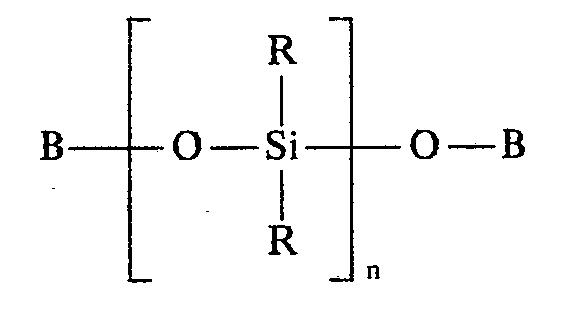
- Zur Herstellung der erfindungsgemäßen Polysiloxane wird ein Polysiloxan folgender Formel eingesetzt:
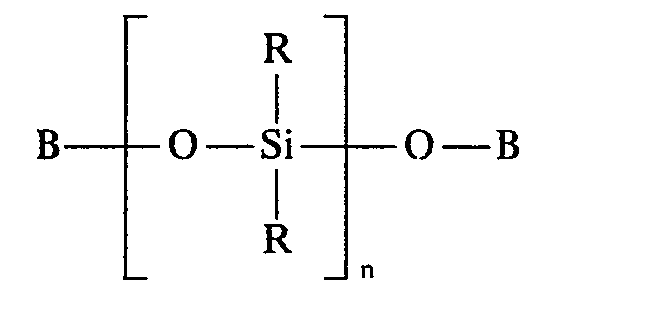
- In der Formel bedeuten
- B gleich oder verschieden einen C1-C8-Alkyl, C6-C12-Aryl oder C7-C12-Alkylarylrest,
- R einen C1-C8-Alkyl oder C6-C18-Cycloalkyl oder C6-C12-Aryl und/oder C7-C12-Alkylarylrest,
- n Zahlen von 3 bis 100.
- Diese Polysiloxanharze können in einem Lösungsmittel wie Benzol, Toluol und Xylol gelöst sein, kommen jedoch vorzugsweise lösungsmittelfrei zum Einsatz. Diese lösungsmittelfreien Polysiloxane sind Flüssigkeiten und weisen eine Viskosität von 40-20 000 auf (gemessen bei 20° C).
- Derartige Polysiloxanharze lassen sich nach literaturbekannten Verfahren herstellen, beispielsweise durch gezielte Hydrolyse von Silanen der allgemeinen Struktur (R2) Si(X)2, wobei R bereits eingangs definiert ist, und X beispielsweise für Chlor und/oder O-Alkyl mit 1-8 Kohlenstoffatomen stehen kann, und wobei die Hydrolyse gegebenenfalls in Gegenwart von organischen Lösungsmitteln wie Toluol oder Xylol und gegebenenfalls in Gegenwart von Alkali oder Säure und einer geeigneten Menge kettenabbrechender C1-C8-Hydroxyalkyle oder C6-C12-Hydroxyarylen oder C7-C12-Hydroxy- alkylaryle ausgeführt wird (vgl. z. B. W. Noll, »Chemie und Technologie der Silicone«, Verlag Chemie GmbH, Weinheim/Bergstraße 1968, Seiten 162-171).
- Bezüglich der eingesetzten Novolake wird auf obige Ausführungen verwiesen.
- Die Menge des bei der Umsetzung eingesetzten Polysiloxans beträgt bevorzugt 30-80 Gew.-Teile bezogen auf 100 Gew.-Teile des Novolaks.
- Die Umsetzung erfolgt bevorzugt in Gegenwart von 0,0001-0,5 Gew.-% eines sauren Umesterungskatalysators (bezogen auf das Gesamtgewicht des Reaktionsgemisches) wie z. B. einer organischen oder anorganischen Säure wie Oxalsäure, Ameisensäure, Essigsäure, Trichlor- oder Trifluoressigsäure, Benzolsulfonsäure, p-Toluolsulfonsäure, Salzsäure, Schwefelsäure, Phosphorsäure oder einer Lewissäure wie Aluminiumchlorid, Eisen-III-Chlorid, Zinkchlorid, Antimon-III-chlorid, Germaniumdioxid oder Zinkoxid.
- Die Umsetzungstemperatur beträgt bevorzugt 130170°C. Das Abdestillieren des bei der Umsetzung abgespaltenen »B-Restes« erfolgt bei Normaldruck, zweckmäßigerweise jedoch bei einem Vakkum von 1-500 mbar.
- Das flüssige erfindungsgemäße Harz wird aus dem Reaktionsgefäß abgelassen, zweckmäßigerweise über ein Pastellierband oder eine Kühlwalze aufgearbeitet und kann anschließend vermahlen werden.
- Die so erhaltenen erfindungsgemäßen Harze besitzen im allgemeinen einen Erweichungspunkt von 60-110°C, vorzugsweise jedoch von 70-100°C (nach DIN 53180 gemessen). Sie zeigen ein höheres durchschnittliches Molekulargewicht (osmometrisch gemessen) als die zur Reaktion eingebrachten Komponenten. So resultiert beispielsweise aus der Umsetzung eines Novolakes mit einem Molekulargewicht von Mos=530 mit einem methoxyendgruppenhaltigem Polysiloxan mit Mos=510 ein Endprodukt mit
M os=760. Durch diese Molekulargewichtsanalyse kann die chemische Umsetzung des Novolakes mit dem Polysiloxan auf einfachem Wege überprüft und nachgewiesen werden. - Um Reibbeläge herzustellen, werden die erhaltenen erfindungsgemäßen Harze mit anorganischen und/oder organischen Füllstoffen wie Metallen und/oder Metalloxiden, Flußspat, Asbest, Kieselsäure, Butyl-, Nitril- und/oder Chloroprenkautschuk in Gegenwart von formaldehydabspaltenden Substanzen wie Hexamethylentetramin, Trioxi- oder Tetraoximethylen auf industriell üblichen Mischaggregaten wie Knetern oder Innenmischern, bevorzugt bei Temperaturen von 60 bis 150°C, innig vermischt. Der Zusatz von formaldehydabspaltenden Substanzen erfolgt in Gewichtsmengen von 4-16 Gew.-%, vorzugsweise von 7-14 Gew.-%, bezogen auf 100 Gew.-Teile des erfindungsgemäßen Harzes.
- Die so erhaltenen Mischungen werden im allgemeinen bei 140°C bis 180°C, insbesondere bei 140° bis 160°C, gegebenenfalls unter einem Druck von 150 bis 250 bar zu Reibbelägen verpreßt (vgl. Vieweg/Becker »Kunststoffhandbuch«, Bd. 10, Duroplaste, S. 93-95, Carl Hanser Verlag, München, 1968).
- Die thermischen Eigenschaften der erhaltenen Formkörper werden anhand der Tabelle 1 demonstriert, die Angaben über den durch Thermogravimetrie unter Stickstoff bestimmten Gewichtsverlust von 2 Harzproben enthält (Aufheizrate: 20° C/Min.).

- Die Erfindung wird durch den nachstehenden Beispiele näher erläutert.
- Eingesetzt werden 660 g eines Novolakes, der aus Phenol und Formaldehyd im Molverhältnis 1 : 1,08 in bekannter Weise in Gegenwart eines sauren Katalysators wie Oxalsäure hergestellt wurde und ein Molgewicht von
M os=530 sowie eine OH-Zahl von 535 aufweist (vgl. Ullmanns Encyclopädie der technischen Chemie, 13. Bd., S. 459, Verlag: Urban Schwarzenberg, München-Berlin, 1962). - Dieser Novolak wird zusammen mit 330 g eines methoxyendgruppenhaltigen Polydiphenylsiloxans umgesetzt, das folgende Kenndaten aufweist:
-
M os=510 - Viskosität (DIN 53 015):110 mm2.
- Gew.-% Methoxygruppen: 14-16
- Die Umsetzung wird bei 160°C in Gegenwart von 0,002 Gew.-% p-Toluolsulfonsäure (bezogen auf das Gesamtgewicht des Reaktionsgemisches) ausgeführt. Man läßt 1 Stunde bei 160°C unter Stickstoffatmosphäre und unter intensivem Rühren reagieren und destilliert anschließend bei einem Druck von 350-10 mbar 36,5g Methanol ab. Gleichzeitig werden auch 3,0g Phenol und Wasser destillativ enfernt.
- Das flüssige Harz wird anschließend aus dem Reaktionsgefäß entnommen und nach dem Erkalten gemahlen. Das Produkt besitzt folgende Kenndaten:
- Ep. (nach DIN 53 180): 89°C,
-
M os=760 - OH-Zahl =330
- Siliciumgehalt: 6,2%
- Das nach Beispiel 1 hergestellte Harz wurde gemahlen, mit 12 Gew.-% Hexamethylentetramin abgemischt und thermogravimetrisch untersucht (vgl. Harz 2 der Tab. 1).
- Die aus dem Harz nach Beispiel 1 hergestellten Reibbeläge zeigen bei Temperaturen über 300°C neben der beispielhaft in Tab. 1 aufgezeigten wesentlich niedrigeren Abdampfrate an niedermolekularen Verbindungen eine erhöhte Elastizität, Weiterreiß- sowie Zugfestigkeit und eine höhere Härte als die Reibbeläge aufweisen, die auf Basis eines Phenol-Formaldehyd-Harzes oder die auf Basis einer Abmischung aus Polysiloxan und Phenolharz hergestellt wurden (vgl. Tab. 2).
- Tabelle 2 beinhaltet einen Eigenschaftsvergleich von Reibbelagsmischungen, die
- A) auf Basis einer Abmischung aus Acrylnitril-Butadien-Copolymerisat und einem Phenolformaldehyd-Novolak mit einem durchschnittlichen Molekulargewicht von Mos=530 und einer OH-Zahl von 535 hergestellt wurden, die
- B) auf Basis einer Mischung aus Acrylnitril-Butadien-Copolymerisat und einem erfindungsgemäßen siloxanmodifiziertem Novolak gemäß dem Harz aus Beispiel 1 hergestellt wurden und die
- C) auf Basis einer Mischung aus Acrylnitril-Butadien-Copolymerisat und einer Phenolnovolak-Siliconharzmischung gemäß dem Harz 4 der DE-OS 2 306 463 hergestellt wurden.
- Dieses Gemisch aus Phenolnovolak und Siliconharz gemäß Harz 4 der DT-OS 2 306 463 wird folgendermaßen hergestellt:
- 33 Gew.-% (bezogen auf Feststoff) eines Methylsiliconharzes mit einem 3 Mcl-%-Anteil an Phenylsiloxan, vorliegend als 51 Gew.-%ige Lösung in Xylol, das eine Viskosität von 40-60 mm2, gemessen bei 20°C, besitzt, wird gemischt mit 60 Gew.-% eines Phenolnovolakes vom Molgewicht
M os=530 und einer OH-Zahl von 535. - - Dieses Gemisch wird mit dem obengenannten Acrylnitril-Butadien-Copolymerisat sowie mit den anderen Komponenten der Reibbelagsmischung innig vermischt, wobei das Xylol bei 100 mbar und 80° C entfernt wird.
- Durch Aushärtung der Reibbelagsmischungen (A), (B) und (C) erfolgt durch 1/2stündiges Verpressen bei 150°C unter einem Druck von 200 bar. Es wurden Platten von 4 mm Stärke hergestellt, aus denen Normprüfstäbe gefertigt wurden.

- Reibbelagsqualitäten, die auf Basis der erfindungsmäßen siloxanmodifizierten Novolake gefertigt werden, zeichnen sich durch niedrigere Mischungsviskositäten und damit ein günstigeres Verarbeitungsverhalten im Vergleich zu phenolnovolakhaltigen Reibbelagsqualitäten aus (vgl. Tab. 2 Werte für die Mooney-Viskosität). Weiterhin sind die Zugfestigkeit (F), die Elastizität (E) und die Weiterreißfestigkeit (WRF), die Maße für die Formstäbilität des Reibbelages sind deutlich verbessert gegenüber einem Reibbelag auf Basis einer Phenol-Novolak-Silikonharz-Mischung (vgl. Mischung (B) und (C) in Tab. 2,11 Die härtende Wirkung der erfindungsgemäßen Harze in Reibbelagsmischungen ist ebenfalls höher als die eines reinen Phenolnovolakes oder einer Phenolnovolak-Silikonharz-Mischung (vgl. HD-Werte in Tabelle 2,11 für Mischungen (A), (B) und (C)).
Claims (9)

Priority Applications (1)
| Application Number | Priority Date | Filing Date | Title |
|---|---|---|---|
| AT79105301T ATE882T1 (de) | 1979-01-04 | 1979-12-21 | Siloxanmodifizierte novolake, deren herstellung und verwendung zur herstellung von reibbelaegen. |
Applications Claiming Priority (2)
| Application Number | Priority Date | Filing Date | Title |
|---|---|---|---|
| DE2900185 | 1979-01-04 | ||
| DE19792900185 DE2900185A1 (de) | 1979-01-04 | 1979-01-04 | Siloxanmodifizierte novolake, deren herstellung und verwendung zur herstellung von reibbelaegen |
Publications (2)
| Publication Number | Publication Date |
|---|---|
| EP0013402A1 EP0013402A1 (de) | 1980-07-23 |
| EP0013402B1 true EP0013402B1 (de) | 1982-04-21 |
Family
ID=6060032
Family Applications (1)
| Application Number | Title | Priority Date | Filing Date |
|---|---|---|---|
| EP79105301A Expired EP0013402B1 (de) | 1979-01-04 | 1979-12-21 | Siloxanmodifizierte Novolake, deren Herstellung und Verwendung zur Herstellung von Reibbelägen |
Country Status (7)
| Country | Link |
|---|---|
| EP (1) | EP0013402B1 (de) |
| JP (1) | JPS5592738A (de) |
| AT (1) | ATE882T1 (de) |
| BR (1) | BR8000013A (de) |
| CA (1) | CA1156784A (de) |
| DE (2) | DE2900185A1 (de) |
| ES (1) | ES487426A1 (de) |
Families Citing this family (12)
| Publication number | Priority date | Publication date | Assignee | Title |
|---|---|---|---|---|
| US4395527A (en) * | 1978-05-17 | 1983-07-26 | M & T Chemicals Inc. | Siloxane-containing polymers |
| DE3008138A1 (de) * | 1980-03-04 | 1981-09-10 | Wacker-Chemie GmbH, 8000 München | Verfahren zur herstellung von siliconmodifizierten harzen |
| DE3237000A1 (de) * | 1982-10-06 | 1984-04-12 | Hüttenes-Albertus Chemische Werke GmbH, 4000 Düsseldorf | Unter polyurethanbildung kalthaertendes formstoff-bindemittel, dessen herstellung und dessen verwendung |
| FR2611730B1 (fr) * | 1987-02-24 | 1989-06-16 | Rhone Poulenc Chimie | Diorganopolysiloxane a fonction alpha-mercaptoester utile comme stabilisant des polymeres a base de chlorure de polyvinyle |
| JPH0386716A (ja) * | 1989-08-31 | 1991-04-11 | Toray Dow Corning Silicone Co Ltd | シリコーン樹脂で変性されたフェノール樹脂の製造方法 |
| JP3066700B2 (ja) * | 1993-12-28 | 2000-07-17 | エヌエスケー・ワーナー株式会社 | 湿式摩擦材 |
| WO1995023833A1 (fr) * | 1994-03-03 | 1995-09-08 | Osaka Gas Company Limited | Composition de liant pour materiaux de friction et materiau de friction |
| GB9524361D0 (en) * | 1995-11-29 | 1996-01-31 | Bp Chem Int Ltd | Phenolic resins |
| US6220405B1 (en) * | 1997-07-02 | 2001-04-24 | Alliedsignal Inc. | Friction material for drum-in-hat disc brake assembly |
| JP3962146B2 (ja) | 1998-03-03 | 2007-08-22 | Nskワーナー株式会社 | 湿式摩擦材及びその製造方法 |
| WO2000044806A1 (en) | 1999-01-29 | 2000-08-03 | Arakawa Chemical Industries, Ltd. | Hardener for epoxy resin, epoxy resin composition, and process for producing silane-modified phenolic resin |
| DE102008055042A1 (de) | 2008-12-19 | 2010-06-24 | Hüttenes-Albertus Chemische Werke GmbH | Modifizierte Phenolharze |
Family Cites Families (6)
| Publication number | Priority date | Publication date | Assignee | Title |
|---|---|---|---|---|
| GB766623A (en) * | 1954-03-08 | 1957-01-23 | Dow Chemical Co | Phenol-aldehyde organosilicon resinous compositions |
| DE1006619B (de) * | 1954-05-25 | 1957-04-18 | Union Carbide & Carbon Corp | Verfahren zur Herstellung modifizierter Polysiloxane |
| US2920058A (en) * | 1955-01-14 | 1960-01-05 | Dow Corning | Compositicn consisting essentially of the resinous reaction product of an esterified phenol-aldehyde resin and a silicone resin |
| SU439169A1 (ru) * | 1972-03-20 | 1976-11-25 | Ордена Ленина Институт Элементоорганических Соединений Ан Ссср | Антифрикционный материал |
| SU507250A3 (ru) * | 1973-02-09 | 1976-03-15 | Байер Аг (Фирма) | Пресскомпозици |
| DE2538818C3 (de) * | 1975-09-01 | 1980-04-30 | Wacker-Chemie Gmbh, 8000 Muenchen | Verfahren zur Förderung von Kondensations- und/oder Äquilibrierungsreaktionen von Organosiliciumverbindungen |
-
1979
- 1979-01-04 DE DE19792900185 patent/DE2900185A1/de not_active Withdrawn
- 1979-12-21 EP EP79105301A patent/EP0013402B1/de not_active Expired
- 1979-12-21 DE DE7979105301T patent/DE2962598D1/de not_active Expired
- 1979-12-21 AT AT79105301T patent/ATE882T1/de active
- 1979-12-26 JP JP16847079A patent/JPS5592738A/ja active Pending
-
1980
- 1980-01-02 CA CA000342940A patent/CA1156784A/en not_active Expired
- 1980-01-03 BR BR8000013A patent/BR8000013A/pt unknown
- 1980-01-03 ES ES487426A patent/ES487426A1/es not_active Expired
Also Published As
| Publication number | Publication date |
|---|---|
| ATE882T1 (de) | 1982-05-15 |
| EP0013402A1 (de) | 1980-07-23 |
| DE2900185A1 (de) | 1980-07-17 |
| CA1156784A (en) | 1983-11-08 |
| ES487426A1 (es) | 1980-06-16 |
| BR8000013A (pt) | 1980-10-07 |
| JPS5592738A (en) | 1980-07-14 |
| DE2962598D1 (en) | 1982-06-03 |
Similar Documents
| Publication | Publication Date | Title |
|---|---|---|
| DE1720204A1 (de) | Phenolharzprodukte und Verfahren zu ihrer Herstellung | |
| EP0013402A1 (de) | Siloxanmodifizierte Novolake, deren Herstellung und Verwendung zur Herstellung von Reibbelägen | |
| DE2512581A1 (de) | Umsetzungsprodukte aus polysiloxanen und polyphenolen | |
| DE69011034T2 (de) | Verfahren zur Herstellung eines mit Siloxanharz modifizierten Phenolharzes. | |
| EP2072547A1 (de) | Modifizierte Phenolharze | |
| DE3447247A1 (de) | Verfahren zur herstellung von aminoalkylsiloxan-polymeren | |
| DE3330042C2 (de) | Glycidylether vom Novolak-Typ-substituierten Phenolharzen, Verfahren zu deren Herstellung und deren Verwendung als Einkapselungsverbindungen | |
| DE69115058T2 (de) | Epoxyharzzusammensetzung und damit verkapselte Halbleiteranordnung. | |
| DE3447253A1 (de) | Zwitterionische siloxanpolymere | |
| DE2244644A1 (de) | Bei raumtemperatur vulkanisierbare selbstklebende zweikomponenten-silikongummizusammensetzungen | |
| DE2759771C2 (de) | Silanol-Endgruppen aufweisende Polyarylenpolyäther, Verfahren zu deren Herstellung und deren Verwendung | |
| EP3837317B1 (de) | Vernetzbare organosiloxan-zusammensetzungen | |
| DE69513859T2 (de) | Verfahren zur Herstellung von hochreaktiven modifizierten Phenolharzen | |
| DE60110051T2 (de) | Mit epoxy-funktionellen polysiloxanen modifizierte phenolharzzusammensetzungen und verbundwerkstoffe | |
| DE69123484T2 (de) | Verfahren zur Herstellung von Harzmischungen mit Phenolgruppen | |
| DE1595543C3 (de) | ||
| DE2906220A1 (de) | Selbstbindende siliconkautschukmassen | |
| DE1182819B (de) | Verfahren zur Herstellung von Formkoerpern | |
| DE69712545T2 (de) | Verfahren zur Herstellung von hochreaktiven niedrigviskosen modifizierten Phenolharzen | |
| EP0003534B1 (de) | Verfahren zur Herstellung von borhaltigen Phenol-Formaldehydharzen | |
| EP3661943B1 (de) | Zusammensetzung enthaltend furfurylsilikate und furfurylalkohol | |
| EP0043097B1 (de) | Härtbare Überzugs- und Bindemittel und deren Verwendung | |
| DE2805763C2 (de) | Verfahren zur Herstellung von Isobutyraldehyd-Phenol-Polykondensaten und deren Verwendung | |
| DE1221020B (de) | Verfahren zur Herstellung von Organopolysiloxanen | |
| DE2020224A1 (de) | Siliconharz |
Legal Events
| Date | Code | Title | Description |
|---|---|---|---|
| PUAI | Public reference made under article 153(3) epc to a published international application that has entered the european phase |
Free format text: ORIGINAL CODE: 0009012 |
|
| 17P | Request for examination filed | ||
| AK | Designated contracting states |
Designated state(s): AT BE DE FR GB IT NL |
|
| ITF | It: translation for a ep patent filed | ||
| GRAA | (expected) grant |
Free format text: ORIGINAL CODE: 0009210 |
|
| AK | Designated contracting states |
Designated state(s): AT BE DE FR GB IT NL |
|
| REF | Corresponds to: |
Ref document number: 882 Country of ref document: AT Date of ref document: 19820515 Kind code of ref document: T |
|
| REF | Corresponds to: |
Ref document number: 2962598 Country of ref document: DE Date of ref document: 19820603 |
|
| PGFP | Annual fee paid to national office [announced via postgrant information from national office to epo] |
Ref country code: DE Payment date: 19841130 Year of fee payment: 6 |
|
| PGFP | Annual fee paid to national office [announced via postgrant information from national office to epo] |
Ref country code: FR Payment date: 19841210 Year of fee payment: 6 |
|
| PGFP | Annual fee paid to national office [announced via postgrant information from national office to epo] |
Ref country code: BE Payment date: 19841231 Year of fee payment: 6 |
|
| PGFP | Annual fee paid to national office [announced via postgrant information from national office to epo] |
Ref country code: AT Payment date: 19851212 Year of fee payment: 7 |
|
| PGFP | Annual fee paid to national office [announced via postgrant information from national office to epo] |
Ref country code: NL Payment date: 19851231 Year of fee payment: 7 |
|
| PG25 | Lapsed in a contracting state [announced via postgrant information from national office to epo] |
Ref country code: AT Effective date: 19861221 |
|
| PG25 | Lapsed in a contracting state [announced via postgrant information from national office to epo] |
Ref country code: BE Effective date: 19861231 |
|
| BERE | Be: lapsed |
Owner name: BAYER A.G. Effective date: 19861231 |
|
| PG25 | Lapsed in a contracting state [announced via postgrant information from national office to epo] |
Ref country code: NL Effective date: 19870701 |
|
| NLV4 | Nl: lapsed or anulled due to non-payment of the annual fee | ||
| GBPC | Gb: european patent ceased through non-payment of renewal fee | ||
| PG25 | Lapsed in a contracting state [announced via postgrant information from national office to epo] |
Ref country code: FR Free format text: LAPSE BECAUSE OF NON-PAYMENT OF DUE FEES Effective date: 19870831 |
|
| PG25 | Lapsed in a contracting state [announced via postgrant information from national office to epo] |
Ref country code: DE Effective date: 19870901 |
|
| REG | Reference to a national code |
Ref country code: FR Ref legal event code: ST |
|
| PG25 | Lapsed in a contracting state [announced via postgrant information from national office to epo] |
Ref country code: GB Free format text: LAPSE BECAUSE OF NON-PAYMENT OF DUE FEES Effective date: 19881118 |
|
| PLBE | No opposition filed within time limit |
Free format text: ORIGINAL CODE: 0009261 |
|
| STAA | Information on the status of an ep patent application or granted ep patent |
Free format text: STATUS: NO OPPOSITION FILED WITHIN TIME LIMIT |