EP0011797B1 - Backtrennöl-Komponente - Google Patents
Backtrennöl-Komponente Download PDFInfo
- Publication number
- EP0011797B1 EP0011797B1 EP79104572A EP79104572A EP0011797B1 EP 0011797 B1 EP0011797 B1 EP 0011797B1 EP 79104572 A EP79104572 A EP 79104572A EP 79104572 A EP79104572 A EP 79104572A EP 0011797 B1 EP0011797 B1 EP 0011797B1
- Authority
- EP
- European Patent Office
- Prior art keywords
- weight
- baking
- fatty
- release oil
- fatty acids
- Prior art date
- Legal status (The legal status is an assumption and is not a legal conclusion. Google has not performed a legal analysis and makes no representation as to the accuracy of the status listed.)
- Expired
Links
- 239000000194 fatty acid Substances 0.000 claims description 24
- 235000014113 dietary fatty acids Nutrition 0.000 claims description 20
- 229930195729 fatty acid Natural products 0.000 claims description 20
- 239000000203 mixture Substances 0.000 claims description 20
- 239000003921 oil Substances 0.000 claims description 20
- 235000019198 oils Nutrition 0.000 claims description 20
- 150000004665 fatty acids Chemical class 0.000 claims description 19
- 239000004164 Wax ester Substances 0.000 claims description 13
- 235000019386 wax ester Nutrition 0.000 claims description 13
- 239000007788 liquid Substances 0.000 claims description 10
- UFTFJSFQGQCHQW-UHFFFAOYSA-N triformin Chemical compound O=COCC(OC=O)COC=O UFTFJSFQGQCHQW-UHFFFAOYSA-N 0.000 claims description 9
- ZCYVEMRRCGMTRW-UHFFFAOYSA-N 7553-56-2 Chemical compound [I] ZCYVEMRRCGMTRW-UHFFFAOYSA-N 0.000 claims description 7
- 229910052740 iodine Inorganic materials 0.000 claims description 7
- 239000011630 iodine Substances 0.000 claims description 7
- 235000019482 Palm oil Nutrition 0.000 claims description 6
- 239000002540 palm oil Substances 0.000 claims description 6
- IIZPXYDJLKNOIY-JXPKJXOSSA-N 1-palmitoyl-2-arachidonoyl-sn-glycero-3-phosphocholine Chemical compound CCCCCCCCCCCCCCCC(=O)OC[C@H](COP([O-])(=O)OCC[N+](C)(C)C)OC(=O)CCC\C=C/C\C=C/C\C=C/C\C=C/CCCCC IIZPXYDJLKNOIY-JXPKJXOSSA-N 0.000 claims description 2
- 239000000787 lecithin Substances 0.000 claims description 2
- 229940067606 lecithin Drugs 0.000 claims description 2
- 235000010445 lecithin Nutrition 0.000 claims description 2
- 150000002191 fatty alcohols Chemical class 0.000 description 9
- -1 polyene fatty acids Chemical class 0.000 description 4
- 150000003626 triacylglycerols Chemical class 0.000 description 4
- HEMHJVSKTPXQMS-UHFFFAOYSA-M Sodium hydroxide Chemical compound [OH-].[Na+] HEMHJVSKTPXQMS-UHFFFAOYSA-M 0.000 description 3
- 239000002253 acid Substances 0.000 description 3
- 229910052799 carbon Inorganic materials 0.000 description 3
- 229960000541 cetyl alcohol Drugs 0.000 description 3
- 230000032050 esterification Effects 0.000 description 3
- 238000005886 esterification reaction Methods 0.000 description 3
- BXWNKGSJHAJOGX-UHFFFAOYSA-N n-hexadecyl alcohol Natural products CCCCCCCCCCCCCCCCO BXWNKGSJHAJOGX-UHFFFAOYSA-N 0.000 description 3
- IJGRMHOSHXDMSA-UHFFFAOYSA-N Atomic nitrogen Chemical compound N#N IJGRMHOSHXDMSA-UHFFFAOYSA-N 0.000 description 2
- OKTJSMMVPCPJKN-UHFFFAOYSA-N Carbon Chemical compound [C] OKTJSMMVPCPJKN-UHFFFAOYSA-N 0.000 description 2
- 241001465754 Metazoa Species 0.000 description 2
- 230000000694 effects Effects 0.000 description 2
- 239000003925 fat Substances 0.000 description 2
- 239000002994 raw material Substances 0.000 description 2
- VXUYXOFXAQZZMF-UHFFFAOYSA-N titanium(IV) isopropoxide Chemical compound CC(C)O[Ti](OC(C)C)(OC(C)C)OC(C)C VXUYXOFXAQZZMF-UHFFFAOYSA-N 0.000 description 2
- WRIDQFICGBMAFQ-UHFFFAOYSA-N (E)-8-Octadecenoic acid Natural products CCCCCCCCCC=CCCCCCCC(O)=O WRIDQFICGBMAFQ-UHFFFAOYSA-N 0.000 description 1
- LQJBNNIYVWPHFW-UHFFFAOYSA-N 20:1omega9c fatty acid Natural products CCCCCCCCCCC=CCCCCCCCC(O)=O LQJBNNIYVWPHFW-UHFFFAOYSA-N 0.000 description 1
- QSBYPNXLFMSGKH-UHFFFAOYSA-N 9-Heptadecensaeure Natural products CCCCCCCC=CCCCCCCCC(O)=O QSBYPNXLFMSGKH-UHFFFAOYSA-N 0.000 description 1
- 241000283153 Cetacea Species 0.000 description 1
- 239000005642 Oleic acid Substances 0.000 description 1
- ZQPPMHVWECSIRJ-UHFFFAOYSA-N Oleic acid Natural products CCCCCCCCC=CCCCCCCCC(O)=O ZQPPMHVWECSIRJ-UHFFFAOYSA-N 0.000 description 1
- 150000007513 acids Chemical class 0.000 description 1
- 150000001298 alcohols Chemical class 0.000 description 1
- 150000001336 alkenes Chemical class 0.000 description 1
- PNEYBMLMFCGWSK-UHFFFAOYSA-N aluminium oxide Inorganic materials [O-2].[O-2].[O-2].[Al+3].[Al+3] PNEYBMLMFCGWSK-UHFFFAOYSA-N 0.000 description 1
- 235000015173 baked goods and baking mixes Nutrition 0.000 description 1
- 239000003054 catalyst Substances 0.000 description 1
- 210000000078 claw Anatomy 0.000 description 1
- 238000004821 distillation Methods 0.000 description 1
- 239000003995 emulsifying agent Substances 0.000 description 1
- 150000002148 esters Chemical class 0.000 description 1
- 238000001914 filtration Methods 0.000 description 1
- 235000013305 food Nutrition 0.000 description 1
- 238000005194 fractionation Methods 0.000 description 1
- 230000008014 freezing Effects 0.000 description 1
- 238000007710 freezing Methods 0.000 description 1
- 238000010438 heat treatment Methods 0.000 description 1
- 238000005984 hydrogenation reaction Methods 0.000 description 1
- QXJSBBXBKPUZAA-UHFFFAOYSA-N isooleic acid Natural products CCCCCCCC=CCCCCCCCCC(O)=O QXJSBBXBKPUZAA-UHFFFAOYSA-N 0.000 description 1
- 238000004519 manufacturing process Methods 0.000 description 1
- 150000004667 medium chain fatty acids Chemical class 0.000 description 1
- 238000000034 method Methods 0.000 description 1
- 229910052757 nitrogen Inorganic materials 0.000 description 1
- JRZJOMJEPLMPRA-UHFFFAOYSA-N olefin Natural products CCCCCCCC=C JRZJOMJEPLMPRA-UHFFFAOYSA-N 0.000 description 1
- ZQPPMHVWECSIRJ-KTKRTIGZSA-N oleic acid Chemical compound CCCCCCCC\C=C/CCCCCCCC(O)=O ZQPPMHVWECSIRJ-KTKRTIGZSA-N 0.000 description 1
- 230000003647 oxidation Effects 0.000 description 1
- 238000007254 oxidation reaction Methods 0.000 description 1
- 238000007670 refining Methods 0.000 description 1
- 238000007127 saponification reaction Methods 0.000 description 1
- 230000001932 seasonal effect Effects 0.000 description 1
- 238000000926 separation method Methods 0.000 description 1
- 238000003756 stirring Methods 0.000 description 1
- 239000003760 tallow Substances 0.000 description 1
- 230000009967 tasteless effect Effects 0.000 description 1
- PHYFQTYBJUILEZ-IUPFWZBJSA-N triolein Chemical compound CCCCCCCC\C=C/CCCCCCCC(=O)OCC(OC(=O)CCCCCCC\C=C/CCCCCCCC)COC(=O)CCCCCCC\C=C/CCCCCCCC PHYFQTYBJUILEZ-IUPFWZBJSA-N 0.000 description 1
- 238000005292 vacuum distillation Methods 0.000 description 1
- 235000015112 vegetable and seed oil Nutrition 0.000 description 1
- 239000008158 vegetable oil Substances 0.000 description 1
- XLYOFNOQVPJJNP-UHFFFAOYSA-N water Substances O XLYOFNOQVPJJNP-UHFFFAOYSA-N 0.000 description 1
Classifications
-
- A—HUMAN NECESSITIES
- A21—BAKING; EDIBLE DOUGHS
- A21D—TREATMENT OF FLOUR OR DOUGH FOR BAKING, e.g. BY ADDITION OF MATERIALS; BAKING; BAKERY PRODUCTS
- A21D8/00—Methods for preparing or baking dough
- A21D8/08—Prevention of sticking, e.g. to baking plates
Definitions
- the aim of the invention is therefore the development of a physiologically and food-safe baking separating oil, which, due to its physical and technological properties, can be used as separating oils for baked goods instead of natural, hardened sperm oil.
- the starting products for the production of the wax ester are a) technical olefin fractions, such as those obtained from tallow fatty acids, palm oil or hardened vegetable oils of suitable composition by saponification and optionally fractionation.
- the fatty acid mixtures obtained therefrom contain fatty acids of chain length C 12 -C 20 with a proportion of at least 90% fatty acids of chain length C 16 -C 18 and an iodine number of 48-96.
- the chain length distribution is roughly as follows:
- the content of polyenoic acids should be as low as possible and not exceed 13% in total.
- a second starting component (b) are fatty alcohol mixtures, such as those obtained by reduction, in particular hydrogenation, of fatty acid mixtures based on animal fats. These fatty alcohol mixtures contain fatty alcohols of chain length C 12 -C 20 with a proportion of at least 90% fatty alcohols of chain length C 16 -C 18 and an iodine number of 50-95.
- the chain length distribution is roughly as follows:
- the wax esters are prepared in a manner known per se by esterifying molar amounts of the corresponding fatty acid component (a) with the corresponding fatty alcohol component (b), e.g. in the presence of esterification catalysts such as isopropyl titanate. After the esterification, the wax ester can be freed of non-esterified portions by vacuum distillation and then deacidified, bleached and deodorized in the usual way in order to obtain a completely tasteless product.
- esterification catalysts such as isopropyl titanate
- Such wax esters have particular advantages for the intended use as a sperm oil replacement product for baking oils. By setting them to a relatively low iodine number of approx. 70 and a low content of fatty acids or fatty alcohols with several double bonds, they have increased oxidation stability. Furthermore, the freezing point can be easily adapted to the seasonal temperature. Maintaining a uniform quality and taking advantage of inexpensive and sufficiently available raw materials are further advantages over sperm oil.
- the raw materials, as well as the wax esters themselves, must have the purity required for use in food.
- the baking oil contains the aforementioned wax esters in a weight ratio of 20: 80-60: 40 in a mixture with triglycerides from natural fatty acids which are liquid at room temperature and have the lowest possible polyenoic acid content. Liquid palm oil fractions and triglycerides of medium-chain fatty acids are particularly suitable as such.
- a suitable palm oil fraction has the following characteristics, for example: Fatty acid composition (%)
- liquid triglycerides with a low content of polyene fatty acids the pour points or dropping points of which are between approximately -18 and +24 ° C.
- pour points or dropping points of which are between approximately -18 and +24 ° C. are also suitable in the same way.
- examples include oleic acid triglyceride or claw oil.
- a suitable medium-chain triglyceride essentially contains fatty acids of chain lengths C 8 -C 10 and has the following characteristics: Fatty acid composition (%) C
- the baking separating oil preferably consists of 20-30% by weight of a wax ester according to the invention, 20-30% by weight of a liquid palm oil fraction or a corresponding liquid triglyceride and 60-40% by weight of a medium-chain triglyceride.
- phosphatides such as lecithin
- Excess oleyl cetyl alcohol is at 225 ° C / 2 -3 Torr distilled off and the product after refining with 50% sodium hydroxide solution by adding 1% activated carbon and 1% acid-activated alumina bleached by heating for 30 minutes at 100 ° C in a water jet vacuum. After filtration, about 1 kg of a wax ester is obtained with the following key figures:
- a release oil with an excellent release effect has the following composition
Landscapes
- Life Sciences & Earth Sciences (AREA)
- Engineering & Computer Science (AREA)
- Food Science & Technology (AREA)
- Fats And Perfumes (AREA)
Description
- Die Reduzierung der Fangquoten für Wale führt zu einer zunehmenden Verknappung von Spermöl. das unter anderem ein wichtiger Bestandteil von Backtrennölen ist. Ziel der Erfindung ist daher die Entwicklung eines physiologisch und lebensmittelrechtlich unbedenklichen Backtrennöls, das auf Grund seiner physikalischen und technologischen Eigenschaften anstelle von natürlichem, angehärtetem Spermöl als Trennölen für Backwaren verwendet werden kann.
- Gegenstand der Erfindung ist somit ein Backtrennöl, bestehend aus 20-60 Gewichtsprozent eines synthetischen Wachsesters aus
- a) einem C12-C20-Fettsäuregemisch der Jodzahl 48-96 mit einem Anteil von wenigstens 90 % C16-C,e-Fettsäuren, und
- b) einem C12-C20-Fettalkoholgemisch der Jodzahl 50-95 mit einem Anteil von wenigstens 90 % C,6-C18-Fettalkoholen, mit folgenden Kenndaten :und 80-40 Gewichtsprozent eines bei Raumtemperatur flüssigen Triglycerids oder Triglyceridgemisches aus natürlichen Speisefettsäuren.

- Ausgangsprodukte für die Herstellung des Wachsesters sind a) technische Oleinfraktionen, wie sie z.B. aus Talgfettsäuren, Palmöl oder angehärteten Pflanzenölen geeigneter Zusammensetzung durch Verseifung und ggf. Fraktionierung gewonnen werden. Die daraus gewonnenen Fettsäuregemische enthalten Fettsäuren der Kettenlänge C12-C20 mit einem Anteil von wenigstens 90 % Fettsäuren der Kettenlänge C16-C18 und einer Jodzahl von 48-96. Die Kettenlängenverteilung liegt etwa in folgendem Rahmen :

- Der Gehalt an Polyensäuren sollte möglichst niedrig sein und insgesamt 13 % nicht übersteigen.
- Die Kenndaten des Fettsäuregemisches liegen in folgendem Bereich :

- Als zweite Ausgangskomponente (b) kommen Fettalkoholgemische in Frage, wie sie durch Reduktion, insbesondere Hydrierung von Fettsäuregemischen auf Basis tierischer Fette erhalten werden. Diese Fettalkoholgemische enthalten Fettalkohole der Kettenlänge C12-C20 mit einem Anteil von wenigstens 90 % Fettalkoholen der Kettenlängen C16-C18 und einer Jodzahl von 50-95. Die Kettenlängenverteilung liegt etwa in folgendem Rahmen :


- Geringe Anteile an Kettenlängen unter C12 und über C20 können vorhanden sein, sollten aber möglichst gering gehalten werden, da einerseits durch einen zu hohen Anteil an Alkoholen < C12 die Trennwirkung leidet, andererseits durch zu lange Fettsäuren die Löslichkeit des Esters in Triglyceriden herabgesetzt wird.
- Die Kenndaten der Fettalkoholgemische liegen etwa in folgendem Bereich :

- Die Herstellung der Wachsester erfolgt in an sich bekannter Weise durch Veresterung molarer Mengen der entsprechenden Fettsäure-Komponente (a) mit der entsprechenden Fettalkohol-Komponente (b), z.B. in Gegenwart von Veresterungskatalysatoren, wie Isopropyltitanat. Der Wachsester kann im Anschluß an die Veresterung durch Vakuumdestillation von nicht veresterten Anteilen befreit und danach in üblicher Weise entsäuert, gebleicht und desodoriert werden, um ein völlig geschmacksneutrales Produkt zu erhalten.
- Durch geeignete Auswahl der für die Veresterung verwendeten Ausgangskomponenten (a) und (b) wird erreicht, daß die Wachsester folgende Kenndaten aufweisen :

- Derartige Wachsester weisen für die vorgesehene Verwendung als Spermöl-Austauschprodukt für Backtrennöle besondere Vorteile auf. So besitzen sie durch Einstellung auf eine relativ niedrige Jodzahl von ca. 70 und geringen Gehalt an Fettsäuren bzw. Fettalkoholen mit mehreren Doppelbindungen eine erhöhte Oxidationsstabilität. Ferner läßt sich der Erstarrungspunkt der jahreszeitlichen Temperatur ohne weiteres anpassen. Die Einhaltung einer einheitlichen Qualität und das Ausnutzen preisgüngstiger und ausreichend vorhandener Rohstoffe sind weitere Vorteile gegenüber dem Spermöl.
- Die Ausgangsstoffe, sowie die Wachsester selbst, müssen die für eine Verwendung in Nahrungsmitteln erforderliche Reinheit aufweisen.
- Das Backtrennöl enthält die vorgenannten Wachsester im Gewichtsverhältnis 20 : 80-60 : 40 im Gemisch mit bei Raumtemperatur flüssigen Triglyceriden aus natürlichen Speisefettsäuren, die einen möglichst geringen Gehalt an Polyensäuren aufweisen. Als solche kommen insbesondere flüssige Palmölfraktionen sowie Triglyceride mittelkettiger Fettsäuren in Betracht.
- Eine geeignete Palmölfraktion besitzt z.B. folgende Kenndaten :

-


- In gleicher Weise sind auch andere flüssige Triglyceride mit niedrigem Gehalt an Polyenfettsäuren, deren Stockpunkte bzw. Tropfpunkte zwischen etwa -18 und +24 °C liegen, geeignet. Beispiele hierfür sind Ölsäure-Triglycerid oder Klauenöl.
- Ein geeignetes mittelkettiges Triglycerid enthält im wesentlichen Fettsäuren der Kettenlängen C8-C10 und weist folgende Kenndaten auf :


- Vorzugsweise besteht das Backtrennöl aus 20-30 Gew.-% eines Wachsesters gemäß der Erfindung, 20-30 Gew.-% einer flüssigen Palmölfraktion bzw. eines entsprechenden flüssigen Triglycerids und 60-40 Gew.-% eines mittelkettigen Triglycerids.
- Als weitere Komponente können dem Backtrennöl bis zu 5 Gew.-% an Phosphatiden, wie Lecithin, als Emulgatoren zugesetzt werden.
- Die Kenndaten wurden nach folgenden Methoden bestimmt :

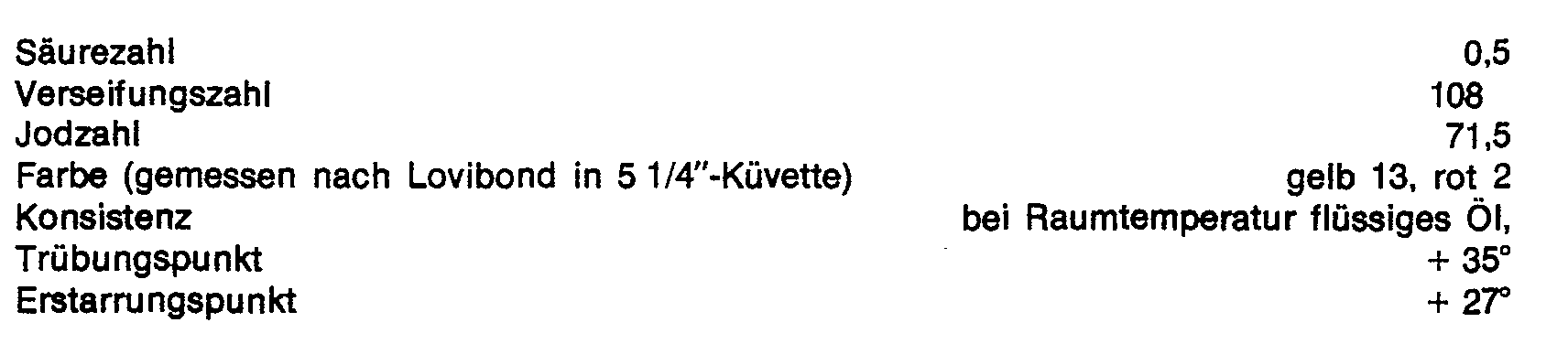
Literatur: J. Marcusson « Die Untersuchung der Fette und Öle*. Verlag Kapp, Halle 1952, S. 33 - In einem 2 1-Dreihalskolben, versehen mit Rührer, Thermometer und Destillationsaufsatz, werden im Stickstoffstrom 522 g Oleyl-Cetylalkohol (OHZ 215, JZ 85) sowie 544 g tierische Fettsäure (SZ 205, JZ 54) bei ca. 100 °C unter Rühren entwässert, Dauer ca. 30 Min. Danach gibt man ca. 1 g einer 28 %igen lsopropyltitanat-Lösung hinzu und erhitzt langsam auf 140-200°C, Dauer ca. 10 Std. Überschüssiger Oleyl-Cetylalkohol wird bei 225 °C/2-3 Torr abdestilliert und das Produkt nach der Raffination mit 50 %iger Natronlauge durch Zusatz von 1 % Aktivkohle und 1 % säureaktivierter Tonerde durch ca. 30-minütiges Erhitzen auf 100 °C im Wasserstrahlvakuum gebleicht. Nach Filtration erhält man ca. 1 kg eines Wachsesters mit folgenden Kennzahlen :
- Wie unter Beispiel 1 beschrieben, wird eine Mischung aus 522 g Oleyl-Cetylalkohol (OHZ 215, JZ 55) und 544 g techn. Ölsäure (SZ 200, JZ 92) verestert, raffiniert und gebleicht. Man erhält ca. 1 kg eines bei Raumtemperatur teilweise erstarrten, flüssigen Wachsesters mit folgenden Kennzahlen :

- Ein Trennöl mit hervorragender Trennwirkung hat folgende Zusammensetzung ;
-

Claims (5)


Applications Claiming Priority (2)
| Application Number | Priority Date | Filing Date | Title |
|---|---|---|---|
| DE2851104 | 1978-11-25 | ||
| DE19782851104 DE2851104A1 (de) | 1978-11-25 | 1978-11-25 | Backtrennoel-komponente |
Publications (2)
| Publication Number | Publication Date |
|---|---|
| EP0011797A1 EP0011797A1 (de) | 1980-06-11 |
| EP0011797B1 true EP0011797B1 (de) | 1982-09-01 |
Family
ID=6055574
Family Applications (1)
| Application Number | Title | Priority Date | Filing Date |
|---|---|---|---|
| EP79104572A Expired EP0011797B1 (de) | 1978-11-25 | 1979-11-19 | Backtrennöl-Komponente |
Country Status (4)
| Country | Link |
|---|---|
| US (1) | US4315040A (de) |
| EP (1) | EP0011797B1 (de) |
| AT (1) | AT362328B (de) |
| DE (2) | DE2851104A1 (de) |
Families Citing this family (9)
| Publication number | Priority date | Publication date | Assignee | Title |
|---|---|---|---|---|
| DE3208930C1 (de) * | 1982-03-12 | 1983-10-13 | Dynamit Nobel Ag, 5210 Troisdorf | Synthetische fluessige Wachsester |
| US4724100A (en) * | 1986-03-26 | 1988-02-09 | Sherex Chemical Company, Inc. | Liquid phase process for producing esters |
| US5662956A (en) * | 1992-03-16 | 1997-09-02 | Emulsion Technology Inc. | Pan and mold release for foods |
| AUPO368896A0 (en) * | 1996-11-19 | 1996-12-12 | Beku Environmental Products Ltd | A lubricant composition |
| USRE38141E1 (en) * | 1997-10-17 | 2003-06-10 | International Flora Technologies Ltd. | Dry emollient compositions |
| US6280746B1 (en) | 1997-10-17 | 2001-08-28 | International Flora Technologies Ltd. | Dry emollient compositions |
| EP0910955A3 (de) * | 1997-10-24 | 2000-03-22 | Unilever N.V. | Wachsester enthaltende Zusammensetzungen |
| CA2249508A1 (en) * | 1997-10-24 | 1999-04-24 | Unilever Plc | Wax ester compositions |
| US20030143312A1 (en) * | 2000-03-16 | 2003-07-31 | Thixo Ltd. | Baking adjuvant |
Family Cites Families (11)
| Publication number | Priority date | Publication date | Assignee | Title |
|---|---|---|---|---|
| US2371284A (en) * | 1945-03-13 | Preparation of sulphated fatty | ||
| US1328556A (en) * | 1918-09-19 | 1920-01-20 | Flora W Bloch | Coating composition for kitchen utensils |
| DE528486C (de) * | 1927-08-16 | 1931-06-27 | Hugues Wassermann | Mittel zum Einfetten von Blechen, Formen oder anderen Backgeraeten |
| US1944887A (en) * | 1931-07-03 | 1934-01-30 | Du Pont | Esters and method of preparing same |
| US2042221A (en) * | 1934-06-05 | 1936-05-26 | Shell Dev | Production of unsaturated esters and products thereof |
| US2559481A (en) * | 1949-01-18 | 1951-07-03 | Don Parsons | Baker's grease |
| US2963372A (en) * | 1959-03-13 | 1960-12-06 | Swift & Co | Pan oil composition and process of making same |
| DE1792683A1 (de) * | 1963-07-11 | 1971-11-18 | Witten Gmbh Chem Werke | Verwendung von bei 0deg. C noch fluessigen Estergemischen als Trennmittel fuer Brot- und Backwaren |
| US4023912A (en) * | 1974-12-30 | 1977-05-17 | Blue Cross Laboratories, Inc. | Solid stick pan lubricant |
| US4112235A (en) * | 1976-10-28 | 1978-09-05 | Uop Inc. | Transesterification of carboxylic acids |
| US4152278A (en) * | 1978-05-19 | 1979-05-01 | The United States Of America As Represented By The Secretary Of Agriculture | Wax esters of vegetable oil fatty acids useful as lubricants |
-
1978
- 1978-11-25 DE DE19782851104 patent/DE2851104A1/de not_active Withdrawn
-
1979
- 1979-11-07 US US06/092,229 patent/US4315040A/en not_active Expired - Lifetime
- 1979-11-19 DE DE7979104572T patent/DE2963626D1/de not_active Expired
- 1979-11-19 EP EP79104572A patent/EP0011797B1/de not_active Expired
- 1979-11-23 AT AT744779A patent/AT362328B/de not_active IP Right Cessation
Also Published As
| Publication number | Publication date |
|---|---|
| ATA744779A (de) | 1980-10-15 |
| US4315040A (en) | 1982-02-09 |
| DE2851104A1 (de) | 1980-06-12 |
| AT362328B (de) | 1981-05-11 |
| DE2963626D1 (en) | 1982-10-28 |
| EP0011797A1 (de) | 1980-06-11 |
Similar Documents
| Publication | Publication Date | Title |
|---|---|---|
| DE3107318C2 (de) | ||
| DE2946565C2 (de) | ||
| DE2705608C2 (de) | Verfahren zur Umlagerung von Fettsäureresten in Fettreaktionsteilnehmern | |
| DE2200461C2 (de) | Konditoreibutter und deren Verwendung | |
| DE2552311C3 (de) | Verfahren zur Herstellung von Öl- und Fettfraktionen durch Umestern | |
| DE1165574B (de) | Verfahren zur Herstellung von als Emulgiermittel fuer Salbengrundlagen dienenden Mischestern | |
| DE1910062A1 (de) | Margarinefett und Verfahren zu seiner Herstellung | |
| EP0011797B1 (de) | Backtrennöl-Komponente | |
| EP0088895B1 (de) | Synthetische flüssige Wachsester | |
| DE19750800A1 (de) | Ungesättigte Palmkernfettalkohole | |
| DE1810061A1 (de) | Verfahren zur Herstellung von Speisefettzusammensetzungen und Speisefettzusammensetzung | |
| DE60101509T2 (de) | Cla-ester | |
| DE2354608A1 (de) | Speisefettzusammensetzung und verfahren zu ihrer herstellung | |
| EP0014308B1 (de) | Biologisch abbaubare, oxidationsstabile, flüssige Estergemische mit niedrigen Trübungspunkten und deren Herstellung | |
| DE68914247T2 (de) | Verflüssigung von Seifenstock. | |
| DE2004098A1 (de) | Nichtsproede,praktisch partialesterfreie Suppositorienmassen und Verfahren zu deren Herstellung | |
| DE2441137C2 (de) | Fettzusammensetzung | |
| DE928843C (de) | Kernoel fuer Giessereizwecke | |
| DE2144252C3 (de) | Verfahren zur Herstellung von synthetischen Esterölen und ihre Verwendung | |
| EP0037017B1 (de) | Fett mit milchfettähnlichen Eigenschaften und Verfahren zu seiner Herstellung | |
| DE2622856A1 (de) | Verfahren zur herstellung von kakaobutterersatz | |
| DE551868C (de) | Verfahren zur Veresterung von Fettsaeuren und fettsaeurehaltigen Gemischen | |
| DE553912C (de) | Verfahren zur Herstellung von Fettsaeuregemischen mit ungerader aus solchen mit gerader Kohlenstoffzahl | |
| DE1792606A1 (de) | Verfahren zum Fraktionieren von OElen und Fetten | |
| DE1078562B (de) | Verfahren zur Herstellung von fuer die Margarinebereitung geeigneten festen Fetten aus Palmoel |
Legal Events
| Date | Code | Title | Description |
|---|---|---|---|
| PUAI | Public reference made under article 153(3) epc to a published international application that has entered the european phase |
Free format text: ORIGINAL CODE: 0009012 |
|
| AK | Designated contracting states |
Designated state(s): BE CH DE FR GB IT NL SE |
|
| 17P | Request for examination filed |
Effective date: 19800626 |
|
| ITF | It: translation for a ep patent filed | ||
| GRAA | (expected) grant |
Free format text: ORIGINAL CODE: 0009210 |
|
| AK | Designated contracting states |
Designated state(s): BE CH DE FR GB IT NL SE |
|
| REF | Corresponds to: |
Ref document number: 2963626 Country of ref document: DE Date of ref document: 19821028 |
|
| PGFP | Annual fee paid to national office [announced via postgrant information from national office to epo] |
Ref country code: SE Payment date: 19911030 Year of fee payment: 13 |
|
| PGFP | Annual fee paid to national office [announced via postgrant information from national office to epo] |
Ref country code: FR Payment date: 19911107 Year of fee payment: 13 |
|
| PGFP | Annual fee paid to national office [announced via postgrant information from national office to epo] |
Ref country code: GB Payment date: 19911108 Year of fee payment: 13 |
|
| ITTA | It: last paid annual fee | ||
| PG25 | Lapsed in a contracting state [announced via postgrant information from national office to epo] |
Ref country code: GB Effective date: 19921119 |
|
| PG25 | Lapsed in a contracting state [announced via postgrant information from national office to epo] |
Ref country code: SE Effective date: 19921120 |
|
| GBPC | Gb: european patent ceased through non-payment of renewal fee |
Effective date: 19921119 |
|
| PG25 | Lapsed in a contracting state [announced via postgrant information from national office to epo] |
Ref country code: FR Effective date: 19930730 |
|
| REG | Reference to a national code |
Ref country code: FR Ref legal event code: ST |
|
| PGFP | Annual fee paid to national office [announced via postgrant information from national office to epo] |
Ref country code: CH Payment date: 19931020 Year of fee payment: 15 |
|
| PGFP | Annual fee paid to national office [announced via postgrant information from national office to epo] |
Ref country code: DE Payment date: 19931026 Year of fee payment: 15 |
|
| PGFP | Annual fee paid to national office [announced via postgrant information from national office to epo] |
Ref country code: NL Payment date: 19931130 Year of fee payment: 15 |
|
| PGFP | Annual fee paid to national office [announced via postgrant information from national office to epo] |
Ref country code: BE Payment date: 19931222 Year of fee payment: 15 |
|
| PG25 | Lapsed in a contracting state [announced via postgrant information from national office to epo] |
Ref country code: CH Effective date: 19941130 Ref country code: BE Effective date: 19941130 |
|
| EUG | Se: european patent has lapsed |
Ref document number: 79104572.7 Effective date: 19930610 |
|
| BERE | Be: lapsed |
Owner name: HENKEL K.G.A.A. Effective date: 19941130 |
|
| PG25 | Lapsed in a contracting state [announced via postgrant information from national office to epo] |
Ref country code: NL Effective date: 19950601 |
|
| NLV4 | Nl: lapsed or anulled due to non-payment of the annual fee | ||
| REG | Reference to a national code |
Ref country code: CH Ref legal event code: PL |
|
| PG25 | Lapsed in a contracting state [announced via postgrant information from national office to epo] |
Ref country code: DE Effective date: 19950801 |
|
| PLBE | No opposition filed within time limit |
Free format text: ORIGINAL CODE: 0009261 |
|
| STAA | Information on the status of an ep patent application or granted ep patent |
Free format text: STATUS: NO OPPOSITION FILED WITHIN TIME LIMIT |