WO2025062573A1 - 基材洗浄装置 - Google Patents
基材洗浄装置 Download PDFInfo
- Publication number
- WO2025062573A1 WO2025062573A1 PCT/JP2023/034315 JP2023034315W WO2025062573A1 WO 2025062573 A1 WO2025062573 A1 WO 2025062573A1 JP 2023034315 W JP2023034315 W JP 2023034315W WO 2025062573 A1 WO2025062573 A1 WO 2025062573A1
- Authority
- WO
- WIPO (PCT)
- Prior art keywords
- mist
- substrate
- cleaning
- gas
- air gas
- Prior art date
- Legal status (The legal status is an assumption and is not a legal conclusion. Google has not performed a legal analysis and makes no representation as to the accuracy of the status listed.)
- Pending
Links
Images





Classifications
-
- B—PERFORMING OPERATIONS; TRANSPORTING
- B08—CLEANING
- B08B—CLEANING IN GENERAL; PREVENTION OF FOULING IN GENERAL
- B08B3/00—Cleaning by methods involving the use or presence of liquid or steam
- B08B3/02—Cleaning by the force of jets or sprays
-
- B—PERFORMING OPERATIONS; TRANSPORTING
- B08—CLEANING
- B08B—CLEANING IN GENERAL; PREVENTION OF FOULING IN GENERAL
- B08B5/00—Cleaning by methods involving the use of air flow or gas flow
- B08B5/02—Cleaning by the force of jets, e.g. blowing-out cavities
-
- B—PERFORMING OPERATIONS; TRANSPORTING
- B08—CLEANING
- B08B—CLEANING IN GENERAL; PREVENTION OF FOULING IN GENERAL
- B08B3/00—Cleaning by methods involving the use or presence of liquid or steam
- B08B3/02—Cleaning by the force of jets or sprays
- B08B3/022—Cleaning travelling work
-
- B—PERFORMING OPERATIONS; TRANSPORTING
- B08—CLEANING
- B08B—CLEANING IN GENERAL; PREVENTION OF FOULING IN GENERAL
- B08B5/00—Cleaning by methods involving the use of air flow or gas flow
- B08B5/02—Cleaning by the force of jets, e.g. blowing-out cavities
- B08B5/023—Cleaning travelling work
-
- H—ELECTRICITY
- H10—SEMICONDUCTOR DEVICES; ELECTRIC SOLID-STATE DEVICES NOT OTHERWISE PROVIDED FOR
- H10P—GENERIC PROCESSES OR APPARATUS FOR THE MANUFACTURE OR TREATMENT OF DEVICES COVERED BY CLASS H10
- H10P72/00—Handling or holding of wafers, substrates or devices during manufacture or treatment thereof
- H10P72/04—Apparatus for manufacture or treatment
- H10P72/0402—Apparatus for fluid treatment
- H10P72/0406—Apparatus for fluid treatment for cleaning followed by drying, rinsing, stripping, blasting or the like
-
- H—ELECTRICITY
- H10—SEMICONDUCTOR DEVICES; ELECTRIC SOLID-STATE DEVICES NOT OTHERWISE PROVIDED FOR
- H10P—GENERIC PROCESSES OR APPARATUS FOR THE MANUFACTURE OR TREATMENT OF DEVICES COVERED BY CLASS H10
- H10P72/00—Handling or holding of wafers, substrates or devices during manufacture or treatment thereof
- H10P72/04—Apparatus for manufacture or treatment
- H10P72/0402—Apparatus for fluid treatment
- H10P72/0406—Apparatus for fluid treatment for cleaning followed by drying, rinsing, stripping, blasting or the like
- H10P72/0411—Apparatus for fluid treatment for cleaning followed by drying, rinsing, stripping, blasting or the like for wet cleaning or washing
- H10P72/0414—Apparatus for fluid treatment for cleaning followed by drying, rinsing, stripping, blasting or the like for wet cleaning or washing using mainly spraying means, e.g. nozzles
Definitions
- This disclosure relates to a substrate cleaning device that cleans substrates, for example, a substrate cleaning device that cleans substrates used in plating processing devices that form metal films in the manufacture of electronic components, etc.
- the cleaning devices disclosed in Patent Documents 1 to 3 basically sprayed a cleaning liquid directly onto the object to clean it.
- the cleaning device disclosed in Patent Document 4 performed cleaning in a mist atmosphere.
- the cleaning device disclosed in Patent Document 5 performed cleaning by spraying a cleaning liquid directly onto the object placed in a mist atmosphere.
- Patent Documents 1 to 5 basically spray the cleaning liquid, including the mist state, directly onto the object to be cleaned, which poses the problem of using a large amount of cleaning liquid.
- the objective of this disclosure is to provide a substrate cleaning device that can solve the above problems and reduce the amount of cleaning liquid used.
- a first air gas spraying unit that performs a first air gas spraying process to obtain the cleaning mist gas by spraying the first air gas onto the cleaning surface of the substrate and merging the first air gas with the relay mist gas, the cleaning mist gas is supplied to the cleaning surface of the substrate by the first air gas spraying process, the flow rate of the relay mist gas is set to an initial mist flow rate, the flow rate of the first air gas is set to a first air gas flow rate, and the first air gas flow rate is set to a rate higher than the initial mist flow rate.
- the mist gas supply mechanism in the substrate cleaning device disclosed herein is configured to include the mist ejection section and the first air gas spray section described above, and the first air gas flow rate is set to be faster than the initial mist flow rate.
- the substrate cleaning device disclosed herein can reduce the amount of cleaning liquid used and remove the material adhering to the cleaning surface of the substrate.
- FIG. 1 is an explanatory diagram illustrating a schematic overall configuration of a substrate cleaning device according to a first embodiment
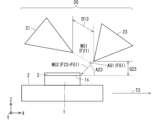
- 2 is an explanatory diagram illustrating a schematic configuration of the mist gas supply mechanism illustrated in FIG. 1
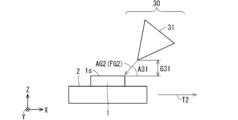
- FIG. 2 is an explanatory diagram illustrating a schematic view of an air knife and its periphery in the liquid cutting mechanism shown in FIG. 1
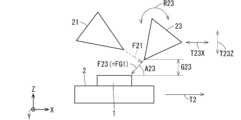
- 10 is an explanatory diagram illustrating a schematic diagram of an adjustment function of an air knife in a mist gas supply mechanism.
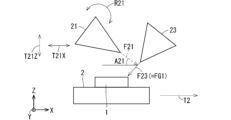
- FIG. 10 is an explanatory diagram illustrating a schematic diagram of an adjustment function of a mist ejection part in a mist gas supply mechanism.
- FIG. 6 is a block diagram showing a configuration for realizing the adjustment functions of the mist ejection portion and the air knife shown in FIGS. 4 and 5 .
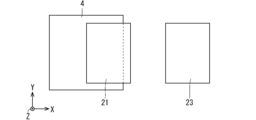
- FIG. 2 is an explanatory diagram showing the mist diffusion prevention plate shown in FIG. 1 and its surroundings.
- FIG. 4 is an explanatory diagram showing a planar configuration of a mist diffusion prevention plate.
- FIG. 2 is an explanatory diagram showing the configuration of a comparative substrate cleaning device.
- FIG. 11 is an explanatory diagram illustrating a schematic overall configuration of a substrate cleaning device according to a second embodiment. 11 is an explanatory diagram illustrating a schematic configuration of the mist gas supply mechanism illustrated in FIG. 10.
- 12 is an explanatory diagram showing the structure of the suction mechanism shown in FIG. 10 and FIG. 11 .
- the substrate cleaning device of the present disclosure is a device for cleaning a substrate, for example, a device for cleaning a substrate used in a plating processing device that forms a metal film in the manufacture of electronic components, etc.
- a more specific example is a substrate cleaning device that cleans the plating solution attached to a substrate to be treated, such as a metal substrate or a printed circuit board, after plating in a plating process.
- a substrate 1 after plating there are plated regions and regions that are not plated and where plating solution remains, and the plating solution remaining in each of the former and latter regions is the cleaning target to be removed.
- ⁇ First embodiment> 1 is an explanatory diagram showing a schematic diagram of the overall configuration of a substrate cleaning apparatus 51 according to the embodiment 1. An XYZ orthogonal coordinate system is shown in the figure.
- the substrate cleaning device 51 includes as its main components a conveying means, an ultrasonic atomizer 11, a mist supply pipe 12, a mist gas supply mechanism 20, and a liquid draining mechanism 30.
- the transport means includes the transport table 2 described above and a transport machine such as a conveyor (not shown).
- the transport means performs a transport operation of transporting the substrate 1 along the table transport direction T2 (+X direction) by moving the transport table 2 along the table transport direction T2 using the transport machine.
- the ultrasonic atomizer 11 contains a cleaning liquid (not shown) and generates a cleaning liquid mist MT with a droplet size of 15 ⁇ m or less by applying ultrasonic vibrations to the cleaning liquid.
- the cleaning liquid mist MT generated by the ultrasonic atomizer 11 is supplied to the mist ejection portion 21 of the mist gas supply mechanism 20 via the mist supply pipe 12 by a carrier gas (not shown).
- pure water is used as the cleaning liquid.
- cleaning liquid mist MT other than the ultrasonic propagation method that applies ultrasonic vibrations to the cleaning liquid, other techniques for generating cleaning liquid mist MT include pressure, rotation, steam, piezoelectric, thermal, electrostatic, etc. However, when generating cleaning liquid mist MT with a relatively small (droplet) particle size of 15 ⁇ m or less, it is preferable to adopt the ultrasonic vibration propagation method.
- the mist gas supply mechanism 20 supplies cleaning mist gas MG2, which contains cleaning liquid mist MT made by turning cleaning liquid into a mist, toward the surface of the substrate 1 in order to clean the object 3 adhering to the surface, which is the cleaning surface of the substrate 1.
- the mist gas supply mechanism 20 includes as its main components a mist ejection section 21 and an air knife 23, which is the first air gas spraying section.
- the mist ejection section 21 ejects relay mist gas MG1 containing cleaning liquid mist MT along a mist ejection direction F21.
- the relay mist gas MG1 is supplied to the outlet or the periphery of the outlet of the air gas AG1 of the air knife 23.
- the flow velocity of the relay mist gas MG1 is defined as the mist gas flow velocity V21. This mist gas flow velocity V21 becomes the initial mist flow velocity.
- the mist ejection section 21 is realized, for example, by transporting the cleaning liquid mist MT using an ejection carrier gas (not shown) having a direction along the mist gas ejection direction F21. In this case, the mixture of the cleaning liquid mist MT and the carrier gas becomes the relay mist gas MG1.
- the particle size of the cleaning liquid mist MT generated by applying ultrasonic vibrations in the ultrasonic atomizer 11 is 15 ⁇ m or less, which is smaller than the particle size of a typical spray mist, and the falling speed of the cleaning liquid mist MT is slow, so it is possible to handle the cleaning liquid mist MT as relay mist gas MG1 by placing it on a gas flow having a directional mist gas ejection direction F21.
- the air knife 23 which is the first air gas spraying section, sprays air gas AG1 along the air gas spraying direction FG1 to the relay mist gas MG1 during the period in which the above-mentioned transport operation is being performed by the transport means described above, and performs a first air gas spraying process in which the air gas AG1 is merged with the relay mist gas MG1 to obtain a cleaning mist gas MG2.
- the air gas AG1 becomes the first air gas, and air, nitrogen, etc. are used as the air gas AG1.
- the air gas flow velocity VG1 is set to be faster than the mist gas flow velocity V21.
- the speed ratio ⁇ VG1:V21 ⁇ between the air gas flow velocity VG1 and the mist gas flow velocity V21 is set to, for example, ⁇ 10:1 ⁇ .
- the air gas flow velocity VG1 is set to be faster than the mist gas flow velocity V21, when the relay mist gas MG1 merges with the air gas AG1, it is caught in the flow of the air gas AG1 and is thus significantly affected by the air gas AG1.
- the flow velocity of the cleaning mist gas MG2 is the mist gas flow velocity V23
- the supply direction of the cleaning mist gas MG2 is the mist gas supply direction F23.
- the cleaning mist gas MG2 is significantly affected by the air gas AG1, so the mist gas supply direction F23 is the same as the air gas spraying direction FG1, and the mist gas flow velocity V23 is approximately the same as the air gas flow velocity VG1. This is because the mist gas flow velocity V21 of the relay mist gas MG1 is slower than the air gas flow velocity VG1 of the air gas AG1, and so the Coanda effect occurs.
- the mist gas supply direction F23 is the same as the air gas spray direction FG1
- the mist gas flow velocity V23 is approximately the same as the air gas flow velocity VG1.
- the cleaning mist gas MG2 obtained by merging the relay mist gas MG1 with the air gas AG1 passes under the mist diffusion prevention plate 4, which will be described in detail later, and is supplied toward the transport path of the transport table 2, which is transported along the table transport direction T2.
- the cleaning mist gas MG2 supplied by the first air gas spraying process is sprayed directly onto the surface of the substrate 1 while the transport means is performing the transport operation.
- the mist gas flow velocity V23 of the cleaning mist gas MG2 is approximately the same as the air gas flow velocity VG1 of the air gas AG1, so the mist gas is sprayed directly onto the object 3 attached to the surface of the substrate 1 at a relatively high mist gas flow velocity V23. Therefore, the object 3, such as the plating solution, can be washed away by the cleaning mist gas MG2 having the mist gas flow velocity V23.
- the cleaning mist gas MG2 containing the cleaning liquid mist MT is sprayed onto the surface of the substrate 1, and the object 3 attached to the surface of the substrate 1 is removed or decomposed, thereby cleaning the object 3 to be cleaned.
- the liquid cutting mechanism 30 includes an air knife 31 as a main component.
- the air knife 31, which is the second air gas spraying section, is positioned downstream of the air knife 23, which is the first air gas spraying section, in the table conveying direction T2.
- the air gas AG2 blown out by the air knife 31, which is the second air gas blowing section, along the air gas blowing direction FG2 passes under the mist diffusion prevention plate 4 and is supplied toward the transport path of the transport table 2, which is transported along the table transport direction T2, during the period during which the transport operation is being performed by the transport means described above.
- the air knife 31 which is the second air gas spraying section, performs a second air gas spraying process in which the second air gas, air gas AG2, is directly sprayed onto the residue remaining on the surface of the substrate 1 during the period in which the above-mentioned conveying operation is being performed by the conveying means described above.
- the air gas spraying direction FG1 of the air gas AG1 (mist gas supply direction F23) and the air gas spraying direction FG2 of the air gas AG2 each have a directional component in the transport counter direction (-X direction) that is opposite to the table transport direction T2.
- the second air gas spraying process using the air knife 31 can remove any remaining material on the surface of the substrate 1.
- the remaining material may be a part of the object to be removed 3, cleaning liquid, etc.
- the table transport direction T2 of the substrate 1 is the horizontal direction (X direction), but the table transport direction T2 may be inclined with respect to the X direction, or the table transport direction T2 may be the vertical direction (Z direction).
- the surface to be cleaned of the substrate 1 is the front surface (upper surface) of the substrate 1, but the back surface (lower surface) of the substrate 1 may also be the surface to be cleaned.
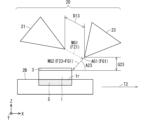
- FIG. 2 is an explanatory diagram showing a schematic configuration of the mist gas supply mechanism 20.
- the distance along the mist gas ejection direction F21 until the relay mist gas MG1 joins the air gas AG1 is the output port distance D13.
- the output port distance D13 is the distance from the ejection port (tip portion) of the mist ejection part 21 to the peripheral area of the blowing port (tip portion) of the air knife 23.
- This output port distance D13 is set so that the relay mist gas MG1 and the air gas AG1 join together to accurately obtain cleaning mist gas MG2 having a directionality of the mist gas supply direction F23 that matches the air gas blowing direction FG1.
- the gap G23 which is the distance in the vertical direction (Z direction) from the surface 1s of the substrate 1 that is to be cleaned to the air outlet of the air knife 23, is set to a length that maximizes the removal effect of the object 3.
- the gas flow supply angle A23 which is the angle of the mist gas supply direction F23 with respect to the table transport direction T2 (+X direction), is set in the range of 0 to 90 degrees (greater than 0 degrees and less than 90 degrees: 0 (degrees) ⁇ A23 ⁇ 90 (degrees)). This gas flow supply angle A23 becomes the first air gas spray angle.
- the gas flow supply angle A23 which is the first air gas spray angle
- the gas flow supply angle A23 which is the first air gas spray angle
- the gas supply pressure to the air knife 23 is set to a pressure that will obtain the desired air gas flow velocity VG1.
- FIG. 3 is an explanatory diagram showing a schematic diagram of the air knife 31 and its surroundings.
- the air gas flow velocity VG2 (second air gas flow velocity) of the air gas AG2 (second air gas) blown out from the air knife 31, which is the second air gas blowing section, is set so that the effect of removing the residue on the surface of the substrate 1 is maintained at a desired removal level, and the degree of dryness of the surface of the substrate 1 is set to a predetermined dryness level or lower.
- the air gas flow velocity VG2 can be adjusted by the gas supply pressure to the air knife 31.
- the gap G31 in the vertical direction (Z direction) from the surface of the substrate 1 to be cleaned to the air outlet of the air knife 31 is set to a distance that is effective in removing residual material and does not move the substrate 1 placed on the conveyor table 2. If the gap G31 is too short, the wind force of the air gas AG2 will be large, and there is a possibility that the substrate 1 will move from the conveyor table 2.
- the gas flow supply angle A31 which is the angle of the air gas spraying direction FG2 with respect to the table transport direction T2 (X direction), is set in the range of 0 to 90 degrees (greater than 0 degrees and less than 90 degrees: 0 (degrees) ⁇ A31 ⁇ 90 (degrees)).
- This gas flow supply angle A23 becomes the second air gas spraying angle.
- the gas flow supply angle A31 which is the second air gas spray angle, outside the range of 0 to 90 degrees, since when the residual material is swept away and removed, the residual material may flow over the surface of the substrate 1 that is to be cleaned, thereby contaminating the surface of the substrate 1.
- FIG. 4 is an explanatory diagram showing a schematic of the adjustment function of the air knife 23.
- FIG. 5 is an explanatory diagram showing a schematic of the adjustment function of the mist ejection part 21.
- FIG. 6 is a block diagram showing the configuration for realizing the adjustment functions of the mist ejection part 21 and the air knife 23.
- the air knife 23 is connected to an air knife rotation mechanism 23R and an air knife movement mechanism 23M.
- the air knife moving mechanism 23M is a mechanism that moves the air knife 23 along the moving direction T23X or the moving direction T23Z. Therefore, the substrate cleaning device 51 having the air knife moving mechanism 23M has a first spraying unit moving function that moves the air knife 23, which is the first air gas spraying unit, along the moving direction T23X or the moving direction T23Z.
- the moving direction T23X is parallel to the X direction
- the moving direction T23Z is parallel to the Z direction.
- the air knife rotation mechanism 23R is a mechanism that rotates the air knife 23 along the rotation direction R23, with a predetermined location of the air knife 23 in the XZ plane as the rotation axis. Therefore, the substrate cleaning device 51 having the air knife rotation mechanism 23R has a first spray angle adjustment function that adjusts the gas flow supply angle A23, which is the first air gas spray angle, by rotating the air knife 23 along the rotation direction R23.
- the air knife movement mechanism 23M can have any configuration as long as it can move the air knife 23 without changing the gas flow supply angle A23, and can be realized with existing technology.
- the air knife rotation mechanism 23R can have any configuration as long as it can rotate the air knife 23 along the rotation direction R23, and can be realized with existing technology.
- the mist ejection part 21 is connected to a mist ejection part rotation mechanism 21R and a mist ejection part movement mechanism 21M.
- the mist spraying part moving mechanism 21M is a mechanism that moves the mist spraying part 21 along the moving direction T21X or the moving direction T21Z. Therefore, the substrate cleaning device 51 having the mist spraying part moving mechanism 21M has a spraying part moving function that moves the mist spraying part 21 along the moving direction T21X or the moving direction T23Z.
- the moving direction T21X is parallel to the X direction
- the moving direction T21Z is parallel to the Z direction.
- the mist sprayer rotation mechanism 21R is a mechanism that rotates the mist sprayer 21 along the rotation direction R21, with a predetermined location of the mist sprayer 21 in the XZ plane as the rotation axis. Therefore, the substrate cleaning device 51 having the mist sprayer rotation mechanism 21R has a spray angle adjustment function that adjusts the mist supply angle A21, which is the mist spray angle with respect to the table transport direction T2, by rotating the mist sprayer 21 along the rotation direction R21.
- the mist supply angle A21 is set in the range of 0 to 90 degrees (greater than 0 degrees and less than 90 degrees: 0 (degrees) ⁇ A21 ⁇ 90 (degrees)).
- the mist ejection part movement mechanism 21M can have any configuration as long as it can move the mist ejection part 21 without changing the mist supply angle A21, and can be realized with existing technology.
- the mist ejection part rotation mechanism 21R can have any configuration as long as it can rotate the air knife 23 along the rotation direction R21, and can be realized with existing technology.
- the substrate cleaning apparatus 51 of the first embodiment has a mist diffusion prevention plate 4.
- the mist diffusion prevention plate 4 is disposed between the mist gas supply mechanism 20 and the substrate 1, and has a flat plate shape. The plate shape is along the XY plane.
- FIG. 7 is an explanatory diagram showing the mist diffusion prevention plate 4 and its surroundings
- FIG. 8 is an explanatory diagram showing the planar configuration of the mist diffusion prevention plate 4.
- FIG. 7 and FIG. 8 shows an XYZ Cartesian coordinate system.
- the mist diffusion prevention plate 4 is positioned so as to provide a diffusion suppression space S1 having a predetermined gap G4 without impeding the supply of the cleaning mist gas MG2 to the surface 1s, which is the cleaning surface of the substrate 1.
- the gap G4 is the distance along the Z direction between the back surface 4r of the mist diffusion prevention plate 4 and the surface 1s of the substrate 1, and the diffusion suppression space S1 is a space having the gap G4 formed between the surface 1s of the substrate 1 and the back surface 4r of the mist diffusion prevention plate 4.
- the planar shape of the mist diffusion prevention plate 4 is set to be sufficiently wide so that most of the space above the surface 1s of the base material 1 can be used as the diffusion suppression space S1.
- the gap G4 which is the specified gap, sufficiently short to narrow the diffusion suppression space S1, it is possible to suppress the diffusion of the cleaning liquid mist MT contained in the cleaning mist gas MG2. It is desirable to set the gap G4 ( ⁇ m) within the range that satisfies ⁇ 15 ⁇ m ⁇ G4 ⁇ 50 mm ⁇ .
- the cleaning liquid mist MT is assumed to have a particle size (of droplets) of 15 ⁇ m or less, and the gap G4 is set to a length that exceeds the particle size of the cleaning liquid mist MT.
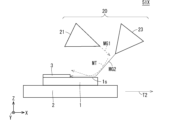
- FIG. 9 is an explanatory diagram showing the configuration of a comparative substrate cleaning device 51X, which assumes that the mist diffusion prevention plate 4 is not included in the substrate cleaning device 51 of embodiment 1.
- the XYZ orthogonal coordinate system is shown in the figure.
- FIG. 9 shows a state in which the object to be removed 3 is attached to part of the surface of the substrate 1.
- the cleaning liquid mist MT contained in the cleaning mist gas MG2 is lightweight, so a portion of the cleaning liquid mist MT diffuses above the substrate 1.
- the comparative substrate cleaning device 51X does not have a mist diffusion prevention plate 4, so it cannot suppress the diffusion phenomenon of the cleaning liquid mist MT.
- the cleaning mist gas MG2 becomes a drier gas, and as a result of the dry cleaning mist gas MG2 being sprayed onto the surface 1s of the substrate 1, the surface 1s of the substrate 1 becomes more likely to dry. If the surface 1s of the substrate 1 in a dried state oxidizes, the surface 1s of the substrate 1 becomes dirty.
- the substrate cleaning apparatus 51 of embodiment 1 the space above the surface 1s of the substrate 1 is narrowed to the diffusion suppression space S1 due to the presence of the mist diffusion prevention plate 4, so that the diffusion of the cleaning liquid mist MT contained in the cleaning mist gas MG2 can be effectively suppressed. Therefore, the substrate cleaning apparatus 51 of embodiment 1 can prevent the surface 1s from drying out, thereby avoiding the phenomenon in which the surface 1s becomes dirty due to oxidation.
- the mist gas supply mechanism 20 in the substrate cleaning apparatus 51 according to the first embodiment of the present disclosure is configured to include a mist ejection section 21 and an air knife 23, and the first air gas flow velocity, VG1, is set to be faster than the mist gas flow velocity V21 of the relay mist gas MG1.
- the cleaning mist gas MG2 obtained by merging the relay mist gas MG1 with the air gas AG1 is influenced by the air gas AG1, so that the mist gas supply direction F23 of the cleaning mist gas MG2 is the same as the air gas spray direction FG1, and the mist gas flow velocity V23 is approximately the same as the air gas flow velocity VG1.
- the air gas flow velocity VG1 to the flow velocity required for cleaning the surface 1s, which is the cleaning surface of the substrate 1
- the amount of cleaning liquid mist MT contained in the cleaning mist gas MG2 can be kept to a minimum, and the cleaning liquid mist MT can be efficiently supplied to the surface of the substrate 1.
- the substrate cleaning device 51 of embodiment 1 can reduce the amount of cleaning liquid used and remove the object 3 adhering to the surface of the substrate 1.
- the substrate cleaning device 51 of the first embodiment supplies cleaning mist gas MG2 onto the transport path of the transport table 2, and by directly spraying the cleaning mist gas MG2 containing the cleaning liquid mist MT onto the surface of the substrate 1, the object 3 to be removed that is attached to the surface of the substrate 1 can be removed with high precision.
- the substrate 1 was a Hull Cell copper substrate with a planar size of 100 mm x 100 mm and a thickness of 0.3 mm. 2 mL of nickel plating solution was dropped onto the surface to be cleaned, and the dropped plating solution was spread to remove unnecessary plating solution. In this way, nickel plating solution with a weight of 0.6 to 0.7 g and a thickness of approximately 0.5 mm was attached to the surface of the substrate 1 as the object to be removed 3.
- cleaning mist gas MG2 is sprayed from the mist gas supply mechanism 20 onto the surface of the substrate 1, and the remaining material on the surface of the substrate 1 is removed with the air knife 31.
- an atmosphere of the cleaning mist gas MG2 can be formed on the surface of the conveyor table 2, the object 3 attached to the surface of the substrate 1 can be removed without directly spraying the cleaning mist gas MG2 onto the surface of the substrate 1.
- an indirect supply environment of the cleaning mist gas MG2 can be considered, in which a conveyor path for the conveyor table 2 is provided on the leeward side of the cleaning mist gas MG2, and the surface of the substrate 1 passes through an atmosphere of the cleaning mist gas MG2.
- an environment in which the cleaning mist gas MG2 is sprayed directly onto the surface of the substrate 1 is more preferable than an environment in which the cleaning mist gas MG2 is indirectly supplied.
- the substrate cleaning device 51 of the first embodiment can precisely remove any residue remaining on the surface 1s of the substrate 1 by blowing the second air gas, AG2, from the air knife 31, which is the second air gas spraying section, directly onto the surface 1s of the substrate 1, which is the cleaning surface.
- the substrate cleaning device 51 of the first embodiment is equipped with an ultrasonic atomizer 11, and is therefore capable of supplying cleaning liquid mist MT with a relatively small particle size, for example 15 ⁇ m or less, to the mist ejection section 21 via the mist supply pipe 12.
- the cleaning liquid mist MT contained in the cleaning mist gas MG2 supplied from the substrate cleaning device 51 of embodiment 1 can penetrate even the finest parts on the surface of the substrate 1, and by limiting the amount of cleaning liquid contained in one droplet of the cleaning liquid mist MT, the amount of cleaning liquid used can be kept to a minimum.
- the air gas spraying direction FG1 (mist gas supply direction F23) has a directional component in the transport counter direction that is opposite to the table transport direction T2, and the gas flow supply angle A23, which is the first air gas spraying angle, is set in the range of 0 to 90 degrees (0 (degrees) ⁇ A23 ⁇ 90 (degrees)).
- the substrate cleaning device 51 of embodiment 1 can accurately remove the object 3 attached to the surface of the substrate 1.
- the substrate cleaning device 51 of embodiment 1 has a first spray section movement function realized by the air knife movement mechanism 23M and a first spray angle adjustment function realized by the air knife rotation mechanism 23R.
- the mist gas ejection direction F21 includes a directional component in the table transport direction T2 (+X direction), and the mist supply angle A21, which is the mist ejection angle relative to the table transport direction T2, is set in the range of 0 to 90 degrees (0 (degrees) ⁇ A21 ⁇ 90 (degrees)).
- the air knife 23 which is the first air gas spraying section
- the air gas spraying direction FG1 which is the first air gas spraying direction
- the gas flow supply angle A23 which is the first air gas spraying angle
- the air knife 23 in the substrate cleaning device 51 of embodiment 1 can relatively easily perform the first air gas spraying process on the relay mist gas MG1 sprayed from the mist spraying section 21.
- the mist supply angle A21 is set to a range of 0 to 90 degrees, including a directional component of the table transport direction T2, so that the mist is supplied to the air gas AG1 outlet or the vicinity of the outlet of the air knife 23.
- the cleaning mist gas MG2 is significantly affected by the air gas AG1, so even in the modified example, it is possible to obtain cleaning mist gas MG2 that is sprayed directly onto the object 3 to be removed by the air gas AG1.
- the substrate cleaning device 51 of the first embodiment has a mist sprayer moving function using the mist sprayer moving mechanism 21M and a spray angle adjustment function using the mist sprayer rotation mechanism 21R.
- the substrate cleaning device 51 of the first embodiment can adjust the confluence point of the relay mist gas MG1 and the air gas AG2 so as to enhance the effect of removing the object 3 adhering to the surface of the substrate 1.
- the mist diffusion prevention plate 4 in the substrate cleaning device 51 of embodiment 1 is positioned so as to provide a diffusion suppression space S1 with a gap G4 that is a predetermined gap between the surface 1s of the substrate 1 and the mist diffusion prevention plate 4, without impeding the supply of the cleaning mist gas MG2 to the surface 1s, which is the cleaning surface of the substrate 1.
- the substrate cleaning device 51 of the first embodiment can exert a mist diffusion suppression effect that effectively suppresses the phenomenon in which the cleaning liquid mist MT contained in the cleaning mist gas MG2 diffuses from the surface 1s of the substrate 1 by restricting the space in contact with the surface 1s of the substrate 1 to a relatively narrow diffusion suppression space S1 using the mist diffusion prevention plate 4.
- the cleaning liquid mist MT is present in the relatively narrow diffusion suppression space S1, and the mist diffusion suppression effect described above can increase the rate of adhesion to the surface 1s of the substrate 1.
- the substrate cleaning device 51 of embodiment 1 can prevent the surface 1s, which is the cleaning surface of the substrate 1, from drying and oxidizing due to the mist diffusion suppression effect, and can remove the object 3 to be removed without contaminating the surface 1s.
- a gap G4 (predetermined gap) is set to a length that exceeds the particle size of the cleaning liquid mist MT.
- the cleaning liquid mist MT is obtained by the ultrasonic atomizer 11, so the gap G4 is set to a length that exceeds 15 ⁇ m. This is because the particle size of the cleaning liquid mist MT generated by the ultrasonic atomizer 11 is 15 ⁇ m or less.
- the gap G4 it is desirable to set the gap G4 within a range that satisfies ⁇ 15 ⁇ m ⁇ G4 ⁇ 50 mm ⁇ so that the mist diffusion suppression effect is not reduced. In other words, it is desirable to set the upper limit of the gap G4 to about 50 mm.
- the substrate cleaning device 51 of the first embodiment can supply the cleaning liquid mist MT contained in the cleaning mist gas MG2 to the diffusion suppression space S1 of the relatively narrow gap G4 without any problems.
- Fig. 10 is an explanatory diagram showing a schematic diagram of the overall configuration of a substrate cleaning apparatus 52 according to embodiment 2.
- Fig. 11 is an explanatory diagram showing a schematic diagram of a mist gas supply mechanism 20. An XYZ orthogonal coordinate system is depicted in each of Figs. 10 and 11.
- the transport means in the substrate cleaning device 52 of embodiment 2, like embodiment 1, includes a transport table 2B on which the substrate 1 is placed, and the transport operation is performed by moving the transport table 2B in the table transport direction T2.
- the conveying table 2B has an adsorption mechanism 5 in the upper part that adsorbs the back surface 1r of the substrate 1.
- the substrate cleaning device 52 of the second embodiment is characterized by having a conveying table 2B with an adsorption mechanism 5.
- FIG. 12 is an explanatory diagram showing a schematic structure of the suction mechanism 5.
- the suction mechanism 5 has a suction path 5r and a plurality of suction holes 5h that communicate with the suction path 5r.
- the plurality of suction holes 5h are arranged at positions that overlap with the rear surface of the substrate 1 in a plan view.
- the suction mechanism 5 has a suction path 5r and a plurality of suction holes 5h, and adsorbs the substrate 1 from the rear surface 1r through the plurality of suction holes 5h by vacuum suction.
- the cleaning mist gas MG2 obtained by the first air gas spraying process of the air knife 23 is sprayed directly onto the surface of the substrate 1, so there is a possibility that the substrate 1 placed on the conveyor table 2B may move.
- the conveyor table 2B has an adsorption mechanism 5, so that the substrate 1 can be adsorbed from the back surface 1r by the adsorption mechanism 5, and the substrate 1 can be stably and tightly fixed on the conveyor table 2 even when exposed to the cleaning mist gas MG2.
- the suction mechanism 5 functions as a porous suction plate having multiple suction holes 5h, even if the substrate 1 has a thin structure with a thickness of 1 mm or less, the substrate 1 can be tightly fixed on the conveyor table 2 so that the substrate 1 does not move due to the cleaning mist gas MG2.
- the adsorption mechanism 5 functions as a porous adsorption plate, no gaps are generated between the surface of the adsorption mechanism 5 and the surface 1s of the substrate 1 due to deformation or deformation of the substrate 1 caused by localized adsorption.
- the substrate cleaning device 52 of embodiment 2 can reliably avoid deformation of the substrate 1, the occurrence of gaps, etc., and can reliably avoid the phenomenon in which the flow of the cleaning mist gas MG2 containing the cleaning liquid mist MT is obstructed.
- the suction mechanism 5 included in the conveying table 2B uses a plurality of suction holes 5h to suction the substrate 1 from the back surface 1r, so that when the cleaning mist gas MG2 or air gas AG2 is directly sprayed onto the surface of the substrate 1 to be cleaned, the substrate 1 can be stably placed on the conveying table 2B. In this case, even if the thickness of the substrate 1 is 1 mm or less, the substrate 1 can be stably placed on the conveying table 2B.
- the multiple suction holes 5h are provided so as to overlap on the back surface of the substrate in a plan view, the substrate 1 is not deformed when the suction mechanism 5 suctions the substrate 1. Therefore, no gap is generated between the suction mechanism 5 and the back surface 1r of the substrate 1 due to deformation of the substrate 1.
- the substrate cleaning device 52 of embodiment 2 can supply the cleaning mist gas MG2 to the surface of the substrate 1 without any hindrance when the first air gas spraying process is performed by the air knife 23, which is the first air gas spraying section, and can accurately remove the object 3 to be removed that is attached to the surface of the substrate 1.
- the substrate cleaning device 52 of embodiment 2 can supply air gas AG2 to the surface of the substrate 1 without hindrance when the second air gas spraying process is performed by the air knife 31, which is the second air gas spraying section, so that any residue remaining on the surface of the substrate 1 can be removed with high accuracy.
- the substrate cleaning apparatus 51 of embodiment 1 and the substrate cleaning apparatus 52 of embodiment 2 have been shown as substrate cleaning apparatuses of the present disclosure, but the present disclosure is not limited to these embodiments and can be modified within the scope of the gist of the disclosure.
- pure water is used as the cleaning liquid, but other possible solutions include alkaline degreasing liquids (solutions containing sodium hydroxide or phosphoric acid) and acidic degreasing liquids (solutions containing sulfuric acid or hydrochloric acid).
- alkaline degreasing liquids and acidic degreasing liquids are effective cleaning liquids.
- the substrate cleaning device disclosed herein can also be used in acid cleaning processes using a solution containing sulfuric acid as the cleaning liquid, etching processes using a solution containing iron (III) chloride as the cleaning liquid, surface modification processes using a solution containing a metal organic compound such as TEOS as the cleaning liquid, and resist agent removal processes using a solution containing sodium hydroxide as the cleaning liquid.
- the object to be removed 3 is assumed to be plating liquid, but other possible objects to be removed 3 include solid fine particles such as dust, dirt, and particles, organic compounds such as oil, and metal and inorganic compounds such as rust and metal oxide films.
- plating removal products such as those from plating solutions
- metal salts which are sources of metal ions.
- metal salts include copper sulfate and nickel sulfate.
- the table transport direction T2 which is the transport direction of the substrate 1, is set to a horizontal direction along the X direction, but the table transport direction T2 may be significantly inclined with respect to the X direction. Furthermore, the table transport direction T2 may be set to a vertical direction along the Z direction. In other words, the table transport direction T2 can be set arbitrarily, provided that the cleaning mist gas MG2 is sprayed onto the surface of the substrate 1 during the transport operation.
- the substrate 1 and the conveyor table 2B may be closely and securely fixed to each other by a fixing means for the substrate 1 other than the adsorption mechanism 5 under the condition that the substrate 1 is stably and closely fixed to the conveyor table 2B even when the substrate 1 is exposed to the cleaning mist gas MG2 and the air gas AG2 without impeding the flow of the cleaning mist gas MG2.
Landscapes
- Cleaning By Liquid Or Steam (AREA)
- Application Of Or Painting With Fluid Materials (AREA)
- Cleaning Or Drying Semiconductors (AREA)
Priority Applications (6)
| Application Number | Priority Date | Filing Date | Title |
|---|---|---|---|
| DE112023003433.8T DE112023003433T5 (de) | 2023-09-21 | 2023-09-21 | Substratreinigungsgerät |
| CN202380070197.3A CN120035488A (zh) | 2023-09-21 | 2023-09-21 | 基材清洗装置 |
| KR1020257012331A KR20250070073A (ko) | 2023-09-21 | 2023-09-21 | 기재 세정 장치 |
| JP2024515140A JP7827837B2 (ja) | 2023-09-21 | 2023-09-21 | 基材洗浄装置 |
| PCT/JP2023/034315 WO2025062573A1 (ja) | 2023-09-21 | 2023-09-21 | 基材洗浄装置 |
| TW113122706A TW202514776A (zh) | 2023-09-21 | 2024-06-19 | 基材洗淨裝置 |
Applications Claiming Priority (1)
| Application Number | Priority Date | Filing Date | Title |
|---|---|---|---|
| PCT/JP2023/034315 WO2025062573A1 (ja) | 2023-09-21 | 2023-09-21 | 基材洗浄装置 |
Publications (1)
| Publication Number | Publication Date |
|---|---|
| WO2025062573A1 true WO2025062573A1 (ja) | 2025-03-27 |
Family
ID=95072355
Family Applications (1)
| Application Number | Title | Priority Date | Filing Date |
|---|---|---|---|
| PCT/JP2023/034315 Pending WO2025062573A1 (ja) | 2023-09-21 | 2023-09-21 | 基材洗浄装置 |
Country Status (6)
| Country | Link |
|---|---|
| JP (1) | JP7827837B2 (https=) |
| KR (1) | KR20250070073A (https=) |
| CN (1) | CN120035488A (https=) |
| DE (1) | DE112023003433T5 (https=) |
| TW (1) | TW202514776A (https=) |
| WO (1) | WO2025062573A1 (https=) |
Citations (7)
| Publication number | Priority date | Publication date | Assignee | Title |
|---|---|---|---|---|
| JPS6095991U (ja) * | 1983-12-02 | 1985-06-29 | 株式会社 東京精密 | 洗浄用ノズル |
| WO2001000336A1 (en) * | 1999-06-24 | 2001-01-04 | Sumitomo Heavy Industries, Ltd. | Method and device for washing by fluid spraying |
| JP2005012197A (ja) * | 2003-05-26 | 2005-01-13 | Sumitomo Heavy Ind Ltd | エアロゾル洗浄方法及び装置 |
| JP2006287169A (ja) * | 2004-07-09 | 2006-10-19 | Sekisui Chem Co Ltd | 基材処理装置及び方法 |
| JP2007033730A (ja) * | 2005-07-26 | 2007-02-08 | Optrex Corp | 洗浄装置及び液晶パネルの製造方法 |
| JP2007324359A (ja) * | 2006-05-31 | 2007-12-13 | Choonpa Jozosho Kk | 洗浄方法と洗浄装置 |
| JP2009136742A (ja) * | 2007-12-05 | 2009-06-25 | Pioneer Electronic Corp | 基板洗浄装置 |
Family Cites Families (7)
| Publication number | Priority date | Publication date | Assignee | Title |
|---|---|---|---|---|
| JP3565690B2 (ja) | 1997-09-02 | 2004-09-15 | 株式会社プレテック | 密閉型洗浄装置およびこの装置を用いて精密基板を洗浄する方法 |
| JP2005166792A (ja) * | 2003-12-01 | 2005-06-23 | Dainippon Screen Mfg Co Ltd | 基板処理装置 |
| JP2006140306A (ja) * | 2004-11-12 | 2006-06-01 | Dainippon Screen Mfg Co Ltd | 基板洗浄装置および基板洗浄方法 |
| JP4802002B2 (ja) * | 2006-01-30 | 2011-10-26 | 芝浦メカトロニクス株式会社 | 基板の洗浄処理装置及び洗浄処理方法 |
| JP4413266B1 (ja) * | 2008-12-15 | 2010-02-10 | アクアサイエンス株式会社 | 対象物洗浄方法及び対象物洗浄システム |
| JP5757003B1 (ja) * | 2014-12-12 | 2015-07-29 | アクアサイエンス株式会社 | 液滴噴射流生成装置及び液滴噴射流生成方法 |
| JP2020018993A (ja) | 2018-08-03 | 2020-02-06 | 三菱重工業株式会社 | 洗浄装置、表面処理装置および洗浄方法 |
-
2023
- 2023-09-21 DE DE112023003433.8T patent/DE112023003433T5/de active Pending
- 2023-09-21 JP JP2024515140A patent/JP7827837B2/ja active Active
- 2023-09-21 WO PCT/JP2023/034315 patent/WO2025062573A1/ja active Pending
- 2023-09-21 CN CN202380070197.3A patent/CN120035488A/zh active Pending
- 2023-09-21 KR KR1020257012331A patent/KR20250070073A/ko active Pending
-
2024
- 2024-06-19 TW TW113122706A patent/TW202514776A/zh unknown
Patent Citations (7)
| Publication number | Priority date | Publication date | Assignee | Title |
|---|---|---|---|---|
| JPS6095991U (ja) * | 1983-12-02 | 1985-06-29 | 株式会社 東京精密 | 洗浄用ノズル |
| WO2001000336A1 (en) * | 1999-06-24 | 2001-01-04 | Sumitomo Heavy Industries, Ltd. | Method and device for washing by fluid spraying |
| JP2005012197A (ja) * | 2003-05-26 | 2005-01-13 | Sumitomo Heavy Ind Ltd | エアロゾル洗浄方法及び装置 |
| JP2006287169A (ja) * | 2004-07-09 | 2006-10-19 | Sekisui Chem Co Ltd | 基材処理装置及び方法 |
| JP2007033730A (ja) * | 2005-07-26 | 2007-02-08 | Optrex Corp | 洗浄装置及び液晶パネルの製造方法 |
| JP2007324359A (ja) * | 2006-05-31 | 2007-12-13 | Choonpa Jozosho Kk | 洗浄方法と洗浄装置 |
| JP2009136742A (ja) * | 2007-12-05 | 2009-06-25 | Pioneer Electronic Corp | 基板洗浄装置 |
Also Published As
| Publication number | Publication date |
|---|---|
| JP7827837B2 (ja) | 2026-03-10 |
| KR20250070073A (ko) | 2025-05-20 |
| CN120035488A (zh) | 2025-05-23 |
| JPWO2025062573A1 (https=) | 2025-03-27 |
| TW202514776A (zh) | 2025-04-01 |
| DE112023003433T5 (de) | 2025-06-12 |
Similar Documents
| Publication | Publication Date | Title |
|---|---|---|
| JP5313684B2 (ja) | 基板の表面を処理する装置および方法 | |
| JPWO2006038472A1 (ja) | 基板処理装置及び基板処理方法 | |
| CN102013389A (zh) | 基板处理设备和基板处理方法 | |
| US20120279519A1 (en) | Integrated Substrate Cleaning System and Method | |
| KR20140086840A (ko) | 기판 세정 장치 | |
| JP2020115513A (ja) | 基板処理方法及び基板処理装置 | |
| WO2015159983A1 (ja) | 成膜装置、基板処理装置、および、デバイス製造方法 | |
| WO2018011854A1 (ja) | ミスト塗布成膜装置及びミスト塗布成膜方法 | |
| US20250083198A1 (en) | Method for Cleaning Particulate Contaminant | |
| KR20220009343A (ko) | 기판 세정 장치, 기판 처리 장치, 기판 세정 방법 및 노즐 | |
| TW201829079A (zh) | 異物除去裝置及異物除去方法 | |
| JP7827837B2 (ja) | 基材洗浄装置 | |
| CN117038518A (zh) | 一种非接触式晶圆清洗的控制模组化装置 | |
| TWI568502B (zh) | Substrate storage device | |
| HK40121200A (zh) | 基材清洗装置 | |
| JP3727162B2 (ja) | 付着液除去装置 | |
| TW202314909A (zh) | 用於有角基板的去塗層裝置 | |
| JP2007059417A (ja) | 基板処理装置 | |
| TWI402111B (zh) | 製程反應系統 | |
| TW201313333A (zh) | 塗佈裝置及塗佈方法 | |
| JP2008171923A (ja) | ウェハ洗浄装置、ウェハ洗浄方法 | |
| JP3265759B2 (ja) | 洗浄装置並びに加工方法及び加工装置 | |
| US20120160272A1 (en) | Cleaning method of semiconductor process | |
| JPH11145096A (ja) | 洗浄方法及び洗浄装置 | |
| JP2001259552A (ja) | 流体処理装置 |
Legal Events
| Date | Code | Title | Description |
|---|---|---|---|
| ENP | Entry into the national phase |
Ref document number: 2024515140 Country of ref document: JP Kind code of ref document: A |
|
| WWE | Wipo information: entry into national phase |
Ref document number: 2024515140 Country of ref document: JP |
|
| WWE | Wipo information: entry into national phase |
Ref document number: 202380070197.3 Country of ref document: CN |
|
| WWE | Wipo information: entry into national phase |
Ref document number: 112023003433 Country of ref document: DE |
|
| ENP | Entry into the national phase |
Ref document number: 20257012331 Country of ref document: KR Kind code of ref document: A |
|
| WWE | Wipo information: entry into national phase |
Ref document number: 1020257012331 Country of ref document: KR |
|
| 121 | Ep: the epo has been informed by wipo that ep was designated in this application |
Ref document number: 23953057 Country of ref document: EP Kind code of ref document: A1 |
|
| WWP | Wipo information: published in national office |
Ref document number: 202380070197.3 Country of ref document: CN |
|
| WWP | Wipo information: published in national office |
Ref document number: 112023003433 Country of ref document: DE |