WO2024143550A1 - 基板搬送ロボットシステム - Google Patents
基板搬送ロボットシステム Download PDFInfo
- Publication number
- WO2024143550A1 WO2024143550A1 PCT/JP2023/047313 JP2023047313W WO2024143550A1 WO 2024143550 A1 WO2024143550 A1 WO 2024143550A1 JP 2023047313 W JP2023047313 W JP 2023047313W WO 2024143550 A1 WO2024143550 A1 WO 2024143550A1
- Authority
- WO
- WIPO (PCT)
- Prior art keywords
- substrate
- robot arm
- deviation
- robot
- transport
- Prior art date
- Legal status (The legal status is an assumption and is not a legal conclusion. Google has not performed a legal analysis and makes no representation as to the accuracy of the status listed.)
- Ceased
Links
Images




Classifications
-
- H—ELECTRICITY
- H10—SEMICONDUCTOR DEVICES; ELECTRIC SOLID-STATE DEVICES NOT OTHERWISE PROVIDED FOR
- H10P—GENERIC PROCESSES OR APPARATUS FOR THE MANUFACTURE OR TREATMENT OF DEVICES COVERED BY CLASS H10
- H10P72/00—Handling or holding of wafers, substrates or devices during manufacture or treatment thereof
- H10P72/30—Handling or holding of wafers, substrates or devices during manufacture or treatment thereof for conveying, e.g. between different workstations
- H10P72/33—Handling or holding of wafers, substrates or devices during manufacture or treatment thereof for conveying, e.g. between different workstations into and out of processing chamber
- H10P72/3302—Mechanical parts of transfer devices
-
- B—PERFORMING OPERATIONS; TRANSPORTING
- B25—HAND TOOLS; PORTABLE POWER-DRIVEN TOOLS; MANIPULATORS
- B25J—MANIPULATORS; CHAMBERS PROVIDED WITH MANIPULATION DEVICES
- B25J13/00—Controls for manipulators
- B25J13/08—Controls for manipulators by means of sensing devices, e.g. viewing or touching devices
-
- B—PERFORMING OPERATIONS; TRANSPORTING
- B25—HAND TOOLS; PORTABLE POWER-DRIVEN TOOLS; MANIPULATORS
- B25J—MANIPULATORS; CHAMBERS PROVIDED WITH MANIPULATION DEVICES
- B25J15/00—Gripping heads and other end effectors
- B25J15/0014—Gripping heads and other end effectors having fork, comb or plate shaped means for engaging the lower surface on a object to be transported
-
- B—PERFORMING OPERATIONS; TRANSPORTING
- B25—HAND TOOLS; PORTABLE POWER-DRIVEN TOOLS; MANIPULATORS
- B25J—MANIPULATORS; CHAMBERS PROVIDED WITH MANIPULATION DEVICES
- B25J19/00—Accessories fitted to manipulators, e.g. for monitoring, for viewing; Safety devices combined with or specially adapted for use in connection with manipulators
- B25J19/02—Sensing devices
-
- B—PERFORMING OPERATIONS; TRANSPORTING
- B25—HAND TOOLS; PORTABLE POWER-DRIVEN TOOLS; MANIPULATORS
- B25J—MANIPULATORS; CHAMBERS PROVIDED WITH MANIPULATION DEVICES
- B25J9/00—Program-controlled manipulators
- B25J9/10—Program-controlled manipulators characterised by positioning means for manipulator elements
-
- B—PERFORMING OPERATIONS; TRANSPORTING
- B25—HAND TOOLS; PORTABLE POWER-DRIVEN TOOLS; MANIPULATORS
- B25J—MANIPULATORS; CHAMBERS PROVIDED WITH MANIPULATION DEVICES
- B25J9/00—Program-controlled manipulators
- B25J9/16—Program controls
- B25J9/1656—Program controls characterised by programming, planning systems for manipulators
- B25J9/1664—Program controls characterised by programming, planning systems for manipulators characterised by motion, path, trajectory planning
-
- B—PERFORMING OPERATIONS; TRANSPORTING
- B25—HAND TOOLS; PORTABLE POWER-DRIVEN TOOLS; MANIPULATORS
- B25J—MANIPULATORS; CHAMBERS PROVIDED WITH MANIPULATION DEVICES
- B25J9/00—Program-controlled manipulators
- B25J9/16—Program controls
- B25J9/1679—Program controls characterised by the tasks executed
- B25J9/1692—Calibration of manipulator
-
- G—PHYSICS
- G05—CONTROLLING; REGULATING
- G05D—SYSTEMS FOR CONTROLLING OR REGULATING NON-ELECTRIC VARIABLES
- G05D3/00—Control of position or direction
-
- H—ELECTRICITY
- H10—SEMICONDUCTOR DEVICES; ELECTRIC SOLID-STATE DEVICES NOT OTHERWISE PROVIDED FOR
- H10P—GENERIC PROCESSES OR APPARATUS FOR THE MANUFACTURE OR TREATMENT OF DEVICES COVERED BY CLASS H10
- H10P72/00—Handling or holding of wafers, substrates or devices during manufacture or treatment thereof
- H10P72/06—Apparatus for monitoring, sorting, marking, testing or measuring
- H10P72/0606—Position monitoring, e.g. misposition detection or presence detection
-
- H—ELECTRICITY
- H10—SEMICONDUCTOR DEVICES; ELECTRIC SOLID-STATE DEVICES NOT OTHERWISE PROVIDED FOR
- H10P—GENERIC PROCESSES OR APPARATUS FOR THE MANUFACTURE OR TREATMENT OF DEVICES COVERED BY CLASS H10
- H10P72/00—Handling or holding of wafers, substrates or devices during manufacture or treatment thereof
- H10P72/30—Handling or holding of wafers, substrates or devices during manufacture or treatment thereof for conveying, e.g. between different workstations
-
- H—ELECTRICITY
- H10—SEMICONDUCTOR DEVICES; ELECTRIC SOLID-STATE DEVICES NOT OTHERWISE PROVIDED FOR
- H10P—GENERIC PROCESSES OR APPARATUS FOR THE MANUFACTURE OR TREATMENT OF DEVICES COVERED BY CLASS H10
- H10P72/00—Handling or holding of wafers, substrates or devices during manufacture or treatment thereof
- H10P72/50—Handling or holding of wafers, substrates or devices during manufacture or treatment thereof for positioning, orientation or alignment
- H10P72/53—Handling or holding of wafers, substrates or devices during manufacture or treatment thereof for positioning, orientation or alignment using optical controlling means
Definitions
- This disclosure relates to a substrate transport robot system.
- the robot system described in JP 2022-102888 A controls the hand to pass through a set relay position when removing a substrate from a specified location and when placing the substrate at a specified location. Specifically, the robot system rotates the joint in one direction to place the hand at the relay position, and then rotates the joint in the same direction only to move the hand from the relay position to a position for removing the substrate and a position for placing the substrate.
- This disclosure has been made to solve the problems described above, and one objective of this disclosure is to provide a substrate transport robot system that can suppress a decrease in the accuracy of the substrate transport operation while suppressing an increase in the time required for the transport operation.
- a substrate transport robot system includes a substrate holding hand that holds a substrate, a robot arm to which the substrate holding hand is attached, a drive unit that serves as a drive source for operating the robot arm in a transport operation of the robot arm that includes at least one of a placement operation for placing the substrate on a placement section and a holding operation for holding the substrate from the placement section, a driven member that transmits the driving force of the drive unit to operate the robot arm, and a control unit that corrects the operation of the robot arm in the transport operation based on the deviation in the amount of movement in the transport operation caused by a deviation in transmission between the drive unit and the driven member.
- the substrate transport robot system includes a control unit that corrects the operation of the robot arm in the transport operation based on the deviation in the amount of movement in the transport operation caused by the deviation in transmission between the drive unit and the driven member, as described above. This makes it possible to suppress a decrease in positional accuracy in the transport operation even when a deviation in transmission between the drive unit and the driven member, such as backlash, occurs, by correcting the operation of the robot arm in the transport operation based on the deviation in the amount of movement in the transport operation caused by the deviation in transmission.
- FIG. 13 is a diagram for explaining correction of an operation during normal operation.
- FIG. 11 is a flowchart for explaining a control process of a substrate transport method by the substrate transport robot system.
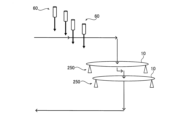
- 13A and 13B are schematic diagrams for explaining a substrate holding hand according to a second embodiment.
- 13A and 13B are diagrams for explaining correction based on a deviation amount of a movement amount according to the second embodiment.
- FIG. 13 is a schematic diagram for explaining a processing module section according to a modified example of the second embodiment of the present disclosure.
- a substrate transfer robot system 100 transfers a substrate 10 in a substrate processing system 101.
- the substrate processing system 101 includes the substrate transfer robot system 100, a load lock unit 102, and a plurality of processing module units 103.
- the substrate processing system 101 includes four processing module units 103.
- the substrate processing system 101 also includes a transfer chamber 104 and a load/unload chamber 105.
- the substrate processing system 101 performs processing on a substrate 10 such as a semiconductor wafer or a printed circuit board.
- the substrate 10 is, for example, a glass substrate or a silicon substrate having a substantially disk shape.
- Each of the multiple processing module sections 103 performs processing such as coating a resist or etching on the substrate 10.
- the multiple processing module sections 103 are arranged along the outer periphery of the transfer chamber 104.
- the inside of the transfer chamber 104 is maintained at a predetermined vacuum level.
- the substrate processing system 101 is a multi-chamber type vacuum processing apparatus.
- a load lock section 102 is provided on the outer periphery of the transfer chamber 104.
- a load/unload chamber 105 is provided on the opposite side of the load lock section 102 to the transfer chamber 104.
- Three ports are provided on the opposite side of the load lock section 102 to the load lock section 102 for attaching carriers 106 capable of accommodating the substrate 10.
- the substrate transport robot system 100 transports the substrate 10 out of the processing module section 103 where the substrate 10 is processed, and transports the substrate 10 into the processing module section 103.
- the substrate 10 is transported from the carrier 106 to the load lock section 102 by a transport robot (not shown) arranged in the loading/unloading chamber 105.
- the substrate 10 is then transported from the load lock section 102 to each of the multiple processing module sections 103 by the substrate transport robot system 100 of the first embodiment.
- the substrate 10 that has been processed in each of the multiple processing module sections 103 is transported from each of the multiple processing module sections 103 to the load lock section 102 by the substrate transport robot system 100.
- the substrate 10 that has been processed is then transported from the load lock section 102 to the carrier 106 by a transport robot (not shown) arranged in the loading/unloading chamber 105.
- the carrier 106 stores multiple substrates 10.
- the substrate 10 is placed on the placement section 40.
- the substrate 10 is placed on the placement section 50.
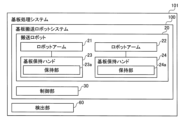
- the substrate transport robot system 100 includes a transport robot 20 and a control unit 30.
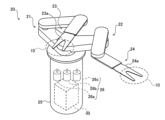
- the transport robot 20 has a robot arm 21 and a robot arm 22.
- the robot arm 21 and the robot arm 22 are respectively equipped with a substrate holding hand 23 and a substrate holding hand 24.
- the transport robot 20 is disposed approximately in the center of the transport chamber 104.
- the robot arm 21 and the robot arm 22 are examples of a first robot arm and a second robot arm, respectively.
- the control unit 30 is, for example, a computer having a CPU (Central Processing Unit), a RAM (Random Access Memory), and a ROM (Read Only Memory).
- the control unit 30 also has a storage device including a flash memory such as an SSD (Solid State Drive).
- the control unit 30 may be located at a position separated from the transport robot 20, or may be located integrally with the transport robot 20.
- the control unit 30 is located on a base unit 25 described later and shown in FIG. 3.
- the control unit 30 controls the operation of each part of the substrate transport robot system 100 based on a program and parameters previously stored in the storage device.
- the control unit 30 is a robot controller that controls the transport operation of each of the robot arms 21 and 22 that transport multiple substrates 10.
- the control unit 30 controls the transport operation for transporting the multiple substrates 10 based on a control signal from a higher-level control device that controls the entire substrate processing system 101. The control of the transport operation by the control unit 30 will be described in detail later.
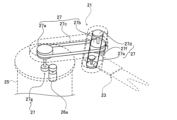
- a driven member 27 that transmits the driving force of motor 26b of drive unit 26 is also arranged on robot arm 22.
- a driven member 27 that transmits the driving force of motor 26b to robot arm 22 is also arranged on base unit 25.
- a driven member 27 that transmits the driving force of motor 26c to robot arm 21 and robot arm 22 is also arranged on base unit 25.
- driven member 27 that transmits the driving force of drive unit 26 may transmit the driving force via multiple gears rather than a belt pulley structure.
- each of the multiple processing module sections 103 is configured to process the substrates 10 one by one. That is, in each of the multiple processing module sections 103, the substrates 10 are placed one by one on the placement section 50.
- the substrate processing system 101 is provided with a pair of load lock sections 102, and in each load lock section 102, the substrates 10 are placed one by one on the placement section 40.
- the placement sections 40 and 50 include, for example, pin-shaped members or table-shaped members that hold the substrates 10.
- the substrate transport robot system 100 transports the substrates 10 one by one between the load lock section 102 and each of the multiple processing module sections 103 by operating the two robot arms 21 and 22 separately.
- the substrate processing system 101 includes a detection unit 60.
- the detection unit 60 detects the substrates 10 held by each of the substrate holding hands 23 and 24 of the transport robot 20.
- the detection unit 60 detects each of the substrates 10 for each of the robot arms 21 and 22.
- the detection unit 60 includes a plurality of transmissive laser sensors.
- the detection unit 60 includes, as a transmissive laser sensor, a light-emitting unit having a light source such as an LED (Light-Emitting Diode) that irradiates laser light, and a light-receiving unit having a light-receiving element such as a CCD (Charge Coupled Device) image sensor.
- the detection unit 60 is disposed on the load lock unit 102 side and on each side of the plurality of processing module units 103 in the transfer chamber 104 of the substrate processing system 101.
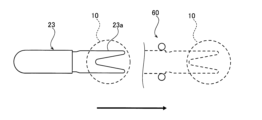
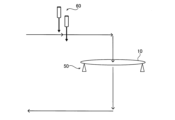
- the detection unit 60 is disposed so that the position through which the substrate 10 passes during the transfer operation to the placement unit 40 or placement unit 50 is the detection target area. That is, the detection unit 60 is positioned so as to detect the position through which the substrate 10 passes before the placement unit 40 and the placement unit 50 when the substrate 10 held by each of the substrate holding hands 23 and 24 is transported toward the placement unit 40 or the placement unit 50.
- Two detectors 60 are provided for each of the placement units 40 and 50 on which one substrate 10 is placed. That is, a pair of detectors 60, which are transmissive laser sensors including a pair of a light-emitting unit and a light-receiving unit, is provided for each of the placement units 40 and 50 on which one substrate 10 is placed.
- a pair of detectors 60 which are transmissive laser sensors including a pair of a light-emitting unit and a light-receiving unit, is provided for each of the placement units 40 and 50 on which one substrate 10 is placed.
- one substrate 10 is detected by a pair of detectors 60.
- the substrate processing system 101 two detectors 60 are provided for each of the four processing module units 103 and the two load lock units 102, for a total of 12 detectors 60.
- Each of the detectors 60 outputs a detection result indicating that the substrate 10 has been detected to the control unit 30. Note that while FIG. 5 illustrates an example in which the substrate 10 is transported by the substrate holding hand 23, the same applies when the substrate 10 is transported by the substrate holding hand 24.
- the control unit 30 calculates the positions of four points on the periphery of one substrate 10 based on the detection results from the pair of detection units 60. For each detection unit 60, which is a transmissive laser sensor, two points are detected: a point where the laser light switches from a transmitting state to a blocking state as the substrate 10 passes, and a point where the laser light switches from a blocking state to a transmitting state.
- the control unit 30 stores in advance the positions that are the detection targets of the detection units 60.
- the control unit 30 obtains the positions of the four points on the periphery of the substrate 10 by obtaining the positions that are the detection targets of the detection units 60 and the speed at which the substrate holding hand 23 is moved.
- the control unit 30 then calculates the position of the substrate 10 based on the obtained four positions.
- the control unit 30 controls the transport operations of the robot arms 21 and 22, including the placing operation of placing the substrate 10 on the placement unit 40 and the placement unit 50, and the holding operation of holding the substrate 10 from the placement unit 40 and the placement unit 50.
- the control unit 30 acquires command values for controlling the transport operations of the robot arms 21 and 22.
- the control unit 30 controls the operation of the robot arms 21 and 22 by controlling the operation of the drive unit 26 based on the acquired command values.
- the command values may be acquired based on a control signal from a higher-level control device, or may be acquired based on setting values and parameters stored in advance in a storage device included in the control unit 30.
- the command values are, for example, command values for controlling the speed or acceleration of each of the motors 26a, 26b, and 26c.
- the command values may be, for example, command values for controlling the torque of each of the motors 26a, 26b, and 26c.
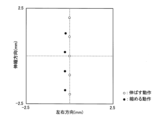
- FIG. 6 shows the position of the substrate holding hand 23 when the robot arm 21 is extended by a predetermined distance by driving the motor 26a, and then the rotation direction of the motor 26a of the drive unit 26 is reversed to retract the robot arm 21 by the same predetermined distance as the extension movement.
- extension movement here means the movement of spreading the two arm parts constituting the robot arm 21 so as to increase the angle between them
- retract movement means the movement of folding the two arm parts so as to decrease the angle between them.
- the positions indicated by white circles in FIG. 6 are the positions of the substrate holding hand 23 detected for each command to extend the robot arm 21 by a predetermined distance during the extension movement. 6 is the position of the substrate holding hand 23 detected for each command to retract the substrate by a predetermined distance in the retraction operation after the extension operation.
- the substrate holding hand 23 Due to this shift in transmission, it becomes difficult to accurately position the substrate holding hand 23 at the position indicated by the command value even when the motor 26a is rotated a predetermined number of times based on the set command value. For example, if the predetermined distance is 1 mm, the substrate holding hand 23 moves to a position substantially the same as the position corresponding to the command value in the extension operation, whereas the substrate holding hand 23 moves to a position shifted by a distance smaller than 1 mm from the position corresponding to the command value in the retraction operation. That is, as an example, the shift in the movement amount in the transport operation caused by the shift in transmission between the driving unit 26 and the driven member 27 is a value smaller than 1 mm.
- the control unit 30 corrects the movements of the robot arms 21 and 22 in the transport operation based on the deviation in the movement amount in the transport operation caused by the deviation in the transmission between the drive unit 26 and the driven member 27. Specifically, the control unit 30 acquires the deviation in the movement amount in the transport operation based on the detection result acquired by the detection unit 60. The control unit 30 acquires the deviation in the movement amount so as to correspond to the multiple degrees of freedom of the movements of the robot arms 21 and 22. That is, since the degrees of freedom of the robot arms 21 and 22 are three, the control unit 30 acquires three deviation amounts. Furthermore, the control unit 30 acquires the deviation in the movement amount when the direction of the movements of the robot arms 21 and 22 is changed in each of the three degrees of freedom. That is, the control unit 30 acquires the deviation in the movement amount when the rotation direction of the motors 26a, 26b, and 26c is reversed in order to change the direction of the movements of the robot arms 21 and 22.
- the control unit 30 acquires the deviation in the amount of movement during the extension and retraction operation of the robot arm 21.
- the control unit 30 acquires the detection result by the detection unit 60 when the motor 26a of the drive unit 26 is rotated to one side so as to extend the robot arm 21.
- the control unit 30 also acquires the detection result by the detection unit 60 when the robot arm 21 is rotated to the other side opposite to the one side so as to retract it.
- the control unit 30 then calculates the deviation in the amount of movement based on the acquired detection result for the extension operation and the detection result for the retraction operation.
- the control unit 30 also similarly acquires the deviation in the amount of movement during the extension and retraction operation of the robot arm 22.
- the control unit 30 then acquires the deviation in the amount of movement based on the detection result when performing an operation to rotate either the robot arm 21 or the robot arm 22. In this way, the control unit 30 acquires the deviation in the amount of movement during operations having a number equal to or greater than the number of degrees of freedom.
- the control unit 30 calculates three correction amounts corresponding to each of the three degrees of freedom based on the deviation amounts of the three movement amounts obtained. That is, the control unit 30 calculates a correction amount for correcting the deviation when the rotation direction is reversed for each of the three motors 26a, 26b, and 26c of the drive unit 26.
- the calculated correction amount is stored in the storage device of the control unit 30.
- When measuring the deviation amount of the movement amount to calculate the correction amount only one of the motors 26a, 26b, and 26c may be operated, or a combination of a plurality of motors may be operated.
- the degree of freedom is three
- the correction amount for each of the three degrees of freedom is calculated by calculating the deviation amount of the movement amount by three or more operations.
- the control for acquiring the deviation amount of the movement amount for calculating the correction amount may be performed when the substrate transport robot system 100 is installed, or may be performed periodically, such as every time a predetermined time has elapsed or every predetermined number of times the system is started.
- the control unit 30 then corrects the movements of the robot arms 21 and 22 for each of the multiple degrees of freedom by using the correction amount calculated based on the deviation amount acquired for each of the multiple degrees of freedom. Specifically, when the control unit 30 controls the rotation of the motors 26a, 26b, and 26c of the drive unit 26 based on the command value, the control unit 30 corrects the command value based on the calculated correction amount at the timing when the robot arms 21 and 22 are operated so that the direction of rotation is reversed. For example, if the correction amount for the rotation of the motor 26a is 1 degree and a command is acquired to rotate 5 degrees in one direction and then 3 degrees in the other direction, the control unit 30 corrects the rotation of the other side to 4 degrees by adding the correction amount to the command for the other side.
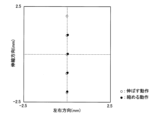
- FIG. 7 shows the position of the substrate holding hand 23 when, in a state where the command value is corrected based on the calculated correction amount, the robot arm 21 is extended by a predetermined distance by driving the motor 26a, as in the operation of FIG. 6, and then the rotation direction of the motor 26a of the drive unit 26 is reversed to perform a contraction motion by the same predetermined distance as the extension motion. That is, the position indicated by the white circle in FIG.
- the position indicated by the black circle in FIG. 7 is the position of the substrate holding hand 23 detected for each command to extend by a predetermined distance by the corrected command value in the extension motion. Also, the position indicated by the black circle in FIG. 7 is the position of the substrate holding hand 23 detected for each command to contract by a predetermined distance by the corrected command value in the contraction motion after the extension motion. In this way, even when an operation is performed in which the rotation of motor 26a, motor 26b, and motor 26c is reversed, the command value for the operation is corrected using the correction amount calculated based on the deviation amount, thereby suppressing a decrease in the accuracy of the operation of robot arm 21 and robot arm 22 compared to the case where correction is not performed.
- the control unit 30 performs fine adjustment control when placing the substrate 10.
- the control unit 30 performs a transport operation of the substrate 10 one by one based on a preset command value.
- the control unit 30 calculates the misalignment of the substrate 10 held by the substrate holding hand 23 or substrate holding hand 24 based on the detection result by the detection unit 60, and performs fine adjustment control to correct the command value to compensate for the misalignment.
- the calculated "misalignment" includes the magnitude and direction of the misalignment of the substrate 10 relative to the substrate holding hand 23 or 24 along the horizontal plane.
- the control unit 30 corrects the command value based on the detection result by the detection unit 60 to compensate for the positional deviation of the substrate 10. Then, the control unit 30 controls the operation of the robot arm 21 or the robot arm 22 so that the substrate 10 is placed on the placement unit 50 based on the corrected command value.
- the control unit 30 places the substrate 10 on the placement unit 50 by lowering the substrate holding hand 23 or the substrate holding hand 24 while aligning the position of the substrate 10 in the horizontal plane with the position of the placement unit 50.
- the control unit 30 corrects the operations of the robot arms 21 and 22 by correcting the command values based on the acquired deviations in the movement amounts during the transport operation. For example, when the substrate transport robot system 100 is installed, the control unit 30 acquires command values for operating the robot arms 21 and 22 based on an input operation by a user that teaches the operations of the robot arms 21 and 22 in the transport operation.
- control unit 30 In the transport operation of the substrate 10, when the control unit 30 operates the drive unit 26 based on the acquired command values, if the transport operation includes an operation in which the rotation directions of the motors 26a, 26b, and 26c of the drive unit 26 are reversed, the control unit 30 corrects the acquired command values based on the correction amounts calculated from the deviations in the movement amounts.
- the control unit 30 calculates a command value for controlling the speed and acceleration of the motor 26a based on the operation of the robot arm 21 and the robot arm 22 taught by the user. In this case, the control unit 30 corrects the command value based on the deviation amount of the movement amount caused by the deviation in the transmission between the drive unit 26 and the driven member 27 at the timing when the positive and negative command values of the speed command are switched.
- the control unit 30 corrects the command value acquired based on the deviation amount, thereby controlling the extension/contraction operation of the robot arm 21 so that the taught operation is performed in a state where the deviation in the transmission between the drive unit 26 and the driven member 27 is canceled.
- the control unit 30 corrects the command value for the speed that commands the motor rotation speed so that the rotation is reversed at an earlier timing than the acquired command value, based on the deviation in the amount of movement.
- control unit 30 corrects the command value based on the operation taught by the user through a teaching operation, based on the deviation in the amount of movement, to compensate for the deviation in the transmission of the driving force.
- the control unit 30 then stores the corrected command value in a storage device, and operates the robot arms 21 and 22 based on the corrected command value.
- Figure 9 shows an example in which a command value that changes linearly from negative to positive at a predetermined rate is acquired.
- the feedback value from the encoder indicating the actual rotation of motor 26a lags behind the command value.
- control unit 30 corrects the command value so that it becomes a large positive value at the timing when the command value before correction changes from negative to positive. Therefore, the corrected command value changes from negative to positive at an earlier timing than the command value before correction.
- Control unit 30 controls the rotation of motor 26a using this corrected command value. Therefore, the delay is eliminated in the feedback value after correction.
- Control process of substrate transport method Next, a control process of the substrate transport method by the substrate transport robot system 100 will be described with reference to Fig. 10. The control process of the substrate transport method is executed by the control unit 30.
- step S1 a command value for performing the transport operation is acquired. Then, in step S2, the amount of deviation in the amount of movement in the transport operation caused by the deviation in transmission between the drive unit 26 and the driven member 27 is acquired. Then, in step S3, the transport operation is performed in a state in which the operations of the robot arms 21 and 22 are corrected based on the acquired amount of deviation. Specifically, the amount of correction is calculated based on the acquired amount of deviation. Then, the command value acquired in step S1 is corrected based on the calculated amount of correction.
- step S1 includes a command value for the transport operation that is set in advance, and a command value for fine-tuning the operations of the robot arms 21 and 22 in fine-tuning control based on detection by the detection unit 60. Also, either step S1 or step S2 may be performed first.
- the control unit 30 corrects the movements of the robot arms 21 and 22 in the transport operation based on the deviation in the movement amount in the transport operation caused by the deviation in the transmission between the drive unit 26 and the driven member 27. As a result, even when a deviation in the transmission between the drive unit 26 and the driven member 27 such as backlash occurs, the movements of the robot arms 21 and 22 in the transport operation are corrected based on the deviation in the movement amount in the transport operation caused by the deviation in the transmission, thereby suppressing a decrease in the positional accuracy in the transport operation.
- the control unit 30 corrects the movements of the robot arms 21 and 22 based on the amount of deviation when the direction of movement of the robot arms 21 and 22 is changed. As a result, even if a deviation occurs in the amount of movement of the transport operation of the robot arms 21 and 22 due to backlash when the direction of movement of the robot arms 21 and 22 is changed, and due to lost motion, which is an error when positioning from different directions, the position accuracy of the transport operation can be reduced by correcting the movements of the robot arms 21 and 22 based on the amount of deviation. As a result, even if the direction of movement of the robot arms 21 and 22 is changed, it is possible to suppress an increase in the time required for the transport operation while suppressing a decrease in the accuracy of the transport operation of the substrate 10.
- the robot arms 21 and 22 have multiple degrees of freedom.
- the control unit 30 corrects the movements of the robot arms 21 and 22 for each of the multiple degrees of freedom based on the deviation amount acquired to correspond to the multiple degrees of freedom of the movements of the robot arms 21 and 22. This allows the movements of the robot arms 21 and 22 to be corrected for each of the multiple degrees of freedom so as to correspond to the deviation in the transmission between the drive unit 26 and the driven member 27 for each of the multiple degrees of freedom of the movements of the robot arms 21 and 22, thereby further suppressing deterioration in accuracy in the transport operation of the substrate 10.
- the substrate transport robot system 100 includes a detection unit 60 that detects the position of the substrate 10 held by the substrate holding hands 23 and 24, the substrate holding hands 23 and 24, and at least one of the robot arms 21 and 22.
- the control unit 30 acquires the amount of deviation based on the detection result acquired by the detection unit 60. As a result, by detecting the position of at least one of the substrate 10 held by the substrate holding hands 23 and 24, the substrate holding hands 23 and 24, and the robot arms 21 and 22, the amount of deviation can be acquired while the substrate 10 is being transported.
- the amount of deviation can be periodically acquired to correct the operation of the robot arms 21 and 22 to correspond to the change in the amount of deviation. Therefore, the amount of deviation can be corrected more accurately, and the decrease in accuracy in the transport operation of the substrate 10 can be further suppressed.
- the substrate transport robot system 100 includes a robot arm 21 as a first robot arm and a robot arm 22 as a second robot arm that operate independently of each other.
- the control unit 30 corrects the operation of each of the robot arms 21 and 22 based on the amount of deviation. As a result, by using multiple robot arms, robot arm 21 and robot arm 22, to transport the substrate 10, the time required to transport multiple substrates 10 can be shortened.
- robot arm 21 and robot arm 22 when the substrate 10 is transported using multiple robot arms, robot arm 21 and robot arm 22, the increase in the time required for each transport operation of the robot arms 21 and 22 can be suppressed while suppressing a decrease in the accuracy of the transport operation of each of the robot arms 21 and 22. Therefore, when the substrate 10 is transported using multiple robot arms, the increase in the time required for the transport operation can be effectively suppressed while suppressing a decrease in the accuracy of the transport operation.
- the substrate transport robot system 100 includes a detection unit 60 that detects the substrate 10.
- the control unit 30 executes fine adjustment control to finely adjust the operation of the robot arms 21 and 22 in the transport operation based on the position of the substrate 10 detected by the detection unit 60.
- the control unit 30 then corrects the operation of the robot arms 21 and 22 based on the deviation amount in the fine adjustment control.
- the correction of the operation of the robot arms 21 and 22 based on the deviation amount is not performed, it becomes difficult to operate the robot arms 21 and 22 with a movement amount smaller than the deviation amount due to the deviation of the transmission between the drive unit 26 and the driven member 27.
- the control unit 30 is configured to correct the operation of the robot arms 21 and 22 based on the deviation amount in the fine adjustment control. This allows the robot arms 21 and 22 to operate with a movement amount that is smaller than the deviation amount. Therefore, fine adjustment control can be performed normally by correcting the movement of the robot arms 21 and 22 based on the deviation amount.
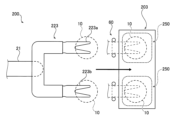
- the substrate transport robot system 200 includes a substrate holding hand 223 that holds a pair of substrates 10.
- the substrate holding hand 223 is attached to the tip of the robot arm 21.
- the substrate holding hand 223 holds a pair of substrates 10.
- the substrate holding hand 223 has a pair of holding portions 223a and 223b.
- Each of the holding portions 223a and 223b holds one substrate 10.
- the holding portions 223a and 223b are thin support plates that support the substrates 10 from below, similar to the holding portion 23a in the first embodiment.
- each of the pair of substrates 10 is held in a state where they are lined up side by side along a horizontal plane.
- the holding portions 223a and 223b are integrally formed. That is, in the substrate holding hand 223, the pair of substrates 10 are held in a state where their relative positional relationship is fixed.
- the substrate transport robot system 200 transports the pair of substrates 10 held in the substrate holding hand 223 as a unit by operating the robot arm 21.
- the positional relationship between the pair of placement sections 250 is the same as the positional relationship between the pair of placement sections of the load lock section 102.
- substrates 10 are transported in pairs between the two placement units of the load lock unit 102 and each of the two placement units 250 of the processing module unit 203.
- the detection units 60 detect each of the pair of substrates 10 held by the substrate holding hand 223.
- Four detection units 60 are arranged on each mounting unit 250 on which the pair of substrates 10 are placed.
- control unit 30 executes fine adjustment control to finely adjust the operation of the robot arm 21 in the transport operation of transporting a pair of substrates 10 based on the detection results detected by the detection unit 60. Then, the control unit 30 corrects the operation of the robot arm 21 in the fine adjustment control.
- control unit 30 calculates the positional deviation of each of the pair of substrates 10 held by the substrate holding hand 223 based on the detection results by the detection unit 60, and performs fine adjustment control to correct the command value to compensate for the positional deviation.
- the control unit 30 controls the transport operation of the robot arm 21 so that each of the pair of substrates 10 held by the substrate holding hand 223 is placed separately, one by one, in order on the placement part 250. Specifically, as in the first embodiment, the control unit 30 corrects the command value to compensate for the positional deviation of the substrate 10 based on the detection result by the detection unit 60 while the substrate 10 is being transported toward the placement part 250.
- the control unit 30 controls the operation of the robot arm 21 based on the corrected command value so that the substrate 10 is placed on one placement part 250 whose placement position is relatively high, and then fine-tunes the operation of the robot arm 21 so that the substrate 10 is placed on the other placement part 250 whose placement position is relatively low. Then, the control unit 30 places the substrate 10 on the other placement unit 250 by lowering the substrate holding hand 223 while aligning the position of the substrate 10 on the horizontal plane with the position of the other placement unit 250.
- control unit 30 further corrects the command values corrected based on the detection results based on the correction amount calculated from the deviation amount, as in the first embodiment.
- each of the pair of substrates 10 is placed on the placement unit 250 with the position of the substrate 10 on the horizontal plane relative to the placement unit 250 accurately fine-tuned.
- the positional deviation of the substrate 10 in the placed state may be detected, and the substrate 10 may be held in order while performing fine adjustment control based on the detected positional deviation.
- the control unit 30 corrects the command value based on the correction amount calculated from the deviation in the amount of movement when the operation includes an operation in which the rotation direction of motors 26a, 26b, and 26c of the drive unit 26 is reversed, as in the first embodiment.
- the other configurations in the second embodiment are the same as those in the first embodiment.
- the substrate holding hand 223 holds each of the substrates 10 and has a plurality of integrally formed holding parts 223a and 223b.
- the control unit 30 corrects the operation of the robot arm 21 based on the amount of deviation in the transport operation of the robot arm 21, which includes at least one of a placing operation of placing each of the substrates 10 on the placement unit 250 and a holding operation of holding each of the substrates 10 from the placement unit 250.
- the substrates 10 may be placed or held while finely adjusting the position of the substrate holding hand 223 so as to correspond to the positions of the substrates 10.
- control is performed to finely adjust the operation of the robot arm 21 so as to correspond to the positions of the substrates 10. Therefore, by correcting the operation of the robot arm 21 based on the amount of deviation in the transport operation of the plurality of substrates 10, it is possible to effectively suppress an increase in the time required for the transport operation while effectively suppressing a decrease in accuracy in the transport operation of the substrates 10, even when fine-tuning the operation of the robot arm 21 to transport the plurality of substrates 10.
- Other effects of the second embodiment are similar to those of the first embodiment.
- the control unit 30 corrects the operation of the robot arm 21 and the robot arm 22 based on the deviation in the amount of movement acquired when the multiple substrates 10 are separately placed on the placement units 50 and 250 of the processing module units 103 and 203, but the present disclosure is not limited to this.
- the control unit may correct the operation of the robot arm based on the deviation in the amount of movement acquired when placing a substrate on a placement unit of a load lock unit.
- the operation of the robot arm may be corrected based on the deviation in the amount of movement.
- the substrate 10 was placed on each of a pair of mounting parts 250 whose mounting positions were different from each other, but the present disclosure is not limited to this.
- the mounting positions of the mounting parts may be changed.
- the substrate may be placed on the mounting parts by moving a pin-shaped member or the like of the mounting part upward.
- the substrate transport robot system according to the present disclosure corrects the operation of the robot arm based on the deviation in the amount of movement in order to position the substrate directly above the mounting parts.
- the present disclosure is not limited to this.
- multiple substrates may be arranged side by side in the substrate holding hand, not along a horizontal plane, but offset in the vertical direction.
- the substrate holding hand may hold multiple substrates arranged along the vertical direction, rather than arranged side by side.
- the number of substrates held by the substrate holding hand may be one, or three or more.
- the shape of the holding portion of the substrate holding hand may be a U-shape with a bifurcated tip, or may be a plate-like shape with an unbraced tip.
- the substrate holding hand does not have to be a passive type end effector.
- robot arm 21 is provided as a first robot arm and robot arm 22 is provided as a second robot arm that operate independently of each other, but the present disclosure is not limited to this.
- only one robot arm may be provided, or three or more robot arms may be provided.
- the two robot arms may share a part of the arm portion.
- each of the two robot arms may be connected to a common member that rotates relative to the base portion.
- the detection unit 60 that detects the substrate 10 is a transmissive laser sensor, but the present disclosure is not limited to this.
- the detection unit may be a reflective laser sensor, or an imaging unit such as a camera that captures an external image. In other words, the amount of deviation of the substrate may be obtained based on the captured external image.
- the detection unit may also be disposed in the transport robot of the substrate transport robot system.
- the detection unit may be disposed in a base unit to which a robot arm is connected.
- the detection unit may also be disposed in the robot arm or the substrate holding hand.
- the detection unit 60 may be configured to detect the position of at least one of the substrate, the substrate holding hand, and the robot arm.
- the substrate transfer robot systems 100 and 200 transfer the substrate 10 in the transfer chamber 104 maintained at a predetermined vacuum level, but the present disclosure is not limited to this.
- the substrate may be transferred at normal pressure.
- each of the multiple processing module sections 203 has two mounting sections 250 with different mounting position heights, but the present disclosure is not limited to this. In the present disclosure, some or all of the multiple processing module sections may have multiple mounting sections with mounting position heights that are approximately equal to each other.
- processing module sections 303 for processing one substrate 10 may be arranged in pairs adjacent to each other.
- the height of the mounting positions of each of the mounting sections 350 of a pair of adjacent processing module sections 303 may be different from each other. That is, the mounting position of one of the mounting sections 350 of a pair of adjacent processing module sections 303 may be higher than the mounting position of the other mounting section 350.
- the height of each mounting section of a pair of adjacent processing module sections may be the same.
- circuitry or processing circuits including general purpose processors, special purpose processors, integrated circuits, ASICs (Application Specific Integrated Circuits), conventional circuits, and/or combinations thereof, configured or programmed to perform the disclosed functions.
- Processors are considered processing circuits or circuits because they include transistors and other circuits.
- a circuit, unit, or means is hardware that performs the recited functions or hardware that is programmed to perform the recited functions.
- the hardware may be hardware disclosed herein or other known hardware that is programmed or configured to perform the recited functions. If the hardware is a processor, which is considered a type of circuit, the circuit, means, or unit is a combination of hardware and software, and the software is used to configure the hardware and/or the processor.
- a substrate holding hand for holding a substrate; a robot arm to which the substrate holding hand is attached; a drive unit serving as a drive source for operating the robot arm in a transport operation of the robot arm, the transport operation including at least one of a placing operation of placing the substrate on a placement part and a holding operation of holding the substrate from the placement part; and a driven member that transmits a driving force of the driving unit to operate the robot arm; a control unit that corrects the movement of the robot arm during the transport operation based on a deviation in a movement amount during the transport operation caused by a deviation in transmission between the drive unit and the driven member.
- the drive unit includes a motor that performs a rotational operation as a drive source, 3.
- the robot arm has multiple degrees of freedom; 4.
- a detection unit that detects a position of at least one of the substrate held by the substrate holding hand, the substrate holding hand, and the robot arm, 5.
- the substrate transport robot system according to any one of claims 1 to 4, wherein the control unit obtains the amount of deviation based on a detection result obtained by the detection unit.
- the substrate holding hand holds each of the plurality of substrates and has a plurality of integrally formed holding portions;
- the robot arm includes a first robot arm and a second robot arm that operate independently of each other; 7.
- the substrate transport robot system according to any one of claims 1 to 6, wherein the control unit corrects the operation of each of the first robot arm and the second robot arm based on the amount of deviation.
- the control unit is A command value for controlling the transport operation is obtained. 8. The substrate transport robot system according to any one of claims 1 to 7, wherein the operation of the robot arm is corrected by correcting the acquired command value based on the amount of deviation.
- a detection unit for detecting the substrate is further provided.
- the control unit is performing fine adjustment control for finely adjusting the operation of the robot arm in the transport operation based on the position of the substrate detected by the detection unit; and 9.
- the substrate transport robot system according to any one of items 1 to 8, wherein in the fine adjustment control, the operation of the robot arm is corrected based on the amount of deviation.
Landscapes
- Engineering & Computer Science (AREA)
- Robotics (AREA)
- Mechanical Engineering (AREA)
- Physics & Mathematics (AREA)
- General Physics & Mathematics (AREA)
- Automation & Control Theory (AREA)
- Human Computer Interaction (AREA)
- Container, Conveyance, Adherence, Positioning, Of Wafer (AREA)
- Manipulator (AREA)
Priority Applications (3)
| Application Number | Priority Date | Filing Date | Title |
|---|---|---|---|
| JP2024567990A JP7767652B2 (ja) | 2022-12-28 | 2023-12-28 | 基板搬送ロボットシステム |
| KR1020257018173A KR20250103716A (ko) | 2022-12-28 | 2023-12-28 | 기판 반송 로봇 시스템 |
| CN202380089013.8A CN120418948A (zh) | 2022-12-28 | 2023-12-28 | 基板搬运机器人系统 |
Applications Claiming Priority (2)
| Application Number | Priority Date | Filing Date | Title |
|---|---|---|---|
| JP2022211864 | 2022-12-28 | ||
| JP2022-211864 | 2022-12-28 |
Publications (1)
| Publication Number | Publication Date |
|---|---|
| WO2024143550A1 true WO2024143550A1 (ja) | 2024-07-04 |
Family
ID=91718184
Family Applications (1)
| Application Number | Title | Priority Date | Filing Date |
|---|---|---|---|
| PCT/JP2023/047313 Ceased WO2024143550A1 (ja) | 2022-12-28 | 2023-12-28 | 基板搬送ロボットシステム |
Country Status (5)
| Country | Link |
|---|---|
| JP (1) | JP7767652B2 (https=) |
| KR (1) | KR20250103716A (https=) |
| CN (1) | CN120418948A (https=) |
| TW (1) | TWI911616B (https=) |
| WO (1) | WO2024143550A1 (https=) |
Citations (8)
| Publication number | Priority date | Publication date | Assignee | Title |
|---|---|---|---|---|
| JP2000506789A (ja) * | 1996-03-22 | 2000-06-06 | ジェンマーク オートメーション インコーポレイテッド | 多自由度ロボット |
| JP2012231041A (ja) * | 2011-04-27 | 2012-11-22 | Hitachi High-Tech Control Systems Corp | 基板搬送装置 |
| JP2015514019A (ja) * | 2012-04-12 | 2015-05-18 | アプライド マテリアルズ インコーポレイテッドApplied Materials,Incorporated | 独立して回転可能なウェストを有するロボットシステム、装置、および方法 |
| JP2016062909A (ja) * | 2014-09-12 | 2016-04-25 | キヤノン株式会社 | 基板搬送システム、基板搬送方法、リソグラフィ装置、および物品の製造方法 |
| JP2017092246A (ja) * | 2015-11-10 | 2017-05-25 | 株式会社Screenホールディングス | 基板搬送装置、基板処理システム、および基板搬送方法 |
| JP2017191448A (ja) * | 2016-04-13 | 2017-10-19 | ファナック株式会社 | モータ制御装置、モータ制御方法及びモータ制御プログラム |
| JP2022102888A (ja) * | 2020-12-25 | 2022-07-07 | 川崎重工業株式会社 | 基板搬送ロボットの制御装置及び関節モータの制御方法 |
| JP2022148398A (ja) * | 2021-03-24 | 2022-10-06 | 東京エレクトロン株式会社 | 基板搬送方法 |
Family Cites Families (5)
| Publication number | Priority date | Publication date | Assignee | Title |
|---|---|---|---|---|
| US8768513B2 (en) | 2011-08-08 | 2014-07-01 | Applied Materials, Inc. | Systems having multi-linkage robots and methods to correct positional and rotational alignment in multi-linkage robots |
| US9202733B2 (en) * | 2011-11-07 | 2015-12-01 | Persimmon Technologies Corporation | Robot system with independent arms |
| JP5596093B2 (ja) * | 2012-09-05 | 2014-09-24 | ファナック株式会社 | バックラッシを補正するモータ制御装置 |
| JP2015178161A (ja) | 2014-03-19 | 2015-10-08 | 株式会社安川電機 | 搬送ロボットおよび搬送システム |
| JP7553191B2 (ja) * | 2020-08-31 | 2024-09-18 | 東京エレクトロン株式会社 | 基板搬送システムの制御方法及び基板搬送システム |
-
2023
- 2023-12-28 KR KR1020257018173A patent/KR20250103716A/ko active Pending
- 2023-12-28 WO PCT/JP2023/047313 patent/WO2024143550A1/ja not_active Ceased
- 2023-12-28 JP JP2024567990A patent/JP7767652B2/ja active Active
- 2023-12-28 CN CN202380089013.8A patent/CN120418948A/zh active Pending
- 2023-12-28 TW TW112151407A patent/TWI911616B/zh active
Patent Citations (8)
| Publication number | Priority date | Publication date | Assignee | Title |
|---|---|---|---|---|
| JP2000506789A (ja) * | 1996-03-22 | 2000-06-06 | ジェンマーク オートメーション インコーポレイテッド | 多自由度ロボット |
| JP2012231041A (ja) * | 2011-04-27 | 2012-11-22 | Hitachi High-Tech Control Systems Corp | 基板搬送装置 |
| JP2015514019A (ja) * | 2012-04-12 | 2015-05-18 | アプライド マテリアルズ インコーポレイテッドApplied Materials,Incorporated | 独立して回転可能なウェストを有するロボットシステム、装置、および方法 |
| JP2016062909A (ja) * | 2014-09-12 | 2016-04-25 | キヤノン株式会社 | 基板搬送システム、基板搬送方法、リソグラフィ装置、および物品の製造方法 |
| JP2017092246A (ja) * | 2015-11-10 | 2017-05-25 | 株式会社Screenホールディングス | 基板搬送装置、基板処理システム、および基板搬送方法 |
| JP2017191448A (ja) * | 2016-04-13 | 2017-10-19 | ファナック株式会社 | モータ制御装置、モータ制御方法及びモータ制御プログラム |
| JP2022102888A (ja) * | 2020-12-25 | 2022-07-07 | 川崎重工業株式会社 | 基板搬送ロボットの制御装置及び関節モータの制御方法 |
| JP2022148398A (ja) * | 2021-03-24 | 2022-10-06 | 東京エレクトロン株式会社 | 基板搬送方法 |
Also Published As
| Publication number | Publication date |
|---|---|
| CN120418948A (zh) | 2025-08-01 |
| JP7767652B2 (ja) | 2025-11-11 |
| TWI911616B (zh) | 2026-01-11 |
| KR20250103716A (ko) | 2025-07-07 |
| JPWO2024143550A1 (https=) | 2024-07-04 |
| TW202435344A (zh) | 2024-09-01 |
Similar Documents
| Publication | Publication Date | Title |
|---|---|---|
| JP7705388B2 (ja) | 重力場センサを備えたウエハハンドリングロボット | |
| TWI778436B (zh) | 基板搬送裝置及基板位置偏移測定方法 | |
| KR101971824B1 (ko) | 로봇, 로봇 시스템, 디바이스 제조 장치, 디바이스 제조 방법 및 티칭 위치 조정 방법 | |
| KR20000064731A (ko) | 다중자유도를가지는로보트 | |
| JP5284486B2 (ja) | 基板中心位置の特定方法 | |
| WO2004084297A1 (ja) | 被処理体の処理システムの搬送位置合わせ方法及び被処理体の処理システム | |
| JP2013149902A (ja) | ウエハ搬送装置 | |
| JP7734744B2 (ja) | 搬送システム及び判定方法 | |
| CN1802736B (zh) | 薄板状物的位移量检测方法和位移量修正方法 | |
| JP2015005682A (ja) | 搬送ロボット、円盤状搬送対象物の搬送方法 | |
| JP7767652B2 (ja) | 基板搬送ロボットシステム | |
| KR102783064B1 (ko) | 기판 반송 로봇의 제어 장치 및 관절 모터의 제어 방법 | |
| JP2009049251A (ja) | ウエハ搬送装置 | |
| JP2024058215A (ja) | 位置教示装置および位置教示方法 | |
| JP2009184069A (ja) | ウエハ搬送装置及びその調整方法 | |
| KR102003659B1 (ko) | 로봇 시스템, 디바이스 제조 장치, 디바이스 제조 방법, 티칭 위치 조정 방법 및 컴퓨터 판독가능 기록 매체 | |
| JP6999443B2 (ja) | 産業用ロボットの補正値算出方法 | |
| JPH11221784A (ja) | 位置合わせ方法及び位置合わせ装置 | |
| WO2024080332A1 (ja) | 基板搬送ロボットシステム | |
| KR102590885B1 (ko) | 산업용 로봇 | |
| JP2024084179A (ja) | 矩形基板のアライメント装置、搬送システム及びアライメント方法 | |
| KR20250150476A (ko) | 반도체 처리 장치 | |
| KR20250111026A (ko) | 직사각형 기판의 반전 장치, 그것을 구비한 기판 반송 시스템, 직사각형 기판의 얼라인먼트 장치, 반송 시스템 및 얼라인먼트 방법 |
Legal Events
| Date | Code | Title | Description |
|---|---|---|---|
| 121 | Ep: the epo has been informed by wipo that ep was designated in this application |
Ref document number: 23912327 Country of ref document: EP Kind code of ref document: A1 |
|
| WWE | Wipo information: entry into national phase |
Ref document number: 2024567990 Country of ref document: JP |
|
| WWE | Wipo information: entry into national phase |
Ref document number: 202380089013.8 Country of ref document: CN |
|
| WWP | Wipo information: published in national office |
Ref document number: 1020257018173 Country of ref document: KR |
|
| NENP | Non-entry into the national phase |
Ref country code: DE |
|
| WWP | Wipo information: published in national office |
Ref document number: 202380089013.8 Country of ref document: CN |
|
| 122 | Ep: pct application non-entry in european phase |
Ref document number: 23912327 Country of ref document: EP Kind code of ref document: A1 |