WO2023167023A1 - 電極用カーボンナノチューブ含有粉末、電極合剤ペースト、蓄電デバイス用電極及び蓄電デバイス - Google Patents
電極用カーボンナノチューブ含有粉末、電極合剤ペースト、蓄電デバイス用電極及び蓄電デバイス Download PDFInfo
- Publication number
- WO2023167023A1 WO2023167023A1 PCT/JP2023/005790 JP2023005790W WO2023167023A1 WO 2023167023 A1 WO2023167023 A1 WO 2023167023A1 JP 2023005790 W JP2023005790 W JP 2023005790W WO 2023167023 A1 WO2023167023 A1 WO 2023167023A1
- Authority
- WO
- WIPO (PCT)
- Prior art keywords
- electrode
- cnt
- containing powder
- solvent
- electrode mixture
- Prior art date
- Legal status (The legal status is an assumption and is not a legal conclusion. Google has not performed a legal analysis and makes no representation as to the accuracy of the status listed.)
- Ceased
Links
Images

Classifications
-
- H—ELECTRICITY
- H01—ELECTRIC ELEMENTS
- H01G—CAPACITORS; CAPACITORS, RECTIFIERS, DETECTORS, SWITCHING DEVICES, LIGHT-SENSITIVE OR TEMPERATURE-SENSITIVE DEVICES OF THE ELECTROLYTIC TYPE
- H01G11/00—Hybrid capacitors, i.e. capacitors having different positive and negative electrodes; Electric double-layer [EDL] capacitors; Processes for the manufacture thereof or of parts thereof
- H01G11/04—Hybrid capacitors
- H01G11/06—Hybrid capacitors with one of the electrodes allowing ions to be reversibly doped thereinto, e.g. lithium ion capacitors [LIC]
-
- H—ELECTRICITY
- H01—ELECTRIC ELEMENTS
- H01M—PROCESSES OR MEANS, e.g. BATTERIES, FOR THE DIRECT CONVERSION OF CHEMICAL ENERGY INTO ELECTRICAL ENERGY
- H01M4/00—Electrodes
- H01M4/02—Electrodes composed of, or comprising, active material
- H01M4/62—Selection of inactive substances as ingredients for active masses, e.g. binders, fillers
- H01M4/624—Electric conductive fillers
- H01M4/625—Carbon or graphite
-
- C—CHEMISTRY; METALLURGY
- C01—INORGANIC CHEMISTRY
- C01B—NON-METALLIC ELEMENTS; COMPOUNDS THEREOF; METALLOIDS OR COMPOUNDS THEREOF NOT COVERED BY SUBCLASS C01C
- C01B32/00—Carbon; Compounds thereof
- C01B32/15—Nano-sized carbon materials
- C01B32/158—Carbon nanotubes
- C01B32/168—After-treatment
- C01B32/174—Derivatisation; Solubilisation; Dispersion in solvents
-
- C—CHEMISTRY; METALLURGY
- C09—DYES; PAINTS; POLISHES; NATURAL RESINS; ADHESIVES; COMPOSITIONS NOT OTHERWISE PROVIDED FOR; APPLICATIONS OF MATERIALS NOT OTHERWISE PROVIDED FOR
- C09D—COATING COMPOSITIONS, e.g. PAINTS, VARNISHES OR LACQUERS; FILLING PASTES; CHEMICAL PAINT OR INK REMOVERS; INKS; CORRECTING FLUIDS; WOODSTAINS; PASTES OR SOLIDS FOR COLOURING OR PRINTING; USE OF MATERIALS THEREFOR
- C09D129/00—Coating compositions based on homopolymers or copolymers of compounds having one or more unsaturated aliphatic radicals, each having only one carbon-to-carbon double bond, and at least one being terminated by an alcohol, ether, aldehydo, ketonic, acetal, or ketal radical; Coating compositions based on hydrolysed polymers of esters of unsaturated alcohols with saturated carboxylic acids; Coating compositions based on derivatives of such polymers
- C09D129/14—Homopolymers or copolymers of acetals or ketals obtained by polymerisation of unsaturated acetals or ketals or by after-treatment of polymers of unsaturated alcohols
-
- H—ELECTRICITY
- H01—ELECTRIC ELEMENTS
- H01B—CABLES; CONDUCTORS; INSULATORS; SELECTION OF MATERIALS FOR THEIR CONDUCTIVE, INSULATING OR DIELECTRIC PROPERTIES
- H01B1/00—Conductors or conductive bodies characterised by the conductive materials; Selection of materials as conductors
- H01B1/20—Conductive material dispersed in non-conductive organic material
- H01B1/24—Conductive material dispersed in non-conductive organic material the conductive material comprising carbon-silicon compounds, carbon or silicon
-
- H—ELECTRICITY
- H01—ELECTRIC ELEMENTS
- H01G—CAPACITORS; CAPACITORS, RECTIFIERS, DETECTORS, SWITCHING DEVICES, LIGHT-SENSITIVE OR TEMPERATURE-SENSITIVE DEVICES OF THE ELECTROLYTIC TYPE
- H01G11/00—Hybrid capacitors, i.e. capacitors having different positive and negative electrodes; Electric double-layer [EDL] capacitors; Processes for the manufacture thereof or of parts thereof
- H01G11/22—Electrodes
- H01G11/30—Electrodes characterised by their material
-
- H—ELECTRICITY
- H01—ELECTRIC ELEMENTS
- H01G—CAPACITORS; CAPACITORS, RECTIFIERS, DETECTORS, SWITCHING DEVICES, LIGHT-SENSITIVE OR TEMPERATURE-SENSITIVE DEVICES OF THE ELECTROLYTIC TYPE
- H01G11/00—Hybrid capacitors, i.e. capacitors having different positive and negative electrodes; Electric double-layer [EDL] capacitors; Processes for the manufacture thereof or of parts thereof
- H01G11/22—Electrodes
- H01G11/30—Electrodes characterised by their material
- H01G11/32—Carbon-based
- H01G11/36—Nanostructures, e.g. nanofibres, nanotubes or fullerenes
-
- H—ELECTRICITY
- H01—ELECTRIC ELEMENTS
- H01G—CAPACITORS; CAPACITORS, RECTIFIERS, DETECTORS, SWITCHING DEVICES, LIGHT-SENSITIVE OR TEMPERATURE-SENSITIVE DEVICES OF THE ELECTROLYTIC TYPE
- H01G11/00—Hybrid capacitors, i.e. capacitors having different positive and negative electrodes; Electric double-layer [EDL] capacitors; Processes for the manufacture thereof or of parts thereof
- H01G11/22—Electrodes
- H01G11/30—Electrodes characterised by their material
- H01G11/32—Carbon-based
- H01G11/38—Carbon pastes or blends; Binders or additives therein
-
- H—ELECTRICITY
- H01—ELECTRIC ELEMENTS
- H01G—CAPACITORS; CAPACITORS, RECTIFIERS, DETECTORS, SWITCHING DEVICES, LIGHT-SENSITIVE OR TEMPERATURE-SENSITIVE DEVICES OF THE ELECTROLYTIC TYPE
- H01G11/00—Hybrid capacitors, i.e. capacitors having different positive and negative electrodes; Electric double-layer [EDL] capacitors; Processes for the manufacture thereof or of parts thereof
- H01G11/22—Electrodes
- H01G11/30—Electrodes characterised by their material
- H01G11/32—Carbon-based
- H01G11/42—Powders or particles, e.g. composition thereof
-
- H—ELECTRICITY
- H01—ELECTRIC ELEMENTS
- H01G—CAPACITORS; CAPACITORS, RECTIFIERS, DETECTORS, SWITCHING DEVICES, LIGHT-SENSITIVE OR TEMPERATURE-SENSITIVE DEVICES OF THE ELECTROLYTIC TYPE
- H01G11/00—Hybrid capacitors, i.e. capacitors having different positive and negative electrodes; Electric double-layer [EDL] capacitors; Processes for the manufacture thereof or of parts thereof
- H01G11/84—Processes for the manufacture of hybrid or EDL capacitors, or components thereof
- H01G11/86—Processes for the manufacture of hybrid or EDL capacitors, or components thereof specially adapted for electrodes
-
- H—ELECTRICITY
- H01—ELECTRIC ELEMENTS
- H01M—PROCESSES OR MEANS, e.g. BATTERIES, FOR THE DIRECT CONVERSION OF CHEMICAL ENERGY INTO ELECTRICAL ENERGY
- H01M10/00—Secondary cells; Manufacture thereof
- H01M10/05—Accumulators with non-aqueous electrolyte
- H01M10/052—Li-accumulators
-
- H—ELECTRICITY
- H01—ELECTRIC ELEMENTS
- H01M—PROCESSES OR MEANS, e.g. BATTERIES, FOR THE DIRECT CONVERSION OF CHEMICAL ENERGY INTO ELECTRICAL ENERGY
- H01M10/00—Secondary cells; Manufacture thereof
- H01M10/05—Accumulators with non-aqueous electrolyte
- H01M10/052—Li-accumulators
- H01M10/0525—Rocking-chair batteries, i.e. batteries with lithium insertion or intercalation in both electrodes; Lithium-ion batteries
-
- H—ELECTRICITY
- H01—ELECTRIC ELEMENTS
- H01M—PROCESSES OR MEANS, e.g. BATTERIES, FOR THE DIRECT CONVERSION OF CHEMICAL ENERGY INTO ELECTRICAL ENERGY
- H01M4/00—Electrodes
- H01M4/02—Electrodes composed of, or comprising, active material
- H01M4/13—Electrodes for accumulators with non-aqueous electrolyte, e.g. for lithium-accumulators; Processes of manufacture thereof
-
- H—ELECTRICITY
- H01—ELECTRIC ELEMENTS
- H01M—PROCESSES OR MEANS, e.g. BATTERIES, FOR THE DIRECT CONVERSION OF CHEMICAL ENERGY INTO ELECTRICAL ENERGY
- H01M4/00—Electrodes
- H01M4/02—Electrodes composed of, or comprising, active material
- H01M4/13—Electrodes for accumulators with non-aqueous electrolyte, e.g. for lithium-accumulators; Processes of manufacture thereof
- H01M4/139—Processes of manufacture
-
- H—ELECTRICITY
- H01—ELECTRIC ELEMENTS
- H01M—PROCESSES OR MEANS, e.g. BATTERIES, FOR THE DIRECT CONVERSION OF CHEMICAL ENERGY INTO ELECTRICAL ENERGY
- H01M4/00—Electrodes
- H01M4/02—Electrodes composed of, or comprising, active material
- H01M4/13—Electrodes for accumulators with non-aqueous electrolyte, e.g. for lithium-accumulators; Processes of manufacture thereof
- H01M4/139—Processes of manufacture
- H01M4/1391—Processes of manufacture of electrodes based on mixed oxides or hydroxides, or on mixtures of oxides or hydroxides, e.g. LiCoOx
-
- H—ELECTRICITY
- H01—ELECTRIC ELEMENTS
- H01M—PROCESSES OR MEANS, e.g. BATTERIES, FOR THE DIRECT CONVERSION OF CHEMICAL ENERGY INTO ELECTRICAL ENERGY
- H01M4/00—Electrodes
- H01M4/02—Electrodes composed of, or comprising, active material
- H01M4/36—Selection of substances as active materials, active masses, active liquids
- H01M4/48—Selection of substances as active materials, active masses, active liquids of inorganic oxides or hydroxides
- H01M4/52—Selection of substances as active materials, active masses, active liquids of inorganic oxides or hydroxides of nickel, cobalt or iron
- H01M4/525—Selection of substances as active materials, active masses, active liquids of inorganic oxides or hydroxides of nickel, cobalt or iron of mixed oxides or hydroxides containing iron, cobalt or nickel for inserting or intercalating light metals, e.g. LiNiO2, LiCoO2 or LiCoOxFy
-
- H—ELECTRICITY
- H01—ELECTRIC ELEMENTS
- H01M—PROCESSES OR MEANS, e.g. BATTERIES, FOR THE DIRECT CONVERSION OF CHEMICAL ENERGY INTO ELECTRICAL ENERGY
- H01M4/00—Electrodes
- H01M4/02—Electrodes composed of, or comprising, active material
- H01M4/36—Selection of substances as active materials, active masses, active liquids
- H01M4/58—Selection of substances as active materials, active masses, active liquids of inorganic compounds other than oxides or hydroxides, e.g. sulfides, selenides, tellurides, halogenides or LiCoFy; of polyanionic structures, e.g. phosphates, silicates or borates
- H01M4/5825—Oxygenated metallic salts or polyanionic structures, e.g. borates, phosphates, silicates, olivines
-
- H—ELECTRICITY
- H01—ELECTRIC ELEMENTS
- H01M—PROCESSES OR MEANS, e.g. BATTERIES, FOR THE DIRECT CONVERSION OF CHEMICAL ENERGY INTO ELECTRICAL ENERGY
- H01M4/00—Electrodes
- H01M4/02—Electrodes composed of, or comprising, active material
- H01M4/62—Selection of inactive substances as ingredients for active masses, e.g. binders, fillers
-
- H—ELECTRICITY
- H01—ELECTRIC ELEMENTS
- H01M—PROCESSES OR MEANS, e.g. BATTERIES, FOR THE DIRECT CONVERSION OF CHEMICAL ENERGY INTO ELECTRICAL ENERGY
- H01M4/00—Electrodes
- H01M4/02—Electrodes composed of, or comprising, active material
- H01M4/62—Selection of inactive substances as ingredients for active masses, e.g. binders, fillers
- H01M4/621—Binders
- H01M4/622—Binders being polymers
-
- H—ELECTRICITY
- H01—ELECTRIC ELEMENTS
- H01M—PROCESSES OR MEANS, e.g. BATTERIES, FOR THE DIRECT CONVERSION OF CHEMICAL ENERGY INTO ELECTRICAL ENERGY
- H01M4/00—Electrodes
- H01M4/02—Electrodes composed of, or comprising, active material
- H01M4/62—Selection of inactive substances as ingredients for active masses, e.g. binders, fillers
- H01M4/621—Binders
- H01M4/622—Binders being polymers
- H01M4/623—Binders being polymers fluorinated polymers
-
- Y—GENERAL TAGGING OF NEW TECHNOLOGICAL DEVELOPMENTS; GENERAL TAGGING OF CROSS-SECTIONAL TECHNOLOGIES SPANNING OVER SEVERAL SECTIONS OF THE IPC; TECHNICAL SUBJECTS COVERED BY FORMER USPC CROSS-REFERENCE ART COLLECTIONS [XRACs] AND DIGESTS
- Y02—TECHNOLOGIES OR APPLICATIONS FOR MITIGATION OR ADAPTATION AGAINST CLIMATE CHANGE
- Y02E—REDUCTION OF GREENHOUSE GAS [GHG] EMISSIONS, RELATED TO ENERGY GENERATION, TRANSMISSION OR DISTRIBUTION
- Y02E60/00—Enabling technologies; Technologies with a potential or indirect contribution to GHG emissions mitigation
- Y02E60/10—Energy storage using batteries
Definitions
- the present invention provides a carbon nanotube (CNT)-containing powder for electrodes, a method for producing the same, an electrode mixture paste containing the CNT-containing powder for electrodes, and an electric storage comprising an electrode mixture layer produced using the electrode mixture paste. It relates to a device electrode and an electricity storage device.
- CNT carbon nanotube
- carbon nanotubes (hereinafter sometimes referred to as "CNT”) and the like are known as substances that are excellent in various properties such as electrical conductivity, thermal conductivity, and mechanical properties.
- the positive electrode of a lithium-ion secondary battery is mainly composed of three main materials: an electrode active material, a binder, and a conductive agent.
- Carbon black acetylene black
- Patent Literature 1 discloses a CNT dispersion with a CNT concentration of 2 to 30% using 30 to 200 parts by weight of a nonionic dispersant with respect to 100 parts by weight of CNTs.
- a dispersion state including a paste state
- aggregation of CNTs can be prevented.
- the surface resistivity of the electrode is lowered to improve conductivity.
- an object of the present invention is to provide a carbon nanotube (CNT)-containing powder for electrode that has excellent adhesion on the surface of an electrode active material and exhibits excellent dispersibility in an electrode mixture, and a method for producing the same. That's what it is.
- Another object of the present invention is to provide an electrode composite and an electrode mixture paste that can obtain an electrode having a low surface resistivity by using the CNT-containing powder for an electrode, and the electrode mixture paste.
- An object of the present invention is to provide an electrode for an electricity storage device and an electricity storage device using the above.
- the present invention relates to a CNT-containing powder for electrodes, characterized by containing carbon nanotubes (CNT) and a modified polyvinyl alcohol resin having an acetal structure as a dispersant.
- CNT carbon nanotubes
- a modified polyvinyl alcohol resin having an acetal structure as a dispersant.
- the dispersant may be attached to the surface of the CNT.
- the weight ratio of the content of the CNT and the dispersant may be 33:67 to 99:1.
- Another embodiment of the present invention relates to an electrode mixture paste containing the CNT-containing powder for an electrode, an electrode active material, a binder and a solvent.
- Another embodiment of the present invention relates to an electric storage device electrode including an electrode mixture layer formed using the electrode mixture paste.
- Another embodiment of the present invention relates to an electricity storage device including an electrode mixture layer formed using the electrode mixture paste.
- a method for producing the CNT-containing powder for electrodes relates to a method characterized by kneading CNTs, a dispersant and a solvent to prepare a paste-like kneaded product, and then drying the kneaded product to obtain a CNT-containing powder.
- the solvent may be one or more selected from the group consisting of alcohol solvents, amine solvents, ether solvents, glycol ester solvents, ketone solvents and water.
- the CNT-containing powder for electrodes of the present invention Since the CNT-containing powder for electrodes of the present invention has excellent dispersibility in an electrode and can obtain excellent conductivity, an electrode composite or an electrode mixture paste containing the CNT-containing powder for electrodes is used.
- the electrode for an electric storage device obtained by the method has a low surface resistivity and excellent conductivity. Therefore, the electric storage device obtained by using the CNT-containing powder for electrode of the present invention can significantly improve the discharge capacity.
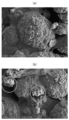
- FIG. 1 is an electron microscope image showing the state of the surface of the electrode active material in the electrode produced using the electrode mixture paste obtained in Test Example 1.
- FIG. 1(a) shows the front side of the electrode
- FIG. 1(b) shows the back side of the electrode.
- FIG. 2 is an electron microscope image showing the state of the surface of the electrode active material in the electrode produced using the electrode mixture paste obtained in Test Example 5.
- FIG. 2(a) shows the front side of the electrode
- FIG. 2(b) shows the back side of the electrode.
- a CNT-containing powder for an electrode according to an embodiment of the present invention contains carbon nanotubes (CNT) and a modified polyvinyl alcohol resin having an acetal structure as a dispersant. characterized by
- CNTs used in the present invention include single-walled carbon tubes (SWCNTs), multi-walled carbon nanotubes (MWCNTs), and the like.
- SWCNTs and MWCNTs may be those that can be used for electrodes of electric storage devices, and for example, the diameter, length and aspect ratio of SWCNTs or MWCNTs are not particularly limited.
- SWCNTs and MWCNTs may be used either alone or in combination.
- Modified polyvinyl alcohol resins having an acetal structure (hereinafter referred to as modified polyvinyl alcohol resins) used as dispersants in the present invention include polyvinyl butyral resins, polyvinyl formal resins, polyvinyl acetoacetal resins, and the like. Moreover, as the modified polyvinyl alcohol resin, in addition to acetal, a polyvinyl alcohol resin having a modifying group other than acetal may be used.
- a modified polyvinyl alcohol resin containing a structural unit having an alkyl modified group in the side chain A modified polyvinyl acetal resin composed of vinyl ester units, vinyl alcohol units, ⁇ -olefin units and acetal units, Modified polyvinyl obtained by saponifying before or after mixing a resin mixture of a copolymer of unsaturated (di)carboxylic acid or unsaturated (di)carboxylic acid derivative and vinyl ester, and a resin mixture of copolymer of ethylene and vinyl ester Modified polyvinyl acetal resin synthesized by acetalization reaction of alcohol resin and aldehyde, etc.
- commercial products Japanese Patent No. 4828347, Japanese Patent No.
- JP-A-2020-088389 examples include those described in JP-A-2020-088389, but are not particularly limited.
- the average molecular weight of the modified polyvinyl acetal resin is preferably 1.0 ⁇ 10 4 to 5.0 ⁇ 10 4 from the viewpoints of solvent solubility and CNT dispersibility.
- the amount of hydroxyl groups in the modified polyvinyl acetal resin is preferably 20 mol % or more from the viewpoint of solubility in a solvent and dispersibility of CNTs.
- the weight ratio of the content of the CNT and the dispersant should be adjusted within the range of 33:67 to 99:1.
- the CNT powder of the present invention can be produced by kneading the CNTs, the dispersant and the solvent to prepare a paste-like kneaded product, and then drying the kneaded product.
- the CNT powder of the present invention has a structure in which the dispersant is attached to the surface of the CNT.
- the CNT powder of the present invention has excellent dispersibility in the electrode material, and widely adheres to the surface of electrode materials such as electrode active materials and solid electrolytes, and has excellent Conductivity can be exhibited.
- the presence of the above structure can be confirmed, for example, by dispersing the CNT powder of the present invention in a solvent such as N-methyl-2-pyrrolidone (NMP) and checking the weight of the liberated dispersant.
- NMP N-methyl-2-pyrrolidone
- the CNT powder of the present invention has the following merits. 1. It has good stability, such as no change in rheology due to aggregation or precipitation of CNTs and no change in concentration due to volatilization of the solvent. 2. Since the product life is long and solvent recovered and recycled at the battery factory is not reused at the dispersion factory, there is no need to build a dispersion factory near the battery factory. 3. Since the CNT content is high, it is considered that there are almost no restrictions on the formulation when producing the electrode mixture. 4. Since the CNT content is high and the volume and weight (per CNT unit weight) are small, transportation and storage costs are low. 5. Since it has excellent dispersibility even when used to prepare electrode mixtures of various compositions, it can be applied to various battery systems. For example, the same CNT powder can be used in liquid-based lithium-ion batteries and sulfide-based all-solid-state batteries.
- dispersions have the following disadvantages.
- 1. In general, dispersions are known to be less stable and have a shorter product life than the CNT powder of the present invention because rheological changes due to aggregation and precipitation of CNTs and changes in concentration due to solvent volatilization are more likely to occur. there is 2. Due to the short product life, and in order to reuse the solvent recovered and recycled at the battery factory, it is necessary to build a dispersion factory near the battery factory. 3. Many commercial products generally have a CNT content of 6% by weight or less. 4. Since the CNT content is low and the volume and weight (per unit weight of CNT) are large, transportation and storage costs are high. 5. A dispersion design that matches the battery system is required. For example, usable solvents are different between a liquid lithium ion battery and a sulfide all-solid-state battery. If the solvent changes, it is highly likely that the CNT dispersion conditions will also change.
- Examples of the solvent include alcohol solvents, amine solvents, ether solvents, glycol ester solvents, ketone solvents and water.
- Examples of the alcohol solvent include methanol, ethanol, normal propyl alcohol, isopropyl alcohol (IPA), butyl alcohol, octyl alcohol, cyclohexanol, allyl alcohol, benzyl alcohol, cresol, furfuryl alcohol, propylene glycol monomethyl ether (PM), Ethylene glycol monomethyl ether, ethylene glycol monoethyl ether, ethylene glycol tertiary butyl ether (ETB), ethylene glycol monobutyl ether, 3-methoxy-3-methyl-1-butanol, ethylene glycol monopropyl ether, ethylene glycol phenyl ether, diethylene glycol mono Butyl ether, triethylene glycol monobutyl ether, dipropylene glycol monomethyl ether and the like.
- IPA isopropyl alcohol
- Examples of the amine solvent include N,N-dimethylaminopropylamine and diethylenetriamine.
- the ether solvent include methylphenyl ether (anisole), tetrahydrofuran, dioxane, ethylene glycol dimethyl ether, and the like.
- Examples of the glycol ester solvent include propylene glycol monomethyl ether acetate (PMA), ethylene glycol monoethyl ether acetate, 3-methoxybutyl acetate, ethylene glycol diacetate and the like.
- Examples of the ketone solvent include acetone, methyl ethyl ketone (MEK), cyclopentanone, cyclohexanone and the like. The solvents may be used alone or in combination of two or more.
- the solvent has a hydrogen bond term contribution ratio of 0.20 or more, which is obtained by the following formula (1).
- 20° C. is preferably a solvent with a vapor pressure greater than 0.1 kPa.
- Contribution rate of the hydrogen bonding term (hydrogen bonding term ⁇ H of the Hansen solubility parameter of the solvent)/(vector length ⁇ of the Hansen solubility parameter of the solvent) Equation (1)
- the contribution rate is preferably 0.90 or less.
- the "Hansen solubility parameter” (also called HSP) is a parameter obtained by dividing the energy of vaporization into three terms: a dispersion term ( ⁇ D ), a polarization term ( ⁇ P ) and a hydrogen bonding term ( ⁇ H ).
- the HSP of various solvents is known and determined from experimental values such as latent heat of vaporization, refractive index, dipole moment, and dielectric constant.
- the length ⁇ of the HSP vector of the solvent is the predetermined dispersion term ( ⁇ D ), the polarization term ( ⁇ P ) and the hydrogen bond term ( ⁇ H ) of the solvent when treated as a three-dimensional vector. It refers to the length calculated from the following formula (2). This value corresponds to the Hildebrand solubility parameter.
- ⁇ 2 ⁇ D 2 + ⁇ P 2 + ⁇ H 2 Equation (2)
- An empirical formula is known that solvents with similar vectors are more likely to dissolve solutes with similar vectors.
- the vapor pressure at 20°C can be measured by a known method.
- the dispersant is easily dissolved and the CNTs are It becomes easy to obtain a paste-like kneaded product in which the and the dispersant are homogeneously present, and the CNT powder obtained by drying this kneaded product has the effect of suppressing the occurrence of CNT agglomeration.
- the amount of the solvent to be mixed with the CNT and the dispersant is not particularly limited as long as a paste-like kneaded product can be obtained.
- Examples of the mixer used for kneading include a planetary stirrer, a kneader, an extrusion kneader, and a thin film swirling high speed stirrer.
- the planetary agitator is a machine that mixes materials by retention and shear stress due to centrifugal force generated by rotating and revolving (planetary motion), and is also called a rotation-revolution mixer.
- a commercially available production apparatus may be used for the planetary stirrer, and there is no particular limitation.
- the conditions for producing the kneaded product are not particularly limited.
- the means for drying the kneaded product obtained as described above is not particularly limited, and may be performed by an apparatus that can adjust the temperature to a temperature higher than that at which the solvent volatilizes, an apparatus that can remove the solvent by reducing pressure, a freeze-drying apparatus, or the like. good.
- an apparatus that can adjust the temperature to a temperature higher than that at which the solvent volatilizes an apparatus that can remove the solvent by reducing pressure, a freeze-drying apparatus, or the like. good.
- the degree to which the solvent is volatilized is not particularly limited as long as the kneaded product is in the form of powder. Further, when the kneaded product is taken out from the drying apparatus and the drying is insufficient or the solvent smells, additional drying may be performed.
- the CNT powder of the present invention has the property of being difficult to agglomerate even in such a drying process.
- the electrode composite of the present invention contains the electrode CNT powder and an inorganic compound, wherein the inorganic compound is an electrode active material and/or a solid electrolyte.
- the electrode composite can be used as a material for producing an electrode.
- an electrode mixture paste can be produced by mixing and kneading the electrode composite containing the electrode active material with carbon black, a binder and a solvent.
- Examples of the inorganic compounds include electrode active materials and solid electrolytes.
- the electrode active material includes an active material used for either a positive electrode or a negative electrode.
- positive electrode active materials include layered oxides (LiCoO 2 , LiNiO 2 , LiNi 1/3 Mn 1/3 Co 1/3 etc.), spinel oxides (LiMnO 2 , LiMn1.6Ni0.4O4 , etc. ), olivine-type oxides (LiFePO4, Fe2 ( SO4 ) 3 , LiCoPO4 , etc.), inverse spinel-type oxides ( LiCoVO4 , LiNiVO4 , etc.), etc. mentioned.
- the negative electrode active material for example, carbon-based (graphite, non-graphitizable carbon, amorphous carbon, polymer compound calcined body (e.g., phenol resin, furan resin, etc.) used in the negative electrode of lithium ion batteries. (e.g., pitch coke, needle coke, petroleum coke, etc.), carbon fiber, etc.), oxide-based (Li 2 TiO 3 , TiNb x O, etc.), silicon-based (Si, SiO), etc. be done.
- the positive electrode active material or the negative electrode active material can be used singly or in combination of two or more.
- the solid electrolyte is a solid that can conduct only ions, and may be any material as long as it can be used for an electricity storage device according to the type of the electricity storage device to be described later.
- lithium ion conductive solid electrolytes include the following. - Oxide - based solid electrolyte : crystalline ( Li1.3Al0.3Ti1.7 ( PO4 ) 3 , La0.51Li0.34TiO2.94 , Li7La3Zr2O12 , etc.
- amorphous (Li 2.9 PO 3.3 N 0.46 etc.) Sulfide-based solid electrolyte crystalline ( Li10GeP2S12 , Li3.25Ge0.25P0.75S4 , Li6PS5Cl , etc. ) , glass ceramic ( Li7P3S11 , etc. ) ), amorphous (70Li 2 S-30P 2 S 5 , etc.) ⁇ Others ( Li2B12H12 , Li3OCl0.5Br0.5 , etc. )
- the content of the CNT-containing powder of the present invention in the electrode composite is not particularly limited, and may be appropriately adjusted according to the type of inorganic compound, the type of CNT, the type of electrode to be applied, and the type of electricity storage device to be applied. Just do it.
- the content of the CNT-containing powder may be 0.01 to 10% by weight.
- the electrode composite can be produced by mixing the electrode CNT-containing powder and the inorganic compound.
- the mixing is not particularly limited, and may be performed by either a wet method or a dry method.
- Examples of the mixer used for the mixing include a planetary stirrer, a kneader, an extrusion kneader, and a thin-film swirling high-speed stirrer.
- an electrode composite containing an electrode active material as an inorganic compound can be produced by the following steps. Homogenization step: A mixture is prepared by mixing an electrode active material, a CNT powder for an electrode, and a solvent. Defibrillation step: The mixture is kneaded using the mixer. Finishing step: If necessary, the solvent is removed by drying or the like.
- the solvent is not particularly limited, and alcohol solvents such as methanol, ethanol, normal propyl alcohol, IPA, butyl alcohol, octyl alcohol, cyclohexanol, allyl alcohol, benzyl alcohol, cresol, furfuryl alcohol, PM, ethylene glycol monomethyl ether, ethylene glycol monoethyl ether, ETB, ethylene glycol monobutyl ether, 3-methoxy-3-methyl-1-butanol, ethylene glycol monopropyl ether, ethylene glycol phenyl ether, diethylene glycol monobutyl ether, triethylene glycol alcohol ether solvents such as monobutyl ether and dipropylene glycol monomethyl ether; Amine-based solvents such as N,N-dimethylaminopropylamine and diethylenetriamine, Ether solvents such as methylphenyl ether (anisole), tetrahydrofuran, dioxane, ethylene glycol dimethyl ether, glyco
- the concentration of the electrode active material is adjusted from the tap density (D Tap ) (unit: g/cm 3 ) of the electrode active material based on the following formula (3):
- D Tap tap density
- C unit: weight %
- the tap density of the electrode active material can be measured by a prescription according to JIS K 5101-12-2. Also, for commercially available electrode active materials, numerical values described in catalogs may be used.
- the electrode mixture paste of the present invention contains the CNT powder for electrodes, an electrode active material, a binder and a solvent.
- the content of the CNT powder for electrodes in the electrode mixture paste of the present invention may be appropriately adjusted according to the type of electricity storage device to be applied from the viewpoint of improving the conductivity and the capacity of the electricity storage device.
- the electrode active material is not particularly limited as long as it can be used in the electrode composite.
- the content of the electrode active material in the electrode mixture paste of the present invention may be appropriately adjusted according to the type of electric storage device to be applied from the viewpoint of improving conductivity and capacity of the electric storage device.
- the binder may be a binder that can be used for an electrode for an electricity storage device.
- examples include polyvinylidene fluoride (PVDF), polyvinyl alcohol, polyvinyl acetal, acrylic resin, polyvinyl acetate, polyvinyl chloride, polystyrene, polyvinyl ether, Polyvinylpyrrolidone (PVP), styrene-butadiene rubber (SBR), carboxymethyl cellulose and the like can be mentioned.
- PVDF polyvinylidene fluoride
- PVDF polyvinyl alcohol
- polyvinyl acetal acrylic resin
- polyvinyl acetate polyvinyl chloride
- polystyrene polyvinyl ether
- SBR styrene-butadiene rubber
- carboxymethyl cellulose and the like can be mentioned.
- These may be modified with various functional groups, and polar functional groups such as acidic groups
- weight average molecular weight of the binder is not particularly limited, it can be suitably used as long as it is within the range of 110,000 to 5,000,000, for example.
- the content of the binder in the electrode mixture paste of the present invention may be appropriately adjusted according to the type of electricity storage device to be applied from the viewpoint of improving conductivity and capacity of the electricity storage device.
- the solvent contained in the electrode mixture paste of the present invention may be appropriately selected according to the type of active material and binder used.
- the solvent is not particularly limited, and aprotic polar solvents such as NMP, dimethylsulfoxide, dimethylformamide, ⁇ -butyrolactone, aliphatic hydrocarbon solvents such as pentane, n-hexane, octane, cyclopentane, and cyclohexane; aromatic hydrocarbon solvents such as benzene, toluene, xylene, cymene, and mesitylene; Aldehyde solvents such as furfural, Ketone solvents such as acetone, MEK, cyclopentanone, cyclohexanone, glycol ester solvents such as PMA, ethylene glycol monoethyl ether acetate, 3-methoxybutyl acetate, ethylene glycol diacetate; ester solvents such as butyl acetate, e
- the electrode mixture paste of the present invention is obtained by kneading the electrode CNT powder, electrode active material, binder and solvent.
- the kneading method is not particularly limited, but examples of mixers used for kneading include a planetary stirrer, a kneader, an extrusion kneader, and a thin-film swirling high-speed stirrer.
- each component may be mixed at the same time, or the CNT powder for the electrode, the electrode active material and the binder may be mixed in order with the solvent.
- This order is not particularly limited, and the mixture of the electrode CNT powder and the electrode active material (electrode composite) may be gradually added.
- the solvent and the binder may be mixed and dissolved in advance.
- the ratio of the electrode components in the electrode mixture paste that is, the ratio of the electrode CNT powder, the electrode active material, and the binder in the electrode mixture paste is determined from the viewpoint of the thickness of the electrode to be obtained and the coatability of the electric storage device to be applied. It may be adjusted as appropriate according to the type.
- the electrode mixture paste can be produced, for example, by the following steps. Homogenization step: A mixture is prepared by mixing an electrode active material, a CNT powder for an electrode, and a solvent. Defibrillation step: The mixture is kneaded using the mixer. Finishing step: Add a binder and, if necessary, a solvent.
- the concentration of the electrode active material is adjusted from the tap density (D Tap ) (unit: g/cm 3 ) of the electrode active material based on the above formula (3)
- D Tap tap density
- C unit: weight %
- the solvent is not particularly limited, and alcohol solvents such as methanol, ethanol, normal propyl alcohol, IPA, butyl alcohol, octyl alcohol, cyclohexanol, allyl alcohol, benzyl alcohol, cresol, furfuryl alcohol, PM, ethylene glycol monomethyl ether, ethylene glycol monoethyl ether, ETB, ethylene glycol monobutyl ether, 3-methoxy-3-methyl-1-butanol, ethylene glycol monopropyl ether, ethylene glycol phenyl ether, diethylene glycol monobutyl ether, triethylene glycol alcohol ether solvents such as monobutyl ether and dipropylene glycol monomethyl ether; Amine-based solvents such as N,N-dimethylaminopropylamine and diethylenetriamine, Ether solvents such as methylphenyl ether (anisole), tetrahydrofuran, dioxane, ethylene glycol dimethyl ether, glyco
- the tap density of the electrode active material can be measured by a prescription according to JIS K 5101-12-2. Also, for commercially available electrode active materials, numerical values described in catalogs may be used.
- the electricity storage device electrode of the present invention (hereinafter also referred to as the electrode of the present invention) includes an electrode mixture layer formed using the electrode mixture paste of the present invention.
- An electrode mixture paste is applied to a current collector, and the resulting product is dried. By the drying, the solvent in the electrode mixture paste of the present invention is removed, an electrode mixture layer is formed on the current collector, and an electrode is obtained.
- examples of the current collector include Al, Ni, Cu, and stainless steel.
- examples of the shape of the current collector include foil-like, flat plate-like, mesh-like, net-like, lath-like, punching metal-like, and embossed shapes, and combinations thereof (e.g., mesh-like flat plate, etc.). ) and the like. Further, unevenness may be formed on the surface of the current collector by etching.
- the method of applying the electrode mixture paste of the present invention to the current collector is not particularly limited. Examples thereof include slit die coating, screen coating, curtain coating, knife coating, gravure coating and electrostatic spraying. Drying after coating may be performed by heat treatment, air drying, vacuum drying, or the like. When drying is performed by heat treatment, the temperature is usually about 50 to 150.degree. Moreover, you may press after drying. Examples of the pressing method include methods such as die pressing and roll pressing.
- the electrode of the present invention can be produced by the method described above. Moreover, the thickness of the electrode is usually about 5 to 500 ⁇ m.
- the electric storage device of the present invention includes an electrode mixture layer formed using the electrode mixture paste of the present invention.
- a liquid-type or solid-type electric storage device including the electrode of the present invention on which an electrode mixture layer made of the electrode mixture paste of the present invention is formed can be mentioned.
- cation redox secondary batteries lithium ion batteries, sodium ion batteries, polyvalent metal ion batteries, lithium sulfur batteries, sulfide batteries, conversion batteries, redox flow batteries, etc.
- anion redox batteries fluoride batteries, chloride batteries , zinc anode batteries, etc.
- various all-solid-state batteries sulfide-based, oxide-based, nitride-based, polymer-based, etc.
- various air batteries lithium-air batteries, zinc-air batteries, sodium-air batteries, etc.
- capacitors lithium ion capacitors, electric double layer capacitors, etc.
- fuel cells solid polymer type, alkaline type, etc.
- the electricity storage device of the present invention can be manufactured by a known electricity storage device manufacturing method, except that the electrode of the present invention is used. Moreover, the structure of the electrode of the present invention included in the electricity storage device may be an appropriate structure according to the type of the electricity storage device, as described above.
- KF Polymer L#1120 ⁇ Electrode active material> ⁇ NCM523 (LiNi 0.5 Co 0.2 Mn 0.3 O 2 ) tap density: 2.13 g/cm 3 ⁇ NCM111 (LiNi 1/3 Co 1/3 Mn 1/3 O 2 ) tap density: 2.31 g/cm 3 ⁇ LFP (LiFePO 4 ) tap density: 0.97 g/cm 3 ⁇ Solvent> Solvents shown in Table 1 were used.
- ⁇ Surface resistivity> The surface resistivity of the electrode produced using the obtained electrode mixture paste was evaluated as follows. ⁇ Surface resistivity on the front side of the electrode The surface resistivity of the electrode mixture layer formed by applying the electrode mixture paste to a PET sheet material to a thickness of 0.05 mm was measured using “Loresta” manufactured by Nitto Seiko Analytic Co., Ltd. -GX MCP-T700". ⁇ Surface resistivity of the back side of the electrode The electrode mixture paste was applied to the surface of the aluminum foil so that the thickness was 0.05 mm, and then the surface resistivity of the electrode mixture electrode layer transferred to the double-sided tape was measured by Nitto Seiko Analytic Co., Ltd. Measured using "Loresta-GX MCP-T700" manufactured by
- FIG. Electron microscope images of the electrode front side (a) and the electrode back side (b) produced by the method are shown in FIG.
- the CNT aggregation portion and the exposed portion of the positive electrode active material are enclosed by lines. From FIGS. 1(a) and 1(b), it was confirmed that the CNTs were agglomerated on the front side of the electrode prepared using the electrode mixture paste obtained in Test Example 1, and the positive electrode active material was found on the back side of the electrode. The exposed part was confirmed. On the other hand, from FIGS. 2(a) and 2(b), no CNT aggregates were observed on the front side of the electrode prepared using the electrode mixture paste obtained in Test Example 5, and the positive electrode active material on the back side. An exposed portion was observed, but it was significantly smaller than the electrode mixture paste obtained in Test Example 1.
- Test Examples 14 and 15 have a large front/rear ratio compared to the conventional product of Test Example 13, and thus are good results.
- Test Examples 17 and 18 have a higher front/rear ratio than the conventional product of Test Example 16, and thus are good results.
Landscapes
- Chemical & Material Sciences (AREA)
- Engineering & Computer Science (AREA)
- Materials Engineering (AREA)
- Power Engineering (AREA)
- Chemical Kinetics & Catalysis (AREA)
- Electrochemistry (AREA)
- General Chemical & Material Sciences (AREA)
- Microelectronics & Electronic Packaging (AREA)
- Nanotechnology (AREA)
- Manufacturing & Machinery (AREA)
- Organic Chemistry (AREA)
- Inorganic Chemistry (AREA)
- Crystallography & Structural Chemistry (AREA)
- Life Sciences & Earth Sciences (AREA)
- Wood Science & Technology (AREA)
- Physics & Mathematics (AREA)
- Dispersion Chemistry (AREA)
- Spectroscopy & Molecular Physics (AREA)
- Battery Electrode And Active Subsutance (AREA)
- Carbon And Carbon Compounds (AREA)
- Electric Double-Layer Capacitors Or The Like (AREA)
Priority Applications (5)
| Application Number | Priority Date | Filing Date | Title |
|---|---|---|---|
| US18/843,400 US20250183314A1 (en) | 2022-03-04 | 2023-02-17 | Carbon nanotube-containing powder for electrodes, electrode slurry, electrode for power storage devices, and power storage device |
| JP2024504617A JPWO2023167023A1 (https=) | 2022-03-04 | 2023-02-17 | |
| EP23763282.3A EP4489137A4 (en) | 2022-03-04 | 2023-02-17 | POWDER CONTAINING CARBON NANOTUBE FOR ELECTRODES, ELECTRODE MIXING PASTE, ELECTRODE FOR ENERGY STORAGE DEVICES, AND ENERGY STORAGE DEVICE |
| CN202380025431.0A CN118830106A (zh) | 2022-03-04 | 2023-02-17 | 含有电极用碳纳米管的粉末、电极合剂糊剂、蓄电器件用电极和蓄电器件 |
| KR1020247031500A KR20240158919A (ko) | 2022-03-04 | 2023-02-17 | 전극용 카본 나노튜브 함유 분말, 전극 합제 페이스트, 축전 디바이스용 전극 및 축전 디바이스 |
Applications Claiming Priority (2)
| Application Number | Priority Date | Filing Date | Title |
|---|---|---|---|
| JP2022033331 | 2022-03-04 | ||
| JP2022-033331 | 2022-03-04 |
Publications (1)
| Publication Number | Publication Date |
|---|---|
| WO2023167023A1 true WO2023167023A1 (ja) | 2023-09-07 |
Family
ID=87883511
Family Applications (1)
| Application Number | Title | Priority Date | Filing Date |
|---|---|---|---|
| PCT/JP2023/005790 Ceased WO2023167023A1 (ja) | 2022-03-04 | 2023-02-17 | 電極用カーボンナノチューブ含有粉末、電極合剤ペースト、蓄電デバイス用電極及び蓄電デバイス |
Country Status (7)
| Country | Link |
|---|---|
| US (1) | US20250183314A1 (https=) |
| EP (1) | EP4489137A4 (https=) |
| JP (1) | JPWO2023167023A1 (https=) |
| KR (1) | KR20240158919A (https=) |
| CN (1) | CN118830106A (https=) |
| TW (1) | TW202335963A (https=) |
| WO (1) | WO2023167023A1 (https=) |
Families Citing this family (1)
| Publication number | Priority date | Publication date | Assignee | Title |
|---|---|---|---|---|
| CN119593093B (zh) * | 2024-12-06 | 2026-01-09 | 深圳市珂莱蒂尔服饰有限公司 | 一种负离子抗菌聚酯纤维面料及其制备方法 |
Citations (20)
| Publication number | Priority date | Publication date | Assignee | Title |
|---|---|---|---|---|
| JPH06122713A (ja) | 1992-10-12 | 1994-05-06 | Hitachi Ltd | ポリビニルアセタール系樹脂及びこれを含有する感光性樹脂組成物 |
| JPH06192326A (ja) | 1992-12-25 | 1994-07-12 | Hitachi Ltd | ポリビニルアセタール系樹脂、これを含有する感光性樹脂組成物並びにその用途 |
| JP3306112B2 (ja) | 1992-09-11 | 2002-07-24 | 株式会社日立製作所 | ポリビニルアセタール系樹脂、その製法及びこれを用いたセラミックシート |
| JP2008001898A (ja) * | 2006-06-21 | 2008-01-10 | Kuan-Jiuh Lin | Cnt/ポリマー複合材料およびその製造方法 |
| JP2009062461A (ja) * | 2007-09-06 | 2009-03-26 | Dainichiseika Color & Chem Mfg Co Ltd | カーボンナノチューブ樹脂組成物、カーボンナノチューブ分散組成物、それらの使用方法およびそれらを使用した物品 |
| JP4302589B2 (ja) | 2004-03-18 | 2009-07-29 | 積水化学工業株式会社 | 導電ペースト |
| JP4584666B2 (ja) | 2004-10-05 | 2010-11-24 | 日本合成化学工業株式会社 | ポリビニルアセタール系樹脂 |
| JP4828347B2 (ja) | 2006-08-01 | 2011-11-30 | 株式会社クラレ | ポリビニルアセタール樹脂 |
| KR20110130806A (ko) * | 2010-05-28 | 2011-12-06 | 부산대학교 산학협력단 | 고분자/탄소나노튜브 복합체 제조 방법, 이를 이용한 고분자/탄소나노튜브 복합체 박막 제조 방법, 고분자/탄소나노튜브 복합체 및 고분자/탄소나노튜브 복합체 박막 |
| JP5162124B2 (ja) | 2006-12-05 | 2013-03-13 | 積水化学工業株式会社 | 変性ポリビニルアセタール樹脂、塗工ペースト、導電ペースト及びセラミックペースト |
| JP5179308B2 (ja) | 2007-10-03 | 2013-04-10 | 株式会社クラレ | ポリビニルアセタール |
| JP5563188B2 (ja) | 2007-05-29 | 2014-07-30 | 株式会社クラレ | グラフト変性ポリビニルアセタールの製法 |
| JP5628503B2 (ja) | 2009-09-25 | 2014-11-19 | 御国色素株式会社 | 導電材分散液、電極ペーストおよび導電材被覆活物質 |
| JP5820200B2 (ja) | 2010-10-29 | 2015-11-24 | 積水化学工業株式会社 | 変性ポリビニルアセタール樹脂及び変性ポリビニルアセタール樹脂組成物 |
| JP5899379B2 (ja) | 2014-03-20 | 2016-04-06 | 積水化学工業株式会社 | 導電ペースト |
| JP6259952B1 (ja) | 2016-04-01 | 2018-01-10 | 積水化学工業株式会社 | リチウム二次電池電極用組成物 |
| JP2018535284A (ja) * | 2015-09-25 | 2018-11-29 | エルジー・ケム・リミテッド | カーボンナノチューブ分散液およびその製造方法 |
| JP2020088389A (ja) | 2018-11-19 | 2020-06-04 | 積水化学工業株式会社 | 導電ペースト |
| JP2021080319A (ja) | 2019-11-14 | 2021-05-27 | 三菱瓦斯化学株式会社 | ポリビニルアセタール樹脂、積層体、及びポリビニルアセタール樹脂の製造方法 |
| KR20210153849A (ko) * | 2020-06-11 | 2021-12-20 | 효성화학 주식회사 | 탄소나노튜브-고분자 나노복합재료 및 그의 제조방법 |
Family Cites Families (5)
| Publication number | Priority date | Publication date | Assignee | Title |
|---|---|---|---|---|
| JPS5628503U (https=) | 1980-07-17 | 1981-03-17 | ||
| US9181090B2 (en) * | 2008-02-08 | 2015-11-10 | Meijo Nano Carbon Co., Ltd. | Carbon nanotube dispersion and utilization of same |
| KR101993783B1 (ko) * | 2016-01-20 | 2019-06-28 | 주식회사 엘지화학 | 카본나노튜브 펠렛 제조장치 |
| PL3333946T3 (pl) * | 2016-03-24 | 2021-07-19 | Lg Chem, Ltd. | Dyspersja przewodnika i akumulator wytworzony z jej użyciem |
| JP6524479B1 (ja) * | 2018-07-20 | 2019-06-05 | 東洋インキScホールディングス株式会社 | 化合物、分散剤、電池用分散組成物、電極、電池 |
-
2023
- 2023-02-17 JP JP2024504617A patent/JPWO2023167023A1/ja active Pending
- 2023-02-17 EP EP23763282.3A patent/EP4489137A4/en active Pending
- 2023-02-17 US US18/843,400 patent/US20250183314A1/en active Pending
- 2023-02-17 WO PCT/JP2023/005790 patent/WO2023167023A1/ja not_active Ceased
- 2023-02-17 CN CN202380025431.0A patent/CN118830106A/zh active Pending
- 2023-02-17 KR KR1020247031500A patent/KR20240158919A/ko active Pending
- 2023-02-22 TW TW112106498A patent/TW202335963A/zh unknown
Patent Citations (20)
| Publication number | Priority date | Publication date | Assignee | Title |
|---|---|---|---|---|
| JP3306112B2 (ja) | 1992-09-11 | 2002-07-24 | 株式会社日立製作所 | ポリビニルアセタール系樹脂、その製法及びこれを用いたセラミックシート |
| JPH06122713A (ja) | 1992-10-12 | 1994-05-06 | Hitachi Ltd | ポリビニルアセタール系樹脂及びこれを含有する感光性樹脂組成物 |
| JPH06192326A (ja) | 1992-12-25 | 1994-07-12 | Hitachi Ltd | ポリビニルアセタール系樹脂、これを含有する感光性樹脂組成物並びにその用途 |
| JP4302589B2 (ja) | 2004-03-18 | 2009-07-29 | 積水化学工業株式会社 | 導電ペースト |
| JP4584666B2 (ja) | 2004-10-05 | 2010-11-24 | 日本合成化学工業株式会社 | ポリビニルアセタール系樹脂 |
| JP2008001898A (ja) * | 2006-06-21 | 2008-01-10 | Kuan-Jiuh Lin | Cnt/ポリマー複合材料およびその製造方法 |
| JP4828347B2 (ja) | 2006-08-01 | 2011-11-30 | 株式会社クラレ | ポリビニルアセタール樹脂 |
| JP5162124B2 (ja) | 2006-12-05 | 2013-03-13 | 積水化学工業株式会社 | 変性ポリビニルアセタール樹脂、塗工ペースト、導電ペースト及びセラミックペースト |
| JP5563188B2 (ja) | 2007-05-29 | 2014-07-30 | 株式会社クラレ | グラフト変性ポリビニルアセタールの製法 |
| JP2009062461A (ja) * | 2007-09-06 | 2009-03-26 | Dainichiseika Color & Chem Mfg Co Ltd | カーボンナノチューブ樹脂組成物、カーボンナノチューブ分散組成物、それらの使用方法およびそれらを使用した物品 |
| JP5179308B2 (ja) | 2007-10-03 | 2013-04-10 | 株式会社クラレ | ポリビニルアセタール |
| JP5628503B2 (ja) | 2009-09-25 | 2014-11-19 | 御国色素株式会社 | 導電材分散液、電極ペーストおよび導電材被覆活物質 |
| KR20110130806A (ko) * | 2010-05-28 | 2011-12-06 | 부산대학교 산학협력단 | 고분자/탄소나노튜브 복합체 제조 방법, 이를 이용한 고분자/탄소나노튜브 복합체 박막 제조 방법, 고분자/탄소나노튜브 복합체 및 고분자/탄소나노튜브 복합체 박막 |
| JP5820200B2 (ja) | 2010-10-29 | 2015-11-24 | 積水化学工業株式会社 | 変性ポリビニルアセタール樹脂及び変性ポリビニルアセタール樹脂組成物 |
| JP5899379B2 (ja) | 2014-03-20 | 2016-04-06 | 積水化学工業株式会社 | 導電ペースト |
| JP2018535284A (ja) * | 2015-09-25 | 2018-11-29 | エルジー・ケム・リミテッド | カーボンナノチューブ分散液およびその製造方法 |
| JP6259952B1 (ja) | 2016-04-01 | 2018-01-10 | 積水化学工業株式会社 | リチウム二次電池電極用組成物 |
| JP2020088389A (ja) | 2018-11-19 | 2020-06-04 | 積水化学工業株式会社 | 導電ペースト |
| JP2021080319A (ja) | 2019-11-14 | 2021-05-27 | 三菱瓦斯化学株式会社 | ポリビニルアセタール樹脂、積層体、及びポリビニルアセタール樹脂の製造方法 |
| KR20210153849A (ko) * | 2020-06-11 | 2021-12-20 | 효성화학 주식회사 | 탄소나노튜브-고분자 나노복합재료 및 그의 제조방법 |
Non-Patent Citations (1)
| Title |
|---|
| See also references of EP4489137A4 |
Also Published As
| Publication number | Publication date |
|---|---|
| KR20240158919A (ko) | 2024-11-05 |
| JPWO2023167023A1 (https=) | 2023-09-07 |
| EP4489137A4 (en) | 2025-12-10 |
| TW202335963A (zh) | 2023-09-16 |
| US20250183314A1 (en) | 2025-06-05 |
| EP4489137A1 (en) | 2025-01-08 |
| CN118830106A (zh) | 2024-10-22 |
Similar Documents
| Publication | Publication Date | Title |
|---|---|---|
| JP5158396B2 (ja) | 電極用バインダー組成物 | |
| Sun et al. | Effect of poly (acrylic acid)/Poly (vinyl alcohol) blending binder on electrochemical performance for lithium iron phosphate cathodes | |
| JP6136765B2 (ja) | 非水系電解質二次電池用正極活物質の製造方法、非水系電解質二次電池用正極活物質および非水系電解質二次電池 | |
| TWI686002B (zh) | 蓄電裝置用集電體、其製造方法及用於其製造之塗佈液 | |
| JP5431699B2 (ja) | 二次電池電極用バインダー、それを用いてなる電極及び二次電池 | |
| CN104115311A (zh) | 二次电池电极形成用组合物、二次电池电极以及二次电池 | |
| JP2012156109A (ja) | リチウムイオン電池用の導電下地塗料 | |
| JP5736928B2 (ja) | キャパシタ用導電下地塗料、キャパシタ用電極、並びに電気二重層キャパシタ及びリチウムイオンキャパシタ | |
| KR102258831B1 (ko) | 음극 슬러리 및 그 슬러리를 이용한 음극 | |
| CN106716687A (zh) | 正极用浆料、蓄电装置正极及蓄电装置 | |
| WO2023167023A1 (ja) | 電極用カーボンナノチューブ含有粉末、電極合剤ペースト、蓄電デバイス用電極及び蓄電デバイス | |
| JP7059858B2 (ja) | カーボンブラック分散組成物およびその利用 | |
| JP2013041785A (ja) | リチウムイオン電池用電極ペーストの製造方法およびリチウムイオン電池電極。 | |
| WO2022045286A1 (ja) | グラフェン分散液、グラフェン樹脂粉、及び電池 | |
| WO2024185255A1 (ja) | 電極用カーボンナノチューブ含有粉末、電極合剤ペースト、蓄電デバイス用電極及び蓄電デバイス | |
| WO2019065930A1 (ja) | 負極活物質塗料、負極および二次電池 | |
| JP2021036520A (ja) | 非水電解質二次電池用下地層付き集電体、非水電解質二次電池用電極及び非水電解質二次電池 | |
| TW202506547A (zh) | 蓄電裝置的電極用含碳納米管的粉末、電極合劑糊、蓄電裝置用電極和蓄電裝置 | |
| WO2026028808A1 (ja) | 電極合剤ペースト及び固体電池用電極 | |
| JP2025162415A (ja) | 固体電池用繊維状導電助剤 | |
| JP2025161046A (ja) | 固体電解質組成物、固体電解質膜、積層体、電池、固体電解質組成物の製造方法 | |
| CN115483361A (zh) | 正极的制造方法、正极及锂离子二次电池 | |
| WO2026079393A1 (ja) | 二次電池電極用分散液セット、カーボンナノチューブ分散液、繊維体分散液、二次電池電極用分散液、二次電池電極用スラリー組成物、二次電池用電極および二次電池、ならびに、二次電池電極用分散液の製造方法 |
Legal Events
| Date | Code | Title | Description |
|---|---|---|---|
| 121 | Ep: the epo has been informed by wipo that ep was designated in this application |
Ref document number: 23763282 Country of ref document: EP Kind code of ref document: A1 |
|
| WWE | Wipo information: entry into national phase |
Ref document number: 18843400 Country of ref document: US |
|
| WWE | Wipo information: entry into national phase |
Ref document number: 202380025431.0 Country of ref document: CN |
|
| ENP | Entry into the national phase |
Ref document number: 2024504617 Country of ref document: JP Kind code of ref document: A |
|
| ENP | Entry into the national phase |
Ref document number: 20247031500 Country of ref document: KR Kind code of ref document: A |
|
| WWE | Wipo information: entry into national phase |
Ref document number: 2023763282 Country of ref document: EP |
|
| NENP | Non-entry into the national phase |
Ref country code: DE |
|
| ENP | Entry into the national phase |
Ref document number: 2023763282 Country of ref document: EP Effective date: 20241004 |
|
| WWP | Wipo information: published in national office |
Ref document number: 18843400 Country of ref document: US |