WO2023127525A1 - 冷却器および電力変換装置 - Google Patents
冷却器および電力変換装置 Download PDFInfo
- Publication number
- WO2023127525A1 WO2023127525A1 PCT/JP2022/046219 JP2022046219W WO2023127525A1 WO 2023127525 A1 WO2023127525 A1 WO 2023127525A1 JP 2022046219 W JP2022046219 W JP 2022046219W WO 2023127525 A1 WO2023127525 A1 WO 2023127525A1
- Authority
- WO
- WIPO (PCT)
- Prior art keywords
- cooler
- cooling fins
- ceramic substrate
- another embodiment
- cooling
- Prior art date
- Legal status (The legal status is an assumption and is not a legal conclusion. Google has not performed a legal analysis and makes no representation as to the accuracy of the status listed.)
- Ceased
Links
Images

















Classifications
-
- H—ELECTRICITY
- H05—ELECTRIC TECHNIQUES NOT OTHERWISE PROVIDED FOR
- H05K—PRINTED CIRCUITS; CASINGS OR CONSTRUCTIONAL DETAILS OF ELECTRIC APPARATUS; MANUFACTURE OF ASSEMBLAGES OF ELECTRICAL COMPONENTS
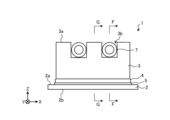
- H05K7/00—Constructional details common to different types of electric apparatus
- H05K7/20—Modifications to facilitate cooling, ventilating, or heating
-
- H—ELECTRICITY
- H10—SEMICONDUCTOR DEVICES; ELECTRIC SOLID-STATE DEVICES NOT OTHERWISE PROVIDED FOR
- H10W—GENERIC PACKAGES, INTERCONNECTIONS, CONNECTORS OR OTHER CONSTRUCTIONAL DETAILS OF DEVICES COVERED BY CLASS H10
- H10W40/00—Arrangements for thermal protection or thermal control
- H10W40/60—Securing means for detachable heating or cooling arrangements, e.g. clamps
Definitions
- the disclosed embodiments relate to coolers and power converters.
- a cooler of the present disclosure includes a ceramic substrate, cooling fins, and a first bonding material that fixes the cooling fins onto the ceramic substrate.
- the ceramic substrate has a first surface and a second surface opposite to the first surface, and the cooling fins are formed by bending a metal plate into a bellows shape.
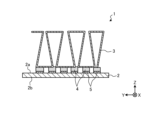
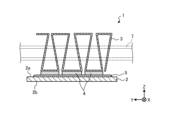
- FIG. 1 is a side view showing an example of the configuration of a cooler according to an embodiment
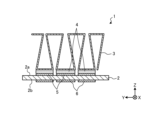
- FIG. 2 is a cross-sectional view taken along line AA shown in FIG. 1.
- FIG. 3 is a plan view showing an example of the configuration of the cooler according to the embodiment.
- 4 is a cross-sectional view showing an example of the configuration of a cooler according to another embodiment 1.
- FIG. 5 is a side view showing an example of the configuration of a cooler according to another embodiment 2.
- FIG. FIG. 6 is a cross-sectional view showing an example of the configuration of a cooler according to another embodiment 3.
- FIG. 7 is a cross-sectional view showing another example of the configuration of a cooler according to another embodiment 3.
- FIG. 8 is a cross-sectional view showing still another example of the configuration of a cooler according to another embodiment 3.
- FIG. FIG. 9 is a diagram showing an example of arrangement of metallized layers according to another embodiment 3.
- FIG. 10 is a diagram showing an example of arrangement of metallized layers according to another embodiment 3.
- FIG. 11 is a diagram showing an example of arrangement of metallized layers according to another embodiment 3.
- FIG. 12 is a diagram showing an example of arrangement of metallized layers according to another embodiment 3.
- FIG. 13 is a cross-sectional view showing an example of the configuration of a cooler according to another embodiment 4.
- FIG. 14 is a cross-sectional view showing an example of the configuration of a cooler according to another embodiment 5.
- FIG. 10 is a diagram showing an example of arrangement of metallized layers according to another embodiment 3.
- FIG. 11 is a diagram showing an example of arrangement of metallized layers according to another embodiment 3.
- FIG. 12 is a diagram showing an example of arrangement of metallized layers according to another embodiment 3.
- FIG. 15 is a cross-sectional view showing an example of the configuration of a cooler according to another embodiment 6.
- FIG. 16 is a cross-sectional view showing an example of the configuration of a cooler according to another embodiment 7.
- FIG. 17 is a side view showing an example of the configuration of a cooler according to another embodiment 8.
- FIG. 18 is a cross-sectional view taken along the line BB shown in FIG. 17.
- FIG. 19 is a cross-sectional view taken along the line CC shown in FIG. 17.
- FIG. 20 is a side view showing an example of the configuration of a cooler according to another embodiment 9.
- FIG. 21 is a cross-sectional view taken along line DD shown in FIG. 20.
- FIG. 22 is a cross-sectional view taken along the line EE shown in FIG. 20.
- FIG. 21 is a cross-sectional view taken along line DD shown in FIG. 20.
- FIG. 23 is a side view showing an example of the configuration of a cooler according to another embodiment 10.
- FIG. 24 is a cross-sectional view taken along line FF shown in FIG. 23.
- FIG. 25 is a cross-sectional view taken along line GG shown in FIG. 23.
- FIG. FIG. 26 is a side view showing an example of the configuration of a cooler according to another eleventh embodiment.
- 27 is a cross-sectional view taken along the line HH shown in FIG. 26.
- FIG. 28 is a cross-sectional view taken along the line II shown in FIG. 26.
- FIG. 29 is a side view showing an example of the configuration of a cooler according to another embodiment 12.
- FIG. 30 is a cross-sectional view taken along line JJ shown in FIG. 29.
- FIG. 31 is a side view showing an example of the configuration of a cooler according to another embodiment 13.
- FIG. 32 is a cross-sectional view taken along the line KK shown in FIG. 31.
- FIG. 33 is a side view showing an example of the configuration of a cooler according to another embodiment 14.
- FIG. 34 is a cross-sectional view taken along line LL shown in FIG. 33.
- FIG. 35 is a plan view showing an example of the configuration of a cooler according to another embodiment 14.
- FIG. 36 is a side view showing an example of the configuration of a cooler according to another fifteenth embodiment.
- FIG. 37 is a cross-sectional view taken along line MM shown in FIG. 36.
- FIG. 38 is a cross-sectional view taken along line NN shown in FIG. 36.
- FIG. 39 is a cross-sectional view showing an example of the configuration of the power converter according to the embodiment.
- FIG. FIG. 40 is a cross-sectional view showing another example of the configuration of the power converter according to the embodiment.
- FIG. 41 is a cross-sectional view showing another example of the configuration of the power converter according to the embodiment.
- FIG. 42 is a cross-sectional view showing another example of the configuration of the power converter according to the embodiment.
- grease may be applied between the cooler and the semiconductor module in order to improve the adhesion between the cooler and the semiconductor module.
- stress may concentrate on the ceramic substrate located near the grease.
- the ceramic substrate is deformed, and the deformation pushes out the grease, which gradually reduces the adhesion between the cooler and the semiconductor module. This may adversely affect the long-term reliability of the power converter.
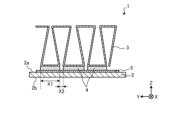
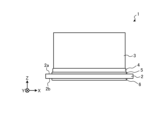
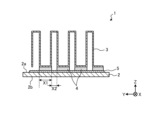
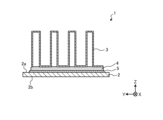
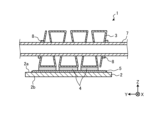
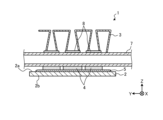
- FIG. 1 is a side view showing an example of the configuration of a cooler 1 according to the embodiment
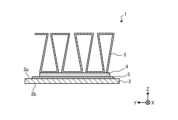
- FIG. 2 is a cross-sectional view taken along line AA shown in FIG.
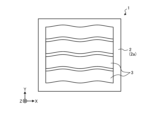
- FIG. 3 is a top view which shows an example of a structure of the cooler 1 which concerns on embodiment.
- the cooler 1 includes a ceramic substrate 2, cooling fins 3, a first bonding material 4, and a metallized layer 5.
- the metallized layer 5 is an example of a first metallized layer.
- the X-axis direction, the Y-axis direction and the Z-axis direction which are orthogonal to each other are defined, and the Z-axis direction is the first surface 2a and the second surface of the ceramic substrate 2.
- 2b is the direction.
- the ceramic substrate 2 is composed of a ceramic sintered body and has a flat plate shape.
- the ceramic substrate 2 has a first surface 2a and a second surface 2b.
- a cooling fin 3 is provided on the side of the first surface 2a of the ceramic substrate 2, and a semiconductor module 20 (see FIG. 39) is provided on the side of the second surface 2b.
- the ceramic substrate 2 functions as an insulating member for electrically insulating the semiconductor module 20 from the outside (for example, the cooling fins 3 ), and conducts heat generated in the semiconductor module 20 to the cooling fins 3 . It also functions as a heat transfer member.
- Ceramic substrate 2 can use, for example, silicon nitride (Si 3 N 4 ) as a main component.
- the main component of the ceramic substrate 2 is not limited to silicon nitride, and the main component of the ceramic substrate 2 may be alumina (Al 2 O 3 ), aluminum nitride (AlN), or the like.
- the ceramic substrate 2 can be manufactured by a known manufacturing method, for example, by adding a sintering aid to a raw material powder such as silicon nitride, molding it into a substrate, and then firing the molded body. can be done.
- Cooling fins 3 dissipate the heat generated in the semiconductor modules 20 to the outside atmosphere.
- Cooling fins 3 can be made of metal materials such as copper (Cu), aluminum (Al), copper alloys, and aluminum alloys, for example.
- the first bonding material 4 fixes the cooling fins 3 on the ceramic substrate 2 .
- the first joining material 4 joins the metallized layer 5 located on the first surface 2 a of the ceramic substrate 2 and the cooling fins 3 .
- the first bonding material 4 is, for example, a bonding material having a relatively high thermal conductivity, such as solder or brazing material. Thereby, the heat generated in the semiconductor module 20 can be efficiently transferred to the cooling fins 3 .
- the metallized layer 5 contains a metal material (eg, copper, silver (Ag), gold (Au), aluminum, nickel (Ni), molybdenum (Mo), tungsten (W), titanium (Ti), etc.) and is a ceramic substrate. It is formed by firing at the same time as 2.
- the metallized layer 5 is located on the first surface 2a of the ceramic substrate 2 in the form of a film.
- the cooling fins 3 are formed by bending a metal plate into a bellows shape. As a result, even if the semiconductor module 20 (see FIG. 39) generates heat during operation and the transmitted heat raises the temperature of the cooling fins 3, the cooling fins 3 themselves can be deformed like springs.
- the embodiment even when the cooling fins 3 reach a high temperature, the application of stress from the cooling fins 3 to the ceramic substrate 2 can be reduced. Therefore, according to the embodiment, it is possible to reduce the extrusion of the grease 30 (see FIG. 39) between the cooler 1 and the semiconductor module 20, thereby improving the long-term reliability of the power conversion device 100 (see FIG. 39). can be made
- the cooling fins 3 may be folded back in an ⁇ shape when viewed in cross section. As a result, the cooling efficiency of the cooler 1 can be improved because the surface area of the cooling fins 3 can be increased.
- the first bonding material 4 may be positioned in a pattern on the ceramic substrate 2 to bond the cooling fins 3 .
- the joints where the cooling fins 3 and the first joint material 4 are in contact with each other are positioned with a gap therebetween, so that the thermal stress of the cooling fins 3 when the temperature becomes high can be alleviated.
- the long-term reliability of the power converter 100 can be further improved.
- the width X1 of the joint portion where the cooling fins 3 and the first joint material 4 are in contact may be larger than the interval X2 between adjacent joint portions. Since the cooling fins 3 have a higher thermal conductivity than the first bonding material 4, the cooler 1 with excellent cooling performance can be obtained by making the width X1 larger than the interval X2.
- the cooling efficiency of the cooler 1 can be improved.
- the cooling fins 3 may have a wavy shape when viewed from above. As a result, the cooling efficiency of the cooler 1 can be improved because the surface area of the cooling fins 3 can be increased.
- FIG. 4 is a cross-sectional view showing an example of the configuration of the cooler 1 according to another embodiment 1. As shown in FIG.
- the same parts as those in the embodiments are given the same reference numerals, thereby omitting redundant explanations.
- the cooling fins 3 are fixed on the ceramic substrate 2 by the integrated first bonding material 4 .
- the heat conduction path between the cooling fins 3 and the metallized layer 5 can be widened, so that the cooling efficiency of the cooler 1 can be improved.
- FIG. 5 is a side view showing an example of the configuration of the cooler 1 according to another embodiment 2.
- FIG. 5 in the cooler 1 according to the second embodiment, the metallized layer 6 is also located on the second surface 2b of the ceramic substrate 2. As shown in FIG. The metallized layer 6 is an example of a second metallized layer.
- the heat transfer characteristics between the semiconductor module 20 (see FIG. 39) and the ceramic substrate 2 can be improved, so the cooling efficiency of the cooler 1 can be improved.
- the metallized layers 5 and 6 are located on the first surface 2a and the second surface 2b of the ceramic substrate 2, respectively. Thermal stress of the substrate 2 can be relaxed. Therefore, according to another embodiment 2, it is possible to further improve the long-term reliability of the power converter 100 (see FIG. 39).
- FIG. 6 is a cross-sectional view showing an example of the configuration of the cooler 1 according to another embodiment 3. As shown in FIG. As shown in FIG. 6, in a cooler 1 according to another embodiment 3, the metallized layer 5 is positioned on the first surface 2a of the ceramic substrate 2 in a pattern.
- the first bonding material 4 is selectively positioned only on the surface of the metallized layer 5, the first bonding material 4 is also not positioned on the first surface 2a where the metallized layer 5 is not positioned. Therefore, in another embodiment 3, a space is formed between the ceramic substrate 2 and the cooling fins 3 .
- such a space can relax the thermal stress generated inside the cooler 1 when the temperature rises. Therefore, according to the third embodiment, it is possible to further improve the long-term reliability of the power conversion device 100 (see FIG. 39).
- FIG. 7 is a cross-sectional view showing another example of the configuration of the cooler 1 according to another embodiment 3.
- FIG. 7 in another embodiment 3, the width of the metallized layer 5 may be narrower than the width of the flat surface of the cooling fin 3 directly facing the metallized layer 5 .
- FIG. 8 is a cross-sectional view showing still another example of the configuration of the cooler 1 according to another embodiment 3.
- FIG. 8 in another embodiment 3, in addition to the metallization layer 5, a metallization layer 6 located on the second surface 2b of the ceramic substrate 2 may also be patterned.
- the space formed between the adjacent metallized layers 6 functions as a grease reservoir that holds the grease 30 (see FIG. 39).
- the third embodiment it is possible to reduce the depletion of the grease 30 between the semiconductor module 20 (see FIG. 39) and the cooler 1, thereby further improving the long-term reliability of the power converter 100. be able to.
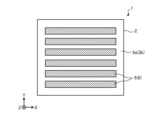
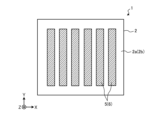
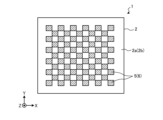
- FIGS. 9 to 12 are diagrams showing an example of arrangement of metallized layers 5 and 6 according to another embodiment 3.
- FIG. As shown in FIGS. 9 and 10, the metallization layers 5 (or metallization layers 6) may be arranged in stripes along a predetermined direction.
- a plurality of band-shaped metallized layers 5 (or metallized layers 6) extending along the X-axis direction may be arranged side by side along the Y-axis direction.
- a plurality of strip-shaped metallized layers 5 (or metallized layers 6) extending along the Y-axis direction may be arranged side by side along the X-axis direction.
- a plurality of metallized layers 5 may be arranged in a matrix along the X-axis direction and the Y-axis direction.
- a plurality of metallized layers 5 may be arranged in a checkered pattern. The pattern includes stripes, matrices, and checkered patterns, and it is sufficient that the metallized layer 5 (or metallized layer 6) is patterned.
- the metallized layer 5 and the metallized layer 6 may have different patterns.
- the metallized layer 5 may have the pattern shown in FIG. 9, and the metallized layer 6 may have the pattern shown in FIG.
- FIG. 13 is a cross-sectional view showing an example of the configuration of the cooler 1 according to another embodiment 4. As shown in FIG. As shown in FIG. 13, in the cooler 1 according to another embodiment 4, the cross-sectional shape of the cooling fins 3 is different from that of the embodiment described above.
- the cooling fins 3 are formed by folding back in a V-shape when viewed in cross section. This also allows the cooling fins 3 themselves to deform like springs when the temperature of the cooling fins 3 becomes high.
- the cooling fins 3 are formed in a V-shape to increase the surface area of the cooling fins 3, so that the cooling efficiency of the cooler 1 can be improved.
- the first bonding material 4 is positioned in a pattern on the ceramic substrate 2 to bond the cooling fins 3 .
- the joints where the cooling fins 3 and the first joint material 4 are in contact with each other are positioned with a gap therebetween, so that the thermal stress of the cooling fins 3 when the temperature becomes high can be alleviated.
- the long-term reliability of the power converter 100 can be further improved.
- FIG. 14 is a cross-sectional view showing an example of the configuration of a cooler 1 according to another embodiment 5. As shown in FIG. 14, in the cooler 1 according to another embodiment 5, the joint structure of the cooling fins 3 is different from that of the above-described fourth embodiment.
- the cooling fins 3 are fixed on the ceramic substrate 2 by the integrated first bonding material 4 .
- the heat conduction path between the cooling fins 3 and the metallized layer 5 can be widened, so that the cooling efficiency of the cooler 1 can be improved.
- FIG. 15 is a cross-sectional view showing an example of the configuration of the cooler 1 according to another embodiment 6. As shown in FIG. As shown in FIG. 15, in the cooler 1 according to the sixth embodiment, the cross-sectional shape of the cooling fins 3 is different from those of the above embodiment and the fourth embodiment.
- the cooling fins 3 are folded back into a U shape when viewed in cross section. This also allows the cooling fins 3 themselves to deform like springs when the temperature of the cooling fins 3 becomes high.
- the cooling fins 3 are folded back in a U shape, so that the surface area of the cooling fins 3 can be increased, so that the cooling efficiency of the cooler 1 can be improved.
- the first bonding material 4 is positioned in a pattern on the ceramic substrate 2 to bond the cooling fins 3 .
- the joints where the cooling fins 3 and the first joint material 4 are in contact with each other are positioned with a gap therebetween, so that the thermal stress of the cooling fins 3 when the temperature becomes high can be alleviated.
- the long-term reliability of the power converter 100 can be further improved.
- the width X1 of the joint portion where the cooling fin 3 and the first joint material 4 are in contact may be larger than the interval X2 between the joint portions adjacent to each other. Since the cooling fins 3 have a higher thermal conductivity than the first bonding material 4, the cooler 1 with excellent cooling performance can be obtained by making the width X1 larger than the interval X2.
- the cooling efficiency of the cooler 1 can be improved.
- FIG. 16 is a cross-sectional view showing an example of the configuration of a cooler 1 according to another embodiment 7.
- FIG. 16 in the cooler 1 according to the seventh embodiment, the joining structure of the cooling fins 3 is different from that of the sixth embodiment.
- the cooling fins 3 are fixed on the ceramic substrate 2 by the integrated first bonding material 4 .
- the heat conduction path between the cooling fins 3 and the metallized layer 5 can be widened, so that the cooling efficiency of the cooler 1 can be improved.
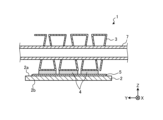
- FIG. 17 is a side view showing an example of the configuration of the cooler 1 according to another embodiment 8.
- FIG. 18 is a cross-sectional view taken along line BB shown in FIG. 17, and
- FIG. 19 is a cross-sectional view taken along line CC shown in FIG.
- a cooler 1 according to another embodiment 8 differs from the above-described embodiments in that a pipe 7 is newly provided.
- the piping 7 allows a coolant to flow therein, and is positioned along the first surface 2 a of the ceramic substrate 2 so as to pass through the central portion of the cooling fins 3 .
- the pipe 7 is made of, for example, a material with high thermal conductivity (for example, a metal material).
- the cooler 1 By providing the cooler 1 with the piping 7 in contact with the cooling fins 3 in this manner, the cooling efficiency of the cooler 1 can be improved.
- the grease 30 (see FIG. 39) is not provided on the first surface 2a side of the ceramic substrate 2. Furthermore, since the piping 7 is not in contact with the cooling fins 3 near the ceramic substrate 2 , the ceramic substrate 2 is not rapidly cooled by the piping 7 .
- cooling fins 3 themselves are forcibly cooled by the refrigerant through the pipes 7, they are not cooled rapidly, but are slowly cooled to the temperature of the refrigerant.
- the opposite surface of the ceramic substrate 2 (that is, the first surface 2a) is slowly cooled with respect to the heating of the semiconductor module 20 (see FIG. 39). almost motionless. Therefore, according to another embodiment 8, the long-term reliability of the power converter 100 can be improved.
- the piping 7 is positioned so as to pass through the cooling fins 3 .
- the cooling fins 3 around the pipes 7 are deformed, so that the thermal stress can be dispersed.
- the long-term reliability of the power converter 100 can be further improved.
- a plurality of (two in the drawing) pipes 7 may be provided so as to be in contact with one cooling fin 3. Thereby, the cooling efficiency of the cooler 1 can be further improved.
- the pipe 7 may have a cylindrical shape. Thereby, when fixing the pipe 7 to the cooling fins 3, the direction of the pipe 7 can be easily adjusted. Therefore, according to another embodiment 8, the manufacturing process of the cooler 1 can be simplified.
- the pipe 7 is not limited to a cylindrical shape, and may have an elliptical shape, a polygonal shape, or the like in a cross-sectional view.
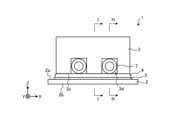
- FIG. 20 is a side view showing an example of the configuration of the cooler 1 according to another ninth embodiment.
- 21 is a cross-sectional view taken along line DD shown in FIG. 20
- FIG. 22 is a cross-sectional view taken along line EE shown in FIG.
- the positions of the pipes 7 are different from those of the eighth embodiment described above.
- the pipe 7 is positioned so as to contact the surface 3 a of the cooling fin 3 opposite to the surface in contact with the first bonding material 4 .
- the opposite surface of the ceramic substrate 2 (that is, the first surface 2a) is slowly cooled with respect to the heating of the semiconductor module 20 (see FIG. 39), so the ceramic substrate 2 expands. Therefore, the grease 30 (see FIG. 39) hardly moves. Therefore, according to the ninth embodiment, it is possible to improve the long-term reliability of the power converter 100 (see FIG. 39).
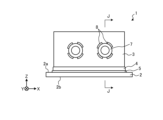
- FIG. 23 is a side view showing an example of the configuration of the cooler 1 according to another tenth embodiment.
- 24 is a cross-sectional view taken along line FF shown in FIG. 23
- FIG. 25 is a cross-sectional view taken along line GG shown in FIG.
- the positions of the pipes 7 are different from those of the other embodiments 8 and 9 described above.
- grooves 3b are formed in the surfaces 3a of the cooling fins 3, and the pipes 7 are positioned in the grooves 3b. That is, the pipe 7 is accommodated in the groove 3b.
- the opposite surface of the ceramic substrate 2 (that is, the first surface 2a) is slowly cooled with respect to the heating of the semiconductor module 20 (see FIG. 39), so the ceramic substrate 2 expands. Therefore, the grease 30 (see FIG. 39) hardly moves. Therefore, according to another tenth embodiment, the long-term reliability of the power conversion device 100 (see FIG. 39) can be improved.
- FIG. 26 is a side view showing an example of the configuration of the cooler 1 according to another eleventh embodiment.
- 27 is a cross-sectional view taken along the line HH shown in FIG. 26
- FIG. 28 is a cross-sectional view taken along the line II shown in FIG.
- the positions of the pipes 7 are different from those of the other embodiments 8 to 10 described above.
- a groove 3d is formed in the surface 3c of the cooling fin 3 in contact with the first bonding material 4, and the pipe 7 is positioned in the groove 3d. That is, the pipe 7 is accommodated in the groove 3d.
- the opposite surface of the ceramic substrate 2 (that is, the first surface 2a) is slowly cooled with respect to the heating of the semiconductor module 20 (see FIG. 39), so the ceramic substrate 2 expands. Therefore, the grease 30 (see FIG. 39) hardly moves. Therefore, according to another eleventh embodiment, the long-term reliability of the power converter 100 (see FIG. 39) can be improved.
- the grooves 3b and 3d of the cooling fins 3 can be formed when the metal plate is bent into a bellows shape.
- the grooves 3b and 3d of the cooling fins 3 can also be formed by bending a metal plate into a bellows shape and then cutting the metal plate.
- FIG. 30 is a cross-sectional view taken along line JJ shown in FIG.
- the cooler 1 according to another embodiment 12 differs from the above-described another embodiment 8 in that a second bonding material 8 is newly provided.
- the second bonding material 8 is positioned between the cooling fins 3 and the pipes 7 penetrating the cooling fins 3, and the cooling fins 3 are connected by the second bonding material 8. Between the piping 7 is joined.
- the second bonding material 8 is, for example, a bonding material with relatively high thermal conductivity such as solder or brazing material. Thereby, the heat reaching the cooling fins 3 can be efficiently transferred to the pipes 7 .
- the opposite surface of the ceramic substrate 2 (that is, the first surface 2a) is slowly cooled with respect to the heating of the semiconductor module 20 (see FIG. 39), so the ceramic substrate 2 expands. Therefore, the grease 30 (see FIG. 39) hardly moves. Therefore, according to the twelfth embodiment, the long-term reliability of the power converter 100 (see FIG. 39) can be improved.
- the cooling fins 3 and the pipes 7 may be partially joined with the second joining material 8.
- the second joining material 8 By providing a gap in the circumferential direction of the pipe 7 in this way, even when the cooling fins 3 are heated to a high temperature, the thermal stress generated inside the cooling fins 3 can be alleviated.
- FIG. 31 is a side view showing an example of the configuration of a cooler 1 according to another embodiment 13, and FIG. 32 is a cross-sectional view taken along line KK shown in FIG.
- the cooler 1 according to another embodiment 13 differs from the above-described another embodiment 11 in that a second bonding material 8 is newly provided.
- the second joint material 8 is positioned between the cooling fins 3 and the pipes 7 accommodated in the grooves 3d of the cooling fins 3. The cooling fins 3 and the pipes 7 are joined together.
- the opposite surface of the ceramic substrate 2 (that is, the first surface 2a) is slowly cooled with respect to the heating of the semiconductor module 20 (see FIG. 39), so the ceramic substrate 2 expands. Therefore, the grease 30 (see FIG. 39) hardly moves. Therefore, according to the thirteenth embodiment, it is possible to improve the long-term reliability of the power converter 100 (see FIG. 39).
- the cooling fins 3 and the pipes 7 may be partially joined with the second joining material 8 inside the grooves 3d.
- the thermal stress generated inside the cooling fins 3 can be alleviated.
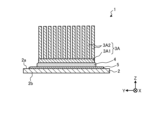
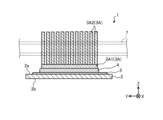
- FIG. 34 is a cross-sectional view taken along line LL shown in FIG.
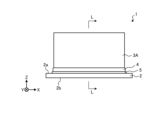
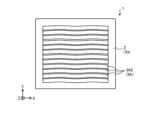
- FIG. 35 is a plan view showing an example of the configuration of the cooler 1 according to another embodiment 14. As shown in FIG.
- cooling fins 3A is different from that of the embodiment described above.
- the cooling fins 3A have a slit fin structure.
- the cooling fin 3A includes a plate-like first portion 3A1 positioned along the first surface 2a of the ceramic substrate 2 and a plurality of plate-like second portions 3A2 erected from the first portion 3A1. have.
- cooling fins 3A for example, metal materials such as copper (Cu), aluminum (Al), copper alloys, and aluminum alloys can be used.
- the 14th embodiment it is possible to reduce the extrusion of the grease 30 (see FIG. 39) between the cooler 1 and the semiconductor module 20, so that the long-term reliability of the power converter 100 (see FIG. 39) can be improved. can improve sexuality.
- the second portion 3A2 of the cooling fin 3A may have a wavy shape when viewed from above.
- the cooling efficiency of the cooler 1 can be improved because the surface area of the cooling fins 3A can be increased.
- FIG. 36 is a side view showing an example of the configuration of the cooler 1 according to another fifteenth embodiment.
- 37 is a cross-sectional view taken along line MM shown in FIG. 36
- FIG. 38 is a cross-sectional view taken along line NN shown in FIG.
- the cooler 1 according to another embodiment 15 differs from the above-described another embodiment 14 in that a pipe 7 is provided.
- the piping 7 allows a coolant to flow therein, and is positioned along the first surface 2a of the ceramic substrate 2 so as to pass through the central portion of the cooling fins 3A.
- the cooler 1 By providing the cooler 1 with the piping 7 in contact with the cooling fins 3A in this way, the cooling efficiency of the cooler 1 can be improved.
- the grease 30 (see FIG. 39) is not provided on the first surface 2a side of the ceramic substrate 2. Furthermore, since the piping 7 does not contact the cooling fins 3A near the ceramic substrate 2 , the ceramic substrate 2 is not rapidly cooled by the piping 7 .
- cooling fins 3A themselves are forcibly cooled by the coolant through the pipes 7, they are not cooled rapidly, but are slowly cooled to the temperature of the coolant.
- the opposite surface of the ceramic substrate 2 (that is, the first surface 2a) is slowly cooled with respect to the heating of the semiconductor module 20 (see FIG. 39). almost motionless. Therefore, according to another fifteenth embodiment, the long-term reliability of the power converter 100 can be improved.
- the piping 7 is positioned so as to pass through the cooling fins 3A.
- the cooling fins 3A around the pipes 7 are deformed, so that the thermal stress can be dispersed.
- the long-term reliability of the power converter 100 can be further improved.
- a plurality of (two in the figure) pipes 7 may be provided so as to be in contact with one cooling fin 3A. Thereby, the cooling efficiency of the cooler 1 can be further improved.
- the pipe 7 may have a cylindrical shape. Accordingly, when fixing the pipe 7 to the cooling fins 3A, the direction of the pipe 7 can be easily adjusted. Therefore, according to another embodiment 15, the manufacturing process of the cooler 1 can be simplified.
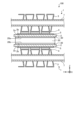
- FIG. 39 is a cross-sectional view showing an example of the configuration of the power converter 100 according to the embodiment.
- the power converter 100 according to the embodiment includes two coolers 1 according to the embodiment, a semiconductor module 20, and grease 30.
- the power converter 100 according to the embodiment includes two coolers 1 according to the embodiment, a semiconductor module 20, and grease 30.
- the power converter 100 according to the embodiment includes two coolers 1 according to the embodiment, a semiconductor module 20, and grease 30.
- the semiconductor module 20 has a power semiconductor element (not shown), a wiring member connected to the power semiconductor element, and the like. .
- Power semiconductor devices are, for example, IGBTs (Insulated Gate Bipolar Transistors), power MOSFETs (Metal-Oxide-Semiconductor Field-Effect Transistors), thyristors, GTOs (Gate Turn-Off thyristors), and the like.
- IGBTs Insulated Gate Bipolar Transistors
- MOSFETs Metal-Oxide-Semiconductor Field-Effect Transistors
- thyristors thyristors
- GTOs Gate Turn-Off thyristors
- the grease 30 has a semi-solid property that is viscous and deformable at room temperature.
- a mixture of silicone resin having good thermal conductivity and an inorganic filler such as metal oxide or carbon can be used.
- the pair of coolers 1 are brought into contact with the main surfaces 20a and 20b of the semiconductor module 20 via the grease 30, respectively.
- the cooler 1 is brought into contact with the semiconductor module 20 so that the main surface 20a (or the main surface 20b) and the second surface 2b of the ceramic substrate 2 face each other.
- the cooling fins 3 are formed by bending a metal plate into a bellows shape.
- the fin 3 itself becomes deformable like a spring.
- the embodiment even when the cooling fins 3 reach a high temperature, the application of stress from the cooling fins 3 to the ceramic substrate 2 can be reduced. Therefore, according to the embodiment, it is possible to reduce the extrusion of the grease 30 between the cooler 1 and the semiconductor module 20, so that the long-term reliability of the power converter 100 can be improved.
- FIG 39 shows an example in which the cooler 1 shown in the embodiment (FIGS. 1 to 3) is mounted in the power conversion device 100, the present disclosure is not limited to such an example, and the above-described another The cooler 1 shown in Embodiments 1 to 7 and another Embodiment 14 may be mounted on the power conversion device 100 .
- FIG. 40 is a cross-sectional view showing another example of the configuration of the power converter 100 according to the embodiment. As shown in FIG. 40, a power conversion device 100 according to another example of the embodiment is different from the above-described example of FIG. .
- the grease 30 is not provided on the first surface 2a side of the ceramic substrate 2 . Furthermore, since the piping 7 is not in contact with the cooling fins 3 near the ceramic substrate 2 , the ceramic substrate 2 is not rapidly cooled by the piping 7 .
- cooling fins 3 themselves are forcibly cooled by the refrigerant through the pipes 7, they are not cooled rapidly, but are slowly cooled to the temperature of the refrigerant.
- the opposite surface of the ceramic substrate 2 (that is, the first surface 2a) is slowly cooled with respect to the heating of the semiconductor module 20, so the ceramic substrate 2 expands and the grease 30 hardly moves. Therefore, according to the example of FIG. 40, the long-term reliability of the power converter 100 can be improved.
- FIG 40 shows an example in which the cooler 1 shown in another embodiment 8 (FIGS. 17 to 19) is mounted on the power conversion device 100, but the present disclosure is not limited to such an example, and the above-described The cooler 1 shown in Embodiments 9 to 13 and Embodiment 15 may be mounted on the power conversion device 100 .
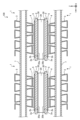
- FIG. 41 is a cross-sectional view showing another example of the configuration of the power converter 100 according to the embodiment. As shown in FIG. 41, in the power conversion device 100, a plurality of (two in the figure) semiconductor modules 20 may be connected along the Y-axis direction.
- the cooler 1 of the above-described liquid cooling system (for example, another embodiment 8) abuts against the plurality of semiconductor modules 20 via grease 30 . Furthermore, in the example of FIG. 41, the pipes 7 of the coolers 1 adjacent to each other in the Y-axis direction are integrally configured.
- the power conversion device 100 of the 2in1 type, 6in1 type, or the like can be configured easily.
- FIG. 42 is a cross-sectional view showing another example of the configuration of the power converter 100 according to the embodiment. As shown in FIG. 42 , pipes 7 of coolers 1 adjacent in the Y-axis direction may be connected via joints 40 .
- the present invention is not limited to the above embodiments, and various modifications are possible without departing from the spirit of the present invention.
- the cooler 1 of the present disclosure is installed in the double-sided cooling semiconductor module 20
- the present disclosure is not limited to such an example, and the cooling device of the present disclosure is installed in the single-sided cooling semiconductor module.
- a device 1 may be installed.
Landscapes
- Physics & Mathematics (AREA)
- Thermal Sciences (AREA)
- Engineering & Computer Science (AREA)
- Microelectronics & Electronic Packaging (AREA)
- Cooling Or The Like Of Semiconductors Or Solid State Devices (AREA)
Priority Applications (1)
| Application Number | Priority Date | Filing Date | Title |
|---|---|---|---|
| JP2023570840A JPWO2023127525A1 (https=) | 2021-12-28 | 2022-12-15 |
Applications Claiming Priority (2)
| Application Number | Priority Date | Filing Date | Title |
|---|---|---|---|
| JP2021-214784 | 2021-12-28 | ||
| JP2021214784 | 2021-12-28 |
Publications (1)
| Publication Number | Publication Date |
|---|---|
| WO2023127525A1 true WO2023127525A1 (ja) | 2023-07-06 |
Family
ID=86998770
Family Applications (1)
| Application Number | Title | Priority Date | Filing Date |
|---|---|---|---|
| PCT/JP2022/046219 Ceased WO2023127525A1 (ja) | 2021-12-28 | 2022-12-15 | 冷却器および電力変換装置 |
Country Status (2)
| Country | Link |
|---|---|
| JP (1) | JPWO2023127525A1 (https=) |
| WO (1) | WO2023127525A1 (https=) |
Cited By (1)
| Publication number | Priority date | Publication date | Assignee | Title |
|---|---|---|---|---|
| WO2026034289A1 (ja) * | 2024-08-09 | 2026-02-12 | ローム株式会社 | 半導体装置、半導体モジュールおよび車両 |
Citations (9)
| Publication number | Priority date | Publication date | Assignee | Title |
|---|---|---|---|---|
| JPS6190250U (https=) * | 1984-11-16 | 1986-06-12 | ||
| JP2003198171A (ja) * | 2001-12-28 | 2003-07-11 | Furukawa Electric Co Ltd:The | ヒートシンクおよび放熱器 |
| WO2006118031A1 (ja) * | 2005-04-27 | 2006-11-09 | Kabushiki Kaisha Toyota Jidoshokki | 絶縁回路基板及びパワーモジュール用基板 |
| JP2007173301A (ja) * | 2005-12-19 | 2007-07-05 | Sumitomo Electric Ind Ltd | 半導体素子冷却用放熱器、半導体装置、半導体素子冷却用放熱器の製造方法 |
| JP2008244394A (ja) * | 2007-03-29 | 2008-10-09 | Sumitomo Electric Ind Ltd | 半導体装置 |
| JP2008288369A (ja) * | 2007-05-17 | 2008-11-27 | Hitachi Densen Mekutekku Kk | ヒートシンク及びその製造方法 |
| JP2017108045A (ja) * | 2015-12-11 | 2017-06-15 | 昭和電工株式会社 | 液冷式冷却装置 |
| JP2018101666A (ja) * | 2016-12-19 | 2018-06-28 | 株式会社デンソー | 積層型冷却器 |
| JP2019179836A (ja) * | 2018-03-30 | 2019-10-17 | 日本電産株式会社 | 冷却装置 |
Family Cites Families (3)
| Publication number | Priority date | Publication date | Assignee | Title |
|---|---|---|---|---|
| JP3250187B2 (ja) * | 1994-07-15 | 2002-01-28 | 三菱マテリアル株式会社 | 高放熱性セラミックパッケージ |
| US20030094273A1 (en) * | 2001-11-21 | 2003-05-22 | Toth Jerome E. | Corrugated fin assembly |
| JP4052205B2 (ja) * | 2003-08-22 | 2008-02-27 | 株式会社デンソー | 電力変換装置 |
-
2022
- 2022-12-15 WO PCT/JP2022/046219 patent/WO2023127525A1/ja not_active Ceased
- 2022-12-15 JP JP2023570840A patent/JPWO2023127525A1/ja active Pending
Patent Citations (9)
| Publication number | Priority date | Publication date | Assignee | Title |
|---|---|---|---|---|
| JPS6190250U (https=) * | 1984-11-16 | 1986-06-12 | ||
| JP2003198171A (ja) * | 2001-12-28 | 2003-07-11 | Furukawa Electric Co Ltd:The | ヒートシンクおよび放熱器 |
| WO2006118031A1 (ja) * | 2005-04-27 | 2006-11-09 | Kabushiki Kaisha Toyota Jidoshokki | 絶縁回路基板及びパワーモジュール用基板 |
| JP2007173301A (ja) * | 2005-12-19 | 2007-07-05 | Sumitomo Electric Ind Ltd | 半導体素子冷却用放熱器、半導体装置、半導体素子冷却用放熱器の製造方法 |
| JP2008244394A (ja) * | 2007-03-29 | 2008-10-09 | Sumitomo Electric Ind Ltd | 半導体装置 |
| JP2008288369A (ja) * | 2007-05-17 | 2008-11-27 | Hitachi Densen Mekutekku Kk | ヒートシンク及びその製造方法 |
| JP2017108045A (ja) * | 2015-12-11 | 2017-06-15 | 昭和電工株式会社 | 液冷式冷却装置 |
| JP2018101666A (ja) * | 2016-12-19 | 2018-06-28 | 株式会社デンソー | 積層型冷却器 |
| JP2019179836A (ja) * | 2018-03-30 | 2019-10-17 | 日本電産株式会社 | 冷却装置 |
Cited By (1)
| Publication number | Priority date | Publication date | Assignee | Title |
|---|---|---|---|---|
| WO2026034289A1 (ja) * | 2024-08-09 | 2026-02-12 | ローム株式会社 | 半導体装置、半導体モジュールおよび車両 |
Also Published As
| Publication number | Publication date |
|---|---|
| JPWO2023127525A1 (https=) | 2023-07-06 |
Similar Documents
| Publication | Publication Date | Title |
|---|---|---|
| US9379083B2 (en) | Semiconductor device and method for manufacturing semiconductor device | |
| US8405992B2 (en) | Power-electronic arrangement | |
| JP4617209B2 (ja) | 放熱装置 | |
| CN110047807B (zh) | 半导体装置 | |
| JP5965687B2 (ja) | パワー半導体モジュール | |
| JP5895220B2 (ja) | 半導体装置の製造方法 | |
| WO2017168756A1 (ja) | 半導体装置 | |
| JP2016100442A (ja) | 半導体モジュール及び半導体装置 | |
| JP7163583B2 (ja) | 半導体装置 | |
| WO2023127525A1 (ja) | 冷却器および電力変換装置 | |
| CN110943062B (zh) | 半导体装置 | |
| JP4935783B2 (ja) | 半導体装置および複合半導体装置 | |
| US20230215776A1 (en) | Semiconductor device | |
| JP6314726B2 (ja) | 半導体モジュール | |
| JP2023109210A (ja) | 半導体装置 | |
| JP7192886B2 (ja) | 半導体装置 | |
| CN115702495A (zh) | 功率半导体模块 | |
| JP7261602B2 (ja) | 半導体装置及び電力変換装置 | |
| JP7765355B2 (ja) | 半導体装置 | |
| JP2016134601A (ja) | 半導体装置 | |
| JP7186931B2 (ja) | 半導体装置 | |
| JP7294403B2 (ja) | 半導体装置 | |
| CN119108361A (zh) | 半导体装置 | |
| JP5932701B2 (ja) | 半導体装置 | |
| JP2013143408A (ja) | 半導体パッケージ及び半導体装置 |
Legal Events
| Date | Code | Title | Description |
|---|---|---|---|
| 121 | Ep: the epo has been informed by wipo that ep was designated in this application |
Ref document number: 22915749 Country of ref document: EP Kind code of ref document: A1 |
|
| WWE | Wipo information: entry into national phase |
Ref document number: 2023570840 Country of ref document: JP |
|
| NENP | Non-entry into the national phase |
Ref country code: DE |
|
| 122 | Ep: pct application non-entry in european phase |
Ref document number: 22915749 Country of ref document: EP Kind code of ref document: A1 |