WO2023074450A1 - 包接化合物、エポキシ樹脂硬化剤及び硬化性樹脂組成物 - Google Patents
包接化合物、エポキシ樹脂硬化剤及び硬化性樹脂組成物 Download PDFInfo
- Publication number
- WO2023074450A1 WO2023074450A1 PCT/JP2022/038644 JP2022038644W WO2023074450A1 WO 2023074450 A1 WO2023074450 A1 WO 2023074450A1 JP 2022038644 W JP2022038644 W JP 2022038644W WO 2023074450 A1 WO2023074450 A1 WO 2023074450A1
- Authority
- WO
- WIPO (PCT)
- Prior art keywords
- compound
- group
- particle size
- acid
- curing agent
- Prior art date
- Legal status (The legal status is an assumption and is not a legal conclusion. Google has not performed a legal analysis and makes no representation as to the accuracy of the status listed.)
- Ceased
Links
Images



Classifications
-
- C—CHEMISTRY; METALLURGY
- C07—ORGANIC CHEMISTRY
- C07D—HETEROCYCLIC COMPOUNDS
- C07D233/00—Heterocyclic compounds containing 1,3-diazole or hydrogenated 1,3-diazole rings, not condensed with other rings
- C07D233/54—Heterocyclic compounds containing 1,3-diazole or hydrogenated 1,3-diazole rings, not condensed with other rings having two double bonds between ring members or between ring members and non-ring members
- C07D233/56—Heterocyclic compounds containing 1,3-diazole or hydrogenated 1,3-diazole rings, not condensed with other rings having two double bonds between ring members or between ring members and non-ring members with only hydrogen atoms or radicals containing only hydrogen and carbon atoms, attached to ring carbon atoms
-
- C—CHEMISTRY; METALLURGY
- C07—ORGANIC CHEMISTRY
- C07C—ACYCLIC OR CARBOCYCLIC COMPOUNDS
- C07C39/00—Compounds having at least one hydroxy or O-metal group bound to a carbon atom of a six-membered aromatic ring
- C07C39/12—Compounds having at least one hydroxy or O-metal group bound to a carbon atom of a six-membered aromatic ring polycyclic with no unsaturation outside the aromatic rings
- C07C39/15—Compounds having at least one hydroxy or O-metal group bound to a carbon atom of a six-membered aromatic ring polycyclic with no unsaturation outside the aromatic rings with all hydroxy groups on non-condensed rings, e.g. phenylphenol
-
- C—CHEMISTRY; METALLURGY
- C07—ORGANIC CHEMISTRY
- C07D—HETEROCYCLIC COMPOUNDS
- C07D233/00—Heterocyclic compounds containing 1,3-diazole or hydrogenated 1,3-diazole rings, not condensed with other rings
- C07D233/54—Heterocyclic compounds containing 1,3-diazole or hydrogenated 1,3-diazole rings, not condensed with other rings having two double bonds between ring members or between ring members and non-ring members
- C07D233/56—Heterocyclic compounds containing 1,3-diazole or hydrogenated 1,3-diazole rings, not condensed with other rings having two double bonds between ring members or between ring members and non-ring members with only hydrogen atoms or radicals containing only hydrogen and carbon atoms, attached to ring carbon atoms
- C07D233/58—Heterocyclic compounds containing 1,3-diazole or hydrogenated 1,3-diazole rings, not condensed with other rings having two double bonds between ring members or between ring members and non-ring members with only hydrogen atoms or radicals containing only hydrogen and carbon atoms, attached to ring carbon atoms with only hydrogen atoms or radicals containing only hydrogen and carbon atoms, attached to ring nitrogen atoms
-
- C—CHEMISTRY; METALLURGY
- C08—ORGANIC MACROMOLECULAR COMPOUNDS; THEIR PREPARATION OR CHEMICAL WORKING-UP; COMPOSITIONS BASED THEREON
- C08G—MACROMOLECULAR COMPOUNDS OBTAINED OTHERWISE THAN BY REACTIONS ONLY INVOLVING UNSATURATED CARBON-TO-CARBON BONDS
- C08G59/00—Polycondensates containing more than one epoxy group per molecule; Macromolecules obtained by polymerising compounds containing more than one epoxy group per molecule using curing agents or catalysts which react with the epoxy groups
- C08G59/18—Macromolecules obtained by polymerising compounds containing more than one epoxy group per molecule using curing agents or catalysts which react with the epoxy groups ; e.g. general methods of curing
- C08G59/40—Macromolecules obtained by polymerising compounds containing more than one epoxy group per molecule using curing agents or catalysts which react with the epoxy groups ; e.g. general methods of curing characterised by the curing agents used
- C08G59/4007—Curing agents not provided for by the groups C08G59/42 - C08G59/66
- C08G59/4014—Nitrogen containing compounds
-
- C—CHEMISTRY; METALLURGY
- C08—ORGANIC MACROMOLECULAR COMPOUNDS; THEIR PREPARATION OR CHEMICAL WORKING-UP; COMPOSITIONS BASED THEREON
- C08G—MACROMOLECULAR COMPOUNDS OBTAINED OTHERWISE THAN BY REACTIONS ONLY INVOLVING UNSATURATED CARBON-TO-CARBON BONDS
- C08G59/00—Polycondensates containing more than one epoxy group per molecule; Macromolecules obtained by polymerising compounds containing more than one epoxy group per molecule using curing agents or catalysts which react with the epoxy groups
- C08G59/18—Macromolecules obtained by polymerising compounds containing more than one epoxy group per molecule using curing agents or catalysts which react with the epoxy groups ; e.g. general methods of curing
- C08G59/40—Macromolecules obtained by polymerising compounds containing more than one epoxy group per molecule using curing agents or catalysts which react with the epoxy groups ; e.g. general methods of curing characterised by the curing agents used
- C08G59/50—Amines
- C08G59/5046—Amines heterocyclic
- C08G59/5053—Amines heterocyclic containing only nitrogen as a heteroatom
- C08G59/5073—Amines heterocyclic containing only nitrogen as a heteroatom having two nitrogen atoms in the ring
-
- C—CHEMISTRY; METALLURGY
- C08—ORGANIC MACROMOLECULAR COMPOUNDS; THEIR PREPARATION OR CHEMICAL WORKING-UP; COMPOSITIONS BASED THEREON
- C08G—MACROMOLECULAR COMPOUNDS OBTAINED OTHERWISE THAN BY REACTIONS ONLY INVOLVING UNSATURATED CARBON-TO-CARBON BONDS
- C08G59/00—Polycondensates containing more than one epoxy group per molecule; Macromolecules obtained by polymerising compounds containing more than one epoxy group per molecule using curing agents or catalysts which react with the epoxy groups
- C08G59/18—Macromolecules obtained by polymerising compounds containing more than one epoxy group per molecule using curing agents or catalysts which react with the epoxy groups ; e.g. general methods of curing
- C08G59/40—Macromolecules obtained by polymerising compounds containing more than one epoxy group per molecule using curing agents or catalysts which react with the epoxy groups ; e.g. general methods of curing characterised by the curing agents used
- C08G59/62—Alcohols or phenols
-
- C—CHEMISTRY; METALLURGY
- C08—ORGANIC MACROMOLECULAR COMPOUNDS; THEIR PREPARATION OR CHEMICAL WORKING-UP; COMPOSITIONS BASED THEREON
- C08G—MACROMOLECULAR COMPOUNDS OBTAINED OTHERWISE THAN BY REACTIONS ONLY INVOLVING UNSATURATED CARBON-TO-CARBON BONDS
- C08G59/00—Polycondensates containing more than one epoxy group per molecule; Macromolecules obtained by polymerising compounds containing more than one epoxy group per molecule using curing agents or catalysts which react with the epoxy groups
- C08G59/18—Macromolecules obtained by polymerising compounds containing more than one epoxy group per molecule using curing agents or catalysts which react with the epoxy groups ; e.g. general methods of curing
- C08G59/40—Macromolecules obtained by polymerising compounds containing more than one epoxy group per molecule using curing agents or catalysts which react with the epoxy groups ; e.g. general methods of curing characterised by the curing agents used
- C08G59/62—Alcohols or phenols
- C08G59/621—Phenols
-
- C—CHEMISTRY; METALLURGY
- C08—ORGANIC MACROMOLECULAR COMPOUNDS; THEIR PREPARATION OR CHEMICAL WORKING-UP; COMPOSITIONS BASED THEREON
- C08K—Use of inorganic or non-macromolecular organic substances as compounding ingredients
- C08K5/00—Use of organic ingredients
- C08K5/04—Oxygen-containing compounds
- C08K5/13—Phenols; Phenolates
-
- C—CHEMISTRY; METALLURGY
- C08—ORGANIC MACROMOLECULAR COMPOUNDS; THEIR PREPARATION OR CHEMICAL WORKING-UP; COMPOSITIONS BASED THEREON
- C08K—Use of inorganic or non-macromolecular organic substances as compounding ingredients
- C08K5/00—Use of organic ingredients
- C08K5/16—Nitrogen-containing compounds
- C08K5/34—Heterocyclic compounds having nitrogen in the ring
- C08K5/3442—Heterocyclic compounds having nitrogen in the ring having two nitrogen atoms in the ring
- C08K5/3445—Five-membered rings
-
- C—CHEMISTRY; METALLURGY
- C08—ORGANIC MACROMOLECULAR COMPOUNDS; THEIR PREPARATION OR CHEMICAL WORKING-UP; COMPOSITIONS BASED THEREON
- C08L—COMPOSITIONS OF MACROMOLECULAR COMPOUNDS
- C08L63/00—Compositions of epoxy resins; Compositions of derivatives of epoxy resins
-
- C—CHEMISTRY; METALLURGY
- C08—ORGANIC MACROMOLECULAR COMPOUNDS; THEIR PREPARATION OR CHEMICAL WORKING-UP; COMPOSITIONS BASED THEREON
- C08K—Use of inorganic or non-macromolecular organic substances as compounding ingredients
- C08K2201/00—Specific properties of additives
- C08K2201/002—Physical properties
- C08K2201/005—Additives being defined by their particle size in general
Definitions
- the present invention relates to a clathrate compound, more specifically, a clathrate compound obtained by mixing an imidazole compound and a polyhydric phenol compound and having a specific particle size, an epoxy resin curing agent containing the same, and the epoxy
- the present invention relates to a curable resin composition containing a resin curing agent and an epoxy resin.
- Epoxy resin is characterized by excellent chemical resistance, corrosion resistance, mechanical properties, thermal properties, excellent adhesion to various substrates, electrical properties, and workability in any environment. It is widely used in electrical metal materials and composite materials.
- Epoxy resin compositions are classified into one-component and two-component systems depending on the type of curing agent or curing catalyst used.
- the two-liquid system has the characteristic that it can be cured at room temperature or low temperature, but on the other hand, it must be weighed and mixed just before use, and the pot life is short, making it difficult to apply to automatic machines.
- it has the drawback that the conditions for its use are limited, such as being difficult. Due to the existence of such problems, a one-component curing type epoxy resin composition is desired in many applications.
- Patent Document 1 describes that the storage stability of a one-component curing type epoxy resin composition can be improved by using a clathrate compound using tetrakisphenol as a curing agent for epoxy resins.
- the problem to be solved by the present invention is to provide a curing agent for epoxy resins, which is capable of one-component curing and can provide a curable resin composition having better curability than conventional ones. .
- the present inventors have made intensive studies, and by adjusting the particle size of the clathrate compound obtained by mixing an imidazole compound and a polyhydric phenol compound to a specific value or less, one-component curing with better curability than conventional The inventors have found that it can be used as a curing agent for type epoxy resins, and arrived at the present invention.
- the present invention provides a clathrate compound obtained by mixing (A) an imidazole compound and (B) a polyhydric phenol compound, which has an average particle size (X) of 7 ⁇ m or less and a maximum particle size (Y) of 40 ⁇ m. It provides the following inclusion compounds.
- the present invention also provides an epoxy resin curing agent containing the clathrate compound.
- the present invention provides a curable resin composition containing an epoxy resin and the epoxy resin curing agent.
- the clathrate compound obtained by mixing (A) an imidazole compound and (B) a polyhydric phenol compound has excellent storage stability and excellent curability.
- An epoxy resin curing agent suitable for the composition can be provided.
- a curable resin composition using the inclusion compound of the present invention has good stability in the presence of a solvent.
- Such a curable resin composition of the present invention is suitable for use as an adhesive for die attach films.
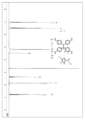
- FIG. 1 is a 1 H-NMR chart of the inclusion compound obtained in Example 1.
- FIG. 2 shows DSC curves (1° C./min) of Example 3 and Comparative Example 2.
- FIG. 3 shows DSC curves (1° C./min) of Example 4 and Comparative Example 2.
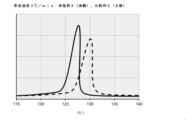
- FIG. 4 shows DSC curves (3° C./min) of Example 3 and Comparative Example 2.
- FIG. 5 shows DSC curves (3° C./min) of Example 4 and Comparative Example 2.
- the clathrate compound of the present invention is described below.
- the clathrate compound of the present invention is a clathrate compound obtained by mixing (A) an imidazole compound and (B) a polyhydric phenol compound, and has an average particle size (X) of 7 ⁇ m or less and a maximum particle size (Y) of is 40 ⁇ m or less.
- (A) the imidazole compound may be described as "(A) component”
- (B) the polyhydric phenol compound may be described as "(B) component”.
- the clathrate compound is obtained from two or more chemical species that can exist stably on their own. It is a compound that forms a specific crystal structure by incorporating (enclosing) the other chemical species, with the first requirement that is compatible with .
- the chemical species that provides the space is called the host, and the chemical species that is included is called the guest.
- the host and guest are bound by the interaction of hydrogen bond, van der Waals force, and ionic bond. If it is an ion-bonding clathrate, it is considered to form an ionic crystal or salt structure.
- a compound represented by the following formula (1) is preferable in terms of curing performance and ease of formation of clathrate compounds.
- R 1 to R 4 are each independently a hydrogen atom, an optionally substituted alkyl group having 1 to 20 carbon atoms or an optionally substituted C 6 to 20 It is an aryl group.
- the substituents are halogen atoms and nitrile groups.
- alkyl groups having 1 to 20 carbon atoms represented by R 1 to R 4 in the above formula include methyl group, ethyl group, propyl group, isopropyl group, butyl group, isobutyl group, tert-butyl group, pentyl group, isopentyl group, tertiary pentyl group, hexyl group, isohexyl group, octyl group, 2-ethylhexyl group, tertiary octyl group, nonyl group, decyl group, undecyl group, dodecyl group, tridecyl group, tetradecyl group, pentadecyl group , hexadecyl group, heptadecyl group, octadecyl group, icosanyl group, benzyl group, phenethyl group and the like.
- halogen atoms include a fluorine atom, a bromine atom, a chlorine atom and an iodine atom.
- Examples of the aryl group having 6 to 20 carbon atoms represented by R 1 to R 4 in the above formula include phenyl group and naphthyl group. These groups may be substituted with an alkyl group having 1 to 10 carbon atoms, a halogen atom, a hydroxy group, a nitrile group, or the like. When the aryl group is substituted with an alkyl group, the number of carbon atoms including the number of carbon atoms of the substituent may be 6 to 20.
- R 1 is preferably an alkyl group having 1 to 20 carbon atoms, more preferably an alkyl group having 1 to 10 carbon atoms, from the viewpoint of ease of forming an inclusion compound. More preferably, it is an alkyl group having 1 to 4 carbon atoms.
- R 2 and R 3 are preferably a hydrogen atom or an alkyl group having 1 to 20 carbon atoms, more preferably a hydrogen atom or an alkyl group having 1 to 10 carbon atoms. 1 to 4 alkyl groups are particularly preferred.
- R 4 is a hydrogen atom.
- R 1 is an alkyl group having 1 to 4 carbon atoms
- R 2 and R 3 are a hydrogen atom or an alkyl group having 1 to 4 carbon atoms
- R 4 is A hydrogen atom is particularly preferred.
- 2-Ethyl-4-methylimidazole is most preferable from the viewpoint of easy formation of an inclusion compound.
- the polyhydric phenol compound that is the component (B) used in the present invention is not particularly limited as long as it forms an inclusion compound when mixed with an imidazole compound. Among them, it is preferable to use at least one selected from tetrakisphenols represented by the following formula (2) from the viewpoint that the inclusion compound is easily obtained.
- R 11 to R 18 are each independently a hydrogen atom, a halogen atom, an optionally substituted alkyl group having 1 to 20 carbon atoms, or an optionally substituted C 6 to It represents 20 aryl groups, and X represents a single bond or a hydrocarbon group having 1 to 4 carbon atoms.
- alkyl groups having 1 to 20 carbon atoms represented by R 11 to R 18 in formula (2) include methyl, ethyl, propyl, isopropyl, butyl, isobutyl, tertiary butyl group, pentyl group, isopentyl group, tert-pentyl group, hexyl group, isohexyl group, octyl group, 2-ethylhexyl group, tert-octyl group, nonyl group, decyl group, undecyl group, dodecyl group, tridecyl group, tetradecyl group , pentadecyl group, hexadecyl group, heptadecyl group, octadecyl group, icosanyl group, benzyl group, phenethyl group and the like. These groups may be substituted with halogen atoms, hydroxy groups,
- examples of the aryl group having 6 to 20 carbon atoms represented by R 11 to R 18 include phenyl group and naphthyl group. These groups may be substituted with an alkyl group having 1 to 10 carbon atoms, a halogen atom, a hydroxy group, a nitrile group, or the like. When the aryl group is substituted with an alkyl group, the number of carbon atoms including the number of carbon atoms of the substituent may be 6 to 20.
- the hydrocarbon group having 1 to 4 carbon atoms represented by X includes an alkylene group having 1 to 4 carbon atoms, and the alkylene group having 1 to 4 carbon atoms includes a methylene group, an ethylene group, and ethylidene. group, n-propylene group, propylidene group, isopropylidene group, methylethylene group, n-butylene group, butylidene group, isobutylidene group, sec-butylidene group, 1,2-dimethylethylene group, 1-methylpropylene group, 2- A methylpropylene group and the like can be mentioned.
- R 11 to R 18 are each independently at least one selected from a hydrogen atom, a lower alkyl group having 1 to 6 carbon atoms, or a halogen atom.
- R 11 to R 18 are preferably It is particularly preferred that each of the groups is independently at least one selected from a hydrogen atom, a lower alkyl group having 1 to 3 carbon atoms and a halogen atom.
- the number of hydrogen atoms among R 11 to R 18 may be 1 or more, 2 or more, 3 or more, 4 or more, 5 or more, 6 or more, 7 or more, or 8.
- X is preferably a single bond or a hydrocarbon group having 1 to 3 carbon atoms in that a curable resin composition having excellent curability can be easily provided when used as a curing agent for epoxy resins. , a single bond or a hydrocarbon group having 1 to 2 carbon atoms is more preferred, and a single bond is most preferred.
- the proportions of components (A) and (B) contained in the clathrate are not particularly limited as long as they can form a clathrate.
- the amount of the compound (A) is preferably 0.1 to 10 mol, more preferably 0.5 to 5.0 mol, per mol.
- the third component accounts for 40 mol% of the total amount of the clathrate compound. is preferably 10 mol % or less, more preferably 3 mol % or less, and most preferably the inclusion compound does not contain a third component.
- the upper limit of the preferred molar ratio of the third component here can be applied to the number of moles of each individual component and the total number of moles thereof when the number of the third components is plural.
- the method for mixing the clathrate compound of the present invention is not particularly limited. It can be obtained by adding dropwise to a solution obtained by dissolving in a solvent, mixing at room temperature to 100°C while dropping or after dropping, and then cooling and pulverizing. Mixing is preferably carried out while heating at a temperature of 40 to 85°C.
- Solvents that can be used for dissolving components (A) and (B) independently include, for example, alcohol solvents such as methanol and 2-propanol; ester solvents such as ethyl acetate and butyl acetate.
- ketone solvents such as methyl ethyl ketone and acetone; aliphatic hydrocarbon solvents such as hexane, heptane and cyclohexane; aromatic hydrocarbon solvents such as benzene, toluene and xylene.
- the solvent for dissolving the component (A) and the solvent for dissolving the component (B) may be the same or different. Furthermore, it can also be used as a mixed solvent.
- ester solvents particularly ethyl acetate, are preferred for successfully producing clathrates.
- the concentration of the solution in which the components (A) and (B) are respectively dissolved is not particularly limited, but can be, for example, 5 to 45% by mass, and can also be 10 to 35% by mass.
- Examples of the pulverizer used in the pulverization step include a jet mill.
- the clathrate compound of the present invention has an average particle size (X) of 7 ⁇ m or less and a maximum particle size (Y) of 40 ⁇ m or less. Curability is obtained.
- the average particle size (X) of the clathrate compound is preferably 0.5 ⁇ m or more from the viewpoint of storage stability.
- the maximum particle size (Y) of the clathrate compound is preferably 1 ⁇ m or more from the viewpoint of storage stability. From the viewpoint of low-temperature curability, the average particle size (X) is more preferably 3 ⁇ m or less. From the viewpoint of low-temperature curability, the maximum particle size (Y) is more preferably 10 ⁇ m or less. From these points, the average particle size (X) is particularly preferably 0.5 to 3 ⁇ m.
- the maximum particle size (Y) is particularly preferably 1 to 10 ⁇ m. Furthermore, from the viewpoint of further enhancing low-temperature curability, the ratio of average particle size (X):maximum particle size (Y) is preferably 1:20 or less, more preferably 1:5 or less. The ratio of average particle size (X):maximum particle size (Y) is usually 1:1 or more, and may be 1:1.5 or more.
- the average particle size (X) and the maximum particle size (Y) are measured by a particle size distribution measuring device using a laser beam diffraction method, and the median size is measured by volume (average particle size: D50, maximum particle size: D100). is read.
- the curing agent for epoxy resins of the present invention essentially includes the clathrate compound of the present invention.
- the epoxy resin curing agent of the present invention may contain components other than the clathrate compound of the present invention, but it preferably contains the clathrate compound of the present invention in an amount of 30% by mass or more, preferably 80% by mass. It is more preferable to contain at least
- the curable resin composition of the present invention is obtained by containing an epoxy resin and an epoxy resin curing agent essentially comprising the clathrate compound of the present invention.
- the amount of the clathrate compound of the present invention added to 100 parts by mass of the epoxy resin is, for example, preferably 5 parts by mass or more and 40 parts by mass or less, more preferably 10 parts by mass or more and 30 parts by mass or less.
- the epoxy resin has at least two epoxy groups in its molecule, and can be used without any particular restrictions on its molecular structure, molecular weight, and the like.
- the epoxy resin include polyglycidyl ether compounds of mononuclear polyhydric phenol compounds such as hydroquinone, resorcinol, pyrocatechol and phloroglucinol; dihydroxynaphthalene, biphenol, methylenebisphenol (bisphenol F), methylenebis ( ortho cresol), ethylidene bisphenol, isopropylidene bisphenol (bisphenol A), isopropylidene bis (ortho cresol), tetrabromobisphenol A, 1,3-bis(4-hydroxycumylbenzene), 1,4-bis(4- hydroxycumylbenzene), 1,1,3-tris(4-hydroxyphenyl)butane, 1,1,2,2-tetra(4-hydroxyphenyl)ethane, thiobisphenol, sulfobisphenol, oxybisphenol, phenol novolak, Polyglycidyl ether compounds of polynuclear polyhydric phenol compounds such as ortho-
- these epoxy resins are internally cross-linked with a prepolymer having terminal isocyanate, or have a high molecular weight with a polyvalent active hydrogen compound (polyhydric phenol, polyamine, carbonyl group-containing compound, polyphosphate ester, etc.). It's okay.
- a polyvalent active hydrogen compound polyhydric phenol, polyamine, carbonyl group-containing compound, polyphosphate ester, etc.
- the amount of the epoxy resin is preferably 20 to 97% by mass, more preferably 30 to 94% by mass, 40% by mass or more, or 50% by mass, based on the total amount of components other than the solvent in the curable resin composition. It may be mass % or more.
- a commonly known epoxy resin curing agent can be used in combination with the epoxy resin curing agent.
- curing agents amine-based curing agents, polythiol-based curing agents, and the like.
- Examples of the acid anhydride curing agent include hymic anhydride, phthalic anhydride, maleic anhydride, methyl hymic anhydride, succinic anhydride, tetrahydrophthalic anhydride, hexahydrophthalic anhydride, methyltetrahydrophthalic anhydride, Methylhexahydrophthalic anhydride, trialkyltetrahydrophthalic anhydride-maleic anhydride adduct, benzophenonetetracarboxylic anhydride, trimellitic anhydride, pyromellitic anhydride, hydrogenated methyl nadic anhydride and the like.
- phenol-based curing agent examples include phenol novolac resin, cresol novolak resin, aromatic hydrocarbon formaldehyde resin-modified phenol resin, dicyclopentadiene phenol addition type resin, phenol aralkyl resin (Zyloc resin), naphthol aralkyl resin, trisphenyl roll methane resin, tetraphenylol ethane resin, naphthol novolac resin, naphthol-phenol co-condensation novolac resin, naphthol-cresol co-condensation novolac resin, biphenyl-modified phenol resin (polyhydric phenol compound in which phenol nuclei are linked by bismethylene groups), Biphenyl-modified naphthol resin (polyvalent naphthol compound in which phenol nuclei are linked by bismethylene groups), aminotriazine-modified phenol resin (compound having phenol skeleton, triazine ring and primary amino group in molecular structure),
- Examples of the amine curing agent include ethylenediamine, 1,2-diaminopropane, 1,3-diaminopropane, 1,3-diaminobutane, 1,4-diaminobutane, hexamethylenediamine, and metaxylenediamine.
- alkylenediamines such as diethylenetriamine, triethylenetriamine and tetraethylenepentamine; 1,4-diaminocyclohexane, 1,3-diaminocyclohexane, 1,3-diaminomethylcyclohexane, 1,2-diaminocyclohexane, 1,4-diamino-3,6-diethylcyclohexane, 4,4'-diaminodicyclohexylmethane, 1,3-bis(aminomethyl)cyclohexane, 1,4-bis(aminomethyl)cyclohexane, 4,4'-diamino Alicyclic polyamines such as dicyclohexylpropane, bis(4-aminocyclohexyl)sulfone, 4,4'-diaminodicyclohexyl ether, 2,2'-dimethyl-4,4'-dia
- Modified products of these amines may also be used, and modification methods include dehydration condensation with carboxylic acids, addition reactions with epoxy compounds, addition reactions with isocyanate compounds, Michael addition reactions, Mannich reactions, and urea. Condensation reaction, condensation reaction with ketone, and the like can be mentioned.
- acids aliphatic, aromatic or alicyclic polybasic acids such as phthalic acid, isophthalic acid, terephthalic acid, trimellitic acid, trimesic acid, pyromellitic acid, tetrahydrophthalic acid, hexahydrophthalic acid, endomethylenetetrahydrophthalic acid etc.
- bisphenol F bisphenol F
- methylenebis(orthocresol) ethylidenebisphenol
- isopropylidenebisphenol bisphenol A
- tetrabromobisphenol A 1,3-bis(4-hydroxycumylbenzene), 1 ,4-bis(4-hydroxycumylbenzene), 1,1,3-tris(4-hydroxyphenyl)butane, 1,1,2,2-tetra(4-hydroxyphenyl)ethane
- thiobisphenol sulfonylbisphenol , oxybisphenol, phenol novolak, ortho-cresol novolak, ethylphenol novolak, butylphenol novolak, octylphenol novolak, resorcinol novolak, polyglydyl ether compounds of polynuclear polyhydric phenol compounds such as terpene phenol; ethylene glycol, propylene glycol
- Isocyanate compounds that can be used in the modified amine curing agent include, for example, 2,4-tolylene diisocyanate, 2,6-tolylene diisocyanate, diphenylmethane-4,4'-diisocyanate, phenylene diisocyanate, and xylylene diisocyanate.
- tetramethylxylylene diisocyanate 1,5-naphthylene diisocyanate, 1,5-tetrahydronaphthalene diisocyanate, 3,3′-dimethyldiphenyl-4,4′-diisocyanate, dianisidine diisocyanate, tetramethylxylylene diisocyanate and other aromatics group diisocyanates; alicyclic diisocyanates such as isophorone diisocyanate, dicyclohexylmethane-4,4'-diisocyanate, trans-1,4-cyclohexyl diisocyanate, norbornene diisocyanate; tetramethylene diisocyanate, 1,6-hexamethylene diisocyanate, 2,2, 4 and / or (2,4,4)-trimethylhexamethylene diisocyanate, aliphatic diisocyanate such as lysine diisocyanate; Phenylmethanetri
- polythiol-based curing agent examples include pentaerythritol tetrakis (3-mercaptopropionate), pentaerythritol tetrakis (thioglycolate), dipentaerythritol hexakis (3-mercaptopropionate), dipentaerythritol hexakis ( 3-mercaptobutyrate), 1,3,4,6-tetrakis(2-mercaptoethyl)-1,3,4,6-tetraazaochydropentalene-2,5-dione, 1,3,5- Tris(3-mercaptopropyl)-1,3,5-triazine-2,4,6(1H,3H,5H)-trione, 4-mercaptomethyl-1,8-dimercapto-3,6-dithiaoctane, 4 ,8-, 4,7- or 5,7-dimercaptomethyl-1,11-dimercapto-3,6,9-tri
- thiol compounds Commercially available products of these preferred thiol compounds include, for example, TS-G manufactured by Shikoku Kasei Kogyo Co., Ltd., DPMP and PEMP manufactured by SC Organic Chemical Co., Ltd., PETG manufactured by Yodo Chemical Co., Ltd., and the like.
- ADEKA HARDNER EH-3636AS manufactured by ADEKA Corporation; dicyandiamide type latent curing agent
- ADEKA HARDNER EH-4351S manufactured by ADEKA Corporation
- ADEKA HARDNER EH-4351S manufactured by ADEKA Corporation
- ADEKA ADEKA HARDNER EH-4351S
- Hardener EH-5011S (manufactured by ADEKA Corporation; imidazole type latent curing agent), ADEKA hardener EH-5046S (manufactured by ADEKA Corporation; imidazole type latent curing agent), ADEKA hardener EH-4357S (manufactured by ADEKA Corporation; polyamine type latent curing agent), ADEKA HARDNER EH-5057P (made by ADEKA Co., Ltd.; polyamine type latent curing agent), ADEKA HARDNER EH-5057PK (made by ADEKA Co., Ltd.; polyamine type latent curing agent), Amicure PN-23 (Ajinomoto Fine Techno Co., Ltd.; amine adduct latent curing agent), Amicure PN-40 (Ajinomoto Fine Techno Co., Ltd.; amine adduct latent curing agent), Amicure VDH (Ajinomoto Fine Techno Co., Ltd.; hydrazide latent cu
- the amount of the curing agent other than the clathrate compound of the present invention is not particularly limited. It is more preferably 100 parts by mass or more and 300 parts by mass or less, and still more preferably 30 parts by mass or less.
- a known epoxy resin curing accelerator can be used in combination with the curable resin composition of the present invention, if necessary.
- these curing accelerators include phosphines such as triphenylphosphine; phosphonium salts such as tetraphenylphosphonium bromide; amines such as benzyldimethylamine and 2,4,6-tris(dimethylaminomethyl)phenol; Quaternary ammonium salts such as trimethylammonium chloride; 3-(p-chlorophenyl)-1,1-dimethylurea, 3-(3,4-dichlorophenyl)-1,1-dimethylurea, 3-phenyl-1,1- Ureas such as dimethyl urea, isophorone diisocyanate-dimethyl urea, and tolylene diisocyanate-dimethyl urea; and complex compounds of boron trifluoride with amines, ether compounds, and the like can be exemplified.
- a silane coupling agent can be used in the curable resin composition of the present invention.
- the silane coupling agent include ⁇ -aminopropyltriethoxysilane, N- ⁇ -(aminoethyl)- ⁇ -aminopropyltriethoxysilane, N- ⁇ -(aminoethyl)-N'- ⁇ -(aminoethyl)- ⁇ -aminopropyltriethoxysilane, ⁇ -anilinopropyltriethoxysilane, ⁇ -glycidoxypropyltri Ethoxysilane, ⁇ -(3,4-epoxycyclohexyl)ethyltriethoxysilane, vinyltriethoxysilane, N- ⁇ -(N-vinylbenzylaminoethyl)- ⁇ -aminopropyltriethoxysilane, ⁇ -methacryloxypropyltriethoxysilane methoxys
- a filler can be contained in the curable resin composition of the present invention.
- the filler include silica such as fused silica and crystalline silica; magnesium hydroxide, aluminum hydroxide, zinc molybdate, calcium carbonate, silicon carbonate, calcium silicate, potassium titanate, beryllia, zirconia, zircon, Powders of forsterite, steatite, spinel, mullite, titania, or the like, beads obtained by spheroidizing these powders, glass fibers, pulp fibers, synthetic fibers, ceramic fibers and the like.
- the curable resin composition of the present invention can be used by dissolving in various solvents, preferably organic solvents.
- alcohols such as iso- or n-butanol, iso- or n-propanol, amyl alcohol, benzyl alcohol, furfuryl alcohol, tetrahydrofurfuryl alcohol, ketones such as methyl ethyl ketone, methyl isopropyl ketone, methyl butyl ketone, benzene , aromatic hydrocarbons such as toluene and xylene, triethylamine, pyridine, dioxane, and acetonitrile.
- the curable resin composition of the present invention may further contain various other additives as necessary.
- the additives include antioxidants (phenol-based, phosphorus-based, sulfur-based), hindered amine light stabilizers, ultraviolet absorbers, phenolic compounds such as biphenol; reactive diluents such as monoalkyl glycidyl ether; Non-reactive diluents (plasticizers) such as phthalate, dibutyl phthalate, benzyl alcohol, coal tar; reinforcing materials such as glass cloth, aramid cloth, carbon fiber; pigments; candelilla wax, carnauba wax, Japan wax, ivory wax , beeswax, lanolin, spermaceti, montan wax, petroleum wax, aliphatic waxes, aliphatic esters, aliphatic ethers, aromatic esters, aromatic ethers; thickeners; thixotropic agents; antifoaming agents; Corrosion preventives; commonly used additives
- the curable resin composition of the present invention is excellent in curability and storage stability, it can be used as a one-component curable resin composition.
- its use is not particularly limited, but for example, a semiconductor encapsulating material, a laminate for printed wiring boards, an electronic component adhesive, an electronic component encapsulating material, a casting material, a varnish, a paint, and a structural adhesive. It can be suitably used for agents, fiber-reinforced composite materials, and the like.
- Example 1 [Production of inclusion compound] 30.0 g (0.272 mol) of 2-ethyl-4-methylimidazole and 138 g of ethyl acetate were added and stirred at 40° C. for 2 hours to give an ethyl acetate solution of 2-ethyl-4-methylimidazole (2E4MZ solution). prepared. A reaction vessel was charged with 53.8 g (0.135 mol) of tetrakis(4-hydroxyphenyl)ethane and 138 g of ethyl acetate to obtain a solution.
- the 2E4MZ solution was added dropwise to the resulting solution at 22-23°C over 15 minutes, then the temperature was raised to 75°C over 1 hour, mixed at 75-77°C for 2 hours, and then 30°C over 1 hour. cooled to below. After that, after filtration and drying by heating at 80° C., pulverized using a jet mill and sieved using a sieve with an opening of 20 ⁇ m, pulverized product A having an average particle size of 2.52 ⁇ m and a maximum particle size of 6.54 ⁇ m. -1 was obtained. The average particle size and the maximum particle size were measured using Microtrac MT-3000II (particle size distribution analyzer manufactured by Microtrac Bell), measuring method: wet, measuring solvent: hexane.
- the sample is placed in 30 ml of hexane (containing 0.5% nonionic activator), which is a sample dispersion solvent, at a sample amount of 0.01 g, subjected to ultrasonic waves (160 W) for 3 minutes, and placed in a measuring instrument for measurement. bottom.
- H 1 -NMR data of the clathrate obtained is shown in FIG.
- NMR was measured using JEOL ECX-NMR was measured using JEOL ECX-400.
- Deuterated DMSO was used as the measurement solvent.
- the amine value was 183 mgKOH/g.
- the amine value was measured by the TEAB method. As shown in FIG.
- NMR measurement confirmed that the molar ratio of tetrakis(4-hydroxyphenyl)ethane and 2-ethyl-4-methylimidazole was 1:2.
- imidazole is assumed to be the guest and tetrakis(4-hydroxyphenyl)ethane to be the host.
- Example 2 [Production of inclusion compound]
- the clathrate compound [before jet mill pulverization] obtained in the same manner as in Example 1 was pulverized using a jet mill and then sieved using a sieve with an opening of 10 ⁇ m.
- a pulverized product A-2 having a particle size of 2.31 ⁇ m was obtained.
- Comparative Example 1 [Production of inclusion compound]
- the clathrate compound obtained in the same manner as in Example 1 [before jet mill pulverization] was pulverized using a jet mill to obtain a pulverized product B-1 having an average particle size of 7.31 ⁇ m and a maximum particle size of 44.00 ⁇ m. rice field.
- Examples 3 and 4 Comparative Example 2 [Curability] An evaluation sample was prepared by mixing 11 parts by weight of the clathrate compound obtained in Examples 1 and 2 and Comparative Example 1 with 100 parts by weight of a bisphenol A type epoxy resin (manufactured by ADEKA Co., Ltd.; ADEKA RESIN EP-4100E). was prepared. Differential scanning calorimetry (DSC) was performed under the following conditions. Table 1 shows the average particle size, the maximum particle size, the peak top and the total heating value (the total amount of reaction heat generated until the curing reaction is completed, using an uncured formulation as a sample). 2 to 5 show part of the vicinity of the peak of the DSC curve obtained by differential scanning calorimetry (DSC). FIG.
- FIG. 2 shows the results of heating from 40° C. to 300° C. at a heating rate of 1° C./min.
- FIG. 3 shows the results of heating from 40° C. to 300° C. at a heating rate of 1° C./min.
- FIG. 4 shows the results of heating from 40° C. to 300° C. at a heating rate of 3° C./min.
- FIG. 5 shows the results of heating from 40° C. to 300° C. at a heating rate of 3° C./min.
- the clathrate of each example has an average particle size (X) of 7 ⁇ m or less and a maximum particle size (Y) of 40 ⁇ m or less.
- the top temperature is lowered, and the total amount of heat generated (the amount of heat required for curing) can be effectively reduced. From this, it is clear that the resin composition obtained using the clathrate compound of the present invention has excellent curability at low temperatures.
- Example 5 Comparative Example 3 [Stability of curable resin composition in the presence of solvent]
- a bisphenol A type epoxy resin manufactured by ADEKA Corporation; ADEKA RESIN EP-4100E
- the inclusion compound A-1 or 2-ethyl-4-methylimidazole produced in Example 1 and methyl ethyl ketone were mixed.
- the amount of 2-ethyl-4-methylimidazole used in Comparative Example 3 was approximately the same as the amount of 2-ethyl-4-methylimidazole in the inclusion compound A-1 used in Example 5. bottom.
- the amount of methyl ethyl ketone was adjusted to 30% by mass in the mixture.
- the resulting solution was allowed to stand at 25°C.
- the viscosities at 25° C. on days 0, 1, 3, and 7 after preparation were measured with a Brookfield viscometer (rotor No. 1 or 2, viscosity 5 minutes after the start of measurement at 60 rpm). In addition, the viscosity on the 7th day of Comparative Example 3 could not be measured.
- the curable resin composition of the present invention did not gel even when coexisting with an epoxy resin for a long time under the condition of containing 30% by mass of solvent, and maintained a low viscosity. Therefore, it can be seen that the curable resin composition of the present invention is excellent in stability in the presence of a solvent, and can be suitably used for applications requiring varnishing of epoxy resin compositions, such as adhesives for die attach films. .
- curable resin composition that is particularly excellent in curability at low temperatures. It can be suitably used for mold materials, paints, structural adhesives, and the like.
Landscapes
- Chemical & Material Sciences (AREA)
- Organic Chemistry (AREA)
- Health & Medical Sciences (AREA)
- Chemical Kinetics & Catalysis (AREA)
- Medicinal Chemistry (AREA)
- Polymers & Plastics (AREA)
- Epoxy Resins (AREA)
Priority Applications (5)
| Application Number | Priority Date | Filing Date | Title |
|---|---|---|---|
| EP22886778.4A EP4424673A4 (en) | 2021-10-26 | 2022-10-17 | COMPOSITE OF CLATHRATE, EPOXY RESIN CURIFIER AND CURABLE RESIN COMPOSITION |
| KR1020247011025A KR20240087786A (ko) | 2021-10-26 | 2022-10-17 | 포접 화합물, 에폭시 수지 경화제 및 경화성 수지 조성물 |
| JP2023556334A JPWO2023074450A1 (https=) | 2021-10-26 | 2022-10-17 | |
| CN202280067295.7A CN118076588A (zh) | 2021-10-26 | 2022-10-17 | 包合化合物、环氧树脂固化剂及固化性树脂组合物 |
| US18/698,296 US20240409681A1 (en) | 2021-10-26 | 2022-10-17 | Clathrate compound, epoxy resin curing agent, and curable resin composition |
Applications Claiming Priority (2)
| Application Number | Priority Date | Filing Date | Title |
|---|---|---|---|
| JP2021-174768 | 2021-10-26 | ||
| JP2021174768 | 2021-10-26 |
Publications (1)
| Publication Number | Publication Date |
|---|---|
| WO2023074450A1 true WO2023074450A1 (ja) | 2023-05-04 |
Family
ID=86157789
Family Applications (1)
| Application Number | Title | Priority Date | Filing Date |
|---|---|---|---|
| PCT/JP2022/038644 Ceased WO2023074450A1 (ja) | 2021-10-26 | 2022-10-17 | 包接化合物、エポキシ樹脂硬化剤及び硬化性樹脂組成物 |
Country Status (7)
| Country | Link |
|---|---|
| US (1) | US20240409681A1 (https=) |
| EP (1) | EP4424673A4 (https=) |
| JP (1) | JPWO2023074450A1 (https=) |
| KR (1) | KR20240087786A (https=) |
| CN (1) | CN118076588A (https=) |
| TW (1) | TW202328262A (https=) |
| WO (1) | WO2023074450A1 (https=) |
Citations (6)
| Publication number | Priority date | Publication date | Assignee | Title |
|---|---|---|---|---|
| JPH10324826A (ja) * | 1997-03-25 | 1998-12-08 | Kansai Paint Co Ltd | 硬化型塗料組成物 |
| EP1520867A2 (en) | 1996-12-27 | 2005-04-06 | Nippon Soda Co., Ltd. | Curatives for epoxy resin, curing accelerator, and epoxy resin composition |
| JP2006016542A (ja) * | 2004-07-02 | 2006-01-19 | Nippon Soda Co Ltd | エポキシ・ポリエステル系粉体塗料組成物 |
| JP2008144021A (ja) * | 2006-12-08 | 2008-06-26 | Sekisui Chem Co Ltd | 半導体チップ接合用接着剤 |
| JP2010195998A (ja) * | 2009-02-27 | 2010-09-09 | Panasonic Electric Works Co Ltd | 半導体封止用エポキシ樹脂組成物、及び半導体装置 |
| JP2013155266A (ja) * | 2012-01-30 | 2013-08-15 | Nippon Soda Co Ltd | 硬化性粉体塗料組成物及びその硬化物 |
Family Cites Families (3)
| Publication number | Priority date | Publication date | Assignee | Title |
|---|---|---|---|---|
| JP5367201B2 (ja) * | 2001-04-18 | 2013-12-11 | 日本曹達株式会社 | 分子化合物の製造方法 |
| JP2013213168A (ja) * | 2012-04-04 | 2013-10-17 | Nippon Soda Co Ltd | プリプレグ用エポキシ樹脂組成物 |
| TWD170649S (zh) | 2014-03-24 | 2015-09-21 | 創科地板護理技術有限公司 | 真空吸塵器(二) |
-
2022
- 2022-10-17 CN CN202280067295.7A patent/CN118076588A/zh active Pending
- 2022-10-17 EP EP22886778.4A patent/EP4424673A4/en active Pending
- 2022-10-17 KR KR1020247011025A patent/KR20240087786A/ko active Pending
- 2022-10-17 JP JP2023556334A patent/JPWO2023074450A1/ja active Pending
- 2022-10-17 WO PCT/JP2022/038644 patent/WO2023074450A1/ja not_active Ceased
- 2022-10-17 US US18/698,296 patent/US20240409681A1/en active Pending
- 2022-10-21 TW TW111140004A patent/TW202328262A/zh unknown
Patent Citations (6)
| Publication number | Priority date | Publication date | Assignee | Title |
|---|---|---|---|---|
| EP1520867A2 (en) | 1996-12-27 | 2005-04-06 | Nippon Soda Co., Ltd. | Curatives for epoxy resin, curing accelerator, and epoxy resin composition |
| JPH10324826A (ja) * | 1997-03-25 | 1998-12-08 | Kansai Paint Co Ltd | 硬化型塗料組成物 |
| JP2006016542A (ja) * | 2004-07-02 | 2006-01-19 | Nippon Soda Co Ltd | エポキシ・ポリエステル系粉体塗料組成物 |
| JP2008144021A (ja) * | 2006-12-08 | 2008-06-26 | Sekisui Chem Co Ltd | 半導体チップ接合用接着剤 |
| JP2010195998A (ja) * | 2009-02-27 | 2010-09-09 | Panasonic Electric Works Co Ltd | 半導体封止用エポキシ樹脂組成物、及び半導体装置 |
| JP2013155266A (ja) * | 2012-01-30 | 2013-08-15 | Nippon Soda Co Ltd | 硬化性粉体塗料組成物及びその硬化物 |
Non-Patent Citations (1)
| Title |
|---|
| See also references of EP4424673A4 |
Also Published As
| Publication number | Publication date |
|---|---|
| JPWO2023074450A1 (https=) | 2023-05-04 |
| KR20240087786A (ko) | 2024-06-19 |
| CN118076588A (zh) | 2024-05-24 |
| EP4424673A1 (en) | 2024-09-04 |
| EP4424673A4 (en) | 2025-10-29 |
| US20240409681A1 (en) | 2024-12-12 |
| TW202328262A (zh) | 2023-07-16 |
Similar Documents
| Publication | Publication Date | Title |
|---|---|---|
| CN101910238B (zh) | 用于复合材料应用的高Tg环氧体系 | |
| KR101593529B1 (ko) | 비브롬화 난연성 에폭시 수지 중 금속 화합물 | |
| US7750107B2 (en) | Substituted urea accelerator with dicyandiamide for epoxy resin systems | |
| US20110247756A1 (en) | Homogeneous bismaleimide - triazine - epoxy compositions useful for the manufacture of electrical laminates | |
| TWI439486B (zh) | 用於固化環氧化物之觸媒 | |
| JP4938567B2 (ja) | 一液型シアネート−エポキシ複合樹脂組成物 | |
| JP6161340B2 (ja) | ビスイミダゾール化合物、該ビスイミダゾール化合物を含有するエポキシ樹脂用硬化剤及び該エポキシ樹脂用硬化剤を含有する一液型硬化性エポキシ樹脂組成物 | |
| WO2015118952A1 (ja) | 新規化合物及びそれを含有してなるエポキシ樹脂組成物 | |
| KR20160031560A (ko) | 에폭시 수지용 금속 안정화제 및 분산 방법 | |
| JP7261580B2 (ja) | 樹脂組成物 | |
| JP7801260B2 (ja) | 電荷移動錯体 | |
| WO2021112104A1 (ja) | 樹脂組成物 | |
| WO2023074450A1 (ja) | 包接化合物、エポキシ樹脂硬化剤及び硬化性樹脂組成物 | |
| JP5996977B2 (ja) | ポリチオウレタン化合物、該化合物を含有するエポキシ樹脂用硬化剤、及び、該エポキシ樹脂用硬化剤を含有してなる一液型硬化性エポキシ樹脂組成物 | |
| JP2020200389A (ja) | 硬化性樹脂組成物 | |
| JP7699104B2 (ja) | 硬化性樹脂組成物、及び硬化性樹脂組成物の硬化収縮を抑制する方法 | |
| JP2020164628A (ja) | 樹脂組成物 | |
| JP7751894B2 (ja) | 硬化触媒、樹脂組成物、封止材、接着剤、及び硬化物 | |
| JP7811202B2 (ja) | 硬化性樹脂組成物、硬化物及び接着剤 | |
| WO2022210190A1 (ja) | アミン誘導体 | |
| JP6307245B2 (ja) | エポキシ樹脂組成物 | |
| JP2025016928A (ja) | リン化合物の結晶体及びその製造方法 | |
| WO2023068109A1 (ja) | 硬化性樹脂組成物、硬化物及び接着剤 | |
| JP2025132266A (ja) | 化合物、化合物の製造方法、エポキシ樹脂組成物及び硬化性組成物 | |
| WO2021112091A1 (ja) | 樹脂組成物 |
Legal Events
| Date | Code | Title | Description |
|---|---|---|---|
| 121 | Ep: the epo has been informed by wipo that ep was designated in this application |
Ref document number: 22886778 Country of ref document: EP Kind code of ref document: A1 |
|
| WWE | Wipo information: entry into national phase |
Ref document number: 2023556334 Country of ref document: JP |
|
| WWE | Wipo information: entry into national phase |
Ref document number: 18698296 Country of ref document: US Ref document number: 202280067295.7 Country of ref document: CN |
|
| WWE | Wipo information: entry into national phase |
Ref document number: 2022886778 Country of ref document: EP |
|
| NENP | Non-entry into the national phase |
Ref country code: DE |
|
| ENP | Entry into the national phase |
Ref document number: 2022886778 Country of ref document: EP Effective date: 20240527 |