WO2022265019A1 - 組織化タンパク食品素材 - Google Patents
組織化タンパク食品素材 Download PDFInfo
- Publication number
- WO2022265019A1 WO2022265019A1 PCT/JP2022/023835 JP2022023835W WO2022265019A1 WO 2022265019 A1 WO2022265019 A1 WO 2022265019A1 JP 2022023835 W JP2022023835 W JP 2022023835W WO 2022265019 A1 WO2022265019 A1 WO 2022265019A1
- Authority
- WO
- WIPO (PCT)
- Prior art keywords
- protein
- mass
- raw material
- food
- structured
- Prior art date
- Legal status (The legal status is an assumption and is not a legal conclusion. Google has not performed a legal analysis and makes no representation as to the accuracy of the status listed.)
- Ceased
Links
Classifications
-
- A—HUMAN NECESSITIES
- A23—FOODS OR FOODSTUFFS; TREATMENT THEREOF, NOT COVERED BY OTHER CLASSES
- A23J—PROTEIN COMPOSITIONS FOR FOODSTUFFS; WORKING-UP PROTEINS FOR FOODSTUFFS; PHOSPHATIDE COMPOSITIONS FOR FOODSTUFFS
- A23J3/00—Working-up of proteins for foodstuffs
- A23J3/22—Working-up of proteins for foodstuffs by texturising
- A23J3/28—Working-up of proteins for foodstuffs by texturising using coagulation from or in a bath, e.g. spun fibres
-
- A—HUMAN NECESSITIES
- A23—FOODS OR FOODSTUFFS; TREATMENT THEREOF, NOT COVERED BY OTHER CLASSES
- A23J—PROTEIN COMPOSITIONS FOR FOODSTUFFS; WORKING-UP PROTEINS FOR FOODSTUFFS; PHOSPHATIDE COMPOSITIONS FOR FOODSTUFFS
- A23J3/00—Working-up of proteins for foodstuffs
- A23J3/14—Vegetable proteins
-
- A—HUMAN NECESSITIES
- A23—FOODS OR FOODSTUFFS; TREATMENT THEREOF, NOT COVERED BY OTHER CLASSES
- A23J—PROTEIN COMPOSITIONS FOR FOODSTUFFS; WORKING-UP PROTEINS FOR FOODSTUFFS; PHOSPHATIDE COMPOSITIONS FOR FOODSTUFFS
- A23J3/00—Working-up of proteins for foodstuffs
- A23J3/14—Vegetable proteins
- A23J3/16—Vegetable proteins from soybean
-
- A—HUMAN NECESSITIES
- A23—FOODS OR FOODSTUFFS; TREATMENT THEREOF, NOT COVERED BY OTHER CLASSES
- A23J—PROTEIN COMPOSITIONS FOR FOODSTUFFS; WORKING-UP PROTEINS FOR FOODSTUFFS; PHOSPHATIDE COMPOSITIONS FOR FOODSTUFFS
- A23J3/00—Working-up of proteins for foodstuffs
- A23J3/20—Proteins from microorganisms or unicellular algae
-
- A—HUMAN NECESSITIES
- A23—FOODS OR FOODSTUFFS; TREATMENT THEREOF, NOT COVERED BY OTHER CLASSES
- A23J—PROTEIN COMPOSITIONS FOR FOODSTUFFS; WORKING-UP PROTEINS FOR FOODSTUFFS; PHOSPHATIDE COMPOSITIONS FOR FOODSTUFFS
- A23J3/00—Working-up of proteins for foodstuffs
- A23J3/22—Working-up of proteins for foodstuffs by texturising
-
- A—HUMAN NECESSITIES
- A23—FOODS OR FOODSTUFFS; TREATMENT THEREOF, NOT COVERED BY OTHER CLASSES
- A23J—PROTEIN COMPOSITIONS FOR FOODSTUFFS; WORKING-UP PROTEINS FOR FOODSTUFFS; PHOSPHATIDE COMPOSITIONS FOR FOODSTUFFS
- A23J3/00—Working-up of proteins for foodstuffs
- A23J3/22—Working-up of proteins for foodstuffs by texturising
- A23J3/225—Texturised simulated foods with high protein content
- A23J3/227—Meat-like textured foods
-
- A—HUMAN NECESSITIES
- A23—FOODS OR FOODSTUFFS; TREATMENT THEREOF, NOT COVERED BY OTHER CLASSES
- A23J—PROTEIN COMPOSITIONS FOR FOODSTUFFS; WORKING-UP PROTEINS FOR FOODSTUFFS; PHOSPHATIDE COMPOSITIONS FOR FOODSTUFFS
- A23J3/00—Working-up of proteins for foodstuffs
- A23J3/22—Working-up of proteins for foodstuffs by texturising
- A23J3/26—Working-up of proteins for foodstuffs by texturising using extrusion or expansion
-
- A—HUMAN NECESSITIES
- A23—FOODS OR FOODSTUFFS; TREATMENT THEREOF, NOT COVERED BY OTHER CLASSES
- A23L—FOODS, FOODSTUFFS OR NON-ALCOHOLIC BEVERAGES, NOT OTHERWISE PROVIDED FOR; PREPARATION OR TREATMENT THEREOF
- A23L13/00—Meat products; Meat meal; Preparation or treatment thereof
Definitions
- the present invention relates to a structured protein food material, a food containing the structured protein food material, and a method for improving the texture of food using the structured protein food material.
- Non-Patent Document 1 discloses that a fibrous structured protein obtained by treating a mixture of chlorella and concentrated soy protein with an extruder is useful as a meat-like food material.
- Patent Documents 1 and 2 describe that a textured product obtained by treating a mixture containing soybeans and algae with an extruder is useful as a functional soybean food.
- Patent Document 3 describes that a textured product obtained by treating a mixture of chlorella, starch and defatted soybean flour with an extruder is useful as a functional food.
- conventionally known structured protein food materials tend to produce algae-derived flavors and colors, and tend to have a weak texture. there were.
- the present invention provides the following structured protein food material, food containing the same, method for producing the structured protein food material, and method for improving the texture of food using the structured protein food material.
- a structured protein food material comprising: (a) a protein raw material derived from algae; [2] The structured protein food material according to [1] above, wherein the algae are one or two selected from the group consisting of Euglena and defatted Euglena. [3] The structured protein food material according to [1] or [2] above, wherein the protein content of the raw material mixture is 35% by mass or more based on the total amount of the raw material mixture. [4] The structured protein food material according to any one of [1] to [3], wherein (b) contains soybean protein.
- a method for producing a structured protein food material comprising: A raw material mixture containing (a) a protein raw material derived from algae and (b) a protein raw material other than (a) having a protein content of 70% by mass or more is pressurized and heated in the presence of water to form the raw material mixture. a step (1) of organizing the contained protein raw material; A method for producing a textured protein food material, comprising a step (2) of drying the textured product obtained in the step (1) to obtain the textured protein.
- a structured protein food material using a protein raw material derived from algae, which has reduced color and odor peculiar to algae, has an appropriate texture when rehydrated, and has a color, A food material with excellent smell and texture can be provided.
- the structured protein food material of the present invention the nutritional value of algae can be imparted to the food while suppressing the influence of the color, odor and texture peculiar to algae on the palatability of the food.
- the texturized protein food material of the present invention is a raw material mixture containing (a) a protein raw material derived from algae and (b) a protein raw material other than (a) having a protein content of 70% by mass or more. characterized by containing an organized protein formed by
- the structured protein food material of the present invention is a food material containing a structured protein obtained by structuring a raw material mixture containing the above (a) and (b), and when added to a food, it has a color peculiar to algae, It is a food material capable of imparting the nutritional value of algae to food while suppressing the influence of odor and texture on the palatability of the food.
- tissue structure can be imparted.
- the protein raw material by pressurizing and heating the protein raw material using an extruder or the like in the presence of water, the protein is loosened, the protein chains are arranged in a certain direction, and the protein chains are separated by heat.
- a tissue structure can be given by binding.
- the “structured protein” uses the above (a) and (b) as protein raw materials, and if necessary, other protein raw materials, and protein chains of these protein raw materials It is a product that has a tissue structure by bonding, and refers to a dry product in which excess water is removed by drying after the protein raw material has been organized.
- the amount of water contained in the structured protein is preferably 10% by mass or less, more preferably 9% by mass or less, and even more preferably 8% by mass or less, based on the total amount of the structured protein.
- (a) and (b) and other components used in the raw material mixture will be described.
- Algae-derived protein raw material used in the present invention is not particularly limited as long as it can be added to foods.
- Raw materials containing proteins derived from algae such as hijiki, mozuku, and agar. These algae may be degreased.
- the degreasing treatment makes it possible to lighten the color peculiar to algae and further reduce the odor.
- Euglena and defatted Euglena are particularly preferred.
- Euglena used in the present invention is a microorganism classified into the genus Euglena, which is a group of eukaryotic organisms belonging to Excoverta, phylum Euglenozoa, Euglenaphyceae, order Euglenoids, and family Euglenaceae.
- the Euglena used in the present invention may be the above-mentioned microorganisms, variants thereof, variants thereof, and related species of the family Euglenaceae.
- Euglena chadefaudii Euglena deses, Euglena gracilis, Euglena granulata, Euglena mutabilis, Euglena proxima, Euglena spirogyra, and Euglena viridis.
- Euglena gracilis E.gracilis is particularly preferred.
- the content of the protein raw material (a) in the raw material mixture is preferably 5% by mass or more and 90% by mass or less, more preferably 10% by mass or more and 85% by mass or less, and even more preferably, based on the total amount of the raw material mixture. is 20% by mass or more and 80% by mass or less, more preferably 30% by mass or more and 75% by mass or less, and particularly preferably 48% by mass or more and 70% by mass or less.
- the content of the protein raw material of (a) may be, for example, 55% by mass or more, or may be 60% by mass or more, based on the total amount of the raw material mixture. According to the present invention, even if the content of the protein raw material (a) is increased, the effect on the taste of the food can be suppressed to a low level, so the nutritional value of algae can be efficiently imparted to the food. .
- the content of the protein raw material in (a) is preferably 5% by mass or more and 90% by mass or less, more preferably 10% by mass or more and 85% by mass or less, based on the total amount of the protein raw material contained in the raw material mixture. , more preferably 20% by mass or more and 80% by mass or less, still more preferably 30% by mass or more and 78% by mass or less, and particularly preferably 50% by mass or more and 75% by mass or less.
- the protein raw material of (a) may be, for example, 55% by mass or more, or may be 60% by mass or more, based on the total amount of the protein raw material contained in the raw material mixture.
- Protein raw material other than (a) having a protein content of 70% by mass or more is used in addition to (a) above.
- a protein raw material having a protein content of 70% by mass or more is used in addition to (a) above.
- a protein raw material with a protein content of 70% by mass or more it is easier to organize at a higher level than in (a) above, the color and odor derived from algae can be further suppressed, and the organized protein easily swells.
- the structured protein food material of the present invention when it is rehydrated, it can be imparted with appropriate hardness and elasticity. Therefore, when it is added to food, it is possible to suppress the influence on the original taste of the food. Moreover, the texture of food can be improved.
- protein content refers to crude protein content, which can be determined by the combustion method ("Dumas method", protein conversion factor 6.25).
- the protein content is 70% by mass or more, preferably 75% by mass or more, more preferably 80% by mass or more, still more preferably 85% by mass or more, and particularly preferably 90% by mass or more.
- the protein content is a value in terms of dry matter (with water removed).
- the protein raw material of (b) above is not particularly limited as long as the protein content is 70% by mass or more, but plant-derived proteins are preferable, and beans-derived proteins such as soybeans, wheat, corn, and peas are more preferable.
- soy protein particularly soy protein.
- soybean protein it becomes easier to organize at a higher level than in (a) above.
- the resulting structured protein easily swells by absorbing water, and when the structured protein food material of the present invention is rehydrated and added to food, it can impart appropriate hardness and elasticity to the food.
- Defatted soybean which is a raw material for soybean protein, is composed of fibers (okara) such as sugars, ash, and cell walls, and protein.
- defatted soybeans may be used as the protein raw material of (b), but it is particularly preferable to use isolated soybean protein obtained by separating only protein from defatted soybeans.
- the protein raw material (b) preferably has a water solubility nitrogen index (NSI) of 55% or more and 100% or less, more preferably 60% or more and 95% or less, still more preferably 65% or more and 93% or less, Especially preferably, it is 70% or more and 90% or less.
- NSSI water solubility nitrogen index
- the protein raw material (b) is easily organized with the protein raw material (a), and the structured protein is easily expanded.
- NAI refers to the ratio of water-soluble nitrogen to total nitrogen, and can be determined by the method described in "Standard Fats and Oils Analysis Test Method" (1971 edition) established by the Japan Oil Chemists' Society.
- the content of the protein raw material (b) in the raw material mixture is preferably 10% by mass or more and 95% by mass or less, more preferably 15% by mass or more and 90% by mass or less, and even more preferably, based on the total amount of the raw material mixture. is 20% by mass or more and 80% by mass or less, more preferably 25% by mass or more and 70% by mass or less, and particularly preferably 28% by mass or more and 50% by mass or less.
- the content of the protein raw material of (b) may be, for example, 45% by mass or less, or may be 40% by mass or less, based on the total amount of the raw material mixture. According to the present invention, even if the content of the protein raw material (a) is increased, the effect on the palatability of the food can be kept low, and the content of the protein raw material (b) can be reduced.
- the content of the protein raw material in (b) is preferably 10% by mass or more and 95% by mass or less, more preferably 15% by mass or more and 90% by mass or less, based on the total amount of the protein raw material contained in the raw material mixture. , more preferably 20% by mass or more and 80% by mass or less, still more preferably 25% by mass or more and 70% by mass or less, and particularly preferably 30% by mass or more and 50% by mass or less.
- the content of the protein raw material of (b) may be, for example, 45% by mass or less, or may be 40% by mass or less, based on the total amount of the raw material mixture.
- the raw material mixture may contain protein raw materials other than (a) and (b) as long as the object of the present invention is not impaired.
- a protein raw material having a protein content of less than 70% by mass may be included in a small amount (for example, less than 10% by mass based on the total amount of the raw material mixture).
- the total content of (a) and (b) in the protein raw materials contained in the raw material mixture is 70% by mass or more based on the total amount of the protein raw materials contained in the raw material mixture. is preferably 80% by mass or more, more preferably 90% by mass or more, particularly preferably 95% by mass or more, and may be 100% by mass.
- the raw material mixture may contain other additives.
- the resulting structured protein contains small amounts of additives.
- Additives are not particularly limited.
- processing aids such as calcium carbonate, calcium sulfate, calcium chloride, and magnesium sulfate can be used for the purpose of stabilizing air bubbles during production.
- additives one or more of seasonings, flavorings, oils and fats, dietary fibers, coloring agents, starches, polysaccharide thickeners, and the like can be used.
- the content of the additive is, for example, 5% by mass or less, preferably 0.1% by mass or more and 5% by mass or less, more preferably 0.2% by mass or more and 3% by mass or less, based on the total amount of the raw material mixture. It is preferably 0.3% by mass or more and 2% by mass or less, and particularly preferably 0.5% by mass or more and 1.5% by mass or less.
- the structured protein obtained by structuring the raw material mixture is classified according to its shape into granular protein formed into granules or flakes; fiberized protein formed into fibrous form.
- the shape of the organized protein is not particularly limited, and it may be used after being cut into an appropriate shape using a rotary cutter or the like.
- the shape of the structured protein can be appropriately selected according to the type of food to which the structured protein food material of the present invention is added, the purpose, and the like.
- the protein content of the raw material mixture is preferably 35% by mass or more, more preferably 40% by mass or more, and still more preferably 45% by mass or more, based on the total amount of the raw material mixture. More preferably 50% by mass or more, particularly preferably 55% by mass or more.
- the protein content of the structured protein is within the above range, the structured protein is easily swollen, and hardness and elasticity can be imparted to the structured protein food material of the present invention when rehydrated.
- the protein content of the structured protein may be, for example, 100% by mass, or may be 90% by mass or less, 80% by mass or less, or 70% by mass or less based on the total amount of the raw material mixture.
- the protein content of organized proteins can be determined by the combustion method described above.
- the structured protein used in the structured protein food material of the present invention is obtained by adding a raw material mixture containing the protein raw materials (a) and (b), and optionally other protein raw materials and optional additives, in the presence of water. Then, it is kneaded under pressure and heating conditions, extruded under normal pressure to form a texture, and then dried. As described above, the resulting structured protein is a dry product with excess water removed.
- the structured protein obtained as described above can be used as it is as a structured protein food material.
- the content of the structured protein is 100% by mass based on the total amount of the structured protein food material.
- the structured protein food material of the present invention includes one or two types of textured protein, seasonings, flavorings, fats and oils, dietary fibers, coloring agents, starch, thickening polysaccharides, and the like.
- the above additives may be included.
- the structured protein food material of the present invention can be obtained by mixing the structured protein and the additive.
- the type and amount of additive may be appropriately selected according to the use and purpose of the structured protein food material of the present invention.
- the content of the structured protein in the structured protein food material is preferably at least a certain amount, preferably 70% by mass or more, based on the total amount of the structured protein food material. It is preferably 80% by mass or more, more preferably 90% by mass or more, even more preferably 95% by mass or more, and particularly preferably 98% by mass or more.
- the structured protein food material of the present invention is excellent in swelling property, it can be used after being rehydrated by water absorption to impart an appropriate texture to the food.
- the water absorption rate of the structured protein food material of the present invention is preferably 150% by mass or more and 500% by mass or less, more preferably 200% by mass or more and 450% by mass or less, still more preferably 250% by mass, based on the total amount of the structured protein. It is more than 425 mass % or less.
- the structured protein food material of the present invention may be used as it is. For example, when the other ingredients of the food contain moisture, the textured protein food material of the present invention is mixed as it is with the other ingredients to absorb water and rehydrate, thereby imparting texture to the food. can also
- the method for producing the structured protein food material of the present invention comprises: A raw material mixture containing (a) a protein raw material derived from algae and (b) a protein raw material other than (a) having a protein content of 70% by mass or more is pressurized and heated in the presence of water to form the raw material mixture. a step (1) of organizing the contained protein raw material; and a step (2) of drying the organized product obtained in the above step to obtain an organized protein.
- the raw material mixture containing the protein raw materials of (a) and (b) is as described above in "1. Structured protein food material”.
- Step (1) a raw material mixture containing the protein raw materials of (a) and (b) is pressurized and heated in the presence of water to organize the protein raw materials contained in the raw material mixture.
- the pressurized heat treatment of the raw material mixture can be performed using an extruder or the like.
- the extruder can be either a single screw extruder or a twin screw extruder.
- the extruder is not particularly limited as long as it is commonly used, for example, it is equipped with a twin screw, a cylinder (barrel), a die, a driving device and a temperature control device, and if necessary, a rotating cutter or cutting head at the outlet. is preferably used.
- the barrel temperature condition is preferably 30° C. or higher and 250° C. or lower, more preferably 30° C. or higher and 230° C. or lower, further preferably 40° C. or higher and 200° C. or lower, especially The temperature is preferably 50°C or higher and 180°C or lower.
- the pressurization conditions are preferably 0.5 MPa to 100 MPa, more preferably 0.5 MPa to 80 MPa, even more preferably 0.5 MPa to 60 MPa, and particularly preferably 0.5 MPa to 40 MPa.
- the raw material mixture when the raw material mixture is pressurized and heated using an extruder, the raw material mixture containing the protein raw materials (a) and (b), and optionally other protein raw materials, is pressurized and heated while adding water.
- the protein raw material contained in the raw material mixture can be organized. More specifically, the protein raw materials of (a) and (b), the protein raw materials containing other protein raw materials as necessary, and additives used as necessary are put into an extruder, and the total amount of the raw material mixture is After about 10% by mass or more and 70% by mass or less, after adding water, for example, the barrel temperature is 30° C. or more and 250° C. or less, the outlet temperature is 80° C.
- the protein raw material can be organized by subjecting the raw material mixture to pressurization and heat treatment for 50 seconds or less.
- the temperature conditions in this case are preferably a barrel temperature of 30°C or higher and 230°C or lower, an outlet temperature of 100°C or higher and 160°C or lower, and a barrel temperature of 50°C or higher and 180°C or lower and an outlet temperature of 110°C. More preferably, the temperature is 145° C. or higher.
- the addition ratio is more preferably adjusted to 10% by mass or more and 70% by mass or less, more preferably 15% by mass or more and 50% by mass or less, and particularly preferably 20% by mass, based on the total amount of the raw material mixture. It is adjusted to 40% by mass or less.
- the screw rotation speed is more preferably 150 rpm or more and 900 rpm or less, and still more preferably 200 rpm or more and 850 rpm or less.
- the heating and pressurizing treatment time is more preferably 7 seconds or more and 50 seconds or less, and still more preferably 10 seconds or more and 45 seconds or less.
- the textured product obtained by pressurizing and heating the raw material mixture as described above is in a swollen state due to water absorption.
- step (2) the textured product obtained in step (1) is dried to obtain the textured protein.
- the structured product obtained in step (1) can be cut into a desired shape using a rotary cutter or the like, or pulverized, if necessary, and then dried in a drier to obtain the structured protein. After obtaining the structured protein, it may be further cut or pulverized into a desired shape, if necessary.
- the dryer is not particularly limited as long as it is commonly used in food manufacturing processes, and can be used.
- the drying temperature is preferably 30° C. or higher and 150° C. or lower, more preferably 40° C. or higher and 140° C. or lower, still more preferably 50° C. or higher and 130° C. or lower, from the viewpoint of drying efficiency and flavor.
- the drying treatment time is not particularly limited and may be appropriately selected depending on the drying method and the like. Drying treatment is performed until the water content of the structured protein falls within a predetermined range.
- the moisture content of the structured protein after drying is preferably 10% by mass or less, more preferably 9% by mass or less, and even more preferably 8% by mass or less, based on the total amount of the structured protein.
- the structured protein obtained as described above has excellent swellability, and can have appropriate hardness and elasticity by being rehydrated by water absorption.
- the water absorption rate of the structured protein is as described in the above "1. Structured protein food material".
- the structured protein After the structured protein is obtained in the above process, it can be mixed with additives as necessary to obtain the desired structured protein food material.
- the types and amounts of additives are as described in the above "1. Structured protein food material”.
- the nutritional value of algae is imparted to the food while suppressing the effect of the color, odor and texture peculiar to algae on the palatability of the food.
- the textured protein food material of the present invention may be used as it is, but it is preferable to use it after rehydrating, because it is easy to impart an appropriate texture to the food.
- the structured protein food material of the present invention can be rehydrated by absorbing the amount of water contained in other ingredients, and can impart an appropriate texture to the food.
- the water absorption rate of the structured protein food material may be appropriately adjusted according to the type and purpose of the food, the desired texture, etc., and is not particularly limited, but is 150% by mass or more and 500% by mass or less based on the total amount of the structured protein. is preferable, more preferably 200% by mass or more and 450% by mass or less, and still more preferably 250% by mass or more and 425% by mass or less.
- the food containing the structured protein food material of the present invention is not particularly limited as long as it is a food to which the structured protein food material can be applied. Dietary supplements such as protein bars are included.
- Processed meat foods include patties, hamburgers, dumplings, sausages, cutlets, mince cutlets, shumai, meatballs, meatballs, Chinese steamed buns, meatballs, and nuggets.
- the structured protein food material of the present invention can be suitably used as a substitute material for livestock meat in these foods.
- Part of the meat contained in the raw material of the processed meat food (for example, the content of the textured protein food material of the present invention after rehydration is 5% by mass or more and 90% by mass or less, preferably 20% by mass, based on the total amount of meat) % by mass or more and 80% by mass or less, more preferably 30% by mass or more and 70% by mass or less) with the structured protein food material of the present invention, a meat processed food can be obtained.
- a meat-like processed food is a food that does not use meat at all or uses a reduced amount of meat.
- Meat-like processed foods include patties, hamburgers, dumplings, sausages, cutlets, mince cutlets, steamed dumplings, meatballs, meatballs, Chinese steamed buns, meatballs, and nuggets.
- the structured protein food material of the present invention can be suitably used as an alternative raw material for animal meat or vegetable protein in these foods.
- Part or all of the meat or vegetable protein contained in the raw material of the meat-like processed food (for example, the content after rehydration of the structured protein food material of the present invention is 5 based on the total amount of meat and vegetable protein) % by mass to 100% by mass, preferably 10% by mass to 70% by mass, more preferably 20% by mass to 50% by mass) with the structured protein food material of the present invention. can be obtained.
- Processed marine products include kamaboko, chikuwa, hanpen, tsumire, and fish sausage.
- the structured protein food material of the present invention can be suitably used as a substitute material for fish meat in these foods.
- Part or all of the fish meat contained in the raw material of the processed marine food for example, the content of the structured protein food material of the present invention after rehydration is 5% by mass or more and 100% by mass or less based on the total amount of fish meat, preferably is 10% by mass or more and 70% by mass or less, more preferably 20% by mass or more and 50% by mass or less
- a processed marine food can be obtained.
- the content of the structured protein food material of the present invention is not particularly limited, and may be appropriately selected according to the type and purpose of the food.
- the content of the structured protein food material after rehydration is 5% by mass or more and 90% by mass or less based on the total amount of the meat processed food or meat-like processed food. is preferable, more preferably 10% by mass or more and 70% by mass or less, and still more preferably 15% by mass or more and 50% by mass or less.
- the content of the structured protein food material after rehydration is 5% by mass or more and 90% by mass or less, preferably 10% by mass or more and 70% by mass, based on the total amount of the processed marine food. % by mass or less, more preferably 15% by mass or more and 50% by mass or less.
- the present invention also relates to a method for improving texture of food, which comprises blending the food material with the structured protein into the food.
- the structured protein food material of the present invention can have appropriate hardness and elasticity by rehydrating.
- the firmness and elasticity of the structured protein food material of the present invention can be adjusted by adjusting the swelling degree of the structured protein contained in the structured protein food material of the present invention.
- the swelling degree and the water absorption rate are correlated, and the more the swelling, the easier it is for the organized protein to absorb water, and the higher the water absorption rate.
- the present invention by combining the protein raw materials (a) and (b), it is possible to obtain a structured protein with excellent swelling properties, and to provide a structured protein food material with a high water absorption rate.
- the degree of swelling of the structured protein can be further adjusted by appropriately adjusting the water content, pressurized heat treatment conditions such as screw rotation speed and barrel temperature.
- Such a structured protein food material of the present invention can be added to foods after rehydration, or can be blended as it is with other food raw materials and then rehydrated by absorbing water to give foods with appropriate hardness and hardness. Elasticity can be imparted and texture can be improved. At the same time, there is also the advantage that the nutritional value of algae can be imparted to foods.
- the amount of the structured protein food material of the present invention after rehydration varies depending on the type and purpose of the food, and cannot be generalized. More preferably 10% by mass or more and 70% by mass or less, still more preferably 15% by mass or more and 50% by mass or less, the effect of improving texture is high.
- Examples 1-1, 1-2, 1-3 Euglena (50% by mass based on the total amount of protein ingredients), isolated soy protein (50% by mass based on the total amount of protein ingredients), and calcium carbonate (1% by mass based on the total amount of protein ingredients) are mixed until sufficiently uniform. to obtain a powdery mixture.
- a twin-screw extruder (“KEI-45” manufactured by Kowa Kogyo Co., Ltd.)
- the obtained mixture was pressurized and heated according to the following conditions while adding water in the amount ratio shown in Table 1.
- Examples 1-4 A structured protein food material was prepared in the same manner as in Example 1-1, except that defatted Euglena 1 was used instead of Euglena as the protein material.
- Example 1-5 The tissue was prepared in the same manner as in Example 1-1 except that defatted Euglena 2 (70% by mass based on the total amount of the protein material) and isolated soy protein (30% by mass based on the total amount of the protein material) were used as the protein raw material. A protein food material was prepared.
- Examples 1-6 A structured protein food material was prepared in the same manner as in Example 1-1, except that defatted Euglena 2 was used instead of Euglena as the protein material.
- Comparative Examples 1-1, 1-2, 1-3 A structured protein food material was prepared in the same manner as in the above Examples, except that Euglena alone, defatted Euglena alone, or Chlorella alone was used as the protein raw material.
- ⁇ Method for preparing degreased Euglena 2> 1. Euglena powder (Euglena gracilis (heterotrophic type), Euglena Co., Ltd.) was weighed in a stainless steel mug, added with twice the amount of ethanol, and heated at 70° C. for 1 hour. After heating, it was allowed to stand until the temperature dropped to 50°C. 2. The supernatant of 1 is transferred to No. 2 filter paper. 3. The residue was spread on a stainless vat and allowed to air dry overnight in a fume hood. 4. The air-dried residue was vacuum-dried at 60° C. for 2 hours to obtain degreased Euglena-2.
- the score is a value obtained by dividing the total score by the number of panel members (that is, the average value).
- the color was evaluated by one person, and the smell and texture were evaluated by three people. Table 5 shows the results.
- the hamburger prepared using the structured protein food material of the present invention has a lower color and odor peculiar to Euglena than Comparative Example 2-1 prepared using Euglena powder, and , the elasticity and hardness were moderate, and a meat-like texture was obtained.
- the structured protein food material of the present invention is suitable as a food material. It was also shown that the texture can be controlled by appropriately selecting the composition of the structured protein food material of the present invention. When defatted Euglena was used as the algae-derived protein raw material, the color, smell and texture were particularly excellent.
Landscapes
- Life Sciences & Earth Sciences (AREA)
- Chemical & Material Sciences (AREA)
- Engineering & Computer Science (AREA)
- Health & Medical Sciences (AREA)
- Polymers & Plastics (AREA)
- Food Science & Technology (AREA)
- Nutrition Science (AREA)
- Biochemistry (AREA)
- Molecular Biology (AREA)
- Biotechnology (AREA)
- Cell Biology (AREA)
- Microbiology (AREA)
- General Preparation And Processing Of Foods (AREA)
- Coloring Foods And Improving Nutritive Qualities (AREA)
- Meat, Egg Or Seafood Products (AREA)
Abstract
Description
しかし、藻類をそのまま食品に添加すると、食品の色が緑色っぽくなり食品の外観が好ましくない。また、藻類特有の磯臭さなどの臭いにより食品本来の風味が損なわれてしまう。さらに、藻類をそのまま食品に添加すると、食品本来の食感が変化してしまう場合もある。このように、藻類単体で食品に添加すると、色、臭いおよび食感などの点で食品本来の美味しさに影響を及ぼす場合があり、食品素材として課題があった。
藻類を含有する食品素材の例として、非特許文献1では、クロレラおよび濃縮大豆タンパクの混合物をエクストルーダーで処理して得られた繊維状の組織化タンパクが肉様食品素材として有用であることが記載されている。
また、特許文献1および2では、大豆および藻類を含む混合物をエクストルーダーで処理して得られる組織化物が機能性大豆食品として有用であることが記載されている。さらに、特許文献3では、クロレラ、澱粉および脱脂大豆粉の混合物をエクストルーダーで処理して得られる組織化物が機能性食品として有用であることが記載されている。
しかし、従来知られている組織化タンパク食品素材は、藻類由来の風味や色が出易く、また食感が弱くなり易いために、食品に添加したときに食品本来の美味しさが損なわれる場合があった。
[1]
(a)藻類由来のタンパク原料、および
(b)タンパク質含量が70質量%以上である(a)以外のタンパク原料
を含む原料混合物を組織化してなる組織化タンパクを含む、組織化タンパク食品素材。
[2]前記藻類が、ユーグレナおよび脱脂ユーグレナからなる群より選ばれる1種または2種である、前記[1]に記載の組織化タンパク食品素材。
[3]前記原料混合物のタンパク質含量が、前記原料混合物の全量基準で、35質量%以上である、前記[1]または[2]に記載の組織化タンパク食品素材。
[4]前記(b)が、大豆タンパクを含む、前記[1]から[3]のいずれか一項に記載の組織化タンパク食品素材。
[5]前記大豆タンパクが、分離大豆タンパクを含む、前記[4]に記載の組織化タンパク食品素材。
[6]前記(b)の水溶性窒素指数(NSI)が、55%以上100%以下である、前記[1]から[5]のいずれか一項に記載の組織化タンパク食品素材。
[7]前記原料混合物における前記(a)の含有量が、前記原料混合物の全量基準で、5質量%以上90質量%以下である、前記[1]から[6]のいずれか一項に記載の組織化タンパク食品素材。
[8]前記[1]から[7]のいずれか一項に記載の組織化タンパク食品素材を含む食品。
[9]前記食品が、畜肉加工食品、畜肉様加工食品および水産加工食品からなる群より選ばれる、前記[8]に記載の食品。
[10]組織化タンパク食品素材の製造方法であって、
(a)藻類由来のタンパク原料、および
(b)タンパク質含量が70質量%以上である(a)以外のタンパク原料
を含む原料混合物を、水の存在下、加圧加熱処理して前記原料混合物に含まれるタンパク原料を組織化する工程(1)と、
前記工程(1)で得られた組織化物を乾燥処理して組織化タンパクを得る工程(2)と
を含む、組織化タンパク食品素材の製造方法。
[11]前記藻類が、ユーグレナおよび脱脂ユーグレナからなる群より選ばれる1種または2種である、前記[10]に記載の組織化タンパク食品素材の製造方法。
[12]前記加圧加熱処理が、エクストルーダーによる加圧加熱処理を含む、前記[10]または[11]に記載の組織化タンパク食品素材の製造方法。
[13]前記[1]から[7]のいずれか一項に記載の組織化タンパク食品素材を食品に配合することを含む、食品の食感改良方法。
本発明の組織化タンパク食品素材を用いることにより、藻類特有の色、臭いおよび食感が与える食品の美味しさへの影響を低く抑えながら、食品に藻類の栄養価を付与することができる。
本発明の組織化タンパク食品素材は、(a)藻類由来のタンパク原料、および
(b)タンパク質含量が70質量%以上である(a)以外のタンパク原料を含む原料混合物を組織化してなる組織化タンパクを含むことを特徴とする。
本発明の組織化タンパク食品素材は、上記(a)および(b)を含む原料混合物を組織化してなる組織化タンパクを含む食品素材であって、食品に添加したときに、藻類特有の色、臭いおよび食感が与える食品の美味しさへの影響を低く抑えながら、食品に藻類の栄養価を付与しうる食品素材である。
以下、(a)および(b)、ならびに原料混合物に用いるその他の成分について説明する。
本発明に用いる藻類由来のタンパク原料としては、食品に添加することができるものであれば特に限定されなく、例えば、スピルリナ、クロレラ、ユーグレナ、コンブ、ノリ、ワカメ、ヒジキ、モズク、テングサなどの藻類に由来するタンパク質を含む原料が挙げられる。
これらの藻類は脱脂処理されていてもよい。本発明の好ましい態様によれば、脱脂処理を行うことにより、藻類特有の色が薄まり、臭いをより低減することができる。
ユーグレナ属に含まれる種としては、Euglena chadefaudii、Euglena deses、Euglena gracilis、Euglena granulata、Euglena mutabilis、Euglena proxima、Euglena spirogyra、Euglena viridisなどが挙げられる。中でも、ユーグレナ・グラシリス(E.gracilis)が特に好ましい。
また、(a)のタンパク原料の含有量は、原料混合物の全量基準で、例えば、55質量%以上であってもよく、60質量%以上であってもよい。本発明によれば、(a)のタンパク原料の含有量を高めても、食品の美味しさへの影響を低く抑えることができるため、藻類の栄養価を効率的に食品に付与することができる。
また、(a)のタンパク原料は、原料混合物に含まれるタンパク原料の全量基準で、例えば、55質量%以上であってもよく、60質量%以上であってもよい。
本発明では、タンパク原料として、上記(a)と共に、タンパク質含量が70質量%以上であるタンパク原料を用いる。タンパク質含量が70質量%以上のタンパク原料を用いることで、上記(a)とより高度に組織化し易く、藻類由来の色および臭いをより抑えることができ、また、組織化タンパクが膨化し易くなり、本発明の組織化タンパク食品素材を水戻したときに、適度な硬さおよび弾力を付与することができる。このため、食品に添加したときに、食品本来の美味しさに与える影響をより低く抑えることができる。また、食品の食感を改良することができる。
上記(b)において、タンパク質含量は、70質量%以上であり、75質量%以上が好ましく、より好ましくは80質量%以上、さらに好ましくは85質量%以上、特に好ましくは90質量%以上である。なお、タンパク質含量は、乾物換算(水分を除いた状態)での値である。
大豆タンパクの原料となる脱脂大豆は、糖類、灰分、細胞壁などの繊維(オカラ)と、タンパク質とで構成されている。本発明においては、(b)のタンパク原料として、脱脂大豆をそのまま用いてもよいが、脱脂大豆からタンパク質のみを分離した分離大豆タンパクを用いることが特に好ましい。
NSIが上記範囲であると、(b)のタンパク原料が、(a)のタンパク原料と組織化し易く、また組織化タンパクが膨化し易くなり、本発明の組織化タンパク食品素材を水戻しして食品に添加したときに、食品に適度な硬さおよび弾力を付与することができる。
ここで「NSI」は全窒素に対する水溶性窒素の割合をいい、日本油化学会制定「基準油脂分析試験法」(1971年版)に記載の方法により求めることができる。
また、(b)のタンパク原料の含有量は、原料混合物の全量基準で、例えば、45質量%以下であってもよく、40質量%以下であってもよい。本発明によれば、(a)のタンパク原料の含有量を高めても、食品の美味しさへの影響を低く抑えることができ、(b)のタンパク原料の含有量を低減させることができる。
また、(b)のタンパク原料の含有量は、原料混合物の全量基準で、例えば、45質量%以下であってもよく、40質量%以下であってもよい。
本発明の一実施態様において、原料混合物は、本発明の目的を損なわない範囲であれば、(a)および(b)以外のタンパク原料を含んでいてもよい。例えば、タンパク質含量が70質量%未満のタンパク原料を、少量(例えば、原料混合物の全量基準で、10質量%未満)の範囲で含んでいてもよい。
この場合、組織化タンパクと添加剤とを混合して、本発明の組織化タンパク食品素材を得ることができる。添加剤の種類および量は、本発明の組織化タンパク食品素材の用途および目的に応じて適宜選択すればよい。
ただし、添加剤を使用する場合も、組織化タンパク食品素材における組織化タンパクの含有量は一定量以上であることが好ましく、組織化タンパク食品素材の全量基準で、好ましくは70質量%以上、より好ましくは80質量%以上、さらに好ましくは90質量%以上、さらにより好ましくは95質量%以上、特に好ましくは98質量%以上である。
なお、本発明の組織化タンパク食品素材は、そのまま使用してもよい。例えば、食品の他の原料が水分を含む場合は、本発明の組織化タンパク食品素材をそのまま他の原料と混合することで、吸水して水戻しされることで、食品に食感を付与することもできる。
本発明の組織化タンパク食品素材の製造方法は、
(a)藻類由来のタンパク原料、および
(b)タンパク質含量が70質量%以上である(a)以外のタンパク原料
を含む原料混合物を、水の存在下、加圧加熱処理して前記原料混合物に含まれるタンパク原料を組織化する工程(1)と、
前記工程で得られた組織化物を乾燥処理して組織化タンパクを得る工程(2)と
を含む。
工程(1)では、前記(a)および(b)のタンパク原料を含む原料混合物を、水の存在下、加圧加熱処理して前記原料混合物に含まれるタンパク原料を組織化する。
エクストルーダーは、一軸または二軸エクストルーダーのいずれを用いることもできる。エクストルーダーは、一般に用いられるものであれば特に限定されなく、例えば、二軸スクリュー、シリンダー(バレル)、ダイ、駆動装置および温度調節装置を備え、必要に応じて出口に回転カッターやカッティングヘッドなどを備えたものが好適に用いられる。
エクストルーダーを用いて原料混合物を加圧加熱処理する場合、バレル温度条件は、30℃以上250℃以下が好ましく、より好ましくは30℃以上230℃以下、さらに好ましくは40℃以上200℃以下、特に好ましくは50℃以上180℃以下である。
より具体的には、(a)および(b)のタンパク原料、必要に応じて他のタンパク原料を含むタンパク原料および必要に応じて使用される添加剤をエクストルーダーに投入し、原料混合物の全量基準で、10質量%以上70質量%以下程度、加水した後、例えば、バレル温度30℃以上250℃以下、出口温度80℃以上180℃以下、スクリュー回転数100rpm以上1000rpm以下、加熱処理時間7秒以上50秒以下の条件で、原料混合物を加圧加熱処理することで、タンパク原料を組織化することができる。
加水条件としては、加水割合を、原料混合物の全量基準で、10質量%以上70質量%以下に調整することがより好ましく、さらに好ましくは15質量%以上50質量%以下、特に好ましくは20質量%以上40質量%以下に調整する。
スクリュー回転数としては、150rpm以上900rpm以下がより好ましく、さらに好ましくは200rpm以上850rpm以下である。
また、加熱加圧処理時間は、7秒以上50秒以下がより好ましく、さらに好ましくは10秒以上45秒以下である。
工程(2)では、工程(1)で得られた組織化物を乾燥処理して組織化タンパクを得る。
工程(1)で得られた組織化物は、必要に応じて、回転カッター等を用いて所望の形状にカットまたは粉砕処理した後、乾燥機で乾燥処理して組織化タンパクを得ることができる。組織化タンパクを得た後、必要に応じてさらに所望の形状にカットまたは粉砕処理してもよい。
乾燥機は、食品の製造工程で一般に用いられるものであれば特に限定されなく、使用することができる。
乾燥処理温度は、乾燥効率と風味の点から、30℃以上150℃以下が好ましく、より好ましくは40℃以上140℃以下、さらに好ましくは50℃以上130℃以下である。
乾燥処理時間は、乾燥方法などによって適宜選択すればよく特に限定されない。組織化タンパクの水分量が所定の範囲になるまで乾燥処理する。
乾燥処理後の組織化タンパクの水分量は、組織化タンパクの全量基準で、10質量%以下が好ましく、より好ましくは9質量%以下、さらに好ましくは8質量%以下である。
上記のようにして得られる組織化タンパクは、膨化性に優れており、吸水により水戻しすることで、適度な硬さおよび弾力を有することができる。組織化タンパクの吸水率については、前記「1.組織化タンパク食品素材」で述べたとおりである。
本発明の組織化タンパク食品素材を食品に添加することで、藻類特有の色、臭いおよび食感が与える食品の美味しさへの影響を低く抑えながら、食品に藻類の栄養価を付与することを可能にする。例えば、本発明の組織化タンパク食品素材を食品の原料と一緒に用いることで、食品に添加または配合することができる。
なお、本発明の組織化タンパク食品素材は、そのまま使用してもよいが、水戻ししてから使用することで、食品に適度な食感を付与し易いため好ましい。本発明の組織化タンパク食品素材をそのまま使用する場合、他の原料に含まれる水分量を吸水することで水戻しされ、食品に適度な食感を付与することもできる。
組織化タンパク食品素材の吸水率は、食品の種類および目的、所望の食感等に応じて適宜調整すればよく特に限定されないが、組織化タンパクの全量基準で、150質量%以上500質量%以下が好ましく、より好ましくは200質量%以上450質量%以下、さらに好ましくは250質量%以上425質量%以下である。
畜肉様加工食品としては、パティ、ハンバーグ、餃子、ソーセージ、カツ、メンチカツ、シュウマイ、ミートボール、肉団子、中華まんじゅう、つくね、ナゲットなどが挙げられる。本発明の組織化タンパク食品素材は、これらの食品において畜肉または植物性タンパク質の代替原料として好適に用いることができる。畜肉様加工食品の原料に含まれる畜肉または植物性タンパク質の一部または全部(例えば、本発明の組織化タンパク食品素材の水戻し後の含有量が、畜肉および植物性タンパク質の全量基準で、5質量%以上100質量%以下、好ましくは10質量%以上70質量%以下、より好ましくは20質量%以上50質量%以下の範囲)を本発明の組織化タンパク食品素材と置き換えることで畜肉様加工食品を得ることができる。
本発明は、前記組織化タンパク食品素材を食品に配合することを含む、食品の食感改良方法にも関する。
前述したとおり、本発明の組織化タンパク食品素材は、水戻しすることにより適度な硬さおよび弾力を有することができる。本発明の組織化タンパク食品素材の硬さおよび弾力は、本発明の組織化タンパク食品素材に含まれる組織化タンパクの膨化度を調整することによって調整することができる。なお、膨化度と吸水率は相関しており、膨化するほど組織化タンパクは水を吸いやすくなり、吸水率が高くなる。本発明では、(a)および(b)のタンパク原料を組み合わせることで、膨化性に優れた組織化タンパクを得ることができ、吸水率の高い組織化タンパク食品素材を提供することができる。組織化タンパクの膨化度はさらに、加水割合や、スクリュー回転数およびバレル温度などの加圧加熱処理条件を適宜調整することによって調整することができる。
このような本発明の組織化タンパク食品素材は、水戻し後に食品に配合することにより、あるいはそのまま他の食品原料と共に配合した後、吸水により水戻しされることにより、食品に適度な硬さおよび弾力を付与することができ、食感を改良することができる。また同時に、藻類が有する栄養価を食品に付与することができるといった利点もある。
本発明の組織化タンパク食品素材の水戻し後の配合量は、食品の種類および目的によって異なり、一概に言えないが、通常、食品の全量基準で、好ましくは5質量%以上90質量%以下、より好ましくは10質量%以上70質量%以下、さらに好ましくは15質量%以上50質量%以下であると、食感改良効果が高い。
表1に記載の組成を用いて組織化タンパク食品素材を調製した。
ユーグレナ(タンパク原料の全量基準で50質量%)、分離大豆タンパク(タンパク原料の全量基準で50質量%)、および炭酸カルシウム(タンパク原料の全量基準で1質量%)を十分に均一になるまで混合し、粉末状の混合物を得た。2軸エクストルーダー(幸和工業社製「KEI-45」)を用いて、得られた混合物を、表1に記載の量比で加水しながら、下記の条件に従って加圧加熱処理した。
その後、押出口に取り付けられたダイより常圧下に押し出し、カッターにより、おおよそ1-6mmの粒状にカットし、乾燥機(ワシオ厨理工業株式会社製「ECO-12」、設定温度110℃)に入れて、水分量が10質量%以下となるまで、約40分間、乾燥処理し、本発明の組織化タンパク食品素材を得た。
<加圧加熱処理条件>
原料供給:340g/分
加水(対原料混合物):32.9~37.1質量%
バレル温度:原料入口から出口に向かって50℃、100℃、180℃、130℃
出口温度:120℃前後
スクリュー回転数250rpm
タンパク原料として、ユーグレナの代わりに脱脂ユーグレナ1を用いたこと以外は、実施例1-1と同様にして組織化タンパク食品素材を調製した。
タンパク原料として、脱脂ユーグレナ2(タンパク原料の全量基準で70質量%)および分離大豆タンパク(タンパク原料の全量基準で30質量%)を用いたこと以外は、実施例1-1と同様にして組織化タンパク食品素材を調製した。
タンパク原料として、ユーグレナの代わりに脱脂ユーグレナ2を用いたこと以外は、実施例1-1と同様にして組織化タンパク食品素材を調製した。
タンパク原料として、ユーグレナ単体、脱脂ユーグレナ単体またはクロレラ単体を用いたこと以外は上記実施例と同様にして組織化タンパク食品素材を調製した。
得られた組織化タンパク食品素材は篩分けを行い、粒度1mm~3.35mm未満が15質量%、3.35mm~5.6mmが85質量%となるように調整した。
得られた組織化タンパク食品素材について評価した。粒度調整した組織化タンパク食品素材に対して2.5倍(質量基準)の水を加え、10分間静置させて水を十分に吸水させた後、評価した。評価者は、訓練された専門パネル3人であった。また、評価項目および評価基準は、下記のとおりである。なお、色は1名で評価し、臭いおよび食感は3名で評価した。製造性、膨化性および吸水率については〇が合格点である。色、臭いおよび食感については、〇および△が合格点である。結果を表1に示す。
1.50mlチューブに粒度調整した組織化タンパク食品素材5g(A)を秤量した。
2.1の粒度調整した組織化タンパク食品素材に、40ml(8倍量)加水をした後、転倒混合し1時間静置した。
3.2の混合物を500μm篩上で転倒、水を濾し、篩上ペレット質量(B)を測定して、吸水率(%)=(B―A/A)×100として算出した。
〇:エクストルーダー出口で繋がった状態で安定して吐出
×:エクストルーダー出口で吐出物が切れたり、膨化度合いが変化し易く不安定
(2)膨化性
〇:エクストルーダー出口で膨らんだ状態で吐出
×:エクストルーダー出口で膨らまず押し固められた状態で吐出
(3)吸水率
○:吸水率が250%以上
×:吸水率が250%未満
(4)色
○:白っぽい緑色、茶色
△:暗い緑色~やや赤みのある緑色
×:濃い緑色、緑色
(5)臭い
〇:磯臭さが低い
△:磯臭さがやや低い
×:磯臭さが強い
(6)食感
〇:肉様の硬さや弾力を感じる
△:硬さはあるが、弾力がない
×:脆くボロボロ崩れ、硬さや弾力が全くない

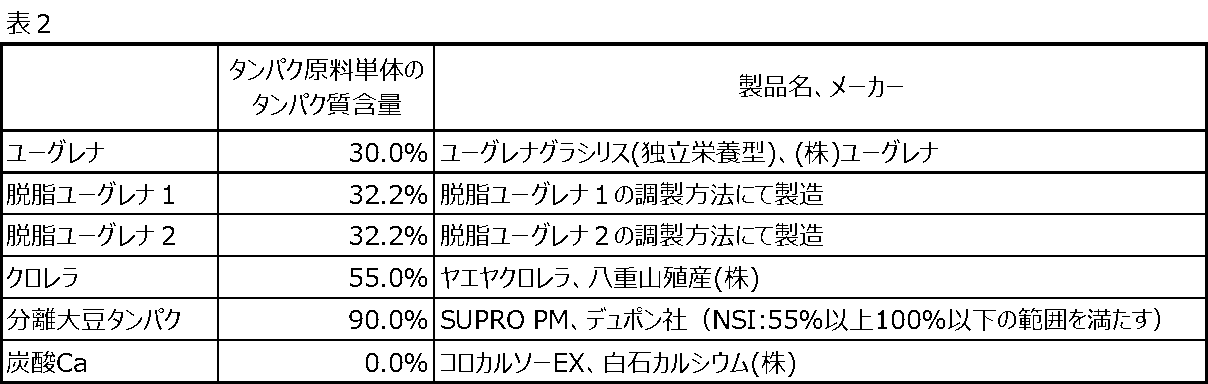
1.ステンレスジョッキにユーグレナ粉末(表2に記載のユーグレナを使用)を計量し、2倍量のヘキサンを加えて1時間浸漬した。この際、15分に1回程度スパチュラで撹拌した。
2.1の上澄みをNo.2ろ紙でろ過し、残渣部分にはデカントした量と同程度のヘキサンを新たに加えた。
3.残渣をステンレスバットに広げて、一晩ドラフト内で風乾させた。
4.風乾後の残渣を60℃で2時間、真空乾燥し、脱脂ユーグレナ1を得た。
<脱脂ユーグレナ2の調製方法>
1.ステンレスジョッキにユーグレナ粉末(ユーグレナグラシリス(従属栄養型)、(株)ユーグレナ)を計量し、2倍量のエタノールを加えて70℃で1時間加熱した。加熱後、50℃に下がるまで静置した。
2.1の上澄みをNo.2ろ紙でろ過した。
3.残渣をステンレスバットに広げて、一晩ドラフト内で風乾させた。
4.風乾後の残渣を60℃で2時間、真空乾燥し、脱脂ユーグレナ2を得た。
また、タンパク原料として脱脂ユーグレナ1および分離大豆タンパクを用いた場合も同様に組織化し膨化し、ユーグレナ単体を用いた場合と比べて色および臭いがさらに抑えられ、やや柔らかいものの、硬さおよび弾力がある食感が得られた(実施例1-4、1-5)。脱脂ユーグレナ2および分離大豆タンパクを用いた場合も同様に組織化し膨化し、ユーグレナ単体を用いた場合と比べて色および臭いが最も抑えられ、硬さおよび弾力がある食感が得られた(実施例1-6)。
得られた組織化タンパクは、組織化タンパク食品素材として好適に用いることができる。
一方、タンパク原料としてユーグレナ単体のみを用いた場合、組織化せず、ユーグレナ特有の色および臭いが強く残り、かなり脆くて弾力が得られず、食感も悪かった(比較例1-1)。脱脂ユーグレナ単体のみを用いた場合、やや組織化するも、膨化が不足し十分に吸水せず、ユーグレナ特有の色および臭いが残り、弾力のある食感が得られなかった(比較例1-2)。タンパク原料としてクロレラ単体のみを用いた場合も同様であり、組織化せず、クロレラ特有の色および臭いが強く残り、かなり脆くて弾力が得られず、食感も悪かった(比較例1-3)。
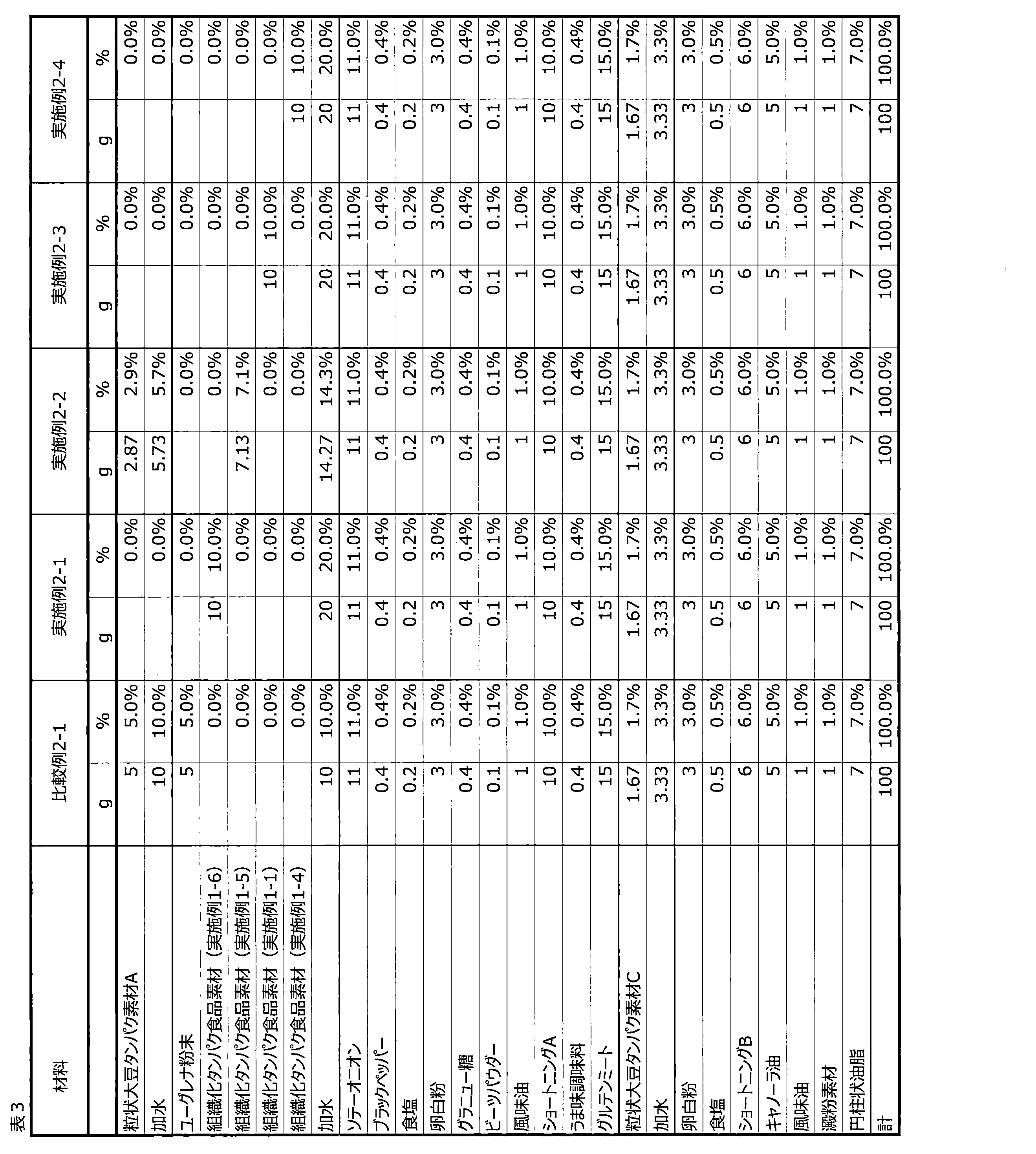
表3に記載の配合を用い、下記の手順に従ってハンバーグを調製した。
1.粒状大豆タンパク素材A、Cおよび各種組織化物はそれぞれ2倍量の加水をして水戻しした。なお、比較例2-1のユーグレナ粉末は、この時点では加水せず、2の段階で加水した。
2.水戻し後の粒状大豆タンパク素材Aからうま味調味料まで(肉粒部位)を、よく混合した。
3.グルテンミートと水戻し後の粒状大豆タンパク素材Cをフードプロセッサーにかけ、よく混合した。
4.3の混合物に卵白粉から風味油まで(つなぎ部位)を加え、よく混合した。
5.2および4の混合物をよく混合した。
6.澱粉素材および円柱状油脂を5の混合物と混ぜ合わせてハンバーグ生地を調製した。
7.6のハンバーグ生地を100g、直径10cmに成形した。
8.フライパンで、中火で裏表約2分ずつ焼成し、ハンバーグを調製した。
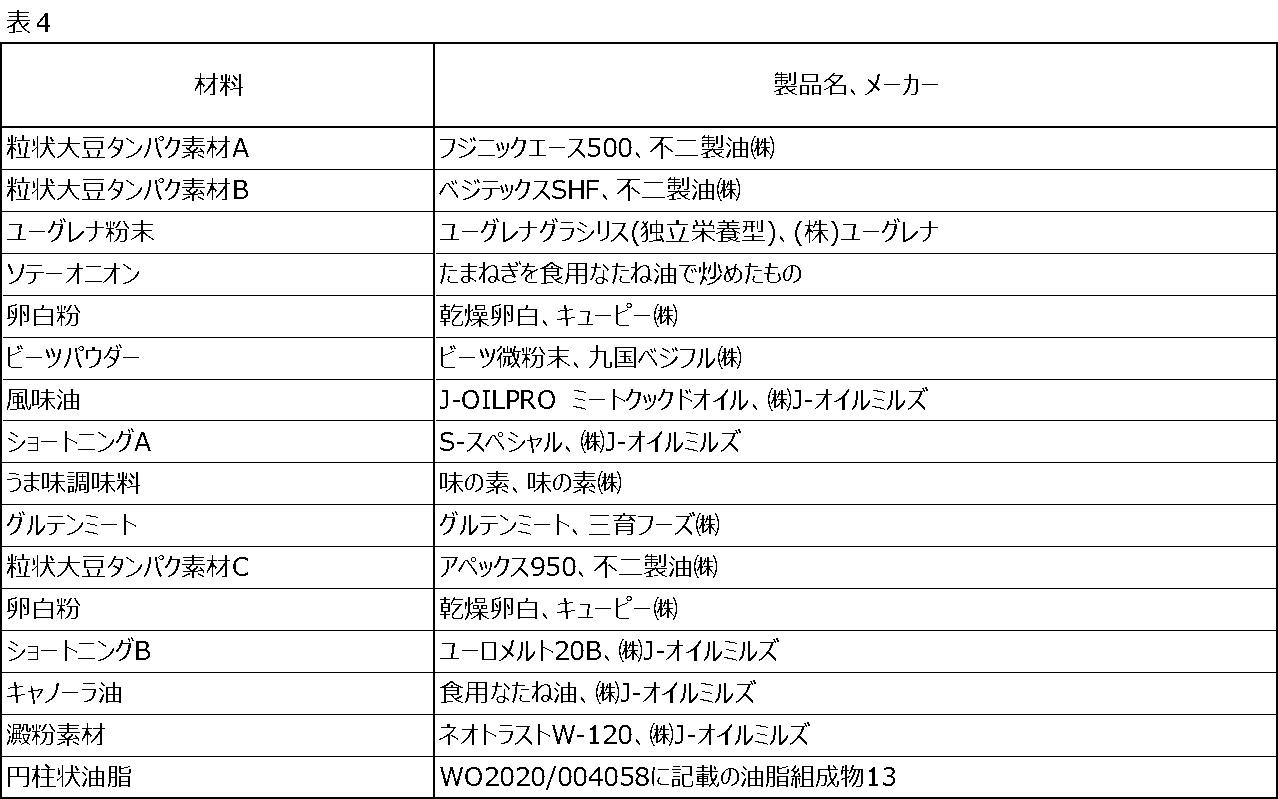
ハンバーグの断面の色を確認した。
(2)食感(弾力、硬さ)
(弾力)
5:とても弾力あり
4:弾力あり
3:やや弾力あり
2:弾力が弱い
1:弾力なし
(硬さ)
5:とても肉らしい硬さ
4:肉らしい硬さ
3:やや肉らしい硬さ
2:やや柔らかい
1:とても柔らかい
5:臭いしない
4:臭いとても弱い
3:臭いややあり
2:臭いあり
1:臭い強い
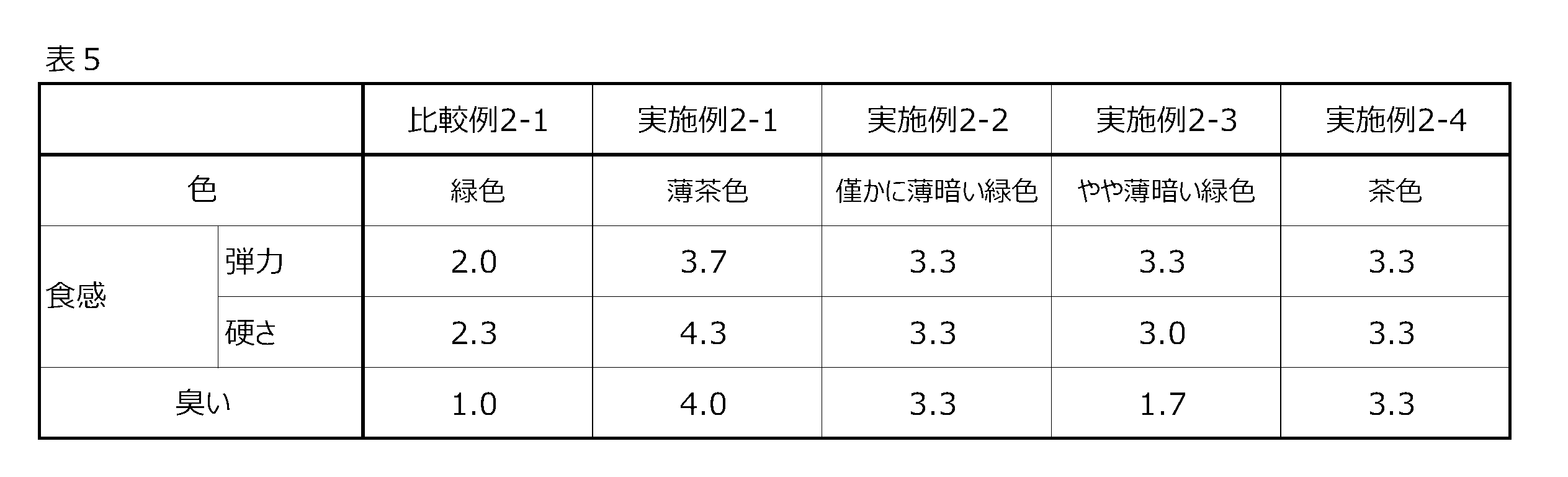
これらの結果から、本発明の組織化タンパク食品素材は、食品素材として適していることが示された。また、本発明の組織化タンパク食品素材の配合を適宜選択することで、食感を制御できることも示された。藻類由来のタンパク原料として、脱脂ユーグレナを用いた場合に色、臭いおよび食感が特に優れていた。
Claims (13)
- (a)藻類由来のタンパク原料、および
(b)タンパク質含量が70質量%以上である(a)以外のタンパク原料
を含む原料混合物を組織化してなる組織化タンパクを含む、組織化タンパク食品素材。 - 前記藻類が、ユーグレナおよび脱脂ユーグレナからなる群より選ばれる1種または2種である、請求項1に記載の組織化タンパク食品素材。
- 前記原料混合物のタンパク質含量が、前記原料混合物の全量基準で、35質量%以上である、請求項1または2に記載の組織化タンパク食品素材。
- 前記(b)が、大豆タンパクを含む、請求項1または2に記載の組織化タンパク食品素材。
- 前記大豆タンパクが、分離大豆タンパクを含む、請求項4に記載の組織化タンパク食品素材。
- 前記(b)の水溶性窒素指数(NSI)が、55%以上100%以下である、請求項1または2に記載の組織化タンパク食品素材。
- 前記原料混合物における前記(a)の含有量が、前記原料混合物の全量基準で、5質量%以上90質量%以下である、請求項1または2に記載の組織化タンパク食品素材。
- 請求項1または2に記載の組織化タンパク食品素材を含む食品。
- 前記食品が、畜肉加工食品、畜肉様加工食品および水産加工食品からなる群より選ばれる、請求項8に記載の食品。
- 組織化タンパク食品素材の製造方法であって、
(a)藻類由来のタンパク原料、および
(b)タンパク質含量が70質量%以上である(a)以外のタンパク原料
を含む原料混合物を、水の存在下、加圧加熱処理して、前記原料混合物に含まれるタンパク原料を組織化する工程(1)と、
前記工程(1)で得られた組織化物を乾燥処理して組織化タンパクを得る工程(2)と
を含む、組織化タンパク食品素材の製造方法。 - 前記藻類が、ユーグレナおよび脱脂ユーグレナからなる群より選ばれる1種または2種である、請求項10に記載の組織化タンパク食品素材の製造方法。
- 前記加圧加熱処理が、エクストルーダーによる加圧加熱処理を含む、請求項10または11に記載の組織化タンパク食品素材の製造方法。
- 請求項1または2に記載の組織化タンパク食品素材を食品に配合することを含む、食品の食感改良方法。
Priority Applications (3)
| Application Number | Priority Date | Filing Date | Title |
|---|---|---|---|
| CN202280040394.6A CN117425406A (zh) | 2021-06-14 | 2022-06-14 | 组织化蛋白食品原材料 |
| US18/568,267 US20240268414A1 (en) | 2021-06-14 | 2022-06-14 | Texturized-protein food ingredient |
| JP2023530355A JP7813789B2 (ja) | 2021-06-14 | 2022-06-14 | 組織化タンパク食品素材 |
Applications Claiming Priority (2)
| Application Number | Priority Date | Filing Date | Title |
|---|---|---|---|
| JP2021-098974 | 2021-06-14 | ||
| JP2021098974 | 2021-06-14 |
Publications (1)
| Publication Number | Publication Date |
|---|---|
| WO2022265019A1 true WO2022265019A1 (ja) | 2022-12-22 |
Family
ID=84527509
Family Applications (1)
| Application Number | Title | Priority Date | Filing Date |
|---|---|---|---|
| PCT/JP2022/023835 Ceased WO2022265019A1 (ja) | 2021-06-14 | 2022-06-14 | 組織化タンパク食品素材 |
Country Status (4)
| Country | Link |
|---|---|
| US (1) | US20240268414A1 (ja) |
| JP (1) | JP7813789B2 (ja) |
| CN (1) | CN117425406A (ja) |
| WO (1) | WO2022265019A1 (ja) |
Families Citing this family (1)
| Publication number | Priority date | Publication date | Assignee | Title |
|---|---|---|---|---|
| JP2025150201A (ja) * | 2024-03-27 | 2025-10-09 | マルハニチロ株式会社 | 加熱済み密封容器入り食品 |
Citations (6)
| Publication number | Priority date | Publication date | Assignee | Title |
|---|---|---|---|---|
| JPS60196157A (ja) * | 1984-03-16 | 1985-10-04 | Amano Pharmaceut Co Ltd | ユ−グレナ含有食品 |
| JPH0458853A (ja) * | 1990-06-26 | 1992-02-25 | Kotobuki:Kk | 機能性大豆食品の製造法 |
| JPH0488958A (ja) * | 1990-08-01 | 1992-03-23 | Kotobuki:Kk | 大豆加工食品の製造法 |
| JPH04228037A (ja) * | 1990-05-08 | 1992-08-18 | Otsuka Shokuhin Kk | 食品素材の製造法 |
| WO2017169205A1 (ja) * | 2016-03-28 | 2017-10-05 | 日清食品ホールディングス株式会社 | 肉様乾燥蛋白加工食品の製造方法 |
| JP2020150892A (ja) * | 2019-03-22 | 2020-09-24 | グリコ栄養食品株式会社 | 肉様食品 |
Family Cites Families (6)
| Publication number | Priority date | Publication date | Assignee | Title |
|---|---|---|---|---|
| JPS62278950A (ja) * | 1986-05-26 | 1987-12-03 | Sanyo Koka Cola Botoringu Kk | 動植物複合蛋白食品素材の製造法 |
| WO2012051428A1 (en) * | 2010-10-13 | 2012-04-19 | The Curators Of The University Of Missouri | Meat analog compositions and process |
| US20160205985A1 (en) * | 2015-01-19 | 2016-07-21 | General Mills, Inc. | Extruded protein product and methods of making |
| CN105768083A (zh) * | 2016-03-24 | 2016-07-20 | 佛山市聚成生化技术研发有限公司 | 一种藻类口味的谷朊粉全素速冻素肉及其制备方法 |
| CN106617105A (zh) * | 2016-09-23 | 2017-05-10 | 锦州医科大学 | 一种大豆蛋白胡萝卜素食香肠及其制备方法 |
| CN111511217B (zh) * | 2017-12-21 | 2023-09-05 | 联合利华知识产权控股有限公司 | 成形素食肉类产品 |
-
2022
- 2022-06-14 CN CN202280040394.6A patent/CN117425406A/zh active Pending
- 2022-06-14 US US18/568,267 patent/US20240268414A1/en active Pending
- 2022-06-14 JP JP2023530355A patent/JP7813789B2/ja active Active
- 2022-06-14 WO PCT/JP2022/023835 patent/WO2022265019A1/ja not_active Ceased
Patent Citations (6)
| Publication number | Priority date | Publication date | Assignee | Title |
|---|---|---|---|---|
| JPS60196157A (ja) * | 1984-03-16 | 1985-10-04 | Amano Pharmaceut Co Ltd | ユ−グレナ含有食品 |
| JPH04228037A (ja) * | 1990-05-08 | 1992-08-18 | Otsuka Shokuhin Kk | 食品素材の製造法 |
| JPH0458853A (ja) * | 1990-06-26 | 1992-02-25 | Kotobuki:Kk | 機能性大豆食品の製造法 |
| JPH0488958A (ja) * | 1990-08-01 | 1992-03-23 | Kotobuki:Kk | 大豆加工食品の製造法 |
| WO2017169205A1 (ja) * | 2016-03-28 | 2017-10-05 | 日清食品ホールディングス株式会社 | 肉様乾燥蛋白加工食品の製造方法 |
| JP2020150892A (ja) * | 2019-03-22 | 2020-09-24 | グリコ栄養食品株式会社 | 肉様食品 |
Non-Patent Citations (1)
| Title |
|---|
| STEPHANIE GRAHL, ET AL.,: "Towards more sustainable meat alternatives: How technical parameters affect the sensory properties of extrusion products derived from soy and algae", JOURNAL OF CLEANER PRODUCTION, vol. 198, 10 October 2018 (2018-10-10), pages 962 - 971, XP055973676 * |
Also Published As
| Publication number | Publication date |
|---|---|
| JPWO2022265019A1 (ja) | 2022-12-22 |
| US20240268414A1 (en) | 2024-08-15 |
| CN117425406A (zh) | 2024-01-19 |
| JP7813789B2 (ja) | 2026-02-13 |
Similar Documents
| Publication | Publication Date | Title |
|---|---|---|
| JP7099661B1 (ja) | 畜肉様加工食品の製造方法 | |
| JP7824872B2 (ja) | 植物性たん白含有食品 | |
| JP4797893B2 (ja) | 畜肉及び魚肉を使用しないハンバーグ様食品の製造方法 | |
| JP2018174923A (ja) | 組織状大豆蛋白の製造方法 | |
| KR101921209B1 (ko) | 햄버거 패티용 프리믹스 조성물, 이를 이용한 햄버거용 패티 및 그 제조방법 | |
| CN113519688A (zh) | 一种应用茶粉-茶多酚联用去豆腥的素肉馅的制备方法 | |
| JP7813789B2 (ja) | 組織化タンパク食品素材 | |
| JP7580931B2 (ja) | 肉類代替食品用組成物の製造方法及び肉類代替食品の製造方法 | |
| JP7432366B2 (ja) | 畜肉様食品の原料および畜肉様食品 | |
| JP7768217B2 (ja) | 畜肉様加工食品の製造方法 | |
| JP2021087392A (ja) | 魚肉加工食品及びその製造方法 | |
| JP7252034B2 (ja) | 組織状大豆蛋白の製造方法 | |
| JP2023002914A (ja) | 植物性蛋白を含んでなる肉類代替食品 | |
| JP2022112586A (ja) | 植物性蛋白の非膨化押出成形物を含んでなる食感改良材 | |
| JP2788104B2 (ja) | 蝦風味を有する加工食品及びその製造法 | |
| JPH11332516A (ja) | 練り製品及びその風味改良法 | |
| TWI917523B (zh) | 畜肉樣加工食品及其製造方法 | |
| RU2815964C1 (ru) | Состав для приготовления заменителя мяса | |
| RU2813730C1 (ru) | Способ приготовления растительного продукта в виде заменителя мяса | |
| JP7239909B1 (ja) | 畜肉様加工食品の製造方法 | |
| JP2025010915A (ja) | 麹菌を使用した畜肉代替素材 | |
| JP2021029149A (ja) | 植物性たん白素材およびその製造方法 | |
| RU2198561C1 (ru) | Способ производства варёных колбасных изделий | |
| JP2025127811A (ja) | 加工食品 | |
| US20260101909A1 (en) | Method for producing meat-like processed food, and binder for meat-like processed foods |
Legal Events
| Date | Code | Title | Description |
|---|---|---|---|
| 121 | Ep: the epo has been informed by wipo that ep was designated in this application |
Ref document number: 22825007 Country of ref document: EP Kind code of ref document: A1 |
|
| WWE | Wipo information: entry into national phase |
Ref document number: 2023530355 Country of ref document: JP |
|
| WWE | Wipo information: entry into national phase |
Ref document number: 2301007917 Country of ref document: TH |
|
| WWE | Wipo information: entry into national phase |
Ref document number: 202280040394.6 Country of ref document: CN |
|
| WWE | Wipo information: entry into national phase |
Ref document number: 18568267 Country of ref document: US |
|
| NENP | Non-entry into the national phase |
Ref country code: DE |
|
| 122 | Ep: pct application non-entry in european phase |
Ref document number: 22825007 Country of ref document: EP Kind code of ref document: A1 |