WO2022177014A1 - セルロースナノファイバーを含む組成物 - Google Patents
セルロースナノファイバーを含む組成物 Download PDFInfo
- Publication number
- WO2022177014A1 WO2022177014A1 PCT/JP2022/007029 JP2022007029W WO2022177014A1 WO 2022177014 A1 WO2022177014 A1 WO 2022177014A1 JP 2022007029 W JP2022007029 W JP 2022007029W WO 2022177014 A1 WO2022177014 A1 WO 2022177014A1
- Authority
- WO
- WIPO (PCT)
- Prior art keywords
- rubber
- mass
- cellulose nanofibers
- cellulose
- less
- Prior art date
- Legal status (The legal status is an assumption and is not a legal conclusion. Google has not performed a legal analysis and makes no representation as to the accuracy of the status listed.)
- Ceased
Links
Images
Classifications
-
- C—CHEMISTRY; METALLURGY
- C08—ORGANIC MACROMOLECULAR COMPOUNDS; THEIR PREPARATION OR CHEMICAL WORKING-UP; COMPOSITIONS BASED THEREON
- C08L—COMPOSITIONS OF MACROMOLECULAR COMPOUNDS
- C08L21/00—Compositions of unspecified rubbers
-
- B—PERFORMING OPERATIONS; TRANSPORTING
- B60—VEHICLES IN GENERAL
- B60C—VEHICLE TYRES; TYRE INFLATION; TYRE CHANGING; CONNECTING VALVES TO INFLATABLE ELASTIC BODIES IN GENERAL; DEVICES OR ARRANGEMENTS RELATED TO TYRES
- B60C1/00—Tyres characterised by the chemical composition or the physical arrangement or mixture of the composition
-
- C—CHEMISTRY; METALLURGY
- C08—ORGANIC MACROMOLECULAR COMPOUNDS; THEIR PREPARATION OR CHEMICAL WORKING-UP; COMPOSITIONS BASED THEREON
- C08J—WORKING-UP; GENERAL PROCESSES OF COMPOUNDING; AFTER-TREATMENT NOT COVERED BY SUBCLASSES C08B, C08C, C08F, C08G or C08H
- C08J3/00—Processes of treating or compounding macromolecular substances
- C08J3/20—Compounding polymers with additives, e.g. colouring
-
- C—CHEMISTRY; METALLURGY
- C08—ORGANIC MACROMOLECULAR COMPOUNDS; THEIR PREPARATION OR CHEMICAL WORKING-UP; COMPOSITIONS BASED THEREON
- C08J—WORKING-UP; GENERAL PROCESSES OF COMPOUNDING; AFTER-TREATMENT NOT COVERED BY SUBCLASSES C08B, C08C, C08F, C08G or C08H
- C08J3/00—Processes of treating or compounding macromolecular substances
- C08J3/20—Compounding polymers with additives, e.g. colouring
- C08J3/22—Compounding polymers with additives, e.g. colouring using masterbatch techniques
- C08J3/226—Compounding polymers with additives, e.g. colouring using masterbatch techniques using a polymer as a carrier
-
- C—CHEMISTRY; METALLURGY
- C08—ORGANIC MACROMOLECULAR COMPOUNDS; THEIR PREPARATION OR CHEMICAL WORKING-UP; COMPOSITIONS BASED THEREON
- C08K—Use of inorganic or non-macromolecular organic substances as compounding ingredients
- C08K5/00—Use of organic ingredients
- C08K5/04—Oxygen-containing compounds
- C08K5/15—Heterocyclic compounds having oxygen in the ring
- C08K5/151—Heterocyclic compounds having oxygen in the ring having one oxygen atom in the ring
- C08K5/1535—Five-membered rings
-
- C—CHEMISTRY; METALLURGY
- C08—ORGANIC MACROMOLECULAR COMPOUNDS; THEIR PREPARATION OR CHEMICAL WORKING-UP; COMPOSITIONS BASED THEREON
- C08K—Use of inorganic or non-macromolecular organic substances as compounding ingredients
- C08K7/00—Use of ingredients characterised by shape
- C08K7/02—Fibres or whiskers
-
- C—CHEMISTRY; METALLURGY
- C08—ORGANIC MACROMOLECULAR COMPOUNDS; THEIR PREPARATION OR CHEMICAL WORKING-UP; COMPOSITIONS BASED THEREON
- C08K—Use of inorganic or non-macromolecular organic substances as compounding ingredients
- C08K9/00—Use of pretreated ingredients
- C08K9/08—Ingredients agglomerated by treatment with a binding agent
-
- C—CHEMISTRY; METALLURGY
- C08—ORGANIC MACROMOLECULAR COMPOUNDS; THEIR PREPARATION OR CHEMICAL WORKING-UP; COMPOSITIONS BASED THEREON
- C08L—COMPOSITIONS OF MACROMOLECULAR COMPOUNDS
- C08L1/00—Compositions of cellulose, modified cellulose or cellulose derivatives
- C08L1/02—Cellulose; Modified cellulose
-
- C—CHEMISTRY; METALLURGY
- C08—ORGANIC MACROMOLECULAR COMPOUNDS; THEIR PREPARATION OR CHEMICAL WORKING-UP; COMPOSITIONS BASED THEREON
- C08L—COMPOSITIONS OF MACROMOLECULAR COMPOUNDS
- C08L71/00—Compositions of polyethers obtained by reactions forming an ether link in the main chain; Compositions of derivatives of such polymers
- C08L71/02—Polyalkylene oxides
-
- C—CHEMISTRY; METALLURGY
- C08—ORGANIC MACROMOLECULAR COMPOUNDS; THEIR PREPARATION OR CHEMICAL WORKING-UP; COMPOSITIONS BASED THEREON
- C08L—COMPOSITIONS OF MACROMOLECULAR COMPOUNDS
- C08L9/00—Compositions of homopolymers or copolymers of conjugated diene hydrocarbons
- C08L9/06—Copolymers with styrene
-
- A—HUMAN NECESSITIES
- A43—FOOTWEAR
- A43B—CHARACTERISTIC FEATURES OF FOOTWEAR; PARTS OF FOOTWEAR
- A43B13/00—Soles; Sole-and-heel integral units
- A43B13/02—Soles; Sole-and-heel integral units characterised by the material
- A43B13/04—Plastics, rubber or vulcanised fibre
-
- C—CHEMISTRY; METALLURGY
- C08—ORGANIC MACROMOLECULAR COMPOUNDS; THEIR PREPARATION OR CHEMICAL WORKING-UP; COMPOSITIONS BASED THEREON
- C08J—WORKING-UP; GENERAL PROCESSES OF COMPOUNDING; AFTER-TREATMENT NOT COVERED BY SUBCLASSES C08B, C08C, C08F, C08G or C08H
- C08J2309/00—Characterised by the use of homopolymers or copolymers of conjugated diene hydrocarbons
- C08J2309/06—Copolymers with styrene
-
- C—CHEMISTRY; METALLURGY
- C08—ORGANIC MACROMOLECULAR COMPOUNDS; THEIR PREPARATION OR CHEMICAL WORKING-UP; COMPOSITIONS BASED THEREON
- C08J—WORKING-UP; GENERAL PROCESSES OF COMPOUNDING; AFTER-TREATMENT NOT COVERED BY SUBCLASSES C08B, C08C, C08F, C08G or C08H
- C08J2409/00—Characterised by the use of homopolymers or copolymers of conjugated diene hydrocarbons
- C08J2409/06—Copolymers with styrene
-
- C—CHEMISTRY; METALLURGY
- C08—ORGANIC MACROMOLECULAR COMPOUNDS; THEIR PREPARATION OR CHEMICAL WORKING-UP; COMPOSITIONS BASED THEREON
- C08L—COMPOSITIONS OF MACROMOLECULAR COMPOUNDS
- C08L2201/00—Properties
- C08L2201/54—Aqueous solutions or dispersions
-
- C—CHEMISTRY; METALLURGY
- C08—ORGANIC MACROMOLECULAR COMPOUNDS; THEIR PREPARATION OR CHEMICAL WORKING-UP; COMPOSITIONS BASED THEREON
- C08L—COMPOSITIONS OF MACROMOLECULAR COMPOUNDS
- C08L2205/00—Polymer mixtures characterised by other features
- C08L2205/03—Polymer mixtures characterised by other features containing three or more polymers in a blend
-
- C—CHEMISTRY; METALLURGY
- C08—ORGANIC MACROMOLECULAR COMPOUNDS; THEIR PREPARATION OR CHEMICAL WORKING-UP; COMPOSITIONS BASED THEREON
- C08L—COMPOSITIONS OF MACROMOLECULAR COMPOUNDS
- C08L2205/00—Polymer mixtures characterised by other features
- C08L2205/14—Polymer mixtures characterised by other features containing polymeric additives characterised by shape
- C08L2205/16—Fibres; Fibrils
-
- C—CHEMISTRY; METALLURGY
- C08—ORGANIC MACROMOLECULAR COMPOUNDS; THEIR PREPARATION OR CHEMICAL WORKING-UP; COMPOSITIONS BASED THEREON
- C08L—COMPOSITIONS OF MACROMOLECULAR COMPOUNDS
- C08L2207/00—Properties characterising the ingredient of the composition
- C08L2207/32—Properties characterising the ingredient of the composition containing low molecular weight liquid component
- C08L2207/324—Liquid component is low molecular weight polymer
-
- C—CHEMISTRY; METALLURGY
- C08—ORGANIC MACROMOLECULAR COMPOUNDS; THEIR PREPARATION OR CHEMICAL WORKING-UP; COMPOSITIONS BASED THEREON
- C08L—COMPOSITIONS OF MACROMOLECULAR COMPOUNDS
- C08L2310/00—Masterbatches
-
- F—MECHANICAL ENGINEERING; LIGHTING; HEATING; WEAPONS; BLASTING
- F16—ENGINEERING ELEMENTS AND UNITS; GENERAL MEASURES FOR PRODUCING AND MAINTAINING EFFECTIVE FUNCTIONING OF MACHINES OR INSTALLATIONS; THERMAL INSULATION IN GENERAL
- F16F—SPRINGS; SHOCK-ABSORBERS; MEANS FOR DAMPING VIBRATION
- F16F1/00—Springs
- F16F1/36—Springs made of rubber or other material having high internal friction, e.g. thermoplastic elastomers
- F16F1/3605—Springs made of rubber or other material having high internal friction, e.g. thermoplastic elastomers characterised by their material
-
- F—MECHANICAL ENGINEERING; LIGHTING; HEATING; WEAPONS; BLASTING
- F16—ENGINEERING ELEMENTS AND UNITS; GENERAL MEASURES FOR PRODUCING AND MAINTAINING EFFECTIVE FUNCTIONING OF MACHINES OR INSTALLATIONS; THERMAL INSULATION IN GENERAL
- F16G—BELTS, CABLES, OR ROPES, PREDOMINANTLY USED FOR DRIVING PURPOSES; CHAINS; FITTINGS PREDOMINANTLY USED THEREFOR
- F16G1/00—Driving-belts
- F16G1/06—Driving-belts made of rubber
Definitions
- One aspect of the present disclosure relates to a composition or the like containing cellulose nanofibers.
- rubber moldings are required to have a high balance of various properties such as mechanical strength, flexibility, wear resistance, and processability. It is common practice to incorporate a filler into the rubber molding for the purpose of In order for a rubber molding containing such a filler to exhibit desired properties, it is important that the filler is well dispersed in the rubber.
- Patent Literature 1 describes a rubber composition for tires characterized by blending oxidized cellulose nanofibers with a diene rubber containing a modified diene rubber for the purpose of improving mechanical properties. .
- cellulose which is a low specific gravity and renewable material
- cellulose nanofiber is very promising as a filler for polymer moldings because it has a good reinforcing effect per amount used on the polymer molding when it is combined with various polymers to form a polymer molding.
- cellulose nanofibers can be used for rubber moldings, it is possible to provide rubber moldings that have low specific gravity and excellent physical properties, can be used for various purposes, and are advantageous in terms of transportation costs and disposal costs.
- Patent Document 1 describes a rubber composition for tires in which cellulose oxide nanofibers as a filler are dispersed in a diene rubber containing a modified diene rubber.
- this technique is a technique in which the modified diene rubber improves the dispersibility by improving the affinity of the oxidized cellulose nanofibers for the diene rubber. Even if the cellulose nanofibers do not have an ionic group, a rubber molded article in which cellulose nanofibers are satisfactorily dispersed in rubber has not yet been provided.
- One aspect of the present invention solves the above problems and provides a rubber composition in which cellulose nanofibers are well dispersed in the rubber and which enables the formation of a molded article having excellent elastic modulus, wear resistance, etc. With the goal.
- a rubber composition comprising cellulose nanofibers, a first rubber component that is liquid rubber, and a surfactant.
- the rubber composition according to aspect 1 wherein the cellulose nanofibers do not have an ionic group.
- the rubber composition according to aspect 1 or 2 wherein the liquid rubber has a number average molecular weight of 1,000 to 80,000.
- the described rubber composition [9] The rubber composition according to any one of the above aspects 1 to 8, wherein the cellulose nanofibers have a degree of substitution of 0. [10] The rubber composition according to any one of aspects 1 to 9, containing 0.5% by mass to 10% by mass of the cellulose nanofibers. [11] The rubber composition according to any one of the aspects 1 to 10, containing 10 parts by mass to 200 parts by mass of the surfactant with respect to 100 parts by mass of the cellulose nanofibers. [12] The rubber composition according to any one of aspects 1 to 11, wherein the surfactant is a nonionic surfactant or a cationic surfactant. [13] The rubber composition according to aspect 12 above, wherein the surfactant is a nonionic surfactant.
- nonionic surfactant is a compound having a hydrophilic group selected from the group consisting of a hydroxyl group, a carboxyl group, a sulfonic acid group, and an amino group, and a hydrocarbon group. rubber composition.
- the nonionic surfactant has the following general formula (1): R-( OCH2CH2 ) m - OH (1) [In the formula, R represents a monovalent aliphatic group having 6 to 30 carbon atoms, and m is a natural number smaller than the number of carbon atoms of R.
- R 1 and R 2 each independently represent a hydrogen atom, an aliphatic group having 1 to 30 carbon atoms, or -COR 3 ⁇ wherein R 3 represents an aliphatic group having 1 to 30 carbon atoms. ⁇ , or --(CH 2 CH 2 O) y --R 4 ⁇ wherein R 4 represents a hydrogen atom or an aliphatic group having 1-30 carbon atoms, and y is an integer of 1-30.
- ⁇ represents.
- the rubber composition according to aspect 13 or 14 above which is one or more selected from the group consisting of: [16] The rubber composition according to any one of the above aspects 1 to 15, wherein at least part of the surface of the cellulose nanofibers is covered with the first rubber component. [17] A powder composed of the rubber composition according to any one of aspects 1 to 16 above. [18] The powder according to aspect 17 above, which has a compacted bulk density of 0.01 g/cm 3 to 0.30 g/cm 3 . [19] A masterbatch, which is a kneaded product of the powder according to aspect 17 or 18 and a second rubber component.
- a method for producing a masterbatch comprising the step of kneading the powder according to aspect 17 or 18 and a second rubber component to obtain a masterbatch.
- a rubber composite which is a kneaded product of the powder according to Aspect 17 or 18 or the masterbatch according to Aspect 19 and a third rubber component.
- a method for producing a rubber cured product comprising: [27] A shoe outsole comprising the cured rubber product according to aspect 25 above. [28] A tire comprising the cured rubber product according to aspect 25 above. [29] An anti-vibration rubber comprising the cured rubber product according to aspect 25 above. [30] A power transmission belt comprising the cured rubber product according to aspect 25 above.
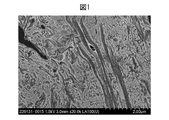
- FIG. 10 is a diagram showing an observation image of a cross section of the powder obtained in Example 10, which was observed with a scanning electron microscope.
- present embodiments Exemplary embodiments of the present invention (hereinafter abbreviated as "present embodiments") will be described below, but the present invention is in no way limited to these embodiments.
- characteristic values of the present disclosure are values measured by the method described in the [Examples] section of the present disclosure or a method understood to be equivalent thereto by those skilled in the art.
- ⁇ Rubber composition>> One aspect of the present disclosure provides a rubber composition that includes cellulose nanofibers, a surfactant, and a first rubber component that is liquid rubber.
- Cellulose nanofibers are inherently hydrophilic due to their hydroxyl groups, while rubber is inherently hydrophobic, and it is usually difficult to uniformly disperse cellulose nanofibers in rubber.
- the present inventors have made various studies from such a viewpoint, and as a result, prepared a rubber composition by dispersing cellulose nanofibers in a specific rubber having fluidity at a predetermined temperature, and then using the rubber composition as, for example, a rubber By kneading rubber with rubber in the form of a masterbatch for industrial use, a cured rubber product is formed that does not impair the expected physical properties of rubber and exhibits a good reinforcing effect of cellulose nanofibers. I found that it can be done.
- the cellulose nanofibers are well dispersed in the rubber, and a cured rubber having good properties (especially, elastic modulus, hardness, etc.) can be formed.
- the cured product has cellulose nanofibers well dispersed in the rubber and can form a molded product having excellent elastic modulus, abrasion resistance, and the like. Preferred examples of each component of the rubber composition of the present embodiment are described below.
- Natural cellulose and regenerated cellulose can be used as raw materials for cellulose nanofibers.
- natural cellulose include wood pulp obtained from wood species (hardwood or softwood), non-wood pulp obtained from non-wood species (cotton, bamboo, hemp, bagasse, kenaf, cotton linter, sisal, straw, etc.), animals (e.g. Ascidians), algae, and cellulose aggregates produced by microorganisms (eg, acetic acid bacteria) can be used.
- regenerated cellulose regenerated cellulose fibers (viscose, cupra, tencel, etc.), cellulose derivative fibers, regenerated cellulose obtained by electrospinning, ultrafine yarns of cellulose derivatives, and the like can be used.
- cellulose nanofibers are produced by treating pulp or the like with hot water at 100° C. or higher, hydrolyzing hemicellulose to make it brittle, and then using a high-pressure homogenizer, a microfluidizer, a ball mill, a disk mill, a mixer (for example, homogenizer It is a fine cellulose fiber mechanically defibrated by a pulverization method such as a mixer.
- the cellulose nanofibers have a number average fiber diameter of 1 nm or more and 1000 nm or less.
- Cellulose nanofibers may be chemically modified as described later, but are preferably not chemically modified in terms of reinforcing effect as a filler.
- cellulose nanofibers that have been defibrated by chemical oxidation treatment such as 2,2,6,6-tetramethylpiperidine-1-oxyl (TEMPO) phosphate ester have the ions introduced into the cellulose nanofibers.
- the heat resistance tends to be low due to the functional group (for example, carboxyl group), and the fiber diameter after fibrillation tends to be small.
- the cellulose nanofibers that are only mechanically defibrated that is, are not subjected to chemical defibration treatment such as oxidation
- the cellulose nanofibers do not have ionic groups.
- that the cellulose nanofibers do not have ionic groups means that the amount of ionic groups measured by conductivity titration is 0.1 mmol/g or less.
- the slurry can be prepared by dispersing cellulose fibers in a liquid medium, and the dispersion may be performed using a high-pressure homogenizer, a microfluidizer, a ball mill, a disk mill, a mixer (e.g., homomixer), or the like. may be obtained as a product of the slurry preparation process of the present disclosure.
- the liquid medium in the slurry may further comprise, in addition to water, optionally other liquid mediums (eg, organic solvents), either singly or in combination of two or more.
- organic solvents include commonly used water-miscible organic solvents such as: alcohols with boiling points of 50° C. to 170° C. (e.g.
- ethers eg, propylene glycol monomethyl ether, 1,2-dimethoxyethane, diisopropyl ether, tetrahydrofuran, 1,4-dioxane, etc.
- carboxylic acids eg, formic acid, acetic acid, lactic acid, etc.
- ketones eg, acetone, methyl ethyl ketone, methyl isobutyl ketone, cyclopentanone, cyclohexanone, etc.
- nitrogen-containing solvents dimethylformamide, dimethylacetamide, acetonitrile, etc.
- the liquid medium in the slurry is substantially
- the alkali-soluble components and sulfuric acid-insoluble components may be reduced through a purification process such as delignification by cooking treatment and a bleaching process.
- refining and bleaching processes such as delignification by digestion cut the molecular chains of cellulose and change the weight-average molecular weight and number-average molecular weight. It is desirable that the weight-average molecular weight of the fiber and the ratio between the weight-average molecular weight and the number-average molecular weight are controlled within appropriate ranges.
- the refining process such as delignification by cooking treatment and the bleaching process reduce the molecular weight of cellulose molecules
- these processes reduce the molecular weight of cellulose nanofibers and denature the cellulose raw material to produce alkali-soluble components.
- the refining and bleaching steps of the cellulose raw material are controlled so that the amount of alkali-soluble matter contained in the cellulose raw material is within a certain range. desirable.
- the number average fiber diameter of the cellulose nanofibers is preferably 2 to 1000 nm from the viewpoint of obtaining the effect of improving the physical properties of the cellulose nanofibers.
- the number average fiber diameter of the cellulose nanofibers is more preferably 4 nm or more, or 5 nm or more, or 10 nm or more, or 15 nm or more, or 20 nm or more, and more preferably 500 nm or less, or 450 nm or less, or 400 nm or less, or 350 nm. or less, or 300 nm or less, or 250 nm or less.
- the average fiber length (L)/fiber diameter (D) ratio of cellulose nanofibers is preferably 30 or more from the viewpoint of satisfactorily improving the mechanical properties of a rubber composite containing cellulose nanofibers with a small amount of cellulose nanofibers. , or 50 or more, or 80 or more, or 100 or more, or 120 or more, or 150 or more. Although the upper limit is not particularly limited, it is preferably 5000 or less from the viewpoint of handleability.
- the fiber length, fiber diameter, and L/D ratio of cellulose nanofibers are measured by dispersing an aqueous dispersion of cellulose nanofibers with a high-shear homogenizer (for example, Nippon Seiki Co., Ltd., trade name "Excel Auto Homogenizer ED- 7”), treatment conditions: A water dispersion dispersed at a rotation speed of 15,000 rpm for 5 minutes was diluted with pure water to 0.1 to 0.5% by mass, cast on mica, and air-dried. A sample is used as a measurement sample, and measured with a scanning electron microscope (SEM) or an atomic force microscope (AFM).
- SEM scanning electron microscope
- AFM atomic force microscope
- the length (L) and diameter (D) of 100 randomly selected cellulose nanofibers in an observation field whose magnification is adjusted so that at least 100 cellulose nanofibers can be observed. is measured and the ratio (L/D) is calculated.
- the number average value of fiber length (L), the number average value of fiber diameter (D), and the number average value of ratio (L/D) are calculated.
- the fiber length, fiber diameter, and L/D ratio of cellulose nanofibers contained in powder, rubber composition, rubber masterbatch, rubber composite, etc. are measured by the above-described measurement method using these as measurement samples. You can check by doing
- the fiber length, fiber diameter, and L/D ratio of the cellulose nanofibers contained in the powder, rubber composition, rubber masterbatch, rubber composite, etc. are organic or inorganic capable of dissolving the polymer components contained therein.
- the cellulose nanofibers are separated and thoroughly washed with the solvent, an aqueous dispersion is prepared by replacing the solvent with pure water, and the cellulose nanofiber concentration is adjusted to 0.1 to It can be confirmed by diluting it with pure water to 0.5% by mass, casting it on mica, air-drying it, and measuring it as a measurement sample by the above-described measurement method. At this time, 100 or more randomly selected cellulose nanofibers to be measured are measured.
- the crystallinity of cellulose nanofibers is preferably 55% or more. When the crystallinity is within this range, the mechanical properties (strength and dimensional stability) of cellulose itself are high, so when cellulose nanofibers are dispersed in rubber, the rubber composite tends to have high strength and dimensional stability. be.
- a more preferred lower limit of crystallinity is 60%, still more preferably 70%, and most preferably 80%.
- the crystallinity of the cellulose nanofibers has no particular upper limit, and the higher the better, but the preferred upper limit is 99% from the viewpoint of production.
- Alkali-soluble polysaccharides such as hemicellulose and acid-insoluble components such as lignin are present between microfibrils of plant-derived cellulose nanofibers and between microfibril bundles.
- Hemicellulose is a polysaccharide composed of sugars such as mannan and xylan, and plays a role of connecting microfibrils by forming hydrogen bonds with cellulose.
- Lignin is a compound having an aromatic ring and is known to covalently bond with hemicellulose in plant cell walls. If the residual amount of impurities such as lignin in the cellulose nanofibers is large, discoloration may occur due to heat during processing. It is desirable that the crystallinity of the nanofibers be within the above range.
- cellulose As crystalline forms of cellulose, type I, type II, type III, type IV, etc. are known. Among them, types I and II are particularly widely used, and types III and IV are available on a laboratory scale. However, it is not widely used on an industrial scale.
- the cellulose nanofibers of the present disclosure have relatively high structural mobility, and by dispersing the cellulose nanofibers in rubber, the coefficient of linear expansion is lower, and the strength and elongation during tensile and bending deformation are superior.
- Cellulose nanofibers containing cellulose type I crystals or cellulose type II crystals are preferable, and cellulose nanofibers containing cellulose type I crystals and having a degree of crystallinity of 55% or more are more preferable, since a molded article having a higher degree of crystallinity can be obtained. .
- the degree of polymerization of the cellulose nanofiber is preferably 100 or more, more preferably 150 or more, more preferably 200 or more, more preferably 300 or more, more preferably 400 or more, more preferably 450 or more, preferably 3500 or more. Below, more preferably 3300 or less, more preferably 3200 or less, more preferably 3100 or less, more preferably 3000 or less.
- the degree of polymerization of cellulose nanofibers is preferably not too high, and from the viewpoint of developing mechanical properties, it is desired that the degree of polymerization is not too low.
- the degree of polymerization of cellulose nanofibers means the average degree of polymerization measured according to the reduction specific viscosity method with a copper ethylenediamine solution described in the confirmation test (3) of the "15th Edition Japanese Pharmacopoeia Commentary (published by Hirokawa Shoten)". do.
- the weight average molecular weight (Mw) of cellulose nanofibers is 100,000 or more, more preferably 200,000 or more.
- the ratio (Mw/Mn) between the weight average molecular weight and the number average molecular weight (Mn) is 6 or less, preferably 5.4 or less.
- the larger the weight average molecular weight the smaller the number of terminal groups of the cellulose molecule.
- the ratio of the weight average molecular weight to the number average molecular weight (Mw/Mn) represents the width of the molecular weight distribution, the smaller the Mw/Mn, the smaller the number of ends of the cellulose molecules.
- the weight average molecular weight (Mw) of cellulose nanofibers may be, for example, 600,000 or less, or 500,000 or less, from the viewpoint of availability of cellulose raw materials.
- the ratio (Mw/Mn) between the weight average molecular weight and the number average molecular weight (Mn) may be, for example, 1.5 or more, or 2 or more from the viewpoint of ease of production of cellulose nanofibers.
- Mw can be controlled within the above range by selecting a cellulose raw material having an Mw suitable for the purpose, and by appropriately subjecting the cellulose raw material to physical and/or chemical treatments within an appropriate range.
- the Mw/Mn is also within the above range by selecting a cellulose raw material having Mw/Mn according to the purpose, by appropriately performing physical treatment and/or chemical treatment on the cellulose raw material in an appropriate range, etc.
- the physical treatment includes dry or wet grinding such as microfluidizer, ball mill, disk mill, crusher, homomixer, high-pressure homogenizer, and ultrasonic device.
- dry or wet grinding such as microfluidizer, ball mill, disk mill, crusher, homomixer, high-pressure homogenizer, and ultrasonic device.
- mechanical forces such as impact, shear, shear, friction, etc., include cooking, bleaching, acid treatment, regenerated cellulose, and the like.
- the weight-average molecular weight and number-average molecular weight of cellulose nanofibers referred to here are obtained by dissolving cellulose nanofibers in N,N-dimethylacetamide to which lithium chloride has been added, and then gelling with N,N-dimethylacetamide as a solvent. It is a value determined by permeation chromatography.
- Methods for controlling the degree of polymerization (that is, the average degree of polymerization) or molecular weight of cellulose nanofibers include hydrolysis treatment.
- the hydrolysis treatment promotes depolymerization of the amorphous cellulose inside the cellulose nanofibers and reduces the average degree of polymerization.
- the hydrolysis treatment removes impurities such as hemicellulose and lignin in addition to the amorphous cellulose described above, so that the interior of the fiber becomes porous.
- the method of hydrolysis is not particularly limited, but includes acid hydrolysis, alkaline hydrolysis, hydrothermal hydrolysis, steam explosion, microwave decomposition, and the like. These methods may be used alone or in combination of two or more.
- acid hydrolysis method for example, ⁇ -cellulose obtained as pulp from a fibrous plant is used as a cellulose raw material, and this is dispersed in an aqueous medium, and an appropriate amount of protonic acid, carboxylic acid, Lewis acid, heteropoly acid, etc. is added.
- the average degree of polymerization can be easily controlled.
- the reaction conditions such as temperature, pressure and time at this time vary depending on the cellulose species, cellulose concentration, acid species, acid concentration, etc., but are appropriately adjusted so as to achieve the desired average degree of polymerization.
- the conditions include using a mineral acid aqueous solution of 2% by mass or less and treating the cellulose nanofibers at 100° C. or higher under pressure for 10 minutes or longer.
- the catalyst component such as acid permeates into the inside of the cellulose nanofibers, promoting hydrolysis, reducing the amount of the catalyst component to be used, and facilitating subsequent purification.
- the dispersion of the cellulose raw material at the time of hydrolysis may contain a small amount of an organic solvent within a range that does not impair the effects of the present invention.
- Alkali-soluble polysaccharides that can be contained in cellulose nanofibers include ⁇ -cellulose and ⁇ -cellulose in addition to hemicellulose.
- Alkali-soluble polysaccharides are components obtained as alkali-soluble parts of holocellulose obtained by solvent extraction and chlorine treatment of plants (for example, wood) (that is, components obtained by removing ⁇ -cellulose from holocellulose). It is understood by those skilled in the art.
- Alkali-soluble polysaccharides are polysaccharides containing hydroxyl groups and have poor heat resistance, and are subject to decomposition when exposed to heat, yellowing during heat aging, and reduced strength of cellulose nanofibers. It is preferable that the content of alkali-soluble polysaccharides in the cellulose nanofibers is as small as possible, because it may cause inconveniences.
- the average content of alkali-soluble polysaccharides in cellulose nanofibers is preferably 20% by mass or less with respect to 100% by mass of cellulose nanofibers, from the viewpoint of obtaining good dispersibility of cellulose nanofibers. Or 18% by mass or less, or 15% by mass or less, or 12% by mass or less. From the viewpoint of ease of production of cellulose nanofibers, the content may be 1% by mass or more, 2% by mass or more, or 3% by mass or more.
- the average content of alkali-soluble polysaccharides can be obtained by the method described in Non-Patent Document (Wood Science Experiment Manual, edited by Japan Wood Science Society, pp. 92-97, 2000), and the holocellulose content (Wise method) It is obtained by subtracting the ⁇ -cellulose content from This method is understood in the art as a method for measuring the amount of hemicellulose.
- the alkali-soluble polysaccharide content is calculated three times for each sample, and the number average of the calculated alkali-soluble polysaccharide contents is taken as the average alkali-soluble polysaccharide content.
- the average content of acid-insoluble components in the cellulose nanofibers is preferably 10% by mass with respect to 100% by mass of the cellulose nanofibers, from the viewpoint of avoiding a decrease in heat resistance of the cellulose nanofibers and accompanying discoloration. or less, or 5% by mass or less, or 3% by mass or less. From the viewpoint of ease of production of cellulose nanofibers, the content may be 0.1% by mass or more, 0.2% by mass or more, or 0.3% by mass or more.
- the average content of acid-insoluble components is determined by quantifying the acid-insoluble components using the Clason method described in Non-Patent Document (Wood Science Experiment Manual, edited by Japan Wood Research Society, pp. 92-97, 2000). This method is understood in the industry as a method for measuring the amount of lignin. After stirring the sample in a sulfuric acid solution to dissolve cellulose, hemicellulose, etc., the sample was filtered through a glass fiber filter paper, and the obtained residue corresponds to the acid-insoluble component. The acid-insoluble component content is calculated from this acid-insoluble component weight, and the number average of the acid-insoluble component content calculated for the three samples is taken as the acid-insoluble component average content.
- the thermal decomposition initiation temperature (T D ) of cellulose nanofibers is, in one aspect, 270° C. or higher, preferably 275° C. or higher, more preferably 275° C. or higher, from the viewpoint that the heat resistance and mechanical strength desired for in-vehicle applications can be exhibited. 280° C. or higher, more preferably 285° C. or higher.
- a higher thermal decomposition initiation temperature is more preferable, but from the viewpoint of ease of production of cellulose nanofibers, it may be, for example, 320° C. or lower, or 300° C. or lower.
- T D is a value obtained from a graph in thermogravimetric (TG) analysis, in which the horizontal axis is temperature and the vertical axis is weight residual rate %.
- TG thermogravimetric
- the 1% weight reduction temperature (T 1% ) is the temperature at which the weight is reduced by 1% by weight from the weight of 150° C. when the temperature is continued to be increased by the method of T D described above.
- the 250° C. weight loss rate (T 250° C. ) of cellulose nanofibers is the weight loss rate when cellulose nanofibers are held at 250° C. under nitrogen flow for 2 hours in TG analysis.
- Cellulose nanofibers may be chemically modified cellulose nanofibers.
- Cellulose nanofibers may be chemically modified in advance, for example, at the raw material pulp or linter stage, during defibration treatment, or after fibrillation treatment, or during or after the slurry preparation process, or the drying (granulation) process. It may be chemically modified during or after.
- modifiers for cellulose nanofibers compounds that react with the hydroxyl groups of cellulose can be used, including esterifying agents, etherifying agents, and silylating agents.
- modifiers with polar groups such as carboxylic acids and phosphate esters, tend to reduce heat resistance by introducing ionic groups (e.g., carboxyl groups) into cellulose nanofibers. From the viewpoint of the reinforcing effect as a filler, it is preferable not to use it.
- the chemical modification is acylation using an esterifying agent, particularly preferably acetylation.
- Preferred esterifying agents are acid halides, acid anhydrides, carboxylic acid vinyl esters and carboxylic acids.
- the acid halide may be at least one selected from the group consisting of compounds represented by the following formulas.
- Specific examples of acid halides include acetyl chloride, acetyl bromide, acetyl iodide, propionyl chloride, propionyl bromide, propionyl iodide, butyryl chloride, butyryl bromide, butyryl iodide, benzoyl chloride, benzoyl bromide, iodine Examples include, but are not limited to, benzoyl chloride and the like.
- alkaline compounds can be added for the purpose of acting as a catalyst and at the same time neutralizing the by-product acidic substances.
- alkaline compounds include, but are not limited to: tertiary amine compounds such as triethylamine and trimethylamine; and nitrogen-containing aromatic compounds such as pyridine and dimethylaminopyridine.
- Any appropriate acid anhydrides can be used as the acid anhydride.
- Anhydrides of saturated aliphatic monocarboxylic acids such as acetic acid, propionic acid, (iso)butyric acid and valeric acid; anhydrides of unsaturated aliphatic monocarboxylic acids such as (meth)acrylic acid and oleic acid;
- Anhydrides of alicyclic monocarboxylic acids such as cyclohexanecarboxylic acid and tetrahydrobenzoic acid;
- Anhydrides of aromatic monocarboxylic acids such as benzoic acid and 4-methylbenzoic acid;
- Dibasic carboxylic acid anhydrides include, for example, anhydrides of saturated aliphatic dicarboxylic acids such as succinic acid and adipic acid; unsaturated aliphatic dicarboxylic acid anhydrides such as maleic anhydride and itaconic anhydride; 1-cyclohexene-1 anhydride , 2-dicar
- an acidic compound such as sulfuric acid, hydrochloric acid, phosphoric acid, etc., or a Lewis acid (for example, a Lewis acid compound represented by MYn, where M is B, As, Ge, etc.) is used as a catalyst.
- a Lewis acid for example, a Lewis acid compound represented by MYn, where M is B, As, Ge, etc.
- n is an integer corresponding to the valence of M, 2 or 3 and Y represents a halogen atom, OAc, OCOCF 3 , ClO 4 , SbF 6 , PF 6 or OSO 2 CF 3 (OTf).), or adding one or more of an alkaline compound such as triethylamine or pyridine You may
- R-COO-CH CH2 ⁇
- R is an alkyl group having 1 to 24 carbon atoms, an alkenyl group having 2 to 24 carbon atoms, a cycloalkyl group having 3 to 16 carbon atoms, or an aryl group having 6 to 24 carbon atoms. ⁇ is preferred.
- Carboxylic acid vinyl esters include vinyl acetate, vinyl propionate, vinyl butyrate, vinyl caproate, vinyl cyclohexanecarboxylate, vinyl caprylate, vinyl caprate, vinyl laurate, vinyl myristate, vinyl palmitate, vinyl stearate, pivaline It is more preferably at least one selected from the group consisting of vinyl acid, vinyl octylate, divinyl adipate, vinyl methacrylate, vinyl crotonate, vinyl octylate, vinyl benzoate, and vinyl cinnamate.
- alkali metal hydroxides For the esterification reaction with a carboxylic acid vinyl ester, alkali metal hydroxides, alkaline earth metal hydroxides, alkali metal carbonates, alkaline earth metal carbonates, alkali metal hydrogencarbonates, primary to tertiary grades are used as catalysts.
- One or more selected from the group consisting of amines, quaternary ammonium salts, imidazole and its derivatives, pyridine and its derivatives, and alkoxides may be added.
- alkali metal hydroxides and alkaline earth metal hydroxides include sodium hydroxide, potassium hydroxide, lithium hydroxide, calcium hydroxide, barium hydroxide, and the like.
- Alkali metal carbonates, alkaline earth metal carbonates and alkali metal hydrogen carbonates include lithium carbonate, sodium carbonate, potassium carbonate, cesium carbonate, magnesium carbonate, calcium carbonate, barium carbonate, lithium hydrogen carbonate, sodium hydrogen carbonate, carbonate Examples include potassium hydrogen and cesium hydrogen carbonate.
- Primary to tertiary amines are primary amines, secondary amines, and tertiary amines, and specific examples include ethylenediamine, diethylamine, proline, N,N,N',N'-tetramethylethylenediamine, N,N,N',N'-tetramethyl-1,3-propanediamine, N,N,N',N'-tetramethyl-1,6-hexanediamine, tris(3-dimethylaminopropyl)amine, Examples include N,N-dimethylcyclohexylamine and triethylamine.
- imidazole and its derivatives examples include 1-methylimidazole, 3-aminopropylimidazole, carbonyldiimidazole and the like.
- Pyridine and its derivatives include N,N-dimethyl-4-aminopyridine and picoline.
- Alkoxides include sodium methoxide, sodium ethoxide, potassium-t-butoxide and the like.
- Examples of carboxylic acids include at least one selected from the group consisting of compounds represented by the following formulas.
- R-COOH (Wherein, R represents an alkyl group having 1 to 16 carbon atoms, an alkenyl group having 2 to 16 carbon atoms, a cycloalkyl group having 3 to 16 carbon atoms, or an aryl group having 6 to 16 carbon atoms.)
- carboxylic acids include acetic acid, propionic acid, butyric acid, caproic acid, cyclohexanecarboxylic acid, caprylic acid, capric acid, lauric acid, myristic acid, palmitic acid, stearic acid, pivalic acid, methacrylic acid, crotonic acid, and octyl. At least one selected from the group consisting of acid, benzoic acid, and cinnamic acid is included.
- the catalyst used is an acidic compound such as sulfuric acid, hydrochloric acid, phosphoric acid, or a Lewis acid (for example, a Lewis acid compound represented by MYn, where M is B, As, Ge, etc.).
- n is an integer corresponding to the valence of M, and 2 or 3 and Y represents a halogen atom, OAc, OCOCF3 , ClO4 , SbF6 , PF6 or OSO2CF3 ( OTf)), or one or more of an alkaline compound such as triethylamine or pyridine may
- esterification reagents at least one selected from the group consisting of acetic anhydride, propionic anhydride, butyric anhydride, vinyl acetate, vinyl propionate, vinyl butyrate, and acetic acid, especially acetic anhydride and vinyl acetate, It is preferable from the viewpoint of reaction efficiency.
- the cellulose nanofibers When the cellulose nanofibers are chemically modified (for example, by hydrophobization such as acylation), the cellulose nanofibers tend to have good dispersibility in rubber, but the cellulose nanofibers of the present disclosure are unsubstituted Alternatively, even with a low degree of substitution, it can exhibit good dispersibility in rubber.
- hydrophobization such as acylation
- the cellulose nanofibers have a degree of substitution of 0 (ie, unsubstituted).
- the degree of acyl substitution (DS) of the cellulose nanofibers is greater than 0, or 0.1 or more, or 0.2 or more, or It may be 0.25 or more, or 0.3 or more, or 0.5 or more.
- the esterified cellulose nanofiber since the unmodified cellulose skeleton remains in the esterified cellulose nanofiber, the esterified cellulose nanofiber has both high tensile strength and dimensional stability derived from cellulose and high thermal decomposition initiation temperature derived from chemical modification.
- the degree of acyl substitution (DS) of cellulose nanofibers is 1.2 or less, or 1.0 or less, or 0.8 or less, or 0.7 or less, or 0.6 or less, or It may be 0.5 or less.
- the degree of acyl substitution is determined by the peak derived from the acyl group and the peak derived from the cellulose skeleton from the attenuated total reflection (ATR) infrared absorption spectrum of the esterified cellulose nanofiber.
- ATR attenuated total reflection
- the content of cellulose nanofibers in the rubber composition is preferably 0.5% by mass or more, or 1% by mass or more, or 3% by mass or more, from the viewpoint of obtaining a good reinforcing effect of cellulose nanofibers. From the viewpoint of obtaining a rubber molding having good rubber elasticity, it is preferably 80% by mass or less, or 60% by mass or less, or 33% by mass or less, or 30% by mass or less, or 20% by mass or less, or 10% by mass or less. is.
- liquid rubber means a substance that has fluidity at 23° C. and forms a rubber elastic body through cross-linking (more specifically vulcanization) and/or chain extension. That is, the liquid rubber is an uncured material in one aspect.
- liquid rubber dissolved in cyclohexane is placed in a vial having a barrel diameter of 21 mm and a total length of 50 mm at 23° C., and then dried to dissolve the liquid rubber into the vial. It means that when the vial is filled up to a height of 1 mm and sealed, and left to stand for 24 hours with the vial upside down, a movement of 0.1 mm or more in the height direction can be confirmed.
- the liquid rubber may have a general rubber monomer composition, and preferably has a relatively low molecular weight from the viewpoint of ease of handling and good dispersibility of cellulose nanofibers.
- the liquid rubber exhibits a liquid form by having a number average molecular weight (Mn) of 80,000 or less.
- Mn number average molecular weight
- the molecular weight and molecular weight distribution of the rubber component are chromatograms measured using gel permeation chromatography using a series of three columns filled with polystyrene gel, and standard polystyrene is used. It is a value obtained by calculating from the calibration curve. Tetrahydrofuran is used as the solvent.
- the liquid rubber is vulcanized during curing from the viewpoint of improving the mechanical properties of the rubber cured product.
- the number average molecular weight (Mn) of the liquid rubber is preferably 1,000 or more, or 1,500, from the viewpoint of obtaining a rubber composition having excellent storage modulus, dispersibility in a matrix component in a rubber composite, and the like. or more, or 2,000 or more, having high fluidity suitable for good dispersion of cellulose nanofibers in the liquid rubber, and having good rubber elasticity so that the liquid rubber does not become too hard after curing. point, preferably 80,000 or less, or 50,000 or less, or 40,000 or less, or 30,000 or less, or 10,000 or less.
- the weight-average molecular weight (Mw) of the liquid rubber is preferably 1,000 or more, or 2,000, from the viewpoint of obtaining a rubber composition having excellent storage modulus, dispersibility in a matrix component in a rubber composite, and the like. or more, or 4,000 or more, having high fluidity suitable for good dispersion of cellulose nanofibers in the liquid rubber, and having good rubber elasticity so that the liquid rubber does not become too hard after curing. point, preferably 240,000 or less, or 150,000 or less, or 30,000 or less.
- the ratio (Mw/Mn) of the number-average molecular weight (Mn) to the weight-average molecular weight (Mw) of the liquid rubber is highly compatible with a plurality of properties of the rubber molded body due to the fact that the molecular weight varies to some extent (in one aspect, From the point that it is possible to achieve a high degree of compatibility between the storage elastic modulus and the rubber elasticity of the rubber molded article, it is preferably 1.5 or more, or 1.8 or more, or 2.0 or more, and the variation in molecular weight is excessive. It is preferably 10 or less, 8 or less, or 5 or less in that the desired physical properties of the rubber molded article are stably obtained without being too large.
- the liquid rubber may be a conjugated diene polymer, a non-conjugated diene polymer, or a hydrogenated product thereof.
- the above polymers or hydrogenated products thereof may be oligomers.
- the liquid rubber may have reactive groups (e.g., one or more selected from the group consisting of hydroxyl, carboxy, isocyanato, thio, amino and halo groups) at both ends, It may therefore be bifunctional. These reactive groups contribute to cross-linking and/or chain extension of the liquid rubber.
- the conjugated diene-based polymer may be a homopolymer, or a copolymer of two or more conjugated diene monomers or a copolymer of a conjugated diene monomer and another monomer. good.
- the copolymer may be random or block.
- Conjugated diene monomers include 1,3-butadiene, isoprene, 2,3-dimethyl-1,3-butadiene, 1,3-pentadiene, 3-methyl-1,3-pentadiene, 1,3-heptadiene, and 1,3-hexadiene, which may be used singly or in combination of two or more.
- the conjugated diene-based polymer is a copolymer of the conjugated diene monomer and the aromatic vinyl monomer.
- the aromatic vinyl monomer is not particularly limited as long as it is a monomer copolymerizable with a conjugated diene monomer. Examples include styrene, m- or p-methylstyrene, ⁇ -methylstyrene, ethylstyrene, p -tert-butylstyrene, vinylethylbenzene, vinylxylene, vinylnaphthalene, diphenylethylene, and divinylbenzene, which may be used singly or in combination of two or more. Styrene is preferable from the viewpoint of the moldability of the rubber composite and the impact resistance of the molded article.
- random copolymers examples include butadiene-isoprene random copolymers, butadiene-styrene random copolymers, isoprene-styrene random copolymers, and butadiene-isoprene-styrene random copolymers.
- the composition distribution of each monomer in the copolymer chain includes completely random copolymers that are close to a statistically random composition, and tapered (gradient) random copolymers that have a composition distribution gradient.
- the bonding pattern of the conjugated diene-based polymer, ie, the composition of 1,4-bonds, 1,2-bonds, etc. may be uniform or different between molecules.
- a block copolymer may be a copolymer consisting of two or more blocks.
- an aromatic vinyl monomer block A and a block B that is a conjugated diene monomer block and/or a copolymer block of an aromatic vinyl monomer and a conjugated diene monomer It may be a block copolymer having a structure such as -B, ABA, ABAB.
- the boundaries of each block do not necessarily need to be clearly distinguished.
- block B is a copolymer of an aromatic vinyl monomer and a conjugated diene monomer
- the mers may be distributed uniformly or tapered.
- Block B may also have a plurality of portions in which the aromatic vinyl monomer is uniformly distributed and/or a plurality of portions in which the aromatic vinyl monomer is distributed in a tapered manner. Furthermore, block B may have a plurality of segments with different aromatic vinyl monomer contents. When multiple blocks A and B are present in the copolymer, their molecular weights and compositions may be the same or different.
- the block copolymer has a bond type, molecular weight, aromatic vinyl compound type, conjugated diene compound type, 1,2-vinyl content or the total amount of 1,2-vinyl content and 3,4-vinyl content, aromatic vinyl It may be a mixture of two or more different ones in one or more of the compound component content, hydrogenation rate, and the like.
- the amount of vinyl bonds in the conjugated diene bond units in the conjugated diene polymer is preferably 10 mol% or more and 75 mol% or less, or 13 mol% or more and 65 mol% or less.
- the amount of vinyl bonds in the conjugated diene bond unit (for example, the amount of 1,2-bonds in butadiene) can be determined by the 13 C-NMR method (quantitative mode). That is, by integrating the peak areas appearing below in 13 C-NMR, a value proportional to the amount of carbon in each structural unit can be obtained, and as a result, it can be converted into mass % of each structural unit.
- the amount of the aromatic vinyl monomer bound to the conjugated diene monomer is , preferably 5.0% by mass or more and 70% by mass or less, or 10% by mass or more and 50% by mass or less with respect to the total mass of the conjugated diene polymer.
- the amount of aromatic vinyl bonds can be determined from the ultraviolet absorbance of the phenyl group, and the amount of conjugated diene bonds can also be determined based on this.
- Examples of the hydrogenated conjugated diene polymer include the hydrogenated conjugated diene polymers exemplified above. Examples include butadiene homopolymer, isoprene homopolymer, styrene-butadiene copolymer, acrylonitrile- It may be a hydrogenated product of a butadiene copolymer.
- the non-conjugated diene-based polymer may be a homopolymer, or a copolymer of two or more non-conjugated diene monomers or a copolymer of a non-conjugated diene monomer and another monomer.
- the copolymer may be random or block.
- Olefin polymers such as ethylene-propylene rubber, ethylene-propylene-diene rubber, ethylene-butene-diene rubber, ethylene- ⁇ -olefin copolymer, Butyl rubber, brominated butyl rubber, acrylic rubber, fluorine rubber, silicone rubber, chlorinated polyethylene rubber, epichlorohydrin rubber, ⁇ , ⁇ -unsaturated nitrile-acrylic acid ester-conjugated diene copolymer rubber, urethane rubber, polysulfide rubber, etc. be done.
- Olefin polymers such as ethylene-propylene rubber, ethylene-propylene-diene rubber, ethylene-butene-diene rubber, ethylene- ⁇ -olefin copolymer, Butyl rubber, brominated butyl rubber, acrylic rubber, fluorine rubber, silicone rubber, chlorinated polyethylene rubber, epichlorohydrin rubber, ⁇ , ⁇ -unsaturated nitrile-acrylic acid ester
- Monomers that can be copolymerized with ethylene units in the ethylene- ⁇ -olefin copolymer include: propylene, butene-1, pentene-1, 4-methylpentene-1, hexene-1, heptene-1, octene-1, nonene. -1, decene-1, undecene-1, dodecene-1, tridecene-1, tetradecene-1, pentadecene-1, hexadecene-1, heptadecene-1, octadecene-1, nonadecene-1, eicosene-1, isobutylene, etc.
- Aliphatic substituted vinyl monomers such as styrene and substituted styrene; Esters such as vinyl acetate, acrylates, methacrylates, glycidyl acrylates, glycidyl methacrylates, and hydroxyethyl methacrylates Nitrogen-containing vinyl monomers such as acrylamide, allylamine, vinyl-p-aminobenzene and acrylonitrile; dienes such as butadiene, cyclopentadiene, 1,4-hexadiene and isoprene.
- Aromatic vinyl monomers such as styrene and substituted styrene
- Esters such as vinyl acetate, acrylates, methacrylates, glycidyl acrylates, glycidyl methacrylates, and hydroxyethyl methacrylates
- Nitrogen-containing vinyl monomers such as acrylamide, allylamine, vinyl-p-aminobenzene and acrylonit
- copolymers of ethylene and one or more ⁇ -olefins having 3 to 20 carbon atoms more preferably copolymers of ethylene and one or more ⁇ -olefins having 3 to 16 carbon atoms, most preferably ethylene and It is a copolymer with one or more ⁇ -olefins having 3 to 12 carbon atoms.
- the molecular weight of the ethylene- ⁇ -olefin copolymer is preferably 10,000 or more, more preferably 10,000 to 100,000, more preferably 10,000, more preferably 10,000 or more, from the viewpoint of developing impact resistance. 000 to 80,000, more preferably 20,000 to 60,000.
- the molecular weight distribution (weight average molecular weight/number average molecular weight: Mw/Mn) is preferably 3 or less, more preferably 1.8 to 2.7, from the viewpoint of achieving both fluidity and impact resistance.
- the preferred ethylene unit content of the ethylene- ⁇ -olefin copolymer is 30 to 95% by mass based on the total amount of the ethylene- ⁇ -olefin copolymer from the viewpoint of handleability during processing.
- ethylene- ⁇ -olefin copolymers are, for example, JP-B-4-12283, JP-A-60-35006, JP-A-60-35007, JP-A-60-35008, It can be produced by the production methods described in JP-A-5-155930, JP-A-3-163088, US Pat. No. 5,272,236, and the like.
- the liquid rubber is at least one selected from the group consisting of diene rubber (in one aspect, the conjugated diene polymer described above), silicone rubber, urethane rubber, polysulfide rubber, and hydrogenated products thereof. including.
- the liquid rubber having a viscosity at 80°C of a predetermined value or less is advantageous when uniformly dispersing the rubber composition in the matrix rubber component in the rubber composite.
- the viscosity of the liquid rubber at 80° C. is preferably 1,000 from the viewpoints of good dispersion of the rubber composition in the matrix rubber component in the rubber composite and good dispersion of the cellulose nanofibers in the liquid rubber.
- the viscosity of the liquid rubber at 25° C. is preferably 1,000,000 mPa ⁇ s or less, or 500,000 mPa ⁇ s or less, or 200,000 mPa ⁇ s from the viewpoint of good dispersion of the cellulose nanofibers in the liquid rubber. and preferably 100 mPa ⁇ s or more, or 300 mPa ⁇ s or more, or 500 mPa ⁇ s or more from the viewpoint of obtaining a rubber composite having excellent physical properties (especially storage elastic modulus).
- the viscosity of the liquid rubber at 0°C is a predetermined value or less.
- the viscosity of the liquid rubber at 0° C. is preferably 2,000,000 mPa ⁇ s or less, or 1,000,000 mPa ⁇ s or less, or 400,000 mPa from the viewpoint of good dispersion of the cellulose nanofibers in the liquid rubber. ⁇ s or less, and from the viewpoint of obtaining a rubber composite having excellent physical properties (especially storage modulus), it is preferably 200 mPa ⁇ s or more, or 600 mPa ⁇ s or more, or 1,000 mPa ⁇ s or more.
- the low temperature dependence of the viscosity of the liquid rubber is preferable in that the cellulose nanofibers can be well dispersed in the liquid rubber over a wide mixing temperature range. From this point of view, it is particularly preferable that all the viscosities of the liquid rubber at 80°C, 25°C and 0°C are within the above ranges.
- the viscosity of liquid rubber is a value measured using a Brookfield viscometer at a rotation speed of 10 rpm.
- the content of the liquid rubber in the rubber composition is preferably 0.1% by mass or more, or 0.5% by mass or more, or 1% by mass or more, or 5% by mass or more, from the viewpoint of obtaining the above advantages of the liquid rubber. % by mass or more, or 10% by mass or more, and preferably 99% by mass or less, or 95% by mass, from the viewpoint of obtaining the advantages of these components by containing a suitable amount of other components (cellulose nanofibers, etc.). or less, or 90% by mass or less, or 80% by mass or less, or 70% by mass or less, or 60% by mass or less, or 50% by mass or less.
- the mass ratio of cellulose nanofibers to 100 parts by mass in total of cellulose nanofibers and liquid rubber in the rubber composition is 1 part by mass or more, or 5 parts by mass or more, or 10 parts by mass or more, or 20 parts by mass. parts or more, or 30 parts by mass or more, or 33 parts by mass or more, or 40 parts by mass or more, or 50 parts by mass or more, and in one aspect, 99 parts by mass or less, or 95 parts by mass or less, or 90 parts by mass or less; Or 80 parts by mass or less, or 70 parts by mass or less, or 60 parts by mass or less, or 50 parts by mass or less.
- the rubber composition includes a surfactant.
- the surfactant is a nonionic surfactant, or a cationic surfactant, or a combination thereof.
- the surfactant is preferably a nonionic surfactant.
- Nonionic surfactants and cationic surfactants can enter into the pores of aggregates of cellulose nanofibers to make the aggregates porous. For example, when a nonionic surfactant and / or cationic surfactant is infiltrated into the aggregate in a wet state and then dried to form a dry body, the nonionic surfactant and cationic surfactant are used. Since shrinkage during drying can be reduced compared to a dry body obtained by drying aggregates without drying, cellulose nanofibers are well dispersed when the dry body is mixed with liquid rubber.
- the nonionic surfactant is preferably a compound having a hydrophilic group selected from the group consisting of a hydroxyl group, a carboxyl group, a sulfonic acid group and an amino group, and a hydrocarbon group.
- the nonionic surfactant has an aliphatic group with 6 to 30 carbon atoms as the hydrophobic moiety.
- the cellulose nanofibers of the present embodiment typically form loose aggregates, whereas the nonionic surfactant has good affinity with the rubber component due to the contribution of the carbon chain of the hydrophobic portion.
- the carbon chain of the hydrophobic portion is not too long, it can easily enter the voids of the cellulose nanofiber aggregate to make the aggregate porous.
- the dry body obtained by drying the aggregate without using the nonionic surfactant and Since the drying shrinkage can be reduced compared to that of the cellulose nanofibers, the cellulose nanofibers are well dispersed when the dried body is mixed with the rubber component.
- the above aliphatic group may be chain or alicyclic or a combination thereof.
- the number of carbon atoms in the aliphatic group is 6 or more, or 8 or more, or 10 or more. From the viewpoint of penetrability into, in one aspect, it is 30 or less, or 25 or less, or 20 or less.
- the nonionic surfactant preferably has, as a hydrophilic moiety, one or more structures selected from the group consisting of oxyethylene, glycerol and sorbitan (specifically, a repeating structure having one or more of these as repeating units ). These structures are preferred in that they show high hydrophilicity and that various nonionic surfactants can be easily obtained by combining them with various hydrophobic moieties.
- the number of carbon atoms in the hydrophobic portion, n, and the number of repeating units, m, in the hydrophilic portion are from the viewpoint of obtaining good dispersibility of the cellulose nanofibers in the rubber component.
- the repeating number m of the hydrophilic portion is preferably 1 or more, or 2 or more, or 3 or more, or 5 or more, from the viewpoint of good penetration of the nonionic surfactant into the voids of the cellulose nanofiber aggregate. and is preferably 30 or less, or 25 or less, or 20 or less, or 18 or less, from the viewpoint of obtaining good dispersibility of the cellulose nanofibers in the rubber component.
- the nonionic surfactant is preferably The following general formula (1): R-( OCH2CH2 ) m - OH (1) [In the formula, R represents a monovalent aliphatic group having 6 to 30 carbon atoms, and m is a natural number smaller than the number of carbon atoms of R. ], and the following general formula (2): R 1 OCH 2 —(CHOH) 4 —CH 2 OR 2 (2) [In the formula, R 1 and R 2 each independently represent a hydrogen atom, an aliphatic group having 1 to 30 carbon atoms, or -COR 3 ⁇ wherein R 3 represents an aliphatic group having 1 to 30 carbon atoms.
- R corresponds to the aforementioned hydrophobic moiety
- (OCH 2 CH 2 ) ie, oxyethylene units
- the number of carbon atoms in R and the repeating number m of (OCH 2 CH 2 ) are preferably in the same range as described above for the number of carbon atoms in the hydrophobic moiety n and the repeating number m in the hydrophilic moiety.
- the number of carbon atoms in the aliphatic group having 1 to 30 carbon atoms is preferably 6 or more, or 8 or more, or 10 or more. Yes, preferably 24 or less, or 20 or less, or 18 or less. Also, y is 1 or more, preferably 2 or more, or 4 or more, and preferably 30 or less, or 25 or less, or 20 or less.
- cationic surfactants include benzalkonium chloride, alkyltrimethylammonium chloride, stearyldimethylammonium chloride, stearyltrimethylammonium chloride, lanolin fatty acid aminopropylethyldimethylammonium ethyl sulfate, stearyldimethylbenzylammonium chloride, stearylamine acetate, Coconut amine acetate etc. are mentioned.
- the amount of surfactant in the rubber composition, or the amount of nonionic surfactant, or the amount of cationic surfactant, or the total amount of nonionic surfactant and cationic surfactant is cellulose nano With respect to 100 parts by mass of the fiber, preferably 10 parts by mass or more, or 15 parts by mass or more, or 20 parts by mass or more, preferably 200 parts by mass or less, or 150 parts by mass or less, or 100 parts by mass or less, Or 90 parts by mass or less, or 80 parts by mass or less, or 70 parts by mass or less, or 60 parts by mass or less, or 50 parts by mass or less, or 45 parts by mass or less, or 40 parts by mass or less.
- the rubber composition may further contain additional components in addition to the cellulose nanofibers, liquid rubber and surfactants described above.
- Additional ingredients include additional polymers, dispersants, organic or inorganic fillers, heat stabilizers, antioxidants, antistatic agents, colorants, and the like.
- the additional polymer include a rubber component, a thermoplastic elastomer, and the like, which will be exemplified later as the matrix component of the rubber composite.
- the content of any additional component in the rubber composition is appropriately selected within a range that does not impair the desired effect of the present invention, for example, 0.01 to 50% by mass, or 0.1 to 30% by mass. can be
- the method for producing the rubber composition is not particularly limited.
- the components that make up the rubber composition are mixed with a rotation/revolution mixer, planetary mixer, homogenizer, homogenizer, propeller stirrer, rotary stirrer, electromagnetic stirrer, open roll, Banbury mixer, single-screw extruder, and twin-screw extruder.
- the rubber composition may be obtained by mixing with a stirring means such as.
- a stirring means such as.
- a mixing method using a homogenizer is preferred in that high shear force and pressure can be applied to promote dispersion.
- the order of addition of the components during mixing is not limited, but for example, (1) A method of obtaining a rubber composition by simultaneously adding and mixing cellulose nanofibers, a surfactant, a liquid rubber, and optionally other components, (2) A method of obtaining a rubber composition by mixing components other than liquid rubber in advance to obtain a pre-mixture, and then mixing the pre-mixture with liquid rubber; etc.
- the method of (2) above for example, By mixing the cellulose nanofibers and the surfactant, the surfactant penetrates into the voids of the cellulose nanofiber aggregates, Next, liquid rubber is added and mixed to infiltrate the liquid rubber into the voids. method.
- the pre-mixture may be dried before mixing with the liquid rubber. Further, after the rubber composition is obtained, it may be dried, and the later-described powder may be formed by controlling the drying conditions.
- ⁇ Powder ⁇ One aspect of the present disclosure provides a powder composed of the rubber composition of the present disclosure.
- the powder may have one or more of the following properties.
- the powder has excellent processing properties, and the cellulose nanofibers can exhibit an excellent dispersion state in the rubber component.
- the cellulose nanofibers are for the purpose of facilitating dispersion without aggregation in these rubber components. At least part of the surface of the cellulose nanofiber is preferably coated with the first rubber component.
- the state in which at least part of the surface of the cellulose nanofibers is covered with the first rubber component is such that the first rubber component and the cellulose nanofibers are in direct contact, and the average length of the contact portion is It is a state in which the length is twice or more the average fiber diameter of the cellulose nanofibers.
- the state in which the surface of the cellulose nanofibers in the powder is coated with the first rubber component is observed with an electron microscope (scanning electron microscope in one aspect) or an atomic force microscope. Electron microscopy is used when both force microscopy is detectable.
- the average fiber diameter is a value measured by the method of the present disclosure using powder as a measurement sample.
- the average length of the contact portion is measured by using a powder as a measurement sample and using an electron microscope (scanning electron microscope in one embodiment) or an atomic force microscope. Specifically, in an observation field whose magnification is adjusted so that at least 30 cellulose nanofibers are observed, each of 30 randomly selected cellulose nanofibers is contacted with the first rubber component. The length of each portion is measured and the number average is calculated.
- the loose bulk density of the powder is preferably 0.01 g/g/ cm 3 or more, or 0.05 g/cm 3 or more, or 0.10 g/cm 3 or more, or 0.15 g/cm 3 or more, or 0.20 g/cm 3 or more; It is preferably 0.50 g/cm 3 or less, because the cellulose nanofibers can be disintegrated and well dispersed in the rubber, and because the powder is not too heavy and poor mixing between the powder and the rubber can be avoided. or 0.40 g/cm 3 or less, or 0.30 g/cm 3 or less, or 0.25 g/cm 3 or less, or 0.20 g/cm 3 or less.
- the compacted bulk density of the powder is controlled within a range that is useful for controlling the loose bulk density and the degree of compaction within suitable ranges.
- /cm 3 or more or 0.10 g/cm 3 or more, or 0.15 g/cm 3 or more, or 0.20 g/cm 3 or more, preferably 1.00 g/cm 3 or less, or 0.80 g/cm cm 3 or less, or 0.70 g/cm 3 or less, or 0.60 g/cm 3 or less, or 0.50 g/cm 3 or less, or 0.40 g/cm 3 or less, or 0.30 g/cm 3 or less .
- the above loose bulk density and hardened bulk density are values measured using a powder tester (model number: PT-X) manufactured by Hosokawa Micron Co., Ltd. according to the procedure described in the [Example] section of the present disclosure.
- Examples of methods for producing powder include a slurry preparation step of preparing a slurry containing cellulose nanofibers and a liquid medium, and a drying step of drying the slurry to form powder.
- Liquid media include water-miscible organic solvents such as: alcohols with a boiling point of 50° C. to 170° C. (e.g. methanol, ethanol, n-propanol, i-propanol, n-butanol, i-butanol, s-butanol, t- butanol, etc.); ethers (eg, propylene glycol monomethyl ether, 1,2-dimethoxyethane, diisopropyl ether, tetrahydrofuran, 1,4-dioxane, etc.); carboxylic acids (eg, formic acid, acetic acid, lactic acid, etc.); esters (eg, ethyl acetate, vinyl acetate, etc.); ketones (eg, acetone, methyl ethyl ketone, methyl isobutyl ketone, cyclopent
- water-miscible organic solvents such as: alcohol
- the concentration of cellulose nanofibers in the slurry is preferably 5% by mass or more, or 10% by mass or more, or 15% by mass or more, or 20% by mass or more, or 25% by mass. % or more, and from the viewpoint of maintaining good handleability by avoiding excessive increase in slurry viscosity and solidification due to aggregation, preferably 60% by mass or less, or 55% by mass or less, or 50% by mass or less , or 45% by mass or less.
- cellulose nanofibers are often produced in a dilute dispersion, and by concentrating such a dilute dispersion, the concentration of cellulose nanofibers in the slurry may be adjusted to the preferred range. . Methods such as suction filtration, pressure filtration, centrifugal deliquoring, and heating can be used for concentration.
- drying process powder is formed by drying the slurry under controlled drying conditions.
- the timing of addition of components other than cellulose nanofibers may be before, during, and/or after drying the slurry.
- a drying device such as a spray dryer or an extruder can be used for drying.
- the drying device may be a commercially available product, and examples thereof include a micromist spray dryer (manufactured by Fujisaki Denki), a spray dryer (manufactured by Okawara Kakoki), and a twin-screw extruder (manufactured by Japan Steel Works).
- proper control of drying rate, drying temperature and/or pressure (degree of vacuum), especially drying rate can be advantageous in achieving the desired shape of the powder.
- the drying rate which is the desorbed amount (parts by mass) of the liquid medium per minute per 100 parts by mass of the slurry, is, for example, 10%/ minutes or more, or 50%/minute or more, or 100%/minute or more, and by avoiding excessive pulverization of the cellulose nanofibers, aggregation of the cellulose nanofibers is suppressed and good handleability is obtained. From a viewpoint, it may be, for example, 10000%/min or less, or 1000%/min or less, or 500%/min or less.
- Drying speed (%/min) (moisture content of slurry at the start of drying (% by mass) - moisture content of powder at the end of drying (% by mass)) / time required from the start of drying to the end of drying (min) (i.e. averaged over the drying process).
- the start of drying is the time at which the slurry or cake to be dried is supplied to the apparatus and the process of drying at the desired drying temperature, degree of pressure reduction, and shear rate is started.
- the drying time does not include the time during which the premixing is performed in a different condition than the drying process.
- the drying end point is the time point when the moisture content becomes 7% by mass or less for the first time when sampling is performed at intervals of 10 minutes at the longest from the start of drying.
- the time required from the start of drying to the end of drying can be interpreted as residence time.
- the residence time can be calculated from the heating air volume and the volume of the drying chamber.
- the residence time can be calculated from the number of screw revolutions and the total number of screw pitches.
- the drying temperature is, for example, 20° C. or higher, or 30° C. or higher, or 40° C. or higher, or 50° C. or higher, from the viewpoint of drying efficiency and moderate aggregation of cellulose nanofibers to form a powder having a desired particle size. from the viewpoint of making it difficult for the cellulose nanofibers and additional components to thermally deteriorate and from the viewpoint of avoiding excessive pulverization of the cellulose nanofibers, for example, 200° C. or less, or 150° C. or less, or 140° C. or less, or It may be 130° C. or lower, or 100° C. or lower.
- the drying temperature is the temperature of the heat source that contacts the slurry, and is defined by, for example, the surface temperature of the temperature control jacket of the drying device, the surface temperature of the heating cylinder, or the temperature of the hot air.
- the degree of reduced pressure is ⁇ 1 kPa or less, or ⁇ 10 kPa or less, or ⁇ 20 kPa or less, or ⁇ 30 kPa or less, or ⁇ from the viewpoint of drying efficiency and moderate aggregation of cellulose nanofibers to form a powder having a desired particle size. It may be 40 kPa or less, or -50 kPa or less, and from the viewpoint of avoiding excessive pulverization of cellulose nanofibers, it may be -100 kPa or more, or -95 kPa or more, or -90 kPa or more.
- the residence time of the slurry at a temperature of 20 ° C. to 200 ° C. is preferably set to 0.01 minutes to 10 minutes, or 0.05 minutes to 5 minutes, or 0.1 minutes to 2 minutes. good. Drying under such conditions rapidly dries the cellulose nanofibers and favorably produces a powder having a desired particle size.
- the slurry when using a spray dryer, the slurry is sprayed and introduced into a drying chamber through which hot gas is circulated using a spray mechanism (rotating disc, pressure nozzle, etc.).
- the slurry droplet size at the time of spray introduction may be, for example, 0.01 ⁇ m to 500 ⁇ m, or 0.1 ⁇ m to 100 ⁇ m, or 0.5 ⁇ m to 10 ⁇ m.
- the hot gas may be nitrogen, an inert gas such as argon, air, or the like.
- the hot gas temperature may be, for example, 50°C to 300°C, or 80°C to 250°C, or 100°C to 200°C.
- the contact of the droplets of slurry with the hot gas within the drying chamber may be co-current, counter-current, or counter-current.
- a cyclone, a drum, or the like collects the particulate powder produced by drying the droplets.
- the slurry when using an extruder, the slurry is fed from a hopper into a kneading unit equipped with a screw, and the slurry is continuously transported by the screw in the kneading unit under reduced pressure and / or heating to dry the slurry.
- a conveying screw, a counterclockwise screw, and a kneading disk may be combined in any order.
- the drying temperature may be, for example, 50°C to 300°C, or 80°C to 250°C, or 100°C to 200°C.
- One aspect of the disclosure provides a masterbatch comprising the rubber composition of the disclosure.
- the masterbatch is a kneaded mixture of the powder of the present disclosure and the second rubber component.
- the second rubber component may be natural rubber, a conjugated diene polymer, a non-conjugated diene polymer, or hydrogenated products thereof.
- the above polymers or hydrogenated products thereof may be oligomers.
- Examples of the monomer composition of the second rubber component are the same as those described above for the liquid rubber.
- the second rubber component may be a liquid rubber as described above, or may be a rubber that is not a liquid rubber.
- the conjugated diene-based polymer as the second rubber component that constitutes the matrix component may be partially hydrogenated or completely hydrogenated.
- the hydrogenation rate of the hydrogenated material is preferably 50% or more, or 80% or more, or 98% or more from the viewpoint of suppressing thermal deterioration during processing, and is preferably 50% or more from the viewpoint of low temperature toughness. or less, or 20% or less, or 0% (ie non-hydrogenated).
- the amount of vinyl bonds in the conjugated diene bond unit depends on the crystallization of the soft segment. From the viewpoint of suppression, it is preferably 5 mol% or more, or 10 mol% or more, or 13 mol% or more, or 15 mol% or more, preferably 80 mol% or less, or 75 mol% or less, or 65 mol % or less, or 50 mol % or less, or 40 mol % or less.
- the second rubber component contains one or more selected from the group consisting of styrene-butadiene rubber, butadiene rubber and isoprene rubber.
- the number average molecular weight (Mn) of the second rubber component is preferably 100,000 or more, or 150,000 or more, or 200,000 or more, from the viewpoint of obtaining a rubber composite having excellent storage modulus and the like, From the viewpoint of ease of dispersing the cellulose nanofibers in the second rubber component, and from the viewpoint that the second rubber component does not become too hard after curing and has good rubber elasticity, it is preferably 800,000 or less, or 750,000 or less, or 700,000 or less, or 600,000 or less.
- the second rubber component may be a modified rubber.
- epoxy group, acid anhydride group, carboxyl group, aldehyde group, hydroxyl group , an alkoxy group, an amino group, an amide group, an imide group, a nitro group, an isocyanate group, a mercapto group, and the like may be introduced.
- Modified rubbers include epoxy-modified natural rubber, epoxy-modified butadiene rubber, epoxy-modified styrene-butadiene rubber, carboxy-modified natural rubber, carboxy-modified butadiene rubber, carboxy-modified styrene-butadiene rubber, acid anhydride-modified natural rubber, and acid anhydride-modified butadiene rubber. , acid anhydride-modified styrene-butadiene rubber, and the like.
- the amount of the modifying group with respect to 100 mol% of the total monomer units is preferably 0.1 mol% or more, or 0.2 mol% or more, or 0.3 mol % or more, and preferably 5 mol % or less, or 3 mol % or less.
- the amount of modified groups is determined by FT-IR (Fourier transform infrared spectroscopy), solid-state NMR (nuclear magnetic resonance), solution NMR, or elemental analysis of elements not contained in the previously specified monomer composition and unmodified rubber. It can be confirmed by a method of calculating the molar ratio of modifying groups in combination with quantification.
- the content of the second rubber component in the masterbatch is preferably 20% by mass or more, or 30% by mass or more, or 40% by mass or more, preferably 99% by mass or less, or 95% by mass or less, Or it is 90% by mass or less.
- the second rubber component can include or be a thermoplastic elastomer.
- an elastomer is, in one aspect, a material (specifically a natural or synthetic polymeric material) that is elastic at room temperature (23° C.).
- being an elastic body means that the storage elastic modulus at 23° C. and 10 Hz measured by dynamic viscoelasticity measurement is 1 MPa or more and 100 MPa or less.
- the thermoplastic elastomer may be a conjugated diene-based polymer or a non-conjugated diene-based polymer, and in one aspect is a crosslinked product. Suitable monomer compositions of the thermoplastic elastomer may be the same as those described above in the sections (Conjugated diene polymer) and (Non-conjugated diene polymer).
- the number average molecular weight (Mn) of the thermoplastic elastomer is preferably 10,000 to 500,000 or 40,000 to 250,000 from the viewpoint of achieving both impact strength and fluidity.
- the thermoplastic elastomer may have a core-shell structure.
- Elastomers having a core-shell structure include core-shell type elastomers having a core that is a particulate rubber and a shell that is a glassy graft layer formed on the outside of the core.
- core butadiene rubber, acrylic rubber, silicone-acrylic composite rubber, and the like are suitable.
- shell glassy polymers such as styrene resin, acrylonitrile-styrene copolymer, and acrylic resin are suitable.
- Thermoplastic elastomers are styrene-butadiene block copolymers, styrene-ethylene-butadiene block copolymers, styrene-ethylene-butylene block copolymers, styrene-butadiene- butylene block copolymer, styrene-isoprene block copolymer, styrene-ethylene-propylene block copolymer, styrene-isobutylene block copolymer, hydrogenated styrene-butadiene block copolymer, styrene-ethylene-butadiene block selected from the group consisting of hydrogenated copolymers, hydrogenated styrene-butadiene-butylene block copolymers, hydrogenated styrene-isoprene block copolymers, and homopolymers of styrene (polystyrene) It is
- thermoplastic elastomer may have an acidic functional group.
- that the thermoplastic elastomer has an acidic functional group means that an acidic functional group is added to the molecular skeleton of the elastomer via a chemical bond.
- the acidic functional group means a functional group capable of reacting with a basic functional group, and specific examples include a hydroxyl group, a carboxyl group, a carboxylate group, a sulfo group, an acid anhydride group, and the like. mentioned.
- the addition amount of the acidic functional groups in the elastomer is preferably 0.01% by mass or more, more preferably 0.1% by mass or more, based on 100% by mass of the elastomer. , more preferably 0.2% by mass or more, preferably 5% by mass or less, more preferably 3% by mass or less, and still more preferably 2% by mass or less.
- the number of acidic functional groups is determined by measuring a calibration curve sample mixed with an acidic substance in advance using an infrared absorption spectrometer, and based on a calibration curve prepared using the characteristic absorption band of the acid. It is a value obtained by measuring a sample.
- elastomers having acidic functional groups include elastomers having a core-shell structure having a layer formed by using acrylic acid or the like as a copolymer component as a shell, ethylene- ⁇ olefin copolymers containing acrylic acid or the like as monomers, polyolefins, aromatic Grafting an ⁇ , ⁇ -unsaturated dicarboxylic acid or a derivative thereof to a group compound-conjugated diene copolymer or an aromatic compound-conjugated diene copolymer hydrogenated product in the presence or absence of a peroxide. and modified elastomers.
- the elastomer is an acid anhydride-modified elastomer.
- polyolefins, aromatic-conjugated diene copolymers, or aromatic-conjugated diene copolymer hydrogenates, in the presence or absence of peroxides, have ⁇ , ⁇ -unsaturation.
- a modified product obtained by grafting a dicarboxylic acid or a derivative thereof is more preferable, and in particular, an ethylene- ⁇ -olefin copolymer or an aromatic compound-conjugated diene block copolymer hydrogenated product is treated in the presence of a peroxide or Modifications grafted in the absence of ⁇ , ⁇ -unsaturated dicarboxylic acids and their derivatives are particularly preferred.
- ⁇ , ⁇ -unsaturated dicarboxylic acids and derivatives thereof include maleic acid, fumaric acid, maleic anhydride, and fumaric anhydride, with maleic anhydride being particularly preferred.
- the elastomer may be a mixture of an elastomer with acidic functional groups and an elastomer without acidic functional groups.
- the mixing ratio of the elastomer having an acidic functional group and the elastomer having no acidic functional group when the total of both is 100% by mass, the elastomer having an acidic functional group contributes to the high toughness and physical property stability of the rubber composite. is preferably 10% by mass or more, more preferably 20% by mass or more, even more preferably 30% by mass or more, and most preferably 40% by mass or more.
- the upper limit is not particularly limited, and substantially all elastomers may be elastomers having an acidic functional group, but from the viewpoint of not causing problems with fluidity, it is preferably 80% by mass or less.
- the content of the thermoplastic elastomer in the masterbatch is preferably 20% by mass or more, or 30% by mass or more, and preferably 99% by mass or less, or 95% by mass or less, or 90% by mass or less.
- the masterbatch When the masterbatch contains uncured rubber, the masterbatch typically contains a vulcanizing agent and optionally a vulcanization accelerator.
- the vulcanizing agent and vulcanization accelerator conventionally known ones may be appropriately selected according to the type of uncured rubber in the masterbatch.
- vulcanizing agents organic peroxides, azo compounds, oxime compounds, nitroso compounds, polyamine compounds, sulfur, sulfur compounds and the like can be used.
- Sulfur compounds include sulfur monochloride, sulfur dichloride, disulfide compounds, polymeric polysulfur compounds, and the like.
- the amount of vulcanizing agent is preferably 0.01 to 20 parts by weight, or 0.1 to 15 parts by weight, based on 100 parts by weight of uncured rubber in the masterbatch.
- vulcanization accelerators examples include sulfenamide-based, guanidine-based, thiuram-based, aldehyde-amine-based, aldehyde-ammonia-based, thiazole-based, thiourea-based, and dithiocarbamate-based vulcanization accelerators.
- Zinc white, stearic acid, etc. may be used as a vulcanizing aid.
- the amount of vulcanization accelerator is preferably 0.01 to 20 parts by weight, or 0.1 to 15 parts by weight with respect to 100 parts by weight of uncured rubber in the masterbatch.
- the masterbatch may contain conventionally known various rubber additives (stabilizers, softeners, antioxidants, etc.). Rubber stabilizers include 2,6-di-tert-butyl-4-hydroxytoluene (BHT), n-octadecyl-3-(4'-hydroxy-3',5'-di-tert-butylphenyl) One or two or more antioxidants such as propionate and 2-methyl-4,6-bis[(octylthio)methyl]phenol may be used. One or more of process oil, extender oil and the like may be used as the softener for rubber. However, in one aspect, the masterbatch of the present embodiment can form a flexible molded body, and therefore in one aspect, it can contain no rubber softener.
- BHT 2,6-di-tert-butyl-4-hydroxytoluene
- antioxidants such as propionate and 2-methyl-4,6-bis[(octylthio)methyl]phenol may be used.
- the masterbatch may optionally contain additional ingredients to improve its performance. Additional ingredients include dispersants, organic or inorganic fillers, heat stabilizers, antioxidants, antistatic agents, colorants, and the like. The content ratio of any additional component in the masterbatch is appropriately selected within a range in which the desired effects of the present invention are not impaired. It's okay.
- the masterbatch contains 10 parts by mass to 50 parts by mass, or 15 parts by mass to 40 parts by mass, or 20 parts by mass to 30 parts by mass of cellulose nanofibers with respect to 100 parts by mass of the rubber component. 1 part by mass to 50 parts by mass, or 2 parts by mass to 40 parts by mass, or 3 parts by mass to 30 parts by mass of the agent.
- the amount of the rubber component is the total amount of the rubber components present in the masterbatch (in one aspect, the total amount of the first rubber component and the second rubber component).
- the composition of ingredients of the masterbatch may be similar to those described above for the rubber composition.
- the mass ratio (masterbatch/additional component) to the additional component (in one aspect, the second rubber component) is 1/99 to 99/1, or 5/95 to 95/5, or 10/ 90 to 90/10, or 20/80 to 80/20, or 30/70 to 70/30, or 40/60 to 60/40.
- One aspect of the present disclosure provides a method for producing a masterbatch, including the step of kneading the powder of the present disclosure and a second rubber component to obtain a masterbatch.
- kneading conditions are not particularly limited, for example, a kneader used for general rubber kneading such as a Banbury mixer or an open roll can be used.
- One aspect of the present disclosure also provides a rubber composite (obtained by mixing them in one aspect) comprising the rubber composition of the present embodiment and a matrix component (that is, a component other than the rubber composition). do.
- rubber composites are derived from the powders or masterbatches of the present disclosure.
- the rubber composite contains the cellulose nanofibers described above, the liquid rubber described above, and the surfactant described above, and further includes a third rubber component and optionally additional components as matrix components.
- the third rubber component may be one or more selected from the group consisting of uncured rubbers and thermoplastic elastomers.
- the rubber composite is a kneaded product of the powder of the present disclosure or the masterbatch of the present disclosure and a third rubber component.
- Specific preferred embodiments of the third rubber component may be the same as those described above for the second rubber component.
- the first, second and third rubber components can differ from each other (heterogeneous) in one or more of constituent monomer component species, constituent monomer component ratios and molecular weights, or In two or more of the rubber components, the constituent monomer component species, the constituent monomer component ratios, and the molecular weights may be the same (identical).
- the constituent monomer component species, the constituent monomer component ratios, and the molecular weights may be the same (identical).
- at least part of the surface of the cellulose nanofibers is covered with the first rubber component.
- the state of the coating is confirmed by scanning electron microscopy or atomic force microscopy as described above.
- the first rubber component is indistinguishable from the second and/or third rubber component by neither scanning electron microscopy nor atomic force microscopy, at least part of the surface of the cellulose nanofibers If it is coated with the rubber component that is not distinguished, it may be considered that at least part of the surface is coated with the first rubber component.
- the first rubber component and the second and/or third rubber component may be of the same type or, even if they are of different types, very close in properties. Therefore, it is considered that by coating the cellulose nanofibers with the indistinguishable rubber component, the advantage obtained when the cellulose nanofibers are coated with the first rubber component can be exhibited.
- the mass ratio of the powder to the third rubber component is 1/99 to 99/1, or 5/95 to 95/5, or 10/90 to 90/10, or 20/80 to 80/20, or 30/70 to 70/30, or 40/60 to 60/40.
- the mass ratio of the masterbatch and the third rubber component is, in one aspect, 1/99 to 99/1, or 5/95 to 95/5, or 10/90 to 90/10, or 20/80 to 80/20, or 30/70 to 70/30, or 40/60 to 60/40.
- the rubber composite is formed by kneading the powder of the present disclosure and a third rubber component, or by forming a masterbatch by the method for producing a masterbatch of the present disclosure, and then combining the masterbatch and the third rubber component. It can be produced by a method including a step of obtaining a rubber composite by kneading.
- the above-mentioned kneading conditions are not particularly limited, but kneaders used for general rubber kneading such as Banbury mixers and open rolls can be used.
- the content of cellulose nanofibers in the rubber composite is preferably 0.5% by mass or more, or 1% by mass or more, or 2% by mass or more, and preferably 30% by mass or less, or 20% by mass or less. , or 15% by mass or less, or 10% by mass or less.
- the total content of the polymer components in the rubber composite is preferably 1% by mass or more, or 2% by mass or more, or 5% by mass or more. % by mass or more, preferably 99% by mass or less, or 95% by mass or less, or 90% by mass or less.
- the mass ratio of cellulose nanofiber/total polymer component in the rubber composite is preferably 1/99 to 50/50, or 2/98 to 40/60, or 3/97 to 30/70.
- the content of the surfactant in the rubber composite may be 0.1% by mass or more, or 0.5% by mass or more, or 1% by mass or more, and in one aspect, 10% by mass or less. , or 5% by mass or less, or 1% by mass or less.
- the amount of the vulcanizing agent and/or vulcanization accelerator for the uncured rubber in the rubber composite is the vulcanizing agent and/or vulcanization accelerator for the uncured rubber in the masterbatch may be in the same range as exemplified as the amount of
- the amounts of the rubber additives and additional components in the rubber composite may be in the same ranges as those exemplified as the amounts in the masterbatch.
- One aspect of the present disclosure provides a cured rubber product that is a cured product of a curable component containing the rubber composition of the present disclosure.
- a desired molded article can be produced by molding the rubber composition of the present disclosure into a desired shape together with other desired components.
- the rubber composition of the present disclosure is mixed with a third rubber component and optionally additional components to form a rubber composite, and the rubber composite, alone or with other components, is formed into a desired shape. By doing so, a desired compact may be produced.
- the method of combining the ingredients and the method of molding are not particularly limited, and may be selected according to the desired molded article.
- the molding method is not limited to, (1)
- the rubber composition or masterbatch contains uncured rubber, and the rubber composition or masterbatch is molded alone or with additional components before, during and/or after molding the uncured rubber.
- a method of obtaining a molded article containing a cured rubber product by curing the (2)
- (3) a method in which the rubber component in the rubber composition is a thermoplastic elastomer, and the rubber composition is melt-molded alone or together with additional components to obtain a molded product; etc.
- Molding may be by injection molding, extrusion, extrusion profile molding, blow molding, compression molding, and the like.
- the mass ratio of the masterbatch/additional component in the cured rubber is, for example, 1/99 to 99/1, or 5/95 to 95/5, or 10/90 to 90/10. , or 20/80 to 80/20, or 30/70 to 70/30, or 40/60 to 60/40.
- the cured rubber is a cured rubber composite of the present disclosure.
- the rubber cured product can be produced by a method including a step of obtaining a rubber composite by the rubber composite production method of the present disclosure, and a step of curing the rubber composite to obtain a rubber cured product.
- a cured rubber product can be obtained by a vulcanizing press conforming to JIS K6299.
- the cured rubber may form moldings of various shapes.
- Molded products are industrial machine parts, general machine parts, automobile/railroad/vehicle/ship/aerospace related parts, electronic/electrical parts, construction/civil engineering materials, daily goods, sports/leisure goods, wind power generation housing materials. , containers and packaging materials.
- applications include automobile parts (for example, tires, bumpers, fenders, door panels, various moldings, emblems, engine hoods, wheel caps, roofs, spoilers, various aero parts, instrument panels, and consoles.
- interior parts such as boxes and trims
- battery parts in-vehicle secondary battery parts, lithium-ion secondary battery parts, solid methanol battery fuel cases, fuel cell piping, etc.
- electronic and electrical equipment parts e.g., various computers and their peripheral equipment, junction boxes, various connectors, various OA equipment, televisions, videos, disc players, chassis, refrigerators, air conditioners, liquid crystal projectors, etc.), daily necessities (shoes outsoles, etc.), etc. you can
- One aspect of the present disclosure provides a shoe outsole, a tire, an anti-vibration rubber, or a transmission belt containing the cured rubber of the present disclosure.
- ⁇ Rubber composition> [Appearance (dispersibility of cellulose nanofibers)]
- the rubber compositions obtained in Examples 1 to 5 and Comparative Examples 2 and 3 were observed with an optical microscope under the following conditions. 1 mg of the sample was sandwiched between two cover glasses, and was flattened and spread so as to have a uniform thickness. The above sample was placed on the stage of a polarizing microscope BX51P manufactured by Olympus. A differential interference prism U-DICR manufactured by Olympus was inserted, and differential interference observation was performed. The dispersibility of the filler was evaluated according to the following criteria. A: Almost uniformly dispersed. B: Dispersed, but aggregates are observed. C: Many aggregations are confirmed.
- ⁇ Dry powder> The dry powder was evaluated as follows using a powder tester (model number: PT-X) manufactured by Hosokawa Micron Corporation.
- a resin adapter with a sufficient capacity (inner diameter 50.46 mm x length 40 mm) is connected to the top of the same bottomed cylindrical container used for the loose bulk density so as to be in close contact, and the same as the loose bulk density measurement.
- the bottomed cylindrical container was vibrated for 30 seconds with an amplitude of 1.5 mm and 50 Hz by a motor having an eccentric weight attached to the rotating shaft while the adapter was connected.
- the adapter is removed, the dried body is scraped off, and the weight is measured to the nearest 0.01 g.
- the solid bulk density was calculated by dividing the number average value of three measurements of the weight by the inner volume of the bottomed cylindrical container.
- the rubber cured product was evaluated as follows. (1) Tensile strength It was evaluated by the tensile test method of JIS K-6251. (2) Storage modulus Storage modulus at 50° C., frequency of 10 Hz, and strain of 3% was evaluated by a torsion method using a viscoelasticity tester ARES-G2 manufactured by TA Instruments. (3) Dispersibility of Cellulose Nanofibers A 5 cm square region on the vulcanization press surface of the cured rubber was visually observed to evaluate the state of dispersion of cellulose nanofibers according to the following criteria. A: Aggregate cannot be visually confirmed B: A small number of aggregates (1 to 10) are confirmed. C: Many aggregations (11 or more) are confirmed.
- Liquid rubber-1 butadiene-styrene random copolymer (RICON 184, available from Clay Valley), viscosity at 25°C 40000 cP, number average molecular weight (Mn) 3,200, weight average molecular weight (Mw) 14,000, Mw/Mn 4.3, vinyl content 19 mol%, aromatic styrene content 8 mol%
- Liquid rubber-2 butadiene-styrene random copolymer (RICON 100, available from Clay Valley), viscosity at 25°C 75000 cP, number average molecular weight (Mn) 2,100, weight average molecular weight (Mw) 4,500, Mw/Mn 2.1, vinyl content 42 mol%, aromatic styrene content 9 mol%
- Rubber-1 Asaprene Y031 (available from Asahi Kasei Corporation)
- CNF-1 microfibrous cellulose (Celish KY-100G, available from Daicel Miraise Co., Ltd.)
- CNF-2 Microfibrous Cellulose 3 parts by mass of cotton linter pulp was immersed in 27 parts by mass of water and dispersed with a pulper. 170 parts by mass of water was added to 30 parts by mass of pulper-treated cotton linter pulp slurry (including 3 parts by mass of cotton linter pulp) and dispersed in water (solid content: 1.5% by mass). The aqueous dispersion was beaten for 30 minutes using an SDR14 model laboratory refiner (pressurized DISK type) manufactured by Co., Ltd. with a clearance between discs of 1 mm. Subsequently, thorough beating was carried out under conditions in which the clearance was reduced to a level close to zero to obtain a beating water dispersion (solid concentration: 1.5% by mass).
- the resulting beaten water dispersion was directly subjected to a fineness treatment using a high-pressure homogenizer (NSO15H manufactured by Nilo Soavi (Italy)) under an operating pressure of 100 MPa for 10 times to obtain a fine cellulose fiber slurry (solid concentration: 1.5). mass %) was obtained. Then, it was concentrated to a solid content of 10% by mass using a dehydrator to obtain a concentrated cake of CNF-2.
- a high-pressure homogenizer NSO15H manufactured by Nilo Soavi (Italy)
- Surfactant-1 Polyoxyethylene (2) monolauryl ether (Emulgen 102KG, available from Kao Corporation) The number in parentheses is the number of repetitions of the oxyethylene chain
- Surfactant-2 Sorbitan monooleate (Rheodol SP -O10V, available from Kao Corporation)
- Surfactant-3 Polyoxyethylene (6) sorbitan monolaurate (Rhedol TW-L106, available from Kao Corporation)
- the number in parentheses is the number of repetitions of the oxyethylene chain
- Surfactant-4 Ethylene glycol-pro Ping glycol copolymer (PEG-PPG) (Sannix GL-3000, available from Sanyo Kasei Co., Ltd.)
- SEBS H1052 Product name "Tuftec H1052", manufactured by Asahi Kasei Corporation
- Silica-1 Precipitated silica (ULTRASIL 7000GR, available from Degussa)
- Si75 bis(3-(triethoxysilyl)propyl)disulfide (available from Evonik Japan Co., Ltd.)
- ⁇ Vulcanizing aid> Zinc oxide: available from Fujifilm Wako Pure Chemical Co., Ltd.
- Stearic acid available from Fujifilm Wako Pure Chemical Co., Ltd.
- Nocrac 6C N-phenyl-N'-(1,3-dimethylbutyl)-p-phenylenediamine (available from Ouchi Shinko Kagaku Co., Ltd.)
- Noccellar CZ N-cyclohexyl-2-benzothiazolylsulfenamide (available from Ouchi Shinko Kagaku Co., Ltd.)
- Noccellar D 1,3-diphenylguanidine (available from Ouchi Shinko Kagaku Co., Ltd.)
- Example 1 Purified water was added to Celish KY100G (manufactured by Daicel Finechem) (aqueous dispersion of cellulose fibers) to prepare an aqueous dispersion with a final cellulose nanofiber content of 5% by mass. Liquid rubber-1 (RICON 184) and surfactant-1 are added to this, and the final composition is 90% by mass of water, 5% by mass of cellulose fiber, 2.86% by mass of liquid rubber, and 2.14% of surfactant. Aqueous dispersions were prepared so as to be mass %. The water dispersion was mixed for 5 minutes using a rotation/revolution mixer ARE-310 manufactured by THINKY Co., Ltd.
- the resulting dispersion was dried at 80° C. using SPH-201 manufactured by Espec Co., Ltd. to obtain a dried product.
- the resulting dried body was pulverized with a mini speed mill MS-05 manufactured by Labnect Co., Ltd., and 20 parts by mass of the dried body was added to 80 parts by mass of liquid rubber-1 (RICON184), and a rotation and revolution mixer ARE- manufactured by Thinky Co., Ltd. 310 was used to mix for 15 minutes to obtain a rubber composition.
- Example 2 Purified water was added to Celish KY100G (manufactured by Daicel Finechem) (aqueous dispersion of cellulose fibers) to prepare an aqueous dispersion with a final cellulose nanofiber content of 5% by mass. Surfactant-1 was added to this to prepare an aqueous dispersion having a final composition of 92.86% by mass of water, 5% by mass of cellulose fiber and 2.14% by mass of surfactant. The water dispersion was mixed for 5 minutes using a rotation/revolution mixer ARE-310 manufactured by THINKY Co., Ltd. to obtain a dispersion of a cellulose nanofiber composition. The resulting dispersion was dried at 80° C.
- Celish KY100G manufactured by Daicel Finechem
- Example 3 A rubber composition was produced under the same conditions as in Example 2, except that Surfactant-1 was replaced with Surfactant-2.
- Example 4 A rubber composition was prepared under the same conditions as in Example 2, except that Surfactant-1 was replaced with Surfactant-3.
- Example 5 A rubber composition was produced under the same conditions as in Example 2, except that Surfactant-1 was replaced with Surfactant-4.
- ⁇ Comparative Example 2 10 parts by mass of Silica-1 was added to 90 parts by mass of Liquid Rubber-1 (RICON 184) and mixed for 15 minutes using a rotation/revolution mixer ARE-310 manufactured by THINKY CORPORATION to obtain a rubber composition.
- Example 1 the cellulose nanofibers were well dispersed in the rubber, and the storage elastic modulus at a frequency of 1 Hz was high.
- Comparative Example 3 a large number of agglomerates were contained in the rubber, and although the storage elastic modulus was measured, stable measured values could not be obtained.
- Example 6 ⁇ Dispersion of rubber composition in thermoplastic elastomer> ⁇ Example 6> Purified water was added to Celish KY100G (manufactured by Daicel Finechem) (aqueous dispersion of cellulose fibers) to prepare an aqueous dispersion with a final cellulose nanofiber content of 5% by mass. Liquid rubber-2 (RICON 100) and surfactant-1 were added to this, and the final composition was 90% by mass of water, 5% by mass of cellulose fiber, 7.86% by mass of liquid rubber, and 2.14% of surfactant. Aqueous dispersions were prepared so as to be mass %.
- the water dispersion was mixed for 15 minutes using a rotation/revolution mixer ARE-310 manufactured by THINKY Co., Ltd. to obtain a dispersion of a cellulose nanofiber composition.
- the resulting dispersion was dried at 80° C. using SPH-201 manufactured by Espec Co., Ltd. to obtain a rubber composition.
- cellulose nanofiber-containing composition 7.1 g was added to 92.9 g of thermoplastic elastomer-1 (SEBS H1052) using a small kneader (Xplore) manufactured by Leo Labs, and melt-kneaded at 200° C. for 5 minutes. , to obtain rubber strands in which cellulose nanofibers are dispersed.
- the resulting rubber strand was hot-pressed at 200° C. and 10 kN for 10 minutes to obtain a sheet. When the sheet was visually observed, a large number of aggregates were confirmed.
- Example 7 Purified water was added to CNF-2 (aqueous dispersion of cellulose fibers) to prepare an aqueous dispersion with a final cellulose nanofiber content of 5% by mass. Liquid rubber-1 and surfactant-1 are added to this, and the final composition is 90% by mass of water, 5% by mass of cellulose fiber, 2.86% by mass of liquid rubber, and 2.14% by mass of surfactant. An aqueous dispersion was prepared so that The aqueous dispersion was mixed for 5 minutes using a rotation/revolution mixer ARE-310 manufactured by THINKY Co., Ltd. to obtain a dispersion of a cellulose nanofiber composition.
- ARE-310 manufactured by THINKY Co., Ltd.
- the resulting dispersion was dried at 80° C. using SPH-201 manufactured by Espec Co., Ltd. to obtain a dried product.
- the resulting dried product was pulverized for 30 seconds with a mini speed mill MS-05 manufactured by Labonect Co., Ltd. to obtain a powder for producing a cured rubber product.
- the loose bulk density and hardened bulk density of the resulting dry powder were measured by the methods described above.
- Example 8 A rubber cured product was obtained in the same manner as in Example 7, except that the dried material was pulverized using a hammer mill manufactured by Flevit Co., Ltd., instead of Mini Speed Mill MS-05 manufactured by Labonect Co., Ltd.
- Example 9 A rubber cured product was obtained in the same manner as in Example 7, except that the dried material was pulverized using a conical screen mill manufactured by Flevit Co., Ltd. instead of Mini Speed Mill MS-05 manufactured by Labonect Co., Ltd.
- Example 10 A cured rubber product was obtained in the same manner as in Example 7, except that the dried material was pulverized using a pin mill manufactured by Flevit Co., Ltd., instead of Mini Speed Mill MS-05 manufactured by Labonect Co., Ltd.
- the powder obtained by pulverizing the dried material was dyed with OsO 4 for 12 hours, mixed with an epoxy resin, and allowed to stand at room temperature for 48 hours to cure the epoxy resin.
- the cured sample was cut with an ultramicrotome, a smooth cross section was prepared, Os plasma coating was performed for 1 second, and an acceleration voltage of 1.5 kV, WD of 3 mm, and a scanning electron microscope (Hitachi High Technologies, SU8220), the cellulose nanofibers were coated with a rubber component (Fig. 1).
- the dark gray portion is the cellulose nanofiber
- the light gray portion around the cellulose nanofiber is the first rubber component
- the black portion is the epoxy resin. From FIG. 1, it was confirmed that the cellulose nanofibers were covered with the first rubber component.
- Example 11 A rubber cured product was obtained in the same manner as in Example 7, except that Surfactant-2 was used instead of Surfactant-1.
- Example 12 As the final composition when preparing the aqueous dispersion, instead of 90% by weight of water, 5% by weight of cellulose fiber, 2.86% by weight of liquid rubber, and 2.14% by weight of surfactant, 92.86% by weight of water , 5% by mass of cellulose fiber, 1.43% by mass of liquid rubber, and 0.71% by mass of surfactant.
- a rubber cured product was obtained in the same manner as in Example 7, except that 7.14 parts by mass was added instead of adding 7.14 parts by mass.
- Example 13 As the final composition when preparing the aqueous dispersion, instead of 90% by weight of water, 5% by weight of cellulose fiber, 2.86% by weight of liquid rubber, and 2.14% by weight of surfactant, 93.58% by weight of water , cellulose fiber 5% by mass, liquid rubber 0.71% by mass, and surfactant 0.71% by mass.
- a rubber cured product was obtained in the same manner as in Example 7, except that 6.42 parts by mass was added instead of adding 6.42 parts by mass.
- Example 14 The final composition when preparing the aqueous dispersion is 90% by weight of water, 5% by weight of cellulose fiber, 2.86% by weight of liquid rubber, and 85% by weight of water instead of 2.14% by weight of surfactant, cellulose An aqueous dispersion was prepared so that the fiber was 5% by mass, the liquid rubber was 7.86% by mass, and the surfactant was 2.14% by mass. A cured rubber product was obtained in the same manner as in Example 7, except that freeze grinding was performed using SPEX Freezer Mill 6875 instead.
- Example 15 Toyo Seiki Labo Plastomill was heated to 70°C, 100 parts by mass of Rubber-1 (Asaprene Y031) was added and kneaded for 0.5 minutes. 30 parts by mass of the solid was added and kneaded for 5.5 minutes to prepare a masterbatch. After that, the Labo Plastomill was heated to 70° C., 67 parts by mass of Rubber-1 (Asaprene Y031) and 43 parts by mass of the masterbatch were added and kneaded for 0.5 minutes to obtain a vulcanizing aid (zinc white 2.0).
- ⁇ Reference example 7> Purified water was added to CNF-2 (aqueous dispersion of cellulose fibers) to obtain an aqueous dispersion with a final cellulose nanofiber content of 5% by mass. Liquid rubber-1 and surfactant-1 are added to this, and the final composition is 82.86% by mass of water, 5% by mass of cellulose fiber, 10% by mass of liquid rubber, and 2.14% by mass of surfactant.
- An aqueous dispersion was prepared so that The water dispersion was mixed for 5 minutes using a rotation/revolution mixer ARE-310 manufactured by THINKY Co., Ltd. to obtain a dispersion of a cellulose nanofiber composition. The resulting dispersion was dried at 80° C.
- Table 2 shows the evaluation results of Examples 7-15 and Reference Examples 5-7.
- the cellulose nanofibers were well dispersed in the rubber, and significant improvement in physical properties was confirmed.
- the rubber composition according to the present disclosure can form a molded article having good physical properties, it is It can be suitably applied to a wide range of uses such as building/civil engineering materials, daily necessities, sports/leisure goods, housing members for wind power generation, containers/packaging members, and the like.
Landscapes
- Chemical & Material Sciences (AREA)
- Health & Medical Sciences (AREA)
- Chemical Kinetics & Catalysis (AREA)
- Medicinal Chemistry (AREA)
- Polymers & Plastics (AREA)
- Organic Chemistry (AREA)
- Engineering & Computer Science (AREA)
- Mechanical Engineering (AREA)
- Compositions Of Macromolecular Compounds (AREA)
- Processes Of Treating Macromolecular Substances (AREA)
- Tires In General (AREA)
- Polysaccharides And Polysaccharide Derivatives (AREA)
Priority Applications (6)
| Application Number | Priority Date | Filing Date | Title |
|---|---|---|---|
| CN202280009060.2A CN116783077B (zh) | 2021-02-22 | 2022-02-21 | 包含纤维素纳米纤维的组合物 |
| JP2023500964A JP7374372B2 (ja) | 2021-02-22 | 2022-02-21 | セルロースナノファイバーを含む組成物 |
| US18/278,133 US20240124690A1 (en) | 2021-02-22 | 2022-02-21 | Composition Containing Cellulose Nanofibers |
| KR1020237028543A KR102650295B1 (ko) | 2021-02-22 | 2022-02-21 | 셀룰로오스 나노섬유를 포함하는 조성물 |
| EP22756331.9A EP4296077B1 (en) | 2021-02-22 | 2022-02-21 | Composition containing cellulose nanofibers |
| JP2023182623A JP2024012361A (ja) | 2021-02-22 | 2023-10-24 | セルロースナノファイバーを含む組成物 |
Applications Claiming Priority (4)
| Application Number | Priority Date | Filing Date | Title |
|---|---|---|---|
| JP2021-026110 | 2021-02-22 | ||
| JP2021026110 | 2021-02-22 | ||
| JP2021196429 | 2021-12-02 | ||
| JP2021-196429 | 2021-12-02 |
Publications (1)
| Publication Number | Publication Date |
|---|---|
| WO2022177014A1 true WO2022177014A1 (ja) | 2022-08-25 |
Family
ID=82932280
Family Applications (1)
| Application Number | Title | Priority Date | Filing Date |
|---|---|---|---|
| PCT/JP2022/007029 Ceased WO2022177014A1 (ja) | 2021-02-22 | 2022-02-21 | セルロースナノファイバーを含む組成物 |
Country Status (7)
| Country | Link |
|---|---|
| US (1) | US20240124690A1 (https=) |
| EP (1) | EP4296077B1 (https=) |
| JP (2) | JP7374372B2 (https=) |
| KR (1) | KR102650295B1 (https=) |
| CN (1) | CN116783077B (https=) |
| TW (2) | TW202432699A (https=) |
| WO (1) | WO2022177014A1 (https=) |
Cited By (3)
| Publication number | Priority date | Publication date | Assignee | Title |
|---|---|---|---|---|
| JP2024012361A (ja) * | 2021-02-22 | 2024-01-30 | 旭化成株式会社 | セルロースナノファイバーを含む組成物 |
| WO2025047917A1 (ja) * | 2023-08-31 | 2025-03-06 | 王子ホールディングス株式会社 | ゴム組成物および架橋ゴム製品 |
| WO2025150576A1 (ja) * | 2024-01-12 | 2025-07-17 | 旭化成株式会社 | 樹脂組成物 |
Families Citing this family (1)
| Publication number | Priority date | Publication date | Assignee | Title |
|---|---|---|---|---|
| KR102760249B1 (ko) * | 2023-12-19 | 2025-01-31 | 주식회사 제이엘기업 | 압력밥솥용 실리콘 패킹 및 그 제조방법 |
Citations (10)
| Publication number | Priority date | Publication date | Assignee | Title |
|---|---|---|---|---|
| JPS6035006A (ja) | 1983-06-06 | 1985-02-22 | エクソン・リサ−チ・アンド・エンジニアリング・カンパニ− | 反応器ブレンドポリオレフインの製造方法及びその触媒 |
| JPS6035008A (ja) | 1983-06-06 | 1985-02-22 | エクソン・リサ−チ・アンド・エンジニアリング・カンパニ− | 幅広い分子量分布を有するポリエチレンの製造方法及びその触媒 |
| JPS6035007A (ja) | 1983-06-06 | 1985-02-22 | エクソン・リサ−チ・アンド・エンジニアリング・カンパニ− | ポリオレフインの密度及び分子量を調節するための方法と触媒 |
| JPH03163088A (ja) | 1989-08-31 | 1991-07-15 | Dow Chem Co:The | 第4族金属配位錯体 |
| JPH0412283B2 (https=) | 1981-07-09 | 1992-03-04 | Hoechst Ag | |
| JPH05155930A (ja) | 1991-05-31 | 1993-06-22 | Mitsui Petrochem Ind Ltd | オレフィン重合用触媒およびオレフィンの重合方法 |
| US5272236A (en) | 1991-10-15 | 1993-12-21 | The Dow Chemical Company | Elastic substantially linear olefin polymers |
| JP2019147877A (ja) | 2018-02-27 | 2019-09-05 | 横浜ゴム株式会社 | タイヤ用ゴム組成物 |
| JP2020063327A (ja) * | 2018-10-15 | 2020-04-23 | 日信工業株式会社 | 複合材料の製造方法及び複合材料 |
| JP2021001292A (ja) * | 2019-06-24 | 2021-01-07 | 住友ゴム工業株式会社 | ナノセルロース・界面活性剤複合体 |
Family Cites Families (21)
| Publication number | Priority date | Publication date | Assignee | Title |
|---|---|---|---|---|
| JP4480529B2 (ja) * | 2004-09-15 | 2010-06-16 | 株式会社ブリヂストン | ゴム組成物及びそれを用いたタイヤ |
| JP2008195790A (ja) * | 2007-02-09 | 2008-08-28 | Bridgestone Corp | 光硬化性液状ゴム組成物 |
| JP5797129B2 (ja) * | 2012-02-14 | 2015-10-21 | 地方独立行政法人京都市産業技術研究所 | セルロースナノファイバー及び樹脂を含む分散液、並びに樹脂組成物 |
| JP5770757B2 (ja) * | 2012-05-09 | 2015-08-26 | 住友ゴム工業株式会社 | ゴム組成物及び空気入りタイヤ |
| TW201500368A (zh) * | 2013-05-03 | 2015-01-01 | Albemarle Corp | 丁二烯dopo衍生物阻燃劑 |
| JP6308021B2 (ja) * | 2014-05-22 | 2018-04-11 | 横浜ゴム株式会社 | タイヤ用ゴム組成物およびスタッドレスタイヤ |
| WO2016090425A1 (en) * | 2014-12-08 | 2016-06-16 | The University Of Queensland | Nanocomposite elastomers |
| KR20170118093A (ko) * | 2015-02-16 | 2017-10-24 | 다우 코닝 도레이 캄파니 리미티드 | 스펀지-형성성 실리콘 고무 조성물 및 실리콘 고무 스펀지 |
| JP6153694B1 (ja) * | 2015-10-07 | 2017-06-28 | 日本製紙株式会社 | ゴム組成物の製造方法 |
| CN108779256B (zh) * | 2016-02-18 | 2021-12-14 | 日本星光工业株式会社 | 纳米纤维分散体及其粉体以及3d打印机用造型材料 |
| CN109641972A (zh) * | 2016-07-07 | 2019-04-16 | 日本制纸株式会社 | 改性纤维素纳米纤维及含有它的橡胶组合物 |
| JP6742197B2 (ja) * | 2016-08-29 | 2020-08-19 | 信越化学工業株式会社 | ヒプロメロースフタル酸エステルの製造方法 |
| JP2019526628A (ja) * | 2016-08-31 | 2019-09-19 | トビラ セラピューティクス, インコーポレイテッド | セニクリビロクメシレートの固体形態及びセニクリビロクメシレートの固体形態を製造するプロセス |
| JP6950169B2 (ja) * | 2016-11-16 | 2021-10-13 | 住友ゴム工業株式会社 | タイヤ用ゴム組成物及びタイヤ |
| CN110291149B (zh) * | 2017-02-09 | 2022-07-29 | 日本制纸株式会社 | 橡胶组合物和其制造方法 |
| WO2018181224A1 (ja) * | 2017-03-29 | 2018-10-04 | 日本製紙株式会社 | ゴム組成物およびその製造方法 |
| WO2019150991A1 (ja) * | 2018-02-01 | 2019-08-08 | ダウ・東レ株式会社 | スポンジ形成性シリコーンゴム組成物およびシリコーンゴムスポンジ |
| JP7081222B2 (ja) * | 2018-03-07 | 2022-06-07 | 住友ゴム工業株式会社 | ミクロフィブリル化植物繊維・ゴム複合体の製造方法 |
| JP7679168B2 (ja) * | 2019-06-20 | 2025-05-19 | 住友ゴム工業株式会社 | ゴム・フィラー複合体の製造方法 |
| JP7299087B2 (ja) * | 2019-07-09 | 2023-06-27 | 大阪瓦斯株式会社 | ゴム状組成物およびその製造方法 |
| JP7374372B2 (ja) * | 2021-02-22 | 2023-11-06 | 旭化成株式会社 | セルロースナノファイバーを含む組成物 |
-
2022
- 2022-02-21 JP JP2023500964A patent/JP7374372B2/ja active Active
- 2022-02-21 CN CN202280009060.2A patent/CN116783077B/zh active Active
- 2022-02-21 WO PCT/JP2022/007029 patent/WO2022177014A1/ja not_active Ceased
- 2022-02-21 KR KR1020237028543A patent/KR102650295B1/ko active Active
- 2022-02-21 EP EP22756331.9A patent/EP4296077B1/en active Active
- 2022-02-21 US US18/278,133 patent/US20240124690A1/en active Pending
- 2022-02-22 TW TW113116513A patent/TW202432699A/zh unknown
- 2022-02-22 TW TW111106319A patent/TWI840757B/zh active
-
2023
- 2023-10-24 JP JP2023182623A patent/JP2024012361A/ja active Pending
Patent Citations (10)
| Publication number | Priority date | Publication date | Assignee | Title |
|---|---|---|---|---|
| JPH0412283B2 (https=) | 1981-07-09 | 1992-03-04 | Hoechst Ag | |
| JPS6035006A (ja) | 1983-06-06 | 1985-02-22 | エクソン・リサ−チ・アンド・エンジニアリング・カンパニ− | 反応器ブレンドポリオレフインの製造方法及びその触媒 |
| JPS6035008A (ja) | 1983-06-06 | 1985-02-22 | エクソン・リサ−チ・アンド・エンジニアリング・カンパニ− | 幅広い分子量分布を有するポリエチレンの製造方法及びその触媒 |
| JPS6035007A (ja) | 1983-06-06 | 1985-02-22 | エクソン・リサ−チ・アンド・エンジニアリング・カンパニ− | ポリオレフインの密度及び分子量を調節するための方法と触媒 |
| JPH03163088A (ja) | 1989-08-31 | 1991-07-15 | Dow Chem Co:The | 第4族金属配位錯体 |
| JPH05155930A (ja) | 1991-05-31 | 1993-06-22 | Mitsui Petrochem Ind Ltd | オレフィン重合用触媒およびオレフィンの重合方法 |
| US5272236A (en) | 1991-10-15 | 1993-12-21 | The Dow Chemical Company | Elastic substantially linear olefin polymers |
| JP2019147877A (ja) | 2018-02-27 | 2019-09-05 | 横浜ゴム株式会社 | タイヤ用ゴム組成物 |
| JP2020063327A (ja) * | 2018-10-15 | 2020-04-23 | 日信工業株式会社 | 複合材料の製造方法及び複合材料 |
| JP2021001292A (ja) * | 2019-06-24 | 2021-01-07 | 住友ゴム工業株式会社 | ナノセルロース・界面活性剤複合体 |
Non-Patent Citations (2)
| Title |
|---|
| "Mokushitsu Kagaku Jikken Manual", 2000, pages: 92 - 97 |
| See also references of EP4296077A4 |
Cited By (5)
| Publication number | Priority date | Publication date | Assignee | Title |
|---|---|---|---|---|
| JP2024012361A (ja) * | 2021-02-22 | 2024-01-30 | 旭化成株式会社 | セルロースナノファイバーを含む組成物 |
| WO2025047917A1 (ja) * | 2023-08-31 | 2025-03-06 | 王子ホールディングス株式会社 | ゴム組成物および架橋ゴム製品 |
| WO2025150576A1 (ja) * | 2024-01-12 | 2025-07-17 | 旭化成株式会社 | 樹脂組成物 |
| JPWO2025150576A1 (https=) * | 2024-01-12 | 2025-07-17 | ||
| JP7846313B2 (ja) | 2024-01-12 | 2026-04-14 | 旭化成株式会社 | 樹脂組成物 |
Also Published As
| Publication number | Publication date |
|---|---|
| EP4296077A4 (en) | 2024-05-29 |
| US20240124690A1 (en) | 2024-04-18 |
| TW202432699A (zh) | 2024-08-16 |
| EP4296077A1 (en) | 2023-12-27 |
| TWI840757B (zh) | 2024-05-01 |
| EP4296077B1 (en) | 2025-05-14 |
| CN116783077B (zh) | 2025-05-23 |
| KR20230129563A (ko) | 2023-09-08 |
| JP2024012361A (ja) | 2024-01-30 |
| JPWO2022177014A1 (https=) | 2022-08-25 |
| EP4296077C0 (en) | 2025-05-14 |
| CN116783077A (zh) | 2023-09-19 |
| KR102650295B1 (ko) | 2024-03-21 |
| JP7374372B2 (ja) | 2023-11-06 |
| TW202244163A (zh) | 2022-11-16 |
Similar Documents
| Publication | Publication Date | Title |
|---|---|---|
| KR102650295B1 (ko) | 셀룰로오스 나노섬유를 포함하는 조성물 | |
| Jonoobi et al. | A comparison of modified and unmodified cellulose nanofiber reinforced polylactic acid (PLA) prepared by twin screw extrusion | |
| JP7231756B2 (ja) | セルロース微細繊維強化ポリアミド樹脂成形体 | |
| JP2024165318A (ja) | セルロースナノファイバーを含むゴム組成物 | |
| JP7547659B2 (ja) | ゴム改質用マスターバッチ、及び低分岐共役ジエン系重合体組成物 | |
| EP4296076A1 (en) | Composition containing cellulose nanofibers | |
| JP2023177265A (ja) | 樹脂組成物及び成形体 | |
| TWI890120B (zh) | 橡膠改質用母料、及氫化共軛二烯系聚合物組合物 | |
| JP7830649B2 (ja) | 樹脂組成物及びその製造方法 | |
| JP2024144239A (ja) | セルロースナノファイバーを含む組成物 | |
| TWI847851B (zh) | 橡膠改質用母料、及分枝共軛二烯系聚合物組合物 | |
| JP2024030654A (ja) | 天然ゴム改質用マスターバッチ、及びブロック共重合体組成物 | |
| JP2024030653A (ja) | ゴム改質用マスターバッチ、及びブロック共重合体組成物 | |
| JP2024030651A (ja) | 天然ゴム改質用マスターバッチ、及び低分岐共役ジエン系重合体組成物 | |
| JP2025084133A (ja) | セルロースナノファイバーを含むゴム組成物 | |
| JP2024030657A (ja) | 天然ゴム改質用マスターバッチ、及び高分岐共役ジエン系重合体組成物 | |
| JP2025135274A (ja) | 樹脂組成物及びその製造方法、3dプリント用造形材料、並びに造形物 | |
| JP2024030656A (ja) | ゴム改質用マスターバッチ、及び高分岐共役ジエン系重合体組成物 | |
| JP2025129728A (ja) | ゴム組成物 |
Legal Events
| Date | Code | Title | Description |
|---|---|---|---|
| 121 | Ep: the epo has been informed by wipo that ep was designated in this application |
Ref document number: 22756331 Country of ref document: EP Kind code of ref document: A1 |
|
| ENP | Entry into the national phase |
Ref document number: 2023500964 Country of ref document: JP Kind code of ref document: A |
|
| WWE | Wipo information: entry into national phase |
Ref document number: 202280009060.2 Country of ref document: CN |
|
| WWE | Wipo information: entry into national phase |
Ref document number: 18278133 Country of ref document: US |
|
| ENP | Entry into the national phase |
Ref document number: 20237028543 Country of ref document: KR Kind code of ref document: A |
|
| WWE | Wipo information: entry into national phase |
Ref document number: 1020237028543 Country of ref document: KR |
|
| WWE | Wipo information: entry into national phase |
Ref document number: 2022756331 Country of ref document: EP |
|
| NENP | Non-entry into the national phase |
Ref country code: DE |
|
| ENP | Entry into the national phase |
Ref document number: 2022756331 Country of ref document: EP Effective date: 20230922 |
|
| WWG | Wipo information: grant in national office |
Ref document number: 2022756331 Country of ref document: EP |
|
| WWG | Wipo information: grant in national office |
Ref document number: 202280009060.2 Country of ref document: CN |