WO2022138813A1 - 医療器具、および医療器具の製造方法 - Google Patents
医療器具、および医療器具の製造方法 Download PDFInfo
- Publication number
- WO2022138813A1 WO2022138813A1 PCT/JP2021/047850 JP2021047850W WO2022138813A1 WO 2022138813 A1 WO2022138813 A1 WO 2022138813A1 JP 2021047850 W JP2021047850 W JP 2021047850W WO 2022138813 A1 WO2022138813 A1 WO 2022138813A1
- Authority
- WO
- WIPO (PCT)
- Prior art keywords
- shaft
- tip
- inner tube
- tip shaft
- lumen
- Prior art date
- Legal status (The legal status is an assumption and is not a legal conclusion. Google has not performed a legal analysis and makes no representation as to the accuracy of the status listed.)
- Ceased
Links
Images





Classifications
-
- A—HUMAN NECESSITIES
- A61—MEDICAL OR VETERINARY SCIENCE; HYGIENE
- A61M—DEVICES FOR INTRODUCING MEDIA INTO, OR ONTO, THE BODY; DEVICES FOR TRANSDUCING BODY MEDIA OR FOR TAKING MEDIA FROM THE BODY; DEVICES FOR PRODUCING OR ENDING SLEEP OR STUPOR
- A61M25/00—Catheters; Hollow probes
- A61M25/01—Introducing, guiding, advancing, emplacing or holding catheters
-
- A—HUMAN NECESSITIES
- A61—MEDICAL OR VETERINARY SCIENCE; HYGIENE
- A61M—DEVICES FOR INTRODUCING MEDIA INTO, OR ONTO, THE BODY; DEVICES FOR TRANSDUCING BODY MEDIA OR FOR TAKING MEDIA FROM THE BODY; DEVICES FOR PRODUCING OR ENDING SLEEP OR STUPOR
- A61M25/00—Catheters; Hollow probes
- A61M25/10—Balloon catheters
Definitions
- the present invention relates to a medical device and a method for manufacturing the medical device.
- Balloon catheters are widely known as medical devices that dilate lesions such as stenosis formed in the lumen of a living body such as blood vessels. Balloon catheters are generally classified into an over-the-wire type and a rapid exchange type (monorail type).
- a guide wire lumen in which a guide wire is inserted only on the distal end side of the catheter shaft on which the balloon is arranged is formed by a guide wire tube.
- a guide wire port (base end opening) that allows the guide wire to be taken in and out of the guide wire lumen is provided at a predetermined position on the distal end side in the axial direction (longitudinal direction) of the catheter shaft.
- a hole or the like is formed in the catheter shaft, and a guide wire tube (inner tube shaft) is inserted into the lumen of the catheter shaft (tip shaft of the outer tube shaft) from the hole. Then, the catheter shaft and the guide wire tube are connected by being fused to each other via another member such as a joint sleeve. Therefore, the guide wire port of the balloon catheter is formed only by the structural wall (single layer) of the guide wire tube.
- the guide wire When a surgeon such as a doctor performs a procedure using a balloon catheter, the guide wire may be moved to the proximal end side or the distal end side with the guide wire inserted through the guide wire lumen of the balloon catheter, or the guide wire may be guided. It may be taken out from the wire port.
- the operator performs these operations using the conventional balloon catheter described in Patent Document 1, excessive stress concentration occurs in the vicinity of the guide wire port, and the guide wire port may be broken. be. If the guide wire is sandwiched between the broken portion (torn portion) of the inner tube shaft, it becomes difficult for the operator to move the guide wire smoothly, so that the operability of the guide wire is significantly reduced. ..
- the tip side of the catheter shaft is composed of a separate member and the vicinity of the guide wire port of the balloon catheter is composed of multiple layers by connecting in the vicinity of the guide wire port, when the operator removes the balloon catheter from the body, Excessive stress concentration may occur at the connection of the catheter shaft (near the guide wire port), causing the catheter shaft to break. This makes it difficult for the operator to move the catheter shaft smoothly, which significantly reduces the operability of the balloon catheter.
- the present invention has been made in view of the above problems, and an object of the present invention is to provide a medical device capable of preventing the vicinity of the proximal end opening formed by the inner tube shaft from breaking, and a method for manufacturing the medical device.
- the medical device includes an inner tube shaft, an outer tube shaft that covers a part of the inner tube shaft, the inner tube shaft, and a balloon fixed to the outer tube shaft, and the outer tube shaft.
- the inner tube shaft has, Includes a proximal end side that is disposed on the outer surface of the second portion of the distal end shaft and forms a proximal end opening.
- an opening is formed on the outer surface of the tip shaft, the tip end side of the inner tube shaft is arranged in the lumen of the first portion of the tip shaft, and the inner tube is formed.
- the inner tube is formed through the opening so that the proximal end side of the shaft is integrally formed with the first portion and is arranged on the outer surface of the second portion arranged on the proximal end side of the first tip portion.
- the shaft is arranged, the first mandrel is inserted into the lumen of the inner tube shaft, the second mandrel is inserted into the lumens of the first portion and the second portion of the tip shaft, and the first mandrel of the tip shaft is inserted. It includes applying heat to the base end of one portion, the tip of the second portion of the tip shaft, and the base end of the inner tube shaft to fuse the tip shaft and the inner tube shaft.
- the vicinity of the base end opening formed by the inner tube shaft is reinforced by the tip shaft of the outer tube shaft.
- the tip shaft is a portion where the inner tube shaft is arranged in the lumen (first part) and a portion where the inner tube shaft is arranged on the outer surface thereof and reinforces the vicinity of the proximal end opening formed by the inner tube shaft. (Second part) is integrally molded. Therefore, the medical device can prevent the vicinity of the proximal end opening formed by the inner tube shaft from breaking.
- an opening is formed on the outer surface of the tip shaft, and when the inner tube shaft and the tip shaft are fused, a portion where the inner tube shaft is inserted into the cavity of the tip shaft. (1st part) and the inner pipe through the opening so that the inner pipe shaft is arranged on the outer surface thereof and a portion (second part) for reinforcing the vicinity of the base end opening formed by the inner pipe shaft is formed.
- the shaft can be placed.
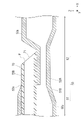
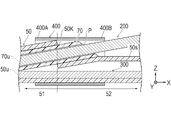
- FIG. 1 is an enlarged cross-sectional view of a portion surrounded by a broken line portion 2 in FIG.
- FIG. 1 is an enlarged cross-sectional view of a portion surrounded by a broken line portion 3 in FIG.
- FIG. 1 is a perspective view of a portion surrounded by a broken line portion 3 in FIG.
- FIGS. 1 to 4 are diagrams provided for explaining the medical device (hereinafter referred to as a catheter) 1 according to the embodiment.
- the arrow X attached to each figure indicates the "longitudinal direction (axial direction)" of the catheter 1
- the arrow Y indicates the “width direction (depth direction)” of the catheter 1
- the arrow Z indicates the "high” of the catheter 1.
- the circumferential direction seen from the axial direction X of the catheter 1 is simply referred to as “circumferential direction ⁇ ”
- the radial direction seen from the axial direction X of the catheter 1 is simply referred to as "radiation direction r”.
- the catheter 1 is, for example, a medical device in which a shaft 10 is inserted into a living lumen and a balloon 20 arranged at the tip of the shaft 10 is expanded in a stenosis (lesion) to expand and treat the stenosis. It is configured as.
- the catheter 1 can be configured as a PTCA dilation balloon catheter used, for example, to widen a narrowed portion of a coronary artery.
- the catheter 1 is used for the purpose of treating and improving a stenosis formed in a biological organ such as another blood vessel, bile duct, trachea, esophagus, other digestive tract, urethra, ear and nose cavity, and other organs. You can also do it.
- the side where the catheter 1 is inserted into the living body is referred to as “tip” or “tip side”
- the hand side of the operator is referred to as “base end” or “base end side”.
- the "tip portion” means a certain range including the tip (tip) and its periphery
- the “base end portion” means the proximal end (most proximal end) and its periphery. It shall mean a certain range including.
- the catheter 1 includes a shaft 10, a balloon 20 fixed to the tip end side of the shaft 10, and a hub 30.
- the shaft 10 includes an outer tube shaft 40 having a lumen 40u, an inner tube shaft 70 arranged in the lumen 40u of the outer tube shaft 40, and a guide wire port P (“base end opening”). ”) And.
- the outer pipe shaft 40 includes a tip shaft 50 and a base shaft 60 connected to the base end side of the tip shaft 50.
- the tip shaft 50 is integrally fused (joined) with the inner pipe shaft 70 in the vicinity of the guide wire port P of the shaft 10.
- the base end shaft 60 includes a tip end side connected to the tip end shaft 50 on the base end side from the guide wire port P, and a base end side connected to the hub 30.
- the constituent materials of the tip shaft 50 include polyethylene, polypropylene, ethylene-propylene copolymer, polyolefin such as ethylene-vinyl acetate copolymer, thermoplastic resin such as soft polyvinyl chloride, polyurethane elastomer, polyamide elastomer, polyester elastomer and the like. Crystalline plastics such as various elastomers, polyamides, crystalline polyethylenes, and crystalline polypropylenes can be used.
- the constituent material of the base end shaft 60 is a metal material having relatively large rigidity, for example, stainless steel, stainless stretchable alloy, Ni—Ti alloy, brass, and aluminum.
- a resin material having a relatively large rigidity for example, polyimide, vinyl chloride, or polycarbonate, if necessary.
- the inner tube shaft 70 is arranged on the tip side of the lumen 40u of the outer tube shaft 40 (in other words, the lumen 40u of the tip shaft 50).
- the inner pipe shaft 70 forms a guide wire lumen L through which the guide wire G can be inserted.
- the base end side of the guide wire lumen L communicates with the guide wire port P.
- the guide wire port P communicates with the guide wire lumen L of the inner pipe shaft 70.
- the guide wire port P is formed on the proximal end side 70A of the inner tube shaft 70 and is at least partially reinforced by the distal end shaft 50 connected (fused) to the proximal end side 70A of the inner tube shaft 70.
- the catheter 1 is configured as a so-called rapid exchange type catheter in which a guide wire port P through which the guide wire G can enter and exit is formed near the tip end side of the shaft 10. That is, the guide wire G is configured to be insertable into the guide wire lumen L from the outside at the guide wire port P.
- the inner tube shaft 70 has an inclined portion 71 inclined toward the center side from the outer surface side of the outer tube shaft 40 (the outer surface 50s side of the tip shaft 50) (see FIG. 3), and the guide wire port P has a guide wire port P. , Formed on the inclined portion 71. The inclination of the inlet side of the guide wire port P makes it easier for the operator to insert the guide wire G into the guide wire port P during the procedure.
- the constituent material of the inner pipe shaft 70 for example, the same material as the tip shaft 50 of the outer pipe shaft 40 can be used.
- the balloon 20 is fixed to the inner pipe shaft 70 and the outer pipe shaft 40, respectively.
- the tip of the balloon 20 is connected to the tip 70A of the inner tube shaft 70.
- the base end portion of the balloon 20 is connected to the tip end portion 40A of the outer tube shaft 40.
- the balloon 20 expands in the radial direction (diameter direction r) of the shaft 10 by injecting a working fluid through the lumen 40u of the outer tube shaft 40.
- the working fluid consists of, for example, a mixture of a contrast agent and a saline solution.
- the constituent materials of the balloon 20 include, for example, polyethylene, polypropylene, polyolefin of ethylene-propylene copolymer, polyester such as polyethylene-terephthalate, polyvinyl chloride, ethylene-vinyl acetate copolymer, crosslinked ethylene-vinyl acetate copolymer, and the like.
- Thermoplastic resins such as polyurethane, polyamides, polyamide elastomers, polystyrene elastomers, silicone rubbers, latex rubbers and the like can be used.
- the inner pipe shaft 70 is provided with a tip tip 80 at the tip end portion. Inside the tip 80, a through hole 81 that penetrates the tip 80 in the axial direction X is formed. Therefore, the through hole forms a part of the guide wire lumen L.
- the tip 80 can be made of, for example, a flexible resin member having heat shrinkage.
- the material of the tip 80 is not particularly limited as long as it can be fixed to the inner tube shaft 70.
- the hub 30 has a supply device (not shown) such as an indeflator for supplying a fluid (working fluid), and a port 31 (see FIG. 1) that can be connected liquidtightly and airtightly.
- a supply device such as an indeflator for supplying a fluid (working fluid)
- a port 31 see FIG. 1
- the port 31 of the hub 30 can be configured by, for example, a known luer taper or the like to which a fluid tube or the like can be connected and separated.
- the shaft 10 is connected to the hub 30 in a state where the lumen 40u of the outer tube shaft 40 communicates with the flow path in the hub 30.
- the working fluid that expands and contracts the balloon 20 is supplied to the lumen 40u of the outer tube shaft 40 via the port 31 of the hub 30.
- the tip shaft 50 has a portion where the tip side 70A of the inner tube shaft 70 is arranged in the lumen 50u (hereinafter referred to as a first portion 51) and an inner tube on the outer surface 50s.
- the base end side 70B of the shaft 70 is arranged, and has a portion (hereinafter referred to as a second portion 52) for reinforcing the vicinity of the guide wire port P formed by the inner pipe shaft 70.
- the tip shaft 50 is integrally fused (joined) with the inner pipe shaft 70 in the vicinity of the guide wire port P. Therefore, on the outer surface 70s of the inner pipe shaft 70 near the guide wire port P, a portion covered by the first portion 51 of the tip shaft 50 and a portion not covered by the first portion 51 of the tip shaft 50 (outer surface).
- a boundary 53a (hereinafter, may be simply referred to as a boundary 53a) with a portion where 70s is exposed is formed.
- the boundary 53a extends along the circumferential direction ⁇ of the tip shaft 50, for example, as shown in FIG.
- the base end portion of the inner pipe shaft 70 is integrally fused (grounded) with the tip shaft 50 in a state of being arranged (grounded) on the outer surface (also referred to as the outer surface 50s) of the second portion 52 of the tip shaft 50. (Joined). Therefore, the base end side of the outer surface 70s of the inner pipe shaft 70 is partially reinforced by the second portion 52 of the tip shaft 50, and the guide wire port P is the structural wall of the inner pipe shaft 70 and the tip shaft 50 (plural). Layer). Therefore, according to such a catheter 1, it is possible to prevent the vicinity of the guide wire port P from being broken when the operator performs the procedure.
- the boundary 53a extends along the circumferential direction ⁇ of the tip shaft 50
- the vicinity of the guide wire port P is covered by covering the entire circumference of the outer surface 70s of the inner tube shaft 70 with the first portion 51 of the tip shaft 50.
- the second part 52 is arranged on the proximal end side 51B of the first part 51, and the first part 51 and the second part 52 are integrally molded by being composed of the same member. Has been done. Therefore, according to such a catheter 1, it is possible to prevent the vicinity of the guide wire port P from being broken when the operator performs the procedure.
- the shape of the boundary described above is not limited to the shape described above.
- the shape of the boundary can be variously changed within the range of the method for manufacturing a medical device described below.
- FIGS. 5A to 5D are views for explaining a method for manufacturing the shaft 10 of the catheter 1.
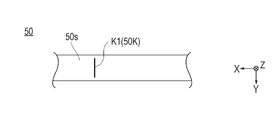
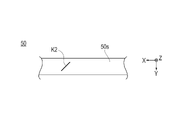
- FIG. 5A is a top view showing a state in which a notch K1 is formed on the outer surface 50s of the tip shaft 50.
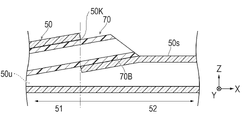
- FIG. 5B is a cross-sectional view showing a state in which the inner tube shaft is inserted through the opening 50K of the tip shaft 51.
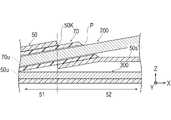
- FIG. 5C shows a state in which the first mandrel 200 is inserted into the lumen 70u of the inner tube shaft 70 and the second mandrel 300 is inserted into the lumen of the tip shaft 51 (the lumen 50u of the outer tube shaft 50). It is a sectional view.
- FIG. 5D is a cross-sectional view showing a state in which the heat-shrinkable tube is arranged.
- the worker who manufactures the shaft 10 is the tip shaft 50 of the outer tube shaft 40, the inner tube shaft 70, the first mandrel 200 arranged in the lumen 70u of the inner tube shaft 70, and the first tip shaft 50.
- a second mandrel 300 to be arranged in the lumen of the site 51 and the lumen of the second site 52 (the lumen 50u of the tip shaft 50) is supplied (prepared).
- the operator prepares, for example, a tubular member having an outer diameter and an inner diameter substantially constant in the axial direction as the tip shaft 50. Further, the operator can use the inner pipe shaft 70 as a tubular member having, for example, an outer diameter and an inner diameter formed substantially constant in the axial direction, and a guide wire port P (inclined portion 71) formed at the base end portion 70B. Prepare.
- the worker can use, for example, known ones that are stretched substantially linearly in the axial direction.
- a crescent type (C type) can be preferably used.
- the operator forms an opening 50K in the tip shaft 50 by forming a notch K1 in the outer surface 50s of the tip shaft 50.
- the operator arranges the inner tube shaft 70 in the lumen of the tip shaft 50 (inner cavity 50u of the outer tube shaft 50).
- the operator arranges the tip end side 70A of the inner tube shaft 70 in the lumen of the first portion 51 of the tip shaft 50 (the lumen 50u of the outer tube shaft 50), and the base end of the inner tube shaft 70.
- the inner pipe shaft 70 is arranged via the opening 50K so that the side 70B is arranged on the outer surface of the second portion 52 (the outer surface 50s of the tip shaft 50). Therefore, the base end side 70B of the inner pipe shaft 70 is arranged so as to protrude by a predetermined range from the opening 50K of the tip shaft 50.
- the notch K1 of the tip shaft 50 can be configured by, for example, a notch in one direction as shown in FIG. 5A, and can be configured to extend along the circumferential direction ⁇ of the tip shaft 50.
- the length of the notch K1 in the opening 50K is preferably more than half the length of the outer circumference of the inner pipe shaft 70 and preferably not more than the diameter of the tip shaft 50, and the inner pipe shaft 70 is placed in the opening 50K.
- the length is not particularly limited as long as it can be inserted.
- the length thereof can be 20 to 50% of the length of the outer circumference of the tip shaft 50.
- the operator inserts the first mandrel 200 into the lumen 70u of the inner tube shaft 70.
- the first mandrel 200 is arranged so that the proximal end side of the first mandrel 200 protrudes from the guide wire port P (base end opening) of the inner pipe shaft 70.
- the operator inserts the second mandrel 300 into the lumens of the first portion 51 and the second portion 52 of the tip shaft 50 (the lumen 50u of the outer tube shaft 50).
- the worker arranges the inner tube shaft 70 in the lumen 50u of the outer tube shaft 50, arranges the first mandrel 200 in the lumen 70u of the inner tube shaft 70, and arranges the second mandrel 300 in the outer tube shaft.
- the work of inserting into the lumen 50u of 50 can be performed in no particular order.
- the operator can use the proximal end side 51B of the first portion 51 of the tip shaft 50, the distal end side 52A of the second portion 52 of the distal end shaft 50, and the proximal end side 70B of the inner pipe shaft 70.
- the heat shrink tube 400 is arranged so as to cover the heat shrink tube 400.
- the operator arranges the base end 400B of the heat-shrinkable tube 400 on the base end side in the axial direction X with respect to the base end (guide wire port P) of the inner tube shaft 70, and the tip 400A of the heat-shrinkable tube 400. It is arranged on the tip side in the axial direction X from the opening 50K of the tip shaft 50.
- the operator can use, for example, a hollow tubular member made of polyolefin or the like as the heat-shrinkable tube 400.
- the operator applies heat to the heat-shrinkable tube 400 to shrink it, and fuses the tip shaft 50 and the inner tube shaft 70.
- the heat-shrinkable tube 400 shrinks when heated, and is deformed so that the inner diameter of the heat-shrinkable tube 400 after heating is smaller than the inner diameter of the heat-shrinkable tube 400 before heating.
- the heat-shrinkable tube 400 is removed by an operator after being heat-applied and shrunk.
- the operator uses the heat-shrinkable tube 400 when connecting the base end of the first portion 51 of the tip shaft 50, the tip of the second portion 52 of the tip shaft 50, and the base end of the inner tube shaft 70 to each other. It does not have to be.
- the operator may fuse by pressing the base end of the first portion 51 of the tip shaft 50, the tip of the second portion 52 of the tip shaft 50, and the base end of the inner tube shaft 70 to apply heat. ..
- the structural materials of the tip shaft 50 and the inner tube shaft 70 are partially fused, and the structural material of the tip shaft 50 is covered with the structural material of the tip shaft 50.
- the vicinity of the guide wire port P is reinforced.
- the operator fuses the tip shaft 50 and the inner tube shaft 70, and then removes the first mandrel 200 from the lumen 70u of the inner tube shaft 70.
- the operator can, for example, remove the second mandrel 300 from the lumen 50u of the outer tube shaft 50 in no particular order from the work of removing the first mandrel 200 from the lumen 70u of the inner tube shaft 70.
- the method for manufacturing the catheter 1 has been described above, but the method can be changed in various ways.
- the shape of the opening of the tip shaft 50 formed by the notch of the tip shaft 50 can be variously changed, and the shape of the opening allows the tip shaft 50 to be formed on the outer surface 70s of the inner tube shaft 70.
- the boundary between the portion covered with the tip shaft 50 and the portion not covered with the tip shaft 50 is defined.
- the boundary 53a is the circumferential direction of the tip shaft 50. It extends along ⁇ (see FIG. 4).
- the tip shaft 50 can continuously cover the outer surface 70s of the inner pipe shaft 70 along the circumferential direction ⁇ . Therefore, the tip shaft 50 can reinforce the vicinity of the guide wire port P, and can improve the tensile strength of the catheter 1 in the axial direction X by securing the cross-sectional area of the shaft 10.
- the range in which the outer surface 70s of the inner pipe shaft 70 when the inner pipe shaft 70 is viewed from the axial direction X is in contact with the outer surface 50s of the tip shaft 50 (ratio of the circumferential direction ⁇ of the inner pipe shaft 70). Since it can be secured, the fusion length (the length of the portion where the inner pipe shaft 70 and the tip shaft 51 are fused in the axial direction X) can be suppressed.
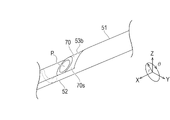
- a modification 1 of the notch of the tip shaft 50 when the notch is configured by a notch K2 extending along a direction (for example, a spiral direction) intersecting the axial direction X of the tip shaft 50 (see FIG. 6A). ), The boundary 53b extends along a direction intersecting the axial direction X of the tip shaft 50 (see FIG. 6B).
- the boundary 53c is the tip shaft 50. It extends from the starting point n1 located on the tip side toward the two ending points n2 and n3 located on the base end side of the tip shaft 50 and symmetrically arranged with the starting point n1 in between (see FIG. 7B). ..
- the tip shaft 50 When the notch L of the tip shaft 50 is configured to extend in a direction intersecting the axial direction X of the tip shaft 50 or extending along the axial direction X, the tip shaft 50 is axial with the outer surface 70s of the inner pipe shaft 70. It can be continuously covered along the direction X. Therefore, the tip shaft 50 can continuously reinforce the vicinity of the guide wire port P along the axial direction X of the inner tube shaft 70, and can improve the tensile strength of the catheter 1 in the axial direction X. Further, the step in the physical characteristics in the vicinity of the guide wire port P becomes gentle, and it is possible to prevent the vicinity of the guide wire port P from breaking during the procedure.
- the opening of the tip shaft 50 may be configured by a plurality of notches in different directions from each other.
- the notch of the tip shaft 50 is located on the tip end side of the tip shaft 50 at the boundary between the portion covered by the first portion 51 of the tip shaft 50 and the portion not covered by the first portion 51 of the tip shaft 50.
- a portion where the outer surface 70s of the inner tube shaft 70 is continuously covered by the tip shaft 50 along the circumferential direction ⁇ is formed. May be done.
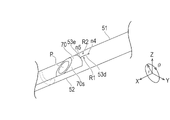
- the notch K4 extending along the axial direction X of the tip shaft 50 and the notch K4 intersecting the axial direction X of the tip shaft 50 (circumferential direction ⁇ ).
- the boundary 53d formed by the notch K4 is formed along the axial direction X
- the boundary 53e formed by the notch K5 is formed along the circumferential direction ⁇ . (See FIG. 8B).
- the structural material of the tip shaft 50 is in the range from the start point n4 to the end point n5 of the boundary 53d.
- the outer surface 70s of the inner pipe shaft 70 is arranged (fused) so as to continuously cover (reinforce) the outer surface 70s in the circumferential direction ⁇ . Therefore, the outer surface 70s of the inner pipe shaft 70 is continuously covered with the tip shaft 50 along the circumferential direction ⁇ in the range from the start point n4 to the end point n5 of the boundary 53d. Therefore, the tip shaft 50 can continuously reinforce the vicinity of the guide wire port P along the circumferential direction ⁇ of the inner tube shaft 70, and can improve the tensile strength in the axial direction X of the catheter 1.
- the catheter (medical instrument) 1 includes an inner tube shaft 70, an outer tube shaft 40 that covers a part of the inner tube shaft 70, and a balloon 20 fixed to the inner tube shaft 70 and the outer tube shaft 40.
- the outer tube shaft 40 has a tip shaft 50 having a lumen 50u and a proximal shaft 60 having a lumen (not shown) connected to the proximal end side of the distal shaft 50.
- the shaft 50 has a first portion 51 and a second portion 52 formed integrally with the first portion 51 and arranged on the proximal end side 51B of the first portion 51, and the inner tube shaft 70 has a tip.
- a proximal end side 70B Arranged on the tip side 70A arranged in the lumen of the first portion 51 of the shaft 50 (the lumen 50u of the tip shaft 50) and on the outer surface of the second portion 52 of the tip shaft 50 (outer surface 50s of the tip shaft 50). Includes a proximal end side 70B, which forms a guide wire port P (base end opening).
- the vicinity of the guide wire port P formed by the inner tube shaft 70 is reinforced by the tip shaft 50 of the outer tube shaft 40.
- the tip shaft 50 has a portion (first portion 51) in which the inner tube shaft 70 is arranged in the lumen 50u and a guide wire port P formed by the inner tube shaft 70 in which the inner tube shaft 70 is arranged on the outer surface 50s.
- a portion (second portion 52) for reinforcing the vicinity is integrally molded. Therefore, the catheter 1 can prevent the vicinity of the guide wire port P formed by the inner tube shaft 70 from breaking.
- the inner pipe shaft has an inclined portion 71 inclined from the outer surface side of the outer pipe shaft 40 toward the center side, and the guide wire port P is formed in the inclined portion 71. This makes it easier for the surgeon to insert the guide wire G into the guide wire port P during the procedure.
- the boundary 53a formed on the outer surface 70s of the inner pipe shaft 70 between the portion covered by the tip shaft 50 and the portion not covered by the tip shaft 50 extends along the circumferential direction ⁇ of the tip shaft 50. It may be present.
- the tip shaft 50 can continuously cover the outer surface 70s of the inner tube shaft 70 along the circumferential direction ⁇ . Therefore, the tip shaft 50 can reinforce the vicinity of the guide wire port P, and can improve the tensile strength of the catheter 1 in the axial direction X by securing the cross-sectional area of the shaft 10.
- the boundary 53b formed on the outer surface 70s of the inner pipe shaft 70 between the portion covered by the tip shaft 50 and the portion not covered by the tip shaft 50 intersects the axial direction X of the tip shaft 50. It may extend along the direction of the shaft.
- the tip shaft 50 can continuously cover the outer surface 70s of the inner tube shaft 70 along the axial direction X. Therefore, the tip shaft 50 can continuously reinforce the vicinity of the guide wire port P along the axial direction X of the inner tube shaft 70, and can improve the tensile strength of the catheter 1 in the axial direction X. Further, the step in the physical characteristics in the vicinity of the guide wire port P becomes gentle, and it is possible to prevent the vicinity of the guide wire port P from breaking during the procedure.
- the boundary 53c formed on the outer surface 70s of the inner pipe shaft 70 between the portion covered by the tip shaft 50 and the portion not covered by the tip shaft 50 is a starting point n1 located on the tip side of the tip shaft 50. Therefore, it may extend toward the two end points n2 and n3, which are located on the base end side of the tip shaft 50 and are symmetrically arranged with the start point n1 in between.
- the tip shaft 50 can continuously cover the outer surface 70s of the inner tube shaft 70 along the axial direction X. Therefore, the tip shaft 50 can continuously reinforce the vicinity of the guide wire port P along the axial direction X of the inner tube shaft 70, and can improve the tensile strength of the catheter 1 in the axial direction X. Further, the step in the physical characteristics in the vicinity of the guide wire port P becomes gentle, and it is possible to prevent the vicinity of the guide wire port P from breaking during the procedure.
- the catheter 1 is a starting point located on the tip end side of the tip shaft 50 at the boundary 53d between the portion covered with the tip shaft and the portion not covered with the tip shaft, which is formed on the outer surface 70s of the inner tube shaft 70. Even if the outer surface 70s of the inner pipe shaft 70 is configured to be continuously covered with the tip shaft 50 along the circumferential direction ⁇ in the range from n4 to the end point n5 located on the proximal end side of the tip shaft 50. good. As a result, the tip shaft 50 can improve the tensile strength of the catheter 1 in the axial direction X.
- the method of manufacturing the catheter 1 is to form an opening 50K on the outer surface 50s of the tip shaft 50, the tip side 70A of the inner tube shaft 70 is arranged in the lumen of the first portion 51 of the tip shaft 50, and The opening so that the proximal end side 60B of the inner pipe shaft 70 is integrally formed with the first portion 51 and is arranged on the outer surface of the second portion 52 arranged on the proximal end side 51B of the first portion 51.
- Arranging the inner tube shaft 70 via 50K inserting the first mandrel 200 into the lumen 70u of the inner tube shaft 70, and the lumens of the first portion 51 and the second portion 52 of the tip shaft 50 (tip shaft).
- an opening 50K is formed on the outer surface 50s of the tip shaft 50, and when the inner tube shaft 70 and the tip shaft 50 are fused, the tip shaft 50 has a cavity.
- the inner tube shaft 70 can be arranged via the opening 50K so that 52) can be formed.
- the opening 50K is composed of at least one notch (for example, notch K1).
- the base end side 70B of the inner pipe shaft 70 is arranged so as to protrude by a predetermined range from the opening 50K of the tip shaft 50 by widening the notch.
- the length of the notch is more than half the length of the outer circumference of the inner pipe shaft 70, and is equal to or less than the diameter of the tip shaft 50. As a result, the base end side 70B of the inner pipe shaft 70 can be inserted into the opening 50K.
- the notch K1 extends along the circumferential direction ⁇ of the tip shaft 50.
- the tip shaft 50 has a boundary 53a formed on the outer surface 70s of the inner tube shaft 70 between the portion covered by the tip shaft 50 and the portion not covered by the tip shaft 50 in the circumferential direction of the tip shaft 50. It can be formed along ⁇ .
- the notch may extend along the direction intersecting the axial direction X of the tip shaft 50, for example, like the notch K2.
- the tip shaft 50 has a boundary 53b formed on the outer surface 70s of the inner tube shaft 70 between the portion covered by the tip shaft 50 and the portion not covered by the tip shaft 50 in the axial direction of the tip shaft 50. It can be formed along a direction intersecting X.
- the notch may extend along the axial direction X of the tip shaft 50, for example, like the notch K3.
- the tip shaft 50 has a boundary 53c between the portion covered by the tip shaft 50 and the portion not covered by the tip shaft 50 from the starting point n1 located on the tip side of the tip shaft 50 to the base end of the tip shaft 50. It can be formed toward two end points n2 and n3, which are located on the side and are symmetrically arranged with the start point n1 in between.
- the present invention can be variously modified based on the description of the claims, and only the contents of the described embodiments are described. It is not limited.
- the structure of the balloon catheter and the arrangement of the members described in the embodiments and the like can be appropriately changed, the use of the additional members described in the illustration is omitted, and other additional members not particularly described. Can be used as appropriate.
- each process related to the manufacturing method of the medical elongated body, the instruments used in the manufacturing, and the like can be appropriately changed.
Landscapes
- Health & Medical Sciences (AREA)
- Life Sciences & Earth Sciences (AREA)
- Heart & Thoracic Surgery (AREA)
- Biomedical Technology (AREA)
- Engineering & Computer Science (AREA)
- Anesthesiology (AREA)
- Pulmonology (AREA)
- Biophysics (AREA)
- Hematology (AREA)
- Animal Behavior & Ethology (AREA)
- General Health & Medical Sciences (AREA)
- Public Health (AREA)
- Veterinary Medicine (AREA)
- Child & Adolescent Psychology (AREA)
- Media Introduction/Drainage Providing Device (AREA)
Priority Applications (1)
| Application Number | Priority Date | Filing Date | Title |
|---|---|---|---|
| JP2022571618A JPWO2022138813A1 (https=) | 2020-12-25 | 2021-12-23 |
Applications Claiming Priority (2)
| Application Number | Priority Date | Filing Date | Title |
|---|---|---|---|
| JP2020216737 | 2020-12-25 | ||
| JP2020-216737 | 2020-12-25 |
Publications (1)
| Publication Number | Publication Date |
|---|---|
| WO2022138813A1 true WO2022138813A1 (ja) | 2022-06-30 |
Family
ID=82158684
Family Applications (1)
| Application Number | Title | Priority Date | Filing Date |
|---|---|---|---|
| PCT/JP2021/047850 Ceased WO2022138813A1 (ja) | 2020-12-25 | 2021-12-23 | 医療器具、および医療器具の製造方法 |
Country Status (2)
| Country | Link |
|---|---|
| JP (1) | JPWO2022138813A1 (https=) |
| WO (1) | WO2022138813A1 (https=) |
Cited By (1)
| Publication number | Priority date | Publication date | Assignee | Title |
|---|---|---|---|---|
| WO2024202776A1 (ja) * | 2023-03-28 | 2024-10-03 | テルモ株式会社 | バルーンカテーテル |
Citations (6)
| Publication number | Priority date | Publication date | Assignee | Title |
|---|---|---|---|---|
| JP2002505168A (ja) * | 1998-03-04 | 2002-02-19 | ボストン サイエンティフィック リミテッド | 折り畳み可能な管腔を組み込んだ転換カテーテル |
| JP2002355310A (ja) * | 2001-05-31 | 2002-12-10 | Kawasumi Lab Inc | バルーンカテーテル |
| JP2009542363A (ja) * | 2006-06-30 | 2009-12-03 | アボット、カーディオバスキュラー、システムズ、インコーポレーテッド | 高い強度および柔軟性を有するバルーンカテーテルシャフトおよびその製造方法 |
| JP2014195487A (ja) * | 2013-03-29 | 2014-10-16 | 日本ライフライン株式会社 | バルーンカテーテル |
| JP2016214820A (ja) * | 2015-05-19 | 2016-12-22 | アボット カーディオバスキュラー システムズ インコーポレイテッド | バルーンカテーテル |
| WO2018181315A1 (ja) * | 2017-03-31 | 2018-10-04 | テルモ株式会社 | バルーンカテーテル、および医療用長尺体の製造方法 |
-
2021
- 2021-12-23 JP JP2022571618A patent/JPWO2022138813A1/ja active Pending
- 2021-12-23 WO PCT/JP2021/047850 patent/WO2022138813A1/ja not_active Ceased
Patent Citations (6)
| Publication number | Priority date | Publication date | Assignee | Title |
|---|---|---|---|---|
| JP2002505168A (ja) * | 1998-03-04 | 2002-02-19 | ボストン サイエンティフィック リミテッド | 折り畳み可能な管腔を組み込んだ転換カテーテル |
| JP2002355310A (ja) * | 2001-05-31 | 2002-12-10 | Kawasumi Lab Inc | バルーンカテーテル |
| JP2009542363A (ja) * | 2006-06-30 | 2009-12-03 | アボット、カーディオバスキュラー、システムズ、インコーポレーテッド | 高い強度および柔軟性を有するバルーンカテーテルシャフトおよびその製造方法 |
| JP2014195487A (ja) * | 2013-03-29 | 2014-10-16 | 日本ライフライン株式会社 | バルーンカテーテル |
| JP2016214820A (ja) * | 2015-05-19 | 2016-12-22 | アボット カーディオバスキュラー システムズ インコーポレイテッド | バルーンカテーテル |
| WO2018181315A1 (ja) * | 2017-03-31 | 2018-10-04 | テルモ株式会社 | バルーンカテーテル、および医療用長尺体の製造方法 |
Cited By (1)
| Publication number | Priority date | Publication date | Assignee | Title |
|---|---|---|---|---|
| WO2024202776A1 (ja) * | 2023-03-28 | 2024-10-03 | テルモ株式会社 | バルーンカテーテル |
Also Published As
| Publication number | Publication date |
|---|---|
| JPWO2022138813A1 (https=) | 2022-06-30 |
Similar Documents
| Publication | Publication Date | Title |
|---|---|---|
| JP6880272B2 (ja) | バルーンカテーテル、およびバルーンカテーテル用長尺部材の製造方法 | |
| US10589073B2 (en) | Rapid exchange catheters having a sealed guidewire lumen and methods of making the same | |
| CN107405469B (zh) | 导管及导管的制造方法 | |
| US5882336A (en) | Dilation catheter | |
| CN108697879B (zh) | 医疗用长条体 | |
| JP5237572B2 (ja) | バルーンカテーテル及びその製造方法 | |
| JP6831366B2 (ja) | バルーンカテーテル、およびバルーンカテーテル用長尺部材の製造方法 | |
| JPH0871161A (ja) | イントロデューサー | |
| JP2021053005A (ja) | バルーンカテーテル、およびバルーンの製造方法 | |
| JP6840607B2 (ja) | バルーンカテーテル | |
| JP2020039376A (ja) | バルーンカテーテル | |
| WO2022138813A1 (ja) | 医療器具、および医療器具の製造方法 | |
| JP7410990B2 (ja) | 生体内留置チューブ | |
| JP4900242B2 (ja) | 大動脈内バルーンポンピングセット | |
| JP6931697B2 (ja) | バルーンカテーテル、および医療用長尺体の製造方法 | |
| US10493236B2 (en) | Catheter | |
| WO2013136636A1 (ja) | バルーンカテーテルおよびステントデリバリーシステム | |
| JP6982061B2 (ja) | バルーンカテーテル、および医療用長尺体の製造方法 | |
| JP2011206171A (ja) | バルーンカテーテル及びその製造方法 | |
| JP2018153452A (ja) | バルーンカテーテルおよびバルーンカテーテルを使用した生体管腔の病変部位の治療方法 | |
| JP2022106410A (ja) | バルーンカテーテル | |
| JP7561650B2 (ja) | バルーンカテーテル | |
| JP7467637B2 (ja) | カテーテル | |
| JP2011056148A (ja) | バルーンカテーテル | |
| WO2025069691A1 (ja) | バルーンカテーテル及びバルーンカテーテルの製造方法 |
Legal Events
| Date | Code | Title | Description |
|---|---|---|---|
| 121 | Ep: the epo has been informed by wipo that ep was designated in this application |
Ref document number: 21910952 Country of ref document: EP Kind code of ref document: A1 |
|
| ENP | Entry into the national phase |
Ref document number: 2022571618 Country of ref document: JP Kind code of ref document: A |
|
| NENP | Non-entry into the national phase |
Ref country code: DE |
|
| 122 | Ep: pct application non-entry in european phase |
Ref document number: 21910952 Country of ref document: EP Kind code of ref document: A1 |