WO2022075447A1 - ソフトフォーカスフィラー、化粧料 - Google Patents
ソフトフォーカスフィラー、化粧料 Download PDFInfo
- Publication number
- WO2022075447A1 WO2022075447A1 PCT/JP2021/037320 JP2021037320W WO2022075447A1 WO 2022075447 A1 WO2022075447 A1 WO 2022075447A1 JP 2021037320 W JP2021037320 W JP 2021037320W WO 2022075447 A1 WO2022075447 A1 WO 2022075447A1
- Authority
- WO
- WIPO (PCT)
- Prior art keywords
- volume
- powder
- soft focus
- diameter
- plate
- Prior art date
- Legal status (The legal status is an assumption and is not a legal conclusion. Google has not performed a legal analysis and makes no representation as to the accuracy of the status listed.)
- Ceased
Links
Images


Classifications
-
- A—HUMAN NECESSITIES
- A61—MEDICAL OR VETERINARY SCIENCE; HYGIENE
- A61K—PREPARATIONS FOR MEDICAL, DENTAL OR TOILETRY PURPOSES
- A61K8/00—Cosmetics or similar toiletry preparations
- A61K8/02—Cosmetics or similar toiletry preparations characterised by special physical form
- A61K8/0241—Containing particulates characterized by their shape and/or structure
- A61K8/0254—Platelets; Flakes
-
- A—HUMAN NECESSITIES
- A61—MEDICAL OR VETERINARY SCIENCE; HYGIENE
- A61K—PREPARATIONS FOR MEDICAL, DENTAL OR TOILETRY PURPOSES
- A61K8/00—Cosmetics or similar toiletry preparations
- A61K8/18—Cosmetics or similar toiletry preparations characterised by the composition
- A61K8/19—Cosmetics or similar toiletry preparations characterised by the composition containing inorganic ingredients
- A61K8/29—Titanium; Compounds thereof
-
- A—HUMAN NECESSITIES
- A61—MEDICAL OR VETERINARY SCIENCE; HYGIENE
- A61Q—SPECIFIC USE OF COSMETICS OR SIMILAR TOILETRY PREPARATIONS
- A61Q1/00—Make-up preparations; Body powders; Preparations for removing make-up
- A61Q1/02—Preparations containing skin colorants, e.g. pigments
-
- C—CHEMISTRY; METALLURGY
- C01—INORGANIC CHEMISTRY
- C01B—NON-METALLIC ELEMENTS; COMPOUNDS THEREOF; METALLOIDS OR COMPOUNDS THEREOF NOT COVERED BY SUBCLASS C01C
- C01B25/00—Phosphorus; Compounds thereof
- C01B25/16—Oxyacids of phosphorus; Salts thereof
- C01B25/26—Phosphates
- C01B25/37—Phosphates of heavy metals
- C01B25/372—Phosphates of heavy metals of titanium, vanadium, zirconium, niobium, hafnium or tantalum
-
- A—HUMAN NECESSITIES
- A61—MEDICAL OR VETERINARY SCIENCE; HYGIENE
- A61K—PREPARATIONS FOR MEDICAL, DENTAL OR TOILETRY PURPOSES
- A61K2800/00—Properties of cosmetic compositions or active ingredients thereof or formulation aids used therein and process related aspects
- A61K2800/20—Chemical, physico-chemical or functional or structural properties of the composition as a whole
- A61K2800/26—Optical properties
- A61K2800/262—Transparent; Translucent
-
- A—HUMAN NECESSITIES
- A61—MEDICAL OR VETERINARY SCIENCE; HYGIENE
- A61K—PREPARATIONS FOR MEDICAL, DENTAL OR TOILETRY PURPOSES
- A61K2800/00—Properties of cosmetic compositions or active ingredients thereof or formulation aids used therein and process related aspects
- A61K2800/40—Chemical, physico-chemical or functional or structural properties of particular ingredients
- A61K2800/60—Particulates further characterized by their structure or composition
- A61K2800/65—Characterized by the composition of the particulate/core
- A61K2800/651—The particulate/core comprising inorganic material
Definitions
- the present invention relates to a soft focus filler and a cosmetic.
- Soft focus is the property that when a cosmetic film is applied to the skin to form a cosmetic film, the surface of the skin becomes blurred, making it difficult to see stains, freckles, pores or fine wrinkles on the skin.
- High focus means that a large proportion of the light that hits the decorative coating film (total irradiation light) is diffused without going straight through the decorative coating film.
- a soft focus filler made of an inorganic powder such as silica has been conventionally added to cosmetics.
- Patent Document 1 describes a cosmetic additive (soft focus filler) having alumina-silica particles, wherein the alumina-silica particles have a side length of 0.3 to 20 ⁇ m as observed by a scanning electron microscope. It consists of cubic primary particles, has a refractive index of 1.48 to 1.52 by the immersion method, has a volume-based average particle size of 1 to 20 ⁇ m by the Coulter counter method, and absorbs oil by JIS K5101-13-2. It is described that the amount is 10 ml / 100 g or more and less than 50 ml / 100 g, and the specific surface area by the BET method is 20 m 2 / g or less.
- Patent Document 2 describes a cosmetic containing spherical organopolysiloxane particles, which imparts a silky feeling, a feeling of use such as smoothness, and extensibility to the cosmetic, and further exhibits an excellent soft focus effect.
- the volume average particle size is 0.1 to 30 ⁇ m
- the average refractive index is 1.44 to 1.57
- 90 mol% or more is an organosilsesquioxane unit. It contains spherical organopolysiloxane particles.
- Patent Document 3 describes at least one soft focus filler containing at least one soft focus filler and b) at least one non-spherical aluminum oxide, at least one metal oxide, and at least one surface treatment agent.
- Compositions comprising a composite pigment and a particularly physiologically acceptable medium are described.
- As the soft focus filler a complex powder of talc / TiO 2 / alumina / silica is exemplified.
- Patent Document 4 describes a cosmetic amount containing barium sulfate, which is doped with a specific amount of a rare earth element, as a soft focus filler.
- Japanese Unexamined Patent Publication No. 2019-172648 Japanese Unexamined Patent Publication No. 2020-75881 Special Table 2018-530580 Gazette Japanese Unexamined Patent Publication No. 2014-88351
- An object of the present invention is to provide a soft focus filler excellent in both transmittance and haze.
- one aspect of the present invention provides a soft focus filler made of a powder composed of plate-like crystal particles of titanium phosphate.
- the soft focus filler of this embodiment is composed of a powder composed of plate-like crystal particles of titanium phosphate.
- the longest diagonal line on the plate surface of this plate-like crystal is measured as the primary particle diameter, and the cumulative 50% primary particle diameter (volume D50% diameter) based on the volume is calculated to be 0.1 ⁇ m or more. It is 7.5 ⁇ m or less.
- the value obtained by measuring the thickness of the side surface of this plate-shaped crystal and calculating the cumulative 50% thickness (volume D50% thickness) based on the volume is 0.01 ⁇ m or more and 1.00 ⁇ m or less, and the aspect ratio (volume). The value obtained by dividing the D50% diameter by the volume D50% thickness) is 5 or more.
- the soft focus filler of this embodiment is composed of a powder composed of plate-like crystal particles of titanium phosphate, it is excellent in both transmittance and haze. Further, in the soft focus filler of this embodiment, the volume D50% diameter of the powder composed of the plate-like crystal particles of titanium phosphate is 0.10 ⁇ m or more and 7.5 ⁇ m or less, and the volume D50% thickness is 0. Since it is 01 ⁇ m or more and 1.00 ⁇ m or less and the aspect ratio is 5 or more, it is possible to satisfy both the total light transmittance of 80% or more and the haze of 55% or more. Further, since the aspect ratio is 5 or more, the slipperiness is also excellent.
- the volume D50% diameter of the powder composed of the plate-shaped crystal particles of titanium phosphate is 0.1 ⁇ m or more and 3.0 ⁇ m or less. As a result, both the total light transmittance of 80% or more and the haze of 80% or more can be satisfied. If the volume D50% thickness of the crystal particles is less than 0.01 ⁇ m, the plate-shaped particles are not formed.
- the soft focus filler of this embodiment is composed of a powder composed of plate-like crystal particles of titanium phosphate, and this powder can be obtained, for example, by the following method.
- an aqueous solution of titanyl sulfate and an aqueous solution of phosphoric acid are mixed at a ratio of the molar concentration of phosphorus [P] to the molar concentration of titanium [Ti] [P] / [Ti] of 5 or more and 21 or less to prepare a mixed solution. obtain.
- this mixed solution is placed in a closed container, the temperature is maintained at a value within the range of 100 ° C. or higher and 160 ° C. or lower, and the reaction is carried out for a predetermined time (for example, 5 hours or longer). That is, hydrothermal synthesis is performed.
- the pressure inside the closed container is higher than the atmospheric pressure naturally determined by the pressurizing temperature. As a result, a slurry containing crystal particles of titanium phosphate is obtained.
- the solid content (titanium phosphate crystal particles) is separated from the slurry.
- the obtained solid content is washed with a washing solution consisting of water or aqueous ammonia (ammonium hydroxide), and then dried.
- cosmetic composition examples include makeup cosmetics such as foundation, white powder, blusher, and lipstick.
- the soft focus filler according to one aspect of the present invention may be used after being treated with various polymers or the following treatments in order to improve cosmetic properties and pigment properties.
- these treatment methods include fluorine treatment, silicon treatment, alkylsilane treatment, alkyl titanate treatment, metal soap treatment, lauroyl lysine treatment, ester treatment, and amino acid treatment.
- amino acid treatment proline, hydroxyproline, alanine, glycine, sarcosine, aspartic acid, glutamic acid can be used.
- the cosmetic containing the soft focus filler according to one aspect of the present invention may contain other ingredients as necessary, as long as the effects of the present invention are not impaired.
- Other ingredients are those commonly used in cosmetics, such as solvents, oils, surfactants, moisturizers, organic UV absorbers, antioxidants, thickeners, fragrances, colorants, bioactive ingredients, antibacterial. Examples include agents.
- one kind may be used alone, or two or more kinds may be used in combination.
- the content of other components is not particularly limited and can be appropriately set according to the purpose.
- the content of the soft focus filler of one aspect of the present invention contained in the cosmetic is preferably 0.1% by mass or more and 50% by mass or less with respect to the entire cosmetic.
- the shape of the particles constituting the powder was plate-like and contained many hexagonal plate-like particles.
- the volume D50% diameter and volume D50 of the crystal particles constituting the obtained powder When the% thickness was measured, the volume D50% diameter was 0.29 ⁇ m, and the volume D50% thickness was 0.030 ⁇ m. Further, the aspect ratio of the crystal particles constituting the obtained powder was 10 by the calculation (0.29 / 0.030) using the measured values of the volume D50% thickness and the volume D50% diameter.
- ⁇ No.2> First, an aqueous solution of titanyl sulfate and an aqueous solution of phosphoric acid are mixed at a ratio [P] / [Ti] of the molar concentration [P] of phosphorus to the molar concentration [Ti] of titanium to be 10.7 to obtain a mixed solution. rice field. Next, this mixed solution was placed in a 1.4 L autoclave, the temperature was maintained at 110 ° C., and the reaction was carried out for 5 hours. After the reaction, the lid was opened to cool the slurry in the container to room temperature, and then the slurry was taken out from the container and filtered to separate the solid content from the slurry.
- the shape of the particles constituting the powder was plate-like and contained many hexagonal plate-like particles.
- the volume D50% diameter and the volume D50% thickness of the crystal particles constituting the obtained powder were measured by the same method as No. 1, the volume D50% diameter was 0.53 ⁇ m and the volume D50%. The thickness was 0.065 ⁇ m.
- the aspect ratio of the crystal particles constituting the obtained powder was 8 by the calculation (0.53 / 0.065) using the measured values of the volume D50% thickness and the volume D50% diameter.
- ⁇ No.3> First, an aqueous solution of titanyl sulfate and an aqueous solution of phosphoric acid are mixed at a ratio [P] / [Ti] of the molar concentration [P] of phosphorus to the molar concentration [Ti] of titanium to be 10.4 to obtain a mixed solution. rice field. Next, this mixed solution was placed in a 1.4 L autoclave, the temperature was maintained at 110 ° C., and the reaction was carried out for 5 hours. After the reaction, the lid was opened to cool the slurry in the container to room temperature, and then the slurry was taken out from the container and filtered to separate the solid content from the slurry.
- the shape of the particles constituting the powder was plate-like and contained many hexagonal plate-like particles.
- the volume D50% diameter and the volume D50% thickness of the crystal particles constituting the obtained powder were measured by the same method as No. 1, the volume D50% diameter was 0.74 ⁇ m and the volume D50%. The thickness was 0.090 ⁇ m.
- the aspect ratio of the crystal particles constituting the obtained powder was 8 by the calculation (0.74 / 0.090) using the measured values of the volume D50% thickness and the volume D50% diameter.
- ⁇ No.4> First, an aqueous solution of titanyl sulfate and an aqueous solution of phosphoric acid are mixed at a ratio of the molar concentration [P] of phosphorus [P] to the molar concentration [Ti] of titanium [P] / [Ti] to be 10.2 to obtain a mixed solution. rice field. Next, this mixed solution was placed in a 200 L autoclave, the temperature was maintained at 110 ° C., and the reaction was carried out for 5 hours. After the reaction, the lid was opened to cool the slurry in the container to room temperature, and then the slurry was taken out from the container and filtered to separate the solid content from the slurry.
- This solid content was washed with 29% aqueous ammonia (aqueous solution of ammonium salt) and then dried (temperature 105 ° C., left for 24 hours) to obtain a powder.
- aqueous ammonia aqueous solution of ammonium salt
- the particles constituting the powder were crystalline titanium phosphate having a structural formula of Ti (HPO 4 ) 2 ⁇ H 2 O. It could be confirmed.
- the shape of the particles constituting the powder was plate-like and contained many hexagonal plate-like particles. Further, when the volume D50% diameter and the volume D50% thickness of the crystal particles constituting the obtained powder were measured by the same method as No. 1, the volume D50% diameter was 1.11 ⁇ m and the volume D50%. The thickness was 0.143 ⁇ m. Further, the aspect ratio of the crystal particles constituting the obtained powder was 8 by the calculation (1.11 / 0.143) using the measured values of the volume D50% thickness and the volume D50% diameter.
- ⁇ No.5> First, an aqueous solution of titanyl sulfate and an aqueous solution of phosphoric acid are mixed at a ratio [P] / [Ti] of the molar concentration [P] of phosphorus to the molar concentration [Ti] of titanium to be 6.9 to obtain a mixed solution. rice field. Next, this mixed solution was placed in a 1.4 L autoclave, the temperature was maintained at 120 ° C., and the reaction was carried out for 5 hours. After the reaction, the lid was opened to cool the slurry in the container to room temperature, and then the slurry was taken out from the container and filtered to separate the solid content from the slurry.
- the shape of the particles constituting the powder was plate-like and contained many hexagonal plate-like particles.
- the volume D50% diameter and the volume D50% thickness of the crystal particles constituting the obtained powder were measured by the same method as No. 1, the volume D50% diameter was 2.07 ⁇ m and the volume D50%. The thickness was 0.302 ⁇ m.
- the aspect ratio of the crystal particles constituting the obtained powder was 7 by the calculation (2.07 / 0.302) using the measured values of the volume D50% thickness and the volume D50% diameter.
- ⁇ No.6> First, an aqueous solution of titanyl sulfate and an aqueous solution of phosphoric acid are mixed at a ratio [P] / [Ti] of the molar concentration [P] of phosphorus to the molar concentration [Ti] of titanium to be 10.8 to obtain a mixed solution. rice field. Next, this mixed solution was placed in a 200 L autoclave, the temperature was maintained at 130 ° C., and the reaction was carried out for 5 hours. After the reaction, the lid was opened to cool the slurry in the container to room temperature, and then the slurry was taken out from the container and filtered to separate the solid content from the slurry.
- the shape of the particles constituting the powder was plate-like and contained many hexagonal plate-like particles.
- the volume D50% diameter and the volume D50% thickness of the crystal particles constituting the obtained powder were measured by the same method as No. 1, the volume D50% diameter was 7.44 ⁇ m and the volume D50%. The thickness was 0.856 ⁇ m. Further, the aspect ratio of the crystal particles constituting the obtained powder was 9 by the calculation (7.44 / 0.856) using the measured values of the volume D50% thickness and the volume D50% diameter.
- a commercially available boron nitride powder having a volume D50% diameter of 9.94 ⁇ m was pulverized with a pot mill to obtain a boron nitride powder having a volume D50% diameter of 4.24 ⁇ m and a volume D50% thickness of 0.395 ⁇ m. According to the calculation (4.24 / 0.395) using the measured values of the volume D50% thickness and the volume D50% diameter, the aspect ratio of the crystal particles constituting this powder was 11.
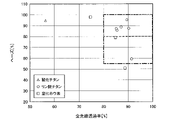
- Figure 1 shows the relationship between the total light transmittance and the haze for each powder. Further, for each titanium phosphate powder obtained in the examples, the relationship between the volume D50% diameter and the total light transmittance is shown in FIG. 2, and the relationship between the volume D50% diameter and the haze is shown in FIG. 3, respectively.
- No. 1 to powder composed of plate-shaped crystal particles of titanium phosphate having a volume D50% diameter of 0.1 ⁇ m or more and 7.5 ⁇ m or less and an aspect ratio of 5 or more.
- the titanium phosphate powder of No. 6 had a total light transmittance of 85.1% or more and 91.4% or less, and a haze of 59.3% or more and 95.3% or less. That is, it satisfied both the total light transmittance of 85.0% or more and the haze of 59.0% or more.
- the No. 1 to No. 5 titanium phosphate powders having a volume D50% diameter of plate-shaped crystal particles of 0.1 ⁇ m or more and 3.0 ⁇ m or less and an aspect ratio of 5 or more are all light rays.
- the transmittance was 85.1% or more and 90.3% or less, and the haze was 85.7% or more and 95.3% or less. That is, it satisfied both the total light transmittance of 85.0% or more and the haze of 85.0% or more.
- the titanium dioxide powder of No. 7 had a high haze of 94.6% but a low total light transmittance of 56.4% (60% or less).
- the boron nitride powders of No. 8 to No. 10 had either the total light transmittance or the haze of less than 80%, and the boron nitride powder of No. 10 had a particularly low haze of 50.8%.
- the wrinkle blurring effect will be considered as follows.
- the No. 1 to No. 5 titanium phosphate powders having a volume D50% diameter of 0.1 ⁇ m or more and 3.0 ⁇ m or less and an aspect ratio of 5 or more of the plate-shaped crystal particles have a total light transmittance of 85.0.
- the transparency and wrinkle blurring effect are high, and among them, the No. 2 and No. 3 powders have a very high wrinkle blurring effect.
- the No. 6 titanium phosphate powder having a volume D50% diameter of 7.44 ⁇ m and an aspect ratio of 9 of the plate-shaped crystal particles had a high total light transmittance of 91.4%, so that the transparency was high. However, since the haze was 59.3%, it was evaluated that the wrinkle blurring effect was a little high. In other words, No. 6 titanium phosphate powder could be used as a soft focus filler.
- the No. 8 boron nitride powder having a volume D50% diameter of 4.24 ⁇ m and an aspect ratio of 11 had a high haze of 97.9%, but a slightly low total light transmittance of 74.6%. Therefore, the wrinkles of the artificial leather are in a state where powder is contained and the wrinkles are conspicuous, and it was evaluated that the wrinkle blurring effect is low. In other words, it can be said that the No. 8 boron nitride powder is not suitable for use as a soft focus filler.
- the No. 9 and No. 10 boron nitride powders had high total light transmittances of 84.8% and 88.7%, so that they had a high transparency, and the volume D50% diameters were as high as 9.75 ⁇ m and 9.94 ⁇ m. Therefore, the powder did not enter the wrinkles of the artificial leather, but the haze was as low as 79.0% and 50.8%, so it was evaluated that the wrinkle blurring effect was a little low. In other words, it can be said that the No. 9 and No. 10 boron nitride powders are not very suitable for use as soft focus fillers.
Landscapes
- Life Sciences & Earth Sciences (AREA)
- Health & Medical Sciences (AREA)
- Animal Behavior & Ethology (AREA)
- General Health & Medical Sciences (AREA)
- Public Health (AREA)
- Veterinary Medicine (AREA)
- Birds (AREA)
- Epidemiology (AREA)
- Chemical & Material Sciences (AREA)
- Inorganic Chemistry (AREA)
- Organic Chemistry (AREA)
- Cosmetics (AREA)
Priority Applications (5)
| Application Number | Priority Date | Filing Date | Title |
|---|---|---|---|
| US18/030,867 US20240050328A1 (en) | 2020-10-08 | 2021-10-08 | Soft focus filler, cosmetic |
| EP21877746.4A EP4226909A4 (en) | 2020-10-08 | 2021-10-08 | GENTLE, COSMETIC FOCUS CHARGE |
| KR1020237011810A KR20230074499A (ko) | 2020-10-08 | 2021-10-08 | 소프트 포커스 필러, 화장료 |
| CN202180068585.9A CN116367807A (zh) | 2020-10-08 | 2021-10-08 | 软焦点填料、化妆品 |
| JP2022555586A JP7853217B2 (ja) | 2020-10-08 | 2021-10-08 | ソフトフォーカスフィラー |
Applications Claiming Priority (2)
| Application Number | Priority Date | Filing Date | Title |
|---|---|---|---|
| JP2020170245 | 2020-10-08 | ||
| JP2020-170245 | 2020-10-08 |
Publications (1)
| Publication Number | Publication Date |
|---|---|
| WO2022075447A1 true WO2022075447A1 (ja) | 2022-04-14 |
Family
ID=81126107
Family Applications (1)
| Application Number | Title | Priority Date | Filing Date |
|---|---|---|---|
| PCT/JP2021/037320 Ceased WO2022075447A1 (ja) | 2020-10-08 | 2021-10-08 | ソフトフォーカスフィラー、化粧料 |
Country Status (6)
| Country | Link |
|---|---|
| US (1) | US20240050328A1 (https=) |
| EP (1) | EP4226909A4 (https=) |
| JP (1) | JP7853217B2 (https=) |
| KR (1) | KR20230074499A (https=) |
| CN (1) | CN116367807A (https=) |
| WO (1) | WO2022075447A1 (https=) |
Citations (3)
| Publication number | Priority date | Publication date | Assignee | Title |
|---|---|---|---|---|
| JPH1046135A (ja) * | 1996-08-07 | 1998-02-17 | Toagosei Co Ltd | 紫外線遮蔽剤 |
| US20140355122A1 (en) * | 2013-05-28 | 2014-12-04 | Tredegar Film Products Corporation | Polyolefin Volumetric Diffuser |
| WO2020059191A1 (ja) * | 2018-09-20 | 2020-03-26 | 株式会社フジミインコーポレーテッド | 化粧料用白色顔料、化粧料 |
Family Cites Families (8)
| Publication number | Priority date | Publication date | Assignee | Title |
|---|---|---|---|---|
| JP3638461B2 (ja) | 1999-02-05 | 2005-04-13 | ポーラ化成工業株式会社 | 化粧料用新規粉体 |
| JP2012121817A (ja) | 2010-12-06 | 2012-06-28 | Kao Corp | 化粧料 |
| JP6051776B2 (ja) | 2012-10-31 | 2016-12-27 | 堺化学工業株式会社 | 希土類ドープ硫酸バリウムおよび化粧料 |
| JP2018530580A (ja) | 2015-10-14 | 2018-10-18 | ロレアル | ソフトフォーカスフィラーと非球状アルミナおよび金属酸化物をベースとする複合顔料とを含む組成物 |
| JP6809844B2 (ja) | 2016-08-25 | 2021-01-06 | 花王株式会社 | 粉末化粧料 |
| EP3604218B1 (en) | 2017-03-30 | 2022-01-26 | Fujimi Incorporated | White pigment titanium phosphate powder for cosmetics |
| JP7163070B2 (ja) | 2017-05-30 | 2022-10-31 | 大阪ガスケミカル株式会社 | 化粧料添加剤、及びこれを含む化粧料 |
| JP7087930B2 (ja) | 2018-11-07 | 2022-06-21 | 信越化学工業株式会社 | 化粧料 |
-
2021
- 2021-10-08 US US18/030,867 patent/US20240050328A1/en active Pending
- 2021-10-08 EP EP21877746.4A patent/EP4226909A4/en active Pending
- 2021-10-08 CN CN202180068585.9A patent/CN116367807A/zh active Pending
- 2021-10-08 JP JP2022555586A patent/JP7853217B2/ja active Active
- 2021-10-08 KR KR1020237011810A patent/KR20230074499A/ko active Pending
- 2021-10-08 WO PCT/JP2021/037320 patent/WO2022075447A1/ja not_active Ceased
Patent Citations (3)
| Publication number | Priority date | Publication date | Assignee | Title |
|---|---|---|---|---|
| JPH1046135A (ja) * | 1996-08-07 | 1998-02-17 | Toagosei Co Ltd | 紫外線遮蔽剤 |
| US20140355122A1 (en) * | 2013-05-28 | 2014-12-04 | Tredegar Film Products Corporation | Polyolefin Volumetric Diffuser |
| WO2020059191A1 (ja) * | 2018-09-20 | 2020-03-26 | 株式会社フジミインコーポレーテッド | 化粧料用白色顔料、化粧料 |
Non-Patent Citations (2)
| Title |
|---|
| DOW CHEMICAL JAPAN: "A new material, EcoSmooth OptiTouch, gives an instant wrinkle elimination effect", FRAGRANCE JOURNAL, vol. 45, no. 6, 1 June 2017 (2017-06-01), JP , pages 100 - 101, XP009535611, ISSN: 0288-9803 * |
| See also references of EP4226909A4 * |
Also Published As
| Publication number | Publication date |
|---|---|
| KR20230074499A (ko) | 2023-05-30 |
| JP7853217B2 (ja) | 2026-04-28 |
| CN116367807A (zh) | 2023-06-30 |
| US20240050328A1 (en) | 2024-02-15 |
| EP4226909A4 (en) | 2024-04-10 |
| JPWO2022075447A1 (https=) | 2022-04-14 |
| EP4226909A1 (en) | 2023-08-16 |
Similar Documents
| Publication | Publication Date | Title |
|---|---|---|
| CN110325477B (zh) | 硫酸钡球状复合粉末及其制造方法 | |
| JP7850708B2 (ja) | TiO2を含まない顔料 | |
| JPWO2018117117A1 (ja) | 化粧料用蛍光体及び化粧料 | |
| JP5983086B2 (ja) | 化粧料 | |
| JP5782256B2 (ja) | 粉末化粧料 | |
| JP2013221000A (ja) | 球状セルロース粉体及びそれを含有する化粧料 | |
| JP7853217B2 (ja) | ソフトフォーカスフィラー | |
| JPWO2019189665A1 (ja) | 化粧料用白色顔料、化粧料 | |
| WO2016136797A1 (ja) | 酸化ケイ素被覆酸化亜鉛、酸化ケイ素被覆酸化亜鉛含有組成物、化粧料 | |
| JP6051776B2 (ja) | 希土類ドープ硫酸バリウムおよび化粧料 | |
| JP2004359592A (ja) | 化粧料 | |
| JP2000290156A (ja) | 紫外線遮蔽性超微粒子分散体 | |
| JP2008050309A (ja) | 固形粉末化粧料 | |
| JP5983087B2 (ja) | 化粧料 | |
| JP6012339B2 (ja) | 複合粉末の製造方法 | |
| JP7842693B2 (ja) | 粉体の製造方法 | |
| JPH07196447A (ja) | 薄片状粉体及びこれを配合した化粧料 | |
| JP4056255B2 (ja) | 新規化粧料用粉体及びこれを配合した化粧料 | |
| JP6774708B2 (ja) | メイクアップ化粧料 | |
| JP5830349B2 (ja) | 油中水型乳化化粧料 | |
| JP3720992B2 (ja) | 化粧料 | |
| JPH0826932A (ja) | 皮膚外用組成物 | |
| WO2018155185A1 (ja) | 硫酸バリウム球状複合粉末及びその製造方法 | |
| JP4777872B2 (ja) | 化粧料 | |
| JP2000319156A (ja) | 紫外線防御剤 |
Legal Events
| Date | Code | Title | Description |
|---|---|---|---|
| 121 | Ep: the epo has been informed by wipo that ep was designated in this application |
Ref document number: 21877746 Country of ref document: EP Kind code of ref document: A1 |
|
| ENP | Entry into the national phase |
Ref document number: 2022555586 Country of ref document: JP Kind code of ref document: A |
|
| ENP | Entry into the national phase |
Ref document number: 20237011810 Country of ref document: KR Kind code of ref document: A |
|
| NENP | Non-entry into the national phase |
Ref country code: DE |
|
| ENP | Entry into the national phase |
Ref document number: 2021877746 Country of ref document: EP Effective date: 20230508 |