WO2021245923A1 - 半導体デバイス - Google Patents
半導体デバイス Download PDFInfo
- Publication number
- WO2021245923A1 WO2021245923A1 PCT/JP2020/022364 JP2020022364W WO2021245923A1 WO 2021245923 A1 WO2021245923 A1 WO 2021245923A1 JP 2020022364 W JP2020022364 W JP 2020022364W WO 2021245923 A1 WO2021245923 A1 WO 2021245923A1
- Authority
- WO
- WIPO (PCT)
- Prior art keywords
- layer
- catalyst layer
- semiconductor
- semiconductor layer
- reaction
- Prior art date
- Legal status (The legal status is an assumption and is not a legal conclusion. Google has not performed a legal analysis and makes no representation as to the accuracy of the status listed.)
- Ceased
Links
Images




Classifications
-
- C—CHEMISTRY; METALLURGY
- C01—INORGANIC CHEMISTRY
- C01B—NON-METALLIC ELEMENTS; COMPOUNDS THEREOF; METALLOIDS OR COMPOUNDS THEREOF NOT COVERED BY SUBCLASS C01C
- C01B3/00—Hydrogen; Gaseous mixtures containing hydrogen; Separation of hydrogen from mixtures containing it; Purification of hydrogen; Reversible storage of hydrogen
- C01B3/02—Production of hydrogen; Production of gaseous mixtures containing hydrogen
- C01B3/04—Production of hydrogen; Production of gaseous mixtures containing hydrogen by decomposition of inorganic compounds
- C01B3/042—Decomposition of water
-
- H—ELECTRICITY
- H10—SEMICONDUCTOR DEVICES; ELECTRIC SOLID-STATE DEVICES NOT OTHERWISE PROVIDED FOR
- H10F—INORGANIC SEMICONDUCTOR DEVICES SENSITIVE TO INFRARED RADIATION, LIGHT, ELECTROMAGNETIC RADIATION OF SHORTER WAVELENGTH OR CORPUSCULAR RADIATION
- H10F30/00—Individual radiation-sensitive semiconductor devices in which radiation controls the flow of current through the devices, e.g. photodetectors
- H10F30/20—Individual radiation-sensitive semiconductor devices in which radiation controls the flow of current through the devices, e.g. photodetectors the devices having potential barriers, e.g. phototransistors
- H10F30/21—Individual radiation-sensitive semiconductor devices in which radiation controls the flow of current through the devices, e.g. photodetectors the devices having potential barriers, e.g. phototransistors the devices being sensitive to infrared, visible or ultraviolet radiation
- H10F30/22—Individual radiation-sensitive semiconductor devices in which radiation controls the flow of current through the devices, e.g. photodetectors the devices having potential barriers, e.g. phototransistors the devices being sensitive to infrared, visible or ultraviolet radiation the devices having only one potential barrier, e.g. photodiodes
- H10F30/227—Individual radiation-sensitive semiconductor devices in which radiation controls the flow of current through the devices, e.g. photodetectors the devices having potential barriers, e.g. phototransistors the devices being sensitive to infrared, visible or ultraviolet radiation the devices having only one potential barrier, e.g. photodiodes the potential barrier being a Schottky barrier
-
- C—CHEMISTRY; METALLURGY
- C01—INORGANIC CHEMISTRY
- C01B—NON-METALLIC ELEMENTS; COMPOUNDS THEREOF; METALLOIDS OR COMPOUNDS THEREOF NOT COVERED BY SUBCLASS C01C
- C01B32/00—Carbon; Compounds thereof
- C01B32/40—Carbon monoxide
-
- C—CHEMISTRY; METALLURGY
- C01—INORGANIC CHEMISTRY
- C01B—NON-METALLIC ELEMENTS; COMPOUNDS THEREOF; METALLOIDS OR COMPOUNDS THEREOF NOT COVERED BY SUBCLASS C01C
- C01B32/00—Carbon; Compounds thereof
- C01B32/50—Carbon dioxide
-
- H—ELECTRICITY
- H10—SEMICONDUCTOR DEVICES; ELECTRIC SOLID-STATE DEVICES NOT OTHERWISE PROVIDED FOR
- H10F—INORGANIC SEMICONDUCTOR DEVICES SENSITIVE TO INFRARED RADIATION, LIGHT, ELECTROMAGNETIC RADIATION OF SHORTER WAVELENGTH OR CORPUSCULAR RADIATION
- H10F77/00—Constructional details of devices covered by this subclass
- H10F77/10—Semiconductor bodies
- H10F77/12—Active materials
- H10F77/124—Active materials comprising only Group III-V materials, e.g. GaAs
- H10F77/1246—III-V nitrides, e.g. GaN
-
- B—PERFORMING OPERATIONS; TRANSPORTING
- B01—PHYSICAL OR CHEMICAL PROCESSES OR APPARATUS IN GENERAL
- B01J—CHEMICAL OR PHYSICAL PROCESSES, e.g. CATALYSIS OR COLLOID CHEMISTRY; THEIR RELEVANT APPARATUS
- B01J21/00—Catalysts comprising the elements, oxides, or hydroxides of magnesium, boron, aluminium, carbon, silicon, titanium, zirconium, or hafnium
- B01J21/06—Silicon, titanium, zirconium or hafnium; Oxides or hydroxides thereof
- B01J21/063—Titanium; Oxides or hydroxides thereof
-
- B—PERFORMING OPERATIONS; TRANSPORTING
- B01—PHYSICAL OR CHEMICAL PROCESSES OR APPARATUS IN GENERAL
- B01J—CHEMICAL OR PHYSICAL PROCESSES, e.g. CATALYSIS OR COLLOID CHEMISTRY; THEIR RELEVANT APPARATUS
- B01J23/00—Catalysts comprising metals or metal oxides or hydroxides, not provided for in group B01J21/00
- B01J23/38—Catalysts comprising metals or metal oxides or hydroxides, not provided for in group B01J21/00 of noble metals
- B01J23/40—Catalysts comprising metals or metal oxides or hydroxides, not provided for in group B01J21/00 of noble metals of the platinum group metals
- B01J23/42—Platinum
-
- B—PERFORMING OPERATIONS; TRANSPORTING
- B01—PHYSICAL OR CHEMICAL PROCESSES OR APPARATUS IN GENERAL
- B01J—CHEMICAL OR PHYSICAL PROCESSES, e.g. CATALYSIS OR COLLOID CHEMISTRY; THEIR RELEVANT APPARATUS
- B01J23/00—Catalysts comprising metals or metal oxides or hydroxides, not provided for in group B01J21/00
- B01J23/70—Catalysts comprising metals or metal oxides or hydroxides, not provided for in group B01J21/00 of the iron group metals or copper
- B01J23/74—Iron group metals
- B01J23/75—Cobalt
-
- B—PERFORMING OPERATIONS; TRANSPORTING
- B01—PHYSICAL OR CHEMICAL PROCESSES OR APPARATUS IN GENERAL
- B01J—CHEMICAL OR PHYSICAL PROCESSES, e.g. CATALYSIS OR COLLOID CHEMISTRY; THEIR RELEVANT APPARATUS
- B01J35/00—Catalysts, in general, characterised by their form or physical properties
- B01J35/30—Catalysts, in general, characterised by their form or physical properties characterised by their physical properties
- B01J35/39—Photocatalytic properties
Definitions
- the present invention relates to a semiconductor device.
- a photocatalyst that exerts a catalytic function by light irradiation and causes a chemical reaction with an oxidation target substance or a reduction target substance.
- a photocatalyst uses sunlight to perform an oxidation reaction that produces hydrogen from water without the generation of carbon dioxide, and a reduction reaction that produces carbon monoxide, formic acid, methanol, methane, etc. from carbon dioxide. conduct.
- the generated carbon monoxide and the like can be used as recycled energy.
- the oxidation reaction site that promotes the oxidation reaction and the reduction reaction site that promotes the reduction reaction can suppress the reverse reaction of the reaction intermediate or the product. It is necessary to install and spatially separate the electron-hole pair photoexcited in the photocatalyst, move the spatially separated holes to the oxidation reaction site, and move the electrons to the reduction reaction site.
- Non-Patent Documents 1 and 2 a method of promoting the hydrogen generation reaction by supporting the metal fine particles on the surface of the titanium oxide particles as a photocatalyst can be considered (see Non-Patent Documents 1 and 2).
- Non-Patent Document 1 a nanoparticle mixture in which the entire surface of titanium oxide fine particles is coated with silver nanoparticles is used, and hydrogen generation by reduction of water is realized in the vicinity of the silver nanoparticles.
- the oxidation sites that generate oxygen by water decomposition that occur on the surface of the titanium oxide fine particles are not controlled, and oxygen generation occurs in the immediate vicinity of the reduction sites that generate hydrogen.
- the spatial separation of electron-hole pairs in the photocatalyst is not controlled. For this reason, hydrogen and oxygen are generated in the very vicinity, and it is difficult to prevent the reverse reaction.
- Non-Patent Document 2 by supporting the indium fine particles on the surface of the titanium oxide fine particles, light reduction of carbon dioxide is realized in the vicinity of the indium fine particles.
- the quantum yield is 0.022%, which is extremely low.
- This carbon dioxide is reduced by one electron the CO 2 - for the reaction field after obtaining is not controlled, because the reverse reaction by a plurality of intermediate occurs.
- Non-Patent Document 3 in order to improve the efficiency of the carbon dioxide reduction reaction, the carbon dioxide reduction reaction site and the water oxidation reaction site are separated, and each is separated into a metal (Cu) cathode plate and a photocatalyst. It is composed of an anode plate to which a cocatalyst (NiO) is added to the surface of (GaN).
- Non-Patent Document 3 it is generally said that the reaction resistance is high while the electrons and holes generated by the photocatalyst by light irradiation are efficiently separated. Holes are accumulated in the anode plate, which is an oxidation reaction site, and not only the target reaction but also the self-oxidation reaction (corrosion reaction) of the anode proceeds as a side reaction. Further, although the system separated by the ion exchange membrane is effective for the redox reaction of the solution system, it cannot be applied to the system in which the reaction target substance of gas is reacted with the solid electrode.
- the present invention has been made in view of the above circumstances, and an object of the present invention is to provide a technique capable of improving the quantum yield of a photocatalytic reaction in a photocatalyst.
- the semiconductor device of one aspect of the present invention is arranged on the surface of a substrate and causes an oxidation reaction and a reduction reaction by irradiation light, and the semiconductor layer is arranged on a part of the surface of the semiconductor layer.
- An oxidation catalyst layer that forms a Schottky junction and oxidizes an oxidation target substance and a part of the surface of the semiconductor layer on which the oxidation catalyst layer is not arranged are arranged apart from the oxidation catalyst layer.
- the oxidation catalyst layer is formed on the entire surface of the reduction catalyst layer that forms an ohmic junction with the semiconductor layer and reduces the reduction target substance, and the surface of the oxidation catalyst layer and the semiconductor layer on which the reduction catalyst layer is not arranged.
- an insulating layer which is arranged in contact with the reduction catalyst layer and transmits the irradiation light to the semiconductor layer, and the entire surface of the semiconductor layer is covered with the oxidation catalyst layer, the reduction catalyst layer, and the insulation. It is covered with a layer.
- FIG. 1 is a cross-sectional view showing a cross section of the semiconductor device according to the first embodiment.
- FIG. 2 is a top view showing the upper surface of the semiconductor device according to the first embodiment.
- FIG. 3 is a diagram showing a method for manufacturing a semiconductor device according to the first embodiment.
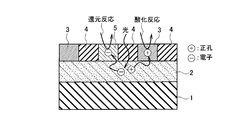
- FIG. 4 is a diagram showing the action and effect of the semiconductor device according to the first embodiment.
- FIG. 5 is a schematic diagram showing the configuration of the redox reaction test cell according to Example 1.
- FIG. 6 is a graph showing a graph of the amount of gas produced according to the first embodiment.
- FIG. 7 is a schematic diagram showing the configuration of the redox reaction test cell according to Comparative Example 7.
- the present invention has high durability that efficiently induces a chemical reaction (oxidation reaction, reduction reaction) of an oxidation target substance or a reduction target substance by using a semiconductor having a photocatalytic function activated by light, particularly sunlight.
- a semiconductor device that reduces carbon dioxide to carbon monoxide, formic acid, methanol, methane, etc. by the energy of sunlight, and a semiconductor device that photodecomposes water to generate hydrogen.
- an oxidation catalyst layer which is a catalyst material for causing an oxidation reaction
- the semiconductor layer which is a photocatalyst
- an electric field that attracts holes toward the junction region with the oxidation catalyst layer is formed in the semiconductor layer, so that spatial separation of photoexcited electron-hole pairs in the semiconductor layer is promoted and the oxidation reaction is promoted.
- the movement of holes to the oxidation reaction site is promoted.
- the quantum yield of the photocatalytic reaction in the semiconductor layer can be improved.
- a reduction catalyst layer which is a catalyst material for causing a reduction reaction, is supported on the same surface of the semiconductor layer so as to form an ohmic contact with the semiconductor layer.
- an electric field that attracts electrons toward the junction region with the reduction catalyst layer is also formed in the semiconductor layer, so that the movement of electrons to the reduction reaction site that promotes the reduction reaction is also promoted.
- the quantum efficiency of the photocatalytic reaction in the semiconductor layer can be further improved.
- the present invention forms an insulating layer capable of transmitting light in the wavelength region absorbed by the semiconductor layer in the exposed region of the semiconductor layer on which the oxidation catalyst layer and the reduction catalyst layer are not supported.
- the structure covers the entire surface of the semiconductor layer, so that the deterioration reaction that progresses on the surface of the semiconductor layer can be suppressed without inhibiting the light absorption by the semiconductor layer, and the redox reaction can be efficiently caused.
- the quantum efficiency of the photocatalytic reaction in the semiconductor layer can be further improved.
- FIG. 1 is a cross-sectional view showing a cross section of the semiconductor device 100 according to the first embodiment.
- the semiconductor device 100 includes, for example, a substrate 1, a semiconductor layer 2, an oxidation catalyst layer 3, an insulating layer 4, and a reduction catalyst layer 5.
- the substrate 1 is a sapphire substrate having a flat plate shape.
- the substrate 1 may be an insulating substrate such as a glass substrate, or a conductive substrate such as a silicon (Si) substrate or a gallium nitride (GaN) substrate.
- the semiconductor layer 2 is a photocatalyst that is arranged on one surface of the substrate 1 and exerts a catalytic function by irradiation with light to cause a chemical reaction with an oxidation target substance or a reduction target substance.
- the semiconductor layer 2 is a semiconductor thin film that spatially separates electron / hole pairs internally by irradiation light, causes an oxidation reaction using the spatially separated holes, and causes a reduction reaction using electrons. ..
- gallium nitride (GaN) which is a nitride semiconductor, is used.
- a metal oxide such as titanium oxide (TIM 2 ), tungsten oxide (WO 3 ), gallium oxide (Ga 2 O 3) having a photocatalytic function may be used.
- a compound semiconductor such as cadmium sulfide (CdS) may be used for the semiconductor layer 2.
- gallium nitride (GaN) is used, n-type gallium nitride (n-GaN) may be used as a single layer, or the energy level at the bottom of the conduction band is n on n-GaN on the substrate 1 side.
- -A semiconductor material larger than GaN for example, aluminum gallium nitride (AlGaN)
- AlGaN aluminum gallium nitride
- charge separation is promoted, so that the semiconductor layer 2 is more preferable.
- the oxidation catalyst layer 3 is an oxidation catalyst that is arranged on a part of the surface of the semiconductor layer 2 and is supported so as to form a Schottky bond with the lower semiconductor layer 2 to oxidize an oxidation target substance. That is, the oxidation catalyst layer 3 functions as an auxiliary catalyst of the photocatalyst that collects the holes photoexcited by the semiconductor layer 2 and performs an oxidation reaction.
- nickel oxide (NiO) is used.
- a metal oxide obtained by heat-treating after forming a metal that can be oxygenated later, such as titanium (Ti) or cobalt (Co), may be used.
- Cobalt oxide (CoO), tricobalt tetraoxide (Co 3 O 4 ), titanium oxide (TIO 2 ) and the like may be directly formed on the oxidation catalyst layer 3 by a sputtering method or a vapor deposition method.
- the film thickness of the oxidation catalyst layer 3 is preferably within a range that does not hinder light transmission to the semiconductor layer 2 (for example, about 1 nm to about 5 nm).
- the insulating layer 4 is arranged in contact with the oxidation catalyst layer 3 and the reduction catalyst layer 5 on all the surfaces of the semiconductor layer 2 on which the oxidation catalyst layer 3 and the reduction catalyst layer 5 are not arranged, and is a semiconductor layer. It is a transmissive insulator that transmits the irradiation light for 2. In this embodiment, silicon dioxide (SiO 2 ) which is an oxide is used.
- the insulating layer 4 may be an insulator made of a material that transmits light having a wavelength absorbed by the underlying semiconductor layer 2.
- the film thickness of the insulating layer 4 is preferably within a range (about 5 nm to about 50 nm) that does not hinder light transmission to the semiconductor layer 2 and forms a continuous film with the semiconductor layer 2. Further, the insulating layer 4 is an insulator, and the band gap of the insulating layer 4 is larger than the band gap of the semiconductor layer 2.
- the reduction catalyst layer 5 is arranged apart from the oxidation catalyst layer 3 on a part of the surface of the semiconductor layer 2 on which the oxidation catalyst layer 3 is not arranged so as to form an ohmic junction with the lower semiconductor layer 2. It is a reduction catalyst that is supported on the surface and reduces the reduction target substance. That is, the reduction catalyst layer 5 functions as an auxiliary catalyst of the photocatalyst that collects the electrons photoexcited by the semiconductor layer 2 and performs a reduction reaction.
- the reduction catalyst layer 5 may be a single metal layer or a layer in which a plurality of metals are laminated.
- a metal forming an ohmic contact with the semiconductor layer 2 is formed on the contact side with the semiconductor layer 2, and a metal having a reducing ability is formed on the outermost surface.
- a metal layer in which titanium (Ti) and platinum (Pt) are laminated in order from the surface side of the semiconductor layer 2 is used.
- the film thickness of the reduction catalyst layer 5 may be in the range of 10 nm or more, as long as pinholes and the like do not occur in each layer of Ti and Pt and the function can be exhibited.
- FIG. 2 is a top view of the semiconductor device 100 shown in FIG.
- the entire surface of the semiconductor layer 2 (not shown) is covered with the oxidation catalyst layer 3, the insulating layer 4, and the reduction catalyst layer 5.
- the insulating layer 4 has a grid-like shape in a plan view (front view in FIG. 2) of the surface of the semiconductor layer 2, and the oxidation catalyst layer 3 and the reduction catalyst layer 5 are latticed on the surface of the semiconductor layer 2.
- the plurality of insulating layer unformed regions S formed by the insulating layer 4 they are alternately formed in different insulating layer unformed regions S.
- the oxidation catalyst layer 3 and the reduction catalyst layer 5 are formed so as to be alternately arranged in both the front-rear and left-right directions with the insulating layer 4 interposed therebetween.
- the semiconductor device 100 shown in FIGS. 1 and 2 is an example. If the oxidation catalyst layer 3 and the reduction catalyst layer 5 are arranged via the insulating layer 4 so as not to come into direct contact with each other, the same effect can be exhibited.
- the shapes of the oxidation catalyst layer 3 and the reduction catalyst layer 5 may be, for example, rectangular or disk-shaped. Further, the shape of the insulating layer 4 may be a houndstooth shape.
- FIG. 3 is a diagram showing a method of manufacturing the semiconductor device 100.
- First step First, a Si-doped n-GaN thin film is epitaxially grown on the upper surface of the sapphire (0001) substrate 1 by an organic metal vapor phase growth method.
- the film thickness of the n-GaN thin film was about 2 ⁇ m.
- AlGaN is grown on the upper surface of the n-GaN thin film by the organic metal vapor phase growth method.
- the Al composition was about 10% (Al 0.1 Ga 0.9 N).
- the film thickness of the AlGaN thin film was about 100 nm.
- the semiconductor layer 2 of the AlGaN / n-GaN thin film is formed.
- SiO 2 is deposited on the upper surface of the AlGaN thin film (semiconductor layer 2) with a film thickness of about 50 nm by a sputtering method. Then, a grid pattern having a line width of about 10 ⁇ m and a pitch between adjacent lines of 20 ⁇ m is formed by a photolithography method. As a result, the insulating layer 4 of the SiO 2 thin film having the shape of a grid pattern is formed (FIG. 3A).
- Ni having a film thickness of about 1 nm is formed in the remaining region of the unformed region of the SiO 2 thin film by a vacuum vapor deposition method.
- the Pt / Ti thin film by masking each region of the Pt / Ti thin film (reduction catalyst layer 5), every other Ni thin film is formed in the front-rear and left-right directions.
- it is heat-treated at about 290 degrees for about 1 hour in an atmospheric atmosphere to oxygenate it into NiO, and form a Schottky bond between NiO and the lower semiconductor layer 2.
- the film thickness of NiO was about 1.7 nm.
- an oxidation catalyst layer 3 having a NiO thin film structure having a size of 10 ⁇ m ⁇ 10 ⁇ m is formed (FIG. 3 (c)).
- the square oxidation catalyst layer 3 and the square reduction catalyst layer 5 are alternately arranged in a matrix on the surface of the semiconductor layer 2 as shown in FIGS. 1 and 2, and a lattice is formed between them.
- a semiconductor device 100 having a structure filled with the insulating layer 4 was formed.
- the oxidation catalyst layer 3 and the reduction catalyst layer 5 are squares having a side of 10 ⁇ m, but even if the shape is a disk shape or a polygonal shape with rounded corners, the symmetry of the shapes makes this embodiment.
- each size of the oxidation catalyst layer 3 and the reduction catalyst layer 5 can generate electrons and holes according to the light absorption characteristics of the semiconductor and the length of the depletion layer, and the electrons and holes can move.
- the diameter is in the range of about 0.5 ⁇ m to about 100 ⁇ m, and the same effect can be expected if they do not come into contact with each other.
- the oxidation catalyst layer 3 that causes an oxidation reaction is supported on the surface of the semiconductor layer 2 so as to form a Schottky bond with the semiconductor layer 2, so that the bonding with the oxidation catalyst layer 3 is formed.
- An electric field that attracts holes toward the region is formed in the semiconductor layer 2, spatial separation of photoexcited electron-hole pairs in the semiconductor layer 2 is promoted, and holes to the oxidation reaction site that promote the oxidation reaction are promoted. Movement is promoted (Fig. 4). As a result, the quantum yield of the photocatalytic reaction in the semiconductor layer 2 can be improved.
- the reduction catalyst layer 5 that causes a reduction reaction is supported on the same surface of the semiconductor layer 2 so as to form an ohmic junction with the semiconductor layer 2, so that the junction region with the reduction catalyst layer 5 is formed.
- An electric field that attracts electrons toward the semiconductor layer 2 is also formed in the semiconductor layer 2, and the transfer of electrons to the site reduction reaction site that promotes the reduction reaction is also promoted (FIG. 4). As a result, the quantum efficiency of the photocatalytic reaction can be further improved.
- the insulating layer 4 capable of transmitting light in the wavelength region absorbed by the semiconductor layer 2 is formed in the exposed region of the semiconductor layer 2 in which the oxidation catalyst layer 3 and the reduction catalyst layer 5 are not supported.
- the structure is such that the entire surface of the semiconductor layer 2 is covered, and the deterioration reaction that progresses on the surface of the semiconductor layer 2 can be suppressed without inhibiting the light absorption by the semiconductor layer 2, and the redox reaction can be efficiently caused. As a result, the quantum efficiency of the photocatalytic reaction can be further improved.
- FIG. 5 is a schematic diagram showing the configuration of the redox reaction test cell according to this embodiment.
- aqueous solution 12 to be put into the reaction cell 11 a 1 M (mol) aqueous solution of sodium hydroxide (NaOH) was used.
- an electrolytic solution such as potassium hydroxide (KOH), sodium sulfate (Na 2 SO 4 ), potassium hydrogen carbonate (KHCO 3 ), or pure water may be used.
- the oxidation target substance and the reduction target substance are not limited to water, and for example, the present invention also produces hydrocarbons of carbon monoxide, formic acid, methanol, and methane using carbon dioxide as the reduction target substance. Can be used.
- the redox reaction test method is not limited to this embodiment, and a reaction cell including an electrolytic solution, an oxidation electrode and a reduction electrode capable of advancing a photoelectrochemical reaction is formed, and sunlight is used as a light source. Has the same effect.
- a 1 mol / L NaOH aqueous solution 12 is placed in a light-transmitting reaction cell 11 with a quartz window having an internal volume of 300 mL, and the semiconductor device 100 produced by the above procedure is completely immersed in the aqueous solution 12 to be suitable. Fixed in position.
- a semiconductor device 100 a semiconductor device 100 cut into a size of 10 mm ⁇ 20 mm was used.
- Argon gas was added at 200 mL / min from the gas input port 13, bubbling for 10 minutes to defoam and replace, and then sealed with silicon Teflon septum 14.
- the pressure in the reaction cell 11 was set to atmospheric pressure (1 atm).
- a 300 W high-pressure xenon lamp (100 mW / cm 2 ) adjusted to the illuminance of sunlight was used as the light source 15 for the redox reaction, and the entire surface of the semiconductor layer 2 of the semiconductor device 100 was formed from the outside of the quartz window of the reaction cell 11. Irradiated evenly toward. Further, the aqueous solution 12 was stirred at the center position of the bottom of the reaction cell 11 at a rotation speed of 250 rpm using a stirrer 16 such as a rotor or a stirrer.
- FIG. 6 shows the change in the amount of generated gas with respect to the light irradiation time. It was confirmed that the amount of gas produced increased linearly with the passage of time, and that the target reaction proceeded without deterioration (self-oxidation) in the semiconductor layer 2. Especially hydrogen generating amount after 20 hours 26.0 ⁇ L / cm 2, amount of oxygen produced was 12.5 [mu] L / cm 2.
- Example 2 the film thickness of the insulating layer 4 in Example 1 was set to about 5 nm. Other than that, it is the same as in Example 1.
- Example 3 In Example 3, the line width of the grid pattern of the insulating layer 4 in Example 1 was set to about 100 ⁇ m, and the pitch between adjacent lines was set to a grid pattern of about 200 ⁇ m. That is, the distance between the oxidation catalyst layer 3 and the reduction catalyst layer 5, the size of one side of the oxidation catalyst layer 3, and the size of one side of the reduction catalyst layer 5 were set to about 100 ⁇ m, respectively. Other than that, it is the same as in Example 1.
- Example 4 in the third step of Example 1, each film of Ti and Pt laminated by the sputtering method is set to about 6 nm, and the total film thickness after heat treatment (the film thickness of the reduction catalyst layer 5) is about. It was set to 10 nm. Other than that, it is the same as in Example 1.
- Example 5 in the fourth step of Example 1, NiO having a film thickness of about 2.5 nm was formed by a vacuum vapor deposition method, and then NiO was formed by oxygenation by heat treatment (oxidation catalyst layer 3). The film thickness) was about 5 nm. Other than that, it is the same as in Example 1.
- Comparative Example 1 In Comparative Example 1, the film thickness of the insulating layer 4 in Example 1 was set to about 1 nm. Other than that, it is the same as in Example 1.
- Comparative Example 2 In Comparative Example 2, the film thickness of the insulating layer 4 in Example 1 was set to about 200 nm. Other than that, it is the same as in Example 1.
- Comparative Example 3 In Comparative Example 3, the line width of the grid pattern of the insulating layer 4 in Example 1 was set to about 200 ⁇ m, and the pitch between adjacent lines was set to a grid pattern of about 400 ⁇ m. That is, the distance between the oxidation catalyst layer 3 and the reduction catalyst layer 5, the size of one side of the oxidation catalyst layer 3, and the size of one side of the reduction catalyst layer 5 were set to about 200 ⁇ m, respectively. Other than that, it is the same as in Example 1.
- Comparative Example 4 In Comparative Example 4, the line width of the grid pattern of the insulating layer 4 in Example 1 was set to about 300 ⁇ m, and the pitch between adjacent lines was set to a grid pattern of about 600 ⁇ m. That is, the distance between the oxidation catalyst layer 3 and the reduction catalyst layer 5, the size of one side of the oxidation catalyst layer 3, and the size of one side of the reduction catalyst layer 5 were set to about 500 ⁇ m, respectively. Other than that, it is the same as in Example 1.
- Comparative Example 5 in the third step of Example 1, the films of Ti and Pt laminated by the sputtering method were set to about 2 nm and about 3 nm, respectively, and the total film thickness after the heat treatment (the film thickness of the reduction catalyst layer 5) was set. ) was set to about 4 nm. Other than that, it is the same as in Example 1.
- Comparative Example 6 in the fourth step of Example 1, the film thickness of NiO formed by forming Ni having a film thickness of about 5 nm by the vacuum vapor deposition method and then oxygenating by heat treatment (the film of the oxidation catalyst layer 3). Thickness) was about 10 nm. Other than that, it is the same as in Example 1.
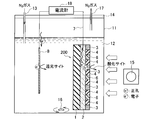
- FIG. 7 is a schematic diagram showing the configuration of the redox reaction test cell according to Comparative Example 7.
- the reduction reaction site and the oxidation reaction site of water are separated from each other by using a metal cathode plate 8 and a semiconductor photoelectrode 200 having an oxidation catalyst layer 3 and an insulating layer 4 on one surface of the semiconductor layer 2 as an anode plate.
- a test was conducted by a photoelectrochemical reaction in which electrons were electrically connected from the semiconductor optical electrode 100'of the anode plate to the cathode plate 8 so that electrons could flow.
- a semiconductor layer 2 in which AlGaN was grown on n-GaN was produced by the same procedure as in Example 1.
- the insulating layer 4 of SiO 2 was formed in a grid pattern on the upper surface of the semiconductor layer 2 by the vacuum vapor deposition method in the same procedure as in Example 1.
- the oxidation catalyst layer 3 of NiO was formed in a part of the unformed region of the insulating layer 4.
- the reduction catalyst layer 5 was not formed, and the unformed region of the remaining insulating layer 4 in which the oxidation catalyst layer 3 was not formed was covered with the epoxy resin 6.
- the semiconductor optical electrode 200 thus prepared was cut into a size of 10 mm ⁇ 25 mm, a part of the surface was peeled off with a diamond scriber, and the lower layer n-GaN was exposed in the semiconductor layer 2.
- Indium was bonded to the exposed portion of n-GaN with a soldering iron, and the lead wire 7 was bonded.
- the surface of the indium was covered with an epoxy resin so as not to be exposed, and the light receiving surface of the semiconductor optical electrode 200 was set to 10 mm ⁇ 20 mm. In this way, the semiconductor optical electrode 200 used for the anode was manufactured.
- the same light source 15 as in Example 1 was used for the redox reaction, and the light source 15 was uniformly irradiated from the outside of the quartz window of the reaction cell 11 toward the entire forming surface of the semiconductor layer 2 of the semiconductor optical electrode 200.
- the aqueous solution 12 was stirred at the center position of the cell bottom at a rotation speed of 250 rpm using a rotor and a stirrer 16 such as a stirrer.
- the gas in the reaction cell 11 was analyzed by introducing the gas chromatograph directly into the gas output port 17 in the reaction cell 11 during light irradiation.
- Tables 1 and Table show the structural features of the semiconductor devices 100 of Examples 1 to 5 and Comparative Examples 1 to 7, and the cumulative amount of hydrogen and oxygen produced after 1 hour, 5 hours, and 20 hours of light irradiation. Shown in 2.
- Comparative Examples 1 to 7 did not increase linearly with the passage of time for both hydrogen and oxygen. This suggests that in Comparative Example 1 in which the film thickness of the insulating layer 4 is small, the etching reaction of the semiconductor layer 2 (that is, the deterioration reaction due to self-oxidation) is proceeding. Further, in Comparative Example 2 in which the film thickness of the insulating layer 4 is large, the light absorption by the semiconductor layer 2 under the insulating layer 4 is inhibited, and the amount of electrons and holes generated is reduced, so that the amount of gas generated is reduced. Was suggested.
- the film thickness of the insulating layer 4 in the semiconductor device 100 is good in both efficiency and life in the range of about 5 nm to about 50 nm.
- the film thickness is 200 nm as in Comparative Example 2
- the amount of gas generated is low, which is considered to be a factor that hinders the transmission of the irradiation light.
- the upper limit of the film thickness of the insulating layer 4 varies depending on the material used, but it can be applied as long as it has a thickness having a light transmittance to the extent that the light absorption in the underlying semiconductor layer 2 is not hindered.
- the distance between the oxidation catalyst layer 3 and the reduction catalyst layer 5 in the semiconductor device 100 is good in both efficiency and life when the distance is about 100 ⁇ m or less. .. Since the oxidation catalyst layer 3 and the reduction catalyst layer 5 are short-circuited when they come into contact with each other, the lower limit of the distance between the oxidation catalyst layer 3 and the reduction catalyst layer 5 is several tens of nm considering the possible distances that do not come into contact in the manufacturing process. It is considered to be a degree.
- the film thickness of the reduction catalyst layer 5 in the semiconductor device 100 is good in both efficiency and life in the range of about 10 nm to about 40 nm. Since a sufficiently continuous film is formed in this film thickness range, the life is good, the electrons generated in the lower semiconductor layer 2 can move to the surface of the reduction catalyst layer 5, and the quantum of the photocatalytic reaction It is considered to be efficient.
- the film thickness of the oxidation catalyst layer 3 in the semiconductor device 100 is good in both efficiency and life when the film thickness is 5 nm or less.
- a film thickness of 1 nm or more is required.
- the film thickness of the oxidation catalyst layer 3 is 10 nm as in Comparative Example 6, it is considered that the light transmittance is lowered and the efficiency is lowered.
- Example 1 and Comparative Example 7 the semiconductor device of the present invention linearly generated hydrogen and oxygen gas after 20 hours as compared with the reaction system using the semiconductor optical electrode 200. Therefore, it was confirmed that it has higher durability than the conventional technology.
- Comparative Example 7 in which the semiconductor layer 2 was provided as the anode plate, the initial gas production amount after 1 hour was higher than that in Example 1, but after 20 hours, it was higher than that in Example 1. There were few. The reason for this is that when the semiconductor layer 2 is provided as an anode plate, electrification separation by light irradiation is promoted, while holes that cannot be consumed in the reaction are accumulated in the semiconductor layer 2, resulting in a semiconductor. It is considered that the self-oxidation (deterioration) of the layer 2 was caused.
- the semiconductor device 100 of the present invention exhibits high photocatalytic activity and suppresses the deterioration reaction of the semiconductor layer 2 by forming an insulator between the oxidation catalyst and the reduction catalyst so that the semiconductor surface is not exposed. It was shown to be a possible device.
- the insulating layer 4 is formed between the oxidation catalyst layer 3 and the reduction catalyst layer 5 so that the surface of the semiconductor layer 2 is not exposed, so that the deterioration reaction of the semiconductor layer 2 is caused. Suppression is also possible.
- Substrate 2 Semiconductor layer 3: Oxidation catalyst layer 4: Insulation layer 5: Reduction catalyst layer 6: Epoxy resin 7: Lead wire 8: Pt wire 11: Reaction cell 12: Aqueous solution 13: Gas input port 14: Silicon Teflon septum 15 : Light source 16: Stirrer 17: Gas output port 18: Current meter 100: Semiconductor device 200: Semiconductor optical electrode
Landscapes
- Chemical & Material Sciences (AREA)
- Organic Chemistry (AREA)
- Inorganic Chemistry (AREA)
- Health & Medical Sciences (AREA)
- General Health & Medical Sciences (AREA)
- Engineering & Computer Science (AREA)
- Combustion & Propulsion (AREA)
- Chemical Kinetics & Catalysis (AREA)
- Catalysts (AREA)
Priority Applications (3)
| Application Number | Priority Date | Filing Date | Title |
|---|---|---|---|
| PCT/JP2020/022364 WO2021245923A1 (ja) | 2020-06-05 | 2020-06-05 | 半導体デバイス |
| US18/000,579 US12501721B2 (en) | 2020-06-05 | 2020-06-05 | Semiconductor device |
| JP2022528383A JPWO2021245923A1 (https=) | 2020-06-05 | 2020-06-05 |
Applications Claiming Priority (1)
| Application Number | Priority Date | Filing Date | Title |
|---|---|---|---|
| PCT/JP2020/022364 WO2021245923A1 (ja) | 2020-06-05 | 2020-06-05 | 半導体デバイス |
Publications (1)
| Publication Number | Publication Date |
|---|---|
| WO2021245923A1 true WO2021245923A1 (ja) | 2021-12-09 |
Family
ID=78830751
Family Applications (1)
| Application Number | Title | Priority Date | Filing Date |
|---|---|---|---|
| PCT/JP2020/022364 Ceased WO2021245923A1 (ja) | 2020-06-05 | 2020-06-05 | 半導体デバイス |
Country Status (3)
| Country | Link |
|---|---|
| US (1) | US12501721B2 (https=) |
| JP (1) | JPWO2021245923A1 (https=) |
| WO (1) | WO2021245923A1 (https=) |
Cited By (1)
| Publication number | Priority date | Publication date | Assignee | Title |
|---|---|---|---|---|
| JP2023150160A (ja) * | 2022-03-31 | 2023-10-16 | セイコーエプソン株式会社 | 光触媒装置、光触媒装置の製造方法、およびガス製造装置 |
Families Citing this family (1)
| Publication number | Priority date | Publication date | Assignee | Title |
|---|---|---|---|---|
| WO2026006901A1 (en) * | 2024-07-05 | 2026-01-08 | The Royal Institution For The Advancement Of Learning/Mcgill University | Photocatalytic reduction of carboxylic acids using gallium nitride |
Citations (7)
| Publication number | Priority date | Publication date | Assignee | Title |
|---|---|---|---|---|
| JP2007239048A (ja) * | 2006-03-09 | 2007-09-20 | Univ Of Electro-Communications | 光エネルギー変換装置及び半導体光電極 |
| JP2010247109A (ja) * | 2009-04-17 | 2010-11-04 | Sony Corp | 光触媒装置及びガス発生装置 |
| JP2016043304A (ja) * | 2014-08-21 | 2016-04-04 | 日本電信電話株式会社 | 光触媒デバイス |
| JP2017121598A (ja) * | 2016-01-05 | 2017-07-13 | 日本電信電話株式会社 | 半導体光触媒 |
| JP2018090863A (ja) * | 2016-12-05 | 2018-06-14 | 日本電信電話株式会社 | 半導体光電極 |
| JP2018089604A (ja) * | 2016-12-07 | 2018-06-14 | 日本電信電話株式会社 | 半導体光電極 |
| JP2018204044A (ja) * | 2017-05-30 | 2018-12-27 | 日本電信電話株式会社 | 半導体電極とその製造方法 |
Family Cites Families (13)
| Publication number | Priority date | Publication date | Assignee | Title |
|---|---|---|---|---|
| US8845877B2 (en) * | 2010-03-19 | 2014-09-30 | Liquid Light, Inc. | Heterocycle catalyzed electrochemical process |
| EP4181241A1 (en) * | 2011-04-05 | 2023-05-17 | Brilliant Light Power, Inc. | H20 - based electrochemical hydrogen - catalyst power system |
| US20140170511A1 (en) * | 2012-08-19 | 2014-06-19 | Ftorion, Inc. | Flow Battery And Regeneration System With Improved Safety |
| JP6067344B2 (ja) * | 2012-11-20 | 2017-01-25 | 株式会社東芝 | 光化学反応システム |
| JP5840170B2 (ja) * | 2013-05-10 | 2016-01-06 | 株式会社昭和 | 高耐久性、高変換効率を有する色素増感型太陽電池 |
| DE102013114226B4 (de) * | 2013-12-17 | 2019-03-07 | Osram Opto Semiconductors Gmbh | Halbleiterlaserdiode, Verfahren zur Herstellung einer Halbleiterlaserdiode und Halbleiterlaserdiodenanordnung |
| JP6239412B2 (ja) * | 2014-03-14 | 2017-11-29 | 株式会社東芝 | 酸化電極および電気化学装置 |
| WO2015148358A1 (en) * | 2014-03-24 | 2015-10-01 | Cornell University | Solar flow battery |
| CN106133198B (zh) * | 2014-04-14 | 2018-09-21 | 富士通株式会社 | 光合成装置 |
| JP6495630B2 (ja) * | 2014-11-28 | 2019-04-03 | 株式会社東芝 | 光電気化学反応装置 |
| JP6470190B2 (ja) * | 2016-01-05 | 2019-02-13 | 日本電信電話株式会社 | 半導体光触媒 |
| JP6672193B2 (ja) * | 2017-02-02 | 2020-03-25 | 株式会社東芝 | 二酸化炭素の電解セルと電解装置 |
| JP6783814B2 (ja) * | 2018-03-22 | 2020-11-11 | 株式会社東芝 | 二酸化炭素電解装置および二酸化炭素電解方法 |
-
2020
- 2020-06-05 JP JP2022528383A patent/JPWO2021245923A1/ja active Pending
- 2020-06-05 US US18/000,579 patent/US12501721B2/en active Active
- 2020-06-05 WO PCT/JP2020/022364 patent/WO2021245923A1/ja not_active Ceased
Patent Citations (7)
| Publication number | Priority date | Publication date | Assignee | Title |
|---|---|---|---|---|
| JP2007239048A (ja) * | 2006-03-09 | 2007-09-20 | Univ Of Electro-Communications | 光エネルギー変換装置及び半導体光電極 |
| JP2010247109A (ja) * | 2009-04-17 | 2010-11-04 | Sony Corp | 光触媒装置及びガス発生装置 |
| JP2016043304A (ja) * | 2014-08-21 | 2016-04-04 | 日本電信電話株式会社 | 光触媒デバイス |
| JP2017121598A (ja) * | 2016-01-05 | 2017-07-13 | 日本電信電話株式会社 | 半導体光触媒 |
| JP2018090863A (ja) * | 2016-12-05 | 2018-06-14 | 日本電信電話株式会社 | 半導体光電極 |
| JP2018089604A (ja) * | 2016-12-07 | 2018-06-14 | 日本電信電話株式会社 | 半導体光電極 |
| JP2018204044A (ja) * | 2017-05-30 | 2018-12-27 | 日本電信電話株式会社 | 半導体電極とその製造方法 |
Cited By (1)
| Publication number | Priority date | Publication date | Assignee | Title |
|---|---|---|---|---|
| JP2023150160A (ja) * | 2022-03-31 | 2023-10-16 | セイコーエプソン株式会社 | 光触媒装置、光触媒装置の製造方法、およびガス製造装置 |
Also Published As
| Publication number | Publication date |
|---|---|
| US20230215966A1 (en) | 2023-07-06 |
| US12501721B2 (en) | 2025-12-16 |
| JPWO2021245923A1 (https=) | 2021-12-09 |
Similar Documents
| Publication | Publication Date | Title |
|---|---|---|
| US9551077B2 (en) | Photoelectrode used for carbon dioxide reduction and method for reducing carbon dioxide using the photoelectrode | |
| Dong et al. | Grain boundary engineering of Cu–Ag thin-film catalysts for selective (photo) electrochemical CO2 reduction to CO and CH4 | |
| JP6190339B2 (ja) | 光触媒デバイス | |
| US9157158B2 (en) | Method for producing alcohol | |
| JP2017210666A (ja) | 二酸化炭素の還元方法、及び二酸化炭素の還元装置 | |
| WO2020116153A1 (ja) | 半導体光電極 | |
| WO2021245923A1 (ja) | 半導体デバイス | |
| JP2017101288A (ja) | 半導体光電極 | |
| JP6715172B2 (ja) | 半導体光電極の製造方法 | |
| JP6470190B2 (ja) | 半導体光触媒 | |
| JP2018089604A (ja) | 半導体光電極 | |
| JP2018090862A (ja) | 半導体光電極 | |
| JP6718805B2 (ja) | 半導体光電極 | |
| WO2021234804A1 (ja) | 半導体光電極 | |
| JP6649237B2 (ja) | 光触媒酸化還元反応装置 | |
| JP7485991B2 (ja) | 半導体光電極および半導体光電極の製造方法 | |
| JP6322157B2 (ja) | 半導体光触媒膜および酸化還元反応装置 | |
| JP6898566B2 (ja) | 半導体光電極 | |
| JP2019205970A (ja) | 半導体光電極 | |
| JP7602149B2 (ja) | 半導体光電極および半導体光電極の製造方法 | |
| JP2019099884A (ja) | 半導体光電極 | |
| JP2016098419A (ja) | 水素の生成方法、水素生成装置および水素生成用のアノード電極 | |
| JP7801605B2 (ja) | 半導体光電極 | |
| WO2025257986A1 (ja) | 半導体光電極の製造方法 | |
| CN116889847A (zh) | 光催化装置、光催化装置的制造方法以及气体制造装置 |
Legal Events
| Date | Code | Title | Description |
|---|---|---|---|
| 121 | Ep: the epo has been informed by wipo that ep was designated in this application |
Ref document number: 20939237 Country of ref document: EP Kind code of ref document: A1 |
|
| ENP | Entry into the national phase |
Ref document number: 2022528383 Country of ref document: JP Kind code of ref document: A |
|
| NENP | Non-entry into the national phase |
Ref country code: DE |
|
| 122 | Ep: pct application non-entry in european phase |
Ref document number: 20939237 Country of ref document: EP Kind code of ref document: A1 |
|
| WWG | Wipo information: grant in national office |
Ref document number: 18000579 Country of ref document: US |