WO2021124651A1 - 非水電解質蓄電素子及びその製造方法 - Google Patents
非水電解質蓄電素子及びその製造方法 Download PDFInfo
- Publication number
- WO2021124651A1 WO2021124651A1 PCT/JP2020/037933 JP2020037933W WO2021124651A1 WO 2021124651 A1 WO2021124651 A1 WO 2021124651A1 JP 2020037933 W JP2020037933 W JP 2020037933W WO 2021124651 A1 WO2021124651 A1 WO 2021124651A1
- Authority
- WO
- WIPO (PCT)
- Prior art keywords
- lithium
- aqueous electrolyte
- silver
- power storage
- storage element
- Prior art date
- Legal status (The legal status is an assumption and is not a legal conclusion. Google has not performed a legal analysis and makes no representation as to the accuracy of the status listed.)
- Ceased
Links
Images
Classifications
-
- H—ELECTRICITY
- H01—ELECTRIC ELEMENTS
- H01G—CAPACITORS; CAPACITORS, RECTIFIERS, DETECTORS, SWITCHING DEVICES, LIGHT-SENSITIVE OR TEMPERATURE-SENSITIVE DEVICES OF THE ELECTROLYTIC TYPE
- H01G11/00—Hybrid capacitors, i.e. capacitors having different positive and negative electrodes; Electric double-layer [EDL] capacitors; Processes for the manufacture thereof or of parts thereof
- H01G11/04—Hybrid capacitors
- H01G11/06—Hybrid capacitors with one of the electrodes allowing ions to be reversibly doped thereinto, e.g. lithium ion capacitors [LIC]
-
- H—ELECTRICITY
- H01—ELECTRIC ELEMENTS
- H01G—CAPACITORS; CAPACITORS, RECTIFIERS, DETECTORS, SWITCHING DEVICES, LIGHT-SENSITIVE OR TEMPERATURE-SENSITIVE DEVICES OF THE ELECTROLYTIC TYPE
- H01G11/00—Hybrid capacitors, i.e. capacitors having different positive and negative electrodes; Electric double-layer [EDL] capacitors; Processes for the manufacture thereof or of parts thereof
- H01G11/22—Electrodes
- H01G11/30—Electrodes characterised by their material
- H01G11/50—Electrodes characterised by their material specially adapted for lithium-ion capacitors, e.g. for lithium-doping or for intercalation
-
- H—ELECTRICITY
- H01—ELECTRIC ELEMENTS
- H01G—CAPACITORS; CAPACITORS, RECTIFIERS, DETECTORS, SWITCHING DEVICES, LIGHT-SENSITIVE OR TEMPERATURE-SENSITIVE DEVICES OF THE ELECTROLYTIC TYPE
- H01G11/00—Hybrid capacitors, i.e. capacitors having different positive and negative electrodes; Electric double-layer [EDL] capacitors; Processes for the manufacture thereof or of parts thereof
- H01G11/54—Electrolytes
- H01G11/58—Liquid electrolytes
- H01G11/62—Liquid electrolytes characterised by the solute, e.g. salts, anions or cations therein
-
- H—ELECTRICITY
- H01—ELECTRIC ELEMENTS
- H01G—CAPACITORS; CAPACITORS, RECTIFIERS, DETECTORS, SWITCHING DEVICES, LIGHT-SENSITIVE OR TEMPERATURE-SENSITIVE DEVICES OF THE ELECTROLYTIC TYPE
- H01G11/00—Hybrid capacitors, i.e. capacitors having different positive and negative electrodes; Electric double-layer [EDL] capacitors; Processes for the manufacture thereof or of parts thereof
- H01G11/84—Processes for the manufacture of hybrid or EDL capacitors, or components thereof
-
- H—ELECTRICITY
- H01—ELECTRIC ELEMENTS
- H01M—PROCESSES OR MEANS, e.g. BATTERIES, FOR THE DIRECT CONVERSION OF CHEMICAL ENERGY INTO ELECTRICAL ENERGY
- H01M10/00—Secondary cells; Manufacture thereof
- H01M10/05—Accumulators with non-aqueous electrolyte
- H01M10/052—Li-accumulators
-
- H—ELECTRICITY
- H01—ELECTRIC ELEMENTS
- H01M—PROCESSES OR MEANS, e.g. BATTERIES, FOR THE DIRECT CONVERSION OF CHEMICAL ENERGY INTO ELECTRICAL ENERGY
- H01M10/00—Secondary cells; Manufacture thereof
- H01M10/05—Accumulators with non-aqueous electrolyte
- H01M10/052—Li-accumulators
- H01M10/0525—Rocking-chair batteries, i.e. batteries with lithium insertion or intercalation in both electrodes; Lithium-ion batteries
-
- H—ELECTRICITY
- H01—ELECTRIC ELEMENTS
- H01M—PROCESSES OR MEANS, e.g. BATTERIES, FOR THE DIRECT CONVERSION OF CHEMICAL ENERGY INTO ELECTRICAL ENERGY
- H01M10/00—Secondary cells; Manufacture thereof
- H01M10/05—Accumulators with non-aqueous electrolyte
- H01M10/056—Accumulators with non-aqueous electrolyte characterised by the materials used as electrolytes, e.g. mixed inorganic/organic electrolytes
- H01M10/0564—Accumulators with non-aqueous electrolyte characterised by the materials used as electrolytes, e.g. mixed inorganic/organic electrolytes the electrolyte being constituted of organic materials only
- H01M10/0566—Liquid materials
- H01M10/0569—Liquid materials characterised by the solvents
-
- H—ELECTRICITY
- H01—ELECTRIC ELEMENTS
- H01M—PROCESSES OR MEANS, e.g. BATTERIES, FOR THE DIRECT CONVERSION OF CHEMICAL ENERGY INTO ELECTRICAL ENERGY
- H01M10/00—Secondary cells; Manufacture thereof
- H01M10/05—Accumulators with non-aqueous electrolyte
- H01M10/058—Construction or manufacture
- H01M10/0587—Construction or manufacture of accumulators having only wound construction elements, i.e. wound positive electrodes, wound negative electrodes and wound separators
-
- H—ELECTRICITY
- H01—ELECTRIC ELEMENTS
- H01M—PROCESSES OR MEANS, e.g. BATTERIES, FOR THE DIRECT CONVERSION OF CHEMICAL ENERGY INTO ELECTRICAL ENERGY
- H01M4/00—Electrodes
- H01M4/02—Electrodes composed of, or comprising, active material
- H01M4/36—Selection of substances as active materials, active masses, active liquids
- H01M4/38—Selection of substances as active materials, active masses, active liquids of elements or alloys
- H01M4/40—Alloys based on alkali metals
- H01M4/405—Alloys based on lithium
-
- H—ELECTRICITY
- H01—ELECTRIC ELEMENTS
- H01M—PROCESSES OR MEANS, e.g. BATTERIES, FOR THE DIRECT CONVERSION OF CHEMICAL ENERGY INTO ELECTRICAL ENERGY
- H01M4/00—Electrodes
- H01M4/02—Electrodes composed of, or comprising, active material
- H01M4/36—Selection of substances as active materials, active masses, active liquids
- H01M4/48—Selection of substances as active materials, active masses, active liquids of inorganic oxides or hydroxides
- H01M4/50—Selection of substances as active materials, active masses, active liquids of inorganic oxides or hydroxides of manganese
- H01M4/505—Selection of substances as active materials, active masses, active liquids of inorganic oxides or hydroxides of manganese of mixed oxides or hydroxides containing manganese for inserting or intercalating light metals, e.g. LiMn2O4 or LiMn2OxFy
-
- H—ELECTRICITY
- H01—ELECTRIC ELEMENTS
- H01M—PROCESSES OR MEANS, e.g. BATTERIES, FOR THE DIRECT CONVERSION OF CHEMICAL ENERGY INTO ELECTRICAL ENERGY
- H01M4/00—Electrodes
- H01M4/02—Electrodes composed of, or comprising, active material
- H01M4/36—Selection of substances as active materials, active masses, active liquids
- H01M4/48—Selection of substances as active materials, active masses, active liquids of inorganic oxides or hydroxides
- H01M4/52—Selection of substances as active materials, active masses, active liquids of inorganic oxides or hydroxides of nickel, cobalt or iron
- H01M4/525—Selection of substances as active materials, active masses, active liquids of inorganic oxides or hydroxides of nickel, cobalt or iron of mixed oxides or hydroxides containing iron, cobalt or nickel for inserting or intercalating light metals, e.g. LiNiO2, LiCoO2 or LiCoOxFy
-
- Y—GENERAL TAGGING OF NEW TECHNOLOGICAL DEVELOPMENTS; GENERAL TAGGING OF CROSS-SECTIONAL TECHNOLOGIES SPANNING OVER SEVERAL SECTIONS OF THE IPC; TECHNICAL SUBJECTS COVERED BY FORMER USPC CROSS-REFERENCE ART COLLECTIONS [XRACs] AND DIGESTS
- Y02—TECHNOLOGIES OR APPLICATIONS FOR MITIGATION OR ADAPTATION AGAINST CLIMATE CHANGE
- Y02E—REDUCTION OF GREENHOUSE GAS [GHG] EMISSIONS, RELATED TO ENERGY GENERATION, TRANSMISSION OR DISTRIBUTION
- Y02E60/00—Enabling technologies; Technologies with a potential or indirect contribution to GHG emissions mitigation
- Y02E60/10—Energy storage using batteries
Definitions
- the present invention relates to a non-aqueous electrolyte power storage device and a method for manufacturing the same.
- Non-aqueous electrolyte secondary batteries represented by lithium ion secondary batteries are widely used in electronic devices such as personal computers and communication terminals, automobiles, etc. due to their high energy density.
- the non-aqueous electrolyte secondary battery generally has a pair of electrodes electrically separated by a separator and a non-aqueous electrolyte interposed between the electrodes, and transfers ions between the two electrodes. It is configured to charge and discharge.
- capacitors such as lithium ion capacitors and electric double layer capacitors are also widely used as non-aqueous electrolyte storage elements other than non-aqueous electrolyte secondary batteries.
- Metallic lithium is known as a negative electrode active material having a high energy density used in a non-aqueous electrolyte power storage element.
- metallic lithium may be deposited in a dendritic shape on the surface of the negative electrode during charging (hereinafter, metallic lithium in a dendritic form is used. It is called "Dendrite").
- Dendrite metallic lithium in a dendritic form is used. It is called "Dendrite").
- this dendrite grows and penetrates the separator and comes into contact with the positive electrode, it causes a short circuit. Therefore, the non-aqueous electrolyte power storage element having metallic lithium as the negative electrode active material has an inconvenience that a short circuit is likely to occur due to repeated charging and discharging.
- a lithium alloy as a negative electrode active material (see Patent Documents 1 to 3).
- Patent Document 1 describes an invention of a non-aqueous electrolyte secondary battery, characterized in that the negative electrode is an alloy of lithium and a solid solution of a metal soluble in lithium.
- the negative electrode is an alloy of lithium and a solid solution of a metal soluble in lithium.
- zinc, magnesium and silver are used as metals that can be dissolved in lithium, and the result that the charge / discharge cycle characteristics are similarly improved is obtained regardless of which lithium alloy is used. It is shown.
- an equal volume mixed solvent of propylene carbonate and 1,2-dimethoxyethane is used as the non-aqueous solvent.
- Patent Document 1 a non-aqueous electrolyte solution in which lithium perchlorate is dissolved in an equal volume mixed solvent of propylene carbonate and 1,2-dimethoxyethane is used as the non-aqueous electrolyte.
- non-aqueous electrolyte storage devices it is being studied to use a fluorinated solvent such as fluorinated carbonate in order to suppress oxidative decomposition of non-aqueous electrolyte that occurs under high potential.
- a fluorinated solvent such as fluorinated carbonate
- a lithium alloy of a metal and metallic lithium that is simply soluble in lithium as in Patent Document 1 is used as the negative electrode active material.
- the inventors have found that the occurrence of a short circuit may not be sufficiently suppressed.
- the electrolyte salt a fluorine-containing lithium salt having good oxidation resistance, solubility, dissociation of lithium ions, etc. is often used.
- a non-aqueous electrolyte power storage element in which a non-aqueous electrolyte containing a lithium salt containing fluorine is used a lithium alloy of a metal and metallic lithium that can be simply dissolved in lithium as in Patent Document 1 is used as a negative electrode.
- the inventors have found that even when used as a substance, the occurrence of short circuits may not be sufficiently suppressed.
- the present invention has been made based on the above circumstances.
- One of the objects of the present invention is to manufacture a non-aqueous electrolyte storage element having a non-aqueous electrolyte containing a fluorinated solvent, a non-aqueous electrolyte storage element in which the occurrence of a short circuit is suppressed, and such a non-aqueous electrolyte storage element.
- One of the other objects of the present invention is a non-aqueous electrolyte storage element having a non-aqueous electrolyte containing a lithium salt containing fluorine, a non-aqueous electrolyte storage element in which the occurrence of a short circuit is suppressed, and such a non-water storage element.
- the present invention provides a method for manufacturing an electrolyte storage element.
- One aspect of the present invention comprises a negative electrode having a lithium alloy and a non-aqueous electrolyte containing a fluorination solvent, the lithium alloy containing silver, and the content of silver relative to the total content of lithium and silver in the lithium alloy. It is a non-aqueous electrolyte power storage element having an amount of 3% by mass or more and 20% by mass or less.
- Another aspect of the present invention comprises a negative electrode having a lithium alloy and a non-aqueous electrolyte containing a lithium salt containing fluorine, the lithium alloy containing silver, and the total content of lithium and silver in the lithium alloy. It is a non-aqueous electrolyte power storage element in which the content of silver with respect to the amount is 3% by mass or more and 20% by mass or less.
- Another aspect of the present invention comprises preparing a negative electrode having a lithium alloy and preparing a non-aqueous electrolyte containing a fluorination solvent, wherein the lithium alloy contains silver and the lithium in the lithium alloy.
- This is a method for manufacturing a non-aqueous electrolyte power storage element in which the content of silver with respect to the total content with silver is 3% by mass or more and 20% by mass or less.
- Another aspect of the present invention comprises preparing a negative electrode having a lithium alloy and preparing a non-aqueous electrolyte containing a lithium salt containing fluorine, wherein the lithium alloy contains silver and the lithium alloy.
- a non-aqueous electrolyte storage element provided with a non-aqueous electrolyte containing a fluorinated solvent, a non-aqueous electrolyte storage element in which the occurrence of a short circuit is suppressed, and such a non-aqueous electrolyte storage element are manufactured.
- a method can be provided.
- a non-aqueous electrolyte storage element including a non-aqueous electrolyte containing a lithium salt containing fluorine, a non-aqueous electrolyte storage element in which the occurrence of a short circuit is suppressed, and such a non-water electrolyte storage element.
- a method for manufacturing an electrolyte storage element can be provided.
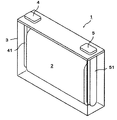
- FIG. 1 is an external perspective view showing a non-aqueous electrolyte power storage element according to an embodiment of the present invention.
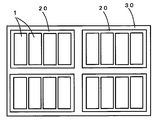
- FIG. 2 is a schematic view showing a power storage device configured by assembling a plurality of non-aqueous electrolyte power storage elements according to an embodiment of the present invention.
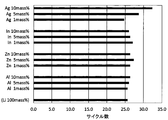
- FIG. 3 is a graph showing the number of cycles until a short circuit occurs in the non-aqueous electrolyte power storage elements of Examples and Comparative Examples.
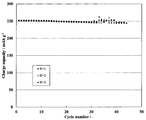
- FIG. 4 is a graph showing the amount of electricity charged for each cycle in the charge / discharge cycle test of the non-aqueous electrolyte power storage element of Example 1.
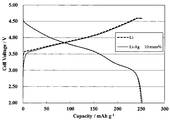
- FIG. 5 is a charge / discharge curve of the non-aqueous electrolyte power storage element of Example 1 and Comparative Example 11 in the first cycle.
- the non-aqueous electrolyte power storage element includes a negative electrode having a lithium alloy and a non-aqueous electrolyte containing a fluorination solvent, the lithium alloy contains silver, and the lithium and silver in the lithium alloy It is a non-aqueous electrolyte power storage element in which the silver content with respect to the total content is 3% by mass or more and 20% by mass or less.
- the non-aqueous electrolyte power storage element includes a non-aqueous electrolyte containing a fluorinated solvent, the occurrence of a short circuit due to the growth of dendrites is suppressed.
- the reason for this is not clear, but the following reasons are presumed.
- paragraphs [0008], [0020], etc. of Patent Document 1 the crystal structure of lithium is changed by solid-solving a metal in lithium, and many active points where precipitation occurs are present. It is stated that lithium is deposited densely during charging and dendritic growth is suppressed. Based on such a theory, it is considered that the same effect is produced without affecting the type of metal dissolved in lithium and the type of non-aqueous solvent.
- the silver content is 20% by mass or less with respect to the total content of lithium and silver in the lithium alloy, and the lithium content is high, which is sufficient. Has a high energy density. Further, in the non-aqueous electrolyte power storage element, since the growth of dendrites is suppressed, the decrease in charge / discharge efficiency is small and sufficient discharge is possible.
- the non-aqueous electrolyte power storage element includes a negative electrode having a lithium alloy and a non-aqueous electrolyte containing a lithium salt containing fluorine, and the lithium alloy contains silver. It is a non-aqueous electrolyte power storage element in which the content of silver with respect to the total content of lithium and silver is 3% by mass or more and 20% by mass or less.
- the non-aqueous electrolyte power storage element includes a non-aqueous electrolyte containing a lithium salt containing fluorine, the occurrence of a short circuit due to the growth of dendrites is suppressed.
- the reason for this is not clear, but the following reasons are presumed.
- paragraphs [0008], [0020], etc. of Patent Document 1 the crystal structure of lithium is changed by solid-solving a metal in lithium, and many active points where precipitation occurs are present. It is stated that lithium is deposited densely during charging and dendritic growth is suppressed. Based on such a theory, it is considered that the same effect is produced without affecting the type of metal dissolved in lithium and the type of electrolyte salt.
- the non-aqueous electrolyte power storage element has a sufficiently high energy density because the silver content in the lithium alloy is 20% by mass or less and the lithium content is high. Further, in the non-aqueous electrolyte power storage element, since the growth of dendrites is suppressed, the decrease in charge / discharge efficiency is small and sufficient discharge is possible.
- the composition ratio of the atoms that make up the lithium alloy (negative electrode active material) in the negative electrode refers to the composition ratio of the lithium alloy that has been discharged by the following method.
- the non-aqueous electrolyte power storage element is constantly charged with a current of 0.05 C until it reaches the end-of-charge voltage during normal use, and is brought into a fully charged state. After a 30-minute pause, a constant current discharge of 0.05 C to the lower limit voltage during normal use.
- the non-aqueous electrolyte power storage element is disassembled and the negative electrode is taken out. Lithium alloy is collected from the removed negative electrode.
- “during normal use” refers to the case where the non-aqueous electrolyte storage element is used by adopting the charging conditions recommended or specified for the non-aqueous electrolyte storage element.
- a charger for the non-aqueous electrolyte power storage element it means a case where the charger is applied to use the non-aqueous electrolyte power storage element.
- the positive electrode potential at the end-of-charge voltage during normal use is 4.30 V vs. It is preferably Li / Li + or more.
- the positive electrode potential at the end-of-charge voltage during normal use is 4.30 V vs.
- the positive electrode potential at the end-of-charge voltage during normal use is 4.30 V vs.
- it is Li / Li + or more oxidative decomposition of the non-aqueous electrolyte tends to occur, and the need for using a fluorinated solvent and / or a lithium salt containing fluorine increases, so that the usefulness of the present invention increases. ..
- the positive electrode potential at the end-of-charge voltage during normal use is 4.30 V vs.
- it is Li / Li + or more it is possible to provide a non-aqueous electrolyte power storage element having a high energy density in combination with the use of a lithium alloy as the negative electrode active material.
- the non-aqueous electrolyte power storage element includes a positive electrode having a lithium transition metal composite oxide, and the lithium transition metal composite oxide has an ⁇ -NaFeO type 2 crystal structure and serves as a transition metal. It contains nickel or manganese, and the molar ratio (Li / Me) of lithium (Li) to the transition metal (Me) is preferably more than 1.
- a lithium transition metal composite oxide is a positive electrode active material having a large electric capacity, and a non-aqueous electrolyte power storage element having a positive electrode having the positive electrode is often used at a high current density.
- the dendrite tends to grow. Therefore, in the case of the non-aqueous electrolyte power storage device including the positive electrode having the lithium transition metal composite oxide, the effect of suppressing the occurrence of a short circuit can be enjoyed more remarkably.
- the composition ratio of the atoms constituting the positive electrode active material refers to the composition ratio of the positive electrode active material that has not been charged and discharged, or the positive electrode active material that has been completely discharged by the following method.
- the non-aqueous electrolyte power storage element is constantly charged with a current of 0.05 C until it reaches the end-of-charge voltage during normal use, and is brought into a fully charged state. After a 30-minute pause, a constant current discharge of 0.05 C to the lower limit voltage during normal use.
- the non-aqueous electrolyte power storage element is disassembled, the positive electrode is taken out, a test battery with a metallic lithium electrode as the counter electrode is assembled, and the positive electrode potential is 2.0 V (vs.
- Li / Li + Li / Li +
- the lithium alloy is substantially composed of lithium and silver. Since the metallic lithium does not substantially contain an element other than silver, it is possible to discharge at a negative electrode potential as low as that of metallic lithium, and a high energy density can be exhibited. Further, when the lithium alloy is substantially composed of lithium and silver, the lithium content ratio can be increased and the electric capacity can be increased.
- the method for producing a non-aqueous electrolyte power storage element includes preparing a negative electrode having a lithium alloy and preparing a non-aqueous electrolyte containing a fluorination solvent, and the lithium alloy contains silver. This is a method for manufacturing a non-aqueous electrolyte power storage element in which the content of silver with respect to the total content of lithium and silver in the lithium alloy is 3% by mass or more and 20% by mass or less.
- the manufacturing method it is possible to manufacture a non-aqueous electrolyte power storage element provided with a non-aqueous electrolyte containing a fluorinated solvent and in which the occurrence of a short circuit is suppressed.
- a method for producing a non-aqueous electrolyte power storage element comprises preparing a negative electrode having a lithium alloy and preparing a non-aqueous electrolyte containing a lithium salt containing fluorine. This is a method for manufacturing a non-aqueous electrolyte power storage element in which the alloy contains silver and the content of silver with respect to the total content of lithium and silver in the lithium alloy is 3% by mass or more and 20% by mass or less.
- the manufacturing method it is possible to manufacture a non-aqueous electrolyte power storage element provided with a non-aqueous electrolyte containing a lithium salt containing fluorine and in which the occurrence of a short circuit is suppressed.
- the non-aqueous electrolyte power storage device has a positive electrode, a negative electrode, and a non-aqueous electrolyte.
- a non-aqueous electrolyte secondary battery (hereinafter, also simply referred to as “secondary battery”) will be described.
- the positive electrode and the negative electrode usually form electrode bodies that are alternately superposed by stacking or winding through a separator.
- the electrode body is housed in a container, and the container is filled with a non-aqueous electrolyte.
- the non-aqueous electrolyte is interposed between the positive electrode and the negative electrode.
- a known metal container, resin container or the like which is usually used as a container for a secondary battery can be used.
- the positive electrode has a positive electrode base material and a positive electrode active material layer arranged directly on the positive electrode base material or via an intermediate layer.
- the positive electrode base material has conductivity.
- the A has a "conductive” means that the volume resistivity is measured according to JIS-H-0505 (1975 years) is not more than 10 7 ⁇ ⁇ cm, "non-conductive", means that the volume resistivity is 10 7 ⁇ ⁇ cm greater.
- metals such as aluminum, titanium, tantalum, and stainless steel or alloys thereof are used. Among these, aluminum and aluminum alloys are preferable from the viewpoint of balance of potential resistance, high conductivity and cost.
- examples of the form of forming the positive electrode base material include foil, a vapor-deposited film, and the like, and foil is preferable from the viewpoint of cost. That is, aluminum foil is preferable as the positive electrode base material.
- Examples of aluminum or aluminum alloy include A1085 and A3003 specified in JIS-H-4000 (2014).
- the average thickness of the positive electrode base material is preferably 3 ⁇ m or more and 50 ⁇ m or less, more preferably 5 ⁇ m or more and 40 ⁇ m or less, further preferably 8 ⁇ m or more and 30 ⁇ m or less, and particularly preferably 10 ⁇ m or more and 25 ⁇ m or less.
- the "average thickness” means a value obtained by dividing the punching mass when punching a base material having a predetermined area by the true density of the base material and the punching area. Hereinafter, the same applies to the “average thickness”.
- the intermediate layer is a coating layer on the surface of the positive electrode base material, and contains conductive particles such as carbon particles to reduce the contact resistance between the positive electrode base material and the positive electrode active material layer.
- the composition of the intermediate layer is not particularly limited, and can be formed by, for example, a composition containing a resin binder and conductive particles.
- the positive electrode active material layer is a layer formed from a so-called positive electrode mixture containing a positive electrode active material.
- the positive electrode mixture forming the positive electrode active material layer may contain an optional component such as a conductive agent, a binder, a thickener, and a filler, if necessary.
- the positive electrode active material can be appropriately selected from known positive electrode active materials.
- As the positive electrode active material for a lithium secondary battery a material capable of occluding and releasing lithium ions is usually used.
- Examples of the positive electrode active material include a lithium transition metal composite oxide having an ⁇ -NaFeO type 2 crystal structure, a lithium transition metal composite oxide having a spinel type crystal structure, a polyanion compound, a chalcogen compound, sulfur and the like.
- Examples of the lithium transition metal composite oxide having an ⁇ -NaFeO type 2 crystal structure include Li [Li x Ni 1-x ] O 2 (0 ⁇ x ⁇ 0.5) and Li [Li x Ni ⁇ Co 1-x.
- Examples of the lithium transition gold composite oxide having a spinel-type crystal structure include Li x Mn 2 O 4 and Li x Ni ⁇ Mn 2- ⁇ O 4 .
- Examples of the polyanion compound include LiFePO 4 , LiMnPO 4 , LiNiPO 4 , LiCoPO 4 , Li 3 V 2 (PO 4 ) 3 , Li 2 MnSiO 4 , Li 2 CoPO 4 F and the like.
- Examples of the chalcogen compound include titanium disulfide, molybdenum disulfide, molybdenum dioxide and the like.
- the atoms or polyanions in these materials may be partially substituted with atoms or anion species consisting of other elements.
- the surface of these materials may be coated with other materials. In the positive electrode active material layer, one of these materials may be used alone, or two or more of these materials may be mixed and used.
- a lithium transition metal composite oxide is preferable, and a lithium transition metal composite oxide having an ⁇ -NaFeO type 2 crystal structure is more preferable.
- the lithium transition metal composite oxide preferably contains nickel or manganese as the transition metal, and more preferably contains both nickel and manganese.
- the lithium transition metal composite oxide may further contain other transition metals such as cobalt.
- the molar ratio (Li / Me) of lithium (Li) to the transition metal (Me) is preferably more than 1, preferably 1.1 or more. Is more preferably 1.2 or more. By using such a lithium transition metal composite oxide, the electric capacity can be increased.
- the upper limit of the molar ratio (Li / Me) of lithium to the transition metal is preferably 1.6, more preferably 1.5.
- lithium transition metal composite oxide having an ⁇ -NaFeO type 2 crystal structure a compound represented by the following formula (1) is preferable. Li 1 + ⁇ Me 1- ⁇ O 2 ... (1)
- Me is a transition metal containing Ni or Mn. 0 ⁇ ⁇ 1.
- Me in the formula (1) preferably contains Ni and Mn. It is preferable that Me is substantially composed of two elements of Ni and Mn or three elements of Ni, Mn and Co. Me may contain other transition metals.
- the lower limit of the molar ratio of Ni to Me is preferably 0.1, more preferably 0.2.
- the upper limit of this molar ratio (Ni / Me) 0.5 is preferable, and 0.45 is more preferable.
- the lower limit of the molar ratio of Mn to Me is preferably 0.5, more preferably 0.55.
- the upper limit of this molar ratio (Mn / Me) 0.75 is preferable, and 0.7 is more preferable.
- the upper limit of the molar ratio of Co to Me is preferably 0.3, more preferably 0.2.
- the molar ratio (Co / Me) or the lower limit of the molar ratio (Co / Me) may be 0.
- the molar ratio of Li to Me (Li / Me), that is, (1 + ⁇ ) / (1- ⁇ ) is preferably more than 1.0 ( ⁇ > 0), more preferably 1.1 or more. , 1.2 or more is more preferable.
- the upper limit of this molar ratio (Li / Me) 1.6 is preferable, and 1.5 is more preferable.
- the lower limit of the content of the lithium transition metal composite oxide with respect to all the positive electrode active materials is preferably 50% by mass, more preferably 80% by mass, and even more preferably 95% by mass.
- the content of the lithium transition metal composite oxide with respect to all the positive electrode active materials may be 100% by mass.
- the average particle size of the positive electrode active material is preferably 0.1 ⁇ m or more and 20 ⁇ m or less, for example.
- the average particle size of the positive electrode active material is based on JIS-Z-8825 (2013), and is based on the particle size distribution measured by a laser diffraction / scattering method with respect to a diluted solution obtained by diluting the particles with a solvent. It means a value at which the volume-based integrated distribution calculated in accordance with Z-8891-2 (2001) is 50%.
- a crusher, a classifier, etc. are used to obtain particles of the positive electrode active material in a predetermined shape.
- the crushing method include a method using a mortar, a ball mill, a sand mill, a vibrating ball mill, a planetary ball mill, a jet mill, a counter jet mill, a swirling airflow type jet mill, a sieve, and the like.
- wet pulverization in which water or an organic solvent such as hexane coexists can also be used.
- a classification method a sieve, a wind power classifier, or the like is used as needed for both dry and wet types.
- the content of the positive electrode active material in the positive electrode active material layer is preferably 70% by mass or more and 98% by mass or less, more preferably 80% by mass or more and 97% by mass or less, and further preferably 90% by mass or more and 96% by mass or less.
- the conductive agent is not particularly limited as long as it is a conductive material.
- a conductive agent include carbonaceous materials; metals; conductive ceramics and the like.
- carbonaceous materials include graphite and carbon black.
- Examples of the type of carbon black include furnace black, acetylene black, and ketjen black. Among these, a carbonaceous material is preferable from the viewpoint of conductivity and coatability. Of these, acetylene black and ketjen black are preferable.
- Examples of the shape of the conductive agent include powder, sheet, and fibrous.
- the content of the conductive agent in the positive electrode active material layer is preferably 1% by mass or more and 40% by mass or less, and more preferably 2% by mass or more and 10% by mass or less.
- binder examples include fluororesins (polytetrafluoroethylene (PTFE), polyvinylidene fluoride (PVDF), etc.), thermoplastic resins such as polyethylene, polypropylene, and polyimide; ethylene-propylene-diene rubber (EPDM), sulfonated EPDM, and styrene butadiene. Elastomers such as rubber (SBR) and fluororubber; polysaccharide polymers and the like can be mentioned.
- fluororesins polytetrafluoroethylene (PTFE), polyvinylidene fluoride (PVDF), etc.
- thermoplastic resins such as polyethylene, polypropylene, and polyimide
- EPDM ethylene-propylene-diene rubber
- SBR rubber
- fluororubber polysaccharide polymers and the like can be mentioned.
- the content of the binder in the positive electrode active material layer is preferably 0.5% by mass or more and 10% by mass or less, and more preferably 1% by mass or more and 6% by mass or less.
- the thickener examples include polysaccharide polymers such as carboxymethyl cellulose (CMC) and methyl cellulose.
- CMC carboxymethyl cellulose
- methyl cellulose examples include polysaccharide polymers such as carboxymethyl cellulose (CMC) and methyl cellulose.
- the filler is not particularly limited.
- Fillers include polyolefins such as polypropylene and polyethylene, silicon dioxide, aluminum oxide, titanium dioxide, calcium oxide, strontium oxide, barium oxide, magnesium oxide, inorganic oxides such as aluminosilicate, magnesium hydroxide, calcium hydroxide, and water.
- Hydroxides such as aluminum oxide, carbonates such as calcium carbonate, sparingly soluble ionic crystals such as calcium fluoride, barium fluoride, barium sulfate, nitrides such as aluminum nitride and silicon nitride, talc, montmorillonite, boehmite and zeolite.
- the filler is not contained in the positive electrode active material layer.
- the positive electrode active material layer includes typical non-metal elements such as B, N, P, F, Cl, Br, I, Li, Na, Mg, Al, K, Ca, Zn, Ga, Ge, Sn, Sr, Ba and the like.
- Typical metal elements of Sc, Ti, V, Cr, Mn, Fe, Co, Ni, Cu, Mo, Zr, Nb, W and other transition metal elements are used as positive electrode active materials, conductive agents, binders, thickeners, fillers. It may be contained as a component other than.
- the negative electrode has a negative electrode base material and a negative electrode active material layer arranged directly on the negative electrode base material or via an intermediate layer.
- the intermediate layer of the negative electrode can have the same structure as the intermediate layer of the positive electrode.
- the negative electrode base material may have the same structure as the positive electrode base material, but as the material, metals such as copper, nickel, stainless steel, nickel-plated steel or alloys thereof are used, and copper or a copper alloy is preferable. .. That is, copper foil is preferable as the negative electrode base material. Examples of the copper foil include rolled copper foil and electrolytic copper foil.
- the average thickness of the negative electrode base material is preferably 2 ⁇ m or more and 35 ⁇ m or less, more preferably 3 ⁇ m or more and 30 ⁇ m or less, further preferably 4 ⁇ m or more and 25 ⁇ m or less, and particularly preferably 5 ⁇ m or more and 20 ⁇ m or less.
- the negative electrode active material layer has a lithium alloy.
- Lithium alloy is a component that functions as a negative electrode active material.
- Lithium alloy contains silver.
- the lower limit of the silver content with respect to the total content of lithium and silver in the lithium alloy is 3% by mass, preferably 5% by mass, and more preferably 7% by mass.
- the upper limit of the silver content with respect to the total content of lithium and silver in the lithium alloy is 20% by mass, preferably 15% by mass, and more preferably 10% by mass.
- the lithium alloy may contain components other than lithium and silver, but is preferably composed substantially of lithium and silver.
- the fact that the lithium alloy is substantially composed of lithium and silver means that it does not substantially contain components other than lithium and silver, and the content of the components other than lithium and silver is less than 1% by mass. Preferably, it is less than 0.1% by mass, more preferably less than 0.01% by mass.
- the negative electrode active material layer may be a layer substantially composed of only a lithium alloy.
- the content of the lithium alloy in the negative electrode active material layer may be 99% by mass or more, and may be 100% by mass.
- the composition ratio of lithium and silver may be non-uniform in each portion of the negative electrode active material layer formed of the lithium alloy.
- the negative electrode active material layer may be formed of a plurality of layers having different composition ratios of lithium and silver, and in this case, there may be a layer that does not contain either lithium or silver.
- the negative electrode active material layer may be a single layer formed of a lithium alloy having a substantially uniform composition ratio of lithium and silver.
- the negative electrode active material layer may be a lithium alloy foil.
- the average thickness of the negative electrode active material layer is preferably 5 ⁇ m or more and 1,000 ⁇ m or less, more preferably 10 ⁇ m or more and 500 ⁇ m or less, and further preferably 30 ⁇ m or more and 300 ⁇ m or less.
- the separator can be appropriately selected from known separators.
- a separator composed of only a base material layer a separator in which a heat-resistant layer containing heat-resistant particles and a binder is formed on one surface or both surfaces of the base material layer can be used.
- the shape of the base material layer of the separator include a woven fabric, a non-woven fabric, and a porous resin film. Among these shapes, a porous resin film is preferable from the viewpoint of strength, and a non-woven fabric is preferable from the viewpoint of liquid retention of a non-aqueous electrolyte.
- polyolefins such as polyethylene and polypropylene are preferable from the viewpoint of shutdown function, and polyimide and aramid are preferable from the viewpoint of oxidative decomposition resistance.
- base material layer of the separator a material in which these resins are composited may be used.
- the heat-resistant particles contained in the heat-resistant layer preferably have a mass loss of 5% or less when heated from room temperature to 500 ° C. in the atmosphere, and a mass loss of 5% when heated from room temperature to 800 ° C. in the atmosphere.
- Inorganic compounds can be mentioned as a material whose mass loss when heated is less than or equal to a predetermined value. Examples of inorganic compounds include oxides such as iron oxide, silicon oxide, aluminum oxide, titanium oxide, barium titanate, zirconium oxide, calcium oxide, strontium oxide, barium oxide, magnesium oxide, and aluminosilicate; magnesium hydroxide, water.
- Hydroxides such as calcium oxide and aluminum hydroxide; nitrides such as aluminum nitride and silicon nitride; carbonates such as calcium carbonate; sulfates such as barium sulfate; sparingly soluble ion crystals such as calcium fluoride and barium fluoride Covalently bonded crystals such as silicon and diamond; substances derived from mineral resources such as talc, montmorillonite, boehmite, zeolite, apatite, kaolin, mulite, spinel, olivine, sericite, bentonite, mica, etc. ..
- the inorganic compound a simple substance or a complex of these substances may be used alone, or two or more kinds thereof may be mixed and used.
- silicon oxide, aluminum oxide, or aluminosilicate is preferable from the viewpoint of safety of the power storage device.
- the porosity of the separator is preferably 80% by volume or less from the viewpoint of strength, and preferably 20% by volume or more from the viewpoint of discharge performance.
- the "porosity” is a volume-based value, and means a value measured by a mercury porosity meter.
- a polymer gel composed of a polymer and a non-aqueous electrolyte may be used.
- the polymer include polyacrylonitrile, polyethylene oxide, polypropylene oxide, polymethylmethacrylate, polyvinylacetate, polyvinylpyrrolidone, polyvinylidene fluoride and the like.
- the use of polymer gel has the effect of suppressing liquid leakage.
- a polymer gel may be used in combination with the above-mentioned porous resin film or non-woven fabric.
- the non-aqueous electrolyte contains a fluorinated solvent and / or a lithium salt containing fluorine as an electrolyte salt.
- the non-aqueous electrolyte may be a non-aqueous electrolyte solution containing a non-aqueous solvent containing a fluorination solvent and an electrolyte salt dissolved in the non-aqueous solvent.
- the non-aqueous electrolyte may be a non-aqueous electrolyte solution containing a non-aqueous solvent and an electrolyte salt containing a fluorine-containing lithium salt dissolved in the non-aqueous solvent.
- the fluorinated solvent is a solvent having a fluorine atom.
- the fluorinated solvent may be one in which some or all of the hydrogen atoms in the hydrocarbon group in the non-aqueous solvent having a hydrocarbon group are replaced with fluorine atoms.
- a fluorinated solvent By using a fluorinated solvent, a film containing LiF capable of suppressing the growth of dendrites can be formed on the surface of the negative electrode. Further, by using the fluorinated solvent, the oxidation resistance is enhanced, and good charge / discharge cycle performance can be maintained even in charging when the positive electrode potential during normal use reaches a high potential.
- fluorinated solvent examples include fluorinated carbonate, fluorinated carboxylic acid ester, fluorinated phosphoric acid ester, fluorinated ether and the like.
- fluorination solvent one kind or two or more kinds can be used.
- fluorinated carbonate is preferable, and it is more preferable to use fluorinated cyclic carbonate and fluorinated chain carbonate in combination.
- fluorinated cyclic carbonate By using the fluorinated cyclic carbonate, the dissociation of the electrolyte salt can be promoted and the ionic conductivity of the non-aqueous electrolyte can be improved.
- fluorinated chain carbonate By using the fluorinated chain carbonate, the viscosity of the non-aqueous electrolyte can be kept low.
- the volume ratio of the fluorinated cyclic carbonate and the fluorinated chain carbonate is, for example, 5:95. It is preferably in the range of 50:50.
- the upper limit of the content ratio of fluorinated carbonate in the fluorinated solvent may be 100% by volume.
- fluorinated cyclic carbonate examples include fluorinated ethylene carbonate such as fluoroethylene carbonate (FEC) and difluoroethylene carbonate, fluorinated propylene carbonate, and fluorinated butylene carbonate.
- fluorinated ethylene carbonate is preferable, and FEC is more preferable.
- FEC has high oxidation resistance and is highly effective in suppressing side reactions (oxidative decomposition of non-aqueous solvents, etc.) that may occur during charging and discharging of secondary batteries.
- fluorinated chain carbonate examples include 2,2,2-trifluoroethylmethyl carbonate and bis (2,2,2-trifluoroethyl) carbonate.
- fluorinated carboxylic acid ester examples include methyl 3,3,3-trifluoropropionate, acetic acid-2,2,2-trifluoroethyl and the like.
- fluorinated phosphate ester examples include tris phosphate (2,2-difluoroethyl) and tris phosphate (2,2,2-trifluoroethyl).
- fluorinated ether examples include 1,1,2,2-tetrafluoroethyl-2,2,2-trifluoroethyl ether, methylheptafluoropropyl ether, methyl nonafluorobutyl ether and the like.
- the non-aqueous solvent may contain a non-aqueous solvent other than the fluorinated solvent.
- a non-aqueous solvent include carbonates other than fluorination solvents, carboxylic acid esters, phosphoric acid esters, ethers, amides, nitriles and the like.
- the content ratio of the fluorinated solvent to the total non-aqueous solvent 50% by volume is preferable, 70% by volume is more preferable, 90% by volume is further preferable, and 99% by volume is further preferable.
- the content ratio of the fluorinated solvent to the total non-aqueous solvent is particularly preferably 100% by volume.
- fluorine-containing lithium salt examples include fluorine-containing inorganic lithium salts such as LiPF 6 , LiPO 2 F 2 , LiBF 4 , and LiN (SO 2 F) 2 , LiSO 3 CF 3 , and LiN (SO 2 CF 3 ) 2. , LiN (SO 2 C 2 F 5 ) 2 , LiN (SO 2 CF 3 ) (SO 2 C 4 F 9 ), LiC (SO 2 CF 3 ) 3 , LiC (SO 2 C 2 F 5 ) 3 and other fluorine Examples thereof include lithium salts having a fluorinated hydrocarbon group. Among these, an inorganic lithium salt containing fluorine is preferable, and LiPF 6 is more preferable.
- the content of the lithium salt containing fluorine in the non-aqueous electrolyte is preferable to be 0.1 mol / dm 3 or more 2.5 mol / dm 3 or less, is 0.3 mol / dm 3 or more 2.0 mol / dm 3 or less more preferably, further preferable to be 0.5 mol / dm 3 or more 1.7 mol / dm 3 or less, and particularly preferably 0.7 mol / dm 3 or more 1.5 mol / dm 3 or less.
- the electrolyte salt another electrolyte salt may be used in combination with the fluorine-containing lithium salt.
- the content of the lithium salt containing fluorine with respect to the total electrolyte salt is preferably 90 mol% or more, preferably 99 mol% or more, and substantially more preferably 100 mol%.
- the total content of the electrolyte salt in the nonaqueous electrolyte is, if it is 0.1 mol / dm 3 or more 2.5 mol / dm 3 or less preferably, 0.3 mol / dm more preferable to be 3 or more 2.0 mol / dm 3 or less, more preferable to be 0.5 mol / dm 3 or more 1.7 mol / dm 3 or less, 0.7 mol / dm 3 or more 1.5 mol / dm 3
- the following is particularly preferable.
- the non-aqueous electrolyte may contain additives.
- Additives include, for example, biphenyls, alkylbiphenyls, terphenyls, partially hydrides of terphenyls, aromatic compounds such as cyclohexylbenzene, t-butylbenzene, t-amylbenzene, diphenyl ethers, dibenzofurans; 2-fluorobiphenyls, o.
- -Partial halides of the above aromatic compounds such as cyclohexylfluorobenzene and p-cyclohexylfluorobenzene; such as 2,4-difluoroanisole, 2,5-difluoroanisole, 2,6-difluoroanisole, 3,5-difluoroanisole and the like.
- Anisole halide compounds succinic anhydride, glutaric anhydride, maleic anhydride, citraconic anhydride, glutaconic anhydride, itaconic anhydride, cyclohexanedicarboxylic acid anhydride; ethylene sulfite, propylene sulfite, dimethyl sulfite, dimethyl sulfite, ethylene sulfate, Sulforane, dimethylsulfone, diethylsulfone, dimethylsulfoxide, diethylsulfoxide, tetramethylenesulfoxide, diphenylsulfide, 4,4'-bis (2,2-dioxo-1,3,2-dioxathiolane), 4-methylsulfonyloxymethyl- Examples thereof include 2,2-dioxo-1,3,2-dioxathiolane, thioanisol, diphenyldisulfide, dipyridinium disulfide, perflu
- the content of the additive contained in the non-aqueous electrolyte is preferably 0.01% by mass or more and 10% by mass or less, more preferably 0.1% by mass or more and 7% by mass or less, and 0.2. It is more preferably mass% or more and 5 mass% or less, and particularly preferably 0.3 mass% or more and 3 mass% or less.
- the positive electrode potential at the end-of-charge voltage during normal use is 4.30 V vs. It is preferably Li / Li + or higher, 4.35 V vs. It is more preferably Li / Li + or more, 4.40 V vs. In some cases, it is more preferably Li / Li + or higher.
- the upper limit of the positive electrode potential at the end-of-charge voltage during normal use of the secondary battery is, for example, 5.0 V vs. Li / Li + , 4.8V vs. It may be Li / Li + , 4.7 V vs. It may be Li / Li +.
- the non-aqueous electrolyte power storage device can be suitably applied to applications in which charging with a high current density is performed.
- Examples of such an application include a power source for automobiles such as an electric vehicle (EV), a hybrid electric vehicle (HEV), and a plug-in hybrid vehicle (PHEV), and a power source for regenerative power charging.
- the shape of the non-aqueous electrolyte power storage element of the present embodiment is not particularly limited, and examples thereof include a cylindrical battery, a pouch type battery, a square type battery, a flat type battery, a coin type battery, and a button type battery. ..
- FIG. 1 shows a non-aqueous electrolyte power storage element 1 as an example of a square battery.
- the figure is a perspective view of the inside of the container.
- the electrode body 2 having the positive electrode and the negative electrode wound around the separator is housed in the square container 3.
- the positive electrode is electrically connected to the positive electrode terminal 4 via the positive electrode lead 41.
- the negative electrode is electrically connected to the negative electrode terminal 5 via the negative electrode lead 51.
- the non-aqueous electrolyte power storage element of the present embodiment is a power source for automobiles such as an electric vehicle (EV), a hybrid vehicle (HEV), and a plug-in hybrid vehicle (PHEV), a power source for electronic devices such as a personal computer and a communication terminal, or a power source. It can be mounted on a storage power source or the like as a power storage unit (battery module) composed of a plurality of non-aqueous electrolyte power storage elements 1. In this case, the technique according to the embodiment of the present invention may be applied to at least one non-aqueous electrolyte power storage element included in the power storage unit.
- FIG. 2 shows an example of a power storage device 30 in which a power storage unit 20 in which two or more electrically connected non-aqueous electrolyte power storage elements 1 are assembled is further assembled.
- the power storage device 30 includes a bus bar (not shown) that electrically connects two or more non-aqueous electrolyte power storage elements 1, a bus bar (not shown) that electrically connects two or more power storage units 20 and the like. May be good.
- the power storage unit 20 or the power storage device 30 may include a condition monitoring device (not shown) for monitoring the state of one or more non-aqueous electrolyte power storage elements.
- a method for producing a non-aqueous electrolyte power storage element comprises preparing a negative electrode having a lithium alloy and preparing a non-aqueous electrolyte containing a fluorination solvent, wherein the lithium alloy contains silver.
- the content of silver is 3% by mass or more and 20% by mass or less with respect to the total content of lithium and silver in the above lithium alloy.
- a method for producing a non-aqueous electrolyte power storage element includes preparing a negative electrode having a lithium alloy and preparing a non-aqueous electrolyte containing a lithium salt containing fluorine, as described above.
- the lithium alloy contains silver, and the content of silver with respect to the total content of lithium and silver in the lithium alloy is 3% by mass or more and 20% by mass or less.
- Preparing a negative electrode having a lithium alloy may be producing a negative electrode having a lithium alloy.
- the negative electrode can be produced by laminating a negative electrode active material layer containing a lithium alloy directly on the negative electrode base material or via an intermediate layer and pressing the negative electrode.
- the negative electrode active material layer containing the lithium alloy may be a lithium alloy foil.
- the specific form and preferred form of the prepared negative electrode are the same as the specific form and preferred form of the negative electrode included in the non-aqueous electrolyte power storage element according to the embodiment of the present invention.
- Preparing a non-aqueous electrolyte containing a fluorinated solvent may be preparing a non-aqueous electrolyte containing a fluorinated solvent.
- the non-aqueous electrolyte can be prepared by mixing each component constituting the non-aqueous electrolyte, such as a fluorinated solvent and other components.
- the specific form and preferred form of the prepared non-aqueous electrolyte are the same as the specific form and preferred form of the non-aqueous electrolyte provided in the non-aqueous electrolyte power storage element according to the embodiment of the present invention.
- Preparing a non-aqueous electrolyte containing a fluorine-containing lithium salt may be preparing a non-aqueous electrolyte containing a fluorine-containing lithium salt.
- the non-aqueous electrolyte can be prepared by mixing each component constituting the non-aqueous electrolyte, such as a lithium salt containing fluorine and a non-aqueous solvent.
- the specific form and preferred form of the prepared non-aqueous electrolyte are the same as the specific form and preferred form of the non-aqueous electrolyte provided in the non-aqueous electrolyte power storage element according to the embodiment of the present invention.
- the method for manufacturing the non-aqueous electrolyte power storage element is to prepare or manufacture a positive electrode, prepare or manufacture a negative electrode, prepare or prepare a non-aqueous electrolyte, and laminate or wind a positive electrode and a negative electrode via a separator. It includes forming electrode bodies that are alternately superimposed by turning, accommodating a positive electrode and a negative electrode (electrode body) in a container, and injecting the non-aqueous electrolyte into the container. After the injection, the non-aqueous electrolyte power storage element can be obtained by sealing the injection port.
- the non-aqueous electrolyte power storage element according to the embodiment of the present invention irreversibly supplies lithium from the positive electrode at the time of initial charging, and the silver content with respect to the total content of lithium and silver in the lithium alloy of the negative electrode. It can also be produced by adjusting the amount to 3% by mass or more and 20% by mass or less.
- the present invention is not limited to the above embodiment, and various modifications may be made without departing from the gist of the present invention.
- the configuration of one embodiment can be added to the configuration of another embodiment, and a part of the configuration of one embodiment can be replaced with the configuration of another embodiment or a well-known technique.
- some of the configurations of certain embodiments can be deleted.
- a well-known technique can be added to the configuration of a certain embodiment.
- the power storage element is used as a chargeable / dischargeable non-aqueous electrolyte secondary battery (for example, a lithium secondary battery) has been described, but the type, shape, dimensions, capacity, etc. of the power storage element are arbitrary.
- the non-aqueous electrolyte power storage element of the present invention can also be applied to capacitors such as various non-aqueous electrolyte secondary batteries, electric double layer capacitors and lithium ion capacitors.
- Example 1 (Preparation of positive electrode)
- a lithium transition metal composite oxide having an ⁇ -NaFeO type 2 crystal structure and represented by Li 1 + ⁇ Me 1- ⁇ O 2 (Me is a transition metal) was used as the positive electrode active material.
- NMP N-methylpyrrolidone
- AB acetylene black
- PVDF polyvinylidene fluoride
- a positive electrode paste contained in the above was prepared.
- the positive electrode paste was applied to one side of an aluminum foil having an average thickness of 15 ⁇ m, which is a positive electrode base material, dried, pressed, and cut, and a positive electrode active material layer was arranged in a rectangular shape having a width of 30 mm and a length of 40 mm.
- a positive electrode was prepared.
- FEC fluoroethylene carbonate
- TFEMC 2,2,2-trifluoroethyl methyl carbonate
- Example 1 (Manufacturing of non-aqueous electrolyte power storage element) An electrode body was produced by laminating the positive electrode and the negative electrode via a separator. This electrode body was housed in a container, the non-aqueous electrolyte was injected into the container, and then sealed by heat welding to obtain a non-aqueous electrolyte storage element (secondary battery) of Example 1 which was a pouch cell. The non-aqueous electrolyte power storage element was pressed by a jig. The fixing screw of the jig was tightened with a tightening torque of 15 cNm so that the pressure applied to the non-aqueous electrolyte power storage element was about 0.3 MPa.
- Non-aqueous electrolyte power storage devices of Example 2 and Comparative Examples 1 to 11 were obtained in the same manner as in Example 1 except that the type (composition) of the negative electrode active material was as shown in Table 1.
- the composition ratio of the uncharged lithium alloy used for producing the negative electrode (silver content with respect to the total content of lithium and silver) was determined. , It is substantially the same as the composition ratio of the lithium alloy in the discharged state.
- Example 1 a non-aqueous electrolyte power storage device was prepared for each of three samples, and a charge / discharge cycle test was performed. The number of cycles until the short circuit shown in Table 1 and FIG. 3 occurred was taken as the average value of the three samples.
- FIG. 4 shows a graph showing the amount of electricity charged for each cycle in the charge / discharge cycle test of the non-aqueous electrolyte power storage element of Example 1.
- the charge / discharge curves of the non-aqueous electrolyte power storage elements of Example 1 and Comparative Example 11 in the first cycle are shown in FIG.
- Patent Document 1 the charge / discharge cycle characteristics are evaluated based on the number of cycles in which the discharge capacity is halved with respect to the initial discharge capacity.
- the first short circuit occurs in the cycle in which the amount of charging electricity is clearly increased, and the evaluation is made based on the number of cycles until the first short circuit occurs. Since various factors other than the occurrence of a short circuit are involved in the decrease in the discharge capacity, it can be said that Patent Document 1 cannot directly evaluate whether or not the occurrence of a short circuit is suppressed. From this point as well, it is considered that the tendency of the result of Patent Document 1 and the result of this example are different.
- a lithium-silver alloy is applied as a negative electrode in a non-aqueous electrolyte storage element using a fluorinated solvent.
- a lithium-silver alloy is applied as a negative electrode in a non-aqueous electrolyte power storage element using a lithium salt containing fluorine.
- the oxidation-reduction potential of the alloy itself such as Li 9 Ag and Li 4 Ag becomes the oxidation-reduction potential of metallic lithium. Appears at higher potentials.
- the silver content in the lithium-silver alloy is low as in the non-aqueous electrolyte power storage element of Example 1, it is considered that the Li 9 Ag alloy or the like is mixed in a large amount of metallic lithium. Actually, it is considered that only metallic lithium reacts mainly, and the voltage becomes almost the same as the case where metallic lithium alone is the negative electrode.
- the electric capacity is lower than that in the case of the metallic lithium alone, but in the non-aqueous electrolyte power storage element of Example 1, the electric capacity is small because the silver content is small. It can be said that the decrease in is also small.
- the present invention can be applied to electronic devices such as personal computers and communication terminals, non-aqueous electrolyte power storage elements used as power sources for automobiles, and the like.
- Non-aqueous electrolyte power storage element 1
- Electrode body 3
- Container 4
- Positive terminal 4
- Negative terminal 51
- Negative lead 20
- Power storage unit 30
- Power storage device
Landscapes
- Chemical & Material Sciences (AREA)
- Engineering & Computer Science (AREA)
- Chemical Kinetics & Catalysis (AREA)
- Electrochemistry (AREA)
- General Chemical & Material Sciences (AREA)
- Power Engineering (AREA)
- Materials Engineering (AREA)
- Inorganic Chemistry (AREA)
- Manufacturing & Machinery (AREA)
- Microelectronics & Electronic Packaging (AREA)
- General Physics & Mathematics (AREA)
- Condensed Matter Physics & Semiconductors (AREA)
- Physics & Mathematics (AREA)
- Secondary Cells (AREA)
- Battery Electrode And Active Subsutance (AREA)
Priority Applications (4)
| Application Number | Priority Date | Filing Date | Title |
|---|---|---|---|
| JP2021565338A JPWO2021124651A1 (cg-RX-API-DMAC7.html) | 2019-12-17 | 2020-10-07 | |
| US17/784,803 US20230028401A1 (en) | 2019-12-17 | 2020-10-07 | Nonaqueous electrolyte energy storage device and method for manufacturing the same |
| DE112020006164.7T DE112020006164T5 (de) | 2019-12-17 | 2020-10-07 | Nichtwässriger-elektrolyt-energiespeichervorrichtung und verfahren zum herstellen derselben |
| CN202080088054.1A CN115191044A (zh) | 2019-12-17 | 2020-10-07 | 非水电解质蓄电元件及其制造方法 |
Applications Claiming Priority (4)
| Application Number | Priority Date | Filing Date | Title |
|---|---|---|---|
| JP2019227631 | 2019-12-17 | ||
| JP2019227638 | 2019-12-17 | ||
| JP2019-227631 | 2019-12-17 | ||
| JP2019-227638 | 2019-12-17 |
Publications (1)
| Publication Number | Publication Date |
|---|---|
| WO2021124651A1 true WO2021124651A1 (ja) | 2021-06-24 |
Family
ID=76477155
Family Applications (1)
| Application Number | Title | Priority Date | Filing Date |
|---|---|---|---|
| PCT/JP2020/037933 Ceased WO2021124651A1 (ja) | 2019-12-17 | 2020-10-07 | 非水電解質蓄電素子及びその製造方法 |
Country Status (5)
| Country | Link |
|---|---|
| US (1) | US20230028401A1 (cg-RX-API-DMAC7.html) |
| JP (1) | JPWO2021124651A1 (cg-RX-API-DMAC7.html) |
| CN (1) | CN115191044A (cg-RX-API-DMAC7.html) |
| DE (1) | DE112020006164T5 (cg-RX-API-DMAC7.html) |
| WO (1) | WO2021124651A1 (cg-RX-API-DMAC7.html) |
Cited By (2)
| Publication number | Priority date | Publication date | Assignee | Title |
|---|---|---|---|---|
| EP4383367A1 (en) * | 2022-12-08 | 2024-06-12 | Samsung Electronics Co., Ltd. | Materials for anode, anode coating, and anode interlayer used in metal batteries |
| WO2024136053A1 (ko) * | 2022-12-23 | 2024-06-27 | 재단법인 포항산업과학연구원 | 리튬 이차 전지용 음극, 이의 제조방법 및 이를 포함하는 리튬 이차 전지 |
Citations (9)
| Publication number | Priority date | Publication date | Assignee | Title |
|---|---|---|---|---|
| JPS63308868A (ja) * | 1987-06-10 | 1988-12-16 | Hitachi Ltd | 二次電池 |
| JPH0547381A (ja) * | 1991-08-20 | 1993-02-26 | Sanyo Electric Co Ltd | 非水電解液二次電池 |
| JPH08153541A (ja) * | 1994-11-28 | 1996-06-11 | Mitsubishi Cable Ind Ltd | リチウム二次電池 |
| JPH08298134A (ja) * | 1995-04-25 | 1996-11-12 | Sony Corp | 非水電解液 |
| JP2006286571A (ja) * | 2005-04-05 | 2006-10-19 | Bridgestone Corp | リチウム二次電池用非水電解液及びそれを備えたリチウム二次電池 |
| WO2016031316A1 (ja) * | 2014-08-25 | 2016-03-03 | 宇部興産株式会社 | 非水電解液、それを用いた蓄電デバイス、及びそれに用いるリン化合物 |
| JP2017103057A (ja) * | 2015-11-30 | 2017-06-08 | 旭硝子株式会社 | 正極活物質の製造方法 |
| WO2018012384A1 (ja) * | 2016-07-14 | 2018-01-18 | 株式会社Gsユアサ | リチウム遷移金属複合酸化物、遷移金属水酸化物前駆体、遷移金属水酸化物前駆体の製造方法、リチウム遷移金属複合酸化物の製造方法、非水電解質二次電池用正極活物質、非水電解質二次電池用電極、非水電解質二次電池及び蓄電装置 |
| JP2019009112A (ja) * | 2017-06-28 | 2019-01-17 | パナソニックIpマネジメント株式会社 | リチウム二次電池 |
Family Cites Families (10)
| Publication number | Priority date | Publication date | Assignee | Title |
|---|---|---|---|---|
| JPS547381B2 (cg-RX-API-DMAC7.html) | 1975-02-24 | 1979-04-06 | ||
| JPS6174258A (ja) | 1984-09-17 | 1986-04-16 | Hitachi Maxell Ltd | リチウム有機二次電池 |
| JPH0722017A (ja) | 1993-07-06 | 1995-01-24 | Mitsubishi Cable Ind Ltd | リチウム二次電池負極用合金およびその合金よりなる負極を備えるリチウム二次電池 |
| JP2968447B2 (ja) * | 1994-02-22 | 1999-10-25 | 三菱電線工業株式会社 | リチウム二次電池用負極合金およびリチウム二次電池 |
| CA2143047A1 (en) * | 1994-02-22 | 1995-08-23 | Yoshinori Takada | Alloy for the negative electrode of lithium secondary battery and lithium secondary battery |
| JPH07296812A (ja) * | 1994-04-28 | 1995-11-10 | Mitsubishi Cable Ind Ltd | 負極及びLi二次電池 |
| JPH08306364A (ja) * | 1995-05-09 | 1996-11-22 | Sony Corp | 非水電解液及び非水電解液電池 |
| US8435679B2 (en) * | 2006-12-20 | 2013-05-07 | 3M Innovative Properties Counsel | Fluorinated compounds for use in lithium battery electrolytes |
| CN101393979B (zh) * | 2007-09-21 | 2012-03-07 | 比亚迪股份有限公司 | 硅负极和包括该负极的锂离子二次电池及它们的制备方法 |
| JP7199157B2 (ja) * | 2018-04-27 | 2023-01-05 | 株式会社日本触媒 | ヨウ化リチウムを含む電解液、及びそれを用いたリチウムイオン電池 |
-
2020
- 2020-10-07 JP JP2021565338A patent/JPWO2021124651A1/ja active Pending
- 2020-10-07 CN CN202080088054.1A patent/CN115191044A/zh active Pending
- 2020-10-07 WO PCT/JP2020/037933 patent/WO2021124651A1/ja not_active Ceased
- 2020-10-07 US US17/784,803 patent/US20230028401A1/en active Pending
- 2020-10-07 DE DE112020006164.7T patent/DE112020006164T5/de active Pending
Patent Citations (9)
| Publication number | Priority date | Publication date | Assignee | Title |
|---|---|---|---|---|
| JPS63308868A (ja) * | 1987-06-10 | 1988-12-16 | Hitachi Ltd | 二次電池 |
| JPH0547381A (ja) * | 1991-08-20 | 1993-02-26 | Sanyo Electric Co Ltd | 非水電解液二次電池 |
| JPH08153541A (ja) * | 1994-11-28 | 1996-06-11 | Mitsubishi Cable Ind Ltd | リチウム二次電池 |
| JPH08298134A (ja) * | 1995-04-25 | 1996-11-12 | Sony Corp | 非水電解液 |
| JP2006286571A (ja) * | 2005-04-05 | 2006-10-19 | Bridgestone Corp | リチウム二次電池用非水電解液及びそれを備えたリチウム二次電池 |
| WO2016031316A1 (ja) * | 2014-08-25 | 2016-03-03 | 宇部興産株式会社 | 非水電解液、それを用いた蓄電デバイス、及びそれに用いるリン化合物 |
| JP2017103057A (ja) * | 2015-11-30 | 2017-06-08 | 旭硝子株式会社 | 正極活物質の製造方法 |
| WO2018012384A1 (ja) * | 2016-07-14 | 2018-01-18 | 株式会社Gsユアサ | リチウム遷移金属複合酸化物、遷移金属水酸化物前駆体、遷移金属水酸化物前駆体の製造方法、リチウム遷移金属複合酸化物の製造方法、非水電解質二次電池用正極活物質、非水電解質二次電池用電極、非水電解質二次電池及び蓄電装置 |
| JP2019009112A (ja) * | 2017-06-28 | 2019-01-17 | パナソニックIpマネジメント株式会社 | リチウム二次電池 |
Cited By (2)
| Publication number | Priority date | Publication date | Assignee | Title |
|---|---|---|---|---|
| EP4383367A1 (en) * | 2022-12-08 | 2024-06-12 | Samsung Electronics Co., Ltd. | Materials for anode, anode coating, and anode interlayer used in metal batteries |
| WO2024136053A1 (ko) * | 2022-12-23 | 2024-06-27 | 재단법인 포항산업과학연구원 | 리튬 이차 전지용 음극, 이의 제조방법 및 이를 포함하는 리튬 이차 전지 |
Also Published As
| Publication number | Publication date |
|---|---|
| JPWO2021124651A1 (cg-RX-API-DMAC7.html) | 2021-06-24 |
| DE112020006164T5 (de) | 2022-10-13 |
| US20230028401A1 (en) | 2023-01-26 |
| CN115191044A (zh) | 2022-10-14 |
Similar Documents
| Publication | Publication Date | Title |
|---|---|---|
| KR20150143681A (ko) | 비수 전해액 이차 전지 | |
| CN102549819B (zh) | 非水电解液型锂离子二次电池 | |
| WO2021246186A1 (ja) | 正極及び蓄電素子 | |
| WO2012111546A1 (ja) | 電池用電極及びその製造方法、非水電解質電池、電池パック及び活物質 | |
| JP7753637B2 (ja) | 非水電解質蓄電素子及びその製造方法 | |
| JP2021125301A (ja) | 蓄電素子 | |
| JP7658279B2 (ja) | 非水電解質蓄電素子及びその製造方法 | |
| JP2022052579A (ja) | 蓄電素子 | |
| JP2021163706A (ja) | 非水電解質蓄電素子、その製造方法及び非水電解質 | |
| WO2023090439A1 (ja) | 非水電解質蓄電素子 | |
| WO2014192208A1 (ja) | 電解液保液層を具備する電池 | |
| US20230028401A1 (en) | Nonaqueous electrolyte energy storage device and method for manufacturing the same | |
| JP2012084554A (ja) | 負極、二次電池、負極の製造方法 | |
| JP7215331B2 (ja) | 非水電解質蓄電素子の製造方法及び非水電解質蓄電素子 | |
| JP2022091637A (ja) | 非水電解質蓄電素子用の負極、非水電解質蓄電素子、及びそれらの製造方法 | |
| JP7604838B2 (ja) | 蓄電素子 | |
| WO2023248769A1 (ja) | 活物質粒子、電極、蓄電素子及び蓄電装置 | |
| JP7532898B2 (ja) | 正極及び蓄電素子 | |
| WO2021246525A1 (ja) | 非水電解質蓄電素子及びその製造方法 | |
| JP2023071075A (ja) | 非水電解質蓄電素子 | |
| WO2022054781A1 (ja) | リチウム二次電池の製造方法及びリチウム二次電池 | |
| JP2023056402A (ja) | 非水電解質蓄電素子 | |
| WO2021100858A1 (ja) | 蓄電素子及び蓄電装置 | |
| JP2022017033A (ja) | 正極活物質粒子、その製造方法、蓄電素子、及び蓄電装置 | |
| JP7654981B2 (ja) | 非水電解質蓄電素子用の負極、非水電解質蓄電素子、及びそれらの製造方法 |
Legal Events
| Date | Code | Title | Description |
|---|---|---|---|
| 121 | Ep: the epo has been informed by wipo that ep was designated in this application |
Ref document number: 20904118 Country of ref document: EP Kind code of ref document: A1 |
|
| ENP | Entry into the national phase |
Ref document number: 2021565338 Country of ref document: JP Kind code of ref document: A |
|
| 122 | Ep: pct application non-entry in european phase |
Ref document number: 20904118 Country of ref document: EP Kind code of ref document: A1 |