WO2021117800A1 - ソレノイド、減衰力調整機構および減衰力調整式緩衝器 - Google Patents
ソレノイド、減衰力調整機構および減衰力調整式緩衝器 Download PDFInfo
- Publication number
- WO2021117800A1 WO2021117800A1 PCT/JP2020/045995 JP2020045995W WO2021117800A1 WO 2021117800 A1 WO2021117800 A1 WO 2021117800A1 JP 2020045995 W JP2020045995 W JP 2020045995W WO 2021117800 A1 WO2021117800 A1 WO 2021117800A1
- Authority
- WO
- WIPO (PCT)
- Prior art keywords
- seal
- exterior member
- bobbin
- seam
- exterior
- Prior art date
- Legal status (The legal status is an assumption and is not a legal conclusion. Google has not performed a legal analysis and makes no representation as to the accuracy of the status listed.)
- Ceased
Links
Images



Classifications
-
- F—MECHANICAL ENGINEERING; LIGHTING; HEATING; WEAPONS; BLASTING
- F16—ENGINEERING ELEMENTS AND UNITS; GENERAL MEASURES FOR PRODUCING AND MAINTAINING EFFECTIVE FUNCTIONING OF MACHINES OR INSTALLATIONS; THERMAL INSULATION IN GENERAL
- F16F—SPRINGS; SHOCK-ABSORBERS; MEANS FOR DAMPING VIBRATION
- F16F9/00—Springs, vibration-dampers, shock-absorbers, or similarly-constructed movement-dampers using a fluid or the equivalent as damping medium
- F16F9/32—Details
- F16F9/36—Special sealings, including sealings or guides for piston-rods
- F16F9/369—Sealings for elements other than pistons or piston rods, e.g. valves
-
- H—ELECTRICITY
- H01—ELECTRIC ELEMENTS
- H01F—MAGNETS; INDUCTANCES; TRANSFORMERS; SELECTION OF MATERIALS FOR THEIR MAGNETIC PROPERTIES
- H01F7/00—Magnets
- H01F7/06—Electromagnets; Actuators including electromagnets
- H01F7/08—Electromagnets; Actuators including electromagnets with armatures
- H01F7/16—Rectilinearly-movable armatures
- H01F7/1607—Armatures entering the winding
-
- F—MECHANICAL ENGINEERING; LIGHTING; HEATING; WEAPONS; BLASTING
- F16—ENGINEERING ELEMENTS AND UNITS; GENERAL MEASURES FOR PRODUCING AND MAINTAINING EFFECTIVE FUNCTIONING OF MACHINES OR INSTALLATIONS; THERMAL INSULATION IN GENERAL
- F16F—SPRINGS; SHOCK-ABSORBERS; MEANS FOR DAMPING VIBRATION
- F16F9/00—Springs, vibration-dampers, shock-absorbers, or similarly-constructed movement-dampers using a fluid or the equivalent as damping medium
- F16F9/32—Details
- F16F9/34—Special valve constructions; Shape or construction of throttling passages
- F16F9/348—Throttling passages in the form of annular discs or other plate-like elements which may or may not have a spring action, operating in opposite directions or singly, e.g. annular discs positioned on top of the valve or piston body
-
- F—MECHANICAL ENGINEERING; LIGHTING; HEATING; WEAPONS; BLASTING
- F16—ENGINEERING ELEMENTS AND UNITS; GENERAL MEASURES FOR PRODUCING AND MAINTAINING EFFECTIVE FUNCTIONING OF MACHINES OR INSTALLATIONS; THERMAL INSULATION IN GENERAL
- F16F—SPRINGS; SHOCK-ABSORBERS; MEANS FOR DAMPING VIBRATION
- F16F9/00—Springs, vibration-dampers, shock-absorbers, or similarly-constructed movement-dampers using a fluid or the equivalent as damping medium
- F16F9/32—Details
- F16F9/44—Means on or in the damper for manual or non-automatic adjustment; such means combined with temperature correction
- F16F9/46—Means on or in the damper for manual or non-automatic adjustment; such means combined with temperature correction allowing control from a distance, i.e. location of means for control input being remote from site of valves, e.g. on damper external wall
-
- F—MECHANICAL ENGINEERING; LIGHTING; HEATING; WEAPONS; BLASTING
- F16—ENGINEERING ELEMENTS AND UNITS; GENERAL MEASURES FOR PRODUCING AND MAINTAINING EFFECTIVE FUNCTIONING OF MACHINES OR INSTALLATIONS; THERMAL INSULATION IN GENERAL
- F16F—SPRINGS; SHOCK-ABSORBERS; MEANS FOR DAMPING VIBRATION
- F16F9/00—Springs, vibration-dampers, shock-absorbers, or similarly-constructed movement-dampers using a fluid or the equivalent as damping medium
- F16F9/32—Details
- F16F9/50—Special means providing automatic damping adjustment, i.e. self-adjustment of damping by particular sliding movements of a valve element, other than flexions or displacement of valve discs; Special means providing self-adjustment of spring characteristics
-
- H—ELECTRICITY
- H01—ELECTRIC ELEMENTS
- H01F—MAGNETS; INDUCTANCES; TRANSFORMERS; SELECTION OF MATERIALS FOR THEIR MAGNETIC PROPERTIES
- H01F7/00—Magnets
- H01F7/06—Electromagnets; Actuators including electromagnets
- H01F7/08—Electromagnets; Actuators including electromagnets with armatures
- H01F7/081—Magnetic constructions
-
- H—ELECTRICITY
- H01—ELECTRIC ELEMENTS
- H01F—MAGNETS; INDUCTANCES; TRANSFORMERS; SELECTION OF MATERIALS FOR THEIR MAGNETIC PROPERTIES
- H01F7/00—Magnets
- H01F7/06—Electromagnets; Actuators including electromagnets
- H01F7/08—Electromagnets; Actuators including electromagnets with armatures
- H01F7/128—Encapsulating, encasing or sealing
-
- B—PERFORMING OPERATIONS; TRANSPORTING
- B60—VEHICLES IN GENERAL
- B60G—VEHICLE SUSPENSION ARRANGEMENTS
- B60G13/00—Resilient suspensions characterised by arrangement, location or type of vibration dampers
- B60G13/02—Resilient suspensions characterised by arrangement, location or type of vibration dampers having dampers dissipating energy, e.g. frictionally
- B60G13/06—Resilient suspensions characterised by arrangement, location or type of vibration dampers having dampers dissipating energy, e.g. frictionally of fluid type
- B60G13/08—Resilient suspensions characterised by arrangement, location or type of vibration dampers having dampers dissipating energy, e.g. frictionally of fluid type hydraulic
-
- B—PERFORMING OPERATIONS; TRANSPORTING
- B60—VEHICLES IN GENERAL
- B60G—VEHICLE SUSPENSION ARRANGEMENTS
- B60G17/00—Resilient suspensions having means for adjusting the spring or vibration-damper characteristics, for regulating the distance between a supporting surface and a sprung part of vehicle or for locking suspension during use to meet varying vehicular or surface conditions, e.g. due to speed or load
- B60G17/06—Characteristics of dampers, e.g. mechanical dampers
- B60G17/08—Characteristics of fluid dampers
-
- B—PERFORMING OPERATIONS; TRANSPORTING
- B60—VEHICLES IN GENERAL
- B60G—VEHICLE SUSPENSION ARRANGEMENTS
- B60G2202/00—Indexing codes relating to the type of spring, damper or actuator
- B60G2202/20—Type of damper
- B60G2202/24—Fluid damper
-
- B—PERFORMING OPERATIONS; TRANSPORTING
- B60—VEHICLES IN GENERAL
- B60G—VEHICLE SUSPENSION ARRANGEMENTS
- B60G2204/00—Indexing codes related to suspensions per se or to auxiliary parts
- B60G2204/62—Adjustable continuously, e.g. during driving
-
- B—PERFORMING OPERATIONS; TRANSPORTING
- B60—VEHICLES IN GENERAL
- B60G—VEHICLE SUSPENSION ARRANGEMENTS
- B60G2206/00—Indexing codes related to the manufacturing of suspensions: constructional features, the materials used, procedures or tools
- B60G2206/01—Constructional features of suspension elements, e.g. arms, dampers, springs
- B60G2206/40—Constructional features of dampers and/or springs
- B60G2206/41—Dampers
-
- B—PERFORMING OPERATIONS; TRANSPORTING
- B60—VEHICLES IN GENERAL
- B60G—VEHICLE SUSPENSION ARRANGEMENTS
- B60G2500/00—Indexing codes relating to the regulated action or device
- B60G2500/10—Damping action or damper
- B60G2500/11—Damping valves
-
- B—PERFORMING OPERATIONS; TRANSPORTING
- B60—VEHICLES IN GENERAL
- B60G—VEHICLE SUSPENSION ARRANGEMENTS
- B60G2800/00—Indexing codes relating to the type of movement or to the condition of the vehicle and to the end result to be achieved by the control action
- B60G2800/16—Running
- B60G2800/162—Reducing road induced vibrations
-
- F—MECHANICAL ENGINEERING; LIGHTING; HEATING; WEAPONS; BLASTING
- F16—ENGINEERING ELEMENTS AND UNITS; GENERAL MEASURES FOR PRODUCING AND MAINTAINING EFFECTIVE FUNCTIONING OF MACHINES OR INSTALLATIONS; THERMAL INSULATION IN GENERAL
- F16F—SPRINGS; SHOCK-ABSORBERS; MEANS FOR DAMPING VIBRATION
- F16F2222/00—Special physical effects, e.g. nature of damping effects
- F16F2222/12—Fluid damping
-
- F—MECHANICAL ENGINEERING; LIGHTING; HEATING; WEAPONS; BLASTING
- F16—ENGINEERING ELEMENTS AND UNITS; GENERAL MEASURES FOR PRODUCING AND MAINTAINING EFFECTIVE FUNCTIONING OF MACHINES OR INSTALLATIONS; THERMAL INSULATION IN GENERAL
- F16F—SPRINGS; SHOCK-ABSORBERS; MEANS FOR DAMPING VIBRATION
- F16F2228/00—Functional characteristics, e.g. variability, frequency-dependence
- F16F2228/06—Stiffness
- F16F2228/066—Variable stiffness
-
- F—MECHANICAL ENGINEERING; LIGHTING; HEATING; WEAPONS; BLASTING
- F16—ENGINEERING ELEMENTS AND UNITS; GENERAL MEASURES FOR PRODUCING AND MAINTAINING EFFECTIVE FUNCTIONING OF MACHINES OR INSTALLATIONS; THERMAL INSULATION IN GENERAL
- F16F—SPRINGS; SHOCK-ABSORBERS; MEANS FOR DAMPING VIBRATION
- F16F2230/00—Purpose; Design features
- F16F2230/18—Control arrangements
-
- F—MECHANICAL ENGINEERING; LIGHTING; HEATING; WEAPONS; BLASTING
- F16—ENGINEERING ELEMENTS AND UNITS; GENERAL MEASURES FOR PRODUCING AND MAINTAINING EFFECTIVE FUNCTIONING OF MACHINES OR INSTALLATIONS; THERMAL INSULATION IN GENERAL
- F16F—SPRINGS; SHOCK-ABSORBERS; MEANS FOR DAMPING VIBRATION
- F16F2230/00—Purpose; Design features
- F16F2230/30—Sealing arrangements
-
- H—ELECTRICITY
- H01—ELECTRIC ELEMENTS
- H01F—MAGNETS; INDUCTANCES; TRANSFORMERS; SELECTION OF MATERIALS FOR THEIR MAGNETIC PROPERTIES
- H01F7/00—Magnets
- H01F7/06—Electromagnets; Actuators including electromagnets
- H01F7/08—Electromagnets; Actuators including electromagnets with armatures
- H01F7/081—Magnetic constructions
- H01F2007/086—Structural details of the armature
Definitions
- the present disclosure relates to, for example, a solenoid, a damping force adjusting mechanism, and a damping force adjusting shock absorber.
- a vehicle such as a four-wheeled vehicle is provided with a shock absorber (damper) between the vehicle body (upper spring) side and each wheel (unsprung) side.
- a vehicle shock absorber for example, there is a damping force adjusting type hydraulic shock absorber that variably adjusts the damping force according to the traveling conditions, the behavior of the vehicle, and the like.
- the damping force adjusting hydraulic shock absorber constitutes, for example, a semi-active suspension of a vehicle.
- the damping force adjusting type hydraulic shock absorber can variably adjust the generated damping force by adjusting the valve opening pressure of the damping force adjusting valve with the damping force variable actuator.
- Patent Document 1 describes a solenoid used for a variable damping force actuator.
- the solenoid is equipped with a coil that generates magnetic force when energized.
- a coil that generates magnetic force when energized.
- the coil and the bobbin around which the coil is wound are covered with an exterior member made of synthetic resin by molding.
- An object of an embodiment of the present invention is to provide a solenoid, a damping force adjusting mechanism, and a damping force adjusting shock absorber that can improve the sealing property between the bobbin and the exterior member.
- the solenoid according to the embodiment of the present invention is arranged around a bobbin, a coil that generates a magnetic force by energization, an exterior member that covers the coil and the bobbin, and an inner peripheral side of the coil, and moves in the axial direction.
- a movable element that can be provided, a storage member that houses the movable element, a stator that sucks the movable element, a control valve that is controlled by the movement of the movable element, and an axial end side of the exterior member.
- a first seam and a second seam are provided between the bobbin and the exterior member, which is on the upstream side of the first seam and is between the first member and the exterior member.
- the first seal member is arranged in the sea
- the second seal member is arranged on the upstream side of the second seam between the second member and the exterior member.
- the damping force adjusting mechanism is arranged on a coil wound around a bobbin to generate a magnetic force by energization, an exterior member covering the coil and the bobbin, and an inner peripheral side of the coil.
- a mover provided so as to be movable in the axial direction, a storage member for accommodating the mover, a stator for sucking the mover, a control valve controlled by the movement of the mover, and an exterior member.
- a first member arranged on one end side in the axial direction, a second member located on the other end side in the axial direction of the exterior member and located on the side on which the control valve is arranged, and a radial outer peripheral side of the exterior member.
- a third member for covering is provided, and a first seam and a second seam are provided between the bobbin and the exterior member, which is on the upstream side of the first seam and is the upstream side of the first member and the exterior member.
- the first seal member is arranged between the exterior member, and the second seal member is arranged on the upstream side of the second seam between the second member and the exterior member.
- the damping force adjusting shock absorber includes a cylinder in which a working fluid is sealed, a piston slidably provided in the cylinder, and an outside of the cylinder connected to the piston.
- a piston rod extending to the cylinder and a damping force adjusting mechanism for controlling the flow of working fluid generated by sliding of the piston in the cylinder to generate a damping force are provided, and the damping force adjusting mechanism is provided on the bobbin.
- a first seam and a second seam are provided between them, and a first seal member is arranged between the first member and the exterior member on the upstream side of the first seam, and the second seal member is arranged.
- a second seal member is arranged on the upstream side of the seam between the second member and the exterior member.
- the sealing property for the joint between the bobbin and the exterior member can be improved.
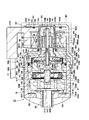
- FIG. 5 is an enlarged cross-sectional view showing a damping force adjusting valve and a solenoid in FIG. 1 taken out.
- FIG. 3 is an enlarged cross-sectional view showing part III in FIG. 2 with the right side facing upward.
- FIG. 5 is an enlarged cross-sectional view showing a coil, a bobbin, and an exterior member together with a part of a mold for molding. It is an enlarged cross-sectional view of the position which is substantially the same as FIG. 3 which shows the solenoid by 2nd Embodiment. It is an enlarged cross-sectional view of the position which is substantially the same as FIG. 3 which shows the solenoid by 3rd Embodiment.
- a damping force adjusting type hydraulic shock absorber 1 (hereinafter referred to as a hydraulic shock absorber 1) incorporating a solenoid 33 and a damping force adjusting device 17 as a damping force adjusting mechanism according to the present embodiment will be described with reference to FIG. To do.
- the hydraulic shock absorber 1 as a damping force adjustment type shock absorber includes a bottomed tubular outer cylinder 2 forming an outer shell.
- the lower end side of the outer cylinder 2 is closed by the bottom cap 3 using welding means or the like.
- the upper end side of the outer cylinder 2 is a crimped portion 2A bent inward in the radial direction.
- a rod guide 9 and a seal member 10 are provided between the caulking portion 2A and the inner cylinder 4.
- an opening 2B is formed concentrically with the connection port 12C of the intermediate cylinder 12.
- a damping force adjusting device 17 is attached to the lower side of the outer cylinder 2 so as to face the opening 2B.
- the bottom cap 3 is provided with a mounting eye 3A that is mounted on the wheel side of the vehicle, for example.
- the inner cylinder 4 is provided coaxially with the outer cylinder 2.
- the lower end side of the inner cylinder 4 is fitted and attached to the bottom valve 13.
- the upper end side of the inner cylinder 4 is fitted and attached to the rod guide 9.
- An oil liquid as a hydraulic fluid (working fluid) is sealed in the inner cylinder 4 as a cylinder.
- the hydraulic fluid is not limited to oil and oil, and may be, for example, water mixed with additives.
- An annular reservoir chamber A is formed between the inner cylinder 4 and the outer cylinder 2. Gas is sealed in the reservoir chamber A together with the oil liquid.
- the gas may be air in an atmospheric pressure state, or a gas such as compressed nitrogen gas may be used.
- An oil hole 4A that allows the rod-side oil chamber B to always communicate with the annular oil chamber D is bored in the radial direction at an intermediate position in the length direction (axial direction) of the inner cylinder 4.
- the piston 5 is slidably inserted into the inner cylinder 4. That is, the piston 5 is slidably provided in the inner cylinder 4.
- the piston 5 defines (separates) the inside of the inner cylinder 4 into a rod-side oil chamber B and a bottom-side oil chamber C.
- a plurality of oil passages 5A and 5B that enable communication between the rod-side oil chamber B and the bottom-side oil chamber C are formed in the piston 5 so as to be separated from each other in the circumferential direction.
- a disc valve 6 on the extension side is provided on the lower end surface of the piston 5.
- the extension side disc valve 6 opens when the pressure in the rod side oil chamber B exceeds the relief set pressure when the piston 5 slides and displaces upward in the extension stroke of the piston rod 8, and the pressure at this time. Is relieved to the bottom side oil chamber C side via each oil passage 5A.
- the relief set pressure is set to a pressure higher than the valve opening pressure when the damping force adjusting device 17 is set to hard.
- the upper end surface of the piston 5 is provided with a contraction side check valve 7 that opens when the piston 5 slides and displaces downward in the contraction stroke of the piston rod 8 and closes at other times.
- the check valve 7 allows the oil liquid in the bottom side oil chamber C to flow in each oil passage 5B toward the rod side oil chamber B, and prevents the oil liquid from flowing in the opposite direction. ..
- the valve opening pressure of the check valve 7 is set to a pressure lower than the valve opening pressure when the damping force adjusting device 17 is softly set, and substantially no damping force is generated. The fact that this substantially no damping force is generated is a force equal to or less than the friction of the piston 5 and the seal member 10, and does not affect the movement of the vehicle.
- the piston rod 8 extends in the inner cylinder 4 in the axial direction.
- the lower end side of the piston rod 8 is inserted into the inner cylinder 4.
- the piston rod 8 is provided so as to be fixed to the piston 5 by a nut 8A or the like.
- the upper end side of the piston rod 8 projects to the outside of the outer cylinder 2 and the inner cylinder 4 via the rod guide 9. That is, the piston rod 8 is connected to the piston 5 and extends to the outside of the inner cylinder 4.
- the lower end of the piston rod 8 may be further extended so as to protrude outward from the bottom portion (for example, the bottom cap 3) side to form so-called both rods.
- a stepped cylindrical rod guide 9 is provided on the upper end side of the inner cylinder 4.
- the rod guide 9 positions the upper portion of the inner cylinder 4 at the center of the outer cylinder 2 and guides the piston rod 8 so as to be slidable in the axial direction on the inner peripheral side thereof.
- An annular sealing member 10 is provided between the rod guide 9 and the crimped portion 2A of the outer cylinder 2.
- the seal member 10 is formed by, for example, baking an elastic material such as rubber on a metal ring plate provided with a hole through which the piston rod 8 is inserted in the center.
- the sealing member 10 seals between the elastic material and the piston rod 8 by sliding the inner circumference of the elastic material on the outer peripheral side of the piston rod 8.
- the seal member 10 is formed with a lip seal 10A as a check valve extending so as to come into contact with the rod guide 9 on the lower surface side.
- the lip seal 10A is arranged between the oil reservoir 11 and the reservoir chamber A.
- the lip seal 10A allows the oil liquid or the like in the oil reservoir 11 to flow toward the reservoir chamber A side through the return passage 9A of the rod guide 9, and prevents the flow in the opposite direction.
- An intermediate cylinder 12 is arranged between the outer cylinder 2 and the inner cylinder 4.
- the intermediate cylinder 12 is attached to, for example, the outer peripheral side of the inner cylinder 4 via upper and lower tubular seals 12A and 12B.
- the intermediate cylinder 12 has an annular oil chamber D formed inside so as to surround the outer peripheral side of the inner cylinder 4 over the entire circumference.
- the annular oil chamber D is an oil chamber independent of the reservoir chamber A.
- the annular oil chamber D is always in communication with the rod side oil chamber B by a radial oil hole 4A formed in the inner cylinder 4.
- a connection port 12C to which the tubular holder 20 of the damping force adjusting valve 18 is attached is provided on the lower end side of the intermediate cylinder 12.
- the bottom valve 13 is located on the lower end side of the inner cylinder 4 and is provided between the bottom cap 3 and the inner cylinder 4.
- the bottom valve 13 has a valve body 14 that defines (separates) a reservoir chamber A and a bottom side oil chamber C between the bottom cap 3 and the inner cylinder 4, and a reduction side provided on the lower surface side of the valve body 14.
- the disc valve 15 and the extension side check valve 16 provided on the upper surface side of the valve body 14 are configured.
- Oil passages 14A and 14B that enable communication between the reservoir chamber A and the bottom side oil chamber C are formed in the valve body 14 at intervals in the circumferential direction, respectively.
- the disc valve 15 on the reduction side opens when the pressure in the oil chamber C on the bottom side exceeds the relief set pressure when the piston 5 slides and displaces downward in the reduction stroke of the piston rod 8. Is relieved to the reservoir chamber A side via each oil passage 14A.
- the relief set pressure is set to a pressure higher than the valve opening pressure when the damping force adjusting device 17 is set to hard.
- the extension-side check valve 16 opens when the piston 5 slides and displaces upward during the extension stroke of the piston rod 8, and closes at other times.
- the check valve 16 allows the oil liquid in the reservoir chamber A to flow in each oil passage 14B toward the bottom oil chamber C, and prevents the oil liquid from flowing in the opposite direction.
- the valve opening pressure of the check valve 16 is set to a pressure lower than the valve opening pressure when the damping force adjusting device 17 is softly set, and substantially no damping force is generated.
- the damping force adjusting device 17 is arranged with its base end side (left end side in FIG. 1) interposed between the reservoir chamber A and the annular oil chamber D, and is arranged on the tip end side (FIG. 1).
- the right end side of the outer cylinder 2) is provided so as to project outward in the radial direction from the lower side of the outer cylinder 2.
- the damping force adjusting device 17 generates a damping force by controlling the flow of the oil liquid from the annular oil chamber D to the reservoir chamber A by the damping force adjusting valve 18. Further, the generated damping force is variably adjusted by adjusting the valve opening pressure of the damping force adjusting valve 18 with the solenoid 33 used as the damping force variable actuator.
- the damping force adjusting device 17 controls the flow of the working fluid (oil liquid) generated by the sliding of the piston 5 in the inner cylinder 4 to generate a damping force.
- the damping force adjusting valve 18 has a substantially cylindrical valve case 19 provided so that the base end side thereof is fixed around the opening 2B of the outer cylinder 2 and the tip end side protrudes outward in the radial direction from the outer cylinder 2.
- a tubular holder 20 whose base end side is fixed to the connection port 12C of the intermediate cylinder 12 and whose tip end side is an annular flange portion 20A and is arranged inside the valve case 19 with a gap, and a flange portion of this tubular holder 20. It is configured to include a valve member 21 and the like that come into contact with 20A.
- the base end side of the valve case 19 is an inner flange portion 19A protruding inward in the radial direction, and an engaging ring 54 for caulking and connecting the cover member 53 of the solenoid 33 is attached to the tip end side of the valve case 19.
- a full-circumferential groove 19B is formed.
- An annular oil chamber 19C leading to the reservoir chamber A is formed between the inner peripheral surface of the valve case 19 and the outer peripheral surface of the valve member 21, the pilot body 26, and the like.
- one side is an oil passage 20B that communicates with the annular oil chamber D and the other side extends to the position of the valve member 21.
- a spacer 22 in which a notch 22A serving as an oil passage is formed is sandwiched between the flange portion 20A of the tubular holder 20 and the inner flange portion 19A of the valve case 19.
- the spacer 22 in which the notch 22A is formed is provided, but instead of the spacer 22, the notch for forming the oil passage in the inner flange portion 19A may be formed radially. Good. With this configuration, one component can be reduced.
- the valve member 21 is provided with a central hole 21A located at the center in the radial direction and extending in the axial direction. Further, the valve member 21 is provided with a plurality of oil passages 21B around the central hole 21A so as to be separated from each other in the circumferential direction. One side (left side of FIGS. 1 and 2) of each oil passage 21B is always connected to the oil passage 20B side of the tubular holder 20. Further, on the end surface of the other side (right side of FIGS. 1 and 2) of the valve member 21, an annular recess 21C formed so as to surround the other side opening of the oil passage 21B and a radial outer side of the annular recess 21C.
- An annular valve seat 21D is provided at the position where the main disc valve 23 is detached and seated.
- the oil passage 21B of the valve member 21 transfers the oil liquid between the annular oil chamber D side (the oil passage 20B) and the reservoir chamber A side (the oil chamber 19C) via the main disk valve 23. Distribute.
- the main disc valve 23 constituting the main valve is sandwiched between the valve member 21 and the large diameter portion 24A of the pilot pin 24 on the inner peripheral side, and is seated on the annular valve seat 21D of the valve member 21 on the outer peripheral side.
- An elastic seal member 23A is fixed to the outer peripheral portion on the back surface side of the main disc valve 23.
- the main disc valve 23 is opened by receiving the pressure on the oil passage 21B side (annular oil chamber D side) of the valve member 21 and separating from the annular valve seat 21D, and the oil passage 21B (annular oil) of the valve member 21 is opened.
- the chamber D side) is communicated with the oil chamber 19C (reservoir chamber A side).
- the pilot pin 24 is formed in a stepped cylindrical shape having a large diameter portion 24A in the middle portion in the axial direction and a central hole 24B extending in the axial direction in the central portion in the radial direction.
- An orifice 24C is formed at one end of the central hole 24B.
- One end side (the left end side of FIGS. 1 and 2) of the pilot pin 24 is press-fitted into the center hole 21A of the valve member 21, and the main disc valve 23 is sandwiched between the large diameter portion 24A and the valve member 21. ..
- the other end side of the pilot pin 24 (the right end side of FIGS. 1 and 2) is fitted in the center hole 26C of the pilot body 26.
- an oil passage 25 extending in the axial direction is formed between the central hole 26C of the pilot body 26 and the other end side of the pilot pin 24, and the main disk valve 23 and the pilot body 26 are formed through the oil passage 25. It is connected to a back pressure chamber 27 formed between the two.
- a plurality of oil passages 25 extending in the axial direction are provided in the circumferential direction on the side surface on the other end side of the pilot pin 24, and the other circumferential positions are press-fitted into the central hole 26C of the pilot body 26.
- the pilot body 26 is formed in a substantially bottomed tubular shape having a cylindrical portion 26A having a stepped hole formed inside and a bottom portion 26B that closes the cylindrical portion 26A.
- a central hole 26C into which the other end side of the pilot pin 24 is fitted is provided in the central portion of the bottom portion 26B.
- a protruding cylinder portion 26D located on the outer diameter side and protruding toward the valve member 21 over the entire circumference is provided on one end side (left end side of FIGS. 1 and 2) of the bottom portion 26B of the pilot body 26 .
- the elastic seal member 23A of the main disc valve 23 is liquid-tightly fitted to the inner peripheral surface of the protruding cylinder portion 26D, and a back pressure chamber 27 is formed between the main disc valve 23 and the pilot body 26.
- the internal pressure of the back pressure chamber 27 acts on the main disc valve 23 in the valve closing direction, that is, in the direction in which the main disc valve 23 is seated on the annular valve seat 21D of the valve member 21.
- a valve seat portion 26E on which the pilot valve member 32 is detached and seated is provided so as to surround the central hole 26C. Further, inside the cylindrical portion 26A of the pilot body 26, when the return spring 28 for urging the pilot valve member 32 away from the valve seat portion 26E of the pilot body 26 and the solenoid 33 are in a non-energized state (pilot valve).
- a disc valve 29 constituting a fail-safe valve (when the member 32 is farthest from the valve seat portion 26E), a holding plate 30 having an oil passage 30A formed on the center side, and the like are arranged.
- the cap 31 is fitted and fixed with the return spring 28, the disc valve 29, the holding plate 30, and the like arranged inside the cylindrical portion 26A.
- the cap 31 for example, four notches 31A serving as a flow path for flowing the oil liquid flowing to the solenoid 33 side through the oil passage 30A of the holding plate 30 to the oil chamber 19C (reservoir chamber A side) are located at four positions in the circumferential direction. Is formed in.
- the pilot valve member 32 constituting the pilot valve is formed in a substantially cylindrical shape.
- the tip of the pilot valve member 32 that is, the tip of the pilot body 26 that takes off and seats on the valve seat 26E, has a tapered shape.
- An actuating pin 49 of the solenoid 33 is fitted and fixed inside the pilot valve member 32, and the valve opening pressure of the pilot valve member 32 is adjusted according to the energization of the solenoid 33.
- the pilot valve member 32 as a control valve is controlled by the movement of the movable iron core 48.
- a flange portion 32A serving as a spring receiver is formed on the base end side of the pilot valve member 32 over the entire circumference.
- the flange portion 32A is a fail-safe valve by coming into contact with the disc valve 29 when the solenoid 33 is in a non-energized state, that is, when the pilot valve member 32 is farthest from the valve seat portion 26E as shown in FIG. Consists of.
- FIG. 3 is shown with the right side of part III in FIG. 2 facing upward. That is, the upper and lower directions in FIG. 3 correspond to the left and right directions in FIG.
- the solenoid 33 is incorporated in the damping force adjusting device 17 as a damping force variable actuator of the damping force adjusting device 17.
- the solenoid 33 includes a mold coil 34, a stator core 42 including a second member and a stator, a movable iron core 48 as a mover, an operating pin 49, a storage member 50, and a cover including the first member and the third member. It includes a member 53.
- the mold coil 34 includes a bobbin 35, a coil 36, and an exterior member 37.
- the bobbin 35 is formed as a tubular body having flange portions protruding from both ends in the axial direction over the entire circumference in the radial direction.
- the coil 36 is wound around a bobbin 35 (between the flange portions of the bobbin 35) and generates a magnetic force when energized.
- the exterior member 37 covers the coil 36 and the bobbin 35. That is, the mold coil 34 is formed in a substantially cylindrical shape by integrally covering (molding) the coil 36 wound around the bobbin 35 with an exterior member 37 such as a thermosetting resin.
- a cover member 53 (bottom 53B) is arranged on one end side in the axial direction of the exterior member 37 (right end side in FIG. 2, upper end side in FIG. 3), and the other end side in the axial direction of the exterior member 37 (FIG. 2).
- a stator core 42 (flange portion 43C) is arranged on the left end side (lower end side in FIG. 3).
- the exterior member 37 is a cable extraction portion 37A because a part in the circumferential direction projects outward in the radial direction between the cover member 53 (bottom portion 53B) and the stator core 42 (flange portion 43C).
- An electric wire cable 41 is connected to the cable take-out portion 37A.
- the coil 36 becomes an electromagnet and generates a magnetic force by supplying (energizing) electric power through the electric wire cable 41.
- the stator core 42 is arranged on the inner peripheral side of the coil 36, and is formed in a bottomed tubular shape by a magnetic material (magnetic material).
- the stator core 42 includes a stator core main body 43 including a second member and an anchor member 44 as a stator.
- the stator core main body 43 and the anchor member 44 are formed as separate parts.
- the stator core main body 43 is formed in a bottomed cylindrical shape, and has a cylindrical tubular portion 43A having a stepped hole inside and one end side of the tubular portion 43A (right end side in FIG. 2, upper end side in FIG. 3). It has a bottom 43B that occludes.
- the tubular portion 43A of the stator core main body 43 is inserted inside the exterior member 37 (that is, inside the mold coil 34).
- the tubular portion 43A of the stator core main body 43 is provided with a flange portion 43C that is located on the other end side and projects radially outward over the entire circumference.
- the flange portion 43C of the stator core main body 43 corresponds to the second member. That is, the flange portion 43C is the other end in the axial direction of the exterior member 37 (the left end in FIG. 2, the upper end in FIG. 3) and the side on which the anchor member 44 is arranged (in other words, the pilot valve member 32 is arranged). Located on the side). The outer peripheral side of the flange portion 43C is in contact with the tubular portion 53A (small diameter tubular portion 53A2) of the cover member 53. Further, on the outer diameter side of the flange portion 43C, a tubular fitting portion 43D protruding toward the damping force adjusting valve 18 side is provided. The cap 31 of the damping force adjusting valve 18 is fitted on the inner diameter side of the fitting portion 43D. The valve case 19 of the damping force adjusting valve 18 is fitted on the outer diameter side of the fitting portion 43D.
- a seal groove 43E and an engagement groove 43F are provided in order from the damping force adjusting valve 18 side over the entire circumference.
- a seal ring 45 is mounted on the seal groove 43E, and the seal ring 45 tightly seals the space between the stator core 42 and the valve case 19 of the damping force adjusting valve 18. The opening edge of the valve case 19 is crimped to the engaging groove 43F.
- a thin-walled portion 43G that partially reduces the magnetic path cross-sectional area in the axial direction is provided at a portion of the tubular portion 43A of the stator core main body 43 that faces the movable iron core 48 in the radial direction.
- the thin-walled portion 43G is formed by providing an annular recess 43H on the inner peripheral side of the tubular portion 43A of the stator core main body 43. That is, as shown in FIG. 3, the tubular portion 43A of the stator core main body 43 has a fitting tubular portion 43A1 to which the storage member 50 is fitted and a large-diameter tubular portion 43A2 having a larger outer diameter than the fitting tubular portion 43A1. And are continuous with each other via the stepped surface 43A3.
- annular positioning recess 43J in which the flange portion 44B of the anchor member 44 is positioned and the tubular portion 44A of the anchor member 44 are fitted in this order from the opening side.
- An annular recess 43H, a facing surface portion 43K facing the movable iron core 48 via a minute radial gap, and a bush mounting portion 43L into which a bush 46 supporting one end side of the operating pin 49 is fitted are provided. ing.
- the base end side of the fitting tubular portion 43A1 is formed in the radial direction.
- the thickness of the thin part is 43G.
- the magnetic field generated by the coil 36 is saturated due to the large magnetic resistance of the thin portion 43G, and is induced between the movable iron core 48 and the anchor member 44 to function as a solenoid thrust.
- the bottom portion 43B of the stator core main body 43 has a tapered shape from the continuous portion with the tubular portion 43A, and its end surface faces the bottom portion 52B of the storage member 50 with a gap. As a result, it is suppressed that an axial force is directly applied from the cover member 53 to the stator core main body 43 via the bottom portion 52B of the storage member 50.
- the anchor member 44 is fitted to the other end side (left end side in FIGS. 1 and 2) of the tubular portion 43A of the stator core main body 43.
- the anchor member 44 sucks the movable iron core 48.
- the anchor member 44 constitutes the stator core 42 together with the stator core main body 43.
- the anchor member 44 is a fixed iron core that attracts the movable iron core 48 when a magnetic force is generated by the coil 36.
- the anchor member 44 is formed in a stepped cylindrical shape, and has a tubular portion 44A through which an operating pin 49 is inserted and a flange portion 44B protruding in the radial direction from the outer peripheral surface of the tubular portion 44A. ..
- a hole 44C into which the movable iron core 48 enters when the movable iron core 48 is attracted is provided on the end surface of the tubular portion 44A facing the movable iron core 48. Further, inside the anchor member 44, a bush mounting portion 44D into which a bush 47 supporting the operating pin 49 is fitted is provided.
- the movable iron core 48 as an iron core called a plunger is arranged inside the stator core 42 and is provided so as to be movable in the axial direction. That is, the movable iron core 48 is arranged on the inner peripheral side of the mold coil 34 (more specifically, the coil 36) and is provided so as to be movable in the axial direction. In this case, the movable iron core 48 is integrally fixed to the operating pin 49.
- the operating pin 49 is supported by the stator core main body 43 and the anchor member 44 via bushes 46 and 47, respectively.
- the movable iron core 48 is formed in a substantially cylindrical shape by an iron-based magnetic material, and when a magnetic force is generated by the coil 36, it is attracted to the anchor member 44 of the stator core 42 to generate thrust.
- a communication passage 48A is formed in the movable iron core 48.
- the movable iron core 48 is integrally fixed (sub-assembled) to the intermediate portion of the operating pin 49, which is a member that transmits the thrust of the movable iron core 48. Both sides of the actuating pin 49 in the axial direction are supported by the stator core 42 via bushes 46 and 47 to enable axial displacement. As shown in FIG. 2, one end side (left end side in FIG. 2) of the operating pin 49 protrudes from the stator core 42, and the pilot valve member 32 of the damping force adjusting valve 18 is fixed to the protruding end. .. Therefore, the pilot valve member 32 moves (displaces) integrally with the movable iron core 48 and the operating pin 49. In other words, the valve opening pressure of the pilot valve member 32 corresponds to the thrust of the movable iron core 48 based on the energization of the coil 36.
- the storage member 50 is fitted to the tubular portion 43A (fitting tubular portion 43A1) of the stator core main body 43.
- the storage member 50 stores the movable iron core 48.
- the storage member 50 stores the movable iron core 48 together with the tubular portion 43A of the stator core 42.
- the storage member 50 is in contact with the thin portion 43G of the stator core 42 (stator core main body 43) from the outer peripheral side.
- one end of the storage member 50 (the left end in FIG. 2 and the lower end in FIG. 3) is in contact with the stepped surface 43A3 of the stator core 42.
- the other end of the storage member 50 (the right end in FIG. 2, the upper end in FIG. 3) is in contact with the cover member 53.
- the portion of the storage member 50 that comes into contact with the thin portion 43G of the stator core 42 is made of a non-magnetic material.
- the storage member 50 is bottomed as a whole, and is composed of two members, a ring member 51 as a non-magnetic annular member and a cap member 52 as a ferromagnetic annular member. That is, the storage member 50 has a cylindrical ring member 51 made of a non-magnetic material which is a portion that abuts in the radial direction with the thin portion 43G of the stator core 42, and a ferromagnetic material which is on the other side of the abutting portion. It is composed of a bottom tubular cap member 52.
- the storage member 50 has a function of protecting (reinforcing) the thin portion 43G of the stator core 42. That is, the storage member 50 prevents the thin-walled portion 43G from being damaged by pressure when the ring member 51 comes into contact with the outer peripheral side of the thin-walled portion 43G.
- the ring member 51 is formed of a non-magnetic material to protect the thin-walled portion 43G while ensuring the saturation of the magnetic flux in the thin-walled portion 43G.
- the cap member 52 is used as the storage member 50, and the stator core main body 43 and the movable iron core 48 are housed in the cap member 52.
- Japanese Patent Application Laid-Open No. 2013-213588 shows. Therefore, the stator core main body may be used as a storage member.
- the cap member 52 by forming the cap member 52 with a ferromagnetic material, it is possible to suppress an increase in the magnetic resistance of the portion of the stator core 42 that is separated from the thin portion 43G.
- the cap member 52 is formed in a bottomed tubular shape having a tubular portion 52A and a bottom portion 52B, and the tubular portion 52A thereof is fitted into the tubular portion 43A (fitting tubular portion 43A1) of the stator core main body 43 by, for example, light press fitting. It fits. As a result, the tubular portion 52A of the cap member 52 is brought into contact with the stator core main body 43 with a sufficient contact area that does not become a resistance for passing magnetic flux.
- the cover member 53 can press the ring member 51 together with the cap member 52 so as not to be displaced in the axial direction, and can efficiently transfer magnetic flux between the cover member 53 and the cap member 52.
- a gap is formed between the inside of the bottom portion 52B of the cap member 52 (the left side of FIGS. 1 and 2 and the lower side of FIG. 3) and the stator core 42. That is, the inner side surface of the bottom portion 52B of the cap member 52 facing the bottom portion 43B of the stator core main body 43 has a minute gap (gap) capable of passing a certain amount of magnetic flux to the bottom portion 43B of the stator core main body 43. They are facing each other. As a result, the direct application of a (axial) force from the cover member 53 to the stator core 42 via the bottom portion 52B of the cap member 52 is suppressed.
- the cover member 53 covers the outer peripheral side of the coil 36.
- the cover member 53 is formed as a yoke using a magnetic material (magnetic material).
- the cover member 53 forms a magnetic circuit (magnetic path) on the outer peripheral side of the mold coil 34 (coil 36).
- the cover member 53 is formed in a substantially bottomed tubular shape. That is, the cover member 53 is roughly composed of a stepped cylindrical tubular portion 53A having a large-diameter tubular portion 53A1 and a small-diameter tubular portion 53A2, and a bottom portion 53B that closes one end side of the tubular portion 53A.
- the tubular portion 53A of the cover member 53 corresponds to the third member.
- the tubular portion 53A covers the mold coil 34, more specifically, the outer peripheral side in the radial direction of the exterior member 37.
- the bottom portion 53B of the cover member 53 corresponds to the first member. That is, the bottom portion 53B is arranged on the mold coil 34, more specifically, on one end side in the axial direction of the exterior member 37 (right end side in FIG. 2, upper end side in FIG. 3).
- the tubular portion 53A and the bottom portion 53B of the cover member 53 are integrally formed, so that the third member and the first member are configured as an integral member (integral part).
- a notch 53C extending in the axial direction is formed in the tubular portion 53A of the cover member 53. That is, a notch 53C extending from the opening end side to the bottom 53B is formed at a portion of the tubular portion 53A in the circumferential direction corresponding to the cable extraction portion 37A of the mold coil 34.
- the inner peripheral surface of the tubular portion 53A (small diameter tubular portion 53A2) of the cover member 53 faces the outer peripheral surface of the mold coil 34 (exterior member 37) with a gap. As a result, the radial force applied to the cover member 53 is not directly applied to the exterior member 37 of the mold coil 34.
- the outer peripheral surface of the flange portion 43C of the stator core main body 43 abuts on the inner peripheral surface of the tubular portion 53A (small diameter tubular portion 53A2) of the cover member 53 by, for example, light press fitting, and between the cover member 53 and the stator core 42. It is configured so that the magnetic flux can be transferred.
- a caulking portion 53D that is plastically deformed inward in the radial direction is provided at the opening end of the tubular portion 53A (large diameter tubular portion 53A1) of the cover member 53. That is, the open end of the tubular portion 53A is crimped to the outer peripheral surface of the valve case 19 with the engaging ring 54 mounted on the all-around groove 19B of the valve case 19 of the damping force adjusting valve 18. As a result, the damping force adjusting valve 18 and the solenoid 33 are integrally coupled.
- the bottom portion 53B of the cover member 53 has a contact recess having an inner diameter dimension larger than the outer diameter dimension of the tubular portion 52A and the bottom portion 52B of the storage member 50 (cap member 52) at a position corresponding to the bottom portion 52B of the cap member 52. 53B1 is provided. The bottom portion 53B of the cover member 53 abuts axially with the bottom portion 52B of the cap member 52 at the position of the contact recess 53B1 so that magnetic flux can be transferred between the cover member 53 and the cap member 52. doing.
- the magnetic flux generated by the coil 36 is generated by the flange portion 43C of the stator core main body 43, the contact portion between the flange portion 43C and the cylinder portion 53A (small diameter cylinder portion 53A2) of the cover member 53, the cover member 53, and the bottom portion 53B of the cover member 53.
- the movable iron core 48 goes around the anchor member 44, and the fitting portion (contact portion) of the anchor member 44 and the stator core main body 43 in this order.
- the magnetic flux can be transferred by the contact portion (the portion in surface contact), and high magnetic efficiency is ensured. be able to.
- the mold coil 34 is formed by integrally covering (molding) the coil 36 wound around the bobbin 35 with a resin exterior member 37.
- a first seam 61 and a second seam 62 between the bobbin 35 and the exterior member 37 on the inner diameter side of the mold coil 34.
- the first seam 61 is a seam in which the inner peripheral surface of the exterior member 37 and the inner peripheral surface of the bobbin 35 are connected. That is, the first seam 61 is a seam in which the inner peripheral surface of the exterior member 37 and the inner peripheral surface of the bobbin 35 are continuously connected because the exterior member 37 and the bobbin 35 have the same inner diameter. ..
- a step 63 is formed between the bobbin 35 and the exterior member 37. That is, the second seam 62 has an inner diameter larger than that of the bobbin 35 at one end side (left side of FIG. 2, lower side of FIG. 3) of the exterior member 37 with respect to the bobbin 35.
- the inner peripheral surface of the bobbin 35 and the inner peripheral surface of the bobbin 35 are connected as a step 63.
- the step 63 is formed by abutting the annular pedestal 101 of the mold 100 for molding and the bobbin 35 when the coil 36 and the bobbin 35 are covered with the exterior member 37 by molding. ..
- the axial position of the bobbin 35 is regulated by abutting against the annular pedestal 101 of the mold 100, and the radial position of the bobbin 35 is regulated by fitting into the central cylinder portion 102 of the mold 100.
- the coil 36 and the bobbin 35 can be positioned with high accuracy in the mold 100 when molding is performed.
- water such as rainwater or muddy water infiltrates the first seam 61 and the second seam 62 from the outside. That is, in the path where water can enter, if there is no sealing means on the upstream side (upstream side in the direction in which water enters from the outside) of the first seam 61 and the second seam 62, water invades the coil 36. , There is a possibility that sufficient insulation cannot be ensured.
- the first seal member 64 is provided between the cover member 53 and the exterior member 37, and the second seal member 65 is provided between the stator core main body 43 and the exterior member 37.
- the first seal member 64 is on the upstream side of the first seam 61 (that is, the upstream side in the direction in which water enters the inside from the outside of the solenoid 33), and the bottom portion 53B of the cover member 53 and the exterior member 37. It is placed between and. For this reason, a seal groove 66 is formed on the side surface (axial end surface) of the exterior member 37 of the mold coil 34 facing the cover member 53 over the entire circumference.
- a first seal member 64 is mounted in the seal groove 66.
- the first sealing member 64 is composed of, for example, a sealing ring such as an O-ring formed in an annular shape by an elastic material such as rubber.
- the first sealing member 64 liquidally seals (seals) between the exterior member 37 of the mold coil 34 and the bottom portion 53B of the cover member 53. This prevents moisture such as rainwater and muddy water from entering the coil 36 and the bobbin 35 side via the cover member 53 and the mold coil 34.
- the first seal member 64 is a surface seal that seals between the outer surface of the exterior member 37 (bottom surface of the seal groove 66) and the inner surface of the cover member 53 (bottom surface of the bottom portion 53B) (between the planes). ..
- the first seal member 64 has an exterior based on a tightening allowance between "the thickness in the axial direction of the exterior member 37" and "the gap between the bottom surface of the seal groove 66 of the exterior member 37 and the bottom surface of the bottom portion 53B of the cover member 53".
- the member 37 is pressed toward the flange portion 43C of the stator core main body 43 while sealing between the exterior member 37 and the cover member 53.
- the exterior member 37 is arranged by being pressed against the flange portion 43C of the stator core main body 43 by the first seal member 64. Further, the first seal member 64 is mounted in the seal groove 66 of the exterior member 37, whereby the exterior member 37 is provided between the first seal member 64 and the bobbin 35.
- the second seal member 65 is on the upstream side of the second seam 62 (that is, the upstream side in the direction in which water enters the inside from the outside of the solenoid 33), and is the flange portion 43C of the stator core main body 43 and the exterior member 37. It is placed between and. Therefore, the inner diameter between the flange portion 43C and the bobbin 35 of the exterior member 37 is larger than the inner diameter of the bobbin 35. As a result, a step 63 is formed between the side surface of the bobbin 35 and the inner peripheral surface of the exterior member 37. A second seal member 65 is mounted between the step 63 and the tubular portion 43A (large diameter tubular portion 43A2) of the stator core main body 43.
- the second seal member 65 is composed of, for example, a seal ring such as an O-ring formed in an annular shape by an elastic material such as rubber.
- the second seal member 65 liquidally seals (seals) between the exterior member 37 of the mold coil 34 and the tubular portion 43A (large diameter tubular portion 43A2) of the stator core main body 43. This prevents moisture such as rainwater and muddy water from entering the coil 36 and the bobbin 35 side via the mold coil 34 and the stator core main body 43.
- the second seal member 65 is a shaft seal that seals between the inner peripheral surface of the exterior member 37 and the outer peripheral surface of the tubular portion 43A (large diameter tubular portion 43A2) of the stator core main body 43 (between the peripheral surfaces).
- the second seal member 65 includes "a cylinder portion 43A (large diameter cylinder portion 43A2) of the storage member 50 or the stator core main body 43", "a bobbin 35 surrounding the storage member 50", “exterior member 37", and "stator core”. It is arranged between the flange portion 43C of the main body 43 and the flange portion 43C.
- the second seal member 65 has a "thickness in its own radial direction" and a "gap between the inner peripheral surface of the exterior member 37 and the outer peripheral surface of the tubular portion 43A (large diameter tubular portion 43A2) of the stator core main body 43". Based on the tightening allowance, the inner peripheral surface of the exterior member 37 and the outer peripheral surface of the tubular portion 43A (large diameter tubular portion 43A2) of the stator core main body 43 are sealed.
- the solenoid 33 of the first embodiment includes the bobbin 35, the exterior member 37, the first seal member 64, and the second seal member 65.
- the second seal member 65 is housed in a step 63 provided between the bobbin 35 and the exterior member 37.
- the second seal member 65 is located between the outer circumference of the tubular portion 43A (large diameter tubular portion 43A2) of the stator core main body 43, which is a magnetic circuit member, and the flange portion 43C of the stator core main body 43 and the bobbin 35 of the exterior member 37. It is a shaft seal that seals these peripheral surfaces with the inner circumference of the part.
- the second seam 62 which is the interface between the bobbin 35 and the exterior member 37, is located deeper than the portion sealed by the second sealing member 65, that is, on the downstream side in the moisture intrusion direction. As a result, the second seam 62 is arranged at a position where it is not immersed in water by the second seal member 65.
- the first seal member 64 is housed in the seal groove 66 provided in the exterior member 37.
- the first seal member 64 is a surface seal that seals the bottom surface (flat surface) between the bottom surface of the seal groove 66 and the bottom surface of the bottom portion 53B of the cover member 53.
- the first seam 61 which is the interface between the bobbin 35 and the exterior member 37, is located deeper than the portion sealed by the first sealing member 64, that is, on the downstream side in the moisture intrusion direction. As a result, the first seam 61 is arranged at a position where it is not immersed in water by the first seal member 64.
- first seal member 64 and the second seal member 65 there are two. It is possible to prevent the seams 61 and 62 from being flooded.
- the second seal member 65 is a shaft seal and the first seal member 64 is a surface seal, the exterior member 37 is pressed against the flange portion 43C side of the stator core main body 43 which is a magnetic circuit member. Therefore, the tightening allowance of the first seal member 64 is uniquely determined. Moreover, since the first seal member 64 provides vibration insulation with the cover member 53, it is possible to suppress the generation of PWM noise due to the operation of the solenoid 33. Further, the step 63 in which the second seal member 65 is accommodated is formed by exposing the side surface (bottom surface) of the bobbin 35. Therefore, when the coil 36 and the bobbin 35 are covered with the exterior member 37 by molding, the step 63 can position the bobbin 35 and the coil 36 in the axial direction in the mold 100 to be molded.
- the solenoid 33 according to the present embodiment and the hydraulic shock absorber 1 in which the solenoid 33 is incorporated have the above-described configuration, and the operation thereof will be described next.
- the hydraulic shock absorber 1 when the hydraulic shock absorber 1 is mounted on a vehicle such as an automobile, for example, the upper end side of the piston rod 8 is attached to the vehicle body side, and the attachment eye 3A side provided on the bottom cap 3 is attached to the wheel side. Further, the electric wire cable 41 of the solenoid 33 is connected to the controller of the vehicle or the like.
- the piston rod 8 When the vehicle is traveling, when vibrations in the upward and downward directions occur due to unevenness of the road surface or the like, the piston rod 8 is displaced so as to extend or contract from the outer cylinder 2, and a damping force is generated by the damping force adjusting device 17 or the like. It can buffer the vibration of the vehicle. At this time, the generated damping force of the hydraulic shock absorber 1 can be variably adjusted by controlling the current value of the solenoid 33 to the coil 36 by the controller and adjusting the valve opening pressure of the pilot valve member 32.
- the check valve 7 on the contraction side of the piston 5 is closed by the movement of the piston 5 in the inner cylinder 4.
- the oil liquid in the oil chamber B on the rod side is pressurized, and the damping force is adjusted through the oil hole 4A of the inner cylinder 4, the annular oil chamber D, and the connection port 12C of the intermediate cylinder 12. It flows into the oil passage 20B of the tubular holder 20 of the valve 18.
- the oil liquid corresponding to the movement of the piston 5 flows from the reservoir chamber A into the bottom side oil chamber C by opening the extension side check valve 16 of the bottom valve 13.
- the pressure in the rod-side oil chamber B reaches the valve opening pressure of the disc valve 6, the disc valve 6 opens and the pressure in the rod-side oil chamber B is relieved to the bottom-side oil chamber C.
- the oil liquid that has flowed into the oil passage 20B of the tubular holder 20 is a valve as shown by an arrow X in FIG. 2 before the valve opening of the main disk valve 23 (piston speed low speed range).
- the pilot valve member 32 is pushed open through the central hole 21A of the member 21, the central hole 24B of the pilot pin 24, and the central hole 26C of the pilot body 26, and flows into the inside of the pilot body 26.
- the oil liquid that has flowed into the inside of the pilot body 26 is between the flange portion 32A of the pilot valve member 32 and the disc valve 29, the oil passage 30A of the holding plate 30, the notch 31A of the cap 31, and the oil of the valve case 19. It flows through the chamber 19C to the reservoir chamber A.
- the oil passage 20B of the tubular holder 20 When the pressure of the oil passage 20B of the tubular holder 20, that is, the pressure of the oil chamber B on the rod side reaches the valve opening pressure of the main disc valve 23 as the piston speed increases, the oil passage 20B of the tubular holder 20 As shown by an arrow Y in FIG. 2, the oil liquid flowing into the valve member 21 passes through the oil passage 21B of the valve member 21, pushes open the main disk valve 23, passes through the oil chamber 19C of the valve case 19, and flows to the reservoir chamber A. ..
- the contraction side check valve 7 of the piston 5 opens due to the movement of the piston 5 in the inner cylinder 4, and the extension side check valve 16 of the bottom valve 13 closes.
- the oil liquid in the bottom oil chamber C flows into the rod side oil chamber B.
- the oil liquid corresponding to the amount of the piston rod 8 infiltrated into the inner cylinder 4 flows from the rod side oil chamber B to the reservoir chamber A via the damping force adjusting valve 18 in the same route as during the extension stroke. ..
- the bottom valve 13 opens and the pressure in the bottom oil chamber C is transferred to the reservoir chamber A. Relieve.
- the damping force is generated by the orifice 24C of the pilot pin 24 and the valve opening pressure of the pilot valve member 32. Is generated, and after the main disc valve 23 is opened, a damping force is generated according to the opening degree of the main disc valve 23.
- the damping force can be directly controlled regardless of the piston speed by adjusting the valve opening pressure of the pilot valve member 32 by energizing the coil 36 of the solenoid 33.
- the valve opening pressure of the pilot valve member 32 is reduced, and a damping force on the soft side is generated.
- the valve opening pressure of the pilot valve member 32 increases, and a damping force on the hard side is generated.
- the internal pressure of the back pressure chamber 27 communicating with the pilot valve member 32 via the oil passage 25 on the upstream side changes depending on the valve opening pressure.
- the pilot valve member 32 retracts (displaces in the direction away from the valve seat portion 26E) by the return spring 28, and the flange of the pilot valve member 32.
- the portion 32A and the disc valve 29 come into contact with each other. In this state, a damping force can be generated by the valve opening pressure of the disc valve 29, and a necessary damping force can be obtained even when a malfunction such as a disconnection of the coil occurs.
- the first seal member 64 is located between the cover member 53 and the exterior member 37 on the upstream side of the first seam 61 (that is, on the upstream side in the direction in which water enters from the outside).
- the second seal member 65 is arranged between the stator core main body 43 and the exterior member 37 on the upstream side of the second seam (that is, on the upstream side in the direction in which water enters from the outside).
- the first seam 61 between the bobbin 35 and the exterior member 37 can be sealed by the first seal member 64, and the second seam 62 between the bobbin 35 and the exterior member 37 is the second seal member 65. Can be sealed with.
- the sealing property between the bobbin 35 and the exterior member 37 with respect to the first seam 61 and the second seam 62 can be improved. That is, since the first seam 61 and the second seam 62, which are the interfaces between the bobbin 35 and the exterior member 37, are provided inside the first seal member 64 and the second seal member 65, the bobbin 35 and the exterior member 37 These interfaces can be reliably waterproofed regardless of the bonding status of the interfaces.
- the first seal member 64 is a surface seal
- the second seal member 65 is a shaft seal. Therefore, the first seal member 64 can seal between the outer surface of the exterior member 37 (the bottom surface of the seal groove 66) and the inner surface of the cover member 53 (the bottom surface of the bottom portion 53B).
- the second seal member 65 includes an inner peripheral surface of the exterior member 37 (the inner peripheral surface of the exterior member 37 between the bobbin 35 and the flange portion 43C of the stator core main body 43) and the outer peripheral surface of the stator core main body 43 (cylindrical portion). It is possible to seal between the 43A large diameter tubular portion 43A2 and the outer peripheral surface).
- the first seal member 64 is tightened with "the thickness in its own axial direction" and "the gap between the outer surface of the exterior member 37 and the inner surface of the cover member 53 where the first seal member 64 is arranged". Based on the margin, it is possible to seal between the outer surface of the exterior member 37 and the inner surface of the cover member 53 while pressing the exterior member 37 toward the flange portion 43C of the stator core main body 43.
- the second seal member 65 has a "thickness in its own radial direction" and a "gap between the inner peripheral surface of the exterior member 37 and the outer peripheral surface of the stator core main body 43" where the second seal member 65 is arranged. It is possible to seal between the inner peripheral surface of the exterior member 37 and the outer peripheral surface of the stator core main body 43 based on the tightening allowance. In this case, since the specifications (direction of the sealing surface, sealing method) of the first sealing member 64 and the second sealing member 65 can be different, for example, the sealing property while absorbing the difference in linear expansion when the temperature rises. Can be secured.
- the cover member 53, the first seal member 64, the mold coil 34, the second seal member 65, and the stator core main body 43 can be easily assembled, and the productivity can be improved. That is, since one of the first seal member 64 and the second seal member 65 is used as a shaft seal and the other is used as a surface seal, the exterior member 37 containing the coil 36 inside can be pressed in one direction in the axial direction. It is possible, and the tightening allowance of the surface seal can be clearly determined. Moreover, it is possible to suppress the increase in the axial length of the solenoid 33 by the first seal member 64 and the second seal member 65, and the solenoid 33 can be downsized (shortened in the axial length) and extended. Therefore, it is possible to improve the vehicle body mountability of the hydraulic shock absorber 1 in which the solenoid 33 is incorporated.
- the first seal member and the second seal member may cause the mold coil including the coil, bobbin, and exterior member to float with respect to the cover member, thereby forming a gap above and below. That is, in this case, the crushing allowance of the seal member is not clearly determined, and the vibration due to the PWM energization is easily transmitted, which may cause noise.
- the first seal member 64 is a surface seal and the second seal member 65 is a shaft seal (seals are different)
- the direction in which the elastic force of the seal member is applied is determined. Can be different.
- the tightening allowance is uniquely determined, and it is possible to make it difficult to transmit the vibration due to PWM energization.
- the second seal member 65 is arranged between the storage member 50, the bobbin 35, the exterior member 37, and the stator core main body 43. Therefore, the second seal member 65, which is a shaft seal, can seal between the storage member 50, the bobbin 35, the exterior member 37, and the stator core main body 43.
- the exterior member 37 is arranged by being pressed against the stator core main body 43 by the first seal member 64.
- the first seal member 64 which is a surface seal, provides a portion where the first seal member 64 is arranged between the "thickness in the axial direction of itself" and the “outer surface of the exterior member 37 and the inner surface of the cover member 53". Sealing between the outer surface of the exterior member 37 and the inner surface of the cover member 53 while pressing the exterior member 37 toward the stator core main body 43 in the direction away from the cover member 53 based on the tightening allowance with the "gap". Can be done.
- the first seal member 64 can suppress the direct transmission of vibration (PWM sound) from the outer surface of the exterior member 37 to the inner surface of the cover member 53, and this vibration (sound) leaks to the outside. Can be suppressed. That is, by using the first seal member 64 on the top plate surface side as a surface seal, it is possible to vibrate and insulate between the exterior member 37 including the coil 36 and the cover member 53, and suppress PWM noise. can do. In other words, since the exterior member 37 (mold coil 34) is pressed toward the inside (the flange portion 43C side of the stator core body 43) instead of the outside (cover member 53 side), the PWM sound is less likely to leak to the outside. it can.
- PWM sound direct transmission of vibration
- a step 63 is formed between the bobbin 35 and the exterior member 37. Therefore, the step 63 of the second seam 62 can be set as the contact position between the mold 100 and the bobbin 35, which is a mold when the coil 36 and the bobbin 35 are covered with the exterior member 37 by molding. That is, the bobbin 35 can be positioned in the mold 100 at the time of molding by the step 63.
- an exterior member 37 is provided between the first seal member 64 and the bobbin 35. Therefore, when the coil 36 and the bobbin 35 are covered with the exterior member 37 by molding, the exterior member 37 can be poured to the first seam 61 having no step with the bobbin 35.
- the stator core 42 (second member) and the cover member 53 (first and third members) are both made of a magnetic material. Therefore, a magnetic circuit (magnetic path) can be formed by the stator core 42 and the cover member 53.
- FIG. 5 shows a second embodiment.
- the feature of the second embodiment is that the first seal member is a shaft seal and the second seal member is a surface seal.
- the same components as those in the first embodiment described above are designated by the same reference numerals, and the description thereof will be omitted.
- the first seal member 71 is provided between the cover member 53, the exterior member 37, and the storage member 50, and the second seal member 72 is provided between the stator core main body 43 and the exterior member 37. It is provided.
- the first seal member 71 is located on the upstream side of the first seam 61 and is arranged between the cover member 53 and the exterior member 37. For this reason, a step 73 having an inner diameter larger than that of the other portion is formed on the inner peripheral edge of the exterior member 37 on the side facing the cover member 53 over the entire circumference.
- a step 73 is provided between the cover member 53 and the bobbin 35 of the exterior member 37, which is an annular recess portion formed by a portion having the same inner diameter as the bobbin 35 and a portion having an inner diameter larger than this portion. Has been done.
- step 73 more specifically, the inner peripheral surface and side surface of the step 73, the outer peripheral surface of the storage member 50 (cylinder portion 52A of the cap member 52), and the inner surface (bottom surface) of the cover member 53 (bottom portion 53B).
- a first seal member 71 is mounted between them.
- the first seal member 71 liquidally seals (seals) between the exterior member 37 of the mold coil 34 and the cap member 52 of the storage member 50. This prevents moisture such as rainwater and muddy water from entering the coil 36 and the bobbin 35 side via the cover member 53 and the mold coil 34.
- the first seal member 71 is a shaft seal that seals between the inner peripheral surface of the exterior member 37 and the outer peripheral surface of the cap member 52 (cylinder portion 52A) of the storage member 50 (between the peripheral surfaces). ..
- the first seal member 71 is arranged between the "storage member 50", the "exterior member 37", and the "bottom 53B of the cover member 53".
- the first seal member 71 has "the thickness in its own radial direction” and "the gap between the inner peripheral surface of the step 73 of the exterior member 37 and the outer peripheral surface of the cap member 52 (cylinder portion 52A) of the storage member 50". Seals between the exterior member 37 and the storage member 50 based on the tightening allowance.
- the first seal member 71 is mounted on the step 73 of the exterior member 37, whereby the exterior member 37 is provided between the first seal member 71 and the bobbin 35.
- the second seal member 72 is located on the upstream side of the second seam 62 and is arranged between the flange portion 43C of the stator core main body 43 and the exterior member 37.
- a seal groove 74 is formed on the side surface (axial end surface) of the exterior member 37 of the mold coil 34 facing the flange portion 43C of the stator core main body 43 over the entire circumference.
- a second seal member 72 is mounted in the seal groove 74.
- the second seal member 72 liquid-tightly seals (seals) between the exterior member 37 of the mold coil 34 and the flange portion 43C of the stator core main body 43. This prevents moisture such as rainwater and muddy water from entering the coil 36 and the bobbin 35 side via the stator core 42 and the mold coil 34.
- the second seal member 72 seals between the outer surface of the exterior member 37 (bottom surface of the seal groove 74) and the inner surface of the stator core 42 (stator core main body 43) (side surface of the flange portion 43C) (between the planes). It is a surface seal to be used.
- the second seal member 72 is based on the tightening allowance between "the thickness in the axial direction of the outer member 37" and "the gap between the bottom surface of the seal groove 74 of the exterior member 37 and the side surface of the flange portion 43C of the stator core main body 43". While pressing the exterior member 37 toward the bottom portion 53B of the cover member 53, the exterior member 37 and the stator core main body 43 are sealed.
- the exterior member 37 is arranged by being pressed against the bottom portion 53B of the cover member 53 by the second seal member 72. Further, the second seal member 72 is mounted in the seal groove 74 of the exterior member 37, whereby the exterior member 37 is provided between the second seal member 72 and the bobbin 35.
- the solenoid 33 of the second embodiment includes the bobbin 35, the exterior member 37, the first seal member 71, and the second seal member 72.
- the second seal member 72 fits in the seal groove 74 provided in the exterior member 37.
- the second seal member 72 is a surface seal that seals these surfaces (flat surfaces) between the bottom surface of the seal groove 74 and the side surface of the flange portion 43C of the stator core main body 43 that serves as a magnetic circuit member.
- the second seam 62 which is the interface between the bobbin 35 and the exterior member 37, is located deeper than the portion sealed by the second sealing member 72, that is, on the downstream side in the moisture intrusion direction. As a result, the second seam 62 is arranged at a position where it is not immersed in water by the second seal member 72.
- the first seal member 71 is housed in a step 73 provided on the inner diameter side of the exterior member 37.
- the first seal member 71 is a shaft seal that seals the peripheral surface between the outer circumference of the storage member 50 (the tubular portion 52A of the cap member 52) which is a magnetic circuit member and the inner circumference of the step 73 of the exterior member 37. is there.
- the first seam 61 which is the interface between the bobbin 35 and the exterior member 37, is located deeper than the portion sealed by the first sealing member 71, that is, on the downstream side in the moisture intrusion direction. As a result, the first seam 61 is arranged at a position where it is not immersed in water by the first seal member 71.
- the two seams (interfaces) between the first seam 61 and the second seam 62 are inside the first seal member 71 and the second seal member 72. Since it is provided in, it is possible to prevent the two seams 61 and 62 from being flooded. Further, since the first seal member 71 is a shaft seal and the second seal member 72 is a surface seal, the exterior member 37 is pressed against the bottom 53B side of the cover member 53 which is a magnetic circuit member. Therefore, the tightening allowance of the second seal member 72 is uniquely determined.
- the second embodiment seals from the first seal member 71 and the second seal member 72 as described above, and the basic operation thereof is not particularly different from that according to the first embodiment described above.
- the first seal member 71 is a shaft seal and the second seal member 72 is a surface seal. Therefore, the first sealing member 71 seals between the inner peripheral surface of the exterior member 37 (the inner peripheral surface of the step 73) and the outer peripheral surface of the storage member 50 (the outer peripheral surface of the tubular portion 52A of the cap member 52). be able to.
- the second seal member 72 can seal between the outer surface of the exterior member 37 (bottom surface of the seal groove 74) and the inner surface of the stator core main body 43 (side surface of the flange portion 43C).
- the first seal member 71 has a "thickness in its own radial direction” and a “gap in a portion where the first seal member 71 is arranged between the inner peripheral surface of the exterior member 37 and the outer peripheral surface of the storage member 50". It is possible to seal between the inner peripheral surface of the exterior member 37 and the outer peripheral surface of the storage member 50 based on the tightening allowance. Further, the second seal member 72 is tightened with “the thickness in its own axial direction” and “the gap between the outer surface of the exterior member 37 and the inner surface of the stator core main body 43" where the second seal member 72 is arranged.
- the sealing property can be ensured while absorbing the difference in linear expansion when the temperature rises. Can be done. That is, since one of the first seal member 71 and the second seal member 72 is used as a shaft seal and the other is used as a surface seal, the exterior member 37 containing the coil 36 inside can be pressed in one direction in the axial direction. It is possible, and the tightening allowance of the surface seal can be clearly determined.
- FIG. 6 shows a third embodiment.
- the feature of the third embodiment is that the stator core is provided with a seal groove for mounting the second seal member.
- the same components as those in the first and second embodiments described above are designated by the same reference numerals, and the description thereof will be omitted.
- the seal groove 81 is formed on the side surface (axial side surface) of the flange portion 43C of the stator core main body 43 facing the exterior member 37 over the entire circumference.
- a second seal member 72 is mounted in the seal groove 81.
- the second seal member 72 liquid-tightly seals (seals) between the exterior member 37 of the mold coil 34 and the flange portion 43C of the stator core main body 43. This prevents moisture such as rainwater and muddy water from entering the coil 36 and the bobbin 35 side via the stator core 42 and the mold coil 34.
- the second seal member 72 is a surface seal that seals between the side surface (bottom surface of the seal groove 81) of the stator core 42 (flange portion 43C of the stator core main body 43) and the side surface of the exterior member 37 (between the planes). Is.
- the second seal member 72 covers the exterior member 37 based on the tightening allowance between "the thickness in the axial direction of the stator core 42" and "the gap between the bottom surface of the seal groove 81 of the stator core 42 and the side surface of the exterior member 37".
- the exterior member 37 and the stator core main body 43 are sealed while being pressed toward the bottom portion 53B of the member 53.
- the exterior member 37 is arranged by being pressed against the bottom portion 53B of the cover member 53 by the second seal member 72. Further, the second seal member 72 is mounted in the seal groove 81 of the stator core main body 43, whereby the exterior member 37 is provided between the second seal member 72 and the bobbin 35.
- the solenoid 33 of the third embodiment includes the bobbin 35, the exterior member 37, the first seal member 71, and the second seal member 72.
- the second seal member 72 is housed in a seal groove 81 provided in the stator core main body 43, which is a magnetic circuit member.
- the second seal member 72 is a surface seal that seals these surfaces (flat surfaces) between the bottom surface of the seal groove 81 and the side surface of the exterior member 37.
- the second seam 62 which is the interface between the bobbin 35 and the exterior member 37, is located deeper than the portion sealed by the second sealing member 72, that is, on the downstream side in the moisture intrusion direction. As a result, the second seam 62 is arranged at a position where it is not immersed in water by the second seal member 72.
- the first seal member 71 is contained in the step 73 provided on the inner diameter side of the exterior member 37, as in the second embodiment.
- the two seams (interfaces) between the first seam 61 and the second seam 62 are larger than those of the first seal member 71 and the second seal member 72. Since it is provided on the inside, it is possible to prevent the two seams 61 and 62 from being flooded.
- the first seal member 71 is a shaft seal and the second seal member 72 is a surface seal
- the exterior member 37 is pressed against the bottom 53B side of the cover member 53 which is a magnetic circuit member. Therefore, the tightening allowance of the second seal member 72 is uniquely determined.
- the third embodiment seals from the first seal member 71 and the second seal member 72 as described above, and the basic operation thereof is not particularly different from that according to the second embodiment described above. That is, in the third embodiment as in the first embodiment and the second embodiment, the sealing property between the bobbin 35 and the exterior member 37 can be improved.
- tubular portion 53A and the bottom portion 53B of the cover member 53 are integrally formed.
- the present invention is not limited to this, and for example, the tubular portion (third member) of the cover member and the bottom portion (first member) of the cover member may be separated. That is, the first member arranged on one end side in the axial direction of the exterior member and the third member covering the radial outer peripheral side of the exterior member may be separate parts. This also applies to the second embodiment and the third embodiment.
- the cover member 53 is composed of one member
- the cover member may be composed of two members or more members by dividing the cover member in the circumferential direction, for example.
- the cover member may be composed of, for example, two members, an inner cover member (first cover member) and an outer cover member (second cover member) that covers the inner cover member from the outside. This also applies to the second embodiment and the third embodiment.
- the storage member 50 is provided with a cap member 52 which is a bottomed tubular member.
- the present invention is not limited to this, and for example, the storage member may be configured to include a tubular member having both ends open in the axial direction. This also applies to the second embodiment and the third embodiment.
- the storage member 50 is composed of two members, a ring member 51 and a cap member 52, has been described as an example.
- the present invention is not limited to this, and for example, the storage member may be composed of one tubular member or one bottomed tubular member. This also applies to the second embodiment and the third embodiment.
- stator core 42 is composed of the stator core main body 43 and the anchor member 44 (fixed iron core) has been described as an example.
- the present invention is not limited to this, and for example, the stator core may be composed of a stator core main body integrated with an anchor member (fixed iron core) and a lid body attached to the stator core main body. This also applies to the second embodiment and the third embodiment.
- the outer peripheral surface of the second seal member 65 faces the inner peripheral surface of the exterior member 37, and the inner peripheral surface of the second seal member 65 is the tubular portion 43A (large diameter tubular portion 43A2) of the stator core main body 43. ),
- the case of facing the outer peripheral surface of) was described as an example.
- the present invention is not limited to this, and for example, the storage member may be extended toward the second member so that the outer peripheral surface of the storage member and the inner peripheral surface of the second seal member face each other.
- a step 63 is formed at the second seam 62
- the present invention is not limited to this, and for example, a step may be formed at the first seam.
- a step may be formed at either the first seam or the second seam.
- the ring member 51 is made of a non-magnetic material.
- the present invention is not limited to this, and for example, by making the axial dimension of the ring member smaller (shorter) than the dimension of the thin-walled portion, at least a part of the portion of the stator core that comes into contact with the thin-walled portion is made of a non-magnetic material. May be good. This also applies to the second embodiment and the third embodiment.
- the storage member 50 is provided with a ring member 51, which is a non-magnetic annular member in which the entire portion of the stator core 42 that contacts the thin portion 43G is a non-magnetic material, and the other end side of the contact portion.
- a ring member 51 which is a non-magnetic annular member in which the entire portion of the stator core 42 that contacts the thin portion 43G is a non-magnetic material
- the cap member 52 which is a ferromagnetic annular member made of a ferromagnet
- the present invention is not limited to this, and for example, by making the axial dimension of the ring member larger (longer) on one end side than the thin-walled portion, the non-magnetic annular member comes into contact with the thin-walled portion of the stator core and the contacting portion.
- a structure may be configured in which one end side is a non-magnetic material. This also applies to the second embodiment and the third embodiment.
- the cover member 53 is made of a yoke (magnetic material)
- a yoke magnetic material
- the present invention is not limited to this, and for example, by forming the cover member with a non-magnetic material, a coil open type solenoid without a yoke may be used. This also applies to the second embodiment and the third embodiment.
- the solenoid 33 is configured as a proportional solenoid
- the present invention is not limited to this, and for example, it may be configured as an ON / OFF solenoid. This also applies to the second embodiment and the third embodiment.
- the first aspect is a solenoid, which is a coil wound around a bobbin and generating a magnetic force by energization, an exterior member covering the coil and the bobbin, and arranged on the inner peripheral side of the coil in the axial direction.
- a mover provided so as to be movable, a storage member for accommodating the mover, a stator for sucking the mover, a control valve controlled by the movement of the mover, and one end in the axial direction of the exterior member.
- a first member arranged on the side, a second member located at the other end of the exterior member in the axial direction and located on the side on which the control valve is arranged, and a third member covering the outer peripheral side in the radial direction of the exterior member.
- a member is provided, and a first seam and a second seam are provided between the bobbin and the exterior member, and the first member and the exterior member are on the upstream side of the first seam.
- the first seal member is arranged between the two, and the second seal member is arranged on the upstream side of the second seam between the second member and the exterior member.
- the first seal member is arranged between the first member and the exterior member on the upstream side of the first seam (that is, on the upstream side in the direction in which water enters from the outside).
- the second seal member is arranged between the second member and the exterior member on the upstream side of the second seam (that is, on the upstream side in the direction in which water enters from the outside). Therefore, the first seam between the bobbin and the exterior member can be sealed with the first sealing member, and the second seam between the bobbin and the exterior member can be sealed with the second sealing member. Thereby, the sealing property between the bobbin and the exterior member with respect to the first seam and the second seam can be improved.
- the first seal member is a surface seal and the second seal member is a shaft seal.
- the first sealing member can seal between the outer surface of the exterior member and the inner surface of the first member.
- the second seal member can seal between the inner peripheral surface of the exterior member and the outer peripheral surface of the second member or the storage member. That is, the first seal member is based on the tightening allowance between "the thickness in the axial direction of itself" and "the gap between the outer surface of the exterior member and the inner surface of the first member where the first seal member is arranged". Therefore, it is possible to seal between the outer surface of the exterior member and the inner surface of the first member while pressing the exterior member toward the second member.
- the second seal member has "the thickness in its own radial direction" and “the gap between the inner peripheral surface of the exterior member and the outer peripheral surface of the second member or the storage member” where the second seal member is arranged. It is possible to seal between the inner peripheral surface of the exterior member and the outer peripheral surface of the second member or the storage member based on the tightening allowance. In this case, since the specifications (direction of the sealing surface) of the first sealing member and the second sealing member can be different, for example, the sealing property can be ensured while absorbing the difference in linear expansion when the temperature rises. .. It is also possible to improve productivity.
- a “face seal” means a seal member arranged between the end faces of two members having a fluid flow passage (hole) and sealing a gap between the two members.
- the “shaft seal” is arranged between the outer peripheral surface of the storage member and the inner peripheral surface of the member (bobbin, exterior member, second member) surrounding the storage member, and surrounds the storage member and the storage member. A seal member that seals the gap between the member and the member.
- the first seal member is a shaft seal and the second seal member is a surface seal.
- the first sealing member can seal between the inner peripheral surface of the exterior member and the outer peripheral surface of the first member or the storage member.
- the second seal member can seal between the outer surface of the exterior member and the inner surface of the second member. That is, the first seal member has "the thickness in its own radial direction" and “the gap between the inner peripheral surface of the exterior member and the outer peripheral surface of the first member or the storage member" where the first seal member is arranged. It is possible to seal between the inner peripheral surface of the exterior member and the outer peripheral surface of the first member or the storage member based on the tightening allowance.
- the second seal member is based on the tightening allowance between "the thickness in the axial direction of itself" and "the gap between the outer surface of the exterior member and the inner surface of the second member where the second seal member is arranged". Therefore, it is possible to seal between the outer surface of the exterior member and the inner surface of the second member while pressing the exterior member toward the first member.
- the specifications (direction of the sealing surface) of the first sealing member and the second sealing member can be different, for example, the sealing property can be ensured while absorbing the difference in linear expansion when the temperature rises. ..
- the second seal member is arranged between the storage member, the bobbin surrounding the storage member, the exterior member, and the second member. Will be done.
- the storage member, the bobbin, the exterior member, and the second member can be sealed by the second seal member which is a shaft seal.
- the exterior member is pressed against the second member by the first seal member and arranged.
- the first seal member which is a surface seal, arranges the first seal member between the "thickness in the axial direction of itself" and the “outer surface of the exterior member and the inner surface of the first member". While pressing the exterior member toward the second member in the direction away from the first member, the outer surface of the exterior member and the inner surface of the first member are sealed based on the tightening allowance with the "gap of the portion to be used". be able to.
- the first seal member can suppress the direct transmission of vibration (PWM sound) from the outer surface of the exterior member to the inner surface of the first member, and prevent the vibration (sound) from leaking to the outside. Can be suppressed. That is, since the PWM sound is pressed toward the inside (second member side) instead of the outside (first member side, third member side), the PWM sound can be prevented from leaking to the outside.
- PWM sound direct transmission of vibration
- a step is formed between the bobbin and the exterior member at either the first seam or the second seam.
- the contact position between the mold (mold) and the bobbin when the step of either the first seam or the second seam is covered with the exterior member by molding the coil and the bobbin. can do. That is, the bobbin can be positioned in the mold at the time of molding with a step.
- the exterior member is provided between the first seal member and the bobbin. According to this seventh aspect, when the coil and the bobbin are covered with the exterior member by molding, the exterior member can be poured up to the first seam.
- the first, second, and third members are all made of a magnetic material.
- a magnetic circuit can be formed by the first, second, and third members.
- a ninth aspect is a damping force adjusting mechanism, which is a coil wound around a bobbin and generating a magnetic force by energization, an exterior member covering the coil and the bobbin, and arranged on the inner peripheral side of the coil.
- a mover provided so as to be movable in the axial direction, a storage member for accommodating the mover, a stator for sucking the mover, a control valve controlled by the movement of the mover, and an exterior member.
- a first member arranged on one end side in the axial direction, a second member located on the other end side in the axial direction of the exterior member and located on the side on which the control valve is arranged, and a radial outer peripheral side of the exterior member.
- a third member for covering is provided, and a first seam and a second seam are provided between the bobbin and the exterior member, which is on the upstream side of the first seam and is the upstream side of the first member and the exterior member.
- the first seal member is arranged between the exterior member, and the second seal member is arranged on the upstream side of the second seam between the second member and the exterior member.
- a tenth aspect is a damping force adjusting shock absorber, in which a cylinder in which a working fluid is sealed, a piston slidably provided in the cylinder, and an outside of the cylinder connected to the piston.
- a piston rod extending to the cylinder and a damping force adjusting mechanism for controlling the flow of working fluid generated by sliding of the piston in the cylinder to generate a damping force are provided, and the damping force adjusting mechanism is provided on the bobbin.
- a second member which is the other end in the axial direction and is located on the side where the control valve is arranged and a third member which covers the radial outer peripheral side of the exterior member are provided, and the bobbin and the exterior member are provided.
- a first seam and a second seam are provided between them, and a first seal member is arranged between the first member and the exterior member on the upstream side of the first seam, and the second seal member is arranged.
- a second seal member is arranged on the upstream side of the seam between the second member and the exterior member.
- the present invention is not limited to the above-described embodiment, and includes various modifications.
- the above-described embodiment has been described in detail in order to explain the present invention in an easy-to-understand manner, and is not necessarily limited to the one including all the described configurations.
- it is possible to replace a part of the configuration of one embodiment with the configuration of another embodiment and it is also possible to add the configuration of another embodiment to the configuration of one embodiment.
- Hydraulic shock absorber (damping force adjustment type shock absorber) 17 Damping force adjusting device (damping force adjusting mechanism) 32 Pilot valve member (control valve) 33 Solenoid 34 Mold coil 35 Bobbin 36 coil 37 Exterior member 42 Stator core 43 Stator core body (No. 1) 2 members) 44 anchor member (stator) 48 movable iron core (movable element) 50 storage member 53 cover member (1st member, 3rd member) 61 1st seam 62 2nd seam 63,73 step 64,71 1st seal Member 65,72 Second seal member 66,74,81 Seal groove
Landscapes
- Engineering & Computer Science (AREA)
- General Engineering & Computer Science (AREA)
- Physics & Mathematics (AREA)
- Electromagnetism (AREA)
- Mechanical Engineering (AREA)
- Power Engineering (AREA)
- Fluid-Damping Devices (AREA)
Priority Applications (5)
| Application Number | Priority Date | Filing Date | Title |
|---|---|---|---|
| JP2021564021A JPWO2021117800A1 (https=) | 2019-12-12 | 2020-12-10 | |
| CN202080085753.0A CN114787947A (zh) | 2019-12-12 | 2020-12-10 | 螺线管、衰减力调整机构以及衰减力调整式缓冲器 |
| US17/783,773 US20230032430A1 (en) | 2019-12-12 | 2020-12-10 | Solenoid, damping force adjustment mechanism, and damping force adjustable shock absorber |
| KR1020227014054A KR20220066167A (ko) | 2019-12-12 | 2020-12-10 | 솔레노이드, 감쇠력 조정 기구 및 감쇠력 조정식 완충기 |
| DE112020006079.9T DE112020006079T5 (de) | 2019-12-12 | 2020-12-10 | Magnetspule, Dämpfungskrafteinstellmechanismus und dämpfungskrafteinstellbarer Stoßdämpfer |
Applications Claiming Priority (2)
| Application Number | Priority Date | Filing Date | Title |
|---|---|---|---|
| JP2019-224682 | 2019-12-12 | ||
| JP2019224682 | 2019-12-12 |
Publications (1)
| Publication Number | Publication Date |
|---|---|
| WO2021117800A1 true WO2021117800A1 (ja) | 2021-06-17 |
Family
ID=76329897
Family Applications (1)
| Application Number | Title | Priority Date | Filing Date |
|---|---|---|---|
| PCT/JP2020/045995 Ceased WO2021117800A1 (ja) | 2019-12-12 | 2020-12-10 | ソレノイド、減衰力調整機構および減衰力調整式緩衝器 |
Country Status (6)
| Country | Link |
|---|---|
| US (1) | US20230032430A1 (https=) |
| JP (1) | JPWO2021117800A1 (https=) |
| KR (1) | KR20220066167A (https=) |
| CN (1) | CN114787947A (https=) |
| DE (1) | DE112020006079T5 (https=) |
| WO (1) | WO2021117800A1 (https=) |
Cited By (3)
| Publication number | Priority date | Publication date | Assignee | Title |
|---|---|---|---|---|
| WO2023157503A1 (ja) * | 2022-02-17 | 2023-08-24 | 日立Astemo株式会社 | ソレノイド、減衰力調整機構および減衰力調整式緩衝器 |
| WO2024022913A1 (de) * | 2022-07-27 | 2024-02-01 | Thyssenkrupp Bilstein Gmbh | Schwingungsdämpfer mit einer dämpfungsventileinrichtung |
| WO2025004566A1 (ja) * | 2023-06-30 | 2025-01-02 | 日立Astemo株式会社 | ソレノイド、緩衝器及びソレノイドの製造方法 |
Families Citing this family (4)
| Publication number | Priority date | Publication date | Assignee | Title |
|---|---|---|---|---|
| JP7377958B2 (ja) * | 2020-04-22 | 2023-11-10 | 日立Astemo株式会社 | ソレノイド、減衰力調整機構および減衰力調整式緩衝器 |
| JP7378885B2 (ja) * | 2022-03-08 | 2023-11-14 | カヤバ株式会社 | 流体圧緩衝器 |
| EP4343168A1 (en) * | 2022-09-23 | 2024-03-27 | DRiV Automotive Inc. | Insert arrangement and a method of assembling a damping arrangement |
| CN117662676B (zh) * | 2023-05-31 | 2024-10-29 | 比亚迪股份有限公司 | 减振器以及车辆 |
Citations (3)
| Publication number | Priority date | Publication date | Assignee | Title |
|---|---|---|---|---|
| JP2005268698A (ja) * | 2004-03-22 | 2005-09-29 | Keihin Corp | 電磁アクチュエータ |
| JP2011222799A (ja) * | 2010-04-12 | 2011-11-04 | Denso Corp | リニアソレノイド |
| JP2014011352A (ja) * | 2012-06-29 | 2014-01-20 | Hitachi Automotive Systems Ltd | ソレノイド |
Family Cites Families (23)
| Publication number | Priority date | Publication date | Assignee | Title |
|---|---|---|---|---|
| JPS60137283U (ja) * | 1984-02-22 | 1985-09-11 | 本田技研工業株式会社 | 電磁作動装置 |
| JPH0926039A (ja) * | 1995-07-14 | 1997-01-28 | Nok Corp | 制御弁 |
| JP4288430B2 (ja) * | 1995-12-26 | 2009-07-01 | 株式会社日立製作所 | 減衰力調整式油圧緩衝器 |
| JP3887760B2 (ja) * | 1996-08-09 | 2007-02-28 | 株式会社日立製作所 | 減衰力調整式油圧緩衝器 |
| JP4048512B2 (ja) * | 1998-03-31 | 2008-02-20 | 株式会社日立製作所 | 減衰力調整式油圧緩衝器 |
| JP4147502B2 (ja) * | 1998-06-26 | 2008-09-10 | 株式会社日立製作所 | 減衰力調整式油圧緩衝器 |
| US7049916B2 (en) * | 2004-01-21 | 2006-05-23 | Keihin Corporation | Electromagnetic apparatus |
| JP2005310838A (ja) * | 2004-04-16 | 2005-11-04 | Hitachi Constr Mach Co Ltd | 電磁式駆動ユニット |
| JP5125441B2 (ja) * | 2007-11-21 | 2013-01-23 | アイシン・エィ・ダブリュ株式会社 | リニアソレノイド装置および電磁弁 |
| KR101568042B1 (ko) * | 2008-03-31 | 2015-11-10 | 가부시끼가이샤 히다치 세이사꾸쇼 | 감쇠력 조정식 완충기 |
| JP5387841B2 (ja) * | 2009-09-30 | 2014-01-15 | 日立オートモティブシステムズ株式会社 | 減衰力調整式緩衝器 |
| DE112010005255T5 (de) * | 2010-02-12 | 2013-05-02 | Hitachi Automotive Systems, Ltd. | Fahrzeugaufhängungsvorrichtung |
| JP5648790B2 (ja) * | 2010-08-31 | 2015-01-07 | 日立オートモティブシステムズ株式会社 | 緩衝器 |
| EP2682639A4 (en) * | 2011-03-02 | 2016-07-27 | Honda Motor Co Ltd | VARIABLE DAMPING FORCE SHOCK ABSORBER |
| JP5924979B2 (ja) * | 2011-05-31 | 2016-05-25 | 日立オートモティブシステムズ株式会社 | 緩衝器 |
| WO2013100076A1 (ja) * | 2011-12-27 | 2013-07-04 | 日立オートモティブシステムズ株式会社 | 緩衝器及び緩衝器の製造方法 |
| JP2014017282A (ja) * | 2012-07-05 | 2014-01-30 | Mikuni Corp | 電磁アクチュエータ |
| JP5678348B2 (ja) | 2013-07-22 | 2015-03-04 | 日立オートモティブシステムズ株式会社 | 減衰力調整式緩衝器 |
| JP2015034618A (ja) * | 2013-08-09 | 2015-02-19 | 日立オートモティブシステムズ株式会社 | 緩衝器 |
| JP6588778B2 (ja) * | 2015-09-14 | 2019-10-09 | Kyb株式会社 | 減衰弁及び緩衝器 |
| DE112016004910B4 (de) * | 2015-10-27 | 2026-01-22 | Hitachi Astemo, Ltd. | Stossdämpfer mit anpassbarer Dämpfungskraft |
| WO2017221967A1 (ja) * | 2016-06-24 | 2017-12-28 | 日立オートモティブシステムズ株式会社 | 減衰力調整式緩衝器 |
| JP2019071378A (ja) * | 2017-10-11 | 2019-05-09 | 株式会社デンソー | ソレノイド装置 |
-
2020
- 2020-12-10 JP JP2021564021A patent/JPWO2021117800A1/ja active Pending
- 2020-12-10 KR KR1020227014054A patent/KR20220066167A/ko not_active Ceased
- 2020-12-10 DE DE112020006079.9T patent/DE112020006079T5/de active Pending
- 2020-12-10 CN CN202080085753.0A patent/CN114787947A/zh active Pending
- 2020-12-10 WO PCT/JP2020/045995 patent/WO2021117800A1/ja not_active Ceased
- 2020-12-10 US US17/783,773 patent/US20230032430A1/en not_active Abandoned
Patent Citations (3)
| Publication number | Priority date | Publication date | Assignee | Title |
|---|---|---|---|---|
| JP2005268698A (ja) * | 2004-03-22 | 2005-09-29 | Keihin Corp | 電磁アクチュエータ |
| JP2011222799A (ja) * | 2010-04-12 | 2011-11-04 | Denso Corp | リニアソレノイド |
| JP2014011352A (ja) * | 2012-06-29 | 2014-01-20 | Hitachi Automotive Systems Ltd | ソレノイド |
Cited By (5)
| Publication number | Priority date | Publication date | Assignee | Title |
|---|---|---|---|---|
| WO2023157503A1 (ja) * | 2022-02-17 | 2023-08-24 | 日立Astemo株式会社 | ソレノイド、減衰力調整機構および減衰力調整式緩衝器 |
| JPWO2023157503A1 (https=) * | 2022-02-17 | 2023-08-24 | ||
| JP7843339B2 (ja) | 2022-02-17 | 2026-04-09 | Astemo株式会社 | ソレノイド、減衰力調整機構および減衰力調整式緩衝器 |
| WO2024022913A1 (de) * | 2022-07-27 | 2024-02-01 | Thyssenkrupp Bilstein Gmbh | Schwingungsdämpfer mit einer dämpfungsventileinrichtung |
| WO2025004566A1 (ja) * | 2023-06-30 | 2025-01-02 | 日立Astemo株式会社 | ソレノイド、緩衝器及びソレノイドの製造方法 |
Also Published As
| Publication number | Publication date |
|---|---|
| CN114787947A (zh) | 2022-07-22 |
| KR20220066167A (ko) | 2022-05-23 |
| JPWO2021117800A1 (https=) | 2021-06-17 |
| US20230032430A1 (en) | 2023-02-02 |
| DE112020006079T5 (de) | 2022-09-22 |
Similar Documents
| Publication | Publication Date | Title |
|---|---|---|
| WO2021117800A1 (ja) | ソレノイド、減衰力調整機構および減衰力調整式緩衝器 | |
| JP6646678B2 (ja) | 減衰力調整式緩衝器 | |
| JP6084787B2 (ja) | ソレノイド | |
| JP6719278B2 (ja) | 減衰力調整式緩衝器 | |
| JP6440861B2 (ja) | 緩衝器及び緩衝器の組立方法 | |
| WO2020195264A1 (ja) | 減衰力調整式緩衝器 | |
| US20260066167A1 (en) | Solenoid, damping force adjustment mechanism, and damping force adjustable shock absorber | |
| US12580113B2 (en) | Solenoid, damping force adjustment mechanism, and damping force adjustable shock absorber | |
| JP2014073018A (ja) | ソレノイド | |
| WO2022091632A1 (ja) | ソレノイド、ソレノイドバルブ、緩衝器およびソレノイドの製造方法 | |
| US12537125B2 (en) | Solenoid, damping force adjustment mechanism, and damping force adjustable shock absorber | |
| JP6383021B2 (ja) | ソレノイド | |
| WO2023238543A1 (ja) | ソレノイド、減衰力調整機構および減衰力調整式緩衝器 | |
| WO2023157503A1 (ja) | ソレノイド、減衰力調整機構および減衰力調整式緩衝器 | |
| WO2021215148A1 (ja) | ソレノイド、減衰力調整機構および減衰力調整式緩衝器 | |
| JP2024048011A (ja) | ソレノイド | |
| JP2024003373A (ja) | ソレノイド、減衰力調整機構および減衰力調整式緩衝器 | |
| WO2024166853A1 (ja) | ソレノイドアクチュエータおよび電磁弁 | |
| JP2024104126A (ja) | ソレノイドアクチュエータ |
Legal Events
| Date | Code | Title | Description |
|---|---|---|---|
| 121 | Ep: the epo has been informed by wipo that ep was designated in this application |
Ref document number: 20897755 Country of ref document: EP Kind code of ref document: A1 |
|
| ENP | Entry into the national phase |
Ref document number: 2021564021 Country of ref document: JP Kind code of ref document: A |
|
| ENP | Entry into the national phase |
Ref document number: 20227014054 Country of ref document: KR Kind code of ref document: A |
|
| 122 | Ep: pct application non-entry in european phase |
Ref document number: 20897755 Country of ref document: EP Kind code of ref document: A1 |