WO2020195676A1 - ポリオレフィン系樹脂発泡シート - Google Patents
ポリオレフィン系樹脂発泡シート Download PDFInfo
- Publication number
- WO2020195676A1 WO2020195676A1 PCT/JP2020/009393 JP2020009393W WO2020195676A1 WO 2020195676 A1 WO2020195676 A1 WO 2020195676A1 JP 2020009393 W JP2020009393 W JP 2020009393W WO 2020195676 A1 WO2020195676 A1 WO 2020195676A1
- Authority
- WO
- WIPO (PCT)
- Prior art keywords
- polyolefin
- foam sheet
- based resin
- thickness
- sheet
- Prior art date
- Legal status (The legal status is an assumption and is not a legal conclusion. Google has not performed a legal analysis and makes no representation as to the accuracy of the status listed.)
- Ceased
Links
Classifications
-
- C—CHEMISTRY; METALLURGY
- C08—ORGANIC MACROMOLECULAR COMPOUNDS; THEIR PREPARATION OR CHEMICAL WORKING-UP; COMPOSITIONS BASED THEREON
- C08J—WORKING-UP; GENERAL PROCESSES OF COMPOUNDING; AFTER-TREATMENT NOT COVERED BY SUBCLASSES C08B, C08C, C08F, C08G or C08H
- C08J9/00—Working-up of macromolecular substances to porous or cellular articles or materials; After-treatment thereof
- C08J9/0061—Working-up of macromolecular substances to porous or cellular articles or materials; After-treatment thereof characterized by the use of several polymeric components
-
- C—CHEMISTRY; METALLURGY
- C08—ORGANIC MACROMOLECULAR COMPOUNDS; THEIR PREPARATION OR CHEMICAL WORKING-UP; COMPOSITIONS BASED THEREON
- C08J—WORKING-UP; GENERAL PROCESSES OF COMPOUNDING; AFTER-TREATMENT NOT COVERED BY SUBCLASSES C08B, C08C, C08F, C08G or C08H
- C08J9/00—Working-up of macromolecular substances to porous or cellular articles or materials; After-treatment thereof
- C08J9/22—After-treatment of expandable particles; Forming foamed products
- C08J9/228—Forming foamed products
-
- C—CHEMISTRY; METALLURGY
- C08—ORGANIC MACROMOLECULAR COMPOUNDS; THEIR PREPARATION OR CHEMICAL WORKING-UP; COMPOSITIONS BASED THEREON
- C08J—WORKING-UP; GENERAL PROCESSES OF COMPOUNDING; AFTER-TREATMENT NOT COVERED BY SUBCLASSES C08B, C08C, C08F, C08G or C08H
- C08J9/00—Working-up of macromolecular substances to porous or cellular articles or materials; After-treatment thereof
-
- B—PERFORMING OPERATIONS; TRANSPORTING
- B29—WORKING OF PLASTICS; WORKING OF SUBSTANCES IN A PLASTIC STATE IN GENERAL
- B29C—SHAPING OR JOINING OF PLASTICS; SHAPING OF MATERIAL IN A PLASTIC STATE, NOT OTHERWISE PROVIDED FOR; AFTER-TREATMENT OF THE SHAPED PRODUCTS, e.g. REPAIRING
- B29C44/00—Shaping by internal pressure generated in the material, e.g. swelling or foaming ; Producing porous or cellular expanded plastics articles
- B29C44/34—Auxiliary operations
- B29C44/3488—Vulcanizing the material before foaming
-
- C—CHEMISTRY; METALLURGY
- C08—ORGANIC MACROMOLECULAR COMPOUNDS; THEIR PREPARATION OR CHEMICAL WORKING-UP; COMPOSITIONS BASED THEREON
- C08J—WORKING-UP; GENERAL PROCESSES OF COMPOUNDING; AFTER-TREATMENT NOT COVERED BY SUBCLASSES C08B, C08C, C08F, C08G or C08H
- C08J5/00—Manufacture of articles or shaped materials containing macromolecular substances
- C08J5/18—Manufacture of films or sheets
-
- C—CHEMISTRY; METALLURGY
- C08—ORGANIC MACROMOLECULAR COMPOUNDS; THEIR PREPARATION OR CHEMICAL WORKING-UP; COMPOSITIONS BASED THEREON
- C08J—WORKING-UP; GENERAL PROCESSES OF COMPOUNDING; AFTER-TREATMENT NOT COVERED BY SUBCLASSES C08B, C08C, C08F, C08G or C08H
- C08J9/00—Working-up of macromolecular substances to porous or cellular articles or materials; After-treatment thereof
- C08J9/36—After-treatment
-
- C—CHEMISTRY; METALLURGY
- C08—ORGANIC MACROMOLECULAR COMPOUNDS; THEIR PREPARATION OR CHEMICAL WORKING-UP; COMPOSITIONS BASED THEREON
- C08L—COMPOSITIONS OF MACROMOLECULAR COMPOUNDS
- C08L23/00—Compositions of homopolymers or copolymers of unsaturated aliphatic hydrocarbons having only one carbon-to-carbon double bond; Compositions of derivatives of such polymers
- C08L23/02—Compositions of homopolymers or copolymers of unsaturated aliphatic hydrocarbons having only one carbon-to-carbon double bond; Compositions of derivatives of such polymers not modified by chemical after-treatment
- C08L23/04—Homopolymers or copolymers of ethene
-
- C—CHEMISTRY; METALLURGY
- C08—ORGANIC MACROMOLECULAR COMPOUNDS; THEIR PREPARATION OR CHEMICAL WORKING-UP; COMPOSITIONS BASED THEREON
- C08L—COMPOSITIONS OF MACROMOLECULAR COMPOUNDS
- C08L23/00—Compositions of homopolymers or copolymers of unsaturated aliphatic hydrocarbons having only one carbon-to-carbon double bond; Compositions of derivatives of such polymers
- C08L23/02—Compositions of homopolymers or copolymers of unsaturated aliphatic hydrocarbons having only one carbon-to-carbon double bond; Compositions of derivatives of such polymers not modified by chemical after-treatment
- C08L23/04—Homopolymers or copolymers of ethene
- C08L23/06—Polyethylene
-
- B—PERFORMING OPERATIONS; TRANSPORTING
- B29—WORKING OF PLASTICS; WORKING OF SUBSTANCES IN A PLASTIC STATE IN GENERAL
- B29C—SHAPING OR JOINING OF PLASTICS; SHAPING OF MATERIAL IN A PLASTIC STATE, NOT OTHERWISE PROVIDED FOR; AFTER-TREATMENT OF THE SHAPED PRODUCTS, e.g. REPAIRING
- B29C35/00—Heating, cooling or curing, e.g. crosslinking or vulcanising; Apparatus therefor
- B29C35/02—Heating or curing, e.g. crosslinking or vulcanizing during moulding, e.g. in a mould
- B29C35/08—Heating or curing, e.g. crosslinking or vulcanizing during moulding, e.g. in a mould by wave energy or particle radiation
- B29C35/0866—Heating or curing, e.g. crosslinking or vulcanizing during moulding, e.g. in a mould by wave energy or particle radiation using particle radiation
- B29C2035/0872—Heating or curing, e.g. crosslinking or vulcanizing during moulding, e.g. in a mould by wave energy or particle radiation using particle radiation using ion-radiation, e.g. alpha-rays
-
- B—PERFORMING OPERATIONS; TRANSPORTING
- B29—WORKING OF PLASTICS; WORKING OF SUBSTANCES IN A PLASTIC STATE IN GENERAL
- B29C—SHAPING OR JOINING OF PLASTICS; SHAPING OF MATERIAL IN A PLASTIC STATE, NOT OTHERWISE PROVIDED FOR; AFTER-TREATMENT OF THE SHAPED PRODUCTS, e.g. REPAIRING
- B29C44/00—Shaping by internal pressure generated in the material, e.g. swelling or foaming ; Producing porous or cellular expanded plastics articles
- B29C44/34—Auxiliary operations
- B29C44/36—Feeding the material to be shaped
- B29C44/46—Feeding the material to be shaped into an open space or onto moving surfaces, i.e. to make articles of indefinite length
- B29C44/50—Feeding the material to be shaped into an open space or onto moving surfaces, i.e. to make articles of indefinite length using pressure difference, e.g. by extrusion or by spraying
- B29C44/505—Feeding the material to be shaped into an open space or onto moving surfaces, i.e. to make articles of indefinite length using pressure difference, e.g. by extrusion or by spraying extruding the compound through a flat die
-
- C—CHEMISTRY; METALLURGY
- C08—ORGANIC MACROMOLECULAR COMPOUNDS; THEIR PREPARATION OR CHEMICAL WORKING-UP; COMPOSITIONS BASED THEREON
- C08J—WORKING-UP; GENERAL PROCESSES OF COMPOUNDING; AFTER-TREATMENT NOT COVERED BY SUBCLASSES C08B, C08C, C08F, C08G or C08H
- C08J2201/00—Foams characterised by the foaming process
- C08J2201/02—Foams characterised by the foaming process characterised by mechanical pre- or post-treatments
- C08J2201/026—Crosslinking before of after foaming
-
- C—CHEMISTRY; METALLURGY
- C08—ORGANIC MACROMOLECULAR COMPOUNDS; THEIR PREPARATION OR CHEMICAL WORKING-UP; COMPOSITIONS BASED THEREON
- C08J—WORKING-UP; GENERAL PROCESSES OF COMPOUNDING; AFTER-TREATMENT NOT COVERED BY SUBCLASSES C08B, C08C, C08F, C08G or C08H
- C08J2201/00—Foams characterised by the foaming process
- C08J2201/02—Foams characterised by the foaming process characterised by mechanical pre- or post-treatments
- C08J2201/03—Extrusion of the foamable blend
-
- C—CHEMISTRY; METALLURGY
- C08—ORGANIC MACROMOLECULAR COMPOUNDS; THEIR PREPARATION OR CHEMICAL WORKING-UP; COMPOSITIONS BASED THEREON
- C08J—WORKING-UP; GENERAL PROCESSES OF COMPOUNDING; AFTER-TREATMENT NOT COVERED BY SUBCLASSES C08B, C08C, C08F, C08G or C08H
- C08J2203/00—Foams characterized by the expanding agent
- C08J2203/04—N2 releasing, ex azodicarbonamide or nitroso compound
-
- C—CHEMISTRY; METALLURGY
- C08—ORGANIC MACROMOLECULAR COMPOUNDS; THEIR PREPARATION OR CHEMICAL WORKING-UP; COMPOSITIONS BASED THEREON
- C08J—WORKING-UP; GENERAL PROCESSES OF COMPOUNDING; AFTER-TREATMENT NOT COVERED BY SUBCLASSES C08B, C08C, C08F, C08G or C08H
- C08J2205/00—Foams characterised by their properties
- C08J2205/04—Foams characterised by their properties characterised by the foam pores
- C08J2205/044—Micropores, i.e. average diameter being between 0,1 micrometer and 0,1 millimeter
-
- C—CHEMISTRY; METALLURGY
- C08—ORGANIC MACROMOLECULAR COMPOUNDS; THEIR PREPARATION OR CHEMICAL WORKING-UP; COMPOSITIONS BASED THEREON
- C08J—WORKING-UP; GENERAL PROCESSES OF COMPOUNDING; AFTER-TREATMENT NOT COVERED BY SUBCLASSES C08B, C08C, C08F, C08G or C08H
- C08J2207/00—Foams characterised by their intended use
- C08J2207/02—Adhesive
-
- C—CHEMISTRY; METALLURGY
- C08—ORGANIC MACROMOLECULAR COMPOUNDS; THEIR PREPARATION OR CHEMICAL WORKING-UP; COMPOSITIONS BASED THEREON
- C08J—WORKING-UP; GENERAL PROCESSES OF COMPOUNDING; AFTER-TREATMENT NOT COVERED BY SUBCLASSES C08B, C08C, C08F, C08G or C08H
- C08J2323/00—Characterised by the use of homopolymers or copolymers of unsaturated aliphatic hydrocarbons having only one carbon-to-carbon double bond; Derivatives of such polymers
-
- C—CHEMISTRY; METALLURGY
- C08—ORGANIC MACROMOLECULAR COMPOUNDS; THEIR PREPARATION OR CHEMICAL WORKING-UP; COMPOSITIONS BASED THEREON
- C08J—WORKING-UP; GENERAL PROCESSES OF COMPOUNDING; AFTER-TREATMENT NOT COVERED BY SUBCLASSES C08B, C08C, C08F, C08G or C08H
- C08J2323/00—Characterised by the use of homopolymers or copolymers of unsaturated aliphatic hydrocarbons having only one carbon-to-carbon double bond; Derivatives of such polymers
- C08J2323/02—Characterised by the use of homopolymers or copolymers of unsaturated aliphatic hydrocarbons having only one carbon-to-carbon double bond; Derivatives of such polymers not modified by chemical after treatment
- C08J2323/04—Homopolymers or copolymers of ethene
-
- C—CHEMISTRY; METALLURGY
- C08—ORGANIC MACROMOLECULAR COMPOUNDS; THEIR PREPARATION OR CHEMICAL WORKING-UP; COMPOSITIONS BASED THEREON
- C08J—WORKING-UP; GENERAL PROCESSES OF COMPOUNDING; AFTER-TREATMENT NOT COVERED BY SUBCLASSES C08B, C08C, C08F, C08G or C08H
- C08J2323/00—Characterised by the use of homopolymers or copolymers of unsaturated aliphatic hydrocarbons having only one carbon-to-carbon double bond; Derivatives of such polymers
- C08J2323/02—Characterised by the use of homopolymers or copolymers of unsaturated aliphatic hydrocarbons having only one carbon-to-carbon double bond; Derivatives of such polymers not modified by chemical after treatment
- C08J2323/04—Homopolymers or copolymers of ethene
- C08J2323/06—Polyethene
-
- C—CHEMISTRY; METALLURGY
- C08—ORGANIC MACROMOLECULAR COMPOUNDS; THEIR PREPARATION OR CHEMICAL WORKING-UP; COMPOSITIONS BASED THEREON
- C08J—WORKING-UP; GENERAL PROCESSES OF COMPOUNDING; AFTER-TREATMENT NOT COVERED BY SUBCLASSES C08B, C08C, C08F, C08G or C08H
- C08J2423/00—Characterised by the use of homopolymers or copolymers of unsaturated aliphatic hydrocarbons having only one carbon-to-carbon double bond; Derivatives of such polymers
- C08J2423/02—Characterised by the use of homopolymers or copolymers of unsaturated aliphatic hydrocarbons having only one carbon-to-carbon double bond; Derivatives of such polymers not modified by chemical after treatment
- C08J2423/04—Homopolymers or copolymers of ethene
-
- C—CHEMISTRY; METALLURGY
- C08—ORGANIC MACROMOLECULAR COMPOUNDS; THEIR PREPARATION OR CHEMICAL WORKING-UP; COMPOSITIONS BASED THEREON
- C08J—WORKING-UP; GENERAL PROCESSES OF COMPOUNDING; AFTER-TREATMENT NOT COVERED BY SUBCLASSES C08B, C08C, C08F, C08G or C08H
- C08J9/00—Working-up of macromolecular substances to porous or cellular articles or materials; After-treatment thereof
- C08J9/04—Working-up of macromolecular substances to porous or cellular articles or materials; After-treatment thereof using blowing gases generated by a previously added blowing agent
- C08J9/06—Working-up of macromolecular substances to porous or cellular articles or materials; After-treatment thereof using blowing gases generated by a previously added blowing agent by a chemical blowing agent
- C08J9/10—Working-up of macromolecular substances to porous or cellular articles or materials; After-treatment thereof using blowing gases generated by a previously added blowing agent by a chemical blowing agent developing nitrogen, the blowing agent being a compound containing a nitrogen-to-nitrogen bond
- C08J9/102—Azo-compounds
- C08J9/103—Azodicarbonamide
-
- C—CHEMISTRY; METALLURGY
- C08—ORGANIC MACROMOLECULAR COMPOUNDS; THEIR PREPARATION OR CHEMICAL WORKING-UP; COMPOSITIONS BASED THEREON
- C08L—COMPOSITIONS OF MACROMOLECULAR COMPOUNDS
- C08L2203/00—Applications
- C08L2203/14—Applications used for foams
-
- C—CHEMISTRY; METALLURGY
- C08—ORGANIC MACROMOLECULAR COMPOUNDS; THEIR PREPARATION OR CHEMICAL WORKING-UP; COMPOSITIONS BASED THEREON
- C08L—COMPOSITIONS OF MACROMOLECULAR COMPOUNDS
- C08L2203/00—Applications
- C08L2203/16—Applications used for films
-
- C—CHEMISTRY; METALLURGY
- C08—ORGANIC MACROMOLECULAR COMPOUNDS; THEIR PREPARATION OR CHEMICAL WORKING-UP; COMPOSITIONS BASED THEREON
- C08L—COMPOSITIONS OF MACROMOLECULAR COMPOUNDS
- C08L2203/00—Applications
- C08L2203/20—Applications use in electrical or conductive gadgets
-
- C—CHEMISTRY; METALLURGY
- C08—ORGANIC MACROMOLECULAR COMPOUNDS; THEIR PREPARATION OR CHEMICAL WORKING-UP; COMPOSITIONS BASED THEREON
- C08L—COMPOSITIONS OF MACROMOLECULAR COMPOUNDS
- C08L2205/00—Polymer mixtures characterised by other features
- C08L2205/02—Polymer mixtures characterised by other features containing two or more polymers of the same C08L -group
- C08L2205/025—Polymer mixtures characterised by other features containing two or more polymers of the same C08L -group containing two or more polymers of the same hierarchy C08L, and differing only in parameters such as density, comonomer content, molecular weight, structure
-
- C—CHEMISTRY; METALLURGY
- C08—ORGANIC MACROMOLECULAR COMPOUNDS; THEIR PREPARATION OR CHEMICAL WORKING-UP; COMPOSITIONS BASED THEREON
- C08L—COMPOSITIONS OF MACROMOLECULAR COMPOUNDS
- C08L2205/00—Polymer mixtures characterised by other features
- C08L2205/03—Polymer mixtures characterised by other features containing three or more polymers in a blend
-
- C—CHEMISTRY; METALLURGY
- C08—ORGANIC MACROMOLECULAR COMPOUNDS; THEIR PREPARATION OR CHEMICAL WORKING-UP; COMPOSITIONS BASED THEREON
- C08L—COMPOSITIONS OF MACROMOLECULAR COMPOUNDS
- C08L2207/00—Properties characterising the ingredient of the composition
- C08L2207/06—Properties of polyethylene
- C08L2207/066—LDPE (radical process)
Definitions
- the present invention relates to a polyolefin-based resin foamed sheet obtained by cross-linking and foaming a polyolefin-based resin, and particularly to a polyolefin-based resin foamed sheet having excellent compression flexibility and reworkability.
- Foams for example, polyolefin-based resin foams, have uniform and fine closed cells and have excellent buffering properties and processability, and are therefore used in various applications. Such a foam can be easily thinned by stretching or slicing, and retains good cushioning and shock absorption even in the thinned state. Therefore, mobile phones and the like It is suitably used as a cushioning material for electronic and electrical equipment.
- closed cell foam is used to improve cushioning, shock absorption, waterproofness, etc.
- the foam is adhesive-processed on one side or both sides thereof, and is incorporated into the device after being punched or cut to about several mm.
- Punching is mainly done with a Thomson blade punching machine. In order to perform continuous punching, workability with almost no punching residue is required. Since the foam is usually compressed in the thickness direction in a gap narrower than the thickness, the foam is required to have high compression flexibility.
- the polyolefin-based resin foam sheet according to the present invention has the following constitution.
- the polyolefin-based resin used in the present invention is not particularly limited, but is, for example, a polyethylene-based resin represented by low-density polyethylene, high-density polyethylene, linear low-density polyethylene, ultra-low-density polyethylene, or the like (the density referred to here).
- the definition is as follows.
- Ultra-low density less than 0.910 g / cm 3 , low density: 0.910 g / cm 3 or more and 0.940 g / cm 3 or less, high density: 0.940 g / cm greater than 3 and 0.965 g / Cm 3 or less), polyethylene-based copolymers, homopolypropylene, ethylene-propylene random copolymers, polyethylene-propylene block copolymers, and other polypropylene-based resins. Any of these mixtures may be used.
- the polyolefin-based resin is more preferably a polyethylene-based resin such as low-density polyethylene, linear low-density polyethylene, or ultra-low-density polyethylene, an ethylene- ⁇ -olefin copolymer, or an ethylene-vinyl acetate copolymer. More preferably, it is a low density polyethylene, a linear low density polyethylene, or an ethylene- ⁇ -olefin copolymer. These polyolefin-based resins may be either one kind or a mixture of two or more kinds.
- the resin composition to be selected can be selected according to the characteristics of the desired foamed sheet, but is closely related to the manufacturing process of the thin film foamed sheet. For example, when a resin having strong rubber elastic behavior such as an ethylene-vinyl acetate copolymer having excellent flexibility is used, if the stress relaxation after stretching is insufficient, the resin is deformed over time after stretching and wound on a roll. The foam sheet tends to have uneven thickness called a gauge band. Therefore, it is preferable to stretch at a high temperature in order to secure a sufficient relaxation time. On the other hand, linear low-density polyethylene or the like can be stretched at a high magnification even near the melting point of the resin, and a foamed sheet having excellent tensile strength can be obtained.
- linear low density polyethylene LLDPE
- LDPE low density polyethylene
- the ratio is preferably in the range of 20:80 to 80:20. If the content of the linear low-density polyethylene resin is less than 20%, the tensile strength of the foamed sheet after stretching may decrease, which is not preferable. If the content of the low-density polyethylene resin is less than 20%, foaming occurs. It is not preferable because it may reduce the flexibility of the sheet.
- thermoplastic resin other than the polyolefin resin may be added as long as the characteristics of the foamed sheet are not significantly impaired.
- the thermoplastic resins other than the polyolefin-based resin mentioned here are, in the case of halogen-free resins, polystyrene, acrylic resins such as polymethylmethacrylate and styrene-acrylic acid copolymers, and styrene-butadiene copolymers.
- Ethylene-vinyl acetate copolymer polyvinyl acetate, polyvinyl alcohol, polyvinyl acetal, polyvinylpyrrolidone, petroleum resin, cellulose, cellulose acetate, cellulose nitrate, methyl cellulose, hydroxymethyl cellulose, hydroxypropyl cellulose and other cellulose derivatives, low molecular weight polyethylene, Polyolefins such as high molecular weight polyethylene and polypropylene, saturated alkyl polyester resins, polyethylene terephthalates, polybutylene terephthalates, and aromatic polyester resins such as polyarite, polyamide resins, polyacetal resins, polycarbonate resins, polyester sulfone resins, polyphenylene sulfide resins, polyether ketone resins, Examples thereof include a vinyl polymerizable monomer and a copolymer having a nitrogen-containing vinyl monomer.
- polystyrene-based thermoplastic elastomers SBC, TPS
- polyolefin-based thermoplastic elastomers TPO
- vinyl chloride-based thermoplastic elastomers TPVC
- polyurethane-based thermoplastic elastomers TPU
- polyester-based thermoplastic elastomers TPEE, TPC
- Polyolefin-based thermoplastic elastomers TPAE, TPA
- Polybutadiene-based thermoplastic elastomers RB
- Hydrogenated styrene-butadiene rubber HSBR
- Styrene-ethylenebutylene-olefin crystal block polymer SEBC
- Olefin crystals-ethylenebutylene-olefin Block copolymers such as crystal block polymer (CEBC), styrene / ethylenebutylene / styrene block polymer (SEBS), olefin block copolymer (OBC), polyolefin-vin
- halogen-containing resin examples include polyvinyl chloride, polyvinylidene chloride, polyvinylidene trichloride, polyvinylidene fluoride resin, fluorocarbon resin, perfluorocarbon resin, and solvent-soluble perfluorocarbon resin.
- the thermoplastic resin other than these polyolefin-based resins may be one kind or may contain a plurality of kinds.
- antioxidants such as phenol-based, phosphorus-based, amine-based and sulfur-based antioxidants, metal damage inhibitors, mica, talc, etc. are used as long as the effects of the present invention are not impaired.
- Fillers, flame retardants such as bromine and phosphorus, flame retardants such as antimony trioxide, antistatic agents, lubricants, pigments, and additives such as polytetrafluoroethylene can be added.
- the polyolefin-based resin foam sheet of the present invention may be colored black.
- the black colorant used for coloring black include carbon black (furness black, channel black, acetylene black, thermal black, lamp black, etc.), graphite, copper oxide, manganese dioxide, aniline black, perylene black, and the like. All known such as titanium black, cyanine black, activated carbon, ferrite (non-magnetic ferrite, magnetic ferrite, etc.), magnetite, chromium oxide, iron oxide, molybdenum disulfide, chromium complex, composite oxide black dye, anthraquinone organic black dye, etc. A colorant can be used. Of these, carbon black is preferable from the viewpoint of cost and availability.
- the black colorant can be used alone or in combination of two or more.
- the amount of the black colorant used is not particularly limited, and for example, when the foamed sheet of the present invention is formed into a double-sided pressure-sensitive adhesive sheet, the amount may be appropriately adjusted so as to impart desired optical characteristics to the sheet. ..
- the polyolefin-based resin foam sheet of the present invention has a thickness of 0.05 to 0.5 mm. More preferably, it is 0.07 mm to 0.35 mm. If the thickness of the foamed sheet is less than 0.05 mm, the compression flexibility and reworkability become insufficient. On the other hand, if the thickness exceeds 0.5 mm, particularly when it is used for fixing the parts constituting the electronic / electrical device to the main body of the device, the thinning of the electronic / electrical device cannot be achieved, which is not preferable.
- the 25% compression hardness specified in JIS K6767 (1999) is in the range of 20 to 100 kPa as the compression strength. More preferably, it is in the range of 25 to 75 kPa. If the 25% compression hardness is less than 20 kPa, the compression flexibility is excellent, but the reworkability and waterproofness tend to decrease, which is not preferable. If it exceeds 100 kPa, a large force is required to compress the foamed sheet in the thickness direction, which makes it difficult to incorporate the foamed sheet into the device, which is not preferable.
- the compressive hardness of the foamed sheet can be designed by a known method.
- the foamed sheet it is possible to soften the foamed sheet by using a flexible resin such as ethylene / propylene rubber, reducing the density of the foamed sheet, or adjusting the open cell ratio.
- a flexible resin such as ethylene / propylene rubber
- reducing the density of the foamed sheet or adjusting the open cell ratio.
- the tensile strength of the polyolefin-based resin foam sheet of the present invention is preferably 5 MPa or more and 10 MPa or less, whichever has the lower tensile strength in the longitudinal direction or the width direction. If it is less than 5 MPa, the reworkability is poor and the foamed sheet may be broken during the reworking work, which is not preferable. If it exceeds 10 MPa, the compressive flexibility of the foamed sheet may be lowered, which is not preferable. More preferably, it is in the range of 6 MPa to 9 MPa.
- the longitudinal direction is the extrusion direction (also referred to as MD direction) when the pre-foamed sheet is manufactured
- the width direction is a direction orthogonal to the longitudinal direction (also referred to as TD direction).
- the ratio of the average cell diameters in the longitudinal direction and the thickness direction (also referred to as the ZD direction) (average cell diameter in the longitudinal direction / average cell diameter in the thickness direction) is 9 to 30.
- the ratio of the average cell diameter in the width direction to the thickness direction (average cell diameter in the width direction / average cell diameter in the thickness direction) needs to be 9 to 30. If the ratio of the average cell diameter is less than 9, the compressive hardness of the foamed sheet becomes large, which is not preferable, and if it exceeds 30, it becomes difficult to thin the foamed sheet. More preferably, it is in the range of 10 to 25.
- the average cell diameter in the thickness direction of the polyolefin-based resin foam sheet of the present invention is preferably in the range of 10 to 20 ⁇ m. If the average bubble diameter in the thickness direction is less than 10 ⁇ m, the shock absorption may be insufficient, and if it exceeds 20 ⁇ m, the compressive flexibility may decrease, which is not preferable. More preferably, it is in the range of 11 to 20 ⁇ m.
- the average cell film thickness in the thickness direction of the polyolefin-based resin foam sheet of the present invention is preferably 2 to 7 ⁇ m. If the average cell film thickness is less than 2 ⁇ m, the cell film is easily torn and bubbles may communicate with each other, which is not preferable. If the average cell film thickness is more than 7 ⁇ m, the compressive flexibility may decrease, which is not preferable. More preferably, it is in the range of 3 to 6 ⁇ m.
- the ratio of the average cell diameter to the average cell film thickness (average cell diameter / average cell film thickness) in the thickness direction of the polyolefin-based resin foam sheet of the present invention is preferably in the range of 2 to 10. If the ratio of the average cell diameter to the average cell film thickness in the thickness direction of the foamed sheet is less than 2, the compressive flexibility of the foamed sheet may decrease, which is not preferable. If it exceeds 10, the tensile strength tends to decrease. In addition, it is not preferable because the waterproof property tends to decrease. More preferably, it is in the range of 3-9.
- the apparent density of the polyolefin-based resin foam sheet of the present invention is preferably 200 kg / m 3 to 500 kg / m 3 . If the apparent density is less than 200 kg / m 3 , the tensile strength of the foamed sheet is lowered, the reworkability is lowered, and the punching workability is lowered, which is not preferable. If the apparent density exceeds 500 kg / m 3 , the foamed sheet becomes hard and the compression flexibility decreases, which is not preferable. More preferably, it is in the range of 250 kg / m 3 to 450 kg / m 3 .
- the degree of cross-linking of the polyolefin-based resin foam sheet of the present invention is preferably in the range of 30 to 50%. If the degree of cross-linking is less than 30%, the thickness of the skin layer on the surface layer of the foamed sheet, which will be described later, becomes thin, which may reduce the punching processability, which is not preferable. If the degree of cross-linking exceeds 50%, the compressive flexibility of the foamed sheet is lowered and the stretchability is lowered, which is not preferable. More preferably, it is in the range of 35 to 50%.
- the skin layer thickness ratio of the polyolefin-based resin foam sheet of the present invention is preferably in the range of 15 to 30%. If the skin layer thickness ratio is less than 15%, the strength of the surface layer is lowered, so that the punching processability is lowered, and the material of the surface layer is liable to be destroyed when the adhesive or the like is applied and then peeled off from the adherend. Not preferred. On the other hand, if the skin layer thickness ratio exceeds 30%, the compression flexibility of the foamed sheet is lowered and the followability to the uneven shape is also lowered, which is not preferable. More preferably, it is in the range of 15 to 25%.
- the closed cell ratio of the polyolefin-based resin foam sheet of the present invention is preferably 90% or more, more preferably 93% or more. If the closed cell ratio is less than 90%, the airtightness and waterproofness when incorporated into an electronic device may decrease, which is not preferable.
- the polyolefin-based resin foam sheet of the present invention is used for applying an adhesive on one or both sides to bond and fix the parts constituting the electronic / electrical device to the device body. Therefore, this foamed sheet may be used as a base material for an adhesive tape.
- the adhesive tape includes an adhesive layer provided on at least one surface of the foam sheet, and can be adhered to another member via the adhesive.
- the adhesive tape may be a foamed sheet provided with an adhesive on both sides, or may be provided with an adhesive on one side.
- the pressure-sensitive adhesive constituting the pressure-sensitive adhesive layer is not particularly limited, and for example, an acrylic pressure-sensitive adhesive, a urethane-based pressure-sensitive adhesive, a rubber-based pressure-sensitive adhesive, or the like can be used. Further, a release sheet such as a paper pattern may be further attached on the adhesive.
- the thickness of the pressure-sensitive adhesive layer is preferably 5 to 200 ⁇ m, more preferably 7 to 150 ⁇ m.
- the method for producing the polyolefin-based resin foam sheet of the present invention is not particularly limited, and for example, a preferred embodiment can be produced by a production method including the following steps 1 to 4.
- Step 1 A process of supplying a polyolefin resin and an additive containing a pyrolysis foaming agent to an extruder, melt-kneading them, and extruding them into a long sheet from a mouthpiece to prepare a polyolefin resin sheet.
- Step 2 A step of irradiating the prepared polyolefin resin sheet with a predetermined amount of ionizing radiation to crosslink the foamable polyolefin resin sheet.
- Step 3 A step of heating a crosslinked foamable polyolefin resin sheet and foaming a pyrolytic foaming agent to prepare a pre-stretched foamed sheet.
- Step 4 A step of stretching in either one or both of the longitudinal direction and the width direction to stretch the foamed sheet before stretching to obtain a polyolefin-based resin thin film foamed sheet.
- Step 1 This step is a step of uniformly kneading the polyolefin resin and a foaming agent or the like necessary for producing a foamed sheet to produce a sheet having a uniform thickness.
- an extruder such as a single-screw extruder, a twin-screw extruder, a tandem type extruder, or a kneader mixer such as a mixing roll or a Banbury mixer can be used.
- a twin-screw extruder because the kneadability and the resin temperature can be controlled.
- the twin-screw extruder is provided with a vacuum vent to prevent the generation of coarse bubbles to degas, and to be provided with a gear pump to stabilize the thickness. Further, by providing a base for forming into a sheet such as a T-die at the tip, a long sheet can be continuously produced.
- the foaming agent used is preferably a pyrolysis type foaming agent that decomposes when heated at normal pressure to generate gas.
- the pyrolytic chemical foaming agent include organic foaming agents such as azodicarboxylic amide, N, N'-dinitrosopentamethylenetetramine, P, P'-oxybenzene sulfonyl hydrazide, sodium bicarbonate, ammonium carbonate, and heavy weight.
- examples include inorganic foaming agents such as ammonium carbonate and calcium azide.
- the foaming agents can be used alone or in combination of two or more. In order to obtain a foamed sheet that is flexible and has a smooth surface, a normal pressure foaming method using azodicarbonamide as a foaming agent is preferably used.
- Step 2 This step is a step of irradiating the polyolefin-based resin foam sheet prepared in step 1 with a predetermined amount of ionizing radiation to crosslink the resin.
- the ionizing radiation include ⁇ -rays, ⁇ -rays, ⁇ -rays, electron beams and the like.
- the irradiation dose of ionizing radiation varies depending on the target degree of cross-linking, the shape of the object to be irradiated, the thickness, and the like, but the irradiation dose is usually 1 to 20 Mrad, preferably 1 to 10 Mrad.
- the resin can be efficiently crosslinked with an object to be irradiated of various thicknesses by controlling the accelerating voltage of electrons.
- the accelerating voltage is preferably in the range of 200 to 1000 kV. If the accelerating voltage is low, the degree of cross-linking on the non-irradiated surface side may be insufficient, and conversely, if the accelerating voltage is high, the degree of cross-linking on the irradiated surface side may be insufficient.
- a polyfunctional monomer such as divinylbenzene or 1,6-hexanediol dimethacrylate is prepared in advance. It can also be adjusted by leaving it.
- Step 3 is a step of heating the foamable polyolefin resin sheet prepared in step 2 to obtain a foamed sheet before stretching.
- a heating method a conventionally known method may be used, and for example, it can be carried out on a vertical or horizontal hot air foaming furnace, a chemical bath such as a molten salt, or the like.
- a foamed sheet having a desired thickness can be produced by stretching the sheet in the longitudinal direction and the width direction for the purpose of removing slack due to the foaming of the sheet due to the decomposition of the pyrolysis type foaming agent. become.
- the average cell diameter in the longitudinal direction and the width direction of the foamed sheet before stretching is preferably 100 to 200 ⁇ m. If the average cell diameter in the longitudinal direction and the width direction of the foamed sheet before stretching is less than 100 ⁇ m, the average cell diameter in the longitudinal direction and the width direction of the foamed sheet after stretching does not become 150 ⁇ m or more, and the average cell diameter in the thickness direction. Is not preferable because it does not fall in the range of 10 to 20 ⁇ m.
- Step 4 is a step of stretching the pre-stretched foamed sheet prepared in step 3 to prepare a thin film foamed sheet having a desired thickness.
- a foamed sheet can be obtained by stretching in either one or both of the longitudinal direction and the width direction, but it is preferable to stretch in both directions from the viewpoint of improving the uniformity of physical properties and the tensile strength. Further, when stretching in both the longitudinal direction and the width direction, either sequential stretching or simultaneous stretching may be used. Further, it is also possible to carry out continuously with step 3, and a method in which a foamed sheet before stretching is prepared in step 3, then cooled once, wound up, and then the foamed sheet before stretching is heated again and stretched. Either is possible.
- the draw ratio is preferably in the range of 150 to 250% in each of the longitudinal direction and the width direction, and most preferably in the range of 175 to 225%.
- the temperature at which the stretching process is performed is also very important.
- the stretching temperature is high, the strength of the cell film portion is relatively low, so that the force for the bubbles to become spherical is large, and the bubbles in the foamed sheet after stretching tend to have a large bubble diameter in the thickness direction.
- the stretching temperature is low, the strength of the cell film portion is relatively high, so that the bubble shape in the stretched state tends to be maintained. Therefore, in order to adjust the average cell diameter in the thickness direction to the range of 10 to 20 ⁇ m and the average cell membrane thickness to the range of 2 to 7 ⁇ m, the melting point of the resin constituting the pre-stretched foam sheet should be within ⁇ 25 ° C. It is preferable to perform stretching. When composed of a plurality of resins, the melting point calculated by the weighted average is used.
- the step 3 of creating the pre-stretched foamed sheet and the step 4 of stretching the foamed sheet to prepare the foamed sheet are carried out independently. Is one of the preferred embodiments. It is also possible to independently control the speed at which the foaming agent is decomposed in step 3 to produce a foamed sheet before stretching and the speed at which the foamed sheet is stretched in step 4. Further, by doing so, the pre-stretched foamed sheet prepared in step 3 is divided in the thickness direction and thinned, and then the foamed sheet is further thinned by undergoing stretching in step 4. Is possible.
- the use of the polyolefin-based resin foam sheet of the present invention is not particularly limited, but it is preferably used inside an electronic device, for example. Since the polyolefin-based resin foam sheet of the present invention is a thin film, it can be suitably used inside a thin electronic device, for example, various portable electronic devices. Examples of portable electronic devices include notebook personal computers, mobile phones, smartphones, tablets, portable music devices, and the like. This foam sheet can be used as a shock absorbing material for absorbing shock, a sealing material for filling gaps between members, and the like inside an electronic device.
- the thickness of the foamed sheet was measured according to ISO1923 (1981) "Measuring method of foamed plastic and rubber line size". Specifically, using a dial gauge equipped with a circular stylus having an area of 10 cm 2 , a foam sheet cut to a certain size is allowed to stand on a flat table, and a constant pressure of 10 g is applied to the surface of the foam sheet. Make contact with and measure.
- the skin layer thickness ratio of the foamed sheet is calculated as follows.
- the cross section of the foam sheet was observed with a scanning electron microscope (SEM) (manufactured by Hitachi High-Technologies Corporation, S-3000N) at a magnification of 1000 times, and the obtained image and measurement software were used for measurement.
- the distance from the surface of the foam sheet to the portion with air bubbles was defined as the skin layer thickness.
- the ratio of the skin layer thickness to the thickness of the foamed sheet was defined as the skin layer thickness ratio.
- the average cell diameter of the foamed sheet is calculated as follows.
- the cross section of the foam sheet was observed at a magnification of 50 times using a scanning electron microscope (SEM) (manufactured by Hitachi High-Technologies Corporation, S-3000N), and the obtained image and measurement software were used to observe the bubble diameter (cell diameter). Diameter) was measured.
- the bubble diameter is in the direction along each of the sheet extrusion direction (sheet longitudinal direction: MD direction), the direction orthogonal to the extrusion direction (sheet width direction: TD direction), and the thickness direction (ZD direction).
- the bubble diameter as the maximum length of each bubble is set in each of the MD direction, TD direction, and ZD direction.
- the measurement was performed, and the average cell diameter in each direction was calculated from the results of 30 randomly selected measurements.
- the bubble diameter in the thickness direction (ZD direction) can be measured from the image of the cross section in either the MD direction or the TD direction, but in each of the examples described later, the image of the cross section in the MD direction is used. And measured.
- Bubble diameter ratio The bubble diameter ratio of the foamed sheet was calculated from the ratio of the average cell diameters in the MD direction, the TD direction, and the ZD direction measured in (6).
- the cell film thickness of the foamed sheet is calculated as follows.
- the cross section of the foam sheet was observed with a scanning electron microscope (SEM) (manufactured by Hitachi High-Technologies Corporation, S-3000N) at a magnification of 1000 times, and the obtained image and measurement software were used for measurement.
- the foam sheet has a large number of cells that are bubbles, and adjacent cells are separated from each other by a cell membrane.
- the cell film thickness was calculated from 10 randomly selected measurement results by measuring the distance between cells adjacent to each other in the thickness direction (ZD direction).
- the tensile strength TS (MPa) is calculated by the following formula.
- TS Fm / Wt TS: Tensile strength (MPa)
- Fm Maximum force (N)
- W Length of parallel part of punching blade shape (mm)
- t Thickness of test piece (mm)
- a Tensilon universal testing machine UCT-500 manufactured by Orient Tech Co., Ltd. was used here.
- a double-sided adhesive tape was produced by applying an acrylic adhesive to both sides of the foam sheet.
- the obtained double-sided adhesive tape was punched into a square having an outer dimension of 24.6 mm and an inner dimension of 20.6 mm to prepare a frame-shaped test piece having a width of 2 mm.
- the other side of the test piece is 200 mm on a side with a 20.0 mm square hole in the center. It was attached to a square SUS plate, and a force of 62N was applied for 10 seconds to crimp the SUS plates located above and below with the test piece, and left at 23 ° C. for 48 hours to prepare a test apparatus.
- the prepared test device was fixed to a support base, and an iron ball sized to pass through the square hole was dropped so as to pass through the square hole.
- the weight of the iron ball and the height at which the iron ball was dropped were gradually changed, and the impact strength of the falling ball when the test piece and the SUS plate were peeled off due to the impact applied by the dropping of the iron ball was measured.
- the falling ball impact tester the falling ball type impact tester IM-301 manufactured by Tester Sangyo Co., Ltd. was used here.
- Linear low density polyethylene as a polyolefin resin (density: 0.925 g / cm 3 , MFR (melt flow rate): 0.8 g / 10 minutes, melting point 122 ° C., "Niporon F15R” manufactured by Toso Co., Ltd. (registered trademark) ))
- LDPE low density polyethylene
- OBC olefin block copolymer
- IFNUSE registered trademark
- 907 olefin block copolymer
- MFR 5.0 g / 10 minutes, melting point 119 ° C.
- Example 10 It was produced in the same manner as in Example 1 except that only MD stretching was carried out after obtaining the foamed sheet. The results are shown in Table 2.
- Example 11 It was produced in the same manner as in Example 1 except that MD stretching and TD stretching were not performed after obtaining the foamed sheet. The results are shown in Table 2.
- the foamed sheet of the present invention has excellent compression flexibility, reworkability, and punching workability, and can be suitably used particularly when a cushioning material or a shock absorbing material for electronic / electrical equipment such as a mobile phone is provided.
Landscapes
- Chemical & Material Sciences (AREA)
- Health & Medical Sciences (AREA)
- Chemical Kinetics & Catalysis (AREA)
- Medicinal Chemistry (AREA)
- Polymers & Plastics (AREA)
- Organic Chemistry (AREA)
- Engineering & Computer Science (AREA)
- Materials Engineering (AREA)
- Manufacturing & Machinery (AREA)
- General Chemical & Material Sciences (AREA)
- Manufacture Of Porous Articles, And Recovery And Treatment Of Waste Products (AREA)
Abstract
Description
(1)ポリオレフィン系樹脂からなる発泡シートであって、発泡シートの厚みが0.05~0.5mm、JIS K6767(1999)に規定の25%圧縮硬さが20~100kPa、長手方向と厚さ方向の気泡径の比が9~30、幅方向と厚さ方向の気泡径の比が9~30であることを特徴とするポリオレフィン系樹脂発泡シート。
(2)発泡シートの長手方向または幅方向の引張強度の低い方の値が5MPa以上、10MPa以下である、(1)に記載のポリオレフィン系樹脂発泡シート。
(3)発泡シートの厚さ方向の平均気泡径が10~20μmである、(1)または(2)に記載のポリオレフィン系樹脂発泡シート。
(4)発泡シートの厚さ方向の平均セル膜厚みが2~7μmである、(1)~(3)のいずれかに記載のポリオレフィン系樹脂発泡シート。
(5)発泡シートの厚さ方向の平均気泡径と平均セル膜厚みの比が2~10である、(1)~(4)のいずれかに記載のポリオレフィン系樹脂発泡シート。
(6)発泡シートの長手方向の平均気泡径と幅方向の平均気泡径とを平均した平均気泡径が、150~500μmである、(1)~(5)のいずれかに記載のポリオレフィン系樹脂発泡シート。
(7)発泡シートの見かけ密度が200~500kg/m3である、(1)~(6)のいずれかに記載のポリオレフィン系樹脂発泡シート。
(8)発泡シートの架橋度が30~50%である、(1)~(7)のいずれかに記載のポリオレフィン系樹脂発泡シート。
(9)発泡シートのスキン層厚み率が15~30%である、(1)~(8)のいずれかに記載のポリオレフィン系樹脂発泡シート。
(10)電子・電気機器を構成する部品を機器本体に接着固定するために用いられる、(1)~(9)のいずれかに記載のポリオレフィン系樹脂発泡シート。
本発明で使用するポリオレフィン系樹脂としては、とくに限定されないが、例えば、低密度ポリエチレン、高密度ポリエチレン、線状低密度ポリエチレン、超低密度ポリエチレンなどに代表されるポリエチレン系樹脂(ここでいう密度の定義は以下の通り。超低密度:0.910g/cm3未満、低密度:0.910g/cm3以上0.940g/cm3以下、高密度:0.940g/cm3より大きく0.965g/cm3以下)や、エチレンを主成分とする共重合体、もしくはホモポリプロピレン、エチレン-プロピレンランダム共重合体、エチレン-プロピレンブロック共重合体などに代表されるポリプロピレン系樹脂などが挙げられ、またこれらの混合物のいずれでもよい。
本発明のポリオレフィン系樹脂発泡シートの製造方法は、特に制限はなく、例えば好ましい態様としては以下の工程1~工程4を含む製造方法により製造することができる。
ポリオレフィン系樹脂と、熱分解型発泡剤を含む添加剤を押出機に供給して溶融混練し、口金から長尺シート状に押出し、ポリオレフィン系樹脂シートを作成する工程
作成したポリオレフィン系樹脂シートに所定量の電離性放射線を照射して発泡性ポリオレフィン系樹脂シートを架橋させる工程
架橋させた発泡性ポリオレフィン系樹脂シートを加熱し、熱分解型発泡剤を発泡させて延伸前発泡シートを作成する工程
長手方向又は幅方向のいずれか一方、又は両方に延伸して、延伸前発泡シートを延伸し、ポリオレフィン系樹脂薄膜発泡シートを得る工程
[工程1]
本工程は、ポリオレフィン系樹脂と、発泡シートを作成するために必要な発泡剤等とを均一に混練し、均一な厚みのシートを作成する工程である。ポリオレフィン系樹脂と発泡剤等の混練は、単軸押出機、二軸押出機、タンデム型押出機等の押出機、ミキシングロールやバンバリーミキサーなどのニーダーミキサーなどを用いることができる。これらの中でも、二軸押出機を用いることで混練性と樹脂温度を制御することが可能となるため好ましい。また、二軸押出機には粗大気泡の発生を防止するために真空ベントを設けて脱気し、厚みを安定させるためにギヤポンプを具備することが好ましい。更に先端にTダイなどのシート状に成形する口金を設けることで、連続的に長尺シートを作成することができる。
本工程は、工程1で作成したポリオレフィン系樹脂発泡シートに所定量の電離性放射線を照射し、樹脂を架橋させる工程である。電離性放射線としては、例えば、α線、β線、γ線、電子線等を挙げることができる。電離性放射線の照射線量は、目的とする架橋度、被照射物の形状、厚み等によって異なるが、照射線量は通常1~20Mrad、好ましくは1~10Mradである。照射線量が少なすぎると、十分に架橋が進行しないためその効果が不十分であり、多すぎると樹脂が分解してしまう可能性があるため好ましくない。これらの中でも、電子の加速電圧を制御することで様々な厚みの被照射物に対して効率よく樹脂を架橋させることができるため、電子線が好ましい。その加速電圧は200~1000kVの範囲であることが好ましい。加速電圧が低いと、非照射面側の架橋度が不十分となり、逆に加速電圧が高いと照射面側の架橋度が不十分となる可能性がある。また電離性放射線の照射回数については特に制限はない。架橋度が高すぎると発泡シートが硬くなり、逆に架橋度が低すぎるとスキン層厚み率が低下し、打ち抜き加工性が低下傾向となる。
本工程は、工程2で作成した発泡性ポリオレフィン系樹脂シートを加熱し、延伸前発泡シートを得る工程である。加熱の方法としては、従来公知の方法を用いてよく、例えば、縦型及び横型の熱風発泡炉、溶融塩等の薬液浴上などで行うことができる。熱分解型発泡剤の分解に伴い、シートが発泡するためにその弛み等を除去する目的で、シートの長手方向や幅方向に延伸することで、所望の厚みの発泡シートを作成することが可能になる。この際、長手方向や幅方向に延伸することで発泡シートの気泡形状を調整することが可能となり、後述する発泡シートにおける最終的な気泡形状をコントロールすることが可能となる。延伸前の発泡シートの長手方向及び幅方向の平均気泡径は100~200μmであることが好ましい。延伸前の発泡シートの長手方向及び幅方向の平均気泡径が100μm未満であると、延伸後の発泡シートの長手方向及び幅方向の平均気泡径が150μm以上とならず、厚み方向の平均気泡径も10~20μmの範囲とならないため好ましくない。
本工程は、工程3で作成した延伸前発泡シートを延伸し、所望の厚みの薄膜発泡シートを作成する工程である。延伸は、長手方向、又は幅方向の何れか一方、又は両方に行うことで発泡シートを得ることができるが、物性の均一性や引張強度を向上させる観点から、両方向に行うことが好ましい。また、長手方向、幅方向の両方に延伸する場合は、逐次延伸及び同時延伸の何れであってもよい。更に、工程3と連続して行うことも可能であるし、工程3で延伸前発泡シートを作成した後、一旦冷却し、巻き取った後に、再度延伸前発泡シートを加熱して延伸する方法の何れでも可能である。
発泡シートの厚みは、ISO1923(1981)「発泡プラスチック及びゴム一線寸法の測定方法」に従って測定を行った。具体的には10cm2の面積を持つ円形測定子をつけたダイヤルゲージを用いて、一定の大きさに切った発泡シートを平坦な台に静置させた上から発泡シート表面に10gの一定圧力で接触させて測定する。
発泡シートの見かけ密度は、JIS K6767(1999)「発泡プラスチック-ポリエチレン-試験方法」に準じて測定・計算した値である。10cm2の面積に切った発泡シートの厚さを測定し、且つこの試験片の質量を秤量する。以下の式によって得られた値を見かけ密度とし、単位はkg/m3とする。
見かけ密度(kg/m3)={試験片の質量(kg)/試験片面積0.01(m2)/試験片の厚さ(m)}。
発泡シートの架橋度の測定は、次の様にして実施する。発泡シートを約0.5mm四方に切断し、約100mgを0.1mgの精度で秤量する。140℃の温度のテトラリン200mlに3時間浸漬した後、100メッシュのステンレス製金網で自然濾過し、金網上の不溶解分を1時間120℃下で熱風オーブンにて乾燥する。次いで、シリカゲルを入れたデシケータ内で30分間冷却し、この不溶解分の質量を精密に秤量し、次の式に従って発泡シートのゲル分率を百分率で算出する。
架橋度(%)={不溶解分の質量(mg)/秤量した発泡シートの質量(mg)}×100
発泡シートの独立気泡率は、詳細には下記の要領で測定できる。
まず、発泡シートから一辺が5cmの平面正方形状の試験片を切り出す。そして、試験片の厚さを測定して試験片の見かけ体積V1を算出すると共に、試験片の重量W1を測定する。
次に、気泡の占める体積V2を下記式に基づいて算出する。なお、試験片を構成しているマトリックス樹脂の密度はρ(g/cm3)とする。
気泡の占める体積V2=V1-W1/ρ
続いて、試験片を23℃の蒸留水中に水面から100mmの深さに沈めて、試験片に15kPaの圧力を3分間に亘って加える。その後、水中で加圧から解放し、1分間静置した後、試験片を水中から取り出して試験片の表面に付着した水分を除去して試験片の重量W2を測定し、下記式に基づいて連続気泡率F1及び独立気泡率F2を算出する。
連続気泡率F1(%)=100×(W2-W1)/V2
独立気泡率F2(%)=100-F1
発泡シートのスキン層厚み率は、次の様にして算出する。発泡シートの断面を、走査型電子顕微鏡(SEM)(株式会社日立ハイテクノロジーズ製、S-3000N)を用いて1000倍の倍率で観察し、得られた画像および計測ソフトを使用して測定した。発泡シートの表面から気泡がある部分までの距離をスキン層厚みとした。発泡シートの厚みに対するスキン層厚みの割合をスキン層厚み率とした。
発泡シートの平均気泡径は、次の様にして算出する。発泡シートの断面を、走査型電子顕微鏡(SEM)(株式会社日立ハイテクノロジーズ製、S-3000N)を用いて50倍の倍率で観察し、得られた画像および計測ソフトを使用して気泡径(直径)を測定した。なお、気泡径は、シート押出方向(シートの長手方向:MD方向)、押出方向に対して直交方向(シートの幅方向:TD方向)、厚み方向(ZD方向)のそれぞれの方向に沿う方向の断面を上記倍率で撮影した画像のうちの1.5mm×1.5mmの範囲内において、MD方向、TD方向、ZD方向のそれぞれの方向に沿う方向に各気泡の最大長さとしての気泡径を測定し、ランダムに選んだ30個の測定結果から各方向の平均気泡径を算出した。なお、厚み方向(ZD方向)の気泡径は、MD方向、TD方向のいずれの方向の断面の画像からも測定可能であるが、後述の各実施例においてはMD方向の断面の画像からを使用して測定した。
発泡シートの気泡径比率は、(6)で測定したMD方向、TD方向、ZD方向の平均気泡径の割合から算出した。
発泡シートのセル膜厚みは、次の様にして算出する。発泡シートの断面を、走査型電子顕微鏡(SEM)(株式会社日立ハイテクノロジーズ製、S-3000N)を用いて1000倍の倍率で観察し、得られた画像および計測ソフトを使用して測定した。発泡シートは、気泡である多数のセルを有し、隣接するセル同士がセル膜によって隔てられたものである。セル膜厚みは、厚み方向(ZD方向)に隣接するセル同士の距離を測定し、ランダムに選んだ10個の測定結果から算出した。
使用した樹脂組成物の融点はJIS K7121(1987)「プラスチックの転移温度測定方法」に準拠して測定されたものである。具体的には、DSC(示差走査熱量計)を使用し加熱速度毎分10℃で融解ピーク終了時より約30℃高い温度まで加熱し、曲線を描かせ、ピークトップの数字を読み取った。
圧縮強度としての25%圧縮硬さの測定方法は、JIS K6767(1999)「発泡プラスチック-ポリエチレン-試験方法」に準拠して測定されたものである。測定機器としては、ここでは株式会社オリエンテック製テンシロン万能試験機UCT-500を用いた。
JIS K6251:2010に規定するダンベル状1号形の打抜き刃を用いて、発泡シートの流れ方向(MD方向:押出方向)に発泡シートを打ち抜き、5枚の試験片を得た。幅方向(TD方向:押出方向に直交する方向)に発泡シートを打ち抜き、5枚の試験片を得た。
試験片を温度23℃、相対湿度50%の標準雰囲気下で16時間以上かけて状態調整した後、同じ標準雰囲気下にて測定した。つかみ具間隔を50mm、試験速度500mm/minで測定し、JIS K6251:2010規定の方法により算出した。但し、伸びはつかみ具間の距離から算出した。引張強度TS(MPa)は次式により算出される。
TS=Fm/Wt
TS:引張強度(MPa)
Fm:最大の力(N)
W:打抜き刃形の平行部分の長さ(mm)
t:試験片の厚み(mm)
測定機器としては、ここでは株式会社オリエンテック製テンシロン万能試験機UCT-500を用いた。
<試験装置の作製>
発泡シートの両面にアクリル系粘着剤を塗布することで、両面粘着テープを作製した。得られた両面粘着テープを外寸が24.6mm、内寸が20.6mmの正方形に打ち抜き、幅2mmの枠状の試験片を作製した。本試験片の一面を厚さ2mm、一辺24.6mmの正方形状のSUS板に貼り付けた後、試験片のもう一方の面を、中央部分に20.0mmの四角い穴の開いた一辺200mmの正方形状のSUS板に貼り付け、62Nの力を10秒間加えて上下に位置するSUS板と試験片を圧着し、23℃で48時間放置して試験装置を作製した。
作製した試験装置を支持台に固定し、四角い穴を通過する大きさの鉄球を四角い穴を通過するように落とした。鉄球の重量と鉄球を落とす高さを徐々に変えていき、鉄球の落下により加わった衝撃により、試験片とSUS板とが剥がれた時の落球衝撃強度を計測した。落球衝撃試験機としては、ここではテスター産業株式会社製落球式衝撃試験機IM-301を用いた。
発泡シートにアクリル系粘着剤を厚み30μm塗布したテープを作成し、幅5mm、長さ100mmのサイズに打ち抜き加工を実施した。得られた粘着性シートをSUS板上に置き、2kgのローラーで3回押し付け、23℃下で20分間放置し貼り付けた後、剥離させた際に下記に記載の基準にて目視にて良否を判定した。
○:発泡シートは破断せず、伸びず、再度使用する事が出来る。
×:発泡シートは破断、もしくは伸びてしまう。
発泡シートを幅100mm、長さ100mmのサイズに打ち抜き加工を実施した。得られた発泡シートを厚み10mmのポリエチレン板上に置き、トムソン刃の打ち抜き機を用いて1mm幅に打ち抜き加工を実施した。100枚打ち抜いた後の、ポリエチレン板の上の打ち抜きカスを観察した際に下記に記載の基準にて目視にて良否を判定した。
〇:打ち抜きカスがポリエチレン板の上に殆ど残らない。
×:打ち抜きカスがポリエチレン板の上に多く残る。
ポリオレフィン系樹脂として線状低密度ポリエチレン(LLDPE)(密度:0.925g/cm3、MFR(メルトフローレート):0.8g/10分、融点122℃、東ソー社製「ニポロンF15R」(登録商標))を50質量部と、低密度ポリエチレン(LDPE)(密度:0.924g/cm3、MFR:2.0g/10分、融点110℃、東ソー社製「ペトロセン183」(登録商標))を50質量部、熱分解型発泡剤であるアゾジカルボンアミド2.8質量部、フェノール系酸化防止剤(BASFジャパン株式会社製「イルガノックス1010」(登録商標))0.1質量部を押出機に供給して130℃で溶融混練した。供給された各成分を混練して得た発泡性組成物を押出機から押出しして、厚さ0.50mmの発泡性シートを得た。次に、加速電圧800kVにて、表1に記載の架橋度になる様に所定の吸収線量の電子線を両面から照射して架橋発泡性シートを得た。該架橋発泡性シートは上面を赤外線ヒーター、下面をソルトバスによる240℃に保持された発泡炉内に連続的に送り込んで加熱して発泡させ、延伸前発泡シートを得た。次いで、一旦冷却後、全体の厚さが表1に記載の厚さとなるように、MD延伸ロール温度105℃、TDテンター温度125℃の条件で、MD延伸率200%、TD延伸率190%に延伸し発泡シートを得た。得られた発泡シートを上記評価方法に従って評価した。結果を表1に示す。
ポリオレフィン樹脂、アゾジカルボンアミドの組成、並びに、発泡性シートの厚み、延伸前発泡シートの厚み、電子線の吸収線量、MD延伸率、TD延伸率などを表1に記載の通り実施した以外は、実施例1と同様にして作製した。また、実施例11,12では、オレフィンブロックコポリマー(OBC)として、Dow Chemical Compny製“INFUSE”(登録商標)9507(密度:867kg/m3、MFR=5.0g/10分、融点119℃)を用いた。
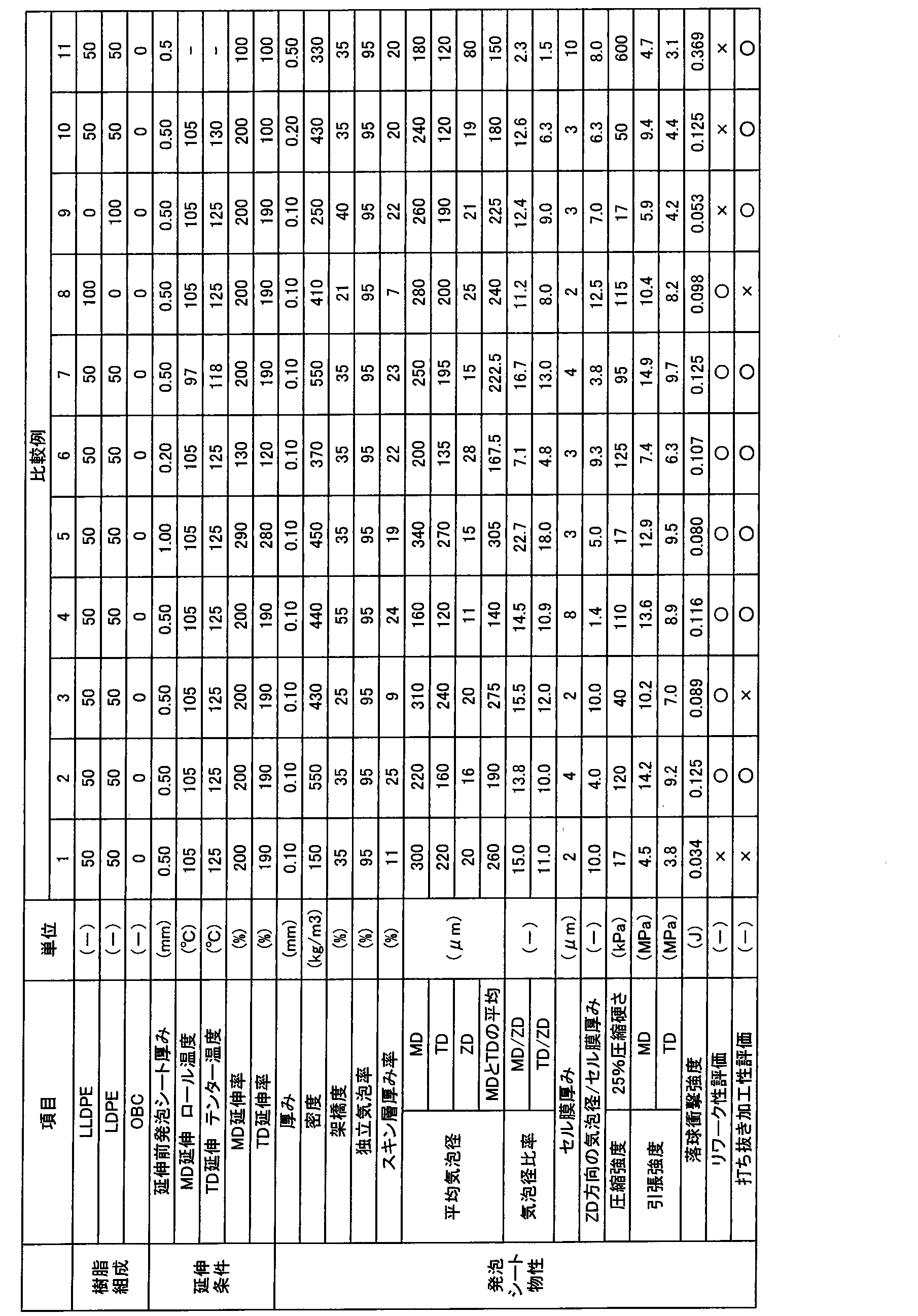
ポリオレフィン樹脂、アゾジカルボンアミドの組成、並びに、発泡性シートの厚み、延伸前発泡シートの厚み、電子線の吸収線量、MD延伸ロール温度、TD延伸テンター温度、MD延伸率、TD延伸率などを表2に記載の通り実施した以外は、実施例1と同様にして作製した。結果を表2に示す。
発泡シートを得た後にMD延伸のみ実施する以外は、実施例1と同様にして作製した。結果を表2に示す。
発泡シートを得た後にMD延伸及びTD延伸を実施しない以外は、実施例1と同様にして作製した。結果を表2に示す。

Claims (10)
- ポリオレフィン系樹脂からなる発泡シートであって、発泡シートの厚みが0.05~0.5mm、JIS K6767(1999)に規定の25%圧縮硬さが20~100kPa、長手方向と厚さ方向の気泡径の比が9~30、幅方向と厚さ方向の気泡径の比が9~30であることを特徴とするポリオレフィン系樹脂発泡シート。
- 発泡シートの長手方向または幅方向の引張強度の低い方の値が5MPa以上、10MPa以下である、請求項1に記載のポリオレフィン系樹脂発泡シート。
- 発泡シートの厚さ方向の平均気泡径が10~20μmである、請求項1または2に記載のポリオレフィン系樹脂発泡シート。
- 発泡シートの厚さ方向の平均セル膜厚みが2~7μmである、請求項1~3のいずれかに記載のポリオレフィン系樹脂発泡シート。
- 発泡シートの厚さ方向の平均気泡径と平均セル膜厚みの比が2~10である、請求項1~4のいずれかに記載のポリオレフィン系樹脂発泡シート。
- 発泡シートの長手方向の平均気泡径と幅方向の平均気泡径とを平均した平均気泡径が、150~500μmである、請求項1~5のいずれかに記載のポリオレフィン系樹脂発泡シート。
- 発泡シートの見かけ密度が200~500kg/m3である、請求項1~6のいずれかに記載のポリオレフィン系樹脂発泡シート。
- 発泡シートの架橋度が30~50%である、請求項1~7のいずれかに記載のポリオレフィン系樹脂発泡シート。
- 発泡シートのスキン層厚み率が15~30%である、請求項1~8のいずれかに記載のポリオレフィン系樹脂発泡シート。
- 電子・電気機器を構成する部品を機器本体に接着固定するために用いられる、請求項1~9のいずれかに記載のポリオレフィン系樹脂発泡シート。
Priority Applications (4)
| Application Number | Priority Date | Filing Date | Title |
|---|---|---|---|
| CN202080015257.8A CN113454148A (zh) | 2019-03-26 | 2020-03-05 | 聚烯烃系树脂发泡片 |
| JP2020526165A JP7029685B2 (ja) | 2019-03-26 | 2020-03-05 | ポリオレフィン系樹脂発泡シート |
| KR1020217025820A KR102382228B1 (ko) | 2019-03-26 | 2020-03-05 | 폴리올레핀계 수지 발포 시트 |
| US17/437,450 US20220169818A1 (en) | 2019-03-26 | 2020-03-05 | Polyolefin-based resin foamed sheet |
Applications Claiming Priority (2)
| Application Number | Priority Date | Filing Date | Title |
|---|---|---|---|
| JP2019058888 | 2019-03-26 | ||
| JP2019-058888 | 2019-03-26 |
Publications (1)
| Publication Number | Publication Date |
|---|---|
| WO2020195676A1 true WO2020195676A1 (ja) | 2020-10-01 |
Family
ID=72611354
Family Applications (1)
| Application Number | Title | Priority Date | Filing Date |
|---|---|---|---|
| PCT/JP2020/009393 Ceased WO2020195676A1 (ja) | 2019-03-26 | 2020-03-05 | ポリオレフィン系樹脂発泡シート |
Country Status (6)
| Country | Link |
|---|---|
| US (1) | US20220169818A1 (ja) |
| JP (1) | JP7029685B2 (ja) |
| KR (1) | KR102382228B1 (ja) |
| CN (1) | CN113454148A (ja) |
| TW (1) | TW202100635A (ja) |
| WO (1) | WO2020195676A1 (ja) |
Cited By (1)
| Publication number | Priority date | Publication date | Assignee | Title |
|---|---|---|---|---|
| US20240327629A1 (en) * | 2023-03-31 | 2024-10-03 | Toray Plastics (America), Inc. | Crosslinked polyethylene foam |
Families Citing this family (4)
| Publication number | Priority date | Publication date | Assignee | Title |
|---|---|---|---|---|
| DE102021112618A1 (de) * | 2021-05-14 | 2022-11-17 | Windmöller & Hölscher Kg | Verfahren zur Herstellung einer Kunststofffolie in einer Folienextrusionsmaschine aus einer Gesamtmenge an Rohstoffen sowie Computerprogrammprodukt zur Durchführung des Verfahrens |
| CN114196099B (zh) * | 2022-02-18 | 2022-05-24 | 苏州贝斯珂胶粘科技有限公司 | 一种聚烯烃系树脂发泡片材及其制备方法 |
| CN115011024B (zh) * | 2022-02-23 | 2024-01-19 | 苏州贝斯珂胶粘科技有限公司 | 一种聚烯烃系树脂发泡片材及其制造方法 |
| CN116330569A (zh) * | 2023-04-14 | 2023-06-27 | 南京大毛牛环保科技有限公司 | 一种柔性轻量泳镜的制备方法及泳镜 |
Citations (7)
| Publication number | Priority date | Publication date | Assignee | Title |
|---|---|---|---|---|
| JPS60183120A (ja) * | 1984-02-29 | 1985-09-18 | Sekisui Chem Co Ltd | 発泡シートの製造方法 |
| WO2005007731A1 (ja) * | 2003-07-16 | 2005-01-27 | Sekisui Chemical Co.,Ltd. | 架橋ポリオレフィン系樹脂発泡シート及びその製造方法並びに粘着テープ |
| WO2012120944A1 (ja) * | 2011-03-09 | 2012-09-13 | 東レ株式会社 | ポリオレフィン系樹脂架橋発泡体 |
| WO2015046526A1 (ja) * | 2013-09-30 | 2015-04-02 | 積水化学工業株式会社 | 架橋ポリオレフィン系樹脂発泡シート |
| WO2017170794A1 (ja) * | 2016-03-29 | 2017-10-05 | 積水化学工業株式会社 | 独立気泡発泡シート、及び表示装置 |
| WO2017170941A1 (ja) * | 2016-03-30 | 2017-10-05 | 積水化学工業株式会社 | ポリオレフィン系樹脂発泡シート及び粘着テープ |
| JP2018053186A (ja) * | 2016-09-30 | 2018-04-05 | 積水化学工業株式会社 | 独立気泡樹脂発泡体及びその製造方法 |
Family Cites Families (7)
| Publication number | Priority date | Publication date | Assignee | Title |
|---|---|---|---|---|
| JP5025549B2 (ja) | 2008-03-31 | 2012-09-12 | キョーラク株式会社 | 発泡ブロー成形品およびその製造方法 |
| JP5785514B2 (ja) | 2012-03-30 | 2015-09-30 | 積水化学工業株式会社 | 架橋ポリオレフィン樹脂発泡シート |
| JP6146768B2 (ja) * | 2012-08-03 | 2017-06-14 | 株式会社ジェイエスピー | ポリエチレン系樹脂発泡シートの製造方法 |
| CN106715550B (zh) | 2014-09-30 | 2020-06-05 | 积水化学工业株式会社 | 聚烯烃系树脂发泡片及粘合胶带 |
| KR102547224B1 (ko) | 2015-03-31 | 2023-06-26 | 세키스이가가쿠 고교가부시키가이샤 | 독립 기포 발포 시트 |
| KR102261471B1 (ko) * | 2017-03-08 | 2021-06-07 | 도레이 카부시키가이샤 | 발포체 및 그 제조 방법 |
| JP7071848B2 (ja) | 2017-03-31 | 2022-05-19 | 積水化学工業株式会社 | 発泡シート、及び粘着テープ |
-
2020
- 2020-03-05 JP JP2020526165A patent/JP7029685B2/ja not_active Expired - Fee Related
- 2020-03-05 CN CN202080015257.8A patent/CN113454148A/zh active Pending
- 2020-03-05 KR KR1020217025820A patent/KR102382228B1/ko not_active Expired - Fee Related
- 2020-03-05 WO PCT/JP2020/009393 patent/WO2020195676A1/ja not_active Ceased
- 2020-03-05 US US17/437,450 patent/US20220169818A1/en not_active Abandoned
- 2020-03-20 TW TW109109340A patent/TW202100635A/zh unknown
Patent Citations (7)
| Publication number | Priority date | Publication date | Assignee | Title |
|---|---|---|---|---|
| JPS60183120A (ja) * | 1984-02-29 | 1985-09-18 | Sekisui Chem Co Ltd | 発泡シートの製造方法 |
| WO2005007731A1 (ja) * | 2003-07-16 | 2005-01-27 | Sekisui Chemical Co.,Ltd. | 架橋ポリオレフィン系樹脂発泡シート及びその製造方法並びに粘着テープ |
| WO2012120944A1 (ja) * | 2011-03-09 | 2012-09-13 | 東レ株式会社 | ポリオレフィン系樹脂架橋発泡体 |
| WO2015046526A1 (ja) * | 2013-09-30 | 2015-04-02 | 積水化学工業株式会社 | 架橋ポリオレフィン系樹脂発泡シート |
| WO2017170794A1 (ja) * | 2016-03-29 | 2017-10-05 | 積水化学工業株式会社 | 独立気泡発泡シート、及び表示装置 |
| WO2017170941A1 (ja) * | 2016-03-30 | 2017-10-05 | 積水化学工業株式会社 | ポリオレフィン系樹脂発泡シート及び粘着テープ |
| JP2018053186A (ja) * | 2016-09-30 | 2018-04-05 | 積水化学工業株式会社 | 独立気泡樹脂発泡体及びその製造方法 |
Cited By (1)
| Publication number | Priority date | Publication date | Assignee | Title |
|---|---|---|---|---|
| US20240327629A1 (en) * | 2023-03-31 | 2024-10-03 | Toray Plastics (America), Inc. | Crosslinked polyethylene foam |
Also Published As
| Publication number | Publication date |
|---|---|
| TW202100635A (zh) | 2021-01-01 |
| KR20210109040A (ko) | 2021-09-03 |
| KR102382228B1 (ko) | 2022-04-04 |
| US20220169818A1 (en) | 2022-06-02 |
| JPWO2020195676A1 (ja) | 2021-12-16 |
| CN113454148A (zh) | 2021-09-28 |
| JP7029685B2 (ja) | 2022-03-04 |
Similar Documents
| Publication | Publication Date | Title |
|---|---|---|
| JP7029685B2 (ja) | ポリオレフィン系樹脂発泡シート | |
| KR102261471B1 (ko) | 발포체 및 그 제조 방법 | |
| JP7183792B2 (ja) | ポリオレフィン系樹脂発泡体とその製造方法及び、粘着テープ | |
| WO2019235529A1 (ja) | 樹脂発泡体シート | |
| KR20190082211A (ko) | 다층 발포 시트, 다층 발포 시트의 제조 방법, 및 점착 테이프 | |
| JP6878098B2 (ja) | 発泡体シート及び粘着テープ | |
| JP7295623B2 (ja) | ポリオレフィン系樹脂発泡シート及びそれを用いた粘着テープ | |
| JP2020139091A (ja) | ポリオレフィン系樹脂発泡体シート及びそれを用いた粘着テープ | |
| KR102557823B1 (ko) | 수지 발포 시트, 수지 발포 시트의 제조 방법, 및 점착 테이프 | |
| JP7453768B2 (ja) | 発泡体シート及び粘着テープ | |
| CN113454149B (zh) | 聚烯烃系树脂发泡片及其制造方法 | |
| JP7071848B2 (ja) | 発泡シート、及び粘着テープ | |
| WO2021020581A1 (ja) | ポリオレフィン系樹脂発泡体シート及びそれを用いた粘着テープ | |
| JP7181143B2 (ja) | 積層体 | |
| JP7221735B2 (ja) | ポリオレフィン系樹脂発泡体シート及びそれを用いた粘着テープ | |
| KR20160140570A (ko) | 점착 테이프 및 점착 테이프의 제조 방법 | |
| JP2021038285A (ja) | ポリオレフィン系樹脂発泡シート及び粘着テープ | |
| JP6898109B2 (ja) | 樹脂発泡シート及びその製造方法 | |
| JP2022036847A (ja) | ポリオレフィン系樹脂発泡体シート及びそれを用いた粘着テープ |
Legal Events
| Date | Code | Title | Description |
|---|---|---|---|
| ENP | Entry into the national phase |
Ref document number: 2020526165 Country of ref document: JP Kind code of ref document: A |
|
| 121 | Ep: the epo has been informed by wipo that ep was designated in this application |
Ref document number: 20776412 Country of ref document: EP Kind code of ref document: A1 |
|
| ENP | Entry into the national phase |
Ref document number: 20217025820 Country of ref document: KR Kind code of ref document: A |
|
| NENP | Non-entry into the national phase |
Ref country code: DE |
|
| 122 | Ep: pct application non-entry in european phase |
Ref document number: 20776412 Country of ref document: EP Kind code of ref document: A1 |