WO2020138065A1 - 多孔質膜、複合膜及び多孔質膜の製造方法 - Google Patents
多孔質膜、複合膜及び多孔質膜の製造方法 Download PDFInfo
- Publication number
- WO2020138065A1 WO2020138065A1 PCT/JP2019/050576 JP2019050576W WO2020138065A1 WO 2020138065 A1 WO2020138065 A1 WO 2020138065A1 JP 2019050576 W JP2019050576 W JP 2019050576W WO 2020138065 A1 WO2020138065 A1 WO 2020138065A1
- Authority
- WO
- WIPO (PCT)
- Prior art keywords
- polyvinylidene fluoride
- polymer
- porous membrane
- fluoride resin
- value
- Prior art date
- Legal status (The legal status is an assumption and is not a legal conclusion. Google has not performed a legal analysis and makes no representation as to the accuracy of the status listed.)
- Ceased
Links
Images


Classifications
-
- B—PERFORMING OPERATIONS; TRANSPORTING
- B01—PHYSICAL OR CHEMICAL PROCESSES OR APPARATUS IN GENERAL
- B01D—SEPARATION
- B01D67/00—Processes specially adapted for manufacturing semi-permeable membranes for separation processes or apparatus
- B01D67/0002—Organic membrane manufacture
- B01D67/0009—Organic membrane manufacture by phase separation, sol-gel transition, evaporation or solvent quenching
- B01D67/0011—Casting solutions therefor
-
- B—PERFORMING OPERATIONS; TRANSPORTING
- B01—PHYSICAL OR CHEMICAL PROCESSES OR APPARATUS IN GENERAL
- B01D—SEPARATION
- B01D67/00—Processes specially adapted for manufacturing semi-permeable membranes for separation processes or apparatus
- B01D67/0002—Organic membrane manufacture
- B01D67/0009—Organic membrane manufacture by phase separation, sol-gel transition, evaporation or solvent quenching
- B01D67/0016—Coagulation
-
- B—PERFORMING OPERATIONS; TRANSPORTING
- B01—PHYSICAL OR CHEMICAL PROCESSES OR APPARATUS IN GENERAL
- B01D—SEPARATION
- B01D69/00—Semi-permeable membranes for separation processes or apparatus characterised by their form, structure or properties; Manufacturing processes specially adapted therefor
- B01D69/02—Semi-permeable membranes for separation processes or apparatus characterised by their form, structure or properties; Manufacturing processes specially adapted therefor characterised by their properties
-
- B—PERFORMING OPERATIONS; TRANSPORTING
- B01—PHYSICAL OR CHEMICAL PROCESSES OR APPARATUS IN GENERAL
- B01D—SEPARATION
- B01D69/00—Semi-permeable membranes for separation processes or apparatus characterised by their form, structure or properties; Manufacturing processes specially adapted therefor
- B01D69/10—Supported membranes; Membrane supports
- B01D69/107—Organic support material
- B01D69/1071—Woven, non-woven or net mesh
-
- B—PERFORMING OPERATIONS; TRANSPORTING
- B01—PHYSICAL OR CHEMICAL PROCESSES OR APPARATUS IN GENERAL
- B01D—SEPARATION
- B01D69/00—Semi-permeable membranes for separation processes or apparatus characterised by their form, structure or properties; Manufacturing processes specially adapted therefor
- B01D69/10—Supported membranes; Membrane supports
- B01D69/108—Inorganic support material
-
- B—PERFORMING OPERATIONS; TRANSPORTING
- B01—PHYSICAL OR CHEMICAL PROCESSES OR APPARATUS IN GENERAL
- B01D—SEPARATION
- B01D69/00—Semi-permeable membranes for separation processes or apparatus characterised by their form, structure or properties; Manufacturing processes specially adapted therefor
- B01D69/12—Composite membranes; Ultra-thin membranes
-
- B—PERFORMING OPERATIONS; TRANSPORTING
- B01—PHYSICAL OR CHEMICAL PROCESSES OR APPARATUS IN GENERAL
- B01D—SEPARATION
- B01D69/00—Semi-permeable membranes for separation processes or apparatus characterised by their form, structure or properties; Manufacturing processes specially adapted therefor
- B01D69/12—Composite membranes; Ultra-thin membranes
- B01D69/1213—Laminated layers
-
- B—PERFORMING OPERATIONS; TRANSPORTING
- B01—PHYSICAL OR CHEMICAL PROCESSES OR APPARATUS IN GENERAL
- B01D—SEPARATION
- B01D71/00—Semi-permeable membranes for separation processes or apparatus characterised by the material; Manufacturing processes specially adapted therefor
- B01D71/06—Organic material
- B01D71/08—Polysaccharides
- B01D71/12—Cellulose derivatives
- B01D71/14—Esters of organic acids
- B01D71/16—Cellulose acetate
-
- B—PERFORMING OPERATIONS; TRANSPORTING
- B01—PHYSICAL OR CHEMICAL PROCESSES OR APPARATUS IN GENERAL
- B01D—SEPARATION
- B01D71/00—Semi-permeable membranes for separation processes or apparatus characterised by the material; Manufacturing processes specially adapted therefor
- B01D71/06—Organic material
- B01D71/30—Polyalkenyl halides
- B01D71/32—Polyalkenyl halides containing fluorine atoms
- B01D71/34—Polyvinylidene fluoride
-
- C—CHEMISTRY; METALLURGY
- C08—ORGANIC MACROMOLECULAR COMPOUNDS; THEIR PREPARATION OR CHEMICAL WORKING-UP; COMPOSITIONS BASED THEREON
- C08J—WORKING-UP; GENERAL PROCESSES OF COMPOUNDING; AFTER-TREATMENT NOT COVERED BY SUBCLASSES C08B, C08C, C08F, C08G or C08H
- C08J9/00—Working-up of macromolecular substances to porous or cellular articles or materials; After-treatment thereof
- C08J9/0061—Working-up of macromolecular substances to porous or cellular articles or materials; After-treatment thereof characterized by the use of several polymeric components
-
- C—CHEMISTRY; METALLURGY
- C08—ORGANIC MACROMOLECULAR COMPOUNDS; THEIR PREPARATION OR CHEMICAL WORKING-UP; COMPOSITIONS BASED THEREON
- C08J—WORKING-UP; GENERAL PROCESSES OF COMPOUNDING; AFTER-TREATMENT NOT COVERED BY SUBCLASSES C08B, C08C, C08F, C08G or C08H
- C08J9/00—Working-up of macromolecular substances to porous or cellular articles or materials; After-treatment thereof
- C08J9/26—Working-up of macromolecular substances to porous or cellular articles or materials; After-treatment thereof by elimination of a solid phase from a macromolecular composition or article, e.g. leaching out
-
- C—CHEMISTRY; METALLURGY
- C08—ORGANIC MACROMOLECULAR COMPOUNDS; THEIR PREPARATION OR CHEMICAL WORKING-UP; COMPOSITIONS BASED THEREON
- C08J—WORKING-UP; GENERAL PROCESSES OF COMPOUNDING; AFTER-TREATMENT NOT COVERED BY SUBCLASSES C08B, C08C, C08F, C08G or C08H
- C08J9/00—Working-up of macromolecular substances to porous or cellular articles or materials; After-treatment thereof
- C08J9/28—Working-up of macromolecular substances to porous or cellular articles or materials; After-treatment thereof by elimination of a liquid phase from a macromolecular composition or article, e.g. drying of coagulum
-
- C—CHEMISTRY; METALLURGY
- C08—ORGANIC MACROMOLECULAR COMPOUNDS; THEIR PREPARATION OR CHEMICAL WORKING-UP; COMPOSITIONS BASED THEREON
- C08L—COMPOSITIONS OF MACROMOLECULAR COMPOUNDS
- C08L27/00—Compositions of homopolymers or copolymers of compounds having one or more unsaturated aliphatic radicals, each having only one carbon-to-carbon double bond, and at least one being terminated by a halogen; Compositions of derivatives of such polymers
- C08L27/02—Compositions of homopolymers or copolymers of compounds having one or more unsaturated aliphatic radicals, each having only one carbon-to-carbon double bond, and at least one being terminated by a halogen; Compositions of derivatives of such polymers not modified by chemical after-treatment
- C08L27/12—Compositions of homopolymers or copolymers of compounds having one or more unsaturated aliphatic radicals, each having only one carbon-to-carbon double bond, and at least one being terminated by a halogen; Compositions of derivatives of such polymers not modified by chemical after-treatment containing fluorine atoms
- C08L27/16—Homopolymers or copolymers or vinylidene fluoride
-
- B—PERFORMING OPERATIONS; TRANSPORTING
- B01—PHYSICAL OR CHEMICAL PROCESSES OR APPARATUS IN GENERAL
- B01D—SEPARATION
- B01D2323/00—Details relating to membrane preparation
- B01D2323/12—Specific ratios of components used
-
- B—PERFORMING OPERATIONS; TRANSPORTING
- B01—PHYSICAL OR CHEMICAL PROCESSES OR APPARATUS IN GENERAL
- B01D—SEPARATION
- B01D2323/00—Details relating to membrane preparation
- B01D2323/15—Use of additives
- B01D2323/218—Additive materials
- B01D2323/2182—Organic additives
- B01D2323/21839—Polymeric additives
- B01D2323/2187—Polyvinylpyrolidone
-
- B—PERFORMING OPERATIONS; TRANSPORTING
- B01—PHYSICAL OR CHEMICAL PROCESSES OR APPARATUS IN GENERAL
- B01D—SEPARATION
- B01D2325/00—Details relating to properties of membranes
- B01D2325/02—Details relating to pores or porosity of the membranes
- B01D2325/0283—Pore size
- B01D2325/02832—1-10 nm
-
- B—PERFORMING OPERATIONS; TRANSPORTING
- B01—PHYSICAL OR CHEMICAL PROCESSES OR APPARATUS IN GENERAL
- B01D—SEPARATION
- B01D2325/00—Details relating to properties of membranes
- B01D2325/02—Details relating to pores or porosity of the membranes
- B01D2325/0283—Pore size
- B01D2325/02833—Pore size more than 10 and up to 100 nm
-
- B—PERFORMING OPERATIONS; TRANSPORTING
- B01—PHYSICAL OR CHEMICAL PROCESSES OR APPARATUS IN GENERAL
- B01D—SEPARATION
- B01D2325/00—Details relating to properties of membranes
- B01D2325/20—Specific permeability or cut-off range
-
- B—PERFORMING OPERATIONS; TRANSPORTING
- B01—PHYSICAL OR CHEMICAL PROCESSES OR APPARATUS IN GENERAL
- B01D—SEPARATION
- B01D2325/00—Details relating to properties of membranes
- B01D2325/30—Chemical resistance
-
- B—PERFORMING OPERATIONS; TRANSPORTING
- B01—PHYSICAL OR CHEMICAL PROCESSES OR APPARATUS IN GENERAL
- B01D—SEPARATION
- B01D2325/00—Details relating to properties of membranes
- B01D2325/34—Molecular weight or degree of polymerisation
-
- B—PERFORMING OPERATIONS; TRANSPORTING
- B01—PHYSICAL OR CHEMICAL PROCESSES OR APPARATUS IN GENERAL
- B01D—SEPARATION
- B01D2325/00—Details relating to properties of membranes
- B01D2325/36—Hydrophilic membranes
-
- B—PERFORMING OPERATIONS; TRANSPORTING
- B01—PHYSICAL OR CHEMICAL PROCESSES OR APPARATUS IN GENERAL
- B01D—SEPARATION
- B01D2325/00—Details relating to properties of membranes
- B01D2325/52—Crystallinity
-
- C—CHEMISTRY; METALLURGY
- C08—ORGANIC MACROMOLECULAR COMPOUNDS; THEIR PREPARATION OR CHEMICAL WORKING-UP; COMPOSITIONS BASED THEREON
- C08J—WORKING-UP; GENERAL PROCESSES OF COMPOUNDING; AFTER-TREATMENT NOT COVERED BY SUBCLASSES C08B, C08C, C08F, C08G or C08H
- C08J2201/00—Foams characterised by the foaming process
- C08J2201/04—Foams characterised by the foaming process characterised by the elimination of a liquid or solid component, e.g. precipitation, leaching out, evaporation
- C08J2201/054—Precipitating the polymer by adding a non-solvent or a different solvent
- C08J2201/0542—Precipitating the polymer by adding a non-solvent or a different solvent from an organic solvent-based polymer composition
- C08J2201/0544—Precipitating the polymer by adding a non-solvent or a different solvent from an organic solvent-based polymer composition the non-solvent being aqueous
-
- C—CHEMISTRY; METALLURGY
- C08—ORGANIC MACROMOLECULAR COMPOUNDS; THEIR PREPARATION OR CHEMICAL WORKING-UP; COMPOSITIONS BASED THEREON
- C08J—WORKING-UP; GENERAL PROCESSES OF COMPOUNDING; AFTER-TREATMENT NOT COVERED BY SUBCLASSES C08B, C08C, C08F, C08G or C08H
- C08J2327/00—Characterised by the use of homopolymers or copolymers of compounds having one or more unsaturated aliphatic radicals, each having only one carbon-to-carbon double bond, and at least one being terminated by a halogen; Derivatives of such polymers
- C08J2327/02—Characterised by the use of homopolymers or copolymers of compounds having one or more unsaturated aliphatic radicals, each having only one carbon-to-carbon double bond, and at least one being terminated by a halogen; Derivatives of such polymers not modified by chemical after-treatment
- C08J2327/12—Characterised by the use of homopolymers or copolymers of compounds having one or more unsaturated aliphatic radicals, each having only one carbon-to-carbon double bond, and at least one being terminated by a halogen; Derivatives of such polymers not modified by chemical after-treatment containing fluorine atoms
- C08J2327/16—Homopolymers or copolymers of vinylidene fluoride
-
- C—CHEMISTRY; METALLURGY
- C08—ORGANIC MACROMOLECULAR COMPOUNDS; THEIR PREPARATION OR CHEMICAL WORKING-UP; COMPOSITIONS BASED THEREON
- C08J—WORKING-UP; GENERAL PROCESSES OF COMPOUNDING; AFTER-TREATMENT NOT COVERED BY SUBCLASSES C08B, C08C, C08F, C08G or C08H
- C08J2427/00—Characterised by the use of homopolymers or copolymers of compounds having one or more unsaturated aliphatic radicals, each having only one carbon-to-carbon double bond, and at least one being terminated by a halogen; Derivatives of such polymers
- C08J2427/02—Characterised by the use of homopolymers or copolymers of compounds having one or more unsaturated aliphatic radicals, each having only one carbon-to-carbon double bond, and at least one being terminated by a halogen; Derivatives of such polymers not modified by chemical after-treatment
- C08J2427/12—Characterised by the use of homopolymers or copolymers of compounds having one or more unsaturated aliphatic radicals, each having only one carbon-to-carbon double bond, and at least one being terminated by a halogen; Derivatives of such polymers not modified by chemical after-treatment containing fluorine atoms
- C08J2427/16—Homopolymers or copolymers of vinylidene fluoride
Definitions
- the present invention relates to a porous membrane, a composite membrane, and a method for producing a porous membrane.
- porous membranes such as microfiltration membranes and ultrafiltration membranes have been used in various fields such as water treatment fields such as water purification or wastewater treatment, medical fields such as blood purification, and the food industry field. Since the porous membrane in such a field is repeatedly used and is washed or sterilized with various chemicals, it is usually required to have high chemical resistance.
- Patent Document 1 discloses a technique for improving the separation performance by reducing the pore size distribution in the cross-sectional structure of a porous membrane containing a polymer containing a polyvinylidene fluoride resin.
- Patent Document 2 discloses a technique in which a long-chain branched fluoropolymer is selected as the polyvinylidene fluoride-based resin contained in the porous membrane to expand the pore diameter of the porous membrane and improve the permeation performance.
- an object of the present invention is to provide a porous membrane capable of achieving both excellent separation performance and permeation performance and having high chemical resistance.
- a porous membrane in which both excellent separation performance and permeation performance are achieved while ensuring high chemical resistance by including a polymer containing a polyvinylidene fluoride-based resin as a main component. be able to.
- FIG. 1 is a graph showing the evaluation results of the porous membrane in each Example/Comparative Example.
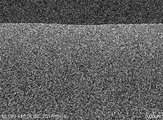
- FIG. 2 is a surface-enlarged image of the porous membrane obtained in Example 8, illustrating a “three-dimensional network structure”.
- FIG. 3 is an enlarged cross-sectional image of the porous membrane obtained in Example 8, which illustrates the “three-dimensional network structure”.
- FIG. 4 is an enlarged surface image of the porous membrane obtained in Comparative Example 3, which illustrates the “three-dimensional network structure”.
- FIG. 5 is an enlarged cross-sectional image of the porous membrane obtained in Comparative Example 3, which illustrates the “three-dimensional network structure”.
- the radius of gyration ⁇ S 2 > 1/2 becomes appropriately small with respect to the absolute molecular weight M w of the polymer. ..
- the polymer easily moves to the surface layer of the porous film when the porous film is formed, and the polymer density of the surface layer of the porous film easily increases. Therefore, it is presumed that the porous membrane exhibits excellent separation performance.
- the radius of gyration ⁇ S 2 > 1/2 appropriately increases with respect to the absolute molecular weight M w of the polymer.
- the value of a is more preferably 0.37 to 0.40, and further preferably 0.37 to 0.39.
- the value of b for the above-mentioned polymer which is determined from the relationship of the above formula 1, must be 0.18 to 0.42 in order to further enhance the separation performance by homogenizing the polymer density of the surface layer due to the entanglement of the polymers.
- the value of b is preferably 0.20 to 0.38, and more preferably 0.25 to 0.33.
- Polyvinylidene fluoride-based resin means a vinylidene fluoride homopolymer or a vinylidene fluoride copolymer.
- the vinylidene fluoride copolymer means a polymer having a vinylidene fluoride residue structure.
- the polymer having a vinylidene fluoride residue structure is typically a copolymer of vinylidene fluoride monomer and other fluorine-based monomers. Examples of such a fluorine-based monomer include vinyl fluoride, tetrafluoroethylene, hexafluoropropylene, or trifluorochloroethylene.
- ethylene or the like other than the above-mentioned fluorine-based monomer may be copolymerized to the extent that the effects of the present invention are not impaired.
- the weight average molecular weight of the polyvinylidene fluoride resin is preferably 50,000 to 1,000,000 Da because the permeation performance of the porous membrane decreases as the weight average molecular weight increases and the separation performance of the porous membrane decreases as the weight average molecular weight decreases.
- the weight average molecular weight is preferably 100,000 to 900,000 Da, more preferably 150,000 to 800,000 Da.
- the porous membrane according to the embodiment of the present invention needs to contain a polymer containing a polyvinylidene fluoride resin as a main component.
- the phrase "having a polyvinylidene fluoride-based resin as a main component” means that the proportion of the polyvinylidene fluoride-based resin in the polymer forming the porous film is 50% by mass or more. In order to secure high chemical resistance, the above ratio is preferably 55% by mass or more, and more preferably 60% by mass or more.
- the porous membrane may contain components other than the polymer as long as the effects of the present invention are not impaired.
- the component other than the polymer include a surfactant and inorganic particles.
- the porous film preferably contains a polymer containing a polyvinylidene fluoride resin as a main component as a main component. In other words, the content of the components other than the polymer in the porous film is preferably less than 50% by mass.
- the polyvinylidene fluoride resin is a branched polyvinylidene fluoride resin in the porous membrane according to the embodiment of the present invention. Need to include.
- the proportion of the branched polyvinylidene fluoride resin in the polyvinylidene fluoride resin is preferably 10 to 100% by mass, more preferably 25 to 100% by mass, and even more preferably 75 to 100% by mass.
- the proportion of the branched polyvinylidene fluoride resin in the porous film is preferably 15 to 100% by mass, more preferably 18 to 80% by mass, and further preferably 55 to 80% by mass. preferable.
- the weight average molecular weight of the branched polyvinylidene fluoride resin is preferably 50,000 to 1,000,000 Da, and 100,000 to 600,000 Da. More preferably, 120,000 to 300,000 Da is even more preferable.
- branched polyvinylidene fluoride resin as used herein means a polyvinylidene fluoride resin having a value of a of 0.41 or less. Further, in order to easily adjust the value of a in the above-mentioned polymer within the range of 0.32 to 0.41, the branched polyvinylidene fluoride resin preferably has a melt viscosity of 30 kP or less, and 20 kP or less. More preferably, it is more preferably 10 kP or less.
- the polymer constituting the porous membrane according to the embodiment of the present invention preferably contains a hydrophilic resin in order to easily adjust the values of a and b for the polymer within a predetermined range. Furthermore, since the polymer forming the porous film according to the embodiment of the present invention contains a hydrophilic resin, it becomes difficult for dirt to adhere to the porous film.
- hydrophilic resin refers to a resin that has a high affinity for water and dissolves in water, or a resin that has a contact angle with water smaller than that of polyvinylidene fluoride resin.
- hydrophilic resin for example, cellulose ester such as cellulose acetate or cellulose acetate propionate, fatty acid vinyl ester, polyvinyl acetate, polyvinylpyrrolidone, ethylene oxide, propylene oxide or acrylic acid ester such as polymethylmethacrylate or methacrylic acid. Examples thereof include polymers of esters and copolymers of these polymers.
- the porous membrane according to the embodiment of the present invention preferably has a three-dimensional network structure in order to further enhance the separation performance by homogenizing the polymer density of the surface layer due to the entanglement of the polymers.
- the “three-dimensional network structure” refers to a structure in which the polymer that constitutes the porous membrane according to the embodiment of the present invention spreads three-dimensionally in a network as shown in FIGS. 2 to 5. Say.
- the three-dimensional network structure has pores and voids bounded by a network-forming polymer.
- a and b are measured by a gel permeation chromatograph (hereinafter, “GPC”) equipped with a multi-angle light scattering detector (hereinafter, “MALS”) and a differential refractometer (hereinafter, “RI”). It can be determined based on the relationship between the radius of gyration ⁇ S 2 > 1/2 and the absolute molecular weight M w measured by a certain GPC-MALS.
- GPC-MALS gel permeation chromatograph
- RI differential refractometer
- NMP N-methyl-2-pyrrolidone
- the relationship between the radius of gyration ⁇ S 2 > 1/2 and the absolute molecular weight M w , which is measured by GPC-MALS, is called a conformation plot, and is represented by the following formula 1 according to a method generally used in polymer research.
- the above values of a and b can be determined by such approximation.
- Such a method is general, for example, as described in "Size Exclusion Chromatography” (Kyoritsu Shuppan Co., Ltd., first edition, 1992).
- the conformational plot may be approximated by linear approximation by applying the least squares method to the equation 1 as a logarithmic graph within a range within the measurement range of the detector.
- ⁇ S 2> 1/2 bM w a ⁇ ( Equation 1)
- the branched polyvinylidene fluoride resin used in the embodiment of the present invention is preferably a star-shaped branched polyvinylidene fluoride resin.
- a porous film is formed as compared with a linear polyvinylidene fluoride resin, a comb-branched polyvinylidene fluoride resin, and a random branched polyvinylidene fluoride resin.
- the polymer is likely to move to the surface layer of the porous membrane, and the polymer density of the surface layer of the porous membrane increases, which is presumed to cause the porous membrane to exhibit further excellent separation performance.
- the shape of the branched polyvinylidene fluoride resin can be determined by determining the ⁇ value by the following equations 4 and 5. Such a method is general, for example, as described in "Size Exclusion Chromatography" (Kyoritsu Shuppan Co., Ltd., first edition, 1992).
- ⁇ value 0.25 to 0.75
- the star-shaped branched polyvinylidene fluoride resin is used.
- the ⁇ value is 1.1 to 1.75
- the comb-shaped branched polyvinylidene fluoride resin or the random branched polyvinylidene fluoride resin is used. Treated as a resin.
- the ⁇ value is preferably 0.25 to 0.75, more preferably 0.35 to 0.70, and most preferably 0.40 to 0.65.
- the value of the weight average molecular weight is preferably used for the calculation of the ⁇ value.
- g ⁇ Intrinsic viscosity of branched polyvinylidene fluoride resin/Intrinsic viscosity of linear polyvinylidene fluoride resin (Equation 4)
- g ⁇ S 2 branches polyvinylidene fluoride resin> / ⁇ S 2 linear polyvinylidene fluoride resin> (Equation 5)
- the intrinsic viscosity [ ⁇ ] and the radius of gyration ⁇ S 2 > 1/2 are measured using the above GPC-MALS and a GPC-MALS-VISCO equipped with a viscosity detector (hereinafter, “VISCO”). To be done. The measurement is performed by dissolving the polymer forming the porous film in a solvent. A salt may be added to the solvent in order to improve the solubility of the polymer.
- GPC-MALS for example, NMP containing 0.1 mol/L of lithium chloride is preferably used.
- the value of the weight average molecular weight is used to calculate the ⁇ value, first, the value of the radius of gyration or the intrinsic viscosity at each elution time and the absolute value at each elution time obtained by the measurement using GPC-MALS-VISCO.
- the relationship with the value of the molecular weight is approximated using Formula 1 and Formula 6, and the values of a, b, e, and f are determined to create an approximate formula.
- the weight average molecular weight of the polymer forming the porous membrane is substituted into M w of each obtained approximate expression.
- the ⁇ value can be obtained by substituting the radius gyration ⁇ S 2 > 1/2 and the intrinsic viscosity [ ⁇ ] thus calculated into the equation 4 or the equation 5, respectively.
- the composite membrane according to the embodiment of the present invention includes the porous membrane according to the embodiment of the present invention and another layer, and the porous membrane according to the embodiment of the present invention is arranged on the surface portion.
- the “surface portion” of the composite film refers to a portion from the surface of the composite film to a depth of 20 ⁇ m in the thickness direction.
- the inner surface and/or the outer surface thereof are the “surface of the composite membrane” here, and the thickness direction of the composite membrane coincides with the radial direction of the hollow fiber membrane.
- the porous membrane according to the embodiment of the present invention showing excellent separation performance on the surface portion, the components contained in the liquid to be filtered hardly invade the inside of the composite membrane, and the composite membrane is high for a long period of time. Permeability can be maintained.
- the above-mentioned other layer is not particularly limited as long as it is a constituent element capable of overlapping with the porous membrane to form a layered structure, but the above-mentioned other layer is preferably a support.
- the “support” refers to a structure for physically reinforcing the porous membrane and having a higher breaking strength than the porous membrane.
- the breaking strength (breaking strength per unit area) of the support is preferably 3 MPa or more, and more preferably 10 MPa or more.
- the breaking strength of the support is preferably 300 gf or more, more preferably 800 gf or more.
- the support preferably has a fibrous structure, a columnar structure or a spherical structure in order to further enhance the strength of the composite membrane.
- the breaking strength or breaking strength of the support can be calculated by using a tensile tester and repeating a tensile test 5 times for a sample having a length of 50 mm under a condition of a tensile speed of 50 mm/min and averaging them.
- the breaking strength or breaking strength of the composite membrane is regarded as the breaking strength or breaking strength of the support which is its constituent element. be able to.
- the molecular weight cutoff of the porous membrane or the composite membrane according to the embodiment of the present invention is preferably 5,000 to 80,000 Da, more preferably 8,000 to 60,000 Da, and more preferably 10,000 to More preferably, it is 40,000 Da.
- the "fractionated molecular weight” means the minimum molecular weight of the components contained in the liquid to be filtered, which can be removed by 90% by the porous membrane.
- the average surface pore diameter is preferably 3 to 16 nm, more preferably 6 to 14 nm in order to increase the polymer density of the surface layer and to exhibit excellent separation performance. , 8 to 11 nm is more preferable.
- the average surface pore diameter of the porous film can be calculated by observing the surface of the porous film with a scanning electron microscope (hereinafter, “SEM”).
- the surface of the porous membrane is observed with an SEM at a magnification of 30,000 to 100,000 times, and the areas of 300 randomly selected pores are measured. From the area of each hole, the diameter when the hole is assumed to be a circle is calculated as the hole diameter, and the average value thereof can be used as the surface average hole diameter.
- the porous membrane or the composite membrane according to the embodiment of the present invention has an average surface pore diameter within the above range and a pure water permeability of 0.1 to 0.8 m 3 /m 2 /hr at 25° C. and 50 kPa. Is more preferable, and 0.3 to 0.7 m 3 /m 2 /hr is more preferable.
- the pure water permeability at 50 kPa of the porous membrane or the composite membrane according to the embodiment of the present invention is measured by measuring the membrane area and the amount of permeated water per hour at a pressure within a range in which the porous membrane is not deformed, and measuring those values at 50 kPa. It may be calculated by converting into a value under pressure. Note that a proportional relationship is established when converting pressure.
- the method for producing a porous film according to an embodiment of the present invention is a polymer solution preparation, in which a polymer containing a branched polyvinylidene fluoride resin is dissolved in a solvent and a polymer having a polyvinylidene fluoride resin as a main component is dissolved to obtain a polymer solution.
- GPC-MALS provided with a multi-angle light scattering detector, which comprises a step (A) and a porous film forming step (B) of forming a porous film by coagulating the polymer solution in a non-solvent
- a for the polymer determined by approximating with the following formula 1 from the radius of gyration ⁇ S 2 > 1/2 measured by gel permeation chromatography) and the absolute molecular weight M w of the polymer is 0.32 .About.0.41 and the value of b must be 0.18 to 0.42.
- ⁇ S 2> 1/2 bM w a ⁇ ( Equation 1)
- the value of a for a polymer containing a branched polyvinylidene fluoride resin as a main component, which contains a branched polyvinylidene fluoride resin, which is dissolved in a solvent in the polymer solution preparation step (A), is 0.41 or less.
- the radius of gyration ⁇ S 2 > 1/2 becomes appropriately smaller than the absolute molecular weight M w of Thereby, in the porous film forming step (B), the polymer easily moves to the surface layer of the porous film when the porous film is formed, and the polymer density of the surface layer of the porous film easily increases. Therefore, it is presumed that the porous membrane exhibits excellent separation performance.
- a good solvent is preferable as the solvent used in the polymer solution preparation step (A).
- the “good solvent” means a solvent capable of dissolving 5% by mass or more of the polyvinylidene fluoride resin even in a low temperature region of 60° C. or lower.
- the good solvent include NMP, dimethylacetamide, dimethylformamide, methylethylketone, acetone, tetrahydrofuran, tetramethylurea or trimethylphosphate, or a mixed solvent thereof.
- the polymer solution obtained in the polymer solution preparation step (A) may appropriately contain a second resin such as a hydrophilic resin, a plasticizer or a salt, in addition to the polyvinylidene fluoride resin.
- a second resin such as a hydrophilic resin, a plasticizer or a salt
- the solubility of the polymer solution is improved.
- the plasticizer include glycerol triacetate, diethylene glycol, dibutyl phthalate, dioctyl phthalate and the like.
- the salt include calcium chloride, magnesium chloride, lithium chloride or barium sulfate.
- the concentration of the polymer solution obtained in the polymer solution preparation step (A) is preferably 15 to 30% by mass, and more preferably 20 to 25% by mass in order to achieve both high separation performance and permeation performance. ..
- the proportion of the branched polyvinylidene fluoride resin in the components of the porous membrane is preferably 15 to 100% by mass, and 18 to 80% by mass. Is more preferable, and 55 to 80% by mass is further preferable.
- Whether or not the polymer is completely dissolved in the solvent in the polymer solution preparation step (A) can be judged by visually confirming that there is no turbidity or insoluble matter, but it is preferable to confirm by using an absorptiometer. If the dissolution of the polymer is insufficient, not only the storage stability of the polymer solution will decrease, but also the porous membrane produced will have an inhomogeneous structure, making it difficult to exhibit excellent separation performance.
- the absorbance of the obtained polymer solution is preferably 0.50 or less, and more preferably 0.09 or less at a wavelength of 500 nm.
- the crystallinity of the polyvinylidene fluoride resin that is soluble in the solvent in the polymer solution preparation step (A) can be adjusted simply by adjusting the values of a and b for the polymer constituting the porous membrane to be produced within a predetermined range. Therefore, it is preferably 35% or more, more preferably 38% or more, and further preferably 40% or more.
- the crystallinity of the polyvinylidene fluoride resin can be calculated from the measurement result of a differential scanning calorimeter (hereinafter, "DSC").
- the branched polyvinylidene fluoride resin used in the polymer solution preparation step (A) is preferably a star-shaped branched polyvinylidene fluoride resin.
- a star-shaped branched polyvinylidene fluoride-based resin a porous film is formed as compared with linear polyvinylidene fluoride-based resin, comb-shaped branched polyvinylidene fluoride-based resin, and random branched polyvinylidene fluoride-based resin.
- the polymer is likely to move to the surface layer of the porous membrane, and the polymer density of the surface layer of the porous membrane increases, which is presumed to cause the porous membrane to exhibit further excellent separation performance.
- the “non-solvent” in the porous film forming step (B) means a solvent that does not dissolve or swell the fluororesin polymer up to the melting point of the polyvinylidene fluoride resin or the boiling point of the solvent.
- the non-solvent include water, hexane, pentane, benzene, toluene, methanol, ethanol, carbon tetrachloride, o-dichlorobenzene, trichloroethylene, ethylene glycol, diethylene glycol, triethylene glycol, propylene glycol, butylene glycol, pentane.
- Aliphatic hydrocarbons such as diols, hexanediols or low molecular weight polyethylene glycols, aromatic hydrocarbons, aliphatic polyhydric alcohols, aromatic polyhydric alcohols, chlorinated hydrocarbons, or other chlorinated organic liquids or their A mixed solvent may be used.
- the solvent of the polymer solution is mixed with the non-solvent in the coagulation bath in which the polymer solution and the non-solvent are brought into contact with each other.
- the concentration of the solvent increases. Therefore, it is preferable to replace the non-solvent in the coagulation bath so that the composition of the liquid in the coagulation bath is kept within a certain range. The lower the concentration of the good solvent in the coagulation bath, the faster the coagulation of the polymer solution, so that the structure of the porous membrane is homogenized, and excellent separation performance can be exhibited.
- the concentration of the good solvent in the coagulation bath is preferably 20% or less, more preferably 15% or less, still more preferably 10% or less.
- the values of a and b for the polymer are adjusted to be within a predetermined range, so that the temperature of the non-solvent is further lowered. Even in such a case, it becomes possible to realize excellent transmission performance.
- the temperature of the liquid containing the polymer solution and/or the non-solvent in the coagulation bath is preferably 0 to 25°C, more preferably 0 to 20°C, and further preferably 5 to 15°C.
- the shape of the manufactured porous membrane can be controlled by the coagulation mode of the polymer solution in the porous membrane forming step (B).
- a flat film-like porous film for example, a film-shaped support made of a non-woven fabric, a metal oxide, a metal or the like coated with a polymer solution can be immersed in a coagulation bath.
- the polymer solution can be discharged from the outer peripheral portion of the double-tube mouthpiece, and the core liquid can be simultaneously discharged from the central portion to a coagulation bath containing a non-solvent.
- the core liquid it is preferable to use a good solvent or the like in the polymer solution preparation step (A).
- a porous membrane may be formed on the surface of a hollow fiber support made of polymer, metal oxide, metal or the like.
- a method for forming a porous film on the surface of a hollow fiber-shaped support made of a polymer for example, a triple tube mouthpiece is used and a solution as a raw material for the hollow fiber-shaped support and a polymer solution are simultaneously discharged.
- a method in which a polymer solution is applied to the outer surface of a hollow fiber-shaped support formed in advance and a nonsolvent in a coagulation bath is allowed to pass therethrough may be used.
- dn/dc in Formula 2 is the amount of change in the refractive index of the polymer solution with respect to the change in polymer concentration, that is, the refractive index increment, but a polymer containing a polyvinylidene fluoride resin as a main component is measured, and If a solvent is used, a value of -0.050 mL/g can be applied as the refractive index increment.
- K 4 ⁇ 2 ⁇ n 0 2 ⁇ (dn/dc) 2 /( ⁇ 4 ⁇ N 0 ) (Equation 2)
- n 0 Refractive index of solvent
- dn/dc Refractive index increment
- ⁇ Wavelength of incident light in vacuum
- N 0 Avogadro's number
- Equation 3 The value of the radius of gyration ⁇ S 2 > 1/2 at each elution time t i was calculated from the slope of Equation 3 below.
- K ⁇ c i / R ⁇ i ) 1/2 M Wi -1/2 ⁇ 1 + 1/6 (4 ⁇ n 0 / ⁇ ) 2 ⁇ S 2> sin 2 ( ⁇ / 2) ⁇ ⁇ ( Equation 3)
- the absolute molecular weight M wi at each elution time t i calculated from Equation 3 is plotted on the x-axis, and the radius of gyration ⁇ S 2 > 1/2 at each elution time t i is plotted on the y-axis to measure the detector.
- Equation 6 the values of e and f in Equation 6 were obtained by approximation with Equation 6 (Mark-Houwink Plot) below.
- the approximation was performed by linearly approximating Equation 6 using a logarithmic graph and applying the least squares method.
- [ ⁇ ] eM w f (Equation 6)
- Equation 6 Substituting the weight average molecular weight of the polymer constituting the porous membrane or the composite membrane into Equations 1 and 6, and substituting the obtained radius of gyration ⁇ S 2 > 1/2 and the intrinsic viscosity [ ⁇ ] into Equations 4 and 5. Then, the ⁇ value was obtained.
- the ⁇ value was 0.25 to 0.75, it was determined to be a star-shaped branched polyvinylidene fluoride resin, and when the ⁇ value was 1.1 to 1.75, it was determined to be a random branched polyvinylidene fluoride resin.
- Solef (registered trademark) 1015 manufactured by Solvay as a linear polyvinylidene fluoride resin
- g ⁇ Intrinsic viscosity of branched polyvinylidene fluoride resin/Intrinsic viscosity of linear polyvinylidene fluoride resin (Equation 4)
- g ⁇ S 2 branches polyvinylidene fluoride resin> / ⁇ S 2 linear polyvinylidene fluoride resin> (Equation 5)
- (Iii) Crystallinity of polyvinylidene fluoride resin About 5 to 10 mg of polyvinylidene fluoride resin is sampled and set in DSC (manufactured by Hitachi High-Tech Science Co., Ltd.; DSC6200) at room temperature to 300°C at 5°C/min. The endothermic peak observed in the range of 100 to 190° C. when the temperature was increased by 1. was regarded as the heat of fusion of the polyvinylidene fluoride resin. The amount of heat was divided by 104.6 J/g, which is the amount of heat of fusion of the polyvinylidene fluoride resin to complete crystal, and the crystallinity of the polyvinylidene fluoride resin was calculated as a percentage.
- Dextran f1 to f4 (manufactured by Fluka; weight average molecular weights of 1,500 Da, 6,000 Da, 15,000 to 25,000 Da, 40,000 Da, respectively)
- Dextran a1 and a2 (manufactured by Aldrich; weight average molecular weights of 60,000 Da and 20,000 Da, respectively)
- Dextran a3 and a4 (molecular weight standard substances manufactured by Aldrich; weight average molecular weights of 5,200 Da and 150,000 Da, respectively)
- Dextran a5 to a7 (Molecular weight standard manufactured by Aldrich; weight average molecular weights of 1,300 Da, 12,000 Da, 50,000 Da, respectively)
- Dextran aqueous solutions 1 were prepared by mixing dextran f1 to f4 and dextran a1 and a2 at a concentration of 500 ppm each in distilled water.
- the prepared dextran aqueous solution 1 was supplied to the porous membrane at 10 kPa, cross-flow filtered at a cross-flow linear velocity of 1.1 m/s, and the filtrate was sampled.
- the dextran aqueous solution 1 and the sampled filtrate were GPC (GPC device: Tosoh Corporation HLC-8320, column: Tosoh Corporation; TSKgel (registered trademark) G3000PW ⁇ 7.5 mm ⁇ 30 cm 1 bottle and Tosoh Corporation; TSKgel).
- the removal rate was calculated from the value of the differential refractive index between the filtrate and the dextran aqueous solution 1. Further, dextran a3 and a4 were mixed in distilled water at 500 ppm each to prepare an aqueous dextran solution 2. Further, 500 ppm each of dextran a5 to a7 was mixed with distilled water to prepare an aqueous dextran solution 3. These dextran aqueous solutions 2 and 3 were injected into GPC under the same conditions as the dextran aqueous solution 1 for measurement, and a calibration curve for calculating the molecular weight at each elution time t i was prepared. A calibration curve prepared, the removal rate of each elution time t i, in terms of the removal rate in each molecular weight, removal rate of the minimum molecular weight is 90% and the molecular weight cutoff of the porous membrane to be evaluated ..
- (V) Average Surface Pore Diameter of Porous Membrane The surface of the porous membrane was observed at a magnification of 30,000 to 100,000 times using SEM (manufactured by Hitachi High-Technologies Corporation; S-5500) and randomly selected. The area of 300 holes was measured, respectively. From the area of each hole, the diameter when assuming that the hole was a circle was calculated as the hole diameter, and the average value thereof was taken as the surface average hole diameter.
- Branched PVDF3 (manufactured by Solvay; Solef
- Example 1 25% by mass of branched PVDF1 and 75% by mass of linear PVDF1 were mixed to form “PVDF”, NMP and the like were added, and the mixture was stirred at 120° C. for 4 hours to prepare a polymer solution having a composition ratio shown in Table 1. ..
- the absorbance of the polymer solution cooled to 25° C. was 0.1.
- the prepared polymer solution was uniformly applied at 10 m/min using a bar coater (film thickness 2 mil). The support coated with the polymer solution was dipped in distilled water at 6° C.
- Example 2 25% by mass of branched PVDF2 and 75% by mass of linear PVDF1 were mixed to obtain "PVDF", NMP and the like were added, and the mixture was stirred at 120°C for 4 hours to prepare a polymer solution having a composition ratio shown in Table 1. It was allowed to cool to 25°C. The absorbance of the polymer solution was 0.3. Then, a porous membrane having a three-dimensional network structure was formed in the same manner as in Example 1 except that the temperature of distilled water was changed to 15°C. The results of evaluating the obtained porous film are shown in Table 1 and FIG. The value of a in the above formula 1 was 0.40, the value of b was 0.18, and both the cutoff molecular weight and the pure water permeability were excellent values.
- Example 3 25% by mass of branched PVDF3 and 75% by mass of linear PVDF1 were mixed to obtain "PVDF", NMP and the like were added, and the mixture was stirred at 120°C for 4 hours to prepare a polymer solution having a composition ratio shown in Table 1. It was allowed to cool to 25°C. The absorbance of the polymer solution was 0.04. Then, a porous membrane having a three-dimensional network structure was formed in the same manner as in Example 1 except that the temperature of distilled water was changed to 30°C. The results of evaluating the obtained porous film are shown in Table 1 and FIG. The value of a in the above formula 1 was 0.41 and the value of b was 0.18, and both the cutoff molecular weight and the pure water permeability were excellent values.
- Example 4 25% by mass of branched PVDF2 and 75% by mass of linear PVDF2 were mixed to form “PVDF”, NMP and the like were added, and the mixture was stirred at 120° C. for 4 hours to prepare a polymer solution having a composition ratio shown in Table 1. It was allowed to cool to 25°C. The absorbance of the polymer solution was 0.4. Then, a porous membrane having a three-dimensional network structure was formed in the same manner as in Example 1 except that the temperature of distilled water was changed to 15°C. The results of evaluating the obtained porous film are shown in Table 1 and FIG. The value of a in the above formula 1 was 0.41 and the value of b was 0.18, and both the cutoff molecular weight and the pure water permeability were excellent values.
- Example 5 Using branched PVDF2 as “PVDF”, NMP and the like were added, and the mixture was stirred at 120° C. for 4 hours to prepare a polymer solution having a composition ratio shown in Table 2. The absorbance of the polymer solution cooled to 25° C. was 0.7. Then, a porous membrane having a three-dimensional network structure was formed in the same manner as in Example 1 except that the temperature of distilled water was changed to 30°C. The results of evaluating the obtained porous film are shown in Table 2 and FIG. In the above formula 1, the value of a was 0.36 and the value of b was 0.27.
- ⁇ in the above formula 4 was 1.21, and the polymer contained in the porous film was determined to be a randomly branched polyvinylidene fluoride resin. Both the molecular weight cutoff and the water permeability of pure water showed excellent values.
- Example 6 A polymer solution having the composition ratio shown in Table 2 was prepared in the same manner as in Example 5 except that the branched PVDF1 was used instead of the branched PVDF2. The absorbance of the polymer solution cooled to 25° C. was 0.09. Then, a porous membrane having a three-dimensional network structure was formed in the same manner as in Example 1 except that the temperature of distilled water was changed to 15°C. The results of evaluating the obtained porous film are shown in Table 2 and FIG. In the above formula 1, the value of a was 0.37 and the value of b was 0.28.
- ⁇ in the above formula 4 was 0.63, and the polymer contained in the porous film was determined to be a star-branched polyvinylidene fluoride resin. Both the molecular weight cutoff and the water permeability of pure water showed excellent values.
- Example 7 A polymer solution having the composition ratio shown in Table 2 was prepared in the same manner as in Example 5 except that the branched PVDF3 was used in place of the branched PVDF2 and the CAP was used in place of the CA. The absorbance of the polymer solution cooled to 25° C. was 0.07. Then, a porous film having a three-dimensional network structure was formed in the same manner as in Example 1 except that the temperature of distilled water was changed to 20°C. The results of evaluating the obtained porous film are shown in Table 2 and FIG. The value of a in the above formula 1 was 0.37 and the value of b was 0.28, and both the cutoff molecular weight and the pure water permeability were excellent values.
- Example 8 38% by mass of linear PVDF3 and 62% by mass of ⁇ -butyrolactone were mixed and dissolved at 160° C. to prepare a stock solution for film formation.
- This stock solution for film formation was discharged from the double tube cap while accommodating an 85% by mass aqueous solution of ⁇ -butyrolactone as a hollow portion forming liquid.
- the discharged film forming stock solution was coagulated in a cooling bath containing a 85% by mass ⁇ -butyrolactone aqueous solution at a temperature of 20° C., which was placed 30 mm below the die to prepare a hollow fiber-shaped support having a spherical structure.
- a polymer solution was prepared in the same manner as in Example 5 except that branched PVDF3 was used instead of branched PVDF2.
- the absorbance of the polymer solution cooled to 25° C. was 0.07.
- the polymer solution was uniformly applied at a rate of 10 m/min to the outer surface of the hollow fiber-shaped support (thickness: 50 ⁇ m).
- the support coated with the polymer solution was immersed in distilled water at 15° C. for 10 seconds to coagulate the support after 1 second from the application to form a porous film having a three-dimensional network structure.
- Table 2 The results of evaluating the obtained porous film are shown in Table 2 and FIG. Further, enlarged images of the obtained porous film observed by SEM are shown in FIGS. 2 and 3.
- FIG. 2 is a surface image of the obtained porous membrane (60,000 times)
- FIG. 3 is a cross-sectional image of the obtained porous membrane (10,000 times).
- the value of a in the above formula 1 was 0.37 and the value of b was 0.28, and both the cutoff molecular weight and the pure water permeability were excellent values.
- Comparative example 2 A polymer solution having a composition ratio shown in Table 3 was prepared in the same manner as in Comparative Example 1 except that the branched PVDF2 was used instead of the linear PVDF2. The absorbance of the polymer solution cooled to 25° C. was 0.1. Then, a porous membrane having a three-dimensional network structure was formed in the same manner as in Example 1 except that the temperature of distilled water was changed to 40°C. The results of evaluating the obtained porous film are shown in Table 3 and FIG. In the above formula 1, the value of a was 0.31 and the value of b was 0.47.
- ⁇ in the above formula 4 was 1.33, and the polymer contained in the porous film was determined to be a randomly branched polyvinylidene fluoride resin. Both the molecular weight cutoff and the water permeability of pure water were inferior to the results of the examples.
- Example 3 A polymer solution having the composition ratio shown in Table 3 was prepared in the same manner as in Example 8 except that the linear PVDF1 was used instead of the branched PVDF3. The absorbance of the polymer solution cooled to 25° C. was 0.03. Then, in the same manner as in Example 8, the polymer solution was applied to the outer surface of the hollow fiber-shaped support and coagulated to form a porous membrane having a three-dimensional network structure. The results of evaluating the obtained porous film are shown in Table 3 and FIG. Further, enlarged images of the obtained porous film observed by SEM are shown in FIGS. 4 and 5. Note that FIG. 4 is a surface image (100,000 times) of the obtained porous membrane, and FIG.
Landscapes
- Chemical & Material Sciences (AREA)
- Chemical Kinetics & Catalysis (AREA)
- Engineering & Computer Science (AREA)
- Polymers & Plastics (AREA)
- Health & Medical Sciences (AREA)
- Medicinal Chemistry (AREA)
- Organic Chemistry (AREA)
- Dispersion Chemistry (AREA)
- Manufacturing & Machinery (AREA)
- Materials Engineering (AREA)
- Inorganic Chemistry (AREA)
- Separation Using Semi-Permeable Membranes (AREA)
- Manufacture Of Porous Articles, And Recovery And Treatment Of Waste Products (AREA)
- Compositions Of Macromolecular Compounds (AREA)
Priority Applications (6)
| Application Number | Priority Date | Filing Date | Title |
|---|---|---|---|
| KR1020217019407A KR102751586B1 (ko) | 2018-12-26 | 2019-12-24 | 다공질막, 복합막 및 다공질막의 제조 방법 |
| CN201980086204.2A CN113195083B (zh) | 2018-12-26 | 2019-12-24 | 多孔膜、复合膜和多孔膜的制造方法 |
| US17/413,734 US12097470B2 (en) | 2018-12-26 | 2019-12-24 | Porous membrane, composite membrane, and method for producing porous membrane |
| JP2020500226A JP7435438B2 (ja) | 2018-12-26 | 2019-12-24 | 多孔質膜、複合膜及び多孔質膜の製造方法 |
| AU2019415278A AU2019415278B2 (en) | 2018-12-26 | 2019-12-24 | Porous film, composite film, and method for producing porous film |
| EP19903765.6A EP3903914A4 (en) | 2018-12-26 | 2019-12-24 | POROUS FILM, COMPOSITE FILM AND METHOD OF MAKING POROUS FILM |
Applications Claiming Priority (2)
| Application Number | Priority Date | Filing Date | Title |
|---|---|---|---|
| JP2018242771 | 2018-12-26 | ||
| JP2018-242771 | 2018-12-26 |
Publications (1)
| Publication Number | Publication Date |
|---|---|
| WO2020138065A1 true WO2020138065A1 (ja) | 2020-07-02 |
Family
ID=71127198
Family Applications (1)
| Application Number | Title | Priority Date | Filing Date |
|---|---|---|---|
| PCT/JP2019/050576 Ceased WO2020138065A1 (ja) | 2018-12-26 | 2019-12-24 | 多孔質膜、複合膜及び多孔質膜の製造方法 |
Country Status (7)
| Country | Link |
|---|---|
| US (1) | US12097470B2 (https=) |
| EP (1) | EP3903914A4 (https=) |
| JP (1) | JP7435438B2 (https=) |
| KR (1) | KR102751586B1 (https=) |
| CN (1) | CN113195083B (https=) |
| AU (1) | AU2019415278B2 (https=) |
| WO (1) | WO2020138065A1 (https=) |
Cited By (1)
| Publication number | Priority date | Publication date | Assignee | Title |
|---|---|---|---|---|
| EP4331714A4 (en) * | 2021-04-28 | 2025-04-09 | Toray Industries, Inc. | Hollow fiber membrane and manufacturing process therefor |
Citations (8)
| Publication number | Priority date | Publication date | Assignee | Title |
|---|---|---|---|---|
| JP2006263721A (ja) | 2005-02-28 | 2006-10-05 | Toray Ind Inc | フッ素樹脂系高分子分離膜、その製造方法、およびそれを用いた膜モジュール、分離装置 |
| WO2010032808A1 (ja) * | 2008-09-19 | 2010-03-25 | 東レ株式会社 | 分離膜およびその製造方法 |
| JP2010526885A (ja) * | 2006-11-21 | 2010-08-05 | アーケマ・インコーポレイテッド | 耐苛性膜 |
| JP2013202461A (ja) * | 2012-03-27 | 2013-10-07 | Asahi Kasei Chemicals Corp | 多孔質膜の製造方法 |
| JP2014076446A (ja) * | 2006-04-19 | 2014-05-01 | Asahi Kasei Chemicals Corp | 高耐久性pvdf多孔質膜及びその製造方法、並びに、これを用いた洗浄方法及び濾過方法 |
| WO2014142311A1 (ja) * | 2013-03-15 | 2014-09-18 | 三菱レイヨン株式会社 | 樹脂組成物、製膜原液、多孔質膜、前記多孔質膜を用いた中空糸膜、水処理装置、電解質支持体、及びセパレーター |
| WO2015133364A1 (ja) * | 2014-03-03 | 2015-09-11 | Jnc株式会社 | 複合微多孔質膜及びこれを用いたフィルター |
| JP2016510688A (ja) | 2013-03-04 | 2016-04-11 | アーケマ・インコーポレイテッド | 長鎖分岐状フルオロポリマー膜 |
Family Cites Families (16)
| Publication number | Priority date | Publication date | Assignee | Title |
|---|---|---|---|---|
| JPH10316793A (ja) | 1997-05-19 | 1998-12-02 | Asahi Chem Ind Co Ltd | フッ化ビニリデン系樹脂製多孔質膜 |
| EP1435261B1 (en) | 2001-10-04 | 2009-06-17 | Toray Industries, Inc. | Method for production of a hollow fiber membrane |
| US20080214687A1 (en) * | 2005-06-20 | 2008-09-04 | Heinz-Joachim Muller | Cross Linking Treatment of Polymer Membranes |
| AU2006346599B8 (en) | 2006-07-25 | 2011-06-09 | Toray Industries, Inc. | Fluororesin polymer separation membrane and process for producing the same |
| JP5223435B2 (ja) | 2008-04-16 | 2013-06-26 | ダイキン工業株式会社 | 含フッ素ブロック共重合体 |
| AU2009309069B2 (en) * | 2008-10-28 | 2014-01-09 | Arkema Inc. | Water flux polymer membranes |
| KR101068437B1 (ko) * | 2008-12-30 | 2011-09-28 | 웅진케미칼 주식회사 | 투수도 및 내약품성이 우수한 다공성 pvdf 막 및 그 제조방법 |
| WO2013108816A1 (ja) | 2012-01-17 | 2013-07-25 | 電気化学工業株式会社 | 多層シート、太陽電池用バックシート及び太陽電池モジュール |
| JP5871234B2 (ja) * | 2012-03-23 | 2016-03-01 | 国立研究開発法人物質・材料研究機構 | 合成コラーゲンナノファイバーの製造方法 |
| JP2013198559A (ja) * | 2012-03-23 | 2013-10-03 | National Institute For Materials Science | 合成コラーゲンナノファイバーを含む止血材 |
| JP2014222601A (ja) * | 2013-05-13 | 2014-11-27 | 三菱レイヨン株式会社 | 非水二次電池負極用バインダー樹脂、非水二次電池負極用スラリー組成物、非水二次電池用負極、および非水二次電池 |
| EP3261144A4 (en) * | 2015-02-20 | 2018-11-07 | DIC Corporation | Ink composition for organic light emitting device, and organic light emitting element |
| JP6816508B2 (ja) * | 2015-08-18 | 2021-01-20 | 三菱ケミカル株式会社 | 偏光膜製造用ポリビニルアルコール系フィルムの製造方法、偏光膜の製造方法 |
| WO2017057709A1 (ja) * | 2015-10-02 | 2017-04-06 | Sdpグローバル株式会社 | 吸水性樹脂組成物及びその製造方法 |
| JP6938859B2 (ja) * | 2015-12-03 | 2021-09-22 | 三菱ケミカル株式会社 | ポリビニルアルコール系フィルムの製造方法及び偏光膜の製造方法 |
| BR112018069060A2 (pt) * | 2016-03-23 | 2019-01-29 | Mochida Pharm Co Ltd | composição para tratar o disco intervertebral |
-
2019
- 2019-12-24 US US17/413,734 patent/US12097470B2/en active Active
- 2019-12-24 EP EP19903765.6A patent/EP3903914A4/en active Pending
- 2019-12-24 KR KR1020217019407A patent/KR102751586B1/ko active Active
- 2019-12-24 JP JP2020500226A patent/JP7435438B2/ja active Active
- 2019-12-24 AU AU2019415278A patent/AU2019415278B2/en active Active
- 2019-12-24 WO PCT/JP2019/050576 patent/WO2020138065A1/ja not_active Ceased
- 2019-12-24 CN CN201980086204.2A patent/CN113195083B/zh active Active
Patent Citations (8)
| Publication number | Priority date | Publication date | Assignee | Title |
|---|---|---|---|---|
| JP2006263721A (ja) | 2005-02-28 | 2006-10-05 | Toray Ind Inc | フッ素樹脂系高分子分離膜、その製造方法、およびそれを用いた膜モジュール、分離装置 |
| JP2014076446A (ja) * | 2006-04-19 | 2014-05-01 | Asahi Kasei Chemicals Corp | 高耐久性pvdf多孔質膜及びその製造方法、並びに、これを用いた洗浄方法及び濾過方法 |
| JP2010526885A (ja) * | 2006-11-21 | 2010-08-05 | アーケマ・インコーポレイテッド | 耐苛性膜 |
| WO2010032808A1 (ja) * | 2008-09-19 | 2010-03-25 | 東レ株式会社 | 分離膜およびその製造方法 |
| JP2013202461A (ja) * | 2012-03-27 | 2013-10-07 | Asahi Kasei Chemicals Corp | 多孔質膜の製造方法 |
| JP2016510688A (ja) | 2013-03-04 | 2016-04-11 | アーケマ・インコーポレイテッド | 長鎖分岐状フルオロポリマー膜 |
| WO2014142311A1 (ja) * | 2013-03-15 | 2014-09-18 | 三菱レイヨン株式会社 | 樹脂組成物、製膜原液、多孔質膜、前記多孔質膜を用いた中空糸膜、水処理装置、電解質支持体、及びセパレーター |
| WO2015133364A1 (ja) * | 2014-03-03 | 2015-09-11 | Jnc株式会社 | 複合微多孔質膜及びこれを用いたフィルター |
Non-Patent Citations (2)
| Title |
|---|
| "size exclusion chromatography", 1992, KYORITSU SHUPPAN CO., LTD. |
| See also references of EP3903914A4 |
Cited By (1)
| Publication number | Priority date | Publication date | Assignee | Title |
|---|---|---|---|---|
| EP4331714A4 (en) * | 2021-04-28 | 2025-04-09 | Toray Industries, Inc. | Hollow fiber membrane and manufacturing process therefor |
Also Published As
| Publication number | Publication date |
|---|---|
| CN113195083B (zh) | 2022-12-27 |
| JP7435438B2 (ja) | 2024-02-21 |
| US20220056235A1 (en) | 2022-02-24 |
| EP3903914A4 (en) | 2022-11-23 |
| CN113195083A (zh) | 2021-07-30 |
| JPWO2020138065A1 (ja) | 2021-11-04 |
| US12097470B2 (en) | 2024-09-24 |
| AU2019415278A1 (en) | 2021-07-15 |
| KR20210104737A (ko) | 2021-08-25 |
| KR102751586B1 (ko) | 2025-01-10 |
| AU2019415278B2 (en) | 2025-03-13 |
| EP3903914A1 (en) | 2021-11-03 |
Similar Documents
| Publication | Publication Date | Title |
|---|---|---|
| JP5732719B2 (ja) | 分離膜およびその製造方法 | |
| EP0850265B1 (en) | Strong, air permeable membranes of polytetrafluoroethylene | |
| Alsalhy | Hollow fiber ultrafiltration membranes prepared from blends of poly (vinyl chloride) and polystyrene | |
| TW201414537A (zh) | 微多孔膜及其製造方法 | |
| JP2010094670A (ja) | ポリフッ化ビニリデン系複合膜およびその製造方法 | |
| WO2019066061A1 (ja) | 多孔質中空糸膜及びその製造方法 | |
| JP7409072B2 (ja) | 多孔質膜、複合膜及び多孔質膜の製造方法 | |
| CA2572492A1 (en) | Porous membrane for water treatment and method of manufacturing the same | |
| JP7435438B2 (ja) | 多孔質膜、複合膜及び多孔質膜の製造方法 | |
| WO2020262490A1 (ja) | 多孔質膜および複合多孔質膜 | |
| JP2011036848A (ja) | ポリフッ化ビニリデン系樹脂製分離膜およびその製造方法 | |
| JPH0242102B2 (https=) | ||
| JP2012187575A (ja) | 複合膜及びその製造方法 | |
| WO2022249839A1 (ja) | 分離膜及びその製造方法 | |
| CN115551623A (zh) | 多孔质膜和复合膜 | |
| JP5109263B2 (ja) | フッ素樹脂系高分子分離膜およびその製造方法 | |
| WO2012063669A1 (ja) | 分離膜の製造方法 | |
| US20240375060A1 (en) | Porous membrane and method for manufacturing porous membrane | |
| CN110475605A (zh) | 分离膜及分离膜的制造方法 | |
| JP7827213B2 (ja) | 分離膜及びその製造方法 | |
| JP2020171923A (ja) | 多孔質膜 | |
| JP2021186746A (ja) | 多孔質膜及び複合膜 |
Legal Events
| Date | Code | Title | Description |
|---|---|---|---|
| ENP | Entry into the national phase |
Ref document number: 2020500226 Country of ref document: JP Kind code of ref document: A |
|
| 121 | Ep: the epo has been informed by wipo that ep was designated in this application |
Ref document number: 19903765 Country of ref document: EP Kind code of ref document: A1 |
|
| ENP | Entry into the national phase |
Ref document number: 20217019407 Country of ref document: KR Kind code of ref document: A |
|
| NENP | Non-entry into the national phase |
Ref country code: DE |
|
| ENP | Entry into the national phase |
Ref document number: 2019415278 Country of ref document: AU Date of ref document: 20191224 Kind code of ref document: A |
|
| ENP | Entry into the national phase |
Ref document number: 2019903765 Country of ref document: EP Effective date: 20210726 |