WO2020032283A1 - 吸水性シートおよびそれを含む吸水性物品 - Google Patents
吸水性シートおよびそれを含む吸水性物品 Download PDFInfo
- Publication number
- WO2020032283A1 WO2020032283A1 PCT/JP2019/031785 JP2019031785W WO2020032283A1 WO 2020032283 A1 WO2020032283 A1 WO 2020032283A1 JP 2019031785 W JP2019031785 W JP 2019031785W WO 2020032283 A1 WO2020032283 A1 WO 2020032283A1
- Authority
- WO
- WIPO (PCT)
- Prior art keywords
- water
- absorbing agent
- particulate
- absorbent
- particulate water
- Prior art date
- Legal status (The legal status is an assumption and is not a legal conclusion. Google has not performed a legal analysis and makes no representation as to the accuracy of the status listed.)
- Ceased
Links
Images



Classifications
-
- A—HUMAN NECESSITIES
- A61—MEDICAL OR VETERINARY SCIENCE; HYGIENE
- A61F—FILTERS IMPLANTABLE INTO BLOOD VESSELS; PROSTHESES; DEVICES PROVIDING PATENCY TO, OR PREVENTING COLLAPSING OF, TUBULAR STRUCTURES OF THE BODY, e.g. STENTS; ORTHOPAEDIC, NURSING OR CONTRACEPTIVE DEVICES; FOMENTATION; TREATMENT OR PROTECTION OF EYES OR EARS; BANDAGES, DRESSINGS OR ABSORBENT PADS; FIRST-AID KITS
- A61F13/00—Bandages or dressings; Absorbent pads
- A61F13/15—Absorbent pads, e.g. sanitary towels, swabs or tampons for external or internal application to the body; Supporting or fastening means therefor; Tampon applicators
- A61F13/53—Absorbent pads, e.g. sanitary towels, swabs or tampons for external or internal application to the body; Supporting or fastening means therefor; Tampon applicators characterised by the absorbing medium
- A61F13/539—Absorbent pads, e.g. sanitary towels, swabs or tampons for external or internal application to the body; Supporting or fastening means therefor; Tampon applicators characterised by the absorbing medium characterised by the connection of the absorbent layers with each other or with the outer layers
-
- A—HUMAN NECESSITIES
- A61—MEDICAL OR VETERINARY SCIENCE; HYGIENE
- A61F—FILTERS IMPLANTABLE INTO BLOOD VESSELS; PROSTHESES; DEVICES PROVIDING PATENCY TO, OR PREVENTING COLLAPSING OF, TUBULAR STRUCTURES OF THE BODY, e.g. STENTS; ORTHOPAEDIC, NURSING OR CONTRACEPTIVE DEVICES; FOMENTATION; TREATMENT OR PROTECTION OF EYES OR EARS; BANDAGES, DRESSINGS OR ABSORBENT PADS; FIRST-AID KITS
- A61F13/00—Bandages or dressings; Absorbent pads
- A61F13/15—Absorbent pads, e.g. sanitary towels, swabs or tampons for external or internal application to the body; Supporting or fastening means therefor; Tampon applicators
- A61F13/53—Absorbent pads, e.g. sanitary towels, swabs or tampons for external or internal application to the body; Supporting or fastening means therefor; Tampon applicators characterised by the absorbing medium
- A61F13/534—Absorbent pads, e.g. sanitary towels, swabs or tampons for external or internal application to the body; Supporting or fastening means therefor; Tampon applicators characterised by the absorbing medium having an inhomogeneous composition through the thickness of the pad
-
- A—HUMAN NECESSITIES
- A61—MEDICAL OR VETERINARY SCIENCE; HYGIENE
- A61F—FILTERS IMPLANTABLE INTO BLOOD VESSELS; PROSTHESES; DEVICES PROVIDING PATENCY TO, OR PREVENTING COLLAPSING OF, TUBULAR STRUCTURES OF THE BODY, e.g. STENTS; ORTHOPAEDIC, NURSING OR CONTRACEPTIVE DEVICES; FOMENTATION; TREATMENT OR PROTECTION OF EYES OR EARS; BANDAGES, DRESSINGS OR ABSORBENT PADS; FIRST-AID KITS
- A61F13/00—Bandages or dressings; Absorbent pads
- A61F13/15—Absorbent pads, e.g. sanitary towels, swabs or tampons for external or internal application to the body; Supporting or fastening means therefor; Tampon applicators
- A61F13/15203—Properties of the article, e.g. stiffness or absorbency
-
- A—HUMAN NECESSITIES
- A61—MEDICAL OR VETERINARY SCIENCE; HYGIENE
- A61L—METHODS OR APPARATUS FOR STERILISING MATERIALS OR OBJECTS IN GENERAL; DISINFECTION, STERILISATION OR DEODORISATION OF AIR; CHEMICAL ASPECTS OF BANDAGES, DRESSINGS, ABSORBENT PADS OR SURGICAL ARTICLES; MATERIALS FOR BANDAGES, DRESSINGS, ABSORBENT PADS OR SURGICAL ARTICLES
- A61L15/00—Chemical aspects of, or use of materials for, bandages, dressings or absorbent pads
- A61L15/16—Bandages, dressings or absorbent pads for physiological fluids such as urine or blood, e.g. sanitary towels, tampons
- A61L15/42—Use of materials characterised by their function or physical properties
- A61L15/60—Liquid-swellable gel-forming materials, e.g. super-absorbents
-
- B—PERFORMING OPERATIONS; TRANSPORTING
- B01—PHYSICAL OR CHEMICAL PROCESSES OR APPARATUS IN GENERAL
- B01J—CHEMICAL OR PHYSICAL PROCESSES, e.g. CATALYSIS OR COLLOID CHEMISTRY; THEIR RELEVANT APPARATUS
- B01J20/00—Solid sorbent compositions or filter aid compositions; Sorbents for chromatography; Processes for preparing, regenerating or reactivating thereof
- B01J20/22—Solid sorbent compositions or filter aid compositions; Sorbents for chromatography; Processes for preparing, regenerating or reactivating thereof comprising organic material
- B01J20/26—Synthetic macromolecular compounds
- B01J20/265—Synthetic macromolecular compounds modified or post-treated polymers
- B01J20/267—Cross-linked polymers
-
- B—PERFORMING OPERATIONS; TRANSPORTING
- B01—PHYSICAL OR CHEMICAL PROCESSES OR APPARATUS IN GENERAL
- B01J—CHEMICAL OR PHYSICAL PROCESSES, e.g. CATALYSIS OR COLLOID CHEMISTRY; THEIR RELEVANT APPARATUS
- B01J20/00—Solid sorbent compositions or filter aid compositions; Sorbents for chromatography; Processes for preparing, regenerating or reactivating thereof
- B01J20/28—Solid sorbent compositions or filter aid compositions; Sorbents for chromatography; Processes for preparing, regenerating or reactivating thereof characterised by their form or physical properties
- B01J20/28002—Solid sorbent compositions or filter aid compositions; Sorbents for chromatography; Processes for preparing, regenerating or reactivating thereof characterised by their form or physical properties characterised by their physical properties
- B01J20/28011—Other properties, e.g. density, crush strength
-
- B—PERFORMING OPERATIONS; TRANSPORTING
- B01—PHYSICAL OR CHEMICAL PROCESSES OR APPARATUS IN GENERAL
- B01J—CHEMICAL OR PHYSICAL PROCESSES, e.g. CATALYSIS OR COLLOID CHEMISTRY; THEIR RELEVANT APPARATUS
- B01J20/00—Solid sorbent compositions or filter aid compositions; Sorbents for chromatography; Processes for preparing, regenerating or reactivating thereof
- B01J20/28—Solid sorbent compositions or filter aid compositions; Sorbents for chromatography; Processes for preparing, regenerating or reactivating thereof characterised by their form or physical properties
- B01J20/28014—Solid sorbent compositions or filter aid compositions; Sorbents for chromatography; Processes for preparing, regenerating or reactivating thereof characterised by their form or physical properties characterised by their form
- B01J20/28033—Membrane, sheet, cloth, pad, lamellar or mat
- B01J20/28038—Membranes or mats made from fibers or filaments
-
- B—PERFORMING OPERATIONS; TRANSPORTING
- B01—PHYSICAL OR CHEMICAL PROCESSES OR APPARATUS IN GENERAL
- B01J—CHEMICAL OR PHYSICAL PROCESSES, e.g. CATALYSIS OR COLLOID CHEMISTRY; THEIR RELEVANT APPARATUS
- B01J20/00—Solid sorbent compositions or filter aid compositions; Sorbents for chromatography; Processes for preparing, regenerating or reactivating thereof
- B01J20/28—Solid sorbent compositions or filter aid compositions; Sorbents for chromatography; Processes for preparing, regenerating or reactivating thereof characterised by their form or physical properties
- B01J20/28054—Solid sorbent compositions or filter aid compositions; Sorbents for chromatography; Processes for preparing, regenerating or reactivating thereof characterised by their form or physical properties characterised by their surface properties or porosity
-
- B—PERFORMING OPERATIONS; TRANSPORTING
- B01—PHYSICAL OR CHEMICAL PROCESSES OR APPARATUS IN GENERAL
- B01J—CHEMICAL OR PHYSICAL PROCESSES, e.g. CATALYSIS OR COLLOID CHEMISTRY; THEIR RELEVANT APPARATUS
- B01J20/00—Solid sorbent compositions or filter aid compositions; Sorbents for chromatography; Processes for preparing, regenerating or reactivating thereof
- B01J20/28—Solid sorbent compositions or filter aid compositions; Sorbents for chromatography; Processes for preparing, regenerating or reactivating thereof characterised by their form or physical properties
- B01J20/28054—Solid sorbent compositions or filter aid compositions; Sorbents for chromatography; Processes for preparing, regenerating or reactivating thereof characterised by their form or physical properties characterised by their surface properties or porosity
- B01J20/28057—Surface area, e.g. B.E.T specific surface area
-
- A—HUMAN NECESSITIES
- A61—MEDICAL OR VETERINARY SCIENCE; HYGIENE
- A61F—FILTERS IMPLANTABLE INTO BLOOD VESSELS; PROSTHESES; DEVICES PROVIDING PATENCY TO, OR PREVENTING COLLAPSING OF, TUBULAR STRUCTURES OF THE BODY, e.g. STENTS; ORTHOPAEDIC, NURSING OR CONTRACEPTIVE DEVICES; FOMENTATION; TREATMENT OR PROTECTION OF EYES OR EARS; BANDAGES, DRESSINGS OR ABSORBENT PADS; FIRST-AID KITS
- A61F13/00—Bandages or dressings; Absorbent pads
- A61F13/15—Absorbent pads, e.g. sanitary towels, swabs or tampons for external or internal application to the body; Supporting or fastening means therefor; Tampon applicators
- A61F13/15203—Properties of the article, e.g. stiffness or absorbency
- A61F2013/15284—Properties of the article, e.g. stiffness or absorbency characterized by quantifiable properties
- A61F2013/15463—Absorbency
- A61F2013/15471—Total capacity
-
- A—HUMAN NECESSITIES
- A61—MEDICAL OR VETERINARY SCIENCE; HYGIENE
- A61F—FILTERS IMPLANTABLE INTO BLOOD VESSELS; PROSTHESES; DEVICES PROVIDING PATENCY TO, OR PREVENTING COLLAPSING OF, TUBULAR STRUCTURES OF THE BODY, e.g. STENTS; ORTHOPAEDIC, NURSING OR CONTRACEPTIVE DEVICES; FOMENTATION; TREATMENT OR PROTECTION OF EYES OR EARS; BANDAGES, DRESSINGS OR ABSORBENT PADS; FIRST-AID KITS
- A61F13/00—Bandages or dressings; Absorbent pads
- A61F13/15—Absorbent pads, e.g. sanitary towels, swabs or tampons for external or internal application to the body; Supporting or fastening means therefor; Tampon applicators
- A61F13/15203—Properties of the article, e.g. stiffness or absorbency
- A61F2013/15284—Properties of the article, e.g. stiffness or absorbency characterized by quantifiable properties
- A61F2013/15544—Permeability
- A61F2013/1556—Water permeability
-
- A—HUMAN NECESSITIES
- A61—MEDICAL OR VETERINARY SCIENCE; HYGIENE
- A61F—FILTERS IMPLANTABLE INTO BLOOD VESSELS; PROSTHESES; DEVICES PROVIDING PATENCY TO, OR PREVENTING COLLAPSING OF, TUBULAR STRUCTURES OF THE BODY, e.g. STENTS; ORTHOPAEDIC, NURSING OR CONTRACEPTIVE DEVICES; FOMENTATION; TREATMENT OR PROTECTION OF EYES OR EARS; BANDAGES, DRESSINGS OR ABSORBENT PADS; FIRST-AID KITS
- A61F13/00—Bandages or dressings; Absorbent pads
- A61F13/15—Absorbent pads, e.g. sanitary towels, swabs or tampons for external or internal application to the body; Supporting or fastening means therefor; Tampon applicators
- A61F13/51—Absorbent pads, e.g. sanitary towels, swabs or tampons for external or internal application to the body; Supporting or fastening means therefor; Tampon applicators characterised by the outer layers of the pads
- A61F2013/51002—Absorbent pads, e.g. sanitary towels, swabs or tampons for external or internal application to the body; Supporting or fastening means therefor; Tampon applicators characterised by the outer layers of the pads with special fibres
- A61F2013/51023—Absorbent pads, e.g. sanitary towels, swabs or tampons for external or internal application to the body; Supporting or fastening means therefor; Tampon applicators characterised by the outer layers of the pads with special fibres being polymeric fibres
- A61F2013/5103—Absorbent pads, e.g. sanitary towels, swabs or tampons for external or internal application to the body; Supporting or fastening means therefor; Tampon applicators characterised by the outer layers of the pads with special fibres being polymeric fibres being hydrophobic
-
- A—HUMAN NECESSITIES
- A61—MEDICAL OR VETERINARY SCIENCE; HYGIENE
- A61F—FILTERS IMPLANTABLE INTO BLOOD VESSELS; PROSTHESES; DEVICES PROVIDING PATENCY TO, OR PREVENTING COLLAPSING OF, TUBULAR STRUCTURES OF THE BODY, e.g. STENTS; ORTHOPAEDIC, NURSING OR CONTRACEPTIVE DEVICES; FOMENTATION; TREATMENT OR PROTECTION OF EYES OR EARS; BANDAGES, DRESSINGS OR ABSORBENT PADS; FIRST-AID KITS
- A61F13/00—Bandages or dressings; Absorbent pads
- A61F13/15—Absorbent pads, e.g. sanitary towels, swabs or tampons for external or internal application to the body; Supporting or fastening means therefor; Tampon applicators
- A61F13/51—Absorbent pads, e.g. sanitary towels, swabs or tampons for external or internal application to the body; Supporting or fastening means therefor; Tampon applicators characterised by the outer layers of the pads
- A61F2013/51002—Absorbent pads, e.g. sanitary towels, swabs or tampons for external or internal application to the body; Supporting or fastening means therefor; Tampon applicators characterised by the outer layers of the pads with special fibres
- A61F2013/51023—Absorbent pads, e.g. sanitary towels, swabs or tampons for external or internal application to the body; Supporting or fastening means therefor; Tampon applicators characterised by the outer layers of the pads with special fibres being polymeric fibres
- A61F2013/51033—Absorbent pads, e.g. sanitary towels, swabs or tampons for external or internal application to the body; Supporting or fastening means therefor; Tampon applicators characterised by the outer layers of the pads with special fibres being polymeric fibres being hydrophilic
-
- A—HUMAN NECESSITIES
- A61—MEDICAL OR VETERINARY SCIENCE; HYGIENE
- A61F—FILTERS IMPLANTABLE INTO BLOOD VESSELS; PROSTHESES; DEVICES PROVIDING PATENCY TO, OR PREVENTING COLLAPSING OF, TUBULAR STRUCTURES OF THE BODY, e.g. STENTS; ORTHOPAEDIC, NURSING OR CONTRACEPTIVE DEVICES; FOMENTATION; TREATMENT OR PROTECTION OF EYES OR EARS; BANDAGES, DRESSINGS OR ABSORBENT PADS; FIRST-AID KITS
- A61F13/00—Bandages or dressings; Absorbent pads
- A61F13/15—Absorbent pads, e.g. sanitary towels, swabs or tampons for external or internal application to the body; Supporting or fastening means therefor; Tampon applicators
- A61F13/53—Absorbent pads, e.g. sanitary towels, swabs or tampons for external or internal application to the body; Supporting or fastening means therefor; Tampon applicators characterised by the absorbing medium
- A61F2013/530007—Absorbent pads, e.g. sanitary towels, swabs or tampons for external or internal application to the body; Supporting or fastening means therefor; Tampon applicators characterised by the absorbing medium being made from pulp
- A61F2013/530036—Absorbent pads, e.g. sanitary towels, swabs or tampons for external or internal application to the body; Supporting or fastening means therefor; Tampon applicators characterised by the absorbing medium being made from pulp being made in chemically-modified cellulosic material, e.g. Rayon
- A61F2013/530051—Absorbent pads, e.g. sanitary towels, swabs or tampons for external or internal application to the body; Supporting or fastening means therefor; Tampon applicators characterised by the absorbing medium being made from pulp being made in chemically-modified cellulosic material, e.g. Rayon being made in cross-linked cellulosic fibres
-
- A—HUMAN NECESSITIES
- A61—MEDICAL OR VETERINARY SCIENCE; HYGIENE
- A61F—FILTERS IMPLANTABLE INTO BLOOD VESSELS; PROSTHESES; DEVICES PROVIDING PATENCY TO, OR PREVENTING COLLAPSING OF, TUBULAR STRUCTURES OF THE BODY, e.g. STENTS; ORTHOPAEDIC, NURSING OR CONTRACEPTIVE DEVICES; FOMENTATION; TREATMENT OR PROTECTION OF EYES OR EARS; BANDAGES, DRESSINGS OR ABSORBENT PADS; FIRST-AID KITS
- A61F13/00—Bandages or dressings; Absorbent pads
- A61F13/15—Absorbent pads, e.g. sanitary towels, swabs or tampons for external or internal application to the body; Supporting or fastening means therefor; Tampon applicators
- A61F13/53—Absorbent pads, e.g. sanitary towels, swabs or tampons for external or internal application to the body; Supporting or fastening means therefor; Tampon applicators characterised by the absorbing medium
- A61F2013/530481—Absorbent pads, e.g. sanitary towels, swabs or tampons for external or internal application to the body; Supporting or fastening means therefor; Tampon applicators characterised by the absorbing medium having superabsorbent materials, i.e. highly absorbent polymer gel materials
- A61F2013/53051—Absorbent pads, e.g. sanitary towels, swabs or tampons for external or internal application to the body; Supporting or fastening means therefor; Tampon applicators characterised by the absorbing medium having superabsorbent materials, i.e. highly absorbent polymer gel materials being only in particular parts or specially arranged
- A61F2013/530547—Absorbent pads, e.g. sanitary towels, swabs or tampons for external or internal application to the body; Supporting or fastening means therefor; Tampon applicators characterised by the absorbing medium having superabsorbent materials, i.e. highly absorbent polymer gel materials being only in particular parts or specially arranged positioned in a separate layer or layers
-
- A—HUMAN NECESSITIES
- A61—MEDICAL OR VETERINARY SCIENCE; HYGIENE
- A61F—FILTERS IMPLANTABLE INTO BLOOD VESSELS; PROSTHESES; DEVICES PROVIDING PATENCY TO, OR PREVENTING COLLAPSING OF, TUBULAR STRUCTURES OF THE BODY, e.g. STENTS; ORTHOPAEDIC, NURSING OR CONTRACEPTIVE DEVICES; FOMENTATION; TREATMENT OR PROTECTION OF EYES OR EARS; BANDAGES, DRESSINGS OR ABSORBENT PADS; FIRST-AID KITS
- A61F13/00—Bandages or dressings; Absorbent pads
- A61F13/15—Absorbent pads, e.g. sanitary towels, swabs or tampons for external or internal application to the body; Supporting or fastening means therefor; Tampon applicators
- A61F13/53—Absorbent pads, e.g. sanitary towels, swabs or tampons for external or internal application to the body; Supporting or fastening means therefor; Tampon applicators characterised by the absorbing medium
- A61F2013/530481—Absorbent pads, e.g. sanitary towels, swabs or tampons for external or internal application to the body; Supporting or fastening means therefor; Tampon applicators characterised by the absorbing medium having superabsorbent materials, i.e. highly absorbent polymer gel materials
- A61F2013/53051—Absorbent pads, e.g. sanitary towels, swabs or tampons for external or internal application to the body; Supporting or fastening means therefor; Tampon applicators characterised by the absorbing medium having superabsorbent materials, i.e. highly absorbent polymer gel materials being only in particular parts or specially arranged
- A61F2013/530547—Absorbent pads, e.g. sanitary towels, swabs or tampons for external or internal application to the body; Supporting or fastening means therefor; Tampon applicators characterised by the absorbing medium having superabsorbent materials, i.e. highly absorbent polymer gel materials being only in particular parts or specially arranged positioned in a separate layer or layers
- A61F2013/530562—Absorbent pads, e.g. sanitary towels, swabs or tampons for external or internal application to the body; Supporting or fastening means therefor; Tampon applicators characterised by the absorbing medium having superabsorbent materials, i.e. highly absorbent polymer gel materials being only in particular parts or specially arranged positioned in a separate layer or layers being arranged in discontinuous pattern
-
- A—HUMAN NECESSITIES
- A61—MEDICAL OR VETERINARY SCIENCE; HYGIENE
- A61F—FILTERS IMPLANTABLE INTO BLOOD VESSELS; PROSTHESES; DEVICES PROVIDING PATENCY TO, OR PREVENTING COLLAPSING OF, TUBULAR STRUCTURES OF THE BODY, e.g. STENTS; ORTHOPAEDIC, NURSING OR CONTRACEPTIVE DEVICES; FOMENTATION; TREATMENT OR PROTECTION OF EYES OR EARS; BANDAGES, DRESSINGS OR ABSORBENT PADS; FIRST-AID KITS
- A61F13/00—Bandages or dressings; Absorbent pads
- A61F13/15—Absorbent pads, e.g. sanitary towels, swabs or tampons for external or internal application to the body; Supporting or fastening means therefor; Tampon applicators
- A61F13/53—Absorbent pads, e.g. sanitary towels, swabs or tampons for external or internal application to the body; Supporting or fastening means therefor; Tampon applicators characterised by the absorbing medium
- A61F2013/530481—Absorbent pads, e.g. sanitary towels, swabs or tampons for external or internal application to the body; Supporting or fastening means therefor; Tampon applicators characterised by the absorbing medium having superabsorbent materials, i.e. highly absorbent polymer gel materials
- A61F2013/530583—Absorbent pads, e.g. sanitary towels, swabs or tampons for external or internal application to the body; Supporting or fastening means therefor; Tampon applicators characterised by the absorbing medium having superabsorbent materials, i.e. highly absorbent polymer gel materials characterized by the form
- A61F2013/530613—Absorbent pads, e.g. sanitary towels, swabs or tampons for external or internal application to the body; Supporting or fastening means therefor; Tampon applicators characterised by the absorbing medium having superabsorbent materials, i.e. highly absorbent polymer gel materials characterized by the form in fibres
- A61F2013/53062—Absorbent pads, e.g. sanitary towels, swabs or tampons for external or internal application to the body; Supporting or fastening means therefor; Tampon applicators characterised by the absorbing medium having superabsorbent materials, i.e. highly absorbent polymer gel materials characterized by the form in fibres being made into a paper or non-woven
-
- A—HUMAN NECESSITIES
- A61—MEDICAL OR VETERINARY SCIENCE; HYGIENE
- A61F—FILTERS IMPLANTABLE INTO BLOOD VESSELS; PROSTHESES; DEVICES PROVIDING PATENCY TO, OR PREVENTING COLLAPSING OF, TUBULAR STRUCTURES OF THE BODY, e.g. STENTS; ORTHOPAEDIC, NURSING OR CONTRACEPTIVE DEVICES; FOMENTATION; TREATMENT OR PROTECTION OF EYES OR EARS; BANDAGES, DRESSINGS OR ABSORBENT PADS; FIRST-AID KITS
- A61F13/00—Bandages or dressings; Absorbent pads
- A61F13/15—Absorbent pads, e.g. sanitary towels, swabs or tampons for external or internal application to the body; Supporting or fastening means therefor; Tampon applicators
- A61F13/53—Absorbent pads, e.g. sanitary towels, swabs or tampons for external or internal application to the body; Supporting or fastening means therefor; Tampon applicators characterised by the absorbing medium
- A61F2013/530481—Absorbent pads, e.g. sanitary towels, swabs or tampons for external or internal application to the body; Supporting or fastening means therefor; Tampon applicators characterised by the absorbing medium having superabsorbent materials, i.e. highly absorbent polymer gel materials
- A61F2013/530708—Absorbent pads, e.g. sanitary towels, swabs or tampons for external or internal application to the body; Supporting or fastening means therefor; Tampon applicators characterised by the absorbing medium having superabsorbent materials, i.e. highly absorbent polymer gel materials characterized by the absorbency properties
- A61F2013/530737—Absorbent pads, e.g. sanitary towels, swabs or tampons for external or internal application to the body; Supporting or fastening means therefor; Tampon applicators characterised by the absorbing medium having superabsorbent materials, i.e. highly absorbent polymer gel materials characterized by the absorbency properties by the absorbent capacity
- A61F2013/530744—Absorbent pads, e.g. sanitary towels, swabs or tampons for external or internal application to the body; Supporting or fastening means therefor; Tampon applicators characterised by the absorbing medium having superabsorbent materials, i.e. highly absorbent polymer gel materials characterized by the absorbency properties by the absorbent capacity by the absorbency under load
- A61F2013/530751—Absorbent pads, e.g. sanitary towels, swabs or tampons for external or internal application to the body; Supporting or fastening means therefor; Tampon applicators characterised by the absorbing medium having superabsorbent materials, i.e. highly absorbent polymer gel materials characterized by the absorbency properties by the absorbent capacity by the absorbency under load by the centrifugal load
-
- A—HUMAN NECESSITIES
- A61—MEDICAL OR VETERINARY SCIENCE; HYGIENE
- A61F—FILTERS IMPLANTABLE INTO BLOOD VESSELS; PROSTHESES; DEVICES PROVIDING PATENCY TO, OR PREVENTING COLLAPSING OF, TUBULAR STRUCTURES OF THE BODY, e.g. STENTS; ORTHOPAEDIC, NURSING OR CONTRACEPTIVE DEVICES; FOMENTATION; TREATMENT OR PROTECTION OF EYES OR EARS; BANDAGES, DRESSINGS OR ABSORBENT PADS; FIRST-AID KITS
- A61F13/00—Bandages or dressings; Absorbent pads
- A61F13/15—Absorbent pads, e.g. sanitary towels, swabs or tampons for external or internal application to the body; Supporting or fastening means therefor; Tampon applicators
- A61F13/53—Absorbent pads, e.g. sanitary towels, swabs or tampons for external or internal application to the body; Supporting or fastening means therefor; Tampon applicators characterised by the absorbing medium
- A61F2013/530481—Absorbent pads, e.g. sanitary towels, swabs or tampons for external or internal application to the body; Supporting or fastening means therefor; Tampon applicators characterised by the absorbing medium having superabsorbent materials, i.e. highly absorbent polymer gel materials
- A61F2013/530788—Absorbent pads, e.g. sanitary towels, swabs or tampons for external or internal application to the body; Supporting or fastening means therefor; Tampon applicators characterised by the absorbing medium having superabsorbent materials, i.e. highly absorbent polymer gel materials characterized by the gel layer permeability
-
- A—HUMAN NECESSITIES
- A61—MEDICAL OR VETERINARY SCIENCE; HYGIENE
- A61F—FILTERS IMPLANTABLE INTO BLOOD VESSELS; PROSTHESES; DEVICES PROVIDING PATENCY TO, OR PREVENTING COLLAPSING OF, TUBULAR STRUCTURES OF THE BODY, e.g. STENTS; ORTHOPAEDIC, NURSING OR CONTRACEPTIVE DEVICES; FOMENTATION; TREATMENT OR PROTECTION OF EYES OR EARS; BANDAGES, DRESSINGS OR ABSORBENT PADS; FIRST-AID KITS
- A61F13/00—Bandages or dressings; Absorbent pads
- A61F13/15—Absorbent pads, e.g. sanitary towels, swabs or tampons for external or internal application to the body; Supporting or fastening means therefor; Tampon applicators
- A61F13/53—Absorbent pads, e.g. sanitary towels, swabs or tampons for external or internal application to the body; Supporting or fastening means therefor; Tampon applicators characterised by the absorbing medium
- A61F13/534—Absorbent pads, e.g. sanitary towels, swabs or tampons for external or internal application to the body; Supporting or fastening means therefor; Tampon applicators characterised by the absorbing medium having an inhomogeneous composition through the thickness of the pad
- A61F2013/53445—Absorbent pads, e.g. sanitary towels, swabs or tampons for external or internal application to the body; Supporting or fastening means therefor; Tampon applicators characterised by the absorbing medium having an inhomogeneous composition through the thickness of the pad from several sheets
-
- A—HUMAN NECESSITIES
- A61—MEDICAL OR VETERINARY SCIENCE; HYGIENE
- A61F—FILTERS IMPLANTABLE INTO BLOOD VESSELS; PROSTHESES; DEVICES PROVIDING PATENCY TO, OR PREVENTING COLLAPSING OF, TUBULAR STRUCTURES OF THE BODY, e.g. STENTS; ORTHOPAEDIC, NURSING OR CONTRACEPTIVE DEVICES; FOMENTATION; TREATMENT OR PROTECTION OF EYES OR EARS; BANDAGES, DRESSINGS OR ABSORBENT PADS; FIRST-AID KITS
- A61F13/00—Bandages or dressings; Absorbent pads
- A61F13/15—Absorbent pads, e.g. sanitary towels, swabs or tampons for external or internal application to the body; Supporting or fastening means therefor; Tampon applicators
- A61F13/53—Absorbent pads, e.g. sanitary towels, swabs or tampons for external or internal application to the body; Supporting or fastening means therefor; Tampon applicators characterised by the absorbing medium
- A61F13/539—Absorbent pads, e.g. sanitary towels, swabs or tampons for external or internal application to the body; Supporting or fastening means therefor; Tampon applicators characterised by the absorbing medium characterised by the connection of the absorbent layers with each other or with the outer layers
- A61F2013/53908—Absorbent pads, e.g. sanitary towels, swabs or tampons for external or internal application to the body; Supporting or fastening means therefor; Tampon applicators characterised by the absorbing medium characterised by the connection of the absorbent layers with each other or with the outer layers with adhesive
-
- B—PERFORMING OPERATIONS; TRANSPORTING
- B01—PHYSICAL OR CHEMICAL PROCESSES OR APPARATUS IN GENERAL
- B01J—CHEMICAL OR PHYSICAL PROCESSES, e.g. CATALYSIS OR COLLOID CHEMISTRY; THEIR RELEVANT APPARATUS
- B01J2220/00—Aspects relating to sorbent materials
- B01J2220/50—Aspects relating to the use of sorbent or filter aid materials
- B01J2220/68—Superabsorbents
Definitions
- the present invention relates to a water-absorbent liquid sheet and a water-absorbent article including the same.
- Water-absorbent resin (SAP / Super Absorbent polymer) is a water-swellable, water-insoluble polymer gelling agent. It is used for various purposes, such as water stoppage agents for industrial use.
- absorbent articles are generally manufactured at a disposable diaper manufacturing plant as absorbents which are mixed with a water-absorbent resin and a fiber material and individually molded for each absorbent article.
- a water-absorbent resin for example, an hourglass type, a fox type, an elliptical type, etc. when viewed in a plane.
- the method of manufacturing these absorbers can be processed into an arbitrary shape because they are individually molded, and the amount of fibers and water-absorbent resin can be easily adjusted for each absorbent article.
- an absorbent body (usually having a width of about 10 cm and a length of about 10 cm) obtained by cutting a long water-absorbent sheet in which a water-absorbent resin is fixed between two sheets in a sanitary material manufacturing process. Paper diapers using a 10 cm rectangular shape) have been manufactured.
- the disposable diaper maker can simplify the production process of the disposable diaper by purchasing or manufacturing a long continuous water-absorbent sheet, and can further reduce the thickness of the disposable diaper by not using pulp.
- the water-absorbent sheet has a configuration in which the water-absorbent resin particles are sandwiched and fixed between upper and lower sheets (especially a non-woven sheet).
- a long continuous sheet is manufactured, and then the long continuous sheet is cut to have a width of about 10 cm. It is made into a rectangle having a length of several 10 cm and incorporated in a paper diaper (for example, Patent Document 1).
- the present inventor has found that the so-called “return” in which the absorbed liquid is released may occur due to the structure unique to the mainstream water-absorbent sheet that is thin. Then, it has been found that when the liquid is introduced several times (particularly three times or more) intermittently under a relatively high pressure and the amount of the liquid introduced is increased, the problem is remarkable.
- an object of the present invention is to provide a novel water-absorbent sheet configuration that can significantly reduce the amount of return even when the liquid introduction environment is as described above.
- a water-absorbent sheet comprising: a first substrate, a second substrate, a first substrate, and a water-absorbing layer located between the second substrate.
- the first base material is a water-permeable sheet located on the side where the liquid to be absorbed is introduced, and the water-absorbing layer is formed on the surface side of the first base material facing the second base material.
- the above problem is solved by a water-absorbent sheet in which the second particulate water-absorbing agent has AAP of 4.8 kPa of 19.0 g / g or more and DAP of 15 g / g or more.
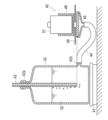
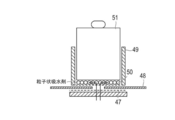
- FIG. 3 is a schematic view of a main part of the measuring device of FIG.
- FIG. 4 is a view for explaining a diffusion direction of a physiological saline in the measuring devices of FIGS. 2 and 3.
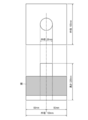
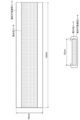
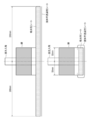
- FIG. 3 is a diagram illustrating a state in which a water-absorbing sheet used in an example of the present application is wound with water-absorbing paper. It is the top view and front view of the liquid injection cylinder used for evaluation of the amount of return.
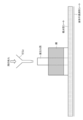
- FIG. 10 is a plan view and a right side view showing a state in which a sodium chloride aqueous solution is poured into a water-absorbent sheet from a liquid injection cylinder using a funnel in FIG. 9.
- the “water-absorbent sheet” in the present invention refers to a structure in which a water-absorbent resin (particulate water-absorbing agent) is supported between two or more long base materials.
- the water-absorbent sheet may use an adhesive or a hot-melt adhesive for adhesion between the substrates and / or for adhesion between the substrate and the particulate water-absorbing agent.
- the water absorbing sheet may contain other components (fiber component, antibacterial agent, deodorant, etc.) in addition to the particulate water absorbing agent. Further, the water-absorbing sheet may include other sheets in addition to the two sheets sandwiching the particulate water-absorbing agent and the like.
- the water-absorbent sheet is in the form of a continuous sheet or a roll in which the continuous sheet is wound.
- the continuous sheet is cut into an appropriate shape (such as a rectangle) and then used as an absorbent such as a disposable diaper.
- a conventional disposable diaper made of a high-concentration water-absorbent resin for example, a disposable diaper whose absorbent is a palpress
- water absorbent resin refers to a water-swelling component (CRC) defined by ERT441.2-02 of 5 g / g or more, and a water-soluble component defined by ERT470.2-02 ( Ext) refers to a polymer gelling agent having an Ext) of 50% by mass or less.
- the water-absorbing resin is preferably a hydrophilic cross-linked polymer obtained by cross-linking and polymerizing an unsaturated monomer having a carboxyl group.
- the shape of the water-absorbent resin is sheet, fiber, film, particle, gel or the like.
- the water absorbent sheet according to one embodiment of the present invention uses a particulate water absorbent resin.
- the “water-absorbent resin” is not limited to an embodiment in which the total amount (100% by mass) is only the water-absorbent resin. It may be a water-absorbing resin composition containing additives and the like. Further, in this specification, the term "water-absorbent resin” is a concept that also includes intermediates in the process of producing the water-absorbent resin. For example, a hydrogel cross-linked polymer after polymerization, a dried polymer after drying, a water-absorbing resin powder before surface cross-linking, and the like may also be referred to as “water-absorbing resin”.
- water-absorbent resin in addition to the water-absorbent resin itself, the water-absorbent resin composition and the intermediate may be collectively referred to as “water-absorbent resin”.
- water absorbing agent refers to an absorbent gelling agent containing a water-absorbing resin as a main component for absorbing an aqueous liquid (liquid).
- aqueous liquid (liquid) is not limited to water, and is not particularly limited as long as it is a liquid containing water.
- the aqueous liquid absorbed by the water-absorbent sheet according to one embodiment of the present invention is urine, menstrual blood, sweat, and other body fluids.
- the “particulate water-absorbing agent” means a particulate (powder-like) water-absorbing agent (corresponding to a particulate water-absorbing resin because the water-absorbing agent contains a water-absorbing resin as a main component).
- the concept of “particulate water-absorbing agent” includes both a single particulate water-absorbing agent and an aggregate of a plurality of particulate water-absorbing agents.
- “particulate” means having a particle form.
- particle refers to a relatively small divided body of matter and has a size of several mm to several mm (“particle”, edited by McGraw-Hill Scientific and Technical Dictionary Dictionary, edited by McGraw-Hill Science) Technical Term Dictionary 3rd Edition ”, Nikkan Kogyo Shimbun, 1996, p. 1929).
- the “particulate water-absorbing agent” may be simply referred to as “water-absorbing agent”.
- the particulate water-absorbing agent contains a water-absorbing resin as a polymer (or particulate water-absorbing resin or water-absorbing resin particles) as a main component.
- the particulate water-absorbing agent contains the water-absorbing resin as a polymer in an amount of 60 to 100% by mass, preferably 70 to 100% by mass, more preferably 80 to 100% by mass, further preferably 90 to 100% by mass, and particularly preferably. Contains 95 to 100% by mass.
- the remainder of the particulate water absorbing agent may optionally include water, additives (inorganic fine particles, polyvalent metal cations, and the like).
- the particulate water-absorbing agent used in the examples of the present application contains 80 to 100% by mass of a water-absorbing resin.
- the upper limit of the water absorbing resin in the particulate water absorbing agent is, for example, 100% by mass, 99% by mass, 97% by mass, 95% by mass, and 90% by mass.
- the composition further contains 0 to 10% by mass of components other than the water-absorbing resin, particularly water, additives (inorganic fine particles, polyvalent metal cations) and the like.
- water-absorbing resin which is a main component of the particulate water-absorbing agent
- examples of the water-absorbing resin include polyacrylic acid (salt) resin, polysulfonic acid (salt) resin, maleic anhydride (salt) resin, polyacrylamide resin, and polyvinyl alcohol.
- Resin polyethylene oxide resin, polyaspartic acid (salt) resin, polyglutamic acid (salt) resin, polyalginic acid (salt) resin, starch resin, and cellulose resin.
- polyacrylic acid (salt) -based resin is preferably used as the water-absorbing resin.
- polyacrylic acid (salt) refers to polyacrylic acid and / or a salt thereof.
- the polyacrylic acid (salt) contains a repeating unit of acrylic acid and / or a salt thereof (hereinafter, referred to as “acrylic acid (salt)”) as a main component, and further includes a graft component as an optional component. It is.
- the polyacrylic acid (salt) is obtained by polymerization of acrylic acid (salt), hydrolysis of polyacrylamide, polyacrylonitrile, and the like.
- the polyacrylic acid (salt) is obtained by polymerization of acrylic acid (salt).
- containing as a main component means that the amount of acrylic acid (salt) used in the polymerization of polyacrylic acid (salt) is the total amount of monomers (excluding the internal crosslinking agent) used in the polymerization.
- amount of acrylic acid (salt) used in the polymerization of polyacrylic acid (salt) is the total amount of monomers (excluding the internal crosslinking agent) used in the polymerization.
- EDANA is an abbreviation of European Disposables and Non International Publication Vens Associations.
- ERT is an abbreviation of a European standard (substantial global standard) water absorbent resin measurement method (EDANA Recommended Test Methods) established by EDANA. In the present specification, unless otherwise specified, the physical properties of the water-absorbent resin are measured in accordance with the 2002 edition of ERT.
- the unit of mass “t (ton)” means “metric ton”.
- Ppm means “mass ppm”.
- mass and weight means “parts by weight” and “parts by weight”, “% by weight” and “% by weight”, and “ppm by weight” and “ppm by weight” have the same meaning.
- —acid (salt) means “—acid and / or salt thereof”.
- (Meth) acryl means “acryl and / or methacryl”.
- the unit of volume “liter” may be described as “l” or “L”.
- Mass% may be described as “wt%”.
- the water-absorbent sheet of the present invention has a first base material, a second base material, and a water-absorbing layer located between the first base material and the second base material.
- a first particulate water-absorbing agent localized on the surface side facing the substrate, and a second particle localized on the surface side of the second substrate facing the first substrate A water-absorbing sheet, wherein the second particulate water-absorbing agent has an AAP of 4.8 kPa of 19.0 g / g or more and a DAP of 15 g / g or more.
- the AAP of the second particulate water-absorbing agent is high at 4.8 kPa, the amount of return to water absorption under pressure is suppressed, and since the DAP is high, the diffusivity under pressure is high.
- the function of the second particulate water-absorbing agent having the function of Then, even if the liquid that could not be absorbed by the second particulate water-absorbing agent attempts to return, the presence of the first particulate water-absorbing agent can prevent the liquid from rising to the skin. Therefore, the “specific return amount evaluation” can be made excellent.
- a water-absorbent sheet or a water-absorbent article designed to suppress the amount of return under general conditions does not always provide excellent results in the “specific return amount evaluation” of the present application.
- the water-absorbent sheet according to one embodiment of the present invention is suitable for use when, for example, a baby whose bladder is still small is sleeping at night or the like and under a load, but of course the use form is limited to this. It is not done.
- the first particulate water-absorbing agent and the second particulate water-absorbing agent are limited in that the AAP 4.8 kPa and the DAP of the second particulate water-absorbing agent are of the same type under the above-mentioned premise. It does not do.
- the mechanism and the like described in this specification do not limit the technical scope of the claims of the present application.
- FIG. 1 is a schematic diagram showing a cross section of the water absorbent sheet 40 according to one embodiment of the present invention.
- the first substrate 11 is located on the side where the liquid to be absorbed is introduced. That is, at least the first substrate is disposed on the liquid discharge side (for example, on the skin side in a disposable diaper). Further, the water absorbing layer 12 is disposed between the first base 11 and the second base 13.
- the second base material 13 is located only on the side opposite to the side where the liquid to be absorbed is introduced and with the water absorbing layer 12 interposed therebetween. 13 may be designed to be larger than the first base material 11 and folded so as to surround the first base material 11.
- the water absorbing layer 12 has a particulate water absorbing agent 14 and may have an intermediate sheet 16 as needed.
- the first particulate water-absorbing agent 14 a localized on the surface of the first substrate 11 facing the second substrate 13
- the second particulate water-absorbing agent 14b localized on the surface facing the first base material 11 is localized so as to sandwich the intermediate sheet 16.
- the water absorbing agent 14 fixed by an adhesive or the like may be detached and the water absorbing agent 14 captured by the intermediate sheet 16 may be present.
- the water absorbing layer 12 has a particulate water absorbing agent 14a fixed to the first substrate 11 and a particulate water absorbing agent 14b fixed to the second substrate. Some of the particulate water absorbing agents 14a and 14b may be detached from each sheet. Therefore, the water-absorbing “layer” does not refer only to a continuous body such as a sheet, but may be any layer that has a certain thickness between the first base material 11 and the second base material 13. It may be in a form.
- an adhesive may be used as a method of fixing to each substrate. For the method of producing a water-absorbent sheet using an adhesive, see [3. ] Will be described in detail.
- the water-absorbent sheet according to one embodiment of the present invention can be made thinner than an absorber used for a conventional absorbent article.
- the thickness is preferably 15 mm or less, more preferably 10 mm or less, still more preferably 7 mm or less, and particularly preferably 5 mm or less, for example, at 40% RH to 50% RH. , Most preferably 4 mm or less.
- the lower limit of the thickness is preferably 0.2 mm or more, more preferably 0.3 mm or more, and still more preferably 0.5 mm or more in consideration of the strength of the water-absorbent sheet and the diameter of the particulate water-absorbing agent.
- the thickness of the water-absorbing sheet used in the examples of the present application was 3 mm to 5 mm under the above conditions.
- the thickness of the water-absorbent sheet is measured using a dial thickness gauge large type (thickness measuring device) (manufactured by Ozaki Seisakusho Co., Ltd., model number: JB, measuring element: anvil vertical ⁇ 50 mm).
- the measurement location was determined by dividing the absorber into three equal parts in the longitudinal direction, and setting the respective central portions (points where a diagonal line was drawn from the end of the absorber and located at the intersection thereof). For example, in the case of a water-absorbent sheet having a length of 36 cm and a width of 10 cm, the measurement position is a point 6 cm from the left end in the longitudinal direction and 5 cm from both ends in the width direction with respect to the length of 36 cm in the longitudinal direction (left).
- Three points correspond to the measurement points: a point 18 cm from the left end in the longitudinal direction and 5 cm from both ends in the width direction (center), and a point 30 cm from the left end in the longitudinal direction and 5 cm from both ends in the width direction (right). .
- the number of measurement points is measured twice for each location, and the measured value of the thickness is an average value of a total of six points.
- T1 T2-T0 (T0: thickness of the sheet (mm), T1: thickness of the water-absorbing sheet (mm), T2: thickness of the water-absorbing sheet and the sheet (mm)).
- the surface of the water-absorbent sheet may be appropriately embossed in order to further impart liquid permeability, diffusivity, flexibility and the like to the water-absorbent sheet.
- the region to be embossed may be the entire surface of the water-absorbent sheet or a part thereof. By providing a continuous embossed area in the longitudinal direction of the water absorbent sheet, the liquid can be easily diffused in the longitudinal direction. Further, the particulate water-absorbing agent may be spread over the entire surface of the water-absorbing sheet, or a region where the particulate water-absorbing agent does not exist may be provided in a part.
- the region in a channel shape (streak shape) in the longitudinal direction of the water absorbing sheet.
- the region serves as a passage (liquid transfer passage) for flowing a large amount of liquid. Fulfill.
- the embossed area and / or the area where no particulate water absorbing agent is present may be provided linearly, curvedly, or corrugated.
- the first substrate is a water-permeable sheet located on the side where the liquid to be absorbed is introduced.
- the liquid to be absorbed is not limited to water, but may be urine, blood, sweat, feces, waste liquid, moisture, steam, ice, a mixture of water and an organic solvent and / or an inorganic solvent, rainwater, groundwater, and the like. It is not particularly limited as long as it contains water.
- urine, menstrual blood, sweat, and other body fluids can be mentioned.
- the first base material, the second base material, and the material of the intermediate sheet used in the water-absorbent sheet according to one embodiment of the present invention are preferably non-woven fabrics.
- the material of the nonwoven fabric is not particularly limited, but from the viewpoint of liquid permeability, flexibility, and strength of the water absorbent sheet, polyolefin fibers (such as polyethylene (PE) and polypropylene (PP)) and polyester fibers (polyethylene terephthalate (PET)) ), Polytrimethylene terephthalate (PTT), polyethylene naphthalate (PEN), etc.), polyamide fibers (nylon, etc.), rayon fibers, pulp (cellulose) fibers, and the like.
- nonwoven fabrics made of synthetic fibers, and nonwoven fabrics produced by mixing synthetic fibers with cotton, silk, hemp, pulp (cellulose) fibers, and the like are also preferable.
- the non-woven fabric described above may be a non-woven fabric containing only one kind of the above-mentioned fibers or a non-woven fabric combining two or more kinds of fibers.
- the nonwoven fabric used for the first base material and the second base material is preferably formed by an airlaid method. Further, it is preferably pulp (cellulose) fiber.
- the nonwoven fabric used in the water-absorbent sheet according to one embodiment of the present invention is preferably a hydrophilic nonwoven fabric in order to increase water permeability, but using a hydrophilic agent (such as a surfactant).
- a hydrophilic agent such as a surfactant
- the nonwoven fabric or the fiber that is the material of the nonwoven fabric may be made hydrophilic.
- hydrophilizing agent examples include anionic surfactants (such as aliphatic sulfonates and higher alcohol sulfates), cationic surfactants (such as quaternary ammonium salts), and nonionic surfactants (such as polyethylene glycol).
- anionic surfactants such as aliphatic sulfonates and higher alcohol sulfates
- cationic surfactants such as quaternary ammonium salts
- nonionic surfactants such as polyethylene glycol
- silicone surfactants polyoxyalkylene-modified silicones, etc.
- stain release agents containing polyester, polyamide, acrylic, and urethane resins are used.
- hydrophilizing agent examples include anionic surfactants (such as aliphatic sulfonates and higher alcohol sulfates), cationic surfactants (such as quaternary ammonium salts), and nonionic surfactants (such as polyethylene glycol).
- anionic surfactants such as aliphatic sulfonates and higher alcohol sulfates
- cationic surfactants such as quaternary ammonium salts
- nonionic surfactants such as polyethylene glycol.
- silicone surfactants polyoxyalkylene-modified silicones, etc.
- stain release agents containing polyester, polyamide, acrylic, and urethane resins are used.
- the first substrate used for the water-absorbent sheet according to one embodiment of the present invention is a water-permeable sheet because it is located on the side where the liquid to be absorbed is introduced, but the second substrate and
- the intermediate sheet is also preferably a water-permeable sheet having water permeability, and may be of the same type or different types.
- the water permeability of the water-permeable sheet is preferably 1 ⁇ 10 ⁇ 5 cm / sec or more as measured by a water permeability coefficient (JIS A1218: 2009).
- the water permeability is more preferably 1 ⁇ 10 ⁇ 4 cm / sec or more, further preferably 1 ⁇ 10 ⁇ 3 cm / sec or more, still more preferably 1 ⁇ 10 ⁇ 2 cm / sec or more, and still more preferably 1 ⁇ 10 ⁇ 2 cm / sec or more. ⁇ 10 ⁇ 1 cm / sec or more.
- the water absorbent sheet according to one embodiment of the present invention is preferably a hydrophilic nonwoven fabric. By being a hydrophilic nonwoven fabric, the desired effects of the present invention can be efficiently achieved.
- the porosity of the first substrate, the second substrate, and the intermediate sheet can be measured by the following equation.
- Density C (g / cm 3 ) Porosity (%) of base material (or sheet) 100 ⁇ ⁇ (A / 10000) / (B / 10) ⁇ / C * 100
- the thicknesses of the first base material and the second base material are preferably as thin as possible as long as they have strength as a water-absorbent sheet.
- Each base material independently has a thickness of 0.01 to 2 mm, and more preferably 0.02 to 0.02 mm. It is appropriately selected within a range of 1 to 1 mm, 0.03 to 0.6 mm, and 0.05 to 0.5 mm.
- the basis weight is preferably 5 to 300 g / m 2 , more preferably 8 to 200 g / m 2 , still more preferably 10 to 100 g / m 2 , and still more preferably 11 to 50 g / m 2 per substrate. is there.
- the water absorbing layer in the water absorbing sheet according to one embodiment of the present invention includes a particulate water absorbing agent and, in some cases, an intermediate sheet. Since the water absorbing layer has an intermediate sheet, the first particulate water absorbing agent and the second particulate water absorbing agent are more efficiently localized on the first base material and the second base material, respectively. It will be easier.
- the localization of the first particulate water absorbing agent and the second particulate water absorbing agent is as follows [3. ], For example, by appropriately using an adhesive.
- the water absorbing layer in the water absorbing sheet according to one embodiment of the present invention contains a first particulate water absorbing agent and a second particulate water absorbing agent.
- first particulate water-absorbing agent and / or the second particulate water-absorbing agent is a mixture of a plurality of types of particulate water-absorbing agents, the following description relates to the physical properties of the mixture. It is an explanation.
- AAP is an abbreviation for Absorption Against Pressure and means the water absorption capacity under pressure of a particulate water absorbing agent. Specifically, 0.9 g of the particulate water-absorbing agent was swollen under a load of 2.06 kPa (21 g / cm 2 , 0.3 psi) for 1 hour against a large excess of 0.9% by mass aqueous sodium chloride solution. It refers to the subsequent water absorption capacity (unit: g / g). In the present application, the measurement is performed with the load condition changed to 4.83 kPa (49 g / cm 2 , 0.7 psi). In addition, ERT442.2-02 is described as Absorption Under Pressure (AUP), but has substantially the same contents.
- AUP Absorption Under Pressure
- AAAP 4.8 kPa of the second particulate water absorbing agent in the water absorbing sheet according to one embodiment of the present invention is 19.0 g / g or more. If it is less than 19.0 g / g, the problem of the present invention cannot be solved.
- AAP 4.8 kPa In order to set AAP 4.8 kPa to a predetermined value or more, it can be controlled by, for example, the crosslinking density of the surface crosslinking layer. These can be controlled by a known technique.
- AAP 4.8 kPa of the second particulate water absorbing agent in the water absorbing sheet according to one embodiment of the present invention is preferably 20.0 g / g or more, more preferably 22.0 g / g or more. And more preferably 22.5 g / g or more. With such an embodiment, excellent results are obtained in the specific return amount evaluation.
- AAP 4.8 kPa of the second particulate water absorbing agent in the water absorbing sheet according to one embodiment of the present invention is practically about 40 g / g or less, 35 g / g or less, or about 30 g / g or less.
- AAP 4.8 kPa of the first particulate water absorbing agent in the water absorbing sheet according to one embodiment of the present invention is preferably 10 g / g or more, more preferably 15 g / g or more, and more preferably 20 g / g. More preferably, it is the above. With such an embodiment, excellent results are obtained in the specific return amount evaluation.
- the upper limit of AAP 4.8 kPa of the first particulate water-absorbing agent in the water-absorbent sheet according to one embodiment of the present invention is practically about 40 g / g or less, 35 g / g or less, or about 30 g / g or less. .
- AAP 4.8 kPa of the second particulate water-absorbing agent and AAP 4.8 kPa of the first particulate water-absorbing agent are the same as the second particulate water-absorbing agent. If AAP 4.8 kPa is 19 g / g or more, it may be the same, but preferably, AAP 4.8 kPa of the second particulate water absorbing agent is better than that of the first particulate water absorbing agent. AAP is higher than 4.8 kPa.
- AAP 4.8 kPa of the second particulate water absorbing agent with respect to AAP 4.8 kPa of the first particulate water absorbing agent is preferably more than 1, more preferably 1.05 or more, and further preferably 1. 08 or more, more preferably 1.1 or more.
- the upper limit is not particularly limited, but is, for example, preferably 2.0 or less, more preferably 1.5 or less, and still more preferably 1.3 or less.
- DAP diffusion absorption capacity under pressure 30 min (DAP 30 min)
- the diffusion absorption capacity under pressure is the absorption of the water-absorbent resin, taking into account the diffusion force of the aqueous liquid in a state where the weight of the water-absorbent resin is high and the particles of the water-absorbent resin are in close contact with each other due to external force. It is a physical property value for evaluation. That is, unlike AAP (longitudinal diffusion of 0.9 g of the particulate water absorbing agent), the diffusion absorption under pressure (DAP) is 2.06 kPa at a high concentration of 1.5 g of the particulate water absorbing agent. Evaluate performance.
- the above-mentioned diffusion water absorption capacity under pressure is calculated from a measured value after a lapse of a predetermined time (30 minutes) from the start of absorption in a measurement under a predetermined condition.
- the diffusion water absorption capacity under pressure measured from the measured value after the lapse of 30 minutes is defined as the diffusion water absorption capacity under pressure 30 minutes (also referred to as DAP 30 min).
- DAP 30 min the diffusion water absorption capacity under pressure
- FIGS. 2 and 3 are schematic diagrams showing a measuring device used for measuring the diffusion absorption capacity.
- the measuring device includes a balance 41, a container 42 having a predetermined capacity placed on the balance 41, an outside air suction pipe 43, a conduit 44, a glass filter 46, and a glass filter 46. And a measuring unit 45 mounted thereon.
- the container 42 has an opening 42a at the top and an opening 42b at the side, and the outside air suction pipe 43 is fitted into the opening 42a, while the conduit 44 is attached to the opening 42b. Have been.
- the container 42 contains a predetermined amount of physiological saline 52.
- the lower end of the outside air suction pipe 43 is submerged in the physiological saline 12.
- the above glass filter 46 is formed to have a diameter of 70 mm.
- the container 42 and the glass filter 46 are in communication with each other by a conduit 44. Further, the glass filter 46 is fixed such that the upper surface thereof is slightly higher than the lower end of the outside air suction pipe 43.
- the measuring unit 45 includes a filter paper 47, a sheet 48, a support cylinder 49, a wire net 50 attached to the bottom of the support cylinder 49, and a weight 51. . Then, the measuring unit 45 places the filter paper 47, the sheet 48, and the support cylinder 49 (that is, the wire mesh 50) on the glass filter 46 in this order, and places the weight 51 inside the support cylinder 49, that is, on the wire mesh 50. Is placed.
- the sheet 48 is made of polyethylene terephthalate (PET), and is formed in a 0.1 mm-thick donut shape having an opening having a diameter of 18 mm at the center.
- the support cylinder 49 has an inner diameter of 60 mm.
- the wire net 50 is made of stainless steel, and is formed to 400 mesh (mesh size 38 ⁇ m) according to JIS. Then, a predetermined amount of the particulate water-absorbing agent is evenly spread on the wire netting 50. The weight of the weight 51 is adjusted so that a load of 21 g / cm 2 (2.06 kPa) can be uniformly applied to the wire netting 50, that is, the particulate water absorbing agent.
- a predetermined preparation operation such as putting a predetermined amount of a 0.90 mass% aqueous sodium chloride solution into the container 42, fitting an outside air suction pipe 43 into the container 42, and the like is performed.
- the filter paper 47 is placed on the glass filter 46, and the sheet 48 is placed on the filter paper 47 such that the opening is located at the center of the glass filter 46.
- the weight was weighed to 1.500 ⁇ 0.005 g inside the support cylinder 49, that is, on the wire mesh 50 (the mass of this particulate water-absorbing agent is W3 (g).
- the whole amount of the particulate water-absorbing agent is evenly spread, and the weight 51 is placed on the particulate water-absorbing agent.
- the wire cylinder 50 that is, the support cylinder 49 on which the particulate water-absorbing agent and the weight 51 are placed, is placed so that the center thereof coincides with the center of the glass filter 46.
- the mass W2 (g) of the 0.90 mass% aqueous sodium chloride solution 52 absorbed by the particulate water-absorbing agent over 30 minutes was measured using the balance 41 from the time when the support cylinder 49 was placed on the sheet 48. . As shown in FIGS.
- the 0.90% by mass aqueous sodium chloride solution 52 passes through the opening of the sheet 48 and then moves in the lateral direction of the particulate water-absorbing agent (indicated by an arrow in FIG. 4). It is absorbed by the particulate water absorbing agent while diffusing almost uniformly.
- the DAP of the second particulate water absorbing agent in the water absorbing sheet according to one embodiment of the present invention is 15 g / g or more. If it is less than 15 g / g, the problem of the present invention cannot be solved.
- it can be controlled by, for example, the crosslinking density of the surface crosslinking layer. This can be controlled by known techniques.
- the DAP of the second particulate water-absorbing agent in the water-absorbent sheet according to one embodiment of the present invention is preferably 19.5 g / g or more, more preferably 20.5 g / g or more, and 22 g. / G or more.
- the DAP of the second particulate water-absorbing agent in the water-absorbent sheet according to one embodiment of the present invention may be 50 g / g or less, 35 g / g or less, or 30 g / g or less. And may be 28.0 g / g or less.
- the DAP of the first particulate water-absorbing agent in the water-absorbent sheet according to one embodiment of the present invention is preferably 15 g / g or more, more preferably 20 g / g or more, for improving diffusivity. More preferably, it is 23 g / g or more.
- the DAP of the first particulate water-absorbing agent in the water-absorbent sheet according to one embodiment of the present invention may be actually 50 g / g or less, 35 g / g or less, or 30 g / g. / G or less.
- CRC Centrifuge Retention Capacity (centrifuge holding capacity), and refers to the water absorption capacity of a particulate water-absorbing agent under no pressure (sometimes referred to as “water absorption capacity”). Specifically, 0.2 g of the particulate water-absorbing agent is put into a non-woven bag, then immersed in a large excess of 0.9% by mass aqueous sodium chloride solution for 30 minutes to freely swell, and then centrifuged ( 250G) means the water absorption capacity (unit: g / g) after draining.
- the CRC of the second particulate water-absorbing agent in the water-absorbent sheet according to one embodiment of the present invention is preferably 30 to 50 g / g, more preferably 31 to 45 g / g, and more preferably 32 to 42 g. / G is more preferable. With such an embodiment, excellent results are obtained in the specific return amount evaluation.
- the CRC of the first particulate water absorbing agent in the water absorbent sheet according to one embodiment of the present invention is preferably 25 to 45 g / g, more preferably 28 to 42 g / g, and more preferably 30 to 40 g / g. / G is more preferable. With such an embodiment, excellent results are obtained in the specific return amount evaluation.
- GPR Gel permeation rate
- the “liquid permeability” of the particulate water-absorbing agent refers to the fluidity of a liquid passing between swollen gel particles under a load.
- the gel permeation velocity (GPR) is used as this index.
- the gel permeation rate (GPR) of the particulate water-absorbing agent (the first particulate water-absorbing agent and the second particulate water-absorbing agent) contained in the water-absorbent sheet according to one embodiment of the present invention is described in US Pat. No. 5,849,405. Reference is made to the saline flow conductivity (SFC) test described in the specification and the measurement procedure is changed, and the measurement is performed in the following procedure.
- SFC saline flow conductivity
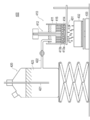
- a device 400 shown in FIG. 5 is used as a device for measurement.
- the device 400 is roughly composed of a container 410 and a tank 420.
- the container 410 is provided with a cell 411 (inner diameter: 6 cm), in which a swelling gel 414 (having a particulate water-absorbing agent absorbed) is accommodated in the cell 411, and a liquid 423 can be introduced. Further, by fitting the piston 412 into the cell 411, pressure can be applied to the swelling gel 414.
- Wire meshes 413a and 413b No.
- the liquid 423 an aqueous solution of 0.00 to 0.90% by weight of sodium chloride is used as the liquid 423.
- the tank 420 stores the liquid 423 inside. Liquid 423 is introduced into cell 411 through cocked L-shaped tube 422. A glass tube 421 is inserted into the tank 420, and the inside of the glass tube 421 is filled with air. Thereby, the lower end of the glass tube 421 and the liquid level in the cell 411 can be made the same.
- the liquid level in the cell 411 can be kept constant.
- the height difference between the lower liquid surface of the liquid 423 in the tank 420 (that is, the lower end of the glass tube 421) and the bottom surface of the swollen gel 414 was 4 cm. That is, according to the device 400, the liquid 423 having a constant hydrostatic pressure can be introduced into the cell 411. Since a hole 415 is formed in the piston 412, the liquid 423 flows through the hole 415, further flows through the swollen gel 414 layer, and flows out of the cell 411.
- the container 410 is placed on a stainless steel mesh 431 that does not prevent the passage of the liquid 423. Therefore, the liquid 423 flowing out of the cell 411 is finally collected in the collection container 432. Then, the amount of the liquid 423 collected in the collection container 432 can be weighed by the fine balance 433.
- the specific method of measuring the gel passage velocity (GPR) is as follows. The following operation is performed at room temperature (20 to 25 ° C.).
- the particulate water-absorbing agent (0.900 g) is uniformly introduced into the cell 411.
- the particulate water-absorbing agent is allowed to absorb a liquid (0.00 to 0.90% by mass (in this application, 0.90% by mass) aqueous sodium chloride solution) under no pressure for 60 minutes, and the swelling gel is obtained. 414.
- the gel permeation velocity (GPR) [g / min] is calculated by averaging the flow rates 1 to 3 minutes after the start of the flow of the liquid 423.
- the first particulate water-absorbing agent preferably has a GPR of 10 g / min or more, more preferably 15 g / min or more, and 50 g / min or more. Is more preferable, and it is still more preferable that it is 100 g / min or more. According to such an embodiment, after the liquid to be absorbed is introduced from the first base material side, the liquid is easily sent to the second particulate water absorbing agent, and the second particulate water absorbing agent is It can be used effectively and gives excellent results in the evaluation of the specific return amount.
- the first particulate water-absorbing agent has a GPR of 500 g / min or less, 400 g / min or less, or 300 g / min or less from the viewpoint of preventing liquid leakage.
- the GPR of the second particulate water-absorbing agent is preferably 2 g / min or more, and more preferably 3 g / min, from the viewpoint that the uptake rate is likely to be high.
- min or more may be 6 g / min or more, or 20 g / min or more.
- the upper limit of the GPR of the second particulate water absorbing agent is, for example, 500 g / min or less, 400 g / min or less, 300 g / min or less, 200 g / min or less, 100 g / min or less, and 90 g / min from the viewpoint of preventing liquid leakage.
- the GPR of the first particulate water-absorbing agent is such that after the liquid to be absorbed is introduced from the first substrate side, the second particulate water-absorbing agent is used.
- the GPR of the first particulate water-absorbing agent is preferably higher than the GPR of the second particulate water-absorbing agent, the GPR of the first particulate water-absorbing agent is preferably 1.2 or more, more preferably 3 or more, still more preferably 4 or more, and may be 10 or more, 15 or more, 20 or more, 25 or more, 30 or more, or 35 or more.
- the upper limit is not particularly limited, but is, for example, preferably 100 or less, more preferably 80 or less, and still more preferably 45 or less.
- the lower limit of the water content of the first particulate water-absorbing agent and the lower limit of the water content of the second particulate water-absorbing agent are process damage resistance (diameter resistance) during diaper production.
- each is independently preferably 2% by mass or more, more preferably 3% by mass or more, even more preferably 5% by mass or more.
- the content is 5% by mass or more, excellent results are obtained in the specific return amount evaluation.
- the upper limit of the water content of the first particulate water-absorbing agent and the upper limit of the water content of the second particulate water-absorbing agent determine the handleability during the production of the sheet.
- the content is preferably independently 20% by mass or less, more preferably 15% by mass or less.
- the adjustment of the water content can be controlled by appropriately referring to conventionally known knowledge. For example, there is a method of changing water addition conditions, drying conditions, moisture absorption conditions, and the like.
- the water content is defined as the amount of water contained in the particulate water-absorbing agent, and the weight loss when 1 g of the particulate water-absorbing agent is dried at 180 ° C. for 3 hours is measured.
- the ratio is expressed in terms of ratio to weight (% by weight).
- the upper limit of the degradable soluble component of the first particulate water absorbent and the degradable soluble component of the second particulate water absorbent is not particularly limited, From the viewpoint of liquid leakage during long-term use, it is preferably independently less than 50%, more preferably 25% or less, and even more preferably 15% or less.
- the lower limit is not particularly limited, but is practically, for example, about 1% or more, 3% or more, and about 5% or more.
- the measuring method of the deterioration soluble component follows the description of the Example of this application.
- the surface tension represents the work (free energy) required to increase the surface area of a solid or a liquid per unit area.
- the surface tension referred to in the present application refers to the surface tension of an aqueous solution when the particulate water-absorbing agent is dispersed in a 0.90% by mass aqueous solution of sodium chloride.
- the surface tension of the water absorbing agent is measured according to the following procedure. That is, 50 ml of physiological saline adjusted to 20 ° C. is placed in a well-washed 100 ml beaker, and the surface tension of the physiological saline is first measured using a surface tensiometer (KRUSS K11 automatic surface tensiometer). Measure.
- a well-washed 25 mm long fluororesin rotor and 0.5 g of a particulate water-absorbing agent were charged into a beaker containing physiological saline after surface tension measurement adjusted to 20 ° C., and 500 rpm. Stir for 4 minutes under conditions. After 4 minutes, the stirring is stopped, and after the water-containing particulate water-absorbing agent has settled, the surface tension of the supernatant is measured again by performing the same operation.
- a plate method using a platinum plate is adopted, and the plate is sufficiently washed with deionized water before each measurement and heated and washed with a gas burner before use.
- the surface tension of at least one of the first particulate water-absorbing agent and the second particulate water-absorbing agent is 65 mN / m or more and 66 mN / m or more in the following order. , 67 mN / m or more, 69 mN / m or more, 70 mN / m or more, 71 mN / m or more, and most preferably 72 mN / m or more.
- the upper limit of the surface tension of at least one of the first particulate water absorbent and the second particulate water absorbent is not particularly limited, but is, for example, 73 mN / m or less.
- the particulate water-absorbing agent according to one embodiment of the present invention preferably has an irregular crushed particle shape. Therefore, at least one of the shapes of the first particulate water-absorbing agent and the second particulate water-absorbing agent is irregularly crushed.
- the irregularly crushed particles are crushed particles having irregular shapes.
- Amorphous crushed particles obtained by reverse-phase suspension polymerization or gas-phase polymerization can be more easily fixed to a substrate than spherical particles.
- the particulate water-absorbing agent according to one embodiment of the present invention is preferably a pulverized product in aqueous solution polymerization.
- the pulverization step when the pulverization step is not performed, typically, spherical particles or granulated particles of spherical particles obtained by reverse phase suspension polymerization or droplet polymerization such as spraying and polymerizing a polymerization monomer are irregularly crushed. Not a state.
- the shape of the particulate water-absorbing agent when the shape of the particulate water-absorbing agent is irregularly crushed, the shape of the water-absorbent sheet is more easily maintained than that of a particle having a high average roundness (for example, spherical).
- the average roundness of the particulate water-absorbing agent is preferably 0.70 or less, more preferably 0.60 or less, and even more preferably 0.55 or less.
- the method of calculating the average roundness is as follows. 100 or more particulate water-absorbing agents are selected at random, and each particulate water-absorbing agent is photographed with an electron microscope (Keyence Corporation, VE-9800) (magnification: 50 times) to obtain an image of the particulate water-absorbing agent. The perimeter and area were calculated for each particle using the attached image analysis software. The following formula:
- particle size The particle size of the particulate water-absorbing agent (or particulate water-absorbent resin or water-absorbent resin particles) according to one embodiment of the present invention can be obtained according to the “PSD” measurement method specified in ERT420.2-02. Weight average particle diameter, which may be 150 to 600 ⁇ m.
- the lower limit of the content of the particulate water-absorbing agent per unit volume of the water-absorbent sheet is, in order of preference, 50 mg / cm 3 or more, 51 mg / cm 3 or more, and 52 mg / cm 3. above, 53 mg / cm 3 or more, 54 mg / cm 3 or more, 55 mg / cm 3 or more, 57 mg / cm 3 or more, 59 mg / cm 3 or more and 60 mg / cm 3 or more.
- the upper limit of the content of the particulate water-absorbing agent per unit volume of the water-absorbent sheet in the water-absorbent sheet according to one embodiment of the present invention is not particularly limited, but is actually 600 mg / cm 3 or less. , 500 mg / cm 3 or less, more preferably 400 mg / cm 3 or less, still more preferably 300 mg / cm 3 or less, and even more preferably 150 mg / cm 3 or less.
- the content of the particulate water-absorbing agent per unit volume of the water-absorbent sheet of the water-absorbent sheet used in Examples of the present application was 50 mg / cm 3 or more.
- the method for producing the particulate water-absorbing agent is not particularly limited as long as it is a method for producing a water-absorbing agent having desired physical properties.
- the particulate water-absorbing agent can be appropriately produced by referring to the publications described in the Examples.
- the content of the first particulate water-absorbing agent with respect to the content of the second particulate water-absorbing agent is preferably 1.0 or less, It is more preferably 0.5 or less, and further preferably 0.4 or less.
- the content weight of the second particulate water-absorbing agent is preferably the same as, preferably larger than the content of the first particulate water-absorbing agent, the second particles are considered to have a so-called tank-like function.
- the water-absorbing agent functions effectively and results in excellent specific return amount evaluation.
- the method for producing a water-absorbent sheet includes: (1) a step of spraying a first particulate water-absorbing agent on a first substrate; and (2) a second particle on a second substrate. And / or (3) a step of spraying the first particulate water absorbent and / or the second particulate water absorbent on the intermediate sheet.
- Examples of more specific manufacturing methods include the following manufacturing methods (a) to (c).
- the same operation is performed for the second base material and the second particulate water absorbing agent.
- the first base material and the second base material are stacked and pressed together such that the surfaces on which the particulate water-absorbing agent is sprayed face each other.
- the pressure bonding is preferably performed by heat bonding at around the melting temperature of the adhesive.
- the particulate water-absorbing agent is uniformly dispersed to form a layer.
- the same operation is performed for the second base material and the second particulate water absorbing agent. Further, the first base material and the second base material are overlapped so that the surfaces on which the particulate water-absorbing agent is sprayed face each other, and are pressure-bonded using a roll press or the like.
- the methods (a) and (c) are preferable from the viewpoint of simplicity of the production method and high production efficiency.
- the water absorbing sheet can be manufactured by using the methods (a) to (c) together.
- the intermediate sheet is placed on top of it and pressed.
- a second particulate water-absorbing agent (and preferably an adhesive) is uniformly dispersed on the surface of the intermediate sheet not facing the first particulate water-absorbing agent.
- the second substrate is stacked thereon and pressed (preferably under heating conditions under which the hot melt melts, or under a state in which the hot melt melts).
- an adhesive is sprayed on the second base material. Then, the surface of the intermediate sheet on which the second particulate water-absorbing agent has been sprayed and the surface of the second base material on which the adhesive has been sprayed are pressed. Next, the first particulate water-absorbing agent is uniformly sprayed on the surface opposite to the surface on which the second particulate water-absorbing agent has been sprayed on the intermediate sheet after the pressure bonding. Further, an adhesive is sprayed on the first base material. Then, the surface of the intermediate sheet on which the first particulate water-absorbing agent has been sprayed and the surface of the first base material on which the adhesive has been sprayed are pressed.
- the pressure bonding is preferably performed under heating conditions under which the hot melt is melted, or under a state in which the hot melt is melted.
- the second particulate water-absorbing agent is evenly sprayed thereon.
- the intermediate sheet is placed thereon and pressed.
- an adhesive is sprayed on the surface of the intermediate sheet not facing the second particulate water-absorbing agent.
- the first particulate water-absorbing agent is evenly sprayed thereon.
- the first base material is placed thereon and pressed. The pressing is preferably performed under heating conditions under which the hot melt is melted, or under a state in which the hot melt is melted.
- the second particulate water-absorbing agent is evenly sprayed thereon.
- the intermediate sheet is placed thereon and pressed.
- the first particulate water-absorbing agent is evenly spread on the surface of the intermediate sheet not facing the second particulate water-absorbing agent.
- an adhesive is sprayed on the first base material.
- the pressing is preferably performed under heating conditions under which the hot melt is melted, or under a state in which the hot melt is melted.
- the water-absorbent sheet may be embossed for the purpose of improving the feel of the water-absorbent sheet and improving the liquid absorption performance.
- the embossing may be performed simultaneously when the first base material and the second base material are pressed, or may be performed after the sheet is manufactured.
- additives deodorant, fiber, antibacterial agent, gel stabilizer, etc.
- the amount of the additive is preferably 0 to 50% by mass, more preferably 0 to 10% by mass, based on the mass of the particulate water absorbing agent.
- a particulate water-absorbing agent in which an additive is mixed in advance may be used, or the additive may be added during the production process.
- the dimensions of the manufactured water-absorbent sheet can be appropriately designed. Usually, the width is 3 to 10 m and the length is several tens to several thousand m (in a continuous sheet or roll state). The manufactured water-absorbent sheet is cut and used according to the purpose (the size of the absorber used).
- the method of fixing the base materials to each other or to the base material and the particulate water-absorbing agent may be (i) pressure bonding, (ii) water, a water-soluble polymer.
- various binders dissolved or dispersed in a solvent may be used, and (iii) the substrates may be heat-sealed at the melting point of the material of the substrate itself.
- it is fixed using an adhesive.
- the adhesive used may be a solution type, but a hot-melt adhesive having high productivity and no problem of the residual solvent is preferable from the trouble of removing the solvent, the problem of the remaining solvent, and the problem of the productivity.
- the hot melt adhesive may be contained in advance on the surface of the base material or the particulate water absorbing agent, or the hot melt adhesive may be separately used in the process of producing the water absorbing sheet.
- the form and melting point of the hot melt adhesive can be appropriately selected, and may be in the form of particles, fibers, nets, films, or liquids melted by heating.
- the melting temperature or softening point of the hot melt adhesive is preferably from 50 to 200 ° C and from 60 to 180 ° C.
- When a particulate adhesive is used its particle size is about 0.01 to 2 times, 0.02 to 1 times, and 0.05 to 0.5 times the average particle size of the above particulate water-absorbing agent.
- An adhesive is used.
- Examples of the method of using a hot melt adhesive in the production of the water absorbent sheet according to one embodiment of the present invention include the following examples.
- a mixture of the particulate water-absorbing agent and the hot-melt adhesive is evenly spread on a base material (for example, a nonwoven fabric), and another base material is laminated. By heat-compression bonding, a water-absorbing sheet can be manufactured.
- the hot-melt adhesive used in the present invention can be appropriately selected, but is preferably selected from ethylene-vinyl acetate copolymer adhesive, styrene-based elastomer adhesive, polyolefin-based adhesive, polyester-based adhesive and the like. More than one species can be used as appropriate.
- polyolefin adhesives include polyethylene, polypropylene, atactic polypropylene, and styrene elastomer adhesives include styrene-isoprene block copolymer (SIS), styrene-butadiene block copolymer (SBS), Styrene-isobutylene block copolymer (SIBS), styrene-ethylene-butylene-styrene block copolymer (SEBS), styrene butadiene rubber (SBR), and the like.
- SIS styrene-isoprene block copolymer
- SBS Styrene-isobutylene block copolymer
- SEBS styrene-ethylene-butylene-styrene block copolymer
- SBR styrene butadiene rubber
- ethylene-vinyl acetate copolymer adhesive examples include ethylene-vinyl acetate copolymer (EVA) adhesive; Ethyl acrylic acid copolymer (EEA), ethylene - butyl acrylate copolymer (EBA), and the like.
- EVA ethylene-vinyl acetate copolymer
- EBA Ethyl acrylic acid copolymer
- EBA ethylene - butyl acrylate copolymer
- the water-absorbent sheet preferably contains an adhesive, and the adhesive is preferably a hot melt adhesive.
- the amount (content) of the hot melt adhesive is more than 0 to 3.0 times the total mass of the first particulate water absorbing agent and the second particulate water absorbing agent.
- the ratio is 0.05 to 2.0 times.
- the content of the adhesive (especially hot melt adhesive) is too large, not only is it disadvantageous in terms of cost and mass of the water-absorbent sheet (increase in the weight of paper diapers), but also the swelling regulation of the particulate water-absorbing agent There is also a possibility that the water absorbing ability of the water absorbing sheet may be reduced.
- the absorbent article according to one embodiment of the present invention has a structure in which the water-absorbent sheet described in [2] is sandwiched between a liquid-permeable sheet and a liquid-impermeable sheet. Therefore, in the present invention, the water-absorbent sheet is sandwiched between a liquid-permeable sheet and a liquid-impermeable sheet, and the liquid-permeable sheet is located on the first base material side, A water absorbent article is provided, wherein a liquid impermeable sheet is located on the second substrate side.
- Specific examples of the absorbent article include disposable diapers, incontinence pads, sanitary napkins, pet sheets, food drip sheets, water cable waterproofing agents, and the like. With such a configuration, excellent results are obtained in the specific return amount evaluation.
- liquid-permeable sheet and the liquid-impermeable sheet those known in the technical field of absorbent articles can be used without particular limitation. Further, the absorbent article can be manufactured by a known method.
- ⁇ Particulate water-absorbing agent 1 Acrylic acid obtained in the above acrylic acid production example, a sodium acrylate aqueous solution obtained by the above-mentioned method for producing a sodium acrylate aqueous solution using the acrylic acid, and 75 mol% of a mixture obtained by mixing deionized water. 5.03 g of polyethylene glycol diacrylate (average number of moles of ethylene oxide 9) was dissolved in 5500 g of an aqueous solution of sodium acrylate having a neutralization ratio (monomer concentration: 38.0% by mass) to prepare a reaction solution.
- the reaction solution was supplied to a reactor formed by attaching a lid to a stainless steel double-armed kneader having a capacity of 10 L and having two sigma-type blades and having a capacity of 10 L. Gas replacement was performed to remove dissolved oxygen in the reaction solution. Subsequently, 30.68 g of a 10% by weight aqueous solution of sodium persulfate and 37.76 g of a 1% by weight aqueous solution of L-ascorbic acid were added while stirring the reaction solution, and polymerization started about 1 minute later. 40 minutes after the start of the polymerization, the hydrogel polymer was taken out. The obtained hydrogel polymer was finely divided into particles of about 2 to 4 mm.
- the finely divided hydrogel polymer was spread on a wire mesh of 50 mesh (mesh size: 300 ⁇ m) and dried with hot air at 175 ° C. for 65 minutes. Next, the dried product was pulverized using a roll mill, and further classified and blended with a wire mesh having an opening of 600 ⁇ m to obtain an irregularly crushed water-absorbent resin (1-1) having an average particle diameter of 380 ⁇ m. To 100 parts by mass of the obtained water-absorbent resin (1-1), 0.03 part by mass of ethylene glycol diglycidyl ether, 0.3 part by mass of 1,4-butanediol, 0.5 part by mass of propylene glycol, and 3.
- Aerosil 200 hydrophilic amorphous silica, manufactured by Nippon Aerosil Co., Ltd.
- ⁇ Particulate water absorbing agent 2 Acrylic acid obtained in the above acrylic acid production example, a sodium acrylate aqueous solution obtained by the above-mentioned method for producing a sodium acrylate aqueous solution using the acrylic acid, and 75 mol% of a mixture obtained by mixing deionized water. 3.93 g of polyethylene glycol diacrylate (average number of moles of ethylene oxide added: 9) of 3,93 g was dissolved in 5,500 g of an aqueous solution of sodium acrylate having a neutralization ratio (monomer concentration: 36.0% by mass) to prepare a reaction solution.
- the reaction solution was supplied to a reactor formed by attaching a lid to a stainless steel double-armed kneader having a capacity of 10 L and having two sigma-type blades and having a capacity of 10 L. Gas replacement was performed to remove dissolved oxygen in the reaction solution. Subsequently, while stirring the reaction mixture, 29.07 g of a 10% by weight aqueous solution of sodium persulfate and 35.78 g of a 1% by weight aqueous solution of L-ascorbic acid were added, and polymerization started about 1 minute later. 40 minutes after the start of the polymerization, the hydrogel polymer was taken out. The obtained hydrogel polymer was finely divided into particles of about 2 to 4 mm.
- the finely divided hydrogel polymer was spread on a wire mesh of 50 mesh (mesh size: 300 ⁇ m) and dried with hot air at 175 ° C. for 65 minutes.
- the dried product was pulverized using a roll mill, and further classified and blended with a metal mesh having a mesh size of 600 ⁇ m to obtain an irregularly crushed water-absorbent resin (2-1) having an average particle diameter of 350 ⁇ m.
- 4.03 parts by mass of ethylene glycol diglycidyl ether, 1.0 part by mass of propylene glycol and 3.0 parts by mass of water 4.03 parts by mass of 100 parts by mass of the obtained water-absorbent resin (2-1). Parts by mass were spray mixed.
- the above mixture was subjected to a heat treatment at a heating medium temperature of 100 ° C. for 40 minutes using a paddle type mixing and heating treatment machine to obtain a surface-crosslinked water-absorbent resin (2-2).
- a heating medium temperature of 100 ° C. for 40 minutes using a paddle type mixing and heating treatment machine to obtain a surface-crosslinked water-absorbent resin (2-2).
- the mixture was passed through a sieve to obtain a water absorbent resin (2-3).
- Aerosil 90G hydrophilic amorphous silica, manufactured by Nippon Aerosil Co., Ltd.
- Acrylic acid obtained in the above acrylic acid production example a sodium acrylate aqueous solution obtained by the above-mentioned method for producing a sodium acrylate aqueous solution using the acrylic acid, and 75 mol% of a mixture obtained by mixing deionized water. 5.01 g of polyethylene glycol diacrylate (average number of moles of ethylene oxide 9) was dissolved in 5500 g of an aqueous solution of sodium acrylate having a neutralization ratio (monomer concentration: 36.0% by mass) to prepare a reaction solution.
- the reaction solution was supplied to a reactor formed by attaching a lid to a stainless steel double-armed kneader having a capacity of 10 L and having two sigma-type blades and having a capacity of 10 L. Gas replacement was performed to remove dissolved oxygen in the reaction solution. Subsequently, while stirring the reaction mixture, 29.07 g of a 10% by weight aqueous solution of sodium persulfate and 35.78 g of a 1% by weight aqueous solution of L-ascorbic acid were added, and polymerization started about 1 minute later. 40 minutes after the start of the polymerization, the hydrogel polymer was taken out. The obtained hydrogel polymer was finely divided into particles of about 2 to 4 mm.
- the finely divided hydrogel polymer was spread on a wire mesh of 50 mesh (mesh size: 300 ⁇ m) and dried with hot air at 175 ° C. for 65 minutes.
- the dried product was pulverized using a roll mill, and further classified and blended with a wire mesh having an opening of 600 ⁇ m to obtain an irregularly crushed water-absorbent resin (3-1) having an average particle diameter of 350 ⁇ m.
- Parts by mass were spray mixed.
- the mixture was heat-treated at a heating medium temperature of 100 ° C. for 40 minutes using a paddle-type mixing heat treatment machine to obtain a surface-crosslinked water-absorbent resin (3-2).
- a surface-crosslinked water-absorbent resin (3-2) To 100 parts by mass of the obtained surface-crosslinked water-absorbent resin (3-2), 3.0 parts by mass of water was spray-mixed, and the mixture was cured at 60 ° C. for 1 hour in a closed container. The mixture was passed through a sieve to obtain a water absorbent resin (3-3).
- Aerosil 90G hydrophilic amorphous silica, manufactured by Nippon Aerosil Co., Ltd.
- ⁇ Particulate water absorbing agent 4 Acrylic acid obtained in the above acrylic acid production example, a sodium acrylate aqueous solution obtained by the above-mentioned method for producing a sodium acrylate aqueous solution using the acrylic acid, and 75 mol% of a mixture obtained by mixing deionized water. 5.77 g of polyethylene glycol diacrylate (average number of added moles of ethylene oxide: 9.77 g) was dissolved in 5,500 g of an aqueous solution of sodium acrylate having a neutralization ratio (monomer concentration: 33.5% by mass) to prepare a reaction solution.
- reaction solution was supplied to a reactor formed by attaching a lid to a stainless steel double-armed kneader having a capacity of 10 L and having two sigma-type blades and having a capacity of 10 L. Gas replacement was performed to remove dissolved oxygen in the reaction solution. Subsequently, 27.05 g of a 10% by mass aqueous solution of sodium persulfate and 33.29 g of a 1% by mass aqueous solution of L-ascorbic acid were added while stirring the reaction solution, and polymerization started about 1 minute later.
- Acrylic acid obtained in the above acrylic acid production example a sodium acrylate aqueous solution obtained by the above-mentioned method for producing a sodium acrylate aqueous solution using the acrylic acid, and 75 mol% of a mixture obtained by mixing deionized water. 4.11 g of polyethylene glycol diacrylate (average number of moles of ethylene oxide of 9) was dissolved in 5,500 g of an aqueous solution of sodium acrylate having a neutralization ratio (monomer concentration: 36.0% by mass) to prepare a reaction solution.
- the reaction solution was supplied to a reactor formed by attaching a lid to a stainless steel double-armed kneader having a capacity of 10 L and having two sigma-type blades and having a capacity of 10 L. Gas replacement was performed to remove dissolved oxygen in the reaction solution. Subsequently, while the reaction solution was stirred, 28.66 g of a 10% by mass aqueous solution of sodium persulfate and 35.28 g of a 1% by mass aqueous solution of L-ascorbic acid were added, and polymerization started about 1 minute later. 40 minutes after the start of the polymerization, the hydrogel polymer was taken out. The obtained hydrogel polymer was finely divided into particles of about 2 to 4 mm.
- the finely divided hydrogel polymer was spread on a wire mesh of 50 mesh (mesh size: 300 ⁇ m) and dried with hot air at 175 ° C. for 65 minutes. Next, the dried product was pulverized using a roll mill, and further classified and blended with a metal mesh having an opening of 600 ⁇ m to obtain an irregularly crushed water-absorbent resin (5-1) having an average particle diameter of 350 ⁇ m.
- a surface crosslinking agent aqueous solution comprising 0.03 parts by mass of ethylene glycol diglycidyl ether, 1.0 part by mass of propylene glycol and 3.0 parts by mass of water were added to 100 parts by mass of the obtained water-absorbent resin (5-1). Parts by mass were spray mixed.
- the above mixture was heat-treated at a heating medium temperature of 100 ° C. for 40 minutes using a paddle-type mixing heat treatment machine to obtain a surface-crosslinked water-absorbent resin (5-2).
- the mixture was passed through a sieve to obtain a water absorbent resin (5-3).
- 0.3 parts by mass of Aerosil 90G hydrophilic amorphous silica, manufactured by Nippon Aerosil Co., Ltd.
- Aerosil 90G hydrophilic amorphous silica, manufactured by Nippon Aerosil Co., Ltd.
- Acrylic acid obtained in the above acrylic acid production example a sodium acrylate aqueous solution obtained by the above-mentioned method for producing a sodium acrylate aqueous solution using the acrylic acid, and 75 mol% of a mixture obtained by mixing deionized water. 5.66 g of polyethylene glycol diacrylate (average number of moles of ethylene oxide added: 9.66 g) was dissolved in 5500 g of an aqueous solution of sodium acrylate having a neutralization rate (monomer concentration: 38.0% by mass) to prepare a reaction solution.
- the reaction solution was supplied to a reactor formed by attaching a lid to a stainless steel double-armed kneader having a capacity of 10 L and having two sigma-type blades and having a capacity of 10 L. Gas replacement was performed to remove dissolved oxygen in the reaction solution. Subsequently, 30.68 g of a 10% by weight aqueous solution of sodium persulfate and 37.76 g of a 1% by weight aqueous solution of L-ascorbic acid were added while stirring the reaction solution, and polymerization started about 1 minute later. 40 minutes after the start of the polymerization, the hydrogel polymer was taken out. The obtained hydrogel polymer was finely divided into particles of about 2 to 4 mm.
- the finely divided hydrogel polymer was spread on a wire mesh of 50 mesh (mesh size: 300 ⁇ m) and dried with hot air at 175 ° C. for 65 minutes. Next, the dried product was pulverized using a roll mill, and further classified and blended with a wire mesh having an opening of 600 ⁇ m to obtain an irregularly crushed water-absorbent resin (6-1) having an average particle diameter of 380 ⁇ m.
- Aqueous surface crosslinking agent aqueous solution comprising 0.3 parts by mass of 1,4-butanediol, 0.5 parts by mass of propylene glycol and 3.0 parts by mass of water with 100 parts by mass of the obtained water-absorbent resin (6-1). 8 parts by mass were spray-mixed.
- the above mixture was subjected to a heat treatment at a heating medium temperature of 210 ° C. for 40 minutes using a paddle type mixing and heating treatment machine to obtain a surface-crosslinked water-absorbing resin (6-2).
- a surface-crosslinked water-absorbing resin 6-2
- the mixture was passed through a sieve to obtain a water absorbent resin (6-3).
- 0.3 parts by mass of Aerosil 90G hydrophilic amorphous silica, manufactured by Nippon Aerosil Co., Ltd.
- Aerosil 90G hydrophilic amorphous silica, manufactured by Nippon Aerosil Co., Ltd.
- ⁇ Particulate water absorbing agent 7 Acrylic acid obtained in the above acrylic acid production example, a sodium acrylate aqueous solution obtained by the above-mentioned method for producing a sodium acrylate aqueous solution using the acrylic acid, and 75 mol% of a mixture obtained by mixing deionized water. 6.01 g of polyethylene glycol diacrylate (average number of moles of ethylene oxide 9) was dissolved in 5500 g of an aqueous solution of sodium acrylate having a neutralization ratio (monomer concentration: 38.0% by mass) to prepare a reaction solution.
- the reaction solution was supplied to a reactor formed by attaching a lid to a stainless steel double-armed kneader having a capacity of 10 L and having two sigma-type blades and having a capacity of 10 L. Gas replacement was performed to remove dissolved oxygen in the reaction solution. Subsequently, 26.65 g of a 10% by weight aqueous solution of sodium persulfate and 32.79 g of a 1% by weight aqueous solution of L-ascorbic acid were added while stirring the reaction solution, and polymerization started about 1 minute later. 40 minutes after the start of the polymerization, the hydrogel polymer was taken out. The obtained hydrogel polymer was finely divided into particles of about 2 to 4 mm.
- the finely divided hydrogel polymer was spread on a wire mesh of 50 mesh (mesh size: 300 ⁇ m) and dried with hot air at 175 ° C. for 65 minutes. Next, the dried product was pulverized using a roll mill, and further classified and blended with a wire mesh having a mesh size of 600 ⁇ m to obtain a crushed amorphous water-absorbent resin (7-1) having an average particle diameter of 420 ⁇ m.
- ⁇ Particulate water absorbing agent 8> Acrylic acid obtained in the above acrylic acid production example, a sodium acrylate aqueous solution obtained by the above-mentioned method for producing a sodium acrylate aqueous solution using the acrylic acid, and 75 mol% of a mixture obtained by mixing deionized water. 2.55 g of polyethylene glycol diacrylate (average number of moles of ethylene oxide added: 9) of 2.55 g was dissolved in 5500 g of an aqueous solution of sodium acrylate having a neutralization ratio (monomer concentration: 38.0% by mass) to prepare a reaction solution.
- the reaction solution was supplied to a reactor formed by attaching a lid to a stainless steel double-armed kneader having a capacity of 10 L and having two sigma-type blades and having a capacity of 10 L. Gas replacement was performed to remove dissolved oxygen in the reaction solution. Subsequently, while the reaction solution was stirred, 28.66 g of a 10% by mass aqueous solution of sodium persulfate and 35.28 g of a 1% by mass aqueous solution of L-ascorbic acid were added, and polymerization started about 1 minute later. 40 minutes after the start of the polymerization, the hydrogel polymer was taken out. The obtained hydrogel polymer was finely divided into particles of about 2 to 4 mm.
- the finely divided hydrogel polymer was spread on a wire mesh of 50 mesh (mesh size: 300 ⁇ m) and dried with hot air at 175 ° C. for 65 minutes. Next, the dried product was pulverized using a roll mill, and further classified and blended with a wire mesh having an opening of 600 ⁇ m to obtain an irregularly crushed water-absorbent resin (8-1) having an average particle diameter of 420 ⁇ m.
- the mixture was passed through a sieve to obtain a water absorbent resin (8-3).
- a water absorbent resin (8-3) 0.3 parts by mass of Aerosil 90G (hydrophilic amorphous silica, manufactured by Nippon Aerosil Co., Ltd.) was added to the water-absorbing resin (8-3), and the mixture was mixed to obtain a particulate water-absorbing agent (8).
- Aerosil 90G hydrophilic amorphous silica, manufactured by Nippon Aerosil Co., Ltd.
- Acrylic acid obtained in the above acrylic acid production example a sodium acrylate aqueous solution obtained by the above-mentioned method for producing a sodium acrylate aqueous solution using the acrylic acid, and 75 mol% of a mixture obtained by mixing deionized water. 4.04 g of polyethylene glycol diacrylate (average number of moles of ethylene oxide added: 9) was dissolved in 5500 g of an aqueous solution of sodium acrylate having a neutralization ratio (monomer concentration: 33.0% by mass) to prepare a reaction solution.
- reaction solution was supplied to a reactor formed by attaching a lid to a stainless steel double-armed kneader having a capacity of 10 L and having two sigma-type blades and having a capacity of 10 L. Gas replacement was performed to remove dissolved oxygen in the reaction solution. Subsequently, 26.65 g of a 10% by weight aqueous solution of sodium persulfate and 32.79 g of a 1% by weight aqueous solution of L-ascorbic acid were added while stirring the reaction solution, and polymerization started about 1 minute later.
- Non-woven fabric (2) having a thickness of 0.70 mm under no load and containing pulp fibers cut to a length of 10 cm and a width of 40 cm as a main component (made by an air laid method. Corresponding to a second base material. : 42 g / m 2 ), 0.3 to 0.5 g of an adhesive containing styrene butadiene rubber (spray glue 77, manufactured by 3M Japan KK) was uniformly sprayed (spray amount: 7.5 to 12). .5g / m 2).
- a nonwoven fabric (2) containing polyolefin as a main component (formed by an air-through method. Corresponding to an intermediate sheet. Weight per unit area: 50.6 g / m 2) Thickness of about 3 mm under no load (Measured value: 2.5 mm), the density of the material of the nonwoven fabric (2) containing the polyolefin as a main component: 0.91 g / cm 3 )), and pressure-bonded.
- an adhesive containing styrene-butadiene rubber (spray glue 77, manufactured by 3M Japan Co., Ltd.) is applied to the surface of the nonwoven fabric (2) on the side not facing the particulate water-absorbing agent (2) from 0.3 to 0. 0.5 g (spray amount: 7.5 to 12.5 g / m 2 ). Further, 3.0 g (spray amount: 75 g / m 2 ) of the particulate water-absorbing agent (1) (corresponding to the first particulate water-absorbing agent) was uniformly sprayed thereon.
- spray glue 77 manufactured by 3M Japan Co., Ltd.
- a non-woven fabric (1) having a thickness of 0.70 mm under no load and containing a pulp fiber cut to a length of 10 cm and a width of 40 cm on the particulate water-absorbing agent (1) prepared by an air laid method. things first corresponds to the substrate basis weight:. 42g / m 2) lap was wearing applied pressure. Thus, a water absorbent sheet (1) was obtained. Thereafter, the water-absorbing sheet (1) pressed and pressed was wound with water-absorbing paper (30 cm in length and 40 cm in width) (FIG. 6). The following Examples and Comparative Examples were similarly wound with water-absorbing paper. A sheet obtained by winding a water-absorbent sheet with water-absorbing paper is simply referred to as a water-absorbent sheet. The same applies hereinafter.
- the nonwoven fabric (1) and the nonwoven fabric (2) used in this example are both water-permeable sheets.
- Example 2 In Example 1, the particulate water-absorbing agent (1) 6.0 g (application rate: 150 g / m 2), the particulate absorber (2) 6.0 g (application rate: 150 g / m 2) using, water The functional sheet (2) was obtained.
- Example 3 In Example 1, the particulate water-absorbing agent (1) 4.0 g (application rate: 100 g / m 2), the particulate absorber (2) 8.0 g (application rate: 200 g / m 2) using, water The functional sheet (3) was obtained.
- Example 4 In Example 1, a water absorbent sheet (4) was obtained by using the particulate water absorbent (3) instead of the particulate absorbent (2).
- Example 5 In Example 1, a water absorbent sheet (5) was prepared by using a particulate absorbent (4) instead of the particulate water absorbent (1) and a particulate absorbent (5) instead of the particulate absorbent (2). I got
- Example 6 In Example 5, a water absorbent sheet (6) was obtained by using the particulate absorbent (1) instead of the particulate water absorbent (5).
- Example 7 In Example 5, a water absorbent sheet (7) was obtained by using the particulate absorbent (3) instead of the particulate water absorbent (5).
- Example 8 In Example 1, a water absorbent sheet (8) was obtained by using the particulate absorbent (3) instead of the particulate water absorbent (1).
- Example 9 In Example 5, a water absorbent sheet (9) was obtained by using the particulate absorbent (6) instead of the particulate absorbent (5).
- Example 10 In Example 1, a water absorbent sheet (10) was obtained by using the particulate absorbent (7) instead of the particulate water absorbent (2).
- Example 11 In Example 1, a water absorbent sheet (11) was obtained by using the particulate absorbent (8) instead of the particulate water absorbent (2).
- Comparative Example 1 Comparative Example 2 (Example 2) In Example 1, a comparative water-absorbent sheet (2) was prepared using a particulate absorbent (T2) instead of the particulate water absorbent (1) and a particulate absorbent (T1) instead of the particulate absorbent (2). I got
- Comparative Example 2 In Comparative Example 1, a comparative water absorbent sheet (2) was obtained by using the particulate absorbent (4) instead of the particulate water absorbent (T2).
- Comparative Example 3 In Comparative Example 2, a comparative water absorbent sheet (3) was obtained by using the particulate absorbent (T2) instead of the particulate water absorbent (T1).
- Example 4 A comparative water-absorbent sheet (4) was obtained in Example 1 by using the particulate absorbent (10) instead of the particulate absorbent (2).
- Comparative Example 5 In Comparative Example 2, a comparative water absorbent sheet (4) was obtained using the particulate absorbent (9) instead of the particulate water absorbent (T1).
- L-ascorbic acid was added to a previously prepared physiological saline to a concentration of 0.05% by mass to prepare a degradation test solution. Specifically, 0.50 g of L-ascorbic acid was dissolved in 999.5 g of physiological saline to prepare a deterioration test solution. 25 ml of the deterioration test liquid was added to a 250 ml glass beaker container, and 1.0 g of a particulate water absorbing agent was added thereto to form a swollen gel.
- This extract was filtered using filter paper (ADVANTEC Toyo Co., Ltd., product name: (JIS P # 3801, No. 2), thickness 0.26 mm, particle diameter of retained particles 5 ⁇ m), and 20.0 g of the filtrate obtained was weighed. Then, 30 g of physiological saline was added to obtain a measurement solution.
- filter paper ADVANTEC Toyo Co., Ltd., product name: (JIS P # 3801, No. 2), thickness 0.26 mm, particle diameter of retained particles 5 ⁇ m)
- the measurement method is as follows: physiological saline is titrated to pH 10 using a 0.1 N NaOH aqueous solution, and then titrated to pH 2.7 using a 0.1 N HCl aqueous solution. , [BHCl] ml). The same titration operation was performed on the measurement solution to determine the titer ([NaOH] ml, [HCl] ml). For example, in the case of a particulate water-absorbing agent comprising a known amount of acrylic acid and its sodium salt, the soluble content in the particulate water-absorbing agent is determined based on the average molecular weight of the monomer and the titer obtained by the above operation.
- Degradable soluble matter 0.1 ⁇ (average molecular weight) ⁇ 200 ⁇ 100 ⁇ ([HCl] ⁇ [bHCl]) / 1000 / 1.0 / 20.0.
- the average molecular weight of the monomer is calculated using the neutralization ratio obtained by titration.
- the water-absorbent sheet cut into a length of 10 cm and a width of 40 cm was wrapped with a liquid-impermeable sheet of 14 cm in length and 40 cm in width to form an opening at the top.
- the liquid injection cylinder (FIG. 7) was placed on the center of the water-absorbent sheet as shown in FIG. In this state, 50 g of a 0.9% mass aqueous sodium chloride solution at 23 ° C. was charged into the liquid injection cylinder using a funnel (FIG. 10) capable of charging the liquid at a flow rate of 7 ml / sec. Ten minutes after the liquid was charged, the liquid injection cylinder was removed, and ten filter papers (model No.
- Table 2 shows the sum of the first, second, and third reversal amounts. Table 2 shows the amount of reversion of each water absorbent sheet and each comparative water absorbent sheet. In addition, it is evaluated that the smaller the sum of the return amounts of the first time (g), the second time (g), and the third time (g), the better.
- the water-absorbent sheet was placed in a plastic bag with a zipper, and the inside of the plastic bag with a zipper was evacuated and sealed. Thereafter, a roller having a diameter of 85 mm, a length of 200 mm, and a weight of 4 kg was rolled thereon 20 times (10 reciprocations) to give an impact force to the water absorbent sheet in the plastic bag with the chuck. Thus, a damage resistance test was performed by applying a predetermined load to the water-absorbent sheet and thereby applying a load to the water-absorbing agent present in the water-absorbent sheet.
- the plastic bag with a zipper for example, "Unipack (registered trademark)" manufactured by Production Japan Co., Ltd. is preferably used.
- the amount of reversion after the damage resistance test was measured using the water absorbent sheets (5) and (6).
- the water-absorbent sheet (5) containing the particulate water-absorbing agent (5) having a water content of 8% did not change in the amount of reversion before and after the damage resistance test, whereas the particulate water-absorbing agent (3) having a water content of 3%.
- the amount of reversion of the water-absorbent sheet (1) containing before and after the test increased. This is probably because the AAP 4.8 kPa of the particulate water absorbing agent (1) was reduced by 0.5 g / g in the damage resistance test.
- 400 devices 410 containers, 411 cells, 412 pistons, 413a, 413b wire mesh, 414 swollen gel (absorbed particulate water absorbing agent), 415 holes, 420 tanks, 421 glass tube, 422 L-shaped tube with cock glass tube, 423 liquid, 431 stainless steel wire mesh, 432 collection container, 433 Precision balance.
Landscapes
- Chemical & Material Sciences (AREA)
- Health & Medical Sciences (AREA)
- General Health & Medical Sciences (AREA)
- Veterinary Medicine (AREA)
- Engineering & Computer Science (AREA)
- Public Health (AREA)
- Epidemiology (AREA)
- Life Sciences & Earth Sciences (AREA)
- Animal Behavior & Ethology (AREA)
- Analytical Chemistry (AREA)
- Organic Chemistry (AREA)
- Chemical Kinetics & Catalysis (AREA)
- Biomedical Technology (AREA)
- Heart & Thoracic Surgery (AREA)
- Vascular Medicine (AREA)
- Materials Engineering (AREA)
- Hematology (AREA)
- Dispersion Chemistry (AREA)
- Absorbent Articles And Supports Therefor (AREA)
- Solid-Sorbent Or Filter-Aiding Compositions (AREA)
Abstract
【課題】 本発明は、比較的高い加圧下の状況で断続的に複数回(特に、3回以上)の液の導入があって液の導入量が多くなっても、戻り量を有意に低減することができる、新規な吸水性シートの構成を提供することを目的とする。 【解決手段】 第1の基材と、第2の基材と、前記第1の基材と、前記第2の基材との間に位置する吸水層と、を有する、吸水性シートであって、前記第1の基材が、吸液される液が導入される側に位置する、透水性シートであり、前記吸水層が、前記第1の基材の前記第2の基材に対向する面側に局在している第1の粒子状吸水剤と、前記第2の基材の前記第1の基材に対向する面側に局在している第2の粒子状吸水剤と、を有し、前記第2の粒子状吸水剤のAAP4.8kPaが19.0g/g以上であり、DAPが15g/g以上である、吸水性シート。
Description
本発明は、吸水液性シートおよびそれを含む吸水性物品に関する。
吸水性樹脂(SAP/Super Absorbent polymer)は、水膨潤性水不溶性の高分子ゲル化剤であり、紙オムツ、生理用ナプキンや成人向け失禁用製品等の衛生材料、農園芸用の土壌保水剤、工業用の止水剤等、様々な用途に利用されている。
これら吸収性物品は一般に紙オムツ製造工場にて吸水性樹脂と繊維材料を混合して吸収性物品ごとに個々に型取りした吸収体として製造されており、目的に応じて種々の形状の吸収体(例えば、平面に見て砂時計型、キツネ型、楕円型等)に加工されている。これら吸収体の製造方法は個々に型取りするため任意の形に加工でき、吸収性物品ごとに繊維や吸水性樹脂の量も調整し易いため、現在の紙オムツの主流となっている。
しかし、近年、紙オムツの製造で、2枚のシート間に吸水性樹脂を固定化した長尺の吸水性シートを衛生材料の製造工程で裁断した吸収体(通常は幅10cm前後で長さ数10cmの長方形に裁断)を用いた紙オムツが製造されるようになってきた。紙オムツメーカーは、長尺の連続吸水性シートを購入又は製造することで、紙オムツの製造工程を簡便化でき、さらにパルプを用いないことで紙オムツを薄型化することができる。吸水性シートは上下のシート(特に不織布シート)間に吸水性樹脂粒子をサンドイッチ及び固定化する構成をとり、通常長尺連続シートを製造した後に長尺連続シートを裁断して幅10cm前後で長さ数10cmの長方形とし、紙オムツに組み込む(例えば、特許文献1)。
従来の衛生材料(紙オムツ)と違って、吸水性シートによる紙オムツはその歴史が浅いこともあり、吸水性シートに適した吸水性樹脂の開発やパラメーターの提案は殆ど行われていないのが実情であり、従来の紙オムツ向けの吸水性樹脂が吸水性シートにもそのまま使用されている。
本発明者は、薄型であることが主流の吸水性シートならではの構造上、吸収された液体が放出されてしまう、いわゆる「逆戻り」が発生してしまうことがあることを知見した。そして、比較的高い加圧下の状況で断続的に複数回(特に、3回以上)の液の導入があって液の導入量が多くなると、その問題が顕著であることを見出した。
よって、本発明は、液の導入環境が上述のようであっても、戻り量を有意に低減することができる、新規な吸水性シートの構成を提供することを目的とする。
第1の基材と、第2の基材と、前記第1の基材と、前記第2の基材との間に位置する吸水層と、を有する、吸水性シートであって、前記第1の基材が、吸液される液が導入される側に位置する、透水性シートであり、前記吸水層が、前記第1の基材の前記第2の基材に対向する面側に局在している第1の粒子状吸水剤と、前記第2の基材の前記第1の基材に対向する面側に局在している第2の粒子状吸水剤と、を有し、前記第2の粒子状吸水剤のAAP4.8kPaが19.0g/g以上であり、DAPが15g/g以上である、吸水性シートによって、上記課題を解決する。
以下、本発明を最良の形態を示しながら説明する。本明細書の全体にわたり、単数形の表現は、特に言及しない限り、その複数形の概念をも含むことが理解されるべきである。従って、単数形の冠詞(例えば、英語の場合は「a」、「an」、「the」等)は、特に言及しない限り、その複数形の概念をも含むことが理解されるべきである。また、本明細書において使用される用語は、特に言及しない限り、当該分野で通常用いられる意味で用いられることが理解されるべきである。したがって、他に定義されない限り、本明細書中で使用される全ての専門用語及び科学技術用語は、本発明の属する分野の当業者によって一般的に理解されるのと同じ意味を有する。矛盾する場合、本明細書(定義を含めて)が優先する。本発明は、下記の実施形態に限定されるものではなく、特許請求の範囲内で種々改変することができる。
〔1.用語の定義〕
[1-1.吸水性シート]
本発明における「吸水性シート」とは、長尺の2枚以上の基材間に吸水性樹脂(粒子状吸水剤)が担持された構造物をいう。上記吸水性シートは、基材同士の接着、および/または、基材と粒子状吸水剤との接着に、接着剤を用いていてもよく、ホットメルト接着剤を用いていてもよい。上記吸水性シートは、粒子状吸水剤に加えて、他の成分(繊維成分、抗菌剤、消臭剤など)を含んでいてもよい。また、上記吸水性シートは、粒子状吸水剤などを挟持する2枚のシート以外にも、他のシートを含んでもよい。
[1-1.吸水性シート]
本発明における「吸水性シート」とは、長尺の2枚以上の基材間に吸水性樹脂(粒子状吸水剤)が担持された構造物をいう。上記吸水性シートは、基材同士の接着、および/または、基材と粒子状吸水剤との接着に、接着剤を用いていてもよく、ホットメルト接着剤を用いていてもよい。上記吸水性シートは、粒子状吸水剤に加えて、他の成分(繊維成分、抗菌剤、消臭剤など)を含んでいてもよい。また、上記吸水性シートは、粒子状吸水剤などを挟持する2枚のシート以外にも、他のシートを含んでもよい。
通常、吸水性シートは、連続シート状、または、当該連続シートを巻き取ったロール状である。上記吸水性シートを使用する際には、連続シートを適当な形状(長方形など)に裁断した後に、使い捨てオムツなどの吸収体として使用する。一方、従来の高濃度吸水性樹脂の使い捨てオムツ(例えば、吸収体がパルプレスの使い捨てオムツ)は、使い捨てオムツ一枚ごとに、個々に型取りされた吸収体を使用する。したがって、このような吸収体は、本発明の吸水性シートとは技術の性質を異にする。
[1-2.吸水性樹脂]
本明細書において「吸水性樹脂」とは、ERT441.2-02により規定される水膨潤性(CRC)が5g/g以上であり、およびERT470.2-02により規定される水可溶成分(Ext)が50質量%以下である高分子ゲル化剤をいう。
本明細書において「吸水性樹脂」とは、ERT441.2-02により規定される水膨潤性(CRC)が5g/g以上であり、およびERT470.2-02により規定される水可溶成分(Ext)が50質量%以下である高分子ゲル化剤をいう。
吸水性樹脂は、好ましくは、カルボキシル基を有する不飽和単量体を架橋重合させた、親水性架橋重合体である。上記吸水性樹脂の形状は、シート状、繊維状、フィルム状、粒子状、ゲル状などである。本発明の一実施形態に係る吸水性シートは、粒子状の吸水性樹脂を用いる。
本明細書において「吸水性樹脂」とは、全量(100質量%)が当該吸水性樹脂のみである態様に限定されない。添加剤などを含んでいる吸水性樹脂組成物であってもよい。また、本明細書において「吸水性樹脂」とは、吸水性樹脂の製造工程における中間体をも包含する概念である。例えば、重合後の含水ゲル状架橋重合体、乾燥後の乾燥重合体、表面架橋前の吸水性樹脂粉末なども、「吸水性樹脂」と表記する場合がある。
このように、本明細書においては、吸水性樹脂そのものに加えて、吸水性樹脂組成物および中間体をも総称して「吸水性樹脂」と表記する場合がある。
[1-3.吸水剤、粒子状吸水剤]
本明細書において「吸水剤」とは、吸水性樹脂を主成分として含む、水性液(液)を吸収するための吸収ゲル化剤を意味する。ここで、上記水性液(液)とは水のみならず、水を含む液体であれば特に限定されない。本発明の一実施形態に係る吸水性シートが吸収する水性液は、尿、経血、汗、その他の体液である。
本明細書において「吸水剤」とは、吸水性樹脂を主成分として含む、水性液(液)を吸収するための吸収ゲル化剤を意味する。ここで、上記水性液(液)とは水のみならず、水を含む液体であれば特に限定されない。本発明の一実施形態に係る吸水性シートが吸収する水性液は、尿、経血、汗、その他の体液である。
本明細書において「粒子状吸水剤」とは、粒子状(粉末状)の吸水剤を意味する(吸水剤中に吸水性樹脂を主成分として含むため、粒子状の吸水性樹脂に相当する)。「粒子状吸水剤」の概念には、一粒の粒子状吸水剤と、複数個の粒子状吸水剤の集合体との、いずれもが包含される。本明細書において「粒子状」とは、粒子の形態を有することを意味する。ここで、「粒子」とは、物質の比較的小さな分割体を指し、数Å~数mmの大きさを有している(「粒子」、マグローヒル科学技術用語大辞典編集委員会 編『マグローヒル科学技術用語大辞典 第3版』、日刊工業新聞社、1996年、1929頁を参照)。なお、本明細書では、「粒子状吸水剤」を単に「吸水剤」と表記することがある。
粒子状吸水剤は、重合体としての吸水性樹脂(もしくは、粒子状の吸水性樹脂、吸水性樹脂粒子とも言う)を主成分として含む。上記粒子状吸水剤は、重合体としての吸水性樹脂を、60~100質量%、好ましくは70~100質量%、より好ましくは80~100質量%、さらに好ましくは90~100質量%、特に好ましくは95~100質量%含む。上記粒子状吸水剤の残部は、水、添加剤(無機微粒子、多価金属カチオンなど)などを任意に含んでもよい。なお、本願の実施例で使用した粒子状吸水剤には、吸水性樹脂が80~100質量%含まれている。
すなわち、粒子状吸水剤中の吸水性樹脂の上限は、例えば、100質量%、99質量%、97質量%、95質量%、90質量%である。そして、好ましくは、吸水性樹脂以外に0~10質量%の成分、特に水、添加剤(無機微粒子、多価金属カチオン)などをさらに含む。
粒子状吸水剤の主成分となる吸水性樹脂の例としては、ポリアクリル酸(塩)系樹脂、ポリスルホン酸(塩)系樹脂、無水マレイン酸(塩)系樹脂、ポリアクリルアミド系樹脂、ポリビニルアルコール系樹脂、ポリエチレンオキシド系樹脂、ポリアスパラギン酸(塩)系樹脂、ポリグルタミン酸(塩)系樹脂、ポリアルギン酸(塩)系樹脂、デンプン系樹脂、セルロース系樹脂が挙げられる。このうち、好ましくは、ポリアクリル酸(塩)系樹脂が吸水性樹脂として使用される。
[1-4.ポリアクリル酸(塩)]
本明細書において「ポリアクリル酸(塩)」とは、ポリアクリル酸および/またはその塩を指す。上記ポリアクリル酸(塩)は、主成分として、アクリル酸および/またはその塩(以下、「アクリル酸(塩)」と称する)の繰り返し単位を含み、任意成分としてグラフト成分をさらに含む、重合体である。上記ポリアクリル酸(塩)は、アクリル酸(塩)の重合、ポリアクリルアミドやポリアクリニトリルなどの加水分解、などによって得られる。好ましくは、上記ポリアクリル酸(塩)は、アクリル酸(塩)の重合によって得られる。
本明細書において「ポリアクリル酸(塩)」とは、ポリアクリル酸および/またはその塩を指す。上記ポリアクリル酸(塩)は、主成分として、アクリル酸および/またはその塩(以下、「アクリル酸(塩)」と称する)の繰り返し単位を含み、任意成分としてグラフト成分をさらに含む、重合体である。上記ポリアクリル酸(塩)は、アクリル酸(塩)の重合、ポリアクリルアミドやポリアクリニトリルなどの加水分解、などによって得られる。好ましくは、上記ポリアクリル酸(塩)は、アクリル酸(塩)の重合によって得られる。
ここで、「主成分として含む」とは、ポリアクリル酸(塩)を重合する際のアクリル酸(塩)の使用量が、重合に用いられる単量体(ただし、内部架橋剤を除く)全体に対して、通常50~100モル%、好ましくは70~100モル%、より好ましくは90~100モル%、さらに好ましくは実質的に100モル%であることをいう。
[1-5.EDANAおよびERT]
「EDANA」は、欧州不織布工業会(European Disposables and Non国際公開第vens Associations)の略称である。「ERT」は、EDANAが制定している、欧州標準(実質的な世界標準)の吸水性樹脂の測定法(EDANA Recommended Test Methods)の略称である。本明細書では、特に断りのない限り、2002年版のERTに準拠して、吸水性樹脂の物性を測定する。
「EDANA」は、欧州不織布工業会(European Disposables and Non国際公開第vens Associations)の略称である。「ERT」は、EDANAが制定している、欧州標準(実質的な世界標準)の吸水性樹脂の測定法(EDANA Recommended Test Methods)の略称である。本明細書では、特に断りのない限り、2002年版のERTに準拠して、吸水性樹脂の物性を測定する。
[1-6.その他]
本明細書において、範囲を示す「X~Y」は「X以上、Y以下」を意味する。
本明細書において、範囲を示す「X~Y」は「X以上、Y以下」を意味する。
本明細書において、特に注釈のない限り、質量の単位である「t(トン)」は「メートルトン(Metric ton)」を意味する。「ppm」は、「質量ppm」を意味する。「質量」と「重量」、「質量部」と「重量部」、「質量%」と「重量%」、「質量ppm」と「重量ppm」は、それぞれ同じ意味として扱う。
本明細書において、「~酸(塩)」は「~酸および/またはその塩」を意味する。「(メタ)アクリル」は「アクリルおよび/またはメタクリル」を意味する。
本明細書においては、体積の単位「リットル」を「l」または「L」と表記する場合がある。「質量%」を「wt%」と表記することがある。微量成分の測定を行う場合において、検出限界以下をN.D.(Non Detected)と表記する。
〔2.吸水性シート〕
本発明の吸水性シートは、第1の基材と、第2の基材と、前記第1の基材と、前記第2の基材との間に位置する吸水層と、を有する、吸水性シートであって、前記第1の基材が、吸液される液が導入される側に位置する、透水性シートであり、前記吸水層が、前記第1の基材の前記第2の基材に対向する面側に局在している第1の粒子状吸水剤と、前記第2の基材の前記第1の基材に対向する面側に局在している第2の粒子状吸水剤と、を有し、前記第2の粒子状吸水剤のAAP4.8kPaが19.0g/g以上であり、DAPが15g/g以上である、吸水性シートである。かかる構成によって、比較的高い加圧下の状況で断続的に複数回(特に、3回以上)の液の導入があって液の導入量が多くなっても、戻り量を有意に低減することができる。特に、かかる構成であることによって、本願の実施例における特定条件での戻り量の測定(本明細書中、「特定戻り量評価」とも称する)において非常に優れた結果を得ることができる。つまり、断続的に複数回(特に、3回以上)の液の導入があると、通常の構成であれば、液量が設定の吸収量以上となって過剰な「戻り」が発生してしまう。これに対し、本発明では、粒子状吸水剤がシート(層)状に形成されている利点を活かして、粒子状吸水剤の層(特に、第2の粒子状吸水剤の層)の面積を最大限に利用する構成を備えている。より具体的に言えば、第2の粒子状吸水剤のAAP4.8kPaが高いので加圧下での吸水に対し戻り量を抑え、かつ、DAPが高いので加圧下での拡散性が高く、言わばタンクとしての機能を有する第2の粒子状吸水剤の機能を発揮させる。そして第2の粒子状吸水剤が吸収できなかった液が逆戻りしようとしても第1の粒子状吸水剤が存在するおかげで、肌まで上がることを抑制できる。そのため、「特定戻り量評価」を優れたものとすることができる。ここで、一般条件での戻り量を抑制しようと設計された吸水性シートや吸水性物品が、本願の「特定戻り量評価」において必ずしも優れた結果にならないことを付言しておく。また、本発明の一実施形態に係る吸水性シートは、例えば、膀胱がまだまだ小さな乳児が夜間等に寝ていて荷重が掛かっている際の使用に好適であるが、無論使用形態がこれに限定されるわけではない。なお、第1の粒子状吸水剤と、第2の粒子状吸水剤とは、第2の粒子状吸水剤のAAP4.8kPaとDAPとが上述の規定の前提では、同じ種類になることを制限するものではない。また、本明細書中に記載したメカニズム等が本願の請求の範囲の技術的範囲を限定することはない。
本発明の吸水性シートは、第1の基材と、第2の基材と、前記第1の基材と、前記第2の基材との間に位置する吸水層と、を有する、吸水性シートであって、前記第1の基材が、吸液される液が導入される側に位置する、透水性シートであり、前記吸水層が、前記第1の基材の前記第2の基材に対向する面側に局在している第1の粒子状吸水剤と、前記第2の基材の前記第1の基材に対向する面側に局在している第2の粒子状吸水剤と、を有し、前記第2の粒子状吸水剤のAAP4.8kPaが19.0g/g以上であり、DAPが15g/g以上である、吸水性シートである。かかる構成によって、比較的高い加圧下の状況で断続的に複数回(特に、3回以上)の液の導入があって液の導入量が多くなっても、戻り量を有意に低減することができる。特に、かかる構成であることによって、本願の実施例における特定条件での戻り量の測定(本明細書中、「特定戻り量評価」とも称する)において非常に優れた結果を得ることができる。つまり、断続的に複数回(特に、3回以上)の液の導入があると、通常の構成であれば、液量が設定の吸収量以上となって過剰な「戻り」が発生してしまう。これに対し、本発明では、粒子状吸水剤がシート(層)状に形成されている利点を活かして、粒子状吸水剤の層(特に、第2の粒子状吸水剤の層)の面積を最大限に利用する構成を備えている。より具体的に言えば、第2の粒子状吸水剤のAAP4.8kPaが高いので加圧下での吸水に対し戻り量を抑え、かつ、DAPが高いので加圧下での拡散性が高く、言わばタンクとしての機能を有する第2の粒子状吸水剤の機能を発揮させる。そして第2の粒子状吸水剤が吸収できなかった液が逆戻りしようとしても第1の粒子状吸水剤が存在するおかげで、肌まで上がることを抑制できる。そのため、「特定戻り量評価」を優れたものとすることができる。ここで、一般条件での戻り量を抑制しようと設計された吸水性シートや吸水性物品が、本願の「特定戻り量評価」において必ずしも優れた結果にならないことを付言しておく。また、本発明の一実施形態に係る吸水性シートは、例えば、膀胱がまだまだ小さな乳児が夜間等に寝ていて荷重が掛かっている際の使用に好適であるが、無論使用形態がこれに限定されるわけではない。なお、第1の粒子状吸水剤と、第2の粒子状吸水剤とは、第2の粒子状吸水剤のAAP4.8kPaとDAPとが上述の規定の前提では、同じ種類になることを制限するものではない。また、本明細書中に記載したメカニズム等が本願の請求の範囲の技術的範囲を限定することはない。
以下、添付した図面を参照しながら、本発明の実施形態を説明する。なお、図面の説明において同一の要素には同一の符号を付し、重複する説明を省略する。また、図面の寸法比率は、説明の都合上誇張されており、実際の比率とは異なる場合がある。
図1は、本発明の一実施形態に係る吸水性シート40の、断面を表す模式図である。第1の基材11は、吸液される液が導入される側に位置する。すなわち、少なくとも第1の基材は、液体の排出側(例えば紙オムツでは肌側)に配置される。また、第1の基材11と第2の基材13との間に吸水層12が配置される。なお、図1では、前記第2の基材13が、吸液される液が導入される側と吸水層12を挟んで反対側にのみ位置しているが、例えば、前記第2の基材13の面積を前記第1の基材11よりも大きく設計し、前記第1の基材11を包み込むように折り重ねてもよい。そうすることで、第1の粒子状吸水剤14a、第2の粒子状吸水剤14bの脱落を抑制することができる。本明細書中、第1の粒子状吸水剤、第2の粒子状吸水剤を合わせて単に粒子状吸水剤と称する場合もある。吸水層12は、粒子状吸水剤14を有し、必要に応じ中間シート16を有していてもよい。図1の吸水性シート40では、第1の基材11の第2の基材13に対向する面側に局在している第1の粒子状吸水剤14aと、第2の基材13の第1の基材11に対向する面側に局在している第2の粒子状吸水剤14bと、が中間シート16を挟むように局在化している。この中間シート16内には、例えば接着剤等により固着していた吸水剤14が脱離して、中間シート16に捕捉された吸水剤14が存在していてもよい。図1の形態においては、吸水層12は、第1の基材11に固着している粒子状吸水剤14aおよび第2の基材に固着している粒子状吸水剤14bを有する。一部の粒子状吸水剤14a、14bは各シートから脱離していてもよい。したがって、吸水「層」とは、シートのような連続体だけを指すのではなく、第1の基材11および第2の基材13間に一定の厚さをもって存在するものであればいずれの形態であってもよい。各基材に固着させる方法としては、例えば、接着剤を使用すればよい。接着剤を用いて吸水性シートを製造する方法については、〔3.〕にて詳述する。
本発明の一実施形態に係る吸水性シートは、従来型の吸収性物品に用いられる吸収体よりも、薄型化が可能である。上記吸水性シートを、使い捨てオムツに使用する場合、その厚さは、例えば40%RH~50%RHにおいて、好ましくは15mm以下、より好ましくは10mm以下、さらにより好ましくは7mm以下特に好ましくは5mm以下、最も好ましくは4mm以下である。一方、厚さの下限は、吸水性シートの強度および粒子状吸水剤の直径を鑑みると、好ましくは0.2mm以上、より好ましくは0.3mm以上、よりさらに好ましくは0.5mm以上である。本願の実施例で使用した吸水性シートの厚みは、上記の条件で、3mm~5mmであった。
なお、吸水性シートの厚みは、ダイヤルシックネスゲージ 大型タイプ(厚み測定器)(株式会社 尾崎製作所製、型番:J-B、測定子:アンビル上下φ50mm)を用いて測定する。測定箇所は、長手方向に吸収体を3等分割し、それぞれの中央部(吸収体の端から対角線を引きその交点に位置する点)とした。例えば、長手方向が36cm、幅方向が10cmの吸水性シートの場合、測定位置は長手方向36cmの長さに対して、長手方向左端から6cmかつ幅方向が両端から5cmの点(左とする)、長手方向左端から18cmかつ幅方向が両端から5cmの点(中央とする)、長手方向左端から30cmかつ幅方向が両端から5cmの点(右とする)、の3点が測定箇所に該当する。測定点数は、各箇所について2回測定し、厚みの測定値は、合計6点の平均値とする。具体的な手順としては、吸水性シートの測定箇所に皺や歪みが生じないよう、厚みが一定の板の上に平らに貼り付け、その板を厚み測定器の下部測定子の上にセットする。次に、厚み測定器の上部測定子を吸水性シートから2~3mmの高さ位置まで近づけた後、ハンドルからゆっくりと手を離し、吸水性シートと板を合わせた厚みを測定する。吸水シートの厚みは、式:T1=T2-T0(T0:板の厚み(mm)、T1:吸水シートの厚み(mm)、T2:吸水シートおよび板の厚み(mm))によって定まる。
吸水性シートにさらに通液性、拡散性、柔軟性などを付与するために、吸水性シートの表面に適宜エンボス加工を施してもよい。エンボス加工を施す領域は、吸水性シート表面の全面でもよく、一部でもよい。連続したエンボス加工領域を、吸水性シートの長手方向に設けることにより、液を長手方向に容易に拡散させることができる。また、粒子状吸水剤は吸水性シートの全面に散布されていてもよく、一部に粒子状吸水剤の非存在領域が設けられていてもよい。粒子状吸水剤の非存在領域を設ける場合は、吸水性シートの長手方向に、チャネル状(筋状)に設けることが好ましい。このように、エンボス加工領域および/または粒子状吸水剤の不存在領域を、長手方向に連続して設けることにより、当該領域が、大量の液を流すための通路(液体搬送通路)の役割を果たす。エンボス加工領域および/または粒子状吸水剤の不存在領域は直線状に設けても、曲線状に設けても、波型に設けてもよい。
以下、吸水性シートを構成する各部材について詳細に説明する。
[2-1.第1の基材、第2の基材および中間シート]
第1の基材は、吸液される液が導入される側に位置する、透水性シートである。なお、吸液される液とは水に限らず、尿、血液、汗、糞、廃液、湿気、蒸気、氷、水と有機溶媒及び/又は無機溶媒との混合物、雨水、地下水等であってもよく、水を含んでいれば特に制限されるものではない。好ましくは、尿、経血、汗、その他の体液を挙げることができる。
第1の基材は、吸液される液が導入される側に位置する、透水性シートである。なお、吸液される液とは水に限らず、尿、血液、汗、糞、廃液、湿気、蒸気、氷、水と有機溶媒及び/又は無機溶媒との混合物、雨水、地下水等であってもよく、水を含んでいれば特に制限されるものではない。好ましくは、尿、経血、汗、その他の体液を挙げることができる。
本発明の一実施形態に係る吸水性シートに用いられる第1の基材、第2の基材および中間シートの材質は、不織布が好ましい。不織布の素材は、特に限定されないが、液体浸透性、柔軟性、および吸水性シートの強度の観点からは、ポリオレフィン繊維(ポリエチレン(PE)、ポリプロピレン(PP)など)、ポリエステル繊維(ポリエチレンテレフタレート(PET)、ポリトリメチレンテレフタレート(PTT)、ポリエチレンナフタレート(PEN)など)、ポリアミド繊維(ナイロンなど)、レーヨン繊維、パルプ(セルロース)繊維などが、好ましい。また、その他の合成繊維の不織布、合成繊維と綿、絹、麻、パルプ(セルロース)繊維などとを混合して製造した不織布も、同様に好ましい。上記に説明した不織布は、上述の繊維を1種類のみ含んでいる不織布でも、2種以上の繊維を組み合わせた不織布でもよい。第1の基材、第2の基材に用いられる不織布は、エアレイド法で作成されたものであることが好ましい。また、パルプ(セルロース)繊維であることが好ましい。
上述したように、本発明の一実施形態に係る吸水性シートに用いられる不織布は、透水性を高めるために親水性不織布であることが好ましいが、親水化剤(界面活性剤など)を用いて、不織布または不織布の材料である繊維を親水化してもよい。
親水化剤の例としては、アニオン系界面活性剤(脂肪族スルホン酸塩、高級アルコール硫酸エステル塩など)、カチオン系界面活性剤(第4級アンモニウム塩など)、ノニオン系界面活性剤(ポリエチレングリコール脂肪酸エステル、ポリグリセリン脂肪酸エステル、ソルビタン脂肪酸エステルなど)、シリコーン系界面活性剤(ポリオキシアルキレン変性シリコーンなど)、ポリエステル系、ポリアミド系、アクリル系、ウレタン系の樹脂を含むステイン・リリース剤などが用いられる。親水化剤の例としては、アニオン系界面活性剤(脂肪族スルホン酸塩、高級アルコール硫酸エステル塩など)、カチオン系界面活性剤(第4級アンモニウム塩など)、ノニオン系界面活性剤(ポリエチレングリコール脂肪酸エステル、ポリグリセリン脂肪酸エステル、ソルビタン脂肪酸エステルなど)、シリコーン系界面活性剤(ポリオキシアルキレン変性シリコーンなど)、ポリエステル系、ポリアミド系、アクリル系、ウレタン系の樹脂を含むステイン・リリース剤などが用いられる。
本発明の一実施形態に係る吸水性シートに使用される第1の基材は、吸液される液が導入される側に位置するため、透水性シートであるが、第2の基材および中間シートも、透水性を有する透水性シートであることが好ましく、それぞれ同じ種類でもよく、異なった種類でもよい。透水性シートにおける透水性は、透水計数(JIS A1218:2009)が1×10⁻⁵cm/sec以上であることが好ましい。該透水係数は、より好ましくは1×10-4cm/sec以上、さらに好ましくは1×10-3cm/sec以上、よりさらに好ましくは1×10-2cm/sec以上、よりさらに好ましくは1×10-1cm/sec以上である。本発明の一実施形態に係る吸水性シートは、親水性不織布であることが好ましい。親水性不織布であることによって、本発明の所期の効果を効率的に奏することができる。
第1の基材、第2の基材および中間シート(例えば、不織布)の空隙率は、以下の式で測定できる。基材(または、シート)に用いられる目付量A(g/m2)、基材(または、シート)の厚みB(mm)、基材(または、シート)に用いられる素材(例えば、ポレオレフィン)の密度C(g/cm3)
基材(または、シート)の空隙率(%)=100-{(A/10000)/(B/10)}/C*100
第1の基材および第2の基材の厚さは吸水性シートとして強度を有する範囲で薄いほどよく、基材1枚当たり、それぞれ独立して、0.01~2mm、さらには0.02~1mm、0.03~0.6mm、0.05~0.5mmの範囲で適宜選択される。その目付量は、基材1枚当たり好ましくは5~300g/m2、より好ましくは8~200g/m2、さらに好ましくは10~100g/m2、よりさらに好ましくは11~50g/m2である。
基材(または、シート)の空隙率(%)=100-{(A/10000)/(B/10)}/C*100
第1の基材および第2の基材の厚さは吸水性シートとして強度を有する範囲で薄いほどよく、基材1枚当たり、それぞれ独立して、0.01~2mm、さらには0.02~1mm、0.03~0.6mm、0.05~0.5mmの範囲で適宜選択される。その目付量は、基材1枚当たり好ましくは5~300g/m2、より好ましくは8~200g/m2、さらに好ましくは10~100g/m2、よりさらに好ましくは11~50g/m2である。
[2-2.吸水層]
本発明の一実施形態に係る吸水性シートにおける吸水層は、粒子状吸水剤と、場合により、中間シートとを含む。前記吸水層が、中間シートを有することによって、第1の粒子状吸水剤と、第2の粒子状吸水剤とを、より効率的にそれぞれ第1の基材、第2の基材に局在させ易くなる。なお、第1の粒子状吸水剤と第2の粒子状吸水剤の局在は、以下の〔3.〕に記載のように例えば接着剤を適宜利用することによっても実現することができる。
本発明の一実施形態に係る吸水性シートにおける吸水層は、粒子状吸水剤と、場合により、中間シートとを含む。前記吸水層が、中間シートを有することによって、第1の粒子状吸水剤と、第2の粒子状吸水剤とを、より効率的にそれぞれ第1の基材、第2の基材に局在させ易くなる。なお、第1の粒子状吸水剤と第2の粒子状吸水剤の局在は、以下の〔3.〕に記載のように例えば接着剤を適宜利用することによっても実現することができる。
(粒子状吸水剤)
本発明の一実施形態に係る吸水性シートにおける吸水層は、第1の粒子状吸水剤と、第2の粒子状吸水剤を含む。なお、別途記載のない限り、第1の粒子状吸水剤および/または第2の粒子状吸水剤が複数種類の粒子状吸水剤の混合物である場合は、以下の記載は、当該混合物の物性に関する説明である。
本発明の一実施形態に係る吸水性シートにおける吸水層は、第1の粒子状吸水剤と、第2の粒子状吸水剤を含む。なお、別途記載のない限り、第1の粒子状吸水剤および/または第2の粒子状吸水剤が複数種類の粒子状吸水剤の混合物である場合は、以下の記載は、当該混合物の物性に関する説明である。
「AAP」(ERT442.2-02)
「AAP」は、Absorption Against Pressureの略称であり、粒子状吸水剤の加圧下吸水倍率を意味する。具体的には、粒子状吸水剤0.9gを大過剰の0.9質量%塩化ナトリウム水溶液に対して、1時間、2.06kPa(21g/cm2、0.3psi)荷重下で膨潤させた後の吸水倍率(単位;g/g)のことをいう。本願では、荷重条件を4.83kPa(49g/cm2、0.7psi)に変更して測定する。また、ERT442.2-02には、Absorption Under Pressure(AUP)と表記されているが、実質的に同一内容である。
「AAP」は、Absorption Against Pressureの略称であり、粒子状吸水剤の加圧下吸水倍率を意味する。具体的には、粒子状吸水剤0.9gを大過剰の0.9質量%塩化ナトリウム水溶液に対して、1時間、2.06kPa(21g/cm2、0.3psi)荷重下で膨潤させた後の吸水倍率(単位;g/g)のことをいう。本願では、荷重条件を4.83kPa(49g/cm2、0.7psi)に変更して測定する。また、ERT442.2-02には、Absorption Under Pressure(AUP)と表記されているが、実質的に同一内容である。
本発明の一実施形態に係る吸水性シートにおける前記第2の粒子状吸水剤のAAP4.8kPaは、19.0g/g以上である。19.0g/g未満であると本発明の課題を解決することができない。AAP4.8kPaを所定値以上にするためには、例えば、表面架橋層の架橋密度等によって制御することができる。これらは公知の技術で制御することができる。
本発明の一実施形態に係る吸水性シートにおける前記第2の粒子状吸水剤のAAP4.8kPaは、20.0g/g以上であることが好ましく、22.0g/g以上であることがより好ましく、22.5g/g以上であることがさらに好ましい。かような実施形態であることによって、特定戻り量評価において優れた結果となる。本発明の一実施形態に係る吸水性シートにおける前記第2の粒子状吸水剤のAAP4.8kPaは、現実的には、40g/g以下、35g/g以下、30g/g以下程度である。
本発明の一実施形態に係る吸水性シートにおける前記第1の粒子状吸水剤のAAP4.8kPaは、10g/g以上であることが好ましく、15g/g以上であることがより好ましく、20g/g以上であることがさらに好ましい。かような実施形態であることによって、特定戻り量評価において優れた結果となる。本発明の一実施形態に係る吸水性シートにおける前記第1の粒子状吸水剤のAAP4.8kPaの上限は、現実的には、40g/g以下、35g/g以下、30g/g以下程度である。
本発明の一実施形態に係る吸水性シートにおいて、前記第2の粒子状吸水剤のAAP4.8kPaと、前記第1の粒子状吸水剤のAAP4.8kPaとは、前記第2の粒子状吸水剤のAAP4.8kPaが、19g/g以上であれば、同じであってもよいが、好ましくは、前記第2の粒子状吸水剤のAAP4.8kPaの方が、前記第1の粒子状吸水剤のAAP4.8kPaより高い。具体的には、前記第1の粒子状吸水剤のAAP4.8kPa対する前記第2の粒子状吸水剤のAAP4.8kPaは、好ましくは1超、より好ましくは1.05以上、さらに好ましくは1.08以上、よりさらに好ましくは、1.1以上である。上限としても特に制限はないが、例えば、2.0以下であることが好ましく、1.5以下であることがより好ましく、1.3以下であることがさらに好ましい。
「DAP」
「加圧下拡散吸水倍率30分(DAP30min)」
加圧下拡散吸水倍率とは、吸水性樹脂の坪量が高く、かつ、外力によって吸水性樹脂の粒子同士が密着している状態における水性液体の拡散力を加味した、吸水性樹脂の吸収量を評価するための物性値である。すなわち、AAP(粒子状吸水剤0.9gの縦拡散)と異なり、加圧下拡散吸水倍率(DAP)は粒子状吸水剤1.5gという高濃度における横拡散での2.06kPaでの加圧下吸収性能を評価する。
「加圧下拡散吸水倍率30分(DAP30min)」
加圧下拡散吸水倍率とは、吸水性樹脂の坪量が高く、かつ、外力によって吸水性樹脂の粒子同士が密着している状態における水性液体の拡散力を加味した、吸水性樹脂の吸収量を評価するための物性値である。すなわち、AAP(粒子状吸水剤0.9gの縦拡散)と異なり、加圧下拡散吸水倍率(DAP)は粒子状吸水剤1.5gという高濃度における横拡散での2.06kPaでの加圧下吸収性能を評価する。
上記の加圧下拡散吸水倍率は、所定条件下での測定における、吸収開始から所定時間(30分)経過後の測定値から算出される。ここで、30分経過後の測定値から測定された加圧下拡散吸水倍率を加圧下拡散吸水倍率30分(DAP30minとも称する)とする。具体的には下記に記載の方法による。
図2および図3は、拡散吸収倍率の測定に用いる測定装置を示す概略模式図である。
図2に示すように、測定装置は、天秤41と、この天秤41上に載置された所定容量の容器42と、外気吸入パイプ43と、導管44と、ガラスフィルタ46と、このガラスフィルタ46上に載置された測定部45とからなっている。上記の容器42は、その頂部に開口部42aを、その側面部に開口部42bをそれぞれ有しており、開口部42aに外気吸入パイプ43が嵌入される一方、開口部42bに導管44が取り付けられている。また、容器42には、所定量の生理食塩水52が入っている。外気吸入パイプ43の下端部は、生理食塩水12中に没している。上記のガラスフィルタ46は、直径70mmに形成されている。そして、容器42およびガラスフィルタ46は、導管44によって互いに連通している。また、ガラスフィルタ46は、その上面が、外気吸入パイプ43の下端に対してごく僅かに高い位置になるようにして固定されている。
図3に示すように、上記の測定部45は、濾紙47と、シート48と、支持円筒49と、この支持円筒49の底部に貼着された金網50と、重り51とを有している。そして、測定部45は、ガラスフィルタ46上に、濾紙47、シート48、支持円筒49(つまり、金網50)がこの順に載置されると共に、支持円筒49内部、即ち、金網50上に重り51が載置されている。シート48は、ポリエチレンテレフタレート(PET)からなり、中央部に直径18mmの開口部を有する厚さ0.1mmのドーナツ状に形成されている。支持円筒49は、内径60mmに形成されている。金網50は、ステンレスからなり、JIS規格で400メッシュ(目の大きさ38μm)に形成されている。そして、金網50上に所定量の粒子状吸水剤が均一に撒布されるようになっている。重り51は、金網50、即ち、粒子状吸水剤に対して、21g/cm2(2.06kPa)の荷重を均一に加えることができるように、その重量が調整されている。
図2に記載のように容器42に所定量の0.90質量%塩化ナトリウム水溶液を入れる、容器42に外気吸入パイプ43を嵌入する、等の所定の準備動作を行う。次に、ガラスフィルタ46上に濾紙47を載置し、この濾紙47上にシート48を、その開口部がガラスフィルタ46の中心部に位置するようにして載置する。一方、これら載置動作に並行して、支持円筒49内部、即ち、金網50上に1.500±0.005gになるように秤量した(この粒子状吸水剤の質量をW3(g)とする)粒子状吸水剤全量を均一に撒布し、この粒子状吸水剤上に重り51を載置する。次いで、シート48上に、金網50、つまり、粒子状吸水剤及び重り51を載置した上記支持円筒49を、その中心部がガラスフィルタ46の中心部に一致するようにして載置する。そして、シート48上に支持円筒49を載置した時点から、30分間にわたって粒子状吸水剤が吸収した0.90質量%塩化ナトリウム水溶液52の質量W2(g)を、天秤41を用いて測定した。なお、図2及び図3に示すように、0.90質量%塩化ナトリウム水溶液52は、シート48の開口部を通過した後、粒子状吸水剤の横方向(図4中、矢印で示す)にほぼ均一に拡散しながら、粒子状吸水剤に吸収される。
そして、上記の質量W2から、下記式に従って、吸収開始から30分間経過後の加圧下拡散吸水倍率(30分値)(g/g)を算出する。
加圧下拡散吸水倍率(g/g)=W2/W3
本発明の一実施形態に係る吸水性シートにおける前記第2の粒子状吸水剤のDAPは15g/g以上である。15g/g未満であると、本発明の課題を解決することができない。なお、DAPを所定値以上にするためには、例えば、表面架橋層の架橋密度等によって制御することができる。これは公知の技術で制御することができる。
本発明の一実施形態に係る吸水性シートにおける前記第2の粒子状吸水剤のDAPは15g/g以上である。15g/g未満であると、本発明の課題を解決することができない。なお、DAPを所定値以上にするためには、例えば、表面架橋層の架橋密度等によって制御することができる。これは公知の技術で制御することができる。
本発明の一実施形態に係る吸水性シートにおける前記第2の粒子状吸水剤のDAPは、19.5g/g以上であることが好ましく、20.5g/g以上であることがより好ましく、22g/g以上であることがさらに好ましい。本発明の一実施形態に係る吸水性シートにおける前記第2の粒子状吸水剤のDAPは、50g/g以下であっても、35g/g以下であってもよく、30g/g以下であってもよく、28.0g/g以下であってもよい。
本発明の一実施形態に係る吸水性シートにおける前記第1の粒子状吸水剤のDAPが、拡散性の向上のため、15g/g以上であることが好ましく、20g/g以上であることがより好ましく、23g/g以上であることがさらに好ましい。また、本発明の一実施形態に係る吸水性シートにおける前記第1の粒子状吸水剤のDAPは、現実的に、50g/g以下であっても、35g/g以下であってもよく、30g/g以下であってもよい。
「CRC」(ERT441.2-02)
「CRC」は、Centrifuge Retention Capacity(遠心分離機保持容量)の略称であり、粒子状吸水剤の無加圧下吸水倍率(「吸水倍率」と称する場合もある)を意味する。具体的には、粒子状吸水剤0.2gを不織布製の袋に入れた後、大過剰の0.9質量%塩化ナトリウム水溶液中に30分間浸漬して自由膨潤させ、その後、遠心分離機(250G)で水切りした後の吸水倍率(単位;g/g)のことをいう。
「CRC」は、Centrifuge Retention Capacity(遠心分離機保持容量)の略称であり、粒子状吸水剤の無加圧下吸水倍率(「吸水倍率」と称する場合もある)を意味する。具体的には、粒子状吸水剤0.2gを不織布製の袋に入れた後、大過剰の0.9質量%塩化ナトリウム水溶液中に30分間浸漬して自由膨潤させ、その後、遠心分離機(250G)で水切りした後の吸水倍率(単位;g/g)のことをいう。
本発明の一実施形態に係る吸水性シートにおける前記第2の粒子状吸水剤のCRCは、30~50g/gであることが好ましく、31~45g/gであることがより好ましく、32~42g/gであることがさらに好ましい。かような実施形態であることによって、特定戻り量評価において優れた結果となる。
本発明の一実施形態に係る吸水性シートにおける前記第1の粒子状吸水剤のCRCは、25~45g/gであることが好ましく、28~42g/gであることがより好ましく、30~40g/gであることがさらに好ましい。かような実施形態であることによって、特定戻り量評価において優れた結果となる。
「GPR」
ゲル透過速度(Gel PermeationPermeability Rate:GPR)
本明細書において、粒子状吸水剤の「通液性」とは、荷重下において膨潤ゲル粒子間を通過する液体の流れ性のことを言う。この指標として、ゲル透過速度(GPR)が用いられる。本発明の一実施形態に係る吸水性シートに含まれている粒子状吸水剤(第1の粒子状吸水剤および第2の粒子状吸水剤)のゲル透過速度(GPR)は、米国特許第5849405号明細書記載の食塩水流れ誘導性(SFC)試験を参考に、測定条件を変更し、以下の手順で行う。
ゲル透過速度(Gel PermeationPermeability Rate:GPR)
本明細書において、粒子状吸水剤の「通液性」とは、荷重下において膨潤ゲル粒子間を通過する液体の流れ性のことを言う。この指標として、ゲル透過速度(GPR)が用いられる。本発明の一実施形態に係る吸水性シートに含まれている粒子状吸水剤(第1の粒子状吸水剤および第2の粒子状吸水剤)のゲル透過速度(GPR)は、米国特許第5849405号明細書記載の食塩水流れ誘導性(SFC)試験を参考に、測定条件を変更し、以下の手順で行う。
測定のための装置として、図5に示す装置400を用いる。装置400は、大きく分けて、容器410とタンク420とから構成されている。容器410にはセル411(内径6cm)が設けられており、セル411の内部に膨潤ゲル414(粒子状吸水剤を吸水させたもの)を収納、および液体423を導入できる。また、セル411にピストン412を嵌合させることにより、膨潤ゲル414に対して圧力を負荷することができる。セル411の底面およびピストン412の底面には、金網413a、413b(No.400ステンレス製金網、目開き38μm)が張られており、膨潤ゲル414(および粒子状吸水剤)が通過できないようになっている。ここで、液体423は、0.00から0.90重量%塩化ナトリウム水溶液を用いる。タンク420は、内部に液体423を蓄えている。液体423は、コック付きL字管422を通じてセル411に導入される。また、タンク420にはガラス管421が挿入されており、ガラス管421の内部は空気で満たされている。これによって、ガラス管421の下端とセル411内の液面を同じとすることができる。すなわち、タンク420内の液体423の液面がガラス管421の下端よりも上部にある間は、セル411内の液面を一定に保持することが可能となる。今回の測定では、タンク420内の液体423の下部液面(すなわち、ガラス管421の下端)と、膨潤ゲル414の底面との高低差を、4cmとした。つまり、装置400によれば、セル411に一定の静水圧の液体423を導入することができる。ピストン412には孔415が空けられているので、液体423は孔415を流通し、さらに膨潤ゲル414層も流通して、セル411の外部へと流出する。容器410は、液体423の通過を妨げないステンレス製の金網431の上に載せられている。そのため、セル411から流出した液体423は、最終的に捕集容器432に集められる。そして、捕集容器432に集められた液体423の量は、上皿天秤433によって秤量できる。
具体的なゲル通過速度(GPR)の測定方法は以下の通りである。なお、以下の操作は室温(20~25℃)にて行う。
(1)セル411に、粒子状吸水剤(0.900g)を均一に入れる。
(2)上記粒子状吸水剤を、無加圧下にて、液体(0.00から0.90質量%の(本願では0.90質量%の)塩化ナトリウム水溶液)を60分間吸水させ、膨潤ゲル414とする。
(3)膨潤ゲル414の上にピストンを載置して、0.3psi(2.07kPa)の加圧状態にする。
(4)静水圧を3923dyne/cm2の一定値に保ちながら、液体423をセル411に導入し、膨潤ゲル414層を通液させる。
(5)膨潤ゲル414層を通液する液体423の量を、5秒間隔で3分間記録する。すなわち、膨潤ゲル414層を通過する液体423の流速を測定する。測定には、上皿天秤433およびコンピュータ(図示せず)を使用する。
(6)液体423の流通を開始してから1分後~3分後の流速を平均し、ゲル透過速度(GPR)[g/min]を算出する。
本発明の一実施形態に係る吸水性シートにおいて、前記第1の粒子状吸水剤のGPRが、10g/min以上であることが好ましく、15g/min以上であることがより好ましく、50g/min以上であることがさらに好ましく、100g/min以上であることがよりさらに好ましい。かような実施形態であることによって、吸液される液が第1の基材側より導入された後、第2の粒子状吸水剤へと送られ易くなり、第2の粒子状吸水剤を有効に利用させることができ、特定戻り量評価において優れた結果となる。本発明の一実施形態に係る吸水性シートにおいて、前記第1の粒子状吸水剤のGPRが、液漏れ防止の観点から、500g/min以下、400g/min以下、または300g/min以下である。
本発明の一実施形態に係る吸水性シートにおいて、前記第2の粒子状吸水剤のGPRが、取り込み速度が速くなる可能性が高いという観点で、2g/min以上であることが好ましく、3g/min以上であることが好ましく、6g/min以上であってもよく、20g/min以上であってもよい。前記第2の粒子状吸水剤のGPRの上限は、液漏れ防止の観点から、例えば、500g/min以下、400g/min以下、300g/min以下、200g/min以下、100g/min以下、90g/min以下、80g/min以下、70g/min以下、60g/min以下、50g/min以下、40g/min以下、あるいは、30g/min以下である。
本発明の一実施形態に係る吸水性シートにおいて、前記第1の粒子状吸水剤のGPRは、吸液される液が第1の基材側より導入された後、第2の粒子状吸水剤へと送られ易くなる観点で、前記第2の粒子状吸水剤のGPRより高い方が好ましく、前記第2の粒子状吸水剤のGPRに対する前記第1の粒子状吸水剤のGPRは、好ましくは1.2以上であり、より好ましくは3以上であり、さらに好ましくは4以上であり、10以上でも、15以上でも、20以上でも、25以上でも、30以上でも、35以上でもよい。上限としても特に制限はないが、例えば、100以下が好ましく、80以下がより好ましく、45以下がさらに好ましい。
「含水率」
本発明の一実施形態に係る吸水性シートにおける、前記第1の粒子状吸水剤の含水率および前記第2の粒子状吸水剤の含水率の下限は、おむつ製造時の耐プロセスダメージ(耐ダメージ性)の観点から、それぞれ独立して、2質量%以上が好ましく、3質量%以上がより好ましく、5質量%以上がさらに好ましい。特に、5質量%以上であることによって、特定戻り量評価において優れた結果となる。また、本発明の一実施形態に係る吸水性シートにおける、前記第1の粒子状吸水剤の含水率および前記第2の粒子状吸水剤の含水率の上限は、シートの製造時の取り扱い性を向上させる観点で、それぞれ独立して、20質量%以下であることが好ましく、15質量%以下であることがより好ましい。含水率の調整は、従来公知の知見を適宜参照することで制御することができるが、例えば、水の添加条件、乾燥条件、吸湿条件などを変える方法がある。
本発明の一実施形態に係る吸水性シートにおける、前記第1の粒子状吸水剤の含水率および前記第2の粒子状吸水剤の含水率の下限は、おむつ製造時の耐プロセスダメージ(耐ダメージ性)の観点から、それぞれ独立して、2質量%以上が好ましく、3質量%以上がより好ましく、5質量%以上がさらに好ましい。特に、5質量%以上であることによって、特定戻り量評価において優れた結果となる。また、本発明の一実施形態に係る吸水性シートにおける、前記第1の粒子状吸水剤の含水率および前記第2の粒子状吸水剤の含水率の上限は、シートの製造時の取り扱い性を向上させる観点で、それぞれ独立して、20質量%以下であることが好ましく、15質量%以下であることがより好ましい。含水率の調整は、従来公知の知見を適宜参照することで制御することができるが、例えば、水の添加条件、乾燥条件、吸湿条件などを変える方法がある。
本願明細書において、含水率は、粒子状吸水剤に含まれる水分量を規定したものであって、粒子状吸水剤1gを180℃で3時間乾燥させた際の減量を測定し、乾燥前の重量に対する比率(重量%)で表したものをいう。
測定は、粒子状吸水剤1g(重量W6[g]とする)を底面の直径が約5cmのアルミカップ(重量W7[g]とする)に入れ、180℃の無風乾燥機中で静置させ乾燥させる。3時間経過後、アルミカップと吸水性樹脂との合計重量(W8[g]とする)を測定し、次式によって含水率を求める。

「劣化可溶分」
本発明の一実施形態に係る吸水性シートにおける、前記第1の粒子状吸水剤の劣化可溶分および前記第2の粒子状吸水剤の劣化可溶分の上限は、特に制限はないが、長時間使用時の液漏れの観点から、それぞれ独立して、50%未満であることが好ましく、25%以下であることがより好ましく、15%以下であることがさらに好ましい。下限としては、特に制限はないが、現実的には、例えば、1%以上、3%以上、5%以上程度である。なお、劣化可溶分の測定方法は、本願の実施例の記載に従う。
本発明の一実施形態に係る吸水性シートにおける、前記第1の粒子状吸水剤の劣化可溶分および前記第2の粒子状吸水剤の劣化可溶分の上限は、特に制限はないが、長時間使用時の液漏れの観点から、それぞれ独立して、50%未満であることが好ましく、25%以下であることがより好ましく、15%以下であることがさらに好ましい。下限としては、特に制限はないが、現実的には、例えば、1%以上、3%以上、5%以上程度である。なお、劣化可溶分の測定方法は、本願の実施例の記載に従う。
「表面張力」
表面張力とは、固体や液体の表面積を増加させるのに必要な仕事(自由エネルギー)を単位面積当たりで表したものである。本願でいう表面張力は、粒子状吸水剤を0.90質量%塩化ナトリウム水溶液中に分散させた際の、水溶液の表面張力をいう。なお、吸水剤の表面張力は、以下の手順により測定する。即ち、十分に洗浄された100mlのビーカーに20℃に調整された生理食塩水50mlを入れ、まず、生理食塩水の表面張力を、表面張力計(KRUSS社製のK11自動表面張力計)を用いて測定する。次に、20℃に調整した表面張力測定後の生理食塩水を含んだビーカーに、十分に洗浄された25mm長のフッ素樹脂製回転子、及び粒子状吸水剤0.5gを投入し、500rpmの条件で4分間攪拌する。4分後、攪拌を止め、含水した粒子状吸水剤が沈降した後に、上澄み液の表面張力を再度同様の操作を行い測定する。なお、本発明では白金プレートを用いるプレート法を採用し、プレートは各測定前に十分脱イオン水にて洗浄し、かつ、ガスバーナーで加熱洗浄して使用する。本発明の一実施形態に係る吸水性シートにおいて、前記第1の粒子状吸水剤および前記第2の粒子状吸水剤の少なくとも一方の表面張力が、以下順に、65mN/m以上、66mN/m以上、67mN/m以上、69mN/m以上、70mN/m以上、71mN/m以上が好ましく、最も好ましくは72mN/m以上である。粒子状吸水剤の吸水性シートへの適用では従来の紙オムツよりも表面張力の影響が表れやすく、表面張力が上記の条件を満たすことにより、紙オムツでの戻り量が低減させることができる。
表面張力とは、固体や液体の表面積を増加させるのに必要な仕事(自由エネルギー)を単位面積当たりで表したものである。本願でいう表面張力は、粒子状吸水剤を0.90質量%塩化ナトリウム水溶液中に分散させた際の、水溶液の表面張力をいう。なお、吸水剤の表面張力は、以下の手順により測定する。即ち、十分に洗浄された100mlのビーカーに20℃に調整された生理食塩水50mlを入れ、まず、生理食塩水の表面張力を、表面張力計(KRUSS社製のK11自動表面張力計)を用いて測定する。次に、20℃に調整した表面張力測定後の生理食塩水を含んだビーカーに、十分に洗浄された25mm長のフッ素樹脂製回転子、及び粒子状吸水剤0.5gを投入し、500rpmの条件で4分間攪拌する。4分後、攪拌を止め、含水した粒子状吸水剤が沈降した後に、上澄み液の表面張力を再度同様の操作を行い測定する。なお、本発明では白金プレートを用いるプレート法を採用し、プレートは各測定前に十分脱イオン水にて洗浄し、かつ、ガスバーナーで加熱洗浄して使用する。本発明の一実施形態に係る吸水性シートにおいて、前記第1の粒子状吸水剤および前記第2の粒子状吸水剤の少なくとも一方の表面張力が、以下順に、65mN/m以上、66mN/m以上、67mN/m以上、69mN/m以上、70mN/m以上、71mN/m以上が好ましく、最も好ましくは72mN/m以上である。粒子状吸水剤の吸水性シートへの適用では従来の紙オムツよりも表面張力の影響が表れやすく、表面張力が上記の条件を満たすことにより、紙オムツでの戻り量が低減させることができる。
本発明の一実施形態に係る吸水性シートにおいて、前記第1の粒子状吸水剤および前記第2の粒子状吸水剤の少なくとも一方の表面張力の上限には特に制限はないが、例えば、73mN/m以下である。
「粒子形状」
本発明の一実施形態に係る粒子状吸水剤は、粒子形状が不定形破砕状であることが好ましい。よって、前記第1の粒子状吸水剤および前記2の粒子状吸水剤の形状の少なくとも一方は、不定形破砕状である。ここで、不定形破砕状とは、形状が一定でない破砕状の粒子である。逆相懸濁重合や気相重合で得られた不定形破砕状では球状粒子に比べて基材へ固定を容易にすることができる。本発明の一実施形態に係る粒子状吸水剤は、好ましくは水溶液重合における粉砕物である。一方、粉砕工程を経ない場合、代表的には逆相懸濁重合や重合モノマーを噴霧し重合するような液滴重合等によって得られる球状の粒子又は球状粒子の造粒物は、不定形破砕状ではない。本発明の実施形態において、粒子状吸水剤の形状が不定形破砕状であると、平均真円度の高いもの(例えば、球形のもの)と比べて吸水性シートの形状保持がなされやすい。本発明の実施形態において、粒子状吸水剤の平均真円度は、0.70以下であることが好ましく、0.60以下であることがより好ましく、0.55以下であることがさらに好ましい。
本発明の一実施形態に係る粒子状吸水剤は、粒子形状が不定形破砕状であることが好ましい。よって、前記第1の粒子状吸水剤および前記2の粒子状吸水剤の形状の少なくとも一方は、不定形破砕状である。ここで、不定形破砕状とは、形状が一定でない破砕状の粒子である。逆相懸濁重合や気相重合で得られた不定形破砕状では球状粒子に比べて基材へ固定を容易にすることができる。本発明の一実施形態に係る粒子状吸水剤は、好ましくは水溶液重合における粉砕物である。一方、粉砕工程を経ない場合、代表的には逆相懸濁重合や重合モノマーを噴霧し重合するような液滴重合等によって得られる球状の粒子又は球状粒子の造粒物は、不定形破砕状ではない。本発明の実施形態において、粒子状吸水剤の形状が不定形破砕状であると、平均真円度の高いもの(例えば、球形のもの)と比べて吸水性シートの形状保持がなされやすい。本発明の実施形態において、粒子状吸水剤の平均真円度は、0.70以下であることが好ましく、0.60以下であることがより好ましく、0.55以下であることがさらに好ましい。
平均真円度の算出方法は以下のとおりである。ランダムに100個以上の粒子状吸水剤を選択し、各粒子状吸水剤を電子顕微鏡(株式会社キーエンス社製 VE-9800)(倍率50倍)で撮影して粒子状吸水剤の画像を取得し、付属の画像解析ソフトを用いて粒子ごとに周囲長および面積を算出した。以下の式:

で各粒子の真円度を求め、得られた値の平均値を平均真円度として算出する。
「粒子径」
本発明の一実施形態に係る粒子状吸水剤(もしくは、粒子状の吸水性樹脂、吸水性樹脂粒子)の粒子径は、ERT420.2-02に規定される「PSD」の測定方法に従って得られた重量平均粒子径であり、150~600μmであってよい。
本発明の一実施形態に係る粒子状吸水剤(もしくは、粒子状の吸水性樹脂、吸水性樹脂粒子)の粒子径は、ERT420.2-02に規定される「PSD」の測定方法に従って得られた重量平均粒子径であり、150~600μmであってよい。
本発明の一実施形態に係る吸水性シートにおける、吸水性シート単位体積当たりの粒子状吸水剤の含有量の下限は、好ましい順に、50mg/cm3以上、51mg/cm3以上、52mg/cm3以上、53mg/cm3以上、54mg/cm3以上、55mg/cm3以上、57mg/cm3以上、59mg/cm3以上、60mg/cm3以上である。また、本発明の一実施形態に係る吸水性シートにおける、吸水性シート単位体積当たりの粒子状吸水剤の含有量の上限としても特に制限はないが、現実的に、600mg/cm3以下であり、500mg/cm3以下が好ましく、400mg/cm3以下がより好ましく、300mg/cm3以下がさらに好ましく、150mg/cm3以下がよりさらに好ましい。粒子状吸水剤の含有量を上記の範囲とすることにより、上記吸水性シートは本発明の効果を効率的に発揮する。本願の実施例で使用した吸水性シートの吸水性シート単位体積当たりの粒子状吸水剤の含有量は、50mg/cm3以上であった。
粒子状吸水剤の製造方法は、所望の物性を有する吸水剤の製造方法であれば、特に限定されず、例えば、実施例に記載の公報等を参酌して適宜製造することができる。
また、本発明の一実施形態に係る吸水性シートにおける、前記第2の粒子状吸水剤の含有量に対する前記第1の粒子状吸水剤の含有重量は、1.0以下であることが好ましく、0.5以下であることがより好ましく、0.4以下であることがさらに好ましい。第2の粒子状吸水剤の含有重量を第1の粒子状吸水剤の含有量と同じとする、好ましくはより多くすることによって、いわゆるタンクのような作用機能があると考えられる第2の粒子状吸水剤が有効に機能して特定戻り量評価が優れた結果となる。
〔3.吸水性シートの製造方法〕
本発明の一実施形態に係る吸水性シートの製造方法は、(1)第1の基材に第1の粒子状吸水剤を散布する工程、(2)第2の基材に第2の粒子状吸水剤を散布する工程、および、(3)中間シートに、第1の粒子状吸水剤および/または第2の粒子状吸水剤を散布する工程、の少なくとも1つを含む。より具体的な製造方法の一例として、下記(a)~(c)の製造方法が挙げられる。
本発明の一実施形態に係る吸水性シートの製造方法は、(1)第1の基材に第1の粒子状吸水剤を散布する工程、(2)第2の基材に第2の粒子状吸水剤を散布する工程、および、(3)中間シートに、第1の粒子状吸水剤および/または第2の粒子状吸水剤を散布する工程、の少なくとも1つを含む。より具体的な製造方法の一例として、下記(a)~(c)の製造方法が挙げられる。
(a)第1の基材の上に、第1の粒子状吸水剤(および、好ましくは接着剤)を均一に散布する。第2の基材および第2の粒子状吸水剤についても、同様の操作を施す。第1の基材および第2の基材を、粒子状吸水剤が散布されている面が対合するように重ねて、圧着する。圧着は、接着剤の溶融温度付近における加熱圧着が好ましい。
(b)第1の基材の上に、第1の粒子状吸水剤(および、好ましくは接着剤)を散布し、加熱炉を通過させて、第1の粒子状吸水剤が散逸しない程度に固着させる。第2の基材および第2の粒子状吸水剤についても、同様の操作を施す。第1の基材および第2の基材を、粒子状吸水剤が散布されている面が対合するように重ねて、加熱圧着する。
(c)第1の基材の上に、接着剤を溶融塗布した後、粒子状吸水剤を均一に散布して層を形成させる。第2の基材および第2の粒子状吸水剤についても、同様の操作を施す。さらに、第1の基材および第2の基材を、粒子状吸水剤が散布されている面が対合するように重ねて、ロールプレスなどを用いて圧着する。
これらの方法のなかでは、製造方法の簡便さと製造効率の高さの観点から、(a)および(c)の方法が好ましい。なお、(a)~(c)の方法を併用して、吸水性シートを製造することもできる。
また、中間シートを備えている吸水性シートの製造方法の一例として、下記(d)~(g)の製造方法がある。
(d)第1の基材の上に、第1の粒子状吸水剤(および、好ましくは接着剤)を均一に散布する。その上に中間シートを重ねて、圧着する。さらに、上記中間シートの第1の粒子状吸水剤に面していない側の表面に、第2の粒子状吸水剤(および、好ましくは接着剤)を均一に散布する。その上に第2の基材を重ねて、(好ましくはホットメルトが溶融する加熱条件下、またはホットメルトが溶融している状態下で)圧着する。
(e)中間シートの上に、第2の粒子状吸水剤を均一に散布する。また、第2の基材の上に接着剤を散布する。そして、上記中間シートの第2の粒子状吸水剤を散布した面と、上記第2の基材の接着剤を散布した面とを圧着する。次に、圧着後の中間シートにおいて、上記第2の粒子状吸水剤を散布した面と反対側の面に、第1の粒子状吸水剤を均一に散布する。また、第1の基材の上に接着剤を散布する。そして、上記中間シートの第1の粒子状吸水剤を散布した面と、上記第1の基材の接着剤を散布した面を圧着する。上記圧着は、ホットメルトが溶融する加熱条件下、またはホットメルトが溶融している状態下で行うことが好ましい。
(f)第2の基材の上に接着剤を散布する。次に、その上に第2の粒子状吸水剤を均一に散布する。次に、その上に中間シートを載せて圧着する。次に、上記中間シートの第2の粒子状吸水剤と面していない方の面に、接着剤を散布する。次に、その上に第1の粒子状吸水剤を均一に散布する。次に、その上に第1の基材を載せて圧着する。上記圧着はホットメルトが溶融する加熱条件下、またはホットメルトが溶融している状態下で行うことが好ましい。
(g)第2の基材の上に接着剤を散布する。次に、その上に第2の粒子状吸水剤を均一に散布する。次に、その上に中間シートを載せて圧着する。次に、上記中間シートの第2の粒子状吸水剤と面していない方の面に、第1の粒子状吸水剤を均一に散布する。また、第1の基材の上に接着剤を散布する。そして、上記中間シートの第1の粒子状吸水剤を散布した面と、上記第1の基材の接着剤を散布した面を圧着する。上記圧着はホットメルトが溶融する加熱条件下、またはホットメルトが溶融している状態下で行うことが好ましい。
以上に説明した以外の工程として、吸水性シートの触感を改善し、液体吸収性能を向上させる目的で、吸水性シートにエンボス加工を施してもよい。エンボス加工は、第1の基材および第2の基材を圧着する際に同時に施してもよいし、シート製造後に施してもよい。
本発明の一実施形態に係る吸水性シートの製造方法においては、添加剤(消臭剤、繊維、抗菌剤、ゲル安定剤など)を適宜配合してもよい。添加剤の配合量は、粒子状吸水剤の質量に対して好ましくは0~50質量%であり、より好ましくは0~10質量%である。上記製造方法においては、予め添加剤を混合した粒子状吸水剤を用いてもよいし、製造工程の途中で添加剤を添加してもよい。
製造される吸水性シートの寸法は、適宜設計されうる。通常は、横幅が3~10m、長さが数10m~数1000m(連続シートまたはロールの状態において)である。製造された吸水性シートは、目的(使用される吸収体の大きさ)に応じて裁断して用いられる。
上記に例示した以外にも、吸水性シートの製造方法は、例えば以下の特許文献に開示されている:国際公開第2012/174026号、国際公開第2013/078109号、国際公開第2015/041784号、国際公開第2011/117187号、国際公開第2012/001117号、国際公開第2012/024445号、国際公開第2010/004894号、国際公開第2010/004895号、国際公開第2010/076857号、国際公開第2010/082373号、国際公開第2010/113754号、国際公開第2010/143635号、国際公開第2011/043256号、国際公開第2011/086841号、国際公開第2011/086842号、国際公開第2011/086843号、国際公開第2011/086844号、国際公開第2011/117997号、国際公開第2011/118409号、国際公開第2011/136087号、国際公開第2012/043546号、国際公開第2013/099634号、国際公開第2013/099635号、特開2010-115406号、特開2002-345883号、特開平6-315501号、特開平6-190003号、特開平6-190002号、特開平6-190001号、特開平2-252558号、特開平2-252560号、特開平2-252561号。これらの文献に開示されている吸水性シートの製造方法も、適宜参照される。
本発明の一実施形態に係る吸水性シートにおいて、基材同士、又は基材と粒子状吸水剤とを固着させる方法としては、(i)圧着によってもよく、(ii)水、水溶性高分子、溶媒に溶解又は分散した各種バインダーによってもよく、(iii)基材自体の材質の融点で基材同士をヒートシールさせてもよい。好ましくは、接着剤を使用して固着される。
使用される接着剤は溶液型でもよいが、溶媒除去の手間や残存する溶媒の問題、生産性の問題から、高い生産性と残存溶媒の問題がないホットメルト接着剤が好ましい。本発明でホットメルト接着剤は、予め基材又は粒子状吸水剤の表面に含有されていてもよく、別途、ホットメルト接着剤を吸水性シートの製造工程で使用してもよい。ホットメルト接着剤の形態や融点は適宜選択でき、粒子状でもよく、繊維状でよく、ネット状でもよく、フィルム状でもよく、また、加熱によって溶融させた液状でもよい。ホットメルト接着剤の溶融温度又は軟化点は50~200℃、60~180℃が好ましい。粒子状の接着剤を使用する場合、その粒子径は上記粒子状吸水剤の平均粒子径の0.01~2倍、0.02~1倍、0.05~0.5倍程度の粒子状接着剤が使用される。
本発明の一実施形態に係る吸水性シートの製造においてホットメルト接着剤を使用する方法には、以下の例が挙げられる。基材(例えば不織布)の上に粒子状吸水剤脂とホットメルト接着剤との混合物とを均一に散布し、さらにもう1枚の基材を積層してから、ホットメルト接着剤の溶融温度付近で加熱圧着することにより、吸水性シートを製造することができる。
本発明に使用するホットメルト接着剤としては、適宜選択できるが、好ましくは、エチレン-酢酸ビニル共重合体接着剤、スチレン系エラストマー接着剤、ポリオレフィン系接着剤及びポリエステル系接着剤等から選ばれる1種以上が適宜使用できる。
具体的に、ポリオレフィン系接着剤として、ポリエチレン、ポリプロピレン、アタクチックポリプロピレンが挙げられ、スチレン系エラストマー接着剤としてはスチレン-イソプレンブロック共重合体(SIS)、スチレン-ブタジエンブロック共重合体(SBS)、スチレン-イソブチレンブロック共重合体(SIBS)、スチレン-エチレン-ブチレン-スチレンブロック共重合体(SEBS)、スチレンブタジエンゴム(SBR)等が挙げられ、共重合ポリオレフィン等、ポリエステル系接着剤としてポリエチレンテレフタレート(PET)、ポリブチレンテレフタレート(PBT)、共重合ポリエステル等が挙げられ、エチレン-酢酸ビニル共重合体接着剤として、エチレン-酢酸ビニル共重合体(EVA)接着剤;エチレン-アクリル酸エチル共重合体(EEA)、エチレン-アクリル酸ブチル共重合体(EBA)等が挙げられる。
本発明の一実施形態に係る吸水性シートおよび/またはその製造方法において、前記吸水性シートが、接着剤を含むことが好ましく、当該接着剤は、ホットメルト接着剤であることが好ましく、接着剤(例えばホットメルト接着剤)の使用量(含有量)は、前記第1の粒子状吸水剤および前記第2の粒子状吸水剤の合計の質量に対して、0超~3.0倍であることは好ましく、0.05~2.0倍であることがより好ましい。接着剤(特にホットメルトメルト接着剤)の含有量が多すぎると、コスト面や吸水性シートの質量面(紙オムツの質量増)で不利となるだけでなく、粒子状吸水剤が膨潤規定を受けて吸水性シートの吸水能を低下させる可能性もある。
〔4.吸収性物品〕
本発明の一実施形態に係る吸収性物品は、〔2〕で説明されている吸水性シートを、液体透過性シートおよび液体不透過性シートによって挟持した構造を有している。よって、本発明においては、前記吸水性シートを液体透過性シートと、液体不透過性シートとで挟持することによりなり、前記液体透過性シートが、前記第1の基材側に位置し、前記液体不透過性シートが、前記第2の基材側に位置している、吸水性物品が提供される。吸収性物品の具体例としては、使い捨てオムツ、失禁パッド、生理用ナプキン、ペットシート、食品用ドリップシート、電力ケーブルの止水剤などが挙げられる。かかる構成であることによって、特定戻り量評価において優れた結果となる。
本発明の一実施形態に係る吸収性物品は、〔2〕で説明されている吸水性シートを、液体透過性シートおよび液体不透過性シートによって挟持した構造を有している。よって、本発明においては、前記吸水性シートを液体透過性シートと、液体不透過性シートとで挟持することによりなり、前記液体透過性シートが、前記第1の基材側に位置し、前記液体不透過性シートが、前記第2の基材側に位置している、吸水性物品が提供される。吸収性物品の具体例としては、使い捨てオムツ、失禁パッド、生理用ナプキン、ペットシート、食品用ドリップシート、電力ケーブルの止水剤などが挙げられる。かかる構成であることによって、特定戻り量評価において優れた結果となる。
液体透過性シートおよび液体不透過性シートとしては、吸収性物品の技術分野で公知のものを、特に制限なく用いることができる。また、吸収性物品は、公知の方法によって製造することができる。
本発明を、以下の実施例および比較例を用いてさらに詳細に説明する。ただし、本発明の技術的範囲が以下の実施例のみに制限されるわけではない。また、下記実施例において、特記しない限り、操作は室温(25℃)/相対湿度40~50%RHの条件下で行われた。
<製造例>
以下の特許に記載の製造例、実施例、比較例を参考に、内部架橋剤量によって、CRCを適宜調整することで、ポリアクリル酸(塩)系樹脂の粒子状吸水剤(1)~(7)を得た。得られた粒子状吸水剤の物性を表1に示した。
以下の特許に記載の製造例、実施例、比較例を参考に、内部架橋剤量によって、CRCを適宜調整することで、ポリアクリル酸(塩)系樹脂の粒子状吸水剤(1)~(7)を得た。得られた粒子状吸水剤の物性を表1に示した。
国際公開第2014/034897号
国際公開第2017/170605号
国際公開第2016/204302号
国際公開第2014/054656号
国際公開第2015/152299号
国際公開第2018/062539号
国際公開第2012/043821号
特開平10-101735号
特開2010-142808号。
国際公開第2017/170605号
国際公開第2016/204302号
国際公開第2014/054656号
国際公開第2015/152299号
国際公開第2018/062539号
国際公開第2012/043821号
特開平10-101735号
特開2010-142808号。
〔アクリル酸の製造例〕
市販のアクリル酸(アクリル酸ダイマー2000ppm、酢酸500ppm、プロピオン酸500ppm、p-メトキシフェノール200ppm)酸を、無堰多孔板50段を有する高沸点不純物分離塔の塔底に供給して、還流比を1として蒸留し、マレイン酸やアクリル酸からなる二量体(アクリル酸ダイマー)などの除去後、さらに晶析を行なうことで、アクリル酸(アクリル酸ダイマー20ppm、酢酸50ppm、プロピオン酸50ppm、フルフラール1ppm以下、プロトアネモニン1ppm以下)を得て、さらに蒸留後にp-メトキシフェノールを50ppm添加した。
〔アクリル酸ナトリム水溶液の製法〕
上記アクリル酸1390gを米国特許5210298号の実施例9に従い、48%苛性ソーダを用いて20~40℃で中和して、濃度37%で100%中和のアクリル酸ナトリウム水溶液を得た。
市販のアクリル酸(アクリル酸ダイマー2000ppm、酢酸500ppm、プロピオン酸500ppm、p-メトキシフェノール200ppm)酸を、無堰多孔板50段を有する高沸点不純物分離塔の塔底に供給して、還流比を1として蒸留し、マレイン酸やアクリル酸からなる二量体(アクリル酸ダイマー)などの除去後、さらに晶析を行なうことで、アクリル酸(アクリル酸ダイマー20ppm、酢酸50ppm、プロピオン酸50ppm、フルフラール1ppm以下、プロトアネモニン1ppm以下)を得て、さらに蒸留後にp-メトキシフェノールを50ppm添加した。
〔アクリル酸ナトリム水溶液の製法〕
上記アクリル酸1390gを米国特許5210298号の実施例9に従い、48%苛性ソーダを用いて20~40℃で中和して、濃度37%で100%中和のアクリル酸ナトリウム水溶液を得た。
<粒子状吸水剤1>
上記アクリル酸の製造例で得られたアクリル酸、該アクリル酸を用いて上記アクリル酸ナトリウム水溶液の製法で得られたアクリル酸ナトリウム水溶液、および脱イオン水を混合して得られた75モル%の中和率を有するアクリル酸ナトリウムの水溶液5500g(単量体濃度38.0質量%)に、ポリエチレングリコールジアクリレート(エチレンオキシドの平均付加モル数9)5.03gを溶解し反応液とした。次いで、シグマ型羽根を2本有する内容積10Lのジャケット付きステンレス製双腕型ニーダーに蓋を付けて形成した反応器に、上記反応液を供給し、反応液を30℃に保ちながら系を窒素ガス置換し、反応液中の溶存酸素を除去した。続いて、反応液を撹拌しながら、過硫酸ナトリウムの10質量%水溶液30.68g及びL-アスコルビン酸の1質量%水溶液37.76gを添加したところ、およそ1分後に重合が開始した。重合を開始して40分後に含水ゲル状重合体を取り出した。得られた含水ゲル状重合体は約2~4mmの粒子に細分化されていた。この細分化された含水ゲル状重合体を50メッシュ(目の大きさ300μm)の金網上に広げ、175℃で65分間熱風乾燥した。次いで、乾燥物をロールミルを用いて粉砕し、さらに目開き600μmの金網で分級、調合することにより、平均粒子径380μmの不定形破砕状の吸水性樹脂(1-1)を得た。
得られた吸水性樹脂(1-1)100質量部に、エチレングリコールジグリシジルエーテル0.03質量部、1,4-ブタンジオール0.3質量部、プロピレングリコール0.5質量部、水3.0質量部からなる表面架橋剤水溶液3.83質量部を噴霧混合した。上記の混合物を、パドル型混合加熱処理機を用いて、熱媒温度210℃で45分間加熱処理して表面架橋された吸水性樹脂(1-2)を得た。得られた表面架橋された吸水性樹脂(1-2)100質量部に、水1.0質量部を噴霧混合して、密閉容器内で60℃で1時間硬化させた後、目開き710μmのふるいを通過させて吸水性樹脂(1-3)を得た。吸水性樹脂(1-3)にAerosil200(親水性アモルファスシリカ、日本アエロジル社製)を0.3質量部添加して混合することにより得た吸水性樹脂を粒子状吸水剤(1)とした。
上記アクリル酸の製造例で得られたアクリル酸、該アクリル酸を用いて上記アクリル酸ナトリウム水溶液の製法で得られたアクリル酸ナトリウム水溶液、および脱イオン水を混合して得られた75モル%の中和率を有するアクリル酸ナトリウムの水溶液5500g(単量体濃度38.0質量%)に、ポリエチレングリコールジアクリレート(エチレンオキシドの平均付加モル数9)5.03gを溶解し反応液とした。次いで、シグマ型羽根を2本有する内容積10Lのジャケット付きステンレス製双腕型ニーダーに蓋を付けて形成した反応器に、上記反応液を供給し、反応液を30℃に保ちながら系を窒素ガス置換し、反応液中の溶存酸素を除去した。続いて、反応液を撹拌しながら、過硫酸ナトリウムの10質量%水溶液30.68g及びL-アスコルビン酸の1質量%水溶液37.76gを添加したところ、およそ1分後に重合が開始した。重合を開始して40分後に含水ゲル状重合体を取り出した。得られた含水ゲル状重合体は約2~4mmの粒子に細分化されていた。この細分化された含水ゲル状重合体を50メッシュ(目の大きさ300μm)の金網上に広げ、175℃で65分間熱風乾燥した。次いで、乾燥物をロールミルを用いて粉砕し、さらに目開き600μmの金網で分級、調合することにより、平均粒子径380μmの不定形破砕状の吸水性樹脂(1-1)を得た。
得られた吸水性樹脂(1-1)100質量部に、エチレングリコールジグリシジルエーテル0.03質量部、1,4-ブタンジオール0.3質量部、プロピレングリコール0.5質量部、水3.0質量部からなる表面架橋剤水溶液3.83質量部を噴霧混合した。上記の混合物を、パドル型混合加熱処理機を用いて、熱媒温度210℃で45分間加熱処理して表面架橋された吸水性樹脂(1-2)を得た。得られた表面架橋された吸水性樹脂(1-2)100質量部に、水1.0質量部を噴霧混合して、密閉容器内で60℃で1時間硬化させた後、目開き710μmのふるいを通過させて吸水性樹脂(1-3)を得た。吸水性樹脂(1-3)にAerosil200(親水性アモルファスシリカ、日本アエロジル社製)を0.3質量部添加して混合することにより得た吸水性樹脂を粒子状吸水剤(1)とした。
<粒子状吸水剤2>
上記アクリル酸の製造例で得られたアクリル酸、該アクリル酸を用いて上記アクリル酸ナトリウム水溶液の製法で得られたアクリル酸ナトリウム水溶液、および脱イオン水を混合して得られた75モル%の中和率を有するアクリル酸ナトリウムの水溶液5500g(単量体濃度36.0質量%)に、ポリエチレングリコールジアクリレート(エチレンオキシドの平均付加モル数9)3.93gを溶解し反応液とした。次いで、シグマ型羽根を2本有する内容積10Lのジャケット付きステンレス製双腕型ニーダーに蓋を付けて形成した反応器に、上記反応液を供給し、反応液を30℃に保ちながら系を窒素ガス置換し、反応液中の溶存酸素を除去した。続いて、反応液を撹拌しながら、過硫酸ナトリウムの10質量%水溶液29.07g及びL-アスコルビン酸の1質量%水溶液35.78gを添加したところ、およそ1分後に重合が開始した。重合を開始して40分後に含水ゲル状重合体を取り出した。得られた含水ゲル状重合体は約2~4mmの粒子に細分化されていた。この細分化された含水ゲル状重合体を50メッシュ(目の大きさ300μm)の金網上に広げ、175℃で65分間熱風乾燥した。次いで、乾燥物をロールミルを用いて粉砕し、さらに目開き600μmの金網で分級、調合することにより、平均粒子径350μmの不定形破砕状の吸水性樹脂(2-1)を得た。
得られた吸水性樹脂(2-1)100質量部に、エチレングリコールジグリシジルエーテル0.03質量部、プロピレングリコール1.0質量部、水3.0質量部からなる表面架橋剤水溶液4.03質量部を噴霧混合した。上記の混合物を、パドル型混合加熱処理機を用いて、熱媒温度100℃で40分間加熱処理して表面架橋された吸水性樹脂(2-2)を得た。得られた表面架橋された吸水性樹脂(2-2)100質量部に、水3.0質量部を噴霧混合して、密閉容器内で60℃で1時間硬化させた後、目開き710μmのふるいを通過させて吸水性樹脂(2-3)を得た。吸水性樹脂(2-3)にAerosil90G(親水性アモルファスシリカ、日本アエロジル社製)を0.3質量部添加して混合することにより得た吸水性樹脂を粒子状吸水剤(2)とした。
上記アクリル酸の製造例で得られたアクリル酸、該アクリル酸を用いて上記アクリル酸ナトリウム水溶液の製法で得られたアクリル酸ナトリウム水溶液、および脱イオン水を混合して得られた75モル%の中和率を有するアクリル酸ナトリウムの水溶液5500g(単量体濃度36.0質量%)に、ポリエチレングリコールジアクリレート(エチレンオキシドの平均付加モル数9)3.93gを溶解し反応液とした。次いで、シグマ型羽根を2本有する内容積10Lのジャケット付きステンレス製双腕型ニーダーに蓋を付けて形成した反応器に、上記反応液を供給し、反応液を30℃に保ちながら系を窒素ガス置換し、反応液中の溶存酸素を除去した。続いて、反応液を撹拌しながら、過硫酸ナトリウムの10質量%水溶液29.07g及びL-アスコルビン酸の1質量%水溶液35.78gを添加したところ、およそ1分後に重合が開始した。重合を開始して40分後に含水ゲル状重合体を取り出した。得られた含水ゲル状重合体は約2~4mmの粒子に細分化されていた。この細分化された含水ゲル状重合体を50メッシュ(目の大きさ300μm)の金網上に広げ、175℃で65分間熱風乾燥した。次いで、乾燥物をロールミルを用いて粉砕し、さらに目開き600μmの金網で分級、調合することにより、平均粒子径350μmの不定形破砕状の吸水性樹脂(2-1)を得た。
得られた吸水性樹脂(2-1)100質量部に、エチレングリコールジグリシジルエーテル0.03質量部、プロピレングリコール1.0質量部、水3.0質量部からなる表面架橋剤水溶液4.03質量部を噴霧混合した。上記の混合物を、パドル型混合加熱処理機を用いて、熱媒温度100℃で40分間加熱処理して表面架橋された吸水性樹脂(2-2)を得た。得られた表面架橋された吸水性樹脂(2-2)100質量部に、水3.0質量部を噴霧混合して、密閉容器内で60℃で1時間硬化させた後、目開き710μmのふるいを通過させて吸水性樹脂(2-3)を得た。吸水性樹脂(2-3)にAerosil90G(親水性アモルファスシリカ、日本アエロジル社製)を0.3質量部添加して混合することにより得た吸水性樹脂を粒子状吸水剤(2)とした。
<粒子状吸水剤3>
上記アクリル酸の製造例で得られたアクリル酸、該アクリル酸を用いて上記アクリル酸ナトリウム水溶液の製法で得られたアクリル酸ナトリウム水溶液、および脱イオン水を混合して得られた75モル%の中和率を有するアクリル酸ナトリウムの水溶液5500g(単量体濃度36.0質量%)に、ポリエチレングリコールジアクリレート(エチレンオキシドの平均付加モル数9)5.01gを溶解し反応液とした。次いで、シグマ型羽根を2本有する内容積10Lのジャケット付きステンレス製双腕型ニーダーに蓋を付けて形成した反応器に、上記反応液を供給し、反応液を30℃に保ちながら系を窒素ガス置換し、反応液中の溶存酸素を除去した。続いて、反応液を撹拌しながら、過硫酸ナトリウムの10質量%水溶液29.07g及びL-アスコルビン酸の1質量%水溶液35.78gを添加したところ、およそ1分後に重合が開始した。重合を開始して40分後に含水ゲル状重合体を取り出した。得られた含水ゲル状重合体は約2~4mmの粒子に細分化されていた。この細分化された含水ゲル状重合体を50メッシュ(目の大きさ300μm)の金網上に広げ、175℃で65分間熱風乾燥した。次いで、乾燥物をロールミルを用いて粉砕し、さらに目開き600μmの金網で分級、調合することにより、平均粒子径350μmの不定形破砕状の吸水性樹脂(3-1)を得た。
得られた吸水性樹脂(3-1)100質量部に、エチレングリコールジグリシジルエーテル0.03質量部、プロピレングリコール1.0質量部、水3.0質量部からなる表面架橋剤水溶液4.03質量部を噴霧混合した。上記の混合物を、パドル型混合加熱処理機を用いて、熱媒温度100℃で40分間加熱処理して表面架橋された吸水性樹脂(3-2)を得た。得られた表面架橋された吸水性樹脂(3-2)100質量部に、水3.0質量部を噴霧混合して、密閉容器内で60℃で1時間硬化させた後、目開き710μmのふるいを通過させて吸水性樹脂(3-3)を得た。吸水性樹脂(3-3)にAerosil90G(親水性アモルファスシリカ、日本アエロジル社製)を0.3質量部添加して混合することにより得た吸水性樹脂を粒子状吸水剤(3)とした。
上記アクリル酸の製造例で得られたアクリル酸、該アクリル酸を用いて上記アクリル酸ナトリウム水溶液の製法で得られたアクリル酸ナトリウム水溶液、および脱イオン水を混合して得られた75モル%の中和率を有するアクリル酸ナトリウムの水溶液5500g(単量体濃度36.0質量%)に、ポリエチレングリコールジアクリレート(エチレンオキシドの平均付加モル数9)5.01gを溶解し反応液とした。次いで、シグマ型羽根を2本有する内容積10Lのジャケット付きステンレス製双腕型ニーダーに蓋を付けて形成した反応器に、上記反応液を供給し、反応液を30℃に保ちながら系を窒素ガス置換し、反応液中の溶存酸素を除去した。続いて、反応液を撹拌しながら、過硫酸ナトリウムの10質量%水溶液29.07g及びL-アスコルビン酸の1質量%水溶液35.78gを添加したところ、およそ1分後に重合が開始した。重合を開始して40分後に含水ゲル状重合体を取り出した。得られた含水ゲル状重合体は約2~4mmの粒子に細分化されていた。この細分化された含水ゲル状重合体を50メッシュ(目の大きさ300μm)の金網上に広げ、175℃で65分間熱風乾燥した。次いで、乾燥物をロールミルを用いて粉砕し、さらに目開き600μmの金網で分級、調合することにより、平均粒子径350μmの不定形破砕状の吸水性樹脂(3-1)を得た。
得られた吸水性樹脂(3-1)100質量部に、エチレングリコールジグリシジルエーテル0.03質量部、プロピレングリコール1.0質量部、水3.0質量部からなる表面架橋剤水溶液4.03質量部を噴霧混合した。上記の混合物を、パドル型混合加熱処理機を用いて、熱媒温度100℃で40分間加熱処理して表面架橋された吸水性樹脂(3-2)を得た。得られた表面架橋された吸水性樹脂(3-2)100質量部に、水3.0質量部を噴霧混合して、密閉容器内で60℃で1時間硬化させた後、目開き710μmのふるいを通過させて吸水性樹脂(3-3)を得た。吸水性樹脂(3-3)にAerosil90G(親水性アモルファスシリカ、日本アエロジル社製)を0.3質量部添加して混合することにより得た吸水性樹脂を粒子状吸水剤(3)とした。
<粒子状吸水剤4>
上記アクリル酸の製造例で得られたアクリル酸、該アクリル酸を用いて上記アクリル酸ナトリウム水溶液の製法で得られたアクリル酸ナトリウム水溶液、および脱イオン水を混合して得られた75モル%の中和率を有するアクリル酸ナトリウムの水溶液5500g(単量体濃度33.5質量%)に、ポリエチレングリコールジアクリレート(エチレンオキシドの平均付加モル数9)5.77gを溶解し反応液とした。次いで、シグマ型羽根を2本有する内容積10Lのジャケット付きステンレス製双腕型ニーダーに蓋を付けて形成した反応器に、上記反応液を供給し、反応液を30℃に保ちながら系を窒素ガス置換し、反応液中の溶存酸素を除去した。続いて、反応液を撹拌しながら、過硫酸ナトリウムの10質量%水溶液27.05g及びL-アスコルビン酸の1質量%水溶液33.29gを添加したところ、およそ1分後に重合が開始した。重合を開始して40分後、150μm以下の吸水性樹脂微粉末を184.3g添加したうえで、ニーダーのブレードを高速回転(130rpm)で10分間ゲル解砕してから含水ゲル状重合体を取り出した。得られた含水ゲル状重合体は約1~2mmの粒子に細分化されていた。この細分化された含水ゲル状重合体を50メッシュ(目の大きさ300μm)の金網上に広げ、175℃で65分間熱風乾燥した。次いで、乾燥物をロールミルを用いて粉砕し、さらに目開き600μmの金網で分級、調合することにより、平均粒子径350μmの不定形破砕状の吸水性樹脂(4-1)を得た。
上記アクリル酸の製造例で得られたアクリル酸、該アクリル酸を用いて上記アクリル酸ナトリウム水溶液の製法で得られたアクリル酸ナトリウム水溶液、および脱イオン水を混合して得られた75モル%の中和率を有するアクリル酸ナトリウムの水溶液5500g(単量体濃度33.5質量%)に、ポリエチレングリコールジアクリレート(エチレンオキシドの平均付加モル数9)5.77gを溶解し反応液とした。次いで、シグマ型羽根を2本有する内容積10Lのジャケット付きステンレス製双腕型ニーダーに蓋を付けて形成した反応器に、上記反応液を供給し、反応液を30℃に保ちながら系を窒素ガス置換し、反応液中の溶存酸素を除去した。続いて、反応液を撹拌しながら、過硫酸ナトリウムの10質量%水溶液27.05g及びL-アスコルビン酸の1質量%水溶液33.29gを添加したところ、およそ1分後に重合が開始した。重合を開始して40分後、150μm以下の吸水性樹脂微粉末を184.3g添加したうえで、ニーダーのブレードを高速回転(130rpm)で10分間ゲル解砕してから含水ゲル状重合体を取り出した。得られた含水ゲル状重合体は約1~2mmの粒子に細分化されていた。この細分化された含水ゲル状重合体を50メッシュ(目の大きさ300μm)の金網上に広げ、175℃で65分間熱風乾燥した。次いで、乾燥物をロールミルを用いて粉砕し、さらに目開き600μmの金網で分級、調合することにより、平均粒子径350μmの不定形破砕状の吸水性樹脂(4-1)を得た。
得られた吸水性樹脂(4-1)100質量部に、エチレングリコールジグリシジルエーテル0.03質量部、1,4-ブタンジオール0.3質量部、プロピレングリコール0.5質量部、水3.0質量部からなる表面架橋剤水溶液3.83質量部を噴霧混合した。上記の混合物を、パドル型混合加熱処理機を用いて、熱媒温度210℃で40分間加熱処理して表面架橋された吸水性樹脂(4-2)を得た。得られた表面架橋された吸水性樹脂(4-2)100質量部に、水1.0質量部を噴霧混合して、密閉容器内で60℃で1時間硬化させた後、目開き710μmのふるいを通過させて吸水性樹脂(4-3)を得た。吸水性樹脂(4-3)にAerosil200(親水性アモルファスシリカ、日本アエロジル社製)を0.3質量部添加して混合することにより得た吸水性樹脂を粒子状吸水剤(4)とした。
<粒子状吸水剤5>
上記アクリル酸の製造例で得られたアクリル酸、該アクリル酸を用いて上記アクリル酸ナトリウム水溶液の製法で得られたアクリル酸ナトリウム水溶液、および脱イオン水を混合して得られた75モル%の中和率を有するアクリル酸ナトリウムの水溶液5500g(単量体濃度36.0質量%)に、ポリエチレングリコールジアクリレート(エチレンオキシドの平均付加モル数9)4.11gを溶解し反応液とした。次いで、シグマ型羽根を2本有する内容積10Lのジャケット付きステンレス製双腕型ニーダーに蓋を付けて形成した反応器に、上記反応液を供給し、反応液を30℃に保ちながら系を窒素ガス置換し、反応液中の溶存酸素を除去した。続いて、反応液を撹拌しながら、過硫酸ナトリウムの10質量%水溶液28.66g及びL-アスコルビン酸の1質量%水溶液35.28gを添加したところ、およそ1分後に重合が開始した。重合を開始して40分後に含水ゲル状重合体を取り出した。得られた含水ゲル状重合体は約2~4mmの粒子に細分化されていた。この細分化された含水ゲル状重合体を50メッシュ(目の大きさ300μm)の金網上に広げ、175℃で65分間熱風乾燥した。次いで、乾燥物をロールミルを用いて粉砕し、さらに目開き600μmの金網で分級、調合することにより、平均粒子径350μmの不定形破砕状の吸水性樹脂(5-1)を得た。
上記アクリル酸の製造例で得られたアクリル酸、該アクリル酸を用いて上記アクリル酸ナトリウム水溶液の製法で得られたアクリル酸ナトリウム水溶液、および脱イオン水を混合して得られた75モル%の中和率を有するアクリル酸ナトリウムの水溶液5500g(単量体濃度36.0質量%)に、ポリエチレングリコールジアクリレート(エチレンオキシドの平均付加モル数9)4.11gを溶解し反応液とした。次いで、シグマ型羽根を2本有する内容積10Lのジャケット付きステンレス製双腕型ニーダーに蓋を付けて形成した反応器に、上記反応液を供給し、反応液を30℃に保ちながら系を窒素ガス置換し、反応液中の溶存酸素を除去した。続いて、反応液を撹拌しながら、過硫酸ナトリウムの10質量%水溶液28.66g及びL-アスコルビン酸の1質量%水溶液35.28gを添加したところ、およそ1分後に重合が開始した。重合を開始して40分後に含水ゲル状重合体を取り出した。得られた含水ゲル状重合体は約2~4mmの粒子に細分化されていた。この細分化された含水ゲル状重合体を50メッシュ(目の大きさ300μm)の金網上に広げ、175℃で65分間熱風乾燥した。次いで、乾燥物をロールミルを用いて粉砕し、さらに目開き600μmの金網で分級、調合することにより、平均粒子径350μmの不定形破砕状の吸水性樹脂(5-1)を得た。
得られた吸水性樹脂(5-1)100質量部に、エチレングリコールジグリシジルエーテル0.03質量部、プロピレングリコール1.0質量部、水3.0質量部からなる表面架橋剤水溶液4.03質量部を噴霧混合した。上記の混合物を、パドル型混合加熱処理機を用いて、熱媒温度100℃で40分間加熱処理して表面架橋された吸水性樹脂(5-2)を得た。得られた表面架橋された吸水性樹脂(5-2)100質量部に、水3.0質量部を噴霧混合して、密閉容器内で60℃で1時間硬化させた後、目開き710μmのふるいを通過させて吸水性樹脂(5-3)を得た。吸水性樹脂(5-3)にAerosil90G(親水性アモルファスシリカ、日本アエロジル社製)を0.3質量部添加して混合することにより得た吸水性樹脂を粒子状吸水剤(5)とした。
<粒子状吸水剤6>
上記アクリル酸の製造例で得られたアクリル酸、該アクリル酸を用いて上記アクリル酸ナトリウム水溶液の製法で得られたアクリル酸ナトリウム水溶液、および脱イオン水を混合して得られた75モル%の中和率を有するアクリル酸ナトリウムの水溶液5500g(単量体濃度38.0質量%)に、ポリエチレングリコールジアクリレート(エチレンオキシドの平均付加モル数9)5.66gを溶解し反応液とした。次いで、シグマ型羽根を2本有する内容積10Lのジャケット付きステンレス製双腕型ニーダーに蓋を付けて形成した反応器に、上記反応液を供給し、反応液を30℃に保ちながら系を窒素ガス置換し、反応液中の溶存酸素を除去した。続いて、反応液を撹拌しながら、過硫酸ナトリウムの10質量%水溶液30.68g及びL-アスコルビン酸の1質量%水溶液37.76gを添加したところ、およそ1分後に重合が開始した。重合を開始して40分後に含水ゲル状重合体を取り出した。得られた含水ゲル状重合体は約2~4mmの粒子に細分化されていた。この細分化された含水ゲル状重合体を50メッシュ(目の大きさ300μm)の金網上に広げ、175℃で65分間熱風乾燥した。次いで、乾燥物をロールミルを用いて粉砕し、さらに目開き600μmの金網で分級、調合することにより、平均粒子径380μmの不定形破砕状の吸水性樹脂(6-1)を得た。
上記アクリル酸の製造例で得られたアクリル酸、該アクリル酸を用いて上記アクリル酸ナトリウム水溶液の製法で得られたアクリル酸ナトリウム水溶液、および脱イオン水を混合して得られた75モル%の中和率を有するアクリル酸ナトリウムの水溶液5500g(単量体濃度38.0質量%)に、ポリエチレングリコールジアクリレート(エチレンオキシドの平均付加モル数9)5.66gを溶解し反応液とした。次いで、シグマ型羽根を2本有する内容積10Lのジャケット付きステンレス製双腕型ニーダーに蓋を付けて形成した反応器に、上記反応液を供給し、反応液を30℃に保ちながら系を窒素ガス置換し、反応液中の溶存酸素を除去した。続いて、反応液を撹拌しながら、過硫酸ナトリウムの10質量%水溶液30.68g及びL-アスコルビン酸の1質量%水溶液37.76gを添加したところ、およそ1分後に重合が開始した。重合を開始して40分後に含水ゲル状重合体を取り出した。得られた含水ゲル状重合体は約2~4mmの粒子に細分化されていた。この細分化された含水ゲル状重合体を50メッシュ(目の大きさ300μm)の金網上に広げ、175℃で65分間熱風乾燥した。次いで、乾燥物をロールミルを用いて粉砕し、さらに目開き600μmの金網で分級、調合することにより、平均粒子径380μmの不定形破砕状の吸水性樹脂(6-1)を得た。
得られた吸水性樹脂(6-1)100質量部に、1,4-ブタンジオール0.3質量部、プロピレングリコール0.5質量部、水3.0質量部からなる表面架橋剤水溶液3.8質量部を噴霧混合した。上記の混合物を、パドル型混合加熱処理機を用いて、熱媒温度210℃で40分間加熱処理して表面架橋された吸水性樹脂(6-2)を得た。得られた表面架橋された吸水性樹脂(6-2)100質量部に、水1.0質量部を噴霧混合して、密閉容器内で60℃で1時間硬化させた後、目開き710μmのふるいを通過させて吸水性樹脂(6-3)を得た。吸水性樹脂(6-3)にAerosil90G(親水性アモルファスシリカ、日本アエロジル社製)を0.3質量部添加して混合することにより得た吸水性樹脂を粒子状吸水剤(6)とした。
<粒子状吸水剤7>
上記アクリル酸の製造例で得られたアクリル酸、該アクリル酸を用いて上記アクリル酸ナトリウム水溶液の製法で得られたアクリル酸ナトリウム水溶液、および脱イオン水を混合して得られた75モル%の中和率を有するアクリル酸ナトリウムの水溶液5500g(単量体濃度38.0質量%)に、ポリエチレングリコールジアクリレート(エチレンオキシドの平均付加モル数9)6.01gを溶解し反応液とした。次いで、シグマ型羽根を2本有する内容積10Lのジャケット付きステンレス製双腕型ニーダーに蓋を付けて形成した反応器に、上記反応液を供給し、反応液を30℃に保ちながら系を窒素ガス置換し、反応液中の溶存酸素を除去した。続いて、反応液を撹拌しながら、過硫酸ナトリウムの10質量%水溶液26.65g及びL-アスコルビン酸の1質量%水溶液32.79gを添加したところ、およそ1分後に重合が開始した。重合を開始して40分後に含水ゲル状重合体を取り出した。得られた含水ゲル状重合体は約2~4mmの粒子に細分化されていた。この細分化された含水ゲル状重合体を50メッシュ(目の大きさ300μm)の金網上に広げ、175℃で65分間熱風乾燥した。次いで、乾燥物をロールミルを用いて粉砕し、さらに目開き600μmの金網で分級、調合することにより、平均粒子径420μmの不定形破砕状の吸水性樹脂(7-1)を得た。
上記アクリル酸の製造例で得られたアクリル酸、該アクリル酸を用いて上記アクリル酸ナトリウム水溶液の製法で得られたアクリル酸ナトリウム水溶液、および脱イオン水を混合して得られた75モル%の中和率を有するアクリル酸ナトリウムの水溶液5500g(単量体濃度38.0質量%)に、ポリエチレングリコールジアクリレート(エチレンオキシドの平均付加モル数9)6.01gを溶解し反応液とした。次いで、シグマ型羽根を2本有する内容積10Lのジャケット付きステンレス製双腕型ニーダーに蓋を付けて形成した反応器に、上記反応液を供給し、反応液を30℃に保ちながら系を窒素ガス置換し、反応液中の溶存酸素を除去した。続いて、反応液を撹拌しながら、過硫酸ナトリウムの10質量%水溶液26.65g及びL-アスコルビン酸の1質量%水溶液32.79gを添加したところ、およそ1分後に重合が開始した。重合を開始して40分後に含水ゲル状重合体を取り出した。得られた含水ゲル状重合体は約2~4mmの粒子に細分化されていた。この細分化された含水ゲル状重合体を50メッシュ(目の大きさ300μm)の金網上に広げ、175℃で65分間熱風乾燥した。次いで、乾燥物をロールミルを用いて粉砕し、さらに目開き600μmの金網で分級、調合することにより、平均粒子径420μmの不定形破砕状の吸水性樹脂(7-1)を得た。
得られた吸水性樹脂(7-1)100質量部に、1,4-ブタンジオール0.3質量部、プロピレングリコール0.5質量部、水3.0質量部からなる表面架橋剤水溶液3.8質量部を噴霧混合した。上記の混合物を、パドル型混合加熱処理機を用いて、熱媒温度210℃で40分間加熱処理して表面架橋された吸水性樹脂(7-2)を得た。得られた表面架橋された吸水性樹脂(7-2)100質量部に、水1.0質量部を噴霧混合して、密閉容器内で60℃で1時間硬化させた後、目開き710μmのふるいを通過させて吸水性樹脂(7-3)を得た。吸水性樹脂(7-3)にAerosil90G(親水性アモルファスシリカ、日本アエロジル社製)を0.3質量部添加して混合することにより得た吸水性樹脂を粒子状吸水剤(7)とした。
<粒子状吸水剤8>
上記アクリル酸の製造例で得られたアクリル酸、該アクリル酸を用いて上記アクリル酸ナトリウム水溶液の製法で得られたアクリル酸ナトリウム水溶液、および脱イオン水を混合して得られた75モル%の中和率を有するアクリル酸ナトリウムの水溶液5500g(単量体濃度38.0質量%)に、ポリエチレングリコールジアクリレート(エチレンオキシドの平均付加モル数9)2.55gを溶解し反応液とした。次いで、シグマ型羽根を2本有する内容積10Lのジャケット付きステンレス製双腕型ニーダーに蓋を付けて形成した反応器に、上記反応液を供給し、反応液を30℃に保ちながら系を窒素ガス置換し、反応液中の溶存酸素を除去した。続いて、反応液を撹拌しながら、過硫酸ナトリウムの10質量%水溶液28.66g及びL-アスコルビン酸の1質量%水溶液35.28gを添加したところ、およそ1分後に重合が開始した。重合を開始して40分後に含水ゲル状重合体を取り出した。得られた含水ゲル状重合体は約2~4mmの粒子に細分化されていた。この細分化された含水ゲル状重合体を50メッシュ(目の大きさ300μm)の金網上に広げ、175℃で65分間熱風乾燥した。次いで、乾燥物をロールミルを用いて粉砕し、さらに目開き600μmの金網で分級、調合することにより、平均粒子径420μmの不定形破砕状の吸水性樹脂(8-1)を得た。
上記アクリル酸の製造例で得られたアクリル酸、該アクリル酸を用いて上記アクリル酸ナトリウム水溶液の製法で得られたアクリル酸ナトリウム水溶液、および脱イオン水を混合して得られた75モル%の中和率を有するアクリル酸ナトリウムの水溶液5500g(単量体濃度38.0質量%)に、ポリエチレングリコールジアクリレート(エチレンオキシドの平均付加モル数9)2.55gを溶解し反応液とした。次いで、シグマ型羽根を2本有する内容積10Lのジャケット付きステンレス製双腕型ニーダーに蓋を付けて形成した反応器に、上記反応液を供給し、反応液を30℃に保ちながら系を窒素ガス置換し、反応液中の溶存酸素を除去した。続いて、反応液を撹拌しながら、過硫酸ナトリウムの10質量%水溶液28.66g及びL-アスコルビン酸の1質量%水溶液35.28gを添加したところ、およそ1分後に重合が開始した。重合を開始して40分後に含水ゲル状重合体を取り出した。得られた含水ゲル状重合体は約2~4mmの粒子に細分化されていた。この細分化された含水ゲル状重合体を50メッシュ(目の大きさ300μm)の金網上に広げ、175℃で65分間熱風乾燥した。次いで、乾燥物をロールミルを用いて粉砕し、さらに目開き600μmの金網で分級、調合することにより、平均粒子径420μmの不定形破砕状の吸水性樹脂(8-1)を得た。
得られた吸水性樹脂(8-1)100質量部に、1,4-ブタンジオール0.3質量部、プロピレングリコール0.5質量部、水3.0質量部からなる表面架橋剤水溶液3.8質量部を噴霧混合した。上記の混合物を、パドル型混合加熱処理機を用いて、熱媒温度200℃で40分間加熱処理して表面架橋された吸水性樹脂(8-2)を得た。得られた表面架橋された吸水性樹脂(8-2)100質量部に、水1.0質量部を噴霧混合して、密閉容器内で60℃で1時間硬化させた後、目開き710μmのふるいを通過させて吸水性樹脂(8-3)を得た。吸水性樹脂(8-3)にAerosil90G(親水性アモルファスシリカ、日本アエロジル社製)を0.3質量部添加して混合することにより得た吸水性樹脂を粒子状吸水剤(8)とした。
<粒子状吸水剤9>
上記アクリル酸の製造例で得られたアクリル酸、該アクリル酸を用いて上記アクリル酸ナトリウム水溶液の製法で得られたアクリル酸ナトリウム水溶液、および脱イオン水を混合して得られた75モル%の中和率を有するアクリル酸ナトリウムの水溶液5500g(単量体濃度33.0質量%)に、ポリエチレングリコールジアクリレート(エチレンオキシドの平均付加モル数9)4.04gを溶解し反応液とした。次いで、シグマ型羽根を2本有する内容積10Lのジャケット付きステンレス製双腕型ニーダーに蓋を付けて形成した反応器に、上記反応液を供給し、反応液を30℃に保ちながら系を窒素ガス置換し、反応液中の溶存酸素を除去した。続いて、反応液を撹拌しながら、過硫酸ナトリウムの10質量%水溶液26.65g及びL-アスコルビン酸の1質量%水溶液32.79gを添加したところ、およそ1分後に重合が開始した。重合を開始して40分後、150μm以下の吸水性樹脂微粉末を181.5g添加したうえで、ニーダーのブレードを高速回転(130rpm)で10分間ゲル解砕してから含水ゲル状重合体を取り出した。得られた含水ゲル状重合体は約1~2mmの粒子に細分化されていた。この細分化された含水ゲル状重合体を50メッシュ(目の大きさ300μm)の金網上に広げ、175℃で65分間熱風乾燥した。次いで、乾燥物をロールミルを用いて粉砕し、さらに目開き600μmの金網で分級、調合することにより、平均粒子径350μmの不定形破砕状の吸水性樹脂(9-1)を得た。
上記アクリル酸の製造例で得られたアクリル酸、該アクリル酸を用いて上記アクリル酸ナトリウム水溶液の製法で得られたアクリル酸ナトリウム水溶液、および脱イオン水を混合して得られた75モル%の中和率を有するアクリル酸ナトリウムの水溶液5500g(単量体濃度33.0質量%)に、ポリエチレングリコールジアクリレート(エチレンオキシドの平均付加モル数9)4.04gを溶解し反応液とした。次いで、シグマ型羽根を2本有する内容積10Lのジャケット付きステンレス製双腕型ニーダーに蓋を付けて形成した反応器に、上記反応液を供給し、反応液を30℃に保ちながら系を窒素ガス置換し、反応液中の溶存酸素を除去した。続いて、反応液を撹拌しながら、過硫酸ナトリウムの10質量%水溶液26.65g及びL-アスコルビン酸の1質量%水溶液32.79gを添加したところ、およそ1分後に重合が開始した。重合を開始して40分後、150μm以下の吸水性樹脂微粉末を181.5g添加したうえで、ニーダーのブレードを高速回転(130rpm)で10分間ゲル解砕してから含水ゲル状重合体を取り出した。得られた含水ゲル状重合体は約1~2mmの粒子に細分化されていた。この細分化された含水ゲル状重合体を50メッシュ(目の大きさ300μm)の金網上に広げ、175℃で65分間熱風乾燥した。次いで、乾燥物をロールミルを用いて粉砕し、さらに目開き600μmの金網で分級、調合することにより、平均粒子径350μmの不定形破砕状の吸水性樹脂(9-1)を得た。
得られた吸水性樹脂(9-1)100質量部に、エチレングリコールジグリシジルエーテル0.03質量部、1,4-ブタンジオール0.3質量部、プロピレングリコール0.5質量部、水3.0質量部からなる表面架橋剤水溶液3.83質量部を噴霧混合した。上記の混合物を、パドル型混合加熱処理機を用いて、熱媒温度195℃で40分間加熱処理して表面架橋された吸水性樹脂(9-2)を得た。得られた表面架橋された吸水性樹脂(9-2)100質量部に、水1.0質量部を噴霧混合して、密閉容器内で60℃で1時間硬化させた後、目開き710μmのふるいを通過させて吸水性樹脂(9-3)を得た。吸水性樹脂(9-3)にAerosil200(親水性アモルファスシリカ、日本アエロジル社製)を0.3質量部添加して混合することにより得た吸水性樹脂を粒子状吸水剤(9)とした。
<粒子状吸水剤10>

[市販品使い捨てオムツからの吸水性樹脂の取出し1]
市販の使い捨てオムツ(ムーニーエアフィット(Lサイズ、Lot No.201512163072)、ユニ・チャーム製、2016年5月に購入)から、吸水性樹脂を取り出した。取出しの際には、綿状パルプなどが混じらないように、吸水性樹脂のみを取り出した。取出された吸水性樹脂は、球状粒子を造粒した粒子形状であった。この吸水性樹脂を、粒子状吸水剤(T1)とした。粒子状吸水剤(T1)の物性を、表1に示した。
市販の使い捨てオムツ(ムーニーエアフィット(Lサイズ、Lot No.201512163072)、ユニ・チャーム製、2016年5月に購入)から、吸水性樹脂を取り出した。取出しの際には、綿状パルプなどが混じらないように、吸水性樹脂のみを取り出した。取出された吸水性樹脂は、球状粒子を造粒した粒子形状であった。この吸水性樹脂を、粒子状吸水剤(T1)とした。粒子状吸水剤(T1)の物性を、表1に示した。
[市販品使い捨てオムツからの吸水性樹脂の取出し2]
市販の使い捨てオムツ(HUGGIES(4Maxiサイズ、Lot No.EXP30/04/19)、キンバリークラーク製、2016年6月にトルコにて購入)から、吸水性樹脂を取り出した。取出しの際には、綿状パルプなどが混じらないように、吸水性樹脂のみを取り出した。取出された吸水性樹脂は、破砕粒子形状であった。この吸水性樹脂を、粒子状吸水剤(T2)とした。粒子状吸水剤(T2)の物性を、表1に示した。
市販の使い捨てオムツ(HUGGIES(4Maxiサイズ、Lot No.EXP30/04/19)、キンバリークラーク製、2016年6月にトルコにて購入)から、吸水性樹脂を取り出した。取出しの際には、綿状パルプなどが混じらないように、吸水性樹脂のみを取り出した。取出された吸水性樹脂は、破砕粒子形状であった。この吸水性樹脂を、粒子状吸水剤(T2)とした。粒子状吸水剤(T2)の物性を、表1に示した。
〔実施例〕
[実施例1]
縦10cm、横40cmに切断したパルプ繊維を主成分とする、無荷重下での厚み0.70mmの不織布(2)(エアレイド法で作成されたもの。第2の基材に相当する。目付量:42g/m2)の表面に、スチレンブタジエンゴムを含む接着剤(スプレーのり77、スリーエムジャパン株式会社製)を、0.3~0.5g均一に散布した(散布量:7.5~12.5g/m2)。
[実施例1]
縦10cm、横40cmに切断したパルプ繊維を主成分とする、無荷重下での厚み0.70mmの不織布(2)(エアレイド法で作成されたもの。第2の基材に相当する。目付量:42g/m2)の表面に、スチレンブタジエンゴムを含む接着剤(スプレーのり77、スリーエムジャパン株式会社製)を、0.3~0.5g均一に散布した(散布量:7.5~12.5g/m2)。
次に、接着剤が散布されている不織布(2)の表面に、粒子状吸水剤(2)(第2の粒子状吸水剤に相当する)を、9.0g(散布量:225g/m2)均一に散布した。さらにその上に、ポリオレフィンを主成分とする不織布(2)(エアースルー法で作成されたもの。中間シートに相当する。目付量:50.6g/m2。厚みは無荷重下で約3mm程度。(実測値2.5mm)、前記ポリオレフィンを主成分とする不織布(2)の素材の密度:0.91g/cm3。))を重ね、加圧圧着した。
次に、粒子状吸水剤(2)と面していない側の不織布(2)の表面に、スチレンブタジエンゴムを含む接着剤(スプレーのり77、スリーエムジャパン株式会社製)を、0.3~0.5g(散布量:7.5~12.5g/m2)均一に散布した。さらにその上に、粒子状吸水剤(1)(第1の粒子状吸水剤に相当)を、3.0g(散布量:75g/m2)均一に散布した。
最後に、粒子状吸水剤(1)の上に縦10cm、横40cmに切断したパルプ繊維を主成分とする、無荷重下での厚み0.70mmの不織布(1)(エアレイド法で作成されたもの。第1の基材に相当する。目付量:42g/m2)を重ね、加圧圧着した。このようにして、吸水性シート(1)を得た。その後、加圧圧着した吸水性シート(1)を吸水紙(縦30cm、横40cm)で巻いた(図6)。以下の実施例、比較例でも同様に吸水紙で巻いた。また、吸水性シートを吸水紙で巻いたものを単に吸水性シートと称する。以下同様である。
なお、本実施例で使用した不織布(1)および不織布(2)は、いずれも透水性シートである。
[実施例2]
実施例1において、粒子状吸水剤(1)を6.0g(散布量:150g/m2)、粒子状吸収剤(2)を6.0g(散布量:150g/m2)用いて、吸水性シート(2)を得た。
実施例1において、粒子状吸水剤(1)を6.0g(散布量:150g/m2)、粒子状吸収剤(2)を6.0g(散布量:150g/m2)用いて、吸水性シート(2)を得た。
[実施例3]
実施例1において、粒子状吸水剤(1)を4.0g(散布量:100g/m2)、粒子状吸収剤(2)を8.0g(散布量:200g/m2)用いて、吸水性シート(3)を得た。
実施例1において、粒子状吸水剤(1)を4.0g(散布量:100g/m2)、粒子状吸収剤(2)を8.0g(散布量:200g/m2)用いて、吸水性シート(3)を得た。
[実施例4]
実施例1において、粒子状吸収剤(2)の代わりに粒子状吸水剤(3)を用いて、吸水性シート(4)を得た。
実施例1において、粒子状吸収剤(2)の代わりに粒子状吸水剤(3)を用いて、吸水性シート(4)を得た。
[実施例5]
実施例1において、粒子状吸水剤(1)の代わりに粒子状吸収剤(4)、粒子状吸収剤(2)の代わりに粒子状吸収剤(5)を用いて、吸水性シート(5)を得た。
実施例1において、粒子状吸水剤(1)の代わりに粒子状吸収剤(4)、粒子状吸収剤(2)の代わりに粒子状吸収剤(5)を用いて、吸水性シート(5)を得た。
[実施例6]
実施例5において、粒子状吸水剤(5)の代わりに粒子状吸収剤(1)を用いて、吸水性シート(6)を得た。
実施例5において、粒子状吸水剤(5)の代わりに粒子状吸収剤(1)を用いて、吸水性シート(6)を得た。
[実施例7]
実施例5において、粒子状吸水剤(5)の代わりに粒子状吸収剤(3)を用いて、吸水性シート(7)を得た。
実施例5において、粒子状吸水剤(5)の代わりに粒子状吸収剤(3)を用いて、吸水性シート(7)を得た。
[実施例8]
実施例1において、粒子状吸水剤(1)の代わりに粒子状吸収剤(3)を用いて、吸水性シート(8)を得た。
実施例1において、粒子状吸水剤(1)の代わりに粒子状吸収剤(3)を用いて、吸水性シート(8)を得た。
[実施例9]
実施例5において、粒子状吸収剤(5)の代わりに粒子状吸収剤(6)を用いて、吸水性シート(9)を得た。
実施例5において、粒子状吸収剤(5)の代わりに粒子状吸収剤(6)を用いて、吸水性シート(9)を得た。
[実施例10]
実施例1において、粒子状吸水剤(2)の代わりに粒子状吸収剤(7)を用いて、吸水性シート(10)を得た。
実施例1において、粒子状吸水剤(2)の代わりに粒子状吸収剤(7)を用いて、吸水性シート(10)を得た。
[実施例11]
実施例1において、粒子状吸水剤(2)の代わりに粒子状吸収剤(8)を用いて、吸水性シート(11)を得た。
実施例1において、粒子状吸水剤(2)の代わりに粒子状吸収剤(8)を用いて、吸水性シート(11)を得た。
[比較例1]
実施例1において、粒子状吸水剤(1)の代わりに粒子状吸収剤(T2)、粒子状吸収剤(2)の代わりに粒子状吸収剤(T1)を用い、比較吸水性シート(2)を得た。
実施例1において、粒子状吸水剤(1)の代わりに粒子状吸収剤(T2)、粒子状吸収剤(2)の代わりに粒子状吸収剤(T1)を用い、比較吸水性シート(2)を得た。
[比較例2]
比較例1において、粒子状吸水剤(T2)の代わりに粒子状吸収剤(4)を用いて、比較吸水性シート(2)を得た。
比較例1において、粒子状吸水剤(T2)の代わりに粒子状吸収剤(4)を用いて、比較吸水性シート(2)を得た。
[比較例3]
比較例2において、粒子状吸水剤(T1)の代わりに粒子状吸収剤(T2)を用いて、比較吸水性シート(3)を得た。
比較例2において、粒子状吸水剤(T1)の代わりに粒子状吸収剤(T2)を用いて、比較吸水性シート(3)を得た。
[比較例4]
実施例1において、粒子状吸収剤(2)の代わりに粒子状吸収剤(10)を用いて、比較吸水性シート(4)を得た。
[比較例5]
比較例2において、粒子状吸水剤(T1)の代わりに粒子状吸収剤(9)を用いて、比較吸水性シート(4)を得た。
実施例1において、粒子状吸収剤(2)の代わりに粒子状吸収剤(10)を用いて、比較吸水性シート(4)を得た。
[比較例5]
比較例2において、粒子状吸水剤(T1)の代わりに粒子状吸収剤(9)を用いて、比較吸水性シート(4)を得た。
〔粒子状吸水剤の評価方法〕
<劣化可溶分>
予め調製した生理食塩水に、0.05質量%となるようにL-アスコルビン酸を添加し、劣化試験液を作成した。具体的には、999.5gの生理食塩水に0.50gのL-アスコルビン酸を溶解して、劣化試験液を調製した。劣化試験液25mlを250ml容量のガラス製ビーカー容器に加え、そこに粒子状吸水剤1.0gを添加することにより膨潤ゲルを形成させた。ラップで容器に蓋をして密閉し、膨潤ゲルを37℃の雰囲気下(楠本化成社製、ETAC商標、HISPECシリーズ、HT320使用、37℃設定・風速可変器目盛30設定)に16時間静置した。16時間後、175mlの生理食塩水と長さ30mmで太さ8mmの円筒型攪拌子を投入し、劣化させた後、10分間500rpmで攪拌して含水ゲルから抽出した。
<劣化可溶分>
予め調製した生理食塩水に、0.05質量%となるようにL-アスコルビン酸を添加し、劣化試験液を作成した。具体的には、999.5gの生理食塩水に0.50gのL-アスコルビン酸を溶解して、劣化試験液を調製した。劣化試験液25mlを250ml容量のガラス製ビーカー容器に加え、そこに粒子状吸水剤1.0gを添加することにより膨潤ゲルを形成させた。ラップで容器に蓋をして密閉し、膨潤ゲルを37℃の雰囲気下(楠本化成社製、ETAC商標、HISPECシリーズ、HT320使用、37℃設定・風速可変器目盛30設定)に16時間静置した。16時間後、175mlの生理食塩水と長さ30mmで太さ8mmの円筒型攪拌子を投入し、劣化させた後、10分間500rpmで攪拌して含水ゲルから抽出した。
この抽出液を濾紙(ADVANTEC東洋株式会社、品名:(JIS P 3801、No.2)、厚さ0.26mm、保留粒子径5μm)を用いて濾過することにより得られた濾液を20.0gはかり取り、さらに生理食塩水30gを加え、測定溶液とした。
測定方法は、生理食塩水を、0.1NのNaOH水溶液を用いてpH10まで滴定を行い、その後、0.1NのHCl水溶液を用いてpH2.7まで滴定し、空滴定量([bNaOH]ml、[bHCl]ml)を得た。同様の滴定操作を測定溶液についても行うことにより滴定量([NaOH]ml、[HCl]ml)を求めた。例えば既知量のアクリル酸とそのナトリウム塩とからなる粒子状吸水剤の場合、そのモノマーの平均分子量と上記操作により得られた滴定量とをもとに、粒子状吸水剤中の可溶分を以下の計算式:
劣化可溶分(質量%)=0.1×(平均分子量)×200×100×([HCl]-[bHCl])/1000/1.0/20.0により算出することができる。未知量の場合は滴定により求めた中和率を用いてモノマーの平均分子量を算出する。
劣化可溶分(質量%)=0.1×(平均分子量)×200×100×([HCl]-[bHCl])/1000/1.0/20.0により算出することができる。未知量の場合は滴定により求めた中和率を用いてモノマーの平均分子量を算出する。
〔吸収性シート評価方法〕
<逆戻り量>
図7に示される液注入筒(内径26mm、外径100mm、高さ220mm、プラスチック製、及び、錘を加え、計4.6kg)を用いて、平面状態における吸水性シート評価を行った。
<逆戻り量>
図7に示される液注入筒(内径26mm、外径100mm、高さ220mm、プラスチック製、及び、錘を加え、計4.6kg)を用いて、平面状態における吸水性シート評価を行った。
まず、図8に示されるように縦10cm、横40cmに切断した吸水性シートを、縦14cm、横40cmの液体不透過性シートで上部に開口部ができるように包んだ。その上に液注入筒(図7)を図9に示されるように吸水性シートの中央に置いた。この状態で、流速7ml/秒で液投入が可能な漏斗(図10)を使用して液注入筒へ23℃の0.9%質量塩化ナトリウム水溶液50gを投入した。液を投入してから10分後、液注入筒を除き、予め質量を測定した濾紙(型式No.2、ADVANTEC製;φ90mm)10枚を、吸水性シートの上に載せ、濾紙と同じ大きさ(φ90mm)の錘(2.5kg)をさらに載せて、2分間保持した。2分後、錘(2.5kg)を除去し、濾紙の質量増分から逆戻り量1回目(g)を測定した。錘を除去してからすぐに同様に液注入筒(図7)を吸水性シートに載せ、再び漏斗を使用して、0.9%質量塩化ナトリウム水溶液50gを投入した。液を投入してから10分後、液注入筒を除き、予め質量を測定した濾紙(型式No.2、ADVANTEC製;φ90mm)20枚を、吸水性シートの上に載せ、濾紙と同じ大きさ(φ90mm)の錘(2.5kg)をさらに載せて、2分間保持した後、先程と同様に逆戻り量2回目を測定した。同様の操作を繰り返し、逆戻り量3回目の時はろ紙を30枚にするのみ変更して、逆戻り量3回目を測定した。1、2、3回目の逆戻り量を合計したものを表2に記載した。各吸水性シート、各比較吸水性シートの逆戻り量を表2に示す。なお、1回目(g)、2回目(g)、3回目(g)の戻り量の合計が小さければ小さいほど、優れていると評価する。
<耐ダメージ性試験>
特許第3688418号を参考に評価を行った。
特許第3688418号を参考に評価を行った。
吸水性シートをチャック付きポリ袋に入れ、該チャック付きポリ袋の内部空気を抜いた後、封をした。その後、その上から直径85mm、長さ200mm、重量4kgのローラを20回(10往復)転がすことにより、チャック付きポリ袋内の吸水性シートに衝撃力を与えた。このように、上記吸水性シートに所定の荷重を加えることにより、上記吸水性シート内に存在する吸水剤にも荷重が加わる事で、耐ダメージ性試験を行った。チャック付きポリ袋としては、例えば株式会社生産日本社製「ユニパック(登録商標)」が好ましく用いられる。
この耐ダメージ性試験後の逆戻り量の測定を吸水性シート(5)、(6)で行った。含水率8%の粒子状吸水剤(5)を含む吸水性シート(5)は耐ダメージ性試験前後で逆戻り量が変化しなかったのに対し、含水率3%の粒子状吸水剤(1)を含む吸水性シート(1)は試験前後で逆戻り量が増加した。これは耐ダメージ性試験により、粒子状吸水剤(1)のAAP4.8kPaが0.5g/g下がっていた為と考えられる。
<吸水性シートの耐尿性試験>
模擬的な人工尿を作製するため、生理食塩水(0.9%質量塩化ナトリウム水溶液)に、L-アスコルビン酸を溶解し、0.05質量%L-アスコルビン酸溶液を準備した。
模擬的な人工尿を作製するため、生理食塩水(0.9%質量塩化ナトリウム水溶液)に、L-アスコルビン酸を溶解し、0.05質量%L-アスコルビン酸溶液を準備した。
吸水性シートに、前記のL-アスコルビン酸溶液300gを投入し、37℃の環境下(楠本化成社製、ETAC商標、HISPECシリーズ、HT320使用、37℃設定・風速可変器目盛30設定)で16時間放置した。その後、吸水性シートの触感評価を行い、べとつきが感じられない場合は◎、べとつきをやや感じるものは○、べとつきを感じ、ゲルをつまむと糸を引く(ドロドロした感じが強い)場合を×と評価した。つまむと糸を引くようなポリマーを使用した場合は、実使用において、一旦吸収した液が離水する為、逆戻り、蒸れにより肌荒れを起こしたり、長時間使用で繰り返し排尿した場合に漏れが起きたりする可能性が高い。

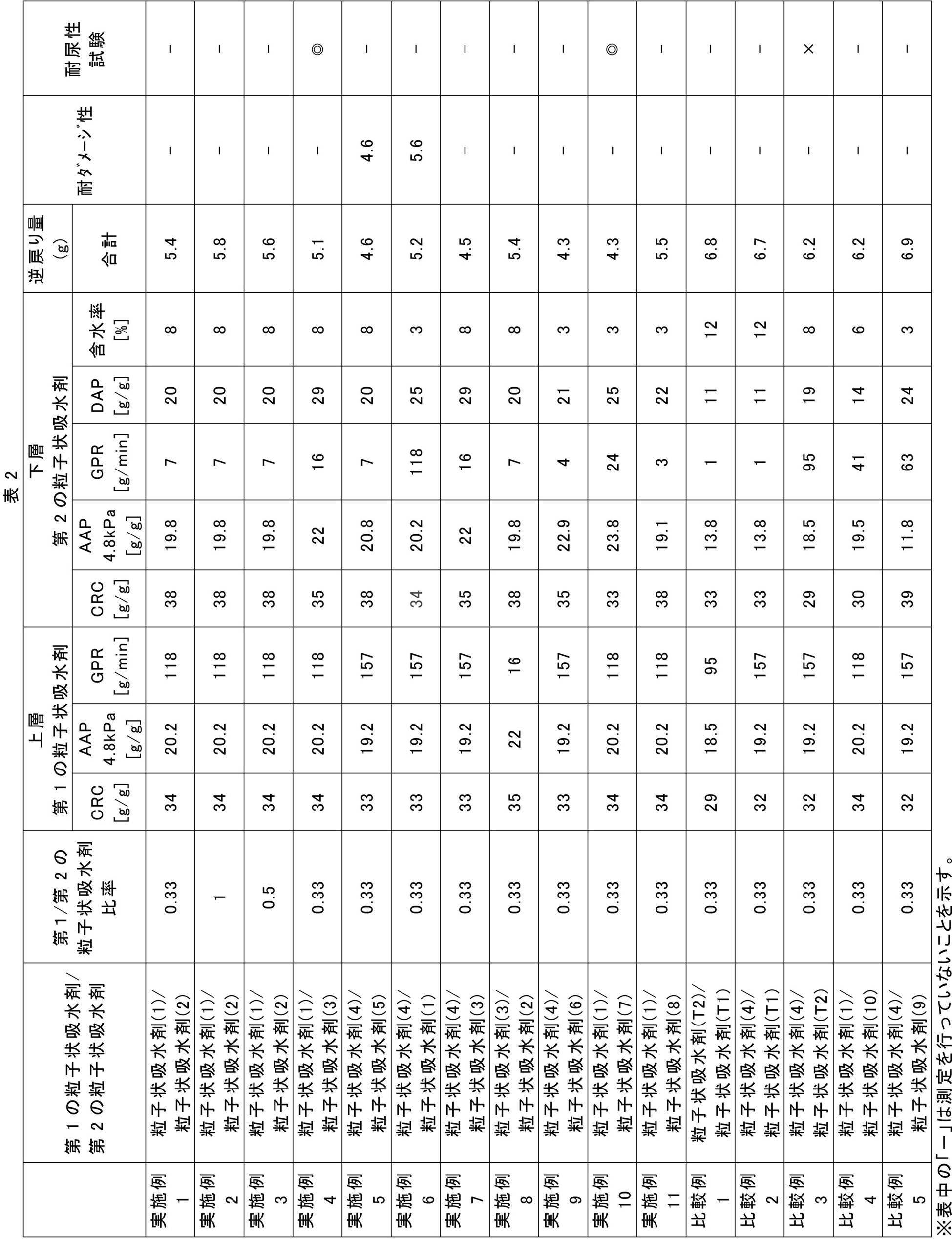
11 第1の基材、
12 吸水層、
13 第2の基材、
14 粒子状吸水剤
14a 第1の粒子状吸水剤
14b 第2の粒子状吸水剤
16 中間シート、
40 吸水性シート
41 天秤、
42 容器、
42a、42b 開口部、
43 外気吸入パイプ、
45 測定部、
46 ガラスフィルタ、
47 濾紙、
48 シート、
49 支持円筒、
50 金網、
51 重り、
52 塩化ナトリウム水溶液、
55 ディッシュ、
56 不織布、
57 パラレルプレート、
60 架台、
61 パイプ、
63 アクリル板、
64 漏斗、
65 金属製トレイ、
66 吸水性シート。
400 装置、
410 容器、
411 セル、
412 ピストン、
413a、413b 金網、
414 膨潤ゲル(粒子状吸水剤を吸水させたもの)、
415 孔、
420 タンク、
421 ガラス管、
422 コックガラス管付きL字管、
423 液体、
431 ステンレス製の金網、
432 捕集容器、
433 上皿天秤。
12 吸水層、
13 第2の基材、
14 粒子状吸水剤
14a 第1の粒子状吸水剤
14b 第2の粒子状吸水剤
16 中間シート、
40 吸水性シート
41 天秤、
42 容器、
42a、42b 開口部、
43 外気吸入パイプ、
45 測定部、
46 ガラスフィルタ、
47 濾紙、
48 シート、
49 支持円筒、
50 金網、
51 重り、
52 塩化ナトリウム水溶液、
55 ディッシュ、
56 不織布、
57 パラレルプレート、
60 架台、
61 パイプ、
63 アクリル板、
64 漏斗、
65 金属製トレイ、
66 吸水性シート。
400 装置、
410 容器、
411 セル、
412 ピストン、
413a、413b 金網、
414 膨潤ゲル(粒子状吸水剤を吸水させたもの)、
415 孔、
420 タンク、
421 ガラス管、
422 コックガラス管付きL字管、
423 液体、
431 ステンレス製の金網、
432 捕集容器、
433 上皿天秤。
本出願は、2018年8月9日に出願された、日本特許出願 特願2018-150124号、特願2018-150125号、特願2018-150129号、2018年9月28日に出願された、特願2018-185701号、特願2018-185706号に基づいており、その開示内容は、その全体が参照により本明細書に組みこまれる。
Claims (18)
- 第1の基材と、
第2の基材と、
前記第1の基材と、前記第2の基材との間に位置する吸水層と、
を有する、吸水性シートであって、
前記第1の基材が、吸液される液が導入される側に位置する、透水性シートであり、
前記吸水層が、前記第1の基材の前記第2の基材に対向する面側に局在している第1の粒子状吸水剤と、前記第2の基材の前記第1の基材に対向する面側に局在している第2の粒子状吸水剤と、を有し、
前記第2の粒子状吸水剤のAAP4.8kPaが19.0g/g以上であり、DAPが15g/g以上である、吸水性シート。 - 前記第2の粒子状吸水剤のCRCが、30~50g/gである、請求項1に記載の吸水性シート。
- 吸水性シート単位体積当たりの粒子状吸水剤の含有量が、50mg/cm3以上である、請求項1または2に記載の吸水性シート。
- 前記第2の粒子状吸水剤のAAP4.8kPaが20.0g/g以上である、請求項1~3のいずれか1項に記載の吸水性シート。
- 前記第2の粒子状吸水剤のAAP4.8kPaが22.0g/g以上である、請求項4に記載の吸水性シート。
- 前記第2の粒子状吸水剤のAAP4.8kPaが22.5g/g以上である、請求項5に記載の吸水性シート。
- 前記第2の粒子状吸水剤のDAPが19.5g/g以上である、請求項1~6のいずれか1項に記載の吸水性シート。
- 前記第2の粒子状吸水剤のDAPが20.5g/g以上である、請求項7に記載の吸水性シート。
- 前記第2の粒子状吸水剤のDAPが28.0g/g以下である、請求項7または8に記載の吸水性シート。
- 前記第2の粒子状吸水剤のAAP4.8kPaが、前記第1の粒子状吸水剤のAAP4.8kPaより高い、請求項1~9のいずれか1項に記載の吸水性シート。
- 前記第2の粒子状吸水剤の含有重量に対する前記第1の粒子状吸水剤の含有重量は、1.0以下である、請求項1~10のいずれか1項に記載の吸水性シート。
- 前記第1の粒子状吸水剤および前記第2の粒子状吸水剤の少なくとも一方の表面張力が、65mN/m以上である、請求項1~11のいずれか1項に記載の吸水性シート。
- 前記第1の粒子状吸水剤および前記2の粒子状吸水剤の少なくとも一方の平均真円度が0.70以下である、請求項1~12のいずれか1項に記載の吸水性シート。
- 前記第1の粒子状吸水剤および前記2の粒子状吸水剤の形状の少なくとも一方は、不定形破砕状である、請求項1~13のいずれか1項に記載の吸水性シート。
- 前記透水性シートが、親水性不織布である、請求項1~14のいずれか1項に記載の吸水性シート。
- 前記吸水層が、中間シートを有する、請求項1~15のいずれか1項に記載の吸水性シート。
- 前記吸水性シートが、ホットメルト接着剤を含み、
前記ホットメルト接着剤の使用量が、前記第1の粒子状吸水剤および前記第2の粒子状吸水剤の合計の質量に対して、0.05~2.0倍である、請求項1~16のいずれか1項に記載の吸水性シート。 - 請求項1~17のいずれか1項に記載の吸水性シートを液体透過性シートと、液体不透過性シートとで挟持することによりなり、前記液体透過性シートが、前記第1の基材側に位置し、前記液体不透過性シートが、前記第2の基材側に位置している、吸水性物品。
Priority Applications (2)
| Application Number | Priority Date | Filing Date | Title |
|---|---|---|---|
| JP2020535938A JP7244523B2 (ja) | 2018-08-09 | 2019-08-09 | 吸水性シートおよびそれを含む吸収性物品 |
| CN201980053813.8A CN112566602B (zh) | 2018-08-09 | 2019-08-09 | 吸水性片和包含其的吸收性物品 |
Applications Claiming Priority (10)
| Application Number | Priority Date | Filing Date | Title |
|---|---|---|---|
| JP2018-150124 | 2018-08-09 | ||
| JP2018150124 | 2018-08-09 | ||
| JP2018-150125 | 2018-08-09 | ||
| JP2018150125 | 2018-08-09 | ||
| JP2018150129 | 2018-08-09 | ||
| JP2018-150129 | 2018-08-09 | ||
| JP2018-185706 | 2018-09-28 | ||
| JP2018-185701 | 2018-09-28 | ||
| JP2018185701 | 2018-09-28 | ||
| JP2018185706 | 2018-09-28 |
Publications (1)
| Publication Number | Publication Date |
|---|---|
| WO2020032283A1 true WO2020032283A1 (ja) | 2020-02-13 |
Family
ID=69414158
Family Applications (3)
| Application Number | Title | Priority Date | Filing Date |
|---|---|---|---|
| PCT/JP2019/031785 Ceased WO2020032283A1 (ja) | 2018-08-09 | 2019-08-09 | 吸水性シートおよびそれを含む吸水性物品 |
| PCT/JP2019/031782 Ceased WO2020032280A1 (ja) | 2018-08-09 | 2019-08-09 | 吸水性シートおよびそれを含む吸水性物品 |
| PCT/JP2019/031787 Ceased WO2020032284A1 (ja) | 2018-08-09 | 2019-08-09 | 吸水性シートおよびそれを含む吸水性物品 |
Family Applications After (2)
| Application Number | Title | Priority Date | Filing Date |
|---|---|---|---|
| PCT/JP2019/031782 Ceased WO2020032280A1 (ja) | 2018-08-09 | 2019-08-09 | 吸水性シートおよびそれを含む吸水性物品 |
| PCT/JP2019/031787 Ceased WO2020032284A1 (ja) | 2018-08-09 | 2019-08-09 | 吸水性シートおよびそれを含む吸水性物品 |
Country Status (5)
| Country | Link |
|---|---|
| US (1) | US20210298965A1 (ja) |
| EP (1) | EP3834789B1 (ja) |
| JP (3) | JP7244523B2 (ja) |
| CN (3) | CN112584809B (ja) |
| WO (3) | WO2020032283A1 (ja) |
Cited By (3)
| Publication number | Priority date | Publication date | Assignee | Title |
|---|---|---|---|---|
| EP3881814A1 (en) | 2020-03-17 | 2021-09-22 | The Procter & Gamble Company | Absorbent core comprising a high loft central layer and superabsorbent particles |
| WO2022120693A1 (en) | 2020-12-10 | 2022-06-16 | The Procter & Gamble Company | Absorbent core comprising a high loft central layer and two different superabsorbent polymers |
| WO2025015584A1 (en) | 2023-07-20 | 2025-01-23 | The Procter & Gamble Company | Absorbent core and absorbent article comprisng the same |
Families Citing this family (10)
| Publication number | Priority date | Publication date | Assignee | Title |
|---|---|---|---|---|
| KR20230038524A (ko) * | 2020-07-17 | 2023-03-20 | 스미토모 세이카 가부시키가이샤 | 흡수체 |
| JP7712102B2 (ja) * | 2021-04-23 | 2025-07-23 | 日本製紙クレシア株式会社 | 吸収性物品 |
| CN113400609A (zh) * | 2021-05-11 | 2021-09-17 | 郑荣盛 | 一种吸水型可降解塑料薄膜的制备工艺 |
| EP4338831A4 (en) * | 2021-05-12 | 2025-05-07 | Nippon Shokubai Co., Ltd. | Poly(meth)acrylic acid (salt)-based water-absorbing resin, and absorbent body |
| JP7712106B2 (ja) * | 2021-05-19 | 2025-07-23 | 日本製紙クレシア株式会社 | 吸収性物品 |
| JP2023000879A (ja) * | 2021-06-18 | 2023-01-04 | 花王株式会社 | 吸収性シート及び吸収性物品 |
| FR3136108B1 (fr) | 2022-05-25 | 2024-04-19 | Commissariat Energie Atomique | Procédé de collage direct assisté par des élements cationiques |
| FR3136106B1 (fr) * | 2022-05-25 | 2024-05-31 | Commissariat Energie Atomique | Procédé de collage direct assisté par une molécule basique |
| FR3136107B1 (fr) | 2022-05-25 | 2024-05-31 | Commissariat Energie Atomique | Procédé de collage direct assisté par une base forte |
| JP2024061284A (ja) * | 2022-10-21 | 2024-05-07 | 日本製紙クレシア株式会社 | 吸収性物品 |
Citations (4)
| Publication number | Priority date | Publication date | Assignee | Title |
|---|---|---|---|---|
| JP2005113117A (ja) * | 2003-06-24 | 2005-04-28 | Nippon Shokubai Co Ltd | 吸水性樹脂組成物とその製造方法 |
| JP2006055833A (ja) * | 2004-03-29 | 2006-03-02 | Nippon Shokubai Co Ltd | 吸水性樹脂を主成分とする粒子状吸水剤 |
| WO2013099634A1 (ja) * | 2011-12-27 | 2013-07-04 | 住友精化株式会社 | 吸水シート構成体 |
| WO2016204302A1 (ja) * | 2015-06-19 | 2016-12-22 | 株式会社日本触媒 | ポリ(メタ)アクリル酸(塩)系粒子状吸水剤及び製造方法 |
Family Cites Families (58)
| Publication number | Priority date | Publication date | Assignee | Title |
|---|---|---|---|---|
| CA2001397A1 (en) | 1988-10-28 | 1990-04-28 | Tadao Shimomura | Method for production of acrylate and acrylate-containing polymer |
| JP2693813B2 (ja) | 1989-03-28 | 1997-12-24 | 大日本印刷株式会社 | 機能性を有する吸水シートの製造方法 |
| JP2693815B2 (ja) | 1989-03-28 | 1997-12-24 | 大日本印刷株式会社 | 吸水シートのシーリング方法及び装置 |
| JP2693814B2 (ja) | 1989-03-28 | 1997-12-24 | 大日本印刷株式会社 | 機能性を有する吸水シートの製造装置 |
| JP3408565B2 (ja) | 1992-12-24 | 2003-05-19 | 積水化成品工業株式会社 | 吸水シートおよびその製造方法 |
| JPH06190003A (ja) | 1992-12-25 | 1994-07-12 | Sekisui Plastics Co Ltd | 吸水シートおよびその製造方法 |
| JP3408566B2 (ja) | 1992-12-25 | 2003-05-19 | 積水化成品工業株式会社 | 吸水シートおよびその製造方法 |
| JPH0659039U (ja) * | 1993-01-08 | 1994-08-16 | 積水化成品工業株式会社 | 積層体 |
| JPH06315501A (ja) | 1993-05-07 | 1994-11-15 | Sekisui Plastics Co Ltd | 吸水シートおよびその製造方法 |
| US5849405A (en) | 1994-08-31 | 1998-12-15 | The Procter & Gamble Company | Absorbent materials having improved absorbent property and methods for making the same |
| JP4087500B2 (ja) * | 1997-06-13 | 2008-05-21 | 株式会社日本触媒 | 吸収性物品の製造方法 |
| US6103785A (en) * | 1998-03-26 | 2000-08-15 | Nippon Shokubai Co., Ltd. | Water-absorbing agent and its production process and use |
| MX217629B (es) * | 1998-04-28 | 2003-11-17 | Procter & Gamble | Articulos absorbentes con materiales de distribucion colocados debajo del material de almacenamiento |
| JP4198314B2 (ja) * | 2000-12-08 | 2008-12-17 | 大王製紙株式会社 | 吸収体、その製造方法、およびその吸収体を備えた吸収性物品 |
| JP4911833B2 (ja) | 2001-05-23 | 2012-04-04 | 株式会社リブドゥコーポレーション | パンツ型使い捨ておむつの連続製造方法 |
| PL215419B1 (pl) | 2003-02-10 | 2013-12-31 | Nippon Catalytic Chem Ind | Srodek pochlaniajacy wode |
| MX268188B (es) * | 2004-02-05 | 2009-07-09 | Nippon Catalytic Chem Ind | Agente absorbente de agua en particulas, y metodo para su produccion, y articulo para absorber agua. |
| EP1730218B1 (en) * | 2004-03-29 | 2010-12-22 | Nippon Shokubai Co.,Ltd. | Particulate water absorbing agent with irregularly pulverized shape |
| CN100560638C (zh) * | 2004-03-29 | 2009-11-18 | 株式会社日本触媒 | 具有吸水树脂作为主要组分的颗粒状吸水剂 |
| CN101489596B (zh) * | 2006-07-19 | 2013-05-15 | 巴斯夫欧洲公司 | 通过聚合单体溶液液滴生产具有较高吸收的后固化的吸水性聚合物颗粒的方法 |
| EP2250222B1 (en) * | 2008-03-07 | 2015-12-23 | Nippon Shokubai Co., Ltd. | Water absorbing agent and production method thereof |
| KR101537137B1 (ko) | 2008-07-11 | 2015-07-15 | 스미또모 세이까 가부시키가이샤 | 흡수 시트 조성물 |
| AU2009269278C1 (en) | 2008-07-11 | 2015-08-27 | Sumitomo Seika Chemicals Co., Ltd. | Water-absorbent sheet composition |
| JP5248990B2 (ja) | 2008-11-14 | 2013-07-31 | 住友精化株式会社 | 吸水シート |
| WO2010076857A1 (ja) | 2008-12-29 | 2010-07-08 | 住友精化株式会社 | 吸水シート組成物 |
| CN102281852B (zh) | 2009-01-19 | 2014-08-06 | 住友精化株式会社 | 吸水片材组合物 |
| DK2415439T3 (en) | 2009-03-31 | 2014-12-08 | Sumitomo Seika Chemicals | water-absorbing film |
| EP2441420B1 (en) | 2009-06-12 | 2014-12-24 | Sumitomo Seika Chemicals CO. LTD. | Water absorbent sheet |
| CN102573729A (zh) * | 2009-10-09 | 2012-07-11 | 住友精化株式会社 | 吸水片材 |
| JP5755151B2 (ja) | 2010-01-13 | 2015-07-29 | 住友精化株式会社 | 吸水シート構成体 |
| US20120328861A1 (en) | 2010-01-13 | 2012-12-27 | Sumitomo Seika Chemicals, Co., Ltd. | Water-absorbent sheet structure |
| WO2011086842A1 (ja) | 2010-01-13 | 2011-07-21 | 住友精化株式会社 | 吸水シート構成体 |
| AU2010342027B2 (en) | 2010-01-13 | 2015-06-04 | Sumitomo Seika Chemicals Co., Ltd. | Water-absorbent sheet structure |
| KR101782188B1 (ko) | 2010-03-24 | 2017-09-26 | 바스프 에스이 | 초박형 유체-흡수성 코어 |
| SG184205A1 (en) | 2010-03-25 | 2012-10-30 | Sumitomo Seika Chemicals | Water-absorbing sheet structure |
| WO2011117997A1 (ja) | 2010-03-25 | 2011-09-29 | 住友精化株式会社 | 吸水シート構成体 |
| EP2565031A4 (en) | 2010-04-30 | 2013-09-25 | Sumitomo Seika Chemicals | WATER ABSORBENT FILM STRUCTURE |
| US9962459B2 (en) | 2010-07-02 | 2018-05-08 | Basf Se | Ultrathin fluid-absorbent cores |
| US8678821B2 (en) | 2010-08-17 | 2014-03-25 | Warsaw Orthopedic, Inc. | Dental implant with hinged stablizing arms |
| WO2012043546A1 (ja) | 2010-09-28 | 2012-04-05 | 住友精化株式会社 | 吸水シート構成体 |
| KR101989142B1 (ko) | 2010-09-30 | 2019-06-13 | 가부시기가이샤 닛뽕쇼꾸바이 | 입자상 흡수제 및 그 제조 방법 |
| JP2012218320A (ja) * | 2011-04-11 | 2012-11-12 | Sumitomo Seika Chem Co Ltd | 吸水シート構成体 |
| WO2013078109A1 (en) | 2011-11-21 | 2013-05-30 | The Procter & Gamble Company | Absorbent articles with improved absorption properties |
| EP2535027B1 (en) | 2011-06-17 | 2022-08-17 | The Procter & Gamble Company | Absorbent article having improved absorption properties |
| JP6013729B2 (ja) * | 2011-12-27 | 2016-10-25 | 株式会社リブドゥコーポレーション | 吸水性樹脂粉末およびこれを用いた吸収体、吸収性物品 |
| CN104010605B (zh) | 2011-12-27 | 2016-08-17 | 住友精化株式会社 | 吸水片材构成体 |
| CN104582833A (zh) | 2012-08-30 | 2015-04-29 | 株式会社日本触媒 | 颗粒状吸水剂及其制造方法 |
| EP2905071B1 (en) | 2012-10-01 | 2020-02-12 | Nippon Shokubai Co., Ltd. | Dust-reducing agent comprising multiple metal compound, water absorbent containing multiple metal compound and method for manufacturing same |
| EP3351225B1 (en) | 2013-09-19 | 2021-12-29 | The Procter & Gamble Company | Absorbent cores having material free areas |
| JP6320785B2 (ja) * | 2014-02-12 | 2018-05-09 | 株式会社リブドゥコーポレーション | 吸収性物品 |
| CN106132534B (zh) | 2014-03-31 | 2020-06-19 | 株式会社日本触媒 | 颗粒状吸水剂及其制造方法 |
| US10562006B2 (en) | 2016-03-28 | 2020-02-18 | Nippon Shokubai Co., Ltd. | Particulate water absorbing agent |
| CN110023412B (zh) | 2016-09-30 | 2021-06-18 | 株式会社日本触媒 | 吸水性树脂组合物 |
| JP6849496B2 (ja) | 2017-03-13 | 2021-03-24 | Ihi運搬機械株式会社 | 急傾斜ベルトコンベヤ |
| JP6748592B2 (ja) | 2017-03-13 | 2020-09-02 | 株式会社日立インダストリアルプロダクツ | ピッキング管理システム、およびピッキング管理方法 |
| JP6705761B2 (ja) | 2017-03-13 | 2020-06-03 | 日立建機株式会社 | リフティングマグネットを備えた油圧ショベル |
| JP6188182B1 (ja) | 2017-04-27 | 2017-08-30 | 株式会社バカン | 空席管理装置及び空席管理プログラム |
| JP2018185706A (ja) | 2017-04-27 | 2018-11-22 | 富士通株式会社 | ストレージ装置及び制御プログラム |
-
2019
- 2019-08-09 JP JP2020535938A patent/JP7244523B2/ja active Active
- 2019-08-09 JP JP2020535935A patent/JP7174759B2/ja active Active
- 2019-08-09 WO PCT/JP2019/031785 patent/WO2020032283A1/ja not_active Ceased
- 2019-08-09 US US17/266,936 patent/US20210298965A1/en not_active Abandoned
- 2019-08-09 CN CN201980053128.5A patent/CN112584809B/zh active Active
- 2019-08-09 WO PCT/JP2019/031782 patent/WO2020032280A1/ja not_active Ceased
- 2019-08-09 CN CN201980053208.0A patent/CN112566598B/zh active Active
- 2019-08-09 JP JP2020535939A patent/JP7085627B2/ja active Active
- 2019-08-09 CN CN201980053813.8A patent/CN112566602B/zh active Active
- 2019-08-09 EP EP19846609.6A patent/EP3834789B1/en active Active
- 2019-08-09 WO PCT/JP2019/031787 patent/WO2020032284A1/ja not_active Ceased
Patent Citations (4)
| Publication number | Priority date | Publication date | Assignee | Title |
|---|---|---|---|---|
| JP2005113117A (ja) * | 2003-06-24 | 2005-04-28 | Nippon Shokubai Co Ltd | 吸水性樹脂組成物とその製造方法 |
| JP2006055833A (ja) * | 2004-03-29 | 2006-03-02 | Nippon Shokubai Co Ltd | 吸水性樹脂を主成分とする粒子状吸水剤 |
| WO2013099634A1 (ja) * | 2011-12-27 | 2013-07-04 | 住友精化株式会社 | 吸水シート構成体 |
| WO2016204302A1 (ja) * | 2015-06-19 | 2016-12-22 | 株式会社日本触媒 | ポリ(メタ)アクリル酸(塩)系粒子状吸水剤及び製造方法 |
Cited By (4)
| Publication number | Priority date | Publication date | Assignee | Title |
|---|---|---|---|---|
| EP3881814A1 (en) | 2020-03-17 | 2021-09-22 | The Procter & Gamble Company | Absorbent core comprising a high loft central layer and superabsorbent particles |
| WO2021188330A1 (en) | 2020-03-17 | 2021-09-23 | The Procter & Gamble Company | Absorbent core comprising a high loft central layer and superabsorbent particles |
| WO2022120693A1 (en) | 2020-12-10 | 2022-06-16 | The Procter & Gamble Company | Absorbent core comprising a high loft central layer and two different superabsorbent polymers |
| WO2025015584A1 (en) | 2023-07-20 | 2025-01-23 | The Procter & Gamble Company | Absorbent core and absorbent article comprisng the same |
Also Published As
| Publication number | Publication date |
|---|---|
| JPWO2020032283A1 (ja) | 2021-08-10 |
| JP7085627B2 (ja) | 2022-06-16 |
| JP7174759B2 (ja) | 2022-11-17 |
| WO2020032284A1 (ja) | 2020-02-13 |
| CN112566598A (zh) | 2021-03-26 |
| CN112566602B (zh) | 2023-06-16 |
| CN112566598B (zh) | 2022-11-29 |
| EP3834789A1 (en) | 2021-06-16 |
| CN112584809B (zh) | 2023-06-20 |
| JPWO2020032284A1 (ja) | 2021-08-10 |
| CN112584809A (zh) | 2021-03-30 |
| EP3834789A4 (en) | 2022-05-04 |
| US20210298965A1 (en) | 2021-09-30 |
| WO2020032280A1 (ja) | 2020-02-13 |
| JP7244523B2 (ja) | 2023-03-22 |
| CN112566602A (zh) | 2021-03-26 |
| JPWO2020032280A1 (ja) | 2021-08-10 |
| EP3834789B1 (en) | 2024-09-18 |
Similar Documents
| Publication | Publication Date | Title |
|---|---|---|
| JP7244523B2 (ja) | 吸水性シートおよびそれを含む吸収性物品 | |
| CN102170849B (zh) | 流体吸收制品 | |
| CN105705534B (zh) | 女性卫生吸收制品 | |
| JP4087500B2 (ja) | 吸収性物品の製造方法 | |
| JP7174761B2 (ja) | 吸水性シートおよびそれを含む吸収性物品 | |
| JP7217268B2 (ja) | 吸水性シート、吸水性シートの製造方法および吸収性物品 | |
| JP7174760B2 (ja) | 吸水性シートおよびそれを含む吸収性物品 | |
| JP7617238B2 (ja) | 吸水性シートおよびそれを含む吸収性物品 | |
| JP7576986B2 (ja) | 吸水性シートおよびそれを含む吸収性物品 |
Legal Events
| Date | Code | Title | Description |
|---|---|---|---|
| 121 | Ep: the epo has been informed by wipo that ep was designated in this application |
Ref document number: 19848188 Country of ref document: EP Kind code of ref document: A1 |
|
| ENP | Entry into the national phase |
Ref document number: 2020535938 Country of ref document: JP Kind code of ref document: A |
|
| NENP | Non-entry into the national phase |
Ref country code: DE |
|
| 122 | Ep: pct application non-entry in european phase |
Ref document number: 19848188 Country of ref document: EP Kind code of ref document: A1 |