WO2020022367A1 - 撥水剤、撥水性繊維製品の製造方法および撥水性繊維製品 - Google Patents
撥水剤、撥水性繊維製品の製造方法および撥水性繊維製品 Download PDFInfo
- Publication number
- WO2020022367A1 WO2020022367A1 PCT/JP2019/028956 JP2019028956W WO2020022367A1 WO 2020022367 A1 WO2020022367 A1 WO 2020022367A1 JP 2019028956 W JP2019028956 W JP 2019028956W WO 2020022367 A1 WO2020022367 A1 WO 2020022367A1
- Authority
- WO
- WIPO (PCT)
- Prior art keywords
- water
- repellent
- mass
- group
- water repellent
- Prior art date
- Legal status (The legal status is an assumption and is not a legal conclusion. Google has not performed a legal analysis and makes no representation as to the accuracy of the status listed.)
- Ceased
Links
Classifications
-
- C—CHEMISTRY; METALLURGY
- C09—DYES; PAINTS; POLISHES; NATURAL RESINS; ADHESIVES; COMPOSITIONS NOT OTHERWISE PROVIDED FOR; APPLICATIONS OF MATERIALS NOT OTHERWISE PROVIDED FOR
- C09K—MATERIALS FOR MISCELLANEOUS APPLICATIONS, NOT PROVIDED FOR ELSEWHERE
- C09K3/00—Materials not provided for elsewhere
- C09K3/18—Materials not provided for elsewhere for application to surfaces to minimize adherence of ice, mist or water thereto; Thawing or antifreeze materials for application to surfaces
-
- C—CHEMISTRY; METALLURGY
- C09—DYES; PAINTS; POLISHES; NATURAL RESINS; ADHESIVES; COMPOSITIONS NOT OTHERWISE PROVIDED FOR; APPLICATIONS OF MATERIALS NOT OTHERWISE PROVIDED FOR
- C09K—MATERIALS FOR MISCELLANEOUS APPLICATIONS, NOT PROVIDED FOR ELSEWHERE
- C09K3/00—Materials not provided for elsewhere
- C09K3/32—Materials not provided for elsewhere for absorbing liquids to remove pollution, e.g. oil, gasoline, fat
-
- D—TEXTILES; PAPER
- D06—TREATMENT OF TEXTILES OR THE LIKE; LAUNDERING; FLEXIBLE MATERIALS NOT OTHERWISE PROVIDED FOR
- D06M—TREATMENT, NOT PROVIDED FOR ELSEWHERE IN CLASS D06, OF FIBRES, THREADS, YARNS, FABRICS, FEATHERS OR FIBROUS GOODS MADE FROM SUCH MATERIALS
- D06M13/00—Treating fibres, threads, yarns, fabrics or fibrous goods made from such materials, with non-macromolecular organic compounds; Such treatment combined with mechanical treatment
- D06M13/322—Treating fibres, threads, yarns, fabrics or fibrous goods made from such materials, with non-macromolecular organic compounds; Such treatment combined with mechanical treatment with compounds containing nitrogen
- D06M13/395—Isocyanates
-
- D—TEXTILES; PAPER
- D06—TREATMENT OF TEXTILES OR THE LIKE; LAUNDERING; FLEXIBLE MATERIALS NOT OTHERWISE PROVIDED FOR
- D06M—TREATMENT, NOT PROVIDED FOR ELSEWHERE IN CLASS D06, OF FIBRES, THREADS, YARNS, FABRICS, FEATHERS OR FIBROUS GOODS MADE FROM SUCH MATERIALS
- D06M15/00—Treating fibres, threads, yarns, fabrics, or fibrous goods made from such materials, with macromolecular compounds; Such treatment combined with mechanical treatment
- D06M15/19—Treating fibres, threads, yarns, fabrics, or fibrous goods made from such materials, with macromolecular compounds; Such treatment combined with mechanical treatment with synthetic macromolecular compounds
- D06M15/37—Macromolecular compounds obtained otherwise than by reactions only involving carbon-to-carbon unsaturated bonds
- D06M15/564—Polyureas, polyurethanes or other polymers having ureide or urethane links; Precondensation products forming them
-
- D—TEXTILES; PAPER
- D06—TREATMENT OF TEXTILES OR THE LIKE; LAUNDERING; FLEXIBLE MATERIALS NOT OTHERWISE PROVIDED FOR
- D06M—TREATMENT, NOT PROVIDED FOR ELSEWHERE IN CLASS D06, OF FIBRES, THREADS, YARNS, FABRICS, FEATHERS OR FIBROUS GOODS MADE FROM SUCH MATERIALS
- D06M15/00—Treating fibres, threads, yarns, fabrics, or fibrous goods made from such materials, with macromolecular compounds; Such treatment combined with mechanical treatment
- D06M15/19—Treating fibres, threads, yarns, fabrics, or fibrous goods made from such materials, with macromolecular compounds; Such treatment combined with mechanical treatment with synthetic macromolecular compounds
- D06M15/37—Macromolecular compounds obtained otherwise than by reactions only involving carbon-to-carbon unsaturated bonds
- D06M15/643—Macromolecular compounds obtained otherwise than by reactions only involving carbon-to-carbon unsaturated bonds containing silicon in the main chain
Definitions
- the present invention relates to a water repellent, a method for producing a water repellent fiber product, and a water repellent fiber product.
- Patent Document 1 a fluorine-based water repellent containing a fluorine element is widely used (Patent Document 1 and the like).
- Fluorine compounds such as perfluorooctanoic acid (hereinafter, referred to as “PFOA”) and perfluorooctanesulfonic acid (hereinafter, referred to as “PFOS”) contained in the fluorine-based water repellent may affect living environments, living organisms, and the like. is there. Therefore, in recent years, non-fluorine-based water repellents containing no elemental fluorine have been proposed.
- PFOA perfluorooctanoic acid
- PFOS perfluorooctanesulfonic acid
- non-fluorine-based water repellents have lower water repellency than fluorine-based water repellents, and in particular, water repellency after washing tends to be reduced. Therefore, a non-fluorinated water repellent excellent in water repellency is required.
- an object of the present invention is to provide a water repellent agent which does not contain a fluorine element and has excellent water repellency, a method for producing a water repellent fiber product using the same, and a water repellent fiber product.
- the water repellent of the present invention is characterized by containing an adduct (A) of the following components (a) and (b).
- A a vinyl polymer having at least one substituent selected from the group consisting of a hydroxyl group, an amino group, and an imino group; and
- the method for producing a water-repellent fiber product of the present invention is characterized by including a water-repellent treatment step of treating fibers with a treatment liquid containing the water-repellent agent of the present invention.
- the water-repellent fiber product of the present invention is characterized in that the adduct (A) or the crosslinked product of the adduct (A) in the water-repellent agent of the present invention adheres to fibers.
- a water repellent agent which does not contain a fluorine element and has excellent water repellency, a method for producing a water repellent fiber product using the same, and a water repellent fiber product.
- the water repellent of the present invention may further contain, for example, a surfactant (B) and water (C).
- the water repellent of the present invention may further include, for example, an organic solvent (D), and the adduct (A) may be dissolved in the organic solvent (D).
- the component (a) is polyvinyl alcohol, vinyl alcohol-vinyl acetate copolymer, ethylene-vinyl alcohol copolymer, ethylene-vinyl alcohol-vinyl acetate copolymer, polyallylamine And at least one selected from the group consisting of polyethyleneimine.
- the ratio of the total number of hydroxyl groups, amino groups and imino groups in the component (a) to the number of isocyanate groups in the component (b) is 4/1. It may be up to 1/1.
- the water repellent of the present invention may further contain, for example, amino-modified silicone (E).
- the treatment liquid contains isocyanate (F), and the adduct (A) is crosslinked with the isocyanate (F). Good.
- the “water repellent composition” refers to a water repellent which is a composition.
- Monoisocyanate refers to an isocyanate having only one isocyanate group in one molecule.
- Polyisocyanate refers to an isocyanate having a plurality of isocyanate groups in one molecule.
- alkyl includes, for example, linear or branched alkyl.
- the alkyl group is not particularly limited, for example, methyl group, ethyl group, n-propyl group, isopropyl group, n-butyl group, isobutyl group, sec-butyl group and tert-butyl group, pentyl group, Hexyl, heptyl, octyl, nonyl, decyl, undecyl, dodecyl, tridecyl, tetradecyl, pentadecyl, hexadecyl, heptadecyl, octadecyl, nonadecyl, icosyl and the like.
- alkylene includes, for example, linear alkylene (methylene or polymethylene) or branched alkylene.
- the alkylene group is not particularly limited. Examples thereof include a methylene group, a dimethylene group (ethylene group), an ethylidene group, a trimethylene group, a 1-methylethylene group (propylene group), a tetramethylene group, and a 1-methyltrimethylene group. Groups, 2-methyltrimethylene group, 1,1-dimethylethylene group, pentamethylene group, hexamethylene group, heptamethylene group, octamethylene group, nonamethylene group, decamethylene group and the like.
- the water repellent of the present invention is characterized by containing an adduct (A) of the following components (a) and (b).
- the adduct (A) is a compound having a structure in which the following component (a) is added to an unsaturated bond of an isocyanate group (isocyanato group) in the following component (b).
- the adduct (A) is, for example, urethane.
- the “urethane” refers to a compound having a urethane bond (—NH—CO—O—).
- the adduct (A) is, for example, urea.
- the “urea” refers to a urea derivative compound having a urea bond (—NH—CO—NH—) instead of urea itself.
- Component (a) is a vinyl polymer as described above.
- Examples of the monomer include vinyl alcohol, vinyl formate, vinyl acetate, vinyl propionate, vinyl butyrate, vinyl isobutyrate, vinyl pivalate, vinyl versatate, vinyl caproate, vinyl caprylate, vinyl laurate, and vinyl palmitate.
- the vinyl-based polymer may have, for example, a structure of a copolymer of the monomer and another monomer.
- the other monomer include ethylene, propylene, 1-butene, isobutene, 1-hexene and the like.
- the vinyl polymer is an unsaturated carboxylic acid such as acrylamide, methacrylamide, acrylic acid, methacrylic acid, crotonic acid, maleic acid, fumaric acid, itaconic acid and the like, esters, amides, anhydrides, sulfones such as vinyl sulfonic acid and the like.
- An acid monomer, dimethylaminoethyl methacrylate, vinyl imidazole, vinyl pyridine, vinyl succinimide and the like may be copolymerized.
- Component (a) is, as described above, a vinyl polymer having at least one substituent selected from the group consisting of a hydroxyl group, an amino group, and an imino group.
- a vinyl polymer having a hydroxyl group may be used.
- the vinyl polymer having a hydroxyl group include polyvinyl alcohol, vinyl alcohol-vinyl acetate copolymer, ethylene-vinyl alcohol copolymer, ethylene-vinyl alcohol-vinyl acetate copolymer, and the like.
- the content of the vinyl alcohol structural unit is not particularly limited, but is, for example, 10 to 80 mol%, 40 to 80 mol%, or 40 to 70 mol%. It is.
- the average degree of polymerization of the ethylene-vinyl alcohol copolymer is not particularly limited, but is, for example, 100 or more, 500 or more, or 800 or more, for example, 3,000 or less, 2,500 or less, or 1,500 or less. is there.
- ethylene-vinyl alcohol copolymers include, for example, EVAL: grades E-171B, E-151B, E-105B, E-171A, E-151A, E-105A, and EVAL (trade name) manufactured by Kuraray Co., Ltd. Soarnol manufactured by Nippon Synthetic Chemical Industry Co., Ltd .: Grade AT4403, AT4406, A4412 and the like. Further, an ethylene-vinyl alcohol copolymer to which ethylene oxide has been added, which is synthesized by addition-polymerizing ethylene oxide to a vinyl group of the ethylene-vinyl alcohol copolymer, can also be used.
- the component (a) is polyvinyl alcohol
- the average degree of polymerization is not particularly limited, but is, for example, 100 to 3,000 or 150 to 2,000.
- the saponification degree of the polyvinyl alcohol is not particularly limited, it is, for example, 70% or more, 80% or more, or 90 to 100%.
- Component (a) may be, for example, a vinyl polymer having an amino group or a vinyl polymer having an imino group.
- the component (a) may be, for example, a vinyl polymer having only one of an amino group and an imino group, or a vinyl polymer having both of them.
- Examples of the vinyl polymer having at least one of the amino group and the imino group include polyallylamine and polyethyleneimine. The molecular weight of the polyallylamine and polyethyleneimine is not particularly limited, but is, for example, 300 to 100,000.
- Component (a) is, for example, as described above, polyvinyl alcohol, vinyl alcohol-vinyl acetate copolymer, ethylene-vinyl alcohol copolymer, ethylene-vinyl alcohol-vinyl acetate copolymer, polyallylamine, and polyethyleneimine. At least one selected from the group consisting of:
- Component (b) is an isocyanate having an aliphatic group having 8 or more carbon atoms, as described above.
- Component (b) may be a monoisocyanate or a polyisocyanate, for example, a monoisocyanate.
- the aliphatic group include an alkyl group, an alkenyl group, and an alkynyl group, and an alkyl group is preferable.
- the aliphatic group may be branched, but is preferably linear.
- the aliphatic group has 8 or more carbon atoms, and the upper limit is not particularly limited, but is, for example, 30 or less, or 20 or less.
- Examples of the component (b) include monoalkyl isocyanates such as octyl isocyanate, dodecyl isocyanate (lauryl isocyanate), and octadecyl isocyanate (stearyl isocyanate), and particularly preferably octadecyl isocyanate (stearyl isocyanate).
- monoalkyl isocyanates such as octyl isocyanate, dodecyl isocyanate (lauryl isocyanate), and octadecyl isocyanate (stearyl isocyanate), and particularly preferably octadecyl isocyanate (stearyl isocyanate).
- octadecyl isocyanate for example, a mixture containing a monoalkyl isocyanate having 12 carbon atoms, 14 carbon atoms, 16 carbon atoms, 17 carbon atoms, 18 carbon atoms, and 20 carbon
- the content of each component in the mixture is preferably 1 to 10% by mass of an isocyanate having 16 carbon atoms in the alkyl group, 0.5 to 4% by mass of an isocyanate having 17 carbon atoms in the alkyl group, It is a mixture of an alkyl group having 18 carbon atoms in the group in an amount of 80 to 98% by mass.
- the mixture may be, for example, a mixture of 8 to 9% by mass of an isocyanate having 16 carbon atoms in an alkyl group, 3 to 4% by mass of an isocyanate having 17 carbon atoms in an alkyl group, and 18% by mass of an isocyanate having 18 carbon atoms in an alkyl group.
- component (b) may be used alone or in combination of two or more.
- the ratio of the total number of hydroxyl groups, amino groups, and imino groups in the component (a) to the number of isocyanate groups in the component (b) is not particularly limited. As described above, the ratio may be 4/1 to 1/1, for example, 4/3 to 1/1 or 2/1 to 1/1.
- the method for producing the adduct (A) is not particularly limited, and may be, for example, the same as or similar to a general addition reaction of a hydroxyl group-containing polymer or an imino group-containing polymer with an isocyanate. Specifically, the method for producing the adduct (A) can be performed, for example, as follows.
- component (a) may or may not be dehydrated as required.
- the dehydration is not particularly limited.
- the component (a) in the form of particles is dispersed in a nonpolar solvent such as toluene, and azeotropic dehydration is performed.
- a nonpolar solvent such as toluene
- azeotropic dehydration is performed.
- a method of removing water by a dryer or the like can be used.
- azeotropic dehydration is preferred from the viewpoint of efficiency and the like.
- azeotropic dehydration for example, a method of separating and removing water in the middle of a reflux device while performing reflux may be used.
- the solvent used is not particularly limited as long as it is a solvent azeotropic with water, but toluene and xylene are preferred from the viewpoint of solubility with the water repellent of the present invention.
- the water content in the component (a) after the water removal step is not particularly limited, but is preferably 150 ppm or less.
- a catalyst used for a general urethane-forming reaction with isocyanate can be used for component (a), if necessary.
- a reaction catalyst a highly water-soluble weakly acidic alkali metal salt, an organic One or two or more tin salts (for example, dibutyltin dilaurate), zinc salts, zirconium complexes, bismuth salts, tertiary amines and their salts (for example, trade names DBU, DBN, and UCASTA102 manufactured by San Apro Corporation) are added.
- a water-soluble solvent such as dimethyl sulfoxide or a water-insoluble solvent such as toluene may be added.
- the component (b) isocyanate
- the catalyst is added, for example, before the reaction, but may be added during the reaction, or may be added in plural times.
- the reaction temperature and the reaction time are not particularly limited, and may be, for example, the same as or similar to a general addition reaction of a hydroxyl group-containing polymer or an imino group-containing polymer with an isocyanate.
- the reaction temperature is not particularly limited as described above, but may be, for example, 50 to 150 ° C or 75 to 140 ° C.
- the reaction time may be, for example, 100 to 240 minutes, or may be 120 to 200 minutes.
- the end point of the reaction can be confirmed, for example, by measuring the remaining amount of the unreacted isocyanate compound in the reaction mixture using an infrared spectrophotometer.
- water can be added to separate the oil layer and the aqueous layer, and the catalyst can be transferred to the aqueous layer and removed.
- this operation may be omitted.
- the adduct (A) of the target product moves to the oil layer.
- This oil layer may be filtered through a filter (filter) to remove a by-product (for example, a bisurea compound).
- a filter for example, a closed pressure filter is preferable because it is intended to remove by-products insoluble in organic solvents such as toluene.
- the method of filtration is not particularly limited.For example, a method of receiving a solution in a separate receiver through a filter from a vessel containing a solution, or a vessel in which a solution is again filled through a filter from a vessel containing a solution. It is possible to use either of the recirculation methods.
- the oil layer containing the adduct (A) is put into a vessel in which methanol has been put in advance, and the precipitated adduct (A) is separated by filtration and used as the water repellent of the present invention.
- the mixture after the reaction may be directly put into methanol to precipitate the adduct (A).
- the water repellent of the present invention may further include a surfactant (B) and water (C) in addition to the additive (A).
- the water repellent of the present invention contains, for example, an organic solvent (D) in addition to the adduct (A) as described above, and the adduct (A) is dissolved in the organic solvent (D). It may be.
- the former may be referred to as “water-based water repellent”, and the latter may be referred to as “solvent-based water repellent”.
- the method for producing the water-based water repellent of the present invention is not particularly limited, and for example, a general mechanical emulsification method can be used.
- the machine used for the mechanical emulsification method is not particularly limited, but in the batch method, for example, a Nauter mixer, an anchor mixer, a homomixer, a homodisper, a planetary mixer, and the like, and a multiaxial emulsifying and dispersing apparatus combining them.
- a combi mix series manufactured by Primix Co., Ltd. may be used.
- a line homomixer or the like may be used, or an apparatus combining them may be used.
- a high-temperature high-pressure emulsifying and dispersing apparatus capable of increasing the pressure in the apparatus is preferable.
- the surfactant (B) is not particularly limited, and may be, for example, a general surfactant.
- the surfactant may be, for example, any of a nonionic (nonionic) surfactant, a cationic (cationic) surfactant, an anionic (anionic) surfactant, and an amphoteric surfactant.
- the nonionic surfactant include a polyoxyalkylene alkyl ether surfactant such as a polyoxyethylene alkyl ether surfactant, and a polyoxyalkylene alkylamine.
- Examples of the polyoxyalkylene alkyl ether surfactant include Brownon 230 and Fine Surf 1502.2 (trade names, manufactured by Aoki Yushi Kogyo Co., Ltd.).
- Examples of the cationic surfactant include a quaternary ammonium salt, a tertiary amine or a salt thereof, and the like.
- Examples of the quaternary ammonium salt include Lipocard 18-63 (trade name, manufactured by Lion Specialty Chemicals Co., Ltd.).
- Examples of the anionic surfactant include alkylbenzenesulfonic acid and salts thereof, and fatty acid salts.
- Examples of the amphoteric surfactant include fatty acid amidopropyldimethylaminoacetic acid betaine.
- the surfactant (B) may be used alone or in combination of two or more.
- the content of the surfactant (B) is not particularly limited, but is, for example, 1% by mass or more, 3% by mass or more, or 5% by mass based on the mass of the adduct (A).
- the content is 200% by mass or less, 150% by mass or less, or 100% by mass or less.
- the water-based water repellent of the present invention may further contain an organic compound such as a hydrocarbon oil or a higher alcohol.
- Organic compounds such as hydrocarbon oils and higher alcohols are components that are different from the organic solvent mixed with water (C) in the water-based water repellent described below.
- Specific examples of the hydrocarbon oil include, for example, squalene, squalane, liquid paraffin, liquid isoparaffin, heavy liquid isoparaffin, ⁇ -olefin oligomer, cycloparaffin, polybutene, petrolatum, paraffin wax, microcrystalline wax, polyethylene wax, and Ceresin.
- the higher alcohol is a higher alcohol having 6 to 30 carbon atoms.
- Specific examples include hexyl alcohol, 2-ethylhexyl alcohol, octyl alcohol, decyl alcohol, isodecyl alcohol, lauryl alcohol, myristyl alcohol, and palmityl. Alcohol, cetyl alcohol, stearyl alcohol, isostearyl alcohol, 2-octyldodecanol, icosyl alcohol, and behenyl alcohol.
- the content of the organic compound is not particularly limited, but is, for example, 1% by mass or more, 3% by mass or more, or 5% by mass or more, for example, 200% by mass or less, 150% by mass with respect to the mass of the adduct (A). % By mass or less, or 100% by mass or less.
- the above organic compound has, for example, an action of reducing the viscosity of an aqueous water repellent.
- an organic compound having an effect of reducing the viscosity of the water-based water repellent by adding an organic compound having an effect of reducing the viscosity of the water-based water repellent, the behavior of increasing the viscosity can be controlled, and the emulsification and dispersion can be easily performed. Become.
- water (C) is not particularly limited, and examples thereof include tap water, distilled water, and ion-exchanged water. If necessary, water (C) and an organic solvent may be mixed. The organic solvent at this time is not particularly limited as long as it is an organic solvent miscible with water.
- alcohols such as methanol and ethanol, ketones such as acetone and methyl ethyl ketone, propylene glycol, dipropylene glycol, and tripropylene glycol Glycols such as propylene glycol, and glycol ethers such as propylene glycol monomethyl ether, dipropylene glycol monomethyl ether, and tripropylene glycol monomethyl ether.
- the ratio between water and the organic solvent is not particularly limited.
- the content of the adduct (A) is not particularly limited, but is, for example, 0.5% by mass or more, 1% by mass or more, or 3% by mass with respect to the mass of water (C). It is at least 90 mass%, for example, at most 90 mass%, at most 70 mass%, or at most 50 mass%.
- the organic solvent (D) is not particularly limited, but a solvent that easily dissolves the adduct (A) is preferable.
- the organic solvent (D) include hydrocarbon solvents such as aromatic hydrocarbons and aliphatic hydrocarbons (such as normal hexane), alcohol solvents (such as methanol and ethanol), glycol solvents (such as ethylene glycol), and amides.
- Solvents (dimethylformamide (DMF), dimethylacetamide, etc.), sulfoxide solvents (dimethylsulfoxide, etc.), ketone solvents (methylethylketone (MEK), etc.), aromatic solvents (toluene, xylene, etc.), ether solvents (dioxane) , Tetrahydrofuran, etc.) and ester solvents (ethyl acetate, butyl acetate, etc.).
- the aromatic hydrocarbon include toluene, benzene, xylene, and 1,3,5-trimethylbenzene.
- the organic solvent (D) may be used alone or in combination of two or more.
- the content of the adduct (A) is not particularly limited, but is, for example, 0.1% by mass or more and 0.5% by mass with respect to the mass of the organic solvent (D). Or more, or 1.0% by mass or more, for example, 90% by mass or less, 80% by mass or less, or 70% by mass or less.
- the water repellent of the present invention may or may not contain any other components other than the components (A) to (D).
- the optional component include the amino-modified silicone (E) described above. That is, the water-based water repellent or the solvent-based water repellent of the present invention may further contain an amino-modified silicone (E) as described above.
- the amino-modified silicone (E) for example, the water repellency of the water-repellent treated fiber or fiber product is further improved, or the texture is further softened.
- Examples of the amino-modified silicone (E) include a side-chain type amino-modified silicone, a double-terminal type amino-modified silicone, a single-terminal type amino-modified silicone, a side-chain double-terminal type amino-modified silicone, and the like. It may have a different reactive group such as an ether group.
- the amino-modified silicone includes, for example, SM-8709SR (trade name, manufactured by Dow Corning Toray Co., Ltd.).
- the functional group equivalent of the amino group is not particularly limited, but is, for example, 100 to 20,000 g / mol, 200 to 18,000 g / mol, or 500 to 16,000 g / mol.
- the content of the amino-modified silicone (E) is not particularly limited, but is, for example, 0.5% by mass or more, It is at least 200 mass%, or at least 2 mass%, for example, at most 200 mass%, at most 150 mass%, or at most 100 mass%.
- the optional component in addition to the amino-modified silicone (E), for example, straight silicone oils such as dimethyl silicone oil and methyl hydrogen silicone oil, and Reactive silicone oils such as polyether-modified silicone oil and epoxy-modified silicone oil are exemplified.
- the method for producing the water-based water-repellent or the solvent-based water-repellent of the present invention is not particularly limited.
- all the components may be mixed and dissolved or dispersed.
- each component may be dissolved or dispersed while appropriately heating or the like so that each component is easily dissolved or dispersed.
- the adduct (A) and the surfactant (B) are mixed while heating and stirring, and then water (C) is added while continuing heating and stirring to add the adduct (A) and the surfactant.
- the activator (B) may be dispersed in water (C) to produce a water-based water repellent.
- the heating temperature in this case is not particularly limited, but is, for example, 30 ° C. or higher, or 50 ° C. or higher, for example, 180 ° C. or lower, or 160 ° C. or lower.
- the heating and stirring time is not particularly limited, but may be, for example, until all the components are uniformly mixed.
- the method of using the water repellent of the present invention is not particularly limited, and for example, may be the same as or similar to the method of using a general water repellent, especially a fiber water repellent.
- the water-repellent agent of the present invention can be used, for example, for water-repellent treatment (water-repellent processing) of fibers or textile products.
- the above-described method for producing the water-repellent fiber product of the present invention and the water-repellent fiber of the present invention Can be used for products.
- the method for producing the water-repellent fiber product of the present invention is not particularly limited, it can be produced by the method for producing a water-repellent fiber product of the present invention.
- the “fiber” to be subjected to the water-repellent treatment is not particularly limited and is arbitrary, and may be, for example, a fiber product.
- the fiber or fiber product is not particularly limited, and may be any fiber or fiber product, such as clothes, daily necessities, interiors, and car seats.
- the method for producing a water-repellent fiber product of the present invention is not particularly limited except that the water-repellent treatment step is performed using the water-repellent agent of the present invention. It may be the same as or similar thereto.
- the method for producing a water-repellent fiber product of the present invention can be carried out, for example, as follows.
- a treatment liquid containing the water repellent of the present invention is prepared.
- the water repellent of the present invention may be used as the processing liquid as it is, or may be diluted with water or an organic solvent to obtain the processing liquid.
- the treatment liquid may be diluted with water, or in the case of a solvent-based water repellent, the treatment liquid may be diluted with an organic solvent of the same or different type as the organic solvent (D). It may be.
- the concentration of the treatment liquid is not particularly limited, but the concentration of the adduct (A) is, for example, 0.1% by mass or more based on the dispersion medium or the solvent (eg, the water or organic solvent) of the treatment liquid.
- the content is 3% by mass or more, or 0.5% by mass or more, for example, 30% by mass or less, 20% by mass or less, or 10% by mass or less.
- a water-repellent auxiliary agent or the like may be added to the treatment liquid.
- the water-repellent auxiliary is not particularly limited.
- straight silicone oils such as amino-modified silicone oil, dimethyl silicone oil and methyl hydrogen silicone oil, and reactive silicones such as polyether-modified silicone oil and epoxy-modified silicone oil Oil and the like.
- the addition amount of the water-repellent auxiliary is not particularly limited either, but is, for example, 0.5% by mass or more, 1% by mass or more, or 2% by mass or more based on the adduct (A), for example, 200% by mass or less, 150% by mass or less. % By mass or less, or 100% by mass or less.
- the water-repellent treatment step of treating the fibers with the treatment liquid is performed.
- This water-repellent treatment step may be, for example, the same as or similar to a general water-repellent treatment method for fibers or textile products, as described above.
- the fiber or fiber product may be dried after the treatment liquid is impregnated into the fiber or fiber product to be subjected to the water-repellent treatment.
- the method for producing a water-repellent fiber product of the present invention can be performed.
- the method for producing a water-repellent fiber product of the present invention may include other steps other than the water-repellent treatment step, but may not include the other steps. As the other step, for example, a dry heat treatment described later is given.
- the water-repellent treatment step may be performed by, for example, a continuous method or a batch method.
- a fiber or a fiber product as an object to be treated is continuously fed to an impregnation device filled with the treatment liquid, and then the object to be treated is impregnated with the water-repellent treatment liquid. And unnecessary water-repellent treatment liquid is removed.
- the impregnation device is not particularly limited, but a padder type application device, a kiss roll type application device, a gravure coater type application device, a spray type application device, a foam type application device, and a coating type application device are preferable, and a padder type application device is particularly preferable.
- water, an organic solvent, and the like remaining on the object to be treated are removed using a dryer.
- the dryer is not particularly limited, but a spread dryer such as a hot flue or a tenter is preferable.
- the continuous method is preferably used, for example, when the object to be treated is a fabric such as a woven fabric.
- the batch method is preferably used, for example, when the object is not suitable for processing by a continuous method. More specifically, when the object to be processed is not a cloth, for example, when the object to be processed is rose hair, top, sliver, skein, tow, thread, or the like, or when the object to be processed is a knitted fabric. There are some cases.
- a cotton dyeing machine, a cheese dyeing machine, a liquid jet dyeing machine, an industrial washing machine, a beam dyeing machine, or the like can be used.
- a hot air drier such as a cheese drier, a beam drier, a tumble drier, or a high-frequency drier can be used.
- the treatment liquid may contain isocyanate (F), and the isocyanate (F) may be used to crosslink the adduct (A).
- the treatment liquid contains the amino-modified silicone (E)
- the amino group of the amino-modified silicone (E) may be crosslinked with the isocyanate (F).
- the isocyanate (F) is not particularly limited, for example, an organic compound containing two or more isocyanate functional groups in a molecule can be used.
- isocyanate (F) examples include, for example, tolylene diisocyanate, hexamethylene diisocyanate, diphenylmethane diisocyanate, hydrogenated diphenylmethane diisocyanate, triphenyl triisocyanate, xylylene diisocyanate, dicyclohexyl methane diisocyanate, and trimethylolpropane tolylene diisocyanate adduct.
- Glycerin tolylene diisocyanate adduct uret of hexamethylene diisocyanate, trimethylolpropane trihexamethylene diisocyanate adduct, glycerin trihexamethylene diisocyanate adduct, and the like.
- isocyanate (F) phenol, malonic acid diethyl ester, methyl ethyl ketoxime, sodium bisulfite, ⁇ which dissociates upon heating and regenerates an active isocyanate group with the organic compound containing an isocyanate functional group, etc.
- An organic compound containing a blocked isocyanate functional group obtained by reacting caprolactam or the like to block an isocyanate group.
- isocyanate (F) examples include, for example, Coronate B-45E and Coronate HX (trade names, manufactured by Tosoh Corporation) as solvent systems, and Duranate D101 and Duranate D201 (trade names, manufactured by Asahi Kasei Corporation).
- Coronate B-45E and Coronate HX trade names, manufactured by Tosoh Corporation
- Duranate D101 and Duranate D201 trade names, manufactured by Asahi Kasei Corporation.
- “Aquanate” series manufactured by the company Duranate WB40-100, Duranate WT20-100, Duranate WE50-100 manufactured by Asahi Kasei Corporation, "Elastron” series manufactured by Daiichi Kogyo Seiyaku Co., Ltd.
- the amount of the isocyanate (F) to be added is not particularly limited either, but is, for example, 0.5% by mass or more, 1% by mass or more, or 3% by mass or more based on the adduct (A), for example, 200% by mass or less, 150% by mass or less. % Or less, or 100% by mass or less.
- the reaction temperature is not particularly limited, and is, for example, 100 ° C. or higher, or 120 ° C. or higher, for example, 200 ° C. or lower, or 180 ° C. or lower. is there.
- the reaction time is not particularly limited, but is, for example, 0.1 minutes or more, or 0.3 minutes or more, for example, 20 minutes or less, or 15 minutes or less.
- the dry heat treatment it is preferable to perform a dry heat treatment on the object to which the water repellent of the present invention is attached. This is because, when the dry heat treatment is performed, the active ingredient of the first water repellent or the second water repellent of the present invention is more likely to adhere to the object to be processed. However, in the present invention, the dry heat treatment may not be performed.
- the water repellent of the present invention can also be used for paper products, wood boards (eg, particle board, MDF board, etc.).
- the water repellent of the present invention has excellent water repellency.
- a water-repellent fiber product excellent in water repellency can be manufactured.
- a water repellent product having excellent water repellency (washing durability) after washing can be produced.
- the water repellent of the present invention for example, excellent oil repellency can be obtained.
- a water-repellent fiber product excellent in oil repellency can be manufactured.
- excellent oil repellency can be obtained by the water repellent of the present invention, and for example, it can be expected that sebum stains are less likely to adhere to textiles.
- non-fluorine-based water repellents are inferior in oil repellency and easily adhere to sebum stains as compared with fluorine-based water repellents.
- the water repellent of the present invention can be used efficiently at a low cost, for example, and is excellent in water repellency, processing bath stability, storage stability and the like.
- the use of the water repellent of the present invention is not particularly limited, and textiles such as clothes, umbrellas, raincoats, tents, daily necessities, interiors, car seats, and further, water repellent paper, water repellent boards, and the like. Widely applicable to Further, the use of the water repellent of the present invention is not limited to the above-mentioned respective uses, and can be widely used for any use.
- the adduct (A) was produced as follows. First, a reaction vessel equipped with a stirrer having a Faudler blade, a reflux condenser, a thermometer, a nitrogen inlet tube and a dropping funnel, and capable of heating and cooling was prepared. Next, 57 parts by mass of stearyl isocyanate (component (b), the content of an aliphatic group having 17 or less carbon atoms of 2.0%) was placed in the reaction vessel, and ethylene / vinyl alcohol was used as a raw material polymer.
- component (b) stearyl isocyanate
- DMSO dimethyl sulfoxide
- the reaction solution was cooled to 80 ° C., and the reaction mixture was poured into methanol five times the total amount of the reaction mixture to obtain a white precipitate. Since DMSO in the reaction solution is dissolved in methanol, DMSO can be removed from the precipitate by filtration. Therefore, the white precipitate is separated by filtration, and the white precipitate is washed with methanol, dried, and pulverized to obtain a high-molecular-weight urethane compound (the components (a) and (b)). Adduct (A)) was obtained.
- Example 1 2.0 parts by mass of the high molecular urethane compound (adduct (A)) obtained in Synthesis Example 1 was dissolved in 98.0 parts by mass of toluene to produce a water repellent of this example. This water repellent was used as it was as a treatment liquid for producing a water-repellent fiber product.
- a 100% nylon cloth and a 100% polyester cloth are each immersed (pickup ratio: 50% by mass) in the water repellent (treatment liquid) of the present embodiment, and then dried at 130 ° C. for 2 minutes to obtain water repellency.
- the water-repellent fiber product (water-repellent treated cloth) of this example was obtained by performing the treatment (water-repellent treatment step).
- the water-repellent fiber product (water-repellent cloth) was further heat-treated at 170 ° C. for 1 minute to obtain a heat-treated water-repellent fiber product of this example (water-repellent cloth).
- the “pickup ratio” represents the ratio of the mass of the treatment liquid absorbed by the cloth to the mass of the cloth before immersion.
- Example 2 2.0 parts by mass of the polymer urethane compound (adduct (A)) obtained in Synthesis Example 2 was dissolved in 98.0 parts by mass of toluene to produce a water repellent of this example. Further, except that the water repellent of the present example was used as a treatment liquid instead of the water repellent of Example 1, the water repellent fiber product of the present example (the cloth treated for water repellency) was used in the same manner as in Example 1. ) And heat-treated water-repellent fiber product of this example (water-repellent treated cloth).
- Example 3 2.0 parts by mass of the polymeric urea compound (adduct (A)) obtained in Synthesis Example 3 was dissolved in 98.0 parts by mass of toluene to produce a water repellent of this example. Further, except that the water repellent of the present example was used as a treatment liquid instead of the water repellent of Example 1, the water repellent fiber product of the present example (the cloth treated for water repellency) was used in the same manner as in Example 1. ) And heat-treated water-repellent fiber product of this example (water-repellent treated cloth).
- Example 4 2.0 parts by mass of the high molecular urethane compound (adduct (A)) obtained in Synthesis Example 1 and 1.0 parts by mass of Coronate B-45E (isocyanate (F)) (trade name, manufactured by Tosoh Corporation) were dissolved in toluene. This was dissolved in 97.0 parts by mass to produce a water repellent of this example. Further, except that the water repellent of the present example was used as a treatment liquid instead of the water repellent of Example 1, the water repellent fiber product of the present example (the cloth treated for water repellency) was used in the same manner as in Example 1. ) And heat-treated water-repellent fiber product of this example (water-repellent treated cloth).
- Example 5 30.0 parts by mass of the polymer urethane compound (adduct (A)) obtained in Synthesis Example 1 and a trade name of Lipocard 18-63 (a quaternary ammonium salt, a cationic interface, manufactured by Lion Specialty Chemicals Co., Ltd.)
- Surfactant, surfactant (B)) 0.5 parts by mass, trade name Brownon 230 (polyoxyalkylene alkyl ether-based surfactant, nonionic surfactant, surfactant (B) manufactured by Aoki Yushi Kogyo Co., Ltd.)
- Fine Surf 1502.2 polyoxyalkylene alkyl ether surfactant, nonionic surfactant, surfactant (B)) manufactured by Aoki Yushi Kogyo Co., Ltd.
- Example 1 0 parts by mass, sealed in a container of a high-pressure multi-screw disperser having an anchor mixer, a homomixer, and a homodisper, sealed, and melt-mixed at 120 ° C. Maintaining the 10 ° C. or more, to produce a water repellent by mixing 87.0 parts by weight 95 ° C. or more hot water with continued stirring this embodiment. Further, Example 1 was repeated except that 9.0 parts by mass of the water repellent (emulsion) of this example and 91.0 parts by mass of water were mixed and used as the treatment liquid instead of the treatment liquid of Example 1.
- Example 6 9.0 parts by mass of the water repellent obtained in Example 5, 3.0 parts by mass of SM-8709SR (amino-modified silicone (E)) (trade name, manufactured by Dow Corning Toray Co., Ltd.), and 88.0 parts by mass of water Are mixed and used as a treatment liquid, in the same manner as in Example 1, except that the water-repellent fiber product (the cloth subjected to the water-repellent treatment) and the heat-treated water-repellent fiber product (the water-repellent cloth) of the present example are used. Treated cloth).
- SM-8709SR amino-modified silicone (E))
- Example 7 9.0 parts by mass of the water repellent obtained in Example 5, 3.0 parts by mass of SM-8709SR (amino-modified silicone (E)) manufactured by Dow Corning Toray Co., Ltd., and 3.0 parts by mass of product manufactured by Tosoh Corporation
- the water-repellent fiber product of this example was prepared in the same manner as in Example 1 except that 1.0 part by mass of Coronate AQ-140 (isocyanate (F)) and 87.0 parts by mass of water were mixed and used as a treatment liquid.
- Coronate AQ-140 isocyanate (F)
- Example 8 Example 5 was repeated except that the high molecular urethane compound (adduct (A)) obtained in Synthesis Example 4 was used instead of the high molecular urethane compound (adduct (A)) obtained in Synthesis Example 1.
- a water-repellent fiber product of this example a cloth subjected to a water-repellent treatment
- a heat-treated water-repellent fiber product of the present example a cloth subjected to a water-repellent treatment
- Example 5 was the same as Example 5 except that the polymer urea compound (adduct (A)) obtained in Synthesis Example 5 was used instead of the polymer urethane compound (adduct (A)) obtained in Synthesis Example 1. Similarly, a water-repellent fiber product of this example (a cloth subjected to a water-repellent treatment) and a heat-treated water-repellent fiber product of the present example (a cloth subjected to a water-repellent treatment) were obtained.
- Example 10 Example 5 was repeated except that the polymer urea compound (adduct (A)) obtained in Synthesis Example 6 was used in place of the polymer urethan compound (adduct (A)) obtained in Synthesis Example 1.
- the water-repellent agent, water-repellent fiber product (water-repellent treated cloth) of this example and heat-treated water-repellent fiber product of this example (water-repellent treated cloth) were obtained in the same manner as described above.
- Example 11 30.0 parts by mass of the polymer urethane compound (adduct (A)) obtained in Synthesis Example 1 and a trade name of Lipocard 18-63 (a quaternary ammonium salt, a cationic interface, manufactured by Lion Specialty Chemicals Co., Ltd.)
- Surfactant, surfactant (B)) 0.5 parts by mass, trade name Brownon 230 (polyoxyalkylene alkyl ether-based surfactant, nonionic surfactant, surfactant (B) manufactured by Aoki Yushi Kogyo Co., Ltd.)
- Fine Surf 1502.2 polyoxyalkylene alkyl ether surfactant, nonionic surfactant, surfactant (B)) manufactured by Aoki Yushi Kogyo Co., Ltd.
- Example 1 Example 1 was repeated except that 9.0 parts by mass of the water repellent (emulsion) of this example and 91.0 parts by mass of water were mixed and used as the treatment liquid instead of the treatment liquid of Example 1.
- Example 12 A water-repellent agent, a water-repellent fiber product (a cloth subjected to water-repellent treatment), and a heat-treated book of this example were carried out in the same manner as in Example 11 except that the same mass of 130 ° F paraffin was used instead of stearyl alcohol. A water-repellent fiber product (a cloth subjected to a water-repellent treatment) of an example was obtained.
- Example 13 Example 5 was repeated except that the polymer urea compound (adduct (A)) obtained in Synthesis Example 7 was used instead of the polymer urethan compound (adduct (A)) obtained in Synthesis Example 1.
- the water-repellent agent, water-repellent fiber product (water-repellent treated cloth) of this example and heat-treated water-repellent fiber product of this example (water-repellent treated cloth) were obtained in the same manner as described above.
- the water repellent fiber product of this comparative example is prepared in the same manner as in Example 1.
- a water-repellent treated fabric) and a heat-treated water-repellent fiber product of this comparative example (water-repellent treated fabric) were obtained.
- Comparative Example 3 8.0 parts by mass of a commercially available fluorine-based water repellent (manufactured by Asahi Glass Co., Ltd., trade name: Asahi Guard AG-E081) and 1.0 part by mass of a crosslinking agent (manufactured by Meisei Chemical Industry Co., Ltd., trade name: Mecanate FM-1) And water-repellent fiber product (water-repellent treated cloth) of this comparative example and heat-treated this comparative example in the same manner as in Example 1 except that water was mixed with 91.0 parts by mass of water and used as a treatment liquid. (Water-repellent treated cloth) was obtained.
- a commercially available fluorine-based water repellent manufactured by Asahi Glass Co., Ltd., trade name: Asahi Guard AG-E081
- a crosslinking agent manufactured by Meisei Chemical Industry Co., Ltd., trade name: Mecanate FM-1
- Water-repellent fiber product water-repellent treated cloth
- Evaluation solution 8 n-heptane 7: n-hexane 6: n-decane 5: n-dodecane 4: n-tetradecane 3: n-hexadecane 2: n-hexadecane / kaidol (mass ratio 65/35) mixed solution 1: Something less than 0: 1
- seam slippage resistance was measured by the 8.23 slippage resistance 8.28.23.1 seam slippage method of JIS L 1096: 2010 b) Method B. The smaller the value, the better the seam slippage property (seam slippage resistance) was evaluated.
- the cloths (water-repellent fiber products) of Examples 1 to 13 in which the water-repellent agent contains the adduct (A) of the components (a) and (b) were 100% nylon and 100% polyester.
- Both heat-treated and non-heat-treated fabrics are extremely excellent in water repellency and oil repellency before washing and water repellency after washing (washing durability), and are based on fluorine-based water repellent (Comparative Example). Compared to 3), there was no inferiority. Further, the cloths (water-repellent fiber products) of Examples 1 to 13 also showed sufficient softness in the evaluation of the hand.
- Examples 6 and 7 to which the amino-modified silicone (E) was added exhibited softness comparable to that of the fluorine-based water repellent (Comparative Example 3).
- the evaluation of the texture was made of a water-repellent fiber product without heat treatment (water-repellent treated cloth) and a water-repellent fiber product heat-treated at 170 ° C. for 1 minute (water-repellent treatment). Since the evaluation results were the same, the evaluation results of both were collectively shown in Tables 1 and 2. Further, the fabrics (water-repellent fiber products) of Examples 1 to 13 were also excellent in seam slippage resistance.
- Comparative Examples 1 and 2 in which the water repellent did not contain the additive (A) of the components (a) and (b), although the texture was soft, the water repellency and oil repellency before washing were improved.
- the water repellency (washing durability) after washing was significantly inferior to the examples.
- the cloth (water-repellent fiber product) of Comparative Example 1 was excellent, but Comparative Example 2 was significantly inferior to the other Examples and Comparative Examples.
- Comparative Example 3 (fluorine-based water repellent) is excellent in water repellency, oil repellency, washing durability and texture, but has a problem in that it contains elemental fluorine.
- the water repellents of Examples 1 to 13 exhibited the same performance as Comparative Example 3 (fluorine-based water repellent) as a water repellent despite not containing the elemental fluorine.
Landscapes
- Chemical & Material Sciences (AREA)
- Engineering & Computer Science (AREA)
- Textile Engineering (AREA)
- Materials Engineering (AREA)
- Organic Chemistry (AREA)
- Chemical Kinetics & Catalysis (AREA)
- Oil, Petroleum & Natural Gas (AREA)
- Public Health (AREA)
- Health & Medical Sciences (AREA)
- Environmental & Geological Engineering (AREA)
- Combustion & Propulsion (AREA)
- Treatments For Attaching Organic Compounds To Fibrous Goods (AREA)
- Materials Applied To Surfaces To Minimize Adherence Of Mist Or Water (AREA)
Abstract
フッ素元素を含まず、かつ、撥水性が優れた撥水剤を提供する。 前記目的を達成するために、本発明の撥水剤は、下記成分(a)および(b)の付加物(A)を含むことを特徴とする。 (a)水酸基、アミノ基、およびイミノ基からなる群から選択される少なくとも一種の置換基を有するビニル系ポリマー (b)炭素数が8以上の脂肪族基を有するイソシアネート
Description
本発明は、撥水剤、撥水性繊維製品の製造方法および撥水性繊維製品に関する。
繊維等に使用する撥水剤としては、フッ素元素を含むフッ素系撥水剤が広く用いられている(特許文献1等)。
フッ素系撥水剤に含まれるパーフルオロオクタン酸(以下「PFOA」という。)、パーフルオロオクタンスルホン酸(以下「PFOS」という)等のフッ素化合物は、生活環境、生物等に影響を及ぼすおそれがある。そこで、近年は、フッ素元素を含まない非フッ素系撥水剤が提案されている。
しかし、非フッ素系撥水剤は、フッ素系撥水剤と比較して撥水性が低く、特に、洗濯後の撥水性が低下しやすい。このため、撥水性に優れた非フッ素系撥水剤が必要とされている。
そこで、本発明は、フッ素元素を含まず、かつ、撥水性が優れた撥水剤、それを用いた撥水性繊維製品の製造方法、および撥水性繊維製品を提供することを目的とする。
前記目的を達成するために、本発明の撥水剤は、下記成分(a)および(b)の付加物(A)を含むことを特徴とする。
(a)水酸基、アミノ基、およびイミノ基からなる群から選択される少なくとも一種の置換基を有するビニル系ポリマー
(b)炭素数が8以上の脂肪族基を有するイソシアネート
(a)水酸基、アミノ基、およびイミノ基からなる群から選択される少なくとも一種の置換基を有するビニル系ポリマー
(b)炭素数が8以上の脂肪族基を有するイソシアネート
本発明の撥水性繊維製品の製造方法は、本発明の撥水剤を含む処理液で繊維を撥水処理する撥水処理工程を含むことを特徴とする。
本発明の撥水性繊維製品は、本発明の撥水剤における前記付加物(A)または前記付加物(A)の架橋物が繊維に付着していることを特徴とする。
本発明によれば、フッ素元素を含まず、かつ、撥水性が優れた撥水剤、それを用いた撥水性繊維製品の製造方法、および撥水性繊維製品を提供することができる。
以下、本発明について、例を挙げて説明する。ただし、本発明は、以下の説明により限定されない。
本発明の撥水剤は、例えば、さらに、界面活性剤(B)と、水(C)とを含んでいてもよい。
本発明の撥水剤は、例えば、さらに、有機溶媒(D)を含み、前記付加物(A)が前記有機溶媒(D)に溶解していてもよい。
本発明の撥水剤は、例えば、前記成分(a)が、ポリビニルアルコール、ビニルアルコール-酢酸ビニル共重合体、エチレン-ビニルアルコール共重合体、エチレン-ビニルアルコール-酢酸ビニル共重合体、ポリアリルアミン、およびポリエチレンイミンからなる群から選択される少なくとも一つであってもよい。
本発明の撥水剤は、例えば、前記成分(a)中の水酸基、アミノ基、およびイミノ基の数の合計と、前記成分(b)中のイソシアネート基の数との比が、4/1~1/1であってもよい。
本発明の撥水剤は、例えば、さらに、アミノ変性シリコーン(E)を含んでいてもよい。
本発明の撥水性繊維製品の製造方法は、例えば、前記撥水処理工程において、前記処理液にイソシアネート(F)を含有させ、前記イソシアネート(F)により前記付加物(A)を架橋させてもよい。
本発明において、「撥水剤組成物」は、撥水剤のうち、組成物であるものをいう。
本発明において、「イソシアネート」は、分子中にイソシアネート基(イソシアナト基)-N=C=Oを有する化合物をいう。「モノイソシアネート」は、1分子中にイソシアネート基を1つのみ有するイソシアネートをいう。「ポリイソシアネート」は、1分子中にイソシアネート基を複数有するイソシアネートをいう。
本発明において、「アルキル」は、例えば、直鎖状または分枝状のアルキルを含む。本発明において、アルキル基は、特に限定されないが、例えば、メチル基、エチル基、n-プロピル基、イソプロピル基、n-ブチル基、イソブチル基、sec-ブチル基およびtert-ブチル基、ペンチル基、ヘキシル基、ヘプチル基、オクチル基、ノニル基、デシル基、ウンデシル基、ドデシル基、トリデシル基、テトラデシル基、ペンタデシル基、ヘキサデシル基、ヘプタデシル基、オクタデシル基、ノナデシル基、イコシル基等が挙げられる。
本発明において、「アルキレン」は、例えば、直鎖状アルキレン(メチレンもしくはポリメチレン)または分枝状のアルキレンを含む。本発明において、アルキレン基は、特に限定されないが、例えば、メチレン基、ジメチレン基(エチレン基)、エチリデン基、トリメチレン基、1-メチルエチレン基(プロピレン基)、テトラメチレン基、1-メチルトリメチレン基、2-メチルトリメチレン基、1,1-ジメチルエチレン基、ペンタメチレン基、ヘキサメチレン基、ヘプタメチレン基、オクタメチレン基、ノナメチレン基、デカメチレン基等が挙げられる。
以下、本発明の実施形態について、さらに具体的に説明する。ただし、本発明は、以下の実施形態に限定されない。
[1.撥水剤]
本発明の撥水剤は、前述のとおり、下記成分(a)および(b)の付加物(A)を含むことを特徴とする。付加物(A)は、下記成分(b)におけるイソシアネート基(イソシアナト基)の不飽和結合に、下記成分(a)が付加した構造の化合物である。下記成分(a)が、水酸基を有するビニル系ポリマーである場合、付加物(A)は、例えば、ウレタンである。なお、前記「ウレタン」は、ウレタン結合(-NH-CO-O-)を有する化合物をいう。下記成分(b)が、アミノ基およびイミノ基の少なくとも一方を有するビニル系ポリマーである場合、付加物(A)は、例えば、ウレアである。なお、本発明において、前記「ウレア」は、尿素自体ではなく、ウレア結合(-NH-CO-NH-)を有する尿素誘導体化合物をいう。
(a)水酸基、アミノ基、およびイミノ基からなる群から選択される少なくとも一種の置換基を有するビニル系ポリマー
(b)炭素数が8以上の脂肪族基を有するイソシアネート
本発明の撥水剤は、前述のとおり、下記成分(a)および(b)の付加物(A)を含むことを特徴とする。付加物(A)は、下記成分(b)におけるイソシアネート基(イソシアナト基)の不飽和結合に、下記成分(a)が付加した構造の化合物である。下記成分(a)が、水酸基を有するビニル系ポリマーである場合、付加物(A)は、例えば、ウレタンである。なお、前記「ウレタン」は、ウレタン結合(-NH-CO-O-)を有する化合物をいう。下記成分(b)が、アミノ基およびイミノ基の少なくとも一方を有するビニル系ポリマーである場合、付加物(A)は、例えば、ウレアである。なお、本発明において、前記「ウレア」は、尿素自体ではなく、ウレア結合(-NH-CO-NH-)を有する尿素誘導体化合物をいう。
(a)水酸基、アミノ基、およびイミノ基からなる群から選択される少なくとも一種の置換基を有するビニル系ポリマー
(b)炭素数が8以上の脂肪族基を有するイソシアネート
[1-1.付加物(A)]
成分(a)は、前述のとおり、ビニル系ポリマーである。前記ビニル系ポリマーは、例えば、末端二重結合(ビニル基CH2=CH-またはビニリデン基CH2=C=)を有するモノマーを重合して得られる構造のポリマーである。前記モノマーとしては、例えば、ビニルアルコール、ギ酸ビニル、酢酸ビニル、プロピオン酸ビニル、酪酸ビニル、イソ酪酸ビニル、ピバリン酸ビニル、バーサチック酸ビニル、カプロン酸ビニル、カプリル酸ビニル、ラウリル酸ビニル、パルミチン酸ビニル、ステアリン酸ビニル、オレイン酸ビニル、安息香酸ビニル等が挙げられる。また、前記ビニル系ポリマーは、例えば、前記モノマーと他のモノマーとの共重合体の構造を有していてもよい。前記他のモノマーとしては、例えば、エチレン、プロピレン、1-ブテン、イソブテン、1-ヘキセン等が挙げられる。また、前記ビニル系ポリマーはアクリルアミド、メタクリルアミド、アクリル酸、メタクリル酸、クロトン酸、マレイン酸、フマル酸、イタコン酸等の不飽和カルボン酸及びそのエステル、アミド、無水物、ビニルスルホン酸等のスルホン酸モノマー、ジメチルアミノエチルメタクリレート、ビニルイミダゾール、ビニルピリジン、ビニルスクシンイミド等が共重合されていてもよい。
成分(a)は、前述のとおり、ビニル系ポリマーである。前記ビニル系ポリマーは、例えば、末端二重結合(ビニル基CH2=CH-またはビニリデン基CH2=C=)を有するモノマーを重合して得られる構造のポリマーである。前記モノマーとしては、例えば、ビニルアルコール、ギ酸ビニル、酢酸ビニル、プロピオン酸ビニル、酪酸ビニル、イソ酪酸ビニル、ピバリン酸ビニル、バーサチック酸ビニル、カプロン酸ビニル、カプリル酸ビニル、ラウリル酸ビニル、パルミチン酸ビニル、ステアリン酸ビニル、オレイン酸ビニル、安息香酸ビニル等が挙げられる。また、前記ビニル系ポリマーは、例えば、前記モノマーと他のモノマーとの共重合体の構造を有していてもよい。前記他のモノマーとしては、例えば、エチレン、プロピレン、1-ブテン、イソブテン、1-ヘキセン等が挙げられる。また、前記ビニル系ポリマーはアクリルアミド、メタクリルアミド、アクリル酸、メタクリル酸、クロトン酸、マレイン酸、フマル酸、イタコン酸等の不飽和カルボン酸及びそのエステル、アミド、無水物、ビニルスルホン酸等のスルホン酸モノマー、ジメチルアミノエチルメタクリレート、ビニルイミダゾール、ビニルピリジン、ビニルスクシンイミド等が共重合されていてもよい。
成分(a)は、前述のとおり、水酸基、アミノ基、およびイミノ基からなる群から選択される少なくとも一種の置換基を有するビニル系ポリマーであり、例えば、水酸基を有するビニル系ポリマーでもよい。前記水酸基を有するビニル系ポリマーとしては、例えば、ポリビニルアルコール、ビニルアルコール-酢酸ビニル共重合体、エチレン-ビニルアルコール共重合体、エチレン-ビニルアルコール-酢酸ビニル共重合体等が挙げられる。成分(a)がエチレン-ビニルアルコール共重合体である場合、ビニルアルコール構造単位の含有率は、特に限定されないが、例えば、10~80モル%、40~80モル%、または40~70モル%である。前記エチレン-ビニルアルコール共重合体の平均重合度は、特に限定されないが、例えば、100以上、500以上、または800以上であり、例えば、3,000以下、2,500以下または1,500以下である。前記エチレン-ビニルアルコール共重合体の市販品としては、例えば、株式会社クラレ製の商品名エバール:グレードE-171B、E-151B、E-105B、E-171A、E-151A、E-105A、日本合成化学工業株式会社製のソアノール:グレードAT4403、AT4406、A4412等が挙げられる。また、エチレン-ビニルアルコール共重合体のビニル基に酸化エチレンを付加重合することによって合成される、酸化エチレンを付加したエチレン-ビニルアルコール共重合体も使用できる。市販品としては、例えば、住友化学社製の商品名スミガード グレード300K、スミガード グレード300G等が挙げられる。成分(a)がポリビニルアルコールである場合、平均重合度は、特に限定されないが、例えば、100~3,000または150~2,000である。前記ポリビニルアルコールのケン化度も特に限定されないが、例えば、70%以上、80%以上、または90~100%である。
成分(a)は、例えば、アミノ基を有するビニル系ポリマーでもよいし、イミノ基を有するビニル系ポリマーでもよい。成分(a)は、例えば、アミノ基およびイミノ基のいずれか一方のみを有するビニル系ポリマーでもよいし、両方を有するビニル系ポリマーでもよい。前記アミノ基およびイミノ基の少なくとも一方を有するビニル系ポリマーとしては、例えば、ポリアリルアミン、ポリエチレンイミン等が挙げられる。前記ポリアリルアミン、ポリエチレンイミンの分子量は、特に限定されないが、例えば300~100,000である。
成分(a)は、1種類のみ用いてもよいし、2種類以上を併用してもよい。成分(a)は、例えば、前述のとおり、ポリビニルアルコール、ビニルアルコール-酢酸ビニル共重合体、エチレン-ビニルアルコール共重合体、エチレン-ビニルアルコール-酢酸ビニル共重合体、ポリアリルアミン、およびポリエチレンイミンからなる群から選択される少なくとも一つであってもよい。
成分(b)は、前述のとおり、炭素数が8以上の脂肪族基を有するイソシアネートである。成分(b)は、モノイソシアネートでもポリイソシアネートでもよいが、例えば、モノイソシアネートである。前記脂肪族基としては、例えば、アルキル基、アルケニル基、アルキニル基等が挙げられ、好ましくはアルキル基である。前記脂肪族基は、分枝鎖状であってもよいが、直鎖状の方が好ましい。前記脂肪族基の炭素数は8以上であり、上限は特に限定されないが、例えば30以下、または20以下である。成分(b)としては、例えば、オクチルイソシアネート、ドデシルイソシアネート(ラウリルイソシアネート)、オクタデシルイソシアネート(ステアリルイソシアネート)等のモノアルキルイソシアネートが挙げられ、特に好ましくはオクタデシルイソシアネート(ステアリルイソシアネート)が挙げられる。なお、オクタデシルイソシアネートは、例えば、アルキル基の炭素の数が12、炭素数14、炭素数16、炭素数17、炭素数18、炭素数20のモノアルキルイソシアネートを含有している混合物が市販されており、それを用いてもよい。前記混合物中の各成分の含有割合としては、好ましくは、アルキル基の炭素数が16のイソシアネートが1~10質量%、アルキル基の炭素数が17のイソシアネートが0.5~4質量%、アルキル基の炭素数が18のアルキル基が80~98質量%の混合物である。また、前記混合物は、例えば、主成分の混合比がアルキル基の炭素数が16のイソシアネートが8~9質量%、アルキル基の炭素数17のイソシアネートが3~4質量%、炭素数18のイソシアネートが85~87質量%の混合物である。そのような混合物の市販品としては、例えば、保土谷化学工業株式会社製、商品名ミリオネートOが挙げられる。本発明において、成分(b)は、1種類のみ用いても2種類以上併用してもよい。
付加物(A)において、成分(a)中の水酸基、アミノ基、およびイミノ基の数の合計と、成分(b)中のイソシアネート基の数との比は、特に限定されないが、例えば、前述のとおり、4/1~1/1であってもよく、例えば、4/3~1/1または2/1~1/1であってもよい。
付加物(A)の製造方法は、特に限定されず、例えば、一般的な水酸基含有ポリマーまたはイミノ基含有ポリマーとイソシアネートとの付加反応と同様またはそれに準じてもよい。付加物(A)の製造方法は、具体的には、例えば、以下のようにして行なうことができる。
まず、成分(a)(ポリマー)は、必要に応じ脱水してもよいし、しなくてもよい。前記脱水は、特に限定されないが、例えば、粒子状の成分(a)をトルエン等の非極性溶媒に分散し、共沸脱水する。それ以外には、例えば、乾燥機等により水分を除く方法が挙げられる。工業的には、効率等の観点から、共沸脱水が好ましい。共沸脱水の操作として、例えば、還流を行いながら還流装置の途中で水分を分離除去する方法等でもよい。また使用する溶剤は水と共沸する溶剤であれば特に限定されないが、本発明の撥水剤との溶解性などからトルエン、キシレンが好ましい。水分除去工程後の成分(a)中の水分含有量は、特に限定されないが、150ppm以下とするのが好ましい。
つぎに、成分(a)に対し、必要に応じて一般的なイソシアネートによるウレタン化反応に使用する触媒を用いることができ、例えば、反応触媒として、水溶性の高い弱酸性のアルカリ金属塩、有機スズ塩(例えば、ジブチルスズジラウレート)、亜鉛塩、ジルコニウム錯体、ビスマス塩、3級アミンおよびその塩(例えば、サンアプロ株式会社製商品名DBU、DBN、UCASTA102)等を1種類または2種類以上添加する。このとき、必要に応じ、ジメチルスルホキシド等の水溶性の溶媒やトルエン等の非水溶性溶媒を添加してもよい。つぎに、成分(b)(イソシアネート)を添加し反応させる。なお、触媒添加の時期は、前述のとおり、例えば、反応前に添加するが、反応途中に添加してもよいし、複数回に分けて添加してもよい。反応温度および反応時間は、特に限定されず、例えば、一般的な水酸基含有ポリマーまたはイミノ基含有ポリマーとイソシアネートとの付加反応と同様またはそれに準じてもよい。反応温度は、前述のとおり特に限定されないが、例えば、50~150℃であってもよく、75~140℃であってもよい。また、反応時間は、例えば、100~240分であってもよく、120~200分であってもよい。反応の終点は、例えば、反応混合物中の未反応イソシアネート化合物の残存量を赤外分光光度計により測定して確認することができる。
反応終了後、例えば、水を加えて油層と水層を分離し、前記触媒を水層に移行させて除去することができる。なお、例えば、前記触媒の除去が不要である場合は、この操作を省略してもよい。一方、目的生成物の付加物(A)は油層に移行する。この油層を、ろ過機(フィルター)を通してろ過し、副生成物(例えばビスウレア体)を除去してもよい。なお、例えば、前記副生成物の除去が不要である場合は、この操作を省略してもよい。前記ろ過機は特に限定されないが、例えば、トルエン等の有機溶剤に不溶な副生成物の除去が目的であることから、密閉型加圧ろ過機が好ましい。ろ過の方式は、特に限定されず、例えば、溶液を入れた器からフィルターを通し別の受器で溶液を受ける方式、あるいは、溶液を入れた器からフィルターを通し、再び溶液を入れてある器に戻す循環方式のどちらでも使用できる。
さらに、あらかじめメタノールを入れておいた器内に、付加物(A)を含む前記油層を入れ、沈殿した付加物(A)をろ過により分離して本発明の撥水剤に使用する。例えば、前記触媒および前記副生成物の分離操作を省略する場合は、前記反応終了後の混合物を、直接メタノールに入れて付加物(A)を沈殿させてもよい。
[1-2.撥水剤およびその製造方法]
本発明の撥水剤は、例えば、前述のとおり、前記付加物(A)に加え、さらに、界面活性剤(B)と、水(C)とを含んでいてもよい。また、本発明の撥水剤は、例えば、前述のとおり、前記付加物(A)に加え、さらに、有機溶媒(D)を含み、前記付加物(A)が前記有機溶媒(D)に溶解していてもよい。以下において、前者を「水系撥水剤」、後者を「溶剤系撥水剤」ということがある。
本発明の撥水剤は、例えば、前述のとおり、前記付加物(A)に加え、さらに、界面活性剤(B)と、水(C)とを含んでいてもよい。また、本発明の撥水剤は、例えば、前述のとおり、前記付加物(A)に加え、さらに、有機溶媒(D)を含み、前記付加物(A)が前記有機溶媒(D)に溶解していてもよい。以下において、前者を「水系撥水剤」、後者を「溶剤系撥水剤」ということがある。
本発明の水系撥水剤の製造方法においては、特に制限は無いが、例えば、一般的な機械式乳化方法を用いることができる。前記機械式乳化方法に用いる機械は、特に限定されないが、バッチ方式では、例えば、ナウターミキサー、アンカーミキサー、ホモミキサー、ホモディスパー、プラネタリミキサー等が挙げられ、それらを組み合わせた多軸乳化分散装置、例えばプライミクス株式会社製のコンビミックスシリーズであってもよい。連続式では、例えば、ラインホモミキサー等が挙げられ、または、それらを組み合わせた装置であってもよい。特に装置内を高圧にすることが出来る高温高圧乳化分散装置が好ましい。
本発明の水系撥水剤において、界面活性剤(B)は、特に限定されず、例えば、一般的な界面活性剤でもよい。前記界面活性剤は、例えば、ノニオン(非イオン)性界面活性剤、カチオン(陽イオン)性界面活性剤、アニオン(陰イオン)性界面活性剤、両性界面活性剤のいずれでも良い。非イオン性界面活性剤としては、例えば、ポリオキシエチレンアルキルエーテル系界面活性剤等のポリオキシアルキレンアルキルエーテル系界面活性剤、ポリオキシアルキレンアルキルアミン等が挙げられる。ポリオキシアルキレンアルキルエーテル系界面活性剤としては、例えば、青木油脂工業株式会社製の商品名ブラウノン230、ファインサーフ1502.2等が挙げられる。陽イオン界面活性剤としては、例えば、第4級アンモニウム塩、3級アミンまたはその塩等が挙げられる。前記第4級アンモニウム塩としては、例えば、ライオン・スペシャリティ・ケミカルズ株式会社製の商品名リポカード18-63等が挙げられる。陰イオン界面活性剤としては、例えば、アルキルベンゼンスルホン酸およびその塩、脂肪酸塩等が挙げられる。両性界面活性剤としては、例えば脂肪酸アミドプロピルジメチルアミノ酢酸ベタイン等が挙げられる。界面活性剤(B)は、1種類のみ用いても2種類以上併用してもよい。
本発明の水系撥水剤において、界面活性剤(B)の含有率は、特に限定されないが、付加物(A)の質量に対し、例えば1質量%以上、3質量%以上、または5質量%以上であり、例えば200質量%以下、150質量%以下、または100質量%以下である。
本発明の水系撥水剤は、さらに、炭化水素油、高級アルコール等の有機化合物を含有してもよい。なお、炭化水素油、高級アルコール等の有機化合物は、後述の水系撥水剤において、水(C)と混合する有機溶剤とは異なる成分である。前記炭化水素油の具体例としては、例えば、スクワレン、スクワラン、流動パラフィン、流動イソパラフィン、重質流動イソパラフィン、α―オレフィンオリゴマー、シクロパラフィン、ポリブテン、ワセリン、パラフィンワックス、マイクロクリスタリンワックス、ポリエチレンワックス、およびセレシンが挙げられる。前記高級アルコールとしては、炭素数6~30の高級アルコールであり、具体例としては、例えば、ヘキシルアルコール、2-エチルヘキシルアルコール、オクチルアルコール、デシルアルコール、イソデシルアルコール、ラウリルアルコール、ミリスチルアルコール、パルミチルアルコール、セチルアルコール、ステアリルアルコール、イソステアリルアルコール、2-オクチルドデカノール、イコシルアルコール、およびベヘニルアルコールが挙げられる。上記、有機化合物の含有率は、特に限定されないが、付加物(A)の質量に対し、例えば1質量%以上、3質量%以上、または5質量%以上であり、例えば200質量%以下、150質量%以下、または100質量%以下である。上記の有機化合物は、例えば、水系撥水剤を減粘する作用がある。例えば、本発明の水系撥水剤の製造中において、水系撥水剤を減粘する作用がある有機化合物を添加することにより、粘度が高くなる挙動をコントロールでき、乳化分散が容易に行えるようになる。
本発明の水系撥水剤において、水(C)は特に限定されず、水道水、蒸留水、イオン交換水等が挙げられる。また必要に応じて水(C)と有機溶剤とを混合してもよい。このときの有機溶剤としては、水と混和可能な有機溶剤であれば特に制限はないが、例えば、メタノール、エタノール等のアルコール類、アセトン、メチルエチルケトン等のケトン類、プロピレングリコール、ジプロピレングリコール、トリプロピレングリコール等のグリコール類、プロピレングリコールモノメチルエーテル、ジプロピレングリコールモノメチルエーテル、トリプロピレングリコールモノメチルエーテル等のグリコールエーテル類が挙げられる。なお、水と有機溶剤の比率は特に限定されない。
また、本発明の水系撥水剤において、付加物(A)の含有率は、特に限定されないが、水(C)の質量に対し、例えば0.5質量%以上、1質量%以上、または3質量%以上であり、例えば90質量%以下、70質量%以下、または50質量%以下である。
本発明の溶剤系撥水剤において、有機溶媒(D)は、特に限定されないが、付加物(A)を溶解しやすい溶媒が好ましい。有機溶媒(D)は、例えば、芳香族炭化水素、脂肪族炭化水素(ノルマルヘキサン等)等の炭化水素系溶媒、アルコール系溶媒(メタノール、エタノール等)、グリコール系溶媒(エチレングリコール等)、アミド系溶媒(ジメチルホルムアミド(DMF)、ジメチルアセトアミド等)、スルホキシド系溶媒(ジメチルスルホキシド等)、ケトン系溶媒(メチルエチルケトン(MEK)等)、芳香族系溶媒(トルエン、キシレン等)、エーテル系溶媒(ジオキサン、テトラヒドロフラン等)、エステル系溶媒(酢酸エチル、酢酸ブチル等)等が挙げられる。前記芳香族炭化水素としては、例えば、トルエン、ベンゼン、キシレン、1,3,5-トリメチルベンゼン等が挙げられる。有機溶媒(D)は、1種類のみ用いても2種類以上併用してもよい。
また、本発明の溶剤系撥水剤において、付加物(A)の含有率は、特に限定されないが、有機溶媒(D)の質量に対し、例えば0.1質量%以上、0.5質量%以上、または1.0質量%以上であり、例えば90質量%以下、80質量%以下、または70質量%以下である。
本発明の撥水剤は、前記成分(A)~(D)以外の他の任意成分を含んでいてもよいし、含んでいなくてもよい。前記任意成分としては、例えば、前述のアミノ変性シリコーン(E)が挙げられる。すなわち、本発明の水系撥水剤または溶剤系撥水剤は、前述のとおり、さらにアミノ変性シリコーン(E)を含んでいてもよい。アミノ変性シリコーン(E)を含むことで、例えば、撥水処理した繊維または繊維製品の撥水性がさらに向上し、または、風合いがさらに柔らかくなる。アミノ変性シリコーン(E)としては、例えば、側鎖型アミノ変性シリコーン、両末端型アミノ変性シリコーン、片末端型アミノ変性シリコーン、側鎖両末端型アミノ変性シリコーン等が挙げられ、同分子内にポリエーテル基等の異なる反応基を有していても良い。前記アミノ変性シリコーンとしては、例えば、東レ・ダウコーニング株式会社製の商品名SM-8709SR等が挙げられる。前記アミノ変性シリコーンにおいて、アミノ基の官能基当量は、特に限定されないが、例えば、100~20,000g/mol、200~18,000g/mol、または500~16,000g/molである。
本発明の水系撥水剤または溶剤系撥水剤において、アミノ変性シリコーン(E)の含有率は、特に限定されないが、付加物(A)の質量に対し、例えば0.5質量%以上、1質量%以上、または2質量%以上であり、例えば200質量%以下、150質量%以下、または100質量%以下である。
本発明の水系撥水剤または溶剤系撥水剤において、前記任意成分としては、アミノ変性シリコーン(E)以外には、例えば、ジメチルシリコーンオイル、メチルハイドロジェンシリコーンオイル等のストレートシリコーンオイル、および、ポリエーテル変性シリコーンオイル、エポキシ変性シリコーンオイル等の反応性シリコーンオイル等が挙げられる。
本発明の水系撥水剤または溶剤系撥水剤の製造方法は、特に限定されず、例えば、全ての成分を混合して溶解または分散させるのみでもよい。また、各成分を溶解または分散させやすいように、適宜加熱等をしながら溶解または分散させてもよい。例えば、水系撥水剤の場合、付加物(A)および界面活性剤(B)を加熱撹拌しながら混合し、その後、加熱撹拌を続けながら水(C)を加えて付加物(A)および界面活性剤(B)を水(C)中に分散させ、水系撥水剤を製造してもよい。この場合の加熱温度は、特に限定されないが、例えば、30℃以上、または50℃以上であり、例えば、180℃以下、または160℃以下である。加熱撹拌の時間は特に限定されないが、例えば、全ての成分が均一に混合するまで行なえばよい。
[2.撥水剤の使用方法、撥水性繊維製品の製造方法、および撥水性繊維製品]
本発明の撥水剤の使用方法は特に限定されず、例えば、一般的な撥水剤、特に繊維用撥水剤の使用方法と同様またはそれに準じてもよい。本発明の撥水剤は、例えば、繊維または繊維製品の撥水処理(撥水加工)に使用可能であり、例えば、前述した本発明の撥水性繊維製品の製造方法および本発明の撥水性繊維製品に用いることができる。本発明の撥水性繊維製品を製造する方法は特に限定されないが、本発明の撥水性繊維製品の製造方法により製造することができる。なお、本発明の撥水性繊維製品の製造方法において、撥水処理(撥水加工)の対象である前記「繊維」は、特に限定されず任意であり、例えば、繊維製品でもよい。前記繊維または繊維製品は、特に限定されず、任意の繊維または繊維製品が可能であり、例えば、衣服、日用品、インテリア、カーシート等が挙げられる。
本発明の撥水剤の使用方法は特に限定されず、例えば、一般的な撥水剤、特に繊維用撥水剤の使用方法と同様またはそれに準じてもよい。本発明の撥水剤は、例えば、繊維または繊維製品の撥水処理(撥水加工)に使用可能であり、例えば、前述した本発明の撥水性繊維製品の製造方法および本発明の撥水性繊維製品に用いることができる。本発明の撥水性繊維製品を製造する方法は特に限定されないが、本発明の撥水性繊維製品の製造方法により製造することができる。なお、本発明の撥水性繊維製品の製造方法において、撥水処理(撥水加工)の対象である前記「繊維」は、特に限定されず任意であり、例えば、繊維製品でもよい。前記繊維または繊維製品は、特に限定されず、任意の繊維または繊維製品が可能であり、例えば、衣服、日用品、インテリア、カーシート等が挙げられる。
本発明の撥水性繊維製品の製造方法は、本発明の撥水剤を用いて前記撥水処理工程を行なうこと以外は特に限定されず、例えば、一般的な繊維または繊維製品の撥水処理方法と同様またはそれに準じてもよい。
本発明の撥水性繊維製品の製造方法は、具体的には、例えば、以下のようにして行なうことができる。
まず、本発明の撥水剤を含む処理液を準備する。例えば、本発明の撥水剤をそのまま前記処理液としてもよいし、水または有機溶媒で希釈して前記処理液としてもよい。例えば、水系撥水剤の場合、水で希釈して前記処理液としてもよいし、溶剤系撥水剤の場合、有機溶媒(D)と同種または異種の有機溶媒等で希釈して前記処理液としてもよい。前記処理液の濃度は特に限定されないが、付加物(A)の濃度が、前記処理液の分散媒または溶媒(例えば、前記水または有機溶媒)に対し、例えば0.1質量%以上、0.3質量%以上、または0.5質量%以上であり、例えば30質量%以下、20質量%以下、または10質量%以下となるようにする。また、前記処理液には、例えば、撥水助剤等を加えてもよい。前記撥水助剤は特に限定されないが、例えば、アミノ変性シリコーンオイル、ジメチルシリコーンオイル、メチルハイドロジェンシリコーンオイル等のストレートシリコーンオイル、および、ポリエーテル変性シリコーンオイル、エポキシ変性シリコーンオイル等の反応性シリコーンオイル等が挙げられる。前記撥水助剤の添加量も特に限定されないが、付加物(A)に対し、例えば0.5質量%以上、1質量%以上、または2質量%以上であり、例えば200質量%以下、150質量%以下、または100質量%以下である。
つぎに、前記処理液で繊維を撥水処理する前記撥水処理工程を行なう。この撥水処理工程は、例えば、前述のとおり、一般的な繊維または繊維製品の撥水処理方法と同様またはそれに準じてもよい。具体的には、例えば、前記処理液を、撥水処理しようとする繊維または繊維製品に染み込ませた後に、前記繊維または繊維製品を乾燥させればよい。このようにして、本発明の撥水性繊維製品の製造方法を行なうことができる。なお、本発明の撥水性繊維製品の製造方法は、前記撥水処理工程以外の他の工程を含んでいてもよいが、含んでいなくてもよい。前記他の工程としては、例えば、後述する乾熱処理が挙げられる。
前記撥水処理工程は、例えば、連続法により行なってもよいし、バッチ法により行なってもよい。
前記連続法は、例えば、まず、前記処理液で満たされた含浸装置に、被処理物である繊維または繊維製品を連続的に送り込み、前記被処理物に前記撥水処理液を含浸させた後、不要な撥水処理液を除去する。前記含浸装置としては特に限定されないが、パッダ式付与装置、キスロール式付与装置、グラビアコーター式付与装置、スプレー式付与装置、フォーム式付与装置、コーティング式付与装置が好ましく、パッダ式が特に好ましい。続いて、乾燥機を用いて前記被処理物に残存する水、有機溶媒等を除去する。前記乾燥機としては、特に限定されないが、ホットフルー、テンター等の拡布乾燥機が好ましい。前記連続法は、例えば、被処理物が織物等の布帛状の場合に用いるのが好ましい。
例えば、被処理物である繊維または繊維製品を前記処理液に浸漬する浸漬工程、および、前記撥水処理液に浸漬した前記被処理物に残存する水、有機溶媒等を除去する液除去工程からなる。前記バッチ法は、例えば、前記被処理物が連続法による処理に適さない場合に用いるのが好ましい。より具体的には、前記被処理物が布帛状でない場合、例えば、前記被処理物が、バラ毛、トップ、スライバ、かせ、トウ、糸等である場合、または、前記被処理物が編み物である場合等が挙げられる。前記浸漬工程においては、例えば、ワタ染機、チーズ染色機、液流染色機、工業用洗濯機、ビーム染色機等を用いることができる。前記液除去工程においては、例えば、チーズ乾燥機、ビーム乾燥機、タンブルドライヤー等の温風乾燥機、高周波乾燥機等を用いることができる。
また、例えば、前述のとおり、前記撥水処理工程において、前記処理液にイソシアネート(F)を含有させ、前記イソシアネート(F)により前記付加物(A)を架橋させてもよい。例えば、前記処理液がアミノ変性シリコーン(E)を含む場合、アミノ変性シリコーン(E)のアミノ基とイソシアネート(F)とを架橋させてもよい。イソシアネート(F)を加えることで、例えば、製造される撥水性繊維製品の、洗濯後の撥水性(洗濯耐久性)がさらに向上する。イソシアネート(F)は、特に限定されないが、例えば、分子中に2個以上のイソシアネート官能基を含む有機化合物を用いることができる。イソシアネート(F)としては、具体的には、例えば、トリレンジイソシアネート、ヘキサメチレンジイソシアネート、ジフェニルメタンジイソシアネート、水素添加ジフェニルメタンジイソシアネート、トリフェニルトリイソシアネート、キシリレンジイソシアネート、ジシクロヘキシルメタンジイソシアネート、トリメチロールプロパントリトリレンジイソシアネートアダクト体、グリセリントリトリレンジイソシアネートアダクト体、ヘキサメチレンジイソシアネートのウレット体、トリメチロールプロパントリヘキサメチレンジイソシアネートアダクト体、グリセリントリヘキサメチレンジイソシナネートアダクト体等が挙げられる。また、イソシアネート(F)としては、さらに、前記イソシアネート官能基を含む有機化合物等に対し、加熱時に解離して活性なイソシアネート基が再生するフェノール、マロン酸ジエチルエステル、メチルエチルケトオキシム、重亜硫酸ソーダ、ε-カプロラクタム等を反応させてイソシアネート基をブロックした、ブロックドイソシアネート官能基を含む有機化合物等が挙げられる。イソシアネート(F)として、具体的には、例えば、溶剤系としては東ソー株式会社製の商品名コロネートB-45E、コロネートHX、旭化成株式会社製の商品名デュラネートD101、デュラネートD201、水系としては東ソー株式会社製の商品名「アクアネート」シリーズ、旭化成株式会社製の商品名デュラネートWB40-100、デュラネートWT20-100、デュラネートWE50-100、第一工業製薬株式会社製の商品名「エラストロン」シリーズ等が挙げられる。イソシアネート(F)の添加量も特に限定されないが、付加物(A)に対し、例えば0.5質量%以上、1質量%以上、または3質量%以上であり、例えば200質量%以下、150質量%以下、または100質量%以下である。イソシアネート(F)により付加物(A)を架橋させる架橋反応において、反応温度は、特に限定されないが、例えば、100℃以上、または120℃以上であり、例えば、200℃以下、または180℃以下である。反応時間は特に限定されないが、例えば、0.1分以上、または0.3分以上であり、例えば、20分以下、または15分以下である。
また、本発明の撥水剤を付着させた前記被処理物には、乾熱処理を行うことが好ましい。前記乾熱処理を行うと、本発明の前記第1の撥水剤または前記第2の撥水剤の有効成分が、前記被処理物に、より強固に付着しやすいためである。ただし、本発明は、乾熱処理を行わなくても良い。また、本発明の撥水剤は、紙製品、木質板(例えば、パーティクルボード、MDFボード等)等にも用いることができる。
本発明の撥水剤は、前述のとおり、撥水性が優れている。これによれば、例えば、撥水性に優れた撥水性繊維製品を製造することができる。また、本発明の撥水剤によれば、例えば、洗濯後の撥水性(洗濯耐久性)に優れた撥水製品を製造することもできる。本発明の撥水剤によれば、例えば、フッ素系撥水剤と同等の撥水性または洗濯耐久性を発揮することも可能である。
また、本発明の撥水剤によれば、例えば、優れた撥油性を得ることができる。これによれば、例えば、撥油性に優れた撥水性繊維製品を製造することができる。なお、本発明の撥水剤によって優れた撥油性を得ることができ、例えば、繊維製品に皮脂汚れが付着しにくくなることが期待できる。一般に、非フッ素系撥水剤は、フッ素系撥水剤と比較して撥油性が劣り、皮脂汚れが付着し易い。しかし、本発明によれば、非フッ素系撥水剤でありながら撥油性が優れた撥水剤および撥水性繊維製品を得ることも可能である。
本発明の撥水剤は、例えば、低コストで効率良く使用可能であり、かつ、撥水性、加工浴の安定性、保存安定性等に優れる。本発明の撥水剤の用途は、前述のとおり、特に限定されず、衣服、雨傘、レインコート、テント地、日用品、インテリア、カーシート等の繊維製品、さらには撥水紙、撥水ボード等に広く適用可能である。さらに、本発明の撥水剤の用途は、前記各用途に限定されず、任意の用途に広く用いることができる。
以下、本発明の実施例について説明する。なお、本発明はこれらの実施例に限定されるものではない。
[合成例1]
以下のようにして、付加物(A)を製造した。まず、ファウドラー羽根を有する撹拌機、還流冷却器、温度計、窒素導入管および滴下ロートを備えるとともに、加熱および冷却が可能な反応容器を準備した。つぎに、前記反応容器中に、ステアリルイソシアネート(成分(b)、炭素数17以下の脂肪族基の含有率2.0%)を57質量部入れ、これに、原料高分子としてエチレン/ビニルアルコール共重合物(成分(a)、エチレン共重合割合32モル%、平均重合度1,500)を10質量部加え、撹拌して分散させた。なお、前記ステアリルイソシアネート(成分(b))および前記エチレン/ビニルアルコール共重合物(成分(a))の質量比は、イソシアネートと水酸基のモル比が1/1となるように調整した比である。この溶液を約30分で80℃まで加温し、さらに、0.036質量部のジブチル錫(スズ)ジラウレートを徐々に加え、撹拌して溶解させた。この溶液をさらに撹拌および昇温しながら、10質量部のジメチルスルホキシド(以下、「DMSO」と略記する)を約30分間かけて滴下した。滴下終了後に撹拌しながら、反応温度を、DMSO滴下終了時温度(約90℃)から、60分間で140℃まで昇温させた。反応温度が140℃に到着後、さらに充分な撹拌下にて反応を継続させた。反応の進行状況を確認しつつ、約140℃で、約120分間撹拌をしたところ、反応が完結していることを確認できた。なお、反応の進行状況は、適宜反応液をサンプリングして、反応液中のステアリルイソシアネート化合物の量を、赤外分光方法により測定することにより調べた。反応完結後、反応液を80℃まで冷却し、この反応混合物を、反応混合物全量に対して5倍量のメタノール中に注いだところ、白色沈殿物を得た。反応液中のDMSOはメタノールに溶解するので、ろ過により、DMSOを沈殿物から除去することができる。したがって、ろ過により前記白色沈殿物を分離し、さらに、この白色沈殿物をメタノールで洗浄して乾燥後、粉砕することにより、目的物である高分子ウレタン化物(成分(a)および(b)の付加物(A))を得た。
以下のようにして、付加物(A)を製造した。まず、ファウドラー羽根を有する撹拌機、還流冷却器、温度計、窒素導入管および滴下ロートを備えるとともに、加熱および冷却が可能な反応容器を準備した。つぎに、前記反応容器中に、ステアリルイソシアネート(成分(b)、炭素数17以下の脂肪族基の含有率2.0%)を57質量部入れ、これに、原料高分子としてエチレン/ビニルアルコール共重合物(成分(a)、エチレン共重合割合32モル%、平均重合度1,500)を10質量部加え、撹拌して分散させた。なお、前記ステアリルイソシアネート(成分(b))および前記エチレン/ビニルアルコール共重合物(成分(a))の質量比は、イソシアネートと水酸基のモル比が1/1となるように調整した比である。この溶液を約30分で80℃まで加温し、さらに、0.036質量部のジブチル錫(スズ)ジラウレートを徐々に加え、撹拌して溶解させた。この溶液をさらに撹拌および昇温しながら、10質量部のジメチルスルホキシド(以下、「DMSO」と略記する)を約30分間かけて滴下した。滴下終了後に撹拌しながら、反応温度を、DMSO滴下終了時温度(約90℃)から、60分間で140℃まで昇温させた。反応温度が140℃に到着後、さらに充分な撹拌下にて反応を継続させた。反応の進行状況を確認しつつ、約140℃で、約120分間撹拌をしたところ、反応が完結していることを確認できた。なお、反応の進行状況は、適宜反応液をサンプリングして、反応液中のステアリルイソシアネート化合物の量を、赤外分光方法により測定することにより調べた。反応完結後、反応液を80℃まで冷却し、この反応混合物を、反応混合物全量に対して5倍量のメタノール中に注いだところ、白色沈殿物を得た。反応液中のDMSOはメタノールに溶解するので、ろ過により、DMSOを沈殿物から除去することができる。したがって、ろ過により前記白色沈殿物を分離し、さらに、この白色沈殿物をメタノールで洗浄して乾燥後、粉砕することにより、目的物である高分子ウレタン化物(成分(a)および(b)の付加物(A))を得た。
[合成例2]
成分(a)として、前記エチレン/ビニルアルコール共重合物に代えて、水酸基の数が等しくなる量のポリビニルアルコール(ケン化度99%、平均重合度2,000)を用いたこと以外は合成例1と同様にして高分子ウレタン化物(成分(a)および(b)の付加物(A))を得た。
成分(a)として、前記エチレン/ビニルアルコール共重合物に代えて、水酸基の数が等しくなる量のポリビニルアルコール(ケン化度99%、平均重合度2,000)を用いたこと以外は合成例1と同様にして高分子ウレタン化物(成分(a)および(b)の付加物(A))を得た。
[合成例3]
成分(a)として、前記エチレン/ビニルアルコール共重合物に代えてポリエチレンイミン(平均重合度700)を用いたことと、前記ポリエチレンイミンのアミノ基とイミノ基の合計の数が前記エチレン/ビニルアルコール共重合物の水酸基の数と等しくなるように前記ポリエチレンイミンの量を調整したこと以外は合成例1と同様にして高分子ウレア化物(成分(a)および(b)の付加物(A))を得た。
成分(a)として、前記エチレン/ビニルアルコール共重合物に代えてポリエチレンイミン(平均重合度700)を用いたことと、前記ポリエチレンイミンのアミノ基とイミノ基の合計の数が前記エチレン/ビニルアルコール共重合物の水酸基の数と等しくなるように前記ポリエチレンイミンの量を調整したこと以外は合成例1と同様にして高分子ウレア化物(成分(a)および(b)の付加物(A))を得た。
[合成例4]
成分(a)として、前記エチレン/ビニルアルコール共重合物に代えて、水酸基の数が1.2倍となる量のポリビニルアルコール(ケン化度99%、平均重合度300)を用いたこと以外は合成例1と同様にして高分子ウレタン化物(成分(a)および(b)の付加物(A))を得た。
成分(a)として、前記エチレン/ビニルアルコール共重合物に代えて、水酸基の数が1.2倍となる量のポリビニルアルコール(ケン化度99%、平均重合度300)を用いたこと以外は合成例1と同様にして高分子ウレタン化物(成分(a)および(b)の付加物(A))を得た。
[合成例5]
成分(a)として、前記エチレン/ビニルアルコール共重合物に代えてポリエチレンイミン(平均重合度500)を用いたことと、前記ポリエチレンイミンのアミノ基とイミノ基の合計の数が前記エチレン/ビニルアルコール共重合物の水酸基の数の1.1倍となるように前記ポリエチレンイミンの量を調整したこと以外は合成例1と同様にして高分子ウレア化物(成分(a)および(b)の付加物(A))を得た。
成分(a)として、前記エチレン/ビニルアルコール共重合物に代えてポリエチレンイミン(平均重合度500)を用いたことと、前記ポリエチレンイミンのアミノ基とイミノ基の合計の数が前記エチレン/ビニルアルコール共重合物の水酸基の数の1.1倍となるように前記ポリエチレンイミンの量を調整したこと以外は合成例1と同様にして高分子ウレア化物(成分(a)および(b)の付加物(A))を得た。
[合成例6]
成分(a)として、前記エチレン/ビニルアルコール共重合物に代えてポリアリルアミン(平均重合度400)を用いたことと、前記ポリアリルアミンのアミノ基の数が前記エチレン/ビニルアルコール共重合物の水酸基の数の1.1倍となるように前記ポリアリルアミンの量を調整したこと以外は合成例1と同様にして高分子ウレア化物(成分(a)および(b)の付加物(A))を得た。
成分(a)として、前記エチレン/ビニルアルコール共重合物に代えてポリアリルアミン(平均重合度400)を用いたことと、前記ポリアリルアミンのアミノ基の数が前記エチレン/ビニルアルコール共重合物の水酸基の数の1.1倍となるように前記ポリアリルアミンの量を調整したこと以外は合成例1と同様にして高分子ウレア化物(成分(a)および(b)の付加物(A))を得た。
[合成例7]
成分(a)として、前記ジブチル錫(スズ)ジラウレートに代えて、3級アミンおよびその塩であるDBU(サンアプロ株式会社製、商品名)を用いたこと以外は合成例1と同様にして高分子ウレタン化物(成分(a)および(b)の付加物(A))を得た。
成分(a)として、前記ジブチル錫(スズ)ジラウレートに代えて、3級アミンおよびその塩であるDBU(サンアプロ株式会社製、商品名)を用いたこと以外は合成例1と同様にして高分子ウレタン化物(成分(a)および(b)の付加物(A))を得た。
[実施例1]
合成例1で得られた高分子ウレタン化物(付加物(A))2.0質量部を、トルエン98.0質量部に溶解して本実施例の撥水剤を製造した。この撥水剤は、そのまま撥水性繊維製品製造用の処理液として用いた。
合成例1で得られた高分子ウレタン化物(付加物(A))2.0質量部を、トルエン98.0質量部に溶解して本実施例の撥水剤を製造した。この撥水剤は、そのまま撥水性繊維製品製造用の処理液として用いた。
さらに、ナイロン100%布およびポリエステル100%布を、それぞれ、前記本実施例の撥水剤(処理液)に浸漬処理(ピックアップ率50質量%)した後、130℃で2分間乾燥して撥水処理し(撥水処理工程)、本実施例の撥水性繊維製品(撥水処理された布)を得た。また、前記撥水性繊維製品(撥水処理された布)を、さらに170℃で1分間熱処理し、熱処理された本実施例の撥水性繊維製品(撥水処理された布)を得た。なお、前記「ピックアップ率」は、浸漬前の布の質量に対する、前記布に吸収された処理液の質量の割合を表す。
[実施例2]
合成例2で得られた高分子ウレタン化物(付加物(A))2.0質量部を、トルエン98.0質量部に溶解して本実施例の撥水剤を製造した。さらに、実施例1の撥水剤に代えて本実施例の撥水剤を処理液として用いること以外は、実施例1と同様にして本実施例の撥水性繊維製品(撥水処理された布)および熱処理された本実施例の撥水性繊維製品(撥水処理された布)を得た。
合成例2で得られた高分子ウレタン化物(付加物(A))2.0質量部を、トルエン98.0質量部に溶解して本実施例の撥水剤を製造した。さらに、実施例1の撥水剤に代えて本実施例の撥水剤を処理液として用いること以外は、実施例1と同様にして本実施例の撥水性繊維製品(撥水処理された布)および熱処理された本実施例の撥水性繊維製品(撥水処理された布)を得た。
[実施例3]
合成例3で得られた高分子ウレア化物(付加物(A))2.0質量部を、トルエン98.0質量部に溶解して本実施例の撥水剤を製造した。さらに、実施例1の撥水剤に代えて本実施例の撥水剤を処理液として用いること以外は、実施例1と同様にして本実施例の撥水性繊維製品(撥水処理された布)および熱処理された本実施例の撥水性繊維製品(撥水処理された布)を得た。
合成例3で得られた高分子ウレア化物(付加物(A))2.0質量部を、トルエン98.0質量部に溶解して本実施例の撥水剤を製造した。さらに、実施例1の撥水剤に代えて本実施例の撥水剤を処理液として用いること以外は、実施例1と同様にして本実施例の撥水性繊維製品(撥水処理された布)および熱処理された本実施例の撥水性繊維製品(撥水処理された布)を得た。
[実施例4]
合成例1で得られた高分子ウレタン化物(付加物(A))2.0質量部と、東ソー株式会社製の商品名コロネートB-45E(イソシアネート(F))1.0質量部とをトルエン97.0質量部に溶解して本実施例の撥水剤を製造した。さらに、実施例1の撥水剤に代えて本実施例の撥水剤を処理液として用いること以外は、実施例1と同様にして本実施例の撥水性繊維製品(撥水処理された布)および熱処理された本実施例の撥水性繊維製品(撥水処理された布)を得た。
合成例1で得られた高分子ウレタン化物(付加物(A))2.0質量部と、東ソー株式会社製の商品名コロネートB-45E(イソシアネート(F))1.0質量部とをトルエン97.0質量部に溶解して本実施例の撥水剤を製造した。さらに、実施例1の撥水剤に代えて本実施例の撥水剤を処理液として用いること以外は、実施例1と同様にして本実施例の撥水性繊維製品(撥水処理された布)および熱処理された本実施例の撥水性繊維製品(撥水処理された布)を得た。
[実施例5]
合成例1で得られた高分子ウレタン化物(付加物(A))30.0質量部、ライオン・スペシャリティ・ケミカルズ株式会社製の商品名リポカード18-63(第4級アンモニウム塩、カチオン性界面活性剤、界面活性剤(B))0.5質量部、青木油脂工業株式会社製の商品名ブラウノン230(ポリオキシアルキレンアルキルエーテル系界面活性剤、ノニオン性界面活性剤、界面活性剤(B))を1.5質量部、および、青木油脂工業株式会社製の商品名ファインサーフ1502.2(ポリオキシアルキレンアルキルエーテル系界面活性剤、ノニオン性界面活性剤、界面活性剤(B))3.0質量部を、アンカーミキサー、ホモミキサー、ホモディスパーを有する高圧多軸分散機の容器に入れて密閉し、120℃にて溶融混合したのち、110℃以上を保ち、撹拌を続けながら95℃以上の熱水87.0質量部を混合して本実施例の撥水剤を製造した。さらに、実施例1の処理液に代えて、本実施例の撥水剤(乳化物)9.0質量部および水91.0質量部を混合し、処理液として用いること以外は、実施例1と同様にして本実施例の撥水性繊維製品(撥水処理された布)および熱処理された本実施例の撥水性繊維製品(撥水処理された布)を得た。
合成例1で得られた高分子ウレタン化物(付加物(A))30.0質量部、ライオン・スペシャリティ・ケミカルズ株式会社製の商品名リポカード18-63(第4級アンモニウム塩、カチオン性界面活性剤、界面活性剤(B))0.5質量部、青木油脂工業株式会社製の商品名ブラウノン230(ポリオキシアルキレンアルキルエーテル系界面活性剤、ノニオン性界面活性剤、界面活性剤(B))を1.5質量部、および、青木油脂工業株式会社製の商品名ファインサーフ1502.2(ポリオキシアルキレンアルキルエーテル系界面活性剤、ノニオン性界面活性剤、界面活性剤(B))3.0質量部を、アンカーミキサー、ホモミキサー、ホモディスパーを有する高圧多軸分散機の容器に入れて密閉し、120℃にて溶融混合したのち、110℃以上を保ち、撹拌を続けながら95℃以上の熱水87.0質量部を混合して本実施例の撥水剤を製造した。さらに、実施例1の処理液に代えて、本実施例の撥水剤(乳化物)9.0質量部および水91.0質量部を混合し、処理液として用いること以外は、実施例1と同様にして本実施例の撥水性繊維製品(撥水処理された布)および熱処理された本実施例の撥水性繊維製品(撥水処理された布)を得た。
[実施例6]
実施例5で得られた撥水剤9.0質量部、東レ・ダウコーニング株式会社製の商品名SM-8709SR(アミノ変性シリコーン(E))3.0質量部、および水88.0質量部を混合し、処理液として用いること以外は、実施例1と同様にして本実施例の撥水性繊維製品(撥水処理された布)および熱処理された本実施例の撥水性繊維製品(撥水処理された布)を得た。
実施例5で得られた撥水剤9.0質量部、東レ・ダウコーニング株式会社製の商品名SM-8709SR(アミノ変性シリコーン(E))3.0質量部、および水88.0質量部を混合し、処理液として用いること以外は、実施例1と同様にして本実施例の撥水性繊維製品(撥水処理された布)および熱処理された本実施例の撥水性繊維製品(撥水処理された布)を得た。
[実施例7]
実施例5で得られた撥水剤9.0質量部、東レ・ダウコーニング株式会社製の商品名SM-8709SR(アミノ変性シリコーン(E))3.0質量部、東ソー株式会社製の商品名コロネートAQ-140(イソシアネート(F))1.0質量部、および水87.0質量部を混合し、処理液として用いること以外は、実施例1と同様にして本実施例の撥水性繊維製品(撥水処理された布)および熱処理された本実施例の撥水性繊維製品(撥水処理された布)を得た。
実施例5で得られた撥水剤9.0質量部、東レ・ダウコーニング株式会社製の商品名SM-8709SR(アミノ変性シリコーン(E))3.0質量部、東ソー株式会社製の商品名コロネートAQ-140(イソシアネート(F))1.0質量部、および水87.0質量部を混合し、処理液として用いること以外は、実施例1と同様にして本実施例の撥水性繊維製品(撥水処理された布)および熱処理された本実施例の撥水性繊維製品(撥水処理された布)を得た。
[実施例8]
合成例1で得られた高分子ウレタン化物(付加物(A))に代えて、合成例4で得られた高分子ウレタン化物(付加物(A))を用いたこと以外は、実施例5と同様にして本実施例の撥水性繊維製品(撥水処理された布)および熱処理された本実施例の撥水性繊維製品(撥水処理された布)を得た。
合成例1で得られた高分子ウレタン化物(付加物(A))に代えて、合成例4で得られた高分子ウレタン化物(付加物(A))を用いたこと以外は、実施例5と同様にして本実施例の撥水性繊維製品(撥水処理された布)および熱処理された本実施例の撥水性繊維製品(撥水処理された布)を得た。
[実施例9]
合成例1で得られた高分子ウレタン化物(付加物(A))に代えて、合成例5で得られた高分子ウレア化物(付加物(A))用いたこと以外は、実施例5と同様にして本実施例の撥水性繊維製品(撥水処理された布)および熱処理された本実施例の撥水性繊維製品(撥水処理された布)を得た。
合成例1で得られた高分子ウレタン化物(付加物(A))に代えて、合成例5で得られた高分子ウレア化物(付加物(A))用いたこと以外は、実施例5と同様にして本実施例の撥水性繊維製品(撥水処理された布)および熱処理された本実施例の撥水性繊維製品(撥水処理された布)を得た。
[実施例10]
合成例1で得られた高分子ウレタン化物(付加物(A))に代えて、合成例6で得られた高分子ウレア化物(付加物(A))を用いたこと以外は、実施例5と同様にして本実施例の撥水剤、撥水性繊維製品(撥水処理された布)および熱処理された本実施例の撥水性繊維製品(撥水処理された布)を得た。
合成例1で得られた高分子ウレタン化物(付加物(A))に代えて、合成例6で得られた高分子ウレア化物(付加物(A))を用いたこと以外は、実施例5と同様にして本実施例の撥水剤、撥水性繊維製品(撥水処理された布)および熱処理された本実施例の撥水性繊維製品(撥水処理された布)を得た。
[実施例11]
合成例1で得られた高分子ウレタン化物(付加物(A))30.0質量部、ライオン・スペシャリティ・ケミカルズ株式会社製の商品名リポカード18-63(第4級アンモニウム塩、カチオン性界面活性剤、界面活性剤(B))0.5質量部、青木油脂工業株式会社製の商品名ブラウノン230(ポリオキシアルキレンアルキルエーテル系界面活性剤、ノニオン性界面活性剤、界面活性剤(B))を1.5質量部、および、青木油脂工業株式会社製の商品名ファインサーフ1502.2(ポリオキシアルキレンアルキルエーテル系界面活性剤、ノニオン性界面活性剤、界面活性剤(B))3.0質量部、さらにステアリルアルコール4.0重量部を、アンカー羽根を有する容器に入れて、100℃にて溶融混合したのち、常状圧条件下で撹拌を続けながら90℃以上の熱水8.0質量部を混合して本実施例の撥水剤を製造した。さらに、実施例1の処理液に代えて、本実施例の撥水剤(乳化物)9.0質量部および水91.0質量部を混合し、処理液として用いること以外は、実施例1と同様にして本実施例の撥水性繊維製品(撥水処理された布)および熱処理された本実施例の撥水性繊維製品(撥水処理された布)を得た。
合成例1で得られた高分子ウレタン化物(付加物(A))30.0質量部、ライオン・スペシャリティ・ケミカルズ株式会社製の商品名リポカード18-63(第4級アンモニウム塩、カチオン性界面活性剤、界面活性剤(B))0.5質量部、青木油脂工業株式会社製の商品名ブラウノン230(ポリオキシアルキレンアルキルエーテル系界面活性剤、ノニオン性界面活性剤、界面活性剤(B))を1.5質量部、および、青木油脂工業株式会社製の商品名ファインサーフ1502.2(ポリオキシアルキレンアルキルエーテル系界面活性剤、ノニオン性界面活性剤、界面活性剤(B))3.0質量部、さらにステアリルアルコール4.0重量部を、アンカー羽根を有する容器に入れて、100℃にて溶融混合したのち、常状圧条件下で撹拌を続けながら90℃以上の熱水8.0質量部を混合して本実施例の撥水剤を製造した。さらに、実施例1の処理液に代えて、本実施例の撥水剤(乳化物)9.0質量部および水91.0質量部を混合し、処理液として用いること以外は、実施例1と同様にして本実施例の撥水性繊維製品(撥水処理された布)および熱処理された本実施例の撥水性繊維製品(撥水処理された布)を得た。
[実施例12]
ステアリルアルコールに代えて同じ質量の130゜Fパラフィンを用いたこと以外は実施例11と同様にして本実施例の撥水剤、撥水性繊維製品(撥水処理された布)および熱処理された本実施例の撥水性繊維製品(撥水処理された布)を得た。
ステアリルアルコールに代えて同じ質量の130゜Fパラフィンを用いたこと以外は実施例11と同様にして本実施例の撥水剤、撥水性繊維製品(撥水処理された布)および熱処理された本実施例の撥水性繊維製品(撥水処理された布)を得た。
[実施例13]
合成例1で得られた高分子ウレタン化物(付加物(A))に代えて、合成例7で得られた高分子ウレア化物(付加物(A))を用いたこと以外は、実施例5と同様にして本実施例の撥水剤、撥水性繊維製品(撥水処理された布)および熱処理された本実施例の撥水性繊維製品(撥水処理された布)を得た。
合成例1で得られた高分子ウレタン化物(付加物(A))に代えて、合成例7で得られた高分子ウレア化物(付加物(A))を用いたこと以外は、実施例5と同様にして本実施例の撥水剤、撥水性繊維製品(撥水処理された布)および熱処理された本実施例の撥水性繊維製品(撥水処理された布)を得た。
[比較例1]
ファウドラー羽根を有する撹拌機、還流冷却器、温度計、窒素導入管及び滴下ロートを備えるとともに、加熱及び冷却が可能な反応容器を準備した。この反応容器中に、乳化剤(ポリオキシエチレン[EO=12]アルキル[C=12~14、分岐型]エーテル)2.0質量部、水14.0質量部を仕込んで溶解し、系内を窒素ガスで置換した。別に、オクタデシルアクリレート49.0質量部、2-エチルヘキシルアクリレート1.0質量部の混合物を作り、その内の2質量部を前記反応容器に加え、70℃で30分間乳化を行った。つぎに、重合開始剤である2,2’-アゾビス(2-メチルプロピオンアミジン)塩酸塩0.2質量部を0.4質量部の水に溶解し、前記反応容器に添加し、直ちに残部の前記重合開始剤を90分間にわたって反応容器内に連続的に滴下し、70℃で重合を行った。滴下終了後に70℃で90分間熟成した。それを室温まで冷却し、撥水剤を得た。得られた撥水剤(乳化物)4質量部を水96質量部と混合し、本比較例の処理液として用いること以外は、実施例1と同様にして本比較例の撥水性繊維製品(撥水処理された布)および熱処理された本比較例の撥水性繊維製品(撥水処理された布)を得た。
ファウドラー羽根を有する撹拌機、還流冷却器、温度計、窒素導入管及び滴下ロートを備えるとともに、加熱及び冷却が可能な反応容器を準備した。この反応容器中に、乳化剤(ポリオキシエチレン[EO=12]アルキル[C=12~14、分岐型]エーテル)2.0質量部、水14.0質量部を仕込んで溶解し、系内を窒素ガスで置換した。別に、オクタデシルアクリレート49.0質量部、2-エチルヘキシルアクリレート1.0質量部の混合物を作り、その内の2質量部を前記反応容器に加え、70℃で30分間乳化を行った。つぎに、重合開始剤である2,2’-アゾビス(2-メチルプロピオンアミジン)塩酸塩0.2質量部を0.4質量部の水に溶解し、前記反応容器に添加し、直ちに残部の前記重合開始剤を90分間にわたって反応容器内に連続的に滴下し、70℃で重合を行った。滴下終了後に70℃で90分間熟成した。それを室温まで冷却し、撥水剤を得た。得られた撥水剤(乳化物)4質量部を水96質量部と混合し、本比較例の処理液として用いること以外は、実施例1と同様にして本比較例の撥水性繊維製品(撥水処理された布)および熱処理された本比較例の撥水性繊維製品(撥水処理された布)を得た。
[比較例2]
信越化学工業株式会社製の商品名X-22-4515(シリコーンオイル)30.0質量部と、炭素数12~14の分枝アルコールのエチレンオキサイド5モル付加物2.0質量部とを混合した。次いで、得られた混合物に、水68.0質量部を少量ずつ混合しながら添加し、ポリエーテルシリコーンを30質量%含む撥水剤を得た。得られた撥水剤(乳化物)6.0質量部を水94.0質量部と混合し、本比較例の処理液として用いること以外は、実施例1と同様にして本比較例の撥水性繊維製品(撥水処理された布)および熱処理された本比較例の撥水性繊維製品(撥水処理された布)を得た。
信越化学工業株式会社製の商品名X-22-4515(シリコーンオイル)30.0質量部と、炭素数12~14の分枝アルコールのエチレンオキサイド5モル付加物2.0質量部とを混合した。次いで、得られた混合物に、水68.0質量部を少量ずつ混合しながら添加し、ポリエーテルシリコーンを30質量%含む撥水剤を得た。得られた撥水剤(乳化物)6.0質量部を水94.0質量部と混合し、本比較例の処理液として用いること以外は、実施例1と同様にして本比較例の撥水性繊維製品(撥水処理された布)および熱処理された本比較例の撥水性繊維製品(撥水処理された布)を得た。
[比較例3]
市販のフッ素系撥水剤(旭硝子株式会社製、商品名アサヒガード AG-E081)8.0質量部と、架橋剤(明成化学工業株式会社製、商品名メイカネート FM-1)1.0質量部とを水91.0質量部と混合し、処理液として用いること以外は、実施例1と同様にして本比較例の撥水性繊維製品(撥水処理された布)および熱処理された本比較例の撥水性繊維製品(撥水処理された布)を得た。
市販のフッ素系撥水剤(旭硝子株式会社製、商品名アサヒガード AG-E081)8.0質量部と、架橋剤(明成化学工業株式会社製、商品名メイカネート FM-1)1.0質量部とを水91.0質量部と混合し、処理液として用いること以外は、実施例1と同様にして本比較例の撥水性繊維製品(撥水処理された布)および熱処理された本比較例の撥水性繊維製品(撥水処理された布)を得た。
以上のようにして製造した実施例1~13および比較例1~3の撥水性繊維製品(撥水処理された布)および熱処理された撥水性繊維製品(撥水処理された布)について、下記の方法により、撥水性、洗濯耐久性(洗濯後の撥水性)および風合いを評価した。これらの評価結果は、下記表1および2にまとめて示す。
[撥水性評価]
JIS L 1092(2009)の撥水度試験(スプレー試験)に準じてシャワー水温を23℃として試験をした。結果は目視にて下記のとおり5段階の等級で評価した。下記5段階の等級の数値が大きいほど撥水性が良好であると評価した。
撥水性:状態
5:表面に付着湿潤のないもの
4:表面にわずかに付着湿潤を示すもの
3:表面に部分的湿潤を示すもの
2:表面に湿潤を示すもの
1:表面全体に湿潤を示すもの
JIS L 1092(2009)の撥水度試験(スプレー試験)に準じてシャワー水温を23℃として試験をした。結果は目視にて下記のとおり5段階の等級で評価した。下記5段階の等級の数値が大きいほど撥水性が良好であると評価した。
撥水性:状態
5:表面に付着湿潤のないもの
4:表面にわずかに付着湿潤を示すもの
3:表面に部分的湿潤を示すもの
2:表面に湿潤を示すもの
1:表面全体に湿潤を示すもの
[撥油性評価]
AATCC 118-1997に準じて下記に示す評価液を試験布の上の5ヶ所に滴下し、30秒後の評価液の状態を目視により観測して撥油性を下記0~8の9段階の等級で評価した。具体的には、30秒後に試験布に浸透していなかった下記評価液のうち、最も数値が大きいものの数値を評価の等級とした。そして、下記9段階の等級の数値が大きいほど撥油性が良好であると評価した。なお、下記「カイドール」は、ウイトコケミカル社の白色鉱油の商品名であり、「KYDOL」と表記することもある。
評価液
8:n-ヘプタン
7:n-ヘキサン
6:n-デカン
5:n-ドデカン
4:n-テトラデカン
3:n-ヘキサデカン
2:n-ヘキサデカン/カイドール(質量比65/35)混合液
1:カイドール
0:1に及ばないもの
AATCC 118-1997に準じて下記に示す評価液を試験布の上の5ヶ所に滴下し、30秒後の評価液の状態を目視により観測して撥油性を下記0~8の9段階の等級で評価した。具体的には、30秒後に試験布に浸透していなかった下記評価液のうち、最も数値が大きいものの数値を評価の等級とした。そして、下記9段階の等級の数値が大きいほど撥油性が良好であると評価した。なお、下記「カイドール」は、ウイトコケミカル社の白色鉱油の商品名であり、「KYDOL」と表記することもある。
評価液
8:n-ヘプタン
7:n-ヘキサン
6:n-デカン
5:n-ドデカン
4:n-テトラデカン
3:n-ヘキサデカン
2:n-ヘキサデカン/カイドール(質量比65/35)混合液
1:カイドール
0:1に及ばないもの
[縫目滑脱抵抗力評価]
縫目滑脱抵抗力を、JIS L 1096:2010の8.23滑脱抵抗力 8.23.1縫目滑脱法 b)B法により測定した。数値が小さいほど縫目滑脱性(縫目滑脱抵抗力)が良好であると評価した。
縫目滑脱抵抗力を、JIS L 1096:2010の8.23滑脱抵抗力 8.23.1縫目滑脱法 b)B法により測定した。数値が小さいほど縫目滑脱性(縫目滑脱抵抗力)が良好であると評価した。
[洗濯耐久性(洗濯後の撥水性)評価]
JIS L 0217(1995)の103法による洗濯を10回(L-10)行なった布の撥水性を、上記撥水性評価方法と同様の方法で評価した。
JIS L 0217(1995)の103法による洗濯を10回(L-10)行なった布の撥水性を、上記撥水性評価方法と同様の方法で評価した。
[風合い評価]
ハンドリング(手触り)により布の柔らかさを1~5の5段階で評価した。下記のとおり、未加工の(撥水処理および加熱処理をしていない)布の柔らかさを5とした相対評価で、評価5が最も柔らかく、評価1が最も硬いとして評価した。
1:硬い ~ 5:柔らかい(未加工布を5とした)
ハンドリング(手触り)により布の柔らかさを1~5の5段階で評価した。下記のとおり、未加工の(撥水処理および加熱処理をしていない)布の柔らかさを5とした相対評価で、評価5が最も柔らかく、評価1が最も硬いとして評価した。
1:硬い ~ 5:柔らかい(未加工布を5とした)

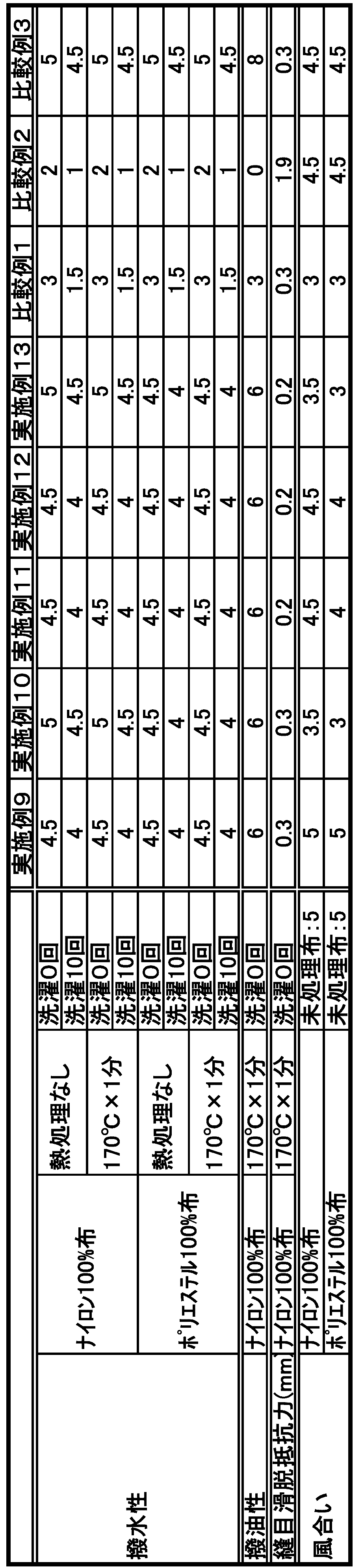
表1および2に示すとおり、撥水剤が成分(a)および(b)の付加物(A)を含む実施例1~13の布(撥水性繊維製品)は、ナイロン100%、ポリエステル100%、熱処理しなかった布、熱処理した布のいずれもが、洗濯前の撥水性および撥油性と、洗濯後の撥水性(洗濯耐久性)とがきわめて優れており、フッ素系撥水剤(比較例3)と比較しても遜色がなかった。また、実施例1~13の布(撥水性繊維製品)は、風合い評価においても、十分な柔らかさを示した。特に、アミノ変性シリコーン(E)を加えた実施例6および7は、フッ素系撥水剤(比較例3)と比較しても遜色がない柔らかさを示した。なお、風合い評価については、全ての実施例および比較例において、熱処理なしの撥水性繊維製品(撥水処理された布)と、170℃で1分間熱処理した撥水性繊維製品(撥水処理された布)との評価結果が同じであったため、表1および2では、両者の評価結果をまとめて示している。さらに、実施例1~13の布(撥水性繊維製品)は、縫目滑脱抵抗力にも優れていた。これに対し、撥水剤が成分(a)および(b)の付加物(A)を含まない比較例1および比較例2では、風合いは柔らかかったものの、洗濯前の撥水性および撥油性と、洗濯後の撥水性(洗濯耐久性)とが、実施例に対し大幅に劣っていた。縫目滑脱抵抗力については、比較例1の布(撥水性繊維製品)は優れていたが、比較例2では、他の実施例および比較例に対し大幅に劣っていた。また、比較例3(フッ素系撥水剤)は、撥水性、撥油性、洗濯耐久性および風合いが優れているが、フッ素元素を含む点で問題がある。前述のとおり、実施例1~13の撥水剤は、フッ素元素を含まないにもかかわらず、撥水剤として比較例3(フッ素系撥水剤)と遜色のない性能を発揮できた。
この出願は、2018年7月25日に出願された日本出願特願2018-139574および2019年1月29日に出願された日本出願特願2019-013679を基礎とする優先権を主張し、その開示の全てをここに取り込む。
Claims (9)
- 下記成分(a)および(b)の付加物(A)を含むことを特徴とする撥水剤。
(a)水酸基、アミノ基、およびイミノ基からなる群から選択される少なくとも一種の置換基を有するビニル系ポリマー
(b)炭素数が8以上の脂肪族基を有するイソシアネート - さらに、界面活性剤(B)と、水(C)とを含む請求項1記載の撥水剤。
- さらに、有機溶媒(D)を含み、前記付加物(A)が前記有機溶媒(D)に溶解している請求項1記載の撥水剤。
- 前記成分(a)が、ポリビニルアルコール、ビニルアルコール-酢酸ビニル共重合体、エチレン-ビニルアルコール共重合体、エチレン-ビニルアルコール-酢酸ビニル共重合体、ポリアリルアミン、およびポリエチレンイミンからなる群から選択される少なくとも一つである請求項1から3のいずれか一項に記載の撥水剤。
- 前記成分(a)中の水酸基、アミノ基、およびイミノ基の数の合計と、前記成分(b)中のイソシアネート基の数との比が、4/1~1/1である請求項1から4のいずれか一項に記載の撥水剤。
- さらに、アミノ変性シリコーン(E)を含む請求項1から5のいずれか一項に記載の撥水剤。
- 請求項1から6のいずれか一項に記載の撥水剤を含む処理液で繊維を撥水処理する撥水処理工程を含むことを特徴とする撥水性繊維製品の製造方法。
- 前記撥水処理工程において、前記処理液にイソシアネート(F)を含有させ、前記イソシアネート(F)により前記付加物(A)を架橋させる請求項7記載の撥水性繊維製品の製造方法。
- 請求項1から6のいずれか一項に記載の撥水剤における前記付加物(A)または前記付加物(A)の架橋物が繊維に付着していることを特徴とする撥水性繊維製品。
Priority Applications (2)
| Application Number | Priority Date | Filing Date | Title |
|---|---|---|---|
| JP2020532434A JPWO2020022367A1 (ja) | 2018-07-25 | 2019-07-24 | 撥水剤、撥水性繊維製品の製造方法および撥水性繊維製品 |
| CN201980049510.9A CN112513220B (zh) | 2018-07-25 | 2019-07-24 | 拒水剂、拒水性纤维产品的制造方法以及拒水性纤维产品 |
Applications Claiming Priority (4)
| Application Number | Priority Date | Filing Date | Title |
|---|---|---|---|
| JP2018139574 | 2018-07-25 | ||
| JP2018-139574 | 2018-07-25 | ||
| JP2019013679 | 2019-01-29 | ||
| JP2019-013679 | 2019-01-29 |
Publications (1)
| Publication Number | Publication Date |
|---|---|
| WO2020022367A1 true WO2020022367A1 (ja) | 2020-01-30 |
Family
ID=69181579
Family Applications (1)
| Application Number | Title | Priority Date | Filing Date |
|---|---|---|---|
| PCT/JP2019/028956 Ceased WO2020022367A1 (ja) | 2018-07-25 | 2019-07-24 | 撥水剤、撥水性繊維製品の製造方法および撥水性繊維製品 |
Country Status (3)
| Country | Link |
|---|---|
| JP (1) | JPWO2020022367A1 (ja) |
| CN (1) | CN112513220B (ja) |
| WO (1) | WO2020022367A1 (ja) |
Cited By (3)
| Publication number | Priority date | Publication date | Assignee | Title |
|---|---|---|---|---|
| WO2022259982A1 (ja) | 2021-06-09 | 2022-12-15 | ダイキン工業株式会社 | 耐油剤及び紙製品 |
| JP2022186001A (ja) * | 2021-06-04 | 2022-12-15 | 松本油脂製薬株式会社 | 撥水繊維用処理剤及びその利用 |
| JP2023042244A (ja) * | 2021-09-14 | 2023-03-27 | 荒川化学工業株式会社 | 撥水剤組成物、撥水性繊維及び撥水性繊維の製造方法 |
Families Citing this family (2)
| Publication number | Priority date | Publication date | Assignee | Title |
|---|---|---|---|---|
| WO2023054428A1 (ja) * | 2021-09-30 | 2023-04-06 | 日油株式会社 | 撥水剤用重合体、撥水剤組成物および撥水剤処理物 |
| CN116876229B (zh) * | 2023-07-18 | 2025-07-22 | 扬州纪元纺织有限公司 | 一种防灼拒水的锦丝伞布、其加工方法和应用 |
Citations (8)
| Publication number | Priority date | Publication date | Assignee | Title |
|---|---|---|---|---|
| US2532011A (en) * | 1946-09-07 | 1950-11-28 | Minnesota Mining & Mfg | Liners and adhesive tapes having low adhesion polyvinyl carbamate coatings |
| JPS297333B1 (ja) * | 1951-09-30 | 1954-11-09 | ||
| JPS5951855A (ja) * | 1982-09-18 | 1984-03-26 | 日東電工株式会社 | 生体面固定用接着テ−プ |
| JPS602779A (ja) * | 1983-06-13 | 1985-01-09 | 保土谷化学工業株式会社 | 繊維製品の撥水、防水加工方法 |
| JPH0386778A (ja) * | 1989-08-31 | 1991-04-11 | Nippon Shokubai Kagaku Kogyo Co Ltd | 水性剥離剤およびその製造方法 |
| JPH06184947A (ja) * | 1992-12-08 | 1994-07-05 | Nippon Unicar Co Ltd | 柔軟剤組成物 |
| JPH09302031A (ja) * | 1996-05-10 | 1997-11-25 | Dainichiseika Color & Chem Mfg Co Ltd | 変性ポリビニルアルコール系共重合体及び可塑化塩化ビニル系樹脂成形品用被覆組成物 |
| JP2017110032A (ja) * | 2015-12-14 | 2017-06-22 | 三菱樹脂株式会社 | 積層ポリエステルフィルム |
Family Cites Families (6)
| Publication number | Priority date | Publication date | Assignee | Title |
|---|---|---|---|---|
| JP4392086B2 (ja) * | 1998-10-22 | 2009-12-24 | 株式会社日本触媒 | ポリマー水分散体、その製造方法および水系剥離剤 |
| DE10124387A1 (de) * | 2001-05-18 | 2002-11-28 | Basf Ag | Hydrophob modifizierte Polyethylenimine und Polyvinylamine zur Antiknitterausrüstung von cellulosehaltigen Textilien |
| JP4236538B2 (ja) * | 2002-08-20 | 2009-03-11 | 東レ株式会社 | バイオセンサ |
| JP2004183159A (ja) * | 2002-12-04 | 2004-07-02 | Toray Ind Inc | 防汚性繊維 |
| JP2005281870A (ja) * | 2004-03-26 | 2005-10-13 | Lintec Corp | 水崩壊性撥水紙及びその製造方法 |
| EP2703465A4 (en) * | 2011-04-27 | 2014-11-19 | Asahi Glass Co Ltd | COMPOSITION OF A WATER REPELLENT AND AN OIL-REACTIVE AGENT, PRODUCTION PROCESS AND ARTICLE THEREOF |
-
2019
- 2019-07-24 WO PCT/JP2019/028956 patent/WO2020022367A1/ja not_active Ceased
- 2019-07-24 JP JP2020532434A patent/JPWO2020022367A1/ja active Pending
- 2019-07-24 CN CN201980049510.9A patent/CN112513220B/zh active Active
Patent Citations (8)
| Publication number | Priority date | Publication date | Assignee | Title |
|---|---|---|---|---|
| US2532011A (en) * | 1946-09-07 | 1950-11-28 | Minnesota Mining & Mfg | Liners and adhesive tapes having low adhesion polyvinyl carbamate coatings |
| JPS297333B1 (ja) * | 1951-09-30 | 1954-11-09 | ||
| JPS5951855A (ja) * | 1982-09-18 | 1984-03-26 | 日東電工株式会社 | 生体面固定用接着テ−プ |
| JPS602779A (ja) * | 1983-06-13 | 1985-01-09 | 保土谷化学工業株式会社 | 繊維製品の撥水、防水加工方法 |
| JPH0386778A (ja) * | 1989-08-31 | 1991-04-11 | Nippon Shokubai Kagaku Kogyo Co Ltd | 水性剥離剤およびその製造方法 |
| JPH06184947A (ja) * | 1992-12-08 | 1994-07-05 | Nippon Unicar Co Ltd | 柔軟剤組成物 |
| JPH09302031A (ja) * | 1996-05-10 | 1997-11-25 | Dainichiseika Color & Chem Mfg Co Ltd | 変性ポリビニルアルコール系共重合体及び可塑化塩化ビニル系樹脂成形品用被覆組成物 |
| JP2017110032A (ja) * | 2015-12-14 | 2017-06-22 | 三菱樹脂株式会社 | 積層ポリエステルフィルム |
Cited By (6)
| Publication number | Priority date | Publication date | Assignee | Title |
|---|---|---|---|---|
| JP2022186001A (ja) * | 2021-06-04 | 2022-12-15 | 松本油脂製薬株式会社 | 撥水繊維用処理剤及びその利用 |
| WO2022259982A1 (ja) | 2021-06-09 | 2022-12-15 | ダイキン工業株式会社 | 耐油剤及び紙製品 |
| KR20240000611A (ko) | 2021-06-09 | 2024-01-02 | 다이킨 고교 가부시키가이샤 | 내유제 및 종이 제품 |
| CN117425713A (zh) * | 2021-06-09 | 2024-01-19 | 大金工业株式会社 | 耐油剂和纸制品 |
| EP4328282A4 (en) * | 2021-06-09 | 2024-10-09 | Daikin Industries, Ltd. | OIL RESISTANT AGENT AND PAPER PRODUCT |
| JP2023042244A (ja) * | 2021-09-14 | 2023-03-27 | 荒川化学工業株式会社 | 撥水剤組成物、撥水性繊維及び撥水性繊維の製造方法 |
Also Published As
| Publication number | Publication date |
|---|---|
| CN112513220B (zh) | 2023-10-10 |
| CN112513220A (zh) | 2021-03-16 |
| JPWO2020022367A1 (ja) | 2021-08-05 |
Similar Documents
| Publication | Publication Date | Title |
|---|---|---|
| CN112513220B (zh) | 拒水剂、拒水性纤维产品的制造方法以及拒水性纤维产品 | |
| CN109563339B (zh) | 无氟纤维处理组合物、经处理基底以及处理方法 | |
| JP6435320B2 (ja) | 基材の表面特性を改質する組成物のためのウレタン性ポリマーエクステンダー | |
| EP3155164B1 (en) | Wax and urethane based extender blends for surface effect compositions | |
| EP3256638B1 (en) | Methods for treating fibrous substrates using fluorine-free compositions including isocyanate-derived (meth)acrylate-containing polymeric compounds | |
| JP6608804B2 (ja) | 非フッ素化ウレタン系コーティング | |
| JP4161717B2 (ja) | 撥水撥油剤組成物とその製法及び用途 | |
| JP6735763B2 (ja) | ポリカルボジイミド及び任意にパラフィンワックスを含むフッ素不含繊維処理組成物、並びに処理方法 | |
| TW201930544A (zh) | 撥水劑組合物、及撥水性纖維製品之製造方法 | |
| KR101761096B1 (ko) | 섬유 재료의 발유 및/또는 발수 가공용 조성물 | |
| TWI766233B (zh) | 撥水劑組成物 | |
| US10253450B2 (en) | Finishing agent with blocked polyisocyanates | |
| CN109988264A (zh) | 一种无氟防水剂及其制备方法和应用 | |
| JPH10204777A (ja) | 防汚加工剤 | |
| CN101842458B (zh) | 用于赋予基材增加的斥水性的组合物和方法以及用该组合物和方法处理过的基材 | |
| JP2009542844A (ja) | 反撥性を付与する方法 | |
| EP0919576B1 (en) | Novel copolymer, process for the preparation of the same, and use thereof | |
| JP2024118357A (ja) | 撥水加工繊維構造物の製造方法及び繊維構造物の撥水加工薬剤キット | |
| JP2024072903A (ja) | 撥水剤、撥水剤処理液および撥水剤処理液を用いた撥水性繊維製品の製造方法 | |
| CN113637121A (zh) | 一种织物处理用共聚物、织物处理剂及应用 |
Legal Events
| Date | Code | Title | Description |
|---|---|---|---|
| 121 | Ep: the epo has been informed by wipo that ep was designated in this application |
Ref document number: 19839850 Country of ref document: EP Kind code of ref document: A1 |
|
| ENP | Entry into the national phase |
Ref document number: 2020532434 Country of ref document: JP Kind code of ref document: A |
|
| NENP | Non-entry into the national phase |
Ref country code: DE |
|
| 122 | Ep: pct application non-entry in european phase |
Ref document number: 19839850 Country of ref document: EP Kind code of ref document: A1 |