WO2020004604A1 - 多孔質セルロース粒子とその製造方法、および化粧料 - Google Patents
多孔質セルロース粒子とその製造方法、および化粧料 Download PDFInfo
- Publication number
- WO2020004604A1 WO2020004604A1 PCT/JP2019/025758 JP2019025758W WO2020004604A1 WO 2020004604 A1 WO2020004604 A1 WO 2020004604A1 JP 2019025758 W JP2019025758 W JP 2019025758W WO 2020004604 A1 WO2020004604 A1 WO 2020004604A1
- Authority
- WO
- WIPO (PCT)
- Prior art keywords
- porous cellulose
- cellulose particles
- particles
- dispersion
- porous
- Prior art date
- Legal status (The legal status is an assumption and is not a legal conclusion. Google has not performed a legal analysis and makes no representation as to the accuracy of the status listed.)
- Ceased
Links
Images

Classifications
-
- A—HUMAN NECESSITIES
- A61—MEDICAL OR VETERINARY SCIENCE; HYGIENE
- A61K—PREPARATIONS FOR MEDICAL, DENTAL OR TOILETRY PURPOSES
- A61K8/00—Cosmetics or similar toiletry preparations
- A61K8/18—Cosmetics or similar toiletry preparations characterised by the composition
- A61K8/72—Cosmetics or similar toiletry preparations characterised by the composition containing organic macromolecular compounds
- A61K8/73—Polysaccharides
- A61K8/731—Cellulose; Quaternized cellulose derivatives
-
- A—HUMAN NECESSITIES
- A61—MEDICAL OR VETERINARY SCIENCE; HYGIENE
- A61K—PREPARATIONS FOR MEDICAL, DENTAL OR TOILETRY PURPOSES
- A61K8/00—Cosmetics or similar toiletry preparations
- A61K8/02—Cosmetics or similar toiletry preparations characterised by special physical form
- A61K8/0241—Containing particulates characterized by their shape and/or structure
- A61K8/025—Explicitly spheroidal or spherical shape
-
- A—HUMAN NECESSITIES
- A61—MEDICAL OR VETERINARY SCIENCE; HYGIENE
- A61K—PREPARATIONS FOR MEDICAL, DENTAL OR TOILETRY PURPOSES
- A61K8/00—Cosmetics or similar toiletry preparations
- A61K8/02—Cosmetics or similar toiletry preparations characterised by special physical form
- A61K8/0241—Containing particulates characterized by their shape and/or structure
- A61K8/0279—Porous; Hollow
-
- A—HUMAN NECESSITIES
- A61—MEDICAL OR VETERINARY SCIENCE; HYGIENE
- A61K—PREPARATIONS FOR MEDICAL, DENTAL OR TOILETRY PURPOSES
- A61K8/00—Cosmetics or similar toiletry preparations
- A61K8/02—Cosmetics or similar toiletry preparations characterised by special physical form
- A61K8/04—Dispersions; Emulsions
- A61K8/06—Emulsions
-
- A—HUMAN NECESSITIES
- A61—MEDICAL OR VETERINARY SCIENCE; HYGIENE
- A61Q—SPECIFIC USE OF COSMETICS OR SIMILAR TOILETRY PREPARATIONS
- A61Q1/00—Make-up preparations; Body powders; Preparations for removing make-up
- A61Q1/12—Face or body powders for grooming, adorning or absorbing
-
- A—HUMAN NECESSITIES
- A61—MEDICAL OR VETERINARY SCIENCE; HYGIENE
- A61Q—SPECIFIC USE OF COSMETICS OR SIMILAR TOILETRY PREPARATIONS
- A61Q19/00—Preparations for care of the skin
-
- C—CHEMISTRY; METALLURGY
- C08—ORGANIC MACROMOLECULAR COMPOUNDS; THEIR PREPARATION OR CHEMICAL WORKING-UP; COMPOSITIONS BASED THEREON
- C08J—WORKING-UP; GENERAL PROCESSES OF COMPOUNDING; AFTER-TREATMENT NOT COVERED BY SUBCLASSES C08B, C08C, C08F, C08G or C08H
- C08J3/00—Processes of treating or compounding macromolecular substances
- C08J3/12—Powdering or granulating
-
- A—HUMAN NECESSITIES
- A61—MEDICAL OR VETERINARY SCIENCE; HYGIENE
- A61K—PREPARATIONS FOR MEDICAL, DENTAL OR TOILETRY PURPOSES
- A61K2800/00—Properties of cosmetic compositions or active ingredients thereof or formulation aids used therein and process related aspects
- A61K2800/10—General cosmetic use
-
- A—HUMAN NECESSITIES
- A61—MEDICAL OR VETERINARY SCIENCE; HYGIENE
- A61K—PREPARATIONS FOR MEDICAL, DENTAL OR TOILETRY PURPOSES
- A61K2800/00—Properties of cosmetic compositions or active ingredients thereof or formulation aids used therein and process related aspects
- A61K2800/20—Chemical, physico-chemical or functional or structural properties of the composition as a whole
- A61K2800/21—Emulsions characterized by droplet sizes below 1 micron
-
- A—HUMAN NECESSITIES
- A61—MEDICAL OR VETERINARY SCIENCE; HYGIENE
- A61K—PREPARATIONS FOR MEDICAL, DENTAL OR TOILETRY PURPOSES
- A61K2800/00—Properties of cosmetic compositions or active ingredients thereof or formulation aids used therein and process related aspects
- A61K2800/40—Chemical, physico-chemical or functional or structural properties of particular ingredients
- A61K2800/41—Particular ingredients further characterized by their size
- A61K2800/412—Microsized, i.e. having sizes between 0.1 and 100 microns
-
- B—PERFORMING OPERATIONS; TRANSPORTING
- B82—NANOTECHNOLOGY
- B82Y—SPECIFIC USES OR APPLICATIONS OF NANOSTRUCTURES; MEASUREMENT OR ANALYSIS OF NANOSTRUCTURES; MANUFACTURE OR TREATMENT OF NANOSTRUCTURES
- B82Y40/00—Manufacture or treatment of nanostructures
-
- B—PERFORMING OPERATIONS; TRANSPORTING
- B82—NANOTECHNOLOGY
- B82Y—SPECIFIC USES OR APPLICATIONS OF NANOSTRUCTURES; MEASUREMENT OR ANALYSIS OF NANOSTRUCTURES; MANUFACTURE OR TREATMENT OF NANOSTRUCTURES
- B82Y5/00—Nanobiotechnology or nanomedicine, e.g. protein engineering or drug delivery
-
- C—CHEMISTRY; METALLURGY
- C08—ORGANIC MACROMOLECULAR COMPOUNDS; THEIR PREPARATION OR CHEMICAL WORKING-UP; COMPOSITIONS BASED THEREON
- C08J—WORKING-UP; GENERAL PROCESSES OF COMPOUNDING; AFTER-TREATMENT NOT COVERED BY SUBCLASSES C08B, C08C, C08F, C08G or C08H
- C08J2300/00—Characterised by the use of unspecified polymers
- C08J2300/16—Biodegradable polymers
-
- C—CHEMISTRY; METALLURGY
- C08—ORGANIC MACROMOLECULAR COMPOUNDS; THEIR PREPARATION OR CHEMICAL WORKING-UP; COMPOSITIONS BASED THEREON
- C08J—WORKING-UP; GENERAL PROCESSES OF COMPOUNDING; AFTER-TREATMENT NOT COVERED BY SUBCLASSES C08B, C08C, C08F, C08G or C08H
- C08J2301/00—Characterised by the use of cellulose, modified cellulose or cellulose derivatives
- C08J2301/02—Cellulose; Modified cellulose
Definitions
- the present invention relates to porous cellulose particles formed by gathering cellulose having good biodegradability, and more particularly to porous cellulose particles having high sphericity and cosmetics containing the same.
- plastics synthetic polymers derived from petroleum are used in various industries. Many synthetic polymers are developed for long-term stability and do not degrade in the natural environment. As a result, various environmental problems have occurred. For example, plastic products spilled into the water environment have accumulated for a long time, causing great harm to marine and lake ecosystems. In recent years, fine plastics, which are called microplastics and have a length of 5 mm or less to a nanometer level, have become a major problem. Examples of microplastics include fine particles contained in cosmetics and the like, small lumps of plastic resin before processing, and large products that have become finer while floating in the sea.
- plastic particles eg, polyethylene particles
- plastic particles eg, polyethylene particles
- the true specific gravity of the plastic particles is light, it is difficult to remove them at a sewage treatment plant, and the plastic particles easily flow out to rivers, oceans, ponds and marshes.
- plastic particles easily adsorb chemicals such as insecticides, there is a possibility that the bioconcentration may affect the human body. This has been pointed out in the United Nations Environment Program and other countries, and countries and various industry groups are considering regulations.
- biodegradable plastics which are decomposed into water and carbon dioxide by microorganisms in the natural environment and incorporated into the natural carbon cycle, have been attracting attention.
- cellulose particles which are natural materials derived from plants, do not float on water even when they flow into the environment, and have good biodegradability, so there is little concern about causing environmental problems.
- a cuprammonium solution in which cellulose is dissolved is neutralized with an acid to obtain regenerated cellulose particles having a spherical shape of 9 to 400 nm (for example, see Patent Document 1).
- a cellulose solution is sprayed to form droplets in a gas phase, and the droplets are brought into contact with a coagulation liquid to obtain spherical regenerated cellulose particles (for example, see Patent Document 2). ). They produce cellulose particles using crystalline cellulose of type II obtained by a process of intentional chemical modification. Such regenerated cellulose particles are classified as naturally occurring raw materials according to the definition of the aforementioned guidelines.
- powdery cellulose particles having strength and disintegration suitable for a scrub agent using cellulose obtained by a process without intentional chemical modification are also known (for example, see Patent Document 3).
- cellulose dispersed in an organic solvent is granulated and dried by a spray-drying method to produce porous cellulose particles having an I-type crystal form (for example, see Patent Document 4).
- cellulose particles In order to use cellulose particles for cosmetics instead of plastic beads, the following two points are required for cellulose particles. (1) Being formed of crystalline cellulose of type I obtained by a process without intentional chemical modification to be regarded as a natural raw material. (2) To have high sphericity and good fluidity, and to improve the feel characteristics of cosmetics.
- Patent Documents 1 and 2 were not regarded as natural raw materials in the aforementioned guidelines. Further, the sphericity of the cellulose particles described in Patent Document 3 was 0.1 to 0.7, and good touch characteristics could not be given to cosmetics. As in Patent Literature 4, cellulose particles can be obtained using a spray drying method, but particles having a sufficient sphericity could not be obtained by a spray drying method because of a high drying rate. For this reason, uniform rolling properties could not be obtained when blended in cosmetics.
- an object of the present invention is to realize porous cellulose particles having both high sphericity and good fluidity by using type I crystalline cellulose obtained by a process without intentional chemical modification. is there. Cosmetics in which such porous cellulose particles are blended are less likely to cause environmental problems, and can also have the same touch characteristics as conventional plastic beads.
- the porous cellulose particles according to the present invention are particles obtained by assembling crystalline cellulose.
- the porous cellulose particles have an average particle diameter d 1 of 0.5 to less than 50 ⁇ m, a specific surface area of 25 to 1000 m 2 / g, and a sphericity. Is 0.85 or more.
- the crystalline cellulose has an I-type crystal form in which a glucose molecule is a constituent unit.
- the pore volume PV was in the range of 0.2 to 5.0 ml / g. Further, the average pore diameter PD was in the range of 2 to 200 nm. In addition, crystalline cellulose having an average particle diameter d 3 of 1 nm to 1 ⁇ m was used. Further, as the porous cellulose particles, hollow particles having a cavity inside the outer shell were used.
- the ratio (d 2 / d) of the average particle diameter d 2 after the dispersion and the average particle diameter d 1 before the dispersion was obtained.
- d 1 is in the range of 0.95 to 1.05.
- the method for producing porous cellulose particles according to the present invention comprises an emulsifying step of preparing an emulsion containing emulsified droplets by mixing a dispersion of crystalline cellulose in a crystalline form of type I, a surfactant and a non-aqueous solvent.
- a frozen emulsion obtained by freezing water in emulsified droplets by cooling the emulsion obtained in the emulsification step in the range of 0 to ⁇ 50 ° C. may be used.
- a cosmetic can be prepared by blending any of the above-described porous cellulose particles with a cosmetic component.
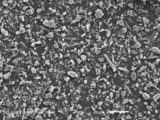
- Example 3 is an SEM photograph showing the appearance of the porous cellulose particles according to Example 1.
- 9 is an SEM photograph showing the appearance of a porous cellulose particle according to Comparative Example 4.
- the porous cellulose particles according to the present invention are formed by gathering crystalline cellulose having “I-type crystalline form having glucose molecules as constituent units” (hereinafter, referred to as “I-type crystalline cellulose”). .
- the porous cellulose particles had an average particle diameter d 1 is less than 50 ⁇ m more than 0.5 [mu] m, 0.85 or more sphericity, specific surface area of 25 ⁇ 1000m 2 / g.
- the average particle size d 1 of the porous cellulose particles affects the feel properties of the cosmetic. If it is less than 0.5 ⁇ m, the tactile properties such as rolling feeling, sustainability of rolling feeling, and uniform spreadability are significantly reduced.
- the average particle diameter d 1 is preferably 1 to 20 ⁇ m, and most preferably 1 to 10 ⁇ m.
- a laser diffraction method to obtain an average particle size d 1 by a laser diffraction method.
- the specific surface area is less than 25 m 2 / g, the rate of biodegradation when flowing into an aqueous environment is not sufficient. On the other hand, if the specific surface area exceeds 1000 m 2 / g, the particles become brittle and may disintegrate when applied to the skin.
- the specific surface area is particularly preferably from 50 to 500 m 2 / g.
- a cosmetic containing particles having a sphericity of less than 0.85 good rolling properties cannot be obtained.
- the sphericity is particularly preferably 0.90 or more.
- the sphericity was determined from a photograph of a scanning electron microscope by an image analysis method.
- the particle variation coefficient (CV) of the porous cellulose particles is preferably 50% or less. If the particle variation coefficient exceeds 50%, uniform rolling properties may be impaired.
- the particle variation coefficient is preferably 40% or less, particularly preferably 30% or less. In addition, although the smaller the particle variation coefficient, the better, it is industrially difficult to obtain particles with a narrow distribution. If it is about 3% or more, there is no particular problem in production.
- the content of the type I crystalline cellulose in the porous particles is desirably 50% or more. It may contain other crystalline forms of cellulose such as II-IV.
- the content of type I crystalline cellulose is preferably at least 75%, particularly preferably at least 90%. The higher the content, the higher the natural index according to the aforementioned guidelines.
- the crystal form of cellulose can be identified by infrared spectroscopy, and the crystalline form of Form I has strong absorption at 3365 to 3370 cm ⁇ 1 . In addition, it can be identified from the difference in chemical shift by solid-state 13C NMR and the diffraction angle by X-ray diffraction. Further, the crystal form may have any structure of I ⁇ and I ⁇ , and may be mixed.
- the porous cellulose particles have a pore volume (PV) of 0.2 to 5.0 ml / g and an average pore diameter (PD) of 2 to 200 nm.
- PV pore volume
- PD average pore diameter
- Particles having a pore volume of less than 0.2 ml / g have low elasticity and are difficult to obtain soft touch characteristics.
- particles exceeding 5.0 ml / g are fragile and may collapse when applied to the skin.
- the pore volume is more preferably from 0.2 to 2.0 ml / g.
- the average pore size is less than 2 nm, the biodegradability is reduced although the touch characteristics are not significantly affected.
- the strength of the particles becomes brittle.
- the porous cellulose particles are disintegrated in the production process of the cosmetic, the function originally expected may not be obtained. Therefore, it is desirable that the average particle diameter of the particles does not change during the manufacturing process. Therefore, a test was conducted in which the porous cellulose particles were dispersed in distilled water and ultrasonic waves were applied for 60 minutes using an ultrasonic disperser.
- the ratio (d 2 / d 1 ) between the average particle diameter d 2 after the test and the average particle diameter d 1 before the test is preferably 0.95 to 1.05. Particles having this ratio of less than 0.95 have low strength and may be disintegrated by a mechanical load in the production process, so that a feeling improving effect may not be obtained.
- This ratio is particularly preferably from 0.97 to 1.03.
- the porous cellulose particles may have a hollow structure in which a cavity is formed inside the outer shell. Since such hollow particles are lighter than solid particles of the same diameter, the number of particles contained in the same weight is larger than that of solid particles.
- the outer shell is preferably porous and has such a porosity that nitrogen gas can pass therethrough.
- the ratio (T / OD) of the outer shell thickness T to the outer diameter OD of the porous cellulose particles is preferably in the range of 0.02 to 0.45. If this ratio exceeds 0.45, it will be substantially equivalent to solid particles. On the other hand, if this ratio is less than 0.02, the particles are likely to collapse. This ratio is particularly preferably in the range of 0.04 to 0.30.
- the type I crystalline cellulose forming the porous cellulose particles preferably has an average particle diameter d 3 of 1 nm to 1 ⁇ m. Porous cellulose particles formed of particles having a fine average particle size exhibit good biodegradability.
- the average particle diameter d 3 of crystalline cellulose particularly preferably 0.1 ⁇ 0.5 [mu] m.
- cellulose nanofibers having a thickness of 1 to 500 nm and a length of 1 ⁇ m or more measured by electron micrographs and cellulose nanocrystals having a thickness of 10 to 50 nm and a length of 100 to 500 nm are also suitable as crystalline cellulose. It is.
- Type I crystalline cellulose is obtained by subjecting cellulose fibers obtained by digesting plant fibers or commercially available cellulose powder (such as CEOLUS (registered trademark) PH-101 manufactured by Asahi Kasei Corporation) to mechanical treatment such as water jet method, or TEMPO oxidation method. And can be obtained by defibration.
- cellulose fibers obtained by digesting plant fibers or commercially available cellulose powder (such as CEOLUS (registered trademark) PH-101 manufactured by Asahi Kasei Corporation) to mechanical treatment such as water jet method, or TEMPO oxidation method. And can be obtained by defibration.
- aqueous dispersion for example, CEOLUS RC manufactured by Asahi Kasei Corporation, Leocrysta (registered trademark) manufactured by Daiichi Kogyo Seiyaku Co., Ltd., BiNFi-s (registered trademark) manufactured by Sugino Machine Co., Ltd., or Fibano manufactured by Kusano Sakuko Co., Ltd.
- CEOLUS RC Asahi Kasei Corporation
- Leocrysta registered trademark
- BiNFi-s registered trademark
- a method for producing the porous cellulose particles will be described.
- a dispersion liquid of crystalline cellulose of type I, a surfactant and a non-aqueous solvent are mixed and emulsified (emulsification step).
- emulsification step an emulsion containing emulsion droplets is obtained.
- the emulsion is dehydrated (dehydration step).
- dehydration step water in the emulsified droplet is slowly removed.
- solid-liquid separation is performed to take out the porous cellulose particles as a solid (solid-liquid separation step). By drying and crushing the solid, powder of porous cellulose particles is obtained (drying step).
- a dispersion of crystalline cellulose of type I is prepared.
- the dispersion is adjusted to have a solid concentration of 0.01 to 5% to obtain a dispersion having an appropriate viscosity.
- the solid content concentration exceeds 5%, the viscosity usually increases, and the uniformity of the emulsified droplet may be impaired. If it is less than 0.01%, the economy is poor and there is no particular advantage.
- the solvent of the dispersion is preferably water.
- Non-aqueous solutions are needed for emulsification.
- the non-aqueous solution only needs to be insoluble in water, and a general hydrocarbon solvent can be used.
- Surfactants are added to form water-in-oil emulsion droplets.
- the HLB value of the surfactant is suitably from 1 to 10.
- An optimum HLB value may be selected according to the polarity of the non-aqueous solvent.
- the HLB value is particularly preferably in the range of 1 to 5. Further, surfactants having different HLB values may be combined.
- this mixed solution is emulsified by an emulsifying device.
- emulsification conditions are set so that an emulsion containing emulsified droplets having an average diameter of 0.5 to 500 ⁇ m is obtained.
- Type I crystalline cellulose dispersed in water is present in the emulsified droplets.
- a general high-speed shearing device can be used for the emulsifying device.
- known devices such as a high-pressure emulsifying device that can obtain finer emulsified droplets, a film emulsifying device that can obtain more uniform emulsified droplets, and a microchannel emulsifying device can be applied according to the purpose.
- the average diameter of the emulsified droplet was measured as follows. The emulsion is dropped on a slide glass, and a cover glass is placed over the slide glass. An image is taken with a digital microscope (VHX-600, manufactured by KEYENCE CORPORATION) at a magnification of 30 to 2000 times through a cover glass to obtain a photographic projection of the emulsified droplet. 50 droplets are arbitrarily selected from the photograph projection view, and the equivalent circle diameter is calculated by attached software. The average value of the 50 equivalent circle diameters was defined as the average diameter (average droplet diameter).
- a separable flask equipped with a cooling tube is heated and dehydration is performed while recovering the non-aqueous solvent.
- dehydration is performed by heating under reduced pressure using a rotary evaporator or an evaporator, and recovering the non-aqueous solvent. It is preferable to perform dehydration to such an extent that the porous cellulose particles can be taken out as a solid from the non-aqueous solvent dispersion in the solid-liquid separation step described below. If the dehydration is insufficient, the form as spherical particles cannot be maintained in the solid-liquid separation step, and a high sphericity cannot be obtained.
- Solid-liquid separation process In the solid-liquid separation step, solids are separated from the non-aqueous solvent dispersion obtained in the dehydration step by a conventionally known method such as filtration or centrifugation. Thereby, a cake-like substance of porous cellulose particles is obtained.
- the obtained cake-like substance may be washed.
- the surfactant can be reduced.
- the porous cellulose particles are incorporated into a liquid preparation such as an emulsion, the surfactant may hinder long-term stability. Therefore, the residual amount of the surfactant contained in the porous cellulose particles is preferably 500 ppm or less. In order to reduce the amount of the surfactant, washing with an organic solvent is preferred.
- drying step the non-aqueous solvent contained in the cake-like substance obtained in the solid-liquid separation step is evaporated by heating under normal pressure or reduced pressure. As a result, a dry powder of porous cellulose particles having an average particle size of 0.5 to 25 ⁇ m is obtained.
- the emulsion obtained in the emulsification step may be cooled in the range of ⁇ 50 to 0 ° C. before the dehydration step. That is, the water in the emulsified droplet is frozen to obtain a frozen emulsion. After the frozen emulsion is returned to room temperature, a dehydration step is performed.
- the freezing temperature is ⁇ 50 ° C. to ⁇ 10 ° C.
- porous cellulose particles having a solid structure are obtained.
- the temperature is -10 to 0 ° C
- porous cellulose particles having a hollow structure are obtained.
- ice crystals grow gradually. As the crystal grows, crystalline cellulose (primary particles) in the droplet is repelled to the outer periphery of the droplet. Therefore, a cavity is formed inside the outer shell.
- a cosmetic can be prepared by blending the above-mentioned porous cellulose particles with various cosmetic ingredients. According to such cosmetics, the same rolling feeling as the single-component inorganic particles (silica particles), the sustainability of the rolling feeling, and the uniform spreadability, the soft feeling and the moist feeling similar to the plastic beads are simultaneously obtained. Obtainable. That is, it is possible to satisfy typical feel characteristics required for the feel improving material of the cosmetic.
- Such a cosmetic can be produced by a conventionally known general method.
- the cosmetic is used in various forms such as powder, cake, pencil, stick, cream, gel, mousse, liquid, and cream.
- Table 2 shows typical classifications and components as various cosmetic components. Furthermore, quasi-drug raw material standards 2006 (published by Yakuji Nippo Co., Ltd., June 16, 2006) and International Cosmetic Ingredient Dictionary and Handbook (published by The Cosmetic, Toiletry, and Fragrance Association, Eleventh Edition 2006), etc. May be added.
- a dispersion liquid of type I crystalline cellulose is prepared.
- 50 g of type I cellulose (Seolas PH-101 manufactured by Asahi Kasei Corporation) was suspended in 4950 g of pure water. This suspension was passed 100 times through a microfluidizer (M-7250-30 manufactured by Microfluidics) to prepare a dispersion having a solid content of 1%.
- FIG. 1 shows an SEM photograph of the porous cellulose particles.
- Table 3 shows the preparation conditions for the porous cellulose particles.
- the physical properties of the powder of the porous cellulose particles were measured by the following methods.
- Table 4 shows the results.
- the particle size distribution was measured using a laser diffraction / scattering particle size distribution analyzer LA-950v2 (manufactured by Horiba, Ltd.).
- LA-950v2 manufactured by Horiba, Ltd.
- average particle size 6000 ⁇ (true density ⁇ specific surface area)
- Pore Volume and Pore Diameter of Porous Cellulose Particles 10 g of the porous cellulose particle powder was placed in a crucible, dried at 105 ° C. for 1 hour, and then cooled in a desiccator to room temperature. Then, a 0.15 g sample is taken in the washed cell, and nitrogen gas is adsorbed to the sample while vacuum degassing using Belsorp mini II (manufactured by Nippon Bell Co., Ltd.), and then desorbed. From the obtained adsorption isotherm, the average pore diameter is calculated by the BJH method.
- V represents the adsorption amount (ml) in a standard state at a pressure of 735 mmHg
- Vc represents the capacity (ml) of the cell blank at a pressure of 735 mmHg
- W represents the mass (g) of the sample.
- the ratio of the density of the nitrogen gas to the density of the liquid nitrogen was 0.001567.
- Example 2 200 g of the dispersion having a solid content of 1% obtained in Example 1 was added to a mixed solution of 3346 g of heptane and 25 g of a surfactant (AO-10V), and the mixture was stirred at 10,000 rpm for 10 minutes using an emulsifying disperser. And emulsified. The emulsion thus obtained was allowed to stand in a thermostat at -5 ° C. for 72 hours to freeze water in the emulsion droplets. Thereafter, the temperature was raised to room temperature and thawed. This was filtered through a quantitative filter paper using a Buchner funnel. Further, washing with heptane was repeated to remove the surfactant. From the cake-like substance thus obtained, powder of porous cellulose particles was obtained in the same manner as in Example 1. The physical properties of this powder were measured in the same manner as in Example 1.
- Example 3 An emulsion was prepared in the same manner as in Example 2. This emulsion was allowed to stand in a freezer at ⁇ 25 ° C. for 72 hours. Thereafter, in the same manner as in Example 2, porous cellulose particles were prepared, and physical properties were measured.
- Example 4 A dispersion having a solid content of 1% was prepared by using BiNFi-s WMa-10002 (manufactured by Sugino Machine Co., Ltd.) as type I cellulose instead of the theorem PH-101 of Example 1. 200 g of this dispersion was added to a mixture of 3346 g of heptane and 25 g of a surfactant (AO-10V). Thereafter, porous cellulose particles were prepared in the same manner as in Example 1, and the physical properties were measured.
- BiNFi-s WMa-10002 manufactured by Sugino Machine Co., Ltd.
- AO-10V a surfactant
- Example 5 In the same manner as in Example 1, a dispersion having a solid content of 1% was prepared. 200 g of this dispersion was added to a mixture of 3346 g of heptane and 25 g of a surfactant (AO-10V). Thereafter, porous cellulose particles were prepared in the same manner as in Example 1, and the physical properties were measured. However, the rotation speed of the emulsifying disperser during emulsification was changed to 2000 rpm, and the heating time (dehydration time) of the emulsion was changed to 24 hours.
- AO-10V a surfactant
- Example 6 The rotation speed of the emulsifying and dispersing machine during emulsification was changed to 5000 rpm, and the heating time of the emulsion was changed to 16 hours. Except for this, porous cellulose particles were prepared in the same manner as in Example 5, and the physical properties were measured.
- Example 7 A dispersion having a solid content of 1% was prepared using I-2SP manufactured by Daiichi Kogyo Seiyaku Co., Ltd. as the type I cellulose. Except for this, porous cellulose particles were prepared in the same manner as in Example 4, and the physical properties were measured.
- Example 8 The rotation speed of the emulsifying and dispersing machine during emulsification was changed to 800 rpm. Except for this, porous cellulose particles were prepared in the same manner as in Example 5, and the physical properties were measured.
- Porous cellulose particles were prepared in the same manner as in Example 4 except that the dehydration conditions of the emulsion were changed to 40 ° C. for 4 hours, and the physical properties were measured.
- the spray liquid is supplied at a flow rate of 2 L / hr from one of the two-fluid nozzles and a gas at a pressure of 0.15 MPa from the other nozzle in a dry air stream having an inlet temperature of 150 ° C. and an outlet temperature of 50 to 55 ° C. Feed and spray dried.
- the dry powder thus obtained is cellulose having the type II crystal form. This was suspended in pure water and filtered with a Buchner funnel (3.2 L, manufactured by Sekiya Rika Glass Instruments Co., Ltd.) through a quantitative filter paper (No. 2 manufactured by Advantech Toyo). Thereafter, the resultant is repeatedly washed with pure water to obtain a cake-like substance. After drying the cake-like substance at 120 ° C. for 16 hours, the cake-like substance was sieved with a 250 mesh sieve (standard sieve for JIS test) to obtain a powder of porous cellulose particles. The physical properties of this powder were measured in the same manner as in Example 1.
- Example 3 In this comparative example, a 4% dispersion was used instead of the 1% solid dispersion in Example 5. That is, 200 g of type I cellulose (Ceolas PH-101 manufactured by Asahi Kasei Corporation) was suspended in 4800 g of pure water to prepare a dispersion having a solid concentration of 4%. Except for this, porous cellulose particles were prepared in the same manner as in Example 5, and the physical properties were measured. However, in the emulsifying step, the rotation speed of the emulsifying and dispersing machine was set to 800 rpm.
- the water contained in the obtained cake was replaced with isopropyl alcohol (hereinafter, IPA) to prepare a slurry having a solid content concentration (solid component: cellulose) of 5.5%, a water content of 0.4% and an IPA of 94.1%.
- IPA isopropyl alcohol
- This slurry was spray-dried using a spray dryer (nitrogen circulation type (explosion-proof specification)).
- the obtained dry powder was sieved with a 330 mesh sieve (standard sieve for JIS test) to obtain porous cellulose particles.
- FIG. 2 shows an SEM photograph of the porous cellulose particles.
- Evaluation point criteria (a) 5 points: Very good. 4 points: Excellent. 3 points: Normal. 2 points: poor. 1 point: very poor. Evaluation criteria (b) :: Total point is 80 points or more :: Total point is 60 points or more and less than 80 points ⁇ : Total point is 40 points or more and less than 60 points ⁇ : Total point is 20 points or more and less than 40 points ⁇ : Total point is less than 20 points
- a powder foundation was prepared using the powder of the porous cellulose particles so that the compounding ratio (% by weight) shown in Table 6 was obtained. That is, the powder of each example was used as the component (1), and was placed in a mixer together with the components (2) to (9) and stirred to be uniformly mixed. Next, the cosmetic ingredients (10) to (12) were put into this mixer, stirred, and further uniformly mixed. After the obtained cake-like substance was crushed, about 12 g was taken out of the crushed substance, placed in a square plate of 46 mm ⁇ 54 mm ⁇ 4 mm, and press-molded. The powder foundation obtained in this manner was subjected to a sensory test by 20 specialized panelists.
Landscapes
- Health & Medical Sciences (AREA)
- Life Sciences & Earth Sciences (AREA)
- Animal Behavior & Ethology (AREA)
- General Health & Medical Sciences (AREA)
- Public Health (AREA)
- Veterinary Medicine (AREA)
- Birds (AREA)
- Epidemiology (AREA)
- Chemical & Material Sciences (AREA)
- Dispersion Chemistry (AREA)
- Dermatology (AREA)
- Chemical Kinetics & Catalysis (AREA)
- Medicinal Chemistry (AREA)
- Polymers & Plastics (AREA)
- Organic Chemistry (AREA)
- Cosmetics (AREA)
- Processes Of Treating Macromolecular Substances (AREA)
- Polysaccharides And Polysaccharide Derivatives (AREA)
Priority Applications (2)
| Application Number | Priority Date | Filing Date | Title |
|---|---|---|---|
| US17/255,284 US11806421B2 (en) | 2018-06-29 | 2019-06-28 | Porous-cellulose particles and production method thereof, and cosmetic |
| JP2020527671A JP7269239B2 (ja) | 2018-06-29 | 2019-06-28 | 多孔質セルロース粒子とその製造方法、および化粧料 |
Applications Claiming Priority (2)
| Application Number | Priority Date | Filing Date | Title |
|---|---|---|---|
| JP2018124651 | 2018-06-29 | ||
| JP2018-124651 | 2018-06-29 |
Publications (1)
| Publication Number | Publication Date |
|---|---|
| WO2020004604A1 true WO2020004604A1 (ja) | 2020-01-02 |
Family
ID=68986777
Family Applications (1)
| Application Number | Title | Priority Date | Filing Date |
|---|---|---|---|
| PCT/JP2019/025758 Ceased WO2020004604A1 (ja) | 2018-06-29 | 2019-06-28 | 多孔質セルロース粒子とその製造方法、および化粧料 |
Country Status (3)
| Country | Link |
|---|---|
| US (1) | US11806421B2 (https=) |
| JP (1) | JP7269239B2 (https=) |
| WO (1) | WO2020004604A1 (https=) |
Cited By (5)
| Publication number | Priority date | Publication date | Assignee | Title |
|---|---|---|---|---|
| JP2022030881A (ja) * | 2020-08-07 | 2022-02-18 | 国立大学法人広島大学 | 多孔性セルロース粒子及びその製造方法 |
| WO2022118883A1 (ja) * | 2020-12-02 | 2022-06-09 | 花王株式会社 | セルロース粒子及びその製造方法 |
| CN114717277A (zh) * | 2022-04-11 | 2022-07-08 | 中国科学院天津工业生物技术研究所 | 一种纳米纤维素及其制备方法与应用 |
| WO2023195402A1 (ja) | 2022-04-08 | 2023-10-12 | 信越化学工業株式会社 | 複合粒子、複合粒子の製造方法、及び化粧料 |
| WO2024106527A1 (ja) | 2022-11-17 | 2024-05-23 | 花王株式会社 | 多孔質セルロース粒子 |
Families Citing this family (3)
| Publication number | Priority date | Publication date | Assignee | Title |
|---|---|---|---|---|
| SE545320C2 (en) * | 2019-12-18 | 2023-07-04 | Stora Enso Oyj | Foam formed solid composite |
| WO2023148237A1 (en) * | 2022-02-01 | 2023-08-10 | Cambridge Glycoscience Ltd | Biomass fiber compositions and products |
| US20250170030A1 (en) | 2023-11-28 | 2025-05-29 | Fujifilm Business Innovation Corp. | Porous cellulose particles and cosmetic preparation |
Citations (10)
| Publication number | Priority date | Publication date | Assignee | Title |
|---|---|---|---|---|
| JPH06254373A (ja) * | 1993-03-03 | 1994-09-13 | Matsumoto Yushi Seiyaku Co Ltd | 球状多孔性セルロース微粒子およびその製法 |
| JPH10195103A (ja) * | 1997-01-14 | 1998-07-28 | Chisso Corp | 多孔性球状セルロース粒子及びその製造方法 |
| JPH11181147A (ja) * | 1997-12-17 | 1999-07-06 | Rengo Co Ltd | 球状セルロース微粒子の製造方法 |
| WO2006115198A1 (ja) * | 2005-04-22 | 2006-11-02 | Asahi Kasei Chemicals Corporation | 多孔質セルロース凝集体及びその成型体組成物 |
| WO2012033223A1 (ja) * | 2010-09-10 | 2012-03-15 | 株式会社カネカ | 多孔質粒子の製造方法、多孔質粒子、吸着体、およびタンパク質の精製方法 |
| WO2014038686A1 (ja) * | 2012-09-10 | 2014-03-13 | 株式会社カネカ | 吸着体 |
| WO2015046473A1 (ja) * | 2013-09-27 | 2015-04-02 | 株式会社カネカ | アルカリ水溶液を用いた多孔質セルロースビーズの製造方法、リガンド固定化用担体および吸着体 |
| JP2015187255A (ja) * | 2014-03-12 | 2015-10-29 | 富士フイルム株式会社 | セルロース多孔質粒子の製造方法及びセルロース多孔質粒子 |
| JP2016153449A (ja) * | 2015-02-20 | 2016-08-25 | 株式会社カネカ | 多孔質セルロース粒子の製造方法 |
| JP2018172578A (ja) * | 2017-03-31 | 2018-11-08 | 日揮触媒化成株式会社 | 有機無機複合粒子、及び化粧料 |
Family Cites Families (4)
| Publication number | Priority date | Publication date | Assignee | Title |
|---|---|---|---|---|
| JP2733259B2 (ja) | 1988-09-20 | 1998-03-30 | 旭化成工業株式会社 | 多孔性微小セルロース粒子 |
| US8629187B2 (en) | 2007-01-12 | 2014-01-14 | Asahi Kasei Fibers Corporation | Cellulose fine particles, and liquid or solid dispersion thereof |
| JP2013133355A (ja) | 2011-12-26 | 2013-07-08 | Univ Of Tokyo | 再生セルロース球状粒子の製造方法 |
| JP2017088873A (ja) | 2015-11-02 | 2017-05-25 | 日本製紙株式会社 | 微小球形粒 |
-
2019
- 2019-06-28 JP JP2020527671A patent/JP7269239B2/ja active Active
- 2019-06-28 US US17/255,284 patent/US11806421B2/en active Active
- 2019-06-28 WO PCT/JP2019/025758 patent/WO2020004604A1/ja not_active Ceased
Patent Citations (10)
| Publication number | Priority date | Publication date | Assignee | Title |
|---|---|---|---|---|
| JPH06254373A (ja) * | 1993-03-03 | 1994-09-13 | Matsumoto Yushi Seiyaku Co Ltd | 球状多孔性セルロース微粒子およびその製法 |
| JPH10195103A (ja) * | 1997-01-14 | 1998-07-28 | Chisso Corp | 多孔性球状セルロース粒子及びその製造方法 |
| JPH11181147A (ja) * | 1997-12-17 | 1999-07-06 | Rengo Co Ltd | 球状セルロース微粒子の製造方法 |
| WO2006115198A1 (ja) * | 2005-04-22 | 2006-11-02 | Asahi Kasei Chemicals Corporation | 多孔質セルロース凝集体及びその成型体組成物 |
| WO2012033223A1 (ja) * | 2010-09-10 | 2012-03-15 | 株式会社カネカ | 多孔質粒子の製造方法、多孔質粒子、吸着体、およびタンパク質の精製方法 |
| WO2014038686A1 (ja) * | 2012-09-10 | 2014-03-13 | 株式会社カネカ | 吸着体 |
| WO2015046473A1 (ja) * | 2013-09-27 | 2015-04-02 | 株式会社カネカ | アルカリ水溶液を用いた多孔質セルロースビーズの製造方法、リガンド固定化用担体および吸着体 |
| JP2015187255A (ja) * | 2014-03-12 | 2015-10-29 | 富士フイルム株式会社 | セルロース多孔質粒子の製造方法及びセルロース多孔質粒子 |
| JP2016153449A (ja) * | 2015-02-20 | 2016-08-25 | 株式会社カネカ | 多孔質セルロース粒子の製造方法 |
| JP2018172578A (ja) * | 2017-03-31 | 2018-11-08 | 日揮触媒化成株式会社 | 有機無機複合粒子、及び化粧料 |
Cited By (12)
| Publication number | Priority date | Publication date | Assignee | Title |
|---|---|---|---|---|
| JP2022030881A (ja) * | 2020-08-07 | 2022-02-18 | 国立大学法人広島大学 | 多孔性セルロース粒子及びその製造方法 |
| JP7562091B2 (ja) | 2020-08-07 | 2024-10-07 | 国立大学法人広島大学 | 多孔性セルロース粒子及びその製造方法 |
| WO2022118883A1 (ja) * | 2020-12-02 | 2022-06-09 | 花王株式会社 | セルロース粒子及びその製造方法 |
| JP2022088343A (ja) * | 2020-12-02 | 2022-06-14 | 花王株式会社 | セルロース粒子及びその製造方法 |
| JP7822161B2 (ja) | 2020-12-02 | 2026-03-02 | 花王株式会社 | セルロース粒子及びその製造方法 |
| WO2023195402A1 (ja) | 2022-04-08 | 2023-10-12 | 信越化学工業株式会社 | 複合粒子、複合粒子の製造方法、及び化粧料 |
| KR20250002200A (ko) | 2022-04-08 | 2025-01-07 | 신에쓰 가가꾸 고교 가부시끼가이샤 | 복합입자, 복합입자의 제조방법, 및 화장료 |
| CN114717277A (zh) * | 2022-04-11 | 2022-07-08 | 中国科学院天津工业生物技术研究所 | 一种纳米纤维素及其制备方法与应用 |
| CN114717277B (zh) * | 2022-04-11 | 2024-03-12 | 中国科学院天津工业生物技术研究所 | 一种纳米纤维素及其制备方法与应用 |
| WO2024106527A1 (ja) | 2022-11-17 | 2024-05-23 | 花王株式会社 | 多孔質セルロース粒子 |
| KR20250111094A (ko) | 2022-11-17 | 2025-07-22 | 카오카부시키가이샤 | 다공질 셀룰로오스 입자 |
| EP4620997A1 (en) | 2022-11-17 | 2025-09-24 | Kao Corporation | Porous cellulose particles |
Also Published As
| Publication number | Publication date |
|---|---|
| JPWO2020004604A1 (ja) | 2021-08-02 |
| US11806421B2 (en) | 2023-11-07 |
| US20210259942A1 (en) | 2021-08-26 |
| JP7269239B2 (ja) | 2023-05-08 |
Similar Documents
| Publication | Publication Date | Title |
|---|---|---|
| JP7269239B2 (ja) | 多孔質セルロース粒子とその製造方法、および化粧料 | |
| JP7265331B2 (ja) | 多孔質セルロース粒子および化粧料 | |
| JP7199871B2 (ja) | 多孔質セルロース粒子とその製造方法、および洗浄用化粧料 | |
| Song et al. | Cross-linked polyvinyl alcohol (PVA) foams reinforced with cellulose nanocrystals (CNCs) | |
| WO2021033742A1 (ja) | 澱粉を含む粒子とその製造方法、および化粧料 | |
| US20160130370A1 (en) | Compositions and structures including nonaggregated stabilized charged polysaccharide nanofibers, methods of making nonaggregated stabilized charged polysaccharide nanofibers, and method of making structures | |
| KR20010032777A (ko) | 셀룰로오스 분산체 | |
| WO2017047768A1 (ja) | 微細繊維状セルロース含有物 | |
| TWI702982B (zh) | 超臨界co2纖維素噴霧乾燥 | |
| Wang et al. | Construction of porous materials from Pickering high internal-phase emulsions stabilized by zein-Hohenbuehelia serotina polysaccharides nanoparticles and their adsortion performances | |
| AU2015344139B2 (en) | Porous Silica Particle and Cleansing Cosmetic | |
| KR20160138991A (ko) | 침상 탄산스트론튬 미립자 및 그 분산액 | |
| JP2019056113A (ja) | 繊維化パラミロン、添加剤、及び、該添加剤の製造方法 | |
| JP2004230719A (ja) | 新規セルロース粒子及びその製造方法 | |
| Hu et al. | High-speed shear-induced micro regenerated cellulose materials preparation: a promising solution for highly efficient and low pressure drop air filtration using agricultural waste | |
| Mubarak et al. | Cellulose nanofibril aerogels derived from Pickering emulsion templates with anisotropic droplet sizes | |
| JP6731593B2 (ja) | セルロースナノウィスカーボール及びその製造方法 | |
| JP7454942B2 (ja) | カルボキシメチルセルロース粒子とその製造方法、および化粧料 | |
| EP3688105A1 (en) | Highly scattering porous material based on fibrillar, elongated, or disk-like particles | |
| JP7822161B2 (ja) | セルロース粒子及びその製造方法 | |
| Shimada et al. | Optimizing Quince Fruit Powder Particle Size for Sustainable Pickering Emulsions | |
| Ding et al. | Study on Pickering emulsion stabilized by hydroxyethyl cellulose/nanocellulose and its rheological properties. | |
| JP6653311B2 (ja) | 分散剤、該分散剤を含む組成物、及び、該分散剤の製造方法 | |
| Peng et al. | Study on Enhancing Low-Frequency Sound Absorption Performance of Polyurethane by Tert-Butanol-Regulated Pore Structure of Cellulose Aerogel Microspheres | |
| Amanda et al. | Pickering emulsion technology in fabricate cellulose foam from oil palm empty fruit bunch waste |
Legal Events
| Date | Code | Title | Description |
|---|---|---|---|
| 121 | Ep: the epo has been informed by wipo that ep was designated in this application |
Ref document number: 19825184 Country of ref document: EP Kind code of ref document: A1 |
|
| ENP | Entry into the national phase |
Ref document number: 2020527671 Country of ref document: JP Kind code of ref document: A |
|
| NENP | Non-entry into the national phase |
Ref country code: DE |
|
| 122 | Ep: pct application non-entry in european phase |
Ref document number: 19825184 Country of ref document: EP Kind code of ref document: A1 |