WO2019239487A1 - 撥水部材の製造方法、撥水部材及び該撥水部材を備える自動車部品 - Google Patents
撥水部材の製造方法、撥水部材及び該撥水部材を備える自動車部品 Download PDFInfo
- Publication number
- WO2019239487A1 WO2019239487A1 PCT/JP2018/022426 JP2018022426W WO2019239487A1 WO 2019239487 A1 WO2019239487 A1 WO 2019239487A1 JP 2018022426 W JP2018022426 W JP 2018022426W WO 2019239487 A1 WO2019239487 A1 WO 2019239487A1
- Authority
- WO
- WIPO (PCT)
- Prior art keywords
- water
- rare earth
- repellent member
- earth oxide
- repellent
- Prior art date
- Legal status (The legal status is an assumption and is not a legal conclusion. Google has not performed a legal analysis and makes no representation as to the accuracy of the status listed.)
- Ceased
Links
Images

Classifications
-
- C—CHEMISTRY; METALLURGY
- C23—COATING METALLIC MATERIAL; COATING MATERIAL WITH METALLIC MATERIAL; CHEMICAL SURFACE TREATMENT; DIFFUSION TREATMENT OF METALLIC MATERIAL; COATING BY VACUUM EVAPORATION, BY SPUTTERING, BY ION IMPLANTATION OR BY CHEMICAL VAPOUR DEPOSITION, IN GENERAL; INHIBITING CORROSION OF METALLIC MATERIAL OR INCRUSTATION IN GENERAL
- C23C—COATING METALLIC MATERIAL; COATING MATERIAL WITH METALLIC MATERIAL; SURFACE TREATMENT OF METALLIC MATERIAL BY DIFFUSION INTO THE SURFACE, BY CHEMICAL CONVERSION OR SUBSTITUTION; COATING BY VACUUM EVAPORATION, BY SPUTTERING, BY ION IMPLANTATION OR BY CHEMICAL VAPOUR DEPOSITION, IN GENERAL
- C23C18/00—Chemical coating by decomposition of either liquid compounds or solutions of the coating forming compounds, without leaving reaction products of surface material in the coating; Contact plating
- C23C18/02—Chemical coating by decomposition of either liquid compounds or solutions of the coating forming compounds, without leaving reaction products of surface material in the coating; Contact plating by thermal decomposition
- C23C18/12—Chemical coating by decomposition of either liquid compounds or solutions of the coating forming compounds, without leaving reaction products of surface material in the coating; Contact plating by thermal decomposition characterised by the deposition of inorganic material other than metallic material
Definitions
- the present invention relates to a method for producing a water-repellent member and a water-repellent member, and more particularly, to a method for producing a water-repellent member capable of forming a water-repellent film on a large-area substrate and a water-repellent member.
- an antifouling structure that repels foreign matter by immobilizing silicone oil or fluorine oil on a porous substrate and forming a water-repellent surface on the surface of the substrate is known. Since the antifouling structure uses liquid oil or the like, the oil is easily lost, and it is difficult to improve durability over a long period of time. A method of imparting water repellency without using organic substances is desired.
- Rare earth oxides are known as inorganic water repellent materials.
- the water repellency of the rare earth oxide is considered to be because the 4f orbit is shielded by electrons on the outer 5s2p6 orbit and cannot interact with water.
- Patent Document 1 Japanese Patent Application Laid-Open No. 2009-120866 of Patent Document 1 describes that a rare earth oxide film having a constant film thickness without cracks can be formed by oxidative decomposition of an organic complex of a rare earth element heated and melted. Has been.
- the present inventor has made dehydration condensation of a part of the functional group of rare earth alkoxide with alcohol, so that the condensation reaction between hydrolyzed alkoxides is suppressed and sol-gel
- the present inventors have found that the reaction can be delayed and have completed the present invention.
- the method for producing a water-repellent member of the present invention includes a process for forming a water-repellent film by applying a rare earth oxide precursor solution to a substrate and baking it.
- the rare earth oxide precursor solution includes a rare earth alkoxide and a reaction inhibitor, and the reaction inhibitor is a dialcohol having an ether bond.
- the water repellent member of the present invention includes a water repellent film on the substrate.
- the water repellent film includes a rare earth oxide having a thickness of 15 nm or more and less than 100 nm.
- the automobile part of the present invention is characterized by comprising the above water-repellent member.
- a water-repellent film can be formed by a sol-gel method, the film thickness can be easily controlled, no cracks occur, and a large area It is possible to provide a method for producing a water-repellent member capable of forming a rare earth oxide film on the substrate.
- FIG. 2 is a cross-sectional SEM image of the water repellent member produced in Example 1.
- the method for producing the water repellent member of the present invention will be described in detail.
- the method for producing the water repellent member is a method of forming a water repellent film of a rare earth oxide on a substrate by a sol-gel method.
- a metal alkoxide is used as a starting material, a sol is obtained by hydrolysis and dehydration condensation reaction, and the sol is applied to a substrate and dried to form a dry gel film, followed by baking to obtain a solvent.
- This is a method of completely removing and forming a metal oxide thin film.
- rare earth alkoxides have a high reaction activity with moisture and are easily hydrolyzed. The viscosity of the liquid will increase.
- a rare earth oxide precursor solution containing a reaction inhibitor is used. Then, a rare-earth oxide precursor solution having a low viscosity in which gelation is suppressed is applied to a base material, and is subjected to hydrolysis and dehydration condensation reaction on the base material to cause gelation.
- a thin gel film can be formed, and a water-repellent film of rare earth oxide without cracks or peeling can be formed.
- a linear dialcohol can be used as the reaction inhibitor.
- a linear dialcohol having 4 or more carbon atoms having at least one ether bond can be used, such as triethylene glycol, diethyl glycol, polyethylene glycol, dipropylene glycol, tripropylene glycol, Examples include 2,2′-oxide (benzyl alcohol), 1,3 bis (4-hydroxyphenoxy) benzene, 4,4′-oxydiphenol, 2,2′-oxydiphenol, and the like.
- the reaction inhibitor for example, triethylene glycol, forms a cyclic structure by dehydration condensation with a rare earth alkoxide as shown in the following reaction formula (1), and suppresses the sol-gel reaction of the rare earth alkoxide.
- the linear dialcohol does not have to have a large side chain that causes steric hindrance, the ether bond can freely rotate, and the two hydroxyl groups of the reaction inhibitor can be dehydrated and condensed with one rare earth alkoxide molecule. Further, it may have a small side chain that does not hinder the rotation of the ether bond or the dehydration reaction of two hydroxyl groups.
- the content of the linear dialcohol in the rare earth oxide precursor solution is not particularly limited and is preferably 1% by mass to 10% by mass, although it depends on the coating conditions.
- rare earth alkoxide examples include rare earth elements, that is, scandium (Sc) and Y yttrium (Y), and lanthanoid alkoxides from lanthanum (La) to lutetium (Lu).
- Examples of the solvent for the rare earth oxide precursor solution include low-boiling organic solvents that can be removed at low temperatures, such as aromatic solvents such as toluene and xylene, nonpolar solvents such as hexane, and cyclic ether solvents such as tetrahydrofuran. .
- the rare earth oxide precursor solution can contain an alcohol. By containing alcohol, the viscosity increase of the rare earth oxide precursor solution can be prevented and the viscosity can be lowered.
- the alcohol to be added to the rare earth oxide precursor solution is preferably a low viscosity alcohol that does not volatilize during coating and increase the viscosity of the rare earth oxide precursor solution.
- examples of such alcohols include ethanol, isopropyl alcohol, and butanol.
- the content of the alcohol in the rare earth oxide precursor solution is not particularly limited and is preferably 50% by mass to 90% by mass, although it depends on the coating conditions.
- Examples of the method for applying the rare earth oxide precursor solution to the substrate include conventionally known coating methods such as spin coating, spray coating, roll coater, flow coating, and dip coating.
- the gel film is preferably baked at 480 ° C. to 515 ° C. By baking at 515 ° C. or lower, a water repellent film can be formed even on a low-melting glass having a softening point of about 520 ° C. to 600 ° C.
- the gel film is considered to have a fine structure formed of secondary particles in which oligomers of several nm obtained by dehydration condensation of rare earth alkoxide are aggregated and connected in a daisy chain.
- oligomers of several nm obtained by dehydration condensation of rare earth alkoxide are aggregated and connected in a daisy chain.
- sputtering or organic complex melting Unlike a dense film formed by a film forming method, ultrafine pores of several nm are formed between the secondary particles.
- the water-repellent film produced by the method for producing the water-repellent film has air entering the pores to form an air film on the surface, and the water repellency is improved in combination with the rare earth oxide.
- a vacuum chamber is not required unlike sputtering, and therefore a uniform water-repellent film can be formed even on a large-area substrate. preferably applicable to 1000 cm 2 or more substrates, especially and 1500 cm 2 or more substrates, the length of one side can be preferably applied to the substrate over long 35 cm.
- the water-repellent film of the present invention is a film containing a rare earth oxide formed on a substrate and has a thickness of 15 nm or more and less than 100 nm.
- both water repellency and transparency can be achieved. If the film thickness is less than 15 nm, the water-repellent film is too thin to reduce the water repellency. If the film thickness exceeds 100 nm, cracks occur and the haze value increases.
- a transparent plate glass or the like can be used as the substrate.
- the haze value of the substrate is preferably 0.1% or less, and the total light transmittance is preferably 93% or more.
- the water repellent member has a total light transmittance of 90% or more and a haze value of 0.5% or less, and further a total light transmittance of 91% or more and a haze value of 0.2% or less. preferable.
- the total light transmittance and the haze value are in the above ranges, transparency required for automobile parts, optical parts and the like can be obtained.
- the automobile component of the present invention includes the water repellent member.
- the water-repellent member By providing the water-repellent member in the automobile part, water repellency and durability are improved, and not only a good field of view can be secured in rainy weather and bad roads, but also the number of times of washing and cleaning can be reduced.
- small transparent parts such as a light cover, a meter panel, a mirror, and a camera lens can be cited in addition to a large area glass window such as a front window, a rear window, and a side window.
- Example 1 (Preparation of rare earth oxide precursor solution) 1000 ⁇ L of triethylene glycol, 1000 ⁇ L of holmium butoxide (Hokuko Chemical Co., Ltd .: 0.503 mol / kg) and 500 ⁇ L of isopropyl alcohol are stirred in a screw tube, further heated at 80 ° C. for 30 minutes, then cooled to room temperature and mixed. A liquid was obtained.
- holmium butoxide Hokuko Chemical Co., Ltd .: 0.503 mol / kg
- Example 2 Preparation of rare earth oxide precursor solution 1000 ⁇ L of triethylene glycol, 1000 ⁇ L of erbium butoxide (Hokuko Chemical Co., Ltd .: 0.503 mol / kg), and 500 ⁇ L of isopropyl alcohol are stirred in a screw tube, further heated at 80 ° C. for 30 minutes, then cooled to room temperature and mixed. A liquid was obtained.
- a water repellent member was obtained in the same manner as in Example 1 except that the rare earth oxide precursor solution was used.
- Example 3 Preparation of rare earth oxide precursor solution 1000 ⁇ L of diethylene glycol, 1000 ⁇ L of holmium butoxide (made by Hokuko Chemical Co., Ltd .: 0.503 mol / kg) and 500 ⁇ L of isopropyl alcohol are stirred in a screw tube, further heated at 80 ° C. for 30 minutes, then cooled to room temperature and the mixed solution is Obtained.
- a water repellent member was obtained in the same manner as in Example 1 except that the rare earth oxide precursor solution was used.
- Example 4 (Preparation of rare earth oxide precursor solution) 1000 ⁇ L of triethylene glycol, 1000 ⁇ L of holmium butoxide (made by Hokuko Chemical Co., Ltd .: 0.503 mol / kg) and 500 ⁇ L of isopropyl alcohol are stirred in a screw tube, further heated at 80 ° C. for 30 minutes, and then cooled to room temperature for rare earth. An oxide precursor solution was obtained.
- a water repellent member was obtained in the same manner as in Example 1 except that the rare earth oxide precursor solution was used.
- Example 5 (Preparation of rare earth oxide precursor solution) 1000 ⁇ L of triethylene glycol, 1000 ⁇ L of holmium butoxide (Hokuko Chemical Co., Ltd .: 0.503 mol / kg) and 500 ⁇ L of isopropyl alcohol were placed in a screw tube and stirred to obtain a rare earth oxide precursor solution.
- holmium butoxide Hokuko Chemical Co., Ltd .: 0.503 mol / kg
- a water repellent member was obtained in the same manner as in Example 1 except that the rare earth oxide precursor solution was used.
- Example 6 Preparation of rare earth oxide precursor solution 1000 ⁇ L of triethylene glycol, 1000 ⁇ L of holmium butoxide (manufactured by Hokuko Chemical Co., Ltd .: 0.503 mol / kg), and 500 ⁇ L of isopropyl alcohol were placed in a screw tube and stirred to obtain a mixed solution.
- a water repellent member was obtained in the same manner as in Example 1 except that the rare earth oxide precursor solution was used.
- Example 1 A water-repellent film was formed in the same manner as in Example 1 except that 1.5 mL of holmium butoxide (manufactured by Hokuko Chemical Co., Ltd .: 0.503 mol / kg) was spin-coated as it was.
- 1.5 mL of holmium butoxide manufactured by Hokuko Chemical Co., Ltd .: 0.503 mol / kg
- a water-repellent film was formed in the same manner as in Example 1 except that the rare earth oxide precursor solution was used.
- the haze value and the total light transmittance of the water repellent member were measured with a haze / transmittometer (Murakami Color: HM-65W) equipped with an integrating sphere.
- FIG. 1 shows a cross-sectional SEM image of the water-repellent member of Example 1.
Landscapes
- Chemical & Material Sciences (AREA)
- Inorganic Chemistry (AREA)
- Physics & Mathematics (AREA)
- Thermal Sciences (AREA)
- General Chemical & Material Sciences (AREA)
- Chemical Kinetics & Catalysis (AREA)
- Engineering & Computer Science (AREA)
- Materials Engineering (AREA)
- Mechanical Engineering (AREA)
- Metallurgy (AREA)
- Organic Chemistry (AREA)
- Surface Treatment Of Glass (AREA)
- Materials Applied To Surfaces To Minimize Adherence Of Mist Or Water (AREA)
Abstract
本発明の撥水部材の製造方法は、希土類酸化物前駆体溶液を基材に塗布し焼成して撥水膜を形成する処理を備える。 そして、上記希土類酸化物前駆体溶液が、希土類アルコキシドと反応抑制剤とを含んでおり、加水分解したアルコキシド同士の縮合反応が抑制されてゾル‐ゲル反応を遅延させて、希土類酸化物前駆体溶液の粘度上昇を抑制できるため、薄くクラックのない希土類酸化物の撥水膜を形成できる。
Description
本発明は、撥水部材の製造方法、及び撥水部材に係り、更に詳細には、大面積の基材にも撥水膜を形成可能な撥水部材の製造方法、及び撥水部材に関する。
従来、多孔質な基材にシリコーンオイルやフッ素オイルなどを固定化させ、基材表面に撥水面を形成することで異物を撥ねる防汚構造体が知られている。
上記防汚構造体は、液体のオイルなどを用いるため、オイルが滅失し易く長期に亘る耐久性の向上が困難であり、有機物を用いずに撥水性を付与する方法が望まれている。
上記防汚構造体は、液体のオイルなどを用いるため、オイルが滅失し易く長期に亘る耐久性の向上が困難であり、有機物を用いずに撥水性を付与する方法が望まれている。
無機物の撥水材料として希土類酸化物が知られている。上記希土類酸化物の撥水性は、4f軌道が外側の5s2p6軌道の電子にシールドされて水と相互作用できないためであると考えられている。
特許文献1の日本国特開2009-120866号公報には、加熱溶融した希土類元素の有機錯体を酸化分解することで、クラックがなく一定の膜厚を有する希土類酸化物被膜を形成できる旨が記載されている。
しかしながら、特許文献1に記載の方法にあっては、溶媒を用いずに希土類元素の有機錯体を加熱溶融するため、上記有機錯体の分解温度以上に加熱することができず、希土類元素の有機錯体の融液の粘度が高くなり、希土類酸化物被膜を薄膜化することが困難である。
本発明は、このような従来技術の有する課題に鑑みてなされたものであり、その目的とするところは、膜厚の制御が容易でクラックが生じず、かつ大面積の基材にも形成可能な、希土類酸化物の撥水膜を備える撥水部材の製造方法を提供することにある。
本発明者は、上記目的を達成すべく鋭意検討を重ねた結果、希土類アルコキシドの官能基の一部をアルコールと脱水縮合させることで、加水分解したアルコキシド同士の縮合反応が抑制されてゾル‐ゲル反応を遅延できることを見出し、本発明を完成するに至った。
即ち、本発明の撥水部材の製造方法は、希土類酸化物前駆体溶液を、基材に塗布し焼成して撥水膜を形成する処理を備える。
そして、上記希土類酸化物前駆体溶液が、希土類アルコキシドと反応抑制剤とを含み、上記反応抑制剤が、エーテル結合を有するジアルコールであることを特徴とする。
そして、上記希土類酸化物前駆体溶液が、希土類アルコキシドと反応抑制剤とを含み、上記反応抑制剤が、エーテル結合を有するジアルコールであることを特徴とする。
また、本発明の撥水部材は、基材上に撥水膜を備える。
そして、上記撥水膜が、厚さが15nm以上100nm未満の希土類酸化物を含むことを特徴とする。
そして、上記撥水膜が、厚さが15nm以上100nm未満の希土類酸化物を含むことを特徴とする。
さらに、本発明の自動車部品は、上記撥水部材を備えることを特徴とする。
本発明によれば、希土類アルコキシドの官能基の一部をアルコールと脱水縮合させることとしたため、ゾル‐ゲル法で撥水膜を形成でき、膜厚の制御が容易でクラックが生じず、大面積の基材にも希土類酸化物被膜を形成可能な、撥水部材の製造方法を提供することができる。
<製造方法>
本発明の撥水部材の製造方法について詳細に説明する。
上記撥水部材の製造方法は、ゾル‐ゲル法により希土類酸化物の撥水膜を基材上に形成する方法である。
本発明の撥水部材の製造方法について詳細に説明する。
上記撥水部材の製造方法は、ゾル‐ゲル法により希土類酸化物の撥水膜を基材上に形成する方法である。
上記ゾル‐ゲル法は、金属アルコキシドを出発原料とし、加水分解、脱水縮合反応によりゾルを得て、上記ゾルを基材に塗布し乾燥させてドライゲルの膜を形成した後、焼成して溶媒を完全に除去し金属酸化物の薄膜を形成する方法である。
しかし、希土類アルコキシドは、ケイ素アルコキシド、アルミニウムアルコキシド、チタニウムアルコキシドなどに比して、水分との反応活性が大きく加水分解し易いため、ゾル‐ゲル反応の反応速度が速く、すぐにゲル化して塗工液の粘度が上昇してしまう。
したがって、ゲル膜の膜厚が厚くなり易く、加熱時の引張応力によってクラックや剥離が生じ、散乱のない透明な希土類酸化物の撥水膜を形成することは困難である。
本発明の製造方法においては、反応抑制剤を含む希土類酸化物前駆体溶液を用いる。
そして、ゲル化が抑制された低粘度の希土類酸化物前駆体溶液を基材に塗布し、基材上で加水分解、脱水縮合反応を進ませてゲル化させる。
そして、ゲル化が抑制された低粘度の希土類酸化物前駆体溶液を基材に塗布し、基材上で加水分解、脱水縮合反応を進ませてゲル化させる。
したがって、希土類アルコキシドであっても膜厚が薄いゲル膜を形成することができ、クラックや剥離のない希土類酸化物の撥水膜を形成することができる。
上記反応抑制剤としては直鎖状ジアルコールを使用できる。
具体的には、エーテル結合を一つ以上有する炭素数が4以上の直鎖状ジアルコールを使用することができ、例えば、トリエチレングリコール、ジエチルグリコール、ポリエチレングリコール、ジプロピレングリコール、トリプロピレグリコール、2,2’-オキシド(ベンジルアルコール)、1,3ビス(4-ハイドロキシフェノキシ)ベンゼン、4,4’-オキシジフェノール、2,2’-オキシジフェノールなどを挙げることができる。
具体的には、エーテル結合を一つ以上有する炭素数が4以上の直鎖状ジアルコールを使用することができ、例えば、トリエチレングリコール、ジエチルグリコール、ポリエチレングリコール、ジプロピレングリコール、トリプロピレグリコール、2,2’-オキシド(ベンジルアルコール)、1,3ビス(4-ハイドロキシフェノキシ)ベンゼン、4,4’-オキシジフェノール、2,2’-オキシジフェノールなどを挙げることができる。
上記反応抑制剤、例えばトリエチレングリコールは、下記反応式(1)に示すように希土類アルコキシドと脱水縮合して環状構造を形成し、希土類アルコキシドのゾル‐ゲル反応を抑制する。

本発明において、直鎖状ジアルコールとは、立体障害になるような大きな側鎖などがなくエーテル結合が自由に回転し、反応抑制剤の2つの水酸基が共に希土類アルコキシド1分子と脱水縮合できればよく、エーテル結合の回転や、2つの水酸基の脱水反応を妨げないような小さな側鎖を有していてもよい。
上記希土類酸化物前駆体溶液中の直鎖状ジアルコールの含有量は、特に制限はなく、塗工条件などにもよるが、1質量%~10質量%であることが好ましい。
希土類アルコキシドとしては、希土類元素、すなわち、スカンジウム(Sc)とYイットリウム(Y)と、ランタン(La)からルテチウム(Lu)までのランタノイドのアルコキシドが挙げられる。
上記希土類酸化物前駆体溶液の溶媒としては、トルエン、キシレン等の芳香族系溶媒、ヘキサンなどの非極性溶媒、テトラヒドロフラン等の環状エーテル系溶媒など、低温で除去可能な低沸点有機溶媒が挙げられる。
希土類酸化物前駆体溶液は、アルコールを含有することができる。アルコールを含有させることで希土類酸化物前駆体溶液の粘度上昇を防止して低粘度化することができる。
希土類酸化物前駆体溶液に添加するアルコールとしては、塗工中に揮発して希土類酸化物前駆体溶液の粘度が上昇することがなく、かつ低粘度のアルコールであることが好ましい。このようなアルコールとしては、例えば、エタノール、イソプロピルアルコール、ブタノールなどを挙げることができる。
上記希土類酸化物前駆体溶液中のアルコールの含有量は、特に制限はなく、塗工条件などにもよるが、50質量%~90質量%であることが好ましい。
上記希土類酸化物前駆体溶液を基材に塗布する方法としては、スピンコート、スプレー塗工、ロールコーター、フローコート、ディップコート等、従来公知の塗工方法を挙げることができる。
上記ゲル膜の焼成は、480℃~515℃で行うことが好ましい。515℃以下で焼成することで、軟化点が520℃~600℃程度の低融点ガラスにも撥水膜を形成できる。
また、上記ゲル膜は、希土類アルコキシドが脱水縮合した数nm程度のオリゴマーが凝集し、数珠つなぎになった二次粒子で形成された微細構造であると考えられ、例えば、スパッタリングや、有機錯体溶融成膜法で形成した緻密な膜とは異なり、上記二次粒子間に数nmの極微細な細孔が形成される。
したがって、上記撥水膜の製造方法で作製した撥水膜は、上記細孔に空気が入り込んで表面に空気の膜が形成され、希土類酸化物と相俟って撥水性が向上する。
上記撥水膜の製造方法によれば、スパッタリングのように真空槽を必要としないため、大面積の基材にも均一な撥水膜を形成することができ、スパッタリングでは形成が困難な面積が1000cm2以上の基材に好ましく適用でき、特に1500cm2以上の基材や、一辺の長さが35cm以上の長尺の基材に好ましく適用できる。
<撥水膜>
本発明の撥水膜は、基材上に形成された希土類酸化物を含む膜であり、厚さが15nm以上100nm未満である。
本発明の撥水膜は、基材上に形成された希土類酸化物を含む膜であり、厚さが15nm以上100nm未満である。
膜厚が上記範囲内であることで、撥水性と透明性とを両立できる。
膜厚が15nm未満では、撥水膜が薄すぎて撥水性が低下し、また、膜厚が100nmを超えると、クラックが生じてヘイズ値が高くなる。
膜厚が15nm未満では、撥水膜が薄すぎて撥水性が低下し、また、膜厚が100nmを超えると、クラックが生じてヘイズ値が高くなる。
<基材>
上記基材としては、透明な板ガラスなどを使用することができる。
上記基材のヘイズ値は0.1%以下であることが好ましく、全光線透過率は93%以上であることが好ましい。
上記基材としては、透明な板ガラスなどを使用することができる。
上記基材のヘイズ値は0.1%以下であることが好ましく、全光線透過率は93%以上であることが好ましい。
上記撥水部材は、全光線透過率が90%以上、かつヘイズ値が0.5%以下であり、さらに、全光線透過率が91%以上、ヘイズ値が0.2%以下であることが好ましい。
全光線透過率及びヘイズ値が上記範囲にあることで、自動車部品や光学部品等に要求される透明性が得られる。
全光線透過率及びヘイズ値が上記範囲にあることで、自動車部品や光学部品等に要求される透明性が得られる。
<自動車部品>
本発明の自動車部品は、上記撥水部材を備える。
自動車部品が上記撥水部材を備えることで、撥水性や耐久性が向上し、雨天や悪路において良好な視界を確保することができるだけでなく、洗車や清掃の回数を減らすことができる。
本発明の自動車部品は、上記撥水部材を備える。
自動車部品が上記撥水部材を備えることで、撥水性や耐久性が向上し、雨天や悪路において良好な視界を確保することができるだけでなく、洗車や清掃の回数を減らすことができる。
上記自動車部品としては、フロントウィンドウ、リヤウィンドウ、サイドウィンドウなど大面積のガラスウィンドウの他、ライトカバー、メーターパネル、ミラー、カメラレンズなど、小型の透明部品を挙げることができる。
以下、本発明を実施例により詳細に説明するが、本発明は下記実施例に限定されるものではない。
[実施例1]
(希土類酸化物前駆体溶液の作製)
トリエチレングリコール1000μL、ホルミウムブトキシド(北興化学社製:0.503mol/kg)1000μL、及びイソプロピルアルコール500μLをスクリュー管に入れて撹拌し、さらに80℃で30分間加熱した後、室温まで冷却して混合液を得た。
(希土類酸化物前駆体溶液の作製)
トリエチレングリコール1000μL、ホルミウムブトキシド(北興化学社製:0.503mol/kg)1000μL、及びイソプロピルアルコール500μLをスクリュー管に入れて撹拌し、さらに80℃で30分間加熱した後、室温まで冷却して混合液を得た。
上記混合液1000μLにイソプロピルアルコールを4000μL入れて希釈し、撹拌して希土類酸化物前駆体溶液を得た。
(成膜)
上記希土類酸化物前駆体溶液1.5mlを、プラズマ処理したソーダライムガラス上に、温度25℃、湿度60%の環境下でスピンコート(回転数100rpmで3sec、500rpmで5sec、1000rpmで15sec)し、150℃で1時間乾燥して室温まで冷却した後、500℃で1時間焼成して撥水部材を得た。
上記希土類酸化物前駆体溶液1.5mlを、プラズマ処理したソーダライムガラス上に、温度25℃、湿度60%の環境下でスピンコート(回転数100rpmで3sec、500rpmで5sec、1000rpmで15sec)し、150℃で1時間乾燥して室温まで冷却した後、500℃で1時間焼成して撥水部材を得た。
[実施例2]
(希土類酸化物前駆体溶液の作製)
トリエチレングリコール1000μL、エルビウムブトキシド(北興化学社製:0.503mol/kg)1000μL、及びイソプロピルアルコール500μLをスクリュー管に入れて撹拌し、さらに80℃で30分間加熱した後、室温まで冷却して混合液を得た。
(希土類酸化物前駆体溶液の作製)
トリエチレングリコール1000μL、エルビウムブトキシド(北興化学社製:0.503mol/kg)1000μL、及びイソプロピルアルコール500μLをスクリュー管に入れて撹拌し、さらに80℃で30分間加熱した後、室温まで冷却して混合液を得た。
上記混合液1000μLにイソプロピルアルコールを4000μL入れて希釈し、撹拌して希土類酸化物前駆体溶液を得た。
上記希土類酸化物前駆体溶液を用いる他は実施例1と同様にして撥水部材を得た。
[実施例3]
(希土類酸化物前駆体溶液の作製)
ジエチレングリコール1000μL、ホルミウムブトキシド(北興化学社製:0.503mol/kg)1000μL、及びイソプロピルアルコール500μLをスクリュー管に入れて撹拌し、さらに80℃で30分間加熱した後、室温まで冷却して混合液を得た。
(希土類酸化物前駆体溶液の作製)
ジエチレングリコール1000μL、ホルミウムブトキシド(北興化学社製:0.503mol/kg)1000μL、及びイソプロピルアルコール500μLをスクリュー管に入れて撹拌し、さらに80℃で30分間加熱した後、室温まで冷却して混合液を得た。
上記混合液1000μLにイソプロピルアルコールを4000μL入れて希釈し、撹拌して希土類酸化物前駆体溶液を得た。
上記希土類酸化物前駆体溶液を用いる他は実施例1と同様にして撥水部材を得た。
[実施例4]
(希土類酸化物前駆体溶液の作製)
トリエチレングリコール1000μL、ホルミウムブトキシド(北興化学社製:0.503mol/kg)1000μL、及びイソプロピルアルコール500μLをスクリュー管に入れて撹拌し、さらに80℃で30分間加熱した後、室温まで冷却して希土類酸化物前駆体溶液を得た。
(希土類酸化物前駆体溶液の作製)
トリエチレングリコール1000μL、ホルミウムブトキシド(北興化学社製:0.503mol/kg)1000μL、及びイソプロピルアルコール500μLをスクリュー管に入れて撹拌し、さらに80℃で30分間加熱した後、室温まで冷却して希土類酸化物前駆体溶液を得た。
上記希土類酸化物前駆体溶液を用いる他は実施例1と同様にして撥水部材を得た。
[実施例5]
(希土類酸化物前駆体溶液の作製)
トリエチレングリコール1000μL、ホルミウムブトキシド(北興化学社製:0.503mol/kg)1000μL、及びイソプロピルアルコール500μLをスクリュー管に入れて撹拌して希土類酸化物前駆体溶液を得た。
(希土類酸化物前駆体溶液の作製)
トリエチレングリコール1000μL、ホルミウムブトキシド(北興化学社製:0.503mol/kg)1000μL、及びイソプロピルアルコール500μLをスクリュー管に入れて撹拌して希土類酸化物前駆体溶液を得た。
上記希土類酸化物前駆体溶液を用いる他は実施例1と同様にして撥水部材を得た。
[実施例6]
(希土類酸化物前駆体溶液の作製)
トリエチレングリコール1000μL、ホルミウムブトキシド(北興化学社製:0.503mol/kg)1000μL、及びイソプロピルアルコール500μLをスクリュー管に入れて撹拌して混合液を得た。
(希土類酸化物前駆体溶液の作製)
トリエチレングリコール1000μL、ホルミウムブトキシド(北興化学社製:0.503mol/kg)1000μL、及びイソプロピルアルコール500μLをスクリュー管に入れて撹拌して混合液を得た。
上記混合液1000μLにイソプロピルアルコールを4000μL入れて希釈し、撹拌して希土類酸化物前駆体溶液を得た。
上記希土類酸化物前駆体溶液を用いる他は実施例1と同様にして撥水部材を得た。
[比較例1]
ホルミウムブトキシド(北興化学社製:0.503mol/kg)1.5mLをそのままスピンコートする他は実施例1と同様にして撥水膜を形成したが剥離が生じ成膜できなかった。
ホルミウムブトキシド(北興化学社製:0.503mol/kg)1.5mLをそのままスピンコートする他は実施例1と同様にして撥水膜を形成したが剥離が生じ成膜できなかった。
[比較例2]
(希土類酸化物前駆体溶液の作製)
ホルミウムブトキシド(北興化学社製:0.503mol/kg)1000μL、及びイソプロピルアルコール4000μLをスクリュー管に入れて撹拌して希土類酸化物前駆体溶液を得た。
(希土類酸化物前駆体溶液の作製)
ホルミウムブトキシド(北興化学社製:0.503mol/kg)1000μL、及びイソプロピルアルコール4000μLをスクリュー管に入れて撹拌して希土類酸化物前駆体溶液を得た。
上記希土類酸化物前駆体溶液を用いる他は実施例1と同様にして撥水膜を形成したが剥離が生じ成膜できなかった。
<評価>
上記実施例1~6で作製した試験片の撥水部材を以下の方法で評価した。
評価結果を表1に示す。
上記実施例1~6で作製した試験片の撥水部材を以下の方法で評価した。
評価結果を表1に示す。
(撥水性)
水平に設置した撥水部材に水5μLを滴下し、その接触角を楕円近似法(共和界面製:Drop Master)にて測定した。
水平に設置した撥水部材に水5μLを滴下し、その接触角を楕円近似法(共和界面製:Drop Master)にて測定した。
(光学特性)
撥水部材のヘイズ値及び全光線透過率を、積分球を備えたヘイズ・透過計(村上色彩製:HM-65W)で測定した。
撥水部材のヘイズ値及び全光線透過率を、積分球を備えたヘイズ・透過計(村上色彩製:HM-65W)で測定した。
(膜厚)
撥水部材の断面を、走査型電子顕微鏡(日立製作所社製:S4700)を用いて観察し、撥水膜の膜厚を測定した。
図1に実施例1の撥水部材の断面SEM像を示す。
撥水部材の断面を、走査型電子顕微鏡(日立製作所社製:S4700)を用いて観察し、撥水膜の膜厚を測定した。
図1に実施例1の撥水部材の断面SEM像を示す。
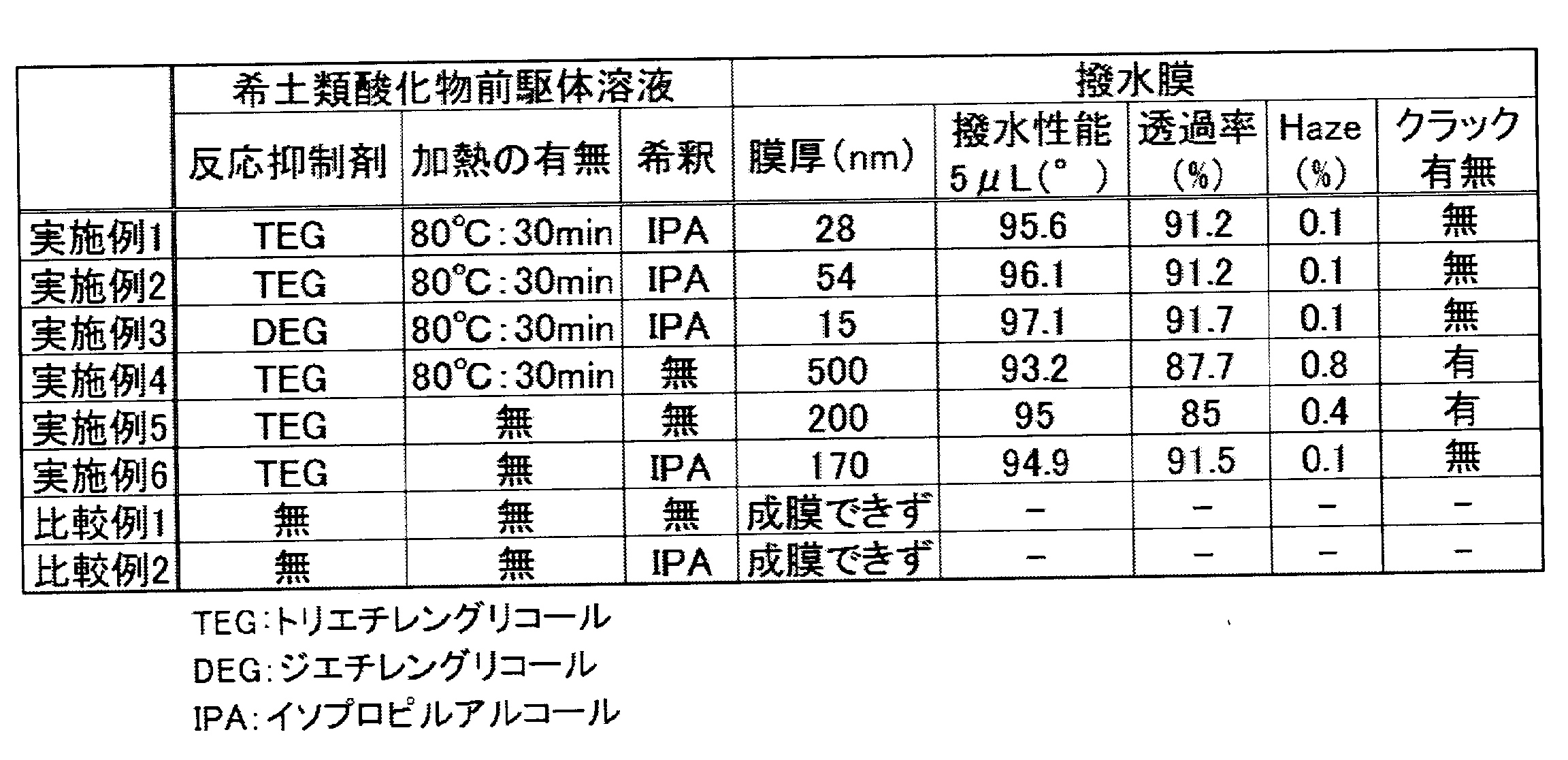
上記表1の結果から、本発明の撥水部材の製造方法によれば、水の接触角が95°以上のクラックのない透明な撥水部材を形成できることがわかる。
Claims (6)
- 希土類酸化物前駆体溶液を基材に塗布し、焼成して撥水膜を形成する処理を備える撥水部材の製造方法であって、
上記希土類酸化物前駆体溶液が、希土類アルコキシドと反応抑制剤とを含み、
上記反応抑制剤が、エーテル結合を有するジアルコールであることを特徴とする撥水部材の製造方法。 - 上記希土類酸化物前駆体溶液が、エタノール、イソプロピルアルコール、ブタノールを含むことを特徴とする請求項1に記載の撥水部材の製造方法。
- 基材上に撥水膜を備え、
上記撥水膜が、希土類酸化物を含み、厚さが15nm以上100nm未満であることを特徴とする撥水部材。 - 全光線透過率が90%以上、かつヘイズ値が0.5%以下であることを特徴とする請求項3に記載の撥水部材。
- 上記基材が、面積1000cm2以上の板ガラスであることを特徴とする請求項3又は4に記載の撥水部材。
- 撥水部材を備える自動車部品であって、
上記撥水部材が、請求項3~5のいずれか1つの項に記載の撥水膜であることを特徴とする自動車部品。
Priority Applications (2)
| Application Number | Priority Date | Filing Date | Title |
|---|---|---|---|
| JP2020524984A JP7165308B2 (ja) | 2018-06-12 | 2018-06-12 | 撥水部材の製造方法、撥水部材及び該撥水部材を備える自動車部品 |
| PCT/JP2018/022426 WO2019239487A1 (ja) | 2018-06-12 | 2018-06-12 | 撥水部材の製造方法、撥水部材及び該撥水部材を備える自動車部品 |
Applications Claiming Priority (1)
| Application Number | Priority Date | Filing Date | Title |
|---|---|---|---|
| PCT/JP2018/022426 WO2019239487A1 (ja) | 2018-06-12 | 2018-06-12 | 撥水部材の製造方法、撥水部材及び該撥水部材を備える自動車部品 |
Publications (1)
| Publication Number | Publication Date |
|---|---|
| WO2019239487A1 true WO2019239487A1 (ja) | 2019-12-19 |
Family
ID=68842948
Family Applications (1)
| Application Number | Title | Priority Date | Filing Date |
|---|---|---|---|
| PCT/JP2018/022426 Ceased WO2019239487A1 (ja) | 2018-06-12 | 2018-06-12 | 撥水部材の製造方法、撥水部材及び該撥水部材を備える自動車部品 |
Country Status (2)
| Country | Link |
|---|---|
| JP (1) | JP7165308B2 (ja) |
| WO (1) | WO2019239487A1 (ja) |
Citations (6)
| Publication number | Priority date | Publication date | Assignee | Title |
|---|---|---|---|---|
| JPH08104985A (ja) * | 1994-10-07 | 1996-04-23 | Toyota Motor Corp | 鉄系部材に撥水性被覆膜を形成する方法 |
| JPH11172455A (ja) * | 1997-12-03 | 1999-06-29 | Kansai Shingijutsu Kenkyusho:Kk | 基材の表面改質方法 |
| JP2007125537A (ja) * | 2005-10-05 | 2007-05-24 | Nippon Sheet Glass Co Ltd | 有機無機複合膜が形成された物品の製造方法 |
| US20100239824A1 (en) * | 2007-08-07 | 2010-09-23 | President And Fellows Of Harvard College | Metal Oxide Coating On Surfaces |
| JP2011063852A (ja) * | 2009-09-17 | 2011-03-31 | Sumitomo Osaka Cement Co Ltd | 防汚加工製品及びその製造方法 |
| JP2016121331A (ja) * | 2014-11-26 | 2016-07-07 | ザ・ボーイング・カンパニーThe Boeing Company | 腐食しにくいゾルゲル被覆系及び方法 |
-
2018
- 2018-06-12 JP JP2020524984A patent/JP7165308B2/ja active Active
- 2018-06-12 WO PCT/JP2018/022426 patent/WO2019239487A1/ja not_active Ceased
Patent Citations (6)
| Publication number | Priority date | Publication date | Assignee | Title |
|---|---|---|---|---|
| JPH08104985A (ja) * | 1994-10-07 | 1996-04-23 | Toyota Motor Corp | 鉄系部材に撥水性被覆膜を形成する方法 |
| JPH11172455A (ja) * | 1997-12-03 | 1999-06-29 | Kansai Shingijutsu Kenkyusho:Kk | 基材の表面改質方法 |
| JP2007125537A (ja) * | 2005-10-05 | 2007-05-24 | Nippon Sheet Glass Co Ltd | 有機無機複合膜が形成された物品の製造方法 |
| US20100239824A1 (en) * | 2007-08-07 | 2010-09-23 | President And Fellows Of Harvard College | Metal Oxide Coating On Surfaces |
| JP2011063852A (ja) * | 2009-09-17 | 2011-03-31 | Sumitomo Osaka Cement Co Ltd | 防汚加工製品及びその製造方法 |
| JP2016121331A (ja) * | 2014-11-26 | 2016-07-07 | ザ・ボーイング・カンパニーThe Boeing Company | 腐食しにくいゾルゲル被覆系及び方法 |
Also Published As
| Publication number | Publication date |
|---|---|
| JP7165308B2 (ja) | 2022-11-04 |
| JPWO2019239487A1 (ja) | 2021-07-01 |
Similar Documents
| Publication | Publication Date | Title |
|---|---|---|
| JP4107050B2 (ja) | コーティング材組成物及びそれにより形成された被膜を有する物品 | |
| KR102120626B1 (ko) | 반사 방지층이 형성된 기재 | |
| JP6532228B2 (ja) | 光学部材及び光学部材の製造方法 | |
| US20070178317A1 (en) | Infrared shielding film-coated glass plate and process for its production | |
| US12162794B2 (en) | Glass sheet with porous coating film and method of producing same | |
| JP4048912B2 (ja) | 表面防汚性複合樹脂フィルム、表面防汚性物品、化粧板 | |
| JP3454110B2 (ja) | 撥水性ガラス | |
| US5268198A (en) | Water-repellent metal oxide film coated on glass substrate and method of forming same | |
| JP7334619B2 (ja) | ポリメタロキサン、組成物、硬化膜、部材、電子部品、繊維、セラミックス成型用結着剤、硬化膜の製造方法、および繊維の製造方法 | |
| JP2018151484A (ja) | 光学部材及び光学部材の製造方法 | |
| JPH0957912A (ja) | 親水性表面を備えた複合材 | |
| JP5665404B2 (ja) | 光学膜の製造方法、光学膜および光学部品 | |
| JP2015229614A (ja) | 車両用窓ガラス | |
| JP2005343016A (ja) | 超撥水性被膜被覆物品 | |
| JP7129247B2 (ja) | コーティング組成物とその製造方法、および光学部材、ならびに撮像装置 | |
| TWI496849B (zh) | And a coating liquid for forming a film for spray coating and a film | |
| CN120255055A (zh) | 滤光器和滤光器的制造方法 | |
| JP7165308B2 (ja) | 撥水部材の製造方法、撥水部材及び該撥水部材を備える自動車部品 | |
| JP5685884B2 (ja) | シリカ体及びその製造方法 | |
| CN1054782A (zh) | 抗静电涂料及其制造方法和使用该涂料的抗静电防眩图象显示屏 | |
| CN109311266B (zh) | 防污构造体及使用该防污构造体的汽车零件 | |
| WO2022202398A1 (ja) | 金属-酸素-金属結合を主鎖とする高分子、その組成物、固体物およびその製造方法、ならびに電子部品および繊維 | |
| CN110944832B (zh) | 防污结构体及具备该防污结构体的汽车部件 | |
| JP5206653B2 (ja) | 多孔性シリカ膜の製造方法及び積層基板の製造方法 | |
| KR20030063628A (ko) | 투명도전막, 그 제조방법 및 이를 채용한 화상표시장치 |
Legal Events
| Date | Code | Title | Description |
|---|---|---|---|
| 121 | Ep: the epo has been informed by wipo that ep was designated in this application |
Ref document number: 18922857 Country of ref document: EP Kind code of ref document: A1 |
|
| ENP | Entry into the national phase |
Ref document number: 2020524984 Country of ref document: JP Kind code of ref document: A |
|
| NENP | Non-entry into the national phase |
Ref country code: DE |
|
| 122 | Ep: pct application non-entry in european phase |
Ref document number: 18922857 Country of ref document: EP Kind code of ref document: A1 |