WO2019225029A1 - 配線部材の固定構造 - Google Patents
配線部材の固定構造 Download PDFInfo
- Publication number
- WO2019225029A1 WO2019225029A1 PCT/JP2018/039257 JP2018039257W WO2019225029A1 WO 2019225029 A1 WO2019225029 A1 WO 2019225029A1 JP 2018039257 W JP2018039257 W JP 2018039257W WO 2019225029 A1 WO2019225029 A1 WO 2019225029A1
- Authority
- WO
- WIPO (PCT)
- Prior art keywords
- wiring member
- fixing
- fixing structure
- wiring
- silencer
- Prior art date
- Legal status (The legal status is an assumption and is not a legal conclusion. Google has not performed a legal analysis and makes no representation as to the accuracy of the status listed.)
- Ceased
Links
Images


Classifications
-
- B—PERFORMING OPERATIONS; TRANSPORTING
- B60—VEHICLES IN GENERAL
- B60N—SEATS SPECIALLY ADAPTED FOR VEHICLES; VEHICLE PASSENGER ACCOMMODATION NOT OTHERWISE PROVIDED FOR
- B60N3/00—Arrangements or adaptations of other passenger fittings, not otherwise provided for
- B60N3/04—Arrangements or adaptations of other passenger fittings, not otherwise provided for of floor mats or carpets
- B60N3/048—Arrangements or adaptations of other passenger fittings, not otherwise provided for of floor mats or carpets characterised by their structure
-
- B—PERFORMING OPERATIONS; TRANSPORTING
- B60—VEHICLES IN GENERAL
- B60N—SEATS SPECIALLY ADAPTED FOR VEHICLES; VEHICLE PASSENGER ACCOMMODATION NOT OTHERWISE PROVIDED FOR
- B60N3/00—Arrangements or adaptations of other passenger fittings, not otherwise provided for
- B60N3/04—Arrangements or adaptations of other passenger fittings, not otherwise provided for of floor mats or carpets
- B60N3/046—Arrangements or adaptations of other passenger fittings, not otherwise provided for of floor mats or carpets characterised by the fixing means
-
- B—PERFORMING OPERATIONS; TRANSPORTING
- B60—VEHICLES IN GENERAL
- B60R—VEHICLES, VEHICLE FITTINGS, OR VEHICLE PARTS, NOT OTHERWISE PROVIDED FOR
- B60R16/00—Electric or fluid circuits specially adapted for vehicles and not otherwise provided for; Arrangement of elements of electric or fluid circuits specially adapted for vehicles and not otherwise provided for
- B60R16/02—Electric or fluid circuits specially adapted for vehicles and not otherwise provided for; Arrangement of elements of electric or fluid circuits specially adapted for vehicles and not otherwise provided for electric constitutive elements
-
- F—MECHANICAL ENGINEERING; LIGHTING; HEATING; WEAPONS; BLASTING
- F16—ENGINEERING ELEMENTS AND UNITS; GENERAL MEASURES FOR PRODUCING AND MAINTAINING EFFECTIVE FUNCTIONING OF MACHINES OR INSTALLATIONS; THERMAL INSULATION IN GENERAL
- F16B—DEVICES FOR FASTENING OR SECURING CONSTRUCTIONAL ELEMENTS OR MACHINE PARTS TOGETHER, e.g. NAILS, BOLTS, CIRCLIPS, CLAMPS, CLIPS OR WEDGES; JOINTS OR JOINTING
- F16B5/00—Joining sheets or plates, e.g. panels, to one another or to strips or bars parallel to them
- F16B5/12—Fastening strips or bars to sheets or plates, e.g. rubber strips, decorative strips for motor vehicles, by means of clips
-
- F—MECHANICAL ENGINEERING; LIGHTING; HEATING; WEAPONS; BLASTING
- F16—ENGINEERING ELEMENTS AND UNITS; GENERAL MEASURES FOR PRODUCING AND MAINTAINING EFFECTIVE FUNCTIONING OF MACHINES OR INSTALLATIONS; THERMAL INSULATION IN GENERAL
- F16B—DEVICES FOR FASTENING OR SECURING CONSTRUCTIONAL ELEMENTS OR MACHINE PARTS TOGETHER, e.g. NAILS, BOLTS, CIRCLIPS, CLAMPS, CLIPS OR WEDGES; JOINTS OR JOINTING
- F16B5/00—Joining sheets or plates, e.g. panels, to one another or to strips or bars parallel to them
- F16B5/12—Fastening strips or bars to sheets or plates, e.g. rubber strips, decorative strips for motor vehicles, by means of clips
- F16B5/123—Auxiliary fasteners specially designed for this purpose
-
- F—MECHANICAL ENGINEERING; LIGHTING; HEATING; WEAPONS; BLASTING
- F16—ENGINEERING ELEMENTS AND UNITS; GENERAL MEASURES FOR PRODUCING AND MAINTAINING EFFECTIVE FUNCTIONING OF MACHINES OR INSTALLATIONS; THERMAL INSULATION IN GENERAL
- F16B—DEVICES FOR FASTENING OR SECURING CONSTRUCTIONAL ELEMENTS OR MACHINE PARTS TOGETHER, e.g. NAILS, BOLTS, CIRCLIPS, CLAMPS, CLIPS OR WEDGES; JOINTS OR JOINTING
- F16B5/00—Joining sheets or plates, e.g. panels, to one another or to strips or bars parallel to them
- F16B5/12—Fastening strips or bars to sheets or plates, e.g. rubber strips, decorative strips for motor vehicles, by means of clips
- F16B5/126—Fastening strips or bars to sheets or plates, e.g. rubber strips, decorative strips for motor vehicles, by means of clips at least one of the sheets, plates, bars or strips having integrally formed or integrally connected snap-in-features
-
- H—ELECTRICITY
- H02—GENERATION; CONVERSION OR DISTRIBUTION OF ELECTRIC POWER
- H02G—INSTALLATION OF ELECTRIC CABLES OR LINES, OR OF COMBINED OPTICAL AND ELECTRIC CABLES OR LINES
- H02G3/00—Installations of electric cables or lines or protective tubing therefor in or on buildings, equivalent structures or vehicles
- H02G3/30—Installations of cables or lines on walls, floors or ceilings
-
- H—ELECTRICITY
- H05—ELECTRIC TECHNIQUES NOT OTHERWISE PROVIDED FOR
- H05K—PRINTED CIRCUITS; CASINGS OR CONSTRUCTIONAL DETAILS OF ELECTRIC APPARATUS; MANUFACTURE OF ASSEMBLAGES OF ELECTRICAL COMPONENTS
- H05K7/00—Constructional details common to different types of electric apparatus
Definitions
- This invention relates to a technique for fixing a wiring member.
- Patent Document 1 a wire harness as a wiring member is embedded in a urethane material (also referred to as a silencer) disposed between a body at the bottom of an automobile and a floor mat for the purpose of soundproofing and smoothing an uneven shape.
- a technique for fixing is disclosed.
- an object of the present invention is to provide a technique capable of easily fixing a wiring member to a silencer formed separately from the wiring member.
- the fixing structure of the wiring member according to the second aspect is the fixing structure of the wiring member according to the first aspect, and the tip of the insertion part has a hole in the insertion part in which no hole is formed. It is formed in a tapered shape that can be inserted while forming.
- the fixing structure of the wiring member according to the third aspect is the fixing structure of the wiring member according to the first or second aspect, and the inserted portion is provided on the side opposite to the insertion surface.
- An inner wing portion that has an outer surface and protrudes toward the outer surface from a portion of the insertion portion that extends through the inserted portion and extends outward from the outer surface. including.
- the wiring member fixing structure according to the fourth aspect is the wiring member fixing structure according to any one of the first to third aspects, wherein the inserted portion is opposite to the insertion surface.
- the fixing member further includes an extending portion that extends to the outside of the inserted portion and is connected to a base end of the inserting portion, and the insertion state maintaining portion includes: And an outer wing portion protruding toward the outer surface from a distal end side extending beyond the outer surface of the extending portion.
- the wiring member fixing structure according to the fifth aspect is the wiring member fixing structure according to any one of the first to fourth aspects, wherein the fixing member is connected to a base end of the insertion portion.
- the insertion part further includes an extension part extending outward, and the insertion state maintaining part is configured by the insertion part and the extension part to hold the insertion part. Part.
- the wiring member fixing structure according to the sixth aspect is the wiring member fixing structure according to any one of the first to fifth aspects, wherein the inserted portion is opposite to the insertion surface.
- the insertion state maintaining unit includes a portion of the insertion portion that extends through the insertion portion and extends outward from the outer surface. It includes a wide portion formed wider than a portion housed in the inserted portion.
- a wiring member fixing structure according to a seventh aspect is the wiring member fixing structure according to any one of the first to sixth aspects, wherein the inserted portion protrudes outward from the main surface. It is formed to do.
- the wiring member fixing structure according to an eighth aspect is the wiring member fixing structure according to any one of the first to seventh aspects, wherein the wiring member includes a wiring body formed flatly, The fixing member is joined to the wiring body.
- the wiring member fixing structure according to a ninth aspect is the wiring member fixing structure according to any one of the first to eighth aspects, wherein the wiring member includes a plurality of linear transmission members,
- the fixing member further includes a fixing portion formed to be continuous with the insertion portion, and the fixing portion and the plurality of linear transmission members are bound by a binding member.
- the wiring member can be fixed to the silencer via the fixing member by inserting the fixing member into the insertion surface of the silencer and attaching the fixing member to the wiring member.
- a wiring member can be easily fixed to a silencer formed separately from the wiring member.
- the second aspect it is not necessary to form a hole in the silencer in advance. This facilitates the processing of the silencer. Further, it is possible to suppress a decrease in the soundproof performance of the silencer.
- the plugged portion when the force in the direction to be pulled out from the plugged portion is applied to the plugged portion, the plugged portion is difficult to come off because the inner wing is hooked on the outer surface.
- an insertion part becomes difficult to come off because an outer wing
- hook part is hooked on an outer surface.
- the frictional force between the silencer and the fixing member is increased by the sandwiching portion sandwiching the inserted portion. For this reason, even if the force of the direction extracted from a to-be-inserted part is applied to an insertion part, an insertion part becomes difficult to come off. Further, since the clamping portion clamps the inserted portion, the fixing member and the silencer are less likely to rattle.
- the wide portion is caught on the outer surface, so that the insertion portion is difficult to come off.
- the seventh aspect it is possible to suppress the formation of a hole penetrating the silencer in the thickness direction in the portion to be inserted or the thickness from being reduced.
- the fixing member can be attached to the wiring member by joining the wiring body and the fixing member.
- the fixing member can be attached to the wiring member by the binding member.
- FIG. 1 is a perspective view showing a wiring member fixing structure 1 according to an embodiment.
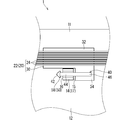
- FIG. 2 is a plan view showing the wiring member fixing structure 1 according to the embodiment.
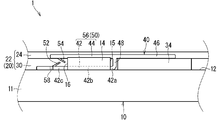
- FIG. 3 is a side view showing the wiring member fixing structure 1 according to the embodiment.
- the wiring member fixing structure 1 includes a silencer 10, a wiring member 20, and a fixing member 40.
- the wiring member 20 is fixed to the silencer 10 by a fixing member 40.
- the silencer 10 is a member disposed in the vehicle for the purpose of soundproofing and the like.
- the silencer 10 demonstrates as what is a floor silencer arrange
- the silencer 10 includes a main body portion 11 and a plugged portion 14.
- the main body 11 has a main surface 12.
- a plugged portion 14 is formed in a part of the main body 11.
- the inserted portion 14 has an insertion surface 15 that intersects the main surface 12 and an outer surface 16 provided on the opposite side of the insertion surface 15.
- the inserted portion 14 is formed as a protrusion 17 protruding outward from the main surface 12.
- the protrusion 17 is formed in a rectangular parallelepiped shape, for example.
- a pair of side surfaces of the rectangular parallelepiped protrusions 17 facing opposite sides are the insertion surface 15 and the outer surface 16.
- the silencer 10 is formed in a plate shape from a soundproof material.
- the silencer 10 is formed by fixing together a chip made of resin foam such as polyurethane foam by applying an adhesive (binder) or the like while compressing the chip in a steam atmosphere.
- an adhesive binder
- the method of manufacturing the silencer 10 is not limited to the above.
- the silencer 10 may be formed by foaming a resin material such as polyurethane, or may be formed using a nonwoven fabric as a material.
- the silencer 10 may be formed by compressing countless fibrous members.
- innumerable fibrous members may be entangled and bonded, or may be fixed by an adhesive or the like.
- Such a fibrous member may be a natural fiber or a chemical fiber.
- the main body 11 of the silencer 10 is formed flat, but has a portion that is uneven in the thickness direction for the purpose of following the shape of the body or partially raising the body. You may do it.
- the wiring member 20 is a member that is connected to a component mounted on the vehicle and transmits electricity or light to and / or from the component.
- the wiring member 20 is disposed along the main surface 12 of the silencer 10.
- the wiring member 20 includes a wiring body formed flat. In the following description, the wiring body is assumed to be the wiring body 22 with sheet material.
- the sheet material-attached wiring body 22 includes a plurality of linear transmission members 24 and a sheet material 30.
- the linear transmission member 24 may be a linear member that transmits electricity or light.
- the linear transmission member 24 may be a general electric wire 24 having a core wire and a coating around the core wire, or may be a bare lead wire, a shield wire, an enamel wire, a nichrome wire, an optical fiber, or the like.
- the linear transmission member 24 that transmits electricity may be various signal lines and various power lines.
- the linear transmission member 24 has a transmission line body that transmits electricity or light, and an outer skin that covers the transmission line body.
- the linear transmission member 24 is demonstrated as what is the general electric wire 24 (henceforth the electric wire 24). That is, the electric wire 24 has a core wire as a transmission line main body and an insulating coating as an outer cover covering the transmission line main body.
- Core wire is composed of one or more strands.
- a strand is formed with conductors, such as copper, copper alloy, aluminum, and aluminum alloy.
- the core wire is composed of a plurality of strands, the plurality of strands are preferably twisted.
- the insulating coating is formed by extruding a resin material such as PVC (polyvinyl chloride) or PE (polyethylene) around the core wire.
- the electric wire 24 is a so-called round electric wire having a circular cross section.
- the plurality of electric wires 24 are disposed on the main surface 12 of the sheet material 30.
- seat material 30 should just be set suitably.
- the electric wires 24 are arranged in a straight line on the sheet material 30, but may be arranged in a bent manner and have both a straight part and a bent part. It may be arranged.
- the plurality of electric wires 24 are arranged side by side on the base material, but at least some of the plurality of electric wires 24 may extend along different paths.
- a connector is provided at the end of the electric wire 24, and the connector is connected to a mating connector provided in a component to which the wiring member 20 is connected.
- a connector is formed, for example, by accommodating the end portion of the electric wire 24 in the electric wire accommodating portion of the housing.
- the end of the electric wire 24 extends outward from the sheet material 30, but the end of the electric wire 24 may be positioned on the sheet material 30.
- the housing may be directly fixed to the sheet material 30 or may not be fixed.
- the sheet material 30 keeps the plurality of electric wires 24 in a flat state.
- the electric wires 24 are disposed on the sheet material 30.
- seat material 30 are being fixed by the fixing means.
- welding is employed as a fixing means for the electric wire 24 and the sheet material 30. That is, at least one of the electric wire 24 and the sheet material 30 has a resin material, and the resin material is melted and joined to the other side.
- the welding means is not particularly limited, and various welding means such as ultrasonic welding, heat and pressure welding, hot air welding, and high frequency welding can be employed.
- the material constituting the sheet material 30 is not particularly limited.
- the material constituting the sheet material 30 may include, for example, a resin such as PVC, PE, PET (polyethylene terephthalate), PP (polypropylene), or a metal such as aluminum or copper. Also good.
- a resin such as PVC, PE, PET (polyethylene terephthalate), PP (polypropylene), or a metal such as aluminum or copper. Also good.
- the electric wire 24 and the sheet material 30 are welded and fixed, it is preferable that the insulating coating of the electric wire 24 and the sheet material 30 are formed of a material suitable for welding such as the same resin material.
- the sheet material 30 may have fibers such as a woven fabric, a knitted fabric, and a non-woven fabric, or may be formed by bonding without fibers by extrusion molding or injection molding. . In the latter case, the sheet material 30 may be a foam-molded foam, or may be molded so as to have a solid cross section without being foam-molded.
- the sheet material 30 may have a single-layer structure or a multi-layer structure.
- a resin layer and a resin layer are laminated.
- a resin layer and a metal layer are laminated.
- a metal layer and a metal layer are laminated.
- the sheet material 30 is configured by laminating a resin layer and a resin layer, layers having fibers or layers not having fibers may be stacked, or layers having fibers and fibers. A layer that does not have a thickness may be overlapped.
- the sheet material 30 may be formed by laminating separately formed sheet-like members, or the sheet material 30 may be formed by one extrusion molding or injection molding. It may be molded.
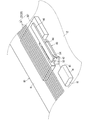
- FIG. 4 is a perspective view showing the fixing member 40.
- FIG. 4 is a perspective view showing the fixing member 40.
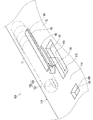
- FIG. 5 is an explanatory diagram showing a state in which the fixing member 40 is fixed to the silencer 10.
- the fixing member 40 is a member for fixing the wiring member 20 to the silencer 10.
- the fixing member 40 is fixed to the silencer 10 by being inserted into the silencer 10.
- the fixing member 40 is attached to the wiring member 20. Accordingly, the fixing member 40 fixes the wiring member 20 to the silencer 10.
- the fixing member 40 includes an insertion portion 42.
- the fixing member 40 further includes an extending portion 44, a fixing portion 46, and a connecting portion 48.
- the insertion part 42 is formed in one plate shape. Further, the extending portion 44 and the fixed portion 46 are connected to each other and formed in a single plate shape longer than the insertion portion 42. A plate-like connecting portion 48 that is shorter than the insertion portion 42 connects one end portion of the insertion portion 42 to a portion between the extension portion 44 and the fixing portion 46.
- the fixing member 40 is formed in a shape including the first, second, and third plate-like portions. An end portion of the first plate-like portion and an intermediate portion of the second plate-like portion are connected by the third plate-like portion.
- the second plate-like portion is formed longer than the first plate-like portion.
- the third plate-like portion is formed shorter than the first plate-like portion.
- the first plate portion and the second plate portion are parallel to each other.
- the third plate-like portion is orthogonal to the first plate-like portion and the second plate-like portion.
- the first plate-like portion is the insertion portion 42.
- a portion on one end side (first plate-like portion side) of the second plate-like portion with respect to the portion connected to the third plate-like portion is defined as the extending portion 44.
- the portion on the other end side of the second plate-like portion with respect to the portion connected to the third plate-like portion is the fixing portion 46.
- the third plate-like portion is the connecting portion 48.
- the insertion part 42 is inserted into the insertion part 14 from the insertion surface 15.
- the insertion part 42 penetrates the insertion part 14. That is, the dimension along the longitudinal direction of the insertion part 42 is longer than the dimension between the insertion surface 15 and the outer surface 16 in the insertion part 14.
- the insertion direction of the insertion part 42 is a direction that intersects the insertion surface 15.
- the insertion direction is a direction connecting the insertion surface 15 and the outer surface 16.
- the insertion direction may include only the horizontal component, or may include only the vertical component, May be included.
- the direction of the horizontal component may be a direction corresponding to the front-rear direction of the vehicle, a direction corresponding to the left-right direction of the vehicle, or the front-rear direction and the left-right direction of the vehicle.
- intersects may be sufficient.
- a portion of the insertion portion 42 that extends outward from the insertion surface 15 is referred to as a first portion 42a.
- the part located inside the to-be-inserted part 14 among the insertion parts 42 is set as the 2nd part 42b.
- a portion of the insertion portion 42 that extends outward from the outer surface 16 is referred to as a third portion 42c.
- the first portion 42 a is a portion that continues to the connecting portion 48 and is a portion that hits the proximal end portion of the insertion portion 42.
- the second part 42b is a part connecting the first part 42a and the third part 42c.
- the third portion 42 c is a portion that is a free end and is a portion that hits the tip of the insertion portion 42.
- the distal end of the insertion portion 42 (here, the distal end of the third portion 42c) is formed in a tapered shape that can be inserted while forming a hole in the insertion portion 14 in which no hole is formed.
- the extending part 44 faces the insertion part 42 in parallel before the insertion part 42 is inserted into the inserted part 14.
- the extending portion 44 extends outward from the inserted portion 14 in a state where the inserting portion 42 is inserted into the inserted portion 14.
- the distal end of the extending portion 44 extends beyond the inserted portion 14 in a state where the inserting portion 42 is inserted into the inserted portion 14. That is, the dimension along the longitudinal direction of the extending part 44 is longer than the dimension between the insertion surface 15 and the outer surface 16 of the inserted part 14. In the example shown in FIG. 4, the dimension along the longitudinal direction of the extension part 44 is shorter than the dimension along the longitudinal direction of the insertion part 42, but it may be the same or extended. The part 44 may be longer.
- the fixing part 46 is used to attach the fixing member 40 to the wiring member 20.
- the fixing member 46 is joined to the sheet material 30 of the wiring body 22 with sheet material, so that the fixing member 40 is attached to the wiring body 22 with sheet material. That is, here, the fixing member 40 is joined to the wiring body.
- the sheet material 30 has a fixing piece 34 extending to the side of the electric wire arrangement portion 32 where the electric wires 24 are arranged.
- the fixing portion 46 is joined to the fixing piece 34.
- the surface of the sheet material 30 on which the electric wires 24 are disposed is joined to the fixing portion 46.
- the surface on the silencer 10 side of the fixed portion 46 is joined to the sheet material 30.
- the joining method of the fixing member 40 and the sheet material 30 is not particularly limited, and various joining methods can be employed.
- the fixing portion 46 and the fixing piece 34 may be welded or may be joined by an adhesive, an adhesive tape, or the like.
- the fixing portion 46 and the fixing piece 34 are joined by a locking structure in which the locking portion formed on the fixing portion 46 is locked to the locked portion formed on the fixing piece 34. Also good.
- the fixing portion 46 and the fixing piece 34 may be joined by screws, pins, rivets or the like.
- the joining positions of the sheet material 30 and the fixing member 40 are not limited to those described above.
- the electric wire arranging portion 32 may be joined to the fixing member 40.
- the surface of the sheet material 30 opposite to the surface on which the electric wires 24 are disposed may be joined to the fixing portion 46.
- the electric wire 24 is positioned on the silencer 10 side with respect to the sheet material 30.
- the extending portion 44 may be joined to the sheet material 30.
- the joining mode is not limited to the above.
- the surface opposite to the surface on the silencer 10 side may be joined to the sheet material 30.
- the fixing portion 46 may be formed at a position extending in the same plane as the insertion portion 42 instead of the current position.
- the fixing member has a shape in which the insertion portion 42 and the extension portion 44 are interchanged in the fixing member 40.
- the fixing member has a shape in which a plate-like portion constituting the insertion portion 42 of the fixing member 40 extends before the connecting portion 48, and has an H shape in a side view.
- the wiring member 22 with sheet material may include two sheet materials 30 that sandwich the electric wire 24, and the fixing portion 46 may be sandwiched between the two sheet materials 30.
- the fixing member 40 includes an insertion state maintaining unit 50.
- the plug-in state maintaining unit 50 maintains a state in which the plug-in unit 42 is inserted into the plugged-in unit 14.
- the insertion state maintaining unit 50 includes an inner wing portion 52, an outer wing portion 54, a sandwiching portion 56, and a wide portion 58.
- the inner wing portion 52 is formed so as to protrude from the third portion 42 c of the insertion portion 42 toward the outer surface 16. That is, the inner wing portion 52 protrudes from the surface on the extension portion 44 side of the third portion 42c of the insertion portion 42, and is formed so as to be separated from the insertion portion 42 toward the second portion 42b. The front end portion of the inner wing portion 52 is separated from the insertion portion 42.
- the inner wing portion 52 can be elastically deformed such that the tip portion thereof approaches the insertion portion 42. In particular, when the insertion portion 42 is inserted into the insertion portion 14, the inner wing portion 52 abuts against the insertion portion 14 and can be elastically deformed so that the tip portion approaches the insertion portion 42. At this time, the inner wing portion 52 penetrates through the inside of the inserted portion 14 together with the third portion 42c.
- the outer wing portion 54 protrudes toward the outer surface 16 from the tip side of the extending portion 44 that extends beyond the outer surface 16. That is, the outer wing portion 54 protrudes from the surface on the insertion portion 42 side of the distal end portion of the extension portion 44, and is formed so as to be separated from the extension portion 44 toward the proximal end portion of the extension portion 44. Yes. The distal end portion of the outer wing portion 54 is separated from the extending portion 44.
- the outer wing portion 54 can be elastically deformed so that the tip portion thereof approaches the extension portion 44.
- the outer wing 54 is formed so as to be positioned closer to the outer surface 16 than the inner wing 52, but this is not an essential configuration.
- the inner wing part 52 may be formed so as to be positioned closer to the outer surface 16 than the outer wing part 54, or both may be formed at the same position.
- the sandwiching part 56 is a part that sandwiches the inserted part 14.
- the sandwiching portion 56 is configured by the insertion portion 42 and the extending portion 44. More specifically, it is parallel to the insertion part 42 and the extension part 44 here. Further, the dimension of the connecting portion 48 along the direction connecting the insertion portion 42 and the extension portion 44 is shorter than the height dimension of the insertion surface 15. Accordingly, the insertion portion 42 and the extension portion 44 sandwich the inserted portion 14 to form a sandwiching portion 56.
- the wide portion 58 is formed in the third portion 42 c of the insertion portion 42.
- the wide part 58 is formed wider than the second part 42 b of the insertion part 42.
- a taper is formed from the wide portion 58 to the tip of the insertion portion 42.
- the wide portion 58 can be caught by the inserted portion 14 by being larger than the hole of the inserted portion 14 into which the insertion portion 42 is inserted.
- the insertion part 14 is formed softer than the insertion part 42.
- a hole is formed in the insertion portion 14 due to the tapered shape of the tip of the insertion portion 42.
- the hole expands due to elastic deformation of the peripheral edge of the hole. That is, when the insertion portion 42 is inserted, a hole smaller than the wide portion 58 is formed in the inserted portion 14, and the wide portion 58 can pass through the elastic deformation of the peripheral portion of the hole. It is possible to spread. Then, after passing through the wide portion 58, the peripheral portion of the hole is elastically restored to be smaller than the wide portion 58, and the wide portion 58 can be hooked on the outer surface 16.
- the tip of the inner wing portion 52 is formed so as to be positioned closer to the outer surface 16 than the wide portion 58, but this is not an essential configuration.
- the wide part 58 may be formed so as to be positioned on the outer surface 16 side with respect to the tip of the inner wing part 52, or both may be formed at the same position.
- the fixing member 40 is an integrally molded product formed by using metal or resin as a material, for example, by injection molding using a mold.
- the fixing member 40 is formed using resin as a material, and the insertion portion 42 is inserted into the insertion portion 14 in which holes are not formed in advance, the insertion portion 42 is inserted into the insertion portion 14. It is better to form it more rigidly.
- the step (a) of attaching the fixing member 40 to the wiring member 20 the step (b) of inserting the fixing member 40 into the silencer 10, and the wiring member 20 of the silencer 10. It is conceivable that a step (c) for arranging the silencer 10 and a step (d) for assembling the silencer 10 to the vehicle are performed. Steps (a) to (c) are steps for manufacturing the wiring member fixing structure 1.
- steps (a) to (d) are not particularly limited, and the steps (a) to (d) may be performed in any order. However, it is preferable that the step (d) is performed after the steps (a) to (c).
- the wiring member 20 is fixed to the silencer 10 by the fixing member 40, and the silencer module is assembled to the vehicle in a state where the wiring member fixing structure 1 (silencer module) is integrated. preferable. Thereby, the assembly process to the vehicle of the silencer 10 and the wiring member 20 can be facilitated.
- the tip of the insertion portion 42 is formed in a tapered shape, it is not necessary to form a hole in the silencer 10 in advance. Thereby, the process of the silencer 10 becomes easy. Moreover, the fall of the soundproof property of the silencer 10 can be suppressed.
- the insertion state maintenance part 50 includes the inner wing part 52, when the force in the direction to be pulled out from the inserted part 14 is applied to the insertion part 42, the inner wing part 52 is caught on the outer surface 16, The insertion portion 42 is difficult to come off.
- the insertion state maintaining unit 50 includes the outer wing portion 54, when the force in the direction to be pulled out from the inserted portion 14 is applied to the insertion portion 42, the outer wing portion 54 is caught on the outer surface 16. The insertion portion 42 is difficult to come off.
- the sandwiching portion 56 sandwiches the inserted portion 14
- the frictional force between the silencer 10 and the fixing member 40 increases. For this reason, even if the force of the direction pulled out from the insertion part 14 is applied to the insertion part 42, the insertion part 42 becomes difficult to come off.
- the sandwiching portion 56 sandwiches the inserted portion 14, the fixing member 40 and the silencer 10 are less likely to rattle.
- the insertion state maintenance part 50 includes the wide part 58, when the force of the direction pulled out from the to-be-inserted part 14 is applied to the insertion part 42, when the wide part 58 is hooked on the outer surface 16, the insertion part 42 becomes difficult to come off.
- the inserted portion 14 is formed so as to protrude outward from the main surface 12, a hole penetrating in the thickness direction is formed in the silencer 10 in the inserted portion 14 portion, or the thickness is reduced. Can be suppressed.
- the fixing member 40 can be attached to the wiring member 20 by joining the wiring body and the fixing member 40 together.
- the silencer 10 and the wiring member 20 can be easily assembled to the vehicle by assembling the silencer module to the vehicle in a state where the wiring member fixing structure 1 is formed and the silencer module is formed before the vehicle is assembled. it can.
- FIG. 6 is a partially exploded perspective view showing a modified example of the wiring member fixing structure 1.
- the shape of the wiring member 120 and the manner of attachment of the fixing member 40 to the wiring member 120 are the same as the shape of the wiring member 20 and the wiring member 20 in the wiring member fixing structure 1. This is different from the attachment mode of the fixing member 40.
- a plurality of linear transmission members 24 are bundled by a binding member 126 to form the wiring member 120.
- a plurality of linear transmission members 24 are bundled into a circular cross-sectional shape to form a wiring member 120.
- the type of the binding member 126 and the method for binding the plurality of linear transmission members 24 by the binding member 126 are not particularly limited.
- the adhesive tape is spirally wound around the plurality of linear transmission members 24 in a manner such as rough winding or double winding, and the plurality of linear transmission members 24 are bundled.
- the protective sheet material is wound in a sushi roll shape or a jointed shape so that a plurality of linear transmission members 24 are bundled.
- a plurality of linear transmission members 24 are accommodated and bundled in a cylindrical member such as a corrugated tube.
- a plurality of linear transmission members 24 are bundled by winding an adhesive tape or a binding band around the linear transmission members 24 at a plurality of locations spaced along the longitudinal direction. .
- the fixing portion 46 and the plurality of linear transmission members 24 are bound by the binding member 60. Thereby, the fixing member 40 is attached to the wiring member 120.
- the binding member 60 is not particularly limited.
- the binding member 60 may be provided separately from the fixing member 40 or may be integrated with the fixing member 40.
- the binding member 60 is a member provided separately from the fixing member 40, for example, an adhesive tape, a binding band, or the like may be employed as the binding member 60.
- a binding band structure including, for example, a band portion and a band fixing portion as the binding member 60 is provided in the fixing portion 46 of the fixing member 40. It is possible.
- the binding member 60 may be wound so as to be overlapped with a position where the binding member 126 that bundles the plurality of linear transmission members 24 is bundled, or wound around a position where the binding member 126 that binds the plurality of linear transmission members 24 is not present. It may be done.
- the shape of the inserted portion 114 is different from the shape of the inserted portion 14 in the wiring member fixing structure 1.
- the insertion surface 115 of the inserted portion 114 is formed to be recessed from the main surface 12. More specifically, a concave portion 118 is formed on the main surface 12 of the main body 11 of the silencer 110, and one of the inner side surfaces of the concave portion 118 is an insertion surface 115. And the part which is a side part of the recessed part 118 among the main-body parts 11 of the silencer 110, and continues to the insertion surface 115 is made into the insertion part 114.
- the recess 118 is preferably formed to be the same as or longer than the plate-like portion including the insertion portion 42 in the fixing member 40. Thereby, it is possible to insert the insertion portion 42 into the insertion portion 114 in a state where the plate-like portion including the insertion portion 42 is accommodated in the recess 118, thereby facilitating the insertion operation. Moreover, it is preferable that this recessed part 118 is bottomed and is not a through-hole which penetrates the main-body part 11 of the silencer 110. FIG. That is, it is preferable that the insertion surface 115 is not the inner peripheral surface of the through hole. Thereby, the fall of the soundproof performance of the silencer 110 can be suppressed.
- the insertion surface 15 according to the embodiment and the insertion surface 115 according to the modification may be combined. That is, the insertion surface includes a portion protruding outward from the main surface 12 of the main body portion 11 like the insertion surface 15, and a portion recessed inward with respect to the main surface 12 of the main body portion 11 like the insertion surface 115. You may have both.
- another recess 119 is formed at a distance from the recess 118.
- the recess 118 is referred to as a first recess 118 and the recess 119 is referred to as a second recess 119.
- the insertion part 42 is inserted into a portion between the first recess 118 and the second recess 119. That is, in the example shown in FIG. 6, the inner surface located on the second recess 119 side of the first recess 118 is the insertion surface 115. In addition, an inner surface located on the first recess 118 side of the second recess 119 is an outer surface 116. A portion between the first recess 118 and the second recess 119 is the insertion portion 114.
- the second recess 119 is preferably formed in such a size that the wide portion 58 and the inner wing portion 52 that protrude outwardly through the inserted portion 114 are accommodated in the second recess 119. Thereby, the wide part 58 and the inner wing part 52 are easily caught on the outer surface 116.
- a bundle of a plurality of linear transmission members 24 can be used as the wiring member 120.
- the fixing member 40 can be attached to the wiring member 120 by the binding member 60.
- the protruding dimension of the portion protruding outward of the main surface 12 can be kept small.
- the flat wiring body has been described as the wiring body 22 with sheet material so far, but this is not an essential configuration.
- the flat wiring body is a so-called FFC (flexible flat cable) in which a plurality of core wires are collectively covered with one coating, or a so-called FPC (flexible printed circuit board) in which a circuit is formed on a conductor foil bonded to an insulating film as a base. Or the like.
- the configuration is not limited to the above.
- the outer shape of the linear transmission member 24 may be formed in a cross-sectional angular shape. In this case, the contact area between the sheet material 30 and the linear transmission member 24 can be easily increased.
- the fixing means of the linear transmission member 24 and the sheet material 30 for example, the linear transmission member 24 and the sheet material 30 may be joined by melting at least one resin by heat or a solvent. As such joining means, known joining means such as welding, fusion, welding and the like can be used. Further, for example, the linear transmission member 24 and the sheet material 30 may be joined by an adhesive, an adhesive tape, or the like. For example, the linear transmission member 24 may be sewn to the sheet material 30 with a sewing thread. Moreover, the wiring member 22 with a sheet material may have a cover that covers the linear transmission member 24 from the side opposite to the sheet material 30.
- the linear transmission member 24 has been described as extending in parallel with the insertion direction, but this is not an essential configuration.
- the linear transmission member 24 may extend in a direction crossing the insertion direction.
- the fixing member 40 may be attached to the sheet material 30 in a different direction from the example shown in FIG.
- a bundle of the fixing portions 46 and the linear transmission members 24 is used by using a fixing member whose extending direction intersects the insertion direction.
- a hole may be formed in advance in the insertion portion 14.
- the tip of the insertion part 42 may not be formed in a tapered shape.
- the inner wing portion 52, the outer wing portion 54, the clamping portion 56, and the wide portion 58 have been provided as the insertion state maintaining portion 50, but this is not an essential configuration.
- An insertion state maintaining unit 50 other than the inner wing 52, the outer wing 54, the clamping unit 56, and the wide part 58 may be provided.
- One or more of the inner wing 52, the outer wing 54, the sandwiching portion 56, and the wide portion 58 may be omitted.
- a plurality of fixing members 40 may be attached to one wiring member 20.
- the fixing members 40 may be attached so that the insertion directions are all the same, or include those in which the insertion directions are different. It may be attached to.
- all of the plurality of fixing members 40 may be inserted into the main body portion 11 of the same silencer 10. A part of the member 40 may be inserted into the main body 11 of the different silencer 10.
- a plurality of fixing members 40 may be inserted into the main body 11 of one silencer 10.
- a plurality of fixing members 40 may be inserted into one inserted portion 14, or a plurality of fixing members 40 are respectively provided. It may be inserted into another inserted part 14.
- all the insertion directions may be the same direction, or the insertion directions may be different directions.
- all of the plurality of fixing members 40 may be attached to the same wiring member 20, or a part of the plurality of fixing members 40 may be different wirings. It may be attached to the member 20.
- SYMBOLS 1 Fixing structure of wiring member 10 Silencer 11 Main body part 12 Main surface 14 Inserted part 15 Inserting surface 16 Outer surface 20 Wiring member 22 Wiring body with sheet material 24 Electric wire (linear transmission member) DESCRIPTION OF SYMBOLS 30 Sheet material 40 Fixing member 42 Insertion part 46 Fixing part 50 Insertion state maintenance part 52 Inner wing part 54 Outer wing part 56 Clamping part 58 Wide part 60 Bundling member
Landscapes
- Engineering & Computer Science (AREA)
- General Engineering & Computer Science (AREA)
- Mechanical Engineering (AREA)
- Architecture (AREA)
- Civil Engineering (AREA)
- Structural Engineering (AREA)
- Transportation (AREA)
- Microelectronics & Electronic Packaging (AREA)
- Installation Of Indoor Wiring (AREA)
- Connection Of Plates (AREA)
- Insertion, Bundling And Securing Of Wires For Electric Apparatuses (AREA)
Priority Applications (3)
| Application Number | Priority Date | Filing Date | Title |
|---|---|---|---|
| CN202210377710.0A CN114914864B (zh) | 2018-05-25 | 2018-10-23 | 配线部件的固定构造 |
| CN201880093443.6A CN112189291B (zh) | 2018-05-25 | 2018-10-23 | 配线部件的固定构造 |
| US17/053,183 US11451036B2 (en) | 2018-05-25 | 2018-10-23 | Fixing structure of wiring member |
Applications Claiming Priority (2)
| Application Number | Priority Date | Filing Date | Title |
|---|---|---|---|
| JP2018-100730 | 2018-05-25 | ||
| JP2018100730A JP6673399B2 (ja) | 2018-05-25 | 2018-05-25 | 配線部材の固定構造 |
Publications (1)
| Publication Number | Publication Date |
|---|---|
| WO2019225029A1 true WO2019225029A1 (ja) | 2019-11-28 |
Family
ID=68616113
Family Applications (1)
| Application Number | Title | Priority Date | Filing Date |
|---|---|---|---|
| PCT/JP2018/039257 Ceased WO2019225029A1 (ja) | 2018-05-25 | 2018-10-23 | 配線部材の固定構造 |
Country Status (4)
| Country | Link |
|---|---|
| US (1) | US11451036B2 (https=) |
| JP (1) | JP6673399B2 (https=) |
| CN (2) | CN114914864B (https=) |
| WO (1) | WO2019225029A1 (https=) |
Families Citing this family (3)
| Publication number | Priority date | Publication date | Assignee | Title |
|---|---|---|---|---|
| JP6870533B2 (ja) * | 2017-08-23 | 2021-05-12 | 株式会社オートネットワーク技術研究所 | 電気部品付ワイヤーハーネスおよび電気部品付ワイヤーハーネスの組付構造 |
| JP6673419B2 (ja) * | 2018-09-19 | 2020-03-25 | 株式会社オートネットワーク技術研究所 | 配線部材 |
| JP7643211B2 (ja) * | 2021-06-30 | 2025-03-11 | 株式会社オートネットワーク技術研究所 | 配線部材 |
Citations (6)
| Publication number | Priority date | Publication date | Assignee | Title |
|---|---|---|---|---|
| JPS57157896A (en) * | 1981-03-23 | 1982-09-29 | Chiyoda Chem Eng & Constr Co Ltd | Liquid transport device by facial heating |
| JPS62290304A (ja) * | 1986-06-04 | 1987-12-17 | 矢崎総業株式会社 | フラツトワイヤハ−ネスの取付装置 |
| JP2001232678A (ja) * | 2000-02-23 | 2001-08-28 | Kanto Auto Works Ltd | 真空成形部材の組み付け構造 |
| JP2005080434A (ja) * | 2003-09-01 | 2005-03-24 | Sumitomo Wiring Syst Ltd | プロテクタのロック構造 |
| JP2016200225A (ja) * | 2015-04-10 | 2016-12-01 | 住友電装株式会社 | バンドクランプおよび該バンドクランプを用いたワイヤハーネスのサイレンサ取付構造 |
| JP2018050390A (ja) * | 2016-09-21 | 2018-03-29 | 住友電装株式会社 | バンドクリップ |
Family Cites Families (44)
| Publication number | Priority date | Publication date | Assignee | Title |
|---|---|---|---|---|
| US3409858A (en) * | 1966-08-29 | 1968-11-05 | Molex Products Co | Electrical connector having resilient arcuately bendable locking means |
| US4310211A (en) * | 1979-12-26 | 1982-01-12 | Amp Incorporated | High current contact system for solar modules |
| JPS5963614A (ja) | 1982-09-30 | 1984-04-11 | 三菱電線工業株式会社 | 架橋ポリエチレン電気絶縁体 |
| JPS5963614U (ja) * | 1982-10-18 | 1984-04-26 | 住友電気工業株式会社 | 電線固定具を備えるハウジング |
| US4918261A (en) * | 1986-06-04 | 1990-04-17 | Yazaki Corporation | Flat wire harness attaching unit |
| JP2528298B2 (ja) | 1986-12-27 | 1996-08-28 | 本田技研工業株式会社 | 車輌用電装部品の組付方法 |
| JP4124282B2 (ja) * | 1997-10-15 | 2008-07-23 | 株式会社イノアックコーポレーション | 自動車用ルームランプ装置の取付構造 |
| US5956821A (en) * | 1997-12-11 | 1999-09-28 | Southco, Inc. | One-piece catch |
| DE19949865A1 (de) * | 1999-10-15 | 2001-04-26 | Parat Automotive Schoenenbach | Klapp- bzw. Faltverdeck für Fahrzeuge wie Cabriolets o. dgl. |
| TWI285280B (en) * | 2004-07-15 | 2007-08-11 | Au Optronics Corp | Wire mount and backlight module utilizing the same |
| TWM278202U (en) * | 2005-04-27 | 2005-10-11 | Smart Ant Telecom Co Ltd | Fixing part |
| JP2007174860A (ja) * | 2005-12-26 | 2007-07-05 | Toyota Boshoku Corp | ハーネス用クランプ |
| KR100767824B1 (ko) * | 2006-09-11 | 2007-10-17 | 주식회사 세원이씨에스 | 차량용 ffc 하네스 고정클립 |
| US7497718B2 (en) * | 2006-11-08 | 2009-03-03 | International Truck Intellectual Property Company, Llc | Routing clip elements with a living hinge and interlocking closure |
| TWI350933B (en) * | 2007-02-16 | 2011-10-21 | Au Optronics Corp | A backlight module and a wire positioning device thereof |
| CN201054478Y (zh) * | 2007-07-17 | 2008-04-30 | 李春利 | 线缆固定夹 |
| JP2010037704A (ja) | 2008-08-08 | 2010-02-18 | Nagao Shoji Kk | 自動車用羊毛製品及びその製造方法 |
| JP5047143B2 (ja) * | 2008-12-18 | 2012-10-10 | 本田技研工業株式会社 | 車両の配線構造 |
| JP2011054816A (ja) * | 2009-09-03 | 2011-03-17 | Oki Electric Industry Co Ltd | ケーブル固定構造及び現金自動預払機 |
| JP5353724B2 (ja) * | 2010-01-19 | 2013-11-27 | 住友電装株式会社 | サイレンサー付きグロメット |
| DE102010006645A1 (de) * | 2010-02-03 | 2011-08-04 | GM Global Technology Operations LLC, ( n. d. Ges. d. Staates Delaware ), Mich. | Durchführung für mindestens eine elektrische Leitung, eine Rohrleitung und/oder einen mechanischen Betätigungszug eines Kraftfahrzeuges |
| CN102545109A (zh) * | 2010-12-08 | 2012-07-04 | 鸿富锦精密工业(深圳)有限公司 | 理线装置 |
| CN102570357A (zh) * | 2010-12-13 | 2012-07-11 | 鸿富锦精密工业(深圳)有限公司 | 理线装置 |
| JP2012214201A (ja) | 2011-03-31 | 2012-11-08 | Uchihama Kasei Kk | 合成樹脂製板状部材の強化方法 |
| JP2012232670A (ja) * | 2011-05-02 | 2012-11-29 | Sumitomo Wiring Syst Ltd | ワイヤーハーネス配索構造部 |
| GB201114436D0 (en) * | 2011-08-22 | 2011-10-05 | Airbus Operations Ltd | Fixing means |
| US9083169B2 (en) * | 2012-01-24 | 2015-07-14 | The Boeing Company | Self-indexing nut plate |
| JP2013161548A (ja) * | 2012-02-02 | 2013-08-19 | Sumitomo Wiring Syst Ltd | ワイヤーハーネス及び分岐部保護部材 |
| US9045174B2 (en) * | 2012-03-30 | 2015-06-02 | Fontaine Spray Suppression Company | Flexible mud flap hanger-bracket |
| US8844882B2 (en) * | 2012-04-13 | 2014-09-30 | Stanley Black & Decker, Inc. | Fastener assisted hanger |
| JP5900314B2 (ja) * | 2012-12-20 | 2016-04-06 | 住友電装株式会社 | ワイヤハーネス |
| JP6079321B2 (ja) * | 2013-03-08 | 2017-02-15 | 住友電装株式会社 | 配線モジュール及び配線モジュールの組付方法 |
| JP6046571B2 (ja) | 2013-08-09 | 2016-12-21 | 株式会社オートネットワーク技術研究所 | コネクタ及びワイヤハーネス |
| JP6015624B2 (ja) * | 2013-10-22 | 2016-10-26 | 住友電装株式会社 | コルゲートチューブへのバンドクリップ取付構造 |
| KR101601506B1 (ko) * | 2014-10-17 | 2016-03-09 | 현대자동차주식회사 | 케이블 결합 장치 |
| CN204179590U (zh) * | 2014-11-13 | 2015-02-25 | 震旦(中国)有限公司 | 带双面翻转盖板的走线盒以及具有该走线槽的桌子 |
| US9676297B2 (en) * | 2015-02-18 | 2017-06-13 | Ford Global Technologies, Llc | Cantilever snap tab attachment device |
| JP6457958B2 (ja) * | 2016-01-21 | 2019-01-23 | 矢崎総業株式会社 | 電装モジュール |
| US10907674B1 (en) * | 2016-05-16 | 2021-02-02 | Trudell Medical International | Elastomeric component and apparatus and method for assembly thereof |
| CN107571813A (zh) * | 2016-07-05 | 2018-01-12 | 福特环球技术公司 | 用于车辆的连接组件、线束夹组件及内饰组件 |
| JP2018050391A (ja) * | 2016-09-21 | 2018-03-29 | 住友電装株式会社 | ハーネス固定用クリップおよびワイヤハーネス |
| JP6743729B2 (ja) * | 2017-03-09 | 2020-08-19 | 株式会社オートネットワーク技術研究所 | 固定具 |
| US10711813B2 (en) * | 2017-12-12 | 2020-07-14 | Ford Global Technologies, Llc | Attachment device providing double engagement for high retention |
| US10761285B2 (en) * | 2018-01-04 | 2020-09-01 | Afl Telecommunications Llc | Cable mounting clamps |
-
2018
- 2018-05-25 JP JP2018100730A patent/JP6673399B2/ja active Active
- 2018-10-23 WO PCT/JP2018/039257 patent/WO2019225029A1/ja not_active Ceased
- 2018-10-23 CN CN202210377710.0A patent/CN114914864B/zh active Active
- 2018-10-23 CN CN201880093443.6A patent/CN112189291B/zh active Active
- 2018-10-23 US US17/053,183 patent/US11451036B2/en active Active
Patent Citations (6)
| Publication number | Priority date | Publication date | Assignee | Title |
|---|---|---|---|---|
| JPS57157896A (en) * | 1981-03-23 | 1982-09-29 | Chiyoda Chem Eng & Constr Co Ltd | Liquid transport device by facial heating |
| JPS62290304A (ja) * | 1986-06-04 | 1987-12-17 | 矢崎総業株式会社 | フラツトワイヤハ−ネスの取付装置 |
| JP2001232678A (ja) * | 2000-02-23 | 2001-08-28 | Kanto Auto Works Ltd | 真空成形部材の組み付け構造 |
| JP2005080434A (ja) * | 2003-09-01 | 2005-03-24 | Sumitomo Wiring Syst Ltd | プロテクタのロック構造 |
| JP2016200225A (ja) * | 2015-04-10 | 2016-12-01 | 住友電装株式会社 | バンドクランプおよび該バンドクランプを用いたワイヤハーネスのサイレンサ取付構造 |
| JP2018050390A (ja) * | 2016-09-21 | 2018-03-29 | 住友電装株式会社 | バンドクリップ |
Also Published As
| Publication number | Publication date |
|---|---|
| US11451036B2 (en) | 2022-09-20 |
| CN112189291A (zh) | 2021-01-05 |
| US20210151969A1 (en) | 2021-05-20 |
| JP2019202732A (ja) | 2019-11-28 |
| CN112189291B (zh) | 2022-04-29 |
| CN114914864A (zh) | 2022-08-16 |
| JP6673399B2 (ja) | 2020-03-25 |
| CN114914864B (zh) | 2024-06-18 |
Similar Documents
| Publication | Publication Date | Title |
|---|---|---|
| JP6562034B2 (ja) | ワイヤーハーネスの固定構造 | |
| US9984790B2 (en) | Sheathed wire harness | |
| JP6579226B1 (ja) | 配線部材 | |
| JP7658190B2 (ja) | ワイヤーハーネス及びベース部材付きワイヤーハーネス | |
| JP6590134B1 (ja) | 固定部材付き配線部材 | |
| WO2020059694A1 (ja) | 配線部材 | |
| JP6673399B2 (ja) | 配線部材の固定構造 | |
| JP7160059B2 (ja) | 配線部材の固定構造 | |
| JP5910547B2 (ja) | ワイヤハーネス及びワイヤハーネスの製造方法 | |
| JP6575639B1 (ja) | 支持部材付配線部材 | |
| JP6601537B1 (ja) | 配線部材の固定構造 | |
| JP7111185B2 (ja) | 配線部材 | |
| JP7056629B2 (ja) | ワイヤーハーネスの固定構造 | |
| JP6322394B2 (ja) | ワイヤハーネス組付体 | |
| JP7081571B2 (ja) | 支持部材付配線部材 | |
| JP2019205349A (ja) | 配線部材の配設構造 | |
| JP2020073373A (ja) | 配線部材の組付構造 | |
| JP7419710B2 (ja) | 固定部材付き配線部材 | |
| JP2010252424A (ja) | ワイヤハーネス | |
| JP6635145B2 (ja) | 配線部材の組付構造 | |
| JP2020043756A (ja) | 配線部材の固定構造 |
Legal Events
| Date | Code | Title | Description |
|---|---|---|---|
| 121 | Ep: the epo has been informed by wipo that ep was designated in this application |
Ref document number: 18919613 Country of ref document: EP Kind code of ref document: A1 |
|
| NENP | Non-entry into the national phase |
Ref country code: DE |
|
| 122 | Ep: pct application non-entry in european phase |
Ref document number: 18919613 Country of ref document: EP Kind code of ref document: A1 |