WO2019138992A1 - 樹脂組成物、プリプレグ、金属箔張積層板、樹脂複合シート、及びプリント配線板 - Google Patents
樹脂組成物、プリプレグ、金属箔張積層板、樹脂複合シート、及びプリント配線板 Download PDFInfo
- Publication number
- WO2019138992A1 WO2019138992A1 PCT/JP2019/000176 JP2019000176W WO2019138992A1 WO 2019138992 A1 WO2019138992 A1 WO 2019138992A1 JP 2019000176 W JP2019000176 W JP 2019000176W WO 2019138992 A1 WO2019138992 A1 WO 2019138992A1
- Authority
- WO
- WIPO (PCT)
- Prior art keywords
- general formula
- group
- resin composition
- resin
- mass
- Prior art date
- Legal status (The legal status is an assumption and is not a legal conclusion. Google has not performed a legal analysis and makes no representation as to the accuracy of the status listed.)
- Ceased
Links
- 0 CC(C)C(*)[N+]([O-])=O Chemical compound CC(C)C(*)[N+]([O-])=O 0.000 description 1
Classifications
-
- C—CHEMISTRY; METALLURGY
- C08—ORGANIC MACROMOLECULAR COMPOUNDS; THEIR PREPARATION OR CHEMICAL WORKING-UP; COMPOSITIONS BASED THEREON
- C08K—Use of inorganic or non-macromolecular organic substances as compounding ingredients
- C08K5/00—Use of organic ingredients
- C08K5/16—Nitrogen-containing compounds
- C08K5/34—Heterocyclic compounds having nitrogen in the ring
- C08K5/3412—Heterocyclic compounds having nitrogen in the ring having one nitrogen atom in the ring
- C08K5/3415—Five-membered rings
-
- C—CHEMISTRY; METALLURGY
- C08—ORGANIC MACROMOLECULAR COMPOUNDS; THEIR PREPARATION OR CHEMICAL WORKING-UP; COMPOSITIONS BASED THEREON
- C08G—MACROMOLECULAR COMPOUNDS OBTAINED OTHERWISE THAN BY REACTIONS ONLY INVOLVING UNSATURATED CARBON-TO-CARBON BONDS
- C08G65/00—Macromolecular compounds obtained by reactions forming an ether link in the main chain of the macromolecule
- C08G65/34—Macromolecular compounds obtained by reactions forming an ether link in the main chain of the macromolecule from hydroxy compounds or their metallic derivatives
- C08G65/48—Polymers modified by chemical after-treatment
- C08G65/485—Polyphenylene oxides
-
- B—PERFORMING OPERATIONS; TRANSPORTING
- B32—LAYERED PRODUCTS
- B32B—LAYERED PRODUCTS, i.e. PRODUCTS BUILT-UP OF STRATA OF FLAT OR NON-FLAT, e.g. CELLULAR OR HONEYCOMB, FORM
- B32B15/00—Layered products comprising a layer of metal
- B32B15/04—Layered products comprising a layer of metal comprising metal as the main or only constituent of a layer, which is next to another layer of the same or of a different material
- B32B15/08—Layered products comprising a layer of metal comprising metal as the main or only constituent of a layer, which is next to another layer of the same or of a different material of synthetic resin
-
- B—PERFORMING OPERATIONS; TRANSPORTING
- B32—LAYERED PRODUCTS
- B32B—LAYERED PRODUCTS, i.e. PRODUCTS BUILT-UP OF STRATA OF FLAT OR NON-FLAT, e.g. CELLULAR OR HONEYCOMB, FORM
- B32B15/00—Layered products comprising a layer of metal
- B32B15/20—Layered products comprising a layer of metal comprising aluminium or copper
-
- B—PERFORMING OPERATIONS; TRANSPORTING
- B32—LAYERED PRODUCTS
- B32B—LAYERED PRODUCTS, i.e. PRODUCTS BUILT-UP OF STRATA OF FLAT OR NON-FLAT, e.g. CELLULAR OR HONEYCOMB, FORM
- B32B5/00—Layered products characterised by the non- homogeneity or physical structure, i.e. comprising a fibrous, filamentary, particulate or foam layer; Layered products characterised by having a layer differing constitutionally or physically in different parts
- B32B5/02—Layered products characterised by the non- homogeneity or physical structure, i.e. comprising a fibrous, filamentary, particulate or foam layer; Layered products characterised by having a layer differing constitutionally or physically in different parts characterised by structural features of a fibrous or filamentary layer
- B32B5/022—Non-woven fabric
-
- B—PERFORMING OPERATIONS; TRANSPORTING
- B32—LAYERED PRODUCTS
- B32B—LAYERED PRODUCTS, i.e. PRODUCTS BUILT-UP OF STRATA OF FLAT OR NON-FLAT, e.g. CELLULAR OR HONEYCOMB, FORM
- B32B5/00—Layered products characterised by the non- homogeneity or physical structure, i.e. comprising a fibrous, filamentary, particulate or foam layer; Layered products characterised by having a layer differing constitutionally or physically in different parts
- B32B5/02—Layered products characterised by the non- homogeneity or physical structure, i.e. comprising a fibrous, filamentary, particulate or foam layer; Layered products characterised by having a layer differing constitutionally or physically in different parts characterised by structural features of a fibrous or filamentary layer
- B32B5/024—Woven fabric
-
- C—CHEMISTRY; METALLURGY
- C08—ORGANIC MACROMOLECULAR COMPOUNDS; THEIR PREPARATION OR CHEMICAL WORKING-UP; COMPOSITIONS BASED THEREON
- C08G—MACROMOLECULAR COMPOUNDS OBTAINED OTHERWISE THAN BY REACTIONS ONLY INVOLVING UNSATURATED CARBON-TO-CARBON BONDS
- C08G65/00—Macromolecular compounds obtained by reactions forming an ether link in the main chain of the macromolecule
- C08G65/34—Macromolecular compounds obtained by reactions forming an ether link in the main chain of the macromolecule from hydroxy compounds or their metallic derivatives
- C08G65/38—Macromolecular compounds obtained by reactions forming an ether link in the main chain of the macromolecule from hydroxy compounds or their metallic derivatives derived from phenols
-
- C—CHEMISTRY; METALLURGY
- C08—ORGANIC MACROMOLECULAR COMPOUNDS; THEIR PREPARATION OR CHEMICAL WORKING-UP; COMPOSITIONS BASED THEREON
- C08G—MACROMOLECULAR COMPOUNDS OBTAINED OTHERWISE THAN BY REACTIONS ONLY INVOLVING UNSATURATED CARBON-TO-CARBON BONDS
- C08G65/00—Macromolecular compounds obtained by reactions forming an ether link in the main chain of the macromolecule
- C08G65/34—Macromolecular compounds obtained by reactions forming an ether link in the main chain of the macromolecule from hydroxy compounds or their metallic derivatives
- C08G65/48—Polymers modified by chemical after-treatment
-
- C—CHEMISTRY; METALLURGY
- C08—ORGANIC MACROMOLECULAR COMPOUNDS; THEIR PREPARATION OR CHEMICAL WORKING-UP; COMPOSITIONS BASED THEREON
- C08G—MACROMOLECULAR COMPOUNDS OBTAINED OTHERWISE THAN BY REACTIONS ONLY INVOLVING UNSATURATED CARBON-TO-CARBON BONDS
- C08G73/00—Macromolecular compounds obtained by reactions forming a linkage containing nitrogen with or without oxygen or carbon in the main chain of the macromolecule, not provided for in groups C08G12/00 - C08G71/00
- C08G73/06—Polycondensates having nitrogen-containing heterocyclic rings in the main chain of the macromolecule
- C08G73/10—Polyimides; Polyester-imides; Polyamide-imides; Polyamide acids or similar polyimide precursors
- C08G73/12—Unsaturated polyimide precursors
- C08G73/126—Unsaturated polyimide precursors the unsaturated precursors being wholly aromatic
-
- C—CHEMISTRY; METALLURGY
- C08—ORGANIC MACROMOLECULAR COMPOUNDS; THEIR PREPARATION OR CHEMICAL WORKING-UP; COMPOSITIONS BASED THEREON
- C08J—WORKING-UP; GENERAL PROCESSES OF COMPOUNDING; AFTER-TREATMENT NOT COVERED BY SUBCLASSES C08B, C08C, C08F, C08G or C08H
- C08J5/00—Manufacture of articles or shaped materials containing macromolecular substances
- C08J5/24—Impregnating materials with prepolymers which can be polymerised in situ, e.g. manufacture of prepregs
-
- C—CHEMISTRY; METALLURGY
- C08—ORGANIC MACROMOLECULAR COMPOUNDS; THEIR PREPARATION OR CHEMICAL WORKING-UP; COMPOSITIONS BASED THEREON
- C08J—WORKING-UP; GENERAL PROCESSES OF COMPOUNDING; AFTER-TREATMENT NOT COVERED BY SUBCLASSES C08B, C08C, C08F, C08G or C08H
- C08J5/00—Manufacture of articles or shaped materials containing macromolecular substances
- C08J5/24—Impregnating materials with prepolymers which can be polymerised in situ, e.g. manufacture of prepregs
- C08J5/241—Impregnating materials with prepolymers which can be polymerised in situ, e.g. manufacture of prepregs using inorganic fibres
- C08J5/244—Impregnating materials with prepolymers which can be polymerised in situ, e.g. manufacture of prepregs using inorganic fibres using glass fibres
-
- C—CHEMISTRY; METALLURGY
- C08—ORGANIC MACROMOLECULAR COMPOUNDS; THEIR PREPARATION OR CHEMICAL WORKING-UP; COMPOSITIONS BASED THEREON
- C08J—WORKING-UP; GENERAL PROCESSES OF COMPOUNDING; AFTER-TREATMENT NOT COVERED BY SUBCLASSES C08B, C08C, C08F, C08G or C08H
- C08J5/00—Manufacture of articles or shaped materials containing macromolecular substances
- C08J5/24—Impregnating materials with prepolymers which can be polymerised in situ, e.g. manufacture of prepregs
- C08J5/249—Impregnating materials with prepolymers which can be polymerised in situ, e.g. manufacture of prepregs characterised by the additives used in the prepolymer mixture
-
- C—CHEMISTRY; METALLURGY
- C08—ORGANIC MACROMOLECULAR COMPOUNDS; THEIR PREPARATION OR CHEMICAL WORKING-UP; COMPOSITIONS BASED THEREON
- C08L—COMPOSITIONS OF MACROMOLECULAR COMPOUNDS
- C08L35/00—Compositions of homopolymers or copolymers of compounds having one or more unsaturated aliphatic radicals, each having only one carbon-to-carbon double bond, and at least one being terminated by a carboxyl radical, and containing at least one other carboxyl radical in the molecule, or of salts, anhydrides, esters, amides, imides or nitriles thereof; Compositions of derivatives of such polymers
- C08L35/08—Copolymers with vinyl ethers
-
- C—CHEMISTRY; METALLURGY
- C08—ORGANIC MACROMOLECULAR COMPOUNDS; THEIR PREPARATION OR CHEMICAL WORKING-UP; COMPOSITIONS BASED THEREON
- C08L—COMPOSITIONS OF MACROMOLECULAR COMPOUNDS
- C08L71/00—Compositions of polyethers obtained by reactions forming an ether link in the main chain; Compositions of derivatives of such polymers
- C08L71/08—Polyethers derived from hydroxy compounds or from their metallic derivatives
- C08L71/10—Polyethers derived from hydroxy compounds or from their metallic derivatives from phenols
- C08L71/12—Polyphenylene oxides
- C08L71/126—Polyphenylene oxides modified by chemical after-treatment
-
- C—CHEMISTRY; METALLURGY
- C08—ORGANIC MACROMOLECULAR COMPOUNDS; THEIR PREPARATION OR CHEMICAL WORKING-UP; COMPOSITIONS BASED THEREON
- C08L—COMPOSITIONS OF MACROMOLECULAR COMPOUNDS
- C08L79/00—Compositions of macromolecular compounds obtained by reactions forming in the main chain of the macromolecule a linkage containing nitrogen with or without oxygen or carbon only, not provided for in groups C08L61/00 - C08L77/00
- C08L79/04—Polycondensates having nitrogen-containing heterocyclic rings in the main chain; Polyhydrazides; Polyamide acids or similar polyimide precursors
- C08L79/08—Polyimides; Polyester-imides; Polyamide-imides; Polyamide acids or similar polyimide precursors
- C08L79/085—Unsaturated polyimide precursors
-
- H—ELECTRICITY
- H05—ELECTRIC TECHNIQUES NOT OTHERWISE PROVIDED FOR
- H05K—PRINTED CIRCUITS; CASINGS OR CONSTRUCTIONAL DETAILS OF ELECTRIC APPARATUS; MANUFACTURE OF ASSEMBLAGES OF ELECTRICAL COMPONENTS
- H05K1/00—Printed circuits
- H05K1/02—Details
- H05K1/03—Use of materials for the substrate
- H05K1/0313—Organic insulating material
- H05K1/0353—Organic insulating material consisting of two or more materials, e.g. two or more polymers, polymer + filler, + reinforcement
- H05K1/0373—Organic insulating material consisting of two or more materials, e.g. two or more polymers, polymer + filler, + reinforcement containing additives, e.g. fillers
-
- B—PERFORMING OPERATIONS; TRANSPORTING
- B32—LAYERED PRODUCTS
- B32B—LAYERED PRODUCTS, i.e. PRODUCTS BUILT-UP OF STRATA OF FLAT OR NON-FLAT, e.g. CELLULAR OR HONEYCOMB, FORM
- B32B2250/00—Layers arrangement
- B32B2250/40—Symmetrical or sandwich layers, e.g. ABA, ABCBA, ABCCBA
-
- B—PERFORMING OPERATIONS; TRANSPORTING
- B32—LAYERED PRODUCTS
- B32B—LAYERED PRODUCTS, i.e. PRODUCTS BUILT-UP OF STRATA OF FLAT OR NON-FLAT, e.g. CELLULAR OR HONEYCOMB, FORM
- B32B2255/00—Coating on the layer surface
- B32B2255/02—Coating on the layer surface on fibrous or filamentary layer
-
- B—PERFORMING OPERATIONS; TRANSPORTING
- B32—LAYERED PRODUCTS
- B32B—LAYERED PRODUCTS, i.e. PRODUCTS BUILT-UP OF STRATA OF FLAT OR NON-FLAT, e.g. CELLULAR OR HONEYCOMB, FORM
- B32B2255/00—Coating on the layer surface
- B32B2255/24—Organic non-macromolecular coating
-
- B—PERFORMING OPERATIONS; TRANSPORTING
- B32—LAYERED PRODUCTS
- B32B—LAYERED PRODUCTS, i.e. PRODUCTS BUILT-UP OF STRATA OF FLAT OR NON-FLAT, e.g. CELLULAR OR HONEYCOMB, FORM
- B32B2255/00—Coating on the layer surface
- B32B2255/26—Polymeric coating
-
- B—PERFORMING OPERATIONS; TRANSPORTING
- B32—LAYERED PRODUCTS
- B32B—LAYERED PRODUCTS, i.e. PRODUCTS BUILT-UP OF STRATA OF FLAT OR NON-FLAT, e.g. CELLULAR OR HONEYCOMB, FORM
- B32B2260/00—Layered product comprising an impregnated, embedded, or bonded layer wherein the layer comprises an impregnation, embedding, or binder material
- B32B2260/02—Composition of the impregnated, bonded or embedded layer
- B32B2260/021—Fibrous or filamentary layer
-
- B—PERFORMING OPERATIONS; TRANSPORTING
- B32—LAYERED PRODUCTS
- B32B—LAYERED PRODUCTS, i.e. PRODUCTS BUILT-UP OF STRATA OF FLAT OR NON-FLAT, e.g. CELLULAR OR HONEYCOMB, FORM
- B32B2260/00—Layered product comprising an impregnated, embedded, or bonded layer wherein the layer comprises an impregnation, embedding, or binder material
- B32B2260/02—Composition of the impregnated, bonded or embedded layer
- B32B2260/021—Fibrous or filamentary layer
- B32B2260/023—Two or more layers
-
- B—PERFORMING OPERATIONS; TRANSPORTING
- B32—LAYERED PRODUCTS
- B32B—LAYERED PRODUCTS, i.e. PRODUCTS BUILT-UP OF STRATA OF FLAT OR NON-FLAT, e.g. CELLULAR OR HONEYCOMB, FORM
- B32B2260/00—Layered product comprising an impregnated, embedded, or bonded layer wherein the layer comprises an impregnation, embedding, or binder material
- B32B2260/04—Impregnation, embedding, or binder material
- B32B2260/046—Synthetic resin
-
- B—PERFORMING OPERATIONS; TRANSPORTING
- B32—LAYERED PRODUCTS
- B32B—LAYERED PRODUCTS, i.e. PRODUCTS BUILT-UP OF STRATA OF FLAT OR NON-FLAT, e.g. CELLULAR OR HONEYCOMB, FORM
- B32B2262/00—Composition or structural features of fibres which form a fibrous or filamentary layer or are present as additives
- B32B2262/02—Synthetic macromolecular fibres
- B32B2262/0261—Polyamide fibres
-
- B—PERFORMING OPERATIONS; TRANSPORTING
- B32—LAYERED PRODUCTS
- B32B—LAYERED PRODUCTS, i.e. PRODUCTS BUILT-UP OF STRATA OF FLAT OR NON-FLAT, e.g. CELLULAR OR HONEYCOMB, FORM
- B32B2262/00—Composition or structural features of fibres which form a fibrous or filamentary layer or are present as additives
- B32B2262/02—Synthetic macromolecular fibres
- B32B2262/0276—Polyester fibres
-
- B—PERFORMING OPERATIONS; TRANSPORTING
- B32—LAYERED PRODUCTS
- B32B—LAYERED PRODUCTS, i.e. PRODUCTS BUILT-UP OF STRATA OF FLAT OR NON-FLAT, e.g. CELLULAR OR HONEYCOMB, FORM
- B32B2262/00—Composition or structural features of fibres which form a fibrous or filamentary layer or are present as additives
- B32B2262/10—Inorganic fibres
- B32B2262/101—Glass fibres
-
- B—PERFORMING OPERATIONS; TRANSPORTING
- B32—LAYERED PRODUCTS
- B32B—LAYERED PRODUCTS, i.e. PRODUCTS BUILT-UP OF STRATA OF FLAT OR NON-FLAT, e.g. CELLULAR OR HONEYCOMB, FORM
- B32B2307/00—Properties of the layers or laminate
- B32B2307/20—Properties of the layers or laminate having particular electrical or magnetic properties, e.g. piezoelectric
- B32B2307/204—Di-electric
-
- B—PERFORMING OPERATIONS; TRANSPORTING
- B32—LAYERED PRODUCTS
- B32B—LAYERED PRODUCTS, i.e. PRODUCTS BUILT-UP OF STRATA OF FLAT OR NON-FLAT, e.g. CELLULAR OR HONEYCOMB, FORM
- B32B2307/00—Properties of the layers or laminate
- B32B2307/20—Properties of the layers or laminate having particular electrical or magnetic properties, e.g. piezoelectric
- B32B2307/206—Insulating
-
- B—PERFORMING OPERATIONS; TRANSPORTING
- B32—LAYERED PRODUCTS
- B32B—LAYERED PRODUCTS, i.e. PRODUCTS BUILT-UP OF STRATA OF FLAT OR NON-FLAT, e.g. CELLULAR OR HONEYCOMB, FORM
- B32B2307/00—Properties of the layers or laminate
- B32B2307/30—Properties of the layers or laminate having particular thermal properties
- B32B2307/306—Resistant to heat
- B32B2307/3065—Flame resistant or retardant, fire resistant or retardant
-
- B—PERFORMING OPERATIONS; TRANSPORTING
- B32—LAYERED PRODUCTS
- B32B—LAYERED PRODUCTS, i.e. PRODUCTS BUILT-UP OF STRATA OF FLAT OR NON-FLAT, e.g. CELLULAR OR HONEYCOMB, FORM
- B32B2307/00—Properties of the layers or laminate
- B32B2307/70—Other properties
- B32B2307/748—Releasability
-
- B—PERFORMING OPERATIONS; TRANSPORTING
- B32—LAYERED PRODUCTS
- B32B—LAYERED PRODUCTS, i.e. PRODUCTS BUILT-UP OF STRATA OF FLAT OR NON-FLAT, e.g. CELLULAR OR HONEYCOMB, FORM
- B32B2457/00—Electrical equipment
- B32B2457/04—Insulators
-
- B—PERFORMING OPERATIONS; TRANSPORTING
- B32—LAYERED PRODUCTS
- B32B—LAYERED PRODUCTS, i.e. PRODUCTS BUILT-UP OF STRATA OF FLAT OR NON-FLAT, e.g. CELLULAR OR HONEYCOMB, FORM
- B32B2457/00—Electrical equipment
- B32B2457/08—PCBs, i.e. printed circuit boards
-
- C—CHEMISTRY; METALLURGY
- C08—ORGANIC MACROMOLECULAR COMPOUNDS; THEIR PREPARATION OR CHEMICAL WORKING-UP; COMPOSITIONS BASED THEREON
- C08J—WORKING-UP; GENERAL PROCESSES OF COMPOUNDING; AFTER-TREATMENT NOT COVERED BY SUBCLASSES C08B, C08C, C08F, C08G or C08H
- C08J2371/00—Characterised by the use of polyethers obtained by reactions forming an ether link in the main chain; Derivatives of such polymers
- C08J2371/08—Polyethers derived from hydroxy compounds or from their metallic derivatives
- C08J2371/10—Polyethers derived from hydroxy compounds or from their metallic derivatives from phenols
- C08J2371/12—Polyphenylene oxides
-
- C—CHEMISTRY; METALLURGY
- C08—ORGANIC MACROMOLECULAR COMPOUNDS; THEIR PREPARATION OR CHEMICAL WORKING-UP; COMPOSITIONS BASED THEREON
- C08J—WORKING-UP; GENERAL PROCESSES OF COMPOUNDING; AFTER-TREATMENT NOT COVERED BY SUBCLASSES C08B, C08C, C08F, C08G or C08H
- C08J2379/00—Characterised by the use of macromolecular compounds obtained by reactions forming in the main chain of the macromolecule a linkage containing nitrogen with or without oxygen, or carbon only, not provided for in groups C08J2361/00 - C08J2377/00
- C08J2379/04—Polycondensates having nitrogen-containing heterocyclic rings in the main chain; Polyhydrazides; Polyamide acids or similar polyimide precursors
- C08J2379/08—Polyimides; Polyester-imides; Polyamide-imides; Polyamide acids or similar polyimide precursors
-
- C—CHEMISTRY; METALLURGY
- C08—ORGANIC MACROMOLECULAR COMPOUNDS; THEIR PREPARATION OR CHEMICAL WORKING-UP; COMPOSITIONS BASED THEREON
- C08J—WORKING-UP; GENERAL PROCESSES OF COMPOUNDING; AFTER-TREATMENT NOT COVERED BY SUBCLASSES C08B, C08C, C08F, C08G or C08H
- C08J2463/00—Characterised by the use of epoxy resins; Derivatives of epoxy resins
-
- C—CHEMISTRY; METALLURGY
- C08—ORGANIC MACROMOLECULAR COMPOUNDS; THEIR PREPARATION OR CHEMICAL WORKING-UP; COMPOSITIONS BASED THEREON
- C08J—WORKING-UP; GENERAL PROCESSES OF COMPOUNDING; AFTER-TREATMENT NOT COVERED BY SUBCLASSES C08B, C08C, C08F, C08G or C08H
- C08J2471/00—Characterised by the use of polyethers obtained by reactions forming an ether link in the main chain; Derivatives of such polymers
- C08J2471/08—Polyethers derived from hydroxy compounds or from their metallic derivatives
- C08J2471/10—Polyethers derived from hydroxy compounds or from their metallic derivatives from phenols
- C08J2471/12—Polyphenylene oxides
-
- H—ELECTRICITY
- H05—ELECTRIC TECHNIQUES NOT OTHERWISE PROVIDED FOR
- H05K—PRINTED CIRCUITS; CASINGS OR CONSTRUCTIONAL DETAILS OF ELECTRIC APPARATUS; MANUFACTURE OF ASSEMBLAGES OF ELECTRICAL COMPONENTS
- H05K1/00—Printed circuits
- H05K1/02—Details
- H05K1/03—Use of materials for the substrate
- H05K1/0313—Organic insulating material
- H05K1/032—Organic insulating material consisting of one material
- H05K1/0326—Organic insulating material consisting of one material containing O
-
- H—ELECTRICITY
- H05—ELECTRIC TECHNIQUES NOT OTHERWISE PROVIDED FOR
- H05K—PRINTED CIRCUITS; CASINGS OR CONSTRUCTIONAL DETAILS OF ELECTRIC APPARATUS; MANUFACTURE OF ASSEMBLAGES OF ELECTRICAL COMPONENTS
- H05K1/00—Printed circuits
- H05K1/02—Details
- H05K1/03—Use of materials for the substrate
- H05K1/0313—Organic insulating material
- H05K1/032—Organic insulating material consisting of one material
- H05K1/0346—Organic insulating material consisting of one material containing N
-
- H—ELECTRICITY
- H05—ELECTRIC TECHNIQUES NOT OTHERWISE PROVIDED FOR
- H05K—PRINTED CIRCUITS; CASINGS OR CONSTRUCTIONAL DETAILS OF ELECTRIC APPARATUS; MANUFACTURE OF ASSEMBLAGES OF ELECTRICAL COMPONENTS
- H05K1/00—Printed circuits
- H05K1/02—Details
- H05K1/03—Use of materials for the substrate
- H05K1/0313—Organic insulating material
- H05K1/0353—Organic insulating material consisting of two or more materials, e.g. two or more polymers, polymer + filler, + reinforcement
- H05K1/0366—Organic insulating material consisting of two or more materials, e.g. two or more polymers, polymer + filler, + reinforcement reinforced, e.g. by fibres, fabrics
Definitions
- the present invention relates to a resin composition, a prepreg, a metal foil-clad laminate, a resin composite sheet, and a printed wiring board.
- Patent Document 1 aims to not only reduce varnish storage stability at low temperatures but also to reduce properties such as multi-layer formability, heat resistance after moisture absorption, electrical characteristics, and peel strength even in winter and long periods of time.
- a bifunctional vinyl benzyl compound (a) containing a specific polyphenylene ether skeleton a specific maleimide compound (b), a specific cyanate ester resin (c) and a specific epoxy resin (d)
- the resin composition for printed wiring boards combined in the predetermined ratio as a structural component is disclosed.
- Patent Document 2 for the purpose of improving plating peel strength and low water absorption, a specific cyanate ester compound (A), a specific polymaleimide compound (B), and a filler (C) are constituted. Resin compositions combined as components are disclosed.
- Patent Document 1 it is disclosed that the use of a resin composition containing each of the components (a) to (d) in a copper-clad laminate improves the low dielectric loss tangent and the peel strength. There is. However, this patent document 1 is not intended to improve the low water absorbency, the desmear resistance, and the flame resistance, and these properties are not evaluated in the examples.
- an object of the present invention is to simultaneously satisfy excellent peel strength, low water absorption, desmear resistance, and flame resistance when used for printed wiring board materials (for example, laminates, metal foil-clad laminates), etc.
- the present inventors obtained a resin composition obtained by combining a specific polymaleimide compound (A), a specific modified polyphenylene ether (B) and a filler (C). And, when used for printed wiring board materials (for example, laminates, metal foil-clad laminates), etc., it is found that excellent peel strength, low water absorption, desmear resistance and flame resistance can be simultaneously satisfied, the present invention Reached.
- a plurality of R's each independently represent a hydrogen atom, an alkyl group having 1 to 5 carbon atoms, or a phenyl group, n is an average value, 1 ⁇ n ⁇ 5 Represent
- R 11 , R 12 , R 13 and R 14 each independently represent a hydrogen atom or a methyl group, and -A- represents a linear or branched C20 or less carbon atom.
- Ring-shaped or cyclic divalent hydrocarbon group (In the general formula (8), -A- represents a linear, branched or cyclic divalent hydrocarbon group having a carbon number of 20 or less.) [4] When the resin solid content in the resin composition is 100 parts by mass, the content of the polymaleimide compound (A) represented by the general formula (1) is 1 to 90 parts by mass, [1] to [1] The resin composition in any one of 3].
- [7] The resin composition according to any one of [1] to [6], wherein the content of the filler (C) in the resin composition is 50 to 1600 parts by mass with respect to 100 parts by mass of the resin solid content.
- a prepreg comprising a substrate, and the resin composition of any one of [1] to [7] impregnated or coated on the substrate.
- a metal foil-clad laminate comprising the prepreg of at least one sheet of claim 8 and a metal foil disposed on one side or both sides of the prepreg.
- a resin composite sheet comprising a support and a resin composition of any one of [1] to [7] disposed on the surface of the support.
- a printed wiring board comprising an insulating layer and a conductor layer disposed on the surface of the insulating layer, wherein the insulating layer comprises a resin composition according to any one of [1] to [7].
- a resin composition, a prepreg, a metal foil-clad laminate, a resin composite sheet, and a printed wiring board can be provided.
- the present embodiment modes for carrying out the present invention (hereinafter, referred to as “the present embodiment”) will be described in detail.
- the following embodiment is an illustration for demonstrating this invention, and this invention is not limited only to the embodiment.
- the resin composition of the present embodiment includes a polymaleimide compound (A) represented by the following general formula (1), a modified polyphenylene ether (B) terminally modified with a substituent containing a carbon-carbon unsaturated double bond, And a filler (C).
- A polymaleimide compound
- B modified polyphenylene ether
- C filler
- the resin composition of the present embodiment having the above-described configuration when used for a printed wiring board material (for example, a laminate, a metal foil-clad laminate) or the like, has excellent peel strength, low water absorption, and desmear resistance. At the same time, the properties and the flame resistance can be satisfied, for example, the above-mentioned properties can be simultaneously improved.
- the resin composition of the present embodiment has the above-described configuration
- a printed wiring board material for example, a laminate, a metal foil-clad laminate
- the low dielectric loss tangent excellent in Can meet when used for a printed wiring board material (for example, a laminate, a metal foil-clad laminate) or the like, for example, the low dielectric loss tangent excellent in Can meet.
- a plurality of R's each independently represent a hydrogen atom, an alkyl group having 1 to 5 carbon atoms, or a phenyl group, n is an average value, and represents 1 ⁇ n ⁇ 5. .
- the polymaleimide compound (A) of the present embodiment is a compound represented by the general formula (1).
- the resin composition of the present embodiment has excellent heat resistance when used as a material for printed wiring boards (for example, laminates, metal foil-clad laminates) and the like by containing a polymaleimide compound having such a structure. And can improve peel strength, low water absorption, desmear resistance, and flame resistance.
- a plurality of R's each independently represent a hydrogen atom or an alkyl group having 1 to 5 carbon atoms (eg, methyl group, ethyl group, n-propyl group, isopropyl group, n-butyl group) A group, isobutyl group, t-butyl group, n-pentyl group etc.) or a phenyl group.
- it is preferably a group selected from the group consisting of a hydrogen atom, a methyl group and a phenyl group, and one of a hydrogen atom and a methyl group Is more preferable, and a hydrogen atom is more preferable.
- n is preferably 4 or less, more preferably 3 or less, and still more preferably 2 or less, from the viewpoint of further excellent solvent solubility.
- the polymaleimide compound represented by the general formula (1) may be prepared by a known method, or a commercially available product may be used. As a commercial item, Nippon Kayaku Co., Ltd. product "MIR-3000" is mentioned, for example.
- the content of the polymaleimide compound (A) is preferably 1 to 90 parts by mass, more preferably 10 to 85 parts by mass, based on 100 parts by mass of the resin solid content in the resin composition. More preferably, it is 10 to 75 parts by mass (preferably 10 to 70 parts by mass, more preferably 10 to 60 parts by mass, and still more preferably 10 to 55 parts by mass).
- the content of the polymaleimide compound (A) is 1 part by mass or more, the flame resistance tends to be further improved.
- the content of the polymaleimide compound (A) is 90 parts by mass or less, the peel strength and the low water absorption tend to be further improved.
- the ratio of the modified polyphenylene ether (B) to 100 parts by mass of the polymaleimide compound (A) is not particularly limited, but the modified polyphenylene ether is heat resistant and peelable per 100 parts by mass of the polymaleimide compound (A). From the viewpoint of strength, it can be 1 to 150 parts by mass, preferably 10 to 100 parts by mass, further preferably 10 to 60 parts by mass, still more preferably 10 to 50 parts by mass from the viewpoint of peel strength Part, particularly preferably 10 to 30 parts by mass.
- Resin solid content in the resin composition means components in the resin composition excluding the solvent and the filler (C) unless otherwise specified, and the resin composition further includes the dispersant, silane described later, and silane When it contains a coupling agent, a hardening accelerator, and various additives, these components are also excluded.
- Resin solid content of 100 parts by mass means that the total of the components removed from the resin composition is 100 parts by mass.
- the modified polyphenylene ether (B) is a modified product in which the terminal of the polyphenylene ether is modified by a substituent containing a carbon-carbon unsaturated double bond.
- the "polyphenylene ether” said to this specification means the compound which has a polyphenylene ether frame
- R 1a represents a hydrogen atom, an alkyl group, an aryl group, an alkenyl group, an alkynyl group, a formyl group, an alkylcarbonyl group, an alkenylcarbonyl group or an alkynylcarbonyl group, and m is the number of repeating units And represents an integer of 1 or more.
- Examples of the substituent containing a carbon-carbon unsaturated double bond include (i) a substituent represented by the following general formula (X2), (ii) a substituent represented by the following general formula (X3), (iii) The substituent etc. which are represented by the following general formula (X4) are mentioned.
- R a represents a hydrogen atom or an alkyl group
- * represents a bond
- a x represents a group represented by the following general formula (X3a), (X3b), (X3c) or (X3d).
- each R x1 independently represents a hydrogen atom, an aliphatic hydrocarbon group having 1 to 5 carbon atoms, or a halogen atom.
- R x2 and R x3 each independently represent a hydrogen atom, an aliphatic hydrocarbon group having 1 to 5 carbon atoms, or a halogen atom
- a y is an alkylene having 1 to 5 carbon atoms A group or an alkylidene group, an ether group, a sulfide group, a sulfonyl group, a carbonoxy group, a ketone group, a single bond, or a group represented by the following general formula (X3b-1).
- R x4 and R x5 each independently represent a hydrogen atom, an aliphatic hydrocarbon group having 1 to 5 carbon atoms, or a halogen atom, and A z is 1 to 5 carbon atoms Or an alkylidene group, an ether group, a sulfide group, a sulfonyl group, a carbooxy group, a ketone group or a single bond.
- m1 represents an integer of 1 to 10.
- R x6 and R x7 each independently represent a hydrogen atom or an aliphatic hydrocarbon group having 1 to 5 carbon atoms, and m2 represents an integer of 1 to 10.
- modified polyphenylene ether (B) that has been terminally modified by the substituent represented by Formula (X3) include modified polyphenylene ether having a structure represented by the following Formula (I).
- a x is as defined above, and R s and R t each independently represent a hydrogen atom, an aliphatic hydrocarbon group having 1 to 5 carbon atoms, or a halogen atom, and t is , Represents an integer of 1 or more.
- R x , R y and R z each independently represent a hydrogen atom or an alkyl group (for example, an alkyl group having 1 to 5 carbon atoms such as a methyl group or an ethyl group), Z Represents an arylene group, p represents an integer of 0 to 10, and * represents a bond.
- Z represents an arylene group.
- the arylene group include monocyclic aromatic groups such as phenylene group, and polycyclic aromatic groups such as naphthalene ring.
- a hydrogen atom bonded to an aromatic ring in an arylene group may be substituted with a functional group (for example, an alkenyl group, an alkynyl group, a formyl group, an alkylcarbinyl group, an alkenylcarbonyl group, an alkynylcarbonyl group, etc.) .
- substituent represented by Formula (X4) include (iii-1) a substituent represented by the following Formula (X4a), and (iii-2) a compound represented by the following Formula (X4b) A substituent is mentioned.
- the modified polyphenylene ether (B) of the present embodiment can be applied to a printed wiring board material (for example, a laminate, a metal foil-clad laminate) or the like, from the viewpoint of being able to impart further excellent low dielectric loss tangent. It is preferable that it is a compound represented by (2).
- — (OX—O) — is a structure represented by the following general formula (3) or the following general formula (4).
- R 1 , R 2 , R 3 , R 7 and R 8 each independently represent a halogen atom or an alkyl group having 6 or less carbon atoms (eg, methyl group, ethyl group, n-propyl group) And an isopropyl group, an n-butyl group, an isobutyl group, a t-butyl group, an n-pentyl group, an n-hexyl group and the like) or a phenyl group.
- an alkyl group having 6 or less carbon atoms is preferable, an alkyl group having 3 or less carbon atoms is preferable, and a methyl group Is more preferred.
- R 4 , R 5 and R 6 each independently represent a hydrogen atom, a halogen atom, an alkyl group having 6 or less carbon atoms (eg, methyl group, ethyl group, n-propyl group, isopropyl A group, n-butyl group, isobutyl group, t-butyl group, n-pentyl group, n-hexyl group etc.) or a phenyl group.
- an alkyl group having 6 or less carbon atoms eg, methyl group, ethyl group, n-propyl group, isopropyl A group, n-butyl group, isobutyl group, t-butyl group, n-pentyl group, n-hexyl group etc.
- a hydrogen atom or an alkyl group having 6 or less carbon atoms is preferable, from the viewpoint of further improving solvent solubility, low viscosity, combustion resistance, and electrical properties (particularly low dielectric loss tangent) in a balanced manner.
- a hydrogen atom or an alkyl group having 3 or less carbon atoms is more preferable, and a hydrogen atom or a methyl group is more preferable.
- the structure represented by the general formula (3) is preferably a structure represented by the following general formula (6), from the viewpoint of achieving the effects and advantages of the present invention more effectively and reliably.
- each of R 9 , R 10 , R 11 , R 12 , R 13 , R 14 , R 15 and R 16 independently represents a hydrogen atom or a halogen atom
- An alkyl group having 6 or less carbon atoms eg, methyl group, ethyl group, n-propyl group, isopropyl group, n-butyl group, isobutyl group, t-butyl group, n-pentyl group, n-hexyl group etc.
- a phenyl group eg, methyl group, ethyl group, n-propyl group, isopropyl group, n-butyl group, isobutyl group, t-butyl group, n-pentyl group, n-hexyl group etc.
- R 9 to R 16 independently represents a hydrogen atom or a methyl group
- the structure represented by the general formula (4) has the following general structure from the viewpoint of more effectively and surely achieving the effects of the present invention: It is preferable that it is a structure shown by Formula (7) or (8).
- R 11 , R 12 , R 13 and R 14 each represent a hydrogen atom or a methyl group
- -A- represents a linear, branched or cyclic group having 20 or less carbon atoms Represents a hydrocarbon group of valence.
- -A- represents a linear, branched or cyclic divalent hydrocarbon group having 20 or less carbon atoms.
- methylene group, ethylidene group, 1-methylethylidene group, 1,1-propylidene group, 1,4-phenylene bis (1-methylethylidene) It is preferably one selected from the group consisting of a group, a 1,3-phenylenebis (1-methylethylidene) group, a phenylmethylene group, a naphthylmethylene group, a 1-phenylethylidene group, and a cyclohexylidene group.
- R 17 and R 18 each independently represent a halogen atom or an alkyl group having 6 or less carbon atoms (eg, methyl group, ethyl group, n-propyl group, isopropyl group, n-butyl group) , Isobutyl, t-butyl, n-pentyl, n-hexyl etc.) or phenyl.
- an alkyl group having 6 or less carbon atoms is preferable, and the carbon number is preferable.
- R 19 and R 20 each independently represent a hydrogen atom, a halogen atom, or an alkyl group having 6 or less carbon atoms (eg, methyl group, ethyl group, n-propyl group, isopropyl group, n-butyl, isobutyl, t-butyl, n-pentyl, n-hexyl etc.) or phenyl is shown.
- a hydrogen atom or an alkyl group having 6 or less carbon atoms is preferable. It is more preferably a hydrogen atom or an alkyl group having 3 or less carbon atoms, and still more preferably a hydrogen atom or a methyl group.
- R 17 and R 18 each represent methyl, from the viewpoint of further improving the productivity, solvent solubility, low viscosity, combustion resistance, and electrical properties (particularly low dielectric loss tangent) in a well-balanced manner.
- R 19 and R 20 are preferably each independently a hydrogen atom or a methyl group.
- the structure represented by the general formula (5) is a structure represented by the following general formula (9) or (10) from the viewpoint of achieving the effect of the present invention more effectively and reliably. More preferable.
- a and b each independently represent an integer of 0 to 100, but at least one of a and b is not 0.
- Each of a and b independently represents an integer of 50 or less from the viewpoint of further improving the solvent solubility, viscosity, moldability, electrical properties (particularly low dielectric loss tangent), and compatibility with other resins in a well-balanced manner. It is preferable to show, and it is more preferable to show the integer of 30 or less.
- a and / or b is a plurality (2 or more)
- a plurality of — (Y—O) — may have one type of structure arrayed, and two or more types
- the structures may be arranged regularly (e.g. alternately) or irregularly (randomly).
- — (OX—O) — is a group represented by the general formula (6), the general formula (7) or the above, from the viewpoint of achieving the function and effect of the present invention more effectively and reliably. It is a structure represented by the general formula (8), and-(Y-O)-is preferably a structure represented by the general formula (9) or the general formula (10). When a and / or b are plural (two or more), the structures represented by the general formula (9) and the general formula (10) are regularly (for example, alternately) or irregularly (for example, It may be arranged randomly.
- the modified polyphenylene ether (B) may be composed of one type, or may be composed of two or more types having different structures.
- the number average molecular weight of polystyrene conversion by GPC method of modified polyphenylene ether (B) is 500-3000.
- the number average molecular weight is 500 or more, stickiness tends to be further suppressed when the resin composition of the present embodiment is coated on a coating film.
- the number average molecular weight is 3,000 or less, the solubility in a solvent tends to be further improved.
- the modified polyphenylene ether (B) of the present embodiment can be prepared by a known method.
- a method for preparing a modified polyphenylene ether (B) end-modified with a substituent represented by the general formula (X3) a primary amino group-containing phenol compound and a polyphenylene ether are redistributed in an organic solvent Thereby, a polyphenylene ether compound containing a primary amino group in the molecule is obtained.
- a modified polyphenylene ether (B) can be obtained by subjecting the obtained polyphenylene ether compound and the bismaleimide compound to a Michael addition reaction. More specifically, the method described in Japanese Patent No. 6079930 can be mentioned.
- the hydrogen atom of the terminal phenolic hydroxyl group is an alkali such as sodium or potassium.
- Examples thereof include a method in which a metal atom-substituted polyphenylene ether is reacted with a compound represented by the general formula (X2-1) or the general formula (X4-1). More specifically, the method described in JP-A-2017-128718 can be mentioned.
- X represents a halogen atom
- R x, R y, R z, Z and p are each, R x in the general formula (X4), R y, R z, Z and It is synonymous with p.
- X represents a halogen atom
- R a has the same meaning as R a in the general formula (X2).
- the preparation method (production method) of the modified polyphenylene ether (B) represented by the general formula (2) of the present embodiment is not particularly limited, and, for example, an oxidized cup of a bifunctional phenol compound and a monofunctional phenol compound Manufactured by ringing to obtain a bifunctional phenylene ether oligomer (oxidative coupling step), and a step of vinylbenzyl etherifying terminal phenolic hydroxyl group of the obtained bifunctional phenylene ether oligomer (vinyl benzyl etherification step) it can.
- a bifunctional phenylene ether oligomer can be obtained, for example, by dissolving a bifunctional phenolic compound, a monofunctional phenolic compound, and a catalyst in a solvent and blowing oxygen under heating and stirring. It does not specifically limit as a bifunctional phenol compound, For example, 2,2 ', 3,3', 5,5'-hexamethyl- (1,1'- biphenol) -4,4'- diol, 4, At least one selected from the group consisting of 4'-methylenebis (2,6-dimethylphenol), 4,4'-dihydroxyphenylmethane, and 4,4'-dihydroxy-2,2'-diphenylpropane .
- the monofunctional phenol compound is not particularly limited, and examples thereof include 2,6-dimethylphenol and / or 2,3,6-trimethylphenol.
- the catalyst is not particularly limited.
- copper salts eg, CuCl, CuBr, CuI, CuCl 2 , CuBr 2 etc.
- amines eg, di-n-butylamine, n-butyldimethylamine, N, N
- the solvent is not particularly limited, and examples thereof include at least one selected from the group consisting of toluene, methanol, methyl ethyl ketone, and xylene.
- the bifunctional phenylene ether oligomer obtained by the oxidative coupling step and vinyl benzyl chloride are dissolved in a solvent, and after adding and reacting under heating and stirring, the resin is solidified.
- the vinylbenzyl chloride is not particularly limited, and examples thereof include at least one selected from the group consisting of o-vinylbenzyl chloride, m-vinylbenzyl chloride, and p-vinylbenzyl chloride.
- the base is not particularly limited, and includes, for example, at least one selected from the group consisting of sodium hydroxide, potassium hydroxide, sodium methoxide and sodium ethoxide.
- an acid may be used to neutralize the base remaining after the reaction, and the acid is not particularly limited.
- the acid comprises hydrochloric acid, sulfuric acid, phosphoric acid, boric acid, and nitric acid At least one selected from the group is mentioned.
- the solvent is not particularly limited, and examples thereof include at least one selected from the group consisting of toluene, xylene, acetone, methyl ethyl ketone, methyl isobutyl ketone, dimethylformamide, dimethylacetamide, methylene chloride, and chloroform.
- a method of solidifying the resin for example, a method of evaporating the solvent to dryness, a method of mixing the reaction liquid with a poor solvent and reprecipitating, etc. may be mentioned.
- the content of the modified polyphenylene ether (B) is preferably 1 to 90 parts by mass, more preferably 5 to 85 parts by mass, and further preferably, when the resin solid content in the resin composition is 100 parts by mass. Is 10 to 70 parts by mass, in particular 15 to 60 parts by mass. When the content of the modified polyphenylene ether (B) is in the above range, the low dielectric loss tangent and the reactivity tend to be further improved.
- the inorganic filler is not particularly limited, and, for example, silicas (eg, fused silica, natural silica, synthetic silica, amorphous silica, aerosil, hollow silica, white carbon, etc.), metal oxides (eg, titanium white, etc.) Zinc oxide, magnesium oxide, zirconium oxide, alumina etc., metal nitrides (eg, boron nitride, agglomerated boron nitride, aluminum nitride etc.), metal sulfates (eg, barium sulfate etc.), metal hydrates (eg, water) Aluminum oxide, heat-treated aluminum hydroxide (Aluminum hydroxide is heat-treated to reduce part of crystal water), boehmite, magnesium hydrox
- silicas eg, fused silica, natural silica, synthetic silica, amorphous silica, aerosil, hollow silica, white carbon, etc.
- the organic filler is not particularly limited, and examples thereof include rubber powder (for example, styrene type, butadiene type, acrylic type, core shell type, etc.), silicone resin powder, silicone rubber powder, silicone composite powder and the like.
- fillers can be used singly or in combination of two or more.
- inorganic fillers are preferable, and silicas are more preferable.
- the content of the filler (C) is not particularly limited, and is preferably 50 to 1600 parts by mass, more preferably 75 to 1200 parts by mass with respect to 100 parts by mass of the resin solid content in the resin composition. And more preferably 75 to 1000 parts by mass (preferably 75 to 750 parts by mass, more preferably 75 to 500 parts by mass, still more preferably 75 to 300 parts by mass, and particularly preferably 100 to 250 parts by mass).
- the content of the filler (C) is in the above range, the moldability of the resin composition tends to be further improved.
- a filler (C) and a silane coupling agent and / or a dispersing agent for example, a wetting and dispersing agent
- the silane coupling agent for example, those generally used for surface treatment of inorganic substances are preferable, and aminosilane compounds (for example, ⁇ -aminopropyltriethoxysilane, N- ⁇ - (aminoethyl) - ⁇ - Aminopropyltrimethoxysilane etc.), epoxysilane compounds (eg ⁇ -glycidoxypropyltrimethoxysilane, ⁇ - (3,4-epoxycyclohexyl) ethyltrimethoxysilane etc.), vinylsilane compounds (eg ⁇ - Methacryloxypropyltrimethoxysilane, vinyl-tri ( ⁇ -methoxyethoxy) silane, etc., cationic silane compounds (eg
- the content of the silane coupling agent is not particularly limited, and may be about 1 to 5 parts by mass with respect to 100 parts by mass of the resin solid content in the resin composition.
- wetting and dispersing agent for example, those generally used for paints are preferable, and a copolymer-based wetting and dispersing agent is more preferable.
- Specific examples of the wetting and dispersing agent include Disperbyk-110, Disperbyk-2009, 111, 161, 180, BYK-W996, BYK-W9010, BYK-W903, BYK-W940 etc. .
- the wetting and dispersing agents can be used alone or in combination of two or more.
- the content of the dispersant is not particularly limited, and may be, for example, about 0.5 to 5 parts by mass with respect to 100 parts by mass of the resin solid content in the resin composition.
- the resin composition of the present embodiment has various properties (for example, peel strength, plating peel strength, hygroscopic heat resistance, strength, elastic modulus, electrical properties such as low dielectric loss tangent, glass transition temperature, heat resistance, low thermal expansion
- Maleimide compounds other than the polymaleimide compound (A) hereinafter referred to as "other maleimide compounds"
- epoxy resin phenol resin
- oxetacene resin benzo from the viewpoint of improving the rate, low thermal decomposition, thermal conductivity, etc.
- the other maleimide compound is not particularly limited as long as it is a compound having one or more maleimide groups in one molecule, and may be a polymaleimide compound having two or more maleimide groups in one molecule, for example, , 4,4-Diphenylmethane bismaleimide, phenylmethanemaleimide, m-phenylenebismaleimide, 2,2-bis (4- (4-maleimidophenoxy) -phenyl) propane, 3,3-dimethyl-5,5-diethyl- 4,4-Diphenylmethane bismaleimide, 4-methyl-1,3-phenylenebismaleimide, 1,6-bismaleimide- (2,2,4-trimethyl) hexane, 4,4-diphenyletherbismaleimide, 4, 4- Diphenyl sulfone bis maleimide, 1,3-bis (3-maleimido phenoxy) benzene , 1,3-bis (4-maleimide phen
- the epoxy resin is not particularly limited as long as it is a compound or resin having two or more epoxy groups in one molecule, and, for example, bisphenol A epoxy resin, bisphenol E epoxy resin, bisphenol F epoxy resin, bisphenol S Type epoxy resin, phenol novolac type epoxy resin, bisphenol A novolac type epoxy resin, glycidyl ester type epoxy resin, aralkyl novolac type epoxy resin, biphenylaralkyl type epoxy resin, naphthalene ether type epoxy resin, cresol novolac type epoxy resin, polyfunctional Phenolic epoxy resin, naphthalene epoxy resin, anthracene epoxy resin, naphthalene skeleton modified novolak epoxy resin, phenol aralkyl epoxy resin, naphthol alcohol Compound which epoxidized double bonds such as epoxy resin of epoxy resin, dicyclopentadiene type epoxy resin, biphenyl type epoxy resin, alicyclic epoxy resin, polyol type epoxy resin, phosphorus containing epoxy resin,
- epoxy resins (D) can be used alone or in combination of two or more.
- biphenyl aralkyl type epoxy resins from the viewpoint of further improving flame retardancy and heat resistance, biphenyl aralkyl type epoxy resins, naphthylene ether type epoxy resins, polyfunctional phenol type epoxy resins, and naphthalene type epoxy resins are preferable.
- the phenol resin is not particularly limited as long as it is a phenol resin having two or more hydroxyl groups in one molecule, and, for example, bisphenol A type phenol resin, bisphenol E type phenol resin, bisphenol F type phenol resin, bisphenol S type Phenolic resin, Phenolic novolac resin, Bisphenol A novolac type phenolic resin, Glycidyl ester type phenolic resin, Aralkyl novolac phenolic resin, Biphenylaralkyl type phenolic resin, Cresol novolac type phenolic resin, Polyfunctional phenolic resin, Naphthol resin, Naphthol novolac resin, Multiple Functional naphthol resin, anthracene type phenol resin, naphthalene skeleton modified novolac type phenol resin, phenol aralkyl type phenol resin, Off tall aralkyl phenolic resins, dicyclopentadiene type phenol resins, biphenyl type phenol resins,
- phenol resins can be used alone or in combination of two or more.
- at least one selected from the group consisting of a biphenylaralkyl type phenol resin, a naphtholaralkyl type phenol resin, a phosphorus-containing phenol resin, and a hydroxyl group-containing silicone resin preferable.
- the oxetane resin is not particularly limited.
- oxetane alkyl oxetane (eg, 2-methyl oxetane, 2,2-dimethyl oxetane, 3-methyl oxetane, 3,3-dimethyl oxatane, etc.), 3-methyl- 3-Methoxymethyl oxetane, 3,3-di (trifluoromethyl) perfluoxetane, 2-chloromethyl oxetane, 3,3-bis (chloromethyl) oxetane, biphenyl type oxetane, OXT-101 (Toagosei Co., Ltd.) Products), OXT-121 (Toa Gosei Co., Ltd. product) and the like.
- These oxetane resins can be used alone or in combination of two or more.
- the benzoxazine compound is not particularly limited as long as it is a compound having two or more dihydrobenzoxazine rings in one molecule, and, for example, bisphenol A type benzooxazine BA-BXZ (manufactured by Konishi Chemical Co., Ltd.), bisphenol F Type benzoxazine BF-BXZ (manufactured by Konishi Chemical Co., Ltd.), bisphenol S type benzoxazine BS-BXZ (manufactured by Konishi Chemical Co., Ltd.), and the like.
- bisphenol A type benzooxazine BA-BXZ manufactured by Konishi Chemical Co., Ltd.
- bisphenol F Type benzoxazine BF-BXZ manufactured by Konishi Chemical Co., Ltd.
- bisphenol S type benzoxazine BS-BXZ manufactured by Konishi Chemical Co., Ltd.
- the compound having a polymerizable unsaturated group other than the modified polyphenylene ether (B) is not particularly limited, and, for example, vinyl compounds (for example, ethylene, propylene, styrene, divinylbenzene, divinylbiphenyl etc.), acrylates (for example, (Methyl (meth) acrylate etc.), (Meth) acrylates of mono- or polyalcohol (eg 2-hydroxypropyl (meth) acrylate, polypropylene glycol di (meth) acrylate, trimethylolpropane di (meth) acrylate, trimethylol Propane tri (meth) acrylate, pentaerythritol tetra (meth) acrylate, dipentaerythritol hexa (meth) acrylate etc., epoxy (meth) acrylates (eg bisphenol A epoxy) Meth) acrylate
- the elastomer is not particularly limited.
- styrene butadiene styrene butadiene ethylene, styrene butadiene styrene, styrene isoprene styrene, styrene ethylene butylene styrene, styrene propylene styrene, styrene ethylene propylene styrene, hydrogenated compounds thereof, alkyl compounds thereof
- the elastomer preferably has an SP value of 9 (cal / cm 3 ) 1/2 or less from the viewpoint of excellent electrical characteristics.
- the SP value is called a dissolution parameter, and is calculated from the square root of the heat of vaporization (cal / cm 3 ) 1/2 required for evaporating 1 cm 3 of liquid.
- the SP value of the elastomer is 9 (cal / cm 3 ) 1/2 or less, high frequency applications
- the resin composition used for the printed wiring board provides more suitable electrical characteristics.
- the elastomer has a polystyrene equivalent weight average molecular weight of 80,000 or more according to the GPC method and is solid at 25 ° C.
- a material for printed wiring board for example, laminate, metal foil-clad laminate, etc.
- the weight average molecular weight of polystyrene conversion by GPC method is 40000 or less and it is a liquid at 25 ° C., the warp applied when the film applied to the film is stuck to the substrate is small, so the buildup of the printed wiring board It is particularly suitable as a material.
- the active ester compound is not particularly limited, and includes, for example, a compound having two or more active ester groups in one molecule, and may be a linear, branched or cyclic compound.
- an active ester compound obtained by reacting a carboxylic acid compound and / or a thiocarboxylic acid compound with a hydroxy compound and / or a thiol compound is preferable, and a carboxylic acid compound.
- An active ester compound obtained by reacting one or more compounds selected from the group consisting of a phenol compound, a naphthol compound, and a thiol compound is more preferable, and a carboxylic acid compound and an aromatic compound having a phenolic hydroxyl group are more preferable.
- Aromatic compounds having two or more active ester groups in the molecule are particularly preferred.
- carboxylic acid compounds include one or more selected from the group consisting of benzoic acid, acetic acid, succinic acid, maleic acid, itaconic acid, phthalic acid, isophthalic acid, terephthalic acid, and pyromellitic acid.
- At least one selected from the group consisting of succinic acid, maleic acid, itaconic acid, phthalic acid, isophthalic acid and terephthalic acid is preferable, and the group consisting of isophthalic acid and terephthalic acid
- the above-mentioned thiocarboxylic acid compound include one or more selected from the group consisting of thioacetic acid and thiobenzoic acid.
- phenol compounds or naphthol compounds include hydroquinone, resorcine, bisphenol A, bisphenol F, bisphenol S, phenolphthalin, methylated bisphenol A, methylated bisphenol F, methylated bisphenol S, phenol, o-cresol, m- Cresol, p-cresol, catechol, ⁇ -naphthol, ⁇ -naphthol, 1,5-dihydroxynaphthalene, 1,6-dihydroxynaphthalene, 2,6-dihydroxynaphthalene, dihydroxybenzophenone, trihydroxybenzophenone, tetrahydroxybenzophenone, phloroglucin, And one or more selected from the group consisting of benzenetriol, dicyclopentadienyldiphenol, and phenol novolac; And from the viewpoint of further improving the solvent solubility, bisphenol A, bisphenol F, bisphenol S, methylated bisphenol A, methylated bisphenol F,
- the active ester compound is preferably a compound having at least two or more carboxylic acids in one molecule and containing an aliphatic chain, which is heat resistant. It is preferable that it is a compound which has an aromatic ring from a viewpoint of improving further. More specific active ester compounds include active ester compounds described in JP-A-2004-277460. These active ester compounds can be used alone or in combination of two or more.
- the active ester compound may be a commercially available product, or may be prepared by a known method.
- Commercially available products include compounds having a dicyclopentadienyl diphenol structure (for example, EXB9451, EXB9460, EXB9460S, HPC-8000-65T (all are products of DIC Corporation), etc.), acetylated products of phenol novolac (for example, DC 808 (Japan Epoxy Resin Co., Ltd. product) and phenol novolak benzoyl compounds (eg, YLH 1026, YLH 1030, YLH 1048 (all are Japan Epoxy Resin Co., Ltd. products)). From the viewpoint of further improving the storage stability of the varnish and the low thermal expansion coefficient of the cured product, EXB 9460S is preferable.
- the preparation method of the active ester compound can be prepared by a known method, and can be obtained, for example, by condensation reaction of a carboxylic acid compound and a hydroxy compound.
- a carboxylic acid compound or its halide As a specific example, (a) carboxylic acid compound or its halide, (b) hydroxy compound, (c) aromatic monohydroxy compound, (b) to 1 mol of carboxyl group or acid halide group of (a) (C) in the proportion of 0.25 to 0.95 mol.
- Cyclone ester compound for example, naphthol aralkyl type cyanate ester compound, napthalene ether type cyanate ester compound, xylene resin type cyanate ester compound, trisphenol methane type cyanate ester compound, and adamantane skeleton type cyanate ester At least one selected from the group consisting of compounds is mentioned.
- naphthol aralkyl type cyanate ester compounds from the viewpoint of further improving the plating adhesion and the low water absorption, it is selected from the group consisting of naphthol aralkyl type cyanate ester compounds, naphthylene ether type cyanate ester compounds, and xylene resin type cyanate ester compounds It is preferable that it is at least 1 type, and it is more preferable that it is a naphthol aralkyl type cyanate ester compound. These cyanate ester compounds may be prepared by known methods, or commercially available products may be used.
- the cyanate ester compound having a naphthol aralkyl skeleton, a naphthylene ether skeleton, a xylene skeleton, a trisphenolmethane skeleton, or an adamantane skeleton has a relatively large number of functional group equivalents and less unreacted cyanate ester groups. Therefore, the water absorbability tends to further decrease. In addition, the plating adhesion tends to be further improved mainly due to having an aromatic skeleton or an adamantane skeleton.
- the content of the other component (D) is 100% by mass of resin solid content in the resin composition from the viewpoint of improving low thermal expansion, suppression of warpage, and electrical characteristics (particularly low dielectric loss tangent) in a well-balanced manner.
- the amount is preferably 20 to 700 parts by mass, more preferably 50 to 600 parts by mass, more preferably 50 to 400 parts by mass, and still more preferably 50 to 300 parts by mass.
- the resin composition of the present embodiment contains, for example, a cyanate ester compound, an epoxy resin or the like as another component (D)
- the resin composition may contain a curing accelerator for appropriately adjusting the curing rate.
- the curing accelerator include those commonly used as curing accelerators such as cyanate ester compounds and epoxy resins, and organic metal salts (eg zinc octylate, zinc naphthenate, cobalt naphthenate, copper naphthenate) Iron acetylacetonate, nickel octylate, manganese octylate etc., phenolic compounds (eg, phenol, xylenol, cresol, resorcinol, catechol, octylphenol, nonylphenol etc.), alcohols (eg, 1-butanol, 2-ethylhexanol etc.) Imidazoles (eg, 2-methylimidazole, 2-ethyl-4-methylimidazole
- the content of the curing accelerator may generally be about 0.005 to 10 parts by mass with respect to 100 parts by mass of the resin solid content in the resin composition.
- the resin composition of the present embodiment may contain various polymer compounds such as a thermosetting resin other than the above-mentioned components, a thermoplastic resin, and an oligomer thereof, and various additives.
- Additives include flame retardants, ultraviolet light absorbers, antioxidants, photopolymerization initiators, fluorescent brightening agents, photosensitizers, dyes, pigments, thickeners, flow control agents, lubricants, antifoaming agents, dispersions Agents, leveling agents, brighteners, polymerization inhibitors and the like. These additives may be used alone or in combination of two or more.
- the resin composition of the present embodiment may contain an organic solvent.
- the resin composition of the present embodiment is in a form (solution or varnish) in which at least part, preferably all, of the various resin components described above are dissolved or compatible with the organic solvent.
- the organic solvent is not particularly limited as long as it is a polar organic solvent or nonpolar organic solvent capable of dissolving or dissolving at least a part, preferably all of the various resin components described above, and a polar organic solvent is, for example, a ketone (Eg, acetone, methyl ethyl ketone, methyl isobutyl ketone), cellosolves (eg, propylene glycol monomethyl ether, propylene glycol monomethyl ether acetate), esters (eg, ethyl lactate, methyl acetate, ethyl acetate, butyl acetate, acetic acid Isoamyl, ethyl lactate, methyl methoxypropionate, methyl hydroxyisobutyrate and the like) amides (eg, dimethoxyacetamide, dimethylformamides and the like), and examples of nonpolar organic solvents include aromatic hydrocarbons (eg, toluene, x
- the resin composition of the present embodiment can be suitably used as an insulating layer of a printed wiring board or a material for a semiconductor package.
- the resin composition of the present embodiment can be suitably used as a prepreg, a metal foil-clad laminate using a prepreg, a resin composite sheet, and a printed wiring board.
- the prepreg of the present embodiment includes a substrate, and the resin composition of the present embodiment impregnated or coated on the substrate.
- the prepreg of the present embodiment can be obtained, for example, by impregnating or applying the resin composition of the present embodiment to a substrate and then semi-curing it by a method such as drying at 120 to 220 ° C. for about 2 to 15 minutes.
- the adhesion amount of the resin composition to the substrate that is, the resin composition amount (including the filler (C)) relative to the total amount of the semi-cured prepreg is preferably in the range of 20 to 99% by mass.
- the substrate is not particularly limited as long as it is a substrate used for various printed wiring board materials.
- the material of the substrate include inorganic fibers (for example, glass fibers (for example, E glass, D glass, L glass, S glass, T glass, Q glass, UN glass, NE glass, spherical glass, etc.) other than glass Quartz, etc.), organic fibers (eg, polyimide, polyamide, polyester, liquid crystal polyester, etc.). It does not specifically limit as a form of a base material, A woven fabric, a nonwoven fabric, a roving, a chopped strand mat
- a woven fabric which has been subjected to super-opening treatment and packing treatment, and from the viewpoint of moisture absorption and heat resistance, silane coupling agents such as epoxysilane treatment and aminosilane treatment
- the glass woven fabric surface-treated by this is preferable, and a liquid-crystalline polyester woven fabric is preferable from a viewpoint of an electrical property.
- the thickness of the substrate is not particularly limited, and may be, for example, about 0.01 to 0.2 mm.
- the metal foil-clad laminate of the present embodiment includes the prepreg of the present embodiment in which at least one or more sheets are stacked, and a metal foil disposed on one side or both sides of the prepreg.
- the metal foil-clad laminate of the present embodiment includes, for example, a method of laminating at least one or more of the prepregs of the present embodiment, arranging a metal foil on one side or both sides, and laminating and forming. Or it can produce by arrange
- the metal foil is not particularly limited as long as it is used for printed wiring board materials, and examples thereof include copper foils such as rolled copper foil and electrolytic copper foil.
- the thickness of the copper foil is not particularly limited, and may be about 2 to 70 ⁇ m.
- a forming method a method usually used when forming a laminate for printed wiring board and a multilayer board may be mentioned, and more specifically, a multistage press, a multistage vacuum press, a continuous forming machine, an autoclave forming machine, etc. Then, a method of laminating and forming at a temperature of about 180 to 350 ° C., a heating time of about 100 to 300 minutes, and a surface pressure of about 20 to 100 kg / cm 2 can be mentioned.
- a multilayer board can also be obtained by laminating and forming the prepreg of the present embodiment and a wiring board for the inner layer separately manufactured in combination.
- a multilayer board for example, copper foils of about 35 ⁇ m are disposed on both sides of one prepreg of this embodiment, laminated by the above molding method, and then an inner layer circuit is formed.
- the inner layer circuit board is formed by carrying out an oxidation treatment, and thereafter, the inner layer circuit board and the prepreg of the present embodiment are alternately disposed one by one, and a copper foil is further disposed at the outermost layer.
- a multilayer board can be produced by laminating and forming preferably under vacuum.
- the metal foil-clad laminate of this embodiment can be suitably used as a printed wiring board.
- the printed wiring board of the present embodiment includes an insulating layer and a conductor layer disposed on the surface of the insulating layer, and the insulating layer includes the resin composition of the present embodiment.
- a printed wiring board can be manufactured according to a conventional method, and the manufacturing method is not particularly limited.
- the manufacturing method is not particularly limited.
- an example of the manufacturing method of a printed wiring board is shown. First, a metal foil-clad laminate, such as the above-mentioned copper-clad laminate, is prepared. Next, the surface of the metal foil-clad laminate is etched to form an inner layer circuit, and an inner layer substrate is produced.
- the inner layer circuit surface of the inner layer substrate is optionally subjected to a surface treatment to increase the adhesive strength, and then the required number of prepregs described above are stacked on the inner layer circuit surface, and metal foil for outer layer circuit is laminated on the outer side Heat and pressure to form a single piece.
- a multilayer laminate is produced in which an insulating layer made of a cured product of a base material and a thermosetting resin composition is formed between the inner layer circuit and the metal foil for the outer layer circuit.
- a plated metal film is formed on the wall surface of this hole to make the inner layer circuit and the metal layer outer layer circuit conductive, and further the outer layer circuit
- the printed wiring board is manufactured by etching the metal foil for forming the outer layer circuit.
- the printed wiring board obtained in the above-described production example has an insulating layer and a conductor layer formed on the surface of the insulating layer, and the insulating layer is configured to include the resin composition of the present embodiment described above. That is, the prepreg (the base material and the resin composition of the present embodiment impregnated or coated with the same) of the above-described embodiment, the layer of the resin composition of the metal foil-clad laminate of the above-described embodiment The layer consisting of a resin composition will be comprised from the insulating layer containing the resin composition of this embodiment.
- the resin composite sheet of the present embodiment includes a support and the resin composition of the present embodiment disposed on the surface of the support.
- the resin composite sheet can be used as a buildup film or a dry film solder resist.
- the method for producing the resin composite sheet is not particularly limited. For example, a solution obtained by dissolving the resin composition of the present embodiment described above in a solvent is applied (coated) to a support and dried. The method to obtain is mentioned.
- a support body used here for example, a polyethylene film, a polypropylene film, a polycarbonate film, a polyethylene terephthalate film, an ethylene tetrafluoroethylene copolymer film, a release film in which a release agent is coated on the surface of these films, polyimide
- An organic film substrate such as a film, a conductor foil such as copper foil or aluminum foil, a glass plate, a SUS plate, a plate such as FRP, etc. may be mentioned, but it is not particularly limited.
- a coating method for example, a method in which a solution in which the resin composition of this embodiment is dissolved in a solvent is coated on a support by a bar coater, a die coater, a doctor blade, a baker applicator, etc. Be Moreover, it can also be set as a single layer sheet (resin sheet) by peeling or etching a support body from the resin composite sheet in which the support body and the resin composition were laminated
- the drying conditions for removing the solvent are not particularly limited, but the solvent tends to remain in the resin composition if the temperature is low and the temperature is high C. to 200.degree. C. for 1 to 90 minutes is preferable because curing of the resin composition proceeds.
- the resin composition can be used in an uncured state where the solvent is dried only, or used in a semi-cured (B-staged) state as necessary. It can also be done.
- the thickness of the resin layer of the single layer or resin composite sheet of the present embodiment can be adjusted by the concentration of the solution of the resin composition of the present embodiment and the application thickness, and is not particularly limited. The thickness is preferably 0.1 to 500 ⁇ m because the solvent tends to remain at the time of drying when the thickness is increased.
- Synthesis Example 1 Synthesis of Modified Polyphenylene Ether (B) (Synthesis of Bifunctional Phenylene Ether Oligomer) 9.36 g (42.1 mmol) of CuBr 2, 1.81 g of N, N'-di-t-butylethylenediamine (10.12 g) in a 12 L vertical reactor equipped with a stirrer, thermometer, air inlet tube, and baffles. 5 mmol), 67.77 g (671.0 mmol) of n-butyldimethylamine, and 2,600 g of toluene are charged, and stirred at a reaction temperature of 40 ° C. and dissolved in 2,300 g of methanol in advance.
- B Synthesis of Modified Polyphenylene Ether (B) (Synthesis of Bifunctional Phenylene Ether Oligomer) 9.36 g (42.1 mmol) of CuBr 2, 1.81 g of N, N'-di-t-butylethylenediamine (10.
- modified polyphenylene ether (B) The number average molecular weight of polystyrene conversion by GPC method of modified polyphenylene ether (B) was 2250, the weight average molecular weight of polystyrene conversion by GPC method was 3920, and vinyl group equivalent was 1189 g / vinyl group.
- Example 1 77 parts by mass of a polymaleimide compound (A) represented by the following general formula (1a) (“MIR-3000”, product of Nippon Kayaku Co., Ltd.), 20 parts by mass of modified polyphenylene ether (B) obtained in Synthesis Example 1 3 parts by mass of naphthalene skeleton-modified novolak type epoxy resin (“HP-9900”, product of DIC Corporation), 150 parts by mass of fused silica (“SC2050-MB (product of Admatex Co., Ltd.)”), wet dispersion 1.0 part by weight of the agent ("Disperbyk-161 (Big Chemie Japan Co., Ltd. product)”, “disperbyk-2009 (Big Chemie Japan Co., Ltd.
- n is an average value and shows 1.4.
- Copper foil peel strength The peel strength (copper foil peel strength) of the copper foil was measured in accordance with JIS C6481 using the metal foil-clad laminate obtained in each of the examples and the comparative examples.
- Water absorption rate A pressure cooker tester (Plainyama Seisakusho Co., Ltd. product, PC-3 type) according to JIS C 648, with a sample obtained by cutting the metal foil-clad laminate obtained in each Example and each Comparative Example to 30 mm ⁇ 30 mm. Thus, the water absorption after treatment at 121 ° C. and 2 atm for 1 hour, 3 hours, and 5 hours was measured.
- Dielectric loss tangent (Df) A dielectric constant of 10 GHz is obtained with a perturbation method cavity resonator (Agilent Technology Inc. product, Agilent 8722 ES) using a sample obtained by etching away the copper foil of the metal foil-clad laminate obtained in each Example and each Comparative Example. (Dk) and the dielectric loss tangent were measured.
- the flame resistance test was performed based on the UL 94 vertical combustion test method using a sample obtained by etching away the copper foil of the metal foil-clad laminate obtained in each example and each comparative example, and the average combustion time was measured. .
- Example 7 is the same as Example 1, except that 7 parts by mass of the polymaleimide compound (A) represented by the general formula (1a) and 90 parts by mass of the modified polyphenylene ether (B) obtained in Synthesis Example 1 are used. Thus, a metal foil-clad laminate was obtained. The copper foil peel strength, water absorption, desmear resistance, and flame resistance were measured in the same manner as in Example 1 using the obtained metal foil-clad laminate, and evaluated according to the following criteria. The results are shown in the following table.
- Example 3 The same as Example 1, except that 47 parts by mass of the polymaleimide compound (A) represented by the general formula (1a) and 50 parts by mass of the modified polyphenylene ether (B) obtained in Synthesis Example 1 were used. Thus, a metal foil-clad laminate was obtained.
- the copper foil peel strength, water absorption, desmear resistance, and flame resistance were measured in the same manner as in Example 1 using the obtained metal foil-clad laminate, and evaluated according to the following criteria. The results are shown in the following table.
- Comparative Example 1 is the same as Comparative Example 1 except that 7 parts by mass of the polymaleimide compound (A) represented by the general formula (1a) and 90 parts by mass of the modified polyphenylene ether (B) obtained in Synthesis Example 1 are used. Thus, a metal foil-clad laminate was obtained. The copper foil peel strength, water absorption, desmear resistance, and flame resistance were measured in the same manner as in Example 1 using the obtained metal foil-clad laminate, and evaluated according to the following criteria. The results are shown in the following table.
- Comparative Example 3 Comparative Example 1 is the same as Comparative Example 1 except that 47 parts by mass of the polymaleimide compound (A) represented by the general formula (1a) and 50 parts by mass of the modified polyphenylene ether (B) obtained in Synthesis Example 1 are used. Thus, a metal foil-clad laminate was obtained. The copper foil peel strength, water absorption, desmear resistance, and flame resistance were measured in the same manner as in Example 1 using the obtained metal foil-clad laminate, and evaluated according to the following criteria. The results are shown in the following table.
- Copper foil peel strength The copper foil peel strength (unit: kN / cm) measured by the same method as in Example 1 was evaluated according to the following criteria.
- Desmear resistance Desmear resistance measured by the same method as in Example 1 (immersion treatment is 3 It evaluated according to the following standard based on the mass reduction amount (mass%) after repeating.
- the resin composition of the present invention can be used, for example, in electrical insulating materials, semiconductor plastic packages, sealing materials, adhesives, laminate materials, in various applications such as electric and electronic materials, machine tool materials, aviation materials, etc. Widely and effectively usable as resists, buildup laminate materials, etc. Especially, particularly effective as printed wiring board materials compatible with high integration and high density in recent information terminal equipment and communication equipment etc. It is.
- the laminate and metal foil-clad laminate of the present invention in particular, have excellent peel strength, low water absorption, desmear resistance, and flame resistance, so their industrial practicability is extremely high. .
Landscapes
- Chemical & Material Sciences (AREA)
- Organic Chemistry (AREA)
- Medicinal Chemistry (AREA)
- Polymers & Plastics (AREA)
- Health & Medical Sciences (AREA)
- Chemical Kinetics & Catalysis (AREA)
- Engineering & Computer Science (AREA)
- Materials Engineering (AREA)
- Manufacturing & Machinery (AREA)
- General Chemical & Material Sciences (AREA)
- Microelectronics & Electronic Packaging (AREA)
- Textile Engineering (AREA)
- Inorganic Chemistry (AREA)
- Compositions Of Macromolecular Compounds (AREA)
- Reinforced Plastic Materials (AREA)
- Addition Polymer Or Copolymer, Post-Treatments, Or Chemical Modifications (AREA)
Abstract
Description
[1]
下記一般式(1)で示されるポリマレイミド化合物(A)、炭素-炭素不飽和二重結合を含有する置換基により末端変性された変性ポリフェニレンエーテル(B)、及び充填材(C)を含有する樹脂組成物。
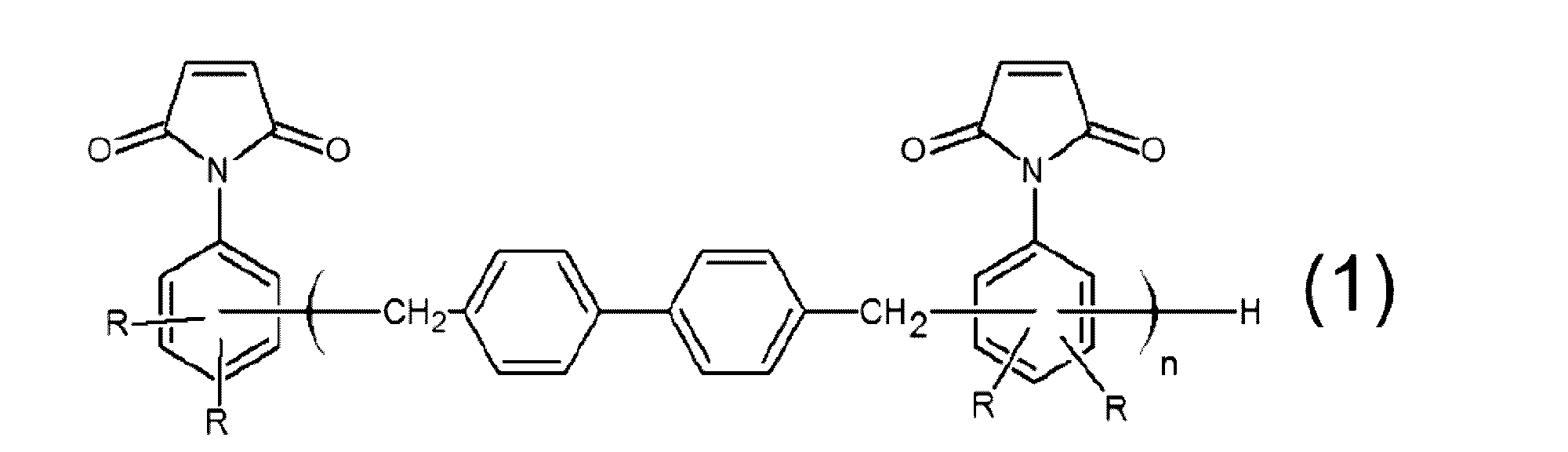
[2]
前記変性ポリフェニレンエーテル(B)が下記一般式(2)で示される、[1]の樹脂組成物。




[3]
前記一般式(2)中、-(O-X-O)-が下記一般式(6)、下記一般式(7)、又は一般式(8)で表される構造であり、-(Y-O)-が下記一般式(9)又は下記一般式(10)で表される構造であり、複数の-(Y-O)-が連続して配列している場合、1種類の構造が配列しているか、あるいは下記一般式(9)及び下記一般式(10)で表される構造が規則的に又は不規則的に配列している、[2]の樹脂組成物。
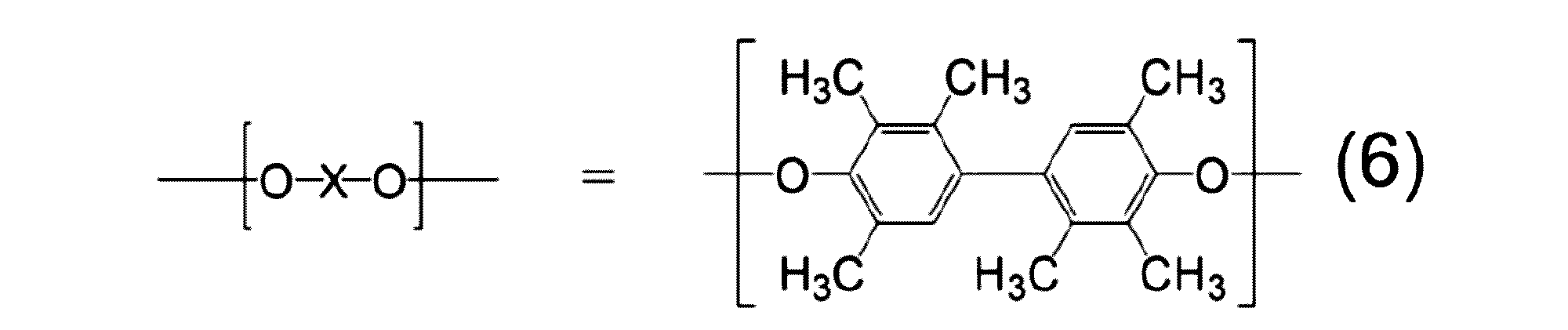


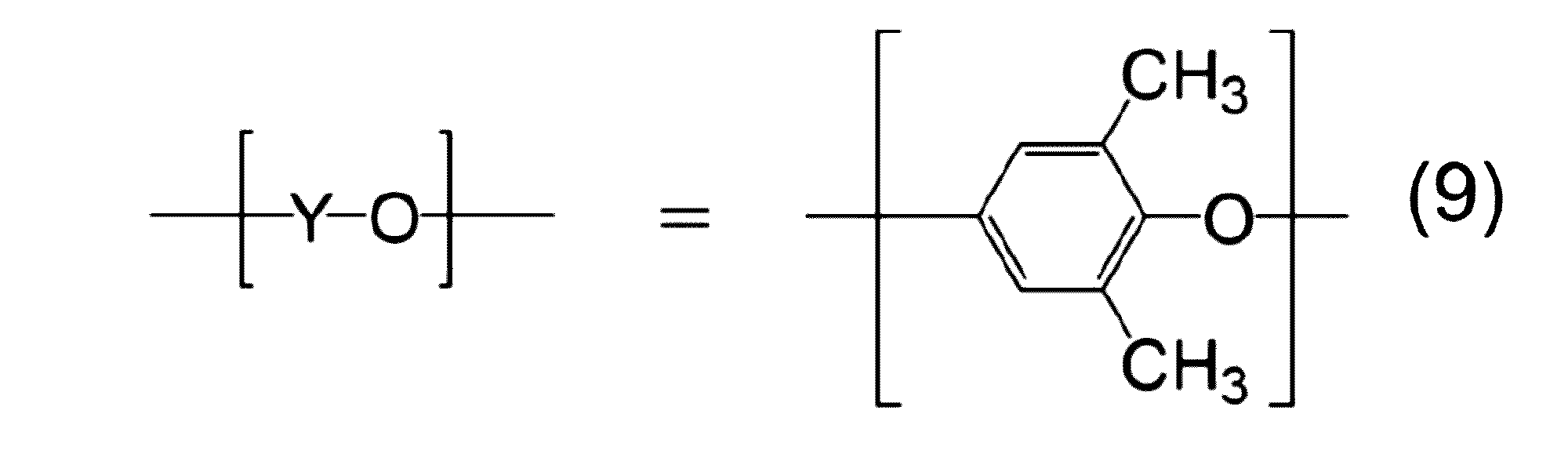

前記樹脂組成物中の樹脂固形分を100質量部としたとき、前記一般式(1)で示されるポリマレイミド化合物(A)の含有量が、1~90質量部である、[1]~[3]のいずれかの樹脂組成物。
[5]
前記樹脂組成物中の樹脂固形分を100質量部としたとき、前記変性ポリフェニレンエーテル(B)の含有量が、1~90質量部である、[1]~[4]のいずれかの樹脂組成物。
[6]
前記一般式(1)で表されるポリマレイミド化合物(A)以外のマレイミド化合物、エポキシ樹脂、フェノール樹脂、オキセタン樹脂、ベンゾオキサジン化合物、前記変性ポリフェニレンエーテル(B)以外の重合可能な不飽和基を有する化合物、エラストマー、活性エステル化合物、及び、シアン酸エステル化合物からなる群より選択される少なくとも1種以上の他の成分(D)をさらに含有する、[1]~[5]のいずれかの樹脂組成物。
[7]
前記樹脂組成物における、前記充填材(C)の含有量が、樹脂固形分100質量部に対し、50~1600質量部である、[1]~[6]のいずれかの樹脂組成物。
[8]
基材と、前記基材上に含浸又は塗布された[1]~[7]のいずれかの樹脂組成物とを含むプリプレグ。
[9]
少なくとも1枚以上重ねた請求項[8]のプリプレグと、前記プリプレグの片面又は両面に配置した金属箔とを含む金属箔張積層板。
[10]
支持体と、前記支持体の表面に配置した[1]~[7]のいずれかの樹脂組成物とを含む樹脂複合シート。
[11]
絶縁層と、前記絶縁層の表面に配置した導体層とを含むプリント配線板であって、前記絶縁層が、[1]~[7]のいずれかの樹脂組成物を含むプリント配線板。
本実施形態の樹脂組成物は、下記一般式(1)で示されるポリマレイミド化合物(A)、炭素-炭素不飽和二重結合を含有する置換基により末端変性された変性ポリフェニレンエーテル(B)、及び充填材(C)を含有する。本実施形態の樹脂組成物は、上記の構成を備えることにより、プリント配線板用材料(例えば、積層板、金属箔張積層板)等に用いると、優れたピール強度、低吸水性、耐デスミア性、及び耐燃性を同時に満たすことができ、例えば、上記の特性を同時に向上することができる。また、本実施形態の樹脂組成物は、上記の構成を備えることにより、プリント配線板用材料(例えば、積層板、金属箔張積層板)等に用いると、例えば、優れた低誘電正接性を満たすことができる。

本実施形態のポリマレイミド化合物(A)は、前記一般式(1)で表される化合物である。本実施形態の樹脂組成物は、このような構造を有するポリマレイミド化合物を含有することにより、プリント配線板用材料(例えば、積層板、金属箔張積層板)等に用いると、優れた耐熱性を付与できるとともに、ピール強度、低吸水性、耐デスミア性、及び耐燃性を向上できる。
変性ポリフェニレンエーテル(B)は、ポリフェニレンエーテルの末端が、炭素-炭素不飽和二重結合を含有する置換基により変性された変性物である。本明細書にいう「ポリフェニレンエーテル」とは、下記一般式(X1)で表されるポリフェニレンエーテル骨格を有する化合物をいう。


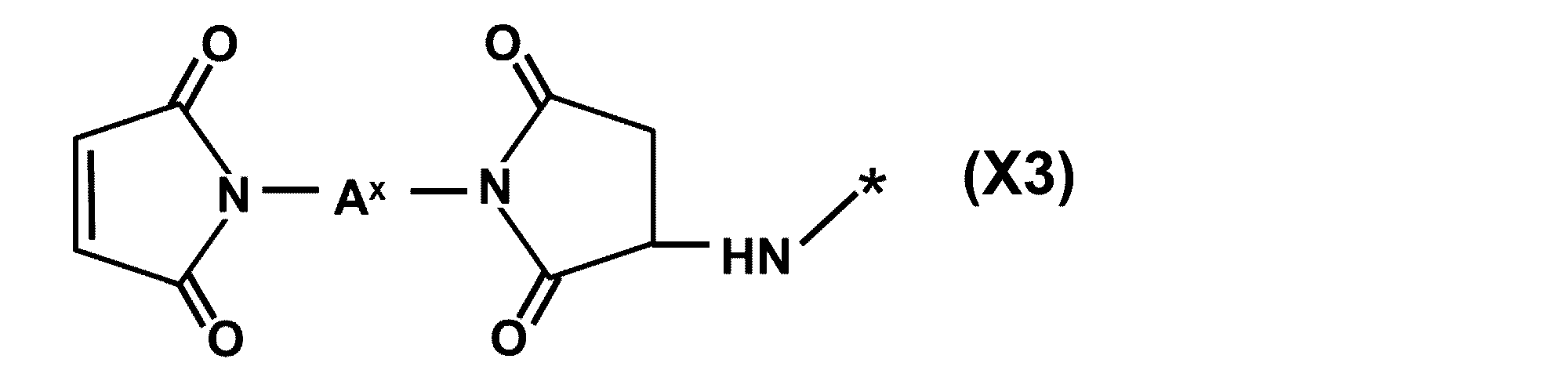


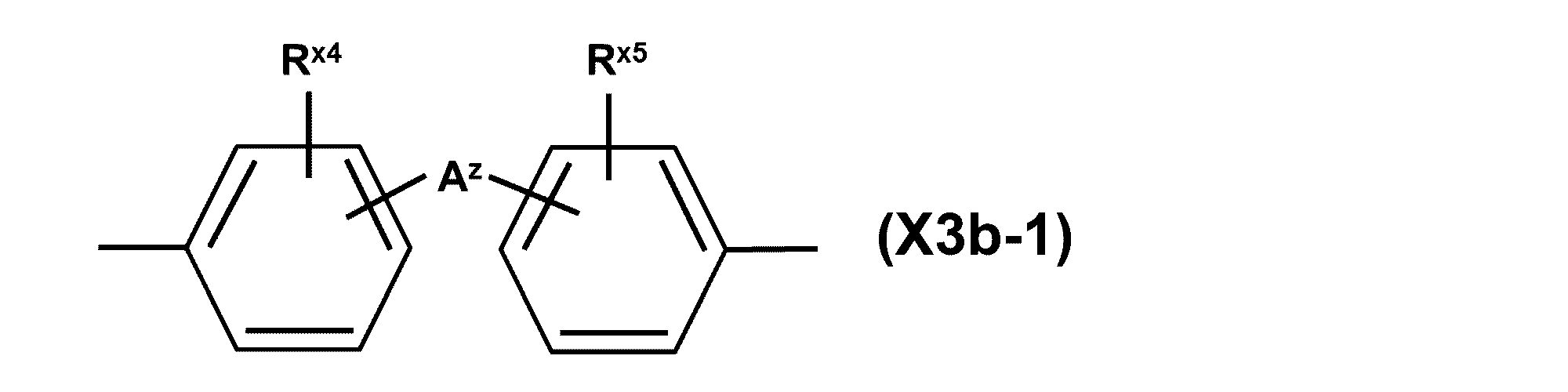


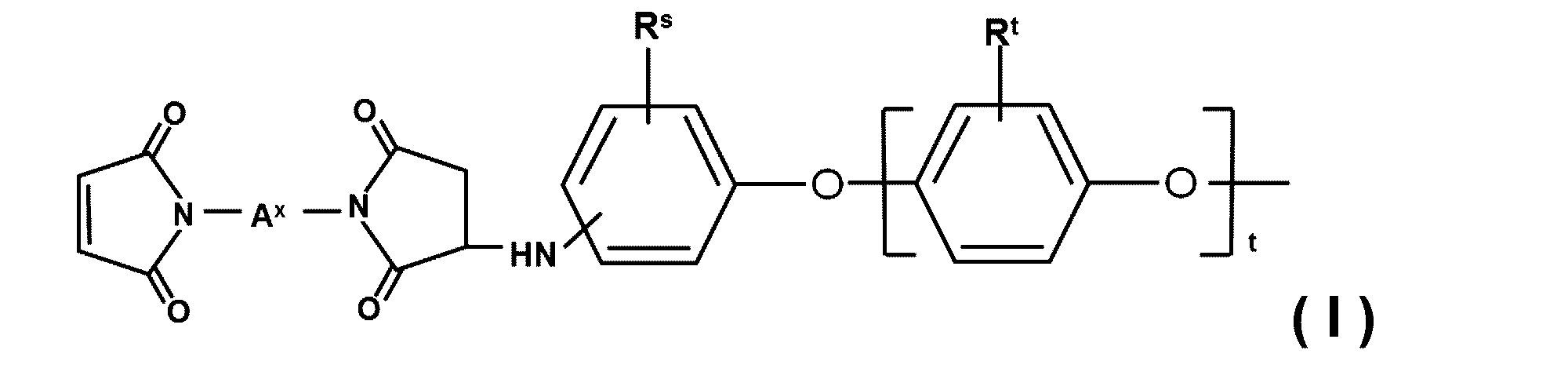
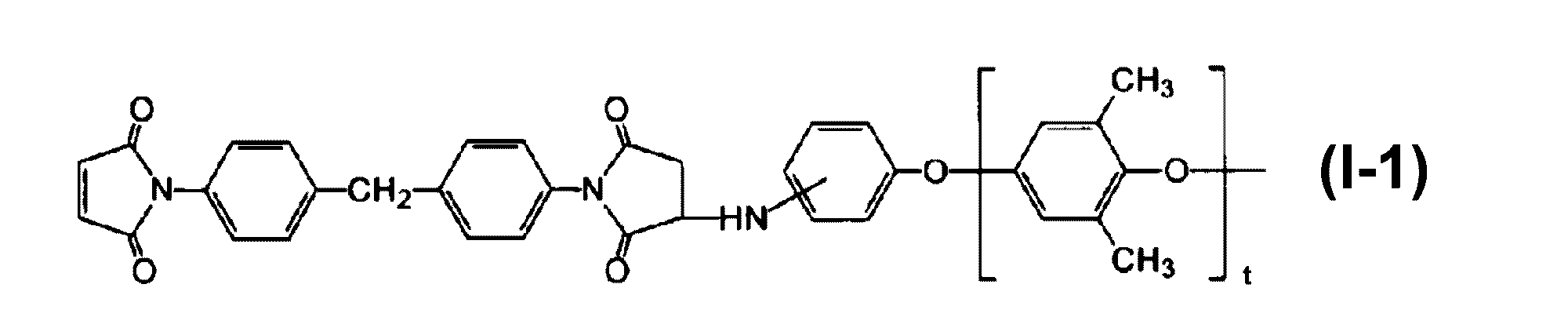






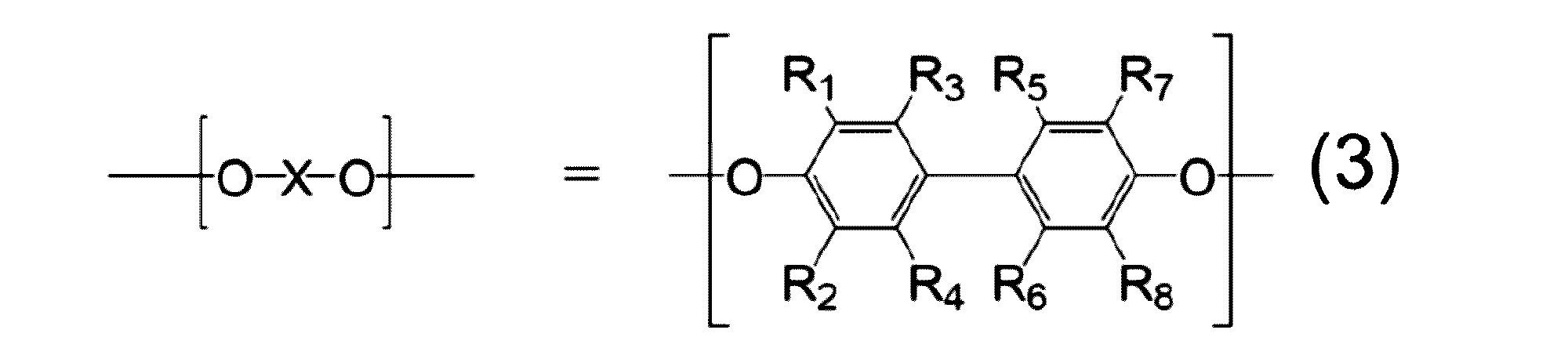

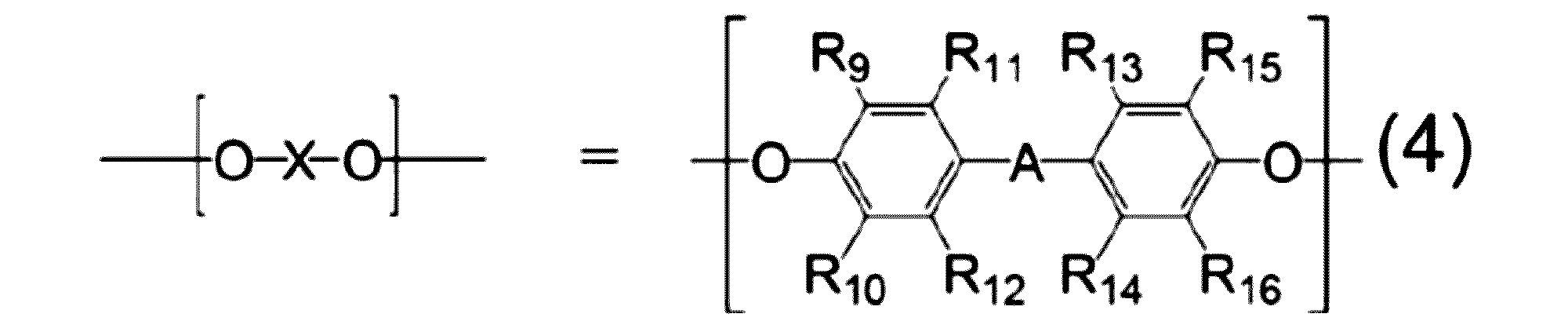


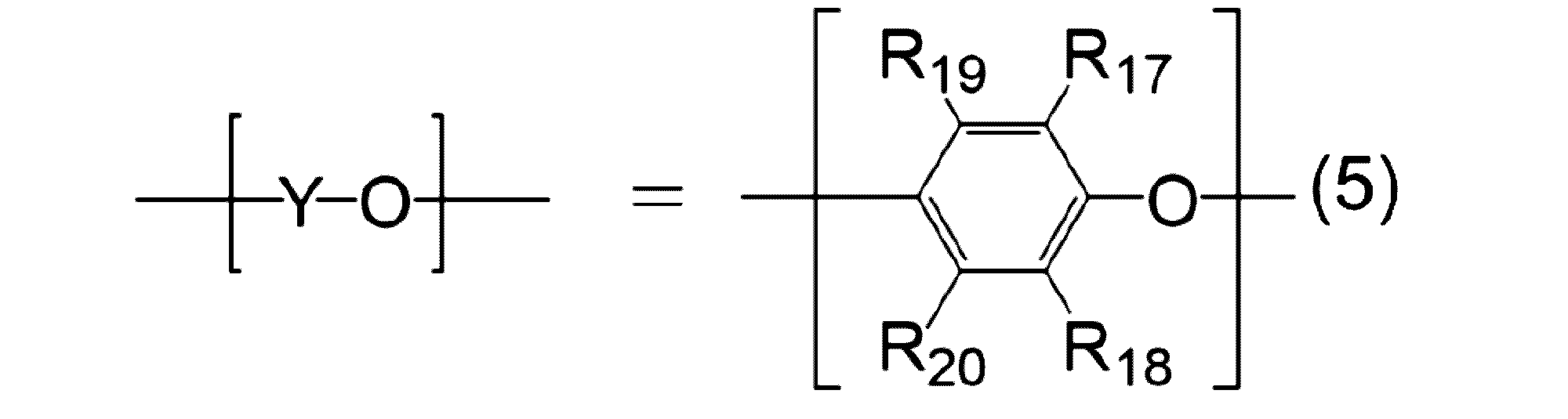
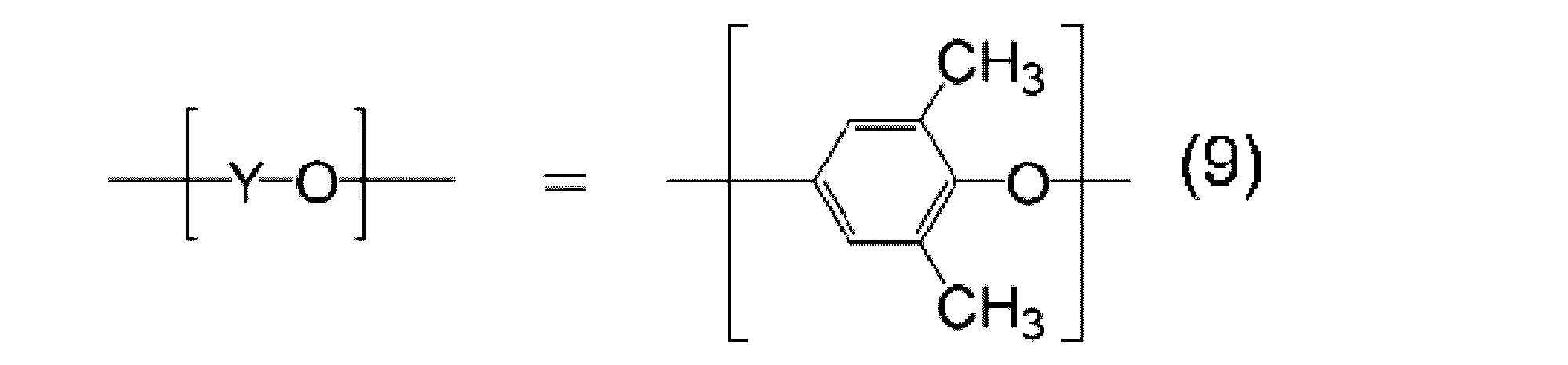


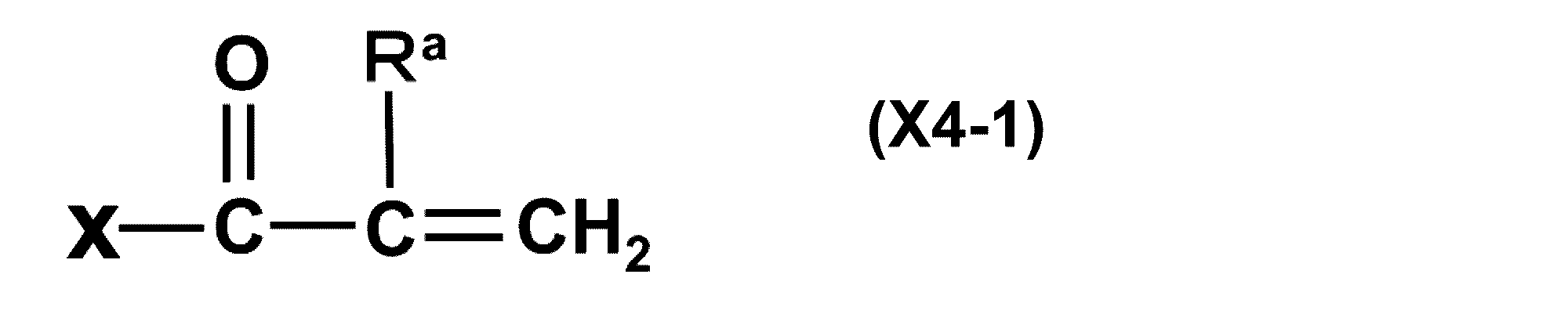
本実施形態の充填材(C)としては、特に限定されず、例えば、公知の無機系充填材及び/又は有機系充填材が挙げられる。無機系充填材としては、特に限定されず、例えば、シリカ類(例えば、溶融シリカ、天然シリカ、合成シリカ、アモルファスシリカ、アエロジル、中空シリカ、ホワイトカーボンなど)、金属酸化物(例えば、チタンホワイト、酸化亜鉛、酸化マグネシウム、酸化ジルコニウム、アルミナ等)、金属窒化物(例えば、窒化ホウ素、凝集窒化ホウ素、窒化ルミニウム等)、金属硫酸塩(例えば、硫酸バリウム等)、金属水和物(例えば、水酸化アルミニウム、水酸化アルミニウム加熱処理品(水酸化アルミニウムを加熱処理し、結晶水の一部を減じたもの)、ベーマイト、水酸化マグネシウム等)、モリブデン化合物(例えば、酸化モリブデン、モリブデン酸亜鉛等)、亜鉛類(例えば、ホウ酸亜鉛、錫酸亜鉛等)、クレー、カオリン、タルク、焼成クレー、焼成カオリン、焼成タルク、マイカ、E-ガラス、A-ガラス、NE-ガラス、C-ガラス、L-ガラス、D-ガラス、S-ガラス、M-ガラスG-20、ガラス短繊維(例えば、Eガラス、Tガラス、Dガラス、Sガラス、Qガラス等のガラス微粉末類を含む。)、中空ガラス、球状ガラス等が挙げられる。
さらに、本実施形態の樹脂組成物は、各種特性(例えば、ピール強度、めっきピール強度、吸湿耐熱性、強度、弾性率、低誘電正接性等の電気特性、ガラス転移温度、耐熱性、低熱膨張率、低熱分解性、熱伝導率等)を向上させる観点から、ポリマレイミド化合物(A)以外のマレイミド化合物(以下、「その他のマレイミド化合物」という。)、エポキシ樹脂、フェノール樹脂、オキタセン樹脂、ベンゾオキサジン化合物、前記一般式(2)で表される変性ポリフェニレンエーテル(B)以外の重合可能な不飽和基を有する化合物、エラストマー、活性エステル化合物、及びシアン酸エステル化合物からなる群より選択される少なくとも1種以上の他の成分(D)をさらに含有することが好ましく、エポキシ樹脂、フェノール樹脂、オキタセン樹脂、ベンゾオキサジン化合物、変性ポリフェニレンエーテル(B)以外の重合可能な不飽和基を有する化合物、エラストマー、及び活性エステル化合物からなる群より選択される少なくとも1種以上の他の成分(D)をさらに含有することが好ましい。
その他のマレイミド化合物としては、1分子中に1個以上のマレイミド基を有する化合物であれば特に限定されず、1分子中に2個以上のマレイミド基を有するポリマレイミド化合物であってもよく、例えば、4,4-ジフェニルメタンビスマレイミド、フェニルメタンマレイミド、m-フェニレンビスマレイミド、2,2-ビス(4-(4-マレイミドフェノキシ)-フェニル)プロパン、3,3-ジメチル-5,5-ジエチル-4,4-ジフェニルメタンビスマレイミド、4-メチル-1,3-フェニレンビスマレイミド、1,6-ビスマレイミド-(2,2,4-トリメチル)ヘキサン、4,4-ジフェニルエーテルビスマレイミド、4,4-ジフェニルスルフォンビスマレイミド、1,3-ビス(3-マレイミドフェノキシ)ベンゼン、1,3-ビス(4-マレイミドフェノキシ)ベンゼン、ポリフェニルメタンマレイミド、及びこれらのマレイミド化合物のプレポリマー、これらのマレイミド化合物とアミン化合物のプレポリマー等が挙げられる。これらのマレイミド化合物は、1種を単独で、又は2種以上を組み合わせて用いることができる。
エポキシ樹脂としては、1分子中に2個以上のエポキシ基を有する化合物又は樹脂であれば特に限定されず、例えば、ビスフェノールA型エポキシ樹脂、ビスフェノールE型エポキシ樹脂、ビスフェノールF型エポキシ樹脂、ビスフェノールS型エポキシ樹脂、フェノールノボラック型エポキシ樹脂、ビスフェノールAノボラック型エポキシ樹脂、グリシジルエステル型エポキシ樹脂、アラルキルノボラック型エポキシ樹脂、ビフェニルアラルキル型エポキシ樹脂、ナフチレンエーテル型エポキシ樹脂、クレゾールノボラック型エポキシ樹脂、多官能フェノール型エポキシ樹脂、ナフタレン型エポキシ樹脂、アントラセン型エポキシ樹脂、ナフタレン骨格変性ノボラック型エポキシ樹脂、フェノールアラルキル型エポキシ樹脂、ナフトールアラルキル型エポキシ樹脂、ジシクロペンタジエン型エポキシ樹脂、ビフェニル型エポキシ樹脂、脂環式エポキシ樹脂、ポリオール型エポキシ樹脂、リン含有エポキシ樹脂、グリシジルアミン、グリシジルエステル、ブタジエン等の二重結合をエポキシ化した化合物、水酸基含有シリコーン樹脂類とエピクロルヒドリンとの反応により得られる化合物等が挙げられる。これらのエポキシ樹脂(D)は、1種を単独で、又は2種以上を組み合わせて用いることができる。これらの中でも、難燃性及び耐熱性をより一層向上する観点から、ビフェニルアラルキル型エポキシ樹脂、ナフチレンエーテル型エポキシ樹脂、多官能フェノール型エポキシ樹脂、ナフタレン型エポキシ樹脂であることが好ましい。
フェノール樹脂としては、1分子中に2個以上のヒドロキシル基を有するフェノール樹脂であれば特に限定されず、例えば、ビスフェノールA型フェノール樹脂、ビスフェノールE型フェノール樹脂、ビスフェノールF型フェノール樹脂、ビスフェノールS型フェノール樹脂、フェノールノボラック樹脂、ビスフェノールAノボラック型フェノール樹脂、グリシジルエステル型フェノール樹脂、アラルキルノボラックフェノール樹脂、ビフェニルアラルキル型フェノール樹脂、クレゾールノボラック型フェノール樹脂、多官能フェノール樹脂、ナフトール樹脂、ナフトールノボラック樹脂、多官能ナフトール樹脂、アントラセン型フェノール樹脂、ナフタレン骨格変性ノボラック型フェノール樹脂、フェノールアラルキル型フェノール樹脂、ナフトールアラルキル型フェノール樹脂、ジシクロペンタジエン型フェノール樹脂、ビフェニル型フェノール樹脂、脂環式フェノール樹脂、ポリオール型フェノール樹脂、リン含有フェノール樹脂、水酸基含有シリコーン樹脂類等が挙げられる。これらのフェノール樹脂は、1種を単独で、又は2種以上を組み合わせて用いることができる。これらの中でも、耐燃性をより一層向上する観点から、ビフェニルアラルキル型フェノール樹脂、ナフトールアラルキル型フェノール樹脂、リン含有フェノール樹脂、及び水酸基含有シリコーン樹脂からなる群より選択される少なくとも1種であることが好ましい。
オキセタン樹脂としては、特に限定されず、例えば、オキセタン、アルキルオキセタン(例えば、2-メチルオキセタン、2,2-ジメチルオキセタン、3-メチルオキセタン、3,3-ジメチルオキサタン等)、3-メチル-3-メトキシメチルオキセタン、3,3-ジ(トリフルオロメチル)パーフルオキセタン、2-クロロメチルオキセタン、3,3-ビス(クロロメチル)オキセタン、ビフェニル型オキセタン、OXT-101(東亜合成(株)製品)、OXT-121(東亜合成(株)製品)等が挙げられる。これらのオキセタン樹脂は、1種を単独で、又は2種以上を組み合わせて用いることができる。
ベンゾオキサジン化合物としては、1分子中に2個以上のジヒドロベンゾオキサジン環を有する化合物であれば特に限定されず、例えば、ビスフェノールA型ベンゾオキサジンBA-BXZ(小西化学(株)製品)、ビスフェノールF型ベンゾオキサジンBF-BXZ(小西化学(株)製品)、ビスフェノールS型ベンゾオキサジンBS-BXZ(小西化学(株)製品)等が挙げられる。これらのベンゾオキサジン化合物は、1種を単独で、又は2種以上を組み合わせて用いることができる。
変性ポリフェニレンエーテル(B)以外の重合可能な不飽和基を有する化合物としては、特に限定されず、例えば、ビニル化合物(例えば、エチレン、プロピレン、スチレン、ジビニルベンゼン、ジビニルビフェニル等)、アクリレート類(例えば、メチル(メタ)アクリレート等)、モノ又はポリアルコールの(メタ)アクリレート類(例えば、2-ヒドロキシプロピル(メタ)アクリレート、ポリプロピレングリコールジ(メタ)アクリレート、トリメチロールプロパンジ(メタ)アクリレート、トリメチロールプロパントリ(メタ)アクリレート、ペンタエリスリトールテトラ(メタ)アクリレート、ジペンタエリスリトールヘキサ(メタ)アクリレート等)、エポキシ(メタ)アクリレート類(例えば、ビスフェノールA型エポキシ(メタ)アクリレート、ビスフェノールF型エポキシ(メタ)アクリレート等)、ベンゾシクロベテン樹脂、(ビス)マレイミド樹脂等が挙げられる。これらの重合可能な不飽和基を有する化合物は、1種を単独で、又は2種以上を組み合わせて用いることができる。
本実施形態において、エラストマーとしては、特に限定されず、例えば、ポリイソプレン、ポリブタジエン、スチレンブタジエン、ブチルゴム、エチレンプロピレンゴム、スチレンブタジエンエチレン、スチレンブタジエンスチレン、スチレンイソプレンスチレン、スチレンエチレンブチレンスチレン、スチレンプロピレンスチレン、スチレンエチレンプロピレンスチレン、フッ素ゴム、シリコーンゴム、それらの水添化合物、それらのアルキル化合物、及びそれらの共重合体からなる群より選択される少なくとも1種が挙げられる。これらの中でも、電気特性に優れる観点から、スチレンブタジエン、スチレンブタジエンエチレン、スチレンブタジエンスチレン、スチレンイソプレンスチレン、スチレンエチレンブチレンスチレン、スチレンプロピレンスチレン、スチレンエチレンプロピレンスチレン、それらの水添化合物、それらのアルキル化合物、及びそれらの共重合体からなる群より選択される少なくとも1種であることが好ましく、変性ポリフェニレンエーテル(B)との相溶性により一層優れる観点から、スチレンブタジエンゴム、ブタジエンゴム、及びイソプレンゴムからなる群より選択される少なくとも1種であることがより好ましい。
活性エステル化合物としては、特に限定されず、例えば、1分子中に2個以上の活性エステル基を有する化合物が挙げられ、直鎖状若しくは分岐状又は環状の化合物であってもよい。これらの中でも、耐熱性を一層向上させる点から、カルボン酸化合物及び/又はチオカルボン酸化合物と、ヒドロキシ化合物及び/又はチオール化合物とを反応させることにより得られる活性エステル化合物が好ましく、カルボン酸化合物と、フェノール化合物、ナフトール化合物、及びチオール化合物からなる群より選択される1種以上の化合物とを反応させることにより得られる活性エステル化合物がより好ましく、カルボン酸化合物とフェノール性水酸基を有する芳香族化合物とを反応させることにより得られ、1分子中に2個以上の活性エステル基を有する芳香族化合物がさらに好ましく、少なくとも2個以上のカルボン酸を1分子中に有する化合物と、フェノール性水酸基を有する芳香族化合物とを反応させることにより得られ、1分子中に2個以上の活性エステル基を有する芳香族化合物が特に好ましい。上述のカルボン酸化合物としては、安息香酸、酢酸、コハク酸、マレイン酸、イタコン酸、フタル酸、イソフタル酸、テレフタル酸、及びピロメリット酸からなる群より選ばれる1種以上が挙げられ、これらの中でも、耐熱性をより一層向上させる観点から、コハク酸、マレイン酸、イタコン酸、フタル酸、イソフタル酸、及びテレフタル酸からなる群より選ばれる1種以上が好ましく、イソフタル酸及びテレフタル酸からなる群より選ばれる1種以上がより好ましい。上述のチオカルボン酸化合物としては、チオ酢酸及びチオ安息香酸からなる群から選ばれる1種以上が挙げられる。上述のフェノール化合物又はナフトール化合物としては、ハイドロキノン、レゾルシン、ビスフェノールA、ビスフェノールF、ビスフェノールS、フェノールフタリン、メチル化ビスフェノールA、メチル化ビスフェノールF、メチル化ビスフェノールS、フェノール、o-クレゾール、m-クレゾール、p-クレゾール、カテコール、α-ナフトール、β-ナフトール、1,5-ジヒドロキシナフタレン、1,6-ジヒドロキシナフタレン、2,6-ジヒドロキシナフタレン、ジヒドロキシベンゾフェノン、トリヒドロキシベンゾフェノン、テトラヒドロキシベンゾフェノン、フロログルシン、ベンゼントリオール、ジシクロペンタジエニルジフェノール、及びフェノールノボラックからなる群より選ばれる1種以上が挙げられ、耐熱性及び溶媒溶解性をより一層向上させる観点から、ビスフェノールA、ビスフェノールF、ビスフェノールS、メチル化ビスフェノールA、メチル化ビスフェノールF、メチル化ビスフェノールS、カテコール、α-ナフトール、β-ナフトール、1,5-ジヒドロキシナフタレン、1,6-ジヒドロキシナフタレン、2,6-ジヒドロキシナフタレン、ジヒドロキシベンゾフェノン、トリヒドロキシベンゾフェノン、テトラヒドロキシベンゾフェノン、フロログルシン、ベンゼントリオール、ジシクロペンタジエニルジフェノール、フェノールノボラックが好ましく、カテコール、1,5-ジヒドロキシナフタレン、1,6-ジヒドロキシナフタレン、2,6-ジヒドロキシナフタレン、ジヒドロキシベンゾフェノン、トリヒドロキシベンゾフェノン、テトラヒドロキシベンゾフェノン、フロログルシン、ベンゼントリオール、ジシクロペンタジエニルジフェノール、及びフェノールノボラックからなる群より選ばれる1種以上がより好ましく、1,5-ジヒドロキシナフタレン、1,6-ジヒドロキシナフタレン、2,6-ジヒドロキシナフタレン、ジヒドロキシベンゾフェノン、トリヒドロキシベンゾフェノン、テトラヒドロキシベンゾフェノン、ジシクロペンタジエニルジフェノール、及びフェノールノボラックからなる群より選ばれる1種以上がさらに好ましく、ジヒドロキシベンゾフェノン、トリヒドロキシベンゾフェノン、テトラヒドロキシベンゾフェノン、ジシクロペンタジエニルジフェノール、及びフェノールノボラックからなる群より選ばれる1種以上(好ましくジシクロペンタジエニルジフェノール及びフェノールノボラックからなる群より選ばれる1種以上、より好ましくはジシクロペンタジエニルジフェノール)であることが特に好ましい。上述のチオール化合物としては、ベンゼンジチオール及びトリアジンジチオールからなる群より選ばれる1種以上が挙げられる。また、活性エステル化合物は、エポキシ樹脂との相溶性を一層向上させる観点から、少なくとも2個以上のカルボン酸を1分子中に有し、かつ脂肪族鎖を含む化合物であることが好ましく、耐熱性を一層向上させる観点から、芳香族環を有する化合物であることが好ましい。より具体的な活性エステル化合物としては、特開2004-277460号公報に記載の活性エステル化合物が挙げられる。これらの活性エステル化合物は、1種を単独で、又は2種以上を組み合わせて用いることができる。
シアン酸エステル化合物としては、例えば、ナフトールアラルキル型シアン酸エステル化合物、ナフチレンエーテル型シアン酸エステル化合物、キシレン樹脂型シアン酸エステル化合物、トリスフェノールメタン型シアン酸エステル化合物、及びアダマンタン骨格型シアン酸エステル化合物からなる群より選択される少なくとも1種が挙げられる。これらの中でも、めっき密着性及び低吸水性がより一層向上する観点から、ナフトールアラルキル型シアン酸エステル化合物、ナフチレンエーテル型シアン酸エステル化合物、及びキシレン樹脂型シアン酸エステル化合物からなる群より選択される少なくとも1種であることが好ましく、ナフトールアラルキル型シアン酸エステル化合物であることがより好ましい。これらのシアン酸エステル化合物は、公知の方法により調製してもよく、市販品を用いてもよい。なお、ナフトールアラルキル骨格、ナフチレンエーテル骨格、キシレン骨格、トリスフェノールメタン骨格、又はアダマンタン骨格を有するシアン酸エステル化合物は、比較的、官能基当量数が大きく、未反応のシアン酸エステル基が少なくなるため、吸水性がより一層低下する傾向にある。また、芳香族骨格又はアダマンタン骨格を有することに主に起因して、めっき密着性がより一層向上する傾向にある。
本実施形態の樹脂組成物は、例えば、他の成分(D)として、シアン酸エステル化合物、エポキシ樹脂等を含有する場合、硬化速度を適宜調節するための硬化促進剤を含有してもよい。硬化促進剤としては、シアン酸エステル化合物、エポキシ樹脂などの硬化促進剤として通常用いられているものが挙げられ、有機金属塩類(例えば、オクチル酸亜鉛、ナフテン酸亜鉛、ナフテン酸コバルト、ナフテン酸銅、アセチルアセトン鉄、オクチル酸ニッケル、オクチル酸マンガン等)、フェノール化合物(例えば、フェノール、キシレノール、クレゾール、レゾルシン、カテコール、オクチルフェノール、ノニルフェノール等)、アルコール類(例えば、1-ブタノール、2-エチルヘキサノール等)、イミダゾール類(例えば、2-メチルイミダゾール、2-エチル-4-メチルイミダゾール、2-フェニルイミダゾール、1-シアノエチル-2-フェニルイミダゾール、1-シアノエチル-2-エチル-4-メチルイミダゾール、2-フェニル-4,5-ジヒドロキシメチルイミダゾール、2-フェニル-4-メチル-5-ヒドロキシメチルイミダゾール等)、及びこれらのイミダゾール類のカルボン酸若しくはその酸無水類の付加体等の誘導体、アミン類(例えば、ジシアンジアミド、ベンジルジメチルアミン、4-メチル-N,N-ジメチルベンジルアミン等)、リン化合物(例えば、ホスフィン系化合物、ホスフィンオキサイド系化合物、ホスホニウム塩系化合物、ダイホスフィン系化合物等)、エポキシ-イミダゾールアダクト系化合物、過酸化物(例えば、ベンゾイルパーオキサイド、p-クロロベンゾイルパーオキサイド、ジ-t-ブチルパーオキサイド、ジイソプロピルパーオキシカーボネート、ジ-2-エチルヘキシルパーオキシカーボネート等)、アゾ化合物(例えば、アゾビスイソブチロニトリル等)が挙げられる。硬化促進剤は、1種を単独で、又は2種以上を組み合わせて用いることができる。
本実施形態の樹脂組成物は、有機溶剤を含有してもよい。この場合、本実施形態の樹脂組成物は、上述した各種樹脂成分の少なくとも一部、好ましくは全部が有機溶剤に溶解又は相溶した形態(溶液又はワニス)である。有機溶剤としては、上述した各種樹脂成分の少なくとも一部、好ましくは全部を溶解又は相溶可能な極性有機溶剤又は無極性有機溶剤であれば特に限定されず、極性有機溶剤としては、例えば、ケトン類(例えば、アセトン、メチルエチルケトン、メチルイソブチルケトン等)、セロソルブ類(例えば、プロピレングリコールモノメチルエーテル、プロピレングリコールモノメチルエーテルアセテート等)、エステル類(例えば、乳酸エチル、酢酸メチル、酢酸エチル、酢酸ブチル、酢酸イソアミル、乳酸エチル、メトキシプロピオン酸メチル、ヒドロキシイソ酪酸メチル等)アミド類(例えば、ジメトキシアセトアミド、ジメチルホルムアミド類等)が挙げられ、無極性有機溶剤としては、芳香族炭化水素(例えば、トルエン、キシレン等)が挙げられる。これらの有機溶剤は、1種を単独で、又は2種以上を組み合わせて用いることができる。
本実施形態の樹脂組成物は、プリント配線板の絶縁層、半導体パッケージ用材料として好適に用いることができる。本実施形態の樹脂組成物は、プリプレグ、プリプレグを用いた金属箔張積層板、樹脂複合シート、及びプリント配線板を構成する材料として好適に用いることができる。
本実施形態のプリプレグは、基材と、基材上に含浸又は塗布された本実施形態の樹脂組成物と、を含む。本実施形態のプリプレグは、例えば、本実施形態の樹脂組成物を基材に含浸又は塗布させた後、120~220℃で2~15分間程度乾燥させる方法等によって半硬化させることにより得られる。この場合、基材に対する樹脂組成物の付着量、すなわち半硬化後のプリプレグの総量に対する樹脂組成物量(充填材(C)を含む。)は、20~99質量%の範囲であることが好ましい。
本実施形態の金属箔張積層板は、少なくとも1枚以上重ねた本実施形態のプリプレグと、プリプレグの片面又は両面に配置した金属箔とを有する。本実施形態の金属箔張積層板は、例えば、本実施形態のプリプレグを少なくとも1枚以上重ね、その片面又は両面に金属箔を配置して積層成形する方法が挙げられ、より詳細にはその片面又は両面に銅、アルミニウム等の金属箔を配置して積層成形することにより作製できる。金属箔としては、プリント配線板用材料に用いられるものであれば特に限定されないが、例えば、圧延銅箔、電解銅箔等の銅箔が挙げられる。銅箔の厚さは、特に限定されず、2~70μm程度であってもよい。成形方法としては、プリント配線板用積層板及び多層板を成形する際に通常用いられる方法が挙げられ、より詳細には多段プレス機、多段真空プレス機、連続成形機、オートクレーブ成形機等を使用して、温度180~350℃程度、加熱時間100~300分間程度、面圧20~100kg/cm2程度で積層成形する方法が挙げられる。また、本実施形態のプリプレグと、別途作製した内層用の配線板とを組み合わせて積層成形することにより、多層板とすることもできる。多層板の製造方法としては、例えば、本実施形態のプリプレグ1枚の両面に35μm程度の銅箔を配置し、上述の成形方法にて積層形成した後、内層回路を形成し、この回路に黒化処理を実施して内層回路板を形成し、この後、この内層回路板と本実施形態のプリプレグとを交互に1枚ずつ配置し、さらに最外層に銅箔を配置して、前記条件にて好ましくは真空下で積層成形することにより、多層板を作製することができる。本実施形態の金属箔張積層板は、プリント配線板として好適に使用することができる。
本実施形態のプリント配線板は、絶縁層と、絶縁層の表面に配置した導体層と、を含み、絶縁層が、本実施形態の樹脂組成物を含む。このようなプリント配線板は、常法に従って製造でき、その製造方法は特に限定されない。以下、プリント配線板の製造方法の一例を示す。まず上述した銅張積層板等の金属箔張り積層板を用意する。次に、金属箔張り積層板の表面にエッチング処理を施して内層回路の形成を行い、内層基板を作製する。この内層基板の内層回路表面に、必要に応じて接着強度を高めるための表面処理を行い、次いでその内層回路表面に上述したプリプレグを所要枚数重ね、さらにその外側に外層回路用の金属箔を積層し、加熱加圧して一体成形する。このようにして、内層回路と外層回路用の金属箔との間に、基材及び熱硬化性樹脂組成物の硬化物からなる絶縁層が形成された多層の積層板が製造される。次いで、この多層の積層板にスルーホールやバイアホール用の穴あけ加工を施した後、この穴の壁面に内層回路と外層回路用の金属箔とを導通させるめっき金属皮膜を形成し、さらに外層回路用の金属箔にエッチング処理を施して外層回路を形成することで、プリント配線板が製造される。
本実施形態の樹脂複合シートは、支持体と、該支持体の表面に配置した本実施形態の樹脂組成物と、を含む。樹脂複合シートは、ビルドアップ用フィルム又はドライフィルムソルダーレジストとして使用することができる。樹脂複合シートの製造方法としては、特に限定されないが、例えば、上述の本実施形態の樹脂組成物を溶剤に溶解させた溶液を支持体に塗布(塗工)し乾燥することで樹脂複合シートを得る方法が挙げられる。
(2官能フェニレンエーテルオリゴマーの合成)
攪拌装置、温度計、空気導入管、及びじゃま板のついた12Lの縦長反応器にCuBr29.36g(42.1mmol)、N,N’-ジ-t-ブチルエチレンジアミン1.81g(10.5mmol)、n-ブチルジメチルアミン67.77g(671.0mmol)、トルエン2,600gを仕込み、反応温度40℃にて攪拌を行い、予め2,300gのメタノールに溶解させた2,2’,3,3’,5,5’-ヘキサメチル-(1,1’-ビフェノール)-4,4’-ジオール129.32g(0.48mol)、2,6-ジメチルフェノール878.4g(7.2mol)、N,N’-ジ-t-ブチルエチレンジアミン1.22g(7.2mmol)、n-ブチルジメチルアミン26.35g(260.9mmol)の混合溶液を、窒素と空気とを混合して酸素濃度8%に調整した混合ガスを5.2L/minの流速でバブリングを行いながら230分間かけて滴下し、攪拌を行った。滴下終了後、エチレンジアミン四酢酸四ナトリウム48.06g(126.4mmol)を溶解した水1,500gを加え、反応を停止した。水層と有機層とを分液し、有機層を1Nの塩酸水溶液、次いで純水で洗浄した。得られた溶液をエバポレーターで50質量%に濃縮し、2官能性フェニレンエーテルオリゴマー体(樹脂「A」)のトルエン溶液を1981g得た。樹脂「A」のGPC法によるポリスチレン換算の数平均分子量は1975、GPC法によるポリスチレン換算の重量平均分子量は3514、水酸基当量が990であった。
攪拌装置、温度計、及び還流管を備えた反応器に樹脂「A」のトルエン溶液833.4g、ビニルベンジルクロライド(セイミケミカル(株)製、「CMS-P」)76.7g、塩化メチレン1,600g、ベンジルジメチルアミン6.2g、純水199.5g、30.5質量%のNaOH水溶液83.6gを仕込み、反応温度40℃で攪拌を行った。24時間攪拌を行った後、有機層を1Nの塩酸水溶液、次いで純水で洗浄した。得られた溶液をエバポレーターで濃縮し、メタノール中へ滴下して固形化を行い、濾過により固体を回収、真空乾燥して変性ポリフェニレンエーテル(B)450.1gを得た。変性ポリフェニレンエーテル(B)のGPC法によるポリスチレン換算の数平均分子量は2250、GPC法によるポリスチレン換算の重量平均分子量は3920、ビニル基当量は1189g/ビニル基であった。
下記一般式(1a)で示されるポリマレイミド化合物(A)(「MIR-3000」、日本化薬(株)製品)77質量部、合成例1で得られた変性ポリフェニレンエーテル(B)20質量部、ナフタレン骨格変性したノボラック型のエポキシ樹脂(「HP-9900」、DIC(株)製品)3質量部、溶融シリカ150質量部(「SC2050-MB(アドマテックス(株)製品)」)、湿潤分散剤1.3質量部(「disperbyk-161(ビッグケミージャパン(株)製品)」1.0質量部、「disperbyk-2009(ビッグケミージャパン(株)製品」0.3質量部)、及びTPIZ(2,4,5-トリフェニルイミダゾール)0.5質量部をメチルエチルケトンで溶解させて混合し、ワニスを得た。なお、上述の各添加量は、固形分量を示し、後述の実施例及び比較例も同様である。このワニスをメチルエチルケトンでさらに希釈し、厚さ0.1mmのNEガラス織布に含浸塗工し、150℃で5分間加熱乾燥して、樹脂組成物量(充填材を含む。)60質量%のプリプレグを得た。

一般式(1a)で示されるポリマレイミド化合物(A)に代えて、その他のマレイミド化合物(「BMI-70」、ケイ・アイ化成株式会社(株)製品)77質量部用い、さらに2-エチル-4-メチルイミダゾール0.5質量部用いた以外は、実施例1と同様にして金属箔張積層板を得た。得られた金属箔張積層板を用いて、銅箔ピール強度、吸水率、耐デスミア性、誘電正接、及び耐燃性の評価を行った。評価結果を表1に示す。
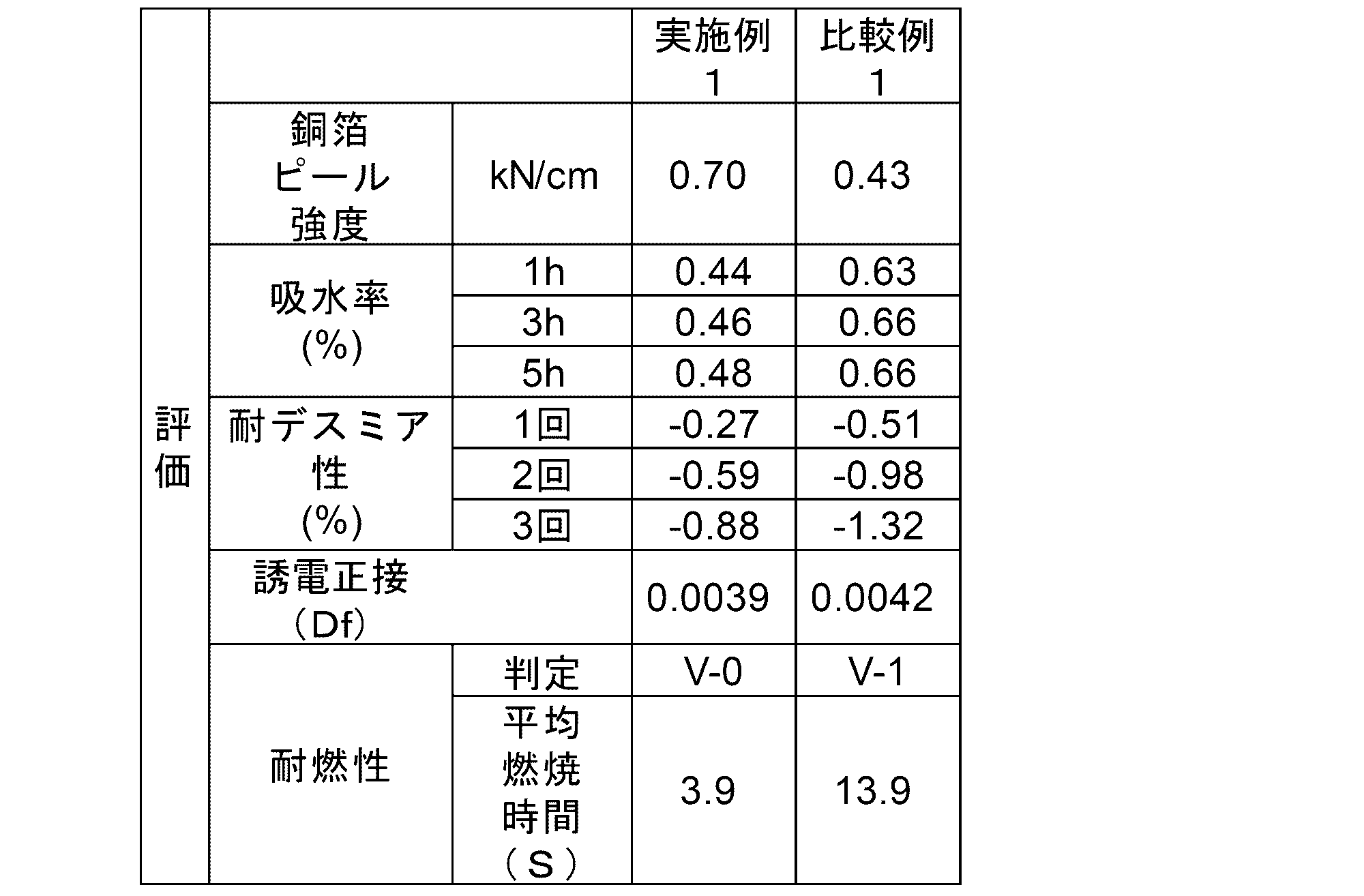
(1)銅箔ピール強度:
各実施例及び各比較例で得られた金属箔張積層板を用いて、JIS C6481に準拠して、銅箔の引き剥がし強度(銅箔ピール強度)を測定した。
(2)吸水率:
各実施例及び各比較例で得られた金属箔張積層板を30mm×30mmにカットしたサンプルを、JIS C648に準拠して、プレッシャークッカー試験機(平山製作所(株)製品、PC-3型)により、121℃、2気圧で1時間、3時間、5時間処理した後の吸水率を測定した。表2中、“1h”は、1時間処理した後の吸水率に対応し、“3h”は、3時間処理した後の吸水率に対応し、“5h”は、5時間処理した後の吸水率に対応する。
(3)耐デスミア性:
各実施例及び各比較例で得られた金属箔張積層板の銅箔をエッチングにより除去した後、以下の浸漬処理を行った。まず、銅箔を除去した積層板を膨潤液(アトテックジャパン (株)製品、スウェリングディップセキュリガントP)に80℃で10分間浸漬した。次に、浸漬した積層板を粗化液(アトテックジャパン(株)製品、コンセントレートコンパクトCP)に80℃で5分間浸漬した。次に、浸漬した積層板を中和液(アトテックジャパン (株)製品、リダクションコンディショナーセキュリガントP500)に45℃で10分間浸漬した。この浸漬処理を1回行った後の質量減少量(質量%)、2回行った後の質量減少量(質量%)、3回行った後の質量減少量(質量%)を測定した。表2中、「1回」は、「浸漬処理を1回行った後の質量減少量(質量%)」に対応し、「2回」は、「浸漬処理を2回行った後の質量減少量(質量%)」に対応し、「3回」は、「浸漬処理を3回行った後の質量減少量(質量%)」に対応する。
各実施例及び各比較例で得られた金属箔張積層板の銅箔をエッチングにより除去したサンプルを用いて、摂動法空洞共振器(アジレントテクノロジー(株)製品、Agilent8722ES)により、10GHzの誘電率(Dk)及び誘電正接を測定した。
各実施例及び各比較例で得られた金属箔張積層板の銅箔をエッチングにより除去したサンプルを用いて、UL94垂直燃焼試験法に準拠して耐燃性試験を行い、平均燃焼時間を測定した。
一般式(1a)で示されるポリマレイミド化合物(A)を7質量部用い、且つ、合成例1で得られた変性ポリフェニレンエーテル(B)を90質量部用いた以外は、実施例1と同様にして金属箔張積層板を得た。得られた金属箔張積層板を用いて、実施例1と同様に銅箔ピール強度、吸水率、耐デスミア性、及び耐燃性の測定を行い、下記基準に従って評価した。結果を下記表に示す。
一般式(1a)で示されるポリマレイミド化合物(A)を47質量部用い、且つ、合成例1で得られた変性ポリフェニレンエーテル(B)を50質量部用いた以外は、実施例1と同様にして金属箔張積層板を得た。得られた金属箔張積層板を用いて、実施例1と同様に銅箔ピール強度、吸水率、耐デスミア性、及び耐燃性の測定を行い、下記基準に従って評価した。結果を下記表に示す。
一般式(1a)で示されるポリマレイミド化合物(A)を7質量部用い、且つ、合成例1で得られた変性ポリフェニレンエーテル(B)を90質量部用いた以外は、比較例1と同様にして金属箔張積層板を得た。得られた金属箔張積層板を用いて、実施例1と同様に銅箔ピール強度、吸水率、耐デスミア性、及び耐燃性の測定を行い、下記基準に従って評価した。結果を下記表に示す。
一般式(1a)で示されるポリマレイミド化合物(A)を47質量部用い、且つ、合成例1で得られた変性ポリフェニレンエーテル(B)を50質量部用いた以外は、比較例1と同様にして金属箔張積層板を得た。得られた金属箔張積層板を用いて、実施例1と同様に銅箔ピール強度、吸水率、耐デスミア性、及び耐燃性の測定を行い、下記基準に従って評価した。結果を下記表に示す。
実施例1と同様の方法によって測定した銅箔ピール強度(単位:kN/cm)を下記基準に従って評価した。
〔基準〕
A:0.6以上
B:0.5以上0.6未満
C:0.5未満
(2)吸水率
実施例1と同様の方法によって測定した吸水率(5h)に基づき、下記基準に従って評価した。
〔基準〕
A:0.5%未満
B:0.5%以上0.6%未満
C:0.6%以上
(3)耐デスミア性
実施例1と同様の方法によって測定した耐デスミア性(浸漬処理を3回行った後の質量減少量(質量%))に基づき、下記基準に従って評価した。
〔基準〕
A:0.5質量%未満
B:0.5質量%以上1.0質量%未満
C:1.0質量%以上
(4)耐燃性
実施例1と同様の方法によって測定した耐燃性(平均燃焼時間)に基づき、下記基準に従って評価した。
〔基準〕
A:10秒未満
B:10秒以上15秒未満
C:15秒以上20秒未満
D:20以上

また、明細書に記載された全ての文献、特許出願、及び技術規格は、個々の文献、特許出願、及び技術規格が参照により取り込まれることが具体的かつ個々に記された場合と同程度に、本明細書中に参照により取り込まれる。
Claims (11)
- 下記一般式(1)で示されるポリマレイミド化合物(A)、炭素-炭素不飽和二重結合を含有する置換基により末端変性された変性ポリフェニレンエーテル(B)、及び充填材(C)を含有する樹脂組成物。

- 前記変性ポリフェニレンエーテル(B)が下記一般式(2)で示される、請求項1に記載の樹脂組成物。


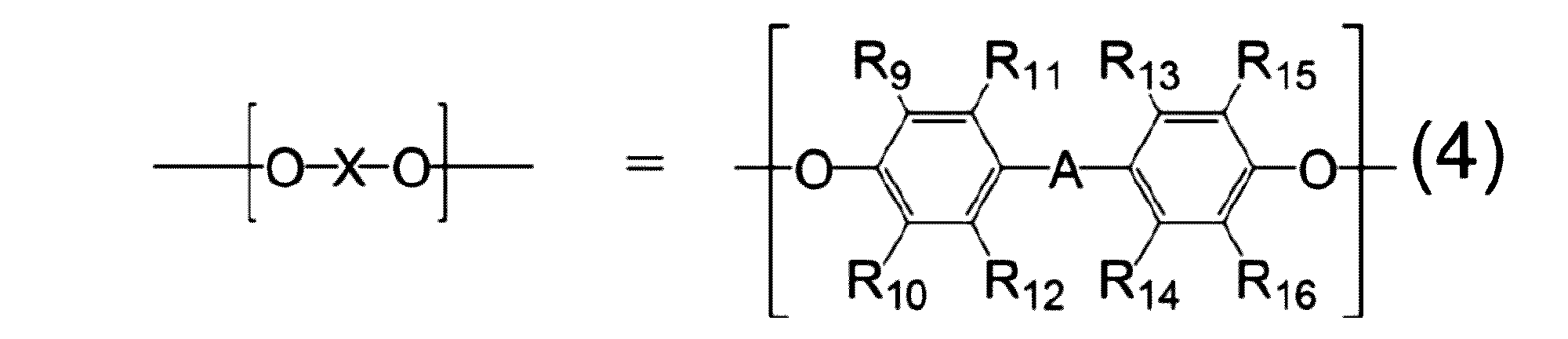

- 前記一般式(2)中、-(O-X-O)-が下記一般式(6)、下記一般式(7)、又は一般式(8)で表される構造であり、-(Y-O)-が下記一般式(9)又は下記一般式(10)で表される構造であり、複数の-(Y-O)-が連続して配列している場合、1種類の構造が配列しているか、あるいは下記一般式(9)及び下記一般式(10)で表される構造が規則的に又は不規則的に配列している、請求項2に記載の樹脂組成物。
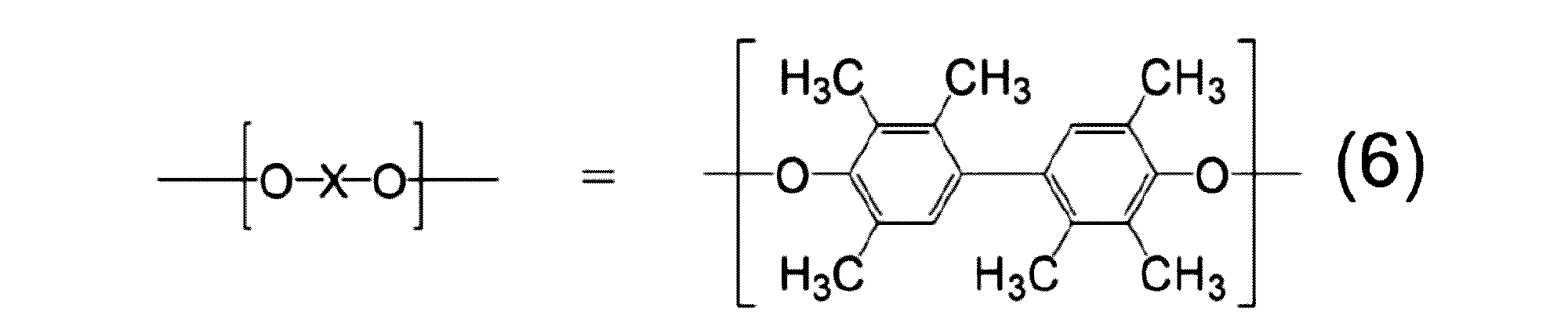


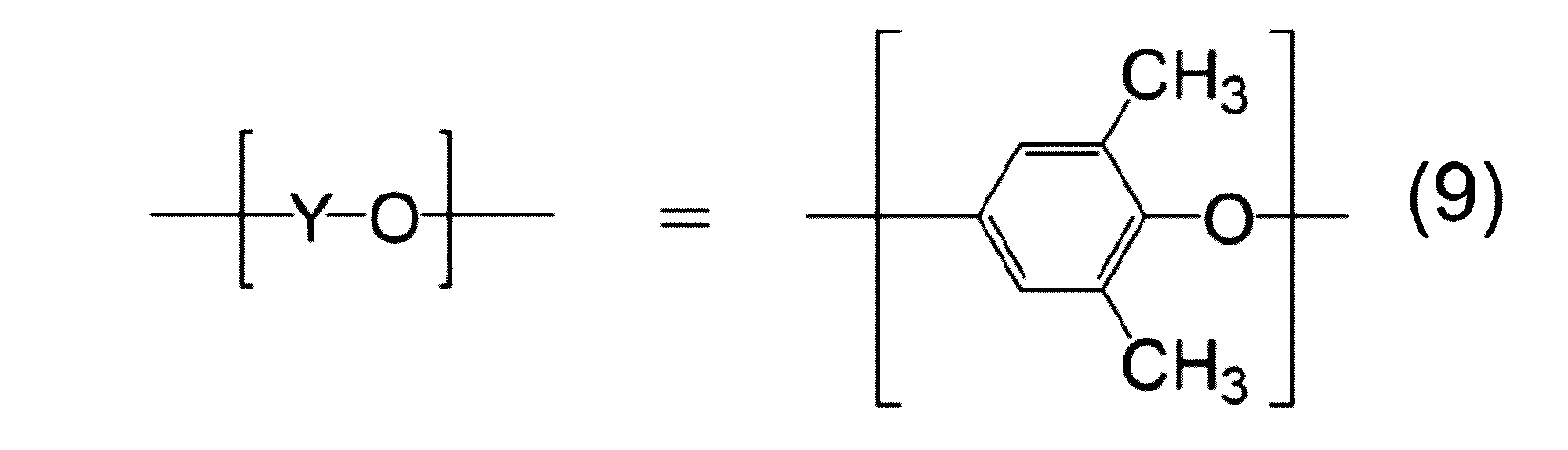
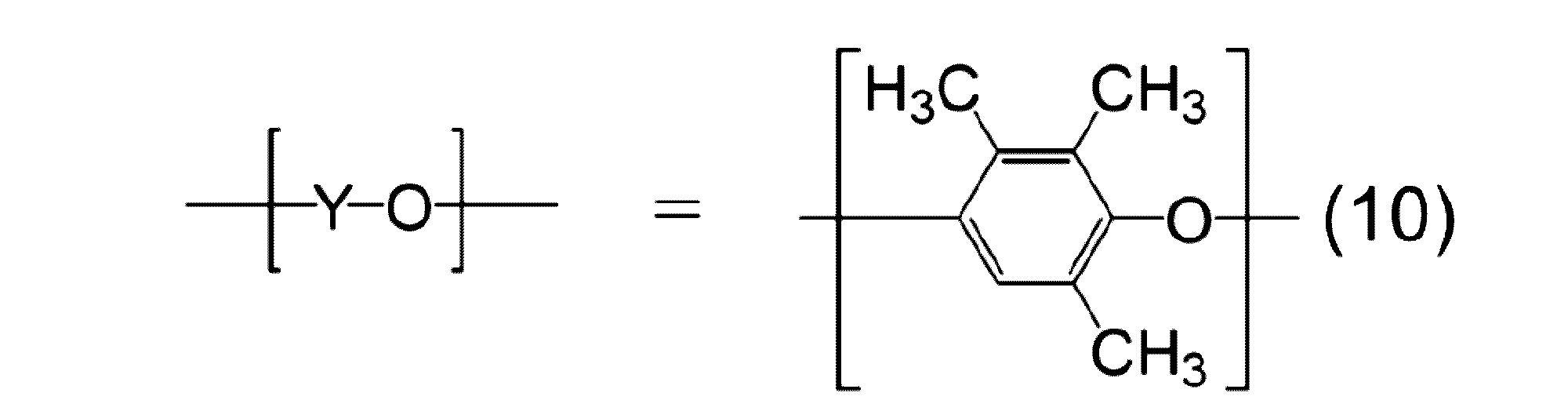
- 前記樹脂組成物中の樹脂固形分を100質量部としたとき、前記一般式(1)で示されるポリマレイミド化合物(A)の含有量が、1~90質量部である、請求項1~請求項3のいずれか一項に記載の樹脂組成物。
- 前記樹脂組成物中の樹脂固形分を100質量部としたとき、前記変性ポリフェニレンエーテル(B)の含有量が、1~90質量部である、請求項1~請求項4のいずれか一項に記載の樹脂組成物。
- 前記一般式(1)で表されるポリマレイミド化合物(A)以外のマレイミド化合物、エポキシ樹脂、フェノール樹脂、オキセタン樹脂、ベンゾオキサジン化合物、前記変性ポリフェニレンエーテル(B)以外の重合可能な不飽和基を有する化合物、エラストマー、活性エステル化合物、及び、シアン酸エステル化合物からなる群より選択される少なくとも1種以上の他の成分(D)をさらに含有する、請求項1~請求項5のいずれか一項に記載の樹脂組成物。
- 前記樹脂組成物における、前記充填材(C)の含有量が、樹脂固形分100質量部に対し、50~1600質量部である、請求項1~請求項6のいずれか一項に記載の樹脂組成物。
- 基材と、前記基材上に含浸又は塗布された請求項1~7のいずれか一項に記載の樹脂組成物とを含むプリプレグ。
- 少なくとも1枚以上重ねた請求項8に記載のプリプレグと、前記プリプレグの片面又は両面に配置した金属箔とを含む金属箔張積層板。
- 支持体と、前記支持体の表面に配置した請求項1~7のいずれか一項に記載の樹脂組成物とを含む樹脂複合シート。
- 絶縁層と、前記絶縁層の表面に配置した導体層とを含むプリント配線板であって、前記絶縁層が、請求項1~7のいずれか一項に記載の樹脂組成物を含むプリント配線板。
Priority Applications (5)
| Application Number | Priority Date | Filing Date | Title |
|---|---|---|---|
| CN201980005889.3A CN111386313B (zh) | 2018-01-09 | 2019-01-08 | 树脂组合物、预浸料、覆金属箔层叠板、树脂复合片、及印刷布线板 |
| EP19738272.4A EP3739005B1 (en) | 2018-01-09 | 2019-01-08 | Resin composition, prepreg, metal-foil-lined laminate, resin composite sheet, and printed circuit board |
| KR1020207014226A KR102165971B1 (ko) | 2018-01-09 | 2019-01-08 | 수지 조성물, 프리프레그, 금속박 피복 적층판, 수지 복합 시트, 및 프린트 배선판 |
| US16/960,181 US11008420B2 (en) | 2018-01-09 | 2019-01-08 | Resin composition, prepreg, metal foil-clad laminate, resin composite sheet, and printed wiring board |
| JP2019519778A JP6631899B2 (ja) | 2018-01-09 | 2019-01-08 | 樹脂組成物、プリプレグ、金属箔張積層板、樹脂複合シート、及びプリント配線板 |
Applications Claiming Priority (2)
| Application Number | Priority Date | Filing Date | Title |
|---|---|---|---|
| JP2018001490 | 2018-01-09 | ||
| JP2018-001490 | 2018-01-09 |
Publications (1)
| Publication Number | Publication Date |
|---|---|
| WO2019138992A1 true WO2019138992A1 (ja) | 2019-07-18 |
Family
ID=67219653
Family Applications (1)
| Application Number | Title | Priority Date | Filing Date |
|---|---|---|---|
| PCT/JP2019/000176 Ceased WO2019138992A1 (ja) | 2018-01-09 | 2019-01-08 | 樹脂組成物、プリプレグ、金属箔張積層板、樹脂複合シート、及びプリント配線板 |
Country Status (7)
| Country | Link |
|---|---|
| US (1) | US11008420B2 (ja) |
| EP (1) | EP3739005B1 (ja) |
| JP (1) | JP6631899B2 (ja) |
| KR (1) | KR102165971B1 (ja) |
| CN (1) | CN111386313B (ja) |
| TW (1) | TWI719382B (ja) |
| WO (1) | WO2019138992A1 (ja) |
Cited By (16)
| Publication number | Priority date | Publication date | Assignee | Title |
|---|---|---|---|---|
| WO2020031935A1 (ja) * | 2018-08-06 | 2020-02-13 | 日本化薬株式会社 | 硬化性樹脂混合物、硬化性樹脂組成物及びその硬化物 |
| WO2021157249A1 (ja) * | 2020-02-07 | 2021-08-12 | パナソニックIpマネジメント株式会社 | 樹脂組成物、プリプレグ、樹脂付きフィルム、樹脂付き金属箔、金属張積層板、及び配線板 |
| WO2022054861A1 (ja) * | 2020-09-11 | 2022-03-17 | パナソニックIpマネジメント株式会社 | 樹脂組成物、プリプレグ、樹脂付きフィルム、樹脂付き金属箔、金属張積層板、及び配線板 |
| CN114423821A (zh) * | 2019-09-27 | 2022-04-29 | 松下知识产权经营株式会社 | 树脂组合物、和使用其的预浸料、带树脂的膜、带树脂的金属箔、覆金属箔层压板及布线板 |
| JPWO2022102756A1 (ja) * | 2020-11-12 | 2022-05-19 | ||
| WO2022210227A1 (ja) * | 2021-03-29 | 2022-10-06 | パナソニックIpマネジメント株式会社 | 樹脂組成物、プリプレグ、樹脂付きフィルム、樹脂付き金属箔、金属張積層板、及び配線板 |
| KR20220146463A (ko) | 2020-02-25 | 2022-11-01 | 미츠비시 가스 가가쿠 가부시키가이샤 | 수지 조성물, 경화물, 프리프레그, 금속박 피복 적층판, 수지 시트, 및, 프린트 배선판 |
| KR20220146464A (ko) | 2020-02-25 | 2022-11-01 | 미츠비시 가스 가가쿠 가부시키가이샤 | 수지 조성물, 경화물, 프리프레그, 금속박 피복 적층판, 수지 시트, 및, 프린트 배선판 |
| US20220363798A1 (en) * | 2019-06-27 | 2022-11-17 | Panasonic Intellectual Property Management Co., Ltd. | Resin composition, prepreg, resin-attached film, resin-attached metal foil, metal-cladded laminate sheet, and wiring board |
| US20230272213A1 (en) * | 2020-07-17 | 2023-08-31 | Panasonic Intellectual Property Management Co., Ltd. | Resin composition, prepreg, film provided with resin, metal foil provided with resin, metal-clad laminate, and wiring board |
| JP2023181910A (ja) * | 2022-06-13 | 2023-12-25 | Eneos株式会社 | 硬化性組成物、該組成物の硬化物、該組成物および該硬化物の製造方法、ならびに半導体装置 |
| WO2024018946A1 (ja) * | 2022-07-20 | 2024-01-25 | パナソニックIpマネジメント株式会社 | 樹脂組成物、プリプレグ、樹脂付きフィルム、樹脂付き金属箔、金属張積層板、及び配線板 |
| WO2024034276A1 (ja) | 2022-08-09 | 2024-02-15 | 三菱瓦斯化学株式会社 | 金属箔張積層板の製造方法、樹脂組成物、樹脂複合シート、プリント配線板の製造方法、および、半導体装置の製造方法 |
| WO2024090408A1 (ja) | 2022-10-26 | 2024-05-02 | 三菱瓦斯化学株式会社 | 樹脂組成物、硬化物、プリプレグ、金属箔張積層板、樹脂複合シート、および、プリント配線板 |
| WO2024090409A1 (ja) | 2022-10-27 | 2024-05-02 | 三菱瓦斯化学株式会社 | 樹脂組成物、硬化物、プリプレグ、金属箔張積層板、樹脂複合シート、および、プリント配線板 |
| EP4563610A4 (en) * | 2022-07-25 | 2025-12-10 | Mitsubishi Gas Chemical Co | RESIN COMPOSITION CONTAINING A BIFUNCTIONAL PHENYLENE ETHER RESIN |
Families Citing this family (6)
| Publication number | Priority date | Publication date | Assignee | Title |
|---|---|---|---|---|
| TWI912346B (zh) * | 2020-09-01 | 2026-01-21 | 日商Jsr股份有限公司 | 預浸體、覆金屬積層板及印刷配線板 |
| WO2022102757A1 (ja) * | 2020-11-12 | 2022-05-19 | 味の素株式会社 | 樹脂組成物 |
| JP7459394B2 (ja) * | 2022-03-14 | 2024-04-01 | 三菱瓦斯化学株式会社 | 樹脂組成物、硬化物、プリプレグ、金属箔張積層板、樹脂複合シート、プリント配線板、および、半導体装置 |
| TWI843244B (zh) * | 2022-10-20 | 2024-05-21 | 台燿科技股份有限公司 | 樹脂組成物及其應用 |
| CN117965010A (zh) * | 2022-10-25 | 2024-05-03 | 中山台光电子材料有限公司 | 树脂组合物及其制品 |
| TWI818811B (zh) * | 2022-11-21 | 2023-10-11 | 南亞塑膠工業股份有限公司 | 樹脂組成物 |
Citations (11)
| Publication number | Priority date | Publication date | Assignee | Title |
|---|---|---|---|---|
| JPS5233710B2 (ja) | 1974-08-05 | 1977-08-30 | ||
| JP2004277460A (ja) | 2003-03-12 | 2004-10-07 | Tdk Corp | エポキシ樹脂組成物およびそれから得られるシート、プリプレグ状材料、金属箔付シート、積層板、電気絶縁用材料、レジスト材料 |
| JP2009040934A (ja) * | 2007-08-10 | 2009-02-26 | Nippon Steel Chem Co Ltd | 硬化性樹脂組成物 |
| JP2009161725A (ja) * | 2007-05-31 | 2009-07-23 | Mitsubishi Gas Chem Co Inc | 硬化性樹脂組成物および硬化性フィルムならびにそれらの硬化物 |
| JP2010138364A (ja) | 2008-02-12 | 2010-06-24 | Mitsubishi Gas Chemical Co Inc | 樹脂組成物、プリプレグおよび金属箔張り積層板 |
| WO2015152427A1 (ja) * | 2014-04-04 | 2015-10-08 | 日立化成株式会社 | N-置換マレイミド基を有するポリフェニレンエーテル誘導体、並びにそれを用いた熱硬化性樹脂組成物、樹脂ワニス、プリプレグ、金属張積層板、及び多層プリント配線板 |
| WO2016072404A1 (ja) | 2014-11-06 | 2016-05-12 | 三菱瓦斯化学株式会社 | 樹脂組成物、プリプレグ、金属箔張積層板、樹脂複合シート、及びプリント配線板 |
| WO2016114286A1 (ja) * | 2015-01-13 | 2016-07-21 | 日立化成株式会社 | 樹脂組成物、樹脂層付き支持体、プリプレグ、積層板、多層プリント配線板及びミリ波レーダー用プリント配線板 |
| WO2017122460A1 (ja) * | 2016-01-13 | 2017-07-20 | 太陽インキ製造株式会社 | ドライフィルムおよびプリント配線板 |
| JP2017128718A (ja) | 2016-01-19 | 2017-07-27 | パナソニックIpマネジメント株式会社 | ポリフェニレンエーテル樹脂組成物、プリプレグ、金属張積層板及びプリント配線板 |
| JP2018001490A (ja) | 2016-06-29 | 2018-01-11 | セイコーエプソン株式会社 | 記録装置 |
Family Cites Families (9)
| Publication number | Priority date | Publication date | Assignee | Title |
|---|---|---|---|---|
| JP5435685B2 (ja) | 2007-02-28 | 2014-03-05 | ナミックス株式会社 | 封止用樹脂フィルム |
| JP2010046914A (ja) * | 2008-08-21 | 2010-03-04 | Asahi Kasei Chemicals Corp | 積層体及びその製造方法 |
| JP5435699B2 (ja) | 2009-03-06 | 2014-03-05 | ナミックス株式会社 | 配線基板の製造方法、配線基板および半導体装置 |
| CN104341766B (zh) * | 2013-08-09 | 2017-03-01 | 台光电子材料(昆山)有限公司 | 低介电树脂组合物及应用其的铜箔基板及印刷电路板 |
| CN104629341B (zh) * | 2013-11-08 | 2017-01-04 | 中山台光电子材料有限公司 | 低介电树脂组合物,应用其的半固化胶片、覆铜箔基板、电路板 |
| CN104725828B (zh) * | 2015-03-04 | 2017-11-21 | 广东生益科技股份有限公司 | 一种树脂组合物以及使用它的预浸料和层压板 |
| TWI589628B (zh) | 2015-12-09 | 2017-07-01 | 中山台光電子材料有限公司 | 樹脂組合物 |
| CN110366569B (zh) | 2017-03-02 | 2022-07-22 | 松下知识产权经营株式会社 | 树脂组合物、预浸料、带树脂的膜、带树脂的金属箔、覆金属箔层压板以及布线板 |
| KR102601823B1 (ko) * | 2017-12-28 | 2023-11-14 | 파나소닉 아이피 매니지먼트 가부시키가이샤 | 수지 조성물, 프리프레그, 수지 부착 필름, 수지 부착 금속박, 금속 클래드 적층판, 및 배선판 |
-
2019
- 2019-01-08 CN CN201980005889.3A patent/CN111386313B/zh active Active
- 2019-01-08 WO PCT/JP2019/000176 patent/WO2019138992A1/ja not_active Ceased
- 2019-01-08 KR KR1020207014226A patent/KR102165971B1/ko active Active
- 2019-01-08 US US16/960,181 patent/US11008420B2/en active Active
- 2019-01-08 EP EP19738272.4A patent/EP3739005B1/en active Active
- 2019-01-08 JP JP2019519778A patent/JP6631899B2/ja active Active
- 2019-01-09 TW TW108100799A patent/TWI719382B/zh active
Patent Citations (12)
| Publication number | Priority date | Publication date | Assignee | Title |
|---|---|---|---|---|
| JPS5233710B2 (ja) | 1974-08-05 | 1977-08-30 | ||
| JP2004277460A (ja) | 2003-03-12 | 2004-10-07 | Tdk Corp | エポキシ樹脂組成物およびそれから得られるシート、プリプレグ状材料、金属箔付シート、積層板、電気絶縁用材料、レジスト材料 |
| JP2009161725A (ja) * | 2007-05-31 | 2009-07-23 | Mitsubishi Gas Chem Co Inc | 硬化性樹脂組成物および硬化性フィルムならびにそれらの硬化物 |
| JP2009040934A (ja) * | 2007-08-10 | 2009-02-26 | Nippon Steel Chem Co Ltd | 硬化性樹脂組成物 |
| JP2010138364A (ja) | 2008-02-12 | 2010-06-24 | Mitsubishi Gas Chemical Co Inc | 樹脂組成物、プリプレグおよび金属箔張り積層板 |
| WO2015152427A1 (ja) * | 2014-04-04 | 2015-10-08 | 日立化成株式会社 | N-置換マレイミド基を有するポリフェニレンエーテル誘導体、並びにそれを用いた熱硬化性樹脂組成物、樹脂ワニス、プリプレグ、金属張積層板、及び多層プリント配線板 |
| JP6079930B2 (ja) | 2014-04-04 | 2017-02-15 | 日立化成株式会社 | N−置換マレイミド基を有するポリフェニレンエーテル誘導体、並びにそれを用いた熱硬化性樹脂組成物、樹脂ワニス、プリプレグ、金属張積層板、及び多層プリント配線板 |
| WO2016072404A1 (ja) | 2014-11-06 | 2016-05-12 | 三菱瓦斯化学株式会社 | 樹脂組成物、プリプレグ、金属箔張積層板、樹脂複合シート、及びプリント配線板 |
| WO2016114286A1 (ja) * | 2015-01-13 | 2016-07-21 | 日立化成株式会社 | 樹脂組成物、樹脂層付き支持体、プリプレグ、積層板、多層プリント配線板及びミリ波レーダー用プリント配線板 |
| WO2017122460A1 (ja) * | 2016-01-13 | 2017-07-20 | 太陽インキ製造株式会社 | ドライフィルムおよびプリント配線板 |
| JP2017128718A (ja) | 2016-01-19 | 2017-07-27 | パナソニックIpマネジメント株式会社 | ポリフェニレンエーテル樹脂組成物、プリプレグ、金属張積層板及びプリント配線板 |
| JP2018001490A (ja) | 2016-06-29 | 2018-01-11 | セイコーエプソン株式会社 | 記録装置 |
Cited By (28)
| Publication number | Priority date | Publication date | Assignee | Title |
|---|---|---|---|---|
| WO2020031935A1 (ja) * | 2018-08-06 | 2020-02-13 | 日本化薬株式会社 | 硬化性樹脂混合物、硬化性樹脂組成物及びその硬化物 |
| US12534584B2 (en) * | 2019-06-27 | 2026-01-27 | Panasonic Intellectual Property Management Co., Ltd. | Resin composition, prepreg, resin-attached film, resin-attached metal foil, metal-cladded laminate sheet, and wiring board |
| US20220363798A1 (en) * | 2019-06-27 | 2022-11-17 | Panasonic Intellectual Property Management Co., Ltd. | Resin composition, prepreg, resin-attached film, resin-attached metal foil, metal-cladded laminate sheet, and wiring board |
| US20220356349A1 (en) * | 2019-09-27 | 2022-11-10 | Panasonic Intellectual Property Management Co., Ltd. | Resin composition, prepreg obtained using same, resin-coated film, resin-coated metal foil, metal-clad laminate, and wiring board |
| CN114423821A (zh) * | 2019-09-27 | 2022-04-29 | 松下知识产权经营株式会社 | 树脂组合物、和使用其的预浸料、带树脂的膜、带树脂的金属箔、覆金属箔层压板及布线板 |
| WO2021157249A1 (ja) * | 2020-02-07 | 2021-08-12 | パナソニックIpマネジメント株式会社 | 樹脂組成物、プリプレグ、樹脂付きフィルム、樹脂付き金属箔、金属張積層板、及び配線板 |
| KR20220146463A (ko) | 2020-02-25 | 2022-11-01 | 미츠비시 가스 가가쿠 가부시키가이샤 | 수지 조성물, 경화물, 프리프레그, 금속박 피복 적층판, 수지 시트, 및, 프린트 배선판 |
| US12384916B2 (en) | 2020-02-25 | 2025-08-12 | Mitsubishi Gas Chemical Company, Inc. | Resin composition, cured product, prepreg, metal foil-clad laminate, resin sheet, and printed wiring board |
| KR20220146464A (ko) | 2020-02-25 | 2022-11-01 | 미츠비시 가스 가가쿠 가부시키가이샤 | 수지 조성물, 경화물, 프리프레그, 금속박 피복 적층판, 수지 시트, 및, 프린트 배선판 |
| US20230101507A1 (en) * | 2020-02-25 | 2023-03-30 | Mitsubishi Gas Chemical Company, Inc | Resin composition, cured product, prepreg, metal foil-clad laminate, resin sheet, and printed wiring board |
| US12534617B2 (en) | 2020-02-25 | 2026-01-27 | Mitsubishi Gas Chemical Company, Inc. | Resin composition, cured product, prepreg, metal foil-clad laminate, resin sheet, and printed wiring board |
| US20230272213A1 (en) * | 2020-07-17 | 2023-08-31 | Panasonic Intellectual Property Management Co., Ltd. | Resin composition, prepreg, film provided with resin, metal foil provided with resin, metal-clad laminate, and wiring board |
| JPWO2022054861A1 (ja) * | 2020-09-11 | 2022-03-17 | ||
| WO2022054861A1 (ja) * | 2020-09-11 | 2022-03-17 | パナソニックIpマネジメント株式会社 | 樹脂組成物、プリプレグ、樹脂付きフィルム、樹脂付き金属箔、金属張積層板、及び配線板 |
| CN116018263A (zh) * | 2020-09-11 | 2023-04-25 | 松下知识产权经营株式会社 | 树脂组合物、预浸料、带树脂的膜、带树脂的金属箔、覆金属箔层压板、以及布线板 |
| JP7792613B2 (ja) | 2020-09-11 | 2025-12-26 | パナソニックIpマネジメント株式会社 | 樹脂組成物、プリプレグ、樹脂付きフィルム、樹脂付き金属箔、金属張積層板、及び配線板 |
| JPWO2022102756A1 (ja) * | 2020-11-12 | 2022-05-19 | ||
| JPWO2022210227A1 (ja) * | 2021-03-29 | 2022-10-06 | ||
| US12286500B2 (en) | 2021-03-29 | 2025-04-29 | Panasonic Intellectual Property Management Co., Ltd. | Resin composition, prepreg, resin-equipped film, resin- equipped metal foil, metal-clad laminate, and wiring board |
| WO2022210227A1 (ja) * | 2021-03-29 | 2022-10-06 | パナソニックIpマネジメント株式会社 | 樹脂組成物、プリプレグ、樹脂付きフィルム、樹脂付き金属箔、金属張積層板、及び配線板 |
| JP2023181910A (ja) * | 2022-06-13 | 2023-12-25 | Eneos株式会社 | 硬化性組成物、該組成物の硬化物、該組成物および該硬化物の製造方法、ならびに半導体装置 |
| WO2024018946A1 (ja) * | 2022-07-20 | 2024-01-25 | パナソニックIpマネジメント株式会社 | 樹脂組成物、プリプレグ、樹脂付きフィルム、樹脂付き金属箔、金属張積層板、及び配線板 |
| EP4563610A4 (en) * | 2022-07-25 | 2025-12-10 | Mitsubishi Gas Chemical Co | RESIN COMPOSITION CONTAINING A BIFUNCTIONAL PHENYLENE ETHER RESIN |
| WO2024034276A1 (ja) | 2022-08-09 | 2024-02-15 | 三菱瓦斯化学株式会社 | 金属箔張積層板の製造方法、樹脂組成物、樹脂複合シート、プリント配線板の製造方法、および、半導体装置の製造方法 |
| WO2024090408A1 (ja) | 2022-10-26 | 2024-05-02 | 三菱瓦斯化学株式会社 | 樹脂組成物、硬化物、プリプレグ、金属箔張積層板、樹脂複合シート、および、プリント配線板 |
| KR20250096750A (ko) | 2022-10-26 | 2025-06-27 | 미츠비시 가스 가가쿠 가부시키가이샤 | 수지 조성물, 경화물, 프리프레그, 금속박 피복 적층판, 수지 복합 시트, 및, 프린트 배선판 |
| WO2024090409A1 (ja) | 2022-10-27 | 2024-05-02 | 三菱瓦斯化学株式会社 | 樹脂組成物、硬化物、プリプレグ、金属箔張積層板、樹脂複合シート、および、プリント配線板 |
| KR20250097842A (ko) | 2022-10-27 | 2025-06-30 | 미츠비시 가스 가가쿠 가부시키가이샤 | 수지 조성물, 경화물, 프리프레그, 금속박 피복 적층판, 수지 복합 시트, 및 프린트 배선판 |
Also Published As
| Publication number | Publication date |
|---|---|
| EP3739005A1 (en) | 2020-11-18 |
| CN111386313A (zh) | 2020-07-07 |
| EP3739005B1 (en) | 2024-04-10 |
| EP3739005A4 (en) | 2021-10-20 |
| KR102165971B1 (ko) | 2020-10-15 |
| JP6631899B2 (ja) | 2020-01-15 |
| CN111386313B (zh) | 2020-10-30 |
| JPWO2019138992A1 (ja) | 2020-01-16 |
| US11008420B2 (en) | 2021-05-18 |
| TW201934631A (zh) | 2019-09-01 |
| US20210032404A1 (en) | 2021-02-04 |
| KR20200058581A (ko) | 2020-05-27 |
| TWI719382B (zh) | 2021-02-21 |
Similar Documents
| Publication | Publication Date | Title |
|---|---|---|
| JP6631899B2 (ja) | 樹脂組成物、プリプレグ、金属箔張積層板、樹脂複合シート、及びプリント配線板 | |
| JP7276333B2 (ja) | 樹脂組成物、プリプレグ、金属箔張積層板、樹脂複合シート、および、プリント配線板 | |
| KR102877886B1 (ko) | 수지 조성물 및 그 응용 | |
| US10550244B2 (en) | Resin composition, prepreg, metal foil-clad laminate, resin composite sheet, and printed wiring board | |
| EP3786230B1 (en) | Thermosetting composition, prepreg, metal foil-clad laminate, resin sheet, and printed wiring board | |
| JP2025168366A (ja) | 樹脂組成物、硬化物、プリプレグ、金属箔張積層板、樹脂シート、および、プリント配線板 | |
| EP3272782B1 (en) | Resin composition, prepreg, metal foil-clad laminate, resin sheet, and printed wiring board | |
| TWI636089B (zh) | 樹脂組成物、預浸體、疊層片及覆金屬箔疊層板 |
Legal Events
| Date | Code | Title | Description |
|---|---|---|---|
| ENP | Entry into the national phase |
Ref document number: 2019519778 Country of ref document: JP Kind code of ref document: A |
|
| 121 | Ep: the epo has been informed by wipo that ep was designated in this application |
Ref document number: 19738272 Country of ref document: EP Kind code of ref document: A1 |
|
| ENP | Entry into the national phase |
Ref document number: 20207014226 Country of ref document: KR Kind code of ref document: A |
|
| NENP | Non-entry into the national phase |
Ref country code: DE |
|
| ENP | Entry into the national phase |
Ref document number: 2019738272 Country of ref document: EP Effective date: 20200810 |