WO2019111887A1 - 樹脂成形品 - Google Patents
樹脂成形品 Download PDFInfo
- Publication number
- WO2019111887A1 WO2019111887A1 PCT/JP2018/044545 JP2018044545W WO2019111887A1 WO 2019111887 A1 WO2019111887 A1 WO 2019111887A1 JP 2018044545 W JP2018044545 W JP 2018044545W WO 2019111887 A1 WO2019111887 A1 WO 2019111887A1
- Authority
- WO
- WIPO (PCT)
- Prior art keywords
- resin
- molded body
- layer side
- surface layer
- mold
- Prior art date
- Legal status (The legal status is an assumption and is not a legal conclusion. Google has not performed a legal analysis and makes no representation as to the accuracy of the status listed.)
- Ceased
Links
Images





Classifications
-
- B—PERFORMING OPERATIONS; TRANSPORTING
- B29—WORKING OF PLASTICS; WORKING OF SUBSTANCES IN A PLASTIC STATE IN GENERAL
- B29C—SHAPING OR JOINING OF PLASTICS; SHAPING OF MATERIAL IN A PLASTIC STATE, NOT OTHERWISE PROVIDED FOR; AFTER-TREATMENT OF THE SHAPED PRODUCTS, e.g. REPAIRING
- B29C45/00—Injection moulding, i.e. forcing the required volume of moulding material through a nozzle into a closed mould; Apparatus therefor
- B29C45/16—Making multilayered or multicoloured articles
-
- B—PERFORMING OPERATIONS; TRANSPORTING
- B29—WORKING OF PLASTICS; WORKING OF SUBSTANCES IN A PLASTIC STATE IN GENERAL
- B29C—SHAPING OR JOINING OF PLASTICS; SHAPING OF MATERIAL IN A PLASTIC STATE, NOT OTHERWISE PROVIDED FOR; AFTER-TREATMENT OF THE SHAPED PRODUCTS, e.g. REPAIRING
- B29C45/00—Injection moulding, i.e. forcing the required volume of moulding material through a nozzle into a closed mould; Apparatus therefor
- B29C45/17—Component parts, details or accessories; Auxiliary operations
- B29C45/26—Moulds
-
- B—PERFORMING OPERATIONS; TRANSPORTING
- B29—WORKING OF PLASTICS; WORKING OF SUBSTANCES IN A PLASTIC STATE IN GENERAL
- B29C—SHAPING OR JOINING OF PLASTICS; SHAPING OF MATERIAL IN A PLASTIC STATE, NOT OTHERWISE PROVIDED FOR; AFTER-TREATMENT OF THE SHAPED PRODUCTS, e.g. REPAIRING
- B29C45/00—Injection moulding, i.e. forcing the required volume of moulding material through a nozzle into a closed mould; Apparatus therefor
- B29C45/17—Component parts, details or accessories; Auxiliary operations
- B29C45/46—Means for plasticising or homogenising the moulding material or forcing it into the mould
- B29C45/56—Means for plasticising or homogenising the moulding material or forcing it into the mould using mould parts movable during or after injection, e.g. injection-compression moulding
Definitions
- the present invention relates to a resin molded product having a pseudo stitch pattern formed on a design surface.
- leather is sometimes used in interiors of moving means such as automobiles, aircrafts, trains and ships, as well as in furniture, etc. in order to create a sense of luxury.
- stitches may be arranged by twisting yarn, leather yarn (string), and the like. This stitch (stitch) can produce a feeling of manual work, and this feeling of manual work can produce a more luxurious feeling in combination with the material feeling such as the appearance and feel of the leather itself.
- Patent Document 1 discloses a method of molding such a resin molded product.
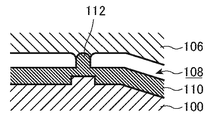
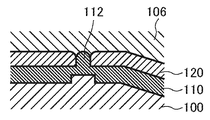
- a first cavity 104 is formed between the common mold portion 100 and the first mold 102, as shown in FIG. 8A.
- the base layer resin is injected into the first cavity 104, and in the first cavity 104, a plurality of stitch portions (grain portions) 112 formed so as to be juxtaposed on the front side are formed.
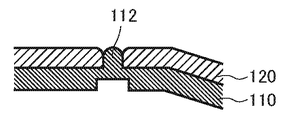
- the base material layer side molded body 110 is molded.
- the first mold 102 is replaced with the second mold 106 while leaving the base layer side molded body 110 in the common mold portion 100, whereby the protrusion of the stitch portion 112 is projected.
- a second cavity 108 is formed between the end-sealed second mold 106 and the common mold portion 100.
- the surface layer resin having a color different from that of the base layer resin is injected into the second cavity 108, and in the second cavity 108, on the front side of the base layer side molded body 110.
- the surface-side compact 120 is molded.
- a pseudo stitch pattern (stitch) on a design surface by a plurality of stitch portions 112 which are exposed and exposed from the surface of the surface layer side molded object 120 Is formed.
- Patent Document 2 a method using a resin material in which a glass fiber is filled with a propylene-ethylene block copolymer having a melting peak temperature of 110 to 150 ° C. as a resin for base layer has been proposed (Patent Document 2).
- Patent Document 2 by using a propylene-ethylene block copolymer having a relatively low melting peak temperature as the resin for the base layer, the molding shrinkage at the time of molding of the base layer side molded body is delayed, and further, Since it is possible to reduce the contraction rate itself by filling the glass fiber, the displacement between the molding surface and the projection end when sealing the projection end of the stitch portion on the molding surface of the second mold is reduced. It is said that this can make it possible to prevent the occurrence of flaws during two-color injection molding at the projecting end.
- the surface layer resin of a much larger amount relative to the volume of the stitch portion 112 is used as the second.
- the cavity 108 is filled.
- resin fluidity of the molten resin injected and filled and remelting (melting loss) by resin heat (resin temperature).
- the protruding end of the stitch portion 112 may be displaced with respect to the molding surface (cavity surface) of the sealed second mold 106. Then, as a result, the molten resin intrudes into the seal surface, and the delicate pattern (concave and convex portions simulating the twist) formed at the projecting end of the stitch portion 112 may be crushed.
- the shrinkage rate of a stitch part is made small intentionally by making resin for base material layers be filled with glass fiber.
- the shrinkage rate of the surface layer resin is larger than the shrinkage rate of the base layer resin (when the surface layer resin shrinks more than the base layer resin)
- it is thin and small at the time of cooling and solidification.
- the stitch portion may be pulled and deformed by the contraction of the surface layer side molded body, or a gap may be generated between the stitch portion and the hole portion of the surface layer side molded body.
- the present invention has been made in view of the above-described problems, and an object thereof is to provide a resin molded product in which a pseudo stitch pattern is precisely formed on a design surface.
- the resin molded product according to the present invention comprises a surface layer side molded body having a design surface on the surface, and a stitch portion which is laminated on the back surface side of the surface layer side molded body and exposed to the design surface side through the surface layer side molded body.
- a molded article having a base material layer side having the above-mentioned, and a pseudo stitch pattern formed on the design surface side by the stitch portion of the base material layer side molded article, wherein the surface layer side molding
- the surface layer resin forming the body has a melting point equal to or lower than the melting point of the base layer resin forming the base layer side molded body, and / or its linear expansion coefficient forms the base layer side molded body It is characterized by being below the linear expansion coefficient of resin for base material layers.
- the surface layer resin forming the surface layer side molded body has a melting point equal to or lower than the melting point of the base material layer resin forming the base material layer side molded body, and the wire
- the expansion coefficient is preferably equal to or less than the linear expansion coefficient of the base layer resin forming the base layer side molded body.
- the resin for surface layer and the resin for base layer be compatible.
- the surface layer resin is preferably made of a resin having a heat deformation temperature lower than that of the base layer resin.
- FIG. 1 is a perspective view schematically showing a resin molded product according to an embodiment of the present invention.
- FIG. 2 is a cross sectional view schematically showing a cross section taken along a line AA 'of FIG. 1; It is a schematic plan view which shows an example of the shape of a stitch-like design and the design surface of the vicinity.
- FIG. 5 is a schematic cross-sectional view taken along the line BB ′ of FIG. 3;
- FIG. 4 is a schematic cross-sectional view taken along the line CC ′ of FIG. 3; It is a figure which shows the mold-opened state of a common metal mold and a 1st metal mold among process drawing which shows an example of the shaping
- FIG. 1 shows the mold-opened state of the injection molding die among process drawings which show the other example of the shaping
- FIG. 1 It is a figure which shows a primary shaping
- FIG. It is a figure which shows a mold opening process among process drawing which shows the shaping
- FIG. It is a figure which shows the state which switched the metal mold
- FIG. 1 It is a figure which shows a secondary forming process among process drawing which shows the shaping
- FIG. It is a figure which shows the molded resin molded product among process drawing which shows the molding method of the resin molded product of patent document 1.
- FIG. 1 It is a figure which shows the molded resin molded product among process drawing which shows the molding method of the resin molded product of patent document 1.
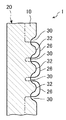
- the resin molded product 1 according to the present embodiment is, as shown in FIGS. 1 and 2, a surface layer side molded body 10 having a design surface on the surface, and a base material layer side laminated on the back surface side of the surface layer side molded body 10. It is a laminated molded article provided with the molded object 20.
- the base material layer side molded body 20 is exposed from the non-design surface portion 22 laminated on the back surface side of the surface layer side molded body 10 from the non-design surface portion 22 through the surface layer side molded body 10 (through) And a stitch portion 24.
- the front end portion (stitch-like design 26) of the stitch portion 24 is exposed to the design surface side through the surface layer side molded body 10 (that is, visible from the design surface side) And the base layer side molded body 20 is laminated and formed on the non-design surface side of the surface layer side molded body 10, so that a pseudo stitch pattern (stitched design 26) simulating a seam (yarn) is obtained. It is configured to be formed on the design surface side of the resin molded product 1.
- the stitch-like design 26 formed on the design surface of the resin molded product 1 is a three-dimensional model that simulates a yarn thread or leather thread (string) visible from the design surface separately from the design surface that simulates the leather surface.
- the stitch-like design 26 may include a surface design in which a three-dimensional design surface has unevenness of one twisted yarn, a cross-sectional shape of a leather yarn (string), and the like.
- the stitched design 26 is illustrated as a simple uneven shape for easy understanding, but the shape of the stitched design 26 and the design surface in the vicinity thereof is, for example, FIG.
- the shape shown in FIG. 5 can be obtained.
- the shape of the design surface in the vicinity of the stitch-like design 26 is such that the portion through which these yarns penetrate the stitch-like design 26 of the yarn thread or leather yarn (string) protruding from the design surface is the yarn It has a valley shape 30 to express the sewing.
- the valley shape 30 and the mountain shape 32 are formed smoothly and continuously.
- the valley shape 30 and the mountain shape 32 are formed by forming a recess and a protrusion, which represent irregularities in the vicinity of the seam, around the recess for forming the stitch portion 24 formed on the mold cavity surface of the mold. can do.
- the stitch design 26 can be more realistically expressed.
- the stitch pattern can be a flat stitch in which the stitch design 26 is substantially flush with the design surface.
- the stitch pattern can be a concave stitch in which the stitch design 26 recedes from the design surface.
- the non-design surface portion 22 of the base material layer side molded body 20 is laminated on the entire back surface (surface on the non-design surface side) of the surface layer side molded body 10
- the present invention is not limited to this, and the non-design surface portion 22 may be configured to be partially laminated on the back surface (surface on the non-design surface side) of the surface layer side molded body 10.
- the surface layer side molded body 10 and the base material layer side molded body 20 are formed of resins different in color from each other.
- the surface layer resin for forming the surface layer side molded body 10 has a melting point equal to or lower than the melting point of the base material layer resin for forming the base material layer side molded body 20 and / or the linear expansion coefficient thereof is the base material layer side molded body It is below the linear expansion coefficient of resin for base material layers which forms 20.
- the melting point of the resin material is a temperature at which melting of the resin material starts to occur.
- the linear expansion coefficient indicates the rate at which the length of the object changes due to the rise in temperature per temperature, and the rate at which the volume of the object changes due to the rise in temperature per the temperature It is a physical property associated with the thermal expansion coefficient (thermal expansion coefficient) shown. That is, at the time of resin molding, it means the degree of contraction at the time of cooling and solidification of the molten resin (the amount of contraction with respect to the reference length at the time of cooling and solidification). It means the degree of expansion and contraction.
- the linear expansion coefficient can be adjusted (basically reduced) by mixing various linear expansion coefficient modifiers, such as inorganic fillers called fillers, into the resin material.
- glass fiber etc. which are 1 type of fillers may be mixed in a resin material with a predetermined amount for the improvement of product strength, in this case, as a result, the linear expansion coefficient changes from the numerical value of the resin material alone. There is also a case.
- the resin for the surface layer and the resin for the base layer have a melting point of the resin for the surface layer equal to or less than the melting point of the resin for the base layer, and / or a linear expansion coefficient of the resin for the surface layer
- various resins can be used as long as they have a relationship of the linear expansion coefficient or less of the material for layer material.
- the main purpose is to prevent erosion of the base material layer side molded article
- the base layer side molded body 20 (particularly, the stitch portion 24) resulting from the flow of the surface layer resin.
- TPS styrene-based elastomer
- PP polypropylene
- fusing point uses the thing of 145-165 degreeC as the former TPS (surface layer resin), and the latter PP (base layer resin) It is further preferred to use one having a melting point of 168 ° C. That is, when the melting point of the surface layer resin is higher than the melting point of the base layer resin, there is a possibility that the stitch portion 24 may be remelted by the resin heat of the resin flow of the surface layer resin.
- the stitch portion 24 of the base layer resin is re-injected at the time of injection filling of the surface layer resin. Melting (melting loss) can be suppressed.
- the melting point is also called melting peak temperature, and can be measured by a differential scanning calorimeter (DSC).
- DSC differential scanning calorimeter
- the base layer side molded body 20 (especially when used as an automobile part, etc.) is prevented from displacement of the base material layer side molded body 20 (especially the stitch portion 24) during molding and the temperature change is severe
- an olefin-based elastomer (TPO) is employed as the surface layer resin
- polypropylene (PP) is employed as the base layer resin. It is preferable to adopt
- the linear expansion coefficient is 5-7 x 10 about the former TPO (resin for surface layers) by the grade selection of each resin material marketed, addition of a linear expansion coefficient regulator, etc. using those -5 / ° C.
- the linear expansion coefficient of the latter PP (resin base material layer) uses those 8.1 ⁇ 10 ⁇ 10 -5 / °C . That is, according to the knowledge of the present inventor, when the linear expansion coefficient of the surface layer resin exceeds the linear expansion coefficient of the base layer resin, as described above, when the cooling and solidification or the temperature environment during use changes.
- the stitch portion 24 of the base material layer side molded body 20 is pulled and deformed by the contraction of the surface layer side molded body 10, or a gap is formed in the contact surface (through hole portion 12) between the stitch portion 24 and the surface layer side molded body 10. It may occur.
- the linear expansion coefficient (5 to 7 ⁇ 10 ⁇ 5 / ° C.) of the surface layer resin is different from the linear expansion coefficient (8.1 to 10 ⁇ 10 ⁇ of the base layer resin).
- the degree of contraction and expansion of the surface layer side molded body 10 is the degree of contraction and expansion of the base material layer side molded body 20 at the time of temperature change during cooling solidification and use Smaller than.
- the combination of the resin for surface layer and the resin for base layer is, in addition to the effect of suppressing deformation and peeling of the base layer side molded body 20, securing of product rigidity by the base layer side molded body 20, low specific gravity material It is also possible to expect effects such as weight reduction of the product and soft soft feeling to the surface side molded body 10 by the above.
- the heat distortion temperature of the surface layer resin forming the surface layer side green body 10 may be lower than the heat deformation temperature of the base material layer resin forming the substrate layer side green body 20.
- the heat distortion temperature of the resin material is also called a weighted deflection temperature, and is one of the indicators indicating the heat resistance of the resin material. Specifically, the temperature of the test piece is raised while applying a determined load to the test piece supported at both ends, and the temperature of the test piece becomes a constant value of the deflection of the test piece.
- polyamide (PA6) is adopted as the surface layer resin. It is also possible to employ a mixture of glass fiber (GF) in a predetermined ratio with polyamide (PA6) as the base layer resin.
- the former PA6 surface layer resin
- the latter PA6 + GF for base layer layer
- the grade selection of resin materials commercially available. It is preferable to use one having a heat distortion temperature of 146 to 149 ° C. for the resin). That is, according to the knowledge of the present inventor, when the heat deformation temperature of the surface layer resin exceeds the heat deformation temperature of the base layer resin, as described above, when the cooling and solidification or the temperature environment during use changes.
- the stitch portion 24 of the base material layer side molded body 20 is pulled and deformed by the contraction of the surface layer side molded body 10, or a gap is formed in the contact surface (through hole portion 12) between the stitch portion 24 and the surface layer side molded body 10. It may occur.
- the heat deformation temperature (68 to 85 ° C.) of the surface layer resin is lower than the heat deformation temperature (146 to 149 ° C.) of the base layer resin.
- the degree of contraction and expansion of the surface layer side molded body 10 is smaller than the degree of contraction and expansion of the base material layer side molded body 20 when the temperature environment at the time of use changes.
- the surface layer side molded body 10 and the base material layer side molded body 20 be formed of a resin having excellent mutual compatibility (bondability / unification).
- the compatibility refers to the property of two or more resins being mutually soluble.
- the compatibility in the case of combining each of these resin materials can be judged using the solubility parameter (SP value) as a standard, and the smaller the difference in the solubility parameter (SP value) of each resin material, the better the compatibility. It can be said that In general, if the difference between the SP values of the respective resin materials is, for example, within ⁇ 10%, it can be said that they have excellent compatibility.
- the reference value of the difference in SP value of each resin material that can be judged to have excellent compatibility is such that it projects from the base material layer side molded body to the design surface side (second mold side) Since it differs depending on the size and shape of the stitch portion to be formed, and further on the relationship of the thickness of the surface layer side molded body, etc., it is determined by the molding test and the quality / strength / durability test of the molded product Is preferred.
- polyethylene terephthalate (PET) is employ
- PET polyethylene terephthalate
- PC polycarbonate
- Such a combination of the surface layer resin and the base layer resin can be applied to the effect of color development by utilizing the light source from the back surface of the base layer side molded body 20 or the like, or to the weathering of the surface side molded body 10 An effect can also be expected.
- SP value uses a thing of 21.8 about former PET (resin for surface layers) by grade selection of each resin material etc.
- PC resin for base material layers
- SP value 20.2.
- the difference between the SP values of the surface layer resin and the base layer resin is as low as about 7 to 8%, excellent compatibility can be ensured.
- the illustration is abbreviate
- the surface layer resin forming the surface layer side molded body has a linear expansion coefficient equal to or less than the linear expansion coefficient of the substrate layer resin forming the base layer side molded body, and / or its melting point It may be equal to or lower than the melting point of the base layer resin forming the base layer side molded body.
- the resin molded product 1 according to the present embodiment is the same as the method for molding a resin molded product of Patent Document 1 shown in FIGS. 8A to 8G.
- the base layer side molded body 20 having 24) is molded (see FIG. 8B).
- the first mold is replaced with the second mold while leaving the base material layer side molded body 20 in the common mold part (see FIGS. 8C and 8D) to seal the protruding end of the stitch part 24.
- the second cavity is formed between the second mold and the common mold portion (see FIG.
- the surface layer resin having a color different from that of the base layer resin is injected into the second cavity.
- the surface layer side molded body 10 is molded on the front side of the base material layer side molded body 20 (see FIG. 8F).
- the resin molded product 1 in which the pseudo stitch pattern (stitch) is formed on the design surface can be molded by the plurality of stitch portions 24 which protrude from the surface of the surface layer side molded body 10 and are exposed (FIG. 8G) reference).
- the resin molded product 1 which concerns on this embodiment is not limited to the molding method mentioned above, It is possible to shape
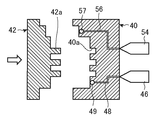
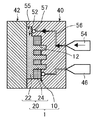
- the surface-side compact 10 is formed between the common mold 40 and the first mold 42, and then the mold to be combined with the common mold 40 is formed.
- a method of expanding the mold cavity by switching from the first mold 42 to the second mold 50, and laminating and molding the base layer side molded body 20 on the back surface side (non-design surface side) of the surface layer side molded body 10 is there.
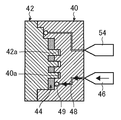
- the common mold 40 and the first mold 42 are first moved by moving the movable plate to the fixed plate side by a mold clamping mechanism not shown. And form a first mold cavity 44 between the common mold 40 and the first mold 42 by applying a predetermined clamping force.
- the surface layer resin is injected and filled into the first mold cavity 44 from the first injection unit 46 through the first resin flow path 48 and the first gate valve 49 (primary injection filling) Process).
- the surface layer resin is a foamable resin containing a chemical foaming agent
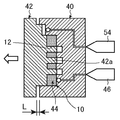
- the first mold 42 is moved from the common mold 40 by a minute distance L by a mold clamping mechanism (not shown). The mold is opened only, and the surface layer resin is foamed (micro mold opening step).
- the surface layer resin which has been foamed in the micro mold opening step is cooled and solidified, whereby the surface layer side molded body which is a foam molded body in which the foam layer is included in the surface layer (skin layer) in the first mold cavity 44. 10 is molded (primary molding step).
- the surface layer resin is not a foamable resin containing a chemical foaming agent
- the surface layer resin is cooled and solidified without undergoing the fine mold opening step, and the surface layer side molded body 10 is formed.
- the surface layer side molded body 10 has a design surface formed on the surface by the inner surface of the common mold 40. Further, in the surface layer side molded body 10, a plurality of through holes 12 penetrating from the surface (design surface) to the back surface (surface on the non-design surface) are formed by the convex portions 42a of the first mold 42. ing.
- the mold facing the common mold 40 by the mold clamping mechanism and the mold exchanging means not shown is the first mold. 42 is switched to the second mold 50.
- This mold switching step is performed in a state where the surface layer side molded body 10 is held by the common mold 40.
- the common mold 40 and the second mold 50 are clamped by moving the movable platen to the fixed platen side by a clamping mechanism (not shown).
- the resin for base layer is injected and filled in the mold cavity extension 55 from the second injection unit 54 through the second resin flow path 56 and the second gate valve 57. (Second injection filling process).
- stacked on the non-design surface side of the surface layer side molded object 10 is shape
- the stitched design applied to the recess 40 a of the common mold 40 is transferred to the tip of the stitch portion 24 of the base layer side molded body 20.
- the common mold 40 and the second mold 50 are opened by moving the movable disc in a direction away from the fixed disc by a mold clamping mechanism (not shown).
- the resin molded product 1 composed of the surface layer side molded body 10 and the base material layer side molded body 20 is carried out of the injection molding machine by the product taking out means (not shown), and the molding cycle is completed.
- simulated stitch pattern (stitch) was formed in the surface (design surface) can be manufactured continuously by repeating the above process.
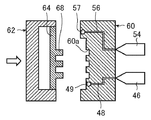
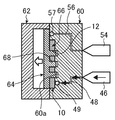
- the surface layer side molded body 10 is roughly formed between the fixed mold 60 and the movable mold 62, and then the movable portion of the movable mold 62 is formed.
- This is a method of expanding the mold cavity by retracting 64 and laminating and molding the base layer side molded body 20 on the back surface side (non-design surface side) of the surface layer side molded body 10.
- the movable platen is moved to the fixed platen side by a clamping mechanism (not shown), whereby the fixed mold 60 and the movable mold 62 and Is closed, and then a predetermined mold clamping force is applied to form a first mold cavity 66 between the fixed mold 60 and the movable mold 62.
- the movable portion 64 of the movable mold 62 is maintained in the state of being closest to the fixed mold 60.
- the surface layer resin is injected and filled in the first mold cavity 66 from the first injection unit 46 via the first resin flow path 48 and the first gate valve 49, and is solidified by cooling.
- the surface layer side molded body 10 is molded in the first mold cavity 66 (primary molding step).
- the surface layer side molded body 10 has a design surface formed on the surface by the inner surface of the fixed mold 60. Further, in the surface layer side molded body 10, a plurality of through holes 12 penetrating from the surface (design surface) to the back surface (surface on the non-design surface side) by the convex portions 68 of the movable portion 64 of the movable mold 62. Is formed.
- stacked on the non-design surface side of the surface layer side molded object 10 is shape
- the stitch-like design applied to the concave portion 60 a of the fixed mold 60 is transferred to the tip of the stitch portion 24 of the base layer side molded body 20.
- the fixed mold 60 and the movable mold 62 are opened by moving the movable board in a direction away from the fixed board by a mold clamping mechanism not shown. .
- the resin molded product 1 composed of the surface layer side molded body 10 and the base material layer side molded body 20 is carried out of the injection molding machine by the product taking out means (not shown), and the molding cycle is completed.
- simulated stitch pattern (stitch) was formed in the surface (design surface) can be manufactured continuously by repeating the above process.
- FIGS. 8A to 8G in the method for forming the base layer side molded body 20 after laminating the surface layer side molded body 10 as shown in FIGS. 6A to 6E and 7A to 7C.
- the protruding end portion (stitch-like design 26) of the stitch portion 24 of the base layer side molded body 20 and the method of laminating and forming the surface layer side molded body 10 after molding the base material layer side molded body 20 There is no need to engage with the molding surface of the second mold 50 to form a seal that prevents the resin material from entering between them.
- the resin for the base layer is filled in the concave portions 40a and 60a through the through holes 12 of the surface-side compact 10 formed previously, so the patent is issued.
- the stitch portion 24 disappears due to re-melting (melting loss) by resin heat, or shape deformation or positional deviation occurs due to resin flow force.
- the heat insulating property and heat retention property as the resin flow path of the through hole 12 formed of a resin (surface layer resin) having a thermal conductivity lower than that of the mold cavity are obtained by forming the entire stitch portion with the mold cavity Higher than one.
- the resin filling property of the resin for the base layer to the recesses 40a and 60a where the stitch-like design 26 is formed is excellent and the resin for the base layer in the recesses 40a and 60a It is suitable for forming a detailed stitch-like design 26 because it is also excellent in the injection filling pressure and the propagation of the holding pressure.
- the surface layer side molded body 10 and the base material layer side molded body 20 are formed of different resins, and for the surface layer forming the surface layer side molded body 10
- the base layer of which resin has a linear expansion coefficient equal to or less than that of the base layer resin forming the base layer side molded body 20 and / or a melting point thereof forms the base layer side molded body 20 It is below the melting point of the resin.
- the resin molded product 1 which concerns on this embodiment, when the coefficient of linear expansion of resin for surface layers is below the coefficient of linear expansion of resin for base material layers, at the time of the change of the temperature environment at the time of cooling solidification or use. Since the degree of contraction and expansion of the surface layer side molded body 10 is smaller than the degree of contraction and expansion of the base material layer side molded body 20, the stitch portion 24 of the base material layer side molded body 20 is It is possible to suppress a phenomenon in which it is pulled by contraction and deformed or a gap is generated between the stitch portion 24 and the through hole 12 of the surface layer side molded body 10.
- the resin molded product 1 according to the present embodiment when the melting point of the surface layer resin is equal to or lower than the melting point of the base layer resin, the remelting (melting loss) of the stitch portion 24 of the base layer resin is suppressed. can do. For this reason, according to the resin molded product 1 according to the present embodiment, it is possible to accurately manufacture a resin molded product having a pseudo stitch pattern formed on a design surface.
- the resin molded product according to the present invention is not limited to the configuration and shape of the resin molded product 1 illustrated in FIGS. 1 and 2, and has a design surface on the surface and a through hole penetrating from the surface to the back A surface-side molded body in which the portion is formed, a non-designed surface portion laminated on the back surface side of the surface-side molded body, and a stitch portion exposed from the non-designed surface portion to the design surface side through the through-hole portion of the surface-side molded body If it is a resin molded product provided with a base material layer side molded body having and the pseudo stitch pattern is formed on the design surface side by the stitch portion of the base material layer side molded body, various configurations and shapes are adopted. It is possible.
- the resin molded product according to the present invention can be molded by various mold configurations and processes without being limited to the above-described mold configuration and molding method by the processes.
Landscapes
- Engineering & Computer Science (AREA)
- Manufacturing & Machinery (AREA)
- Mechanical Engineering (AREA)
- Injection Moulding Of Plastics Or The Like (AREA)
- Moulds For Moulding Plastics Or The Like (AREA)
Applications Claiming Priority (2)
| Application Number | Priority Date | Filing Date | Title |
|---|---|---|---|
| JP2017-234881 | 2017-12-07 | ||
| JP2017234881A JP2019098691A (ja) | 2017-12-07 | 2017-12-07 | 樹脂成形品 |
Publications (1)
| Publication Number | Publication Date |
|---|---|
| WO2019111887A1 true WO2019111887A1 (ja) | 2019-06-13 |
Family
ID=66751601
Family Applications (1)
| Application Number | Title | Priority Date | Filing Date |
|---|---|---|---|
| PCT/JP2018/044545 Ceased WO2019111887A1 (ja) | 2017-12-07 | 2018-12-04 | 樹脂成形品 |
Country Status (2)
| Country | Link |
|---|---|
| JP (1) | JP2019098691A (https=) |
| WO (1) | WO2019111887A1 (https=) |
Citations (7)
| Publication number | Priority date | Publication date | Assignee | Title |
|---|---|---|---|---|
| JPS6464818A (en) * | 1987-09-07 | 1989-03-10 | Nishikawa Kasei Kk | Synthetic resin molded item and its production |
| JPH0999522A (ja) * | 1995-10-04 | 1997-04-15 | Japan Synthetic Rubber Co Ltd | 複層成形品 |
| JP2001150480A (ja) * | 1999-11-30 | 2001-06-05 | Hitachi Ltd | 透かし模様成形体 |
| JP2012139967A (ja) * | 2011-01-05 | 2012-07-26 | Inoac Corp | 複層部材の製造方法 |
| JP2014008707A (ja) * | 2012-06-29 | 2014-01-20 | Inoac Corp | 樹脂成形品の製造方法 |
| JP2014133357A (ja) * | 2013-01-10 | 2014-07-24 | Inoac Corp | 車両内装部材 |
| JP2016094005A (ja) * | 2014-05-30 | 2016-05-26 | 宇部興産機械株式会社 | 樹脂成形品 |
Family Cites Families (2)
| Publication number | Priority date | Publication date | Assignee | Title |
|---|---|---|---|---|
| JP2003305747A (ja) * | 2002-04-18 | 2003-10-28 | Idemitsu Petrochem Co Ltd | 浴室カウンタおよびその製造方法 |
| JP2012250509A (ja) * | 2011-06-06 | 2012-12-20 | Seiko Epson Corp | 射出成形方法、射出成形品及び射出成形金型 |
-
2017
- 2017-12-07 JP JP2017234881A patent/JP2019098691A/ja active Pending
-
2018
- 2018-12-04 WO PCT/JP2018/044545 patent/WO2019111887A1/ja not_active Ceased
Patent Citations (7)
| Publication number | Priority date | Publication date | Assignee | Title |
|---|---|---|---|---|
| JPS6464818A (en) * | 1987-09-07 | 1989-03-10 | Nishikawa Kasei Kk | Synthetic resin molded item and its production |
| JPH0999522A (ja) * | 1995-10-04 | 1997-04-15 | Japan Synthetic Rubber Co Ltd | 複層成形品 |
| JP2001150480A (ja) * | 1999-11-30 | 2001-06-05 | Hitachi Ltd | 透かし模様成形体 |
| JP2012139967A (ja) * | 2011-01-05 | 2012-07-26 | Inoac Corp | 複層部材の製造方法 |
| JP2014008707A (ja) * | 2012-06-29 | 2014-01-20 | Inoac Corp | 樹脂成形品の製造方法 |
| JP2014133357A (ja) * | 2013-01-10 | 2014-07-24 | Inoac Corp | 車両内装部材 |
| JP2016094005A (ja) * | 2014-05-30 | 2016-05-26 | 宇部興産機械株式会社 | 樹脂成形品 |
Also Published As
| Publication number | Publication date |
|---|---|
| JP2019098691A (ja) | 2019-06-24 |
Similar Documents
| Publication | Publication Date | Title |
|---|---|---|
| JP6617527B2 (ja) | 樹脂成形品 | |
| CN103101151B (zh) | 树脂模制物品及其生产方法 | |
| US20010041245A1 (en) | Foamed thermoplastic resin molding for automotive interior and production method thereof | |
| JP5824691B2 (ja) | 樹脂成形品の製造方法 | |
| CN101027173A (zh) | 通过注射模制塑料部件用的模子及模制方法 | |
| KR20170061178A (ko) | 샌드위치 성형품 | |
| JP2011194701A (ja) | 成形用金型、成形方法及び該方法を用いて成形された成形品 | |
| WO2019111887A1 (ja) | 樹脂成形品 | |
| JP6048827B2 (ja) | 射出成形方法及び射出成形機 | |
| JP5634040B2 (ja) | 複合品、射出成形用金型及び複合品の製造方法 | |
| JP5083652B2 (ja) | 積層成形品の成形方法及び成形用金型 | |
| JP2001334549A (ja) | 複合成形品の製造方法および複合成形品 | |
| JP5190778B2 (ja) | 多層成形装置及び多層成形方法 | |
| CN207955425U (zh) | 汽车地毯 | |
| JP2018039215A (ja) | 多層からなる発泡成形体の製造方法 | |
| JP2013107328A (ja) | 多色成形品の製造方法、成形型、及び多色成形品 | |
| JP2014004698A (ja) | 樹脂成形品 | |
| JP2014124771A (ja) | 射出成形方法 | |
| JP2006068913A (ja) | 車両用内装材の成形装置 | |
| JP5071855B2 (ja) | 成形装置及び成形方法 | |
| JP2014124770A (ja) | 射出成形方法 | |
| JP2010208318A (ja) | 射出成形用金型及び熱可塑性樹脂成形体の製造方法 | |
| JP2004058559A (ja) | 補強構造体および補強構造体成形用の金型構造 | |
| JP2016147496A (ja) | 樹脂成形品 | |
| JP4702138B2 (ja) | 箱状樹脂成形品の製造方法 |
Legal Events
| Date | Code | Title | Description |
|---|---|---|---|
| 121 | Ep: the epo has been informed by wipo that ep was designated in this application |
Ref document number: 18885919 Country of ref document: EP Kind code of ref document: A1 |
|
| NENP | Non-entry into the national phase |
Ref country code: DE |
|
| 122 | Ep: pct application non-entry in european phase |
Ref document number: 18885919 Country of ref document: EP Kind code of ref document: A1 |