WO2018228985A1 - Herbizid wirksame 3-phenylisoxazolin-5-carboxamide von tetrahydro- und dihydrofurancarbonsäuren und -estern - Google Patents

Herbizid wirksame 3-phenylisoxazolin-5-carboxamide von tetrahydro- und dihydrofurancarbonsäuren und -estern Download PDF

Info

Publication number
WO2018228985A1
WO2018228985A1 PCT/EP2018/065333 EP2018065333W WO2018228985A1 WO 2018228985 A1 WO2018228985 A1 WO 2018228985A1 EP 2018065333 W EP2018065333 W EP 2018065333W WO 2018228985 A1 WO2018228985 A1 WO 2018228985A1
Authority
WO
WIPO (PCT)
Prior art keywords
compounds
group
fluorine
chlorine
alkyl
Prior art date
Legal status (The legal status is an assumption and is not a legal conclusion. Google has not performed a legal analysis and makes no representation as to the accuracy of the status listed.)
Ceased
Application number
PCT/EP2018/065333
Other languages
English (en)
French (fr)
Inventor
Olaf Peters
Klaus Bernhard HAAF
Stephen David Lindell
Guido Bojack
Katherine Rose LAW
Anu Bheemaiah MACHETTIRA
Hansjörg Dietrich
Elmar Gatzweiler
Christopher Hugh Rosinger
Current Assignee (The listed assignees may be inaccurate. Google has not performed a legal analysis and makes no representation or warranty as to the accuracy of the list.)
Bayer AG
Bayer CropScience AG
Original Assignee
Bayer AG
Bayer CropScience AG
Priority date (The priority date is an assumption and is not a legal conclusion. Google has not performed a legal analysis and makes no representation as to the accuracy of the date listed.)
Filing date
Publication date
Priority to HRP20211611TT priority Critical patent/HRP20211611T1/hr
Priority to UAA202000212A priority patent/UA126240C2/uk
Priority to SI201830393T priority patent/SI3638665T1/sl
Priority to AU2018285212A priority patent/AU2018285212B2/en
Priority to CN201880039047.5A priority patent/CN110770232B/zh
Priority to MYPI2019007416A priority patent/MY204817A/en
Priority to LTEPPCT/EP2018/065333T priority patent/LT3638665T/lt
Priority to JP2019568349A priority patent/JP7083851B2/ja
Priority to DK18728668.7T priority patent/DK3638665T3/da
Priority to MX2019014980A priority patent/MX2019014980A/es
Priority to BR122023020136-1A priority patent/BR122023020136A2/pt
Priority to ES18728668T priority patent/ES2894277T3/es
Priority to EA202090015A priority patent/EA039486B1/ru
Priority to BR122023020315-1A priority patent/BR122023020315A2/pt
Application filed by Bayer AG, Bayer CropScience AG filed Critical Bayer AG
Priority to US16/621,303 priority patent/US11597724B2/en
Priority to PL18728668T priority patent/PL3638665T3/pl
Priority to BR112019026261-0A priority patent/BR112019026261B1/pt
Priority to CA3066852A priority patent/CA3066852A1/en
Priority to EP18728668.7A priority patent/EP3638665B1/de
Publication of WO2018228985A1 publication Critical patent/WO2018228985A1/de
Priority to ZA2019/07558A priority patent/ZA201907558B/en
Anticipated expiration legal-status Critical
Priority to CY20211100895T priority patent/CY1124592T1/el
Ceased legal-status Critical Current

Links

Classifications

    • CCHEMISTRY; METALLURGY
    • C07ORGANIC CHEMISTRY
    • C07DHETEROCYCLIC COMPOUNDS
    • C07D413/00Heterocyclic compounds containing two or more hetero rings, at least one ring having nitrogen and oxygen atoms as the only ring hetero atoms
    • C07D413/02Heterocyclic compounds containing two or more hetero rings, at least one ring having nitrogen and oxygen atoms as the only ring hetero atoms containing two hetero rings
    • C07D413/12Heterocyclic compounds containing two or more hetero rings, at least one ring having nitrogen and oxygen atoms as the only ring hetero atoms containing two hetero rings linked by a chain containing hetero atoms as chain links
    • AHUMAN NECESSITIES
    • A01AGRICULTURE; FORESTRY; ANIMAL HUSBANDRY; HUNTING; TRAPPING; FISHING
    • A01NPRESERVATION OF BODIES OF HUMANS OR ANIMALS OR PLANTS OR PARTS THEREOF; BIOCIDES, e.g. AS DISINFECTANTS, AS PESTICIDES OR AS HERBICIDES; PEST REPELLANTS OR ATTRACTANTS; PLANT GROWTH REGULATORS
    • A01N25/00Biocides, pest repellants or attractants, or plant growth regulators, characterised by their forms, or by their non-active ingredients or by their methods of application, e.g. seed treatment or sequential application; Substances for reducing the noxious effect of the active ingredients to organisms other than pests
    • A01N25/32Ingredients for reducing the noxious effect of the active substances to organisms other than pests, e.g. toxicity reducing compositions, self-destructing compositions
    • AHUMAN NECESSITIES
    • A01AGRICULTURE; FORESTRY; ANIMAL HUSBANDRY; HUNTING; TRAPPING; FISHING
    • A01NPRESERVATION OF BODIES OF HUMANS OR ANIMALS OR PLANTS OR PARTS THEREOF; BIOCIDES, e.g. AS DISINFECTANTS, AS PESTICIDES OR AS HERBICIDES; PEST REPELLANTS OR ATTRACTANTS; PLANT GROWTH REGULATORS
    • A01N43/00Biocides, pest repellants or attractants, or plant growth regulators containing heterocyclic compounds
    • A01N43/72Biocides, pest repellants or attractants, or plant growth regulators containing heterocyclic compounds having rings with nitrogen atoms and oxygen or sulfur atoms as ring hetero atoms
    • A01N43/80Biocides, pest repellants or attractants, or plant growth regulators containing heterocyclic compounds having rings with nitrogen atoms and oxygen or sulfur atoms as ring hetero atoms five-membered rings with one nitrogen atom and either one oxygen atom or one sulfur atom in positions 1,2

Definitions

  • the invention relates to the technical field of herbicides, in particular that of herbicides for the selective control of weeds and grass weeds in crops.
  • WO2005 / 021515 Al describes, inter alia, in each case 3-phenylisoxazoline-5-carboxamides which are substituted on the phenyl ring in the 3- and 4-position by alkoxy radicals.
  • WO1998 / 057937 Al describes inter alia compounds which are substituted on the phenyl ring in the 4-position by an alkoxy radical.
  • WO2006 / 016237 Al describes, inter alia, in each case those compounds which are substituted on the phenyl ring by an amido radical.
  • WO2005 / 021516 A1 discloses 3 - (([3- (3-tert-butylphenyl) -5-ethyl-4,5-dihydro-1,2-oxazol-5-yl] -carbonyl) -amino) -5-fluoro 4-oxopentanoic acid and 3 - (([3- (3-tert-butylphenyl) -5-isopropyl-4,5-dihydro-l, 2-oxazol-5-yl] -carbonyl) -amino) -5-fluoro-4- oxopentanoic acid as a pharmacologically active
  • EP 0 520 371 A2 and DE 4017665 disclose 3-phenylisoxazoline-5-carboxamides which carry a hydrogen atom in the 5-position of the isoxazoline ring. These compounds are described there as agrochemically active safeners, ie as compounds which abolish the undesirable herbicidal action of herbicides against crop plants. A herbicidal activity of these compounds is not disclosed.
  • Priority-unpublished European Patent Application No. 10170238 discloses herbicidal and fungicidal 3-phenylisoxazoline-5-carboxamides and 3-phenylisoxazoline-5-thioamides bearing a hydrogen atom at the 5-position of the isoxazoline ring.
  • WO 2014/048827 describes the herbicidal action of 3-phenylisoxazoline-5-carboxylic acids, -5-carboxylic acid esters, 5-carbaldehydes and 5-nitriles.
  • WO 2014/048853 discloses isoxazoline-5-carboxamides and -5-thioamides with heterocycles in the 3-position which have a herbicidal and fungicidal action.
  • WO 2014/048940 discloses fungicidal isoxazoline carboxamides having a quinoline as a specific heterocycle in the 3-position.
  • WO 2014/048882 discloses isoxazoline-carboxamides with alkoxy as a specific residue in the 5-position.
  • WO 2012/130798 describes herbicidal and fungicidally active 3-phenylisoxazoline-5-carboxamides and -5-thioamides of substituted heterocycles.
  • An object of the present invention is therefore to provide compounds with herbicidal activity (herbicides), which are highly effective even at relatively low rates of use against economically important harmful plants and preferably with good efficacy against
  • Harmful plants can be used selectively in crops and thereby preferably show a good compatibility with crop plants.
  • these herbicidal compounds should be particularly effective and efficient against a broad spectrum of grass weeds, and preferably additionally have good activity against many weeds.
  • the present invention therefore relates to compounds of the general formula (I)
  • R 1 and R 2 are each independently hydrogen, fluorine, chlorine or cyano
  • R 3 is in each case m radicals from the group consisting of fluorine, chlorine, bromine, cyano, (C 1 -C 4) -
  • R 4 is hydrogen
  • Y is oxygen or sulfur
  • W oxygen or sulfur
  • Z is a fully saturated or partially saturated furan ring, the with k radicals of the group R 5 is substituted
  • X 4 and X 6 are each independently of one another hydrogen, fluorine, chlorine, bromine or cyano,
  • X 3 and X 5 independently of one another are hydrogen, fluorine, chlorine, bromine, iodine, hydroxyl, cyano, nitro,
  • R 6 is in each case m radicals from the group consisting of fluorine and chlorine-substituted (C 1 -C 2) -alkyl or (C 3 -C 1) -cycloalkyl; R 7 is hydrogen,
  • n is the run number 0, 1 or 2.
  • Alkyl means saturated, straight or branched chain hydrocarbon radicals having the respectively specified number of carbon atoms, for example, CI-C ⁇ - alkyl such as methyl, ethyl, propyl, 1-methylethyl, butyl, 1-methyl-propyl, 2-methylpropyl, 1,1- Dimethylethyl, pentyl, 1-methylbutyl, 2-methylbutyl, 3-methylbutyl, 2,2-dimethylpropyl, 1-ethylpropyl, hexyl, 1,1-dimethylpropyl, 1,2-dimethylpropyl, 1-methylpentyl, 2- Methylpentyl, 3-methylpentyl, 4-methylpentyl, 1,1-dimethylbutyl, 1, 2-dimethylbutyl, 1, 3-dimethylbutyl, 2,2-dimethylbutyl, 2,3-dimethylbutyl, 3, 3-dimethylbutyl, 1 -
  • Ethylbutyl 2-ethylbutyl, 1,1,2-trimethylpropyl, 1, 2,2-trimethylpropyl, 1-ethyl-1-methylpropyl and 1-ethyl-2-methylpropyl.
  • Alkyl substituted by halogen means straight-chain or branched alkyl groups, in which groups the hydrogen atoms may be partially or completely replaced by halogen atoms, for example C 1 -C 2 -haloalkyl such as chloromethyl, bromomethyl, dichloromethyl, trichloromethyl, fluoromethyl, difluoromethyl, trifluoromethyl, chlorofluoromethyl, dichlorofluoromethyl , Chlorodifluoromethyl, 1-chloroethyl, 1-bromoethyl, 1-fluoroethyl, 2-fluoroethyl, 2,2-difluoroethyl, 2,2,2-trifluoroethyl, 2-chloro-2-fluoroethyl, 2-chloro, 2-difluoroethyl, 2 , 2-dichloro-2-fluoroethyl, 2,2,2-trichloroethyl, pentafluoroethy
  • Alkenyl denotes unsaturated, straight-chain or branched hydrocarbon radicals having in each case the number of carbon atoms and a double bond in any desired position, for example C 2 -C 6 -alkenyl, such as ethenyl, 1-propenyl, 2-propenyl, 1-methylethenyl, 1-butenyl, 2-butenyl, 3-butenyl, 1-methyl-1-propenyl, 2-methyl-1-propenyl, 1-methyl-2-propenyl, 2-methyl-2-propenyl, 1-pentenyl, 2-pentenyl, 3 - Pentenyl, 4-pentenyl, 1-methyl-1-butenyl, 2-methyl-1-butenyl, 3-methyl-1-butenyl, 1-methyl-2-butenyl, 2-methyl-2-butenyl, 3-methyl 2-butenyl, 1-methyl-3-butenyl, 2-methyl-3-butenyl, 3-methyl-3-butenyl, 1, 1-dimethyl-2-
  • Alkynyl means straight-chain or branched hydrocarbon radicals having in each case the number of carbon atoms and a triple bond in any desired position, e.g. C 2 -C 6 -alkynyl, such as ethynyl, 1-propynyl, 2-propynyl (or propargyl), 1-butynyl, 2-butynyl, 3-butynyl, 1-methyl-2-propynyl, 1-pentynyl, 2-pentynyl, 3 Pentynyl, 4-pentynyl, 3-methyl-1-butynyl, 1-methyl-2-butynyl, 1-methyl-3-butynyl, 2-methyl-3-butynyl, 1, 1-dimethyl-2-propynyl, Ethyl 2-propynyl, 1-hexynyl, 2-hexynyl, 3-hexynyl, 4-hexynyl, 5-hexynyl,
  • Cycloalkyl means a carbocyclic saturated ring system preferably having 3-8 ring C atoms, e.g. Cyclopropyl, cyclobutyl, cyclopentyl or cyclohexyl.
  • substituents wherein substituents having a double bond on the cycloalkyl, z.
  • alkylidene group such as methylidene, are included.
  • cycloalkyl there are also included polycyclic aliphatic systems such as bicyclo [1.1.0] butan-1-yl, bicyclo [1.1.0] butan-2-yl, bicyclo [2.1.0] pentan-1-yl , Bicyclo [2.1.0] pentan-2-yl, bicyclo [2.1.0] pentan-5-yl, bicyclo [2.2.1] hept-2-yl (norbornyl), adamantan-1-yl and adamantan-2 yl.
  • spirocyclic aliphatic systems are also included, such as spiro [2.2] pent-1-yl, spiro [2.3] hex-1-yl and spiro [2.3] hex-4-yl, 3-spiro [2.3] hex-5-yl.
  • Cycloalkenyl means a carbocyclic, non-aromatic, partially unsaturated ring system preferably having 4-8 C atoms, e.g. 1 -cyclobutenyl, 2-cyclobutenyl, 1-cyclopentenyl, 2-cyclopentenyl, 3-cyclopentenyl, or 1-cyclohexenyl, 2-cyclohexenyl, 3-cyclohexenyl, 1,3-cyclohexadienyl or 1,4-cyclohexadienyl, wherein also substituents with a Double bond on Cycloalkenylrest, z.
  • an alkylidene group such as methylidene, are included.
  • the explanations for substituted cycloalkyl apply correspondingly.
  • Alkoxy means saturated, straight-chain or branched alkoxy radicals with the number of carbon atoms given in each case, for example C 1 -C 6 -alkoxy, such as methoxy, ethoxy, propoxy, 1-methylethoxy, butoxy, 1-methylpropoxy, 2-methylpropoxy, 1, 1-dimethylethoxy , Pentoxy, 1-methylbutoxy, 2-methylbutoxy, 3-methylbutoxy, 2,2-dimethylpropoxy, 1-ethylpropoxy, hexoxy, 1,1- Dimethylpropoxy, 1,2-dimethylpropoxy, 1-methylpentoxy, 2-methylpentoxy, 3-methylpentoxy, 4-methylpentoxy, 1,1-dimethylbutoxy, 1,2-dimethylbutoxy, 1,3-dimethylbutoxy, 2,2-dimethylbutoxy, 2, 3-dimethylbutoxy, 3,3-dimethylbutoxy, 1-ethylbutoxy, 2-ethylbutoxy, 1,1,2-trimethylpropoxy, 1,2,2-trimethylpropoxy, 1-eth
  • Hydrogen atoms may be replaced by halogen atoms as mentioned above, e.g. C1-C2-haloalkoxy such as chloromethoxy, bromomethoxy, dichloromethoxy, trichloromethoxy, fluoromethoxy, difluoromethoxy, trifluoromethoxy, chlorofluoromethoxy, dichlorofluoromethoxy, chlorodifluoromethoxy, 1-chloroethoxy, 1-bromoethoxy, 1-fluoroethoxy, 2-fluoroethoxy, 2,2-difluoroethoxy, 2,2,2-trifluoroethoxy, 2-chloro-2-fluoroethoxy, 2-chloro-1, 2-difluoroethoxy, 2,2-dichloro-2-fluoroethoxy, 2,2,2-trichloroethoxy, pentafluoroethoxy and 1, 1,1-trifluoroprop-2-oxy.
  • C1-C2-haloalkoxy such as
  • Aryl is an optionally substituted by 0- 5 radicals from the group of fluorine, chlorine, bromine, iodine, cyano, hydroxyl, (C 1 -C 3 ) -alkyl, (C 1 -C 3 ) -alkoxy, (C 3 -C 4 ) - Cycloalkyl, (C 2 -C 3 ) alkenyl or (C 2 -C 3 ) alkynyl-substituted phenyl.
  • halogen means fluorine, chlorine, bromine or iodine.
  • halogen means a fluorine, chlorine, bromine or iodine atom.
  • Stereoisomers are present. For example, if one or more asymmetrically substituted carbon atoms and / or sulfoxides are present, enantiomers and diastereomers may occur.
  • Stereoisomers can be prepared from the mixtures obtained in the preparation of conventional
  • stereoisomers can be selectively prepared by using stereoselective reactions using optically active starting and / or adjuvants.
  • the invention also relates to all stereoisomers and mixtures thereof which are of the formula (I), but not specifically defined. However, in the following, for the sake of simplicity, it will always be understood from
  • Suitable bases are, for example, hydroxides, carbonates, bicarbonates of the alkali and alkaline earth metals, in particular those of sodium, potassium, magnesium and calcium, furthermore ammonia, primary, secondary and tertiary amines having (C 1 -C 4) -alkyl groups, mono-, Di- and trialkanolamines of (C 1 -C 4 ) -alkanols, choline and also chlorocholine, and also organic amines, such as trialkylamines, morpholine, piperidine or pyridine.
  • salts are compounds in which the acidic hydrogen is replaced by an agriculturally suitable cation, for example metal salts, in particular alkali metal salts or alkaline earth metal salts, in particular sodium and potassium salts, or else ammonium salts, salts with organic amines or quaternary ammonium salts
  • metal salts in particular alkali metal salts or alkaline earth metal salts, in particular sodium and potassium salts, or else ammonium salts, salts with organic amines or quaternary ammonium salts
  • R 1 to R'"each independently of one another represent an organic radical, in particular alkyl, aryl, aralkyl or alkylaryl -C4) trialkylsulfonium and (C 1 -C 4) -trialkylsulfoxonium salts.
  • the compounds of formula (I) may be prepared by addition of a suitable inorganic or organic acid such as, for example, mineral acids such as HCl, HBr, H 2 SO 4, H 3 PO 4 or HNO 3, or organic acids, e.g. As carboxylic acids, such as formic acid, acetic acid, propionic acid,
  • a basic group e.g. Amino, alkylamino, dialkylamino, piperidino, morpholino or pyridino
  • Suitable substituents which are in deprotonated form e.g. Sulfonic acids or carboxylic acids, may form internal salts with their turn protonatable groups, such as amino groups.
  • R 1 and R 2 each independently of one another are each hydrogen, fluorine, chlorine or cyano, or by in each case m radicals from the group consisting of fluorine and chlorine-substituted methyl or methoxy. Particularly preferably, R 1 and R 2 are each hydrogen.
  • R 3 is preferably (m-C 3 ) -alkyl, (C 3 -C 4 ) -cycloalkyl, in each case substituted by m radicals from the group consisting of fluorine, chlorine, bromine, cyano, (C 1 -C 2 ) -alkoxy and hydroxy, (C 2 -C 3 ) -alkenyl, (C 2 -C 3 ) -alkynyl or (C 1 -C 3 ) -alkoxy.
  • m radicals from the group consisting of fluorine, chlorine, bromine, cyano, (C 1 -C 2 ) -alkoxy and hydroxy, (C 2 -C 3 ) -alkenyl, (C 2 -C 3 ) -alkynyl or (C 1 -C 3 ) -alkoxy.
  • R 4 preferably denotes hydrogen or (C 3 -C 6) -substituted by in each case m radicals from the group consisting of fluorine, chlorine, bromine, cyano, (C 1 -C 4) -alkoxy, hydroxyl and aryl-substituted (C 1 -C 6) -alkyl cycloalkyl, (C 3 -C 6) -cycloalkyl- (Ci-C 6) -alkyl, (C 2 -C 6) alkenyl, (C 5 -C 6) cycloalkenyl, or (C 2 -C 6) - alkynyl.
  • Y is preferably oxygen.
  • W is preferably oxygen.
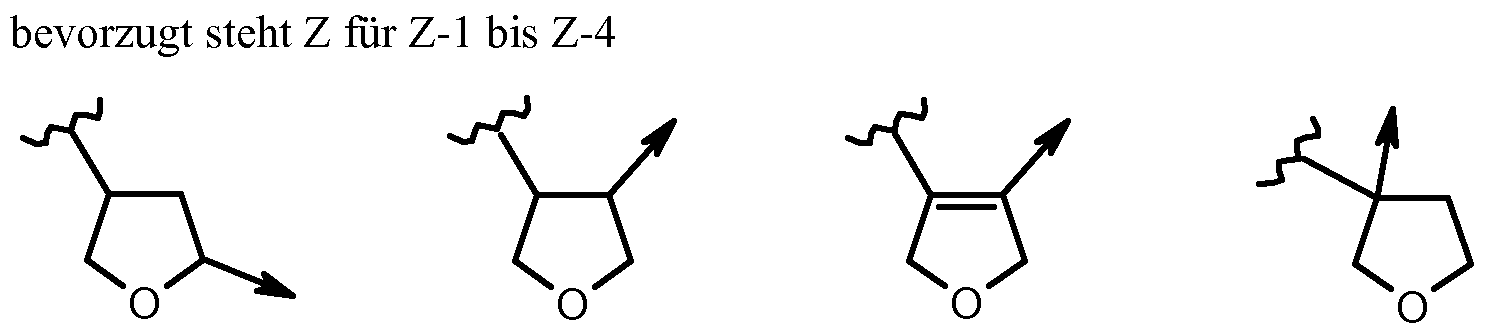
  • Z preferably represents a group Z1 to Z-33, where Z1 to Z-33 have the following meanings:
  • Z particularly preferably represents a group Z-1 to Z-15, where Z-1 to Z-15 have the following meanings:
  • R 5 preferably fluorine, chlorine, cyano, CO2H, CO2CH3 or CO2CH2CH3, or in each case by m radicals from the group consisting of fluorine and chlorine-substituted (Ci-C2) alkyl or (Ci-C2) alkoxy.
  • X 2 , X 4 and X 6 each independently of one another preferably denote hydrogen, fluorine, chlorine, bromine or cyano, or in each case by m radicals from the group consisting of fluorine and chlorine-substituted methyl or methoxy.
  • X 2 , X 4 and X 6 are particularly preferably independently of one another hydrogen or fluorine.
  • X 2 , X 4 and X 6 are particularly preferably independently of one another hydrogen or fluorine.
  • X 3 and X 5 are each independently hydrogen, fluorine, chlorine, bromine, hydroxyl or cyano, or in each case by m radicals selected from the group consisting of fluorine, chlorine and bromine substituted (Ci-C 3 ) alkyl, (Ci-C 3 ) Alkoxy, (C 3 -C 4 ) cycloalkyl, (C 2 -C 3 ) alkenyl or (C 2 -C 3 ) alkynyl.
  • R 7 is preferably hydrogen, or in each case by m radicals from the group consisting of fluorine and chlorine substituted (Ci-C 3) alkyl.
  • the running number m is preferably 0, 1, 2 or 3.
  • R 1 and R 2 are each independently hydrogen, fluorine, chlorine or cyano
  • R is in each case m radicals from the group consisting of fluorine, chlorine, bromine, cyano, (C 1 -C 4 ) -alkoxy and hydroxy-substituted (C 1 -C 4 ) -alkyl, (C 3 -C 5 ) -cycloalkyl, ( C 2 -C 4 ) - alkenyl, (C 2 -C 4 ) -alkynyl or (C 1 -C 4 ) -alkoxy;
  • R 4 is hydrogen
  • Y is oxygen
  • W means oxygen
  • Z represents a group Z-1 to Z-33, where Z-1 to Z-33 have the following meanings:
  • X, X and X are each independently hydrogen, fluorine, chlorine, bromine or cyano, or
  • m radicals from the group consisting of fluorine, chlorine, bromine and (C 1 -C 2) -alkoxy-substituted (C 1 -C 2) -alkyl;
  • X 3 and X 5 independently of one another are hydrogen, fluorine, chlorine, bromine, iodine, hydroxyl, cyano, nitro, S (O) n R 6 or C0 2 R 7 ,
  • R 6 is (m-C 2 ) -alkyl or (C 3 -C 4 ) -cycloalkyl substituted by in each case m radicals from the group consisting of fluorine and chlorine;
  • R 7 is hydrogen
  • n is the run number 0, 1 or 2.
  • R 1 and R 2 are each independently hydrogen, fluorine, chlorine or cyano
  • Each R 3 represents radicals from the group consisting of fluorine, chlorine, bromine, cyano,
  • R 4 is hydrogen
  • Z represents a group Z-1 to Z-15, where Z-1 to Z-15 have the following meanings:
  • X, X and X are each independently hydrogen, fluorine, chlorine, bromine or cyano, or
  • X 3 and X 5 are independently hydrogen, fluorine, chlorine, bromine, iodine, hydroxy or
  • m radicals from the group consisting of fluorine, chlorine and bromine, (Ci-C 3) alkyl, (Ci-C 3) alkoxy, (C 3 -C 4) -cycloalkyl, (C 2 -C 3) Alkenyl or (C 2 -C 3 ) alkynyl; and m is the run number 0, 1, 2 or 3.
  • R and R are each hydrogen; R are each m radicals from the group consisting of fluorine, chlorine, bromine, cyano,
  • R 4 is hydrogen
  • m radicals from the group consisting of fluorine, chlorine, bromine, cyano, (Ci-C i) alkoxy, hydroxy and aryl substituted (Ci-C 6) -alkyl, (C 3 -C 6) cycloalkyl, ( C 3 -C 6) -cycloalkyl- (Ci-C 6) - alkyl, (C 2 -C 6) alkenyl, (C 5 -C 6) cycloalkenyl, or (C 2 -C 6) alkynyl;
  • Y is oxygen
  • W means oxygen;
  • Z is a group Z-1 to Z-4, where Z-1 to Z-4 have the following meanings:
  • X 2 , X 4 and X 6 are independently hydrogen or fluorine;
  • X 3 and X 5 independently of one another are hydrogen, fluorine, chlorine, bromine, hydroxyl or
  • m radicals from the group consisting of fluorine, chlorine and bromine, (Ci-C 3) alkyl, (Ci-C 3) alkoxy, (C 3 -C 4) -cycloalkyl, (C 2 -C 3) Alkenyl or (C 2 -C 3 ) alkynyl; and m is the run number 0, 1, 2 or 3.
  • the compounds according to the invention can be prepared by various processes, which are listed below:
  • (X) n is the substituents X 2 , X 3 , X 4 , X 5 and X 6 .
  • Such 1, 3-dipolar cycloadditions of nitrile oxides with suitable dipolarophiles are described, for example, in Reviews: 1,3 dipolar cycloaddition Chemistry, Padwa, ed. Wiley, New York, 1984; Kanemasa and Tsuge, Heterocycles 1990, 30, 719.
  • chloroximes see Kim, Jae N., Ryu, Eung KJ Org. Chem. 1992, 57, 6649).
  • Transformations of the functional groups R are possible both at the level of the alkenes and at the level of the isoxazolines.
  • Collections of compounds of formula (I) and / or their salts, which may be synthesized following the above reactions, may also be prepared in a parallelized manner, which may be done in a manual, partially automated or fully automated manner. It is possible, for example, to automate the reaction procedure, the work-up or the purification of the products or intermediates. Overall, this is one
  • the compounds of the formula (I) according to the invention (and / or their salts), together referred to as “compounds according to the invention", have excellent herbicidal activity against a broad spectrum of economically important monocotyledonous and dicotyledonous harmful plants.
  • the present invention therefore also provides a method for controlling undesirable plants or for regulating the growth of plants, preferably in
  • Plant cultures in which one or more compounds of the invention (s) on the plants eg harmful plants such as mono- or dicotyledonous weeds or undesirable crops
  • the seed eg grains, seeds or vegetative propagules such as tubers or sprouts with buds
  • the area on the plants grow eg the acreage
  • the compounds of the invention may be e.g. in pre-sowing (possibly also by incorporation into the soil), pre-emergence or Nachauflaufmaschinen be applied.
  • some representatives of the monocotyledonous and dicotyledonous weed flora can be mentioned, which can be controlled by the compounds according to the invention, without the intention of limiting them to certain species.
  • the compounds according to the invention are applied to the surface of the earth before germination, either the emergence of the weed seedlings is completely prevented or the weeds grow up to the cotyledon stage stage, but then stop their growth.
  • the compounds according to the invention can have selectivities in useful cultures and can also be used as nonselective herbicides.
  • the active compounds can also be used for controlling harmful plants in crops of known or yet to be developed genetically modified plants.
  • the transgenic plants are usually characterized by particular advantageous properties, for example by resistance to certain active ingredients used in the agricultural industry, especially certain herbicides,
  • Resistances to plant diseases or pathogens of plant diseases such as certain insects or microorganisms such as fungi, bacteria or viruses.
  • Other special properties concern e.g. the crop in terms of quantity, quality, shelf life, composition and special ingredients.
  • transgenic plants with increased starch content or altered quality of the starch or those with other fatty acid composition of the crop are known.
  • Other particular properties are tolerance or resistance to abiotic stressors, e.g. Heat, cold, drought, salt and ultraviolet radiation.
  • the compounds of the formula (I) can be used as herbicides in crops which are resistant to the phytotoxic effects of the herbicides or have been made genetically resistant.
  • new plants with altered properties can be generated by genetic engineering techniques (see, for example, EP 0221044, EP 0131624).
  • genetic modifications of crop plants have been described for the purpose of modifying the starch synthesized in the plants (eg WO 92/011376 A, WO 92/014827 A, WO 91/019806 A), transgenic crop plants which are resistant to certain glufosinate-type herbicides (US Pat. see eg EP 0242236 A, EP 0242246 A) or glyphosate (WO 92/000377 A) or the sulfonylureas (EP 0257993 A, US 5,013,659) or against combinations or
  • herbicides are "gene stacking" resistant, such as transgenic crops such as corn or soybean with the trade name or the name Optimum TM GAT TM (Glyphosate ALS Tolerant).
  • Transgenic crops for example cotton, with the ability to produce Bacillus thuringiensis toxins (Bt toxins), which make the plants resistant to certain pests (EP 0142924 A, EP 0193259 A).
  • Bacillus thuringiensis toxins Bacillus thuringiensis toxins
  • Transgenic crops with modified fatty acid composition WO 91/013972 A).
  • transgenic crops characterized by higher yields or better quality transgenic crops characterized by a combination of e.g. the o. g. characterize new properties ("gene stacking")
  • nucleic acid molecules can be introduced into plasmids that allow mutagenesis or sequence alteration by recombination of DNA sequences.
  • Base exchanges are made, partial sequences removed or natural or synthetic sequences added.
  • For the connection of the DNA fragments with one another adapters or linkers can be attached to the fragments, see e.g. Sambrook et al., 1989, Molecular Cloning, A Laboratory Manual, 2nd Ed. Cold Spring Harbor Laboratory Press, Cold Spring Harbor, NY; or Winnacker "Genes and Clones", VCH Weinheim 2nd edition 1996
  • the production of plant cells having a reduced activity of a gene product can be achieved, for example, by the expression of at least one corresponding antisense RNA, a sense RNA to obtain a cosuppression effect, or the expression of at least one appropriately engineered ribozyme which specifically cleaves transcripts of the above gene product.
  • DNA molecules can be used which encode the entire
  • the synthesized protein may be located in any compartment of the plant cell. However, to achieve localization in a particular compartment, for example, the coding region can be linked to DNA sequences that ensure localization in a particular compartment.
  • Such sequences are known to those skilled in the art (see, for example, Braun et al., EMBO J.
  • the expression of the nucleic acid molecules can also take place in the organelles of the plant cells.
  • the transgenic plant cells can be regenerated to whole plants by known techniques.
  • the transgenic plants can in principle be plants of any one
  • Plant species that is, both monocotyledonous and dicotyledonous plants.
  • the compounds (I) according to the invention can be used in transgenic cultures which are resistant to growth factors, such as e.g. 2,4-D, dicamba or against herbicides containing essential plant enzymes, e.g. Acetolactate synthases (ALS), EPSP synthases, glutamine synthases (GS) or Hydoxyphenylpyruvat Dioxygenases (HPPD) inhibit or resistant to herbicides from the group of sulfonylureas, the glyphosate, glufosinate or Benzoylisoxazole and analogues, or against any combination of these agents resistant.
  • growth factors such as e.g. 2,4-D, dicamba or against herbicides containing essential plant enzymes, e.g. Acetolactate synthases (ALS), EPSP synthases, glutamine synthases (GS) or Hydoxyphenylpyruvat Dioxygenases (HPPD) inhibit or resistant to herbicides from the group of sul
  • the compounds according to the invention can particularly preferably be employed in transgenic crop plants which are resistant to a combination of glyphosates and glufosinates, glyphosates and sulfonylureas or imidazolinones. Most preferably, the compounds of the invention in transgenic crops such. As corn or soybean with the trade name or the name OptimumTM GATTM (Glyphosate ALS Tolerant) can be used.
  • the active compounds according to the invention in addition to the effects observed in other crops on harmful plants, effects which are specific for the application in the respective transgenic crop often occur, for example a modified or specially extended weed spectrum which can be controlled Application rates that can be used for the application, preferably good combinability with the herbicides to which the transgenic culture is resistant, and influencing growth and yield of the transgenic crops.
  • the invention therefore also relates to the use of the compounds of the formula (I) according to the invention as herbicides for controlling harmful plants in transgenic crop plants.
  • the compounds according to the invention can be used in the form of wettable powders, emulsifiable concentrates, sprayable solutions, dusts or granules in the customary formulations.
  • the invention therefore also relates to herbicidal and plant growth-regulating agents which contain the compounds according to the invention.
  • the compounds according to the invention can be formulated in various ways, depending on which biological and / or chemical-physical parameters are predetermined.
  • Formulation options are, for example: wettable powder (WP), water-soluble powders (SP), water-soluble concentrates, emulsifiable concentrates (EC), emulsions (EW), such as oil-in-water and water-in-oil emulsions, sprayable solutions, Suspension concentrates (SC), oil- or water-based dispersions, oil-miscible solutions, capsule suspensions (CS), dusts (DP), mordants, granules for litter and soil application, granules (GR) in the form of micro, spray, elevator and adsorption granules, water-dispersible granules (WG), water-soluble granules (SG), ULV formulations, microcapsules and waxes.
  • WP wettable powder
  • SP water-soluble powders
  • EC emulsifiable concentrates
  • EW emulsions
  • SC Suspension concentrates
  • SC oil- or water-based dispersions
  • auxiliaries such as inert materials, surfactants, solvents and other additives are also known and are described, for example, in: Watkins, "Handbook of Insecticides Dust Diluents and Carriers", 2nd ed., Darland Books, Caldwell N.J., H.v. Olphen,
  • Produce growth regulators for example in the form of a ready-made formulation or as a tank mix.
  • combination partners for the compounds according to the invention in mixture formulations or in the tank mix are known active compounds which are based on inhibition of, for example, acetolactate synthase, acetyl-CoA carboxylase, cellulose synthase, enolpyruvylshikimate-3-phosphate synthase, glutamine synthetase, p-hydroxyphenylpyruvate dioxygenase, phytoene desaturase,
  • Photosystem I, photosystem II or protoporphyrinogen oxidase can be used, as e.g. from Weed Research 26 (1986) 441-445 or "The Pesticide Manual", 16th edition, The British Crop Protection Council and the Royal Soc. of Chemistry, 2006 and cited therein.
  • ISO International Organization for Standardization
  • all forms of application such as acids, salts, esters and all isomeric forms such as stereoisomers and optical isomers are always included, even if they are not explicitly mentioned.
  • Examples of such herbicidal mixture partners are:
  • flucarbazone flucarbazone-sodium, flucetosulfuron, fluchloralin, flufenacet, flufenpyr, flufenpyr-ethyl, flumetsulam, flumiclorac, flumiclorac-pentyl, flumioxazine, fluometuron, flurenol, flurenol-butyl, - dimethylammonium and -methyl, fluoroglycofen, fluoroglycofen-ethyl, flupropanate, flupyrsulfuron, flupyrsulfuron-methyl-sodium, fluridone, flurochloridone, fluroxypyr, fluroxypyr-meptyl, flurtamone, fluthiacet, fluthiacet-methyl, fomesafen, fomesafen-sodium, foramsulfuron, fosamine, glufosinate, glufosinate-ammonium, glufosinate-p-s
  • methabenzothiazuron metam, metamifop, metamitron, metazachlor, metazosulfuron,
  • met.zthiazuron methiopyrsulfuron, methiozoline, methyl isothiocyanate, metobromuron, metolachlor, S-metolachlor, metosulam, metoxuron, metribuzin, metsulfuron, metsulfuron-methyl, molinate, monolinuron, monosulfuron, monosulfuron ester, MT-5950, ie N- [3-chloro -4- (1-methylethyl) phenyl] -2-methylpentanamide, NGGC-011, napropamide, NC-310, ie 4- (2,4-dichlorobenzoyl) -l-methyl-5-benzyloxypyrazole, neburon, nicosulfuron, nonanoic acid (pelargonic acid), norflurazon, oleic acid (fatty acids), orbencarb, orthosulfamuron, oryzalin, oxadiar
  • plant growth regulators as possible mixing partners are: Acibenzolar, acibenzolar-S-methyl, 5-aminolevulinic acid, ancymidol, 6-benzylaminopurine,
  • Safeners which are used in combination with the compounds of the formula (I) according to the invention and, if appropriate, in combinations with further active compounds, such as, for example, Insecticides, acaricides, herbicides, fungicides as listed above, are preferably selected from the group consisting of:
  • nA is a natural number from 0 to 5, preferably 0 to 3;
  • R A 1 is halogen, (C 1 -C 4 ) alkyl, (C 1 -C 4 ) alkoxy, nitro or (C 1 -C 4 ) haloalkyl;
  • W A is an unsubstituted or substituted divalent heterocyclic radical from the group of the unsaturated or unsaturated five-membered ring heterocycles having 1 to 3 hetero ring N and O groups, wherein at least one N atom and at most one O atom is contained in the ring, preferably a residue from the group (WA 1 ) to (W A 4 ),
  • niA is 0 or 1
  • RA is ORA, SRA or NRA RA or a saturated or unsaturated 3- to 7-membered one
  • Heterocycle having at least one N atom and up to 3 heteroatoms, preferably from the group O and S, which is connected via the N atom with the carbonyl group in (S l) and unsubstituted or by radicals from the group (Ci-C4) Alkyl, (Ci-C4) alkoxy or optionally substituted phenyl, preferably a radical of the formula ORA 3 , NHRA 4 or N (CH 3) 2, in particular the formula
  • RA 3 is hydrogen or an unsubstituted or substituted aliphatic hydrocarbon radical, preferably having a total of 1 to 18 C atoms;
  • RA 4 is hydrogen, (C 1 -C 6) alkyl, (C 1 -C 6) alkoxy or substituted or unsubstituted phenyl;
  • RA 5 is H, (C 1 -C 8 ) alkyl, (C 1 -C 8 ) haloalkyl, (C 1 -C 4 ) alkoxy (C 1 -C 8 ) alkyl, cyano or COOR A 9 , where RA 9 is hydrogen, C 8) alkyl, (Ci-C 8) haloalkyl, (Ci-C 4) alkoxy (Ci-C 4) alkyl, (Ci-C 6) hydroxyalkyl, (C3-Ci2) -cycloalkyl or tri- (C -C 4 ) -alkyl-silyl; R A 6 , RA 7 , RA 8 are identical or different hydrogen, (C 1 -C 8 ) alkyl, (C 1 -C 8 ) haloalkyl, (C 3 -C 12) cycloalkyl or substituted or unsubstituted phenyl; preferably: a) compounds of the type
  • Fenchlorazole ethyl ester
  • ethyl ester 1- (2,4-dichlorophenyl) -5-trichloromethyl (1H) -l, 2,4-triazole-3-carboxylic acid ethyl ester (S l -7), and related compounds as they are in EP-A-174 562 and EP-A-346 620; e) compounds of the type of 5-benzyl- or 5-phenyl-2-isoxazoline-3-carboxylic acid or of 5,5-diphenyl-2-isoxazoline-3-carboxylic acid (Sl e ), preferably compounds such as
  • RB 1 is halogen, (Ci-C 4) alkyl, (Ci-C 4) alkoxy, nitro or (Ci-C 4) haloalkyl; n is a natural number of 0 to 5, preferably 0 to 3;
  • RB is OR B , SR B or NR B RB or a saturated or unsaturated 3- to 7-membered heterocycle having at least one N atom and up to 3
  • Heteroatoms preferably from the group O and S, which is connected via the N-atom with the carbonyl group in (S2) and unsubstituted or by radicals from the group (Ci-C i) alkyl, (Ci-C i) alkoxy or optionally substituted phenyl, preferably a radical of the formula ORB 3 , NHR B 4 or N (CH 3 ) 2, in particular of the formula OR B 3 ;
  • RB is hydrogen or an unsubstituted or substituted aliphatic hydrocarbon radical, preferably having a total of 1 to 18 carbon atoms;
  • RB 4 is hydrogen, (Ci-C6) alkyl, (Ci-Ce) alkoxy or substituted or unsubstituted phenyl;
  • T B is a (Ci or C2) alkanediyl chain which is unsubstituted or substituted by one or two (C 1 -C 4) alkyl radicals or by [(C 1 -C 3) alkoxy] carbonyl; preferably: a) compounds of the 8-quinolinoxyacetic acid type (S2 a ), preferably
  • Rc 1 is (Ci-C 4) alkyl, (Ci-C 4) haloalkyl, (C 2 -C 4) alkenyl, (C 2 -C 4) haloalkenyl, (C 3 -C 7) cycloalkyl, preferably dichloromethyl;
  • Rc, Rc are identical or different hydrogen, (Ci-C 4) alkyl, (C 2 -C 4) alkenyl, (C 2 -C 4) alkynyl, (Ci- C4) haloalkyl, (C 2 -C 4) haloalkenyl, (Ci-C4) alkylcarbamoyl (Ci-C4) alkyl, (C 2 -C 4) Alkenylcarbamoyl- (Ci-C 4) alkyl, (Ci-C 4) alkoxy (Ci-C 4) alkyl, dioxolanyl (C C 4 ) alkyl, thiazolyl, furyl, furylalkyl, thienyl, piperidyl, substituted or unsubstituted phenyl, or Rc 2 and Rc 3 together form a substituted or unsubstituted heterocyclic ring, preferably an oxazolidine,
  • R-29148 (3-dichloroacetyl-2,2,5-trimethyl-1,3-oxazolidine) from Stauffer (S3-2),
  • R-28725" (3-dichloroacetyl-2,2, -dimethyl-1,3-oxazolidine) from Stauffer (S3-3),
  • Benoxacor (4-dichloroacetyl-3,4-dihydro-3-methyl-2H-1,4-benzoxazine) (S3-4),
  • PPG-1292 N-allyl-N - [(1,3-dioxolan-2-yl) -methyl] -dichloroacetamide
  • TI-35 (1-dichloroacetyl-azepane) from TRI-Chemical RT (S3-8),
  • a D is S0 2 -NR D 3 -CO or CO-NR D 3 -S0 2
  • RD 1 is CO-NRD 5 RD 6 or NHCO-RD 7 ;
  • RD 2 is halogen, (Ci-C 4) haloalkyl, (Ci-C 4) haloalkoxy, nitro, (Ci-C 4) alkyl, (Ci-C 4) alkoxy, (Ci C 4) alkylsulfonyl, (Ci- C 4 ) alkoxycarbonyl or (C 1 -C 4 ) alkylcarbonyl;
  • RD 3 is hydrogen, (C 1 -C 4 ) alkyl, (C 2 -C 4 ) alkenyl or (C 2 -C 4 ) alkynyl;
  • RD 4 is halogen, nitro, (Ci-C 4) alkyl, (Ci-C 4) haloalkyl, (Ci-C 4) haloalkoxy, (C 3 -C 6) cycloalkyl, phenyl, (Ci-C 4) alkoxy, cyano, (Ci-C 4) alkylthio, (Ci-C 4) Alkylsulfmyl, (Ci-C 4) alkylsulfonyl, (Ci C 4) alkoxycarbonyl or (Ci-C 4) alkylcarbonyl;
  • R D 5 is hydrogen, (C 1 -C 6 ) alkyl, (C 3 -C 6 ) cycloalkyl, (C 2 -C 6 ) alkenyl, (C 2 -C 6 ) alkynyl, (C 5 -C 6 ) cycloalkenyl, phenyl or 3- to 6-membered heterocycl
  • RD 6 is hydrogen, (Ci-C 6 ) alkyl, (C 2 -C 6 ) alkenyl or (C 2 -C 6 ) alkynyl, where the three latter radicals by VD radicals from the group halogen, hydroxy, (Ci-C 4 ) alkyl, (Ci-C 4 ) alkoxy and (Ci-C 4 ) alkylthio are substituted, or
  • RD 7 is hydrogen, (Ci-C 4 ) alkylamino, di- (Ci-C 4 ) alkylamino, (Ci-C 6 ) alkyl, (C 3 -C 6 ) cycloalkyl, wherein the latter two radicals by VD substituents from the Group halogen, (Ci-C 4 ) alkoxy, (Ce Ce) haloalkoxy and (Ci-C 4 ) alkylthio and in the case of cyclic remainders also (Ci-C 4 ) alkyl and
  • nD is 0, 1 or 2; niD is 1 or 2;
  • VD is 0, 1, 2 or 3; Of these, preference is given to compounds of the N-acylsulfonamide type, for example of the following formula (S4 a ), which are, for example, B. are known from WO-A-97/45016 wherein
  • RD 7 (Ci-C6) alkyl, (C3-C6) cycloalkyl, where the 2 latter radicals by VD substituents selected from the group consisting of halogen, (Ci-C i) alkoxy, (Ci-Ce) haloalkoxy and (Ci-C4) alkylthio and in the case of cyclic radicals also (Ci-C4) alkyl and (Ci-C4) haloalkyl are substituted;
  • RD 4 is halogen, (C 1 -C 4 ) alkyl, (C 1 -C 4 ) alkoxy, CF 3; mD 1 or 2;
  • VD is 0, 1, 2 or 3; and acylsulfamoylbenzamides, for example of the formula (S4 b), for example are known from WO-A-99/16744,
  • compounds of the type of the N-acylsulfamoylphenylureas of the formula (S 4 C ) which are known, for example, from EP-A-365484, wherein
  • RD 8 and RD 9 are independently hydrogen, (Ci-Cg) alkyl, (C3-Cg) cycloalkyl, (C3-C6) alkenyl, (C3-C6) alkynyl, R D 4 halogen, (Ci-C 4) alkyl , (C 1 -C 4 ) alkoxy, CF 3 niD represents 1 or 2; for example
  • N-phenylsulfonylterephthalamides of the formula (S4 d ) which are known, for example, from CN 101838227,
  • R D 4 halogen, (Ci-C 4) alkyl, (Ci-C 4) alkoxy, CF 3; mD 1 or 2;
  • RD 5 is hydrogen, (C 1 -C 6 ) alkyl, (C 3 -C 6 ) cycloalkyl, (C 2 -C 6 ) alkenyl, (C 2 -C 6 ) alkynyl, (C 5 -C 6 ) cycloalkenyl.
  • Carboxylic acid derivatives (S5) e.g.
  • S6 active compounds from the class of 1,2-dihydroquinoxaline-2-ones (S6), e.g.
  • RE 1 , RE 2 are each independently halogen, (Ci-C i) alkyl, (Ci-C i) alkoxy, (Ci-C i) haloalkyl,
  • a E is COORE 3 or COSR E 4
  • RE 3 , RE 4 are, independently of one another, hydrogen, (C 1 -C 4 ) -alkyl, (C 2 -C 6 ) -alkenyl,
  • ⁇ 1 is 0 or 1 ⁇ 2 , ⁇ 3 are independently 0, 1 or 2, preferably :
  • Methyl diphenylmethoxyacetate (CAS No. 41858-19-9) (S7-1).
  • RF 2 is hydrogen or (C 1 -C 4 ) alkyl
  • RF 3 is hydrogen, (C 1 -C 8 ) alkyl, (C 2 -C 4 ) alkenyl, (C 2 -C 4 ) alkynyl, or aryl, where each of the abovementioned C containing radicals is unsubstituted or substituted by one or more, preferably up to three identical or different radicals from the group consisting of halogen and alkoxy; or their salts, preferably compounds wherein X is F, F is an integer from 0 to 2,
  • RF 1 is halogen, (Ci-C 4) alkyl, (Ci-C 4) haloalkyl, (Ci-C 4) alkoxy, (Ci-C 4) haloalkoxy, RF 2 is hydrogen or (Ci-C 4) alkyl,
  • RF 3 is hydrogen, (Ci-Cg) alkyl, (C 2 -C 4 ) alkenyl, (C 2 -C 4 ) alkynyl, or aryl, wherein each of the aforementioned C-containing radicals unsubstituted or by one or more, preferably up to three identical or different radicals from the group consisting of halogen and alkoxy is substituted, mean
  • YG, Z G independently of one another O or S, an integer from 0 to 4, R G 2 (Ci-Ci 6 ) alkyl, (C 2 -C 6 ) alkenyl, (C 3 -C 6 ) cycloalkyl, aryl; Benzyl, halobenzyl, RG 3 is hydrogen or (Ci-Ce) alkyl.
  • Si l active ingredients of the type of oxyimino compounds (Si l), which are known as seed dressing, such as. B.
  • Oxabetrinil ((Z) -l, 3-dioxolan-2-ylmethoxyimino (phenyl) acetonitrile) (Sl l-1), which is known as a seed safener for millet against damage by metolachlor,
  • Fluorofenim (1- (4-chlorophenyl) -2,2,2-trifluoro-1-ethanone-0- (1,3-dioxolan-2-ylmethyl) -oxime) (S1-2) used as seed dressing -Safener for millet is known against damage from metolachlor, and
  • Cyometrinil or “CGA-43089” ((Z) -cyanomethoxyimino (phenyl) acetonitrile) (S1-3), which is known as a seed dressing safener for millet against damage by metolachlor.
  • S12 Isothiochromanone (S12) class agents, e.g. Methyl- [(3-oxo-1H-2-benzothiopyran-4 (3H) -ylidene) methoxy] acetate (CAS Reg. No. 205121-04-6) (S12-1) and related compounds of WO-A- 1998/13361.
  • S12 Isothiochromanone (S12) class agents, e.g. Methyl- [(3-oxo-1H-2-benzothiopyran-4 (3H) -ylidene) methoxy] acetate (CAS Reg. No. 205121-04-6) (S12-1) and related compounds of WO-A- 1998/13361.
  • S13 One or more compounds from group (S13): "Naphthalene anhydride” (l, 8-naphthalenedicarboxylic anhydride) (S13-1), which is known as a seed safener for corn against damage by thiocarbamate herbicides.
  • RH is a (Ci-C6) haloalkyl radical
  • RH is hydrogen or halogen
  • RH, RH are independently hydrogen, (Ci-Ci6) alkyl, (C 2 -Ci 6) alkenyl or
  • (C 2 -C 6) alkynyl each of the last-mentioned 3 unsubstituted or by one or more radicals from the group halogen, hydroxy, cyano, (Ci-C4) alkoxy, (Ci-C4) haloalkoxy, (Ci-C4) alkylthio .
  • RH 3 is (C 1 -C 4 ) -alkoxy, (C 2 -C 4 ) -alkenyloxy, (C 2 -C 6) -alkinyloxy or (C 2 -C 4 ) -haloalkoxy and RH is hydrogen or (C 1 -C 4 ) -alkyl or RH 3 and RH 4 together with the directly attached N atom form a four- to eight-membered heterocyclic ring which, in addition to the N atom, may also contain further hetero ring atoms, preferably up to two further hetero ring atoms from the group consisting of N, O and S, and which may be unsubstituted or substituted by one or more radicals from the group halogen, cyano, nitro, (Ci-C4) alkyl, (Ci-C4) haloalkyl, (Ci-C4) alkoxy, (Ci-C4) haloalkoxy and (Ci-C4) alkylthi
  • Particularly preferred safeners are mefenpyr-diethyl, cyprosulfamide, isoxadifen-ethyl, cloquintocetmexyl and dichloromide.
  • Injectable powders are preparations which are uniformly dispersible in water and contain surfactants of the ionic and / or nonionic type (wetting agents, dispersants) in addition to the active ingredient except a diluent or inert substance.
  • surfactants of the ionic and / or nonionic type (wetting agents, dispersants) in addition to the active ingredient except a diluent or inert substance.
  • the herbicidal active compounds are finely ground, for example, in customary apparatus such as hammer mills, blower mills and air-jet mills and mixed simultaneously or subsequently with the formulation auxiliaries.
  • Emulsifiable concentrates are prepared by dissolving the active ingredient in an organic solvent, e.g. Butanol, cyclohexanone, dimethylformamide, xylene or higher-boiling aromatics or hydrocarbons or mixtures of organic solvents with the addition of one or more surfactants of ionic and / or nonionic type (emulsifiers).
  • organic solvent e.g. Butanol, cyclohexanone, dimethylformamide, xylene or higher-boiling aromatics or hydrocarbons or mixtures of organic solvents
  • surfactants of ionic and / or nonionic type emulsifiers
  • alkylarylsulfonic acid calcium salts such as
  • Ca-dodecylbenzenesulfonate or nonionic emulsifiers such as fatty acid polyglycol ester, Alkylaryl polyglycol ethers, fatty alcohol polyglycol ethers, propylene oxide-ethylene oxide condensation products, alkyl polyethers, sorbitan esters such as sorbitan fatty acid esters or polyoxethylenesorbitan esters such as polyoxyethylene sorbitan fatty acid esters.
  • Dusts are obtained by grinding the active substance with finely divided solids, eg
  • Talc natural clays such as kaolin, bentonite and pyrophyllite, or diatomaceous earth.
  • Suspension concentrates may be water or oil based. They can be prepared, for example, by wet grinding using commercially available bead mills and, if appropriate, addition of surfactants, as described, for example, in US Pat. are already listed above for the other formulation types.
  • Emulsions e.g. Oil-in-water emulsions (EW), for example, by means of stirrers,
  • Solvents and optionally surfactants such as e.g. listed above for the other formulation types.
  • Granules can either be prepared by spraying the active ingredient onto adsorptive, granulated inert material or by applying active substance concentrates by means of
  • Adhesives e.g. Polyvinyl alcohol, polyacrylic acid sodium or mineral oils, on the
  • Water-dispersible granules are generally prepared by the usual methods such as spray drying, fluidized bed granulation, plate granulation, mixing with high-speed mixers and extrusion without solid inert material.
  • the agrochemical preparations generally contain from 0.1 to 99% by weight, in particular from 0.1 to 95% by weight, of compounds according to the invention.
  • the active ingredient concentration is, for example, about 10 to 90 wt .-%, the remainder to 100 wt .-% consists of conventional formulation components.
  • the active ingredient concentration may be about 1 to 90, preferably 5 to 80 wt .-%.
  • Dust-like formulations contain 1 to 30 wt .-% of active ingredient, preferably usually 5 to 20 wt .-% of active ingredient, sprayable solutions contain about 0.05 to 80, preferably 2 to 50% by weight of active ingredient.
  • sprayable solutions contain about 0.05 to 80, preferably 2 to 50% by weight of active ingredient.
  • the content of active ingredient depends on whether the active compound is liquid or solid and which granulation aids, fillers, etc. are used.
  • the content of active ingredient is, for example, between 1 and 95% by weight, preferably between 10 and 80% by weight.
  • the active substance formulations mentioned optionally contain the customary adhesion, wetting, dispersing, emulsifying, penetrating, preserving, antifreezing and solvent, fillers, carriers and dyes, antifoams, evaporation inhibitors and the pH and the Viscosity-influencing agent.
  • the formulations present in commercial form are optionally diluted in a customary manner, e.g. for wettable powders, emulsifiable concentrates, dispersions and water-dispersible granules by means of water. Dust-like preparations, soil or
  • Spreading granulates and sprayable solutions are usually no longer diluted with other inert substances before use.
  • the type of herbicide used u.a. varies the required application rate of the compounds of formula (I). It can vary within wide limits, e.g. between 0.001 and 1.0 kg / ha or more of active substance, but is preferably between 0.005 and 750 g / ha.
  • Carrier means a natural or synthetic, organic or inorganic substance, with which the active ingredients for better applicability, v.a. for application to plants or
  • the carrier which may be solid or liquid, is generally inert and should be useful in agriculture.
  • Suitable solid or liquid carriers are: for example, ammonium salts and ground natural minerals, such as kaolins, clays, talc, chalk, quartz, attapulgite, montmorillonite or diatomaceous earth, and ground synthetic minerals, such as finely divided silica, alumina and natural or synthetic silicates, resins, waxes, solids Fertilizers, water, alcohols, especially butanol, organic solvents, mineral and vegetable oils and derivatives thereof. Mixtures of such
  • Suitable solid carriers for granules are: e.g. Cracked and fractionated natural rocks such as calcite, marble, pumice, sepiolite, dolomite and synthetic granules of inorganic and organic flours and granules of organic material such as sawdust, coconut shells, corn cobs and tobacco stems.
  • Suitable liquefied gaseous diluents or carriers are those liquids which are gaseous at normal temperature and under normal pressure, e.g. Aerosol propellants, such as halogenated hydrocarbons, as well as butane, propane, nitrogen and carbon dioxide.
  • Aerosol propellants such as halogenated hydrocarbons, as well as butane, propane, nitrogen and carbon dioxide.
  • Adhesives such as carboxymethyl cellulose, natural and synthetic powdery, granular or latex polymers, such as gum arabic, can be used in the formulations.
  • Other additives may be mineral and vegetable oils.
  • Suitable liquid solvents are essentially: aromatics, such as xylene, toluene or alkylnaphthalenes, chlorinated aromatics or chlorinated aliphatic hydrocarbons, such as chlorobenzenes, chloroethylenes or dichloromethane, aliphatic hydrocarbons, such as cyclohexane or paraffins, e.g.
  • Petroleum fractions mineral and vegetable oils, alcohols such as butanol or glycol and their ethers and esters, ketones such as acetone, methyl ethyl ketone, methyl isobutyl ketone or cyclohexanone, strongly polar solvents such as dimethylformamide and dimethyl sulfoxide, and water.
  • alcohols such as butanol or glycol and their ethers and esters
  • ketones such as acetone, methyl ethyl ketone, methyl isobutyl ketone or cyclohexanone
  • strongly polar solvents such as dimethylformamide and dimethyl sulfoxide, and water.
  • the agents of the invention may additionally contain other ingredients, e.g.
  • Surfactants include emulsifying and / or foaming agents, dispersants or wetting agents with ionic or nonionic
  • Naphthalenesulphonic acid polycondensates of ethylene oxide with fatty alcohols or with fatty amines, substituted phenols (preferably alkylphenols or arylphenols), salts of sulphosuccinic acid esters, taurine derivatives (preferably alkyl taurates), phosphoric acid esters of polyethoxylated alcohols or phenols, fatty acid esters of polyols, and derivatives of the compounds containing sulphates , Sulphonates and phosphates, for example alkylarylpolyglycol ethers, alkylsulphonates, alkylsulfates, arylsulfonates, protein hydrolysates, lignin-sulphite liquors and methylcellulose.
  • a surfactant is necessary when one of the active ingredients and / or one of the inert carriers is not soluble in water and when applied in water.
  • the proportion of surface-active substances is between 5 and 40 percent by weight of the agent according to the invention.
  • Dyes such as inorganic pigments such as iron oxide, titanium oxide, ferrocyan blue and organic dyes such as alizarin, azo and metal phthalocyanine dyes and trace nutrients such as salts of iron, manganese, boron, copper, cobalt, molybdenum and zinc can be used.
  • additional components may also be included, e.g. protective colloids, binders, adhesives, thickeners, thixotropic substances, penetration promoters, stabilizers,
  • the active ingredients can be combined with any solid or liquid additive commonly used for formulation purposes.
  • the agents and formulations according to the invention contain between 0.05 and 99% by weight, 0.01 and 98% by weight, preferably between 0.1 and 95% by weight, particularly preferably between 0.5 and 90%. Active ingredient, most preferably between 10 and 70 weight percent.
  • the active compounds or compositions according to the invention can be used as such or as a function of their physical and / or chemical properties in the form of their formulations or the use forms prepared therefrom, such as aerosols, capsule suspensions, cold mist concentrates, hot mist concentrates, encapsulated granules, fine granules, flowable concentrates for the
  • Seed treatment ready-to-use solutions, dustable powders, emulsifiable concentrates, oil-in-water emulsions, water-in-oil emulsions, macrogranules, microgranules, oil-dispersible powders, oil-miscible flowable concentrates, oil-miscible liquids, foams, pastes, Pesticide-coated seeds, suspension concentrates, suspension-emulsion concentrates, soluble concentrates, suspensions, wettable powders, soluble powders, dusts and granules, water-soluble granules or tablets, water-soluble powders for seed treatment, wettable powders, active substance-impregnated natural and synthetic substances, and Very fine encapsulations in polymers
  • Substances and in encapsulants for seeds, as well as ULV cold and warm mist formulations are used.
  • the formulations mentioned can be prepared in a manner known per se, for example by mixing the active compounds with at least one customary extender, solvent or diluent, emulsifier, dispersing and / or binding or fixing agent, wetting agent, water repellent, if appropriate Desiccant and UV stabilizers and optionally dyes and pigments, defoamers, preservatives, secondary thickeners, adhesives, gibberellins and other processing aids.
  • the compositions according to the invention comprise not only formulations which are already ready for use and which can be applied to the plant or the seed with a suitable apparatus, but also commercial concentrates which have to be diluted with water before use.
  • the active compounds according to the invention can be used as such or in their (commercially available) formulations and in the formulations prepared from these formulations in admixture with others
  • active ingredients such as insecticides, attractants, sterilants, bactericides, acaricides, nematicides, fungicides, growth regulators, herbicides, fertilizers, safeners or semiochemicals.
  • active ingredients such as insecticides, attractants, sterilants, bactericides, acaricides, nematicides, fungicides, growth regulators, herbicides, fertilizers, safeners or semiochemicals.
  • transgenic seed As also described below, the treatment of transgenic seed with the active compounds or agents according to the invention is of particular importance.
  • the heterologous gene in transgenic seed may e.g. come from microorganisms of the species Bacillus, Rhizobium, Pseudomonas, Serratia, Trichoderma, Clavibacter, Glomus or Gliocladium.
  • this heterologous gene is derived from Bacillus sp., Wherein the gene product has an activity against the European corn borer and / or Westem Com Rootworm.
  • the heterologous gene is from Bacillus thuringiensis.
  • the agent according to the invention is applied to the seed alone or in a suitable formulation.
  • the seed is treated in a condition that is so stable that no damage occurs during the treatment.
  • the treatment of the seed can be done at any time between harvesting and sowing.
  • seed is used which has been separated from the plant and freed from flasks, shells, stems, hull, wool or pulp.
  • seed may be used which has been harvested, cleaned and dried to a moisture content below 15% by weight.
  • seed can also be used, which after drying, for example, treated with water and then dried again.
  • care must be taken in the treatment of the seed that the amount of the agent and / or other additives applied to the seed is chosen so that germination of the seed is not impaired or the resulting plant is not damaged. This is especially important for active ingredients, which can show phytotoxic effects in certain application rates.
  • agents according to the invention can be applied directly, ie without further
  • Suitable formulations and methods for seed treatment are known to those skilled in the art and are described e.g. in the following documents: US 4,272,417 A, US 4,245,432 A, US 4,808,430, US 5,876,739, US 2003/0176428 AI, WO 2002/080675 AI, WO 2002/028186 A2.
  • the active compounds which can be used according to the invention can be converted into the customary seed dressing formulations, such as solutions, emulsions, suspensions, powders, foams, slurries or other seed coating compositions, as well as ULV formulations.
  • formulations are prepared in a known manner by mixing the active ingredients with conventional additives, such as conventional extenders and solution or
  • Diluents dyes, wetting agents, dispersants, emulsifiers, defoamers, preservatives, secondary thickeners, adhesives, gibberellins and also water.
  • Dyes which may be present in the seed dressing formulations which can be used according to the invention are all dyes customary for such purposes. Both water-insoluble pigments and water-soluble dyes are useful in this case. Examples which may be mentioned are the dyes known under the names Rhodamine B, C.L Pigment Red 112 and C.L Solvent Red 1.
  • Suitable wetting agents which may be present in the seed dressing formulations which can be used according to the invention are all wetting-promoting substances customary for the formulation of agrochemical active compounds. Preference is given to using alkylnaphthalene sulfonates, such as diisopropyl or diisobutyl naphthalene sulfonates.
  • dispersants and / or emulsifiers which may be present in the seed dressing formulations which can be used according to the invention, all are used for the formulation of agrochemicals
  • Nonionic, anionic and cationic dispersants are nonionic or anionic dispersants or mixtures of nonionic or anionic dispersants.
  • suitable nonionic dispersants are in particular ethylene oxide-propylene oxide block polymers, Alkylphenolpolyglykolether and Tristryrylphenolpolyglykolether and their phosphated or sulfated derivatives.
  • Suitable anionic dispersants are in particular lignosulfonates, polyacrylic acid salts and arylsulfonate-formaldehyde condensates.
  • Defoamers which may be present in the seed-dressing formulations which can be used according to the invention are all foam-inhibiting substances customary for the formulation of agrochemical active compounds.
  • Defoamers which may be present in the seed dressing formulations which can be used according to the invention are all substances which can be used for such purposes in agrochemical compositions. Examples include dichlorophen and Benzylalkoholhemiformal.
  • Suitable secondary thickeners which may be present in the seed dressing formulatives usable in accordance with the invention are all substances which can be used for such purposes in agrochemical compositions. Preference is given to cellulose derivatives, acrylic acid derivatives, xanthan, modified clays and finely divided silica.
  • Suitable adhesives which may be present in the seed dressing formulations which can be used according to the invention are all customary binders which can be used in pickling agents.
  • Preferably mentioned are polyvinylpyrrolidone, polyvinyl acetate, polyvinyl alcohol and Tylose.
  • the seed dressing formulations which can be used according to the invention can be used either directly or after prior dilution with water for the treatment of seed of various kinds, including seed of transgenic plants. In this case, additional synergistic effects may occur in interaction with the substances formed by expression.
  • the seed dressing formulations which can be used according to the invention or the preparations prepared therefrom by the addition of water
  • all mixing devices customarily usable for the dressing can be considered.
  • the seed is placed in a mixer which adds either desired amount of seed dressing formulations either as such or after prior dilution with water and mixes until evenly distributed the formulation on the seed.
  • a drying process follows.
  • the active compounds according to the invention are suitable for good plant tolerance, more favorable
  • plants which can be treated according to the invention the following main crops are mentioned: maize, soybean, cotton, Brassica oilseeds such as Brassica napus (eg canola), Brassica rapa, B. juncea (eg (field) mustard) and Brassica carinata, rice, Wheat sugar beet, cane, oats, rye, barley, millet, triticale, flax, wine and various fruits and vegetables of various botanical taxa such as Rosaceae sp.
  • Brassica oilseeds such as Brassica napus (eg canola), Brassica rapa, B. juncea (eg (field) mustard) and Brassica carinata, rice, Wheat sugar beet, cane, oats, ry
  • Rubiaceae sp. for example, coffee
  • Theaceae sp. Sterculiceae sp.
  • Rutaceae sp. for example, lemons, organs and grapefruit
  • Solanaceae sp. for example, tomatoes, potatoes, peppers, eggplants
  • Liliaceae sp. Compositae sp.
  • lettuce, artichoke and chicory - including root chicory, endive or common chicory for example, Umbelliferae sp. (for example, carrots, parsley, celery and celeriac),
  • Cucurbitaceae sp. for example cucumber - including gherkin, squash, watermelon, gourd and melons
  • Alliaceae sp. for example, leek and onion
  • Leguminosae sp. e.g., peanuts, peas, and beans - such as barley bean and field bean
  • Chenopodiaceae sp. for example, Swiss chard, fodder beet, spinach, beetroot
  • Malvaceae for example okra
  • asparagaceae for example asparagus
  • transgenic plants and their parts can be treated.
  • wild-type or plant species obtained by conventional biological breeding methods such as crossing or protoplast fusion, and plant cultivars and their parts are treated.
  • transgenic plants and their parts are treated.
  • transgenic plants and their parts obtained by conventional biological breeding methods, such as crossing or protoplast fusion, and plant cultivars and their parts are treated.
  • transgenic plants and their parts are treated.
  • Plants and plant varieties that have been obtained by genetic engineering methods, where appropriate in combination with conventional methods (Genetically Modified Organisms) and treated parts thereof.
  • the term “parts” or “parts of plants” or “parts of plants” has been explained above.Propeas of the respective commercially available or in use plant varieties are particularly preferably treated according to the invention
  • the treatment method of the invention may be used for the treatment of genetically modified organisms (GMOs), e.g. As plants or seeds are used.
  • GMOs genetically modified organisms
  • Genetically modified plants are plants in which a heterologous gene has been stably integrated into the genome.
  • heterologous gene essentially means a gene that is provided or assembled outside the plant and that when introduced into the nuclear genome, the
  • RNAi RNA Interference
  • a heterologous gene present in the genome is also referred to as a transgene.
  • a transgene defined by its specific presence in the plant genome is referred to as a transformation or transgenic event.
  • Dryness or water or soil salt content increased flowering efficiency, harvest relief,
  • Plants and plant varieties which are preferably treated according to the invention include all plants which have genetic material conferring on these plants particularly advantageous, useful features (whether obtained by breeding and / or biotechnology).
  • nematode-resistant plants are described, for example, in the following US patent applications: 11 / 765,491, 11 / 765,494, 10 / 926,819, 10 / 782,020, 12 / 032,479, 10 / 783,417, 10 / 782,096, 11 / 657,964, 12 / 192,904, 11 / 396,808, 12 / 166,253, 12 / 166,239, 12 / 166,124, 12 / 166,209, 11 / 762,886, 12 / 364,335, 11 / 763,947, 12 / 252,453, 12 / 209,354, 12 / 491,396 and 12 / 497,221. Plants which can be treated according to the invention are hybrid plants which already have the
  • Heterosis or hybrid effect characteristics which generally results in higher yield, higher vigor, better health and better resistance to biotic and abiotic stresses.
  • Such plants are typically produced by mixing an inbred male sterile parental line (the female crossover partner) with another
  • Inbred pollenfertilen parent line (the male crossover partner) crosses.
  • the hybrid seed is typically harvested from the male sterile plants and sold to propagators.
  • Pollen sterile plants can sometimes be produced (e.g., in maize) by delaving (i.e., mechanically removing the male genitalia (s)); however, it is more common for male sterility to be due to genetic determinants in the plant genome.
  • delaving i.e., mechanically removing the male genitalia (s)
  • the desired product as one wants to harvest from the hybrid plants, is the seeds, it is usually beneficial to ensure that the pollen fertility in hybrid plants containing the genetic determinants responsible for male sterility , completely restored. This can be achieved by ensuring that the male
  • Crossbred partners possess appropriate fertility restorer genes capable of restoring pollen fertility in hybrid plants containing the genetic determinants responsible for male sterility.
  • Genetic determinants of pollen sterility may be localized in the cytoplasm. Examples of cytoplasmic male sterility (CMS) have been described, for example, for Brassica species. However, genetic determinants of pollen sterility may also be localized in the nuclear genome. Pollen sterile plants can also be obtained using plant biotechnology methods such as genetic engineering. A particularly convenient means of producing male-sterile plants is described in WO 89/10396, wherein, for example, a ribonuclease such as a barnase is selectively expressed in the tapetum cells in the stamens. The fertility can then be restorated by expression of a ribonuclease inhibitor such as barstar in the tapetum cells.
  • a ribonuclease inhibitor such as barstar in the tapetum cells.
  • Plants or plant varieties obtained by methods of plant biotechnology, such as genetic engineering which can be treated according to the invention are herbicide-tolerant plants, i. H. Plants tolerant to one or more given herbicides. Such plants can be obtained either by genetic transformation or by selection of plants containing a mutation conferring such herbicide tolerance.
  • Herbicide-tolerant plants are, for example, glyphosate-tolerant plants, ie plants that have been tolerated to the herbicide glyphosate or its salts. Plants can be made tolerant to glyphosate by various methods. Thus, for example, glyphosate-tolerant plants can be obtained by transforming the plant with a gene encoding the enzyme 5-enolpyruvylshikimate-3-phosphate synthase (EPSPS). Examples of such EPSPS genes are the AroA gene (mutant CT7) of the bacterium Salmonella typhimurium (Comai et al., 1983, Science 221, 370-371), the CP4 gene of the bacterium Agrobacterium sp.
  • EPSPS 5-enolpyruvylshikimate-3-phosphate synthase
  • Glyphosate-tolerant plants can also be obtained by expressing a gene encoding a glyphosate acetyltransferase enzyme. Glyphosate-tolerant plants can also be obtained by selecting plants containing naturally-occurring mutations of the above mentioned genes. Plants expressing EPSPS genes conferring glyphosate tolerance are described. Plants which confer other genes that confer glyphosate tolerance, eg decarboxylase genes, are described. Other herbicide-resistant plants are, for example, plants that are resistant to herbicides containing the
  • Inhibit enzyme glutamine synthase such as bialaphos, phosphinotricin or glufosinate, have been tolerant.
  • Such plants can be obtained by expressing an enzyme which detoxifies the herbicide or a mutant of the enzyme glutamine synthase, which is resistant to inhibition.
  • an effective detoxifying enzyme is, for example, an enzyme suitable for
  • Phosphinotricin acetyltransferase encoded such as the bar or pat protein from Streptomyces species. Plants expressing an exogenous phosphinotricin acetyltransferase have been described.
  • herbicide-tolerant plants are also plants tolerant to the herbicides which inhibit the enzyme hydroxyphenylpyruvate dioxygenase (HPPD). Both
  • Hydroxyphenylpyruvate dioxygenases are enzymes which inhibit the reaction in the
  • HPPD Hydroxyphenylpyruvate
  • Plants tolerant to HPPD inhibitors can be transformed with a gene encoding a naturally occurring resistant HPPD enzyme or a gene encoding a mutant or chimeric HPPD enzyme, as in WO 96/38567 , WO 99/24585, WO 99/24586, WO 2009/144079, WO 2002/046387 or US 6,768,044.
  • Tolerance to HPPD inhibitors can also be achieved by transforming plants with genes encoding certain enzymes that allow the formation of homogentisate despite inhibition of the native HPPD enzyme by the HPPD inhibitor. Such plants are described in WO 99/34008 and WO 02/36787.
  • the tolerance of plants to HPPD inhibitors can also be improved by transforming plants in addition to a gene coding for an HPPD tolerant enzyme with a gene coding for a prephenate dehydrogenase enzyme, as in WO 2004/024928 is described.
  • plants can be made even more tolerant to HPPD inhibitors by insert a gene into its genome encoding an enzyme that metabolizes or degrades HPPD inhibitors, such as CYP450 enzymes (see WO 2007/103567 and WO 2008/150473).
  • ALS inhibitors include sulfonylurea, imidazolinone, triazolopyrimidines, pyrimidinyloxy (thio) benzoates and / or sulfonylaminocarbonyltriazolinone herbicides. It is known that various mutations in the enzyme ALS (also known as
  • Acetohydroxy acid synthase known confer tolerance to different herbicides or groups of herbicides, e.g. in Tranel and Wright (Weed Science 2002, 50, 700-712).
  • AHAS AHAS
  • Imidazolinontoleranten plants is described. Other sulfonylurea and imidazolinone tolerant plants are also described.
  • plants which are tolerant to imidazolinones and / or sulfonylureas may be obtained by induced mutagenesis, selection in cell cultures in the presence of the herbicide or by
  • Plants or plant varieties obtained by methods of plant biotechnology, such as genetic engineering), which can also be treated according to the invention, are tolerant to abiotic stressors. Such plants can be obtained by genetic transformation or by selection of plants containing a mutation conferring such stress resistance. Particularly useful plants with stress tolerance include the following:
  • PARP poly (ADP-ribose) polymerase
  • Nicotinate phosphoribosyltransferase nicotinic acid mononucleotide adenyltransferase, nicotinamide adenine dinucleotide synthetase or nicotinamide phosphoribosyltransferase.
  • Plants or plant varieties obtained by plant biotechnology methods such as genetic engineering which can also be treated according to the invention have a changed amount, quality and / or storability of the harvested product and / or altered characteristics of certain components of the harvested product, such as: 1) Transgenic plants that synthesize a modified starch, with respect to their physicochemical properties, in particular the amylose content or the amylose / amylopectin ratio, the degree of branching, the average chain length, the distribution of side chains, the
  • Viscosity behavior, gel strength, the starch grain size and / or starch grain morphology compared to the synthesized starch in wild-type plant cells or plants is changed, so that this modified starch is better suited for certain applications.
  • Non-starch carbohydrate polymers whose properties are altered compared to wild-type plants without genetic modification. Examples are plants that produce polyfructose, particularly of the inulin and levan type, plants that produce alpha-1,4-glucans, plants that produce alpha-1,6-branched alpha-1,4-glucans, and plants that produce Produce alternan.
  • Transgenic plants or hybrid plants such as onions with certain properties such as "high soluble solids content", low pungency (LP) and / or long storage (LS) ).
  • Plants or plant varieties obtained by methods of plant biotechnology, such as genetic engineering, which can also be treated according to the invention, are plants such as
  • Cotton plants with altered fiber properties Such plants can be obtained by genetic transformation or by selection of plants containing a mutation conferring such altered fiber properties; these include:
  • plants such as cotton plants containing an altered form of cellulose synthase genes
  • plants such as cotton plants, containing an altered form of rsw2 or rsw3 homologous nucleic acids, such as cotton plants having increased expression of sucrose phosphate synthase;
  • plants such as cotton plants with increased expression of sucrose synthase
  • plants such as cotton plants in which the timing of the passage control of the Plasmodesmen is changed at the base of the fiber cell, z.
  • plants such as cotton plants in which the timing of the passage control of the Plasmodesmen is changed at the base of the fiber cell, z.
  • plants such as cotton plants with modified reactivity fibers, e.g.
  • N-acetylglucosamine transferase gene, including nodC, and chitin synthase genes By expression of the N-acetylglucosamine transferase gene, including nodC, and chitin synthase genes.
  • Plants or plant varieties obtained by plant biotechnology methods such as genetic engineering which can also be treated according to the invention are plants such as oilseed rape or related Brassica plants with altered oil composition properties. Such plants can be obtained by genetic transformation or by selection of plants containing a mutation conferring such altered oil properties; these include:
  • oilseed rape plants which produce oil of high oleic acid content
  • plants such as oilseed rape plants, which produce oil with a low linolenic acid content
  • plants such as rape plants that produce oil with a low saturated fatty acid content.
  • Plants or plant varieties which can be obtained by plant biotechnology methods such as genetic engineering), which can also be treated according to the invention, are plants such as potatoes which are virus-resistant, e.g. against the potato virus Y (Event SY230 and SY233 from Tecnoplant, Argentina), or which are resistant to diseases such as potato late blight (eg RB gene), or which show a reduced cold-induced sweetness (which the genes Nt- Inh, II-INV bear) or which show the dwarf phenotype (gene A-20 oxidase).
  • Plants or plant varieties obtained by methods of plant biotechnology, such as genetic engineering), which can also be treated according to the invention, are plants such as oilseed rape or related Brassica plants with altered seed shattering properties. Such plants can be obtained by genetic transformation or by selection of plants containing a mutation conferring such altered properties, and include plants such as oilseed rape with delayed or reduced seed failure.
  • transgenic plants which can be treated according to the present invention are plants having transformational events or combinations of transformation events which are the subject of issued or pending petitions in the United States Animal and Plant Health Inspection Service (APHIS) of the United States Department of Agriculture (USDA) for the non-regulated status.
  • APIS United States Animal and Plant Health Inspection Service
  • USA United States Department of Agriculture
  • the information is currently available from APHIS (4700 River Road Riverdale, MD 20737, USA), e.g. via the website http://www.aphis.usda.gov/brs/not_reg.html. On the filing date of this
  • Transgenic phenotype the trait conferred on the plant by the transformation event.
  • transgenic plants which can be treated according to the invention are plants with one or more genes coding for one or more toxins, the transgenic plants offered under the following commercial names: YIELD GARD® (for example maize, cotton, Soybeans), KnockOut® (for example corn), BiteGard® (for example maize), BT-Xtra® (for example corn), StarLink® (for example maize), Bollgard® (cotton), Nucotn® (cotton), Nucotn 33B® (cotton), NatureGard® (for example corn), Protecta® and NewLeaf® (potato).
  • YIELD GARD® for example maize, cotton, Soybeans
  • KnockOut® for example corn
  • BiteGard® for example maize
  • BT-Xtra® for example corn
  • StarLink® for example maize
  • Bollgard® cotton
  • Nucotn® cotton
  • Nucotn 33B® cotton
  • NatureGard® for example corn
  • Protecta® and NewLeaf® pot
  • Herbicide-tolerant crops to be mentioned are, for example, corn, cotton and soybean varieties sold under the following tradenames: Roundup Ready® (glyphosate tolerance, for example corn, cotton, soybean), Liberty Link® (phosphinotricin tolerance, for example rapeseed) , IMI® (imidazolinone tolerance) and SCS® (sylphonylurea tolerance), for example corn.
  • Herbicide-resistant plants (plants traditionally grown for herbicide tolerance) to be mentioned include the varieties sold under the name Clearfield® (for example corn).
  • transgenic plants which can be treated according to the invention are plants which contain transformation events, or a combination of transformation events, and which are used for
  • Example in the files are cited by different national or regional authorities (see for example http://gmoinfo.jrc.it/gmp_browse.aspx and
  • the NMR data of disclosed examples are listed either in classical form ( ⁇ values, number of H atoms, multiplet splitting) or as so-called NMR peak lists.
  • the NMR data of selected examples are recorded in the form of NMR peak lists, with the ⁇ value in ppm and then the signal intensity separated by a space for each signal peak.
  • the ⁇ -value signal intensity-number pairs of different signal peaks are listed separated by semicolons.
  • the peak list of an example therefore has the form: ⁇ (intensity ⁇ ; ⁇ 2 (intensity2);; ⁇ ; (intensity ⁇ ;; ⁇ ⁇ (intensity n )
  • the intensity of sharp signals correlates with the height of the signals in a printed example of an NMR spectrum in cm and shows the true ratios of the signal intensities.
  • broad Signals can show multiple peaks or the center of the signal and their relative intensity compared to the most intense signal in the spectrum.
  • tetramethylsilane is used and / or the chemical shift of the solvent, especially in the case of spectra measured in DMSO. Therefore, the tetramethylsilane peak can occur in NMR peaks, but it does not have to.
  • stereoisomers and / or impurities may be typical of each
  • An expert calculating the peaks of the target compounds by known methods can isolate the peaks of the target compounds as needed, using additional intensity filters if necessary. This isolation would be similar to peak picking in classical 1H NMR interpretation.
  • Ethyl 4-amino-2,5-dihydrofuran-3-carboxylate can be prepared analogously to the method described by F. Cohen et al., J. Med. Chem. 2011, 54, 3426-3435.
  • 4-Aminotetrahydrofuran-3-carboxylic acid methyl ester can be prepared by the method described by G.R. Ott et al .; Bioorg. Med. Chem. Lett. 2008, 694-699.
  • Cis-4-amino-tetrahydrofuran-2-carboxylic acid methyl ester hydrochloride may be prepared by the method described by D.P. Walker et al., Synthesis 2011, 1113-1119.
  • This crude product was used for the esterifications to the tert-butyl ester and added via a syringe filter.
  • Trans-4-aminotetrahydrofuran-2-carboxylic acid methyl ester Hydrochloride can be prepared either from the commercially available trans-aminocarboxylic acid by esterification with thionyl chloride / methanol or after the Allan, Robin D.; Tran, Hue W. Australian Journal of Chemistry (1984), 37 (5), 1123-6 can be prepared from commercially available 2,5-anhydro-3-deoxypentonic acid.
  • (4S) -4-Amino-4,5-dihydrofuran-2-carboxylic acid methyl ester may be prepared according to the method described by Joseph P. Burkhart, Gene W. Holbert, Brian W. Metealf, Tetrahedron Lett., 25 (46), 1984, pp. 5267-5270 method can be prepared from commercially available L-Glutaminklaremethylester.
  • (4R) -4-Amino-4,5-dihydrofuran-2-carboxylic acid methyl ester may be prepared according to the method described by Joseph P. Burkhart, Gene W. Holbert, Brian W. Metealf, Tetrahedron Lett., 25 (46), 1984, p. 5267-5270 method can be prepared from commercially available D-Glutaminklar.
  • Target compound implemented. In this way, from 317 mg (1.74 mmol) of intermediate 14 and 400 mg (1.39 mmol)
  • Carboxylic acid chloride 39 mg (13%) of cis-4 - [[3- (3,5-difluorophenyl) -5- (trifluoromethyl) -4H-isoxazol-5-carbonyl] -amino] -tetrahydrofuran-2-carboxylic acid methyl ester.
  • Carboxylic acid chloride 64 mg (26%) of cis-4 - [[3- (3-fluorophenyl) -5-vinyl-4H-isoxazol-5-carbonyl] -amino] -tetrahydrofuran-2-carboxylic acid methyl ester.
  • Carboxylic acid chloride 64 mg (26%) of cis-4 - [[3- (3-fluorophenyl) -5-vinyl-4H-isoxazol-5-carbonyl] -amino] -tetrahydrofuran-2-carboxylic acid methyl ester.
  • the mixture of individual diastereomers could be separated by HPLC in 1-15 and 1-16.
  • Carboxylic acid chloride 75 mg (23%) of cis-4 - [(5-methoxy-3-phenyl-4H-isoxazol-5-carbonyl) amino] tetrahydrofuran-2-carboxylic acid methyl ester.
  • Example 1-19 The title compound can be prepared analogously to Example 1-17.
  • Example 1-19 The title compound can be prepared analogously to Example 1-17.
  • the reaction mixture was washed with 0.5 M aqueous hydrochloric acid, dried and concentrated in vacuo.
  • the crude product was then purified by chromatography.
  • the reaction mixture was washed with 0.5 M aqueous hydrochloric acid, dried and concentrated in vacuo.
  • the crude product was then purified by chromatography.
  • 0.2 ml of tert-butyl-N, N'-diisopropylcarbamimidate was added through a syringe filter.
  • the reaction mixture was refluxed for 3 hours, cooled, and an additional 0.2 ml of tert-butyl N, N'-diisopropylcarbamimidate was added.
  • the reaction mixture was refluxed for a further 2 hours and then cooled to room temperature.
  • the reaction mixture was washed with 0.5 M aqueous hydrochloric acid, dried and concentrated in vacuo.
  • the crude product was then purified by chromatography.
  • the reaction mixture was washed with 0.5 M aqueous hydrochloric acid, dried and concentrated in vacuo.
  • the crude product was then purified by chromatography.
  • Cis-4 - [[(5S) -3- (3,5-Difluorophenyl) -5-vinyl-4H-isoxazol-5-carbonyl] -amino] -tetrahydrofuran-2-carboxylic acid isopropyl ester
  • the reaction mixture was washed with 0.5 M aqueous hydrochloric acid, dried and concentrated in vacuo.
  • the crude product was then purified by chromatography.
  • Cis-4 - [[(5S) -3- (3,5-Difluorophenyl) -5-vinyl-4H-isoxazol-5-carbonyl] -amino] -tetrahydrofuran-2-carboxylic acid benzyl ester
  • reaction mixture was washed with saturated aqueous sodium bicarbonate solution, dried and concentrated in vacuo.
  • Cis-4 - [[(5S) -3- (3,5-Difluorophenyl) -5-vinyl-4H-isoxazol-5-carbonyl] -amino] -tetrahydrofuran-2-carboxylic acid tert. butyl ester
  • 7.518 (1.0), 7.260 (181.8), 7.171 (1.8), 7.166 (2.2), 7.162 (1.3), 7.155 (1.2), 7.151 (2.2), 7.146 (1.8), 6.996 (1.0), 6.898 (0.6 6,883 (0.7); 6,882 (0.7); 6,878 (1.2); 6,876 (1.2); 6,870 (0.6); 6,854 (0.6); 4,578 (1.1); 4,573 (0.7); 4,569 (1.1); 4,560 (0.5 ); 4,554 (1.6); 4,545 (1.3); 4,530 (1.0); 4,521
  • 7.518 (1.2), 7.394 (1.4), 7.389 (2.4), 7.374 (5.0), 7.365 (4.2), 7.358 (0.6), 7.310 (0.7), 7.268 (1.5), 7.265 (3.0), 7.259 (207.2), 7.253 (1.0), 7.252 (0.8), 7.251 (0.6), 7.145 (0.8), 7.140 (0.6), 7.130 (1.0), 7.121 (0.9), 7.113 (0.6), 7.110 (0.6), 6.995 (1.2); 4,577 (1.2); 4,567 (1.1); 4,557 (0.6); 4,553
  • 7.518 (1.2), 7.259 (207.4), 7.210 (0.6), 7.170 (1.4), 7.165 (1.8), 7.150 (1.7), 7.145 (1.4), 6.995 (1.2), 6.898 (0.6), 6.882 (0.7 6,876 (1.2); 6,870 (0.6); 6,854 (0.6); 4,581 (0.6); 4,554 (1.2); 4,545-15 (1.0); 4,530 (1.2); 4,521 (1.0); 4,066 (0.9); 4,052 (0.9); 4,042 (1.5); 4,029 (1.4); 3,968 (1.0); 3,962
  • 7.519 (0.5), 7,426 (0.5), 7,260 (91.8), 7,172 (1.4), 7,166 (1.8), 7,152 (1.7), 7,146 (1.4), 6,900 (0.6), 6,884 (0.7), 6,878 (1.2 6,872 (0.6), 6,856 (0.6), 4,580 (1.3), 4,570 (1.5), 4,556 (1.6), 4,547 (-16 1.3), 4,030 (1.0), 4,017 (1.0), 4,006 (1.4), 3,993 (1.3), 3.901 (1.0), 3.895 (0.9), 3.878 (0.7), 3.871 (0.7), 3.834 (16.0), 3.756 (2.2), 3.713 (2.5), 3.190 (2.4), 3.147 (2.0), 2.599 (0.5), 2.581 (0.6), 2.575 (0.5), 2.564 (0.6), 2.558 (0.6), 2.547 (0.6), 2.541 (0.6), 2.524 (0.6), 2.122 (0.8), 2.087 (0.6), 1.688 (12.8) 1,536 (5.7); 0.008 (1.4); 0,000 (33.1) - 0.008 (1.1)
  • 7.263 (33.4); 7.258 (0.6); 7.179 (0.5); 7.174 (1.4); 7.168 (1.8); 7.165 (2.3); 7.159 (2.1); 7.157 (1.5); 7.154 (2.0); 7.148 (2.2 7,145 (1.7), 7,140 (1.3), 7,040 (0.7), 7,021 (0.7), 6,916 (0.8), 6,910 (0.8), 6,900 (0.8), 6,894 (1.7), 6,888 (1.5), 6,882 (0.6 6,879 (0.7), 6,872 (1.0), 6,866 (0.8), 4,715 (0.8), 4,710 (0.6), 4,706 (0.8), 4,700 (0.6), 4,696 (0.8), 4,690 (0.5), 4,225 (0.7 4,203 (1.7), 4,181 (1.8), 4,159 (0.9), 4,149 (0.6), 4,131 (1.6), 4,113 (1.6), 4,095 (0.6), 4,038 (0.9), 4,023 (0.9), 4,014 (- 19
  • 7.519 (0.7), 7.387 (0.5), 7.373 (0.8), 7.364 (1.0), 7.352 (0.6), 7.260 (128.7), 6.996 (0.7), 3.797-33 (0.5), 3.754 (0.6), 3.743 (0.5); 3.220 (0.5); 3.211 (0.6); 3.177 (0.5); 3.168 (0.5); 1.918 (0.6); 1.704 (3.4); 1.682 (3.1); 1.540 (16.0); 1.520 (9.8); 1.465 (10.8), 1.369 (0.6), 1.335 (0.6), 1.255 (0.9), 1.1 34 (0.5), 1.106 (0.5), 0.008 (1.6), 0.000 (47.3), - 0.008 (1.9)
  • 7.5186 (1.0); 7.5024 (0.6); 7.4829 (0.6); 7.4416 (0.8); 7.4215 (0.8); 7.2598 (167.2); 7.2093 (0.6); 7.1693 (2.1); 7.1639 (2.6); 7.1496 (3.8); 7.1370 (2.2); 7.1315 (1.8); 6.9958 (0.9); 6.8933 (1.0); 6.8888 (1.0); 6.8772 (1.0); 6.8718 (2.0); 6.8669 (2.0); 6.8554 (0.6); 6.8500 (1.0); 6.8454 (0.9); 4.5805 (1.1); 4.4363 (1.2); 4.4274 (1.4); 4.4131 (2.3); 4.4042 (2.4); 4.3899 (1.1); 4.3808 (1.1); 4.0768 (0.9); 4.0631 (0.9); 4.0533 (1.5); 4.0394 (1.7); 4.0231 (1.2); 4.0132 (1.7); 3.9994 (1.6); 3.9694 (1.1); 3.9633 (1.2); 3.9467 (0.8); 3.9395-42
  • 7.5183 (1.2); 7.4000 (1.1); 7.3866 (2.4); 7.3814 (3.3); 7.3772 (3.0); 7.3726 (2.5); 7.3705 (3.1); 7.3650 (1.1); 7.3617 (1.4); 7.2595 (199.8); 7.1662 (0.6); 7.1600 (0.8); 7.1475 (0.6); 7.1451 (0.7); 7.1368 (0.8); 7.1305 (0.6); 7.1224 (0.8); 6.9954 (1.5); 5.9487 (1.6); 5.9411 (1.6); 5.8864 (1.3); 5.8787 (1.3); 5.2429 (0.6); 5.2304 (0.6); 5.2226 (0.6); 5.2204 (0.5); 5.2104 (0.5); 4.6454 (0.6); 4.6231 (0.6); 4.6189 (0.7); 4.6036 (0.7); 4.5963-46
  • 7.2610 (30.5); 7.1737 (1.7); 7.1677 (2.8); 7.1643 (2.5); 7.1617 (2.4); 7.1581 (2.3); 7.1539 (2.6); 7.1515 (2.6); 7.1481 (2.8); 7.1421 (1.7); 6.9968 (1.0); 6.9770 (1.0); 6.9141 (0.8); 6.9087 (0.8); 6.8979 (0.8); 6.8925 (1.6); 6.8870 (1.5); 6.8813 (0.8); 6.8764 (0.6); 6.8708 (0.9); 6.8653 (0.8); 4.6416 (0.6); 4.6215 (1.5); 4.6030 (1.6); 4.5825 (0.8); 4.5490-55 (1.0); 4.5426 (1.1); 4.5372 (1.1); 4.5306 (1.1); 4.1649 (0.8); 4.1522 (0.8); 4.1410 (1.2);

Landscapes

  • Organic Chemistry (AREA)
  • Chemical & Material Sciences (AREA)
  • Life Sciences & Earth Sciences (AREA)
  • Health & Medical Sciences (AREA)
  • General Health & Medical Sciences (AREA)
  • Dentistry (AREA)
  • Environmental Sciences (AREA)
  • Engineering & Computer Science (AREA)
  • Pest Control & Pesticides (AREA)
  • Agronomy & Crop Science (AREA)
  • Wood Science & Technology (AREA)
  • Zoology (AREA)
  • Plant Pathology (AREA)
  • Toxicology (AREA)
  • Agricultural Chemicals And Associated Chemicals (AREA)
  • Plural Heterocyclic Compounds (AREA)
  • Heterocyclic Carbon Compounds Containing A Hetero Ring Having Nitrogen And Oxygen As The Only Ring Hetero Atoms (AREA)
  • Catching Or Destruction (AREA)
  • Cultivation Of Plants (AREA)

Abstract

Die Erfindung betrifft 3-Phenylisoxazolin-5-carboxamide von Tetrahydro- und Dihydrofurancarbonsäuren und -estern der allgemeinen Formel (I) und deren agrochemischverträglichen Salze sowie deren Verwendung im Bereich des Pflanzenschutzes.

Description

Herbizid wirksame 3-Phenylisoxazolin-5-carboxamide von Tetrahydro- und Dihydrofurancarbonsäuren und -estern
Beschreibung
Die Erfindung betrifft das technische Gebiet der Herbizide, insbesondere das der Herbizide zur selektiven Bekämpfung von Unkräutern und Ungräsern in Nutzpflanzenkulturen.
Speziell betrifft sie substituierte 3-Phenylisoxazolin-5-carboxamide und -5-thioamide von Tetrahydro- und Dihydrofurancarbonsäuren und -estern, Verfahren zu ihrer Herstellung und ihre Verwendung als Herbizide.
WO1995/014681 AI, WO1995/014680 AI, WO 2008/035315 AI, WO2005/051931 AI und
WO2005/021515 AI beschreiben unter anderen jeweils 3-Phenylisoxazolin-5-carboxamide, die am Phenylring in 3- und 4-Position durch Alkoxy-Reste substiuiert sind. WO1998/057937 AI beschreibt unter anderem Verbindungen, die am Phenylring in 4-Position durch einen Alkoxy-Rest substiuiert sind. WO2006/016237 AI beschreibt unter anderen jeweils solche Verbindungen, die am Phenylring durch einen Amido-Rest substiuiert sind. Die in vorstehend genannten Dokumenten beschriebenen
Verbindungen werden darin als pharmakologisch wirksam offenbart.
In WO2005/021516 AI werden 3-(([3-(3-tert-Butylphenyl)-5-ethyl-4,5-dihydro-l,2-oxazol-5- yl]carbonyl)amino)-5-fluor-4-oxopentansäure und 3-(([3-(3-tert-Butylphenyl)-5-isopropyl-4,5-dihydro- l,2-oxazol-5-yl]carbonyl)amino)-5-fluor-4-oxopentansäure als pharmakologisch wirksame
Verbindungen offenbart.
Aus DE 4026018 AI, EP 0 520 371 A2 und DE 4017665 sind 3-Phenylisoxazolin-5-carboxamide bekannt, die in 5-Position des Isoxazolin-Rings ein Wasserstoffatom tragen. Diese Verbindungen werden dort als agrochemisch wirksame Safener beschrieben, d.h. als Verbindungen, die die unerwünschte herbizide Wirkung von Herbiziden gegenüber Kulturpflanzen aufheben. Eine herbizide Wirkung dieser Verbindungen ist nicht offenbart. Die prioritätsältere nicht vorveröffentlichte europäische Patentanmeldung Nr. 10170238 offenbart herbizid und fungizid wirksame 3- Phenylisoxazolin-5-carboxamide und 3-Phenylisoxazolin-5-thioamide, die in 5-Position des Isoxazolin- Rings ein Wasserstoffatom tragen. Aus Monatshefte Chemie (2010) 141, 461 und Letters in Organic Chemistry (2010), 7, 502 sind ebenfalls 3-Phenylisoxazolin-5-carboxamide bekannt, die in 5-Position des Isoxazolin-Rings ein Wasserstoffatom tragen. Für einige der genannten Verbindungen wird eine fungizide, jedoch keine herbizide Wirkung offenbart.
WO 2014/048827 beschreibt die herbizide Wirkung von 3 -Phenylisoxazolin-5 -carbonsäuren, -5- carbonsäureestern, 5-carbaldehyden und 5-nitrilen.
WO 2014/048853 offenbart Isoxazolin-5-carboxamide und -5-thioamide mit Heterocyclen in 3-Position, die eine herbizide und fungizide Wirkung zeigen. WO 2014/048940 offenbart fungizide wirksame Isoxazolin-carboxamide mit einem Chinolin als speziellem Heterocyclus in der 3-Position.
WO 2014/048882 offenbart Isoxazolin-carboxamide mit Alkoxy als speziellen Rest in der 5-Position. In WO 2012/130798 werden herbizid und fungizid aktive 3-Phenylisoxazolin-5-carboxamide und -5- thioamide von substituierten Heterocyclen beschrieben.
Die herbizide Wirkung dieser bekannten Verbindungen, insbesondere bei niedrigen Aufwandmengen, bzw. deren Verträglichkeit gegenüber Kulturpflanzen bleiben verbesserungswürdig. Aus den genannten Gründen besteht weiterhin ein Bedarf nach wirkungsstarken Herbiziden und/oder Pflanzenwachstumsregulatoren für die selektive Anwendung in Pflanzenkulturen oder die Anwendung auf Nichtkulturland, wobei diese Wirkstoffe vorzugsweise weitere vorteilhafte Eigenschaften in der Anwendung haben sollten, wie zum Beispiel eine verbesserte Verträglichkeit gegenüber Kulturpflanzen.
Ein Gegenstand der vorliegenden Erfindung ist daher die Bereitstellung von Verbindungen mit herbizider Wirkung (Herbizide), die bereits bei relativ niedrigen Aufwandmengen gegen wirtschaftlich wichtige Schadpflanzen hochwirksam sind und vorzugsweise bei guter Wirksamkeit gegen
Schadpflanzen selektiv in Kulturpflanzen eingesetzt werden können und dabei vorzugsweise eine gute Verträglichkeit gegenüber Kulturpflanzen zeigen. Bevorzugt sollten diese herbiziden Verbindungen insbesondere effektiv und effizient gegen ein breites Spektrum an Ungräsern sein, und vorzugsweise zusätzlich eine gute Wirksamkeit gegen viele Unkräuter aufweisen.
Neben einer herbiziden Wirkung weisen zahlreiche Verbindung der Formel (I) auch fungizide Wirkung auf, die jedoch nur gering ausgeprägt ist.
Überraschenderweise wurde nun gefunden, dass die nachfolgend definierten 3-Phenylisoxazolin-5- carboxamide von Tetrahydro- und Dihydrofurancarbonsäuren und -estern der Formel (I) und deren Salze eine ausgezeichnete herbizide Wirksamkeit gegen ein breites Spektrum wirtschaftlich wichtiger mono- und dikotyler annueller Schadpflanzen aufweisen.
Gegenstand der vorliegenden Erfindung sind daher Verbindungen der allgemeinen Formel (I)
Figure imgf000004_0001
und deren agrochemisch verträglichen Salze, in welchen
R1 und R2 unabhängig voneinander jeweils Wasserstoff, Fluor, Chlor oder Cyano,
oder
durch jeweils m Reste aus der Gruppe bestehend aus Fluor, Chlor, Brom und Cyano substituiertes (Ci-C3)-Alkyl oder (Ci-C3)-Alkoxy bedeuten;
R3 durch jeweils m Reste aus der Gruppe bestehend aus Fluor, Chlor, Brom, Cyano, (C1-C4)-
Alkoxy und Hydroxy substituiertes (Ci-C i)-Alkyl, (C3-C5)-Cycloalkyl, (C2-C i)-Alkenyl, (C2- C i)-Alkinyl oder (Ci-C i)-Alkoxy bedeutet;
R4 Wasserstoff,
oder
durch jeweils m Reste aus der Gruppe bestehend aus Halogen, Cyano, (Ci-C6)-Alkoxy, Hydroxy und Aryl substituiertes (Ci-Ci2)-Alkyl, (C3-C7)-Cycloalkyl, (C3-C7)-Cycloalkyl-(Ci-C8)-Alkyl, (C2-C8)-Alkenyl, (C5-C6)-Cycloalkenyl oder (C2-C8)-Alkinyl bedeutet;
Y Sauerstoff oder Schwefel bedeutet;
W Sauerstoff oder Schwefel bedeutet;
Z für einen vollständig gesättigten oder teilweise gesättigten Furanring steht, der mit k Resten der Gruppe R5 substituiert ist
Figure imgf000005_0001
z
worin der Pfeil jeweils für eine Bindung zur Gruppe C=W der Formel (I) steht;
Fluor, Chlor, Cyano oder CO2R7,
oder
durch jeweils m Reste aus der Gruppe bestehend aus Fluor und Chlor substituiertes (C1-C2)- Alkyl oder (Ci-C2)-Alkoxy bedeutet;
X4und X6 unabhängig voneinander jeweils Wasserstoff, Fluor, Chlor, Brom oder Cyano,
oder
jeweils durch m Reste aus der Gruppe bestehend aus Fluor, Chlor, Brom und (C1-C2)- Alkoxy substituiertes (Ci-C2)-Alkyl bedeuten; X3 und X5 unabhängig voneinander Wasserstoff, Fluor, Chlor, Brom, lod, Hydroxy, Cyano, Nitro,
S(0)nR6 oder C02R7,
oder
jeweils durch m Reste aus der Gruppe bestehend aus Fluor, Chlor und Brom substituiertes (Ci-C3)-Alkyl, (Ci-C3)-Alkoxy, (C3-C4)-Cycloalkyl, (C2-C3)-Alkenyl oder (C2-C3)-Alkinyl bedeuten;
R6 durch jeweils m Reste aus der Gruppe bestehend aus Fluor und Chlor substituiertes (C1-C2)- Alkyl oder (C3-C i)-Cycloaikyl bedeutet; R7 Wasserstoff,
oder
durch jeweils m Reste aus der Gruppe bestehend aus Fluor, Chlor und (Ci-C2)-Alkoxy substituiertes (Ci-C3)-Alkyl oder (C3-C5)-Cycloalkyl bedeutet; k die Laufzahl 0, 1 oder 2 beträgt; m die Laufzahl 0, 1, 2, 3, 4 oder 5 beträgt; und n die Laufzahl 0, 1 oder 2 beträgt. Alkyl bedeutet gesättigte, geradkettige oder verzweigte Kohlenwasserstoffreste mit der jeweils angegebenen Anzahl von Kohlenstoffatomen, z.B. CI-CÖ- Alkyl wie Methyl, Ethyl, Propyl, 1- Methylethyl, Butyl, 1 -Methyl-propyl, 2-Methylpropyl, 1,1-Dimethylethyl, Pentyl, 1 -Methylbutyl, 2- Methylbutyl, 3 -Methylbutyl, 2,2-Di-methylpropyl, 1 -Ethylpropyl, Hexyl, 1,1-Dimethylpropyl, 1,2-Di- methylpropyl,l-Methylpentyl, 2-Methylpentyl, 3-Methylpentyl, 4-Methylpentyl, 1,1-Dimethylbutyl, 1 ,2-Dimethylbutyl, 1 ,3 -Dimethylbutyl, 2,2-Dimethylbutyl, 2,3 -Dimethylbutyl, 3 ,3 -Dimethylbutyl, 1 -
Ethylbutyl, 2-Ethylbutyl, 1,1,2-Trimethylpropyl, 1 ,2,2-Trimethylpropyl, 1 -Ethyl- 1 -methylpropyl und 1- Ethyl-2-methylpropyl.
Durch Halogen substitiertes Alkyl bedeutet geradkettige oder verzweigte Alkylgruppen, wobei in diesen Gruppen teilweise oder vollständig die Wasserstoffatome durch Halogenatome ersetzt sein können, z.B. Ci-C2-Halogenalkyl wie Chlormethyl, Brommethyl, Dichlormethyl, Trichlormethyl, Fluormethyl, Difluormethyl, Trifluormethyl, Chlorfluormethyl, Dichlorfluormethyl, Chlordifluormethyl, 1 - Chlorethyl, 1 -Bromethyl, 1 -Fluorethyl, 2-Fluorethyl, 2,2-Difluorethyl, 2,2,2-Trifluorethyl, 2-Chlor-2- fluorethyl, 2-Chlor,2-difluorethyl, 2,2-Dichlor-2-fluorethyl, 2,2,2-Trichlorethyl, Pentafluorethyl und 1,1,1 -Trifluorprop-2-yl.
Alkenyl bedeutet ungesättigte, geradkettige oder verzweigte Kohlenwasserstoffreste mit der jeweils angegebenen Anzahl von Kohlenstoffatomen und einer Doppelbindung in einer beliebigen Position, z.B. C2-C6- Alkenyl wie Ethenyl, 1-Propenyl, 2-Propenyl, 1 -Methylethenyl, 1-Butenyl, 2-Butenyl, 3-Butenyl, 1 -Methyl- 1-propenyl, 2-Methyl-l-propenyl, 1 -Methyl-2-propenyl, 2-Methyl-2-propenyl, 1 -Pentenyl, 2- Pentenyl, 3 -Pentenyl, 4-Pentenyl, 1 -Methyl- 1-butenyl, 2-Methyl-l-butenyl, 3 -Methyl- 1-butenyl, 1- Methyl-2-butenyl, 2-Methyl-2-butenyl, 3-Methyl-2-butenyl, l-Methyl-3-butenyl, 2-Methyl-3-butenyl, 3-Methyl-3-butenyl, 1 , 1 -Dimethyl-2-propenyl, 1 ,2-Dimethyl- 1-propenyl, 1 ,2-Dimethyl-2-propenyl, 1- Ethyl- 1-propenyl, 1 -Ethyl-2-propenyl, 1-Hexenyl, 2-Hexenyl, 3-Hexenyl, 4-Hexenyl, 5-Hexenyl, 1- Methyl- 1 -pentenyl, 2-Methyl- 1 -pentenyl, 3 -Methyl- 1 -pentenyl, 4-Methyl- 1 -pentenyl, 1 -Methyl-2- pentenyl, 2-Methyl-2-pentenyl, 3-Methyl-2-pentenyl, 4-Methyl-2-pentenyl, l-Methyl-3 -pentenyl, 2- Methyl-3 -pentenyl, 3 -Methyl-3 -pentenyl, 4-Methyl-3 -pentenyl, 1 -Methyl-4-pentenyl, 2-Methyl-4- pentenyl, 3-Methyl-4-pentenyl, 4-Methyl-4-pentenyl, 1 , 1 -Dimethyl-2-butenyl, l,l-Dimethyl-3-butenyl, 1 ,2-Dimethyl- 1-butenyl, l,2-Dimethyl-2-butenyl, l,2-Dimethyl-3-butenyl, 1, 3 -Dimethyl- 1-butenyl, 1,3- Dimethyl-2-butenyl, l,3-Dimethyl-3-butenyl, 2,2-Dimethyl-3-butenyl, 2,3-Dimethyl-l-butenyl, 2,3-
Dimethyl-2-butenyl, 2,3-Dimethyl-3-butenyl, 3,3-Dimethyl-l-butenyl, 3,3-Dimethyl-2-butenyl, 1-Ethyl- 1-butenyl, 1 -Ethyl-2-butenyl, l-Ethyl-3-butenyl, 2-Ethyl- 1-butenyl, 2-Ethyl-2-butenyl, 2-Ethyl-3- butenyl, l,l,2-Trimethyl-2-propenyl, l-Ethyl-l-methyl-2-propenyl, l-Ethyl-2-methyl-l -propenyl und 1- Ethyl-2-methyl-2-propenyl.
Alkinyl bedeutet geradkettige oder verzweigte Kohlenwasserstoffreste mit der jeweils angegebenen Anzahl von Kohlenstoffatomen und einer Dreifachbindung in einer beliebigen Position, z.B. C2-C6- Alkinyl wie Ethinyl, 1-Propinyl, 2-Propinyl (oder Propargyl), 1-Butinyl, 2-Butinyl, 3-Butinyl, 1- Methyl-2-propinyl, 1-Pentinyl, 2-Pentinyl, 3-Pentinyl, 4-Pentinyl, 3 -Methyl- 1-butinyl, l-Methyl-2- butinyl, l-Methyl-3-butinyl, 2-Methyl-3-butinyl, 1 , 1 -Dimethyl-2-propinyl, l-Ethyl-2-propinyl, 1- Hexinyl, 2-Hexinyl, 3-Hexinyl, 4-Hexinyl, 5-Hexinyl, 3 -Methyl- 1-pentinyl, 4-Methyl-l-pentinyl, 1- Methyl-2-pentinyl, 4-Methyl-2-pentinyl, 1 -Methyl-3 -pentinyl, 2-Methyl-3 -pentinyl, 1 -Methyl-4- pentinyl, 2-Methyl-4-pentinyl, 3-Methyl-4-pentinyl, 1 , 1 -Dimethyl-2-butinyl, l,l-Dimethyl-3-butinyl, l,2-Dimethyl-3-butinyl, 2,2-Dimethyl-3-butinyl, 3, 3 -Dimethyl- 1-butinyl, 1 -Ethyl-2-butinyl, l-Ethyl-3- butinyl, 2-Ethyl-3-butinyl und l-Ethyl-l-methyl-2-propinyl. Cycloalkyl bedeutet ein carbocyclisches, gesättigtes Ringsystem mit vorzugsweise 3-8 Ring-C-Atomen, z.B. Cyclopropyl, Cyclobutyl, Cyclopentyl oder Cyclohexyl. Im Falle von gegebenenfalls substituiertem Cycloalkyl werden cyclische Systeme mit Substituenten umfasst, wobei auch Substituenten mit einer Doppelbindung am Cycloalkylrest, z. B. eine Alkylidengruppe wie Methyliden, umfasst sind.
Im Falle von gegebenenfalls substituiertem Cycloalkyl werden auch mehrcyclische aliphatische Systeme umfaßt, wie beispielsweise Bicyclo[1.1.0]butan-l-yl, Bicyclo[1.1.0]butan-2-yl, Bicyclo[2.1.0]pentan-1- yl, Bicyclo[2.1.0]pentan-2-yl, Bicyclo[2.1.0]pentan-5-yl, Bicyclo[2.2.1]hept-2-yl (Norbornyl), Adamantan-1 -yl und Adamantan-2-yl.
Im Falle von substituiertem Cycloalkyl werden auch spirocyclische aliphatische Systeme umfaßt, wie beispielsweise Spiro[2.2]pent-l -yl, Spiro[2.3]hex-l-yl und Spiro[2.3]hex-4-yl, 3-Spiro[2.3]hex-5-yl.
Cycloalkenyl bedeutet ein carbocyclisches, nicht aromatisches, partiell ungesättigtes Ringsystem mit vorzugsweise 4-8 C-Atomen, z.B. 1 -Cyclobutenyl, 2-Cyclobutenyl, 1 -Cyclopentenyl, 2-Cyclopentenyl, 3 -Cyclopentenyl, oder 1 -Cyclohexenyl, 2-Cyclohexenyl, 3-Cyclohexenyl, 1,3-Cyclohexadienyl oder 1 ,4-Cyclohexadienyl, wobei auch Substituenten mit einer Doppelbindung am Cycloalkenylrest, z. B. eine Alkylidengruppe wie Methyliden, umfasst sind. Im Falle von gegebenenfalls substituiertem Cycloalkenyl gelten die Erläuterungen für substituiertes Cycloalkyl entsprechend.
Alkoxy bedeutet gesättigte, geradkettige oder verzweigte Alkoxyreste mit der jeweils angegebenen Anzahl von Kohlenstoffatomen, z.B. CI-CÖ- Alkoxy wie Methoxy, Ethoxy, Propoxy, 1 -Methylethoxy, Butoxy, 1 -Methyl-propoxy, 2-Methylpropoxy, 1 , 1 -Dimethylethoxy, Pentoxy, 1 -Methylbutoxy, 2- Methylbutoxy, 3 -Methylbutoxy, 2,2-Di-methylpropoxy, 1 -Ethylpropoxy, Hexoxy, 1,1- Dimethylpropoxy, l,2-Dimethylpropoxy,l-Methylpentoxy, 2-Methylpentoxy, 3-Methylpentoxy, 4- Methylpentoxy, 1,1-Dimethylbutoxy, 1 ,2-Dimethylbutoxy, 1,3-Dimethylbutoxy, 2,2-Dimethylbutoxy, 2,3-Dimethylbutoxy, 3,3-Dimethylbutoxy, 1 -Ethylbutoxy, 2-Ethylbutoxy, 1,1,2-Trimethylpropoxy, 1 ,2,2-Trimethylpropoxy, 1-Ethyl-l-methylpropoxy und 1 -Ethyl-2-methylpropoxy. Durch Halogen subsumiertes Alkoxy bedeutet geradkettige oder verzweigte Alkoxyreste mit der jeweils angegebenen Anzahl von Kohlenstoffatomen, wobei in diesen Gruppen teilweise oder vollständig die
Wasserstoffatome durch Halogenatome wie vorstehend genannt ersetzt sein können, z.B. C1-C2- Halogenalkoxy wie Chlormethoxy, Brommethoxy, Dichlormethoxy, Trichlormethoxy, Fluormethoxy, Difluormethoxy, Trifluormethoxy, Chlorfluormethoxy, Dichlor-fluormethoxy, Chlordifluormethoxy, 1 - Chlorethoxy, 1 -Bromethoxy, 1 -Fluorethoxy, 2-Fluorethoxy, 2,2-Difluorethoxy, 2,2,2-Trifluorethoxy, 2- Chlor-2-fluorethoxy, 2-Chlor-l,2-difluorethoxy, 2,2-Dichlor-2-fluorethoxy, 2,2,2-Trichlorethoxy, Pentafluor-ethoxy und 1,1,1 -Trifluorprop-2-oxy.
Aryl bedeutet ein gegebenenfalls durch 0 - 5 Reste aus der Gruppe Fluor, Chlor, Brom, Iod, Cyano, Hydroxy, (Ci- C3)-Alkyl, (Ci-C3)-Alkoxy, (C3- C4)-Cycloalkyl, (C2- C3)-Alkenyl oder (C2- C3)-Alkinyl substituiertes Phenyl.
Die Bezeichnung "Halogen" bedeutet Fluor, Chlor, Brom oder Iod. Wird die Bezeichnung für einen Rest verwendet, dann bedeutet "Halogen" ein Fluor-, Chlor-, Brom- oder Iodatom.
Die Verbindungen der Formel (I) können je nach Art und Verknüpfung der Substituenten als
Stereoisomere vorliegen. Sind beispielsweise ein oder mehrere asymmetrisch substiuierte Kohlenstoffatome und/oder Sulfoxide vorhanden, so können Enantiomere und Diastereomere auftreten.
Stereoisomere lassen sich aus den bei der Herstellung anfallenden Gemischen nach üblichen
Trennmethoden, beispielsweise durch chromatographische Trennverfahren, erhalten. Ebenso können Stereoisomere durch Einsatz stereoselektiver Reaktionen unter Verwendung optisch aktiver Ausgangsund/oder Hilfsstoffe selektiv hergestellt werden.
Die Erfindung betrifft auch alle Stereoisomeren und deren Gemische, die von der Formel (I) umfaßt, jedoch nicht spezifisch definiert sind. Im Folgenden wird der Einfachheit halber jedoch stets von
Verbindungen der Formel (I) gesprochen, obwohl sowohl die reinen Verbindungen als gegebenenfalls auch Gemische mit unterschiedlichen Anteilen an isomeren Verbindungen gemeint sind.
Je nach Art der oben definierten Substituenten weisen die Verbindungen der Formel (I) saure
Eigenschaften auf und können mit anorganischen oder organischen Basen oder mit Metallionen Salze, gegebenenfalls auch innere Salze oder Addukte bilden. Tragen die Verbindungen der Formel (I) Hydroxy, Carboxy oder andere, saure Eigenschaften induzierende Gruppen, so können diese Verbindungen mit Basen zu Salzen umgesetzt werden. Geeignete Basen sind beispielsweise Hydroxide, Carbonate, Hydrogencarbonate der Alkali- und Erdalkalimetalle, insbesondere die von Natrium, Kalium, Magnesium und Calcium, weiterhin Ammoniak, primäre, sekundäre und teritäre Amine mit (C1-C4-)- Alkyl-Gruppen, Mono-, Di- und Trialkanolamine von (Ci-C4)-Alkanolen, Cholin sowie Chlorcholin, sowie organische Amine, wie Trialkylamine, Morpholin, Piperidin oder Pyridin. Diese Salze sind Verbindungen, in denen der acide Wasserstoff durch ein für die Landwirtschaft geeignetes Kation ersetzt wird, beispielsweise Metallsalze, insbesondere Alkalimetallsalze oder Erdalkalimetallsalze, insbesondere Natrium- und Kaliumsalze, oder auch Ammoniumsalze, Salze mit organischen Aminen oder quartäre (quaternäre) Ammoniumsalze, zum Beispiel mit Kationen der Formel [NRR'R"R"']+, worin R bis R'" jeweils unabhängig voneinander einen organischen Rest, insbesondere Alkyl, Aryl, Aralkyl oder Alkylaryl darstellen. Infrage kommen auch Alkylsulfonium- und Alkylsulfoxoniumsalze, wie (Ci-C4)-Trialkylsulfonium- und (Ci-C4)-Trialkylsulfoxoniumsalze.
Die Verbindungen der Formel (I) können durch Anlagerung einer geeigneten anorganischen oder organischen Säure, wie beispielsweise Mineralsäuren, wie beispielsweise HCl, HBr, H2SO4, H3PO4 oder HNO3, oder organische Säuren, z. B. Carbonsäuren, wie Ameisensäure, Essigsäure, Propionsäure,
Oxalsäure, Milchsäure oder Salicylsäure oder Sulfonsäuren, wie zum Beispiel p-Toluolsulfonsäure, an eine basische Gruppe, wie z.B. Amino, Alkylamino, Dialkylamino, Piperidino, Morpholino oder Pyridino, Salze bilden. Diese Salze enthalten dann die konjugierte Base der Säure als Anion.
Geeignete Substituenten, die in deprotonierter Form, wie z.B. Sulfonsäuren oder Carbonsäuren, vorliegen, können innere Salze mit ihrerseits protonierbaren Gruppen, wie Aminogruppen bilden.
Ist eine Gruppe mehrfach durch Reste substituiert, so bedeutet dies, dass diese Gruppe durch einen oder mehrere gleiche oder verschiedene der genannten Reste substituiert ist.
In allen nachfolgend genannten Formeln haben die Substituenten und Symbole, sofern nicht anders definiert, dieselbe Bedeutung wie unter Formel (I) beschrieben. Pfeile in einer chemischen Formel bedeuten die Verknüpfungsorte zum restlichen Molekül.
Im Folgenden werden, jeweils für die einzelnen Substituenten, bevorzugte, besonders bevorzugte und ganz besonders bevorzugte Bedeutungen beschrieben. Die übrigen Substituenten der allgemeinen Formel (I), welche nachfolgend nicht genannt werden, weisen die oben genannte Bedeutung auf.
In einer ersten Ausführungsform der vorliegenden Erfindung bedeuten
R1 und R2 bevorzugt unabhängig voneinander jeweils Wasserstoff, Fluor, Chlor oder Cyano, oder durch jeweils m Reste aus der Gruppe bestehend aus Fluor und Chlor substituiertes Methyl oder Methoxy. Besonders bevorzugt bedeuten R1 und R2 jeweils Wasserstoff.
In einer zweiten Ausführungsform der vorliegenden Erfindung bedeutet
R3 bevorzugt durch jeweils m Reste aus der Gruppe bestehend aus Fluor, Chlor, Brom, Cyano, (Ci-C2)-Alkoxy und Hydroxy substituiertes (Ci-C3)-Alkyl, (C3-C4)-Cycloalkyl, (C2-C3)-Alkenyl, (C2-C3)-Alkinyl oder (Ci-C3)-Alkoxy. In einer dritten Ausführungsform der vorliegenden Erfindung bedeutet
R4 bevorzugt Wasserstoff, oder durch jeweils m Reste aus der Gruppe bestehend aus Fluor, Chlor, Brom, Cyano, (Ci-C i)-Alkoxy, Hydroxy und Aryl substituiertes (Ci-C6)-Alkyl, (C3-C6)-Cycloalkyl, (C3-C6)-Cycloalkyl-(Ci-C6)-Alkyl, (C2-C6)-Alkenyl, (C5-C6)-Cycloalkenyl oder (C2-C6)-Alkinyl.
In einer vierten Ausführungsform der vorliegenden Erfindung bedeutet Y bevorzugt Sauerstoff. In einer fünften Ausführungsform der vorliegenden Erfindung bedeutet W bevorzugt Sauerstoff.
In einer sechsten Ausführungsform der vorliegenden Erfindung steht
Z bevorzugt für eine Gruppe Z-l bis Z-33, wobei Z-l bis Z-33 folgende Bedeutung haben:
Figure imgf000011_0001
Z-1 Z-5
Figure imgf000011_0002
worin der Pfeil jeweils für eine Bindung zur Gruppe C=W der Formel (I) steht. Besonders bevorzugt steht Z für eine Gruppe Z-1 bis Z-15, wobei Z-1 bis Z-15 folgende Bedeutung haben:
Figure imgf000012_0001
Z-6 Z-7 Z-8 Z-9
Figure imgf000012_0002
Z-11 Z-12 Z-13 Z-14 Z-15 worin der Pfeil jeweils für eine Bindung zur Gruppe C=W der Formel (I) steht. Am meisten
Figure imgf000012_0003
Z-1 Z-2 Z-3 Z-4 worin der Pfeil jeweils für eine Bindung zur Gruppe C=W der Formel (I) steht. In einer siebten Ausführungsform der vorliegenden Erfindung bedeutet
R5 bevorzugt Fluor, Chlor, Cyano, CO2H, CO2CH3 oder CO2CH2CH3, oder jeweils durch m Reste aus der Gruppe bestehend aus Fluor und Chlor substituiertes (Ci-C2)-Alkyl oder (Ci-C2)-Alkoxy. In einer achten Ausführungsform der vorliegenden Erfindung bedeuten
X2, X4und X6 bevorzugt unabhängig voneinander jeweils Wasserstoff, Fluor, Chlor, Brom oder Cyano, oder jeweils durch m Reste aus der Gruppe bestehend aus Fluor und Chlor substituiertes Methyl oder Methoxy.
Besonders bevorzugt bedeuten X2, X4und X6 unabhängig voneinander Wasserstoff oder Fluor. In einer neunten Ausführungsform der vorliegenden Erfindung bedeutet
X3 und X5 bevorzugt unabhängig voneinander Wasserstoff, Fluor, Chlor, Brom, Hydroxy oder Cyano, oder jeweils durch m Reste aus der Gruppe bestehend aus Fluor, Chlor und Brom substituiertes (Ci-C3)-Alkyl, (Ci-C3)-Alkoxy, (C3-C4)-Cycloalkyl, (C2-C3)-Alkenyl oder (C2-C3)-Alkinyl.
In einer zehnten Ausführungsform der vorliegenden Erfindung bedeutet
R7 bevorzugt Wasserstoff, oder durch jeweils m Reste aus der Gruppe bestehend aus Fluor und Chlor substituiertes (Ci-C3)-Alkyl.
In einer elften Ausführungsform der vorliegenden Erfindung beträgt die Laufzahl m bevorzugt 0, 1 , 2 oder 3.
Im Rahmen der vorliegenden Erfindung ist es möglich, die einzelnen bevorzugten, besonders bevorzugten und am meisten bevorzugten Bedeutungen für die Substituenten R1 bis R7, X2 bis X6, W, Y und Z, sowie die Laufzahlen k, m, und n beliebig miteinander zu kombinieren.
Das heißt, dass Verbindungen der allgemeinen Formel (I) von der vorliegenden Erfindung umfasst sind, in welchen beispielsweise der Substituent R1 eine bevorzugte Bedeutung aufweist und die Substituenten R2 bis R7 die all gemeine Bedeutung aufweisen oder aber der Substituent R eine bevorzugte Bedeutung aufweist, der Substituent R3 eine besonders bevorzugte, bzw. eine ganz besonders bevorzugte,
Bedeutung aufweist und die übrigen Substituenten eine allgemeine Bedeutung aufweisen.
Drei dieser Kombinationen der oben für die Substituenten R1 bis R7, X2 bis X6, W, Y und Z, sowie die Laufzahlen k, m, und n angegebenen Definitionen werden nachfolgend beispielhaft erläutert und jeweils als weitere Ausführungsformen offenbart:
In einer zwölften Ausführungsform der vorliegenden Erfindung bedeuten
R1 und R2 unabhängig voneinander jeweils Wasserstoff, Fluor, Chlor oder Cyano,
oder
durch jeweils m Reste aus der Gruppe bestehend aus Fluor, Chlor, Brom und Cyano substituiertes (Ci-C3)-Alkyl oder (Ci-C3)-Alkoxy; R bedeutet durch jeweils m Reste aus der Gruppe bestehend aus Fluor, Chlor, Brom, Cyano, (Ci-C4)-Alkoxy und Hydroxy substituiertes (Ci-C4)-Alkyl, (C3-C5)-Cycloalkyl, (C2-C4)- Alkenyl, (C2-C4)-Alkinyl oder (Ci-C4)-Alkoxy;
R4 bedeutet Wasserstoff,
oder
durch jeweils m Reste aus der Gruppe bestehend aus Fluor, Chlor, Brom, Cyano, (Ci-C4)-Alkoxy, Hydroxy und Aryl substituiertes (Ci-C6)-Alkyl, (C3-C6)-Cycloalkyl, (C3-C6)-Cycloalkyl-(Ci-C6)- Alkyl, (C2-C6)-Alkenyl, (C5-C6)-Cycloalkenyl oder (C2-C6)-Alkinyl;
Y bedeutet Sauerstoff;
W bedeutet Sauerstoff;
Z steht für eine Gruppe Z-1 bis Z-33, wobei Z-1 bis Z-33 folgende Bedeutung haben:
Figure imgf000015_0001
Z-1 Z-5
Figure imgf000015_0002
worin der Pfeil jeweils für eine Bindung zur Gruppe C=W der Formel (I) steht; X , X und X bedeuten unabhängig voneinander jeweils Wasserstoff, Fluor, Chlor, Brom oder Cyano, oder
jeweils durch m Reste aus der Gruppe bestehend aus Fluor, Chlor, Brom und (C1-C2)- Alkoxy substituiertes (Ci-C2)-Alkyl; X3 und X5 bedeuten unabhängig voneinander Wasserstoff, Fluor, Chlor, Brom, Iod, Hydroxy, Cyano, Nitro, S(0)nR6 oder C02R7,
oder
jeweils durch m Reste aus der Gruppe bestehend aus Fluor, Chlor und Brom substituiertes (Ci-C3)-Alkyl, (Ci-C3)-Alkoxy, (C3-C4)-Cycloalkyl, (C2-C3)-Alkenyl oder (C2-C3)-Alkinyl;
R6 bedeutet durch jeweils m Reste aus der Gruppe bestehend aus Fluor und Chlor substituiertes (Ci-C2)-Alkyl oder (C3-C4)-Cycloalkyl;
R7 bedeutet Wasserstoff,
oder
durch jeweils m Reste aus der Gruppe bestehend aus Fluor, Chlor und (Ci-C2)-Alkoxy substituiertes (Ci-C3)-Alkyl oder (C3-C5)-Cycloalkyl; m die Laufzahl 0, 1, 2 oder 3 beträgt; und n die Laufzahl 0, 1 oder 2 beträgt.
In einer dreizehnten Ausführungsform der vorliegenden Erfindung bedeuten
R1 und R2 unabhängig voneinander jeweils Wasserstoff, Fluor, Chlor oder Cyano,
oder
durch jeweils m Reste aus der Gruppe bestehend aus Fluor und Chlor substituiertes Methyl oder Methoxy;
R3 bedeutet durch jeweils m Reste aus der Gruppe bestehend aus Fluor, Chlor, Brom, Cyano,
(Ci-C2)-Alkoxy und Hydroxy substituiertes (Ci-C3)-Alkyl, (C3-C4)-Cycloalkyl, (C2-C3)- Alkenyl, (C2-C3)-Alkinyl oder (Ci-C3)-Alkoxy;
R4 bedeutet Wasserstoff,
oder
durch jeweils m Reste aus der Gruppe bestehend aus Fluor, Chlor, Brom, Cyano, (Ci-C4)-Alkoxy, Hydroxy und Aryl substituiertes (Ci-C6)-Alkyl, (C3-C6)-Cycloalkyl, (C3-C6)-Cycloalkyl-(Ci-C6)- Alkyl, (C2-C6)-Alkenyl, (C5-C6)-Cycloalkenyl oder (C2-C6)-Alkinyl;
Y bedeutet Sauerstoff; W bedeutet Sauerstoff:
Z steht für eine Gruppe Z-1 bis Z-15, wobei Z-1 bis Z-15 folgende Bedeutung haben:
Figure imgf000017_0001
Z-11 Z-12 Z-13 Z-14 Z-15 worin der Pfeil jeweils für eine Bindung zur Gruppe C=W der Formel (I) steht;
X , X und X bedeuten unabhängig voneinander jeweils Wasserstoff, Fluor, Chlor, Brom oder Cyano, oder
jeweils durch m Reste aus der Gruppe bestehend aus Fluor und Chlor substituiertes Methyl oder Methoxy;
X3 und X5 bedeuten unabhängig voneinander Wasserstoff, Fluor, Chlor, Brom, lod, Hydroxy oder
Cyano,
oder
jeweils durch m Reste aus der Gruppe bestehend aus Fluor, Chlor und Brom substituiertes (Ci-C3)-Alkyl, (Ci-C3)-Alkoxy, (C3-C4)-Cycloalkyl, (C2-C3)-Alkenyl oder (C2-C3)-Alkinyl; und m die Laufzahl 0, 1 , 2 oder 3 beträgt .
In einer vierzehnten Ausführungsform der vorliegenden Erfindung bedeuten
R und R jeweils Wasserstoff; R bedeuten durch jeweils m Reste aus der Gruppe bestehend aus Fluor, Chlor, Brom, Cyano,
(Ci-C2)-Alkoxy und Hydroxy substituiertes (Ci-C3)-Alkyl, (C3-C4)-Cycloalkyl, (C2-C3)-Alkenyl, (C2-C3)-Alkinyl oder (Ci-C3)-Alkoxy;
R4 bedeutet Wasserstoff,
oder
durch jeweils m Reste aus der Gruppe bestehend aus Fluor, Chlor, Brom, Cyano, (Ci-C i)-Alkoxy, Hydroxy und Aryl substituiertes (Ci-C6)-Alkyl, (C3-C6)-Cycloalkyl, (C3-C6)-Cycloalkyl-(Ci-C6)- Alkyl, (C2-C6)-Alkenyl, (C5-C6)-Cycloalkenyl oder (C2-C6)-Alkinyl;
Y bedeutet Sauerstoff;
W bedeutet Sauerstoff; Z steht für eine Gruppe Z-1 bis Z-4, wobei Z-1 bis Z-4 folgende Bedeutung haben:
Figure imgf000018_0001
Z-1 Z-2 Z-3 Z-4 worin der Pfeil jeweils für eine Bindung zur Gruppe C=W der Formel (I) steht;
X2, X4 und X6 bedeuten unabhängig voneinander Wasserstoff oder Fluor;
X3 und X5 bedeuten unabhängig voneinander Wasserstoff, Fluor, Chlor, Brom, Hydroxy oder
Cyano,
oder
jeweils durch m Reste aus der Gruppe bestehend aus Fluor, Chlor und Brom substituiertes (Ci-C3)-Alkyl, (Ci-C3)-Alkoxy, (C3-C4)-Cycloalkyl, (C2-C3)-Alkenyl oder (C2-C3)-Alkinyl; und m die Laufzahl 0, 1 , 2 oder 3 beträgt.
Im Folgenden werden in tabellarischer Form Beispiele der Verbindungen der allgemeinen Formel (I) wiedergegeben. In der nachfolgenden Tabelle 1 werden die in Formel (I) allgemein definerten
Substituenten spezifiziert. Tabelle 1: Verbindungen der allgemeinen Formel (I), worin X2 = X4 = X6 = R1 = R2 = H und für Y = W = O steht
Figure imgf000019_0001
Figure imgf000020_0001
Figure imgf000021_0001
Die erfindungsgemäßen Verbindungen können nach verschiedenen Verfahren hergestellt werden, die im Folgenden aufgeführt werden:
Figure imgf000022_0001
In Schema 1 und den nachfolgenden Schemata steht (X)n für die Substituenten X2, X3, X4, X5 und X6. Solche 1 ,3-dipolaren Cycloadditionen von Nitriloxiden mit geeigneten Dipolarophilen sind beispielsweise beschrieben in Reviews: 1,3 dipolar Cycloaddition Chemistry, Padwa, ed. Wiley, New York, 1984; Kanemasa and Tsuge, Heterocycles 1990, 30, 719. Zur Darstellung von Chloroximen siehe Kim, Jae N., Ryu, Eung K. J. Org. Chem. 1992, 57, 6649). Erfindungsgemäße Verbindungen, die in der 4- und 5- Position des Isoxazolin-Ringsystems substituiert sind, lassen sich ebenfalls durch 1,3-dipolare Cycloaddition herstellen, indem geeignete 1,2- disubstituierte Olefine als Dipolarophile eingesetzt werden. Zumeist entstehen bei dieser Reaktion Diastereomerengemische, die durch Säulenchromatographie getrennt werden können. Optisch aktive Isoxazoline können durch chirale HPLC geeigneter Vorstufen oder Endstufen erhalten werden, ebenso auch durch enantioselektive Reakionen wie z.B. enzymatische Ester- oder Amidspaltungen oder durch den Einsatz von chiralen Hilfsreagenzien am Dipolarophil wie von Olssen beschrieben, (J. Org. Chem. 1988, 53, 2468).
Zur Herstellung der erfindungsgemäßen Verbindungen können auch geeignet substituierte 2- Alkoxyacrylsäureamide eingesetzt werden (Schema 3). Diese sind aus den in Schema 2 beschriebenen Acrylsäureestern nach Hydrolyse und Amidbildung zugänglich. Schema 2:
Figure imgf000023_0001
Zur Aktivierung der Acrylsäure bieten sich dabei Carbodiimide wie zum Beispiel EDCI an (Chen, F. M. F.; Benoiton, N. L. Synthesis 1979, 709). Zur Herstellung von Acrylsäureamiden siehe US 2,521,902, JP60112746, J. of Polymer Science 1979, 17 (6), 1655. Geeignet substituierte Acrylsäureamide können in einer 1,3-Cycloadditionsreaktion mit Nitriloxiden zu den erfindungsgemäßen Verbindungen umgesetzt werden (Schema 3).
Schema 3 :
Figure imgf000023_0002
Transformationen der funktionellen Gruppen R sind sowohl auf der Stufe der Alkene als auch auf der Stufe der Isoxazoline möglich.
Kollektionen aus Verbindungen der Formel (I) und/oder deren Salzen, die nach den oben genannten Reaktionen synthetisiert werden können, können auch in parallelisierter Weise hergestellt werden, wobei dies in manueller, teilweise automatisierter oder vollständig automatisierter Weise geschehen kann. Dabei ist es beispielsweise möglich, die Reaktionsdurchführung, die Aufarbeitung oder die Reinigung der Produkte bzw. Zwischenstufen zu automatisieren. Insgesamt wird hierunter eine
Vorgehensweise verstanden, wie sie beispielsweise durch D. Tiebes in Combinatorial Chemistry - Synthesis, Analysis, Screening (Herausgeber Günther Jung), Verlag Wiley 1999, auf den Seiten 1 bis 34 beschrieben ist.
Die erfindungsgemäßen Verbindungen der Formel (I) (und/oder deren Salze), im folgenden zusammen als„erfindungsgemäße Verbindungen" bezeichnet, weisen eine ausgezeichnete herbizide Wirksamkeit gegen ein breites Spektrum wirtschaftlich wichtiger mono- und dikotyler annueller Schadpflanzen auf. Gegenstand der vorliegenden Erfindung ist daher auch ein Verfahren zur Bekämpfung von unerwünschten Pflanzen oder zur Wachstumsregulierung von Pflanzen, vorzugsweise in
Pflanzenkulturen, worin eine oder mehrere erfindungsgemäße Verbindung(en) auf die Pflanzen (z.B. Schadpflanzen wie mono- oder dikotyle Unkräuter oder unerwünschte Kulturpflanzen), das Saatgut (z.B. Körner, Samen oder vegetative Vermehrungsorgane wie Knollen oder Sprossteile mit Knospen) oder die Fläche, auf der die Pflanzen wachsen (z.B. die Anbaufläche), ausgebracht werden. Dabei können die erfindungsgemäßen Verbindungen z.B. im Vorsaat- (ggf. auch durch Einarbeitung in den Boden), Vorauflauf- oder Nachauflaufverfahren ausgebracht werden. Im einzelnen seien beispielhaft einige Vertreter der mono- und dikotylen Unkrautflora genannt, die durch die erfindungsgemäßen Verbindungen kontrolliert werden können, ohne dass durch die Nennung eine Beschränkung auf bestimmte Arten erfolgen soll.
Monokotyle Schadpflanzen der Gattungen: Aegilops, Agropyron, Agrostis, Alopecurus, Apera, Avena, Brachiaria, Bromus, Cenchrus, Commelina, Cynodon, Cyperus, Dactyloctenium, Digitaria, Echino- chloa, Eleocharis, Eleusine, Eragrostis, Eriochloa, Festuca, Fimbristylis, Heteranthera, Imperata,
Ischaemum, Leptochloa, Lolium, Monochoria, Panicum, Paspalum, Phalaris, Phleum, Poa, Rottboellia, Sagittaria, Scirpus, Setaria, Sorghum.
Dikotyle Unkräuter der Gattungen: Abutilon, Amaranthus, Ambrosia, Anoda, Anthemis, Aphanes, Artemisia, Atriplex, Bellis, Bidens, Capsella, Carduus, Cassia, Centaurea, Chenopodium, Cirsium, Convolvulus, Datura, Desmodium, Emex, Erysimum, Euphorbia, Galeopsis, Galinsoga, Galium, Hibiscus, Ipomoea, Kochia, Lamium, Lepidium, Lindernia, Matricaria, Mentha, Mercurialis, Mullugo, Myosotis, Papaver, Pharbitis, Plantago, Polygonum, Portulaca, Ranunculus, Raphanus, Rorippa, Rotala, Rumex, Salsola, Senecio, Sesbania, Sida, Sinapis, Solanum, Sonchus, Sphenoclea, Stellaria, Taraxacum, Thlaspi, Trifolium, Urtica, Veronica, Viola, Xanthium.
Werden die erfindungsgemäßen Verbindungen vor dem Keimen auf die Erdoberfläche appliziert, so wird entweder das Auflaufen der Unkrautkeimlinge vollständig verhindert oder die Unkräuter wachsen bis zum Keimblattstadium heran, stellen jedoch dann ihr Wachstum ein.
Bei Applikation der Wirkstoffe auf die grünen Pflanzenteile im Nachauflaufverfahren tritt nach der Behandlung Wachstumsstop ein und die Schadpflanzen bleiben in dem zum Applikationszeitpunkt vorhandenen Wachstumsstadium stehen oder sterben nach einer gewissen Zeit ganz ab, so dass auf diese Weise eine für die Kulturpflanzen schädliche Unkrautkonkurrenz sehr früh und nachhaltig beseitigt wird. Die erfindungsgemäßen Verbindungen können in Nutzkulturen Selektivitäten aufweisen und können auch als nichtselektive Herbizide eingesetzt werden.
Aufgrund ihrer herbiziden und pflanzenwachstumsregulatorischen Eigenschaften können die Wirkstoffe auch zur Bekämpfung von Schadpflanzen in Kulturen von bekannten oder noch zu entwickelnden gentechnisch veränderten Pflanzen eingesetzt werden. Die transgenen Pflanzen zeichnen sich in der Regel durch besondere vorteilhafte Eigenschaften aus, beispielsweise durch Resistenzen gegenüber bestimmten in der Agrarindustrie verwendeten Wirkstoff , vor allem bestimmten Herbiziden,
Resistenzen gegenüber Pflanzenkrankheiten oder Erregern von Pflanzenkrankheiten wie bestimmten Insekten oder Mikroorganismen wie Pilzen, Bakterien oder Viren. Andere besondere Eigenschaften betreffen z.B. das Erntegut hinsichtlich Menge, Qualität, Lagerfähigkeit, Zusammensetzung und spezieller Inhaltsstoffe. So sind transgene Pflanzen mit erhöhtem Stärkegehalt oder veränderter Qualität der Stärke oder solche mit anderer Fettsäurezusammensetzung des Ernteguts bekannt. Weitere besondere Eigenschaften liegen in einer Toleranz oder Resistenz gegen abiotische Stressoren z.B. Hitze, Kälte, Trockenheit, Salz und ultraviolette Strahlung.
Bevorzugt ist die Anwendung der erfindungsgemäßen Verbindungen der Formel (I) oder deren Salze in wirtschaftlich bedeutenden transgenen Kulturen von Nutz-und Zierpflanzen,
Die Verbindungen der Formel (I) können als Herbizide in Nutzpflanzenkulturen eingesetzt werden, welche gegenüber den phytotoxischen Wirkungen der Herbizide resistent sind bzw. gentechnisch resistent gemacht wurden.
Herkömmliche Wege zur Herstellung neuer Pflanzen, die im Vergleich zu bisher vorkommenden Pflanzen modifizierte Eigenschaften aufweisen, bestehen beispielsweise in klassischen
Züchtungsverfahren und der Erzeugung von Mutanten. Alternativ können neue Pflanzen mit veränderten Eigenschaften mit Hilfe gentechnischer Verfahren erzeugt werden (siehe z.B. EP 0221044, EP 0131624). Beschrieben wurden beispielsweise in mehreren Fällen gentechnische Veränderungen von Kulturpflanzen zwecks Modifikation der in den Pflanzen synthetisierten Stärke (z.B. WO 92/011376 A, WO 92/014827 A, WO 91/019806 A), transgene Kulturpflanzen, welche gegen bestimmte Herbizide vom Typ Glufosinate (vgl. z.B. EP 0242236 A, EP 0242246 A) oder Glyphosate (WO 92/000377 A) oder der Sulfonylharnstoffe (EP 0257993 A, US 5,013,659) oder gegen Kombinationen oder
Mischungen dieser Herbizide durch„gene stacking" resistent sind, wie transgenen Kulturpflanzen z. B. Mais oder Soja mit dem Handelsnamen oder der Bezeichnung Optimum™ GAT™ (Glyphosate ALS Tolerant).
- transgene Kulturpflanzen, beispielsweise Baumwolle, mit der Fähigkeit Bacillus thuringiensis- Toxine (Bt-Toxine) zu produzieren, welche die Pflanzen gegen bestimmte Schädlinge resistent machen (EP 0142924 A, EP 0193259 A). transgene Kulturpflanzen mit modifizierter Fettsäurezusammensetzung (WO 91/013972 A).
gentechnisch veränderte Kulturpflanzen mit neuen Inhalts- oder Sekundärstoffen z.B. neuen Phytoalexinen, die eine erhöhte Krankheitsresistenz verursachen (EP 0309862 A, EP 0464461 A) gentechnisch veränderte Pflanzen mit reduzierter Photorespiration, die höhere Erträge und höhere Stresstoleranz aufweisen (EP 0305398 A)
transgene Kulturpflanzen, die pharmazeutisch oder diagnostisch wichtige Proteine produzieren („molecular pharming")
transgene Kulturpflanzen, die sich durch höhere Erträge oder bessere Qualität auszeichnen transgene Kulturpflanzen die sich durch eine Kombinationen z.B. der o. g. neuen Eigenschaften auszeichnen („gene stacking")
Zahlreiche molekularbiologische Techniken, mit denen neue transgene Pflanzen mit veränderten Eigenschaften hergestellt werden können, sind im Prinzip bekannt; siehe z.B. I. Potrykus und G.
Spangenberg (eds.) Gene Transfer to Plants, Springer Lab Manual (1995), Springer Verlag Berlin, Heidelberg, oder Christou, "Trends in Plant Science" 1 (1996) 423-431).
Für derartige gentechnische Manipulationen können Nucleinsäuremoleküle in Plasmide eingebracht werden, die eine Mutagenese oder eine Sequenzveränderung durch Rekombination von DNA- Sequenzen erlauben. Mit Hilfe von Standardverfahren können z.B. Basenaustausche vorgenommen, Teilsequenzen entfernt oder natürliche oder synthetische Sequenzen hinzugefügt werden. Für die Verbindung der DNA-Fragmente untereinander können an die Fragmente Adaptoren oder Linker angesetzt werden, siehe z.B. Sambrook et al., 1989, Molecular Cloning, A Laboratory Manual, 2. Aufl. Cold Spring Harbor Laboratory Press, Cold Spring Harbor, NY; oder Winnacker "Gene und Klone", VCH Weinheim 2. Auflage 1996
Die Herstellung von Pflanzenzellen mit einer verringerten Aktivität eines Genprodukts kann beispielsweise erzielt werden durch die Expression mindestens einer entsprechenden antisense-RNA, einer sense-RNA zur Erzielung eines Cosuppressionseffektes oder die Expression mindestens eines entsprechend konstruierten Ribozyms, das spezifisch Transkripte des obengenannten Genprodukts spaltet. Hierzu können zum einen DNA-Moleküle verwendet werden, die die gesamte codierende
Sequenz eines Genprodukts einschließlich eventuell vorhandener flankierender Sequenzen umfassen, als auch DNA-Moleküle, die nur Teile der codierenden Sequenz umfassen, wobei diese Teile lang genug sein müssen, um in den Zellen einen antisense-Effekt zu bewirken. Möglich ist auch die Verwendung von DNA- Sequenzen, die einen hohen Grad an Homologie zu den codiereden Sequenzen eines Genprodukts aufweisen, aber nicht vollkommen identisch sind. Bei der Expression von Nucleinsäuremolekülen in Pflanzen kann das synthetisierte Protein in jedem beliebigen Kompartiment der pflanzlichen Zelle lokalisiert sein. Um aber die Lokalisation in einem bestimmten Kompartiment zu erreichen, kann z.B. die codierende Region mit DNA-Sequenzen verknüpft werden, die die Lokalisierung in einem bestimmten Kompartiment gewährleisten. Derartige Sequenzen sind dem Fachmann bekannt (siehe beispielsweise Braun et al., EMBO J. 11 (1992), 3219- 3227; Wolter et al., Proc. Natl. Acad. Sei. USA 85 (1988), 846-850; Sonnewald et al., Plant J. 1 (1991), 95-106). Die Expression der Nukleinsäuremoleküle kann auch in den Organellen der Pflanzenzellen stattfinden. Die transgenen Pflanzenzellen können nach bekannten Techniken zu ganzen Pflanzen regeneriert werden. Bei den transgenen Pflanzen kann es sich prinzipiell um Pflanzen jeder beliebigen
Pflanzenspezies handeln, d.h., sowohl monokotyle als auch dikotyle Pflanzen. So sind transgene Pflanzen erhältlich, die veränderte Eigenschaften durch Überexpression, Suppression oder Inhibierung homologer (= natürlicher) Gene oder Gensequenzen oder Expression heterologer (= fremder) Gene oder Gensequenzen aufweisen.
Vorzugsweise können die erfindungsgemäßen Verbindungen (I) in transgenen Kulturen eingesetzt werden, welche gegen Wuchsstoffe, wie z.B. 2,4-D, Dicamba oder gegen Herbizide, die essentielle Pflanzenenzyme, z.B. Acetolactatsynthasen (ALS), EPSP Synthasen, Glutaminsynthasen (GS) oder Hydoxyphenylpyruvat Dioxygenasen (HPPD) hemmen, respektive gegen Herbizide aus der Gruppe der Sulfonylharnstoffe, der Glyphosate, Glufosinate oder Benzoylisoxazole und analogen Wirkstoffe, oder gegen beliebige Kombinationen dieser Wirkstoffe, resistent sind.
Besonders bevorzugt können die erfindungsgemäßen Verbindungen in transgenen Kulturpflanzen eingesetzt werden, die gegen eine Kombination von Glyphosaten und Glufosinaten, Glyphosaten und Sulfonylharnstoffen oder Imidazolinonen resistent sind. Ganz besonders bevorzugt können die erfindungsgemäßen Verbindungen in transgenen Kulturpflanzen wie z. B. Mais oder Soja mit dem Handelsnamen oder der Bezeichnung OptimumTM GATTM (Glyphosate ALS Tolerant) eingesetzt werden.
Bei der Anwendung der erfindungsgemäßen Wirkstoffe in transgenen Kulturen treten neben den in anderen Kulturen zu beobachtenden Wirkungen gegenüber Schadpflanzen oftmals Wirkungen auf, die für die Applikation in der jeweiligen transgenen Kultur spezifisch sind, beispielsweise ein verändertes oder speziell erweitertes Unkrautspektrum, das bekämpft werden kann, veränderte Aufwandmengen, die für die Applikation eingesetzt werden können, vorzugsweise gute Kombinierbarkeit mit den Herbiziden, gegenüber denen die transgene Kultur resistent ist, sowie Beeinflussung von Wuchs und Ertrag der transgenen Kulturpflanzen. Gegenstand der Erfindung ist deshalb auch die Verwendung der erfindungsgemäßen Verbindungen der Formel (I) als Herbizide zur Bekämpfung von Schadpflanzen in transgenen Kulturpflanzen. Die erfindungsgemäßen Verbindungen können in Form von Spritzpulvern, emulgierbaren Konzentraten, versprühbaren Lösungen, Stäubemitteln oder Granulaten in den üblichen Zubereitungen angewendet werden. Gegenstand der Erfindung sind deshalb auch herbizide und pflanzenwachstumsregulierende Mittel, welche die erfindungsgemäßen Verbindungen enthalten. Die erfindungsgemäßen Verbindungen können auf verschiedene Art formuliert werden, je nachdem welche biologischen und/oder chemisch-physikalischen Parameter vorgegeben sind. Als
Formulierungsmöglichkeiten kommen beispielsweise in Frage: Spritzpulver (WP), wasserlösliche Pulver (SP), wasserlösliche Konzentrate, emulgierbare Konzentrate (EC), Emulsionen (EW), wie Öl-in- Wasser- und Wasser-in-Öl-Emulsionen, versprühbare Lösungen, Suspensionskonzentrate (SC), Dispersionen auf Öl- oder Wasserbasis, ölmischbare Lösungen, Kapselsuspensionen (CS), Stäubemittel (DP), Beizmittel, Granulate für die Streu- und Bodenapplikation, Granulate (GR) in Form von Mikro-, Sprüh-, Aufzugs- und Adsorptionsgranulaten, wasserdispergierbare Granulate (WG), wasserlösliche Granulate (SG), ULV-Formulierungen, Mikrokapseln und Wachse. Diese einzelnen
Formulierungstypen sind im Prinzip bekannt und werden beispielsweise beschrieben in:
Winnacker-Küchler, "Chemische Technologie", Band 7, C. Hanser Verlag München, 4. Aufl. 1986, Wade van Valkenburg, "Pesticide Formulations", Marcel Dekker, N.Y., 1973, K. Martens, "Spray Drying" Handbook, 3rd Ed. 1979, G. Goodwin Ltd. London.
Die notwendigen Formulierungshilfsmittel wie Inertmaterialien, Tenside, Lösungsmittel und weitere Zusatzstoffe sind ebenfalls bekannt und werden beispielsweise beschrieben in: Watkins, "Handbook of Insecticide Dust Diluents and Carriers", 2nd Ed., Darland Books, Caldwell N.J., H.v. Olphen,
"Introduction to Clay Colloid Chemistry", 2nd Ed., J. Wiley & Sons, N.Y., C. Marsden, "Solvents Guide", 2nd Ed., Interscience, N.Y. 1963, McCutcheon's "Detergents and Emulsifiers Annual", MC Publ. Corp., Ridgewood N.J., Sisley and Wood, "Encyclopedia of Surface Active Agents", Chem. Publ. Co. Inc., N.Y. 1964, Schönfeldt, "Grenzflächenaktive Äthylenoxid-addukte", Wiss. Verlagsgesell.,
Stuttgart 1976, Winnacker-Küchler, "Chemische Technologie", Band 7, C. Hanser Verlag München, 4. Aufl. 1986.
Auf der Basis dieser Formulierungen lassen sich auch Kombinationen mit anderen Wirkstoffen, wie z.B. Insektiziden, Akariziden, Herbiziden, Fungiziden, sowie mit Safenern, Düngemitteln und/oder
Wachstumsregulatoren herstellen, z.B. in Form einer Fertigformulierung oder als Tankmix. Als Kombinationspartner für die erfindungsgemäßen Verbindungen in Mischungsformulierungen oder im Tank-Mix sind beispielsweise bekannte Wirkstoffe, die auf einer Inhibition von beispielsweise Acetolactat-Synthase, Acetyl-CoA-Carboxylase, Cellulose-Synthase, Enolpyruvylshikimat-3-phosphat- Synthase, Glutamin-Synthetase, p-Hydroxyphenylpyruvat-Dioxygenase, Phytoendesaturase,
Photosystem I, Photosystem II oder Protoporphyrinogen-Oxidase beruhen, einsetzbar, wie sie z.B. aus Weed Research 26 (1986) 441-445 oder "The Pesticide Manual", 16th edition, The British Crop Protection Council und the Royal Soc. of Chemistry, 2006 und dort zitierter Literatur beschrieben sind. Nachfolgend werden beispielhaft bekannte Herbizide oder Pflanzenwachstumsregulatoren genannt, die mit den erfindungsgemäßen Verbindungen kombiniert werden können, wobei diese Wirkstoffe entweder mit ihrem "common name" in der englischsprachigen Variante gemäß International Organization for Standardization (ISO) oder mit dem chemischen Namen bzw. mit der Codenummer bezeichnet sind. Dabei sind stets sämtliche Anwendungsformen wie beispielsweise Säuren, Salze, Ester sowie auch alle isomeren Formen wie Stereoisomere und optische Isomere umfaßt, auch wenn diese nicht explizit erwähnt sind. Beispiele für solche herbiziden Mischungspartner sind:
Acetochlor, acifluorfen, acifluorfen-sodium, aclonifen, alachlor, allidochlor, alloxydim, alloxydim- sodium, ametryn, amicarbazone, amidochlor, amidosulfuron, 4-amino-3-chloro-6-(4-chloro-2-fluoro-3- methylphenyl)-5-fluoropyridine-2-carboxylic acid, aminocyclopyrachlor, aminocyclopyrachlor- potassium, aminocyclopyrachlor-methyl, aminopyralid, amitrole, ammoniumsulfamate, anilofos, asulam, atrazine, azafenidin, azimsulfuron, beflubutamid, benazolin, benazolin-ethyl, benfluralin, benfuresate, bensulfuron, bensulfuron-methyl, bensulide, bentazone, benzobicyclon, benzofenap, bicyclopyron, bifenox, bilanafos, bilanafos-sodium, bispyribac, bispyribac-sodium, bromacil, bromobutide, bromofenoxim, bromoxynil, bromoxynil-butyrate, -potassium, -heptanoate und -octanoate, busoxinone, butachlor, butafenacil, butamifos, butenachlor, butralin, butroxydim, butylate, cafenstrole, carbetamide, carfentrazone, carfentrazone-ethyl, chloramben, chlorbromuron, chlorfenac, chlorfenac- sodium, chlorfenprop, chlorflurenol, chlorflurenol-methyl, chloridazon, chlorimuron, chlorimuron-ethyl, chlorophthalim, chlorotoluron, chlorthal-dimethyl, chlorsulfuron, cinidon, cinidon-ethyl, cinmethylin, cinosulfuron, clacyfos, clethodim, clodinafop, clodinafop-propargyl, clomazone, clomeprop, clopyralid, cloransulam, cloransulam-methyl, cumyluron, cyanamide, cyanazine, cycloate, cyclopyrimorate, cyclosulfamuron, cycloxydim, cyhalofop, cyhalofop-butyl, cyprazine, 2,4-D, 2,4-D-butotyl, -butyl, - dimethylammonium, -diolamin, -ethyl, 2-ethylhexyl, -isobutyl, -isooctyl, -isopropylammonium, - potassium, -triisopropanolammonium und -trolamine, 2,4-DB, 2,4-DB-butyl, -dimethylammonium, isooctyl, -potassium und -sodium, daimuron (dymron), dalapon, dazomet, n-decanol, desmedipham, detosyl-pyrazolate (DTP), dicamba, dichlobenil, 2-(2,4-dichlorobenzyl)-4,4-dimethyl-l,2-oxazolidin-3- one, 2-(2,5-dichlorobenzyl)-4,4-dimethyl-l,2-oxazolidin-3-one, dichlorprop, dichlorprop-P, diclofop, diclofop-methyl, diclofop-P-methyl, diclosulam, difenzoquat, diflufenican, diflufenzopyr, diflufenzopyr- sodium, dimefuron, dimepiperate, dimethachlor, dimethametryn, dimethenamid, dimethenamid-P, dimetrasulfuron, dinitramine, dmoterb, diphenamid, diquat, diquat-dibromid, dithiopyr, diuron, DNOC, endothal, EPTC, esprocarb, ethalfluralin, ethametsulfuron, ethametsulfuron-methyl, ethiozin, ethofumesate, ethoxyfen, ethoxyfen-ethyl, ethoxysulfuron, etobenzanid, F-9600, F-5231, i.e. N-[2- Chlor-4-fluor-5-[4-(3-fluorpropyl)-4,5-dihydro-5-oxo-lH-tetrazol-l-yl]-phenyl]-ethansulfonamid, F- 7967, i.e. 3-[7-Chlor-5-fluor-2-(trifluormethyl)-lH-benzimidazol-4-yl]-l-methyl-6- (trifluormethyl)pyrimidin-2,4(lH,3H)-dion, fenoxaprop, fenoxaprop-P, fenoxaprop-ethyl, fenoxaprop-P- ethyl, fenoxasulfone, fenquinotrione, fentrazamide, flamprop, flamprop-M-isopropyl, flamprop-M- methyl, flazasulfuron, florasulam, fluazifop, fluazifop-P, fluazifop-butyl, fluazifop-P-butyl,
flucarbazone, flucarbazone-sodium, flucetosulfuron, fluchloralin, flufenacet, flufenpyr, flufenpyr-ethyl, flumetsulam, flumiclorac, flumiclorac-pentyl, flumioxazin, fluometuron, flurenol, flurenol-butyl, - dimethylammonium und -methyl, fluoroglycofen, fluoroglycofen-ethyl, flupropanate, flupyrsulfuron, flupyrsulfuron-methyl-sodium, fluridone, flurochloridone, fluroxypyr, fluroxypyr-meptyl, flurtamone, fluthiacet, fluthiacet-methyl, fomesafen, fomesafen-sodium, foramsulfuron, fosamine, glufosinate, glufosinate-ammonium, glufosinate-P-sodium, glufosinate-P-ammonium, glufosinate-P-sodium, glyphosate, glyphosate-ammonium, -isopropylammonium, -diammonium, -dimethylammonium, - potassium, -sodium und -trimesium, H-9201 , i.e. 0-(2,4-Dimethyl-6-nitrophenyl)-0-ethyl- isopropylphosphoramidothioat, halauxifen, halauxifen-methyl, halosafen, halosulfuron, halosulfuron- methyl, haloxyfop, haloxyfop-P, haloxyfop-ethoxyethyl, haloxyfop-P-ethoxyethyl, haloxyfop-methyl, haloxyfop-P-methyl, hexazinone, HW-02, i.e. l-(Dimethoxyphosphoryl)-ethyl-(2,4- dichlorphenoxy)acetat, imazamethabenz, Imazamethabenz-methyl, imazamox, imazamox-ammonium, imazapic, imazapic-ammonium, imazapyr, imazapyr-isopropylammonium, imazaquin, imazaquin- ammonium, imazethapyr, imazethapyr-immonium, imazosulfuron, indanofan, indaziflam, iodosulfuron, iodosulfuron-methyl-sodium, ioxynil, ioxynil-octanoate, -potassium und sodium, ipfencarbazone, isoproturon, isouron, isoxaben, isoxaflutole, karbutilate, KUH-043, i.e. 3-({[5-(Difluormethyl)-l - methyl-3-(trifluormethyl)- 1 H-pyrazol-4-yl]methyl} sulfonyl)-5,5-dimethyl-4,5-dihydro- 1 ,2-oxazol, ketospiradox, lactofen, lenacil, linuron, MCPA, MCPA-butotyl, -dimethylammonium, -2-ethylhexyl, - isopropylammonium, -potassium und -sodium, MCPB, MCPB-methyl, -ethyl und -sodium, mecoprop, mecoprop-sodium, und -butotyl, mecoprop-P, mecoprop-P-butotyl, -dimethylammonium, -2-ethylhexyl und -potassium, mefenacet, mefluidide, mesosulfuron, mesosulfuron-methyl, mesotrione,
methabenzthiazuron, metam, metamifop, metamitron, metazachlor, metazosulfuron,
methabenzthiazuron, methiopyrsulfuron, methiozolin, methyl isothiocyanate, metobromuron, metolachlor, S-metolachlor, metosulam, metoxuron, metribuzin, metsulfuron, metsulfuron-methyl, molinat, monolinuron, monosulfuron, monosulfuron-ester, MT-5950, i.e. N-[3-chlor-4-(l-methylethyl)- phenyl]-2-methylpentanamid, NGGC-011, napropamide, NC-310, i.e. 4-(2,4-Dichlorbenzoyl)-l-methyl- 5-benzyloxypyrazol, neburon, nicosulfuron, nonanoic acid (Pelargonsäure), norflurazon, oleic acid (fatty acids), orbencarb, orthosulfamuron, oryzalin, oxadiargyl, oxadiazon, oxasulfuron, oxaziclomefon, oxyfluorfen, paraquat, paraquat dichloride, pebulate, pendimethalin, penoxsulam, pentachlorphenol, pentoxazone, pethoxamid, petroleum oils, phenmedipham, picloram, picolinafen, pinoxaden, piperophos, pretilachlor, primisulfuron, primisulfuron-methyl, prodiamine, profoxydim, prometon, prometryn, propachlor, propanil, propaquizafop, propazine, propham, propisochlor, propoxycarbazone, propoxycarbazone-sodium, propyrisulfuron, propyzamide, prosulfocarb, prosulfuron, pyraclonil, pyraflufen, pyraflufen-ethyl, pyrasulfotole, pyrazolynate (pyrazolate), pyrazosulfuron, pyrazosulfuron- ethyl, pyrazoxyfen, pyribambenz, pyribambenz-isopropyl, pyribambenz-propyl, pyribenzoxim, pyributicarb, pyridafol, pyridate, pyriftalid, pyriminobac, pyriminobac-methyl, pyrimisulfan, pyrithiobac, pyrithiobac-sodium, pyroxasulfone, pyroxsulam, quinclorac, quinmerac, quinoclamine, quizalofop, quizalofop-ethyl, quizalofop-P, quizalofop-P-ethyl, quizalofop-P-tefuryl, rimsulfuron, saflufenacil, sethoxydim, siduron, simazine, simetryn, SL-261, sulcotrion, sulfentrazone, sulfometuron, sulfometuron-methyl, sulfosulfuron, , SYN-523, SYP-249, i.e. l-Ethoxy-3-methyl-l-oxobut-3-en-2-yl- 5-[2-chlor-4-(trifluormethyl)phenoxy]-2-nitrobenzoat, SYP-300, i.e. l-[7-Fluor-3-oxo-4-(prop-2-in-l- yl)-3,4-dihydro-2H-l,4-benzoxazin-6-yl]-3-propyl-2-thioxoimidazolidin-4,5-dion, 2,3,6-TBA, TCA (Trifluoressigsäure), TCA-sodium, tebuthiuron, tefuryltrione, tembotrione, tepraloxydim, terbacil, terbucarb, terbumeton, terbuthylazin, terbutryn, thenylchlor, thiazopyr, thiencarbazone, thiencarbazone- methyl, thifensulfuron, thifensulfuron-methyl, thiobencarb, tiafenacil, tolpyralate, topramezone, tralkoxydim, triafamone, tri-allate, triasulfuron, triaziflam, tribenuron, tribenuron-methyl, triclopyr, trietazine, trifloxysulfuron, trifloxysulfuron-sodium, trifludimoxazin, trifluralin, triflusulfuron, triflusulfuron-methyl, tritosulfuron, urea sulfate, vernolate, XDE-848, ZJ-0862, i.e. 3,4-Dichlor-N- {2- [(4,6-dimethoxypyrimidin-2-yl)oxy]benzyl}anilin, sowie die folgenden Verbindungen:
Figure imgf000031_0001
Beispiele für Pflanzenwachstumsregulatoren als mögliche Mischungspartner sind: Acibenzolar, acibenzolar-S-methyl, 5-Aminolävulinsäure, ancymidol, 6-benzylaminopurine,
Brassinolid, Catechin, chlormequat chloride, cloprop, cyclanilide, 3-(Cycloprop-l-enyl)propionsäure, daminozide, dazomet, n-decanol, dikegulac, dikegulac-sodium, endothal, endothal- dipotassium, -disodium, und mono(N,N-dimethylalkylammonium), ethephon, flumetralin, flurenol, flurenol-butyl, flurprimidol, forchlorfenuron, gibberellic acid, inabenfide, indol-3-acetic acid (IAA), 4- indol-3-ylbutyric acid, isoprothiolane, probenazole, Jasmonsäure, Jasmonsäuremethylester, maleic hydrazide, mepiquat chloride, 1 -methylcyclopropene, 2-(l-naphthyl)acetamide, 1 -naphthylacetic acid, 2- naphthyloxyacetic acid, nitrophenolate-mixture, 4-0x0-4 [(2 -phenylethyl)amino]buttersäure, paclobutrazol, N-phenylphthalamic acid, prohexadione, prohexadione-calcium, prohydrojasmone, Salicylsäure, Strigolacton, tecnazene, thidiazuron, triacontanol, trinexapac, trinexapac-ethyl, tsitodef, uniconazole, uniconazole-P.
Safener, die in Kombination mit den erfindungsgemäßen Verbindungen der Formel (I) und ggf. in Kombinationen mit weiteren Wirkstoffen wie z.B. Insektiziden, Akariziden, Herbiziden, Fungiziden wie oben aufgelistet, eingesetzt werden können, sind vorzugsweise ausgewählt aus der Gruppe bestehend aus:
Verbindungen der Formel (Sl),
Figure imgf000032_0001
wobei die Symbole und Indizes folgende Bedeutungen haben: nA ist eine natürliche Zahl von 0 bis 5, vorzugsweise 0 bis 3;
RA 1 ist Halogen, (Ci-C4)Alkyl, (Ci-C4)Alkoxy, Nitro oder (Ci-C4)Haloalkyl;
WA ist ein unsubstituierter oder substituierter divalenter heterocyclischer Rest aus der Gruppe der teilungesättigten oder aromatischen Fünfring-Heterocyclen mit 1 bis 3 Heteroringatomen aus der Gruppe N und O, wobei mindestens ein N-Atom und höchstens ein O-Atom im Ring enthalten ist, vorzugsweise ein Rest aus der Gruppe (WA1) bis (WA 4),
Figure imgf000033_0001
niA ist 0 oder 1 ;
RA ist ORA , SRA oder NRA RA oder ein gesättigter oder ungesättigter 3- bis 7-gliedriger
Heterocyclus mit mindestens einem N-Atom und bis zu 3 Heteroatomen, vorzugsweise aus der Gruppe O und S, der über das N-Atom mit der Carbonylgruppe in (S l) verbunden ist und unsubstituiert oder durch Reste aus der Gruppe (Ci-C4)Alkyl, (Ci-C4)Alkoxy oder gegebenenfalls substituiertes Phenyl substituiert ist, vorzugsweise ein Rest der Formel ORA3, NHRA4 oder N(CH3)2, insbesondere der Formel
RA3 ist Wasserstoff oder ein unsubstituierter oder substituierter aliphatischer Kohlenwasserstoffrest, vorzugsweise mit insgesamt 1 bis 18 C-Atomen;
RA4 ist Wasserstoff, (Ci-C6)Alkyl, (Ci-Ce)Alkoxy oder substituiertes oder unsubstituiertes Phenyl;
RA5 ist H, (Ci-C8)Alkyl, (Ci-C8)Haloalkyl, (Ci-C4)Alkoxy(Ci-C8)Alkyl, Cyano oder COORA 9, worin RA9 Wasserstoff, (Ci-C8)Alkyl, (Ci-C8)Haloalkyl, (Ci-C4)Alkoxy-(Ci-C4)alkyl, (Ci-C6)Hydroxyalkyl, (C3-Ci2)Cycloalkyl oder Tri-(Ci-C4)-alkyl-silyl ist; RA 6, RA7, RA8 sind gleich oder verschieden Wasserstoff, (Ci-C8)Alkyl, (Ci-C8)Haloalkyl, (C3- Ci2)Cycloalkyl oder substituiertes oder unsubstituiertes Phenyl; vorzugsweise: a) Verbindungen vom Typ der Dichlorphenylpyrazolin-3-carbonsäure (Sla), vorzugsweise Verbindungen wie 1 -(2,4-Dichlorphenyl)-5-(ethoxycarbonyl)-5-methyl-2-pyrazolin-3-carbonsäure, 1 -(2,4-Dichlorphenyl)-5-(ethoxycarbonyl)-5-methyl-2-pyrazolin-3-carbonsäureethylester (S 1 - 1 )
("Mefenpyr-diethyl"), und verwandte Verbindungen, wie sie in der WO-A-91/07874 beschrieben sind; b) Derivate der Dichlorphenylpyrazolcarbonsäure (S lb), vorzugsweise Verbindungen wie 1 -(2,4-Dichlorphenyl)-5-methyl-pyrazol-3-carbonsäureethylester (S 1 -2),
l -(2,4-Dichlorphenyl)-5-isopropyl-pyrazol-3-carbonsäureethylester (S l -3),
1 -(2,4-Dichlorphenyl)-5-(l , 1 -dimethyl-ethyl)pyrazol-3-carbonsäureethyl-ester (S 1 -4) und verwandte Verbindungen, wie sie in EP-A-333 131 und EP-A-269 806 beschrieben sind; c) Derivate der l ,5-Diphenylpyrazol-3-carbonsäure (S lc), vorzugsweise Verbindungen wie 1 -(2,4-Dichlorphenyl)-5-phenylpyrazol-3-carbonsäureethylester (S 1 -5),
l -(2-Chlorphenyl)-5-phenylpyrazol-3-carbonsäuremethylester (S l -6) und verwandte Verbindungen wie sie beispielsweise in der EP-A-268554 beschrieben sind; d) Verbindungen vom Typ der Triazolcarbonsäuren (Sld), vorzugsweise Verbindungen wie
Fenchlorazol(-ethylester), d.h. l -(2,4-Dichlorphenyl)-5-trichlormethyl-(lH)-l ,2,4-triazol-3-carbonsäure- ethylester (S l -7), und verwandte Verbindungen wie sie in EP-A-174 562 und EP-A-346 620 beschrieben sind; e) Verbindungen vom Typ der 5-Benzyl- oder 5-Phenyl-2-isoxazolin-3- carbonsäure oder der 5,5- Diphenyl-2-isoxazolin-3-carbonsäure (Sle), vorzugsweise Verbindungen wie
5-(2,4-Dichlorbenzyl)-2-isoxazolin-3-carbonsäureethylester (S l -8) oder 5-Phenyl-2-isoxazolin-3- carbonsäureethylester (Sl -9) und verwandte Verbindungen, wie sie in WO-A-91/08202 beschrieben sind, bzw. 5,5-Diphenyl-2-isoxazolin-3-carbonsäure (Sl -10) oder 5,5-Diphenyl-2-isoxazolin-3- carbonsäureethylester (Sl -1 1) ("Isoxadifen-ethyl") oder -n-propylester (S l -12) oder der
5-(4-Fluorphenyl)-5-phenyl-2-isoxazolin-3-carbonsäureethylester (Sl -13), wie sie in der
Patentanmeldung WO-A-95/07897 beschrieben sind.
S2) Chinolinderivate der Formel (S2),
Figure imgf000034_0001
wobei die Symbole und Indizes folgende Bedeutungen haben:
RB1 ist Halogen, (Ci-C4)Alkyl, (Ci-C4)Alkoxy, Nitro oder (Ci-C4)Haloalkyl; nß ist eine natürliche Zahl von 0 bis 5, vorzugsweise 0 bis 3;
RB ist ORB , SRB oder NRB RB oder ein gesättigter oder ungesättigter 3- bis 7-gliedriger Heterocyclus mit mindestens einem N-Atom und bis zu 3
Heteroatomen, vorzugsweise aus der Gruppe O und S, der über das N-Atom mit der Carbonylgruppe in (S2) verbunden ist und unsubstituiert oder durch Reste aus der Gruppe (Ci-C i)Alkyl, (Ci-C i)Alkoxy oder gegebenenfalls substituiertes Phenyl substituiert ist, vorzugsweise ein Rest der Formel ORB3, NHRB 4 oder N(CH3)2, insbesondere der Formel ORB 3; RB ist Wasserstoff oder ein unsubstituierter oder substituierter aliphatischer Kohlenwasserstoffrest, vorzugsweise mit insgesamt 1 bis 18 C-Atomen;
RB4 ist Wasserstoff, (Ci-C6)Alkyl, (Ci-Ce)Alkoxy oder substituiertes oder unsubstituiertes Phenyl;
TB ist eine (Ci oder C2)-Alkandiylkette, die unsubstituiert oder mit einem oder zwei (Ci- C4)Alkylresten oder mit [(Ci-C3)-Alkoxy]-carbonyl substituiert ist; vorzugsweise: a) Verbindungen vom Typ der 8-Chinolinoxyessigsäure (S2a), vorzugsweise
(5 -Chlor-* ^-chinolinoxy)essigsäure-(l -methylhexyl)ester ("Cloquintocet-mexyl") (S2-1),
(5 -Chlor-* ^-chinolinoxy)essigsäure-(l ,3-dimethyl-but-l -yl)ester (S2-2),
(5 -Chlor-* ^-chinolinoxy)essigsäure-4-allyloxy-butylester (S2-3),
(5 -Chlor-* ^-chinolinoxy)essigsäure-l -allyloxy-prop-2-ylester (S2-4),
(5 -Chlor-* ^-chinolinoxy)essigsäureethylester (S2-5),
(5 -Chlor-* ^-chinolinoxy)essigsäuremethylester (S2-6),
(5 -Chlor-* ^-chinolinoxy)essigsäureallylester (S2-7),
(5 -Chlor-* ^-chinolinoxy)essigsäure-2-(2-propyliden-iminoxy)-l -ethylester (S2-8), (5-Chlor- chinolinoxy)essigsäure-2-oxo-prop-l -ylester (S2-9) und verwandte Verbindungen, wie sie in
EP-A-86 750, EP-A-94 349 und EP-A-191 736 oder EP-A-0 492 366 beschrieben sind, sowie (5-Chlor- 8-chinolinoxy)essigsäure (S2-10), deren Hydrate und Salze, beispielsweise deren Lithium-, Natrium- Kalium-, Kalzium-, Magnesium-, Aluminium-, Eisen-, Ammonium-, quartäre Ammonium-, Sulfonium-, oder Phosphoniumsalze wie sie in der WO-A-2002/34048 beschrieben sind; b) Verbindungen vom Typ der (5-Chlor-8-chinolinoxy)malonsäure (S2b), vorzugsweise
Verbindungen wie (5-Chlor-8-chinolinoxy)malonsäurediethylester,
(5-Chlor-8-chinolinoxy)malonsäurediallylester, (5-Chlor-8-chinolinoxy)malonsäure-methyl-ethylester und verwandte Verbindungen, wie sie in EP-A-0 582 198 beschrieben sind. S3) Verbindungen der Formel (S3)
Figure imgf000035_0001
wobei die Symbole und Indizes folgende Bedeutungen haben:
Rc1 ist (Ci-C4)Alkyl, (Ci-C4)Haloalkyl, (C2-C4)Alkenyl, (C2-C4)Haloalkenyl, (C3-C7)Cycloalkyl, vorzugsweise Dichlormethyl;
Rc , Rc sind gleich oder verschieden Wasserstoff, (Ci-C4)Alkyl, (C2-C4)Alkenyl, (C2-C4)Alkinyl, (Ci- C4)Haloalkyl, (C2-C4)Haloalkenyl, (Ci-C4)Alkylcarbamoyl-(Ci-C4)alkyl, (C2-C4)Alkenylcarbamoyl- (Ci-C4)alkyl, (Ci-C4)Alkoxy-(Ci-C4)alkyl, Dioxolanyl-(Ci-C4)alkyl, Thiazolyl, Furyl, Furylalkyl, Thienyl, Piperidyl, substituiertes oder unsubstituiertes Phenyl, oder Rc2 und Rc3 bilden zusammen einen substituierten oder unsubstituierten heterocyclischen Ring, vorzugsweise einen Oxazolidin-,
Thiazolidin-, Piperidin-, Morpholin-, Hexahydropyrimidin- oder Benzoxazinring; vorzugsweise:
Wirkstoffe vom Typ der Dichloracetamide, die häufig als Vorauflaufsafener (bodenwirksame Safener) angewendet werden, wie z. B.
"Dichlormid" (N,N-Diallyl-2,2-dichloracetamid) (S3-1),
"R-29148" (3-Dichloracetyl-2,2,5-trimethyl-l ,3-oxazolidin) der Firma Stauffer (S3-2),
"R-28725" (3-Dichloracetyl-2,2,-dimethyl-l ,3-oxazolidin) der Firma Stauffer (S3-3),
"Benoxacor" (4-Dichloracetyl-3,4-dihydro-3-methyl-2H-l ,4-benzoxazin) (S3-4),
"PPG-1292" (N-Allyl-N-[(l ,3-dioxolan-2-yl)-methyl]-dichloracetamid) der Firma PPG Industries (S3-5),
"DKA-24" (N-Allyl-N-[(allylaminocarbonyl)methyl]-dichloracetamid) der Firma Sagro-Chem (S3-6), "AD-67" oder "MON 4660" (3-Dichloracetyl-l -oxa-3-aza-spiro[4,5]decan) der Firma Nitrokemia bzw. Monsanto (S3-7),
"TI-35" (1 -Dichloracetyl-azepan) der Firma TRI-Chemical RT (S3-8),
"Diclonon" (Dicyclonon) oder "BAS 145138" oder "LAB 145138" (S3-9)
((RS)-l -Dichloracetyl-3,3,8a-trimethylperhydropyrrolo[l ,2-a]pyrimidin-6-on) der Firma BASF, "Furilazol" oder "MON 13900" ((RS)-3-Dichloracetyl-5-(2-furyl)-2,2-dimethyloxazolidin) (S3-10); sowie dessen (R)-Isomer (S3-1 1). S4) N-Acylsulfonamide der Formel (S4) und ihre Salze,
Figure imgf000036_0001
(RD2), worin die Symbole und Indizes folgende Bedeutungen haben: AD ist S02-NRD 3-CO oder CO-NRD 3-S02
Figure imgf000037_0001
RD1 ist CO-NRD5RD6 oder NHCO-RD7;
RD2 ist Halogen, (Ci-C4)Haloalkyl, (Ci-C4)Haloalkoxy, Nitro, (Ci-C4)Alkyl, (Ci-C4)Alkoxy, (Ci- C4)Alkylsulfonyl, (Ci-C4)Alkoxycarbonyl oder (Ci-C4)Alkylcarbonyl;
RD3 ist Wasserstoff, (Ci-C4)Alkyl, (C2-C4)Alkenyl oder (C2-C4)Alkinyl;
RD4 ist Halogen, Nitro, (Ci-C4)Alkyl, (Ci-C4)Haloalkyl, (Ci-C4)Haloalkoxy, (C3-C6)Cycloalkyl, Phenyl, (Ci-C4)Alkoxy, Cyano, (Ci-C4)Alkylthio, (Ci-C4)Alkylsulfmyl, (Ci-C4)Alkylsulfonyl, (Ci- C4)Alkoxycarbonyl oder (Ci-C4)Alkylcarbonyl; RD 5 ist Wasserstoff, (Ci-C6)Alkyl, (C3-C6)Cycloalkyl, (C2-C6)Alkenyl, (C2-C6)Alkinyl, (C5- C6)Cycloalkenyl, Phenyl oder 3- bis 6-gliedriges Heterocyclyl enthaltend VD Heteroatome aus der Gruppe Stickstoff, Sauerstoff und Schwefel, wobei die sieben letztgenannten Reste durch VD
Substituenten aus der Gruppe Halogen, (Ci-C6)Alkoxy, (Ci-C6)Haloalkoxy, (Ci-C2)Alkylsulfinyl, (Ci- C2)Alkylsulfonyl, (C3-C6)Cycloalkyl, (Ci-C4)Alkoxycarbonyl, (Ci-C4)Alkylcarbonyl und Phenyl und im Falle cyclischer Reste auch (Ci-C4) Alkyl und (Ci-C4)Haloalkyl substituiert sind;
RD6 ist Wasserstoff, (Ci-C6)Alkyl, (C2-C6)Alkenyl oder (C2-C6)Alkinyl, wobei die drei letztgenannten Reste durch VD Reste aus der Gruppe Halogen, Hydroxy, (Ci-C4)Alkyl, (Ci-C4)Alkoxy und (Ci-C4)Alkylthio substituiert sind, oder
RD5 und RD6 gemeinsam mit dem dem sie tragenden Stickstoffatom einen Pyrrolidinyl- oder Piperidinyl-Rest bilden;
RD7 ist Wasserstoff, (Ci-C4)Alkylamino, Di-(Ci-C4)alkylamino, (Ci-C6)Alkyl, (C3-C6)Cycloalkyl, wobei die 2 letztgenannten Reste durch VD Substituenten aus der Gruppe Halogen, (Ci-C4)Alkoxy, (Ci- Ce)Haloalkoxy und (Ci-C4)Alkylthio und im Falle cyclischer Reste auch (Ci-C4)Alkyl und
(Ci-C4)Haloalkyl substituiert sind; nD ist 0, 1 oder 2; niD ist 1 oder 2;
VD ist 0, 1 , 2 oder 3; davon bevorzugt sind Verbindungen vom Typ der N-Acylsulfonamide, z.B. der nachfolgenden Formel (S4a), die z. B. bekannt sind aus WO-A-97/45016
Figure imgf000038_0001
worin
RD7 (Ci-C6)Alkyl, (C3-C6)Cycloalkyl, wobei die 2 letztgenannten Reste durch VD Substituenten aus der Gruppe Halogen, (Ci-C i)Alkoxy, (Ci-Ce)Haloalkoxy und (Ci-C4)Alkylthio und im Falle cyclischer Reste auch (Ci-C4)Alkyl und (Ci-C4)Haloalkyl substituiert sind;
RD4 Halogen, (Ci-C4)Alkyl, (Ci-C4)Alkoxy, CF3; mD 1 oder 2;
VD ist 0, 1 , 2 oder 3 bedeutet; sowie Acylsulfamoylbenzoesäureamide, z.B. der nachfolgenden Formel (S4b), die z.B. bekannt sind aus WO- A-99/16744,
Figure imgf000038_0002
z.B. solche worin
RD5 = Cyclopropyl und (RD4) = 2-OMe ist ("Cyprosulfamide", S4-1), RD 5 = Cyclopropyl und (RD4) = 5-Cl-2-OMe ist (S4-2), RD5 = Ethyl und (RD4) = 2-OMe ist (S4-3), RD5 = Isopropyl und (RD4) = 5-Cl-2-OMe ist (S4-4) und RD 5 = Isopropyl und (RD4) = 2-OMe ist (S4-5). sowie Verbindungen vom Typ der N-Acylsulfamoylphenylharnstoffe der Formel (S4C), die z.B. bekannt sind aus der EP-A-365484,
Figure imgf000039_0001
worin
RD8 und RD9 unabhängig voneinander Wasserstoff, (Ci-Cg)Alkyl, (C3-Cg)Cycloalkyl, (C3-C6)Alkenyl, (C3-C6)Alkinyl, RD 4 Halogen, (Ci-C4)Alkyl, (Ci-C4)Alkoxy, CF3 niD 1 oder 2 bedeutet; beispielsweise
1 - [4-(N-2-Methoxybenzoylsulfamoyl)phenyl] -3 -methylharnstoff,
1 - [4-(N-2-Methoxybenzoylsulfamoyl)phenyl] -3 ,3 -dimethylharnstoff,
l -[4-(N-4,5-Dimethylbenzoylsulfamoyl)phenyl]-3-methylharnstoff, sowie
N-Phenylsulfonylterephthalamide der Formel (S4d), die z.B. bekannt sind aus CN 101838227,
Figure imgf000039_0002
z.B. solche worin RD 4 Halogen, (Ci-C4)Alkyl, (Ci-C4)Alkoxy, CF3; mD 1 oder 2;
RD5 Wasserstoff, (Ci-C6)Alkyl, (C3-C6)Cycloalkyl, (C2-C6)Alkenyl, (C2-C6)Alkinyl, (C5- Ce)Cycloalkenyl bedeutet.
S5) Wirkstoffe aus der Klasse der Hydroxyaromaten und der aromatisch-aliphatischen
Carbonsäurederivate (S5), z.B.
3,4,5-Triacetoxybenzoesäureethylester, 3,5-Dimethoxy-4-hydroxybenzoesäure, 3,5- Dihydroxybenzoesäure, 4-Hydroxysalicylsäure, 4-Fluorsalicyclsäure, 2-Hydroxyzimtsäure, 2,4- Dichlorzimtsäure, wie sie in der WO-A-2004/084631 , WO-A-2005/015994, WO-A-2005/016001 beschrieben sind.
S6) Wirkstoffe aus der Klasse der l ,2-Dihydrochinoxalin-2-one (S6), z.B.
l -Methyl-3-(2-thienyl)-l ,2-dihydrochinoxalin-2-on, l -Methyl-3-(2-thienyl)-l ,2-dihydrochinoxalin-2- thion, l -(2-Aminoethyl)-3-(2-thienyl)-l ,2-dihydro-chinoxalin-2-on-hydrochlorid, l -(2-
Methylsulfonylaminoethyl)-3-(2-thienyl)-l ,2-dihydro-chinoxalin-2-on, wie sie in der WO-A- 2005/1 12630 beschrieben sind.
Verbindungen der Formel (S7),wie sie in der WO-A- 1998/38856 beschrieben sind
Figure imgf000040_0001
worin die Symbole und Indizes folgende Bedeutungen haben:
RE1, RE2 sind unabhängig voneinander Halogen, (Ci-C i)Alkyl, (Ci-C i)Alkoxy, (Ci-C i)Haloalkyl,
(Ci-C4)Alkylamino, Di-(Ci-C4)Alkylamino, Nitro;
AE ist COORE3 oder COSRE 4
RE3, RE4 sind unabhängig voneinander Wasserstoff, (Ci-C4)Alkyl, (C2-Ce)Alkenyl,
(C2-C4)Alkinyl, Cyanoalkyl, (Ci-C4)Haloalkyl, Phenyl, Nitrophenyl, Benzyl, Halobenzyl, Pyridinylalkyl und Alkylammonium, ηε1 ist 0 oder 1 ηε2, ηε3 sind unabhängig voneinander 0, 1 oder 2, vorzugsweise:
Diphenylmethoxyessigsäure,
Diphenylmethoxyessigsäureethylester,
Diphenylmethoxyessigsäuremethylester (CAS-Reg.Nr. 41858-19-9) (S7-1).
S8) Verbindungen der Formel (S8),wie sie in der WO-A-98/27049 beschrieben sind
Figure imgf000041_0001
worin
Figure imgf000041_0002
nF für den Fall, dass XF=N ist, eine ganze Zahl von 0 bis 4 und für den Fall, dass XF=CH ist, eine ganze Zahl von 0 bis 5 ,
RF1 Halogen, (Ci-C4)Alkyl, (Ci-C4)Haloalkyl, (Ci-C4)Alkoxy, (Ci-C4)Haloalkoxy, Nitro, (Ci- C4)Alkylthio, (Ci-C4)-Alkylsulfonyl, (Ci-C4)Alkoxycarbonyl, ggf. substituiertes. Phenyl, ggf.
substituiertes Phenoxy,
RF2 Wasserstoff oder (Ci-C4)Alkyl RF3 Wasserstoff, (Ci-C8)Alkyl, (C2-C4)Alkenyl, (C2-C4)Alkinyl, oder Aryl, wobei jeder der vorgenannten C-haltigen Reste unsubstituiert oder durch einen oder mehrere, vorzugsweise bis zu drei gleiche oder verschiedene Reste aus der Gruppe, bestehend aus Halogen und Alkoxy substituiert ist; bedeuten, oder deren Salze, vorzugsweise Verbindungen worin XF CH, nF eine ganze Zahl von 0 bis 2 ,
RF1 Halogen, (Ci-C4)Alkyl, (Ci-C4)Haloalkyl, (Ci-C4)Alkoxy, (Ci-C4)Haloalkoxy, RF2 Wasserstoff oder (Ci-C4)Alkyl,
RF3 Wasserstoff, (Ci-Cg)Alkyl, (C2-C4)Alkenyl, (C2-C4)Alkinyl, oder Aryl, wobei jeder der vorgenannten C-haltigen Reste unsubstituiert oder durch einen oder mehrere, vorzugsweise bis zu drei gleiche oder verschiedene Reste aus der Gruppe, bestehend aus Halogen und Alkoxy substituiert ist, bedeuten,
oder deren Salze.
S9) Wirkstoffe aus der Klasse der 3-(5-Tetrazolylcarbonyl)-2-chinolone (S9), z.B.
l ,2-Dihydro-4-hydroxy-l -ethyl-3-(5-tetrazolylcarbonyl)-2-chinolon (CAS-Reg.Nr. 219479-18-2), 1 ,2- Dihydro-4-hydroxy-l-methyl-3-(5-tetrazolyl-carbonyl)-2-chinolon (CAS-Reg.Nr. 95855-00-8), wie sie in der WO-A- 1999/000020 beschrieben sind.
S 10) Verbindungen der Formeln (S 10a) oder (S 10b) wie sie in der WO-A-2007/023719 und WO-A-2007/023764 beschrieben sind
Figure imgf000042_0001
(S10a) (S10b) worin
RG' Halogen, (Ci-C4)Alkyl, Methoxy, Nitro, Cyano, CF3, OCF3
YG, ZG unabhängig voneinander O oder S, eine ganze Zahl von 0 bis 4, RG 2 (Ci-Ci6)Alkyl, (C2-C6)Alkenyl, (C3-C6)Cycloalkyl, Aryl; Benzyl, Halogenbenzyl, RG3 Wasserstoff oder (Ci-Ce)Alkyl bedeutet.
Si l) Wirkstoffe vom Typ der Oxyimino- Verbindungen (Si l), die als Saatbeizmittel bekannt sind, wie z. B.
"Oxabetrinil" ((Z)-l,3-Dioxolan-2-ylmethoxyimino(phenyl)acetonitril) (Sl l-1), das als Saatbeiz-Safener für Hirse gegen Schäden von Metolachlor bekannt ist,
"Fluxofenim" (l-(4-Chlorphenyl)-2,2,2-trifluor-l-ethanon-0-(l,3-dioxolan-2-ylmethyl)-oxim) (Sl 1-2), das als Saatbeiz-Safener für Hirse gegen Schäden von Metolachlor bekannt ist, und
"Cyometrinil" oder "CGA-43089" ((Z)-Cyanomethoxyimino(phenyl)acetonitril) (Sl 1-3), das als Saatbeiz-Safener für Hirse gegen Schäden von Metolachlor bekannt ist.
S12) Wirkstoffe aus der Klasse der Isothiochromanone (S12), wie z.B. Methyl- [(3 -oxo-lH-2- benzothiopyran-4(3H)-yliden)methoxy]acetat (CAS-Reg.Nr. 205121-04-6) (S12-1) und verwandte Verbindungen aus WO-A-1998/13361.
S13) Eine oder mehrere Verbindungen aus Gruppe (S13): "Naphthalic anhydrid" (l ,8-Naphthalindicarbonsäureanhydrid) (S13-1), das als Saatbeiz-Safener für Mais gegen Schäden von Thiocarbamatherbiziden bekannt ist,
"Fenclorim" (4,6-Dichlor-2-phenylpyrimidin) (S13-2), das als Safener für Pretilachlor in gesätem Reis bekannt ist, "Flurazole" (Benzyl-2-chlor-4-trifluormethyl-l ,3-thiazol-5-carboxylat) (S 13-3), das als Saatbeiz-Safener für Hirse gegen Schäden von Alachlor und Metolachlor bekannt ist,
"CL 304415" (CAS-Reg.Nr. 31541 -57-8)
(4-Carboxy-3,4-dihydro-2H-l -benzopyran-4-essigsäure) (S13-4) der Firma American Cyanamid, das als Safener für Mais gegen Schäden von Imidazolinonen bekannt ist, "MG 191 " (CAS-Reg.Nr. 96420-72-3) (2-Dichlormethyl-2-methyl-l ,3-dioxolan) (S13-5) der Firma Nitrokemia, das als Safener für Mais bekannt ist,
"MG 838" (CAS-Reg.Nr. 133993-74-5)
(2-propenyl l -oxa-4-azaspiro[4.5]decan-4-carbodithioat) (S13-6) der Firma Nitrokemia, "Disulfoton" (0,0-Diethyl S-2-ethylthioethyl phosphordithioat) (S13-7), "Dietholate" (0,0-Diethyl-O-phenylphosphorothioat) (S 13-8), "Mephenate" (4-Chlorphenyl-methylcarbamat) (S 13-9).
S 14) Wirkstoffe, die neben einer herbiziden Wirkung gegen Schadpflanzen auch Safenerwirkung an Kulturpflanzen wie Reis aufweisen, wie z. B.
"Dimepiperate" oder "MY 93" (S-\ -Methyl- 1 -phenylethyl-piperidin-l -carbothioat), das als Safener für Reis gegen Schäden des Herbizids Molinate bekannt ist,
"Daimuron" oder "SK 23" (l -(l -Methyl-l -phenylethyl)-3-p-tolyl-harnstoff), das als Safener für Reis gegen Schäden des Herbizids Imazosulfuron bekannt ist,
"Cumyluron" = "JC 940" (3-(2-Chlorphenylmethyl)-l -(l -methyl-l -phenyl-ethyl)harnstoff, siehe JP-A- 60087254), das als Safener für Reis gegen Schäden einiger Herbizide bekannt ist, "Methoxyphenon" oder "NK 049" (3,3'-Dimethyl-4-methoxy-benzophenon), das als Safener für Reis gegen Schäden einiger Herbizide bekannt ist,
"CSB" (l -Brom-4-(chlormethylsulfonyl)benzol) von Kumiai, (CAS-Reg.Nr. 54091 -06-4), das als Safener gegen Schäden einiger Herbizide in Reis bekannt ist. Verbindungen der Formel (S15) oder deren Tautomere
Figure imgf000044_0001
wie sie in der WO-A-2008/131861 und WO-A-2008/131860 beschrieben sind, worin
RH einen (Ci-C6)Haloalkylrest bedeutet und
2
RH Wasserstoff oder Halogen bedeutet und
4
RH , RH unabhängig voneinander Wasserstoff, (Ci-Ci6)Alkyl, (C2-Ci6)Alkenyl oder
(C2-Ci6)Alkinyl, wobei jeder der letztgenannten 3 Reste unsubstituiert oder durch einen oder mehrere Reste aus der Gruppe Halogen, Hydroxy, Cyano, (Ci-C4)Alkoxy, (Ci-C4)Haloalkoxy, (Ci-C4)Alkylthio,
(Ci-C4)Alkylamino, Di[(Ci-C4)alkyl]-amino, [(Ci-C4)Alkoxy]-carbonyl, [(Ci-C4)Haloalkoxy]-carbonyl, (C3-C6)Cycloalkyl, das unsubstituiert oder substituiert ist, Phenyl, das unsubstituiert oder substituiert ist, und Heterocyclyl, das unsubstituiert oder substituiert ist, substituiert ist, oder (C3-C6)Cycloalkyl, (C4-C6)Cycloalkenyl, (C3-C6)Cycloalkyl, das an einer Seite des Rings mit einem 4 bis 6-gliedrigen gesättigten oder ungesättigten carbocyclischen Ring kondensiert ist, oder (C4-C6)Cycloalkenyl, das an einer Seite des Rings mit einem 4 bis 6-gliedrigen gesättigten oder ungesättigten carbocyclischen Ring kondensiert ist, wobei jeder der letztgenannten 4 Reste unsubstituiert oder durch einen oder mehrere Reste aus der Gruppe Halogen, Hydroxy, Cyano, (Ci-C4)Alkyl, (Ci-C4)Haloalkyl, (Ci-C4)Alkoxy, (Ci-C4)Haloalkoxy, (Ci-C4)Alkylthio, (Ci-C4)Alkylamino, Di[(Ci-C4)alkyl]-amino, [(Ci-c4)Alkoxy]-carbonyl,
[(Ci-C4)Haloalkoxy]-carbonyl, (C3-C6)Cycloalkyl, das unsubstituiert oder substituiert ist, Phenyl, das unsubstituiert oder substituiert ist, und Heterocyclyl, das unsubstituiert oder substituiert ist, substituiert ist, bedeutet oder
RH3 (Ci-C4)-Alkoxy, (C2-C4)Alkenyloxy, (C2-C6)Alkinyloxy oder (C2-C4)Haloalkoxy bedeutet und RH Wasserstoff oder (Ci-C4)-Alkyl bedeutet oder RH3 und RH4 zusammen mit dem direkt gebundenen N-Atom einen vier- bis achtgliedrigen heterocyclischen Ring, der neben dem N-Atom auch weitere Heteroringatome, vorzugsweise bis zu zwei weitere Heteroringatome aus der Gruppe N, O und S enthalten kann und der unsubstituiert oder durch einen oder mehrere Reste aus der Gruppe Halogen, Cyano, Nitro, (Ci-C4)Alkyl, (Ci-C4)Haloalkyl, (Ci- C4)Alkoxy, (Ci-C4)Haloalkoxy und (Ci-C4)Alkylthio substituiert ist, bedeutet.
S 16) Wirkstoffe, die vorrangig als Herbizide eingesetzt werden, jedoch auch Safenerwirkung auf Kulturpflanzen aufweisen, z.B.
(2,4-Dichlorphenoxy)essigsäure (2,4-D),
(4-Chlorphenoxy)essigsäure,
(R,S)-2-(4-Chlor-o-tolyloxy)propionsäure (Mecoprop),
4-(2,4-Dichlorphenoxy)buttersäure (2,4-DB),
(4-Chlor-o-tolyloxy)essigsäure (MCPA),
4-(4-Chlor-o-tolyloxy)buttersäure,
4-(4-Chlorphenoxy)buttersäure,
3,6-Dichlor-2-methoxybenzoesäure (Dicamba),
l -(Ethoxycarbonyl)ethyl-3,6-dichlor-2-methoxybenzoat (Lactidichlor-ethyl).
Besonders bevorzugte Safener sind Mefenpyr-diethyl, Cyprosulfamid, Isoxadifen-ethyl, Cloquintocet- mexyl und Dichlormid.
Spritzpulver sind in Wasser gleichmäßig dispergierbare Präparate, die neben dem Wirkstoff außer einem Verdünnungs- oder Inertstoff noch Tenside ionischer und/oder nichtionischer Art (Netzmittel, Dispergiermittel), z.B. polyoxyethylierte Alkylphenole, polyoxethylierte Fettalkohole, polyoxethylierte Fettamine, Fettalkoholpolyglykolether-sulfate, Alkansulfonate, Alkylbenzolsulfonate,
ligninsulfonsaures Natrium, 2,2'-dinaphthylmethan-6,6'-disulfonsaures Natrium,
dibutylnaphthalin-sulfonsaures Natrium oder auch oleoylmethyltaurinsaures Natrium enthalten. Zur Herstellung der Spritzpulver werden die herbiziden Wirkstoffe beispielsweise in üblichen Apparaturen wie Hammermühlen, Gebläsemühlen und Luftstrahlmühlen feingemahlen und gleichzeitig oder anschließend mit den Formulierungshilfsmitteln vermischt.
Emulgierbare Konzentrate werden durch Auflösen des Wirkstoffes in einem organischen Lösungsmittel z.B. Butanol, Cyclohexanon, Dimethylformamid, Xylol oder auch höhersiedenden Aromaten oder Kohlenwasserstoffen oder Mischungen der organischen Lösungsmittel unter Zusatz von einem oder mehreren Tensiden ionischer und/oder nichtionischer Art (Emulgatoren) hergestellt. Als Emulgatoren können beispielsweise verwendet werden: Alkylarylsulfonsaure Calzium-Salze wie
Ca-Dodecylbenzolsulfonat oder nichtionische Emulgatoren wie Fettsäurepoly-glykolester, Alkylarylpolyglykolether, Fettalkoholpolyglykolether, Propylenoxid-Ethylen- oxid-Kondensationsprodukte, Alkylpolyether, Sorbitanester wie z.B. Sorbitanfett-säureester oder Polyoxethylensorbitanester wie z.B. Polyoxyethylensorbitan-fettsäureester. Stäubemittel erhält man durch Vermählen des Wirkstoffes mit fein verteilten festen Stoffen, z.B.
Talkum, natürlichen Tonen, wie Kaolin, Bentonit und Pyrophyllit, oder Diatomeenerde.
Suspensionskonzentrate können auf Wasser- oder Ölbasis sein. Sie können beispielsweise durch Naß-Vermahlung mittels handelsüblicher Perlmühlen und gegebenenfalls Zusatz von Tensiden, wie sie z.B. oben bei den anderen Formulierungstypen bereits aufgeführt sind, hergestellt werden.
Emulsionen, z.B. Öl-in- Wasser-Emulsionen (EW), lassen sich beispielsweise mittels Rührern,
Kolloidmühlen und/oder statischen Mischern unter Verwendung von wäßrigen organischen
Lösungsmitteln und gegebenenfalls Tensiden, wie sie z.B. oben bei den anderen Formulierungstypen bereits aufgeführt sind, herstellen.
Granulate können entweder durch Verdüsen des Wirkstoffes auf adsorptionsfähiges, granuliertes Inertmaterial hergestellt werden oder durch Aufbringen von Wirkstoffkonzentraten mittels
Klebemitteln, z.B. Polyvinylalkohol, polyacrylsaurem Natrium oder auch Mineralölen, auf die
Oberfläche von Trägerstoffen wie Sand, Kaolinite oder von granuliertem Inertmaterial. Auch können geeignete Wirkstoffe in der für die Herstellung von Düngemittelgranulaten üblichen Weise - gewünschtenfalls in Mischung mit Düngemitteln - granuliert werden.
Wasserdispergierbare Granulate werden in der Regel nach den üblichen Verfahren wie Sprühtrocknung, Wirbelbett-Granulierung, Teller-Granulierung, Mischung mit Hochgeschwindigkeitsmischern und Extrusion ohne festes Inertmaterial hergestellt.
Zur Herstellung von Teller-, Fließbett-, Extruder- und Sprühgranulate siehe z.B. Verfahren in
"Spray-Drying Handbook" 3rd ed. 1979, G. Goodwin Ltd., London, J.E. Browning, "Agglomeration", Chemical and Engineering 1967, Seiten 147 ff, "Perry's Chemical Engineer's Handbook", 5th Ed., McGraw-Hill, New York 1973, S. 8-57.
Für weitere Einzelheiten zur Formulierung von Pflanzenschutzmitteln siehe z.B. G.C. Klingman, "Weed Control as a Science", John Wiley and Sons, Inc., New York, 1961, Seiten 81-96 und J.D. Freyer, S.A. Evans, "Weed Control Handbook", 5th Ed., Blackwell Scientific Publications, Oxford, 1968, Seiten 101-103. Die agrochemischen Zubereitungen enthalten in der Regel 0.1 bis 99 Gew.-%, insbesondere 0.1 bis 95 Gew.-%, erfindungsgemäße Verbindungen. In Spritzpulvern beträgt die Wirkstoff-konzentration z.B. etwa 10 bis 90 Gew.-%, der Rest zu 100 Gew.-% besteht aus üblichen Formulierungsbestandteilen. Bei emulgierbaren Konzentraten kann die Wirkstoffkonzentration etwa 1 bis 90, vorzugsweise 5 bis 80 Gew.-% betragen. Staubförmige Formulierungen enthalten 1 bis 30 Gew.-% Wirkstoff, vorzugsweise meistens 5 bis 20 Gew.-% an Wirkstoff, versprühbare Lösungen enthalten etwa 0.05 bis 80, vorzugsweise 2 bis 50 Gew.- % Wirkstoff. Bei wasser-dispergierbaren Granulaten hängt der
Wirkstoffgehalt zum Teil davon ab, ob die wirksame Verbindung flüssig oder fest vorliegt und welche Granulierhilfsmittel, Füllstoffe usw. verwendet werden. Bei den in Wasser dispergierbaren Granulaten liegt der Gehalt an Wirkstoff beispielsweise zwischen 1 und 95 Gew.-%, vorzugsweise zwischen 10 und 80 Gew.-%.
Daneben enthalten die genannten Wirkstofformulierungen gegebenenfalls die jeweils üblichen Haft-, Netz-, Dispergier-, Emulgier-, Penetrations-, Konservierungs-, Frostschutz- und Lösungsmittel, Füll-, Träger- und Farbstoffe, Entschäumer, Verdunstungshemmer und den pH- Wert und die Viskosität beeinflussende Mittel.
Auf der Basis dieser Formulierungen lassen sich auch Kombinationen mit anderen pestizid wirksamen Stoffen, wie z.B. Insektiziden, Akariziden, Herbiziden, Fungiziden, sowie mit Safenern, Düngemitteln und/oder Wachstumsregulatoren herstellen, z.B. in Form einer Fertigformulierung oder als Tankmix.
Zur Anwendung werden die in handelsüblicher Form vorliegenden Formulierungen gegebenenfalls in üblicher Weise verdünnt z.B. bei Spritzpulvern, emulgierbaren Konzentraten, Dispersionen und wasserdispergierbaren Granulaten mittels Wasser. Staubförmige Zubereitungen, Boden- bzw.
Streugranulate sowie versprühbare Lösungen werden vor der Anwendung üblicherweise nicht mehr mit weiteren inerten Stoffen verdünnt.
Mit den äußeren Bedingungen wie Temperatur, Feuchtigkeit, der Art des verwendeten Herbizids, u.a. variiert die erforderliche Aufwandmenge der Verbindungen der Formel (I). Sie kann innerhalb weiter Grenzen schwanken, z.B. zwischen 0,001 und 1,0 kg/ha oder mehr Aktivsubstanz, vorzugsweise liegt sie jedoch zwischen 0,005 und 750 g/ha.
Trägerstoff bedeutet eine natürliche oder synthetische, organische oder anorganische Substanz, mit welchen die Wirkstoffe zur besseren Anwendbarkeit, v.a. zum Aufbringen auf pflanzen oder
Pflanzenteile oder Saatgut, gemischt oder verbunden sind. Der Trägerstoff, welcher fest oder flüssig sein kann, ist im Allgemeinen inert und sollte in der Landwirtschaft verwendbar sein. Als feste oder flüssige Trägerstoffe kommen infrage: z.B. Ammoniumsalze und natürliche Gesteinsmehle, wie Kaoline, Tonerden, Talkum, Kreide, Quarz, Attapulgit, Montmorillonit oder Diatomeenerde und synthetische Gesteinsmehle, wie hochdisperse Kieselsäure, Aluminiumoxid und natürliche oder synthetische Silikate, Harze, Wachse, feste Düngemittel, Wasser, Alkohole, besonders Butanol, organische Solventien, Mineral- und Pflanzenöle sowie Derivate hiervon. Mischungen solcher
Trägerstoffe können ebenfalls verwendet werden. Als feste Trägerstoffe für Granulate kommen infrage: z.B. gebrochene und fraktionierte natürliche Gesteine wie Calcit, Marmor, Bims, Sepiolith, Dolomit sowie synthetische Granulate aus anorganischen und organischen Mehlen sowie Granulate aus organischem Material wie Sägemehl, Kokosnussschalen, Maiskolben und Tabakstängel.
Als verflüssigte gasförmige Streckmittel oder Trägerstoffe kommen solche Flüssigkeiten infrage, welche bei normaler Temperatur und unter Normaldruck gasförmig sind, z.B. Aerosol-Treibgase, wie Halogenkohlenwasserstoffe, sowie Butan, Propan, Stickstoff und Kohlendioxid.
Es können in den Formulierungen Haftmittel wie Carboxymethylcellulose, natürliche und synthetische pulverige, körnige oder latexförmige Polymere verwendet werden, wie Gummiarabikum,
Polyvinylalkohol, Polyvinylacetat, sowie natürliche Phospholipide, wie Kephaline und Lecithine, und synthetische Phospholipide. Weitere Additive können mineralische und vegetabile Öle sein.
Im Falle der Benutzung von Wasser als Streckmittel können z.B. auch organische Lösungsmittel als Hilfslösungsmittel verwendet werden. Als flüssige Lösungsmittel kommen im Wesentlichen infrage: Aromaten, wie Xylol, Toluol oder Alkylnaphthaline, chlorierte Aromaten oder chlorierte aliphatische Kohlenwasserstoffe, wie Chlorbenzole, Chlorethylene oder Dichlormethan, aliphatische Kohlenwasserstoffe, wie Cyclohexan oder Paraffine, z.B. Erdölfraktionen, mineralische und pflanzliche Öle, Alkohole, wie Butanol oder Glykol sowie deren Ether und Ester, Ketone, wie Aceton, Methyl- ethylketon, Methylisobutylketon oder Cyclohexanon, stark polare Lösungsmittel wie Dimethyl- formamid und Dimethylsulfoxid, sowie Wasser.
Die erfindungsgemäßen Mittel können zusätzlich weitere Bestandteile enthalten, wie z.B.
oberflächenaktive Stoffe. Als oberflächenaktive Stoffe kommen Emulgier- und/oder Schaum erzeugende Mittel, Dispergiermittel oder Benetzungsmittel mit ionischen oder nicht-ionischen
Eigenschaften oder Mischungen dieser oberflächenaktiven Stoffe infrage. Beispiele hierfür sind Salze von Polyacrylsäure, Salze von Lignosulphonsäure, Salze von Phenolsulphonsäure oder
Naphthalinsulphonsäure, Polykondensate von Ethylenoxid mit Fettalkoholen oder mit Fettsäuren oder mit Fettaminen, substituierten Phenolen (vorzugsweise Alkylphenole oder Arylphenole), Salze von Sulphobernsteinsäureestern, Taurinderivate (vorzugsweise Alkyltaurate), Phosphorsäureester von polyethoxylierten Alkoholen oder Phenole, Fettsäureester von Polyolen, und Derivate der Verbindungen enthaltend Sulphate, Sulphonate und Phosphate, z.B. Alkylarylpolyglycolether, Alkylsulfonate, Alkyl- sulfate, Arylsulfonate, Eiweißhydrolysate, Lignin- Sulfitablaugen und Methylcellulose. Die Anwesenheit einer oberflächenaktiven Substanz ist notwendig, wenn einer der Wirkstoff und/oder einer der inerten Trägerstoffe nicht in Wasser löslich ist und wenn die Anwendung in Wasser erfolgt. Der Anteil an oberflächenaktiven Stoffen liegt zwischen 5 und 40 Gewichtsprozent des erfindungsgemäßen Mittels. Es können Farbstoffe wie anorganische Pigmente, z.B. Eisenoxid, Titanoxid, Ferrocyanblau und organische Farbstoffe, wie Alizarin-, Azo- und Metallphthalocyaninfarbstoffe und Spurennährstoffe, wie Salze von Eisen, Mangan, Bor, Kupfer, Kobalt, Molybdän und Zink verwendet werden.
Gegebenenfalls können auch andere zusätzliche Komponenten enthalten sein, z.B. schützende Kolloide, Bindemittel, Klebstoffe, Verdicker, thixotrope Stoffe, Penetrationsförderer, Stabilisatoren,
Sequestiermittel, Komplexbildner. Im Allgemeinen können die Wirkstoffe mit jedem festen oder flüssigen Additiv, welches für Formulierungszwecke gewöhnlich verwendet wird, kombiniert werden. Im Allgemeinen enthalten die erfindungsgemäßen Mittel und Formulierungen zwischen 0,05 und 99 Gew.-%, 0,01 und 98 Gew.-%, vorzugsweise zwischen 0,1 und 95 Gew.-%, besonders bevorzugt zwischen 0,5 und 90 % Wirkstoff, ganz besonders bevorzugt zwischen 10 und 70 Gewichtsprozent. Die erfindungsgemäßen Wirkstoffe bzw. Mittel können als solche oder in Abhängigkeit von ihren jeweiligen physikalischen und/oder chemischen Eigenschaften in Form ihrer Formulierungen oder den daraus bereiteten Anwendungsformen, wie Aerosole, Kapselsuspensionen, Kaltnebelkonzentrate, Heißnebelkonzentrate, verkapselte Granulate, Feingranulate, fließfähige Konzentrate für die
Behandlung von Saatgut, gebrauchsfertige Lösungen, verstäubbare Pulver, emulgierbare Konzentrate, Öl-in- Wasser-Emulsionen, Wasser-in-Öl-Emulsionen, Makrogranulate, Mikrogranulate, Öl dispergierbare Pulver, Öl mischbare fließfähige Konzentrate, Öl mischbare Flüssigkeiten, Schäume, Pasten, Pestizid ummanteltes Saatgut, Suspensionskonzentrate, Suspensions-Emulsions-Konzentrate, lösliche Konzentrate, Suspensionen, Spritzpulver, lösliche Pulver, Stäubemittel und Granulate, wasserlösliche Granulate oder Tabletten, wasserlösliche Pulver für Saatgut-behandlung, benetzbare Pulver, Wirkstoff- imprägnierte Natur- und synthetische Stoffe sowie Feinstverkapselungen in polymeren
Stoffen und in Hüllmassen für Saatgut, sowie ULV-Kalt- und Warmnebel-Formulierungen eingesetzt werden.
Die genannten Formulierungen können in an sich bekannter Weise hergestellt werden, z.B. durch Ver- mischen der Wirkstoffe mit mindestens einem üblichen Streckmittel, Lösungs- bzw. Verdünnungsmittel, Emulgator, Dispergier- und/oder Binde- oder Fixiermittels, Netzmittel, Wasser-Repellent, gegebenenfalls Sikkative und UV-Stabilisatoren und gegebenenfalls Farbstoffen und Pigmenten, Entschäumer, Konservierungsmittel, sekundäre Verdickungsmittel, Kleber, Gibberelline sowie weiteren Verarbeitungshilfsmitteln. Die erfindungsgemäßen Mittel umfassen nicht nur Formulierungen, welche bereits anwendungsfertig sind und mit einer geeigneten Apparatur auf die Pflanze oder das Saatgut ausgebracht werden können, sondern auch kommerzielle Konzentrate, welche vor Gebrauch mit Wasser verdünnt werden müssen. Die erfindungsgemäßen Wirkstoffe können als solche oder in ihren (handelsüblichen) Formulierungen sowie in den aus diesen Formulierungen bereiteten Anwendungsformen in Mischung mit anderen
(bekannten) Wirkstoffen, wie Insektiziden, Lockstoffen, Sterilantien, Bakteriziden, Akariziden, Nema- tiziden, Fungiziden, Wachstumsregulatoren, Herbiziden, Düngemitteln, Safener bzw. Semiochemicals vorliegen. Die erfindungsgemäße Behandlung der Pflanzen und Pflanzenteile mit den Wirkstoffen bzw. Mitteln erfolgt direkt oder durch Einwirkung auf deren Umgebung, Lebensraum oder Lagerraum nach den üblichen Behandlungsmethoden, z.B. durch Tauchen, (Ver-) Spritzen, (Ver-) Sprühen, Berieseln, Verdampfen, Zerstäuben, Vernebeln, (Ver-) Streuen, Verschäumen, Bestreichen, Verstreichen, Gießen (drenchen), Tröpfchenbewässerung und bei Vermehrungsmaterial, insbesondere bei Samen, weiterhin durch Trockenbeizen, Nassbeizen, Schlämmbeizen, Inkrustieren, ein- oder mehrschichtiges Umhüllen usw. Es ist ferner möglich, die Wirkstoffe nach dem Ultra-Low- Volume- Verfahren auszubringen oder die Wirkstoffzubereitung oder den Wirkstoff selbst in den Boden zu injizieren.
Wie auch weiter unten beschrieben, ist die Behandlung von transgenem Saatgut mit den erfindungsge- mäßen Wirkstoffen bzw. Mitteln von besonderer Bedeutung. Dies betrifft das Saatgut von Pflanzen, die wenigstens ein heterologes Gen enthalten, das die Expression eines Polypeptids oder Proteins mit Insektiziden Eigenschaften ermöglicht. Das heterologe Gen in transgenem Saatgut kann z.B. aus Mikroorganismen der Arten Bacillus, Rhizobium, Pseudomonas, Serratia, Trichoderma, Clavibacter, Glomus oder Gliocladium stammen. Bevorzugt stammt dieses heterologe Gen aus Bacillus sp., wobei das Genprodukt eine Wirkung gegen den Maiszünsler (European com borer) und/oder Westem Com Rootworm besitzt. Besonders bevorzugt stammt das heterologe Gen aus Bacillus thuringiensis.
Im Rahmen der vorliegenden Erfindung wird das erfindungsgemäße Mittel alleine oder in einer geeigneten Formulierung auf das Saatgut aufgebracht. Vorzugsweise wird das Saatgut in einem Zustand behandelt, in dem so stabil ist, dass keine Schäden bei der Behandlung auftreten. Im Allgemeinen kann die Behandlung des Saatguts zu jedem Zeitpunkt zwischen der Ernte und der Aussaat erfolgen.
Üblicherweise wird Saatgut verwendet, das von der Pflanze getrennt und von Kolben, Schalen, Stängeln, Hülle, Wolle oder Fruchtfleisch befreit wurde. So kann zum Beispiel Saatgut verwendet werden, das geerntet, gereinigt und bis zu einem Feuchtigkeitsgehalt von unter 15 Gew.-% getrocknet wurde. Alternativ kann auch Saatgut verwendet werden, das nach dem Trocknen z.B. mit Wasser behandelt und dann erneut getrocknet wurde. Im Allgemeinen muss bei der Behandlung des Saatguts darauf geachtet werden, dass die Menge des auf das Saatgut aufgebrachten erfindungsgemäßen Mittels und/oder weiterer Zusatzstoffe so gewählt wird, dass die Keimung des Saatguts nicht beeinträchtigt bzw. die daraus hervorgehende Pflanze nicht geschädigt wird. Dies ist vor allem bei Wirkstoffen zu beachten, die in bestimmten Aufwandmengen phytotoxische Effekte zeigen können.
Die erfindungsgemäßen Mittel können unmittelbar aufgebracht werden, also ohne weitere
Komponenten zu enthalten und ohne verdünnt worden zu sein. In der Regel ist es vorzuziehen, die Mittel in Form einer geeigneten Formulierung auf das Saatgut aufzubringen. Geeignete Formulierungen und Verfahren für die Saatgutbehandlung sind dem Fachmann bekannt und werden z.B. in den folgenden Dokumenten beschrieben: US 4,272,417 A, US 4,245,432 A, US 4,808,430, US 5,876,739, US 2003/0176428 AI, WO 2002/080675 AI, WO 2002/028186 A2.
Die erfindungsgemäß verwendbaren Wirkstoffe können in die üblichen Beizmittel-Formulierungen überführt werden, wie Lösungen, Emulsionen, Suspensionen, Pulver, Schäume, Slurries oder andere Hüllmassen für Saatgut, sowie ULV-Formulierungen.
Diese Formulierungen werden in bekannter Weise hergestellt, indem man die Wirkstoffe mit üblichen Zusatzstoffen vermischt, wie zum Beispiel übliche Streckmittel sowie Lösungs- oder
Verdünnungsmittel, Farbstoffe, Netzmittel, Dispergiermittel, Emulgatoren, Entschäumer, Konservierungsmittel, sekundäre Verdickungsmittel, Kleber, Gibberelline und auch Wasser.
Als Farbstoffe, die in den erfindungsgemäß verwendbaren Beizmittel-Formulierungen enthalten sein können, kommen alle für derartige Zwecke üblichen Farbstoffe in Betracht. Dabei sind sowohl in Wasser wenig lösliche Pigmente als auch in Wasser lösliche Farbstoffe verwendbar. Als Beispiele genannt seien die unter den Bezeichnungen Rhodamin B, C.L Pigment Red 112 und C.L Solvent Red 1 bekannten Farbstoffe.
Als Netzmittel, die in den erfindungsgemäß verwendbaren Beizmittel-Formulierungen enthalten sein können, kommen alle zur Formulierung von agrochemischen Wirkstoffen üblichen, die Benetzung fördernden Stoffe in Frage. Vorzugsweise verwendbar sind Alkylnaphthalin-Sulfonate, wie Diiso- propyl- oder Diisobutyl-naphthalin-Sulfonate.
Als Dispergiermittel und/oder Emulgatoren, die in den erfindungsgemäß verwendbaren Beizmittel- Formulierungen enthalten sein können, kommen alle zur Formulierung von agrochemischen
Wirkstoffen üblichen nichtionischen, anionischen und kationischen Dispergiermittel in Betracht. Vorzugsweise verwendbar sind nichtionische oder anionische Dispergiermittel oder Gemische von nichtionischen oder anionischen Dispergiermitteln. Als geeignete nichtionische Dispergiermittel sind insbesondere Ethylenoxid-Propylenoxid Blockpolymere, Alkylphenolpolyglykolether sowie Tristryryl- phenolpolyglykolether und deren phosphatierte oder sulfatierte Derivate zu nennen. Geeignete anionische Dispergiermittel sind insbesondere Ligninsulfonate, Polyacrylsäuresalze und Arylsulfonat- Formaldehydkondensate.
Als Entschäumer können in den erfindungsgemäß verwendbaren Beizmittel-Formulierungen alle zur Formulierung von agrochemischen Wirkstoffen üblichen schaumhemmenden Stoffe enthalten sein. Vorzugsweise verwendbar sind Silikonentschäumer und Magnesiumstearat. Als Konservierungsmittel können in den erfindungsgemäß verwendbaren Beizmittel-Formulierungen alle für derartige Zwecke in agrochemischen Mitteln einsetzbaren Stoffe vorhanden sein. Beispielhaft genannt seien Dichlorophen und Benzylalkoholhemiformal.
Als sekundäre Verdickungsmittel, die in den erfindungsgemäß verwendbaren Beizmittel-Formu- Herongen enthalten sein können, kommen alle für derartige Zwecke in agrochemischen Mitteln einsetzbaren Stoffe in Frage. Vorzugsweise in Betracht kommen Cellulosederivate, Acrylsäurederivate, Xanthan, modifizierte Tone und hochdisperse Kieselsäure.
Als Kleber, die in den erfindungsgemäß verwendbaren Beizmittel-Formulierungen enthalten sein können, kommen alle üblichen in Beizmitteln einsetzbaren Bindemittel in Frage. Vorzugsweise genannt seien Polyvinylpyrrolidon, Polyvinylacetat, Polyvinylalkohol und Tylose.
Die erfindungsgemäß verwendbaren Beizmittel-Formulierungen können entweder direkt oder nach vorherigem Verdünnen mit Wasser zur Behandlung von Saatgut der verschiedensten Art, auch von Saatgut transgener Pflanzen, eingesetzt werden. Dabei können im Zusammenwirken mit den durch Expression gebildeten Substanzen auch zusätzliche synergistische Effekte auftreten.
Zur Behandlung von Saatgut mit den erfindungsgemäß verwendbaren Beizmittel-Formulierungen oder den daraus durch Zugabe von Wasser hergestellten Zubereitungen kommen alle üblicherweise für die Beizung einsetzbaren Mischgeräte in Betracht. Im einzelnen geht man bei der Beizung so vor, dass man das Saatgut in einen Mischer gibt, die jeweils gewünschte Menge an Beizmittel-Formulierungen entweder als solche oder nach vorherigem Verdünnen mit Wasser hinzufügt und bis zur gleichmäßigen Verteilung der Formulierung auf dem Saatgut mischt. Gegebenenfalls schließt sich ein Trocknungsvorgang an.
Die erfindungsgemäßen Wirkstoffe eignen sich bei guter Pflanzenverträglichkeit, günstiger
Warmblütertoxizität und guter Umweltverträglichkeit zum Schutz von Pflanzen und Pflanzenorganen, zur Steigerung der Ernteerträge, Verbesserung der Qualität des Erntegutes. Sie können vorzugsweise als Pflanzenschutzmittel eingesetzt werden. Sie sind gegen normal sensible und resistente Arten sowie gegen alle oder einzelne Entwicklungsstadien wirksam. Als Pflanzen, welche erfindungsgemäß behandelt werden können, seien folgende Hauptanbaupflanzen erwähnt: Mais, Sojabohne, Baumwolle, Brassica Ölsaaten wie Brassica napus (z.B. Canola), Brassica rapa, B. juncea (z.B. (Acker-)Senf) und Brassica carinata, Reis, Weizen Zuckerrübe, Zurckerrohr, Hafer, Roggen, Gerste, Hirse, Triticale, Flachs, Wein und verschiedene Früchte und Gemüse von verschiedenen botanischen Taxa wie z.B. Rosaceae sp. (beispielsweise Kernfrüchte wie Apfel und Birne, aber auch Steinfrüchte wie Aprikosen, Kirschen, Mandeln und Pfirsiche und Beerenfrüchte wie Erdbeeren), Ribesioidae sp., Juglandaceae sp., Betulaceae sp., Anacardiaceae sp., Fagaceae sp., Moraceae sp., Oleaceae sp., Actinidaceae sp., Lauraceae sp., Musaceae sp. (beispielsweise
Bananenbäume und -plantagen), Rubiaceae sp. (beispielsweise Kaffee), Theaceae sp., Sterculiceae sp., Rutaceae sp. (beispielsweise Zitronen, Organen und Grapefruit); Solanaceae sp. (beispielsweise Tomaten, Kartoffeln, Pfeffer, Auberginen), Liliaceae sp., Compositae sp. (beispielsweise Salat, Artischocke and Chicoree - einschließlich Wurzelchicoree, Endivie oder gemeinen Chicoree), Umbelliferae sp. (beispielsweise Karrotte, Petersilie, Stangensellerie und Knollensellerie),
Cucurbitaceae sp. (beispielsweise Gurke - einschließlich Gewürzgurke, Kürbis, Wassermelone, Flaschenkürbis und Melonen), Alliaceae sp. (beispielsweise Lauch und Zwiebel), Cruciferae sp.
(beispielsweise Weißkohl, Rotkohl, Brokkoli, Blumenkohl, Rosenkohl, Pak Choi, Kohlrabi,
Radieschen, Meerrettich, Kresse und Chinakohl), Leguminosae sp. (beispielsweise Erdnüsse, Erbsen, und Bohnen - wie z.B. Stangenbohne und Ackerbohne), Chenopodiaceae sp. (beispielsweise Mangold, Futterrübe, Spinat, Rote Rübe), Malvaceae (beispielsweise Okra), Asparagaceae (beispielsweise Spargel); Nutzpflanzen und Zierpflanzen in Garten und Wald; sowie jeweils genetisch modifizierte Arten dieser Pflanzen.
Wie oben erwähnt, können erfindungsgemäß alle Pflanzen und deren Teile behandelt werden. In einer bevorzugten Ausführungsform werden wild vorkommende oder durch konventionelle biologische Zuchtmethoden, wie Kreuzung oder Protoplastenfusion erhaltenen Pflanzenarten und Pflanzensorten sowie deren Teile behandelt. In einer weiteren bevorzugten Ausführungsform werden transgene
Pflanzen und Pflanzensorten, die durch gentechnologische Methoden gegebenenfalls in Kombination mit konventionellen Methoden erhalten wurden (Genetically Modified Organisms) und deren Teile behandelt. Der Begriff„Teile" bzw.„Teile von Pflanzen" oder„Pflanzenteile" wurde oben erläutert. Besonders bevorzugt werden erfindungsgemäß Pflanzen der jeweils handelsüblichen oder in Gebrauch befindlichen Pflanzensorten behandelt. Unter Pflanzensorten versteht man Pflanzen mit neuen
Eigenschaften („Traits"), die sowohl durch konventionelle Züchtung, durch Mutagenese oder durch rekombinante DNA-Techniken gezüchtet worden sind. Dies können Sorten, Rassen, Bio- und
Genotypen sein.
Das erfindungsgemäße Behandlungsverfahren kann für die Behandlung von genetisch modifizierten Organismen (GMOs), z. B. Pflanzen oder Samen, verwendet werden. Genetisch modifizierte Pflanzen (oder transgene Pflanzen) sind Pflanzen, bei denen ein heterologes Gen stabil in das Genom integriert worden ist. Der Begriff "heterologes Gen" bedeutet im wesentlichen ein Gen, das außerhalb der Pflanze bereitgestellt oder assembliert wird und das bei Einführung in das Zellkerngenom, das
Chloroplastengenom oder das Mitochondriengenom der transformierten Pflanze dadurch neue oder verbesserte agronomische oder sonstige Eigenschaften verleiht, dass es ein interessierendes Protein oder Polypeptid exprimiert oder dass es ein anderes Gen, das in der Pflanze vorliegt bzw. andere Gene, die in der Pflanze vorliegen, herunterreguliert oder abschaltet (zum Beispiel mittels Antisense-Technologie, Cosuppressionstechnologie oder RNAi-Technologie [RNA Interference]). Ein heterologes Gen, das im Genom vorliegt, wird ebenfalls als Transgen bezeichnet. Ein Transgen, das durch sein spezifisches Vorliegen im Pflanzengenom definiert ist, wird als Transformations- bzw. transgenes Event bezeichnet.
In Abhängigkeit von den Pflanzenarten oder Pflanzensorten, ihrem Standort und ihren
Wachstumsbedingungen (Böden, Klima, Vegetationsperiode, Ernährung) kann die erfindungsgemäße Behandlung auch zu überadditiven ("synergistischen") Effekten führen. So sind zum Beispiel die folgenden Effekte möglich, die über die eigentlich zu erwartenden Effekte hinausgehen: verringerte
Aufwandmengen und/oder erweitertes Wirkungsspektrum und/oder erhöhte Wirksamkeit der Wirkstoffe und Zusammensetzungen, die erfindungsgemäß eingesetzt werden können, besseres Pflanzenwachstum, erhöhte Toleranz gegenüber hohen oder niedrigen Temperaturen, erhöhte Toleranz gegenüber
Trockenheit oder Wasser- oder Bodensalzgehalt, erhöhte Blühleistung, Ernteerleichterung,
Reifebeschleunigung, höhere Erträge, größere Früchte, größere Pflanzenhöhe, intensiver grüne Farbe des Blatts, frühere Blüte, höhere Qualität und/oder höherer Nährwert der Ernteprodukte, höhere Zuckerkonzentration in den Früchten, bessere Lagerfähigkeit und/oder Verarbeitbarkeit der
Ernteprodukte. Zu Pflanzen und Pflanzensorten, die vorzugsweise erfindungsgemäß behandelt werden, zählen alle Pflanzen, die über Erbgut verfügen, das diesen Pflanzen besonders vorteilhafte, nützliche Merkmale verleiht (egal, ob dies durch Züchtung und/oder Biotechnologie erzielt wurde).
Beispiele für Nematoden-resistente Pflanzen sind z.B. folgenden US Patentanmeldungen beschrieben: 11/765,491, 11/765,494, 10/926,819, 10/782,020, 12/032,479, 10/783,417, 10/782,096, 11/657,964, 12/192,904, 11/396,808, 12/166,253, 12/166,239, 12/166,124, 12/166,209, 11/762,886, 12/364,335, 11/763,947, 12/252,453, 12/209,354, 12/491,396 und 12/497,221. Pflanzen, die erfindungsgemäß behandelt werden können, sind Hybridpflanzen, die bereits die
Eigenschaften der Heterosis bzw. des Hybrideffekts exprimieren, was im Allgemeinen zu höherem Ertrag, höherer Wüchsigkeit, besserer Gesundheit und besserer Resistenz gegen biotische und abiotische Stressfaktoren führt. Solche Pflanzen werden typischerweise dadurch erzeugt, dass man eine ingezüchtete pollensterile Elternlinie (den weiblichen Kreuzungspartner) mit einer anderen
ingezüchteten pollenfertilen Elternlinie (dem männlichen Kreuzungspartner) kreuzt. Das Hybridsaatgut wird typischerweise von den pollensterilen Pflanzen geerntet und an Vermehrer verkauft. Pollensterile Pflanzen können manchmal (z. B. beim Mais) durch Entfahnen (d.h. mechanischem Entfernen der männlichen Geschlechtsorgane bzw. der männlichen Blüten), produziert werden; es ist jedoch üblicher, dass die Pollensterilität auf genetischen Determinanten im Pflanzengenom beruht. In diesem Fall, insbesondere dann, wenn es sich bei dem gewünschten Produkt, da man von den Hybridpflanzen ernten will, um die Samen handelt, ist es üblicherweise günstig, sicherzustellen, dass die Pollenfertilität in Hybridpflanzen, die die für die Pollensterilität verantwortlichen genetischen Determinanten enthalten, völlig restoriert wird. Dies kann erreicht werden, indem sichergestellt wird, dass die männlichen
Kreuzungspartner entsprechende Fertilitätsrestorergene besitzen, die in der Lage sind, die Pollenfertilität in Hybridpflanzen, die die genetischen Determinanten, die für die Pollensterilität verantwortlich sind, enthalten, zu restorieren. Genetische Determinanten für Pollensterilität können im Cytoplasma lokalisiert sein. Beispiele für cytoplasmatische Pollensterilität (CMS) wurden zum Beispiel für Brassica- Arten beschrieben. Genetische Determinanten für Pollensterilität können jedoch auch im Zellkerngenom lokalisiert sein. Pollensterile Pflanzen können auch mit Methoden der pflanzlichen Biotechnologie, wie Gentechnik, erhalten werden. Ein besonders günstiges Mittel zur Erzeugung von pollensterilen Pflanzen ist in WO 89/10396 beschrieben, wobei zum Beispiel eine Ribonuklease wie eine Barnase selektiv in den Tapetumzellen in den Staubblättern exprimiert wird. Die Fertilität kann dann durch Expression eines Ribonukleasehemmers wie Barstar in den Tapetumzellen restoriert werden.
Pflanzen oder Pflanzensorten (die mit Methoden der Pflanzenbiotechnologie, wie der Gentechnik, erhalten werden), die erfindungsgemäß behandelt werden können, sind herbizidtolerante Pflanzen, d. h. Pflanzen, die gegenüber einem oder mehreren vorgegebenen Herbiziden tolerant gemacht worden sind. Solche Pflanzen können entweder durch genetische Transformation oder durch Selektion von Pflanzen, die eine Mutation enthalten, die solch eine Herbizidtoleranz verleiht, erhalten werden.
Herbizidtolerante Pflanzen sind zum Beispiel glyphosatetolerante Pflanzen, d. h. Pflanzen, die gegenüber dem Herbizid Glyphosate oder dessen Salzen tolerant gemacht worden sind. Pflanzen können mit verschiedenen Methoden tolerant gegenüber Glyphosate gemacht werden. So können zum Beispiel glyphosatetolerante Pflanzen durch Transformation der Pflanze mit einem Gen, das für das Enzym 5- Enolpyruvylshikimat-3-phosphatsynthase (EPSPS) kodiert, erhalten werden. Beispiele für solche EPSPS-Gene sind das AroA-Gen (Mutante CT7) des Bakterium Salmonella typhimurium (Comai et al., 1983, Science 221, 370-371), das CP4-Gen des Bakteriums Agrobacterium sp. (Barry et al., 1992, Curr. Topics Plant Physiol. 7, 139-145), die Gene, die für eine EPSPS aus der Petunie (Shah et al., 1986, Science 233, 478-481), für eine EPSPS aus der Tomate (Gasser et al., 1988, J. Biol. Chem. 263, 4280- 4289) oder für eine EPSPS aus Eleusine (WO 01/66704) kodieren. Es kann sich auch um eine mutierte EPSPS handeln. Glyphosate-tolerante Pflanzen können auch dadurch erhalten werden, dass man ein Gen exprimiert, das für ein Glyphosate-Oxidoreduktase-Enzym kodiert. Glyphosate-tolerante Pflanzen können auch dadurch erhalten werden, dass man ein Gen exprimiert, das für ein Glyphosate- acetyltransferase-Enzym kodiert. Glyphosatetolerante Pflanzen können auch dadurch erhalten werden, dass man Pflanzen, die natürlich vorkommende Mutationen der oben erwähnten Gene enthalten, selektiert. Pflanzen, die EPSPS Gene, welche Glyphosate-Toleranz verleihen, exprimieren, sind beschrieben. Pflanzen, welche andere Gene, die Glyphosate-Toleranz verleihen, z.B. Decarboxylase- Gene, sind beschrieben. Sonstige herbizidresistente Pflanzen sind zum Beispiel Pflanzen, die gegenüber Herbiziden, die das
Enzym Glutaminsynthase hemmen, wie Bialaphos, Phosphinotricin oder Glufosinate, tolerant gemacht worden sind. Solche Pflanzen können dadurch erhalten werden, dass man ein Enzym exprimiert, das das Herbizid oder eine Mutante des Enzyms Glutaminsynthase, das gegenüber Hemmung resistent ist, entgiftet. Solch ein wirksames entgiftendes Enzym ist zum Beispiel ein Enzym, das für ein
Phosphinotricin-acetyltransferase kodiert (wie zum Beispiel das bar- oder pat-Protein aus Streptomyces- Arten). Pflanzen, die eine exogene Phosphinotricin-acetyltransferase exprimieren, sind beschrieben.
Weitere herbizidtolerante Pflanzen sind auch Pflanzen, die gegenüber den Herbiziden, die das Enzym Hydroxyphenylpyruvatdioxygenase (HPPD) hemmen, tolerant gemacht worden sind. Bei den
Hydroxyphenylpyruvatdioxygenasen handelt es sich um Enzyme, die die Reaktion, in der para-
Hydroxyphenylpyruvat (HPP) zu Homogentisat umgesetzt wird, katalysieren. Pflanzen, die gegenüber HPPD-Hemmern tolerant sind, können mit einem Gen, das für ein natürlich vorkommendes resistentes HPPD-Enzym kodiert, oder einem Gen, das für ein mutiertes oder chimäres HPPD-Enzym kodiert, transformiert werden, wie in WO 96/38567, WO 99/24585, WO 99/24586, WO 2009/144079, WO 2002/046387 oder US 6,768,044 beschrieben. Eine Toleranz gegenüber HPPD-Hemmern kann auch dadurch erzielt werden, dass man Pflanzen mit Genen transformiert, die für gewisse Enzyme kodieren, die die Bildung von Homogentisat trotz Hemmung des nativen HPPD-Enzyms durch den HPPD- Hemmer ermöglichen. Solche Pflanzen sind in WO 99/34008 und WO 02/36787 beschrieben. Die Toleranz von Pflanzen gegenüber HPPD-Hemmern kann auch dadurch verbessert werden, dass man Pflanzen zusätzlich zu einem Gen, das für ein HPPD-tolerantes Enzym kodiert, mit einem Gen transformiert, das für ein Prephenatdehydrogenase-Enzym kodiert, wie in WO 2004/024928 beschrieben ist. Außerdem können Pflanzen noch toleranter gegen HPPD-Hemmern gemacht werden, indem man ein Gen in ihr Genom einfügt, welches für ein Enzym kodiert, das HPPD-Hemmer metabolisiert oder abbaut, wie z.B. CYP450 Enzyme (siehe WO 2007/103567 und WO 2008/150473).
Weitere herbizidresistente Pflanzen sind Pflanzen, die gegenüber Acetolactatsynthase (ALS)-Hemmern tolerant gemacht worden sind. Zu bekannten ALS-Hemmern zählen zum Beispiel Sulfonylharnstoff, Imidazolinon, Triazolopyrimidine, Pyrimidinyloxy(thio)benzoate und/oder Sulfonylaminocarbonyl- triazolinon-Herbizide. Es ist bekannt, dass verschiedene Mutationen im Enzym ALS (auch als
Acetohydroxysäure-Synthase, AHAS, bekannt) eine Toleranz gegenüber unterschiedlichen Herbiziden bzw. Gruppen von Herbiziden verleihen wie z.B. in Tranel und Wright (Weed Science 2002, 50, 700- 712) beschrieben ist. Die Herstellung von sulfonylharnstofftoleranten Pflanzen und
imidazolinontoleranten Pflanzen ist beschrieben. Weitere Sulfonylharnstoff- und imidazolinontolerante Pflanzen sind auch beschrieben.
Weitere Pflanzen, die gegenüber Imidazolinonen und/oder Sulfonylharnstoffen tolerant sind, können durch induzierte Mutagenese, Selektion in Zellkulturen in Gegenwart des Herbizids oder durch
Mutationszüchtung erhalten werden (vgl. z.B. für Sojabohne US 5,084,082, für Reis WO 97/41218, für Zuckerrübe US 5,773,702 und WO 99/057965, für Salat US 5,198,599 oder für Sonnenblume WO 01/065922). Pflanzen oder Pflanzensorten (die nach Methoden der pflanzlichen Biotechnologie, wie der Gentechnik, erhalten wurden), die ebenfalls erfindungsgemäß behandelt werden können, sind gegenüber abiotischen Stressfaktoren tolerant. Solche Pflanzen können durch genetische Transformation oder durch Selektion von Pflanzen, die eine Mutation enthalten, die solch eine Stressresistenz verleiht, erhalten werden. Zu besonders nützlichen Pflanzen mit Stresstoleranz zählen folgende:
a. Pflanzen, die ein Transgen enthalten, das die Expression und/oder Aktivität des Gens für die Poly(ADP-ribose)polymerase (PARP) in den Pflanzenzellen oder Pflanzen zu reduzieren vermag.
b. Pflanzen, die ein stresstoleranzförderndes Transgen enthalten, das die Expression und/oder Aktivität der für PARG kodierenden Gene der Pflanzen oder Pflanzenzellen zu reduzieren vermag;
c. Pflanzen, die ein stresstoleranzförderndes Transgen enthalten, das für ein in Pflanzen funktionelles Enzym des Nicotinamidadenindinukleotid-Salvage-Biosynthesewegs kodiert, darunter Nicotinamidase,
Nicotinatphosphoribosyltransferase, Nicotinsäuremononukleotidadenyltransferase, Nicotinamidadenindinu- kleotidsynthetase oder Nicotinamidphosphoribosyltransferase.
Pflanzen oder Pflanzensorten (die nach Methoden der pflanzlichen Biotechnologie, wie der Gentechnik, erhalten wurden), die ebenfalls erfindungsgemäß behandelt werden können, weisen eine veränderte Menge, Qualität und/oder Lagerfähigkeit des Ernteprodukts und/oder veränderte Eigenschaften von bestimmten Bestandteilen des Ernteprodukts auf, wie zum Beispiel: 1) Transgene Pflanzen, die eine modifizierte Stärke synthetisieren, die bezüglich ihrer chemisch-physikalischen Eigenschaften, insbesondere des Amylosegehalts oder des Amylose/Amylopektin- Verhältnisses, des Verzweigungsgrads, der durchschnittlichen Kettenlänge, der Verteilung der Seitenketten, des
Viskositätsverhaltens, der Gelfestigkeit, der Stärkekorngröße und/oder Stärkekornmorphologie im Vergleich mit der synthetisierten Stärke in Wildtyppflanzenzellen oder -pflanzen verändert ist, so dass sich diese modifizierte Stärke besser für bestimmte Anwendungen eignet.
2) Transgene Pflanzen, die Nichtstärkekohlenhydratpolymere synthetisieren, oder
Nichtstärkekohlenhydratpolymere, deren Eigenschaften im Vergleich zu Wildtyppflanzen ohne genetische Modifikation verändert sind. Beispiele sind Pflanzen, die Polyfructose, insbesondere des Inulin- und Levantyps, produzieren, Pflanzen, die alpha- 1,4-Glucane produzieren, Pflanzen, die alpha- 1,6-verzweigte alpha- 1,4-Glucane produzieren und Pflanzen, die Alternan produzieren.
3) Transgene Pflanzen, die Hyaluronan produzieren.
4) Transgene Pflanzen oder Hybridpflanzen wie Zwiebeln mit bestimmten Eigenschaften wie „hohem Anteil an löslichen Feststoffen" (,high soluble solids content'), geringe Schärfe (,low pungency', LP) und/oder lange Lagerfähigkeit (,long storage', LS).
Pflanzen oder Pflanzensorten (die nach Methoden der pflanzlichen Biotechnologie, wie der Gentechnik, erhalten wurden), die ebenfalls erfindungsgemäß behandelt werden können, sind Pflanzen wie
Baumwollpflanzen mit veränderten Fasereigenschaften. Solche Pflanzen können durch genetische Transformation oder durch Selektion von Pflanzen, die eine Mutation enthalten, die solche veränderten Fasereigenschaften verleiht, erhalten werden; dazu zählen:
a) Pflanzen wie Baumwollpflanzen, die eine veränderte Form von Cellulosesynthasegenen enthalten,
b) Pflanzen wie Baumwollpflanzen, die eine veränderte Form von rsw2- oder rsw3 -homologen Nukleinsäuren enthalten, wie Baumwollpflanzen mit einer erhöhten Expression der Saccharosephosphatsyn- thase;
c) Pflanzen wie Baumwollpflanzen mit einer erhöhten Expression der Saccharosesynthase;
d) Pflanzen wie Baumwollpflanzen bei denen der Zeitpunkt der Durchlaßsteuerung der Plasmodesmen an der Basis der Faserzelle verändert ist, z. B. durch Herunterregulieren der faserselektiven ß-l,3-Glucanase; e) Pflanzen wie Baumwollpflanzen mit Fasern mit veränderter Reaktivität, z. B. durch Expression des N-Acetylglucosamintransferasegens, darunter auch nodC, und von Chitinsynthasegenen.
Pflanzen oder Pflanzensorten (die nach Methoden der pflanzlichen Biotechnologie, wie der Gentechnik, erhalten wurden), die ebenfalls erfindungsgemäß behandelt werden können, sind Pflanzen wie Raps oder verwandte Brassica-Pflanzen mit veränderten Eigenschaften der Ölzusammensetzung. Solche Pflanzen können durch genetische Transformation oder durch Selektion von Pflanzen, die eine Mutation enthalten, die solche veränderten Öleigenschaften verleiht, erhalten werden; dazu zählen:
a) Pflanzen wie Rapspflanzen, die Öl mit einem hohen Ölsäuregehalt produziere; b) Pflanzen wie Rapspflanzen, die Öl mit einem niedrigen Linolensäuregehalt produzieren.
c) Pflanzen wie Rapspflanzen, die Öl mit einem niedrigen gesättigten Fettsäuregehalt produzieren. Pflanzen oder Pflanzensorten (die nach Methoden der pflanzlichen Biotechnologie, wie der Gentechnik, erhalten werden können), die ebenfalls erfindungsgemäß behandelt werden können, sind Pflanzen wie Kartoffeln, welche Virus-resistent sind z.B. gegen den Kartoffelvirus Y (Event SY230 und SY233 von Tecnoplant, Argentinien), oder welche resistent gegen Krankheiten wie die Kraut- und Knollenfäule (potato late blight) (z.B. RB Gen), oder welche eine verminderte kälteinduzierte Süße zeigen (welche die Gene Nt-Inh, II-INV tragen) oder welche den Zwerg-Phänotyp zeigen (Gen A-20 Oxidase).
Pflanzen oder Pflanzensorten (die nach Methoden der pflanzlichen Biotechnologie, wie der Gentechnik, erhalten wurden), die ebenfalls erfindungsgemäß behandelt werden können, sind Pflanzen wie Raps oder verwandte Brassica-Pflanzen mit veränderten Eigenschaften im Samenausfall (seed shattering). Solche Pflanzen können durch genetische Transformation oder durch Selektion von Pflanzen, die eine Mutation enthalten, die solche veränderten Eigenschaften verleihen, und umfassen Pflanzen wie Raps mit verzögertem oder vermindertem Samenausfall.
Besonders nützliche transgene Pflanzen, die erfindungsgemäß behandelt werden können, sind Pflanzen mit Transformationsevents oder Kombinationen von Transformationsevent, welche in den USA beim Animal and Plant Health Inspection Service (APHIS) of the United States Department of Agriculture (USDA) Gegenstand von erteilten oder anhängigen Petitionen für den nicht-regulierten Status sind. Die Information hierzu ist j ederzeit beim APHIS (4700 River Road Riverdale, MD 20737, USA) erhältlich, z.B. über die Internetseite http://www.aphis.usda.gov/brs/not_reg.html. Am Anmeldetag dieser
Anmeldung waren beim APHIS die Petitionen mit folgenden Informationen entweder erteilt oder anhängig:
- Petition: Identifikationsnummer der Petition. Die Technische Beschreibung des Transformations- events kann im einzelnen Petitionsdokument erhältlich von APHIS auf der Website über die
Petitionsnummer gefunden werden. Diese Beschreibungen sind hiermit per Referenz offenbart.
- Erweiterung einer Petition: Referenz zu einer frühere Petition, für die eine Erweiterung oder Verlängerung beantragt wird.
- Institution: Name der die Petition einreichenden Person.
- Regulierter Artikel: die betroffen Pflanzenspecies.
- Transgener Phänotyp: die Eigenschaft („Trait"), die der Pflanze durch das Transformationsevent verliehen wird.
- Transformationevent oder -linie: der Name des oder der Events (manchmal auch als Linie(n) bezeichnet), für die der nicht-regulierte Status beantragt ist.
- APHIS Documente: verschiedene Dokumente, die von APHIS bzgl. der Petition veröffentlicht Warden oder von APHIS auf Anfrage erhalten werden können. Besonders nützliche transgene Pflanzen, die erfindungsgemäß behandelt werden können, sind Pflanzen mit einem oder mehreren Genen, die für ein oder mehrere Toxine kodieren, sind die transgenen Pflanzen, die unter den folgenden Handelsbezeichnungen angeboten werden: YIELD GARD® (zum Beispiel Mais, Baumwolle, Sojabohnen), KnockOut® (zum Beispiel Mais), BiteGard® (zum Beispiel Mais), BT-Xtra® (zum Beispiel Mais), StarLink® (zum Beispiel Mais), Bollgard® (Baumwolle), Nucotn® (Baumwolle), Nucotn 33B® (Baumwolle), NatureGard® (zum Beispiel Mais), Protecta® und NewLeaf® (Kartoffel). Herbizidtolerante Pflanzen, die zu erwähnen sind, sind zum Beispiel Maissorten, Baumwollsorten und Sojabohnensorten, die unter den folgenden Handelsbezeichnungen angeboten werden: Roundup Ready® (Glyphosatetoleranz, zum Beispiel Mais, Baumwolle, Sojabohne), Liberty Link® (Phosphinotricintoleranz, zum Beispiel Raps), IMI® (Imidazolinontoleranz) und SCS® (Sylfonylharnstofftoleranz), zum Beispiel Mais. Zu den herbizidresistenten Pflanzen (traditionell auf Herbizidtoleranz gezüchtete Pflanzen), die zu erwähnen sind, zählen die unter der Bezeichnung Clearfield® angebotenen Sorten (zum Beispiel Mais).
Besonders nützliche transgene Pflanzen, die erfindungsgemäß behandelt werden können, sind Pflanzen, die Transformations-Events, oder eine Kombination von Transformations-Events, enthalten und die zum
Beispiel in den Dateien von verschiedenen nationalen oder regionalen Behörden angeführt sind (siehe zum Beispiel http://gmoinfo.jrc.it/gmp_browse.aspx und
http://cera-gmc.org/index.php?evidcode=&hstIDXCode=&gType=&AbbrCode=&atCode=&stCode=&coID Code=&action=gm_crop_database&mode=Submit).
A. Chemische Beispiele
Die NMR-Daten offenbarter Beispiele werden entweder in klassischer Form (δ- Werte, Anzahl der H- Atome, Multiplettaufspaltung) oder als sogenannte NMR-Peak-Listen aufgeführt. Beim NMR-Peak- Listenverfahren werden die NMR-Daten ausgewählter Beispiele in Form von NMR-Peaklisten notiert, wobei zu jedem Signalpeak erst der δ-Wert in ppm und dann die Signalintensität durch ein Leerzeichen getrennt aufgeführt wird. Die δ-Wert-Signalintensitäts - Zahlenpaare von verschiedenen Signalpeaks werden durch Semikolons voneinander getrennt aufgelistet. Die Peakliste eines Beispieles hat daher die Form: δι (Intensität^; δ2 (Intensität2); ; δ; (Intensität^; ; δη (Intensitätn)
Die Intensität scharfer Signale korreliert mit der Höhe der Signale in einem gedruckten Beispiel eines NMR-Spektrums in cm und zeigt die wirklichen Verhältnisse der Signalintensitäten. Bei breiten Signalen können mehrere Peaks oder die Mitte des Signals und ihre relative Intensität im Vergleich zum intensivsten Signal im Spektrum gezeigt werden.
Zur Kalibrierung der chemischen Verschiebung von 'H-NMR-Spektren wird Tetramethylsilan benutzt und/oder die chemische Verschiebung des Lösungsmittels, besondern im Falle von Spektren, die in DMSO gemessen werden. Daher kann in NMR-Peaklisten der Tetramethylsilan-Peak vorkommen, muss es aber nicht.
Die Listen der 'H-NMR-Peaks sind ähnlich den klassischen 'H-NMR- Ausdrucken und enthalten somit gewöhnlich alle Peaks, die bei einer klassischen NMR-Interpretation aufgeführt werden.
Darüber hinaus können sie wie klassische 'H-NMR- Ausdrucke Lösungsmittelsignale, Signale von Stereoisomeren der Zielverbindungen, die ebenfalls Gegenstand der Erfindung sind, und/oder Peaks von Verunreinigungen zeigen.
Bei der Angabe von Verbindungssignalen im Delta-Bereich von Lösungsmitteln und/oder Wasser sind in unseren Listen von 'H-NMR-Peaks die gewöhnlichen Lösungsmittelpeaks, zum Beispiel Peaks von DMSO in DMSO-D6 und der Peak von Wasser, gezeigt, die gewöhnlich im Durchschnitt eine hohe Intensität aufweisen.
Solche Stereoisomere und/oder Verunreinigungen können typisch für das jeweilige
Herstellungsverfahren sein. Ihre Peaks können somit dabei helfen, die Reproduktion unseres
Herstellungsverfahrens anhand von "Nebenprodukt-Fingerabdrucken" zu erkennen.
Einem Experten, der die Peaks der Zielverbindungen mit bekannten Verfahren (MestreC, ACD- Simulation, aber auch mit empirisch ausgewerteten Erwartungswerten) berechnet, kann je nach Bedarf die Peaks der Zielverbindungen isolieren, wobei gegebenenfalls zusätzliche Intensitätsfilter eingesetzt werden. Diese Isolierung wäre ähnlich dem betreffenden Peak-Picking bei der klassischen 1H-NMR- Interpretation.
Weitere Details zu 'H-NMR-Peaklisten können der Research Disclosure Database Number 564025 entnommen werden.
Die nachstehenden Beispiele erläutern die Erfindung näher.
Intermediat 1
Herstellung von 3,5-Difluor-N-hydroxybenzolcarboximidoylchlorid Analog der Vorschrift in WO2012/130798 für 3,5-Dichlor-N-hydroxybenzolcarboximidoylchlorid wurde 3,5-Difluor-N-hydroxybenzolcarboximidoylchlorid ausgehend von 3,5-Difluorbenzaldehyd in zwei Stufen hergestellt. Intermediat 2
Herstellung von 3-(3,5-Difluorphenyl)-5-methyl-4H-isoxazol-5-carbonsäuremethylester
Analog der Vorschrift in WO2012/130798 für 3-(3,5-Difluorphenyl)-5-methyl-4H-isoxazol-5- carbonsäuremethylester wurde 3-(3,5-Difluorphenyl)-5-methyl-4H-isoxazol-5-carbonsäuremethylester ausgehend von 3,5-Difluorbenzaldehyd in drei Stufen hergestellt.
Intermediat 3
Herstellung von 3-(3,5-Difluorphenyl)-5-methyl-4H-isoxazol-5-carbonsäure
Analog der Vorschrift in WO2012/130798 für 3-(3,5-Dichlorphenyl)-5-methyl-4H-isoxazol-5- carbonsäure wurde 3-(3,5-Difluorphenyl)-5-methyl-4H-isoxazol-5-carbonsäure durch Verseifung von 3- (3,5-Difluorphenyl)-5-methyl-4H-isoxazol-5-carbonsäuremethylester hergestellt.
Intermediat 4
Herstellung von 3-(3,5-Difluorphenyl)-5-methyl-4H-isoxazol-5-carbonsäurechlorid
Analog der Vorschrift in WO2012/130798 für N-tert-Butyl-3-(3,5-dichlorphenyl)-5-methyl-4, 5- dihydro-l,2-oxazol-5-carboxamid wurde aus 3-(3,5-Difluorphenyl)-5-methyl-4H-isoxazol-5- carbonsäure durch Umsetzung mit Oxalylchlorid 3-(3,5-Difluorphenyl)-5-methyl-4H-isoxazol-5- carbonsäurechlorid hergestellt und ohne weitere Reinigung als Rohprodukt eingesetzt.
Intermediat 5
Herstellung von 3-(3,5-Difluorphenyl)-5-(l-hydroxyethyl)-4H-isoxazol-5-carbonsäuremethylester
19.9 g (104 mmol) 3,5-Difluor-N-hydroxybenzimidoylchlorid (s. Intermediat 1) wurden in 330 ml 2- Propanol gelöst und mit 15.0 g (104 mmol) 3-Hydroxy-2-methylenbutansäuremethylester versetzt. Nach Zugabe von 43.8 g (522 mmol) Natriumhydrogencarbonat wurde die Suspension auf 50°C geheizt und die Temperatur für 2 h, bis zum vollständigen Umsatz des Ausgangsmaterials, gehalten. Die Suspension wurde filtriert und das Filtrat im Vakuum eingeengt. Der erhaltene Rückstand wurde in Dichlormethan aufgenommen, danach mit gesättigter Natriumchloridlösung gewaschen, die organische Phase mit Natriumsulfat getrocknet und nach Filtrieren im Vakuum eingedampft. Das so erhaltene rohe Produkt wurde in Toluol aufgenommen und durch Zugabe von n-Heptan zum Kristallisieren gebracht. Auf diese Weise erhielt man 25.5 g (86 %) 3-(3,5-Difluorphenyl)-5-(l-hydroxyethyl)-4H-isoxazol-5- carbonsäure- methylester in Form farbloser Kristalle.
Diastereomer 1 : lH NMR (CDC13): δ = 1.20 (d, 3H), 2.36 (d, 1H), 3.52 (d, 1H), 3.72 (d, 1H), 3.83 (s, 3H), 4.34 (m, 1H), 6.88 (m, 1H), 7.20 (m, 2H). Diastereomer 2: lH NMR (CDC13): δ = 1.29 (d, 3H), 2.12 (d, 1H), 3.58 (d, 1H), 3.68 (d, 1H), 3.83 (s, 3H), 4.23 (m, 1H), 6.88 (m, 1H), 7.20 (m, 2H).
Intermediat 6
Herstellung von 3-(3,5-Difluorphenyl)-5-[l-(trifluormethylsulfonyloxy)ethyl]-4H-isoxazol-5- carbonsäuremethylester
29.9 (105 mmol) 3-(3,5-Difluorphenyl)-5-(l-hydroxyethyl)-4H-isoxazol-5-carbonsäuremethylester in 660 ml Dichlormethan wurden auf 0°C gekühlt und mit 16.3 g (210 mmol) Pyridin versetzt. Dann wurde langsam eine Lösung aus 38.6 g (137 mmol) Trifluormethansulfonsäureanhydrid in 80 ml Dichloromethan hinzugefügt. Nach 30 Minuten bei 0°C wurde mit 300 ml Dichlormethan versetzt und die organische Phase dreimal mit je 200 ml einer Lösung aus gesättigter Natriumchloridlösung und 1 N Salzsäure (3: 1) gewaschen. Danach wurde die organische Phase zweimal mit gesättigter
Natriumchloridlösung gewaschen, mit Natriumsulfat getrocknet und das Lösungsmittel im Vakuum entfernt. Das so erhaltene Rohprodukt wurde ohne weitere Reinigung in die nächste Stufe eingesetzt. Diastereomer 1 : lH NMR (CDC13): δ = 1.54 (d, 3H), 3.44 (d, 1H), 3.89 (s, 3H), 3.94 (d, 1H), 5.49 (q, 1H), 6.91 (m, 1H), 7.20 (m, 2H).
Diastereomer 2: lH NMR (CDC13): δ = 1.59 (d, 3H), 3.53 (d, 1H), 3.89 (s, 3H), 3.90 (d, 1H), 5.57 (q, 1H), 6.91 (m, 1H), 7.20 (m, 2H). Intermediat 7
Herstellung von 3-(3,5-Difluorphenyl)-5-vinyl-4H-isoxazol-5-carbonsäuremethylester
43.0 g (103 mmol) Rohes Produkt der letzten Stufe (3-(3,5-Difluorphenyl)-5-[l- (trifluormethylsulfonyloxy)ethyl]-4H-isoxazol-5-carbonsäuremethylester) wurden in 500 ml
Dimethylacetamid gelöst und innerhalb von 20 Minuten tropfenweise mit einer Lösung aus 18.8 g (124 mmol) DBU in 50 ml Dimethylacetamid versetzt. Die Reaktionsmischung wurde bei Raumtemperatur 2 h gerührt, dann auf 1 1 eisgekühlte 2 N Salzsäure gegeben und zweimal mit je 500 ml Diethylether extrahiert. Die vereinigten organischen Phasen wurden mit Natriumsulfat getrocknet, filtriert und im Vakuum eingedampft. Nach chromatographischer Reinigung an Kieselgel mit Dichlormethan als Eluent wurde das Rohprodukt aus Cyclohexan kristalllisiert. Auf diese Weise erhielt man 23.4 g (85 %) farblose Kristalle.
lH NMR (CDC13): δ = 3.34 (d, 1H), 3.84 (s, 3H),3.93 (d, 1H), 5.38 (d, 1H), 5.55 (d, 1H), 6.14 (dd, 1H), 6.88 (m, 1H), 7.19 (m, 2H). Intermediat 8
Herstellung von 3-(3,5-Difluorphenyl)-5-vinyl-4H-isoxazol-5-carbonsäure
7.5 g (28.0 mmol) 3-(3,5-Difluorphenyl)-5-vinyl-4H-isoxazol-5-carbonsäuremethylester wurden mit 21 ml 2 N Natronlauge versetzt und 8 h zum Rückfluss erhitzt. Nach dem Abkühlen wurde die
Reaktionsmischung mit Ethylacetat gewaschen, die wässrige Phase mit 2 N Salzsäure auf pH 1 angesäuert, der farblose Niederschlag ab filtriert und an der Luft getrocknet. Die Ausbeute betrug 6.8 g, (96 %).
lH NMR (CDC13): δ = 3.40 (d, 1H), 3.92 (d, 1H), 5,00 (dd, 1H), 5.45 (d,lH), 5.63 (d, 1H), 6.16 (dd, 1H), 6.87-6.93 (m, 1H), 7.16-7.21 (m, 2H).
Intermediat 9
Herstellung von 3-(3,5-Difluorphenyl)-5-vinyl-4H-isoxazol-5-carbonsäurechlorid
2.70 g (10.6 mmol) 3-(3,5-Difluorphenyl)-5-vinyl-4H-isoxazol-5-carbonsäure wurden in 45 ml Dichlormethan gegeben, dann drei Tropfen Dimethylformamid (DMF) und anschließend 2.03 g (15.9 mmol) Oxalylchlorid hinzugefügt. Eine lebhafte Gasentwicklung war sichtbar. Die Mischung wurde 6 h bei Raumtemperatur gerührt und dann das Lösungsmittel und überschüssiges Oxallylchlorid im Vakuum abgedampft. Das so erhaltene Rohprodukt wurde ohne weitere Reinigung in die nächste Stufe eingesetzt. Intermediat 10
Herstellung von 3-(3,5-Dichlorphenyl)-5-methoxy-4H-isoxazol-5-carbonsäurechlorid
282 mg (0.97 mmol) 3-(3,5-Dichlorphenyl)-5-methoxy-4H-isoxazol-5-carbonsäure wurden in 10 ml Dichlormethan gegeben, dann drei Tropfen Dimethylformamid (DMF) und anschließend 185 mg (1.85 mmol) Oxalylchlorid glöst in wenig Dichlormethan hinzugefügt. Die Mischung wurde 6 h bei Raumtemperatur gerührt und das Reaktionsgemisch dann im Vakuum eingedampft. Danach wurde der Rückstand noch zweimal mit Dichlormethan versetzt und im Vakuum eingedampft. Das so erhaltene Rohprodukt wurde ohne weitere Reinigung in die nächste Stufe eingesetzt.
Intermediat 11
Herstellung von 4-Amino-2,5-dihydrofuran-3-carbonsäuremethylester
4-Amino-2,5-dihydrofuran-3-carbonsäuremethylester kann analog der von F. Cohen et al., J. Med. Chem. 2011, 54_, 3426-3435 beschriebenen Methode hergestellt werden. Intermediat 12
Herstellung von 4-Amino-2,5-dihydrofuran-3-carbonsäureethylester
4-Amino-2,5-dihydrofuran-3-carbonsäureethylester kann analog der von F. Cohen et al., J. Med. Chem. 2011, 54_, 3426-3435 beschriebenen Methode hergestellt werden.
Intermediat 13
Herstellung von 4-Aminotetrahydrofuran-3-carbonsäuremethylester
4-Aminotetrahydrofuran-3-carbonsäuremethylester kann nach der von G.R. Ott et al.; Bioorg. Med. Chem. Lett. 2008, 694-699 beschriebenen Methode hergestellt werden.
Intermediat 14
Herstellung von Cis-4-Aminotetrahydrofuran-2-carbonsäuremethylester Hydrochlorid
Cis-4-Aminotetrahydrofuran-2-carbonsäuremethylester Hydrochlorid kann nach der von D.P. Walker et al., Synthesis 2011, 1113-1119 beschriebenen Methode hergestellt werden.
Intermediat 15
Herstellung von Tert-Butyl-N,N'-diisopropylcarbamimidat
2.33 g tert-Butanol und 3.44 g N-N'-Diisopropylcarbodiimid wurden in einem ausgeheizten Kolben unter Stickstoff mit 27 mg wasserfreiem Kupfer-(I)-chlorid versetzt, bei Raumtemperatur 2 h lang gerührt und drei Tage lang stehen gelassen.
Dieses Rohprodukt wurde so für die Veresterungen zum tert-Butylester verwendet und über einen Spritzenfilter zudosiert.
Intermediat 16
Herstellung von Trans-4-Aminotetrahydrofuran-2-carbonsäuremethylester Hydrochlorid
Trans-4-Aminotetrahydrofuran-2-carbonsäuremethylester Hydrochlorid kann entweder aus der kommerziell verfügbaren Trans-aminocarbonsäure durch Veresterung mittels Thionylchlorid/Methanol oder nach der von Allan, Robin D.; Tran, Hue W. Australian Journal of Chemistry (1984), 37(5), 1123-6 beschriebenen Methode aus kommerziell erhältlichem 2,5-Anhydro-3-desoxypentonsäure hergestellt werden.
Intermediat 17
Herstellung von (4S)-4-Amino-4,5-dihydrofuran-2-carbonsäuremethylester
(4S)-4-Amino-4,5-dihydrofuran-2-carbonsäuremethylester kann nach der von Joseph P. Burkhart, Gene W. Holbert, Brian W. Metealf, Tetrahedron Lett., 25 (46), 1984, pp. 5267-5270 beschriebenen Methode aus kommerziell erhältlichem L-Glutaminsäuremethylester hergestellt werden. Intermediat 18
Herstellung von (4R)-4-Amino-4,5-dihydrofuran-2-carbonsäuremethylester
(4R)-4-Amino-4,5-dihydrofuran-2-carbonsäuremethylester kann nach der von Joseph P. Burkhart, Gene W. Holbert, Brian W. Metealf, Tetrahedron Lett., 25 (46), 1984, pp. 5267-5270 beschriebenen Methode aus kommerziell erhältlichem D-Glutaminsäuremethylester hergestellt werden.
Beispiel 1-01
Herstellung von Cis-4-[[3-(3,5-Difluorphenyl)-5-methyl-4H-isoxazol-5- carbonyl]amino]tetrahydrofuran-2-carbonsäuremethylester
Zu 262 mg (1.44 mmol) Intermediat 14 in 5 ml Dichlormethan wurden 292 mg (2.88 mmol)
Triethylamin gegeben, dann bei 0°C 250 mg (0.96 mmol) Carbonsäurechlorid (Intermediat 4) in 6 ml Dichlormethan hinzugefügt, 6 h unter Erwärmung auf Raumtemperatur gerührt und schließlich Wasser hinzugegeben. Die organische Phase wurde abgetrennt, mit Natriumsulfat getrocknet und im Vakuum eingedampft. Nach Chromatographie des Eindampfrückstandes an Kieselgel (Eluent n-Heptan / Ethylacetat) wurden 75 mg (21 %) cis-4-[[3-(3,5-Difluorphenyl)-5-methyl-4H-isoxazol-5- carbonyl]amino]tetrahydrofuran-2-carbonsäuremeethylester erhalten.
Beispiel 1-02
Herstellung von Cis-4-[[3-(3,5-Dichlorphenyl)-5-methoxy-4H-isoxazol-5- carbonyl] amino]tetrahydrofuran-2-carbonsäuremethylester
Zu 249 mg (1.37 mmol) Intermediat 14 in 5 ml Dichlormethan wurden 277 mg (2.74 mmol)
Triethylamin gegeben, dann bei 0°C 282 mg (0.91 mmol) 3-(3,5-Dichlorphenyl)-5-methoxy-4H- isoxazol-5-carbonsäurechlorid in 5 ml Dichlormethan hinzugefügt, 6 h unter Erwärmung auf
Raumtemperatur gerührt und schließlich Wasser hinzugegeben. Die organische Phase wurde abgetrennt, mit Natriumsulfat getrocknet und im Vakuum eingedampft. Nach Chromatographie des Eindampfrückstandes an Kieselgel (Eluent n-Heptan / Ethylacetat) wurden 41 mg (11 %) cis-4-[[3-(3,5- Dichlorphenyl)-5-methoxy-4H-isoxazol-5-carbonyl]amino]tetrahydrofuran-2-carbonsäuremeethylester erhalten. Beispiel 1-03
Herstellung von Cis-4-[[3-(3,5-Dichlorphenyl)-5-vinyl-4H-isoxazol-5-carbonyl]amino]tetrahydrofuran- 2- carbonsäuremethylester
Ausgehend von 3,5-Dichlorbenzaldehyd wurde zunächst in Analogie zur Herstellung von Intermediat 9 das entsprechende Carbonsäurechlorid hergestellt. Dieses wurde dann analog Beispiel 1-02 zur
Zielverbindung umgesetzt. Auf diese Weise wurden aus 317 mg (1.74 mmol) Intermediat 14 und 400 mg (1.39 mmol)
Carbonsäurechlorid 10 mg (2 %) cis-4-[[3-(3,5-Dichlorphenyl)-5-vinyl-4H-isoxazol-5-carbonyl]amino]- tetrahydrofuran-2-carbonsäuremethylester erhalten. Beispiel 1-04
Herstellung von Cis-4-[[3-(3-Brom-5-methyl-phenyl)-5-methyl-4H-isoxazol-5- carbonyl] amino]tetrahydrofuran-2- carbonsäuremethylester
Ausgehend von 3-Brom-5-methylbenzaldehyd wurde zunächst in Analogie zur Herstellung von Intermediat 4 das entsprechende Carbonsäurechlorid hergestellt. Dieses wurde dann analog Beispiel I- 02 zur Zielverbindung umgesetzt.
Auf diese Weise wurden aus 129 mg (0.71 mmol) Intermediat 14 und 150 mg (0.47 mmol)
Carbonsäurechlorid 22 mg (11 %) cis-4-[[3-(3-Brom-5-methyl-phenyl)-5-methyl-4H-isoxazol-5- carbonyl] amino]tetrahydrofuran-2- carbonsäuremethylester erhalten. Beispiel 1-05
Herstellung von Cis-4-[[3-(3,5-Difluorphenyl)-5-methoxy-4H-isoxazol-5- carbonyl]amino]tetrahydrofuran-2-carbonsäuremethylester
Ausgehend von 3,5-Difluorbenzaldehyd wurde zunächst in Analogie zur Herstellung von Intermediat 4 das entsprechende Carbonsäurechlorid hergestellt, welches dann analog Beispiel 1-02 zur
Zielverbindung umgesetzt wurde.
Auf diese Weise wurden aus 247 mg (1.36 mmol) Intermediat 14 und 250 mg (0.90 mmol)
Carbonsäurechlorid 63 mg (18 %) cis-4-[[3-(3,5-Difluorphenyl)-5-methoxy-4H-isoxazol-5- carbonyl]amino]tetrahydrofuran-2-carbonsäuremethylester erhalten. Beispiel 1-06
Herstellung von Cis-4-[[3-(3,5-Difluorphenyl)-5-(trifluormethyl)-4H-isoxazol-5- carbonyl]amino]tetrahydrofuran-2-carbonsäuremethylester
In Analogie zur Herstellung von Intermediat 4 wurde zunächst das entsprechende Carbonsäurechlorid hergestellt, welches dann analog Beispiel 1-02 zur Zielverbindung umgesetzt wurde.
Auf diese Weise wurden aus 184 mg (1.01 mmol) Intermediat 14 und 212 mg (0.67 mmol)
Carbonsäurechlorid 39 mg (13 %) cis-4-[[3-(3,5-Difluorphenyl)-5-(trifluormethyl)-4H-isoxazol-5- carbonyl]amino]tetrahydrofuran-2-carbonsäuremethylester erhalten.
Beispiel 1-07
Herstellung von Cis-4-[[3-(3-Fluoφhenyl)-5-vinyl-4H-isoxazol-5-carbonyl]amino]tetrahydrofuran-2- carbonsäuremethylester In Analogie zur Herstellung von Intermediat 9 wurde zunächst das entsprechende Carbonsäurechlorid hergestellt, welches analog Beispiel 1-02 zur Zielverbindung umgesetzt wurde.
Auf diese Weise wurden aus 184 mg (1.01 mmol) Intermediat 14 und 212 mg (0.67 mmol)
Carbonsäurechlorid 64 mg (26 %) cis-4-[[3-(3-Fluorphenyl)-5-vinyl-4H-isoxazol-5- carbonyl] amino]tetrahydrofuran-2-carbonsäuremethylester erhalten.
Beispiel 1-08
Herstellung von Cis-4-[[3-(3-Brom-5-methyl-phenyl)-5-methoxy-4H-isoxazol-5- carbonyl] amino]tetrahydrofuran-2- carbonsäuremethylester
In Analogie zur Herstellung von Intermediat 4 wurde zunächst das entsprechende Carbonsäurechlorid hergestellt, welches analog Beispiel 1-02 zur Zielverbindung umgesetzt wurde.
Auf diese Weise wurden aus 184 mg (1.01 mmol) Intermediat 14 und 212 mg (0.67 mmol)
Carbonsäurechlorid 64 mg (26 %) cis-4-[[3-(3-Fluorphenyl)-5-vinyl-4H-isoxazol-5- carbonyl]amino]tetrahydrofuran-2-carbonsäuremethylester erhalten.
Beispiel 1-09
Herstellung von Cis-4-[[(5R)-3-(3,5-Difluorphenyl)-5-methyl-4H-isoxazol-5- carbonyl] amino]tetrahydrofuran-2- carbonsäuremethylester
In Analogie zur Herstellung von Intermediat 4 wurde zunächst das entsprechende Carbonsäurechlorid hergestellt, welches analog Beispiel 1-01 zur Zielverbindung umgesetzt wurde.
Auf diese Weise wurden aus 227 mg (1.24 mmol) Intermediat 14 und 216 mg (0.83 mmol)
Carbonsäurechlorid 79 mg (25 %) cis-4-[[(5R)-3-(3,5-Difluorphenyl)-5-methyl-4H-isoxazol-5- carbonyl] amino]tetrahydrofuran-2- carbonsäuremethylester erhalten.
Das Gemisch der einzelnen Diastereomere konnte mittels HPLC in 1-15 und 1-16 aufgetrennt werden.
Beispiel 1-10
Herstellung von Cis-4-[[(5S)-3-(3,5-Difluorphenyl)-5-vinyl-4H-isoxazol-5- carbonyl] amino]tetrahydrofuran-2- carbonsäuremethylester
In Analogie zur Herstellung von Intermediat 9 wurde zunächst das entsprechende Carbonsäurechlorid hergestellt, welches analog Beispiel 1-01 zur Zielverbindung umgesetzt wurde.
Auf diese Weise wurden aus 246 mg (1.35 mmol) Intermediat 14 und 228 mg (0.90 mmol)
Carbonsäurechlorid 110 mg (31 %) cis-4-[[(5S)-3-(3,5-Difluorphenyl)-5-vinyl-4H-isoxazol-5- carbonyl] amino]tetrahydrofuran-2- carbonsäuremethylester erhalten.
Das Gemisch der einzelnen Diastereomere wurde mittels HPLC in 1-11 und 1-12 aufgetrennt. Beispiel 1-11 : Diastereomer 1 von 1-10
Herstellung von Cis-4-[[(5S)-3-(3,5-Difluorphenyl)-5-vinyl-4H-isoxazol-5- carbonyl] amino]tetrahydrofuran-2- carbonsäuremethylester
H-NMR Daten siehe Tabelle zu den analytischen Daten.
Beispiel 1-12: Diastereomer 2 von 1-10
Herstellung von Cis-4-[[(5S)-3-(3,5-Difluorphenyl)-5-vinyl-4H-isoxazol-5- carbonyl] amino]tetrahydrofuran-2- carbonsäuremethylester
H-NMR Daten siehe Tabelle zu den analytischen Daten.
Beispiel 1-13
Herstellung von Cis-4-[[3-(3-Fluorphenyl)-5-methyl-4H-isoxazol-5-carbonyl]amino]tetrahydrofuran-2- carbonsäuremethylester
In Analogie zur Herstellung von Intermediat 4 wurde zunächst das entsprechende Carbonsäurechlorid hergestellt, welches analog Beispiel 1-01 zur Zielverbindung umgesetzt wurde.
Auf diese Weise wurden aus 169 mg (0.93 mmol) Intermediat 14 und 150 mg (0.62 mmol)
Carbonsäurechlorid 171 mg (75 %) cis-4-[[3-(3-Fluorphenyl)-5-methyl-4H-isoxazol-5- carbonyl]amino]tetrahydrofuran-2-carbonsäuremethylester erhalten. Beispiel 1-14
Herstellung von Cis-4-[(5-Methoxy-3-phenyl-4H-isoxazol-5-carbonyl)amino]tetrahydrofuran-2- carbonsäuremethylester
In Analogie zur Herstellung von Intermediat 10 wurde zunächst das entsprechende Carbonsäurechlorid hergestellt, welches analog Beispiel 1-03 zur Zielverbindung umgesetzt wurde.
Auf diese Weise wurden aus 247 mg (1.35 mmol) Intermediat 14 und 217 mg (0.90 mmol)
Carbonsäurechlorid 75 mg (23 %) Cis-4-[(5-Methoxy-3-phenyl-4H-isoxazol-5- carbonyl)amino]tetrahydrofuran-2-carbonsäuremethylester erhalten.
Beispiel 1-15: Diastereomer 1 von 1-09
Herstellung von Cis-4-[[(5R)-3-(3,5-Difluorphenyl)-5-methyl-4H-isoxazol-5- carbonyl]amino]tetrahydrofuran-2-carbonsäuremethylester
H-NMR Daten siehe Tabelle zu den analytischen Daten.
Beispiel 1-16: Diastereomer 2 von 1-09
Cis-4-[[(5R)-3-(3,5-Difluorphenyl)-5-methyl-4H-isoxazol-5-carbonyl]amino]tetrahydrofuran-2- carbonsäuremethylester
H-NMR Daten siehe Tabelle zu den analytischen Daten. Beispiel 1-17
Herstellung von 3-[[3-(3,5-Difluorphenyl)-5-methyl-4H-isoxazol-5-carbonyl]amino]tetrahydrofuran-3- carbonsäuremethylester
Zunächst wurde das entsprechende Carbonsäurechlorid hergestellt, welches analog Beispiel 1-01 zur Zielverbindung umgesetzt wurde.
Auf diese Weise wurden aus 1.57 g (8.66 mmol) 3 -Aminotetrahydrofuran-3 -carbonsäuremethylester - Hydrochlorid und 1.50 g (5.77 mmol) Carbonsäurechlorid 477 mg (22 %) 3-[[3-(3,5-Difluorphenyl)-5- methyl-4H-isoxazol-5-carbonyl]amino]tetrahydrofuran-3-carbonsäuremethylester erhalten. Beispiel 1-18
Herstellung von 3-[[3-(3,5-Difluorphenyl)-5-methyl-4H-isoxazol-5-carbonyl]amino]tetrahydrofuran-3- carbonsäureethylester
Die Titelverbindung kann anaolog Beispiel 1-17 aus hergestellt werden. Beispiel 1-19
Herstellung von 4-[[3-(3,5-Difluorphenyl)-5-methyl-4H-isoxazol-5-carbonyl]amino]tetrahydrofuran-3- carbonsäuremethylester
Zunächst wurde das entsprechende Carbonsäurechlorid hergestellt, welches analog Beispiel 1-01 mit 4- Aminotetrahydrofuran-3 -carbonsäuremethylester zur Zielverbindung umgesetzt wurde.
Auf diese Weise wurden aus 419 mg (8.66 mmol) 4-Aminotetrahydrofuran-3-carbonsäuremethylester und 500 mg (1.92 mmol) Carbonsäurechlorid 657 mg (91 %) 4-[[3-(3,5-Difluorphenyl)-5-methyl-4H- isoxazol-5-carbonyl]amino]tetrahydrofuran-3-carbonsäuremethylester erhalten.
Beispiel 1-20
Herstellung von Cis-4-[[3-(3-Fluorphenyl)-5-methyl-4H-isoxazol-5-carbonyl]amino]tetrahydrofuran-2- carbonsäure
85 mg (0.24 mmol) Cis-4-[[3-(3-Fluorphenyl)-5-methyl-4H-isoxazol-5-carbonyl]amino]tetra- hydrofuran-2-carbonsäuremethylester wurden mit 1 ml 2 N Salzsäure versetzt und 3 Tage bei
Raumtemperatur belassen. Danach wurde die Reaktionsmischung am Rotationsverdampfer
eingedampft. Auf diese Weise wurden 33 mg (40 %) cis-4-[[3-(3-Fluorphenyl)-5-methyl-4H-isoxazol-5- carbonyl] amino]tetrahydrofuran-2-carbonsäure erhalten.
Beispiel 1-21
Herstellung von Cis-4-[[3-(3,5-Difluorphenyl)-5-vinyl-4H-isoxazol-5-carbonyl]amino]tetrahydrofuran- 2-carbonsäure
650 mg (1.70 mmol) Cis-4-[[3-(3,5-Difluorphenyl)-5-vinyl-4H-isoxazol-5- carbonyl]amino]tetrahydrofuran-2-carbonsäuremethylester wurden in 10 ml Tetrahydrofuran gegeben, bei Raumtemperatur mit 0.64 ml einer 2 N Natronlauge versetzt und 6 h gerührt. Dann wurde mit konz. Salzsäure angesäuert, mit Ethylacetat extrahiert und die organische Phase mit Natriumsulfat getrocknet. Durch Eindampfen der organischen Phase erhielt man
530 mg (83 %) cis-4-[[3-(3,5-Difluorphenyl)-5-vinyl-4H-isoxazol-5-carbonyl]amino]tetrahydrofuran-2- carbonsäure.
Beispiel 1-22
Herstellung von Cis-4-[[(5R)-3-(3,5-Difluorphenyl)-5-vinyl-4H-isoxazol-5- carbonyl]amino]tetrahydrofuran-2-carbonsäuremethylester
Die Titelverbindung wurde in Analogie zu Beispiel 1-01 aus 268 mg (0.98 mmol) des entsprechenden Carbonsäurechlorid und 215 mg (1.48 mmol) des Amins (Intermediat 14) hergestellt.
Auf diese Weise wurden 64 mg (17 %) cis-4-[[(5R)-3-(3,5-Difluorphenyl)-5-vinyl-4H-isoxazol-5- carbonyl]amino]tetrahydrofuran-2-carbonsäuremethylester erhalten. Beispiel 1-23
Herstellung von 4-[[3-(3,5-Difluorphenyl)-5-vinyl-4H-isoxazol-5-carbonyl]amino]-2,5-dihydrofuran-3- carbonsäureethylester
Zuerst wurde 4-Amino-2,5-dihydrofuran-3-carbonsäureethylester analog F. Cohen et al., J. Med. Chem. 2011, 54_, 3426-3435 aus 4-Oxotetrahydrofurancarbonsäureethylester hergestellt, welcher dann mit dem entsprechenden Carbonsäurechlorid (Intermediat 9) analog Vorschrift 1-01 umgesetzt wurde.
Auf diese Weise wurden aus 230 mg (0.84 mmol) Carbonsäurechlorid und 166 mg (1.05 mmol) Amin 52 mg (15 %) 4-[[3-(3,5-Difluo^henyl)-5-vinyl-4H-isoxazol-5-carbonyl]amino]-2,5-dihydrofuran-3- carbonsäureethylester erhalten. Beispiel 1-24
Herstellung von 4-[[3-(3,5-Difluo^henyl)-5-methyl-4H-isoxazol-5-carbonyl]amino]-2,5-dihydrofuran- 3- carbonsäureethylester
Zuerst wurde 4-Amino-2,5-dihydrofuran-3-carbonsäureethylester analog F. Cohen et al., J. Med. Chem. 2011, 54_, 3426-3435 aus 4-Oxotetrahydrofurancarbonsäureethylester hergestellt, welcher dann mit dem entsprechenden Carbonsäurechlorid (Intermediat 4) analog Vorschrift 1-01 umgesetzt wurde.
Auf diese Weise wurden aus 220 mg (0.84 mmol) Carbonsäurechlorid und 166 mg (1.05 mmol) Amin 175 mg (53 %) 4-[[3-(3,5-Difluorphenyl)-5-methyl-4H-isoxazol-5-carbonyl]amino]-2,5-dihydrofuran-3- carbonsäureethylester erhalten. Beispiel 1-25
Herstellung von 4-[[3-(3,5-Difluo^henyl)-5-methyl-4H-isoxazol-5-carbonyl]amino]-2,5-dihydrofuran- 3- carbonsäuremethylester Zuerst wurde 4-Amino-2,5-dihydrofuran-3-carbonsäuremethylester analog F. Cohen et al., J. Med. Chem. 2011, 54_, 3426-3435 aus 4-Oxotetrahydrofurancarbonsäuremethylester hergestellt, welcher dann mit dem entsprechenden Carbonsäurechlorid (Intermediat 4) analog Vorschrift 1-01 umgesetzt wurde. Auf diese Weise wurden aus 200 mg (0.77 mmol) Carbonsäurechlorid und 165 mg (1.15 mmol) Amin 94 mg (33 %) 4-[[3-(3,5-Difluorphenyl)-5-methyl-4H-isoxazol-5-carbonyl]amino]-2,5-dihydrofuran-3- carbonsäuremethylester erhalten.
Beispiel 1-26
Herstellung von 4-[[(5S)-3-(3,5-Difluo^henyl)-5-vinyl-4H-isoxazol-5-carbonyl]amino]tetrahydrofuran- 3- carbonsäuremethylester
Zunächst wurde das entsprechende Carbonsäurechlorid hergestellt, welches analog Beispiel 1-01 mit 4- Aminotetrahydrofuran-3 -carbonsäuremethylester zur Zielverbindung umgesetzt wurde.
Auf diese Weise wurden aus 110 mg (0.40 mmol) Carbonsäurechlorid und 88 mg (0.60 mmol) cis-4- Aminotetrahydrofuran-3-carbonsäuremethylester 7 mg (4 %) 4-[[(5S)-3-(3,5-Difluorphenyl)-5-vinyl- 4H-isoxazol-5-carbonyl]amino]tetrahydrofuran-3- carbonsäuremethylester erhalten.
Beispiel 1-27
Herstellung von 4-[[3-(3,5-Difluorphenyl)-5-methoxy-4H-isoxazol-5-carbonyl]amino]tetrahydrofuran- 3 -carbonsäuremethylester
Zunächst wurde das entsprechende Carbonsäurechlorid hergestellt, welches analog Beispiel 1-02 mit 4- Aminotetrahydrofuran-3 -carbonsäuremethylester zur Zielverbindung umgesetzt wurde.
Auf diese Weise wurden aus 112 mg (0.40 mmol) Carbonsäurechlorid und 88 mg (0.60 mmol) 4- Aminotetrahydrofuran-3-carbonsäuremethylester 28 mg (17 %) 4-[[3-(3,5-Difluorphenyl)-5-methoxy- 4H-isoxazol-5-carbonyl]amino]tetrahydrofuran-3-carbonsäuremethylester erhalten.
Beispiel 1-28
Herstellung von 4-[[(5R)-3-(3,5-Difluorphenyl)-5-methyl-4H-isoxazol-5- carbonyl] amino]tetrahydrofuran-3 - carbonsäuremethylester
In Analogie zur Herstellung von Intermediat 4 wurde zunächst das entsprechende Carbonsäurechlorid hergestellt, welches nach Beispiel 1-01 mit mit 4- Aminotetrahydrofuran-3 -carbonsäuremethylester zur Zielverbindung umgesetzt wurde.
Auf diese Weise wurden aus 110 mg (0.42 mmol) Carbonsäurechlorid und 92 mg (0.63 mmol) 4- Aminotetrahydrofuran-3-carbonsäuremethylester 36 mg (23 %) 4-[[(5R)-3-(3,5-Difluorphenyl)-5- methyl-4H-isoxazol-5-carbonyl]amino]tetrahydrofuran-3-carbonsäuremethylester erhalten. Beispiel 1-29
Herstellung von 4-[[3-(3,5-Dichlorphenyl)-5-methoxy-4H-isoxazol-5-carbonyl]amino]tetrahydrofuran- 3- carbonsäuremethylester
Zunächst wurde das entsprechende Carbonsäurechlorid (Intermediat 10) hergestellt, welches analog Beispiel 1-02 mit 4-Aminotetrahydrofuran-3-carbonsäuremethylester zur Zielverbindung umgesetzt wurde.
Auf diese Weise wurden aus 110 mg (0.35 mmol) Carbonsäurechlorid und 78 mg (0.53 mmol) 4- Aminotetrahydrofuran-3-carbonsäuremethylester 80 mg (53 %) 4-[[3-(3,5-Dichlorphenyl)-5-methoxy- 4H-isoxazol-5-carbonyl]amino]tetrahydrofuran-3-carbonsäuremethylester erhalten.
Beispiel 1-30
Herstellung von Cis-4-[[(5RS)-3-(3-Fluorphenyl)-5-methyl-4H-isoxazol-5- carbonyl] amino]tetrahydrofuran-2- carbonsäureethylester
0.10 g Carbonsäure, 85 mg l-(3-Dimethylaminopropyl)-3-ethylcarbodiimid hydrochlorid und 4 mg 4- Dimethylaminopyridin wurden in 5 ml Dichlormethan gelöst.
Daraufhin wurde unter Rühren bei Raumtemperatur 68 mg Ethanol zugegeben und das
Reaktionsgemisch 8 h bei Raumtemperatur und dann über Nacht rühren gelassen.
Das Reaktionsgemisch wurde mit 0.5 M wässriger Salzsäure gewaschen, getrocknet und im Vakuum eingeengt. Das Rohprodukt wurde dann mittels Chromatographie gereinigt.
Man erhielt 55 mg Ethylester (49 % Ausbeute).
Beispiel 1-31
Herstellung von Cis-4-[[(5S)-3-(3,5-Difluorphenyl)-5-vinyl-4H-isoxazol-5- carbonyl] amino]tetrahydrofuran-2- carbonsäure
0.52 g des Methylesters wurden in 8 ml Tetrahydrofuran gelöst und auf 0°C gekühlt. Zu dieser Lösung wurde eine Lösung von 98 mg Lithiumhydroxid in 4 ml Wasser tropfenweise unter Rühren zugegeben. Die Reaktionsmischung wurde unter Rühren innerhalb 1 h auf Raumtemperatur gebracht. Das Reaktionsgemisch wurde mit Wasser verdünnt, mit 0.5 M wässriger Salzsäure angesäuert und mit Ethylacetat extrahiert. Die so erhaltene Ethylacetat-Phase wurde dann getrocknet und im Vakuum eingeengt.
Das Rohprodukt wurde zur weiteren Reinigung in 2 M wässriger Natronlauge aufgenommen und mit Ethylacetat gewaschen. Die wässrige Phase wurde daraufhin mit 2 M wässriger Salzsäure angesäuert und mit Dichlormethan extrahiert. Die Dichlormethan- Phase wurde getrocknet und eingeengt. Man erhielt 0.53 g Carbonsäure (84 % Ausbeute). Beispiel 1-32
Herstellung von Cis-4-[[(5RS)-3-(3-Fluorphenyl)-5-methyl-4H-isoxazol-5- carbonyl]amino]tetrahydrofuran-2-carbonsäureisopropylester
0.12 g Carbonsäure, 98 mg l-(3-Dimethylaminopropyl)-3-ethylcarbodiimid hydrochlorid und 4 mg 4- Dimethylaminopyridin wurden in 5 ml Dichlormethan gelöst.
Daraufhin wurde unter Rühren bei Raumtemperatur 0.41 g 2-Propanol zugegeben und das
Reaktionsgemisch 1.5 h bei Raumtemperatur und dann drei Tage rühren gelassen.
Das Reaktionsgemisch wurde mit 0.5 M wässriger Salzsäure gewaschen, getrocknet und im Vakuum eingeengt. Das Rohprodukt wurde dann mittels Chromatographie gereinigt.
Man erhielt 82 mg 2-Propylester (61% Ausbeute).
Beispiel 1-33
Herstellung von Cis-4-[[(5RS)-3-(3-Fluorphenyl)-5-methyl-4H-isoxazol-5- carbonyl] amino]tetrahydrofuran-2- carbonsäuretert. -butylester
0.11 g Carbonsäure wurde in 2 ml Tetrahydrofuran gelöst und unter Stickstoff gesetzt.
Durch einen Spritzenfilter wurden 0.2 ml tert-Butyl-N,N'-diisopropylcarbamimidat hinzugegeben. Die Reaktionsmischung wurde 3 h lang unter Rückfluss erhitzt, abgekühlt, und es wurden weitere 0.2 ml tert-Butyl-N,N'-diisopropylcarbamimidat hinzugefügt. Das Reaktionsgemisch wurde weitere 2 h refluxiert und anschließend auf Raumtemperatur abgekühlt.
Die Reaktionsmischung wurde dann mit Ethylacetat verdünnt und über Celite filtriert, wobei mit zusätzlichem Ethylacetat nachgespült wurde. Die vereinigten Filtrate wurden im Vakuum eingeengt und durch Säulenchromatographie gereinigt. Nach einer weiteren Reinigung via HPLC erhielt man 61 mg tert-Butylester (48 % Ausbeute). Beispiel 1-34
Herstellung von Cis-4-[[(5RS)-3-(3-Fluorphenyl)-5-methyl-4H-isoxazol-5- carbonyl]amino]tetrahydrofuran-2-carbonsäurebenzylester
0,10 g Carbonsäure, 89 mg l-(3-Dimethylaminopropyl)-3-ethylcarbodiimid hydrochlorid und 4 mg 4- Dimethylaminopyridin wurden in 5 ml Dichlormethan gelöst.
Daraufhin wurde unter Rühren bei Raumtemperatur 0.67 g Benzylalkohol zugegeben und das
Reaktionsgemisch 1.5 h bei Raumtemperatur und dann drei Tage rühren gelassen.
Das Reaktionsgemisch wurde mit 0.5 M wässriger Salzsäure gewaschen, getrocknet und im Vakuum eingeengt. Das Rohprodukt wurde dann mittels Chromatographie gereinigt.
Man erhielt 84 mg (61 %) Benzylester. Beispiel 1-35
Herstellung von Cis-4-[[(5S)-3-(3,5-Difluorphenyl)-5-vinyl-4H-isoxazol-5- carbonyl] amino]tetrahydrofuran-2- carbonsäureethylester
0.12 g Carbonsäure und 8 mg 4-Dimethylaminopyridin wurden in 5ml Dichlormethan gelöst. Daraufhin wurde unter Rühren bei Raumtemperatur 92 mg l-(3-Dimethylaminopropyl)-3-ethylcarbodiimid hydrochlorid gefolgt von 0.22 g Ethanol zugegeben, und das Reaktionsgemisch wurde 1.5 h bei Raumtemperatur und dann 36h bei dieser Temperatur rühren gelassen.
Das Reaktionsgemisch wurde mit 0.5 M wässriger Salzsäure gewaschen, getrocknet und im Vakuum eingeengt. Das Rohprodukt wurde dann mittels Chromatographie gereinigt.
Man erhielt 82 mg Ethylester (64 % Ausbeute).
Beispiel 1-36
Herstellung von Cis-4-[[(5S)-3-(3,5-Difluorphenyl)-5-vinyl-4H-isoxazol-5- carbonyl] amino]tetrahydrofuran-2- carbonsäureisopropylester
0.13 g Carbonsäure und 9 mg 4-Dimethylaminopyridin wurden in 5 ml Dichlormethan gelöst.Daraufhin wurde unter Rühren bei Raumtemperatur 104 mg l-(3-Dimethylaminopropyl)-3-ethylcarbodiimid hydrochlorid gefolgt von 0.33 g 2-Propanol zugegeben, und das Reaktionsgemisch wurde 1.5 h bei Raumtemperatur und dann 36 h bei dieser Temperatur rühren gelassen.
Das Reaktionsgemisch wurde mit 0.5 M wässriger Salzsäure gewaschen, getrocknet und im Vakuum eingeengt. Das Rohprodukt wurde dann mittels Chromatographie gereinigt.
Man erhielt 106 mg 2-Propylester (71 % Ausbeute).
Beispiel 1-37
Herstellung von Cis-4-[[(5S)-3-(3,5-Difluorphenyl)-5-vinyl-4H-isoxazol-5- carbonyl]amino]tetrahydrofuran-2- carbonsäurebenzylester
0.10 g Carbonsäure und 0.04 g Benzylalkohol wurden in 5 ml Dichlormethan gelöst. Zu dieser
Mischung wurden unter Rühren bei Raumtemperatur 0.07 g Ν,Ν-Diisopropylethylamin gefolgt von 0.26 g einer Lösung von Propylphosphonsäureanhydrid 50 %ig in Tetrahydrofuran zugegeben und die
Reaktionsmischung lh bei Raumtemperatur gerührt.
Das Reaktionsgemisch wurde mit gesättigter wässriger Natriumhydrogencarbonat-Lösung gewaschen, getrocknet und im Vakuum eingeengt.
Man erhielt 100 mg Benzylester (73 % Ausbeute).
Beispiel 1-38
Herstellung von Cis-4-[[(5S)-3-(3,5-Difluorphenyl)-5-vinyl-4H-isoxazol-5- carbonyl] amino]tetrahydrofuran-2-carbonsäure-tert. butylester
0.13 g Carbonsäure wurde in 2 ml Tetrahydrofuran gelöst und unter Stickstoff gesetzt. Durch einen Spritzenfilter wurden 0.2 ml tert-Butyl-N,N'-diisopropylcarbamimidat hinzugegeben. Die Reaktionsmischung wurde 3 Stunden lang unter Rückfluss erhitzt, abgekühlt, und es wurden weitere 0.2 ml tert-Butyl-N,N'-diisopropylcarbamimidat hinzugefügt. Das Reaktionsgemisch wurde weitere 2 h refluxiert und anschließend auf Raumtemperatur abgekühlt.
Die Reaktionsmischung wurde dann mit Ethylacetat verdünnt und über Celite filtriert, wobei mit zusätzlichem Ethylacetat nachgespült wurde. Die vereinigten Filtrate wurden im Vakuum eingeengt und durch Säulenchromatographie gereinigt. Nach einer weiteren Reinigung mittels HPLC erhielt man 84 mg tert-Butylester (54 % Ausbeute). Beispiel 1-39 und Beispiel 1-40
Herstellung von (3S)-3-[[3-(3-Fluorphenyl)-5-methyl-4H-isoxazol-5-carbonyl]amino]-2,3- dihydrofuran-5-carbonsäuremethylester und (2S,4S)-4-[[3-(3-Fluorphenyl)-5-methyl-4H-isoxazol-5- carbonyl]amino]-2-methoxy-tetrahydrofuran-2-carbonsäuremethylester
0.43 g Intermediat 17 (als Hydrochlorid) und 0.42 g Carbonsäure wurden in 15 ml Dichlormethan gelöst. Zu dieser Mischung wurden unter Rühren bei Raumtemperatur 0.78 ml Triethylamin gefolgt von 3.34 ml einer Lösung von Propylphosphonsäureanhydrid 50 %ig in Tetrahydrofuran zugegeben und die Reaktionsmischung 3 h bei Raumtemperatur gerührt. Das Reaktionsgemisch wurde mit gesättigter wässriger Natriumhydrogencarbonat-Lösung gewaschen, getrocknet und im Vakuum eingeengt. Das Rohprodukt wurde dann mittels Chromatographie gereinigt.
Man erhielt 40 mg (5 % Ausbeute) von (3S)-3-[[3-(3-Fluorphenyl)-5-methyl-4H-isoxazol-5- carbonyl]amino]-2,3-dihydrofuran-5-carbonsäuremethylester sowie 96 mg (13 % Ausbeute) von
(2S,4S)-4-[[3-(3-Fluo^henyl)-5-methyl-4H-isoxazol-5-carbonyl]amino]-2-methoxy-tetrahydrofuran-2- carbonsäuremethylester. Beispiel 1-46 und Beispiel 1-47
Herstellung von (3R)-3-[[3-(3-Fluorphenyl)-5-methyl-4H-isoxazol-5-carbonyl]amino]-2,3- dihydrofuran-5-carbonsäuremethylester und (2R,4R)-4-[[3-(3-Fluorphenyl)-5-methyl-4H-isoxazol-5- carbonyl]amino]-2-methoxy-tetrahydrofuran-2-carbonsäuremethylester
Die Herstellung erfolgte analog aus Intermediat 18 (als Hydrochlorid) unter den unter Beispiel 1-39 und Beispiel 1-40 angegebenen Bedingungen.
Beispiel 1-55
Herstellung von Trans-4-[[(5R)-3-(3,5-Difluorphenyl)-5-methyl-4H-isoxazol-5- carbonyl]amino]tetrahydrofuran-2- carbonsäuremethylester
0.08 g Intermediat 16 und 0.11 g Carbonsäure wurden in 5 ml Dichlormethan gelöst. Zu dieser Mischung wurden unter Rühren bei Raumtemperatur 0.18 ml Triethylamin, gefolgt von 0.79 ml einer Lösung von Propylphosphonsäureanhydrid 50 %ig in Tetrahydrofuran zugegeben und die
Reaktionsmischung 2 h bei Raumtemperatur gerührt. Das Reaktionsgemisch wurde mit gesättigter wässriger Natriumhydrogencarbonat-Lösung gewaschen, getrocknet und im Vakuum eingeengt. Das Rohprodukt wurde dann mittels Chromatographie gereinigt. Man erhielt 90 mg (54 % Ausbeute).
Beispiel 1-56
Herstellung von Trans-4-[[(5S)-3-(3,5-Difluorphenyl)-5-vinyl-4H-isoxazol-5- carbonyl] amino]tetrahydrofuran-2- carbonsäuremethylester
Die Herstellung erfolgte analog Beispiel 1-55 unter Einsatz von 0.08 g Intermediat 16 und 0.11 g Carbonsäure. Man erhielt 110 mg (64 % Ausbeute).
Analytische Daten der Beispiele 1-01
Nr. NMR
1H-NMR(400.0 MHz, CDC13):
δ= 7.518(1.0);7.260(181.8);7.171 (1.8);7.166(2.2);7.162(1.3);7.155(1.2);7.151 (2.2);7.146 (1.8);6.996(1.0);6.898(0.6);6.883(0.7);6.882(0.7);6.878(1.2);6.876(1.2);6.870(0.6);6.854 (0.6);4.578(1.1);4.573(0.7);4.569(1.1);4.560(0.5);4.554(1.6);4.545(1.3);4.530(1.0);4.521
1-01 (0.8);4.065(0.8);4.052(0.8);4.042(1.3);4.029(1.7);4.017(0.8);4.006(1.1);3.993(1.0);3.967 (0.7);3.962(0.7);3.900(0.6);3.896(0.6);3.834(14.5);3.785(16.0);3.773(2.0);3.756(1.8);3.7 30(2.2);3.712(2.0);3.190(1.9);3.182(2.0);3.146(1.6);3.138(1.8);2.558(0.7);2.541(0.9);2.5 24(0.8);2.506(0.5);2.019(0.5);1.710(11.3);1.687(10.3);1.541(35.4);0.008(2.1);0.000(68.8 );-0.008(1.9)
1H-NMR(400.0 MHz, CDC13):
δ= 7.556(5.0);7.552(6.9);7.552(6.5);7.548(6.3);7.518(1.0);7.438(1.8);7.437(1.6);7.433(3.
1);7.432(2.8);7.429(1.5);7.427(1.4);7.268(0.6);7.267(0.7);7.260(105.5);6.996(0.6);5.298
(5.7);4.677(0.6);4.671(0.6);4.590(0.8);4.582(1.2);4.574(0.7);4.567(0.8);4.558(1.3);4.551
1-02
(0.7);4.061(0.6);4.048(0.7);4.045(1.3);4.037(1.4);4.033(1.2);4.024(1.3);4.014(0.6);4.010
(0.7);4.000(0.7);3.994(0.8);3.890(1.5);3.848(1.9);3.844(1.9);3.810(15.9);3.802(2.2);3.79
2(13.4);3.359(13.3);3.355(16.0);3.337(2.2);3.320(1.8);3.291(1.8);3.274(1.6);2.591(0.5);
2.573(0.6);2.567(0.5);2.126(0.5);1.538(20.2);0.008(1.3);0.000(42.8);-0.008(1.2)
1H-NMR(400.0 MHz, CDC13):
δ= 7.595(2.6);7.590(2.9);7.526(7.9);7.521(8.3);7.518(2.3);7.448(1.1);7.445(1.4);7.443(1. 4);7.419(2.0);7.414(3.2);7.409(1.7);7.259(347.5);6.995(1.9);6.172(1.3);6.145(1.6);6.129 (1.6);6.102(1.7);5.556(1.6);5.555(1.8);5.540(1.0);5.513(1.5);5.512(1.5);5.497(0.8);5.355 (1.6);5.341(0.8);5.328(1.4);5.314(0.8);5.298(3.5);4.594(0.6);4.587(0.7);4.572(0.8);4.564
1-03 (0.9);4.556(1.0);4.548(1.0);4.541(0.5);4.533(0.8);4.524(0.8);4.053(1.3);4.040(1.6);4.029 (1.4);4.016(1.7);4.008(0.6);4.003(0.8);3.949(0.8);3.924(2.5);3.903(1.3);3.881(2.1);3.860 (1.4);3.857(5.2);3.827(5.8);3.814(9.6);3.803(16.0);3.326(1.0);3.318(1.1);3.315(1.0);3.30 8(1.8);3.301(1.0);3.290(1.0);3.274(0.8);3.265(1.5);2.837(0.7);2.835(0.7);2.526(0.6);2.50 8(0.5);2.039(0.6);2.004(0.8);1.532(84.5);1.284(0.5);1.256(0.5);0.899(2.5);0.896(2.3);0.8 84(2.5);0.880(2.3);0.008(4.3);0.000(146.4);-0.008(3.9) 1H-NMR(400.0 MHz, CDC13):
δ= 8.018(1.1);7.569(1.2);7.518(6.4);7.384(2.3);7.359(2.0);7.322(2.1);7.308(2.4);7.295(2. 9);7.259(1071.8);7.252(5.2);7.251(1.9);7.250(1.7);7.249(1.6);7.248(1.4);7.248(1.5);7.24 7(1.5);7.246(1.5);7.245(1.3);7.244(1.2);7.244(1.2);7.242(1.1);7.241(1.2);7.240(1.2);7.23 9(1.1);7.236(1.4);7.232(1.6);7.227(1.8);7.221(1.6);7.217(1.8);7.209(2.1);7.194(1.1);7.15 0(0.6);6.995(5.9);5.298(16.0);4.565(0.8);4.541(0.8);4.419(0.6);4.392(0.6);4.113(0.6);4.0-04
43(0.8);3.991(0.9);3.947(0.9);3.825(3.9);3.786(4.3);3.772(4.7);3.760(4.6);3.746(1.4);3.7 06(1.6);3.633(1.5);3.589(0.6);3.424(2.1);3.203(2.3);3.166(0.9);3.142(0.9);3.129(1.8);3.1 24(2.2);3.040(2.4);2.992(2.0);2.986(1.8);2.955(11.0);2.884(9.4);2.882(9.4);2.553(0.6);2. 352(6.6);2.340(2.6);2.321(1.4);2.221(3.9);2.043(2.2);2.003(1.2);1.714(6.2);1.704(6.4);1. 686(6.9);1.676(5.7);1.664(6.0);1.658(6.2);1.495(2.1);1.434(2.5);1.333(1.0);1.284(1.1);1. 258(1.9);0.146(1.4);0.008(13.6);0.000(458.9);-0.008(12.8);-0.051(0.7);-0.149(1.4)
'H-NMR^OO.O MHz, CDC13):
δ= 7.518(1.6);7.310(0.5);7.259(217.2);7.227(0.5);7.211(1.3);7.208(1.9);7.205(2.0);7.202
(2.0);7.191(2.0);7.188(1.8);7.186(1.9);7.182(1.2);6.995(1.2);6.920(0.7);6.904(0.8);6.898
(1.3);6.894(0.7);6.878(0.7);4.678(0.6);4.673(0.6);4.667(0.5);4.591(0.7);4.583(1.3);4.575
(0.9);4.568(0.8);4.560(1.4);4.552(0.8);4.071(0.5);4.059(0.7);4.047(1.6);4.037(1.6);4.035-05
(1.6);4.025(1.3);4.015(0.8);4.012(0.8);4.002(0.7);3.998(0.7);3.884(1.8);3.841(1.9);3.838
(2.3);3.810(14.7);3.796(2.4);3.790(16.0);3.366(15.8);3.362(15.0);3.343(2.1);3.326(2.2);
3.298(1.8);3.280(1.8);2.593(0.5);2.580(0.5);2.573(0.6);2.562(0.6);2.556(0.5);2.552(0.5);
2.545(0.5);2.146(0.5);2.128(0.5);2.119(0.5);1.539(11.2);0.008(2.6);0.000(88.3);-
0.008(2.4)
1H-NMR(400.0 MHz, CDC13):
δ= 7.261(34.4);7.205(1.5);7.200(2.0);7.196(1.2);7.189(1.2);7.185(1.9);7.180(1.6);6.960( 0.8);6.945(0.8);6.939(1.5);6.933(0.7);6.917(0.7);5.298(5.5);4.678(0.5);4.675(0.6);4.663( 0.6);4.658(0.5);4.606(0.6);4.598(0.7);4.585(0.8);4.582(0.8);4.577(1.0);4.575(0.8);4.561(-06
0.8);4.554(0.8);4.074(0.7);4.061(0.7);4.050(1.4);4.047(0.6);4.037(1.3);4.035(0.6);4.022( 1.2);4.010(1.2);4.000(0.7);3.998(0.8);3.993(1.2);3.987(0.8);3.985(0.7);3.980(0.9);3.969( 0.6);3.955(0.6);3.934(1.1);3.910(0.9);3.829(12.4);3.798(16.0);3.752(2.0);3.746(2.3);3.70 7(1.3);3.701(1.6);2.521(0.5);2.104(0.6);2.099(0.6);2.096(0.6);1.556(6.0);0.000(14.2)
1H-NMR(400.0 MHz, CDC13):
δ= 7.405(0.7);7.404(0.8);7.402(1.0);7.400(1.0);7.398(1.0);7.394(1.4);7.393(1.4);7.388(0.
9);7.385(1.5);7.380(5.0);7.377(2.9);7.375(2.0);7.372(2.8);7.368(1.5);7.261(32.6);7.149(
0.6);7.143(0.6);7.135(0.8);7.133(0.7);7.127(0.8);7.114(0.5);6.189(1.3);6.163(1.4);6.146(
1.5);6.119(1.6);5.562(1.7);5.561(1.7);5.547(1.4);5.545(1.4);5.519(1.5);5.518(1.5);5.504(-07 1.2);5.502(1.2);5.346(1.4);5.345(1.4);5.334(1.2);5.332(1.2);5.320(1.4);5.318(1.4);5.307(
1.1) ;5.305(1.1);5.298(2.9);4.572(0.9);4.564(0.8);4.554(0.9);4.549(0.9);4.545(0.9);4.540( 0.7);4.531(0.8);4.521(0.8);4.062(0.8);4.049(0.8);4.044(0.7);4.039(1.2);4.031(0.7);4.026(
1.2) ;4.020(1.0);4.007(0.9);3.952(0.7);3.950(0.7);3.946(2.5);3.926(2.6);3.921(1.0);3.919( 0.9);3.903(2.6);3.883(1.9);3.815(13.3);3.796(16.0);3.357(1.6);3.348(1.9);3.314(1.4);3.30 5(1.6);2.542(0.6);2.531(0.6);2.513(0.5);2.042(0.5);1.572(4.6);0.000(12.8)
1H-NMR(400.0 MHz, CDC13):
δ= 7.613(0.7);7.611(0.8);7.607(1.5);7.605(1.4);7.603(1.4);7.598(0.7);7.596(0.6);7.413(2.
8);7.411(3.9);7.409(4.0);7.407(3.5);7.262(34.4);5.298(11.2);4.675(0.6);4.670(0.5);4.667
(0.5);4.654(0.5);4.589(0.7);4.580(1.5);4.572(0.8);4.565(0.8);4.557(1.5);4.548(0.8);4.074-08 (0.6);4.063(0.7);4.062(0.7);4.050(1.8);4.039(1.6);4.038(1.6);4.027(1.2);4.014(0.7);4.012
(0.7);4.009(0.8);4.006(0.7);3.998(0.6);3.996(0.7);3.992(1.0);3.989(0.9);3.881(1.7);3.841
(1.7);3.836(2.1);3.810(14.9);3.795(2.1);3.789(16.0);3.360(2.5);3.355(15.3);3.351(14.7);
3.343(2.2);3.315(1.7);3.297(1.8);2.594(0.5);2.576(0.5);2.574(0.5);2.562(0.6);2.363(11.5
);2.362(11.5);2.143(0.5);2.136(0.6);2.130(0.5);1.568(4.3);0.000(14.6) 1H-NMR(400.0 MHz, CDC13):
δ= 7.263(29.0);7.172(1.9);7.166(2.3);7.163(1.3);7.155(1.3);7.152(2.2);7.146(1.9);6.900( 0.6);6.898(0.6);6.884(0.7);6.882(0.7);6.878(1.3);6.876(1.2);6.872(0.7);6.870(0.6);6.856( 0.6);6.854(0.6);5.299(4.4);4.579(1.2);4.574(0.7);4.569(1.2);4.560(0.6);4.554(1.7);4.545(-09 1.4);4.530(0.9);4.521(0.8);4.066(0.7);4.053(0.7);4.042(1.2);4.029(1.7);4.017(0.8);4.006( 1.2);3.993(1.1);3.967(0.7);3.963(0.6);3.961(0.6);3.902(0.6);3.900(0.6);3.896(0.6);3.894( 0.6);3.834(16.0);3.785(15.8);3.779(0.7);3.774(2.3);3.757(1.9);3.730(2.2);3.714(2.2);3.19 1(2.0);3.183(1.9);3.148(1.7);3.140(1.7);2.565(0.6);2.559(0.7);2.541(0.9);2.524(0.8);2.12 2(0.5);2.020(0.5);1.710(10.7);1.687(10.9);1.585(5.6);0.000(11.5)
1H-NMR(400.0 MHz, CDC13):
δ= 7.262(28.6);7.180(2.2);7.174(2.6);7.171(1.5);7.163(1.5);7.160(2.6);7.154(2.1);6.903( 0.8);6.887(0.9);6.882(1.6);6.876(0.8);6.860(0.8);6.176(2.0);6.150(2.3);6.133(2.4);6.106( 2.5);5.560(1.8);5.558(1.8);5.544(1 );5.543(1.^
1.4);5.357(1.6);5.356(1.6);5.343(1.5);5.342(1.5);5.330(1.5);5.329(1.5);5.316(1.4);5.315( 1.4);5.299(9.2);4.603(0.5);4.596(0.6);4.591(0.6);4.585(0.6);4.579(0.6);4.574(1.1);4.565(-10
1.2);4.558(1.1);4.550(1.4);4.542(0.9);4.534(0.9);4.525(0.8);4.056(0.8);4.043(0.9);4.041( 0.9);4.033(1.3);4.028(0.8);4.020(1.3);4.017(1.4);4.004(1.1);3.950(0.7);3.946(0.7);3.944( 0.7);3.929(1.1);3.922(2.7);3.905(0.5);3.899(2.3);3.878(2.2);3.856(2.2);3.814(15.9);3.800 (16.0);3.322(1.9);3.313(1.9);3.279(1.6);3.270(1.7);2.566(0.5);2.564(0.5);2.555(0.6);2.54 9(0.5);2.546(0.5);2.540(0.6);2.538(0.6);2.531(0.6);2.529(0.6);2.514(0.5);2.511(0.6);2.09 4(0.6);2.060(0.5);2.052(0.5);2.044(0.6);1.577(5.9);0.000(11.4)
1H-NMR(400.6 MHz, CDC13):
δ= 7.494(0.6);7.474(0.6);7.278(0.9);7.184(1.5);7.178(2.0);7.176(1.4);7.167(1.3);7.164(2.
0);7.159(1.7);6.906(0.6);6.890(0.7);6.884(1.3);6.879(0.7);6.863(0.6);6.180(1.1);6.153(1.
2);6.137(1.4);6.110(1.4);5.560(2.2);5.559(2.2);5.516(1.9);5.516(1.9);5.358(2.1);5.331 (2.-11 0);4.622(0.5);4.615(0.6);4.611(0.6);4.608(0.6);4.602(0.6);4.597(0.6);4.562(1.0);4.553(1.
2);4.539(1.2);4.530(1.1);4.060(0.9);4.047(1.0);4.036(1.5);4.023(1.4);3.955(1.1);3.951(1.
2);3.928(2.9);3.885(2.5);3.801(16.0);3.322(2.3);3.279(2.0);2.569(0.5);2.551(0.6);2.546(
0.6);2.534(0.7);2.528(0.6);2.517(0.7);2.511(0.7);2.493(0.6);2.056(0.5);2.050(0.8);2.043(
0.6);2.015(0.8);2.009(0.5);0.000(0.8)
1H-NMR(400.6 MHz, CDC13):
δ= 7.461(0.7);7.442(0.7);7.278(0.9);7.184(1.6);7.178(2.0);7.164(2.1);7.159(1.6);6.907(0.
6);6.891 (0.8);6.885(1.3);6.880(0.7);6.864(0.7);6.179(1.1);6.152(1.3);6.136(1.4);6.109(1.
4);5.543(2.3);5.500(2.0);5.344(2.2);5.317(2.1);4.593(0.6);4.587(0.7);4.579(1.6);4.570(1.-12
8);4.563(0.6);4.555(1.5);4.546(1.2);4.043(1.0);4.030(1.0);4.019(1.6);4.006(1.4);3.935(1.
2);3.930(1.2);3.905(3.0);3.862(2.6);3.814(16.0);3.331(2.4);3.288(2.1);2.596(0.5);2.579(
0.6);2.573(0.6);2.562(0.7);2.555(0.6);2.544(0.7);2.538(0.7);2.521(0.6);2.107(0.6);2.101(
0.9);2.095(0.6);2.073(0.5);2.067(0.8);2.060(0.5);1.257(0.5);0.000(0.8)
1H-NMR(400.0 MHz, CDC13):
δ= 7.518(1.2);7.394(1.4);7.389(2.4);7.374(5.0);7.365(4.2);7.358(0.6);7.310(0.7);7.268(1. 5);7.265(3.0);7.259(207.2);7.253(1.0);7.252(0.8);7.251(0.6);7.145(0.8);7.140(0.6);7.130 (1.0);7.121(0.9);7.113(0.6);7.110(0.6);6.995(1.2);4.577(1.2);4.567(1.1);4.557(0.6);4.553
(1.2) ;4.550(1.2);4.544(1.0);4.540(1.1);4.526(0.9);4.517(0.8);4.072(0.8);4.059(0.8);4.048-13
(1.3) ;4.035(1.6);4.021(0.8);4.010(1.1);3.997(0.9);3.966(0.7);3.961(0.8);3.896(0.6);3.890 (0.6);3.835(14.3);3.800(2.0);3.785(2.1);3.778(16.0);3.762(0.6);3.757(2.3);3.742(2.1);3.2 23(1.9);3.215(2.1);3.180(1.7);3.172(1.9);2.561(0.8);2.549(0.5);2.543(0.9);2.526(0.9);2.5 20(0.5);2.509(0.5);2.503(0.5);2.018(0.6);1.983(0.5);1.725(0.6);1.714(1.4);1.708(11.3);1. 697(0.7);1.686(10.3);1.666(0.6);1.606(2.7);0.008(2.2);0.000(86.6);-0.008(2.6) 1H-NMR(400.0 MHz, CDC13):
δ= 7.684(1.6);7.680(2.9);7.677(2.1);7.670(1.0);7.666(1.6);7.665(1.5);7.663(1.6);7.660(2.
4);7.656(1.9);7.520(0.6);7.454(0.6);7.452(0.7);7.451(0.8);7.450(0.8);7.442(1.4);7.440(1.
6);7.437(5.2);7.432(2.3);7.427(1.0);7.422(1.3);7.418(2.4);7.404(0.8);7.261(43.3);5.298(
3.7);4.680(0.5);4.672(0.5);4.590(0.7);4.581(1.3);4.571(0.8);4.567(0.8);4.557(1.3);4.548(-14 0.8);4.081(0.6);4.068(1.0);4.057(1.4);4.055(0.8);4.044(2.0);4.031(1.2);4.018(0.7);4.016(
0.7);4.012(0.7);4.009(0.7);3.999(0.6);3.997(0.7);3.992(1.0);3.904(1.9);3.866(1.8);3.858(
2.2);3.821(2.2);3.813(14.8);3.783(15.8);3.438(2.2);3.420(2.3);3.393(1.9);3.375(2.5);3.37
0(16.0);3.364(15.0);2.600(0.8);2.583(0.7);2.577(0.8);2.566(0.6);2.560(0.7);2.146(0.8);2.
143(0.6);2.140(0.6);2.137(0.7);2.111(0.7);2.108(0.5);2.105(0.5);2.102(0.6);1.563(9.6);0.
008(0.5);0.000(18.3);-0.008(0.5)
1H-NMR(400.0 MHz, CDC13):
δ= 7.518(1.2);7.259(207.4);7.210(0.6);7.170(1.4);7.165(1.8);7.150(1.7);7.145(1.4);6.995 (1.2);6.898(0.6);6.882(0.7);6.876(1.2);6.870(0.6);6.854(0.6);4.581(0.6);4.554(1.2);4.545-15 (1.0) ;4.530(1.2);4.521(1.0);4.066(0.9);4.052(0.9);4.042(1.5);4.029(1.4);3.968(1.0);3.962
(1.1) ;3.945(0.7);3.786(16.0);3.773(2.3);3.729(2.5);3.182(2.4);3.138(2.1);2.559(0.5);2.54 0(0.5);2.536(0.6);2.524(0.7);2.518(0.6);2.506(0.7);2.501(0.6);2.483(0.5);2.019(0.8);1.98 5(0.6);1.710(13.0);1.530(23.7);0.008(2.5);0.000(73.7);-0.008(2.3)
1H-NMR(400.0 MHz, CDC13):
δ= 7.519(0.5);7.426(0.5);7.260(91.8);7.172(1.4);7.166(1.8);7.152(1.7);7.146(1.4);6.900( 0.6);6.884(0.7);6.878(1.2);6.872(0.6);6.856(0.6);4.580(1.3);4.570(1.5);4.556(1.6);4.547(-16 1.3);4.030(1.0);4.017(1.0);4.006(1.4);3.993(1.3);3.901(1.0);3.895(0.9);3.878(0.7);3.871( 0.7);3.834(16.0);3.756(2.2);3.713(2.5);3.190(2.4);3.147(2.0);2.599(0.5);2.581(0.6);2.575 (0.5);2.564(0.6);2.558(0.6);2.547(0.6);2.541(0.6);2.524(0.6);2.122(0.8);2.087(0.6);1.688 (12.8);1.536(5.7);0.008(1.4);0.000(33.1);-0.008(1.1)
1H-NMR(400.0 MHz, CDC13):
δ= 7.260(62.3);7.217(0.8);7.186(1.3);7.181(2.3);7.178(1.4);7.175(1.5);7.171(1.1);7.167(
1.6);7.164(1.3);7.161(2.3);7.155(1.1);6.919(0.5);6.913(0.9);6.897(1.1);6.891(1.8);6.886(
0.9);6.876(0.5);6.870(0.9);4.239(1.7);4.215(2.1);4.203(1.6);4.179(1.9);4.012(1.6);4.002(-17 2.5);3.996(1.5);3.993(2.0);3.988(1.1);3.982(2.1);3.977(2.8);3.968(0.9);3.964(0.9);3.946(
1.3);3.922(1.1);3.769(1.9);3.760(1.7);3.724(14.8);3.716(2.1);3.706(16.0);3.208(3.1);3.16
5(2.8);2.624(0.6);2.603(0.5);2.590(0.9);2.584(0.6);2.570(0.6);2.551(0.8);2.252(0.6);2.23
6(0.5);2.219(0.5);2.190(0.6);2.174(0.6);1.723(14.0);1.547(5.9);0.008(0.7);0.000(23.6);-
0.008(0.7)
1H-NMR(400.0 MHz, CDC13):
δ= 7.262(30.8);7.221(0.9);7.184(1.4);7.178(2.2);7.173(1.6);7.168(1.1);7.164(1.8);7.158( 2.1);7.153(1.0);6.917(0.6);6.911(1.0);6.905(0.5);6.895(1.2);6.889(2.0);6.884(1.0);6.874( 0.6);6.868(1.0);5.299(2.7);4.230(1.9);4.206(2.9);4.198(1.6);4.190(1.3);4.188(2.9);4.173( 4.5);4.170(3.3);4.155(3.8);4.152(1.2);4.137(1.2);4.009(1.5);4.006(1.9);3.997(1.9);3.993(-18
2.0);3.990(1.4);3.982(2.8);3.978(2.6);3.974(1.7);3.962(1.8);3.953(1.2);3.928(1.0);3.776( 2.0);3.766(1.6);3.733(2.3);3.723(1.8);3.207(3.2);3.164(2.8);2.625(0.7);2.610(0.5);2.608( 0.5);2.592(1.0);2.589(0.9);2.575(0.6);2.573(0.5);2.570(0.5);2.556(1.0);2.245(0.6);2.229( 0.5);2.184(0.7);2.168(0.6);2.151(0.6);1.726(16.0);1.215(3.2);1.197(9.0);1.180(10.3);1.16 2(3.9);0.000(12.2) 1H-NMR(400.0 MHz, CDC13):
δ= 7.263(33.4);7.258(0.6);7.179(0.5);7.174(1.4);7.168(1.8);7.165(2.3);7.159(2.1);7.157( 1.5);7.154(2.0);7.148(2.2);7.145(1.7);7.140(1.3);7.040(0.7);7.021(0.7);6.916(0.8);6.910( 0.8);6.900(0.8);6.894(1.7);6.888(1.5);6.882(0.6);6.879(0.7);6.872(1.0);6.866(0.8);4.715( 0.8);4.710(0.6);4.706(0.8);4.700(0.6);4.696(0.8);4.690(0.5);4.225(0.7);4.203(1.7);4.181( 1.8);4.159(0.9);4.149(0.6);4.131(1.6);4.113(1.6);4.095(0.6);4.038(0.9);4.023(0.9);4.014(-19
1.8);4.000(1.8);3.991(1.0);3.976(1.1);3.950(1.0);3.934(1.0);3.927(0.9);3.922(1.0);3.911( 0.9);3.907(1.1);3.899(0.9);3.884(0.9);3.792(2.0);3.780(2.0);3.774(0.6);3.772(0.5);3.757( 0.9);3.746(16.0);3.741(1.2);3.737(6.0);3.731(1.2);3.725(1.0);3.710(0.6);3.704(0.6);3.691 (16.0);3.680(1.1);3.665(0.9);3.656(0.8);3.541(3.0);3.211(2.8);3.188(0.6);3.168(2.4);3.14 5(0.5);3.007(1.0);2.045(7.1);1.722(10.8);1.715(13.2);1.688(2.5);1.277(2.6);1.264(1.8);1. 260(5.3);1.242(2.3);0.899(0.9);0.882(3.1);0.864(1.2);0.000(13.7)
1H-NMR(400.0 MHz, de-DMSO):
δ= 8.147(0.6);8.130(0.6);8.087(0.6);8.069(0.6);7.526(2.2);7.524(2.3);7.517(3.2);7.512(2. 2);7.498(2.4);7.469(1.1);7.465(0.9);7.349(0.6);7.341(0.6);7.334(0.7);7.326(1.0);7.322(0. 9);7.315(0.6);7.308(0.6);7.303(0.7);5.756(5.0);4.380(0.6);4.365(1.4);4.359(0.8);4.349(1. 0);4.343(1.5);4.327(0.9);4.318(0.8);4.303(0.8);3.911(0.7);3.895(0.7);3.889(0.9);3.873(0.-20 8) ;3.868(0.7);3.853(0.7);3.847(0.8);3.831(0.7);3.761(1.3);3.740(1.5);3.717(1.6);3.696(1.
9) ;3.678(0.8);3.671(0.7);3.660(0.8);3.647(0.7);3.638(0.6);3.625(0.6);3.390(1.8);3.385(1. 7);3.346(1.9);3.341(2.0);3.322(43.8);2.670(0.6);2.544(0.8);2.524(1.3);2.519(2.0);2.510( 32.8);2.506(72.0);2.501(100.7);2.497(70.3);2.492(31.4);2.468(0.8);2.456(1.2);2.451(1.0) ;2.447(1.1);2.436(0.5);2.425(0.7);2.328(0.6);2.048(0.5);1.979(0.6);1.963(0.6);1.947(0.6) ;1.567(1.4);1.534(16.0);0.000(1.8)
1H-NMR(400.0 MHz, de-DMSO):
δ= 7.428(4.5);7.421(1.4);7.410(3.4);7.404(2.6);7.386(0.6);7.381(0.5);6.160(1.0);6.153(0.
9);6.134(1.1);6.126(1.0);6.117(1.2);6.110(1.1);6.091(1.2);6.083(1.0);5.398(2.3);5.396(1.
5);5.355(2.1);5.316(2.1);5.288(2.0);4.376(0.6);4.367(0.8);4.360(1.0);4.354(1.0);4.351(1.
2);4.346(1.3);4.339(1.0);4.330(1.3);4.314(0.5);4.056(1.0);4.038(3.2);4.020(3.2);4.003(1.-21 1);3.908(0.7);3.893(1.6);3.887(1.0);3.880(1.5);3.871(0.8);3.862(0.6);3.856(0.8);3.849(1.
5);3.840(0.8);3.835(1.7);3.667(1.4);3.653(1.3);3.645(1.2);3.631(1.1);3.601(0.6);3.574(3.
0);3.530(2.6);3.431(1.9);2.670(0.7);2.524(2.1);2.519(3.0);2.510(39.7);2.506(85.1);2.501
(118.3);2.496(82.4);2.492(36.6);2.476(0.6);2.464(0.6);2.453(0.8);2.432(0.6);2.332(0.5);
2.328(0.7);2.323(0.5);2.014(0.6);2.005(0.7);1.996(0.6);1.988(16.0);1.973(0.6);1.908(1.7
);1.760(0.5);1.356(0.8);1.192(4.1);1.175(8.3);1.157(4.0);0.000(3.8)
1H-NMR(400.0 MHz, CDC13):
δ= 7.262(46.3);7.180(2.1);7.174(2.4);7.171(1.4);7.164(1.4);7.160(2.4);7.154(1.9);6.904( 0.8);6.888(0.9);6.882(1.5);6.877(0.7);6.860(0.7);6.176(2.0);6.150(2.2);6.133(2.4);6.106( 2.4);5.560(1.8);5.559(1.8);5.544(1.7);5.543(1.7);5.517(1.6);5.516(1.6);5.501(1.5);5.500( 1.4);5.358(1.6);5.356(1.6);5.344(1.5);5.342(1.4);5.331(1.4);5.330(1.4);5.317(1.4);5.316( 1.4);5.300(2.9);4.586(0.5);4.579(0.6);4.576(1.1);4.566(1.1);4.559(1.1);4.552(1.3);4.543(-22
0.8);4.535(0.9);4.526(0.8);4.056(0.8);4.043(0.9);4.041(0.8);4.033(1.3);4.028(0.8);4.020( 1.3);4.017(1.3);4.004(1.1);3.953(0.6);3.951(0.7);3.947(0.7);3.945(0.6);3.930(1.0);3.927( 1.0);3.921(2.4);3.899(2.0);3.878(2.2);3.856(2.1);3.814(15.6);3.801(16.0);3.323(1.8);3.31 3(1.9);3.280(1.6);3.270(1.6);2.556(0.5);2.549(0.5);2.547(0.5);2.541(0.5);2.539(0.6);2.53 2(0.6);2.530(0.6);2.515(0.5);2.512(0.6);2.095(0.6);2.052(0.6);2.044(0.6);1.569(13.8);0.0 08(0.6);0.000(18.2);-0.008(0.5)
1H-NMR(400.0 MHz, CDC13):
δ= 7.519(0.6);7.269(0.5);7.268(0.6);7.267(0.7);7.266(0.9);7.266(1.1);7.265(1.4);7.264(1. 9);7.263(2.5);7.260(105.9);7.256(1.7);7.255(1.3);7.254(1.0);7.253(0.7);7.252(0.6);7.210 (0.9);7.200(1.1);7.195(1.2);7.192(0.7);7.184(0.7);7.181(1.3);7.175(1.1);6.996(0.6);6.896-23 (0.5);6.890(0.9);6.189(0.9);6.162(1.1);6.146(1.2);6.119(1.2);5.647(1.7);5.646(1.7);5.604 (1.5);5.603(1.5);5.428(1.6);5.401(1.4);5.299(1.3);5.217(1.1);5.206(2.1);5.194(1.2);4.754 (1.1);4.742(2.3);4.732(0.8);4.730(0.9);4.318(0.6);4.301(1.9);4.300(1.9);4.283(2.0);4.283 (2.0);4.265(0.7);3.942(1.7);3.898(1.9);3.367(1.6);3.324(1.4);1.539(16.0);1.371(3.2);1.35 3(6.7);1.335(3.1);0.008(l .l);0.000(41.6);-0.005(0.7);-0.006(0.6);-0.008(1.3) 1H-NMR(400.0 MHz, CDC13):
δ= 10.908(1.1);7.260(57.2);7.210(0.8);7.194(2.0);7.189(2.4);7.178(1.7);7.175(2.4);7.169 (1.8);6.907(0.8);6.891(1.0);6.885(1.6);6.879(0.8);6.869(0.5);6.863(0.8);5.299(0.6);5.222 (1.3);5.211(2.4);5.205(2.5);5.200(1.6);5.194(1.3);4.757(1.6);4.751(1.9);4.745(2.2);4.741-24 (2.3) ;4.738(2.0);4.728(1.3);4.324(0.8);4.319(0.8);4.306(2.4);4.301(2.4);4.288(2.5);4.283
(2.4) ;4.270(0.9);4.265(0.8);4.189(0.7);4.171(2.0);4.153(2.0);4.135(0.8);4.121(5.1);3.852 (1.4);3.836(2.9);3.820(1.5);3.793(2.8);3.756(8.4);3.750(3.5);3.254(3.0);3.211(2.6);2.655 (1.4);2.638(2.6);2.622(1.3);1.777(16.0);1.554(4.9);1.370(5.0);1.352(10.2);1.335(5.0);1.2 85(2.5);1.267(4.9);1.257(1.0);1.249(2.5);0.008(1.3);0.000(23.4);-0.008(1.1)
'H-NMR^OO.O MHz, CDC13):
δ= 7.266(0.5);7.263(16.6);7.200(1.2);7.196(0.8);7.194(1.3);7.190(0.7);7.183(0.7);7.180( 1.4);7.177(0.7);7.174(1.1);6.907(0.5);6.891(0.6);6.885(1.1);6.879(0.5);6.863(0.5);5.300(-25 1.8);5.218(0.6);5.211(0.8);5.207(1.1);5.200(1.3);5.196(0.8);5.189(0.7);4.753(1.0);4.746( 1.0);4.743(1.1);4.741(1.3);4.736(1.2);4.734(1.0);4.731(0.9);4.724(0.8);4.120(3.7);3.854( 1.3);3.838(2.9);3.822(2.0);3.818(16.0);3.794(1.9);3.756(6.7);3.751(2.3);3.706(7.2);3.257 (1.9);3.214(1.7);2.672(1.0);2.656(1.9);2.640(0.9);1.779(10.8);1.574(2.0);0.000(7.0)
1H-NMR(400.0 MHz, CDC13):
δ= 7.520(1.9);7.311(0.9);7.291(0.8);7.261(352.0);7.255(0.8);7.254(0.7);7.210(2.5);7.183
(1.3) ;7.177(1.5);7.174(1.6);7.169(1.5);7.166(1.5);7.163(1.5);7.160(1.3);7.157(1.6);7.155
(1.4) ;7.149(1.1);6.997(2.5);6.977(0.6);6.920(0.8);6.915(0.8);6.904(0.6);6.899(1.6);6.893
(1.5) ;6.887(0.6);6.877(0.8);6.871(0.8);6.181(1.1);6.174(1.0);6.154(1.2);6.147(1.2);6.138
(1.2) ;6.131(1.3);6.111(1.2);6.104(1.2);5.562(1.8);5.561(1.7);5.552(1.7);5.550(1.8);5.519-26 (1.5);5.517(1.6);5.508(1.5);5.507(1.6);5.372(1.5);5.360(1.6);5.344(1.4);5.333(1.5);5.300
(2.3) ;4.729(0.6);4.720(0.7);4.212(1.1);4.190(1.8);4.167(5.4);4.026(0.8);4.019(0.8);4.011 (0.8);4.002(1.1);3.995(1.0);3.987(1.1);3.980(0.8);3.943(0.9);3.936(1.9);3.925(2.0);3.921 (1.8);3.905(1.6);3.897(0.8);3.893(2.4);3.882(2.8);3.739(16.0);3.717(0.7);3.711(1.3);3.69 8(15.8);3.687(0.7);3.678(0.6);3.580(1.9);3.336(2.1);3.294(1.8);3.146(0.8);3.128(2.6);3.1 10(2.6);3.091(0.8);1.628(2.0);1.382(2.6);1.363(5.4);1.345(2.5);1.284(0.6);1.254(0.9);0.0 08(4.1);0.000(145.8);-0.006(1.2);-0.008(4.2);-0.050(1.2)
1H-NMR(400.0 MHz, CDC13):
δ= 7.262(46.2);7.212(0.8);7.210(1.0);7.204(1.3);7.200(1.1);7.194(0.9);7.190(1.3);7.184( 1.1);7.180(0.6);6.909(0.9);6.903(0.8);5.300(3.9);4.258(0.6);4.236(1.0);4.214(0.8);4.035(-27 0.6);4.026(0.8);4.011(0.8);3.936(0.5);3.920(1.0);3.901(1.2);3.874(1.1);3.856(1.4);3.796( 0.9);3.788(0.6);3.775(0.6);3.765(0.6);3.758(7.8);3.744(8.3);3.736(3.6);3.719(3.6);3.362( 7.7);3.356(6.1);3.354(8.9);3.345(1.2);3.343(0.7);3.337(1.2);3.321(0.5);3.300(1.0);3.292( 1.0);1.558(16.0);0.008(0.5);0.000(18.3)
1H-NMR(400.0 MHz, CDC13):
δ= 7.262(57.6);7.179(0.6);7.174(1.0);7.169(1.5);7.165(1.8);7.160(1.6);7.154(1.3);7.149( 1.6);7.146(1.2);7.144(0.9);7.140(0.8);6.916(0.6);6.910(0.5);6.901(0.7);6.895(1.2);6.889( 1.0);6.879(0.8);6.873(0.8);6.867(0.5);5.300(8.2);4.704(0.5);4.695(0.5);4.202(1.1);4.181( 1.2);4.158(0.5);4.038(0.6);4.023(0.6);4.021(0.6);4.014(1.1);3.999(1.2);3.990(0.7);3.976(-28
0.9);3.949(0.6);3.934(0.7);3.926(0.6);3.922(0.7);3.910(0.6);3.906(0.7);3.899(0.5);3.883( 0.5);3.790(1.4);3.778(1.3);3.773(0.8);3.755(0.7);3.746(12.8);3.737(6.4);3.730(1.3);3.723 (0.5);3.703(0.8);3.695(0.8);3.691(11.2);3.678(0.5);3.662(0.5);3.542(5.0);3.211(1.9);3.18 8(0.9);3.167(1.6);3.144(0.8);1.722(7.6);1.715(10.9);1.688(4.0);1.563(16.0);0.008(0.7);0. 000(23.2);-0.008(0.6) 1H-NMR(400.0 MHz, CDC13):
δ= 7.558(1.3);7.553(7.2);7.549(10.9);7.544(5.8);7.445(1.8);7.444(1.8);7.440(3.4);7.439( 3.2);7.436(2.2);7.263(38.3);7.005(0.6);6.999(0.6);6.990(0.6);5.300(15.8);4.798(0.6);4.78 9(0.7);4.783(0.8);4.778(0.7);4.774(0.7);4.770(0.5);4.764(0.7);4.257(1.3);4.235(2.0);4.21 4(1.5);4.050(0.8);4.047(0.9);4.035(0.9);4.033(0.9);4.025(1.2);4.023(1.2);4.011(1.2);3.96-29
1(0.9);3.951(1.0);3.945(1.0);3.938(0.9);3.936(1.1);3.927(1.0);3.924(2.0);3.912(0.9);3.90 6(1.9);3.879(2.1);3.860(2.2);3.806(0.8);3.798(1.1);3.787(1.0);3.783(0.7);3.774(0.9);3.76 3(0.9);3.757(15.3);3.744(16.0);3.736(3.1);3.722(3.0);3.354(14.7);3.350(4.7);3.347(16.0) ;3.340(2.4);3.337(0.8);3.332(2.2);3.294(1.9);3.287(1.9);3.077(0.6);3.066(0.8);3.061(0.6) ;3.056(0.6);3.050(0.8);2.045(0.8);1.575(11.7);1.259(0.6);0.000(15.0)
1H-NMR(400.0 MHz, CDC13):
δ= 7.394(0.9);7.390(1.4);7.388(1.2);7.374(3.6);7.371(2.6);7.368(2.0);7.366(2.7);7.261(6 8.0);7.144(0.7);7.128(0.7);7.121(0.7);4.548(0.7);4.538(0.7);4.522(0.8);4.512(0.8);4.498( 0.7);4.489(0.7);4.296(1.3);4.293(1.3);4.278(1.4);4.275(1.3);4.248(0.9);4.230(2.8);4.213(-30 2.9);4.195(1.0);4.079(0.6);4.065(0.6);4.055(1.0);4.042(0.9);4.034(0.6);4.021(0.6);4.010( 0.8);3.997(0.8);3.968(0.6);3.963(0.6);3.802(1.6);3.789(1.4);3.759(1.9);3.746(1.6);3.221( 1.5);3.213(1.7);3.178(1.3);3.170(1.5);2.561 (0.5);2.526(0.5);1.708(9.2); 1.684(8.0); 1.554( 16.0);1.360(2.8);1.342(5.8);1.325(2.7);1.296(3.2);1.278(6.7);1.260(3.3);0.008(0.7);0.000 (24.6);-0.008(0.7)
1H-NMR(400.0 MHz, CDC13):
δ= 7.520(1.5);7.343(1.5);7.322(1.6);7.305(1.7);7.284(1.9);7.261(268.6);7.179(1.2);7.177
(1.2) ;7.166(5.7);7.164(8.0);7.161(9.1);7.158(8.3);7.147(8.5);7.144(8.8);7.141(7.4);7.139 (5.1);7.129(1.0);6.997(1.5);6.906(1.3);6.900(2.2);6.896(1.6);6.890(2.3);6.884(3.3);6.878 (4.5);6.874(3.2);6.869(4.3);6.863(3.1);6.857(2.3);6.853(1.6);6.847(2.1);6.841(0.9);6.168
(4.3) ;6.156(4.4);6.141(4.9);6.130(5.1);6.124(5.4);6.113(5.2);6.098(5.5);6.086(5.4);5.544 (7.8);5.543(6.8);5.532(7.5);5.531(6.8);5.501(6.8);5.500(6.0);5.489(6.7);5.355(7.2);5.346 (7.0);5.328(6.8);5.319(6.4);5.299(16.0);4.609(3.9);4.598(7.8);4.588(5.5);4.585(6.1);4.57-31 5(8.8);4.565(5.7);4.553(2.3);4.546(2.1);4.540(1.5);4.527(1.2);4.380(0.5);4.150(1.0);4.13 2(2.6);4.115(2.7);4.103(3.0);4.097(1.2);4.090(3.0);4.079(7.4);4.066(7.2);4.056(4.9);4.04 2(4.5);4.012(3.1);4.007(3.1);3.988(2.1);3.983(4.6);3.976(3.1);3.958(1.9);3.952(1.8);3.92 6(7.3);3.915(7.6);3.884(8.4);3.872(8.6);3.698(0.6);3.332(7.6);3.325(7.6);3.289(6.6);3.28 2(6.7);2.681(1.5);2.664(1.6);2.657(1.6);2.646(2.1);2.640(3.3);2.629(2.0);2.623(3.4);2.61 6(1.7);2.605(3.7);2.599(1.8);2.588(1.8);2.582(1.8);2.564(1.6);2.226(1.3);2.219(2.1);2.21 0(1.3);2.192(1.2);2.184(3.0);2.176(3.1);2.167(1.4);2.150(1.1);2.141(1.8);2.133(1.1);2.11 6(4.1);2.046(10.8);1.432(3.6);1.304(1.2);1.277(5.0);1.265(5.9);1.259(10.0);1.242(3.6);0. 899(3.2);0.882(11.0);0.864(4.2);0.008(2.5);0.000(95.7);-0.008(2.8)
1H-NMR(400.0 MHz, CDC13):
δ= 7.487(0.6);7.466(0.7);7.434(0.6);7.399(1.6);7.395(1.9);7.392(1.6);7.388(1.8);7.383(1.
7);7.380(1.8);7.375(5.0);7.372(5.4);7.370(5.0);7.366(5.9);7.360(2.1);7.357(2.4);7.261(5
8.8);7.149(0.5);7.146(0.6);7.139(1.0);7.134(0.9);7.126(1.2);7.122(1.1);7.119(1.2);7.113(
1.0) ;7.107(0.9);7.102(0.5);5.144(1.2);5.128(1.6);5.112(1.2);5.091 (0.5);5.075(1.3);5.060( 1.7);5.044(1.3);5.028(0.5);4.602(0.6);4.595(0.9);4.588(1.1);4.582(1.0);4.577(1.1);4.570(
1.1) ;4.563(0.9);4.557(0.7);4.550(0.5);4.503(1.1);4.493(1.2);4.478(1.8);4.468(1.9);4.454(-32 1.3) ;4.444(1.3);4.082(1.1);4.068(1.1);4.059(1.8);4.045(1.6);4.032(1.1);4.018(1.1);4.008( 1.5);3.995(1.4);3.967(1.1);3.961(1.1);3.944(0.8);3.937(0.7);3.889(1.0);3.882(1.0);3.865( 0.7);3.859(0.7);3.803(2.8);3.791(2.5);3.760(3.2);3.748(2.9);3.221(2.8);3.212(3.1);3.178(
2.4) ;3.169(2.7);2.599(0.6);2.581(0.6);2.576(0.6);2.565(0.7);2.558(0.7);2.555(0.7);2.547( 0.7);2.541(0.7);2.536(0.7);2.531(0.7);2.523(0.7);2.520(0.8);2.513(0.7);2.502(0.7);2.497( 0.7);2.478(0.6);2.056(0.7);2.022(0.6);1.958(0.8);1.923(0.7);1.708(16.0);1.685(14.4);1.56 9(9.5); 1.327(7.3); 1.314(8.2); 1.311 (8.4); 1.299(7.5); 1.290(8.2); 1.274(8.0); 1.262(0.6); 1.25 5(0.6);1.247(0.5);1.212(8.0);1.196(7.9);0.008(0.6);0.000(19.7);-0.008(0.8) 1H-NMR(400.0 MHz, CDC13):
δ= 7.519(0.7);7.387(0.5);7.373(0.8);7.364(1.0);7.352(0.6);7.260(128.7);6.996(0.7);3.797-33 (0.5);3.754(0.6);3.743(0.5);3.220(0.5);3.211(0.6);3.177(0.5);3.168(0.5);1.918(0.6);1.704 (3.4);1.682(3.1);1.540(16.0);1.520(9.8);1.465(10.8);1.369(0.6);1.335(0.6);1.255(0.9);1.1 34(0.5);1.106(0.5);0.008(1.6);0.000(47.3);-0.008(1.9)
1H-NMR(400.0 MHz, CDC13):
δ= 7.483(0.6);7.464(0.6);7.448(0.6);7.427(0.5);7.402(1.0);7.387(4.8);7.384(4.6);7.376(4.
5);7.369(7.4);7.365(7.2);7.352(3.1);7.347(1.8);7.340(1.0);7.331(1.5);7.328(1.1);7.318(1
5.6);7.260(69.1);7.151(0.5);7.142(0.8);7.135(0.8);7.128(1.1);7.123(1.0);7.120(1.4);7.114
(1.1) ;7.108(0.8);7.103(0.5);7.097(0.7);5.304(1.3);5.274(3.0);5.228(3.0);5.197(1.4);5.182
(5.2) ;5.179(5.6);4.591(0.6);4.586(1.6);4.576(1.8);4.566(2.2);4.563(2.0);4.556(2.1);4.553-34 (1.8);4.542(1.6);4.533(1.3);4.091(1.1);4.077(1.1);4.068(1.7);4.054(1.6);4.040(1.0);4.026 (1.0);4.016(1.4);4.002(1.3);3.968(1.1);3.961(1.1);3.944(0.7);3.938(0.7);3.897(0.9);3.890 (0.9);3.874(0.6);3.866(0.6);3.803(2.8);3.785(2.4);3.760(3.2);3.742(2.7);3.213(2.8);3.210
(3.3) ;3.170(2.4);3.167(2.8);2.602(0.5);2.584(0.6);2.579(0.5);2.568(0.6);2.561(0.6);2.556 (0.6);2.550(0.6);2.544(0.7);2.538(0.7);2.533(0.7);2.527(0.6);2.522(0.8);2.515(0.7);2.503 (0.7);2.498(0.7);2.480(0.6);2.079(0.7);2.045(0.6);2.019(0.8);1.984(0.7);1.701(16.0);1.64 7(13.2);1.560(16.4);0.008(0.8);0.000(23.7);-0.008(0.7)
1H-NMR(400.0 MHz, CDC13):
δ= 7.519(1.7);7.477(1.5);7.452(2.5);7.430(1.8);7.260(283.4);7.228(5.0);7.210(0.7);7.173 (8.0);7.158(8.0);6.996(1.6);6.901(2.3);6.880(4.7);6.858(2.4);6.175(3.6);6.148(4.0);6.132 (4.4);6.105(4.5);5.558(4.5);5.540(5.0);5.515(3.9);5.497(4.4);5.354(4.2);5.335(4.9);5.328 (4.3);5.309(4.5);4.595(2.6);4.546(2.4);4.537(2.8);4.530(2.5);4.522(4.5);4.513(2.8);4.507-35 (2.6);4.498(2.3);4.292(2.1);4.274(7.8);4.256(11.6);4.238(7.8);4.221(2.2);4.061(1.8);4.04 8(2.0);4.038(3.5);4.024(3.5);4.017(3.5);4.004(3.1);3.947(2.4);3.922(8.1);3.900(6.2);3.87 9(4.8);3.857(5.2);3.320(5.1);3.310(4.6);3.277(4.4);3.267(4.1);2.588(1.1);2.570(1.4);2.56 4(1.6);2.554(1.7);2.547(1.7);2.536(2.5);2.530(2.1);2.520(1.4);2.512(1.7);2.484(1.2);2.07 2(2.0);2.031 (2.4); 1.990(1.5); 1.537(40.6); 1.350(8.0);1.332(16.0); 1.318(9.5); 1.314(9.5); 1. 300(14.6);1.282(7.4);1.258(1.3);0.146(0.5);0.000(103.5)
1H-NMR(400.0 MHz, CDC13):
δ= 7.518(1.5);7.460(2.0);7.435(1.3);7.260(234.7);7.226(0.6);7.211(1.0);7.174(5.8);7.160 (5.8);6.996(1.3);6.900(1.5);6.878(3.1);6.856(1.6);6.176(2.8);6.150(3.0);6.133(3.2);6.106 (3.4);5.560(3.3);5.544(3.5);5.518(2.9);5.501(3.0);5.354(3.2);5.329(5.3);5.303(3.1);5.142 (0.6);5.126(1.5);5.110(2.1);5.102(1.7);5.095(1.8);5.086(2.0);5.071(1.6);5.055(0.6);4.602-36 (2.0);4.502(1.6);4.493(2.0);4.487(1.9);4.478(3.1);4.470(2.0);4.464(1.9);4.455(1.6);4.064 (1.3);4.050(1.4);4.040(3.4);4.027(3.4);4.016(2.2);4.003(2.0);3.946(1.9);3.923(5.9);3.901 (4.2);3.880(3.4);3.858(3.5);3.320(3.4);3.310(3.4);3.277(3.0);3.267(3.0);2.583(0.8);2.549 (1.2);2.531 (1.8);2.501 (1.2);2.478(0.8);2.026(1.4);1.985(2.1); 1.949(1.2);1.536(39.5);1.31 8(10.2);1.304(16.0);1.298(13.5);1.290(11.4);1.282(11.1);1.256(1.2);1.240(9.5);1.224(9.5 );0.000(88.1)
1H-NMR(400.0 MHz, CDC13):
δ= 7.469(0.8);7.448(1.4);7.428(0.8);7.385(3.1);7.383(3.4);7.379(3.7);7.372(9.3);7.359(2. 1);7.350(2.5);7.338(3.4);7.332(18.3);7.308(0.6);7.260(75.8);7.192(0.6);7.186(0.7);7.180 (2.2);7.174(4.2);7.169(3.1);7.164(2.5);7.159(3.2);7.154(4.1);7.148(2.1);7.142(0.7);6.902 (0.9);6.897(0.9);6.891(0.9);6.886(1.3);6.880(1.8);6.875(1.7);6.869(1.7);6.864(1.2);6.859 (0.9);6.853(0.9);6.848(0.8);6.168(1.6);6.152(1.6);6.141(1.7);6.125(3.4);6.109(1.9);6.098 (1.9);6.082(1.9);5.552(3.0);5.537(2.9);5.509(2.6);5.494(2.5);5.348(2.8);5.321(3.0);5.318 (3.1);5.291(2.6);5.274(1.4);5.252(1.5);5.244(4.8);5.220(7.7);5.198(4.8);5.189(1.5);5.167-37
(1.4);4.618(0.8);4.611(1.0);4.604(1.0);4.598(1.3);4.592(1.3);4.585(2.3);4.576(3.4);4.567 (2.0);4.562(1.8);4.553(3.0);4.544(1.4);4.074(1.3);4.060(1.2);4.050(2.8);4.036(2.5);4.025 (1.9);4.012(1.8);3.954(1.3);3.947(1.3);3.930(2.2);3.921(4.2);3.906(1.0);3.898(3.7);3.878 (3.4);3.855(3.3);3.318(3.1);3.306(3.1);3.275(2.7);3.263(2.7);2.590(0.6);2.573(0.7);2.567 (0.7);2.560(0.8);2.556(0.9);2.549(0.8);2.542(0.9);2.538(1.3);2.532(0.9);2.526(0.9);2.519 (0.8);2.515(0.8);2.508(0.8);2.502(0.8);2.484(0.7);2.072(0.6);2.065(1.0);2.058(0.6);2.051 (0.7);2.043(1.1);2.037(1.0);2.022(0.6);2.017(0.6);2.009(0.9);2.002(0.5);1.554(16.0);0.00 8(1.0);0.000(27.3);-0.008(1.0)
1H-NMR(400.0 MHz, CDC13):
δ= 7.518(16.0);7.454(1.7);7.321(2.2);7.297(3.1);7.260(2792.7);7.230(2.9);7.210(9.5);7.2 01(2.0);7.177(3.3);7.172(3.7);7.166(4.1);7.160(5.6);7.146(5.5);6.996(15.6);6.898(1.8);6. 876(2.8);6.175(3.9);6.148(3.6);6.132(4.2);6.105(3.9);5.559(4.5);5.540(4.0);5.516(4.3);5. 497(3.5);5.349(4.3);5.321(6.3);5.293(3.2);4.610(1.9);4.432(1.7);4.423(2.4);4.418(2.3);4. 409(3.9);4.399(2.0);4.394(2.5);4.385(2.2);4.065(2.1);4.052(2.5);4.042(3.3);4.028(3.7);4.-38
011(3.4);3.944(2.3);3.915(6.8);3.894(5.0);3.872(6.0);3.852(4.5);3.493(1.9);3.319(4.5);3. 308(5.1);3.276(3.8);3.265(4.4);2.535(1.8);2.517(1.8);2.501(2.1);2.481(1.6);1.949(5.4);1. 915(4.5);1.713(4.1);1.679(5.0);1.617(2.8);1.593(2.8);1.574(3.2);1.537(678.7);1.505(87.4 );1.479(101.8);1.398(2.3);1.369(5.2);1.335(5.1);1.306(3.1);1.254(13.8);1.193(2.0);1.166 (3.2);1.135(4.2);1.105(4.8);1.079(4.0);0.880(1.7);0.146(3.5);0.008(31.6);0.000(1031.9);- 0.008(30.7);-0.050(3.7);-0.150(3.8)
1H-NMR(400.0 MHz, CDC13):
δ= 7.5181 (3.2); 7.3998 (1.1); 7.3867 (2.5); 7.3811 (3.4); 7.3771 (3.1); 7.3707 (3.0); 7.3616 (1.5); 7.3073 (0.9); 7.2880 (0.9); 7.2592 (562.4); 7.2336 (0.7); 7.2088 (1.0); 7.2001 (0.6); 7.1603 (1.1); 7.1383 (0.9); 7.1308 (0.7); 7.1227 (0.8); 6.9953 (3.6); 5.9486 (1.8); 5.9409 (1.8); 5.8861 (1.1); 5.8789 (1.1); 5.2426 (0.8); 5.2314 (0.6); 5.2211 (0.6);-39 5.2124 (0.5); 4.6185 (0.6); 4.6035 (0.8); 4.5964 (0.6); 4.5766 (1.0); 4.5539 (0.8); 4.3293 (0.6); 4.3195 (0.6); 4.3024 (0.6); 4.2342 (1.1); 4.2240 (1.1); 4.2074 (1.0); 4.1973 (0.9); 3.8522 (13.3); 3.8423 (8.0); 3.8080 (1.2); 3.7891 (1.8); 3.7649 (1.3); 3.7458 (2.1);
3.6913 (0.6); 3.2485 (2.1); 3.2434 (1.4); 3.2052 (1.8); 3.2001 (1.1); 2.4632 (1.1); 2.3297 (1.0); 1.7155 (16.0); 1.7038 (0.8); 1.5291 (89.5); 1.3237 (0.8); 1.3064 (0.7); 1.2559 (0.7); 0.1460 (0.9); 0.0079 (6.9); -0.0002 (200.7); -0.0084 (6.5); -0.1498 (0.9)
1H-NMR(599.8 MHz, CDC13):
δ= 7.4820 (2.4); 7.4684 (2.5); 7.4487 (2.4); 7.4353 (2.4); 7.4046 (1.0); 7.3998 (1.3); 7.3962 (1.2); 7.3915 (4.1); 7.3866 (6.8); 7.3826 (9.1); 7.3816 (9.1); 7.3780 (12.0); 7.3758 (12.0); 7.3717 (12.8); 7.3672 (14.8); 7.3579 (2.5); 7.3553 (2.1); 7.2849 (5.3); 7.1506 (1.4); 7.1462 (2.9); 7.1436 (2.9); 7.1419 (2.6); 7.1381 (2.7); 7.1367 (2.7); 7.1321 (5.0); 7.1279 (4.7); 7.1212 (3.0); 7.1167 (2.7); 7.1124 (1.3); 7.1078 (0.3); 4.6805 (0.5); 4.6718 (1.5); 4.6672 (2.4); 4.6634 (3.0); 4.6594 (3.4); 4.6550 (3.8); 4.6512 (3.5); 4.6473 (2.9); 4.6429 (2.4); 4.6393 (1.7); 4.6298 (0.6); 4.1557 (3.8); 4.1474 (3.9); 4.1401 (4.8); 4.1318 (4.5); 4.1271 (3.8); 4.1185 (3.8); 4.1113 (4.4); 4.1027 (4.1); 4.0077 (0.3); 3.9767-40 (3.9); 3.9624 (3.1); 3.9614 (3.1); 3.9010 (3.4); 3.8990 (3.6); 3.8867 (50.0); 3.8552
(49.2); 3.8453 (0.8); 3.8328 (2.0); 3.8078 (0.4); 3.7963 (7.8); 3.7759 (7.7); 3.7675 (8.7); 3.7607 (0.6); 3.7471 (8.3); 3.7291 (0.3); 3.3491 (48.2); 3.3405 (48.2); 3.2449 (0.4); 3.2368 (8.2); 3.2253 (8.6); 3.2186 (0.7); 3.2163 (0.6); 3.2080 (7.5); 3.2021 (0.6); 3.1965 (7.7); 2.5589 (3.2); 2.5468 (3.4); 2.5351 (3.9); 2.5231 (3.7); 2.5024 (3.4); 2.4902 (3.5); 2.4785 (4.0); 2.4664 (3.8); 2.2319 (2.9); 2.2308 (3.0); 2.2264 (3.0); 2.2082 (2.6); 2.2071 (2.6); 2.2027 (2.6); 2.1546 (2.9); 2.1533 (3.0); 2.1493 (3.1); 2.1481 (2.9); 2.1307 (2.6); 2.1294 (2.7); 2.1255 (2.8); 1.8553 (1.3); 1.7169 (40.5); 1.6954 (39.1); 1.3373 (0.8); 1.2871 (1.3); 1.2573 (3.3); 0.8920 (0.4); 0.8808 (0.9); 0.8689 (0.5); 0.8424 (0.3); - 0.0001 (4.5)
'H-NMR^OO.O MHZ, CDC13):
δ= 7.5185 (0.9); 7.3305 (0.6); 7.3101 (0.9); 7.2935 (0.8); 7.2901 (0.8); 7.2596 (159.2); 7.1701 (0.7); 7.1642 (0.6); 7.1577 (3.3); 7.1520 (4.0); 7.1488 (2.3); 7.1411 (2.2); 7.1378
(4.0) ; 7.1322 (3.3); 7.1197 (0.5); 6.9956 (0.9); 6.8966 (0.8); 6.8885 (0.8); 6.8808 (1.0); 6.8749 (1.6); 6.8668 (1.7); 6.8609 (0.9); 6.8532 (0.8); 6.8451 (0.8); 5.2983 (0.6); 4.6116 (1.2); 4.6013 (1.4); 4.5885 (2.0); 4.5793 (1.9); 4.5660 (1.5); 4.5561 (1.7); 4.5443 (0.8); 4.5381 (0.9); 4.5332 (0.9); 4.5265 (0.9); 4.5204 (0.9); 4.5131 (0.8); 4.5085 (0.5); 4.1133-41 (1.1) ; 4.1002 (1.1); 4.0894 (2.0); 4.0763 (1.9); 4.0733 (1.4); 4.0599 (1.2); 4.0492 (1.8);
4.0357 (2.0); 4.0261 (1.2); 4.0094 (0.7); 4.0022 (0.7); 3.9682 (1.1); 3.9624 (1.1); 3.9441 (0.7); 3.9372 (0.7); 3.7796 (2.9); 3.7729 (2.9); 3.7363 (3.3); 3.7296 (3.3); 3.1984 (3.0); 3.1935 (3.0); 3.1551 (2.6); 3.1502 (2.7); 2.6774 (0.6); 2.6601 (0.7); 2.6537 (0.6); 2.6427 (0.8); 2.6365 (0.7); 2.6257 (0.8); 2.6191 (0.8); 2.6112 (0.6); 2.6048 (0.7); 2.6020 (0.8); 2.5939 (0.8); 2.5875 (0.7); 2.5766 (0.7); 2.5703 (0.7); 2.5529 (0.6); 2.2721 (1.0); 2.2378 (0.7); 2.1741 (0.8); 2.1396 (0.7); 2.1109 (7.6); 1.7027 (15.9); 1.6873 (16.0); 1.4319 (4.0); 1.2567 (0.7); 0.8820 (0.9); 0.0080 (1.5); -0.0002 (46.7); -0.0085 (1.4)
1H-NMR(400.0 MHz, CDC13):
δ= 7.5186 (1.0); 7.5024 (0.6); 7.4829 (0.6); 7.4416 (0.8); 7.4215 (0.8); 7.2598 (167.2); 7.2093 (0.6); 7.1693 (2.1); 7.1639 (2.6); 7.1496 (3.8); 7.1370 (2.2); 7.1315 (1.8); 6.9958 (0.9); 6.8933 (1.0); 6.8888 (1.0); 6.8772 (1.0); 6.8718 (2.0); 6.8669 (2.0); 6.8554 (0.6); 6.8500 (1.0); 6.8454 (0.9); 4.5805 (1.1); 4.4363 (1.2); 4.4274 (1.4); 4.4131 (2.3); 4.4042 (2.4); 4.3899 (1.1); 4.3808 (1.1); 4.0768 (0.9); 4.0631 (0.9); 4.0533 (1.5); 4.0394 (1.7); 4.0231 (1.2); 4.0132 (1.7); 3.9994 (1.6); 3.9694 (1.1); 3.9633 (1.2); 3.9467 (0.8); 3.9395-42
(0.7); 3.8931 (1.3); 3.8869 (1.4); 3.8694 (0.9); 3.8631 (1.1); 3.7676 (2.2); 3.7564 (2.7); 3.7244 (2.6); 3.7133 (3.1); 3.1860 (2.9); 3.1770 (2.6); 3.1428 (2.6); 3.1338 (2.3); 2.5651 (0.6); 2.5472 (0.7); 2.5417 (0.7); 2.5311 (1.0); 2.5239 (0.8); 2.5127 (1.1); 2.4992 (0.7); 2.4910 (1.0); 2.4807 (0.7); 2.4756 (0.7); 2.4573 (0.6); 2.2528 (0.6); 2.0199 (1.0); 1.9855 (0.9); 1.9132 (0.8); 1.8784 (0.7); 1.7070 (13.3); 1.6833 (16.0); 1.5392 (24.4); 1.5194 (53.5); 1.4680 (43.6); 1.4445 (0.7); 1.4275 (0.7); 1.2552 (0.7); 1.2049 (0.7); 1.1885 (0.8); 1.1827 (2.5); 1.1713 (2.3); 1.1525 (1.0); 1.1368 (1.0); 0.0079 (2.2); -0.0002 (58.9) 1H-NMR(400.6 MHz, CDC13):
δ= 7.5219 (0.6); 7.5011 (0.7); 7.4886 (0.7); 7.4681 (0.6); 7.2990 (1.4); 7.1903 (0.5); 7.1780 (2.9); 7.1724 (3.6); 7.1691 (2.1); 7.1616 (2.1); 7.1580 (3.6); 7.1525 (2.9); 7.1460 (0.5); 7.1402 (0.5); 6.9069 (0.7); 6.9011 (1.3); 6.8953 (0.7); 6.8852 (1.5); 6.8794 (2.6); 6.8736 (1.3); 6.8634 (0.8); 6.8577 (1.3); 6.8519 (0.6); 4.6076 (0.6); 4.6031 (0.7); 4.6008 (0.6); 4.5967 (0.8); 4.5933 (0.7); 4.5899 (1.0); 4.5867 (0.9); 4.5832 (1.0); 4.5761 (0.8); 4.5727 (0.7); 4.5697 (0.7); 4.5660 (0.6); 4.5590 (0.6); 4.5559 (1.3); 4.5466 (1.4); 4.5320 (2.2); 4.5226 (2.2); 4.5082 (1.3); 4.4989 (1.2); 4.3114 (0.9); 4.3099 (1.0); 4.2936 (2.9); 4.2921 (3.0); 4.2757 (3.0); 4.2745 (3.0); 4.2577 (1.1); 4.2567 (1.1); 4.2531 (1.2); 4.2353 (3.7); 4.2176 (3.9); 4.1998 (1.4); 4.0770 (1.1); 4.0638 (1.1); 4.0535 (1.8); 4.0403 (1.7);-43
4.0340 (1.2); 4.0207 (1.2); 4.0104 (1.7); 3.9971 (1.6); 3.9801 (1.1); 3.9749 (1.0); 3.9734 (1.0); 3.9566 (0.7); 3.9514 (0.6); 3.9499 (0.6); 3.9089 (0.9); 3.9075 (1.0); 3.9024 (1.0); 3.9009 (0.9); 3.8854 (0.6); 3.8838 (0.7); 3.8788 (0.7); 3.8774 (0.6); 3.8340 (1.0); 3.7866 (2.9); 3.7836 (1.3); 3.7732 (2.6); 3.7435 (3.3); 3.7300 (3.0); 3.2065 (2.8); 3.1990 (3.0); 3.1634 (2.5); 3.1559 (2.6); 2.6102 (0.6); 2.5926 (0.6); 2.5868 (0.6); 2.5758 (0.8); 2.5691 (0.8); 2.5665 (0.7); 2.5582 (0.7); 2.5524 (0.8); 2.5484 (0.7); 2.5430 (0.7); 2.5348 (0.8); 2.5320 (0.9); 2.5251 (0.7); 2.5139 (0.7); 2.5086 (0.7); 2.4906 (0.6); 2.1117 (0.8); 2.1095 (0.5); 2.0773 (0.6); 2.0132 (0.8); 2.0063 (0.5); 1.9969 (0.6); 1.9787 (0.7); 1.7143 (16.0); 1.6904 (14.9); 1.3614 (5.6); 1.3436 (11.6); 1.3257 (5.4); 1.3047 (5.8); 1.2869 (12.0); 1.2691 (5.7); 1.2597 (0.8); -0.0002 (1.0)
'Η-ΝΜΚ^ΟΟ.ό MHz, CDC13):
δ= 7.5274 (0.7); 7.5067 (0.8); 7.4922 (0.8); 7.4716 (0.7); 7.3034 (1.2); 7.1783 (2.8); 7.1745 (3.5); 7.1728 (3.3); 7.1603 (3.1); 7.1586 (3.6); 7.1548 (2.9); 7.1532 (2.4); 6.9036 (0.6); 6.8991 (1.0); 6.8979 (1.0); 6.8935 (0.6); 6.8922 (0.6); 6.8832 (1.1); 6.8819 (1.3); 6.8774 (2.0); 6.8762 (2.1); 6.8718 (1.1); 6.8704 (1.1); 6.8614 (0.6); 6.8601 (0.7); 6.8558
(1.0) ; 6.8544 (1.1); 6.8501 (0.5); 6.8488 (0.5); 5.1433 (1.3); 5.1277 (1.8); 5.1120 (1.3); 5.0961 (0.7); 5.0947 (0.7); 5.0788 (1.4); 5.0631 (1.8); 5.0475 (1.4); 5.0318 (0.5); 4.6095 (0.7); 4.6023 (0.9); 4.5987 (0.9); 4.5952 (1.0); 4.5918 (1.1); 4.5889 (1.0); 4.5846 (1.0); 4.5820 (0.9); 4.5779 (0.8); 4.5748 (0.7); 4.5712 (0.6); 4.5124 (1.2); 4.5030 (1.4); 4.4888 (2.5); 4.4793 (2.6); 4.4651 (1.4); 4.4558 (1.3); 4.0796 (1.1); 4.0663 (1.1); 4.0561 (1.9);-44
4.0428 (1.7); 4.0321 (1.2); 4.0187 (1.1); 4.0085 (1.7); 3.9951 (1.6); 3.9824 (1.2); 3.9765 (1.2); 3.9589 (0.8); 3.9533 (0.7); 3.9036 (1.1); 3.8980 (1.0); 3.8800 (0.7); 3.8745 (0.7); 3.7882 (2.9); 3.7840 (0.5); 3.7769 (2.7); 3.7451 (3.3); 3.7337 (3.1); 3.2084 (2.9); 3.2001
(3.1) ; 3.1652 (2.6); 3.1569 (2.7); 2.6063 (0.6); 2.5885 (0.6); 2.5830 (0.6); 2.5720 (0.8); 2.5651 (0.7); 2.5610 (0.7); 2.5542 (0.7); 2.5486 (0.8); 2.5428 (0.7); 2.5376 (0.7); 2.5308 (0.7); 2.5265 (0.9); 2.5195 (0.7); 2.5083 (0.7); 2.5032 (0.7); 2.4850 (0.6); 2.0692 (0.8); 2.0622 (0.5); 2.0443 (0.9); 2.0348 (0.8); 1.9781 (0.5); 1.9712 (0.8); 1.9641 (0.5); 1.9626 (0.5); 1.9367 (0.7); 1.7159 (16.0); 1.6923 (15.1); 1.3290 (8.0); 1.3156 (9.6); 1.3136 (9.8); 1.3002 (8.8); 1.2970 (9.4); 1.2812 (8.3); 1.2594 (0.6); 1.2582 (0.6); 1.2217 (8.2); 1.2060 (8.2); -0.0002 (0.9)
1H-NMR(400.0 MHz, CDC13):
δ= 7.5182 (1.0); 7.4766 (0.5); 7.4574 (0.6); 7.4411 (0.6); 7.4206 (0.6); 7.4015 (0.8); 7.3897 (2.3); 7.3853 (4.0); 7.3813 (3.4); 7.3750 (1.3); 7.3723 (3.1); 7.3701 (3.5); 7.3646 (1.0); 7.3572 (1.2); 7.3547 (1.7); 7.3514 (1.6); 7.3487 (1.4); 7.3436 (1.0); 7.3313 (2.3); 7.3254 (13.2); 7.3128 (0.7); 7.3062 (0.5); 7.2935 (0.6); 7.2593 (174.4); 7.1696 (1.9); 7.1661 (2.9); 7.1637 (2.9); 7.1604 (3.1); 7.1528 (1.5); 7.1497 (3.0); 7.1463 (2.9); 7.1441 (2.9); 7.1405 (1.8); 6.9953 (1.0); 6.8960 (0.8); 6.8899 (0.8); 6.8839 (0.8); 6.8801 (1.0); 6.8743 (1.6); 6.8682 (1.5); 6.8622 (1.5); 6.8564 (0.9); 6.8526 (0.8); 6.8464 (0.7); 6.8405 (0.8); 5.3028 (1.6); 5.2723 (3.6); 5.2284 (4.1); 5.1973 (5.2); 5.1839 (4.2); 5.1533 (0.8);-45 4.5944 (0.6); 4.5894 (1.9); 4.5800 (2.0); 4.5765 (1.3); 4.5717 (2.0); 4.5659 (2.1); 4.5626 (2.2); 4.5565 (2.0); 4.5486 (1.6); 4.5391 (1.5); 4.0842 (1.1); 4.0709 (1.1); 4.0607 (1.8); 4.0473 (1.6); 4.0356 (1.2); 4.0222 (1.2); 4.0119 (1.7); 3.9985 (1.5); 3.9693 (1.0); 3.9637 (1.0); 3.9458 (0.7); 3.9399 (0.7); 3.9022 (1.0); 3.8967 (1.0); 3.8785 (0.7); 3.8731 (0.7); 3.7711 (2.8); 3.7541 (2.8); 3.7280 (3.2); 3.7110 (3.2); 3.1777 (3.1); 3.1733 (3.1); 3.1346 (2.7); 3.1302 (2.7); 2.5979 (0.6); 2.5800 (0.6); 2.5746 (0.6); 2.5634 (0.8); 2.5563 (1.0); 2.5456 (0.7); 2.5400 (0.8); 2.5373 (0.8); 2.5321 (0.7); 2.5212 (1.1); 2.5141 (0.7); 2.5027 (0.7); 2.4976 (0.7); 2.4795 (0.6); 2.0772 (0.8); 2.0428 (0.7); 2.0327 (0.7); 2.0231 (0.8); 1.9886 (0.7); 1.7099 (0.6); 1.7009 (16.0); 1.6443 (16.0); 1.5408 (30.6); 1.2557 (0.5); 0.0080 (1.9); -0.0002 (61.3); -0.0085 (1.8)
'H-NMR^OO.O MHZ, CDC13):
δ= 7.5183 (1.2); 7.4000 (1.1); 7.3866 (2.4); 7.3814 (3.3); 7.3772 (3.0); 7.3726 (2.5); 7.3705 (3.1); 7.3650 (1.1); 7.3617 (1.4); 7.2595 (199.8); 7.1662 (0.6); 7.1600 (0.8); 7.1475 (0.6); 7.1451 (0.7); 7.1368 (0.8); 7.1305 (0.6); 7.1224 (0.8); 6.9954 (1.5); 5.9487 (1.6); 5.9411 (1.6); 5.8864 (1.3); 5.8787 (1.3); 5.2429 (0.6); 5.2304 (0.6); 5.2226 (0.6); 5.2204 (0.5); 5.2104 (0.5); 4.6454 (0.6); 4.6231 (0.6); 4.6189 (0.7); 4.6036 (0.7); 4.5963-46
(0.6); 4.5807 (0.7); 4.5768 (0.9); 4.5542 (0.7); 4.3294 (0.8); 4.3197 (0.8); 4.3027 (0.7); 4.2930 (0.7); 4.2343 (1.0); 4.2243 (1.0); 4.2075 (0.9); 4.1975 (0.9); 3.8592 (0.5); 3.8520
(14.0) ; 3.8421 (11.8); 3.8082 (1.5); 3.7892 (1.8); 3.7649 (1.7); 3.7459 (2.1); 3.2487 (2.0); 3.2436 (1.7); 3.2054 (1.7); 3.2003 (1.4); 2.0436 (1.1); 1.7157 (16.0); 1.5330
(11.1) ; 1.2765 (0.5); 1.2586 (1.3); 0.8819 (0.8); 0.0080 (2.3); -0.0002 (73.4); -0.0085 (2.2)
1H-NMR(400.0 MHz, CDC13):
δ= 7.4477 (0.6); 7.4344 (0.6); 7.4155 (0.7); 7.4110 (0.7); 7.3960 (1.4); 7.3912 (1.9); 7.3889 (1.7); 7.3826 (2.0); 7.3779 (2.5); 7.3722 (3.0); 7.3673 (5.3); 7.3610 (3.5); 7.3520 (0.6); 7.3479 (0.5); 7.2625 (29.8); 7.1554 (0.8); 7.1497 (0.8); 7.1456 (0.5); 7.1421 (0.5); 7.1393 (0.6); 7.1352 (0.9); 7.1310 (1.0); 7.1277 (0.8); 7.1255 (0.8); 7.1172 (0.6); 7.1118 (0.6); 4.6657 (0.6); 4.6604 (0.7); 4.6525 (0.8); 4.6474 (0.8); 4.6402 (0.7); 4.6346 (0.6); 4.1581 (1.0); 4.1458 (1.0); 4.1345 (1.4); 4.1303 (1.1); 4.1222 (1.2); 4.1175 (1.0); 4.1066-47 (1.2); 4.0938 (1.1); 3.9763 (0.8); 3.9514 (0.7); 3.8892 (15.7); 3.8757 (0.8); 3.8727 (0.8);
3.8703 (0.7); 3.8592 (16.0); 3.8414 (0.8); 3.8008 (2.1); 3.7795 (2.0); 3.7576 (2.3); 3.7363 (2.3); 3.3514 (15.6); 3.3424 (15.2); 3.2389 (2.2); 3.2272 (2.2); 3.1956 (1.9); 3.1839 (1.9); 2.5668 (0.8); 2.5487 (0.9); 2.5311 (1.1); 2.5123 (1.5); 2.4932 (0.9); 2.4755 (1.1); 2.4573 (1.0); 2.2298 (0.7); 2.2275 (0.7); 2.2215 (0.7); 2.2192 (0.7); 2.1941 (0.6); 2.1917 (0.6); 2.1858 (0.6); 2.1834 (0.6); 2.1532 (0.7); 2.1506 (0.7); 2.1453 (0.7); 2.1428 (0.7); 2.1173 (0.6); 2.1148 (0.6); 2.1095 (0.6); 2.1069 (0.6); 1.7164 (11.9); 1.6946 (11.4); -0.0002 (10.0) 1H-NMR(400.0 MHz, CDC13):
δ= 7.2618 (68.4); 7.1797 (0.5); 7.1715 (2.4); 7.1676 (3.6); 7.1620 (2.6); 7.1571 (2.1); 7.1543 (2.6); 7.1518 (3.5); 7.1480 (3.2); 7.1419 (1.5); 7.1353 (0.5); 6.9978 (0.9); 6.9792 (0.6); 6.9142 (0.8); 6.9086 (0.8); 6.9056 (0.5); 6.9037 (0.6); 6.8982 (1.2); 6.8925 (1.8); 6.8869 (1.5); 6.8839 (0.9); 6.8819 (1.0); 6.8779 (1.3); 6.8766 (1.4); 6.8708 (1.3); 6.8653 (0.8); 6.8603 (0.5); 6.8564 (0.6); 6.8549 (0.6); 4.6416 (0.6); 4.6209 (1.4); 4.6031 (1.4); 4.5801 (1.3); 4.5744 (0.8); 4.5703 (1.2); 4.5610 (0.8); 4.5555 (2.0); 4.5462 (1.7); 4.5369 (0.9); 4.5310 (1.5); 4.5221 (1.0); 4.1650 (0.9); 4.1522 (0.9); 4.1411 (1.1); 4.1359 (1.0); 4.1283 (1.0); 4.1230 (0.9); 4.1119 (1.1); 4.0989 (1.0); 4.0662 (0.7); 4.0532 (0.6); 4.0426-48
(1.1); 4.0299 (1.6); 4.0172 (0.8); 4.0066 (1.0); 3.9935 (1.0); 3.9680 (0.7); 3.9635 (0.6); 3.9010 (0.6); 3.8965 (0.6); 3.8555 (0.7); 3.8515 (0.6); 3.8489 (0.6); 3.8342 (13.9); 3.8276 (0.9); 3.8252 (0.8); 3.7909 (2.6); 3.7856 (13.6); 3.7738 (2.0); 3.7706 (2.5); 3.7654 (14.3); 3.7570 (2.4); 3.7505 (14.2); 3.7307 (2.1); 3.7273 (2.4); 3.7137 (2.0); 3.2132 (2.0); 3.2095 (2.1); 3.1912 (1.8); 3.1832 (1.8); 3.1699 (1.8); 3.1661 (1.8); 3.1480 (1.6); 3.1400 (1.5); 2.5651 (0.5); 2.5591 (0.7); 2.5418 (0.8); 2.5247 (0.8); 2.4160 (0.7); 2.3990 (0.9); 2.3863 (0.8); 2.3818 (1.2); 2.3692 (0.9); 2.3644 (0.6); 2.3520 (1.0); 2.3345 (0.5); 1.7167 (16.0); 1.7106 (10.7); 1.6878 (9.8); 1.5652 (8.8); 0.0080 (0.7); -0.0002 (24.5); -0.0085 (0.8)
'H-NMR^OO.O MHZ, CDC13):
δ= 7.2603 (79.2); 7.2105 (0.5); 7.1993 (1.7); 7.1949 (2.3); 7.1797 (2.3); 7.1755 (1.7); 6.9331 (0.8); 6.9171 (0.9); 6.9113 (1.6); 6.9056 (0.8); 6.8897 (0.8); 4.6474 (0.7); 4.6423 (0.7); 4.6307 (0.7); 4.6268 (0.7); 4.6214 (0.5); 4.5982 (0.8); 4.5903 (0.9); 4.5751 (1.2); 4.5676 (1.4); 4.5526 (0.9); 4.5445 (0.8); 4.0667 (0.7); 4.0543 (0.8); 4.0430 (2.0); 4.0304-49 (1.9); 4.0191 (1.3); 4.0063 (1.2); 3.9783 (0.7); 3.9749 (0.8); 3.9636 (0.7); 3.9575 (1.0);
3.8276 (15.4); 3.8151 (0.9); 3.8010 (16.0); 3.7826 (1.4); 3.7706 (1.3); 3.6729 (2.3); 3.6505 (2.1); 3.6285 (1.3); 3.6061 (1.3); 2.5764 (0.5); 2.5591 (0.5); 2.5562 (0.5); 2.5526 (0.5); 2.5354 (0.6); 2.5325 (0.5); 2.5212 (0.5); 2.4976 (0.5); 2.1028 (0.5); 2.0811 (0.6); 2.0730 (0.6); 2.0436 (0.8); 1.8128 (2.2); 1.7968 (2.1); 1.7659 (4.4); 1.7498 (4.2); 1.7190 (2.4); 1.7029 (2.3); 1.5438 (17.9); 0.0080 (1.2); -0.0002 (41.5); -0.0085 (1.2)
1H-NMR(400.0 MHz, CDC13):
δ= 7.5191 (1.2); 7.4723 (1.2); 7.4535 (1.2); 7.3606 (0.6); 7.3094 (0.5); 7.2779 (0.6); 7.2771 (0.6); 7.2763 (0.7); 7.2755 (0.7); 7.2739 (0.9); 7.2731 (1.0); 7.2723 (1.1); 7.2715 (1.2); 7.2707 (1.3); 7.2699 (1.4); 7.2691 (1.6); 7.2683 (1.8); 7.2675 (2.0); 7.2602 (205.8); 7.2530 (1.5); 7.2521 (1.2); 7.2513 (0.9); 7.2505 (0.8); 7.2497 (0.7); 7.2489 (0.6); 7.2481 (0.5); 7.2095 (0.6); 7.1932 (0.6); 7.1876 (0.6); 7.1801 (2.8); 7.1761 (3.4); 7.1608 (3.7); 7.1568 (2.5); 6.9962 (1.2); 6.9293 (0.9); 6.9228 (1.0); 6.9138 (1.0); 6.9077
(2.0) ; 6.9011 (2.0); 6.8952 (0.9); 6.8862 (0.9); 6.8795 (1.0); 4.6357 (1.2); 4.6266 (1.5); 4.6216 (0.8); 4.6114 (3.1); 4.6023 (3.8); 4.5877 (2.2); 4.5785 (2.0); 4.5726 (0.7); 4.1498 (1.2); 4.1320 (3.5); 4.1195 (1.2); 4.1141 (3.7); 4.1069 (1.1); 4.0958 (2.9); 4.0884 (1.2);-50 4.0828 (1.9); 4.0755 (1.0); 4.0641 (1.9); 4.0511 (1.8); 4.0386 (1.3); 4.0335 (1.3); 4.0142 (1.8); 3.9952 (0.6); 3.9901 (0.6); 3.8220 (1.4); 3.8138 (1.3); 3.7775 (2.8); 3.7742 (3.7); 3.7681 (3.2); 3.7638 (2.3); 3.7574 (6.6); 3.7514 (2.2); 3.7471 (1.5); 3.7400 (3.4); 3.7221
(2.1) ; 3.7046 (0.8); 3.6642 (4.8); 3.6196 (2.8); 2.6928 (0.6); 2.6757 (0.6); 2.6688 (0.6); 2.6580 (0.8); 2.6518 (0.7); 2.6410 (0.7); 2.6342 (0.9); 2.6177 (1.0); 2.6123 (0.7); 2.6012 (0.9); 2.5951 (0.7); 2.5840 (0.8); 2.5775 (0.7); 2.5602 (0.7); 2.2473 (0.5); 2.2406 (0.8); 2.2307 (0.7); 2.2207 (0.9); 2.2137 (0.9); 2.2058 (0.8); 2.1948 (0.6); 2.1859 (0.7); 2.1136 (1.6); 2.0456 (16.0); 1.8760 (2.4); 1.8683 (2.2); 1.8594 (7.1); 1.8546 (1.5); 1.8505 (2.2); 1.8428 (2.4); 1.8042 (3.1); 1.7864 (2.9); 1.7572 (6.5); 1.7392 (5.8); 1.7104 (3.5); 1.6924 (3.1); 1.4320 (1.1); 1.2772 (4.6); 1.2655 (2.4); 1.2593 (9.4); 1.2480 (4.5); 1.2414 (4.9); 1.2391 (2.8); 1.2304 (2.2); 0.0079 (2.0); -0.0002 (64.7); -0.0068 (0.9); -0.0085 (2.1) 1H-NMR(400.0 MHz, CDC13):
δ= 7.7312 (1.0); 7.7094 (1.0); 7.6924 (1.0); 7.6716 (0.9); 7.5189 (1.4); 7.2929 (0.5); 7.2600 (265.2); 7.2108 (1.2); 7.1984 (4.5); 7.1938 (5.8); 7.1788 (5.7); 7.1742 (4.5); 7.1616 (0.8); 6.9960 (1.5); 6.9329 (1.0); 6.9290 (1.6); 6.9271 (1.6); 6.9213 (0.9); 6.9130 (1.9); 6.91 12 (2.0); 6.9073 (3.2); 6.9055 (3.2); 6.9016 (1.7); 6.8997 (1.6); 6.8914 (1.0); 6.8896 (1.0); 6.8856 (1.6); 6.8838 (1.6); 6.8799 (0.8); 5.1532 (0.9); 5.1375 (2.3); 5.1218
(3.1) ; 5.1099 (1.1); 5.1061 (2.4); 5.0943 (2.4); 5.0905 (1.1); 5.0786 (3.2); 5.0629 (2.3); 5.0472 (0.9); 4.6923 (0.5); 4.6866 (0.5); 4.6798 (0.9); 4.6744 (1.0); 4.6690 (1.0); 4.6633
(1.2) ; 4.6582 (1.3); 4.6518 (1.3); 4.6457 (1.3); 4.6399 (1.2); 4.6247 (0.9); 4.6183 (0.5); 4.6122 (0.5); 4.5188 (2.0); 4.5104 (2.3); 4.5028 (2.2); 4.4948 (4.4); 4.4867 (2.1); 4.4794-51 (2.2); 4.471 1 (2.1); 4.0691 (1.8); 4.0564 (1.8); 4.0453 (3.2); 4.0366 (2.0); 4.0327 (3.1);
4.0236 (1.8); 4.0127 (3.1); 3.9996 (2.9); 3.9768 (1.8); 3.9730 (1.8); 3.9471 (2.8); 3.9426 (1.9); 3.9232 (1.1); 3.9188 (1.0); 3.8237 (2.0); 3.8157 (2.1); 3.7792 (3.4); 3.7713 (3.6); 3.6777 (5.6); 3.6551 (5.5); 3.6332 (3.2); 3.6107 (3.3); 2.6051 (1.0); 2.5872 (1.0); 2.5813 (1.0); 2.5702 (1.3); 2.5635 (1.1); 2.5526 (1.2); 2.5465 (1.3); 2.5431 (1.1); 2.5287 (1.2); 2.5250 (1.2); 2.5195 (1.1); 2.5081 (1.3); 2.5016 (1.1); 2.4902 (1.2); 2.4847 (1.2); 2.4667 (1.0); 2.0339 (1.4); 2.0308 (1.7); 2.0283 (1.8); 2.0257 (1.6); 2.0227 (1.5); 1.9991 (1.3); 1.9934 (1.5); 1.9877 (1.3); 1.8128 (5.2); 1.7970 (5.2); 1.7659 (10.6); 1.7500 (10.5); 1.7191 (5.7); 1.7032 (5.7); 1.5429 (43.8); 1.4474 (0.6); 1.3265 (13.4); 1.3108 (14.3); 1.3062 (16.0); 1.3037 (16.0); 1.2905 (15.3); 1.2880 (15.4); 1.2553 (0.8); 1.2437 (13.2); 1.2280 (13.0); 0.0079 (3.5); -0.0002 (1 12.0); -0.0085 (3.3)
'H-NMR^OO.O MHZ, CDC13):
δ= 7.5190 (1.4); 7.4491 (1.9); 7.4333 (2.6); 7.4159 (1.9); 7.3658 (1.7); 7.3512 (1.9); 7.3461 (3.2); 7.3323 (3.9); 7.3263 (2.8); 7.3188 (2.1); 7.3122 (4.5); 7.2989 (3.4); 7.2938
(2.8) ; 7.2793 (2.8); 7.2731 (1.4); 7.2690 (2.2); 7.2683 (2.4); 7.2601 (236.0); 7.2109 (0.6); 7.1919 (0.6); 7.1861 (1.2); 7.1777 (1.8); 7.1738 (5.6); 7.1679 (7.8); 7.1653 (10.5); 7.1624 (8.6); 7.1597 (9.8); 7.1570 (6.8); 7.1541 (7.7); 7.1483 (8.9); 7.1456 (8.8); 7.1433
(6.9) ; 7.1400 (6.9); 7.1275 (1.3); 7.1 177 (4.0); 7.1 162 (4.0); 7.1 138 (3.4); 7.1049 (2.8); 7.1009 (3.7); 7.0998 (3.7); 7.0972 (3.3); 7.0868 (1.8); 7.0815 (2.4); 7.0775 (1.9); 7.0581
(2.8) ; 7.0557 (2.8); 7.0524 (3.4); 7.0342 (4.3); 7.0303 (5.4); 7.0097 (3.4); 6.9961 (1.7); 6.9883 (1.3); 6.9818 (1.0); 6.9085 (1.3); 6.9027 (2.3); 6.8986 (1.7); 6.8929 (2.5); 6.8868 (3.6); 6.8810 (4.6); 6.8769 (3.4); 6.8754 (3.0); 6.8712 (4.7); 6.8653 (3.4); 6.8593 (2.3); 6.8552 (1.7); 6.8495 (2.3); 6.8436 (1.0); 6.1652 (4.5); 6.1552 (4.5); 6.1384 (5.0); 6.1284 (5.0); 6.1221 (5.5); 6.1 120 (5.2); 6.0952 (5.6); 6.0852 (5.4); 5.5477 (7.5); 5.5463 (7.7);-52 5.5327 (7.0); 5.531 1 (7.3); 5.5046 (6.7); 5.5032 (6.7); 5.4895 (6.3); 5.4880 (6.3); 5.3488
(6.9) ; 5.3476 (6.7); 5.3219 (6.6); 5.3207 (7.2); 5.3186 (7.3); 5.3171 (6.7); 5.2917 (5.9); 5.2903 (5.9); 5.2638 (2.6); 5.2385 (2.7); 5.2325 (8.5); 5.2069 (16.0); 5.1880 (8.9); 5.1749 (2.6); 5.1567 (2.3); 4.7085 (0.8); 4.6437 (0.5); 4.6373 (1.0); 4.6307 (1.2); 4.6238 (2.0); 4.6171 (2.5); 4.6101 (2.4); 4.6034 (3.3); 4.5998 (5.6); 4.5916 (8.0); 4.5832 (5.6); 4.5768 (5.0); 4.5683 (6.3); 4.5598 (3.8); 4.0771 (3.3); 4.0638 (3.4); 4.0532 (6.5); 4.0398 (5.8); 4.0283 (4.9); 4.0149 (4.4); 3.9575 (3.0); 3.9524 (2.9); 3.9328 (4.4); 3.9298 (4.6); 3.9257 (1 1.9); 3.9068 (2.0); 3.8998 (2.3); 3.8953 (8.0); 3.8827 (9.2); 3.8523 (8.9); 3.3196 (7.7); 3.3057 (7.9); 3.2766 (6.7); 3.2627 (6.9); 2.6071 (1.7); 2.5893 (1.8); 2.5837 (1.8); 2.5727 (2.6); 2.5660 (2.0); 2.5569 (2.4); 2.5549 (2.6); 2.5516 (2.5); 2.5494 (2.5); 2.5404 (2.3); 2.5337 (2.3); 2.5317 (2.2); 2.5226 (2.1); 2.5172 (2.0); 2.4993 (1.8); 2.0840 (1.4); 2.0772 (2.3); 2.0687 (2.5); 2.0602 (2.5); 2.0515 (2.4); 2.0427 (2.1); 2.0340 (2.2); 2.0256 (2.1); 2.0190 (1.2); 1.5534 (22.4); 1.2559 (0.7); 0.0079 (3.2); -0.0002 (99.5); - 0.0068 (1.2); -0.0085 (3.0) 1H-NMR(400.0 MHz, CDC13):
δ= 7.4651 (0.6); 7.4434 (0.7); 7.3653 (0.5); 7.3508 (0.5); 7.3455 (0.9); 7.3302 (1.3); 7.3257 (0.9); 7.3140 (0.7); 7.3104 (1.7); 7.2949 (1.2); 7.2900 (0.8); 7.2748 (0.9); 7.2601 (81.2); 7.1746 (1.2); 7.1731 (1.2); 7.1706 (1.4); 7.1641 (1.8); 7.1580 (3.8); 7.1547 (2.9); 7.1521 (3.0); 7.1486 (2.0); 7.1441 (2.2); 7.1416 (2.1); 7.1382 (3.4); 7.1322 (2.0); 7.1257 (0.6); 7.1197 (0.9); 7.1065 (1.3); 7.1051 (1.3); 7.0877 (1.3); 7.0861 (1.2); 7.0463 (0.8); 7.0411 (0.9); 7.0345 (0.9); 7.0311 (1.0); 7.0276 (1.2); 7.0244 (1.0); 7.0176 (0.9); 7.0134 (1.0); 7.0071 (1.2); 6.9962 (0.6); 6.8971 (0.7); 6.8919 (0.7); 6.8863 (0.8); 6.8810 (1.1); 6.8753 (1.4); 6.8702 (1.3); 6.8646 (1.6); 6.8590 (1.0); 6.8536 (0.7); 6.8485 (0.6); 6.8429 (0.8); 5.2928 (1.0); 5.2616 (2.3); 5.2160 (2.6); 5.1836 (4.0); 5.1732 (3.4); 4.6044 (1.4);-53
4.5953 (1.8); 4.5911 (1.0); 4.5879 (1.8); 4.5845 (1.3); 4.5809 (2.1); 4.5786 (2.4); 4.5716 (1.7); 4.5645 (2.0); 4.5554 (1.4); 4.0874 (1.1); 4.0741 (1.1); 4.0638 (1.8); 4.0506 (1.6); 4.0390 (1.0); 4.0257 (1.0); 4.0153 (1.4); 4.0020 (1.3); 3.9744 (1.0); 3.9688 (1.0); 3.9507 (0.7); 3.9453 (0.6); 3.9040 (0.8); 3.8987 (0.8); 3.8803 (0.6); 3.8749 (0.6); 3.7769 (2.8); 3.7520 (2.3); 3.7337 (3.2); 3.7088 (2.7); 3.1824 (2.5); 3.1760 (2.9); 3.1393 (2.2); 3.1328 (2.6); 2.5968 (0.6); 2.5912 (0.5); 2.5801 (0.7); 2.5734 (0.6); 2.5704 (0.7); 2.5624 (0.6); 2.5567 (0.7); 2.5525 (0.7); 2.5472 (0.7); 2.5389 (0.6); 2.5359 (0.8); 2.5292 (0.7); 2.5179 (0.7); 2.5126 (0.7); 2.4947 (0.6); 2.0911 (0.7); 2.0566 (0.6); 2.0479 (0.8); 2.0396 (0.8); 2.0049 (0.7); 1.7017 (16.0); 1.6504 (13.3); 1.5512 (10.8); 1.2584 (0.5); 0.0079 (1.2); - 0.0002 (35.6); -0.0085 (1.0)
'H-NMR^OO.O MHZ, CDC13):
δ= 7.4531 (0.7); 7.3377 (2.3); 7.3325 (0.8); 7.3212 (0.8); 7.3158 (2.5); 7.3089 (0.5); 7.2925 (2.5); 7.2872 (1.0); 7.2760 (1.0); 7.2706 (2.9); 7.2600 (55.9); 7.1855 (2.2);
7.1798 (2.6); 7.1767 (1.5); 7.1689 (1.5); 7.1657 (2.7); 7.1600 (2.2); 6.9096 (0.6); 6.9032
(3.4) ; 6.8978 (1.2); 6.8949 (0.8); 6.8869 (1.3); 6.8815 (3.4); 6.8760 (1.1); 6.8732 (1.5); 6.8686 (3.3); 6.8634 (1.0); 6.8603 (0.7); 6.8518 (1.3); 6.8467 (2.8); 6.1708 (1.1); 6.1572 (1.0); 6.1440 (1.2); 6.1304 (1.2); 6.1277 (1.4); 6.1141 (1.2); 6.1009 (1.3); 6.0873 (1.2); 5.5589 (1.9); 5.5575 (1.8); 5.5443 (1.7); 5.5428 (1.7); 5.5157 (1.6); 5.5144 (1.6); 5.5013
(1.5) ; 5.4997 (1.4); 5.3543 (1.7); 5.3532 (1.6); 5.3315 (1.6); 5.3300 (1.7); 5.3276 (1.7);-54
5.3264 (1.6); 5.3047 (1.4); 5.3033 (1.4); 5.2078 (0.7); 5.1956 (0.9); 5.1781 (2.3); 5.1658 (2.2); 5.1573 (2.3); 5.1308 (2.3); 5.1011 (0.8); 4.6040 (0.6); 4.5971 (0.5); 4.5907 (0.7); 4.5854 (0.6); 4.5790 (0.5); 4.5723 (0.6); 4.5504 (0.9); 4.5407 (1.5); 4.5311 (1.0); 4.5269
(1.0) ; 4.5173 (1.6); 4.5078 (0.8); 4.0599 (0.8); 4.0465 (0.8); 4.0361 (1.5); 4.0227 (1.4); 4.0111 (1.1); 3.9977 (1.0); 3.9409 (0.8); 3.9337 (0.8); 3.9301 (2.0); 3.9168 (1.1); 3.9100
(1.1) ; 3.8965 (1.9); 3.8871 (2.6); 3.8536 (2.1); 3.8127 (16.0); 3.7946 (15.8); 3.3214 (1.8); 3.3109 (1.9); 3.2784 (1.6); 3.2679 (1.7); 2.5341 (0.6); 2.5186 (0.6); 2.5162 (0.6); 2.5137 (0.6); 2.5108 (0.6); 2.5023 (0.5); 2.4955 (0.5); 2.0433 (0.6); 2.0343 (0.5); 2.0089 (0.8); 2.0000 (0.8); 1.5548 (7.2); 1.2584 (0.5); 0.0079 (0.7); -0.0002 (24.0); -0.0085 (0.7)
1H-NMR(400.0 MHz, CDC13):
δ= 7.2610 (30.5); 7.1737 (1.7); 7.1677 (2.8); 7.1643 (2.5); 7.1617 (2.4); 7.1581 (2.3); 7.1539 (2.6); 7.1515 (2.6); 7.1481 (2.8); 7.1421 (1.7); 6.9968 (1.0); 6.9770 (1.0); 6.9141 (0.8); 6.9087 (0.8); 6.8979 (0.8); 6.8925 (1.6); 6.8870 (1.5); 6.8813 (0.8); 6.8764 (0.6); 6.8708 (0.9); 6.8653 (0.8); 4.6416 (0.6); 4.6215 (1.5); 4.6030 (1.6); 4.5825 (0.8); 4.5490-55 (1.0); 4.5426 (1.1); 4.5372 (1.1); 4.5306 (1.1); 4.1649 (0.8); 4.1522 (0.8); 4.1410 (1.2);
4.1359 (1.1); 4.1283 (1.2); 4.1230 (1.0); 4.1119 (1.1); 4.0990 (1.0); 3.8549 (0.8); 3.8511 (0.8); 3.8337 (0.8); 3.8271 (0.8); 3.7906 (2.4); 3.7654 (11.5); 3.7505 (11.9); 3.7270 (2.4); 3.2127 (2.2); 3.2093 (2.0); 3.1694 (2.0); 3.1660 (1.8); 2.4160 (0.6); 2.3990 (0.9); 2.3862 (1.0); 2.3819 (1.2); 2.3693 (1.0); 2.3646 (0.7); 2.3521 (1.0); 2.3346 (0.5); 2.2651 (0.6); 2.1767 (0.5); 1.7169 (16.0); 1.5519 (8.1); -0.0002 (13.3) 'H-NMR^OO.O MHZ, CDC13):
δ= 7.2602 (70.1); 7.1772 (4.1); 7.1582 (4.2); 6.9440 (1.7); 6.9241 (1.5); 6.9183 (1.7); 6.9128 (1.5); 6.8967 (2.4); 6.8913 (2.3); 6.8751 (1.4); 6.8696 (1.3); 6.1887 (1.1); 6.1731 (1.2); 6.1620 (1.3); 6.1460 (2.5); 6.1300 (1.5); 6.1190 (1.4); 6.1032 (1.5); 5.5554 (2.9); 5.5500 (3.0); 5.5122 (2.6); 5.5069 (2.7); 5.3632 (4.1); 5.3365 (3.9); 4.6264 (1.9); 4.6074 (3.2); 4.5884 (2.3); 4.5516 (1.8); 4.1567 (1.2); 4.1438 (1.5); 4.1392 (1.6); 4.1326 (1.8); 4.1263 (1.6); 4.1198 (1.8); 4.1152 (1.8); 4.1025 (1.5); 3.9348 (2.3); 3.9161 (2.4); 3.8917 (2.6); 3.8730 (2.8); 3.8349 (1.3); 3.8153 (2.5); 3.7911 (1.3); 3.7857 (1.3); 3.7620 (15.4); 3.7515 (16.0); 3.3388 (3.9); 3.2956 (3.4); 2.4196 (0.5); 2.4120 (0.6); 2.4024 (1.0); 2.3945 (1.1); 2.3854 (1.5); 2.3775 (1.5); 2.3682 (1.8); 2.3604 (1.8); 2.3507 (1.1); 2.3428 (1.0); 2.2829 (0.7); 2.2757 (0.7); 2.2625 (0.7); 2.2552 (0.8); 2.2273 (1.1); 2.2198 (1.1); 2.2062 (0.8); 2.1984 (0.8); 2.1722 (0.6); 1.5419 (18.5); -0.0002 (29.5)
In Analogie zu den oben angeführten und an entsprechender Stelle zitierten Herstellungsbeispieli unter Berücksichtigung der allgemeinen Angaben zur Herstellung von substituierten Isoxazolin- carboxamiden kann man die nachfolgend genannten Verbindungen erhalten:
Tabelle 2.1 : Erfindungsgemäße Verbindungen 2.1-1 bis 2.1-240 der allgemeinen Formel (L I), worin Z-(C=W)-0-R4 wie nachfolgend definiert ist.
Figure imgf000092_0001
abelle 2.1
Figure imgf000093_0001
Figure imgf000094_0001
Figure imgf000095_0001
Figure imgf000096_0001
Figure imgf000097_0001
Figure imgf000098_0001
Figure imgf000099_0001
Figure imgf000100_0001
Figure imgf000101_0001
Figure imgf000102_0001
Figure imgf000103_0001
Figure imgf000104_0001
Figure imgf000105_0001
Tabelle 2.2: Ernndungsgemäße Verbindungen 2.2-1 bis 2.2-240 der allgemeinen Formel (1.2), worin Z-(C=W)-0-R4 wie in Tabelle 2.1 definiert ist.
Figure imgf000105_0002
Tabelle 2.3: Erfindungsgemäße Verbindungen 2.3-1 bis 2.3-240 der allgemeinen Formel (1.3), worin Z-(C=W)-0-R4 wie in Tabelle 2.1 definiert ist.
Figure imgf000105_0003
Tabelle 2.4: Erfindungsgemäße Verbindungen 2.4-1 bis 2.4-240 der allgemeinen Formel (1.4), worin Z-(C=W)-0-R4 wie in Tabelle 2.1 definiert ist.
Figure imgf000106_0001
Tabelle 2.5: Erfindungsgemäße Verbindungen 2.5-1 bis 2.5-240 der allgemeinen Formel (1.5), worin Z-(C=W)-0-R4 wie in Tabelle 2.1 definiert ist.
Figure imgf000106_0002
Tabelle 2.6: Erfindungsgemäße Verbindungen 2.6-1 bis 2.6-240 der allgemeinen Formel (1.6), worin Z-(C=W)-0-R4 wie in Tabelle 2.1 definiert ist.
Figure imgf000106_0003
Tabelle 2.7: Erfindungsgemäße Verbindungen 2.7-1 bis 2.7-240 der allgemeinen Formel (1.7), worin Z-(C=W)-0-R4 wie in Tabelle 2.1 definiert ist.
Figure imgf000106_0004
(1-7), Tabelle 2.8: Erfindungsgemäße Verbindungen 2.8-1 bis 2.8-240 der allgemeinen Formel (1.8), worin Z-(C=W)-0-R4 wie in Tabelle 2.1 definiert ist.
Figure imgf000107_0001
Tabelle 2.9: Erfindungsgemäße Verbindungen 2.9-1 bis 2.9-240 der allgemeinen Formel (1.9), worin Z-(C=W)-0-R4 wie in Tabelle 2.1 definiert ist.
Figure imgf000107_0002
Tabelle 2.10: Erfindungsgemäße Verbindungen 2.10-1 bis 2.10-240 der allgemeinen Formel (1.10), worin Z-(C=W)-0-R4 wie in Tabelle 2.1 definiert ist.
Figure imgf000107_0003
Tabelle 2.11 : Erfindungsgemäße Verbindungen 2.11-1 bis 2.11 -240 der allgemeinen Formel (1.11), worin Z-(C=W)-0-R4 wie in Tabelle 2.1 definiert ist.
Figure imgf000108_0001
Tabelle 2.12: Erfindungsgemäße Verbindungen 2.12-1 bis 2.12-240 der allgemeinen Formel (1.12), worin Z-(C=W)-0-R4 wie in Tabelle 2.1 definiert ist.
Figure imgf000108_0002
Tabelle 2.13: Erfindungsgemäße Verbindungen 2.13-1 bis 2.13-240 der allgemeinen Formel (1.13), worin Z-(C=W)-0-R4 wie in Tabelle 2.1 definiert ist.
Figure imgf000108_0003
Tabelle 2.14: Erfindungsgemäße Verbindungen 2.14-1 bis 2.14-240 der allgemeinen Formel (1.14), worin Z-(C=W)-0-R4 wie in Tabelle 2.1 definiert ist.
Figure imgf000108_0004
Tabelle 2.15: Erfindungsgemäße Verbindungen 2.15-1 bis 2.15-240 der allgemeinen Formel (1.15), worin Z-(C=W)-0-R4 wie in Tabelle 2.1 definiert ist.
Figure imgf000109_0001
Tabelle 2.16: Erfindungsgemäße Verbindungen 2.16-1 bis 2.16-240 der allgemeinen Formel (1.16), worin Z-(C=W)-0-R4 wie in Tabelle 2.1 definiert ist.
Figure imgf000109_0002
Tabelle 2.17: Erfindungsgemäße Verbindungen 2.17-1 bis 2.17-240 der allgemeinen Formel (1.17), worin Z-(C=W)-0-R4 wie in Tabelle 2.1 definiert ist.
Figure imgf000109_0003
Tabelle 2.18: Erfindungsgemäße Verbindungen 2.18-1 bis 2.18-240 der allgemeinen Formel (1.18), worin Z-(C=W)-0-R4 wie in Tabelle 2.1 definiert ist.
Figure imgf000109_0004
Tabelle 2.19: Erfindungsgemäße Verbindungen 2.19-1 bis 2.19-240 der allgemeinen Formel (1.19), worin Z-(C=W)-0-R4 wie in Tabelle 2.1 definiert ist.
Figure imgf000110_0001
Tabelle 2.20: Erfindungsgemäße Verbindungen 2.20-1 bis 2.20-240 der allgemeinen Formel (1.20), worin Z-(C=W)-0-R4 wie in Tabelle 2.1 definiert ist.
Figure imgf000110_0002
Tabelle 2.21 : Erfindungsgemäße Verbindungen 2.21-1 bis 2.21-240 der allgemeinen Formel (1.21), worin Z-(C=W)-0-R4 wie in Tabelle 2.1 definiert ist.
Figure imgf000110_0003
Figure imgf000110_0004
Tabelle 2.23: Erfindungsgemäße Verbindungen 2.23-1 bis 2.23-240 der allgemeinen Formel (1.23), worin Z-(C=W)-0-R4 wie in Tabelle 2.1 definiert ist.
Figure imgf000111_0001
Tabelle 2.24: Erfindungsgemäße Verbindungen 2.24-1 bis 2.24-240 der allgemeinen Formel (1.24), worin Z-(C=W)-0-R4 wie in Tabelle 2.1 definiert ist.
Figure imgf000111_0002
Tabelle 2.25: Erfindungsgemäße Verbindungen 2.25-1 bis 2.25-240 der allgemeinen Formel (1.25), worin Z-(C=W)-0-R4 wie in Tabelle 2.1 definiert ist.
Figure imgf000111_0003
Tabelle 2.26: Erfindungsgemäße Verbindungen 2.26-1 bis 2.26-240 der allgemeinen Formel (1.26), worin Z-(C=W)-0-R4 wie in Tabelle 2.1 definiert ist.
Figure imgf000112_0001
Tabelle 2.27: Erfindungsgemäße Verbindungen 2.27-1 bis 2.27-240 der allgemeinen Formel (1.27), worin Z-(C=W)-0-R4 wie in Tabelle 2.1 definiert ist.
Figure imgf000112_0002
Tabelle 2.28: Erfindungsgemäße Verbindungen 2.28-1 bis 2.28-240 der allgemeinen Formel (1.28), worin Z-(C=W)-0-R4 wie in Tabelle 2.1 definiert ist.
Figure imgf000112_0003
(L28),
Tabelle 2.29: Erfindungsgemäße Verbindungen 2.29-1 bis 2.29-240 der allgemeinen Formel (1.29), worin Z-(C=W)-0-R4 wie in Tabelle 2.1 definiert ist.
Figure imgf000112_0004
Tabelle 2.30: Erfindungsgemäße Verbindungen 2.30-1 bis 2.30-240 der allgemeinen Formel (1.30), worin Z-(C=W)-0-R4 wie in Tabelle 2.1 definiert ist.
Figure imgf000113_0001
Tabelle 2.31 : Erfindungsgemäße Verbindungen 2.31-1 bis 2.31-240 der allgemeinen Formel (1.31), worin Z-(C=W)-0-R4 wie in Tabelle 2.1 definiert ist.
Figure imgf000113_0002
Tabelle 2.32: Erfindungsgemäße Verbindungen 2.32-1 bis 2.32-240 der allgemeinen Formel (1.32), worin Z-(C=W)-0-R4 wie in Tabelle 2.1 definiert ist.
Figure imgf000113_0003
Tabelle 2.33: Erfindungsgemäße Verbindungen 2.33-1 bis 2.33-240 der allgemeinen Formel (1.33), worin Z-(C=W)-0-R4 wie in Tabelle 2.1 definiert ist.
Figure imgf000114_0001
Tabelle 2.34: Erfindungsgemäße Verbindungen 2.34-1 bis 2.34-240 der allgemeinen Formel (1.34), worin Z-(C=W)-0-R4 wie in Tabelle 2.1 definiert ist.
Figure imgf000114_0002
Tabelle 2.35: Erfindungsgemäße Verbindungen 2.35-1 bis 2.35-240 der allgemeinen Formel (1.35), worin Z-(C=W)-0-R4 wie in Tabelle 2.1 definiert ist.
Figure imgf000114_0003
Tabelle 2.36: Erfindungsgemäße Verbindungen 2.36-1 bis 2.36-240 der allgemeinen Formel (1.36), worin Z-(C=W)-0-R4 wie in Tabelle 2.1 definiert ist.
Figure imgf000114_0004
Tabelle 2.37: Erfindungsgemäße Verbindungen 2.37-1 bis 2.37-240 der allgemeinen Formel (1.37), worin Z-(C=W)-0-R4 wie in Tabelle 2.1 definiert ist.
Figure imgf000115_0001
Tabelle 2.38: Erfindungsgemäße Verbindungen 2.38-1 bis 2.38-240 der allgemeinen Formel (1.38), worin Z-(C=W)-0-R4 wie in Tabelle 2.1 definiert ist.
Figure imgf000115_0002
Tabelle 2.39: Erfindungsgemäße Verbindungen 2.39-1 bis 2.39-240 der allgemeinen Formel (1.39), worin Z-(C=W)-0-R4 wie in Tabelle 2.1 definiert ist.
Figure imgf000115_0003
Tabelle 2.40: Erfindungsgemäße Verbindungen 2.40-1 bis 2.40-240 der allgemeinen Formel (1.40), worin Z-(C=W)-0-R4 wie in Tabelle 2.1 definiert ist.
Figure imgf000116_0001
Tabelle 2.41 : Erfindungsgemäße Verbindungen 2.41-1 bis 2.41-240 der allgemeinen Formel (1.41), worin Z-(C=W)-0-R4 wie in Tabelle 2.1 definiert ist.
Figure imgf000116_0002
Tabelle 2.42: Erfindungsgemäße Verbindungen 2.42-1 bis 2.42-240 der allgemeinen Formel (1.42), worin Z-(C=W)-0-R4 wie in Tabelle 2.1 definiert ist.
Figure imgf000116_0003
Tabelle 2.43: Erfindungsgemäße Verbindungen 2.43-1 bis 2.43-240 der allgemeinen Formel (1.43), worin Z-(C=W)-0-R4 wie in Tabelle 2.1 definiert ist.
Figure imgf000117_0001
Tabelle 2.44: Erfindungsgemäße Verbindungen 2.44-1 bis 2.44-240 der allgemeinen Formel (1.44), worin Z-(C=W)-0-R4 wie in Tabelle 2.1 definiert ist.
Figure imgf000117_0002
Tabelle 2.45: Erfindungsgemäße Verbindungen 2.45-1 bis 2.45-240 der allgemeinen Formel (1.45), worin Z-(C=W)-0-R4 wie in Tabelle 2.1 definiert ist.
Figure imgf000117_0003
Tabelle 2.46: Erfindungsgemäße Verbindungen 2.46-1 bis 2.46-240 der allgemeinen Formel (1.46), worin Z-(C=W)-0-R4 wie in Tabelle 2.1 definiert ist.
Figure imgf000117_0004
Tabelle 2.47: Erfindungsgemäße Verbindungen 2.47 bis 2.47-240 der allgemeinen Formel (1.47), worin Z-(C=W)-0-R4 wie in Tabelle 2.1 definiert ist.
Figure imgf000118_0001
Tabelle 2.48: Erfindungsgemäße Verbindungen 2.48-1 bis 2.48-240 der allgemeinen Formel (1.48), worin Z-(C=W)-0-R4 wie in Tabelle 2.1 definiert ist.
Figure imgf000118_0002
Tabelle 2.49: Erfindungsgemäße Verbindungen 2.49-1 bis 2.49-240 der allgemeinen Formel (1.49), worin Z-(C=W)-0-R4 wie in Tabelle 2.1 definiert ist.
Figure imgf000118_0003
Tabelle 2.50: Erfindungsgemäße Verbindungen 2.50-1 bis 2.50-240 der allgemeinen Formel (1.50), worin Z-(C=W)-0-R4 wie in Tabelle 2.1 definiert ist.
Figure imgf000119_0001
Tabelle 2.51 : Erfindungsgemäße Verbindungen 2.51-1 bis 2.51-240 der allgemeinen Formel (1.51), worin Z-(C=W)-0-R4 wie in Tabelle 2.1 definiert ist.
Figure imgf000119_0002
Tabelle 2.52: Erfindungsgemäße Verbindungen 2.52-1 bis 2.52-240 der allgemeinen Formel (1.52), worin Z-(C=W)-0-R4 wie in Tabelle 2.1 definiert ist.
Figure imgf000119_0003
Tabelle 2.53: Erfindungsgemäße Verbindungen 2.53-1 bis 2.53-240 der allgemeinen Formel (1.53), worin Z-(C=W)-0-R4 wie in Tabelle 2.1 definiert ist.
Figure imgf000120_0001
Tabelle 2.54: Erfindungsgemäße Verbindungen 2.54-1 bis 2.54-240 der allgemeinen Formel (1.54), worin Z-(C=W)-0-R4 wie in Tabelle 2.1 definiert ist.
Figure imgf000120_0002
Tabelle 2.55: Erfindungsgemäße Verbindungen 2.55-1 bis 2.55-240 der allgemeinen Formel (1.55), worin Z-(C=W)-0-R4 wie in Tabelle 2.1 definiert ist.
Figure imgf000120_0003
Tabelle 2.56: Erfindungsgemäße Verbindungen 2.56-1 bis 2.56-240 der allgemeinen Formel (1.56), worin Z-(C=W)-0-R4 wie in Tabelle 2.1 definiert ist.
Figure imgf000121_0001
B. Formulierungsbeispiele
1. Stäubemittel
Ein Stäubemittel wird erhalten, indem man 10 Gew. -Teile einer Verbindung der Formel (I) und 90 Gew. -Teile Talkum als Inertstoff mischt und in einer Schlagmühle zerkleinert. 2. Dispergierbares Pulver
Ein in Wasser leicht dispergierbares, benetzbares Pulver wird erhalten, indem man 25 Gewichtsteile einer Verbindung der Formel (I), 64 Gewichtsteile kaolinhaltigen Quarz als Inertstoff, 10 Gewichtsteile ligninsulfonsaures Kalium und 1 Gew. -Teil oleoylmethyltaurinsaures Natrium als Netz- und
Dispergiermittel mischt und in einer Stiftmühle mahlt.
3. Dispersionskonzentrat
Ein in Wasser leicht dispergierbares Dispersionskonzentrat wird erhalten, indem man 20 Gewichtsteile einer Verbindung der Formel (I), 6 Gew. -Teile Alkylphenolpolyglykolether (®Triton X 207), 3 Gew.- Teile Isotridecanolpolyglykolether (8 EO) und 71 Gew. -Teile paraffinischem Mineralöl (Siedebereich z.B. ca. 255 bis über 277°C) mischt und in einer Reibkugelmühle auf eine Feinheit von unter 5 Mikron vermahlt.
4. Emulgierbares Konzentrat
Ein emulgierbares Konzentrat wird erhalten aus 15 Gew. -Teilen einer Verbindung der Formel (I), 75 Gew.Teilen Cyclohexanon als Lösemittel und 10 Gew. -Teilen oxethyliertes Nonylphenol als Emulgator.
5. Wasserdispergierbares Granulat
Ein in Wasser dispergierbares Granulat wird erhalten, indem man
75 Gew. -Teile einer Verbindung der Formel (I),
10 " ligninsulfonsaures Calcium,
5 " Natriumlaurylsulfat,
3 " Polyvinylalkohol und 7 " Kaolin
mischt, auf einer Stiftmühle mahlt und das Pulver in einem Wirbelbett durch Aufsprühen von Wasser als Granulierflüssigkeit granuliert. Ein in Wasser dispergierbares Granulat wird auch erhalten, indem man
25 Gew. -Teile einer Verbindung der Formel (I),
2,2'-dinaphthylmethan-6,6'-disulfonsaures Natrium,
oleoylmethyltaurinsaures Natrium,
Polyvinylalkohol,
Calciumcarbonat und
Wasser
auf einer Kolloidmühle homogenesiert und vorzerkleinert, anschließend auf einer Perlmühle mahlt und die so erhaltene Suspension in einem Sprühturm mittels einer Einstoffdüse zerstäubt und trocknet.
C. Biologische Beispiele
Versuchsbeschreibung 1. Herbizide Wirkung und Kulturverträglichkeit im Vorauflauf
Samen von mono- bzw. dikotylen Unkraut und Kulturpflanzen werden in Kunststoff- oder
Holzfasertöpfen ausgelegt und mit Erde abgedeckt. Die in Form von benetzbaren Pulvern (WP) oder als Emulsionskonzentrate (EC) formulierten erfindungsgemäßen Verbindungen werden dann als wässrige Suspension bzw. Emulsion unter Zusatz von 0,5% Additiv mit einer Wasseraufwandmenge von umgerechnet 600 1/ha auf die Oberfläche der Abdeckerde appliziert. Nach der Behandlung werden die Töpfe im Gewächshaus aufgestellt und unter guten Wachstumsbedingungen für die Testpflanzen gehalten. Nach ca. 3 Wochen wird die Wirkung der Präparate visuell im Vergleich zu unbehandelten Kontrollen in Prozentwerten bonitiert. Beispielsweise bedeutet 100% Wirkung = Pflanzen sind abgestorben, 0% Wirkung = wie Kontrollpflanzen.
In den nachfolgenden Tabellen werden folgende Abkürzungen verwendet: Unerwünschte Pflanzen / Weeds: ABUTH: Abutilon theophrasti ALOMY: Alopecurus myosuroides
AMARE: Amaranthus retroflexus AVEFA: Avena fatua
ECHCG: Echinochloa crus-galli HORMU: Hordeum murinum
LOLRI: Lolium rigidum PHBPU: Pharbitis purpurea
POLCO: Polygonum convolvulus SETVI: Setaria viridis
STEME: Stellaria media VERPE: Veronica persica VIOTR: Viola tricolor
Tabelle Cl : Herbizide Wirkung im Vorauflauf gegen ALOMY
BeispielDosierung
nummer [g/ha] o
:
1-49 80 100
1-11 80 100
1-48 80 100
1-35 80 100
1-36 80 100
1-37 80 100
1-38 80 100
1-45 80 100
1-42 80 100
1-10 80 100
1-44 80 100
1-12 80 100
1-43 80 100
1-41 80 100
1-21 80 100
1-46 80 100
1-09 80 100
1-26 80 100
1-30 80 100
1-28 80 100
1-29 80 90
1-27 80 90
1-06 80 80
1-01 80 100 BeispielDosierung
nummer [g/ha] o
:
1-34 80 100
1-32 80 100
1-33 80 100
1-19 80 90
AAVEF
1-23 80 90
Tabelle C2: Herbizide Wirkung im Vorauflauf gegen AVEVA
BeispielDosierung
nummer [g/ha]
1-49 80 100
1-11 80 100
1-48 80 100
1-35 80 100
1-36 80 100
1-37 80 100
1-38 80 90
1-45 80 100
1-42 80 90
1-10 80 100
1-44 80 90
1-12 80 100
1-43 80 100
1-41 80 100
1-21 80 90
1-46 80 80
1-09 80 90
1-26 80 90
1-30 80 80
1-28 80 100
1-29 80 80
1-27 80 90
1-06 80 90
1-01 80 90
1-34 80 80
1-19 80 80 abelle C3 : Herbizide Wirkung im Vorauflauf gegen ECHCG in % im Vorauflauf gegen LOLRI in %
Figure imgf000125_0001
BeispielDosierung
nummer [g/ha]
1-43 80 100
1-41 80 100
1-46 80 100
1-30 80 100
SOETVl LLRI
1-34 80 100
1-32 80 100
1-39 80 100
Tabelle C5: Herbizide Wirkung im Vorauflauf gegen SETVl
BeispielDosierung
nummer [g/ha]
1-49 80 100
1-11 80 100
1-48 80 100
1-35 80 100
1-36 80 100
1-37 80 100
1-38 80 100
1-45 80 100
1-42 80 100
1-10 80 100
1-44 80 100
1-12 80 100
1-43 80 100
1-41 80 100
1-21 80 90
1-46 80 100
1-09 80 80
1-26 80 100
1-30 80 100
1-34 80 90
1-32 80 100
1-33 80 100
1-05 80 90 Tabelle C6: Herbizide Wirkung im Vorauflauf gegen ABUTH
AAMRE
Figure imgf000127_0001
Tabelle C7: Herbizide Wirkung im Vorauflauf gegen AMARE
BeispielDosierung
nummer [g/ha]
1-49 80 100
1-11 80 100
1-48 80 100
1-35 80 100
1-36 80 100
1-37 80 100
1-38 80 100
1-45 80 100
1-42 80 100
1-10 80 90
1-44 80 90
1-12 80 100
1-43 80 90
1-41 80 90
1-21 80 100
1-46 80 90
1-09 80 80
1-26 80 100
1-30 80 80
1-28 80 90
1-29 80 90
1-27 80 90
1-32 80 90
1-23 80 80
1-03 80 80
1-24 80 80
1-07 80 90 Tabelle C8: Herbizide Wirkung im Vorauflauf gegen PHBPU in %
BeispielDosierung
nummer [g/ha]
1-49 80 90
1-11 80 1 PHBPUOCO PL00
1-48 80 90
1-35 80 90
1-36 80 90
1-37 80 90
1-45 80 90
1-42 80 90
1-10 80 80
1-44 80 80
1-41 80 90
1-21 80 80
1-26 80 90
1-28 80 90
1-06 80 80
Tabelle C9: Herbizide Wirk ig im Vorauflauf gegen POLCO in %
BeispielDosierung
nummer [g/ha]
1-49 80 100
1-11 80 100
1-48 80 100
1-35 80 100
1-36 80 100
1-37 80 100
1-38 80 100
1-45 80 100
1-42 80 100
1-44 80 100
1-12 80 100
1-43 80 100
1-41 80 90
1-10 80 100
1-21 80 90
1-46 80 90
1-09 80 100
1-30 80 90
1-29 80 100 O
BeispielDosierung U
nummer [g/ha] o
1-27 80 80
1-06 80 100
1-01 80 80
1-34 80 90
STEME
1-32 80 90
1-33 80 90
1-19 80 90
1-39 80 80
1-08 80 80
1-47 80 90
1-03 80 80
1-04 80 90
1-05 80 80
1-07 80 80
Tabelle C10: Herbizide Wirkung im Vorauflauf gegen STEME
BeispielDosierung
nummer [g/ha]
1-49 80 100
1-11 80 100
1-48 80 100
1-35 80 100
1-36 80 100
1-37 80 100
1-38 80 100
1-45 80 100
1-42 80 100
1-10 80 100
1-44 80 90
1-12 80 100
1-43 80 100
1-41 80 100
1-21 80 100
1-46 80 100
1-26 80 100
1-30 80 90
1-28 80 100
1-29 80 90
1-27 80 90
1-01 80 90
1-34 80 90 BeispielDosierung
nummer [g/ha]
1-32 80 90
1-33 80 100
1-19 80 80
1-25 80 100
O VITR STEME
Tabelle Cl 1 : Herbizide Wirkung im Vorauflauf gegen VIOTR
BeispielDosierung
nummer [g/ha]
1-49 80 100
1-11 80 100
1-48 80 100
1-35 80 100
1-36 80 100
1-37 80 100
1-38 80 100
1-45 80 100
1-42 80 100
1-10 80 100
1-44 80 80
1-12 80 100
1-43 80 90
1-27 80 90
1-06 80 80
Tabelle C12: Herbizide Wir ig im Vorauflauf gegen VERPE in % ω
BeispielDosierung
nummer [g/ha] ω
>
1-49 80 100
1-11 80 100
1-48 80 100
1-35 80 100
1-36 80 100
1-37 80 100
1-38 80 100
1-45 80 80
1-42 80 90
1-10 80 100
1-44 80 80 BeispielDosierung
nummer [g/ha]
1-12 80 100
1-43 80 90
1-21 80 100
1-46 80 80
O HRMU VERPE
1-09 80 90
1-26 80 100
1-28 80 90
1-29 80 100
1-27 80 90
1-01 80 80
1-33 80 100
1-19 80 90
1-08 80 90
1-25 80 100
1-24 80 100
Tabelle C13: Herbizide Wirkung im Vorauflauf gegen HORMU
BeispielDosierung
nummer [g/ha]
1-49 80 100
1-11 80 100
1-48 80 100
1-35 80 100
1-36 80 90
1-37 80 100
1-38 80 90
1-45 80 100
1-42 80 100
1-10 80 100
1-44 80 100
1-12 80 100
1-43 80 90
1-41 80 100
1-46 80 100
1-30 80 90
1-33 80 80
1-39 80 100
1-47 80 90 Wie die Ergebnisse zeigen, weisen erfindungsgemäße Verbindungen, wie beispielsweise die
Verbindungen Nr. 1-21 und andere Verbindungen aus den Tabellen (beispielsweise 1-10, 1-26, 1-09, 1- 30, 1-28, 1-29, 1-27, 1-01, 1-06, 1-34, 1-32, 1-33, 1-19, 1-11, 1-12, 1-35, 1-36, 1-37, 1-38, 1-41, 1-42, 1-43, 1- 44, 1-46, 1-49) bei Behandlung im Vorauflauf eine eine sehr gute Wirkung (80% bis 100% herbizide Wirkung) gegen Schadpflanzen wie Abutilon theophrasti, Alopecurus myosuroides, Amaranthus retroflexus, Avena fatua, Echinochloa crus-galli, Hordeum murinum, Lolium rigidum, Pharbitis purpurea, Polygonum convolvulus, Setaria viridis, Stellaria media, Veronica persica und Viola tricolor bei einer Aufwandmenge von 0.08 kg Aktivsubstanz oder weniger pro Hektar auf.
2. Herbizide Wirkung und Kulturverträglichkeit im Nachauflauf
Samen von mono- bzw. dikotylen Unkraut- bzw. Kulturpflanzen werden in Kunststoff- oder
Holzfasertöpfen in sandigem Lehmboden ausgelegt, mit Erde abgedeckt und im Gewächshaus unter kontrollierten Wachstumsbedingungen angezogen. 2 bis 3 Wochen nach der Aussaat werden die
Versuchspflanzen im Einblattstadium behandelt. Die in Form von benetzbaren Pulvern (WP) oder als Emulsionskonzentrate (EC) formulierten erfindungsgemäßen Verbindungen werden dann als wässrige Suspension bzw. Emulsion unter Zusatz von 0,5%> Additiv mit einer Wasseraufwandmenge von umgerechnet 600 1/ha auf die grünen Pflanzenteile gesprüht. Nach ca. 3 Wochen Standzeit der Versuchspflanzen im Gewächshaus, unter optimalen Wachstumsbedingungen, wird die Wirkung der Präparate visuell im Vergleich zu unbehandelten Kontrollen bonitiert. Beispielsweise bedeutet 100%> Wirkung = Pflanzen sind abgestorben, 0%> Wirkung = wie Kontrollpflanzen.
Tabelle C14: Herbizide Wirkung im Nachauflauf gegen ALOMY in %>
BeispielDosierung
nummer [g/ha] o
:
1-54 320 90
1-10 320 100
1-56 320 90
1-53 320 90
1-52 320 90
1-48 320 90
1-55 320 90
1-50 320 90
1-46 320 100
1-51 320 100
1-42 320 100
1-36 320 90
1-43 320 100 BeispielDosierung nummer [g/ha] o
:
1-44 320 100
1-45 320 100
1-19 320 90
1-06 320 90
1-41 320 100
1-28 320 90
1-35 320 100
1-01 320 100
1-38 320 90
1-39 320 100
1-47 320 100
1-32 320 90
1-11 320 90
1-12 320 90
1-29 320 90
1-26 320 90
1-33 320 100
1-34 320 100
1-21 320 90
1-49 320 90
1-09 320 90
1-04 320 90
1-30 320 100
1-14 320 100
1-05 320 90
1-03 320 90
1-20 320 90
1-27 320 90
1-40 320 90
1-07 320 90
1-23 320 100
1-25 320 100
1-13 320 90
1-02 320 80
1-24 320 90
1-18 320 80 Tabelle C15: Herbizide Wirkung im Nachauflauf gegen AVEFA
BeispielDosierung
nummer [g/ha]
1-54 320 90
1-10 320 100
1-56 320 1 AAVEF00
1-53 320 90
1-52 320 90
1-48 320 80
1-55 320 90
1-50 320 100
1-46 320 100
1-51 320 100
1-42 320 100
1-36 320 90
1-43 320 100
1-44 320 100
1-45 320 100
1-19 320 100
1-06 320 90
1-41 320 100
1-28 320 100
1-35 320 100
1-01 320 100
1-38 320 90
1-39 320 100
1-47 320 100
1-32 320 100
1-11 320 100
1-12 320 100
1-37 320 100
1-29 320 90
1-26 320 90
1-33 320 100
1-34 320 100
1-21 320 90
1-49 320 80
1-09 320 90
1-04 320 100
1-30 320 100
1-14 320 100
1-05 320 100
1-03 320 80
1-20 320 90
1-27 320 90 BeispielDosierung
nummer [g/ha]
1-07 320 90
1-23 320 100
1-25 320 100
1-13 320 90
AACCGVEF EH
1-08 320 100
1-24 320 90
1-18 320 100
1-17 320 80
Tabelle C16: Herbizide Wirkung im Nachauflauf gegen ECHCG
BeispielDosierung
nummer [g/ha]
1-54 320 90
1-10 320 100
1-56 320 90
1-53 320 90
1-52 320 90
1-48 320 90
1-55 320 90
1-50 320 90
1-46 320 100
1-51 320 90
1-42 320 100
1-36 320 90
1-43 320 100
1-44 320 100
1-45 320 100
1-19 320 90
1-06 320 90
1-41 320 100
1-28 320 80
1-35 320 100
1-01 320 90
1-38 320 90
1-39 320 100
1-47 320 100
1-32 320 90
1-11 320 90
1-12 320 90
1-37 320 90
1-29 320 90 im Nachauflauf gegen LOLRI
Figure imgf000136_0001
BeispielDosierung
nummer [g/ha]
1-32 320 100
1-11 320 100
1-12 320 100
1-37 320 90
O S LLRIETVl
1-33 320 100
1-34 320 90
1-49 320 90
1-30 320 100
1-23 320 90
1-24 320 90
Tabelle C18: Herbizide Wirkung im Nachauflauf gegen SETVl
BeispielDosierung
nummer [g/ha]
1-54 320 90
1-10 320 90
1-56 320 90
1-53 320 90
1-52 320 90
1-48 320 80
1-55 320 90
1-50 320 90
1-46 320 80
1-51 320 90
1-42 320 90
1-36 320 80
1-43 320 80
1-44 320 90
1-45 320 90
1-19 320 80
1-06 320 80
1-41 320 90
1-28 320 80
1-35 320 90
1-01 320 90
1-38 320 100
1-39 320 90
1-47 320 80
1-32 320 90
1-11 320 90
1-12 320 90
1-37 320 80 im Nachauflauf gegen ABUTH
Figure imgf000138_0001
BeispielDosierung
nummer [g/ha]
1-01 320 80
1-38 320 80
1-39 320 80
1-47 320 8 ABUTH0
AAMRE
1-32 320 80
1-11 320 90
1-12 320 90
1-37 320 80
1-29 320 80
1-34 320 80
1-25 320 80
Tabelle C20: Herbizide Wirkung im Nachauflauf gegen AMARE
BeispielDosierung
nummer [g/ha]
1-54 320 80
1-10 320 80
1-56 320 90
1-53 320 90
1-52 320 90
1-48 320 80
1-55 320 80
1-50 320 80
1-46 320 80
1-51 320 80
1-42 320 80
1-36 320 90
1-43 320 80
1-44 320 80
1-45 320 80
1-19 320 90
1-06 320 80
1-41 320 100
1-28 320 80
1-35 320 90
1-01 320 80
1-38 320 100
1-39 320 80
1-32 320 80
1-11 320 90
1-12 320 90 BeispielDosierung
nummer [g/ha]
1-37 320 80
1-26 320 80
1-33 320 90
1-34 320 PHBPU 80
AAMRE
1-21 320 100
1-20 320 80
1-40 320 80
1-23 320 80
Tabelle C21 : Herbizide Wirkung im Nachauflauf gegen PHBPU
BeispielDosierung
nummer [g/ha]
1-54 320 90
1-10 320 90
1-56 320 90
1-53 320 90
1-52 320 90
1-48 320 80
1-55 320 90
1-50 320 90
1-46 320 90
1-51 320 90
1-42 320 90
1-36 320 80
1-43 320 90
1-44 320 90
1-45 320 90
1-19 320 80
1-06 320 90
1-41 320 90
1-28 320 80
1-35 320 90
1-01 320 90
1-38 320 90
1-39 320 90
1-47 320 90
1-32 320 90
1-11 320 90
1-12 320 90
1-37 320 90
1-29 320 80 BeispielDosierung
nummer [g/ha]
1-26 320 80
1-33 320 90
1-34 320 90
1-21 320 8 PHBPU0
1-49 320 80
1-09 320 90
1-04 320 90
1-30 320 90
1-14 320 80
1-05 320 90
1-03 320 90
1-20 320 80
1-27 320 80
1-40 320 90
1-07 320 90
1-23 320 90
1-25 320 80
1-13 320 90
1-02 320 90
1-08 320 90
1-24 320 80
Tabelle C22: Herbizide Wirkung im Nachauflauf gegen POLCO
O
BeispielDosierung U
nummer [g/ha] o
1-54 320 90
1-10 320 80
1-56 320 90
1-53 320 90
1-52 320 90
1-48 320 80
1-55 320 90
1-50 320 90
1-46 320 80
1-51 320 90
1-42 320 80
1-36 320 80
1-43 320 80
1-44 320 80
1-45 320 80
1-19 320 80 O
BeispielDosierung U
nummer [g/ha] o
1-06 320 80
1-41 320 90
1-28 320 80
1-01 320 80
STEME
1-39 320 80
1-47 320 80
1-32 320 80
1-11 320 90
1-12 320 90
1-29 320 80
1-33 320 80
1-49 320 80
1-09 320 80
1-04 320 80
1-30 320 80
1-14 320 90
1-05 320 90
1-03 320 80
1-20 320 80
1-27 320 80
1-40 320 80
1-07 320 80
1-23 320 90
1-25 320 90
1-13 320 80
1-02 320 90
1-08 320 80
1-24 320 90
1-17 320 90
1-22 320 90
Tabelle C23 : Herbizide Wirkung im Nachauflauf gegen STEME
BeispielDosierung
nummer [g/ha]
1-54 320 90
1-10 320 90
1-56 320 90
1-53 320 90
1-52 320 90
1-48 320 90
1-55 320 90 BeispielDosierung nummer [g/ha]
1-50 320 90
1-46 320 90
1-51 320 90
1-42 320 90
STEME
1-36 320 90
1-43 320 100
1-44 320 90
1-45 320 90
1-19 320 90
1-06 320 80
1-41 320 90
1-28 320 80
1-35 320 90
1-01 320 90
1-38 320 90
1-39 320 90
1-47 320 90
1-32 320 90
1-11 320 90
1-12 320 90
1-37 320 90
1-29 320 80
1-26 320 90
1-33 320 90
1-34 320 90
1-21 320 80
1-49 320 90
1-09 320 90
1-04 320 90
1-30 320 90
1-14 320 90
1-05 320 90
1-03 320 90
1-20 320 80
1-27 320 80
1-40 320 80
1-07 320 90
1-23 320 90
1-25 320 90 Tabelle C24: Herbizide Wirkung im Nachauflauf gegen VIOTR
Figure imgf000144_0001
Tabelle C25: Herbizide Wirkung im Nachauflauf gegen VERPE
BeispielDosierung
nummer [g/ha]
1-54 320 90
1-56 320 90
1-53 320 9 VERPE0
1-52 320 90
1-48 320 80
1-55 320 90
1-50 320 90
1-46 320 80
1-51 320 90
1-42 320 80
1-36 320 90
1-43 320 90
1-44 320 80
1-45 320 80
1-19 320 80
1-06 320 80
1-41 320 80
1-28 320 90
1-35 320 80
1-01 320 80
1-38 320 80
1-39 320 80
1-47 320 80
1-32 320 80
1-37 320 80
1-29 320 90
1-26 320 90
1-33 320 80
1-34 320 80
1-21 320 100
1-49 320 80
1-09 320 80
1-04 320 80
1-30 320 80
1-14 320 80
1-10 320 80
1-05 320 80
1-03 320 80
1-20 320 90
1-27 320 80
1-40 320 80
1-07 320 80 BeispielDosierung
nummer [g/ha]
1-25 320 80
1-13 320 80
1-02 320 80
1-08 320 80
O HRMU VERPE
1-18 320 80
Tabelle C26: Herbizide Wirkung im Nachauflauf gegen HORMU
BeispielDosierung
nummer [g/ha]
1-54 320 90
1-10 320 100
1-56 320 90
1-53 320 90
1-52 320 90
1-48 320 90
1-55 320 100
1-50 320 100
1-46 320 100
1-51 320 90
1-42 320 100
1-36 320 90
1-43 320 100
1-44 320 100
1-45 320 100
1-41 320 100
1-35 320 100
1-38 320 90
1-39 320 100
1-47 320 100
1-32 320 90
1-11 320 100
1-12 320 90
1-37 320 80
1-33 320 90
1-34 320 100
1-30 320 100
1-40 320 90
1-23 320 100
1-24 320 90 Wie die Ergebnisse zeigen, weisen erfindungsgemäße Verbindungen, wie beispielsweise die
Verbindungen Nr. 1-35 und andere Verbindungen aus den Tabellen (beispielsweise 1-28, 1-38, 1-01, 1-19, 1-36, 1-29, 1-32, 1-11, 1-12, 1-37, 1-06, 1-09, 1-33, 1-34, 1-13, 1-04, 1-26, 1-21, 1-30, 1-05, 1-03, 1-20, 1-27, 1- 14, 1-10, 1-23, 1-07, 1-25, 1-02, 1-08, 1-24, 1-41, 1-42, 1-43, 1-44, 1-46, 1-49, 1-54, 1-55, 1-56) bei
Behandlung im Nachauflauf eine sehr gute herbizide Wirkung (80% bis 100% herbizide Wirkung) gegen Schadpflanzen wie Abutilon theophrasti, Alopecurus myosuroides, Amaranthus retroflexus, Avena fatua, Echinochloa crus-galli, Hordeum murinum, Lolium rigidum, Pharbitis purpurea,
Polygonum convolvulus, Setaria viridis, Stellaria media, Veronica persica und Viola tricolor bei einer Aufwandmenge von 0.32 kg Aktivsubstanz oder weniger pro Hektar auf.

Claims

Patentansprüche
1. 3-Phenylisoxazolin-5-carboxamide und -5-thioamide der allgemeinen Formel (I),
Figure imgf000148_0001
und deren agrochemisch verträglichen Salze, in welchen
R1 und R2 unabhängig voneinander jeweils Wasserstoff, Fluor, Chlor oder Cyano,
oder
durch jeweils m Reste aus der Gruppe bestehend aus Fluor, Chlor, Brom und Cyano substituiertes (Ci-C3)-Alkyl oder (Ci-C3)-Alkoxy bedeuten;
R3 durch jeweils m Reste aus der Gruppe bestehend aus Fluor, Chlor, Brom, Cyano, (C1-C4)- Alkoxy und Hydroxy substituiertes (Ci-C4)-Alkyl, (C3-C5)-Cycloalkyl, (C2-C4)-Alkenyl, (C2-C4)-Alkinyl oder (Ci-C4)-Alkoxy bedeutet;
R4 Wasserstoff,
oder
durch jeweils m Reste aus der Gruppe bestehend aus Halogen, Cyano, (Ci-C6)-Alkoxy, Hydroxy und Aryl substituiertes (Ci-Ci2)-Alkyl, (C3-C7)-Cycloalkyl, (C3-C7)-Cycloalkyl- (Ci-C8)-Alkyl, (C2-C6)-Alkenyl, (C5-C6)-Cycloalkenyl oder (C2-C8)-Alkinyl bedeutet;
Y Sauerstoff oder Schwefel bedeutet;
W Sauerstoff oder Schwefel bedeutet;
Z für einen vollständig gesättigten oder teilweise gesättigten Furanring steht, der mit k Resten der Gruppe R5 substituiert ist
Figure imgf000149_0001
z
worin der Pfeil jeweils für eine Bindung zur Gruppe C=W der Formel (I) steht;
R5 Fluor, Chlor, Cyano oder C02R7,
oder
durch jeweils m Reste aus der Gruppe bestehend aus Fluor und Chlor substituiertes (Ci-C2)-Alkyl oder (Ci-C2)-Alkoxy bedeutet;
X2, X4und X6 unabhängig voneinander jeweils Wasserstoff, Fluor, Chlor, Brom oder Cyano, oder
jeweils durch m Reste aus der Gruppe bestehend aus Fluor, Chlor, Brom und (Ci-C2)-Alkoxy substituiertes (Ci-C2)-Alkyl bedeuten;
X3 und X5 unabhängig voneinander Wasserstoff, Fluor, Chlor, Brom, Iod, Hydroxy,
Cyano, Nitro, S(0)nR6 oder C02R7,
oder
jeweils durch m Reste aus der Gruppe bestehend aus Fluor, Chlor und Brom substituiertes (Ci-C3)-Alkyl, (Ci-C3)-Alkoxy, (C3-C4)-Cycloalkyl, (C2-C3)- Alkenyl oder (C2-C3)-Alkinyl bedeuten;
R6 durch jeweils m Reste aus der Gruppe bestehend aus Fluor und Chlor substituiertes (Ci-C2)-Alkyl oder (C3-C4)-Cycloalkyl bedeutet;
R7 Wasserstoff,
oder
durch jeweils m Reste aus der Gruppe bestehend aus Fluor, Chlor und (Ci-C2)-Alkoxy substituiertes (Ci-C3)-Alkyl oder (C3-C5)-Cycloalkyl bedeutet; k die Laufzahl 0, 1 oder 2 beträgt; m die Laufzahl 0, 1, 2, 3, 4 oder 5 beträgt; und n die Laufzahl 0, 1 oder 2 beträgt.
2. Verbindungen der allgemeinen Formel (I) gemäß Anspruch 1, wobei R1 und R2 unabhängig voneinander jeweils Wasserstoff, Fluor, Chlor oder Cyano,
oder
durch jeweils m Reste aus der Gruppe bestehend aus Fluor und Chlor substituiertes Methyl oder Methoxy bedeuten.
3. Verbindungen der allgemeinen Formel (I) gemäß Anspruch 1 oder 2, wobei R3 durch jeweils m Reste aus der Gruppe bestehend aus Fluor, Chlor, Brom, Cyano, (Ci-C2)-Alkoxy und Hydroxy substituiertes (Ci-C3)-Alkyl, (C3-C4)-Cycloalkyl, (C2-C3)-Alkenyl, (C2-C3)-Alkinyl oder (C1-C3)- Alkoxy bedeutet.
4. Verbindungen der allgemeinen Formel (I) gemäß einem der Ansprüche 1 bis 3, wobei R4
Wasserstoff,
oder
durch jeweils m Reste aus der Gruppe bestehend aus Fluor, Chlor, Brom, Cyano, (C1-C4)- Alkoxy, Hydroxy und Aryl substituiertes (Ci-C6)-Alkyl, (C3-C6)-Cycloalkyl, (C3-Ce)- Cycloalkyl-(Ci-C6)-Alkyl, (C2-C6)-Alkenyl, (C5-C6)-Cycloalkenyl oder (C2-C6)-Alkinyl bedeutet.
5. Verbindungen der allgemeinen Formel (I) gemäß einem der Ansprüche 1 bis 4, wobei Y und W Sauerstoff bedeutet.
6. Verbindungen der allgemeinen Formel (I) gemäß einem der Ansprüche 1 bis 5, wobei Z für eine Gruppe Z-l bis Z-33 steht, wobei Z-l bis Z-33 folgende Bedeutung haben:
Figure imgf000151_0001
Z-1 Z-5
Figure imgf000151_0002
worin der Pfeil jeweils für eine Bindung zur Gruppe C=W der Formel (I) steht.
Verbindungen der allgemeinen Formel (I) gemäß einem der Ansprüche 1 bis 6, wobei R5 Fluor,
Chlor, Cyano, C02H, CO2CH3 oder CO2CH2CH3,
oder
jeweils durch m Reste aus der Gruppe bestehend aus Fluor und Chlor substituiertes (C1-C2)- Alkyl oder (Ci-C2)-Alkoxy bedeutet.
8. Verbindungen der allgemeinen Formel (I) gemäß einem der Ansprüche 1 bis 7, wobei X2, X4 und X6 unabhängig voneinander jeweils Wasserstoff, Fluor, Chlor, Brom oder Cyano, oder
jeweils durch m Reste aus der Gruppe bestehend aus Fluor und Chlor substituiertes Methyl oder Methoxy bedeuten.
9. Verbindungen der allgemeinen Formel (I) gemäß einem der Ansprüche 1 bis 8, wobei X3 und X5 Wasserstoff, Fluor, Chlor, Brom, Hydroxy oder Cyano,
oder
jeweils durch m Reste aus der Gruppe bestehend aus Fluor, Chlor und Brom substituiertes (Ci-C3)-Alkyl, (Ci-C3)-Alkoxy, (C3-C4)-Cycloalkyl, (C2-C3)-Alkenyl oder (C2-C3)-Alkinyl bedeuten.
10. Verbindungen der allgemeinen Formel (I) gemäß einem der Ansprüche 1 bis 9, wobei R7
Wasserstoff,
oder
durch jeweils m Reste aus der Gruppe bestehend aus Fluor und Chlor substituiertes (Ci-C3)- Alkyl bedeutet.
11. Verbindungen der allgemeinen Formel (I) gemäß einem der Ansprüche 1 bis 10, wobei die Laufzahl m 0, 1 , 2 oder 3 beträgt.
12. Verbindungen der allgemeinen Formel (I) gemäß einem der Ansprüche 1 bis 11,
in welchen
R1 und R2 jeweils Wasserstoff bedeuten;
R3 durch jeweils m Reste aus der Gruppe bestehend aus Fluor, Chlor, Brom, Cyano, (C1-C2) Alkoxy und Hydroxy substituiertes (Ci-C3)-Alkyl, (C3-C i)-Cycloalkyl, (C2-C3)-Alkenyl, (C2-C3)-Alkinyl oder (Ci-C3)-Alkoxy bedeutet;
R4 Wasserstoff bedeutet,
oder
durch jeweils m Reste aus der Gruppe bestehend aus Fluor, Chlor, Brom, Cyano, (C1-C4) Alkoxy, Hydroxy und Aryl substituiertes (Ci-C6)-Alkyl, (C3-C6)-Cycloalkyl, (C3-Ce)- Cycloalkyl-(Ci-C6)-Alkyl, (C2-C6)-Alkenyl, (C5-C6)-Cycloalkenyl oder (C2-C6)-Alkinyl bedeutet; Y bedeutet Sauerstoff;
W bedeutet Sauerstoff;
Z eine Gruppe Z-1 bis Z-4 steht, wobei Z-1 bis Z-4 folgende Bedeutung haben:
Figure imgf000153_0001
Z-1 Z-2 Z-3 Z-4 worin der Pfeil jeweils für eine Bindung zur Gruppe C=W der Formel (I) steht; , X4 und X6 unabhängig voneinander Wasserstoff oder Fluor bedeuten;
X3 und X5 unabhängig voneinander Wasserstoff, Fluor, Chlor, Brom, Hydroxy oder
Cyano,
oder
jeweils durch m Reste aus der Gruppe bestehend aus Fluor, Chlor und Brom substituiertes (Ci-C3)-Alkyl, (Ci-C3)-Alkoxy, (C3-C4)-Cycloalkyl, (C2-C3)- Alkenyl oder (C2-C3)-Alkinyl bedeuten; und m die Laufzahl 0, 1 , 2 oder 3 beträgt.
13. Herbizides Mittel oder pflanzenwachstumsregulierendes Mittel, dadurch gekennzeichnet, dass es eine oder mehrere Verbindungen der allgemeinen Formel (i) oder deren Salze nach einem der Ansprüche 1 bis 12 enthält.
14. Herbizide Mittel nach Anspruch 13, die ferner ein Formulierungshilfsmitteln enthält.
15. Herbizide Mittel nach Anspruch 13 oder 14 enthaltend mindestens einen weiteren Wirkstoff aus der Gruppe der Insektizide, Akarizide, Herbizide, Fungizide, Safenern und/oder
Wachstumsregulatoren.
16. Herbizide Mittel nach Anspruch 14 oder 15 enthaltend einen Safener.
17. Herbizide Mittel nach Anspruch 16, worin der Safener ausgewählt ist aus der Gruppe bestehend aus Mefenpyr-diethyl, Cyprosulfamid, Isoxadifen-ethyl, Cloquintocet-mexyl, Benoxacor und Dichlormid.
Verfahren zur Bekämpfung unerwünschter Pflanzen, dadurch gekennzeichnet, dass man eine wirksame Menge mindestens einer Verbindung der Formel (I) gemäß einem der Ansprüche 1 bis 12 oder eines herbiziden Mittels nach einem der Ansprüche 13 bis 17 auf die Pflanzen oder auf den Ort des unerwünschten Pflanzenwachstums appliziert.
Verwendung von Verbindungen der Formel (I) gemäß einem der Ansprüche 1 bis 12 oder herbiziden Mitteln nach einem der Ansprüche 13 bis 17 zur Bekämpfung unerwünschter Pflanzen.
20. Verwendung nach Anspruch 19, dadurch gekennzeichnet, dass die Verbindungen der Formel (I) zur Bekämpfung unerwünschter Pflanzen in Kulturen von Nutzpflanzen eingesetzt werden.
21. Verwendung nach Anspruch 20, dadurch gekennzeichnet, dass die Nutzpflanzen transgene Nutzpflanzen sind.
Verbindungen der Formel (II) und deren agrochemisch verträglichen Salze
Figure imgf000154_0001
worin die Reste X2, X3, X4, X5, X6, R1, R2, R3, Y, Z und W gemäß den Ansprüchen 1 bis 12 definiert sind.
PCT/EP2018/065333 2017-06-13 2018-06-11 Herbizid wirksame 3-phenylisoxazolin-5-carboxamide von tetrahydro- und dihydrofurancarbonsäuren und -estern Ceased WO2018228985A1 (de)

Priority Applications (21)

Application Number Priority Date Filing Date Title
EA202090015A EA039486B1 (ru) 2017-06-13 2018-06-11 Гербицидно-активные 3-фенилизоксазолин-5-карбоксамиды тетрагидро- и дигидрофурановых карбоновых кислот и эфиров и их применение
SI201830393T SI3638665T1 (sl) 2017-06-13 2018-06-11 Herbicidni 3-fenilizoksazolin-5-karboksamidi tetrahidro in dihidrofuran karboksilnih kislin in estrov
AU2018285212A AU2018285212B2 (en) 2017-06-13 2018-06-11 Herbicidally active 3-phenylisoxazoline-5-carboxamides of tetrahydro and dihydrofuran carboxylic acids and esters
CN201880039047.5A CN110770232B (zh) 2017-06-13 2018-06-11 除草活性的四氢和二氢呋喃羧酸和酯的3-苯基异噁唑啉-5-甲酰胺
MYPI2019007416A MY204817A (en) 2017-06-13 2018-06-11 Herbicidally active 3-phenylisoxazoline-5-carboxamides of tetrahydro and dihydrofuran carboxylic acids and esters
LTEPPCT/EP2018/065333T LT3638665T (lt) 2017-06-13 2018-06-11 Tetrahidro- ir dihidrofurankarboksirūgščių ir esterių herbicidiniai 3-fenilizoksazolin-5-karboksamidai
JP2019568349A JP7083851B2 (ja) 2017-06-13 2018-06-11 除草活性を示すテトラヒドロ及びジヒドロフランカルボン酸及びエステルの3-フェニルイソオキサゾリン-5-カルボキサミド類
DK18728668.7T DK3638665T3 (da) 2017-06-13 2018-06-11 Herbicidt virksomme 3-phenylisoxazolin-5-carboxamider af tetrahydro- og dihydrofurancarboxylsyrer og -estere
MX2019014980A MX2019014980A (es) 2017-06-13 2018-06-11 3-fenilisoxazolin-5-carboxamidas de acidos y esteres tetrahidro y dihidrofuranocarboxilicos con efecto herbicida.
BR122023020136-1A BR122023020136A2 (pt) 2017-06-13 2018-06-11 3-fenilisoxazolina-5-carboxamidas
ES18728668T ES2894277T3 (es) 2017-06-13 2018-06-11 3-Fenilisoxazolin-5-carboxamidas de ácidos y ésteres tetrahidro y dihidrofuranocarboxílicos con efecto herbicida
HRP20211611TT HRP20211611T1 (hr) 2017-06-13 2018-06-11 Herbicidni 3-fenilizoksazolin-5-karboksamidi tetrahidro i dihidrofuran karboksilnih kiselina i estera
BR122023020315-1A BR122023020315A2 (pt) 2017-06-13 2018-06-11 3-fenilisoxazolina-5-carboxamidas
EP18728668.7A EP3638665B1 (de) 2017-06-13 2018-06-11 Herbizid wirksame 3-phenylisoxazolin-5-carboxamide von tetrahydro- und dihydrofurancarbonsäuren und -estern
US16/621,303 US11597724B2 (en) 2017-06-13 2018-06-11 Herbicidally active 3-phenylisoxazoline-5-carboxamides of tetrahydro and dihydrofuran carboxylic acids and esters
PL18728668T PL3638665T3 (pl) 2017-06-13 2018-06-11 Chwastobójczo skuteczne 3-fenyloizoksazolino-5-karboksyamidy kwasów i estrów tetrahydro- i dihydrofuranokarboksylowych
BR112019026261-0A BR112019026261B1 (pt) 2017-06-13 2018-06-11 3- fenilisoxazolina-5-carboxamidas e seus usos para controlar plantas indesejadas
CA3066852A CA3066852A1 (en) 2017-06-13 2018-06-11 Herbicidally active 3-phenylisoxazoline-5-carboxamides of tetrahydro and dihydrofuran carboxylic acids and esters
UAA202000212A UA126240C2 (uk) 2017-06-13 2018-06-11 Гербіцидно активний 3-фенілізоксазолін-5-карбоксамід тетрагідро- та дигідрофуранкарбонових кислот та складних ефірів
ZA2019/07558A ZA201907558B (en) 2017-06-13 2019-11-08 Herbicidally active 3-phenylisoxazoline-5-carboxamides of tetrahydro and dihydrofuran carboxylic acids and esters
CY20211100895T CY1124592T1 (el) 2017-06-13 2021-10-15 Ζιζανιοκτονως δραστικα 3-φαινυλοïσοξαζολινο-5-καρβοξαμιδια αποτελουμενα απο τετραϋδρο- και διυδροφουρανοκαρβοξυλικα οξεα και εστερες

Applications Claiming Priority (2)

Application Number Priority Date Filing Date Title
EP17175777 2017-06-13
EP17175777.6 2017-06-13

Publications (1)

Publication Number Publication Date
WO2018228985A1 true WO2018228985A1 (de) 2018-12-20

Family

ID=59055114

Family Applications (1)

Application Number Title Priority Date Filing Date
PCT/EP2018/065333 Ceased WO2018228985A1 (de) 2017-06-13 2018-06-11 Herbizid wirksame 3-phenylisoxazolin-5-carboxamide von tetrahydro- und dihydrofurancarbonsäuren und -estern

Country Status (24)

Country Link
US (1) US11597724B2 (de)
EP (1) EP3638665B1 (de)
JP (1) JP7083851B2 (de)
CN (1) CN110770232B (de)
AR (1) AR112142A1 (de)
AU (1) AU2018285212B2 (de)
BR (3) BR122023020136A2 (de)
CA (1) CA3066852A1 (de)
CY (1) CY1124592T1 (de)
DK (1) DK3638665T3 (de)
EA (1) EA039486B1 (de)
ES (1) ES2894277T3 (de)
HR (1) HRP20211611T1 (de)
HU (1) HUE056692T2 (de)
LT (1) LT3638665T (de)
MX (1) MX2019014980A (de)
MY (1) MY204817A (de)
PL (1) PL3638665T3 (de)
PT (1) PT3638665T (de)
SI (1) SI3638665T1 (de)
UA (1) UA126240C2 (de)
UY (1) UY37769A (de)
WO (1) WO2018228985A1 (de)
ZA (1) ZA201907558B (de)

Cited By (51)

* Cited by examiner, † Cited by third party
Publication number Priority date Publication date Assignee Title
WO2020114932A1 (de) * 2018-12-07 2020-06-11 Bayer Aktiengesellschaft Herbizide zusammensetzungen
KR20210102296A (ko) * 2018-12-07 2021-08-19 바이엘 악티엔게젤샤프트 제초 조성물
WO2021170464A1 (en) 2020-02-28 2021-09-02 Basf Se Herbicidal malonamides
WO2021185806A1 (en) 2020-03-20 2021-09-23 Bayer Aktiengesellschaft Crystal forms of methyl(2r*,4r*)-4-[[(5s)-3-(3,5-difluorophenyl)-5-vinyl-4h-isoxazole-5-carbonyl]amino]tetrahydrofuran-2-carboxylate and their herbicidal synergistic effects
WO2021191035A1 (en) 2020-03-25 2021-09-30 Basf Se Dioxazolines and their use as herbicides
WO2021209268A1 (en) 2020-04-14 2021-10-21 Basf Se Beta-lactams and their use as herbicides
WO2021224040A1 (en) 2020-05-05 2021-11-11 Basf Se Condensed isoxazoline derivatives and their use as herbicides
WO2021245008A1 (en) 2020-06-02 2021-12-09 Bayer Aktiengesellschaft Selective herbicides based on substituted isoxazolin carboxamides and benoxacor
WO2021245006A1 (en) 2020-06-02 2021-12-09 Bayer Aktiengesellschaft Selective herbicides based on substituted isoxazolin carboxamides and furilazole
WO2021245004A1 (en) 2020-06-02 2021-12-09 Bayer Aktiengesellschaft Selective herbicides based on substituted isoxazolin carboxamides and cloquintocet-mexyl
WO2021245005A1 (en) 2020-06-02 2021-12-09 Bayer Aktiengesellschaft Selective herbicides based on substituted isoxazolin carboxamides and cyprosulfamide
WO2021245009A1 (en) 2020-06-02 2021-12-09 Bayer Aktiengesellschaft Selective herbicides based on substituted isoxazolin carboxamides and metcamifen
WO2021245007A1 (en) 2020-06-02 2021-12-09 Bayer Aktiengesellschaft Selective herbicides based on substituted isoxazolin carboxamides and mefenpyr-diethyl
WO2021245003A1 (en) 2020-06-02 2021-12-09 Bayer Aktiengesellschaft Selective herbicides based on substituted isoxazolin carboxamides and isoxadifen-ethyl
WO2022012963A1 (de) 2020-07-16 2022-01-20 Bayer Aktiengesellschaft 4-furanamide und verfahren zu deren herstellung
WO2022018057A1 (de) 2020-07-23 2022-01-27 Bayer Aktiengesellschaft Verfahren zur herstellung von aminofuranen
WO2022069554A1 (de) 2020-10-01 2022-04-07 Bayer Aktiengesellschaft Verfahren zur herstellung von 4-bromfuran-2-carboxylaten
WO2022073943A1 (de) 2020-10-06 2022-04-14 Bayer Aktiengesellschaft Verfahren zur herstellung von carbonylaminofuranen
JP2022523256A (ja) * 2019-03-12 2022-04-21 バイエル・アクチエンゲゼルシヤフト 除草活性のs含有シクロペンテニルカルボキシル酸エステルの3-フェニルイソオキサゾリン-5-カルボキサミド
WO2022112351A1 (en) 2020-11-25 2022-06-02 Basf Se Herbicidal malonamides
WO2022112347A1 (en) 2020-11-25 2022-06-02 Basf Se Herbicidal malonamides
EP4053112A1 (de) 2021-03-03 2022-09-07 Bayer AG Verfahren zur herstellung von substituiertem 4-oxo-tetrahydrofuran
EP4053113A1 (de) 2021-03-03 2022-09-07 Bayer AG Verbessertes verfahren zur herstellung von alky-4-oxo-tetrahydrofuran-2,3-dicarboxylate
WO2022189190A1 (en) 2021-03-09 2022-09-15 Basf Se Malonamides and their use as herbicides
WO2022218853A1 (de) 2021-04-13 2022-10-20 Bayer Aktiengesellschaft Verfahren zur chlorierung von benzaldehydoximen
WO2022251154A1 (en) 2021-05-25 2022-12-01 Bayer Cropscience Lp Methods for weed control in lawn or turf
WO2022268563A1 (en) 2021-06-23 2022-12-29 Basf Se Herbicidal arylcyclopentene carboxamides
WO2023274870A1 (de) 2021-06-29 2023-01-05 Bayer Aktiengesellschaft Verfahren zur herstellung von isoxazolincarbonsäure-derivaten
WO2023001679A1 (en) 2021-07-19 2023-01-26 Bayer Aktiengesellschaft Method for spot-treatment application against weeds
WO2023031199A1 (en) 2021-08-31 2023-03-09 Basf Se Herbicidal malonamides containing monocyclic heteroaromatic rings
WO2023031200A1 (en) 2021-08-31 2023-03-09 Basf Se Herbicidal malonamides containing a condensed ring system
WO2023099641A1 (de) 2021-12-03 2023-06-08 Bayer Aktiengesellschaft Verfahren zur herstellung von isoxazolin-5,5-vinylcarbonsäure-derivaten
WO2023104616A1 (de) 2021-12-07 2023-06-15 Bayer Aktiengesellschaft Verfahren zur herstellung von isoxazolincarbonsäure-derivaten
WO2023110813A1 (en) 2021-12-15 2023-06-22 Bayer Aktiengesellschaft Use of isoxazolinecarboxamide for sprout inhibition
WO2023217972A1 (de) 2022-05-13 2023-11-16 Bayer Aktiengesellschaft Verfahren zur chlorierung von benzaldehydoximen
WO2024038036A1 (de) 2022-08-19 2024-02-22 Bayer Aktiengesellschaft Eliminierungsreaktion zur herstellung von substituierten alkenen
WO2024041925A1 (de) 2022-08-25 2024-02-29 Bayer Aktiengesellschaft Herbizide zusammensetzungen
WO2024141382A1 (de) 2022-12-28 2024-07-04 Bayer Aktiengesellschaft Verfahren zur herstellung von isoxazolincarbonsäure-derivaten
WO2024188791A1 (en) 2023-03-14 2024-09-19 Bayer Aktiengesellschaft Lipase with improved stereoselectivity and lipase-based chiral resolution methods
EP4455116A1 (de) 2023-04-26 2024-10-30 Bayer Aktiengesellschaft Verfahren zur herstellung von halodifluorbenzol
WO2024251055A1 (zh) 2023-06-04 2024-12-12 江苏中旗科技股份有限公司 一种3-苯基异噁唑啉-5-甲酰胺类化合物、其制备方法、除草组合物和应用
WO2025012088A1 (en) 2023-07-13 2025-01-16 Basf Se Herbicide compositions comprising malonamides and safeners for selective weed control in crops
WO2025073561A1 (en) 2023-10-02 2025-04-10 Bayer Aktiengesellschaft Herbicide/safener combination based on seed treatment with safeners belonging to the class of substituted [(1,5-diphenyl-1h-1,2,4-triazol-3-yl)oxy]acetic acid and salts thereof
WO2025132266A1 (en) 2023-12-22 2025-06-26 Bayer Aktiengesellschaft Herbicidal combinations and compositions
EP4595756A1 (de) 2024-01-31 2025-08-06 Bayer Aktiengesellschaft Herbizide kombinationen
WO2025168777A1 (en) 2024-02-08 2025-08-14 Bayer Aktiengesellschaft Use of isoxazolinecarboxamide for selective weed control in pineapple
WO2025168776A1 (en) 2024-02-08 2025-08-14 Bayer Aktiengesellschaft Use of isoxazolinecarboxamide as pre-emergent herbicide in dicotyledonous crops
WO2026008692A1 (en) 2024-07-04 2026-01-08 Bayer Aktiengesellschaft Process for the preparation of methyl 4-[[3-(3,5-difluorophenyl)-5-vinyl-4h-isoxazole-5-carbonyl]amino]tetrahydrofuran-2-carboxylate
WO2026008693A1 (en) 2024-07-04 2026-01-08 Bayer Aktiengesellschaft Method for preparing 4-amino-furane
EP4714934A1 (de) 2024-09-18 2026-03-25 Bayer Aktiengesellschaft Verfahren zur herstellung von alkyl-3-hydroxy-2-methylenalkanoaten
US12617803B2 (en) 2020-05-05 2026-05-05 Basf Se Condensed isoxazoline derivatives and their use as herbicides

Families Citing this family (9)

* Cited by examiner, † Cited by third party
Publication number Priority date Publication date Assignee Title
CA3089286A1 (en) * 2018-01-25 2019-08-01 Bayer Aktiengesellschaft Herbicidally active 3-phenylisoxazoline-5-carboxamides of cyclopentenylcarboxylic acid derivatives
CN119451575A (zh) * 2022-06-29 2025-02-14 巴斯夫欧洲公司 包含l-草铵膦或其盐和第二除草剂的除草混合物
CN118177207B (zh) * 2024-03-19 2026-04-17 青岛恒宁生物科技有限公司 一种除草组合物及其应用
WO2025223566A1 (zh) * 2024-04-26 2025-10-30 青岛清原化合物有限公司 3-苯基异噁唑啉-5-甲酰胺类化合物及其制备方法、除草组合物和应用
CN118452220B (zh) * 2024-05-06 2026-04-28 青岛恒宁生物科技有限公司 一种含icafolin的除草组合物及其应用
CN118511886B (zh) * 2024-05-17 2026-04-28 青岛恒宁生物科技有限公司 一种含有icafolin的除草组合物及其应用
CN120036332B (zh) * 2025-03-20 2026-03-27 青岛恒宁生物科技有限公司 一种除草组合物及其应用
CN120391449B (zh) * 2025-04-25 2026-04-28 青岛恒宁生物科技有限公司 一种除草剂及其应用
CN120530972B (zh) * 2025-05-21 2026-04-17 青岛恒宁生物科技有限公司 一种除草组合物及其应用

Citations (79)

* Cited by examiner, † Cited by third party
Publication number Priority date Publication date Assignee Title
US2521902A (en) 1948-04-06 1950-09-12 Eastman Kodak Co N-fluoroalkylacrylamides and polymers thereof
US4245432A (en) 1979-07-25 1981-01-20 Eastman Kodak Company Seed coatings
US4272417A (en) 1979-05-22 1981-06-09 Cargill, Incorporated Stable protective seed coating
EP0131624A1 (de) 1983-01-17 1985-01-23 Monsanto Co Plasmide zur transformation von pflanzenzellen.
JPS6087254A (ja) 1983-10-19 1985-05-16 Japan Carlit Co Ltd:The 新規尿素化合物及びそれを含有する除草剤
EP0142924A2 (de) 1983-09-26 1985-05-29 Mycogen Plant Science, Inc. Insektresistente Pflanzen
JPS60112746A (ja) 1983-11-21 1985-06-19 Agency Of Ind Science & Technol 新規なビニル化合物
EP0193259A1 (de) 1985-01-18 1986-09-03 Plant Genetic Systems N.V. Modifikation von Pflanzen auf pentechnologischem Wege zur Bekämpfung oder zur Kontrolle von Insekten
EP0221044A1 (de) 1985-10-25 1987-05-06 Monsanto Company Pflanzenvektoren
EP0242246A1 (de) 1986-03-11 1987-10-21 Plant Genetic Systems N.V. Durch Gentechnologie erhaltene und gegen Glutaminsynthetase-Inhibitoren resistente Pflanzenzellen
EP0257993A2 (de) 1986-08-26 1988-03-02 E.I. Du Pont De Nemours And Company Herbizid-resistante Pflanzen-Acetolactatsynthase kodierendes Nucleinsäurefragment
EP0268554A2 (de) 1986-10-22 1988-05-25 Ciba-Geigy Ag 1,5-Diphenylpyrazol-3-carbonsäurederivate zum Schützen von Kulturpflanzen
US4808430A (en) 1987-02-27 1989-02-28 Yazaki Corporation Method of applying gel coating to plant seeds
EP0305398A1 (de) 1986-05-01 1989-03-08 Honeywell Inc Verbindungsanordnung für mehrere integrierte schaltungen.
EP0309862A1 (de) 1987-09-30 1989-04-05 Bayer Ag Stilbensynthase-Gen
WO1989010396A1 (en) 1988-04-28 1989-11-02 Plant Genetic Systems N.V. Plants with modified stamen cells
EP0365484A1 (de) 1988-10-20 1990-04-25 Ciba-Geigy Ag Sulfamoylphenylharnstoffe
US5013659A (en) 1987-07-27 1991-05-07 E. I. Du Pont De Nemours And Company Nucleic acid fragment encoding herbicide resistant plant acetolactate synthase
WO1991008202A1 (de) 1989-11-25 1991-06-13 Hoechst Aktiengesellschaft Isoxazoline, verfahren zu ihrer herstellung und ihre verwendung als pflanzenschützende mittel
WO1991007874A1 (de) 1989-11-30 1991-06-13 Hoechst Aktiengesellschaft Pyrazoline zum schutz von kulturpflanzen gegenüber herbiziden
WO1991013972A1 (en) 1990-03-16 1991-09-19 Calgene, Inc. Plant desaturases - compositions and uses
DE4017665A1 (de) 1990-06-01 1991-12-05 Hoechst Ag Pflanzenschuetzende substituierte isoxazoline, isoxazole, isothiazoline und isothiazole sowie verfahren zu ihrer herstellung und ihre verwendung
WO1991019806A1 (en) 1990-06-18 1991-12-26 Monsanto Company Increased starch content in plants
EP0464461A2 (de) 1990-06-29 1992-01-08 Bayer Ag Stilbensynthase-Gene aus Weinrebe
WO1992000377A1 (en) 1990-06-25 1992-01-09 Monsanto Company Glyphosate tolerant plants
US5084082A (en) 1988-09-22 1992-01-28 E. I. Du Pont De Nemours And Company Soybean plants with dominant selectable trait for herbicide resistance
DE4026018A1 (de) 1990-08-17 1992-02-20 Hoechst Ag Isoxazoline oder isothiazoline enthaltende pflanzenschuetzende mittel und neue isoxazoline und isothiazoline
WO1992011376A1 (en) 1990-12-21 1992-07-09 Amylogene Hb Genetically engineered modification of potato to form amylopectin-type starch
WO1992014827A1 (en) 1991-02-13 1992-09-03 Institut Für Genbiologische Forschung Berlin Gmbh Plasmids containing dna-sequences that cause changes in the carbohydrate concentration and the carbohydrate composition in plants, as well as plant cells and plants containing these plasmids
US5198599A (en) 1990-06-05 1993-03-30 Idaho Resarch Foundation, Inc. Sulfonylurea herbicide resistance in plants
WO1995007897A1 (de) 1993-09-16 1995-03-23 Hoechst Schering Agrevo Gmbh Substituierte isoxazoline, verfahren zu deren herstellung, diese enthaltende mittel und deren verwendung als safener
WO1995014680A1 (en) 1993-11-26 1995-06-01 Pfizer Inc. 3-aryl-2-isoxazolines as antiinflammatory agents
WO1995014681A1 (en) 1993-11-26 1995-06-01 Pfizer Inc. Isoxazoline compounds as antiinflammatory agents
WO1996038567A2 (fr) 1995-06-02 1996-12-05 Rhone-Poulenc Agrochimie Sequence adn d'un gene de l'hydroxy-phenyl pyruvate dioxygenase et obtention de plantes contenant un gene de l'hydroxy-phenyl pyruvate dioxygenase, tolerantes a certains herbicides
WO1997041218A1 (en) 1996-04-29 1997-11-06 Board Of Supervisors Of Louisiana State University And Agricultural And Mechanical College Herbicide resistant rice
WO1997045016A1 (de) 1996-05-29 1997-12-04 Hoechst Schering Agrevo Gmbh Neue n-acylsulfonamide, neue mischungen aus herbiziden und antidots und deren verwendung
WO1998013361A1 (en) 1996-09-26 1998-04-02 Novartis Ag Herbicidal composition
WO1998027049A1 (de) 1996-12-19 1998-06-25 Hoechst Schering Agrevo Gmbh Neue 2-fluoracrylsäurederivate, neue mischungen aus herbiziden und antidots und deren verwendung
US5773702A (en) 1996-07-17 1998-06-30 Board Of Trustees Operating Michigan State University Imidazolinone herbicide resistant sugar beet plants
WO1998038856A1 (en) 1997-03-04 1998-09-11 Zeneca Limited Compositions for safening rice against acetochlor
WO1998057937A2 (en) 1997-06-19 1998-12-23 The Du Pont Merck Pharmaceutical Company Inhibitors of factor xa with a neutral p1 specificity group
WO1999000020A1 (de) 1997-06-27 1999-01-07 Hoechst Schering Agrevo Gmbh 3-(5-tetrazolylcarbonyl)-2-chinolone und diese enthaltende nutzpflanzenschützende mittel
US5876739A (en) 1996-06-13 1999-03-02 Novartis Ag Insecticidal seed coating
WO1999016744A1 (de) 1997-09-29 1999-04-08 Aventis Cropscience Gmbh Acylsulfamoylbenzoesäureamide, diese enthaltende nutzpflanzenschützende mittel und verfahren zu ihrer herstellung
WO1999024586A1 (fr) 1997-11-07 1999-05-20 Aventis Cropscience S.A. Hydroxy-phenyl pyruvate dioxygenase chimere, sequence d'adn et obtention de plantes contenant un tel gene, tolerantes aux herbicides
WO1999034008A1 (fr) 1997-12-24 1999-07-08 Aventis Cropscience S.A. Procede de preparation enzymatique d'homogentisate
WO1999057965A1 (de) 1998-05-14 1999-11-18 Aventis Cropscience Gmbh Sulfonylharnstoff-tolerante zuckerrübenmutanten
WO2001065922A2 (en) 2000-03-09 2001-09-13 E. I. Du Pont De Nemours And Company Sulfonylurea-tolerant sunflower plants
WO2001066704A2 (en) 2000-03-09 2001-09-13 Monsanto Technology Llc Methods for making plants tolerant to glyphosate and compositions thereof
WO2002028186A2 (en) 2000-10-06 2002-04-11 Monsanto Technology, Llc Seed treatment with combinations of insecticides
WO2002034048A1 (en) 2000-10-23 2002-05-02 Syngenta Participations Ag Agrochemical compositions with quinoline safeners
WO2002036787A2 (fr) 2000-10-30 2002-05-10 Bayer Cropscience S.A. Plantes tolerantes aux herbicides par contournement de voie metabolique
WO2002046387A2 (en) 2000-12-07 2002-06-13 Syngenta Limited Plant derived hydroxy phenyl pyruvate dioxygenases (hppd) resistant against triketone herbicides and transgenic plants containing these dioxygenases
WO2002080675A1 (en) 2001-03-21 2002-10-17 Monsanto Technology, Llc Treated plant seeds with controlled release of active agents
US20030176428A1 (en) 1998-11-16 2003-09-18 Schneidersmann Ferdinand Martin Pesticidal composition for seed treatment
WO2004024928A2 (fr) 2002-09-11 2004-03-25 Bayer Cropscience S.A. Plantes transformees a biosynthese de prenylquinones amelioree
US6768044B1 (en) 2000-05-10 2004-07-27 Bayer Cropscience Sa Chimeric hydroxyl-phenyl pyruvate dioxygenase, DNA sequence and method for obtaining plants containing such a gene, with herbicide tolerance
WO2004084631A1 (de) 2003-03-26 2004-10-07 Bayer Cropscience Gmbh Verwendung von hydroxyaromaten als safener
WO2005015994A1 (de) 2003-08-05 2005-02-24 Bayer Cropscience Gmbh Verwendung von hydroxyaromaten als safener
WO2005016001A1 (de) 2003-08-05 2005-02-24 Bayer Cropscience Gmbh Safener auf basis aromatisch-aliphatischer carbonsäurederivate
WO2005021516A1 (en) 2003-08-27 2005-03-10 Lg Life Sciences Ltd. Caspase inhibitors containing isoxazoline ring
WO2005021515A2 (en) 2003-08-29 2005-03-10 Ranbaxy Laboratories Limited Inhibitors of phosphodiesterase type-iv
WO2005051931A2 (en) 2003-11-26 2005-06-09 Ranbaxy Laboratories Limited Phosphodiesterase inhibitors
WO2005112630A1 (de) 2004-05-12 2005-12-01 Bayer Cropscience Gmbh Chinoxalin-2-on-derivate, diese enthaltende nutzpflanzenschützende mittel und verfahren zu ihrer herstellung und deren verwendung
WO2006016237A2 (en) 2004-08-04 2006-02-16 Ranbaxy Laboratories Limited Heterocyclic derivatives as anti-inflammatory agents
WO2007023764A1 (ja) 2005-08-26 2007-03-01 Kumiai Chemical Industry Co., Ltd. 薬害軽減剤及び薬害が軽減された除草剤組成物
WO2007023719A1 (ja) 2005-08-22 2007-03-01 Kumiai Chemical Industry Co., Ltd. 薬害軽減剤及び薬害が軽減された除草剤組成物
WO2007103567A2 (en) 2006-03-09 2007-09-13 E. I. Dupont De Nemours & Company Polynucleotide encoding a maize herbicide resistance gene and methods for use
WO2008035315A2 (en) 2006-09-22 2008-03-27 Ranbaxy Laboratories Limited Inhibitors of phosphodiesterase type-iv
WO2008131861A1 (de) 2007-04-30 2008-11-06 Bayer Cropscience Ag Verwendung von pyridin-2-oxy-3-carbonamiden als safener
WO2008131860A2 (de) 2007-04-30 2008-11-06 Bayer Cropscience Ag Pyridoncarboxamide, diese enthaltende nutzpflanzenschützende mittel und verfahren zu ihrer herstellung und deren verwendung
WO2008150473A2 (en) 2007-05-30 2008-12-11 Syngenta Participations Ag Cytochrome p450 genes conferring herbicide resistance
WO2009144079A1 (en) 2008-04-14 2009-12-03 Bayer Bioscience N.V. New mutated hydroxyphenylpyruvate dioxygenase, dna sequence and isolation of plants which are tolerant to hppd inhibitor herbicides
CN101838227A (zh) 2010-04-30 2010-09-22 孙德群 一种苯甲酰胺类除草剂的安全剂
WO2012130798A1 (de) 2011-03-31 2012-10-04 Bayer Cropscience Ag Herbizid und fungizid wirksame 3-phenylisoxazolin-5-carboxamide und 3- phenylisoxazolin-5-thioamide
WO2014048853A1 (de) 2012-09-25 2014-04-03 Bayer Cropscience Ag Herbizid und fungizid wirksame 3-heteroarylisoxazolin-5-carboxamide und 3-heteroarylisoxazolin-5-thioamide
WO2014048827A1 (de) 2012-09-25 2014-04-03 Bayer Cropscience Ag Herbizid wirksame 3-phenylisoxazolinderivate
WO2014048940A2 (en) 2012-09-28 2014-04-03 Bayer Cropscience Ag Nitrogen-containing heterocyclic compounds for plant disease control
WO2014048882A1 (de) 2012-09-25 2014-04-03 Bayer Cropscience Ag Herbizid und fungizid wirksame 5-oxy-substituierte 3-phenylisoxazolin-5-carboxamide und 5-oxy-substituierte 3-phenylisoxazolin-5-thioamide

Family Cites Families (3)

* Cited by examiner, † Cited by third party
Publication number Priority date Publication date Assignee Title
DE59208312D1 (de) 1991-06-25 1997-05-15 Hoechst Schering Agrevo Gmbh Neue Isoxazoline und Isothiazoline, sie enthaltende pflanzenschützende Mittel sowie ein Nachweisverfahren zur Identifizieurung potentieller pflanzenschützender Mittel
CN103003247B (zh) 2010-07-21 2015-06-10 拜耳知识产权有限责任公司 4-(4-卤代烷基-3-硫代苯甲酰基)吡唑及其作为除草剂的用途
US11613522B2 (en) * 2017-06-13 2023-03-28 Bayer Aktiengesellschaft Herbicidally active 3-phenylisoxazoline-5-carboxamides of tetrahydro- and dihydrofurancarboxamides

Patent Citations (81)

* Cited by examiner, † Cited by third party
Publication number Priority date Publication date Assignee Title
US2521902A (en) 1948-04-06 1950-09-12 Eastman Kodak Co N-fluoroalkylacrylamides and polymers thereof
US4272417A (en) 1979-05-22 1981-06-09 Cargill, Incorporated Stable protective seed coating
US4245432A (en) 1979-07-25 1981-01-20 Eastman Kodak Company Seed coatings
EP0131624A1 (de) 1983-01-17 1985-01-23 Monsanto Co Plasmide zur transformation von pflanzenzellen.
EP0142924A2 (de) 1983-09-26 1985-05-29 Mycogen Plant Science, Inc. Insektresistente Pflanzen
JPS6087254A (ja) 1983-10-19 1985-05-16 Japan Carlit Co Ltd:The 新規尿素化合物及びそれを含有する除草剤
JPS60112746A (ja) 1983-11-21 1985-06-19 Agency Of Ind Science & Technol 新規なビニル化合物
EP0193259A1 (de) 1985-01-18 1986-09-03 Plant Genetic Systems N.V. Modifikation von Pflanzen auf pentechnologischem Wege zur Bekämpfung oder zur Kontrolle von Insekten
EP0221044A1 (de) 1985-10-25 1987-05-06 Monsanto Company Pflanzenvektoren
EP0242236A1 (de) 1986-03-11 1987-10-21 Plant Genetic Systems N.V. Durch Gentechnologie erhaltene und gegen Glutaminsynthetase-Inhibitoren resistente Pflanzenzellen
EP0242246A1 (de) 1986-03-11 1987-10-21 Plant Genetic Systems N.V. Durch Gentechnologie erhaltene und gegen Glutaminsynthetase-Inhibitoren resistente Pflanzenzellen
EP0305398A1 (de) 1986-05-01 1989-03-08 Honeywell Inc Verbindungsanordnung für mehrere integrierte schaltungen.
EP0257993A2 (de) 1986-08-26 1988-03-02 E.I. Du Pont De Nemours And Company Herbizid-resistante Pflanzen-Acetolactatsynthase kodierendes Nucleinsäurefragment
EP0268554A2 (de) 1986-10-22 1988-05-25 Ciba-Geigy Ag 1,5-Diphenylpyrazol-3-carbonsäurederivate zum Schützen von Kulturpflanzen
US4808430A (en) 1987-02-27 1989-02-28 Yazaki Corporation Method of applying gel coating to plant seeds
US5013659A (en) 1987-07-27 1991-05-07 E. I. Du Pont De Nemours And Company Nucleic acid fragment encoding herbicide resistant plant acetolactate synthase
EP0309862A1 (de) 1987-09-30 1989-04-05 Bayer Ag Stilbensynthase-Gen
WO1989010396A1 (en) 1988-04-28 1989-11-02 Plant Genetic Systems N.V. Plants with modified stamen cells
US5084082A (en) 1988-09-22 1992-01-28 E. I. Du Pont De Nemours And Company Soybean plants with dominant selectable trait for herbicide resistance
EP0365484A1 (de) 1988-10-20 1990-04-25 Ciba-Geigy Ag Sulfamoylphenylharnstoffe
WO1991008202A1 (de) 1989-11-25 1991-06-13 Hoechst Aktiengesellschaft Isoxazoline, verfahren zu ihrer herstellung und ihre verwendung als pflanzenschützende mittel
WO1991007874A1 (de) 1989-11-30 1991-06-13 Hoechst Aktiengesellschaft Pyrazoline zum schutz von kulturpflanzen gegenüber herbiziden
WO1991013972A1 (en) 1990-03-16 1991-09-19 Calgene, Inc. Plant desaturases - compositions and uses
DE4017665A1 (de) 1990-06-01 1991-12-05 Hoechst Ag Pflanzenschuetzende substituierte isoxazoline, isoxazole, isothiazoline und isothiazole sowie verfahren zu ihrer herstellung und ihre verwendung
US5198599A (en) 1990-06-05 1993-03-30 Idaho Resarch Foundation, Inc. Sulfonylurea herbicide resistance in plants
WO1991019806A1 (en) 1990-06-18 1991-12-26 Monsanto Company Increased starch content in plants
WO1992000377A1 (en) 1990-06-25 1992-01-09 Monsanto Company Glyphosate tolerant plants
EP0464461A2 (de) 1990-06-29 1992-01-08 Bayer Ag Stilbensynthase-Gene aus Weinrebe
DE4026018A1 (de) 1990-08-17 1992-02-20 Hoechst Ag Isoxazoline oder isothiazoline enthaltende pflanzenschuetzende mittel und neue isoxazoline und isothiazoline
WO1992011376A1 (en) 1990-12-21 1992-07-09 Amylogene Hb Genetically engineered modification of potato to form amylopectin-type starch
WO1992014827A1 (en) 1991-02-13 1992-09-03 Institut Für Genbiologische Forschung Berlin Gmbh Plasmids containing dna-sequences that cause changes in the carbohydrate concentration and the carbohydrate composition in plants, as well as plant cells and plants containing these plasmids
WO1995007897A1 (de) 1993-09-16 1995-03-23 Hoechst Schering Agrevo Gmbh Substituierte isoxazoline, verfahren zu deren herstellung, diese enthaltende mittel und deren verwendung als safener
WO1995014680A1 (en) 1993-11-26 1995-06-01 Pfizer Inc. 3-aryl-2-isoxazolines as antiinflammatory agents
WO1995014681A1 (en) 1993-11-26 1995-06-01 Pfizer Inc. Isoxazoline compounds as antiinflammatory agents
WO1996038567A2 (fr) 1995-06-02 1996-12-05 Rhone-Poulenc Agrochimie Sequence adn d'un gene de l'hydroxy-phenyl pyruvate dioxygenase et obtention de plantes contenant un gene de l'hydroxy-phenyl pyruvate dioxygenase, tolerantes a certains herbicides
WO1997041218A1 (en) 1996-04-29 1997-11-06 Board Of Supervisors Of Louisiana State University And Agricultural And Mechanical College Herbicide resistant rice
WO1997045016A1 (de) 1996-05-29 1997-12-04 Hoechst Schering Agrevo Gmbh Neue n-acylsulfonamide, neue mischungen aus herbiziden und antidots und deren verwendung
US5876739A (en) 1996-06-13 1999-03-02 Novartis Ag Insecticidal seed coating
US5773702A (en) 1996-07-17 1998-06-30 Board Of Trustees Operating Michigan State University Imidazolinone herbicide resistant sugar beet plants
WO1998013361A1 (en) 1996-09-26 1998-04-02 Novartis Ag Herbicidal composition
WO1998027049A1 (de) 1996-12-19 1998-06-25 Hoechst Schering Agrevo Gmbh Neue 2-fluoracrylsäurederivate, neue mischungen aus herbiziden und antidots und deren verwendung
WO1998038856A1 (en) 1997-03-04 1998-09-11 Zeneca Limited Compositions for safening rice against acetochlor
WO1998057937A2 (en) 1997-06-19 1998-12-23 The Du Pont Merck Pharmaceutical Company Inhibitors of factor xa with a neutral p1 specificity group
WO1999000020A1 (de) 1997-06-27 1999-01-07 Hoechst Schering Agrevo Gmbh 3-(5-tetrazolylcarbonyl)-2-chinolone und diese enthaltende nutzpflanzenschützende mittel
WO1999016744A1 (de) 1997-09-29 1999-04-08 Aventis Cropscience Gmbh Acylsulfamoylbenzoesäureamide, diese enthaltende nutzpflanzenschützende mittel und verfahren zu ihrer herstellung
WO1999024586A1 (fr) 1997-11-07 1999-05-20 Aventis Cropscience S.A. Hydroxy-phenyl pyruvate dioxygenase chimere, sequence d'adn et obtention de plantes contenant un tel gene, tolerantes aux herbicides
WO1999024585A1 (fr) 1997-11-07 1999-05-20 Aventis Cropscience S.A. Hydroxy-phenyl pyruvate dioxygenase mutee, sequence d'adn et obtention de plantes contenant un tel gene, tolerantes aux herbicides
WO1999034008A1 (fr) 1997-12-24 1999-07-08 Aventis Cropscience S.A. Procede de preparation enzymatique d'homogentisate
WO1999057965A1 (de) 1998-05-14 1999-11-18 Aventis Cropscience Gmbh Sulfonylharnstoff-tolerante zuckerrübenmutanten
US20030176428A1 (en) 1998-11-16 2003-09-18 Schneidersmann Ferdinand Martin Pesticidal composition for seed treatment
WO2001066704A2 (en) 2000-03-09 2001-09-13 Monsanto Technology Llc Methods for making plants tolerant to glyphosate and compositions thereof
WO2001065922A2 (en) 2000-03-09 2001-09-13 E. I. Du Pont De Nemours And Company Sulfonylurea-tolerant sunflower plants
US6768044B1 (en) 2000-05-10 2004-07-27 Bayer Cropscience Sa Chimeric hydroxyl-phenyl pyruvate dioxygenase, DNA sequence and method for obtaining plants containing such a gene, with herbicide tolerance
WO2002028186A2 (en) 2000-10-06 2002-04-11 Monsanto Technology, Llc Seed treatment with combinations of insecticides
WO2002034048A1 (en) 2000-10-23 2002-05-02 Syngenta Participations Ag Agrochemical compositions with quinoline safeners
WO2002036787A2 (fr) 2000-10-30 2002-05-10 Bayer Cropscience S.A. Plantes tolerantes aux herbicides par contournement de voie metabolique
WO2002046387A2 (en) 2000-12-07 2002-06-13 Syngenta Limited Plant derived hydroxy phenyl pyruvate dioxygenases (hppd) resistant against triketone herbicides and transgenic plants containing these dioxygenases
WO2002080675A1 (en) 2001-03-21 2002-10-17 Monsanto Technology, Llc Treated plant seeds with controlled release of active agents
WO2004024928A2 (fr) 2002-09-11 2004-03-25 Bayer Cropscience S.A. Plantes transformees a biosynthese de prenylquinones amelioree
WO2004084631A1 (de) 2003-03-26 2004-10-07 Bayer Cropscience Gmbh Verwendung von hydroxyaromaten als safener
WO2005015994A1 (de) 2003-08-05 2005-02-24 Bayer Cropscience Gmbh Verwendung von hydroxyaromaten als safener
WO2005016001A1 (de) 2003-08-05 2005-02-24 Bayer Cropscience Gmbh Safener auf basis aromatisch-aliphatischer carbonsäurederivate
WO2005021516A1 (en) 2003-08-27 2005-03-10 Lg Life Sciences Ltd. Caspase inhibitors containing isoxazoline ring
WO2005021515A2 (en) 2003-08-29 2005-03-10 Ranbaxy Laboratories Limited Inhibitors of phosphodiesterase type-iv
WO2005051931A2 (en) 2003-11-26 2005-06-09 Ranbaxy Laboratories Limited Phosphodiesterase inhibitors
WO2005112630A1 (de) 2004-05-12 2005-12-01 Bayer Cropscience Gmbh Chinoxalin-2-on-derivate, diese enthaltende nutzpflanzenschützende mittel und verfahren zu ihrer herstellung und deren verwendung
WO2006016237A2 (en) 2004-08-04 2006-02-16 Ranbaxy Laboratories Limited Heterocyclic derivatives as anti-inflammatory agents
WO2007023719A1 (ja) 2005-08-22 2007-03-01 Kumiai Chemical Industry Co., Ltd. 薬害軽減剤及び薬害が軽減された除草剤組成物
WO2007023764A1 (ja) 2005-08-26 2007-03-01 Kumiai Chemical Industry Co., Ltd. 薬害軽減剤及び薬害が軽減された除草剤組成物
WO2007103567A2 (en) 2006-03-09 2007-09-13 E. I. Dupont De Nemours & Company Polynucleotide encoding a maize herbicide resistance gene and methods for use
WO2008035315A2 (en) 2006-09-22 2008-03-27 Ranbaxy Laboratories Limited Inhibitors of phosphodiesterase type-iv
WO2008131861A1 (de) 2007-04-30 2008-11-06 Bayer Cropscience Ag Verwendung von pyridin-2-oxy-3-carbonamiden als safener
WO2008131860A2 (de) 2007-04-30 2008-11-06 Bayer Cropscience Ag Pyridoncarboxamide, diese enthaltende nutzpflanzenschützende mittel und verfahren zu ihrer herstellung und deren verwendung
WO2008150473A2 (en) 2007-05-30 2008-12-11 Syngenta Participations Ag Cytochrome p450 genes conferring herbicide resistance
WO2009144079A1 (en) 2008-04-14 2009-12-03 Bayer Bioscience N.V. New mutated hydroxyphenylpyruvate dioxygenase, dna sequence and isolation of plants which are tolerant to hppd inhibitor herbicides
CN101838227A (zh) 2010-04-30 2010-09-22 孙德群 一种苯甲酰胺类除草剂的安全剂
WO2012130798A1 (de) 2011-03-31 2012-10-04 Bayer Cropscience Ag Herbizid und fungizid wirksame 3-phenylisoxazolin-5-carboxamide und 3- phenylisoxazolin-5-thioamide
WO2014048853A1 (de) 2012-09-25 2014-04-03 Bayer Cropscience Ag Herbizid und fungizid wirksame 3-heteroarylisoxazolin-5-carboxamide und 3-heteroarylisoxazolin-5-thioamide
WO2014048827A1 (de) 2012-09-25 2014-04-03 Bayer Cropscience Ag Herbizid wirksame 3-phenylisoxazolinderivate
WO2014048882A1 (de) 2012-09-25 2014-04-03 Bayer Cropscience Ag Herbizid und fungizid wirksame 5-oxy-substituierte 3-phenylisoxazolin-5-carboxamide und 5-oxy-substituierte 3-phenylisoxazolin-5-thioamide
WO2014048940A2 (en) 2012-09-28 2014-04-03 Bayer Cropscience Ag Nitrogen-containing heterocyclic compounds for plant disease control

Non-Patent Citations (50)

* Cited by examiner, † Cited by third party
Title
"Cycloaddition Chemistry", 1984, WILEY
"Database", Database accession no. 564025
"Perry's Chemical Engineer's Handbook", 1973, MCGRAW-HILL, pages: 8 - 57
"Springer Lab Manual", 1995, SPRINGER VERLAG, article "Gene Transfer to Plants"
"The Pesticide Manual", 2006, THE BRITISH CROP PROTECTION COUNCIL UND THE ROYAL SOC. OF CHEMISTRY
ALLAN, ROBIN D.; TRAN, HUE W., AUSTRALIAN JOURNAL OF CHEMISTRY, vol. 37, no. 5, 1984, pages 1123 - 6
BARRY ET AL., CURR. TOPICS PLANT PHYSIOL., vol. 7, 1992, pages 139 - 145
BRAUN ET AL., EMBO J., vol. 11, 1992, pages 3219 - 3227
C. MARSDEN: "Solvents Guide", 1963, INTERSCIENCE
CHEMICAL ABSTRACTS, Columbus, Ohio, US; abstract no. 133993-74-5
CHEMICAL ABSTRACTS, Columbus, Ohio, US; abstract no. 205121-04-6
CHEMICAL ABSTRACTS, Columbus, Ohio, US; abstract no. 219479-18-2
CHEMICAL ABSTRACTS, Columbus, Ohio, US; abstract no. 31541-57-8
CHEMICAL ABSTRACTS, Columbus, Ohio, US; abstract no. 41858-19-9
CHEMICAL ABSTRACTS, Columbus, Ohio, US; abstract no. 54091-06-4
CHEMICAL ABSTRACTS, Columbus, Ohio, US; abstract no. 95855-00-8
CHEMICAL ABSTRACTS, Columbus, Ohio, US; abstract no. 96420-72-3
CHEN, F. M. F.; BENOITON, N. L., SYNTHESIS, 1979, pages 709
CHRISTOU, TRENDS IN PLANT SCIENCE, vol. 1, 1996, pages 423 - 431
COMAI ET AL., SCIENCE, vol. 221, 1983, pages 370 - 371
D. TIEBES: "Combinatorial Chemistry - Synthesis, Analysis, Screening", 1999, VERLAG WILEY, pages: 1 - 34
D.P. WALKER ET AL., SYNTHESIS, 2011, pages 1113 - 1119
F. COHEN ET AL., /. MED. CHEM., vol. 54, 2011, pages 3426 - 3435
F. COHEN ET AL., J. MED. CHEM., vol. 54, 2011, pages 3426 - 3435
G.C. KLINGMAN: "Weed Control as a Science", 1961, JOHN WILEY AND SONS, INC., pages: 81 - 96
G.R. OTT ET AL., BIOORG. MED. CHEM. LETT., 2008, pages 694 - 699
GASSER ET AL., J. BIOL. CHEM., vol. 263, 1988, pages 4280 - 4289
H.V. OLPHEN: "Introduction to Clay Colloid Chemistry", J. WILEY & SONS
J. OF POLYMER SCIENCE, vol. 17, no. 6, 1979, pages 1655
J. ORG.CHEM., vol. 53, 1988, pages 2468
J.D. FREYER; S.A. EVANS: "Weed Control Handbook", 1968, BLACKWELL SCIENTIFIC, pages: 101 - 103
J.E. BROWNING: "Chemical and Engineering", 1967, article "Agglomeration", pages: 147 ff
JOSEPH P. BURKHART; GENE W. HOLBERT; BRIAN W. METCALF, TETRAHEDRON LETT., vol. 25, no. 46, 1984, pages 5267 - 5270
K. MARTENS: "Handbook", 1979, G. GOODWIN LTD, article "Spray Drying"
KANEMASA; TSUGE, HETEROCYCLES, vol. 30, 1990, pages 719
KIM, JAE N.; RYU, EUNG K., J. ORG. CHEM., vol. 57, 1992, pages 6649
MCCUTCHEON'S: "Detergents and Emulsifiers Annual", MC PUBL. CORP.
SAMBROOK ET AL.: "Molecular Cloning, A Laboratory Manual", 1989, COLD SPRING HARBOR LABORATORY PRESS
SCHÖNFELDT: "Grenzflächenaktive Äthylenoxid-addukte", 1976, WISS. VERLAGSGESELL.
SHAH ET AL., SCIENCE, vol. 233, 1986, pages 478 - 481
SISLEY; WOOD: "Encyclopedia of Surface Active Agents", 1964, CHEM. PUBL. CO. INC.
SONNEWALD ET AL., PLANT J., vol. 1, 1991, pages 95 - 106
TRANEL; WRIGHT, WEED SCIENCE, vol. 50, 2002, pages 700 - 712
VERFAHREN: "Spray-Drying Handbook", 1979, G. GOODWIN LTD.
WADE VAN VALKENBURG: "Pesticide Formulations", 1973, MARCEL DEKKER
WATKINS: "Handbook of Insecticide Dust Diluents and Carriers", DARLAND BOOKS
WEED RESEARCH, vol. 26, 1986, pages 441 - 445
WINNACKER: "Gene und Klone", 1996, VCH
WINNACKER-KÜCHLER: "Chemische Technologie", vol. 7, 1986, C. HANSER VERLAG
WOLTER ET AL., PROC. NATL. ACAD. SCI. USA, vol. 85, 1988, pages 846 - 850

Cited By (83)

* Cited by examiner, † Cited by third party
Publication number Priority date Publication date Assignee Title
WO2020114932A1 (de) * 2018-12-07 2020-06-11 Bayer Aktiengesellschaft Herbizide zusammensetzungen
KR20210102296A (ko) * 2018-12-07 2021-08-19 바이엘 악티엔게젤샤프트 제초 조성물
KR20210102295A (ko) * 2018-12-07 2021-08-19 바이엘 악티엔게젤샤프트 제초 조성물
KR102834126B1 (ko) 2018-12-07 2025-07-15 바이엘 악티엔게젤샤프트 제초 조성물
JP2022511487A (ja) * 2018-12-07 2022-01-31 バイエル・アクチエンゲゼルシヤフト 除草性組成物
KR102833018B1 (ko) 2018-12-07 2025-07-11 바이엘 악티엔게젤샤프트 제초 조성물
US12171230B2 (en) 2018-12-07 2024-12-24 Bayer Aktiengesellschaft Herbicidal compositions
JP7728700B2 (ja) 2018-12-07 2025-08-25 バイエル・アクチエンゲゼルシヤフト 除草性組成物
JP7463393B2 (ja) 2019-03-12 2024-04-08 バイエル・アクチエンゲゼルシヤフト 除草活性のs含有シクロペンテニルカルボキシル酸エステルの3-フェニルイソオキサゾリン-5-カルボキサミド
JP2022523256A (ja) * 2019-03-12 2022-04-21 バイエル・アクチエンゲゼルシヤフト 除草活性のs含有シクロペンテニルカルボキシル酸エステルの3-フェニルイソオキサゾリン-5-カルボキサミド
US12612394B2 (en) 2020-02-28 2026-04-28 Basf Se Herbicidal malonamides
WO2021170464A1 (en) 2020-02-28 2021-09-02 Basf Se Herbicidal malonamides
JP2023518767A (ja) * 2020-03-20 2023-05-08 バイエル アクチェンゲゼルシャフト メチル(2r*,4r*)-4-[[(5s)-3-(3,5-ジフルオロフェニル)-5-ビニル-4h-イソオキサゾール-5-カルボニル]アミノ]テトラヒドロフラン-2-カルボキシレートの結晶形およびそれらの除草相乗効果
WO2021185806A1 (en) 2020-03-20 2021-09-23 Bayer Aktiengesellschaft Crystal forms of methyl(2r*,4r*)-4-[[(5s)-3-(3,5-difluorophenyl)-5-vinyl-4h-isoxazole-5-carbonyl]amino]tetrahydrofuran-2-carboxylate and their herbicidal synergistic effects
WO2021191035A1 (en) 2020-03-25 2021-09-30 Basf Se Dioxazolines and their use as herbicides
US12389910B2 (en) 2020-04-14 2025-08-19 Basf Se Beta-lactams and their use as herbicides
WO2021209268A1 (en) 2020-04-14 2021-10-21 Basf Se Beta-lactams and their use as herbicides
US12617803B2 (en) 2020-05-05 2026-05-05 Basf Se Condensed isoxazoline derivatives and their use as herbicides
WO2021224040A1 (en) 2020-05-05 2021-11-11 Basf Se Condensed isoxazoline derivatives and their use as herbicides
WO2021245004A1 (en) 2020-06-02 2021-12-09 Bayer Aktiengesellschaft Selective herbicides based on substituted isoxazolin carboxamides and cloquintocet-mexyl
JP2023528856A (ja) * 2020-06-02 2023-07-06 バイエル アクチェンゲゼルシャフト 置換イソキサゾリンカルボキサミドおよびベノキサコールに基づく選択性除草剤
WO2021245007A1 (en) 2020-06-02 2021-12-09 Bayer Aktiengesellschaft Selective herbicides based on substituted isoxazolin carboxamides and mefenpyr-diethyl
WO2021245009A1 (en) 2020-06-02 2021-12-09 Bayer Aktiengesellschaft Selective herbicides based on substituted isoxazolin carboxamides and metcamifen
JP7840877B2 (ja) 2020-06-02 2026-04-06 バイエル アクチェンゲゼルシャフト 置換イソオキサゾリンカルボキサミドとメトカミフェンに基づく選択的除草剤
WO2021245005A1 (en) 2020-06-02 2021-12-09 Bayer Aktiengesellschaft Selective herbicides based on substituted isoxazolin carboxamides and cyprosulfamide
US20230240297A1 (en) * 2020-06-02 2023-08-03 Bayer Aktiengesellschaft Selective herbicides based on substituted isoxazolin carboxamides and cyprosulfamide
US20230217926A1 (en) * 2020-06-02 2023-07-13 Bayer Aktiengesellschaft Selective herbicides based on substituted isoxazolin carboxamides and isoxadifen-ethyl
JP2023528853A (ja) * 2020-06-02 2023-07-06 バイエル アクチェンゲゼルシャフト 置換イソキサゾリンカルボキサミドおよびメフェンピル-ジエチルに基づく選択性除草剤
JP2023528854A (ja) * 2020-06-02 2023-07-06 バイエル アクチェンゲゼルシャフト 置換イソキサゾリンカルボキサミドおよびクロキントセット-メキシルに基づく選択性除草剤
JP2023528850A (ja) * 2020-06-02 2023-07-06 バイエル アクチェンゲゼルシャフト 置換イソキサゾリンカルボキサミドおよびイソキサジフェン-エチルに基づく選択性除草剤
WO2021245003A1 (en) 2020-06-02 2021-12-09 Bayer Aktiengesellschaft Selective herbicides based on substituted isoxazolin carboxamides and isoxadifen-ethyl
JP2023528852A (ja) * 2020-06-02 2023-07-06 バイエル アクチェンゲゼルシャフト 置換イソキサゾリンカルボキサミドおよびシプロスルファミドをベースとする選択的除草剤
JP2023528855A (ja) * 2020-06-02 2023-07-06 バイエル アクチェンゲゼルシャフト 置換イソオキサゾリンカルボキサミドとメトカミフェンに基づく選択的除草剤
JP2023528857A (ja) * 2020-06-02 2023-07-06 バイエル アクチェンゲゼルシャフト 置換イソキサゾリンカルボキサミドおよびフリラゾールに基づく選択性除草剤
CN115666242A (zh) * 2020-06-02 2023-01-31 拜耳公司 基于取代的异噁唑啉羧酰胺和metcamifen的选择性除草剂
US20230200394A1 (en) * 2020-06-02 2023-06-29 Bayer Aktiengesellschaft Selective herbicides based on substituted isoxazolin carboxamides and benoxacor
US20230200390A1 (en) * 2020-06-02 2023-06-29 Bayer Aktiengesellschaft Selective herbicides based on substituted isoxazolin carboxamides and mefenpyr-diethyl
US20230189808A1 (en) * 2020-06-02 2023-06-22 Bayer Aktiengesellschaft Selective herbicides based on substituted isoxazolin carboxamides and furilazole
WO2021245006A1 (en) 2020-06-02 2021-12-09 Bayer Aktiengesellschaft Selective herbicides based on substituted isoxazolin carboxamides and furilazole
WO2021245008A1 (en) 2020-06-02 2021-12-09 Bayer Aktiengesellschaft Selective herbicides based on substituted isoxazolin carboxamides and benoxacor
WO2022012963A1 (de) 2020-07-16 2022-01-20 Bayer Aktiengesellschaft 4-furanamide und verfahren zu deren herstellung
JP2023533838A (ja) * 2020-07-16 2023-08-04 バイエル アクチェンゲゼルシャフト 4-フランアミドおよびその製造方法
WO2022018057A1 (de) 2020-07-23 2022-01-27 Bayer Aktiengesellschaft Verfahren zur herstellung von aminofuranen
US12612377B2 (en) 2020-07-23 2026-04-28 Bayer Aktiengesellschaft Process for preparing aminofuranes
WO2022069554A1 (de) 2020-10-01 2022-04-07 Bayer Aktiengesellschaft Verfahren zur herstellung von 4-bromfuran-2-carboxylaten
WO2022073943A1 (de) 2020-10-06 2022-04-14 Bayer Aktiengesellschaft Verfahren zur herstellung von carbonylaminofuranen
WO2022112351A1 (en) 2020-11-25 2022-06-02 Basf Se Herbicidal malonamides
WO2022112347A1 (en) 2020-11-25 2022-06-02 Basf Se Herbicidal malonamides
WO2022184612A1 (de) 2021-03-03 2022-09-09 Bayer Aktiengesellschaft Verfahren zur herstellung von alkyl-4-oxotetrahydrofuran-2-carboxylat
EP4053112A1 (de) 2021-03-03 2022-09-07 Bayer AG Verfahren zur herstellung von substituiertem 4-oxo-tetrahydrofuran
WO2022184611A1 (de) 2021-03-03 2022-09-09 Bayer Aktiengesellschaft Verfahren zur herstellung von alkyl-4-oxotetrahydrofuran-2-carboxylat
EP4053113A1 (de) 2021-03-03 2022-09-07 Bayer AG Verbessertes verfahren zur herstellung von alky-4-oxo-tetrahydrofuran-2,3-dicarboxylate
WO2022189190A1 (en) 2021-03-09 2022-09-15 Basf Se Malonamides and their use as herbicides
WO2022218853A1 (de) 2021-04-13 2022-10-20 Bayer Aktiengesellschaft Verfahren zur chlorierung von benzaldehydoximen
WO2022251154A1 (en) 2021-05-25 2022-12-01 Bayer Cropscience Lp Methods for weed control in lawn or turf
CN117545745A (zh) * 2021-06-23 2024-02-09 巴斯夫欧洲公司 除草的芳基环戊烯羧酰胺
WO2022268563A1 (en) 2021-06-23 2022-12-29 Basf Se Herbicidal arylcyclopentene carboxamides
WO2022268564A1 (en) 2021-06-23 2022-12-29 Basf Se Herbicidal aryldihydrofurane carboxylates
WO2023274870A1 (de) 2021-06-29 2023-01-05 Bayer Aktiengesellschaft Verfahren zur herstellung von isoxazolincarbonsäure-derivaten
WO2023001679A1 (en) 2021-07-19 2023-01-26 Bayer Aktiengesellschaft Method for spot-treatment application against weeds
WO2023031199A1 (en) 2021-08-31 2023-03-09 Basf Se Herbicidal malonamides containing monocyclic heteroaromatic rings
WO2023031200A1 (en) 2021-08-31 2023-03-09 Basf Se Herbicidal malonamides containing a condensed ring system
WO2023099641A1 (de) 2021-12-03 2023-06-08 Bayer Aktiengesellschaft Verfahren zur herstellung von isoxazolin-5,5-vinylcarbonsäure-derivaten
WO2023104616A1 (de) 2021-12-07 2023-06-15 Bayer Aktiengesellschaft Verfahren zur herstellung von isoxazolincarbonsäure-derivaten
US20250057164A1 (en) * 2021-12-15 2025-02-20 Bayer Aktiengesellschaft Use of isoxazolinecarboxamide for sprout inhibition
WO2023110813A1 (en) 2021-12-15 2023-06-22 Bayer Aktiengesellschaft Use of isoxazolinecarboxamide for sprout inhibition
WO2023217972A1 (de) 2022-05-13 2023-11-16 Bayer Aktiengesellschaft Verfahren zur chlorierung von benzaldehydoximen
WO2024038036A1 (de) 2022-08-19 2024-02-22 Bayer Aktiengesellschaft Eliminierungsreaktion zur herstellung von substituierten alkenen
WO2024041925A1 (de) 2022-08-25 2024-02-29 Bayer Aktiengesellschaft Herbizide zusammensetzungen
WO2024141382A1 (de) 2022-12-28 2024-07-04 Bayer Aktiengesellschaft Verfahren zur herstellung von isoxazolincarbonsäure-derivaten
WO2024188791A1 (en) 2023-03-14 2024-09-19 Bayer Aktiengesellschaft Lipase with improved stereoselectivity and lipase-based chiral resolution methods
EP4455116A1 (de) 2023-04-26 2024-10-30 Bayer Aktiengesellschaft Verfahren zur herstellung von halodifluorbenzol
WO2024251055A1 (zh) 2023-06-04 2024-12-12 江苏中旗科技股份有限公司 一种3-苯基异噁唑啉-5-甲酰胺类化合物、其制备方法、除草组合物和应用
WO2025012088A1 (en) 2023-07-13 2025-01-16 Basf Se Herbicide compositions comprising malonamides and safeners for selective weed control in crops
WO2025073561A1 (en) 2023-10-02 2025-04-10 Bayer Aktiengesellschaft Herbicide/safener combination based on seed treatment with safeners belonging to the class of substituted [(1,5-diphenyl-1h-1,2,4-triazol-3-yl)oxy]acetic acid and salts thereof
WO2025132266A1 (en) 2023-12-22 2025-06-26 Bayer Aktiengesellschaft Herbicidal combinations and compositions
EP4595756A1 (de) 2024-01-31 2025-08-06 Bayer Aktiengesellschaft Herbizide kombinationen
WO2025168776A1 (en) 2024-02-08 2025-08-14 Bayer Aktiengesellschaft Use of isoxazolinecarboxamide as pre-emergent herbicide in dicotyledonous crops
WO2025168777A1 (en) 2024-02-08 2025-08-14 Bayer Aktiengesellschaft Use of isoxazolinecarboxamide for selective weed control in pineapple
WO2026008693A1 (en) 2024-07-04 2026-01-08 Bayer Aktiengesellschaft Method for preparing 4-amino-furane
WO2026008692A1 (en) 2024-07-04 2026-01-08 Bayer Aktiengesellschaft Process for the preparation of methyl 4-[[3-(3,5-difluorophenyl)-5-vinyl-4h-isoxazole-5-carbonyl]amino]tetrahydrofuran-2-carboxylate
WO2026062081A1 (de) 2024-09-18 2026-03-26 Bayer Aktiengesellschaft Verfahren zur herstellung von alkyl-3-hydroxy-2-methylenalkanoaten
EP4714934A1 (de) 2024-09-18 2026-03-25 Bayer Aktiengesellschaft Verfahren zur herstellung von alkyl-3-hydroxy-2-methylenalkanoaten

Also Published As

Publication number Publication date
AU2018285212A1 (en) 2020-01-16
UA126240C2 (uk) 2022-09-07
CY1124592T1 (el) 2022-07-22
JP2020523346A (ja) 2020-08-06
JP7083851B2 (ja) 2022-06-13
CN110770232B (zh) 2023-08-15
SI3638665T1 (sl) 2021-11-30
EA202090015A1 (ru) 2020-05-26
BR122023020136A2 (pt) 2023-12-12
EP3638665A1 (de) 2020-04-22
EP3638665B1 (de) 2021-07-21
EA039486B1 (ru) 2022-02-01
CN110770232A (zh) 2020-02-07
HUE056692T2 (hu) 2022-03-28
CA3066852A1 (en) 2018-12-20
US20210292312A1 (en) 2021-09-23
PT3638665T (pt) 2021-10-19
ES2894277T3 (es) 2022-02-14
AU2018285212B2 (en) 2022-06-30
BR112019026261B1 (pt) 2023-12-19
HRP20211611T1 (hr) 2022-02-04
US11597724B2 (en) 2023-03-07
LT3638665T (lt) 2021-09-27
BR122023020315A2 (pt) 2023-12-12
MY204817A (en) 2024-09-17
BR112019026261A2 (pt) 2020-06-30
UY37769A (es) 2019-01-02
ZA201907558B (en) 2021-05-26
PL3638665T3 (pl) 2021-12-27
DK3638665T3 (da) 2021-10-11
AR112142A1 (es) 2019-09-25
MX2019014980A (es) 2020-02-24

Similar Documents

Publication Publication Date Title
EP3638665B1 (de) Herbizid wirksame 3-phenylisoxazolin-5-carboxamide von tetrahydro- und dihydrofurancarbonsäuren und -estern
JP7198519B2 (ja) シクロペンチルカルボン酸類及びエステル類の除草活性3-フェニル-5-トリフルオロメチルイソオキサゾリン-5-カルボキサミド類
EP3743411A1 (de) Herbizid wirksame 3-phenylisoxazolin-5-carboxamide von cyclopentenylcarbonsäurederivaten
EP3937637B1 (de) Herbizid wirksame 3-phenylisoxazolin-5-carboxamide von s-haltigen cyclopentenylcarbonsäureestern
WO2020245044A1 (de) 1-phenyl-5-azinylpyrazolyl-3-oxyalkylsäuren und deren verwendung zur bekämpfung unerwünschten pflanzenwachstums
WO2019219587A1 (de) 2-brom-6-alkoxyphenyl-substituierte pyrrolin-2-one und deren verwendung als herbizide
EP3938348A1 (de) Neue 3-(2-brom-4-alkinyl-6-alkoxyphenyl)-3-pyrrolin-2-one und deren verwendung als herbizide
WO2019219584A1 (de) Neue spirocyclohexylpyrrolin-2-one und deren verwendung als herbizide
EP3853219B1 (de) Herbizid wirksame substituierte phenylpyrimidinhydrazide
WO2019228788A1 (de) 2-brom-6-alkoxyphenyl-substituierte pyrrolin-2-one und deren verwendung als herbizide
EP3580216A1 (de) Substituierte benzyl-4-aminopicolinsäureester und pyrimidin-4-carbonsäureester, verfahren zu deren herstellung sowie deren verwendung als herbizide und pflanzenwachstumsregulatoren
WO2019228787A1 (de) Speziell substituierte 2-alkyl-6-alkoxyphenyl-3-pyrrolin-2-one und deren verwendung als herbizide
EP3759105A1 (de) Herbizid wirksame bizyklische benzamide
WO2019166305A1 (de) Herbizid wirksame bizyklische benzamide
WO2019096884A1 (de) Herbizid wirksame bizyklische benzamide
WO2023274869A1 (de) 3-(4-alkenyl-phenyl)-3-pyrrolin-2-one und deren verwendung als herbizide
WO2022253700A1 (de) Speziell substituierte pyrrolin-2-one und deren verwendung als herbizide
EP3938349A1 (de) Speziell substituierte 3-(2-alkoxy-6-alkyl-4-propinylphenyl)-3-pyrrolin-2-one und deren verwendung als herbizide
EP4367105A1 (de) N-(1,3,4-oxadiazol-2-yl)phenylcarboxamide als herbizide
EP3938346A1 (de) Speziell substituierte 3-(2-halogen-6-alkyl-4-propinylphenyl)-3-pyrrolin-2-one und deren verwendung als herbizide
EP3938347A1 (de) Speziell substituierte 3-phenyl-5-spirocyclopentyl-3-pyrrolin-2-one und deren verwendung als herbizide
EP3938350A1 (de) 3-(2-brom-4-alkinyl-6-alkoxyphenyl)-substituierte 5-spirocyclohexyl-3-pyrrolin-2-one und deren verwendung als herbizide
WO2019233862A1 (de) Herbizid wirksame substituierte phenylpyrimidine
WO2019219588A1 (de) Speziell substituierte 2-alkyl-6-alkoxyphenyl-3-pyrroliin-2-one und deren verwendung als herbizide
WO2019219585A1 (de) Neue 3-(4-alkinyl-6-alkoxy-2-chlorphenyl)-3-pyrrolin-2-one und deren verwendung als herbizide

Legal Events

Date Code Title Description
121 Ep: the epo has been informed by wipo that ep was designated in this application

Ref document number: 18728668

Country of ref document: EP

Kind code of ref document: A1

ENP Entry into the national phase

Ref document number: 3066852

Country of ref document: CA

ENP Entry into the national phase

Ref document number: 2019568349

Country of ref document: JP

Kind code of ref document: A

NENP Non-entry into the national phase

Ref country code: DE

REG Reference to national code

Ref country code: BR

Ref legal event code: B01A

Ref document number: 112019026261

Country of ref document: BR

ENP Entry into the national phase

Ref document number: 2018285212

Country of ref document: AU

Date of ref document: 20180611

Kind code of ref document: A

ENP Entry into the national phase

Ref document number: 2018728668

Country of ref document: EP

Effective date: 20200113

ENP Entry into the national phase

Ref document number: 112019026261

Country of ref document: BR

Kind code of ref document: A2

Effective date: 20191211