WO2018116597A1 - ポリアセタール樹脂組成物およびその製造方法 - Google Patents
ポリアセタール樹脂組成物およびその製造方法 Download PDFInfo
- Publication number
- WO2018116597A1 WO2018116597A1 PCT/JP2017/037336 JP2017037336W WO2018116597A1 WO 2018116597 A1 WO2018116597 A1 WO 2018116597A1 JP 2017037336 W JP2017037336 W JP 2017037336W WO 2018116597 A1 WO2018116597 A1 WO 2018116597A1
- Authority
- WO
- WIPO (PCT)
- Prior art keywords
- polyacetal resin
- resin composition
- fatty acid
- calcium salt
- mass
- Prior art date
- Legal status (The legal status is an assumption and is not a legal conclusion. Google has not performed a legal analysis and makes no representation as to the accuracy of the status listed.)
- Ceased
Links
Classifications
-
- C—CHEMISTRY; METALLURGY
- C08—ORGANIC MACROMOLECULAR COMPOUNDS; THEIR PREPARATION OR CHEMICAL WORKING-UP; COMPOSITIONS BASED THEREON
- C08K—Use of inorganic or non-macromolecular organic substances as compounding ingredients
- C08K5/00—Use of organic ingredients
- C08K5/04—Oxygen-containing compounds
- C08K5/09—Carboxylic acids; Metal salts thereof; Anhydrides thereof
- C08K5/098—Metal salts of carboxylic acids
-
- C—CHEMISTRY; METALLURGY
- C08—ORGANIC MACROMOLECULAR COMPOUNDS; THEIR PREPARATION OR CHEMICAL WORKING-UP; COMPOSITIONS BASED THEREON
- C08K—Use of inorganic or non-macromolecular organic substances as compounding ingredients
- C08K5/00—Use of organic ingredients
- C08K5/04—Oxygen-containing compounds
- C08K5/13—Phenols; Phenolates
-
- C—CHEMISTRY; METALLURGY
- C08—ORGANIC MACROMOLECULAR COMPOUNDS; THEIR PREPARATION OR CHEMICAL WORKING-UP; COMPOSITIONS BASED THEREON
- C08L—COMPOSITIONS OF MACROMOLECULAR COMPOUNDS
- C08L59/00—Compositions of polyacetals; Compositions of derivatives of polyacetals
Definitions
- the present invention relates to a polyacetal resin comprising a polyacetal resin blended with a hindered phenolic antioxidant and a specific fatty acid calcium salt, and has a small increase in resin pressure due to clogging of the screen mesh at the discharge section of the extruder during heat kneading extrusion. Relates to the composition. Further, the present invention relates to a polyacetal resin composition excellent in hue, retention discoloration, and hot water resistance.
- polyacetal resins have excellent mechanical properties, fatigue resistance, friction / wear resistance, chemical resistance, and moldability, and are used in automobiles, electrical / electronic equipment, other precision machines, building material piping, etc. .
- a fatty acid calcium salt is often added to the polyacetal resin used for these purposes in order to improve heat resistance stability and colorability (Patent Document 1).
- Patent Document 2 physical properties such as creep resistance are improved by allowing calcium carbonate and a fatty acid to be present at the same time and defining the amount of Na and Sr in the resin composition.
- the fatty acid calcium salt greatly improves the physical properties and coloring of the polyacetal resin composition, and contributes greatly to the physical properties and coloring even though the amount of the metal as an impurity is very small.
- the present inventors have found that the object of the present invention can be achieved by the following means.
- A 100 parts by mass of a polyacetal resin; (B) 0.01 to 1.0 part by mass of a hindered phenol antioxidant, (C) A polyacetal resin composition containing 0.01 to 0.5 parts by mass of a fatty acid calcium salt and having an Al content of 50 ppm or less based on (C) the fatty acid calcium salt.
- B 0.01 to 1.0 part by mass of a hindered phenol antioxidant
- C A polyacetal resin composition containing 0.01 to 0.5 parts by mass of a fatty acid calcium salt and having an Al content of 50 ppm or less based on (C) the fatty acid calcium salt.
- the (C) fatty acid calcium salt is at least one selected from calcium 12-hydroxystearate, calcium stearate, and calcium palmitate.
- a raw material composition containing a polyacetal resin, a hindered phenolic antioxidant, and a fatty acid calcium salt is charged into an extruder, and the raw material composition is kneaded and extruded in the extruder to form a polyacetal resin composition.
- the method for producing pellets the method for producing a polyacetal resin composition, wherein the amount of Al relative to the fatty acid calcium salt is 50 ppm or less.
- the polyacetal resin composition of the present invention comprises (A) 100 parts by mass of a polyacetal resin, (B) 0.01 to 1.0 part by mass of a hindered phenolic antioxidant, and (C) 0.01 to 0.5 mass part is contained,
- the amount of Al with respect to (C) fatty acid calcium salt is 50 ppm or less, It is characterized by the above-mentioned.
- Polyacetal resin The kind of polyacetal resin used in the present invention is not particularly limited as long as the object of the present invention is not impaired, and can be appropriately selected from polyacetal resins conventionally used for various applications.
- the polyacetal resin includes a polyacetal homopolymer having only an oxymethylene group (—CH 2 O—) as a structural unit, and a polyacetal copolymer containing another comonomer unit as a structural unit in addition to the oxymethylene group.
- the comonomer unit includes an oxy C 2-6 alkylene unit (for example, an oxy C 2-4 alkylene unit such as an oxyethylene group (—CH 2 CH 2 O—), an oxypropylene group, an oxytetramethylene group).
- the comonomer unit content is, for example, about 0.01 to 30 mol%, preferably 0.03 to 20 mol%, more preferably about 0.03 to 15 mol%, based on the entire constituent units of the polyacetal resin. You can select from a range.
- the polyacetal resin when it is a polyacetal copolymer, it may be a copolymer composed of two components, a terpolymer composed of three components, or the like.
- the polyacetal copolymer may be a random copolymer, a block copolymer, a graft copolymer, or the like.
- the polyacetal resin may have a branched structure as well as a linear structure, and may have a crosslinked structure.
- the terminal of the polyacetal resin may be stabilized by, for example, esterification with a carboxylic acid such as acetic acid or propionic acid or an anhydride thereof.
- the polyacetal resin can be produced, for example, by anionic polymerization of formaldehyde.
- trioxane or formaldehyde as a main monomer and cyclic ethers such as ethylene oxide, propylene oxide, 1,3-dioxolane, 1,3-dioxane, diethylene glycol formal, 1,4-butanediol formal, and cyclic formal as comonomers can be produced by cationic copolymerization.
- the hindered phenol antioxidant used in the present invention is not particularly limited in structure, and IRGANOX 1010, 1035, 1076, 1098, 1135, 1330, 1425, 245, 259, 565, Commercially available compounds such as 3114 (product name, manufactured by BASF Japan Ltd.) can be used.
- the content of the hindered phenol antioxidant in the polyacetal resin composition is 0.01 parts by mass or more and 1.0 part by mass or less with respect to 100 parts by mass of the polyacetal resin. A more preferable content is 0.1 part by mass or more and 0.6 part by mass or less. If the amount of the antioxidant is too small, it is not preferable because sufficient antioxidant properties cannot be obtained. (B) When the amount of the antioxidant is excessive, it is not preferable because it may adversely affect the mechanical properties and moldability of the resin composition.
- the fatty acid constituting the fatty acid calcium salt may be a saturated fatty acid or an unsaturated fatty acid.
- fatty acids include monovalent or divalent fatty acids having 10 or more carbon atoms, such as monovalent saturated fatty acids having 10 or more carbon atoms [capric acid, lauric acid, myristic acid, pentadecylic acid, palmitic acid, stearic acid.
- C10-34 saturated fatty acids (preferably C10-30 saturated fatty acids) such as arachidic acid, behenic acid and montanic acid], monovalent unsaturated fatty acids having 10 or more carbon atoms [oleic acid, linoleic acid, linolenic acid, arachidone C10-34 unsaturated fatty acids such as acids and erucic acids (preferably C10-30 unsaturated fatty acids) and the like], divalent fatty acids having 10 or more carbon atoms (dibasic fatty acids) [sebacic acid, dodecanoic acid, tetradecanoic acid, Bivalent C1 such as divalent C10-30 saturated fatty acid (preferably divalent C10-20 saturated fatty acid) such as tapsia acid, decenedioic acid, dodecenedioic acid, etc. -30 unsaturated fatty acids (preferably divalent C10-20 unsaturated fatty acids), etc.] can be exemplified.
- fatty acids having a partial hydrogen atom substituted with a substituent such as a hydroxyl group in the above fatty acid and having one or more hydroxyl groups in the molecule for example, hydroxy-saturated such as 12-hydroxystearic acid) C10-26 fatty acids and the like
- fatty acids having slightly different carbon numbers depending on the precision of purification particularly preferred fatty acid calcium salts are calcium stearate, calcium 12-hydroxystearate, and calcium palmitate.
- the content of the fatty acid calcium salt in the polyacetal resin composition is 0.01 parts by mass or more and 0.5 parts by mass or less with respect to 100 parts by mass of the polyacetal resin. If the content of the fatty acid calcium salt is 0.01 parts by mass or more, it is preferable for the reason that the heat resistance of the molded body is improved, and if it is 0.5 parts by mass or less, it is preferable for the reason that there is little discoloration of the molded body.
- the said content of a preferable fatty-acid calcium salt is 0.03 mass part or more and 0.4 mass part or less.
- ⁇ Al content of fatty acid calcium salt is 50ppm or less ⁇
- the synthetic reaction system is routed through a synthetic route that reduces contact with extra metal, or the synthesized fatty acid calcium salt is used in an organic solvent-ion exchange water. For example, recrystallization and washing. As other metals, when the amount of Na is smaller, the occurrence of screen mesh clogging is suppressed. If the amount of Na is 100 ppm or less, the effect can be exhibited.
- the production method of the polyacetal resin composition is not particularly limited, and any method can be adopted as long as the above components can be included in the above specific mixing ratio.
- it can be easily produced by a commonly used method known as a method for producing a resin composition. Specifically, after mixing each component which comprises a composition, the method of melt-kneading and extruding with a uniaxial or biaxial extruder, cut
- trioxane containing 650 ppm of methylal as a chain transfer agent was continuously supplied to one end thereof.
- 1,3-dioxolane as a comonomer is added to the trioxane in an amount of 3.3% by mass with respect to all monomers (trioxane and comonomer), and boron trifluoride as an initiator is added to the mixture.
- Copolymerization was carried out by continuously adding 20 ppm with respect to all monomers.
- the crude polyacetal copolymer was discharged from a discharge port provided at the other end of the polymerization machine.
- the discharged reaction product was quickly passed through a crusher and added to a 60 ° C. aqueous solution containing 0.05% by mass of triethylamine to deactivate the initiator. Further, a crude polyacetal copolymer was obtained by separation, washing and drying.
- melt index measuring device Melt Indexer L202 type (manufactured by Takara Thermistor) was used for measurement under the conditions of a load of 2.16 kg and a temperature of 190 ° C. As a result, the melt index (MI) was 9.0 g / 10 min.
- C-1 12-hydroxy calcium stearate with 5 ppm Al and 40 ppm Na
- C-2 1000 ppm Al and 350 ppm Na 12-hydroxy calcium stearate (Al, Na not reduced)
- C-3 Al content 5 ppm, Na content 20 ppm
- Calcium palmitate C-4 Calcium palmitate with Al content 900 ppm, Na content 400 ppm (Al, Na not reduced)
- C-5 Calcium stearate with Al content of 5 ppm and Na content of 10 ppm
- C-6 Calcium stearate with Al content of 950 ppm and Na content of 300 ppm (Al, Na not reduced)
- C-7 12-hydroxy calcium stearate with 100 ppm Al and 50 ppm Na
- C-8 12-hydroxy calcium stearate with 45 ppm Al and 20 ppm Na
- the amounts of Al and Na relative to the above-mentioned calcium 12-hydroxystearate and calcium palmitate and calcium stearate were analyzed by using an inductively coupled plasma emission spectroscopic analysis (ICP-AES, CIROSCCD-120 manufactured by Spectro) as a dry ashed solution. Quantified. Dry ashing: 0.1 g of a sample was weighed into a platinum crucible, carbonized with an electric stove, and then ashed with an electric furnace (600 ° C. ⁇ 1 hr). The incinerated sample was recovered by dissolving in 5 mL of a 3.5% aqueous hydrochloric acid solution, and the solution was made up to a volume of 25 mL with ultrapure water.
- ICP-AES inductively coupled plasma emission spectroscopic analysis
- the twin screw extruder was 30 mm in diameter with one vent port, and a 100 mesh screen mesh was attached to the discharge part.
- Injection molding machine “SE100DU” manufactured by Sumitomo Heavy Industries, Ltd. Cylinder temperature: 210 ° C (from feed section to nozzle) Mold temperature: 80 °C Injection speed: 1.5m / min
- Molding condition 1 Molding with a molding cycle of 40 seconds without causing the molten resin to stay in the cylinder.
- Molding condition 2 Molten resin is retained in the cylinder for 30 minutes and then molded. (Calculation of discoloration after melt retention ( ⁇ E)) The degree of color change ( ⁇ E) after the melt retention was calculated using the following formula.
- L 1 , a 1 , and b 1 indicate the hue of the molded product under molding condition 2 (after 30 minutes of melt residence), and L 0 , a 0 , and b 0 indicate the hue of the molded product according to molding condition 1.
Landscapes
- Chemical & Material Sciences (AREA)
- Health & Medical Sciences (AREA)
- Chemical Kinetics & Catalysis (AREA)
- Medicinal Chemistry (AREA)
- Polymers & Plastics (AREA)
- Organic Chemistry (AREA)
- Compositions Of Macromolecular Compounds (AREA)
- Processes Of Treating Macromolecular Substances (AREA)
Abstract
本発明の目的は、押出機のスクリーンメッシュ目詰まりの発生を抑制するポリアセタール樹脂組成物を提供することである。 A)ポリアセタール樹脂100質量部と、(B)ヒンダードフェノール系酸化防止剤0.01~1.0質量部と、(C)脂肪酸カルシウム塩0.01~0.5質量部とを含有し、(C)脂肪酸カルシウム塩に対するAl量が50ppm以下であるポリアセタール樹脂組成物によって達成された。
Description
本発明は、ポリアセタール樹脂にヒンダードフェノール系酸化防止剤と特定の脂肪酸カルシウム塩とを配合してなる、加熱混練押出時に押出機吐出部のスクリーンメッシュの目詰まりによる樹脂圧力の上昇が少ないポリアセタール樹脂組成物に関する。さらに色相、滞留変色性、耐熱水性に優れたポリアセタール樹脂組成物に関する。
従来より、ポリアセタール樹脂は機械的性質、耐疲労性、耐摩擦・摩耗性、耐薬品性、及び成形性に優れ、自動車、電気・電子機器、その他の精密機械、建材配管等に利用されている。これらの利用目的で使用されるポリアセタール樹脂には、耐熱安定性、着色性を改善するために、脂肪酸カルシウム塩を添加することがしばしば行われる(特許文献1)。
一方、炭酸カルシウムと脂肪酸を同時に存在させ、その樹脂組成物中のNa量、Sr量を規定することにより、耐クリープ特性等の物性を改良することも行われている(特許文献2)。
このように脂肪酸カルシウム塩は、ポリアセタール樹脂組成物の物性、着色を大いに改善し、その不純物としての金属が微量でありながらも、その物性、着色に大きく寄与していることが知られている。
このように脂肪酸カルシウム塩は、ポリアセタール樹脂組成物の物性、着色を大いに改善し、その不純物としての金属が微量でありながらも、その物性、着色に大きく寄与していることが知られている。
ところが、この脂肪酸カルシウム塩を使用する系での生産を重ねる中で、樹脂の混練、押出工程において、スクリーンメッシュを装着したブレーカープレートの上流部に樹脂圧力の上昇が発生することがあった。本圧力上昇は、樹脂温度の上昇を引き起こし、押出後のペレット色相を悪化させる等の品質劣化を促進した。
また、本圧力上昇が短時間で過大になればベントアップ等の不具合を引き起こし、圧力上昇の原因であるスクリーンメッシュの目詰まりを解消するためにスクリーンメッシュを頻繁に交換する必要が生じ、生産性の低下を招くことがあった。さらに、押出後の品質に関し、滞留変色性が大きく、耐熱水性が不十分であることがあった。
本発明は、上記スクリーンメッシュの目詰まりを抑制し、押出機吐出部の樹脂圧力の上昇を抑制するポリアセタール樹脂組成物を提供することを目的とする。また、優れた色相、滞留変色性、耐熱水性のポリアセタール樹脂組成物を提供することを目的とする。
本発明者らは、下記手段によって本発明の目的を達成することができることを見出した。
(1) (A)ポリアセタール樹脂100質量部と、
(B)ヒンダードフェノール系酸化防止剤0.01~1.0質量部と、
(C)脂肪酸カルシウム塩0.01~0.5質量部とを含有し、(C)脂肪酸カルシウム塩に対するAl量が50ppm以下であるポリアセタール樹脂組成物。
(2) 脂肪酸カルシウム塩に対するNa量が100ppm以下である(1)記載のポリアセタール樹脂組成物。
(3) 前記(C)脂肪酸カルシウム塩が、12-ヒドロキシステアリン酸カルシウム、ステアリン酸カルシウム、パルミチン酸カルシウムから選ばれた少なくとも1種である(1)または(2)に記載のポリアセタール樹脂組成物。
(4) ポリアセタール樹脂と、ヒンダードフェノール系酸化防止剤と、脂肪酸カルシウム塩とを含む原料組成物を押出機に投入し、押出機内で前記原料組成物を混練、押出ししポリアセタール樹脂組成物からなるペレットを製造する方法において、該脂肪酸カルシウム塩に対するAl量が50ppm以下である、ポリアセタール樹脂組成物の製造方法。
(B)ヒンダードフェノール系酸化防止剤0.01~1.0質量部と、
(C)脂肪酸カルシウム塩0.01~0.5質量部とを含有し、(C)脂肪酸カルシウム塩に対するAl量が50ppm以下であるポリアセタール樹脂組成物。
(2) 脂肪酸カルシウム塩に対するNa量が100ppm以下である(1)記載のポリアセタール樹脂組成物。
(3) 前記(C)脂肪酸カルシウム塩が、12-ヒドロキシステアリン酸カルシウム、ステアリン酸カルシウム、パルミチン酸カルシウムから選ばれた少なくとも1種である(1)または(2)に記載のポリアセタール樹脂組成物。
(4) ポリアセタール樹脂と、ヒンダードフェノール系酸化防止剤と、脂肪酸カルシウム塩とを含む原料組成物を押出機に投入し、押出機内で前記原料組成物を混練、押出ししポリアセタール樹脂組成物からなるペレットを製造する方法において、該脂肪酸カルシウム塩に対するAl量が50ppm以下である、ポリアセタール樹脂組成物の製造方法。
以下、本発明の実施形態について詳細に説明する。
<ポリアセタール樹脂組成物>
本発明のポリアセタール樹脂組成物は、(A)ポリアセタール樹脂100質量部と、(B)ヒンダードフェノール系酸化防止剤0.01~1.0質量部と、(C)脂肪酸カルシウム塩0.01~0.5質量部とを含有し、(C)脂肪酸カルシウム塩に対するAl量が50ppm以下である、ことを特徴とする。
<ポリアセタール樹脂組成物>
本発明のポリアセタール樹脂組成物は、(A)ポリアセタール樹脂100質量部と、(B)ヒンダードフェノール系酸化防止剤0.01~1.0質量部と、(C)脂肪酸カルシウム塩0.01~0.5質量部とを含有し、(C)脂肪酸カルシウム塩に対するAl量が50ppm以下である、ことを特徴とする。
≪ポリアセタール樹脂≫
本発明において用いるポリアセタール樹脂の種類は、本発明の目的を阻害しない範囲で特に制限されず、従来、種々の用途に使用されるポリアセタール樹脂から適宜選択して使用することができる。
本発明において用いるポリアセタール樹脂の種類は、本発明の目的を阻害しない範囲で特に制限されず、従来、種々の用途に使用されるポリアセタール樹脂から適宜選択して使用することができる。
ポリアセタール樹脂には、オキシメチレン基(-CH2O-)のみを構成単位とするポリアセタールホモポリマー、及びオキシメチレン基以外に他のコモノマー単位を構成単位として含有するポリアセタールコポリマーが含まれる。コポリマーにおいて、コモノマー単位には、オキシC2-6アルキレン単位(例えば、オキシエチレン基(-CH2CH2O-)、オキシプロピレン基、オキシテトラメチレン基等のオキシC2-4アルキレン単位)が含まれる。コモノマー単位の含有量は、ポリアセタール系樹脂の構成単位全体に対して、例えば、0.01~30モル%、好ましくは0.03~20モル%、さらに好ましくは0.03~15モル%程度の範囲から選択できる。
ポリアセタール樹脂がポリアセタールコポリマーである場合は、二成分で構成されたコポリマー、三成分で構成されたターポリマー等であってもよい。ポリアセタールコポリマーは、ランダムコポリマーの他、ブロックコポリマー、グラフトコポリマー等であってもよい。また、ポリアセタール系樹脂は、線状のみならず分岐構造であってもよく、架橋構造を有していてもよい。さらに、ポリアセタール系樹脂の末端は、例えば、酢酸、プロピオン酸等のカルボン酸又はそれらの無水物とのエステル化等により安定化してもよい。
ポリアセタール樹脂としては、例えば、ホルムアルデヒドのアニオン重合により製造できる。また、トリオキサンまたはホルムアルデヒドを主モノマーとし、エチレンオキサイド、プロピレンオキサイド、1,3-ジオキソラン、1,3-ジオキサン、ジエチレングリコールホルマール、1,4-ブタンジオールホルマール等の環状エーテルや環状ホルマールをコモノマーとして、これらをカチオン共重合することにより製造できる。
≪ヒンダードフェノール系酸化防止剤≫
本発明で使用されるヒンダードフェノール系酸化防止剤は、特に構造は問わず、IRGANOX1010、同1035、同1076、同1098、同1135、同1330、同1425、同245、同259、同565、同3114等(以上製品名、BASFジャパン社製)、市販の化合物を使用することができる。
本発明で使用されるヒンダードフェノール系酸化防止剤は、特に構造は問わず、IRGANOX1010、同1035、同1076、同1098、同1135、同1330、同1425、同245、同259、同565、同3114等(以上製品名、BASFジャパン社製)、市販の化合物を使用することができる。
ポリアセタール樹脂組成物中のヒンダードフェノール系酸化防止剤の含有量は、ポリアセタール樹脂100質量部に対して、0.01質量部以上1.0質量部以下である。より好ましい含有量は、0.1質量部以上0.6質量部以下である。 酸化防止剤の配合量が少ないと、酸化防止特性を十分に得られないため、好ましくない。(B)酸化防止剤の配合量が過剰の場合、樹脂組成物の機械特性や成形性等に悪影響を生じ得るため、好ましくない。
≪脂肪酸カルシウム塩≫
脂肪酸カルシウム塩を構成する脂肪酸は、飽和脂肪酸であってもよく、不飽和脂肪酸であってもよい。このような脂肪酸としては、炭素数10以上の1価又は2価の脂肪酸、例えば、炭素数10以上の1価の飽和脂肪酸[カプリン酸、ラウリン酸、ミリスチン酸、ペンタデシル酸、パルミチン酸、ステアリン酸、アラキン酸、ベヘン酸、モンタン酸等のC10-34飽和脂肪酸(好ましくはC10-30飽和脂肪酸)等]、炭素数10以上の1価の不飽和脂肪酸[オレイン酸、リノール酸、リノレン酸、アラキドン酸、エルカ酸等のC10-34不飽和脂肪酸(好ましくはC10-30不飽和脂肪酸)等]、炭素数10以上の2価の脂肪酸(二塩基性脂肪酸)[セバシン酸、ドデカン酸、テトラデカン酸、タプシア酸等の2価のC10-30飽和脂肪酸(好ましくは2価のC10-20飽和脂肪酸)、デセン二酸、ドデセン二酸等の2価のC10-30不飽和脂肪酸(好ましくは2価のC10-20不飽和脂肪酸)等]が例示できる。
脂肪酸カルシウム塩を構成する脂肪酸は、飽和脂肪酸であってもよく、不飽和脂肪酸であってもよい。このような脂肪酸としては、炭素数10以上の1価又は2価の脂肪酸、例えば、炭素数10以上の1価の飽和脂肪酸[カプリン酸、ラウリン酸、ミリスチン酸、ペンタデシル酸、パルミチン酸、ステアリン酸、アラキン酸、ベヘン酸、モンタン酸等のC10-34飽和脂肪酸(好ましくはC10-30飽和脂肪酸)等]、炭素数10以上の1価の不飽和脂肪酸[オレイン酸、リノール酸、リノレン酸、アラキドン酸、エルカ酸等のC10-34不飽和脂肪酸(好ましくはC10-30不飽和脂肪酸)等]、炭素数10以上の2価の脂肪酸(二塩基性脂肪酸)[セバシン酸、ドデカン酸、テトラデカン酸、タプシア酸等の2価のC10-30飽和脂肪酸(好ましくは2価のC10-20飽和脂肪酸)、デセン二酸、ドデセン二酸等の2価のC10-30不飽和脂肪酸(好ましくは2価のC10-20不飽和脂肪酸)等]が例示できる。
また、上記の脂肪酸には、その一部の水素原子がヒドロキシル基等の置換基で置換され、分子内に1又は複数のヒドロキシル基等を有する脂肪酸(例えば、12-ヒドロキシステアリン酸等のヒドロキシ飽和C10-26脂肪酸等)も含まれ、また精製の精度により炭素数が若干相違する脂肪酸も含まれるものである。
本発明において、特に好ましい脂肪酸カルシウム塩は、ステアリン酸カルシウム、12-ヒドロキシステアリン酸カルシウム、パルミチン酸カルシウムである。
本発明において、特に好ましい脂肪酸カルシウム塩は、ステアリン酸カルシウム、12-ヒドロキシステアリン酸カルシウム、パルミチン酸カルシウムである。
ポリアセタール樹脂組成物中の脂肪酸カルシウム塩の含有量は、ポリアセタール樹脂100質量部に対して、0.01質量部以上0.5質量部以下である。脂肪酸カルシウム塩の含有量が0.01質量部以上であれば成形体の耐熱性が向上するという理由で好ましく、0.5質量部以下であれば成形体の変色が少ないという理由で好ましい。好ましい脂肪酸カルシウム塩の上記含有量は、0.03質量部以上0.4質量部以下である。
≪脂肪酸カルシウム塩に対するAl量が50ppm以下≫
本発明は、脂肪酸カルシウム塩に対するAl量を少なくすることによって、生産性を低下させるスクリーンメッシュ目詰りの発生が抑えられることを見出したものである。Al量は少なければ少ないほどよいが、50ppm以下であれば、スクリーンメッシュの交換時間を大幅に延すことが可能となり、好ましくは20ppm以下である。
本発明は、脂肪酸カルシウム塩に対するAl量を少なくすることによって、生産性を低下させるスクリーンメッシュ目詰りの発生が抑えられることを見出したものである。Al量は少なければ少ないほどよいが、50ppm以下であれば、スクリーンメッシュの交換時間を大幅に延すことが可能となり、好ましくは20ppm以下である。
脂肪酸カルシウム塩に含まれるAl量を減らすには、合成反応系で余計な金属への接触を減らすような合成経路を経由することや、合成した脂肪酸カルシウム塩を、有機溶媒-イオン交換水を用いて再結晶、洗浄する方法等が挙げられる。
その他の金属としては、Na量が同時に少ない方が、スクリーンメッシュ目詰りの発生が抑えられる。Na量としては、100ppm以下であれば、効果を発揮することができる。
その他の金属としては、Na量が同時に少ない方が、スクリーンメッシュ目詰りの発生が抑えられる。Na量としては、100ppm以下であれば、効果を発揮することができる。
<その他の成分>
ポリアセタール樹脂組成物には、本発明の目的や効果を損なわない範囲であれば、公知の各種安定剤や添加剤をさらに配合することができる。例えば、各種の着色剤、離型剤、メラミン等の安定剤、核剤、帯電防止剤、その他の界面活性剤、異種ポリマー等を挙げることができる。
ポリアセタール樹脂組成物には、本発明の目的や効果を損なわない範囲であれば、公知の各種安定剤や添加剤をさらに配合することができる。例えば、各種の着色剤、離型剤、メラミン等の安定剤、核剤、帯電防止剤、その他の界面活性剤、異種ポリマー等を挙げることができる。
<ポリアセタール樹脂組成物の製造方法>
ポリアセタール樹脂組成物の製造方法は、特に限定されず、上記の成分を上記の特定の配合割合で含むようにできればどのような方法も採用可能である。例えば、樹脂組成物の製造法として知られ一般に用いられる方法により容易に製造することができる。具体的には、組成物を構成する各成分を混合した後、一軸又は二軸の押出機により溶融混練して押出し、これを切断してペレット状組成物を製造する方法が挙げられる。
ポリアセタール樹脂組成物の製造方法は、特に限定されず、上記の成分を上記の特定の配合割合で含むようにできればどのような方法も採用可能である。例えば、樹脂組成物の製造法として知られ一般に用いられる方法により容易に製造することができる。具体的には、組成物を構成する各成分を混合した後、一軸又は二軸の押出機により溶融混練して押出し、これを切断してペレット状組成物を製造する方法が挙げられる。
以下、実施例により本発明を具体的に説明するが、本発明はこれらに限定されるものではない。
<試験体の製造>
〔(A)ポリアセタール樹脂の調製〕
(A1)メルトインデックス(MI)が9.0g/10minであるポリアセタール樹脂
重合反応装置として連続式二軸重合機を用いた。この重合機は、外側に加熱用又は冷却用の媒体を通すためのジャケットが付いており、その内部には撹拌、推進用の多数のバドルを付した2本の回転軸が長手方向に設けられている。この二軸重合機のジャケットに80℃の熱媒を通し、2本の回転軸を一定の速度で回転させながら、その一端に、連鎖移動剤としてのメチラール650ppmを含むトリオキサンを連続的に供給し、該トリオキサンに対して、コモノマーとしての1,3-ジオキソランを、全モノマー(トリオキサン及びコモノマー)に対して3.3質量%添加して、この混合液に、開始剤としての三フッ化ホウ素を全モノマーに対して20ppm連続添加して共重合を行なった。
<試験体の製造>
〔(A)ポリアセタール樹脂の調製〕
(A1)メルトインデックス(MI)が9.0g/10minであるポリアセタール樹脂
重合反応装置として連続式二軸重合機を用いた。この重合機は、外側に加熱用又は冷却用の媒体を通すためのジャケットが付いており、その内部には撹拌、推進用の多数のバドルを付した2本の回転軸が長手方向に設けられている。この二軸重合機のジャケットに80℃の熱媒を通し、2本の回転軸を一定の速度で回転させながら、その一端に、連鎖移動剤としてのメチラール650ppmを含むトリオキサンを連続的に供給し、該トリオキサンに対して、コモノマーとしての1,3-ジオキソランを、全モノマー(トリオキサン及びコモノマー)に対して3.3質量%添加して、この混合液に、開始剤としての三フッ化ホウ素を全モノマーに対して20ppm連続添加して共重合を行なった。
その後、重合機の他端に設けられた吐出口から粗ポリアセタール共重合体を排出した。排出された反応生成物は速やかに破砕機に通しながら、トリエチルアミンを0.05質量%含有する60℃の水溶液に加え開始剤を失活させた。さらに、分離、洗浄、乾燥することで、粗ポリアセタール共重合体を得た。
次いで、この粗ポリアセタール共重合体100質量部に対して、トリエチルアミン5質量%水溶液3質量%を添加し、2軸押出機にて210℃で溶融混練し不安定部分を除去し、ポリアセタール樹脂を得た。メルトインデックス測定装置:Melt Indexer L202型(タカラサーミスタ社製)を用い、荷重2.16kg、温度190℃の条件で測定した結果、メルトインデックス(MI)は、9.0g/10minであった。
〔(B)ヒンダードフェノール系酸化防止剤〕
ペンタエリスリトールテトラキス[3-(3,5-ジ-t-ブチル-4-ヒドロキシフェニル)プロピオネート](製品名:IRGANOX1010,BASFジャパン社製)
ペンタエリスリトールテトラキス[3-(3,5-ジ-t-ブチル-4-ヒドロキシフェニル)プロピオネート](製品名:IRGANOX1010,BASFジャパン社製)
〔(C)脂肪酸カルシウム塩〕
C-1:Al量5ppm、Na量40ppmの12-ヒドロキシステアリン酸カルシウム
C-2:Al量1000ppm、Na量350ppm12-ヒドロキシステアリン酸カルシウム(Al、Na減量処理せず)
C-3:Al量5ppm、Na量20ppmパルミチン酸カルシウム
C-4:Al量900ppm、Na量400ppmのパルミチン酸カルシウム(Al、Na減量処理せず)
C-5:Al量5ppm、Na量10ppmのステアリン酸カルシウム
C-6:Al量950ppm、Na量300ppmのステアリン酸カルシウム(Al、Na減量処理せず)
C-7:Al量100ppm、Na量50ppmの12-ヒドロキシステアリン酸カルシウム
C-8:Al量45ppm、Na量20ppmの12-ヒドロキシステアリン酸カルシウム
C-1:Al量5ppm、Na量40ppmの12-ヒドロキシステアリン酸カルシウム
C-2:Al量1000ppm、Na量350ppm12-ヒドロキシステアリン酸カルシウム(Al、Na減量処理せず)
C-3:Al量5ppm、Na量20ppmパルミチン酸カルシウム
C-4:Al量900ppm、Na量400ppmのパルミチン酸カルシウム(Al、Na減量処理せず)
C-5:Al量5ppm、Na量10ppmのステアリン酸カルシウム
C-6:Al量950ppm、Na量300ppmのステアリン酸カルシウム(Al、Na減量処理せず)
C-7:Al量100ppm、Na量50ppmの12-ヒドロキシステアリン酸カルシウム
C-8:Al量45ppm、Na量20ppmの12-ヒドロキシステアリン酸カルシウム
前記12-ヒドロキシステアリン酸カルシウムおよびパルミチン酸カルシウム、ステアリン酸カルシウムに対するAl量およびNa量は、誘導結合プラズマ発光分光分析(ICP-AES、スペクトロ製CIROSCCD-120)にて、乾式灰化した溶液を分析試料として定量した。
乾式灰化:サンプル0.1gを白金ルツボに量り取り、電器コンロで炭化した後、電気炉(600℃×1hr)で灰化した。灰化したサンプルは3.5%塩酸水溶液5mLで溶解させて回収し、その溶液を超純水にて25mLに定容した。
乾式灰化:サンプル0.1gを白金ルツボに量り取り、電器コンロで炭化した後、電気炉(600℃×1hr)で灰化した。灰化したサンプルは3.5%塩酸水溶液5mLで溶解させて回収し、その溶液を超純水にて25mLに定容した。
〔ポリアセタール樹脂組成物の製造〕
ポリアセタール樹脂組成物の製造は、従来の樹脂組成物製造方法として一般に用いられている公知の方法により容易に調製される。上記に記載の(A)ポリアセタール樹脂に(B)ヒンダードフェノール系酸化防止剤、(C)脂肪酸カルシウム塩を表1に示す割合で添加混合し、二軸の押出機で溶融混練して、実施例及び比較例に係るペレット状の樹脂組成物を製造した。
ポリアセタール樹脂組成物の製造は、従来の樹脂組成物製造方法として一般に用いられている公知の方法により容易に調製される。上記に記載の(A)ポリアセタール樹脂に(B)ヒンダードフェノール系酸化防止剤、(C)脂肪酸カルシウム塩を表1に示す割合で添加混合し、二軸の押出機で溶融混練して、実施例及び比較例に係るペレット状の樹脂組成物を製造した。
二軸押出機は1ヶ所のベント口を有する30mm径で、吐出部に100メッシュのスクリーンメッシュを装着した。L/D=35、押出温度200℃、スクリュー回転数120rpm、ベント真空度-700mmHg、吐出量15kg/hrの条件で運転した。
以上の方法により製造したポリアセタール樹脂組成物について、下記の評価を行った。下記の評価は特に記載のない限り、23℃、50%RHの環境条件にて測定したものである。
<溶融滞留後の変色度(滞留変色)>
実施例及び比較例において調製したポリアセタール樹脂組成物から、次に示す2つの成形条件で、寸法70mm×50mm×3mmの平板を各々成形し、各成形品の色相(L、a、b)を色差計SE-2000(日本電色工業社製)で測定した。その後、溶融滞留後の変色度(ΔE)を計算した。
<溶融滞留後の変色度(滞留変色)>
実施例及び比較例において調製したポリアセタール樹脂組成物から、次に示す2つの成形条件で、寸法70mm×50mm×3mmの平板を各々成形し、各成形品の色相(L、a、b)を色差計SE-2000(日本電色工業社製)で測定した。その後、溶融滞留後の変色度(ΔE)を計算した。
(共通成形条件)
射出成形機:住友重機械工業社製「SE100DU」
シリンダー温度:210℃(フィード部からノズルまで)
金型温度:80℃
射出速度:1.5m/min
射出成形機:住友重機械工業社製「SE100DU」
シリンダー温度:210℃(フィード部からノズルまで)
金型温度:80℃
射出速度:1.5m/min
(可変成形条件)
成形条件1:シリンダー内への溶融樹脂の滞留をさせずに、40秒の成形サイクルで成形。
成形条件2:シリンダー内に溶融樹脂を30分間滞留させた後、成形。
(溶融滞留後の変色度(ΔE)の計算)
溶融滞留後の変色度(ΔE)は、次の式を用いて計算した。
ΔE={(L1-L0)2+(a1-a0)2+(b1-b0)2}1/2
ここで、L1、a1、b1は成形条件2(溶融滞留30分後)による成形品の色相を示し、L0、a0、b0は成形条件1による成形品の色相を示す。
成形条件1:シリンダー内への溶融樹脂の滞留をさせずに、40秒の成形サイクルで成形。
成形条件2:シリンダー内に溶融樹脂を30分間滞留させた後、成形。
(溶融滞留後の変色度(ΔE)の計算)
溶融滞留後の変色度(ΔE)は、次の式を用いて計算した。
ΔE={(L1-L0)2+(a1-a0)2+(b1-b0)2}1/2
ここで、L1、a1、b1は成形条件2(溶融滞留30分後)による成形品の色相を示し、L0、a0、b0は成形条件1による成形品の色相を示す。
<耐熱水性評価>
ISO20753(Type 1A)に準拠した引張試験片を用い、120℃の熱水の入ったオートクレーブに10日間浸漬させた後取り出し、ISO527-1,2に準拠して引張強さを測定した。引張強さ保持率は、上記に準拠して測定した浸漬前の引張強さの値を100%として計算した。
ISO20753(Type 1A)に準拠した引張試験片を用い、120℃の熱水の入ったオートクレーブに10日間浸漬させた後取り出し、ISO527-1,2に準拠して引張強さを測定した。引張強さ保持率は、上記に準拠して測定した浸漬前の引張強さの値を100%として計算した。
<ペレットにおける色相の評価>
色差計SE-2000(日本電色工業社製)を用いて、ペレット測定用のセル(丸セル)にペレットを所定量入れ、試料台に置き、カバーを被せ、測定したときに表示されるb値を読み取った。
<樹脂圧力の上昇>
押出操作開始4時間後の樹脂圧力を、初期圧力と比較して、圧力上昇率が5%未満を◎、5%以上10%未満を○、10%以上を×とした。
色差計SE-2000(日本電色工業社製)を用いて、ペレット測定用のセル(丸セル)にペレットを所定量入れ、試料台に置き、カバーを被せ、測定したときに表示されるb値を読み取った。
<樹脂圧力の上昇>
押出操作開始4時間後の樹脂圧力を、初期圧力と比較して、圧力上昇率が5%未満を◎、5%以上10%未満を○、10%以上を×とした。
処方、結果を表1、2で示す。

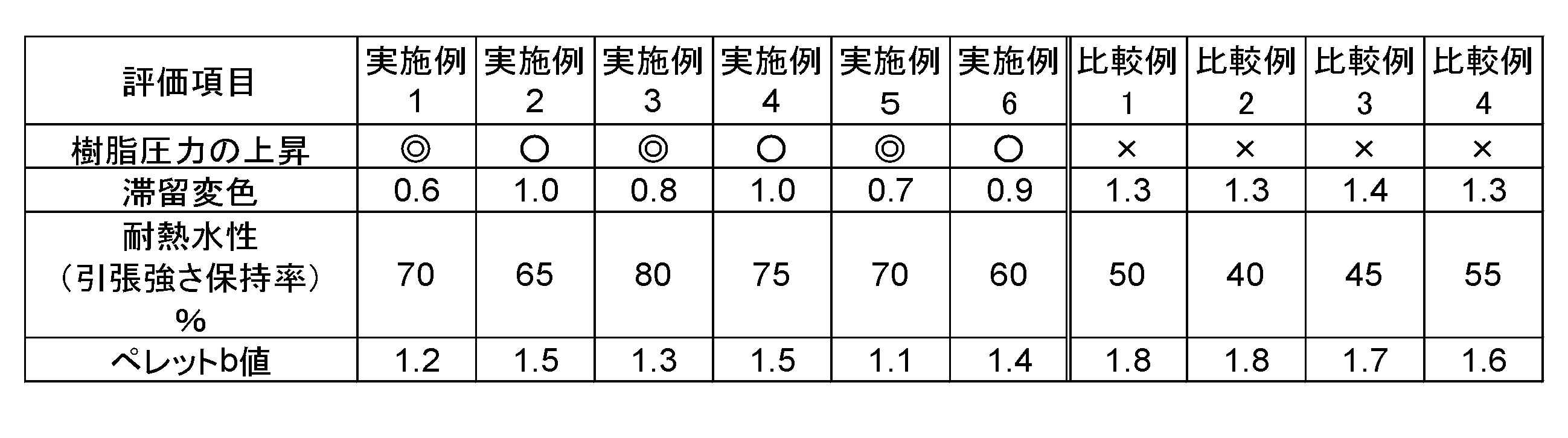
表1、2からAl量を減量することによって樹脂圧力上昇が抑制され、生産性が向上することが確認された。ペレット色相、滞留変色性および耐熱水性においても改善が確認された。
Claims (4)
- (A)ポリアセタール樹脂100質量部と、
(B)ヒンダードフェノール系酸化防止剤0.01~1.0質量部と、
(C)脂肪酸カルシウム塩0.01~0.5質量部とを含有し、(C)脂肪酸カルシウム塩に対するAl量が50ppm以下であるポリアセタール樹脂組成物。 - 脂肪酸カルシウム塩に対するNa量が100ppm以下である請求項1記載のポリアセタール樹脂組成物。
- 前記(C)脂肪酸カルシウム塩が、12-ヒドロキシステアリン酸カルシウム、ステアリン酸カルシウム、パルミチン酸カルシウムから選ばれた少なくとも1種である請求項1または2に記載のポリアセタール樹脂組成物。
- ポリアセタール樹脂と、ヒンダードフェノール系酸化防止剤と、脂肪酸カルシウム塩とを含む原料組成物を押出機に投入し、押出機内で前記原料組成物を混練、押出ししポリアセタール樹脂組成物からなるペレットを製造する方法において、該脂肪酸カルシウム塩に対するAl量が50ppm以下である、ポリアセタール樹脂組成物の製造方法。
Priority Applications (2)
| Application Number | Priority Date | Filing Date | Title |
|---|---|---|---|
| CN201780063372.0A CN109844019B (zh) | 2016-12-21 | 2017-10-16 | 聚缩醛树脂组合物及其制造方法 |
| MYPI2019003012A MY191909A (en) | 2016-12-21 | 2017-10-16 | Polyacetal resin composition and method for producing same |
Applications Claiming Priority (2)
| Application Number | Priority Date | Filing Date | Title |
|---|---|---|---|
| JP2016247413A JP6807227B2 (ja) | 2016-12-21 | 2016-12-21 | ポリアセタール樹脂組成物およびその製造方法 |
| JP2016-247413 | 2016-12-21 |
Publications (1)
| Publication Number | Publication Date |
|---|---|
| WO2018116597A1 true WO2018116597A1 (ja) | 2018-06-28 |
Family
ID=62626133
Family Applications (1)
| Application Number | Title | Priority Date | Filing Date |
|---|---|---|---|
| PCT/JP2017/037336 Ceased WO2018116597A1 (ja) | 2016-12-21 | 2017-10-16 | ポリアセタール樹脂組成物およびその製造方法 |
Country Status (5)
| Country | Link |
|---|---|
| JP (1) | JP6807227B2 (ja) |
| CN (1) | CN109844019B (ja) |
| MY (1) | MY191909A (ja) |
| TW (1) | TWI749096B (ja) |
| WO (1) | WO2018116597A1 (ja) |
Citations (7)
| Publication number | Priority date | Publication date | Assignee | Title |
|---|---|---|---|---|
| JPH04168143A (ja) * | 1990-10-31 | 1992-06-16 | Toray Ind Inc | ポリオキシメチレン樹脂組成物 |
| JPH07188514A (ja) * | 1993-12-27 | 1995-07-25 | Toray Ind Inc | ポリアセタール樹脂組成物 |
| JPH08127702A (ja) * | 1994-10-27 | 1996-05-21 | Asahi Chem Ind Co Ltd | モールドデポジットの改良されたポリアセタール樹脂組成物 |
| JP2013185027A (ja) * | 2012-03-07 | 2013-09-19 | Polyplastics Co | ポリアセタール樹脂成形品の使用方法 |
| WO2015075999A1 (ja) * | 2013-11-21 | 2015-05-28 | ポリプラスチックス株式会社 | ポリオキシメチレン樹脂組成物の製造方法 |
| JP2015209483A (ja) * | 2014-04-25 | 2015-11-24 | 旭化成ケミカルズ株式会社 | ポリアセタール樹脂組成物、及びそれからなる成形体 |
| JP2017165690A (ja) * | 2016-03-17 | 2017-09-21 | 旭化成株式会社 | 脂肪酸金属塩組成物の製造方法及びポリアセタール樹脂組成物 |
Family Cites Families (1)
| Publication number | Priority date | Publication date | Assignee | Title |
|---|---|---|---|---|
| JP2005112949A (ja) * | 2003-10-06 | 2005-04-28 | Mitsubishi Rayon Co Ltd | 熱可塑性樹脂組成物 |
-
2016
- 2016-12-21 JP JP2016247413A patent/JP6807227B2/ja active Active
-
2017
- 2017-10-16 CN CN201780063372.0A patent/CN109844019B/zh active Active
- 2017-10-16 MY MYPI2019003012A patent/MY191909A/en unknown
- 2017-10-16 WO PCT/JP2017/037336 patent/WO2018116597A1/ja not_active Ceased
- 2017-11-06 TW TW106138293A patent/TWI749096B/zh active
Patent Citations (7)
| Publication number | Priority date | Publication date | Assignee | Title |
|---|---|---|---|---|
| JPH04168143A (ja) * | 1990-10-31 | 1992-06-16 | Toray Ind Inc | ポリオキシメチレン樹脂組成物 |
| JPH07188514A (ja) * | 1993-12-27 | 1995-07-25 | Toray Ind Inc | ポリアセタール樹脂組成物 |
| JPH08127702A (ja) * | 1994-10-27 | 1996-05-21 | Asahi Chem Ind Co Ltd | モールドデポジットの改良されたポリアセタール樹脂組成物 |
| JP2013185027A (ja) * | 2012-03-07 | 2013-09-19 | Polyplastics Co | ポリアセタール樹脂成形品の使用方法 |
| WO2015075999A1 (ja) * | 2013-11-21 | 2015-05-28 | ポリプラスチックス株式会社 | ポリオキシメチレン樹脂組成物の製造方法 |
| JP2015209483A (ja) * | 2014-04-25 | 2015-11-24 | 旭化成ケミカルズ株式会社 | ポリアセタール樹脂組成物、及びそれからなる成形体 |
| JP2017165690A (ja) * | 2016-03-17 | 2017-09-21 | 旭化成株式会社 | 脂肪酸金属塩組成物の製造方法及びポリアセタール樹脂組成物 |
Also Published As
| Publication number | Publication date |
|---|---|
| JP6807227B2 (ja) | 2021-01-06 |
| TW201835207A (zh) | 2018-10-01 |
| CN109844019B (zh) | 2022-05-17 |
| TWI749096B (zh) | 2021-12-11 |
| MY191909A (en) | 2022-07-18 |
| JP2018100354A (ja) | 2018-06-28 |
| CN109844019A (zh) | 2019-06-04 |
Similar Documents
| Publication | Publication Date | Title |
|---|---|---|
| JP3087911B2 (ja) | 樹脂組成物 | |
| JP6024749B2 (ja) | オキシメチレン共重合体の製造方法 | |
| JP6046482B2 (ja) | ポリアセタール樹脂組成物 | |
| WO2013094393A1 (ja) | 樹脂組成物および成形体 | |
| EP0388809B1 (en) | Polyacetal resins containing non-meltable polymer stabilizers or cellulose stabilizers | |
| JP6327923B2 (ja) | ポリアセタール樹脂組成物、及びそれからなる成形体 | |
| US20250051562A1 (en) | Polyoxymethylene compositions | |
| JP6807227B2 (ja) | ポリアセタール樹脂組成物およびその製造方法 | |
| CN110016201A (zh) | 聚缩醛树脂组合物 | |
| JP6965877B2 (ja) | ポリアセタール樹脂組成物及びその製造方法 | |
| JP5556064B2 (ja) | 難燃性ポリフェニレンエーテル系樹脂組成物及びその成形品 | |
| JP5031198B2 (ja) | 不安定末端基分解処理剤を用いた、安定化ポリアセタール樹脂の製造方法 | |
| JP2007051205A (ja) | ポリアセタール樹脂組成物及び樹脂成形体 | |
| JP6014390B2 (ja) | ポリアセタール樹脂組成物 | |
| JP2012233121A (ja) | ポリオキシメチレン樹脂組成物 | |
| JP6673539B1 (ja) | オキシメチレン共重合体の製造方法 | |
| WO2018003233A1 (ja) | 板状成形体成形用のポリアセタール樹脂組成物、板状成形体、及びウインドレギュレータのキャリアプレート | |
| TW202124574A (zh) | 聚縮醛樹脂組合物及金屬樹脂組合物 | |
| KR20130078778A (ko) | 폴리옥시메틸렌 수지 조성물 | |
| JP2008156504A (ja) | ポリアセタール樹脂組成物 | |
| JPH0518864B2 (ja) | ||
| JP2013129749A (ja) | 樹脂組成物および成形体 | |
| JP2017115086A (ja) | ポリアセタール樹脂組成物 | |
| CN104119659A (zh) | 一种高流动性的pc组合物及其制备方法 | |
| JP2522302C (ja) |
Legal Events
| Date | Code | Title | Description |
|---|---|---|---|
| 121 | Ep: the epo has been informed by wipo that ep was designated in this application |
Ref document number: 17884910 Country of ref document: EP Kind code of ref document: A1 |
|
| NENP | Non-entry into the national phase |
Ref country code: DE |
|
| 122 | Ep: pct application non-entry in european phase |
Ref document number: 17884910 Country of ref document: EP Kind code of ref document: A1 |