WO2018097061A1 - インク、インクセット、及び繊維の捺染方法 - Google Patents
インク、インクセット、及び繊維の捺染方法 Download PDFInfo
- Publication number
- WO2018097061A1 WO2018097061A1 PCT/JP2017/041490 JP2017041490W WO2018097061A1 WO 2018097061 A1 WO2018097061 A1 WO 2018097061A1 JP 2017041490 W JP2017041490 W JP 2017041490W WO 2018097061 A1 WO2018097061 A1 WO 2018097061A1
- Authority
- WO
- WIPO (PCT)
- Prior art keywords
- ink
- fiber
- reactive
- mass
- printing method
- Prior art date
- Legal status (The legal status is an assumption and is not a legal conclusion. Google has not performed a legal analysis and makes no representation as to the accuracy of the status listed.)
- Ceased
Links
Classifications
-
- B—PERFORMING OPERATIONS; TRANSPORTING
- B41—PRINTING; LINING MACHINES; TYPEWRITERS; STAMPS
- B41J—TYPEWRITERS; SELECTIVE PRINTING MECHANISMS, i.e. MECHANISMS PRINTING OTHERWISE THAN FROM A FORME; CORRECTION OF TYPOGRAPHICAL ERRORS
- B41J2/00—Typewriters or selective printing mechanisms characterised by the printing or marking process for which they are designed
- B41J2/005—Typewriters or selective printing mechanisms characterised by the printing or marking process for which they are designed characterised by bringing liquid or particles selectively into contact with a printing material
- B41J2/01—Ink jet
-
- B—PERFORMING OPERATIONS; TRANSPORTING
- B41—PRINTING; LINING MACHINES; TYPEWRITERS; STAMPS
- B41M—PRINTING, DUPLICATING, MARKING, OR COPYING PROCESSES; COLOUR PRINTING
- B41M5/00—Duplicating or marking methods; Sheet materials for use therein
-
- C—CHEMISTRY; METALLURGY
- C09—DYES; PAINTS; POLISHES; NATURAL RESINS; ADHESIVES; COMPOSITIONS NOT OTHERWISE PROVIDED FOR; APPLICATIONS OF MATERIALS NOT OTHERWISE PROVIDED FOR
- C09D—COATING COMPOSITIONS, e.g. PAINTS, VARNISHES OR LACQUERS; FILLING PASTES; CHEMICAL PAINT OR INK REMOVERS; INKS; CORRECTING FLUIDS; WOODSTAINS; PASTES OR SOLIDS FOR COLOURING OR PRINTING; USE OF MATERIALS THEREFOR
- C09D11/00—Inks
- C09D11/30—Inkjet printing inks
- C09D11/32—Inkjet printing inks characterised by colouring agents
- C09D11/328—Inkjet printing inks characterised by colouring agents characterised by dyes
-
- C—CHEMISTRY; METALLURGY
- C09—DYES; PAINTS; POLISHES; NATURAL RESINS; ADHESIVES; COMPOSITIONS NOT OTHERWISE PROVIDED FOR; APPLICATIONS OF MATERIALS NOT OTHERWISE PROVIDED FOR
- C09D—COATING COMPOSITIONS, e.g. PAINTS, VARNISHES OR LACQUERS; FILLING PASTES; CHEMICAL PAINT OR INK REMOVERS; INKS; CORRECTING FLUIDS; WOODSTAINS; PASTES OR SOLIDS FOR COLOURING OR PRINTING; USE OF MATERIALS THEREFOR
- C09D11/00—Inks
- C09D11/30—Inkjet printing inks
- C09D11/36—Inkjet printing inks based on non-aqueous solvents
-
- C—CHEMISTRY; METALLURGY
- C09—DYES; PAINTS; POLISHES; NATURAL RESINS; ADHESIVES; COMPOSITIONS NOT OTHERWISE PROVIDED FOR; APPLICATIONS OF MATERIALS NOT OTHERWISE PROVIDED FOR
- C09D—COATING COMPOSITIONS, e.g. PAINTS, VARNISHES OR LACQUERS; FILLING PASTES; CHEMICAL PAINT OR INK REMOVERS; INKS; CORRECTING FLUIDS; WOODSTAINS; PASTES OR SOLIDS FOR COLOURING OR PRINTING; USE OF MATERIALS THEREFOR
- C09D11/00—Inks
- C09D11/30—Inkjet printing inks
- C09D11/38—Inkjet printing inks characterised by non-macromolecular additives other than solvents, pigments or dyes
-
- C—CHEMISTRY; METALLURGY
- C09—DYES; PAINTS; POLISHES; NATURAL RESINS; ADHESIVES; COMPOSITIONS NOT OTHERWISE PROVIDED FOR; APPLICATIONS OF MATERIALS NOT OTHERWISE PROVIDED FOR
- C09D—COATING COMPOSITIONS, e.g. PAINTS, VARNISHES OR LACQUERS; FILLING PASTES; CHEMICAL PAINT OR INK REMOVERS; INKS; CORRECTING FLUIDS; WOODSTAINS; PASTES OR SOLIDS FOR COLOURING OR PRINTING; USE OF MATERIALS THEREFOR
- C09D11/00—Inks
- C09D11/30—Inkjet printing inks
- C09D11/40—Ink-sets specially adapted for multi-colour inkjet printing
-
- D—TEXTILES; PAPER
- D06—TREATMENT OF TEXTILES OR THE LIKE; LAUNDERING; FLEXIBLE MATERIALS NOT OTHERWISE PROVIDED FOR
- D06P—DYEING OR PRINTING TEXTILES; DYEING LEATHER, FURS OR SOLID MACROMOLECULAR SUBSTANCES IN ANY FORM
- D06P3/00—Special processes of dyeing or printing textiles, or dyeing leather, furs, or solid macromolecular substances in any form, classified according to the material treated
- D06P3/02—Material containing basic nitrogen
- D06P3/04—Material containing basic nitrogen containing amide groups
- D06P3/24—Polyamides; Polyurethanes
-
- D—TEXTILES; PAPER
- D06—TREATMENT OF TEXTILES OR THE LIKE; LAUNDERING; FLEXIBLE MATERIALS NOT OTHERWISE PROVIDED FOR
- D06P—DYEING OR PRINTING TEXTILES; DYEING LEATHER, FURS OR SOLID MACROMOLECULAR SUBSTANCES IN ANY FORM
- D06P3/00—Special processes of dyeing or printing textiles, or dyeing leather, furs, or solid macromolecular substances in any form, classified according to the material treated
- D06P3/58—Material containing hydroxyl groups
- D06P3/60—Natural or regenerated cellulose
- D06P3/66—Natural or regenerated cellulose using reactive dyes
-
- D—TEXTILES; PAPER
- D06—TREATMENT OF TEXTILES OR THE LIKE; LAUNDERING; FLEXIBLE MATERIALS NOT OTHERWISE PROVIDED FOR
- D06P—DYEING OR PRINTING TEXTILES; DYEING LEATHER, FURS OR SOLID MACROMOLECULAR SUBSTANCES IN ANY FORM
- D06P5/00—Other features in dyeing or printing textiles, or dyeing leather, furs, or solid macromolecular substances in any form
-
- D—TEXTILES; PAPER
- D06—TREATMENT OF TEXTILES OR THE LIKE; LAUNDERING; FLEXIBLE MATERIALS NOT OTHERWISE PROVIDED FOR
- D06P—DYEING OR PRINTING TEXTILES; DYEING LEATHER, FURS OR SOLID MACROMOLECULAR SUBSTANCES IN ANY FORM
- D06P5/00—Other features in dyeing or printing textiles, or dyeing leather, furs, or solid macromolecular substances in any form
- D06P5/02—After-treatment
-
- D—TEXTILES; PAPER
- D06—TREATMENT OF TEXTILES OR THE LIKE; LAUNDERING; FLEXIBLE MATERIALS NOT OTHERWISE PROVIDED FOR
- D06P—DYEING OR PRINTING TEXTILES; DYEING LEATHER, FURS OR SOLID MACROMOLECULAR SUBSTANCES IN ANY FORM
- D06P5/00—Other features in dyeing or printing textiles, or dyeing leather, furs, or solid macromolecular substances in any form
- D06P5/30—Ink jet printing
Definitions
- the present invention relates to an ink and an ink set containing reactive dyes, and a textile printing method using them.
- reactive dyes are used in inks for inkjet printing used for dyeing cellulose fibers such as cotton and rayon.
- reactive dyes reactive groups that react with the fibers present in the dye molecule react with hydroxy groups and the like present in the fibers, and form a covalent bond between the dye and the fibers, thereby fixing to the fibers.
- ink jet textile printing ink droplets are ejected to form an image, so that ink used in conventional textile printing methods such as screen textile printing cannot be directly applied to ink jet textile printing.
- Patent Document 1 proposes an ink containing a reactive dye and thiodiglycol as an ink for inkjet printing from which a high-density printed fabric can be obtained.
- Patent Documents 2 and 3 propose inks containing reactive dyes and 1,2-alkanediol as inks for ink jet printing that can produce printed fabrics having a high concentration.
- An object of the present invention is to provide an ink containing a reactive dye and capable of high-density dyeing, an ink set including the ink, and a textile printing method using the ink.
- An ink set comprising black ink and at least one of magenta ink and cyan ink,
- the black ink is the ink according to any one of 1) to 15)
- the magenta ink is C.I. I. Containing Reactive Red 245 as reactive dye
- the cyan ink is C.I. I. Reactive Blue 15: 1 and C.I. I.
- a textile printing method comprising: 18) The fiber according to 17), further comprising a pretreatment step in which an aqueous solution containing one or more types of paste material, a pretreatment pH adjuster, and a hydrotropic agent is adhered to the fiber before the attachment step. Printing method.
- a textile printing method comprising: 20) The fiber according to 19), further comprising a pretreatment step of adhering an aqueous solution containing one or more types of glue material, a pretreatment pH adjuster, and a hydrotropic agent to the fibers before the adhesion step. Printing method.
- the inkjet printer is a scanning inkjet printer, The textile printing method according to 19) or 20), wherein, in the attaching step, the black ink and at least one of the magenta ink and the cyan ink are attached to the fiber in an overlapping manner. 22) 21. The textile printing method according to 21), wherein, in the attaching step, the black ink, the magenta ink, and the cyan ink are attached to the fiber in an overlapping manner. 23) The textile printing method according to 21) or 22), wherein the black ink discharge amount is larger than the other ink discharge amounts. 24) The fiber printing method according to any one of 17) to 23), wherein the fibers are cellulosic fibers or polyamide fibers. 25) The fiber printing method according to 24), wherein the fiber is a cellulosic fiber.
- an ink containing a reactive dye and capable of high-density dyeing an ink set including the ink, and a textile printing method using the ink.
- the ink according to this embodiment is C.I. I. Reactive Blue 176 and C.I. I. Reactive Red 245 and C.I. I. Reactive Orange 13 and C.I. I. Reactive dye containing at least one of Reactive Orange 99, and urea. According to such an ink, it is possible to dye black with a high dyeing density.
- the ink according to this embodiment is C.I. I.
- a reactive dye selected from Reactive Blue C.I. I. Contains Reactive Blue 176.
- C. I. Reactive Blue 176 is a C.I. I. It is a reactive dye, also called Reactive Black 39, which has excellent color developability and a clear navy color.
- the content of Reactive Blue 176 is preferably 5 to 15% by mass, and more preferably 8 to 12% by mass, based on the total amount of ink.
- Reactive Blue 176 is generally known as a Na salt compound, but can be changed to a salt other than Na salt according to the required characteristics of the ink.
- Examples of salts other than the Na salt that Reactive Blue 176 may have include salts with inorganic cations or organic cations.
- Specific examples of the salt with an inorganic cation include a salt with an alkali metal such as Li and K, a salt with an alkaline earth metal such as Ca and Mg, and an ammonium salt (NH 4 + ).
- Specific examples of the salt with an organic cation include quaternary ammonium salts such as tetramethylammonium salt, tetraethylammonium salt, and tetrabutylammonium salt. Among these, a salt with a monovalent cation is preferable, and a Li salt is more preferable.
- the molar ratio of Li salt to salt other than Li salt is preferably 5:95 to 95: 5, more preferably 20:80 to 80:20. 30:70 to 70:30, more preferably 40:60 to 60:40, particularly preferably 40:60 to 50:50.
- the Li ion concentration in the ink is preferably in the range of 1000 to 2000 mass ppm, more preferably in the range of 1200 to 1700 mass ppm. This Li ion concentration can be measured by a known method.
- the salt as described above as its preparation method, for example, it is possible to use a known ion exchange method such as preparation by ion exchange using a reverse osmosis membrane purification method or salt exchange crystallization, It is preferable to use a reverse osmosis membrane purification method.
- the ink according to this embodiment is C.I. I.
- a reactive dye selected from Reactive Red C.I. I. Contains Reactive Red 245.
- the content of Reactive Red 245 is preferably 0.1 to 10% by mass, more preferably 1 to 8% by mass, based on the total amount of ink.
- the ink according to this embodiment is C.I. I.
- a reactive dye selected from Reactive Orange C.I. I. Reactive Orange 13 and C.I. I. Contains at least one of Reactive Orange 99.
- the ink according to this embodiment is C.I. I. Reactive Orange 13 and C.I. I. It is preferable to contain both Reactive Orange 99.
- the total content of Reactive Orange 99 is preferably 0.1 to 30% by mass, and more preferably 1 to 25% by mass, based on the total amount of ink.
- the ink according to this embodiment may contain a reactive dye other than the above as long as the effects of the present invention are not impaired.
- C.I. I As what is classified into Reactive Blue, for example, C.I. I. Reactive Blue 1, 2, 3, 4, 5, 6, 7, 8, 9, 10, 11, 13, 14, 15, 15: 1, 16, 17, 18, 19, 19: 2, 20, 21, 22, 23, 24, 25, 26, 27, 28, 29, 30, 31, 32, 33, 34, 35, 36, 36: 1, 38, 39, 40, 41, 42, 43, 44, 46, 47, 48, 49, 50, 51, 52, 53, 54, 55, 56, 57, 58, 59, 60, 61, 62, 63, 64, 65, 66, 67, 68, 69, 70, 71, 72, 73, 74, 75, 76, 77, 78, 79, 80, 81, 82, 83, 84, 85, 86, 87, 88, 89, 90, 91, 92, 93, 94, 95, 96, 97, 98, 99, 100, 101, 102, 103, 104, 105, 1 6,
- C.I. I examples of those classified as Reactive Red include C.I. I. Reactive Red 1, 1: 1, 2, 3, 3: 1, 4, 5, 6, 6: 1, 7, 8, 8: 1, 9, 10, 11, 12, 13, 14, 15, 16, 17, 18, 19, 20, 21, 21: 1, 22, 22: 1, 23, 24, 24: 1, 25, 26, 27, 28, 29, 30, 31, 31: 1, 32, 33, 34, 35, 35: 1, 35: 2, 36, 37, 38, 39, 40, 41, 42, 43, 44, 45, 45: 1, 46, 47, 48, 49, 50, 51, 51: 1, 52, 53, 54, 55, 56, 58, 59, 59: 1, 60, 60: 1, 61, 61: 1, 62, 63, 63: 1, 64, 65, 66, 67, 68, 69, 70, 71, 72, 73, 73: 1, 74, 75, 76, 77, 78, 79, 80, 81, 82, 83, 84 85, 86, 87, 88, 89, 90
- C.I. I As what is classified into Reactive Orange, for example, C.I. I. Reactive Orange 1, 2, 3, 4, 5, 6, 7, 8, 9, 10, 11, 12, 14, 15, 15: 1, 16, 16: 1, 16: 2, 17, 18, 19, 20, 21, 22, 23, 24, 25, 26, 27, 28, 28: 1, 29, 30, 31, 32, 33, 34, 35, 36, 37, 38, 39, 40, 41, 42, 43, 44, 45, 46, 47, 48, 49, 50, 51, 52, 53, 54, 55, 56, 57, 58, 59, 60, 61, 62, 63, 64, 66, 67, 68, 69, 70, 71, 72, 72: 1, 73, 74, 75, 76, 77, 78, 79, 80, 81, 82, 83, 84, 85, 86, 87, 88, 89, 90, 91, 92, 93, 94, 95, 96, 97, 98, 100, 101, 102, 1 3, 104,
- the content of other reactive dyes is preferably 10% by mass or less, and more preferably 5% by mass or less, based on the total amount of ink.
- the ink according to the present embodiment contains urea.
- the urea content is preferably 5 to 20% by mass, more preferably 10 to 20% by mass, based on the total amount of ink.
- the urea content is preferably 5 to 20% by mass, more preferably 10 to 20% by mass, based on the total amount of ink.
- the ink according to the present embodiment is a water-based ink and contains water.
- the water used for preparing the ink is preferably one that has been subjected to a purification operation such as ion exchange water or distilled water.
- a purification operation such as ion exchange water or distilled water.
- water that is not subjected to purification operations contains metal ions such as Ca ions and Mg ions. Therefore, when such water is used for ink preparation, the ions and the like are mixed in a minute amount.
- such metal ions and inorganic salts are referred to as “inorganic impurities” for convenience. These inorganic impurities are preferably reduced in order to deteriorate the solubility in ink and the storage stability.
- the ink according to this embodiment may contain a water-soluble organic solvent in addition to water.
- the water-soluble organic solvent include C1-C4 alcohols such as methanol, ethanol, n-propanol, isopropanol, n-butanol, isobutanol, sec-butanol, and tert-butanol; N, N-dimethylformamide, N, N Amides such as dimethylacetamide; 2-pyrrolidone, N-methyl-2-pyrrolidone, hydroxyethyl-2-pyrrolidone, 1,3-dimethylimidazolidin-2-one, 1,3-dimethylhexahydropyrimido-2 Heterocyclic ketones such as --one; ketones or ketoalcohols such as acetone, methyl ethyl ketone, 2-methyl-2-hydroxypentan-4-one; cyclic ethers such as tetrahydrofuran, diox
- the ink according to the present embodiment has a dipole moment value ( ⁇ P value) including at least one cyclic amide solvent of 9 to 30 MPa 1/2 from the viewpoint of improving ejection stability and low-temperature storage stability. It is preferable to contain a water-soluble organic solvent within a range (preferably within a range of 9 to 20 MPa 1/2 ).
- the dipole moment value ( ⁇ P value) is a polarization term of a Hansen solubility parameter, and can be estimated using computer software (Hansen Solubility Parameters in Practice (HSPIP)).
- cyclic amide solvent examples include solvents in which a carboxy group and an amino group are condensed by dehydration to form a 3- to 7-membered ring structure. Specific examples include ⁇ -lactam (21.7), ⁇ -lactam ( 17.9), ⁇ -caprolactam (13.8), 2-pyrrolidone (12), N-methyl-2-pyrrolidone (12.3), N-ethyl-2-pyrrolidone (12), etc. The numerical value in each indicates the ⁇ P value).
- a cyclic amide solvent may be used individually by 1 type, and may use 2 or more types together.
- the ink according to this embodiment preferably contains 2-pyrrolidone among the cyclic amide solvents.
- the content of 2-pyrrolidone is preferably 5 to 20% by mass, and more preferably 8 to 12% by mass, based on the total amount of ink.
- the ink according to this embodiment contains 2-pyrrolidone
- the total content of 2-pyrrolidone and urea is 15 to 30% by mass
- the content ratio of 2-pyrrolidone and urea is mass. 1: 2 to 2: 1 on the basis (however, the total content of 2-pyrrolidone and urea is 15% by mass, and the content ratio of 2-pyrrolidone and urea is 2: 2 on the mass basis). 1 is preferred).
- Examples of the water-soluble organic solvent having a dipole moment value ( ⁇ P value) in the range of 9 to 30 MPa 1/2 other than the cyclic amide solvent include, for example, ethylene glycol (11), propylene glycol (10.4). ), Glycerin (11.3), trade names manufactured by Idemitsu Kosan Co., Ltd. Ecamide B-100 (9) and Ecamide M-100 (10.4), 1,4-butanediol (11), ethylene urea (17 .6), 2-methyl-1,3-propanediol (9.2), cinnamide (27.6), etc. (all numerical values in parentheses indicate ⁇ P values).
- One type of water-soluble organic solvent other than the cyclic amide solvent may be used alone, or two or more types may be used in combination.
- the ink according to this embodiment preferably contains at least one of ethylene glycol and propylene glycol, and more preferably contains both ethylene glycol and propylene glycol, among water-soluble organic solvents other than cyclic amide solvents. .
- the total content of ethylene glycol and propylene glycol is preferably 1 to 50% by mass, more preferably 5 to 40% by mass, based on the total amount of ink.
- the ink according to this embodiment includes, as other components, a pH adjuster, an antiseptic / antifungal agent, a chelating reagent, a rust preventive agent, an ultraviolet absorber, a viscosity adjuster, an antifading agent, a surface tension adjuster, an antifoaming agent, etc.
- the ink preparation agent may be contained. Each ink preparation agent may be used individually by 1 type, and may use 2 or more types together.
- pH adjuster examples include alkali metal hydroxides such as sodium hydroxide, potassium hydroxide and lithium hydroxide; triethanolamine, diethanolamine, dimethylethanolamine, diethylethanolamine, tris (hydroxymethyl) aminomethane and the like.
- alkali metal hydroxides such as sodium hydroxide, potassium hydroxide and lithium hydroxide
- triethanolamine diethanolamine, dimethylethanolamine, diethylethanolamine, tris (hydroxymethyl) aminomethane and the like.
- Tertiary amines preferably mono-, di-, or tri-C1-C4 alkylamines optionally substituted with a hydroxy group; and the like. Of these, tris (hydroxymethyl) aminomethane is preferred.
- the ink according to this embodiment contains a pH adjuster
- the content is usually 0.01 to 3% by mass, preferably 0.02 to 2.5% by mass, based on the total amount of the ink. More preferably, it is 0.05 to 2% by mass.
- antiseptic and antifungal agents examples include organic sulfur, organic nitrogen sulfur, organic halogen, haloallylsulfone, iodopropargyl, N-haloalkylthio, benzothiazole, nitrile, pyridine, 8- Oxyquinoline, isothiazoline, dithiol, pyridine oxide, nitropropane, organotin, phenol, quaternary ammonium salt, triazine, thiadiazine, anilide, adamantane, dithiocarbamate, brominated indanone And compounds such as benzyl bromacetate and inorganic salts.
- Examples of the organic halogen compound include sodium pentachlorophenol.
- Examples of pyridine oxide compounds include sodium 2-pyridinethiol-1-oxide.
- Examples of the isothiazoline compounds include 1,2-benzisothiazolin-3-one, 2-n-octyl-4-isothiazolin-3-one, 5-chloro-2-methyl-4-isothiazoline-3-one, 5 -Chloro-2-methyl-4-isothiazolin-3-one magnesium chloride, 5-chloro-2-methyl-4-isothiazolin-3-one calcium chloride, 2-methyl-4-isothiazolin-3-one calcium chloride, etc. Can be mentioned.
- antiseptic / antifungal agents include sodium acetate, sodium sorbate, sodium benzoate, trade names Proxel RTM GXL (S) and Proxel RTM XL-2 (S) manufactured by Arch Chemical Co., Ltd.
- the superscript RTM means a registered trademark.
- chelating reagent examples include disodium ethylenediaminetetraacetate, sodium nitrilotriacetate, sodium hydroxyethylethylenediaminetriacetate, sodium diethylenetriaminepentaacetate, sodium uracil diacetate, and the like.
- anti-rust examples include acidic sulfite, sodium thiosulfate, ammonium thioglycolate, diisopropylammonium nitrite, pentaerythritol tetranitrate, and dicyclohexylammonium nitrite.
- UV absorber examples include benzophenone compounds, benzotriazole compounds, cinnamic acid compounds, triazine compounds, and stilbene compounds.
- a compound that absorbs ultraviolet rays such as a benzoxazole-based compound and emits fluorescence, a so-called fluorescent whitening agent, and the like can also be used.
- viscosity modifier examples include water-soluble polymer compounds in addition to water-soluble organic solvents.
- water-soluble polymer compound examples include polyvinyl alcohol, cellulose derivatives, polyamine, polyimine, poly C2-C3 alkylene glycol having a molecular weight of about 20000 or less, preferably liquid polyalkylene glycol.
- polyoxypropylene diglyceryl ethers such as trade names SC-P400, SC-P750, SC-P1000, SC-P1200, SC-P1600 manufactured by Sakamoto Pharmaceutical Co., Ltd .; SC-E450, SC-E750, SC- Examples thereof include polyoxyethylene diglyceryl ethers such as E1000, SC-E1500, and SC-E2000. SC-P1000 is preferably used.
- the anti-fading agent is used for the purpose of improving image storage stability.
- various organic and metal complex antifading agents can be used.
- the organic anti-fading agent include hydroquinones, alkoxyphenols, dialkoxyphenols, phenols, anilines, amines, indanes, chromans, alkoxyanilines, and heterocycles.
- the metal complex anti-fading agent include nickel complexes and zinc complexes.
- Surfactant is mentioned as a surface tension regulator.
- the surfactant include an anionic surfactant, a nonionic surfactant, a cationic surfactant, and an amphoteric surfactant.
- the surfactants at least one of a nonionic surfactant and an anionic surfactant is preferable.
- anionic surfactant examples include alkyl sulfocarboxylates; ⁇ -olefin sulfonates; polyoxyethylene alkyl ether acetates; N-acyl amino acids or salts thereof; N-acyl methyl taurates; Alkyl ether sulfate; alkyl sulfate polyoxyethylene alkyl ether phosphate; rosin acid soap; castor oil sulfate ester; lauryl alcohol sulfate ester; alkylphenol phosphate ester; alkyl phosphate ester; alkyl aryl sulfonate salt; Examples thereof include sulfosuccinates such as oxalate, diethylhexylsilsulfate, and dioctylsulfosuccinate.
- Sulfosuccinic acid is preferable, and examples of commercially available products thereof include Lion Corp., trade name Ripar 835I, 860K, 870P, NTD, MSC; Adeka Co., Ltd., trade name Adeka Coal EC8600. Manufactured by Kao Co., Ltd., trade names PELEX OT-P, CS, TA, TR; Shin Nippon Rika Co., Ltd., Jamaica Mild ES-100, ES-200, Rika Surf P-10, M- 30, M-75, M-300, G-30, G-600; manufactured by Toho Chemical Industry Co., Ltd., Kohakunol L-300, L-40, L-400, NL-400; Etc.
- the content is usually 0.05 to 2% by mass, preferably 0.05 to 1.5% by mass, based on the total amount of the ink. %, More preferably 0.05 to 1% by mass, and still more preferably 0.1 to 0.5% by mass.
- Nonionic surfactant examples include ethers such as polyoxyethylene nonyl phenyl ether, polyoxyethylene octyl phenyl ether, polyoxyethylene dodecyl phenyl ether, polyoxyethylene oleyl ether, polyoxyethylene lauryl ether, and polyoxyethylene alkyl ether.
- Polyesters such as polyoxyethylene oleate, polyoxyethylene distearate, sorbitan laurate, sorbitan monostearate, sorbitan monooleate, sorbitan sesquioleate, polyoxyethylene monooleate, polyoxyethylene stearate
- Acetylene alcohol system such as 3,5-dimethyl-1-hexyn-3-ol; 2,4,7,9-tetramethyl-5-decyne-4 7-diol, 3,6-dimethyl-4-octyne-3,6-diol, manufactured by Air Products, trade names Surfinol 104, 104PG50, 82, 420, 440, 465, 485; Acetylene glycol type such as STG; Among these, acetylene glycol type or acetylene alcohol type is preferable, and acetylene glycol type is more preferable.
- the content is usually 0.05 to 2% by mass, preferably 0.05 to 1.5% by mass, based on the total amount of the ink. %, More preferably 0.05 to 1% by mass, and still more preferably 0.1 to 0.5% by mass.
- cationic surfactant examples include 2-vinylpyridine derivatives and poly-4-vinylpyridine derivatives.
- amphoteric surfactant examples include lauryldimethylaminoacetic acid betaine, 2-alkyl-N-carboxymethyl-N-hydroxyethylimidazolinium betaine, coconut oil fatty acid amidopropyldimethylaminoacetic acid betaine, polyoctylpolyaminoethylglycine, imidazoline. Derivatives and the like.
- Examples of the antifoaming agent include highly oxidized oil-based, glycerin fatty acid ester-based, fluorine-based and silicone-based compounds.
- the viscosity of the ink according to the present embodiment at 20 ° C. is, for example, preferably 4 to 30 mPa ⁇ s, and more preferably 5 to 20 mPa ⁇ s.
- the static surface tension at 25 ° C. of the ink according to the present embodiment is 20 from the viewpoint of improving high-speed continuous ejection under a low temperature environment. It is preferably ⁇ 45 mN / m, more preferably 25 to 40 mN / m.
- the order in which the components are added is not particularly limited, and the ink may be prepared by mixing until substantially becoming a solution by stirring. As described above, it is preferable to use water having a small amount of inorganic impurities such as distilled water and ion-exchanged water as the water used in preparing the ink.
- the ink should be fine filtered using a membrane filter or the like, and the filtrate from which impurities are removed should be used.
- the pore size of the filter when performing microfiltration is usually 0.1 to 1.0 ⁇ m, preferably 0.1 to 0.8 ⁇ m.
- the content of inorganic impurities is usually 1% by mass or less, preferably 0.1% by mass or less, more preferably 0.01% by mass or less, based on the total amount of ink.
- a lower limit can be made below the detection limit of a detection apparatus, ie, 0 mass%.
- it can adjust to a desired dye density
- the ink set according to the present embodiment includes black ink and at least one of magenta ink and cyan ink.
- the ink set according to the present embodiment preferably includes both magenta ink and cyan ink.
- Magenta ink is C.I. I.
- Reactive Red 245 is contained as a reactive dye.
- the content of Reactive Red 245 is preferably 1 to 30% by mass, and more preferably 5 to 25% by mass in the total amount of magenta ink.
- Magenta ink is C.I. I. Reactive Red 3, 3: 1, 4, 13, 24, 29, 31, 33, 125, 151, 206, 218, 226, etc. I. Other reactive dyes classified as Reactive Red may be contained. However, the content of other reactive dyes is preferably 5% by mass or less, and more preferably 1% by mass or less, based on the total amount of magenta ink.
- Cyan ink is C.I. I. Reactive Blue 15: 1 and C.I. I. At least one of Reactive Blue 72 is contained as a reactive dye.
- the total content of Reactive Blue 72 is preferably 1 to 30% by mass, and more preferably 5 to 25% by mass, based on the total amount of cyan ink.
- Cyan ink is C.I. I. Reactive Blue 2, 5, 10, 13, 14, 15, 49, 63, 71, 75, 162, 176, etc. I. Other reactive dyes classified as Reactive Blue may be contained. However, the content of other reactive dyes is preferably 5% by mass or less, and more preferably 1% by mass or less, based on the total amount of cyan ink.
- Magenta ink and cyan ink are water-based inks and contain water. Further, the magenta ink and the cyan ink may contain a water-soluble organic solvent and other ink preparation agents, similarly to the ink according to the present embodiment described above.
- the fiber printing method according to this embodiment is a method of printing on fibers (preferably cellulosic fibers or polyamide fibers) using the ink according to this embodiment described above or the ink set according to this embodiment. . More specifically, it is preferable to print on a fabric mainly composed of cellulosic fibers or polyamide fibers.
- the cellulosic fibers include natural fibers such as cotton and hemp, regenerated cellulose fibers such as rayon, and blended fibers containing these.
- Examples of the textile printing method include a method of sequentially performing the following three steps.
- Adhesion process Ink droplets are ejected by an ink jet printer and adhered to the fiber.
- reaction fixing process The reactive dye in the ink attached to the fiber in the attaching step is reactively fixed to the fiber by heat.
- Hashing process Unreacted reactive dye remaining in the fiber is washed.
- the ink nozzles of the inkjet printer are not particularly limited, and can be appropriately selected according to the purpose.
- the printing method of the ink jet printer is not particularly limited, and an arbitrary printing method such as a scanning method or a single pass method can be selected.
- the attaching step there is a method in which a container filled with the ink according to the present embodiment described above is loaded in a predetermined position of the ink jet printer, and the ink droplets are ejected in accordance with a recording signal to adhere to the fiber.
- a container filled with each ink is loaded in a predetermined position of the ink jet printer, and each ink droplet is ejected in accordance with a recording signal to adhere to the fiber. Just do it.
- reaction fixing step examples include a method in which the fiber to which the ink is attached is allowed to stand for 0.5 to 30 minutes at room temperature to 150 ° C. and preliminarily dried and then subjected to a steaming treatment.
- the conditions for the steaming treatment include a condition in which the fibers to which the ink is attached are allowed to stand for 5 to 40 minutes in an environment of 80 to 100% humidity and 95 to 105 ° C.
- the washing process includes a method of washing the steamed fiber with water.
- cleaning may contain surfactant.
- the fiber after washing the unfixed dye is dried at 50 to 120 ° C. for 5 to 30 minutes, whereby a dyed fiber can be obtained.
- the fiber printing method may include a pretreatment step for the fiber as a step before the adhesion step.
- the pretreatment step include a step of attaching an aqueous solution containing one or more types of paste material, a pretreatment pH adjuster, and a hydrotropic agent to the fiber as a pretreatment solution.
- this pretreatment step is not essential, there is a case where the effect of preventing the bleeding of the dye can be obtained at the time of printing. Therefore, a printing method in which four steps including the pretreatment step are sequentially performed is preferable.
- the pH adjuster contained in the pretreatment liquid has the same purpose of use as the pH adjuster contained in the ink, but preferred specific examples thereof are different. For this reason, in this specification, the pH adjuster contained in the ink is simply described as “pH adjuster”, and the pH adjuster contained in the pretreatment liquid is described as “pH adjuster for pretreatment”. Distinguish between the two.
- natural gums such as guar and locust bean, starches, seaweed such as sodium alginate, funari, plant skins such as pectic acid, methyl fibrin, ethyl fibrin, hydroxyethylcellulose, carboxymethylcellulose, etc.
- fiber derivatives such as carboxymethyl starch
- processed natural gums such as shiratsu gum and roast bean gum
- synthetic glues such as polyvinyl alcohol and polyacrylate.
- sodium alginate is preferable as the paste used for the pretreatment of the cellulosic fibers.
- natural gums such as guar and locust bean, and processed natural gums such as silat gum and roast bean gum are preferable.
- a pH adjuster suitable for the fiber is selected.
- the pH adjuster used for the pretreatment of the cellulosic fiber is preferably one that exhibits alkalinity when made into an aqueous solution.
- an alkali metal salt of an inorganic acid or an organic acid an alkaline earth metal salt; Compounds that liberate alkali; and the like.
- alkali metal hydroxides and alkali metal salts of inorganic acids or organic acids are preferred. Specific examples include sodium hydroxide, calcium hydroxide, sodium carbonate, sodium bicarbonate, potassium carbonate, sodium formate, sodium phosphate and the like, and sodium bicarbonate is preferred.
- the pH adjuster used for the pretreatment of the polyamide-based fiber one that exhibits acidity when made into an aqueous solution is preferable.
- acidic ammonium salts such as ammonium sulfate, ammonium tartrate, and ammonium acetate, with ammonium sulfate being preferred.
- hydrotropic agent examples include ureas, dimethylureas, thioureas, alkylmethylureas such as monomethylthiourea and dimethylthiourea, and preferably urea.
- the above-mentioned paste, pretreatment pH adjuster, and hydrotropic agent may each be used alone or in combination of two or more.
- the padding drawing ratio is preferably about 40 to 90%, more preferably about 60 to 80%.
- the black ink and at least one (preferably both) of magenta ink and cyan ink are overlapped and adhered to the fiber.
- a black ink and at least one of magenta ink and cyan ink may be overlapped and adhered to the fiber using a scanning ink jet printer. In this way, by overlapping the black ink and at least one of the magenta ink and the cyan ink and attaching them to the fiber, it is possible to obtain a clear black ink-jet printed matter having a high dyeing density without repeated printing. it can.
- the discharge amount of the black ink is preferably larger than the discharge amounts of the other inks.
- Example 1 [Preparation of ink] C. adjusted to a concentration of about 1 to 10%.
- a solution of Reactive Blue 176 (Na salt) was added to a lithium hydroxide solution by a reverse osmosis membrane purification method and then evaporated to dryness to adjust the Li ion concentration to about 15000 ppm.
- a dry powder of Reactive Blue 176 was obtained. Then, each component (unit: part) described in Table 1 below was mixed and stirred for about 1 hour until the solid content was dissolved in a state where the liquid temperature was maintained at 40 ° C., and then a 0.45 ⁇ m membrane filter (cellulose)
- a test ink was prepared by filtering through an acetate filter paper (manufactured by Advantech).
- a pretreatment liquid containing sodium alginate, urea, and sodium bicarbonate was attached to the cotton cloth by the pad method, and then dried to obtain a pretreated cotton cloth.
- the pretreated cotton fabric was cut into A4 size.
- the container filled with the ink of Example 1 was loaded into an industrial inkjet head evaluation apparatus (expandable coating apparatus EV2500; manufactured by Ricoh Co., Ltd.), and the pretreated cotton cloth was 200 mm ⁇ 250 mm in an environment of 25 ° C. A solid pattern was printed.
- the obtained cotton cloth was dried at 60 to 80 ° C. and then subjected to a steaming treatment at 100 to 103 ° C. for 10 minutes.
- the obtained cotton fabric was washed successively with water, boiling water at 95 to 100 ° C. (10 minutes), and water, and then dried to obtain a printed fabric for evaluation.
- the dyed cloth was used as a test sample. When color measurement was necessary in the evaluation test, a colorimeter manufactured by GRETAG-MACBETH (trade name: SpectroEye) was used.
- the ink of Example 1 had high dye solubility during ink preparation and excellent low-temperature stability. As shown in Table 3, the ink of Example 1 was capable of high-density dyeing and was excellent in ejection stability.
- Containers filled with the inks of Examples 2 to 9 and Comparative Example 1 were loaded into an industrial inkjet head evaluation device (expandable coating device EV2500; manufactured by Ricoh Co., Ltd.), and cotton (mercerized) under an environment of 25 ° C.
- Cotton broad, no mercerized cotton knit, or mercerized cotton knit) was printed with a solid pattern of 200 mm ⁇ 250 mm.
- Each cotton fabric obtained was dried at 60 to 80 ° C. and then subjected to a steaming treatment at 100 to 103 ° C. for 10 minutes.
- Each cotton cloth obtained was washed successively with water, boiling water at 95 to 100 ° C. (10 minutes), and water, and then dried to obtain a printed textile for evaluation.
- Each dyed cloth was used as a test sample, and the following evaluation test was performed. When color measurement was necessary in the evaluation test, a colorimeter manufactured by GRETAG-MACBETH (trade name: SpectroEye) was used.
- ⁇ K / S value is 220 or more B: ⁇ K / S value is 200 or more and less than 220 C: ⁇ K / S value is 190 or more and less than 200 D: ⁇ K / S value is less than 190 (evaluation criteria for mercerized cotton knit)
- A: ⁇ K / S value is 320 or more B: ⁇ K / S value is 300 or more and less than 320 C: ⁇ K / S value is 290 or more and less than 300 D: ⁇ K / S value is less than 290 (evaluation criteria for mercerized cotton knit)
- A: ⁇ K / S value is 280 or more B: ⁇ K / S value is 250 or more and less than 280 C: ⁇ K / S value is 220 or more and less than 250 D: ⁇ K / S value is less than 220
- the inks of Examples 2 to 9 showed printing resistance equal to or higher than that of Comparative Example 1 and higher dyeing density than the ink of Comparative Example 1. I was able to get things.
- Example 10 to 19 [Preparation of ink] Each component (unit: part) described in Table 8 below was mixed and stirred for about 1 hour until the solid content was dissolved while maintaining the liquid temperature at 40 ° C. Then, a 0.45 ⁇ m membrane filter (cellulose acetate type) Each ink for a test was prepared by filtering with a filter paper (made by Advantech). In Table 8, “-” indicates that the component is not contained.
- a pretreatment liquid containing sodium alginate, urea, and sodium hydrogen carbonate was attached to the cotton cloth by the pad method, and then the cotton cloth was dried to obtain a pretreated cotton cloth.
- the pretreated cotton fabric was cut into A4 size.
- a container filled with each ink prepared in [Preparation of ink] is loaded into an industrial inkjet head evaluation device (expandable coating device EV2500; manufactured by Ricoh Co., Ltd.), and after pretreatment in a 25 ° C. environment.
- a solid pattern of 200 mm ⁇ 250 mm was printed on a cotton cloth under the conditions shown in Table 9 below. Solid ink printing conditions with black ink are regarded as 100% ink placement, and magenta ink, cyan ink 1, cyan ink 2, and yellow ink are 0 to 100% based on black ink placement. Printing was performed with any numerical value.
- the obtained cotton cloth was dried at 60 to 80 ° C. and then subjected to a steaming treatment at 100 to 103 ° C. for 10 minutes.
- the obtained cotton fabric was washed successively with water, boiling water at 95 to 100 ° C. (10 minutes), and water, and then dried to obtain a printed fabric for evaluation.
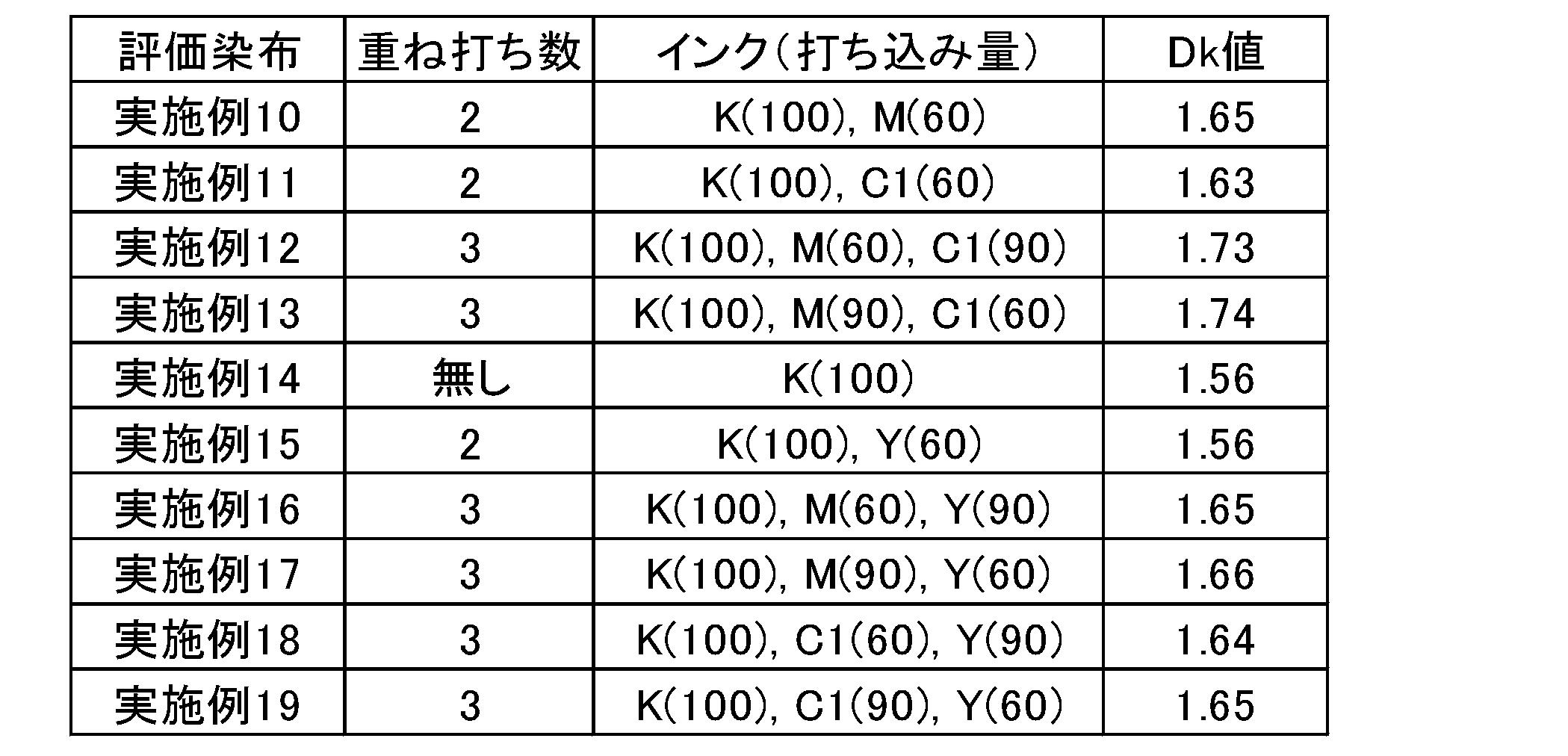
- the dyed fabrics of Examples 10 to 13 obtained by overprinting the black ink and the magenta ink or the cyan ink 1 were obtained by the same single printing without repeatedly printing the same portion. As compared with the dyed fabric of Example 14, the Dk value was high. In addition, the dyed fabrics of Examples 10 and 11 both showed higher Dk values than the dyed fabric of Example 15 obtained by overprinting the black ink and the yellow ink. Further, the dyed fabrics of Examples 12 and 13 obtained by overprinting the black ink, the magenta ink, and the cyan ink 1 are Examples 16 and 17 obtained by overprinting the black ink, the magenta ink, and the yellow ink.
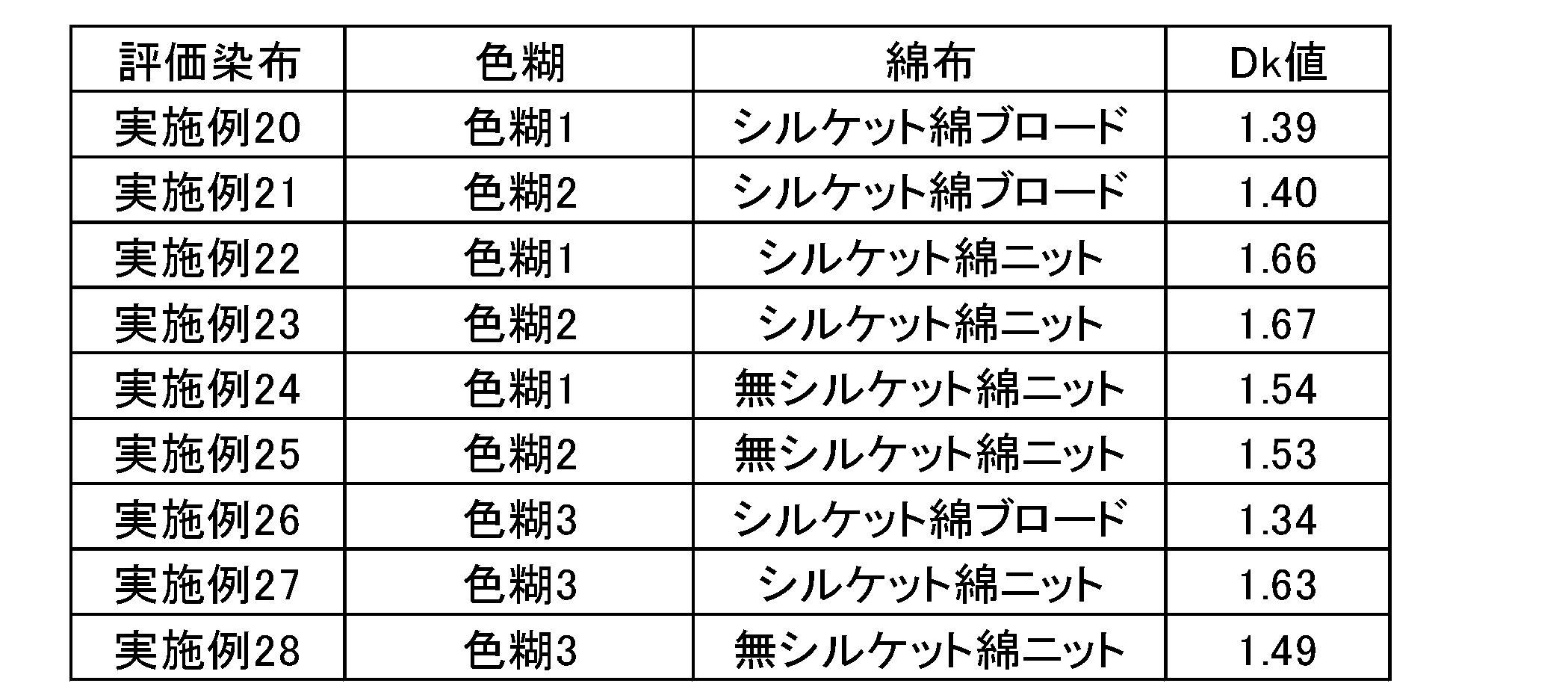
- the dyed fabrics of Examples 20 to 25 printed using color paste 1 in which black ink and cyan ink 1 are mixed or color paste 2 in which black ink and cyan ink 2 are mixed are cyan.
- the dyed fabrics of Examples 26 to 28 which were printed using the color paste 3 containing no ink a higher Dk value was exhibited.
Landscapes
- Engineering & Computer Science (AREA)
- Chemical & Material Sciences (AREA)
- Textile Engineering (AREA)
- Life Sciences & Earth Sciences (AREA)
- Materials Engineering (AREA)
- Wood Science & Technology (AREA)
- Organic Chemistry (AREA)
- Inks, Pencil-Leads, Or Crayons (AREA)
- Ink Jet Recording Methods And Recording Media Thereof (AREA)
Abstract
Description
(1)製版工程が不要であり工程が短縮できること、
(2)デジタル化されたデザインを、コンピューターを介してそのまま印捺できること、
(3)多品種の製品を少量ずつであっても生産することが可能であること、
(4)染料色糊の廃液等が大幅に削減できること、
等の多くのメリットがある。その一方で、インクジェット捺染は、従来の製版捺染に比べ、印捺加工速度が遅いこと、濃色を再現し難いこと等の課題があり、見本反の製造や少量生産の範囲で使用されることが多かった。
C.I.Reactive Blue 176と、C.I.Reactive Red 245と、C.I.Reactive Orange 13及びC.I.Reactive Orange 99の少なくとも一方とを含む反応染料、及び尿素を含有するインク。
2)
前記反応染料がC.I.Reactive Orange 13を含む、1)に記載のインク。
3)
前記反応染料がC.I.Reactive Orange 99を含む、1)に記載のインク。
4)
前記反応染料がC.I.Reactive Orange 13及びC.I.Reactive Orange 99を含む、1)に記載のインク。
5)
少なくとも環状アミド系溶剤1種以上を含む双極子モーメント値(δP値)が9~30MPa1/2の範囲内である水溶性有機溶剤、及び水を含有する、1)~4)のいずれか一項に記載のインク。
6)
前記水溶性有機溶剤の双極子モーメント値(δP値)が9~20MPa1/2の範囲内である、5)に記載のインク。
7)
前記環状アミド系溶剤が2-ピロリドンである、5)又は6)に記載のインク。
8)
2-ピロリドンの含有率が5~20質量%である、7)に記載のインク。
9)
尿素の含有率が5~20質量%である、1)~8)のいずれか一項に記載のインク。
10)
2-ピロリドンを含有し、2-ピロリドンと尿素との合計の含有率が15~30質量%であり、かつ、2-ピロリドンと尿素との含有比が質量基準で1:2~2:1である(ただし、2-ピロリドンと尿素との合計の含有率が15質量%であり、かつ、2-ピロリドンと尿素との含有比が質量基準で2:1であるものを除く)、1)~9)のいずれか一項に記載のインク。
11)
pH調整剤を含有する、1)~10)のいずれか一項に記載のインク。
12)
前記pH調整剤がトリス(ヒドロキシメチル)アミノメタンである、11)に記載のインク。
13)
C.I.Reactive Blue 176の含有率が5~15質量%である、1)~12)のいずれか一項に記載のインク。
14)
C.I.Reactive Blue 176の含有率が8~12質量%である、13)に記載のインク。
15)
ノニオン界面活性剤及びアニオン界面活性剤の少なくとも一方を含む、1)~14)のいずれか一項に記載のインク。
ブラックインクと、マゼンタインク及びシアンインクの少なくとも一方とを備えるインクセットであって、
前記ブラックインクが、1)~15)のいずれか一項に記載のインクであり、
前記マゼンタインクが、C.I.Reactive Red 245を反応染料として含有し、
前記シアンインクが、C.I.Reactive Blue 15:1及びC.I.Reactive Blue 72の少なくとも一方を反応染料として含有するインクセット。
1)~15)のいずれか一項に記載のインクの液滴を、インクジェットプリンタにより吐出させて繊維に付着させる付着工程と、
前記付着工程にて前記繊維に付着させたインク中の反応染料を、熱により該繊維に反応固着させる反応固着工程と、
前記繊維中に残存する未固着の反応染料を洗浄する洗浄工程と、
を含む繊維の捺染方法。
18)
前記付着工程を行う前の繊維に、1種類以上の糊材、前処理用のpH調整剤、及びヒドロトロピー剤を含有する水溶液を付着させる前処理工程をさらに含む、17)に記載の繊維の捺染方法。
19)
16)に記載のインクセットが備える各インクの液滴を、インクジェットプリンタにより吐出させて繊維に付着させる付着工程と、
前記付着工程にて前記繊維に付着させたインク中の反応染料を、熱により該繊維に反応固着させる反応固着工程と、
前記繊維中に残存する未固着の反応染料を洗浄する洗浄工程と、
を含む繊維の捺染方法。
20)
前記付着工程を行う前の繊維に、1種類以上の糊材、前処理用のpH調整剤、及びヒドロトロピー剤を含有する水溶液を付着させる前処理工程をさらに含む、19)に記載の繊維の捺染方法。
21)
前記インクジェットプリンタがスキャン方式のインクジェットプリンタであり、
前記付着工程では、前記ブラックインクと、前記マゼンタインク及び前記シアンインクの少なくとも一方とを重ねて前記繊維に付着させる、19)又は20)に記載の繊維の捺染方法。
22)
前記付着工程では、前記ブラックインクと、前記マゼンタインクと、前記シアンインクとを重ねて前記繊維に付着させる、21)に記載の繊維の捺染方法。
23)
前記ブラックインクの吐出量がその他のインクの吐出量よりも多い、21)又は22)に記載の繊維の捺染方法。
24)
前記繊維がセルロース系繊維又はポリアミド系繊維である17)~23)のいずれか一項に記載の繊維の捺染方法。
25)
前記繊維がセルロース系繊維である、24)に記載の繊維の捺染方法。
1)~15)のいずれか一項に記載のインク又は16)に記載のインクセットを用いて染色された繊維。
27)
17)~23)のいずれか一項に記載の捺染方法により染色された繊維。
本実施形態に係るインクは、C.I.Reactive Blue 176と、C.I.Reactive Red 245と、C.I.Reactive Orange 13及びC.I.Reactive Orange 99の少なくとも一方とを含む反応染料、及び尿素を含有する。このようなインクによれば、高い染色濃度で黒色に染色することが可能である。
本実施形態に係るインクは、C.I.Reactive Blueから選択される反応染料として、C.I.Reactive Blue 176を含有する。C.I.Reactive Blue 176は、C.I.Reactive Black 39とも称される反応染料であり、発色性に優れ、鮮明なネイビー色を呈する。
本実施形態に係るインクは、尿素を含有する。尿素の含有率は、インクの総量中、5~20質量%であることが好ましく、10~20質量%であることがより好ましい。尿素の含有率を5質量%以上とすることで、染色濃度がより高まるとともに、インクの耐乾燥性がより向上する傾向にある。また、尿素の含有率を20質量%以下とすることで、インクの高温保存安定性が向上する傾向にある。
本実施形態に係るインクは、水性インクであり、水を含有する。インク調製に用いる水は、イオン交換水、蒸留水等の精製操作を行ったものが好ましい。特に精製操作を行わない水は、Caイオン、Mgイオン等の金属イオンを含むため、このような水をインク調製に用いた場合には、微量ながら該イオン等が混入する。本明細書においては、このような金属イオンや無機塩を、便宜上、「無機不純物」という。これらの無機不純物は、インクに対する溶解度及び保存安定性を悪くするため、少なくする方がよい。
本実施形態に係るインクは、水のほかに水溶性有機溶剤を含有していてもよい。水溶性有機溶剤としては、例えば、メタノール、エタノール、n-プロパノール、イソプロパノール、n-ブタノール、イソブタノール、第二ブタノール、第三ブタノール等のC1-C4アルコール;N,N-ジメチルホルムアミド、N,N-ジメチルアセトアミド等のアミド類;2-ピロリドン、N-メチル-2-ピロリドン、ヒドロキシエチル-2-ピロリドン、1,3-ジメチルイミダゾリジン-2-オン、1,3-ジメチルヘキサヒドロピリミド-2-オン等の複素環式ケトン;アセトン、メチルエチルケトン、2-メチル-2-ヒドロキシペンタン-4-オン等のケトン又はケトアルコール;テトラヒドロフラン、ジオキサン等の環状エーテル;エチレングリコール、1,2-プロパンジオール、1,3-プロパンジオール、2-メチル-1,3-プロパンジオール、1,2-ブタンジオール、1,4-ブタンジオール、1,2-ペンタンジオール、1,5-ペンタンジオール、1,2-ヘキサンジオール、1,6-ヘキシレングリコール、ジエチレングリコール、トリエチレングリコール、テトラエチレングリコール、ジプロピレングリコール、ポリエチレングリコール、ポリプロピレングリコール、チオジグリコール等のC2-C6アルキレン単位を有するモノ、オリゴ、若しくはポリアルキレングリコール又はチオグリコール;トリメチロールプロパン、グリセリン、ヘキサン-1,2,6-トリオール等のポリオール(好ましくはトリオール);エチレングリコールモノメチルエーテル、エチレングリコールモノエチルエーテル、ジエチレングリコールモノメチルエーテル、ジエチレングリコールモノエチルエーテル、ジエチレングリコールモノブチルエーテル(ブチルカルビトール)、トリエチレングリコールモノメチルエーテル、トリエチレングリコールモノエチルエーテル等の多価アルコールのC1-C4モノアルキルエーテル;γ-ブチロラクトン;ジメチルスルホキシド;等が挙げられる。
本実施形態に係るインクは、その他の成分として、pH調整剤、防腐防黴剤、キレート試薬、防錆剤、紫外線吸収剤、粘度調整剤、褪色防止剤、表面張力調整剤、消泡剤等のインク調製剤を含有していてもよい。各インク調製剤は、1種を単独で用いてもよく、2種以上を併用してもよい。
pH調整剤としては、例えば、水酸化ナトリウム、水酸化カリウム、水酸化リチウム等のアルカリ金属の水酸化物;トリエタノールアミン、ジエタノールアミン、ジメチルエタノールアミン、ジエチルエタノールアミン、トリス(ヒドロキシメチル)アミノメタン等の3級アミン類、好ましくはヒドロキシ基で置換されていてもよいモノ、ジ、又はトリC1-C4アルキルアミン;等が挙げられる。これらの中では、トリス(ヒドロキシメチル)アミノメタンが好ましい。
防腐防黴剤としては、例えば、有機硫黄系、有機窒素硫黄系、有機ハロゲン系、ハロアリルスルホン系、ヨードプロパギル系、N-ハロアルキルチオ系、ベンゾチアゾール系、ニトリル系、ピリジン系、8-オキシキノリン系、イソチアゾリン系、ジチオール系、ピリジンオキシド系、ニトロプロパン系、有機スズ系、フェノール系、第4アンモニウム塩系、トリアジン系、チアジアジン系、アニリド系、アダマンタン系、ジチオカーバメイト系、ブロム化インダノン系、ベンジルブロムアセテート系、無機塩系等の化合物が挙げられる。有機ハロゲン系化合物としては、例えば、ペンタクロロフェノールナトリウムが挙げられる。ピリジンオキシド系化合物としては、例えば、2-ピリジンチオール-1-オキサイドナトリウムが挙げられる。イソチアゾリン系化合物としては、例えば、1,2-ベンズイソチアゾリン-3-オン、2-n-オクチル-4-イソチアゾリン-3-オン、5-クロロ-2-メチル-4-イソチアゾリン-3-オン、5-クロロ-2-メチル-4-イソチアゾリン-3-オンマグネシウムクロライド、5-クロロ-2-メチル-4-イソチアゾリン-3-オンカルシウムクロライド、2-メチル-4-イソチアゾリン-3-オンカルシウムクロライド等が挙げられる。その他の防腐防黴剤としては、酢酸ナトリウム、ソルビン酸ナトリウム、安息香酸ナトリウム、アーチケミカル社製の商品名プロキセルRTMGXL(S)及びプロキセルRTMXL-2(S)等が挙げられる。なお、上付きのRTMは登録商標を意味する。
キレート試薬としては、例えば、エチレンジアミン四酢酸二ナトリウム、ニトリロ三酢酸ナトリウム、ヒドロキシエチルエチレンジアミン三酢酸ナトリウム、ジエチレントリアミン五酢酸ナトリウム、ウラシル二酢酸ナトリウム等が挙げられる。
防錆剤としては、例えば、酸性亜硫酸塩、チオ硫酸ナトリウム、チオグリコール酸アンモニウム、ジイソプロピルアンモニウムナイトライト、四硝酸ペンタエリスリトール、ジシクロヘキシルアンモニウムナイトライト等が挙げられる。
紫外線吸収剤としては、例えば、ベンゾフェノン系化合物、ベンゾトリアゾール系化合物、桂皮酸系化合物、トリアジン系化合物、スチルベン系化合物が挙げられる。また、ベンズオキサゾール系化合物に代表される紫外線を吸収して蛍光を発する化合物、いわゆる蛍光増白剤等も使用できる。
粘度調整剤としては、水溶性有機溶剤のほかに水溶性高分子化合物が挙げられる。水溶性高分子化合物としては、例えば、ポリビニルアルコール、セルロース誘導体、ポリアミン、ポリイミン、分子量20000程度以下のポリC2-C3アルキレングリコール、好ましくは液状のポリアルキレングリコール等が挙げられる。例えば、阪本薬品工業(株)製の商品名SC-P400、SC-P750、SC-P1000、SC-P1200、SC-P1600等のポリオキシプロピレンジグリセリルエーテル;SC-E450、SC-E750、SC-E1000、SC-E1500、SC-E2000等のポリオキシエチレンジグリセリルエーテル;等が挙げられ、SC-P1000を用いることが好ましい。
褪色防止剤は、画像の保存性を向上させる目的で使用される。褪色防止剤としては、各種の有機系及び金属錯体系の褪色防止剤を使用することができる。有機系の褪色防止剤としては、例えば、ハイドロキノン類、アルコキシフェノール類、ジアルコキシフェノール類、フェノール類、アニリン類、アミン類、インダン類、クロマン類、アルコキシアニリン類、及びヘテロ環類等が挙げられる。金属錯体系の褪色防止剤としては、例えば、ニッケル錯体、亜鉛錯体等が挙げられる。
表面張力調整剤としては、界面活性剤が挙げられる。界面活性剤としては、例えば、アニオン界面活性剤、ノニオン界面活性剤、カチオン界面活性剤、及び両性界面活性剤等が挙げられる。界面活性剤の中でも、ノニオン界面活性剤及びアニオン界面活性剤の少なくとも一方が好ましい。
ノニオン界面活性剤としては、例えば、ポリオキシエチレンノニルフェニルエーテル、ポリオキシエチレンオクチルフェニルエーテル、ポリオキシエチレンドデシルフェニルエーテル、ポリオキシエチレンオレイルエーテル、ポリオキシエチレンラウリルエーテル、ポリオキシエチレンアルキルエーテル等のエーテル系;ポリオキシエチレンオレイン酸エステル、ポリオキシエチレンジステアリン酸エステル、ソルビタンラウレート、ソルビタンモノステアレート、ソルビタンモノオレエート、ソルビタンセスキオレエート、ポリオキシエチレンモノオレエート、ポリオキシエチレンステアレート等のエステル系;3,5-ジメチル-1-ヘキシン-3-オール等のアセチレンアルコール系;2,4,7,9-テトラメチル-5-デシン-4,7-ジオール、3,6-ジメチル-4-オクチン-3,6-ジオール、エアープロダクト社製、商品名サーフィノール104、同104PG50、同82、同420、同440、同465、同485;オルフィンSTG;等のアセチレングリコール系;などが挙げられる。これらの中でも、アセチレングリコール系又はアセチレンアルコール系が好ましく、アセチレングリコール系がより好ましい。
カチオン界面活性剤としては、例えば、2-ビニルピリジン誘導体、ポリ4-ビニルピリジン誘導体等が挙げられる。
両性界面活性剤としては、例えば、ラウリルジメチルアミノ酢酸ベタイン、2-アルキル-N-カルボキシメチル-N-ヒドロキシエチルイミダゾリニウムベタイン、ヤシ油脂肪酸アミドプロピルジメチルアミノ酢酸ベタイン、ポリオクチルポリアミノエチルグリシン、イミダゾリン誘導体等が挙げられる。
消泡剤としては、例えば、高酸化油系、グリセリン脂肪酸エステル系、フッ素系、シリコーン系化合物等が挙げられる。
本実施形態に係るインクの20℃における粘度は、例えば、4~30mPa・sであることが好ましく、5~20mPa・sであることがより好ましい。
また、工業用インクジェットヘッドが搭載されたプリンタでの使用時において、低温環境下における高速での連続吐出性を改善する観点から、本実施形態に係るインクの25℃における静的表面張力は、20~45mN/mであることが好ましく、25~40mN/mであることがより好ましい。
本実施形態に係るインクにおいて、各成分を加える順番は特に制限されず、撹拌により実質的に溶液となるまで混合し、インクを調製すればよい。インクの調製の際に使用する水は、上記のとおり、蒸留水、イオン交換水等の無機不純物の少ないものを用いるのがよい。
本実施形態に係るインクセットは、ブラックインクと、マゼンタインク及びシアンインクの少なくとも一方とを備える。本実施形態に係るインクセットは、マゼンタインク及びシアンインクの両方を備えることが好ましい。
本実施形態に係る繊維の捺染方法は、上述した本実施形態に係るインク又は本実施形態に係るインクセットを用いて、繊維(好ましくは、セルロース系繊維又はポリアミド系繊維)に捺染する方法である。より具体的には、セルロース系繊維又はポリアミド系繊維を主体とした布帛に捺染するのが好ましい。セルロース系繊維としては、綿、麻等の天然繊維、レーヨン等の再生セルロース繊維、及びこれらを含有する混紡繊維等が挙げられる。
(付着工程)
インクの液滴を、インクジェットプリンタにより吐出させて繊維に付着させる。
(反応固着工程)
付着工程にて繊維に付着させたインク中の反応染料を、熱により該繊維に反応固着させる。
(洗浄工程)
該繊維中に残存する未固着の反応染料を洗浄する。
[インクの調製]
1~10%程度の濃度に調整したC.I.Reactive Blue 176(Na塩)の水溶液を、逆浸透膜精製法にて水酸化リチウム溶液を添加した後、蒸発乾燥することで、Liイオン濃度を約15000ppmに調整したC.I.Reactive Blue 176の乾燥粉末を得た。そして、下記表1に記載の各成分(単位:部)を混合し、40℃に液温を保持した状態で固形分が溶解するまで約1時間撹拌した後、0.45μmのメンブランフィルタ(セルロースアセテート系濾紙、アドバンテック社製)で濾過することにより、試験用のインクを調製した。
RB176…C.I.Reactive Blue 176
RO13…C.I.Reactive Orange 13
RO99…C.I.Reactive Orange 99
RR245…C.I.Reactive Red 245
2PD…2-ピロリドン
EG…エチレングリコール
PG…プロピレングリコール
SC-P1000…ポリオキシプロピレンジグリセリルエーテル
SF440…サーフィノール440(アセチレングリコール界面活性剤)
GXL…プロキセルRTMGXL
THMAM…トリス(ヒドロキシメチル)アミノメタン

実施例1のインクの20℃における粘度を、E型粘度計を用いて測定した。結果を下記表2に示す。この粘度の単位はmP・sである。
インク調製時におけるRB176の溶解性を評価した。上記表1に記載の各成分を混合し、40℃に液温を保持した状態で固形分が溶解するまで約1時間撹拌することによりインクを得た後、室温で放置し、以下の基準で評価した。結果を下記表2に示す。
(評価基準)
A:7日以上放置しても析出物が観察されない。
B:7日未満では析出物が観察されないが、7日以上放置すると析出物が観察される。
C:3日以上7日未満放置すると析出物が僅かに観察される。
D:3日未満で明らかな析出物が観察される。
実施例1のインクの低温保存安定性を評価した。低温保存安定性は、-5℃で3日間保管した後、室温で数時間放置し、以下の基準で評価した。結果を下記表2に示す。
(評価基準)
A:染料の沈降及びインクのゲル化が確認されない。
B:染料の沈降が僅かにあるが、インクのゲル化は確認されない。
C:染料の沈降が相当あるか、又はインクのゲル化が確認される。

アルギン酸ナトリウム、尿素、及び炭酸水素ナトリウムを含有する前処理液を、パッド法にて綿布に付着させた後、乾燥することにより、前処理された綿布を得た。前処理後の綿布は、A4サイズに裁断した。
染布の反射濃度を上記の測色機で測色してDk値を得た後、以下の基準で染色濃度を評価した。Dk値が大きい方が染色濃度が高いことを意味するため、品質が優れる。結果を下記表3に示す。
(評価基準)
A:Dk値が1.6以上
B:Dk値が1.4以上1.6未満
C:Dk値が1.4未満
実施例1のインクが充填された容器を上記の評価装置に装填したまま、装置を止めた状態で2日間放置した後、パージを1回行い、前処理後の綿布に200mm×250mmのベタ柄を印捺した。そして、以下の基準で吐出安定性を評価した。結果を下記表3に示す。
(評価基準)
A:最後まで良好に印捺できる。
B:最後まで良好に印捺できるが、印捺画像に僅かに散り及びスジ欠けが確認される。
C:印捺画像の散り及びスジ欠けが激しい。

[インクの調製]
1~10%程度の濃度に調整したC.I.Reactive Blue 176(Na塩)の水溶液を、逆浸透膜精製法にて水酸化リチウム溶液を添加した後、蒸発乾燥することで、Liイオン濃度を約15000ppmに調整したC.I.Reactive Blue 176の乾燥粉末を得た。そして、下記表4、5に記載の各成分(単位:部)を混合し、40℃に液温を保持した状態で固形分が溶解するまで約1時間撹拌した後、0.45μmのメンブランフィルタ(セルロースアセテート系濾紙、アドバンテック社製)で濾過することにより、試験用のインクを調製した。なお、表5中の「-」は、その成分を含有しないことを示す。
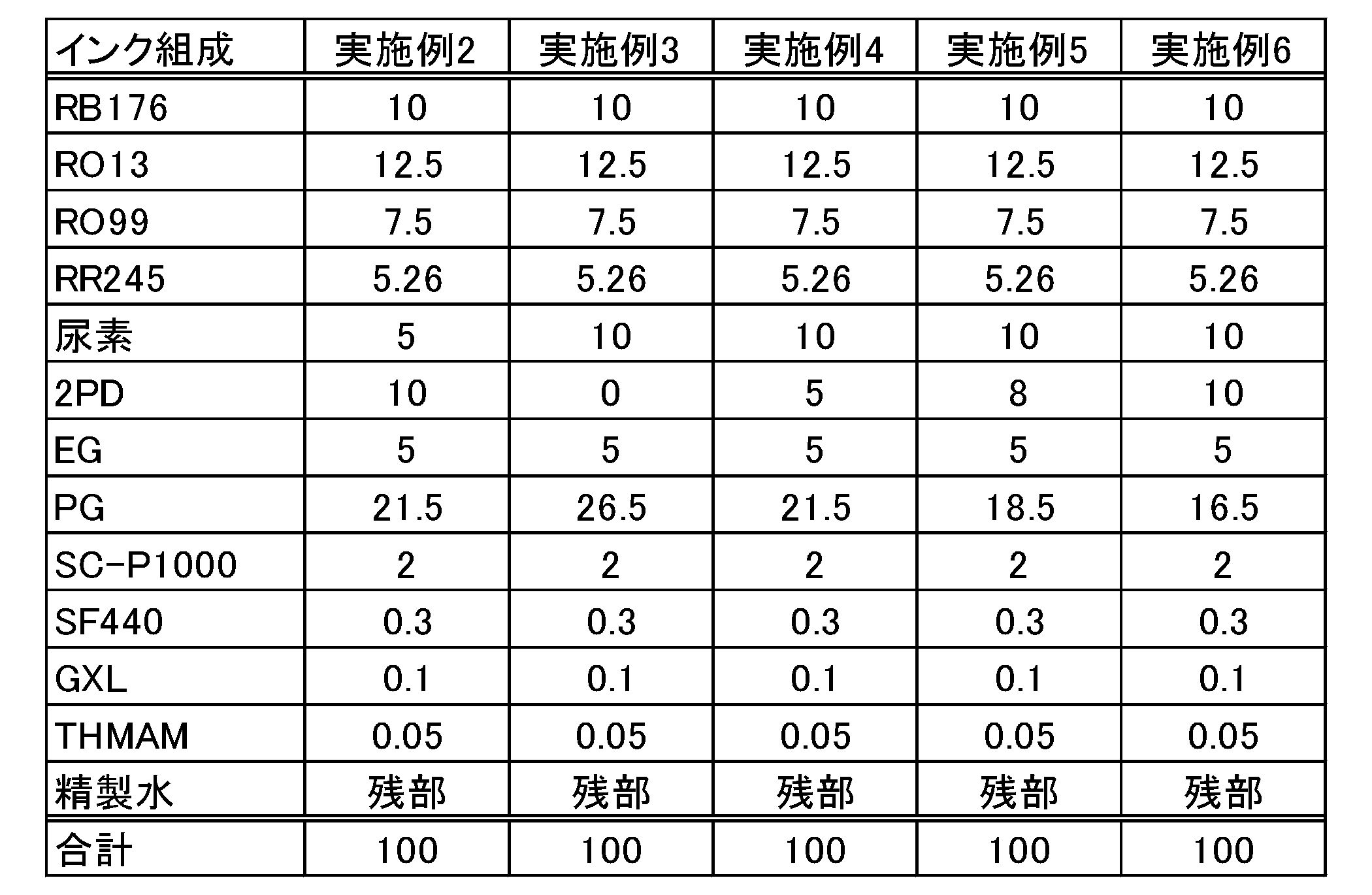

実施例2~9、比較例1の各インクの20℃における粘度を、E型粘度計を用いて測定した。結果を下記表6、7に示す。この粘度の単位はmP・sである。
実施例2~9、比較例1の各インクをシャーレに入れ、60℃で4時間保持し、以下の基準で耐乾燥性を評価した。結果を下記表6、7に示す。
(評価基準)
S:析出物が観察されない。
A:僅かに析出物が観察される。
B:明らかな析出物が観察される。
実施例2~9、比較例1の各インクが充填された容器を産業用インクジェットヘッド評価装置(拡張型塗布装置EV2500;リコー(株)製)に装填し、25℃の環境下、綿布(シルケット綿ブロード、無シルケット綿ニット、又はシルケット綿ニット)に200mm×250mmのベタ柄を印捺した。得られた各綿布を60~80℃で乾燥した後、100~103℃で10分間スチーミング処理を行った。得られた各綿布を水、95~100℃の沸騰水(10分間)、及び水で順次洗浄した後、乾燥することにより、評価用の捺染された染布を得た。各染布をテストサンプルとして用い、下記の評価試験を行った。評価試験において測色が必要な際は、GRETAG-MACBETH社製の測色機(商品名:SpectroEye)を用いた。
各染布の380~730nmにおける反射率Rλを測色し、Kubelka-Munkの式:K/S=(1-Rλ)2/2RλによりK/S値を算出した。そして、各波長におけるK/S値の合計であるΣK/S値を算出し、以下の基準で染色濃度を評価した。ΣK/S値が大きい方が染色濃度が高いことを意味するため、品質が優れる。結果を下記表6、7に示す。
(シルケット綿ブロードの評価基準)
A:ΣK/S値が220以上
B:ΣK/S値が200以上220未満
C:ΣK/S値が190以上200未満
D:ΣK/S値が190未満
(無シルケット綿ニットの評価基準)
A:ΣK/S値が320以上
B:ΣK/S値が300以上320未満
C:ΣK/S値が290以上300未満
D:ΣK/S値が290未満
(シルケット綿ニットの評価基準)
A:ΣK/S値が280以上
B:ΣK/S値が250以上280未満
C:ΣK/S値が220以上250未満
D:ΣK/S値が220未満


[インクの調製]
下記表8に記載の各成分(単位:部)を混合し、40℃に液温を保持した状態で固形分が溶解するまで約1時間撹拌した後、0.45μmのメンブランフィルタ(セルロースアセテート系濾紙、アドバンテック社製)で濾過することにより、試験用の各インクを調製した。なお、表8中の「-」は、その成分を含有しないことを示す。
RB176…C.I.Reactive Blue 176
RO13…C.I.Reactive Orange 13
RO99…C.I.Reactive Orange 99
RR245…C.I.Reactive Red 245
RB15:1…C.I.Reactive Blue 15:1
RB72…C.I.Reactive Blue 72
RY2…C.I.Reactive Yellow 2
RY95…C.I.Reactive Yellow 95
EG…エチレングリコール
PG…プロピレングリコール
SF440…サーフィノール440(アセチレングリコール界面活性剤)
GXL…プロキセルRTMGXL
THMAM…トリス(ヒドロキシメチル)アミノメタン
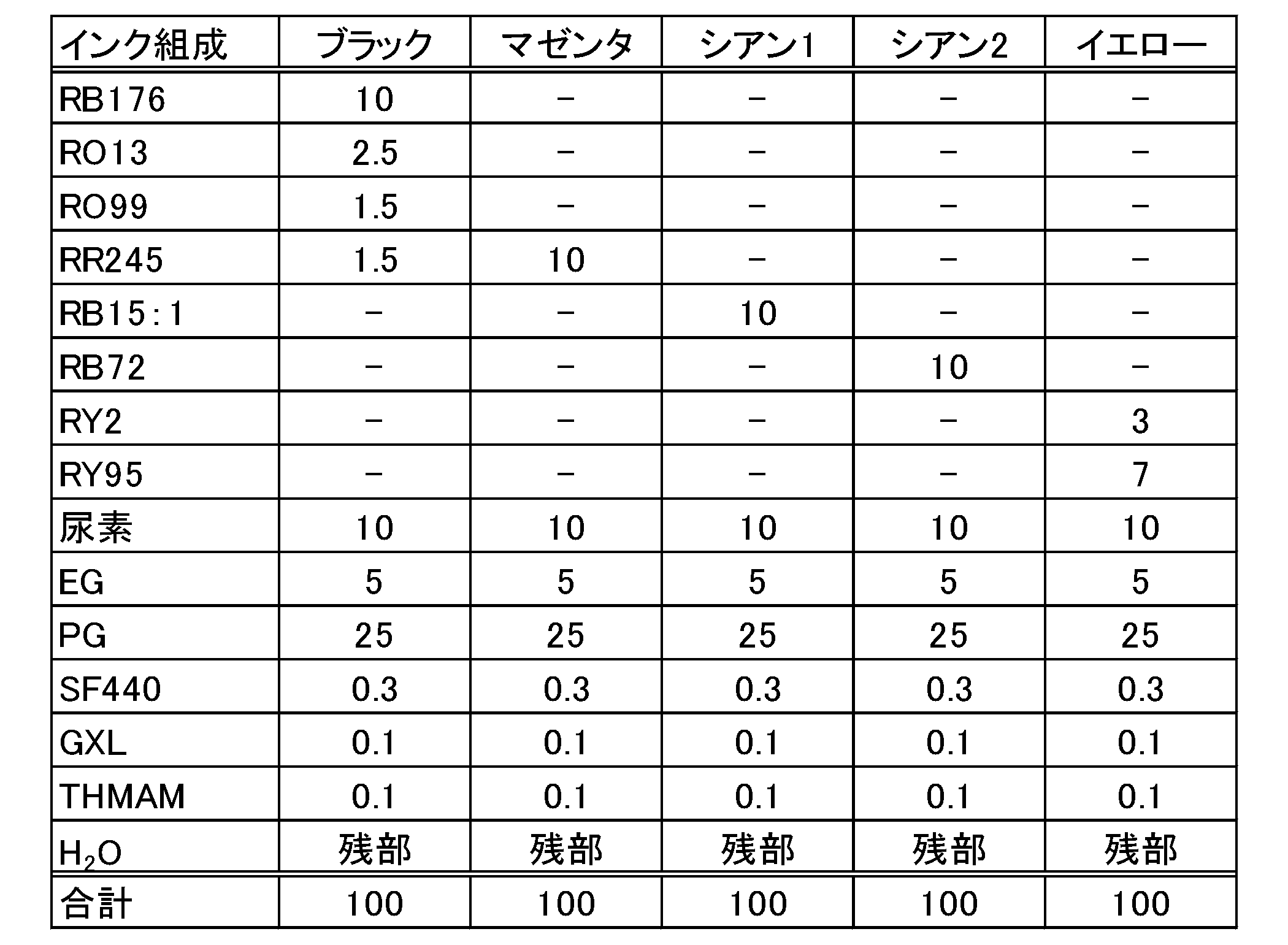
アルギン酸ナトリウム、尿素、及び炭酸水素ナトリウムを含有する前処理液を、パッド法にて綿布に付着させた後、綿布を乾燥することにより、前処理された綿布を得た。前処理後の綿布は、A4サイズに裁断した。
上記のようにして得た各染布の反射濃度をGRETAG-MACBETH社製の測色機(商品名SpectroEye)で測色し、Dk値を得た。Dk値が大きい方が、染色濃度が高いことを意味するため品質が優れる。結果を下記表9に示す。
表9中、記号のKはブラックインク、Mはマゼンタインク、C1はシアンインク1、Yはイエローインクをそれぞれ示す。また、各インク記号の後の括弧内に記載した数字は、ブラック100%のインク打ち込み量を100とした場合の打ち込み量を数値化したものであり、60は60%、90は90%を意味する。
[色糊の調製]
実施例10~19と同様にして、ブラックインク、シアンインク1、及びシアンインク2の各インクを調製した。そして、下記表10に記載の各成分(単位:部)を混合し、試験用の色糊を調製した。なお、表10中の「-」は、その成分を含有しないことを示す。

上記[色糊の調製]で調製した各色糊を用いて、25℃の環境下、綿布(シルケット綿ブロード、無シルケット綿ニット、又はシルケット綿ニット)にスクリーン印捺した。得られた綿布を60~80℃で乾燥した後、100~103℃で10分間スチーミング処理を行った。得られた綿布を水、95~100℃の沸騰水(10分間)、及び水で順次洗浄した後、乾燥することにより、評価用の捺染された染布を得た。
上記のようにして得た各染布の反射濃度をGRETAG-MACBETH社製の測色機(商品名SpectroEye)で測色し、Dk値を得た。Dk値が大きい方が、染色濃度が高いことを意味するため品質が優れる。結果を下記表11に示す。
Claims (27)
- C.I.Reactive Blue 176と、C.I.Reactive Red 245と、C.I.Reactive Orange 13及びC.I.Reactive Orange 99の少なくとも一方とを含む反応染料、及び尿素を含有するインク。
- 前記反応染料がC.I.Reactive Orange 13を含む、請求項1に記載のインク。
- 前記反応染料がC.I.Reactive Orange 99を含む、請求項1に記載のインク。
- 前記反応染料がC.I.Reactive Orange 13及びC.I.Reactive Orange 99を含む、請求項1に記載のインク。
- 少なくとも環状アミド系溶剤1種以上を含む双極子モーメント値(δP値)が9~30MPa1/2の範囲内である水溶性有機溶剤、及び水を含有する、請求項1~4のいずれか一項に記載のインク。
- 前記水溶性有機溶剤の双極子モーメント値(δP値)が9~20MPa1/2の範囲内である、請求項5に記載のインク。
- 前記環状アミド系溶剤が2-ピロリドンである、請求項5又は6に記載のインク。
- 2-ピロリドンの含有率が5~20質量%である、請求項7に記載のインク。
- 尿素の含有率が5~20質量%である、請求項1~8のいずれか一項に記載のインク。
- 2-ピロリドンを含有し、2-ピロリドンと尿素との合計の含有率が15~30質量%であり、かつ、2-ピロリドンと尿素との含有比が質量基準で1:2~2:1である(ただし、2-ピロリドンと尿素との合計の含有率が15質量%であり、かつ、2-ピロリドンと尿素との含有比が質量基準で2:1であるものを除く)、請求項1~9のいずれか一項に記載のインク。
- pH調整剤を含有する、請求項1~10のいずれか一項に記載のインク。
- 前記pH調整剤がトリス(ヒドロキシメチル)アミノメタンである、請求項11に記載のインク。
- C.I.Reactive Blue 176の含有率が5~15質量%である、請求項1~12のいずれか一項に記載のインク。
- C.I.Reactive Blue 176の含有率が8~12質量%である、請求項13に記載のインク。
- ノニオン界面活性剤及びアニオン界面活性剤の少なくとも一方を含む、請求項1~14のいずれか一項に記載のインク。
- ブラックインクと、マゼンタインク及びシアンインクの少なくとも一方とを備えるインクセットであって、
前記ブラックインクが、請求項1~15のいずれか一項に記載のインクであり、
前記マゼンタインクが、C.I.Reactive Red 245を反応染料として含有し、
前記シアンインクが、C.I.Reactive Blue 15:1及びC.I.Reactive Blue 72の少なくとも一方を反応染料として含有するインクセット。 - 請求項1~15のいずれか一項に記載のインクの液滴を、インクジェットプリンタにより吐出させて繊維に付着させる付着工程と、
前記付着工程にて前記繊維に付着させたインク中の反応染料を、熱により該繊維に反応固着させる反応固着工程と、
前記繊維中に残存する未固着の反応染料を洗浄する洗浄工程と、
を含む繊維の捺染方法。 - 前記付着工程を行う前の繊維に、1種類以上の糊材、前処理用のpH調整剤、及びヒドロトロピー剤を含有する水溶液を付着させる前処理工程をさらに含む、請求項17に記載の繊維の捺染方法。
- 請求項16に記載のインクセットが備える各インクの液滴を、インクジェットプリンタにより吐出させて繊維に付着させる付着工程と、
前記付着工程にて前記繊維に付着させたインク中の反応染料を、熱により該繊維に反応固着させる反応固着工程と、
前記繊維中に残存する未固着の反応染料を洗浄する洗浄工程と、
を含む繊維の捺染方法。 - 前記付着工程を行う前の繊維に、1種類以上の糊材、前処理用のpH調整剤、及びヒドロトロピー剤を含有する水溶液を付着させる前処理工程をさらに含む、請求項19に記載の繊維の捺染方法。
- 前記インクジェットプリンタがスキャン方式のインクジェットプリンタであり、
前記付着工程では、前記ブラックインクと、前記マゼンタインク及び前記シアンインクの少なくとも一方とを重ねて前記繊維に付着させる、請求項19又は20に記載の繊維の捺染方法。 - 前記付着工程では、前記ブラックインクと、前記マゼンタインクと、前記シアンインクとを重ねて前記繊維に付着させる、請求項21に記載の繊維の捺染方法。
- 前記ブラックインクの吐出量がその他のインクの吐出量よりも多い、請求項21又は22に記載の繊維の捺染方法。
- 前記繊維がセルロース系繊維又はポリアミド系繊維である請求項17~23のいずれか一項に記載の繊維の捺染方法。
- 前記繊維がセルロース系繊維である、請求項24に記載の繊維の捺染方法。
- 請求項1~15のいずれか一項に記載のインク又は請求項16に記載のインクセットを用いて染色された繊維。
- 請求項17~23のいずれか一項に記載の捺染方法により染色された繊維。
Priority Applications (2)
| Application Number | Priority Date | Filing Date | Title |
|---|---|---|---|
| KR1020197008597A KR102445345B1 (ko) | 2016-11-25 | 2017-11-17 | 잉크, 잉크 세트, 및 섬유의 날염 방법 |
| JP2018552546A JP6998321B2 (ja) | 2016-11-25 | 2017-11-17 | インク、インクセット、及び繊維の捺染方法 |
Applications Claiming Priority (4)
| Application Number | Priority Date | Filing Date | Title |
|---|---|---|---|
| JP2016228558 | 2016-11-25 | ||
| JP2016-228558 | 2016-11-25 | ||
| JP2017008386 | 2017-01-20 | ||
| JP2017-008386 | 2017-01-20 |
Publications (1)
| Publication Number | Publication Date |
|---|---|
| WO2018097061A1 true WO2018097061A1 (ja) | 2018-05-31 |
Family
ID=62195142
Family Applications (1)
| Application Number | Title | Priority Date | Filing Date |
|---|---|---|---|
| PCT/JP2017/041490 Ceased WO2018097061A1 (ja) | 2016-11-25 | 2017-11-17 | インク、インクセット、及び繊維の捺染方法 |
Country Status (3)
| Country | Link |
|---|---|
| JP (1) | JP6998321B2 (ja) |
| KR (1) | KR102445345B1 (ja) |
| WO (1) | WO2018097061A1 (ja) |
Cited By (2)
| Publication number | Priority date | Publication date | Assignee | Title |
|---|---|---|---|---|
| CN111350088A (zh) * | 2020-04-20 | 2020-06-30 | 天津工业大学 | 一种棉/聚酰胺织物喷墨印花预处理剂及预处理工艺 |
| JP2022061262A (ja) * | 2020-10-06 | 2022-04-18 | コニカミノルタ株式会社 | 捺染用インクジェットインク、捺染用インクジェットインクセット、および画像形成方法 |
Citations (6)
| Publication number | Priority date | Publication date | Assignee | Title |
|---|---|---|---|---|
| JP2003521572A (ja) * | 2000-02-04 | 2003-07-15 | ダイスター・テクスティルファルベン・ゲゼルシャフト・ミト・ベシュレンクテル・ハフツング・ウント・コンパニー・ドイッチュラント・コマンデイトゲゼルシャフト | インクジェット捺染で使用する水性捺染インク、その調製および織物繊維でのその使用 |
| JP2010143175A (ja) * | 2008-12-22 | 2010-07-01 | Konica Minolta Ij Technologies Inc | テキスタイルプリント方法 |
| CN102352569A (zh) * | 2011-09-30 | 2012-02-15 | 郑州鸿盛数码科技股份有限公司 | 一种水性数码印花的喷墨墨水及其生产工艺 |
| JP2013035952A (ja) * | 2011-08-09 | 2013-02-21 | Nippon Kayaku Co Ltd | インクジェット捺染用ブラックインク組成物及びそれを用いた繊維の捺染方法 |
| JP2013035951A (ja) * | 2011-08-09 | 2013-02-21 | Nippon Kayaku Co Ltd | インクジェット捺染用ゴールデンイエローインク組成物及びそれを用いた繊維の捺染方法 |
| JP2016138157A (ja) * | 2015-01-26 | 2016-08-04 | セイコーエプソン株式会社 | インクジェット捺染用インクセット及びインクジェット捺染方法 |
Family Cites Families (4)
| Publication number | Priority date | Publication date | Assignee | Title |
|---|---|---|---|---|
| JP3323549B2 (ja) | 1991-09-26 | 2002-09-09 | キヤノン株式会社 | インクジェット捺染用インク及びインクジェット捺染方法 |
| JP2004292523A (ja) | 2003-03-26 | 2004-10-21 | Konica Minolta Holdings Inc | インクジェット捺染用インクとそれを用いたインクジェット記録方法 |
| KR101553093B1 (ko) * | 2008-07-31 | 2015-09-14 | 닛뽄 가야쿠 가부시키가이샤 | 잉크젯 날염용 잉크 세트 및 그것을 사용한 섬유의 날염 방법 |
| JP2011195675A (ja) | 2010-03-18 | 2011-10-06 | Seiko Epson Corp | インクジェット捺染用インク組成物 |
-
2017
- 2017-11-17 KR KR1020197008597A patent/KR102445345B1/ko active Active
- 2017-11-17 JP JP2018552546A patent/JP6998321B2/ja active Active
- 2017-11-17 WO PCT/JP2017/041490 patent/WO2018097061A1/ja not_active Ceased
Patent Citations (6)
| Publication number | Priority date | Publication date | Assignee | Title |
|---|---|---|---|---|
| JP2003521572A (ja) * | 2000-02-04 | 2003-07-15 | ダイスター・テクスティルファルベン・ゲゼルシャフト・ミト・ベシュレンクテル・ハフツング・ウント・コンパニー・ドイッチュラント・コマンデイトゲゼルシャフト | インクジェット捺染で使用する水性捺染インク、その調製および織物繊維でのその使用 |
| JP2010143175A (ja) * | 2008-12-22 | 2010-07-01 | Konica Minolta Ij Technologies Inc | テキスタイルプリント方法 |
| JP2013035952A (ja) * | 2011-08-09 | 2013-02-21 | Nippon Kayaku Co Ltd | インクジェット捺染用ブラックインク組成物及びそれを用いた繊維の捺染方法 |
| JP2013035951A (ja) * | 2011-08-09 | 2013-02-21 | Nippon Kayaku Co Ltd | インクジェット捺染用ゴールデンイエローインク組成物及びそれを用いた繊維の捺染方法 |
| CN102352569A (zh) * | 2011-09-30 | 2012-02-15 | 郑州鸿盛数码科技股份有限公司 | 一种水性数码印花的喷墨墨水及其生产工艺 |
| JP2016138157A (ja) * | 2015-01-26 | 2016-08-04 | セイコーエプソン株式会社 | インクジェット捺染用インクセット及びインクジェット捺染方法 |
Cited By (3)
| Publication number | Priority date | Publication date | Assignee | Title |
|---|---|---|---|---|
| CN111350088A (zh) * | 2020-04-20 | 2020-06-30 | 天津工业大学 | 一种棉/聚酰胺织物喷墨印花预处理剂及预处理工艺 |
| JP2022061262A (ja) * | 2020-10-06 | 2022-04-18 | コニカミノルタ株式会社 | 捺染用インクジェットインク、捺染用インクジェットインクセット、および画像形成方法 |
| JP7593040B2 (ja) | 2020-10-06 | 2024-12-03 | コニカミノルタ株式会社 | 捺染用インクジェットインク、捺染用インクジェットインクセット、および画像形成方法 |
Also Published As
| Publication number | Publication date |
|---|---|
| KR102445345B1 (ko) | 2022-09-19 |
| KR20190086432A (ko) | 2019-07-22 |
| JP6998321B2 (ja) | 2022-01-18 |
| JPWO2018097061A1 (ja) | 2019-10-17 |
Similar Documents
| Publication | Publication Date | Title |
|---|---|---|
| EP2412761B1 (en) | Ink composition and method for producing dyed polyamide-based fiber | |
| JP5580824B2 (ja) | インク組成物及びそれを用いた繊維の捺染方法 | |
| JP5174047B2 (ja) | インク組成物及びそれを用いた繊維の捺染方法 | |
| JP5416116B2 (ja) | インクジェット捺染用インクセット及びそれを用いた繊維の捺染方法 | |
| JP2016044259A (ja) | インクジェット捺染用インクセット及び繊維の捺染方法 | |
| JP5979727B2 (ja) | インクジェット捺染用グレーインク組成物及びそれを用いた繊維の捺染方法 | |
| JP6998321B2 (ja) | インク、インクセット、及び繊維の捺染方法 | |
| JP2013018849A (ja) | 水溶性アゾ化合物又はその塩、インク組成物及び着色体 | |
| JP5943568B2 (ja) | インクジェット捺染用ブラックインク組成物及びそれを用いた繊維の捺染方法 | |
| WO2018135419A1 (ja) | インクジェット捺染用インク組成物及びそれを用いた繊維の捺染方法 | |
| JP2014185201A (ja) | インクジェット捺染に用いるインク及びそれを用いた繊維の捺染方法 | |
| JP2010189460A (ja) | インク組成物及びそれを用いた繊維の捺染方法 | |
| JP2013035951A (ja) | インクジェット捺染用ゴールデンイエローインク組成物及びそれを用いた繊維の捺染方法 | |
| JP2017125080A (ja) | インク組成物及びそれを用いた繊維の捺染方法 | |
| JP2016210920A (ja) | インク組成物及びそれを用いた繊維の捺染方法 | |
| JP2015078300A (ja) | インクジェット捺染用インク及び繊維の捺染方法 | |
| JP2017125081A (ja) | インク組成物及びそれを用いた繊維の捺染方法 | |
| JP2016169273A (ja) | インク組成物及びそれを用いた繊維の捺染方法 | |
| JP2014156559A (ja) | インクジェット捺染用インク及びそれを用いた繊維の捺染方法 | |
| JP2017125082A (ja) | インク組成物及びそれを用いた繊維の捺染方法 | |
| JP6739189B2 (ja) | インク組成物及びそれを用いた繊維の捺染方法 | |
| JP2017155109A (ja) | インク組成物及びそれを用いた繊維の捺染方法 | |
| JP2017110095A (ja) | インク及びそれを用いた繊維の捺染方法 | |
| JP2016155968A (ja) | インク組成物及びそれを用いた繊維の捺染方法 | |
| JP2012036257A (ja) | インク組成物及び着色体 |
Legal Events
| Date | Code | Title | Description |
|---|---|---|---|
| 121 | Ep: the epo has been informed by wipo that ep was designated in this application |
Ref document number: 17874413 Country of ref document: EP Kind code of ref document: A1 |
|
| ENP | Entry into the national phase |
Ref document number: 2018552546 Country of ref document: JP Kind code of ref document: A |
|
| ENP | Entry into the national phase |
Ref document number: 20197008597 Country of ref document: KR Kind code of ref document: A |
|
| NENP | Non-entry into the national phase |
Ref country code: DE |
|
| 122 | Ep: pct application non-entry in european phase |
Ref document number: 17874413 Country of ref document: EP Kind code of ref document: A1 |