WO2017221660A1 - 研磨液、化学的機械的研磨方法 - Google Patents
研磨液、化学的機械的研磨方法 Download PDFInfo
- Publication number
- WO2017221660A1 WO2017221660A1 PCT/JP2017/020409 JP2017020409W WO2017221660A1 WO 2017221660 A1 WO2017221660 A1 WO 2017221660A1 JP 2017020409 W JP2017020409 W JP 2017020409W WO 2017221660 A1 WO2017221660 A1 WO 2017221660A1
- Authority
- WO
- WIPO (PCT)
- Prior art keywords
- polishing
- polishing liquid
- rpm
- acid
- group
- Prior art date
- Legal status (The legal status is an assumption and is not a legal conclusion. Google has not performed a legal analysis and makes no representation as to the accuracy of the status listed.)
- Ceased
Links
Images


Classifications
-
- C—CHEMISTRY; METALLURGY
- C09—DYES; PAINTS; POLISHES; NATURAL RESINS; ADHESIVES; COMPOSITIONS NOT OTHERWISE PROVIDED FOR; APPLICATIONS OF MATERIALS NOT OTHERWISE PROVIDED FOR
- C09G—POLISHING COMPOSITIONS; SKI WAXES
- C09G1/00—Polishing compositions
- C09G1/02—Polishing compositions containing abrasives or grinding agents
-
- B—PERFORMING OPERATIONS; TRANSPORTING
- B24—GRINDING; POLISHING
- B24B—MACHINES, DEVICES, OR PROCESSES FOR GRINDING OR POLISHING; DRESSING OR CONDITIONING OF ABRADING SURFACES; FEEDING OF GRINDING, POLISHING, OR LAPPING AGENTS
- B24B37/00—Lapping machines or devices; Accessories
-
- C—CHEMISTRY; METALLURGY
- C09—DYES; PAINTS; POLISHES; NATURAL RESINS; ADHESIVES; COMPOSITIONS NOT OTHERWISE PROVIDED FOR; APPLICATIONS OF MATERIALS NOT OTHERWISE PROVIDED FOR
- C09K—MATERIALS FOR MISCELLANEOUS APPLICATIONS, NOT PROVIDED FOR ELSEWHERE
- C09K3/00—Materials not provided for elsewhere
- C09K3/14—Anti-slip materials; Abrasives
-
- C—CHEMISTRY; METALLURGY
- C09—DYES; PAINTS; POLISHES; NATURAL RESINS; ADHESIVES; COMPOSITIONS NOT OTHERWISE PROVIDED FOR; APPLICATIONS OF MATERIALS NOT OTHERWISE PROVIDED FOR
- C09K—MATERIALS FOR MISCELLANEOUS APPLICATIONS, NOT PROVIDED FOR ELSEWHERE
- C09K3/00—Materials not provided for elsewhere
- C09K3/14—Anti-slip materials; Abrasives
- C09K3/1454—Abrasive powders, suspensions and pastes for polishing
-
- H—ELECTRICITY
- H10—SEMICONDUCTOR DEVICES; ELECTRIC SOLID-STATE DEVICES NOT OTHERWISE PROVIDED FOR
- H10P—GENERIC PROCESSES OR APPARATUS FOR THE MANUFACTURE OR TREATMENT OF DEVICES COVERED BY CLASS H10
- H10P52/00—Grinding, lapping or polishing of wafers, substrates or parts of devices
Definitions
- the present invention relates to a polishing liquid used for chemical mechanical polishing and a chemical mechanical polishing method.
- CMP chemical mechanical polishing
- a general method of CMP is to apply a polishing pad on a circular polishing platen (platen), immerse the surface of the polishing pad with a polishing liquid, press the surface of the object to be polished against the pad, and apply a predetermined pressure from the back surface.
- both the polishing platen and the object to be polished are rotated, and the surface of the object to be polished is flattened by the generated mechanical friction.
- a polishing liquid having a good polishing rate “containing an oxidizing agent, a metal oxide dissolving agent, a metal anticorrosive agent, a water-soluble polymer and water, and the water-soluble polymer includes acrylic acid and methacrylic acid.
- the copolymerization ratio of the methacrylic acid in the copolymer is 1 to 20 mol% based on the total of the acrylic acid and the methacrylic acid, and the viscosity at 25 ° C. is 0.5 Disclosed is a “polishing liquid for metal film having a viscosity of ⁇ 3.5 mPa ⁇ s”.
- the inventors have used a polishing liquid described in Patent Document 1 to form an inorganic insulating film such as a silicon oxide film or silicon nitride, or a wafer on which a metal film mainly containing Cu, Ta, or the like is formed.
- an inorganic insulating film such as a silicon oxide film or silicon nitride, or a wafer on which a metal film mainly containing Cu, Ta, or the like is formed.
- the in-plane uniformity hereinafter simply referred to as “in-plane uniformity”
- the cause is that the shearing force received from the polishing pad differs depending on the position in the plane of the object to be polished (for example, the wafer).
- this invention makes it a subject to provide the polishing liquid which can give the to-be-polished body excellent in in-plane uniformity.
- Another object of the present invention is to provide a chemical mechanical polishing method using the above polishing liquid.
- the present inventors have found that the above-mentioned problems can be solved by a polishing liquid having a pseudo-plasticity with a viscosity ratio measured by a rotational viscometer,
- the present invention has been completed. That is, it has been found that the above object can be achieved by the following configuration.
- ⁇ 100 rpm is the viscosity of the polishing liquid measured at 40 rpm RH and a rotational viscometer at a rotation speed of 100 rpm at 23 ° C.
- ⁇ 500 rpm is 40% RH, 23
- the viscosity of the polishing liquid measured at 500 rpm with a rotational viscometer at ° C., and ⁇ 1000 rpm is the viscosity of the polishing liquid
- the water-soluble polymer is at least one selected from the group consisting of polyacrylic acid, polymethacrylic acid, and a copolymer containing at least one of polyacrylic acid and polymethacrylic acid.
- polishing liquid according to any one of (1) to (5) further comprising an oxidizing agent.
- Polishing liquid as described in (6) whose content of the said oxidizing agent is 0.03 mass% or more with respect to polishing liquid total mass.
- the oxidizing agent is hydrogen peroxide.
- a chemical mechanical polishing method comprising a step of relatively moving a polishing object and the polishing pad to polish the surface to be polished to obtain a polished object.
- the present invention it is possible to provide a polishing liquid that can provide an object to be polished having excellent in-plane uniformity. Moreover, according to this invention, the chemical mechanical polishing method using the said polishing liquid can be provided.
- FIG. 1 is a schematic view showing a relative position between a wafer and a polishing pad in a process of performing CMP using a polishing pad on a wafer as an object to be polished.
- FIG. 2 is a diagram showing the polishing rate (polishing amount) at each position in the plane of the wafer when CMP is performed using a polishing liquid exhibiting Newtonian properties. It is a figure which shows the grinding
- a numerical range expressed using “to” means a range including numerical values described before and after “to” as a lower limit value and an upper limit value.
- 1 rpm corresponds to 1 rotation / minute.
- 1 psi corresponds to 6894.76 Pa.
- 1 cP corresponds to 1 ⁇ 10 3 Pa ⁇ s.
- the description that does not indicate substitution and non-substitution includes those that have a substituent together with those that do not have a substituent, as long as the effects of the present invention are not impaired. It is included.
- the “hydrocarbon group” includes not only a hydrocarbon group having no substituent (unsubstituted hydrocarbon group) but also a hydrocarbon group having a substituent (substituted hydrocarbon group). . This is synonymous also about each compound.
- the polishing liquid of the present invention is A polishing liquid used for chemical mechanical polishing, Containing abrasive grains, organic acid, and water-soluble polymer, All of the following formulas (1) to (3) are satisfied. Equation (1): 1.5 ⁇ ⁇ 100rpm / ⁇ 1000rpm ⁇ 20 Formula (2): 1.2 ⁇ ⁇ 100 rpm / ⁇ 500 rpm ⁇ 10 Formula (3): ⁇ 100 rpm / ⁇ 1000 rpm > ⁇ 100 rpm / ⁇ 500 rpm
- ⁇ 100 rpm is the viscosity of the polishing liquid measured at 40 rpm RH and a rotational viscometer at a rotation speed of 100 rpm at 23 ° C.
- ⁇ 500 rpm is 40% RH, 23
- the viscosity of the polishing liquid measured at 500 rpm with a rotational viscometer at ° C., and ⁇ 1000 rpm is the viscosity of the polishing
- FIG. 1 is a schematic view showing a relative position between a wafer and a polishing pad in a process of performing CMP using a polishing pad on a wafer as an object to be polished.
- FIG. 2 shows the polishing rate (polishing amount) at each position (center portion A and peripheral portions B and C) in the wafer plane when CMP is performed using a polishing liquid exhibiting Newtonian properties.
- FIG. 1 and 2 in the plane of the wafer 1, the peripheral portions B and C are easily sheared with respect to the central portion A, and the peripheral portions B and C have a high polishing rate. For this reason, the amount of polishing of the object to be polished is larger at the peripheral portions B and C with respect to the central portion A. Note that the difference in polishing rate (shear difference) between the peripheral portions B and C is eliminated by the rotation of the wafer 1, and the polishing amounts at the peripheral portions B and C are substantially the same.
- the object to be polished has a large amount of polishing at the peripheral portion with respect to the central portion and is inferior in in-plane uniformity.
- the polishing liquid of the present invention is characterized in that all of the above formulas (1) to (3) are satisfied. Due to this feature, when CMP is performed on the object to be polished using the polishing liquid of the present invention, the viscosity of the polishing liquid becomes lower in the peripheral portions B and C on the plane of the wafer 1. That is, since the polishing liquid has a low viscosity, the shear from the polishing pad 2 is easily relaxed, and the polishing amount of the object to be polished is reduced.
- the in-plane uniformity is excellent (see FIG. 3 above). Further, from the viewpoint of in-plane uniformity, the viscosity measured at a rotational speed between 100 rpm and 1000 rpm by a rotational viscometer is preferably lower at a location where the polishing rate (polishing amount) is larger, at least It is necessary to satisfy Expression (2) and Expression (3).
- the polishing rate polishing amount
- Expression (2) when eta is 100rpm / ⁇ 500rpm ⁇ 1.2, the polishing liquid shows Newtonian becomes inferior in in-plane uniformity.
- ⁇ 100 rpm / ⁇ 500 rpm > 10 in the formula (2) the polishing amount in the central portion A becomes large, and the in-plane uniformity is inferior.
- the viscosity measured with a rotational viscometer means a viscosity measured with a Brookfield rotational viscometer at 40% RH and 23 ° C.
- the pH of the polishing liquid is preferably 2.0 to 8.0, and can be appropriately set depending on the material of the object to be polished.
- the pH of the polishing liquid can be measured using a pH meter (for example, Toa Denpa Kogyo Co., Ltd., HM-30G).
- a pH meter for example, Toa Denpa Kogyo Co., Ltd., HM-30G.
- 2.0 to 6.0 is more preferable
- 2.0 to 5.0 is more preferable from the viewpoint of further improving the polishing rate and in-plane uniformity.
- 2.0 to 4.0 is particularly preferable.
- 2.0 to 6.0 is more preferable from the viewpoint of further improving the in-plane uniformity.
- the viscosity of the polishing liquid satisfies the relationships of the above formulas (1) to (3).
- eta 100 rpm / eta 1000 rpm is preferably 1.5 to 10, more preferably from 1.5 to 5.
- ⁇ 100 rpm / ⁇ 500 rpm is preferably 1.2 to 5, and more preferably 1.2 to 3.
- ⁇ 100 rpm is preferably 1.0 to 10.0 cP, and more preferably 1.2 to 5.0 cP.
- ⁇ 500 rpm is preferably 1.0 to 8.0 cP, and more preferably 1.2 to 4.0 cP.
- ⁇ 1000 rpm is preferably 0.8 to 5.0 cp, more preferably 1.0 to 3.5 cP.
- the polishing liquid contains abrasive grains.
- the abrasive grains are not particularly limited, and known abrasive grains can be used.
- the abrasive grains include inorganic abrasive grains such as silica, alumina, zirconia, ceria, titania, germania, and silicon carbide; and organic abrasive grains such as polystyrene, polyacryl, and polyvinyl chloride.
- silica particles or ceria particles are preferable, and silica particles are more preferable because the dispersion stability in the polishing liquid is excellent and the number of scratches generated by CMP is small.
- the silica particles are not particularly limited, and examples thereof include precipitated silica, fumed silica, and colloidal silica. Of these, colloidal silica is preferable.
- the average primary particle size of the abrasive grains is not particularly limited, but is preferably 1 to 100 nm in that the polishing liquid has more excellent dispersion stability.
- the average primary particle size can be confirmed by a manufacturer's catalog or the like.
- Examples of commercially available abrasive grains include, as colloidal silica, PL-1, PL-3, PL-7, PL-10H, etc. (all trade names, manufactured by Fuso Chemical Industry Co., Ltd.).
- the content of the abrasive grains is not particularly limited and is preferably 0.01 to 10% by mass with respect to the total mass of the polishing liquid. Within the above range, when the polishing liquid is applied to CMP, the polishing rate is excellent and the in-plane uniformity can be further improved. From the viewpoint of further improving the in-plane uniformity, the lower limit of the content of the abrasive grains is more preferably 0.1% by mass or more, and further preferably 3% by mass or more with respect to the total mass of the polishing liquid.
- an abrasive grain may be used individually by 1 type, or may use 2 or more types together. When two or more kinds of abrasive grains are used in combination, the total content is preferably within the above range.
- the polishing liquid contains an organic acid.
- the organic acid is a compound different from the oxidizing agent described later, and has an action of promoting the oxidation of the metal, adjusting the pH of the polishing liquid, and as a buffering agent.
- As the organic acid a water-soluble organic acid is preferable. It does not restrict
- Acid 2-methylhexanoic acid, n-octanoic acid, 2-ethylhexanoic acid, benzoic acid, glycolic acid, salicylic acid, glyceric acid, oxalic acid, malonic acid, succinic acid, glutaric acid, adipic acid, pimelic acid, maleic acid Phthalic acid, malic acid, tartaric acid, citric acid, lactic acid, hydroxyethyliminodiacetic acid, iminodiacetic acid, and salts such as ammonium salts and / or alkali metal salts thereof.
- succinic acid, malic acid, malonic acid and citric acid is more preferable.
- the content of the organic acid is preferably 10% by mass or less, more preferably 5% by mass or less, and further more preferably 3% by mass or less with respect to the total mass of the polishing liquid.
- an organic acid may be used individually by 1 type, or may use 2 or more types together. When two or more organic acids are used in combination, the total content is preferably within the above range.
- the polishing liquid of the present invention contains a water-soluble polymer.
- the water-soluble polymer acts as a viscosity modifier for the polishing liquid.
- examples of the water-soluble polymer include a polymer having a carboxyl group-containing monomer as a basic structural unit, a salt thereof, and a copolymer containing them.
- polyacrylic acid and salts thereof, and copolymers containing them polymethacrylic acid and salts thereof, and copolymers containing them; polyamic acid and salts thereof, and copolymers containing them; Acid, polyitaconic acid, polyfumaric acid, poly (p-styrenecarboxylic acid), and polycarboxylic acids such as polyglyoxylic acid and salts thereof, and copolymers containing them.
- vinyl polymers such as polyvinyl alcohol, polyvinyl pyrrolidone and polyacrolein may be mentioned.
- the object to be polished is a silicon substrate for a semiconductor integrated circuit or the like, contamination with alkali metal, alkaline earth metal and / or halide is not desirable. It is desirable to use it as it is or in its ammonium salt state.
- water-soluble polymer among the above, polyacrylic acid, polymethacrylic acid, polymaleic acid, polyacrylamide, polyacrylic acid ammonium salt, polyvinyl alcohol, polyvinylpyrrolidone or polyethylene glycol, or a copolymer containing these, or Polyoxyethylene-polyoxypropylene block polymers are preferred.
- polyacrylic acid, polymethacrylic acid, and a copolymer containing at least one of polyacrylic acid and polymethacrylic acid (a copolymer containing at least one of the above polyacrylic acid and polymethacrylic acid and Contains a copolymer containing structural units derived from acrylic acid, a copolymer containing structural units derived from methacrylic acid, or a structural unit derived from acrylic acid and a structural unit derived from methacrylic acid
- the copolymer is intended to be at least one selected from the group consisting of:
- the weight average molecular weight of the water-soluble polymer As the weight average molecular weight of the water-soluble polymer, the viscosity of the polishing liquid is appropriately adjusted, and from the viewpoint of achieving good in-plane uniformity, the polystyrene conversion value by the GPC (gel permeation chromatography) method is used as the handleability. From the viewpoint, it is usually preferably 3000 to 100,000, more preferably 5000 to 100,000, still more preferably 10,000 to 50,000, and particularly preferably 15,000 to 30,000.
- the GPC method uses HLC-8020GPC (manufactured by Tosoh Corporation), TSKgel SuperHZM-H, TSKgel SuperHZ4000, TSKgel SuperHZ2000 (manufactured by Tosoh Corporation, 4.6 mm ID ⁇ 15 cm) as a column and THF as an eluent. Based on the method using (tetrahydrofuran).
- the content of the water-soluble polymer is not particularly limited and is preferably 0.01 to 10% by mass with respect to the total mass of the polishing liquid. If the content of the water-soluble polymer is 0.01% by mass or more, the in-plane uniformity becomes better. Further, when the content of the water-soluble polymer is 10% by mass or less, the polishing rate is excellent and the in-plane uniformity is further improved. From the viewpoint of further improving the in-plane uniformity, the lower limit of the content of the water-soluble polymer is more preferably 0.1% by mass or more, and further preferably 0.5% by mass or more with respect to the total mass of the polishing liquid.
- the upper limit of the content of the water-soluble polymer is more preferably 5% by mass or less, and still more preferably 4% by mass or less, with respect to the total mass of the polishing liquid.
- a water-soluble polymer may be used individually by 1 type, or may use 2 or more types together. When two or more water-soluble polymers are used in combination, the total content is preferably within the above range.
- the polishing liquid preferably contains an oxidizing agent when applied to CMP for removing excess metal thin film during wiring formation.
- the oxidizing agent has a function of oxidizing a metal to be polished existing on the surface to be polished of the object to be polished. It does not restrict
- the oxidizing agent include hydrogen peroxide, peroxide, nitric acid, nitrate, iodate, periodate, hypochlorite, chlorite, chlorate, perchlorate, and persulfate. Examples thereof include salts, dichromates, permanganates, ozone water, silver (II) salts, and iron (III) salts. Of these, hydrogen peroxide is preferable.
- the content is not particularly limited, but is preferably 0.005 to 10% by mass with respect to the total mass of the polishing liquid.
- the content of the oxidizing agent is 0.005% by mass or more, a more excellent polishing rate can be obtained when the polishing liquid is applied to CMP.
- the content of the oxidizing agent is 10% by mass or less, dishing is less likely to occur on the surface to be polished when the polishing liquid is applied to CMP.
- the lower limit of the content of the oxidizing agent is more preferably 0.03% by mass or more, and still more preferably 1% by mass or more with respect to the total mass of the polishing liquid.
- the upper limit of the content of the oxidizing agent is more preferably 5% by mass or less with respect to the total mass of the polishing liquid.
- an oxidizing agent may be used individually by 1 type, or may use 2 or more types together. When using 2 or more types of oxidizing agents together, it is preferable that total content is in the said range.
- the polishing liquid preferably contains water.
- the water contained in the polishing liquid is not particularly limited, but ion exchange water, pure water, or the like can be used.
- the water content is not particularly limited, but is preferably 80 to 99% by mass based on the total mass of the polishing liquid.
- the polishing liquid preferably contains an azole compound when applied to CMP such as removal of excess metal thin film during wiring formation.
- the azole compound not only improves the oxidation action by the oxidant, which is an optional component described above, but also adsorbs on the surface of the object to be polished to form a film and controls the corrosion of the metal surface, so that dishing or erosion occurs. Can be suppressed.
- the azole compound means a compound containing a hetero five-membered ring containing one or more nitrogen atoms, and the number of nitrogen atoms is preferably 1 to 4.
- the azole compound may contain atoms other than nitrogen atoms as heteroatoms.
- guide_body intends the compound which has the substituent which the said heterocyclic 5-membered ring can contain.
- the azole compound examples include pyrrole skeleton, imidazole skeleton, pyrazole skeleton, isothiazole skeleton, isoxazole skeleton, triazole skeleton, tetrazole skeleton, imidazole skeleton, thiazole skeleton, oxazole skeleton, isoxazole skeleton, thiadiazole skeleton, and oxadiazole. Examples thereof include compounds having a skeleton and a tetrazole skeleton.
- the azole compound may be an azole compound containing a polycyclic structure containing a condensed ring in the skeleton.
- Examples of the azole compound containing a polycyclic structure include compounds containing an indole skeleton, a purine skeleton, an indazole skeleton, a benzimidazole skeleton, a carbazole skeleton, a benzoxazole skeleton, a benzothiazole skeleton, a benzothiadiazole skeleton, and a naphthimidazole skeleton. Is mentioned.
- the substituent that the azole compound may contain is not particularly limited, and examples thereof include a halogen atom (a fluorine atom, a chlorine atom, a bromine atom, or an iodine atom), an alkyl group (a linear, branched, or cyclic alkyl group, A polycyclic alkyl group such as an alkyl group or an active methine group may be included), an alkenyl group, an alkynyl group, an aryl group, a heterocyclic group (regarding the position of substitution), an acyl group, an alkoxycarbonyl group , Aryloxycarbonyl group, heterocyclic oxycarbonyl group, carbamoyl group (Examples of the carbamoyl group having a substituent include N-hydroxycarbamoyl group, N-acylcarbamoyl group, N-sulfonylcarbamoyl group, N-carbamoylcarbamoyl
- a halogen atom (a fluorine atom, a chlorine atom, a bromine atom, or an iodine atom
- an alkyl group (a linear, branched or cyclic alkyl group, even a polycyclic alkyl group such as a bicycloalkyl group, An active methine group may be included), an alkenyl group, an alkynyl group, an aryl group, or a heterocyclic group (regarding the position of substitution).
- active methine group means a methine group substituted with two electron-attracting groups.
- the “electron withdrawing group” is, for example, an acyl group, an alkoxycarbonyl group, an aryloxycarbonyl group, a carbamoyl group, an alkylsulfonyl group, an arylsulfonyl group, a sulfamoyl group, a trifluoromethyl group, a cyano group, a nitro group, or A carbonimidoyl group is intended.
- Two electron-withdrawing groups may be bonded to each other to form a cyclic structure.
- the term “salt” is intended to include cations such as alkali metals, alkaline earth metals, and heavy metals; organic cations such as ammonium ions and phosphonium ions.
- azole compound examples include 5-methylbenzotriazole, 5-aminobenzotriazole, benzotriazole, 5,6-dimethylbenzoatriazole, 3-amino-1,2,4-triazole, 1,2, Examples include 4-triazole, 3,5-dimethylpyrazole, pyrazole, and imidazole.
- a benzotriazole compound (a compound containing a benzotriazole skeleton) and a compound different from the benzotriazole compound (a compound not containing a benzotriazole skeleton) may be contained.
- a compound containing a benzotriazole skeleton is strongly coordinated with copper oxidized by an oxidizing agent.
- a compound that does not contain a benzotriazole skeleton is relatively weak and easy to coordinate with oxidized copper.
- the compound not containing the benzotriazole skeleton is not particularly limited, but 3-amino-1,2,4-triazole, 1,2,4-triazole, or imidazole is preferable from the viewpoint of further improving the polishing rate.
- the content of the azole compound is not particularly limited, but is preferably 0.001 to 5% by mass and more preferably 0.001 to 2% by mass with respect to the total mass of the polishing liquid from the viewpoint of further improving the polishing rate. .
- the total amount is contained in the said range.
- the polishing liquid may contain an organic solvent. It does not restrict
- methyl ethyl ketone, tetrahydrofuran, dioxane, N-methylpyrrolidone, methanol, ethanol, ethylene glycol and the like are preferable.
- the content is not particularly limited, but is preferably 0.001 to 5.0% by mass, and more preferably 0.01 to 2.0% by mass with respect to the total mass of the polishing liquid.
- the content of the organic solvent is in the range of 0.01 to 2.0% by mass, a polishing solution that is superior in stability of the polishing rate can be obtained.
- the organic solvent may be used individually by 1 type, or may use 2 or more types together. When two or more organic solvents are used in combination, the total content is preferably within the above range.
- the polishing liquid When applied to the CMP of the inorganic insulating layer, the polishing liquid preferably contains a polishing accelerator.
- a polishing accelerator By containing a polishing accelerator, it is easier to improve the in-plane uniformity of the inorganic insulating layer on the surface of the object to be polished.
- the polishing accelerator include sulfonic acid compounds and phosphonic acid compounds, which are compounds having a sulfo group (—SO 3 H) and an amino group (—NH 2 , —NHR or —NRR ′) in the molecule. preferable.
- said R and R ' represent an alkyl group, an aryl group, or each substituent each independently.
- polishing accelerator examples include 3-aminobenzenesulfonic acid, 4-aminobenzenesulfonic acid (sulfanilic acid), aminomethanesulfonic acid, 1-aminoethanesulfonic acid, 2-amino-1-ethanesulfonic acid (taurine). And aminosulfonic acids such as 1-aminopropane-2-sulfonic acid, amide sulfuric acid (sulfamic acid), N-methylsulfamic acid, phenylsulfamic acid, and sulfamic acids such as N-cyclohexylsulfamic acid.
- benzenesulfonic acids such as 3-aminobenzenesulfonic acid or 4-aminobenzenesulfonic acid, or amidosulfuric acid is more preferable, and 4-aminobenzenesulfonic acid is preferable.
- amide sulfuric acid is still more preferable.
- the content is not particularly limited, but is preferably 0.001 to 5% by mass with respect to the total mass of the polishing liquid from the viewpoint of improving in-plane uniformity and polishing rate. 0.01 to 3% by mass is more preferable.
- a polishing accelerator may be used individually by 1 type, or may use 2 or more types together. When two or more kinds of polishing accelerators are used in combination, the total content is preferably within the above range.
- the polishing liquid may further contain a pH adjusting agent and / or a pH buffering agent so as to have a predetermined pH.
- the pH adjusting agent and / or pH buffering agent include acid agents and / or alkali agents.
- the pH adjusting agent and the pH buffering agent are compounds different from the organic acid. Although it does not restrict
- the alkali agent is not particularly limited, but ammonia; ammonium hydroxide and organic ammonium hydroxide (for example, tetrabutylammonium hydroxide); alkanolamines such as diethanolamine, triethanolamine, and triisopropanolamine; sodium hydroxide, water Alkali metal hydroxides such as potassium oxide and lithium hydroxide; carbonates such as sodium carbonate; phosphates such as trisodium phosphate; borate and tetraborate; hydroxybenzoate; It is done.
- the content of the pH adjusting agent and / or pH buffering agent is not particularly limited as long as it is an amount necessary to maintain the pH in a desired range, and is usually 0.01 to 1 in the total mass of the polishing liquid. Mass% is preferred.
- the chemical mechanical polishing method using the polishing liquid of the present invention is not particularly limited, and a known chemical mechanical polishing method can be applied.
- a chemical mechanical polishing method according to an embodiment in which the polishing liquid of the present invention can be used the polishing surface of the object to be polished is polished while supplying the polishing liquid to the polishing pad attached to the polishing surface plate.
- a chemical mechanical polishing method (hereinafter also referred to as “CMP method”), which includes a step of obtaining a polished target object by polishing the surface to be polished by relatively moving the target object and the polishing pad. .).
- the object to be polished to which the CMP method according to the above embodiment can be applied is not particularly limited.
- substrate which has at least 1 sort (s) chosen from the group which consists of a metal layer and an inorganic insulating layer on the surface is mentioned. That is, the metal layer or the inorganic insulating layer described above is polished by the CMP method according to the above embodiment. Note that these layers may be stacked.
- the semiconductor substrate which consists of a single layer, and the semiconductor substrate which consists of a multilayer are contained.
- the material constituting the semiconductor substrate composed of a single layer is not particularly limited, and is generally preferably composed of a Group III-V compound such as silicon, silicon germanium, GaAs, or any combination thereof.
- the configuration is not particularly limited.
- a metal layer The wiring layer which can form wiring, a barrier metal layer, etc. are mentioned.
- the metal component contained in the wiring layer that can form the wiring examples include a copper-based metal (such as copper or a copper alloy). Moreover, it does not restrict
- the material constituting the inorganic insulating layer is not particularly limited, and examples thereof include silicon oxide, silicon nitride, silicon carbide, silicon carbonitride, silicon oxycarbide, and silicon oxynitride. Of these, silicon oxide or silicon nitride is preferable.
- the polishing apparatus is not particularly limited, and a known chemical mechanical polishing apparatus (hereinafter also referred to as “CMP apparatus”) to which the CMP method according to the above embodiment can be applied can be used.
- CMP apparatus for example, a holder that holds an object to be polished (for example, a semiconductor substrate) having a surface to be polished and a polishing pad to which a polishing pad is attached (a motor that can change the number of revolutions is attached).
- a general CMP apparatus provided with a board can be used.
- FREX300 made by Ebara Chemical Co., Ltd.
- FREX300 made by Ebara Chemical Co., Ltd.
- polishing is preferably performed at a polishing pressure, that is, a pressure generated on the contact surface between the surface to be polished and the polishing pad of 3000 to 25000 Pa, and more preferably 6500 to 14000 Pa. .
- the polishing is preferably performed at a rotation speed of the polishing platen of 50 to 200 rpm, more preferably 60 to 150 rpm.
- the holder may be further rotated and / or swayed, the polishing platen may be rotated on a planetary surface, or the belt-like polishing pad may be elongated. It may be moved linearly in one direction.
- the holder may be in a fixed, rotating, or swinging state.
- polishing liquid supply method In the CMP method according to the above embodiment, the polishing liquid is continuously supplied to the polishing pad on the polishing surface plate by a pump or the like while the surface to be polished is polished. Although there is no restriction
- the aspect of the polishing liquid is as described above.
- Each raw material and each catalyst used in each Example shown below are those purified by distillation, ion exchange, filtration or the like in advance using a high purity grade having a purity of 99% or more.
- polishing liquids of Examples 1 to 27 and Comparative Examples 1 to 4 and their evaluation [Example 1] Each component shown below was mixed to prepare a polishing liquid.
- dilute sulfuric acid or potassium hydroxide was appropriately added so that the pH of the polishing liquid became the value described in Table 1.
- Colloidal silica (average primary particle size: 35 nm, product name “PL3”, manufactured by Fuso Chemical Industries, applicable to abrasive grains) 3.0% by mass ⁇ Malic acid (corresponds to organic acid) 0.5% by mass PAA (Mw 25000) (corresponds to polyacrylic acid having a weight average molecular weight of 25000 and a water-soluble polymer) 1.0% by mass ⁇ Hydrogen peroxide (corresponds to oxidizing agent) 0.03% by mass ⁇ Methanol (corresponding to organic solvent) 1.0% by mass -BTA (corresponds to an azole compound containing a benzotriazole or benzotriazole skeleton) 0.5% by mass ⁇ Water (ultra pure water) Balance (mass%)
- Polishing device FREX300 (manufactured by Sugawara Chemical Co., Ltd.) -Object to be polished (wafer): A 12-inch blanket wafer in which a Cu film having a thickness of 1.5 ⁇ m is formed on a silicon substrate (note that 1 inch corresponds to 25.4 mm) 12-inch in which a Ta film having a thickness of 0.2 ⁇ m is formed on a silicon substrate Blanket wafer, polishing pad: IC1400 XY-k-pad (Rodel Nitta Co., Ltd.) ⁇ Polishing conditions: Polishing pressure (contact pressure between polished surface and polishing pad); 1.5 psi Polishing liquid supply speed; 300 ml / min Polishing platen rotation speed: 112 rpm Polishing head rotation speed: 113 rpm
- polishing rate The blanket wafer was polished for 60 seconds, and the metal film thickness before and after polishing was determined using 49 contact-type film thickness measuring instruments at 49 equally spaced locations on the wafer surface. The average value obtained by dividing the film thickness by the polishing time was defined as the polishing rate (unit: nm / min). The results are shown in Table 1.
- in-plane uniformity in the outer periphery exclusion area (Edge Exclusion: EE) of the blanket wafer was also evaluated.
- EE 3 mm means in-plane uniformity excluding the area of 3 mm on the outer peripheral side of the blanket wafer
- EE 10 mm is in-plane uniformity excluding the area of 10 mm on the outer peripheral side of the blanket wafer. Means sex. The results are shown in Table 1.
- Examples 2 to 27, Comparative Examples 1 to 4 The polishing liquids of Examples 2 to 27 and Comparative Examples 1 to 4 were prepared and evaluated in the same manner as in Example 1 except that the blending amount or pH of each component was changed. The results are shown in Table 1.
- each component amount (% by mass) in the polishing liquid composition means an amount relative to the total mass of the composition.
- other components used in Table 1 are shown.
- PAA (Mw 3000) (corresponds to polyacrylic acid having a weight average molecular weight of 3000, water-soluble polymer)
- PAA (Mw 5000) (corresponds to polyacrylic acid having a weight average molecular weight of 5000 and a water-soluble polymer)
- PAA (Mw 15000) (corresponds to polyacrylic acid having a weight average molecular weight of 15000 and a water-soluble polymer)
- PAA (Mw 50000) (corresponds to polyacrylic acid having a weight average molecular weight of 50000, water-soluble polymer)
- PAA (Mw 100,000) (corresponds to polyacrylic acid having a weight average molecular weight of 100,000, water-soluble polymer)
- PVA (Mw 10000) (corresponds to polyvinyl alcohol having a weight average molecular weight of 10,000, water-soluble polymer)
- CMC (Mw 10000) (corresponds to carboxymethyl cellulose having a weight average mo
- Example 1 From comparison between Examples 1, 22, and 23, it was confirmed that in-plane uniformity was more excellent when the content of the oxidizing agent was 0.03% by mass or more. From the comparison of Examples 1 and 24 to 26, it was confirmed that the in-plane uniformity was more excellent when the pH was 2.0 to 5.0 (preferably 2.0 to 4.0). From the comparison of Examples 1 to 4, when the organic acid content is 3% by mass or less, the polishing rate is excellent, and in particular, in-plane uniformity is more excellent when CMP is performed on the Cu film. confirmed.
- a comparison between Example 1 and Examples 13 to 14 confirms that when polyacrylic acid is used as the water-soluble polymer, it is more excellent in in-plane uniformity, particularly when CMP is performed on the Cu film. It was. By comparing Example 27 with Example 1 and Examples 17 to 19, when malic acid, malonic acid, or citric acid was used as the organic acid, it was more effective especially when CMP was performed on the Cu film. It was confirmed that the inner uniformity was excellent.
- polishing Liquids of Examples 28 to 42 and Comparative Example 5 Each component shown below was mixed to prepare a polishing liquid. In addition, dilute sulfuric acid or potassium hydroxide was appropriately added so that the pH of the polishing liquid became the value described in Table 2.
- Ceria particles (Ceria abrasive dispersion, secondary particle size: 350 nm, manufactured by Hitachi Chemical Co., Ltd., product name “GPX series”, pH 8-9, applicable to abrasive grains) 3.0% by mass ⁇
- Citric acid (corresponds to organic acid) 0.5% by mass
- PAA (Mw 25000) (corresponds to polyacrylic acid having a weight average molecular weight of 25000 and a water-soluble polymer) 1.0% by mass ⁇ 4-Aminobenzenesulfonic acid (corresponds to polishing accelerator) 2.0% by mass ⁇ Water (ultra pure water) Balance (mass%)
- Example 28 The resulting polishing liquid of Example 28 was subjected to viscosity measurement using a rotational viscometer in the same manner as in Example 1. Further, in the same manner as in Example 1, polishing rate evaluation and in-plane uniformity evaluation were performed. In addition, about polishing rate evaluation and in-plane uniformity evaluation, the to-be-polished body (wafer) was made into the blanket wafer shown below, and the film thickness before and behind grinding
- Example 29 to 42, Comparative Example 5 The polishing liquids of Examples 29 to 42 and Comparative Example 5 were prepared and evaluated in the same manner as in Example 28 except that the blending amount or pH of each component was changed. The results are shown in Table 2.
- each component amount (% by mass) in the polishing liquid composition means an amount relative to the total mass of the composition.
- the other components used in Table 2 are the same as those shown in Table 1 above.
Landscapes
- Chemical & Material Sciences (AREA)
- Engineering & Computer Science (AREA)
- Organic Chemistry (AREA)
- Mechanical Engineering (AREA)
- Materials Engineering (AREA)
- Mechanical Treatment Of Semiconductor (AREA)
- Finish Polishing, Edge Sharpening, And Grinding By Specific Grinding Devices (AREA)
Abstract
Description
例えば、特許文献1には、研磨速度が良好な研磨液として、「酸化剤、酸化金属溶解剤、金属防食剤、水溶性ポリマー及び水を含有し、上記水溶性ポリマーが、アクリル酸とメタクリル酸との共重合体であり、その共重合体における上記メタクリル酸の共重合比率が、上記アクリル酸と上記メタクリル酸との合計を基準として1~20mol%であり、25℃における粘度が0.5~3.5mPa・sである、金属膜用研磨液」を開示している。
本発明者は、その原因が、研磨パッドから受けるせん断力が、被研磨体(例えばウエハ)の平面内の位置により異なることにあることを見出した。
また、本発明は、上記研磨液を用いた化学的機械的研磨方法を提供することも課題とする。
すなわち、以下の構成により上記目的を達成することができることを見出した。
砥粒と、有機酸と、水溶性高分子と、を含有し、
下記式(1)~式(3)をいずれも満たす、研磨液。
式(1):1.5≦η100rpm/η1000rpm≦20
式(2):1.2≦η100rpm/η500rpm≦10
式(3):η100rpm/η1000rpm>η100rpm/η500rpm
式(1)~式(3)中、η100rpmは、40%RH、23℃において回転粘度計により回転数100rpmで測定される上記研磨液の粘度であり、η500rpmは、40%RH、23℃において回転粘度計により回転数500rpmで測定される上記研磨液の粘度であり、η1000rpmは、40%RH、23℃において回転粘度計により回転数1000rpmで測定される上記研磨液の粘度である。
(2) 上記水溶性高分子の重量平均分子量が、5000~100000である、(1)に記載の研磨液。
(3) 上記水溶性高分子が、ポリアクリル酸、ポリメタクリル酸、並びに、ポリアクリル酸及びポリメタクリル酸の少なくとも1種を含有する共重合体よりなる群から選ばれる少なくともいずれか1種である、(1)又は(2)に記載の研磨液。
(4) 上記水溶性高分子の含有量が0.5~4質量%である、(1)~(3)のいずれかに記載の研磨液。
(5) 上記有機酸が、コハク酸、リンゴ酸、マロン酸及びクエン酸よりなる群から選ばれる少なくともいずれか1種である、(1)~(4)のいずれかに記載の研磨液。
(6) 更に、酸化剤を含有する、(1)~(5)のいずれかに記載の研磨液。
(7) 上記酸化剤の含有量が、研磨液全質量に対して0.03質量%以上である、(6)に記載の研磨液。
(8) 上記酸化剤が、過酸化水素である、(6)または(7)に記載の研磨液。
(9) 砥粒の含有量が3質量%以上である、(1)~(8)のいずれかに記載の研磨液。
(10) pHが、2.0~6.0の範囲である、(1)~(9)のいずれかに記載の研磨液。
(11) 研磨定盤に取り付けられた研磨パッドに、(1)~(10)のいずれかに記載の研磨液を供給しながら、被研磨体の被研磨面を上記研磨パッドに接触させ、上記被研磨体、及び上記研磨パッドを相対的に動かして上記被研磨面を研磨して研磨済み被研磨体を得る工程を含有する、化学的機械的研磨方法。
以下に記載する構成要件の説明は、本発明の代表的な実施態様に基づいてなされることがあるが、本発明はそのような実施態様に限定されるものではない。
なお、本明細書において、「~」を用いて表される数値範囲は、「~」の前後に記載される数値を下限値及び上限値として含む範囲を意味する。
また、本発明において、1rpmは、1回転/分に相当する。
また、本発明において、1psiは、6894.76Paに相当する。
また、本発明において、1cPは、1×10³Pa・sに相当する。
また、本発明における基(原子群)の表記において、置換及び無置換を記していない表記は、本発明の効果を損ねない範囲で、置換基を有さないものと共に置換基を有するものをも包含するものである。例えば、「炭化水素基」とは、置換基を有さない炭化水素基(無置換炭化水素基)のみならず、置換基を有する炭化水素基(置換炭化水素基)をも包含するものである。このことは、各化合物についても同義である。
本発明の研磨液は、
化学的機械的研磨に用いられる研磨液であって、
砥粒と、有機酸と、水溶性高分子と、を含有し、
下記式(1)~式(3)をいずれも満たす。
式(1):1.5≦η100rpm/η1000rpm≦20
式(2):1.2≦η100rpm/η500rpm≦10
式(3):η100rpm/η1000rpm>η100rpm/η500rpm
式(1)~式(3)中、η100rpmは、40%RH、23℃において回転粘度計により回転数100rpmで測定される上記研磨液の粘度であり、η500rpmは、40%RH、23℃において回転粘度計により回転数500rpmで測定される上記研磨液の粘度であり、η1000rpmは、40%RH、23℃において回転粘度計により回転数1000rpmで測定される上記研磨液の粘度である。
これに対し、本発明の研磨液は、上記式(1)~式(3)をいずれも満たす点に特徴がある。この特徴により、本発明の研磨液を用いて被研磨体に対してCMPを実施した場合、ウエハ1の平面において、周縁部B及びCほど研磨液の粘度が低くなる。つまり、研磨液が低粘性であることにより、研磨パッド2からのせん断が緩和され易く、被研磨体の研磨量が小さくなる。
ここで、本発明の上記式(1)~式(3)を説明する。
式(1)において、η100rpm/η1000rpm<1.5であると、研磨液がニュートン性とほぼ同じ挙動を示し、上述のとおり、面内均一性に劣るものとなる。(上記図2参照)。一方、式(1)において、η100rpm/η1000rpm>20であると、ウエハ1の平面において、中心部Aに対して、周縁部B及びCの研磨液の粘度が低くなりすぎる。この結果、中心部Aにおける研磨量が大きくなり、面内均一性に劣るものとなる(上記図4参照)。1.5≦η100rpm/η1000rpm≦20の範囲にある場合、面内均一性に優れる(上記図3参照)。
また、面内均一性の観点からは、回転粘度計により100rpm~1000rpmの間の回転数で測定される粘度についても、研磨速度(研磨量)が大きい箇所ほどその値が低いことが望ましく、少なくとも式(2)及び式(3)を満たす必要がある。
式(2)において、η100rpm/η500rpm<1.2である場合、研磨液がニュートン性を示し、面内均一性に劣るものとなる。一方、式(2)において、η100rpm/η500rpm>10であると、中心部Aにおける研磨量が大きくなり、面内均一性に劣るものとなる。
<pH>
上記研磨液のpHは、2.0~8.0であることが好ましく、被研磨体の材質により適宜設定することができる。研磨液のpHは、pHメータ(例えば、東亜電波工業株式会社、HM-30G)を用いて測定することができる。
例えば、研磨対象が後述するような金属層である場合には、研磨速度及び面内均一性を更に向上できる観点から、2.0~6.0がより好ましく、2.0~5.0が更に好ましく、2.0~4.0が特に好ましい。
また、例えば、研磨対象が、後述するような、無機絶縁層である場合には、面内均一性を更に向上できる観点から、2.0~6.0がより好ましい。
上述のとおり、研磨液の粘度は、上記式(1)~(3)の関係を満たす。
より面内均一性を向上させる観点から、η100rpm/η1000rpmは、1.5~10が好ましく、1.5~5がより好ましい。また、より面内均一性を向上させる観点から、η100rpm/η500rpmは、1.2~5が好ましく、1.2~3がより好ましい。
研磨速度及び面内均一性をより良好とする観点から、η100rpmは、1.0~10.0cPが好ましく、1.2~5.0cPがより好ましい。また、研磨速度及び面内均一性をより良好とする観点から、η500rpmは、1.0~8.0cPが好ましく、1.2~4.0cPがより好ましい。また、研磨速度及び面内均一性をより良好とする観点から、η1000rpmは、0.8~5.0cpが好ましく、1.0~3.5cPがより好ましい。
上記研磨液は、砥粒を含有する。
上記砥粒としては特に制限されず、公知の砥粒を用いることができる。
砥粒としては例えば、シリカ、アルミナ、ジルコニア、セリア、チタニア、ゲルマニア、及び炭化珪素等の無機物砥粒;ポリスチレン、ポリアクリル、及びポリ塩化ビニル等の有機物砥粒が挙げられる。なかでも、研磨液中での分散安定性が優れる点、及びCMPにより発生するスクラッチの発生数の少ない点で、砥粒としてはシリカ粒子又はセリア粒子が好ましく、シリカ粒子がより好ましい。
シリカ粒子としては特に制限されず、例えば、沈降シリカ、ヒュームドシリカ、及びコロイダルシリカ等が挙げられる。なかでも、コロイダルシリカが好ましい。
上記砥粒の市販品としては、例えば、コロイダルシリカとして、PL-1、PL-3、PL-7、及びPL-10H等(いずれも商品名、扶桑化学工業社製)が挙げられる。
なお、砥粒は1種を単独で用いても、2種以上を併用してもよい。2種以上の砥粒を併用する場合には、合計含有量が上記範囲内であることが好ましい。
上記研磨液は、有機酸を含有する。有機酸は、後述する酸化剤とは異なる化合物であり、金属の酸化促進、研磨液のpH調整、及び緩衝剤としての作用を有する。
有機酸としては、水溶性の有機酸が好ましい。
有機酸としては、特に制限されず、公知の有機酸を用いることができる。
有機酸としては、例えば、ギ酸、酢酸、プロピオン酸、酪酸、吉草酸、2-メチル酪酸、n-ヘキサン酸、3,3-ジメチル酪酸、2-エチル酪酸、4-メチルペンタン酸、n-ヘプタン酸、2-メチルヘキサン酸、n-オクタン酸、2-エチルヘキサン酸、安息香酸、グリコール酸、サリチル酸、グリセリン酸、シュウ酸、マロン酸、コハク酸、グルタル酸、アジピン酸、ピメリン酸、マレイン酸、フタル酸、リンゴ酸、酒石酸、クエン酸、乳酸、ヒドロキシエチルイミノ二酢酸、イミノ二酢酸、並びにこれらのアンモニウム塩及び/又はアルカリ金属塩等の塩が挙げられる。なかでも、コハク酸、リンゴ酸、マロン酸及びクエン酸よりなる群から選ばれる少なくともいずれか1種であることがより好ましい。
なお、有機酸は1種を単独で用いても、2種以上を併用してもよい。2種以上の有機酸を併用する場合には、合計含有量が上記範囲内であることが好ましい。
本発明の研磨液は、水溶性高分子を含有する。水溶性高分子は、研磨液の粘度調整剤としての作用を有する。
水溶性高分子としては、カルボキシル基を有するモノマーを基本構成単位とするポリマー及びその塩、並びにそれらを含む共重合体が挙げられる。具体的には、ポリアクリル酸及びその塩、並びにそれらを含む共重合体;ポリメタクリル酸及びその塩、並びにそれらを含む共重合体;ポリアミド酸及びその塩、並びにそれらを含む共重合体;ポリマレイン酸、ポリイタコン酸、ポリフマル酸、ポリ(p-スチレンカルボン酸)、及びポリグリオキシル酸等のポリカルボン酸及びその塩、並びにそれらを含む共重合体;が挙げられる。
また、上記のほかに、ポリビニルアルコール、ポリビニルピロリドン及びポリアクロレイン等のビニル系ポリマーが挙げられる。
但し、適用する被研磨体が半導体集積回路用シリコン基板等の場合はアルカリ金属、アルカリ土類金属及び/又はハロゲン化物等による汚染は望ましくないため、水溶性高分子が酸の場合は、酸のまま用いるか、もしくは、そのアンモニウム塩の状態で用いることが望ましい。
なお、水溶性高分子は1種を単独で用いても、2種以上を併用してもよい。2種以上の水溶性高分子を併用する場合には、合計含有量が上記範囲内であることが好ましい。
(酸化剤)
上記研磨液は、配線形成時の余分な金属薄膜の除去のCMP用途に適用する場合には、酸化剤を含有することが好ましい。酸化剤は、被研磨体の被研磨面に存在する研磨対象となる金属を酸化する機能を有する。
酸化剤としては特に制限されず、公知の酸化剤を用いることができる。
酸化剤としては、例えば、過酸化水素、過酸化物、硝酸、硝酸塩、ヨウ素酸塩、過ヨウ素酸塩、次亜塩素酸塩、亜塩素酸塩、塩素酸塩、過塩素酸塩、過硫酸塩、重クロム酸塩、過マンガン酸塩、オゾン水、銀(II)塩、及び鉄(III)塩等が挙げられる。なかでも、過酸化水素が好ましい。
面内均一性をより向上させる観点から、酸化剤の含有量の下限は、研磨液全質量に対して、0.03質量%以上がより好ましく、1質量%以上が更に好ましい。また、面内均一性をより向上させる観点から、酸化剤の含有量の上限は、研磨液全質量に対して、5質量%以下がより好ましい。
なお、酸化剤は1種を単独で用いても、2種以上を併用してもよい。2種以上の酸化剤を併用する場合には、合計含有量が上記範囲内であることが好ましい。
上記研磨液は、水を含有することが好ましい。上記研磨液が含有する水としては、特に制限されないが、イオン交換水、又は純水等を用いることができる。
水の含有量としては特に制限されないが、研磨液全質量中、通常80~99質量%が好ましい。
上記研磨液は、配線形成時の余分な金属薄膜の除去等のCMP用途に適用する場合には、アゾール化合物を含有することが好ましい。アゾール化合物は、上述した任意成分である酸化剤による酸化作用を向上させるだけではなく、被研磨体表面に吸着して皮膜を形成し、金属表面の腐食を制御するため、ディッシング又はエロージョンの発生を抑制できる。
本明細書において、アゾール化合物とは、窒素原子を1個以上含有する複素五員環を含有する化合物のことを意図し、窒素原子数としては1~4個が好ましい。また、アゾール化合物は窒素原子以外の原子をヘテロ原子として含有してもよい。
また、上記誘導体は、上記複素五員環が含有しうる置換基を有する化合物を意図する。
上記アゾール化合物としては、上記の骨格に更に縮合環を含有する多環構造を含有するアゾール化合物であってもよい。上記多環構造を含有するアゾール化合物としては例えば、インドール骨格、プリン骨格、インダゾール骨格、ベンゾイミダゾール骨格、カルバゾール骨格、ベンゾオキサゾール骨格、ベンゾチアゾール骨格、ベンゾチアジアゾール骨格、及びナフトイミダゾール骨格を含有する化合物等が挙げられる。
なかでも、ハロゲン原子(フッ素原子、塩素原子、臭素原子、又は沃素原子)、アルキル基(直鎖、分岐又は環状のアルキル基であり、ビシクロアルキル基のように多環アルキル基であっても、活性メチン基を含んでもよい)、アルケニル基、アルキニル基、アリール基、又はヘテロ環基(置換する位置は問わない)が好ましい。
アゾール化合物を2種以上用いる場合は、その合計量が上記範囲内に含まれることが好ましい。
上記研磨液は、有機溶剤を含有してもよい。有機溶剤としては特に制限されず、公知の有機溶剤を用いることができる。なかでも、水溶性の有機溶剤が好ましい。
有機溶剤としては、例えば、ケトン系溶剤、エーテル系溶剤、アルコール系溶剤、グリコール系溶剤、グリコールエーテル系溶剤及びアミド系溶剤等が挙げられる。
より具体的には、例えば、アセトン、メチルエチルケトン、テトラヒドロフラン、ジオキサン、ジメチルアセトアミド、N-メチルピロリドン、ジメチルスルホキシド、アセトニトリル、メタノール、エタノール、1-プロパノール、2-プロパノール、1-ブタノール、エチレングリコール、プロピレングリコール、及びエトキシエタノール等が挙げられる。
なかでも、メチルエチルケトン、テトラヒドロフラン、ジオキサン、N-メチルピロリドン、メタノール、エタノール、又はエチレングリコール等が好ましい。
有機溶剤の含有量が0.01~2.0質量%の範囲内であると、研磨速度の安定性により優れた研磨液が得られる。
なお有機溶剤は1種を単独で用いても、2種以上を併用してもよい。2種以上の有機溶剤を併用する場合には、合計含有量が上記範囲内であることが好ましい。
無機絶縁層のCMPに適用する場合には、研磨液は、研磨促進剤を含有することが好ましい。研磨促進剤を含有することで、被研磨体の表面の無機絶縁層の面内均一性をより向上させやすい。研磨促進剤としては、スルホン酸化合物、ホスホン酸化合物が挙げられ、スルホ基(-SO3H)及びアミノ基(-NH2、-NHR又は-NRR’)を分子中に有する化合物であることが好ましい。なお、上記R及びR’は、それぞれ独立に、アルキル基、アリール基、又はそれぞれの置換体を表す。
なお、研磨促進剤は1種を単独で用いても、2種以上を併用してもよい。2種以上の研磨促進剤を併用する場合には、合計含有量が上記範囲内であることが好ましい。
上記研磨液は、所定のpHとすべく、更にpH調整剤及び/又はpH緩衝剤を含有してもよい。pH調整剤及び/又はpH緩衝剤としては、酸剤及び/又はアルカリ剤が挙げられる。なお、pH調整剤及びpH緩衝剤は、上記有機酸とは異なる化合物である。
酸剤としては、特に制限されないが、無機酸が好ましい。無機酸としては、例えば、硫酸、硝酸、ホウ酸、及び燐酸等が挙げられる。なかでも硫酸又は硝酸がより好ましい。
アルカリ剤としては、特に制限されないが、アンモニア;水酸化アンモニウム及び有機水酸化アンモニウム(例えば水酸化テトラブチルアンモニウム);ジエタノールアミン、トリエタノールアミン、及びトリイソプロパノールアミン等のアルカノールアミン類;水酸化ナトリウム、水酸化カリウム、及び水酸化リチウム等のアルカリ金属水酸化物;炭酸ナトリウム等の炭酸塩;リン酸三ナトリウム等のリン酸塩;ホウ酸塩、及び四ホウ酸塩;ヒドロキシ安息香酸塩;等が挙げられる。
pH調整剤及び/又はpH緩衝剤の含有量としては、pHが所望の範囲に維持されるのに必要な量であれば特に制限されず、通常、研磨液全質量中、0.01~1質量%が好ましい。
本発明の研磨液を用いた化学的機械的研磨方法は、特に限定されず、公知の化学的機械的研磨方法を適用することができる。
本発明の研磨液を用い得る一実施形態に係る化学的機械的研磨方法として、研磨定盤に取り付けられた研磨パッドに、上記研磨液を供給しながら、被研磨体の被研磨面を研磨パッドに接触させ、被研磨体、及び研磨パッドを相対的に動かして被研磨面を研磨して研磨済み被研磨体を得る工程を含有する、化学的機械的研磨方法(以下「CMP方法」ともいう。)が挙げられる。
上記実施態様に係るCMP方法を適用することができる被研磨体としては、特に制限されない。被研磨体の一例として、表面に、金属層及び無機絶縁層からなる群より選ばれる少なくとも1種を有する基板が挙げられる。つまり、上記実施態様に係るCMP方法により、上述した金属層又は無機絶縁層が研磨される。なお、これらの層は積層されていてもよい。
単層からなる半導体基板を構成する材料は特に限定されず、一般的に、シリコン、シリコンゲルマニウム、GaAsのような第III-V族化合物、又はそれらの任意の組み合わせから構成されることが好ましい。
多層からなる半導体基板である場合には、その構成は特に限定されず、例えば、上述のシリコン等の半導体基板上に金属線及び誘電材料のような相互接続構造(interconnect features)等の露出した集積回路構造を有していてもよい。
金属層とは、特に限定されないが、配線を形成し得る配線層及びバリア金属層等が挙げられる。配線を形成し得る配線層に含まれる金属成分とは、例えば、銅系金属(銅又は銅合金等)が挙げられる。また、バリア金属層を構成するメタル材料としては、特に制限されず、公知の低抵抗のメタル材料を用いることができる。低抵抗のメタル材料としては、例えば、TiN、TiW、Ta、TaN、W、又はWNが好ましく、なかでもTa、又はTaNがより好ましい。
無機絶縁層を構成する材料としては、特に限定されないが、例えば、酸化珪素、窒化珪素、炭化珪素、炭窒化珪素、酸化炭化珪素、及び酸窒化珪素等が挙げられる。なかでも、酸化珪素、又は窒化珪素が好ましい。
研磨装置としては特に制限されず、上記実施態様に係るCMP方法を適用できる公知の化学的機械的研磨装置(以下「CMP装置」ともいう、)を用いることができる。
CMP装置としては、例えば、被研磨面を有する被研磨体(例えば、半導体基板等)を保持するホルダーと、研磨パッドを貼り付けた(回転数が変更可能なモータ等を取り付けてある)研磨定盤と、を備える一般的なCMP装置を用いることができる。市販品としては、例えば、FREX300(荏原化学社製)を用いることができる。
上記実施態様に係るCMP方法では、研磨圧力、即ち、被研磨面と研磨パッドとの接触面に生ずる圧力が3000~25000Paで研磨を行うことが好ましく、6500~14000Paで研磨を行うことがより好ましい。
上記実施態様に係るCMP方法では、研磨定盤の回転数が50~200rpmで研磨を行うことが好ましく、60~150rpmで研磨を行うことがより好ましい。
なお、研磨体及び研磨パッドを相対的に動かすために、更にホルダーを回転及び/又は揺動させてもよいし、研磨定盤を遊星回転させてもよいし、ベルト状の研磨パッドを長尺方向の一方向に直線状に動かしてもよい。なお、ホルダーは固定、回転、又は揺動のいずれの状態でもよい。これらの研磨方法は、研磨体及び研磨パッドを相対的に動かすのであれば、被研磨面及び/又は研磨装置により適宜選択できる。
上記実施態様に係るCMP方法では、被研磨面を研磨する間、研磨定盤上の研磨パッドに研磨液をポンプ等で連続的に供給する。この供給量に制限はないが、研磨パッドの表面が常に研磨液で覆われていることが好ましい。なお、研磨液の態様については上記のとおりである。
以下に示す各実施例で使用される各原料及び各触媒は、純度99%以上の高純度グレードを用い、更に事前に蒸留、イオン交換、又はろ過等によって精製したものである。
〔実施例1〕
下記に示す各成分を混合し、研磨液を調製した。なお研磨液のpHが表1に記載の値となるよう、希硫酸又は水酸化カリウムを適宜添加した。
・コロイダルシリカ(平均一次粒子径:35nm、製品名「PL3」、扶桑化学工業社製、砥粒に該当する。) 3.0質量%
・リンゴ酸(有機酸に該当する。) 0.5質量%
・PAA(Mw25000)(重量平均分子量25000のポリアクリル酸、水溶性高分子に該当する。) 1.0質量%
・過酸化水素(酸化剤に該当する。) 0.03質量%
・メタノール(有機溶剤に相当する) 1.0質量%
・BTA(ベンゾトリアゾール、ベンゾトリアゾール骨格を含有するアゾール化合物に該当する。) 0.5質量%
・水(超純水) 残部(質量%)
得られた実施例1の研磨液に対して下記の評価を行った。
<回転粘度計による粘度測定>
回転粘度計を用い、40%RH、23℃での各回転数における粘度(η100rpm、η500rpm、η1000rpm)を測定した。なお、回転粘度計には、Brookfield社製「LVDV-II」を用いた。
粘度測定は、回転を開始してから粘度が安定するまで2分間回転させ、2分後の粘度を測定値とした。
測定した粘度から、η100rpm/η1000rpm、及び、η100rpm/η500rpmの各値を求めた。
以下の条件で研磨液を研磨パッドに供給しながら研磨を行い、研磨速度の評価を行った。
・研磨装置:FREX300(荏原化学社製)
・被研磨体(ウエハ):
シリコン基板上に厚み1.5μmのCu膜を形成した12インチ(なお、1インチは25.4mmに相当する。)のブランケットウエハ
シリコン基板上に厚み0.2μmのTa膜を形成した12インチのブランケットウエハ
・研磨パッド:IC1400 XY-k-pad(ロデール・ニッタ株式会社製)
・研磨条件:
研磨圧力(被研磨面と研磨パッドとの接触圧力); 1.5psi
研磨液供給速度;300ml/min
研磨定盤回転数;112rpm
研磨ヘッド回転数;113rpm
上記ブランケットウエハを60秒間研磨し、ウエハ面上の均等間隔の49箇所に対し、接触式の膜厚測定器を用いて研磨前後での金属膜厚を求め、(研磨前の膜厚―研磨後の膜厚)を研磨時間で割って求めた値の平均値を研磨速度(単位:nm/min)とした。
結果を表1に示す。
上記研磨後のブランケットウエハの直径方向の膜厚を測定し、その膜厚ばらつきを面内均一性と定義した。
具体的には、上記ブランケットウエハの直径方向に41点等間隔で測定点を取り、接触式の膜厚測定器を用いて、最大膜厚(Max)と最小膜厚(min)とを測定し、下記に示す算出式より評価した。
面内均一性=(最大膜厚(Max)-最小膜厚(min))/(最大膜厚(Max)+最小膜厚(min))×100(%)
表中、「EE 3mm」とは、ブランケットウエハの外周側3mmの領域を除外した面内均一性を意味し、「EE 10mm」とは、ブランケットウエハの外周側10mmの領域を除外した面内均一性を意味する。
結果を表1に示す。
各成分の配合量又はpHを換えた以外は上記実施例1と同様の方法により、実施例2~27、比較例1~4の研磨液を調製し、同様の評価を行った。結果を表1に示す。
なお、表1において、研磨液組成における各成分量(質量%)は、組成物全質量に対する量を意味する。
また、以下、表1で用いられる他の成分を示す。
・PAA(Mw3000)(重量平均分子量3000のポリアクリル酸、水溶性高分子に該当する。)
・PAA(Mw5000)(重量平均分子量5000のポリアクリル酸、水溶性高分子に該当する。)
・PAA(Mw15000)(重量平均分子量15000のポリアクリル酸、水溶性高分子に該当する。)
・PAA(Mw50000)(重量平均分子量50000のポリアクリル酸、水溶性高分子に該当する。)
・PAA(Mw100000)(重量平均分子量100000のポリアクリル酸、水溶性高分子に該当する。)
・PVA(Mw10000)(重量平均分子量10000のポリビニルアルコール、水溶性高分子に該当する。)
・CMC(Mw10000)(重量平均分子量10000のカルボキシメチルセルロース、水溶性高分子に該当する。)
・5-MBTA(5-メチルベンゾトリアゾール、ベンゾトリアゾール骨格を含有するアゾール化合物に該当する。)
・1,2,4-トリアゾール(ベンゾトリアゾール骨格を含有しない化合物に該当する。
・クエン酸(有機酸に該当する)。
・マロン酸(有機酸に該当する)。
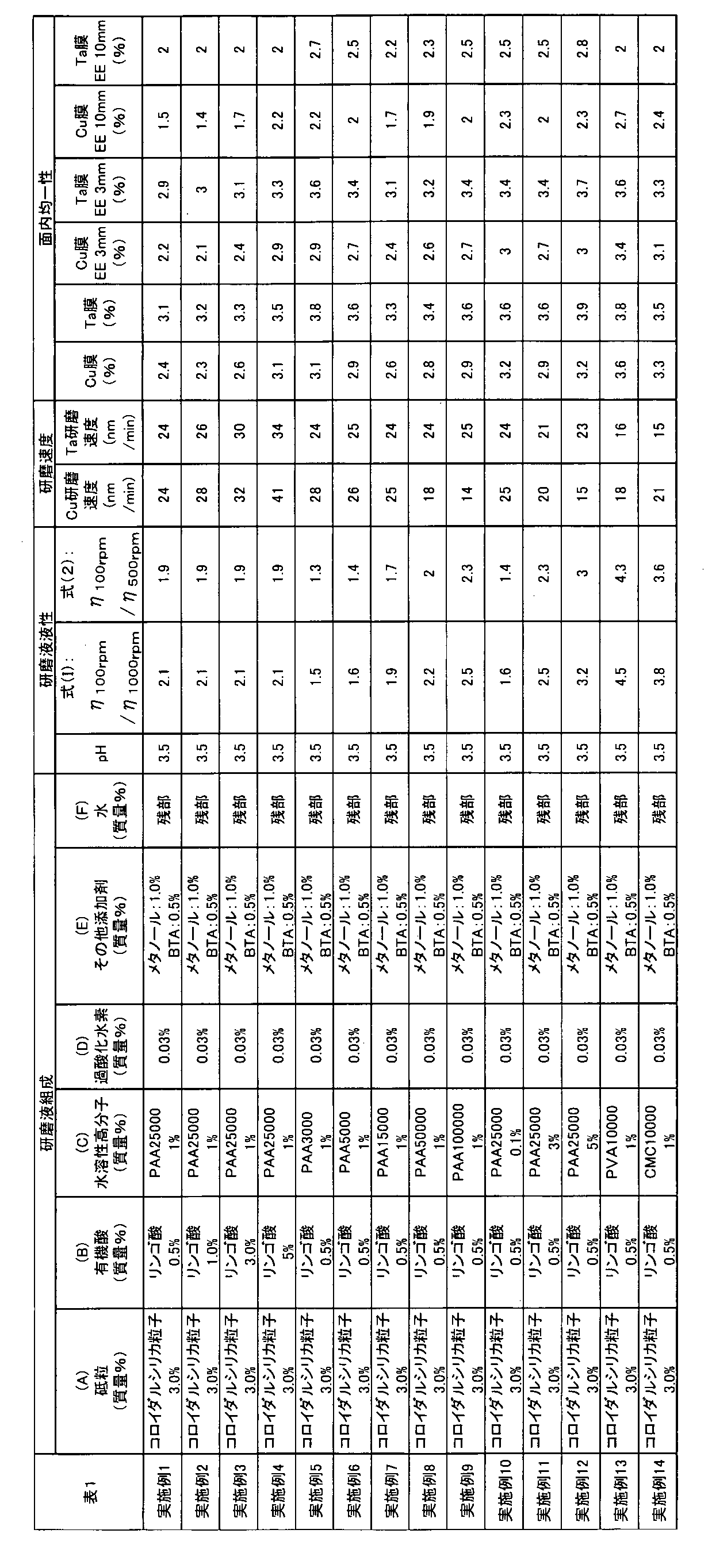
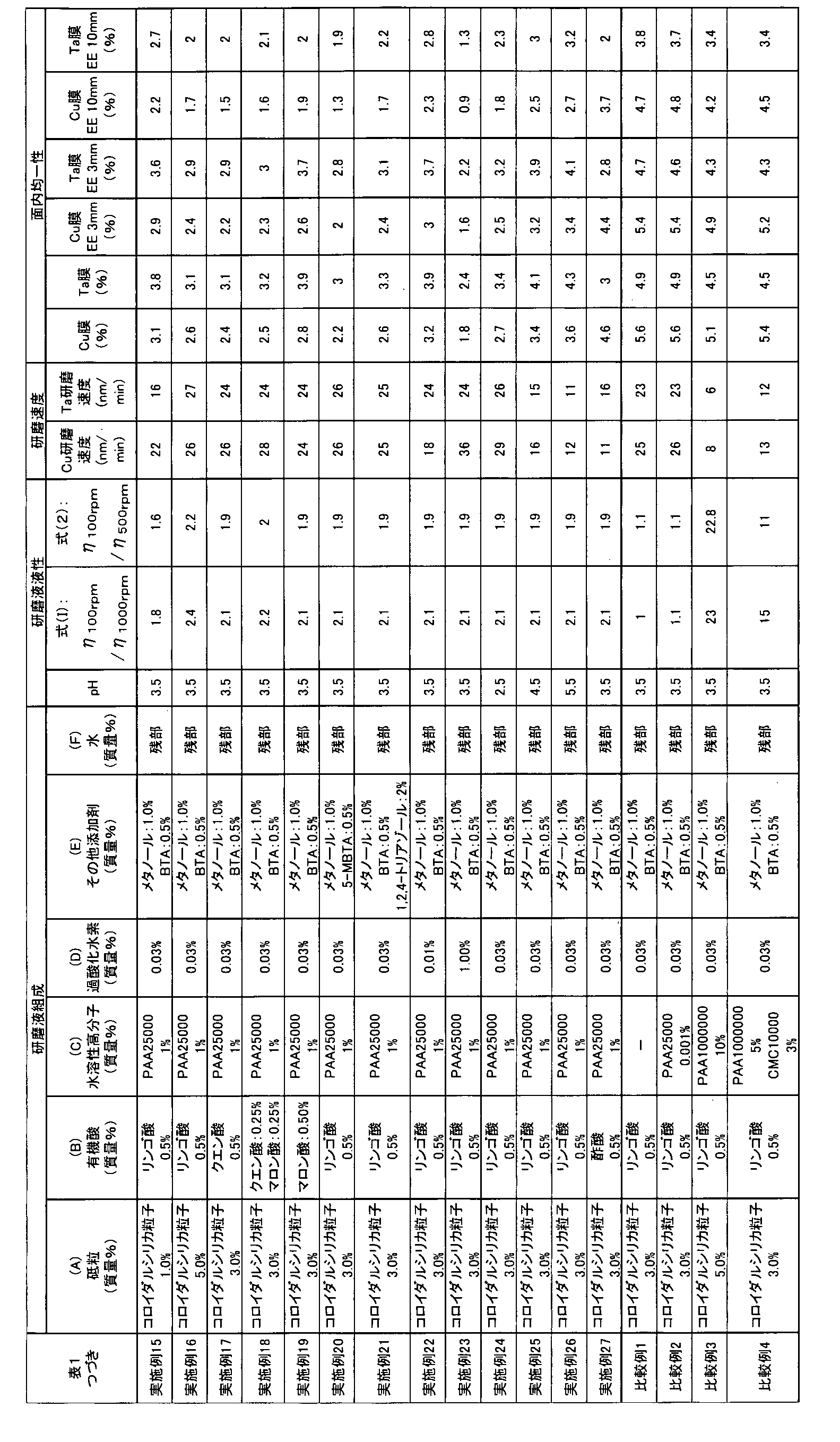
なかでも、実施例1、5~9の比較より、水溶性高分子の重量平均分子量が5000~100000の場合(好ましくは10000~50000、より好ましくは15000~30000)、面内均一性がより優れることが確認された。
実施例1、10~12の比較より、水溶性高分子の含有量が0.5~4質量%の場合、面内均一性がより優れることが確認された。
実施例1、15、16の比較より、砥粒の含有量が3質量%以上の場合、面内均一性がより優れることが確認された。
実施例1、22、23の比較より、酸化剤の含有量が0.03質量%以上の場合、面内均一性がより優れることが確認された。
実施例1、24~26の比較より、pHが2.0~5.0(好ましくは、2.0~4.0)の場合、面内均一性がより優れることが確認された。
実施例1~4の比較より、有機酸の含有量が3質量%以下の場合、研磨速度により優れ、また、特にCu膜に対してCMPをする際に、面内均一性がより優れることが確認された。
実施例1と、実施例13~14の比較により、水溶性高分子としてポリアクリル酸を用いた場合、特にCu膜に対してCMPをする際に、より面内均一性に優れることが確認された。
実施例27と、実施例1、実施例17~19との対比により、有機酸として、リンゴ酸、マロン酸又はクエン酸を用いた場合、特にCu膜に対してCMPをする際に、より面内均一性に優れることが確認された。
〔実施例28〕
下記に示す各成分を混合し、研磨液を調製した。なお研磨液のpHが表2に記載の値となるよう、希硫酸又は水酸化カリウムを適宜添加した。
セリア粒子(セリア砥粒分散液、二次粒径:350nm、日立化成工業株式会社製、製品名「GPXシリーズ」、pH8~9、砥粒に該当する。)
3.0質量%
・クエン酸(有機酸に該当する。) 0.5質量%
・PAA(Mw25000)(重量平均分子量25000のポリアクリル酸、水溶性高分子に該当する。) 1.0質量%
・4-アミノベンゼンスルホン酸(研磨促進剤に該当する。)2.0質量%
・水(超純水) 残部(質量%)
得られた実施例28の研磨液に対して、実施例1と同様に、回転粘度計による粘度測定を実施した。また、実施例1と同様に、研磨速度評価、及び、面内均一性評価を実施した。なお、研磨速度評価及び面内均一性評価については、被研磨体(ウエハ)を下記に示すブランケットウエハとし、また、非接触式の膜厚測定器を用いて研磨前後の膜厚を測定した。
シリコン基板上に厚み1.5μmのSiO2膜を形成した直径12インチのブランケットウエハ
結果を表2に示す。
各成分の配合量又はpHを換えた以外は上記実施例28と同様の方法により、実施例29~42、比較例5の研磨液を調製し、同様の評価を行った。結果を表2に示す。
なお、表2において、研磨液組成における各成分量(質量%)は、組成物全質量に対する量を意味する。また、表2で用いられる他の成分については、上記表1で示したものと同じである。

なかでも、実施例28~33の比較より、水溶性高分子の重量平均分子量が5000~100000の場合(好ましくは10000~50000、より好ましくは15000~30000)、面内均一性がより優れることが確認された。
実施例28、34~36の比較より、水溶性高分子の含有量が0.5~4質量%の場合、面内均一性がより優れることが確認された。
実施例28、37、38の比較より、砥粒の含有量が3質量%以上の場合、面内均一性がより優れることが確認された。
実施例28、40~42の比較より、pHが4.0~6.0の場合、面内均一性がより優れることが確認された。
一方、比較例の研磨液を用いた場合、面内均一性が所望の要求を満たしていなかった。
2 研磨パッド
Claims (11)
- 化学的機械的研磨に用いられる研磨液であって、
砥粒と、有機酸と、水溶性高分子と、を含有し、
下記式(1)~式(3)をいずれも満たす、研磨液。
式(1):1.5≦η100rpm/η1000rpm≦20
式(2):1.2≦η100rpm/η500rpm≦10
式(3):η100rpm/η1000rpm>η100rpm/η500rpm
式(1)~式(3)中、η100rpmは、40%RH、23℃において回転粘度計により回転数100rpmで測定される前記研磨液の粘度であり、η500rpmは、40%RH、23℃において回転粘度計により回転数500rpmで測定される前記研磨液の粘度であり、η1000rpmは、40%RH、23℃において回転粘度計により回転数1000rpmで測定される前記研磨液の粘度である。 - 前記水溶性高分子の重量平均分子量が、5000~100000である、請求項1に記載の研磨液。
- 前記水溶性高分子が、ポリアクリル酸、ポリメタクリル酸、並びに、ポリアクリル酸及びポリメタクリル酸の少なくとも1種を含有する共重合体よりなる群から選ばれる少なくともいずれか1種である、請求項1又は請求項2に記載の研磨液。
- 前記水溶性高分子の含有量が0.5~4質量%である、請求項1~3のいずれか1項に記載の研磨液。
- 前記有機酸が、コハク酸、リンゴ酸、マロン酸及びクエン酸よりなる群から選ばれる少なくともいずれか1種である、請求項1~4のいずれか1項に記載の研磨液。
- 更に、酸化剤を含有する、請求項1~5のいずれか1項に記載の研磨液。
- 前記酸化剤の含有量が、研磨液全質量に対して0.03質量%以上である、請求項6に記載の研磨液。
- 前記酸化剤が、過酸化水素である、請求項6または7に記載の研磨液。
- 砥粒の含有量が3質量%以上である、請求項1~8のいずれか1項に記載の研磨液。
- pHが、2.0~6.0の範囲である、請求項1~9のいずれか1項に記載の研磨液。
- 研磨定盤に取り付けられた研磨パッドに、請求項1~10のいずれか1項に記載の研磨液を供給しながら、被研磨体の被研磨面を前記研磨パッドに接触させ、前記被研磨体、及び前記研磨パッドを相対的に動かして前記被研磨面を研磨して研磨済み被研磨体を得る工程を含有する、化学的機械的研磨方法。
Priority Applications (3)
| Application Number | Priority Date | Filing Date | Title |
|---|---|---|---|
| JP2018523645A JP6761469B2 (ja) | 2016-06-22 | 2017-06-01 | 研磨液、化学的機械的研磨方法 |
| CN201780033060.5A CN109312211A (zh) | 2016-06-22 | 2017-06-01 | 研磨液、化学机械研磨方法 |
| KR1020187036008A KR102169835B1 (ko) | 2016-06-22 | 2017-06-01 | 연마액, 화학적 기계적 연마 방법 |
Applications Claiming Priority (2)
| Application Number | Priority Date | Filing Date | Title |
|---|---|---|---|
| JP2016123235 | 2016-06-22 | ||
| JP2016-123235 | 2016-06-22 |
Publications (1)
| Publication Number | Publication Date |
|---|---|
| WO2017221660A1 true WO2017221660A1 (ja) | 2017-12-28 |
Family
ID=60784228
Family Applications (1)
| Application Number | Title | Priority Date | Filing Date |
|---|---|---|---|
| PCT/JP2017/020409 Ceased WO2017221660A1 (ja) | 2016-06-22 | 2017-06-01 | 研磨液、化学的機械的研磨方法 |
Country Status (5)
| Country | Link |
|---|---|
| JP (1) | JP6761469B2 (ja) |
| KR (1) | KR102169835B1 (ja) |
| CN (1) | CN109312211A (ja) |
| TW (1) | TWI744337B (ja) |
| WO (1) | WO2017221660A1 (ja) |
Cited By (6)
| Publication number | Priority date | Publication date | Assignee | Title |
|---|---|---|---|---|
| JP2018199751A (ja) * | 2017-05-25 | 2018-12-20 | ニッタ・ハース株式会社 | 研磨用スラリー |
| JP2019131641A (ja) * | 2018-01-29 | 2019-08-08 | ニッタ・ハース株式会社 | 研磨用組成物 |
| JPWO2020255921A1 (ja) * | 2019-06-17 | 2020-12-24 | ||
| JP2021057093A (ja) * | 2019-09-30 | 2021-04-08 | 株式会社フジミインコーポレーテッド | 研磨用組成物 |
| JP2022512431A (ja) * | 2018-12-12 | 2022-02-03 | ビーエーエスエフ ソシエタス・ヨーロピア | 銅及びルテニウムを含有する基板の化学機械研磨 |
| CN114227527A (zh) * | 2020-09-09 | 2022-03-25 | 中国科学院微电子研究所 | 研磨试剂及其制备方法、化学机械研磨方法及其装置 |
Families Citing this family (2)
| Publication number | Priority date | Publication date | Assignee | Title |
|---|---|---|---|---|
| TWI906581B (zh) * | 2018-06-11 | 2025-12-01 | 德商巴斯夫歐洲公司 | 可移除氮化鈦的蝕刻後殘渣清理溶液 |
| CN109746771B (zh) * | 2019-02-14 | 2020-11-20 | 南京航空航天大学 | 一种CsPbX3无机钙钛矿晶体材料的抛光方法 |
Citations (3)
| Publication number | Priority date | Publication date | Assignee | Title |
|---|---|---|---|---|
| JP2008539581A (ja) * | 2005-04-28 | 2008-11-13 | テクノ セミケム シーオー., エルティーディー. | 高段差酸化膜の平坦化のための自動研磨停止機能を有する化学機械的研磨組成物 |
| JP2009105455A (ja) * | 2009-02-10 | 2009-05-14 | Hitachi Chem Co Ltd | 素子分離形成方法 |
| JP2010028081A (ja) * | 2008-02-18 | 2010-02-04 | Jsr Corp | 化学機械研磨用水系分散体およびその製造方法、ならびに化学機械研磨方法 |
Family Cites Families (8)
| Publication number | Priority date | Publication date | Assignee | Title |
|---|---|---|---|---|
| JPS5176078A (en) * | 1974-12-23 | 1976-07-01 | Hitachi Ltd | Handaboshokumakuo hodokoshita handotaisochi |
| KR100661273B1 (ko) * | 2005-04-28 | 2006-12-26 | 테크노세미켐 주식회사 | 고단차 산화막의 평탄화를 위한 화학기계적 연마조성물 |
| KR101406642B1 (ko) * | 2006-04-03 | 2014-06-11 | 제이에스알 가부시끼가이샤 | 화학 기계 연마용 수계 분산체 및 화학 기계 연마 방법, 및화학 기계 연마용 수계 분산체를 제조하기 위한 키트 |
| EP2071615B1 (en) * | 2006-10-06 | 2012-07-18 | JSR Corporation | Aqueous dispersion for chemical mechanical polishing and chemical mechanical polishing method for semiconductor device |
| WO2008095078A1 (en) * | 2007-01-31 | 2008-08-07 | Advanced Technology Materials, Inc. | Stabilization of polymer-silica dispersions for chemical mechanical polishing slurry applications |
| KR101563023B1 (ko) * | 2008-02-18 | 2015-10-23 | 제이에스알 가부시끼가이샤 | 화학 기계 연마용 수계 분산체 및 화학 기계 연마 방법 |
| JP5176078B2 (ja) | 2008-04-15 | 2013-04-03 | 日立化成株式会社 | 金属膜用研磨液及びこれを用いた研磨方法 |
| WO2013152894A1 (de) * | 2012-04-13 | 2013-10-17 | Boehringer Ingelheim International Gmbh | Zerstäuber mit kodiermitteln |
-
2017
- 2017-06-01 JP JP2018523645A patent/JP6761469B2/ja active Active
- 2017-06-01 CN CN201780033060.5A patent/CN109312211A/zh active Pending
- 2017-06-01 WO PCT/JP2017/020409 patent/WO2017221660A1/ja not_active Ceased
- 2017-06-01 KR KR1020187036008A patent/KR102169835B1/ko active Active
- 2017-06-14 TW TW106119744A patent/TWI744337B/zh active
Patent Citations (3)
| Publication number | Priority date | Publication date | Assignee | Title |
|---|---|---|---|---|
| JP2008539581A (ja) * | 2005-04-28 | 2008-11-13 | テクノ セミケム シーオー., エルティーディー. | 高段差酸化膜の平坦化のための自動研磨停止機能を有する化学機械的研磨組成物 |
| JP2010028081A (ja) * | 2008-02-18 | 2010-02-04 | Jsr Corp | 化学機械研磨用水系分散体およびその製造方法、ならびに化学機械研磨方法 |
| JP2009105455A (ja) * | 2009-02-10 | 2009-05-14 | Hitachi Chem Co Ltd | 素子分離形成方法 |
Cited By (13)
| Publication number | Priority date | Publication date | Assignee | Title |
|---|---|---|---|---|
| JP2018199751A (ja) * | 2017-05-25 | 2018-12-20 | ニッタ・ハース株式会社 | 研磨用スラリー |
| JP7002354B2 (ja) | 2018-01-29 | 2022-02-04 | ニッタ・デュポン株式会社 | 研磨用組成物 |
| JP2019131641A (ja) * | 2018-01-29 | 2019-08-08 | ニッタ・ハース株式会社 | 研磨用組成物 |
| US12351737B2 (en) | 2018-12-12 | 2025-07-08 | Basf Se | Chemical mechanical polishing of substrates containing copper and ruthenium |
| JP7504886B2 (ja) | 2018-12-12 | 2024-06-24 | ビーエーエスエフ ソシエタス・ヨーロピア | 銅及びルテニウムを含有する基板の化学機械研磨 |
| JP2022512431A (ja) * | 2018-12-12 | 2022-02-03 | ビーエーエスエフ ソシエタス・ヨーロピア | 銅及びルテニウムを含有する基板の化学機械研磨 |
| WO2020255921A1 (ja) * | 2019-06-17 | 2020-12-24 | 株式会社フジミインコーポレーテッド | 研磨用組成物 |
| EP3985078A4 (en) * | 2019-06-17 | 2023-08-02 | Fujimi Incorporated | Polishing composition |
| JP7667079B2 (ja) | 2019-06-17 | 2025-04-22 | 株式会社フジミインコーポレーテッド | 研磨用組成物 |
| JPWO2020255921A1 (ja) * | 2019-06-17 | 2020-12-24 | ||
| JP7368997B2 (ja) | 2019-09-30 | 2023-10-25 | 株式会社フジミインコーポレーテッド | 研磨用組成物 |
| JP2021057093A (ja) * | 2019-09-30 | 2021-04-08 | 株式会社フジミインコーポレーテッド | 研磨用組成物 |
| CN114227527A (zh) * | 2020-09-09 | 2022-03-25 | 中国科学院微电子研究所 | 研磨试剂及其制备方法、化学机械研磨方法及其装置 |
Also Published As
| Publication number | Publication date |
|---|---|
| TW201805399A (zh) | 2018-02-16 |
| TWI744337B (zh) | 2021-11-01 |
| JP6761469B2 (ja) | 2020-09-23 |
| JPWO2017221660A1 (ja) | 2019-04-25 |
| KR20190007025A (ko) | 2019-01-21 |
| CN109312211A (zh) | 2019-02-05 |
| KR102169835B1 (ko) | 2020-10-26 |
Similar Documents
| Publication | Publication Date | Title |
|---|---|---|
| KR102169835B1 (ko) | 연마액, 화학적 기계적 연마 방법 | |
| CN109312213B (zh) | 研磨液、化学机械研磨方法 | |
| JP5625044B2 (ja) | 化学的機械的研磨用スラリー | |
| TWI478227B (zh) | 用於基板之化學機械研磨之方法 | |
| CN101230238A (zh) | 金属抛光液和使用该金属抛光液的抛光方法 | |
| JP2009218539A (ja) | 金属用研磨液、及び化学的機械的研磨方法 | |
| WO2019187977A1 (ja) | 研磨液、化学的機械的研磨方法 | |
| KR102609113B1 (ko) | 연마액, 연마액의 제조 방법, 연마액 원액, 및 화학적 기계적 연마 방법 | |
| JP2010245091A (ja) | 化学的機械的研磨液及び研磨方法 | |
| WO2019181437A1 (ja) | 研磨液および化学的機械的研磨方法 | |
| JP2007214518A (ja) | 金属用研磨液 | |
| JP2011176208A (ja) | 化学的機械的研磨液及び研磨方法 | |
| KR20080020946A (ko) | 금속 연마 방법 | |
| JP5448396B2 (ja) | 金属用研磨液 | |
| JP2008251939A (ja) | 金属用研磨液及びそれを用いた研磨方法 | |
| JP2010045258A (ja) | 金属用研磨液、及び化学的機械的研磨方法 | |
| JP6652638B2 (ja) | 研磨液、及び化学的機械的研磨方法 | |
| JP2009088182A (ja) | 金属用研磨液及びそれを用いた研磨方法 | |
| JP2007194261A (ja) | 研磨方法 | |
| JP2009087967A (ja) | 金属用研磨液及び研磨方法 | |
| JP2012212723A (ja) | 研磨用組成物および研磨方法 | |
| JP2007242984A (ja) | 金属用研磨液、及び、化学的機械的研磨方法 | |
| JP2010073999A (ja) | 化学的機械的研磨液 | |
| JP2012253076A (ja) | 研磨用組成物および研磨方法 | |
| JP2007273642A (ja) | 金属用研磨液及びそれを用いた研磨方法 |
Legal Events
| Date | Code | Title | Description |
|---|---|---|---|
| ENP | Entry into the national phase |
Ref document number: 2018523645 Country of ref document: JP Kind code of ref document: A |
|
| 121 | Ep: the epo has been informed by wipo that ep was designated in this application |
Ref document number: 17815129 Country of ref document: EP Kind code of ref document: A1 |
|
| ENP | Entry into the national phase |
Ref document number: 20187036008 Country of ref document: KR Kind code of ref document: A |
|
| NENP | Non-entry into the national phase |
Ref country code: DE |
|
| 122 | Ep: pct application non-entry in european phase |
Ref document number: 17815129 Country of ref document: EP Kind code of ref document: A1 |